一(第 3 章)如下:
publicclass BasicSearchingTest extends LiaTestCase {
public void testTerm() throws Exception {
IndexSearcher searcher = new IndexSearcher(directory);
Term t = new Term(“subject”, “ant”);
Query query = new TermQuery(t);
Hits hits = searcher.search(query);
assertEquals(“JDwA”, 1, hits.length());
One hit expected for
search for “ant”
t = new Term(“subject”, “junit”);
hits = searcher.search(new TermQuery(t));
assertEquals(2, hits.length());
Two hits expected for “junit”
searcher.close();
}
}
当然, 我们将在之后解释这个测试用例中使用的 Lucene API。 现在我们只关注 JUnit 的细节。
testTerm 方法中的 directory 变量没在此类中定义。JUnit 提供一个在执行每个测试方法之前
的初始化钩子;这个钩子是名为 public void setUp()的方法。我们的 LiaTestCase 基类以这种
方式实现 setUp:
public abstract class LiaTestCase extends TestCase {
private String indexDir = System.getProperty(“index.dir”);
protected Directory directory;
protected void setUp() throws Exception {
directory = FSDirectory.getDirectory(indexDir, false);
}
}
如果 testTerm 中的第一个断言失败,我们会得到一个异常:
junit.framework.AssertionFalsedError: JDwA expected:<1> but was:<0>
at lia.searching.BasicSearchingTest.
→ testTerm(BasicSearchingTest.java:20)
这个失败指出我们的测试数据与预期的结果不同。
测试 Lucene
本书中的大部分测试都是测试 Lucene 本身的。实际上,这是否现实呢?难道要测的不是我
们自己写的代码而是库本身?有个 Test Driven Development 的姊妹篇是用来学习 API 的:
Test Driven Learning。它为新 API 写测试以了解它是如何工作以及你能从中得到什么时非常
有帮助。这正是我们在大部分代码示例中所做的,所以测试都是测试 Lucene 它本身。但是
不要把这些为学习而做的测试抛开。保留它们以确保你在升级到新版的 API 或因 API 改变
而重构时,它们能够保持真值。
模型对象
在一些用例中,我们使用模型对象来测试。模型对象用来作为探测器传入真实的业务逻辑,
以判断这个业务逻辑是否正常工作。例如,第 4 章中有个 SynonymEngine 接口(4.6 节) 。
7.
使用这个接口的真实业务逻辑是个分析器。当我们想测试这个分析器本身时,
SynonymEngine 使用什么类型就不重要,我们只想使用一个定义良好并有可预见行为的对
象。模型对象可以使得测试用例尽可能简单,这样它们每次只测试系统的一个方面,在测试
失败要修正什么错误时没有纠缠的依赖。 使用模型对象的一个好处来自于设计的变动, 例如
关系的分离和设计使用接口代替直接具体实现。
我们的测试数据
为了避免每个小节都要用完全不同的数据, 书中大部多都是围绕一组公共的示例数据以提供
一致性。这些示例数据由书籍详细资料组成。表 1 显示了这些数据,你可以参考它来理解我
们的例子。
表 1 本书中用到的示例数据
Title / Author Category Subject
A Modern Art of Education
Rudoif Steiner /education/pedagogy education philosophy
psychology practice Waldorf
Imperial Secrets of Health
and Logevity
Bob Flaws /health/alternative/Chinese diet chinese medicine qi
gong health herbs
Tao Te Ching 道德經
Stephen Mitchell /philosophy/eastern taoism
Gödel, Escher, Bach:
an Eternal Golden Braid
Douglas Hofstadter /technology/computers/ai artificial intelligence number theory mathematics
music
Mindstorms
Seymour Papert /technology/computers/programming/eduction children computers powerful
ideas LOGO eduction
Java Development with Ant
Erik Hatcher,
Steve Loughran /technology/computers/programming apache jakarta ant build tool
junit java development
JUnit in Action
Vincent Massol, Ted Husted /technology/computers/programming junit unit testing mock
objects
Lucene in Action
Otis Gospodnetic,
Erik Hatcher /technology/computers/programming lucene search
Extreme Programming
Explained
Kent Beck /technology/computers/programming/methodology extreme programming agile
test driven development
methodology
Tapestry in Action
Howard Lewis-Ship /technology/computers/programming tapestry web user interface
8.
components
The Pragmatic Programmer
DaveThomas, Andy Hunt /technology/computers/programming pragmatic agile methodology
developer tools
除了表中所显示的数据字段,还有 ISBN、URL 和出版日期。种类和标题字段是我们主观值,
但是另一些都是有关这些书的真实客观值。
代码约定和下载
列表和正文中的代码都以等宽字体的形式出现以与普通文本区分。在正文中 Java 方法名称
通常都不包含完整声明。
第一部分
Lucene 核心
本书的前半部分覆盖了“盒子外的” (嗯…,JAR 外的)Lucene。你将以整体的观点接触 Lucene
并开发一个完整的索引和搜索程序。每个后续的章节系统地深入研究特定的内容。 “索引”
数据和文档和后来的对它们的“搜索”是使用 Lucene 的第一步。在从索引过程返回后, “分
析”将使你深入理解在使用 Lucene 索引文本时发生了什么。搜索是 Lucene 真正的亮点:本
部分以仅使用内建特征的“高级搜索”技术结束, “扩展搜索”显示了 Lucene 针对定制目的
的扩展性。
第一章 接触 Lucene
本章包括
n 理解 Lucene
n 使用基本的索引 API
n 使用搜索 API
n 考虑可替换产品
Lucene 流行和成功的一个关键因素是它的简单。… …
1.1 信息组织和访问的演化
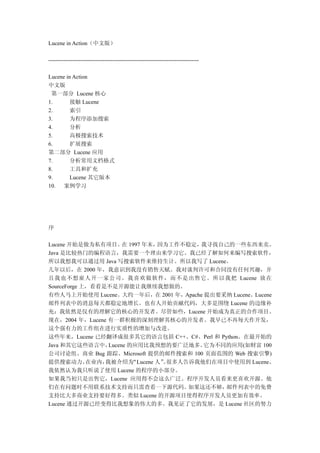
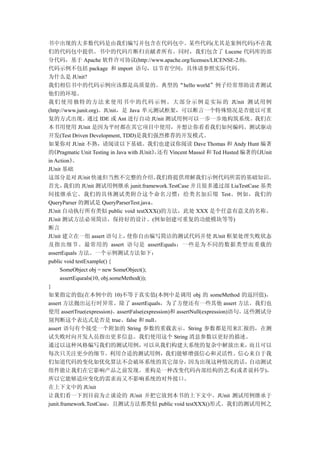
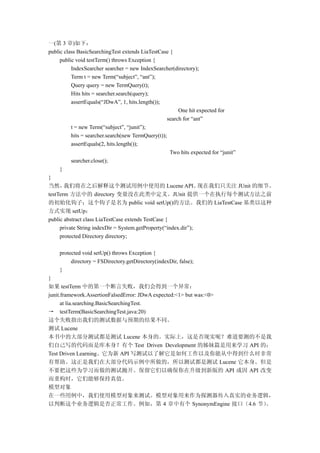
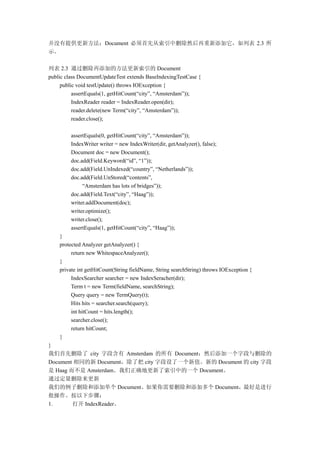
列表 1.1 Indexer:遍历文件系统并且索引.txt文件
/**
* This code was originally written for
* Erik’s Lucene intro java.net article
*/
public class Indexer {
public static void main(String[] args) throws Exception {
if (args.length != 2) {
throw new Exception(“Usage: java ” + Indexer.class.getName()
+ “ <index dir> <data dir>”);
}
File indexDir = new File(args[0]);
File dataDir = new File(args[1]);
long start = new Data().getTime();
int numIndexed = index(indexDir, dataDir);
long end = new Date().getTime();
System.out.println(“Indexing ” + numIndexed + “ files took ”
+ (end - start) + “ milliseconds”);
}
// open an index and start file directory traversal
public static int index(File indexDir, File dataDir)
throws IOException {
if (!dataDir.exists() || !dataDir.isDirectory()) {
throw new IOException(dataDir
+ “ does not exist or is not a directory”);
}
IndexWriter writer = new IndexWriter(indexDir, ① 创建 Lucene 索引
new StandardAnalyzer(), true);
writer.setUseCompoundFile(false);
indexDirectory(writer, dataDir);
int numIndexed = writer.docCount();
writer.optimize();
writer.close();
return numIndexed;
}
// recursive method that calls itself when it finds a directory
![1.2 理解 Lucene
不同的人使用不同的方法解决相同的问题—即信息超负荷问题。 一些人使用新的用户接口来
工作,一些使用智能代理,还有一些使用发展较为成熟的搜索工具如 Lucene。本章稍后我
们展示代码示例之前,我们将提供给你一张高层次的图来说明 Lucene 是什么,它不是什么
和它以后会变得怎样。
1.2.1 Lucene 是什么
Lucene 是一个高性能、可伸缩的信息搜索(IR)库。它使你可以为你的应用程序添加索引和搜
索能力。Lucene 是用 java 实现的成熟的、免费的开源项目,是著名的 Apache Jakarta 大家庭
的一员,并且基于在 Apache 软件许可 [ASF, License]。同样,Lucene 是当前与近几年内非
常流行的免费的 Java 信息搜索(IR)库。
注意 贯穿这本书,我们将使用术语 IR(Information Retrieval)来描述像 Lucene 这样的搜索
工具。人们常常将 IR 库归诸于搜索引擎,但是一定不要将 IR 库与 web 搜索引擎混为一谈。
正如你马上就会发现的,Lucene 提供了一组简单却足够强大的核心 API,只需要最小限度
地理解全文索引和搜索。你只须学习它的几个类从而把 Lucene 集成到一个应用程序中。因
为 Lucene 是一个 Java 库,它并不限定要索引和搜索的内容,这使得它比其它一些搜索程序
更具有优势。
刚接触 Lucene 的人经常把它误解为一个现成的程序,类似文件搜索程序或 web 网络爬行器
或是一个网站的搜索引擎。那些都不是 Lucene:Lucene 是一个软件库,一个开发工具包(如
果你想这样称呼),而不是一个具有完整特征的搜索应用程序。它本身只关注文本的索引和
搜索,并且这些事它完成的非常好。Lucene 使得你的应用程序只针对它的问题域来处理业
务规则,而把复杂的索引和搜索实现隐藏在一组简单易用的 API 之后。你可以把 Lucene 认
为成一层,应用程序位于它之上,如图 1.5 所示。
图 1.5 一个集成 Lucene 的典型应用
大量基于 Lucene 的完整的搜索程序已经构建出来。如果你正在寻找预创建的东西或是一个
抓 取 、 文 档 处 理 和 搜 索 的 框 架 , 请 参 考 Lucene Wiki 的 “ powered by ” 页
(http://wiki.apache.org/jakarta-lucene/PoweredBy)以获得更多选择:Zilverling、SearchBlox、
Nutch、LARM 和 jSearch,还有其它一部分的命名。Nutch 和 SearchBlox 的案例研究包含在
第 10 章。
1.2.2 Lucene 能做什么
Lucene 使你可以为你的应用程序添加索引和搜索能力(这些功能将在 1.3 节中描述)。Lucene
可以索引并能使得可以转换成文本格式的任何数据能够被搜索。在图 1.5 可以看出,Lucene
并不关心数据的来源、格式甚至它的语言,只要你能将它转换为文本。这就意味着你可经索
引并搜索存放于文件中的数据:在远程服务器上的 web 页面,存于本地文件系统的文档,
简单的文本文件,微软 Word 文档,HTML 或 PDF 文件或任何其它能够提取出文本信息的
格式。
同样,利用 Lucene 你可以索引存放于数据库中的数据,提供给用户很多数据库没有提供的](https://image.slidesharecdn.com/luceneinaction-100225200204-phpapp01/85/Lucene-In-Action-9-320.jpg)
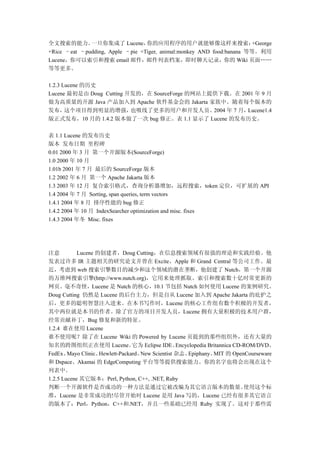
![列表 1.1 Indexer:遍历文件系统并且索引.txt 文件
/**
* This code was originally written for
* Erik’s Lucene intro java.net article
*/
public class Indexer {
public static void main(String[] args) throws Exception {
if (args.length != 2) {
throw new Exception(“Usage: java ” + Indexer.class.getName()
+ “ <index dir> <data dir>”);
}
File indexDir = new File(args[0]);
File dataDir = new File(args[1]);
long start = new Data().getTime();
int numIndexed = index(indexDir, dataDir);
long end = new Date().getTime();
System.out.println(“Indexing ” + numIndexed + “ files took ”
+ (end - start) + “ milliseconds”);
}
// open an index and start file directory traversal
public static int index(File indexDir, File dataDir)
throws IOException {
if (!dataDir.exists() || !dataDir.isDirectory()) {
throw new IOException(dataDir
+ “ does not exist or is not a directory”);
}
IndexWriter writer = new IndexWriter(indexDir, ① 创建 Lucene 索引
new StandardAnalyzer(), true);
writer.setUseCompoundFile(false);
indexDirectory(writer, dataDir);
int numIndexed = writer.docCount();
writer.optimize();
writer.close();
return numIndexed;
}
// recursive method that calls itself when it finds a directory](https://image.slidesharecdn.com/luceneinaction-100225200204-phpapp01/85/Lucene-In-Action-12-320.jpg)
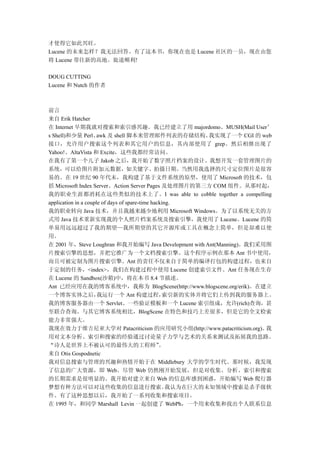
![private static void indexDirectory(IndexWriter writer, File dir)
throws IOException {
File[] files = dir.listFiles();
for (int i = 0; i < files.length; i++) {
File f = files;
if (f.isDirectory()) {
indexDirectory(writer, f); ② 递归
} else if (f.getName().endsWith(“.txt”)) {
indexFile(writer, f);
}
}
}
// method to actually index file using Lucene
private static void indexFile(IndexWriter writer, File f)
throws IOException {
if (f.isHidden() || !f.exists() || !f.canRead()) {
return;
}
System.out.println(“Indexing ” + f.getCanonicalPath());
Document doc = new Document();
doc.add(Field.Text(“contents”, new FileReader(f)));③ 索引文件
内容
doc.add(Field.Keyword(“filename”, f.getCannicalPath()));④ 索引
文件名称
writer.addDocument(doc); ⑤ 添加片段到 Lucene 索引
}
}
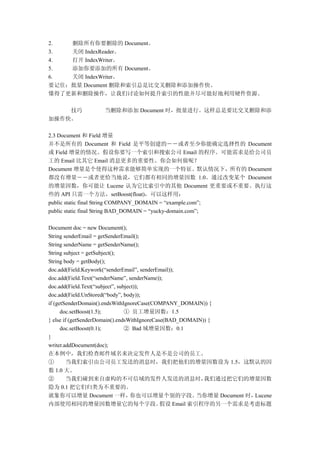
有趣的是,代码的大部分是执行目录的遍历(②)。只有 IndexWriter 的创建和关闭(①)和
IndexFile 方法中的四行(③,④,⑤)使用了 Lucene API—有效的 6 行代码。
这个示例只关注.txt 扩展名的文本文件是为了在说明 Lucene 的用法和强大功能时保持尽量
简单。在第 7 章,我们将向你展示如何处理非文本文件,并且我们开发了一个现成的小框架
来分析和索引几种常见的格式的文档。
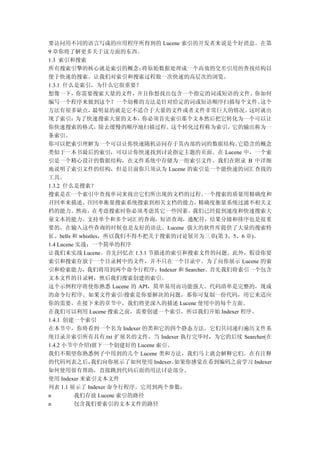
运行 Indexer
在命令行中, 我们针对包含 Lucene 本身的源文件的本地工作目录运行 Indexer。我们使 Indexer
索引/lucene 目录下的文件并将 Lucene 索引保存在 build/index 目录中。
% java lia.meetlucene.Indexer build/index /lucene
Indexing /lucene/build/test/TestDoc/test.txt
Indexing /lucene/build/test/TestDoc/test2.txt
Indexing /lucene/BUILD.txt](https://image.slidesharecdn.com/luceneinaction-100225200204-phpapp01/85/Lucene-In-Action-13-320.jpg)
![/**
* This code was originally written for
* Erik’s Lucene intro java.net article
*/
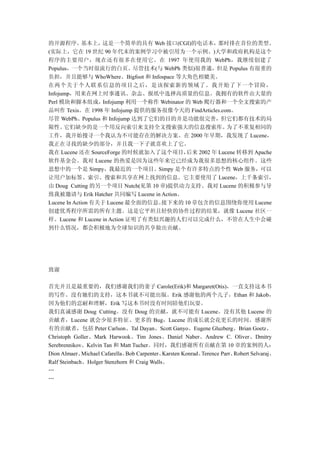
public class Searcher {
public static void main(String[] args) throws Exception {
if (args.length != 2) {
throw new Exception(“Usage: java ” + Searcher.class.getName()
+ “ <index dir> <auery>”);
}
File indexDir = new File(args[0]);
String q = args[1];
if (!indexDir.exists() || !indexDir.isDirectory()) {
throw new Exception(indexDir +
“ does not exist or is not a directory.”);
}
search(indexDir, q);
}
public static void search(File indexDir, String q)
throws Exception {
Directory fsDir = FSDirectory.getDirectory(indexDir, false);
IndexSearcher is = new IndexSearcher(fsDir); ① 打开索引
Query query = QueryParser.parse(q, “contents”, ② 分析查询
new StandardAnalyzer());
long start = new Date().getTime();
Hits hits = is.search(query); ③ 搜索索引
long end = new Date().getTime();
System.err.println(“Found ” + hits.length() +
“ document(s) (in ” + (end - start) +
“ milliseconds) that matched query ‘” +
q + “’:”);
for (int i = 0; i < hits.length(); i++) {
Document doc = hits.doc(i); ④ 得到匹配的文档
System.out.println(doc.get(“filename”));
}
}
}
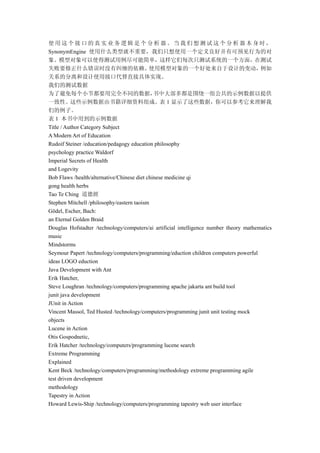
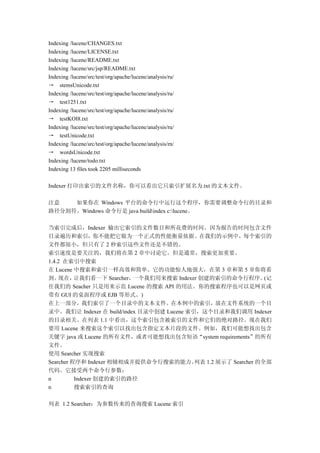
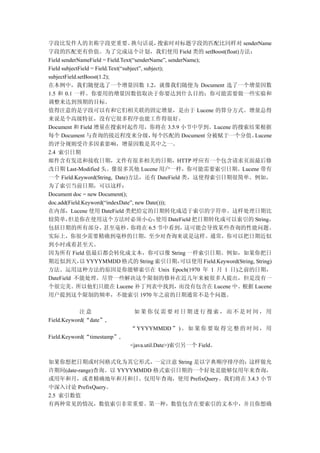
Searcher 类似于 Indexer,只有几行代码与 Lucene 相关。在 search 方法中出现了几种特别的
事物,
① 我们使用 Lucene 的 IndexSearcher 和 FSDirectory 类来打开我们的索引以进行搜索。](https://image.slidesharecdn.com/luceneinaction-100225200204-phpapp01/85/Lucene-In-Action-15-320.jpg)
![可选择的操作。例如,单词可以在索引之前转化为小写,以保证搜索是大小写无关的。典型
的,它也有可能排除转入中所有经常出现但无意义的词,例如英语终止词(a, an, the, in, on
等等)。类似的,通常分析输入单词以获取它的本质。
这个非常重要的步骤称为分析。Lucene 的输入能够以很多有趣且有用的方法进行分析,所
以我们将在第 4 章详细分析这个过程。目前,把这个步骤想像为一个过滤器。
2.1.3 写索引
在输入被分析完后,就可以添加到索引中了。Lucene 将输入存储在一个反向索引的数据结
构中。 这个数据结构在允许快速关键字查询的同时有效地利用了磁盘空间。 这个结构反向是
因为它使用从输入中提取的单词做为查询键值而不是用处理的文档做为中枢入口。换句话
说,代替尝试回答这个问题“这个文档中含有哪些单词?” ,这个结构为提供快速回答“哪
篇文档含有单词 X?”做了优化。
如果你想一下你常用的 Web 搜索引擎和你典型的查询格式,你会发现你想得到的精确的查
询。当今所有的 Web 搜索引擎的核心都是反向索引。使得各搜索引擎不同的是一组严格保
密的附加参数来改进这个索引结构。例如 Goolge 知名的级别(PageRank, PR)因素。Lucene
也有它自己的一套技术,你可以在附录 B 中学到其中一些。
2.2 基本索引操作
在第 1 章中,你看到了如何向索引中添加文档。但是我们将在此总结这个过程,同时描述删
除和更新操作,以给你一个方便的参数点。
2.2.1 向索引中索加文档
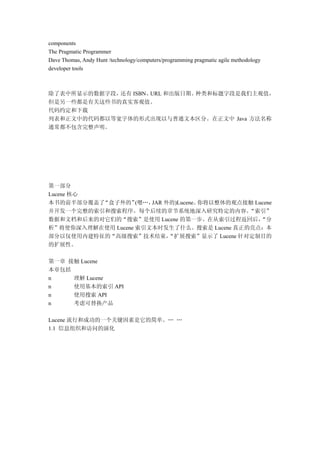
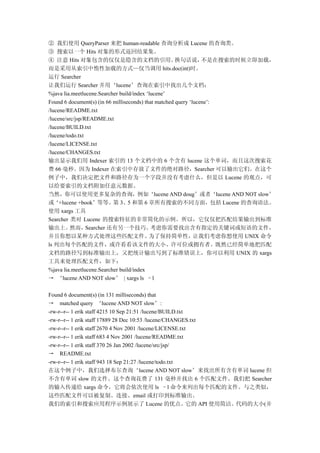
为了总结你已知的,让我们来看一下在本章中作为单元测试基类的代码片断。代码列表 2.1
创建一个复合的索引称做 index-dir(索引目录),存储于系统临时目录:UNIX 的/tmp,或使
用 Windows 的 C:TEMP。(复合索引在附录 B 中描述)我们使用 SimpleAnalyzer 来分析输入
文本,然后我们索引两个简单的 Document,每个都包含四种类型的 Field:Keyword、
UnIndexed、UnStored 和 Text。
列表 2.1 在基本测试类的每个测试之前准备一个新的索引
public abstract class BaseIndexingTestCase extends TestCase {
protected String[] keywords = {“1”, “2”};
protected String[] unindexed = {“Netherlands”, “Italy”};
protected String[] unstored = {“Amsterdam has lots of bridges”, “Venice has lots of canals”};
protected String[] text = {“Amsterdam”, “Venice”};
protected Directory dir;
protected void setUp() throws IOException {
String indexDir =
System.getProperty(“java.io.tmpdir”, “tmp”) +
System.getProperty(“file.separator”) + “index-dir”;
dir = FSDirectory.getDirectory(indexDir, true);
addDocuments(dir);
}
protected void addDocuments(Directory dir)
throws IOException {
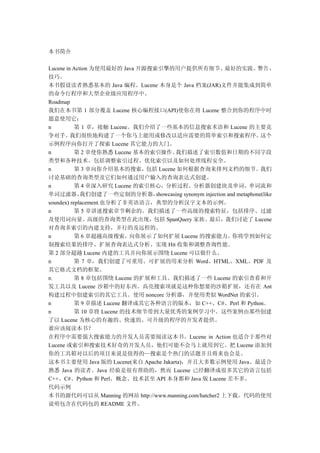
IndexWriter writer = new IndexWriter(dir, getAnalyzer(), true);](https://image.slidesharecdn.com/luceneinaction-100225200204-phpapp01/85/Lucene-In-Action-23-320.jpg)
![writer.setUseCompoundFile(isCompound());
for (int i = 0; i < keywords.length; i++) {
Document doc = new Document();
doc.add(Field.Keyword(“id”, keywords));
doc.add(Field.UnIndexed(“country”, unindexed));
doc.add(Field.UnStored(“contents”, unstored));
doc.add(Field.Text(“city”, text));
writer.addDocument(doc);
}
writer.optimize();
writer.close();
}
protected Analyzer getAnalyzer() {
return new SimplyAnalyzer();
}
protected boolean isCompound() {
return true;
}
}
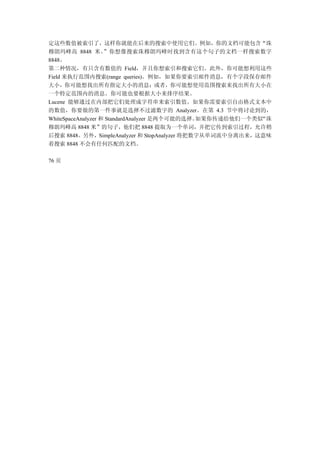
因为 BaseIndexingTestCase 类要被本章的其它单元测试类继承, 我们将指出几个重要的细节。
BaseIndexingTestCase 每次 setUp()方法调用时创建相同的索引。 因为 setUp()在测试执行之前
被调用,每个测试都是针对新创建的索引运行。尽管基类使用 SimpleAnalyzer,子类可以覆
盖 getAnalyzer()方法以返回不同的 Analyzer 类型。
不同的 Document
Lucene 的一个重要特征是它允许有不同 Field 的 Document 在同一索引中共存。这就意味着
你可以用一个索引来保存代表不同实体的 Document。例如,你可以存放代表零售产品,有
名称和价格字段的 Document 和代表 people,有名称、年龄和性别字段的 Document。
附加字段
假设你有个生成给定单词的同意词数组的程序,并且你想用 Lucene 来索引基本词和所有它
的同意词。实现的一个方法是遍历所有的同意词并把它们添加到一个 String 中,然后你可以
用它来创建 Lucene 字段。索引所有同意词和基本词另一个方法可能是更好的方法是把不同
的值添加到相同的字段,如下:
String baseWord = “fast”;
String synonyms[] = String {“quick”, “rapid”, “speedy”};
Document doc = new Document();
doc.add(Field.Text(“word”, baseWord));
for (int i = 0; i < synonyms.length; i++) {
doc.add(Field.Text(“word”, synonyms));
}
其中,Lucene 添加所有的单词并把它们索引在同一个字段 word 中,允许你在搜索时使用其
中任何一个。
2.2.2 在索引中清除 Document
尽管大多程序关心的是添加 Document 到 Lucene 索引中,一些也需要清除它们。例如,报](https://image.slidesharecdn.com/luceneinaction-100225200204-phpapp01/85/Lucene-In-Action-24-320.jpg)


![Lucene 3[1] 0 原理与代码分析](https://cdn.slidesharecdn.com/ss_thumbnails/lucene31-0-100225194736-phpapp02-thumbnail.jpg?width=640&height=640&fit=bounds)


