TABOO LANGUAGE of the
WORKING CLASS in the
UNITED KINGDOM*
*UNSKILLED AND SEMI-SKILLED WORKING CLASS
ZARKO SIBALIJA
Purpose of the Research Paper and
Research Question
 - to investigate the relationship between the working class in the United Kingdom
and taboo language
 - in order to find out whether there are particular terms used mostly by the members
of this class
 - so the results of the research can potentially reveal to what extent social class
affects language in everyday communication
Structure of the Research Paper
 1. INTRODUCTION
 1.01. TABOO LANGUAGE
 - something proscribed by society as improper or unacceptable
(dictionary.reference.com, 2012)
 - first recorded in 1777 in A Voyage to the Pacific Ocean by James Cook
 1.02. WORKING CLASS IN THE UNITED KINGDOM
 - unskilled and semi-skilled working class
 - manual labourers: assembly lines in car factories, steel mills, coal mines,
foundries and even call centres
Structure of the Research Paper
2. LITERATURE REVIEW
 - various works from the fields of linguistics, sociology and cultural studies
 - Lars Andersson and Peter Trudgill Bad Language (1990)
 - Tony McEnery Swearing in English. Bad Language, Purity and Power from
1586 to the Present (2006)
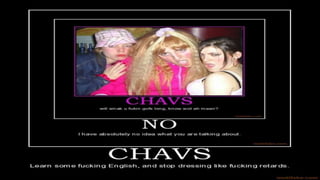
 - Owen Jones Chavs: The Demonization of the Working Class (2011)
 - Skins (2007-2013), Misfits (2009-2013); Channel Four Television Corporation
Structure of the Research Paper
 3. RESEARCH METHODOLOGY
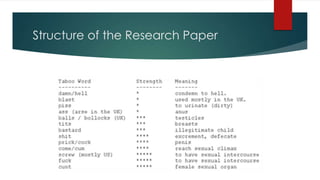
 - the first part will entail collecting and choosing a certain number of
taboo words and phrases from two British television shows Skins and Misfits
 - data will be classified into the categories of very strong taboo words or
phrases, strong, moderate and mild taboo words or phrases
 - selected and categorized terms will be individually typed into the British
National Corpus (BNC)
 - DE- lower working class; C2- upper working class; the BNC standard
Structure of the Research Paper
 4. RESULTS AND ELABORATIONS
 - to what extent social class affects language in everyday communication
 5. CONCLUSION
Progress so far
 - extensive reading of the primary and secondary sources
 - collecting and choosing data
 THANK YOU FOR YOUR ATTENTION !!!
Thesis Writing

Thesis Writing

  • 1.
    TABOO LANGUAGE ofthe WORKING CLASS in the UNITED KINGDOM* *UNSKILLED AND SEMI-SKILLED WORKING CLASS ZARKO SIBALIJA
  • 2.
    Purpose of theResearch Paper and Research Question  - to investigate the relationship between the working class in the United Kingdom and taboo language  - in order to find out whether there are particular terms used mostly by the members of this class  - so the results of the research can potentially reveal to what extent social class affects language in everyday communication
  • 3.
    Structure of theResearch Paper  1. INTRODUCTION  1.01. TABOO LANGUAGE  - something proscribed by society as improper or unacceptable (dictionary.reference.com, 2012)  - first recorded in 1777 in A Voyage to the Pacific Ocean by James Cook  1.02. WORKING CLASS IN THE UNITED KINGDOM  - unskilled and semi-skilled working class  - manual labourers: assembly lines in car factories, steel mills, coal mines, foundries and even call centres
  • 4.
    Structure of theResearch Paper 2. LITERATURE REVIEW  - various works from the fields of linguistics, sociology and cultural studies  - Lars Andersson and Peter Trudgill Bad Language (1990)  - Tony McEnery Swearing in English. Bad Language, Purity and Power from 1586 to the Present (2006)  - Owen Jones Chavs: The Demonization of the Working Class (2011)  - Skins (2007-2013), Misfits (2009-2013); Channel Four Television Corporation
  • 5.
    Structure of theResearch Paper  3. RESEARCH METHODOLOGY  - the first part will entail collecting and choosing a certain number of taboo words and phrases from two British television shows Skins and Misfits  - data will be classified into the categories of very strong taboo words or phrases, strong, moderate and mild taboo words or phrases  - selected and categorized terms will be individually typed into the British National Corpus (BNC)  - DE- lower working class; C2- upper working class; the BNC standard
  • 6.
    Structure of theResearch Paper
  • 7.
    Structure of theResearch Paper  4. RESULTS AND ELABORATIONS  - to what extent social class affects language in everyday communication  5. CONCLUSION
  • 8.
    Progress so far - extensive reading of the primary and secondary sources  - collecting and choosing data  THANK YOU FOR YOUR ATTENTION !!!