Kids Get Fit: A Non-Sport Based Alternative to Improve Elementary Children’s Fitness
An Honors Thesis (HONR 499)
by
Kimberly Forsythe
Dr. Jason Powell
Mrs. Nicole Koontz
Ball State University
Muncie, Indiana
April 2015
Expected Date of Graduation
May 2015
Abstract
The obesity rate in children continues to rise in America despite the vast knowledge
that is available on how to prevent and reverse obesity. As a result, the number of
children and adults that suffer from obesity-related complications, like Type II
Diabetes, continues to rise as well. To add to the problem, physical education classes
are being cut from schools, sports are becoming more expensive to participate in,
and more families are eating out and on the go. To combat this issue, I have created
“Kids Get Fit”, an afterschool program designed to educate and improve the health
of the entire family, with a focus on children in third through sixth grade. Children
who are not able or do not wish to participate in sports would be able to increase
their daily activity by participating in this program. The children will read a story
about a child just like them who struggles with making healthy choices, participate
in many types of group fitness activities and games, and learn about what it is like to
make healthy decisions. Parents will stay connected with one another by engaging
in an online blog and reading a monthly newsletter. The goal of the program is to
instill healthy habits that will be kept for a lifetime.
Acknowledgements
I would like to thank Mrs. Nicole Koontz for inspiring me to create this project and
advising me throughout the process. Her knowledge of fitness across the lifespan
and her desire to help improve fitness have been huge assets to me while working
on this project. She has been my professor and mentor for a number of years and
has helped me in many ways beyond what this project encompasses.
I would also like to thank Dr. Jason Powell for helping me to think “outside of the
box” and bring this project to life. His creative mind and philosophical expertise
allowed me to bring this project to another level. He has encouraged and supported
me not only during this project, but for a majority of my college experience.
Lastly, I would like to thank Jessica Maxwell for partnering with me and illustrating
all of the pictures for Exercising Ellie. Your artistic skills are greatly appreciated.
Table of Contents
Paper……………………………………………………………………………………………………………… 4
Works Cited…………………………………………………………………………………………………….16
Example Pre-Participation Form .…………………………………………………………………….17
Example Blog Posts …………………………………………………………………………………………18
Example Parent Newsletters ……………………………………………………………………………19
3-Month Calendar of Activities …………………………………………………………………………21
Story: Exercising Ellie …………………………………………………………………………………………...23
Doctors and other health professionals are able to determine that a person is
overweight or obese by calculating his or her body mass index. Body mass index is
determined from a person’s height and weight. A body mass index of 25.0-29.9 is
considered overweight and 30.0 or greater is considered obese. Research shows us
that more and more adults in the United States are overweight and obese
(Childhood Overweight and Obesity Trends, 2014). These trends continue despite
adults now knowing more about the chronic effects of being overweight and obese.
There are many speculations as to why this is. I think that our fast-paced lifestyle is
a main contributor to this phenomenon. Most of our children do not experience the
same kind of home-cooked meals every day like our grandparents would have had.
Fast food is conveniently available and often chosen many times a week. For adults,
there are many more office jobs being filled than factory jobs, meaning more adults
are sedentary most of the day. Many times it takes years for a person to notice that
his or her weight has gotten out of hand and by that point the chronic medical
consequences have already taken effect. In my opinion, the best way to reverse the
trend is to instill good habits into our children. The importance someone places on a
healthy diet and exercise as a child or young adult is very likely to be carried into
adulthood. My goal through the “Kids Get Fit” program is to create a lifestyle change
in our children and families that will become lifelong habits, drastically reducing the
number of children and adults who suffer from complications from being
overweight or obese.
It may not seem intuitive that a fast-paced lifestyle is a main cause of obesity.
However, the on-the-go lifestyle leads to a diet that is high in fat and sodium and
lack of exercise. In order for activity to be considered exercise, it must be planned
and repetitive. The American College of Sports Medicine recommends that all adults
exercise for thirty minutes a day three to five days per week. Many times our busy
lifestyles do not seem very conducive to this. Poor diet and inactivity are the leading
causes of being overweight or obese. More uncommon causes can be heredity and
medications. Being overweight or obese can then lead to acquiring Type 2 Diabetes,
the number 7 killer of American adults (Statistics About Diabetes, 2014). It is a very
slippery slope that so many young children are heading down and never being able
to recover from.
According to the Center for Disease Control, obesity plagues 17% of children,
three times the rate in children just one generation ago (Childhood Obesity Facts,
2014); approximately 22% of children are overweight as well. According to the
American Diabetes Association, over 200,000 American children have been
diagnosed with Diabetes (Statistics About Diabetes, 2014). More children are
diagnosed with Type 2 Diabetes, which in prior years had been known more as
“adult-onset Diabetes.” These statistics are very strongly correlated and are rising
each year. According to Diabetic Care Services, 80-90% of people who have been
diagnosed with Type 2 Diabetes are also obese (A Codependent Relationship:
Diabetes and Obesity). Being overweight or obese, having a high fat distribution in
the abdomen, and inactivity are some of the primary risk factors for acquiring Type
2 Diabetes, according to the Mayo Clinic (Mayo Clinic Staff, July 2014). My program
specifically addresses these three main risk factors.
Although Diabetes is one of the top complications that can arise from being
overweight or obese, there are a number of other complications (Mayo Clinic Staff,
May 2014). The Mayo Clinic lists nearly fifteen serious health problems that can
arise from obesity. Some of the issues include metabolic syndrome, heart disease,
stroke, cancer, breathing disorders, and osteoarthritis. The quality of life of an obese
individual can also be lower because of other emotional issues, including
depression, shame, and social isolation. Obesity is a very serious issue that many
Americans face. My hope is that through my program and many other programs of
its kind, we can cultivate a generation of young children who are aware of how their
choices about diet and exercise can affect them for the rest of their lives.
These statistics are not news to anyone. Gyms are packed with people who
are trying to lose weight. Every year there are new fad diets that thousands of
people are trying. The number one New Year’s resolution every year is to lose
weight. We are very aware of the issue and many people take the initial steps to try
and fix it. The biggest issue is that most people give up after a short amount of time.
They do not see the results they want fast enough or it is just too difficult to
maintain the self-control for an extended amount of time. Those habits have been
set and have been that way for years, maybe even decades. If adults are aware and
understand the complications of obesity and are not prioritizing making a change,
how can we expect anything to change for our children? This is the primary reason
why this program not only gets the kids active, but also provides resources and
accountability for the parents. This program is designed to help the family as a
whole make lifestyle changes that will benefit every member of the family and instill
healthy habits in the children that will carry on for a lifetime.
In addition to the change in diet that children of the twenty first century have
experienced, fewer children are intentionally participating in something that keeps
them active. With schools receiving less funding, many physical education classes
have been cut and sports are very expensive to participate in; also, not all children
are interested in playing sports. Some children are not coordinated and sports may
actually be a source of anxiety. Therefore, even if sports were readily available to
them, not all children want to play. This program would not require a lot of
equipment and could be done in almost any type of room. It is much more group
fitness and game based, not skill based. Activities like Zumba or dance are all done
at once and there is no need to perfect the skill, therefore the likelihood of bullying
is much lower. My hope is that the children not interested in playing sports would
be drawn to an activity like this.
The problem of childhood obesity is very important to me because I was
overweight as a child. I remember consuming many snacks and desserts, adding
hundreds of extra calories to my daily diet. I played sports, but I felt like I was
always one of the slowest kids. I was raised by my single mom who worked full-time
for most of my childhood. My sister and I were involved in many activities after
school so there were many days I would go straight from school to daycare to a
practice and not be home until 8 or 9 at night. We ate on-the-go a lot and lacked
daily fruits and vegetables at meals. By the time I got to high school, I weighed about
40 pounds over what a healthy weight would have been for my height. Around that
time, I started to realize that I could not continue making the same food choices that
I had been making for most of my life. It was not until I joined show choir my
sophomore year and spent two hours a day dancing for many months that my
weight started to get under control. By my senior year of high school, I was within a
healthy weight range. This change did not come overnight and it involved breaking a
lot of life-long habits that I developed very early on. Even as a college student, I still
struggle with binge eating on high sugar snacks, but I am much more aware of how
my food choices affect my health now and in the future.
My goal through this program is to create healthy life-long habits in children.
I was never bullied or made fun of for my weight, but I had low self-esteem when it
came to how my body looked in comparison to the other children my age. Shopping
for any type of clothing was not an activity I looked forward to. I automatically had
to look to the back of the rack for the biggest size in the junior department and this
was not something I was proud of. I want to help other children who struggle with
weight management and making good food choices. Childhood obesity is strongly
linked with adult obesity and the longer the problem goes unfixed, the more difficult
it will be to eradicate in adulthood.
This project combines two of my biggest passions – kids and health/fitness. I
will be the first to tell you that I am still not great at making good food choices every
day and sometimes I have to drag myself to the gym. However, in my future career
as a physical therapist, improving quality of living is something that is of utmost
importance for me with every one of my future patients. Health and fitness are large
components of quality of living in the future. The better that we take care of our
bodies now, the stronger and more resilient they will be in the future.
I believe that if we can show children how exercising can be fun and healthy
foods can be tasty too, they will be more likely to make these decisions on their own.
The statistics are important, but they mean nothing to children. However, the fact is
that the parents provide most meals. We must also educate parents and show them
how to make this a family effort. I want to provide easy, hassle free healthy meal
options and a support system.
When I first started thinking about this project and what exactly I wanted to
design I wondered why it is that people like to exercise. After all, like I stated earlier,
it is the number one New Year’s resolution each year. Gyms are packed the first
week of January but after a month the gyms are back to their normal number of
people. Why is exercising and staying healthy so difficult to stick with? And what
makes some people successful at it? I was brought back to an Honors class I took
where we studied what it means for humans to be happy. I was reminded of a
particular quote by Michael Novak in The Experience of Nothingness that says: “The
happiness that all men claim to seek is not to be conceived of as a psychological
state of contentment, an excess of pleasure over pain, an inner equilibrium or peace,
a sense of satisfaction, a comfortable middle-of-the-road avoidance of conflict and
disorder. On the contrary, happiness (eudaimonia) is activity; it is to act to the
fullest of one’s capacities. In Aristotle’s view action comes first. The feeling of
pleasure or satisfaction is secondary, a sort of overflow that may or may not be
present. To be happy is not to do little, to be passive, to be content; it is to act, and to
act well. Indeed, eudaimonia is to be translated as well acting.” Essentially he says
that happiness is action. Even though we all enjoy a good Netflix binge and
mindlessly getting lost in some type of “screen activity,” we are most truly happy
when we are doing something. Exercising and eating well fulfill some of our deepest
desires to be happy and do well. In addition, when we exercise we are usually in
some type of group setting. A group of people working toward a common goal and
encouraging each other along the way is a very powerful thing. People give up and
stop trying to be healthy when they do not see results right away. Through the
program, Kits Get Fit, I hope that kids will truly be happy participating in my
program and will build a sense of community and accomplishment. If the kids that
participate in my program can equate exercise with happiness, I believe that they
will be much more likely to continue into the future.
The idea for my program came from a book that was introduced to me called
“Henry Gets Moving,” written by Pierre Rouzier and Chaz Nielsen and illustrated by
Catherine Lazar Odell. The premise for this book is that children will relate with
Henry the Hamster who is obese and cannot keep up with his friends. He goes to the
doctor who tells him that he needs to eat better and exercise more. Henry takes the
advice, and together with his parents, they start making better decisions about diet
and exercise. After a little time, he loses weight, is not so sluggish, and better able to
keep up with his friends. Henry learns that losing the weight actually makes him feel
better. Throughout the book, there is a little worm that appears on sporadic pages.
When the kids see the worm, they are supposed to wiggle and squirm. This keeps
them engaged in the story, but also teaches them the importance of movement.
There are teaching packets that go with the book and many times speakers are also
brought in to talk to the kids in addition to reading the book.
My favorite part of this book is that it really educates and informs children in
a way that they can understand. Children love to imitate and learn by following an
example. In addition to the fitness program that I have designed, I have also written
a book and collaborated with an art student at Ball State to illustrate the book.
Although statistics are important and you can show videos and charts that scare
people into making healthier choices, these things do nothing to elicit change in
children. The age group that my program is designed for is elementary students,
specifically grades three through six. These children are old enough to understand
that their actions have consequences, but they cannot think far enough in to the
future to understand how their actions have consequences many years into the
future. The easiest way to explain the importance of a healthy diet and regular
exercise to children is to show them how it affects them now. Henry Gets Moving
and my book do just that.
At the start of the program, children will read a story that I have written,
entitled “Exercising Ellie” that tells the story of a little girl named Ellie that is
unhealthy and not able to keep up with her friends. She makes poor choices about
her diet and exercise, until she starts participating in a new after school program
that her school offers. With the help of her friends and family, she gets active, starts
eating better, and starts feeling much better about herself. Kids that are about to
start the Kids Gets Fit program will be able to relate with Ellie and see the end result
of what they can experience at the end of the program. At the end of the story, the
facilitator can engage in conversation with the children about what kinds of choices
Ellie made before and after she started Kids Get Fit. Kids can be asked what they
think are the better choices to make and if they currently make those decisions. The
story will be used to get the kids to start thinking about fitness and its long term
affects before they even start the program. My hope is that the children will want to
be like Ellie at the end of the story and be eager to start the same kind of program
that she went through. This will also allow the facilitator to figure out what the kids
think about fitness.
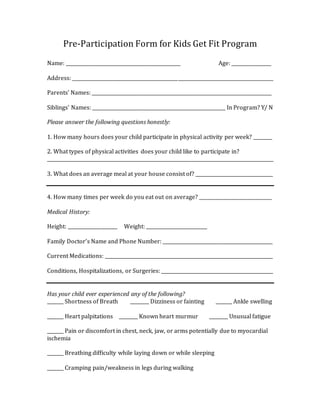
Parents will be asked to fill out a pre-participation form that will allow the
facilitators of the program to gather information about the child’s health history,
current level of activity, and any contraindications to physical activity. These
contraindications are in line with the signs and symptoms of cardiovascular disease
as laid out by the American College of Sports Medicine. Facilitators will be informed
of medications, conditions, and physical limitations that children have before the
child starts the program. Parents will also be forced to evaluate what their family’s
eating habits are so that they are aware of how they can make changes to improve
their family’s diet. I have included a copy of this form I have created.
As I have previously explained very briefly, this program is designed
specifically for children, but it incorporates the entire family. A blog for parents and
weekly newsletter are both ways that I would like to see the whole family engaged. I
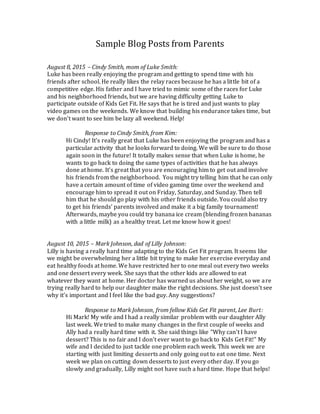
have included samples of each at the end. A blog is meant to be used for parents to
post success stories and their struggles as they make changes in their lives to help
everyone move toward a healthier lifestyle. If children are used to McDonalds and
dessert after every meal, they may not be very excited about whole wheat pasta and
green beans on their plate. My hope is that parents will be supportive of one another
and keep each other up to date on what has worked and what can be improved upon
so every family participating in the program can benefit. The blog will create a sense
of accountability and community, similar to how someone going through
rehabilitation needs support. The weekly newsletter will include updates on what
types of activity the children have been doing and a healthy recipe option. It will
suggest ways to keep the whole family active outside of the time that the children
spend in the program, like replacing watching television or playing video games
with a walk to the park or even a more active video game like Just Dance. Through
these two avenues, parents can be very involved in the program the child is
participating in and carry the same values into their every day life.
A program like “Kids Get Fit” could be implemented at a number of locations,
however my thought is that it will be utilized most often as an after-school program.
It lasts approximately one hour after school. Almost any child can participate in the
program, but the activities that I have chosen are most geared toward children who
are between the ages of 9 and 12. Children this age are very malleable and
impressionable, a perfect time to instill healthy habits. My goal is to present exercise
and being active as a fun way to hang out with your friends, so that they are more
likely to want to participate. Then, we can also educate them on the importance of
eating well and inform parents on the best ways to make these changes. “Kids Get
Fit” can also be implemented at daycares, churches, and fitness centers like the
YMCA/YWCA, Lifetime Fitness, and Planet Fitness. The program lasts about three
months, occurring three times a year: the Spring, Fall, and Summer to coincide with
school schedules. The program involves little equipment and space so the price
could stay low as well. Kids Get Fit is designed to be as accessible as possible for all
families.
Any child can participate in “Kids Get Fit,” regardless of if they struggle with
being overweight or obese or not. My main goal for every child at the end of the
program is to increase the amount of activity that the child participates in daily. I
also want children to be more aware of how their choices about diet and exercise
affect them now and in the future. I hope that each child will understand what
obesity is, what causes it, and what complications arise from it. My secondary aim is
to help the whole family make lifestyle changes that will become habits for the
children for decades into the future. Long term, if programs like this were to be
implemented and become popular across the United States, hopefully we will start
to see a decrease in obesity and Diabetes in children and adults. We might actually
see trends start to go in the opposite direction for the first time since the turn of the
century.
The program is intended to last for three months, occurring five days a week
for one hour after school. I have provided a sample schedule of the three-month
program. The first month involves a lot of group fitness activities like Zumba,
Kickboxing, Step, and Aerobics. The first two weeks of the second month involves a
lot of games that would increase the children’s cardiorespiratory endurance. The
remaining month and a half is similar to the first month, but involve shorter rest
breaks. Every Thursday there is a competition activity to give the kids who like that
a chance to compete against one another. Every Friday is “Flexibility Friday” and
alternates between Yoga and Pilates to increase the children’s flexibility.
The three main components of fitness, cardiorespiratory endurance,
muscular strength, and flexibility, will all be included in the program. On the
schedules of activities, the fitness component that the day focuses on is printed next
to the activity. Cardiorespiratory endurance is important for being able to complete
activities without causing too much fatigue on the body, as seen by increasing heart
rate, blood pressure, and respiratory rate. As an individual trains, endurance
increases and signs of fatigue are lessened. Muscular strength is important for
stability of joints and also assisting in cardiorespiratory endurance. The stronger
muscles are, the less taxing an activity is on them. Flexibility is important for
maintaining full range of motion in each joint. Lack of mobility can be a major source
pain in the body, especially the lower back. All activities in the Kids Get Fit program
are categorized under aerobic exercise, which involves long term, endurance
activities where the body utilizes oxygen to create energy.
At the end of the program, children will be more aware of what types of
activities they can participate in that will keep them active and will have been
educated on how their diet affects their health. Families will have made lifestyle
changes to not only benefit the child, but the whole family. Children will have
improved their muscular endurance, muscular strength, and flexibility. Parents will
have a support system of other parents and families that have undergone the same
types of changes and can keep each other accountable. On the last day of the
program, the activity will only last about half of the time and then the children will
have the opportunity to talk about how the program has changed them and what
kinds of things they will do in the future to continue this change. At the end of Kids
Get Fit, I hope to have motivated the children and their families to actually want to
make smart decisions about their diet and exercise that will continue for the rest of
their lives. As more children and families participate in these types of programs, we
will start to see a decrease in obesity and obesity related complications across the
nation. People will live longer and be healthier and happier. Through a program like
Kids Get Fit, I hope to improve the quality of lives for people of all ages.
Works Cited
Lippincott, Williams, and Wilkins. ACSM Participation Health Screening. ACSM
Guidelines for Exercise Testing and Prescription, 2013. 9th ed, pg 19-38.
Childhood Obesity Facts. Centers for Disease Control and Prevention, 3 Sep 2014.
Web. 20 March 2015. http://www.cdc.gov/obesity/data/childhood.html
Childhood Overweight and Obesity Trends. National Conference of State Legislatures,
21 Feb 2014. Web 20 March 2015.
http://www.ncsl.org/research/health/childhood-obesity-trends-state-
rates.aspx
A Codependent Relationship: Diabetes and Obesity. Diabetic Care Services and
Pharmacy. Web. 20 March 2015.
http://www.diabeticcareservices.com/diabetes-education/diabetes-and-
obesity
Mayo Clinic Staff. Diseases and Conditions Type 2 Diabetes. Mayo Clinic, 24 July 2014.
Web. 20 March 2015. http://www.mayoclinic.org/diseases-conditions/type-
2-diabetes/basics/risk-factors/con-20031902
Mayo Clinic Staff. Diseases and Conditions Obesity. Mayo Clinic, 13 May 2014. Web.
20 March 2015. http://www.mayoclinic.org/diseases-
conditions/obesity/basics/complications/con-20014834
Rouzier, Pierre, and Chaz Nielsen. Henry Gets Moving. Amherst, MA: SportsMed,
2012. Print.
Statistics About Diabetes. American Diabetes Association, 10 June 2014. Web. 20
March 2015 http://www.diabetes.org/diabetes-basics/statistics/
Pre-Participation Form for Kids Get Fit Program
Name: _________________________________________________ Age: _________________
Address: ______________________________________________________________________________________
Parents’ Names: _____________________________________________________________________________
Siblings’ Names: _________________________________________________________ In Program? Y/ N
Please answer the following questions honestly:
1. How many hours does your child participate in physical activity per week? ________
2. What types of physical activities does your child like to participate in?
_________________________________________________________________________________________________
3. What does an average meal at your house consist of? _________________________________
4. How many times per week do you eat out on average? _______________________________
Medical History:
Height: _____________________ Weight: __________________________
Family Doctor’s Name and Phone Number: _______________________________________________
Current Medications: ________________________________________________________________________
Conditions, Hospitalizations, or Surgeries: ________________________________________________
Has your child ever experienced any of the following?
_______ Shortness of Breath ________ Dizziness or fainting _______ Ankle swelling
_______ Heart palpitations ________ Known heart murmur ________ Unusual fatigue
_______ Pain or discomfort in chest, neck, jaw, or arms potentially due to myocardial
ischemia
_______ Breathing difficulty while laying down or while sleeping
_______ Cramping pain/weakness in legs during walking
Sample Blog Posts from Parents
August 8, 2015 – Cindy Smith, mom of Luke Smith:
Luke has been really enjoying the program and getting to spend time with his
friends after school. He really likes the relay races because he has a little bit of a
competitive edge. His father and I have tried to mimic some of the races for Luke
and his neighborhood friends, but we are having difficulty getting Luke to
participate outside of Kids Get Fit. He says that he is tired and just wants to play
video games on the weekends. We know that building his endurance takes time, but
we don’t want to see him be lazy all weekend. Help!
Response to Cindy Smith, from Kim:
Hi Cindy! It’s really great that Luke has been enjoying the program and has a
particular activity that he looks forward to doing. We will be sure to do those
again soon in the future! It totally makes sense that when Luke is home, he
wants to go back to doing the same types of activities that he has always
done at home. It’s great that you are encouraging him to get out and involve
his friends from the neighborhood. You might try telling him that he can only
have a certain amount of time of video gaming time over the weekend and
encourage him to spread it out on Friday, Saturday, and Sunday. Then tell
him that he should go play with his other friends outside. You could also try
to get his friends’ parents involved and make it a big family tournament!
Afterwards, maybe you could try banana ice cream (blending frozen bananas
with a little milk) as a healthy treat. Let me know how it goes!
August 10, 2015 – Mark Johnson, dad of Lilly Johnson:
Lilly is having a really hard time adapting to the Kids Get Fit program. It seems like
we might be overwhelming her a little bit trying to make her exercise everyday and
eat healthy foods at home. We have restricted her to one meal out every two weeks
and one dessert every week. She says that the other kids are allowed to eat
whatever they want at home. Her doctor has warned us about her weight, so we are
trying really hard to help our daughter make the right decisions. She just doesn’t see
why it’s important and I feel like the bad guy. Any suggestions?
Response to Mark Johnson, from fellow Kids Get Fit parent, Lee Burt:
Hi Mark! My wife and I had a really similar problem with our daughter Ally
last week. We tried to make many changes in the first couple of weeks and
Ally had a really hard time with it. She said things like “Why can’t I have
dessert? This is no fair and I don’t ever want to go back to Kids Get Fit!” My
wife and I decided to just tackle one problem each week. This week we are
starting with just limiting desserts and only going out to eat one time. Next
week we plan on cutting down desserts to just every other day. If you go
slowly and gradually, Lilly might not have such a hard time. Hope that helps!
August 2015
Kids Get Fit!
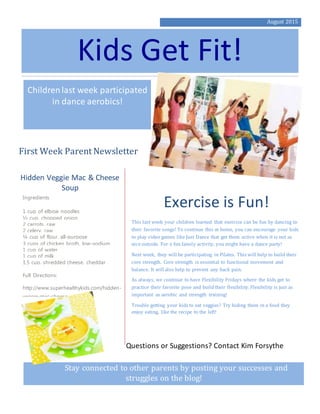
Childrenlast week participated
in dance aerobics!
First Week Parent Newsletter
Exercise is Fun!
This last week your children learned that exercise can be fun by dancing to
their favorite songs! To continue this at home, you can encourage your kids
to play video games like Just Dance that get them active when it is not as
nice outside. For a fun family activity, you might have a dance party!
Next week, they will be participating in Pilates. This will help to build their
core strength. Core strength is essential to functional movement and
balance. It will also help to prevent any back pain.
As always, we continue to have Flexibility Fridays where the kids get to
practice their favorite pose and build their flexibility. Flexibility is just as
important as aerobic and strength training!
Trouble getting your kids to eat veggies? Try hiding them in a food they
enjoy eating, like the recipe to the left!
Stay connected to other parents by posting your successes and
struggles on the blog!
Hidden Veggie Mac & Cheese
Soup
Ingredients
1 cup of elbow noodles
½ cup, chopped onion
2 carrots, raw
2 celery, raw
¼ cup of flour, all-purpose
3 cups of chicken broth, low-sodium
1 cup of water
1 cup of milk
1.5 cup, shredded cheese, cheddar
Full Directions:
http://www.superhealthykids.com/hidden-
veggie-mac-cheese-soup/
Questions or Suggestions? Contact Kim Forsythe
Have you gone to the blog post yet? Check out what
these parents had to say!
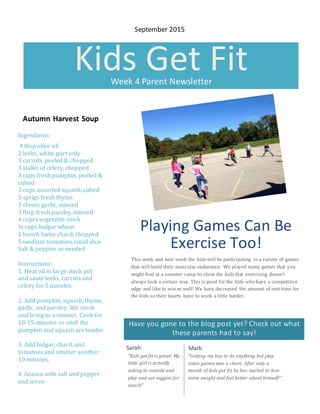
Kids Get FitWeek 4 Parent Newsletter
Playing Games Can Be
Exercise Too!
This week and next week the kids will be participating in a variety of games
that will build their muscular endurance. We played many games that you
might find at a summer camp to show the kids that exercising doesn’t
always look a certain way. This is good for the kids who have a competitive
edge and like to win as well! We have decreased the amount of rest time for
the kids so their hearts have to work a little harder.
Sarah: Mark:
“Getting my boy to do anything but play
video games was a chore. After only a
month of kids get fit, he has started to lose
some weight and feel better about himself!”
September 2015
Autumn Harvest Soup
Ingredients:
4 tbsp olive oil
2 leeks, white part only
3 carrots, peeled & chopped
3 stalks of celery, chopped
3 cups fresh pumpkin, peeled &
cubed
3 cups assorted squash, cubed
5 sprigs fresh thyme
3 cloves garlic, minced
3 tbsp fresh parsley, minced
4 cuprs vegetable stock
¾ cups bulgar wheat
1 bunch Swiss chard, chopped
5 medium tomatoes, small dice
Salt & peppter as needed
Instructions:
1. Heat oil in large stock pot
and sauté leeks, carrots and
celery for 5 minutes.
2. Add pumpkin, squash, thyme,
garlic, and parsley. Stir stock
and bring to a simmer. Cook for
10-15 minutes or until the
pumpkin and squash are tender
3. Add bulgar, chard, and
tomatoes and simmer another
10 minutes.
4. Season with salt and pepper
and serve.
Taken from:
http://www.chefannfoundation.org/for-
parents/home-recipes/autumn-harvest-soup/
“Kids get fit is great! My
little girl is actually
asking to outside and
play and eat veggies for
snack!”
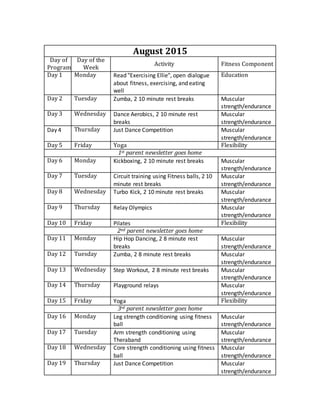
August 2015
Day of
Program
Day of the
Week
Activity Fitness Component
Day 1 Monday Read "Exercising Ellie", open dialogue
about fitness, exercising, and eating
well
Education
Day 2 Tuesday Zumba, 2 10 minute rest breaks Muscular
strength/endurance
Day 3 Wednesday Dance Aerobics, 2 10 minute rest
breaks
Muscular
strength/endurance
Day 4 Thursday Just Dance Competition Muscular
strength/endurance
Day 5 Friday Yoga Flexibility
1st parent newsletter goes home
Day 6 Monday Kickboxing, 2 10 minute rest breaks Muscular
strength/endurance
Day 7 Tuesday Circuit training using Fitness balls, 2 10
minute rest breaks
Muscular
strength/endurance
Day 8 Wednesday Turbo Kick, 2 10 minute rest breaks Muscular
strength/endurance
Day 9 Thursday Relay Olympics Muscular
strength/endurance
Day 10 Friday Pilates Flexibility
2nd parent newsletter goes home
Day 11 Monday Hip Hop Dancing, 2 8 minute rest
breaks
Muscular
strength/endurance
Day 12 Tuesday Zumba, 2 8 minute rest breaks Muscular
strength/endurance
Day 13 Wednesday Step Workout, 2 8 minute rest breaks Muscular
strength/endurance
Day 14 Thursday Playground relays Muscular
strength/endurance
Day 15 Friday Yoga Flexibility
3rd parent newsletter goes home
Day 16 Monday Leg strength conditioning using fitness
ball
Muscular
strength/endurance
Day 17 Tuesday Arm strength conditioning using
Theraband
Muscular
strength/endurance
Day 18 Wednesday Core strength conditioning using fitness
ball
Muscular
strength/endurance
Day 19 Thursday Just Dance Competition Muscular
strength/endurance
Day 20 Friday Pilates Flexibility
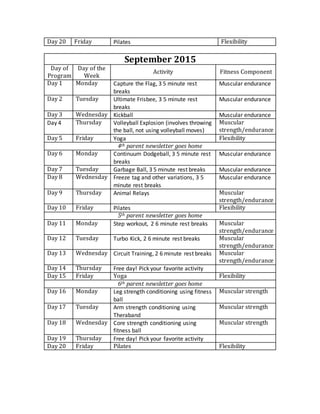
September 2015
Day of
Program
Day of the
Week
Activity Fitness Component
Day 1 Monday Capture the Flag, 3 5 minute rest
breaks
Muscular endurance
Day 2 Tuesday Ultimate Frisbee, 3 5 minute rest
breaks
Muscular endurance
Day 3 Wednesday Kickball Muscular endurance
Day 4 Thursday Volleyball Explosion (involves throwing
the ball, not using volleyball moves)
Muscular
strength/endurance
Day 5 Friday Yoga Flexibility
4th parent newsletter goes home
Day 6 Monday Continuum Dodgeball, 3 5 minute rest
breaks
Muscular endurance
Day 7 Tuesday Garbage Ball, 3 5 minute rest breaks Muscular endurance
Day 8 Wednesday Freeze tag and other variations, 3 5
minute rest breaks
Muscular endurance
Day 9 Thursday Animal Relays Muscular
strength/endurance
Day 10 Friday Pilates Flexibility
5th parent newsletter goes home
Day 11 Monday Step workout, 2 6 minute rest breaks Muscular
strength/endurance
Day 12 Tuesday Turbo Kick, 2 6 minute rest breaks Muscular
strength/endurance
Day 13 Wednesday Circuit Training, 2 6 minute rest breaks Muscular
strength/endurance
Day 14 Thursday Free day! Pick your favorite activity
Day 15 Friday Yoga Flexibility
6th parent newsletter goes home
Day 16 Monday Leg strength conditioning using fitness
ball
Muscular strength
Day 17 Tuesday Arm strength conditioning using
Theraband
Muscular strength
Day 18 Wednesday Core strength conditioning using
fitness ball
Muscular strength
Day 19 Thursday Free day! Pick your favorite activity
Day 20 Friday Pilates Flexibility
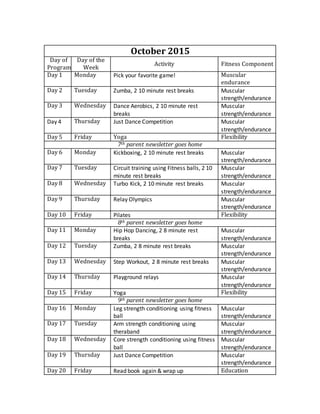
October 2015
Day of
Program
Day of the
Week
Activity Fitness Component
Day 1 Monday Pick your favorite game! Muscular
endurance
Day 2 Tuesday Zumba, 2 10 minute rest breaks Muscular
strength/endurance
Day 3 Wednesday Dance Aerobics, 2 10 minute rest
breaks
Muscular
strength/endurance
Day 4 Thursday Just Dance Competition Muscular
strength/endurance
Day 5 Friday Yoga Flexibility
7th parent newsletter goes home
Day 6 Monday Kickboxing, 2 10 minute rest breaks Muscular
strength/endurance
Day 7 Tuesday Circuit training using Fitness balls, 2 10
minute rest breaks
Muscular
strength/endurance
Day 8 Wednesday Turbo Kick, 2 10 minute rest breaks Muscular
strength/endurance
Day 9 Thursday Relay Olympics Muscular
strength/endurance
Day 10 Friday Pilates Flexibility
8th parent newsletter goes home
Day 11 Monday Hip Hop Dancing, 2 8 minute rest
breaks
Muscular
strength/endurance
Day 12 Tuesday Zumba, 2 8 minute rest breaks Muscular
strength/endurance
Day 13 Wednesday Step Workout, 2 8 minute rest breaks Muscular
strength/endurance
Day 14 Thursday Playground relays Muscular
strength/endurance
Day 15 Friday Yoga Flexibility
9th parent newsletter goes home
Day 16 Monday Leg strength conditioning using fitness
ball
Muscular
strength/endurance
Day 17 Tuesday Arm strength conditioning using
theraband
Muscular
strength/endurance
Day 18 Wednesday Core strength conditioning using fitness
ball
Muscular
strength/endurance
Day 19 Thursday Just Dance Competition Muscular
strength/endurance
Day 20 Friday Read book again & wrap up Education
conversation
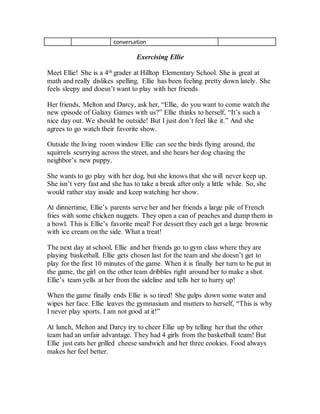
Exercising Ellie
Meet Ellie! She is a 4th grader at Hilltop Elementary School. She is great at
math and really dislikes spelling. Ellie has been feeling pretty down lately. She
feels sleepy and doesn’t want to play with her friends.
Her friends, Melton and Darcy, ask her, “Ellie, do you want to come watch the
new episode of Galaxy Games with us?” Ellie thinks to herself, “It’s such a
nice day out. We should be outside! But I just don’t feel like it.” And she
agrees to go watch their favorite show.
Outside the living room window Ellie can see the birds flying around, the
squirrels scurrying across the street, and she hears her dog chasing the
neighbor’s new puppy.
She wants to go play with her dog, but she knows that she will never keep up.
She isn’t very fast and she has to take a break after only a little while. So, she
would rather stay inside and keep watching her show.
At dinnertime, Ellie’s parents serve her and her friends a large pile of French
fries with some chicken nuggets. They open a can of peaches and dump them in
a bowl. This is Ellie’s favorite meal! For dessert they each get a large brownie
with ice cream on the side. What a treat!
The next day at school, Ellie and her friends go to gym class where they are
playing basketball. Ellie gets chosen last for the team and she doesn’t get to
play for the first 10 minutes of the game. When it is finally her turn to be put in
the game, the girl on the other team dribbles right around her to make a shot.
Ellie’s team yells at her from the sideline and tells her to hurry up!
When the game finally ends Ellie is so tired! She gulps down some water and
wipes her face. Ellie leaves the gymnasium and mutters to herself, “This is why
I never play sports. I am not good at it!”
At lunch, Melton and Darcy try to cheer Ellie up by telling her that the other
team had an unfair advantage. They had 4 girls from the basketball team! But
Ellie just eats her grilled cheese sandwich and her three cookies. Food always
makes her feel better.
Ellie tells her parents as soon as she gets home about what happened in gym
class that afternoon. Her parents are very upset, but they know that Ellie has
never been the most coordinated. They want to get her involved with something
that will help her be active, but they don’t know what.
Ellie’s parents talk to their friends and teachers at Ellie’s school. They decide
that they are going to start a program that will meet after school like a sport, but
it will involve more games that can be played by anyone! The games will help
Ellie and her classmates to work together and build friendships, while
encouraging them to be active. And the best part, no one will get picked last!
Ellie and her friends LOVED participating in the new school program, Kids
Get Fit. Ellie has also been eating more fruits and vegetables at home and
school. Instead of going for the cookies when she is upset, she writes her
feelings down or talks about them with someone.
Ellie has been feeling much better too! She can keep up with everyone in her
gym class and she doesn’t get picked last. She has even made friends with
some of the basketball girls, who have been teaching her some pretty sweet
moves!
Ellie learned in Kids Get Fit that exercise and eating right are very important to
feeling good. She feels so much happier now! Now, when Ellie, Melton, and
Darcy all come home from school, they go outside and play on the swings.
They save the TV just for rainy days!
Ellie feels good about herself and wants other kids like you to feel the same
way. You are about to start the same program that Ellie participated in. Maybe
some of the changes she made will help you to feel good as well!

thesis text

  • 1.
    Kids Get Fit:A Non-Sport Based Alternative to Improve Elementary Children’s Fitness An Honors Thesis (HONR 499) by Kimberly Forsythe Dr. Jason Powell Mrs. Nicole Koontz Ball State University Muncie, Indiana April 2015 Expected Date of Graduation May 2015
  • 2.
    Abstract The obesity ratein children continues to rise in America despite the vast knowledge that is available on how to prevent and reverse obesity. As a result, the number of children and adults that suffer from obesity-related complications, like Type II Diabetes, continues to rise as well. To add to the problem, physical education classes are being cut from schools, sports are becoming more expensive to participate in, and more families are eating out and on the go. To combat this issue, I have created “Kids Get Fit”, an afterschool program designed to educate and improve the health of the entire family, with a focus on children in third through sixth grade. Children who are not able or do not wish to participate in sports would be able to increase their daily activity by participating in this program. The children will read a story about a child just like them who struggles with making healthy choices, participate in many types of group fitness activities and games, and learn about what it is like to make healthy decisions. Parents will stay connected with one another by engaging in an online blog and reading a monthly newsletter. The goal of the program is to instill healthy habits that will be kept for a lifetime. Acknowledgements I would like to thank Mrs. Nicole Koontz for inspiring me to create this project and advising me throughout the process. Her knowledge of fitness across the lifespan and her desire to help improve fitness have been huge assets to me while working on this project. She has been my professor and mentor for a number of years and has helped me in many ways beyond what this project encompasses. I would also like to thank Dr. Jason Powell for helping me to think “outside of the box” and bring this project to life. His creative mind and philosophical expertise allowed me to bring this project to another level. He has encouraged and supported me not only during this project, but for a majority of my college experience. Lastly, I would like to thank Jessica Maxwell for partnering with me and illustrating all of the pictures for Exercising Ellie. Your artistic skills are greatly appreciated.
  • 3.
    Table of Contents Paper………………………………………………………………………………………………………………4 Works Cited…………………………………………………………………………………………………….16 Example Pre-Participation Form .…………………………………………………………………….17 Example Blog Posts …………………………………………………………………………………………18 Example Parent Newsletters ……………………………………………………………………………19 3-Month Calendar of Activities …………………………………………………………………………21 Story: Exercising Ellie …………………………………………………………………………………………...23
  • 4.
    Doctors and otherhealth professionals are able to determine that a person is overweight or obese by calculating his or her body mass index. Body mass index is determined from a person’s height and weight. A body mass index of 25.0-29.9 is considered overweight and 30.0 or greater is considered obese. Research shows us that more and more adults in the United States are overweight and obese (Childhood Overweight and Obesity Trends, 2014). These trends continue despite adults now knowing more about the chronic effects of being overweight and obese. There are many speculations as to why this is. I think that our fast-paced lifestyle is a main contributor to this phenomenon. Most of our children do not experience the same kind of home-cooked meals every day like our grandparents would have had. Fast food is conveniently available and often chosen many times a week. For adults, there are many more office jobs being filled than factory jobs, meaning more adults are sedentary most of the day. Many times it takes years for a person to notice that his or her weight has gotten out of hand and by that point the chronic medical consequences have already taken effect. In my opinion, the best way to reverse the trend is to instill good habits into our children. The importance someone places on a healthy diet and exercise as a child or young adult is very likely to be carried into adulthood. My goal through the “Kids Get Fit” program is to create a lifestyle change in our children and families that will become lifelong habits, drastically reducing the number of children and adults who suffer from complications from being overweight or obese. It may not seem intuitive that a fast-paced lifestyle is a main cause of obesity. However, the on-the-go lifestyle leads to a diet that is high in fat and sodium and
  • 5.
    lack of exercise.In order for activity to be considered exercise, it must be planned and repetitive. The American College of Sports Medicine recommends that all adults exercise for thirty minutes a day three to five days per week. Many times our busy lifestyles do not seem very conducive to this. Poor diet and inactivity are the leading causes of being overweight or obese. More uncommon causes can be heredity and medications. Being overweight or obese can then lead to acquiring Type 2 Diabetes, the number 7 killer of American adults (Statistics About Diabetes, 2014). It is a very slippery slope that so many young children are heading down and never being able to recover from. According to the Center for Disease Control, obesity plagues 17% of children, three times the rate in children just one generation ago (Childhood Obesity Facts, 2014); approximately 22% of children are overweight as well. According to the American Diabetes Association, over 200,000 American children have been diagnosed with Diabetes (Statistics About Diabetes, 2014). More children are diagnosed with Type 2 Diabetes, which in prior years had been known more as “adult-onset Diabetes.” These statistics are very strongly correlated and are rising each year. According to Diabetic Care Services, 80-90% of people who have been diagnosed with Type 2 Diabetes are also obese (A Codependent Relationship: Diabetes and Obesity). Being overweight or obese, having a high fat distribution in the abdomen, and inactivity are some of the primary risk factors for acquiring Type 2 Diabetes, according to the Mayo Clinic (Mayo Clinic Staff, July 2014). My program specifically addresses these three main risk factors.
  • 6.
    Although Diabetes isone of the top complications that can arise from being overweight or obese, there are a number of other complications (Mayo Clinic Staff, May 2014). The Mayo Clinic lists nearly fifteen serious health problems that can arise from obesity. Some of the issues include metabolic syndrome, heart disease, stroke, cancer, breathing disorders, and osteoarthritis. The quality of life of an obese individual can also be lower because of other emotional issues, including depression, shame, and social isolation. Obesity is a very serious issue that many Americans face. My hope is that through my program and many other programs of its kind, we can cultivate a generation of young children who are aware of how their choices about diet and exercise can affect them for the rest of their lives. These statistics are not news to anyone. Gyms are packed with people who are trying to lose weight. Every year there are new fad diets that thousands of people are trying. The number one New Year’s resolution every year is to lose weight. We are very aware of the issue and many people take the initial steps to try and fix it. The biggest issue is that most people give up after a short amount of time. They do not see the results they want fast enough or it is just too difficult to maintain the self-control for an extended amount of time. Those habits have been set and have been that way for years, maybe even decades. If adults are aware and understand the complications of obesity and are not prioritizing making a change, how can we expect anything to change for our children? This is the primary reason why this program not only gets the kids active, but also provides resources and accountability for the parents. This program is designed to help the family as a
  • 7.
    whole make lifestylechanges that will benefit every member of the family and instill healthy habits in the children that will carry on for a lifetime. In addition to the change in diet that children of the twenty first century have experienced, fewer children are intentionally participating in something that keeps them active. With schools receiving less funding, many physical education classes have been cut and sports are very expensive to participate in; also, not all children are interested in playing sports. Some children are not coordinated and sports may actually be a source of anxiety. Therefore, even if sports were readily available to them, not all children want to play. This program would not require a lot of equipment and could be done in almost any type of room. It is much more group fitness and game based, not skill based. Activities like Zumba or dance are all done at once and there is no need to perfect the skill, therefore the likelihood of bullying is much lower. My hope is that the children not interested in playing sports would be drawn to an activity like this. The problem of childhood obesity is very important to me because I was overweight as a child. I remember consuming many snacks and desserts, adding hundreds of extra calories to my daily diet. I played sports, but I felt like I was always one of the slowest kids. I was raised by my single mom who worked full-time for most of my childhood. My sister and I were involved in many activities after school so there were many days I would go straight from school to daycare to a practice and not be home until 8 or 9 at night. We ate on-the-go a lot and lacked daily fruits and vegetables at meals. By the time I got to high school, I weighed about 40 pounds over what a healthy weight would have been for my height. Around that
  • 8.
    time, I startedto realize that I could not continue making the same food choices that I had been making for most of my life. It was not until I joined show choir my sophomore year and spent two hours a day dancing for many months that my weight started to get under control. By my senior year of high school, I was within a healthy weight range. This change did not come overnight and it involved breaking a lot of life-long habits that I developed very early on. Even as a college student, I still struggle with binge eating on high sugar snacks, but I am much more aware of how my food choices affect my health now and in the future. My goal through this program is to create healthy life-long habits in children. I was never bullied or made fun of for my weight, but I had low self-esteem when it came to how my body looked in comparison to the other children my age. Shopping for any type of clothing was not an activity I looked forward to. I automatically had to look to the back of the rack for the biggest size in the junior department and this was not something I was proud of. I want to help other children who struggle with weight management and making good food choices. Childhood obesity is strongly linked with adult obesity and the longer the problem goes unfixed, the more difficult it will be to eradicate in adulthood. This project combines two of my biggest passions – kids and health/fitness. I will be the first to tell you that I am still not great at making good food choices every day and sometimes I have to drag myself to the gym. However, in my future career as a physical therapist, improving quality of living is something that is of utmost importance for me with every one of my future patients. Health and fitness are large
  • 9.
    components of qualityof living in the future. The better that we take care of our bodies now, the stronger and more resilient they will be in the future. I believe that if we can show children how exercising can be fun and healthy foods can be tasty too, they will be more likely to make these decisions on their own. The statistics are important, but they mean nothing to children. However, the fact is that the parents provide most meals. We must also educate parents and show them how to make this a family effort. I want to provide easy, hassle free healthy meal options and a support system. When I first started thinking about this project and what exactly I wanted to design I wondered why it is that people like to exercise. After all, like I stated earlier, it is the number one New Year’s resolution each year. Gyms are packed the first week of January but after a month the gyms are back to their normal number of people. Why is exercising and staying healthy so difficult to stick with? And what makes some people successful at it? I was brought back to an Honors class I took where we studied what it means for humans to be happy. I was reminded of a particular quote by Michael Novak in The Experience of Nothingness that says: “The happiness that all men claim to seek is not to be conceived of as a psychological state of contentment, an excess of pleasure over pain, an inner equilibrium or peace, a sense of satisfaction, a comfortable middle-of-the-road avoidance of conflict and disorder. On the contrary, happiness (eudaimonia) is activity; it is to act to the fullest of one’s capacities. In Aristotle’s view action comes first. The feeling of pleasure or satisfaction is secondary, a sort of overflow that may or may not be present. To be happy is not to do little, to be passive, to be content; it is to act, and to
  • 10.
    act well. Indeed,eudaimonia is to be translated as well acting.” Essentially he says that happiness is action. Even though we all enjoy a good Netflix binge and mindlessly getting lost in some type of “screen activity,” we are most truly happy when we are doing something. Exercising and eating well fulfill some of our deepest desires to be happy and do well. In addition, when we exercise we are usually in some type of group setting. A group of people working toward a common goal and encouraging each other along the way is a very powerful thing. People give up and stop trying to be healthy when they do not see results right away. Through the program, Kits Get Fit, I hope that kids will truly be happy participating in my program and will build a sense of community and accomplishment. If the kids that participate in my program can equate exercise with happiness, I believe that they will be much more likely to continue into the future. The idea for my program came from a book that was introduced to me called “Henry Gets Moving,” written by Pierre Rouzier and Chaz Nielsen and illustrated by Catherine Lazar Odell. The premise for this book is that children will relate with Henry the Hamster who is obese and cannot keep up with his friends. He goes to the doctor who tells him that he needs to eat better and exercise more. Henry takes the advice, and together with his parents, they start making better decisions about diet and exercise. After a little time, he loses weight, is not so sluggish, and better able to keep up with his friends. Henry learns that losing the weight actually makes him feel better. Throughout the book, there is a little worm that appears on sporadic pages. When the kids see the worm, they are supposed to wiggle and squirm. This keeps them engaged in the story, but also teaches them the importance of movement.
  • 11.
    There are teachingpackets that go with the book and many times speakers are also brought in to talk to the kids in addition to reading the book. My favorite part of this book is that it really educates and informs children in a way that they can understand. Children love to imitate and learn by following an example. In addition to the fitness program that I have designed, I have also written a book and collaborated with an art student at Ball State to illustrate the book. Although statistics are important and you can show videos and charts that scare people into making healthier choices, these things do nothing to elicit change in children. The age group that my program is designed for is elementary students, specifically grades three through six. These children are old enough to understand that their actions have consequences, but they cannot think far enough in to the future to understand how their actions have consequences many years into the future. The easiest way to explain the importance of a healthy diet and regular exercise to children is to show them how it affects them now. Henry Gets Moving and my book do just that. At the start of the program, children will read a story that I have written, entitled “Exercising Ellie” that tells the story of a little girl named Ellie that is unhealthy and not able to keep up with her friends. She makes poor choices about her diet and exercise, until she starts participating in a new after school program that her school offers. With the help of her friends and family, she gets active, starts eating better, and starts feeling much better about herself. Kids that are about to start the Kids Gets Fit program will be able to relate with Ellie and see the end result of what they can experience at the end of the program. At the end of the story, the
  • 12.
    facilitator can engagein conversation with the children about what kinds of choices Ellie made before and after she started Kids Get Fit. Kids can be asked what they think are the better choices to make and if they currently make those decisions. The story will be used to get the kids to start thinking about fitness and its long term affects before they even start the program. My hope is that the children will want to be like Ellie at the end of the story and be eager to start the same kind of program that she went through. This will also allow the facilitator to figure out what the kids think about fitness. Parents will be asked to fill out a pre-participation form that will allow the facilitators of the program to gather information about the child’s health history, current level of activity, and any contraindications to physical activity. These contraindications are in line with the signs and symptoms of cardiovascular disease as laid out by the American College of Sports Medicine. Facilitators will be informed of medications, conditions, and physical limitations that children have before the child starts the program. Parents will also be forced to evaluate what their family’s eating habits are so that they are aware of how they can make changes to improve their family’s diet. I have included a copy of this form I have created. As I have previously explained very briefly, this program is designed specifically for children, but it incorporates the entire family. A blog for parents and weekly newsletter are both ways that I would like to see the whole family engaged. I have included samples of each at the end. A blog is meant to be used for parents to post success stories and their struggles as they make changes in their lives to help everyone move toward a healthier lifestyle. If children are used to McDonalds and
  • 13.
    dessert after everymeal, they may not be very excited about whole wheat pasta and green beans on their plate. My hope is that parents will be supportive of one another and keep each other up to date on what has worked and what can be improved upon so every family participating in the program can benefit. The blog will create a sense of accountability and community, similar to how someone going through rehabilitation needs support. The weekly newsletter will include updates on what types of activity the children have been doing and a healthy recipe option. It will suggest ways to keep the whole family active outside of the time that the children spend in the program, like replacing watching television or playing video games with a walk to the park or even a more active video game like Just Dance. Through these two avenues, parents can be very involved in the program the child is participating in and carry the same values into their every day life. A program like “Kids Get Fit” could be implemented at a number of locations, however my thought is that it will be utilized most often as an after-school program. It lasts approximately one hour after school. Almost any child can participate in the program, but the activities that I have chosen are most geared toward children who are between the ages of 9 and 12. Children this age are very malleable and impressionable, a perfect time to instill healthy habits. My goal is to present exercise and being active as a fun way to hang out with your friends, so that they are more likely to want to participate. Then, we can also educate them on the importance of eating well and inform parents on the best ways to make these changes. “Kids Get Fit” can also be implemented at daycares, churches, and fitness centers like the YMCA/YWCA, Lifetime Fitness, and Planet Fitness. The program lasts about three
  • 14.
    months, occurring threetimes a year: the Spring, Fall, and Summer to coincide with school schedules. The program involves little equipment and space so the price could stay low as well. Kids Get Fit is designed to be as accessible as possible for all families. Any child can participate in “Kids Get Fit,” regardless of if they struggle with being overweight or obese or not. My main goal for every child at the end of the program is to increase the amount of activity that the child participates in daily. I also want children to be more aware of how their choices about diet and exercise affect them now and in the future. I hope that each child will understand what obesity is, what causes it, and what complications arise from it. My secondary aim is to help the whole family make lifestyle changes that will become habits for the children for decades into the future. Long term, if programs like this were to be implemented and become popular across the United States, hopefully we will start to see a decrease in obesity and Diabetes in children and adults. We might actually see trends start to go in the opposite direction for the first time since the turn of the century. The program is intended to last for three months, occurring five days a week for one hour after school. I have provided a sample schedule of the three-month program. The first month involves a lot of group fitness activities like Zumba, Kickboxing, Step, and Aerobics. The first two weeks of the second month involves a lot of games that would increase the children’s cardiorespiratory endurance. The remaining month and a half is similar to the first month, but involve shorter rest breaks. Every Thursday there is a competition activity to give the kids who like that
  • 15.
    a chance tocompete against one another. Every Friday is “Flexibility Friday” and alternates between Yoga and Pilates to increase the children’s flexibility. The three main components of fitness, cardiorespiratory endurance, muscular strength, and flexibility, will all be included in the program. On the schedules of activities, the fitness component that the day focuses on is printed next to the activity. Cardiorespiratory endurance is important for being able to complete activities without causing too much fatigue on the body, as seen by increasing heart rate, blood pressure, and respiratory rate. As an individual trains, endurance increases and signs of fatigue are lessened. Muscular strength is important for stability of joints and also assisting in cardiorespiratory endurance. The stronger muscles are, the less taxing an activity is on them. Flexibility is important for maintaining full range of motion in each joint. Lack of mobility can be a major source pain in the body, especially the lower back. All activities in the Kids Get Fit program are categorized under aerobic exercise, which involves long term, endurance activities where the body utilizes oxygen to create energy. At the end of the program, children will be more aware of what types of activities they can participate in that will keep them active and will have been educated on how their diet affects their health. Families will have made lifestyle changes to not only benefit the child, but the whole family. Children will have improved their muscular endurance, muscular strength, and flexibility. Parents will have a support system of other parents and families that have undergone the same types of changes and can keep each other accountable. On the last day of the program, the activity will only last about half of the time and then the children will
  • 16.
    have the opportunityto talk about how the program has changed them and what kinds of things they will do in the future to continue this change. At the end of Kids Get Fit, I hope to have motivated the children and their families to actually want to make smart decisions about their diet and exercise that will continue for the rest of their lives. As more children and families participate in these types of programs, we will start to see a decrease in obesity and obesity related complications across the nation. People will live longer and be healthier and happier. Through a program like Kids Get Fit, I hope to improve the quality of lives for people of all ages.
  • 17.
    Works Cited Lippincott, Williams,and Wilkins. ACSM Participation Health Screening. ACSM Guidelines for Exercise Testing and Prescription, 2013. 9th ed, pg 19-38. Childhood Obesity Facts. Centers for Disease Control and Prevention, 3 Sep 2014. Web. 20 March 2015. http://www.cdc.gov/obesity/data/childhood.html Childhood Overweight and Obesity Trends. National Conference of State Legislatures, 21 Feb 2014. Web 20 March 2015. http://www.ncsl.org/research/health/childhood-obesity-trends-state- rates.aspx A Codependent Relationship: Diabetes and Obesity. Diabetic Care Services and Pharmacy. Web. 20 March 2015. http://www.diabeticcareservices.com/diabetes-education/diabetes-and- obesity Mayo Clinic Staff. Diseases and Conditions Type 2 Diabetes. Mayo Clinic, 24 July 2014. Web. 20 March 2015. http://www.mayoclinic.org/diseases-conditions/type- 2-diabetes/basics/risk-factors/con-20031902 Mayo Clinic Staff. Diseases and Conditions Obesity. Mayo Clinic, 13 May 2014. Web. 20 March 2015. http://www.mayoclinic.org/diseases- conditions/obesity/basics/complications/con-20014834 Rouzier, Pierre, and Chaz Nielsen. Henry Gets Moving. Amherst, MA: SportsMed, 2012. Print. Statistics About Diabetes. American Diabetes Association, 10 June 2014. Web. 20 March 2015 http://www.diabetes.org/diabetes-basics/statistics/
  • 18.
    Pre-Participation Form forKids Get Fit Program Name: _________________________________________________ Age: _________________ Address: ______________________________________________________________________________________ Parents’ Names: _____________________________________________________________________________ Siblings’ Names: _________________________________________________________ In Program? Y/ N Please answer the following questions honestly: 1. How many hours does your child participate in physical activity per week? ________ 2. What types of physical activities does your child like to participate in? _________________________________________________________________________________________________ 3. What does an average meal at your house consist of? _________________________________ 4. How many times per week do you eat out on average? _______________________________ Medical History: Height: _____________________ Weight: __________________________ Family Doctor’s Name and Phone Number: _______________________________________________ Current Medications: ________________________________________________________________________ Conditions, Hospitalizations, or Surgeries: ________________________________________________ Has your child ever experienced any of the following? _______ Shortness of Breath ________ Dizziness or fainting _______ Ankle swelling _______ Heart palpitations ________ Known heart murmur ________ Unusual fatigue _______ Pain or discomfort in chest, neck, jaw, or arms potentially due to myocardial ischemia _______ Breathing difficulty while laying down or while sleeping _______ Cramping pain/weakness in legs during walking
  • 19.
    Sample Blog Postsfrom Parents August 8, 2015 – Cindy Smith, mom of Luke Smith: Luke has been really enjoying the program and getting to spend time with his friends after school. He really likes the relay races because he has a little bit of a competitive edge. His father and I have tried to mimic some of the races for Luke and his neighborhood friends, but we are having difficulty getting Luke to participate outside of Kids Get Fit. He says that he is tired and just wants to play video games on the weekends. We know that building his endurance takes time, but we don’t want to see him be lazy all weekend. Help! Response to Cindy Smith, from Kim: Hi Cindy! It’s really great that Luke has been enjoying the program and has a particular activity that he looks forward to doing. We will be sure to do those again soon in the future! It totally makes sense that when Luke is home, he wants to go back to doing the same types of activities that he has always done at home. It’s great that you are encouraging him to get out and involve his friends from the neighborhood. You might try telling him that he can only have a certain amount of time of video gaming time over the weekend and encourage him to spread it out on Friday, Saturday, and Sunday. Then tell him that he should go play with his other friends outside. You could also try to get his friends’ parents involved and make it a big family tournament! Afterwards, maybe you could try banana ice cream (blending frozen bananas with a little milk) as a healthy treat. Let me know how it goes! August 10, 2015 – Mark Johnson, dad of Lilly Johnson: Lilly is having a really hard time adapting to the Kids Get Fit program. It seems like we might be overwhelming her a little bit trying to make her exercise everyday and eat healthy foods at home. We have restricted her to one meal out every two weeks and one dessert every week. She says that the other kids are allowed to eat whatever they want at home. Her doctor has warned us about her weight, so we are trying really hard to help our daughter make the right decisions. She just doesn’t see why it’s important and I feel like the bad guy. Any suggestions? Response to Mark Johnson, from fellow Kids Get Fit parent, Lee Burt: Hi Mark! My wife and I had a really similar problem with our daughter Ally last week. We tried to make many changes in the first couple of weeks and Ally had a really hard time with it. She said things like “Why can’t I have dessert? This is no fair and I don’t ever want to go back to Kids Get Fit!” My wife and I decided to just tackle one problem each week. This week we are starting with just limiting desserts and only going out to eat one time. Next week we plan on cutting down desserts to just every other day. If you go slowly and gradually, Lilly might not have such a hard time. Hope that helps!
  • 20.
    August 2015 Kids GetFit! Childrenlast week participated in dance aerobics! First Week Parent Newsletter Exercise is Fun! This last week your children learned that exercise can be fun by dancing to their favorite songs! To continue this at home, you can encourage your kids to play video games like Just Dance that get them active when it is not as nice outside. For a fun family activity, you might have a dance party! Next week, they will be participating in Pilates. This will help to build their core strength. Core strength is essential to functional movement and balance. It will also help to prevent any back pain. As always, we continue to have Flexibility Fridays where the kids get to practice their favorite pose and build their flexibility. Flexibility is just as important as aerobic and strength training! Trouble getting your kids to eat veggies? Try hiding them in a food they enjoy eating, like the recipe to the left! Stay connected to other parents by posting your successes and struggles on the blog! Hidden Veggie Mac & Cheese Soup Ingredients 1 cup of elbow noodles ½ cup, chopped onion 2 carrots, raw 2 celery, raw ¼ cup of flour, all-purpose 3 cups of chicken broth, low-sodium 1 cup of water 1 cup of milk 1.5 cup, shredded cheese, cheddar Full Directions: http://www.superhealthykids.com/hidden- veggie-mac-cheese-soup/ Questions or Suggestions? Contact Kim Forsythe
  • 21.
    Have you goneto the blog post yet? Check out what these parents had to say! Kids Get FitWeek 4 Parent Newsletter Playing Games Can Be Exercise Too! This week and next week the kids will be participating in a variety of games that will build their muscular endurance. We played many games that you might find at a summer camp to show the kids that exercising doesn’t always look a certain way. This is good for the kids who have a competitive edge and like to win as well! We have decreased the amount of rest time for the kids so their hearts have to work a little harder. Sarah: Mark: “Getting my boy to do anything but play video games was a chore. After only a month of kids get fit, he has started to lose some weight and feel better about himself!” September 2015 Autumn Harvest Soup Ingredients: 4 tbsp olive oil 2 leeks, white part only 3 carrots, peeled & chopped 3 stalks of celery, chopped 3 cups fresh pumpkin, peeled & cubed 3 cups assorted squash, cubed 5 sprigs fresh thyme 3 cloves garlic, minced 3 tbsp fresh parsley, minced 4 cuprs vegetable stock ¾ cups bulgar wheat 1 bunch Swiss chard, chopped 5 medium tomatoes, small dice Salt & peppter as needed Instructions: 1. Heat oil in large stock pot and sauté leeks, carrots and celery for 5 minutes. 2. Add pumpkin, squash, thyme, garlic, and parsley. Stir stock and bring to a simmer. Cook for 10-15 minutes or until the pumpkin and squash are tender 3. Add bulgar, chard, and tomatoes and simmer another 10 minutes. 4. Season with salt and pepper and serve. Taken from: http://www.chefannfoundation.org/for- parents/home-recipes/autumn-harvest-soup/ “Kids get fit is great! My little girl is actually asking to outside and play and eat veggies for snack!”
  • 22.
    August 2015 Day of Program Dayof the Week Activity Fitness Component Day 1 Monday Read "Exercising Ellie", open dialogue about fitness, exercising, and eating well Education Day 2 Tuesday Zumba, 2 10 minute rest breaks Muscular strength/endurance Day 3 Wednesday Dance Aerobics, 2 10 minute rest breaks Muscular strength/endurance Day 4 Thursday Just Dance Competition Muscular strength/endurance Day 5 Friday Yoga Flexibility 1st parent newsletter goes home Day 6 Monday Kickboxing, 2 10 minute rest breaks Muscular strength/endurance Day 7 Tuesday Circuit training using Fitness balls, 2 10 minute rest breaks Muscular strength/endurance Day 8 Wednesday Turbo Kick, 2 10 minute rest breaks Muscular strength/endurance Day 9 Thursday Relay Olympics Muscular strength/endurance Day 10 Friday Pilates Flexibility 2nd parent newsletter goes home Day 11 Monday Hip Hop Dancing, 2 8 minute rest breaks Muscular strength/endurance Day 12 Tuesday Zumba, 2 8 minute rest breaks Muscular strength/endurance Day 13 Wednesday Step Workout, 2 8 minute rest breaks Muscular strength/endurance Day 14 Thursday Playground relays Muscular strength/endurance Day 15 Friday Yoga Flexibility 3rd parent newsletter goes home Day 16 Monday Leg strength conditioning using fitness ball Muscular strength/endurance Day 17 Tuesday Arm strength conditioning using Theraband Muscular strength/endurance Day 18 Wednesday Core strength conditioning using fitness ball Muscular strength/endurance Day 19 Thursday Just Dance Competition Muscular strength/endurance
  • 23.
    Day 20 FridayPilates Flexibility September 2015 Day of Program Day of the Week Activity Fitness Component Day 1 Monday Capture the Flag, 3 5 minute rest breaks Muscular endurance Day 2 Tuesday Ultimate Frisbee, 3 5 minute rest breaks Muscular endurance Day 3 Wednesday Kickball Muscular endurance Day 4 Thursday Volleyball Explosion (involves throwing the ball, not using volleyball moves) Muscular strength/endurance Day 5 Friday Yoga Flexibility 4th parent newsletter goes home Day 6 Monday Continuum Dodgeball, 3 5 minute rest breaks Muscular endurance Day 7 Tuesday Garbage Ball, 3 5 minute rest breaks Muscular endurance Day 8 Wednesday Freeze tag and other variations, 3 5 minute rest breaks Muscular endurance Day 9 Thursday Animal Relays Muscular strength/endurance Day 10 Friday Pilates Flexibility 5th parent newsletter goes home Day 11 Monday Step workout, 2 6 minute rest breaks Muscular strength/endurance Day 12 Tuesday Turbo Kick, 2 6 minute rest breaks Muscular strength/endurance Day 13 Wednesday Circuit Training, 2 6 minute rest breaks Muscular strength/endurance Day 14 Thursday Free day! Pick your favorite activity Day 15 Friday Yoga Flexibility 6th parent newsletter goes home Day 16 Monday Leg strength conditioning using fitness ball Muscular strength Day 17 Tuesday Arm strength conditioning using Theraband Muscular strength Day 18 Wednesday Core strength conditioning using fitness ball Muscular strength Day 19 Thursday Free day! Pick your favorite activity Day 20 Friday Pilates Flexibility
  • 24.
    October 2015 Day of Program Dayof the Week Activity Fitness Component Day 1 Monday Pick your favorite game! Muscular endurance Day 2 Tuesday Zumba, 2 10 minute rest breaks Muscular strength/endurance Day 3 Wednesday Dance Aerobics, 2 10 minute rest breaks Muscular strength/endurance Day 4 Thursday Just Dance Competition Muscular strength/endurance Day 5 Friday Yoga Flexibility 7th parent newsletter goes home Day 6 Monday Kickboxing, 2 10 minute rest breaks Muscular strength/endurance Day 7 Tuesday Circuit training using Fitness balls, 2 10 minute rest breaks Muscular strength/endurance Day 8 Wednesday Turbo Kick, 2 10 minute rest breaks Muscular strength/endurance Day 9 Thursday Relay Olympics Muscular strength/endurance Day 10 Friday Pilates Flexibility 8th parent newsletter goes home Day 11 Monday Hip Hop Dancing, 2 8 minute rest breaks Muscular strength/endurance Day 12 Tuesday Zumba, 2 8 minute rest breaks Muscular strength/endurance Day 13 Wednesday Step Workout, 2 8 minute rest breaks Muscular strength/endurance Day 14 Thursday Playground relays Muscular strength/endurance Day 15 Friday Yoga Flexibility 9th parent newsletter goes home Day 16 Monday Leg strength conditioning using fitness ball Muscular strength/endurance Day 17 Tuesday Arm strength conditioning using theraband Muscular strength/endurance Day 18 Wednesday Core strength conditioning using fitness ball Muscular strength/endurance Day 19 Thursday Just Dance Competition Muscular strength/endurance Day 20 Friday Read book again & wrap up Education
  • 25.
    conversation Exercising Ellie Meet Ellie!She is a 4th grader at Hilltop Elementary School. She is great at math and really dislikes spelling. Ellie has been feeling pretty down lately. She feels sleepy and doesn’t want to play with her friends. Her friends, Melton and Darcy, ask her, “Ellie, do you want to come watch the new episode of Galaxy Games with us?” Ellie thinks to herself, “It’s such a nice day out. We should be outside! But I just don’t feel like it.” And she agrees to go watch their favorite show. Outside the living room window Ellie can see the birds flying around, the squirrels scurrying across the street, and she hears her dog chasing the neighbor’s new puppy. She wants to go play with her dog, but she knows that she will never keep up. She isn’t very fast and she has to take a break after only a little while. So, she would rather stay inside and keep watching her show. At dinnertime, Ellie’s parents serve her and her friends a large pile of French fries with some chicken nuggets. They open a can of peaches and dump them in a bowl. This is Ellie’s favorite meal! For dessert they each get a large brownie with ice cream on the side. What a treat! The next day at school, Ellie and her friends go to gym class where they are playing basketball. Ellie gets chosen last for the team and she doesn’t get to play for the first 10 minutes of the game. When it is finally her turn to be put in the game, the girl on the other team dribbles right around her to make a shot. Ellie’s team yells at her from the sideline and tells her to hurry up! When the game finally ends Ellie is so tired! She gulps down some water and wipes her face. Ellie leaves the gymnasium and mutters to herself, “This is why I never play sports. I am not good at it!” At lunch, Melton and Darcy try to cheer Ellie up by telling her that the other team had an unfair advantage. They had 4 girls from the basketball team! But Ellie just eats her grilled cheese sandwich and her three cookies. Food always makes her feel better.
  • 26.
    Ellie tells herparents as soon as she gets home about what happened in gym class that afternoon. Her parents are very upset, but they know that Ellie has never been the most coordinated. They want to get her involved with something that will help her be active, but they don’t know what. Ellie’s parents talk to their friends and teachers at Ellie’s school. They decide that they are going to start a program that will meet after school like a sport, but it will involve more games that can be played by anyone! The games will help Ellie and her classmates to work together and build friendships, while encouraging them to be active. And the best part, no one will get picked last! Ellie and her friends LOVED participating in the new school program, Kids Get Fit. Ellie has also been eating more fruits and vegetables at home and school. Instead of going for the cookies when she is upset, she writes her feelings down or talks about them with someone. Ellie has been feeling much better too! She can keep up with everyone in her gym class and she doesn’t get picked last. She has even made friends with some of the basketball girls, who have been teaching her some pretty sweet moves! Ellie learned in Kids Get Fit that exercise and eating right are very important to feeling good. She feels so much happier now! Now, when Ellie, Melton, and Darcy all come home from school, they go outside and play on the swings. They save the TV just for rainy days! Ellie feels good about herself and wants other kids like you to feel the same way. You are about to start the same program that Ellie participated in. Maybe some of the changes she made will help you to feel good as well!