“…the enjoyment of scenery employs the mind without fatigue and yet exercises it, tranquilizes it and
yet enlivens it; and thus, through the influence of the mind over the body, gives the effect of refreshing
rest and reinvigoration to the whole system.” (Olmsted, 1865.)
Biophilic Mental Health Facility
Healing through Biophilia
ByRebeccaKiefer
TableofContents:
I.HistoryandProblem
II.ConceptandGOST
III.UsersandResearch
IV.CaseStudies
V.PrecedenceStudies
VI.SolutionandConclusion
VII.BuildingandSite
VIII.FirstFloor
IX.SecondFloor
X.Appendix
HistoryandProblem
In history, we see the proof of these problems in practice, in how we have treated
the mentally ill.
A study by Ulrich in the late 1980s led to the discovery that patients with views
of nature out their window as opposed to a brick wall had faster recovery rates,
shorter hospital stays, took fewer pain medications, and received fewer negative
comments on documentations of nurse’s notes.

And we see the problem in the rising number of mentally ill, potentially caused
by this disconnect from nature. Lidner Center of Hope in Mason, Ohio notes that
Mental Illness ranks as the one of the leading causes of disability in the world,
with 2.5 times more Americans suffering from a major psychiatric disorder in their
lifetime compared with cancer, heart disease and diabetes combined.
a) In history, we are able note where people have recognized the importance of
connectedness to nature. Ulrich was notably one of the first that recognized this
connection in the psychiatric hospital setting, and Eric Fromm coined the term
Biophilia in his book, The Heart of Man, published in 1964.
b) Edward O. Wilson and Stephen Kellert further developed this subject in their
research and the books they wrote. Kellert later had his book, Biophilic Design,
published in 2008. This book became my primary source of information on the
topic, where I came across the six elements of Biophilia that I’ve decided to use as
the foundation of the therapeutic environment I’ll be designing.
1.
2.
3.
History:
DESIGNED TO CURE, NOT TO HEAL
Healthcare structures emphasize the elimination of ailments and with
disregard for the fundamental aspects of human health—they are “designed
to cure, not to heal.” Bedridden patients face drab walls, bland ceiling
tiles, minimal daylight, few views of nature, and rare ability to go outside.
This disconnect from nature that can intensify stress, pain, anxiety, and
depression, costing the hospital more hours, staff, and resources.
HUMAN’S DISCONNECT FROM NATURE
Problem:
Concept&GOST
What is Biophilia?
Biophilia is simply human’s biological connection
to nature. In biophilic design, designers seek to
improve this connection in order to capitalize on
the phyiscal, psychological and pysiological health
benefits of enhancing this connection.
Healing through Biophilia
My thesis project is centered on the idea of using
the elements of Biophilia to heal mental health
patients in an interior environment that blends
indoor and outdoor.
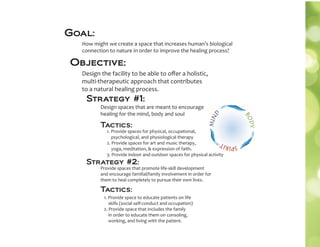
How might we create a space that increases human’s biological
connection to nature in order to improve the healing process?
Objective:
Design the facility to be able to offer a holistic,
multi-therapeutic approach that contributes
to a natural healing process.
Strategy #1:
Design spaces that are meant to encourage
healing for the mind, body and soul
Tactics:
1. Provide spaces for physical, occupational,
psychological, and physiological therapy
2. Provide spaces for art and music therapy,
yoga, meditation, & expression of faith.
3. Provide indoor and outdoor spaces for physical activity
Goal:
Strategy #2:
Provide spaces that promote life-skill development
and encourage familial/family involvement in order for
them to heal completely to pursue their own lives.
Tactics:
1. Provide space to educate patients on life
skills (social self-conduct and occupation)
2. Provide space that includes the family
in order to educate them on consoling,
working, and living with the patient.
Users&Research:
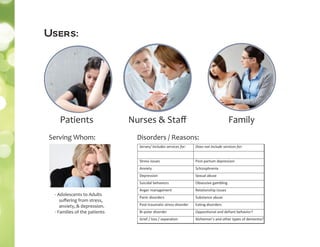
Patients FamilyNurses & Staff
Disorders / Reasons:Serving Whom:
- Adolescents to Adults
suffering from stress,
anxiety, & depression.
- Families of the patients
Serves/ Includes services for: Does not include services for:
Stress issues Post-partum depression
Anxiety Schizophrenia
Depression Sexual abuse
Suicidal behaviors Obsessive gambling
Anger management Relationship issues
Panic disorders Substance abuse
Post-traumatic stress disorder Eating disorders
Bi-polar disorder Oppositional and defiant behavior?
Grief / loss / separation Alzheimer’s and other types of dementia?
Users:
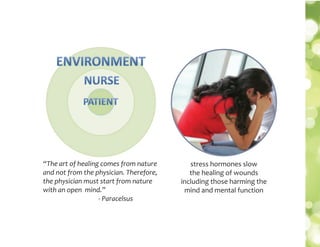
stress hormones slow
the healing of wounds
including those harming the
mind and mental function
“The art of healing comes from nature
and not from the physician. Therefore,
the physician must start from nature
with an open mind.”
- Paracelsus
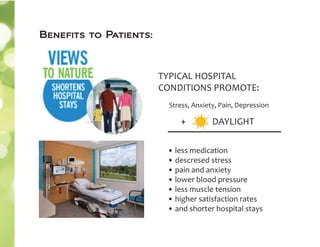
Benefits to Patients:
Stress, Anxiety, Pain, Depression
TYPICAL HOSPITAL
CONDITIONS PROMOTE:
• less medication
• descresed stress
• pain and anxiety
• lower blood pressure
• less muscle tension
• higher satisfaction rates
• and shorter hospital stays
+ DAYLIGHT
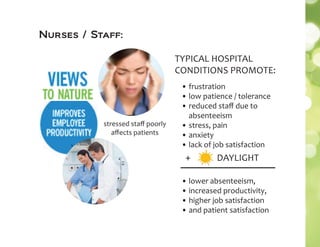
Nurses / Staff:
• lower absenteeism,
• increased productivity,
• higher job satisfaction
• and patient satisfaction
TYPICAL HOSPITAL
CONDITIONS PROMOTE:
• frustration
• low patience / tolerance
• reduced staff due to
absenteeism
• stress, pain
• anxiety
• lack of job satisfaction
stressed staff poorly
affects patients
+ DAYLIGHT
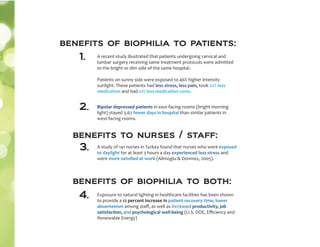
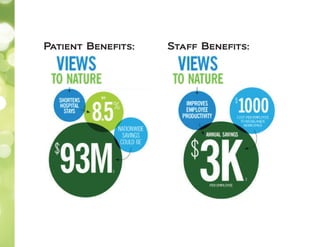
A recent study illustrated that patients undergoing cervical and
lumbar surgery receiving same treatment protocols were admitted
to the bright or dim side of the same hospital.
Patients on sunny side were exposed to 46% higher intensity
sunlight. These patients had less stress, less pain, took 22% less
medication and had 21% less medication costs.
1.
Bipolar depressed patients in east-facing rooms (bright morning
light) stayed 3.67 fewer days in hospital than similar patients in
west-facing rooms.
2.
A study of 141 nurses in Turkey found that nurses who were exposed
to daylight for at least 3 hours a day experienced less stress and
were more satisfied at work (Alimoglu & Donmez, 2005).
benefits to nurses / staff:
3.
benefits of biophilia to both:
Exposure to natural lighting in healthcare facilities has been shown
to provide a 12 percent increase in patient recovery time, lower
absenteeism among staff, as well as increased productivity, job
satisfaction, and psychological well-being (U.S. DOE, Efficiency and
Renewable Energy)
4.
benefits of biophilia to patients:
CaseStudies:
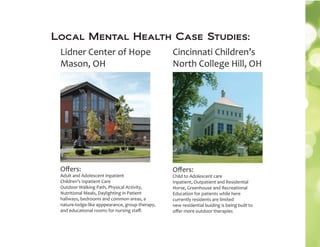
Cincinnati Children’s
North College Hill, OH
Lidner Center of Hope
Mason, OH
Offers:
Adult and Adolescent Inpatient
Children’s Inpatient Care
Outdoor Walking Path, Physical Activity,
Nutritional Meals, Daylighting in Patient
hallways, bedrooms and common areas, a
nature-lodge-like apppearance, group therapy,
and educational rooms for nursing staff.
Offers:
Child to Adolescent care
Inpatient, Outpatient and Residential
Horse, Greenhouse and Recreational
Education for patients while here
currently residents are limited
new residential buiding is being built to
offer more outdoor therapies
Local Mental Health Case Studies:
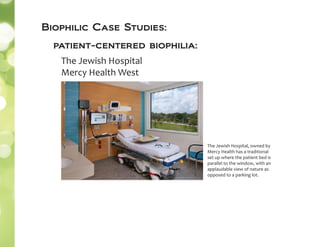
The Jewish Hospital, owned by
Mercy Health has a traditional
set up where the patient bed is
parallel to the window, with an
applaudable view of nature as
opposed to a parking lot.
The Jewish Hospital
Mercy Health West
patient-centered biophilia:
Biophilic Case Studies:
patient-centered biophilia:
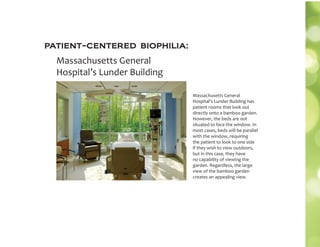
Massachusetts General
Hospital’s Lunder Building has
patient rooms that look out
directly onto a bamboo garden.
However, the beds are not
situated to face the window. In
most cases, beds will be parallel
with the window, requiring
the patient to look to one side
if they wish to view outdoors,
but in this case, they have
no capability of viewing the
garden. Regardless, the large
view of the bamboo garden
creates an appealing view.
Massachusetts General
Hospital’s Lunder Building
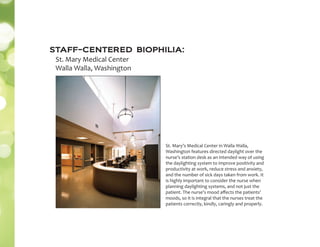
staff-centered biophilia:
St. Mary Medical Center
Walla Walla, Washington
St. Mary’s Medical Center in Walla Walla,
Washington features directed daylight over the
nurse’s station desk as an intended way of using
the daylighting system to improve positivity and
productivity at work, reduce stress and anxiety,
and the number of sick days taken from work. It
is highly important to consider the nurse when
planning daylighting systems, and not just the
patient. The nurse’s mood affects the patients’
moods, so it is integral that the nurses treat the
patients correctly, kindly, caringly and properly.
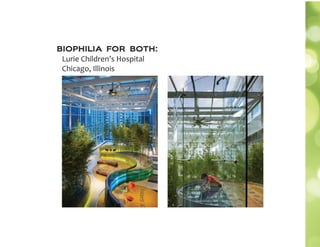
biophilia for both:
Lurie Children’s Hospital
Chicago, Illinois
PrecedenceStudies
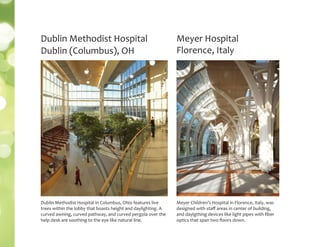
Meyer Hospital
Florence, Italy
Meyer Children’s Hospital in Florence, Italy, was
designed with staff areas in center of building,
and daylgthing devices like light pipes with fiber
optics that span two floors down.
Dublin Methodist Hospital
Dublin (Columbus), OH
Dublin Methodist Hospital in Columbus, Ohio features live
trees within the lobby that boasts height and daylighting. A
curved awning, curved pathway, and curved pergola over the
help desk are soothing to the eye like natural line.
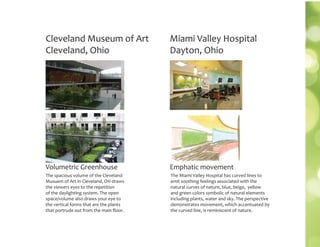
Cleveland Museum of Art
Cleveland, Ohio
The spacious volume of the Cleveland
Musuem of Art in Cleveland, OH draws
the viewers eyes to the repetition
of the daylighting system. The open
space/volume also draws your eye to
the vertical forms that are the plants
that portrude out from the main floor.
Volumetric Greenhouse
The Miami Valley Hospital has curved lines to
emit soothing feelings associated with the
natural curves of nature, blue, beige, yellow
and green colors symbolic of natural elements
including plants, water and sky. The perspective
demonstrates movement, which accentuated by
the curved line, is reminiscent of nature.
Miami Valley Hospital
Dayton, Ohio
Emphatic movement
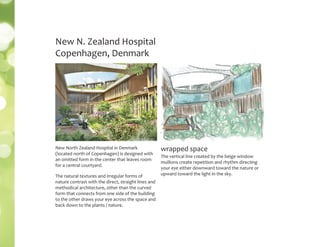
The vertical line created by the beige window
mullions create repetition and rhythm directing
your eye either downward toward the nature or
upward toward the light in the sky.
New N. Zealand Hospital
Copenhagen, Denmark
wrapped spaceNew North Zealand Hospital in Denmark
(located north of Copenhagen) is designed with
an omitted form in the center that leaves room
for a central courtyard.
The natural textures and irregular forms of
nature contrast with the direct, straight lines and
methodical architecture, other than the curved
form that connects from one side of the building
to the other draws your eye across the space and
back down to the plants / nature.
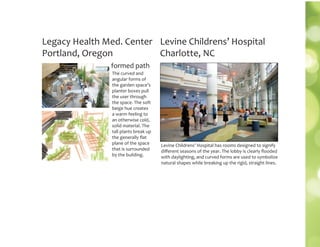
The curved and
angular forms of
the garden space’s
planter boxes pull
the user through
the space. The soft
beige hue creates
a warm feeling to
an otherwise cold,
solid material. The
tall plants break up
the generally flat
plane of the space
that is surrounded
by the building.
Legacy Health Med. Center
Portland, Oregon
formed path
Levine Childrens’ Hospital
Charlotte, NC
Levine Childrens’ Hospital has rooms designed to signify
different seasons of the year. The lobby is clearly flooded
with daylighting, and curved forms are used to symbolize
natural shapes while breaking up the rigid, straight lines.
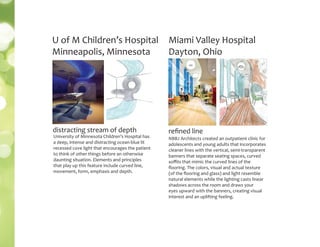
U of M Children’s Hospital
Minneapolis, Minnesota
distracting stream of depth
University of Minnesota Children’s Hospital has
a deep, intense and distracting ocean-blue lit
recessed cove light that encourages the patient
to think of other things before an otherwise
daunting situation. Elements and principles
that play up this feature include curved line,
movement, form, emphasis and depth.
NBBJ Architects created an outpatient clinic for
adolescents and young adults that incorporates
cleaner lines with the vertical, semi-transparent
banners that separate seating spaces, curved
soffits that mimic the curved lines of the
flooring. The colors, visual and actual texture
(of the flooring and glass) and light resemble
natural elements while the lighting casts linear
shadows across the room and draws your
eyes upward with the banners, creating visual
interest and an uplifting feeling.
Miami Valley Hospital
Dayton, Ohio
refined line
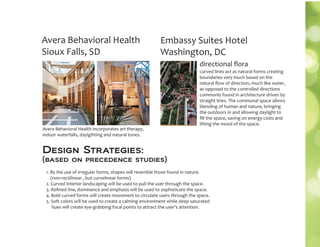
Avera Behavioral Health
Sioux Falls, SD
Avera Behavioral Health incorporates art therapy,
indoor waterfalls, daylgihting and natural tones.
Embassy Suites Hotel
Washington, DC
curved lines act as natural forms creating
boundaries very much based on the
natural flow of direction, much like water,
as opposed to the controlled directions
commonly found in architecture driven by
straight lines. The communal space allows
blending of human and nature, bringing
the outdoors in and allowing daylight to
fill the space, saving on energy costs and
lifting the mood of the space.
directional flora
1. By the use of irregular forms, shapes will resemble those found in nature.
(non-rectilinear , but curvelinear forms)
2. Curved Interior landscaping will be used to pull the user through the space.
3. Refined line, dominance and emphasis will be used to sophisticate the space.
4. Bold curved forms will create movement to circulate users through the space.
5. Soft colors will be used to create a calming environment while deep saturated
hues will create eye-grabbing focal points to attract the user’s attention.
Design Strategies:
(based on precedence studies)
Solution&Conclusion
Solution:
By using a Biophilic approach to healthcare design,
there will be positive benefits for mentally ill patients,
their families, and most importantly the staff, who
will be caring for them.
This research and exploration will help me create
peaceful healing environment blending indoor and
outdoor, while maintaining the safety and healthcare
requirements of a mental health facility.
Conclusion:
7850 Voice of America Park
West Chester, Ohio 45069
Building: Site Location:
1. offers access to the park and courtyard from common spaces
2. incorporation of alternate energy sources
3. ample daylight in the building for mental and physical healing
4. the shape of the building resembles a biomorphic form
Why this location?
2. suburban location - avoids the stress and dirtiness of the city
(feeling of safety & security pulled away from city)
3. proximity to two hospitals that can send patients
here from West Chester’s and Cincinnati Children’s Liberty Campus
architectural firm in Wisconsin
that designed this elementary
school in Beijing, China
Why this building?
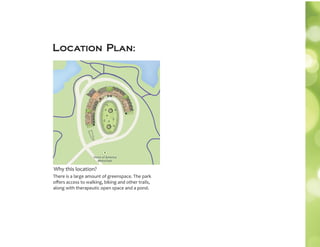
Location Plan:
There is a large amount of greenspace. The park
offers access to walking, biking and other trails,
along with therapeutic open space and a pond.
Why this location?
FirstFloor
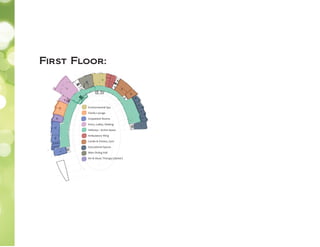
First Floor:
Environmental Spa
Family Lounge
Outpatient Rooms
Entry, Lobby, Waiting
Hallways - Active Space
Ambulatory Wing
Cardio & Fitness, Gym
Educational Spaces
Main Dining Hall
Art & Music Therapy (darker)
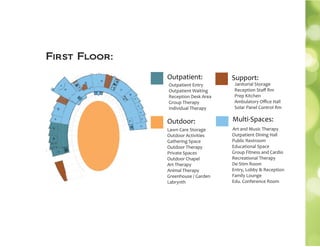
First Floor:
Outpatient:
Multi-Spaces:Outdoor:
Outpatient Entry
Outpatient Waiting
Reception Desk Area
Group Therapy
Individual Therapy
Art and Music Therapy
Outpatient Dining Hall
Public Restroom
Educational Space
Group Fitness and Cardio
Recreational Therapy
De-Stim Room
Entry, Lobby & Reception
Family Lounge
Edu. Conference Room
Lawn Care Storage
Outdoor Activities
Gathering Space
Outdoor Therapy
Private Spaces
Outdoor Chapel
Art Therapy
Animal Therapy
Greenhouse / Garden
Labrynth
Support:
Janitorial Storage
Reception Staff Rm
Prep Kitchen
Ambulatory Office Hall
Solar Panel Control Rm
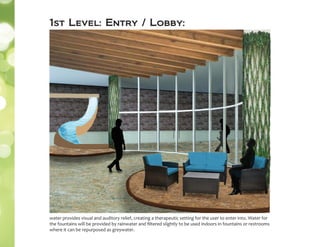
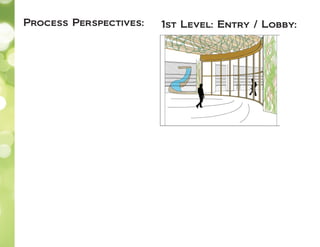
1st Level: Entry / Lobby:
water provides visual and auditory relief, creating a therapeutic setting for the user to enter into. Water for
the fountains will be provided by rainwater and filtered slightly to be used indoors in fountains or restrooms
where it can be repurposed as greywater.
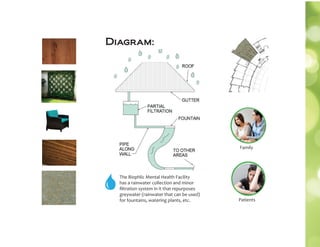
Diagram:
Patients
Family
The Biophlic Mental Health Facility
has a rainwater collection and minor
filtration system in it that repurposes
greywater (rainwater that can be used)
for fountains, watering plants, etc.
SecondFloor
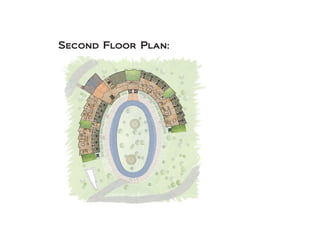
Second Floor Plan:
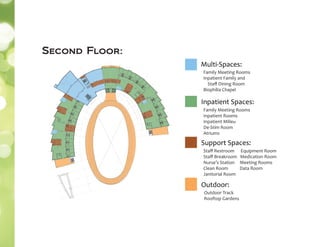
Second Floor:
Inpatient Spaces:
Multi-Spaces:
Family Meeting Rooms
Inpatient Family and
Staff Dining Room
Biophilia Chapel
Staff Restroom Equipment Room
Staff Breakroom Medication Room
Nurse’s Station Meeting Rooms
Clean Room Data Room
Janitorial Room
Support Spaces:
Family Meeting Rooms
Inpatient Rooms
Inpatient Milieu
De-Stim Room
Atriums
Outdoor:
Outdoor Track
Rooftop Gardens
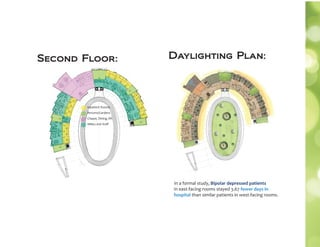
Daylighting Plan:
In a formal study, Bipolar depressed patients
in east-facing rooms stayed 3.67 fewer days in
hospital than similar patients in west-facing rooms.
Second Floor:
Inpatient Rooms
Atriums/Gardens
Chapel, Dining, RR
Milieu and Staff
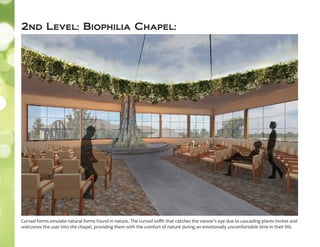
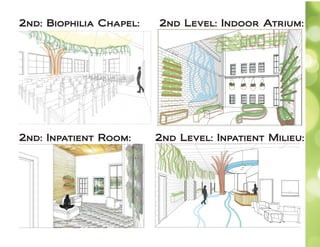
2nd Level: Biophilia Chapel:
Curved forms emulate natural forms found in nature. The curved soffit that catches the viewer’s eye due to cascading plants invites and
welcomes the user into the chapel, providing them with the comfort of nature during an emotionally uncomfortable time in their life.
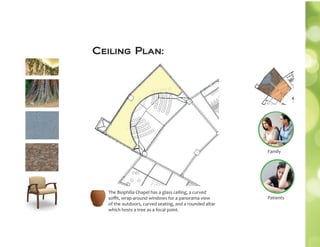
Ceiling Plan:
The Biophilia Chapel has a glass ceiling, a curved
soffit, wrap-around windows for a panorama view
of the outdoors, curved seating, and a rounded altar
which hosts a tree as a focal point.
Family
Patients
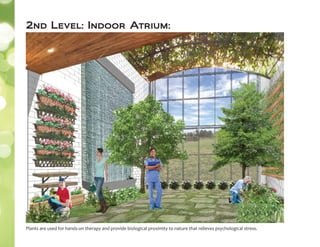
2nd Level: Indoor Atrium:
Plants are used for hands-on therapy and provide biological proximity to nature that relieves psychological stress.
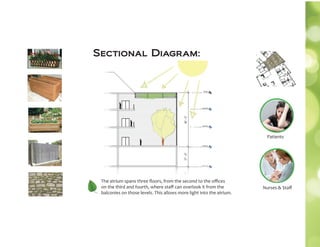
The atrium spans three floors, from the second to the offices
on the third and fourth, where staff can overlook it from the
balconies on those levels. This allows more light into the atrium.
Patients
Nurses & Staff
Sectional Diagram:
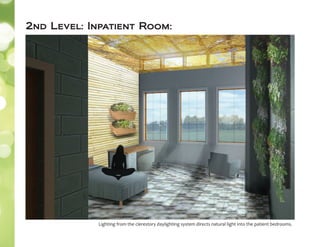
2nd Level: Inpatient Room:
Lighting from the clerestory daylighting system directs natural light into the patient bedrooms.
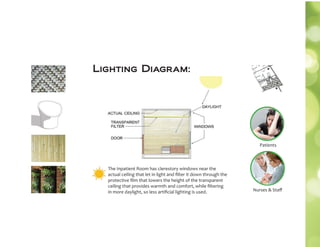
Lighting Diagram:
The Inpatient Room has clerestory windows near the
actual ceiling that let in light and filter it down through the
protective film that lowers the height of the transparent
ceiling that provides warmth and comfort, while filtering
in more daylight, so less artificial lighting is used.
Patients
Nurses & Staff
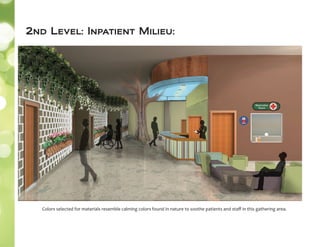
2nd Level: Inpatient Milieu:
Colors selected for materials resemble calming colors found in nature to soothe patients and staff in this gathering area.
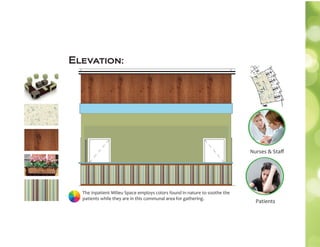
Elevation:
The Inpatient Milieu Space employs colors found in nature to soothe the
patients while they are in this communal area for gathering.
Nurses & Staff
Patients
Appendix:
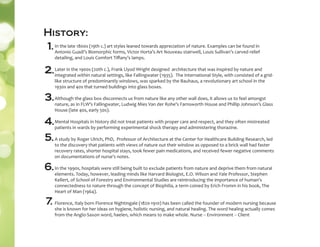
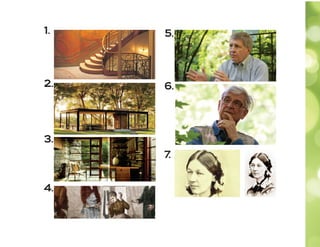
In the late 1800s (19th c.) art styles leaned towards appreciation of nature. Examples can be found in
Antonio Guadi’s Biomorphic forms, Victor Horta’s Art Nouveau stairwell, Louis Sullivan’s carved relief
detailing, and Louis Comfort Tiffany’s lamps.
Later in the 1900s (20th c.), Frank Llyod Wright designed architecture that was inspired by nature and
integrated within natural settings, like Fallingwater (1935). The International Style, with consisted of a grid-
like structure of predominantly windows, was sparked by the Bauhaus, a revolutionary art school in the
1930s and 40s that turned buildings into glass boxes.
Although the glass box disconnects us from nature like any other wall does, it allows us to feel amongst
nature, as in FLW’s Fallingwater, Ludwig Mies Van der Rohe’s Farnsworth House and Phillip Johnson’s Glass
House (late 40s, early 50s).
Mental Hospitals in history did not treat patients with proper care and respect, and they often mistreated
patients in wards by performing experimental shock therapy and administering thorazine.
A study by Roger Ulrich, PhD, Professor of Architecture at the Center for Healthcare Building Research, led
to the discovery that patients with views of nature out their window as opposed to a brick wall had faster
recovery rates, shorter hospital stays, took fewer pain medications, and received fewer negative comments
on documentations of nurse’s notes.
In the 1990s, hospitals were still being built to exclude patients from nature and deprive them from natural
elements. Today, however, leading minds like Harvard Biologist, E.O. Wilson and Yale Professor, Stephen
Kellert, of School of Forestry and Environmental Studies are reintroducing the importance of human’s
connectedness to nature through the concept of Biophilia, a term coined by Erich Fromm in his book, The
Heart of Man (1964).
Florence, Italy born Florence Nightingale (1820-1910) has been called the founder of modern nursing because
she is known for her ideas on hygiene, holistic nursing, and natural healing. The word healing actually comes
from the Anglo-Saxon word, haelen, which means to make whole. Nurse -- Environment -- Client
History:
2.
3.
4.
1.
5.
6.
7.
2.
3.
4.
5.
6.
7.
1.
Staff Benefits:Patient Benefits:
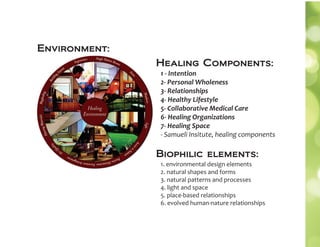
1 - Intention
2- Personal Wholeness
3- Relationships
4- Healthy Lifestyle
5- Collaborative Medical Care
6- Healing Organizations
7- Healing Space
- Samueli Insitute, healing components
Healing Components:
Environment:
1. environmental design elements
2. natural shapes and forms
3. natural patterns and processes
4. light and space
5. place-based relationships
6. evolved human-nature relationships
Biophilic elements:
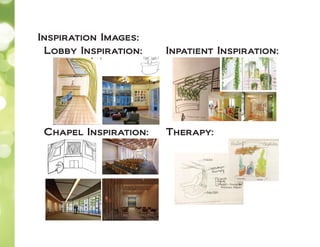
Inspiration Images:
Inpatient Inspiration:Lobby Inspiration:
Chapel Inspiration: Therapy:
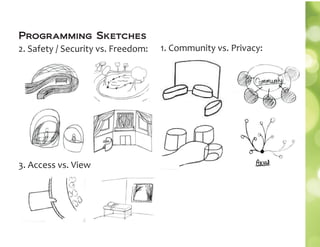
1. Community vs. Privacy:2. Safety / Security vs. Freedom:
3. Access vs. View
Programming Sketches
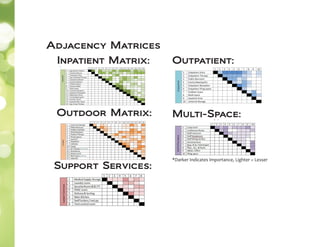
Adjacency Matrices
Inpatient Matrix: Outpatient:
Multi-Space:
Support Services:
Outdoor Matrix:
*Darker Indicates Importance, Lighter = Lesser
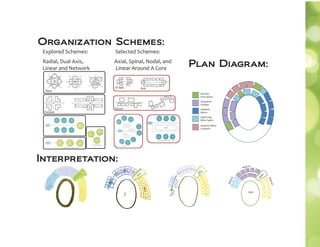
Interpretation:
KZ
Possible
Entry points
Outpatient
Therapy
Inpatient
Rooms
Gathering/
Mileu Space
Potential Office
Locations
Explored Schemes: Selected Schemes:
Axial, Spinal, Nodal, and
Linear Around A Core
Radial, Dual Axis,
Linear and Network
Organization Schemes:
Plan Diagram:
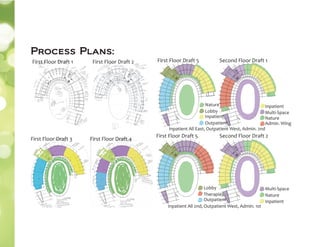
Process Plans:
First Floor Draft 3 First Floor Draft 4
Outpatient
Nature
Lobby
Inpatient
Inpatient
Multi-Space
Nature
Admin. Wing
Inpatient All East, Outpatient West, Admin. 2nd
First Floor Draft 5 Second Floor Draft 1First Floor Draft 1 First Floor Draft 2
Outpatient
Therapies
Lobby
Inpatient
Multi-Space
Nature
Inpatient All 2nd, Outpatient West, Admin. 1st
Second Floor Draft 2First Floor Draft 5
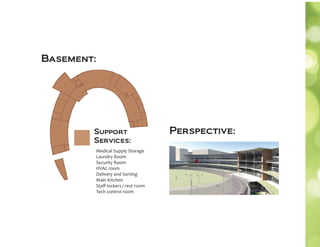
Basement:
Medical Supply Storage
Laundry Room
Security Room
HVAC room
Delivery and Sorting
Main Kitchen
Staff lockers / rest room
Tech control room
Support
Services:
Perspective:
Approximately 40,000 square meters (430,000 square
feet) in size, the building design includes four levels of
above ground classroom, administrative, performance
and related educational spaces, plus two underground
levels reserved for parking and a multi-purpose
gymnasium/athletic complex.
Zhongguancun Elementary School in
Beijing, China by TKWA (ARCH firm)
Outdoor terraces connected to classrooms on each
level help manage stormwater and provide planting
areas for students to learn about plant growth and
food production. It is also one way to bring them to
closer to nature.
Building:
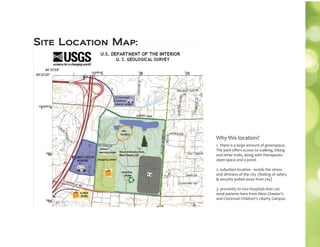
Site Location Map:
1. There is a large amount of greenspace.
The park offers access to walking, biking
and other trails, along with therapeutic
open space and a pond.
2. suburban location - avoids the stress
and dirtiness of the city (feeling of safety
 security pulled away from city)
3. proximity to two hospitals that can
send patients here from West Chester’s
and Cincinnati Children’s Liberty Campus
Why this location?
1st Level: Entry / Lobby:Process Perspectives:
2nd: Inpatient Room: 2nd Level: Inpatient Milieu:
2nd Level: Indoor Atrium:2nd: Biophilia Chapel:
RebeccaKiefer
InteriorArchitectureandDesign
SustainabilityandMarketing
kieferrebecca4@gmail.com
270-300-4793

Thesis booklet_Kiefer, Rebecca

  • 1.
    “…the enjoyment ofscenery employs the mind without fatigue and yet exercises it, tranquilizes it and yet enlivens it; and thus, through the influence of the mind over the body, gives the effect of refreshing rest and reinvigoration to the whole system.” (Olmsted, 1865.) Biophilic Mental Health Facility Healing through Biophilia ByRebeccaKiefer
  • 3.
  • 4.
  • 5.
    In history, wesee the proof of these problems in practice, in how we have treated the mentally ill. A study by Ulrich in the late 1980s led to the discovery that patients with views of nature out their window as opposed to a brick wall had faster recovery rates, shorter hospital stays, took fewer pain medications, and received fewer negative comments on documentations of nurse’s notes. And we see the problem in the rising number of mentally ill, potentially caused by this disconnect from nature. Lidner Center of Hope in Mason, Ohio notes that Mental Illness ranks as the one of the leading causes of disability in the world, with 2.5 times more Americans suffering from a major psychiatric disorder in their lifetime compared with cancer, heart disease and diabetes combined. a) In history, we are able note where people have recognized the importance of connectedness to nature. Ulrich was notably one of the first that recognized this connection in the psychiatric hospital setting, and Eric Fromm coined the term Biophilia in his book, The Heart of Man, published in 1964. b) Edward O. Wilson and Stephen Kellert further developed this subject in their research and the books they wrote. Kellert later had his book, Biophilic Design, published in 2008. This book became my primary source of information on the topic, where I came across the six elements of Biophilia that I’ve decided to use as the foundation of the therapeutic environment I’ll be designing. 1. 2. 3. History:
  • 6.
    DESIGNED TO CURE,NOT TO HEAL Healthcare structures emphasize the elimination of ailments and with disregard for the fundamental aspects of human health—they are “designed to cure, not to heal.” Bedridden patients face drab walls, bland ceiling tiles, minimal daylight, few views of nature, and rare ability to go outside. This disconnect from nature that can intensify stress, pain, anxiety, and depression, costing the hospital more hours, staff, and resources. HUMAN’S DISCONNECT FROM NATURE Problem:
  • 7.
  • 8.
    What is Biophilia? Biophiliais simply human’s biological connection to nature. In biophilic design, designers seek to improve this connection in order to capitalize on the phyiscal, psychological and pysiological health benefits of enhancing this connection. Healing through Biophilia My thesis project is centered on the idea of using the elements of Biophilia to heal mental health patients in an interior environment that blends indoor and outdoor.
  • 9.
    How might wecreate a space that increases human’s biological connection to nature in order to improve the healing process? Objective: Design the facility to be able to offer a holistic, multi-therapeutic approach that contributes to a natural healing process. Strategy #1: Design spaces that are meant to encourage healing for the mind, body and soul Tactics: 1. Provide spaces for physical, occupational, psychological, and physiological therapy 2. Provide spaces for art and music therapy, yoga, meditation, & expression of faith. 3. Provide indoor and outdoor spaces for physical activity Goal: Strategy #2: Provide spaces that promote life-skill development and encourage familial/family involvement in order for them to heal completely to pursue their own lives. Tactics: 1. Provide space to educate patients on life skills (social self-conduct and occupation) 2. Provide space that includes the family in order to educate them on consoling, working, and living with the patient.
  • 10.
  • 11.
    Patients FamilyNurses &Staff Disorders / Reasons:Serving Whom: - Adolescents to Adults suffering from stress, anxiety, & depression. - Families of the patients Serves/ Includes services for: Does not include services for: Stress issues Post-partum depression Anxiety Schizophrenia Depression Sexual abuse Suicidal behaviors Obsessive gambling Anger management Relationship issues Panic disorders Substance abuse Post-traumatic stress disorder Eating disorders Bi-polar disorder Oppositional and defiant behavior? Grief / loss / separation Alzheimer’s and other types of dementia? Users:
  • 12.
    stress hormones slow thehealing of wounds including those harming the mind and mental function “The art of healing comes from nature and not from the physician. Therefore, the physician must start from nature with an open mind.” - Paracelsus
  • 13.
    Benefits to Patients: Stress,Anxiety, Pain, Depression TYPICAL HOSPITAL CONDITIONS PROMOTE: • less medication • descresed stress • pain and anxiety • lower blood pressure • less muscle tension • higher satisfaction rates • and shorter hospital stays + DAYLIGHT
  • 14.
    Nurses / Staff: •lower absenteeism, • increased productivity, • higher job satisfaction • and patient satisfaction TYPICAL HOSPITAL CONDITIONS PROMOTE: • frustration • low patience / tolerance • reduced staff due to absenteeism • stress, pain • anxiety • lack of job satisfaction stressed staff poorly affects patients + DAYLIGHT
  • 15.
    A recent studyillustrated that patients undergoing cervical and lumbar surgery receiving same treatment protocols were admitted to the bright or dim side of the same hospital. Patients on sunny side were exposed to 46% higher intensity sunlight. These patients had less stress, less pain, took 22% less medication and had 21% less medication costs. 1. Bipolar depressed patients in east-facing rooms (bright morning light) stayed 3.67 fewer days in hospital than similar patients in west-facing rooms. 2. A study of 141 nurses in Turkey found that nurses who were exposed to daylight for at least 3 hours a day experienced less stress and were more satisfied at work (Alimoglu & Donmez, 2005). benefits to nurses / staff: 3. benefits of biophilia to both: Exposure to natural lighting in healthcare facilities has been shown to provide a 12 percent increase in patient recovery time, lower absenteeism among staff, as well as increased productivity, job satisfaction, and psychological well-being (U.S. DOE, Efficiency and Renewable Energy) 4. benefits of biophilia to patients:
  • 17.
  • 19.
    Cincinnati Children’s North CollegeHill, OH Lidner Center of Hope Mason, OH Offers: Adult and Adolescent Inpatient Children’s Inpatient Care Outdoor Walking Path, Physical Activity, Nutritional Meals, Daylighting in Patient hallways, bedrooms and common areas, a nature-lodge-like apppearance, group therapy, and educational rooms for nursing staff. Offers: Child to Adolescent care Inpatient, Outpatient and Residential Horse, Greenhouse and Recreational Education for patients while here currently residents are limited new residential buiding is being built to offer more outdoor therapies Local Mental Health Case Studies:
  • 20.
    The Jewish Hospital,owned by Mercy Health has a traditional set up where the patient bed is parallel to the window, with an applaudable view of nature as opposed to a parking lot. The Jewish Hospital Mercy Health West patient-centered biophilia: Biophilic Case Studies:
  • 21.
    patient-centered biophilia: Massachusetts General Hospital’sLunder Building has patient rooms that look out directly onto a bamboo garden. However, the beds are not situated to face the window. In most cases, beds will be parallel with the window, requiring the patient to look to one side if they wish to view outdoors, but in this case, they have no capability of viewing the garden. Regardless, the large view of the bamboo garden creates an appealing view. Massachusetts General Hospital’s Lunder Building
  • 22.
    staff-centered biophilia: St. MaryMedical Center Walla Walla, Washington St. Mary’s Medical Center in Walla Walla, Washington features directed daylight over the nurse’s station desk as an intended way of using the daylighting system to improve positivity and productivity at work, reduce stress and anxiety, and the number of sick days taken from work. It is highly important to consider the nurse when planning daylighting systems, and not just the patient. The nurse’s mood affects the patients’ moods, so it is integral that the nurses treat the patients correctly, kindly, caringly and properly.
  • 23.
    biophilia for both: LurieChildren’s Hospital Chicago, Illinois
  • 24.
  • 25.
    Meyer Hospital Florence, Italy MeyerChildren’s Hospital in Florence, Italy, was designed with staff areas in center of building, and daylgthing devices like light pipes with fiber optics that span two floors down. Dublin Methodist Hospital Dublin (Columbus), OH Dublin Methodist Hospital in Columbus, Ohio features live trees within the lobby that boasts height and daylighting. A curved awning, curved pathway, and curved pergola over the help desk are soothing to the eye like natural line.
  • 26.
    Cleveland Museum ofArt Cleveland, Ohio The spacious volume of the Cleveland Musuem of Art in Cleveland, OH draws the viewers eyes to the repetition of the daylighting system. The open space/volume also draws your eye to the vertical forms that are the plants that portrude out from the main floor. Volumetric Greenhouse The Miami Valley Hospital has curved lines to emit soothing feelings associated with the natural curves of nature, blue, beige, yellow and green colors symbolic of natural elements including plants, water and sky. The perspective demonstrates movement, which accentuated by the curved line, is reminiscent of nature. Miami Valley Hospital Dayton, Ohio Emphatic movement
  • 27.
    The vertical linecreated by the beige window mullions create repetition and rhythm directing your eye either downward toward the nature or upward toward the light in the sky. New N. Zealand Hospital Copenhagen, Denmark wrapped spaceNew North Zealand Hospital in Denmark (located north of Copenhagen) is designed with an omitted form in the center that leaves room for a central courtyard. The natural textures and irregular forms of nature contrast with the direct, straight lines and methodical architecture, other than the curved form that connects from one side of the building to the other draws your eye across the space and back down to the plants / nature.
  • 28.
    The curved and angularforms of the garden space’s planter boxes pull the user through the space. The soft beige hue creates a warm feeling to an otherwise cold, solid material. The tall plants break up the generally flat plane of the space that is surrounded by the building. Legacy Health Med. Center Portland, Oregon formed path Levine Childrens’ Hospital Charlotte, NC Levine Childrens’ Hospital has rooms designed to signify different seasons of the year. The lobby is clearly flooded with daylighting, and curved forms are used to symbolize natural shapes while breaking up the rigid, straight lines.
  • 29.
    U of MChildren’s Hospital Minneapolis, Minnesota distracting stream of depth University of Minnesota Children’s Hospital has a deep, intense and distracting ocean-blue lit recessed cove light that encourages the patient to think of other things before an otherwise daunting situation. Elements and principles that play up this feature include curved line, movement, form, emphasis and depth. NBBJ Architects created an outpatient clinic for adolescents and young adults that incorporates cleaner lines with the vertical, semi-transparent banners that separate seating spaces, curved soffits that mimic the curved lines of the flooring. The colors, visual and actual texture (of the flooring and glass) and light resemble natural elements while the lighting casts linear shadows across the room and draws your eyes upward with the banners, creating visual interest and an uplifting feeling. Miami Valley Hospital Dayton, Ohio refined line
  • 30.
    Avera Behavioral Health SiouxFalls, SD Avera Behavioral Health incorporates art therapy, indoor waterfalls, daylgihting and natural tones. Embassy Suites Hotel Washington, DC curved lines act as natural forms creating boundaries very much based on the natural flow of direction, much like water, as opposed to the controlled directions commonly found in architecture driven by straight lines. The communal space allows blending of human and nature, bringing the outdoors in and allowing daylight to fill the space, saving on energy costs and lifting the mood of the space. directional flora 1. By the use of irregular forms, shapes will resemble those found in nature. (non-rectilinear , but curvelinear forms) 2. Curved Interior landscaping will be used to pull the user through the space. 3. Refined line, dominance and emphasis will be used to sophisticate the space. 4. Bold curved forms will create movement to circulate users through the space. 5. Soft colors will be used to create a calming environment while deep saturated hues will create eye-grabbing focal points to attract the user’s attention. Design Strategies: (based on precedence studies)
  • 31.
  • 32.
    Solution: By using aBiophilic approach to healthcare design, there will be positive benefits for mentally ill patients, their families, and most importantly the staff, who will be caring for them. This research and exploration will help me create peaceful healing environment blending indoor and outdoor, while maintaining the safety and healthcare requirements of a mental health facility. Conclusion:
  • 34.
    7850 Voice ofAmerica Park West Chester, Ohio 45069 Building: Site Location: 1. offers access to the park and courtyard from common spaces 2. incorporation of alternate energy sources 3. ample daylight in the building for mental and physical healing 4. the shape of the building resembles a biomorphic form Why this location? 2. suburban location - avoids the stress and dirtiness of the city (feeling of safety & security pulled away from city) 3. proximity to two hospitals that can send patients here from West Chester’s and Cincinnati Children’s Liberty Campus architectural firm in Wisconsin that designed this elementary school in Beijing, China Why this building?
  • 35.
    Location Plan: There isa large amount of greenspace. The park offers access to walking, biking and other trails, along with therapeutic open space and a pond. Why this location?
  • 36.
  • 37.
    First Floor: Environmental Spa FamilyLounge Outpatient Rooms Entry, Lobby, Waiting Hallways - Active Space Ambulatory Wing Cardio & Fitness, Gym Educational Spaces Main Dining Hall Art & Music Therapy (darker)
  • 38.
    First Floor: Outpatient: Multi-Spaces:Outdoor: Outpatient Entry OutpatientWaiting Reception Desk Area Group Therapy Individual Therapy Art and Music Therapy Outpatient Dining Hall Public Restroom Educational Space Group Fitness and Cardio Recreational Therapy De-Stim Room Entry, Lobby & Reception Family Lounge Edu. Conference Room Lawn Care Storage Outdoor Activities Gathering Space Outdoor Therapy Private Spaces Outdoor Chapel Art Therapy Animal Therapy Greenhouse / Garden Labrynth Support: Janitorial Storage Reception Staff Rm Prep Kitchen Ambulatory Office Hall Solar Panel Control Rm
  • 39.
    1st Level: Entry/ Lobby: water provides visual and auditory relief, creating a therapeutic setting for the user to enter into. Water for the fountains will be provided by rainwater and filtered slightly to be used indoors in fountains or restrooms where it can be repurposed as greywater.
  • 40.
    Diagram: Patients Family The Biophlic MentalHealth Facility has a rainwater collection and minor filtration system in it that repurposes greywater (rainwater that can be used) for fountains, watering plants, etc.
  • 41.
  • 42.
  • 43.
    Second Floor: Inpatient Spaces: Multi-Spaces: FamilyMeeting Rooms Inpatient Family and Staff Dining Room Biophilia Chapel Staff Restroom Equipment Room Staff Breakroom Medication Room Nurse’s Station Meeting Rooms Clean Room Data Room Janitorial Room Support Spaces: Family Meeting Rooms Inpatient Rooms Inpatient Milieu De-Stim Room Atriums Outdoor: Outdoor Track Rooftop Gardens
  • 44.
    Daylighting Plan: In aformal study, Bipolar depressed patients in east-facing rooms stayed 3.67 fewer days in hospital than similar patients in west-facing rooms. Second Floor: Inpatient Rooms Atriums/Gardens Chapel, Dining, RR Milieu and Staff
  • 45.
    2nd Level: BiophiliaChapel: Curved forms emulate natural forms found in nature. The curved soffit that catches the viewer’s eye due to cascading plants invites and welcomes the user into the chapel, providing them with the comfort of nature during an emotionally uncomfortable time in their life.
  • 46.
    Ceiling Plan: The BiophiliaChapel has a glass ceiling, a curved soffit, wrap-around windows for a panorama view of the outdoors, curved seating, and a rounded altar which hosts a tree as a focal point. Family Patients
  • 47.
    2nd Level: IndoorAtrium: Plants are used for hands-on therapy and provide biological proximity to nature that relieves psychological stress.
  • 48.
    The atrium spansthree floors, from the second to the offices on the third and fourth, where staff can overlook it from the balconies on those levels. This allows more light into the atrium. Patients Nurses & Staff Sectional Diagram:
  • 49.
    2nd Level: InpatientRoom: Lighting from the clerestory daylighting system directs natural light into the patient bedrooms.
  • 50.
    Lighting Diagram: The InpatientRoom has clerestory windows near the actual ceiling that let in light and filter it down through the protective film that lowers the height of the transparent ceiling that provides warmth and comfort, while filtering in more daylight, so less artificial lighting is used. Patients Nurses & Staff
  • 51.
    2nd Level: InpatientMilieu: Colors selected for materials resemble calming colors found in nature to soothe patients and staff in this gathering area.
  • 52.
    Elevation: The Inpatient MilieuSpace employs colors found in nature to soothe the patients while they are in this communal area for gathering. Nurses & Staff Patients
  • 53.
  • 54.
    In the late1800s (19th c.) art styles leaned towards appreciation of nature. Examples can be found in Antonio Guadi’s Biomorphic forms, Victor Horta’s Art Nouveau stairwell, Louis Sullivan’s carved relief detailing, and Louis Comfort Tiffany’s lamps. Later in the 1900s (20th c.), Frank Llyod Wright designed architecture that was inspired by nature and integrated within natural settings, like Fallingwater (1935). The International Style, with consisted of a grid- like structure of predominantly windows, was sparked by the Bauhaus, a revolutionary art school in the 1930s and 40s that turned buildings into glass boxes. Although the glass box disconnects us from nature like any other wall does, it allows us to feel amongst nature, as in FLW’s Fallingwater, Ludwig Mies Van der Rohe’s Farnsworth House and Phillip Johnson’s Glass House (late 40s, early 50s). Mental Hospitals in history did not treat patients with proper care and respect, and they often mistreated patients in wards by performing experimental shock therapy and administering thorazine. A study by Roger Ulrich, PhD, Professor of Architecture at the Center for Healthcare Building Research, led to the discovery that patients with views of nature out their window as opposed to a brick wall had faster recovery rates, shorter hospital stays, took fewer pain medications, and received fewer negative comments on documentations of nurse’s notes. In the 1990s, hospitals were still being built to exclude patients from nature and deprive them from natural elements. Today, however, leading minds like Harvard Biologist, E.O. Wilson and Yale Professor, Stephen Kellert, of School of Forestry and Environmental Studies are reintroducing the importance of human’s connectedness to nature through the concept of Biophilia, a term coined by Erich Fromm in his book, The Heart of Man (1964). Florence, Italy born Florence Nightingale (1820-1910) has been called the founder of modern nursing because she is known for her ideas on hygiene, holistic nursing, and natural healing. The word healing actually comes from the Anglo-Saxon word, haelen, which means to make whole. Nurse -- Environment -- Client History: 2. 3. 4. 1. 5. 6. 7.
  • 55.
  • 56.
  • 57.
    1 - Intention 2-Personal Wholeness 3- Relationships 4- Healthy Lifestyle 5- Collaborative Medical Care 6- Healing Organizations 7- Healing Space - Samueli Insitute, healing components Healing Components: Environment: 1. environmental design elements 2. natural shapes and forms 3. natural patterns and processes 4. light and space 5. place-based relationships 6. evolved human-nature relationships Biophilic elements:
  • 58.
    Inspiration Images: Inpatient Inspiration:LobbyInspiration: Chapel Inspiration: Therapy:
  • 59.
    1. Community vs.Privacy:2. Safety / Security vs. Freedom: 3. Access vs. View Programming Sketches
  • 60.
    Adjacency Matrices Inpatient Matrix:Outpatient: Multi-Space: Support Services: Outdoor Matrix: *Darker Indicates Importance, Lighter = Lesser
  • 61.
    Interpretation: KZ Possible Entry points Outpatient Therapy Inpatient Rooms Gathering/ Mileu Space PotentialOffice Locations Explored Schemes: Selected Schemes: Axial, Spinal, Nodal, and Linear Around A Core Radial, Dual Axis, Linear and Network Organization Schemes: Plan Diagram:
  • 62.
    Process Plans: First FloorDraft 3 First Floor Draft 4 Outpatient Nature Lobby Inpatient Inpatient Multi-Space Nature Admin. Wing Inpatient All East, Outpatient West, Admin. 2nd First Floor Draft 5 Second Floor Draft 1First Floor Draft 1 First Floor Draft 2 Outpatient Therapies Lobby Inpatient Multi-Space Nature Inpatient All 2nd, Outpatient West, Admin. 1st Second Floor Draft 2First Floor Draft 5
  • 63.
    Basement: Medical Supply Storage LaundryRoom Security Room HVAC room Delivery and Sorting Main Kitchen Staff lockers / rest room Tech control room Support Services: Perspective:
  • 64.
    Approximately 40,000 squaremeters (430,000 square feet) in size, the building design includes four levels of above ground classroom, administrative, performance and related educational spaces, plus two underground levels reserved for parking and a multi-purpose gymnasium/athletic complex. Zhongguancun Elementary School in Beijing, China by TKWA (ARCH firm) Outdoor terraces connected to classrooms on each level help manage stormwater and provide planting areas for students to learn about plant growth and food production. It is also one way to bring them to closer to nature. Building:
  • 65.
    Site Location Map: 1.There is a large amount of greenspace. The park offers access to walking, biking and other trails, along with therapeutic open space and a pond. 2. suburban location - avoids the stress and dirtiness of the city (feeling of safety security pulled away from city) 3. proximity to two hospitals that can send patients here from West Chester’s and Cincinnati Children’s Liberty Campus Why this location?
  • 66.
    1st Level: Entry/ Lobby:Process Perspectives:
  • 67.
    2nd: Inpatient Room:2nd Level: Inpatient Milieu: 2nd Level: Indoor Atrium:2nd: Biophilia Chapel:
  • 68.