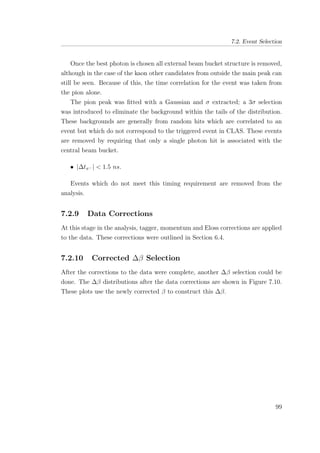
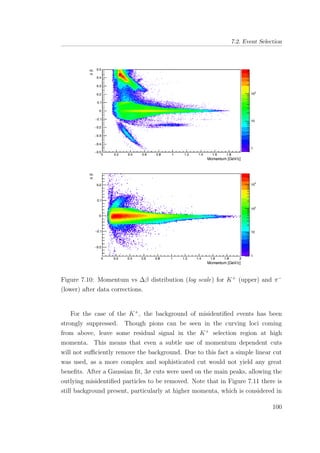
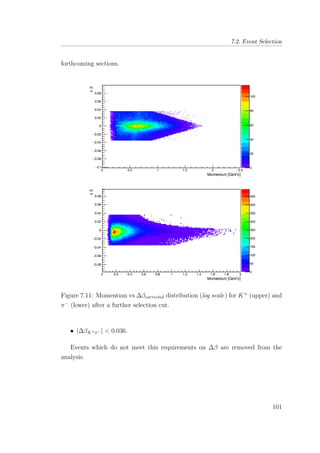
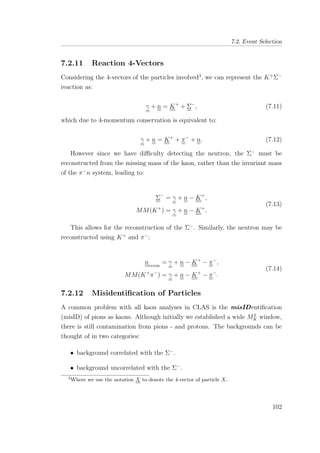
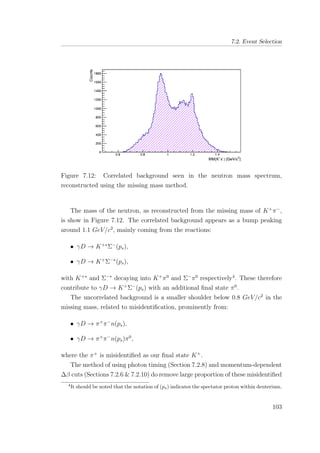
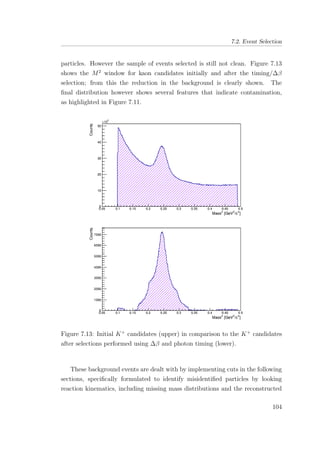
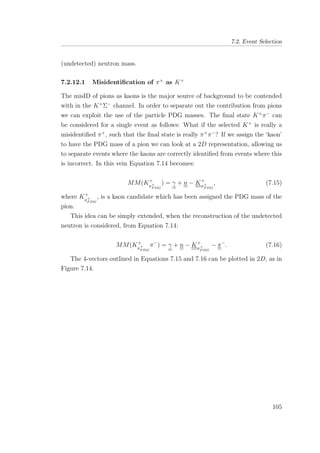
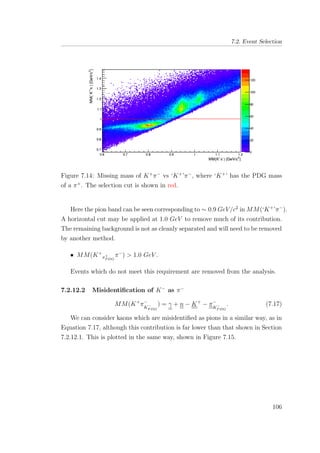
First Measurement of the E Double-polarisation
Observable for γn → K+
Σ−
with CLAS
&
a New Forward Tagging Hodoscope for CLAS12.
TH
E
U
N I V E R
S
ITY
OF
E
D I N B U
R
G
HJamie Alan Fleming
School of Physics and Astronomy
University of Edinburgh
A thesis submitted for the degree of
Doctor of Philosophy
The University of Edinburgh
30/06/2016
Dedication
For my beloved parents.
i
Acknowledgements
Firstly, I would like to thank Dan Watts, my supervisor, for all of his insight
and expertise shared over these last five years. Instrumental to the work in this
thesis was also the guidance of Lorenzo Zana and Derek Glazier, without whom
computational headaches would have become computational migraines. Also a
relatively new arrival to the group, Nick Zachariou, who was an invaluable source
of not just physics knowledge, but squash prowess.
I would like to thank my collaborators at JLab, as well as the University
of Glasgow. Particularly Franz Klein for his encyclopaedic knowledge in all
matters; Irene Zonta, for her friendship and analysis advice; Mark Anderson, for
his friendship and my introduction to Archer; and the resfac staff (particularly
Melissa and Rose) who made JLab feel like a home, whether it was for three days
or a month.
I am grateful to those who have passed through the department, for their
chats, advice, games of chess, squash and general distraction from my work.
Similarly my friends in the wider physics department, some from undergrad and
others from more recent years.
Thanks to Scott and Lorna for the time we have spent together, as well as my
other friends for keeping my spirits up while my work went less than swimmingly.
My Dungeons & Dragons group, for all the adventures we have shared, from doing
morally questionable things to NPCs, to disintegrating gods.
Of course Brian and Michelle, for their constant support, advice, love and
ability to make me believe “the problem is fixable”.
ii
Finally, my darling Alex.
I don’t quite know how to sum up all that you’ve done. You’ve helped me
through illness and days where I couldn’t get out of bed. You understood when I
spent weekends in the office and made me dinner when I got home at 10pm. You
understood when I flew to America and Italy on three days notice and met me
at the airport when I came home.
I could not have done this without you.
iii
Abstract
Establishing the excitation spectrum of the nucleon would be a key advance to
further our understanding of nucleon structure and Quantum Chromodynamics
(QCD). Recent theoretical advances allow predictions of the excitation spectrum
of the nucleon and other nucleon properties directly from QCD in the non-
perturbative regime, via numerical methods (such as Lattice QCD), complement-
ing existing constituent quark models. There is an ongoing world programme in
meson photoproduction from the nucleon, which has already led to a number of
nucleon resonances being discovered and established. This advance has largely
been made possible by the first accurate measurement of polarisation observables.
Available data has been obtained for proton targets, whereas for a complete
picture of meson photoproduction, data from the neutron must also be obtained.
This is important, as nucleon resonances can have very different photo-couplings
to the proton and neutron.
This thesis presents the first measurement of the E double-polarisation
observable for the exclusive γn → K+
Σ−
reaction using a polarised hydrogen-
deuterium target from the g14 run period at CLAS. Circularly polarised photons
of energies between 1.1 and 2.3 GeV were used, with results shown in 200 MeV
bins in Eγ and bins of 0.4 in cos θC.M.
K+ .
Further to this, CLAS has undergone a detector upgrade in order to facilitate
electrons of up to 12 GeV from Jefferson Lab’s upgraded accelerator. Essential
to this, is a new system for tagging quasi-real photons by detecting electrons
scattered at very small angles. My work includes significant contributions to
the design, realisation and construction of a hodoscope for this forward photon
tagging apparatus. Presented in this thesis is a comprehensive overview of my
work in developing and constructing the scintillating hodoscope for the CLAS12
Forward Tagger.
iv
Lay Summary
Atoms consist of a positively charged nucleus surrounded by a negatively
charged cloud of electrons. Probing deeper, we find that the nucleus is made
up of positvely charged protons and uncharged neutrons, together referred to
as nucleons. Probing deeper still, we find that these objects are made of
further elementary particles called quarks. For decades, scientists have attempted
to unravel the interactions of quarks and understand how they combine to
make composite particles such as baryons (containing three quarks) and mesons
(containing two quarks). A powerful method to understand such systems is to
determine how they can be excited when they absorb energy. As a consequence
of the quantum mechanical nature of the objects, the possible energies do not
form a continuum, rather discrete (separated) energies. These energies and other
properties of the excited states, such as angular momentum and symmetry, give
strong constraints on how the quarks interact. Different theoretical models give
very different predictions for this spectrum of excited states. My thesis work
was an important part of the world programme to provide the first accurate
determination of this spectrum experimentally.
To produce the excited nucleon states, we fire an intense beam of high energy
photons (γ) at a nucleon target. It is only in recent years that photon beams of
sufficient quality have been available to perform these experiments. A key advance
is the use of polarised photon beams (having right or left handed rotation of the
electric field) and polarised nucleon targets (in which the spin of the nucleons in
the target can be oriented with respect to the beam). Once excited, the nucleon
decays very quickly (in time-scales of around ∼ 10−24
s), with the most common
decay being back to a nucleon with the emission of a meson, however it has been
predicted that many missing excited states would show up strongly in decays to
final states which involve strange quarks; corresponding to a “Kaon” meson (K)
v
and a “Sigma” baryon (Σ).
This thesis presents the first measurement of the dependence of the reaction
γn → K+
Σ−
, on the polarisation of the photon beam and neutron target.
The experiment detailed was conducted in Hall B of the Thomas Jefferson
National Accelerator Facility (JLab) in Virginia, USA. This thesis also presents a
comprehensive overview of the design and construction of a new detector for the
ongoing facility upgrade at JLab. This project was undertaken at the University
of Edinburgh, with significant contributions from myself, which in the coming
years will further the world programme to isolate further excited nucleon and
meson states.
vi
Declaration
The data presented in this thesis were obtained as part of the g14 collaboration at
the Thomas Jefferson National Accelerator Facility (JLab), Virginia, USA, and
the Nuclear Physics Group at the University of Edinburgh. I participated fully
in the execution, calibration and analysis of the experiment. The analysis of the
experimental data is my own work and this thesis was composed by myself.
Jamie A. Fleming
30/06/2016
vii
Quotes
“There are known knowns; there are things we know we know. We also know
there are known unknowns; that is to say we know there are some things we do
not know. But there are also unknown unknowns - the ones we don’t know we
don’t know.”
Donald Rumsfeld
“To the scientist there is the joy in pursuing truth which nearly counteracts
the depressing revelations of the truth.”
H.P. Lovecraft
“In the beginning the Universe was created. This has made a lot of people
very angry and been widely regarded as a bad move.”
Douglas Adams
viii
Contents
Dedication i
Acknowledgements ii
Abstract iv
Lay Summary v
Declaration vii
Quotation viii
Contents ix
List of Figures xv
List of Tables xxv
1 Introduction 1
1.1 Quantum Chromodynamics . . . . . . . . . . . . . . . . . . . . . 1
1.2 Particle Multiplets . . . . . . . . . . . . . . . . . . . . . . . . . . 4
1.2.1 Isospin . . . . . . . . . . . . . . . . . . . . . . . . . . . . . 5
1.3 Hadron Spectroscopy . . . . . . . . . . . . . . . . . . . . . . . . . 7
1.4 Meson Spectroscopy . . . . . . . . . . . . . . . . . . . . . . . . . 8
1.5 Theoretical Approaches to Hadron Spectroscopy . . . . . . . . . . 10
1.5.0.1 Constituent Quark Models . . . . . . . . . . . . . 10
1.5.0.2 The Di-quark Model . . . . . . . . . . . . . . . . 11
1.5.0.3 Bag Models . . . . . . . . . . . . . . . . . . . . . 12
1.5.1 Lattice QCD . . . . . . . . . . . . . . . . . . . . . . . . . 13
1.5.2 Classification of Experimentally Determined Hadronic Ex-
citation Spectra . . . . . . . . . . . . . . . . . . . . . . . . 16
1.6 Summary . . . . . . . . . . . . . . . . . . . . . . . . . . . . . . . 17
ix
CONTENTS
2 Kaon Photoproduction 19
2.1 Final State . . . . . . . . . . . . . . . . . . . . . . . . . . . . . . 19
2.1.1 The Kaon . . . . . . . . . . . . . . . . . . . . . . . . . . . 21
2.1.2 The Σ Baryon . . . . . . . . . . . . . . . . . . . . . . . . . 21
2.2 Baryon Photoproduction Kinematics . . . . . . . . . . . . . . . . 22
2.3 Reaction Amplitudes . . . . . . . . . . . . . . . . . . . . . . . . . 24
2.4 Polarisation Observables . . . . . . . . . . . . . . . . . . . . . . . 26
2.5 Isolating a Polarisation Observable . . . . . . . . . . . . . . . . . 28
2.6 Theoretical Models for Meson Photoproduction . . . . . . . . . . 29
2.6.1 Isobar Models . . . . . . . . . . . . . . . . . . . . . . . . . 30
2.6.2 Coupled-Channel Analysis . . . . . . . . . . . . . . . . . . 31
2.7 Summary . . . . . . . . . . . . . . . . . . . . . . . . . . . . . . . 32
3 Previous Experimental Data 34
3.1 Current Experimental Knowledge . . . . . . . . . . . . . . . . . . 34
3.1.1 Kaon Photoproduction at Cornell . . . . . . . . . . . . . . 34
3.1.2 Kaon Photoproduction at LEPS . . . . . . . . . . . . . . . 35
3.1.3 Kaon Photoproduction at Jefferson Lab . . . . . . . . . . . 37
4 Experimental Apparatus 39
4.1 Experimental Overview . . . . . . . . . . . . . . . . . . . . . . . . 39
4.2 Jefferson Lab . . . . . . . . . . . . . . . . . . . . . . . . . . . . . 39
4.3 CEBAF . . . . . . . . . . . . . . . . . . . . . . . . . . . . . . . . 40
4.4 Experimental Halls . . . . . . . . . . . . . . . . . . . . . . . . . . 43
4.5 Hall B . . . . . . . . . . . . . . . . . . . . . . . . . . . . . . . . . 44
4.5.1 The Bremsstrahlung Process . . . . . . . . . . . . . . . . . 45
4.5.2 Bremsstrahlung Photon Tagging . . . . . . . . . . . . . . . 46
4.5.3 Beam Polarisation . . . . . . . . . . . . . . . . . . . . . . 48
4.5.3.1 Linear Polarisation . . . . . . . . . . . . . . . . . 48
4.5.3.2 Circular Polarisation . . . . . . . . . . . . . . . . 48
4.5.4 CLAS Detector . . . . . . . . . . . . . . . . . . . . . . . . 50
4.5.4.1 Torus Magnet . . . . . . . . . . . . . . . . . . . . 51
4.5.4.2 Start Counter . . . . . . . . . . . . . . . . . . . . 52
4.5.4.3 Drift Chambers . . . . . . . . . . . . . . . . . . . 53
4.5.4.4 Time-of-Flight Scintillators . . . . . . . . . . . . 54
5 The HD-ice Target 56
5.1 Introduction . . . . . . . . . . . . . . . . . . . . . . . . . . . . . . 56
5.2 HD-ice Target Geometry . . . . . . . . . . . . . . . . . . . . . . . 57
5.3 HD-ice Target Physics . . . . . . . . . . . . . . . . . . . . . . . . 58
5.4 HD-ice Target Production Equipment . . . . . . . . . . . . . . . 61
5.4.1 Production Dewer . . . . . . . . . . . . . . . . . . . . . . . 61
5.4.2 Transfer Cryostat . . . . . . . . . . . . . . . . . . . . . . . 62
x
CONTENTS
5.4.3 Dilution Refrigerator . . . . . . . . . . . . . . . . . . . . . 63
5.4.4 Storage Dewar . . . . . . . . . . . . . . . . . . . . . . . . . 64
5.4.5 In-Beam Cryostat . . . . . . . . . . . . . . . . . . . . . . . 64
5.5 Full Target Production Procedure . . . . . . . . . . . . . . . . . . 65
5.6 Produced Targets . . . . . . . . . . . . . . . . . . . . . . . . . . . 67
6 Data Calibration and Optimisation 68
6.1 g14 Overview . . . . . . . . . . . . . . . . . . . . . . . . . . . . . 68
6.1.1 Estimating Target Polarisations for Periods Silver 4 and 5 70
6.2 Organisation of the g14 Data . . . . . . . . . . . . . . . . . . . . 70
6.2.1 Data Reconstruction . . . . . . . . . . . . . . . . . . . . . 72
6.2.1.1 Particle Charge and Momenta . . . . . . . . . . . 72
6.2.1.2 Particle Beta . . . . . . . . . . . . . . . . . . . . 73
6.2.2 Start Counter Calibration . . . . . . . . . . . . . . . . . . 73
6.2.2.1 Stage 1: Time-walk Correction . . . . . . . . . . 74
6.2.2.2 Stage 2: Propagation Time . . . . . . . . . . . . 75
6.2.2.3 Stage 3: Timing Offset . . . . . . . . . . . . . . . 76
6.3 Data Banks and Skimming . . . . . . . . . . . . . . . . . . . . . . 77
6.3.1 Banks . . . . . . . . . . . . . . . . . . . . . . . . . . . . . 77
6.3.2 K+
Σ−
Skim . . . . . . . . . . . . . . . . . . . . . . . . . . 78
6.3.3 Selection of Experimental Data to be Analysed . . . . . . 79
6.4 Applied Corrections to Data . . . . . . . . . . . . . . . . . . . . . 79
6.4.1 Kinematic Fitting . . . . . . . . . . . . . . . . . . . . . . . 80
6.4.2 CLAS tracking parameters . . . . . . . . . . . . . . . . . . 81
6.4.3 Energy Loss Correction . . . . . . . . . . . . . . . . . . . . 82
6.4.4 Momentum Correction . . . . . . . . . . . . . . . . . . . . 83
6.4.5 Tagger Correction . . . . . . . . . . . . . . . . . . . . . . . 83
6.4.6 Neutron Vertex Correction . . . . . . . . . . . . . . . . . . 84
7 γN → K+
Σ−
Event Selection 85
7.1 Outline . . . . . . . . . . . . . . . . . . . . . . . . . . . . . . . . . 85
7.2 Event Selection . . . . . . . . . . . . . . . . . . . . . . . . . . . . 86
7.2.1 Coarse Data Reduction . . . . . . . . . . . . . . . . . . . . 86
7.2.2 Detector Hits . . . . . . . . . . . . . . . . . . . . . . . . . 87
7.2.3 Particle Mass2
Windows . . . . . . . . . . . . . . . . . . . 88
7.2.4 Neutron Selection . . . . . . . . . . . . . . . . . . . . . . . 89
7.2.5 Topology . . . . . . . . . . . . . . . . . . . . . . . . . . . . 90
7.2.6 Momentum vs ∆β . . . . . . . . . . . . . . . . . . . . . . 91
7.2.7 Candidate Photons and Tagger ID . . . . . . . . . . . . . 94
7.2.8 Photon Identification . . . . . . . . . . . . . . . . . . . . . 95
7.2.9 Data Corrections . . . . . . . . . . . . . . . . . . . . . . . 99
7.2.10 Corrected ∆β Selection . . . . . . . . . . . . . . . . . . . . 99
7.2.11 Reaction 4-Vectors . . . . . . . . . . . . . . . . . . . . . . 102
xi
CONTENTS
7.2.12 Misidentification of Particles . . . . . . . . . . . . . . . . . 102
7.2.12.1 Misidentification of π+
as K+
. . . . . . . . . . . 105
7.2.12.2 Misidentification of K−
as π−
. . . . . . . . . . . 106
7.2.12.3 Misidentification of p as K+
. . . . . . . . . . . . 108
7.2.13 ΣΛ Separation . . . . . . . . . . . . . . . . . . . . . . . . 110
7.2.14 Neutron Reconstruction . . . . . . . . . . . . . . . . . . . 112
7.2.15 Quasi-free Selection for the Complete Final State . . . . . 114
7.2.16 K+
Σ−
Threshold Energy . . . . . . . . . . . . . . . . . . . 116
7.2.17 Event z-vertex . . . . . . . . . . . . . . . . . . . . . . . . 118
7.2.17.1 Cell Contributions . . . . . . . . . . . . . . . . . 119
7.2.18 Fiducial Cuts . . . . . . . . . . . . . . . . . . . . . . . . . 120
7.2.19 Final Reconstructed Σ−
Selection . . . . . . . . . . . . . . 122
7.2.20 Three particle final state . . . . . . . . . . . . . . . . . . . 123
7.2.21 Summary . . . . . . . . . . . . . . . . . . . . . . . . . . . 124
8 Extraction of Polarisation Observables 126
8.1 Introduction . . . . . . . . . . . . . . . . . . . . . . . . . . . . . . 126
8.2 Angle and Energy Bin Choice . . . . . . . . . . . . . . . . . . . . 127
8.2.1 Eγ Binning . . . . . . . . . . . . . . . . . . . . . . . . . . 128
8.2.2 cosθCM
K+ Binning . . . . . . . . . . . . . . . . . . . . . . . . 128
8.3 Asymmetry of Empty (Unpolarised) Targets . . . . . . . . . . . . 130
8.4 Removing the Empty Target . . . . . . . . . . . . . . . . . . . . . 139
8.4.1 Empty Target Subtraction . . . . . . . . . . . . . . . . . . 139
8.4.2 Empty Target Dilution Factor . . . . . . . . . . . . . . . . 141
8.5 Extracting Observables for Kaon Photoproduction . . . . . . . . . 143
8.6 Investigation of Systematics in Extraction of the Asymmetry . . . 144
8.6.1 Effect of φ Acceptance . . . . . . . . . . . . . . . . . . . . 150
8.7 Background Estimation from the K+
Σ0
Channel . . . . . . . . . . 157
8.7.1 Energy Dependence of K+
Σ0
. . . . . . . . . . . . . . . . 158
8.7.2 Angular Dependence of K+
Σ0
. . . . . . . . . . . . . . . . 159
8.8 Combining Period Results . . . . . . . . . . . . . . . . . . . . . . 161
8.9 Current Theoretical Model Prediction . . . . . . . . . . . . . . . . 161
8.9.1 KaonMAID . . . . . . . . . . . . . . . . . . . . . . . . . . 162
8.9.2 Bonn-Gatchina . . . . . . . . . . . . . . . . . . . . . . . . 163
9 Results and Discussion of the Double-polarisation Observable E 166
9.1 Beam-Target Observable E . . . . . . . . . . . . . . . . . . . . . . 166
9.1.1 Empty Target Dilution Method . . . . . . . . . . . . . . . 166
9.1.2 Empty Target Subtraction Method . . . . . . . . . . . . . 171
9.1.3 Comparison of Empty Target Methods . . . . . . . . . . . 175
9.2 E Observable Results Compared with Model Predictions . . . . . 179
9.2.1 KaonMAID . . . . . . . . . . . . . . . . . . . . . . . . . . 179
9.2.2 Bonn-Gatchina . . . . . . . . . . . . . . . . . . . . . . . . 183
xii
CONTENTS
9.3 Systematic Uncertainties . . . . . . . . . . . . . . . . . . . . . . . 187
9.4 Summary . . . . . . . . . . . . . . . . . . . . . . . . . . . . . . . 188
10 JLab Upgrade and CLAS12 191
10.1 Electroproduction at low Q2
. . . . . . . . . . . . . . . . . . . . . 191
10.2 CLAS12 Detector . . . . . . . . . . . . . . . . . . . . . . . . . . . 193
10.2.1 CLAS12 Components . . . . . . . . . . . . . . . . . . . . . 193
10.2.1.1 Forward Detector . . . . . . . . . . . . . . . . . . 194
10.2.1.2 Central Detector . . . . . . . . . . . . . . . . . . 195
10.3 The Forward Tagger . . . . . . . . . . . . . . . . . . . . . . . . . 196
10.3.1 The EM Calorimeter (FT-Cal) . . . . . . . . . . . . . . . . 198
10.3.2 The Hodoscope (FT-Hodo) . . . . . . . . . . . . . . . . . . 199
10.3.3 The Tracker (FT-Trck) . . . . . . . . . . . . . . . . . . . . 200
10.4 FT-Hodo Overview . . . . . . . . . . . . . . . . . . . . . . . . . . 201
10.5 FT-Hodo Design . . . . . . . . . . . . . . . . . . . . . . . . . . . 204
10.6 Hodoscope Simulations . . . . . . . . . . . . . . . . . . . . . . . . 208
10.6.1 Tile Thickness Simulations . . . . . . . . . . . . . . . . . . 209
10.6.2 Timing Resolution . . . . . . . . . . . . . . . . . . . . . . 210
10.6.3 Fibre Bending . . . . . . . . . . . . . . . . . . . . . . . . . 211
10.6.4 Radiation Dose . . . . . . . . . . . . . . . . . . . . . . . . 212
10.6.5 Initial Tests . . . . . . . . . . . . . . . . . . . . . . . . . . 214
10.6.5.1 First Test: JLab . . . . . . . . . . . . . . . . . . 214
10.6.5.2 Second Test: BTF at DAΦNE . . . . . . . . . . . 216
10.6.5.3 Third Test: BTF at DAΦNE . . . . . . . . . . . 221
11 Hodoscope Construction 223
11.1 Hodoscope Construction . . . . . . . . . . . . . . . . . . . . . . . 223
11.1.1 Preparation of Scintillator . . . . . . . . . . . . . . . . . . 225
11.1.1.1 Tile Cleaning . . . . . . . . . . . . . . . . . . . . 226
11.1.1.2 Tile Painting . . . . . . . . . . . . . . . . . . . . 226
11.1.2 Tile Placement . . . . . . . . . . . . . . . . . . . . . . . . 229
11.1.2.1 Inner Radius . . . . . . . . . . . . . . . . . . . . 230
11.1.2.2 Even Sectors . . . . . . . . . . . . . . . . . . . . 232
11.1.2.3 Odd Sectors . . . . . . . . . . . . . . . . . . . . . 234
11.1.2.4 Optimal Tile Arrangement . . . . . . . . . . . . . 235
11.1.3 Tile Cutting and Gluing . . . . . . . . . . . . . . . . . . . 236
11.1.4 Spliced WLS-Optical Fibres . . . . . . . . . . . . . . . . . 238
11.1.4.1 Preparation of Optical Fibres . . . . . . . . . . . 239
11.1.4.2 Optical Fibre Gluing . . . . . . . . . . . . . . . . 239
11.1.4.3 Fibre Routing . . . . . . . . . . . . . . . . . . . . 240
11.1.5 LED Flasher . . . . . . . . . . . . . . . . . . . . . . . . . 244
11.1.6 Electronic Connectors . . . . . . . . . . . . . . . . . . . . 245
11.1.7 Sealing and Shipping . . . . . . . . . . . . . . . . . . . . . 247
xiii
CONTENTS
11.2 Complete Test at Jefferson Lab . . . . . . . . . . . . . . . . . . . 249
11.2.1 Preliminary Results . . . . . . . . . . . . . . . . . . . . . . 251
12 Conclusions 254
A Hodoscope Tile Schematics 264
xiv
List of Figures
1.1 Gluonic self-interaction. . . . . . . . . . . . . . . . . . . . . . . 2
1.2 Summary of measurements of the strong coupling constant,
αs(Q), as a function of the energy scale, Q. . . . . . . . . . . . 3
1.3 A representation of quark and gluon interactions inside the
nucleon. . . . . . . . . . . . . . . . . . . . . . . . . . . . . . . 4
1.4 Meson nonet (B = 0) shown in terms of charge, Q, and
strangeness, S. . . . . . . . . . . . . . . . . . . . . . . . . . . . 6
1.5 Baryon octet (B = 1) shown in terms of charge, Q, and
strangeness S. . . . . . . . . . . . . . . . . . . . . . . . . . . . 7
1.6 Evolution of the strong coupling constant, αs(Q), as a function
of the interaction distance. . . . . . . . . . . . . . . . . . . . . 8
1.7 Mass predictions, γN, πN, and KΣ decay amplitude predic-
tions for nucleon resonances up to 2200 MeV . . . . . . . . . . 11
1.8 Representation of the di-quark model inside the nucleon. . . . 11
1.9 Light baryon and meson masses, predicted by the bag model.
The actual masses are given by dotted lines, while all other
masses are predicted. The masses of N, ∆, Ω and ω were used
to determine the parameters. . . . . . . . . . . . . . . . . . . . 13
1.10 Simple interpretation of QCD calculated on a lattice. . . . . . 14
1.11 The spectra of isoscalar mesons calculated by the JLab LQCD
group (mπ ∼ 396 MeV ). . . . . . . . . . . . . . . . . . . . . . 15
1.12 The spectra of baryons calculated by the JLab LQCD group
(mπ ∼ 396 MeV ), in units of the calculated Ω mass. . . . . . . 16
1.13 Photoproduction cross section of γp (log scale), including the
magnitude of channels contributing to the total cross section. . 17
2.1 Feynman diagram showing the decay of the Σ−
baryon at the
quark level. . . . . . . . . . . . . . . . . . . . . . . . . . . . . . 20
2.2 Diagram of the reaction γn → K+
Σ−
. . . . . . . . . . . . . . . 20
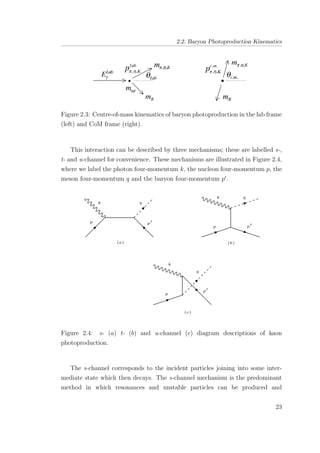
2.3 Centre-of-mass kinematics of baryon photoproduction in the lab
frame (left) and CoM frame (right). . . . . . . . . . . . . . . . 23
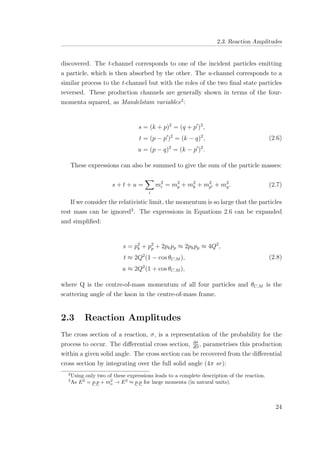
2.4 s- (a) t- (b) and u-channel (c) diagram descriptions of kaon
photoproduction. . . . . . . . . . . . . . . . . . . . . . . . . . 23
xv
LIST OF FIGURES
2.5 Process for nucleon structure calculation and experimentation. 33
3.1 Differential cross sections for γn → K+
Σ−
(circles) and γp →
K+
Σ0
(squares). Only statistical errors are shown. The solid
and dashed curves are the Regge model calculations for the
K+
Σ−
and K+
Σ0
, respectively. The dotted curve is the
KaonMAID model calculations for the K+
Σ−
. . . . . . . . . . 36
3.2 Photon-beam asymmetries for γn → K+
Σ−
(circles) and γp →
K+
Σ0
(squares). The solid and dashed curves are the Regge
model calculations for the K+
Σ−
and K+
Σ0
, respectively. . . 37
3.3 Differential cross sections of the reaction γD → K+
Σ−
(ps)
obtained by CLAS (full circles). The error bars represent
the total (statistical plus systematic) uncertainty. LEPS data
(empty triangles) and a Regge-3 model prediction (solid curve)
are also shown. Notice the logarithmic scale for high energy
plots. . . . . . . . . . . . . . . . . . . . . . . . . . . . . . . . . 38
4.1 Aerial view of the JLab facility, highlighting the CEBAF
accelerator and experimental halls. . . . . . . . . . . . . . . . . 40
4.2 Schematic of CEBAF at Jefferson Lab, including the experi-
mental halls. . . . . . . . . . . . . . . . . . . . . . . . . . . . . 41
4.3 Schematic of CEBAF at Jefferson Lab, showing additions for
the upgrade to the beam-line, including the placement of the
new Hall D. . . . . . . . . . . . . . . . . . . . . . . . . . . . . 43
4.4 Diagram showing the scale of CLAS in Hall B at Jefferson Lab. 45
4.5 Simple illustration of bremsstrahlung radiation. . . . . . . . . . 46
4.6 chematic of the coherent bremsstrahlung facility in Hall B. . . 47
4.7 Degree of circular polarisation as a function of the ratio of beam
energies, Eγ/Ee− . . . . . . . . . . . . . . . . . . . . . . . . . . 49
4.8 The CLAS detector, including drift chambers, Cherenkov coun-
ters, electromagnetic calorimeters, and time-of-flight detectors. 50
4.9 Left: Magnetic field for the CLAS torus magnet around the
target region. Right: Magnetic field shape created by the
magnets in CLAS. . . . . . . . . . . . . . . . . . . . . . . . . . 52
4.10 Cross section of the CLAS start counter. . . . . . . . . . . . . 53
4.11 Simple diagram of the CLAS drift chambers, highlighting the
DC regions, time-of-flight counters and torus coils. . . . . . . . 54
4.12 Diagram showing one sector of the CLAS time-of-flight scintil-
lator counters. . . . . . . . . . . . . . . . . . . . . . . . . . . . 55
5.1 Photograph of a deconstructed HDice target, showing the cell,
copper ring and Al wires. . . . . . . . . . . . . . . . . . . . . . 57
5.2 HD target schematic, indicating the target sizes. . . . . . . . . 57
5.3 Decay mechanism within the HDice target. . . . . . . . . . . . 59
xvi
LIST OF FIGURES
5.4 Equilibrium polarisation within the HD target as a function
of magnetic field, B, and temperature, T. This shows the
polarisation of hydrogen, vector deuterium and tensor deuterium. 60
5.5 Zeeman levels within solid HD. . . . . . . . . . . . . . . . . . 61
5.6 Schematic of the production dewar. . . . . . . . . . . . . . . . 62
5.7 Photograph of the transfer cryostat. . . . . . . . . . . . . . . . 63
5.8 Photograph of the dilution refrigerator. . . . . . . . . . . . . . 64
5.9 External schematic of the IBC, shown in both the vertical (left)
and horizontal positions (right). . . . . . . . . . . . . . . . . . 65
5.10 Internal schematic of the IBC. . . . . . . . . . . . . . . . . . . 65
5.11 Simple illustration of a target transfer. . . . . . . . . . . . . . 66
5.12 The life cycle of a HDice target for use with CLAS. . . . . . . 67
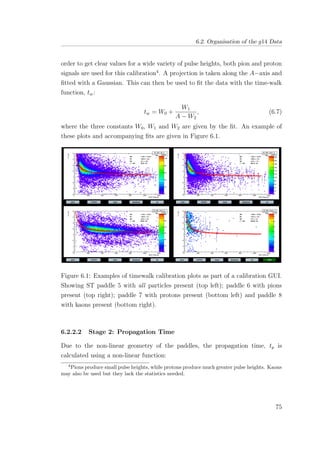
6.1 Examples of timewalk calibration plots as part of a calibration
GUI. Showing ST paddle 5 with all particles present (top left);
paddle 6 with pions present (top right); paddle 7 with protons
present (bottom left) and paddle 8 with kaons present (bottom
right). . . . . . . . . . . . . . . . . . . . . . . . . . . . . . . . . 75
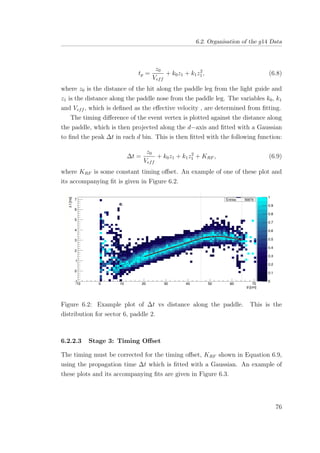
6.2 Example plot of ∆t vs distance along the paddle. This is the
distribution for sector 6, paddle 2. . . . . . . . . . . . . . . . . 76
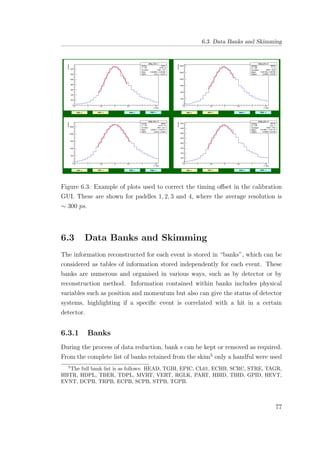
6.3 Example of plots used to correct the timing offset in the
calibration GUI. These are shown for paddles 1, 2, 3 and 4,
where the average resolution is ∼ 300 ps. . . . . . . . . . . . . 77
6.4 Diagram outlining the two coordinate systems used in CLAS. . 81
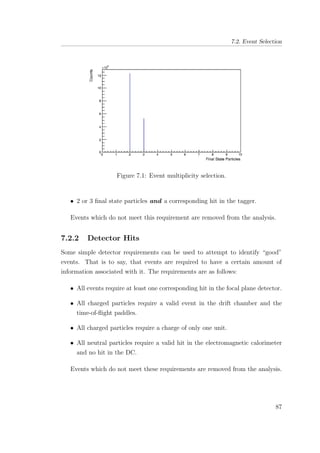
7.1 Event multiplicity selection. . . . . . . . . . . . . . . . . . . . 87
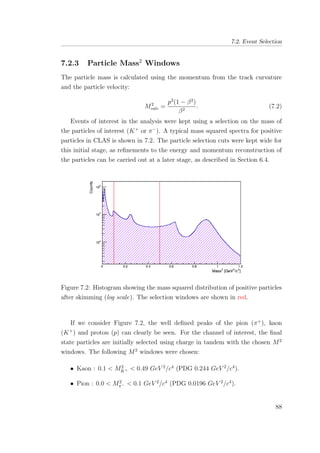
7.2 Histogram showing the mass squared distribution of positive
particles after skimming (log scale). The selection windows are
shown in red. . . . . . . . . . . . . . . . . . . . . . . . . . . . . 88
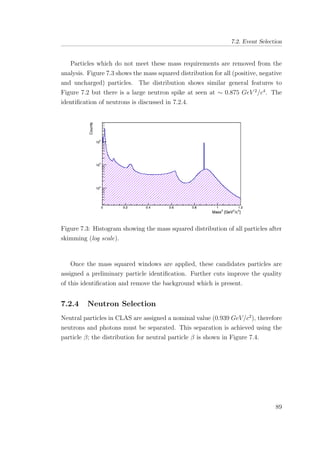
7.3 Histogram showing the mass squared distribution of all particles
after skimming (log scale). . . . . . . . . . . . . . . . . . . . . 89
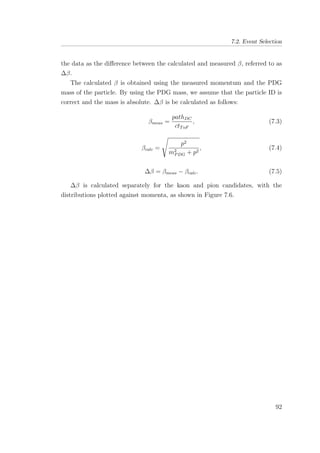
7.4 β distribution for neutral candidates. The selection cut is shown
in red, with neutrons falling on the left and photons on the right. 90
7.5 Momentum vs β distribution for positive and negative particles
(log scale). . . . . . . . . . . . . . . . . . . . . . . . . . . . . . 91
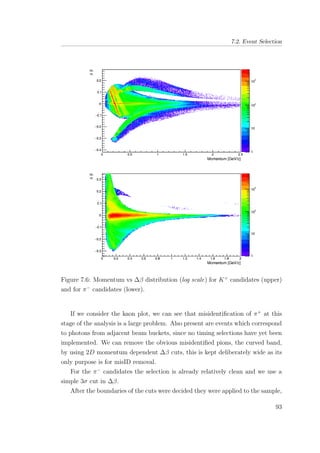
7.6 Momentum vs ∆β distribution (log scale) for K+
candidates
(upper) and for π−
candidates (lower). . . . . . . . . . . . . . 93
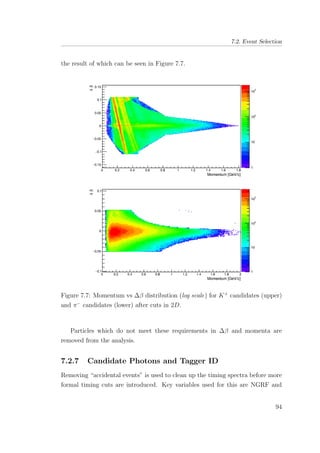
7.7 Momentum vs ∆β distribution (log scale) for K+
candidates
(upper) and π−
candidates (lower) after cuts in 2D. . . . . . . 94
7.8 K+
(upper) and π−
(lower) timing difference between the start
counter and time-of-flight scintillators. . . . . . . . . . . . . . . 97
7.9 K+
(upper) and π−
(lower) timing difference using the selected
best photon. The selection cut is shown in red. . . . . . . . . . 98
xvii
LIST OF FIGURES
7.10 Momentum vs ∆β distribution (log scale) for K+
(upper) and
π−
(lower) after data corrections. . . . . . . . . . . . . . . . . . 100
7.11 Momentum vs ∆βcorrected distribution (log scale) for K+
(upper)
and π−
(lower) after a further selection cut. . . . . . . . . . . . 101
7.12 Correlated background seen in the neutron mass spectrum,
reconstructed using the missing mass method. . . . . . . . . . 103
7.13 Initial K+
candidates (upper) in comparison to the K+
candi-
dates after selections performed using ∆β and photon timing
(lower). . . . . . . . . . . . . . . . . . . . . . . . . . . . . . . . 104
7.14 Missing mass of K+
π−
vs ‘K+
’π−
, where ‘K+
’ has the PDG
mass of a π+
. The selection cut is shown in red. . . . . . . . . 106
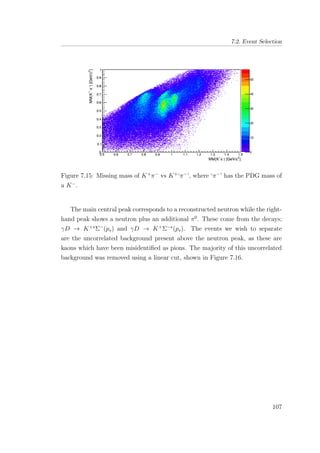
7.15 Missing mass of K+
π−
vs K+
‘π−
’, where ‘π−
’ has the PDG
mass of a K−
. . . . . . . . . . . . . . . . . . . . . . . . . . . . 107
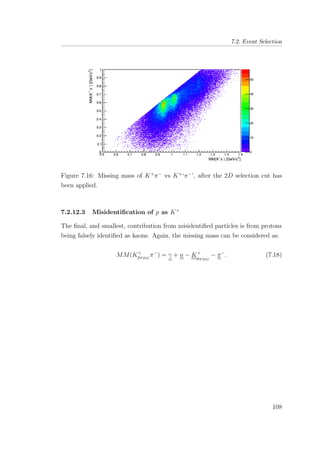
7.16 Missing mass of K+
π−
vs K+
‘π−
’, after the 2D selection cut
has been applied. . . . . . . . . . . . . . . . . . . . . . . . . . 108
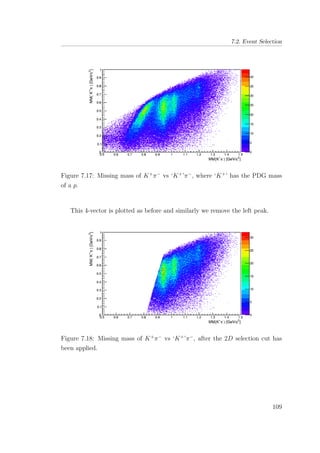
7.17 Missing mass of K+
π−
vs ‘K+
’π−
, where ‘K+
’ has the PDG
mass of a p. . . . . . . . . . . . . . . . . . . . . . . . . . . . . 109
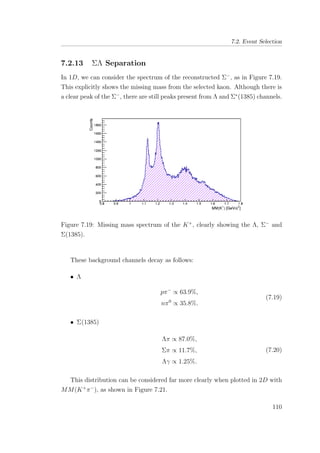
7.18 Missing mass of K+
π−
vs ‘K+
’π−
, after the 2D selection cut
has been applied. . . . . . . . . . . . . . . . . . . . . . . . . . 109
7.19 Missing mass spectrum of the K+
, clearly showing the Λ, Σ−
and Σ(1385). . . . . . . . . . . . . . . . . . . . . . . . . . . . . 110
7.20 2D plot of the reconstructed Σ−
[MM(K+
)] vs. the recon-
structed neutron [MM(K+
π−
)]. . . . . . . . . . . . . . . . . . 111
7.21 2D plot of the reconstructed Σ−
vs the reconstructed neutron
after introducing a linear 2D selection cut. Both the Λ and Σ0
peaks are removed, leaving only Σ−
. . . . . . . . . . . . . . . . 112
7.22 Reconstructed neutron using the missing mass technique [MM(K+
π−
)]
after misID selections have been applied. . . . . . . . . . . . . 113
7.23 Reconstructed neutron using the missing mass technique vs
Momentum. The selection cut is shown in red. . . . . . . . . . 114
7.24 Missing mass of the spectator proton, ps, from the missing mass
technique. . . . . . . . . . . . . . . . . . . . . . . . . . . . . . 115
7.25 Missing momentum of the spectator proton, ps. The selection
cut is shown in red. . . . . . . . . . . . . . . . . . . . . . . . . 116
7.26 A typical spectrum of photon energy when using circularly
polarised beam. The selection cut is shown in red. . . . . . . . 117
7.27 K+
z-vertex from the centre of CLAS. The selection cut is
shown in red. . . . . . . . . . . . . . . . . . . . . . . . . . . . . 119
7.28 K+
z vertex from the centre of CLAS, compared with scaled
empty target data. . . . . . . . . . . . . . . . . . . . . . . . . . 120
7.29 K+
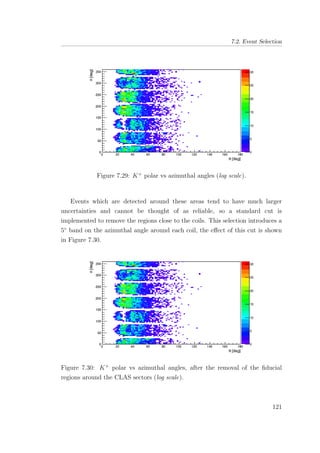
polar vs azimuthal angles (log scale). . . . . . . . . . . . . 121
7.30 K+
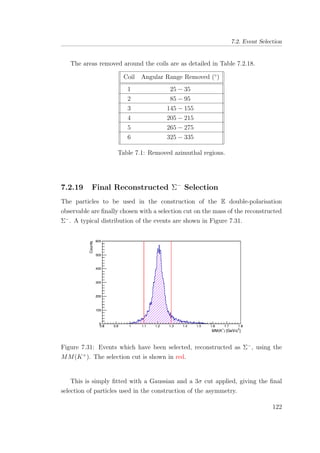
polar vs azimuthal angles, after the removal of the fiducial
regions around the CLAS sectors (log scale). . . . . . . . . . . 121
xviii
LIST OF FIGURES
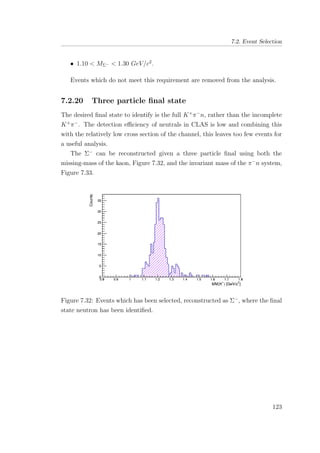
7.31 Events which have been selected, reconstructed as Σ−
, using
the MM(K+
). The selection cut is shown in red. . . . . . . . . 122
7.32 Events which has been selected, reconstructed as Σ−
, where the
final state neutron has been identified. . . . . . . . . . . . . . . 123
7.33 Reconstructed Σ−
, using the invariant mass method [M(nπ−
)]. 124
8.1 Diagram showing the kinematics for the γn → K+
Σ−
in the
centre-of mass frame. . . . . . . . . . . . . . . . . . . . . . . . 127
8.2 Energy spectrum of photons, after all event selections have
taken place. The binning is shown in red. . . . . . . . . . . . . 128
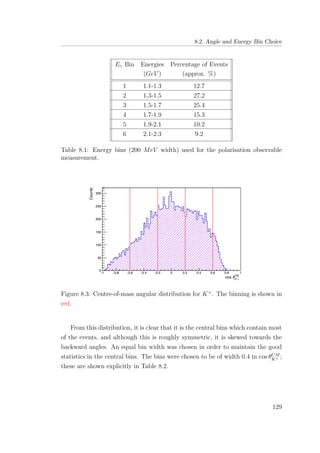
8.3 Centre-of-mass angular distribution for K+
. The binning is
shown in red. . . . . . . . . . . . . . . . . . . . . . . . . . . . . 129
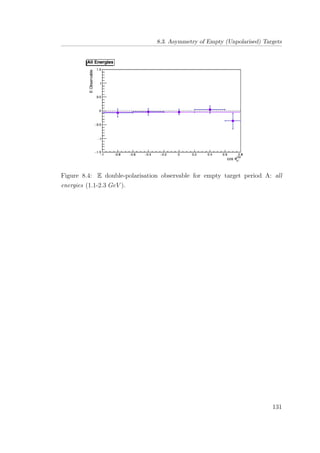
8.4 E double-polarisation observable for empty target period A: all
energies (1.1-2.3 GeV ). . . . . . . . . . . . . . . . . . . . . . . 131
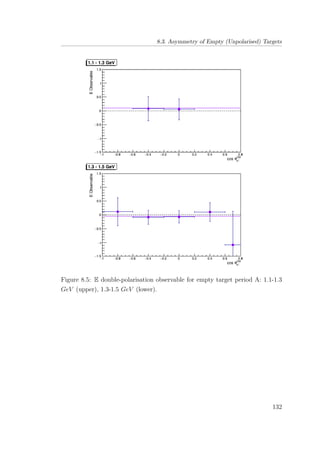
8.5 E double-polarisation observable for empty target period A: 1.1-
1.3 GeV (upper), 1.3-1.5 GeV (lower). . . . . . . . . . . . . . . 132
8.6 E double-polarisation observable for empty target period A: 1.5-
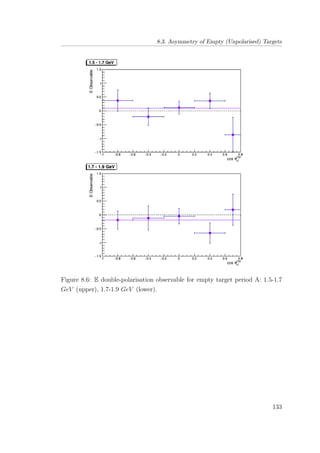
1.7 GeV (upper), 1.7-1.9 GeV (lower). . . . . . . . . . . . . . . 133
8.7 E double-polarisation observable for empty target period A: 1.9-
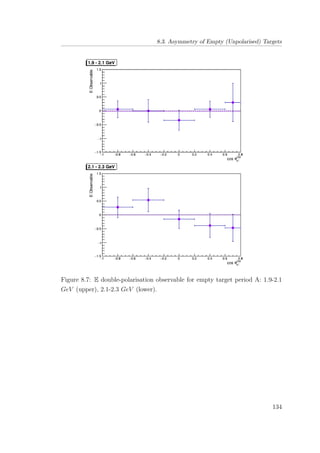
2.1 GeV (upper), 2.1-2.3 GeV (lower). . . . . . . . . . . . . . . 134
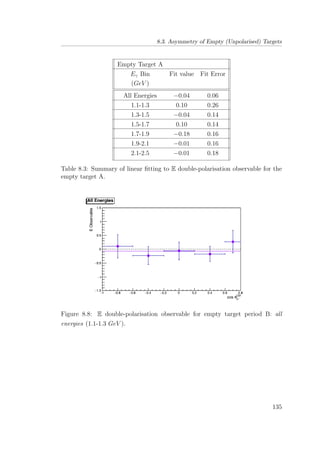
8.8 E double-polarisation observable for empty target period B: all
energies (1.1-1.3 GeV ). . . . . . . . . . . . . . . . . . . . . . . 135
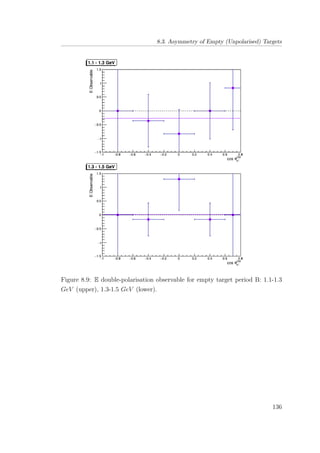
8.9 E double-polarisation observable for empty target period B: 1.1-
1.3 GeV (upper), 1.3-1.5 GeV (lower). . . . . . . . . . . . . . . 136
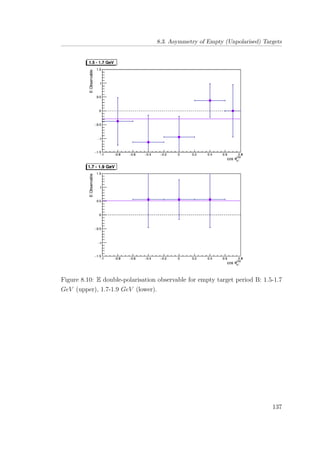
8.10 E double-polarisation observable for empty target period B: 1.5-
1.7 GeV (upper), 1.7-1.9 GeV (lower). . . . . . . . . . . . . . . 137
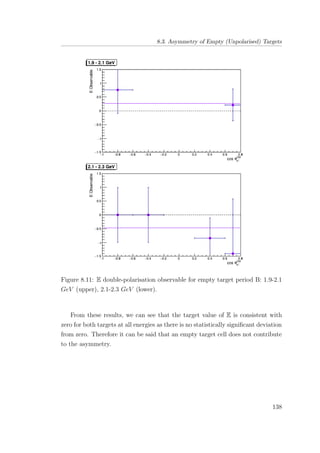
8.11 E double-polarisation observable for empty target period B: 1.9-
2.1 GeV (upper), 2.1-2.3 GeV (lower). . . . . . . . . . . . . . . 138
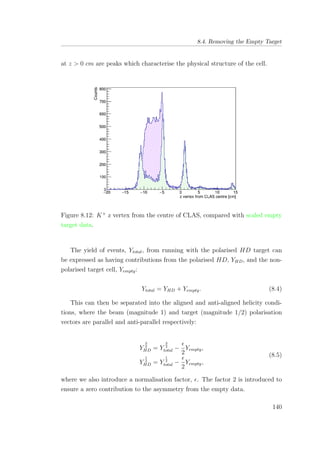
8.12 K+
z vertex from the centre of CLAS, compared with scaled
empty target data. . . . . . . . . . . . . . . . . . . . . . . . . . 140
8.13 Photon energy (Eγ) vs photon polarisation. . . . . . . . . . . . 144
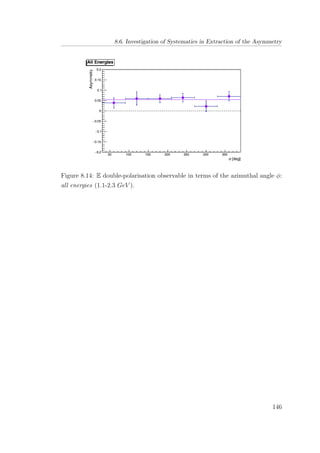
8.14 E double-polarisation observable in terms of the azimuthal angle
φ: all energies (1.1-2.3 GeV ). . . . . . . . . . . . . . . . . . . . 146
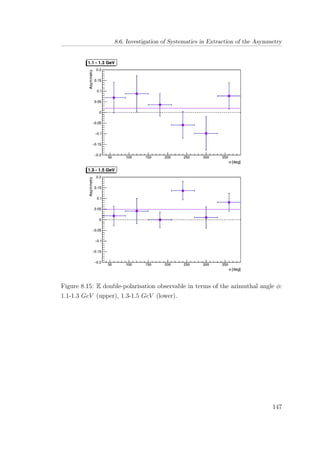
8.15 E double-polarisation observable in terms of the azimuthal angle
φ: 1.1-1.3 GeV (upper), 1.3-1.5 GeV (lower). . . . . . . . . . . 147
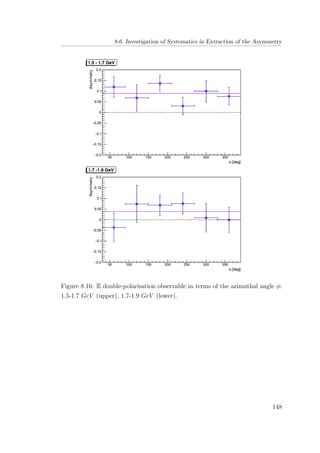
8.16 E double-polarisation observable in terms of the azimuthal angle
φ: 1.5-1.7 GeV (upper), 1.7-1.9 GeV (lower). . . . . . . . . . . 148
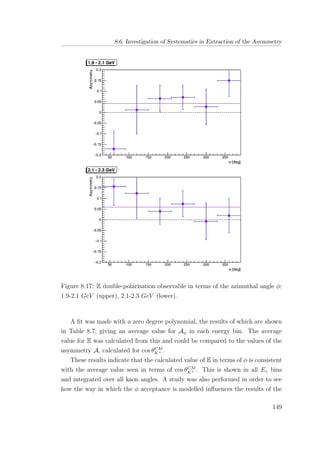
8.17 E double-polarisation observable in terms of the azimuthal angle
φ: 1.9-2.1 GeV (upper), 2.1-2.3 GeV (lower). . . . . . . . . . . 149
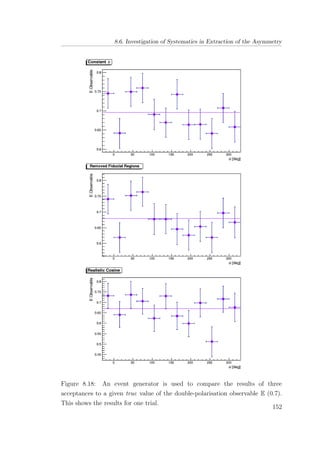
8.18 An event generator is used to compare the results of three
acceptances to a given true value of the double-polarisation
observable E (0.7). This shows the results for one trial. . . . . 152
xix
LIST OF FIGURES
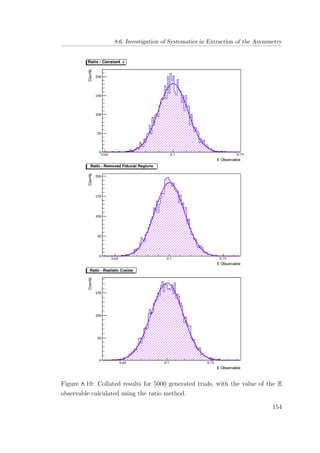
8.19 Collated results for 5000 generated trials, with the value of the
E observable calculated using the ratio method. . . . . . . . . 154
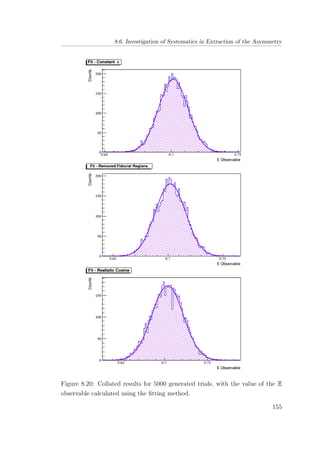
8.20 Collated results for 5000 generated trials, with the value of the
E observable calculated using the fitting method. . . . . . . . . 155
8.21 Predictions from KaonMAID for E in the reaction γn → K+
Σ−
.
These are plotted every 100 MeV : 1050, 1150, 1250, 1350, 1450,
1550. . . . . . . . . . . . . . . . . . . . . . . . . . . . . . . . . 162
8.22 Predictions from KaonMAID for E in the reaction γn → K+
Σ−
.
These are plotted every 100 MeV : 1650, 1750, 1850, 1950, 2050,
2100. . . . . . . . . . . . . . . . . . . . . . . . . . . . . . . . . 163
8.23 Predictions from Bonn-Gatchina for E in the reaction γn →
K+
Σ−
. These are plotted every 100 MeV : 1050, 1150, 1250,
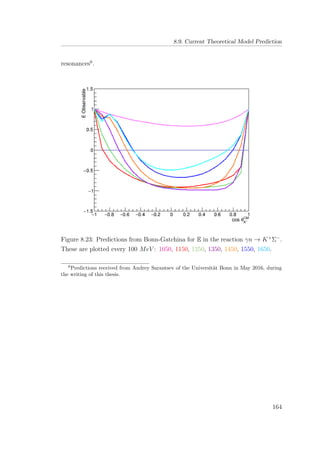
1350, 1450, 1550, 1650. . . . . . . . . . . . . . . . . . . . . . . 164
8.24 Predictions from Bonn-Gatchina for E in the reaction γn →
K+
Σ−
. These are plotted every 100 MeV : 1750, 1850, 1950,
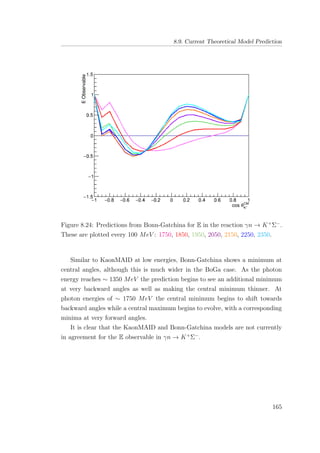
2050, 2150, 2250, 2350. . . . . . . . . . . . . . . . . . . . . . . 165
9.1 Results for the E double-polarisation observable using the target
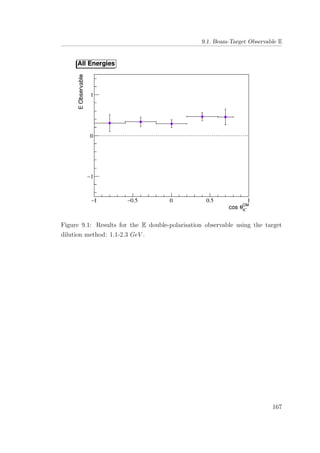
dilution method: 1.1-2.3 GeV . . . . . . . . . . . . . . . . . . . 167
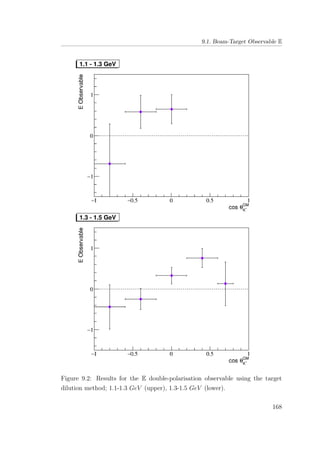
9.2 Results for the E double-polarisation observable using the target
dilution method; 1.1-1.3 GeV (upper), 1.3-1.5 GeV (lower). . . 168
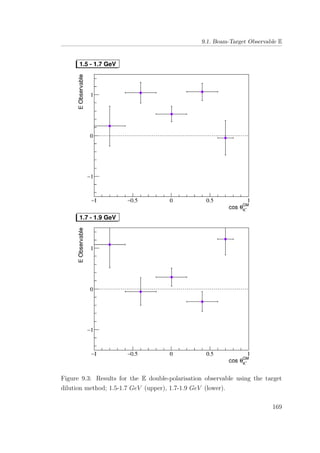
9.3 Results for the E double-polarisation observable using the target
dilution method; 1.5-1.7 GeV (upper), 1.7-1.9 GeV (lower). . . 169
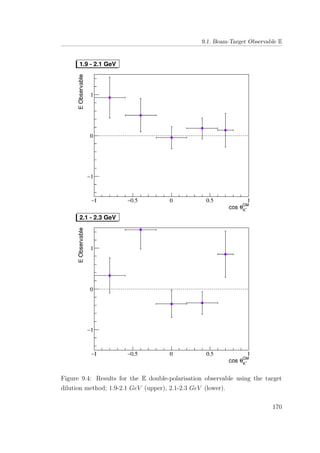
9.4 Results for the E double-polarisation observable using the target
dilution method; 1.9-2.1 GeV (upper), 2.1-2.3 GeV (lower). . . 170
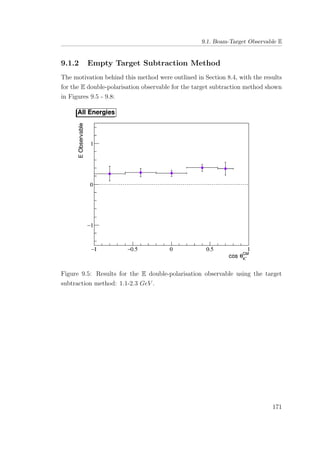
9.5 Results for the E double-polarisation observable using the target
subtraction method: 1.1-2.3 GeV . . . . . . . . . . . . . . . . . 171
9.6 Results for the E double-polarisation observable using the target
subtraction method; 1.1-1.3 GeV (upper), 1.3-1.5 GeV (lower). 172
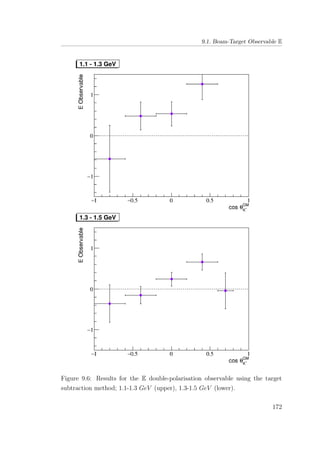
9.7 Results for the E double-polarisation observable using the target
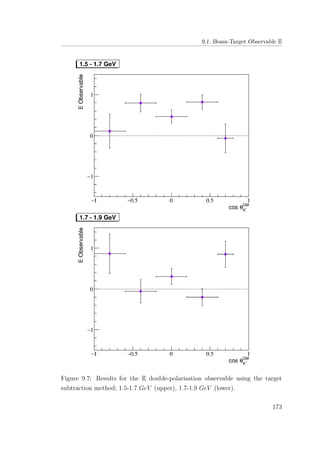
subtraction method; 1.5-1.7 GeV (upper), 1.7-1.9 GeV (lower). 173
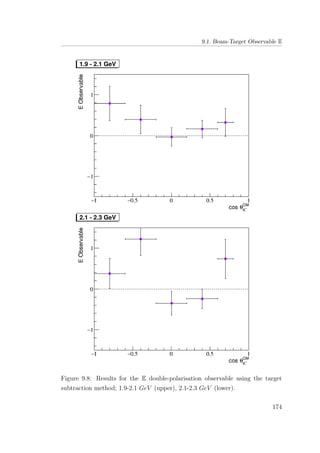
9.8 Results for the E double-polarisation observable using the target
subtraction method; 1.9-2.1 GeV (upper), 2.1-2.3 GeV (lower). 174
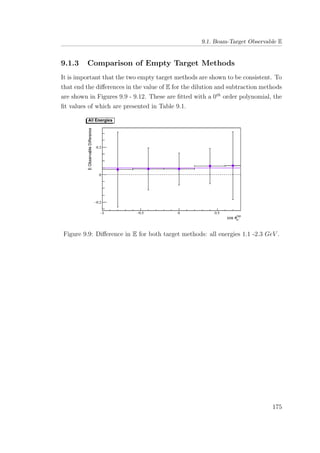
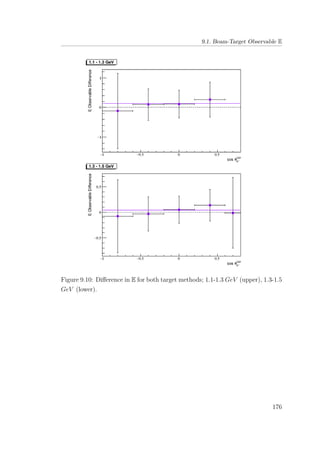
9.9 Difference in E for both target methods: all energies 1.1 -2.3
GeV . . . . . . . . . . . . . . . . . . . . . . . . . . . . . . . . . 175
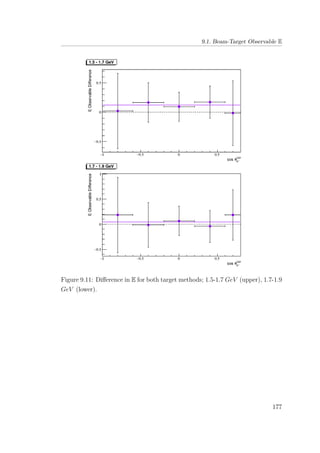
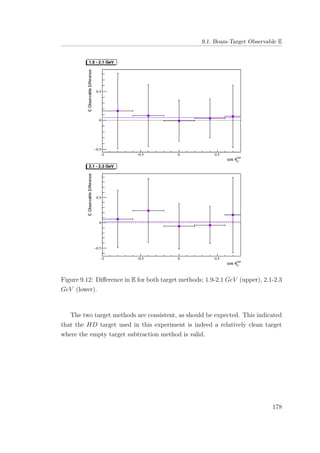
9.10 Difference in E for both target methods; 1.1-1.3 GeV (upper),
1.3-1.5 GeV (lower). . . . . . . . . . . . . . . . . . . . . . . . . 176
9.11 Difference in E for both target methods; 1.5-1.7 GeV (upper),
1.7-1.9 GeV (lower). . . . . . . . . . . . . . . . . . . . . . . . . 177
9.12 Difference in E for both target methods; 1.9-2.1 GeV (upper),
2.1-2.3 GeV (lower). . . . . . . . . . . . . . . . . . . . . . . . . 178
xx
LIST OF FIGURES
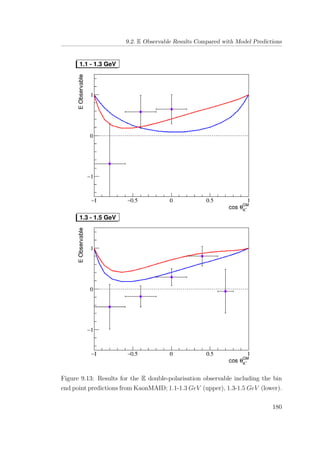
9.13 Results for the E double-polarisation observable including
the bin end point predictions from KaonMAID; 1.1-1.3 GeV
(upper), 1.3-1.5 GeV (lower). . . . . . . . . . . . . . . . . . . . 180
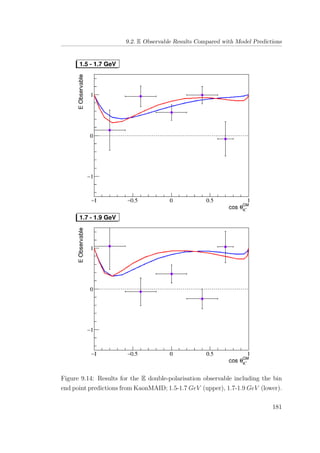
9.14 Results for the E double-polarisation observable including
the bin end point predictions from KaonMAID; 1.5-1.7 GeV
(upper), 1.7-1.9 GeV (lower). . . . . . . . . . . . . . . . . . . . 181
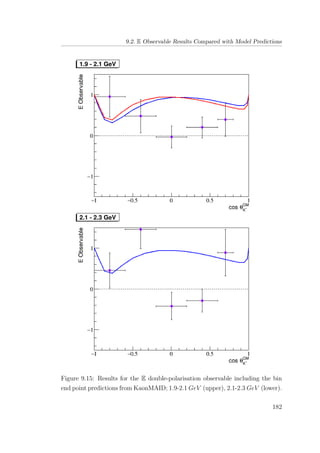
9.15 Results for the E double-polarisation observable including
the bin end point predictions from KaonMAID; 1.9-2.1 GeV
(upper), 2.1-2.3 GeV (lower). . . . . . . . . . . . . . . . . . . . 182
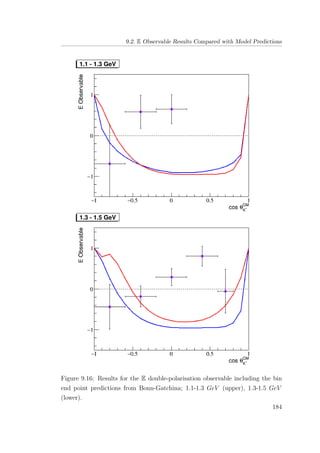
9.16 Results for the E double-polarisation observable including the
bin end point predictions from Bonn-Gatchina; 1.1-1.3 GeV
(upper), 1.3-1.5 GeV (lower). . . . . . . . . . . . . . . . . . . . 184
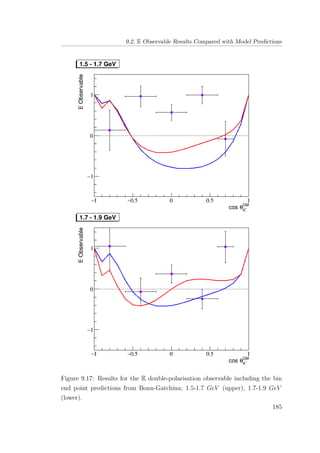
9.17 Results for the E double-polarisation observable including the
bin end point predictions from Bonn-Gatchina; 1.5-1.7 GeV
(upper), 1.7-1.9 GeV (lower). . . . . . . . . . . . . . . . . . . . 185
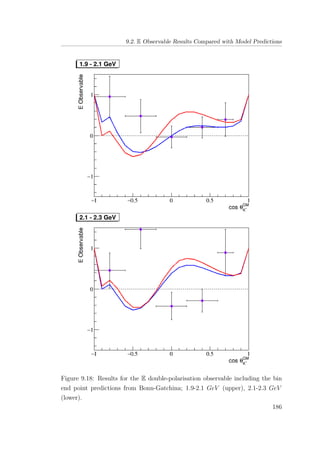
9.18 Results for the E double-polarisation observable including the
bin end point predictions from Bonn-Gatchina; 1.9-2.1 GeV
(upper), 2.1-2.3 GeV (lower). . . . . . . . . . . . . . . . . . . . 186
10.1 GEMC visualisation of the CLAS12 detector in Hall B. . . . . 193
10.2 Cross sectional view of the CLAS12 FD. . . . . . . . . . . . . . 195
10.3 Cross sectional view of the CLAS12 CD. . . . . . . . . . . . . 196
10.4 Full view (upper) and cross sectional view (lower) of the FT
as implemented in the CLAS12 GEANT4 simulation code.
The FT is supported by the tungsten beam pipe (green) and
surrounded by thermal insulation (white). The FT-Hodo (blue)
and FT-Trck (red-gold) are placed in front of the FT-Cal
(cream). A tungsten cone (orange) is located in the upstream
region to shield the detector from electromagnetic background. 197
10.5 Simple representation of the forward tagger calorimeter (FT-
Cal), showing the arrangement of the crystals. . . . . . . . . . 199
10.6 Simple representation of the forward tagger hodoscope (FT-
Hodo), which is located upstream from the FT-Cal. . . . . . . 200
10.7 Simple representation of the forward tagger tracker (FT-Trck),
which is located upstream from the FT-Hodo and FT-Cal. . . 201
10.8 Emission spectrum of EJ − 204 scintillator. . . . . . . . . . . . 202
10.9 Absorption spectra of Kuraray Y − 11 WLS fibre. . . . . . . . 202
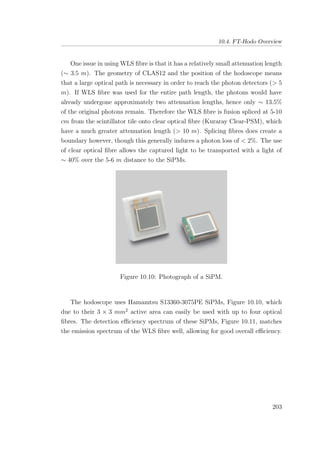
10.10 Photograph of a SiPM. . . . . . . . . . . . . . . . . . . . . . . 203
10.11 Detection efficiency spectrum of the SiPMs. . . . . . . . . . . . 204
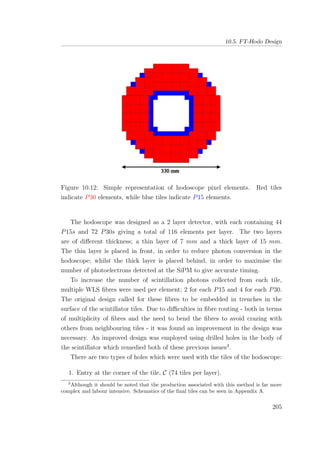
10.12 Simple representation of hodoscope pixel elements. Red tiles
indicate P30 elements, while blue tiles indicate P15 elements. . 205
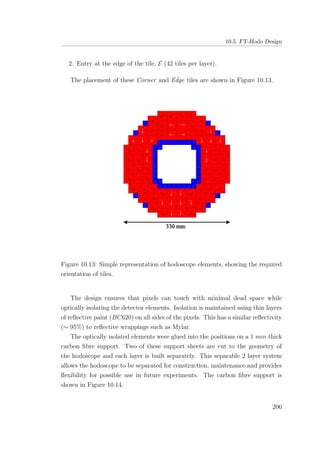
10.13 Simple representation of hodoscope elements, showing the
required orientation of tiles. . . . . . . . . . . . . . . . . . . . . 206
xxi
LIST OF FIGURES
10.14 CAD drawing of a carbon fibre support for one hodoscope layer. 207
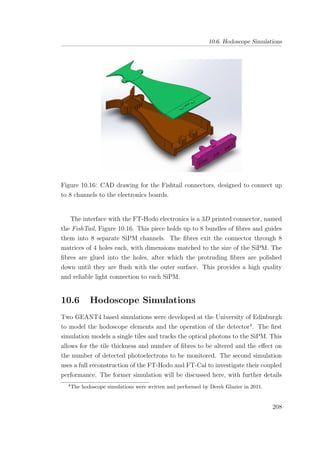
10.15 CAD drawing for the deltawing, designed to collect fibre
bundles at the base of the hodoscope before routing through
CLAS. . . . . . . . . . . . . . . . . . . . . . . . . . . . . . . . 207
10.16 CAD drawing for the Fishtail connectors, designed to connect
up to 8 channels to the electronics boards. . . . . . . . . . . . 208
10.17 Number of photons detected for tile geometry similar to the
previous CLAS Inner Calorimeter, which measured 18 photons
per MIP. . . . . . . . . . . . . . . . . . . . . . . . . . . . . . . 209
10.18 The number of photons detected for different configurations of
tile. Left: P15. Right: P30. . . . . . . . . . . . . . . . . . . . 210
10.19 Timing resolution for different configurations of tile. Left: P15.
Right: P30. . . . . . . . . . . . . . . . . . . . . . . . . . . . . 211
10.20 Effect of bending a fibre. Shown is the fraction of photons
transmitted to the detector as a function of the bend radius of
the fibre. . . . . . . . . . . . . . . . . . . . . . . . . . . . . . . 212
10.21 Radiation dose on the FT calorimeter crystals in rad/hour at
1035
cm−2
s−1
luminosity. The maximum values of about 5
rad/h are observed for the innermost crystals. . . . . . . . . . 213
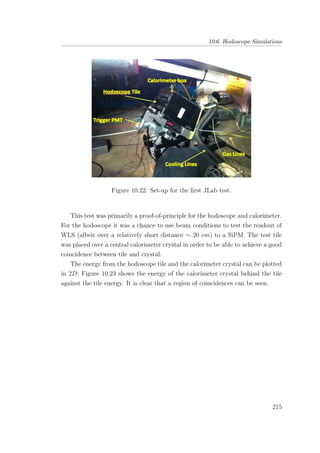
10.22 Set-up for the first JLab test. . . . . . . . . . . . . . . . . . . . 215
10.23 A sample result from the first test at JLab. Shown is the central
calorimeter energy vs the hodoscope energy (presented in terms
of ADC channel). The small left-hand cluster represents a
pedestal, while the large right-hand cluster represents a coin-
cidence measurement between the hodoscope and calorimeter
element. . . . . . . . . . . . . . . . . . . . . . . . . . . . . . . 216
10.24 Ariel schematic of the DAΦNE complex. . . . . . . . . . . . . 217
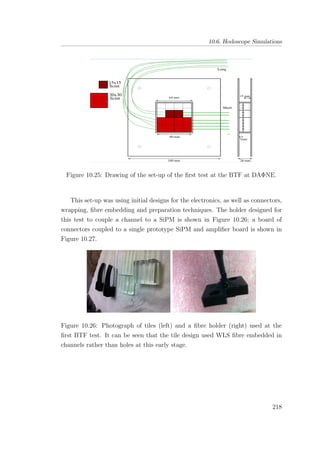
10.25 Drawing of the set-up of the first test at the BTF at DAΦNE. 218
10.26 Photograph of tiles (left) and a fibre holder (right) used at the
first BTF test. It can be seen that the tile design used WLS
fibre embedded in channels rather than holes at this early stage. 218
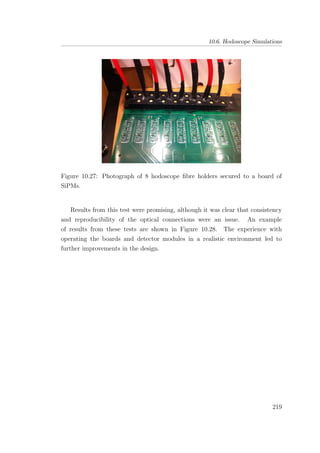
10.27 Photograph of 8 hodoscope fibre holders secured to a board of
SiPMs. . . . . . . . . . . . . . . . . . . . . . . . . . . . . . . . 219
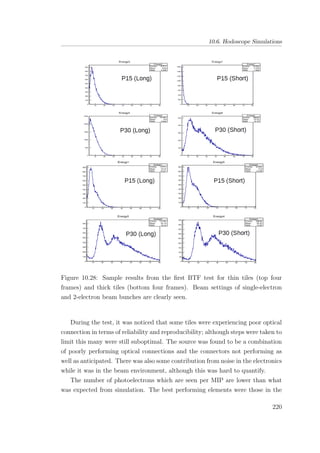
10.28 Sample results from the first BTF test for thin tiles (top four
frames) and thick tiles (bottom four frames). Beam settings of
single-electron and 2-electron beam bunches are clearly seen. . 220
10.29 Photograph of the set-up for the second BTF test. Although
new tiles were constructed, the set-up used for data taking
remained the same. . . . . . . . . . . . . . . . . . . . . . . . . 221
10.30 Sample result from the second BTF test for a single P30 tile.
The peak for the single-electron beam mode is shown clearly
above the pedestal. . . . . . . . . . . . . . . . . . . . . . . . . 222
xxii
LIST OF FIGURES
11.1 Tent and low UV set-up used during the construction of the
hodoscope. . . . . . . . . . . . . . . . . . . . . . . . . . . . . . 224
11.2 Cross section of the carbon fibre support material for the final
stage of the hodoscope. . . . . . . . . . . . . . . . . . . . . . . 225
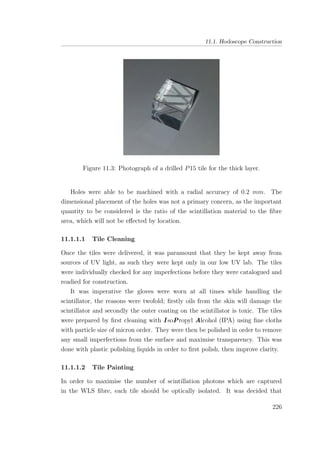
11.3 Photograph of a drilled P15 tile for the thick layer. . . . . . . 226
11.4 Tile shown post-painting. Dummy fibres and aluminium foil
were used to protect the drilled channels. . . . . . . . . . . . . 227
11.5 Illustration showing the additional thickness created by the
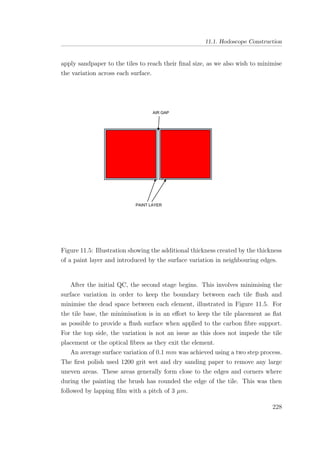
thickness of a paint layer and introduced by the surface
variation in neighbouring edges. . . . . . . . . . . . . . . . . . 228
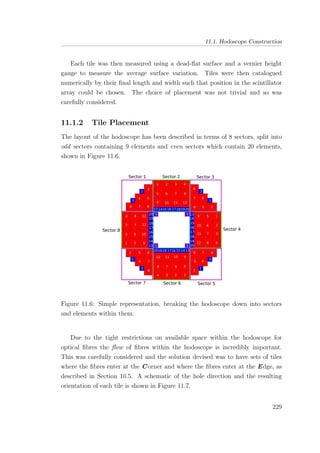
11.6 Simple representation, breaking the hodoscope down into sec-
tors and elements within them. . . . . . . . . . . . . . . . . . . 229
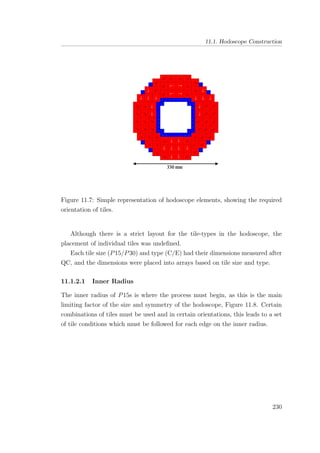
11.7 Simple representation of hodoscope elements, showing the
required orientation of tiles. . . . . . . . . . . . . . . . . . . . . 230
11.8 Illustration showing the tile orientation at the centre of the
hodoscope. Since tiles are no longer square both sides of the
tile are considered independently. . . . . . . . . . . . . . . . . 231
11.9 Illustration showing the orientation of tiles in the even sectors
of the hodoscope. These are considered as three rows. . . . . . 233
11.10 Illustration showing the orientation of tiles in the odd sectors
of the hodoscope. These are considered as one row and one
column sharing a common element. . . . . . . . . . . . . . . . 234
11.11 Fully minimised layout for the thick layer of the hodoscope.
Element types are denoted by colour: P30C, P30E, P15C and
P15E. . . . . . . . . . . . . . . . . . . . . . . . . . . . . . . . 235
11.12 A close-up view of the edge where tiles cross the outer radius,
as outline by the to-scale schematic placed underneath. . . . . 236
11.13 Photograph showing the 3D printed (black) and machined
(silver) jigs used for even sector tile placement. . . . . . . . . . 237
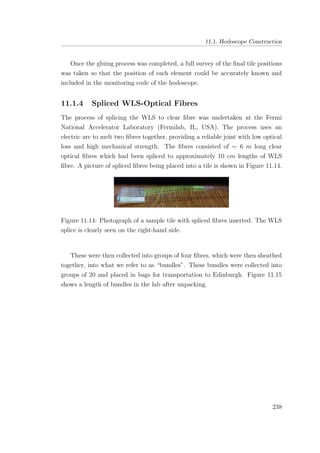
11.14 Photograph of a sample tile with spliced fibres inserted. The
WLS splice is clearly seen on the right-hand side. . . . . . . . . 238
11.15 Lengths of spliced fibre in the lab. . . . . . . . . . . . . . . . . 239
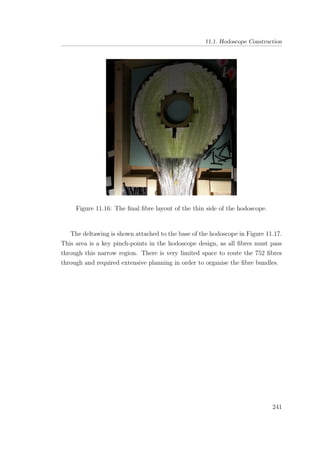
11.16 The final fibre layout of the thin side of the hodoscope. . . . . 241
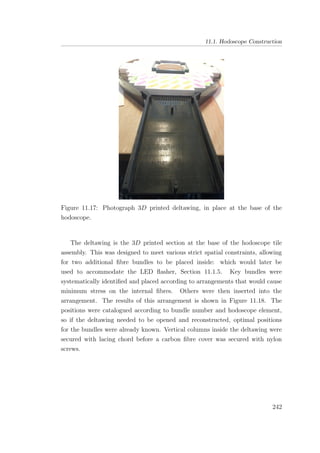
11.17 Photograph 3D printed deltawing, in place at the base of the
hodoscope. . . . . . . . . . . . . . . . . . . . . . . . . . . . . . 242
11.18 Photograph of the deltawing with fibre bundles arranged and
preliminarily secured. . . . . . . . . . . . . . . . . . . . . . . . 243
11.19 Photograph of the edge enclosure of the hodoscope. . . . . . . 244
11.20 Photograph of one element of the LED flasher before the
hodoscope was sealed for transportation. . . . . . . . . . . . . 245
11.21 Photograph of fishtail connectors after fibres have been glued.
Left: shown only in the front panel. Right: shown in a
constructed fishtail. . . . . . . . . . . . . . . . . . . . . . . . . 246
xxiii
LIST OF FIGURES
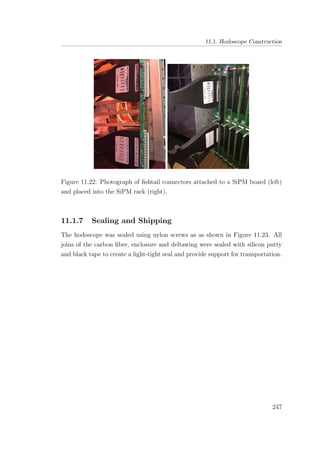
11.22 Photograph of fishtail connectors attached to a SiPM board
(left) and placed into the SiPM rack (right). . . . . . . . . . . 247
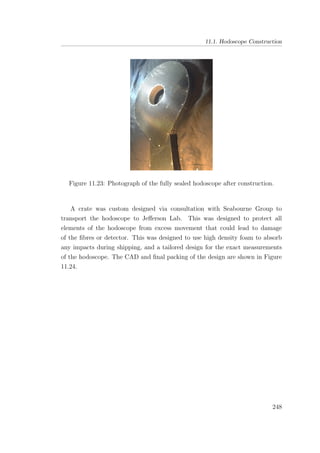
11.23 Photograph of the fully sealed hodoscope after construction. . 248
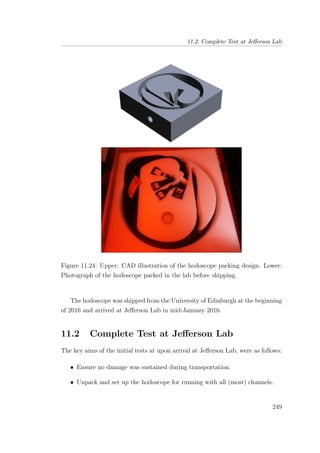
11.24 Upper: CAD illustration of the hodoscope packing design.
Lower: Photograph of the hodoscope packed in the lab before
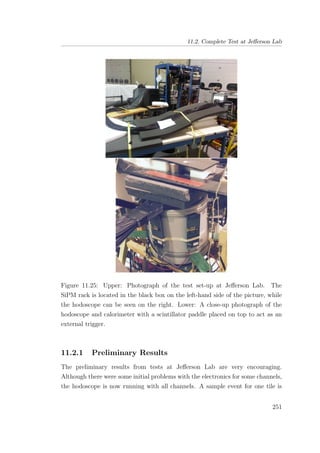
shipping. . . . . . . . . . . . . . . . . . . . . . . . . . . . . . . 249
11.25 Upper: Photograph of the test set-up at Jefferson Lab. The
SiPM rack is located in the black box on the left-hand side
of the picture, while the hodoscope can be seen on the right.
Lower: A close-up photograph of the hodoscope and calorimeter
with a scintillator paddle placed on top to act as an external
trigger. . . . . . . . . . . . . . . . . . . . . . . . . . . . . . . . 251
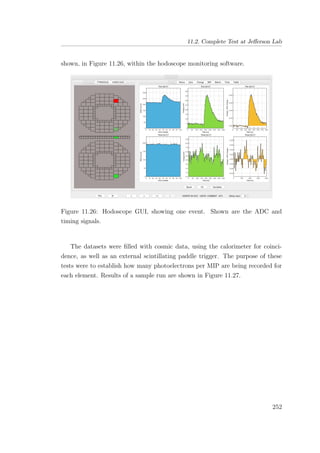
11.26 Hodoscope GUI, showing one event. Shown are the ADC and
timing signals. . . . . . . . . . . . . . . . . . . . . . . . . . . . 252
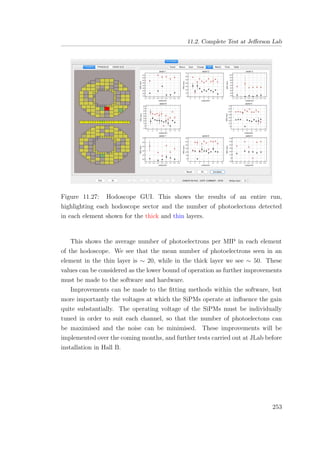
11.27 Hodoscope GUI. This shows the results of an entire run, high-
lighting each hodoscope sector and the number of photoelectons
detected in each element shown for the thick and thin layers. . 253
xxiv
List of Tables
1.1 Summary of nucleon and kaon properties. . . . . . . . . . . . . 6
2.1 Polarisation observables associated with kaon photoproduction,
where Px, Py, Pz are the components of target polarisation along
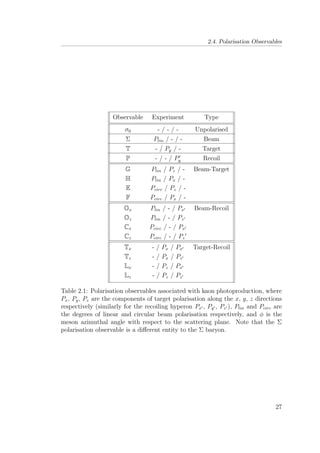
the x, y, z directions respectively (similarly for the recoiling
hyperon Px , Py , Pz ), Plin and Pcirc are the degrees of linear
and circular beam polarisation respectively, and φ is the meson
azimuthal angle with respect to the scattering plane. Note that
the Σ polarisation observable is a different entity to the Σ baryon. 27
3.1 Data points and associated errors obtained from cross section
measurements at Cornell. . . . . . . . . . . . . . . . . . . . . . 35
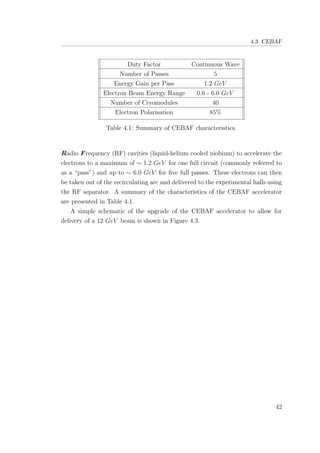
4.1 Summary of CEBAF characteristics. . . . . . . . . . . . . . . . 42
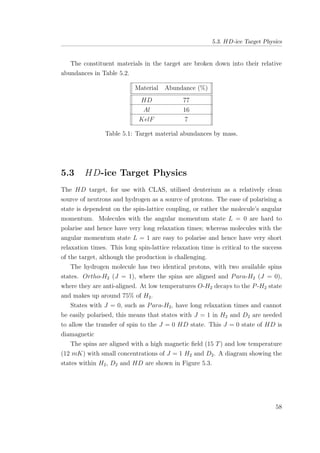
5.1 Target material abundances by mass. . . . . . . . . . . . . . . 58
5.2 Summary of the targets produced for the g14 run period and
their characteristics. . . . . . . . . . . . . . . . . . . . . . . . . 67
6.1 Summary of the g14 run period. This shows each sub-period,
including the beam, torus and target characteristics. . . . . . . 69
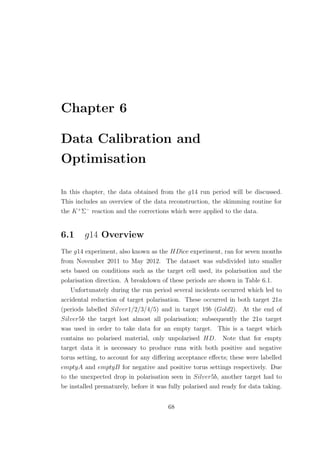
6.2 Calibration responsibilities and prerequisites. . . . . . . . . . 71
7.1 Removed azimuthal regions. . . . . . . . . . . . . . . . . . . . 122
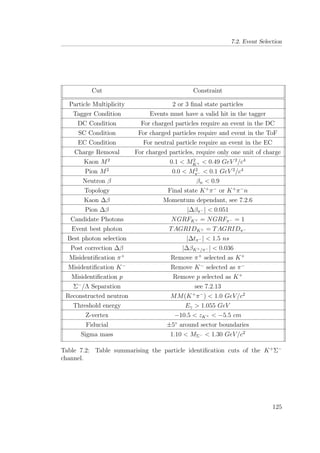
7.2 Table summarising the particle identification cuts of the K+
Σ−
channel. . . . . . . . . . . . . . . . . . . . . . . . . . . . . . . 125
8.1 Energy bins (200 MeV width) used for the polarisation observ-
able measurement. . . . . . . . . . . . . . . . . . . . . . . . . 129
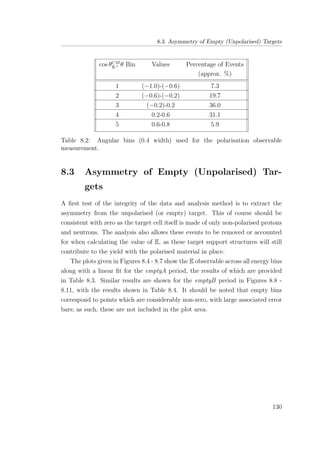
8.2 Angular bins (0.4 width) used for the polarisation observable
measurement. . . . . . . . . . . . . . . . . . . . . . . . . . . . 130
8.3 Summary of linear fitting to E double-polarisation observable
for the empty target A. . . . . . . . . . . . . . . . . . . . . . . 135
8.4 Summary of linear fitting to E double-polarisation observable
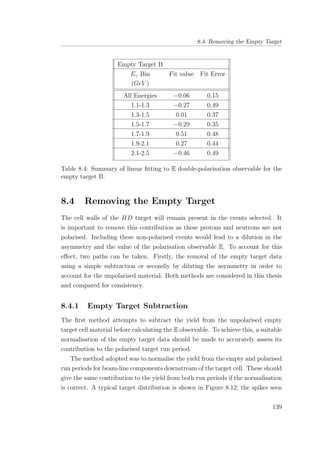
for the empty target B. . . . . . . . . . . . . . . . . . . . . . . 139
xxv
LIST OF TABLES
8.5 Summary of the empty target scaling factor with respect to the
selected photon energy bins, 1/( ¯PγPT ). . . . . . . . . . . . . . 141
8.6 Summary of how photon beam polarisation relates to the
selected photon energy bins. . . . . . . . . . . . . . . . . . . . 145
8.7 Summary of the E double-polarisation observable, as calculated
in terms of φ. This can be compared with the average value of
the E observable plotted with cos θCM
K+ . . . . . . . . . . . . . . 150
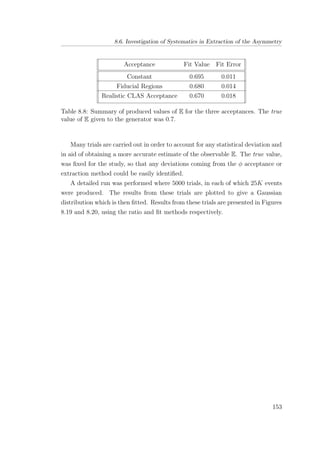
8.8 Summary of produced values of E for the three acceptances.
The true value of E given to the generator was 0.7. . . . . . . . 153
8.9 Summary of produced values of E for the three acceptances
over 5000 trials. The value of E was calculated using the ratio
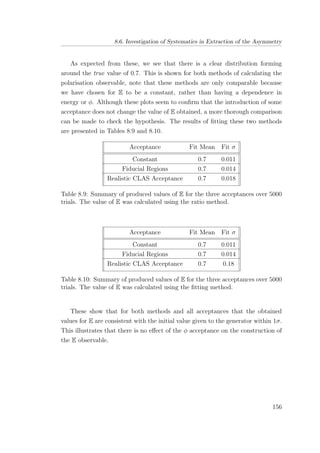
method. . . . . . . . . . . . . . . . . . . . . . . . . . . . . . . 156
8.10 Summary of produced values of E for the three acceptances
over 5000 trials. The value of E was calculated using the fitting
method. . . . . . . . . . . . . . . . . . . . . . . . . . . . . . . 156
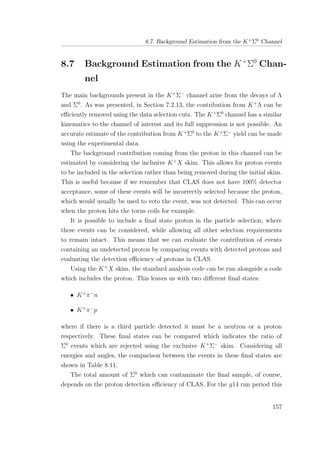
8.11 Summary of the number of final state events when excluding
and including a final state proton. . . . . . . . . . . . . . . . . 158
8.12 Outline of how the proton contribution evolves with the photon
energy, Eγ. . . . . . . . . . . . . . . . . . . . . . . . . . . . . . 158
8.13 Outline of how the proton contribution evolves with the cosine
of the K+
centre-of-mass angle, cos θCM
K+ , from 1.1- 1.7 GeV . . 159
8.14 Outline of how the proton contribution evolves with the cosine
of the K+
centre-of-mass angle, cos θCM
K+ , from 1.7- 2.3 GeV . . 160
9.1 Summary of the differences in the target methods, using a 0th
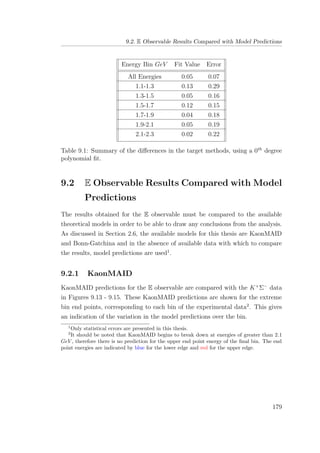
degree polynomial fit. . . . . . . . . . . . . . . . . . . . . . . . 179
9.2 Systematic uncertainties associated with polarisation measure-
ments during the g14 run period. . . . . . . . . . . . . . . . . . 187
9.3 Systematic uncertainties in E in terms of Eγ and cos θCM
K+ .
Showing shifts assuming the value of E for the K+
Σ0
channel
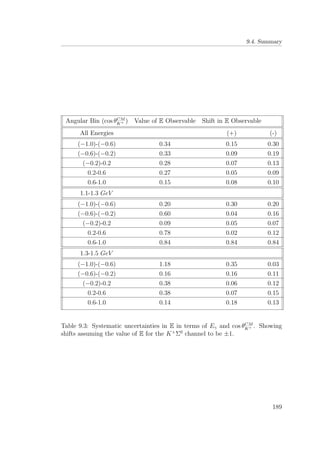
to be ±1. . . . . . . . . . . . . . . . . . . . . . . . . . . . . . . 189
9.4 Systematic uncertainties in E in terms of Eγ and cos θCM
K+ .
Showing shifts assuming the value of E for the K+
Σ0
channel
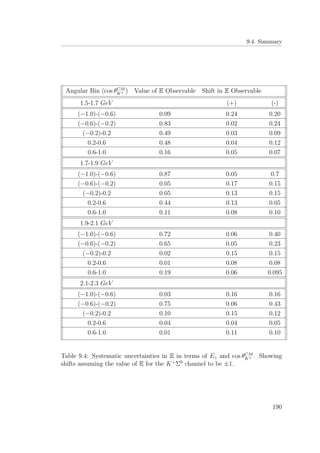
to be ±1. . . . . . . . . . . . . . . . . . . . . . . . . . . . . . . 190
10.1 Summary of the Forward Tagger kinematic range. . . . . . . . 198
10.2 Summary of approximate numbers of photons expected for tiles
similar to those used in the final hodoscope construction. . . . 210
10.3 Summary of approximate timing resolution expected for tiles
similar to those used in the final hodoscope construction. . . . 211
xxvi
Chapter 1
Introduction
The work presented in this thesis shows the first measurement of the E double-
polarisation observable for the reaction γn → K+
Σ−
from a HD target, during
the g14 run period of CLAS; the final period at Jefferson Lab to use an electron
beam energy of 6 GeV . The measurement provides key new data for the world
programme to constrain the excitation spectrum of the nucleon. In recent years,
key advances have been made in this field through Partial W ave Analysis (PWA)
of cross section and polarisation observables in meson photoproduction from the
nucleon.
Also contained within this thesis (Chapters 10 and 11) are details of the
development and construction of the Forward Tagging Hodoscope, a detector
designed for use with post-upgrade Jefferson Lab, which will deliver an electron
beam energy of 12 GeV .
This opening chapter discusses the background and motivation for the types
of experiment carried out at Jefferson Lab. This will cover the topics directly
relevant to the analysis of the HD experiment as well as outlining aspects relevant
to the use of the hodoscope at CLAS12.
1.1 Quantum Chromodynamics
Quantum ChromoDynamics (QCD) can be summarised as a non-abelian gauge
theory which parametrises quarks with symmetry group SU(3)1
. QCD may be
considered as analogous to the more familiar Quantum ElectroDynamics (QED),
1
A Special U nitary group.
1
1.1. Quantum Chromodynamics
in that they both describe interactions mediated by a massless spin − 1 boson
(gluons and photons respectively)2
.
Quarks exist in six flavours, along with their associated anti-particles:
• up (u & ¯u),
• down (d & ¯d),
• charm (c & ¯c),
• strange (s & ¯s),
• top (t & ¯t),
• bottom (b & ¯b).
These elementary particles, omitting the top quark, are able to form composite
particles, known as hadrons, using various combinations of two-quark (meson)
and three-quark (baryon) states, bound by gluons.
Gluons have no electric charge, like the photon, but instead couple to colour
charges, which should be conserved in all strong interactions3
. This gives a
flavour independence of the strong interaction, i.e. all flavours of quark must
have identical strong interactions as they may have the same values of colour
states. The crucial difference between QCD and QED is that gluons have the
ability to self-interact, as they themselves are bi-coloured, which is what defines
QCD as non-abelian. The self-interaction of gluons leads to the ability for three-
and four-gluon vertices, examples of which are illustrated in Figure 1.1. Gluonic
self-interaction leads to two other important properties; colour confinement and
asymptotic freedom.
Figure 1.1: Gluonic self-interaction.
2
More comprehensive formulations of QCD, in terms of interactions and mathematics, may
be found in [1] [2] [3].
3
Colours are defined as red (r), green (g) and blue (b); though not related to the physical
perception of colour but a tool to aid with the mathematical complications of QCD.
2
1.1. Quantum Chromodynamics
Colour confinement can effectively be thought of as a condition that states
must be colour neutral. Moreover this leads to the requirement that there can be
no free quarks, as they have non-zero colour charge and must be contained in a
bound system with other quarks. Similarly for gluons, they may not be free but
can, in principle, be bound in states with other gluons, inside glueballs4
.
Asymptotic freedom means that the interaction becomes weaker at shorter
distances, and is echoed in the property that the coupling constant is not in fact
constant (often called a running coupling constant); the evolution of the running
coupling constant with energy is shown in Figure 1.2.
Figure 1.2: Summary of measurements of the strong coupling constant, αs(Q),
as a function of the energy scale, Q [4].
As the distance increases (> 1 fm) the higher order corrections of interactions
become more important. In this regime there are two main approaches:
1. Phenomenological models which include aspects expected from QCD but
4
The existence of the glueball remains to be established experimentally.
3
1.2. Particle Multiplets
employing effective degrees of freedom. Such approaches are discussed
further in Section 1.5.0.1.
2. Obtaining solutions based on calculations using powerful computational
tools. Probably the most successful technique to date is that of Lattice
QCD (LQCD)5
. This approach is discussed further in Section 1.5.1.
It is also important to consider the effect of gluonic interactions within
hadrons. If we consider the proton, the constituent quark rest masses only
account for ∼ 1% of the total mass. This means that ∼ 99% of the mass
is dynamically generated from the non-perturbative interactions of quarks via
the exchange of gluons. These can self couple and interact with the vacuum
to produce quark-antiquark pairs. The net energy of all these processes then
produces the mass, from the equivalence between mass and energy (E = mc2
).
An artistic representation of this is shown in Figure 1.3. This demonstrates why
the internal dynamics of the proton and other hadrons are far from trivial.
Figure 1.3: A representation of quark and gluon interactions inside the nucleon
[7].
1.2 Particle Multiplets
After the discovery of the proton and neutron, it was postulated that they could
be considered as two states of the same particle, called the Nucleon [1]. At a
5
A more complete formalism of LQCD may be found in [5] [6].
4
1.2. Particle Multiplets
cursory glance it can be seen that throughout the existing hadrons there are
sub-groups which seem to form families of particles with similar masses6
. For
example, the nucleons:
p(938) = uud,
n(940) = udd,
(1.1)
and the family of kaons:
K±
(494) = u¯s,
K0
(498) = d¯s.
(1.2)
These families are labelled Isospin Multiplets [1].
1.2.1 Isospin
Isospin, I, is a spin quantum number, which has its definition based in the
construction of these multiplets. Another quantum number can be introduced,
hypercharge Y :
Y = B + S + C + ˜B + T, (1.3)
where B, S, C, ˜B and T are the baryon number, strangeness, charm, beauty
and truth respectively. If we consider the members of a multiplet it can be seen
that these individual quantum numbers do not change, therefore neither does the
hypercharge. Here we see the third component of isospin, I3, defined in terms of
hypercharge and the electric charge, Q:
I3 = Q −
Y
2
. (1.4)
For the case of the nucleon, only the baryon number contributes to hyper-
charge (Y = 1), from Equation 1.4 this gives the values of I3 = +1/2 and
I3 = −1/2 for the proton and neutron respectively.
6
Other interesting properties which these families display are identical spin, parity, baryon
number, strangeness, charm and beauty.
5
1.2. Particle Multiplets
The values of I3 for a multiplet run from ±I:
I3 = I, I − 1, ..., −I. (1.5)
If we extend our earlier example of nucleons and kaons, the quantum numbers
can be shown simply in Table 1.1 as:
Particle B Y Q I3 I
p(938) 1 1 1 1
2
1
2
n(940) 1 1 0 −1
2
1
2
K+
(494) 0 1 1 1
2
1
2
K0
(498) 0 1 0 −1
2
1
2
Table 1.1: Summary of nucleon and kaon properties.
We have only considered the variable of isospin, but these multiplets can be
extended in hypercharge space, giving rise to further families. This can be done
for mesons, as in Figure 1.4, and equivalently for baryons, as in Figure 1.5.
Figure 1.4: Meson nonet (B = 0) shown in terms of charge, Q, and strangeness,
S [8].
6
1.3. Hadron Spectroscopy
Figure 1.5: Baryon octet (B = 1) shown in terms of charge, Q, and strangeness
S [9].
1.3 Hadron Spectroscopy
The internal structure of the nucleon and its interactions are key areas of interest
within the nuclear physics community. The excitation spectrum of the nucleon is
a very effective way to constrain nucleon dynamics; spectroscopy is the study of
these excited states. The excited states of the nucleon are resolvable in a limited
mass range, typically ∼ 1-2 GeV [10] [11]. As shown in Figure 1.2, the running
coupling constant is extremely large in this region, therefore perturbation theory
is no longer valid; this is shown explicitly in Figure 1.6 in terms of interaction
distance.
7
1.4. Meson Spectroscopy
Figure 1.6: Evolution of the strong coupling constant, αs(Q), as a function of the
interaction distance [12].
Decays from resonances of excited nucleon states predominantly proceed via
the strong force. Intrinsically, strong processes occur over very short times,
leading to large peak widths, as expected from the uncertainty principle;
∆E∆t ≥
2
. (1.6)
Excited states with lifetimes of around 10−23
s, are seen with widths of
around 100 MeV . Resonances, however, are typically spaced much closer together
than this, leading to significant overlap of neighbouring peaks. This overlapping
structure makes a reliable extraction of the spectrum more challenging than in
the case of atomic or nuclear physics, when states can generally be well separated.
1.4 Meson Spectroscopy
The study of non-perturbative QCD is not of course limited to the nucleon studies
discussed above. Similar basic processes, in terms of hadronic structure and mass
generation mechanisms can also occur in mesons.
8
1.4. Meson Spectroscopy
Central to the aim of the upgraded JLab facility is to obtain a complete map
of the spectrum of meson states in the range 1-3 GeV . This would provide a
unique fingerprint to constrain our understanding of the confinement of mesons7
.
States in the low mass region of the meson spectrum are relatively well
experimentally characterised [15]. However, the spectrum of higher mass states is
established with much poorer confidence and accuracy. As well as mesons states
expected from simple constituent quark models, others are predicted outwith the
allowed quantum numbers for a simple q¯q system. These take the form of more
exotic states like tetraquarks (q¯qq¯q), hybrids (qqg) and glueballs (gg) [16] [17]
[18] [19]. The latter two occur due to excited gluonic degrees of freedom within
the meson system, allowing for the quantum numbers of the gluonic field itself
to contribute to the mesonic state. Early theoretical approaches used a flux-tube
model [20] [21] for these gluonic components but major recent developments in
theory have allowed predictions directly from QCD.
The lowest of the exotic states are predicted around 2 GeV , from LQCD
calculations [22] [23]. The lightest of these predicted states include 1−+
, 0+−
and
2+−
in terms of JPC
. The hybrid and glueball mass range is thought to be around
1.4-3.0 GeV ; accessible with the 12 GeV beam energy which will be available at
JLab12.
In photoproduction, the production rate of hybrid mesons is thought to be
comparable to normal meson production rates and CLAS12 aims to exploit this
fact.
There is some weak and disputed evidence for a few of the predicted states [24]
[25] but new measurements and analyses are required to establish their existence
and properties. Also for a full confirmation of any of these states they must, of
course, be seen in more than one decay mode.
7
Other goals of the upgraded JLab include, better establishing the internal dynamics of the
nucleon, Generalised Parton Distributions (GPDs) and eventually achieving a 3D image of
the nucleon, by mapping out the momentum and spatial location of its constituents [11] [13]
[14].
9
1.5. Theoretical Approaches to Hadron Spectroscopy
1.5 Theoretical Approaches to Hadron Spec-
troscopy
There exist many theoretical approaches to model hadrons and predict their
excited states. These methods either start from the underlying QCD Lagrangian
or attempt to incorporate various properties of QCD such as colour confinement
and asymptotic freedom in phenomenological degrees of freedom [26].
1.5.0.1 Constituent Quark Models
These phenomenological models treat the nucleon as a bound state of constituent
quarks, each of which are assigned one third of the nucleon mass [27]. These
constituent quarks are then bound with a quark-quark interaction which is based
on the one gluon exchange potential from QCD. The constituent quarks can be
thought of as a bare valence quark, as seen in QCD, which has been dressed in a
cloud of low-momenta virtual gluons, resulting in an effective mass mq = 1
3
mN .
These models have some success in predicting the spectra of experimentally
observed excited states. These models tend to predict many more states than
those currently observed. It is not currently established if this reflects a deficiency
in the theory or insensitivity in current experimental measurements. It should be
remarked however that a similar quantity of excited states have been predicted
from recent LQCD calculations, Section 1.5.1.
Figure 1.7 indicates states predicted by the constituent quark model and
highlights their experimental standing. In this plot the heavy uniform-width bars
show the predicted masses of states with well established counterparts from PWA,
light bars those of states which are weakly established or missing. The length
of the thin white bar gives the prediction for each states γN decay amplitude,
thin grey bar for its πN decay amplitude, and thin black bar for its KΣ decay
amplitude.
10
1.5. Theoretical Approaches to Hadron Spectroscopy
Figure 1.7: Mass predictions, γN, πN, and KΣ decay amplitude predictions for
nucleon resonances up to 2200 MeV [28].
1.5.0.2 The Di-quark Model
This model considers the nucleon as a pair of quarks which are strongly correlated
and a third valence quark, reducing the number of degrees of freedom in the
system [29]. A simple illustration of this is given in Figure 1.8. The reduced
number of degrees of freedom results in fewer excited states than the qqq
constituent quark models.
Figure 1.8: Representation of the di-quark model inside the nucleon [30].
11
1.5. Theoretical Approaches to Hadron Spectroscopy
This model has also had some success in predicting low energy resonances
[31], but results from LQCD [32] [33] seem to suggest that di-quarks do not
form inside the nucleon. The existence or non-existence of di-quarks is still an
unresolved question in the field.
1.5.0.3 Bag Models
Bag models attempt to explicitly model the colour confinement of quarks within
the hadron [34]. The model begins with some finite spherical potential, set at a
fixed radius, labelled the bag. Quarks are placed inside this potential, in which
they are seen as massless. The boundary conditions of the bag are set-up such
that the quarks are confined by a bag and out-with this volume they have infinite
mass. Perturbative QCD can then be used within these boundary conditions.
Variants on this model have also been developed, such as the MIT Bag Model
[18], the Cloudy Bag Model [35] and the SLAC Bag Model [36].
Bag models have had some success in predicting the masses of particles, shown
in Figure 1.9.
12
1.5. Theoretical Approaches to Hadron Spectroscopy
Figure 1.9: Light baryon and meson masses, predicted by the bag model. The
actual masses are given by dotted lines, while all other masses are predicted. The
masses of N, ∆, Ω and ω were used to determine the parameters [26].
1.5.1 Lattice QCD
Lattice QCD is formulated upon a grid, named the lattice, in space-time. Fields
are used to represent quarks which are located at points on the lattice; between
these lattice points gluon fields are used to link quark fields, this is simply
illustrated in Figure 1.10. Within this framework, QCD predictions can be
extracted taking the limit, in which the lattice spacing is reduced to zero. The
complexity of numerical calculations increases dramatically as the lattice spacing
is reduced.
13
1.5. Theoretical Approaches to Hadron Spectroscopy
Figure 1.10: Simple interpretation of QCD calculated on a lattice [37].
A central challenge of hadronic physics is to establish whether LQCD can fully
explain phenomena at these large distances and low momenta, where realistic
analytical predictions from QCD are intractable. The lattice approach offers the
possibility to obtain predictions based on QCD using computational methods
without explicitly solving the QCD Lagrangian.
Interestingly LQCD predicts many bound quark states beyond the simple
nucleon and meson that are yet to be observed experimentally and gives an
indication of the expected masses. This includes hybrid mesons, in which the
usual two quark degrees of freedom are supplemented with other dynamics [38].
In hybrid mesons the gluonic field which is created in the confinement process
of the two quarks can become a degree of freedom in itself. The additional parity
and angular momentum quantum numbers are predicted to give rise to exotics,
which have combinations of spin, parity and C-parity which cannot be reached
from only two degrees of freedom. The search for these objects is a key physics
goal of the Forward Tagger [39], discussed in Chapter 10.
In recent years LQCD has progressed such that prediction of the excitation
spectrum of the nucleon can be made, this method has had much success
predicting the lowest mass hadrons to experimental values to within 1% [40].
Currently computational limits mean that these calculations cannot be carried
out at realistically light quark masses in the nucleon, although there is rapid
14
1.5. Theoretical Approaches to Hadron Spectroscopy
progress towards this. Current state-of-the-art calculations are carried out at
quark masses equivalent to a pion mass of ∼ 400 MeV (∼ 260 MeV above the
PDG value). The calculations are extrapolated to realistic quark masses using
phenomenological (although QCD-guided) extrapolations.
The spectra of predicted meson states is shown in Figure 1.11. States corre-
sponding to the established mesons are predicted, along with many unobserved
or poorly established states. Lattice QCD also predicts a whole family of hybrid
mesons which are unobserved. Clearly QCD may be a much richer environment
than currently established.
Figure 1.11: The spectra of isoscalar mesons calculated by the JLab LQCD group
(mπ ∼ 396 MeV ) [41].
Predictions for the baryon spectra are shown in Figure 1.12. Many more
excited states than currently established are predicted by the models, mirroring
the excess of states predicted by the qqq constituent quark model. Also hybrid
baryon states are predicted, excited nucleon states which have large gluonic
components in their wavefunction. Unfortunately such states do not have exotic
quantum numbers but are predicted in a mass range where there is a paucity of
qqq states. Future experiments will search for these exotic objects.
15
1.5. Theoretical Approaches to Hadron Spectroscopy
Figure 1.12: The spectra of baryons calculated by the JLab LQCD group (mπ ∼
396 MeV ), in units of the calculated Ω mass [42].
The results support the idea that there may be many excited nucleon states
that remain to be established experimentally. It is crucial to establish whether
this is due to a lack of sensitivity in the measurements or whether this is telling
us about something lacking in the underlying theory to describe non-perturbative
QCD.
1.5.2 Classification of Experimentally Determined Hadronic
Excitation Spectra
In identifying resonant states experimentally it is imperative to determine
quantum numbers, particle mass, branching ratios and widths to challenge
the theoretical models. The Particle Data Group (PDG) collects data for
experimentally observed states; using a star system to indicate the confidence
level of each determination, based on the consistency of sightings in different
analyses and the significance of the signals obtained. The different ratings are
defined below:
• **** Existence is certain, and properties are at least fairly well explored
• *** Existence is very likely but further confirmation of decay modes is
required
• ** Evidence of existence is only fair
16
1.6. Summary
• * Evidence of existence is poor
Until around a decade ago, most data on resonances came from the study of
πN scattering experiments. Recently, photoproduction is being used as a powerful
experimental tool and has established five new resonances in recent years [43].
This new sensitivity has arisen from the quality of the photoproduction data and
differences in the relative coupling of the missing resonances to the πN and γN
channels. The cross sections of meson photoproduction from the proton are shown
in Figure 1.13, separated according to the different strong decay channels. It has
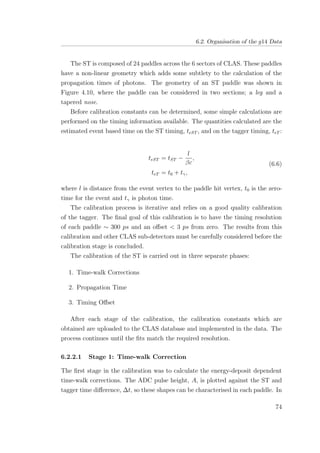
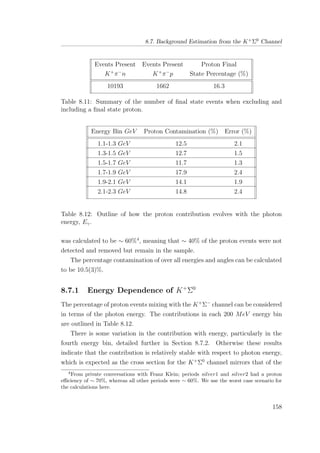
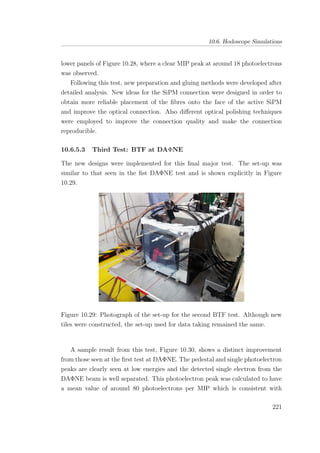
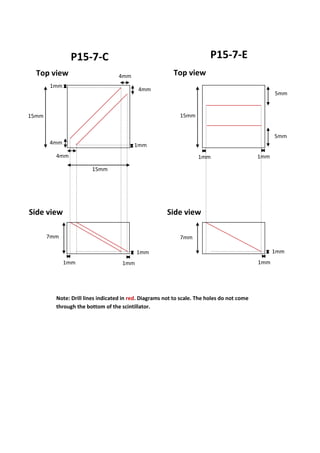
been predicted that some missing resonances may couple strongly to “strange”
photoproduction channels [28]; meaning that the channels KΛ and KΣ are of
specific interest.
Figure 1.13: Photoproduction cross section of γp (log scale), including the
magnitude of channels contributing to the total cross section [44].
1.6 Summary
Given the non-perturbative behavior of QCD at low energies, states must be
investigated through approximate solutions of QCD such as QCD-inspired models
17
1.6. Summary
and QCD-based calculations. Within the QCD-inspired models, constituent
quark models solve, an approximate QCD Lagrangian based on effective degrees of
freedom, where the valence quarks are replaced by effective quarks which interact
through potentials that mimic QCD’s asymptotic freedom and quark confinement.
Conversely, LQCD attempts to solve the exact QCD Lagrangian with a minimum
set of approximations by discretising space-time.
The experimental challenge is to establish the excitation spectrum as unam-
biguously as possible in order to test whether QCD is a complete theory for
describing non-perturbatively bound QCD objects such as nucleons and mesons.
This is an ongoing goal and the work described in this thesis is an important part
of the ongoing world programme to achieve this.
18
Chapter 2
Kaon Photoproduction
Experiments involving photoproduction are now commonly used in order to
study the excitation spectrum of the nucleon. In this chapter, the extraction
of polarisation observables for the K+
Σ−
reaction via photoproduction will be
discussed. Interest will be directed primarily towards the polarisation observable
E, as this is the work of this thesis. Theoretical models will also be considered
as there are currently no other experimental data to compare to the results
presented.
2.1 Final State
The γn → K+
Σ−
reaction can be considered as a two stage process:
1. An initial photon-nucleon interaction in the target
2. A decay from the Σ−
baryon
The Σ−
baryon has a very short decay time, of order 10−10
s, meaning that it
is not possible to directly detect it and so must be reconstructed from its daughter
particles. This decay is shown at the quark-level in Figure 2.1.
19
2.1. Final State
Figure 2.1: Feynman diagram showing the decay of the Σ−
baryon at the quark
level.
At the particle-level, the reaction can be shown as in Figure 2.2, where the
final state particles which can be detected are K+
, π−
and n.
Figure 2.2: Diagram of the reaction γn → K+
Σ−
.
20
2.1. Final State
2.1.1 The Kaon
The kaon has been briefly introduced, in Section 1.2, to demonstrate the
construction of particle multiplets.
The kaon family is comprised of up, down and strange quarks, along with
their respective antiparticles. The family typically has decay times of the order
10−8
s (decay distance of order meters) and so can be directly detected before
they decay into other hadrons or leptons. The masses and quark content of these
mesons are shown below:
K+
(494) = u¯s,
K0
(498) = d¯s,
¯K0
(498) = ¯ds,
K−
(494) = ¯us.
(2.1)
These are said to be strange mesons, as they contain a strange quark and
as such have a non-zero strangeness quantum number (S = ±1). Production of
strange particles from strong interactions are defined as associated production.
Although strange particles are produced in associated production, equal amounts
of both s and ¯s are produced, therefore conserving strangeness overall. If we
consider the channel of interest in this thesis:
γ n → K+
Σ−
− udd → u¯s dds
S = 0 → −1 + 1
(2.2)
Here we see that although two strange particles are created, the overall
strangeness is conserved by s¯s production.
2.1.2 The Σ Baryon
The Σ baryon is a system of three quarks; two up and/or down along with a third
of a higher generation. We wish to consider the case where this third quark is
21
2.2. Baryon Photoproduction Kinematics
strange1
. The strange Σ isotriplet masses and quark content are shown below:
Σ+
(1189) = uus,
Σ0
(1193) = uds,
Σ−
(1198) = dds,
(2.3)
where we are interested in the Σ−
(as a final state particle) and Σ0
(as a
background). The decay times of the Σ family are wide-ranging: Σ−
has a decay
of the order 10−10
s whereas the Σ0
has a much faster decay, of the order 10−20
s.
The baryon of interest, Σ−
, decays via a strangeness-violating weak reaction
with an almost complete Branching Ratio (BR):
Σ−
→ π−
n (BR ∼ 99.85%). (2.4)
The Σ0
, decays via an electromagnetic reaction to Λ (uds):
Σ0
→ Λγ (BR ∼ 100%),
Λ → pπ−
(BR ∼ 63.9%),
→ nπ0
(BR ∼ 35.8%).
(2.5)
The Λ then decays in a weak process to pπ−
. The Σ0
is a background
production process in our data sample and will be explicitly discussed in Section
8.7.
2.2 Baryon Photoproduction Kinematics
Figure 2.3 illustrates a kaon photoproduction reaction from a nucleon in both the
lab and centre-of-mass frame. This shows the incident photon, Eγ, interacting
with a target nucleon, mtgt. This produces a meson, mπ,η,K and a recoil baryon,
mR.
1
Other cases use charm (Σ++
c , Σ+
c , Σ0
c), bottom (Σ+
b , Σ0
b, Σ−
b ) or in principle top (Σ++
t , Σ+
t ,
Σ0
t which are unseen) quarks.
22
2.2. Baryon Photoproduction Kinematics
Figure 2.3: Centre-of-mass kinematics of baryon photoproduction in the lab frame
(left) and CoM frame (right).
This interaction can be described by three mechanisms; these are labelled s-,
t- and u-channel for convenience. These mechanisms are illustrated in Figure 2.4,
where we label the photon four-momentum k, the nucleon four-momentum p, the
meson four-momentum q and the baryon four-momentum p .
Figure 2.4: s- (a) t- (b) and u-channel (c) diagram descriptions of kaon
photoproduction.
The s-channel corresponds to the incident particles joining into some inter-
mediate state which then decays. The s-channel mechanism is the predominant
method in which resonances and unstable particles can be produced and
23
2.3. Reaction Amplitudes
discovered. The t-channel corresponds to one of the incident particles emitting
a particle, which is then absorbed by the other. The u-channel corresponds to a
similar process to the t-channel but with the roles of the two final state particles
reversed. These production channels are generally shown in terms of the four-
momenta squared, as Mandelstam variables2
:
s = (k + p)2
= (q + p )2
,
t = (p − p )2
= (k − q)2
,
u = (p − q)2
= (k − p )2
.
(2.6)
These expressions can also be summed to give the sum of the particle masses:
s + t + u =
i
m2
i = m2
p + m2
k + m2
p + m2
q. (2.7)
If we consider the relativistic limit, the momentum is so large that the particles
rest mass can be ignored3
. The expressions in Equations 2.6 can be expanded
and simplified:
s = p2
k + p2
p + 2pkpp ≈ 2pkpp ≈ 4Q2
,
t ≈ 2Q2
(1 − cos θC.M ),
u ≈ 2Q2
(1 + cos θC.M ),
(2.8)
where Q is the centre-of-mass momentum of all four particles and θC.M is the
scattering angle of the kaon in the centre-of-mass frame.
2.3 Reaction Amplitudes
The cross section of a reaction, σ, is a representation of the probability for the
process to occur. The differential cross section, dσ
dΩ
, parametrises this production
within a given solid angle. The cross section can be recovered from the differential
cross section by integrating over the full solid angle (4π sr):
2
Using only two of these expressions leads to a complete description of the reaction.
3
As E2
= p.p + m2
o → E2
≈ p.p for large momenta (in natural units).
24
2.3. Reaction Amplitudes
σ =
4π
dσ
dΩ
dΩ. (2.9)
The differential cross section of a photoproduction reaction can be written in
terms of s and t, from Equation 2.8, in an amplitude, A, which is a function of
the outgoing momentum and the scattering angle:
dσ
dΩ
= A(s, cos θ)A(s, cos θ) ∼ |A(s, cos θ)|2
. (2.10)
Any function of θ can be written in terms of associated Legendre polynomials,
Φl(cos θ). The scattering amplitude can be written in terms of the Mandelstam
variable s and these polynomials:
A(s, cos θ) =
4
√
s
∞
l=0
(2l + 1)al(k)Φl(cos θ), (2.11)
where l is the relative orbital angular momentum between the target and the
scattered particle, and al(k) is defined as the lth
partial wave amplitude [45].
The scattering amplitudes can be decomposed into several of these partial wave
amplitudes, each denoting scattering in a particular angular momentum.
The photoproduction process can be described mathematically using the
scattering matrix, S. The matrix represents the probability of the transition
from the initial to final state. The method relates the initial and final states, in a
way which allows computation of probabilities related to the scattering process.
The initial photon and nucleon state is defined with an eigenstate i|; while the
final meson and baryon state is defined with the eigenstate |f , related by the
scattering matrix, S:
i|S|f . (2.12)
The scattering matrix can be described in terms of the particle four-momenta,
k, p, q and p , and the transition matrix, Tfi:
Sfi = δfi − i(2π)4
δ4
(k + p − q − p )Tfi. (2.13)
The first term here represents the possibility of no scattering, while the second
is the scattering term. The transition matrix is a type of stochastic matrix, where
25
2.4. Polarisation Observables
the entries represent the probability of transitions between states.
2.4 Polarisation Observables
In order to fully understand the photoproduction process and extract unambigu-
ous information on intermediate nucleon resonance contributions, it is important
to make measurements in addition to the unpolarised differential cross section.
These additional observables are extracted by measuring the dependencies of the
differential cross section to the known polarisation of the particles involved in the
reaction. Specifically for the case of strangeness photoproduction these consist
of:
1. Incident photon,
2. Target nucleon,
3. Recoiling hyperon.
Scattering amplitudes in kaon photoproduction are constructed using Chew
Goldberger Low N ambu (CGLN) amplitudes [46]. Four of these complex
amplitudes are necessary to describe the degrees of freedom of the incident photon
and nucleon system. Taking bilinear combinations of these amplitudes allow for
16 independent polarisation observables to be constructed [47], shown in Table
2.1.
The single-polarisation observables arise when only the polarisation of one
of the beam, target or recoil is measured in the reaction. Double-polarisation
observables are split into three groups: Beam-Target, Beam-Recoil and Target-
Recoil. Within these three groups multiple measurements must be made to
identify all possible observables. For example, for the Beam-Target observables
measurements must be made using all combinations of linearly and circularly
polarised beam incident on a transversely and longitudinally polarised target.
Since these observables are derived from four complex amplitudes, they are
not independent. This means that all observables for a photoproduction process
can be known by only measuring a sub-set of these 16. Relations between these
observables are shown as follows [48]:
26
2.4. Polarisation Observables
Observable Experiment Type
σ0 - / - / - Unpolarised
Σ Plin / - / - Beam
T - / Py / - Target
P - / - / Py Recoil
G Plin / Pz / - Beam-Target
H Plin / Px / -
E Pcirc / Pz / -
F Pcirc / Px / -
Ox Plin / - / Px Beam-Recoil
Oz Plin / - / Pz
Cx Pcirc / - / Px
Cz Pcirc / - / Pz
Tx - / Px / Px Target-Recoil
Tz - / Px / Pz
Lx - / Pz / Px
Lz - / Pz / Pz
Table 2.1: Polarisation observables associated with kaon photoproduction, where
Px, Py, Pz are the components of target polarisation along the x, y, z directions
respectively (similarly for the recoiling hyperon Px , Py , Pz ), Plin and Pcirc are
the degrees of linear and circular beam polarisation respectively, and φ is the
meson azimuthal angle with respect to the scattering plane. Note that the Σ
polarisation observable is a different entity to the Σ baryon.
27
2.5. Isolating a Polarisation Observable
E2
+ F2
+ G2
+ H2
= 1 + P2
− Σ2
− T2
,
FG − EH = P − ΣT,
T2
x + T2
z + L2
x + L2
z = 1 + Σ2
− P2
− T2
,
Tx Lz − Tz Lx = Σ − PT,
C2
x + C2
z + O2
x + O2
z = 1 + T2
− P2
− Σ2
,
C2
z O2
x − C2
x O2
z = T − PΣ.
(2.14)
Beyond determining a single polarisation observable, a goal of these meson
photoproduction experiments is to perform a full set of measurements on a
channel in order to unambiguously constrain the amplitude. Many of these
experiments are non-trivial so it is beneficial that all 16 polarisation observables
need-not be measured in order to fully define the amplitude.
Measurement of the single-polarisation observables (Σ, T, P) must be made
[47], as well as taking a selected number of double-polarisation observables. The
exact number and nature of these double-polarisation observables was debated
and disagreed upon. This was finally settled by Chiang and Tabakin [49], who
showed that four appropriately chosen double-polarisation observables along with
the cross section and single-polarisation observables are enough to fully determine
the amplitude unambiguously.
2.5 Isolating a Polarisation Observable
The differential cross section is classified into three expressions dependent on
the type of double-polarisation experiment being conducted. Considering an
experiment with polarised photons incident on a polarised target:
dσ
dΩ
=
dσ
dΩ 0
[1 − PlinΣ cos(2φ)
+ Px(−PlinH sin(2φ) + PcircF)
+ Py(T − PlinP cos(2φ))
+ Pz(PlinG sin(2φ) − PcircE)].
(2.15)
28
2.6. Theoretical Models for Meson Photoproduction
Considering an experiment with Beam-Recoil measurements:
dσ
dΩ
=
dσ
dΩ 0
[1 − PlinΣ cos(2φ)
+ Px (−PlinOx sin(2φ) − PcircCx )
+ Py (P − PlinT cos(2φ))
+ Pz (−PlinOz sin(2φ) − PcircCz )].
(2.16)
Finally, considering an experiment with Target-Recoil measurements:
dσ
dΩ
=
dσ
dΩ 0
[1 + PyT + Py P
+ Px (PxTx − PzLx )
+ Py PyΣ
+ Pz (PxTz + PzLz )].
(2.17)
In this thesis, the observable of interest is the Beam-Target observable E.
From Table 2.1, in order to study the observable E, a circularly polarised photon
beam and a longitudinally polarised target must be used. Other components
of the target polarisation are therefore zero, Px = Py = 0, while there is no
contribution from a linearly polarised photon beam, Plin = 0. We simplify our
expression for the Beam-Target differential cross section, Equation 2.15, using
these conditions:
dσ
dΩ
=
dσ
dΩ 0
[1 − PzPcircE]. (2.18)
2.6 Theoretical Models for Meson Photopro-
duction
Information on the nucleon resonance spectrum is extracted by fitting a model
to experimental data and fitting parameters in the model to extract the masses,
29
2.6. Theoretical Models for Meson Photoproduction
widths and quantum numbers of the contributing resonances [50]. As this fitting
separates the contributions from different angular momenta (partial waves) it is
often referred to as a Partial W ave Analysis (PWA) [38].
These models consider the processes as being comprised of a resonant and
background component. These components are parametrised and extracted
from the experimental data through fitting. As with many models, the more
experimental data which is available, the more constraints can be placed upon
the reaction channel to provide more accurate and less ambiguous results.
If we consider a generic reaction where we have a photon-nucleon interaction,
a, with some intermediate resonance state, c, which finally ends in a meson-
nucleon system, b, the Hamiltonian can be written as:
H = H0 + V, (2.19)
where the first term is the free Hamiltonian, H0, and the second is the interaction
term, V. As is a common feature of reaction models, this interaction term is split
into a resonant component, VR, and a background component, VB:
V = VR(E) + VB, (2.20)
where the resonant component is a function of the total energy, E.
The probability of the process to occur is governed by a transition matrix,
Tba, which can be similarly reduced into components:
Tba(E) = TR
ba(E) + TB
ba. (2.21)
The resonant component of this transition matrix can be expanded by
summing over all possible paths in the process a → c → b, and introducing
a propagator of state c, gc;
Tba(E) =
c
Vbagc(E)Tbc(E) + Vba. (2.22)
2.6.1 Isobar Models
Isobar models attempt to use an effective Lagrangian to simulate the properties
of interactions. They do this by evaluating tree-level Feynman diagrams for the
30
2.6. Theoretical Models for Meson Photoproduction
resonant and non-resonant exchange of mesons and baryons. By considering
the possible exchanges which take place in s-, t- and u-channel reactions, excited
states can be identified. This tree-level method is useful to simplify the interaction
to first order, but neglects to take into account effects such as interactions in the
final state or coupled-channel effects.
The isobar model we will consider in this thesis is the KaonMAID model [51]4
.
The model considers low-order diagrams for the interaction, which are then split
into resonant and non-resonant terms (Born terms). The s-channel mechanism
represents the resonant contributions, while the t- and u-channel mechanisms
represent the background contribution.
These isobar models have seen much use in the energy region under 2 GeV
due to the smaller importance of higher order diagrams and Born terms at lower
energies. The models attempt to produce theoretical predictions of polarisation
observables using various combinations of resonances. This allows for comparison
between data and prediction in order to infer the presence or absence of a
resonance. This is not a trivial procedure as many partial waves can be present
and interfere strongly.
2.6.2 Coupled-Channel Analysis
Coupled-Channel (CC) analysis is an attempt to improve the accuracy of the
isobar model to include final state particle interactions, as well as intermediate
states such as πN5
. These processes can be described as production of a non-
resonant state which rescatters from the nucleon in order to produce a resonance.
Coupled-channel analysis also hopes to reduce the ambiguity of resonance
combinations used to fit data [52]. As it is possible for more than one combination
of resonances to fit the data well, this disambiguous nature can be removed by
considering multiple observables on multiple final states. This analysis method
allows more constraints to be added to the channel which acts as a filter to remove
resonances which do not contribute to the final state.
The model we wish to consider in this thesis is the Bonn-Gatchina (BoGa)6
.
4
Maintained and developed by the Institut f¨ur Kernphysik, Universit¨at Mainz, Germany.
5
Amplitudes of γN → πN process is thought to play a considerable effect in the overall
process γN → πN → KY , where Y is a final state hyperon.
6
Maintained and developed by the Helmholtz-Institut f¨ur Strahlen- und Kernphysik,
Universit¨at Bonn, Germany; and Kurchatov Institute, Petersburg N uclear Physics I nstitute
31
2.7. Summary
This is a coupled-channel model which aims to consider multiple decay
channels at once, with angular and energy dependencies of different observables
are analysed simultaneously [53]. This provides stable fits for partial waves with
high spin and provides a smooth behaviour in energy.
Two particle final states, such as πN, ηN, KΛ, KΣ, ωN and K∗
Λ are
fitted with the χ2
method. At fixed energies, the unpolarised cross section of
pseudoscalar mesons is characterised by the differential cross section only. For
vector mesons however, the unpolarised cross section is characterised by the
differential cross section and three spin density matrix elements.
2.7 Summary
Experiments utilising both polarised beams and targets are crucial in gathering
data in order to characterise photoproduction scattering amplitudes. Reaction
models such as KaonMAID and Bonn-Gatchina can be fitted to experimental
data and used to extract properties of nucleon resonances contributing to the
reaction.
An outline of the process is shown in Figure 2.5, showing the relations between
the experiment, reaction model theory and QCD.
(PNPI), Gatchina, Russia.
32
2.7. Summary
Figure 2.5: Process for nucleon structure calculation and experimentation [54].
33
Chapter 3
Previous Experimental Data
In this chapter, key experimental data from the K+
Σ−
channel are discussed.
Since there are no previous measurements for the E double-polarisation ob-
servable, these measurements focus on differential cross sections and beam-
asymmetries.
3.1 Current Experimental Knowledge
Polarisation observable experiments from strangeness channels from neutron
targets are relatively few: this is particularly true for the reaction γn → K+
Σ−
.
Experiments were conducted at Cornell in the late 1950s, followed by experiments
at LEPS and Jefferson Lab in the mid-2000s.
3.1.1 Kaon Photoproduction at Cornell
The experiment which took place at Cornell in the 1950s aimed to measure the
differential cross section of the γn → K+
Σ−
reaction [55]. This used both liquid
hydrogen and liquid deuterium target with kaon momenta of 0.405 and 0.455
GeV , and a bremsstrahlung beam of peak energy 1.170 GeV .
They wished to consider the total K+
photoproduction cross section from
three reaction channels:
34
3.1. Current Experimental Knowledge
k θCM γp → K+
Σ0 γn→K+Σ−
γp→K+Σ0
(MeV ) (◦
) (10−31
cm2
/sr)
1122 82 0.6 ± 0.1 1.6 ± 0.7
1146 75 1.1 ± 0.2 0.8 ± 0.6
Table 3.1: Data points and associated errors obtained from cross section
measurements at Cornell [55].
γp → K+
Λ,
γp → K+
Σ0
,
γn → K+
Σ−
.
(3.1)
The cross sections from the proton had already been measured at Cornell
in 1959/60 respectively [56] [57]. From the total kaon yield and the previous
measurements at Cornell, it was possible to estimate the cross section for the
K+
Σ−
reaction. Only two data points were obtained from this analysis, with
error bars of order ∼ 50%, these are shown in Table 3.1.
3.1.2 Kaon Photoproduction at LEPS
The experiment which took place at the Laser Electron Photon beam-line at
SPring−8 (LEPS) in the 2000s, aimed to measure differential cross sections and
photon-beam asymmetries for the γn → K+
Σ−
and γp → K+
Σ0
reactions [58].
This used linearly polarised photons on liquid hydrogen and deuterium targets.
The photon beam was of energy 1.5 - 2.4 GeV with a high polarisation (typically
∼ 90% at 2.4 GeV ) , with kaons measured at 0.6 < cos θK+
CM < 1.0.
Differential cross sections for K+
Σ−
and K+
Σ0
in four angular bins were
obtained, shown in Figure 3.1. They found the cross sections of both channels
were comparable at higher energies. The theoretical models tended to agree well
with the K+
Σ0
data but overestimate the K+
Σ−
data at higher energies.
35
3.1. Current Experimental Knowledge
Figure 3.1: Differential cross sections for γn → K+
Σ−
(circles) and γp → K+
Σ0
(squares). Only statistical errors are shown. The solid and dashed curves are
the Regge model [59] calculations for the K+
Σ−
and K+
Σ0
, respectively. The
dotted curve is the KaonMAID model calculations for the K+
Σ−
[58].
Measurements for the photon-beam asymmetry were also taken, Figure 3.2.
These indicated the asymmetries of K+
Σ−
were typically larger than for the
K+
Σ0
channel. Another key feature was the increase in asymmetry for K+
Σ0
with the centre-of-mass energy, whereas K+
Σ−
shows minimal dependence above
2 GeV . The Regge model agrees well with the K+
Σ−
channel but overestimates
the K+
Σ0
channel.
36
3.1. Current Experimental Knowledge
Figure 3.2: Photon-beam asymmetries for γn → K+
Σ−
(circles) and γp → K+
Σ0
(squares). The solid and dashed curves are the Regge model calculations for the
K+
Σ−
and K+
Σ0
, respectively [58].
3.1.3 Kaon Photoproduction at Jefferson Lab
The ‘g10’ experiment which took place at Jefferson Lab in the 2000s, measured
the differential cross section of the γD → K+
Σ−
(ps) reaction using the Hall-B
CLAS detector [60]. The experiment used a bremsstrahlung photon beam with
energies 0.8 - 1.6 GeV on a liquid deuterium target, measuring kaons with centre-
of-mass angles between 10 - 140◦
. The data are shown, along with the data from
LEPS in Figure 3.3.
37
3.1. Current Experimental Knowledge
Figure 3.3: Differential cross sections of the reaction γD → K+
Σ−
(ps) obtained
by CLAS (full circles). The error bars represent the total (statistical plus
systematic) uncertainty. LEPS data (empty triangles) and a Regge-3 model
prediction (solid curve) are also shown. Notice the logarithmic scale for high
energy plots [60].
This was the first high precision measurement of the Σ−
photoproduction
from the neutron over a broad range of kaon angle and photon energies. At
photon energies of ∼ 1.8 GeV a predominant peak in the forward direction begins
to form as the photon energy increases. This peak is attributed to increased
contributions from t-channel mechanisms, whereas at lower energies s-channel
mechanisms dominate. At energies above ∼ 2.1 GeV show possible indications
of a backwards peak beginning to form, thought to be coming from the presence
of u-channel mechanisms.
38
Chapter 4
Experimental Apparatus
In this chapter, the main features of the Jefferson Lab facility and the
experimental set-up in Hall B are discussed.
4.1 Experimental Overview
The data used in this analysis for this thesis were taken during the g14 (HDice)
run period at the Thomas Jefferson N ational Accelerator Facility (TJNAF -
JLab), in Virginia, USA. The dates during which this experiment was carried
out were from November 2011 until May 2012. This timeframe corresponds
to the experimental proposal “N∗
Resonances in Pseudoscalar-Meson Photo-
Production from Polarized Neutrons in
−→
H.
−→
D and a Complete Determination
of the γn → K0
Λ Amplitude” (E06-101) [61]. This experiment used linearly and
circularly polarised photon beams on a frozen spin HD target in order to extract
polarisation observables.
4.2 Jefferson Lab
JLab consists of four experimental halls: A, B and C have been long-standing
constructions used in many iterations of JLab physics research; Hall D is a newly
built experimental facility.
Feeding these experimental halls is the Continuous Electron Beam Accelerator
Facility (CEBAF). An aerial view of the facility is shown in Figure 4.1. CEBAF
allows for a 6 GeV electron beam to be simultaneously delivered to up to three
39
4.3. CEBAF
experimental halls, meaning that each hall may pursue its own experimental
program independently of the others.
Figure 4.1: Aerial view of the JLab facility, highlighting the CEBAF accelerator
and experimental halls [62].
Prior to May 2012, the facility and its detectors were designed to perform
experiments with a maximum beam energy of 6 GeV . The g14 experiment was
the final incarnation and this date marked the end of what was generally referred
to as JLAB6. Subsequently an upgrade began across the entire facility to enable
the production and receipt of a 12 GeV electron beam - JLAB12.
4.3 CEBAF
The CEBAF accelerator consists of two anti-parallel superconducting LIN ear
ACcelerators (LINACs) connected using recirculation arcs to form a “racetrack”
accelerator with a total length of 1.4 km. The main components of the CEBAF
accelerator are shown in Figure 4.2.
40
4.3. CEBAF
Figure 4.2: Schematic of CEBAF at Jefferson Lab, including the experimental
halls [63].
An aggregate of nine arcs are used to recirculate beam-bunches allowing them
to be further accelerated with each pass through the LINAC sections, gaining
energies of up to 6 GeV . Multiple recirculation arcs are needed in order to
accept electrons after each new pass through the LINAC sections. The set of four
recirculation arcs in the east also contain an RF separator [64], which allows the
beam to be extracted and sent to individual experimental halls.
The electrons injected into the CEBAF accelerator are initially produced using
a 780 nm laser incident on a Gallium Arsenide (GaAs) photocathode. After initial
acceleration by an anode potential, these electrons are then accelerated to 67
MeV in the injector1
and separated into 2.0005 ns beam buckets, which are then
injected into the CEBAF accelerator. The electrons circle the racetrack up to five
times, gaining up to 0.6 GeV in each LINAC. The LINACs use superconducting
1
The injector consists of three pulsed lasers, one which supplies each hall, striking the
photocathode at a rate of 499 MHz leads to the characteristic ∼ 2 ns beam bucket structure
of CEBAF. The use of three separate lasers also allows each beam to have independent current
and polarisations.
41
4.3. CEBAF
Duty Factor Continuous Wave
Number of Passes 5
Energy Gain per Pass 1.2 GeV
Electron Beam Energy Range 0.6 - 6.0 GeV
Number of Cryomodules 40
Electron Polarisation 85%
Table 4.1: Summary of CEBAF characteristics.
Radio Frequency (RF) cavities (liquid-helium cooled niobium) to accelerate the
electrons to a maximum of ∼ 1.2 GeV for one full circuit (commonly referred to
as a “pass”) and up to ∼ 6.0 GeV for five full passes. These electrons can then
be taken out of the recirculating arc and delivered to the experimental halls using
the RF separator. A summary of the characteristics of the CEBAF accelerator
are presented in Table 4.1.
A simple schematic of the upgrade of the CEBAF accelerator to allow for
delivery of a 12 GeV beam is shown in Figure 4.3.
42
4.4. Experimental Halls
Figure 4.3: Schematic of CEBAF at Jefferson Lab, showing additions for the
upgrade to the beam-line, including the placement of the new Hall D [65].
4.4 Experimental Halls
Halls A, B, C and D are each equipped with bespoke detector systems. Hall D,
is the fourth experimental hall to be constructed off the beam-line of CEBAF;
this was recently completed in the quadrant off the northern LINAC, shown in
Figure 4.3.
The physics explored at JLab centres on exploring the nature of the nucleon.
Each hall uses its experimental set-up to probe various properties:
• Hall A [66]:
– Largest experimental hall containing two high-resolution spectrome-
ters.
– Experiments study: nucleon form factors, strange-quark structure of
the proton, and nucleon spin structure.
43
4.5. Hall B
• Hall B [67]:
– Smallest experimental hall, containing CLAS; a spectrometer with a
nearly full angular range (∼ 4π) based around a toroidal magnetic
field.
– Experiments study: excited states of the nucleon, 3D imaging of the
nucleon’s quark structure and nucleon-nucleon correlations in nuclei,
exotic and hybrid mesons.
• Hall C [68]:
– Contains a high momentum spectrometer, using unique set-ups for
each experiment.
– Experiments study; weak interaction of the proton, transitions from
hadrons to quarks and strange nuclei.
• Hall D [69]:
– Contains a hermetic detector based around a solenoid magnet, de-
signed for use with JLAB12.
– Experiments will study: exotic and hybrid mesons.
During 6 GeV operation, Halls A and C received much greater beam currents
than that supplied to Hall B; typical beam currents are 100 µA and 10 nA
respectively. This factor of 104
difference is necessary due to the luminosity
restrictions of the Hall B detectors, which were not designed for high-flux
measurements. The fact that CEBAF is able to deliver beam currents with such
divergent beams simultaneously is a major achievement of the accelerator.
The g14 experiment was conducted in Hall B, therefore the remainder of the
chapter will be dedicated to exploring the Hall B experimental set-up.
4.5 Hall B
Hall B is the smallest experimental hall at Jefferson Lab and within it, the
CEBAF Large Acceptance Spectrometer (CLAS) is situated. A schematic view
of Hall B is shown in Figure 4.4. Although electron beam is delivered to the halls;
44
4.5. Hall B
for some experiments, such as g14, it is desirable to use polarised photons on a
target. This is achieved in Hall B using a some kind of medium (a radiator) in
order to produce bremsstrahlung photons.
Figure 4.4: Diagram showing the scale of CLAS in Hall B at Jefferson Lab [63].
4.5.1 The Bremsstrahlung Process
The photon beam produced for use with CLAS uses electrons incident upon a
radiator, which decelerates the electrons while they interact with the electromag-
netic field of nuclei. Due to conservation of energy, the decelerated electrons must
emit the energy it has lost, which takes the form of a photon. The bremsstrahlung
method allows for the production of photons with energies in the range of 20−95%
of the incident electron beam energy [70]. A simple representation of this process
is shown in Figure 4.5.
45
4.5. Hall B
Figure 4.5: Simple illustration of bremsstrahlung radiation [71].
Bremsstrahlung is kinematically possible if only a small amount of momentum
is transferred to the radiator nucleus, −→q ∼ 0. This is actually the typical method
of energy loss for electrons in material, and the nucleus recoil energy can usually
be neglected.
4.5.2 Bremsstrahlung Photon Tagging
Hall B has the ability to use CEBAF’s electron beam to create a photon beam for
use with certain targets [70]. In the case of the g14 experiment, both linearly and
circularly polarised photon beams were required for use on a HD target. Photons
were “tagged”, event-by-event, by the tagging spectrometer, which consists of a
large dipole magnet and a focal plane hodoscope. The dipole magnet bends
the electrons from the beam-line towards the timing and energy counters in the
hodoscope. A schematic of the tagging spectrometer is shown in Figure 4.6.
46
4.5. Hall B
Figure 4.6: Schematic of the coherent bremsstrahlung facility in Hall B [70].
The electron and photon beams emerge from the radiator approximately
parallel to the incident electron beam, and are produced with an angular
distribution as follows:
θc =
1
γ
=
mc2
Ee−
, (4.1)
where m is the electron rest mass. The electron scattering angle is a function of
the photon production angle, energy and the electron energy:
θe− = θc
Eγ
Ee−
=
mc2
Eγ
Ee− Ee−
. (4.2)
For typical JLab energies, to a first approximation, the photons and electrons
are parallel. The photon and electron beams are then separated using the dipole
tagger magnet. The electrons are bent downwards while the photons continue
down the beam-line to interact with the target.
The tagging hodoscope consists of two separate layers of scintillator arrays.
The upper plane of scintillation counters (E-counters) are used to measure the
energy of the bent electrons after the bremsstrahlung emission, Ee− . When
combining this measurement with knowledge of the initial electron beam energy,
Ee− , a simple calculation of the produced photon energy, Eγ can be made:
47
4.5. Hall B
Eγ = Ee− − Ee− . (4.3)
The E-counters allow for energy resolution of up to 0.0013 × Ee− .
The lower plane of scintillation counters (T-counters) are used to measure the
timing of the photon, with a resolution of ∼ 300 ps. This timing measurement
allows the electron to be correlated with its bunch and can be used to calculate
the photon time at the target. A full description of the tagging hodoscope can
be found within [70].
4.5.3 Beam Polarisation
Hall B is able to run using both linearly and circularly polarised photon beams.
These running modes require special conditions in the bremsstrahlung process.
4.5.3.1 Linear Polarisation
In Hall B, linearly polarised photons are generated from an unpolarised electron
beam using the coherent bremsstrahlung technique [72] [73]. This results in two
contributions to the photon spectrum; one from polarised (coherent) and another
from unpolarised (incoherent) bremsstrahlung photons2
.
In Hall B, the electron beam is scattered from a diamond radiator, of thickness
50 µm, in order to produce a linearly polarised photon beam from coherent
bremsstrahlung. Further information on the diamond radiator and linearly
polarised beam can be found in [74].
4.5.3.2 Circular Polarisation
To produced circularly polarised photons, it is required that a longitudinally
polarised electron beam be used. Foil was used as a radiator in this case, with
two main properties considered before a material was chosen:
1. Minimise the number of electron interactions
2. Maximise the probability of interaction
2
This is true for both linearly and circularly polarised periods.
48
4.5. Hall B
This first property leads to the realisation that very thin foils must be used to
ensure that statistically one electron produces one photon. The second property,
when coupled with the information that the cross section for bremsstrahlung
emission is proportional to Z2
[75]3
, leads to the realisation that high-Z materials
should be used. The chosen material was a foil of gold (Z = 79) with thickness
10−4
radiation lengths.
The degree of circular polarisation obtained from this method is dependent on
the ratio of the photon energy, Eγ, and the incident electron energy, Ee− , often
labelled x for convenience (x = Eγ/Ee− ):
Pcirc =
4x − x2
4 − 4x + 3x2
Pe− , (4.4)
where Pcirc and Pe− are the photon circular and electron helicity polarisations
respectively. The distribution of the transfer of polarisation is shown in Figure
4.7.
Figure 4.7: Degree of circular polarisation as a function of the ratio of beam
energies, Eγ/Ee− [76].
3
Z denotes the atomic number of the material, which indicates the number of protons in the
nucleus.
49
4.5. Hall B
4.5.4 CLAS Detector
The CEBAF Large Acceptance Spectrometer (CLAS) is housed in Hall B of the
Jefferson Lab facility. CLAS is a combination of many different types of particle
detector, giving almost complete angular coverage (∼ 4π) [67]. CLAS is built
around six superconducting coils, which produce a toroidal magnetic field, giving
a field-free region at the centre for use with polarised targets. These coils split
CLAS into six azimuthal regions going outward, which are defined as sectors.
The design is focused keenly on accurate detection of charged particles with good
momentum resolution. A diagram of CLAS and its associated sub-detectors is
shown in Figure 4.8.
Figure 4.8: The CLAS detector, including drift chambers, Cherenkov counters,
electromagnetic calorimeters, and time-of-flight detectors [77].
When a photon beam is used in Hall B, these photons interact with a target at
the centre of CLAS, causing a cascade of reaction products. These particles travel
outwards from the centre of CLAS passing through the multiple detector layers.
Particles firstly travel through the STart counter (ST), giving the start time of
50
4.5. Hall B
the event. Particles then pass through the Drift Chambers (DC) which, using the
toroidal field, measures the bending of particles in order to calculate their velocity
and therefore momenta. They then pass through the time-of-flight Scintillation
Counters, giving the particle flight time from the target. The final layers are
focussed on forward particle detection; the penultimate being the Cherenkov
Counters and the final being the Electromagnetic Calorimeter 4
. These final
layers are used in electron beam experiments where negative pion and electrons
must be separated. Further information on the CC and EC can be found in [78]
and [79] respectively.
4.5.4.1 Torus Magnet
The toroidal field, around which CLAS is centred, is used to bend the paths of
charged particles in order to calculate particle momenta. The superconducting
coils themselves are kidney-shaped and equally spaced (60◦
) around the beam-
line. The magnetic field within CLAS and the typical field strength of a
superconducting coil are shown in Figure 4.9. The coils create areas of low
acceptance at the boundaries of sectors, reducing the CLAS acceptance to ∼ 70%
of the 4π solid angle. Close to the coils, the magnetic field is very unstable and
not confined to the azimuthal direction which leads to this low acceptance. At
larger distances from the coils, charged particles are confined to a single sector
using the azimuthal field.
4
It should be noted that this analysis does not use these final forward layers.
51
4.5. Hall B
Figure 4.9: Left: Magnetic field for the CLAS torus magnet around the target
region. Right: Magnetic field shape created by the magnets in CLAS [67].
The g14 run used two running conditions for the torus magnet. These were:
• +1920 A : where negative particles are bent towards the beam-line.
• −1500 A : where positive particles are bent towards the beam-line.
In principle, higher currents could be used during running although this
leads to a reduction in acceptance for oppositely charged particles [80]. Further
information about the CLAS torus can be found in [81].
4.5.4.2 Start Counter
The STart Counter (ST) system is used to associate a beam bucket with a
particle track, with a timing resolution of ∼ 300 ps [82]. Specifically the start
counter is used to indicate the start time for time-of-flight measurements of
charged particles produced from photon interactions with the target. The ST
is split into six sectors of thin scintillation counters surrounding the target. The
paddles of the start counter are shown in a cross section of the assembly in Figure
4.10.
52
4.5. Hall B
Figure 4.10: Cross section of the CLAS start counter [82].
Before commencing the g14 experiment, the light guides of the start counter
were increased in length. This was in an effort to move the PMTs further away
from the target area as the cryostat which would hold the target generates a
sizeable magnetic field (1 T). Further information on the start counter can be
found in [82].
4.5.4.3 Drift Chambers
Drift Chambers (DC) are used to calculate particle momenta from the bending
of charged tracks [83]. Like most of the CLAS sub-detectors the DC is split into
six sectors, these are then sub-divided into three regions. These regions, simply
referred to as 1, 2, 3, have their own purposes:
• Region 1
– Closest to target, in an area of minimal magnetic field.
– Used to determine the start of the charged particle track.
• Region 2
53
4.5. Hall B
– Central layer, in an area where the magnetic field peaks.
– Best momentum resolution due to the drastic bending of the tracks in
this region.
• Region 3
– Furthest from target, in an area of low magnetic field.
– Used to determine the end of the charged particle track.
This system provides ∼ 80% coverage, due to the regions which are not covered
around the superconducting coils. Figure 4.11 shows the drift chamber regions
within CLAS. Further information on the drift chambers can be found in [84].
Figure 4.11: Simple diagram of the CLAS drift chambers, highlighting the DC
regions, time-of-flight counters and torus coils [65].
4.5.4.4 Time-of-Flight Scintillators
The Time-of-Flight (ToF) counters, also called Scintillation Counters (SC), are
used to determine the timing for a particle to travel from its initial interaction
54
4.5. Hall B
vertex in the target to the ToF counters. The counters are situated outside the
radius of the drift chambers, enclosing CLAS. Combining their timing information
with timing information from the ST allows the particle β to be calculated (β =
v/c). From this, using the ToF and tracking information allows for the particle
mass to be estimated [85]. As with other sub-detectors, the scintillator is split
into six segmented areas following the sectors of CLAS. The counters within these
sectors have varying lengths and widths, shown in Figure 4.12, and have timing
resolutions varying from 110 − 200 ps. Further information on the time-of-flight
scintillators can be found in [85].
Figure 4.12: Diagram showing one sector of the CLAS time-of-flight scintillator
counters [82].
55
Chapter 5
The HD-ice Target
In this chapter, the properties and manufacturing process of H ydrogen-Deuterium
(HD) targets used in the g14 run period are described.
5.1 Introduction
The g14 run period was named the HDice experiment due to the frozen-spin
nature of the target. The target was designed such that it would be able to achieve
high polarisation of both “free” protons (H) and neutrons (D) with frozen spins
(‘ice’).
The advantage of using HD as a polarised (bound) neutron target is many
fold. Firstly, the HD target material requires conditions (with respect to
magnetic field and temperature) achievable in CLAS and it can maintain its
polarisation for long periods under experimental conditions. Secondly, when
compared to other bound neutron targets, such as ammonia and butanol (as
in the FROST target at CLAS), there is less background from unpolarised target
material. Thirdly, it contains also a highly polarisable proton source.
In principle very high polarisations are achievable for this set-up; as high as
90% H polarisation and up to 60% D polarisation [86] [61]. The drawbacks
for such a target are that the handling procedures are complex and, as was
experienced during the g14 run, the risk of losing target polarisation is significant.
Compounding this, while polarisation can quickly be lost, if no targets are waiting
to replace a failed target, new targets take months to properly produce.
56
5.2. HD-ice Target Geometry
5.2 HD-ice Target Geometry
The cells used for the HDice target have dimensions of 15 mmφ × 50 mm; an
exploded-view of the target cell is shown in Figure 5.1.
Figure 5.1: Photograph of a deconstructed HDice target, showing the cell, copper
ring and Al wires [61].
The aluminium wires are used to mitigate any heat build up in the solid
HD, these are inserted into holes in a copper ring. This copper ring is double-
threaded such that it allows the cell to be transferred between dewers without
violating the magnetic field or temperature conditions. The cell walls are made
from PolyChloroTriFluoroEthylene (PCTFE - C2ClF3), also referred to as
KelF, which provides a clean cell with no background for H and D from N uclear
M agnetic Resonance (NMR) measurements. A more detailed schematic of a
constructed HD target is shown in Figure 5.2.
Figure 5.2: HD target schematic, indicating the target sizes [87].
57
5.3. HD-ice Target Physics
The constituent materials in the target are broken down into their relative
abundances in Table 5.2.
Material Abundance (%)
HD 77
Al 16
KelF 7
Table 5.1: Target material abundances by mass.
5.3 HD-ice Target Physics
The HD target, for use with CLAS, utilised deuterium as a relatively clean
source of neutrons and hydrogen as a source of protons. The ease of polarising a
state is dependent on the spin-lattice coupling, or rather the molecule’s angular
momentum. Molecules with the angular momentum state L = 0 are hard to
polarise and hence have very long relaxation times; whereas molecules with the
angular momentum state L = 1 are easy to polarise and hence have very short
relaxation times. This long spin-lattice relaxation time is critical to the success
of the target, although the production is challenging.
The hydrogen molecule has two identical protons, with two available spins
states. Ortho-H2 (J = 1), where the spins are aligned and Para-H2 (J = 0),
where they are anti-aligned. At low temperatures O-H2 decays to the P-H2 state
and makes up around 75% of H2.
States with J = 0, such as Para-H2, have long relaxation times and cannot
be easily polarised, this means that states with J = 1 in H2 and D2 are needed
to allow the transfer of spin to the J = 0 HD state. This J = 0 state of HD is
diamagnetic
The spins are aligned with a high magnetic field (15 T) and low temperature
(12 mK) with small concentrations of J = 1 H2 and D2. A diagram showing the
states within H2, D2 and HD are shown in Figure 5.3.
58
5.3. HD-ice Target Physics
Figure 5.3: Decay mechanism within the HDice target [61].
The HD molecule has a very long spin-relaxation times [88], dependent on
impurity levels in the target. Direct polarisation takes very long preparation
times, so indirect polarisation is used. A small concentration of O-H2 (of order
10−4
)1
which will readily polarise and transfer polarisation between the H in H2
and the H in HD via spin-coupling. After many O-H2 half-lives (∼ 3 months)
almost all the H2 impurity had decayed to the inert P-H2 state (1/e decay time
τ = 6.5 days), leaving the H in HD in a frozen-spin state. For D2 a similar
method is followed using a small concentration of D2. The P-D2 state has J = 1
and polarises readily like O-H2, and transfers spin to HD via spin-exchange. P-
D2 decays to O-D2 (τ = 18 days), so again after a significant number of half-lives
the D in HD will reach a frozen-spin state.
The polarisation of D will always be less than that of H due to a smaller
magnetic moment of D (µD/µH ∼ 1/3). Once polarised, the target has a beam
life of a few years due to the long relaxation time, meaning that there is no need
to ‘repolarise’ the target during running. Practically, the degree of polarisation
is given by the Brillouin function [90]:
PJ (x) =
2J + 1
2J
coth
2J + 1
2J
x −
1
2J
coth
1
2J
x ,
x =
µB
kBT
,
(5.1)
1
Impurities in the HD gas are characterised using gas chromatography and Raman
spectroscopy [89].
59
5.3. HD-ice Target Physics
where this is dependent on the nuclear spin J, magnetic moment µ, magnetic
field B, Boltzmann constant and the temperature T. For D this is limited to
∼ 15% at 25 mK and 15 T. The characteristic curves for H and D are shown in
Figure 5.4.
Figure 5.4: Equilibrium polarisation within the HD target as a function of
magnetic field, B, and temperature, T. This shows the polarisation of hydrogen,
vector deuterium and tensor deuterium [91].
The D polarisation can be further increased by exploiting the adiabatic fast-
passage method [92] in order to transfer polarisation from H to D. The Zeeman
levels in solid HD are shown in Figure 5.5. Once the impurities of H2 and D2 are
decayed, the population of the mD = +1 and mH = +1
2
substates are greater than
the mD = −1 and mH = −1
2
substates. Forbidden RF transitions can be driven
in order to transfer state population from the initial mH = +1
2
, mD = −1, 0
states to the mH = −1
2
, mD = 0, +1 states. Employing this RF method allows
for the D polarisation to increase to up to 30%.
60
5.4. HD-ice Target Production Equipment
Figure 5.5: Zeeman levels within solid HD [61].
During the P-H2 and O-D2 decays heat is released, which generates a problem
as the temperature must be kept low to retain polarisation. Solid HD has poor
thermal conductivity so cooling must be done by using embedded aluminium wires
in the solid HD. At low temperatures energy is transported through phonons
and experience an impedance mismatch at the HD/Al boundary, which limits
the HD temperature to around 12 mK. This method of target allows for much
shorted run times to obtain high statistics, around 75 days rather than 1000-2000
days with the previous FROST target at CLAS.
5.4 HD-ice Target Production Equipment
Production for these particular targets is a complex and time consuming process.
As such, there are many stages and various pieces of equipment involved in the
production. Specifically these need to be able to maintain low temperatures and
high magnetic fields in order to hold the target polarisation.
The following sections outline these cryogenic containers, a far more detailed
description of these can be found in [87] [93].
5.4.1 Production Dewer
The Production Dewar (PD) was used to condense the HD gas into a solid
form within the target cell. HD solidifies at temperatures of ∼ 16 K but much
lower temperatures are required to induce the polarisation required for the target.
61
5.4. HD-ice Target Production Equipment
Once the HD gas is condensed, the PD is designed such that N uclear M agnetic
Resonance (NMR) measurements can be performed. A detailed schematic of the
PD is shown in Figure 5.6.
Figure 5.6: Schematic of the production dewar [87].
• Production Dewar Conditions: 1.5 K temperature; 2 T magnetic field.
5.4.2 Transfer Cryostat
The Transfer Cryostat (TC) was used for moving the targets between the various
dewars and cryostats. The double-threaded copper ring in the base of the target
cell, shown in Figure 5.1, allows for the maintenance of temperature and magnetic
field conditions during these transfers. One set of threads connects to the TC,
while the other links to the dewar for transfer. For example, removing a target
62
5.4. HD-ice Target Production Equipment
from the PD using the TC: once the TC is screwed into the copper ring at the
base of the target, continuing the rotation unscrews the target from the PD. A
picture of the TC is shown in Figure 5.7.
Figure 5.7: Photograph of the transfer cryostat [87].
• Transfer Cryostat Conditions: 2 K temperature; 0.1 T magnetic field.
5.4.3 Dilution Refrigerator
The Dilution ReFrigerator (DF) was used to polarise the solid HD target. Due
to the length of target production time this was designed to hold up to three
targets at once, allowing for several targets to be produced concurrently. A
picture of the DF is shown in Figure 5.8.
63
5.4. HD-ice Target Production Equipment
Figure 5.8: Photograph of the dilution refrigerator [87].
• Dilution Refrigerator Conditions: 10 mK temperature; 15 T magnetic field.
5.4.4 Storage Dewar
The Storage Dewar (SD) was used for the storage of target cells which were well
polarised, having spent several months in the DF. Similarly to the DF, the SD
was designed to be able to hold several targets simultaneously. The purpose of
this was to maintain the polarisation of targets before use in the experimental hall
while freeing up space in the DF so more targets could be placed into production.
• Storage Dewar Conditions: 1 K temperature; 6 T magnetic field.
5.4.5 In-Beam Cryostat
The I n-Beam Cryostat (IBC) was used to hold the target in the beam line under
conditions such that the production polarisation was maintained. It was designed
for operation in two positions: for loading from the TC (vertically) and running
inside CLAS (horizontally); these positions are shown in Figure 5.9.
64
5.5. Full Target Production Procedure
Figure 5.9: External schematic of the IBC, shown in both the vertical (left) and
horizontal positions (right) [87].
A schematic, showing the inside of the IBC is shown in Figure 5.10.
Figure 5.10: Internal schematic of the IBC [87].
• In-Beam Cryostat Conditions: 50 − 300 mK temperature; 1 T longitudinal
magnetic field 0.07 T transverse magnetic field.
5.5 Full Target Production Procedure
Industrial standard HD gas has a purity of ∼ 98%, with ∼ 1.5% of impurities
from H2 and ∼ 0.5% of impurities from D2
2
.
To begin target production, HD gas is condensed into liquid and then to solid
in a 2-4 K production dewar. Target calibration was also done with the aid of
NMR measurements to characterise the polarisation. This is then transferred
2
This can however be purified further using a procedure developed by James Madison
University (JMU) [94], giving impurities as low as 10−4
.
65
5.5. Full Target Production Procedure
to the dilution refrigerator using the transfer cryostat, a simple illustration of a
typical transfer is shown in Figure 5.11. The cell is then left to polarise at 15 T
and 12 mK for 2-6 months, with potentially two other targets; during this, the
HD is able to achieve a frozen spin state.
Figure 5.11: Simple illustration of a target transfer [93].
Transferring targets into CLAS is a long and careful process, as it’s important
to keep the target cooled and in a magnetic field at all times. The target is
removed from the dilution refrigerator (0.01 K/15 T) with the transfer cryostat
(2 K/0.1 T). The target is then transferred to the production dewar for a pre-run
NMR measurement (2 K/2 T) and once complete transferred to the storage dewar
(1 K/3 T). The storage dewar is then mounted onto a shock absorbing frame on
a truck and transported to Hall B. The storage dewar is then craned to level 2 of
CLAS and the target transferred to the IBC (0.2-0.7 K & 0.1-0.9 T) on level 1
and rolled into the centre of CLAS. Once the experimental runs are completed,
it is moved to the dewar for a post experiment polarisation measurement. A
diagram of this production cycle is shown in Figure 5.12.
66
5.6. Produced Targets
Figure 5.12: The life cycle of a HDice target for use with CLAS [87].
5.6 Produced Targets
Only three targets were produced for use with production running during g14,
although others were used for beam tests. The details of these targets are
presented in Table 5.2.
Target Cell Cell Name ρ(g/cm2
) ρ wrt 21a Beam Conditions Used
21a Silver 0.028 1.0 Circularly polarised
19b Gold 0.020 0.70 Circularly/linearly polarised
22b Last 0.027 0.96 Linearly polarised
Table 5.2: Summary of the targets produced for the g14 run period and their
characteristics.
67
Chapter 6
Data Calibration and
Optimisation
In this chapter, the data obtained from the g14 run period will be discussed.
This includes an overview of the data reconstruction, the skimming routine for
the K+
Σ−
reaction and the corrections which were applied to the data.
6.1 g14 Overview
The g14 experiment, also known as the HDice experiment, ran for seven months
from November 2011 to May 2012. The dataset was subdivided into smaller
sets based on conditions such as the target cell used, its polarisation and the
polarisation direction. A breakdown of these periods are shown in Table 6.1.
Unfortunately during the run period several incidents occurred which led to
accidental reduction of target polarisation. These occurred in both target 21a
(periods labelled Silver1/2/3/4/5) and in target 19b (Gold2). At the end of
Silver5b the target lost almost all polarisation; subsequently the 21a target
was used in order to take data for an empty target. This is a target which
contains no polarised material, only unpolarised HD. Note that for empty
target data it is necessary to produce runs with both positive and negative
torus setting, to account for any differing acceptance effects; these were labelled
emptyA and emptyB for negative and positive torus settings respectively. Due
to the unexpected drop in polarisation seen in Silver5b, another target had to
be installed prematurely, before it was fully polarised and ready for data taking.
68
6.1. g14 Overview
PeriodBeamEnergye−
BeampolRunRangeDateRangeEventsTorusCurrentTargetPol.
(GeV)(%)(106
)(A)(%)
Silver12.28181.5±1.4±3.368021−6809201/12−06/12830+1920+25.6±0.7±1.5
Silver22.28181.5±1.4±3.368094−6817606/12−11/121170+1920+23.2±0.7±1.4
Silver32.28176.2±1.4±3.168188−6823012/12−16/12250−1500+21.2±0.8±1.3
Silver42.28188.8±1.5±3.668232−6830516/12−04/01820−1500−6.4±0.4±0.4
Silver52.25888.8±1.5±3.668335−6876904/01−05/025210−1500−5.9±0.2±0.4
Gold22.54283.4±1.5±3.369227−6936410/04−18/042100−1500+26.8±1.0±1.6
EmptyA3.35688.2±1.5±3.668993−6903708/03−11/03660−15000
EmptyBb3.35688.2±1.5±3.669038−6904411/03−12/03120+19200
Table6.1:Summaryoftheg14runperiod.Thisshowseachsub-period,includingthebeam,torusandtargetcharacteristics
[95].
69
6.2. Organisation of the g14 Data
Target 19b was substituted for the 21a target, giving a good set of runs with
highly polarised HD.
6.1.1 Estimating Target Polarisations for Periods Silver 4
and 5
Some discrepancies were raised with initial results obtained from the Silver4 and
5 periods. This manifested in a drop in the magnitude of the E observable when
compared to other periods. This indicated that the true polarisation values for
Silver4 and 5 were smaller than originally calculated using NMR measurements.
Members of the g14 group1
studied this issue using the γn → π−
p reaction, in
order to see what the target polarisation would have had to be to produce the
same E asymmetry in π−
p as seen in the Gold2 period, assuming compatible
and comparable beam helicities. The study indicated a disparity of the values
given for the target polarisation using the NMR and what was seen for the target
polarisation of the Silver4 and 5 periods.
Experimentally, at the start of the Silver4 period the target was rotated
from spin +Z, parallel to the beam momentum, to −Z anti-parallel to the beam
momentum. During this process it was noted that there were some mechanical
failures, although it is not believed that any of these issues should have caused
significant polarisation loss and it is not known why there should be any disparity
with the NMR measurement.
The result from the NMR was given as ∼ 25% whereas the analysis method
gave a target polarisation of only ∼ 6%. The true cause of this is unknown and
still being considered within the group.
6.2 Organisation of the g14 Data
Data is collected from detectors into Bank Object System (BOS) files [96]. These
contain the raw data from ADCs and TDCs taken directly from the detectors,
which can be thought of as purely binary data. In itself this information offers
no insight into properties of the detected particles as they are generally simply
a correlation of various hits within sub-detectors. The dataset is then cooked,
1
Dao Ho and Peng Peng were responsible for providing this study to the group.
70
6.2. Organisation of the g14 Data
where it is converted into usable variables such as charge, momentum and particle
beta. The cooking was done using the CLAS reconstruction and analysis package
RECIS and was overseen by the g14 “chef”, Franz Klein.
After the cooking was completed, each detector went though a detailed
calibration procedure. These were to apply individual corrections to the data
for each subsystem; ensuring consistency across all runs and indicating potential
problems. Responsibility for these calibrations were split across the g14 group,
indicated in Table 6.2.
Calibration Responsible Prerequisite
Tagger Natalie Walford None
Time-of-Flight Haiyun Lu Tagger
Start Counter Jamie Fleming Tagger
Drift Chamber Dao Ho Time-of-flight & Start Counter
Drift Chamber Alignment Franz Klein Drift Chamber
Electromagnetic Calorimeter Irene Zonta Time-of-flight & Start Counter
Table 6.2: Calibration responsibilities and prerequisites.
Once calibration is completed the datasets are cooked once again, allowing
for the new calibration constants for all subsystems to be used. This iterative
calibration-cooking cycle is continued until the calibration of the data is of a high
standard2
and there are no misalignment artefacts in the data.
The files produced after cooking are in a compact ROOT Data Summary
Tape (DST) format, which contains banks of the physical variables allowing for
the reconstruction of events. It is these DST files which go on to be used in the
physics analysis.
The analysis for this thesis was completed using an analysis framework
based around the (C++ based) object-orientated ROOT framework from CERN
[97]. This framework is named ROOT Bank Event Extraction Routines
(ROOTBEER), which allows the reading of DST files in a form which is
independent of CLAS analysis programs and allowing analysis code to be made
2
Each sub-detector has its own requirements for a good calibration.
71
6.2. Organisation of the g14 Data
into executables [98].
6.2.1 Data Reconstruction
If the complete experimental goals of Jefferson Lab are considered, the sheer
number of reaction channels which are of interest is staggering, meaning that
often very wide and generic triggers are used to record events3
. When one channel
is considered for analysis, the volume of other events contained within the data
are considerable in scale. It is completely impractical to run an analysis over the
entire dataset in terms of computational time alone. It is much more productive
to remove the extraneous data to massively reduce the size of the set, this practice
is called skimming; the channel of interest can then be identified with much less
processing time. These skims can be set up for exclusive final states, such as
K+
Σ−
, or much more generic inclusive final states, such as K+
X.
Events are reconstructed from the basic data acquired from detector subsys-
tems. Arrays of measurable quantities for each particle are obtained from the
various detectors; these are used to describe the particle properties during the
reconstruction, with variables such as charge, mass, momentum and velocity.
6.2.1.1 Particle Charge and Momenta
The charge of a particle can be ascertained from the interaction of the particle
with the magnetic field of the drift chambers. The direction of the curvature
identifies whether the particle charge is positive or negative; neutral particles will
be unaffected by the magnetic field.
A particle can be described using the Lorentz force:
F = q[E + (v × B)], (6.1)
where F is the Lorentz force acting on the particle, of charge q moving with
velocity v in the presence of an electric field E and a magnetic field B. In
the case of the CLAS drift chambers, the electric field is absent so this can be
simplified to:
3
The trigger at CLAS consists of two levels. Trigger Level 1 processes all prompt (90 ns)
signals, with a more robust Level 2 trigger which requires a candidate for a track in the DC.
72
6.2. Organisation of the g14 Data
F = q(v × B). (6.2)
From the Lorentz force, the radial orbit induced by the field on the charged
particle can be considered, where v ⊥ B. This motion can be described using
the centripetal acceleration:
a =
v2
r
, (6.3)
where r is the radius of curvature of the track. The expressions from Equations
6.2 and 6.3 can be equated to give:
F = q(v × B) = m
v2
r
,
mv = qrB,
p = qrB.
(6.4)
This allows the momentum of a particle to be calculated from the curvature
in the drift chambers.
6.2.1.2 Particle Beta
The particle velocities are commonly presented as a fraction of the speed of light,
c, denoted by β. This is done independently of the calculation of the particle
momentum, Equation 6.4. For the velocity; timing information is used from the
timing difference of the hit in the start counter (ST) and the scintillation counter,
also called the time-of-flight counter (ToF). The path length is then determined
from the reconstructed track in the drift chambers, l:
β =
l
c(tST − tToF )
. (6.5)
6.2.2 Start Counter Calibration
The start counter was outlined in Section 4.5.4.2, the timing information must
be accurately calibrated, as this information will be used to determine particle
timing and in isolating the tagged photon for the event.
73
6.2. Organisation of the g14 Data
The ST is composed of 24 paddles across the 6 sectors of CLAS. These paddles
have a non-linear geometry which adds some subtlety to the calculation of the
propagation times of photons. The geometry of an ST paddle was shown in
Figure 4.10, where the paddle can be considered in two sections; a leg and a
tapered nose.
Before calibration constants can be determined, some simple calculations are
performed on the timing information available. The quantities calculated are the
estimated event based time on the ST timing, teST , and on the tagger timing, teT :
teST = tST −
l
βc
,
teT = t0 + tγ,
(6.6)
where l is distance from the event vertex to the paddle hit vertex, t0 is the zero-
time for the event and tγ is photon time.
The calibration process is iterative and relies on a good quality calibration
of the tagger. The final goal of this calibration is to have the timing resolution
of each paddle ∼ 300 ps and an offset < 3 ps from zero. The results from this
calibration and other CLAS sub-detectors must be carefully considered before the
calibration stage is concluded.
The calibration of the ST is carried out in three separate phases:
1. Time-walk Corrections
2. Propagation Time
3. Timing Offset
After each stage of the calibration, the calibration constants which are
obtained are uploaded to the CLAS database and implemented in the data. The
process continues until the fits match the required resolution.
6.2.2.1 Stage 1: Time-walk Correction
The first stage in the calibration was to calculate the energy-deposit dependent
time-walk corrections. The ADC pulse height, A, is plotted against the ST and
tagger time difference, ∆t, so these shapes can be characterised in each paddle. In
74
6.2. Organisation of the g14 Data
order to get clear values for a wide variety of pulse heights, both pion and proton
signals are used for this calibration4
. A projection is taken along the A−axis and
fitted with a Gaussian. This can then be used to fit the data with the time-walk
function, tw:
tw = W0 +
W1
A − W2
, (6.7)
where the three constants W0, W1 and W2 are given by the fit. An example of
these plots and accompanying fits are given in Figure 6.1.
Figure 6.1: Examples of timewalk calibration plots as part of a calibration GUI.
Showing ST paddle 5 with all particles present (top left); paddle 6 with pions
present (top right); paddle 7 with protons present (bottom left) and paddle 8
with kaons present (bottom right).
6.2.2.2 Stage 2: Propagation Time
Due to the non-linear geometry of the paddles, the propagation time, tp is
calculated using a non-linear function:
4
Pions produce small pulse heights, while protons produce much greater pulse heights. Kaons
may also be used but they lack the statistics needed.
75
6.2. Organisation of the g14 Data
tp =
z0
Veff
+ k0z1 + k1z2
1, (6.8)
where z0 is the distance of the hit along the paddle leg from the light guide and
z1 is the distance along the paddle nose from the paddle leg. The variables k0, k1
and Veff , which is defined as the effective velocity , are determined from fitting.
The timing difference of the event vertex is plotted against the distance along
the paddle, which is then projected along the d−axis and fitted with a Gaussian
to find the peak ∆t in each d bin. This is then fitted with the following function:
∆t =
z0
Veff
+ k0z1 + k1z2
1 + KRF , (6.9)
where KRF is some constant timing offset. An example of one of these plot and
its accompanying fit is given in Figure 6.2.
Figure 6.2: Example plot of ∆t vs distance along the paddle. This is the
distribution for sector 6, paddle 2.
6.2.2.3 Stage 3: Timing Offset
The timing must be corrected for the timing offset, KRF shown in Equation 6.9,
using the propagation time ∆t which is fitted with a Gaussian. An example of
these plots and its accompanying fits are given in Figure 6.3.
76
6.3. Data Banks and Skimming
Figure 6.3: Example of plots used to correct the timing offset in the calibration
GUI. These are shown for paddles 1, 2, 3 and 4, where the average resolution is
∼ 300 ps.
6.3 Data Banks and Skimming
The information reconstructed for each event is stored in “banks”, which can be
considered as tables of information stored independently for each event. These
banks are numerous and organised in various ways, such as by detector or by
reconstruction method. Information contained within banks includes physical
variables such as position and momentum but also can give the status of detector
systems, highlighting if a specific event is correlated with a hit in a certain
detector.
6.3.1 Banks
During the process of data reduction, bank s can be kept or removed as required.
From the complete list of banks retained from the skim5
only a handful were used
5
The full bank list is as follows: HEAD, TGBI, EPIC, CL01, ECHB, SCRC, STRE, TAGR,
HBTR, HDPL, TBER, TDPL, MVRT, VERT, RGLK, PART, HBID, TBID, GPID, HEVT,
EVNT, DCPB, TRPB, ECPB, SCPB, STPB, TGPB.
77
6.3. Data Banks and Skimming
in the final analysis, although others were useful for diagnostic purposes. The
main bank used in the analysis was the GPID bank [99].
The GPID bank contains particle information, as well as information from the
time-of-flight scintillators, start counter and tagger. Initially during the selection
the Particle IDentification (PID) variable of this bank was used as some initial
particle selection, though this is not a very robust method. The PID variable
was mainly considered for some initial diagnostic tests and was later dropped in
favour of a more robust method of selection.
The PID variable is defined as follows; the momentum is determined from the
bending of the particles in the DC magnetic field. From this, values of the particle
β are trialled using the PDG particle masses. The value of β is measured using
time-of-flight information and the difference between these measured values and
the trail values are minimised. This best suited identity is then assigned to the
particle. This method has associated issues, paricularly when particle corrections
are not taken into account and particularly struggles to separate pions and kaons
at high momenta.
Other banks used in this analysis are outlined below:
• HEAD: Bank containing information about the run; primarily used to
obtain the number of the current run.
• MVRT: Bank containing information about the event vertex.
• TBID: Bank containing information about time-based particle ID; us-
ing details from the time-of-flight, Cherenkov counter, electromagnetic
calorimeter, start counter and large angle calorimeter.
• TAGR: Bank containing information from the photon tagger; primarily used
for the selection of the event photon.
6.3.2 K+
Σ−
Skim
The skim used in this analysis was an exclusive K+
Σ−
skim. The particle
identification for charged tracks were taken from the EVNT or PART banks of
CLAS, and selecting particle β using momentum p (in GeV ): βmin < β < βmax.
The full requirements of the K+
Σ−
skim were as follows:
78
6.4. Applied Corrections to Data
• Pions:
βmin =
p
p2 + 0.32
− 0.03,
βmax =
p
p2 + 0.052
+ 0.03.
(6.10)
• Kaons:
βmin =
p
p2 + 0.62
− 0.05,
βmax =
p
p2 + 0.42
+ 0.05.
(6.11)
• Protons:
βmin =
p
p2 + 1.12
− 0.06,
βmax =
p
p2 + 0.82
+ 0.06.
(6.12)
• Z vertex distance for a π+
π−
pair must be < 2.0 cm.
• No particle identification cut for neutral particles.
• Event particles: K+
= 1, π−
= 1, π+
= 0, p = 0, neutrals < 3.
6.3.3 Selection of Experimental Data to be Analysed
Some individual files and runs were removed due to poor quality data or corrupted
files. This included runs which were not production quality, either due to the
stability of the beam delivered to the Hall or simply that these runs were designed
for some diagnostic reason. The removal of this data was primarily carried out
during cooking and calibration phases.
6.4 Applied Corrections to Data
Although the data had undergone a cycle of calibration and cooking, other
corrections were still required. These are to account for various systematic effects
of detectors and the energy loss of particles during detection.
79
6.4. Applied Corrections to Data
6.4.1 Kinematic Fitting
The goal of using a correction to particle momentum is to improve the resolution
of the data; for the g14 period this was done using kinematic fitting [76] [100].
A measured quantity, the particle 4-vector, must fulfil certain kinematic
constraints, such as the conservation of momentum. Since these measured
quantities have some associated uncertainty, the constraints are not perfectly
satisfied. The constraint boundaries can then be used to slightly change the
measured values, within the parameters of their uncertainties, without breaking
conservation.
The goal of kinematic fitting is to have an event-by-event least squares fitting
to ensure the measured values fulfil the constraints. The software used for this
iterative procedure was developed at Carnegie M ellon U niversity (CMU).
Least squares fitting, utilises the minimisation of the sum of the squares of
the data offsets from some fit, commonly referred to as residuals. If we consider
the sum of the residuals for a set of n points for some function f:
R2
=
i
[yi − f(xi, a1, a2, ..., an)]2
, (6.13)
where yi is the measured value for each of the n events.
The sum of the squares is used so we can exploit the fact that the residuals
can be treated as a continuous differentiable quantity. This does mean however
that outlying points are given disproportionately large weighting due to the
construction of R2
. The condition to minimise R2
for some dataset i = 1, ..., n is:
∂(R2
)
∂ai
= 0. (6.14)
If some measurable quantity is considered, we can write:
−→η = −→y + −→, (6.15)
where −→y are the estimator variables as given by a fit and −→ are the set of
deviations needed to shift the observed values of −→η to satisfy the constraints.
Ideally these shifts in −→η should have a Gaussian distribution around zero. The
shift distributions are checked at each iteration, which is done by using pull
distributions in order to measure the relative difference of the values and their
80
6.4. Applied Corrections to Data
uncertainties, reminiscent of the residuals. The pulls are defined as:
z =
ηit − yit
σ2
ηit
− σ2
yit
. (6.16)
The iterations continue until they converge on an ideal Gaussian distribution,
µ = 0; σ2
= 1.
6.4.2 CLAS tracking parameters
Three separate coordinate systems are used in CLAS. These are the tracking
system, lab system and sector system. It is important to consider the transition
from the tracking system to the lab system within CLAS for use with the
correction methods. The track system defines x along the beam line; y through
the sector centre and z along the average magnetic field direction. Whilst the lab
system defines the x through the centre of sector 1; y is vertically upwards and z
is along the direction of the beam line. These systems are shown in Figure 6.4.
Figure 6.4: Diagram outlining the two coordinate systems used in CLAS [63].
The track system can be related to the lab system as follows:
81
6.4. Applied Corrections to Data





xtrack
ytrack
ztrack





=





zlab
cos(α)xlab + sin(α)ylab
− sin(α)xlab + cos(α)ylab





, (6.17)
where α = π
3
(Nsector − 1).
The momenta of the tracks are considered in terms of the ratio of momentum
and charge, q/|p|, the dipolar angle relative to the sector plane, λ and the angle
in the sector plane relative to the xtrack axis, φ [101]:





pxlab
pylab
pzlab





=





p(cos(λ) sin(φ) cos(α) − sin(λ) sin(α))
p(cos(λ) sin(φ) sin(α) + sin(λ) cos(α))
p cos(λ) cos(φ)





. (6.18)
6.4.3 Energy Loss Correction
CLAS uses the curvature of charged particle tracks in the DC to determine
particle momentum. However the code used during the reconstruction does not
take into account the energy loss due to material the particle encounters before
it reaches the drift chambers. This becomes critically important for photon runs
as the start counter is placed surrounding the target, removing yet more energy.
This is particularly important for low momentum particles which lose their energy
easily. The Eloss software6
attempts to correct for these energy losses.
From the event vertex to the drift chambers, the particle must pass through
a significant amount of material such as the start counter paddles, beam pipe
and target cell material/wall. The software looks at the path of the particle to
identify which materials it has passed through. The thicknesses of the various
materials are calculated and the software attempts to correct the 4-vector for the
energy which would be lost in the material. Although this has been done for many
previous experiments at CLAS, the software target was updated specifically for
the HDice target geometry and material [102].
6
The Eloss software was written and updated for the g14 run by Eugene Pasyuk of Jefferson
Lab.
82
6.4. Applied Corrections to Data
6.4.4 Momentum Correction
Several factors lead to the need for momentum corrections after the calibration
phase. The CLAS reconstruction momentum is taken from DC information;
which means that any errors in the alignment of the DC or inaccuracies in the
field map will be propagated into the reconstructed momenta. The reaction
γp → pπ+
π−
was studied to obtain the corrections. The Eloss correction was
applied to the final state particles before the event was kinematically fitted. The
correction works in terms of considering three hypotheses; wherein one of the
final state particles is considered “missing”:
• γp → (p)missingπ+
π−
,
• γp → p(π+
)missingπ−
,
• γp → pπ+
(π−
)missing.
The corrections applied are:
∆px = pkfit
x − pmeas
x ,
∆λx = λkfit
x − λmeas
x ,
∆φx = φkfit
x − φmeas
x ,
(6.19)
where p is the magnitude of the momentum vector; λ is the dipolar angle relative
to the sectors (x, y) for the track and φ is the the angle of the xtrack relative to
the (x, y) plane.
6.4.5 Tagger Correction
An additional correction must be added to the tagger after calibration, as
alignment issues lead to photon energies being reconstructed with some offset
[101]. This misalignment comes from the weight of the paddles over time moving
them from their original alignment, leading to inaccurate values given by certain
tagger channels. Note that these corrections will also differ according to the
energy of the electron beam and so must be considered for each beam setting. The
reaction γp → pπ+
π−
was again studied after the Eloss correction was applied.
The events were then kinematically fitted, and events with a Confidence Level
83
6.4. Applied Corrections to Data
(CL) greater than 10% were used to determine the correction. The correction for
each beam energy, Ebeam is:
∆Etag =
Ekfit
γ − Emeas
γ
Ebeam
, (6.20)
where Ekfit
γ is the photon energy value from the kinematic fitting and Emeas
γ is
the photon energy from the tagger system. The correction was then used for the
associated beam period and then for each tagger paddle on an event-by-event
basis.
6.4.6 Neutron Vertex Correction
If the neutron was able to be reliably detected and the complete final state K+
π−
n
identified, more corrections would need to be made. This consideration is not
required for this work but would become important during any higher statistics
experiments.
Neutrons are detected finally in the CLAS EC. Due to the large interaction
length for the neutron in the EC, it is difficult to accurately pinpoint the hit
coordinates. Any offsets in the interaction vertex within the EC can be considered
using a careful study of the channel γD → π+
π−
pn. This takes advantage of
a common production vertex, therefore giving a reliable neutron vertex in the
target.
When considering the K+
Σ−
channel rather than π+
π−
pn, there is a subtlety.
The neutron that we would consider has a displaced vertex as the decay length of
the Σ−
is ∼ 4.43cm. Though generally when CLAS assigns vertex it chooses the
vertex of the fastest particle in the event (e.g. a fast π±
). This is usually a good
approximation when the neutron comes from the primary interaction vertex, but
something more subtle would have to be considered and studied to have some
idea what influence this vertex choice would have in the data.
These neutron corrections were implemented in the previous measurements in
CLAS [54] [60].
84
Chapter 7
γN → K+Σ− Event Selection
This chapter details the use of the g14 period dataset to reconstruct and identify
the reaction yield of:
γn → K+
Σ−
→ K+
π−
n. (7.1)
7.1 Outline
The g14 experiment is one of the first measurements of the photoproduction of
mesons from a polarised neutron target and will be instrumental in the world
programme to better establish the excitation spectrum of the nucleon. Expected
rates are given in [61] as ratios to other decay channels. It is expected that the
cross section of K+
Σ−
is one fifth of the cross section of K0
Λ. An estimate of
K0
Λ was made by JLab of 104
events for the experimental period, giving 2000
expected events for K+
Σ−
. It has since been thought that this initial ratio of
1 : 5 is a large underestimate, from a relative comparison of other run periods.
Previous experiments at JLab have shown that this ratio may be much closer
to 1 : 11
. Since this was clearly uncertain, a rough event study was undertaken
before the full analysis was initiated. This study confirmed that enough events
were present to warrant a complete analysis.
This channel is particularly challenging for several reasons other than the low
relative cross section. Firstly, power of the polarisation observable measurement
is correlated with the available target polarisation, which was predicted to be able
1
From private correspondence with Franz Klein.
85
7.2. Event Selection
to have values of 75% for H and 40% for D. In practice typical values of 15-25%
were obtained for both H and D. Secondly, CLAS itself was not designed as a
neutral particle detector, with a neutron efficiency of only 5-7% [61], so with a
final state neutron this becomes problematic. Misidentification is also a concern,
specifically the false ID of K+
as π+
. Finally, because the target neutron is bound
inside deuterium, from this bound state inside the deuteron there will be Fermi
motion of the nucleon.
7.2 Event Selection
After the data is skimmed, as outlined in Section 6.3.2, the files were transferred
to a storage space at the University of Edinburgh. These individual run files
were arranged and merged into periods as outlined in Table 6.1. Once this was
complete the event selection procedure could begin. Each stage of selection was
carefully monitored in terms of statistics of events removed, in order to ensure
sensible reductions.
7.2.1 Coarse Data Reduction
The skimmed CLAS data contains the events of interest, as well as other reaction
channels not studied in this thesis. Initial coarse selection cuts were applied to
the skimmed data to further reduced the data sample.
The multiplicity of an event is the number of particles successfully identified
in the final state. Of course, ideally for this analysis all three final state particles
would be identified, K+
π−
n. However, due to the restrictions of CLAS to identify
neutral particles this is not always possible. This means that the two particles,
non-exclusive, final state, K+
π−
, where the neutron has not been detected
is the primary consideration. For this case the (undetected) neutron can be
reconstructed from the missing mass : γn → K+
π−
X. Mx can be evaluated on
an event-by-event basis to select neutron candidates from the reaction yield.
By considering the hit multiplicity in CLAS and selecting events with two and
three particle final states we can reduce the data to be processed. Furthermore
we can improve the quality of the data selected by requiring that events also have
a valid hit in the tagger. The distribution of the selected final states are shown
in Figure 7.1:
86
7.2. Event Selection
Figure 7.1: Event multiplicity selection.
• 2 or 3 final state particles and a corresponding hit in the tagger.
Events which do not meet this requirement are removed from the analysis.
7.2.2 Detector Hits
Some simple detector requirements can be used to attempt to identify “good”
events. That is to say, that events are required to have a certain amount of
information associated with it. The requirements are as follows:
• All events require at least one corresponding hit in the focal plane detector.
• All charged particles require a valid event in the drift chamber and the
time-of-flight paddles.
• All charged particles require a charge of only one unit.
• All neutral particles require a valid hit in the electromagnetic calorimeter
and no hit in the DC.
Events which do not meet these requirements are removed from the analysis.
87
7.2. Event Selection
7.2.3 Particle Mass2
Windows
The particle mass is calculated using the momentum from the track curvature
and the particle velocity:
M2
calc =
p2
(1 − β2
)
β2
. (7.2)
Events of interest in the analysis were kept using a selection on the mass of
the particles of interest (K+
or π−
). A typical mass squared spectra for positive
particles in CLAS is shown in 7.2. The particle selection cuts were kept wide for
this initial stage, as refinements to the energy and momentum reconstruction of
the particles can be carried out at a later stage, as described in Section 6.4.
Figure 7.2: Histogram showing the mass squared distribution of positive particles
after skimming (log scale). The selection windows are shown in red.
If we consider Figure 7.2, the well defined peaks of the pion (π+
), kaon
(K+
) and proton (p) can clearly be seen. For the channel of interest, the final
state particles are initially selected using charge in tandem with the chosen M2
windows. The following M2
windows were chosen:
• Kaon : 0.1 < M2
K+ < 0.49 GeV 2
/c4
(PDG 0.244 GeV 2
/c4
).
• Pion : 0.0 < M2
π− < 0.1 GeV 2
/c4
(PDG 0.0196 GeV 2
/c4
).
88
7.2. Event Selection
Particles which do not meet these mass requirements are removed from the
analysis. Figure 7.3 shows the mass squared distribution for all (positive, negative
and uncharged) particles. The distribution shows similar general features to
Figure 7.2 but there is a large neutron spike at seen at ∼ 0.875 GeV 2
/c4
. The
identification of neutrons is discussed in 7.2.4.
Figure 7.3: Histogram showing the mass squared distribution of all particles after
skimming (log scale).
Once the mass squared windows are applied, these candidates particles are
assigned a preliminary particle identification. Further cuts improve the quality
of this identification and remove the background which is present.
7.2.4 Neutron Selection
Neutral particles in CLAS are assigned a nominal value (0.939 GeV/c2
), therefore
neutrons and photons must be separated. This separation is achieved using the
particle β; the distribution for neutral particle β is shown in Figure 7.4.
89
7.2. Event Selection
Figure 7.4: β distribution for neutral candidates. The selection cut is shown in
red, with neutrons falling on the left and photons on the right.
The photon peak can be clearly seen centred around β = 1, with neutron
populating the lower β regions. In order to decide where the cut should be
placed to differentiate neutrons and photons, the peak was fitted and the width,
σ, extracted. To eliminate the photons from the sample, a 3σ wide exclusion
window was applied to the data. From the extracted σ this corresponded to:
• Neutrons βn < 0.9.
Particles which do not meet this requirement in β are removed from the
analysis.
7.2.5 Topology
Following the initial particle identification, a cut on the channel topology for the
channel of interest was employed. This cut is dependent on the multiplicity of
the final state:
• If 2 final state particles; these must have the identities of K+
π−
.
• if 3 final state particles; these must have the identities of K+
π−
n.
Events which do not meet these requirements are removed from the analysis.
90
7.2. Event Selection
7.2.6 Momentum vs ∆β
Further refinements to the particle ID are carried out by utilising the correlation
between the independently measured momentum (from the DC) and the measured
time-of-flight (from the SC). The momentum vs β distribution for positive and
negative particles is shown in Figure 7.5. The proton and pion bands are clearly
seen in red, while the kaons can be made out in between. The other bandings,
having a more horizontal locus, can be attributed to misidentified particles. The
shadows in the bands (i.e. a mirror band occurring at a different β) are attributed
to events where the photon was taken to be from the wrong beam bucket and as
the time-of-flight was calculated by using an incorrect start time. The error in
the momentum from the track curvature is of the order of ∼ 1%, while in β it
is up to ∼ 5% as the uncertainty comes from the time-of-flight and path length
[67].
Figure 7.5: Momentum vs β distribution for positive and negative particles (log
scale).
Figure 7.5 shows that at higher momenta the kaon and pion candidates
begin to converge, particularly at > 1.5 GeV/c. At these higher momenta their
separation becomes difficult due to the worsening β resolution and the proximity
of their loci.
To allow more simple particle ID regions to be identified, it is useful to present
91
7.2. Event Selection
the data as the difference between the calculated and measured β, referred to as
∆β.
The calculated β is obtained using the measured momentum and the PDG
mass of the particle. By using the PDG mass, we assume that the particle ID is
correct and the mass is absolute. ∆β is be calculated as follows:
βmeas =
pathDC
ctToF
, (7.3)
βcalc =
p2
m2
PDG + p2
, (7.4)
∆β = βmeas − βcalc. (7.5)
∆β is calculated separately for the kaon and pion candidates, with the
distributions plotted against momenta, as shown in Figure 7.6.
92
7.2. Event Selection
Figure 7.6: Momentum vs ∆β distribution (log scale) for K+
candidates (upper)
and for π−
candidates (lower).
If we consider the kaon plot, we can see that misidentification of π+
at this
stage of the analysis is a large problem. Also present are events which correspond
to photons from adjacent beam buckets, since no timing selections have yet been
implemented. We can remove the obvious misidentified pions, the curved band,
by using 2D momentum dependent ∆β cuts, this is kept deliberately wide as its
only purpose is for misID removal.
For the π−
candidates the selection is already relatively clean and we use a
simple 3σ cut in ∆β.
After the boundaries of the cuts were decided they were applied to the sample,
93
7.2. Event Selection
the result of which can be seen in Figure 7.7.
Figure 7.7: Momentum vs ∆β distribution (log scale) for K+
candidates (upper)
and π−
candidates (lower) after cuts in 2D.
Particles which do not meet these requirements in ∆β and momenta are
removed from the analysis.
7.2.7 Candidate Photons and Tagger ID
Removing “accidental events” is used to clean up the timing spectra before more
formal timing cuts are introduced. Key variables used for this are NGRF and
94
7.2. Event Selection
TAGRID from the GPID bank. NGRF stores the number of candidate photons
associated with an event, while TARGID stores an indexing to the TAGR bank
indicating which candidate photon corresponds to a particle. The requirements
introduced were:
• Number of candidate photons in same RF bucket, must be 1 for K+
and
π−
candidates.
• The tagger ID of the event must be the same for both the K+
and π−
,
showing they came from the same photon.
Events which do not meet these requirements are removed from the analysis.
7.2.8 Photon Identification
An important step in selection is to clarify the photon corresponding to an event.
In order to do this, it must be shown that the timing from the tagger and ToF are
consistent i.e. their difference is in the form of a Gaussian centred around zero.
The tagger and the photon flight time are used to calculate the arrival time of the
photon at the vertex, tγ. The ToF and tracking information are used to calculate
the vertex time from CLAS, tv. The difference between these quantities should
be minimised in order to identify the photon which most accurately represents
the event.
The CLAS time-of-flight vertex time is calculated as:
tv = tSC − test,
tv = tSC −
l
cβ
,
(7.6)
where tSC is the time-of-flight with respect to the global start time, measured by
the scintillation counters (SC) and test is the estimated time-of-flight, obtained
by using the length of the particle track from the vertex to the SC, l.
The photon time is calculated from the time of the photon to arrive at the
target centre, tcentre, and the time for the photon to propagate from the target
centre to the interaction vertex, tprop:
tγ = tcentre + tprop. (7.7)
95
7.2. Event Selection
The propagation time can be expanded:
tprop =
zvert + dtarg
c
, (7.8)
where z is the coordinate of the event vertex on the beam axis and dtarg is the
offset of the centre of the target on the z-axis2
. This then gives:
tγ = tcentre +
zvert + ztarg
c
. (7.9)
Some offset in the x and y directions will also be present due to the spot size
of the beam (of order cm) but it should be noted that these will be comparable
to the vertex resolution.
The photon coincidence time can then be calculated using Equation 7.6 and
7.9:
∆t = tγ − tv. (7.10)
This is shown in Figure 7.8 for both kaons and pions. This plot also gives
some indication of how well the time-of-flight and tagger were calibrated, as the
times should be the distributed around zero; in this respect, this plot is a useful
diagnostic aid during iterations of calibration.
We see a clear structure oscillating at a characteristic 2 ns; the structure is
a symptom of the beam timing, indicating these are photons from other beam
buckets taken in as a random correlation between a particle and the event trigger.
2
In the g14 run period, the offset for the HDice target was -7.5 cm.
96
7.2. Event Selection
Figure 7.8: K+
(upper) and π−
(lower) timing difference between the start
counter and time-of-flight scintillators.
There is a clear background present in the kaon distribution, which is
partially derived from the dependence of the vertex time on the momentum
but the underlying background gives a much clearer indication there are many
misidentified pions in the sample. From these plots, it is clear the pions would give
a cleaner timing selection due to the smaller background. The main consideration
in doing this is, if we use this do we still select the same the best photon? A
study addressing this was done and this method actually selects the same photon
∼ 99% of the time.
For many events there will be more than one photon registered in the tagger.
97
7.2. Event Selection
It is important to consider which of these is the best photon for the event. This
is done by minimising the timing difference between the vertex and the photon
time. As well as misidentification, the kaons are influenced by pions which come
from hyperon decays. This occurs because the hyperon can travel some distance
before decaying, giving a displaced vertex for these pions. It is thought that this
is the cause for the asymmetric kaon timing spectrum seen.
The best photon for both the kaon and pion candidates are shown in Figure
7.9.
Figure 7.9: K+
(upper) and π−
(lower) timing difference using the selected best
photon. The selection cut is shown in red.
98
7.2. Event Selection
Once the best photon is chosen all external beam bucket structure is removed,
although in the case of the kaon other candidates from outside the main peak can
still be seen. Because of this, the time correlation for the event was taken from
the pion alone.
The pion peak was fitted with a Gaussian and σ extracted; a 3σ selection
was introduced to eliminate the background within the tails of the distribution.
These backgrounds are generally from random hits which are correlated to an
event but which do not correspond to the triggered event in CLAS. These events
are removed by requiring that only a single photon hit is associated with the
central beam bucket.
• |∆tπ− | < 1.5 ns.
Events which do not meet this timing requirement are removed from the
analysis.
7.2.9 Data Corrections
At this stage in the analysis, tagger, momentum and Eloss corrections are applied
to the data. These corrections were outlined in Section 6.4.
7.2.10 Corrected ∆β Selection
After the corrections to the data were complete, another ∆β selection could be
done. The ∆β distributions after the data corrections are shown in Figure 7.10.
These plots use the newly corrected β to construct this ∆β.
99
7.2. Event Selection
Figure 7.10: Momentum vs ∆β distribution (log scale) for K+
(upper) and π−
(lower) after data corrections.
For the case of the K+
, the background of misidentified events has been
strongly suppressed. Though pions can be seen in the curving loci coming
from above, leave some residual signal in the K+
selection region at high
momenta. This means that even a subtle use of momentum dependent cuts
will not sufficiently remove the background. Due to this fact a simple linear cut
was used, as a more complex and sophisticated cut would not yield any great
benefits. After a Gaussian fit, 3σ cuts were used on the main peaks, allowing the
outlying misidentified particles to be removed. Note that in Figure 7.11 there is
still background present, particularly at higher momenta, which is considered in
100
7.2. Event Selection
forthcoming sections.
Figure 7.11: Momentum vs ∆βcorrected distribution (log scale) for K+
(upper) and
π−
(lower) after a further selection cut.
• |∆βK+π− | < 0.036.
Events which do not meet this requirements on ∆β are removed from the
analysis.
101
7.2. Event Selection
7.2.11 Reaction 4-Vectors
Considering the 4-vectors of the particles involved3
, we can represent the K+
Σ−
reaction as:
γ + n = K+
+ Σ−
, (7.11)
which due to 4-momentum conservation is equivalent to:
γ + n = K+
+ π−
+ n. (7.12)
However since we have difficulty detecting the neutron, the Σ−
must be
reconstructed from the missing mass of the kaon, rather than the invariant mass
of the π−
n system, leading to:
Σ−
= γ + n − K+
,
MM(K+
) = γ + n − K+
.
(7.13)
This allows for the reconstruction of the Σ−
. Similarly, the neutron may be
reconstructed using K+
and π−
:
nrecon
= γ + n − K+
− π−
,
MM(K+
π−
) = γ + n − K+
− π−
.
(7.14)
7.2.12 Misidentification of Particles
A common problem with all kaon analyses in CLAS is the misIDentification
(misID) of pions as kaons. Although initially we established a wide M2
K window,
there is still contamination from pions - and protons. The backgrounds can be
thought of in two categories:
• background correlated with the Σ−
.
• background uncorrelated with the Σ−
.
3
Where we use the notation X to denote the 4-vector of particle X.
102
7.2. Event Selection
Figure 7.12: Correlated background seen in the neutron mass spectrum,
reconstructed using the missing mass method.
The mass of the neutron, as reconstructed from the missing mass of K+
π−
,
is show in Figure 7.12. The correlated background appears as a bump peaking
around 1.1 GeV/c2
, mainly coming from the reactions:
• γD → K+∗
Σ−
(ps),
• γD → K+
Σ−∗
(ps),
with K+∗
and Σ−∗
decaying into K+
π0
and Σ−
π0
respectively4
. These therefore
contribute to γD → K+
Σ−
(ps) with an additional final state π0
.
The uncorrelated background is a smaller shoulder below 0.8 GeV/c2
in the
missing mass, related to misidentification, prominently from:
• γD → π+
π−
n(ps),
• γD → π+
π−
n(ps)π0
,
where the π+
is misidentified as our final state K+
.
The method of using photon timing (Section 7.2.8) and momentum-dependent
∆β cuts (Sections 7.2.6 & 7.2.10) do remove large proportion of these misidentified
4
It should be noted that the notation of (ps) indicates the spectator proton within deuterium.
103
7.2. Event Selection
particles. However the sample of events selected is still not clean. Figure 7.13
shows the M2
window for kaon candidates initially and after the timing/∆β
selection; from this the reduction in the background is clearly shown. The
final distribution however shows several features that indicate contamination,
as highlighted in Figure 7.11.
Figure 7.13: Initial K+
candidates (upper) in comparison to the K+
candidates
after selections performed using ∆β and photon timing (lower).
These background events are dealt with by implementing cuts in the following
sections, specifically formulated to identify misidentified particles by looking
reaction kinematics, including missing mass distributions and the reconstructed
104
7.2. Event Selection
(undetected) neutron mass.
7.2.12.1 Misidentification of π+
as K+
The misID of pions as kaons is the major source of background to be contended
with in the K+
Σ−
channel. In order to separate out the contribution from pions
we can exploit the use of the particle PDG masses. The final state K+
π−
can
be considered for a single event as follows: What if the selected K+
is really a
misidentified π+
, such that the final state is really π+
π−
? If we assign the ‘kaon’
to have the PDG mass of a pion we can look at a 2D representation, allowing us
to separate events where the kaons are correctly identified from events where this
is incorrect. In this vein Equation 7.14 becomes:
MM(K+
π+
P DG
) = γ + n − K+
π+
P DG
, (7.15)
where K+
π+
P DG
, is a kaon candidate which has been assigned the PDG mass of the
pion.
This idea can be simply extended, when the reconstruction of the undetected
neutron is considered, from Equation 7.14:
MM(K+
π+
P DG
π−
) = γ + n − K+
π+
P DG
− π−
. (7.16)
The 4-vectors outlined in Equations 7.15 and 7.16 can be plotted in 2D, as in
Figure 7.14.
105
7.2. Event Selection
Figure 7.14: Missing mass of K+
π−
vs ‘K+
’π−
, where ‘K+
’ has the PDG mass
of a π+
. The selection cut is shown in red.
Here the pion band can be seen corresponding to ∼ 0.9 GeV/c2
in MM(‘K+
’π−
).
A horizontal cut may be applied at 1.0 GeV to remove much of its contribution.
The remaining background is not as cleanly separated and will need to be removed
by another method.
• MM(K+
π+
P DG
π−
) > 1.0 GeV .
Events which do not meet this requirement are removed from the analysis.
7.2.12.2 Misidentification of K−
as π−
MM(K+
π−
K−
P DG
) = γ + n − K+
− π−
K−
P DG
. (7.17)
We can consider kaons which are misidentified as pions in a similar way, as in
Equation 7.17, although this contribution is far lower than that shown in Section
7.2.12.1. This is plotted in the same way, shown in Figure 7.15.
106
7.2. Event Selection
Figure 7.15: Missing mass of K+
π−
vs K+
‘π−
’, where ‘π−
’ has the PDG mass of
a K−
.
The main central peak corresponds to a reconstructed neutron while the right-
hand peak shows a neutron plus an additional π0
. These come from the decays;
γD → K+∗
Σ−
(ps) and γD → K+
Σ−∗
(ps). The events we wish to separate
are the uncorrelated background present above the neutron peak, as these are
kaons which have been misidentified as pions. The majority of this uncorrelated
background was removed using a linear cut, shown in Figure 7.16.
107
7.2. Event Selection
Figure 7.16: Missing mass of K+
π−
vs K+
‘π−
’, after the 2D selection cut has
been applied.
7.2.12.3 Misidentification of p as K+
The final, and smallest, contribution from misidentified particles is from protons
being falsely identified as kaons. Again, the missing mass can be considered as:
MM(K+
pP DG
π−
) = γ + n − K+
pP DG
− π−
. (7.18)
108
7.2. Event Selection
Figure 7.17: Missing mass of K+
π−
vs ‘K+
’π−
, where ‘K+
’ has the PDG mass
of a p.
This 4-vector is plotted as before and similarly we remove the left peak.
Figure 7.18: Missing mass of K+
π−
vs ‘K+
’π−
, after the 2D selection cut has
been applied.
109
7.2. Event Selection
7.2.13 ΣΛ Separation
In 1D, we can consider the spectrum of the reconstructed Σ−
, as in Figure 7.19.
This explicitly shows the missing mass from the selected kaon. Although there is
a clear peak of the Σ−
, there are still peaks present from Λ and Σ∗
(1385) channels.
Figure 7.19: Missing mass spectrum of the K+
, clearly showing the Λ, Σ−
and
Σ(1385).
These background channels decay as follows:
• Λ
pπ−
∝ 63.9%,
nπ0
∝ 35.8%.
(7.19)
• Σ(1385)
Λπ ∝ 87.0%,
Σπ ∝ 11.7%,
Λγ ∝ 1.25%.
(7.20)
This distribution can be considered far more clearly when plotted in 2D with
MM(K+
π−
), as shown in Figure 7.21.
110
7.2. Event Selection
Figure 7.20: 2D plot of the reconstructed Σ−
[MM(K+
)] vs. the reconstructed
neutron [MM(K+
π−
)].
In this plot, the Σ−
(PDG 1198 MeV ) can be seen; in addition the Λ (PDG
1116 MeV ) is also present at lower mass, although clear separation can only be
seen in 2D. Considering the 2D distribution also clearly shows a contribution
from Σ0
(PDG 1193 MeV ), where there is an additional π0
in the final state.
The Σ0
decays as follows:
• Σ0
Λγ ∝ 100%. (7.21)
The Σ−
can then be isolated using a linear cut in 2D, to remove contributions
from Λ and Σ0
. The distribution after this cut is shown in Figure 7.21.
111
7.2. Event Selection
Figure 7.21: 2D plot of the reconstructed Σ−
vs the reconstructed neutron after
introducing a linear 2D selection cut. Both the Λ and Σ0
peaks are removed,
leaving only Σ−
.
7.2.14 Neutron Reconstruction
In order to reconstruct the Σ−
, only the final state kaon is required, however this
method comes with a large amount of associated background, mostly in the form
of misidentification. To overcome this it is key to also detect the final state pion,
in order to reconstruct the neutron from the non-exclusive reaction. Using the
missing mass technique, we are able to reconstruct the neutron from the kaon
and the pion produced from the Σ−
decay.
The missing mass distribution from Equation 7.14 can be seen in Figure 7.22.
The neutron peak (PDG 940 MeV ) is clear, although a higher mass background
can be seen.
112
7.2. Event Selection
Figure 7.22: Reconstructed neutron using the missing mass technique
[MM(K+
π−
)] after misID selections have been applied.
The nature of this background is clearer when presented in 2D versus
momentum of the K+
, Figure 7.23. The neutron peak was fitted with a Gaussian,
in 1D, and σ extracted. A study was undertaken to show affect of varying σ
around this peak5
.
5
After the study was concluded a selection cut of 2σ was chosen.
113
7.2. Event Selection
Figure 7.23: Reconstructed neutron using the missing mass technique vs
Momentum. The selection cut is shown in red.
• MM(K+
π−
) < 1.0 GeV/c2
.
Events which do not meet this requirement are removed from the analysis.
7.2.15 Quasi-free Selection for the Complete Final State
Considering the reaction γD → K+
Σ−
(ps) is a different proposal than γn →
K+
Σ−
. There are two contributions to this channel, one where the proton is a
spectator to the reaction and one where it has an interaction with the produced
particles. The former is the quasi-free reaction, where the proton momentum
distribution is mainly dominated by the Fermi motion; the latter represents
rescattering in which the proton is hit by a kaon or a sigma and gains momentum.
If the final state neutron can be detected, the proton in the deuterium nucleus
can be reconstructed. The hope is then that quasi-free regions in this proton can
be identified such that the proton is truly a spectator, ps. For this the spectator
proton will recoil with the Fermi momentum of the initial state. In our case,
the inability to detect the final state neutron without compromising the available
statistical data sample, means that this is not applicable to the main data set
but as a formality this procedure will be briefly discussed. The 4-vector equation
can be constructed:
114
7.2. Event Selection
γ + D = ps + K+
+ π−
+ n. (7.22)
Provided the final state neutron can be detected, the undetected proton can
then be reconstructed using the missing 4-momentum method:
p
missing
= γ + D − K+
− π−
− n. (7.23)
The distributions of the reconstructed spectator proton mass and momentum
are shown in Figures 7.24 and 7.25 respectively.
Figure 7.24: Missing mass of the spectator proton, ps, from the missing mass
technique.
115
7.2. Event Selection
Figure 7.25: Missing momentum of the spectator proton, ps. The selection cut is
shown in red.
The form the missing momentum the quasi-free events can be isolated. The
Fermi motion inside the deuteron nucleus results in final state interactions having
a greater contribution at high momenta. There should therefore be a restriction
placed upon the momentum of the (reconstructed) spectator proton.
• Momentum ps < 0.2 GeV/c.
For the cases where the neutron is detected, events which do not meet this
requirement are removed from the analysis.
7.2.16 K+
Σ−
Threshold Energy
When considering the K+
Σ−
channel, in order to create the final state particles
there is a minimum photon energy required. This can be calculated and the
minimum threshold energy for the incident photon applied. A typical distribution
of the photon energies is given in Figure 7.26.
116
7.2. Event Selection
Figure 7.26: A typical spectrum of photon energy when using circularly polarised
beam. The selection cut is shown in red.
The energy-momentum relation is used to relate the total energy E, rest mass
m0 and momentum p:
E2
= (pc)2
+ (m0c2
)2
, (7.24)
where c is the speed of light. This can be reduced, using natural units to:
E2
= p2
+ m2
0. (7.25)
It can then be extended into a many-body equation:
n=1,2,...
n
En
2
=
n=1,2,...
n
pn
2
+ (m0)2
. (7.26)
Specifically, considering the final state of K+
Σ−
, this becomes:
(Eγ + mn)2
= (pγ + pn)2
+ (mK+ + mΣ− )2
. (7.27)
We assume that the neutron is at rest in this case for simplicity (although in
reality it will have some intrinsic Fermi momentum). This leads to:
117
7.2. Event Selection
E2
γ + 2Eγmn + m2
n = p2
γ + (mK+ + mΣ− )2
,
Eγ =
(mK+ + mΣ− )2
− m2
n
2mn
.
(7.28)
Substituting the PDG particle masses, we find the minimum energy required
to produce this final state.
• Threshold energy for photons: Eγ > 1.055 GeV .
Events which do not meet this requirement are removed from the analysis.
7.2.17 Event z-vertex
Events must be consistent with a vertex originating from the polarised target
material rather than any of the surrounding unpolarised material, thus a selection
in the z-vertex must be added. In the case of our reaction channel only the final
state kaon originates from the target, whereas the pion has a displaced vertex, as
this is a decay product of the Σ−
which will have a decay distance of cτ ∼ 4.43
cm. Although this may still decay within the target area, there is a considerable
proportion of Σ−
decays which will take place outside of the target. Therefore
it would be unwise to exclude all pion event from out-with the target, as these
may-well be consistent with good K+
Σ−
events.
The events from the HD were selected by simply looking at the z-vertex and
initiating a cut from -10.5 to -5.5 cm, this excludes events originating from the
target cell windows. The distribution of kaons in the z-vertex is shown in Figure
7.27.
118
7.2. Event Selection
Figure 7.27: K+
z-vertex from the centre of CLAS. The selection cut is shown in
red.
• (−10.5) < ZK+
vert < (−5.5) cm.
Events which do not meet this requirement are removed from the analysis.
7.2.17.1 Cell Contributions
It is important to note that although a cut in the z-vertex has been performed,
there are still unpolarised events within the sample present from the empty target.
In order to maintain the low temperatures required in the cell, the design required
aluminium cooling wires to be placed inside and the cell walls to be made of KelF.
These materials contain only unpolarised protons and neutrons and so events
which consider these as the target proton or neutron will have no analysing power.
Runs with an empty target (containing no polarised material) were conducted
in order to assess the contribution from the cell. Note that these runs were
conducted for each torus setting (+1920 A and −1500 A). The z-vertex
distribution from the empty target can be compared to the production target.
The peaks outside the polarised target area were normalised by considering the
integrals of the region -2 to +30 cm. The empty target data was then scaled to
reflect the true contribution in the data, as shown in Figure 7.28. An explicit
discussion of the method to account for this target background is given in Section
8.4.
119
7.2. Event Selection
Figure 7.28: K+
z vertex from the centre of CLAS, compared with scaled empty
target data.
7.2.18 Fiducial Cuts
The segmented design of the CLAS detector, using six superconducting coils of
the torus magnet leads to low acceptance regions around the sector boundaries,
these can be seen in Figure 7.29. These regions are primarily used for placement
of cabling and electronics for CLAS sub-detectors, monitoring and are considered
as dead regions of the detector. These acceptances are non-uniform and difficult
to model accurately as the magnetic field changes quickly and is inaccurately
mapped.
120
7.2. Event Selection
Figure 7.29: K+
polar vs azimuthal angles (log scale).
Events which are detected around these areas tend to have much larger
uncertainties and cannot be thought of as reliable, so a standard cut is
implemented to remove the regions close to the coils. This selection introduces a
5◦
band on the azimuthal angle around each coil, the effect of this cut is shown
in Figure 7.30.
Figure 7.30: K+
polar vs azimuthal angles, after the removal of the fiducial
regions around the CLAS sectors (log scale).
121
7.2. Event Selection
The areas removed around the coils are as detailed in Table 7.2.18.
Coil Angular Range Removed (◦
)
1 25 − 35
2 85 − 95
3 145 − 155
4 205 − 215
5 265 − 275
6 325 − 335
Table 7.1: Removed azimuthal regions.
7.2.19 Final Reconstructed Σ−
Selection
The particles to be used in the construction of the E double-polarisation
observable are finally chosen with a selection cut on the mass of the reconstructed
Σ−
. A typical distribution of the events are shown in Figure 7.31.
Figure 7.31: Events which have been selected, reconstructed as Σ−
, using the
MM(K+
). The selection cut is shown in red.
This is simply fitted with a Gaussian and a 3σ cut applied, giving the final
selection of particles used in the construction of the asymmetry.
122
7.2. Event Selection
• 1.10 < MΣ− < 1.30 GeV/c2
.
Events which do not meet this requirement are removed from the analysis.
7.2.20 Three particle final state
The desired final state to identify is the full K+
π−
n, rather than the incomplete
K+
π−
. The detection efficiency of neutrals in CLAS is low and combining this
with the relatively low cross section of the channel, this leaves too few events for
a useful analysis.
The Σ−
can be reconstructed given a three particle final using both the
missing-mass of the kaon, Figure 7.32, and the invariant mass of the π−
n system,
Figure 7.33.
Figure 7.32: Events which has been selected, reconstructed as Σ−
, where the final
state neutron has been identified.
123
7.2. Event Selection
Figure 7.33: Reconstructed Σ−
, using the invariant mass method [M(nπ−
)].
Comparing these plots to the final selection in the two particle final state,
we find a difference in statistics of a factor ∼ 20. This would be a preferable
final state to analyse, in terms of minimising background and taking advantage
of the ability to use the invariant mass, as has been done in measurements of the
cross section [60], however the statistics available for this work does not make
this viable.
7.2.21 Summary
A summary of the applied selection cuts and corrections in this chapter are
outlined below.
124
7.2. Event Selection
Cut Constraint
Particle Multiplicity 2 or 3 final state particles
Tagger Condition Events must have a valid hit in the tagger
DC Condition For charged particles require an event in the DC
SC Condition For charged particles require and event in the ToF
EC Condition For neutral particle require an event in the EC
Charge Removal For charged particles, require only one unit of charge
Kaon M2
0.1 < M2
K+ < 0.49 GeV 2
/c4
Pion M2
0.0 < M2
π− < 0.1 GeV 2
/c4
Neutron β βn < 0.9
Topology Final state K+
π−
or K+
π−
n
Kaon ∆β Momentum dependant, see 7.2.6
Pion ∆β |∆βπ− | < 0.051
Candidate Photons NGRFK+ = NGRFπ− = 1
Event best photon TAGRIDK+ = TAGRIDπ−
Best photon selection |∆tπ− | < 1.5 ns
Post correction ∆β |∆βK+/π− | < 0.036
Misidentification π+
Remove π+
selected as K+
Misidentification K−
Remove K−
selected as π−
Misidentification p Remove p selected as K+
Σ−
/Λ Separation see 7.2.13
Reconstructed neutron MM(K+
π−
) < 1.0 GeV/c2
Threshold energy Eγ > 1.055 GeV
Z-vertex −10.5 < zK+ < −5.5 cm
Fiducial ±5◦
around sector boundaries
Sigma mass 1.10 < MΣ− < 1.30 GeV/c2
Table 7.2: Table summarising the particle identification cuts of the K+
Σ−
channel.
125
Chapter 8
Extraction of Polarisation
Observables
This chapter outlines the extraction of the double-polarisation observable E for
the reaction γn → K+
Σ−
from the g14 experimental data.
8.1 Introduction
The polarised cross section, dσ
dΩ
, is related to the unpolarised cross section, (dσ
dΩ
)0,
by:
dσ
dΩ
=
dσ
dΩ 0
(1 − PγP⊕E), (8.1)
where Pγ is the polarisation of incident photon and P⊕ is the polarisation of the
target. The observable E can be extracted from the beam-asymmetry [103], A,
which is defined as:
A =
N1
2
(→⇐) − N3
2
(←⇐)
N1
2
(→⇒) + N3
2
(←⇒)
, (8.2)
where N represents the appropriate number of events for the corresponding target
(→) and beam (⇒) polarisation vectors. The beam-asymmetry is then used in
conjunction with the target and photon polarisations to give an expression for
the double-polarisation observable E:
126
8.2. Angle and Energy Bin Choice
E =
1
PγP⊕
A. (8.3)
8.2 Angle and Energy Bin Choice
The extraction of the E observable from the γn → K+
Σ−
reaction is considered
as a function of Eγ (lab frame) and cosθCM
K+ (centre-of-mass frame).
Figure 8.1: Diagram showing the kinematics for the γn → K+
Σ−
in the centre-of
mass frame [54].
The binning of each of these must be carefully chosen. There are were two
possibilities considered:
• Bin according to some standard spacing of bin centres.
• Bin according to equal bin statistics.
In the first case, some bins can suffer from very low statistics and therefore
be of little use in terms of analysing power. In the second case, bins are
often asymmetric and may be problematic when integrating over large intervals.
Therefore it can be seen that there is a balance to consider between these two
binning methods.
127
8.2. Angle and Energy Bin Choice
8.2.1 Eγ Binning
The binning in Eγ, was chosen to be 200 MeV . This was chosen after considering
the total statistics available to the channel. Although more bins are preferable,
this would mean that the errors within each Eγ bin would be considerably
larger. Fortunately, the E observable does not evolve quickly in terms of photon
energy and at the scale of 200 MeV there is limited movement. The asymmetry
predictions are considered explicitly in Section 8.9. The full photon energy
spectrum is shown in Figure 8.2.
Figure 8.2: Energy spectrum of photons, after all event selections have taken
place. The binning is shown in red.
The photon energy bins chosen are shown in Table 8.1, along with the
respective statistics of each bin.
8.2.2 cosθCM
K+ Binning
The binning in cosθCM
K+ was selected using symmetric bins over the complete
angular range of θCM
K+ (cos θCM
K+ ) = [−1, 1]. Again, due to statistics a relatively
small number of angular bins were selected. Five angular bins per photon energy
were used to extract the measurement of E. The distribution of cos θCM
K+ over all
energies is shown in Figure 8.3.
128
8.2. Angle and Energy Bin Choice
Eγ Bin Energies Percentage of Events
(GeV ) (approx. %)
1 1.1-1.3 12.7
2 1.3-1.5 27.2
3 1.5-1.7 25.4
4 1.7-1.9 15.3
5 1.9-2.1 10.2
6 2.1-2.3 9.2
Table 8.1: Energy bins (200 MeV width) used for the polarisation observable
measurement.
Figure 8.3: Centre-of-mass angular distribution for K+
. The binning is shown in
red.
From this distribution, it is clear that it is the central bins which contain most
of the events, and although this is roughly symmetric, it is skewed towards the
backward angles. An equal bin width was chosen in order to maintain the good
statistics in the central bins. The bins were chosen to be of width 0.4 in cos θCM
K+ ;
these are shown explicitly in Table 8.2.
129
8.3. Asymmetry of Empty (Unpolarised) Targets
cos θCM
K+ θ Bin Values Percentage of Events
(approx. %)
1 (−1.0)-(−0.6) 7.3
2 (−0.6)-(−0.2) 19.7
3 (−0.2)-0.2 36.0
4 0.2-0.6 31.1
5 0.6-0.8 5.9
Table 8.2: Angular bins (0.4 width) used for the polarisation observable
measurement.
8.3 Asymmetry of Empty (Unpolarised) Tar-
gets
A first test of the integrity of the data and analysis method is to extract the
asymmetry from the unpolarised (or empty) target. This of course should be
consistent with zero as the target cell itself is made of only non-polarised protons
and neutrons. The analysis also allows these events to be removed or accounted
for when calculating the value of E, as these target support structures will still
contribute to the yield with the polarised material in place.
The plots given in Figures 8.4 - 8.7 show the E observable across all energy bins
along with a linear fit for the emptyA period, the results of which are provided
in Table 8.3. Similar results are shown for the emptyB period in Figures 8.8 -
8.11, with the results shown in Table 8.4. It should be noted that empty bins
correspond to points which are considerably non-zero, with large associated error
bars; as such, these are not included in the plot area.
130
8.3. Asymmetry of Empty (Unpolarised) Targets
Figure 8.4: E double-polarisation observable for empty target period A: all
energies (1.1-2.3 GeV ).
131
8.3. Asymmetry of Empty (Unpolarised) Targets
Figure 8.5: E double-polarisation observable for empty target period A: 1.1-1.3
GeV (upper), 1.3-1.5 GeV (lower).
132
8.3. Asymmetry of Empty (Unpolarised) Targets
Figure 8.6: E double-polarisation observable for empty target period A: 1.5-1.7
GeV (upper), 1.7-1.9 GeV (lower).
133
8.3. Asymmetry of Empty (Unpolarised) Targets
Figure 8.7: E double-polarisation observable for empty target period A: 1.9-2.1
GeV (upper), 2.1-2.3 GeV (lower).
134
8.3. Asymmetry of Empty (Unpolarised) Targets
Empty Target A
Eγ Bin Fit value Fit Error
(GeV )
All Energies −0.04 0.06
1.1-1.3 0.10 0.26
1.3-1.5 −0.04 0.14
1.5-1.7 0.10 0.14
1.7-1.9 −0.18 0.16
1.9-2.1 −0.01 0.16
2.1-2.5 −0.01 0.18
Table 8.3: Summary of linear fitting to E double-polarisation observable for the
empty target A.
Figure 8.8: E double-polarisation observable for empty target period B: all
energies (1.1-1.3 GeV ).
135
8.3. Asymmetry of Empty (Unpolarised) Targets
Figure 8.9: E double-polarisation observable for empty target period B: 1.1-1.3
GeV (upper), 1.3-1.5 GeV (lower).
136
8.3. Asymmetry of Empty (Unpolarised) Targets
Figure 8.10: E double-polarisation observable for empty target period B: 1.5-1.7
GeV (upper), 1.7-1.9 GeV (lower).
137
8.3. Asymmetry of Empty (Unpolarised) Targets
Figure 8.11: E double-polarisation observable for empty target period B: 1.9-2.1
GeV (upper), 2.1-2.3 GeV (lower).
From these results, we can see that the target value of E is consistent with
zero for both targets at all energies as there is no statistically significant deviation
from zero. Therefore it can be said that an empty target cell does not contribute
to the asymmetry.
138
8.4. Removing the Empty Target
Empty Target B
Eγ Bin Fit value Fit Error
(GeV )
All Energies −0.06 0.15
1.1-1.3 −0.27 0.49
1.3-1.5 0.01 0.37
1.5-1.7 −0.29 0.35
1.7-1.9 0.51 0.48
1.9-2.1 0.27 0.44
2.1-2.5 −0.46 0.49
Table 8.4: Summary of linear fitting to E double-polarisation observable for the
empty target B.
8.4 Removing the Empty Target
The cell walls of the HD target will remain present in the events selected. It
is important to remove this contribution as these protons and neutrons are not
polarised. Including these non-polarised events would lead to a dilution in the
asymmetry and the value of the polarisation observable E. To account for this
effect, two paths can be taken. Firstly, the removal of the empty target data
using a simple subtraction or secondly by diluting the asymmetry in order to
account for the unpolarised material. Both methods are considered in this thesis
and compared for consistency.
8.4.1 Empty Target Subtraction
The first method attempts to subtract the yield from the unpolarised empty
target cell material before calculating the E observable. To achieve this, a suitable
normalisation of the empty target data should be made to accurately assess its
contribution to the polarised target run period.
The method adopted was to normalise the yield from the empty and polarised
run periods for beam-line components downstream of the target cell. These should
give the same contribution to the yield from both run periods if the normalisation
is correct. A typical target distribution is shown in Figure 8.12; the spikes seen
139
8.4. Removing the Empty Target
at z > 0 cm are peaks which characterise the physical structure of the cell.
Figure 8.12: K+
z vertex from the centre of CLAS, compared with scaled empty
target data.
The yield of events, Ytotal, from running with the polarised HD target can
be expressed as having contributions from the polarised HD, YHD, and the non-
polarised target cell, Yempty:
Ytotal = YHD + Yempty. (8.4)
This can then be separated into the aligned and anti-aligned helicity condi-
tions, where the beam (magnitude 1) and target (magnitude 1/2) polarisation
vectors are parallel and anti-parallel respectively:
Y
3
2
HD = Y
3
2
total −
2
Yempty,
Y
1
2
HD = Y
1
2
total −
2
Yempty,
(8.5)
where we also introduce a normalisation factor, . The factor 2 is introduced to
ensure a zero contribution to the asymmetry from the empty data.
140
8.4. Removing the Empty Target
The z component of the interaction vertex for empty target and full target
runs are plotted, Figure 8.12. The histograms are scaled in order to account for
differences in beam and run time1
.
It is clear that the yields from the downstream components in the beam-line
are in good agreement between the the production data and the scaled empty
target data. Target scaling is done in each Eγ bin rather than across the whole
energy range, in an attempt to account for variations seen across the energy range.
The scaled empty target events are then subtracted from the production data.
This is the used in association with the average photon beam polarisation of the
energy bin, giving the total scaling factor. Typical scalings for each energy bin
are presented in Table 8.5.
Eγ Bin Empty Target Scaling
(GeV )
1.1-2.3 6.5
1.1-1.3 9.5
1.3-1.5 8.1
1.5-1.7 7.1
1.7-1.9 6.2
1.9-2.1 5.6
2.1-2.3 5.2
Table 8.5: Summary of the empty target scaling factor with respect to the selected
photon energy bins, 1/( ¯PγPT ).
8.4.2 Empty Target Dilution Factor
The second approach to dealing with the empty target contribution is to leave
the yield in the data sample used to calculate the asymmetry - but to calculate
the resulting dilution of the extracted value due to the unpolarised contribution.
We can consider the yield of events, as in Equation 8.1, for the signal (S) and
empty target (E) respectively:
1
Note that there exists a special case for the Gold2 target, as there are less aluminium wires
in the cell. As such, there is an additional factor of 0.7 introduced in the scaling.
141
8.4. Removing the Empty Target
Y ±
S = A±
S (1 EPγP⊕), (8.6)
Y ±
E = A±
E(1 EPγP⊕), (8.7)
where ± indicates the beam helicity and A±
represents some acceptance present.
As it has been shown in Section 8.3, the value of the E observable is consistent
with zero for the empty target. Hence the second term within Equation 8.7 is in
fact zero.
If the total yield of events for a process is considered, where there is some
weighting of the true signal and empty target, Equations 8.6 and 8.7 can be
combined as follows:
Y ±
T = Y ±
S + Y ±
E ,
= A±
S + A±
E A±
S EPγP⊕,
(8.8)
Y ±
T = A±
T A±
S EPγP⊕, (8.9)
where A±
S and A±
E have been enveloped into some total acceptance A±
T . Using
this, the total asymmetry of yields can be constructed, similarly to Equation 8.2:
A =
Y −
T − Y +
T
Y −
T + Y +
T
,
=
(A−
T + A−
S EPγPT ) − (A+
T − A+
S EPγPT )
(A−
T + A−
S EPγPT ) + (A+
T − A+
S EPγPT )
.
(8.10)
We assume that the acceptance effects for both ± cases are equivalent, which
then allows us to simplify to:
A =
ASEPγP⊕
AT
. (8.11)
It is important to note that AS is not known as the signal cannot be sufficiently
separated from the total and empty data. E can then be written:
142
8.5. Extracting Observables for Kaon Photoproduction
E =
AT
AS
1
PγP⊕
A,
=
AT
AT − AE
1
PγP⊕
A,
=
1
AT −AE
AT
1
PγP⊕
A,
=
1
1 − AE
AT
1
PγP⊕
A,
(8.12)
E =
1
1 − NE
NT
1
PγP⊕
A, (8.13)
where NE/T are the number of events in the empty target and total data
respectively, while is the scaling factor of the empty target in regions outside
the target material.
The additional factor present in Equation 8.13 represents the dilution factor
and uses the calculated scaling of the empty target to account for the contribution
of the target cell to the polarisation observable E.
8.5 Extracting Observables for Kaon Photopro-
duction
The three parameters to consider in the extraction of the E observable are the
beam-asymmetry (A), the polarisation of the photon (Pγ) and the polarisation
of the target (P⊕).
The beam-asymmetry is calculated as shown in Equation 8.2, while the target
polarisation was calculated using NMR measurements during the run and are
shown in Table 6.1. The photon polarisation however, is calculated on an event
by event basis.
The circularly polarised photons are produced using a longitudinally polarised
143
8.6. Investigation of Systematics in Extraction of the Asymmetry
electron beam, incident on a bremsstrahlung radiator. The degree of polarisation
depends on the ratio of energies x = Eγ/Ee− . This ratio allows for calculation of
the polarisation of the incident photon [75]:
Pγ = Pe−
4x − x2
4 − 4x + 3x2
. (8.14)
The degree of photon polarisation is considered separately in each energy
bin as there is a photon energy dependence that must be accounted for. So
the mean value of photon polarisation is taken for each bin. The evolution of
photon polarisation with photon energy is shown in Figure 8.13, while the photon
polarisation for each energy bin is considered in Table 8.6.
Figure 8.13: Photon energy (Eγ) vs photon polarisation.
8.6 Investigation of Systematics in Extraction
of the Asymmetry
This section presents results from investigations into potential systematics in
the extraction of the asymmetry, A, arising from detector acceptance effects.
The extracted value for the asymmetry should not show any dependence on the
azimuthal angle of the reaction products. This lack of dependence on φ was
checked using the final state kaon in the analysis presented below.
144
8.6. Investigation of Systematics in Extraction of the Asymmetry
Eγ Bin Average Photon Polarisation
(GeV ) (approx. %)
1.1-1.3 60
1.3-1.5 68
1.5-1.7 76
1.7-1.9 82
1.9-2.1 86
2.1-2.3 87
1.1-2.3 76
Table 8.6: Summary of how photon beam polarisation relates to the selected
photon energy bins.
The initial step is to plot the polarisation observable E versus φ of the kaon,
Figures 8.14 - 8.17. This allows the value of Aφ to be compared to the double-
polarisation observable E 2
. This comes from rearranging Equation 8.3 into:
Aφ = PγP⊕E. (8.15)
2
Note that the region φ = 0 − 30◦
have been shifted to 360 − 390◦
so that no sectors are
split while plotting.
145
8.6. Investigation of Systematics in Extraction of the Asymmetry
Figure 8.14: E double-polarisation observable in terms of the azimuthal angle φ:
all energies (1.1-2.3 GeV ).
146
8.6. Investigation of Systematics in Extraction of the Asymmetry
Figure 8.15: E double-polarisation observable in terms of the azimuthal angle φ:
1.1-1.3 GeV (upper), 1.3-1.5 GeV (lower).
147
8.6. Investigation of Systematics in Extraction of the Asymmetry
Figure 8.16: E double-polarisation observable in terms of the azimuthal angle φ:
1.5-1.7 GeV (upper), 1.7-1.9 GeV (lower).
148
8.6. Investigation of Systematics in Extraction of the Asymmetry
Figure 8.17: E double-polarisation observable in terms of the azimuthal angle φ:
1.9-2.1 GeV (upper), 2.1-2.3 GeV (lower).
A fit was made with a zero degree polynomial, the results of which are shown
in Table 8.7, giving an average value for Aφ in each energy bin. The average
value for E was calculated from this and could be compared to the values of the
asymmetry A, calculated for cos θCM
K+ .
These results indicate that the calculated value of E in terms of φ is consistent
with the average value seen in terms of cos θCM
K+ . This is shown in all Eγ bins
and integrated over all kaon angles. A study was also performed in order to see
how the way in which the φ acceptance is modelled influences the results of the
149
8.6. Investigation of Systematics in Extraction of the Asymmetry
EγBin Aφ fit Calculated E Fitted E (cos θCM
K+ ) Fit Error
(GeV )
1.1-2.3 0.054 0.30 0.29 0.01
1.1-1.3 0.020 0.11 0.13 0.19
1.3-1.5 0.048 0.26 0.29 0.10
1.5-1.7 0.089 0.48 0.48 0.10
1.7-1.9 0.038 0.21 0.18 0.12
1.9-2.1 0.042 0.23 0.19 0.14
2.1-2.3 0.059 0.33 0.26 0.14
Table 8.7: Summary of the E double-polarisation observable, as calculated in
terms of φ. This can be compared with the average value of the E observable
plotted with cos θCM
K+ .
observable E.
8.6.1 Effect of φ Acceptance
Further studies of any potential φ dependent systematics were explored using
simulated pseudo-data. Events were generated using an event generator with a
fixed value for E. These data were then passed through the data analysis code
used for the real data. Different conditions were placed on this pseudo-data
sample to explore possible systematic effect. These were assessed by comparison
of the extracted value of E from the data. Three scenarios were considered for
this study:
• Uniform acceptance in φ.
• Removing fiducial regions in CLAS, which limit the φ acceptance of the
final state particles.
• Realistic cosine function (mimicking some realistic CLAS acceptance)3
.
Each time the generator was run, plots were made of E vs φ for each scenario.
These plots were then fitted with a zero degree polynomial and compared to the
3
This function was obtained from Nicholas Zachariou.
150
8.6. Investigation of Systematics in Extraction of the Asymmetry
‘true’ value of E given to the generator. As well as investigating the acceptance
effects described above in extracting E, two different methods were explored:
1. Using the histograms for the asymmetry method.
2. Using bins for the asymmetry method then performing a pol0 fit of the
observable in φ.
An example of the results obtained from one run is given in Figure 8.18 with
fitted values given in Table 8.8, where the value of E is shown for all three
acceptance scenarios. It should be noted that this only indicated one trial, so
there will be some natural deviation from the true value of E.
151
8.6. Investigation of Systematics in Extraction of the Asymmetry
Figure 8.18: An event generator is used to compare the results of three
acceptances to a given true value of the double-polarisation observable E (0.7).
This shows the results for one trial.
152
8.6. Investigation of Systematics in Extraction of the Asymmetry
Acceptance Fit Value Fit Error
Constant 0.695 0.011
Fiducial Regions 0.680 0.014
Realistic CLAS Acceptance 0.670 0.018
Table 8.8: Summary of produced values of E for the three acceptances. The true
value of E given to the generator was 0.7.
Many trials are carried out in order to account for any statistical deviation and
in aid of obtaining a more accurate estimate of the observable E. The true value,
was fixed for the study, so that any deviations coming from the φ acceptance or
extraction method could be easily identified.
A detailed run was performed where 5000 trials, in each of which 25K events
were produced. The results from these trials are plotted to give a Gaussian
distribution which is then fitted. Results from these trials are presented in Figures
8.19 and 8.20, using the ratio and fit methods respectively.
153
8.6. Investigation of Systematics in Extraction of the Asymmetry
Figure 8.19: Collated results for 5000 generated trials, with the value of the E
observable calculated using the ratio method.
154
8.6. Investigation of Systematics in Extraction of the Asymmetry
Figure 8.20: Collated results for 5000 generated trials, with the value of the E
observable calculated using the fitting method.
155
8.6. Investigation of Systematics in Extraction of the Asymmetry
As expected from these, we see that there is a clear distribution forming
around the true value of 0.7. This is shown for both methods of calculating the
polarisation observable, note that these methods are only comparable because
we have chosen for E to be a constant, rather than having a dependence in
energy or φ. Although these plots seem to confirm that the introduction of some
acceptance does not change the value of E obtained, a more thorough comparison
can be made to check the hypothesis. The results of fitting these two methods
are presented in Tables 8.9 and 8.10.
Acceptance Fit Mean Fit σ
Constant 0.7 0.011
Fiducial Regions 0.7 0.014
Realistic CLAS Acceptance 0.7 0.018
Table 8.9: Summary of produced values of E for the three acceptances over 5000
trials. The value of E was calculated using the ratio method.
Acceptance Fit Mean Fit σ
Constant 0.7 0.011
Fiducial Regions 0.7 0.014
Realistic CLAS Acceptance 0.7 0.18
Table 8.10: Summary of produced values of E for the three acceptances over 5000
trials. The value of E was calculated using the fitting method.
These show that for both methods and all acceptances that the obtained
values for E are consistent with the initial value given to the generator within 1σ.
This illustrates that there is no effect of the φ acceptance on the construction of
the E observable.
156
8.7. Background Estimation from the K+Σ0 Channel
8.7 Background Estimation from the K+
Σ0
Chan-
nel
The main backgrounds present in the K+
Σ−
channel arise from the decays of Λ
and Σ0
. As was presented, in Section 7.2.13, the contribution from K+
Λ can be
efficiently removed using the data selection cuts. The K+
Σ0
channel has a similar
kinematics to the channel of interest and its full suppression is not possible. An
accurate estimate of the contribution from K+
Σ0
to the K+
Σ−
yield can be made
using the experimental data.
The background contribution coming from the proton in this channel can be
estimated by considering the inclusive K+
X skim. This allows for proton events
to be included in the selection rather than being removed during the initial skim.
This is useful because if we remember that CLAS does not have 100% detector
acceptance, some of these events will be incorrectly selected because the proton,
which would usually be used to veto the event, was not detected. This can occur
when the proton hits the torus coils for example.
It is possible to include a final state proton in the particle selection, where
these events can be considered, while allowing all other selection requirements
to remain intact. This means that we can evaluate the contribution of events
containing an undetected proton by comparing events with detected protons and
evaluating the detection efficiency of protons in CLAS.
Using the K+
X skim, the standard analysis code can be run alongside a code
which includes the proton. This leaves us with two different final states:
• K+
π−
n
• K+
π−
p
where if there is a third particle detected it must be a neutron or a proton
respectively. These final states can be compared which indicates the ratio of
Σ0
events which are rejected using the exclusive K+
Σ−
skim. Considering all
energies and angles, the comparison between the events in these final states are
shown in Table 8.11.
The total amount of Σ0
which can contaminate the final sample, of course,
depends on the proton detection efficiency of CLAS. For the g14 run period this
157
8.7. Background Estimation from the K+Σ0 Channel
Events Present Events Present Proton Final
K+
π−
n K+
π−
p State Percentage (%)
10193 1662 16.3
Table 8.11: Summary of the number of final state events when excluding and
including a final state proton.
Energy Bin GeV Proton Contamination (%) Error (%)
1.1-1.3 GeV 12.5 2.1
1.3-1.5 GeV 12.7 1.5
1.5-1.7 GeV 11.7 1.3
1.7-1.9 GeV 17.9 2.4
1.9-2.1 GeV 14.1 1.9
2.1-2.3 GeV 14.8 2.4
Table 8.12: Outline of how the proton contribution evolves with the photon
energy, Eγ.
was calculated to be ∼ 60%4
, meaning that ∼ 40% of the proton events were not
detected and removed but remain in the sample.
The percentage contamination of over all energies and angles can be calculated
to be 10.5(3)%.
8.7.1 Energy Dependence of K+
Σ0
The percentage of proton events mixing with the K+
Σ−
channel can be considered
in terms of the photon energy. The contributions in each 200 MeV energy bin
are outlined in Table 8.12.
There is some variation in the contribution with energy, particularly in the
fourth energy bin, detailed further in Section 8.7.2. Otherwise these results
indicate that the contribution is relatively stable with respect to photon energy,
which is expected as the cross section for the K+
Σ0
channel mirrors that of the
4
From private conversations with Franz Klein; periods silver1 and silver2 had a proton
efficiency of ∼ 70%, whereas all other periods were ∼ 60%. We use the worst case scenario for
the calculations here.
158
8.7. Background Estimation from the K+Σ0 Channel
Angular Bin (cos θCM
K+ ) Contamination (%) Error (%)
1.1-1.3 GeV
(−1.0)-(−0.6) 25.6 7.8
(−0.6)-(−0.2) 10.6 2.0
(−0.2)-0.2 6.1 1.4
0.2-0.6 7.5 2.1
0.6-1.0 N/A N/A
1.3-1.5 GeV
(−1.0)-(−0.6) 16.9 4.0
(−0.6)-(−0.2) 14.8 2.0
(−0.2)-0.2 9.8 1.2
0.2-0.6 5.5 1.0
0.6-1.0 16.7 5.9
1.5-1.7 GeV
(−1.0)-(−0.6) 22.8 5.2
(−0.6)-(−0.2) 13.5 2.3
(−0.2)-0.2 6.9 1.0
0.2-0.6 8.5 1.3
0.6-1.0 6.9 2.4
Table 8.13: Outline of how the proton contribution evolves with the cosine of the
K+
centre-of-mass angle, cos θCM
K+ , from 1.1- 1.7 GeV .
K+
Σ−
channel well.
8.7.2 Angular Dependence of K+
Σ0
Similarly the contribution can be expanded in terms of the kaon production angle,
shown in Tables 8.13 and 8.14.
A key feature seen here is the strong contribution at very backward angles, as
much as a factor 2 or in some cases greater, than at central and forward angles.
Considering the issue seen in the photon energy bin 1.7-1.9 GeV ; we see that in
the first angular bin the contamination is ∼ 40%. This is a significantly larger
value than other bins.
159
8.7. Background Estimation from the K+Σ0 Channel
Angular Bin (cos θCM
K+ ) Contamination (%) Error (%)
1.7-1.9 GeV
(−1.0)-(−0.6) 39.3 10.3
(−0.6)-(−0.2) 16.7 3.5
(−0.2)-0.2 14.2 2.1
0.2-0.6 9.6 1.7
0.6-1.0 9.8 3.3
1.9-2.1 GeV
(−1.0)-(−0.6) 23.8 7.2
(−0.6)-(−0.2) 14.6 4.3
(−0.2)-0.2 16.0 2.8
0.2-0.6 8.0 1.8
0.6-1.0 8.0 3.2
2.1-2.3 GeV
(−1.0)-(−0.6) 16.7 5.4
(−0.6)-(−0.2) 25.0 8.5
(−0.2)-0.2 14.9 3.8
0.2-0.6 5.7 1.7
0.6-1.0 11.8 5.2
Table 8.14: Outline of how the proton contribution evolves with the cosine of the
K+
centre-of-mass angle, cos θCM
K+ , from 1.7- 2.3 GeV .
160
8.8. Combining Period Results
An estimation of the background is included in the systematic error estimate
for the final results.
8.8 Combining Period Results
The Gold2 and Silver periods were combined into one complete dataset in
order to improve the statistics for calculating the beam-asymmetry and therefore
the errors of the observable E. It is important to ensure that these periods
are appropriately weighted when they are combined as each will have differing
statistics. This can be thought of as weighting the value of the polarisation
observable in accordance with the error on the value; i.e. imprecise values with
large errors are thought of as less reliable while more accurate values with smaller
errors are weighted more heavily.
A weighted mean was used when periods were combined to ensure that
contributions from each target period are appropriately accounted for. For a
set of data, [x1, x2, ..., xn], the weighted arithmetic mean is written as:
¯x =
n
i=1
wixi
n
i=1
wi
, (8.16)
where wi is the variable which is being used to weight the data5
.
8.9 Current Theoretical Model Prediction
The two models used as a comparison in this thesis were KaonMAID, and
Bonn-Gatchina. Although the MAID prediction has not been updated since its
calculation in 2000, it is one of the few models to actually include the K+
Σ−
reaction.
The plots of the polarisation observable E, use two theoretical predictions for
each model. These are added because bins are relatively wide (200 MeV ) due to
the low statistics available. The predictions shown are the bin end points with
5
In our case, the number of events in the target period is used to represent the analysing
power of each period.
161
8.9. Current Theoretical Model Prediction
the upper shown in red and lower in blue. This clearly highlights the evolution
of the E observable prediction across the width of the energy bin.
8.9.1 KaonMAID
Predictions from the KaonMAID model [104] evolving with photon energy are
shown in Figures 8.21 and 8.22.
Figure 8.21: Predictions from KaonMAID for E in the reaction γn → K+
Σ−
.
These are plotted every 100 MeV : 1050, 1150, 1250, 1350, 1450, 1550.
162
8.9. Current Theoretical Model Prediction
Figure 8.22: Predictions from KaonMAID for E in the reaction γn → K+
Σ−
.
These are plotted every 100 MeV : 1650, 1750, 1850, 1950, 2050, 2100.
One obvious comment on these predictions as a whole are that they seldom
become negative. We see that at low energies the prediction is largely featureless
with peaks near the central angles. As energy increases, the minimum begins
to shift towards backward angles and a maximum begins to emerge at central
angles. As the energy limit of the KaonMAID model is reached the backward
minimum has become more pronounced and a minimum at very forward angles
has developed. The KaonMAID model is currently only applicable below 2.1
GeV .
8.9.2 Bonn-Gatchina
Predictions from the Bonn-Gatchina model evolving with photon energy are
shown in Figures 8.23 and 8.24. These predictions were requested from the Bonn-
Gatchina group specifically for this analysis and include the most recent data on
163
8.9. Current Theoretical Model Prediction
resonances6
.
Figure 8.23: Predictions from Bonn-Gatchina for E in the reaction γn → K+
Σ−
.
These are plotted every 100 MeV : 1050, 1150, 1250, 1350, 1450, 1550, 1650.
6
Predictions received from Andrey Sarantsev of the Universit¨at Bonn in May 2016, during
the writing of this thesis.
164
8.9. Current Theoretical Model Prediction
Figure 8.24: Predictions from Bonn-Gatchina for E in the reaction γn → K+
Σ−
.
These are plotted every 100 MeV : 1750, 1850, 1950, 2050, 2150, 2250, 2350.
Similar to KaonMAID at low energies, Bonn-Gatchina shows a minimum at
central angles, although this is much wider in the BoGa case. As the photon
energy reaches ∼ 1350 MeV the prediction begins to see an additional minimum
at very backward angles as well as making the central minimum thinner. At
photon energies of ∼ 1750 MeV the central minimum begins to shift towards
backward angles while a central maximum begins to evolve, with a corresponding
minima at very forward angles.
It is clear that the KaonMAID and Bonn-Gatchina models are not currently
in agreement for the E observable in γn → K+
Σ−
.
165
Chapter 9
Results and Discussion of the
Double-polarisation Observable E
This chapter will present the results of the analysis, describing the results of the
polarisation observable E for the γn → K+
Σ−
reaction. E will be compared to
predictions from the KaonMAID model and the Bonn-Gatchina model, as these
are the only theoretical models currently available for this channel.
9.1 Beam-Target Observable E
The results for the E observable are shown, binned in 200 MeV energy bins (Eγ)
as a function of the kaon centre-of-mass angle (cos θCM
K+ ) with bins of width 0.4. A
comparison is made between the empty target subtraction and dilution methods.
9.1.1 Empty Target Dilution Method
The motivation behind this method were outlined in Section 8.4.2, with the results
for the E double-polarisation observable for the target dilution method shown in
Figures 9.1 - 9.4:
166
9.1. Beam-Target Observable E
Figure 9.1: Results for the E double-polarisation observable using the target
dilution method: 1.1-2.3 GeV .
167
9.1. Beam-Target Observable E
Figure 9.2: Results for the E double-polarisation observable using the target
dilution method; 1.1-1.3 GeV (upper), 1.3-1.5 GeV (lower).
168
9.1. Beam-Target Observable E
Figure 9.3: Results for the E double-polarisation observable using the target
dilution method; 1.5-1.7 GeV (upper), 1.7-1.9 GeV (lower).
169
9.1. Beam-Target Observable E
Figure 9.4: Results for the E double-polarisation observable using the target
dilution method; 1.9-2.1 GeV (upper), 2.1-2.3 GeV (lower).
170
9.1. Beam-Target Observable E
9.1.2 Empty Target Subtraction Method
The motivation behind this method were outlined in Section 8.4, with the results
for the E double-polarisation observable for the target subtraction method shown
in Figures 9.5 - 9.8:
Figure 9.5: Results for the E double-polarisation observable using the target
subtraction method: 1.1-2.3 GeV .
171
9.1. Beam-Target Observable E
Figure 9.6: Results for the E double-polarisation observable using the target
subtraction method; 1.1-1.3 GeV (upper), 1.3-1.5 GeV (lower).
172
9.1. Beam-Target Observable E
Figure 9.7: Results for the E double-polarisation observable using the target
subtraction method; 1.5-1.7 GeV (upper), 1.7-1.9 GeV (lower).
173
9.1. Beam-Target Observable E
Figure 9.8: Results for the E double-polarisation observable using the target
subtraction method; 1.9-2.1 GeV (upper), 2.1-2.3 GeV (lower).
174
9.1. Beam-Target Observable E
9.1.3 Comparison of Empty Target Methods
It is important that the two empty target methods are shown to be consistent. To
that end the differences in the value of E for the dilution and subtraction methods
are shown in Figures 9.9 - 9.12. These are fitted with a 0th
order polynomial, the
fit values of which are presented in Table 9.1.
Figure 9.9: Difference in E for both target methods: all energies 1.1 -2.3 GeV .
175
9.1. Beam-Target Observable E
Figure 9.10: Difference in E for both target methods; 1.1-1.3 GeV (upper), 1.3-1.5
GeV (lower).
176
9.1. Beam-Target Observable E
Figure 9.11: Difference in E for both target methods; 1.5-1.7 GeV (upper), 1.7-1.9
GeV (lower).
177
9.1. Beam-Target Observable E
Figure 9.12: Difference in E for both target methods; 1.9-2.1 GeV (upper), 2.1-2.3
GeV (lower).
The two target methods are consistent, as should be expected. This indicated
that the HD target used in this experiment is indeed a relatively clean target
where the empty target subtraction method is valid.
178
9.2. E Observable Results Compared with Model Predictions
Energy Bin GeV Fit Value Error
All Energies 0.05 0.07
1.1-1.3 0.13 0.29
1.3-1.5 0.05 0.16
1.5-1.7 0.12 0.15
1.7-1.9 0.04 0.18
1.9-2.1 0.05 0.19
2.1-2.3 0.02 0.22
Table 9.1: Summary of the differences in the target methods, using a 0th
degree
polynomial fit.
9.2 E Observable Results Compared with Model
Predictions
The results obtained for the E observable must be compared to the available
theoretical models in order to be able to draw any conclusions from the analysis.
As discussed in Section 2.6, the available models for this thesis are KaonMAID
and Bonn-Gatchina and in the absence of available data with which to compare
the results, model predictions are used1
.
9.2.1 KaonMAID
KaonMAID predictions for the E observable are compared with the K+
Σ−
data
in Figures 9.13 - 9.15. These KaonMAID predictions are shown for the extreme
bin end points, corresponding to each bin of the experimental data2
. This gives
an indication of the variation in the model predictions over the bin.
1
Only statistical errors are presented in this thesis.
2
It should be noted that KaonMAID begins to break down at energies of greater than 2.1
GeV , therefore there is no prediction for the upper end point energy of the final bin. The end
point energies are indicated by blue for the lower edge and red for the upper edge.
179
9.2. E Observable Results Compared with Model Predictions
Figure 9.13: Results for the E double-polarisation observable including the bin
end point predictions from KaonMAID; 1.1-1.3 GeV (upper), 1.3-1.5 GeV (lower).
180
9.2. E Observable Results Compared with Model Predictions
Figure 9.14: Results for the E double-polarisation observable including the bin
end point predictions from KaonMAID; 1.5-1.7 GeV (upper), 1.7-1.9 GeV (lower).
181
9.2. E Observable Results Compared with Model Predictions
Figure 9.15: Results for the E double-polarisation observable including the bin
end point predictions from KaonMAID; 1.9-2.1 GeV (upper), 2.1-2.3 GeV (lower).
182
9.2. E Observable Results Compared with Model Predictions
The experimental data for E generally shows a positive asymmetry for most
of the measured photon energy range. The data near threshold has somewhat
poorer statistical accuracy due to the smaller cross section. At the higher photon
energies, the backward kaon angle data indicates a small or possibly negative
asymmetry.
Apart from the lowest Eγ bins, only a small variation in E is predicted across
experimental bins, evidenced by the similarity of the prediction lines on each
figure. The KaonMAID model gives a reasonable description of the experimental
data within statistical uncertainties up to photon energies around 1.7 GeV . Above
this energy the model gives poorer agreement, predicting a larger (and positive)
asymmetry at forward kaon angles than indicated in the data. Despite these
discrepancies at forward angles, very backward angles see reasonable agreement
at these energies.
9.2.2 Bonn-Gatchina
Bonn-Gatchina predictions for the E observable are compared with the K+
Σ−
data, in Figures 9.16 - 9.18. Once again the predictions are included for the bin
end point energies.
183
9.2. E Observable Results Compared with Model Predictions
Figure 9.16: Results for the E double-polarisation observable including the bin
end point predictions from Bonn-Gatchina; 1.1-1.3 GeV (upper), 1.3-1.5 GeV
(lower).
184
9.2. E Observable Results Compared with Model Predictions
Figure 9.17: Results for the E double-polarisation observable including the bin
end point predictions from Bonn-Gatchina; 1.5-1.7 GeV (upper), 1.7-1.9 GeV
(lower).
185
9.2. E Observable Results Compared with Model Predictions
Figure 9.18: Results for the E double-polarisation observable including the bin
end point predictions from Bonn-Gatchina; 1.9-2.1 GeV (upper), 2.1-2.3 GeV
(lower).
186
9.3. Systematic Uncertainties
Contribution to polarisation systematic σsys
Photon Beam Polarisation 3.4%
Target Polarisation 6.0%
Total 6.89%
Table 9.2: Systematic uncertainties associated with polarisation measurements
during the g14 run period.
The Bonn-Gatchina predictions do not show very significant variation across
the experimental bins, with predictions from the bin edges indicating similar
trends and magnitude. The Bonn-Gatchina model predicts more negative
asymmetries than KaonMAID for photon energies below 1.7 GeV . This behaviour
is not well reflected in the data, as we see a clear difference in sign between
the model and data at central kaon angles. At higher photon energies the
smaller predicted asymmetries show better general agreement with the data
within uncertainties. The Bonn-Gatchina model is constrained by a much larger
database including recent meson photoproduction data, so this poorer agreement
is interesting.
9.3 Systematic Uncertainties
Two kinds of systematic uncertainties were considered. Firstly, those associated
with event selection and observable extraction. Secondly, those systematic
uncertainties associated with the presence of the K+
Σ0
background channel were
assessed on a bin-by-bin basis.
The systematic error associated with the empty target subtraction was taken
to be negligible compared to the statistical error, from the agreement between
different analysis methods, shown in Section 9.1.3. Systematics in the measured
photon flux are assumed to cancel in the asymmetry and to be of similar
magnitude for both helicities. There was no significant variation in the asymmetry
found when varying the particle selection cuts, these were found to be consistent
within uncertainties.
Systematic uncertainties of the photon and target polarisations were calcu-
lated by the g14 run group [105]. These are shown in Table 9.2.
187
9.4. Summary
These polarisation uncertainties are combined in quadrature in order to give
a systematic in the polarisation factor of the E observable:
1
PγP⊕
. (9.1)
The main systematic uncertainty arises from the contamination of K+
Σ−
by
the K+
Σ0
reaction. This has been considered by studying the effect of the Σ0
events on the E observable. In calculating the systematic, we estimated the effect
of the background yield if taking the full range of the E asymmetry (±1)3
. The
event contamination presented in Tables 8.12 - 8.14 was used in the estimate.
The resulting systematic in E is given in Tables 9.3 and 9.4 as a function of Eγ
and cos θCM
K+ .
9.4 Summary
The first measurement of the E observable for γn → K+
Σ−
has been extracted.
The results were compared with the latest available reaction models for the
process. These give divergent predictions for this observable for certain regions of
photon energy and kaon angle. The KaonMAID tends to give better agreement
in the lower photon energy ranges while Bonn-Gatchina gives better agreement
for the higher photon energies measured.
The new experimental data will provide valuable constraints on these models
and the properties of nucleon resonances contributing at these photon energies.
Definitive physics conclusions will await the new data being incorporated into
the database for these models and systematic studies of the effect on resonance
properties.
3
This is the most pessimistic estimation. The systematic would be smaller if the experimental
value for the K+
Σ0
asymmetry was included bin-by-bin.
188
9.4. Summary
Angular Bin (cos θCM
K+ ) Value of E Observable Shift in E Observable
All Energies (+) (-)
(−1.0)-(−0.6) 0.34 0.15 0.30
(−0.6)-(−0.2) 0.33 0.09 0.19
(−0.2)-0.2 0.28 0.07 0.13
0.2-0.6 0.27 0.05 0.09
0.6-1.0 0.15 0.08 0.10
1.1-1.3 GeV
(−1.0)-(−0.6) 0.20 0.30 0.20
(−0.6)-(−0.2) 0.60 0.04 0.16
(−0.2)-0.2 0.09 0.05 0.07
0.2-0.6 0.78 0.02 0.12
0.6-1.0 0.84 0.84 0.84
1.3-1.5 GeV
(−1.0)-(−0.6) 1.18 0.35 0.03
(−0.6)-(−0.2) 0.16 0.16 0.11
(−0.2)-0.2 0.38 0.06 0.12
0.2-0.6 0.38 0.07 0.15
0.6-1.0 0.14 0.18 0.13
Table 9.3: Systematic uncertainties in E in terms of Eγ and cos θCM
K+ . Showing
shifts assuming the value of E for the K+
Σ0
channel to be ±1.
189
9.4. Summary
Angular Bin (cos θCM
K+ ) Value of E Observable Shift in E Observable
1.5-1.7 GeV (+) (-)
(−1.0)-(−0.6) 0.09 0.24 0.20
(−0.6)-(−0.2) 0.83 0.02 0.24
(−0.2)-0.2 0.49 0.03 0.09
0.2-0.6 0.48 0.04 0.12
0.6-1.0 0.16 0.05 0.07
1.7-1.9 GeV
(−1.0)-(−0.6) 0.87 0.05 0.7
(−0.6)-(−0.2) 0.05 0.17 0.15
(−0.2)-0.2 0.05 0.13 0.15
0.2-0.6 0.44 0.13 0.05
0.6-1.0 0.11 0.08 0.10
1.9-2.1 GeV
(−1.0)-(−0.6) 0.72 0.06 0.40
(−0.6)-(−0.2) 0.65 0.05 0.23
(−0.2)-0.2 0.02 0.15 0.15
0.2-0.6 0.01 0.08 0.08
0.6-1.0 0.19 0.06 0.095
2.1-2.3 GeV
(−1.0)-(−0.6) 0.03 0.16 0.16
(−0.6)-(−0.2) 0.75 0.06 0.43
(−0.2)-0.2 0.10 0.15 0.12
0.2-0.6 0.04 0.04 0.05
0.6-1.0 0.01 0.11 0.10
Table 9.4: Systematic uncertainties in E in terms of Eγ and cos θCM
K+ . Showing
shifts assuming the value of E for the K+
Σ0
channel to be ±1.
190
Chapter 10
JLab Upgrade and CLAS12
Experimental running of Jefferson Lab ceased after the g14 experiment in 2012.
The accelerator then began an upgrade in order to deliver an electron beam of 12
GeV and JLab’s associated Halls began upgrades in order to perform experiments
with such a beam; providing increased kinematic coverage, resolution and particle
identification.
A significant fraction of my thesis work concerned the development of new
detector apparatus for use with the upgraded JLab facility, CLAS12. In this
chapter the new facility is outlined and the detector principle and construction
detailed.
10.1 Electroproduction at low Q2
A key goal of CLAS12 is to search for exotic mesons; this will be done using
scattered electrons at small angles to provide tagged quasi-real virtual photons1
(Q2
< 0.1 GeV/c2
). These virtual photons have an intrinsic and sizeable
linear polarisation, which can be determined on an event-by-event basis by
measuring the scattered electron energy/momentum and the scattering plane.
This technique has some advantages with respect to coherent bremsstrahlung
where only the average beam polarisation can be determined.
The use of a photon beam when searching for these exotic states is likely to
be advantageous and more likely to produce exotic states than a pion beam, as
1
Since the 4-momentum transfer (Q2
) is very small (0.01-0.3 GeV 2
), the virtual photon is
considered quasi-real.
191
10.1. Electroproduction at low Q2
the use of a spin − 1 probe may favour production of q¯q states where the quark
spins are aligned which is more likely to provide a meson with exotic quantum
numbers [106]. Phenomenological studies also suggest that the cross section of
these exotic states would be comparable to non-exotic mesons [107] [108].
The use of low Q2
allows a more controlled use of photon flux, so thin targets
can be used. This method is expected to have a luminosity of 1035
cm−2
s−1
with
a tagged photon rate of 107
s−1
[67]. This technique has been used to produce
very high energy photon beams at CERN [109] [110] and DESY [111].
The use of unpolarised electrons, allows for a virtual photon to be produce
with polarisation:
= 1 + 2
(Q2
+ ν2
)
Q2
tan2
(θe /2)
−1
, (10.1)
where ν is the photon energy and θe is the scattering angle of the electron [112].
The longitudinal polarisation is given by;
L =
Q2
ν2
. (10.2)
At very small values of Q2
, the virtual photons are seen as quasi-real since
L ≈ 0. From measurements made of the scattered electron, properties of the
quasi-real photon can be reconstructed. Three key quantities are required for the
correct determination of polarisation; firstly, the azimuthal angle φe , in order to
determine the polarisation plane. Secondly, the energy of the scattered electron
for the calculation of linear polarisation:
ν = Ebeam − Ee ,
Pγ = 1 +
ν2
2EbeamEe
.
(10.3)
Finally, the polar angle, θe , to determine the momentum transfer:
Q2
= 4EbeamEe sin2
(θe /2). (10.4)
192
10.2. CLAS12 Detector
10.2 CLAS12 Detector
The Hall B detector, CLAS [67], has been undergoing a full detector upgrade into
CLAS12 [113]. An initial projection of what this would look like is presented in
Figure 10.1.
Figure 10.1: GEMC visualisation of the CLAS12 detector in Hall B [114].
The detector will consist of two sections [113]: a Forward Detector (FD) and
a Central Detector (CD).
10.2.1 CLAS12 Components
The FD is based on a toroidal magnet and retains the six sector symmetry of
CLAS, to detect forward scattered particles. Due to the large energy increase
once CEBAF is upgraded to 12 GeV , many more particles will be peaked in the
forward direction, meaning new forward detectors were developed. The FD aims
to maintain characteristics similar to CLAS but with the benefit of improved
timing and energy resolution, leading to improved particle identification.
The CD is based on a solenoid magnet with full cylindrical symmetry for the
detection of large angle recoiling hadrons.
193
10.2. CLAS12 Detector
10.2.1.1 Forward Detector
Detectors are added in the forward direction to allow efficient detection of
particles, these include [114]:
• Forward V ertex Tracker (FVT).
• H igh Threshold Cherenkov Counter (HTCC).
• Forward Drift Chambers (FDC).
• Ring I maging CH erenkov (RICH).
• Forward Time-Of-Flight (FTOF).
• Pre-shower Calorimeter (PCal).
• Forward Electromagnetic Calorimeter (FEC).
• Forward Tagger (FT).
These additions to existing CLAS components aim to improve particle
detection as well as timing and energy resolution. Several components of the
existing CLAS technology are retained, such as the low threshold Cherenkov
counters, electromagnetic calorimeters and time-of-flight scintillators. High
threshold Cherenkov counters are added to complement the low threshold
Cherenkov in order to improve electron/pion separation. The existing time-of-
flight and electromagnetic calorimeter must undergo improvements in order to
effectively resolve higher momentum forward-going particles. The time-of-flight
is made into three planes of scintillator counters with sub-ns timing. A pre-
shower calorimeter is also inserted in front of the EC to allow for high energy
photon detection and photon/pion separation.
A cross section of CLAS12, highlighting the detector systems is shown in
Figure 10.2.
194
10.2. CLAS12 Detector
Figure 10.2: Cross sectional view of the CLAS12 FD [114].
10.2.1.2 Central Detector
Some detectors in the central region have also undergone an upgrade for
operations with JLab12, these include [114]:
• Central Time-Of-Flight (CTOF).
• Barrel Silicon Tracker (BST).
• Silicon V ertex Tracker (SVT).
• M icroM esh gas detectors (MM).
• Central N eutron Detector (CND).
The superconducting solenoid magnet, which the CD is based around,
provides magnetic shielding for surrounding detectors from charged particle
backgrounds. It is also able to provide a uniform 5 T magnetic field for use
with polarised target experiments. A cross seciton of the CLAS12 CD is shown
in Figure 10.3.
195
10.3. The Forward Tagger
Figure 10.3: Cross sectional view of the CLAS12 CD [114].
10.3 The Forward Tagger
The increase in the electron beam energy, with the upgrade of the CEBAF
accelerator, means that the current JLab tagger system must be redesigned. The
current tagger magnets would be unable to bend an electron beam with double
the energy in the space currently available. This means that one of the space
available or the magnet strength must be increased, both of which would incur
great cost. To circumvent these problems a different concept to produce tagged
almost-real photons was developed. This involves tagging electrons scattered at
very forward angles, in kinematics where the exchanged virtual photon is quasi-
real.
The new apparatus to detect electrons in this region is called the Forward
Tagger (FT). The Nuclear Physics group at the University of Edinburgh has a
leading role in this project and were responsible for the design and construction
of basic equipment for the FT, namely the forward tagging “Hodoscope”.
GEant4 M onte Carlo (GEMC) was used to produce an assembly of the FT,
two pictures showing this are shown in Figure 10.4.
196
10.3. The Forward Tagger
Figure 10.4: Full view (upper) and cross sectional view (lower) of the FT as
implemented in the CLAS12 GEANT4 simulation code. The FT is supported by
the tungsten beam pipe (green) and surrounded by thermal insulation (white).
The FT-Hodo (blue) and FT-Trck (red-gold) are placed in front of the FT-Cal
(cream). A tungsten cone (orange) is located in the upstream region to shield
the detector from electromagnetic background [114].
Key requirements of the FT are that it must be able to operate in a high
magnetic field with high electromagnetic background2
; be able to reconstruct
2
The main source of this electromagnetic background is Møller scattering; for which
simulations suggest that the rate could be around 10 MHz over the entire detector for a
luminosity of 1035
cm−2
s−1
.
197
10.3. The Forward Tagger
electrons with enough accuracy to discriminate between final states; determine
the plane of linear polarisation of the photons; sustain high rate; be radiation
hard and be contained within a fairly limited space.
To detect the initial photon and cleanly separate the events from the large
photon background, the FT is required to detect at very forward angles (< 5◦
).
The detection of scattered electrons between 2.5-4.5◦
and an energy of 0.5-4.5
GeV is required to give access to the regions where hybrid mesons are predicted.
The FT is a conglomeration of three sub-detectors:
1. A Tracker to determine the scattering angle and plane.
2. A Hodoscope to separate electrons and photons.
3. A Calorimeter to determine the electron energy.
A full outline of the requirements of the FT, is shown below in Table 10.1,
and a detailed description of the FT and its sub-detectors can be found in [114].
Variable Range
Ee 0.5-4.5 GeV
θe 2.5-4.5◦
φe 0-360◦
Eγ 6.5-10.5 GeV
Pγ 70-10%
Q2
0.01-0.3 GeV 2
W 3.6-4.5 GeV
Table 10.1: Summary of the Forward Tagger kinematic range.
10.3.1 The EM Calorimeter (FT-Cal)
The FT-Cal is designed to accurately measure the energy of scattered electrons.
The design is an array comprised of lead-tungstate (PbWO4) crystals. Each
crystal is of dimensions 15 × 15 × 200 mm3
; the complete ensemble contains 332
such crystals. The arrangement of the crystals allows the FT-Cal to cover the
198
10.3. The Forward Tagger
angular range of 2.0-5.5◦
and contain electromagnetic showers from electrons in
the detection range of 2.5-4.5◦
.
The energy resolution of the detected electrons is a key quantity to accurately
determine the photon energy. Due to the high rate expected during operation
all components of the FT should have a fast recovery time (∼ 10 ns) to avoid
pile-up and a sub-ns timing resolution to allow good coincidence timing.
A simple depiction of the FT-Cal is shown in Figure 10.5, demonstrating the
arrangement of the crystals.
Figure 10.5: Simple representation of the forward tagger calorimeter (FT-Cal),
showing the arrangement of the crystals [114].
A full discussion of the FT-Cal is given in the FT Technical Design Report
[114].
10.3.2 The Hodoscope (FT-Hodo)
The hodoscope’s purpose is to separate electron and photon events incident on
the calorimeter by identifying electrons from a hit in the hodoscope which is
correlated in time and position with the FT-Cal. To achieve this the detector must
be highly efficient for M inimum I onising Particles (MIPs) (∼ 99% achievable);
have minimal false coincidences (where a photon event has an uncorrelated hit
in the hodoscope); sub-ns timing for MIPs and high segmentation for spatial
resolution.
199
10.3. The Forward Tagger
The full design of the hodoscope is considered in more detail in Section 10.4.
A simple depiction of the FT-Hodo, in place ahead of the FT-Cal, is shown in
Figure 10.6.
Figure 10.6: Simple representation of the forward tagger hodoscope (FT-Hodo),
which is located upstream from the FT-Cal [114].
10.3.3 The Tracker (FT-Trck)
The FT-Trck is designed to reconstruct the (x, y) coordinates of electron tracks
between the 2.5-4.5◦
operating angles. This involves using two MicroMegas
detectors to create the vector of the path and measure the azimuthal and polar
angles of the scattered electrons.
Micromegas detectors are gaseous detectors for MIPs, allowing for measure-
ment of position and timing. Particles travelling through the micromegas ionise
the contained gas. Each Micromegas detector is double-layered in order to
reduced background, maximising the tracking resolution whilst in a spatially
restricted area. A simple depiction of the FT-Trck, in place ahead of the FT-
Hodo and FT-Cal, is shown in Figure 10.7.
200
10.4. FT-Hodo Overview
Figure 10.7: Simple representation of the forward tagger tracker (FT-Trck), which
is located upstream from the FT-Hodo and FT-Cal [114].
A full discussion of the FT-Trck is given in the FT Technical Design Report
[114].
10.4 FT-Hodo Overview
The hodoscope is a segmented array of plastic scintillator tiles, embedded with
W aveLength Shifting (WLS) fibres (Kuraray Y 11) and read out by Silicon
PhotoM ultipliers (SiPMs) via optical fibres.
The plastic scintillator used (EJ−204) provides fast timing and good radiation
resistance for use in high rate environments. Due to the high radiation flux
and large magnetic field in the vicinity of the hodoscope, it is required that the
scintillation light is taken to a far more controlled environment for detection.
A unique principle of this is also that the emission spectra, Figure 10.8,
matches well the absorption spectra of the WLS, Figure 10.9.
201
10.4. FT-Hodo Overview
Figure 10.8: Emission spectrum of EJ − 204 scintillator [115].
Figure 10.9: Absorption spectra of Kuraray Y − 11 WLS fibre [116].
WLS fibres are used to shift the frequency of the scintillation light and
transport it out of the area of high magnetic field. The WLS fibres absorb the
UV light produced in the plastic scintillator and emit at a longer wavelength,
which matches with the optimal quantum efficiency of a typical SiPM (green).
Kuraray Y 11 was chosen because of its established radiation hardness and good
timing properties. The fibre has been used successfully in other detectors such
as the hodoscope used with the inner calorimeter of CLAS [117].
202
10.4. FT-Hodo Overview
One issue in using WLS fibre is that it has a relatively small attenuation length
(∼ 3.5 m). The geometry of CLAS12 and the position of the hodoscope means
that a large optical path is necessary in order to reach the photon detectors (> 5
m). If WLS fibre was used for the entire path length, the photons would have
already undergone approximately two attenuation lengths, hence only ∼ 13.5%
of the original photons remain. Therefore the WLS fibre is fusion spliced at 5-10
cm from the scintillator tile onto clear optical fibre (Kuraray Clear-PSM), which
have a much greater attenuation length (> 10 m). Splicing fibres does create a
boundary however, though this generally induces a photon loss of < 2%. The use
of clear optical fibre allows the captured light to be transported with a light of
∼ 40% over the 5-6 m distance to the SiPMs.
Figure 10.10: Photograph of a SiPM.
The hodoscope uses Hamamtsu S13360-3075PE SiPMs, Figure 10.10, which
due to their 3 × 3 mm2
active area can easily be used with up to four optical
fibres. The detection efficiency spectrum of these SiPMs, Figure 10.11, matches
the emission spectrum of the WLS fibre well, allowing for good overall efficiency.
203
10.5. FT-Hodo Design
Figure 10.11: Detection efficiency spectrum of the SiPMs [118].
10.5 FT-Hodo Design
The spatial resolution of the hodoscope should be a good match for that of the
FT-Cal. To comply with this the hodoscope used pixels of 15 × 15 mm (P15s),
which covers a single crystal in the FT-Cal and pixels of 30 × 30 mm (P30s)
which cover four crystals of the FT-Cal. These sizes were chosen to compromise
between minimising the number of tile boundaries and maximising the number
of photons which can be collected by the WLS fibre. The arrangement of these
detector elements which make up a layer of the hodoscope is shown in Figure
10.12.
204
10.5. FT-Hodo Design
Figure 10.12: Simple representation of hodoscope pixel elements. Red tiles
indicate P30 elements, while blue tiles indicate P15 elements.
The hodoscope was designed as a 2 layer detector, with each containing 44
P15s and 72 P30s giving a total of 116 elements per layer. The two layers
are of different thickness; a thin layer of 7 mm and a thick layer of 15 mm.
The thin layer is placed in front, in order to reduce photon conversion in the
hodoscope; whilst the thick layer is placed behind, in order to maximise the
number of photoelectrons detected at the SiPM to give accurate timing.
To increase the number of scintillation photons collected from each tile,
multiple WLS fibres were used per element; 2 for each P15 and 4 for each P30.
The original design called for these fibres to be embedded in trenches in the
surface of the scintillator tiles. Due to difficulties in fibre routing - both in terms
of multiplicity of fibres and the need to bend the fibres to avoid crazing with
others from neighbouring tiles - it was found an improvement in the design was
necessary. An improved design was employed using drilled holes in the body of
the scintillator which remedied both of these previous issues3
.
There are two types of holes which were used with the tiles of the hodoscope:
1. Entry at the corner of the tile, C (74 tiles per layer).
3
Although it should be noted that the production associated with this method is far more
complex and labour intensive. Schematics of the final tiles can be seen in Appendix A.
205
10.5. FT-Hodo Design
2. Entry at the edge of the tile, E (42 tiles per layer).
The placement of these Corner and Edge tiles are shown in Figure 10.13.
→
→
←
←
↓↓
↓
↓
↓
↓
↓↓
↓
↓↓↓
↓↓
↓
↓
↓
↓ ↓
↓
↓
↓
↓
↓
↓
↓
↓
↓
↓
↓
↓
↓
↓ ↓
↓
↓
↓
↓
↓
↓
↓
↓
↓
↓↓
↓
↓
↓
↓
↓
↓
↓
↓↓
↓↓↓
↓
↓
↓
↓
↓
↓
↓
↓
← ← →→
↓↓↓
↓
↓
↓
↓
↓ ↓
↓
↓
↓
↓
↓
↓ ↓
↓ ↓
↓
↓
↓↓
↓
↓
↓
↓
↓
↓
↓
↓
↓ ↓
↓ ↓
↓
↓
↓
↓
↓
↓ ↓
↓
↓
Figure 10.13: Simple representation of hodoscope elements, showing the required
orientation of tiles.
The design ensures that pixels can touch with minimal dead space while
optically isolating the detector elements. Isolation is maintained using thin layers
of reflective paint (BC620) on all sides of the pixels. This has a similar reflectivity
(∼ 95%) to reflective wrappings such as Mylar.
The optically isolated elements were glued into the positions on a 1 mm thick
carbon fibre support. Two of these support sheets are cut to the geometry of
the hodoscope and each layer is built separately. This separable 2 layer system
allows the hodoscope to be separated for construction, maintenance and provides
flexibility for possible use in future experiments. The carbon fibre support is
shown in Figure 10.14.
206
10.5. FT-Hodo Design
Figure 10.14: CAD drawing of a carbon fibre support for one hodoscope layer.
The fibre bundles are arranged and held at the bottom of the hodoscope within
a 3D printed section called the DeltaWing, Figure 10.15. The bundle are stacked
within the wing and held in position using an array of lacing chord.
Figure 10.15: CAD drawing for the deltawing, designed to collect fibre bundles
at the base of the hodoscope before routing through CLAS.
As well as the optical fibres to transport the scintillation light from the
hodoscope elements, space was also allocated for optical fibres for LED flasher.
This was developed by the University of Glasgow, in order to track the recovery
time of the hodoscope from radiation exposure.
207
10.6. Hodoscope Simulations
Figure 10.16: CAD drawing for the Fishtail connectors, designed to connect up
to 8 channels to the electronics boards.
The interface with the FT-Hodo electronics is a 3D printed connector, named
the FishTail, Figure 10.16. This piece holds up to 8 bundles of fibres and guides
them into 8 separate SiPM channels. The fibres exit the connector through 8
matrices of 4 holes each, with dimensions matched to the size of the SiPM. The
fibres are glued into the holes, after which the protruding fibres are polished
down until they are flush with the outer surface. This provides a high quality
and reliable light connection to each SiPM.
10.6 Hodoscope Simulations
Two GEANT4 based simulations were developed at the University of Edinburgh
to model the hodoscope elements and the operation of the detector4
. The first
simulation models a single tiles and tracks the optical photons to the SiPM. This
allows for the tile thickness and number of fibres to be altered and the effect on
the number of detected photoelectrons to be monitored. The second simulation
uses a full reconstruction of the FT-Hodo and FT-Cal to investigate their coupled
performance. The former simulation will be discussed here, with further details
4
The hodoscope simulations were written and performed by Derek Glazier in 2011.
208
10.6. Hodoscope Simulations
available for these simulations available in [114].
The validity of the simulation was checked for by comparing consistency to
the CLAS Inner Calorimeter hodoscope. The set-up from this detector yielded
18 photoelectrons per MIP, which was in agreement with the most likely value of
the simulated set-up, shown in Figure 10.17.
Figure 10.17: Number of photons detected for tile geometry similar to the
previous CLAS Inner Calorimeter, which measured 18 photons per MIP [114].
The simulation used the GEANT4 framework, with energy deposits handled
using the standard physics classes available. The optical light produced was
modelled with the parameters of the construction materials used (light output,
reflectivity, etc.) The simulation was then used to explore possible tile and fibre
designs for the hodoscope.
A common feature of all the simulations carried out are that they are trialled
with multiple fibre-options per tile, typically 1 fibre, 2 fibres and 4 fibres.
10.6.1 Tile Thickness Simulations
The number of photons detected were considered while varying number of fibres,
as well as timing resolution. Figure 10.18 shows the number of photons detected
for P15 and P30 elements. This details the photons while the tile thickness is
increased and the number of fibres per tile is also varied.
209
10.6. Hodoscope Simulations
Figure 10.18: The number of photons detected for different configurations of tile.
Left: P15. Right: P30 [114].
The simulation illustrates important effects in tile thickness and fibre number.
Comparing P15 and P30 elements we see that the increase in size alters the
detected photons by more than a factor of 2. While doubling the number of
fibres gives less than a factor of 2 increase in the number of detected photons.
Simulation results for the tiles used in the final construction are shown in Table
10.3, where P15s are read out by two fibres and P30s are read out by four fibres.
Tile Size Tile Thickness(mm) Approx. Number of Photons
P15 7 70
15 150
P30 7 55
15 120
Table 10.2: Summary of approximate numbers of photons expected for tiles
similar to those used in the final hodoscope construction.
10.6.2 Timing Resolution
The results for the timing resolution simulation are given in Figure 10.19.
210
10.6. Hodoscope Simulations
Figure 10.19: Timing resolution for different configurations of tile. Left: P15.
Right: P30 [114].
The key point to notice here is that to improve the timing resolution it is
important to maximise the number of detected photons. The simulation indicates
that sub nanosecond timing resolution is attainable for the kinds of configurations
that were used. Simulation results for the tile timing resolution used in the final
construction are shown in Table 10.3.
Tile Size Tile Thickness (mm) Approx. Timing Resolution (ns)
P15 7 0.40
15 0.30
P30 7 0.50
15 0.35
Table 10.3: Summary of approximate timing resolution expected for tiles similar
to those used in the final hodoscope construction.
10.6.3 Fibre Bending
Fibre bending was the last effect which was considered in order to study light
loss due to routing in CLAS and within the hodoscope enclosure itself. Figure
211
10.6. Hodoscope Simulations
10.20 was generated in order to show the amount of light lost from the fibre as a
function of the bending radius.
Figure 10.20: Effect of bending a fibre. Shown is the fraction of photons
transmitted to the detector as a function of the bend radius of the fibre [114].
10.6.4 Radiation Dose
Simulations for the radiation exposure of the hodoscope and calorimeter were
carried out by INFN Genoa. These were important, in order to assess the exposed
dose and to ensure this wouldn’t lead to significant degradation of the hodoscope’s
efficiency during running.
The simulations showed that the rate on the innermost pixels was equal to
3.8 rad/h without the Møller shield in place. A plot from the INFN simulation
is shown in Figure 10.21.
212
10.6. Hodoscope Simulations
Figure 10.21: Radiation dose on the FT calorimeter crystals in rad/hour at 1035
cm−2
s−1
luminosity. The maximum values of about 5 rad/h are observed for the
innermost crystals [114].
Since 3.8 rad/h is the highest rate, we assumed this to be the rate over the
entire hodoscope, rather than just the innermost pixels. This gives a yearly rate
of 33 krad. It is known that the irradiation of scintillator causes the properties of
the material to change; which leads to a reduction in light yield and a degradation
in energy resolution. Similar effects are seen in wavelength shifting fibre where
transparency, attenuation length and brightness are reduced.
There are many studies outlining the effects of radiation damage on scintil-
lators and wavelength shifting fibre. For example, [119] suggests that doses of
10-100 krad may overcome difficulties of damage and only once the exposure
reaches ∼ 1 Mrad is damage a concern, becoming irreversibly damaged at 10
Mrad. Many other sources, [120] [121] [122], suggest that damage is only a
concern at the Mrad level and even that lower rates (0.64 krad/h) can recover
while being irradiated. It should be noted that the doses in these studies are
given over a period of hours and total dose is of the Mrad level, whereas over a
year our total dose is of the 10 krad level. From this, we conclude that at the
dose rate expected at CLAS12, the hodoscope is sufficiently radiation hard.
213
10.6. Hodoscope Simulations
10.6.5 Initial Tests
Although many lab tests were carried out throughout the research and develop-
ment of the hodoscope project, these were mainly done by using sources or taking
cosmic data, leading to low energy spectra and low rates respectively. The ability
to use real beam is key in order to improve not just the mechanical design of
the detector but also to evaluate the electronics under more realistic conditions.
Three key staging tests were done in order to help finalise the hodoscope design.
These began with a prototype test at Jefferson Lab, concluding with two separate
tests at the Double Annular Φ Factory for N ice Experiments (DAFNE or
DAΦNE) Beam Test Facility (BTF). All of these major tests were completed
in tandem with prototypes of the FT-Cal.
10.6.5.1 First Test: JLab
The initial set-up used only a single tile prototype, of dimensions 15 × 15 × 10
mm3 5
. The tile used a groove rather than holes to read out 2 WLS fibres to a
SiPM. The set-up with the calorimeter prototype, in Hall B at JLab, is shown in
Figure 10.22.
5
Note the thickness lies between that of the final thin layer and thick layer thicknesses of 7
mm and 15 mm respectively.
214
10.6. Hodoscope Simulations
Figure 10.22: Set-up for the first JLab test.
This test was primarily a proof-of-principle for the hodoscope and calorimeter.
For the hodoscope it was a chance to use beam conditions to test the readout of
WLS (albeit over a relatively short distance ∼ 20 cm) to a SiPM. The test tile
was placed over a central calorimeter crystal in order to be able to achieve a good
coincidence between tile and crystal.
The energy from the hodoscope tile and the calorimeter crystal can be plotted
in 2D; Figure 10.23 shows the energy of the calorimeter crystal behind the tile
against the tile energy. It is clear that a region of coincidences can be seen.
215
10.6. Hodoscope Simulations
Figure 10.23: A sample result from the first test at JLab. Shown is the
central calorimeter energy vs the hodoscope energy (presented in terms of ADC
channel). The small left-hand cluster represents a pedestal, while the large right-
hand cluster represents a coincidence measurement between the hodoscope and
calorimeter element.
The initial readout set-up provided positive results but also gave many areas
of development for the project. These included the optical isolation of the tile;
improving the optical connection from fibre to SiPM and considering how this
would work for multiple channels.
10.6.5.2 Second Test: BTF at DAΦNE
DAΦNE is an e−
-e+
collider at the INFN Frascati National Laboratory, Figure
10.24. The LINAC is used to accelerate electrons and positrons to W = 1.02
GeV in order to create φ mesons, which decay into kaons. The BTF [123] is a
beam transfer line which allows users to use the DAΦNE facility as a source of
electrons and positrons for multiplicity or single-electron running modes.
216
10.6. Hodoscope Simulations
Figure 10.24: Ariel schematic of the DAΦNE complex [123].
The purpose of this second test was to test multiple hodoscope channels in
conjunction with multiple calorimeter channels. A total of 8 tiles were prepared
for this test; 4 P15 elements and 4 P30 which were then split equally between
thin (7 mm) and thick (15 mm) tiles. Similarly to the initial test at JLab, the
tiles were mounted in front of the calorimeter tile. To facilitate ease of readout
the tiles on the left were provided with longer WLS fibre (∼ 1 m) than the right
side (∼ 0.2 m)6
. This set-up is shown in a simple schematic, Figure 10.25.
6
Note that the fibres are glued with UV curing glue and still reading out in channels rather
than holes. Wrapping uses aluminiumised Mylar rather than reflective paint.
217
10.6. Hodoscope Simulations
Figure 10.25: Drawing of the set-up of the first test at the BTF at DAΦNE.
This set-up was using initial designs for the electronics, as well as connectors,
wrapping, fibre embedding and preparation techniques. The holder designed for
this test to couple a channel to a SiPM is shown in Figure 10.26; a board of
connectors coupled to a single prototype SiPM and amplifier board is shown in
Figure 10.27.
Figure 10.26: Photograph of tiles (left) and a fibre holder (right) used at the
first BTF test. It can be seen that the tile design used WLS fibre embedded in
channels rather than holes at this early stage.
218
10.6. Hodoscope Simulations
Figure 10.27: Photograph of 8 hodoscope fibre holders secured to a board of
SiPMs.
Results from this test were promising, although it was clear that consistency
and reproducibility of the optical connections were an issue. An example
of results from these tests are shown in Figure 10.28. The experience with
operating the boards and detector modules in a realistic environment led to
further improvements in the design.
219
10.6. Hodoscope Simulations
Figure 10.28: Sample results from the first BTF test for thin tiles (top four
frames) and thick tiles (bottom four frames). Beam settings of single-electron
and 2-electron beam bunches are clearly seen.
During the test, it was noticed that some tiles were experiencing poor optical
connection in terms of reliability and reproducibility; although steps were taken to
limit this many were still suboptimal. The source was found to be a combination
of poorly performing optical connections and the connectors not performing as
well as anticipated. There was also some contribution from noise in the electronics
while it was in the beam environment, although this was hard to quantify.
The number of photoelectrons which are seen per MIP are lower than what
was expected from simulation. The best performing elements were those in the
220
10.6. Hodoscope Simulations
lower panels of Figure 10.28, where a clear MIP peak at around 18 photoelectrons
was observed.
Following this test, new preparation and gluing methods were developed after
detailed analysis. New ideas for the SiPM connection were designed in order to
obtain more reliable placement of the fibres onto the face of the active SiPM
and improve the optical connection. Also different optical polishing techniques
were employed to improve the connection quality and make the connection
reproducible.
10.6.5.3 Third Test: BTF at DAΦNE
The new designs were implemented for this final major test. The set-up was
similar to that seen in the fist DAΦNE test and is shown explicitly in Figure
10.29.
Figure 10.29: Photograph of the set-up for the second BTF test. Although new
tiles were constructed, the set-up used for data taking remained the same.
A sample result from this test, Figure 10.30, shows a distinct improvement
from those seen at the first test at DAΦNE. The pedestal and single photoelectron
peaks are clearly seen at low energies and the detected single electron from the
DAΦNE beam is well separated. This photoelectron peak was calculated to have
a mean value of around 80 photoelectrons per MIP which is consistent with
221
10.6. Hodoscope Simulations
the design criteria for detection of the hodoscope. This also showed reasonable
agreement with the GEANT4 simulations.
Figure 10.30: Sample result from the second BTF test for a single P30 tile. The
peak for the single-electron beam mode is shown clearly above the pedestal.
222
Chapter 11
Hodoscope Construction
In this chapter, the construction procedure of the hodoscope is presented. This
spans the preparation of individual elements, assembly and packing for shipment
to Jefferson Lab. Once at JLab, the hodoscope was tested in tandem with the
calorimeter and a sample of the initial results obtained are also presented here.
11.1 Hodoscope Construction
The hodoscope was constructed in a laboratory of the James Clerk Maxwell
Building at the University of Edinburgh. The lab was repurposed for the project,
which included constructing a tent to cover the hodoscope materials and specialist
low UV lighting, shown in Figure 11.1. These steps were taken in an attempt
to minimise dust in the construction area and to ensure the scintillator tiles
were not damaged by exposure to excessive UV light. A “growcube”1
was also
purchased in order to have access to a reliably light-tight environment for testing
single detector elements. These tests were primarily to fine tune the operation
of the electronics which would be used in the final set-up, as well as being used
as a quality control area for randomly sampled detector elements as they were
completed.
1
“Growcubes” are usually used to aid in growing plants indoors, although their ability to be
a light-tight enviroment highlights our interest.
223
11.1. Hodoscope Construction
Figure 11.1: Tent and low UV set-up used during the construction of the
hodoscope.
Although the hodoscope was finally constructed into one complete detector,
during the initial stages of the construction the hodoscope was treated purely in
terms of two single layer detectors. Each half was built upon a piece of carbon
fibre support material, which could then be placed together. A cross section of
the carbon fibre supports from a prototype design is shown in Figure 11.2.
224
11.1. Hodoscope Construction
Figure 11.2: Cross section of the carbon fibre support material for the final stage
of the hodoscope.
Once the support columns are removed from each layer, the central piece of
carbon fibre is split into the two supports. Once separated, these are used to
mount the thin and thick layers of the hodoscope separately.
11.1.1 Preparation of Scintillator
The scintillator tiles were made by Eljen Technology (via Southern Scientific
Ltd) after a long consultation for the hodoscope project. The scintillator was
manufactured into uniform P15 and P30 elements for both the thin and thick
layer of the hodoscope, with dimensional accuracy of the order of 0.5 mm. These
were then machined by Carville Plastics, drilling holes diagonally into the tiles to
allow for placement of the fibres; a sample tile post-machining is shown in Figure
11.3.
225
11.1. Hodoscope Construction
Figure 11.3: Photograph of a drilled P15 tile for the thick layer.
Holes were able to be machined with a radial accuracy of 0.2 mm. The
dimensional placement of the holes was not a primary concern, as the important
quantity to be considered is the ratio of the scintillation material to the fibre
area, which will not be effected by location.
11.1.1.1 Tile Cleaning
Once the tiles were delivered, it was paramount that they be kept away from
sources of UV light, as such they were kept only in our low UV lab. The tiles
were individually checked for any imperfections before they were catalogued and
readied for construction.
It was imperative the gloves were worn at all times while handling the
scintillator, the reasons were twofold; firstly oils from the skin will damage the
scintillator and secondly the outer coating on the scintillator is toxic. The tiles
were prepared by first cleaning with I soPropyl Alcohol (IPA) using fine cloths
with particle size of micron order. They were then be polished in order to remove
any small imperfections from the surface and maximise transparency. This was
done with plastic polishing liquids in order to first polish, then improve clarity.
11.1.1.2 Tile Painting
In order to maximise the number of scintillation photons which are captured
in the WLS fibre, each tile should be optically isolated. It was decided that
226
11.1. Hodoscope Construction
the isolation would be achieved by using reflective paint (specifically BC-622A
Reflector Paint [124]). This was selected after considering factors such as total
reflectivity, application thickness, work hours required and ability to quality
control.
The reflector was applied using fine round, rigger and angle paint brushes2
.
The minimum requirement for paint thickness per side was defined as 0.15 mm;
this and a detailed visual inspection of each tile were the criteria for passing the
first stage of QC. An example of a prepared tile is shown in Figure 11.4.
Figure 11.4: Tile shown post-painting. Dummy fibres and aluminium foil were
used to protect the drilled channels.
It should also be made clear that the addition of paint adds ‘size’ to the tile.
The additional thickness introduced leads to outer tiles of the hodoscope being
displaced by the order of several mms. The assigned 0.15 mm thickness is a
compromise between a highly reflective surface and a minimised movement of the
outer tiles. The concern of this is twofold: firstly, any tiles which exceed the outer
radius of the hodoscope area must be cut and secondly, additional tile thickness
increases dead regions within the detector,
Once the tiles were painted the first round of QC is performed. This is a
visual inspection where any areas which are obviously too thin or streaked must
be repainted, the goal of this is to obtain as close to a smooth homogeneous finish
as possible. It was necessary to have a thickness larger than 0.15 mm and then to
2
This was done in shifts by several members of the department, some of whom were actively
involved in the hodoscope project and others who were not. While the painting was done by
many people, the Quality Control (QC) and additional tile corrections were only undertaken
by myself.
227
11.1. Hodoscope Construction
apply sandpaper to the tiles to reach their final size, as we also wish to minimise
the variation across each surface.
Figure 11.5: Illustration showing the additional thickness created by the thickness
of a paint layer and introduced by the surface variation in neighbouring edges.
After the initial QC, the second stage begins. This involves minimising the
surface variation in order to keep the boundary between each tile flush and
minimise the dead space between each element, illustrated in Figure 11.5. For
the tile base, the minimisation is in an effort to keep the tile placement as flat
as possible to provide a flush surface when applied to the carbon fibre support.
For the top side, the variation is not an issue as this does not impede the tile
placement or the optical fibres as they exit the element.
An average surface variation of 0.1 mm was achieved using a two step process.
The first polish used 1200 grit wet and dry sanding paper to remove any large
uneven areas. These areas generally form close to the edges and corners where
during the painting the brush has rounded the edge of the tile. This was then
followed by lapping film with a pitch of 3 µm.
228
11.1. Hodoscope Construction
Each tile was then measured using a dead-flat surface and a vernier height
gauge to measure the average surface variation. Tiles were then catalogued
numerically by their final length and width such that position in the scintillator
array could be chosen. The choice of placement was not trivial and so was
carefully considered.
11.1.2 Tile Placement
The layout of the hodoscope has been described in terms of 8 sectors, split into
odd sectors containing 9 elements and even sectors which contain 20 elements,
shown in Figure 11.6.
Figure 11.6: Simple representation, breaking the hodoscope down into sectors
and elements within them.
Due to the tight restrictions on available space within the hodoscope for
optical fibres the flow of fibres within the hodoscope is incredibly important.
This was carefully considered and the solution devised was to have sets of tiles
where the fibres enter at the Corner and where the fibres enter at the Edge, as
described in Section 10.5. A schematic of the hole direction and the resulting
orientation of each tile is shown in Figure 11.7.
229
11.1. Hodoscope Construction
→
→
←
←
↓↓
↓
↓
↓
↓
↓↓
↓
↓↓↓
↓↓
↓
↓
↓
↓ ↓
↓
↓
↓
↓
↓
↓
↓
↓
↓
↓
↓
↓
↓
↓ ↓
↓
↓
↓
↓
↓
↓
↓
↓
↓
↓↓
↓
↓
↓
↓
↓
↓
↓
↓↓
↓↓↓
↓
↓
↓
↓
↓
↓
↓
↓
← ← →→
↓↓↓
↓
↓
↓
↓
↓ ↓
↓
↓
↓
↓
↓
↓ ↓
↓ ↓
↓
↓
↓↓
↓
↓
↓
↓
↓
↓
↓
↓
↓ ↓
↓ ↓
↓
↓
↓
↓
↓
↓ ↓
↓
↓
Figure 11.7: Simple representation of hodoscope elements, showing the required
orientation of tiles.
Although there is a strict layout for the tile-types in the hodoscope, the
placement of individual tiles was undefined.
Each tile size (P15/P30) and type (C/E) had their dimensions measured after
QC, and the dimensions were placed into arrays based on tile size and type.
11.1.2.1 Inner Radius
The inner radius of P15s is where the process must begin, as this is the main
limiting factor of the size and symmetry of the hodoscope, Figure 11.8. Certain
combinations of tiles must be used and in certain orientations, this leads to a set
of tile conditions which must be followed for each edge on the inner radius.
230
11.1. Hodoscope Construction
Figure 11.8: Illustration showing the tile orientation at the centre of the
hodoscope. Since tiles are no longer square both sides of the tile are considered
independently.
Firstly consider the top edge:
• Corner tile, Corner tile, Edge tile, Edge tile, Edge tile, Edge tile, Corner
tile, Corner tile ... or
• CCEEEECC.
Including the orientation needed for each tile (where 1 and 2 have been
introduced to represent length and width respectively), the length of the top
edge becomes:
• C2 + C2 + E2 + E2 + E2 + E2 + C1 + C1.
This can be emulated similarly for all inner edges:
• Top: C2 + C2 + E2 + E2 + E2 + E2 + C1 + C1,
• Left: E2 + E2 + E2 + E2 + C2 + C2 + C2 + C2,
• Right: E2 + E2 + E2 + E2 + C1 + C1 + C1 + C1,
• Bottom: C1 + C1 + E1 + E1 + E1 + E1 + C2 + C2.
Although we consider each side as a separate entities, the minimisation process
is not as trivial as minimising these lengths. Without any consideration of the
231
11.1. Hodoscope Construction
correlation of edges, it is easy to end up with asymmetries and a skewed inner
radius. To overcome this, some further considerations must be made. Along
with the intra-edge properties defined above we also must consider the inter-edge
properties. These include the constructed inner circumference to parametrise the
inner radius, ζ. The relative differences in the intra-edge lengths and the sum
of these values allow for parametrisation of the edge symmetry, ξ. The final
minimisation function, χ, becomes some weighting of these two variables:
χinner = Aζ + Bξ, (11.1)
where A, B ∈ Q[0, 1] and A+B
!
= 1. This allows the importance of minimisation
and symmetry to be carefully balanced and experimented with to find an ideal
configuration.
The minimisation process randomly selects tiles of the appropriate type and
orientation, where each can only be selected once. The function χ is then
minimised according to the weighted values of ζ and ξ. Many trials of this
were run with various weightings in order to find a favoured minimisation. The
key to an effective minimisation is a lower number of iterations but many trials
with a different random seed; this method ensures that false local minima do not
strongly influence the result.
11.1.2.2 Even Sectors
The next key stage is minimising the even sectors, the orientations are shown
in Figure 11.9. These four sectors were considered in terms of rows within each
sector. We can sub-divide each sector into three constituent rows and label tiles
as for the inner radius:
232
11.1. Hodoscope Construction
Figure 11.9: Illustration showing the orientation of tiles in the even sectors of the
hodoscope. These are considered as three rows.
• Sector 2:
(C2 + C2 + C1 + C1) × 1,
(C2 + E2 + E2 + C1) × 2.
• Sector 4:
(C1 + C1 + C1 + C1) × 2,
(E2 + E2 + C1 + C1) × 1.
• Sector 6:
(E1 + E1 + E1 + E1) × 2,
(C1 + E1 + E1 + C2) × 1.
• Sector 8:
(C2 + C2 + C2 + C2) × 2,
(C2 + C2 + E2 + E2) × 1.
Again the minimisation is not trivial. We consider intra-sector properties,
such as the average row size, row deviation from the average and the sum of the
deviations; giving some indication of the squareness of the sector, µ. Inter-sector
properties are also considered, such as the sector deviations from the average
size; giving some indication of the sector symmetry, ν. A new χ function can be
defined:
χouter = Aµ + Bν, (11.2)
where A, B ∈ Q[0, 1] and A + B
!
= 1. This χ is again minimised for weighted
values of µ and ν, for many iterations until a suitable minimisation is found.
233
11.1. Hodoscope Construction
11.1.2.3 Odd Sectors
Finally, the odd sectors were considered, orientations are shown in Figure 11.10.
The width of the row and column rather than the length are monitored here. The
is also a special case included, where the corner tile is a common element to the
row and to the column.
Figure 11.10: Illustration showing the orientation of tiles in the odd sectors of the
hodoscope. These are considered as one row and one column sharing a common
element.
• Sector 1:
C2 + E2 + E2,
E1 + C2 + C2.
• Sector 3:
C1 + C1 + E1,
E2 + E2 + C1.
• Sector 5:
C1 + C1 + C1,
C2 + C2 + C2.
• Sector 7:
C1 + C1 + C1,
C2 + C2 + C2,
where the orientations identified in purple are the special case, using the same
element but a different dimension.
234
11.1. Hodoscope Construction
Intra-sector properties are considered such as the average width; the deviation
from the average in a column; the deviation between columns and the sum of
deviations and relative deviations. This gives two considerations: the squareness
of the rows, δ and the symmetry of the rows, λ. Inter-sector properties such as
the deviation from sector averages and sum of these are considered, giving an
insight into the sector symmetry, ψ. We again construct a minimisation function:
χcorner = Aδ + Bλ + Cψ, (11.3)
where A, B, C ∈ Q[0, 1] and A + B + C
!
= 1. This is then minimised with
weightings of A, B and C, in order to find a suitable arrangement.
11.1.2.4 Optimal Tile Arrangement
Each stage of minimisation must be fully completed before continuing onto the
next. This is because once a tile is selected, it must be removed from the array
of available tiles. A fully minimised arrangement in the lab is shown in Figure
11.11.
Figure 11.11: Fully minimised layout for the thick layer of the hodoscope.
Element types are denoted by colour: P30C, P30E, P15C and P15E.
235
11.1. Hodoscope Construction
11.1.3 Tile Cutting and Gluing
Once each element was given a finalised position, the tiles were put into their final
configuration on the carbon fibre backing. From this it was simple to identify
outer tiles which would cutting in order to stay within the radial limitations. A
close-up of some of these tiles are shown in Figure 11.12, where it can be seen
where certain tiles cross the radial boundary.
Figure 11.12: A close-up view of the edge where tiles cross the outer radius, as
outline by the to-scale schematic placed underneath.
The tiles were machined by the mechanical workshop of the physics depart-
ment at the University of Edinburgh. Once these were machined, the process of
cleaning, polishing, painting and quality control were conducted again as outlined
in Section 11.1.1.
The order of the tile mounting was also important, as if any small offset was
introduced near the centre this would propagate outwards causing offsets and
asymmetries towards the outer edges of the hodoscope. The P30s within even
sectors are the key pieces to begin with.
236
11.1. Hodoscope Construction
Figure 11.13: Photograph showing the 3D printed (black) and machined (silver)
jigs used for even sector tile placement.
A 3D printed plastic jig was designed in order to secure into the central
hodoscope collar, this would allow for accurate placement of the inner circumfer-
ence of P15s in terms of position and rotation. A machined metal jig was also
produced, and fitted onto this such that the even sector P30s could be inserted
and aligned with the inner boundary. These jigs are pictured in Figure 11.13.
The P30s from the odd sectors were the next to be added, as these naturally
sit against the even sectors such that they self-align. The P15s in the inner radius
and outer edges are inserted finally to complete the scintillator array.
The gluing of the tiles to the carbon fibre board was then undertaken using
an Araldite two part epoxy adhesive. These elements were left overnight, covered
with a layer of foam with a small weight placed on top to provide a full cure while
minimising the risk of tile movement.
237
11.1. Hodoscope Construction
Once the gluing process was completed, a full survey of the final tile positions
was taken so that the position of each element could be accurately known and
included in the monitoring code of the hodoscope.
11.1.4 Spliced WLS-Optical Fibres
The process of splicing the WLS to clear fibre was undertaken at the Fermi
National Accelerator Laboratory (Fermilab, IL, USA). The process uses an
electric arc to melt two fibres together, providing a reliable joint with low optical
loss and high mechanical strength. The fibres consisted of ∼ 6 m long clear
optical fibres which had been spliced to approximately 10 cm lengths of WLS
fibre. A picture of spliced fibres being placed into a tile is shown in Figure 11.14.
Figure 11.14: Photograph of a sample tile with spliced fibres inserted. The WLS
splice is clearly seen on the right-hand side.
These were then collected into groups of four fibres, which were then sheathed
together, into what we refer to as “bundles”. These bundles were collected into
groups of 20 and placed in bags for transportation to Edinburgh. Figure 11.15
shows a length of bundles in the lab after unpacking.
238
11.1. Hodoscope Construction
Figure 11.15: Lengths of spliced fibre in the lab.
11.1.4.1 Preparation of Optical Fibres
Each bundle of optical fibre had to be prepared before they could be glued into
the hodoscope elements. This involved similar preparations to that of the tiles,
as outlined in Section 11.1.1.
The fibre ends were polished using sand paper from coarse grain down to 3
µm lapping paper. These were then thoroughly cleaned using IPA, before being
painted with reflective paint in order to maximise the number of photons collected
in the fibres.
Each bundle labelled numerically at both ends, so that each bundle could be
mapped to the corresponding hodoscope elements. It is important to remember
that each bundle consists of four optical fibres. Due to spatial limitations, there
are not sufficient space for each element to have a dedicated bundle. Therefore two
P15 elements were forced to share a bundle. Once the fibre ends were prepared
the gluing process could begin.
11.1.4.2 Optical Fibre Gluing
The optical adhesive chosen for gluing the fibres into the drilled channels of the
tiles was Epotek 301-2 [125], a two part epoxy with very good optical properties
and resistance to radiation damage. Once mixed it was placed in a vacuum
239
11.1. Hodoscope Construction
chamber to removed any air bubbles which were added during the epoxy mixing.
Each batch of glue had a sample taken and placed between two microscope slides;
this was an attempt to have some kind of quantitative QC over the glue used so
future problems could be highlighted, such as premature yellowing. A hypodermic
needle was used to syringe the glue into the bottom of the drilled channels after
they were cleaned with air. Fibres were then cleaned with IPA before being
inserted into the holes, being careful to ensure enough glue had been used to fill
the cavity. Once this completed, the excess glue was removed and the epoxy left
to cure over night.
11.1.4.3 Fibre Routing
Each element was then catalogued along with the associated fibre bundle and
batch number. Once a layer of the hodoscope’s fibres were fully cured, they had
to be appropriately routed. This was an important step, because due to spatial
restrictions there was a limit on the height available to each layer of the hodoscope,
including fibres. Great care was taken, ensuring that each fibre’s path minimised
crossing with others and took the simplest available route to the deltawing. The
main concern was that when the carbon fibre cover was placed on there would
be too much force placed on the fibres, which could lead to crazing, cracking and
breaking. A completed thin hodoscope layer is shown in Figure 11.16.
240
11.1. Hodoscope Construction
Figure 11.16: The final fibre layout of the thin side of the hodoscope.
The deltawing is shown attached to the base of the hodoscope in Figure 11.17.
This area is a key pinch-points in the hodoscope design, as all fibres must pass
through this narrow region. There is very limited space to route the 752 fibres
through and required extensive planning in order to organise the fibre bundles.
241
11.1. Hodoscope Construction
Figure 11.17: Photograph 3D printed deltawing, in place at the base of the
hodoscope.
The deltawing is the 3D printed section at the base of the hodoscope tile
assembly. This was designed to meet various strict spatial constraints, allowing
for two additional fibre bundles to be placed inside: which would later be
used to accommodate the LED flasher, Section 11.1.5. Key bundles were
systematically identified and placed according to arrangements that would cause
minimum stress on the internal fibres. Others were then inserted into the
arrangement. The results of this arrangement is shown in Figure 11.18. The
positions were catalogued according to bundle number and hodoscope element,
so if the deltawing needed to be opened and reconstructed, optimal positions
for the bundles were already known. Vertical columns inside the deltawing were
secured with lacing chord before a carbon fibre cover was secured with nylon
screws.
242
11.1. Hodoscope Construction
Figure 11.18: Photograph of the deltawing with fibre bundles arranged and
preliminarily secured.
Once the deltawing arrangement was finalised the hodoscope could be closed.
The carbon fibre cover for the hodoscope and deltawing were secured with nylon
screws into struts placed around the hodoscope edge. An outer enclosure was
also made, Figure 11.19, in order to provide a good seal with the lids on both
layers. These were also secured with nylon screws, this time into the side of the
support struts.
243
11.1. Hodoscope Construction
Figure 11.19: Photograph of the edge enclosure of the hodoscope.
Once sealed, the hodoscope was flipped such that the unglued side was
exposed. The same procedures for fibre preparation and gluing were followed.
11.1.5 LED Flasher
The aim of installing an LED flasher was to monitor the radiation damage
and recovery of the hodoscope’s tiles and fibres. Specifically, this would allow
measurements of the detector response to be made pre-run and post-run so that
any changes could be monitored.
The flasher uses an LED attached to optical fibres, connected to several
diffusers within the hodoscope. The flasher uses these optical diffusers to release
light onto a section of optical fibres, as shown in Figure 11.20. These were placed
into the quadrants of each hodoscope layer and secured to the carbon fibre lid.
The placement allows for the study of four areas of each layer. This will allow for
the measurements of the change in response of the optical fibres independently,
rather than having some convolution of the tile/fibre system. Furthermore, this
also allows for separation of the tiles/fibres so that the response of the tiles can
be inferred.
244
11.1. Hodoscope Construction
Figure 11.20: Photograph of one element of the LED flasher before the hodoscope
was sealed for transportation.
The LED Flasher was designed and tested by the Nuclear Physics Department
at the University of Glasgow. The main testing the flasher will be undertaken
at JLab, as the hodoscope had to be constructed fully before any multi-channel
tests could be undertaken.
11.1.6 Electronic Connectors
The connectors to the electronic boards were 3D printed in three parts, referred
to collectively as Fishtails:
• Front Panel: which aligns the fibre bundles to the SiPMs.
• Base: interlocking into the front panel.
• Lid: when secured with screws, holds the fishtail together.
Each fishtail is able to align a maximum of 8 channels from the hodoscope
to the SiPMs in the electronic rack. 15 of these fishtails were printed for each
hodoscope layer. From the arrangement specified inside the deltawing, the order
that bundles would be placed into fishtails was mimicked in order to minimise
tangling and crossing of the bundles.
245
11.1. Hodoscope Construction
Due to the differing path lengths of the fibres within the hodoscope, ends of
the bundles were not uniform. These were cut to similar lengths and placed into
the front panel of the connector and glued using Araldite, as shown in Figure
11.21.
Figure 11.21: Photograph of fishtail connectors after fibres have been glued. Left:
shown only in the front panel. Right: shown in a constructed fishtail.
The additional fibre was then cut back to ∼ 2 mm from the connector face
and polished until flush. As before the polishing initially used large grain sand
paper, progressing towards fine lapping film. Each channel in each fishtail was
then labelled so that it could be easily traced to its original element within the
hodoscope.
A picture of two completed fishtails is shown in Figure 11.22.
246
11.1. Hodoscope Construction
Figure 11.22: Photograph of fishtail connectors attached to a SiPM board (left)
and placed into the SiPM rack (right).
11.1.7 Sealing and Shipping
The hodoscope was sealed using nylon screws as as shown in Figure 11.23. All
joins of the carbon fibre, enclosure and deltawing were sealed with silicon putty
and black tape to create a light-tight seal and provide support for transportation.
247
11.1. Hodoscope Construction
Figure 11.23: Photograph of the fully sealed hodoscope after construction.
A crate was custom designed via consultation with Seabourne Group to
transport the hodoscope to Jefferson Lab. This was designed to protect all
elements of the hodoscope from excess movement that could lead to damage
of the fibres or detector. This was designed to use high density foam to absorb
any impacts during shipping, and a tailored design for the exact measurements
of the hodoscope. The CAD and final packing of the design are shown in Figure
11.24.
248
11.2. Complete Test at Jefferson Lab
Figure 11.24: Upper: CAD illustration of the hodoscope packing design. Lower:
Photograph of the hodoscope packed in the lab before shipping.
The hodoscope was shipped from the University of Edinburgh at the beginning
of 2016 and arrived at Jefferson Lab in mid-January 2016.
11.2 Complete Test at Jefferson Lab
The key aims of the initial tests at upon arrival at Jefferson Lab, were as follows:
• Ensure no damage was sustained during transportation.
• Unpack and set up the hodoscope for running with all (most) channels.
249
11.2. Complete Test at Jefferson Lab
• Take data in coincidence with the calorimeter.
After the hodoscope was unpacked, the initial checks performed on the
detector were mainly cosmetic. After this, the main concerns were broken fibres
within the sheathing, and fractures within the hodoscope enclosure or fishtail
connectors. These would be most easily identified by taking data over the entire
face of the hodoscope and identifying any problematic channels. To fully identify
problems, data had to be taken over the entire face of the hodoscope.
The hodoscope was placed on top of the calorimeter, constructed by INFN
Genoa, via a tungsten pipe for alignment, Figure 11.25. This also shows the
layout of the hodoscope’s fibre bundles leading to the covered SiPM boards.
250
11.2. Complete Test at Jefferson Lab
Figure 11.25: Upper: Photograph of the test set-up at Jefferson Lab. The
SiPM rack is located in the black box on the left-hand side of the picture, while
the hodoscope can be seen on the right. Lower: A close-up photograph of the
hodoscope and calorimeter with a scintillator paddle placed on top to act as an
external trigger.
11.2.1 Preliminary Results
The preliminary results from tests at Jefferson Lab are very encouraging.
Although there were some initial problems with the electronics for some channels,
the hodoscope is now running with all channels. A sample event for one tile is
251
11.2. Complete Test at Jefferson Lab
shown, in Figure 11.26, within the hodoscope monitoring software.
Figure 11.26: Hodoscope GUI, showing one event. Shown are the ADC and
timing signals.
The datasets were filled with cosmic data, using the calorimeter for coinci-
dence, as well as an external scintillating paddle trigger. The purpose of these
tests were to establish how many photoelectrons per MIP are being recorded for
each element. Results of a sample run are shown in Figure 11.27.
252
11.2. Complete Test at Jefferson Lab
Figure 11.27: Hodoscope GUI. This shows the results of an entire run,
highlighting each hodoscope sector and the number of photoelectons detected
in each element shown for the thick and thin layers.
This shows the average number of photoelectrons per MIP in each element
of the hodoscope. We see that the mean number of photoelectrons seen in an
element in the thin layer is ∼ 20, while in the thick layer we see ∼ 50. These
values can be considered as the lower bound of operation as further improvements
must be made to the software and hardware.
Improvements can be made to the fitting methods within the software, but
more importantly the voltages at which the SiPMs operate at influence the gain
quite substantially. The operating voltage of the SiPMs must be individually
tuned in order to suit each channel, so that the number of photoelectons can
be maximised and the noise can be minimised. These improvements will be
implemented over the coming months, and further tests carried out at JLab before
installation in Hall B.
253
Chapter 12
Conclusions
A measurement of the double-polarisation observable E has been presented for
the K+
Σ−
channel from the g14 (HDice) run period at CLAS. These results
were presented in the photon energy (Eγ) range 1.1-2.5 GeV and the complete
range of the cosine of the kaon centre-of-mass angle (cos θCM
K+ ). The modest
statistics of the data allowed for a bin width of 200 MeV in Eγ and 0.4 in cos θCM
K+ .
This measurement represents the first measurement of the E double-polarisation
observable for the K+
Σ−
channel.
The data were compared with the current solutions of two theoretical models,
KaonMAID and Bonn-Gatchina. These gave divergent predictions for the
observable and the new data gave better agreement with KaonMAID at low
Eγ (< 1.7 GeV ), and better agreement with Bonn-Gatchina at higher Eγ. The
new data will be an important new constraint on these models. More definitive
physics conclusions regarding nucleon resonance properties will await the new
data being incorporated into the theoretical predictions. This will occur after the
data is published.
Future analysis of the channel would benefit from the capability of achieving
a sufficiently large data sample in which the final state neutron is also detected.
This would allow cleaner event identification (removing the largest systematic
error in the current analysis) and also allow more restrictions on the spectator
proton momentum to reduce potential contributions from final state interactions.
However the current data is an important first step.
Also presented in this thesis was the design and construction of a new
forward tagging hodoscope for use during the CLAS12 era of Jefferson Lab.
254
The hodoscope is a segmented scintillating detector array, for the separation of
photons and electrons within a new tagging system at JLab. The initial design,
alongside simulations were presented here, as well as the process of construction.
The hodoscope will be installed alongside the forward tagger calorimeter and
tracker during 2016, with the aim of initial data-taking during 2017. There is
still a great deal of work to be undertaken for the hodoscope in terms of software
development and calibration procedure (which is ongoing). The new apparatus
will be key in future experiments searching for exotic hybrid mesons, hybrid
baryons and a range of other programmes in hadron spectroscopy.
255
Bibliography
[1] B.R. Martin and G. Shaw. Particle Physics. Wiley & Sons Ltd, 1999.
[2] D. Griffiths. Introduction to Elementary Particles. Wiley-VCH, Weinheim, 2008.
[3] F.E Close. An Introduction to Quarks and Partons. Academic Press Limited,
London, 1989.
[4] S. Bethke. Experimental Tests of Asymptotic Freedom. Prog. Part. Nucl. Phys.,
58:351–386.
[5] I. Montvay and G M¨unster. Quantum Fields on a Lattice. Cambridge University
Press, 1997.
[6] J. Smit. Introduction to Quantum Fields on a Lattice. Cambridge University
Press, 2002.
[7] Cern Courier. HERMES Searches for the Nucleon’s Missing Spin, Oct 31 2001.
http://cerncourier.com/cws/article/cern/28532/2.
[8] Dr W. Roberts (Florida State University). Meson Nonet, 2006. http://web2.
physics.fsu.edu/~roberts/roberts_quark_model.html.
[9] Dr W. Roberts (Florida State University). Baryon Octet, 2006. http://web2.
physics.fsu.edu/~roberts/roberts_quark_model.html.
[10] K. Nakamura et al. (Particle Data Group). Review of Particle Physics. Journal
of Physics G, 37:075021.
[11] M. Battaglieri et al. Meson Spectroscopy with Low Q2 Electron Scattering in
CLAS12. Proposal to PAC37, V2.3, 2010.
[12] J. Messchendorp for the BESIII Collaboration. Physics with Charmonium – A
few recent highlights of BESIII, PoS Bormio2013 2013. Conference: C13-01-21.2
Proceedings.
[13] S. Niccolai. The Physics Program of CLAS12. Nucl. Phys. B, 210-211:119–124,
2011.
[14] E.S. Smith. The 12GeV JLab Upgrade Project. Nucl. Phys. A, 827:599c–604c,
2009.
256
BIBLIOGRAPHY
[15] I. Nakamura. Radiation Damage of Pixelated Photon Detector by Neutron
Radiation. Nucl. Inst. Meth. A, 610:110–113, 2009.
[16] R.L. Jaffe et al. Unconventional States of Confined Quarks and Gluons. Phys.
Lett., B60:201, 1976.
[17] D. Horn and J Mandula. Models of Mesons with Constituent Gluons. Phys. Rev.
D, 17:898, 1978.
[18] T. Barnes et al. q¯qg Hermaphrodite Mesons in the MIT Bag Model. Nucl. Phys.
B, 224:241, 1983.
[19] P. Guo et al. Heavy Quarkonium Hybrids from Coulomb Gauge QCD. Phys.
Rev. D, 78:056003, 2008.
[20] N. Isgur et al. Gluonic Excitations of Mesons: Why they are missing and where
to find them. Phys. Rev. Lett., 54:869, 1985.
[21] N. Isgur et al. Flux-tube Model for Hadrons in QCD. Phys. Rev. D, 31:2910,
1985.
[22] J.J. Dudek et al. Highly Excited and Exotic Meson Spectrum from Dynamical
Lattice QCD. Phys. Rev. Lett., 103:262001, 2009.
[23] J.J. Dudek et al. Toward the Excited Meson Spectrum of Dynamical QCD. Phys.
Rev. D, 82:034508, 2010.
[24] D.I. Glazier (on behalf of the CLAS collaboration). A Quasi-real Photon Tagger
for CLAS12. Nucl. Phys. B, 207-208:204–207, 2010.
[25] E. Klempt and J.M. Richard. Baryon Spectroscopy. Rev. Mod. Phys., 82, 2010.
[26] T. DeGrand et al. Masses and Other Parameters of the Light Hadrons. Phys.
Rev. D, 12:2060, 1975.
[27] D. Diakonov. Foundations of the Constituent Quark Model. Lecture at the
International School of Nuclear Physics, 1995. arXiv:nucl-th/9603023v1.
[28] S. Capstick and W. Roberts. Strange Decays of Nonstrange Baryons. Phys. Rev.
D, 58:074011, 1998.
[29] M. Anselmino et al. Diquarks. Rev. Mod. Phys., 65:1199, 1993.
[30] Crystal Barrel. Baryon Spectroscopy. https://www1.cb.uni-bonn.de/index.
php?id=3.
[31] E. Santopinto and J. Ferretti. Strange and Non-strange Baryon Spectra in
the Relativistic Interacting Quark-Diquark Model with a G¨ursey and Radicati-
inspired Exchange Interaction. Phys. Rev. C, 92:025202, 2015.
[32] M. Hess et al. Diquark Masses from Lattice QCD. Phys. Rev. D, 58:111502, 1998.
257
BIBLIOGRAPHY
[33] T. DeGrand et al. Diquark Effects in Light Baryon Corrrelators from Lattice
QCD. Phys. Rev. D, 77:034505, 2008.
[34] P. Hasenfratz and J. Kuti. The Quark Bag Model. Phyiscs Reports, 40 - 2:75–179,
1978.
[35] A.W. Thomas et al. Cloudy Bag Model of the Nucleon. Phys. Rev. D, 24:216,
1981.
[36] R.C. Giles et al. Semiclassical Dynamics of the “SLAC Bag”. Phys. Rev. D,
13:1670, 1976.
[37] Hiroshima University. Theoretical Particle Physics. http:
//core-u.hiroshima-u.ac.jp/en/research-groups-en/
theoretical-particle-physics-en.html.
[38] A.V. Anisovich et al. The Impact of New Polarization Data from Bonn, Mainz and
Jefferson Laboratory on γp → πN Multipoles. 2016. arXiv:nucl-th/1604.05704v1.
[39] V.D. Burkert. Meson Production and Baryon Resonances at CLAS. International
Journal of Modern Physics A, 3/4:493–498, 2011.
[40] S. D¨urr. Ab Initio Determination of Light Hadron Masses. Science, 322:1224,
2008.
[41] J.J. Dudek et al. Toward the Excited Isoscalar Meson Spectrum from Lattice
QCD. Phys. Rev. D, 88:094505, 2013.
[42] J.J. Dudek et al. Excited State Baryon Spectroscopy from Lattice QCD. Phys.
Rev. D, 84:074508, 2011.
[43] V.D. Burkert. Nulceon Resonance Physics. 2016. arXiv:nucl-ex/1603.00919.
[44] T. Sato. Osaka University, August 2014. http://research.
dsu.edu/cetup/documents/2014-talks/neutrino-interactions/
Electroweak-Meson-Production(Toru-Sato).pdf.
[45] R. Shankar. Principles of Quantum Mechanics. Springer, 1994.
[46] G.F. Chew et al. Relativistic Dispersion Relation Approach to Photomeson
Production. Phys. Rev., 106:1345, 1957.
[47] I.S. Barker and A. Donnachie. Complete Experiments in Pseudoscalar
Photoproduction. Nucl. Phys. B, 95:347–356, 1975.
[48] R.A. Adelseck and B. Saghai. Kaon Photoproduction: Data Consistency,
Coupling Constants, and Polarization Observables. Phys. Rev. C, 42:108–127,
1990.
[49] W. Chiang and F. Tabakin. Completeness Rules for Spin Observables in
Pseudoscalar Meson Photoproduction. Phys. Rev. C, 55:2054, 1997.
258
BIBLIOGRAPHY
[50] A.M. Sandorfi et al. Determining Pseudoscalar Meson Photo-production
Amplitudes from Complete Experiments. 2011. arXiv:nucl-th/1010.4555v2.
[51] F.X. Lee et al. Quasifree Kaon Photoproduction on Nuclei. Nucl. Phys. A,
695:237, 2001.
[52] X. Cao. Disentangling the Nature of Resonances in Coupled-channel Models.
Chinese Phys. C, 39:041002, 2015.
[53] Andrey Sarantsev. Properties of Baryons from Bonn-Gatchina Partial Wave
Analysis. JPS Conf. Proc., 10:010005, 2016.
[54] E. Munevar. Photon Beam Asymmetry Measurement from the γn → K+Σ−
Reaction. PhD thesis, George Washington University, 2014.
[55] R.L. Anderson et al. Photoproduction of K+ Mesons from Deuterium. Phys.
Rev., 123:1003, 1961.
[56] B.D. McDaniel et al. Photoproduction of K+ Mesons. Phys. Rev., 115:1039,
1959.
[57] R.L. Anderson et al. Photoproduction of K+ Mesons in Hydrogen. Conference
Proceedings of Annual Conference of High Energy Physics, 1960.
[58] H. Kohri et al. Differential Cross Section and Photon-Beam Asymmetry for the
γn → K+Σ− Reaction at Eγ 1.5 − 2.4 GeV . Phys. Rev. Lett., 97:082003, 2006.
[59] P.D.B. Collins. An Introduction to Regge Theory and High Energy Physics.
Cambridge University Press, 2011.
[60] S.A Pereira et al. Differential Cross Section of γn → K+Σ− on Bound Neutrons
with Incident Photons from 1.1 − 3.6 GeV . Phys. Lett. B, 688:289–293, 2010.
[61] F. Klein et al. N Resonances in Pseudo-scalar Meson Photo-production from
Polarized Neutrons in HD and a Complete Determination of the γn → K◦Λ
amplitude. HDice Proposal, 2010.
[62] Jefferson Lab. CEBAF Celebrates Seven Years of Physics, 2012. http://wwwold.
jlab.org/news/articles/2003/cebaf_caption.html.
[63] Jefferson Lab. JLab Picture Exchange. http://www1.jlab.org/ul/jpix.
[64] C.W. Leemann et al. The Continuous Electron Beam Accelerator Facility:
CEBAF at the Jefferson Laboratory. Annu. Rev. Nucl. Part. Sci., 51:413–450,
2001.
[65] S. Fegan. Polarisation Observables from Strangeness Photoproduction on a Frozen
Spin Target with CLAS at Jefferson Lab. PhD thesis, University of Glasgow, 2011.
[66] J. Alcorn et al. Basic Instrumentation for Hall A at Jefferson Lab. Nucl. Inst.
Meth. A, 522:294–346, 2004.
259
BIBLIOGRAPHY
[67] B.A. Mecking et al. The CEBAF Large Acceptance Spectrometer. Nucl. Inst.
Meth. A, 503:513, 2003.
[68] M. Hauger et al. A High Precision Polarimeter. Nucl. Inst. Meth. A, 462:382,
2001.
[69] Y. Qiang. Detector Development for Jefferson Lab’s 12 GeV Upgrade. Nucl.
Inst. Meth. B, 350:71–76, 2015.
[70] D.I. Sober et al. The Bremsstrahlung Tagged Photon Beam in Hall B at JLab.
Nucl. Inst. Meth. A, 440:263–284, 2000.
[71] Study Blue. https://www.studyblue.com/notes/note/n/
chapter-1-x-ray-production/deck/10725781.
[72] H. ¨Uberall. High-Energy Interference Effect of Bremsstrahlung and Pair
Production in Crystals. Phys. Rev., 103:1055, 1956.
[73] U. Timm. Coherent Bremsstrahlung of Electrons in Crystals. Fortsch. Phys.,
17:765–808, 1969.
[74] K. Livingston. The Stonehenge Technique: A Method for Aligning Coherent
Bremsstrahlung Radiators. Nucl. Inst. Meth. A, 603:205–219, 2009.
[75] H. Olsen and L.C. Maximon. Photon and Electron Polarization in High-Energy
Bremsstrahlung and Pair Production with Screening. Phys. Rev., 114:887, 1959.
[76] I. Zonta. Polarization Observables from 2−pion and ρ Meson Photoproduction
on Polarized HD target at JLab. PhD thesis, Universita Delgi Studi di Roma,
2014.
[77] W. Gohn et al. Beam-spin Asymmetries from Semi-inclusive Pion Electoproduc-
tion. Phys. Rev. D, 89:072011, 2014.
[78] G. Adams et al. The CLAS Cherenkov Detector. Nucl. Inst. Meth. A, 465:414,
2001.
[79] M. Amarian et al. The CLAS Forward Electromagnetic Calorimeter. Nucl. Inst.
Meth. A, 460:239, 2001.
[80] A.J. Street et al. Final Site Assembly and Testing of the Superconducting Toroidal
Magnet for the CEBAF Large Acceptance Spectrometer (CLAS). IEEE Trans.
Mag., 32:2074, 1996.
[81] J. O’Meara et al. A Superconducting Toroidal Magnet for the CEBAF Large
Acceptance Spectrometer. IEEE Trans. Mag., 25:1902, 1989.
[82] Y.G. Sharabian et al. A New Highly Segmented Start Counter for the CLAS
Detector. Nucl. Inst. Meth. A, 556:246–258, 2006.
[83] M.D. Mestayer et al. The CLAS Drift Chamber System. Nucl. Inst. Meth. A,
449:81, 2000.
260
BIBLIOGRAPHY
[84] F.J. Barbosa et al. A Drift Chamber System for a Toroidal Detector. Nucl. Inst.
Meth. A, 323:19, 1992.
[85] E.S. Smith et al. The Time-of-flight System for CLAS. Nucl. Inst. Meth. A,
432:265, 1999.
[86] G. Rouille et al. A Polarized HD Target Factory in Europe. Nucl. Inst. Meth. A,
464:428–432, 2001.
[87] V. Laine. Polarimetry of the Polarized Hydrogen Deuteride HDice Target Under
an Electron Beam. PhD thesis, Universite Blaise Pascal, 2013.
[88] W.N Hardy and J.R. Graines. Nuclear Spin Relaxation in Solid HD with H2
Impurity. Phys. Rev. Lett, 17:1278, 1966.
[89] D.J. Gardiner and P.R. Graves. Practical Ramen Spectroscopy. Springer Berlin
Heidelberg, 1989.
[90] C. Kittel. Introduction to Solid State Physics. John Wiley and Sons Ltd, 2013.
[91] A. Sandorfi. The g14 HDice Experiment in Hall B, JLab User Meeting
2012. https://www.jlab.org/conferences/ugm/2012/Tuesday/Sandorfi%
20-JLab%20Users%20mtg%20Jun5-12.pdf.
[92] A. Honig et al. New Investigations of Polarized Solid HD Targets. Nucl. Inst.
Meth. A, 356:39–46, 1995.
[93] C.D. Bass et al. A Portable Cryostat for the Cold Transfer of Polarized Solid HD
Targets. Nucl. Inst. Meth. A, 737:107–116, 2014.
[94] C.S. Whisnant et al. HD Gas Purification for Polarized HDice Target Production
at Jefferson Lab. Proceedings of Science, 017, 2009.
[95] D.H. Ho. Measurement of the E Polarisation Observable for γd → π−p(ps),
γd → K0Λ(ps), and γd → π+π−d(0) using CLAS g14 Data at Jefferson Lab.
PhD thesis, Carnegie Mellon University, 2015.
[96] V. Blobel. The BOS System for CLAS Detector. Institut f¨ur Experimental
Physik, Universit¨at Hamburg, 1995.
[97] CERN. ROOT a Data Analysis Framework. https://root.cern.ch/.
[98] K. Livingston. RootBeer. http://nuclear.gla.ac.uk/~kl/rootbeer/manual/
html/rootbeer.php.
[99] E. Pasyuk. A Brief User Guide to GPID, CLAS NOTE 2007-008.
[100] S. Brandt. Statistical and Compuattional Methods in Data Analysis. North
Holland Publishing Company, 1970.
261
BIBLIOGRAPHY
[101] M. Williams. Measurement of Differential Cross Sections and Spin Density
Matrix Elements along with a Partial Wave Analysis for γp → pω using CLAS
at Jefferson Lab. PhD thesis, Carnegie Mellon University, 2007.
[102] E. Pasyuk. Energy Loss Corrections for Charged Particles in CLAS, CLAS
Internal Report: CLAS-Note 2007-016 2007.
[103] S. Strauch et al. First Measurement of the Polarization Observable E in the
p(γ, π+)n Reaction up to 2.25 GeV . Phys. Lett. B, 750:53, 2015.
[104] Institut f¨ur Kernphysik. An effective Lagrangian Model for Kaon Photo- and
Electroproduction on the Nucleon. http://portal.kph.uni-mainz.de/MAID/
/kaon/.
[105] D. Ho et al. E Asymmetry for γn → π−p from g14 (HDice) Data, CLAS Analysis
Note 2016. Currently in review.
[106] R. De Vita. Meson Spectroscopy at CLAS and CLAS12: the Present and the
Future. AIP Conf. Proc., 1354:141–147, 2011.
[107] A. Afanasev and P.R. Page. Photoproduction and Electroproduction of JPC =
1−+ Exotics. Phys. Rev. A, 57:6771, 1998.
[108] A. Szczepaniak and M. Swat. Role of Photoproduction in Exotic Meson Searches.
Phys. Lett. B, 516:72, 2001.
[109] E.S. Ageev et al. Gluon Polarization in the Nucleon from Quasi-real
Photoproduction of High-p(T) Hadron Pairs. Phys. Lett. B, 633, 2005.
[110] M. Atkinson et al. Photoproduction of φ Mesons by Linearly Polarized Photons
of Energy 20-40 GeV and Further Evidence for a Photoproduced High-Mass KK
Enhancement . Z. Phys. C, 27:233, 1985.
[111] S. Chekanov et al. Measurement of the PhotonProton Total Cross Section at a
Center-of-mass Energy of 209 GeV at HERA. Nucl. Phys. B, 627:3, 2002.
[112] K. Hicks et al. Search for Scalar Mesons at low Q2 using CLAS12. Proposal to
PAC37, V1.0, 2010.
[113] V.D. Burkert. CLAS12 and its Science Program at the Jefferson Lab Upgrade.
2008. arXiv:hep-ph/0810.4718v2.
[114] The CLAS12 Collaboration. CLAS12 Forward Tagger (FT) Technical Design
Report. Technical Report V1.2, Jefferson Laboratory, Newport News, VA,
November 2011.
[115] Southern Scientific. EJ204 Data Sheet. http://www.southernscientific.co.
uk/store/public/application/file/document/EJ204%20data%20sheet.pdf.
[116] Kuraray. Wavelength Shifting Fibers. http://kuraraypsf.jp/psf/ws.html.
262
BIBLIOGRAPHY
[117] S. Stepanyan et al. Scintillation Hodoscope Reconstruction Software Package and
Calibration Procedures, CLAS NOTE 2009-019.
[118] Hamamatsu. MPPC Data Sheets. http://www.hamamatsu.com/resources/
pdf/ssd/s13360_series_kapd1052e.pdf.
[119] CERN. Review of Radiation Damage Studies on Scintillating Materials used in
HEP Experiments. TIS Commision Report, 1987.
[120] S. Barsuk et al. Radiation Damage of LHCb Electromagnetic Calorimeter.
Submitted to NIM, ITEP, Moscow.
[121] S.W. Han et al. Radiation Hardness Tests of Scintillating Tile/WLS Fibre
Calorimeter Modules. Nucl. Inst. Meth. A, 365:337–351, 1995.
[122] M.M. Hamada et al. Radiation Damage Studies on the Optical and Mechanical
Properties of Plastic Scintillators. Nucl. Inst. Meth. A, 422:148–154, 1999.
[123] G. Mazzitelli et al. DAΦNE Beam Test Facility Comissioning. Proceedings of the
2003 Particle Accelerator Conference.
[124] Saint Gobain. BC-620 Reflector Paint for Plastic Scintillators. http://www.
crystals.saint-gobain.com/uploadedFiles/SG-Crystals/Documents/.
[125] Epoxy Technology. Epo-Tek 301-2 Data Sheet. http://www.epotek.com/site/
administrator/components/com_products/assets/files/Style_Uploads/
301-2.
263
Appendix A
Hodoscope Tile Schematics
264
P30-7-C P30-7-E
5mm
5mm
5mm
5mm
30mm
30mm
7mm
1mm
1mm
1mm
1mm
7mm
30mm
6mm
6mm
1mm 1mm
6mm
6mm
6mm
15mm
15mm
15mm
15mm
Note: Drill lines indicated in red. Diagrams not to scale. The holes do not come
through the bottom of the scintillator.
Top view Top view
Side view Side view
1mm1mm
1mm
1mm
P30-15-C P30-15-E
1mm
1mm
15mm
30mm
6mm
6mm
1mm 1mm
6mm
6mm
6mm
Note: Drill lines indicated in red. Diagrams not to scale. The holes do not come
through the bottom of the scintillator.
Top view
Side view
5mm
5mm
5mm
5mm
30mm
30mm
15mm
1mm
1mm
15mm
15mm
15mm
15mm
Top view
Side view
1mm
1mm
1mm
P15-7-C P15-7-E
4mm
4mm
4mm
4mm
15mm
15mm
7mm
1mm
1mm
1mm
1mm
7mm
15mm
5mm
5mm
1mm 1mm
Note: Drill lines indicated in red. Diagrams not to scale. The holes do not come
through the bottom of the scintillator.
Top view Top view
Side view Side view
1mm
1mm
1mm
P15-15-C P15-15-E
4mm
4mm
4mm
4mm
15mm
15mm
15mm
1mm
1mm
1mm
1mm
15mm
15mm
5mm
5mm
1mm 1mm
Note: Drill lines indicated in red. Diagrams not to scale. The holes do not come
through the bottom of the scintillator.
Top view Top view
Side view Side view
1mm
1mm
1mm

thesis

  • 1.
    First Measurement ofthe E Double-polarisation Observable for γn → K+ Σ− with CLAS & a New Forward Tagging Hodoscope for CLAS12. TH E U N I V E R S ITY OF E D I N B U R G HJamie Alan Fleming School of Physics and Astronomy University of Edinburgh A thesis submitted for the degree of Doctor of Philosophy The University of Edinburgh 30/06/2016
  • 2.
  • 3.
    Acknowledgements Firstly, I wouldlike to thank Dan Watts, my supervisor, for all of his insight and expertise shared over these last five years. Instrumental to the work in this thesis was also the guidance of Lorenzo Zana and Derek Glazier, without whom computational headaches would have become computational migraines. Also a relatively new arrival to the group, Nick Zachariou, who was an invaluable source of not just physics knowledge, but squash prowess. I would like to thank my collaborators at JLab, as well as the University of Glasgow. Particularly Franz Klein for his encyclopaedic knowledge in all matters; Irene Zonta, for her friendship and analysis advice; Mark Anderson, for his friendship and my introduction to Archer; and the resfac staff (particularly Melissa and Rose) who made JLab feel like a home, whether it was for three days or a month. I am grateful to those who have passed through the department, for their chats, advice, games of chess, squash and general distraction from my work. Similarly my friends in the wider physics department, some from undergrad and others from more recent years. Thanks to Scott and Lorna for the time we have spent together, as well as my other friends for keeping my spirits up while my work went less than swimmingly. My Dungeons & Dragons group, for all the adventures we have shared, from doing morally questionable things to NPCs, to disintegrating gods. Of course Brian and Michelle, for their constant support, advice, love and ability to make me believe “the problem is fixable”. ii
  • 4.
    Finally, my darlingAlex. I don’t quite know how to sum up all that you’ve done. You’ve helped me through illness and days where I couldn’t get out of bed. You understood when I spent weekends in the office and made me dinner when I got home at 10pm. You understood when I flew to America and Italy on three days notice and met me at the airport when I came home. I could not have done this without you. iii
  • 5.
    Abstract Establishing the excitationspectrum of the nucleon would be a key advance to further our understanding of nucleon structure and Quantum Chromodynamics (QCD). Recent theoretical advances allow predictions of the excitation spectrum of the nucleon and other nucleon properties directly from QCD in the non- perturbative regime, via numerical methods (such as Lattice QCD), complement- ing existing constituent quark models. There is an ongoing world programme in meson photoproduction from the nucleon, which has already led to a number of nucleon resonances being discovered and established. This advance has largely been made possible by the first accurate measurement of polarisation observables. Available data has been obtained for proton targets, whereas for a complete picture of meson photoproduction, data from the neutron must also be obtained. This is important, as nucleon resonances can have very different photo-couplings to the proton and neutron. This thesis presents the first measurement of the E double-polarisation observable for the exclusive γn → K+ Σ− reaction using a polarised hydrogen- deuterium target from the g14 run period at CLAS. Circularly polarised photons of energies between 1.1 and 2.3 GeV were used, with results shown in 200 MeV bins in Eγ and bins of 0.4 in cos θC.M. K+ . Further to this, CLAS has undergone a detector upgrade in order to facilitate electrons of up to 12 GeV from Jefferson Lab’s upgraded accelerator. Essential to this, is a new system for tagging quasi-real photons by detecting electrons scattered at very small angles. My work includes significant contributions to the design, realisation and construction of a hodoscope for this forward photon tagging apparatus. Presented in this thesis is a comprehensive overview of my work in developing and constructing the scintillating hodoscope for the CLAS12 Forward Tagger. iv
  • 6.
    Lay Summary Atoms consistof a positively charged nucleus surrounded by a negatively charged cloud of electrons. Probing deeper, we find that the nucleus is made up of positvely charged protons and uncharged neutrons, together referred to as nucleons. Probing deeper still, we find that these objects are made of further elementary particles called quarks. For decades, scientists have attempted to unravel the interactions of quarks and understand how they combine to make composite particles such as baryons (containing three quarks) and mesons (containing two quarks). A powerful method to understand such systems is to determine how they can be excited when they absorb energy. As a consequence of the quantum mechanical nature of the objects, the possible energies do not form a continuum, rather discrete (separated) energies. These energies and other properties of the excited states, such as angular momentum and symmetry, give strong constraints on how the quarks interact. Different theoretical models give very different predictions for this spectrum of excited states. My thesis work was an important part of the world programme to provide the first accurate determination of this spectrum experimentally. To produce the excited nucleon states, we fire an intense beam of high energy photons (γ) at a nucleon target. It is only in recent years that photon beams of sufficient quality have been available to perform these experiments. A key advance is the use of polarised photon beams (having right or left handed rotation of the electric field) and polarised nucleon targets (in which the spin of the nucleons in the target can be oriented with respect to the beam). Once excited, the nucleon decays very quickly (in time-scales of around ∼ 10−24 s), with the most common decay being back to a nucleon with the emission of a meson, however it has been predicted that many missing excited states would show up strongly in decays to final states which involve strange quarks; corresponding to a “Kaon” meson (K) v
  • 7.
    and a “Sigma”baryon (Σ). This thesis presents the first measurement of the dependence of the reaction γn → K+ Σ− , on the polarisation of the photon beam and neutron target. The experiment detailed was conducted in Hall B of the Thomas Jefferson National Accelerator Facility (JLab) in Virginia, USA. This thesis also presents a comprehensive overview of the design and construction of a new detector for the ongoing facility upgrade at JLab. This project was undertaken at the University of Edinburgh, with significant contributions from myself, which in the coming years will further the world programme to isolate further excited nucleon and meson states. vi
  • 8.
    Declaration The data presentedin this thesis were obtained as part of the g14 collaboration at the Thomas Jefferson National Accelerator Facility (JLab), Virginia, USA, and the Nuclear Physics Group at the University of Edinburgh. I participated fully in the execution, calibration and analysis of the experiment. The analysis of the experimental data is my own work and this thesis was composed by myself. Jamie A. Fleming 30/06/2016 vii
  • 9.
    Quotes “There are knownknowns; there are things we know we know. We also know there are known unknowns; that is to say we know there are some things we do not know. But there are also unknown unknowns - the ones we don’t know we don’t know.” Donald Rumsfeld “To the scientist there is the joy in pursuing truth which nearly counteracts the depressing revelations of the truth.” H.P. Lovecraft “In the beginning the Universe was created. This has made a lot of people very angry and been widely regarded as a bad move.” Douglas Adams viii
  • 10.
    Contents Dedication i Acknowledgements ii Abstractiv Lay Summary v Declaration vii Quotation viii Contents ix List of Figures xv List of Tables xxv 1 Introduction 1 1.1 Quantum Chromodynamics . . . . . . . . . . . . . . . . . . . . . 1 1.2 Particle Multiplets . . . . . . . . . . . . . . . . . . . . . . . . . . 4 1.2.1 Isospin . . . . . . . . . . . . . . . . . . . . . . . . . . . . . 5 1.3 Hadron Spectroscopy . . . . . . . . . . . . . . . . . . . . . . . . . 7 1.4 Meson Spectroscopy . . . . . . . . . . . . . . . . . . . . . . . . . 8 1.5 Theoretical Approaches to Hadron Spectroscopy . . . . . . . . . . 10 1.5.0.1 Constituent Quark Models . . . . . . . . . . . . . 10 1.5.0.2 The Di-quark Model . . . . . . . . . . . . . . . . 11 1.5.0.3 Bag Models . . . . . . . . . . . . . . . . . . . . . 12 1.5.1 Lattice QCD . . . . . . . . . . . . . . . . . . . . . . . . . 13 1.5.2 Classification of Experimentally Determined Hadronic Ex- citation Spectra . . . . . . . . . . . . . . . . . . . . . . . . 16 1.6 Summary . . . . . . . . . . . . . . . . . . . . . . . . . . . . . . . 17 ix
  • 11.
    CONTENTS 2 Kaon Photoproduction19 2.1 Final State . . . . . . . . . . . . . . . . . . . . . . . . . . . . . . 19 2.1.1 The Kaon . . . . . . . . . . . . . . . . . . . . . . . . . . . 21 2.1.2 The Σ Baryon . . . . . . . . . . . . . . . . . . . . . . . . . 21 2.2 Baryon Photoproduction Kinematics . . . . . . . . . . . . . . . . 22 2.3 Reaction Amplitudes . . . . . . . . . . . . . . . . . . . . . . . . . 24 2.4 Polarisation Observables . . . . . . . . . . . . . . . . . . . . . . . 26 2.5 Isolating a Polarisation Observable . . . . . . . . . . . . . . . . . 28 2.6 Theoretical Models for Meson Photoproduction . . . . . . . . . . 29 2.6.1 Isobar Models . . . . . . . . . . . . . . . . . . . . . . . . . 30 2.6.2 Coupled-Channel Analysis . . . . . . . . . . . . . . . . . . 31 2.7 Summary . . . . . . . . . . . . . . . . . . . . . . . . . . . . . . . 32 3 Previous Experimental Data 34 3.1 Current Experimental Knowledge . . . . . . . . . . . . . . . . . . 34 3.1.1 Kaon Photoproduction at Cornell . . . . . . . . . . . . . . 34 3.1.2 Kaon Photoproduction at LEPS . . . . . . . . . . . . . . . 35 3.1.3 Kaon Photoproduction at Jefferson Lab . . . . . . . . . . . 37 4 Experimental Apparatus 39 4.1 Experimental Overview . . . . . . . . . . . . . . . . . . . . . . . . 39 4.2 Jefferson Lab . . . . . . . . . . . . . . . . . . . . . . . . . . . . . 39 4.3 CEBAF . . . . . . . . . . . . . . . . . . . . . . . . . . . . . . . . 40 4.4 Experimental Halls . . . . . . . . . . . . . . . . . . . . . . . . . . 43 4.5 Hall B . . . . . . . . . . . . . . . . . . . . . . . . . . . . . . . . . 44 4.5.1 The Bremsstrahlung Process . . . . . . . . . . . . . . . . . 45 4.5.2 Bremsstrahlung Photon Tagging . . . . . . . . . . . . . . . 46 4.5.3 Beam Polarisation . . . . . . . . . . . . . . . . . . . . . . 48 4.5.3.1 Linear Polarisation . . . . . . . . . . . . . . . . . 48 4.5.3.2 Circular Polarisation . . . . . . . . . . . . . . . . 48 4.5.4 CLAS Detector . . . . . . . . . . . . . . . . . . . . . . . . 50 4.5.4.1 Torus Magnet . . . . . . . . . . . . . . . . . . . . 51 4.5.4.2 Start Counter . . . . . . . . . . . . . . . . . . . . 52 4.5.4.3 Drift Chambers . . . . . . . . . . . . . . . . . . . 53 4.5.4.4 Time-of-Flight Scintillators . . . . . . . . . . . . 54 5 The HD-ice Target 56 5.1 Introduction . . . . . . . . . . . . . . . . . . . . . . . . . . . . . . 56 5.2 HD-ice Target Geometry . . . . . . . . . . . . . . . . . . . . . . . 57 5.3 HD-ice Target Physics . . . . . . . . . . . . . . . . . . . . . . . . 58 5.4 HD-ice Target Production Equipment . . . . . . . . . . . . . . . 61 5.4.1 Production Dewer . . . . . . . . . . . . . . . . . . . . . . . 61 5.4.2 Transfer Cryostat . . . . . . . . . . . . . . . . . . . . . . . 62 x
  • 12.
    CONTENTS 5.4.3 Dilution Refrigerator. . . . . . . . . . . . . . . . . . . . . 63 5.4.4 Storage Dewar . . . . . . . . . . . . . . . . . . . . . . . . . 64 5.4.5 In-Beam Cryostat . . . . . . . . . . . . . . . . . . . . . . . 64 5.5 Full Target Production Procedure . . . . . . . . . . . . . . . . . . 65 5.6 Produced Targets . . . . . . . . . . . . . . . . . . . . . . . . . . . 67 6 Data Calibration and Optimisation 68 6.1 g14 Overview . . . . . . . . . . . . . . . . . . . . . . . . . . . . . 68 6.1.1 Estimating Target Polarisations for Periods Silver 4 and 5 70 6.2 Organisation of the g14 Data . . . . . . . . . . . . . . . . . . . . 70 6.2.1 Data Reconstruction . . . . . . . . . . . . . . . . . . . . . 72 6.2.1.1 Particle Charge and Momenta . . . . . . . . . . . 72 6.2.1.2 Particle Beta . . . . . . . . . . . . . . . . . . . . 73 6.2.2 Start Counter Calibration . . . . . . . . . . . . . . . . . . 73 6.2.2.1 Stage 1: Time-walk Correction . . . . . . . . . . 74 6.2.2.2 Stage 2: Propagation Time . . . . . . . . . . . . 75 6.2.2.3 Stage 3: Timing Offset . . . . . . . . . . . . . . . 76 6.3 Data Banks and Skimming . . . . . . . . . . . . . . . . . . . . . . 77 6.3.1 Banks . . . . . . . . . . . . . . . . . . . . . . . . . . . . . 77 6.3.2 K+ Σ− Skim . . . . . . . . . . . . . . . . . . . . . . . . . . 78 6.3.3 Selection of Experimental Data to be Analysed . . . . . . 79 6.4 Applied Corrections to Data . . . . . . . . . . . . . . . . . . . . . 79 6.4.1 Kinematic Fitting . . . . . . . . . . . . . . . . . . . . . . . 80 6.4.2 CLAS tracking parameters . . . . . . . . . . . . . . . . . . 81 6.4.3 Energy Loss Correction . . . . . . . . . . . . . . . . . . . . 82 6.4.4 Momentum Correction . . . . . . . . . . . . . . . . . . . . 83 6.4.5 Tagger Correction . . . . . . . . . . . . . . . . . . . . . . . 83 6.4.6 Neutron Vertex Correction . . . . . . . . . . . . . . . . . . 84 7 γN → K+ Σ− Event Selection 85 7.1 Outline . . . . . . . . . . . . . . . . . . . . . . . . . . . . . . . . . 85 7.2 Event Selection . . . . . . . . . . . . . . . . . . . . . . . . . . . . 86 7.2.1 Coarse Data Reduction . . . . . . . . . . . . . . . . . . . . 86 7.2.2 Detector Hits . . . . . . . . . . . . . . . . . . . . . . . . . 87 7.2.3 Particle Mass2 Windows . . . . . . . . . . . . . . . . . . . 88 7.2.4 Neutron Selection . . . . . . . . . . . . . . . . . . . . . . . 89 7.2.5 Topology . . . . . . . . . . . . . . . . . . . . . . . . . . . . 90 7.2.6 Momentum vs ∆β . . . . . . . . . . . . . . . . . . . . . . 91 7.2.7 Candidate Photons and Tagger ID . . . . . . . . . . . . . 94 7.2.8 Photon Identification . . . . . . . . . . . . . . . . . . . . . 95 7.2.9 Data Corrections . . . . . . . . . . . . . . . . . . . . . . . 99 7.2.10 Corrected ∆β Selection . . . . . . . . . . . . . . . . . . . . 99 7.2.11 Reaction 4-Vectors . . . . . . . . . . . . . . . . . . . . . . 102 xi
  • 13.
    CONTENTS 7.2.12 Misidentification ofParticles . . . . . . . . . . . . . . . . . 102 7.2.12.1 Misidentification of π+ as K+ . . . . . . . . . . . 105 7.2.12.2 Misidentification of K− as π− . . . . . . . . . . . 106 7.2.12.3 Misidentification of p as K+ . . . . . . . . . . . . 108 7.2.13 ΣΛ Separation . . . . . . . . . . . . . . . . . . . . . . . . 110 7.2.14 Neutron Reconstruction . . . . . . . . . . . . . . . . . . . 112 7.2.15 Quasi-free Selection for the Complete Final State . . . . . 114 7.2.16 K+ Σ− Threshold Energy . . . . . . . . . . . . . . . . . . . 116 7.2.17 Event z-vertex . . . . . . . . . . . . . . . . . . . . . . . . 118 7.2.17.1 Cell Contributions . . . . . . . . . . . . . . . . . 119 7.2.18 Fiducial Cuts . . . . . . . . . . . . . . . . . . . . . . . . . 120 7.2.19 Final Reconstructed Σ− Selection . . . . . . . . . . . . . . 122 7.2.20 Three particle final state . . . . . . . . . . . . . . . . . . . 123 7.2.21 Summary . . . . . . . . . . . . . . . . . . . . . . . . . . . 124 8 Extraction of Polarisation Observables 126 8.1 Introduction . . . . . . . . . . . . . . . . . . . . . . . . . . . . . . 126 8.2 Angle and Energy Bin Choice . . . . . . . . . . . . . . . . . . . . 127 8.2.1 Eγ Binning . . . . . . . . . . . . . . . . . . . . . . . . . . 128 8.2.2 cosθCM K+ Binning . . . . . . . . . . . . . . . . . . . . . . . . 128 8.3 Asymmetry of Empty (Unpolarised) Targets . . . . . . . . . . . . 130 8.4 Removing the Empty Target . . . . . . . . . . . . . . . . . . . . . 139 8.4.1 Empty Target Subtraction . . . . . . . . . . . . . . . . . . 139 8.4.2 Empty Target Dilution Factor . . . . . . . . . . . . . . . . 141 8.5 Extracting Observables for Kaon Photoproduction . . . . . . . . . 143 8.6 Investigation of Systematics in Extraction of the Asymmetry . . . 144 8.6.1 Effect of φ Acceptance . . . . . . . . . . . . . . . . . . . . 150 8.7 Background Estimation from the K+ Σ0 Channel . . . . . . . . . . 157 8.7.1 Energy Dependence of K+ Σ0 . . . . . . . . . . . . . . . . 158 8.7.2 Angular Dependence of K+ Σ0 . . . . . . . . . . . . . . . . 159 8.8 Combining Period Results . . . . . . . . . . . . . . . . . . . . . . 161 8.9 Current Theoretical Model Prediction . . . . . . . . . . . . . . . . 161 8.9.1 KaonMAID . . . . . . . . . . . . . . . . . . . . . . . . . . 162 8.9.2 Bonn-Gatchina . . . . . . . . . . . . . . . . . . . . . . . . 163 9 Results and Discussion of the Double-polarisation Observable E 166 9.1 Beam-Target Observable E . . . . . . . . . . . . . . . . . . . . . . 166 9.1.1 Empty Target Dilution Method . . . . . . . . . . . . . . . 166 9.1.2 Empty Target Subtraction Method . . . . . . . . . . . . . 171 9.1.3 Comparison of Empty Target Methods . . . . . . . . . . . 175 9.2 E Observable Results Compared with Model Predictions . . . . . 179 9.2.1 KaonMAID . . . . . . . . . . . . . . . . . . . . . . . . . . 179 9.2.2 Bonn-Gatchina . . . . . . . . . . . . . . . . . . . . . . . . 183 xii
  • 14.
    CONTENTS 9.3 Systematic Uncertainties. . . . . . . . . . . . . . . . . . . . . . . 187 9.4 Summary . . . . . . . . . . . . . . . . . . . . . . . . . . . . . . . 188 10 JLab Upgrade and CLAS12 191 10.1 Electroproduction at low Q2 . . . . . . . . . . . . . . . . . . . . . 191 10.2 CLAS12 Detector . . . . . . . . . . . . . . . . . . . . . . . . . . . 193 10.2.1 CLAS12 Components . . . . . . . . . . . . . . . . . . . . . 193 10.2.1.1 Forward Detector . . . . . . . . . . . . . . . . . . 194 10.2.1.2 Central Detector . . . . . . . . . . . . . . . . . . 195 10.3 The Forward Tagger . . . . . . . . . . . . . . . . . . . . . . . . . 196 10.3.1 The EM Calorimeter (FT-Cal) . . . . . . . . . . . . . . . . 198 10.3.2 The Hodoscope (FT-Hodo) . . . . . . . . . . . . . . . . . . 199 10.3.3 The Tracker (FT-Trck) . . . . . . . . . . . . . . . . . . . . 200 10.4 FT-Hodo Overview . . . . . . . . . . . . . . . . . . . . . . . . . . 201 10.5 FT-Hodo Design . . . . . . . . . . . . . . . . . . . . . . . . . . . 204 10.6 Hodoscope Simulations . . . . . . . . . . . . . . . . . . . . . . . . 208 10.6.1 Tile Thickness Simulations . . . . . . . . . . . . . . . . . . 209 10.6.2 Timing Resolution . . . . . . . . . . . . . . . . . . . . . . 210 10.6.3 Fibre Bending . . . . . . . . . . . . . . . . . . . . . . . . . 211 10.6.4 Radiation Dose . . . . . . . . . . . . . . . . . . . . . . . . 212 10.6.5 Initial Tests . . . . . . . . . . . . . . . . . . . . . . . . . . 214 10.6.5.1 First Test: JLab . . . . . . . . . . . . . . . . . . 214 10.6.5.2 Second Test: BTF at DAΦNE . . . . . . . . . . . 216 10.6.5.3 Third Test: BTF at DAΦNE . . . . . . . . . . . 221 11 Hodoscope Construction 223 11.1 Hodoscope Construction . . . . . . . . . . . . . . . . . . . . . . . 223 11.1.1 Preparation of Scintillator . . . . . . . . . . . . . . . . . . 225 11.1.1.1 Tile Cleaning . . . . . . . . . . . . . . . . . . . . 226 11.1.1.2 Tile Painting . . . . . . . . . . . . . . . . . . . . 226 11.1.2 Tile Placement . . . . . . . . . . . . . . . . . . . . . . . . 229 11.1.2.1 Inner Radius . . . . . . . . . . . . . . . . . . . . 230 11.1.2.2 Even Sectors . . . . . . . . . . . . . . . . . . . . 232 11.1.2.3 Odd Sectors . . . . . . . . . . . . . . . . . . . . . 234 11.1.2.4 Optimal Tile Arrangement . . . . . . . . . . . . . 235 11.1.3 Tile Cutting and Gluing . . . . . . . . . . . . . . . . . . . 236 11.1.4 Spliced WLS-Optical Fibres . . . . . . . . . . . . . . . . . 238 11.1.4.1 Preparation of Optical Fibres . . . . . . . . . . . 239 11.1.4.2 Optical Fibre Gluing . . . . . . . . . . . . . . . . 239 11.1.4.3 Fibre Routing . . . . . . . . . . . . . . . . . . . . 240 11.1.5 LED Flasher . . . . . . . . . . . . . . . . . . . . . . . . . 244 11.1.6 Electronic Connectors . . . . . . . . . . . . . . . . . . . . 245 11.1.7 Sealing and Shipping . . . . . . . . . . . . . . . . . . . . . 247 xiii
  • 15.
    CONTENTS 11.2 Complete Testat Jefferson Lab . . . . . . . . . . . . . . . . . . . 249 11.2.1 Preliminary Results . . . . . . . . . . . . . . . . . . . . . . 251 12 Conclusions 254 A Hodoscope Tile Schematics 264 xiv
  • 16.
    List of Figures 1.1Gluonic self-interaction. . . . . . . . . . . . . . . . . . . . . . . 2 1.2 Summary of measurements of the strong coupling constant, αs(Q), as a function of the energy scale, Q. . . . . . . . . . . . 3 1.3 A representation of quark and gluon interactions inside the nucleon. . . . . . . . . . . . . . . . . . . . . . . . . . . . . . . 4 1.4 Meson nonet (B = 0) shown in terms of charge, Q, and strangeness, S. . . . . . . . . . . . . . . . . . . . . . . . . . . . 6 1.5 Baryon octet (B = 1) shown in terms of charge, Q, and strangeness S. . . . . . . . . . . . . . . . . . . . . . . . . . . . 7 1.6 Evolution of the strong coupling constant, αs(Q), as a function of the interaction distance. . . . . . . . . . . . . . . . . . . . . 8 1.7 Mass predictions, γN, πN, and KΣ decay amplitude predic- tions for nucleon resonances up to 2200 MeV . . . . . . . . . . 11 1.8 Representation of the di-quark model inside the nucleon. . . . 11 1.9 Light baryon and meson masses, predicted by the bag model. The actual masses are given by dotted lines, while all other masses are predicted. The masses of N, ∆, Ω and ω were used to determine the parameters. . . . . . . . . . . . . . . . . . . . 13 1.10 Simple interpretation of QCD calculated on a lattice. . . . . . 14 1.11 The spectra of isoscalar mesons calculated by the JLab LQCD group (mπ ∼ 396 MeV ). . . . . . . . . . . . . . . . . . . . . . 15 1.12 The spectra of baryons calculated by the JLab LQCD group (mπ ∼ 396 MeV ), in units of the calculated Ω mass. . . . . . . 16 1.13 Photoproduction cross section of γp (log scale), including the magnitude of channels contributing to the total cross section. . 17 2.1 Feynman diagram showing the decay of the Σ− baryon at the quark level. . . . . . . . . . . . . . . . . . . . . . . . . . . . . . 20 2.2 Diagram of the reaction γn → K+ Σ− . . . . . . . . . . . . . . . 20 2.3 Centre-of-mass kinematics of baryon photoproduction in the lab frame (left) and CoM frame (right). . . . . . . . . . . . . . . . 23 2.4 s- (a) t- (b) and u-channel (c) diagram descriptions of kaon photoproduction. . . . . . . . . . . . . . . . . . . . . . . . . . 23 xv
  • 17.
    LIST OF FIGURES 2.5Process for nucleon structure calculation and experimentation. 33 3.1 Differential cross sections for γn → K+ Σ− (circles) and γp → K+ Σ0 (squares). Only statistical errors are shown. The solid and dashed curves are the Regge model calculations for the K+ Σ− and K+ Σ0 , respectively. The dotted curve is the KaonMAID model calculations for the K+ Σ− . . . . . . . . . . 36 3.2 Photon-beam asymmetries for γn → K+ Σ− (circles) and γp → K+ Σ0 (squares). The solid and dashed curves are the Regge model calculations for the K+ Σ− and K+ Σ0 , respectively. . . 37 3.3 Differential cross sections of the reaction γD → K+ Σ− (ps) obtained by CLAS (full circles). The error bars represent the total (statistical plus systematic) uncertainty. LEPS data (empty triangles) and a Regge-3 model prediction (solid curve) are also shown. Notice the logarithmic scale for high energy plots. . . . . . . . . . . . . . . . . . . . . . . . . . . . . . . . . 38 4.1 Aerial view of the JLab facility, highlighting the CEBAF accelerator and experimental halls. . . . . . . . . . . . . . . . . 40 4.2 Schematic of CEBAF at Jefferson Lab, including the experi- mental halls. . . . . . . . . . . . . . . . . . . . . . . . . . . . . 41 4.3 Schematic of CEBAF at Jefferson Lab, showing additions for the upgrade to the beam-line, including the placement of the new Hall D. . . . . . . . . . . . . . . . . . . . . . . . . . . . . 43 4.4 Diagram showing the scale of CLAS in Hall B at Jefferson Lab. 45 4.5 Simple illustration of bremsstrahlung radiation. . . . . . . . . . 46 4.6 chematic of the coherent bremsstrahlung facility in Hall B. . . 47 4.7 Degree of circular polarisation as a function of the ratio of beam energies, Eγ/Ee− . . . . . . . . . . . . . . . . . . . . . . . . . . 49 4.8 The CLAS detector, including drift chambers, Cherenkov coun- ters, electromagnetic calorimeters, and time-of-flight detectors. 50 4.9 Left: Magnetic field for the CLAS torus magnet around the target region. Right: Magnetic field shape created by the magnets in CLAS. . . . . . . . . . . . . . . . . . . . . . . . . . 52 4.10 Cross section of the CLAS start counter. . . . . . . . . . . . . 53 4.11 Simple diagram of the CLAS drift chambers, highlighting the DC regions, time-of-flight counters and torus coils. . . . . . . . 54 4.12 Diagram showing one sector of the CLAS time-of-flight scintil- lator counters. . . . . . . . . . . . . . . . . . . . . . . . . . . . 55 5.1 Photograph of a deconstructed HDice target, showing the cell, copper ring and Al wires. . . . . . . . . . . . . . . . . . . . . . 57 5.2 HD target schematic, indicating the target sizes. . . . . . . . . 57 5.3 Decay mechanism within the HDice target. . . . . . . . . . . . 59 xvi
  • 18.
    LIST OF FIGURES 5.4Equilibrium polarisation within the HD target as a function of magnetic field, B, and temperature, T. This shows the polarisation of hydrogen, vector deuterium and tensor deuterium. 60 5.5 Zeeman levels within solid HD. . . . . . . . . . . . . . . . . . 61 5.6 Schematic of the production dewar. . . . . . . . . . . . . . . . 62 5.7 Photograph of the transfer cryostat. . . . . . . . . . . . . . . . 63 5.8 Photograph of the dilution refrigerator. . . . . . . . . . . . . . 64 5.9 External schematic of the IBC, shown in both the vertical (left) and horizontal positions (right). . . . . . . . . . . . . . . . . . 65 5.10 Internal schematic of the IBC. . . . . . . . . . . . . . . . . . . 65 5.11 Simple illustration of a target transfer. . . . . . . . . . . . . . 66 5.12 The life cycle of a HDice target for use with CLAS. . . . . . . 67 6.1 Examples of timewalk calibration plots as part of a calibration GUI. Showing ST paddle 5 with all particles present (top left); paddle 6 with pions present (top right); paddle 7 with protons present (bottom left) and paddle 8 with kaons present (bottom right). . . . . . . . . . . . . . . . . . . . . . . . . . . . . . . . . 75 6.2 Example plot of ∆t vs distance along the paddle. This is the distribution for sector 6, paddle 2. . . . . . . . . . . . . . . . . 76 6.3 Example of plots used to correct the timing offset in the calibration GUI. These are shown for paddles 1, 2, 3 and 4, where the average resolution is ∼ 300 ps. . . . . . . . . . . . . 77 6.4 Diagram outlining the two coordinate systems used in CLAS. . 81 7.1 Event multiplicity selection. . . . . . . . . . . . . . . . . . . . 87 7.2 Histogram showing the mass squared distribution of positive particles after skimming (log scale). The selection windows are shown in red. . . . . . . . . . . . . . . . . . . . . . . . . . . . . 88 7.3 Histogram showing the mass squared distribution of all particles after skimming (log scale). . . . . . . . . . . . . . . . . . . . . 89 7.4 β distribution for neutral candidates. The selection cut is shown in red, with neutrons falling on the left and photons on the right. 90 7.5 Momentum vs β distribution for positive and negative particles (log scale). . . . . . . . . . . . . . . . . . . . . . . . . . . . . . 91 7.6 Momentum vs ∆β distribution (log scale) for K+ candidates (upper) and for π− candidates (lower). . . . . . . . . . . . . . 93 7.7 Momentum vs ∆β distribution (log scale) for K+ candidates (upper) and π− candidates (lower) after cuts in 2D. . . . . . . 94 7.8 K+ (upper) and π− (lower) timing difference between the start counter and time-of-flight scintillators. . . . . . . . . . . . . . . 97 7.9 K+ (upper) and π− (lower) timing difference using the selected best photon. The selection cut is shown in red. . . . . . . . . . 98 xvii
  • 19.
    LIST OF FIGURES 7.10Momentum vs ∆β distribution (log scale) for K+ (upper) and π− (lower) after data corrections. . . . . . . . . . . . . . . . . . 100 7.11 Momentum vs ∆βcorrected distribution (log scale) for K+ (upper) and π− (lower) after a further selection cut. . . . . . . . . . . . 101 7.12 Correlated background seen in the neutron mass spectrum, reconstructed using the missing mass method. . . . . . . . . . 103 7.13 Initial K+ candidates (upper) in comparison to the K+ candi- dates after selections performed using ∆β and photon timing (lower). . . . . . . . . . . . . . . . . . . . . . . . . . . . . . . . 104 7.14 Missing mass of K+ π− vs ‘K+ ’π− , where ‘K+ ’ has the PDG mass of a π+ . The selection cut is shown in red. . . . . . . . . 106 7.15 Missing mass of K+ π− vs K+ ‘π− ’, where ‘π− ’ has the PDG mass of a K− . . . . . . . . . . . . . . . . . . . . . . . . . . . . 107 7.16 Missing mass of K+ π− vs K+ ‘π− ’, after the 2D selection cut has been applied. . . . . . . . . . . . . . . . . . . . . . . . . . 108 7.17 Missing mass of K+ π− vs ‘K+ ’π− , where ‘K+ ’ has the PDG mass of a p. . . . . . . . . . . . . . . . . . . . . . . . . . . . . 109 7.18 Missing mass of K+ π− vs ‘K+ ’π− , after the 2D selection cut has been applied. . . . . . . . . . . . . . . . . . . . . . . . . . 109 7.19 Missing mass spectrum of the K+ , clearly showing the Λ, Σ− and Σ(1385). . . . . . . . . . . . . . . . . . . . . . . . . . . . . 110 7.20 2D plot of the reconstructed Σ− [MM(K+ )] vs. the recon- structed neutron [MM(K+ π− )]. . . . . . . . . . . . . . . . . . 111 7.21 2D plot of the reconstructed Σ− vs the reconstructed neutron after introducing a linear 2D selection cut. Both the Λ and Σ0 peaks are removed, leaving only Σ− . . . . . . . . . . . . . . . . 112 7.22 Reconstructed neutron using the missing mass technique [MM(K+ π− )] after misID selections have been applied. . . . . . . . . . . . . 113 7.23 Reconstructed neutron using the missing mass technique vs Momentum. The selection cut is shown in red. . . . . . . . . . 114 7.24 Missing mass of the spectator proton, ps, from the missing mass technique. . . . . . . . . . . . . . . . . . . . . . . . . . . . . . 115 7.25 Missing momentum of the spectator proton, ps. The selection cut is shown in red. . . . . . . . . . . . . . . . . . . . . . . . . 116 7.26 A typical spectrum of photon energy when using circularly polarised beam. The selection cut is shown in red. . . . . . . . 117 7.27 K+ z-vertex from the centre of CLAS. The selection cut is shown in red. . . . . . . . . . . . . . . . . . . . . . . . . . . . . 119 7.28 K+ z vertex from the centre of CLAS, compared with scaled empty target data. . . . . . . . . . . . . . . . . . . . . . . . . . 120 7.29 K+ polar vs azimuthal angles (log scale). . . . . . . . . . . . . 121 7.30 K+ polar vs azimuthal angles, after the removal of the fiducial regions around the CLAS sectors (log scale). . . . . . . . . . . 121 xviii
  • 20.
    LIST OF FIGURES 7.31Events which have been selected, reconstructed as Σ− , using the MM(K+ ). The selection cut is shown in red. . . . . . . . . 122 7.32 Events which has been selected, reconstructed as Σ− , where the final state neutron has been identified. . . . . . . . . . . . . . . 123 7.33 Reconstructed Σ− , using the invariant mass method [M(nπ− )]. 124 8.1 Diagram showing the kinematics for the γn → K+ Σ− in the centre-of mass frame. . . . . . . . . . . . . . . . . . . . . . . . 127 8.2 Energy spectrum of photons, after all event selections have taken place. The binning is shown in red. . . . . . . . . . . . . 128 8.3 Centre-of-mass angular distribution for K+ . The binning is shown in red. . . . . . . . . . . . . . . . . . . . . . . . . . . . . 129 8.4 E double-polarisation observable for empty target period A: all energies (1.1-2.3 GeV ). . . . . . . . . . . . . . . . . . . . . . . 131 8.5 E double-polarisation observable for empty target period A: 1.1- 1.3 GeV (upper), 1.3-1.5 GeV (lower). . . . . . . . . . . . . . . 132 8.6 E double-polarisation observable for empty target period A: 1.5- 1.7 GeV (upper), 1.7-1.9 GeV (lower). . . . . . . . . . . . . . . 133 8.7 E double-polarisation observable for empty target period A: 1.9- 2.1 GeV (upper), 2.1-2.3 GeV (lower). . . . . . . . . . . . . . . 134 8.8 E double-polarisation observable for empty target period B: all energies (1.1-1.3 GeV ). . . . . . . . . . . . . . . . . . . . . . . 135 8.9 E double-polarisation observable for empty target period B: 1.1- 1.3 GeV (upper), 1.3-1.5 GeV (lower). . . . . . . . . . . . . . . 136 8.10 E double-polarisation observable for empty target period B: 1.5- 1.7 GeV (upper), 1.7-1.9 GeV (lower). . . . . . . . . . . . . . . 137 8.11 E double-polarisation observable for empty target period B: 1.9- 2.1 GeV (upper), 2.1-2.3 GeV (lower). . . . . . . . . . . . . . . 138 8.12 K+ z vertex from the centre of CLAS, compared with scaled empty target data. . . . . . . . . . . . . . . . . . . . . . . . . . 140 8.13 Photon energy (Eγ) vs photon polarisation. . . . . . . . . . . . 144 8.14 E double-polarisation observable in terms of the azimuthal angle φ: all energies (1.1-2.3 GeV ). . . . . . . . . . . . . . . . . . . . 146 8.15 E double-polarisation observable in terms of the azimuthal angle φ: 1.1-1.3 GeV (upper), 1.3-1.5 GeV (lower). . . . . . . . . . . 147 8.16 E double-polarisation observable in terms of the azimuthal angle φ: 1.5-1.7 GeV (upper), 1.7-1.9 GeV (lower). . . . . . . . . . . 148 8.17 E double-polarisation observable in terms of the azimuthal angle φ: 1.9-2.1 GeV (upper), 2.1-2.3 GeV (lower). . . . . . . . . . . 149 8.18 An event generator is used to compare the results of three acceptances to a given true value of the double-polarisation observable E (0.7). This shows the results for one trial. . . . . 152 xix
  • 21.
    LIST OF FIGURES 8.19Collated results for 5000 generated trials, with the value of the E observable calculated using the ratio method. . . . . . . . . 154 8.20 Collated results for 5000 generated trials, with the value of the E observable calculated using the fitting method. . . . . . . . . 155 8.21 Predictions from KaonMAID for E in the reaction γn → K+ Σ− . These are plotted every 100 MeV : 1050, 1150, 1250, 1350, 1450, 1550. . . . . . . . . . . . . . . . . . . . . . . . . . . . . . . . . 162 8.22 Predictions from KaonMAID for E in the reaction γn → K+ Σ− . These are plotted every 100 MeV : 1650, 1750, 1850, 1950, 2050, 2100. . . . . . . . . . . . . . . . . . . . . . . . . . . . . . . . . 163 8.23 Predictions from Bonn-Gatchina for E in the reaction γn → K+ Σ− . These are plotted every 100 MeV : 1050, 1150, 1250, 1350, 1450, 1550, 1650. . . . . . . . . . . . . . . . . . . . . . . 164 8.24 Predictions from Bonn-Gatchina for E in the reaction γn → K+ Σ− . These are plotted every 100 MeV : 1750, 1850, 1950, 2050, 2150, 2250, 2350. . . . . . . . . . . . . . . . . . . . . . . 165 9.1 Results for the E double-polarisation observable using the target dilution method: 1.1-2.3 GeV . . . . . . . . . . . . . . . . . . . 167 9.2 Results for the E double-polarisation observable using the target dilution method; 1.1-1.3 GeV (upper), 1.3-1.5 GeV (lower). . . 168 9.3 Results for the E double-polarisation observable using the target dilution method; 1.5-1.7 GeV (upper), 1.7-1.9 GeV (lower). . . 169 9.4 Results for the E double-polarisation observable using the target dilution method; 1.9-2.1 GeV (upper), 2.1-2.3 GeV (lower). . . 170 9.5 Results for the E double-polarisation observable using the target subtraction method: 1.1-2.3 GeV . . . . . . . . . . . . . . . . . 171 9.6 Results for the E double-polarisation observable using the target subtraction method; 1.1-1.3 GeV (upper), 1.3-1.5 GeV (lower). 172 9.7 Results for the E double-polarisation observable using the target subtraction method; 1.5-1.7 GeV (upper), 1.7-1.9 GeV (lower). 173 9.8 Results for the E double-polarisation observable using the target subtraction method; 1.9-2.1 GeV (upper), 2.1-2.3 GeV (lower). 174 9.9 Difference in E for both target methods: all energies 1.1 -2.3 GeV . . . . . . . . . . . . . . . . . . . . . . . . . . . . . . . . . 175 9.10 Difference in E for both target methods; 1.1-1.3 GeV (upper), 1.3-1.5 GeV (lower). . . . . . . . . . . . . . . . . . . . . . . . . 176 9.11 Difference in E for both target methods; 1.5-1.7 GeV (upper), 1.7-1.9 GeV (lower). . . . . . . . . . . . . . . . . . . . . . . . . 177 9.12 Difference in E for both target methods; 1.9-2.1 GeV (upper), 2.1-2.3 GeV (lower). . . . . . . . . . . . . . . . . . . . . . . . . 178 xx
  • 22.
    LIST OF FIGURES 9.13Results for the E double-polarisation observable including the bin end point predictions from KaonMAID; 1.1-1.3 GeV (upper), 1.3-1.5 GeV (lower). . . . . . . . . . . . . . . . . . . . 180 9.14 Results for the E double-polarisation observable including the bin end point predictions from KaonMAID; 1.5-1.7 GeV (upper), 1.7-1.9 GeV (lower). . . . . . . . . . . . . . . . . . . . 181 9.15 Results for the E double-polarisation observable including the bin end point predictions from KaonMAID; 1.9-2.1 GeV (upper), 2.1-2.3 GeV (lower). . . . . . . . . . . . . . . . . . . . 182 9.16 Results for the E double-polarisation observable including the bin end point predictions from Bonn-Gatchina; 1.1-1.3 GeV (upper), 1.3-1.5 GeV (lower). . . . . . . . . . . . . . . . . . . . 184 9.17 Results for the E double-polarisation observable including the bin end point predictions from Bonn-Gatchina; 1.5-1.7 GeV (upper), 1.7-1.9 GeV (lower). . . . . . . . . . . . . . . . . . . . 185 9.18 Results for the E double-polarisation observable including the bin end point predictions from Bonn-Gatchina; 1.9-2.1 GeV (upper), 2.1-2.3 GeV (lower). . . . . . . . . . . . . . . . . . . . 186 10.1 GEMC visualisation of the CLAS12 detector in Hall B. . . . . 193 10.2 Cross sectional view of the CLAS12 FD. . . . . . . . . . . . . . 195 10.3 Cross sectional view of the CLAS12 CD. . . . . . . . . . . . . 196 10.4 Full view (upper) and cross sectional view (lower) of the FT as implemented in the CLAS12 GEANT4 simulation code. The FT is supported by the tungsten beam pipe (green) and surrounded by thermal insulation (white). The FT-Hodo (blue) and FT-Trck (red-gold) are placed in front of the FT-Cal (cream). A tungsten cone (orange) is located in the upstream region to shield the detector from electromagnetic background. 197 10.5 Simple representation of the forward tagger calorimeter (FT- Cal), showing the arrangement of the crystals. . . . . . . . . . 199 10.6 Simple representation of the forward tagger hodoscope (FT- Hodo), which is located upstream from the FT-Cal. . . . . . . 200 10.7 Simple representation of the forward tagger tracker (FT-Trck), which is located upstream from the FT-Hodo and FT-Cal. . . 201 10.8 Emission spectrum of EJ − 204 scintillator. . . . . . . . . . . . 202 10.9 Absorption spectra of Kuraray Y − 11 WLS fibre. . . . . . . . 202 10.10 Photograph of a SiPM. . . . . . . . . . . . . . . . . . . . . . . 203 10.11 Detection efficiency spectrum of the SiPMs. . . . . . . . . . . . 204 10.12 Simple representation of hodoscope pixel elements. Red tiles indicate P30 elements, while blue tiles indicate P15 elements. . 205 10.13 Simple representation of hodoscope elements, showing the required orientation of tiles. . . . . . . . . . . . . . . . . . . . . 206 xxi
  • 23.
    LIST OF FIGURES 10.14CAD drawing of a carbon fibre support for one hodoscope layer. 207 10.15 CAD drawing for the deltawing, designed to collect fibre bundles at the base of the hodoscope before routing through CLAS. . . . . . . . . . . . . . . . . . . . . . . . . . . . . . . . 207 10.16 CAD drawing for the Fishtail connectors, designed to connect up to 8 channels to the electronics boards. . . . . . . . . . . . 208 10.17 Number of photons detected for tile geometry similar to the previous CLAS Inner Calorimeter, which measured 18 photons per MIP. . . . . . . . . . . . . . . . . . . . . . . . . . . . . . . 209 10.18 The number of photons detected for different configurations of tile. Left: P15. Right: P30. . . . . . . . . . . . . . . . . . . . 210 10.19 Timing resolution for different configurations of tile. Left: P15. Right: P30. . . . . . . . . . . . . . . . . . . . . . . . . . . . . 211 10.20 Effect of bending a fibre. Shown is the fraction of photons transmitted to the detector as a function of the bend radius of the fibre. . . . . . . . . . . . . . . . . . . . . . . . . . . . . . . 212 10.21 Radiation dose on the FT calorimeter crystals in rad/hour at 1035 cm−2 s−1 luminosity. The maximum values of about 5 rad/h are observed for the innermost crystals. . . . . . . . . . 213 10.22 Set-up for the first JLab test. . . . . . . . . . . . . . . . . . . . 215 10.23 A sample result from the first test at JLab. Shown is the central calorimeter energy vs the hodoscope energy (presented in terms of ADC channel). The small left-hand cluster represents a pedestal, while the large right-hand cluster represents a coin- cidence measurement between the hodoscope and calorimeter element. . . . . . . . . . . . . . . . . . . . . . . . . . . . . . . 216 10.24 Ariel schematic of the DAΦNE complex. . . . . . . . . . . . . 217 10.25 Drawing of the set-up of the first test at the BTF at DAΦNE. 218 10.26 Photograph of tiles (left) and a fibre holder (right) used at the first BTF test. It can be seen that the tile design used WLS fibre embedded in channels rather than holes at this early stage. 218 10.27 Photograph of 8 hodoscope fibre holders secured to a board of SiPMs. . . . . . . . . . . . . . . . . . . . . . . . . . . . . . . . 219 10.28 Sample results from the first BTF test for thin tiles (top four frames) and thick tiles (bottom four frames). Beam settings of single-electron and 2-electron beam bunches are clearly seen. . 220 10.29 Photograph of the set-up for the second BTF test. Although new tiles were constructed, the set-up used for data taking remained the same. . . . . . . . . . . . . . . . . . . . . . . . . 221 10.30 Sample result from the second BTF test for a single P30 tile. The peak for the single-electron beam mode is shown clearly above the pedestal. . . . . . . . . . . . . . . . . . . . . . . . . 222 xxii
  • 24.
    LIST OF FIGURES 11.1Tent and low UV set-up used during the construction of the hodoscope. . . . . . . . . . . . . . . . . . . . . . . . . . . . . . 224 11.2 Cross section of the carbon fibre support material for the final stage of the hodoscope. . . . . . . . . . . . . . . . . . . . . . . 225 11.3 Photograph of a drilled P15 tile for the thick layer. . . . . . . 226 11.4 Tile shown post-painting. Dummy fibres and aluminium foil were used to protect the drilled channels. . . . . . . . . . . . . 227 11.5 Illustration showing the additional thickness created by the thickness of a paint layer and introduced by the surface variation in neighbouring edges. . . . . . . . . . . . . . . . . . 228 11.6 Simple representation, breaking the hodoscope down into sec- tors and elements within them. . . . . . . . . . . . . . . . . . . 229 11.7 Simple representation of hodoscope elements, showing the required orientation of tiles. . . . . . . . . . . . . . . . . . . . . 230 11.8 Illustration showing the tile orientation at the centre of the hodoscope. Since tiles are no longer square both sides of the tile are considered independently. . . . . . . . . . . . . . . . . 231 11.9 Illustration showing the orientation of tiles in the even sectors of the hodoscope. These are considered as three rows. . . . . . 233 11.10 Illustration showing the orientation of tiles in the odd sectors of the hodoscope. These are considered as one row and one column sharing a common element. . . . . . . . . . . . . . . . 234 11.11 Fully minimised layout for the thick layer of the hodoscope. Element types are denoted by colour: P30C, P30E, P15C and P15E. . . . . . . . . . . . . . . . . . . . . . . . . . . . . . . . 235 11.12 A close-up view of the edge where tiles cross the outer radius, as outline by the to-scale schematic placed underneath. . . . . 236 11.13 Photograph showing the 3D printed (black) and machined (silver) jigs used for even sector tile placement. . . . . . . . . . 237 11.14 Photograph of a sample tile with spliced fibres inserted. The WLS splice is clearly seen on the right-hand side. . . . . . . . . 238 11.15 Lengths of spliced fibre in the lab. . . . . . . . . . . . . . . . . 239 11.16 The final fibre layout of the thin side of the hodoscope. . . . . 241 11.17 Photograph 3D printed deltawing, in place at the base of the hodoscope. . . . . . . . . . . . . . . . . . . . . . . . . . . . . . 242 11.18 Photograph of the deltawing with fibre bundles arranged and preliminarily secured. . . . . . . . . . . . . . . . . . . . . . . . 243 11.19 Photograph of the edge enclosure of the hodoscope. . . . . . . 244 11.20 Photograph of one element of the LED flasher before the hodoscope was sealed for transportation. . . . . . . . . . . . . 245 11.21 Photograph of fishtail connectors after fibres have been glued. Left: shown only in the front panel. Right: shown in a constructed fishtail. . . . . . . . . . . . . . . . . . . . . . . . . 246 xxiii
  • 25.
    LIST OF FIGURES 11.22Photograph of fishtail connectors attached to a SiPM board (left) and placed into the SiPM rack (right). . . . . . . . . . . 247 11.23 Photograph of the fully sealed hodoscope after construction. . 248 11.24 Upper: CAD illustration of the hodoscope packing design. Lower: Photograph of the hodoscope packed in the lab before shipping. . . . . . . . . . . . . . . . . . . . . . . . . . . . . . . 249 11.25 Upper: Photograph of the test set-up at Jefferson Lab. The SiPM rack is located in the black box on the left-hand side of the picture, while the hodoscope can be seen on the right. Lower: A close-up photograph of the hodoscope and calorimeter with a scintillator paddle placed on top to act as an external trigger. . . . . . . . . . . . . . . . . . . . . . . . . . . . . . . . 251 11.26 Hodoscope GUI, showing one event. Shown are the ADC and timing signals. . . . . . . . . . . . . . . . . . . . . . . . . . . . 252 11.27 Hodoscope GUI. This shows the results of an entire run, high- lighting each hodoscope sector and the number of photoelectons detected in each element shown for the thick and thin layers. . 253 xxiv
  • 26.
    List of Tables 1.1Summary of nucleon and kaon properties. . . . . . . . . . . . . 6 2.1 Polarisation observables associated with kaon photoproduction, where Px, Py, Pz are the components of target polarisation along the x, y, z directions respectively (similarly for the recoiling hyperon Px , Py , Pz ), Plin and Pcirc are the degrees of linear and circular beam polarisation respectively, and φ is the meson azimuthal angle with respect to the scattering plane. Note that the Σ polarisation observable is a different entity to the Σ baryon. 27 3.1 Data points and associated errors obtained from cross section measurements at Cornell. . . . . . . . . . . . . . . . . . . . . . 35 4.1 Summary of CEBAF characteristics. . . . . . . . . . . . . . . . 42 5.1 Target material abundances by mass. . . . . . . . . . . . . . . 58 5.2 Summary of the targets produced for the g14 run period and their characteristics. . . . . . . . . . . . . . . . . . . . . . . . . 67 6.1 Summary of the g14 run period. This shows each sub-period, including the beam, torus and target characteristics. . . . . . . 69 6.2 Calibration responsibilities and prerequisites. . . . . . . . . . 71 7.1 Removed azimuthal regions. . . . . . . . . . . . . . . . . . . . 122 7.2 Table summarising the particle identification cuts of the K+ Σ− channel. . . . . . . . . . . . . . . . . . . . . . . . . . . . . . . 125 8.1 Energy bins (200 MeV width) used for the polarisation observ- able measurement. . . . . . . . . . . . . . . . . . . . . . . . . 129 8.2 Angular bins (0.4 width) used for the polarisation observable measurement. . . . . . . . . . . . . . . . . . . . . . . . . . . . 130 8.3 Summary of linear fitting to E double-polarisation observable for the empty target A. . . . . . . . . . . . . . . . . . . . . . . 135 8.4 Summary of linear fitting to E double-polarisation observable for the empty target B. . . . . . . . . . . . . . . . . . . . . . . 139 xxv
  • 27.
    LIST OF TABLES 8.5Summary of the empty target scaling factor with respect to the selected photon energy bins, 1/( ¯PγPT ). . . . . . . . . . . . . . 141 8.6 Summary of how photon beam polarisation relates to the selected photon energy bins. . . . . . . . . . . . . . . . . . . . 145 8.7 Summary of the E double-polarisation observable, as calculated in terms of φ. This can be compared with the average value of the E observable plotted with cos θCM K+ . . . . . . . . . . . . . . 150 8.8 Summary of produced values of E for the three acceptances. The true value of E given to the generator was 0.7. . . . . . . . 153 8.9 Summary of produced values of E for the three acceptances over 5000 trials. The value of E was calculated using the ratio method. . . . . . . . . . . . . . . . . . . . . . . . . . . . . . . 156 8.10 Summary of produced values of E for the three acceptances over 5000 trials. The value of E was calculated using the fitting method. . . . . . . . . . . . . . . . . . . . . . . . . . . . . . . 156 8.11 Summary of the number of final state events when excluding and including a final state proton. . . . . . . . . . . . . . . . . 158 8.12 Outline of how the proton contribution evolves with the photon energy, Eγ. . . . . . . . . . . . . . . . . . . . . . . . . . . . . . 158 8.13 Outline of how the proton contribution evolves with the cosine of the K+ centre-of-mass angle, cos θCM K+ , from 1.1- 1.7 GeV . . 159 8.14 Outline of how the proton contribution evolves with the cosine of the K+ centre-of-mass angle, cos θCM K+ , from 1.7- 2.3 GeV . . 160 9.1 Summary of the differences in the target methods, using a 0th degree polynomial fit. . . . . . . . . . . . . . . . . . . . . . . . 179 9.2 Systematic uncertainties associated with polarisation measure- ments during the g14 run period. . . . . . . . . . . . . . . . . . 187 9.3 Systematic uncertainties in E in terms of Eγ and cos θCM K+ . Showing shifts assuming the value of E for the K+ Σ0 channel to be ±1. . . . . . . . . . . . . . . . . . . . . . . . . . . . . . . 189 9.4 Systematic uncertainties in E in terms of Eγ and cos θCM K+ . Showing shifts assuming the value of E for the K+ Σ0 channel to be ±1. . . . . . . . . . . . . . . . . . . . . . . . . . . . . . . 190 10.1 Summary of the Forward Tagger kinematic range. . . . . . . . 198 10.2 Summary of approximate numbers of photons expected for tiles similar to those used in the final hodoscope construction. . . . 210 10.3 Summary of approximate timing resolution expected for tiles similar to those used in the final hodoscope construction. . . . 211 xxvi
  • 28.
    Chapter 1 Introduction The workpresented in this thesis shows the first measurement of the E double- polarisation observable for the reaction γn → K+ Σ− from a HD target, during the g14 run period of CLAS; the final period at Jefferson Lab to use an electron beam energy of 6 GeV . The measurement provides key new data for the world programme to constrain the excitation spectrum of the nucleon. In recent years, key advances have been made in this field through Partial W ave Analysis (PWA) of cross section and polarisation observables in meson photoproduction from the nucleon. Also contained within this thesis (Chapters 10 and 11) are details of the development and construction of the Forward Tagging Hodoscope, a detector designed for use with post-upgrade Jefferson Lab, which will deliver an electron beam energy of 12 GeV . This opening chapter discusses the background and motivation for the types of experiment carried out at Jefferson Lab. This will cover the topics directly relevant to the analysis of the HD experiment as well as outlining aspects relevant to the use of the hodoscope at CLAS12. 1.1 Quantum Chromodynamics Quantum ChromoDynamics (QCD) can be summarised as a non-abelian gauge theory which parametrises quarks with symmetry group SU(3)1 . QCD may be considered as analogous to the more familiar Quantum ElectroDynamics (QED), 1 A Special U nitary group. 1
  • 29.
    1.1. Quantum Chromodynamics inthat they both describe interactions mediated by a massless spin − 1 boson (gluons and photons respectively)2 . Quarks exist in six flavours, along with their associated anti-particles: • up (u & ¯u), • down (d & ¯d), • charm (c & ¯c), • strange (s & ¯s), • top (t & ¯t), • bottom (b & ¯b). These elementary particles, omitting the top quark, are able to form composite particles, known as hadrons, using various combinations of two-quark (meson) and three-quark (baryon) states, bound by gluons. Gluons have no electric charge, like the photon, but instead couple to colour charges, which should be conserved in all strong interactions3 . This gives a flavour independence of the strong interaction, i.e. all flavours of quark must have identical strong interactions as they may have the same values of colour states. The crucial difference between QCD and QED is that gluons have the ability to self-interact, as they themselves are bi-coloured, which is what defines QCD as non-abelian. The self-interaction of gluons leads to the ability for three- and four-gluon vertices, examples of which are illustrated in Figure 1.1. Gluonic self-interaction leads to two other important properties; colour confinement and asymptotic freedom. Figure 1.1: Gluonic self-interaction. 2 More comprehensive formulations of QCD, in terms of interactions and mathematics, may be found in [1] [2] [3]. 3 Colours are defined as red (r), green (g) and blue (b); though not related to the physical perception of colour but a tool to aid with the mathematical complications of QCD. 2
  • 30.
    1.1. Quantum Chromodynamics Colourconfinement can effectively be thought of as a condition that states must be colour neutral. Moreover this leads to the requirement that there can be no free quarks, as they have non-zero colour charge and must be contained in a bound system with other quarks. Similarly for gluons, they may not be free but can, in principle, be bound in states with other gluons, inside glueballs4 . Asymptotic freedom means that the interaction becomes weaker at shorter distances, and is echoed in the property that the coupling constant is not in fact constant (often called a running coupling constant); the evolution of the running coupling constant with energy is shown in Figure 1.2. Figure 1.2: Summary of measurements of the strong coupling constant, αs(Q), as a function of the energy scale, Q [4]. As the distance increases (> 1 fm) the higher order corrections of interactions become more important. In this regime there are two main approaches: 1. Phenomenological models which include aspects expected from QCD but 4 The existence of the glueball remains to be established experimentally. 3
  • 31.
    1.2. Particle Multiplets employingeffective degrees of freedom. Such approaches are discussed further in Section 1.5.0.1. 2. Obtaining solutions based on calculations using powerful computational tools. Probably the most successful technique to date is that of Lattice QCD (LQCD)5 . This approach is discussed further in Section 1.5.1. It is also important to consider the effect of gluonic interactions within hadrons. If we consider the proton, the constituent quark rest masses only account for ∼ 1% of the total mass. This means that ∼ 99% of the mass is dynamically generated from the non-perturbative interactions of quarks via the exchange of gluons. These can self couple and interact with the vacuum to produce quark-antiquark pairs. The net energy of all these processes then produces the mass, from the equivalence between mass and energy (E = mc2 ). An artistic representation of this is shown in Figure 1.3. This demonstrates why the internal dynamics of the proton and other hadrons are far from trivial. Figure 1.3: A representation of quark and gluon interactions inside the nucleon [7]. 1.2 Particle Multiplets After the discovery of the proton and neutron, it was postulated that they could be considered as two states of the same particle, called the Nucleon [1]. At a 5 A more complete formalism of LQCD may be found in [5] [6]. 4
  • 32.
    1.2. Particle Multiplets cursoryglance it can be seen that throughout the existing hadrons there are sub-groups which seem to form families of particles with similar masses6 . For example, the nucleons: p(938) = uud, n(940) = udd, (1.1) and the family of kaons: K± (494) = u¯s, K0 (498) = d¯s. (1.2) These families are labelled Isospin Multiplets [1]. 1.2.1 Isospin Isospin, I, is a spin quantum number, which has its definition based in the construction of these multiplets. Another quantum number can be introduced, hypercharge Y : Y = B + S + C + ˜B + T, (1.3) where B, S, C, ˜B and T are the baryon number, strangeness, charm, beauty and truth respectively. If we consider the members of a multiplet it can be seen that these individual quantum numbers do not change, therefore neither does the hypercharge. Here we see the third component of isospin, I3, defined in terms of hypercharge and the electric charge, Q: I3 = Q − Y 2 . (1.4) For the case of the nucleon, only the baryon number contributes to hyper- charge (Y = 1), from Equation 1.4 this gives the values of I3 = +1/2 and I3 = −1/2 for the proton and neutron respectively. 6 Other interesting properties which these families display are identical spin, parity, baryon number, strangeness, charm and beauty. 5
  • 33.
    1.2. Particle Multiplets Thevalues of I3 for a multiplet run from ±I: I3 = I, I − 1, ..., −I. (1.5) If we extend our earlier example of nucleons and kaons, the quantum numbers can be shown simply in Table 1.1 as: Particle B Y Q I3 I p(938) 1 1 1 1 2 1 2 n(940) 1 1 0 −1 2 1 2 K+ (494) 0 1 1 1 2 1 2 K0 (498) 0 1 0 −1 2 1 2 Table 1.1: Summary of nucleon and kaon properties. We have only considered the variable of isospin, but these multiplets can be extended in hypercharge space, giving rise to further families. This can be done for mesons, as in Figure 1.4, and equivalently for baryons, as in Figure 1.5. Figure 1.4: Meson nonet (B = 0) shown in terms of charge, Q, and strangeness, S [8]. 6
  • 34.
    1.3. Hadron Spectroscopy Figure1.5: Baryon octet (B = 1) shown in terms of charge, Q, and strangeness S [9]. 1.3 Hadron Spectroscopy The internal structure of the nucleon and its interactions are key areas of interest within the nuclear physics community. The excitation spectrum of the nucleon is a very effective way to constrain nucleon dynamics; spectroscopy is the study of these excited states. The excited states of the nucleon are resolvable in a limited mass range, typically ∼ 1-2 GeV [10] [11]. As shown in Figure 1.2, the running coupling constant is extremely large in this region, therefore perturbation theory is no longer valid; this is shown explicitly in Figure 1.6 in terms of interaction distance. 7
  • 35.
    1.4. Meson Spectroscopy Figure1.6: Evolution of the strong coupling constant, αs(Q), as a function of the interaction distance [12]. Decays from resonances of excited nucleon states predominantly proceed via the strong force. Intrinsically, strong processes occur over very short times, leading to large peak widths, as expected from the uncertainty principle; ∆E∆t ≥ 2 . (1.6) Excited states with lifetimes of around 10−23 s, are seen with widths of around 100 MeV . Resonances, however, are typically spaced much closer together than this, leading to significant overlap of neighbouring peaks. This overlapping structure makes a reliable extraction of the spectrum more challenging than in the case of atomic or nuclear physics, when states can generally be well separated. 1.4 Meson Spectroscopy The study of non-perturbative QCD is not of course limited to the nucleon studies discussed above. Similar basic processes, in terms of hadronic structure and mass generation mechanisms can also occur in mesons. 8
  • 36.
    1.4. Meson Spectroscopy Centralto the aim of the upgraded JLab facility is to obtain a complete map of the spectrum of meson states in the range 1-3 GeV . This would provide a unique fingerprint to constrain our understanding of the confinement of mesons7 . States in the low mass region of the meson spectrum are relatively well experimentally characterised [15]. However, the spectrum of higher mass states is established with much poorer confidence and accuracy. As well as mesons states expected from simple constituent quark models, others are predicted outwith the allowed quantum numbers for a simple q¯q system. These take the form of more exotic states like tetraquarks (q¯qq¯q), hybrids (qqg) and glueballs (gg) [16] [17] [18] [19]. The latter two occur due to excited gluonic degrees of freedom within the meson system, allowing for the quantum numbers of the gluonic field itself to contribute to the mesonic state. Early theoretical approaches used a flux-tube model [20] [21] for these gluonic components but major recent developments in theory have allowed predictions directly from QCD. The lowest of the exotic states are predicted around 2 GeV , from LQCD calculations [22] [23]. The lightest of these predicted states include 1−+ , 0+− and 2+− in terms of JPC . The hybrid and glueball mass range is thought to be around 1.4-3.0 GeV ; accessible with the 12 GeV beam energy which will be available at JLab12. In photoproduction, the production rate of hybrid mesons is thought to be comparable to normal meson production rates and CLAS12 aims to exploit this fact. There is some weak and disputed evidence for a few of the predicted states [24] [25] but new measurements and analyses are required to establish their existence and properties. Also for a full confirmation of any of these states they must, of course, be seen in more than one decay mode. 7 Other goals of the upgraded JLab include, better establishing the internal dynamics of the nucleon, Generalised Parton Distributions (GPDs) and eventually achieving a 3D image of the nucleon, by mapping out the momentum and spatial location of its constituents [11] [13] [14]. 9
  • 37.
    1.5. Theoretical Approachesto Hadron Spectroscopy 1.5 Theoretical Approaches to Hadron Spec- troscopy There exist many theoretical approaches to model hadrons and predict their excited states. These methods either start from the underlying QCD Lagrangian or attempt to incorporate various properties of QCD such as colour confinement and asymptotic freedom in phenomenological degrees of freedom [26]. 1.5.0.1 Constituent Quark Models These phenomenological models treat the nucleon as a bound state of constituent quarks, each of which are assigned one third of the nucleon mass [27]. These constituent quarks are then bound with a quark-quark interaction which is based on the one gluon exchange potential from QCD. The constituent quarks can be thought of as a bare valence quark, as seen in QCD, which has been dressed in a cloud of low-momenta virtual gluons, resulting in an effective mass mq = 1 3 mN . These models have some success in predicting the spectra of experimentally observed excited states. These models tend to predict many more states than those currently observed. It is not currently established if this reflects a deficiency in the theory or insensitivity in current experimental measurements. It should be remarked however that a similar quantity of excited states have been predicted from recent LQCD calculations, Section 1.5.1. Figure 1.7 indicates states predicted by the constituent quark model and highlights their experimental standing. In this plot the heavy uniform-width bars show the predicted masses of states with well established counterparts from PWA, light bars those of states which are weakly established or missing. The length of the thin white bar gives the prediction for each states γN decay amplitude, thin grey bar for its πN decay amplitude, and thin black bar for its KΣ decay amplitude. 10
  • 38.
    1.5. Theoretical Approachesto Hadron Spectroscopy Figure 1.7: Mass predictions, γN, πN, and KΣ decay amplitude predictions for nucleon resonances up to 2200 MeV [28]. 1.5.0.2 The Di-quark Model This model considers the nucleon as a pair of quarks which are strongly correlated and a third valence quark, reducing the number of degrees of freedom in the system [29]. A simple illustration of this is given in Figure 1.8. The reduced number of degrees of freedom results in fewer excited states than the qqq constituent quark models. Figure 1.8: Representation of the di-quark model inside the nucleon [30]. 11
  • 39.
    1.5. Theoretical Approachesto Hadron Spectroscopy This model has also had some success in predicting low energy resonances [31], but results from LQCD [32] [33] seem to suggest that di-quarks do not form inside the nucleon. The existence or non-existence of di-quarks is still an unresolved question in the field. 1.5.0.3 Bag Models Bag models attempt to explicitly model the colour confinement of quarks within the hadron [34]. The model begins with some finite spherical potential, set at a fixed radius, labelled the bag. Quarks are placed inside this potential, in which they are seen as massless. The boundary conditions of the bag are set-up such that the quarks are confined by a bag and out-with this volume they have infinite mass. Perturbative QCD can then be used within these boundary conditions. Variants on this model have also been developed, such as the MIT Bag Model [18], the Cloudy Bag Model [35] and the SLAC Bag Model [36]. Bag models have had some success in predicting the masses of particles, shown in Figure 1.9. 12
  • 40.
    1.5. Theoretical Approachesto Hadron Spectroscopy Figure 1.9: Light baryon and meson masses, predicted by the bag model. The actual masses are given by dotted lines, while all other masses are predicted. The masses of N, ∆, Ω and ω were used to determine the parameters [26]. 1.5.1 Lattice QCD Lattice QCD is formulated upon a grid, named the lattice, in space-time. Fields are used to represent quarks which are located at points on the lattice; between these lattice points gluon fields are used to link quark fields, this is simply illustrated in Figure 1.10. Within this framework, QCD predictions can be extracted taking the limit, in which the lattice spacing is reduced to zero. The complexity of numerical calculations increases dramatically as the lattice spacing is reduced. 13
  • 41.
    1.5. Theoretical Approachesto Hadron Spectroscopy Figure 1.10: Simple interpretation of QCD calculated on a lattice [37]. A central challenge of hadronic physics is to establish whether LQCD can fully explain phenomena at these large distances and low momenta, where realistic analytical predictions from QCD are intractable. The lattice approach offers the possibility to obtain predictions based on QCD using computational methods without explicitly solving the QCD Lagrangian. Interestingly LQCD predicts many bound quark states beyond the simple nucleon and meson that are yet to be observed experimentally and gives an indication of the expected masses. This includes hybrid mesons, in which the usual two quark degrees of freedom are supplemented with other dynamics [38]. In hybrid mesons the gluonic field which is created in the confinement process of the two quarks can become a degree of freedom in itself. The additional parity and angular momentum quantum numbers are predicted to give rise to exotics, which have combinations of spin, parity and C-parity which cannot be reached from only two degrees of freedom. The search for these objects is a key physics goal of the Forward Tagger [39], discussed in Chapter 10. In recent years LQCD has progressed such that prediction of the excitation spectrum of the nucleon can be made, this method has had much success predicting the lowest mass hadrons to experimental values to within 1% [40]. Currently computational limits mean that these calculations cannot be carried out at realistically light quark masses in the nucleon, although there is rapid 14
  • 42.
    1.5. Theoretical Approachesto Hadron Spectroscopy progress towards this. Current state-of-the-art calculations are carried out at quark masses equivalent to a pion mass of ∼ 400 MeV (∼ 260 MeV above the PDG value). The calculations are extrapolated to realistic quark masses using phenomenological (although QCD-guided) extrapolations. The spectra of predicted meson states is shown in Figure 1.11. States corre- sponding to the established mesons are predicted, along with many unobserved or poorly established states. Lattice QCD also predicts a whole family of hybrid mesons which are unobserved. Clearly QCD may be a much richer environment than currently established. Figure 1.11: The spectra of isoscalar mesons calculated by the JLab LQCD group (mπ ∼ 396 MeV ) [41]. Predictions for the baryon spectra are shown in Figure 1.12. Many more excited states than currently established are predicted by the models, mirroring the excess of states predicted by the qqq constituent quark model. Also hybrid baryon states are predicted, excited nucleon states which have large gluonic components in their wavefunction. Unfortunately such states do not have exotic quantum numbers but are predicted in a mass range where there is a paucity of qqq states. Future experiments will search for these exotic objects. 15
  • 43.
    1.5. Theoretical Approachesto Hadron Spectroscopy Figure 1.12: The spectra of baryons calculated by the JLab LQCD group (mπ ∼ 396 MeV ), in units of the calculated Ω mass [42]. The results support the idea that there may be many excited nucleon states that remain to be established experimentally. It is crucial to establish whether this is due to a lack of sensitivity in the measurements or whether this is telling us about something lacking in the underlying theory to describe non-perturbative QCD. 1.5.2 Classification of Experimentally Determined Hadronic Excitation Spectra In identifying resonant states experimentally it is imperative to determine quantum numbers, particle mass, branching ratios and widths to challenge the theoretical models. The Particle Data Group (PDG) collects data for experimentally observed states; using a star system to indicate the confidence level of each determination, based on the consistency of sightings in different analyses and the significance of the signals obtained. The different ratings are defined below: • **** Existence is certain, and properties are at least fairly well explored • *** Existence is very likely but further confirmation of decay modes is required • ** Evidence of existence is only fair 16
  • 44.
    1.6. Summary • *Evidence of existence is poor Until around a decade ago, most data on resonances came from the study of πN scattering experiments. Recently, photoproduction is being used as a powerful experimental tool and has established five new resonances in recent years [43]. This new sensitivity has arisen from the quality of the photoproduction data and differences in the relative coupling of the missing resonances to the πN and γN channels. The cross sections of meson photoproduction from the proton are shown in Figure 1.13, separated according to the different strong decay channels. It has been predicted that some missing resonances may couple strongly to “strange” photoproduction channels [28]; meaning that the channels KΛ and KΣ are of specific interest. Figure 1.13: Photoproduction cross section of γp (log scale), including the magnitude of channels contributing to the total cross section [44]. 1.6 Summary Given the non-perturbative behavior of QCD at low energies, states must be investigated through approximate solutions of QCD such as QCD-inspired models 17
  • 45.
    1.6. Summary and QCD-basedcalculations. Within the QCD-inspired models, constituent quark models solve, an approximate QCD Lagrangian based on effective degrees of freedom, where the valence quarks are replaced by effective quarks which interact through potentials that mimic QCD’s asymptotic freedom and quark confinement. Conversely, LQCD attempts to solve the exact QCD Lagrangian with a minimum set of approximations by discretising space-time. The experimental challenge is to establish the excitation spectrum as unam- biguously as possible in order to test whether QCD is a complete theory for describing non-perturbatively bound QCD objects such as nucleons and mesons. This is an ongoing goal and the work described in this thesis is an important part of the ongoing world programme to achieve this. 18
  • 46.
    Chapter 2 Kaon Photoproduction Experimentsinvolving photoproduction are now commonly used in order to study the excitation spectrum of the nucleon. In this chapter, the extraction of polarisation observables for the K+ Σ− reaction via photoproduction will be discussed. Interest will be directed primarily towards the polarisation observable E, as this is the work of this thesis. Theoretical models will also be considered as there are currently no other experimental data to compare to the results presented. 2.1 Final State The γn → K+ Σ− reaction can be considered as a two stage process: 1. An initial photon-nucleon interaction in the target 2. A decay from the Σ− baryon The Σ− baryon has a very short decay time, of order 10−10 s, meaning that it is not possible to directly detect it and so must be reconstructed from its daughter particles. This decay is shown at the quark-level in Figure 2.1. 19
  • 47.
    2.1. Final State Figure2.1: Feynman diagram showing the decay of the Σ− baryon at the quark level. At the particle-level, the reaction can be shown as in Figure 2.2, where the final state particles which can be detected are K+ , π− and n. Figure 2.2: Diagram of the reaction γn → K+ Σ− . 20
  • 48.
    2.1. Final State 2.1.1The Kaon The kaon has been briefly introduced, in Section 1.2, to demonstrate the construction of particle multiplets. The kaon family is comprised of up, down and strange quarks, along with their respective antiparticles. The family typically has decay times of the order 10−8 s (decay distance of order meters) and so can be directly detected before they decay into other hadrons or leptons. The masses and quark content of these mesons are shown below: K+ (494) = u¯s, K0 (498) = d¯s, ¯K0 (498) = ¯ds, K− (494) = ¯us. (2.1) These are said to be strange mesons, as they contain a strange quark and as such have a non-zero strangeness quantum number (S = ±1). Production of strange particles from strong interactions are defined as associated production. Although strange particles are produced in associated production, equal amounts of both s and ¯s are produced, therefore conserving strangeness overall. If we consider the channel of interest in this thesis: γ n → K+ Σ− − udd → u¯s dds S = 0 → −1 + 1 (2.2) Here we see that although two strange particles are created, the overall strangeness is conserved by s¯s production. 2.1.2 The Σ Baryon The Σ baryon is a system of three quarks; two up and/or down along with a third of a higher generation. We wish to consider the case where this third quark is 21
  • 49.
    2.2. Baryon PhotoproductionKinematics strange1 . The strange Σ isotriplet masses and quark content are shown below: Σ+ (1189) = uus, Σ0 (1193) = uds, Σ− (1198) = dds, (2.3) where we are interested in the Σ− (as a final state particle) and Σ0 (as a background). The decay times of the Σ family are wide-ranging: Σ− has a decay of the order 10−10 s whereas the Σ0 has a much faster decay, of the order 10−20 s. The baryon of interest, Σ− , decays via a strangeness-violating weak reaction with an almost complete Branching Ratio (BR): Σ− → π− n (BR ∼ 99.85%). (2.4) The Σ0 , decays via an electromagnetic reaction to Λ (uds): Σ0 → Λγ (BR ∼ 100%), Λ → pπ− (BR ∼ 63.9%), → nπ0 (BR ∼ 35.8%). (2.5) The Λ then decays in a weak process to pπ− . The Σ0 is a background production process in our data sample and will be explicitly discussed in Section 8.7. 2.2 Baryon Photoproduction Kinematics Figure 2.3 illustrates a kaon photoproduction reaction from a nucleon in both the lab and centre-of-mass frame. This shows the incident photon, Eγ, interacting with a target nucleon, mtgt. This produces a meson, mπ,η,K and a recoil baryon, mR. 1 Other cases use charm (Σ++ c , Σ+ c , Σ0 c), bottom (Σ+ b , Σ0 b, Σ− b ) or in principle top (Σ++ t , Σ+ t , Σ0 t which are unseen) quarks. 22
  • 50.
    2.2. Baryon PhotoproductionKinematics Figure 2.3: Centre-of-mass kinematics of baryon photoproduction in the lab frame (left) and CoM frame (right). This interaction can be described by three mechanisms; these are labelled s-, t- and u-channel for convenience. These mechanisms are illustrated in Figure 2.4, where we label the photon four-momentum k, the nucleon four-momentum p, the meson four-momentum q and the baryon four-momentum p . Figure 2.4: s- (a) t- (b) and u-channel (c) diagram descriptions of kaon photoproduction. The s-channel corresponds to the incident particles joining into some inter- mediate state which then decays. The s-channel mechanism is the predominant method in which resonances and unstable particles can be produced and 23
  • 51.
    2.3. Reaction Amplitudes discovered.The t-channel corresponds to one of the incident particles emitting a particle, which is then absorbed by the other. The u-channel corresponds to a similar process to the t-channel but with the roles of the two final state particles reversed. These production channels are generally shown in terms of the four- momenta squared, as Mandelstam variables2 : s = (k + p)2 = (q + p )2 , t = (p − p )2 = (k − q)2 , u = (p − q)2 = (k − p )2 . (2.6) These expressions can also be summed to give the sum of the particle masses: s + t + u = i m2 i = m2 p + m2 k + m2 p + m2 q. (2.7) If we consider the relativistic limit, the momentum is so large that the particles rest mass can be ignored3 . The expressions in Equations 2.6 can be expanded and simplified: s = p2 k + p2 p + 2pkpp ≈ 2pkpp ≈ 4Q2 , t ≈ 2Q2 (1 − cos θC.M ), u ≈ 2Q2 (1 + cos θC.M ), (2.8) where Q is the centre-of-mass momentum of all four particles and θC.M is the scattering angle of the kaon in the centre-of-mass frame. 2.3 Reaction Amplitudes The cross section of a reaction, σ, is a representation of the probability for the process to occur. The differential cross section, dσ dΩ , parametrises this production within a given solid angle. The cross section can be recovered from the differential cross section by integrating over the full solid angle (4π sr): 2 Using only two of these expressions leads to a complete description of the reaction. 3 As E2 = p.p + m2 o → E2 ≈ p.p for large momenta (in natural units). 24
  • 52.
    2.3. Reaction Amplitudes σ= 4π dσ dΩ dΩ. (2.9) The differential cross section of a photoproduction reaction can be written in terms of s and t, from Equation 2.8, in an amplitude, A, which is a function of the outgoing momentum and the scattering angle: dσ dΩ = A(s, cos θ)A(s, cos θ) ∼ |A(s, cos θ)|2 . (2.10) Any function of θ can be written in terms of associated Legendre polynomials, Φl(cos θ). The scattering amplitude can be written in terms of the Mandelstam variable s and these polynomials: A(s, cos θ) = 4 √ s ∞ l=0 (2l + 1)al(k)Φl(cos θ), (2.11) where l is the relative orbital angular momentum between the target and the scattered particle, and al(k) is defined as the lth partial wave amplitude [45]. The scattering amplitudes can be decomposed into several of these partial wave amplitudes, each denoting scattering in a particular angular momentum. The photoproduction process can be described mathematically using the scattering matrix, S. The matrix represents the probability of the transition from the initial to final state. The method relates the initial and final states, in a way which allows computation of probabilities related to the scattering process. The initial photon and nucleon state is defined with an eigenstate i|; while the final meson and baryon state is defined with the eigenstate |f , related by the scattering matrix, S: i|S|f . (2.12) The scattering matrix can be described in terms of the particle four-momenta, k, p, q and p , and the transition matrix, Tfi: Sfi = δfi − i(2π)4 δ4 (k + p − q − p )Tfi. (2.13) The first term here represents the possibility of no scattering, while the second is the scattering term. The transition matrix is a type of stochastic matrix, where 25
  • 53.
    2.4. Polarisation Observables theentries represent the probability of transitions between states. 2.4 Polarisation Observables In order to fully understand the photoproduction process and extract unambigu- ous information on intermediate nucleon resonance contributions, it is important to make measurements in addition to the unpolarised differential cross section. These additional observables are extracted by measuring the dependencies of the differential cross section to the known polarisation of the particles involved in the reaction. Specifically for the case of strangeness photoproduction these consist of: 1. Incident photon, 2. Target nucleon, 3. Recoiling hyperon. Scattering amplitudes in kaon photoproduction are constructed using Chew Goldberger Low N ambu (CGLN) amplitudes [46]. Four of these complex amplitudes are necessary to describe the degrees of freedom of the incident photon and nucleon system. Taking bilinear combinations of these amplitudes allow for 16 independent polarisation observables to be constructed [47], shown in Table 2.1. The single-polarisation observables arise when only the polarisation of one of the beam, target or recoil is measured in the reaction. Double-polarisation observables are split into three groups: Beam-Target, Beam-Recoil and Target- Recoil. Within these three groups multiple measurements must be made to identify all possible observables. For example, for the Beam-Target observables measurements must be made using all combinations of linearly and circularly polarised beam incident on a transversely and longitudinally polarised target. Since these observables are derived from four complex amplitudes, they are not independent. This means that all observables for a photoproduction process can be known by only measuring a sub-set of these 16. Relations between these observables are shown as follows [48]: 26
  • 54.
    2.4. Polarisation Observables ObservableExperiment Type σ0 - / - / - Unpolarised Σ Plin / - / - Beam T - / Py / - Target P - / - / Py Recoil G Plin / Pz / - Beam-Target H Plin / Px / - E Pcirc / Pz / - F Pcirc / Px / - Ox Plin / - / Px Beam-Recoil Oz Plin / - / Pz Cx Pcirc / - / Px Cz Pcirc / - / Pz Tx - / Px / Px Target-Recoil Tz - / Px / Pz Lx - / Pz / Px Lz - / Pz / Pz Table 2.1: Polarisation observables associated with kaon photoproduction, where Px, Py, Pz are the components of target polarisation along the x, y, z directions respectively (similarly for the recoiling hyperon Px , Py , Pz ), Plin and Pcirc are the degrees of linear and circular beam polarisation respectively, and φ is the meson azimuthal angle with respect to the scattering plane. Note that the Σ polarisation observable is a different entity to the Σ baryon. 27
  • 55.
    2.5. Isolating aPolarisation Observable E2 + F2 + G2 + H2 = 1 + P2 − Σ2 − T2 , FG − EH = P − ΣT, T2 x + T2 z + L2 x + L2 z = 1 + Σ2 − P2 − T2 , Tx Lz − Tz Lx = Σ − PT, C2 x + C2 z + O2 x + O2 z = 1 + T2 − P2 − Σ2 , C2 z O2 x − C2 x O2 z = T − PΣ. (2.14) Beyond determining a single polarisation observable, a goal of these meson photoproduction experiments is to perform a full set of measurements on a channel in order to unambiguously constrain the amplitude. Many of these experiments are non-trivial so it is beneficial that all 16 polarisation observables need-not be measured in order to fully define the amplitude. Measurement of the single-polarisation observables (Σ, T, P) must be made [47], as well as taking a selected number of double-polarisation observables. The exact number and nature of these double-polarisation observables was debated and disagreed upon. This was finally settled by Chiang and Tabakin [49], who showed that four appropriately chosen double-polarisation observables along with the cross section and single-polarisation observables are enough to fully determine the amplitude unambiguously. 2.5 Isolating a Polarisation Observable The differential cross section is classified into three expressions dependent on the type of double-polarisation experiment being conducted. Considering an experiment with polarised photons incident on a polarised target: dσ dΩ = dσ dΩ 0 [1 − PlinΣ cos(2φ) + Px(−PlinH sin(2φ) + PcircF) + Py(T − PlinP cos(2φ)) + Pz(PlinG sin(2φ) − PcircE)]. (2.15) 28
  • 56.
    2.6. Theoretical Modelsfor Meson Photoproduction Considering an experiment with Beam-Recoil measurements: dσ dΩ = dσ dΩ 0 [1 − PlinΣ cos(2φ) + Px (−PlinOx sin(2φ) − PcircCx ) + Py (P − PlinT cos(2φ)) + Pz (−PlinOz sin(2φ) − PcircCz )]. (2.16) Finally, considering an experiment with Target-Recoil measurements: dσ dΩ = dσ dΩ 0 [1 + PyT + Py P + Px (PxTx − PzLx ) + Py PyΣ + Pz (PxTz + PzLz )]. (2.17) In this thesis, the observable of interest is the Beam-Target observable E. From Table 2.1, in order to study the observable E, a circularly polarised photon beam and a longitudinally polarised target must be used. Other components of the target polarisation are therefore zero, Px = Py = 0, while there is no contribution from a linearly polarised photon beam, Plin = 0. We simplify our expression for the Beam-Target differential cross section, Equation 2.15, using these conditions: dσ dΩ = dσ dΩ 0 [1 − PzPcircE]. (2.18) 2.6 Theoretical Models for Meson Photopro- duction Information on the nucleon resonance spectrum is extracted by fitting a model to experimental data and fitting parameters in the model to extract the masses, 29
  • 57.
    2.6. Theoretical Modelsfor Meson Photoproduction widths and quantum numbers of the contributing resonances [50]. As this fitting separates the contributions from different angular momenta (partial waves) it is often referred to as a Partial W ave Analysis (PWA) [38]. These models consider the processes as being comprised of a resonant and background component. These components are parametrised and extracted from the experimental data through fitting. As with many models, the more experimental data which is available, the more constraints can be placed upon the reaction channel to provide more accurate and less ambiguous results. If we consider a generic reaction where we have a photon-nucleon interaction, a, with some intermediate resonance state, c, which finally ends in a meson- nucleon system, b, the Hamiltonian can be written as: H = H0 + V, (2.19) where the first term is the free Hamiltonian, H0, and the second is the interaction term, V. As is a common feature of reaction models, this interaction term is split into a resonant component, VR, and a background component, VB: V = VR(E) + VB, (2.20) where the resonant component is a function of the total energy, E. The probability of the process to occur is governed by a transition matrix, Tba, which can be similarly reduced into components: Tba(E) = TR ba(E) + TB ba. (2.21) The resonant component of this transition matrix can be expanded by summing over all possible paths in the process a → c → b, and introducing a propagator of state c, gc; Tba(E) = c Vbagc(E)Tbc(E) + Vba. (2.22) 2.6.1 Isobar Models Isobar models attempt to use an effective Lagrangian to simulate the properties of interactions. They do this by evaluating tree-level Feynman diagrams for the 30
  • 58.
    2.6. Theoretical Modelsfor Meson Photoproduction resonant and non-resonant exchange of mesons and baryons. By considering the possible exchanges which take place in s-, t- and u-channel reactions, excited states can be identified. This tree-level method is useful to simplify the interaction to first order, but neglects to take into account effects such as interactions in the final state or coupled-channel effects. The isobar model we will consider in this thesis is the KaonMAID model [51]4 . The model considers low-order diagrams for the interaction, which are then split into resonant and non-resonant terms (Born terms). The s-channel mechanism represents the resonant contributions, while the t- and u-channel mechanisms represent the background contribution. These isobar models have seen much use in the energy region under 2 GeV due to the smaller importance of higher order diagrams and Born terms at lower energies. The models attempt to produce theoretical predictions of polarisation observables using various combinations of resonances. This allows for comparison between data and prediction in order to infer the presence or absence of a resonance. This is not a trivial procedure as many partial waves can be present and interfere strongly. 2.6.2 Coupled-Channel Analysis Coupled-Channel (CC) analysis is an attempt to improve the accuracy of the isobar model to include final state particle interactions, as well as intermediate states such as πN5 . These processes can be described as production of a non- resonant state which rescatters from the nucleon in order to produce a resonance. Coupled-channel analysis also hopes to reduce the ambiguity of resonance combinations used to fit data [52]. As it is possible for more than one combination of resonances to fit the data well, this disambiguous nature can be removed by considering multiple observables on multiple final states. This analysis method allows more constraints to be added to the channel which acts as a filter to remove resonances which do not contribute to the final state. The model we wish to consider in this thesis is the Bonn-Gatchina (BoGa)6 . 4 Maintained and developed by the Institut f¨ur Kernphysik, Universit¨at Mainz, Germany. 5 Amplitudes of γN → πN process is thought to play a considerable effect in the overall process γN → πN → KY , where Y is a final state hyperon. 6 Maintained and developed by the Helmholtz-Institut f¨ur Strahlen- und Kernphysik, Universit¨at Bonn, Germany; and Kurchatov Institute, Petersburg N uclear Physics I nstitute 31
  • 59.
    2.7. Summary This isa coupled-channel model which aims to consider multiple decay channels at once, with angular and energy dependencies of different observables are analysed simultaneously [53]. This provides stable fits for partial waves with high spin and provides a smooth behaviour in energy. Two particle final states, such as πN, ηN, KΛ, KΣ, ωN and K∗ Λ are fitted with the χ2 method. At fixed energies, the unpolarised cross section of pseudoscalar mesons is characterised by the differential cross section only. For vector mesons however, the unpolarised cross section is characterised by the differential cross section and three spin density matrix elements. 2.7 Summary Experiments utilising both polarised beams and targets are crucial in gathering data in order to characterise photoproduction scattering amplitudes. Reaction models such as KaonMAID and Bonn-Gatchina can be fitted to experimental data and used to extract properties of nucleon resonances contributing to the reaction. An outline of the process is shown in Figure 2.5, showing the relations between the experiment, reaction model theory and QCD. (PNPI), Gatchina, Russia. 32
  • 60.
    2.7. Summary Figure 2.5:Process for nucleon structure calculation and experimentation [54]. 33
  • 61.
    Chapter 3 Previous ExperimentalData In this chapter, key experimental data from the K+ Σ− channel are discussed. Since there are no previous measurements for the E double-polarisation ob- servable, these measurements focus on differential cross sections and beam- asymmetries. 3.1 Current Experimental Knowledge Polarisation observable experiments from strangeness channels from neutron targets are relatively few: this is particularly true for the reaction γn → K+ Σ− . Experiments were conducted at Cornell in the late 1950s, followed by experiments at LEPS and Jefferson Lab in the mid-2000s. 3.1.1 Kaon Photoproduction at Cornell The experiment which took place at Cornell in the 1950s aimed to measure the differential cross section of the γn → K+ Σ− reaction [55]. This used both liquid hydrogen and liquid deuterium target with kaon momenta of 0.405 and 0.455 GeV , and a bremsstrahlung beam of peak energy 1.170 GeV . They wished to consider the total K+ photoproduction cross section from three reaction channels: 34
  • 62.
    3.1. Current ExperimentalKnowledge k θCM γp → K+ Σ0 γn→K+Σ− γp→K+Σ0 (MeV ) (◦ ) (10−31 cm2 /sr) 1122 82 0.6 ± 0.1 1.6 ± 0.7 1146 75 1.1 ± 0.2 0.8 ± 0.6 Table 3.1: Data points and associated errors obtained from cross section measurements at Cornell [55]. γp → K+ Λ, γp → K+ Σ0 , γn → K+ Σ− . (3.1) The cross sections from the proton had already been measured at Cornell in 1959/60 respectively [56] [57]. From the total kaon yield and the previous measurements at Cornell, it was possible to estimate the cross section for the K+ Σ− reaction. Only two data points were obtained from this analysis, with error bars of order ∼ 50%, these are shown in Table 3.1. 3.1.2 Kaon Photoproduction at LEPS The experiment which took place at the Laser Electron Photon beam-line at SPring−8 (LEPS) in the 2000s, aimed to measure differential cross sections and photon-beam asymmetries for the γn → K+ Σ− and γp → K+ Σ0 reactions [58]. This used linearly polarised photons on liquid hydrogen and deuterium targets. The photon beam was of energy 1.5 - 2.4 GeV with a high polarisation (typically ∼ 90% at 2.4 GeV ) , with kaons measured at 0.6 < cos θK+ CM < 1.0. Differential cross sections for K+ Σ− and K+ Σ0 in four angular bins were obtained, shown in Figure 3.1. They found the cross sections of both channels were comparable at higher energies. The theoretical models tended to agree well with the K+ Σ0 data but overestimate the K+ Σ− data at higher energies. 35
  • 63.
    3.1. Current ExperimentalKnowledge Figure 3.1: Differential cross sections for γn → K+ Σ− (circles) and γp → K+ Σ0 (squares). Only statistical errors are shown. The solid and dashed curves are the Regge model [59] calculations for the K+ Σ− and K+ Σ0 , respectively. The dotted curve is the KaonMAID model calculations for the K+ Σ− [58]. Measurements for the photon-beam asymmetry were also taken, Figure 3.2. These indicated the asymmetries of K+ Σ− were typically larger than for the K+ Σ0 channel. Another key feature was the increase in asymmetry for K+ Σ0 with the centre-of-mass energy, whereas K+ Σ− shows minimal dependence above 2 GeV . The Regge model agrees well with the K+ Σ− channel but overestimates the K+ Σ0 channel. 36
  • 64.
    3.1. Current ExperimentalKnowledge Figure 3.2: Photon-beam asymmetries for γn → K+ Σ− (circles) and γp → K+ Σ0 (squares). The solid and dashed curves are the Regge model calculations for the K+ Σ− and K+ Σ0 , respectively [58]. 3.1.3 Kaon Photoproduction at Jefferson Lab The ‘g10’ experiment which took place at Jefferson Lab in the 2000s, measured the differential cross section of the γD → K+ Σ− (ps) reaction using the Hall-B CLAS detector [60]. The experiment used a bremsstrahlung photon beam with energies 0.8 - 1.6 GeV on a liquid deuterium target, measuring kaons with centre- of-mass angles between 10 - 140◦ . The data are shown, along with the data from LEPS in Figure 3.3. 37
  • 65.
    3.1. Current ExperimentalKnowledge Figure 3.3: Differential cross sections of the reaction γD → K+ Σ− (ps) obtained by CLAS (full circles). The error bars represent the total (statistical plus systematic) uncertainty. LEPS data (empty triangles) and a Regge-3 model prediction (solid curve) are also shown. Notice the logarithmic scale for high energy plots [60]. This was the first high precision measurement of the Σ− photoproduction from the neutron over a broad range of kaon angle and photon energies. At photon energies of ∼ 1.8 GeV a predominant peak in the forward direction begins to form as the photon energy increases. This peak is attributed to increased contributions from t-channel mechanisms, whereas at lower energies s-channel mechanisms dominate. At energies above ∼ 2.1 GeV show possible indications of a backwards peak beginning to form, thought to be coming from the presence of u-channel mechanisms. 38
  • 66.
    Chapter 4 Experimental Apparatus Inthis chapter, the main features of the Jefferson Lab facility and the experimental set-up in Hall B are discussed. 4.1 Experimental Overview The data used in this analysis for this thesis were taken during the g14 (HDice) run period at the Thomas Jefferson N ational Accelerator Facility (TJNAF - JLab), in Virginia, USA. The dates during which this experiment was carried out were from November 2011 until May 2012. This timeframe corresponds to the experimental proposal “N∗ Resonances in Pseudoscalar-Meson Photo- Production from Polarized Neutrons in −→ H. −→ D and a Complete Determination of the γn → K0 Λ Amplitude” (E06-101) [61]. This experiment used linearly and circularly polarised photon beams on a frozen spin HD target in order to extract polarisation observables. 4.2 Jefferson Lab JLab consists of four experimental halls: A, B and C have been long-standing constructions used in many iterations of JLab physics research; Hall D is a newly built experimental facility. Feeding these experimental halls is the Continuous Electron Beam Accelerator Facility (CEBAF). An aerial view of the facility is shown in Figure 4.1. CEBAF allows for a 6 GeV electron beam to be simultaneously delivered to up to three 39
  • 67.
    4.3. CEBAF experimental halls,meaning that each hall may pursue its own experimental program independently of the others. Figure 4.1: Aerial view of the JLab facility, highlighting the CEBAF accelerator and experimental halls [62]. Prior to May 2012, the facility and its detectors were designed to perform experiments with a maximum beam energy of 6 GeV . The g14 experiment was the final incarnation and this date marked the end of what was generally referred to as JLAB6. Subsequently an upgrade began across the entire facility to enable the production and receipt of a 12 GeV electron beam - JLAB12. 4.3 CEBAF The CEBAF accelerator consists of two anti-parallel superconducting LIN ear ACcelerators (LINACs) connected using recirculation arcs to form a “racetrack” accelerator with a total length of 1.4 km. The main components of the CEBAF accelerator are shown in Figure 4.2. 40
  • 68.
    4.3. CEBAF Figure 4.2:Schematic of CEBAF at Jefferson Lab, including the experimental halls [63]. An aggregate of nine arcs are used to recirculate beam-bunches allowing them to be further accelerated with each pass through the LINAC sections, gaining energies of up to 6 GeV . Multiple recirculation arcs are needed in order to accept electrons after each new pass through the LINAC sections. The set of four recirculation arcs in the east also contain an RF separator [64], which allows the beam to be extracted and sent to individual experimental halls. The electrons injected into the CEBAF accelerator are initially produced using a 780 nm laser incident on a Gallium Arsenide (GaAs) photocathode. After initial acceleration by an anode potential, these electrons are then accelerated to 67 MeV in the injector1 and separated into 2.0005 ns beam buckets, which are then injected into the CEBAF accelerator. The electrons circle the racetrack up to five times, gaining up to 0.6 GeV in each LINAC. The LINACs use superconducting 1 The injector consists of three pulsed lasers, one which supplies each hall, striking the photocathode at a rate of 499 MHz leads to the characteristic ∼ 2 ns beam bucket structure of CEBAF. The use of three separate lasers also allows each beam to have independent current and polarisations. 41
  • 69.
    4.3. CEBAF Duty FactorContinuous Wave Number of Passes 5 Energy Gain per Pass 1.2 GeV Electron Beam Energy Range 0.6 - 6.0 GeV Number of Cryomodules 40 Electron Polarisation 85% Table 4.1: Summary of CEBAF characteristics. Radio Frequency (RF) cavities (liquid-helium cooled niobium) to accelerate the electrons to a maximum of ∼ 1.2 GeV for one full circuit (commonly referred to as a “pass”) and up to ∼ 6.0 GeV for five full passes. These electrons can then be taken out of the recirculating arc and delivered to the experimental halls using the RF separator. A summary of the characteristics of the CEBAF accelerator are presented in Table 4.1. A simple schematic of the upgrade of the CEBAF accelerator to allow for delivery of a 12 GeV beam is shown in Figure 4.3. 42
  • 70.
    4.4. Experimental Halls Figure4.3: Schematic of CEBAF at Jefferson Lab, showing additions for the upgrade to the beam-line, including the placement of the new Hall D [65]. 4.4 Experimental Halls Halls A, B, C and D are each equipped with bespoke detector systems. Hall D, is the fourth experimental hall to be constructed off the beam-line of CEBAF; this was recently completed in the quadrant off the northern LINAC, shown in Figure 4.3. The physics explored at JLab centres on exploring the nature of the nucleon. Each hall uses its experimental set-up to probe various properties: • Hall A [66]: – Largest experimental hall containing two high-resolution spectrome- ters. – Experiments study: nucleon form factors, strange-quark structure of the proton, and nucleon spin structure. 43
  • 71.
    4.5. Hall B •Hall B [67]: – Smallest experimental hall, containing CLAS; a spectrometer with a nearly full angular range (∼ 4π) based around a toroidal magnetic field. – Experiments study: excited states of the nucleon, 3D imaging of the nucleon’s quark structure and nucleon-nucleon correlations in nuclei, exotic and hybrid mesons. • Hall C [68]: – Contains a high momentum spectrometer, using unique set-ups for each experiment. – Experiments study; weak interaction of the proton, transitions from hadrons to quarks and strange nuclei. • Hall D [69]: – Contains a hermetic detector based around a solenoid magnet, de- signed for use with JLAB12. – Experiments will study: exotic and hybrid mesons. During 6 GeV operation, Halls A and C received much greater beam currents than that supplied to Hall B; typical beam currents are 100 µA and 10 nA respectively. This factor of 104 difference is necessary due to the luminosity restrictions of the Hall B detectors, which were not designed for high-flux measurements. The fact that CEBAF is able to deliver beam currents with such divergent beams simultaneously is a major achievement of the accelerator. The g14 experiment was conducted in Hall B, therefore the remainder of the chapter will be dedicated to exploring the Hall B experimental set-up. 4.5 Hall B Hall B is the smallest experimental hall at Jefferson Lab and within it, the CEBAF Large Acceptance Spectrometer (CLAS) is situated. A schematic view of Hall B is shown in Figure 4.4. Although electron beam is delivered to the halls; 44
  • 72.
    4.5. Hall B forsome experiments, such as g14, it is desirable to use polarised photons on a target. This is achieved in Hall B using a some kind of medium (a radiator) in order to produce bremsstrahlung photons. Figure 4.4: Diagram showing the scale of CLAS in Hall B at Jefferson Lab [63]. 4.5.1 The Bremsstrahlung Process The photon beam produced for use with CLAS uses electrons incident upon a radiator, which decelerates the electrons while they interact with the electromag- netic field of nuclei. Due to conservation of energy, the decelerated electrons must emit the energy it has lost, which takes the form of a photon. The bremsstrahlung method allows for the production of photons with energies in the range of 20−95% of the incident electron beam energy [70]. A simple representation of this process is shown in Figure 4.5. 45
  • 73.
    4.5. Hall B Figure4.5: Simple illustration of bremsstrahlung radiation [71]. Bremsstrahlung is kinematically possible if only a small amount of momentum is transferred to the radiator nucleus, −→q ∼ 0. This is actually the typical method of energy loss for electrons in material, and the nucleus recoil energy can usually be neglected. 4.5.2 Bremsstrahlung Photon Tagging Hall B has the ability to use CEBAF’s electron beam to create a photon beam for use with certain targets [70]. In the case of the g14 experiment, both linearly and circularly polarised photon beams were required for use on a HD target. Photons were “tagged”, event-by-event, by the tagging spectrometer, which consists of a large dipole magnet and a focal plane hodoscope. The dipole magnet bends the electrons from the beam-line towards the timing and energy counters in the hodoscope. A schematic of the tagging spectrometer is shown in Figure 4.6. 46
  • 74.
    4.5. Hall B Figure4.6: Schematic of the coherent bremsstrahlung facility in Hall B [70]. The electron and photon beams emerge from the radiator approximately parallel to the incident electron beam, and are produced with an angular distribution as follows: θc = 1 γ = mc2 Ee− , (4.1) where m is the electron rest mass. The electron scattering angle is a function of the photon production angle, energy and the electron energy: θe− = θc Eγ Ee− = mc2 Eγ Ee− Ee− . (4.2) For typical JLab energies, to a first approximation, the photons and electrons are parallel. The photon and electron beams are then separated using the dipole tagger magnet. The electrons are bent downwards while the photons continue down the beam-line to interact with the target. The tagging hodoscope consists of two separate layers of scintillator arrays. The upper plane of scintillation counters (E-counters) are used to measure the energy of the bent electrons after the bremsstrahlung emission, Ee− . When combining this measurement with knowledge of the initial electron beam energy, Ee− , a simple calculation of the produced photon energy, Eγ can be made: 47
  • 75.
    4.5. Hall B Eγ= Ee− − Ee− . (4.3) The E-counters allow for energy resolution of up to 0.0013 × Ee− . The lower plane of scintillation counters (T-counters) are used to measure the timing of the photon, with a resolution of ∼ 300 ps. This timing measurement allows the electron to be correlated with its bunch and can be used to calculate the photon time at the target. A full description of the tagging hodoscope can be found within [70]. 4.5.3 Beam Polarisation Hall B is able to run using both linearly and circularly polarised photon beams. These running modes require special conditions in the bremsstrahlung process. 4.5.3.1 Linear Polarisation In Hall B, linearly polarised photons are generated from an unpolarised electron beam using the coherent bremsstrahlung technique [72] [73]. This results in two contributions to the photon spectrum; one from polarised (coherent) and another from unpolarised (incoherent) bremsstrahlung photons2 . In Hall B, the electron beam is scattered from a diamond radiator, of thickness 50 µm, in order to produce a linearly polarised photon beam from coherent bremsstrahlung. Further information on the diamond radiator and linearly polarised beam can be found in [74]. 4.5.3.2 Circular Polarisation To produced circularly polarised photons, it is required that a longitudinally polarised electron beam be used. Foil was used as a radiator in this case, with two main properties considered before a material was chosen: 1. Minimise the number of electron interactions 2. Maximise the probability of interaction 2 This is true for both linearly and circularly polarised periods. 48
  • 76.
    4.5. Hall B Thisfirst property leads to the realisation that very thin foils must be used to ensure that statistically one electron produces one photon. The second property, when coupled with the information that the cross section for bremsstrahlung emission is proportional to Z2 [75]3 , leads to the realisation that high-Z materials should be used. The chosen material was a foil of gold (Z = 79) with thickness 10−4 radiation lengths. The degree of circular polarisation obtained from this method is dependent on the ratio of the photon energy, Eγ, and the incident electron energy, Ee− , often labelled x for convenience (x = Eγ/Ee− ): Pcirc = 4x − x2 4 − 4x + 3x2 Pe− , (4.4) where Pcirc and Pe− are the photon circular and electron helicity polarisations respectively. The distribution of the transfer of polarisation is shown in Figure 4.7. Figure 4.7: Degree of circular polarisation as a function of the ratio of beam energies, Eγ/Ee− [76]. 3 Z denotes the atomic number of the material, which indicates the number of protons in the nucleus. 49
  • 77.
    4.5. Hall B 4.5.4CLAS Detector The CEBAF Large Acceptance Spectrometer (CLAS) is housed in Hall B of the Jefferson Lab facility. CLAS is a combination of many different types of particle detector, giving almost complete angular coverage (∼ 4π) [67]. CLAS is built around six superconducting coils, which produce a toroidal magnetic field, giving a field-free region at the centre for use with polarised targets. These coils split CLAS into six azimuthal regions going outward, which are defined as sectors. The design is focused keenly on accurate detection of charged particles with good momentum resolution. A diagram of CLAS and its associated sub-detectors is shown in Figure 4.8. Figure 4.8: The CLAS detector, including drift chambers, Cherenkov counters, electromagnetic calorimeters, and time-of-flight detectors [77]. When a photon beam is used in Hall B, these photons interact with a target at the centre of CLAS, causing a cascade of reaction products. These particles travel outwards from the centre of CLAS passing through the multiple detector layers. Particles firstly travel through the STart counter (ST), giving the start time of 50
  • 78.
    4.5. Hall B theevent. Particles then pass through the Drift Chambers (DC) which, using the toroidal field, measures the bending of particles in order to calculate their velocity and therefore momenta. They then pass through the time-of-flight Scintillation Counters, giving the particle flight time from the target. The final layers are focussed on forward particle detection; the penultimate being the Cherenkov Counters and the final being the Electromagnetic Calorimeter 4 . These final layers are used in electron beam experiments where negative pion and electrons must be separated. Further information on the CC and EC can be found in [78] and [79] respectively. 4.5.4.1 Torus Magnet The toroidal field, around which CLAS is centred, is used to bend the paths of charged particles in order to calculate particle momenta. The superconducting coils themselves are kidney-shaped and equally spaced (60◦ ) around the beam- line. The magnetic field within CLAS and the typical field strength of a superconducting coil are shown in Figure 4.9. The coils create areas of low acceptance at the boundaries of sectors, reducing the CLAS acceptance to ∼ 70% of the 4π solid angle. Close to the coils, the magnetic field is very unstable and not confined to the azimuthal direction which leads to this low acceptance. At larger distances from the coils, charged particles are confined to a single sector using the azimuthal field. 4 It should be noted that this analysis does not use these final forward layers. 51
  • 79.
    4.5. Hall B Figure4.9: Left: Magnetic field for the CLAS torus magnet around the target region. Right: Magnetic field shape created by the magnets in CLAS [67]. The g14 run used two running conditions for the torus magnet. These were: • +1920 A : where negative particles are bent towards the beam-line. • −1500 A : where positive particles are bent towards the beam-line. In principle, higher currents could be used during running although this leads to a reduction in acceptance for oppositely charged particles [80]. Further information about the CLAS torus can be found in [81]. 4.5.4.2 Start Counter The STart Counter (ST) system is used to associate a beam bucket with a particle track, with a timing resolution of ∼ 300 ps [82]. Specifically the start counter is used to indicate the start time for time-of-flight measurements of charged particles produced from photon interactions with the target. The ST is split into six sectors of thin scintillation counters surrounding the target. The paddles of the start counter are shown in a cross section of the assembly in Figure 4.10. 52
  • 80.
    4.5. Hall B Figure4.10: Cross section of the CLAS start counter [82]. Before commencing the g14 experiment, the light guides of the start counter were increased in length. This was in an effort to move the PMTs further away from the target area as the cryostat which would hold the target generates a sizeable magnetic field (1 T). Further information on the start counter can be found in [82]. 4.5.4.3 Drift Chambers Drift Chambers (DC) are used to calculate particle momenta from the bending of charged tracks [83]. Like most of the CLAS sub-detectors the DC is split into six sectors, these are then sub-divided into three regions. These regions, simply referred to as 1, 2, 3, have their own purposes: • Region 1 – Closest to target, in an area of minimal magnetic field. – Used to determine the start of the charged particle track. • Region 2 53
  • 81.
    4.5. Hall B –Central layer, in an area where the magnetic field peaks. – Best momentum resolution due to the drastic bending of the tracks in this region. • Region 3 – Furthest from target, in an area of low magnetic field. – Used to determine the end of the charged particle track. This system provides ∼ 80% coverage, due to the regions which are not covered around the superconducting coils. Figure 4.11 shows the drift chamber regions within CLAS. Further information on the drift chambers can be found in [84]. Figure 4.11: Simple diagram of the CLAS drift chambers, highlighting the DC regions, time-of-flight counters and torus coils [65]. 4.5.4.4 Time-of-Flight Scintillators The Time-of-Flight (ToF) counters, also called Scintillation Counters (SC), are used to determine the timing for a particle to travel from its initial interaction 54
  • 82.
    4.5. Hall B vertexin the target to the ToF counters. The counters are situated outside the radius of the drift chambers, enclosing CLAS. Combining their timing information with timing information from the ST allows the particle β to be calculated (β = v/c). From this, using the ToF and tracking information allows for the particle mass to be estimated [85]. As with other sub-detectors, the scintillator is split into six segmented areas following the sectors of CLAS. The counters within these sectors have varying lengths and widths, shown in Figure 4.12, and have timing resolutions varying from 110 − 200 ps. Further information on the time-of-flight scintillators can be found in [85]. Figure 4.12: Diagram showing one sector of the CLAS time-of-flight scintillator counters [82]. 55
  • 83.
    Chapter 5 The HD-iceTarget In this chapter, the properties and manufacturing process of H ydrogen-Deuterium (HD) targets used in the g14 run period are described. 5.1 Introduction The g14 run period was named the HDice experiment due to the frozen-spin nature of the target. The target was designed such that it would be able to achieve high polarisation of both “free” protons (H) and neutrons (D) with frozen spins (‘ice’). The advantage of using HD as a polarised (bound) neutron target is many fold. Firstly, the HD target material requires conditions (with respect to magnetic field and temperature) achievable in CLAS and it can maintain its polarisation for long periods under experimental conditions. Secondly, when compared to other bound neutron targets, such as ammonia and butanol (as in the FROST target at CLAS), there is less background from unpolarised target material. Thirdly, it contains also a highly polarisable proton source. In principle very high polarisations are achievable for this set-up; as high as 90% H polarisation and up to 60% D polarisation [86] [61]. The drawbacks for such a target are that the handling procedures are complex and, as was experienced during the g14 run, the risk of losing target polarisation is significant. Compounding this, while polarisation can quickly be lost, if no targets are waiting to replace a failed target, new targets take months to properly produce. 56
  • 84.
    5.2. HD-ice TargetGeometry 5.2 HD-ice Target Geometry The cells used for the HDice target have dimensions of 15 mmφ × 50 mm; an exploded-view of the target cell is shown in Figure 5.1. Figure 5.1: Photograph of a deconstructed HDice target, showing the cell, copper ring and Al wires [61]. The aluminium wires are used to mitigate any heat build up in the solid HD, these are inserted into holes in a copper ring. This copper ring is double- threaded such that it allows the cell to be transferred between dewers without violating the magnetic field or temperature conditions. The cell walls are made from PolyChloroTriFluoroEthylene (PCTFE - C2ClF3), also referred to as KelF, which provides a clean cell with no background for H and D from N uclear M agnetic Resonance (NMR) measurements. A more detailed schematic of a constructed HD target is shown in Figure 5.2. Figure 5.2: HD target schematic, indicating the target sizes [87]. 57
  • 85.
    5.3. HD-ice TargetPhysics The constituent materials in the target are broken down into their relative abundances in Table 5.2. Material Abundance (%) HD 77 Al 16 KelF 7 Table 5.1: Target material abundances by mass. 5.3 HD-ice Target Physics The HD target, for use with CLAS, utilised deuterium as a relatively clean source of neutrons and hydrogen as a source of protons. The ease of polarising a state is dependent on the spin-lattice coupling, or rather the molecule’s angular momentum. Molecules with the angular momentum state L = 0 are hard to polarise and hence have very long relaxation times; whereas molecules with the angular momentum state L = 1 are easy to polarise and hence have very short relaxation times. This long spin-lattice relaxation time is critical to the success of the target, although the production is challenging. The hydrogen molecule has two identical protons, with two available spins states. Ortho-H2 (J = 1), where the spins are aligned and Para-H2 (J = 0), where they are anti-aligned. At low temperatures O-H2 decays to the P-H2 state and makes up around 75% of H2. States with J = 0, such as Para-H2, have long relaxation times and cannot be easily polarised, this means that states with J = 1 in H2 and D2 are needed to allow the transfer of spin to the J = 0 HD state. This J = 0 state of HD is diamagnetic The spins are aligned with a high magnetic field (15 T) and low temperature (12 mK) with small concentrations of J = 1 H2 and D2. A diagram showing the states within H2, D2 and HD are shown in Figure 5.3. 58
  • 86.
    5.3. HD-ice TargetPhysics Figure 5.3: Decay mechanism within the HDice target [61]. The HD molecule has a very long spin-relaxation times [88], dependent on impurity levels in the target. Direct polarisation takes very long preparation times, so indirect polarisation is used. A small concentration of O-H2 (of order 10−4 )1 which will readily polarise and transfer polarisation between the H in H2 and the H in HD via spin-coupling. After many O-H2 half-lives (∼ 3 months) almost all the H2 impurity had decayed to the inert P-H2 state (1/e decay time τ = 6.5 days), leaving the H in HD in a frozen-spin state. For D2 a similar method is followed using a small concentration of D2. The P-D2 state has J = 1 and polarises readily like O-H2, and transfers spin to HD via spin-exchange. P- D2 decays to O-D2 (τ = 18 days), so again after a significant number of half-lives the D in HD will reach a frozen-spin state. The polarisation of D will always be less than that of H due to a smaller magnetic moment of D (µD/µH ∼ 1/3). Once polarised, the target has a beam life of a few years due to the long relaxation time, meaning that there is no need to ‘repolarise’ the target during running. Practically, the degree of polarisation is given by the Brillouin function [90]: PJ (x) = 2J + 1 2J coth 2J + 1 2J x − 1 2J coth 1 2J x , x = µB kBT , (5.1) 1 Impurities in the HD gas are characterised using gas chromatography and Raman spectroscopy [89]. 59
  • 87.
    5.3. HD-ice TargetPhysics where this is dependent on the nuclear spin J, magnetic moment µ, magnetic field B, Boltzmann constant and the temperature T. For D this is limited to ∼ 15% at 25 mK and 15 T. The characteristic curves for H and D are shown in Figure 5.4. Figure 5.4: Equilibrium polarisation within the HD target as a function of magnetic field, B, and temperature, T. This shows the polarisation of hydrogen, vector deuterium and tensor deuterium [91]. The D polarisation can be further increased by exploiting the adiabatic fast- passage method [92] in order to transfer polarisation from H to D. The Zeeman levels in solid HD are shown in Figure 5.5. Once the impurities of H2 and D2 are decayed, the population of the mD = +1 and mH = +1 2 substates are greater than the mD = −1 and mH = −1 2 substates. Forbidden RF transitions can be driven in order to transfer state population from the initial mH = +1 2 , mD = −1, 0 states to the mH = −1 2 , mD = 0, +1 states. Employing this RF method allows for the D polarisation to increase to up to 30%. 60
  • 88.
    5.4. HD-ice TargetProduction Equipment Figure 5.5: Zeeman levels within solid HD [61]. During the P-H2 and O-D2 decays heat is released, which generates a problem as the temperature must be kept low to retain polarisation. Solid HD has poor thermal conductivity so cooling must be done by using embedded aluminium wires in the solid HD. At low temperatures energy is transported through phonons and experience an impedance mismatch at the HD/Al boundary, which limits the HD temperature to around 12 mK. This method of target allows for much shorted run times to obtain high statistics, around 75 days rather than 1000-2000 days with the previous FROST target at CLAS. 5.4 HD-ice Target Production Equipment Production for these particular targets is a complex and time consuming process. As such, there are many stages and various pieces of equipment involved in the production. Specifically these need to be able to maintain low temperatures and high magnetic fields in order to hold the target polarisation. The following sections outline these cryogenic containers, a far more detailed description of these can be found in [87] [93]. 5.4.1 Production Dewer The Production Dewar (PD) was used to condense the HD gas into a solid form within the target cell. HD solidifies at temperatures of ∼ 16 K but much lower temperatures are required to induce the polarisation required for the target. 61
  • 89.
    5.4. HD-ice TargetProduction Equipment Once the HD gas is condensed, the PD is designed such that N uclear M agnetic Resonance (NMR) measurements can be performed. A detailed schematic of the PD is shown in Figure 5.6. Figure 5.6: Schematic of the production dewar [87]. • Production Dewar Conditions: 1.5 K temperature; 2 T magnetic field. 5.4.2 Transfer Cryostat The Transfer Cryostat (TC) was used for moving the targets between the various dewars and cryostats. The double-threaded copper ring in the base of the target cell, shown in Figure 5.1, allows for the maintenance of temperature and magnetic field conditions during these transfers. One set of threads connects to the TC, while the other links to the dewar for transfer. For example, removing a target 62
  • 90.
    5.4. HD-ice TargetProduction Equipment from the PD using the TC: once the TC is screwed into the copper ring at the base of the target, continuing the rotation unscrews the target from the PD. A picture of the TC is shown in Figure 5.7. Figure 5.7: Photograph of the transfer cryostat [87]. • Transfer Cryostat Conditions: 2 K temperature; 0.1 T magnetic field. 5.4.3 Dilution Refrigerator The Dilution ReFrigerator (DF) was used to polarise the solid HD target. Due to the length of target production time this was designed to hold up to three targets at once, allowing for several targets to be produced concurrently. A picture of the DF is shown in Figure 5.8. 63
  • 91.
    5.4. HD-ice TargetProduction Equipment Figure 5.8: Photograph of the dilution refrigerator [87]. • Dilution Refrigerator Conditions: 10 mK temperature; 15 T magnetic field. 5.4.4 Storage Dewar The Storage Dewar (SD) was used for the storage of target cells which were well polarised, having spent several months in the DF. Similarly to the DF, the SD was designed to be able to hold several targets simultaneously. The purpose of this was to maintain the polarisation of targets before use in the experimental hall while freeing up space in the DF so more targets could be placed into production. • Storage Dewar Conditions: 1 K temperature; 6 T magnetic field. 5.4.5 In-Beam Cryostat The I n-Beam Cryostat (IBC) was used to hold the target in the beam line under conditions such that the production polarisation was maintained. It was designed for operation in two positions: for loading from the TC (vertically) and running inside CLAS (horizontally); these positions are shown in Figure 5.9. 64
  • 92.
    5.5. Full TargetProduction Procedure Figure 5.9: External schematic of the IBC, shown in both the vertical (left) and horizontal positions (right) [87]. A schematic, showing the inside of the IBC is shown in Figure 5.10. Figure 5.10: Internal schematic of the IBC [87]. • In-Beam Cryostat Conditions: 50 − 300 mK temperature; 1 T longitudinal magnetic field 0.07 T transverse magnetic field. 5.5 Full Target Production Procedure Industrial standard HD gas has a purity of ∼ 98%, with ∼ 1.5% of impurities from H2 and ∼ 0.5% of impurities from D2 2 . To begin target production, HD gas is condensed into liquid and then to solid in a 2-4 K production dewar. Target calibration was also done with the aid of NMR measurements to characterise the polarisation. This is then transferred 2 This can however be purified further using a procedure developed by James Madison University (JMU) [94], giving impurities as low as 10−4 . 65
  • 93.
    5.5. Full TargetProduction Procedure to the dilution refrigerator using the transfer cryostat, a simple illustration of a typical transfer is shown in Figure 5.11. The cell is then left to polarise at 15 T and 12 mK for 2-6 months, with potentially two other targets; during this, the HD is able to achieve a frozen spin state. Figure 5.11: Simple illustration of a target transfer [93]. Transferring targets into CLAS is a long and careful process, as it’s important to keep the target cooled and in a magnetic field at all times. The target is removed from the dilution refrigerator (0.01 K/15 T) with the transfer cryostat (2 K/0.1 T). The target is then transferred to the production dewar for a pre-run NMR measurement (2 K/2 T) and once complete transferred to the storage dewar (1 K/3 T). The storage dewar is then mounted onto a shock absorbing frame on a truck and transported to Hall B. The storage dewar is then craned to level 2 of CLAS and the target transferred to the IBC (0.2-0.7 K & 0.1-0.9 T) on level 1 and rolled into the centre of CLAS. Once the experimental runs are completed, it is moved to the dewar for a post experiment polarisation measurement. A diagram of this production cycle is shown in Figure 5.12. 66
  • 94.
    5.6. Produced Targets Figure5.12: The life cycle of a HDice target for use with CLAS [87]. 5.6 Produced Targets Only three targets were produced for use with production running during g14, although others were used for beam tests. The details of these targets are presented in Table 5.2. Target Cell Cell Name ρ(g/cm2 ) ρ wrt 21a Beam Conditions Used 21a Silver 0.028 1.0 Circularly polarised 19b Gold 0.020 0.70 Circularly/linearly polarised 22b Last 0.027 0.96 Linearly polarised Table 5.2: Summary of the targets produced for the g14 run period and their characteristics. 67
  • 95.
    Chapter 6 Data Calibrationand Optimisation In this chapter, the data obtained from the g14 run period will be discussed. This includes an overview of the data reconstruction, the skimming routine for the K+ Σ− reaction and the corrections which were applied to the data. 6.1 g14 Overview The g14 experiment, also known as the HDice experiment, ran for seven months from November 2011 to May 2012. The dataset was subdivided into smaller sets based on conditions such as the target cell used, its polarisation and the polarisation direction. A breakdown of these periods are shown in Table 6.1. Unfortunately during the run period several incidents occurred which led to accidental reduction of target polarisation. These occurred in both target 21a (periods labelled Silver1/2/3/4/5) and in target 19b (Gold2). At the end of Silver5b the target lost almost all polarisation; subsequently the 21a target was used in order to take data for an empty target. This is a target which contains no polarised material, only unpolarised HD. Note that for empty target data it is necessary to produce runs with both positive and negative torus setting, to account for any differing acceptance effects; these were labelled emptyA and emptyB for negative and positive torus settings respectively. Due to the unexpected drop in polarisation seen in Silver5b, another target had to be installed prematurely, before it was fully polarised and ready for data taking. 68
  • 96.
    6.1. g14 Overview PeriodBeamEnergye− BeampolRunRangeDateRangeEventsTorusCurrentTargetPol. (GeV)(%)(106 )(A)(%) Silver12.28181.5±1.4±3.368021−6809201/12−06/12830+1920+25.6±0.7±1.5 Silver22.28181.5±1.4±3.368094−6817606/12−11/121170+1920+23.2±0.7±1.4 Silver32.28176.2±1.4±3.168188−6823012/12−16/12250−1500+21.2±0.8±1.3 Silver42.28188.8±1.5±3.668232−6830516/12−04/01820−1500−6.4±0.4±0.4 Silver52.25888.8±1.5±3.668335−6876904/01−05/025210−1500−5.9±0.2±0.4 Gold22.54283.4±1.5±3.369227−6936410/04−18/042100−1500+26.8±1.0±1.6 EmptyA3.35688.2±1.5±3.668993−6903708/03−11/03660−15000 EmptyBb3.35688.2±1.5±3.669038−6904411/03−12/03120+19200 Table6.1:Summaryoftheg14runperiod.Thisshowseachsub-period,includingthebeam,torusandtargetcharacteristics [95]. 69
  • 97.
    6.2. Organisation ofthe g14 Data Target 19b was substituted for the 21a target, giving a good set of runs with highly polarised HD. 6.1.1 Estimating Target Polarisations for Periods Silver 4 and 5 Some discrepancies were raised with initial results obtained from the Silver4 and 5 periods. This manifested in a drop in the magnitude of the E observable when compared to other periods. This indicated that the true polarisation values for Silver4 and 5 were smaller than originally calculated using NMR measurements. Members of the g14 group1 studied this issue using the γn → π− p reaction, in order to see what the target polarisation would have had to be to produce the same E asymmetry in π− p as seen in the Gold2 period, assuming compatible and comparable beam helicities. The study indicated a disparity of the values given for the target polarisation using the NMR and what was seen for the target polarisation of the Silver4 and 5 periods. Experimentally, at the start of the Silver4 period the target was rotated from spin +Z, parallel to the beam momentum, to −Z anti-parallel to the beam momentum. During this process it was noted that there were some mechanical failures, although it is not believed that any of these issues should have caused significant polarisation loss and it is not known why there should be any disparity with the NMR measurement. The result from the NMR was given as ∼ 25% whereas the analysis method gave a target polarisation of only ∼ 6%. The true cause of this is unknown and still being considered within the group. 6.2 Organisation of the g14 Data Data is collected from detectors into Bank Object System (BOS) files [96]. These contain the raw data from ADCs and TDCs taken directly from the detectors, which can be thought of as purely binary data. In itself this information offers no insight into properties of the detected particles as they are generally simply a correlation of various hits within sub-detectors. The dataset is then cooked, 1 Dao Ho and Peng Peng were responsible for providing this study to the group. 70
  • 98.
    6.2. Organisation ofthe g14 Data where it is converted into usable variables such as charge, momentum and particle beta. The cooking was done using the CLAS reconstruction and analysis package RECIS and was overseen by the g14 “chef”, Franz Klein. After the cooking was completed, each detector went though a detailed calibration procedure. These were to apply individual corrections to the data for each subsystem; ensuring consistency across all runs and indicating potential problems. Responsibility for these calibrations were split across the g14 group, indicated in Table 6.2. Calibration Responsible Prerequisite Tagger Natalie Walford None Time-of-Flight Haiyun Lu Tagger Start Counter Jamie Fleming Tagger Drift Chamber Dao Ho Time-of-flight & Start Counter Drift Chamber Alignment Franz Klein Drift Chamber Electromagnetic Calorimeter Irene Zonta Time-of-flight & Start Counter Table 6.2: Calibration responsibilities and prerequisites. Once calibration is completed the datasets are cooked once again, allowing for the new calibration constants for all subsystems to be used. This iterative calibration-cooking cycle is continued until the calibration of the data is of a high standard2 and there are no misalignment artefacts in the data. The files produced after cooking are in a compact ROOT Data Summary Tape (DST) format, which contains banks of the physical variables allowing for the reconstruction of events. It is these DST files which go on to be used in the physics analysis. The analysis for this thesis was completed using an analysis framework based around the (C++ based) object-orientated ROOT framework from CERN [97]. This framework is named ROOT Bank Event Extraction Routines (ROOTBEER), which allows the reading of DST files in a form which is independent of CLAS analysis programs and allowing analysis code to be made 2 Each sub-detector has its own requirements for a good calibration. 71
  • 99.
    6.2. Organisation ofthe g14 Data into executables [98]. 6.2.1 Data Reconstruction If the complete experimental goals of Jefferson Lab are considered, the sheer number of reaction channels which are of interest is staggering, meaning that often very wide and generic triggers are used to record events3 . When one channel is considered for analysis, the volume of other events contained within the data are considerable in scale. It is completely impractical to run an analysis over the entire dataset in terms of computational time alone. It is much more productive to remove the extraneous data to massively reduce the size of the set, this practice is called skimming; the channel of interest can then be identified with much less processing time. These skims can be set up for exclusive final states, such as K+ Σ− , or much more generic inclusive final states, such as K+ X. Events are reconstructed from the basic data acquired from detector subsys- tems. Arrays of measurable quantities for each particle are obtained from the various detectors; these are used to describe the particle properties during the reconstruction, with variables such as charge, mass, momentum and velocity. 6.2.1.1 Particle Charge and Momenta The charge of a particle can be ascertained from the interaction of the particle with the magnetic field of the drift chambers. The direction of the curvature identifies whether the particle charge is positive or negative; neutral particles will be unaffected by the magnetic field. A particle can be described using the Lorentz force: F = q[E + (v × B)], (6.1) where F is the Lorentz force acting on the particle, of charge q moving with velocity v in the presence of an electric field E and a magnetic field B. In the case of the CLAS drift chambers, the electric field is absent so this can be simplified to: 3 The trigger at CLAS consists of two levels. Trigger Level 1 processes all prompt (90 ns) signals, with a more robust Level 2 trigger which requires a candidate for a track in the DC. 72
  • 100.
    6.2. Organisation ofthe g14 Data F = q(v × B). (6.2) From the Lorentz force, the radial orbit induced by the field on the charged particle can be considered, where v ⊥ B. This motion can be described using the centripetal acceleration: a = v2 r , (6.3) where r is the radius of curvature of the track. The expressions from Equations 6.2 and 6.3 can be equated to give: F = q(v × B) = m v2 r , mv = qrB, p = qrB. (6.4) This allows the momentum of a particle to be calculated from the curvature in the drift chambers. 6.2.1.2 Particle Beta The particle velocities are commonly presented as a fraction of the speed of light, c, denoted by β. This is done independently of the calculation of the particle momentum, Equation 6.4. For the velocity; timing information is used from the timing difference of the hit in the start counter (ST) and the scintillation counter, also called the time-of-flight counter (ToF). The path length is then determined from the reconstructed track in the drift chambers, l: β = l c(tST − tToF ) . (6.5) 6.2.2 Start Counter Calibration The start counter was outlined in Section 4.5.4.2, the timing information must be accurately calibrated, as this information will be used to determine particle timing and in isolating the tagged photon for the event. 73
  • 101.
    6.2. Organisation ofthe g14 Data The ST is composed of 24 paddles across the 6 sectors of CLAS. These paddles have a non-linear geometry which adds some subtlety to the calculation of the propagation times of photons. The geometry of an ST paddle was shown in Figure 4.10, where the paddle can be considered in two sections; a leg and a tapered nose. Before calibration constants can be determined, some simple calculations are performed on the timing information available. The quantities calculated are the estimated event based time on the ST timing, teST , and on the tagger timing, teT : teST = tST − l βc , teT = t0 + tγ, (6.6) where l is distance from the event vertex to the paddle hit vertex, t0 is the zero- time for the event and tγ is photon time. The calibration process is iterative and relies on a good quality calibration of the tagger. The final goal of this calibration is to have the timing resolution of each paddle ∼ 300 ps and an offset < 3 ps from zero. The results from this calibration and other CLAS sub-detectors must be carefully considered before the calibration stage is concluded. The calibration of the ST is carried out in three separate phases: 1. Time-walk Corrections 2. Propagation Time 3. Timing Offset After each stage of the calibration, the calibration constants which are obtained are uploaded to the CLAS database and implemented in the data. The process continues until the fits match the required resolution. 6.2.2.1 Stage 1: Time-walk Correction The first stage in the calibration was to calculate the energy-deposit dependent time-walk corrections. The ADC pulse height, A, is plotted against the ST and tagger time difference, ∆t, so these shapes can be characterised in each paddle. In 74
  • 102.
    6.2. Organisation ofthe g14 Data order to get clear values for a wide variety of pulse heights, both pion and proton signals are used for this calibration4 . A projection is taken along the A−axis and fitted with a Gaussian. This can then be used to fit the data with the time-walk function, tw: tw = W0 + W1 A − W2 , (6.7) where the three constants W0, W1 and W2 are given by the fit. An example of these plots and accompanying fits are given in Figure 6.1. Figure 6.1: Examples of timewalk calibration plots as part of a calibration GUI. Showing ST paddle 5 with all particles present (top left); paddle 6 with pions present (top right); paddle 7 with protons present (bottom left) and paddle 8 with kaons present (bottom right). 6.2.2.2 Stage 2: Propagation Time Due to the non-linear geometry of the paddles, the propagation time, tp is calculated using a non-linear function: 4 Pions produce small pulse heights, while protons produce much greater pulse heights. Kaons may also be used but they lack the statistics needed. 75
  • 103.
    6.2. Organisation ofthe g14 Data tp = z0 Veff + k0z1 + k1z2 1, (6.8) where z0 is the distance of the hit along the paddle leg from the light guide and z1 is the distance along the paddle nose from the paddle leg. The variables k0, k1 and Veff , which is defined as the effective velocity , are determined from fitting. The timing difference of the event vertex is plotted against the distance along the paddle, which is then projected along the d−axis and fitted with a Gaussian to find the peak ∆t in each d bin. This is then fitted with the following function: ∆t = z0 Veff + k0z1 + k1z2 1 + KRF , (6.9) where KRF is some constant timing offset. An example of one of these plot and its accompanying fit is given in Figure 6.2. Figure 6.2: Example plot of ∆t vs distance along the paddle. This is the distribution for sector 6, paddle 2. 6.2.2.3 Stage 3: Timing Offset The timing must be corrected for the timing offset, KRF shown in Equation 6.9, using the propagation time ∆t which is fitted with a Gaussian. An example of these plots and its accompanying fits are given in Figure 6.3. 76
  • 104.
    6.3. Data Banksand Skimming Figure 6.3: Example of plots used to correct the timing offset in the calibration GUI. These are shown for paddles 1, 2, 3 and 4, where the average resolution is ∼ 300 ps. 6.3 Data Banks and Skimming The information reconstructed for each event is stored in “banks”, which can be considered as tables of information stored independently for each event. These banks are numerous and organised in various ways, such as by detector or by reconstruction method. Information contained within banks includes physical variables such as position and momentum but also can give the status of detector systems, highlighting if a specific event is correlated with a hit in a certain detector. 6.3.1 Banks During the process of data reduction, bank s can be kept or removed as required. From the complete list of banks retained from the skim5 only a handful were used 5 The full bank list is as follows: HEAD, TGBI, EPIC, CL01, ECHB, SCRC, STRE, TAGR, HBTR, HDPL, TBER, TDPL, MVRT, VERT, RGLK, PART, HBID, TBID, GPID, HEVT, EVNT, DCPB, TRPB, ECPB, SCPB, STPB, TGPB. 77
  • 105.
    6.3. Data Banksand Skimming in the final analysis, although others were useful for diagnostic purposes. The main bank used in the analysis was the GPID bank [99]. The GPID bank contains particle information, as well as information from the time-of-flight scintillators, start counter and tagger. Initially during the selection the Particle IDentification (PID) variable of this bank was used as some initial particle selection, though this is not a very robust method. The PID variable was mainly considered for some initial diagnostic tests and was later dropped in favour of a more robust method of selection. The PID variable is defined as follows; the momentum is determined from the bending of the particles in the DC magnetic field. From this, values of the particle β are trialled using the PDG particle masses. The value of β is measured using time-of-flight information and the difference between these measured values and the trail values are minimised. This best suited identity is then assigned to the particle. This method has associated issues, paricularly when particle corrections are not taken into account and particularly struggles to separate pions and kaons at high momenta. Other banks used in this analysis are outlined below: • HEAD: Bank containing information about the run; primarily used to obtain the number of the current run. • MVRT: Bank containing information about the event vertex. • TBID: Bank containing information about time-based particle ID; us- ing details from the time-of-flight, Cherenkov counter, electromagnetic calorimeter, start counter and large angle calorimeter. • TAGR: Bank containing information from the photon tagger; primarily used for the selection of the event photon. 6.3.2 K+ Σ− Skim The skim used in this analysis was an exclusive K+ Σ− skim. The particle identification for charged tracks were taken from the EVNT or PART banks of CLAS, and selecting particle β using momentum p (in GeV ): βmin < β < βmax. The full requirements of the K+ Σ− skim were as follows: 78
  • 106.
    6.4. Applied Correctionsto Data • Pions: βmin = p p2 + 0.32 − 0.03, βmax = p p2 + 0.052 + 0.03. (6.10) • Kaons: βmin = p p2 + 0.62 − 0.05, βmax = p p2 + 0.42 + 0.05. (6.11) • Protons: βmin = p p2 + 1.12 − 0.06, βmax = p p2 + 0.82 + 0.06. (6.12) • Z vertex distance for a π+ π− pair must be < 2.0 cm. • No particle identification cut for neutral particles. • Event particles: K+ = 1, π− = 1, π+ = 0, p = 0, neutrals < 3. 6.3.3 Selection of Experimental Data to be Analysed Some individual files and runs were removed due to poor quality data or corrupted files. This included runs which were not production quality, either due to the stability of the beam delivered to the Hall or simply that these runs were designed for some diagnostic reason. The removal of this data was primarily carried out during cooking and calibration phases. 6.4 Applied Corrections to Data Although the data had undergone a cycle of calibration and cooking, other corrections were still required. These are to account for various systematic effects of detectors and the energy loss of particles during detection. 79
  • 107.
    6.4. Applied Correctionsto Data 6.4.1 Kinematic Fitting The goal of using a correction to particle momentum is to improve the resolution of the data; for the g14 period this was done using kinematic fitting [76] [100]. A measured quantity, the particle 4-vector, must fulfil certain kinematic constraints, such as the conservation of momentum. Since these measured quantities have some associated uncertainty, the constraints are not perfectly satisfied. The constraint boundaries can then be used to slightly change the measured values, within the parameters of their uncertainties, without breaking conservation. The goal of kinematic fitting is to have an event-by-event least squares fitting to ensure the measured values fulfil the constraints. The software used for this iterative procedure was developed at Carnegie M ellon U niversity (CMU). Least squares fitting, utilises the minimisation of the sum of the squares of the data offsets from some fit, commonly referred to as residuals. If we consider the sum of the residuals for a set of n points for some function f: R2 = i [yi − f(xi, a1, a2, ..., an)]2 , (6.13) where yi is the measured value for each of the n events. The sum of the squares is used so we can exploit the fact that the residuals can be treated as a continuous differentiable quantity. This does mean however that outlying points are given disproportionately large weighting due to the construction of R2 . The condition to minimise R2 for some dataset i = 1, ..., n is: ∂(R2 ) ∂ai = 0. (6.14) If some measurable quantity is considered, we can write: −→η = −→y + −→, (6.15) where −→y are the estimator variables as given by a fit and −→ are the set of deviations needed to shift the observed values of −→η to satisfy the constraints. Ideally these shifts in −→η should have a Gaussian distribution around zero. The shift distributions are checked at each iteration, which is done by using pull distributions in order to measure the relative difference of the values and their 80
  • 108.
    6.4. Applied Correctionsto Data uncertainties, reminiscent of the residuals. The pulls are defined as: z = ηit − yit σ2 ηit − σ2 yit . (6.16) The iterations continue until they converge on an ideal Gaussian distribution, µ = 0; σ2 = 1. 6.4.2 CLAS tracking parameters Three separate coordinate systems are used in CLAS. These are the tracking system, lab system and sector system. It is important to consider the transition from the tracking system to the lab system within CLAS for use with the correction methods. The track system defines x along the beam line; y through the sector centre and z along the average magnetic field direction. Whilst the lab system defines the x through the centre of sector 1; y is vertically upwards and z is along the direction of the beam line. These systems are shown in Figure 6.4. Figure 6.4: Diagram outlining the two coordinate systems used in CLAS [63]. The track system can be related to the lab system as follows: 81
  • 109.
    6.4. Applied Correctionsto Data      xtrack ytrack ztrack      =      zlab cos(α)xlab + sin(α)ylab − sin(α)xlab + cos(α)ylab      , (6.17) where α = π 3 (Nsector − 1). The momenta of the tracks are considered in terms of the ratio of momentum and charge, q/|p|, the dipolar angle relative to the sector plane, λ and the angle in the sector plane relative to the xtrack axis, φ [101]:      pxlab pylab pzlab      =      p(cos(λ) sin(φ) cos(α) − sin(λ) sin(α)) p(cos(λ) sin(φ) sin(α) + sin(λ) cos(α)) p cos(λ) cos(φ)      . (6.18) 6.4.3 Energy Loss Correction CLAS uses the curvature of charged particle tracks in the DC to determine particle momentum. However the code used during the reconstruction does not take into account the energy loss due to material the particle encounters before it reaches the drift chambers. This becomes critically important for photon runs as the start counter is placed surrounding the target, removing yet more energy. This is particularly important for low momentum particles which lose their energy easily. The Eloss software6 attempts to correct for these energy losses. From the event vertex to the drift chambers, the particle must pass through a significant amount of material such as the start counter paddles, beam pipe and target cell material/wall. The software looks at the path of the particle to identify which materials it has passed through. The thicknesses of the various materials are calculated and the software attempts to correct the 4-vector for the energy which would be lost in the material. Although this has been done for many previous experiments at CLAS, the software target was updated specifically for the HDice target geometry and material [102]. 6 The Eloss software was written and updated for the g14 run by Eugene Pasyuk of Jefferson Lab. 82
  • 110.
    6.4. Applied Correctionsto Data 6.4.4 Momentum Correction Several factors lead to the need for momentum corrections after the calibration phase. The CLAS reconstruction momentum is taken from DC information; which means that any errors in the alignment of the DC or inaccuracies in the field map will be propagated into the reconstructed momenta. The reaction γp → pπ+ π− was studied to obtain the corrections. The Eloss correction was applied to the final state particles before the event was kinematically fitted. The correction works in terms of considering three hypotheses; wherein one of the final state particles is considered “missing”: • γp → (p)missingπ+ π− , • γp → p(π+ )missingπ− , • γp → pπ+ (π− )missing. The corrections applied are: ∆px = pkfit x − pmeas x , ∆λx = λkfit x − λmeas x , ∆φx = φkfit x − φmeas x , (6.19) where p is the magnitude of the momentum vector; λ is the dipolar angle relative to the sectors (x, y) for the track and φ is the the angle of the xtrack relative to the (x, y) plane. 6.4.5 Tagger Correction An additional correction must be added to the tagger after calibration, as alignment issues lead to photon energies being reconstructed with some offset [101]. This misalignment comes from the weight of the paddles over time moving them from their original alignment, leading to inaccurate values given by certain tagger channels. Note that these corrections will also differ according to the energy of the electron beam and so must be considered for each beam setting. The reaction γp → pπ+ π− was again studied after the Eloss correction was applied. The events were then kinematically fitted, and events with a Confidence Level 83
  • 111.
    6.4. Applied Correctionsto Data (CL) greater than 10% were used to determine the correction. The correction for each beam energy, Ebeam is: ∆Etag = Ekfit γ − Emeas γ Ebeam , (6.20) where Ekfit γ is the photon energy value from the kinematic fitting and Emeas γ is the photon energy from the tagger system. The correction was then used for the associated beam period and then for each tagger paddle on an event-by-event basis. 6.4.6 Neutron Vertex Correction If the neutron was able to be reliably detected and the complete final state K+ π− n identified, more corrections would need to be made. This consideration is not required for this work but would become important during any higher statistics experiments. Neutrons are detected finally in the CLAS EC. Due to the large interaction length for the neutron in the EC, it is difficult to accurately pinpoint the hit coordinates. Any offsets in the interaction vertex within the EC can be considered using a careful study of the channel γD → π+ π− pn. This takes advantage of a common production vertex, therefore giving a reliable neutron vertex in the target. When considering the K+ Σ− channel rather than π+ π− pn, there is a subtlety. The neutron that we would consider has a displaced vertex as the decay length of the Σ− is ∼ 4.43cm. Though generally when CLAS assigns vertex it chooses the vertex of the fastest particle in the event (e.g. a fast π± ). This is usually a good approximation when the neutron comes from the primary interaction vertex, but something more subtle would have to be considered and studied to have some idea what influence this vertex choice would have in the data. These neutron corrections were implemented in the previous measurements in CLAS [54] [60]. 84
  • 112.
    Chapter 7 γN →K+Σ− Event Selection This chapter details the use of the g14 period dataset to reconstruct and identify the reaction yield of: γn → K+ Σ− → K+ π− n. (7.1) 7.1 Outline The g14 experiment is one of the first measurements of the photoproduction of mesons from a polarised neutron target and will be instrumental in the world programme to better establish the excitation spectrum of the nucleon. Expected rates are given in [61] as ratios to other decay channels. It is expected that the cross section of K+ Σ− is one fifth of the cross section of K0 Λ. An estimate of K0 Λ was made by JLab of 104 events for the experimental period, giving 2000 expected events for K+ Σ− . It has since been thought that this initial ratio of 1 : 5 is a large underestimate, from a relative comparison of other run periods. Previous experiments at JLab have shown that this ratio may be much closer to 1 : 11 . Since this was clearly uncertain, a rough event study was undertaken before the full analysis was initiated. This study confirmed that enough events were present to warrant a complete analysis. This channel is particularly challenging for several reasons other than the low relative cross section. Firstly, power of the polarisation observable measurement is correlated with the available target polarisation, which was predicted to be able 1 From private correspondence with Franz Klein. 85
  • 113.
    7.2. Event Selection tohave values of 75% for H and 40% for D. In practice typical values of 15-25% were obtained for both H and D. Secondly, CLAS itself was not designed as a neutral particle detector, with a neutron efficiency of only 5-7% [61], so with a final state neutron this becomes problematic. Misidentification is also a concern, specifically the false ID of K+ as π+ . Finally, because the target neutron is bound inside deuterium, from this bound state inside the deuteron there will be Fermi motion of the nucleon. 7.2 Event Selection After the data is skimmed, as outlined in Section 6.3.2, the files were transferred to a storage space at the University of Edinburgh. These individual run files were arranged and merged into periods as outlined in Table 6.1. Once this was complete the event selection procedure could begin. Each stage of selection was carefully monitored in terms of statistics of events removed, in order to ensure sensible reductions. 7.2.1 Coarse Data Reduction The skimmed CLAS data contains the events of interest, as well as other reaction channels not studied in this thesis. Initial coarse selection cuts were applied to the skimmed data to further reduced the data sample. The multiplicity of an event is the number of particles successfully identified in the final state. Of course, ideally for this analysis all three final state particles would be identified, K+ π− n. However, due to the restrictions of CLAS to identify neutral particles this is not always possible. This means that the two particles, non-exclusive, final state, K+ π− , where the neutron has not been detected is the primary consideration. For this case the (undetected) neutron can be reconstructed from the missing mass : γn → K+ π− X. Mx can be evaluated on an event-by-event basis to select neutron candidates from the reaction yield. By considering the hit multiplicity in CLAS and selecting events with two and three particle final states we can reduce the data to be processed. Furthermore we can improve the quality of the data selected by requiring that events also have a valid hit in the tagger. The distribution of the selected final states are shown in Figure 7.1: 86
  • 114.
    7.2. Event Selection Figure7.1: Event multiplicity selection. • 2 or 3 final state particles and a corresponding hit in the tagger. Events which do not meet this requirement are removed from the analysis. 7.2.2 Detector Hits Some simple detector requirements can be used to attempt to identify “good” events. That is to say, that events are required to have a certain amount of information associated with it. The requirements are as follows: • All events require at least one corresponding hit in the focal plane detector. • All charged particles require a valid event in the drift chamber and the time-of-flight paddles. • All charged particles require a charge of only one unit. • All neutral particles require a valid hit in the electromagnetic calorimeter and no hit in the DC. Events which do not meet these requirements are removed from the analysis. 87
  • 115.
    7.2. Event Selection 7.2.3Particle Mass2 Windows The particle mass is calculated using the momentum from the track curvature and the particle velocity: M2 calc = p2 (1 − β2 ) β2 . (7.2) Events of interest in the analysis were kept using a selection on the mass of the particles of interest (K+ or π− ). A typical mass squared spectra for positive particles in CLAS is shown in 7.2. The particle selection cuts were kept wide for this initial stage, as refinements to the energy and momentum reconstruction of the particles can be carried out at a later stage, as described in Section 6.4. Figure 7.2: Histogram showing the mass squared distribution of positive particles after skimming (log scale). The selection windows are shown in red. If we consider Figure 7.2, the well defined peaks of the pion (π+ ), kaon (K+ ) and proton (p) can clearly be seen. For the channel of interest, the final state particles are initially selected using charge in tandem with the chosen M2 windows. The following M2 windows were chosen: • Kaon : 0.1 < M2 K+ < 0.49 GeV 2 /c4 (PDG 0.244 GeV 2 /c4 ). • Pion : 0.0 < M2 π− < 0.1 GeV 2 /c4 (PDG 0.0196 GeV 2 /c4 ). 88
  • 116.
    7.2. Event Selection Particleswhich do not meet these mass requirements are removed from the analysis. Figure 7.3 shows the mass squared distribution for all (positive, negative and uncharged) particles. The distribution shows similar general features to Figure 7.2 but there is a large neutron spike at seen at ∼ 0.875 GeV 2 /c4 . The identification of neutrons is discussed in 7.2.4. Figure 7.3: Histogram showing the mass squared distribution of all particles after skimming (log scale). Once the mass squared windows are applied, these candidates particles are assigned a preliminary particle identification. Further cuts improve the quality of this identification and remove the background which is present. 7.2.4 Neutron Selection Neutral particles in CLAS are assigned a nominal value (0.939 GeV/c2 ), therefore neutrons and photons must be separated. This separation is achieved using the particle β; the distribution for neutral particle β is shown in Figure 7.4. 89
  • 117.
    7.2. Event Selection Figure7.4: β distribution for neutral candidates. The selection cut is shown in red, with neutrons falling on the left and photons on the right. The photon peak can be clearly seen centred around β = 1, with neutron populating the lower β regions. In order to decide where the cut should be placed to differentiate neutrons and photons, the peak was fitted and the width, σ, extracted. To eliminate the photons from the sample, a 3σ wide exclusion window was applied to the data. From the extracted σ this corresponded to: • Neutrons βn < 0.9. Particles which do not meet this requirement in β are removed from the analysis. 7.2.5 Topology Following the initial particle identification, a cut on the channel topology for the channel of interest was employed. This cut is dependent on the multiplicity of the final state: • If 2 final state particles; these must have the identities of K+ π− . • if 3 final state particles; these must have the identities of K+ π− n. Events which do not meet these requirements are removed from the analysis. 90
  • 118.
    7.2. Event Selection 7.2.6Momentum vs ∆β Further refinements to the particle ID are carried out by utilising the correlation between the independently measured momentum (from the DC) and the measured time-of-flight (from the SC). The momentum vs β distribution for positive and negative particles is shown in Figure 7.5. The proton and pion bands are clearly seen in red, while the kaons can be made out in between. The other bandings, having a more horizontal locus, can be attributed to misidentified particles. The shadows in the bands (i.e. a mirror band occurring at a different β) are attributed to events where the photon was taken to be from the wrong beam bucket and as the time-of-flight was calculated by using an incorrect start time. The error in the momentum from the track curvature is of the order of ∼ 1%, while in β it is up to ∼ 5% as the uncertainty comes from the time-of-flight and path length [67]. Figure 7.5: Momentum vs β distribution for positive and negative particles (log scale). Figure 7.5 shows that at higher momenta the kaon and pion candidates begin to converge, particularly at > 1.5 GeV/c. At these higher momenta their separation becomes difficult due to the worsening β resolution and the proximity of their loci. To allow more simple particle ID regions to be identified, it is useful to present 91
  • 119.
    7.2. Event Selection thedata as the difference between the calculated and measured β, referred to as ∆β. The calculated β is obtained using the measured momentum and the PDG mass of the particle. By using the PDG mass, we assume that the particle ID is correct and the mass is absolute. ∆β is be calculated as follows: βmeas = pathDC ctToF , (7.3) βcalc = p2 m2 PDG + p2 , (7.4) ∆β = βmeas − βcalc. (7.5) ∆β is calculated separately for the kaon and pion candidates, with the distributions plotted against momenta, as shown in Figure 7.6. 92
  • 120.
    7.2. Event Selection Figure7.6: Momentum vs ∆β distribution (log scale) for K+ candidates (upper) and for π− candidates (lower). If we consider the kaon plot, we can see that misidentification of π+ at this stage of the analysis is a large problem. Also present are events which correspond to photons from adjacent beam buckets, since no timing selections have yet been implemented. We can remove the obvious misidentified pions, the curved band, by using 2D momentum dependent ∆β cuts, this is kept deliberately wide as its only purpose is for misID removal. For the π− candidates the selection is already relatively clean and we use a simple 3σ cut in ∆β. After the boundaries of the cuts were decided they were applied to the sample, 93
  • 121.
    7.2. Event Selection theresult of which can be seen in Figure 7.7. Figure 7.7: Momentum vs ∆β distribution (log scale) for K+ candidates (upper) and π− candidates (lower) after cuts in 2D. Particles which do not meet these requirements in ∆β and momenta are removed from the analysis. 7.2.7 Candidate Photons and Tagger ID Removing “accidental events” is used to clean up the timing spectra before more formal timing cuts are introduced. Key variables used for this are NGRF and 94
  • 122.
    7.2. Event Selection TAGRIDfrom the GPID bank. NGRF stores the number of candidate photons associated with an event, while TARGID stores an indexing to the TAGR bank indicating which candidate photon corresponds to a particle. The requirements introduced were: • Number of candidate photons in same RF bucket, must be 1 for K+ and π− candidates. • The tagger ID of the event must be the same for both the K+ and π− , showing they came from the same photon. Events which do not meet these requirements are removed from the analysis. 7.2.8 Photon Identification An important step in selection is to clarify the photon corresponding to an event. In order to do this, it must be shown that the timing from the tagger and ToF are consistent i.e. their difference is in the form of a Gaussian centred around zero. The tagger and the photon flight time are used to calculate the arrival time of the photon at the vertex, tγ. The ToF and tracking information are used to calculate the vertex time from CLAS, tv. The difference between these quantities should be minimised in order to identify the photon which most accurately represents the event. The CLAS time-of-flight vertex time is calculated as: tv = tSC − test, tv = tSC − l cβ , (7.6) where tSC is the time-of-flight with respect to the global start time, measured by the scintillation counters (SC) and test is the estimated time-of-flight, obtained by using the length of the particle track from the vertex to the SC, l. The photon time is calculated from the time of the photon to arrive at the target centre, tcentre, and the time for the photon to propagate from the target centre to the interaction vertex, tprop: tγ = tcentre + tprop. (7.7) 95
  • 123.
    7.2. Event Selection Thepropagation time can be expanded: tprop = zvert + dtarg c , (7.8) where z is the coordinate of the event vertex on the beam axis and dtarg is the offset of the centre of the target on the z-axis2 . This then gives: tγ = tcentre + zvert + ztarg c . (7.9) Some offset in the x and y directions will also be present due to the spot size of the beam (of order cm) but it should be noted that these will be comparable to the vertex resolution. The photon coincidence time can then be calculated using Equation 7.6 and 7.9: ∆t = tγ − tv. (7.10) This is shown in Figure 7.8 for both kaons and pions. This plot also gives some indication of how well the time-of-flight and tagger were calibrated, as the times should be the distributed around zero; in this respect, this plot is a useful diagnostic aid during iterations of calibration. We see a clear structure oscillating at a characteristic 2 ns; the structure is a symptom of the beam timing, indicating these are photons from other beam buckets taken in as a random correlation between a particle and the event trigger. 2 In the g14 run period, the offset for the HDice target was -7.5 cm. 96
  • 124.
    7.2. Event Selection Figure7.8: K+ (upper) and π− (lower) timing difference between the start counter and time-of-flight scintillators. There is a clear background present in the kaon distribution, which is partially derived from the dependence of the vertex time on the momentum but the underlying background gives a much clearer indication there are many misidentified pions in the sample. From these plots, it is clear the pions would give a cleaner timing selection due to the smaller background. The main consideration in doing this is, if we use this do we still select the same the best photon? A study addressing this was done and this method actually selects the same photon ∼ 99% of the time. For many events there will be more than one photon registered in the tagger. 97
  • 125.
    7.2. Event Selection Itis important to consider which of these is the best photon for the event. This is done by minimising the timing difference between the vertex and the photon time. As well as misidentification, the kaons are influenced by pions which come from hyperon decays. This occurs because the hyperon can travel some distance before decaying, giving a displaced vertex for these pions. It is thought that this is the cause for the asymmetric kaon timing spectrum seen. The best photon for both the kaon and pion candidates are shown in Figure 7.9. Figure 7.9: K+ (upper) and π− (lower) timing difference using the selected best photon. The selection cut is shown in red. 98
  • 126.
    7.2. Event Selection Oncethe best photon is chosen all external beam bucket structure is removed, although in the case of the kaon other candidates from outside the main peak can still be seen. Because of this, the time correlation for the event was taken from the pion alone. The pion peak was fitted with a Gaussian and σ extracted; a 3σ selection was introduced to eliminate the background within the tails of the distribution. These backgrounds are generally from random hits which are correlated to an event but which do not correspond to the triggered event in CLAS. These events are removed by requiring that only a single photon hit is associated with the central beam bucket. • |∆tπ− | < 1.5 ns. Events which do not meet this timing requirement are removed from the analysis. 7.2.9 Data Corrections At this stage in the analysis, tagger, momentum and Eloss corrections are applied to the data. These corrections were outlined in Section 6.4. 7.2.10 Corrected ∆β Selection After the corrections to the data were complete, another ∆β selection could be done. The ∆β distributions after the data corrections are shown in Figure 7.10. These plots use the newly corrected β to construct this ∆β. 99
  • 127.
    7.2. Event Selection Figure7.10: Momentum vs ∆β distribution (log scale) for K+ (upper) and π− (lower) after data corrections. For the case of the K+ , the background of misidentified events has been strongly suppressed. Though pions can be seen in the curving loci coming from above, leave some residual signal in the K+ selection region at high momenta. This means that even a subtle use of momentum dependent cuts will not sufficiently remove the background. Due to this fact a simple linear cut was used, as a more complex and sophisticated cut would not yield any great benefits. After a Gaussian fit, 3σ cuts were used on the main peaks, allowing the outlying misidentified particles to be removed. Note that in Figure 7.11 there is still background present, particularly at higher momenta, which is considered in 100
  • 128.
    7.2. Event Selection forthcomingsections. Figure 7.11: Momentum vs ∆βcorrected distribution (log scale) for K+ (upper) and π− (lower) after a further selection cut. • |∆βK+π− | < 0.036. Events which do not meet this requirements on ∆β are removed from the analysis. 101
  • 129.
    7.2. Event Selection 7.2.11Reaction 4-Vectors Considering the 4-vectors of the particles involved3 , we can represent the K+ Σ− reaction as: γ + n = K+ + Σ− , (7.11) which due to 4-momentum conservation is equivalent to: γ + n = K+ + π− + n. (7.12) However since we have difficulty detecting the neutron, the Σ− must be reconstructed from the missing mass of the kaon, rather than the invariant mass of the π− n system, leading to: Σ− = γ + n − K+ , MM(K+ ) = γ + n − K+ . (7.13) This allows for the reconstruction of the Σ− . Similarly, the neutron may be reconstructed using K+ and π− : nrecon = γ + n − K+ − π− , MM(K+ π− ) = γ + n − K+ − π− . (7.14) 7.2.12 Misidentification of Particles A common problem with all kaon analyses in CLAS is the misIDentification (misID) of pions as kaons. Although initially we established a wide M2 K window, there is still contamination from pions - and protons. The backgrounds can be thought of in two categories: • background correlated with the Σ− . • background uncorrelated with the Σ− . 3 Where we use the notation X to denote the 4-vector of particle X. 102
  • 130.
    7.2. Event Selection Figure7.12: Correlated background seen in the neutron mass spectrum, reconstructed using the missing mass method. The mass of the neutron, as reconstructed from the missing mass of K+ π− , is show in Figure 7.12. The correlated background appears as a bump peaking around 1.1 GeV/c2 , mainly coming from the reactions: • γD → K+∗ Σ− (ps), • γD → K+ Σ−∗ (ps), with K+∗ and Σ−∗ decaying into K+ π0 and Σ− π0 respectively4 . These therefore contribute to γD → K+ Σ− (ps) with an additional final state π0 . The uncorrelated background is a smaller shoulder below 0.8 GeV/c2 in the missing mass, related to misidentification, prominently from: • γD → π+ π− n(ps), • γD → π+ π− n(ps)π0 , where the π+ is misidentified as our final state K+ . The method of using photon timing (Section 7.2.8) and momentum-dependent ∆β cuts (Sections 7.2.6 & 7.2.10) do remove large proportion of these misidentified 4 It should be noted that the notation of (ps) indicates the spectator proton within deuterium. 103
  • 131.
    7.2. Event Selection particles.However the sample of events selected is still not clean. Figure 7.13 shows the M2 window for kaon candidates initially and after the timing/∆β selection; from this the reduction in the background is clearly shown. The final distribution however shows several features that indicate contamination, as highlighted in Figure 7.11. Figure 7.13: Initial K+ candidates (upper) in comparison to the K+ candidates after selections performed using ∆β and photon timing (lower). These background events are dealt with by implementing cuts in the following sections, specifically formulated to identify misidentified particles by looking reaction kinematics, including missing mass distributions and the reconstructed 104
  • 132.
    7.2. Event Selection (undetected)neutron mass. 7.2.12.1 Misidentification of π+ as K+ The misID of pions as kaons is the major source of background to be contended with in the K+ Σ− channel. In order to separate out the contribution from pions we can exploit the use of the particle PDG masses. The final state K+ π− can be considered for a single event as follows: What if the selected K+ is really a misidentified π+ , such that the final state is really π+ π− ? If we assign the ‘kaon’ to have the PDG mass of a pion we can look at a 2D representation, allowing us to separate events where the kaons are correctly identified from events where this is incorrect. In this vein Equation 7.14 becomes: MM(K+ π+ P DG ) = γ + n − K+ π+ P DG , (7.15) where K+ π+ P DG , is a kaon candidate which has been assigned the PDG mass of the pion. This idea can be simply extended, when the reconstruction of the undetected neutron is considered, from Equation 7.14: MM(K+ π+ P DG π− ) = γ + n − K+ π+ P DG − π− . (7.16) The 4-vectors outlined in Equations 7.15 and 7.16 can be plotted in 2D, as in Figure 7.14. 105
  • 133.
    7.2. Event Selection Figure7.14: Missing mass of K+ π− vs ‘K+ ’π− , where ‘K+ ’ has the PDG mass of a π+ . The selection cut is shown in red. Here the pion band can be seen corresponding to ∼ 0.9 GeV/c2 in MM(‘K+ ’π− ). A horizontal cut may be applied at 1.0 GeV to remove much of its contribution. The remaining background is not as cleanly separated and will need to be removed by another method. • MM(K+ π+ P DG π− ) > 1.0 GeV . Events which do not meet this requirement are removed from the analysis. 7.2.12.2 Misidentification of K− as π− MM(K+ π− K− P DG ) = γ + n − K+ − π− K− P DG . (7.17) We can consider kaons which are misidentified as pions in a similar way, as in Equation 7.17, although this contribution is far lower than that shown in Section 7.2.12.1. This is plotted in the same way, shown in Figure 7.15. 106
  • 134.
    7.2. Event Selection Figure7.15: Missing mass of K+ π− vs K+ ‘π− ’, where ‘π− ’ has the PDG mass of a K− . The main central peak corresponds to a reconstructed neutron while the right- hand peak shows a neutron plus an additional π0 . These come from the decays; γD → K+∗ Σ− (ps) and γD → K+ Σ−∗ (ps). The events we wish to separate are the uncorrelated background present above the neutron peak, as these are kaons which have been misidentified as pions. The majority of this uncorrelated background was removed using a linear cut, shown in Figure 7.16. 107
  • 135.
    7.2. Event Selection Figure7.16: Missing mass of K+ π− vs K+ ‘π− ’, after the 2D selection cut has been applied. 7.2.12.3 Misidentification of p as K+ The final, and smallest, contribution from misidentified particles is from protons being falsely identified as kaons. Again, the missing mass can be considered as: MM(K+ pP DG π− ) = γ + n − K+ pP DG − π− . (7.18) 108
  • 136.
    7.2. Event Selection Figure7.17: Missing mass of K+ π− vs ‘K+ ’π− , where ‘K+ ’ has the PDG mass of a p. This 4-vector is plotted as before and similarly we remove the left peak. Figure 7.18: Missing mass of K+ π− vs ‘K+ ’π− , after the 2D selection cut has been applied. 109
  • 137.
    7.2. Event Selection 7.2.13ΣΛ Separation In 1D, we can consider the spectrum of the reconstructed Σ− , as in Figure 7.19. This explicitly shows the missing mass from the selected kaon. Although there is a clear peak of the Σ− , there are still peaks present from Λ and Σ∗ (1385) channels. Figure 7.19: Missing mass spectrum of the K+ , clearly showing the Λ, Σ− and Σ(1385). These background channels decay as follows: • Λ pπ− ∝ 63.9%, nπ0 ∝ 35.8%. (7.19) • Σ(1385) Λπ ∝ 87.0%, Σπ ∝ 11.7%, Λγ ∝ 1.25%. (7.20) This distribution can be considered far more clearly when plotted in 2D with MM(K+ π− ), as shown in Figure 7.21. 110
  • 138.
    7.2. Event Selection Figure7.20: 2D plot of the reconstructed Σ− [MM(K+ )] vs. the reconstructed neutron [MM(K+ π− )]. In this plot, the Σ− (PDG 1198 MeV ) can be seen; in addition the Λ (PDG 1116 MeV ) is also present at lower mass, although clear separation can only be seen in 2D. Considering the 2D distribution also clearly shows a contribution from Σ0 (PDG 1193 MeV ), where there is an additional π0 in the final state. The Σ0 decays as follows: • Σ0 Λγ ∝ 100%. (7.21) The Σ− can then be isolated using a linear cut in 2D, to remove contributions from Λ and Σ0 . The distribution after this cut is shown in Figure 7.21. 111
  • 139.
    7.2. Event Selection Figure7.21: 2D plot of the reconstructed Σ− vs the reconstructed neutron after introducing a linear 2D selection cut. Both the Λ and Σ0 peaks are removed, leaving only Σ− . 7.2.14 Neutron Reconstruction In order to reconstruct the Σ− , only the final state kaon is required, however this method comes with a large amount of associated background, mostly in the form of misidentification. To overcome this it is key to also detect the final state pion, in order to reconstruct the neutron from the non-exclusive reaction. Using the missing mass technique, we are able to reconstruct the neutron from the kaon and the pion produced from the Σ− decay. The missing mass distribution from Equation 7.14 can be seen in Figure 7.22. The neutron peak (PDG 940 MeV ) is clear, although a higher mass background can be seen. 112
  • 140.
    7.2. Event Selection Figure7.22: Reconstructed neutron using the missing mass technique [MM(K+ π− )] after misID selections have been applied. The nature of this background is clearer when presented in 2D versus momentum of the K+ , Figure 7.23. The neutron peak was fitted with a Gaussian, in 1D, and σ extracted. A study was undertaken to show affect of varying σ around this peak5 . 5 After the study was concluded a selection cut of 2σ was chosen. 113
  • 141.
    7.2. Event Selection Figure7.23: Reconstructed neutron using the missing mass technique vs Momentum. The selection cut is shown in red. • MM(K+ π− ) < 1.0 GeV/c2 . Events which do not meet this requirement are removed from the analysis. 7.2.15 Quasi-free Selection for the Complete Final State Considering the reaction γD → K+ Σ− (ps) is a different proposal than γn → K+ Σ− . There are two contributions to this channel, one where the proton is a spectator to the reaction and one where it has an interaction with the produced particles. The former is the quasi-free reaction, where the proton momentum distribution is mainly dominated by the Fermi motion; the latter represents rescattering in which the proton is hit by a kaon or a sigma and gains momentum. If the final state neutron can be detected, the proton in the deuterium nucleus can be reconstructed. The hope is then that quasi-free regions in this proton can be identified such that the proton is truly a spectator, ps. For this the spectator proton will recoil with the Fermi momentum of the initial state. In our case, the inability to detect the final state neutron without compromising the available statistical data sample, means that this is not applicable to the main data set but as a formality this procedure will be briefly discussed. The 4-vector equation can be constructed: 114
  • 142.
    7.2. Event Selection γ+ D = ps + K+ + π− + n. (7.22) Provided the final state neutron can be detected, the undetected proton can then be reconstructed using the missing 4-momentum method: p missing = γ + D − K+ − π− − n. (7.23) The distributions of the reconstructed spectator proton mass and momentum are shown in Figures 7.24 and 7.25 respectively. Figure 7.24: Missing mass of the spectator proton, ps, from the missing mass technique. 115
  • 143.
    7.2. Event Selection Figure7.25: Missing momentum of the spectator proton, ps. The selection cut is shown in red. The form the missing momentum the quasi-free events can be isolated. The Fermi motion inside the deuteron nucleus results in final state interactions having a greater contribution at high momenta. There should therefore be a restriction placed upon the momentum of the (reconstructed) spectator proton. • Momentum ps < 0.2 GeV/c. For the cases where the neutron is detected, events which do not meet this requirement are removed from the analysis. 7.2.16 K+ Σ− Threshold Energy When considering the K+ Σ− channel, in order to create the final state particles there is a minimum photon energy required. This can be calculated and the minimum threshold energy for the incident photon applied. A typical distribution of the photon energies is given in Figure 7.26. 116
  • 144.
    7.2. Event Selection Figure7.26: A typical spectrum of photon energy when using circularly polarised beam. The selection cut is shown in red. The energy-momentum relation is used to relate the total energy E, rest mass m0 and momentum p: E2 = (pc)2 + (m0c2 )2 , (7.24) where c is the speed of light. This can be reduced, using natural units to: E2 = p2 + m2 0. (7.25) It can then be extended into a many-body equation: n=1,2,... n En 2 = n=1,2,... n pn 2 + (m0)2 . (7.26) Specifically, considering the final state of K+ Σ− , this becomes: (Eγ + mn)2 = (pγ + pn)2 + (mK+ + mΣ− )2 . (7.27) We assume that the neutron is at rest in this case for simplicity (although in reality it will have some intrinsic Fermi momentum). This leads to: 117
  • 145.
    7.2. Event Selection E2 γ+ 2Eγmn + m2 n = p2 γ + (mK+ + mΣ− )2 , Eγ = (mK+ + mΣ− )2 − m2 n 2mn . (7.28) Substituting the PDG particle masses, we find the minimum energy required to produce this final state. • Threshold energy for photons: Eγ > 1.055 GeV . Events which do not meet this requirement are removed from the analysis. 7.2.17 Event z-vertex Events must be consistent with a vertex originating from the polarised target material rather than any of the surrounding unpolarised material, thus a selection in the z-vertex must be added. In the case of our reaction channel only the final state kaon originates from the target, whereas the pion has a displaced vertex, as this is a decay product of the Σ− which will have a decay distance of cτ ∼ 4.43 cm. Although this may still decay within the target area, there is a considerable proportion of Σ− decays which will take place outside of the target. Therefore it would be unwise to exclude all pion event from out-with the target, as these may-well be consistent with good K+ Σ− events. The events from the HD were selected by simply looking at the z-vertex and initiating a cut from -10.5 to -5.5 cm, this excludes events originating from the target cell windows. The distribution of kaons in the z-vertex is shown in Figure 7.27. 118
  • 146.
    7.2. Event Selection Figure7.27: K+ z-vertex from the centre of CLAS. The selection cut is shown in red. • (−10.5) < ZK+ vert < (−5.5) cm. Events which do not meet this requirement are removed from the analysis. 7.2.17.1 Cell Contributions It is important to note that although a cut in the z-vertex has been performed, there are still unpolarised events within the sample present from the empty target. In order to maintain the low temperatures required in the cell, the design required aluminium cooling wires to be placed inside and the cell walls to be made of KelF. These materials contain only unpolarised protons and neutrons and so events which consider these as the target proton or neutron will have no analysing power. Runs with an empty target (containing no polarised material) were conducted in order to assess the contribution from the cell. Note that these runs were conducted for each torus setting (+1920 A and −1500 A). The z-vertex distribution from the empty target can be compared to the production target. The peaks outside the polarised target area were normalised by considering the integrals of the region -2 to +30 cm. The empty target data was then scaled to reflect the true contribution in the data, as shown in Figure 7.28. An explicit discussion of the method to account for this target background is given in Section 8.4. 119
  • 147.
    7.2. Event Selection Figure7.28: K+ z vertex from the centre of CLAS, compared with scaled empty target data. 7.2.18 Fiducial Cuts The segmented design of the CLAS detector, using six superconducting coils of the torus magnet leads to low acceptance regions around the sector boundaries, these can be seen in Figure 7.29. These regions are primarily used for placement of cabling and electronics for CLAS sub-detectors, monitoring and are considered as dead regions of the detector. These acceptances are non-uniform and difficult to model accurately as the magnetic field changes quickly and is inaccurately mapped. 120
  • 148.
    7.2. Event Selection Figure7.29: K+ polar vs azimuthal angles (log scale). Events which are detected around these areas tend to have much larger uncertainties and cannot be thought of as reliable, so a standard cut is implemented to remove the regions close to the coils. This selection introduces a 5◦ band on the azimuthal angle around each coil, the effect of this cut is shown in Figure 7.30. Figure 7.30: K+ polar vs azimuthal angles, after the removal of the fiducial regions around the CLAS sectors (log scale). 121
  • 149.
    7.2. Event Selection Theareas removed around the coils are as detailed in Table 7.2.18. Coil Angular Range Removed (◦ ) 1 25 − 35 2 85 − 95 3 145 − 155 4 205 − 215 5 265 − 275 6 325 − 335 Table 7.1: Removed azimuthal regions. 7.2.19 Final Reconstructed Σ− Selection The particles to be used in the construction of the E double-polarisation observable are finally chosen with a selection cut on the mass of the reconstructed Σ− . A typical distribution of the events are shown in Figure 7.31. Figure 7.31: Events which have been selected, reconstructed as Σ− , using the MM(K+ ). The selection cut is shown in red. This is simply fitted with a Gaussian and a 3σ cut applied, giving the final selection of particles used in the construction of the asymmetry. 122
  • 150.
    7.2. Event Selection •1.10 < MΣ− < 1.30 GeV/c2 . Events which do not meet this requirement are removed from the analysis. 7.2.20 Three particle final state The desired final state to identify is the full K+ π− n, rather than the incomplete K+ π− . The detection efficiency of neutrals in CLAS is low and combining this with the relatively low cross section of the channel, this leaves too few events for a useful analysis. The Σ− can be reconstructed given a three particle final using both the missing-mass of the kaon, Figure 7.32, and the invariant mass of the π− n system, Figure 7.33. Figure 7.32: Events which has been selected, reconstructed as Σ− , where the final state neutron has been identified. 123
  • 151.
    7.2. Event Selection Figure7.33: Reconstructed Σ− , using the invariant mass method [M(nπ− )]. Comparing these plots to the final selection in the two particle final state, we find a difference in statistics of a factor ∼ 20. This would be a preferable final state to analyse, in terms of minimising background and taking advantage of the ability to use the invariant mass, as has been done in measurements of the cross section [60], however the statistics available for this work does not make this viable. 7.2.21 Summary A summary of the applied selection cuts and corrections in this chapter are outlined below. 124
  • 152.
    7.2. Event Selection CutConstraint Particle Multiplicity 2 or 3 final state particles Tagger Condition Events must have a valid hit in the tagger DC Condition For charged particles require an event in the DC SC Condition For charged particles require and event in the ToF EC Condition For neutral particle require an event in the EC Charge Removal For charged particles, require only one unit of charge Kaon M2 0.1 < M2 K+ < 0.49 GeV 2 /c4 Pion M2 0.0 < M2 π− < 0.1 GeV 2 /c4 Neutron β βn < 0.9 Topology Final state K+ π− or K+ π− n Kaon ∆β Momentum dependant, see 7.2.6 Pion ∆β |∆βπ− | < 0.051 Candidate Photons NGRFK+ = NGRFπ− = 1 Event best photon TAGRIDK+ = TAGRIDπ− Best photon selection |∆tπ− | < 1.5 ns Post correction ∆β |∆βK+/π− | < 0.036 Misidentification π+ Remove π+ selected as K+ Misidentification K− Remove K− selected as π− Misidentification p Remove p selected as K+ Σ− /Λ Separation see 7.2.13 Reconstructed neutron MM(K+ π− ) < 1.0 GeV/c2 Threshold energy Eγ > 1.055 GeV Z-vertex −10.5 < zK+ < −5.5 cm Fiducial ±5◦ around sector boundaries Sigma mass 1.10 < MΣ− < 1.30 GeV/c2 Table 7.2: Table summarising the particle identification cuts of the K+ Σ− channel. 125
  • 153.
    Chapter 8 Extraction ofPolarisation Observables This chapter outlines the extraction of the double-polarisation observable E for the reaction γn → K+ Σ− from the g14 experimental data. 8.1 Introduction The polarised cross section, dσ dΩ , is related to the unpolarised cross section, (dσ dΩ )0, by: dσ dΩ = dσ dΩ 0 (1 − PγP⊕E), (8.1) where Pγ is the polarisation of incident photon and P⊕ is the polarisation of the target. The observable E can be extracted from the beam-asymmetry [103], A, which is defined as: A = N1 2 (→⇐) − N3 2 (←⇐) N1 2 (→⇒) + N3 2 (←⇒) , (8.2) where N represents the appropriate number of events for the corresponding target (→) and beam (⇒) polarisation vectors. The beam-asymmetry is then used in conjunction with the target and photon polarisations to give an expression for the double-polarisation observable E: 126
  • 154.
    8.2. Angle andEnergy Bin Choice E = 1 PγP⊕ A. (8.3) 8.2 Angle and Energy Bin Choice The extraction of the E observable from the γn → K+ Σ− reaction is considered as a function of Eγ (lab frame) and cosθCM K+ (centre-of-mass frame). Figure 8.1: Diagram showing the kinematics for the γn → K+ Σ− in the centre-of mass frame [54]. The binning of each of these must be carefully chosen. There are were two possibilities considered: • Bin according to some standard spacing of bin centres. • Bin according to equal bin statistics. In the first case, some bins can suffer from very low statistics and therefore be of little use in terms of analysing power. In the second case, bins are often asymmetric and may be problematic when integrating over large intervals. Therefore it can be seen that there is a balance to consider between these two binning methods. 127
  • 155.
    8.2. Angle andEnergy Bin Choice 8.2.1 Eγ Binning The binning in Eγ, was chosen to be 200 MeV . This was chosen after considering the total statistics available to the channel. Although more bins are preferable, this would mean that the errors within each Eγ bin would be considerably larger. Fortunately, the E observable does not evolve quickly in terms of photon energy and at the scale of 200 MeV there is limited movement. The asymmetry predictions are considered explicitly in Section 8.9. The full photon energy spectrum is shown in Figure 8.2. Figure 8.2: Energy spectrum of photons, after all event selections have taken place. The binning is shown in red. The photon energy bins chosen are shown in Table 8.1, along with the respective statistics of each bin. 8.2.2 cosθCM K+ Binning The binning in cosθCM K+ was selected using symmetric bins over the complete angular range of θCM K+ (cos θCM K+ ) = [−1, 1]. Again, due to statistics a relatively small number of angular bins were selected. Five angular bins per photon energy were used to extract the measurement of E. The distribution of cos θCM K+ over all energies is shown in Figure 8.3. 128
  • 156.
    8.2. Angle andEnergy Bin Choice Eγ Bin Energies Percentage of Events (GeV ) (approx. %) 1 1.1-1.3 12.7 2 1.3-1.5 27.2 3 1.5-1.7 25.4 4 1.7-1.9 15.3 5 1.9-2.1 10.2 6 2.1-2.3 9.2 Table 8.1: Energy bins (200 MeV width) used for the polarisation observable measurement. Figure 8.3: Centre-of-mass angular distribution for K+ . The binning is shown in red. From this distribution, it is clear that it is the central bins which contain most of the events, and although this is roughly symmetric, it is skewed towards the backward angles. An equal bin width was chosen in order to maintain the good statistics in the central bins. The bins were chosen to be of width 0.4 in cos θCM K+ ; these are shown explicitly in Table 8.2. 129
  • 157.
    8.3. Asymmetry ofEmpty (Unpolarised) Targets cos θCM K+ θ Bin Values Percentage of Events (approx. %) 1 (−1.0)-(−0.6) 7.3 2 (−0.6)-(−0.2) 19.7 3 (−0.2)-0.2 36.0 4 0.2-0.6 31.1 5 0.6-0.8 5.9 Table 8.2: Angular bins (0.4 width) used for the polarisation observable measurement. 8.3 Asymmetry of Empty (Unpolarised) Tar- gets A first test of the integrity of the data and analysis method is to extract the asymmetry from the unpolarised (or empty) target. This of course should be consistent with zero as the target cell itself is made of only non-polarised protons and neutrons. The analysis also allows these events to be removed or accounted for when calculating the value of E, as these target support structures will still contribute to the yield with the polarised material in place. The plots given in Figures 8.4 - 8.7 show the E observable across all energy bins along with a linear fit for the emptyA period, the results of which are provided in Table 8.3. Similar results are shown for the emptyB period in Figures 8.8 - 8.11, with the results shown in Table 8.4. It should be noted that empty bins correspond to points which are considerably non-zero, with large associated error bars; as such, these are not included in the plot area. 130
  • 158.
    8.3. Asymmetry ofEmpty (Unpolarised) Targets Figure 8.4: E double-polarisation observable for empty target period A: all energies (1.1-2.3 GeV ). 131
  • 159.
    8.3. Asymmetry ofEmpty (Unpolarised) Targets Figure 8.5: E double-polarisation observable for empty target period A: 1.1-1.3 GeV (upper), 1.3-1.5 GeV (lower). 132
  • 160.
    8.3. Asymmetry ofEmpty (Unpolarised) Targets Figure 8.6: E double-polarisation observable for empty target period A: 1.5-1.7 GeV (upper), 1.7-1.9 GeV (lower). 133
  • 161.
    8.3. Asymmetry ofEmpty (Unpolarised) Targets Figure 8.7: E double-polarisation observable for empty target period A: 1.9-2.1 GeV (upper), 2.1-2.3 GeV (lower). 134
  • 162.
    8.3. Asymmetry ofEmpty (Unpolarised) Targets Empty Target A Eγ Bin Fit value Fit Error (GeV ) All Energies −0.04 0.06 1.1-1.3 0.10 0.26 1.3-1.5 −0.04 0.14 1.5-1.7 0.10 0.14 1.7-1.9 −0.18 0.16 1.9-2.1 −0.01 0.16 2.1-2.5 −0.01 0.18 Table 8.3: Summary of linear fitting to E double-polarisation observable for the empty target A. Figure 8.8: E double-polarisation observable for empty target period B: all energies (1.1-1.3 GeV ). 135
  • 163.
    8.3. Asymmetry ofEmpty (Unpolarised) Targets Figure 8.9: E double-polarisation observable for empty target period B: 1.1-1.3 GeV (upper), 1.3-1.5 GeV (lower). 136
  • 164.
    8.3. Asymmetry ofEmpty (Unpolarised) Targets Figure 8.10: E double-polarisation observable for empty target period B: 1.5-1.7 GeV (upper), 1.7-1.9 GeV (lower). 137
  • 165.
    8.3. Asymmetry ofEmpty (Unpolarised) Targets Figure 8.11: E double-polarisation observable for empty target period B: 1.9-2.1 GeV (upper), 2.1-2.3 GeV (lower). From these results, we can see that the target value of E is consistent with zero for both targets at all energies as there is no statistically significant deviation from zero. Therefore it can be said that an empty target cell does not contribute to the asymmetry. 138
  • 166.
    8.4. Removing theEmpty Target Empty Target B Eγ Bin Fit value Fit Error (GeV ) All Energies −0.06 0.15 1.1-1.3 −0.27 0.49 1.3-1.5 0.01 0.37 1.5-1.7 −0.29 0.35 1.7-1.9 0.51 0.48 1.9-2.1 0.27 0.44 2.1-2.5 −0.46 0.49 Table 8.4: Summary of linear fitting to E double-polarisation observable for the empty target B. 8.4 Removing the Empty Target The cell walls of the HD target will remain present in the events selected. It is important to remove this contribution as these protons and neutrons are not polarised. Including these non-polarised events would lead to a dilution in the asymmetry and the value of the polarisation observable E. To account for this effect, two paths can be taken. Firstly, the removal of the empty target data using a simple subtraction or secondly by diluting the asymmetry in order to account for the unpolarised material. Both methods are considered in this thesis and compared for consistency. 8.4.1 Empty Target Subtraction The first method attempts to subtract the yield from the unpolarised empty target cell material before calculating the E observable. To achieve this, a suitable normalisation of the empty target data should be made to accurately assess its contribution to the polarised target run period. The method adopted was to normalise the yield from the empty and polarised run periods for beam-line components downstream of the target cell. These should give the same contribution to the yield from both run periods if the normalisation is correct. A typical target distribution is shown in Figure 8.12; the spikes seen 139
  • 167.
    8.4. Removing theEmpty Target at z > 0 cm are peaks which characterise the physical structure of the cell. Figure 8.12: K+ z vertex from the centre of CLAS, compared with scaled empty target data. The yield of events, Ytotal, from running with the polarised HD target can be expressed as having contributions from the polarised HD, YHD, and the non- polarised target cell, Yempty: Ytotal = YHD + Yempty. (8.4) This can then be separated into the aligned and anti-aligned helicity condi- tions, where the beam (magnitude 1) and target (magnitude 1/2) polarisation vectors are parallel and anti-parallel respectively: Y 3 2 HD = Y 3 2 total − 2 Yempty, Y 1 2 HD = Y 1 2 total − 2 Yempty, (8.5) where we also introduce a normalisation factor, . The factor 2 is introduced to ensure a zero contribution to the asymmetry from the empty data. 140
  • 168.
    8.4. Removing theEmpty Target The z component of the interaction vertex for empty target and full target runs are plotted, Figure 8.12. The histograms are scaled in order to account for differences in beam and run time1 . It is clear that the yields from the downstream components in the beam-line are in good agreement between the the production data and the scaled empty target data. Target scaling is done in each Eγ bin rather than across the whole energy range, in an attempt to account for variations seen across the energy range. The scaled empty target events are then subtracted from the production data. This is the used in association with the average photon beam polarisation of the energy bin, giving the total scaling factor. Typical scalings for each energy bin are presented in Table 8.5. Eγ Bin Empty Target Scaling (GeV ) 1.1-2.3 6.5 1.1-1.3 9.5 1.3-1.5 8.1 1.5-1.7 7.1 1.7-1.9 6.2 1.9-2.1 5.6 2.1-2.3 5.2 Table 8.5: Summary of the empty target scaling factor with respect to the selected photon energy bins, 1/( ¯PγPT ). 8.4.2 Empty Target Dilution Factor The second approach to dealing with the empty target contribution is to leave the yield in the data sample used to calculate the asymmetry - but to calculate the resulting dilution of the extracted value due to the unpolarised contribution. We can consider the yield of events, as in Equation 8.1, for the signal (S) and empty target (E) respectively: 1 Note that there exists a special case for the Gold2 target, as there are less aluminium wires in the cell. As such, there is an additional factor of 0.7 introduced in the scaling. 141
  • 169.
    8.4. Removing theEmpty Target Y ± S = A± S (1 EPγP⊕), (8.6) Y ± E = A± E(1 EPγP⊕), (8.7) where ± indicates the beam helicity and A± represents some acceptance present. As it has been shown in Section 8.3, the value of the E observable is consistent with zero for the empty target. Hence the second term within Equation 8.7 is in fact zero. If the total yield of events for a process is considered, where there is some weighting of the true signal and empty target, Equations 8.6 and 8.7 can be combined as follows: Y ± T = Y ± S + Y ± E , = A± S + A± E A± S EPγP⊕, (8.8) Y ± T = A± T A± S EPγP⊕, (8.9) where A± S and A± E have been enveloped into some total acceptance A± T . Using this, the total asymmetry of yields can be constructed, similarly to Equation 8.2: A = Y − T − Y + T Y − T + Y + T , = (A− T + A− S EPγPT ) − (A+ T − A+ S EPγPT ) (A− T + A− S EPγPT ) + (A+ T − A+ S EPγPT ) . (8.10) We assume that the acceptance effects for both ± cases are equivalent, which then allows us to simplify to: A = ASEPγP⊕ AT . (8.11) It is important to note that AS is not known as the signal cannot be sufficiently separated from the total and empty data. E can then be written: 142
  • 170.
    8.5. Extracting Observablesfor Kaon Photoproduction E = AT AS 1 PγP⊕ A, = AT AT − AE 1 PγP⊕ A, = 1 AT −AE AT 1 PγP⊕ A, = 1 1 − AE AT 1 PγP⊕ A, (8.12) E = 1 1 − NE NT 1 PγP⊕ A, (8.13) where NE/T are the number of events in the empty target and total data respectively, while is the scaling factor of the empty target in regions outside the target material. The additional factor present in Equation 8.13 represents the dilution factor and uses the calculated scaling of the empty target to account for the contribution of the target cell to the polarisation observable E. 8.5 Extracting Observables for Kaon Photopro- duction The three parameters to consider in the extraction of the E observable are the beam-asymmetry (A), the polarisation of the photon (Pγ) and the polarisation of the target (P⊕). The beam-asymmetry is calculated as shown in Equation 8.2, while the target polarisation was calculated using NMR measurements during the run and are shown in Table 6.1. The photon polarisation however, is calculated on an event by event basis. The circularly polarised photons are produced using a longitudinally polarised 143
  • 171.
    8.6. Investigation ofSystematics in Extraction of the Asymmetry electron beam, incident on a bremsstrahlung radiator. The degree of polarisation depends on the ratio of energies x = Eγ/Ee− . This ratio allows for calculation of the polarisation of the incident photon [75]: Pγ = Pe− 4x − x2 4 − 4x + 3x2 . (8.14) The degree of photon polarisation is considered separately in each energy bin as there is a photon energy dependence that must be accounted for. So the mean value of photon polarisation is taken for each bin. The evolution of photon polarisation with photon energy is shown in Figure 8.13, while the photon polarisation for each energy bin is considered in Table 8.6. Figure 8.13: Photon energy (Eγ) vs photon polarisation. 8.6 Investigation of Systematics in Extraction of the Asymmetry This section presents results from investigations into potential systematics in the extraction of the asymmetry, A, arising from detector acceptance effects. The extracted value for the asymmetry should not show any dependence on the azimuthal angle of the reaction products. This lack of dependence on φ was checked using the final state kaon in the analysis presented below. 144
  • 172.
    8.6. Investigation ofSystematics in Extraction of the Asymmetry Eγ Bin Average Photon Polarisation (GeV ) (approx. %) 1.1-1.3 60 1.3-1.5 68 1.5-1.7 76 1.7-1.9 82 1.9-2.1 86 2.1-2.3 87 1.1-2.3 76 Table 8.6: Summary of how photon beam polarisation relates to the selected photon energy bins. The initial step is to plot the polarisation observable E versus φ of the kaon, Figures 8.14 - 8.17. This allows the value of Aφ to be compared to the double- polarisation observable E 2 . This comes from rearranging Equation 8.3 into: Aφ = PγP⊕E. (8.15) 2 Note that the region φ = 0 − 30◦ have been shifted to 360 − 390◦ so that no sectors are split while plotting. 145
  • 173.
    8.6. Investigation ofSystematics in Extraction of the Asymmetry Figure 8.14: E double-polarisation observable in terms of the azimuthal angle φ: all energies (1.1-2.3 GeV ). 146
  • 174.
    8.6. Investigation ofSystematics in Extraction of the Asymmetry Figure 8.15: E double-polarisation observable in terms of the azimuthal angle φ: 1.1-1.3 GeV (upper), 1.3-1.5 GeV (lower). 147
  • 175.
    8.6. Investigation ofSystematics in Extraction of the Asymmetry Figure 8.16: E double-polarisation observable in terms of the azimuthal angle φ: 1.5-1.7 GeV (upper), 1.7-1.9 GeV (lower). 148
  • 176.
    8.6. Investigation ofSystematics in Extraction of the Asymmetry Figure 8.17: E double-polarisation observable in terms of the azimuthal angle φ: 1.9-2.1 GeV (upper), 2.1-2.3 GeV (lower). A fit was made with a zero degree polynomial, the results of which are shown in Table 8.7, giving an average value for Aφ in each energy bin. The average value for E was calculated from this and could be compared to the values of the asymmetry A, calculated for cos θCM K+ . These results indicate that the calculated value of E in terms of φ is consistent with the average value seen in terms of cos θCM K+ . This is shown in all Eγ bins and integrated over all kaon angles. A study was also performed in order to see how the way in which the φ acceptance is modelled influences the results of the 149
  • 177.
    8.6. Investigation ofSystematics in Extraction of the Asymmetry EγBin Aφ fit Calculated E Fitted E (cos θCM K+ ) Fit Error (GeV ) 1.1-2.3 0.054 0.30 0.29 0.01 1.1-1.3 0.020 0.11 0.13 0.19 1.3-1.5 0.048 0.26 0.29 0.10 1.5-1.7 0.089 0.48 0.48 0.10 1.7-1.9 0.038 0.21 0.18 0.12 1.9-2.1 0.042 0.23 0.19 0.14 2.1-2.3 0.059 0.33 0.26 0.14 Table 8.7: Summary of the E double-polarisation observable, as calculated in terms of φ. This can be compared with the average value of the E observable plotted with cos θCM K+ . observable E. 8.6.1 Effect of φ Acceptance Further studies of any potential φ dependent systematics were explored using simulated pseudo-data. Events were generated using an event generator with a fixed value for E. These data were then passed through the data analysis code used for the real data. Different conditions were placed on this pseudo-data sample to explore possible systematic effect. These were assessed by comparison of the extracted value of E from the data. Three scenarios were considered for this study: • Uniform acceptance in φ. • Removing fiducial regions in CLAS, which limit the φ acceptance of the final state particles. • Realistic cosine function (mimicking some realistic CLAS acceptance)3 . Each time the generator was run, plots were made of E vs φ for each scenario. These plots were then fitted with a zero degree polynomial and compared to the 3 This function was obtained from Nicholas Zachariou. 150
  • 178.
    8.6. Investigation ofSystematics in Extraction of the Asymmetry ‘true’ value of E given to the generator. As well as investigating the acceptance effects described above in extracting E, two different methods were explored: 1. Using the histograms for the asymmetry method. 2. Using bins for the asymmetry method then performing a pol0 fit of the observable in φ. An example of the results obtained from one run is given in Figure 8.18 with fitted values given in Table 8.8, where the value of E is shown for all three acceptance scenarios. It should be noted that this only indicated one trial, so there will be some natural deviation from the true value of E. 151
  • 179.
    8.6. Investigation ofSystematics in Extraction of the Asymmetry Figure 8.18: An event generator is used to compare the results of three acceptances to a given true value of the double-polarisation observable E (0.7). This shows the results for one trial. 152
  • 180.
    8.6. Investigation ofSystematics in Extraction of the Asymmetry Acceptance Fit Value Fit Error Constant 0.695 0.011 Fiducial Regions 0.680 0.014 Realistic CLAS Acceptance 0.670 0.018 Table 8.8: Summary of produced values of E for the three acceptances. The true value of E given to the generator was 0.7. Many trials are carried out in order to account for any statistical deviation and in aid of obtaining a more accurate estimate of the observable E. The true value, was fixed for the study, so that any deviations coming from the φ acceptance or extraction method could be easily identified. A detailed run was performed where 5000 trials, in each of which 25K events were produced. The results from these trials are plotted to give a Gaussian distribution which is then fitted. Results from these trials are presented in Figures 8.19 and 8.20, using the ratio and fit methods respectively. 153
  • 181.
    8.6. Investigation ofSystematics in Extraction of the Asymmetry Figure 8.19: Collated results for 5000 generated trials, with the value of the E observable calculated using the ratio method. 154
  • 182.
    8.6. Investigation ofSystematics in Extraction of the Asymmetry Figure 8.20: Collated results for 5000 generated trials, with the value of the E observable calculated using the fitting method. 155
  • 183.
    8.6. Investigation ofSystematics in Extraction of the Asymmetry As expected from these, we see that there is a clear distribution forming around the true value of 0.7. This is shown for both methods of calculating the polarisation observable, note that these methods are only comparable because we have chosen for E to be a constant, rather than having a dependence in energy or φ. Although these plots seem to confirm that the introduction of some acceptance does not change the value of E obtained, a more thorough comparison can be made to check the hypothesis. The results of fitting these two methods are presented in Tables 8.9 and 8.10. Acceptance Fit Mean Fit σ Constant 0.7 0.011 Fiducial Regions 0.7 0.014 Realistic CLAS Acceptance 0.7 0.018 Table 8.9: Summary of produced values of E for the three acceptances over 5000 trials. The value of E was calculated using the ratio method. Acceptance Fit Mean Fit σ Constant 0.7 0.011 Fiducial Regions 0.7 0.014 Realistic CLAS Acceptance 0.7 0.18 Table 8.10: Summary of produced values of E for the three acceptances over 5000 trials. The value of E was calculated using the fitting method. These show that for both methods and all acceptances that the obtained values for E are consistent with the initial value given to the generator within 1σ. This illustrates that there is no effect of the φ acceptance on the construction of the E observable. 156
  • 184.
    8.7. Background Estimationfrom the K+Σ0 Channel 8.7 Background Estimation from the K+ Σ0 Chan- nel The main backgrounds present in the K+ Σ− channel arise from the decays of Λ and Σ0 . As was presented, in Section 7.2.13, the contribution from K+ Λ can be efficiently removed using the data selection cuts. The K+ Σ0 channel has a similar kinematics to the channel of interest and its full suppression is not possible. An accurate estimate of the contribution from K+ Σ0 to the K+ Σ− yield can be made using the experimental data. The background contribution coming from the proton in this channel can be estimated by considering the inclusive K+ X skim. This allows for proton events to be included in the selection rather than being removed during the initial skim. This is useful because if we remember that CLAS does not have 100% detector acceptance, some of these events will be incorrectly selected because the proton, which would usually be used to veto the event, was not detected. This can occur when the proton hits the torus coils for example. It is possible to include a final state proton in the particle selection, where these events can be considered, while allowing all other selection requirements to remain intact. This means that we can evaluate the contribution of events containing an undetected proton by comparing events with detected protons and evaluating the detection efficiency of protons in CLAS. Using the K+ X skim, the standard analysis code can be run alongside a code which includes the proton. This leaves us with two different final states: • K+ π− n • K+ π− p where if there is a third particle detected it must be a neutron or a proton respectively. These final states can be compared which indicates the ratio of Σ0 events which are rejected using the exclusive K+ Σ− skim. Considering all energies and angles, the comparison between the events in these final states are shown in Table 8.11. The total amount of Σ0 which can contaminate the final sample, of course, depends on the proton detection efficiency of CLAS. For the g14 run period this 157
  • 185.
    8.7. Background Estimationfrom the K+Σ0 Channel Events Present Events Present Proton Final K+ π− n K+ π− p State Percentage (%) 10193 1662 16.3 Table 8.11: Summary of the number of final state events when excluding and including a final state proton. Energy Bin GeV Proton Contamination (%) Error (%) 1.1-1.3 GeV 12.5 2.1 1.3-1.5 GeV 12.7 1.5 1.5-1.7 GeV 11.7 1.3 1.7-1.9 GeV 17.9 2.4 1.9-2.1 GeV 14.1 1.9 2.1-2.3 GeV 14.8 2.4 Table 8.12: Outline of how the proton contribution evolves with the photon energy, Eγ. was calculated to be ∼ 60%4 , meaning that ∼ 40% of the proton events were not detected and removed but remain in the sample. The percentage contamination of over all energies and angles can be calculated to be 10.5(3)%. 8.7.1 Energy Dependence of K+ Σ0 The percentage of proton events mixing with the K+ Σ− channel can be considered in terms of the photon energy. The contributions in each 200 MeV energy bin are outlined in Table 8.12. There is some variation in the contribution with energy, particularly in the fourth energy bin, detailed further in Section 8.7.2. Otherwise these results indicate that the contribution is relatively stable with respect to photon energy, which is expected as the cross section for the K+ Σ0 channel mirrors that of the 4 From private conversations with Franz Klein; periods silver1 and silver2 had a proton efficiency of ∼ 70%, whereas all other periods were ∼ 60%. We use the worst case scenario for the calculations here. 158
  • 186.
    8.7. Background Estimationfrom the K+Σ0 Channel Angular Bin (cos θCM K+ ) Contamination (%) Error (%) 1.1-1.3 GeV (−1.0)-(−0.6) 25.6 7.8 (−0.6)-(−0.2) 10.6 2.0 (−0.2)-0.2 6.1 1.4 0.2-0.6 7.5 2.1 0.6-1.0 N/A N/A 1.3-1.5 GeV (−1.0)-(−0.6) 16.9 4.0 (−0.6)-(−0.2) 14.8 2.0 (−0.2)-0.2 9.8 1.2 0.2-0.6 5.5 1.0 0.6-1.0 16.7 5.9 1.5-1.7 GeV (−1.0)-(−0.6) 22.8 5.2 (−0.6)-(−0.2) 13.5 2.3 (−0.2)-0.2 6.9 1.0 0.2-0.6 8.5 1.3 0.6-1.0 6.9 2.4 Table 8.13: Outline of how the proton contribution evolves with the cosine of the K+ centre-of-mass angle, cos θCM K+ , from 1.1- 1.7 GeV . K+ Σ− channel well. 8.7.2 Angular Dependence of K+ Σ0 Similarly the contribution can be expanded in terms of the kaon production angle, shown in Tables 8.13 and 8.14. A key feature seen here is the strong contribution at very backward angles, as much as a factor 2 or in some cases greater, than at central and forward angles. Considering the issue seen in the photon energy bin 1.7-1.9 GeV ; we see that in the first angular bin the contamination is ∼ 40%. This is a significantly larger value than other bins. 159
  • 187.
    8.7. Background Estimationfrom the K+Σ0 Channel Angular Bin (cos θCM K+ ) Contamination (%) Error (%) 1.7-1.9 GeV (−1.0)-(−0.6) 39.3 10.3 (−0.6)-(−0.2) 16.7 3.5 (−0.2)-0.2 14.2 2.1 0.2-0.6 9.6 1.7 0.6-1.0 9.8 3.3 1.9-2.1 GeV (−1.0)-(−0.6) 23.8 7.2 (−0.6)-(−0.2) 14.6 4.3 (−0.2)-0.2 16.0 2.8 0.2-0.6 8.0 1.8 0.6-1.0 8.0 3.2 2.1-2.3 GeV (−1.0)-(−0.6) 16.7 5.4 (−0.6)-(−0.2) 25.0 8.5 (−0.2)-0.2 14.9 3.8 0.2-0.6 5.7 1.7 0.6-1.0 11.8 5.2 Table 8.14: Outline of how the proton contribution evolves with the cosine of the K+ centre-of-mass angle, cos θCM K+ , from 1.7- 2.3 GeV . 160
  • 188.
    8.8. Combining PeriodResults An estimation of the background is included in the systematic error estimate for the final results. 8.8 Combining Period Results The Gold2 and Silver periods were combined into one complete dataset in order to improve the statistics for calculating the beam-asymmetry and therefore the errors of the observable E. It is important to ensure that these periods are appropriately weighted when they are combined as each will have differing statistics. This can be thought of as weighting the value of the polarisation observable in accordance with the error on the value; i.e. imprecise values with large errors are thought of as less reliable while more accurate values with smaller errors are weighted more heavily. A weighted mean was used when periods were combined to ensure that contributions from each target period are appropriately accounted for. For a set of data, [x1, x2, ..., xn], the weighted arithmetic mean is written as: ¯x = n i=1 wixi n i=1 wi , (8.16) where wi is the variable which is being used to weight the data5 . 8.9 Current Theoretical Model Prediction The two models used as a comparison in this thesis were KaonMAID, and Bonn-Gatchina. Although the MAID prediction has not been updated since its calculation in 2000, it is one of the few models to actually include the K+ Σ− reaction. The plots of the polarisation observable E, use two theoretical predictions for each model. These are added because bins are relatively wide (200 MeV ) due to the low statistics available. The predictions shown are the bin end points with 5 In our case, the number of events in the target period is used to represent the analysing power of each period. 161
  • 189.
    8.9. Current TheoreticalModel Prediction the upper shown in red and lower in blue. This clearly highlights the evolution of the E observable prediction across the width of the energy bin. 8.9.1 KaonMAID Predictions from the KaonMAID model [104] evolving with photon energy are shown in Figures 8.21 and 8.22. Figure 8.21: Predictions from KaonMAID for E in the reaction γn → K+ Σ− . These are plotted every 100 MeV : 1050, 1150, 1250, 1350, 1450, 1550. 162
  • 190.
    8.9. Current TheoreticalModel Prediction Figure 8.22: Predictions from KaonMAID for E in the reaction γn → K+ Σ− . These are plotted every 100 MeV : 1650, 1750, 1850, 1950, 2050, 2100. One obvious comment on these predictions as a whole are that they seldom become negative. We see that at low energies the prediction is largely featureless with peaks near the central angles. As energy increases, the minimum begins to shift towards backward angles and a maximum begins to emerge at central angles. As the energy limit of the KaonMAID model is reached the backward minimum has become more pronounced and a minimum at very forward angles has developed. The KaonMAID model is currently only applicable below 2.1 GeV . 8.9.2 Bonn-Gatchina Predictions from the Bonn-Gatchina model evolving with photon energy are shown in Figures 8.23 and 8.24. These predictions were requested from the Bonn- Gatchina group specifically for this analysis and include the most recent data on 163
  • 191.
    8.9. Current TheoreticalModel Prediction resonances6 . Figure 8.23: Predictions from Bonn-Gatchina for E in the reaction γn → K+ Σ− . These are plotted every 100 MeV : 1050, 1150, 1250, 1350, 1450, 1550, 1650. 6 Predictions received from Andrey Sarantsev of the Universit¨at Bonn in May 2016, during the writing of this thesis. 164
  • 192.
    8.9. Current TheoreticalModel Prediction Figure 8.24: Predictions from Bonn-Gatchina for E in the reaction γn → K+ Σ− . These are plotted every 100 MeV : 1750, 1850, 1950, 2050, 2150, 2250, 2350. Similar to KaonMAID at low energies, Bonn-Gatchina shows a minimum at central angles, although this is much wider in the BoGa case. As the photon energy reaches ∼ 1350 MeV the prediction begins to see an additional minimum at very backward angles as well as making the central minimum thinner. At photon energies of ∼ 1750 MeV the central minimum begins to shift towards backward angles while a central maximum begins to evolve, with a corresponding minima at very forward angles. It is clear that the KaonMAID and Bonn-Gatchina models are not currently in agreement for the E observable in γn → K+ Σ− . 165
  • 193.
    Chapter 9 Results andDiscussion of the Double-polarisation Observable E This chapter will present the results of the analysis, describing the results of the polarisation observable E for the γn → K+ Σ− reaction. E will be compared to predictions from the KaonMAID model and the Bonn-Gatchina model, as these are the only theoretical models currently available for this channel. 9.1 Beam-Target Observable E The results for the E observable are shown, binned in 200 MeV energy bins (Eγ) as a function of the kaon centre-of-mass angle (cos θCM K+ ) with bins of width 0.4. A comparison is made between the empty target subtraction and dilution methods. 9.1.1 Empty Target Dilution Method The motivation behind this method were outlined in Section 8.4.2, with the results for the E double-polarisation observable for the target dilution method shown in Figures 9.1 - 9.4: 166
  • 194.
    9.1. Beam-Target ObservableE Figure 9.1: Results for the E double-polarisation observable using the target dilution method: 1.1-2.3 GeV . 167
  • 195.
    9.1. Beam-Target ObservableE Figure 9.2: Results for the E double-polarisation observable using the target dilution method; 1.1-1.3 GeV (upper), 1.3-1.5 GeV (lower). 168
  • 196.
    9.1. Beam-Target ObservableE Figure 9.3: Results for the E double-polarisation observable using the target dilution method; 1.5-1.7 GeV (upper), 1.7-1.9 GeV (lower). 169
  • 197.
    9.1. Beam-Target ObservableE Figure 9.4: Results for the E double-polarisation observable using the target dilution method; 1.9-2.1 GeV (upper), 2.1-2.3 GeV (lower). 170
  • 198.
    9.1. Beam-Target ObservableE 9.1.2 Empty Target Subtraction Method The motivation behind this method were outlined in Section 8.4, with the results for the E double-polarisation observable for the target subtraction method shown in Figures 9.5 - 9.8: Figure 9.5: Results for the E double-polarisation observable using the target subtraction method: 1.1-2.3 GeV . 171
  • 199.
    9.1. Beam-Target ObservableE Figure 9.6: Results for the E double-polarisation observable using the target subtraction method; 1.1-1.3 GeV (upper), 1.3-1.5 GeV (lower). 172
  • 200.
    9.1. Beam-Target ObservableE Figure 9.7: Results for the E double-polarisation observable using the target subtraction method; 1.5-1.7 GeV (upper), 1.7-1.9 GeV (lower). 173
  • 201.
    9.1. Beam-Target ObservableE Figure 9.8: Results for the E double-polarisation observable using the target subtraction method; 1.9-2.1 GeV (upper), 2.1-2.3 GeV (lower). 174
  • 202.
    9.1. Beam-Target ObservableE 9.1.3 Comparison of Empty Target Methods It is important that the two empty target methods are shown to be consistent. To that end the differences in the value of E for the dilution and subtraction methods are shown in Figures 9.9 - 9.12. These are fitted with a 0th order polynomial, the fit values of which are presented in Table 9.1. Figure 9.9: Difference in E for both target methods: all energies 1.1 -2.3 GeV . 175
  • 203.
    9.1. Beam-Target ObservableE Figure 9.10: Difference in E for both target methods; 1.1-1.3 GeV (upper), 1.3-1.5 GeV (lower). 176
  • 204.
    9.1. Beam-Target ObservableE Figure 9.11: Difference in E for both target methods; 1.5-1.7 GeV (upper), 1.7-1.9 GeV (lower). 177
  • 205.
    9.1. Beam-Target ObservableE Figure 9.12: Difference in E for both target methods; 1.9-2.1 GeV (upper), 2.1-2.3 GeV (lower). The two target methods are consistent, as should be expected. This indicated that the HD target used in this experiment is indeed a relatively clean target where the empty target subtraction method is valid. 178
  • 206.
    9.2. E ObservableResults Compared with Model Predictions Energy Bin GeV Fit Value Error All Energies 0.05 0.07 1.1-1.3 0.13 0.29 1.3-1.5 0.05 0.16 1.5-1.7 0.12 0.15 1.7-1.9 0.04 0.18 1.9-2.1 0.05 0.19 2.1-2.3 0.02 0.22 Table 9.1: Summary of the differences in the target methods, using a 0th degree polynomial fit. 9.2 E Observable Results Compared with Model Predictions The results obtained for the E observable must be compared to the available theoretical models in order to be able to draw any conclusions from the analysis. As discussed in Section 2.6, the available models for this thesis are KaonMAID and Bonn-Gatchina and in the absence of available data with which to compare the results, model predictions are used1 . 9.2.1 KaonMAID KaonMAID predictions for the E observable are compared with the K+ Σ− data in Figures 9.13 - 9.15. These KaonMAID predictions are shown for the extreme bin end points, corresponding to each bin of the experimental data2 . This gives an indication of the variation in the model predictions over the bin. 1 Only statistical errors are presented in this thesis. 2 It should be noted that KaonMAID begins to break down at energies of greater than 2.1 GeV , therefore there is no prediction for the upper end point energy of the final bin. The end point energies are indicated by blue for the lower edge and red for the upper edge. 179
  • 207.
    9.2. E ObservableResults Compared with Model Predictions Figure 9.13: Results for the E double-polarisation observable including the bin end point predictions from KaonMAID; 1.1-1.3 GeV (upper), 1.3-1.5 GeV (lower). 180
  • 208.
    9.2. E ObservableResults Compared with Model Predictions Figure 9.14: Results for the E double-polarisation observable including the bin end point predictions from KaonMAID; 1.5-1.7 GeV (upper), 1.7-1.9 GeV (lower). 181
  • 209.
    9.2. E ObservableResults Compared with Model Predictions Figure 9.15: Results for the E double-polarisation observable including the bin end point predictions from KaonMAID; 1.9-2.1 GeV (upper), 2.1-2.3 GeV (lower). 182
  • 210.
    9.2. E ObservableResults Compared with Model Predictions The experimental data for E generally shows a positive asymmetry for most of the measured photon energy range. The data near threshold has somewhat poorer statistical accuracy due to the smaller cross section. At the higher photon energies, the backward kaon angle data indicates a small or possibly negative asymmetry. Apart from the lowest Eγ bins, only a small variation in E is predicted across experimental bins, evidenced by the similarity of the prediction lines on each figure. The KaonMAID model gives a reasonable description of the experimental data within statistical uncertainties up to photon energies around 1.7 GeV . Above this energy the model gives poorer agreement, predicting a larger (and positive) asymmetry at forward kaon angles than indicated in the data. Despite these discrepancies at forward angles, very backward angles see reasonable agreement at these energies. 9.2.2 Bonn-Gatchina Bonn-Gatchina predictions for the E observable are compared with the K+ Σ− data, in Figures 9.16 - 9.18. Once again the predictions are included for the bin end point energies. 183
  • 211.
    9.2. E ObservableResults Compared with Model Predictions Figure 9.16: Results for the E double-polarisation observable including the bin end point predictions from Bonn-Gatchina; 1.1-1.3 GeV (upper), 1.3-1.5 GeV (lower). 184
  • 212.
    9.2. E ObservableResults Compared with Model Predictions Figure 9.17: Results for the E double-polarisation observable including the bin end point predictions from Bonn-Gatchina; 1.5-1.7 GeV (upper), 1.7-1.9 GeV (lower). 185
  • 213.
    9.2. E ObservableResults Compared with Model Predictions Figure 9.18: Results for the E double-polarisation observable including the bin end point predictions from Bonn-Gatchina; 1.9-2.1 GeV (upper), 2.1-2.3 GeV (lower). 186
  • 214.
    9.3. Systematic Uncertainties Contributionto polarisation systematic σsys Photon Beam Polarisation 3.4% Target Polarisation 6.0% Total 6.89% Table 9.2: Systematic uncertainties associated with polarisation measurements during the g14 run period. The Bonn-Gatchina predictions do not show very significant variation across the experimental bins, with predictions from the bin edges indicating similar trends and magnitude. The Bonn-Gatchina model predicts more negative asymmetries than KaonMAID for photon energies below 1.7 GeV . This behaviour is not well reflected in the data, as we see a clear difference in sign between the model and data at central kaon angles. At higher photon energies the smaller predicted asymmetries show better general agreement with the data within uncertainties. The Bonn-Gatchina model is constrained by a much larger database including recent meson photoproduction data, so this poorer agreement is interesting. 9.3 Systematic Uncertainties Two kinds of systematic uncertainties were considered. Firstly, those associated with event selection and observable extraction. Secondly, those systematic uncertainties associated with the presence of the K+ Σ0 background channel were assessed on a bin-by-bin basis. The systematic error associated with the empty target subtraction was taken to be negligible compared to the statistical error, from the agreement between different analysis methods, shown in Section 9.1.3. Systematics in the measured photon flux are assumed to cancel in the asymmetry and to be of similar magnitude for both helicities. There was no significant variation in the asymmetry found when varying the particle selection cuts, these were found to be consistent within uncertainties. Systematic uncertainties of the photon and target polarisations were calcu- lated by the g14 run group [105]. These are shown in Table 9.2. 187
  • 215.
    9.4. Summary These polarisationuncertainties are combined in quadrature in order to give a systematic in the polarisation factor of the E observable: 1 PγP⊕ . (9.1) The main systematic uncertainty arises from the contamination of K+ Σ− by the K+ Σ0 reaction. This has been considered by studying the effect of the Σ0 events on the E observable. In calculating the systematic, we estimated the effect of the background yield if taking the full range of the E asymmetry (±1)3 . The event contamination presented in Tables 8.12 - 8.14 was used in the estimate. The resulting systematic in E is given in Tables 9.3 and 9.4 as a function of Eγ and cos θCM K+ . 9.4 Summary The first measurement of the E observable for γn → K+ Σ− has been extracted. The results were compared with the latest available reaction models for the process. These give divergent predictions for this observable for certain regions of photon energy and kaon angle. The KaonMAID tends to give better agreement in the lower photon energy ranges while Bonn-Gatchina gives better agreement for the higher photon energies measured. The new experimental data will provide valuable constraints on these models and the properties of nucleon resonances contributing at these photon energies. Definitive physics conclusions will await the new data being incorporated into the database for these models and systematic studies of the effect on resonance properties. 3 This is the most pessimistic estimation. The systematic would be smaller if the experimental value for the K+ Σ0 asymmetry was included bin-by-bin. 188
  • 216.
    9.4. Summary Angular Bin(cos θCM K+ ) Value of E Observable Shift in E Observable All Energies (+) (-) (−1.0)-(−0.6) 0.34 0.15 0.30 (−0.6)-(−0.2) 0.33 0.09 0.19 (−0.2)-0.2 0.28 0.07 0.13 0.2-0.6 0.27 0.05 0.09 0.6-1.0 0.15 0.08 0.10 1.1-1.3 GeV (−1.0)-(−0.6) 0.20 0.30 0.20 (−0.6)-(−0.2) 0.60 0.04 0.16 (−0.2)-0.2 0.09 0.05 0.07 0.2-0.6 0.78 0.02 0.12 0.6-1.0 0.84 0.84 0.84 1.3-1.5 GeV (−1.0)-(−0.6) 1.18 0.35 0.03 (−0.6)-(−0.2) 0.16 0.16 0.11 (−0.2)-0.2 0.38 0.06 0.12 0.2-0.6 0.38 0.07 0.15 0.6-1.0 0.14 0.18 0.13 Table 9.3: Systematic uncertainties in E in terms of Eγ and cos θCM K+ . Showing shifts assuming the value of E for the K+ Σ0 channel to be ±1. 189
  • 217.
    9.4. Summary Angular Bin(cos θCM K+ ) Value of E Observable Shift in E Observable 1.5-1.7 GeV (+) (-) (−1.0)-(−0.6) 0.09 0.24 0.20 (−0.6)-(−0.2) 0.83 0.02 0.24 (−0.2)-0.2 0.49 0.03 0.09 0.2-0.6 0.48 0.04 0.12 0.6-1.0 0.16 0.05 0.07 1.7-1.9 GeV (−1.0)-(−0.6) 0.87 0.05 0.7 (−0.6)-(−0.2) 0.05 0.17 0.15 (−0.2)-0.2 0.05 0.13 0.15 0.2-0.6 0.44 0.13 0.05 0.6-1.0 0.11 0.08 0.10 1.9-2.1 GeV (−1.0)-(−0.6) 0.72 0.06 0.40 (−0.6)-(−0.2) 0.65 0.05 0.23 (−0.2)-0.2 0.02 0.15 0.15 0.2-0.6 0.01 0.08 0.08 0.6-1.0 0.19 0.06 0.095 2.1-2.3 GeV (−1.0)-(−0.6) 0.03 0.16 0.16 (−0.6)-(−0.2) 0.75 0.06 0.43 (−0.2)-0.2 0.10 0.15 0.12 0.2-0.6 0.04 0.04 0.05 0.6-1.0 0.01 0.11 0.10 Table 9.4: Systematic uncertainties in E in terms of Eγ and cos θCM K+ . Showing shifts assuming the value of E for the K+ Σ0 channel to be ±1. 190
  • 218.
    Chapter 10 JLab Upgradeand CLAS12 Experimental running of Jefferson Lab ceased after the g14 experiment in 2012. The accelerator then began an upgrade in order to deliver an electron beam of 12 GeV and JLab’s associated Halls began upgrades in order to perform experiments with such a beam; providing increased kinematic coverage, resolution and particle identification. A significant fraction of my thesis work concerned the development of new detector apparatus for use with the upgraded JLab facility, CLAS12. In this chapter the new facility is outlined and the detector principle and construction detailed. 10.1 Electroproduction at low Q2 A key goal of CLAS12 is to search for exotic mesons; this will be done using scattered electrons at small angles to provide tagged quasi-real virtual photons1 (Q2 < 0.1 GeV/c2 ). These virtual photons have an intrinsic and sizeable linear polarisation, which can be determined on an event-by-event basis by measuring the scattered electron energy/momentum and the scattering plane. This technique has some advantages with respect to coherent bremsstrahlung where only the average beam polarisation can be determined. The use of a photon beam when searching for these exotic states is likely to be advantageous and more likely to produce exotic states than a pion beam, as 1 Since the 4-momentum transfer (Q2 ) is very small (0.01-0.3 GeV 2 ), the virtual photon is considered quasi-real. 191
  • 219.
    10.1. Electroproduction atlow Q2 the use of a spin − 1 probe may favour production of q¯q states where the quark spins are aligned which is more likely to provide a meson with exotic quantum numbers [106]. Phenomenological studies also suggest that the cross section of these exotic states would be comparable to non-exotic mesons [107] [108]. The use of low Q2 allows a more controlled use of photon flux, so thin targets can be used. This method is expected to have a luminosity of 1035 cm−2 s−1 with a tagged photon rate of 107 s−1 [67]. This technique has been used to produce very high energy photon beams at CERN [109] [110] and DESY [111]. The use of unpolarised electrons, allows for a virtual photon to be produce with polarisation: = 1 + 2 (Q2 + ν2 ) Q2 tan2 (θe /2) −1 , (10.1) where ν is the photon energy and θe is the scattering angle of the electron [112]. The longitudinal polarisation is given by; L = Q2 ν2 . (10.2) At very small values of Q2 , the virtual photons are seen as quasi-real since L ≈ 0. From measurements made of the scattered electron, properties of the quasi-real photon can be reconstructed. Three key quantities are required for the correct determination of polarisation; firstly, the azimuthal angle φe , in order to determine the polarisation plane. Secondly, the energy of the scattered electron for the calculation of linear polarisation: ν = Ebeam − Ee , Pγ = 1 + ν2 2EbeamEe . (10.3) Finally, the polar angle, θe , to determine the momentum transfer: Q2 = 4EbeamEe sin2 (θe /2). (10.4) 192
  • 220.
    10.2. CLAS12 Detector 10.2CLAS12 Detector The Hall B detector, CLAS [67], has been undergoing a full detector upgrade into CLAS12 [113]. An initial projection of what this would look like is presented in Figure 10.1. Figure 10.1: GEMC visualisation of the CLAS12 detector in Hall B [114]. The detector will consist of two sections [113]: a Forward Detector (FD) and a Central Detector (CD). 10.2.1 CLAS12 Components The FD is based on a toroidal magnet and retains the six sector symmetry of CLAS, to detect forward scattered particles. Due to the large energy increase once CEBAF is upgraded to 12 GeV , many more particles will be peaked in the forward direction, meaning new forward detectors were developed. The FD aims to maintain characteristics similar to CLAS but with the benefit of improved timing and energy resolution, leading to improved particle identification. The CD is based on a solenoid magnet with full cylindrical symmetry for the detection of large angle recoiling hadrons. 193
  • 221.
    10.2. CLAS12 Detector 10.2.1.1Forward Detector Detectors are added in the forward direction to allow efficient detection of particles, these include [114]: • Forward V ertex Tracker (FVT). • H igh Threshold Cherenkov Counter (HTCC). • Forward Drift Chambers (FDC). • Ring I maging CH erenkov (RICH). • Forward Time-Of-Flight (FTOF). • Pre-shower Calorimeter (PCal). • Forward Electromagnetic Calorimeter (FEC). • Forward Tagger (FT). These additions to existing CLAS components aim to improve particle detection as well as timing and energy resolution. Several components of the existing CLAS technology are retained, such as the low threshold Cherenkov counters, electromagnetic calorimeters and time-of-flight scintillators. High threshold Cherenkov counters are added to complement the low threshold Cherenkov in order to improve electron/pion separation. The existing time-of- flight and electromagnetic calorimeter must undergo improvements in order to effectively resolve higher momentum forward-going particles. The time-of-flight is made into three planes of scintillator counters with sub-ns timing. A pre- shower calorimeter is also inserted in front of the EC to allow for high energy photon detection and photon/pion separation. A cross section of CLAS12, highlighting the detector systems is shown in Figure 10.2. 194
  • 222.
    10.2. CLAS12 Detector Figure10.2: Cross sectional view of the CLAS12 FD [114]. 10.2.1.2 Central Detector Some detectors in the central region have also undergone an upgrade for operations with JLab12, these include [114]: • Central Time-Of-Flight (CTOF). • Barrel Silicon Tracker (BST). • Silicon V ertex Tracker (SVT). • M icroM esh gas detectors (MM). • Central N eutron Detector (CND). The superconducting solenoid magnet, which the CD is based around, provides magnetic shielding for surrounding detectors from charged particle backgrounds. It is also able to provide a uniform 5 T magnetic field for use with polarised target experiments. A cross seciton of the CLAS12 CD is shown in Figure 10.3. 195
  • 223.
    10.3. The ForwardTagger Figure 10.3: Cross sectional view of the CLAS12 CD [114]. 10.3 The Forward Tagger The increase in the electron beam energy, with the upgrade of the CEBAF accelerator, means that the current JLab tagger system must be redesigned. The current tagger magnets would be unable to bend an electron beam with double the energy in the space currently available. This means that one of the space available or the magnet strength must be increased, both of which would incur great cost. To circumvent these problems a different concept to produce tagged almost-real photons was developed. This involves tagging electrons scattered at very forward angles, in kinematics where the exchanged virtual photon is quasi- real. The new apparatus to detect electrons in this region is called the Forward Tagger (FT). The Nuclear Physics group at the University of Edinburgh has a leading role in this project and were responsible for the design and construction of basic equipment for the FT, namely the forward tagging “Hodoscope”. GEant4 M onte Carlo (GEMC) was used to produce an assembly of the FT, two pictures showing this are shown in Figure 10.4. 196
  • 224.
    10.3. The ForwardTagger Figure 10.4: Full view (upper) and cross sectional view (lower) of the FT as implemented in the CLAS12 GEANT4 simulation code. The FT is supported by the tungsten beam pipe (green) and surrounded by thermal insulation (white). The FT-Hodo (blue) and FT-Trck (red-gold) are placed in front of the FT-Cal (cream). A tungsten cone (orange) is located in the upstream region to shield the detector from electromagnetic background [114]. Key requirements of the FT are that it must be able to operate in a high magnetic field with high electromagnetic background2 ; be able to reconstruct 2 The main source of this electromagnetic background is Møller scattering; for which simulations suggest that the rate could be around 10 MHz over the entire detector for a luminosity of 1035 cm−2 s−1 . 197
  • 225.
    10.3. The ForwardTagger electrons with enough accuracy to discriminate between final states; determine the plane of linear polarisation of the photons; sustain high rate; be radiation hard and be contained within a fairly limited space. To detect the initial photon and cleanly separate the events from the large photon background, the FT is required to detect at very forward angles (< 5◦ ). The detection of scattered electrons between 2.5-4.5◦ and an energy of 0.5-4.5 GeV is required to give access to the regions where hybrid mesons are predicted. The FT is a conglomeration of three sub-detectors: 1. A Tracker to determine the scattering angle and plane. 2. A Hodoscope to separate electrons and photons. 3. A Calorimeter to determine the electron energy. A full outline of the requirements of the FT, is shown below in Table 10.1, and a detailed description of the FT and its sub-detectors can be found in [114]. Variable Range Ee 0.5-4.5 GeV θe 2.5-4.5◦ φe 0-360◦ Eγ 6.5-10.5 GeV Pγ 70-10% Q2 0.01-0.3 GeV 2 W 3.6-4.5 GeV Table 10.1: Summary of the Forward Tagger kinematic range. 10.3.1 The EM Calorimeter (FT-Cal) The FT-Cal is designed to accurately measure the energy of scattered electrons. The design is an array comprised of lead-tungstate (PbWO4) crystals. Each crystal is of dimensions 15 × 15 × 200 mm3 ; the complete ensemble contains 332 such crystals. The arrangement of the crystals allows the FT-Cal to cover the 198
  • 226.
    10.3. The ForwardTagger angular range of 2.0-5.5◦ and contain electromagnetic showers from electrons in the detection range of 2.5-4.5◦ . The energy resolution of the detected electrons is a key quantity to accurately determine the photon energy. Due to the high rate expected during operation all components of the FT should have a fast recovery time (∼ 10 ns) to avoid pile-up and a sub-ns timing resolution to allow good coincidence timing. A simple depiction of the FT-Cal is shown in Figure 10.5, demonstrating the arrangement of the crystals. Figure 10.5: Simple representation of the forward tagger calorimeter (FT-Cal), showing the arrangement of the crystals [114]. A full discussion of the FT-Cal is given in the FT Technical Design Report [114]. 10.3.2 The Hodoscope (FT-Hodo) The hodoscope’s purpose is to separate electron and photon events incident on the calorimeter by identifying electrons from a hit in the hodoscope which is correlated in time and position with the FT-Cal. To achieve this the detector must be highly efficient for M inimum I onising Particles (MIPs) (∼ 99% achievable); have minimal false coincidences (where a photon event has an uncorrelated hit in the hodoscope); sub-ns timing for MIPs and high segmentation for spatial resolution. 199
  • 227.
    10.3. The ForwardTagger The full design of the hodoscope is considered in more detail in Section 10.4. A simple depiction of the FT-Hodo, in place ahead of the FT-Cal, is shown in Figure 10.6. Figure 10.6: Simple representation of the forward tagger hodoscope (FT-Hodo), which is located upstream from the FT-Cal [114]. 10.3.3 The Tracker (FT-Trck) The FT-Trck is designed to reconstruct the (x, y) coordinates of electron tracks between the 2.5-4.5◦ operating angles. This involves using two MicroMegas detectors to create the vector of the path and measure the azimuthal and polar angles of the scattered electrons. Micromegas detectors are gaseous detectors for MIPs, allowing for measure- ment of position and timing. Particles travelling through the micromegas ionise the contained gas. Each Micromegas detector is double-layered in order to reduced background, maximising the tracking resolution whilst in a spatially restricted area. A simple depiction of the FT-Trck, in place ahead of the FT- Hodo and FT-Cal, is shown in Figure 10.7. 200
  • 228.
    10.4. FT-Hodo Overview Figure10.7: Simple representation of the forward tagger tracker (FT-Trck), which is located upstream from the FT-Hodo and FT-Cal [114]. A full discussion of the FT-Trck is given in the FT Technical Design Report [114]. 10.4 FT-Hodo Overview The hodoscope is a segmented array of plastic scintillator tiles, embedded with W aveLength Shifting (WLS) fibres (Kuraray Y 11) and read out by Silicon PhotoM ultipliers (SiPMs) via optical fibres. The plastic scintillator used (EJ−204) provides fast timing and good radiation resistance for use in high rate environments. Due to the high radiation flux and large magnetic field in the vicinity of the hodoscope, it is required that the scintillation light is taken to a far more controlled environment for detection. A unique principle of this is also that the emission spectra, Figure 10.8, matches well the absorption spectra of the WLS, Figure 10.9. 201
  • 229.
    10.4. FT-Hodo Overview Figure10.8: Emission spectrum of EJ − 204 scintillator [115]. Figure 10.9: Absorption spectra of Kuraray Y − 11 WLS fibre [116]. WLS fibres are used to shift the frequency of the scintillation light and transport it out of the area of high magnetic field. The WLS fibres absorb the UV light produced in the plastic scintillator and emit at a longer wavelength, which matches with the optimal quantum efficiency of a typical SiPM (green). Kuraray Y 11 was chosen because of its established radiation hardness and good timing properties. The fibre has been used successfully in other detectors such as the hodoscope used with the inner calorimeter of CLAS [117]. 202
  • 230.
    10.4. FT-Hodo Overview Oneissue in using WLS fibre is that it has a relatively small attenuation length (∼ 3.5 m). The geometry of CLAS12 and the position of the hodoscope means that a large optical path is necessary in order to reach the photon detectors (> 5 m). If WLS fibre was used for the entire path length, the photons would have already undergone approximately two attenuation lengths, hence only ∼ 13.5% of the original photons remain. Therefore the WLS fibre is fusion spliced at 5-10 cm from the scintillator tile onto clear optical fibre (Kuraray Clear-PSM), which have a much greater attenuation length (> 10 m). Splicing fibres does create a boundary however, though this generally induces a photon loss of < 2%. The use of clear optical fibre allows the captured light to be transported with a light of ∼ 40% over the 5-6 m distance to the SiPMs. Figure 10.10: Photograph of a SiPM. The hodoscope uses Hamamtsu S13360-3075PE SiPMs, Figure 10.10, which due to their 3 × 3 mm2 active area can easily be used with up to four optical fibres. The detection efficiency spectrum of these SiPMs, Figure 10.11, matches the emission spectrum of the WLS fibre well, allowing for good overall efficiency. 203
  • 231.
    10.5. FT-Hodo Design Figure10.11: Detection efficiency spectrum of the SiPMs [118]. 10.5 FT-Hodo Design The spatial resolution of the hodoscope should be a good match for that of the FT-Cal. To comply with this the hodoscope used pixels of 15 × 15 mm (P15s), which covers a single crystal in the FT-Cal and pixels of 30 × 30 mm (P30s) which cover four crystals of the FT-Cal. These sizes were chosen to compromise between minimising the number of tile boundaries and maximising the number of photons which can be collected by the WLS fibre. The arrangement of these detector elements which make up a layer of the hodoscope is shown in Figure 10.12. 204
  • 232.
    10.5. FT-Hodo Design Figure10.12: Simple representation of hodoscope pixel elements. Red tiles indicate P30 elements, while blue tiles indicate P15 elements. The hodoscope was designed as a 2 layer detector, with each containing 44 P15s and 72 P30s giving a total of 116 elements per layer. The two layers are of different thickness; a thin layer of 7 mm and a thick layer of 15 mm. The thin layer is placed in front, in order to reduce photon conversion in the hodoscope; whilst the thick layer is placed behind, in order to maximise the number of photoelectrons detected at the SiPM to give accurate timing. To increase the number of scintillation photons collected from each tile, multiple WLS fibres were used per element; 2 for each P15 and 4 for each P30. The original design called for these fibres to be embedded in trenches in the surface of the scintillator tiles. Due to difficulties in fibre routing - both in terms of multiplicity of fibres and the need to bend the fibres to avoid crazing with others from neighbouring tiles - it was found an improvement in the design was necessary. An improved design was employed using drilled holes in the body of the scintillator which remedied both of these previous issues3 . There are two types of holes which were used with the tiles of the hodoscope: 1. Entry at the corner of the tile, C (74 tiles per layer). 3 Although it should be noted that the production associated with this method is far more complex and labour intensive. Schematics of the final tiles can be seen in Appendix A. 205
  • 233.
    10.5. FT-Hodo Design 2.Entry at the edge of the tile, E (42 tiles per layer). The placement of these Corner and Edge tiles are shown in Figure 10.13. → → ← ← ↓↓ ↓ ↓ ↓ ↓ ↓↓ ↓ ↓↓↓ ↓↓ ↓ ↓ ↓ ↓ ↓ ↓ ↓ ↓ ↓ ↓ ↓ ↓ ↓ ↓ ↓ ↓ ↓ ↓ ↓ ↓ ↓ ↓ ↓ ↓ ↓ ↓ ↓ ↓ ↓ ↓↓ ↓ ↓ ↓ ↓ ↓ ↓ ↓ ↓↓ ↓↓↓ ↓ ↓ ↓ ↓ ↓ ↓ ↓ ↓ ← ← →→ ↓↓↓ ↓ ↓ ↓ ↓ ↓ ↓ ↓ ↓ ↓ ↓ ↓ ↓ ↓ ↓ ↓ ↓ ↓ ↓↓ ↓ ↓ ↓ ↓ ↓ ↓ ↓ ↓ ↓ ↓ ↓ ↓ ↓ ↓ ↓ ↓ ↓ ↓ ↓ ↓ ↓ Figure 10.13: Simple representation of hodoscope elements, showing the required orientation of tiles. The design ensures that pixels can touch with minimal dead space while optically isolating the detector elements. Isolation is maintained using thin layers of reflective paint (BC620) on all sides of the pixels. This has a similar reflectivity (∼ 95%) to reflective wrappings such as Mylar. The optically isolated elements were glued into the positions on a 1 mm thick carbon fibre support. Two of these support sheets are cut to the geometry of the hodoscope and each layer is built separately. This separable 2 layer system allows the hodoscope to be separated for construction, maintenance and provides flexibility for possible use in future experiments. The carbon fibre support is shown in Figure 10.14. 206
  • 234.
    10.5. FT-Hodo Design Figure10.14: CAD drawing of a carbon fibre support for one hodoscope layer. The fibre bundles are arranged and held at the bottom of the hodoscope within a 3D printed section called the DeltaWing, Figure 10.15. The bundle are stacked within the wing and held in position using an array of lacing chord. Figure 10.15: CAD drawing for the deltawing, designed to collect fibre bundles at the base of the hodoscope before routing through CLAS. As well as the optical fibres to transport the scintillation light from the hodoscope elements, space was also allocated for optical fibres for LED flasher. This was developed by the University of Glasgow, in order to track the recovery time of the hodoscope from radiation exposure. 207
  • 235.
    10.6. Hodoscope Simulations Figure10.16: CAD drawing for the Fishtail connectors, designed to connect up to 8 channels to the electronics boards. The interface with the FT-Hodo electronics is a 3D printed connector, named the FishTail, Figure 10.16. This piece holds up to 8 bundles of fibres and guides them into 8 separate SiPM channels. The fibres exit the connector through 8 matrices of 4 holes each, with dimensions matched to the size of the SiPM. The fibres are glued into the holes, after which the protruding fibres are polished down until they are flush with the outer surface. This provides a high quality and reliable light connection to each SiPM. 10.6 Hodoscope Simulations Two GEANT4 based simulations were developed at the University of Edinburgh to model the hodoscope elements and the operation of the detector4 . The first simulation models a single tiles and tracks the optical photons to the SiPM. This allows for the tile thickness and number of fibres to be altered and the effect on the number of detected photoelectrons to be monitored. The second simulation uses a full reconstruction of the FT-Hodo and FT-Cal to investigate their coupled performance. The former simulation will be discussed here, with further details 4 The hodoscope simulations were written and performed by Derek Glazier in 2011. 208
  • 236.
    10.6. Hodoscope Simulations availablefor these simulations available in [114]. The validity of the simulation was checked for by comparing consistency to the CLAS Inner Calorimeter hodoscope. The set-up from this detector yielded 18 photoelectrons per MIP, which was in agreement with the most likely value of the simulated set-up, shown in Figure 10.17. Figure 10.17: Number of photons detected for tile geometry similar to the previous CLAS Inner Calorimeter, which measured 18 photons per MIP [114]. The simulation used the GEANT4 framework, with energy deposits handled using the standard physics classes available. The optical light produced was modelled with the parameters of the construction materials used (light output, reflectivity, etc.) The simulation was then used to explore possible tile and fibre designs for the hodoscope. A common feature of all the simulations carried out are that they are trialled with multiple fibre-options per tile, typically 1 fibre, 2 fibres and 4 fibres. 10.6.1 Tile Thickness Simulations The number of photons detected were considered while varying number of fibres, as well as timing resolution. Figure 10.18 shows the number of photons detected for P15 and P30 elements. This details the photons while the tile thickness is increased and the number of fibres per tile is also varied. 209
  • 237.
    10.6. Hodoscope Simulations Figure10.18: The number of photons detected for different configurations of tile. Left: P15. Right: P30 [114]. The simulation illustrates important effects in tile thickness and fibre number. Comparing P15 and P30 elements we see that the increase in size alters the detected photons by more than a factor of 2. While doubling the number of fibres gives less than a factor of 2 increase in the number of detected photons. Simulation results for the tiles used in the final construction are shown in Table 10.3, where P15s are read out by two fibres and P30s are read out by four fibres. Tile Size Tile Thickness(mm) Approx. Number of Photons P15 7 70 15 150 P30 7 55 15 120 Table 10.2: Summary of approximate numbers of photons expected for tiles similar to those used in the final hodoscope construction. 10.6.2 Timing Resolution The results for the timing resolution simulation are given in Figure 10.19. 210
  • 238.
    10.6. Hodoscope Simulations Figure10.19: Timing resolution for different configurations of tile. Left: P15. Right: P30 [114]. The key point to notice here is that to improve the timing resolution it is important to maximise the number of detected photons. The simulation indicates that sub nanosecond timing resolution is attainable for the kinds of configurations that were used. Simulation results for the tile timing resolution used in the final construction are shown in Table 10.3. Tile Size Tile Thickness (mm) Approx. Timing Resolution (ns) P15 7 0.40 15 0.30 P30 7 0.50 15 0.35 Table 10.3: Summary of approximate timing resolution expected for tiles similar to those used in the final hodoscope construction. 10.6.3 Fibre Bending Fibre bending was the last effect which was considered in order to study light loss due to routing in CLAS and within the hodoscope enclosure itself. Figure 211
  • 239.
    10.6. Hodoscope Simulations 10.20was generated in order to show the amount of light lost from the fibre as a function of the bending radius. Figure 10.20: Effect of bending a fibre. Shown is the fraction of photons transmitted to the detector as a function of the bend radius of the fibre [114]. 10.6.4 Radiation Dose Simulations for the radiation exposure of the hodoscope and calorimeter were carried out by INFN Genoa. These were important, in order to assess the exposed dose and to ensure this wouldn’t lead to significant degradation of the hodoscope’s efficiency during running. The simulations showed that the rate on the innermost pixels was equal to 3.8 rad/h without the Møller shield in place. A plot from the INFN simulation is shown in Figure 10.21. 212
  • 240.
    10.6. Hodoscope Simulations Figure10.21: Radiation dose on the FT calorimeter crystals in rad/hour at 1035 cm−2 s−1 luminosity. The maximum values of about 5 rad/h are observed for the innermost crystals [114]. Since 3.8 rad/h is the highest rate, we assumed this to be the rate over the entire hodoscope, rather than just the innermost pixels. This gives a yearly rate of 33 krad. It is known that the irradiation of scintillator causes the properties of the material to change; which leads to a reduction in light yield and a degradation in energy resolution. Similar effects are seen in wavelength shifting fibre where transparency, attenuation length and brightness are reduced. There are many studies outlining the effects of radiation damage on scintil- lators and wavelength shifting fibre. For example, [119] suggests that doses of 10-100 krad may overcome difficulties of damage and only once the exposure reaches ∼ 1 Mrad is damage a concern, becoming irreversibly damaged at 10 Mrad. Many other sources, [120] [121] [122], suggest that damage is only a concern at the Mrad level and even that lower rates (0.64 krad/h) can recover while being irradiated. It should be noted that the doses in these studies are given over a period of hours and total dose is of the Mrad level, whereas over a year our total dose is of the 10 krad level. From this, we conclude that at the dose rate expected at CLAS12, the hodoscope is sufficiently radiation hard. 213
  • 241.
    10.6. Hodoscope Simulations 10.6.5Initial Tests Although many lab tests were carried out throughout the research and develop- ment of the hodoscope project, these were mainly done by using sources or taking cosmic data, leading to low energy spectra and low rates respectively. The ability to use real beam is key in order to improve not just the mechanical design of the detector but also to evaluate the electronics under more realistic conditions. Three key staging tests were done in order to help finalise the hodoscope design. These began with a prototype test at Jefferson Lab, concluding with two separate tests at the Double Annular Φ Factory for N ice Experiments (DAFNE or DAΦNE) Beam Test Facility (BTF). All of these major tests were completed in tandem with prototypes of the FT-Cal. 10.6.5.1 First Test: JLab The initial set-up used only a single tile prototype, of dimensions 15 × 15 × 10 mm3 5 . The tile used a groove rather than holes to read out 2 WLS fibres to a SiPM. The set-up with the calorimeter prototype, in Hall B at JLab, is shown in Figure 10.22. 5 Note the thickness lies between that of the final thin layer and thick layer thicknesses of 7 mm and 15 mm respectively. 214
  • 242.
    10.6. Hodoscope Simulations Figure10.22: Set-up for the first JLab test. This test was primarily a proof-of-principle for the hodoscope and calorimeter. For the hodoscope it was a chance to use beam conditions to test the readout of WLS (albeit over a relatively short distance ∼ 20 cm) to a SiPM. The test tile was placed over a central calorimeter crystal in order to be able to achieve a good coincidence between tile and crystal. The energy from the hodoscope tile and the calorimeter crystal can be plotted in 2D; Figure 10.23 shows the energy of the calorimeter crystal behind the tile against the tile energy. It is clear that a region of coincidences can be seen. 215
  • 243.
    10.6. Hodoscope Simulations Figure10.23: A sample result from the first test at JLab. Shown is the central calorimeter energy vs the hodoscope energy (presented in terms of ADC channel). The small left-hand cluster represents a pedestal, while the large right- hand cluster represents a coincidence measurement between the hodoscope and calorimeter element. The initial readout set-up provided positive results but also gave many areas of development for the project. These included the optical isolation of the tile; improving the optical connection from fibre to SiPM and considering how this would work for multiple channels. 10.6.5.2 Second Test: BTF at DAΦNE DAΦNE is an e− -e+ collider at the INFN Frascati National Laboratory, Figure 10.24. The LINAC is used to accelerate electrons and positrons to W = 1.02 GeV in order to create φ mesons, which decay into kaons. The BTF [123] is a beam transfer line which allows users to use the DAΦNE facility as a source of electrons and positrons for multiplicity or single-electron running modes. 216
  • 244.
    10.6. Hodoscope Simulations Figure10.24: Ariel schematic of the DAΦNE complex [123]. The purpose of this second test was to test multiple hodoscope channels in conjunction with multiple calorimeter channels. A total of 8 tiles were prepared for this test; 4 P15 elements and 4 P30 which were then split equally between thin (7 mm) and thick (15 mm) tiles. Similarly to the initial test at JLab, the tiles were mounted in front of the calorimeter tile. To facilitate ease of readout the tiles on the left were provided with longer WLS fibre (∼ 1 m) than the right side (∼ 0.2 m)6 . This set-up is shown in a simple schematic, Figure 10.25. 6 Note that the fibres are glued with UV curing glue and still reading out in channels rather than holes. Wrapping uses aluminiumised Mylar rather than reflective paint. 217
  • 245.
    10.6. Hodoscope Simulations Figure10.25: Drawing of the set-up of the first test at the BTF at DAΦNE. This set-up was using initial designs for the electronics, as well as connectors, wrapping, fibre embedding and preparation techniques. The holder designed for this test to couple a channel to a SiPM is shown in Figure 10.26; a board of connectors coupled to a single prototype SiPM and amplifier board is shown in Figure 10.27. Figure 10.26: Photograph of tiles (left) and a fibre holder (right) used at the first BTF test. It can be seen that the tile design used WLS fibre embedded in channels rather than holes at this early stage. 218
  • 246.
    10.6. Hodoscope Simulations Figure10.27: Photograph of 8 hodoscope fibre holders secured to a board of SiPMs. Results from this test were promising, although it was clear that consistency and reproducibility of the optical connections were an issue. An example of results from these tests are shown in Figure 10.28. The experience with operating the boards and detector modules in a realistic environment led to further improvements in the design. 219
  • 247.
    10.6. Hodoscope Simulations Figure10.28: Sample results from the first BTF test for thin tiles (top four frames) and thick tiles (bottom four frames). Beam settings of single-electron and 2-electron beam bunches are clearly seen. During the test, it was noticed that some tiles were experiencing poor optical connection in terms of reliability and reproducibility; although steps were taken to limit this many were still suboptimal. The source was found to be a combination of poorly performing optical connections and the connectors not performing as well as anticipated. There was also some contribution from noise in the electronics while it was in the beam environment, although this was hard to quantify. The number of photoelectrons which are seen per MIP are lower than what was expected from simulation. The best performing elements were those in the 220
  • 248.
    10.6. Hodoscope Simulations lowerpanels of Figure 10.28, where a clear MIP peak at around 18 photoelectrons was observed. Following this test, new preparation and gluing methods were developed after detailed analysis. New ideas for the SiPM connection were designed in order to obtain more reliable placement of the fibres onto the face of the active SiPM and improve the optical connection. Also different optical polishing techniques were employed to improve the connection quality and make the connection reproducible. 10.6.5.3 Third Test: BTF at DAΦNE The new designs were implemented for this final major test. The set-up was similar to that seen in the fist DAΦNE test and is shown explicitly in Figure 10.29. Figure 10.29: Photograph of the set-up for the second BTF test. Although new tiles were constructed, the set-up used for data taking remained the same. A sample result from this test, Figure 10.30, shows a distinct improvement from those seen at the first test at DAΦNE. The pedestal and single photoelectron peaks are clearly seen at low energies and the detected single electron from the DAΦNE beam is well separated. This photoelectron peak was calculated to have a mean value of around 80 photoelectrons per MIP which is consistent with 221
  • 249.
    10.6. Hodoscope Simulations thedesign criteria for detection of the hodoscope. This also showed reasonable agreement with the GEANT4 simulations. Figure 10.30: Sample result from the second BTF test for a single P30 tile. The peak for the single-electron beam mode is shown clearly above the pedestal. 222
  • 250.
    Chapter 11 Hodoscope Construction Inthis chapter, the construction procedure of the hodoscope is presented. This spans the preparation of individual elements, assembly and packing for shipment to Jefferson Lab. Once at JLab, the hodoscope was tested in tandem with the calorimeter and a sample of the initial results obtained are also presented here. 11.1 Hodoscope Construction The hodoscope was constructed in a laboratory of the James Clerk Maxwell Building at the University of Edinburgh. The lab was repurposed for the project, which included constructing a tent to cover the hodoscope materials and specialist low UV lighting, shown in Figure 11.1. These steps were taken in an attempt to minimise dust in the construction area and to ensure the scintillator tiles were not damaged by exposure to excessive UV light. A “growcube”1 was also purchased in order to have access to a reliably light-tight environment for testing single detector elements. These tests were primarily to fine tune the operation of the electronics which would be used in the final set-up, as well as being used as a quality control area for randomly sampled detector elements as they were completed. 1 “Growcubes” are usually used to aid in growing plants indoors, although their ability to be a light-tight enviroment highlights our interest. 223
  • 251.
    11.1. Hodoscope Construction Figure11.1: Tent and low UV set-up used during the construction of the hodoscope. Although the hodoscope was finally constructed into one complete detector, during the initial stages of the construction the hodoscope was treated purely in terms of two single layer detectors. Each half was built upon a piece of carbon fibre support material, which could then be placed together. A cross section of the carbon fibre supports from a prototype design is shown in Figure 11.2. 224
  • 252.
    11.1. Hodoscope Construction Figure11.2: Cross section of the carbon fibre support material for the final stage of the hodoscope. Once the support columns are removed from each layer, the central piece of carbon fibre is split into the two supports. Once separated, these are used to mount the thin and thick layers of the hodoscope separately. 11.1.1 Preparation of Scintillator The scintillator tiles were made by Eljen Technology (via Southern Scientific Ltd) after a long consultation for the hodoscope project. The scintillator was manufactured into uniform P15 and P30 elements for both the thin and thick layer of the hodoscope, with dimensional accuracy of the order of 0.5 mm. These were then machined by Carville Plastics, drilling holes diagonally into the tiles to allow for placement of the fibres; a sample tile post-machining is shown in Figure 11.3. 225
  • 253.
    11.1. Hodoscope Construction Figure11.3: Photograph of a drilled P15 tile for the thick layer. Holes were able to be machined with a radial accuracy of 0.2 mm. The dimensional placement of the holes was not a primary concern, as the important quantity to be considered is the ratio of the scintillation material to the fibre area, which will not be effected by location. 11.1.1.1 Tile Cleaning Once the tiles were delivered, it was paramount that they be kept away from sources of UV light, as such they were kept only in our low UV lab. The tiles were individually checked for any imperfections before they were catalogued and readied for construction. It was imperative the gloves were worn at all times while handling the scintillator, the reasons were twofold; firstly oils from the skin will damage the scintillator and secondly the outer coating on the scintillator is toxic. The tiles were prepared by first cleaning with I soPropyl Alcohol (IPA) using fine cloths with particle size of micron order. They were then be polished in order to remove any small imperfections from the surface and maximise transparency. This was done with plastic polishing liquids in order to first polish, then improve clarity. 11.1.1.2 Tile Painting In order to maximise the number of scintillation photons which are captured in the WLS fibre, each tile should be optically isolated. It was decided that 226
  • 254.
    11.1. Hodoscope Construction theisolation would be achieved by using reflective paint (specifically BC-622A Reflector Paint [124]). This was selected after considering factors such as total reflectivity, application thickness, work hours required and ability to quality control. The reflector was applied using fine round, rigger and angle paint brushes2 . The minimum requirement for paint thickness per side was defined as 0.15 mm; this and a detailed visual inspection of each tile were the criteria for passing the first stage of QC. An example of a prepared tile is shown in Figure 11.4. Figure 11.4: Tile shown post-painting. Dummy fibres and aluminium foil were used to protect the drilled channels. It should also be made clear that the addition of paint adds ‘size’ to the tile. The additional thickness introduced leads to outer tiles of the hodoscope being displaced by the order of several mms. The assigned 0.15 mm thickness is a compromise between a highly reflective surface and a minimised movement of the outer tiles. The concern of this is twofold: firstly, any tiles which exceed the outer radius of the hodoscope area must be cut and secondly, additional tile thickness increases dead regions within the detector, Once the tiles were painted the first round of QC is performed. This is a visual inspection where any areas which are obviously too thin or streaked must be repainted, the goal of this is to obtain as close to a smooth homogeneous finish as possible. It was necessary to have a thickness larger than 0.15 mm and then to 2 This was done in shifts by several members of the department, some of whom were actively involved in the hodoscope project and others who were not. While the painting was done by many people, the Quality Control (QC) and additional tile corrections were only undertaken by myself. 227
  • 255.
    11.1. Hodoscope Construction applysandpaper to the tiles to reach their final size, as we also wish to minimise the variation across each surface. Figure 11.5: Illustration showing the additional thickness created by the thickness of a paint layer and introduced by the surface variation in neighbouring edges. After the initial QC, the second stage begins. This involves minimising the surface variation in order to keep the boundary between each tile flush and minimise the dead space between each element, illustrated in Figure 11.5. For the tile base, the minimisation is in an effort to keep the tile placement as flat as possible to provide a flush surface when applied to the carbon fibre support. For the top side, the variation is not an issue as this does not impede the tile placement or the optical fibres as they exit the element. An average surface variation of 0.1 mm was achieved using a two step process. The first polish used 1200 grit wet and dry sanding paper to remove any large uneven areas. These areas generally form close to the edges and corners where during the painting the brush has rounded the edge of the tile. This was then followed by lapping film with a pitch of 3 µm. 228
  • 256.
    11.1. Hodoscope Construction Eachtile was then measured using a dead-flat surface and a vernier height gauge to measure the average surface variation. Tiles were then catalogued numerically by their final length and width such that position in the scintillator array could be chosen. The choice of placement was not trivial and so was carefully considered. 11.1.2 Tile Placement The layout of the hodoscope has been described in terms of 8 sectors, split into odd sectors containing 9 elements and even sectors which contain 20 elements, shown in Figure 11.6. Figure 11.6: Simple representation, breaking the hodoscope down into sectors and elements within them. Due to the tight restrictions on available space within the hodoscope for optical fibres the flow of fibres within the hodoscope is incredibly important. This was carefully considered and the solution devised was to have sets of tiles where the fibres enter at the Corner and where the fibres enter at the Edge, as described in Section 10.5. A schematic of the hole direction and the resulting orientation of each tile is shown in Figure 11.7. 229
  • 257.
    11.1. Hodoscope Construction → → ← ← ↓↓ ↓ ↓ ↓ ↓ ↓↓ ↓ ↓↓↓ ↓↓ ↓ ↓ ↓ ↓↓ ↓ ↓ ↓ ↓ ↓ ↓ ↓ ↓ ↓ ↓ ↓ ↓ ↓ ↓ ↓ ↓ ↓ ↓ ↓ ↓ ↓ ↓ ↓ ↓ ↓↓ ↓ ↓ ↓ ↓ ↓ ↓ ↓ ↓↓ ↓↓↓ ↓ ↓ ↓ ↓ ↓ ↓ ↓ ↓ ← ← →→ ↓↓↓ ↓ ↓ ↓ ↓ ↓ ↓ ↓ ↓ ↓ ↓ ↓ ↓ ↓ ↓ ↓ ↓ ↓ ↓↓ ↓ ↓ ↓ ↓ ↓ ↓ ↓ ↓ ↓ ↓ ↓ ↓ ↓ ↓ ↓ ↓ ↓ ↓ ↓ ↓ ↓ Figure 11.7: Simple representation of hodoscope elements, showing the required orientation of tiles. Although there is a strict layout for the tile-types in the hodoscope, the placement of individual tiles was undefined. Each tile size (P15/P30) and type (C/E) had their dimensions measured after QC, and the dimensions were placed into arrays based on tile size and type. 11.1.2.1 Inner Radius The inner radius of P15s is where the process must begin, as this is the main limiting factor of the size and symmetry of the hodoscope, Figure 11.8. Certain combinations of tiles must be used and in certain orientations, this leads to a set of tile conditions which must be followed for each edge on the inner radius. 230
  • 258.
    11.1. Hodoscope Construction Figure11.8: Illustration showing the tile orientation at the centre of the hodoscope. Since tiles are no longer square both sides of the tile are considered independently. Firstly consider the top edge: • Corner tile, Corner tile, Edge tile, Edge tile, Edge tile, Edge tile, Corner tile, Corner tile ... or • CCEEEECC. Including the orientation needed for each tile (where 1 and 2 have been introduced to represent length and width respectively), the length of the top edge becomes: • C2 + C2 + E2 + E2 + E2 + E2 + C1 + C1. This can be emulated similarly for all inner edges: • Top: C2 + C2 + E2 + E2 + E2 + E2 + C1 + C1, • Left: E2 + E2 + E2 + E2 + C2 + C2 + C2 + C2, • Right: E2 + E2 + E2 + E2 + C1 + C1 + C1 + C1, • Bottom: C1 + C1 + E1 + E1 + E1 + E1 + C2 + C2. Although we consider each side as a separate entities, the minimisation process is not as trivial as minimising these lengths. Without any consideration of the 231
  • 259.
    11.1. Hodoscope Construction correlationof edges, it is easy to end up with asymmetries and a skewed inner radius. To overcome this, some further considerations must be made. Along with the intra-edge properties defined above we also must consider the inter-edge properties. These include the constructed inner circumference to parametrise the inner radius, ζ. The relative differences in the intra-edge lengths and the sum of these values allow for parametrisation of the edge symmetry, ξ. The final minimisation function, χ, becomes some weighting of these two variables: χinner = Aζ + Bξ, (11.1) where A, B ∈ Q[0, 1] and A+B ! = 1. This allows the importance of minimisation and symmetry to be carefully balanced and experimented with to find an ideal configuration. The minimisation process randomly selects tiles of the appropriate type and orientation, where each can only be selected once. The function χ is then minimised according to the weighted values of ζ and ξ. Many trials of this were run with various weightings in order to find a favoured minimisation. The key to an effective minimisation is a lower number of iterations but many trials with a different random seed; this method ensures that false local minima do not strongly influence the result. 11.1.2.2 Even Sectors The next key stage is minimising the even sectors, the orientations are shown in Figure 11.9. These four sectors were considered in terms of rows within each sector. We can sub-divide each sector into three constituent rows and label tiles as for the inner radius: 232
  • 260.
    11.1. Hodoscope Construction Figure11.9: Illustration showing the orientation of tiles in the even sectors of the hodoscope. These are considered as three rows. • Sector 2: (C2 + C2 + C1 + C1) × 1, (C2 + E2 + E2 + C1) × 2. • Sector 4: (C1 + C1 + C1 + C1) × 2, (E2 + E2 + C1 + C1) × 1. • Sector 6: (E1 + E1 + E1 + E1) × 2, (C1 + E1 + E1 + C2) × 1. • Sector 8: (C2 + C2 + C2 + C2) × 2, (C2 + C2 + E2 + E2) × 1. Again the minimisation is not trivial. We consider intra-sector properties, such as the average row size, row deviation from the average and the sum of the deviations; giving some indication of the squareness of the sector, µ. Inter-sector properties are also considered, such as the sector deviations from the average size; giving some indication of the sector symmetry, ν. A new χ function can be defined: χouter = Aµ + Bν, (11.2) where A, B ∈ Q[0, 1] and A + B ! = 1. This χ is again minimised for weighted values of µ and ν, for many iterations until a suitable minimisation is found. 233
  • 261.
    11.1. Hodoscope Construction 11.1.2.3Odd Sectors Finally, the odd sectors were considered, orientations are shown in Figure 11.10. The width of the row and column rather than the length are monitored here. The is also a special case included, where the corner tile is a common element to the row and to the column. Figure 11.10: Illustration showing the orientation of tiles in the odd sectors of the hodoscope. These are considered as one row and one column sharing a common element. • Sector 1: C2 + E2 + E2, E1 + C2 + C2. • Sector 3: C1 + C1 + E1, E2 + E2 + C1. • Sector 5: C1 + C1 + C1, C2 + C2 + C2. • Sector 7: C1 + C1 + C1, C2 + C2 + C2, where the orientations identified in purple are the special case, using the same element but a different dimension. 234
  • 262.
    11.1. Hodoscope Construction Intra-sectorproperties are considered such as the average width; the deviation from the average in a column; the deviation between columns and the sum of deviations and relative deviations. This gives two considerations: the squareness of the rows, δ and the symmetry of the rows, λ. Inter-sector properties such as the deviation from sector averages and sum of these are considered, giving an insight into the sector symmetry, ψ. We again construct a minimisation function: χcorner = Aδ + Bλ + Cψ, (11.3) where A, B, C ∈ Q[0, 1] and A + B + C ! = 1. This is then minimised with weightings of A, B and C, in order to find a suitable arrangement. 11.1.2.4 Optimal Tile Arrangement Each stage of minimisation must be fully completed before continuing onto the next. This is because once a tile is selected, it must be removed from the array of available tiles. A fully minimised arrangement in the lab is shown in Figure 11.11. Figure 11.11: Fully minimised layout for the thick layer of the hodoscope. Element types are denoted by colour: P30C, P30E, P15C and P15E. 235
  • 263.
    11.1. Hodoscope Construction 11.1.3Tile Cutting and Gluing Once each element was given a finalised position, the tiles were put into their final configuration on the carbon fibre backing. From this it was simple to identify outer tiles which would cutting in order to stay within the radial limitations. A close-up of some of these tiles are shown in Figure 11.12, where it can be seen where certain tiles cross the radial boundary. Figure 11.12: A close-up view of the edge where tiles cross the outer radius, as outline by the to-scale schematic placed underneath. The tiles were machined by the mechanical workshop of the physics depart- ment at the University of Edinburgh. Once these were machined, the process of cleaning, polishing, painting and quality control were conducted again as outlined in Section 11.1.1. The order of the tile mounting was also important, as if any small offset was introduced near the centre this would propagate outwards causing offsets and asymmetries towards the outer edges of the hodoscope. The P30s within even sectors are the key pieces to begin with. 236
  • 264.
    11.1. Hodoscope Construction Figure11.13: Photograph showing the 3D printed (black) and machined (silver) jigs used for even sector tile placement. A 3D printed plastic jig was designed in order to secure into the central hodoscope collar, this would allow for accurate placement of the inner circumfer- ence of P15s in terms of position and rotation. A machined metal jig was also produced, and fitted onto this such that the even sector P30s could be inserted and aligned with the inner boundary. These jigs are pictured in Figure 11.13. The P30s from the odd sectors were the next to be added, as these naturally sit against the even sectors such that they self-align. The P15s in the inner radius and outer edges are inserted finally to complete the scintillator array. The gluing of the tiles to the carbon fibre board was then undertaken using an Araldite two part epoxy adhesive. These elements were left overnight, covered with a layer of foam with a small weight placed on top to provide a full cure while minimising the risk of tile movement. 237
  • 265.
    11.1. Hodoscope Construction Oncethe gluing process was completed, a full survey of the final tile positions was taken so that the position of each element could be accurately known and included in the monitoring code of the hodoscope. 11.1.4 Spliced WLS-Optical Fibres The process of splicing the WLS to clear fibre was undertaken at the Fermi National Accelerator Laboratory (Fermilab, IL, USA). The process uses an electric arc to melt two fibres together, providing a reliable joint with low optical loss and high mechanical strength. The fibres consisted of ∼ 6 m long clear optical fibres which had been spliced to approximately 10 cm lengths of WLS fibre. A picture of spliced fibres being placed into a tile is shown in Figure 11.14. Figure 11.14: Photograph of a sample tile with spliced fibres inserted. The WLS splice is clearly seen on the right-hand side. These were then collected into groups of four fibres, which were then sheathed together, into what we refer to as “bundles”. These bundles were collected into groups of 20 and placed in bags for transportation to Edinburgh. Figure 11.15 shows a length of bundles in the lab after unpacking. 238
  • 266.
    11.1. Hodoscope Construction Figure11.15: Lengths of spliced fibre in the lab. 11.1.4.1 Preparation of Optical Fibres Each bundle of optical fibre had to be prepared before they could be glued into the hodoscope elements. This involved similar preparations to that of the tiles, as outlined in Section 11.1.1. The fibre ends were polished using sand paper from coarse grain down to 3 µm lapping paper. These were then thoroughly cleaned using IPA, before being painted with reflective paint in order to maximise the number of photons collected in the fibres. Each bundle labelled numerically at both ends, so that each bundle could be mapped to the corresponding hodoscope elements. It is important to remember that each bundle consists of four optical fibres. Due to spatial limitations, there are not sufficient space for each element to have a dedicated bundle. Therefore two P15 elements were forced to share a bundle. Once the fibre ends were prepared the gluing process could begin. 11.1.4.2 Optical Fibre Gluing The optical adhesive chosen for gluing the fibres into the drilled channels of the tiles was Epotek 301-2 [125], a two part epoxy with very good optical properties and resistance to radiation damage. Once mixed it was placed in a vacuum 239
  • 267.
    11.1. Hodoscope Construction chamberto removed any air bubbles which were added during the epoxy mixing. Each batch of glue had a sample taken and placed between two microscope slides; this was an attempt to have some kind of quantitative QC over the glue used so future problems could be highlighted, such as premature yellowing. A hypodermic needle was used to syringe the glue into the bottom of the drilled channels after they were cleaned with air. Fibres were then cleaned with IPA before being inserted into the holes, being careful to ensure enough glue had been used to fill the cavity. Once this completed, the excess glue was removed and the epoxy left to cure over night. 11.1.4.3 Fibre Routing Each element was then catalogued along with the associated fibre bundle and batch number. Once a layer of the hodoscope’s fibres were fully cured, they had to be appropriately routed. This was an important step, because due to spatial restrictions there was a limit on the height available to each layer of the hodoscope, including fibres. Great care was taken, ensuring that each fibre’s path minimised crossing with others and took the simplest available route to the deltawing. The main concern was that when the carbon fibre cover was placed on there would be too much force placed on the fibres, which could lead to crazing, cracking and breaking. A completed thin hodoscope layer is shown in Figure 11.16. 240
  • 268.
    11.1. Hodoscope Construction Figure11.16: The final fibre layout of the thin side of the hodoscope. The deltawing is shown attached to the base of the hodoscope in Figure 11.17. This area is a key pinch-points in the hodoscope design, as all fibres must pass through this narrow region. There is very limited space to route the 752 fibres through and required extensive planning in order to organise the fibre bundles. 241
  • 269.
    11.1. Hodoscope Construction Figure11.17: Photograph 3D printed deltawing, in place at the base of the hodoscope. The deltawing is the 3D printed section at the base of the hodoscope tile assembly. This was designed to meet various strict spatial constraints, allowing for two additional fibre bundles to be placed inside: which would later be used to accommodate the LED flasher, Section 11.1.5. Key bundles were systematically identified and placed according to arrangements that would cause minimum stress on the internal fibres. Others were then inserted into the arrangement. The results of this arrangement is shown in Figure 11.18. The positions were catalogued according to bundle number and hodoscope element, so if the deltawing needed to be opened and reconstructed, optimal positions for the bundles were already known. Vertical columns inside the deltawing were secured with lacing chord before a carbon fibre cover was secured with nylon screws. 242
  • 270.
    11.1. Hodoscope Construction Figure11.18: Photograph of the deltawing with fibre bundles arranged and preliminarily secured. Once the deltawing arrangement was finalised the hodoscope could be closed. The carbon fibre cover for the hodoscope and deltawing were secured with nylon screws into struts placed around the hodoscope edge. An outer enclosure was also made, Figure 11.19, in order to provide a good seal with the lids on both layers. These were also secured with nylon screws, this time into the side of the support struts. 243
  • 271.
    11.1. Hodoscope Construction Figure11.19: Photograph of the edge enclosure of the hodoscope. Once sealed, the hodoscope was flipped such that the unglued side was exposed. The same procedures for fibre preparation and gluing were followed. 11.1.5 LED Flasher The aim of installing an LED flasher was to monitor the radiation damage and recovery of the hodoscope’s tiles and fibres. Specifically, this would allow measurements of the detector response to be made pre-run and post-run so that any changes could be monitored. The flasher uses an LED attached to optical fibres, connected to several diffusers within the hodoscope. The flasher uses these optical diffusers to release light onto a section of optical fibres, as shown in Figure 11.20. These were placed into the quadrants of each hodoscope layer and secured to the carbon fibre lid. The placement allows for the study of four areas of each layer. This will allow for the measurements of the change in response of the optical fibres independently, rather than having some convolution of the tile/fibre system. Furthermore, this also allows for separation of the tiles/fibres so that the response of the tiles can be inferred. 244
  • 272.
    11.1. Hodoscope Construction Figure11.20: Photograph of one element of the LED flasher before the hodoscope was sealed for transportation. The LED Flasher was designed and tested by the Nuclear Physics Department at the University of Glasgow. The main testing the flasher will be undertaken at JLab, as the hodoscope had to be constructed fully before any multi-channel tests could be undertaken. 11.1.6 Electronic Connectors The connectors to the electronic boards were 3D printed in three parts, referred to collectively as Fishtails: • Front Panel: which aligns the fibre bundles to the SiPMs. • Base: interlocking into the front panel. • Lid: when secured with screws, holds the fishtail together. Each fishtail is able to align a maximum of 8 channels from the hodoscope to the SiPMs in the electronic rack. 15 of these fishtails were printed for each hodoscope layer. From the arrangement specified inside the deltawing, the order that bundles would be placed into fishtails was mimicked in order to minimise tangling and crossing of the bundles. 245
  • 273.
    11.1. Hodoscope Construction Dueto the differing path lengths of the fibres within the hodoscope, ends of the bundles were not uniform. These were cut to similar lengths and placed into the front panel of the connector and glued using Araldite, as shown in Figure 11.21. Figure 11.21: Photograph of fishtail connectors after fibres have been glued. Left: shown only in the front panel. Right: shown in a constructed fishtail. The additional fibre was then cut back to ∼ 2 mm from the connector face and polished until flush. As before the polishing initially used large grain sand paper, progressing towards fine lapping film. Each channel in each fishtail was then labelled so that it could be easily traced to its original element within the hodoscope. A picture of two completed fishtails is shown in Figure 11.22. 246
  • 274.
    11.1. Hodoscope Construction Figure11.22: Photograph of fishtail connectors attached to a SiPM board (left) and placed into the SiPM rack (right). 11.1.7 Sealing and Shipping The hodoscope was sealed using nylon screws as as shown in Figure 11.23. All joins of the carbon fibre, enclosure and deltawing were sealed with silicon putty and black tape to create a light-tight seal and provide support for transportation. 247
  • 275.
    11.1. Hodoscope Construction Figure11.23: Photograph of the fully sealed hodoscope after construction. A crate was custom designed via consultation with Seabourne Group to transport the hodoscope to Jefferson Lab. This was designed to protect all elements of the hodoscope from excess movement that could lead to damage of the fibres or detector. This was designed to use high density foam to absorb any impacts during shipping, and a tailored design for the exact measurements of the hodoscope. The CAD and final packing of the design are shown in Figure 11.24. 248
  • 276.
    11.2. Complete Testat Jefferson Lab Figure 11.24: Upper: CAD illustration of the hodoscope packing design. Lower: Photograph of the hodoscope packed in the lab before shipping. The hodoscope was shipped from the University of Edinburgh at the beginning of 2016 and arrived at Jefferson Lab in mid-January 2016. 11.2 Complete Test at Jefferson Lab The key aims of the initial tests at upon arrival at Jefferson Lab, were as follows: • Ensure no damage was sustained during transportation. • Unpack and set up the hodoscope for running with all (most) channels. 249
  • 277.
    11.2. Complete Testat Jefferson Lab • Take data in coincidence with the calorimeter. After the hodoscope was unpacked, the initial checks performed on the detector were mainly cosmetic. After this, the main concerns were broken fibres within the sheathing, and fractures within the hodoscope enclosure or fishtail connectors. These would be most easily identified by taking data over the entire face of the hodoscope and identifying any problematic channels. To fully identify problems, data had to be taken over the entire face of the hodoscope. The hodoscope was placed on top of the calorimeter, constructed by INFN Genoa, via a tungsten pipe for alignment, Figure 11.25. This also shows the layout of the hodoscope’s fibre bundles leading to the covered SiPM boards. 250
  • 278.
    11.2. Complete Testat Jefferson Lab Figure 11.25: Upper: Photograph of the test set-up at Jefferson Lab. The SiPM rack is located in the black box on the left-hand side of the picture, while the hodoscope can be seen on the right. Lower: A close-up photograph of the hodoscope and calorimeter with a scintillator paddle placed on top to act as an external trigger. 11.2.1 Preliminary Results The preliminary results from tests at Jefferson Lab are very encouraging. Although there were some initial problems with the electronics for some channels, the hodoscope is now running with all channels. A sample event for one tile is 251
  • 279.
    11.2. Complete Testat Jefferson Lab shown, in Figure 11.26, within the hodoscope monitoring software. Figure 11.26: Hodoscope GUI, showing one event. Shown are the ADC and timing signals. The datasets were filled with cosmic data, using the calorimeter for coinci- dence, as well as an external scintillating paddle trigger. The purpose of these tests were to establish how many photoelectrons per MIP are being recorded for each element. Results of a sample run are shown in Figure 11.27. 252
  • 280.
    11.2. Complete Testat Jefferson Lab Figure 11.27: Hodoscope GUI. This shows the results of an entire run, highlighting each hodoscope sector and the number of photoelectons detected in each element shown for the thick and thin layers. This shows the average number of photoelectrons per MIP in each element of the hodoscope. We see that the mean number of photoelectrons seen in an element in the thin layer is ∼ 20, while in the thick layer we see ∼ 50. These values can be considered as the lower bound of operation as further improvements must be made to the software and hardware. Improvements can be made to the fitting methods within the software, but more importantly the voltages at which the SiPMs operate at influence the gain quite substantially. The operating voltage of the SiPMs must be individually tuned in order to suit each channel, so that the number of photoelectons can be maximised and the noise can be minimised. These improvements will be implemented over the coming months, and further tests carried out at JLab before installation in Hall B. 253
  • 281.
    Chapter 12 Conclusions A measurementof the double-polarisation observable E has been presented for the K+ Σ− channel from the g14 (HDice) run period at CLAS. These results were presented in the photon energy (Eγ) range 1.1-2.5 GeV and the complete range of the cosine of the kaon centre-of-mass angle (cos θCM K+ ). The modest statistics of the data allowed for a bin width of 200 MeV in Eγ and 0.4 in cos θCM K+ . This measurement represents the first measurement of the E double-polarisation observable for the K+ Σ− channel. The data were compared with the current solutions of two theoretical models, KaonMAID and Bonn-Gatchina. These gave divergent predictions for the observable and the new data gave better agreement with KaonMAID at low Eγ (< 1.7 GeV ), and better agreement with Bonn-Gatchina at higher Eγ. The new data will be an important new constraint on these models. More definitive physics conclusions regarding nucleon resonance properties will await the new data being incorporated into the theoretical predictions. This will occur after the data is published. Future analysis of the channel would benefit from the capability of achieving a sufficiently large data sample in which the final state neutron is also detected. This would allow cleaner event identification (removing the largest systematic error in the current analysis) and also allow more restrictions on the spectator proton momentum to reduce potential contributions from final state interactions. However the current data is an important first step. Also presented in this thesis was the design and construction of a new forward tagging hodoscope for use during the CLAS12 era of Jefferson Lab. 254
  • 282.
    The hodoscope isa segmented scintillating detector array, for the separation of photons and electrons within a new tagging system at JLab. The initial design, alongside simulations were presented here, as well as the process of construction. The hodoscope will be installed alongside the forward tagger calorimeter and tracker during 2016, with the aim of initial data-taking during 2017. There is still a great deal of work to be undertaken for the hodoscope in terms of software development and calibration procedure (which is ongoing). The new apparatus will be key in future experiments searching for exotic hybrid mesons, hybrid baryons and a range of other programmes in hadron spectroscopy. 255
  • 283.
    Bibliography [1] B.R. Martinand G. Shaw. Particle Physics. Wiley & Sons Ltd, 1999. [2] D. Griffiths. Introduction to Elementary Particles. Wiley-VCH, Weinheim, 2008. [3] F.E Close. An Introduction to Quarks and Partons. Academic Press Limited, London, 1989. [4] S. Bethke. Experimental Tests of Asymptotic Freedom. Prog. Part. Nucl. Phys., 58:351–386. [5] I. Montvay and G M¨unster. Quantum Fields on a Lattice. Cambridge University Press, 1997. [6] J. Smit. Introduction to Quantum Fields on a Lattice. Cambridge University Press, 2002. [7] Cern Courier. HERMES Searches for the Nucleon’s Missing Spin, Oct 31 2001. http://cerncourier.com/cws/article/cern/28532/2. [8] Dr W. Roberts (Florida State University). Meson Nonet, 2006. http://web2. physics.fsu.edu/~roberts/roberts_quark_model.html. [9] Dr W. Roberts (Florida State University). Baryon Octet, 2006. http://web2. physics.fsu.edu/~roberts/roberts_quark_model.html. [10] K. Nakamura et al. (Particle Data Group). Review of Particle Physics. Journal of Physics G, 37:075021. [11] M. Battaglieri et al. Meson Spectroscopy with Low Q2 Electron Scattering in CLAS12. Proposal to PAC37, V2.3, 2010. [12] J. Messchendorp for the BESIII Collaboration. Physics with Charmonium – A few recent highlights of BESIII, PoS Bormio2013 2013. Conference: C13-01-21.2 Proceedings. [13] S. Niccolai. The Physics Program of CLAS12. Nucl. Phys. B, 210-211:119–124, 2011. [14] E.S. Smith. The 12GeV JLab Upgrade Project. Nucl. Phys. A, 827:599c–604c, 2009. 256
  • 284.
    BIBLIOGRAPHY [15] I. Nakamura.Radiation Damage of Pixelated Photon Detector by Neutron Radiation. Nucl. Inst. Meth. A, 610:110–113, 2009. [16] R.L. Jaffe et al. Unconventional States of Confined Quarks and Gluons. Phys. Lett., B60:201, 1976. [17] D. Horn and J Mandula. Models of Mesons with Constituent Gluons. Phys. Rev. D, 17:898, 1978. [18] T. Barnes et al. q¯qg Hermaphrodite Mesons in the MIT Bag Model. Nucl. Phys. B, 224:241, 1983. [19] P. Guo et al. Heavy Quarkonium Hybrids from Coulomb Gauge QCD. Phys. Rev. D, 78:056003, 2008. [20] N. Isgur et al. Gluonic Excitations of Mesons: Why they are missing and where to find them. Phys. Rev. Lett., 54:869, 1985. [21] N. Isgur et al. Flux-tube Model for Hadrons in QCD. Phys. Rev. D, 31:2910, 1985. [22] J.J. Dudek et al. Highly Excited and Exotic Meson Spectrum from Dynamical Lattice QCD. Phys. Rev. Lett., 103:262001, 2009. [23] J.J. Dudek et al. Toward the Excited Meson Spectrum of Dynamical QCD. Phys. Rev. D, 82:034508, 2010. [24] D.I. Glazier (on behalf of the CLAS collaboration). A Quasi-real Photon Tagger for CLAS12. Nucl. Phys. B, 207-208:204–207, 2010. [25] E. Klempt and J.M. Richard. Baryon Spectroscopy. Rev. Mod. Phys., 82, 2010. [26] T. DeGrand et al. Masses and Other Parameters of the Light Hadrons. Phys. Rev. D, 12:2060, 1975. [27] D. Diakonov. Foundations of the Constituent Quark Model. Lecture at the International School of Nuclear Physics, 1995. arXiv:nucl-th/9603023v1. [28] S. Capstick and W. Roberts. Strange Decays of Nonstrange Baryons. Phys. Rev. D, 58:074011, 1998. [29] M. Anselmino et al. Diquarks. Rev. Mod. Phys., 65:1199, 1993. [30] Crystal Barrel. Baryon Spectroscopy. https://www1.cb.uni-bonn.de/index. php?id=3. [31] E. Santopinto and J. Ferretti. Strange and Non-strange Baryon Spectra in the Relativistic Interacting Quark-Diquark Model with a G¨ursey and Radicati- inspired Exchange Interaction. Phys. Rev. C, 92:025202, 2015. [32] M. Hess et al. Diquark Masses from Lattice QCD. Phys. Rev. D, 58:111502, 1998. 257
  • 285.
    BIBLIOGRAPHY [33] T. DeGrandet al. Diquark Effects in Light Baryon Corrrelators from Lattice QCD. Phys. Rev. D, 77:034505, 2008. [34] P. Hasenfratz and J. Kuti. The Quark Bag Model. Phyiscs Reports, 40 - 2:75–179, 1978. [35] A.W. Thomas et al. Cloudy Bag Model of the Nucleon. Phys. Rev. D, 24:216, 1981. [36] R.C. Giles et al. Semiclassical Dynamics of the “SLAC Bag”. Phys. Rev. D, 13:1670, 1976. [37] Hiroshima University. Theoretical Particle Physics. http: //core-u.hiroshima-u.ac.jp/en/research-groups-en/ theoretical-particle-physics-en.html. [38] A.V. Anisovich et al. The Impact of New Polarization Data from Bonn, Mainz and Jefferson Laboratory on γp → πN Multipoles. 2016. arXiv:nucl-th/1604.05704v1. [39] V.D. Burkert. Meson Production and Baryon Resonances at CLAS. International Journal of Modern Physics A, 3/4:493–498, 2011. [40] S. D¨urr. Ab Initio Determination of Light Hadron Masses. Science, 322:1224, 2008. [41] J.J. Dudek et al. Toward the Excited Isoscalar Meson Spectrum from Lattice QCD. Phys. Rev. D, 88:094505, 2013. [42] J.J. Dudek et al. Excited State Baryon Spectroscopy from Lattice QCD. Phys. Rev. D, 84:074508, 2011. [43] V.D. Burkert. Nulceon Resonance Physics. 2016. arXiv:nucl-ex/1603.00919. [44] T. Sato. Osaka University, August 2014. http://research. dsu.edu/cetup/documents/2014-talks/neutrino-interactions/ Electroweak-Meson-Production(Toru-Sato).pdf. [45] R. Shankar. Principles of Quantum Mechanics. Springer, 1994. [46] G.F. Chew et al. Relativistic Dispersion Relation Approach to Photomeson Production. Phys. Rev., 106:1345, 1957. [47] I.S. Barker and A. Donnachie. Complete Experiments in Pseudoscalar Photoproduction. Nucl. Phys. B, 95:347–356, 1975. [48] R.A. Adelseck and B. Saghai. Kaon Photoproduction: Data Consistency, Coupling Constants, and Polarization Observables. Phys. Rev. C, 42:108–127, 1990. [49] W. Chiang and F. Tabakin. Completeness Rules for Spin Observables in Pseudoscalar Meson Photoproduction. Phys. Rev. C, 55:2054, 1997. 258
  • 286.
    BIBLIOGRAPHY [50] A.M. Sandorfiet al. Determining Pseudoscalar Meson Photo-production Amplitudes from Complete Experiments. 2011. arXiv:nucl-th/1010.4555v2. [51] F.X. Lee et al. Quasifree Kaon Photoproduction on Nuclei. Nucl. Phys. A, 695:237, 2001. [52] X. Cao. Disentangling the Nature of Resonances in Coupled-channel Models. Chinese Phys. C, 39:041002, 2015. [53] Andrey Sarantsev. Properties of Baryons from Bonn-Gatchina Partial Wave Analysis. JPS Conf. Proc., 10:010005, 2016. [54] E. Munevar. Photon Beam Asymmetry Measurement from the γn → K+Σ− Reaction. PhD thesis, George Washington University, 2014. [55] R.L. Anderson et al. Photoproduction of K+ Mesons from Deuterium. Phys. Rev., 123:1003, 1961. [56] B.D. McDaniel et al. Photoproduction of K+ Mesons. Phys. Rev., 115:1039, 1959. [57] R.L. Anderson et al. Photoproduction of K+ Mesons in Hydrogen. Conference Proceedings of Annual Conference of High Energy Physics, 1960. [58] H. Kohri et al. Differential Cross Section and Photon-Beam Asymmetry for the γn → K+Σ− Reaction at Eγ 1.5 − 2.4 GeV . Phys. Rev. Lett., 97:082003, 2006. [59] P.D.B. Collins. An Introduction to Regge Theory and High Energy Physics. Cambridge University Press, 2011. [60] S.A Pereira et al. Differential Cross Section of γn → K+Σ− on Bound Neutrons with Incident Photons from 1.1 − 3.6 GeV . Phys. Lett. B, 688:289–293, 2010. [61] F. Klein et al. N Resonances in Pseudo-scalar Meson Photo-production from Polarized Neutrons in HD and a Complete Determination of the γn → K◦Λ amplitude. HDice Proposal, 2010. [62] Jefferson Lab. CEBAF Celebrates Seven Years of Physics, 2012. http://wwwold. jlab.org/news/articles/2003/cebaf_caption.html. [63] Jefferson Lab. JLab Picture Exchange. http://www1.jlab.org/ul/jpix. [64] C.W. Leemann et al. The Continuous Electron Beam Accelerator Facility: CEBAF at the Jefferson Laboratory. Annu. Rev. Nucl. Part. Sci., 51:413–450, 2001. [65] S. Fegan. Polarisation Observables from Strangeness Photoproduction on a Frozen Spin Target with CLAS at Jefferson Lab. PhD thesis, University of Glasgow, 2011. [66] J. Alcorn et al. Basic Instrumentation for Hall A at Jefferson Lab. Nucl. Inst. Meth. A, 522:294–346, 2004. 259
  • 287.
    BIBLIOGRAPHY [67] B.A. Meckinget al. The CEBAF Large Acceptance Spectrometer. Nucl. Inst. Meth. A, 503:513, 2003. [68] M. Hauger et al. A High Precision Polarimeter. Nucl. Inst. Meth. A, 462:382, 2001. [69] Y. Qiang. Detector Development for Jefferson Lab’s 12 GeV Upgrade. Nucl. Inst. Meth. B, 350:71–76, 2015. [70] D.I. Sober et al. The Bremsstrahlung Tagged Photon Beam in Hall B at JLab. Nucl. Inst. Meth. A, 440:263–284, 2000. [71] Study Blue. https://www.studyblue.com/notes/note/n/ chapter-1-x-ray-production/deck/10725781. [72] H. ¨Uberall. High-Energy Interference Effect of Bremsstrahlung and Pair Production in Crystals. Phys. Rev., 103:1055, 1956. [73] U. Timm. Coherent Bremsstrahlung of Electrons in Crystals. Fortsch. Phys., 17:765–808, 1969. [74] K. Livingston. The Stonehenge Technique: A Method for Aligning Coherent Bremsstrahlung Radiators. Nucl. Inst. Meth. A, 603:205–219, 2009. [75] H. Olsen and L.C. Maximon. Photon and Electron Polarization in High-Energy Bremsstrahlung and Pair Production with Screening. Phys. Rev., 114:887, 1959. [76] I. Zonta. Polarization Observables from 2−pion and ρ Meson Photoproduction on Polarized HD target at JLab. PhD thesis, Universita Delgi Studi di Roma, 2014. [77] W. Gohn et al. Beam-spin Asymmetries from Semi-inclusive Pion Electoproduc- tion. Phys. Rev. D, 89:072011, 2014. [78] G. Adams et al. The CLAS Cherenkov Detector. Nucl. Inst. Meth. A, 465:414, 2001. [79] M. Amarian et al. The CLAS Forward Electromagnetic Calorimeter. Nucl. Inst. Meth. A, 460:239, 2001. [80] A.J. Street et al. Final Site Assembly and Testing of the Superconducting Toroidal Magnet for the CEBAF Large Acceptance Spectrometer (CLAS). IEEE Trans. Mag., 32:2074, 1996. [81] J. O’Meara et al. A Superconducting Toroidal Magnet for the CEBAF Large Acceptance Spectrometer. IEEE Trans. Mag., 25:1902, 1989. [82] Y.G. Sharabian et al. A New Highly Segmented Start Counter for the CLAS Detector. Nucl. Inst. Meth. A, 556:246–258, 2006. [83] M.D. Mestayer et al. The CLAS Drift Chamber System. Nucl. Inst. Meth. A, 449:81, 2000. 260
  • 288.
    BIBLIOGRAPHY [84] F.J. Barbosaet al. A Drift Chamber System for a Toroidal Detector. Nucl. Inst. Meth. A, 323:19, 1992. [85] E.S. Smith et al. The Time-of-flight System for CLAS. Nucl. Inst. Meth. A, 432:265, 1999. [86] G. Rouille et al. A Polarized HD Target Factory in Europe. Nucl. Inst. Meth. A, 464:428–432, 2001. [87] V. Laine. Polarimetry of the Polarized Hydrogen Deuteride HDice Target Under an Electron Beam. PhD thesis, Universite Blaise Pascal, 2013. [88] W.N Hardy and J.R. Graines. Nuclear Spin Relaxation in Solid HD with H2 Impurity. Phys. Rev. Lett, 17:1278, 1966. [89] D.J. Gardiner and P.R. Graves. Practical Ramen Spectroscopy. Springer Berlin Heidelberg, 1989. [90] C. Kittel. Introduction to Solid State Physics. John Wiley and Sons Ltd, 2013. [91] A. Sandorfi. The g14 HDice Experiment in Hall B, JLab User Meeting 2012. https://www.jlab.org/conferences/ugm/2012/Tuesday/Sandorfi% 20-JLab%20Users%20mtg%20Jun5-12.pdf. [92] A. Honig et al. New Investigations of Polarized Solid HD Targets. Nucl. Inst. Meth. A, 356:39–46, 1995. [93] C.D. Bass et al. A Portable Cryostat for the Cold Transfer of Polarized Solid HD Targets. Nucl. Inst. Meth. A, 737:107–116, 2014. [94] C.S. Whisnant et al. HD Gas Purification for Polarized HDice Target Production at Jefferson Lab. Proceedings of Science, 017, 2009. [95] D.H. Ho. Measurement of the E Polarisation Observable for γd → π−p(ps), γd → K0Λ(ps), and γd → π+π−d(0) using CLAS g14 Data at Jefferson Lab. PhD thesis, Carnegie Mellon University, 2015. [96] V. Blobel. The BOS System for CLAS Detector. Institut f¨ur Experimental Physik, Universit¨at Hamburg, 1995. [97] CERN. ROOT a Data Analysis Framework. https://root.cern.ch/. [98] K. Livingston. RootBeer. http://nuclear.gla.ac.uk/~kl/rootbeer/manual/ html/rootbeer.php. [99] E. Pasyuk. A Brief User Guide to GPID, CLAS NOTE 2007-008. [100] S. Brandt. Statistical and Compuattional Methods in Data Analysis. North Holland Publishing Company, 1970. 261
  • 289.
    BIBLIOGRAPHY [101] M. Williams.Measurement of Differential Cross Sections and Spin Density Matrix Elements along with a Partial Wave Analysis for γp → pω using CLAS at Jefferson Lab. PhD thesis, Carnegie Mellon University, 2007. [102] E. Pasyuk. Energy Loss Corrections for Charged Particles in CLAS, CLAS Internal Report: CLAS-Note 2007-016 2007. [103] S. Strauch et al. First Measurement of the Polarization Observable E in the p(γ, π+)n Reaction up to 2.25 GeV . Phys. Lett. B, 750:53, 2015. [104] Institut f¨ur Kernphysik. An effective Lagrangian Model for Kaon Photo- and Electroproduction on the Nucleon. http://portal.kph.uni-mainz.de/MAID/ /kaon/. [105] D. Ho et al. E Asymmetry for γn → π−p from g14 (HDice) Data, CLAS Analysis Note 2016. Currently in review. [106] R. De Vita. Meson Spectroscopy at CLAS and CLAS12: the Present and the Future. AIP Conf. Proc., 1354:141–147, 2011. [107] A. Afanasev and P.R. Page. Photoproduction and Electroproduction of JPC = 1−+ Exotics. Phys. Rev. A, 57:6771, 1998. [108] A. Szczepaniak and M. Swat. Role of Photoproduction in Exotic Meson Searches. Phys. Lett. B, 516:72, 2001. [109] E.S. Ageev et al. Gluon Polarization in the Nucleon from Quasi-real Photoproduction of High-p(T) Hadron Pairs. Phys. Lett. B, 633, 2005. [110] M. Atkinson et al. Photoproduction of φ Mesons by Linearly Polarized Photons of Energy 20-40 GeV and Further Evidence for a Photoproduced High-Mass KK Enhancement . Z. Phys. C, 27:233, 1985. [111] S. Chekanov et al. Measurement of the PhotonProton Total Cross Section at a Center-of-mass Energy of 209 GeV at HERA. Nucl. Phys. B, 627:3, 2002. [112] K. Hicks et al. Search for Scalar Mesons at low Q2 using CLAS12. Proposal to PAC37, V1.0, 2010. [113] V.D. Burkert. CLAS12 and its Science Program at the Jefferson Lab Upgrade. 2008. arXiv:hep-ph/0810.4718v2. [114] The CLAS12 Collaboration. CLAS12 Forward Tagger (FT) Technical Design Report. Technical Report V1.2, Jefferson Laboratory, Newport News, VA, November 2011. [115] Southern Scientific. EJ204 Data Sheet. http://www.southernscientific.co. uk/store/public/application/file/document/EJ204%20data%20sheet.pdf. [116] Kuraray. Wavelength Shifting Fibers. http://kuraraypsf.jp/psf/ws.html. 262
  • 290.
    BIBLIOGRAPHY [117] S. Stepanyanet al. Scintillation Hodoscope Reconstruction Software Package and Calibration Procedures, CLAS NOTE 2009-019. [118] Hamamatsu. MPPC Data Sheets. http://www.hamamatsu.com/resources/ pdf/ssd/s13360_series_kapd1052e.pdf. [119] CERN. Review of Radiation Damage Studies on Scintillating Materials used in HEP Experiments. TIS Commision Report, 1987. [120] S. Barsuk et al. Radiation Damage of LHCb Electromagnetic Calorimeter. Submitted to NIM, ITEP, Moscow. [121] S.W. Han et al. Radiation Hardness Tests of Scintillating Tile/WLS Fibre Calorimeter Modules. Nucl. Inst. Meth. A, 365:337–351, 1995. [122] M.M. Hamada et al. Radiation Damage Studies on the Optical and Mechanical Properties of Plastic Scintillators. Nucl. Inst. Meth. A, 422:148–154, 1999. [123] G. Mazzitelli et al. DAΦNE Beam Test Facility Comissioning. Proceedings of the 2003 Particle Accelerator Conference. [124] Saint Gobain. BC-620 Reflector Paint for Plastic Scintillators. http://www. crystals.saint-gobain.com/uploadedFiles/SG-Crystals/Documents/. [125] Epoxy Technology. Epo-Tek 301-2 Data Sheet. http://www.epotek.com/site/ administrator/components/com_products/assets/files/Style_Uploads/ 301-2. 263
  • 291.
  • 292.
    P30-7-C P30-7-E 5mm 5mm 5mm 5mm 30mm 30mm 7mm 1mm 1mm 1mm 1mm 7mm 30mm 6mm 6mm 1mm 1mm 6mm 6mm 6mm 15mm 15mm 15mm 15mm Note:Drill lines indicated in red. Diagrams not to scale. The holes do not come through the bottom of the scintillator. Top view Top view Side view Side view 1mm1mm 1mm 1mm
  • 293.
    P30-15-C P30-15-E 1mm 1mm 15mm 30mm 6mm 6mm 1mm 1mm 6mm 6mm 6mm Note:Drill lines indicated in red. Diagrams not to scale. The holes do not come through the bottom of the scintillator. Top view Side view 5mm 5mm 5mm 5mm 30mm 30mm 15mm 1mm 1mm 15mm 15mm 15mm 15mm Top view Side view 1mm 1mm 1mm
  • 294.
    P15-7-C P15-7-E 4mm 4mm 4mm 4mm 15mm 15mm 7mm 1mm 1mm 1mm 1mm 7mm 15mm 5mm 5mm 1mm 1mm Note:Drill lines indicated in red. Diagrams not to scale. The holes do not come through the bottom of the scintillator. Top view Top view Side view Side view 1mm 1mm 1mm
  • 295.
    P15-15-C P15-15-E 4mm 4mm 4mm 4mm 15mm 15mm 15mm 1mm 1mm 1mm 1mm 15mm 15mm 5mm 5mm 1mm 1mm Note:Drill lines indicated in red. Diagrams not to scale. The holes do not come through the bottom of the scintillator. Top view Top view Side view Side view 1mm 1mm 1mm