THERMOPLASTIC
ELASTOMERS (TPEs)

N PRAKASAN
ME METALLURGY
2
THERMOPLASTIC ELASTOMERS (TPE)
INTRODUCTION
 Elastomers:
 An

Elastomer is a polymeric material that has
elongation greater than 100% and a significant amount
of resilience.
 For elastomers to experience relatively large elastic
deformations, the onset of plastic deformation must be
delayed.
 Restricting the motions of chains past one another by
cross-linking accomplishes this objective.
 Cross-linking in many elastomers is carried out in a
process called vulcanization (heating with Sulphur
about 140oC).
2
THERMOPLASTIC ELASTOMERS (TPE)
INTRODUCTION
 Classification
 Natural

Rubber (Thermoset by cross-linking)

 Synthetic

•
•
•
•
•

of Elastomers:

Rubber (Thermoset by cross-linking)

Polyisoprene
Styrene Butadiene Rubber (SBR)
Chloroprene, Polybutadiene
Nitrile rubber, Butyle rubber, Silicones,
Ethylene propylene diene monomer (EPDM), etc

 Thermoplastic

Elastomers
3
THERMOPLASTIC ELASTOMERS (TPE)
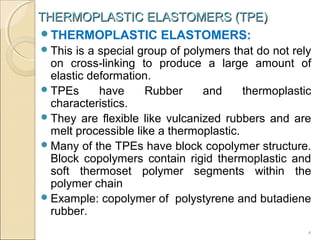
THERMOPLASTIC ELASTOMERS:
 This

is a special group of polymers that do not rely
on cross-linking to produce a large amount of
elastic deformation.
 TPEs
have
Rubber
and
thermoplastic
characteristics.
 They are flexible like vulcanized rubbers and are
melt processible like a thermoplastic.
 Many of the TPEs have block copolymer structure.
Block copolymers contain rigid thermoplastic and
soft thermoset polymer segments within the
polymer chain
 Example: copolymer of polystyrene and butadiene
rubber.
4
THERMOPLASTIC ELASTOMERS (TPE)
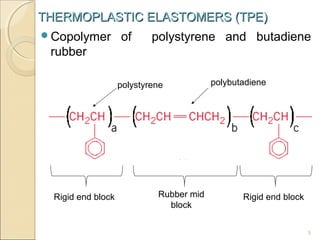
Copolymer

of

polystyrene and butadiene

rubber
polystyrene

Rigid end block

Rubber mid
block

polybutadiene

Rigid end block

5
THERMOPLASTIC ELASTOMERS (TPE)
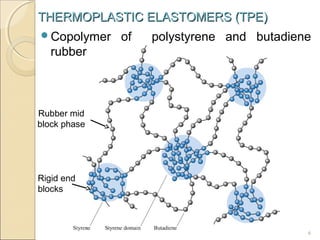
Copolymer

of

polystyrene and butadiene

rubber

Rubber mid
block phase

Rigid end
blocks

6
THERMOPLASTIC ELASTOMERS (TPE)
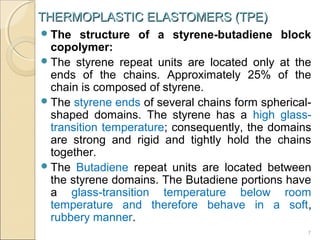
 The

structure of a styrene-butadiene block
copolymer:
 The styrene repeat units are located only at the
ends of the chains. Approximately 25% of the
chain is composed of styrene.
 The styrene ends of several chains form sphericalshaped domains. The styrene has a high glasstransition temperature; consequently, the domains
are strong and rigid and tightly hold the chains
together.
 The Butadiene repeat units are located between
the styrene domains. The Butadiene portions have
a glass-transition temperature below room
temperature and therefore behave in a soft,
rubbery manner.
7
THERMOPLASTIC ELASTOMERS (TPE)
The

structure of a styrene-butadiene block
copolymer:
Elastic deformation occurs by recoverable
movement of the chains; sliding of the chains
at normal temperatures is prevented by the
styrene domains (Rigid).
When the thermoplastic elastomer is heated,
the styrene heats above the glass transition
temperature, the domains are destroyed, the
polymer deforms in a viscous manner and it
behaves as thermoplastic, can be fabricated
very easily.
8
THERMOPLASTIC ELASTOMERS (TPE)
The

structure of a styrene-butadiene block
copolymer:
When the polymer cools, the domains reform
and the polymer reverts to its elastomeric
characteristics.
The thermoplastic elastomers consequently
behave as ordinary thermoplastics at elevated
temperatures and as elastomers at low
temperatures.
This behaviour also permits thermoplastic
elastomers to be more easily recycled than
conventional elastomers.
9
THERMOPLASTIC ELASTOMERS (TPE)
 Advantages

of TPEs compared with conventional
thermoset elastomers:
 No chemical cross-linking
 Simpler processing and faster cycle times
 Can be processed by Injection molding, Blow molding,
thermoforming and extrusion.
 Undercuts and complex shapes are possible with
simple tooling.
 Scrap and waste can be recycled. Normal cross-linked
polymers cannot be recycled because they don't melt
due to the cross-links tie all the polymer chains
together, making it impossible for the material to flow.
 Limitations:
 They may have lower temperature resistance than
most thermoset rubbers.
 Creep resistance inferior to thermoset rubbers.
10
THERMOPLASTIC ELASTOMERS (TPE)
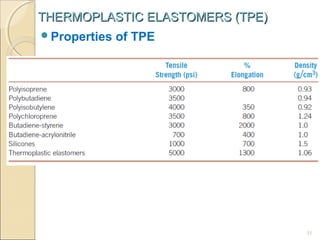
Properties

of TPE

11
THERMOPLASTIC ELASTOMERS (TPE)
 Commercially

available Thermoplastic elastomers
and their applications:

 1.

Styrenic block copolymer
(Polystyrene + Butadiene or polyisoprene)

 Applications:

•
•
•
•
•

Grips on cameras,
Razor handles,
Medical devices
Shoe soles
Adhesives
12
THERMOPLASTIC ELASTOMERS (TPE)
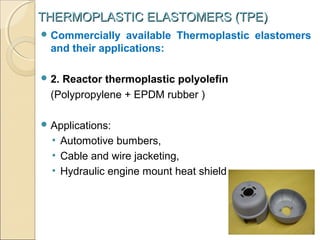
 Commercially

available Thermoplastic elastomers
and their applications:

 2.

Reactor thermoplastic polyolefin
(Polypropylene + EPDM rubber )

 Applications:

• Automotive bumbers,
• Cable and wire jacketing,
• Hydraulic engine mount heat shield

13
THERMOPLASTIC ELASTOMERS (TPE)
 Commercially

available Thermoplastic elastomers
and their applications:

 3.

Thermoplastic polyurethane
(Polyester / polyether polyurethane + long chain diols )

 Applications:

•
•
•
•
•

Automotive underhood applications,
Seals / gaskets,
Shoe soles
Conveyor belts
Caster / wheels.
14
THERMOPLASTIC ELASTOMERS (TPE)
 Commercially

available Thermoplastic elastomers
and their applications:

 4.

Thermoplastic copolyester
(polybutylene terepthalate + Polytetramethylene ether)

 Applications:

•
•
•
•
•

Seals,
Belting,
Hoses,
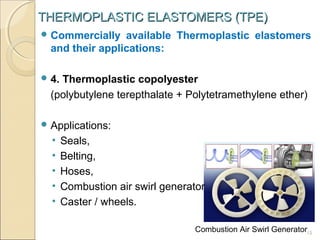
Combustion air swirl generator
Caster / wheels.
Combustion Air Swirl Generator15
THERMOPLASTIC ELASTOMERS (TPE)
 Commercially

available Thermoplastic elastomers
and their applications:

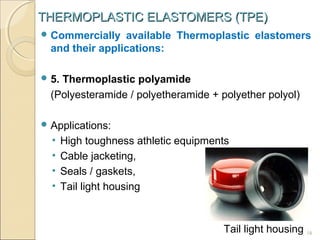
 5.

Thermoplastic polyamide
(Polyesteramide / polyetheramide + polyether polyol)

 Applications:

•
•
•
•

High toughness athletic equipments
Cable jacketing,
Seals / gaskets,
Tail light housing

Tail light housing

16
THERMOPLASTIC ELASTOMERS (TPE)
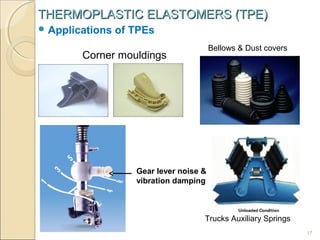
 Applications

of TPEs
Bellows & Dust covers

Corner mouldings

Gear lever noise &
vibration damping

Trucks Auxiliary Springs
17
THERMOPLASTIC ELASTOMERS (TPE)
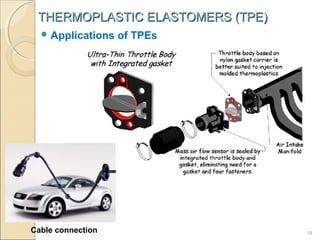
 Applications

Cable connection

of TPEs

18
THERMOPLASTIC ELASTOMERS (TPE)
 References

:

 Donald

R. Askeland, Pradeep P. Fulay, Wendelin J. Wright,
The Science and Engineering of Materials, Sixth Edition.

 Kenneth

G Budinski and Michael K Budinski, Engineering
Materials - Properties and selection, Eighth edition,
Prentice-Hall Inc.

 William

D.Callister, Fundamentals of Materials Science
and Engineering, Fifth edition.

19

Thermoplastic elastomers (TPE)

  • 1.
  • 2.
    THERMOPLASTIC ELASTOMERS (TPE) INTRODUCTION Elastomers:  An Elastomer is a polymeric material that has elongation greater than 100% and a significant amount of resilience.  For elastomers to experience relatively large elastic deformations, the onset of plastic deformation must be delayed.  Restricting the motions of chains past one another by cross-linking accomplishes this objective.  Cross-linking in many elastomers is carried out in a process called vulcanization (heating with Sulphur about 140oC). 2
  • 3.
    THERMOPLASTIC ELASTOMERS (TPE) INTRODUCTION Classification  Natural Rubber (Thermoset by cross-linking)  Synthetic • • • • • of Elastomers: Rubber (Thermoset by cross-linking) Polyisoprene Styrene Butadiene Rubber (SBR) Chloroprene, Polybutadiene Nitrile rubber, Butyle rubber, Silicones, Ethylene propylene diene monomer (EPDM), etc  Thermoplastic Elastomers 3
  • 4.
    THERMOPLASTIC ELASTOMERS (TPE) THERMOPLASTICELASTOMERS:  This is a special group of polymers that do not rely on cross-linking to produce a large amount of elastic deformation.  TPEs have Rubber and thermoplastic characteristics.  They are flexible like vulcanized rubbers and are melt processible like a thermoplastic.  Many of the TPEs have block copolymer structure. Block copolymers contain rigid thermoplastic and soft thermoset polymer segments within the polymer chain  Example: copolymer of polystyrene and butadiene rubber. 4
  • 5.
    THERMOPLASTIC ELASTOMERS (TPE) Copolymer of polystyreneand butadiene rubber polystyrene Rigid end block Rubber mid block polybutadiene Rigid end block 5
  • 6.
    THERMOPLASTIC ELASTOMERS (TPE) Copolymer of polystyreneand butadiene rubber Rubber mid block phase Rigid end blocks 6
  • 7.
    THERMOPLASTIC ELASTOMERS (TPE) The structure of a styrene-butadiene block copolymer:  The styrene repeat units are located only at the ends of the chains. Approximately 25% of the chain is composed of styrene.  The styrene ends of several chains form sphericalshaped domains. The styrene has a high glasstransition temperature; consequently, the domains are strong and rigid and tightly hold the chains together.  The Butadiene repeat units are located between the styrene domains. The Butadiene portions have a glass-transition temperature below room temperature and therefore behave in a soft, rubbery manner. 7
  • 8.
    THERMOPLASTIC ELASTOMERS (TPE) The structureof a styrene-butadiene block copolymer: Elastic deformation occurs by recoverable movement of the chains; sliding of the chains at normal temperatures is prevented by the styrene domains (Rigid). When the thermoplastic elastomer is heated, the styrene heats above the glass transition temperature, the domains are destroyed, the polymer deforms in a viscous manner and it behaves as thermoplastic, can be fabricated very easily. 8
  • 9.
    THERMOPLASTIC ELASTOMERS (TPE) The structureof a styrene-butadiene block copolymer: When the polymer cools, the domains reform and the polymer reverts to its elastomeric characteristics. The thermoplastic elastomers consequently behave as ordinary thermoplastics at elevated temperatures and as elastomers at low temperatures. This behaviour also permits thermoplastic elastomers to be more easily recycled than conventional elastomers. 9
  • 10.
    THERMOPLASTIC ELASTOMERS (TPE) Advantages of TPEs compared with conventional thermoset elastomers:  No chemical cross-linking  Simpler processing and faster cycle times  Can be processed by Injection molding, Blow molding, thermoforming and extrusion.  Undercuts and complex shapes are possible with simple tooling.  Scrap and waste can be recycled. Normal cross-linked polymers cannot be recycled because they don't melt due to the cross-links tie all the polymer chains together, making it impossible for the material to flow.  Limitations:  They may have lower temperature resistance than most thermoset rubbers.  Creep resistance inferior to thermoset rubbers. 10
  • 11.
  • 12.
    THERMOPLASTIC ELASTOMERS (TPE) Commercially available Thermoplastic elastomers and their applications:  1. Styrenic block copolymer (Polystyrene + Butadiene or polyisoprene)  Applications: • • • • • Grips on cameras, Razor handles, Medical devices Shoe soles Adhesives 12
  • 13.
    THERMOPLASTIC ELASTOMERS (TPE) Commercially available Thermoplastic elastomers and their applications:  2. Reactor thermoplastic polyolefin (Polypropylene + EPDM rubber )  Applications: • Automotive bumbers, • Cable and wire jacketing, • Hydraulic engine mount heat shield 13
  • 14.
    THERMOPLASTIC ELASTOMERS (TPE) Commercially available Thermoplastic elastomers and their applications:  3. Thermoplastic polyurethane (Polyester / polyether polyurethane + long chain diols )  Applications: • • • • • Automotive underhood applications, Seals / gaskets, Shoe soles Conveyor belts Caster / wheels. 14
  • 15.
    THERMOPLASTIC ELASTOMERS (TPE) Commercially available Thermoplastic elastomers and their applications:  4. Thermoplastic copolyester (polybutylene terepthalate + Polytetramethylene ether)  Applications: • • • • • Seals, Belting, Hoses, Combustion air swirl generator Caster / wheels. Combustion Air Swirl Generator15
  • 16.
    THERMOPLASTIC ELASTOMERS (TPE) Commercially available Thermoplastic elastomers and their applications:  5. Thermoplastic polyamide (Polyesteramide / polyetheramide + polyether polyol)  Applications: • • • • High toughness athletic equipments Cable jacketing, Seals / gaskets, Tail light housing Tail light housing 16
  • 17.
    THERMOPLASTIC ELASTOMERS (TPE) Applications of TPEs Bellows & Dust covers Corner mouldings Gear lever noise & vibration damping Trucks Auxiliary Springs 17
  • 18.
    THERMOPLASTIC ELASTOMERS (TPE) Applications Cable connection of TPEs 18
  • 19.
    THERMOPLASTIC ELASTOMERS (TPE) References :  Donald R. Askeland, Pradeep P. Fulay, Wendelin J. Wright, The Science and Engineering of Materials, Sixth Edition.  Kenneth G Budinski and Michael K Budinski, Engineering Materials - Properties and selection, Eighth edition, Prentice-Hall Inc.  William D.Callister, Fundamentals of Materials Science and Engineering, Fifth edition. 19