Elastomers
Elastomers
 Polymers that have more than 200%
elastic elongation
 High elastic elongation is associated with
low stiffness and low strength
 Can be either thermoplastic or thermoset
Elastomers
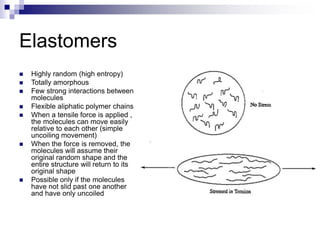
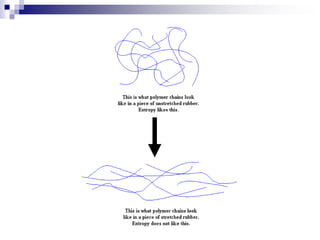
 Highly random (high entropy)
 Totally amorphous
 Few strong interactions between
molecules
 Flexible aliphatic polymer chains
 When a tensile force is applied ,
the molecules can move easily
relative to each other (simple
uncoiling movement)
 When the force is removed, the
molecules will assume their
original random shape and the
entire structure will return to its
original shape
 Possible only if the molecules
have not slid past one another
and have only uncoiled
Elastomers
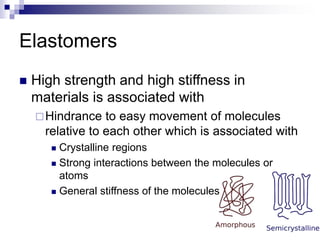
 High strength and high stiffness in
materials is associated with
Hindrance to easy movement of molecules
relative to each other which is associated with
 Crystalline regions
 Strong interactions between the molecules or
atoms
 General stiffness of the molecules
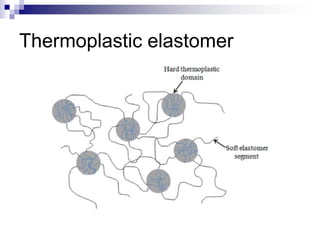
Thermoplastic elastomer
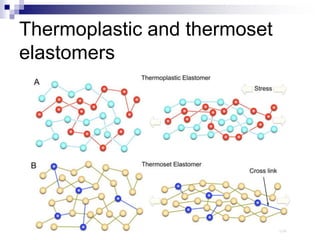
Thermoplastic and thermoset
elastomers
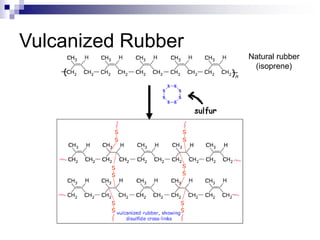
Vulcanized Rubber
Natural rubber
(isoprene)
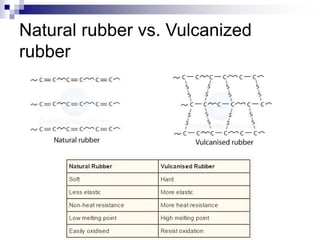
Natural rubber vs. Vulcanized
rubber
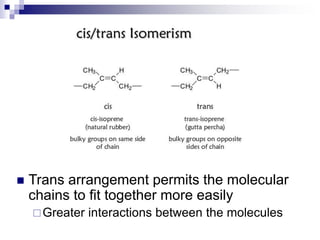
 Trans arrangement permits the molecular
chains to fit together more easily
Greater interactions between the molecules
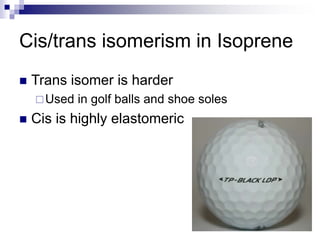
Cis/trans isomerism in Isoprene
 Trans isomer is harder
Used in golf balls and shoe soles
 Cis is highly elastomeric
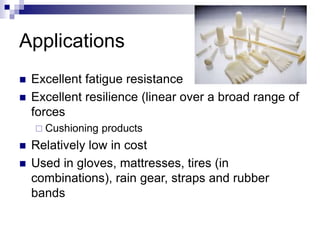
Applications
 Excellent fatigue resistance
 Excellent resilience (linear over a broad range of
forces
 Cushioning products
 Relatively low in cost
 Used in gloves, mattresses, tires (in
combinations), rain gear, straps and rubber
bands
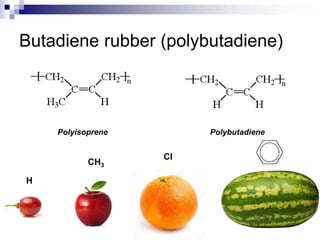
Butadiene rubber (polybutadiene)
H
CH3
Cl
Polyisoprene Polybutadiene
Resilience or compressive recovery
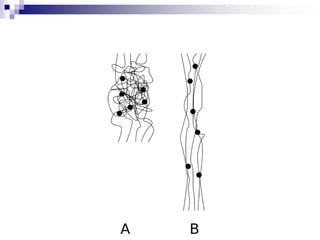
 Compressed state (low entropy and highly
ordered state)
 When compressive force is removed the
molecules tend to push against the
surface in order to return to their random
positions
 The entropy also increases as a result
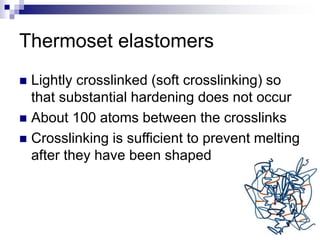
Thermoset elastomers
 Lightly crosslinked (soft crosslinking) so
that substantial hardening does not occur
 About 100 atoms between the crosslinks
 Crosslinking is sufficient to prevent melting
after they have been shaped
Thermoset elastomers
 Capable of moving with freedom
 Uncoiled and coil
 Long term creep is reduced especially at elevated
temperatures
 Complete melting is prohibited
 Max extent of elongation is limited
 Max elongation can be set within the elastic region
 The crosslink density can be increased or decreased as
per requirement

Elastomers.ppt

  • 1.
  • 2.
    Elastomers  Polymers thathave more than 200% elastic elongation  High elastic elongation is associated with low stiffness and low strength  Can be either thermoplastic or thermoset
  • 3.
    Elastomers  Highly random(high entropy)  Totally amorphous  Few strong interactions between molecules  Flexible aliphatic polymer chains  When a tensile force is applied , the molecules can move easily relative to each other (simple uncoiling movement)  When the force is removed, the molecules will assume their original random shape and the entire structure will return to its original shape  Possible only if the molecules have not slid past one another and have only uncoiled
  • 4.
    Elastomers  High strengthand high stiffness in materials is associated with Hindrance to easy movement of molecules relative to each other which is associated with  Crystalline regions  Strong interactions between the molecules or atoms  General stiffness of the molecules
  • 5.
  • 8.
  • 9.
  • 10.
    Natural rubber vs.Vulcanized rubber
  • 11.
     Trans arrangementpermits the molecular chains to fit together more easily Greater interactions between the molecules
  • 12.
    Cis/trans isomerism inIsoprene  Trans isomer is harder Used in golf balls and shoe soles  Cis is highly elastomeric
  • 13.
    Applications  Excellent fatigueresistance  Excellent resilience (linear over a broad range of forces  Cushioning products  Relatively low in cost  Used in gloves, mattresses, tires (in combinations), rain gear, straps and rubber bands
  • 14.
  • 15.
    Resilience or compressiverecovery  Compressed state (low entropy and highly ordered state)  When compressive force is removed the molecules tend to push against the surface in order to return to their random positions  The entropy also increases as a result
  • 16.
    Thermoset elastomers  Lightlycrosslinked (soft crosslinking) so that substantial hardening does not occur  About 100 atoms between the crosslinks  Crosslinking is sufficient to prevent melting after they have been shaped
  • 17.
    Thermoset elastomers  Capableof moving with freedom  Uncoiled and coil  Long term creep is reduced especially at elevated temperatures  Complete melting is prohibited  Max extent of elongation is limited  Max elongation can be set within the elastic region  The crosslink density can be increased or decreased as per requirement