Mechanical Behavior of
Materials
Topic: Theories of Failure
Submitted To: Submitted
By:
Dr. Sanjeev Kumar Mandeep
Kumar
Prof. in MED SID: 13209024
Requirement of TOF
 Theories of failure are used to determine
the safe dimension of a component
when it is subjected to combined
stresses due to various loads.
 Theories of failure are used in design by
establishing a relationship between
stresses induced under combined
loading conditions and properties
obtained from tension test like Syt & Sut
Various Theory Of Failure
• Maximum principal stress theory (Rankine’s
Theory)
• Maximum principal strain theory (St.
Venant’s theory)
• Maximum strain energy theory (Haigh’
Theory)
• Maximum Distortion energy theory (Von-
mises and Henky’s Theory)
• Maximum shear stress theory (Guest and
Treska’s Theory)
Maximum Principle Stress
Theory:
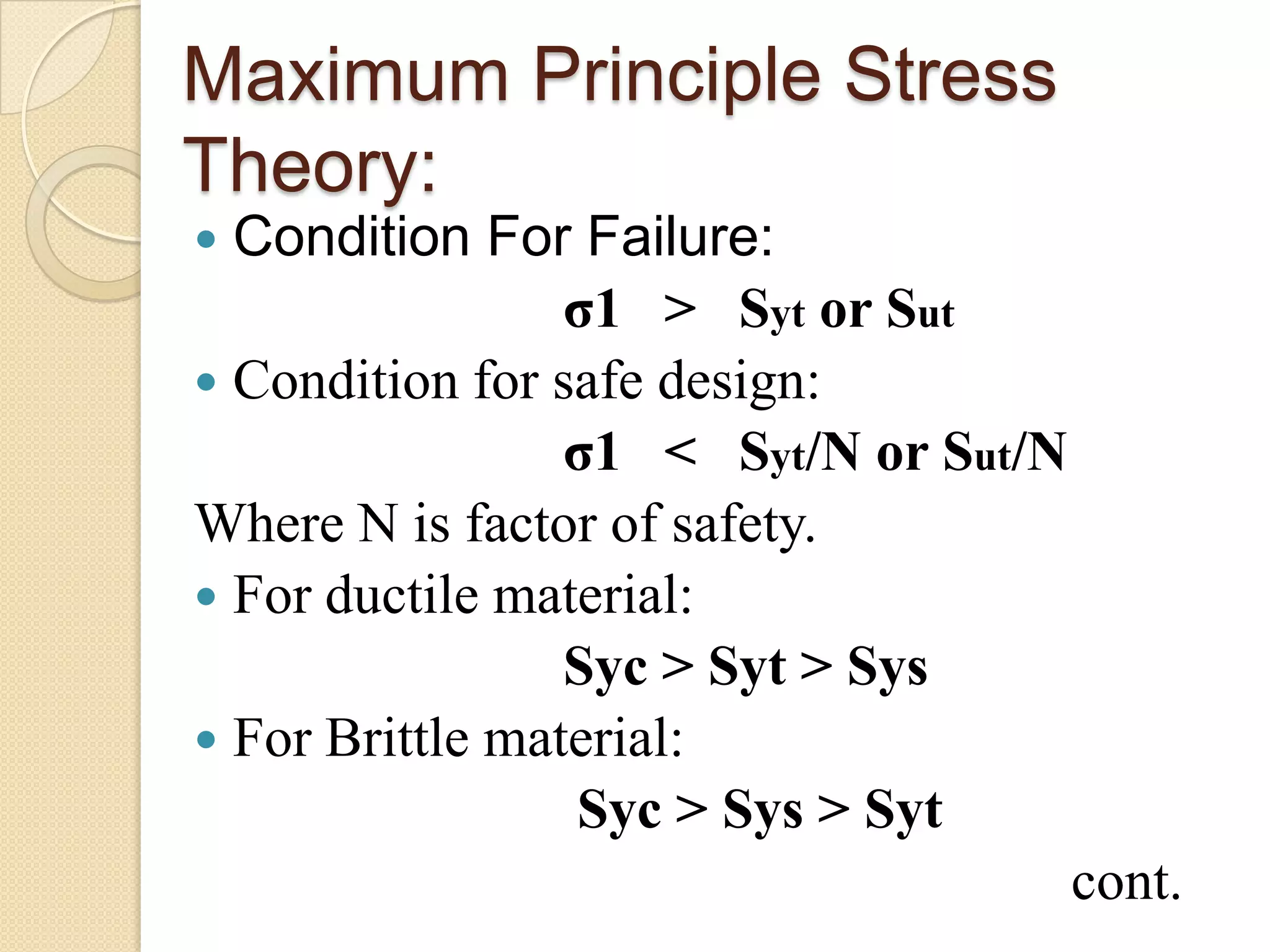
 Condition For Failure:
σ1 > Syt or Sut
 Condition for safe design:
σ1 < Syt/N or Sut/N
Where N is factor of safety.
 For ductile material:
Syc > Syt > Sys
 For Brittle material:
Syc > Sys > Syt
cont.
Maximum Principle Stress
Theory
 This theory is suitable for the safe design of
machine component made up of brittle
material, because brittle material are weak in
tension
 This theory is not good for design of ductile
material because shear failure may occur
 But this theory is also suitable for ductile
material under following condition :
1. uniaxial state of stress condition.
2. Under biaxial state of stress when are like in
nature.
3. Hydrostatic stress condition.
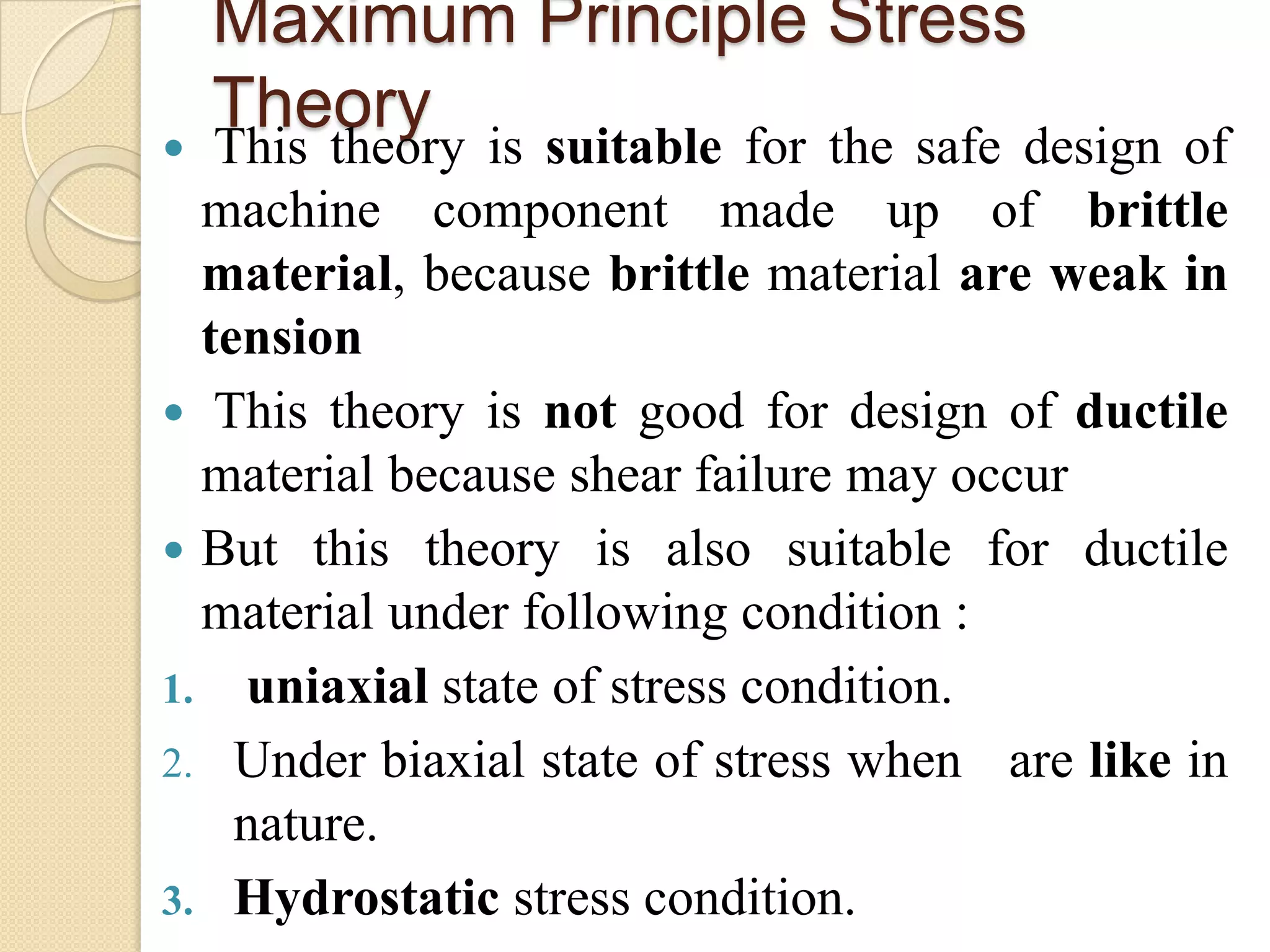
Graphical representation of MPST
Maximum shear stress theory
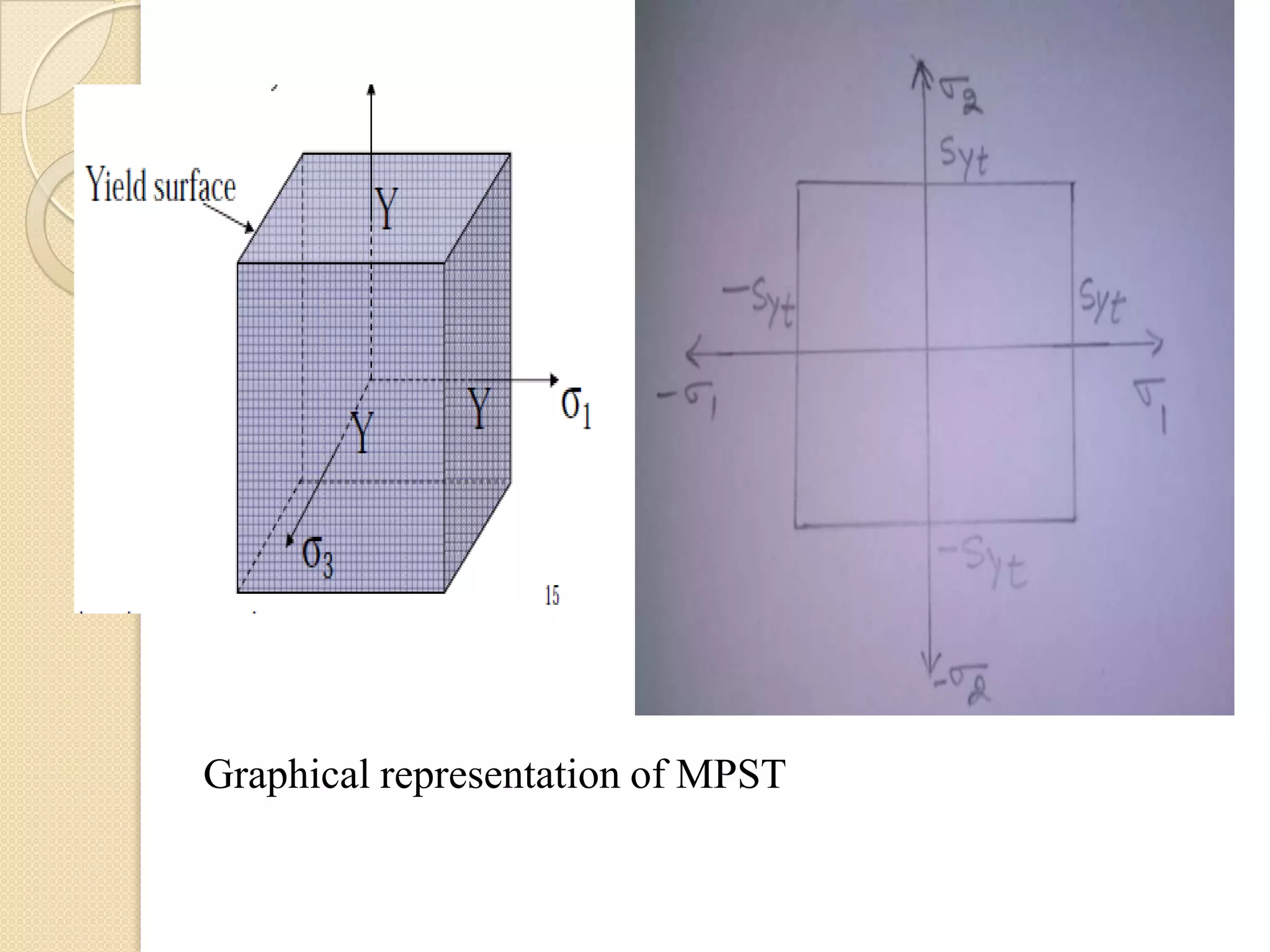
 Condition For Failure:
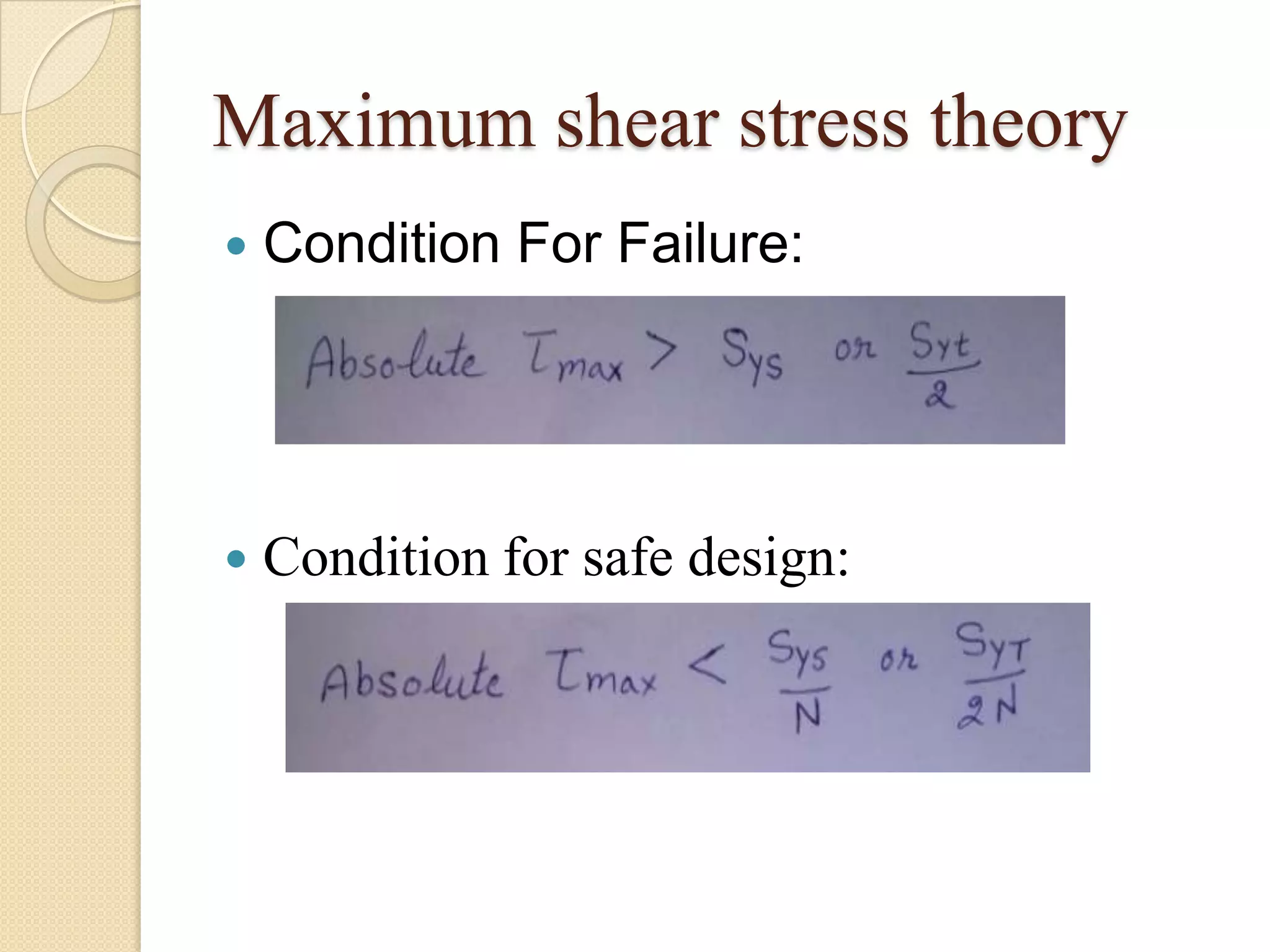
 Condition for safe design:
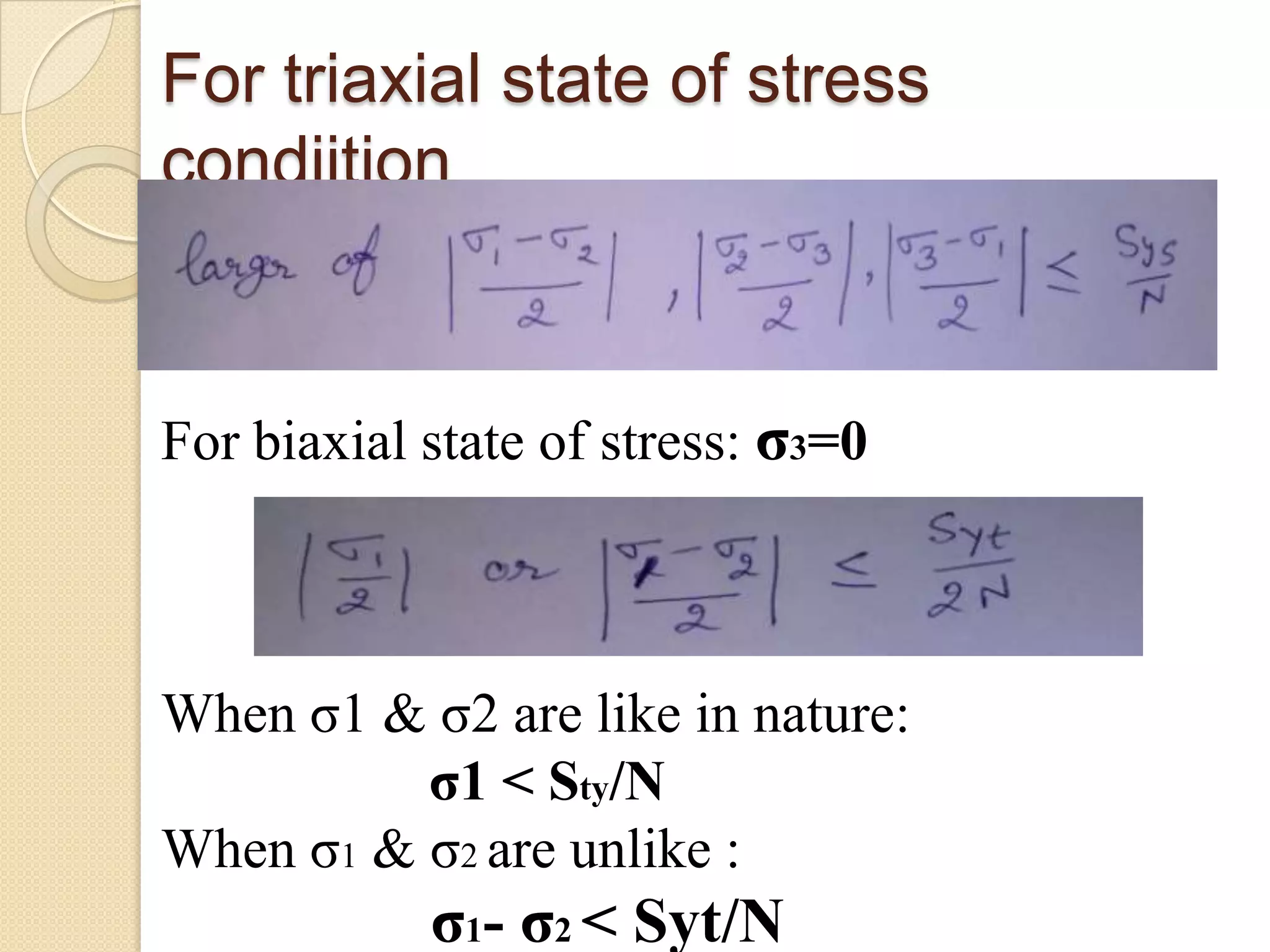
For triaxial state of stress
condiition
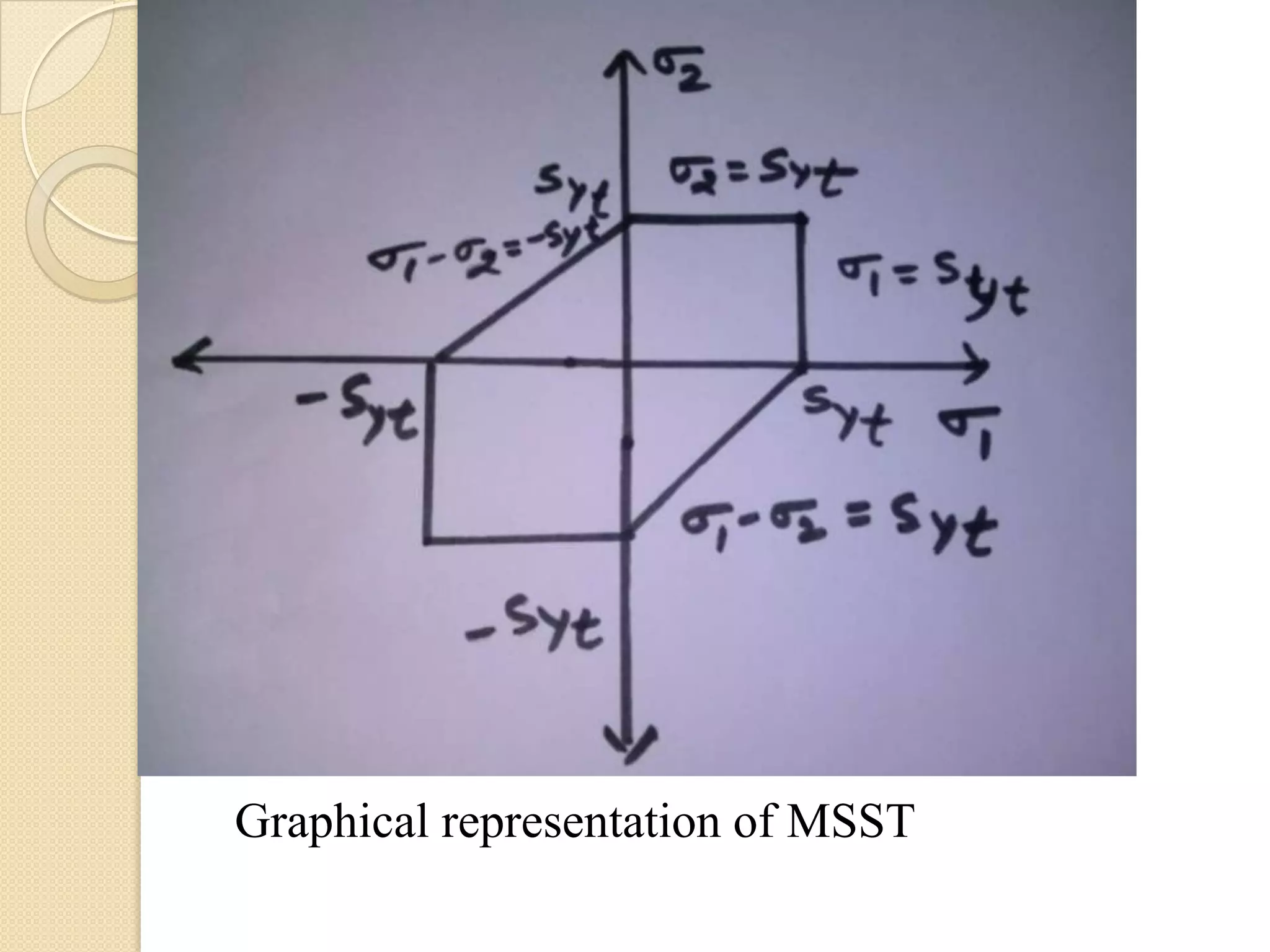
For biaxial state of stress: σ3=0
When σ1 & σ2 are like in nature:
σ1 < Sty/N
When σ1 & σ2 are unlike :
σ1- σ2 < Syt/N
Graphical representation of MSST
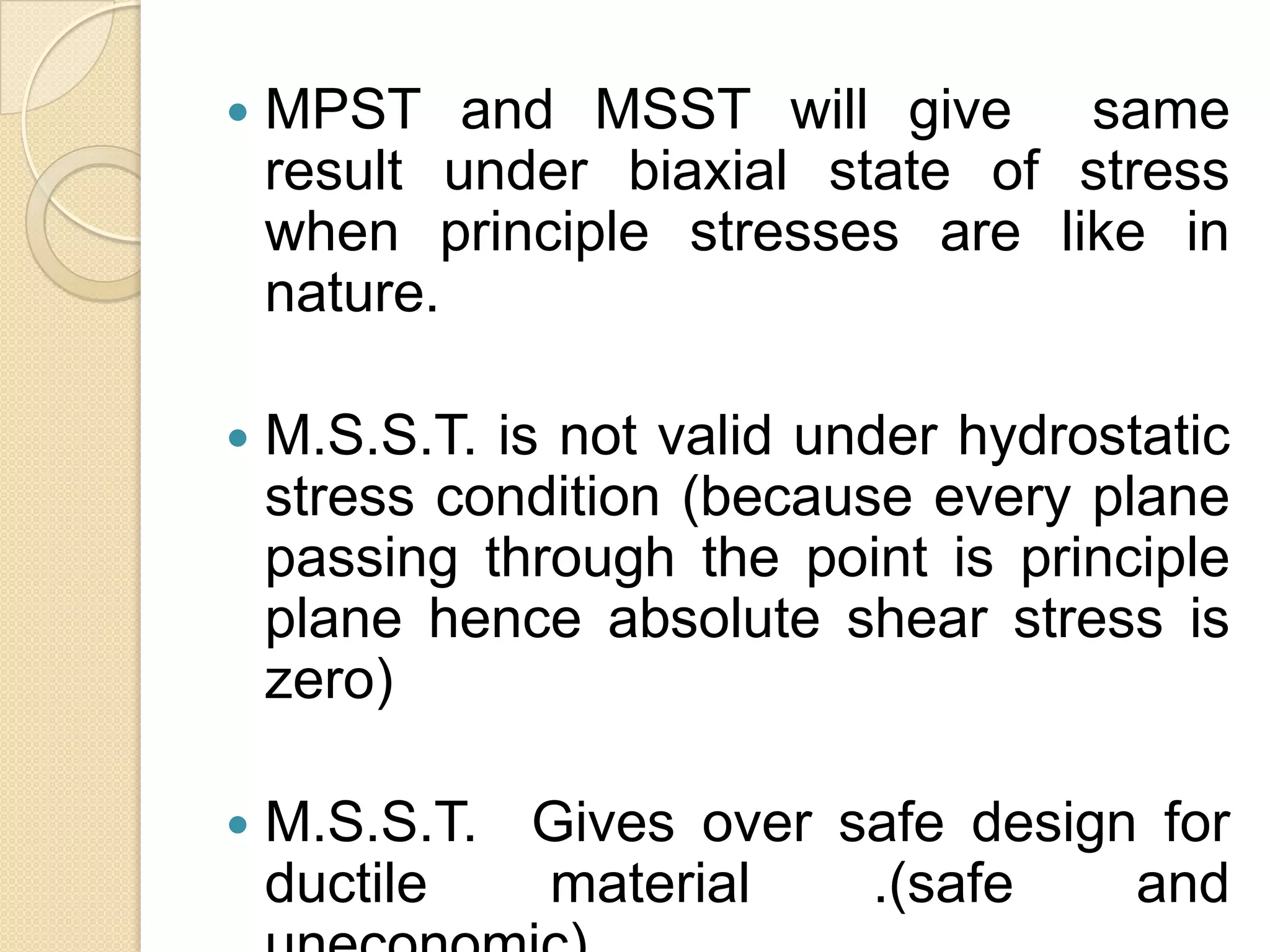
 MPST and MSST will give same
result under biaxial state of stress
when principle stresses are like in
nature.
 M.S.S.T. is not valid under hydrostatic
stress condition (because every plane
passing through the point is principle
plane hence absolute shear stress is
zero)
 M.S.S.T. Gives over safe design for
ductile material .(safe and
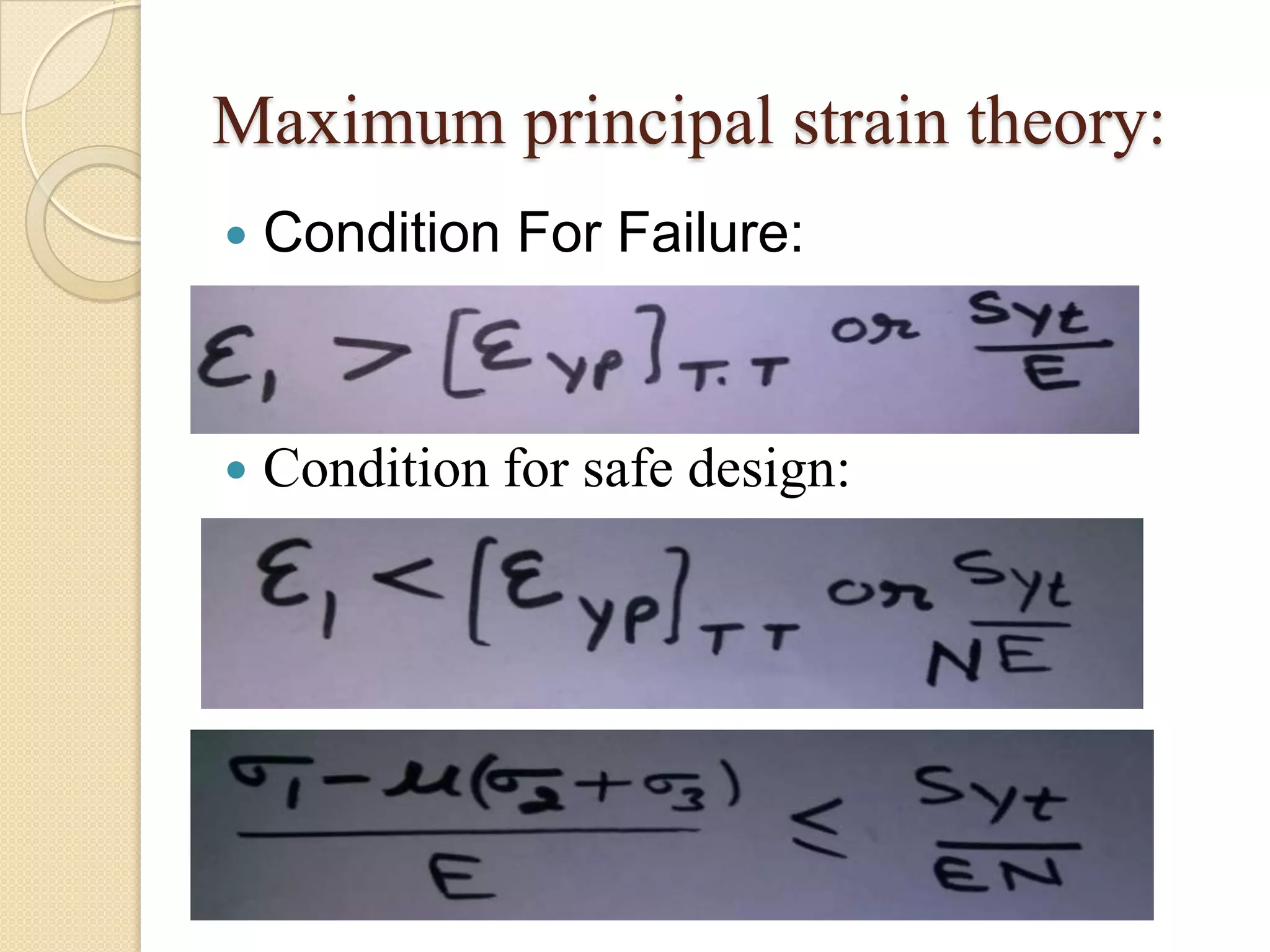
Maximum principal strain theory:
 Condition For Failure:
 Condition for safe design:
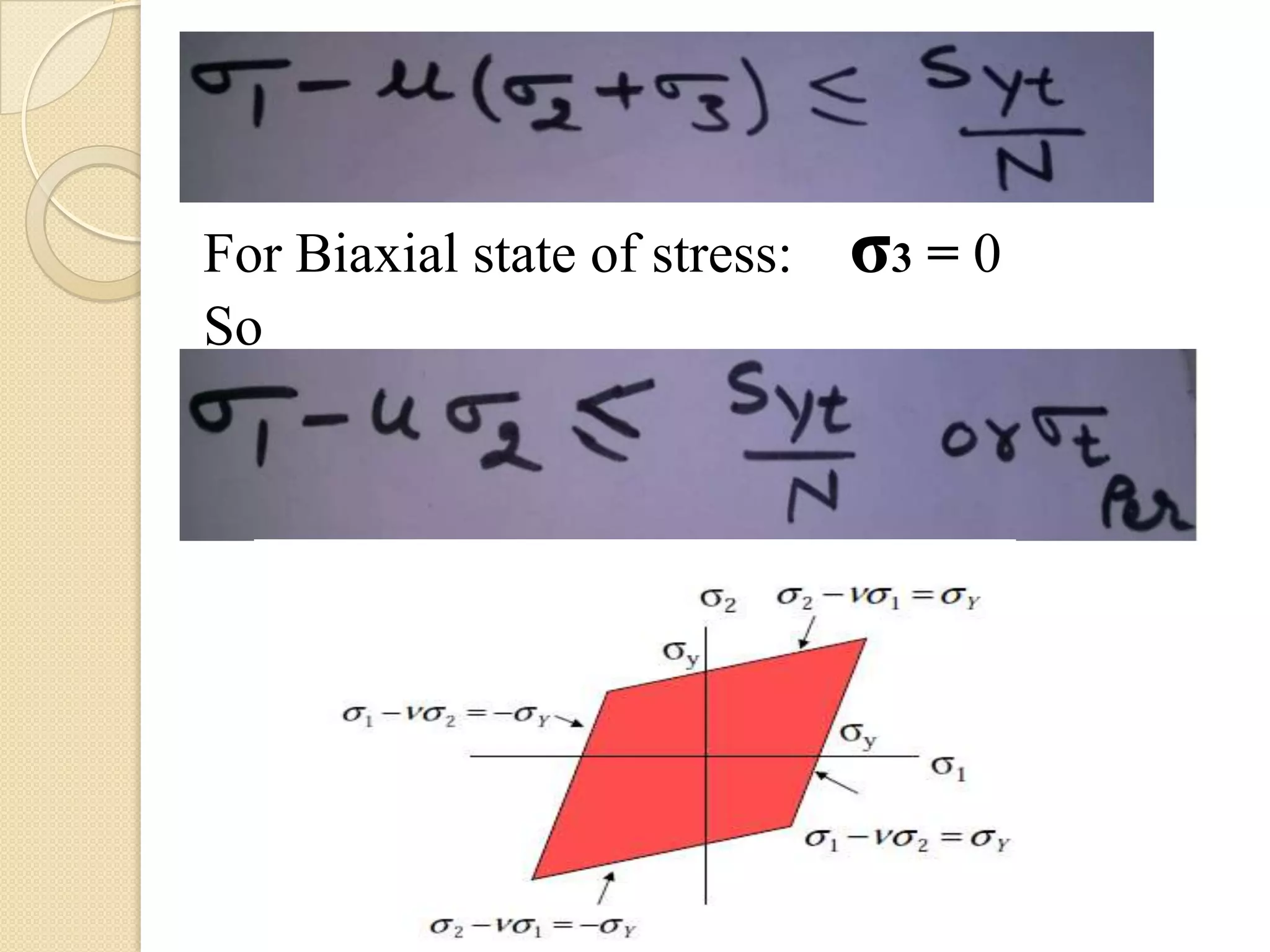
For Biaxial state of stress: σ3 = 0
So
Maximum strain energy theory:
 Condition For Failure:
Total strain energy/vol > [(S.E/vol)yp]TT
 Condition for safe design:
Total strain energy/vol < [(S.E/vol)yp]TT
Under triaxial loading condition:
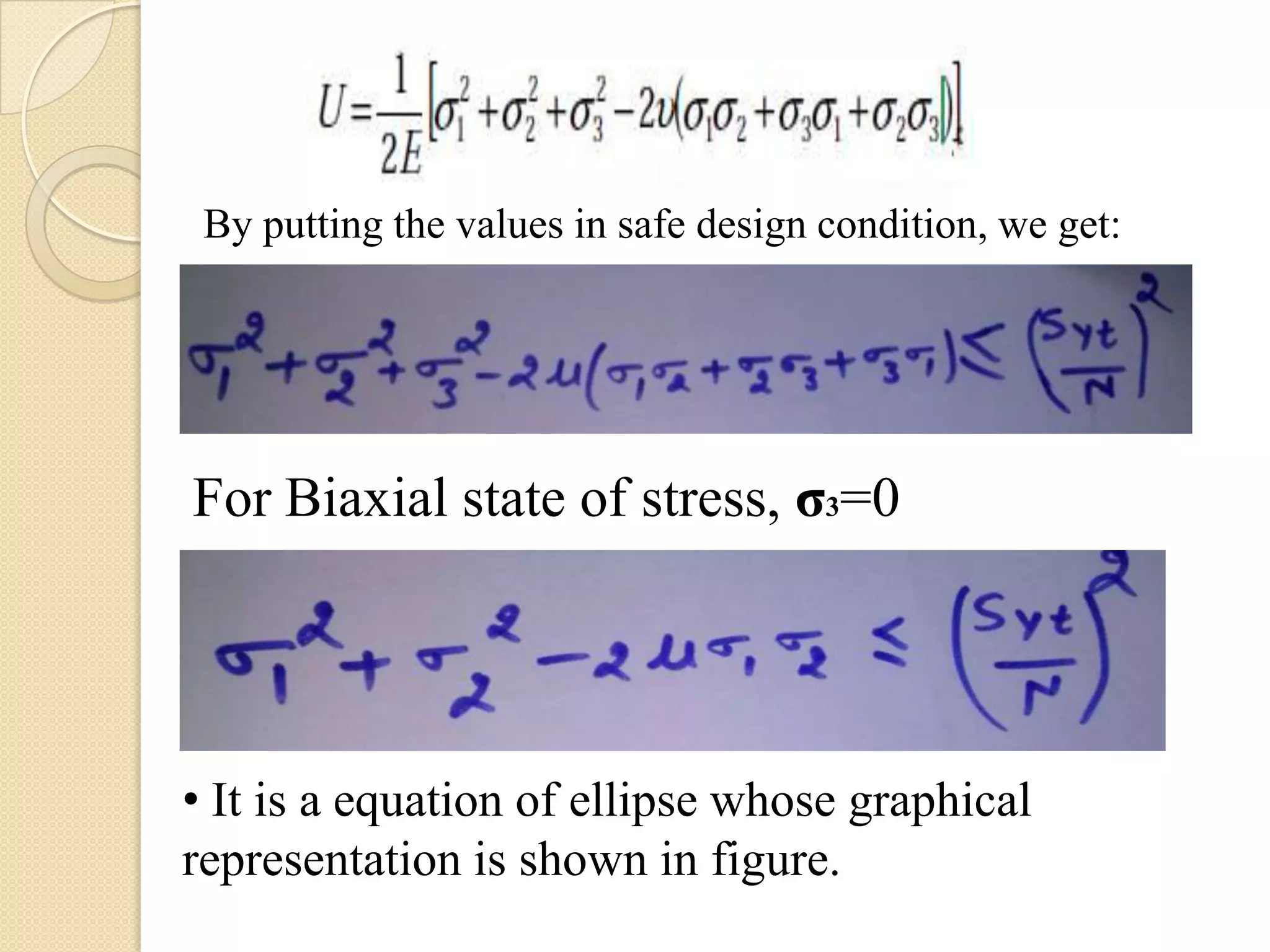
By putting the values in safe design condition, we get:
For Biaxial state of stress, σ3=0
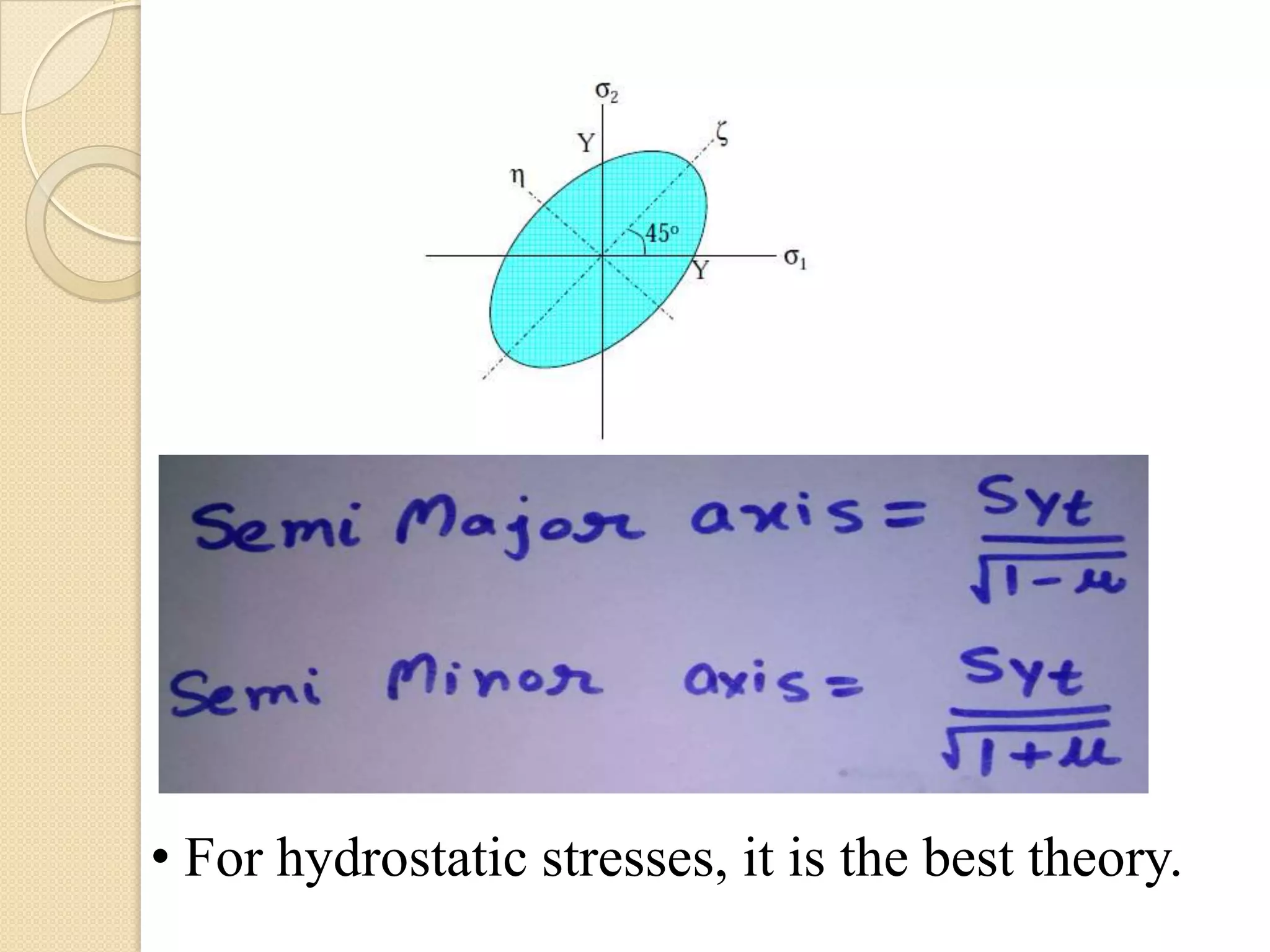
• It is a equation of ellipse whose graphical
representation is shown in figure.
• For hydrostatic stresses, it is the best theory.
Maximum Distortion energy theory:
 Condition For Failure:
Max. D.E. / volume > [(D.E./vol.)yp]TT
 Condition for safe design:
Max. D.E. / volume < [(D.E./vol.)yp]TT
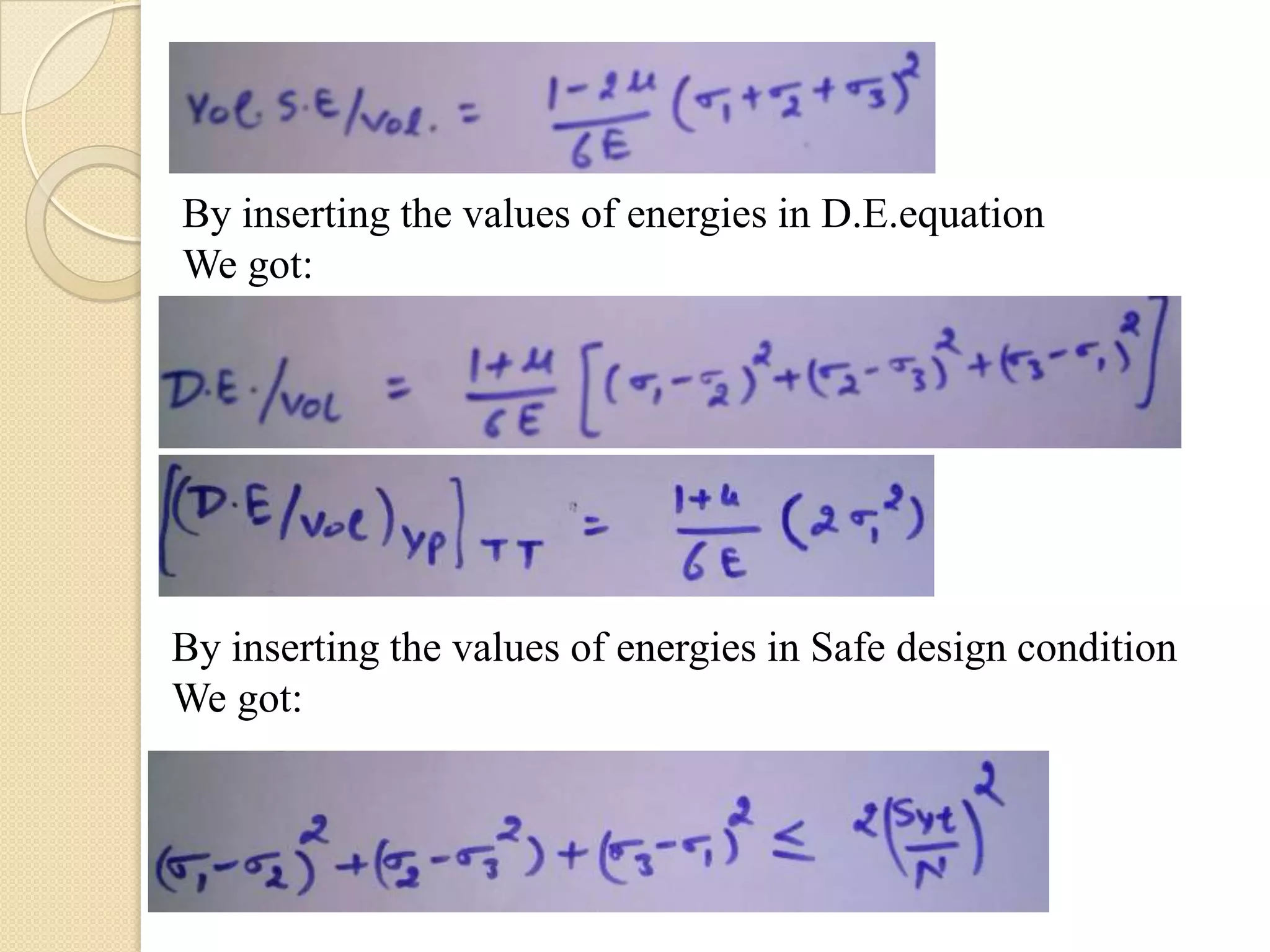
 Max. D.E. / vol = Total S.E. /vol – volumetric S.E. / vol
By inserting the values of energies in D.E.equation
We got:
By inserting the values of energies in Safe design condition
We got:
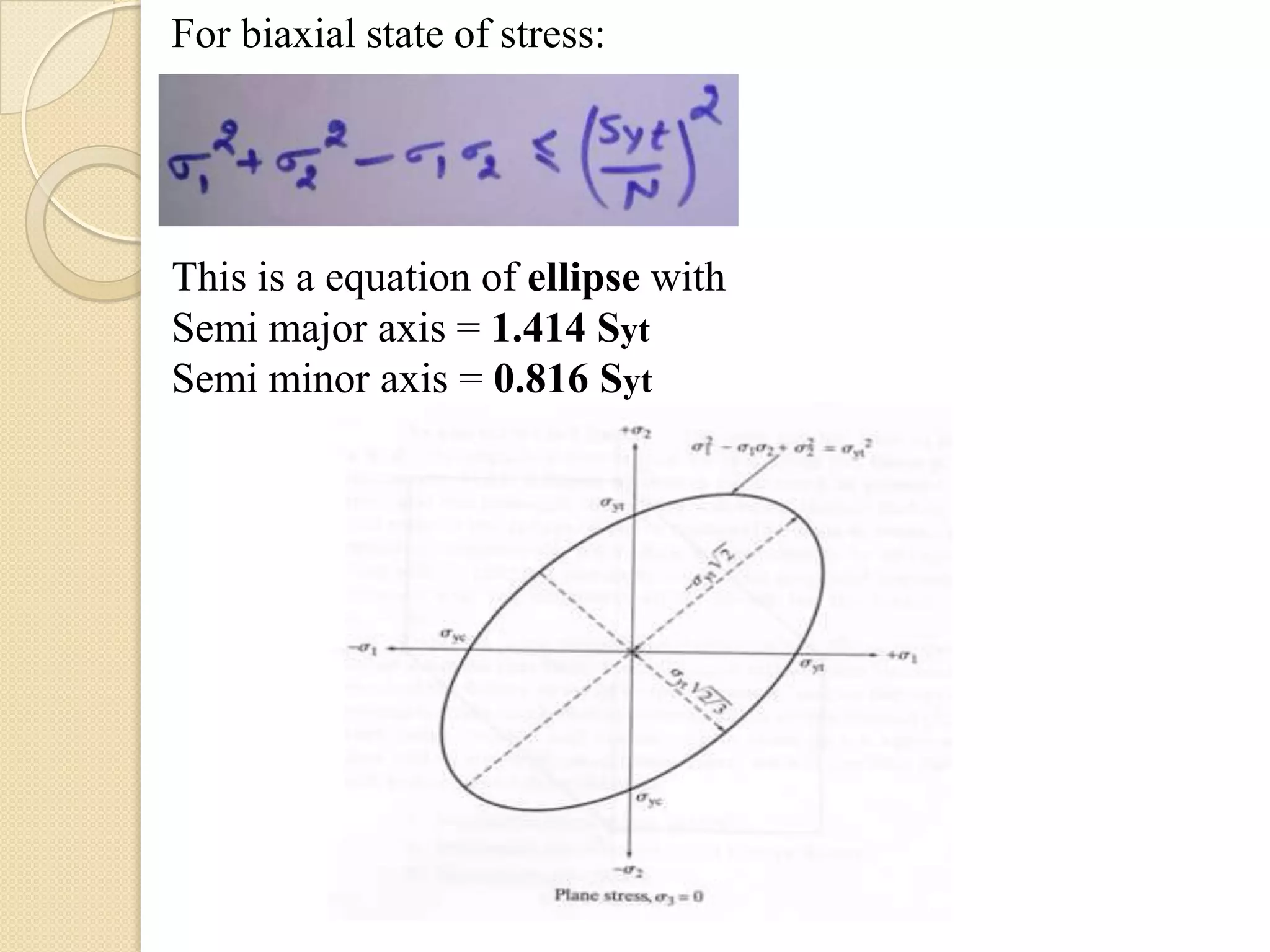
For biaxial state of stress:
This is a equation of ellipse with
Semi major axis = 1.414 Syt
Semi minor axis = 0.816 Syt
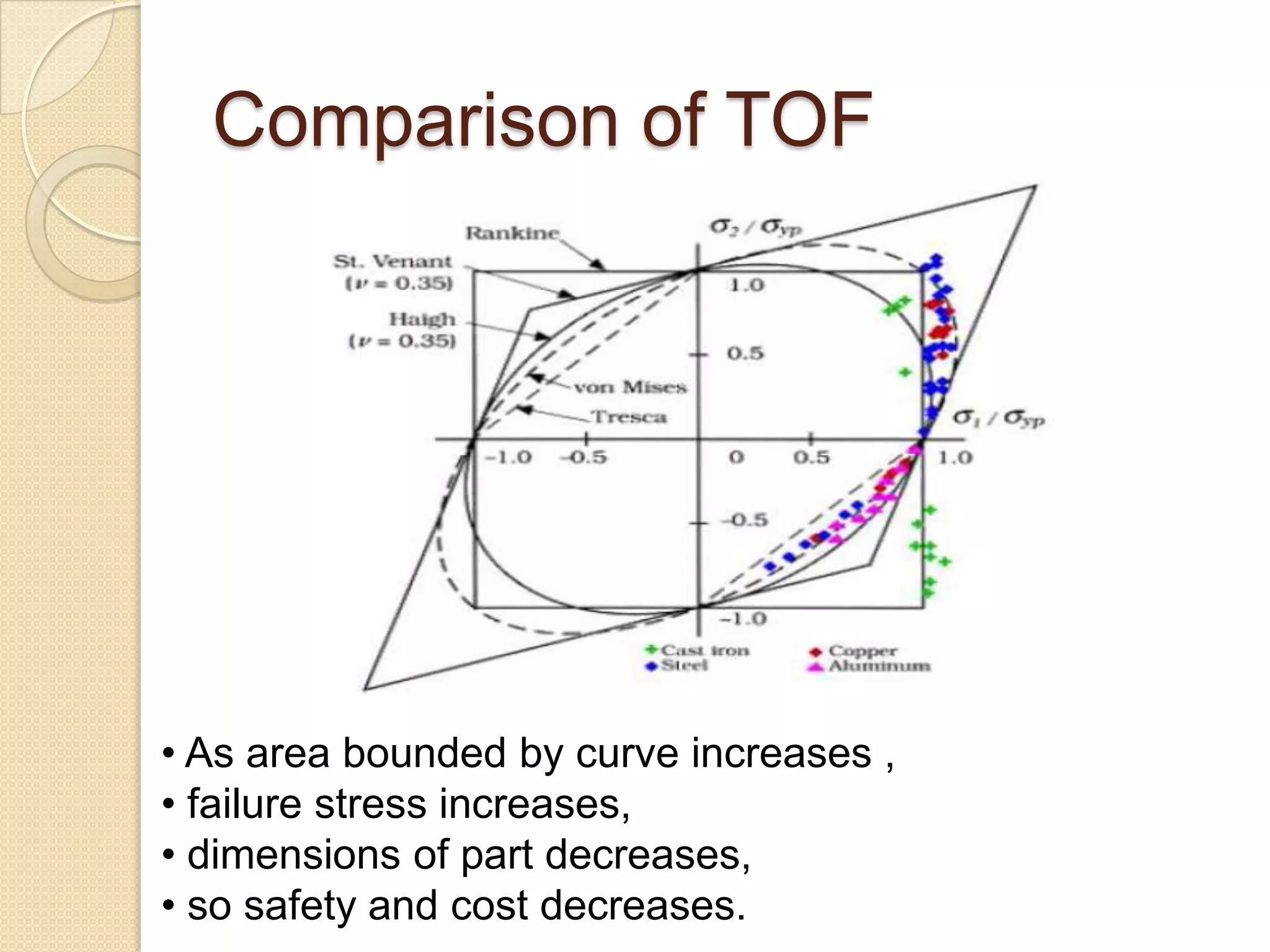
Comparison of TOF
• As area bounded by curve increases ,
• failure stress increases,
• dimensions of part decreases,
• so safety and cost decreases.
 Area of MDETcurve > area of MSST curve
 So dimension of MDET < dimension of
MSST
 MPST, MSST, MDET will give same result
under biaxial state of stress of same
nature i.e. σ1=σ2= σ and σ3=0
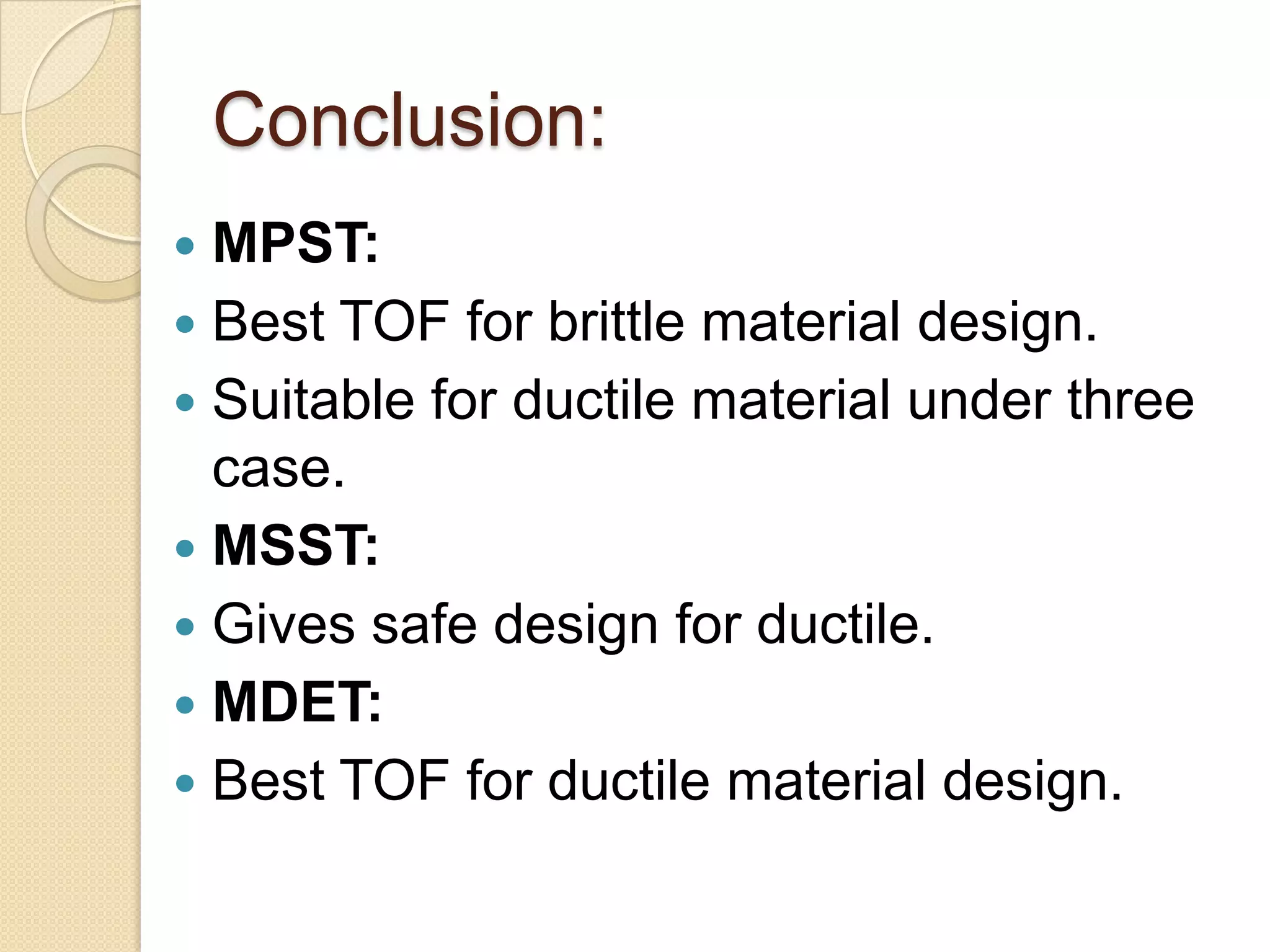
Conclusion:
 MPST:
 Best TOF for brittle material design.
 Suitable for ductile material under three
case.
 MSST:
 Gives safe design for ductile.
 MDET:
 Best TOF for ductile material design.
Thank You

theories of failure

  • 1.
    Mechanical Behavior of Materials Topic:Theories of Failure Submitted To: Submitted By: Dr. Sanjeev Kumar Mandeep Kumar Prof. in MED SID: 13209024
  • 2.
    Requirement of TOF Theories of failure are used to determine the safe dimension of a component when it is subjected to combined stresses due to various loads.  Theories of failure are used in design by establishing a relationship between stresses induced under combined loading conditions and properties obtained from tension test like Syt & Sut
  • 3.
    Various Theory OfFailure • Maximum principal stress theory (Rankine’s Theory) • Maximum principal strain theory (St. Venant’s theory) • Maximum strain energy theory (Haigh’ Theory) • Maximum Distortion energy theory (Von- mises and Henky’s Theory) • Maximum shear stress theory (Guest and Treska’s Theory)
  • 4.
    Maximum Principle Stress Theory: Condition For Failure: σ1 > Syt or Sut  Condition for safe design: σ1 < Syt/N or Sut/N Where N is factor of safety.  For ductile material: Syc > Syt > Sys  For Brittle material: Syc > Sys > Syt cont.
  • 5.
    Maximum Principle Stress Theory This theory is suitable for the safe design of machine component made up of brittle material, because brittle material are weak in tension  This theory is not good for design of ductile material because shear failure may occur  But this theory is also suitable for ductile material under following condition : 1. uniaxial state of stress condition. 2. Under biaxial state of stress when are like in nature. 3. Hydrostatic stress condition.
  • 6.
  • 7.
    Maximum shear stresstheory  Condition For Failure:  Condition for safe design:
  • 8.
    For triaxial stateof stress condiition For biaxial state of stress: σ3=0 When σ1 & σ2 are like in nature: σ1 < Sty/N When σ1 & σ2 are unlike : σ1- σ2 < Syt/N
  • 9.
  • 10.
     MPST andMSST will give same result under biaxial state of stress when principle stresses are like in nature.  M.S.S.T. is not valid under hydrostatic stress condition (because every plane passing through the point is principle plane hence absolute shear stress is zero)  M.S.S.T. Gives over safe design for ductile material .(safe and
  • 11.
    Maximum principal straintheory:  Condition For Failure:  Condition for safe design:
  • 12.
    For Biaxial stateof stress: σ3 = 0 So
  • 13.
    Maximum strain energytheory:  Condition For Failure: Total strain energy/vol > [(S.E/vol)yp]TT  Condition for safe design: Total strain energy/vol < [(S.E/vol)yp]TT Under triaxial loading condition:
  • 14.
    By putting thevalues in safe design condition, we get: For Biaxial state of stress, σ3=0 • It is a equation of ellipse whose graphical representation is shown in figure.
  • 15.
    • For hydrostaticstresses, it is the best theory.
  • 16.
    Maximum Distortion energytheory:  Condition For Failure: Max. D.E. / volume > [(D.E./vol.)yp]TT  Condition for safe design: Max. D.E. / volume < [(D.E./vol.)yp]TT  Max. D.E. / vol = Total S.E. /vol – volumetric S.E. / vol
  • 17.
    By inserting thevalues of energies in D.E.equation We got: By inserting the values of energies in Safe design condition We got:
  • 18.
    For biaxial stateof stress: This is a equation of ellipse with Semi major axis = 1.414 Syt Semi minor axis = 0.816 Syt
  • 19.
    Comparison of TOF •As area bounded by curve increases , • failure stress increases, • dimensions of part decreases, • so safety and cost decreases.
  • 20.
     Area ofMDETcurve > area of MSST curve  So dimension of MDET < dimension of MSST  MPST, MSST, MDET will give same result under biaxial state of stress of same nature i.e. σ1=σ2= σ and σ3=0
  • 21.
    Conclusion:  MPST:  BestTOF for brittle material design.  Suitable for ductile material under three case.  MSST:  Gives safe design for ductile.  MDET:  Best TOF for ductile material design.
  • 22.