A seminar Report
                          On
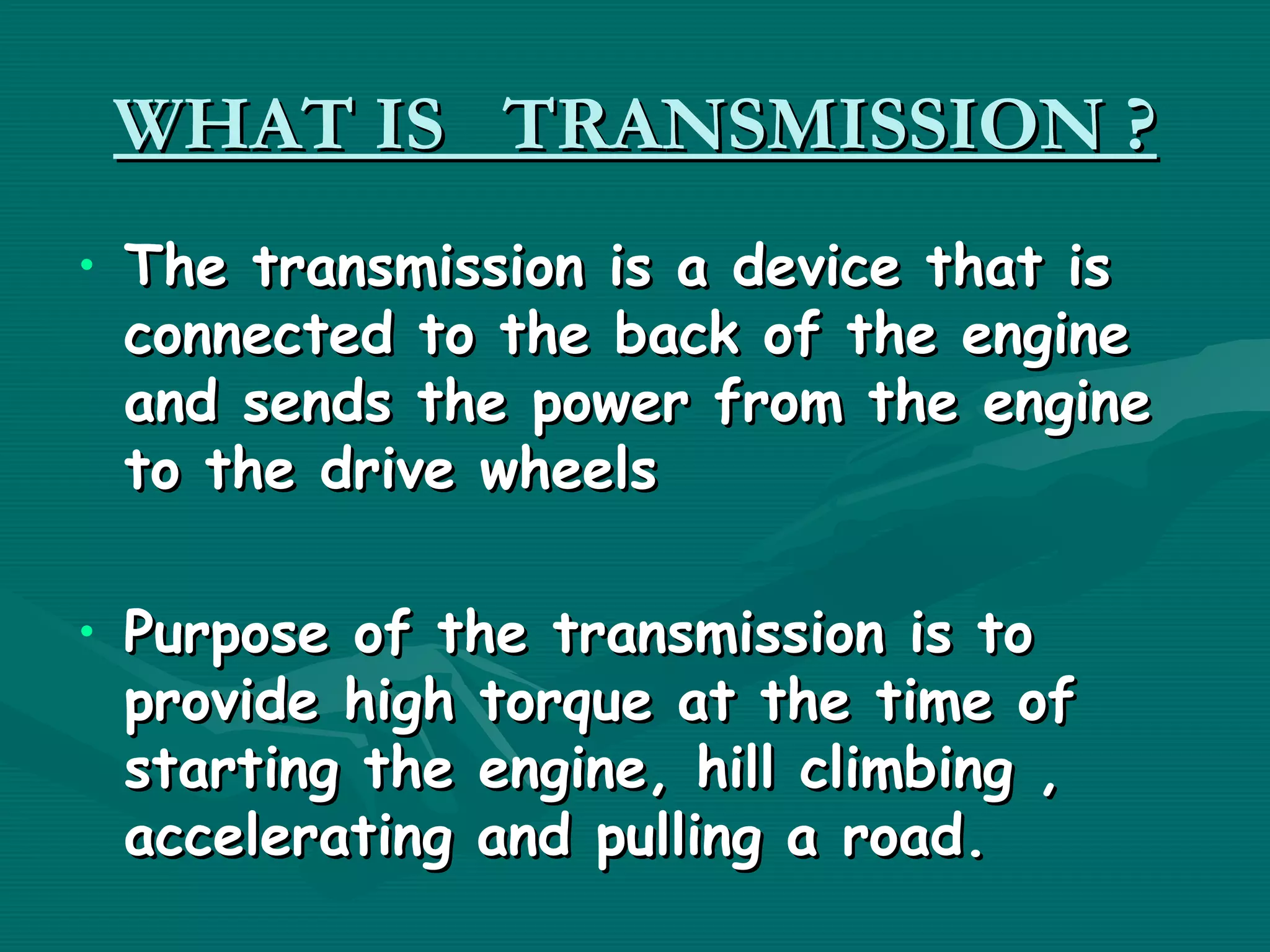
          “Automatic Transmission           System”
                  Submitted by:
                 VIJAY KUMAR
                 (4VV07ME054)
                  VIII Semester
             Mechanical Engineering
                 VVCE, Mysore

                     On : APRIL 13TH 2011

                 Under the valuable guidance of :

SRI D V SATISH                                        SRI G B KRISHNAPPA
   Asst. Professor                                     Professor & HOD

Dept. of Mechanical Engg.                          Dept. of Mechanical Engg.
 VVCE Mysore                                            VVCE Mysore
                      Department of Mechanical Engineering
                      VidyaVardhaka College of Engineering
INTRODUCTION
The modern automatic transmission is
by far, the most complicated
mechanical component in today’s
automobile. 
 Automatic transmissions contain
Mechanical systems, Hydraulic
systems, Electrical systems and
Computer controls, all working
together in perfect harmony which
goes virtually unnoticed until there is
a problem.
WHAT IS TRANSMISSION ?
• The transmission is a device that is
  connected to the back of the engine
  and sends the power from the engine
  to the drive wheels

• Purpose of the transmission is to
  provide high torque at the time of
  starting the engine, hill climbing ,
  accelerating and pulling a road.
TYPES OF AUTOMATIC
      TRANSMISSION

• Rear wheel drive


• Front wheel drive
REAR WHEEL DRIVE
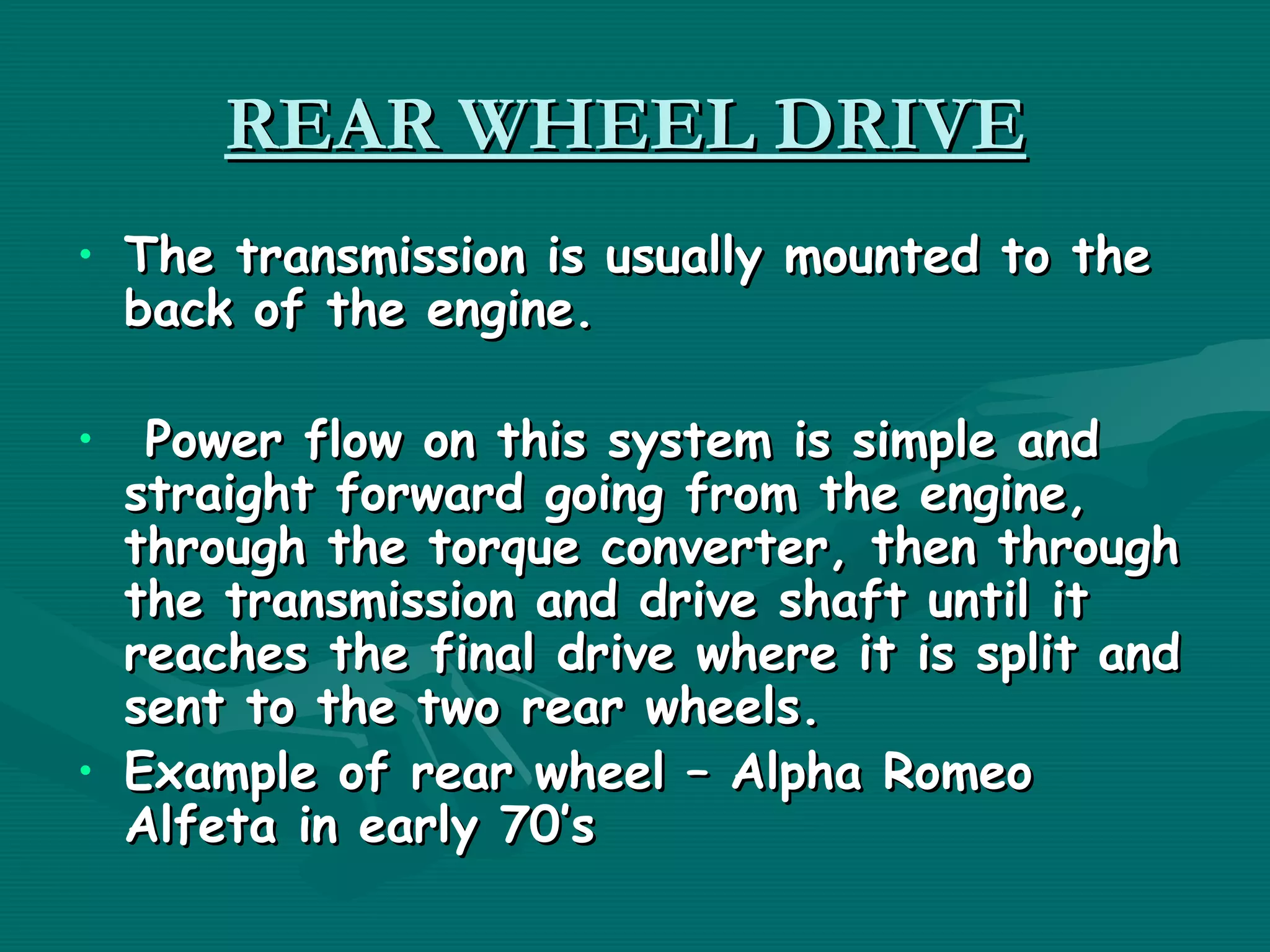
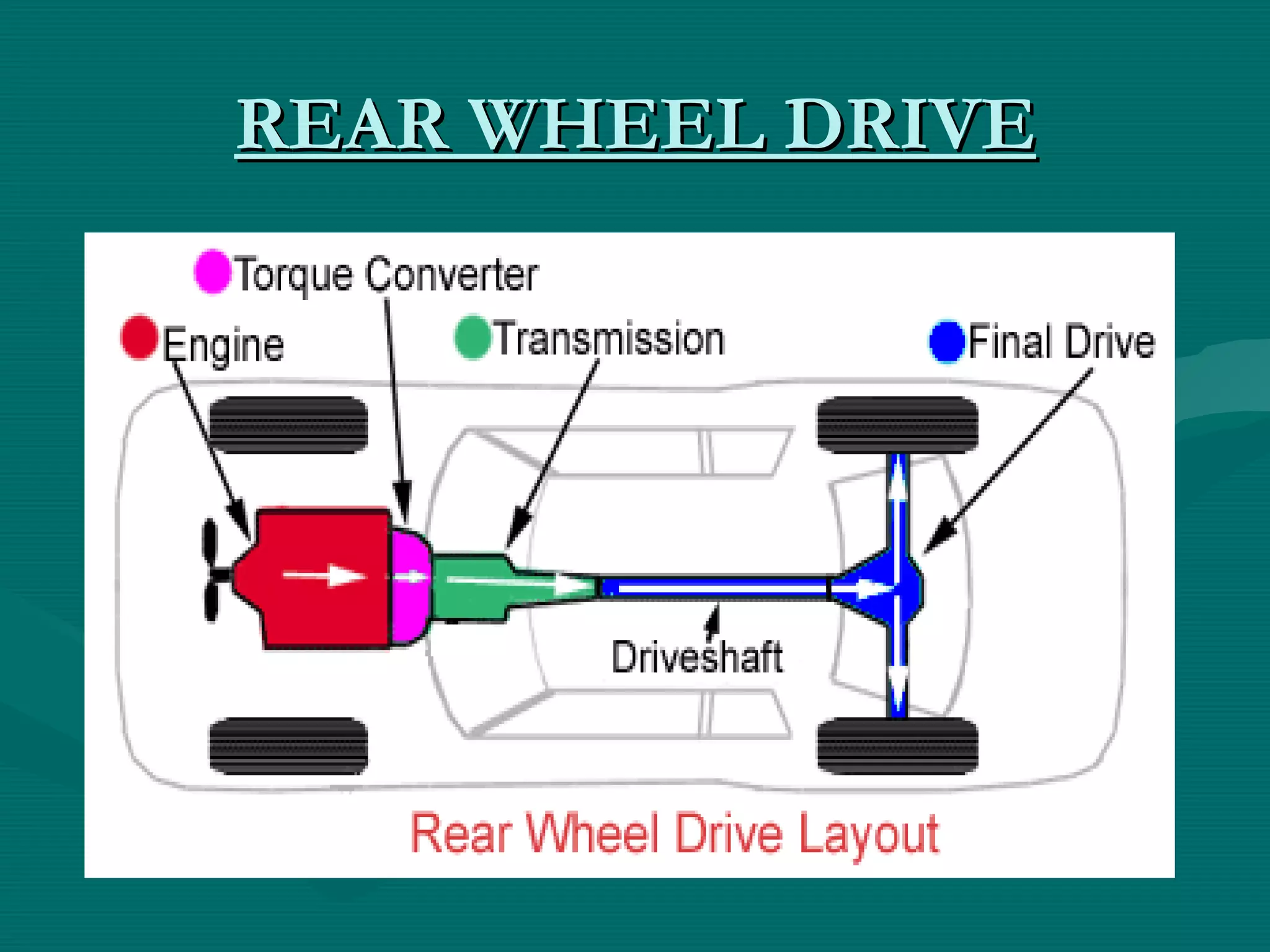
• The transmission is usually mounted to the
  back of the engine.

•  Power flow on this system is simple and
  straight forward going from the engine,
  through the torque converter, then through
  the transmission and drive shaft until it
  reaches the final drive where it is split and
  sent to the two rear wheels.
• Example of rear wheel – Alpha Romeo
  Alfeta in early 70’s
REAR WHEEL DRIVE
FRONT WHEEL DRIVE
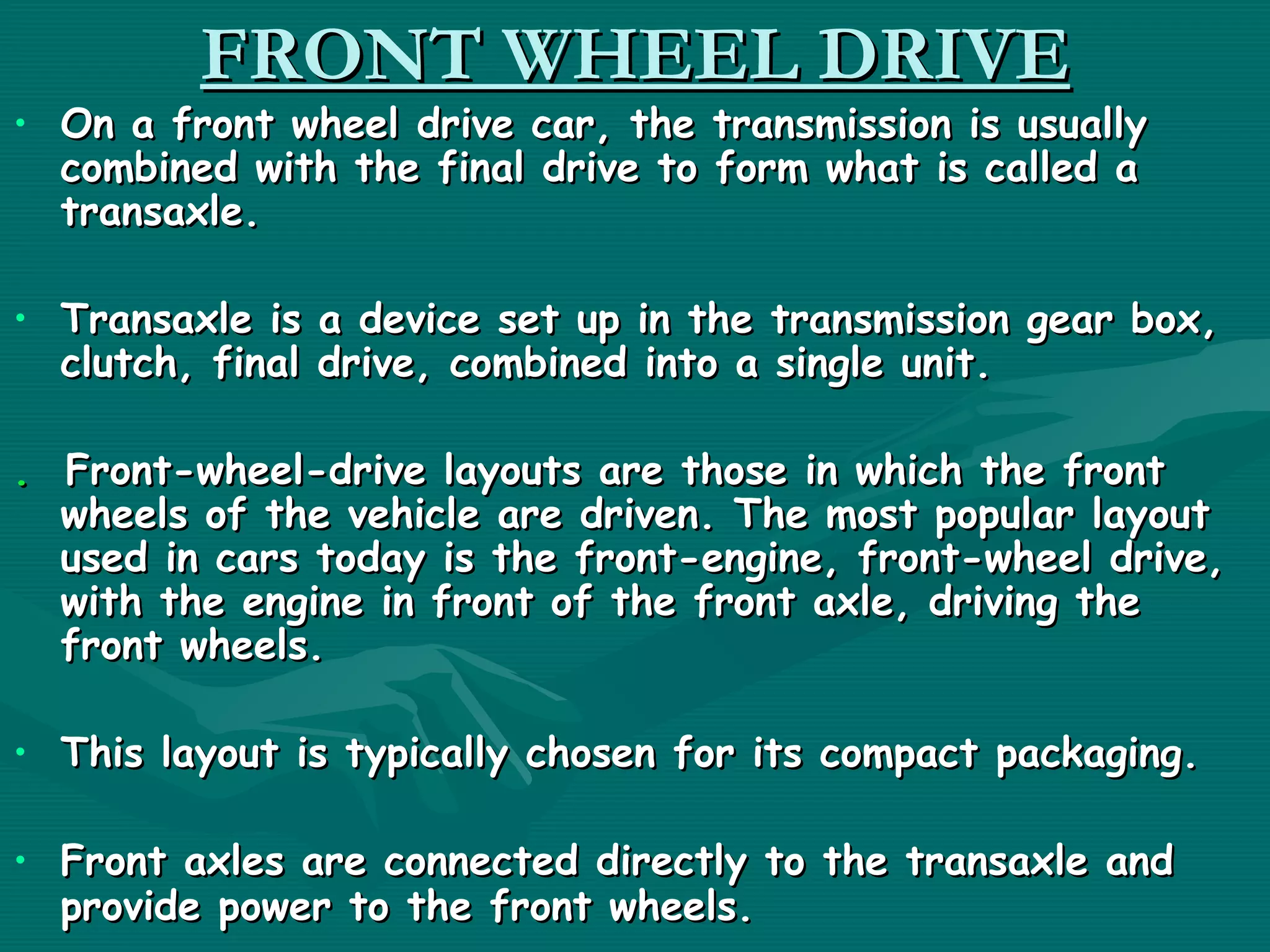
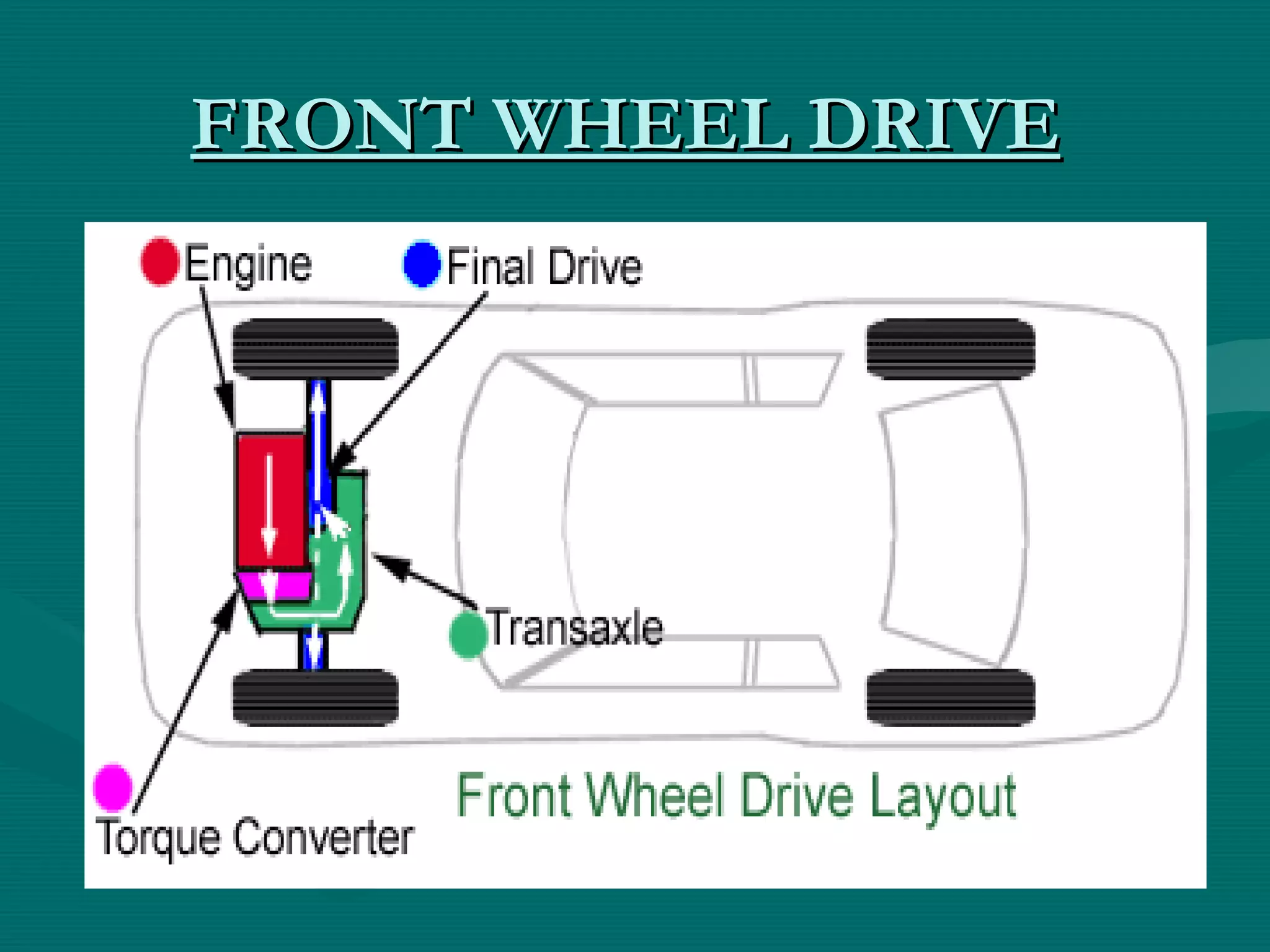
• On a front wheel drive car, the transmission is usually
  combined with the final drive to form what is called a
  transaxle.

• Transaxle is a device set up in the transmission gear box,
  clutch, final drive, combined into a single unit.

. Front-wheel-drive layouts are those in which the front
  wheels of the vehicle are driven. The most popular layout
  used in cars today is the front-engine, front-wheel drive,
  with the engine in front of the front axle, driving the
  front wheels.

• This layout is typically chosen for its compact packaging. 

• Front axles are connected directly to the transaxle and
  provide power to the front wheels. 
FRONT WHEEL DRIVE
TRANSMISSION COMPONENTS
• Planetary Gear Sets
• Hydraulic System
            Oil Pump
            Valve Body
            Clutches
             Band
•   Seals and Gaskets
•   Torque Converter
•   Governor
•   Computer Controls
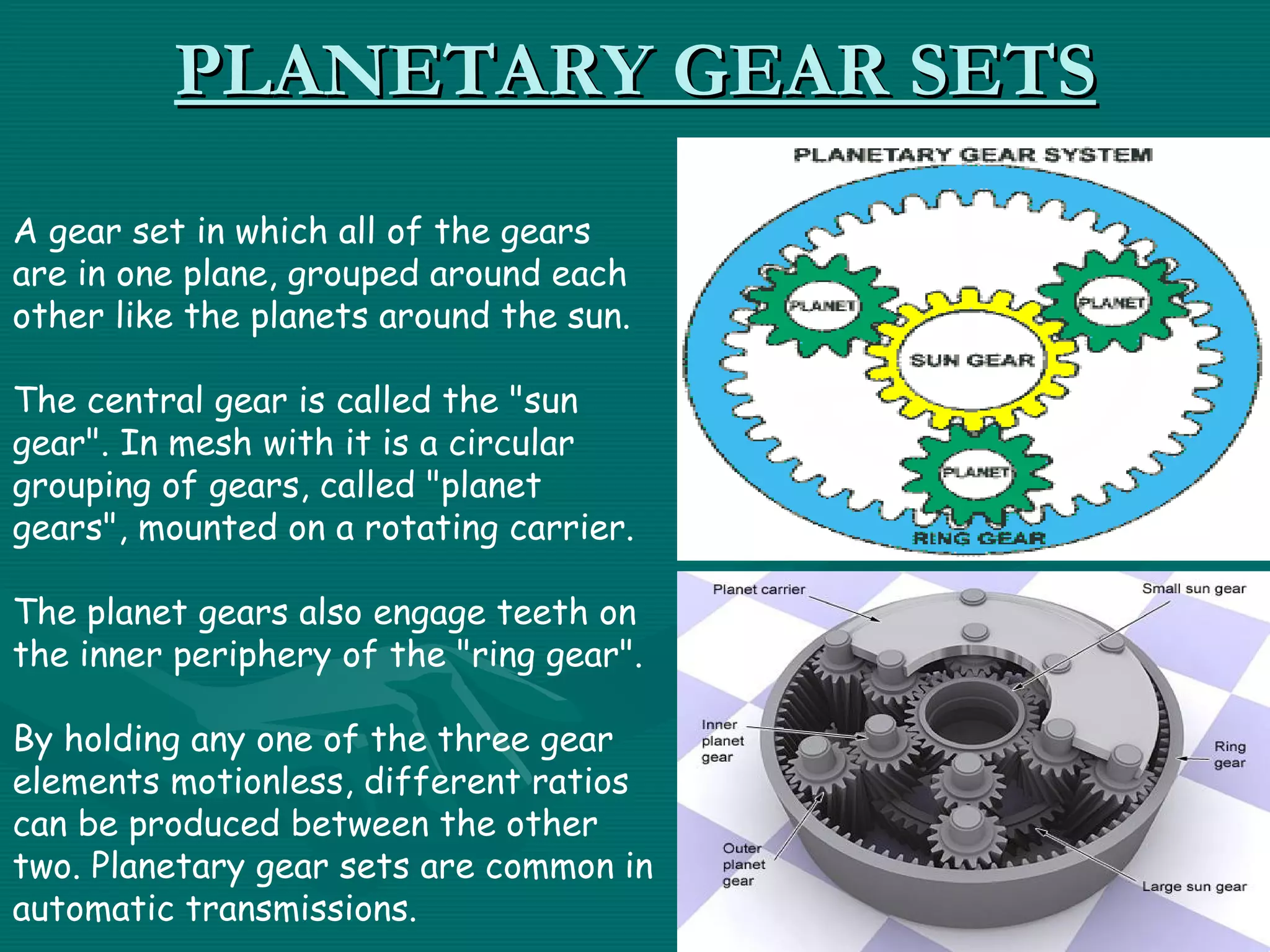
PLANETARY GEAR SETS
A gear set in which all of the gears
are in one plane, grouped around each
other like the planets around the sun.

The central gear is called the "sun
gear". In mesh with it is a circular
grouping of gears, called "planet
gears", mounted on a rotating carrier.

The planet gears also engage teeth on
the inner periphery of the "ring gear".

By holding any one of the three gear
elements motionless, different ratios
can be produced between the other
two. Planetary gear sets are common in
automatic transmissions.
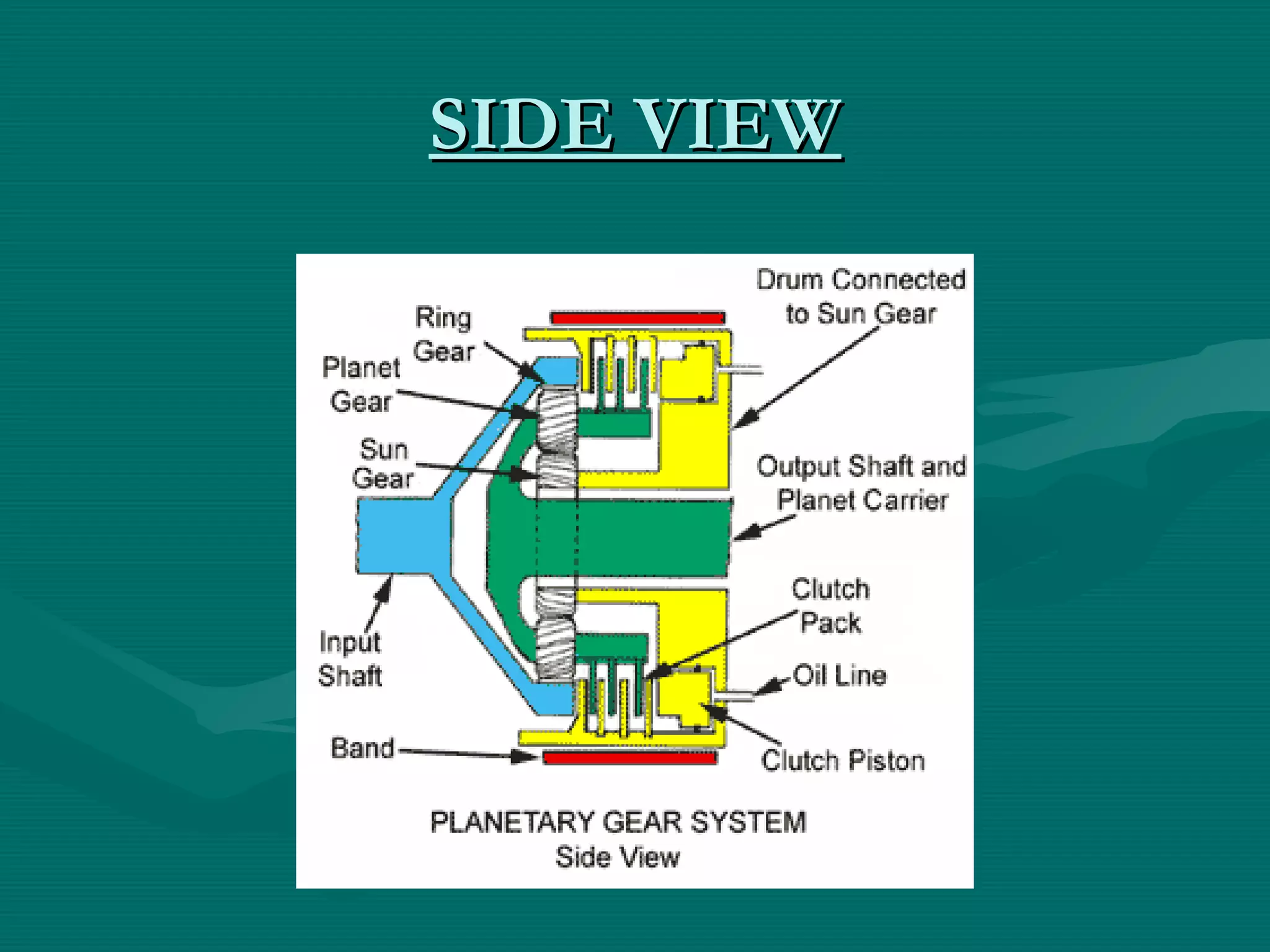
SIDE VIEW
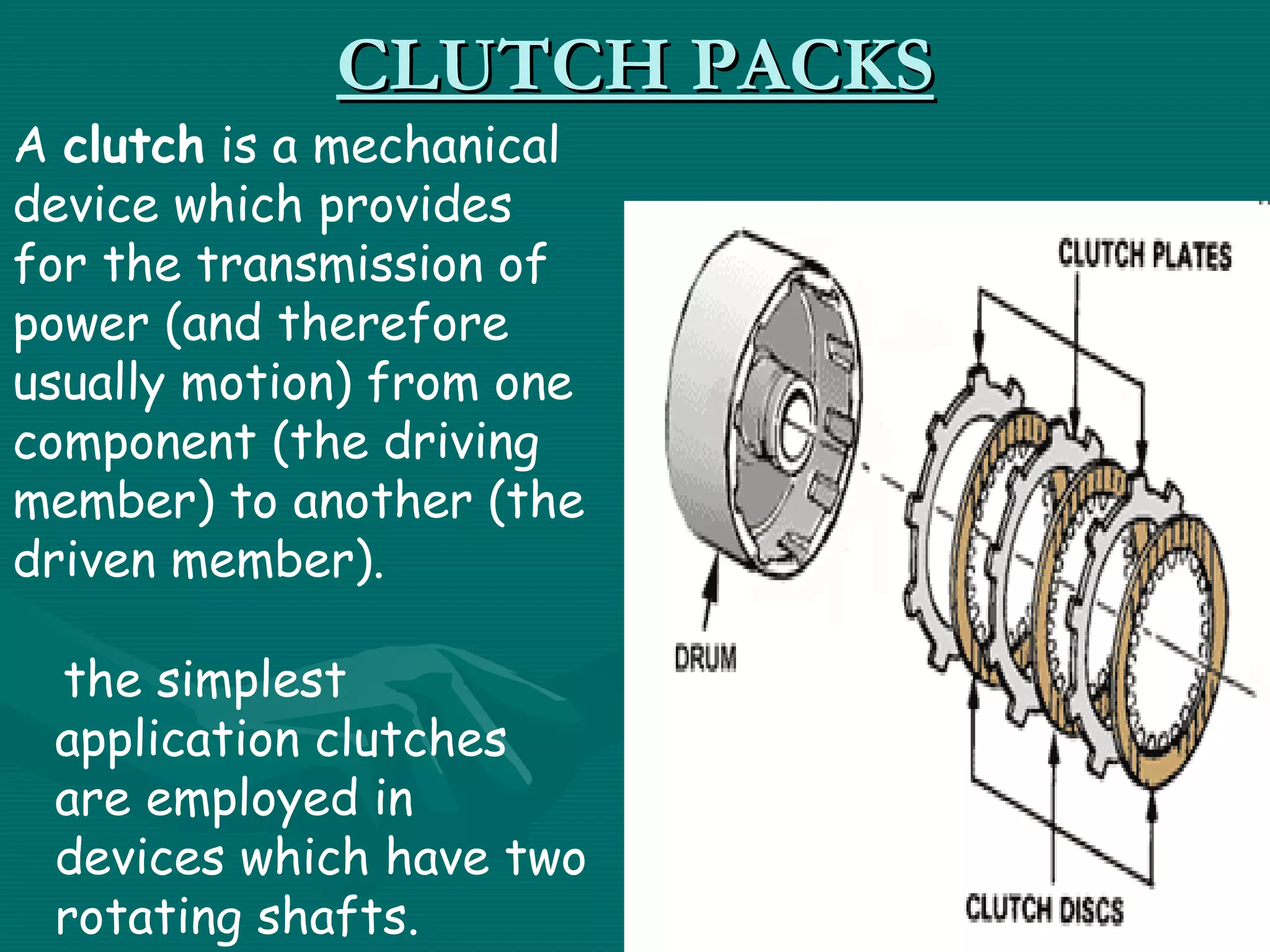
CLUTCH PACKS
A clutch is a mechanical
device which provides
for the transmission of
power (and therefore
usually motion) from one
component (the driving
member) to another (the
driven member).

  the simplest
 application clutches
 are employed in
 devices which have two
 rotating shafts.
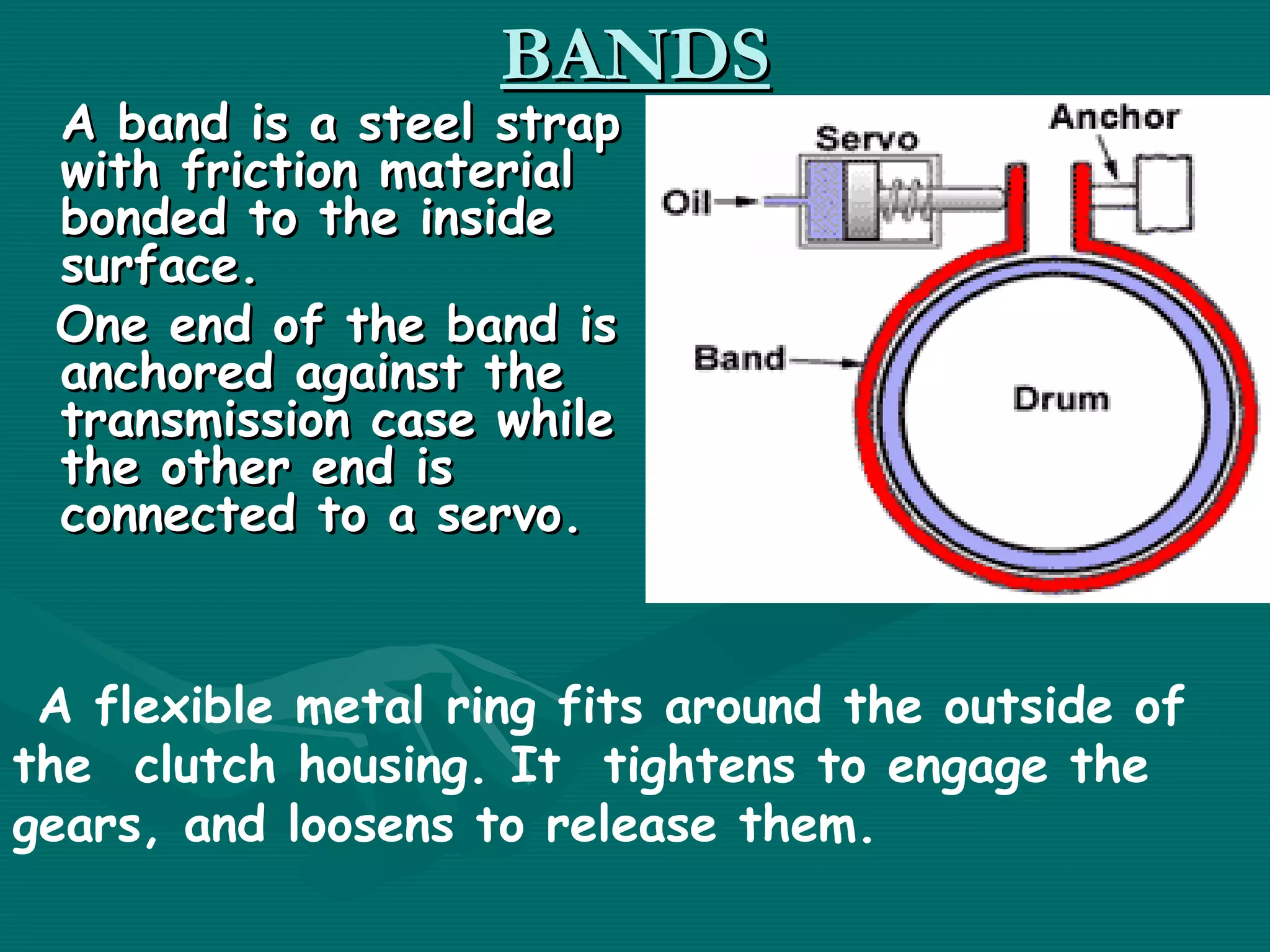
BANDS
 A band is a steel strap
 with friction material
 bonded to the inside
 surface. 
 One end of the band is
 anchored against the
 transmission case while
 the other end is
 connected to a servo.


 A flexible metal ring fits around the outside of
the clutch housing. It tightens to engage the
gears, and loosens to release them.
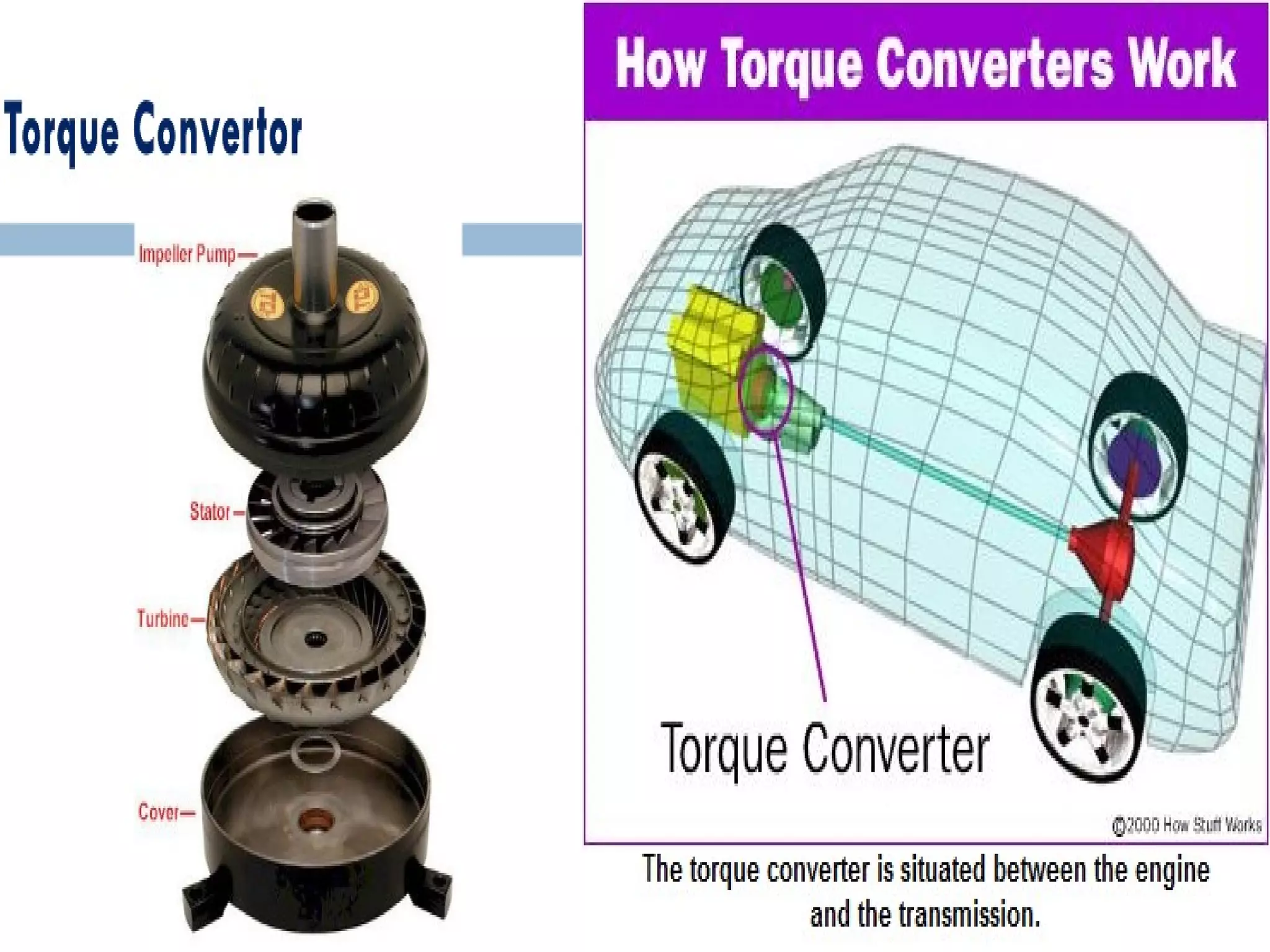
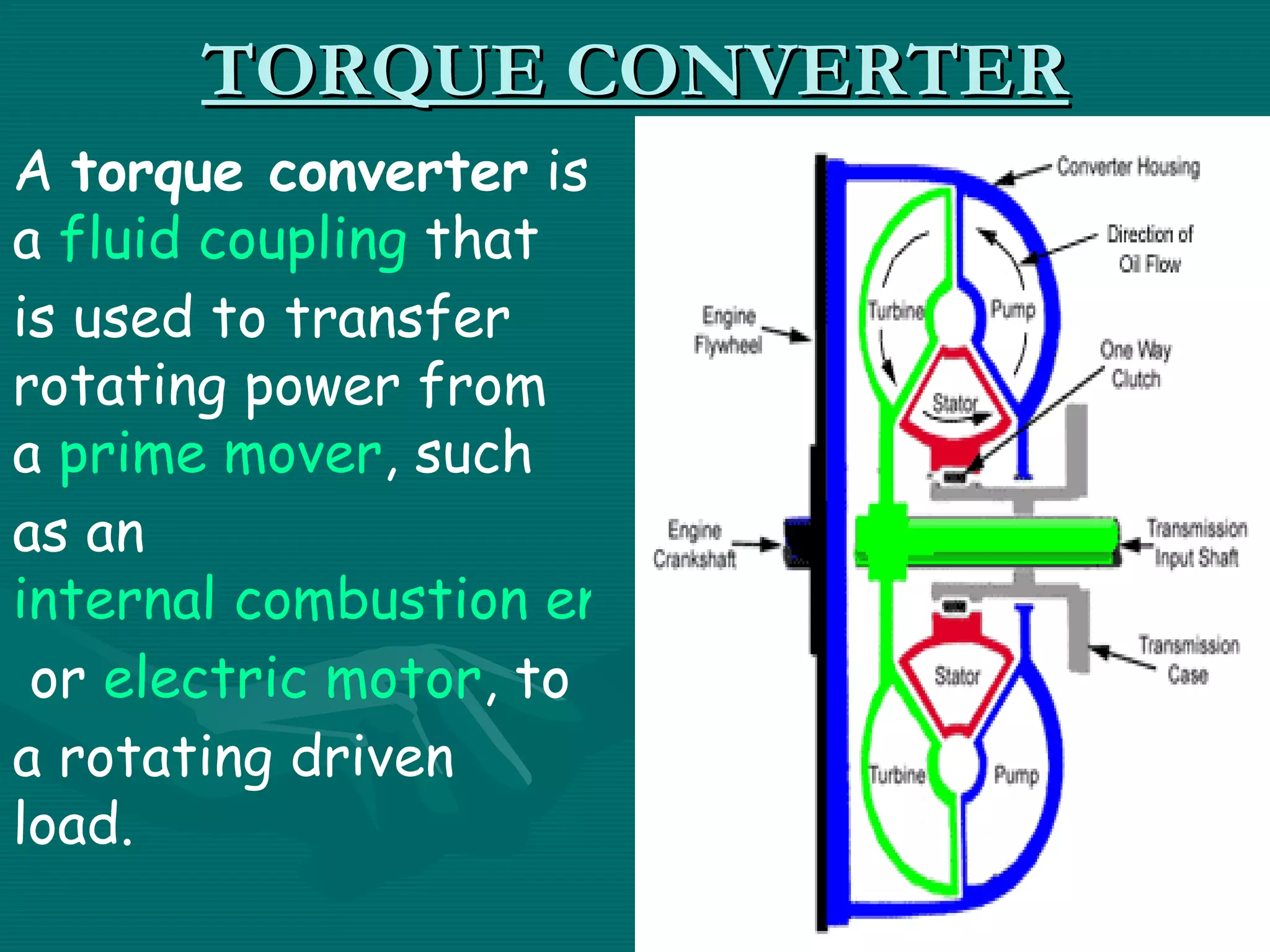
TORQUE CONVERTER
A torque converter is
a fluid coupling that
is used to transfer
rotating power from
a prime mover, such
as an 
internal combustion engine
 or electric motor, to
a rotating driven
load.
HYDRAULIC SYSTEM
•   The Hydraulic system is a complex
    maze of passages and tubes that
    sends transmission fluid under
    pressure to all parts of the
    transmission and torque converter
•   It works with some components.

          Oil Pump
          Valve Body
COMPUTER CONTROLS
The computer uses sensors on the
engine and  transmission to detect such
things as throttle position, vehicle
speed, engine speed, engine load, brake
pedal position, etc. to control exact
shift points as well as how soft or firm
the shift should be.  Once the
computer receives this information, it
then sends signals to a solenoid pack
inside the transmission
NON-COMPUTERIZED
       TRANSMISSIONS
• Governor

• Vacuum Modulator

• Throttle Cable

• Seals and Gaskets
SPOTTING PROBLEMS BEFORE
     THEY GET WORSE

• Watch for leaks or stains under the car.

• Check fluid for color and odor.

• Be sensitive to new noises, vibrations and
  shift behavior.
TRANSMISSION REPAIRS
• Adjustments and In-Car Repairs

• Reseal job

• Replace accessible parts

• Complete Overhaul

• Replacement unit vs. overhaul existing
  unit
Conclusion
• Being able to drive a stick-shift means more
  than just understanding your gears, however.
  That's because to shift gears, you usually
  don't just move the shift lever and be done
  with it. (You can do this sometimes, but it's
  not recommended in day-to-day driving, and
  we'll get to it later.) Instead, you have to
  press the clutch pedal while you shift. .
  Keeping the transmission and its fluid cool,
  and in the correct operating-temperature
  range is crucial for long life.
References-
                   www.drivetrain.com
                                ZF Sachs AG
                              Ernst-Sachs-Straße 62
                              D-97424 Schweinfurt
                                  Germany
                                www.zf.com
    ZF Sachs Product Information PC A Automated Manual Transmission en ebook
                   www.sciencedirect.com
                          www.scribd.co
                       www.youtube.com
  http://www.gears-gearbox.com/semi-automatic-
                transmission.html
www.fueleconomy.gov/feg/tech_transmission.shtml
               Google , Wikipedia.
“THANK YOU”

Automatic transmission system ppt

  • 1.
    A seminar Report On “Automatic Transmission System” Submitted by: VIJAY KUMAR (4VV07ME054) VIII Semester Mechanical Engineering VVCE, Mysore On : APRIL 13TH 2011 Under the valuable guidance of : SRI D V SATISH SRI G B KRISHNAPPA Asst. Professor Professor & HOD Dept. of Mechanical Engg. Dept. of Mechanical Engg. VVCE Mysore VVCE Mysore Department of Mechanical Engineering VidyaVardhaka College of Engineering
  • 2.
    INTRODUCTION The modern automatictransmission is by far, the most complicated mechanical component in today’s automobile.  Automatic transmissions contain Mechanical systems, Hydraulic systems, Electrical systems and Computer controls, all working together in perfect harmony which goes virtually unnoticed until there is a problem.
  • 3.
    WHAT IS TRANSMISSION? • The transmission is a device that is connected to the back of the engine and sends the power from the engine to the drive wheels • Purpose of the transmission is to provide high torque at the time of starting the engine, hill climbing , accelerating and pulling a road.
  • 4.
    TYPES OF AUTOMATIC TRANSMISSION • Rear wheel drive • Front wheel drive
  • 5.
    REAR WHEEL DRIVE •The transmission is usually mounted to the back of the engine. • Power flow on this system is simple and straight forward going from the engine, through the torque converter, then through the transmission and drive shaft until it reaches the final drive where it is split and sent to the two rear wheels. • Example of rear wheel – Alpha Romeo Alfeta in early 70’s
  • 6.
  • 7.
    FRONT WHEEL DRIVE •On a front wheel drive car, the transmission is usually combined with the final drive to form what is called a transaxle. • Transaxle is a device set up in the transmission gear box, clutch, final drive, combined into a single unit. . Front-wheel-drive layouts are those in which the front wheels of the vehicle are driven. The most popular layout used in cars today is the front-engine, front-wheel drive, with the engine in front of the front axle, driving the front wheels. • This layout is typically chosen for its compact packaging.  • Front axles are connected directly to the transaxle and provide power to the front wheels. 
  • 8.
  • 9.
    TRANSMISSION COMPONENTS • PlanetaryGear Sets • Hydraulic System Oil Pump Valve Body Clutches  Band • Seals and Gaskets • Torque Converter • Governor • Computer Controls
  • 10.
    PLANETARY GEAR SETS Agear set in which all of the gears are in one plane, grouped around each other like the planets around the sun. The central gear is called the "sun gear". In mesh with it is a circular grouping of gears, called "planet gears", mounted on a rotating carrier. The planet gears also engage teeth on the inner periphery of the "ring gear". By holding any one of the three gear elements motionless, different ratios can be produced between the other two. Planetary gear sets are common in automatic transmissions.
  • 11.
  • 12.
    CLUTCH PACKS A clutch is amechanical device which provides for the transmission of power (and therefore usually motion) from one component (the driving member) to another (the driven member).  the simplest application clutches are employed in devices which have two rotating shafts.
  • 13.
    BANDS A bandis a steel strap with friction material bonded to the inside surface.  One end of the band is anchored against the transmission case while the other end is connected to a servo. A flexible metal ring fits around the outside of the clutch housing. It tightens to engage the gears, and loosens to release them.
  • 15.
    TORQUE CONVERTER A torque converter is a fluidcoupling that is used to transfer rotating power from a prime mover, such as an  internal combustion engine  or electric motor, to a rotating driven load.
  • 16.
    HYDRAULIC SYSTEM • The Hydraulic system is a complex maze of passages and tubes that sends transmission fluid under pressure to all parts of the transmission and torque converter • It works with some components.  Oil Pump  Valve Body
  • 17.
    COMPUTER CONTROLS The computeruses sensors on the engine and  transmission to detect such things as throttle position, vehicle speed, engine speed, engine load, brake pedal position, etc. to control exact shift points as well as how soft or firm the shift should be.  Once the computer receives this information, it then sends signals to a solenoid pack inside the transmission
  • 18.
    NON-COMPUTERIZED TRANSMISSIONS • Governor • Vacuum Modulator • Throttle Cable • Seals and Gaskets
  • 19.
    SPOTTING PROBLEMS BEFORE THEY GET WORSE • Watch for leaks or stains under the car. • Check fluid for color and odor. • Be sensitive to new noises, vibrations and shift behavior.
  • 20.
    TRANSMISSION REPAIRS • Adjustmentsand In-Car Repairs • Reseal job • Replace accessible parts • Complete Overhaul • Replacement unit vs. overhaul existing unit
  • 21.
    Conclusion • Being ableto drive a stick-shift means more than just understanding your gears, however. That's because to shift gears, you usually don't just move the shift lever and be done with it. (You can do this sometimes, but it's not recommended in day-to-day driving, and we'll get to it later.) Instead, you have to press the clutch pedal while you shift. . Keeping the transmission and its fluid cool, and in the correct operating-temperature range is crucial for long life.
  • 22.
    References- www.drivetrain.com ZF Sachs AG Ernst-Sachs-Straße 62 D-97424 Schweinfurt Germany www.zf.com ZF Sachs Product Information PC A Automated Manual Transmission en ebook www.sciencedirect.com www.scribd.co www.youtube.com http://www.gears-gearbox.com/semi-automatic- transmission.html www.fueleconomy.gov/feg/tech_transmission.shtml Google , Wikipedia.
  • 23.