

CHASSIS
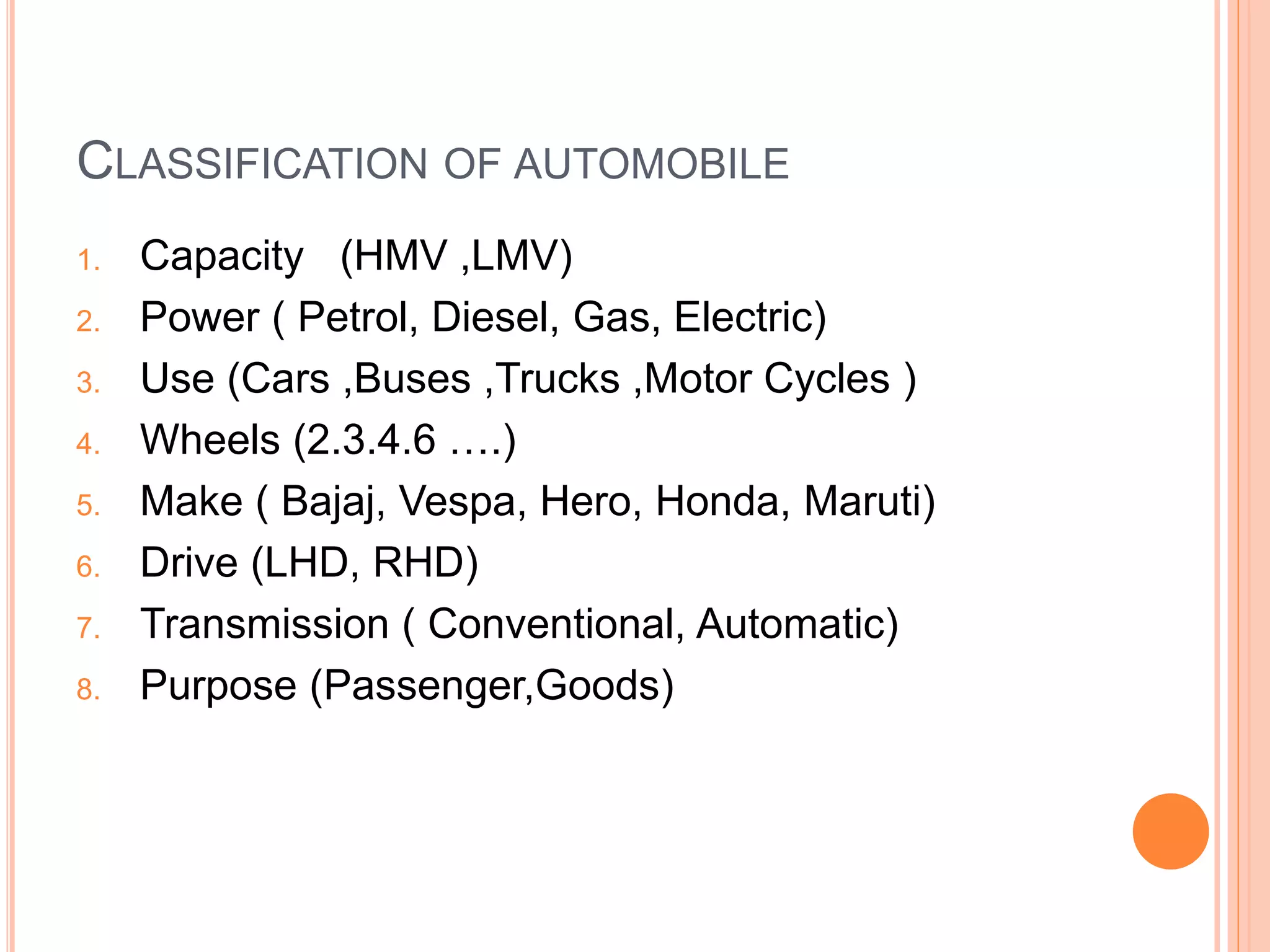
CLASSIFICATION OF AUTOMOBILE
1. Capacity (HMV ,LMV)
2. Power ( Petrol, Diesel, Gas, Electric)
3. Use (Cars ,Buses ,Trucks ,Motor Cycles )
4. Wheels (2.3.4.6 ….)
5. Make ( Bajaj, Vespa, Hero, Honda, Maruti)
6. Drive (LHD, RHD)
7. Transmission ( Conventional, Automatic)
8. Purpose (Passenger,Goods)
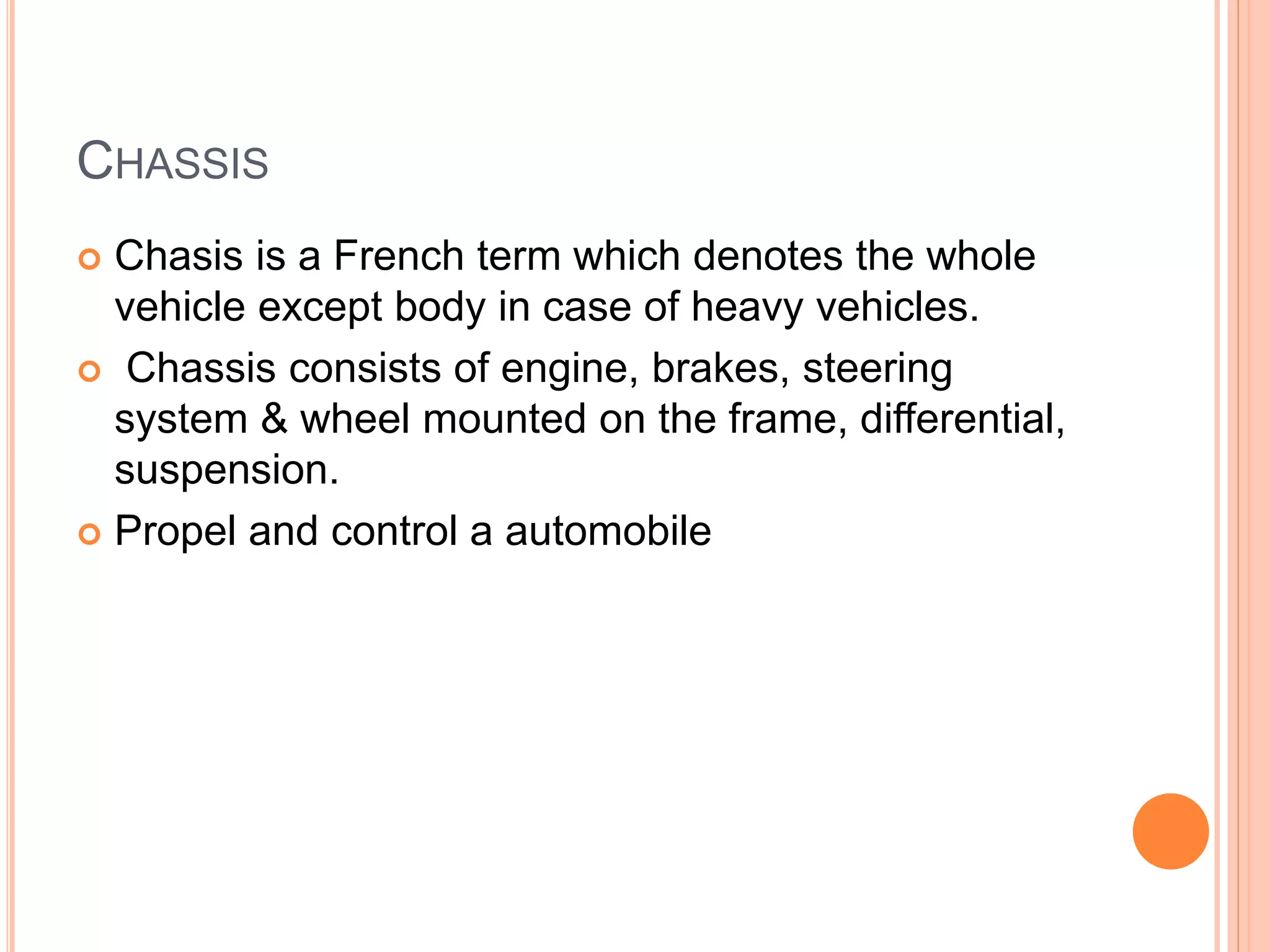
CHASSIS
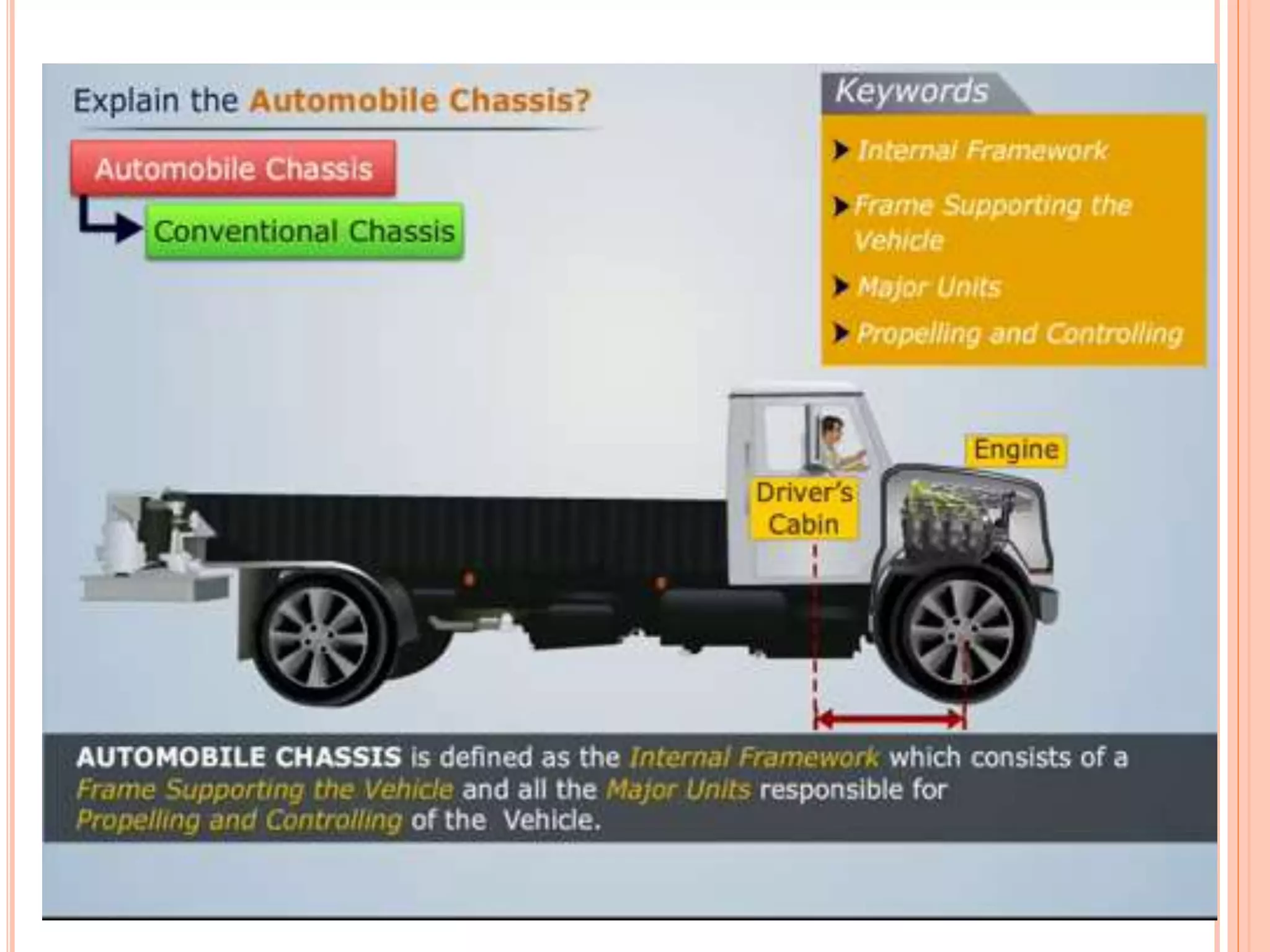
 Chasis is a French term which denotes the whole
vehicle except body in case of heavy vehicles.
 Chassis consists of engine, brakes, steering
system & wheel mounted on the frame, differential,
suspension.
 Propel and control a automobile
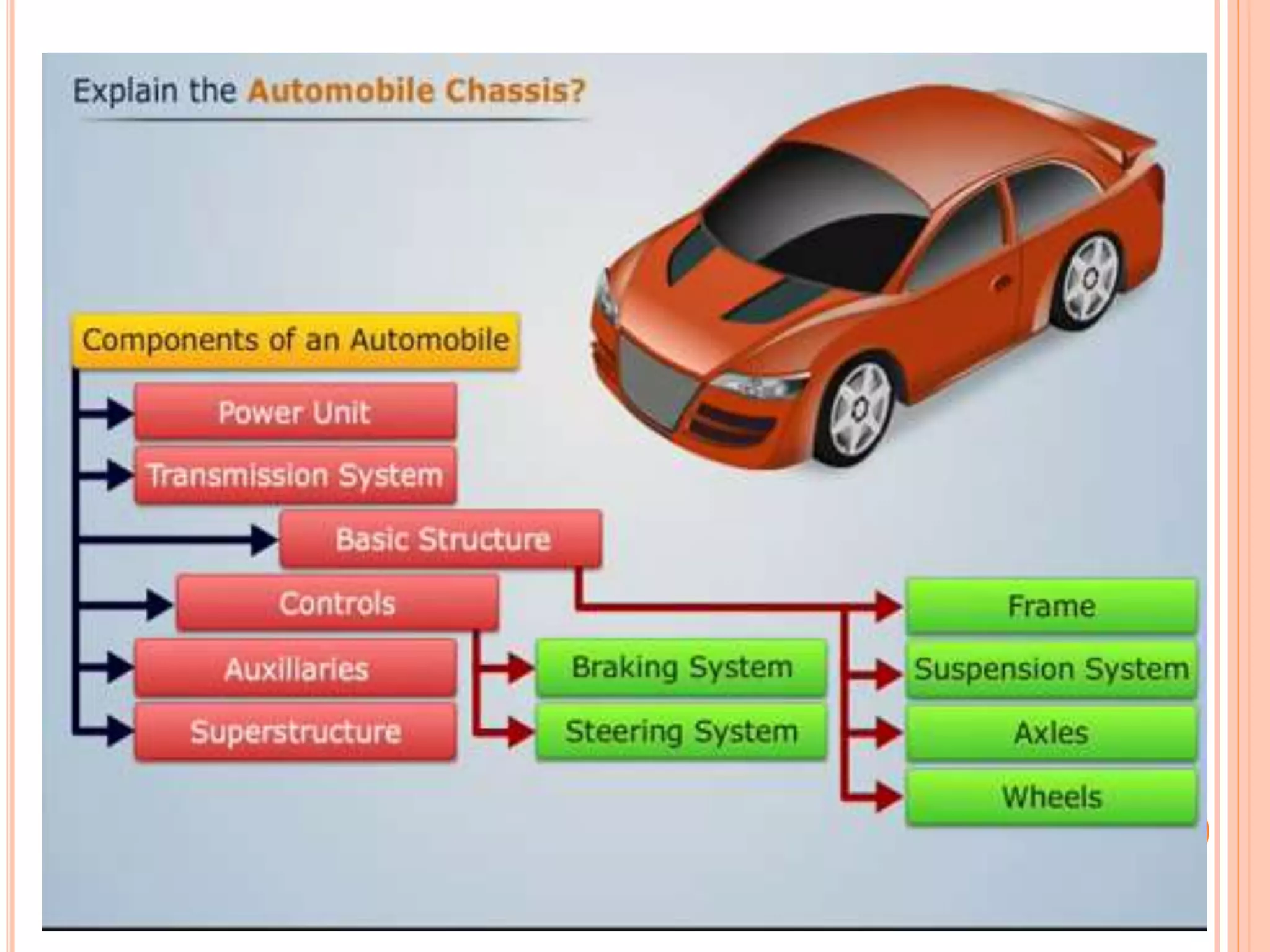
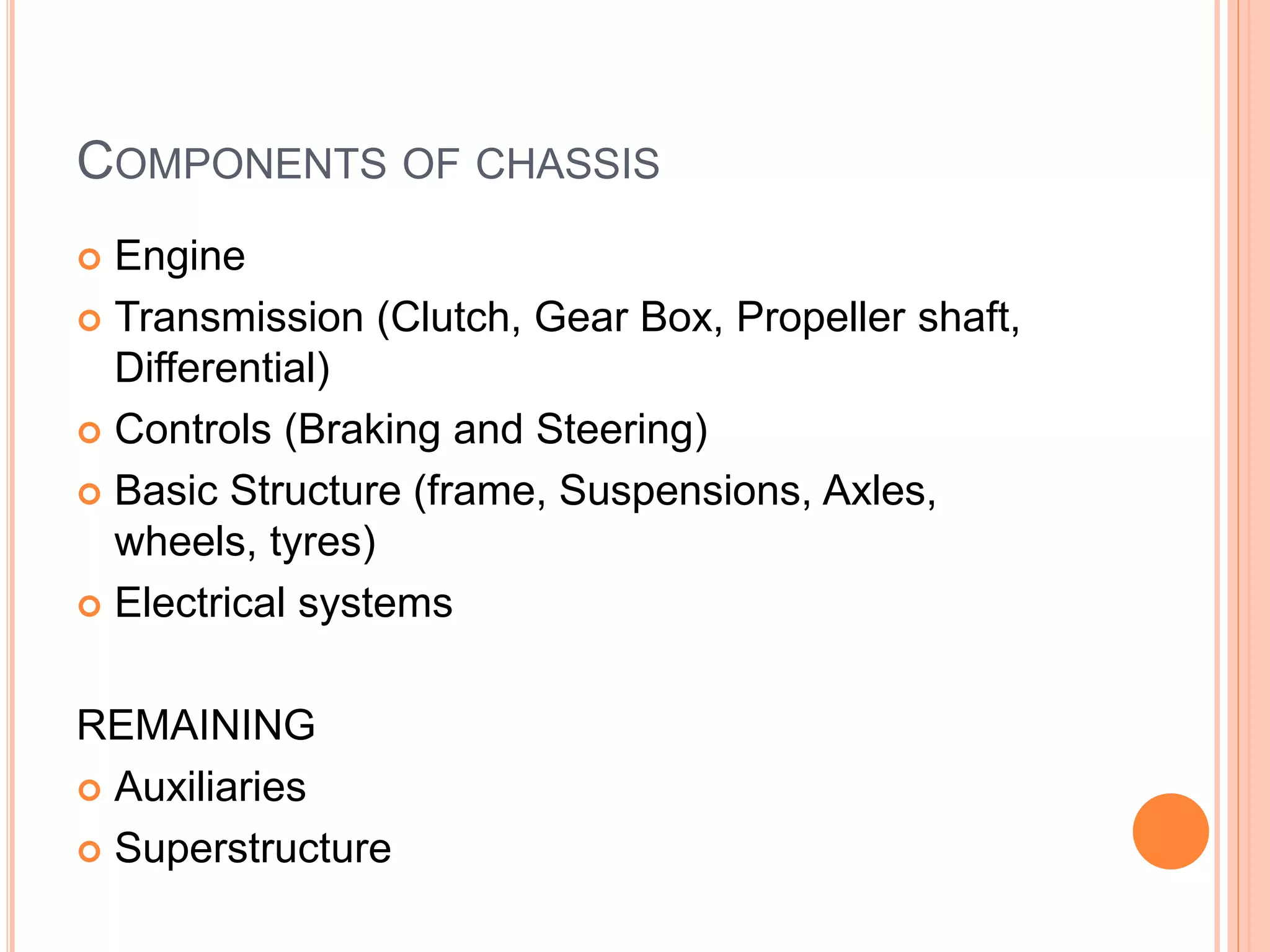
COMPONENTS OF CHASSIS
 Engine
 Transmission (Clutch, Gear Box, Propeller shaft,
Differential)
 Controls (Braking and Steering)
 Basic Structure (frame, Suspensions, Axles,
wheels, tyres)
 Electrical systems
REMAINING
 Auxiliaries
 Superstructure
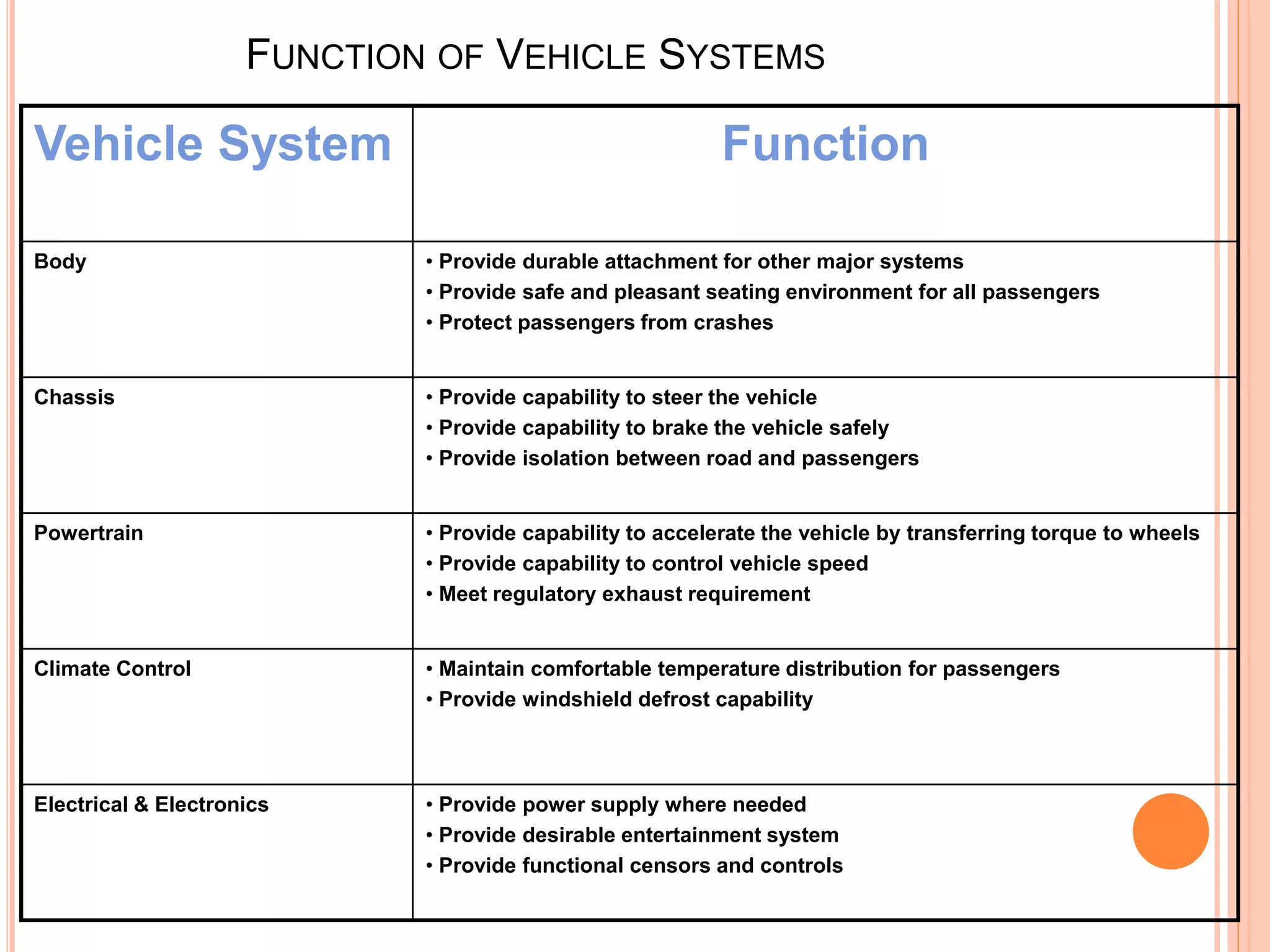
FUNCTION OF VEHICLE SYSTEMS
Vehicle System Function
Body • Provide durable attachment for other major systems
• Provide safe and pleasant seating environment for all passengers
• Protect passengers from crashes
Chassis • Provide capability to steer the vehicle
• Provide capability to brake the vehicle safely
• Provide isolation between road and passengers
Powertrain • Provide capability to accelerate the vehicle by transferring torque to wheels
• Provide capability to control vehicle speed
• Meet regulatory exhaust requirement
Climate Control • Maintain comfortable temperature distribution for passengers
• Provide windshield defrost capability
Electrical & Electronics • Provide power supply where needed
• Provide desirable entertainment system
• Provide functional censors and controls
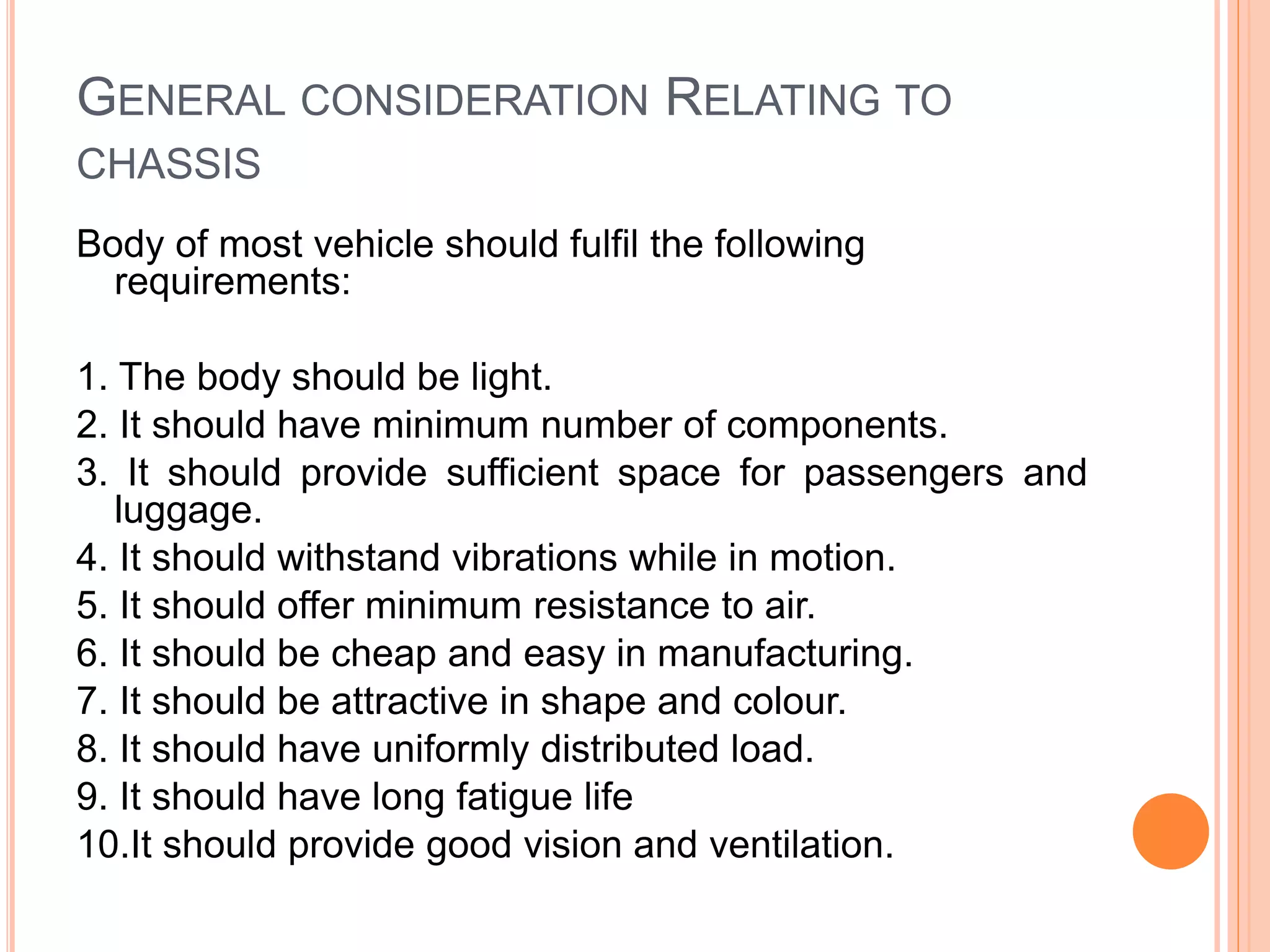
GENERAL CONSIDERATION RELATING TO
CHASSIS
Body of most vehicle should fulfil the following
requirements:
1. The body should be light.
2. It should have minimum number of components.
3. It should provide sufficient space for passengers and
luggage.
4. It should withstand vibrations while in motion.
5. It should offer minimum resistance to air.
6. It should be cheap and easy in manufacturing.
7. It should be attractive in shape and colour.
8. It should have uniformly distributed load.
9. It should have long fatigue life
10.It should provide good vision and ventilation.
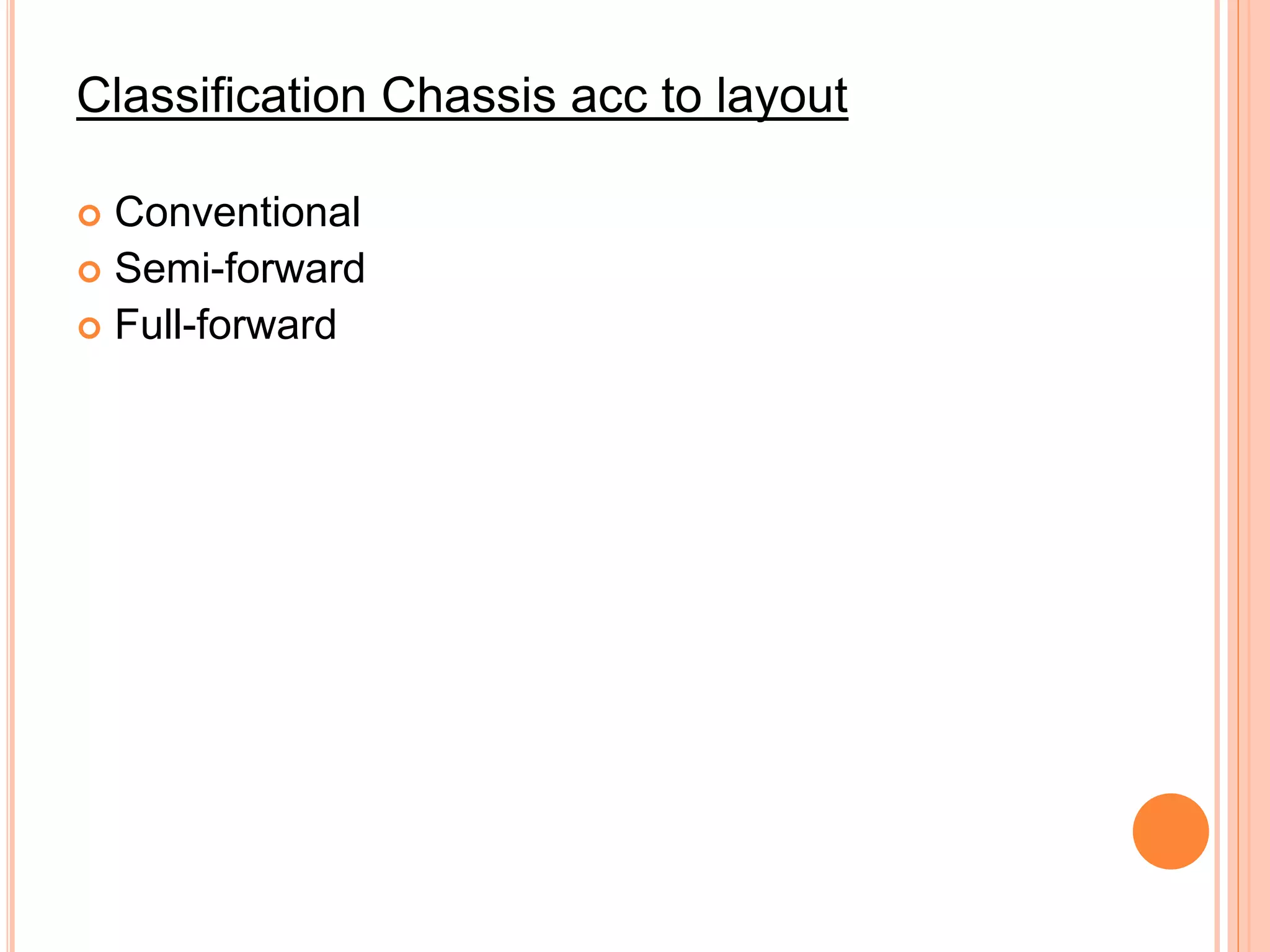
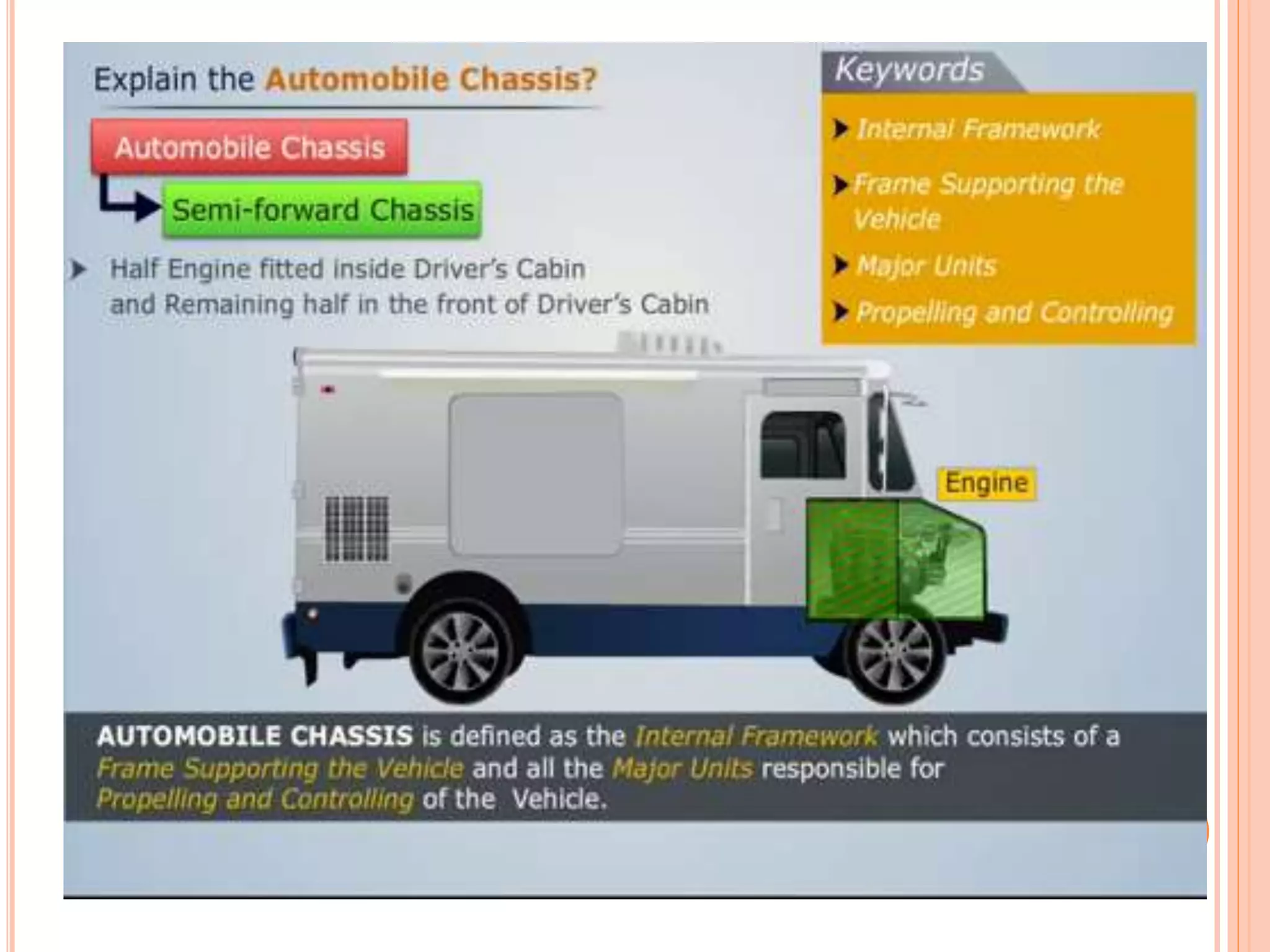
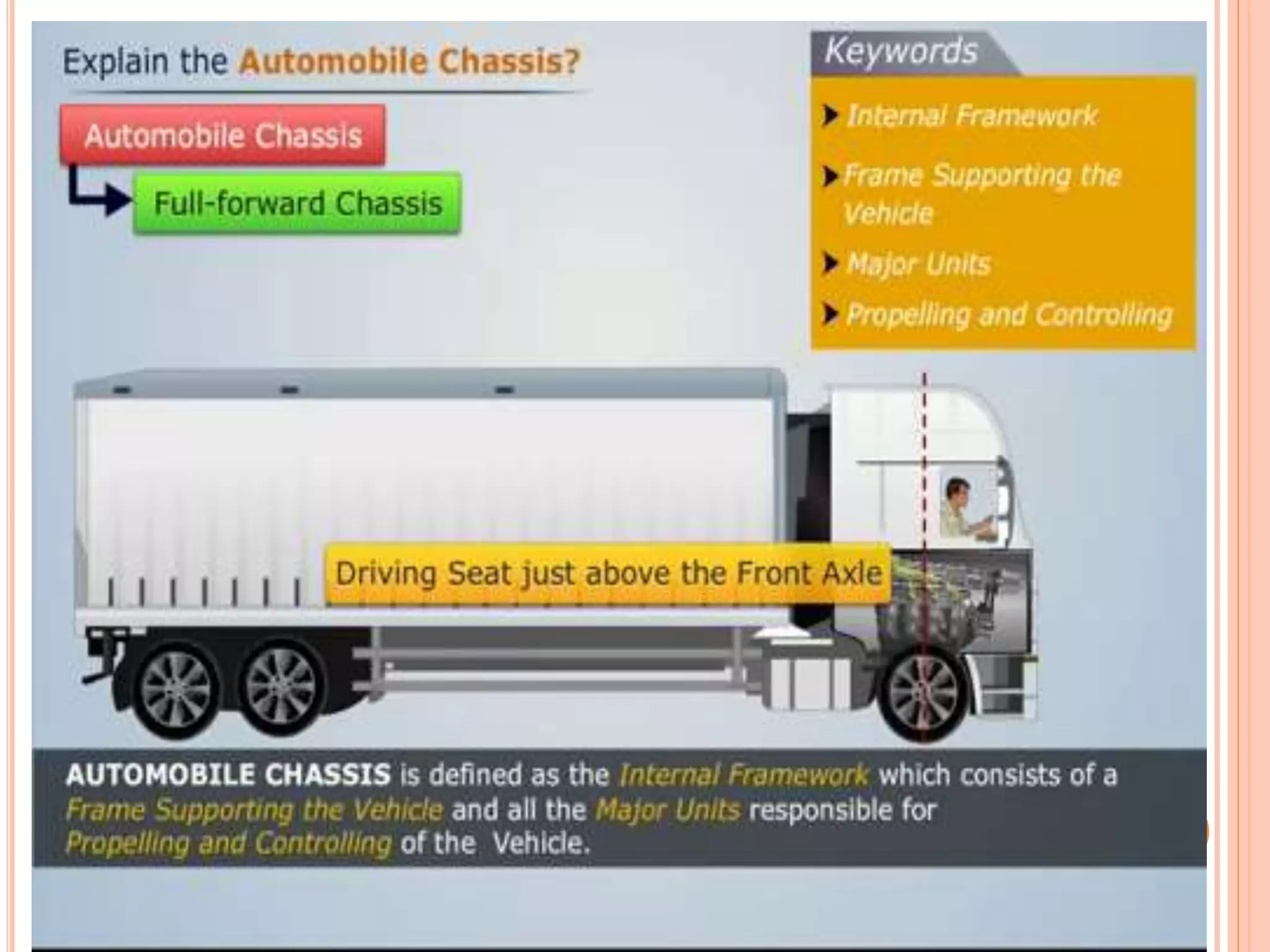
Classification Chassis acc to layout
 Conventional
 Semi-forward
 Full-forward
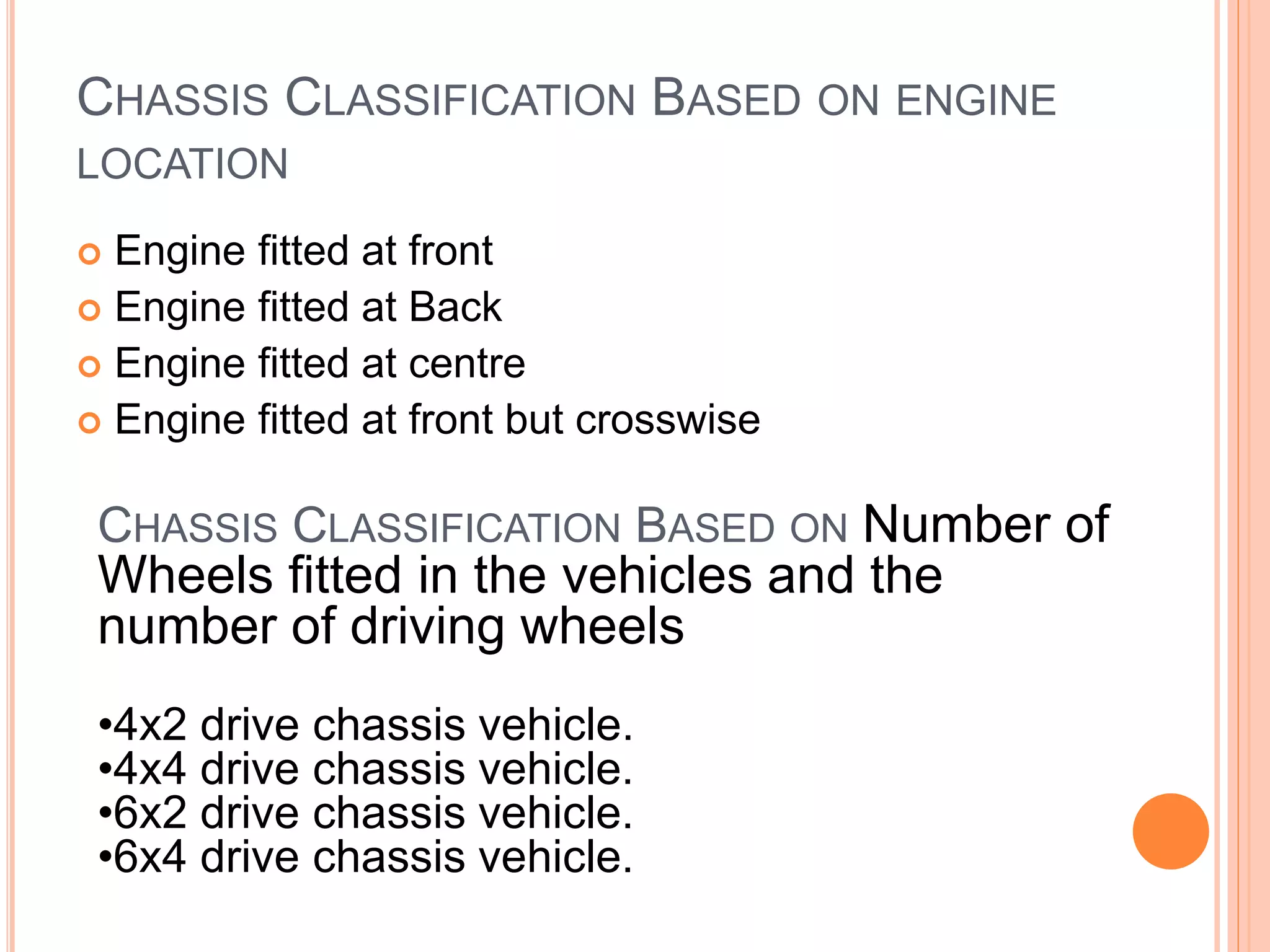
CHASSIS CLASSIFICATION BASED ON ENGINE
LOCATION
 Engine fitted at front
 Engine fitted at Back
 Engine fitted at centre
 Engine fitted at front but crosswise
CHASSIS CLASSIFICATION BASED ON Number of
Wheels fitted in the vehicles and the
number of driving wheels
•4x2 drive chassis vehicle.
•4x4 drive chassis vehicle.
•6x2 drive chassis vehicle.
•6x4 drive chassis vehicle.
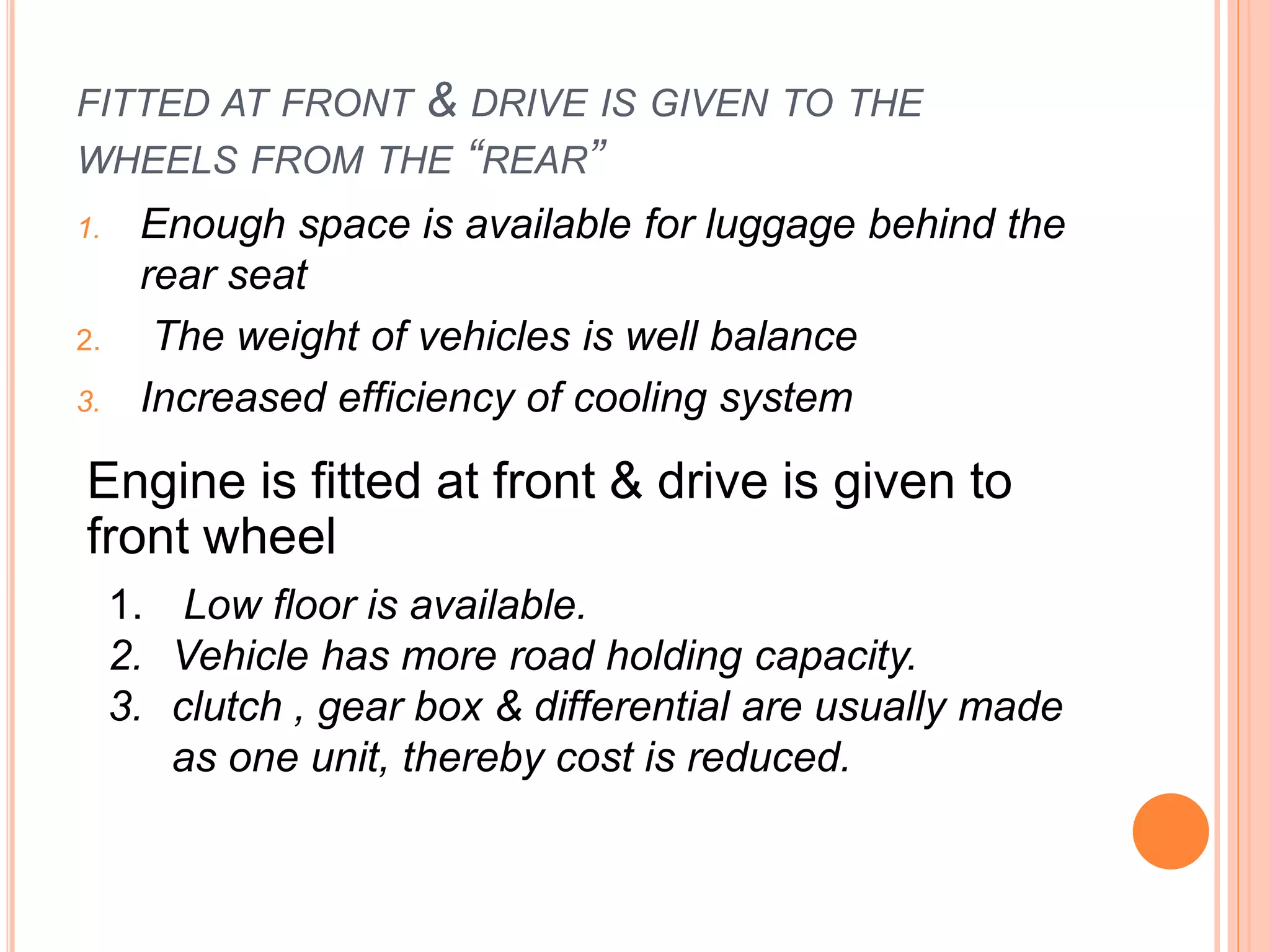
FITTED AT FRONT & DRIVE IS GIVEN TO THE
WHEELS FROM THE “REAR”
1. Enough space is available for luggage behind the
rear seat
2. The weight of vehicles is well balance
3. Increased efficiency of cooling system
Engine is fitted at front & drive is given to
front wheel
1. Low floor is available.
2. Vehicle has more road holding capacity.
3. clutch , gear box & differential are usually made
as one unit, thereby cost is reduced.
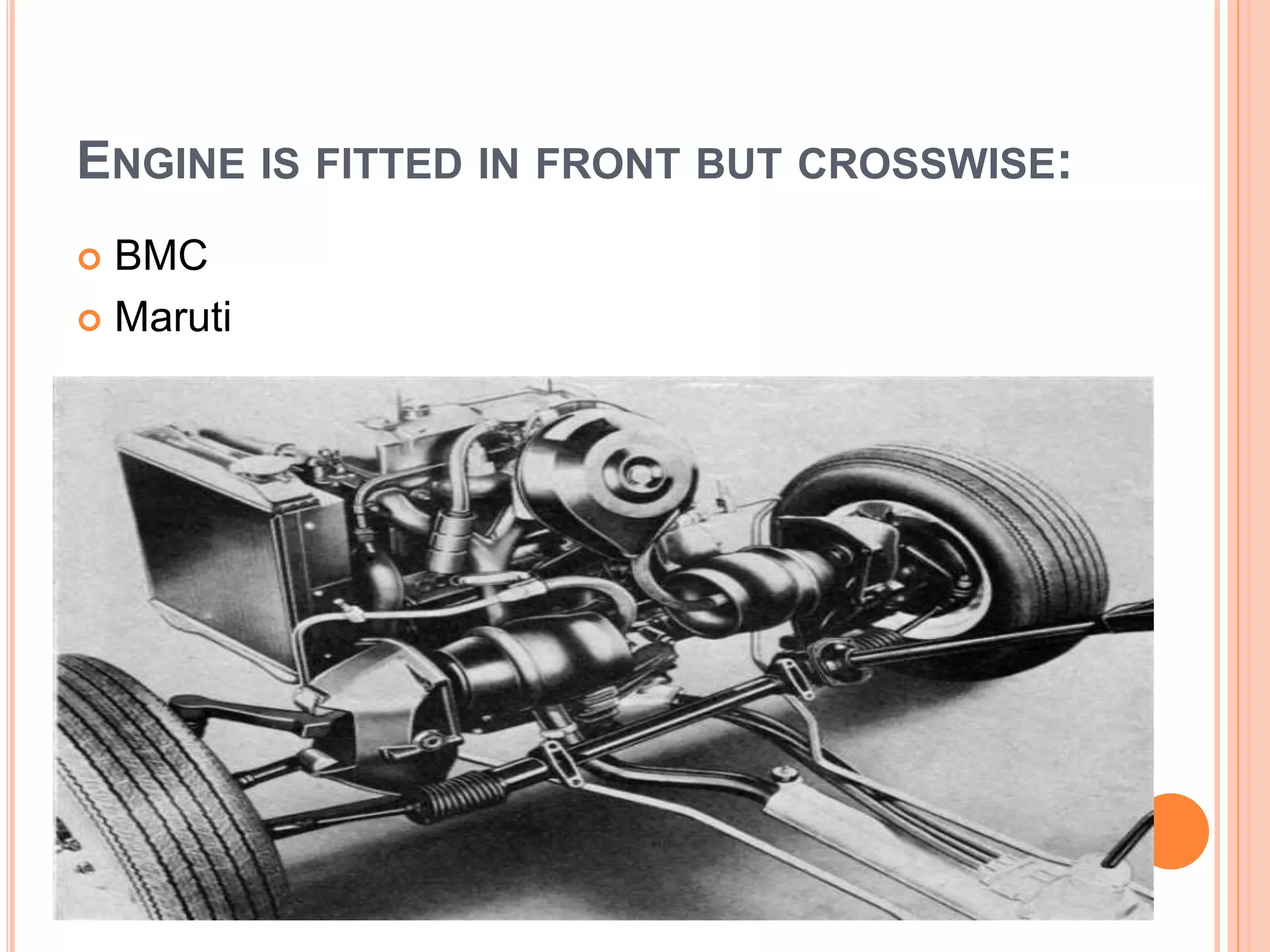
ENGINE IS FITTED IN FRONT BUT CROSSWISE:
 BMC
 Maruti
ENGINE FITTED AT THE CENTRE OF THE
CHASSIS:
 Drive is given to the rear
 As in royal tiger world master buses
 This arrangement provide full space of floor for use
ENGINE FITTED AT BACK
1. Flat floor is available since long propeller shafts are
eliminated
2. With elimination of propeller shaft the centre of gravity
lowered giving stable driving
3. Better adhesion on road specially when climbing hill.
4. While Climbing hills proper adhesion may be affected
since the weight of vehicles moves to the rear , thereby
reducing the weight on the front wheel.
5. As a result of grouping of the engine with clutch, gear
box and differential, the repair and adjustment become
difficult due to congestion at the rear.
FRAMES
TYPES OF CHASSIS FRAMES:
THERE ARE THREE TYPES OF FRAMES
1. CONVENTIONAL FRAME
2. INTEGRAL FRAME
3. SEMI-INTEGRAL FRAME
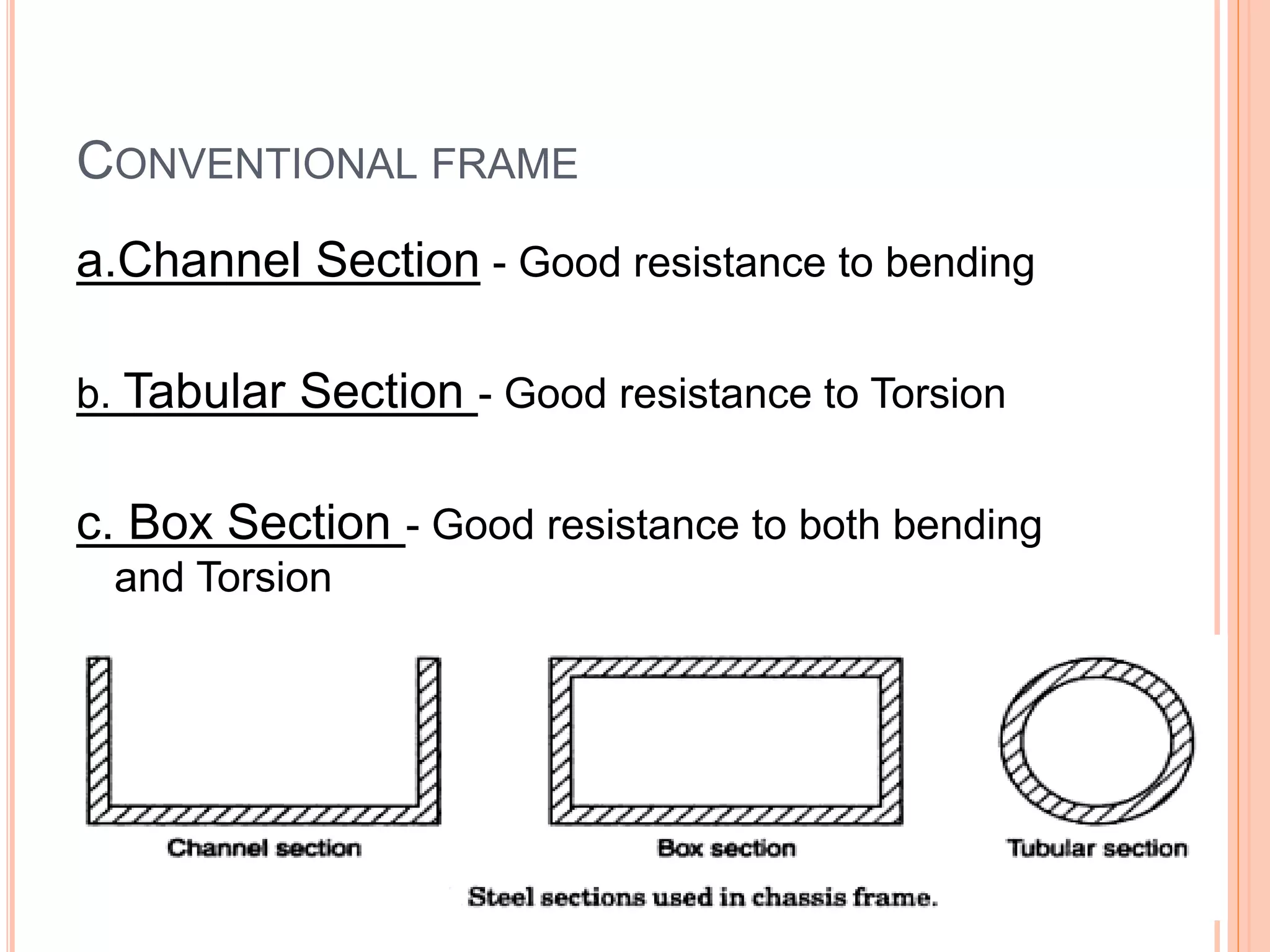
CONVENTIONAL FRAME
a.Channel Section - Good resistance to bending
b. Tabular Section - Good resistance to Torsion
c. Box Section - Good resistance to both bending
and Torsion
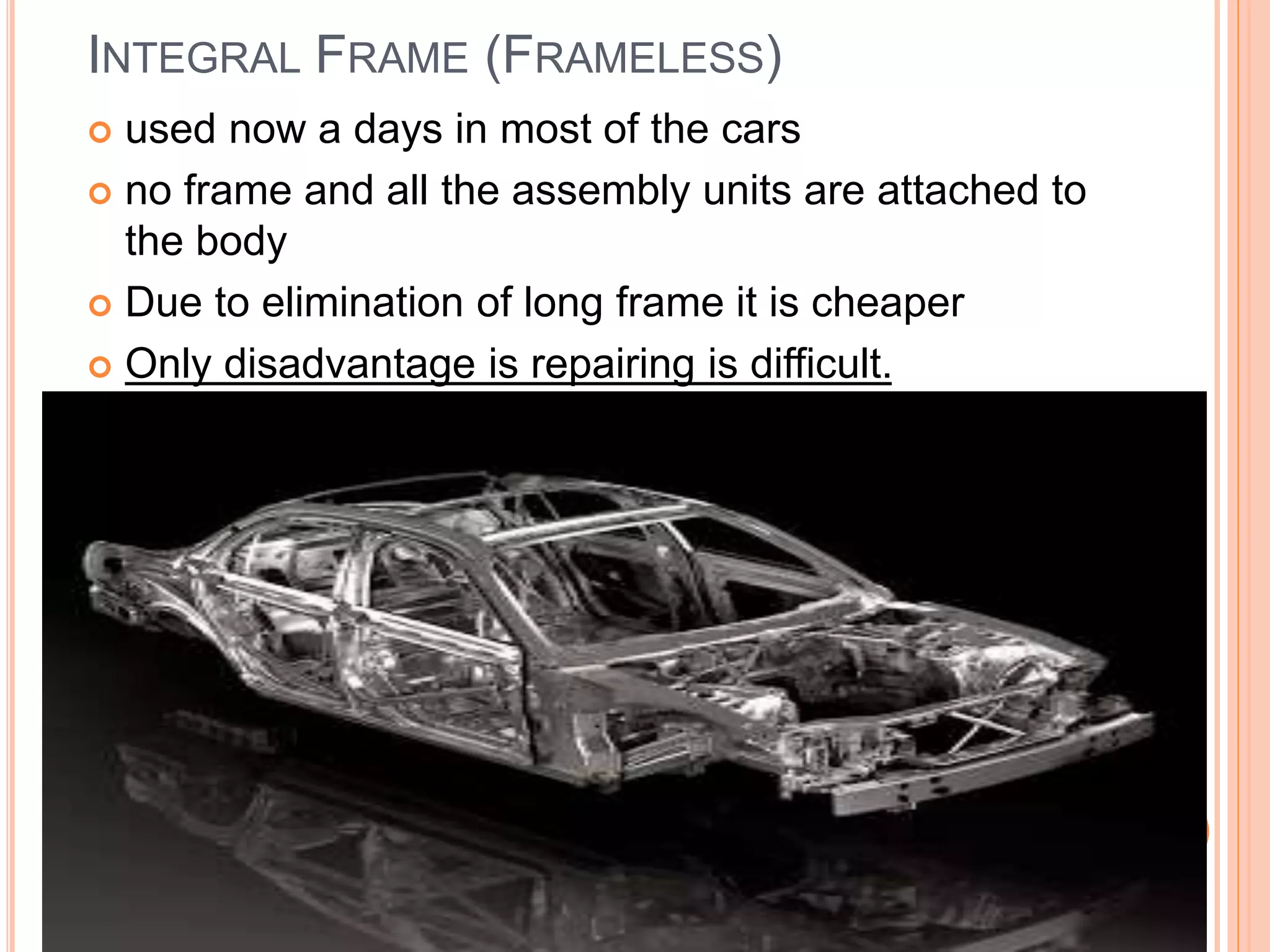
INTEGRAL FRAME (FRAMELESS)
 used now a days in most of the cars
 no frame and all the assembly units are attached to
the body
 Due to elimination of long frame it is cheaper
 Only disadvantage is repairing is difficult.
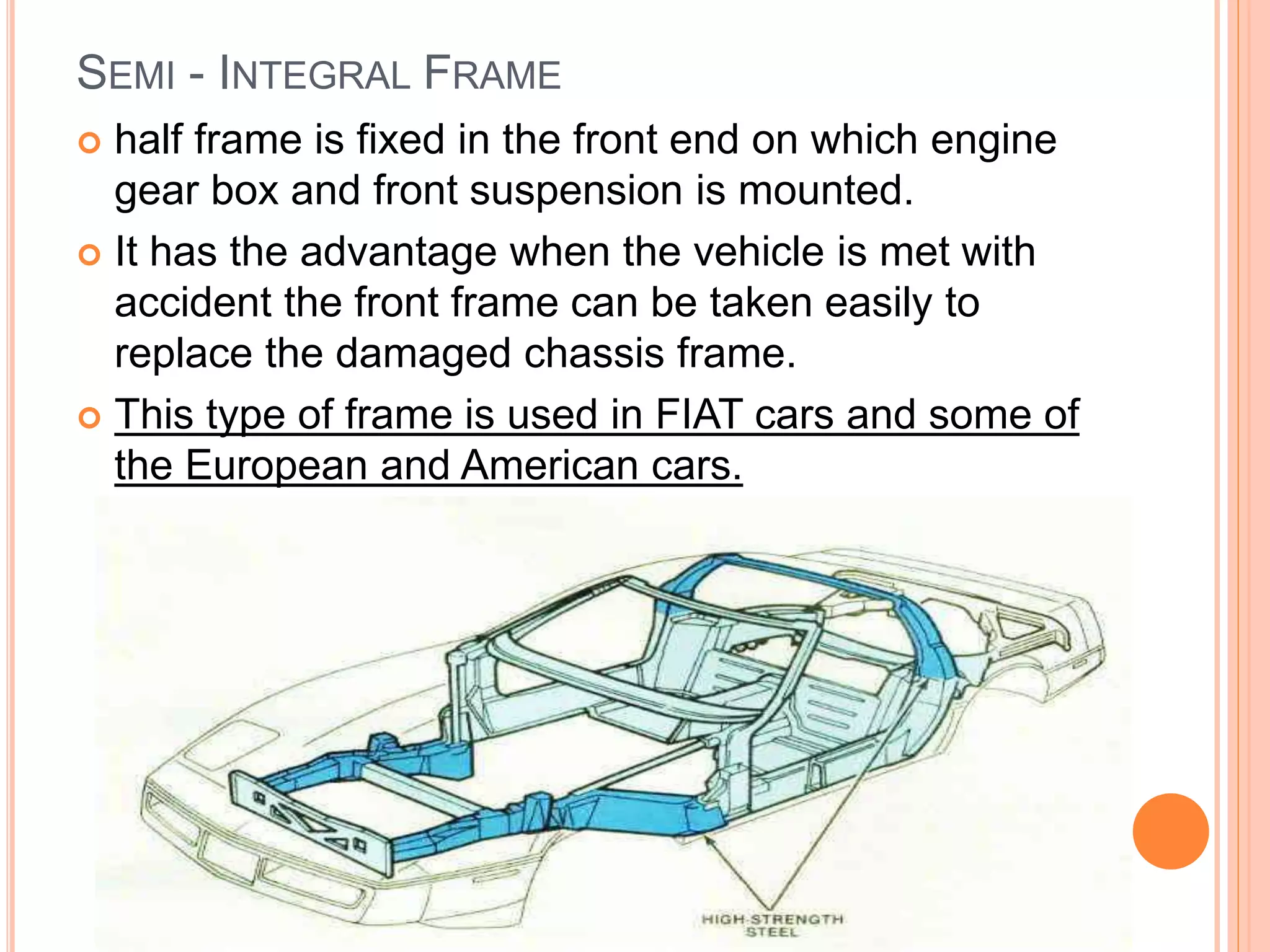
SEMI - INTEGRAL FRAME
 half frame is fixed in the front end on which engine
gear box and front suspension is mounted.
 It has the advantage when the vehicle is met with
accident the front frame can be taken easily to
replace the damaged chassis frame.
 This type of frame is used in FIAT cars and some of
the European and American cars.
SOME OF IMPORTANT CHASSIS FRAMES ARE:
 Ladder Frame
 Tabular Space Frame
 Monocoque Frame
 Aluminum Space Frame
 Carbon Fibre frame
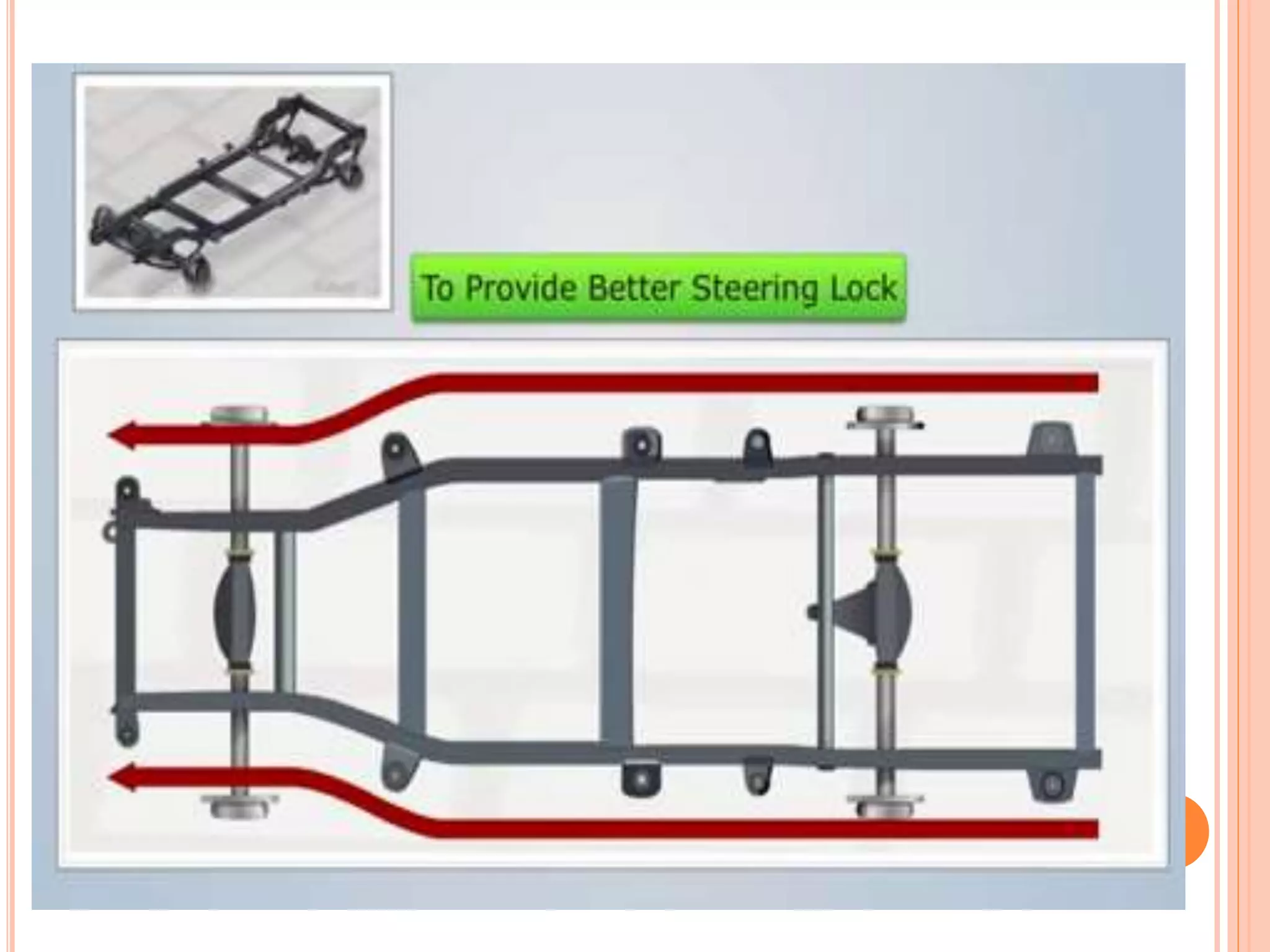
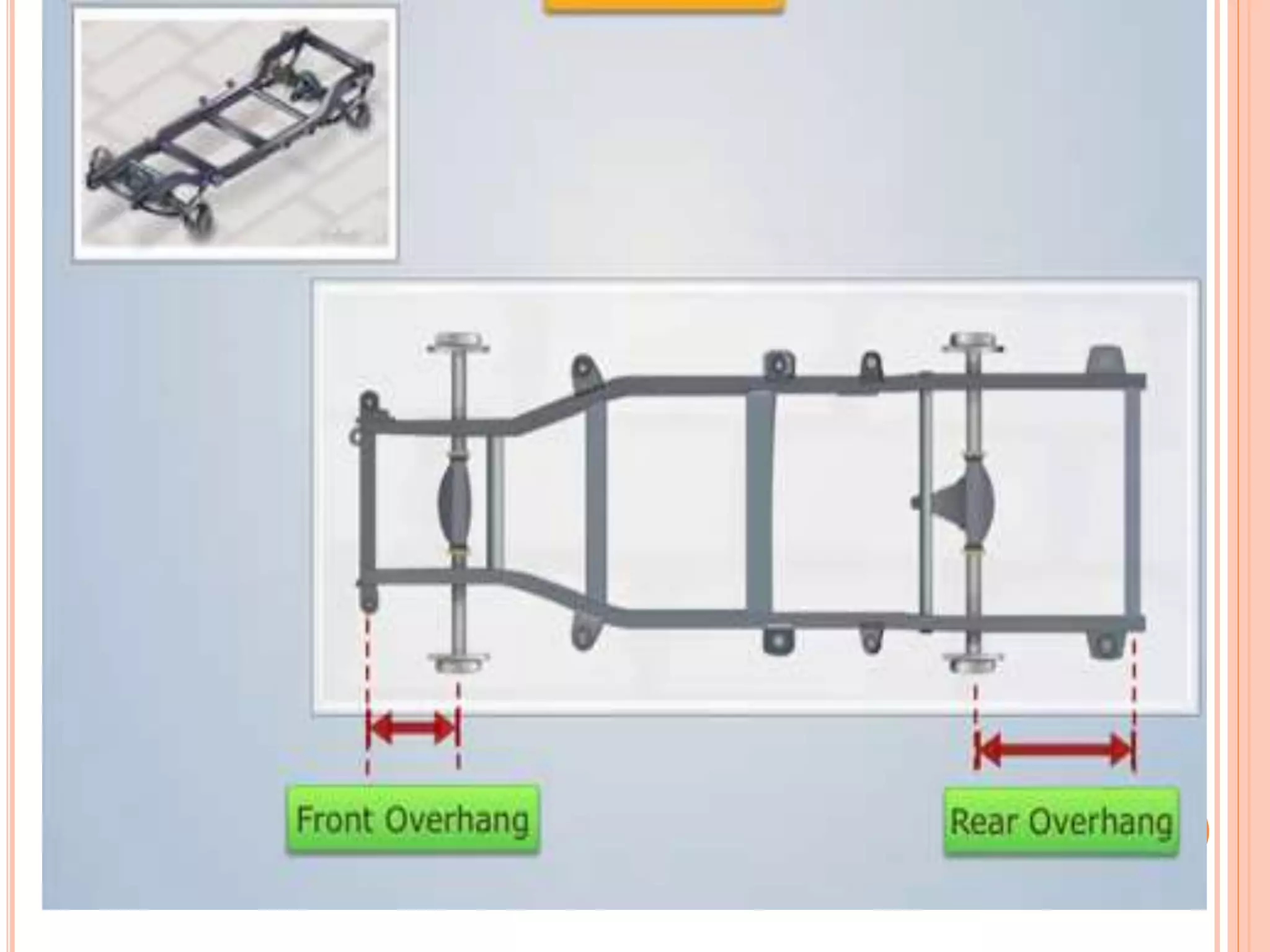
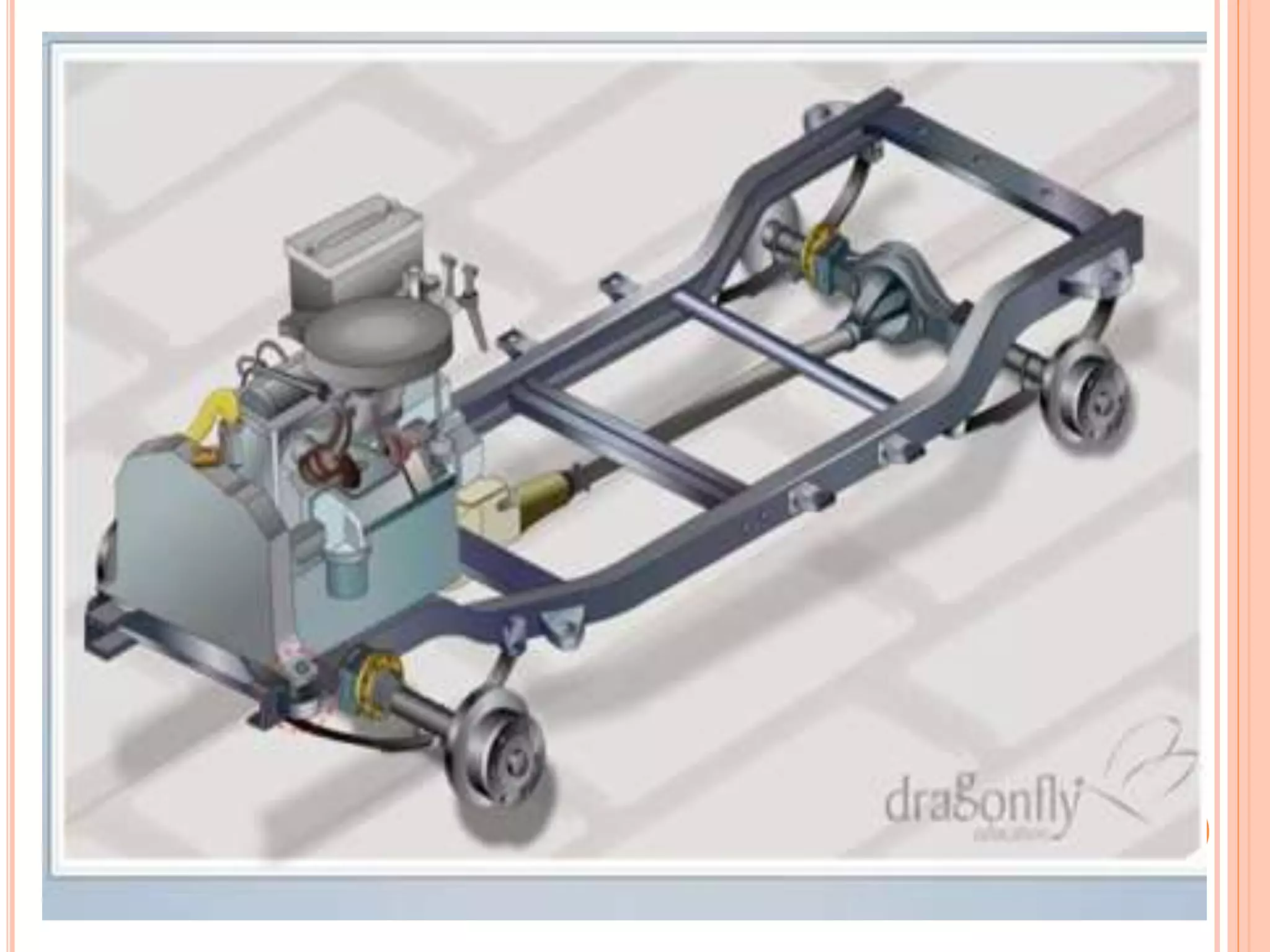
LADDER FRAME:
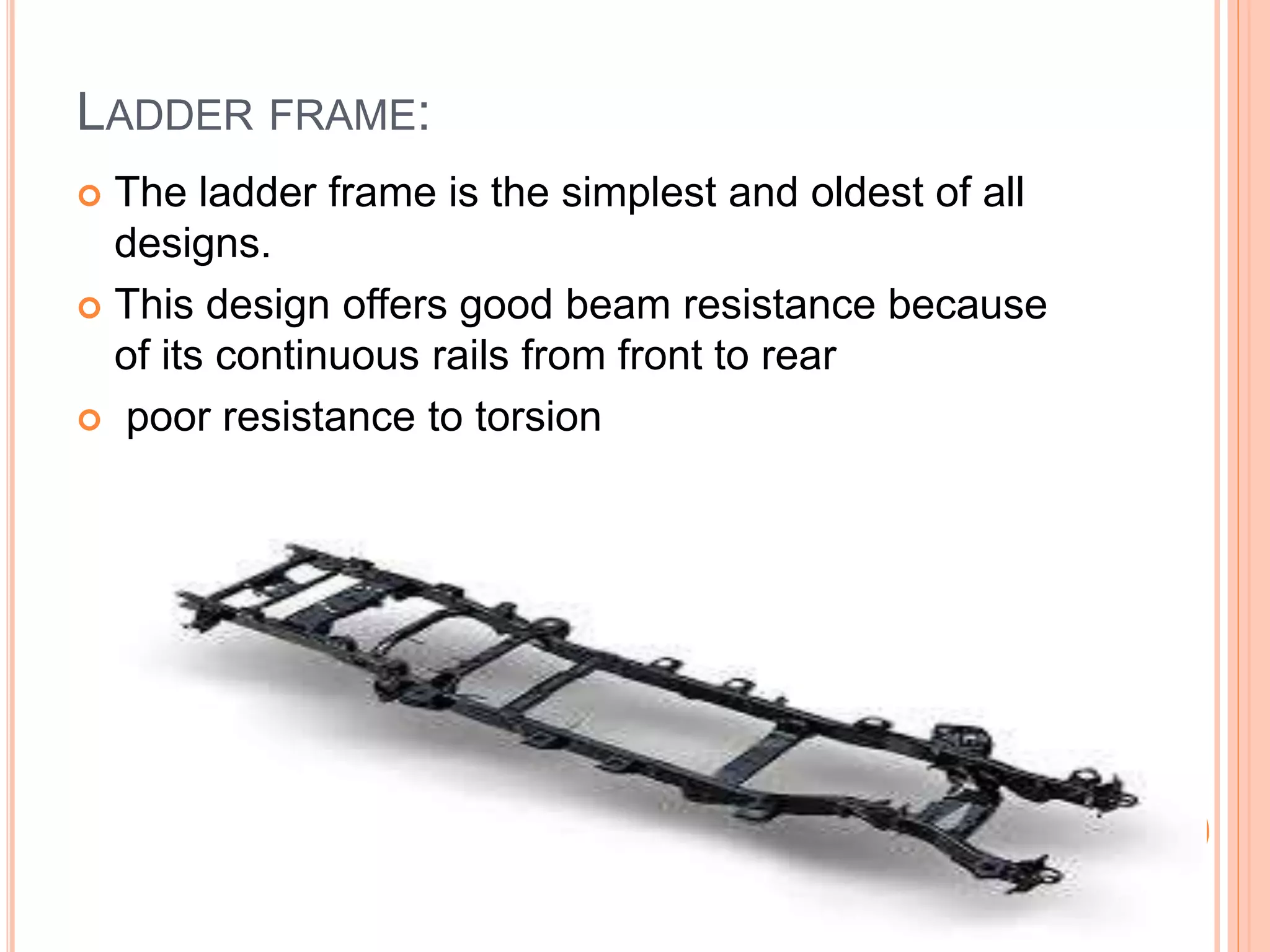
 The ladder frame is the simplest and oldest of all
designs.
 This design offers good beam resistance because
of its continuous rails from front to rear
 poor resistance to torsion
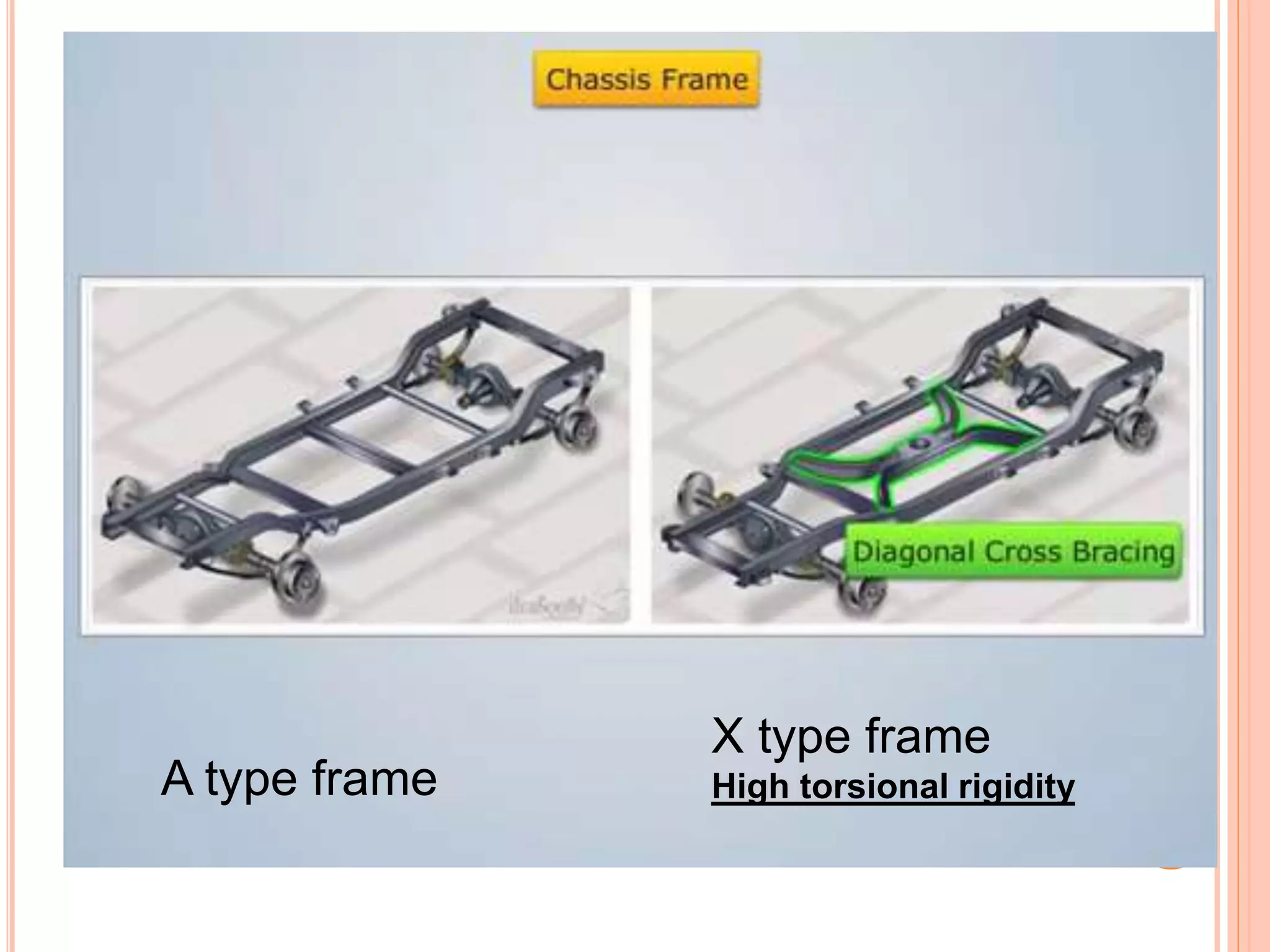
A type frame
X type frame
High torsional rigidity
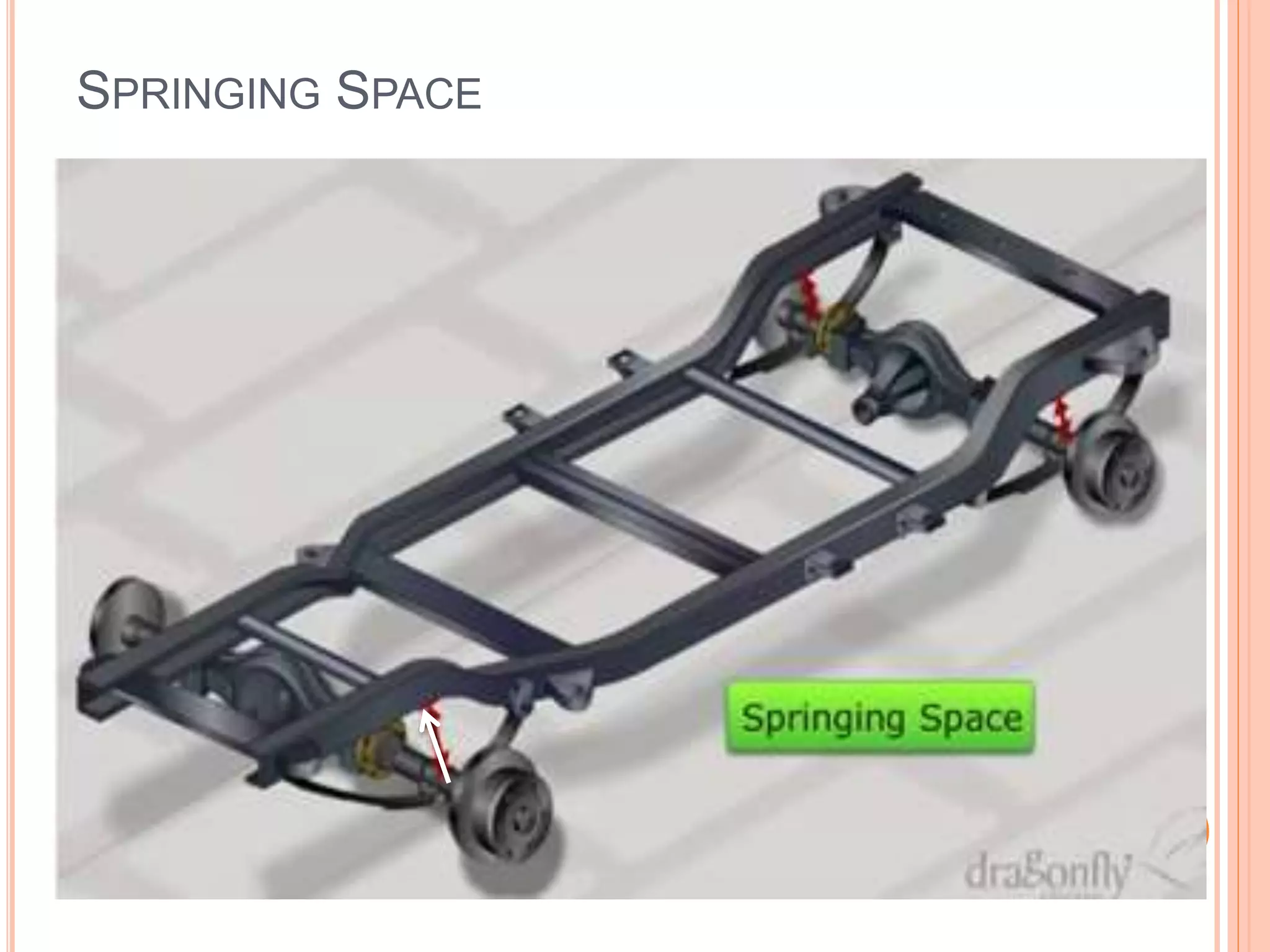
SPRINGING SPACE
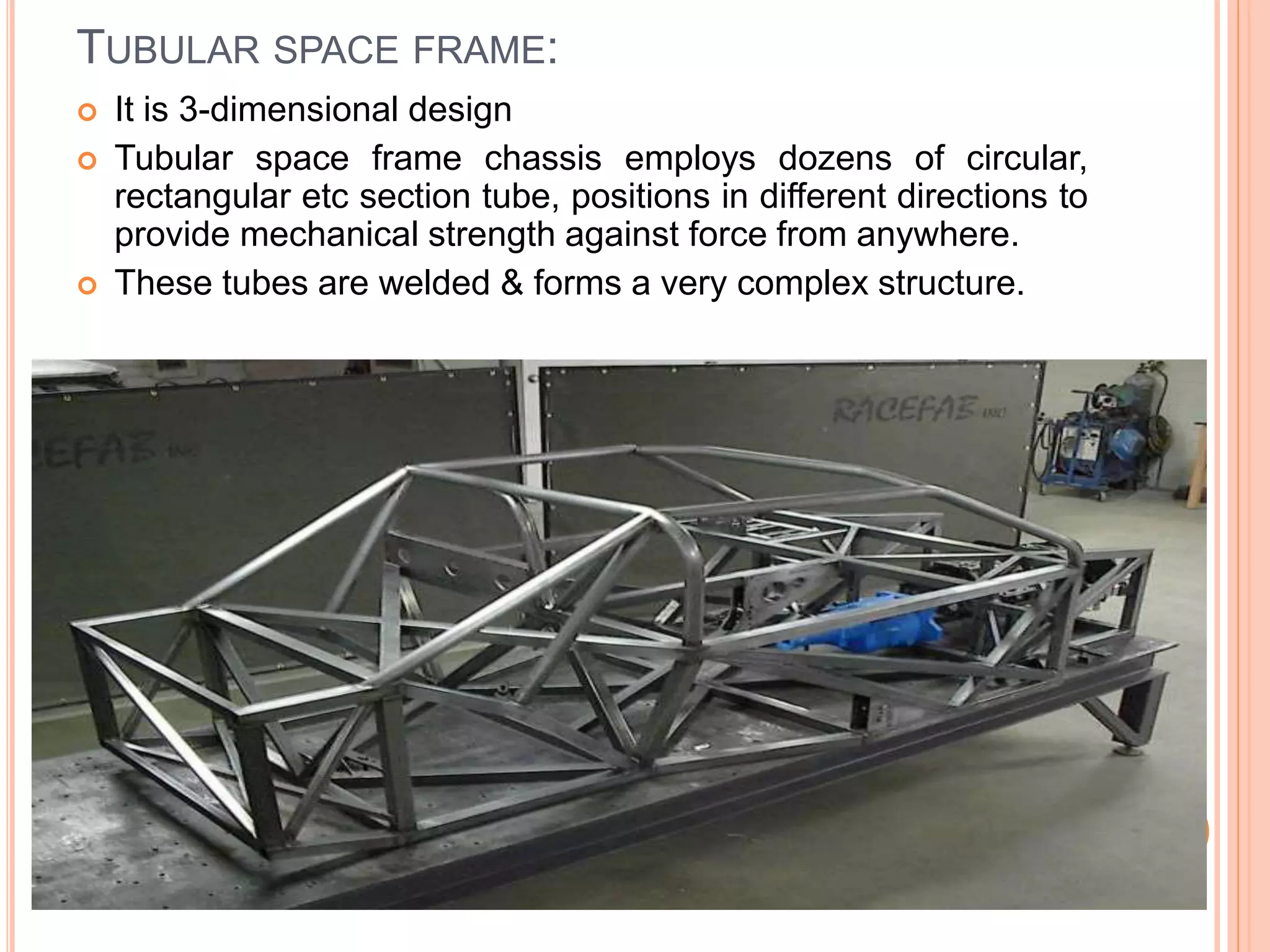
TUBULAR SPACE FRAME:
 It is 3-dimensional design
 Tubular space frame chassis employs dozens of circular,
rectangular etc section tube, positions in different directions to
provide mechanical strength against force from anywhere.
 These tubes are welded & forms a very complex structure.
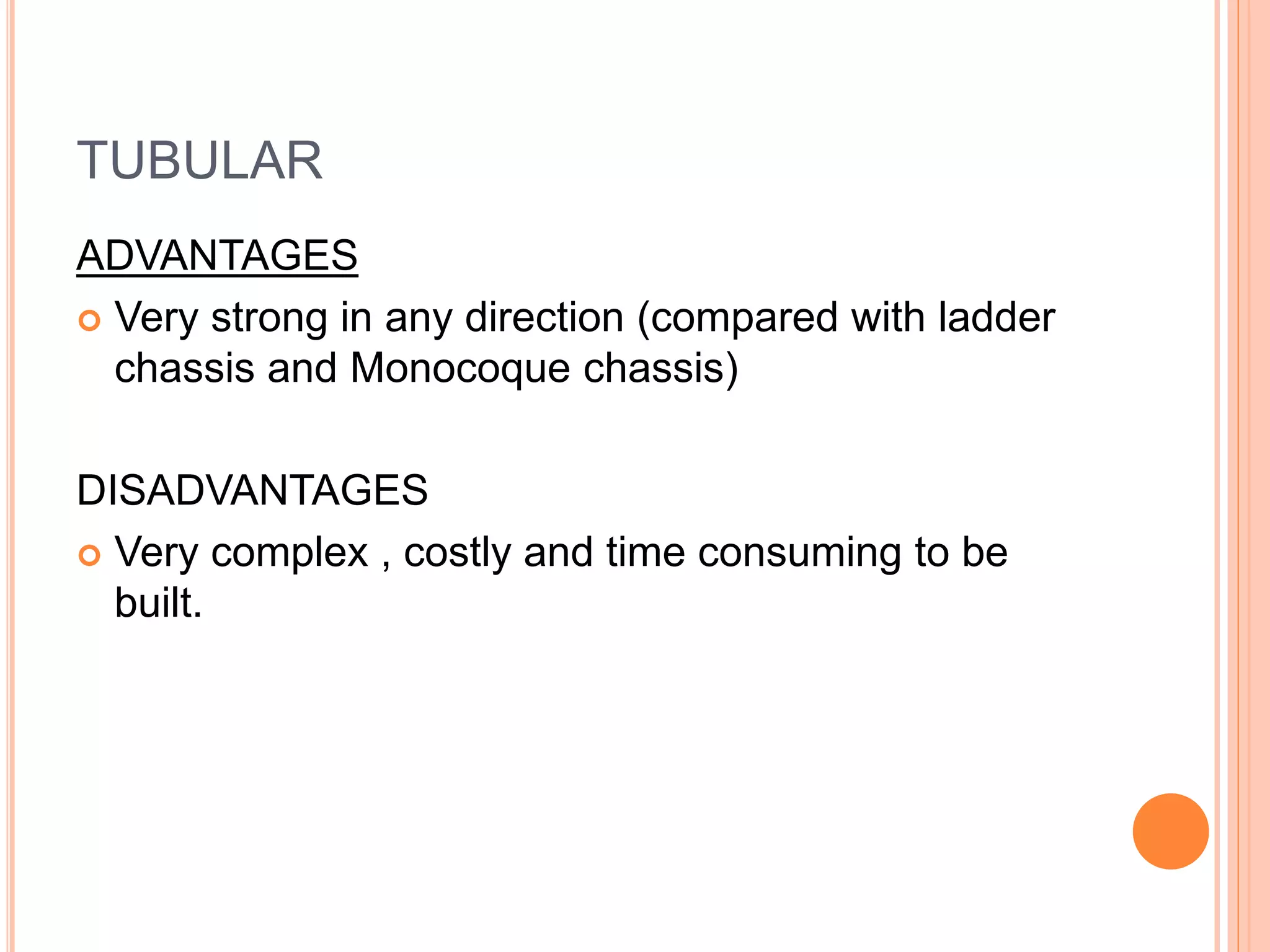
TUBULAR
ADVANTAGES
 Very strong in any direction (compared with ladder
chassis and Monocoque chassis)
DISADVANTAGES
 Very complex , costly and time consuming to be
built.
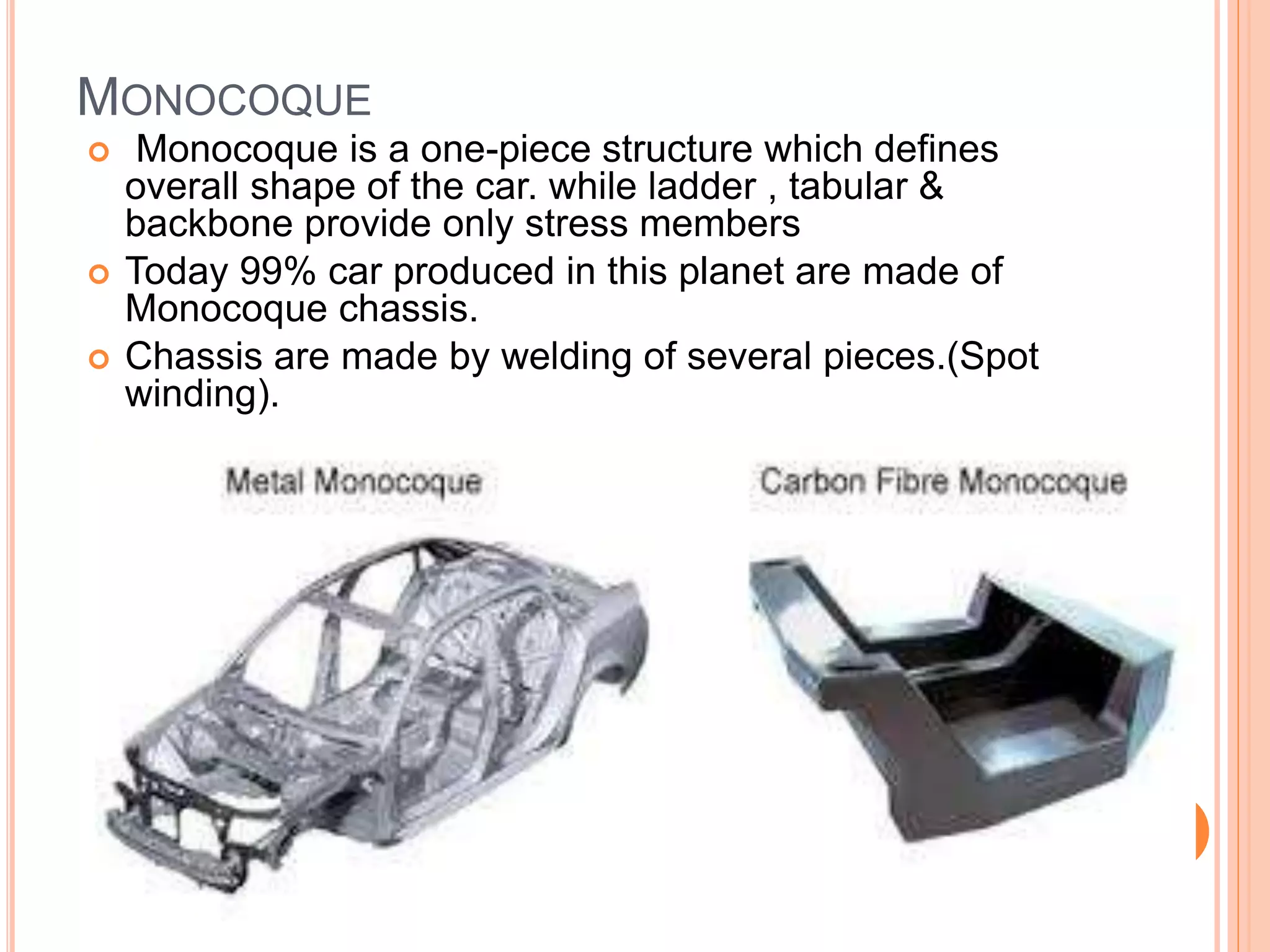
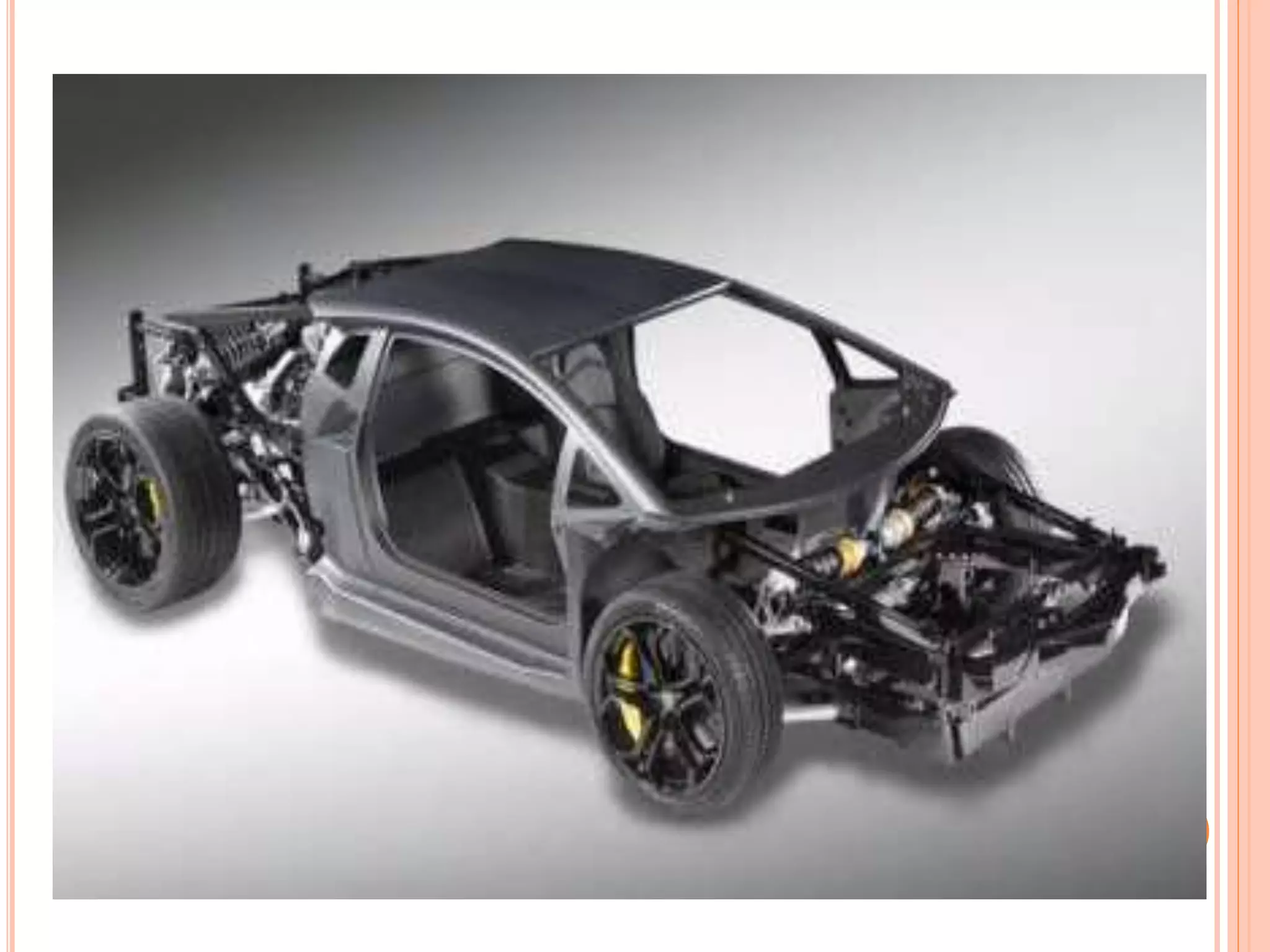
MONOCOQUE
 Monocoque is a one-piece structure which defines
overall shape of the car. while ladder , tabular &
backbone provide only stress members
 Today 99% car produced in this planet are made of
Monocoque chassis.
 Chassis are made by welding of several pieces.(Spot
winding).
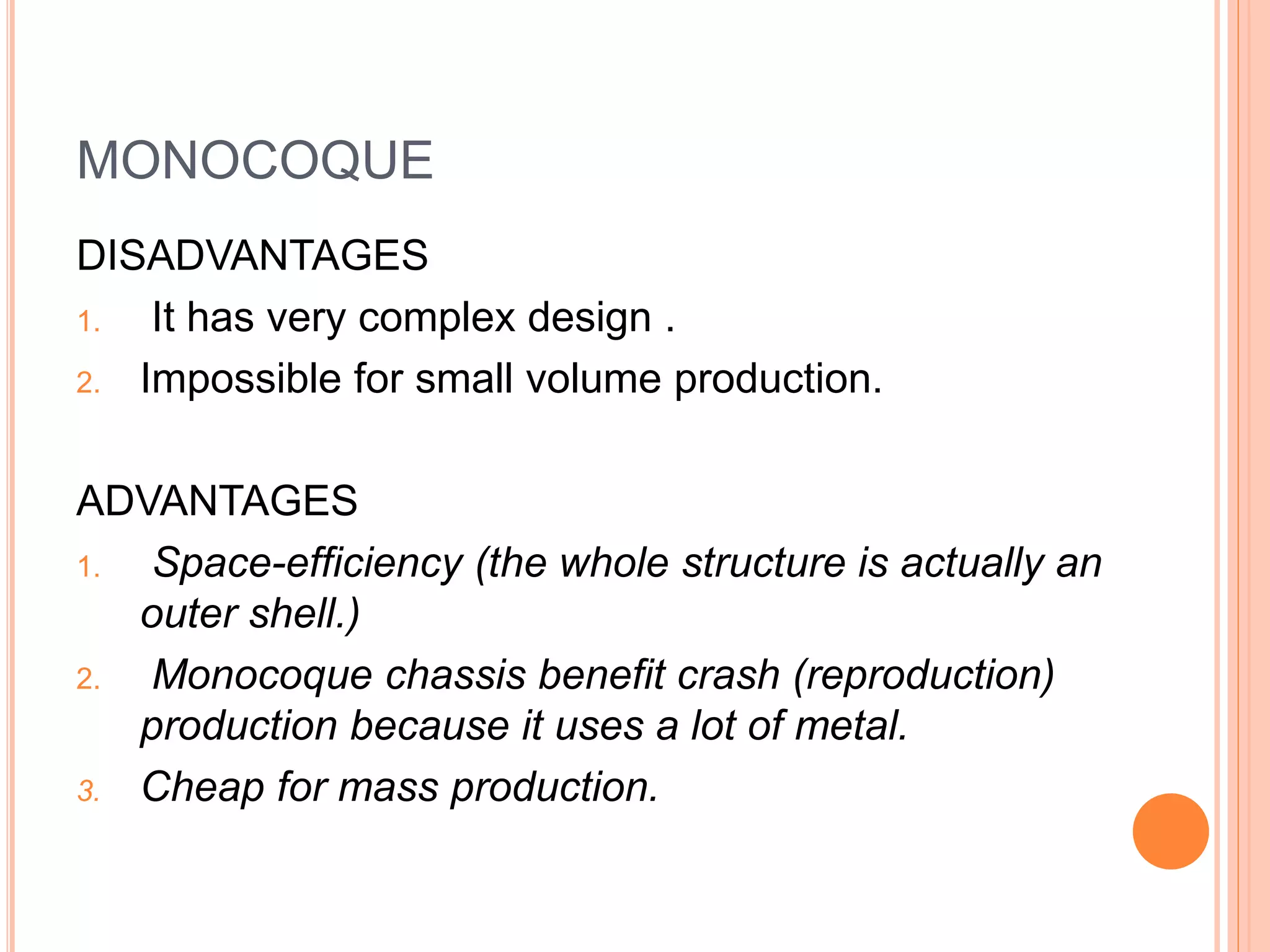
MONOCOQUE
DISADVANTAGES
1. It has very complex design .
2. Impossible for small volume production.
ADVANTAGES
1. Space-efficiency (the whole structure is actually an
outer shell.)
2. Monocoque chassis benefit crash (reproduction)
production because it uses a lot of metal.
3. Cheap for mass production.
ALUMINIUM MONOCOQUE-
 Audi A8 is the first mass production car featuring
Aluminium Space Frame chassis.
 To replace conventional steel monocoque mainly
for the benefit of lightness.
 Audi claimed A8's ASF is 40% lighter yet 40% stiffer
than contemporary steel monocoque.
CARBON-FIBER MONOCOQUE
 Carbon Fiber is the most sophisticated material
using in aircrafts, spaceships and racing cars
because of its superior rigidity-to-weight
ratio.
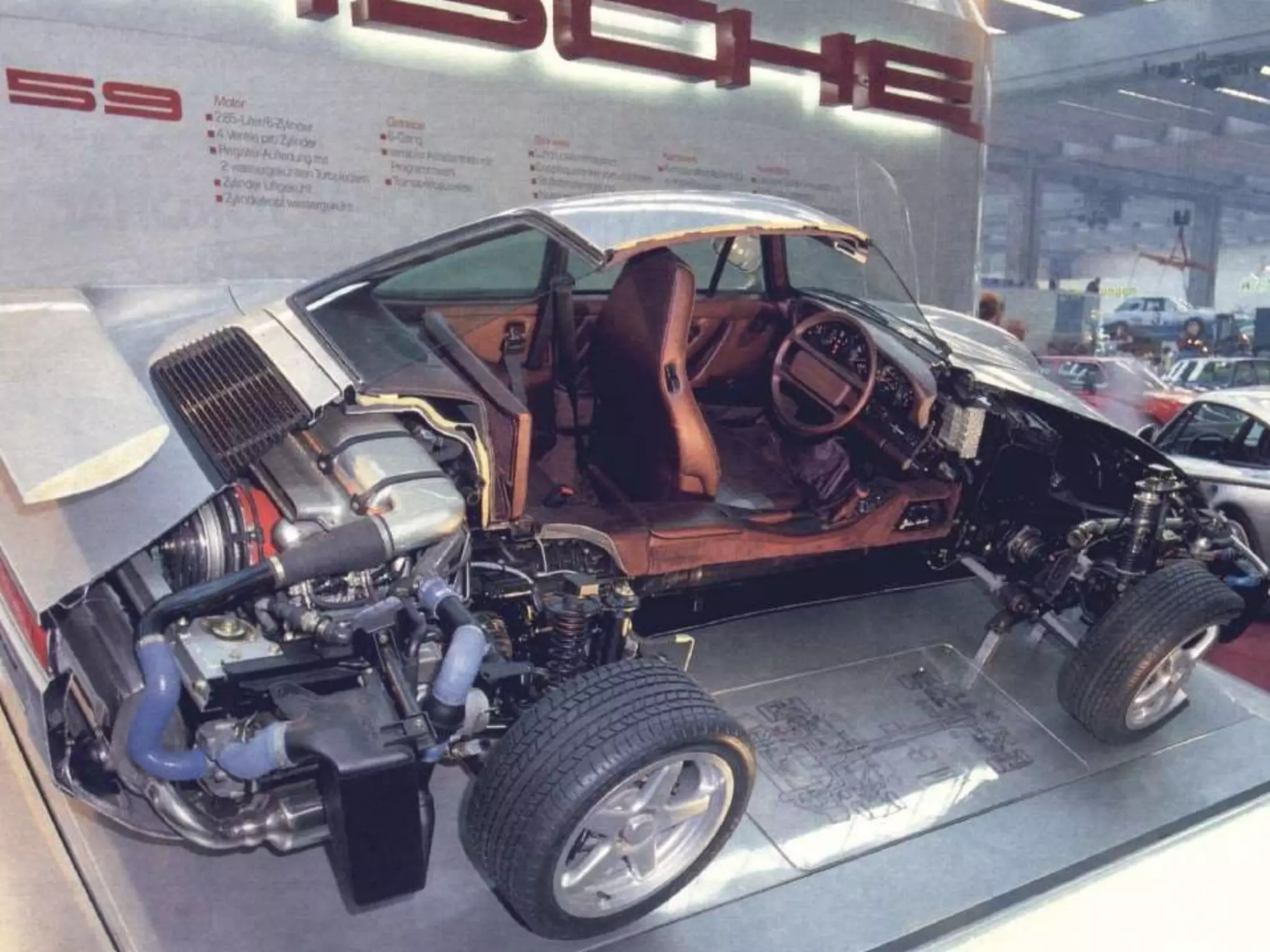
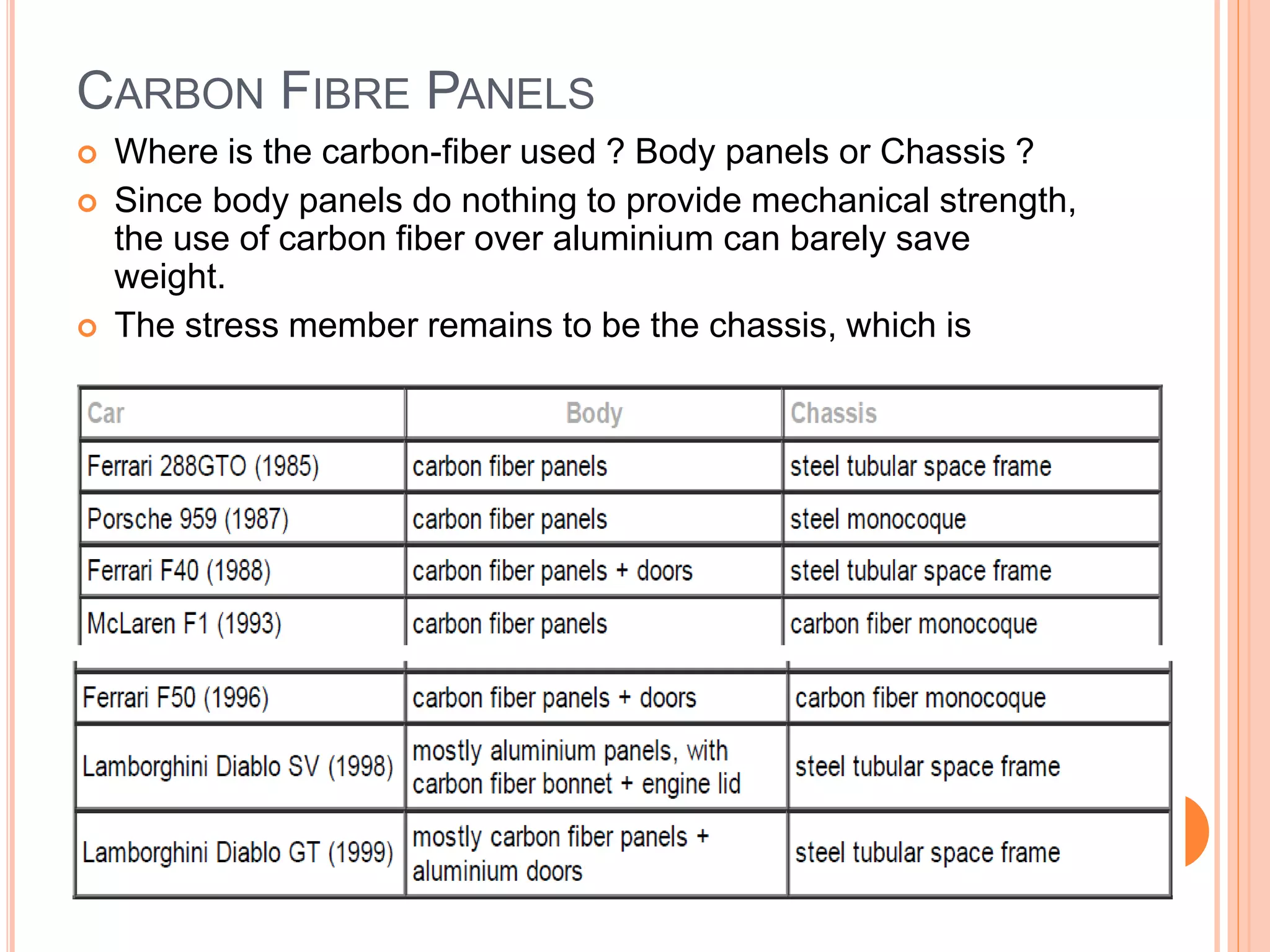
 Road cars featuring Carbon-Fiber body panels,
such as Ferrari 288GTO and Porsche 959.There
are several Carbon-fibers commonly used in motor
industry.
 Kevlar, which was developed by Du Pont, offers
the highest rigidity-to-weight ratio among them.
Because of this, army's helmets are made of
Kevlar. Kevlar can also be found in the body panels
of many exotic cars, although most of them
simultaneously use other kinds of carbon-fiber in
even larger amount.
CARBON FIBRE MONOCOQUE
Production process
 Carbon-fiber panels are made by growing carbon-
fiber sheets (something look like textile) in either
side of an aluminium foil.
 The foil, which defines the shape of the panel, is
sticked with several layers of carbon fiber sheets
impregnated with resin, then cooked in a big oven
for 3 hours at 120°C and 90 psi pressure.
 After that, the carbon fiber layers will be melted and
form a uni-formal, rigid body panel
CARBON FIBRE PANELS
 Where is the carbon-fiber used ? Body panels or Chassis ?
 Since body panels do nothing to provide mechanical strength,
the use of carbon fiber over aluminium can barely save
weight.
 The stress member remains to be the chassis, which is
usually in heavier and weaker steel tubular frame.
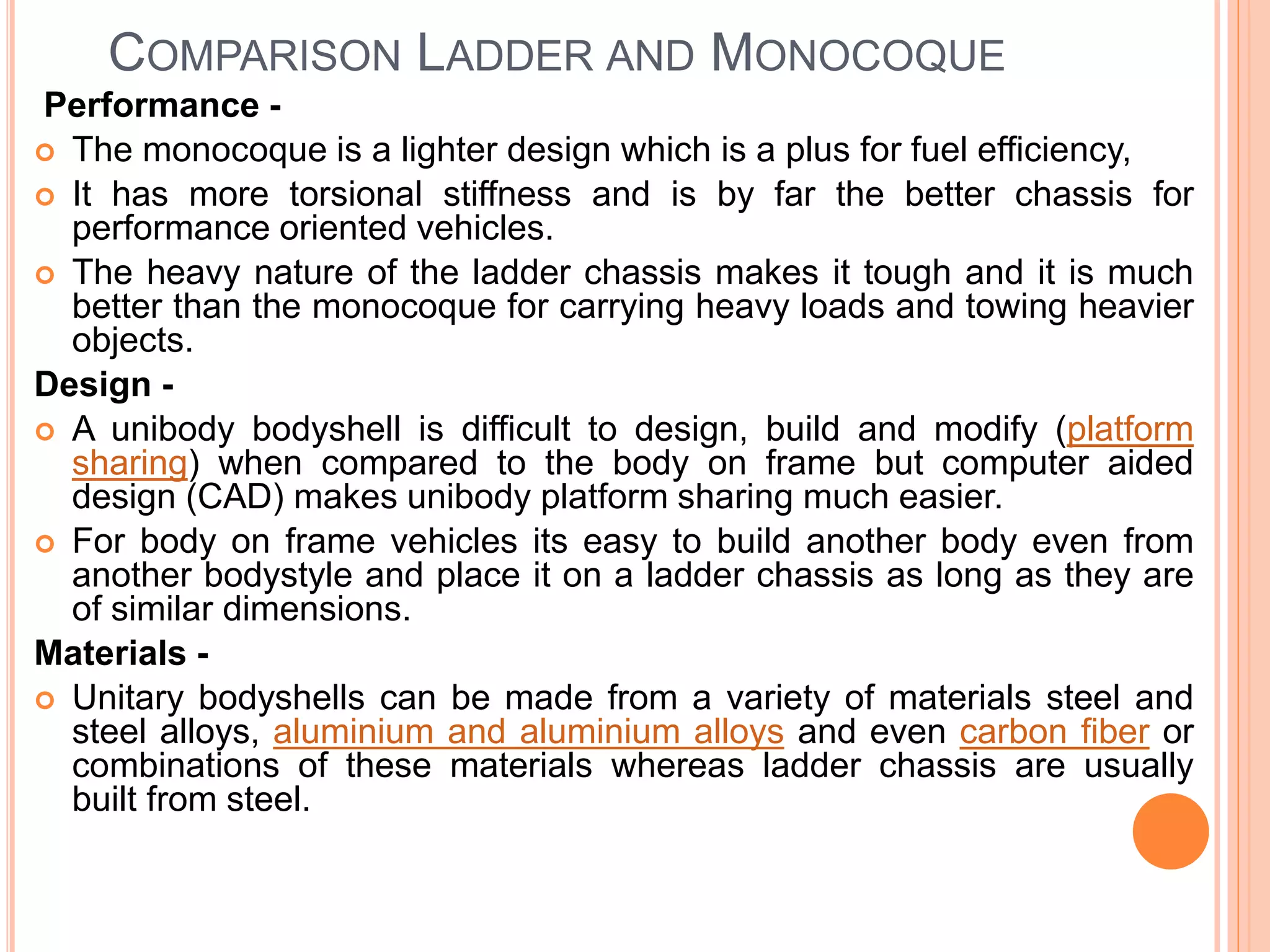
COMPARISON LADDER AND MONOCOQUE
Performance -
 The monocoque is a lighter design which is a plus for fuel efficiency,
 It has more torsional stiffness and is by far the better chassis for
performance oriented vehicles.
 The heavy nature of the ladder chassis makes it tough and it is much
better than the monocoque for carrying heavy loads and towing heavier
objects.
Design -
 A unibody bodyshell is difficult to design, build and modify (platform
sharing) when compared to the body on frame but computer aided
design (CAD) makes unibody platform sharing much easier.
 For body on frame vehicles its easy to build another body even from
another bodystyle and place it on a ladder chassis as long as they are
of similar dimensions.
Materials -
 Unitary bodyshells can be made from a variety of materials steel and
steel alloys, aluminium and aluminium alloys and even carbon fiber or
combinations of these materials whereas ladder chassis are usually
built from steel.
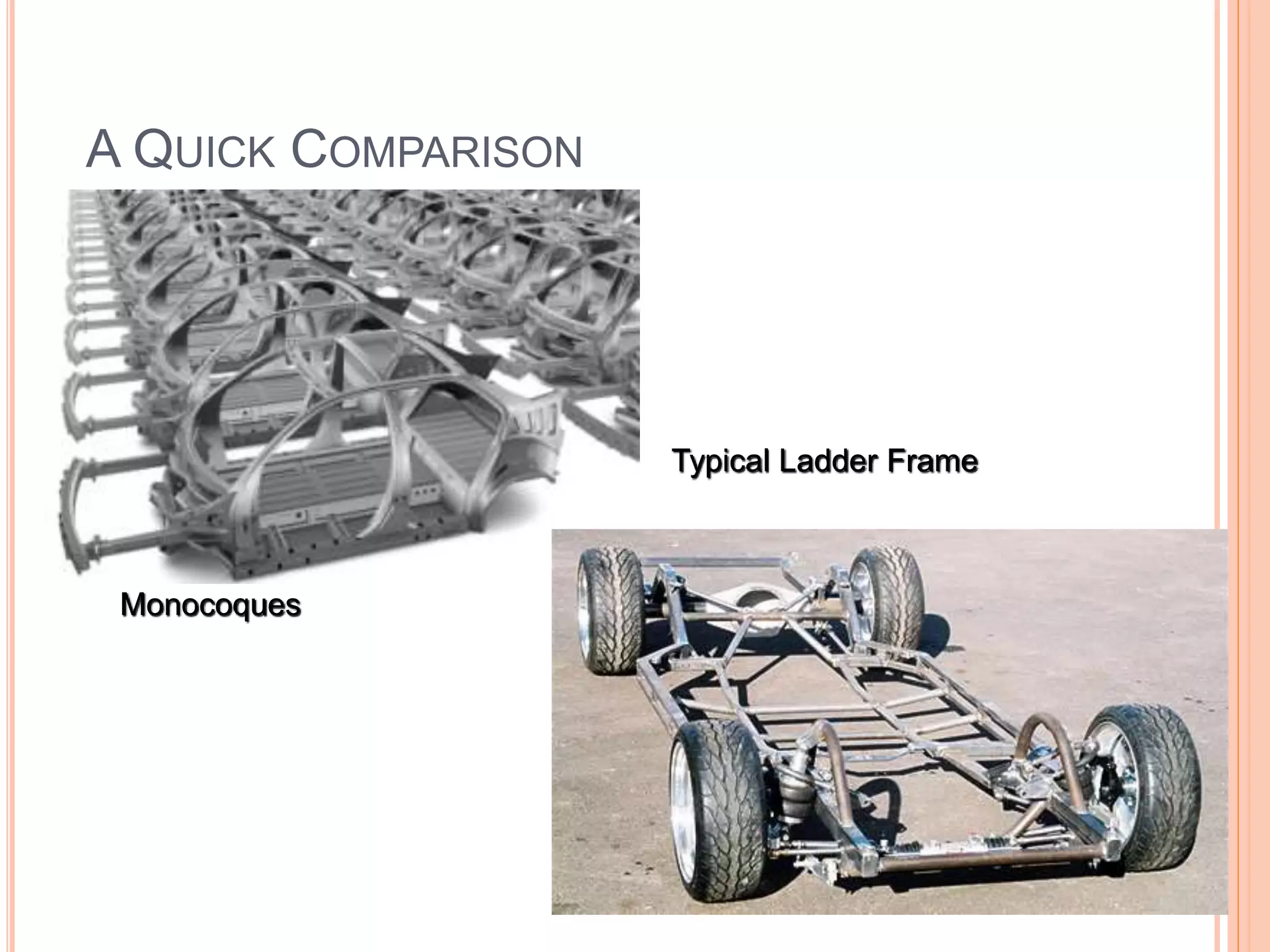
A QUICK COMPARISON
Monocoques
Typical Ladder Frame
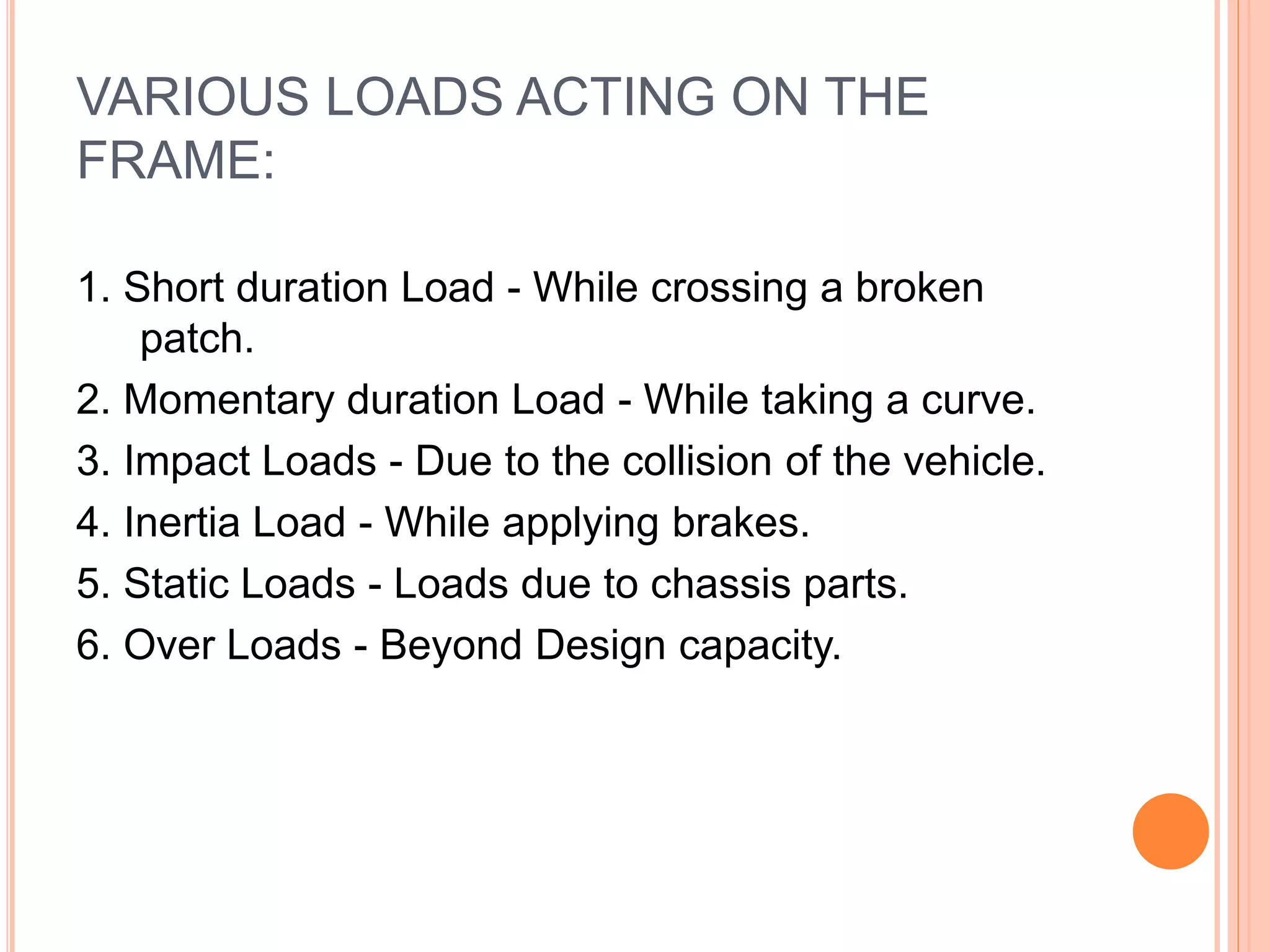
VARIOUS LOADS ACTING ON THE
FRAME:
1. Short duration Load - While crossing a broken
patch.
2. Momentary duration Load - While taking a curve.
3. Impact Loads - Due to the collision of the vehicle.
4. Inertia Load - While applying brakes.
5. Static Loads - Loads due to chassis parts.
6. Over Loads - Beyond Design capacity.
MATERIALS- WHY IMPORTANT
 As fuel economy restrictions become tighter,
manufacturers must find new ways to meet them.
 This has led them away from using so much steel in
the vehicles, and more and more are moving
towards aluminum.
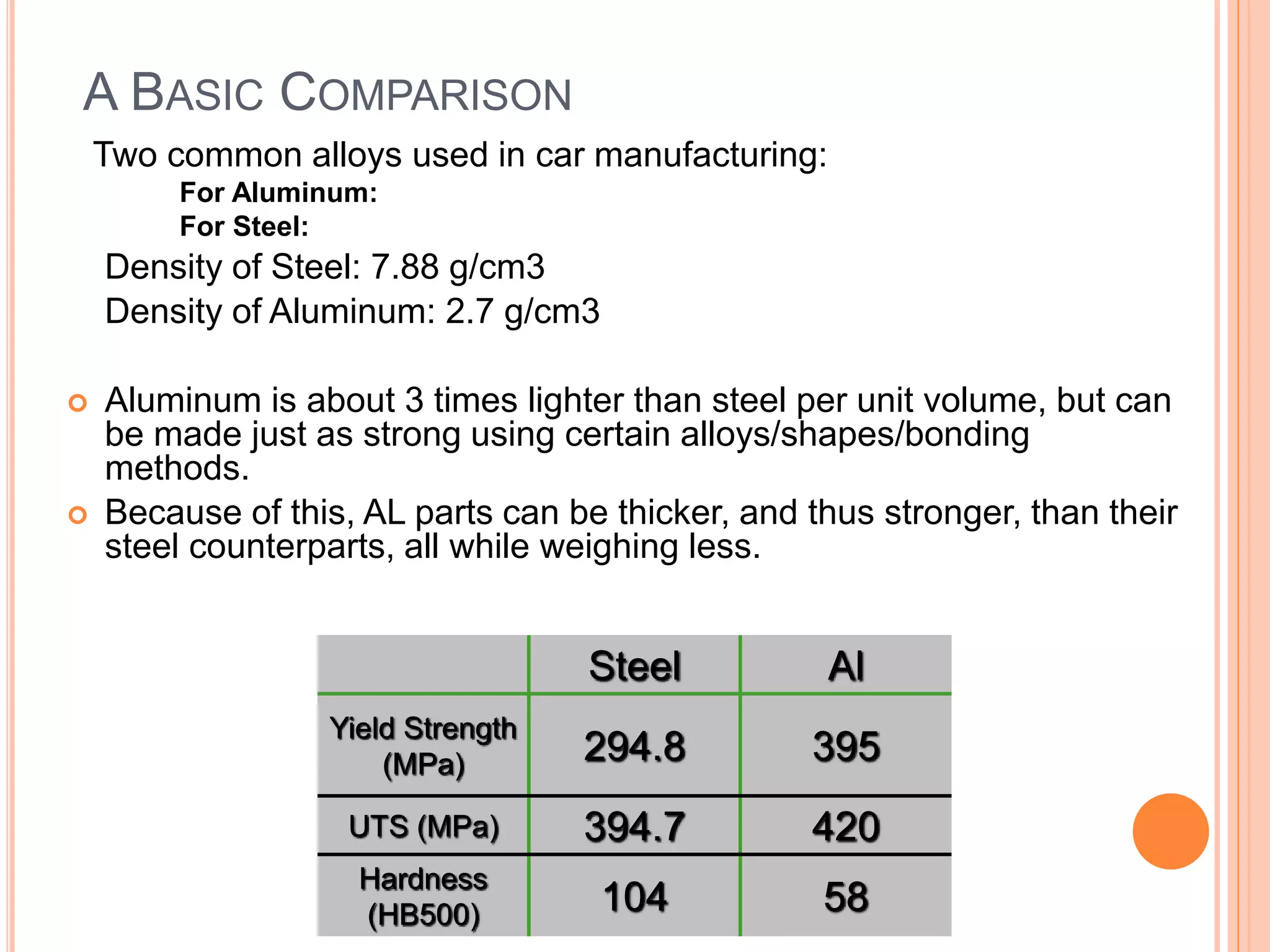
A BASIC COMPARISON
Two common alloys used in car manufacturing:
For Aluminum:
For Steel:
Density of Steel: 7.88 g/cm3
Density of Aluminum: 2.7 g/cm3
 Aluminum is about 3 times lighter than steel per unit volume, but can
be made just as strong using certain alloys/shapes/bonding
methods.
 Because of this, AL parts can be thicker, and thus stronger, than their
steel counterparts, all while weighing less.
Steel Al
Yield Strength
(MPa) 294.8 395
UTS (MPa) 394.7 420
Hardness
(HB500) 104 58
THE COST ISSUE
While Al may seem like a miracle metal for car
production, there is a reason not all cars are made from
Al... It costs a lot more than Steel.
THE MOVE TO ALUMINUM
 The first production vehicle to move to an Al frame was
the Audi A8 in 1994.
 This allowed Audi to make their full-size car lighter than
the competitions (BMW, Mercedes, Lexus...), thus giving
them the edge in performance & handling.
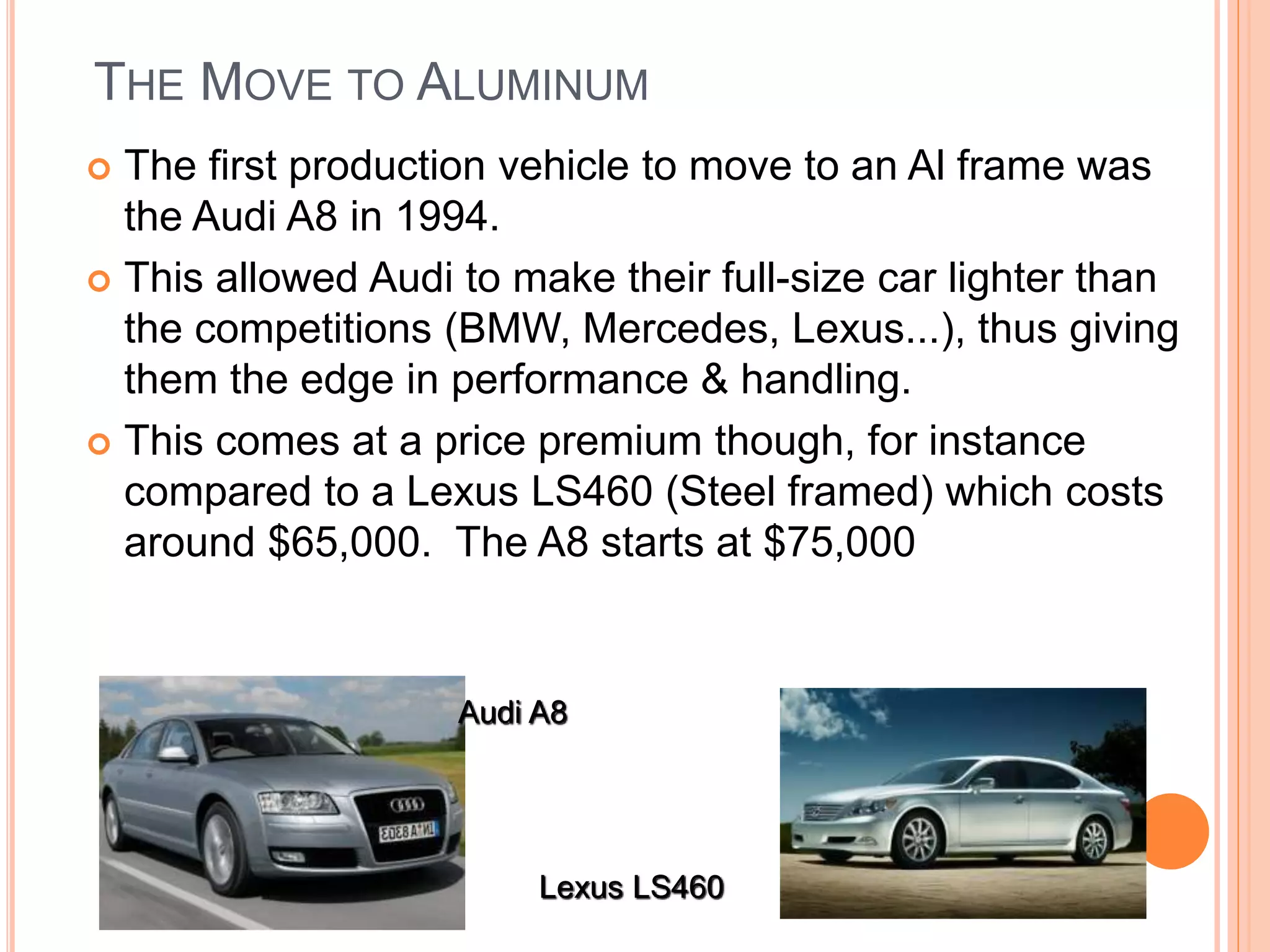
 This comes at a price premium though, for instance
compared to a Lexus LS460 (Steel framed) which costs
around $65,000. The A8 starts at $75,000
Audi A8
Lexus LS460
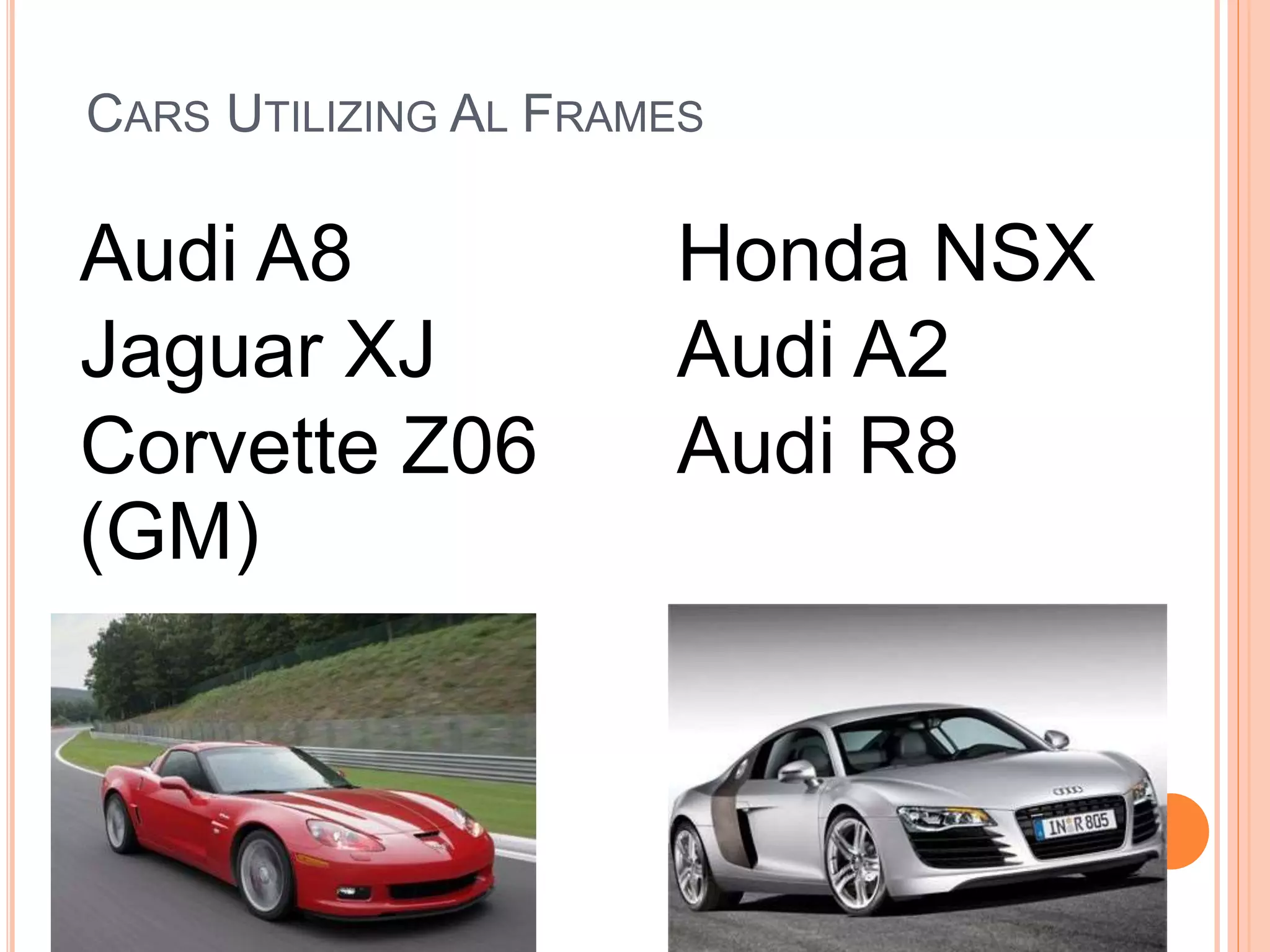
CARS UTILIZING AL FRAMES
Audi A8
Jaguar XJ
Corvette Z06
(GM)
Honda NSX
Audi A2
Audi R8
SOME OTHER ADVANTAGES...
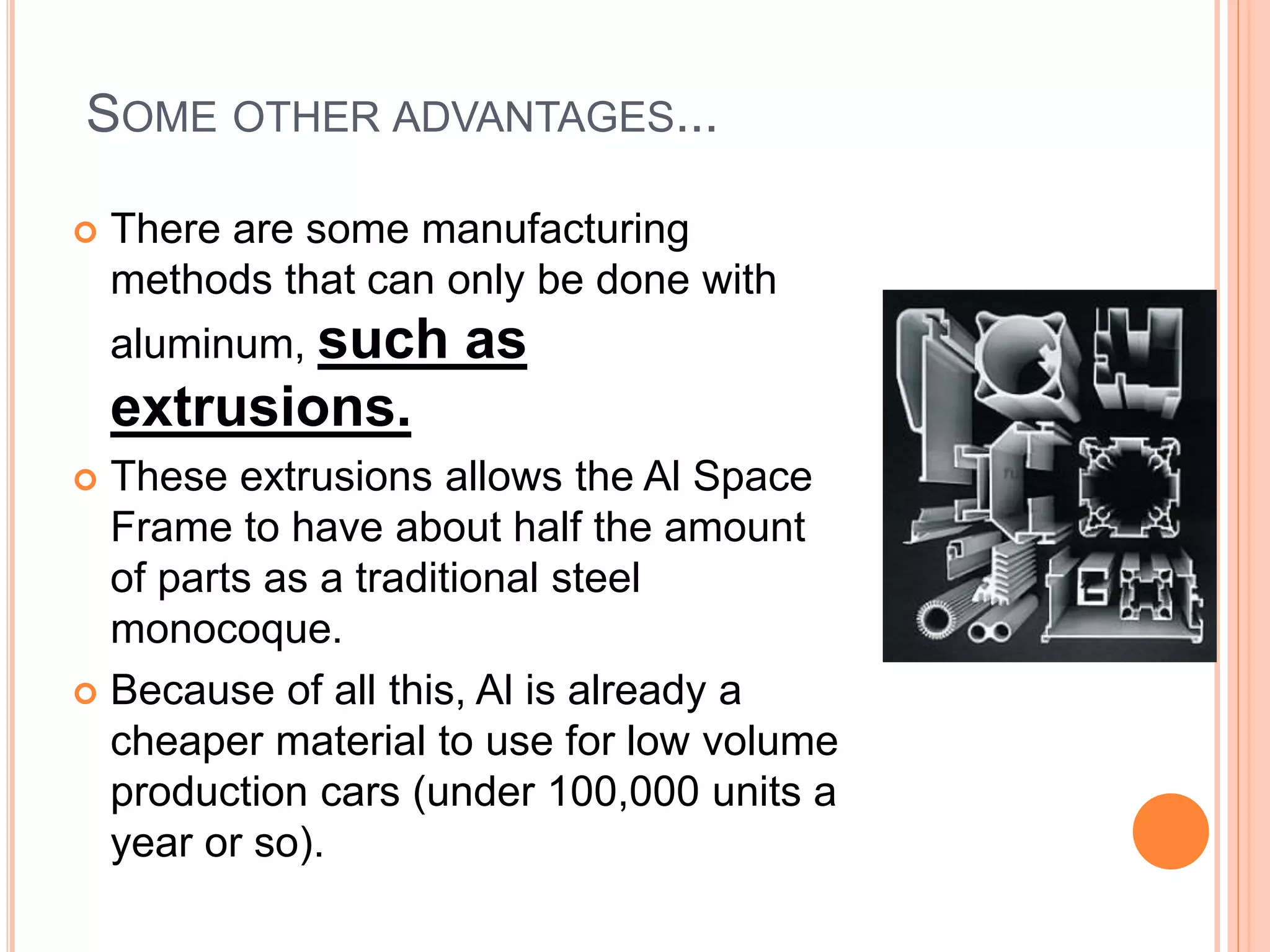
 There are some manufacturing
methods that can only be done with
aluminum, such as
extrusions.
 These extrusions allows the Al Space
Frame to have about half the amount
of parts as a traditional steel
monocoque.
 Because of all this, Al is already a
cheaper material to use for low volume
production cars (under 100,000 units a
year or so).
IN THE FUTURE
 While Aluminum may be the wave of the future for now,
some exotic car companies are already looking ahead to
composite materials.
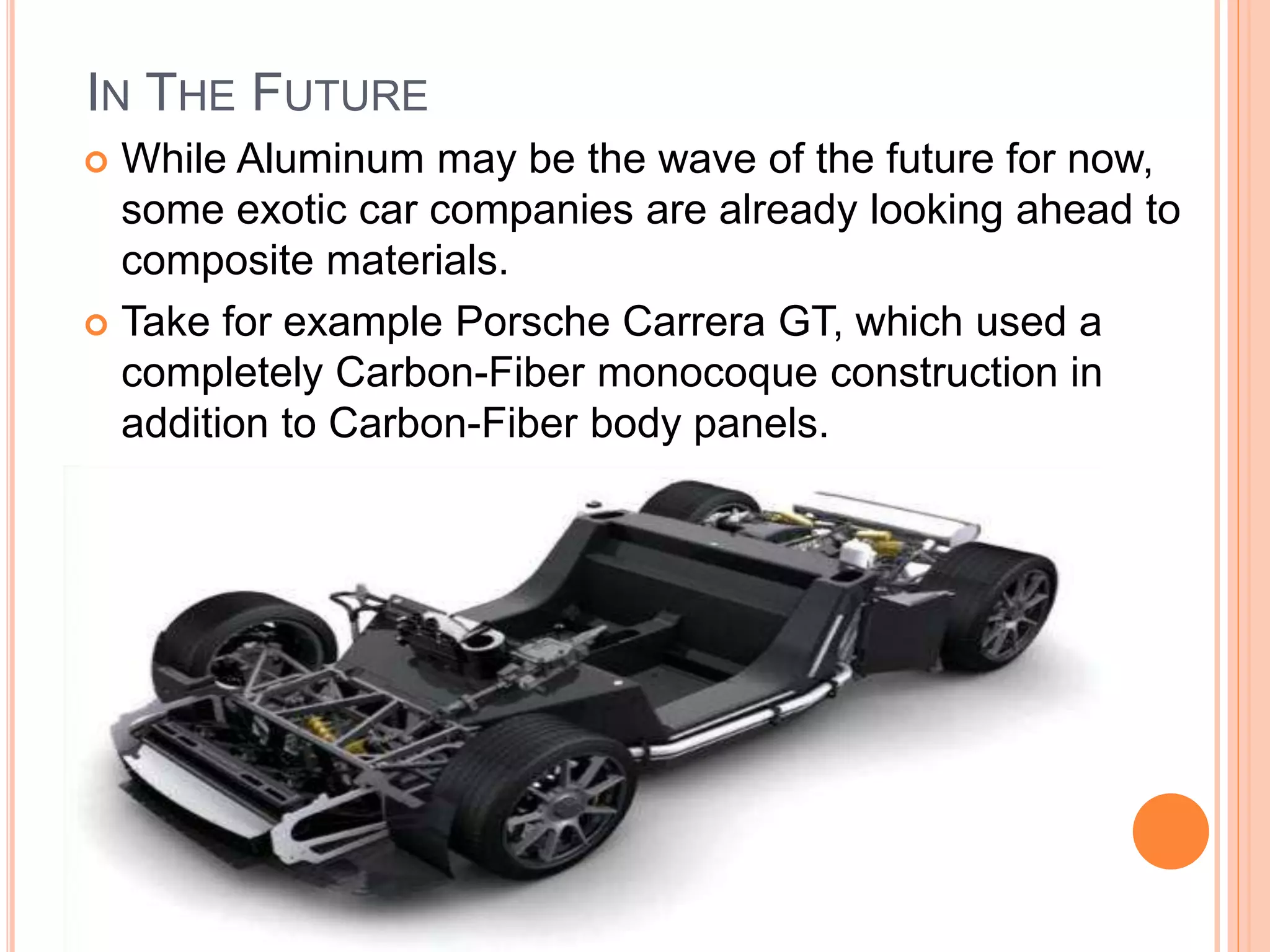
 Take for example Porsche Carrera GT, which used a
completely Carbon-Fiber monocoque construction in
addition to Carbon-Fiber body panels.
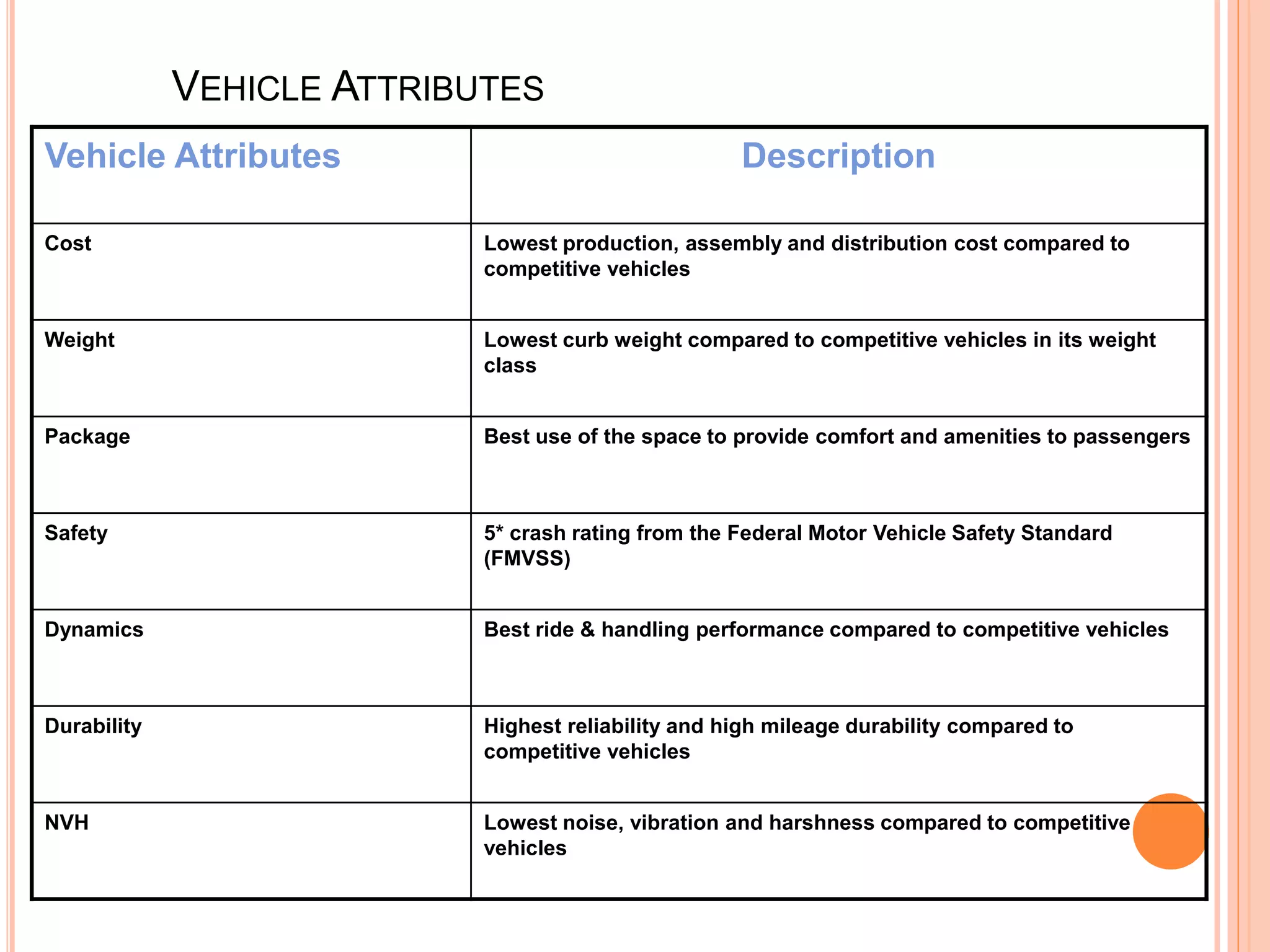
VEHICLE ATTRIBUTES
Vehicle Attributes Description
Cost Lowest production, assembly and distribution cost compared to
competitive vehicles
Weight Lowest curb weight compared to competitive vehicles in its weight
class
Package Best use of the space to provide comfort and amenities to passengers
Safety 5* crash rating from the Federal Motor Vehicle Safety Standard
(FMVSS)
Dynamics Best ride & handling performance compared to competitive vehicles
Durability Highest reliability and high mileage durability compared to
competitive vehicles
NVH Lowest noise, vibration and harshness compared to competitive
vehicles
TYPES OF CARS ON AS PER THEIR DESIGN
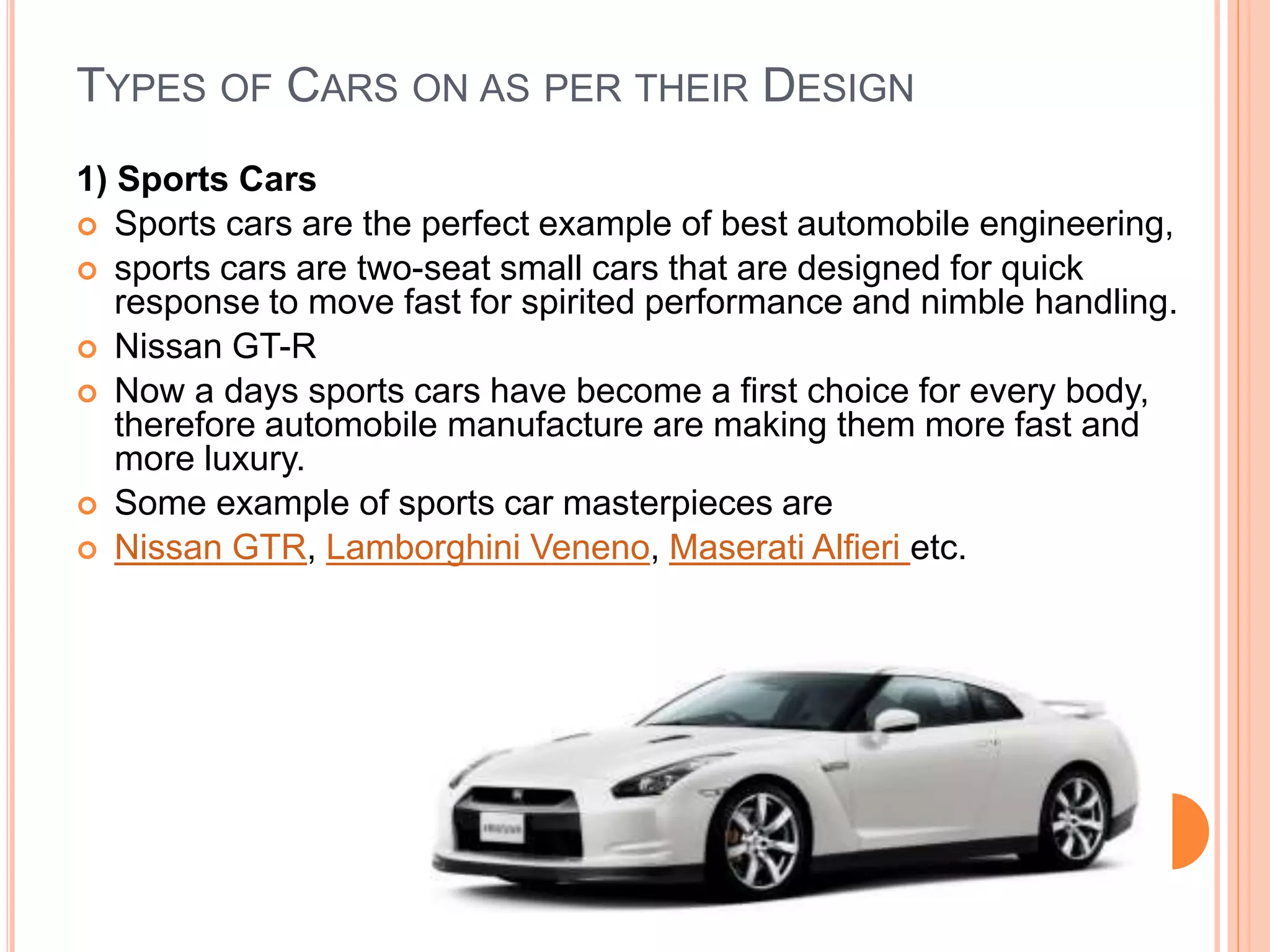
1) Sports Cars
 Sports cars are the perfect example of best automobile engineering,
 sports cars are two-seat small cars that are designed for quick
response to move fast for spirited performance and nimble handling.
 Nissan GT-R
 Now a days sports cars have become a first choice for every body,
therefore automobile manufacture are making them more fast and
more luxury.
 Some example of sports car masterpieces are
 Nissan GTR, Lamborghini Veneno, Maserati Alfieri etc.
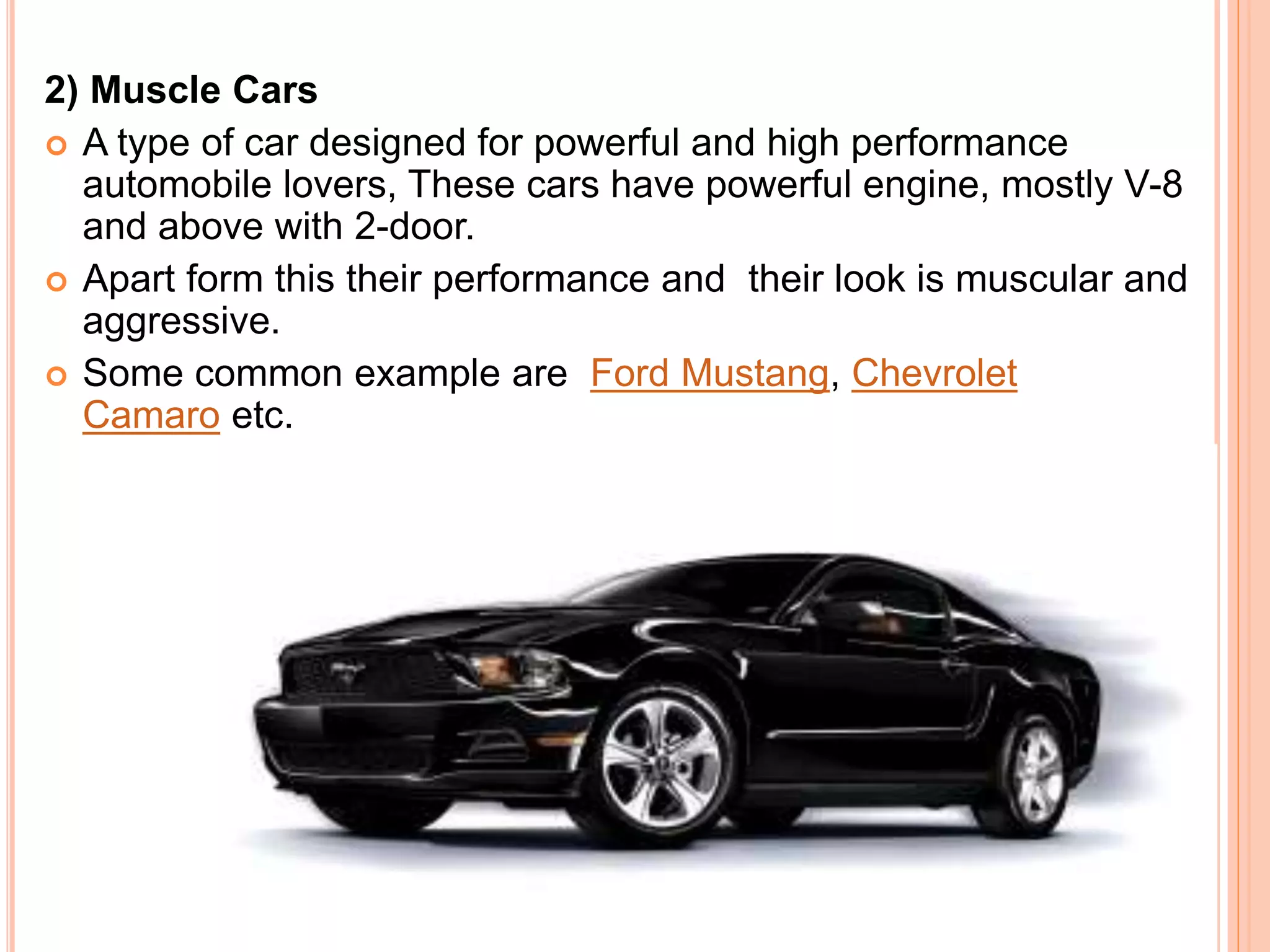
2) Muscle Cars
 A type of car designed for powerful and high performance
automobile lovers, These cars have powerful engine, mostly V-8
and above with 2-door.
 Apart form this their performance and their look is muscular and
aggressive.
 Some common example are Ford Mustang, Chevrolet
Camaro etc.
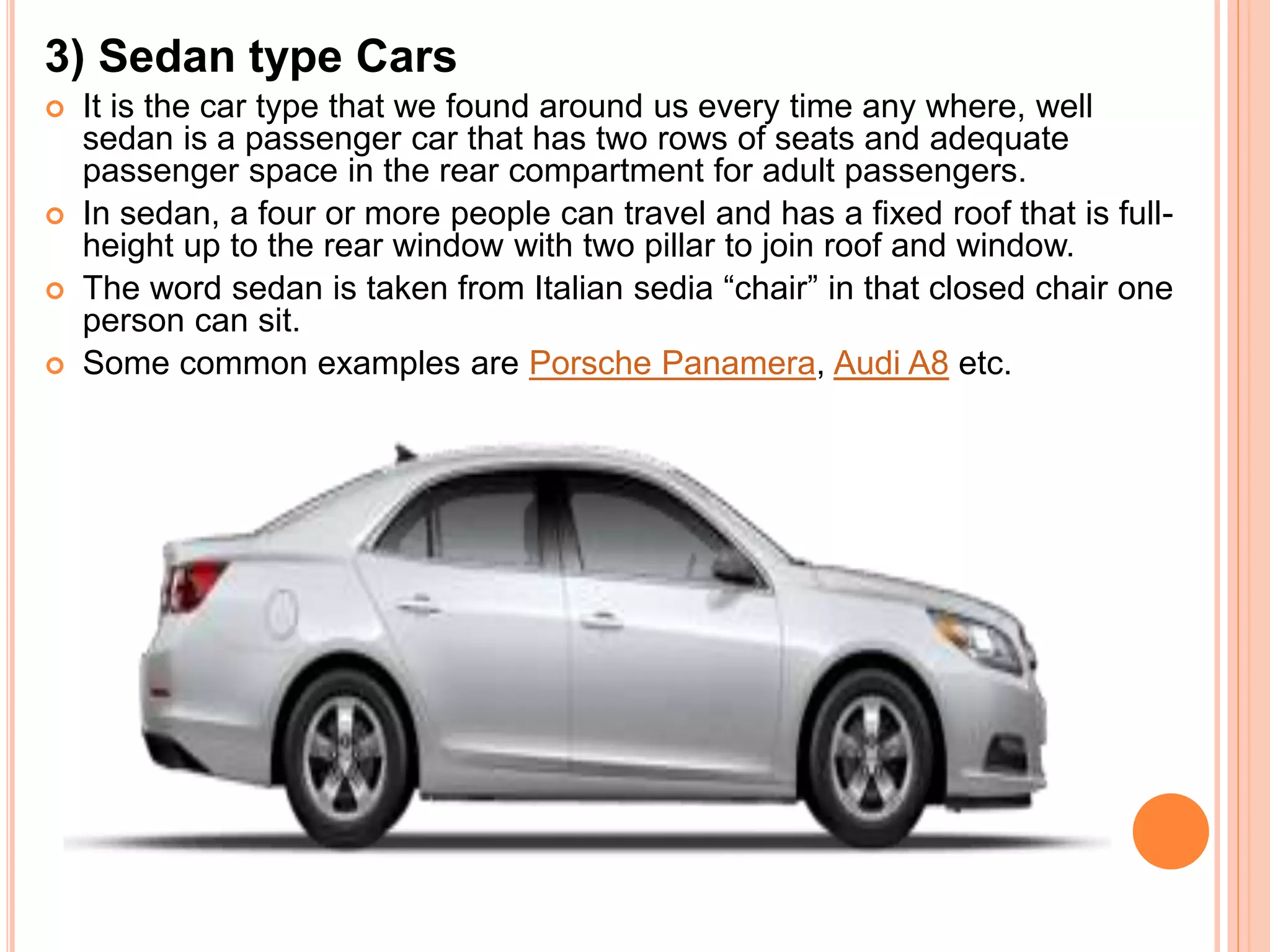
3) Sedan type Cars
 It is the car type that we found around us every time any where, well
sedan is a passenger car that has two rows of seats and adequate
passenger space in the rear compartment for adult passengers.
 In sedan, a four or more people can travel and has a fixed roof that is full-
height up to the rear window with two pillar to join roof and window.
 The word sedan is taken from Italian sedia “chair” in that closed chair one
person can sit.
 Some common examples are Porsche Panamera, Audi A8 etc.
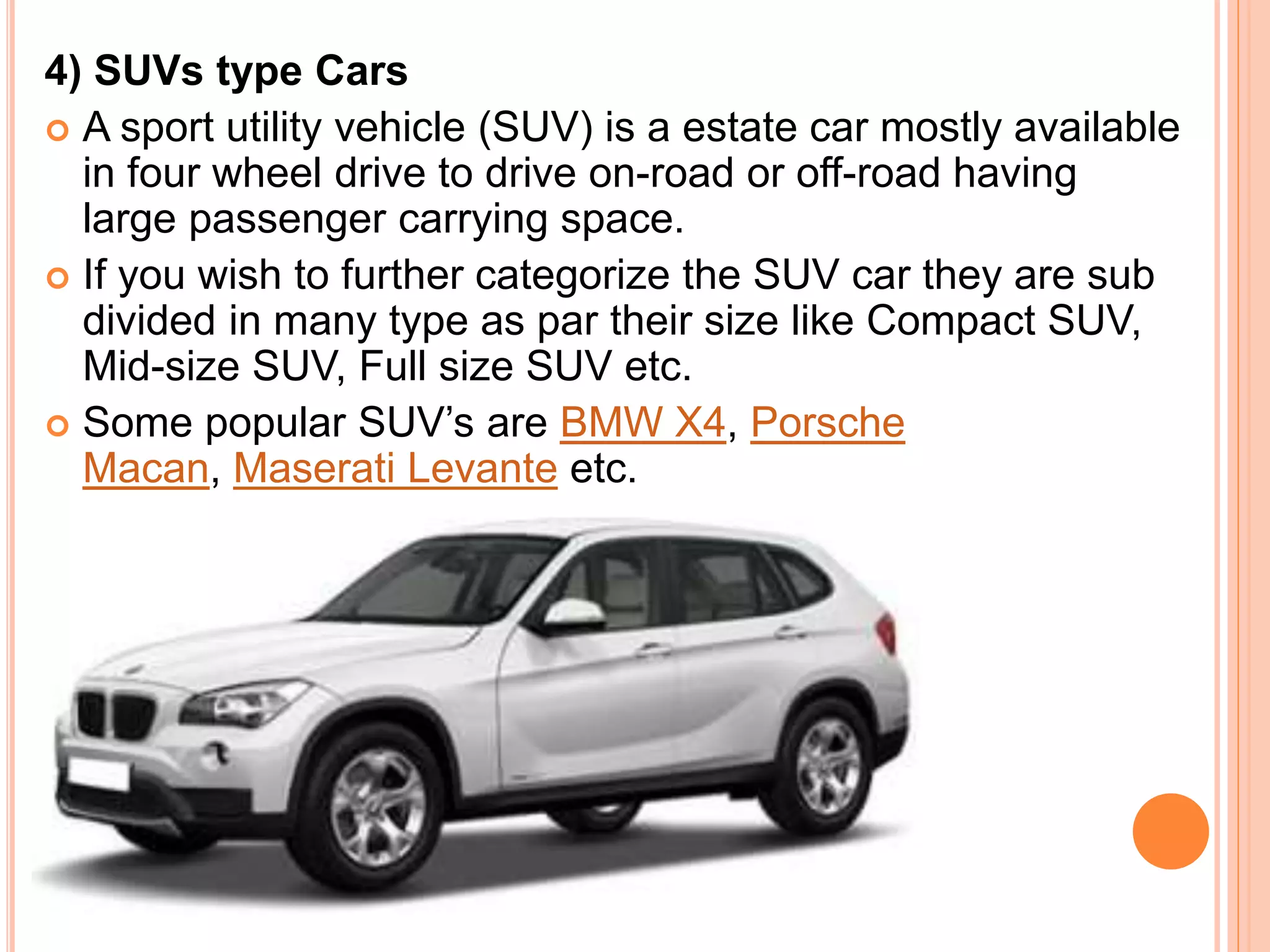
4) SUVs type Cars
 A sport utility vehicle (SUV) is a estate car mostly available
in four wheel drive to drive on-road or off-road having
large passenger carrying space.
 If you wish to further categorize the SUV car they are sub
divided in many type as par their size like Compact SUV,
Mid-size SUV, Full size SUV etc.
 Some popular SUV’s are BMW X4, Porsche
Macan, Maserati Levante etc.
5) Multi-utility vehicles: MUVs
 Usually based on either a mid-sized car or mini-van
platform.
 Usually two-wheel drive "people movers". They have
higher ceilings, more storage than a sedan, some of the
utility of a SUV with a similar ride,
 though from a construction standpoint not as robust.
 Great for larger families of 4-5 and comfortable.
In India a good example is the Honda Mobilio
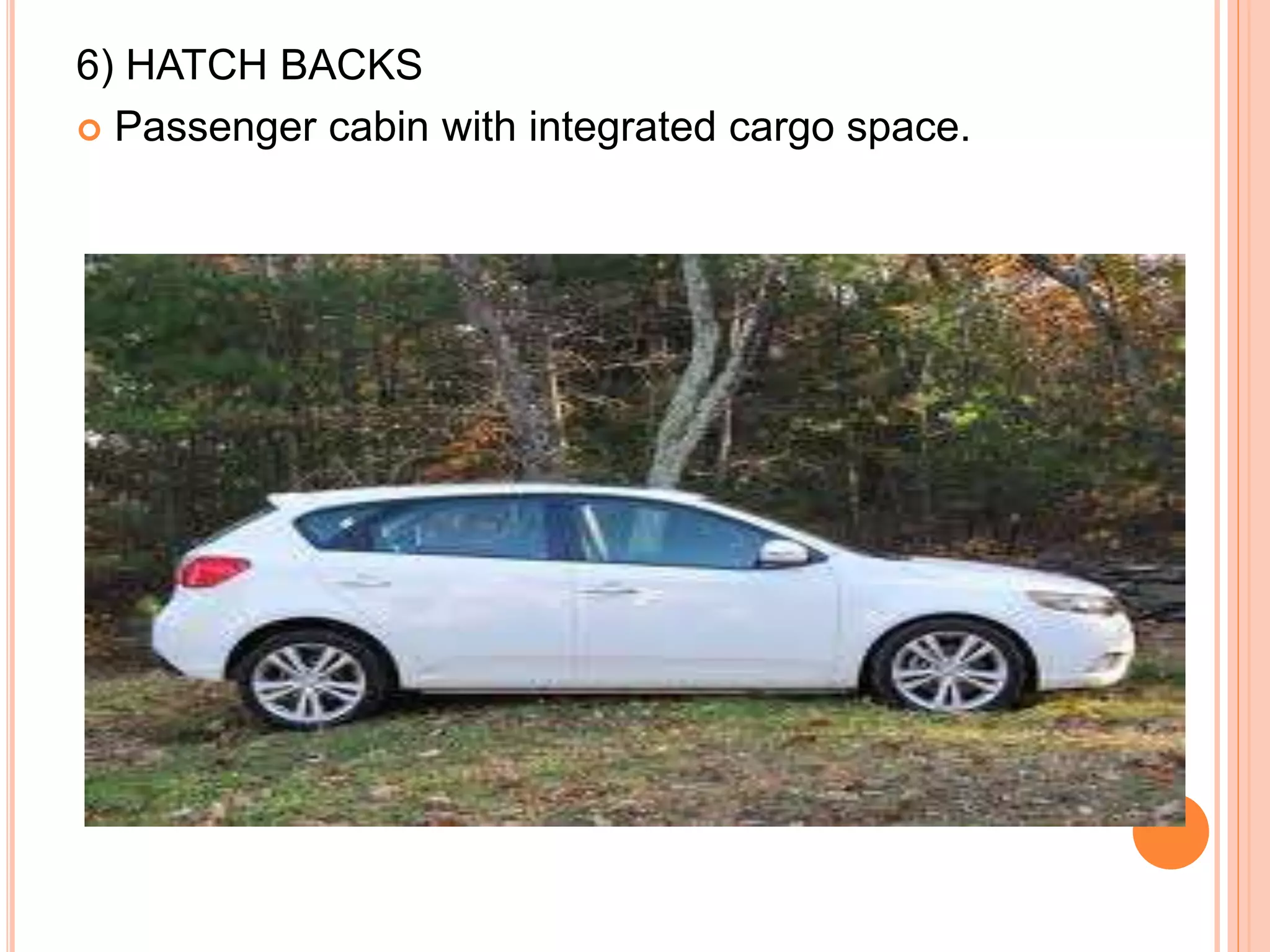
6) HATCH BACKS
 Passenger cabin with integrated cargo space.

Automobile chassis and classification (frames)

  • 1.
  • 3.
    CLASSIFICATION OF AUTOMOBILE 1.Capacity (HMV ,LMV) 2. Power ( Petrol, Diesel, Gas, Electric) 3. Use (Cars ,Buses ,Trucks ,Motor Cycles ) 4. Wheels (2.3.4.6 ….) 5. Make ( Bajaj, Vespa, Hero, Honda, Maruti) 6. Drive (LHD, RHD) 7. Transmission ( Conventional, Automatic) 8. Purpose (Passenger,Goods)
  • 4.
    CHASSIS  Chasis isa French term which denotes the whole vehicle except body in case of heavy vehicles.  Chassis consists of engine, brakes, steering system & wheel mounted on the frame, differential, suspension.  Propel and control a automobile
  • 5.
    COMPONENTS OF CHASSIS Engine  Transmission (Clutch, Gear Box, Propeller shaft, Differential)  Controls (Braking and Steering)  Basic Structure (frame, Suspensions, Axles, wheels, tyres)  Electrical systems REMAINING  Auxiliaries  Superstructure
  • 6.
    FUNCTION OF VEHICLESYSTEMS Vehicle System Function Body • Provide durable attachment for other major systems • Provide safe and pleasant seating environment for all passengers • Protect passengers from crashes Chassis • Provide capability to steer the vehicle • Provide capability to brake the vehicle safely • Provide isolation between road and passengers Powertrain • Provide capability to accelerate the vehicle by transferring torque to wheels • Provide capability to control vehicle speed • Meet regulatory exhaust requirement Climate Control • Maintain comfortable temperature distribution for passengers • Provide windshield defrost capability Electrical & Electronics • Provide power supply where needed • Provide desirable entertainment system • Provide functional censors and controls
  • 7.
    GENERAL CONSIDERATION RELATINGTO CHASSIS Body of most vehicle should fulfil the following requirements: 1. The body should be light. 2. It should have minimum number of components. 3. It should provide sufficient space for passengers and luggage. 4. It should withstand vibrations while in motion. 5. It should offer minimum resistance to air. 6. It should be cheap and easy in manufacturing. 7. It should be attractive in shape and colour. 8. It should have uniformly distributed load. 9. It should have long fatigue life 10.It should provide good vision and ventilation.
  • 8.
    Classification Chassis accto layout  Conventional  Semi-forward  Full-forward
  • 12.
    CHASSIS CLASSIFICATION BASEDON ENGINE LOCATION  Engine fitted at front  Engine fitted at Back  Engine fitted at centre  Engine fitted at front but crosswise CHASSIS CLASSIFICATION BASED ON Number of Wheels fitted in the vehicles and the number of driving wheels •4x2 drive chassis vehicle. •4x4 drive chassis vehicle. •6x2 drive chassis vehicle. •6x4 drive chassis vehicle.
  • 13.
    FITTED AT FRONT& DRIVE IS GIVEN TO THE WHEELS FROM THE “REAR” 1. Enough space is available for luggage behind the rear seat 2. The weight of vehicles is well balance 3. Increased efficiency of cooling system Engine is fitted at front & drive is given to front wheel 1. Low floor is available. 2. Vehicle has more road holding capacity. 3. clutch , gear box & differential are usually made as one unit, thereby cost is reduced.
  • 14.
    ENGINE IS FITTEDIN FRONT BUT CROSSWISE:  BMC  Maruti
  • 15.
    ENGINE FITTED ATTHE CENTRE OF THE CHASSIS:  Drive is given to the rear  As in royal tiger world master buses  This arrangement provide full space of floor for use
  • 16.
    ENGINE FITTED ATBACK 1. Flat floor is available since long propeller shafts are eliminated 2. With elimination of propeller shaft the centre of gravity lowered giving stable driving 3. Better adhesion on road specially when climbing hill. 4. While Climbing hills proper adhesion may be affected since the weight of vehicles moves to the rear , thereby reducing the weight on the front wheel. 5. As a result of grouping of the engine with clutch, gear box and differential, the repair and adjustment become difficult due to congestion at the rear.
  • 17.
  • 18.
    TYPES OF CHASSISFRAMES: THERE ARE THREE TYPES OF FRAMES 1. CONVENTIONAL FRAME 2. INTEGRAL FRAME 3. SEMI-INTEGRAL FRAME
  • 19.
    CONVENTIONAL FRAME a.Channel Section- Good resistance to bending b. Tabular Section - Good resistance to Torsion c. Box Section - Good resistance to both bending and Torsion
  • 20.
    INTEGRAL FRAME (FRAMELESS) used now a days in most of the cars  no frame and all the assembly units are attached to the body  Due to elimination of long frame it is cheaper  Only disadvantage is repairing is difficult.
  • 21.
    SEMI - INTEGRALFRAME  half frame is fixed in the front end on which engine gear box and front suspension is mounted.  It has the advantage when the vehicle is met with accident the front frame can be taken easily to replace the damaged chassis frame.  This type of frame is used in FIAT cars and some of the European and American cars.
  • 22.
    SOME OF IMPORTANTCHASSIS FRAMES ARE:  Ladder Frame  Tabular Space Frame  Monocoque Frame  Aluminum Space Frame  Carbon Fibre frame
  • 23.
    LADDER FRAME:  Theladder frame is the simplest and oldest of all designs.  This design offers good beam resistance because of its continuous rails from front to rear  poor resistance to torsion
  • 24.
    A type frame Xtype frame High torsional rigidity
  • 25.
  • 30.
    TUBULAR SPACE FRAME: It is 3-dimensional design  Tubular space frame chassis employs dozens of circular, rectangular etc section tube, positions in different directions to provide mechanical strength against force from anywhere.  These tubes are welded & forms a very complex structure.
  • 31.
    TUBULAR ADVANTAGES  Very strongin any direction (compared with ladder chassis and Monocoque chassis) DISADVANTAGES  Very complex , costly and time consuming to be built.
  • 32.
    MONOCOQUE  Monocoque isa one-piece structure which defines overall shape of the car. while ladder , tabular & backbone provide only stress members  Today 99% car produced in this planet are made of Monocoque chassis.  Chassis are made by welding of several pieces.(Spot winding).
  • 34.
    MONOCOQUE DISADVANTAGES 1. It hasvery complex design . 2. Impossible for small volume production. ADVANTAGES 1. Space-efficiency (the whole structure is actually an outer shell.) 2. Monocoque chassis benefit crash (reproduction) production because it uses a lot of metal. 3. Cheap for mass production.
  • 36.
    ALUMINIUM MONOCOQUE-  AudiA8 is the first mass production car featuring Aluminium Space Frame chassis.  To replace conventional steel monocoque mainly for the benefit of lightness.  Audi claimed A8's ASF is 40% lighter yet 40% stiffer than contemporary steel monocoque.
  • 37.
    CARBON-FIBER MONOCOQUE  CarbonFiber is the most sophisticated material using in aircrafts, spaceships and racing cars because of its superior rigidity-to-weight ratio.  Road cars featuring Carbon-Fiber body panels, such as Ferrari 288GTO and Porsche 959.There are several Carbon-fibers commonly used in motor industry.  Kevlar, which was developed by Du Pont, offers the highest rigidity-to-weight ratio among them. Because of this, army's helmets are made of Kevlar. Kevlar can also be found in the body panels of many exotic cars, although most of them simultaneously use other kinds of carbon-fiber in even larger amount.
  • 38.
    CARBON FIBRE MONOCOQUE Productionprocess  Carbon-fiber panels are made by growing carbon- fiber sheets (something look like textile) in either side of an aluminium foil.  The foil, which defines the shape of the panel, is sticked with several layers of carbon fiber sheets impregnated with resin, then cooked in a big oven for 3 hours at 120°C and 90 psi pressure.  After that, the carbon fiber layers will be melted and form a uni-formal, rigid body panel
  • 39.
    CARBON FIBRE PANELS Where is the carbon-fiber used ? Body panels or Chassis ?  Since body panels do nothing to provide mechanical strength, the use of carbon fiber over aluminium can barely save weight.  The stress member remains to be the chassis, which is usually in heavier and weaker steel tubular frame.
  • 40.
    COMPARISON LADDER ANDMONOCOQUE Performance -  The monocoque is a lighter design which is a plus for fuel efficiency,  It has more torsional stiffness and is by far the better chassis for performance oriented vehicles.  The heavy nature of the ladder chassis makes it tough and it is much better than the monocoque for carrying heavy loads and towing heavier objects. Design -  A unibody bodyshell is difficult to design, build and modify (platform sharing) when compared to the body on frame but computer aided design (CAD) makes unibody platform sharing much easier.  For body on frame vehicles its easy to build another body even from another bodystyle and place it on a ladder chassis as long as they are of similar dimensions. Materials -  Unitary bodyshells can be made from a variety of materials steel and steel alloys, aluminium and aluminium alloys and even carbon fiber or combinations of these materials whereas ladder chassis are usually built from steel.
  • 41.
  • 42.
    VARIOUS LOADS ACTINGON THE FRAME: 1. Short duration Load - While crossing a broken patch. 2. Momentary duration Load - While taking a curve. 3. Impact Loads - Due to the collision of the vehicle. 4. Inertia Load - While applying brakes. 5. Static Loads - Loads due to chassis parts. 6. Over Loads - Beyond Design capacity.
  • 43.
    MATERIALS- WHY IMPORTANT As fuel economy restrictions become tighter, manufacturers must find new ways to meet them.  This has led them away from using so much steel in the vehicles, and more and more are moving towards aluminum.
  • 44.
    A BASIC COMPARISON Twocommon alloys used in car manufacturing: For Aluminum: For Steel: Density of Steel: 7.88 g/cm3 Density of Aluminum: 2.7 g/cm3  Aluminum is about 3 times lighter than steel per unit volume, but can be made just as strong using certain alloys/shapes/bonding methods.  Because of this, AL parts can be thicker, and thus stronger, than their steel counterparts, all while weighing less. Steel Al Yield Strength (MPa) 294.8 395 UTS (MPa) 394.7 420 Hardness (HB500) 104 58
  • 45.
    THE COST ISSUE WhileAl may seem like a miracle metal for car production, there is a reason not all cars are made from Al... It costs a lot more than Steel.
  • 46.
    THE MOVE TOALUMINUM  The first production vehicle to move to an Al frame was the Audi A8 in 1994.  This allowed Audi to make their full-size car lighter than the competitions (BMW, Mercedes, Lexus...), thus giving them the edge in performance & handling.  This comes at a price premium though, for instance compared to a Lexus LS460 (Steel framed) which costs around $65,000. The A8 starts at $75,000 Audi A8 Lexus LS460
  • 47.
    CARS UTILIZING ALFRAMES Audi A8 Jaguar XJ Corvette Z06 (GM) Honda NSX Audi A2 Audi R8
  • 48.
    SOME OTHER ADVANTAGES... There are some manufacturing methods that can only be done with aluminum, such as extrusions.  These extrusions allows the Al Space Frame to have about half the amount of parts as a traditional steel monocoque.  Because of all this, Al is already a cheaper material to use for low volume production cars (under 100,000 units a year or so).
  • 49.
    IN THE FUTURE While Aluminum may be the wave of the future for now, some exotic car companies are already looking ahead to composite materials.  Take for example Porsche Carrera GT, which used a completely Carbon-Fiber monocoque construction in addition to Carbon-Fiber body panels.
  • 50.
    VEHICLE ATTRIBUTES Vehicle AttributesDescription Cost Lowest production, assembly and distribution cost compared to competitive vehicles Weight Lowest curb weight compared to competitive vehicles in its weight class Package Best use of the space to provide comfort and amenities to passengers Safety 5* crash rating from the Federal Motor Vehicle Safety Standard (FMVSS) Dynamics Best ride & handling performance compared to competitive vehicles Durability Highest reliability and high mileage durability compared to competitive vehicles NVH Lowest noise, vibration and harshness compared to competitive vehicles
  • 51.
    TYPES OF CARSON AS PER THEIR DESIGN 1) Sports Cars  Sports cars are the perfect example of best automobile engineering,  sports cars are two-seat small cars that are designed for quick response to move fast for spirited performance and nimble handling.  Nissan GT-R  Now a days sports cars have become a first choice for every body, therefore automobile manufacture are making them more fast and more luxury.  Some example of sports car masterpieces are  Nissan GTR, Lamborghini Veneno, Maserati Alfieri etc.
  • 52.
    2) Muscle Cars A type of car designed for powerful and high performance automobile lovers, These cars have powerful engine, mostly V-8 and above with 2-door.  Apart form this their performance and their look is muscular and aggressive.  Some common example are Ford Mustang, Chevrolet Camaro etc.
  • 53.
    3) Sedan typeCars  It is the car type that we found around us every time any where, well sedan is a passenger car that has two rows of seats and adequate passenger space in the rear compartment for adult passengers.  In sedan, a four or more people can travel and has a fixed roof that is full- height up to the rear window with two pillar to join roof and window.  The word sedan is taken from Italian sedia “chair” in that closed chair one person can sit.  Some common examples are Porsche Panamera, Audi A8 etc.
  • 54.
    4) SUVs typeCars  A sport utility vehicle (SUV) is a estate car mostly available in four wheel drive to drive on-road or off-road having large passenger carrying space.  If you wish to further categorize the SUV car they are sub divided in many type as par their size like Compact SUV, Mid-size SUV, Full size SUV etc.  Some popular SUV’s are BMW X4, Porsche Macan, Maserati Levante etc.
  • 55.
    5) Multi-utility vehicles:MUVs  Usually based on either a mid-sized car or mini-van platform.  Usually two-wheel drive "people movers". They have higher ceilings, more storage than a sedan, some of the utility of a SUV with a similar ride,  though from a construction standpoint not as robust.  Great for larger families of 4-5 and comfortable. In India a good example is the Honda Mobilio
  • 56.
    6) HATCH BACKS Passenger cabin with integrated cargo space.