Themes From  The Second World By Austin Kruisheer
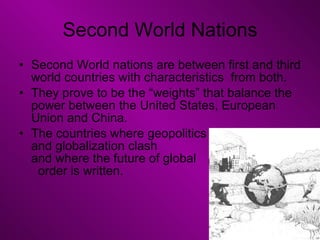
Second World Nations Second World nations are between first and third world countries with characteristics  from both. They prove to be the “weights” that balance the power between the United States, European Union and China. The countries where geopolitics  and globalization clash  and where the future of global  order is written.
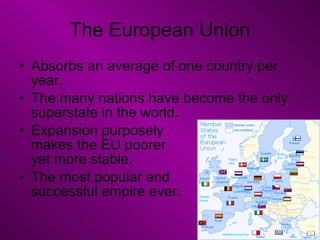
The European Union Absorbs an average of one country per year. The many nations have become the only superstate in the world. Expansion purposely  makes the EU poorer  yet more stable. The most popular and  successful empire ever.
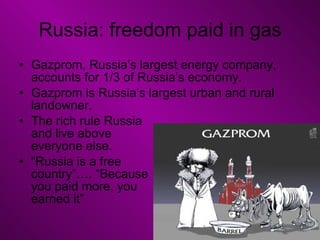
Russia: freedom paid in gas Gazprom, Russia’s largest energy company, accounts for 1/3 of Russia’s economy. Gazprom is Russia’s largest urban and rural landowner. The rich rule Russia  and live above  everyone else. “ Russia is a free  country”…. “Because  you paid more, you  earned it”
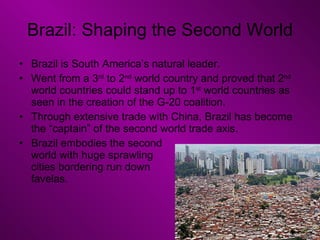
Brazil: Shaping the Second World Brazil is South America’s natural leader. Went from a 3 rd  to 2 nd  world country and proved that 2 nd  world countries could stand up to 1 st  world countries as seen in the creation of the G-20 coalition. Through extensive trade with China, Brazil has become the “captain” of the second world trade axis. Brazil embodies the second  world with huge sprawling  cities bordering run down  favelas.
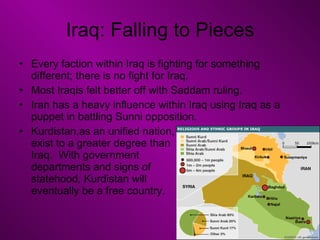
Iraq: Falling to Pieces Every faction within Iraq is fighting for something different; there is no fight for Iraq. Most Iraqis felt better off with Saddam ruling. Iran has a heavy influence within Iraq using Iraq as a puppet in battling Sunni opposition. Kurdistan,as an unified nation,  exist to a greater degree than  Iraq.  With government  departments and signs of  statehood, Kurdistan will  eventually be a free country.
Vietnam: Holding It’s Own Vietnam is the only country China has invaded but didn’t conquer. Anti-Colonial but not Anti-Capitalist Japan and China have looked to Vietnam for future profits in Vietnams fast growing economy. With American help, Vietnam has prevented Sino centrism while moving  forward in the global  economy.

Themes from The Second World

  • 1.
    Themes From The Second World By Austin Kruisheer
  • 2.
    Second World NationsSecond World nations are between first and third world countries with characteristics from both. They prove to be the “weights” that balance the power between the United States, European Union and China. The countries where geopolitics and globalization clash and where the future of global order is written.
  • 3.
    The European UnionAbsorbs an average of one country per year. The many nations have become the only superstate in the world. Expansion purposely makes the EU poorer yet more stable. The most popular and successful empire ever.
  • 4.
    Russia: freedom paidin gas Gazprom, Russia’s largest energy company, accounts for 1/3 of Russia’s economy. Gazprom is Russia’s largest urban and rural landowner. The rich rule Russia and live above everyone else. “ Russia is a free country”…. “Because you paid more, you earned it”
  • 5.
    Brazil: Shaping theSecond World Brazil is South America’s natural leader. Went from a 3 rd to 2 nd world country and proved that 2 nd world countries could stand up to 1 st world countries as seen in the creation of the G-20 coalition. Through extensive trade with China, Brazil has become the “captain” of the second world trade axis. Brazil embodies the second world with huge sprawling cities bordering run down favelas.
  • 6.
    Iraq: Falling toPieces Every faction within Iraq is fighting for something different; there is no fight for Iraq. Most Iraqis felt better off with Saddam ruling. Iran has a heavy influence within Iraq using Iraq as a puppet in battling Sunni opposition. Kurdistan,as an unified nation, exist to a greater degree than Iraq. With government departments and signs of statehood, Kurdistan will eventually be a free country.
  • 7.
    Vietnam: Holding It’sOwn Vietnam is the only country China has invaded but didn’t conquer. Anti-Colonial but not Anti-Capitalist Japan and China have looked to Vietnam for future profits in Vietnams fast growing economy. With American help, Vietnam has prevented Sino centrism while moving forward in the global economy.