BS-ENGLISH-3rd Semester-Self-Support
Group: Leaders
Submitted to: Ma'am Romana
• MaggieTulliver, by Frederick Stuart Church
• Dorlcote Mill – theTulliver family home for a century
• Basset – home of Moss Farm
• DownlowCommon
• Garum Firs – visited for a treat
• Midsummer – home of the academy
• Mud port
• St. Ogg's
• St. Ursula
The characters move from
Dorlcote Mill to the small
town of St.Ogg, in the wide
plain where the river Floss
hurries on.
Setting
Mary Ann Evans hide her name under
the alias George Eliot to avoid the
diffidence and the prejudices of the
hypocrite bourgeoisie of theVictorian
age.
SOCIAL CONTEXT
MaryAnn Evans wrote “The Mill on the Floss”
during theVictorianism, a period
characterized by an economic prosperity and
a colonial and commercial expansion.
On the contrary the society showed deep
social lacerations. Indeed, after the Industrial
Revolution, the difference between rich and
poor social classes had increased: to
somebody’s accumulation of wealth stood
opposite child and female mistreatment,
poverty and prostitution.
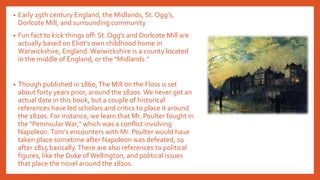
• Early 19th century England, the Midlands, St. Ogg’s,
Dorlcote Mill, and surrounding community
• Fun fact to kick things off: St. Ogg’s and Dorlcote Mill are
actually based on Eliot’s own childhood home in
Warwickshire, England.Warwickshire is a county located
in the middle of England, or the "Midlands."
• Though published in 1860,The Mill on the Floss is set
about forty years prior, around the 1820s. We never get an
actual date in this book, but a couple of historical
references have led scholars and critics to place it around
the 1820s. For instance, we learn that Mr. Poulter fought in
the "Peninsular War," which was a conflict involving
Napoleon.Tom’s encounters with Mr. Poulter would have
taken place sometime after Napoleon was defeated, so
after 1815 basically.There are also references to political
figures, like the Duke ofWellington, and political issues
that place the novel around the 1820s.
• So, we’ve got time period out of the way. It’s important to note that this novel is set in
the Midlands and takes place largely at an industrial mill.The Midlands were the major
site for England’s Industrial Revolution.This gives us some insight into our characters.
Lots of the people living in the Midlands in this period made their living in some sort of
business profession. In other words, these people weren’t all just farmers, and the
wealthy people in the novel (like the Deane) made their money through business as
opposed to inheritance. Business, industry, and legal procedures were a growing part
of this society. And business and the law often made this society very precarious, or
unstable.As we see through Mr.Tulliver’s disastrous lawsuit, people could lose
everything (home, money, possessions) very quickly. Reputations were also lost quickly
in a small community that had very strictVictorian social codes, which were even
stricter for women.
Theme
• The conflict between the individual and the conformist society in
which he or she lives. In the novel , Maggie’s intelligence is defined
by her father as an inconvenient disadvantage, something that
won’t be useful in her life: “Too clever for a woman […] it doesn’t
add to her value.” Such as her dark skin is something to be ashamed
of.The society denies her intellectual and spiritual growth and a kind
of determinism rejects her attempts to grow and to be true to
herself.
The theme is simply a novel about the middle class family in England and
the concept of the individual against society. Alan Bellringer has
commented, "The two main themes of the novel, growing up and falling in
love, lend themselves to amusement, but it is stunted growth and
frustrated love that are emphasized."
• The growth.That is the transition from childhood dreams to the hard reality of life.
Indeed Maggie, after her quite carefree youth, has to face her family’s bankrupting,
Tom’s abandonment, her father’s death and has to give her love up.
• The relationship between brother and sister, that is the background throughout
the whole novel.
• - Independence and freedom, that is the importance of the right of free choice.
Indeed in the novel we can notice the succession of Maggie’s conditioned choices,
and as a result she dies without having lived her life. She has renounced to
everything and to herself.
Gender Disparity
• The gender disparity in the world ofThe Mill on the Floss is vital to understanding Maggie’s
story. She is an intelligent and fascinating woman, but the world she is born into offers
nothing for her to do with her talents; women are assumed to be more interested in gossip
than reading, adherence to custom is valued more highly than intelligence or knowledge, and
whether women are even capable of amassing a depth of knowledge is a subject of debate.
• In this world, Maggie’s many talents do nothing for her except make her feel all the more
dissatisfied with what is available.This context is crucial to understanding why choice is so
difficult for her, why she is pulled so strongly between duty and desire. Her desires would lead
her to a masculine pursuit, which is not available to her in any meaningful way and would
require a great sacrifice of duty. But duty offers little of interest to someone with her
creativity and sharpness, and so is a much harder choice than it is for, for example, Lucy
Deane, who can play the appropriate feminine role perfectly. Maggie’s struggles, then, which
the author so directly associates with progress, are not just for the general progress of culture
away from the previous generation’s comfort with “ignorance”, but progress towards greater
freedom of possibility for women like Maggie - women like George Eliot.
The Difficulty of Choice
• ThroughoutThe Mill on the Floss, the individual is pitted against the community, especially in reference
to MaggieTulliver.To make the decision to inhabit her individuality would be, in many ways, the more
difficult path, as the book shows us that with the freedom of individuality comes the responsibility to
make choices, and for Maggie, at least, such decisive action is never easy.
• If Maggie were to subjugate her will to the greater community, choices become meaningless - she just
has to do what everyone does, follow tradition and custom, and so the only choices she would have to
make are minor and insignificant because they are within these set bounds.
• If instead Maggie were to assert her individuality, as she tries to at various points, the choices she
makes define who she is, how she will live, how her community will see her, and in some cases, how
those around her will live.Though Maggie is deeply intelligent and passionate and has clearly defined
desires, she finds this nearly impossible. She tries to choose between Philip andTom, fails, and in trying
to have both, hurts them both. She tries to choose between Stephen and the community, regrets her
decision, but in regretting it after the fact, finds she has already alienated most of the community.The
difficulty Maggie finds in making choices, sticking to them, and facing the consequences, leads her to
subjugate her will to the community completely.
Renunciation and Sacrifice
• Renunciation and sacrifice are at the heart of the major actions of Maggie andTom’s lives. After his
father’s losses,Tom dedicates his life to repaying his father’s debts, and then to getting the mill back
from Mr.Wakem.To this end he gives up all socializing so that he won’t be tempted to spend any of the
money he makes, and he works so hard that when he gets home every night, he is too tired to even
converse with his family. He thus essentially sacrifices human interaction to regain his family’s honor.
• Maggie also becomes fixated on renunciation, but whereasTom sacrifices pleasure for a specific,
concrete aim, Maggie’s renunciation is a spiritual attempt to find peace in a world ill-suited to her.
Maggie finds the weight of the “conflict between inward impulse and outward fact, which is the lot of
every imaginative and passionate nature” too much to bear, and so “renunciation seemed to her the
entrance into that satisfaction which she had so long been craving in vain”.
• Because her sacrifice has no active realm in which to act, as opposed toTom’s, she finds it much harder
to adhere to. She lapses from it repeatedly, but in the end, returns to it in her plan to finally renounce a
chance for love and happiness with Stephen.Though at that point, the damage has already been done
and to marry him would likely not cause any more harm, she does not allow this for herself, because she
believes renunciation is right for its own sake, regardless of what is being renounced or the potential
consequences.
Communal versus Individual Interests
• The theme of communal versus individual interests, which could also be called duty versus desire, is
of central importance toThe Mill on the Floss, and is essentially what drives the plot. Maggie, with
her unusual looks, her intellectual prowess, her driving curiosity, and her passionate desires, does
not naturally fit into the community of St. Ogg’s at all. Her family continually fears what will
become of her, she is often misunderstood and almost never taken seriously, and she is certainly
never given the praise for her cleverness that she so desires.To fulfill her individual desires, then, is
to break out of any role the community is willing to offer her, and so to go against it.
• Though Maggie yearns for this at times, in the end she is far too bound to her past, her family, and
the broader community to be willing to relinquish it.Though it would seem that marrying Stephen
offers her the best opportunity for happiness, she chooses to leave him and, she believes, all future
chances of happiness to return to St. Ogg’s.Once there, even the understanding Dr. Kenn, who
appreciates her Christian values in staying close to her roots, tells her it would be best for her to go,
but still, she stays.When she dies, it is in a boat on a current taking her towards home, so this
becomes her final choice, and she has ultimately given her life to stay in the community; she loses
her individuality in the most profound sense.
The Loss of Innocence
• Loss of innocence is a major theme inThe Mill on the Floss. From the beginning of the novel,
the narrator makes it clear that there is a strong demarcation between living in childhood, as
Maggie andTom are doing, and looking back on it, as she is doing.With sentences like,
“Childhood has no forebodings; but then, it is soothed by no memories of outlived sorrow” , or
“Very trivial, perhaps, this anguish seems to weather-worn mortals who have to think of
Christmas bills, dead loves, and broken friendships” , the narrator repeatedly calls to attention
the great distance between the perception of children and the perception of adults.
• When Mr.Tulliver loses all his assets and his senses, it becomes clear that the divide between
child and adult is not necessarily slowly created over time, but that, for Maggie andTom at
least, it is created in a single episode of rending - a loss of innocence.With powerful imagery,
Eliot shows Maggie andTom going “forth together into their new life of sorrow,” “the thorny
wilderness,” as “the golden gates of their childhood had for ever closed behind them” and they
will “never more see the sunshine undimmed by remembered cares”.The knowledge of their
family’s great hardships to come is “a violent shock” that separates them permanently from
their Edenic - in comparison, at least - childhood.
• This was very much a world in transition, as we can see throughTom’s education.Tom gets a very
old-fashioned "gentleman’s" education, which doesn’t help him in the modern business world.
Tom’s education helps to shed light on the importance of class in this world too.Tom, who has to
work for a living, definitely requires a different sort of education than someone like Philip Wakem
or Stephen Guest, who are wealthy enough to not worry about learning a trade and getting actual
job skills.Their respective fathers have been so successful at business that Stephen and Philip
don’t really have to work now.
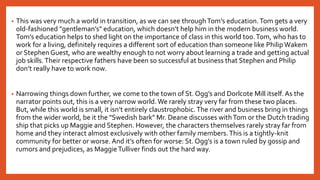
• Narrowing things down further, we come to the town of St. Ogg’s and Dorlcote Mill itself. As the
narrator points out, this is a very narrow world. We rarely stray very far from these two places.
But, while this world is small, it isn’t entirely claustrophobic.The river and business bring in things
from the wider world, be it the "Swedish bark" Mr. Deane discusses withTom or the Dutch trading
ship that picks up Maggie and Stephen. However, the characters themselves rarely stray far from
home and they interact almost exclusively with other family members.This is a tightly-knit
community for better or worse. And it’s often for worse: St. Ogg’s is a town ruled by gossip and
rumors and prejudices, as MaggieTulliver finds out the hard way.
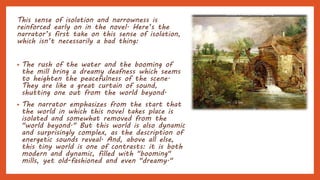
This sense of isolation and narrowness is
reinforced early on in the novel. Here’s the
narrator’s first take on this sense of isolation,
which isn’t necessarily a bad thing:
• The rush of the water and the booming of
the mill bring a dreamy deafness which seems
to heighten the peacefulness of the scene.
They are like a great curtain of sound,
shutting one out from the world beyond.
• The narrator emphasizes from the start that
the world in which this novel takes place is
isolated and somewhat removed from the
"world beyond." But this world is also dynamic
and surprisingly complex, as the description of
energetic sounds reveal. And, above all else,
this tiny world is one of contrasts: it is both
modern and dynamic, filled with "booming"
mills, yet old-fashioned and even "dreamy."
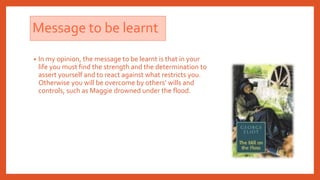
Message to be learnt
• In my opinion, the message to be learnt is that in your
life you must find the strength and the determination to
assert yourself and to react against what restricts you.
Otherwise you will be overcome by others’ wills and
controls, such as Maggie drowned under the flood.
Themes and Settings

Themes and Settings

  • 1.
  • 3.
    • MaggieTulliver, byFrederick Stuart Church • Dorlcote Mill – theTulliver family home for a century • Basset – home of Moss Farm • DownlowCommon • Garum Firs – visited for a treat • Midsummer – home of the academy • Mud port • St. Ogg's • St. Ursula The characters move from Dorlcote Mill to the small town of St.Ogg, in the wide plain where the river Floss hurries on.
  • 4.
    Setting Mary Ann Evanshide her name under the alias George Eliot to avoid the diffidence and the prejudices of the hypocrite bourgeoisie of theVictorian age. SOCIAL CONTEXT MaryAnn Evans wrote “The Mill on the Floss” during theVictorianism, a period characterized by an economic prosperity and a colonial and commercial expansion. On the contrary the society showed deep social lacerations. Indeed, after the Industrial Revolution, the difference between rich and poor social classes had increased: to somebody’s accumulation of wealth stood opposite child and female mistreatment, poverty and prostitution.
  • 5.
    • Early 19thcentury England, the Midlands, St. Ogg’s, Dorlcote Mill, and surrounding community • Fun fact to kick things off: St. Ogg’s and Dorlcote Mill are actually based on Eliot’s own childhood home in Warwickshire, England.Warwickshire is a county located in the middle of England, or the "Midlands." • Though published in 1860,The Mill on the Floss is set about forty years prior, around the 1820s. We never get an actual date in this book, but a couple of historical references have led scholars and critics to place it around the 1820s. For instance, we learn that Mr. Poulter fought in the "Peninsular War," which was a conflict involving Napoleon.Tom’s encounters with Mr. Poulter would have taken place sometime after Napoleon was defeated, so after 1815 basically.There are also references to political figures, like the Duke ofWellington, and political issues that place the novel around the 1820s.
  • 6.
    • So, we’vegot time period out of the way. It’s important to note that this novel is set in the Midlands and takes place largely at an industrial mill.The Midlands were the major site for England’s Industrial Revolution.This gives us some insight into our characters. Lots of the people living in the Midlands in this period made their living in some sort of business profession. In other words, these people weren’t all just farmers, and the wealthy people in the novel (like the Deane) made their money through business as opposed to inheritance. Business, industry, and legal procedures were a growing part of this society. And business and the law often made this society very precarious, or unstable.As we see through Mr.Tulliver’s disastrous lawsuit, people could lose everything (home, money, possessions) very quickly. Reputations were also lost quickly in a small community that had very strictVictorian social codes, which were even stricter for women.
  • 7.
    Theme • The conflictbetween the individual and the conformist society in which he or she lives. In the novel , Maggie’s intelligence is defined by her father as an inconvenient disadvantage, something that won’t be useful in her life: “Too clever for a woman […] it doesn’t add to her value.” Such as her dark skin is something to be ashamed of.The society denies her intellectual and spiritual growth and a kind of determinism rejects her attempts to grow and to be true to herself. The theme is simply a novel about the middle class family in England and the concept of the individual against society. Alan Bellringer has commented, "The two main themes of the novel, growing up and falling in love, lend themselves to amusement, but it is stunted growth and frustrated love that are emphasized."
  • 8.
    • The growth.Thatis the transition from childhood dreams to the hard reality of life. Indeed Maggie, after her quite carefree youth, has to face her family’s bankrupting, Tom’s abandonment, her father’s death and has to give her love up. • The relationship between brother and sister, that is the background throughout the whole novel. • - Independence and freedom, that is the importance of the right of free choice. Indeed in the novel we can notice the succession of Maggie’s conditioned choices, and as a result she dies without having lived her life. She has renounced to everything and to herself.
  • 9.
    Gender Disparity • Thegender disparity in the world ofThe Mill on the Floss is vital to understanding Maggie’s story. She is an intelligent and fascinating woman, but the world she is born into offers nothing for her to do with her talents; women are assumed to be more interested in gossip than reading, adherence to custom is valued more highly than intelligence or knowledge, and whether women are even capable of amassing a depth of knowledge is a subject of debate. • In this world, Maggie’s many talents do nothing for her except make her feel all the more dissatisfied with what is available.This context is crucial to understanding why choice is so difficult for her, why she is pulled so strongly between duty and desire. Her desires would lead her to a masculine pursuit, which is not available to her in any meaningful way and would require a great sacrifice of duty. But duty offers little of interest to someone with her creativity and sharpness, and so is a much harder choice than it is for, for example, Lucy Deane, who can play the appropriate feminine role perfectly. Maggie’s struggles, then, which the author so directly associates with progress, are not just for the general progress of culture away from the previous generation’s comfort with “ignorance”, but progress towards greater freedom of possibility for women like Maggie - women like George Eliot.
  • 10.
    The Difficulty ofChoice • ThroughoutThe Mill on the Floss, the individual is pitted against the community, especially in reference to MaggieTulliver.To make the decision to inhabit her individuality would be, in many ways, the more difficult path, as the book shows us that with the freedom of individuality comes the responsibility to make choices, and for Maggie, at least, such decisive action is never easy. • If Maggie were to subjugate her will to the greater community, choices become meaningless - she just has to do what everyone does, follow tradition and custom, and so the only choices she would have to make are minor and insignificant because they are within these set bounds. • If instead Maggie were to assert her individuality, as she tries to at various points, the choices she makes define who she is, how she will live, how her community will see her, and in some cases, how those around her will live.Though Maggie is deeply intelligent and passionate and has clearly defined desires, she finds this nearly impossible. She tries to choose between Philip andTom, fails, and in trying to have both, hurts them both. She tries to choose between Stephen and the community, regrets her decision, but in regretting it after the fact, finds she has already alienated most of the community.The difficulty Maggie finds in making choices, sticking to them, and facing the consequences, leads her to subjugate her will to the community completely.
  • 11.
    Renunciation and Sacrifice •Renunciation and sacrifice are at the heart of the major actions of Maggie andTom’s lives. After his father’s losses,Tom dedicates his life to repaying his father’s debts, and then to getting the mill back from Mr.Wakem.To this end he gives up all socializing so that he won’t be tempted to spend any of the money he makes, and he works so hard that when he gets home every night, he is too tired to even converse with his family. He thus essentially sacrifices human interaction to regain his family’s honor. • Maggie also becomes fixated on renunciation, but whereasTom sacrifices pleasure for a specific, concrete aim, Maggie’s renunciation is a spiritual attempt to find peace in a world ill-suited to her. Maggie finds the weight of the “conflict between inward impulse and outward fact, which is the lot of every imaginative and passionate nature” too much to bear, and so “renunciation seemed to her the entrance into that satisfaction which she had so long been craving in vain”. • Because her sacrifice has no active realm in which to act, as opposed toTom’s, she finds it much harder to adhere to. She lapses from it repeatedly, but in the end, returns to it in her plan to finally renounce a chance for love and happiness with Stephen.Though at that point, the damage has already been done and to marry him would likely not cause any more harm, she does not allow this for herself, because she believes renunciation is right for its own sake, regardless of what is being renounced or the potential consequences.
  • 12.
    Communal versus IndividualInterests • The theme of communal versus individual interests, which could also be called duty versus desire, is of central importance toThe Mill on the Floss, and is essentially what drives the plot. Maggie, with her unusual looks, her intellectual prowess, her driving curiosity, and her passionate desires, does not naturally fit into the community of St. Ogg’s at all. Her family continually fears what will become of her, she is often misunderstood and almost never taken seriously, and she is certainly never given the praise for her cleverness that she so desires.To fulfill her individual desires, then, is to break out of any role the community is willing to offer her, and so to go against it. • Though Maggie yearns for this at times, in the end she is far too bound to her past, her family, and the broader community to be willing to relinquish it.Though it would seem that marrying Stephen offers her the best opportunity for happiness, she chooses to leave him and, she believes, all future chances of happiness to return to St. Ogg’s.Once there, even the understanding Dr. Kenn, who appreciates her Christian values in staying close to her roots, tells her it would be best for her to go, but still, she stays.When she dies, it is in a boat on a current taking her towards home, so this becomes her final choice, and she has ultimately given her life to stay in the community; she loses her individuality in the most profound sense.
  • 13.
    The Loss ofInnocence • Loss of innocence is a major theme inThe Mill on the Floss. From the beginning of the novel, the narrator makes it clear that there is a strong demarcation between living in childhood, as Maggie andTom are doing, and looking back on it, as she is doing.With sentences like, “Childhood has no forebodings; but then, it is soothed by no memories of outlived sorrow” , or “Very trivial, perhaps, this anguish seems to weather-worn mortals who have to think of Christmas bills, dead loves, and broken friendships” , the narrator repeatedly calls to attention the great distance between the perception of children and the perception of adults. • When Mr.Tulliver loses all his assets and his senses, it becomes clear that the divide between child and adult is not necessarily slowly created over time, but that, for Maggie andTom at least, it is created in a single episode of rending - a loss of innocence.With powerful imagery, Eliot shows Maggie andTom going “forth together into their new life of sorrow,” “the thorny wilderness,” as “the golden gates of their childhood had for ever closed behind them” and they will “never more see the sunshine undimmed by remembered cares”.The knowledge of their family’s great hardships to come is “a violent shock” that separates them permanently from their Edenic - in comparison, at least - childhood.
  • 14.
    • This wasvery much a world in transition, as we can see throughTom’s education.Tom gets a very old-fashioned "gentleman’s" education, which doesn’t help him in the modern business world. Tom’s education helps to shed light on the importance of class in this world too.Tom, who has to work for a living, definitely requires a different sort of education than someone like Philip Wakem or Stephen Guest, who are wealthy enough to not worry about learning a trade and getting actual job skills.Their respective fathers have been so successful at business that Stephen and Philip don’t really have to work now. • Narrowing things down further, we come to the town of St. Ogg’s and Dorlcote Mill itself. As the narrator points out, this is a very narrow world. We rarely stray very far from these two places. But, while this world is small, it isn’t entirely claustrophobic.The river and business bring in things from the wider world, be it the "Swedish bark" Mr. Deane discusses withTom or the Dutch trading ship that picks up Maggie and Stephen. However, the characters themselves rarely stray far from home and they interact almost exclusively with other family members.This is a tightly-knit community for better or worse. And it’s often for worse: St. Ogg’s is a town ruled by gossip and rumors and prejudices, as MaggieTulliver finds out the hard way.
  • 15.
    This sense ofisolation and narrowness is reinforced early on in the novel. Here’s the narrator’s first take on this sense of isolation, which isn’t necessarily a bad thing: • The rush of the water and the booming of the mill bring a dreamy deafness which seems to heighten the peacefulness of the scene. They are like a great curtain of sound, shutting one out from the world beyond. • The narrator emphasizes from the start that the world in which this novel takes place is isolated and somewhat removed from the "world beyond." But this world is also dynamic and surprisingly complex, as the description of energetic sounds reveal. And, above all else, this tiny world is one of contrasts: it is both modern and dynamic, filled with "booming" mills, yet old-fashioned and even "dreamy."
  • 16.
    Message to belearnt • In my opinion, the message to be learnt is that in your life you must find the strength and the determination to assert yourself and to react against what restricts you. Otherwise you will be overcome by others’ wills and controls, such as Maggie drowned under the flood.