DISCIPLINE:
BASICS OF MEDICAL COMMUNICATION
Dr Stela Spînu
II. EDUCATIONALACTIVITIES
The content of the course
No. d/o ТHEME
Number of hours
Lectures
Practical
hours
Individual
work
1.
Communication: definitions and functions 2 6 8
2.
Medical communication. Levels of medical
communication
2 4 6
3.
Metacommunication and cultural differences 2 4 6
4.
Barriers and cleavages in the medical
communication
2 4 6
5.
Conflict - the essential constituent element of
communication
2 4 6
6.
Intercultural communication and its presence in
medical activity
2 4 6
7.
Communication for changing health risk behavior 3 4 7
… 15 30 45
III. SKILLS
At the end of the discipline study the student will know
about:
 the communication process and communication
functions;
 the communication techniques in building physician-
patient functional relationships;
 the elements of intercultural communication in the doctor-
patient relationship;
 the knowledge and skills to detect sources of barriers in
communication etc.
I. PRELIMINARY
 Like many other people based professions, communications
skills are essential to medical practice.
 The ability to communicate effectively is a core
competency for medical practitioners.
 Good communication skills are an asset in medical practice.
 Effective communication helps build a healthy doctor-
patient relationship.
 Better communication between doctor and patient builds
confidence, improves compliance, and reduces mistakes,
thereby reducing malpractice suits.
Theme 1. Communication: definitions and functions
1. The notion of communication
2. Constitutive elements of the communication
process
3. Communication functions
4. Theoretical models of communication
5. Psychology of communication
6. The types of personalities and their individual
manifestations
1. The notion of communication
Communication is simply the
act of transferring information
from one place, person or
group to another.
Every communication involves
(at least) one sender, a
message and a recipient.
1. The notion of communication
Communication is the sending and receiving of information and
can be one-on-one or between groups of people, and can be face-
to-face or through communication devices.
Communication requires a sender, the person who initiates
communication, to transfer their thoughts or encode a message.
This message is sent to the receiver, a person who receives the
message, and finally, the receiver must decode, or interpret the
message.
1. The notion of communication
The word communication has been derived from the Latin
word 'communis' which means 'common' which
consequently implies common understanding.
Communication is defined in various ways:
as speech, understanding, social process, reduction of
uncertainties, transmission, behavior modifying response,
power etc.
1. The notion of communication
 Communication as
speech:
„Communication is the
verbal interchange of
thought or idea”.
 Communication as
understanding:
„Communication is the
process
by which we understand
others and in turn
endeavor to be
understood by them”.
 Communication as social process:
„Communication is a social process
affecting human behavior, including both
interperson and virtual interaction made
possible by advances in technology”.
 Communication as reduction of
uncertainties:
„Communication
arises out of the need to reduce
uncertainty, to act effectively, to defend
or strengthen the ego”.
1. The notion of communication
 Communication as transmission:
„A sender encodes a message
and transmits it through a channel
to a receiver who decodes it”.
 Communication as
Discriminative Response:
„Communication is the
discriminatory response of an
organism to a stimulus”.
 Communication as intention:
„Communicating with intention is
being aware of the purpose and
implication of what you are about to
say. ”
1. The notion of communication
 Communication as
power:
„Communication is the
mechanism by
which power is exerted”.
 Communication as a process:
„The process of communication
refers to the transmission of
information from the sender
through a selected channel to the
receiver overcoming barriers that
affect its pace”.
1. The notion of communication
 This diversity is the result of communication complexity as well as its being a
subject - matter of a very broad constituency of disciplines that includes:
Rhetoric (the art of speaking or writing effectively);
Journalism (the collection and editing of news for presentation through the
media);
Sociology (the science of society, social institutions, and social
relationships);
 Psychology (the science of mind and behavior);
Anthropology (the science of human beings);
Semiotics (a general philosophical theory of signs and symbols ), and others.
1. The notion of communication
 The importance of communication can't be overstated.
 After all, you can't have culture, society, or civilization without the
ability to communicate with one another.
 Good communication prevents wars and misunderstandings,
 helps us meet our needs, establishes rules and laws that aid in the
structuring of society,
 helps people find and keep employment,
 provides information and guidance to people,
 and passes down cultural traditions, norms, and values.
1. The notion of communication
Communication occurs to all areas
of life: home, university,
community, work etc.
Communication includes acts or
interacts that confer knowledge and
experiences, share emotion, give
advice and commands, and ask
questions.
Communication requires a
lot of skill in
intrapersonal and
interpersonal processing
such as listening,
observing, speaking,
questioning, analyzing,
and evaluating.
1. The notion of communication
Communication requires
physical and psychological
capability to send and
receive information,
because the efficiency in
information interchanging
depends on such factor as
anxiety, fatigue, boring,
annoyance, and interest.
Human communication happened at many
levels: (i.e. verbal, nonverbal, paraverbal,
extra-verbal);
take many forms (i.e. intrapersonal,
interpersonal, social mediated),
in one of the various manners (i.e. verbal
presentation, letter, through movements,
sounds, reactions, physical changes,
gestures, languages, etc).
2. Constitutive elements of the communication process
 The sender is the person who is trying to communicate a
message.
 The receiver is the recipient of the message and must
translate the words into thoughts, process the thoughts, and
determine how to respond to the sender.
 The message is a verbal, written, or recorded communication
sent to or left for a recipient.
 Channel is the medium used by the sender to send the
message to the receiver. This may be in-person, via telephone,
e-mail, text message, written correspondence etc.
2. Constitutive elements of the communication process
 Noise refers to interference that takes place during the
communication process. Both the sender and receiver may be
distracted by noise. Noise may come from internal (thoughts,
emotions, etc.) or external sources (radios, other
conversations, etc.).
 Feedback is the process of determining if the message has
been properly received. This can be initiated by the sender or
receiver. The sender, for example, may ask the receiver to
repeat the message. On the other hand, a good listener will
provide feedback to confirm that he/she correctly received
the message.
3. Communication functions
1. The referential function refers to the context.
Here we have the function emphasizing that communication is
always dealing with something contextual, referential.
The referential function is dominant in official communiqués,
bulletins, questionnaires, reports, chronicles.
3. Communication functions
2. The poetic function is allocated to the
message and puts 'the focus on the
message for its own sake'.
Messages convey more than just the
content.
They always contain a creative 'touch' of
our own.
3. Communication functions
3. The emotive function focuses
on the sender, as in the
interjections 'Bah!' and 'Oh!'.
The sender's own attitude towards
the content of the message is
emphasized.
The emotive function is present in
memoirs, confessions,
commentaries, critical
interpretations
3. Communication functions
4. The conative function is allocated to the recipient
(imperatives and apostrophes).
It is directed towards the recipient.
The conative function is present in order, decisions,
regulations, political speeches, advertisements.
3. Communication functions
5.The phatic function helps to establish contact,
prolong or discontinue communication and refers
to the channel of communication.
The phatic function is present in greetings and
convenient formulas, texts for receiving the
telephone message.
3. Communication functions
6. The metalinguistic function deals with the code itself; is used to
establish mutual agreement on the code.
This is the function of language about language (for example, a
definition).
We use it to examine the code.
The metalinguistic function is present in grammatical analyses, in
dictionaries, in didactic texts.
4. Theoretical models of communication
1. Shannon and Weaver Model of Communication;
2. Linguistic models of communication;
3. Wilbur Schramm's model;
4. George Gerbner's model of communication;
5. Transactional Analysis by Eric Berne.
4. Theoretical models of communication
Shannon and Weaver Model of Communication
Shannon was an American mathematician, Electronic
engineer. Weaver was an American scientist.
In 1948, both of them join together to write an article in
„Bell System Technical Journal” called „A Mathematical
Theory of Communication” and also called as „Shannon-
Weaver model of communication”.
4. Theoretical models of communication
Shannon and Weaver Model of Communication
The Shannon and Weaver Model of Communication is a
mathematical theory of communication that argues that human
communication can be broken down into 6 key concepts:
 sender,
 encoder,
 channel,
 noise,
 decoder,
 receiver.
4. Theoretical models of communication
Practical Example of Shannon-Weaver model of communication
 Thomson made call to his assistant “come here I want to see
you”. During his call, noise appeared (transmission error) and
his assistant received “I want” only. Again Assistant asked
Thomson (feedback) “what do you want Thomson”.
4. Theoretical models of communication
Shannon and Weaver Model of Communication
 Shannon and Weaver's model
is considered as an advanced
model than other
communication models due
to the importance it attaches
to the feedback mechanism
which lacks in most of the
other communication models.
4. Theoretical models of communication Linguistic
models of communication
 Linguistic models deal with statements as they are used to
express meanings.
 Thus statements in fact models describe individual views while
statements in linguistic models describe viewpoints.
 Linguistic models focus at the definitions of new meanings.
4. Theoretical models of communication
Linguistic models of communication
The classical linguistic model of communication is elaborated by Roman
Jakobson. It establishes six components of the act of verbal communication:
the sender – the speaker who sends the message;
he receiver - the recipient, receives the transmitted message;
the message – consisting of a set of linguistic signs;
the channel - ensures the contact between the sender and the recipient;
the code - consisting of a set of signs and a combination of them, common to
both the encoder and the decoder;
the referent – is made up of elements of the sender's and receiver's
environment.
4. Theoretical models of communication
Wilbur Schramm's model
Schramm's Model of Communication
was postulated by Wilbur Schramm
in 1954, where he suggested that
communication is a two-way process
where both sender and receiver take
turns to send and receive a message.
Information is of no use unless and
until it is carefully put into words and
conveyed to others.
4. Theoretical models of communication
Wilbur Schramm's model
4. Theoretical models of communication
Wilbur Schramm's model
Advantage
 Dynamic model shows how
a situation can change.
 It shows why redundancy is
an essential part.
 Assume communication to
be circular in nature.
 Feedback – central feature.
Disadvantage
 This model does not talk about
semantic noise and it assumes
the moment of encoding and
decoding.
4. Theoretical models of communication
Gerbner’s General Model
Gerbner's model consists of a verbal aspect, where
someone observes an event and gives feedback about the
situation, and a schematic model where someone
perceives an event and sends messages to the sender.
So, George Gerbner introduces as original elements:
perception, production and meaning of the message.
4. Theoretical models of communication
Gerbner’s General Model
So, communication first means the perception of events and the
production of messages.
The reaction and production of the message is transmitted through
certain means.
In this way, the message becomes available for communication.
Each message is perceived in a given context and tells us something.
Finally, the communication process generates certain consequences.
4. Theoretical models of communication
Gerbner’s General Model
In this model, perception results from the event,
reflects it but also differs from it.
It depends on both the event and the
communication agencies.
The statement will be formulated according to the
perception of the communication agent.
4. Theoretical models of communication
Transactional Analysis - Eric Berne
Transactional Analysis (TA) is a psychoanalytic
theory and method of therapy, developed by
Eric Berne during the 1950s.
Transactions refer to the communication
exchanges between people.
4. Theoretical models of communication
Transactional Analysis - Eric Berne
TA recognized that the human personality is
made up of three „ego states"; each of which is
an entire system of thought, feeling, and
behavior from which we interact with each
other.
The Parent, Adult and Child ego states and the
interaction between them form the foundation
of transactional analysis theory.
5. Psychology of communication
Why is psychology important in communication?
We get to understand more on how a person
interacts with us, and help us in the expressions
and opinions that we speak to others.
As we give importance to the understanding of
the human mind and behavior, we adjust how
we speak to the different people we encounter.
5. Psychology of communication
What is communication psychology?
Communication psychology is the subfield of psychology
that focuses on phenomena of human verbal and
nonverbal communication.
5. Psychology of communication
How many types of communication are in psychology?
There are four major communication styles:
1. Assertive style (means expressing your point of view in a
way that is clear and direct, while still respecting others).
2. Aggressive style (is emphasized by speaking in a loud and
demanding voice, maintaining intense eye contact and
dominating or controlling others by blaming, intimidating,
criticizing, threatening or attacking them,
5. Psychology of communication
3. Passive style (being passive means complying with the wishes of
others).
4. Passive-aggressive (Passive-aggressive behavior is a pattern of
indirectly expressing negative feelings instead of openly
addressing them. There's a disconnect between what a person
who exhibits passive-aggressive behavior says and what he or
she does).
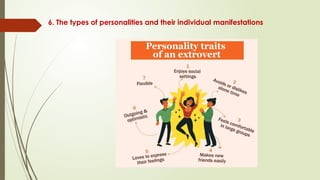
6. The types of personalities and their individual manifestations
Theme_1__Communication_definitions_and_functions-67092.pptx

Theme_1__Communication_definitions_and_functions-67092.pptx

  • 1.
    DISCIPLINE: BASICS OF MEDICALCOMMUNICATION Dr Stela Spînu
  • 2.
  • 3.
    The content ofthe course No. d/o ТHEME Number of hours Lectures Practical hours Individual work 1. Communication: definitions and functions 2 6 8 2. Medical communication. Levels of medical communication 2 4 6 3. Metacommunication and cultural differences 2 4 6 4. Barriers and cleavages in the medical communication 2 4 6 5. Conflict - the essential constituent element of communication 2 4 6 6. Intercultural communication and its presence in medical activity 2 4 6 7. Communication for changing health risk behavior 3 4 7 … 15 30 45
  • 4.
    III. SKILLS At theend of the discipline study the student will know about:  the communication process and communication functions;  the communication techniques in building physician- patient functional relationships;  the elements of intercultural communication in the doctor- patient relationship;  the knowledge and skills to detect sources of barriers in communication etc.
  • 5.
    I. PRELIMINARY  Likemany other people based professions, communications skills are essential to medical practice.  The ability to communicate effectively is a core competency for medical practitioners.  Good communication skills are an asset in medical practice.  Effective communication helps build a healthy doctor- patient relationship.  Better communication between doctor and patient builds confidence, improves compliance, and reduces mistakes, thereby reducing malpractice suits.
  • 6.
    Theme 1. Communication:definitions and functions 1. The notion of communication 2. Constitutive elements of the communication process 3. Communication functions 4. Theoretical models of communication 5. Psychology of communication 6. The types of personalities and their individual manifestations
  • 7.
    1. The notionof communication Communication is simply the act of transferring information from one place, person or group to another. Every communication involves (at least) one sender, a message and a recipient.
  • 8.
    1. The notionof communication Communication is the sending and receiving of information and can be one-on-one or between groups of people, and can be face- to-face or through communication devices. Communication requires a sender, the person who initiates communication, to transfer their thoughts or encode a message. This message is sent to the receiver, a person who receives the message, and finally, the receiver must decode, or interpret the message.
  • 9.
    1. The notionof communication The word communication has been derived from the Latin word 'communis' which means 'common' which consequently implies common understanding. Communication is defined in various ways: as speech, understanding, social process, reduction of uncertainties, transmission, behavior modifying response, power etc.
  • 10.
    1. The notionof communication  Communication as speech: „Communication is the verbal interchange of thought or idea”.  Communication as understanding: „Communication is the process by which we understand others and in turn endeavor to be understood by them”.  Communication as social process: „Communication is a social process affecting human behavior, including both interperson and virtual interaction made possible by advances in technology”.  Communication as reduction of uncertainties: „Communication arises out of the need to reduce uncertainty, to act effectively, to defend or strengthen the ego”.
  • 11.
    1. The notionof communication  Communication as transmission: „A sender encodes a message and transmits it through a channel to a receiver who decodes it”.  Communication as Discriminative Response: „Communication is the discriminatory response of an organism to a stimulus”.  Communication as intention: „Communicating with intention is being aware of the purpose and implication of what you are about to say. ”
  • 12.
    1. The notionof communication  Communication as power: „Communication is the mechanism by which power is exerted”.  Communication as a process: „The process of communication refers to the transmission of information from the sender through a selected channel to the receiver overcoming barriers that affect its pace”.
  • 13.
    1. The notionof communication  This diversity is the result of communication complexity as well as its being a subject - matter of a very broad constituency of disciplines that includes: Rhetoric (the art of speaking or writing effectively); Journalism (the collection and editing of news for presentation through the media); Sociology (the science of society, social institutions, and social relationships);  Psychology (the science of mind and behavior); Anthropology (the science of human beings); Semiotics (a general philosophical theory of signs and symbols ), and others.
  • 14.
    1. The notionof communication  The importance of communication can't be overstated.  After all, you can't have culture, society, or civilization without the ability to communicate with one another.  Good communication prevents wars and misunderstandings,  helps us meet our needs, establishes rules and laws that aid in the structuring of society,  helps people find and keep employment,  provides information and guidance to people,  and passes down cultural traditions, norms, and values.
  • 15.
    1. The notionof communication Communication occurs to all areas of life: home, university, community, work etc. Communication includes acts or interacts that confer knowledge and experiences, share emotion, give advice and commands, and ask questions. Communication requires a lot of skill in intrapersonal and interpersonal processing such as listening, observing, speaking, questioning, analyzing, and evaluating.
  • 16.
    1. The notionof communication Communication requires physical and psychological capability to send and receive information, because the efficiency in information interchanging depends on such factor as anxiety, fatigue, boring, annoyance, and interest. Human communication happened at many levels: (i.e. verbal, nonverbal, paraverbal, extra-verbal); take many forms (i.e. intrapersonal, interpersonal, social mediated), in one of the various manners (i.e. verbal presentation, letter, through movements, sounds, reactions, physical changes, gestures, languages, etc).
  • 17.
    2. Constitutive elementsof the communication process
  • 18.
    2. Constitutive elementsof the communication process  The sender is the person who is trying to communicate a message.  The receiver is the recipient of the message and must translate the words into thoughts, process the thoughts, and determine how to respond to the sender.  The message is a verbal, written, or recorded communication sent to or left for a recipient.  Channel is the medium used by the sender to send the message to the receiver. This may be in-person, via telephone, e-mail, text message, written correspondence etc.
  • 19.
    2. Constitutive elementsof the communication process  Noise refers to interference that takes place during the communication process. Both the sender and receiver may be distracted by noise. Noise may come from internal (thoughts, emotions, etc.) or external sources (radios, other conversations, etc.).  Feedback is the process of determining if the message has been properly received. This can be initiated by the sender or receiver. The sender, for example, may ask the receiver to repeat the message. On the other hand, a good listener will provide feedback to confirm that he/she correctly received the message.
  • 20.
  • 21.
    3. Communication functions 1.The referential function refers to the context. Here we have the function emphasizing that communication is always dealing with something contextual, referential. The referential function is dominant in official communiqués, bulletins, questionnaires, reports, chronicles.
  • 22.
    3. Communication functions 2.The poetic function is allocated to the message and puts 'the focus on the message for its own sake'. Messages convey more than just the content. They always contain a creative 'touch' of our own.
  • 23.
    3. Communication functions 3.The emotive function focuses on the sender, as in the interjections 'Bah!' and 'Oh!'. The sender's own attitude towards the content of the message is emphasized. The emotive function is present in memoirs, confessions, commentaries, critical interpretations
  • 24.
    3. Communication functions 4.The conative function is allocated to the recipient (imperatives and apostrophes). It is directed towards the recipient. The conative function is present in order, decisions, regulations, political speeches, advertisements.
  • 25.
    3. Communication functions 5.Thephatic function helps to establish contact, prolong or discontinue communication and refers to the channel of communication. The phatic function is present in greetings and convenient formulas, texts for receiving the telephone message.
  • 26.
    3. Communication functions 6.The metalinguistic function deals with the code itself; is used to establish mutual agreement on the code. This is the function of language about language (for example, a definition). We use it to examine the code. The metalinguistic function is present in grammatical analyses, in dictionaries, in didactic texts.
  • 30.
    4. Theoretical modelsof communication 1. Shannon and Weaver Model of Communication; 2. Linguistic models of communication; 3. Wilbur Schramm's model; 4. George Gerbner's model of communication; 5. Transactional Analysis by Eric Berne.
  • 31.
    4. Theoretical modelsof communication Shannon and Weaver Model of Communication Shannon was an American mathematician, Electronic engineer. Weaver was an American scientist. In 1948, both of them join together to write an article in „Bell System Technical Journal” called „A Mathematical Theory of Communication” and also called as „Shannon- Weaver model of communication”.
  • 32.
    4. Theoretical modelsof communication Shannon and Weaver Model of Communication The Shannon and Weaver Model of Communication is a mathematical theory of communication that argues that human communication can be broken down into 6 key concepts:  sender,  encoder,  channel,  noise,  decoder,  receiver.
  • 34.
    4. Theoretical modelsof communication Practical Example of Shannon-Weaver model of communication  Thomson made call to his assistant “come here I want to see you”. During his call, noise appeared (transmission error) and his assistant received “I want” only. Again Assistant asked Thomson (feedback) “what do you want Thomson”.
  • 35.
    4. Theoretical modelsof communication Shannon and Weaver Model of Communication  Shannon and Weaver's model is considered as an advanced model than other communication models due to the importance it attaches to the feedback mechanism which lacks in most of the other communication models.
  • 36.
    4. Theoretical modelsof communication Linguistic models of communication  Linguistic models deal with statements as they are used to express meanings.  Thus statements in fact models describe individual views while statements in linguistic models describe viewpoints.  Linguistic models focus at the definitions of new meanings.
  • 37.
    4. Theoretical modelsof communication Linguistic models of communication The classical linguistic model of communication is elaborated by Roman Jakobson. It establishes six components of the act of verbal communication: the sender – the speaker who sends the message; he receiver - the recipient, receives the transmitted message; the message – consisting of a set of linguistic signs; the channel - ensures the contact between the sender and the recipient; the code - consisting of a set of signs and a combination of them, common to both the encoder and the decoder; the referent – is made up of elements of the sender's and receiver's environment.
  • 38.
    4. Theoretical modelsof communication Wilbur Schramm's model Schramm's Model of Communication was postulated by Wilbur Schramm in 1954, where he suggested that communication is a two-way process where both sender and receiver take turns to send and receive a message. Information is of no use unless and until it is carefully put into words and conveyed to others.
  • 39.
    4. Theoretical modelsof communication Wilbur Schramm's model
  • 40.
    4. Theoretical modelsof communication Wilbur Schramm's model Advantage  Dynamic model shows how a situation can change.  It shows why redundancy is an essential part.  Assume communication to be circular in nature.  Feedback – central feature. Disadvantage  This model does not talk about semantic noise and it assumes the moment of encoding and decoding.
  • 41.
    4. Theoretical modelsof communication Gerbner’s General Model Gerbner's model consists of a verbal aspect, where someone observes an event and gives feedback about the situation, and a schematic model where someone perceives an event and sends messages to the sender. So, George Gerbner introduces as original elements: perception, production and meaning of the message.
  • 42.
    4. Theoretical modelsof communication Gerbner’s General Model So, communication first means the perception of events and the production of messages. The reaction and production of the message is transmitted through certain means. In this way, the message becomes available for communication. Each message is perceived in a given context and tells us something. Finally, the communication process generates certain consequences.
  • 43.
    4. Theoretical modelsof communication Gerbner’s General Model In this model, perception results from the event, reflects it but also differs from it. It depends on both the event and the communication agencies. The statement will be formulated according to the perception of the communication agent.
  • 45.
    4. Theoretical modelsof communication Transactional Analysis - Eric Berne Transactional Analysis (TA) is a psychoanalytic theory and method of therapy, developed by Eric Berne during the 1950s. Transactions refer to the communication exchanges between people.
  • 46.
    4. Theoretical modelsof communication Transactional Analysis - Eric Berne TA recognized that the human personality is made up of three „ego states"; each of which is an entire system of thought, feeling, and behavior from which we interact with each other. The Parent, Adult and Child ego states and the interaction between them form the foundation of transactional analysis theory.
  • 48.
    5. Psychology ofcommunication Why is psychology important in communication? We get to understand more on how a person interacts with us, and help us in the expressions and opinions that we speak to others. As we give importance to the understanding of the human mind and behavior, we adjust how we speak to the different people we encounter.
  • 49.
    5. Psychology ofcommunication What is communication psychology? Communication psychology is the subfield of psychology that focuses on phenomena of human verbal and nonverbal communication.
  • 50.
    5. Psychology ofcommunication How many types of communication are in psychology? There are four major communication styles: 1. Assertive style (means expressing your point of view in a way that is clear and direct, while still respecting others). 2. Aggressive style (is emphasized by speaking in a loud and demanding voice, maintaining intense eye contact and dominating or controlling others by blaming, intimidating, criticizing, threatening or attacking them,
  • 51.
    5. Psychology ofcommunication 3. Passive style (being passive means complying with the wishes of others). 4. Passive-aggressive (Passive-aggressive behavior is a pattern of indirectly expressing negative feelings instead of openly addressing them. There's a disconnect between what a person who exhibits passive-aggressive behavior says and what he or she does).
  • 52.
    6. The typesof personalities and their individual manifestations
  • 53.
    6. The typesof personalities and their individual manifestations
  • 54.
    6. The typesof personalities and their individual manifestations