The concept of
professional
English or
business English.
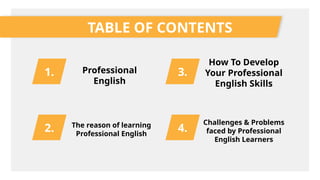
TABLE OF CONTENTS
Professional
English
The reason of learning
Professional English
How To Develop
Your Professional
English Skills
Challenges & Problems
faced by Professional
English Learners
1.
2.
3.
4.
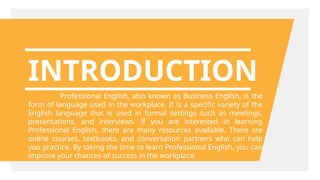
INTRODUCTION
Professional English, also known as Business English, is the
form of language used in the workplace. It is a specific variety of the
English language that is used in formal settings such as meetings,
presentations, and interviews. If you are interested in learning
Professional English, there are many resources available. There are
online courses, textbooks, and conversation partners who can help
you practice. By taking the time to learn Professional English, you can
improve your chances of success in the workplace.
Broadly speaking, professional
English refers to the language and
communication skills you need to have in order
to express yourself clearly and professionally in
a business-oriented environment. You may need
these skills both in speaking and writing.
For example, you would need professional
English when writing emails in English, attending
conferences and meetings, giving presentations,
or when you’re being interviewed for a job.
Understanding English for
Professional Purposes
Read Trade Magazines or
Industry-specific Blogs
Listen to Professional
Podcasts
Be Specific When Looking for
a Dictionary
Tips to Learn English for Professional
Purposes
Make It a Goal to Attend an
International Industry
Conference
Find Specialized Professional
English Courses Online
How does Professional English Differ from
Regular English?
● It is generally much more formal than regular English.
This means that contractions and slang should be
avoided, and sentence structure should be clear and
concise.You can organize your ideas clearly
● Professional English often uses specialized
vocabulary that may not be familiar to those outside of
the business world. By familiarizing yourself with
these terms, you’ll be better equipped to communicate
effectively in a professional setting.
● Remember that proper etiquette is essential in
Professional English. Whether you’re sending an
email or participating in a meeting, always take care to
use polite language and follow the proper protocol.
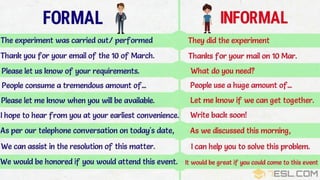
Regular
English vs
professional one
LET’S
PRACTICE
1
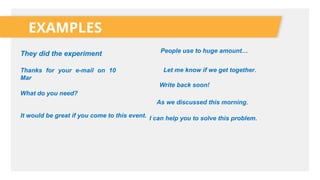
They did the experiment
EXAMPLES
People use to huge amount…
What do you need?
Thanks for your e-mail on 10
Mar
Let me know if we get together.
Write back soon!
As we discussed this morning.
I can help you to solve this problem.
It would be great if you come to this event.
Why learn professional English?
Career
Advancement
Fluency in professional English
opens doors to a wide range of
career opportunities, both
domestically and internationally.
Employers often value candidates
who can effectively communicate in
English, especially in industries with
a global presence.
Global
Networking
A good command of professional
English enables you to connect
with professionals from diverse
backgrounds and cultures,
facilitating collaboration,
partnerships, and networking
opportunities on a global scale.
Business
Communication
In today’s interconnected world,
effective communication is essential for
business success. Proficiency in
professional English allows you to
communicate confidently with clients,
colleagues, and stakeholders,
enhancing your credibility and
professionalism.
Access to
Resources
Many valuable resources, such as
industry reports, research papers, and
educational materials, are available in
English. By mastering professional
English, you can access a wealth of
knowledge and stay informed about the
latest developments in your field.
International
Travel
Whether you’re traveling for
business or leisure, English is often
the lingua franca in many countries.
Proficiency in professional English
ensures seamless communication
during international travel, making
your trips more enjoyable and
productive.
Cultural
understanding
Proficiency in professional English
fosters cultural awareness and
sensitivity, allowing you to navigate
diverse cultural contexts with ease.
It promotes mutual understanding,
respect, and appreciation for
different perspectives and ways of
life.
Global
Citizenship
Being proficient in professional English
allows you to engage with global
issues, contribute to international
conversations, and advocate for
positive change on a global scale. It
empowers you to be an active global
citizen and participate in cross-cultural
dialogue.
Employers value candidates with
strong communication skills,
including proficiency in professional
English. By mastering professional
English, you enhance your
marketability and competitiveness in
the job market.
Proficiency in professional English can
also be essential for academic success,
especially for students pursuing higher
education or research opportunities
abroad. It enables you to participate in
lectures, seminars, and academic
discussions in English-speaking
institutions.
Academic
Pursuits
Enhanced
Marketability
LET’S
PRACTICE
2
Career
Advancement
Global
Networking
Access to
Resources
Academic
Pursuits
Global
Citizenship
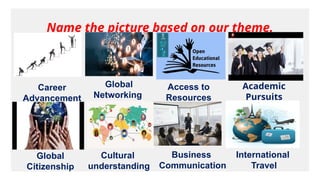
Name the picture based on our theme.
Cultural
understanding
Business
Communication
International
Travel
How To
Develop Your
Professional
English Skills
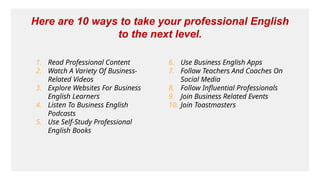
1. Read Professional Content
2. Watch A Variety Of Business-
Related Videos
3. Explore Websites For Business
English Learners
4. Listen To Business English
Podcasts
5. Use Self-Study Professional
English Books
6. Use Business English Apps
7. Follow Teachers And Coaches On
Social Media
8. Follow Influential Professionals
9. Join Business Related Events
10. Join Toastmasters
Here are 10 ways to take your professional English
to the next level.
Challenges &
Problems faced by
Professional
English Learners
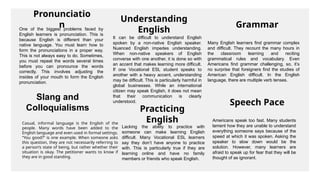
Pronunciatio
n
One of the biggest problems faced by
English learners is pronunciation. This is
because English is different than your
native language. You must learn how to
form the pronunciations in a proper way.
This is not always easy to do. Sometimes,
you must repeat the words several times
before you can pronounce the words
correctly. This involves adjusting the
insides of your mouth to form the English
pronunciation.
Understanding
English
It can be difficult to understand English
spoken by a non-native English speaker.
Nuanced English impedes understanding.
When non-native speakers of English
converse with one another, it is done so with
an accent that makes learning more difficult.
If one Vocational ESL student speaks to
another with a heavy accent, understanding
may be difficult. This is particularly harmful in
global businesses. While an international
citizen may speak English, it does not mean
that their communication is clearly
understood.
Slang and
Colloquialisms
Casual, informal language is the English of the
people. Many words have been added to the
English language and even used in formal settings.
“You good?” is one example. When someone asks
this question, they are not necessarily referring to
a person’s state of being, but rather whether their
situation is okay. The petitioner wants to know if
they are in good standing.
Practicing
English
Lacking the ability to practice with
someone can make learning English
difficult. Many Vocational ESL learners
say they don’t have anyone to practice
with. This is particularly true if they are
learning online and have no family
members or friends who speak English.
Grammar
Many English learners find grammar complex
and difficult. They recount the many hours in
the classroom learning and reciting
grammatical rules and vocabulary. Even
Americans find grammar challenging, so, it’s
no surprise that foreigners find the studies of
American English difficult. In the English
language, there are multiple verb tenses.
Speech Pace
Americans speak too fast. Many students
lament how they are unable to understand
everything someone says because of the
speed at which it was spoken. Asking the
speaker to slow down would be the
solution. However, many learners are
afraid to speak up for fear that they will be
thought of as ignorant.
What is the Solution?
With disciplined study,
conversation practice, reading, writing,
and growing your vocabulary, English
mastery is possible. Despite all the
complexities of the English language,
people all over the world are reading,
writing, listening to podcasts, watching
videos, and studying vocabulary to
speak fluent English. While this is
admirable, students don’t have to go on
the journey alone.
CONCLUSION
Before you go and work on your
professional English, remember that
the best way to improve it is to use it.
So don’t be afraid to speak at
meetings. Don’t worry too much
about mistakes in your emails. Use
the best professional English you
have at the moment. That’s enough.
But of course, work at it, practice it,
and study it, so you can advance
your career, do business, and, most
importantly, get rich!
THANKS!

Theme 1.Professional English_nnnPPP.pptx

  • 1.
  • 2.
    TABLE OF CONTENTS Professional English Thereason of learning Professional English How To Develop Your Professional English Skills Challenges & Problems faced by Professional English Learners 1. 2. 3. 4.
  • 3.
    INTRODUCTION Professional English, alsoknown as Business English, is the form of language used in the workplace. It is a specific variety of the English language that is used in formal settings such as meetings, presentations, and interviews. If you are interested in learning Professional English, there are many resources available. There are online courses, textbooks, and conversation partners who can help you practice. By taking the time to learn Professional English, you can improve your chances of success in the workplace.
  • 4.
    Broadly speaking, professional Englishrefers to the language and communication skills you need to have in order to express yourself clearly and professionally in a business-oriented environment. You may need these skills both in speaking and writing. For example, you would need professional English when writing emails in English, attending conferences and meetings, giving presentations, or when you’re being interviewed for a job.
  • 5.
    Understanding English for ProfessionalPurposes Read Trade Magazines or Industry-specific Blogs Listen to Professional Podcasts Be Specific When Looking for a Dictionary Tips to Learn English for Professional Purposes Make It a Goal to Attend an International Industry Conference Find Specialized Professional English Courses Online
  • 6.
    How does ProfessionalEnglish Differ from Regular English? ● It is generally much more formal than regular English. This means that contractions and slang should be avoided, and sentence structure should be clear and concise.You can organize your ideas clearly ● Professional English often uses specialized vocabulary that may not be familiar to those outside of the business world. By familiarizing yourself with these terms, you’ll be better equipped to communicate effectively in a professional setting. ● Remember that proper etiquette is essential in Professional English. Whether you’re sending an email or participating in a meeting, always take care to use polite language and follow the proper protocol.
  • 7.
  • 8.
  • 9.
    They did theexperiment EXAMPLES People use to huge amount… What do you need? Thanks for your e-mail on 10 Mar Let me know if we get together. Write back soon! As we discussed this morning. I can help you to solve this problem. It would be great if you come to this event.
  • 11.
    Why learn professionalEnglish? Career Advancement Fluency in professional English opens doors to a wide range of career opportunities, both domestically and internationally. Employers often value candidates who can effectively communicate in English, especially in industries with a global presence. Global Networking A good command of professional English enables you to connect with professionals from diverse backgrounds and cultures, facilitating collaboration, partnerships, and networking opportunities on a global scale. Business Communication In today’s interconnected world, effective communication is essential for business success. Proficiency in professional English allows you to communicate confidently with clients, colleagues, and stakeholders, enhancing your credibility and professionalism.
  • 12.
    Access to Resources Many valuableresources, such as industry reports, research papers, and educational materials, are available in English. By mastering professional English, you can access a wealth of knowledge and stay informed about the latest developments in your field. International Travel Whether you’re traveling for business or leisure, English is often the lingua franca in many countries. Proficiency in professional English ensures seamless communication during international travel, making your trips more enjoyable and productive. Cultural understanding Proficiency in professional English fosters cultural awareness and sensitivity, allowing you to navigate diverse cultural contexts with ease. It promotes mutual understanding, respect, and appreciation for different perspectives and ways of life.
  • 13.
    Global Citizenship Being proficient inprofessional English allows you to engage with global issues, contribute to international conversations, and advocate for positive change on a global scale. It empowers you to be an active global citizen and participate in cross-cultural dialogue. Employers value candidates with strong communication skills, including proficiency in professional English. By mastering professional English, you enhance your marketability and competitiveness in the job market. Proficiency in professional English can also be essential for academic success, especially for students pursuing higher education or research opportunities abroad. It enables you to participate in lectures, seminars, and academic discussions in English-speaking institutions. Academic Pursuits Enhanced Marketability
  • 14.
  • 15.
    Career Advancement Global Networking Access to Resources Academic Pursuits Global Citizenship Name thepicture based on our theme. Cultural understanding Business Communication International Travel
  • 16.
  • 17.
    1. Read ProfessionalContent 2. Watch A Variety Of Business- Related Videos 3. Explore Websites For Business English Learners 4. Listen To Business English Podcasts 5. Use Self-Study Professional English Books 6. Use Business English Apps 7. Follow Teachers And Coaches On Social Media 8. Follow Influential Professionals 9. Join Business Related Events 10. Join Toastmasters Here are 10 ways to take your professional English to the next level.
  • 18.
    Challenges & Problems facedby Professional English Learners
  • 19.
    Pronunciatio n One of thebiggest problems faced by English learners is pronunciation. This is because English is different than your native language. You must learn how to form the pronunciations in a proper way. This is not always easy to do. Sometimes, you must repeat the words several times before you can pronounce the words correctly. This involves adjusting the insides of your mouth to form the English pronunciation. Understanding English It can be difficult to understand English spoken by a non-native English speaker. Nuanced English impedes understanding. When non-native speakers of English converse with one another, it is done so with an accent that makes learning more difficult. If one Vocational ESL student speaks to another with a heavy accent, understanding may be difficult. This is particularly harmful in global businesses. While an international citizen may speak English, it does not mean that their communication is clearly understood. Slang and Colloquialisms Casual, informal language is the English of the people. Many words have been added to the English language and even used in formal settings. “You good?” is one example. When someone asks this question, they are not necessarily referring to a person’s state of being, but rather whether their situation is okay. The petitioner wants to know if they are in good standing. Practicing English Lacking the ability to practice with someone can make learning English difficult. Many Vocational ESL learners say they don’t have anyone to practice with. This is particularly true if they are learning online and have no family members or friends who speak English. Grammar Many English learners find grammar complex and difficult. They recount the many hours in the classroom learning and reciting grammatical rules and vocabulary. Even Americans find grammar challenging, so, it’s no surprise that foreigners find the studies of American English difficult. In the English language, there are multiple verb tenses. Speech Pace Americans speak too fast. Many students lament how they are unable to understand everything someone says because of the speed at which it was spoken. Asking the speaker to slow down would be the solution. However, many learners are afraid to speak up for fear that they will be thought of as ignorant.
  • 20.
    What is theSolution?
  • 21.
    With disciplined study, conversationpractice, reading, writing, and growing your vocabulary, English mastery is possible. Despite all the complexities of the English language, people all over the world are reading, writing, listening to podcasts, watching videos, and studying vocabulary to speak fluent English. While this is admirable, students don’t have to go on the journey alone.
  • 22.
    CONCLUSION Before you goand work on your professional English, remember that the best way to improve it is to use it. So don’t be afraid to speak at meetings. Don’t worry too much about mistakes in your emails. Use the best professional English you have at the moment. That’s enough. But of course, work at it, practice it, and study it, so you can advance your career, do business, and, most importantly, get rich!

  • 23.