The Contract
Management Process
Contract
Formation
INTRODUCTION
 Successful contract management covers the period from the
beginning of a procurement until after a contract ends. The receipt
of goods and services at the right price, quality, and on time as well
as proper compensation of the contractor is the goal of a successful
procurement.
 However, poor contract management often results in end-user
frustration, reluctance to use new vendors, agency acceptance of
poor quality service or goods, increased costs due to lack of quality
or overpayment to contractors, lack of contractor accountability, and
generally poor contractor performance.
 A good contract is a means to an end. Simply enforcing the contract,
however, does not necessarily result in a successful relationship with
the contractor. Success should instead be measured by the
effectiveness of the program that the contract supports.
OUTLINE
 Developing Specifications - Specify The Need
 What Are Contract Risks To Agency – Protect The Agency
 What Is Contract Type
 Special Terms And Conditions Of Resulting Contract –
Eliminate Risks
DEVELOPING SPECIFICATIONS
- SPECIFY THE NEED
 Develop Bid or RFP Specifications (Scope of
Work) –
 The element of a contract that is most likely to
create contract administration problems is the
Scope of Work.
 The Contractor’s ability to interpret the Scope
of Work determines contract performance.
DEVELOPING SPECIFICATIONS
- SPECIFY THE NEED cont…
 Design Specifications:
 Describes specifics of a good such as dimensions,
physical requirements, materials, etc.
 This type of specification gives an agency control
because it determines exactly what the contractor
must provide.
 However, it also places an additional burden on the
agency to ensure that the specifications are exactly
as needed and to inspect or test the item to
determine compliance.
DEVELOPING SPECIFICATIONS
- SPECIFY THE NEED cont…
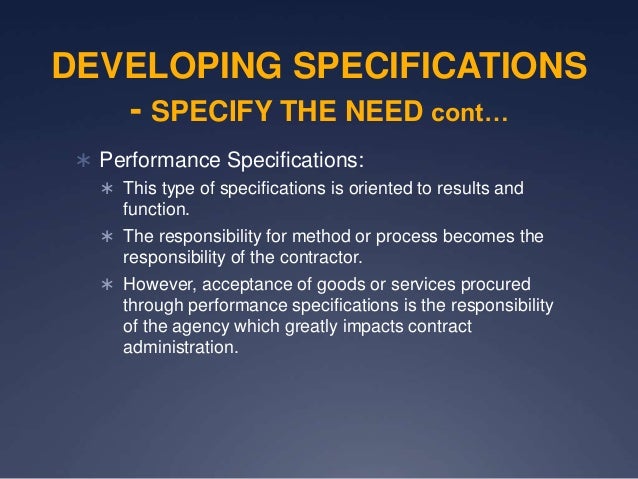
 Performance Specifications:
 This type of specifications is oriented to results and
function.
 The responsibility for method or process becomes the
responsibility of the contractor.
 However, acceptance of goods or services procured
through performance specifications is the responsibility
of the agency which greatly impacts contract
administration.
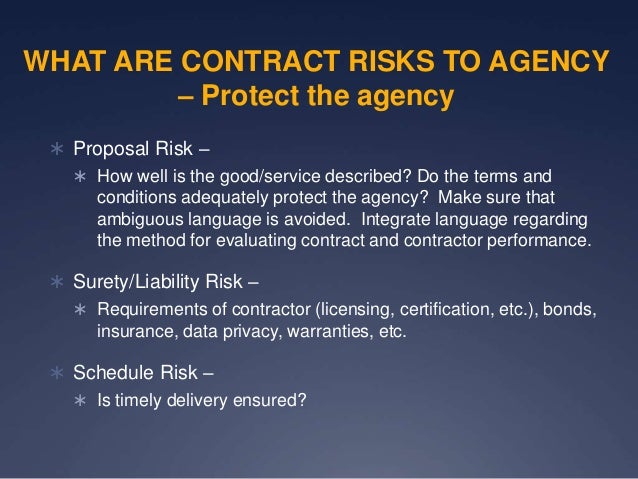
WHAT ARE CONTRACT RISKS TO AGENCY
– Protect the agency
 Proposal Risk –
 How well is the good/service described? Do the terms and
conditions adequately protect the agency? Make sure that
ambiguous language is avoided. Integrate language regarding
the method for evaluating contract and contractor performance.
 Surety/Liability Risk –
 Requirements of contractor (licensing, certification, etc.), bonds,
insurance, data privacy, warranties, etc.
 Schedule Risk –
 Is timely delivery ensured?
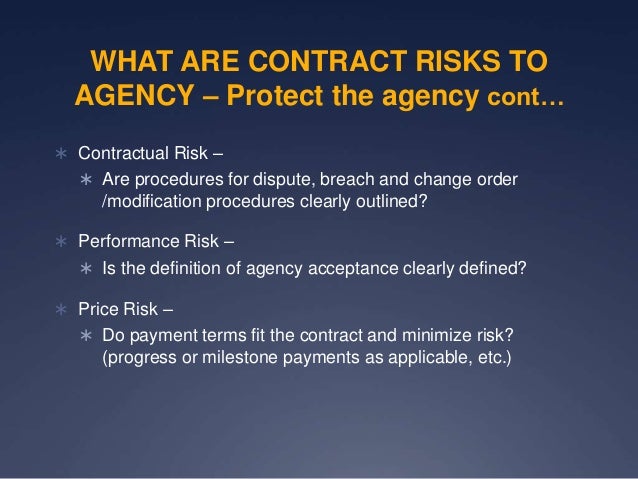
WHAT ARE CONTRACT RISKS TO
AGENCY – Protect the agency cont…
 Contractual Risk –
 Are procedures for dispute, breach and change order
/modification procedures clearly outlined?
 Performance Risk –
 Is the definition of agency acceptance clearly defined?
 Price Risk –
 Do payment terms fit the contract and minimize risk?
(progress or milestone payments as applicable, etc.)
WHAT IS CONTRACT TYPE
Supplies/Goods
Capital Outlay
Professional
Services
Non-Professional
Services
Software
Lease
Construction
One-time goods
purchase
Dependent upon the type of contract, different team
members, different processes
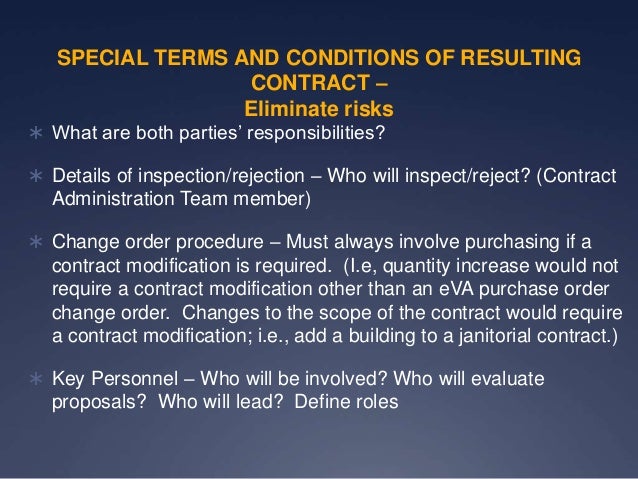
SPECIAL TERMS AND CONDITIONS OF RESULTING
CONTRACT –
Eliminate risks
 What are both parties’ responsibilities?
 Details of inspection/rejection – Who will inspect/reject? (Contract
Administration Team member)
 Change order procedure – Must always involve purchasing if a
contract modification is required. (I.e, quantity increase would not
require a contract modification other than an eVA purchase order
change order. Changes to the scope of the contract would require
a contract modification; i.e., add a building to a janitorial contract.)
 Key Personnel – Who will be involved? Who will evaluate
proposals? Who will lead? Define roles
SPECIAL TERMS AND CONDITIONS OF RESULTING
CONTRACT –
Eliminate risks cont…
 Breach/Termination procedure – outlined in the APSPM derived
from The Virginia Public Procurement Act
 Dispute Resolution – Dictated by – The Virginia Public
Procurement Act, Agency Procurement and Surplus Property
Manual
 Warranties - Manufacturer or Commercial
 Acceptance – What constitutes acceptance
 Payment – Does vendor accept Small Purchase Charge Card?
Are payments $50k or less?
The-Contract-Management-Process-Contract-Formation (2).pptx

  • 1.
  • 2.
    INTRODUCTION  Successful contractmanagement covers the period from the beginning of a procurement until after a contract ends. The receipt of goods and services at the right price, quality, and on time as well as proper compensation of the contractor is the goal of a successful procurement.  However, poor contract management often results in end-user frustration, reluctance to use new vendors, agency acceptance of poor quality service or goods, increased costs due to lack of quality or overpayment to contractors, lack of contractor accountability, and generally poor contractor performance.  A good contract is a means to an end. Simply enforcing the contract, however, does not necessarily result in a successful relationship with the contractor. Success should instead be measured by the effectiveness of the program that the contract supports.
  • 3.
    OUTLINE  Developing Specifications- Specify The Need  What Are Contract Risks To Agency – Protect The Agency  What Is Contract Type  Special Terms And Conditions Of Resulting Contract – Eliminate Risks
  • 4.
    DEVELOPING SPECIFICATIONS - SPECIFYTHE NEED  Develop Bid or RFP Specifications (Scope of Work) –  The element of a contract that is most likely to create contract administration problems is the Scope of Work.  The Contractor’s ability to interpret the Scope of Work determines contract performance.
  • 5.
    DEVELOPING SPECIFICATIONS - SPECIFYTHE NEED cont…  Design Specifications:  Describes specifics of a good such as dimensions, physical requirements, materials, etc.  This type of specification gives an agency control because it determines exactly what the contractor must provide.  However, it also places an additional burden on the agency to ensure that the specifications are exactly as needed and to inspect or test the item to determine compliance.
  • 6.
    DEVELOPING SPECIFICATIONS - SPECIFYTHE NEED cont…  Performance Specifications:  This type of specifications is oriented to results and function.  The responsibility for method or process becomes the responsibility of the contractor.  However, acceptance of goods or services procured through performance specifications is the responsibility of the agency which greatly impacts contract administration.
  • 7.
    WHAT ARE CONTRACTRISKS TO AGENCY – Protect the agency  Proposal Risk –  How well is the good/service described? Do the terms and conditions adequately protect the agency? Make sure that ambiguous language is avoided. Integrate language regarding the method for evaluating contract and contractor performance.  Surety/Liability Risk –  Requirements of contractor (licensing, certification, etc.), bonds, insurance, data privacy, warranties, etc.  Schedule Risk –  Is timely delivery ensured?
  • 8.
    WHAT ARE CONTRACTRISKS TO AGENCY – Protect the agency cont…  Contractual Risk –  Are procedures for dispute, breach and change order /modification procedures clearly outlined?  Performance Risk –  Is the definition of agency acceptance clearly defined?  Price Risk –  Do payment terms fit the contract and minimize risk? (progress or milestone payments as applicable, etc.)
  • 9.
    WHAT IS CONTRACTTYPE Supplies/Goods Capital Outlay Professional Services Non-Professional Services Software Lease Construction One-time goods purchase Dependent upon the type of contract, different team members, different processes
  • 10.
    SPECIAL TERMS ANDCONDITIONS OF RESULTING CONTRACT – Eliminate risks  What are both parties’ responsibilities?  Details of inspection/rejection – Who will inspect/reject? (Contract Administration Team member)  Change order procedure – Must always involve purchasing if a contract modification is required. (I.e, quantity increase would not require a contract modification other than an eVA purchase order change order. Changes to the scope of the contract would require a contract modification; i.e., add a building to a janitorial contract.)  Key Personnel – Who will be involved? Who will evaluate proposals? Who will lead? Define roles
  • 11.
    SPECIAL TERMS ANDCONDITIONS OF RESULTING CONTRACT – Eliminate risks cont…  Breach/Termination procedure – outlined in the APSPM derived from The Virginia Public Procurement Act  Dispute Resolution – Dictated by – The Virginia Public Procurement Act, Agency Procurement and Surplus Property Manual  Warranties - Manufacturer or Commercial  Acceptance – What constitutes acceptance  Payment – Does vendor accept Small Purchase Charge Card? Are payments $50k or less?