What is aStaffing Plan?
• A staffing plan is a detailed strategy for
ensuring that the right people are in the
right roles at the right time. It focuses on
planning the workforce needs of an
organization to meet its goals effectively.
3.
Why is aStaffing Plan Important?
• Efficiency: Helps ensure that the right
skills are available when needed.
• Cost-Effective: Minimizes the risk of
overstaffing or understaffing.
• Alignment: Aligns workforce with the
organization’s strategic objectives.
• Employee Satisfaction: Ensures adequate
resources for staff to meet goals without
burnout.
4.
Key Elements ofa Staffing Plan
• Workforce Analysis: Identifying current and future
workforce needs.
• Skill Assessment: Evaluating the skills needed for current
and future positions.
• Budget: Allocating funds for recruitment, training, and
staffing.
• Recruitment Strategy: Plan for sourcing and hiring the
right talent.
• Training and Development: Ensuring staff have the skills
needed for growth and transition.
• Performance Metrics: Measuring the effectiveness of
staffing decisions.
5.
Advantages of astaffing plan
• Better Planning: Helps foresee staffing needs
based on future projects or changes.
• Improved Productivity: Ensures teams have the
right talent to complete tasks effectively.
• Resource Optimization: Allocates personnel
efficiently, avoiding overstaffing or shortages.
• Long-Term Success: Supports the growth and
scalability of an organization.
6.
Disadvantages of aStaffing Plan
• Rigidity: A fixed plan might not be flexible
enough to accommodate sudden changes.
• Resource-Intensive: Developing and
maintaining a staffing plan can require
significant time and effort.
• Overlooking Short-Term Needs: A long-term
focus may cause neglect of immediate
staffing needs.
7.
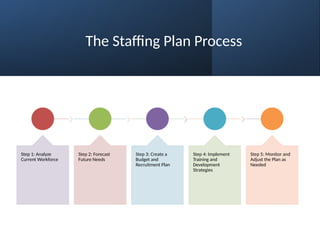
The Staffing PlanProcess
Step 1: Analyze
Current Workforce
Step 2: Forecast
Future Needs
Step 3: Create a
Budget and
Recruitment Plan
Step 4: Implement
Training and
Development
Strategies
Step 5: Monitor and
Adjust the Plan as
Needed
8.
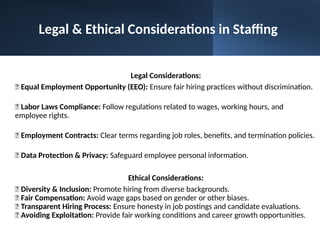
Legal Considerations:
📌 EqualEmployment Opportunity (EEO): Ensure fair hiring practices without discrimination.
📌 Labor Laws Compliance: Follow regulations related to wages, working hours, and
employee rights.
📌 Employment Contracts: Clear terms regarding job roles, benefits, and termination policies.
📌 Data Protection & Privacy: Safeguard employee personal information.
Ethical Considerations:
🔹 Diversity & Inclusion: Promote hiring from diverse backgrounds.
🔹 Fair Compensation: Avoid wage gaps based on gender or other biases.
🔹 Transparent Hiring Process: Ensure honesty in job postings and candidate evaluations.
🔹 Avoiding Exploitation: Provide fair working conditions and career growth opportunities.
Legal & Ethical Considerations in Staffing
9.
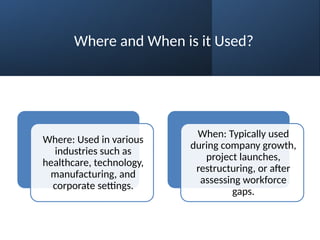
Where and Whenis it Used?
Where: Used in various
industries such as
healthcare, technology,
manufacturing, and
corporate settings.
When: Typically used
during company growth,
project launches,
restructuring, or after
assessing workforce
gaps.
10.
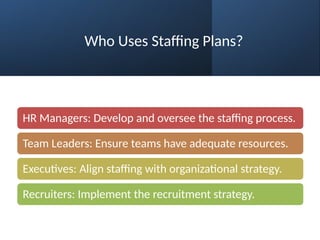
Who Uses StaffingPlans?
HR Managers: Develop and oversee the staffing process.
Team Leaders: Ensure teams have adequate resources.
Executives: Align staffing with organizational strategy.
Recruiters: Implement the recruitment strategy.
11.
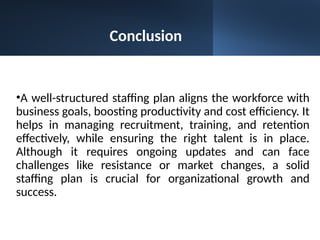
•A well-structured staffingplan aligns the workforce with
business goals, boosting productivity and cost efficiency. It
helps in managing recruitment, training, and retention
effectively, while ensuring the right talent is in place.
Although it requires ongoing updates and can face
challenges like resistance or market changes, a solid
staffing plan is crucial for organizational growth and
success.
Conclusion

![Chap001[1]](https://cdn.slidesharecdn.com/ss_thumbnails/chap0011-140422074736-phpapp02-thumbnail.jpg?width=640&height=640&fit=bounds)


![OM Unit 2 Leson 1 Nature of Staffing [Autosaved].pptx](https://cdn.slidesharecdn.com/ss_thumbnails/omunit2leson1natureofstaffingautosaved-241202224728-4630628e-thumbnail.jpg?width=640&height=640&fit=bounds)


![5G Explained! A High Level Overview [Introduction]](https://cdn.slidesharecdn.com/ss_thumbnails/5gexplainedahighleveloverview-260119165306-cc137a3e-thumbnail.jpg?width=640&height=640&fit=bounds)


