The Whale Problem A Status Report William E Schevill
The Whale Problem A Status Report William E Schevill
The Whale Problem A Status Report William E Schevill
The Whale Problem A Status Report William E Schevill
The Whale Problem A Status Report William E Schevill
1.
The Whale ProblemA Status Report William E
Schevill download
https://ebookbell.com/product/the-whale-problem-a-status-report-
william-e-schevill-51389620
Explore and download more ebooks at ebookbell.com
2.
Here are somerecommended products that we believe you will be
interested in. You can click the link to download.
Chemical Dependency Understanding A Problem That Affects The Whole
Family Dr Eduardo Kalina
https://ebookbell.com/product/chemical-dependency-understanding-a-
problem-that-affects-the-whole-family-dr-eduardo-kalina-48771966
Fractional Elliptic Problems With Critical Growth In The Whole Of N
1st Edition Serena Dipierro
https://ebookbell.com/product/fractional-elliptic-problems-with-
critical-growth-in-the-whole-of-n-1st-edition-serena-dipierro-5886450
The Whale And The Reactor A Search For Limits In An Age Of High
Technology Langdon Winner
https://ebookbell.com/product/the-whale-and-the-reactor-a-search-for-
limits-in-an-age-of-high-technology-langdon-winner-51762526
The Whale Tells His Side Of The Story Hey God Ive Got Some Guy Named
Jonah In My Stomach And I Think Im Gonna Throw Up Troy Schmidt
https://ebookbell.com/product/the-whale-tells-his-side-of-the-story-
hey-god-ive-got-some-guy-named-jonah-in-my-stomach-and-i-think-im-
gonna-throw-up-troy-schmidt-46440350
3.
The Whale YearsGregory Obrien
https://ebookbell.com/product/the-whale-years-gregory-obrien-46571442
The Whale Road Robert Low
https://ebookbell.com/product/the-whale-road-robert-low-47433590
The Whale That Fell In Love With A Submarine Akiyuki Nosaka
https://ebookbell.com/product/the-whale-that-fell-in-love-with-a-
submarine-akiyuki-nosaka-47752444
The Whale Who Felt A Little Blue A Picture Book About Depression Isla
Wynter
https://ebookbell.com/product/the-whale-who-felt-a-little-blue-a-
picture-book-about-depression-isla-wynter-48693806
The Whale House Sharon Millar
https://ebookbell.com/product/the-whale-house-sharon-millar-48793086
THE WHALE PROBLEM
AStatus Report
William E. Schevill, editor
G. Carleton Ray and Kenneth S. Norris
consulting editors
Harvard University Press
Cambridge, Massachusetts
1974
8.
Copyright 1974 bythe President and Fellows of Harvard College
All rights reserved
Library of Congress Catalog Card Number 73-88056
SBN 674-95075-5
Printed in the United States of America
9.
PREFACE
On 24 November1970 the United States Secretary of the Interior,
Walter Hickel, announced that an international meeting of leading
cetologists would be called to consider the plight of the great whales
and their biology as related to their conservation. He did this as he
placed eight commercially sought-after whales on the Endangered Species
List, which made it illegal to import any parts or products of these
animals into the United States. The eight whales listed were the bow-
head, right, blue, sperm, finback, sei, humpback, and gray.
The resulting meeting, the International Conference on the Biology
of Whales, was held on 10-12 June 1971 in Shenandoah National Park on
the Blue Ridge of Virginia, primarily sponsored by the Department of
the Interior, the Smithsonian Institution, the New York Zoological
Society, and the International Biological Program (Marine Productivity
(PM) Section). Cosponsors were the Department of Commerce, the
National Science Foundation, the National Audubon Society, the Environ-
mental Defense Fund, the World Wildlife Fund, the Conservation Founda-
tion, and the National Wildlife Federation. Thus funded, the conference
was organized and managed by a committee of the Marine Mammal Council
of the United States International Biological Program: G. C. Ray,
W. E. Schevill, and K. S. Norris, specialists in marine mammals then
unconnected with either whaling or sealing or their regulation. Ten
countries were represented at the conference (the Russians were in-
vited but did not attend) by thirty-four participants and twenty
observers, who are listed at page 21. The cetologists invited to the
conference had been concerned with the conservation of whales, and
many had been active in calling the attention of the International
Whaling Commission to the plight of the whales. Although their ob-
jectivity was not and is not in question (and I emphasize this), it
was felt appropriate to have protectionists represented at the con-
ference, and so also in this book (Chapter 17).
The meeting was planned, not primarily to consider matters of
10.
vi PREFACE
international lawor problems of resource management as such, but
rather to define what we know and do not know about whale biology and
numbers, especially in relevance to their conservation as healthy
members of the ecosystem. We were concerned with the basic biology
needed for proper management rather than with management itself. We
hoped that the conference would show where our cetology is based on
shaky premises, and point to new departures to help us learn as
quickly as may be what we need to place management on a sound footing.
At the end of the Shenandoah conference, the participants were
somewhat informally divided into three working groups, (1) on biology
and natural history, (2) on regional populations, and (3) on bio-
metrics and management. Their conclusions are presented at page 5
following a digest prepared immediately after the conference. Al-
though some of the points we then raised have since been acted upon
(for example, the blue whale unit), we give the reports as they were
submitted on 12 June 1971. The acceleration and expansion of cetacean
research that we then anticipated has scarcely occurred, although it
was unanimously approved by the International Whaling Commission at
its 1972 meeting; we have merely a name: the International Decade
of Cetacean Research.
The chapters of this book are revisions of presentations made
during the three-day conference. It had been hoped to publish it
within the year, but a series of delays has prevented this. First,
the tardiness of a few contributors slowed the assembly of the
material until July 1972, and during the next several months there
were further delays following submission of the manuscript to the
Press. It must be understood that these chapters were completed in
1971 (a few in early 1972), and that the authors, with one exception,
have had no opportunity to include new data that may have become
available in the meantime. The exception, which was sought by the
editor, is Dr. McHugh's historical account of the International
Whaling Commission (Chapter 13). The two IWC meetings following the
Shenandoah conference saw important changes and marked progress
toward whale conservation, and it seemed useful to have Dr. McHugh,
who was Chairman of the Commission in 1972, report on this.
11.
PREFACE vii
Although inmany areas whaling was prosecuted at excessive rates
during the first years of the International Whaling Commission, it
has not been entirely reasonable to scold this body for not saving
the world's whales from depletion. Many of its critics seem unaware
of the actual provisions of the Convention under which the Commission
was set up a quarter century ago. The Convention states, inter alia,
"that the whale stocks are susceptible of natural increases if whaling
is properly regulated and that increases in the size of whale stocks
will permit increases in the numbers of whales which may be captured
without endangering these natural resources; . . . [and] that it is
in the common interest to achieve the optimum level of whale stocks
as rapidly as possible without causing widespread economic and nutri-
tional distress." The Convention, in Article V, also protects the
national and industrial independence of its members, thus providing
for the weakening or evasion of amendments to the Schedule. The re-
sults have been that overfishing of some species has continued and
that the recommendations of concerned scientists have been repeatedly
ignored.
Nevertheless, the International Whaling Commission has taken some
positive actions toward conservation, and it should receive credit for
them. Long before the 1972 United Nations Conference on the Human
Environment at Stockholm, it imposed moratoria on certain species of
whales. At the time of its establishment, the Commission forbade
the taking or killing of gray and right whales. Subsequently, blue
and humpback whales were added to the list—though admittedly after
the species had been extremely depleted. The "right" whale, in the
language of the IWC, includes the bowhead, northern right, southern
right, and pygmy right whales. Thus seven zoological species are pro-
tected by IWC moratoria.
The excellent book by Dr. N. A. Mackintosh, "The Stocks of
Whales," published in London in 1965, may be considered a foundation
and point of departure for this book of ours. Ours is an attempt to
extend somewhat the basic work of Dr. Mackintosh, but we by no means
supplant it. The interested reader should have a copy at hand for
general information; besides, there are numerous references to it
12.
viii PREFACE
throughout thesepages.
In preparing these chapters for publication, the editor has been
at some pains to avoid meddling with the authors' mathematics and
English style, his concern being only that the meaning be apparent.
Of course, each chapter is the statement and opinion of its author.
Consistency (sometimes useful but often tiresome) has been attempted
in the technical nomenclature of cetaceans and in the references to
the literature (where, to save space, the reports of the International
Whaling Commission are cited as Rpt. IWC). We follow the example of
the International Commission on Whaling in speaking of it as the
International Whaling Commission or IWC. In the use of vernacular
and trade names for whales we have let each author make his own choice,
and append a glossary of most of these, and other technical jargon.
The editor thanks his colleagues G. Carleton Ray and Kenneth S.
Norris for substantial help with certain chapters, and most particu-
larly Suzanne M. Contos, executive secretary of the Marine Mammal
Council, for active assistance throughout the project. Especial
thanks are due the photographers who supplied the photographs of
whales at sea, following page 302; these photographs are not covered
by the general copyright of the book, but remain the property of
the photographers.
W. E. S.
13.
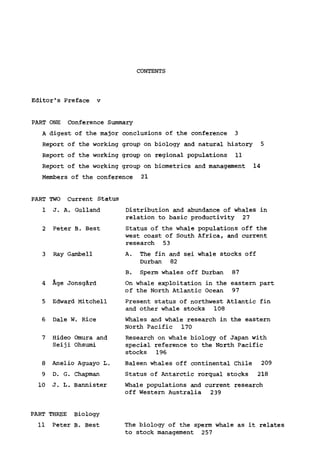
CONTENTS
Editor's Preface ν
PARTONE Conference Summary
A digest of the major conclusions of the conference 3
Report of the working group on biology and natural history 5
Report of the working group on regional populations 11
Report of the working group on biometrics and management 14
Members of the conference 21
PART TWO Current Status
1 J. A. Gulland
2 Peter B. Best
3 Ray Gambell
4 Age Jonsgärd
5 Edward Mitchell
6 Dale W. Rice
7 Hideo Omura and
Seiji Ohsumi
8 Anelio Aguayo L.
9 D. G. Chapman
10 J. L. Bannister
Distribution and abundance of whales in
relation to basic productivity 27
Status of the whale populations off the
west coast of South Africa, and current
research 53
A. The fin and sei whale stocks off
Durban 82
B. Sperm whales off Durban 87
On whale exploitation in the eastern part
of the North Atlantic Ocean 97
Present status of northwest Atlantic fin
and other whale stocks 108
Whales and whale research in the eastern
North Pacific 170
Research on whale biology of Japan with
special reference to the North Pacific
stocks 196
Baleen whales off continental Chile 209
Status of Antarctic rorqual stocks 218
Whale populations and current research
off Western Australia 239
PART THREE Biology
11 Peter B. Best The biology of the sperm whale as it relates
to stock management 257
14.
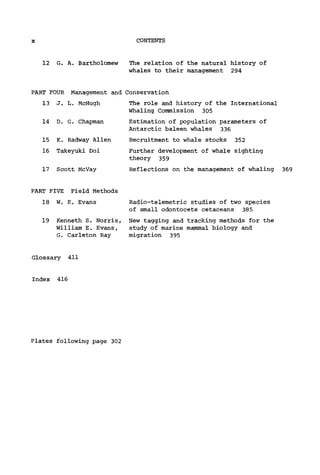
CONTENTS
12 G. A.Bartholomew The relation of the natural history of
whales to their management 294
PART FOUR Management and Conservation
13 J. L. McHugh
14 D. G. Chapman
15 K. Radway Allen
16 Takeyuki Doi
17 Scott McVay
The role and history of the International
Whaling Commission 305
Estimation of population parameters of
Antarctic baleen whales 336
Recruitment to whale stocks 352
Further development of whale sighting
theory 359
Reflections on the management of whaling 369
PART FIVE Field Methods
18 W. E. Evans Radio-telemetric studies of two species
of small odontocete cetaceans 385
19 Kenneth S. Norris, New tagging and tracking methods for the
William E. Evans, study of marine mammal biology and
G. Carleton Ray migration 395
Glossary 411
Index 416
Plates following page 302
A DIGEST OFTHE MAJOR CONCLUSIONS OF THE INTERNATIONAL CONFERENCE
ON THE BIOLOGY OF WHALES, 10-12 JUNE 1971,
SHENANDOAH NATIONAL PARK, VIRGINIA
by the Conference Management Committee and Messrs. K. R. Allen,
L. K. Boerema, D. G. Chapman, R. Gambell, and J. A. Gulland
(1) Many whale populations have been drastically reduced by com-
mercial whaling. Some have been reduced to the point at which con-
tinued harvesting as a separate venture is no longer economic; others
are below the level at which they could produce the maximum yield sus-
tainable for long periods, although they can still economically sup-
port commercial whaling; others again are at or above the level which
can sustain the maximum yield. Stocks in the first category are
generally already protected by the International Whaling Commission,
and protection should be continued until they have recovered to
about the level giving maximum sustainable yield. It should also be
management policy to limit catches so as to allow stocks in the second
category to return to this level.
(2) While it is unlikely that any whale species is on the verge
of extinction, there are a number of highly localized stocks of some
of these species which could possibly be wiped out by whaling opera-
tions undertaken either by nations outside the International Whaling
Commission or in breach of its regulations. Regulations of the Com-
mission prohibit capture of those species that are in any possible
danger. Institution of the International Observer Scheme would help
to insure that these regulations are carried out.
(3) The effective biological unit in whales is not the species
but the breeding population of local stock. While these are rarely
entirely discrete, every effort should be made to manage the harvest-
ing of each stock separately in accordance with the concepts of Para-
graph (1) above. It is still more important that the species should
be managed individually in each area and not as groups. Therefore the
18.
4 CONFERENCE DIGEST
bluewhale unit, which is used to establish a single quota for all
species of baleen whales in the Antarctic, should be abandoned and
each species managed separately.
(4) More knowledge is needed for fully effective management of
individual whale stocks. Therefore, certain specific lines of research
are required and the development of some new research approaches is
needed.
(5) New research approaches that appear to have special merit
include (not necessarily in order of priority): (1) tracking and bio-
logical studies by use of radio-telemetry, recoverable instrument
packages, transponders, aircraft and satellite monitoring; (2) the
development of age-specific marking techniques and of improved tech-
niques for the direct aging of whales; (3) the allocation of ships
for whale study outside the normal catching grounds; and (4) biochemi-
cal and other methods for population determination.
(6) Studies of whales should be carried out throughout their
ranges and at all seasons. The distinction and relationships of stocks
should be defined. The relationships of whales to their ecosystems
should be clarified.
(7) The present scientific manpower and resources devoted to
whale research are inadequate and should be expanded. Through the
Bureau of International Whaling Statistics and the United Nations
Food and Agriculture Organization, there is already valuable centrali-
zation of data on whaling operations and on whales caught, but further
expansion, particularly as regards biological data, would be bene-
ficial. Further expansion of international cooperation in whale re-
search is also required, and this should be done under the auspices
of an appropriate international body. Either an existing body, such
as the International Whaling Commission, or one established for the
purpose should be considered.
(8) Small toothed whales (including porpoises) represent an
almost unknown but potentially important worldwide resource. Biologi-
cal studies relating to their future management need to be instituted
as soon as possible.
19.
REPORT OF THEWORKING GROUP ON BIOLOGY AND NATURAL HISTORY
The Relation of Natural History to Whale Management
Many populations of large whales have been drastically reduced by
commercial whaling. It is a truism that effective management of wild
species requires that harvesting procedures be based on accurate knowl-
edge of their natural history and their population structure and dy-
namics. Substantial information on these topics has been developed
from data derived from analysis of commercially caught whales. How-
ever, to produce a picture sufficiently complete to be the basis of
biologically sound harvesting, it will be necessary to fill in sub-
stantial gaps in our knowledge. The purpose of this report is to
identify some of the more conspicuous of the gaps and to suggest
methods that can be used to fill them. To achieve the goals that are
outlined will require the establishment of two innovations in research
methodology:
(1) A program of pelagic research captures from specially equipped
whaling vessels such as the Norwegian Peder Huse, which is a combined
catcher and factory ship.
(2) The development of methods for the study of individual whales
through radio-telemetry.
Identification of Whale Stocks
Effective management requires that the distribution, size, and
dynamics of the population in question be known. It seems clear that
the effective biological unit in most whales is not the species, but
the individual stocks or breeding population. Therefore, the unequivo-
cal identification of stocks of all commercial species (and others as
well) must be given high priority.
Methods
(1) In addition to a continuation of the sampling methods used
on the commercial catch, it is important to obtain detailed information
20.
6 REPORTS OFWORKING GROUPS
on the movements of individually marked animals over long periods of
time. To augment the traditional methods of marking, such as Dis-
covery tags, tracking by radio-telemetry must be undertaken to give
continuous records of individuals. (2) The methods of population
genetics must be brought to bear—serological studies employing elec-
trophoretic and immunological techniques, enzymatic studies, amino
acid sequencing, and karyotype analyses. (3) Identification of para-
sites, diatoms, and other biological indicators. (4) Effective prose-
cution of these studies requires the use of small specialized whaling
vessels on which a biologist must be in charge.
Population Analyses
It is essential that population analysis be uncoupled from the
past and present dependence on the capture of animals on the tradi-
tional whaling grounds. An adequate picture of population structure
can be obtained only if sampling is carried on throughout the year in
all parts of the population's range and all classes in the population.
To do this will require that the breeding area be found by exploration
and that some selective whaling (under license) be done on a basis of
scientific rather than economic need. It will be helpful if such
breeding areas could be designated as research control areas, where
whaling would be by license only. Population analyses of the sort
proposed will involve the use of ships such as the Peder Huse which
can serve as catchers, biological laboratories, and as factory ships,
and are not confined to coastal areas. This will make it possible
for whales taken for biological purposes to be commercially utilized.
Animals captured for study and subsequent processing should be sub-
jected to at least the following tests: (1) detailed analysis of
reproductive state and reproductive history; (2) age determination
using teeth, ear plugs, ovarian histology, jawbone structure, baleen,
and biological samples prepared for later biophysical and biochemical
study (analysis of seasonal variations of bone tissues by electron
microscopy. X-ray diffraction, ultra-sound, etc.); and (3) determina-
of hormone levels where practical.
21.
REPORTS OF WORKINGGROUPS 7
Trophic Analysis for Whales
Although knowledge of the biology of whales when they are away
from the main feeding grounds must be sought (see above), detailed
quantitative information related to energetics of whale populations
must be obtained. A number of topics invite attention. A few of the
more obvious are listed below:
(1) Trophic effects of the removal of a major consumer, such as
the blue or fin whale on (a) other baleen whales, and (b) other con-
sumers of the same trophic level (seabirds, pelagic seals).
(2) Seasonal and geographic localization of feeding and the role
of prolonged fasting.
(3) Effects of age on food habits.
(4) Role of patchiness of plankton on food searching and the
local distribution of whales. Does patchy distribution of whale food
such as krill allow uncoupling of the mean productivity of a region
from whale energetics? To answer this would require simultaneous
sampling of water and plankton at areas where whales are taken and
comparison of the observed productivity with average values in the
region.
(5) Development of models for estimating metabolic rates of
large whales and methods of direct measurement of metabolism on small
ones.
(6) Use of aerial (and possibly satellite) photography or remote
sensing to determine patchiness and distribution of plankton.
The patterns of distribution of the feeding of whales are wide-
spread geographically, while at the same time stocks are sufficiently
circumscribed geographically that whales should be useful monitors
of pollution of the oceans by heavy metals, pesticide residues, radio-
nuclides, and other fallout products.
The local distribution of whales and porpoises has already been
affected by the environmental deterioration associated with human
activities; for example, their numbers in the southern parts of the
North Sea have decreased markedly in recent years. Since whales are
among the few marine animals that can be seen from above the surface
22.
8 REPORTS OFWORKING GROUPS
of the sea and since they are at the top of the trophic pyramid, it
should be possible to use them as indicators of changes in the envi-
ronmental quality of the seas.
Natural History of Poorly Known Species
Work on the taxonomy and natural history of poorly known species
should be continued and expanded. The smaller cetaceans, including
porpoises, invite attention. As previously indicated, they represent
a biological resource concerning which our ignorance is almost complete.
Study of Unexploited Stocks of Large Whales
A few relatively unexploited stocks of large whales remain. They
are too small to be of major economic importance, but knowledge of
them can serve as baselines with which to compare stocks which have
long been exploited or overexploited. The sperm whale population of
the western South Atlantic and the gray whale population of the eastern
North Pacific offer attractive possibilities.
Whale Movements in Relation to
Hydrographie Factors and Submarine Geology
To marine mammals, the sea is surely an environment with many
local variations. It is possible that bottom topography—submarine
canyons, ridges, flat-topped seamounts, etc.—plays an important role
in their distribution and ecology. It is clear that oceanographic
factors are important to them. The role of these elements of the sub-
marine environment could be explored by the conventional means of
correlating them with the occurrence of whales, or by detailed track-
ing by means of telemetry of individuals carrying radio packages that
have sensors equipped for depth and temperature measurements (see below).
Telemetrie Studies of Free-Ranging Individuals
Because we cannot easily observe whales directly in their natural
23.
REPORTS OF WORKINGGROUPS 9
environment, we have had to develop our knowledge of cetacean natural
history by inferences drawn from dead animals and brief observations
of live animals when they were near the surface. The development of
radio telemetry offers the possibility of directly following known
individuals for long periods of time, while also obtaining data on
the environmental conditions they meet and measurements of physiologi-
cal parameters from which behavioral responses can be deduced. It is
technically possible to equip a whale with a telemetry and recording
package which would allow the determination of location, abdominal
temperature, water pressure, light intensity, velocity, time, magnetic
heading, water temperature, heart rate, and breathing. From these
data, it would be possible to follow an individual (either alone or
in a group) and obtain information about location, direction, and
speed of travel; frequency, duration, and depth of dives; times and
depths of feeding; and the nature of the water through which it passes.
The Smaller Whales
It is important that we consider not only the "commercial" spe-
cies—the baleen whales and the sperm whale—but also the smaller
whales, including the porpoises. These smaller cetaceans, although
for the most part not commercially exploited, represent a resource of
major potential economic importance. This has been clearly demon-
strated by recent developments in the American tuna fishery, which
has produced a problem of great economic and biological importance
affecting delphinids of the genera Stenella and Delphinus. Tuna
fishermen locate schools of tuna by watching for porpoise and seabird
activity. Having sighted a school, they enclose it in a long purse
seine which captures not only the tuna but also the cetaceans. There
is at present no practical method for effectively separating these
delphinids from the tuna. As a result, the setting of one tuna net
may result in the death of scores or even hundreds of porpoises. Over
most of the world, there is no good market for porpoise meat, so the
dead porpoises are discarded. It has been estimated that in the
eastern Pacific alone as many as 250,000 porpoises are wasted annually
24.
10 REPORTS OFWORKING GROUPS
as a result of this situation. It is obviously only a matter of time
until this extremely efficient method of tuna fishing becomes wide-
spread. The resultant wastage of porpoises will represent a major
problem in all oceans. Aside from this specific instance, it is clear
that in view of the worldwide shortage of animal protein, in the near
future porpoise hunting as an end in itself will become an important
enterprise. At present, we do not have the biological information
necessary to apply effective management to a porpoise fishery—even
the alpha-taxonomy of the smaller cetaceans is fragmentary. Knowledge
of their natural history and distribution—not to mention their be-
havior and reproductive biology—is equally incomplete.
Chairman: George A. Bartholomew
Members: A. Aguayo L.
W. Dawbin
R. Gambell
T. Ichihara
Ä. Jonsgärd
Κ. Kenyon
C. Ray
V. Scheffer
W. Schevill
12 June 1971 R. Vaz-Ferreira
25.
REPORT OF THEWORKING GROUP ON REGIONAL POPULATIONS
Stock identification is an important prerequisite for rational
exploitation of a fishery. The working group considers that there are
five main approaches to this problem for cetaceans: studies of den-
sity distribution, marking, biochemical techniques, morphometries and
morphology, and biological indicators.
The working group considered these five main approaches in rela-
tion to three categories of exploited species: large cetaceans (the
larger mysticetes and Physeter), medium-sized cetaceans (minke, pilot,
killer, belugas, narwhals, and all species of beaked whales), and
small cetaceans (porpoises in general).
Before reasonable estimates of density distribution can be ob-
tained, comprehensive catch and effort data have to be available. At
present, certain statistical data are generally unavailable for large
cetaceans caught off Spain, Chile, Peru, Korea, China, Brazil, and
for the operations of a fleet of unlicensed whalers in the Atlantic.
There are also inadequate data for animals caught in native and ab-
original fisheries. Better biological figures (length, sex, fetus,
and month of capture) and effort information are needed for all minke,
bottlenose (Hyperoodon and Berardius separately), killer, pilot, and
beluga fisheries. There are incomplete data for beluga and narwhal
fisheries in the Arctic, and no data for pilot whale catches at Oki-
nawa, for example. Some of these figures are already handled by the
Bureau of International Whaling Statistics, and it is recommended
that this bureau or some other central agency should handle this
extra work. In areas where a fishery involving small cetaceans is
in operation, provisions should be made for the collection by regional
bodies of catch data such as "species," numbers, and, if possible,
tonnages killed.
To obtain density estimates, more sighting work should be car-
ried out by scouting vessels and those engaged in marking, especially
in regions where no catching is done. Data for minke, killer, pilot,
and all bottlenose species should be collected. In addition, annual
trends in the abundance of protected species should be monitored in
26.
12 REPORTS OFWORKING GROUPS
as many areas as possible. Plots of regions of high density give indi-
cations of areas within which a stock may be found. These preliminary
hypotheses can then be tested using one of the other four techniques.
The correlation of high densities with existing oceanographic informa-
tion may also assist in provisional estimates of stock boundaries.
The working group gives high priority to the use of biochemical
methods, such as electrophoresis, immunology, and enzyme typing; once
the techniques have been established, relatively rapid results can be
obtained. The group assigns the following priorities for this work:
(1) Sperm whales worldwide, especially in the southern hemisphere
(2) Sei whales, Antarctic and North Pacific
(3) Fin whales, Antarctic and North Pacific
(4) Fin whales, North Atlantic
(5) Medium-sized cetaceans, North Atlantic
(6) Minke whales, Antarctic
(7) Bowheads, Pacific and Atlantic Arctic.
This technique is highly desirable for other medium-sized and for small
cetaceans where fresh material may be readily available.
Independently of any biochemical method, it is recommended that
marking of all cetaceans should be developed and intensified. The use
of standard Discovery-type marks for large mysticetes should be con-
tinued. Further trials of more efficient streamer marks using larger
and more conspicuously colored streamers are required. There is a
need for test firings of increased-charge marks into sperm whale car-
casses. The .410 Discovery-type marks also should be brought into
wider use for calves and minke whales. This type of marking could also
be carried out by nonwhaling scientists from recognized institutions,
and restricted to bulk marking of medium-sized and small cetaceans,
especially in areas where there is a fishery. Experimental studies
using radio-telemetry packages, freeze-branding, and laser beams should
be encouraged. Whenever possible, double marking, particularly using
the Discovery-type .410 or other suitable tags, should be carried out
on these animals. It is essential to consider the question of a cen-
tral agency to coordinate the marking information. Priorities for
species and areas are the same as those assigned for biochemical methods.
27.
REPORTS OF WORKINGGROUPS 13
In areas where other methods are not available, the use of morpho-
metries is recommended. Certain simple morphological characters such
as right whale callosities, flipper and baleen colorations in minke
whales, the shape of Bryde's whale baleen plates, and the detailed
documentation of color patterns in Delphinidae may all prove useful.
Biological indicators such as external parasites and scarring, viral
and bacterial flora, and possible dialects in vocalization may have a
limited value.
In conclusion, the working group on regional populations recom-
mends that research efforts be concentrated on the following problems:
(1) The development of biochemical techniques for identification
of populations.
(2) The intensification of marking of large cetaceans and the
development of new marks for all cetaceans.
(3) The collection of more comprehensive catch and effort statis-
tics for all fisheries where unavailable at present.
Chairman: Peter B. Best
Members: J. Bannister
S. Brown
W. Evans
E. Mitchell
S. Ohsumi
H. Omura
D. Rice
12 June 1971 W. van Utrecht
28.
REPORT OF THEWORKING GROUP ON BIOMETRICS AND MANAGEMENT
The group concludes as follows:
(1) The northern and southern seas are among the most biologically
productive regions on earth. In these regions, macroplanktonic animals
in most striking abundance are euphausids and copepods—the diet of the
baleen whales. Although direct harvesting by man of these Zooplankton
resources, especially of euphausids, has been proposed, and some re-
search is in progress to this end, practical and economic techniques
have not yet been devised. Harvesting of whales is, at present, by far
the most effective way of tapping these resources. Even if and when
practical techniques are devised, they could supplement rather than
replace the whale harvest since the optimum whale stock sizes (that is,
those giving maximum sustainable yields) are at about half the unex-
ploited levels, and we would expect there to be a large harvestable
Zooplankton surplus in these circumstances.
(2) The herds of the great whales could at optimum stock levels
contribute significantly to human needs for protein. We therefore
concur in a policy for whale management which will insure that no stock
is reduced below its optimum level or, when this has already happened,
that exploitation is restricted to permit the stock to recover to its
optimum.
(3) The history of the past centuries has been one of successive
overexploitation of many of the major whale species. Right, bowhead,
gray, blue, humpback, and some stocks of fin whales have been depleted
to well below their optimum levels.
The present scientific evidence is sufficiently good to provide
guidance in general terms for the management of most stocks of large
whales. Action has been taken by the International Whaling Commission
to rebuild stocks of the most depleted species. Reduction of fin and
sei whale stocks that had been occurring at a very rapid rate has been
slowed or stopped. But this is not good enough, since no deliberate
action is yet being taken to rebuild the very important Antarctic fin
whale stock. The more conservative estimates suggest that this stock.
29.
REPORTS OF WORKINGGROUPS 15
and some other stocks of fin, sei, and sperm whales, are still being
depleted, although rather slowly. No action has yet been taken to
prevent the overexploitation of the remaining unexploited stocks of
cetaceans, particularly the Antarctic minke whale.
The group affirms that it is not enough to seek protection for a
species only after its numbers have been so reduced as to threaten its
existence. This minimum action is not resource management. Restraint
should be exercised early enough that the species remains sufficiently
abundant to fulfill its role in the ecosystem. It seems reasonable to
assume that a species held at the level of maximum sustainable yield
is still a major element in the ecosystem and that the policy of har-
vesting at maximum sustainable yield is therefore not at variance with
considerations of ecology.
Existence of means of harvesting and of markets for the products
must, in the absence of regulation, be seen as an implicit danger to
the well-being of a species or stock. Thus, we recognize as a general
principle of resource management that controls must evolve as new
areas and species are opened to exploitation and as major technologi-
cal innovations appear. In the past when industries have been allowed
to expand without restraint, economic considerations have made it dif-
ficult or impossible for the industry to abide by the necessary reduc-
tions . Application of regulations after a period of overexploitation
has usually meant a period of painful readjustment to a more rational
pattern. Increasingly rapid rates of exploitation may otherwise be
presumed to lead to depletion before conclusive scientific evidence
on the optimum stock size could be obtained and regulation secured.
A possible remedy to protect newly exploited species might be to set
an arbitrarily low quota which can be raised as data provided by cap-
ture indicate how high sustainable yields can be set. Specifically,
it is recommended that conservative catch quotas be set forthwith
for the Antarctic minke whale stocks. Better scientific information
would permit a more responsible attitude on these matters to be adopted.
As scientists, we feel that the burden of proof that any given
rate of harvesting will not endanger a stock must rest with those who
stand to benefit from such harvesting. The industry should accept
30.
16 REPORTS OFWORKING GROUPS
the judgment of a competent group of scientists in this matter. Further,
it should be the responsibility of those exploiting the resource to
provide the statistical and other information regarding their opera-
tions which the scientists require to make their assessments.
Although scientific efforts in the past have been invaluable,
they have been limited both in species and in geographical areas. For
example, information on the abundance and distribution of all whale
stocks in the Indian, South Atlantic, and South Pacific Oceans, and
their relationships with other stocks, particularly the Antarctic
stocks, is almost totally lacking. In the case of small whales in all
oceans, it is almost absent.
Thus, we emphasize the need for a quantum jump in research per-
sonnel and facilities for research on a far broader front to elucidate
the unknown potential of this important marine mammal research.
(4) Because of the importance of studying whales that are not
exploited (either due to protection or to lack of an industry), it is
of prime importance that techniques be developed which would produce
useful information from live, free-ranging whales. The objectives of
research, in relation to management, should be to produce the follow-
ing information:
(a) The identity of individual stocks, their location, move-
ment, and possible mixing.
(b) The number of animals being caught.
(c) The number of animals in the stock, both catch and stock
being broken down by age, sex, and size.
(d) The relation between the number of mature animals and the
number of young produced per unit time which survive to
recruit to the fishery, and the density-dependent changes
in this relationship.
For (b) as regards the large whales good information is available,
mainly through the Bureau of International Whaling Statistics. How-
ever, the meeting believes that (1) the introduction of an international
observer scheme would add greatly to the reliance that can be placed on
their data (without the scheme, fears of incorrect reporting undermine
the confidence that can be placed on the scientific assessments), and
31.
REPORTS OF WORKINGGROUPS 17
that (2) similar data on numbers and sizes caught should be collected
under a suitable international arrangement for all small cetaceans.
Stock identity has, in the past, been studied mainly by traditional
marking techniques, which are slow and often inconclusive. A number
of new techniques offer good promise and should be investigated and
used where possible. These include attached telemetering devices for
following by ships, planes, satellites, etc., and biochemical methods.
One of the principal needs is for a tag that could be read without
killing the animal.
Age data are available for most stocks of the large species, and
collection should be started for other stocks. Some doubt still sur-
rounds the precise interpretation of ear plugs. New techniques should
be tried, such as tags that will mark the animal's bones, teeth, or
eye-lens. Direct catch-per-unit-effort data need careful checking.
Possible changes in the ship's equipment or tactics used by whalers
should be examined to see whether the efficiency is likely to have
changed. Sighting techniques should be improved and they should be
used systematically. Observations on the changes, if any, in the
abundance of the presently protected whales (blue, right, gray, bow-
head, and humpback) by sightings or other means are needed. Other
techniques which could yield estimates of stock abundance, either of
the whole stock or in a particular area, and which deserve further
examination, include:
(a) Aerial and satellite tracking and surveys.
(b) Radio and sonic tagging, including transponders.
(c) Listening by means of hydrophone arrays.
(5) Estimates of stock sizes and sustainable yields are now being
made by a greater variety and more refined methods. As a result, sci-
entists are more confident of their conclusions. Nevertheless, there
are sometimes divergent estimates, and we cannot yet assign useful
limits of error to any estimates.
International regulations tend to be based on midrange estimates,
and we cannot at this time suggest a better policy. It is essential,
however, that some calculation be made of the likely consequences of
acting upon midrange or other estimates if the true values are less or
more favorable.
32.
18 REPORTS OFWORKING GROUPS
(6) Effective studies of cetaceans will be costly and must usu-
ally be on a scale requiring international cooperation. There are
some marine mammal research projects under the International Biologi-
cal Program, and a coordinated study of the exploitable biological
production of Antarctic circumpolar waters is being considered as a
major project of the International Decade of Ocean Exploration, which
has been declared for the 1970's. Arrangements should now be made
for scientists to draw up and for governments to fund in the framework
of the Decade a comprehensive program of cetacean research, with empha-
sis on the ecology, behavior, and dynamics of the exploitable species
and stocks, and on the monitoring of changes in protected stocks. Such
a program will require funding greatly exceeding present levels and it
is urged that this be provided. Present expenditures are quite inade-
quate for the declared aims of existing programs. They also represent
an unacceptably small proportion of the income from the exploitation
of cetacean stocks, even in their present depleted state.
(7) A disturbing feature of the present situation is the almost
complete lack of scientists working full-time on the population dynamics
of whales. Assessments of the major whale stocks have been made by
scientists working on whales in the time that could be spared from
their other main duties. There is great need within a general expan-
sion of whale research for full-time studies of the population dynamics
of whales, as well as for whale biologists to become familiar with the
concepts of population dynamics, and for population dynamics experts
to study whales in more depth.
(8) Implementation of regulations. Though the implementation of
regulations will have to take into account economic, social, and politi-
cal factors, as well as the scientific evidence, the meeting has come
to the following general conclusions:
(1) The entire species and all its component stocks should be
considered. The subgroups of a species are very likely part of the
evolutionary strategy by which the species took its place in the modern
world and thus the geographic pattern of distribution and abundance
must be looked on as part of the health of the species as a whole. This
implies that it is not sufficient to set a single species limit, but
rather that limits should be set by stocks.
33.
REPORTS OF WORKINGGROUPS 19
(2) Management of whale stocks of the world must insure that each
stock of each species is maintained at or close to the optimum level.
This would be achieved by setting a quota separately for each stock
and is clearly not insured by the current blue whale unit system.
(3) It should not be the strategy of the International Whaling
Commission merely to maintain overexploited stocks, but rather to allow
the whale populations sufficient surplus reproductive potential to re-
gain levels at which the populations can provide the maximum sustainable
yield.
(4) Estimation of what constitutes a prudent management practice
should include consideration of the possible effects of population
catastrophes, such as failure of local food supplies, epidemic dis-
eases, etc.
(5) It should be the role of the groups, both national and inter-
national, to foster and encourage study in the research areas discussed.
A new agency should be created, or an existing one mandated, to coor-
dinate research efforts, including the job of applying to member govern-
ments for support of specific projects.
Recommendations:
(1) The international observer scheme should be instituted at
once.
(2) The blue whale unit should be rescinded and replaced by a
quota scheme that provides management of each individual species and
stock.
(3) Quotas for those species estimated to be at or above their
optimum levels should be set at values which will not reduce the stocks
below those levels; quotas for species below their optimum levels
should be brought to values that will insure rebuilding of the stocks.
The consequences of acting upon possibly erroneous midrange estimates
of sustainable yields should be studied and appropriate action taken.
(4) A quota should be set for minke whaling in the Antarctic.
(5) There appears to be a danger to certain isolated whale stocks
which could be destroyed in a very short time. There could be a par-
ticular risk from the irresponsible use of existing surplus whaling
34.
20 REPORTS OFWORKING GROUPS
equipment, especially in countries not party to the International Whal-
ing Commission. It is recommended that all nonmember nations engaged
in or entering whaling operations immediately join the IWC and adhere
to its regulations, and that member countries of the IWC should take
all possible steps to bring this about and seek universal adherence to
its recommendations.
(6) Regulations should be implemented as soon as possible to
insure appropriate levels of protection for each sex of sperm whale.
(7) A comprehensive long-term program of cetacean research, in-
volving a very substantial increase in the number of scientists engaged
in the field and in available research facilities, including special
ships, should be planned and implemented as soon as possible.
Chairman: Sidney J. Holt
Members: K. Allen
L. Boerema
D. Chapman
T. Doi
Μ. Dunbar
Y. Fukuda
J. Gulland
R. Laws
J. McHugh
S. McVay
Μ. Nishiwaki
Κ. Norris
12 June 1971 R. Payne
35.
MEMBERS OF THECONFERENCE
Participants
Anelio Aguayo L.
Departamento de Oceanologia
Universidad de Chile
Vina del Mar, Chile
K. Radway Allen
Fisheries Research Board of Canada
Nanaimo, British Columbia, Canada
J. L. Bannister
Western Australian Museum
Perth, Western Australia
George A. Bartholomew, Jr.
University of California
Los Angeles, California
Peter B. Best
Division of Sea Fisheries
Cape Town, South Africa
L. K. Boerema
United Nations Food and Agricul-
ture Organization
Rome, Italy
Sidney G. Brown
Whale Research Unit (IOS)
London, England
Douglas G. Chapman
University of Washington
Seattle, Washington
William H. Dawbin
University of Sydney
Sydney, N.S.W., Australia
Takeyuki Doi
Tokai Regional Fisheries Research
Laboratory
Tokyo, Japan
Max J. Dunbar
McGill University
Montreal, Quebec, Canada
William E. Evans
Naval Undersea Research and
Development Center
Sem Diego, California
Yoshio Fukuda
Far Seas Fisheries Research
Laboratory
Shimizu, Shizuoka Ken, Japan
Ray Gambe11
Whale Research Unit (IOS)
London, England
J. A. Gulland
United Nations Food and Agricul-
ture Organization
Rome, Italy
Sidney J. Holt
Office of Oceanography
UNESCO
Paris, France
Tadayoshi Ichihara
Far Seas Fisheries Research
Laboratory
Shimizu, Shizuoka Ken, Japan
Äge Jonsgärd
Instltutt for Marin Biologi, A og C
Oslo, Norway
Karl W. Kenyon
Department of the Interior
Fish and Wildlife Service
Seattle, Washington
Richard M. Laws
British Antarctic Survey
Monks Wood Experimental Station
Abbots Ripton
Huntington, England
J. L. McHugh
State University of New York
Stony Brook, New York
36.
22 MEMBERS OFTHE CONFERENCE
Scott McVay
Princeton University
Princeton, New Jersey
Edward D. Mitchell
Arctic Biological Station
Fisheries Research Board of Canada
Ste. Anne de Bellevue, Quebec,
Canada
Masaharu Nishiwaki
Ocean Research Institute
University of Tokyo
Nakano, Tokyo, Japan
Kenneth S. Norris
Oceanic Institute
Waimanalo, Oahu, Hawaii
Seiji Ohsumi
Far Seas Fisheries Research
Laboratory
Shimizu, Shizuoka Ken, Japan
Hideo Omura
Whales Research Institute
Tokyo, Japan
Roger S. Payne
Rockefeller University
New York, New York
G. Carleton Ray
Johns Hopkins University
Baltimore, Maryland
Dale W. Rice
National Marine Fisheries Service
La Jolla, California
Victor B. Scheffer
Bellevue, Washington
William E. Schevill
Woods Hole Oceanographic Insti-
tution
Woods Hole, Massachusetts
Willem L. van Utrecht
Universiteit van Amsterdam
Amsterdam, Netherlands
Raul Vaz-Ferreira
Universidad de la Republica
Montevideo, Uruguay
Observers
Department of the Interior
Washington, D.C.
Curtis Bohlen
Clyde Jones
Frank Whitmore
Earl Baysinger
John Sayre
Robert L. Brownell
Smithsonian Institution
Washington, D.C.
Charles 0. Handley
Michael Huxley
New York Zoological Society
Bronx, New York
James A. Oliver
U.S. International Biological
Program
William Milstead
Department of Commerce (NOAA)
Washington, D.C.
George Y. Harry, Jr.
National Science Foundation
Washington, D.C.
George Llano
Environmental Defense Fund
Roderick A. Cameron
World Wildlife Fund
Steven Seater
Council on Environmental Quality
Washington, D.C.
Lee Talbot
International Union for the Con-
servation of Nature
Colin W. Holloway
Harold J. Coolidge
37.
MEMBERS OF THECONFERENCE 23
University of California, Berkeley
Edwin R. Lewis
Marine Technological Society
Robert Niblock
Conference Management
Marine Mammal Council
U.S. International Biological Program
G. Carleton Ray, program director and session chairman
William E. Schevill, associate program director and session chairman
Kenneth S. Norris, session chairman
Suzanne M. Contos, executive secretary
CHAPTER 1
DISTRIBUTION ANDABUNDANCE OF WHALES IN RELATION TO BASIC PRODUCTIVITY
J. A. Gulland1
Management of marine resources has become an important problem
facing the international community. A special conference on the Law
of the Sea is being convened probably in 1974 by the United Nations,
in which this will be an important topic. Among marine resources,
whales have become the classic example of the difficulties involved
in achieving proper management and the losses arising from a failure
of management. They are, however, not unique in this regard. The
advance of modern technology has resulted in an increasing variety of
animals being harvested from the sea. Few stocks are being well
managed, even though different conditions, especially with regard to
the biology of the animals concerned, have resulted in the failure to
achieve good management in the case of most fish stocks, which has
less serious consequences than in the case of the whales. As an indus-
try, whaling should be considered as one rather specialized way of
using the vast, but not limitless, primary production of the oceans
for the benefit of mankind. The present paper is a brief attempt to
relate the distribution and abundance of whales to the primary produc-
tion in the oceans, with particular reference to the efficiency of
the whale stocks in harvesting this production (and making it more
readily available to man).
For the purpose of this paper, only the larger whales (rorquals
and sperm whales) will be considered. The most important differences
between these two groups in the present context is their food. Sperm
whales are top predators; the large squid on which they feed are them-
selves probably second or third level predators, so that the sperm
The views expressed here are those of the author and not neces-
sarily those of FAO.
42.
28 GULLAND
whale isseveral steps removed from primary production. Relative to
this primary production, and the intermediate stages, the production
of sperm whales must therefore be low.
The baleen whales, on the other hand, are trophically much nearer
to the primary production; the typical food chain of Antarctic rorquals
is diatoms to euphausids to whales. This energy transfer implies that
the production of Antarctic baleen whales can be high. In considering
the links between whales and their food, a careful distinction must
be made between production and biomass. To the whale looking for a
meal or to the individual fisherman wanting a good catch the production
—the rate at which plants or animals are produced—is of less signi-
ficance than the standing crop or biomass—the amount present at a
given time. Though high standing stocks are associated with high pro-
duction, the relation is not necessarily a directly proportional one.
The average length of life of the animals or plants concerned is also
important.
In the warmer areas of high production, e.g., the upwelling areas
off Peru or California, the herbivores are short-lived; Cushing (1969)
states that the copepods, which are a major element of the Zooplankton,
have up to ten generations per year, while in the Antarctic, krill
(Euphausia superba) lives several years (Marr 1962) . The standing
stock of Zooplankton off California will therefore be the production
of only a few weeks, but in the Antarctic the standing stock may be
the production of a year or more. For a given annual production, the
Zooplankton standing stock in the Antarctic will therefore be much
higher than off California. This makes the Antarctic particularly
attractive to the rorquals.
Less is known about the average length of life of the squid on
which the sperm whales feed, but they are large animals and might be
expected to be moderately long-lived—probably a matter of years
rather than months even in the tropical areas. The biomass, therefore,
will be equal to the production of a year or more. Possibly also
sperm whales are less dependent on high biomass than rorquals because
they pursue individual animals and may therefore be able to harvest
the available food over a much wider area than do the baleen whales.
43.
WHALES AND BASICPRODUCTIVITY 29
On this basis one might expect the rorquals to be confined to
areas of high Zooplankton biomass, but to be abundant in those areas,
and sperm whales to be more widespread, though at a lower density.
Distribution
Primary and Secondary Production
The pattern of distribution of primary production in the oceans
has been fairly well mapped out, at least in broad general terms, in
the hundred years since the Challenger expedition (a convenient date
for the start of oceanography as a science) and especially in the
period since the development of the carbon-14 technique by Steemann
Nielsen (1954).
Over much of the open oceans of the tropics and subtropics, both
production and standing stock at all trophic levels are low. Much of
the available nutrient material is locked up in living organisms.
There is a fairly steady balance among the trophic levels: plants,
herbivores, and carnivores. Any tendency of plants to increase is
limited by grazing by herbivores, which in turn are controlled by
predation by larger animals. In temperate and subarctic waters the
balance is less well-maintained. At the end of winter, the deep mix-
ing of the water by winter storms has added to the nutrients in the
surface layers, and the increasing sunlight in spring triggers off a
phytoplankton bloom which cannot be controlled by the herbivorous
Zooplankton. The latter in turn has an outburst a few weeks later.
These waters (for instance, the North Atlantic in a band from New
England south of Greenland to Iceland and Norway, and much of the
Antarctic Ocean) are therefore regions of high primary production.
In the upwelling areas there is a somewhat similar, but more con-
tinuous , structure of unbalanced production, i.e., production in which
the peaks of plant and herbivore production do not coincide, although
the separation in the upwelling areas is a matter of space rather than
time. In these areas—off Peru, northwest and southwest Africa, and
along the equator—divergent current systems, or steady offshore winds
(the same wind systems that produce the coastal deserts of Peru,
WHALES AND BASICPRODUCTIVITY 31
Mauritania, and the Kalahari), result in cool and nutrient-rich water
rising to the surface. As it nears the surface, there is a phyto-
plankton bloom, similar to the spring bloom in temperate or subpolar
waters, which in turn supports a later Zooplankton outburst, generally
somewhat downstream of the initial upwelling. These upwelling areas
are among the most productive seas in the world and support some of
the richest fisheries, notably that for the Peruvian anchoveta, which
currently produces some 20% of the total world fish catch.
The distribution of the standing crop of Zooplankton has been
studied in most parts of the world. There are some difficulties of
interpretation, because the more active animals, such as the euphausids,
can escape to a greater or lesser extent from the nets usually employed.
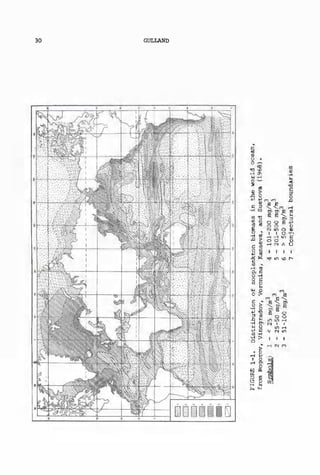
Thus summary distribution charts, for example produced by Bogorov,
Vinogradov, Voronina, Kanaeva, and Suetova (1968) (Fig. 1-1) may under-
estimate the density of Zooplankton in areas where euphausids predomi-
nate. Their chart, therefore, does not show the Antarctic as being
particularly rich, but the other highly productive areas such as the
North Pacific, the North Atlantic, and the waters off Peru are clearly
illustrated.
General Distribution of Sperm Whales
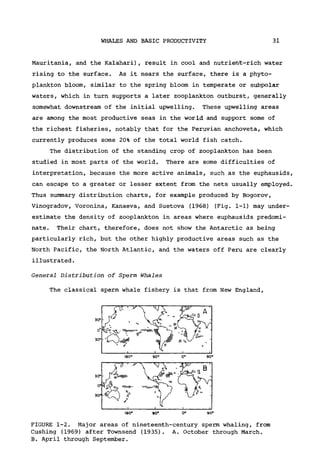
The classical sperm whale fishery is that from New England,
FIGURE 1-2. Major areas of nineteenth-century sperm whaling, from
Cushing (1969) after Townsend (1935). A. October through March.
B. April through September.
46.
32 GULLAND
described sowell and in rich detail by Herman Melville. Logbooks of
these whaling ships give the position of many of the whales caught;
these records have been summarized by Townsend (1935). The striking
correlation between the distribution of sperm whale catches and the
major upwelling areas has been noted by several authors. Cushing
(1969) notes that the main upwelling areas—California, Peru, Benguela,
and Canary, and particularly the equatorial system in the Pacific—
show up well as areas of high sperm whale catches (Fig. 1-2). The
South Arabian upwelling area is missing from the catch data. On the
other hand, there are some catches away from known upwelling areas—
in the central and western North Atlantic in the northern summer, and
rather similar areas north and west of New Zealand and west of the
Cape of Good Hope in the northern winter. The first of these may be
as much due to the number of whaling ships passing through the area
on the way to and from their home ports as to a real concentration of
whales.
The distribution of present-day whaling gives a less clear pic-
ture of sperm whale distribution. There is no pelagic operation
confined entirely to sperm whales, and the position of shore stations
is dependent upon a number of social and economic factors as well as
upon the distribution of whales. Coastal sperm whaling is now
restricted to half a dozen places: Japan, Chile-Peru, Western Aus-
tralia, South Africa, and Spain-Portugal. These shore stations
account for only about a quarter of the total catches. The rest is
taken by pelagic expeditions, in three distinct operations: in the
Antarctic during, or immediately before or after, the rorqual season;
in temperate or tropical waters by Antarctic expeditions on passage;
and in the North Pacific. The second of these probably covers areas
similar to those of the New England fishery and takes both males and
females.
Possibly as a result of a more strict enforcement of size limits
in temperate and tropical waters, these catches have declined in the
last few years. The North Pacific, and more especially the Antarctic,
pelagic operations take almost entirely large males. These catches
are outside the distribution of New England catches shown by Townsend;
47.
WHALES AND BASICPRODUCTIVITY 33
probably the general weather conditions were unfavorable to open-boat
whaling in these areas.
There is a very striking difference in distribution between the
large males, which occur in temperate or subpolar waters, and the rest
of the population, which is confined almost entirely to tropical and
subtropical waters. The reasons for the difference do not appear to
be known. The food seems to be similar for the two groups of animals.
Both eat squid and if the big sperm whales eat rather larger squid
there are no data on the distribution of different sizes of squid that
would suggest that they would have to enter the colder areas to get
the big squid. The separation between the main sperm whale groups,
mainly of females and young, and the solitary males is clearly a social
phenomenon, but it is not clear why this separation should be a matter
of up to 20 degrees of latitude.
In any case the main concentration of the population, and the
location of the main production, is where the females and young, and
also the harem bulls, are found, which is in the upwelling areas. On
the other hand, the solitary males represent the larger part of the
harvestable surplus. Thus, the main areas of production (in the sub-
tropics) are different from the main harvesting areas (temperate and
subpolar) for sperm whales.
Relative Abundance of Sperm Whales in Different Areas
Few estimates are available on the abundance of sperm whales in
different areas, though some (noted below) have been reported to the
International Whaling Commission, especially by the IWC-FAO working
group on stock assessment (Anon. 1969b). The common indices of rela-
tive abundance—particularly indices of catch per unit effort, such
as catch per catcher day's work, number sighted per hour flown by
aircraft, etc.—are not easily comparable between areas, because of
the different measures used, or the difference in size and capacity
of the ships concerned, or the skill of gunners. Another difficulty
is that not enough is known about the stock structure of sperm whales,
and especially the relations between the males in high latitudes and
the females and young males in warmer water. Thus, even when abundance
48.
34 GULLAND
estimates havebeen obtained, the limits of the area to which they
refer are far from clear.
With these reservations, the estimates given by the IWC-FAO work-
ing group which met in Rome in March 1968 and from more recent sources
are given in Table 1-1. Doi and Ohsumi (1970) believed that the mature
TABLE 1-1. Estimates of abundance of sperm whales.
Area Period Number of whales Source
Males only Total
North Pacific 1969 77,700
Initial stock 129,400
Western
Australia
Durban,
South Africa
Chile-Peru
1962-1966 28,000-44,000
1962-1965
1957-1961
22,000-56,000
45,000
Doi and
Ohsumi 1970
Anon. 1969b
males in subarctic waters of the North Pacific, estimated in the first
line of Table 1-1, were about two-thirds of the initial male stock.
If the mature females number about the same, the total of mature ani-
mals in the North Pacific stock (or stocks) must initially have been
3
about 2 x — x 130,000, or about 400,000.
These figures would suggest clear differences in the size of the
stocks considered. The North Pacific stock would appear to be much
the biggest (a little less than half a million animals), the Western
Australian stock being about half to a quarter of this size (100,000
to 150,000), and the stocks off Durban and Chile-Peru both about half
that off Western Australia. No estimates have been made of the magni-
tude of the stocks exploited in the Antarctic. Conventional analysis
based on catch-per-unit-of-effort data is impossible because of the
lack of suitable effort data. The total catches from the beginning
of Antarctic whaling have been close to 100,000 animals, almost
entirely males, which must have come from a total stock at least com-
parable with the North Pacific stocks. The distribution of these
catches among the different Antarctic whaling areas is shown in Table
1-2. Since the distribution of whaling activities is determined by
49.
WHALES ÄND BASICPRODUCTIVITY 35
TABLE 1-2. Numbers of whales caught in the various areas of the
Antarctic 1931 to 1938 (from International Whaling Statistics), except
that in the third line the blue and fin catches are combined in blue
whale units, not individual whales.
Area II III IV V VI I Total
0 0 0 0 ο ο ο ο
60 W-0 0 -70 Ε 70 Ε - 130 Ε - 170 W- 120 W-
0 0 0 0
130 Ε 170 W 120 W 60 W
Catches
Blue 38,400
Fin 159,600
B.w.u. 118,200
Sperm 21,400
Sperm/b.w.u.
0.18
77,000 56,800
193,500 77,000
173,750 95,300
32,500 20,800
0.19 0.22
11,700 4,500
35,900 30,300
29,650 19,650
19,000 3,000
0.64 0.15
900 189,300
16,900 513,200
9,350 445,900
2,400 99,100
0.26 0.22
the availability of baleen whales, the total in blue whale units is
shown as well as the catches of blue and fin whales.
This table shows that, not surprisingly, the biggest sperm whale
catches have come from the areas (II, III, and IV) in which most
whaling as judged by baleen catches has been carried out. The ratio
of sperm to baleen (b.w.u.) catches does not vary very much, except
for a high value in Area V, south of eastern Australia and New Zea-
land. If the large male sperm whales in the different areas of the
Antarctic come from populations immediately to the north, this would
suggest a relative high concentration of sperm whales north of Area V,
i.e., in the central and western Pacific, between Hawaii and the
Philippines. This would be in general agreement with the high primary
production in this area.
Distribution of Baleen Whales
Compared with our knowledge on the abundance and distribution of
sperm whales, that on baleen whales is reasonably good—though some
of this better knowlege is due to the more serious depletion of the
initial baleen stocks. Because so many of the stocks have been reduced
to a very low level, the actual numbers caught give a good index of the
50.
36 GULLAND
initial abundanceof the different stocks.
The actual number of baleen whales taken in the Antarctic between
1931 (when the collection of good statistics on area of capture was
started) and 1968 was 825,300. The general distribution of the whal-
ing grounds, and the boundaries of the statistical areas are shown in
Figure 5 of Mackintosh (1965, p. 52). The estimates of the initial
exploitable stocks in the whole Antarctic are 210,000 blue whales
(Anon. 1964), and between 120,000 and 180,000 sei whales (Anon. 1969a,
Doi and Ohsumi 1969) . The initial stock of fin whales has not been so
well estimated, but was probably twice the average number alive in the
period 1950/51 to 1956/57 (Anon. 1964). The most recent estimate of
the abundance near to that period is 171,800 in 1958 (Anon. 1971),
which would suggest an initial exploitable population of around
450,000 animals. Adding in a few tens of thousands of humpback whales
gives a total initial population of around 850,000 animals, which hap-
pens to be very nearly equal to the actual numbers caught. Assuming
the arithmetical coincidence also holds for individual areas, the
distribution of catches according to statistical areas can be taken
as a fair approximation to the distribution of initial stock. These
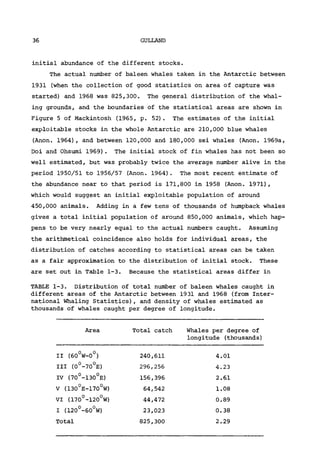
are set out in Table 1-3. Because the statistical areas differ in
TABLE 1-3. Distribution of total number of baleen whales caught in
different areas of the Antarctic between 1931 and 1968 (from Inter-
national Whaling Statistics), and density of whales estimated as
thousands of whales caught per degree of longitude.
Area Total catch Whales per degree of
longitude (thousands)
II (60°W-0°)
III (0°-70°E)
IV (70°-130°E)
V (130°E-170°W)
VI (170°-120°W)
I (120°-60°W)
Total
240,611
296,256
156,396
64,542
44,472
23,023
825,300
0.38
4.23
2.29
4.01
0.89
1.08
2.61
51.
WHALES AND BASICPRODUCTIVITY 37
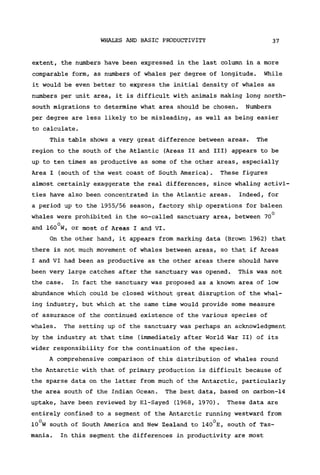
extent, the numbers have been expressed in the last column in a more
comparable form, as numbers of whales per degree of longitude. While
it would be even better to express the initial density of whales as
numbers per unit area, it is difficult with animals making long north-
south migrations to determine what area should be chosen. Numbers
per degree are less likely to be misleading, as well as being easier
to calculate.
This table shows a very great difference between areas. The
region to the south of the Atlantic (Areas II and III) appears to be
up to ten times as productive as some of the other areas, especially
Area I (south of the west coast of South America). These figures
almost certainly exaggerate the real differences, since whaling activi-
ties have also been concentrated in the Atlantic areas. Indeed, for
a period up to the 1955/56 season, factory ship operations for baleen
whales were prohibited in the so-called sanctuary area, between 70°
and 160°W, or most of Areas I and VI.
On the other hand, it appears from marking data (Brown 1962) that
there is not much movement of whales between areas, so that if Areas
I and VI had been as productive as the other areas there should have
been very large catches after the sanctuary was opened. This was not
the case. In fact the sanctuary was proposed as a known area of low
abundance which could be closed without great disruption of the whal-
ing industry, but which at the same time would provide some measure
of assurance of the continued existence of the various species of
whales. The setting up of the sanctuary was perhaps an acknowledgment
by the industry at that time (immediately after World War II) of its
wider responsibility for the continuation of the species.
A comprehensive comparison of this distribution of whales round
the Antarctic with that of primary production is difficult because of
the sparse data on the latter from much of the Antarctic, particularly
the area south of the Indian Ocean. The best data, based on carbon-14
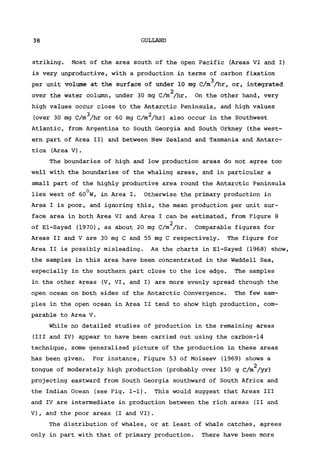
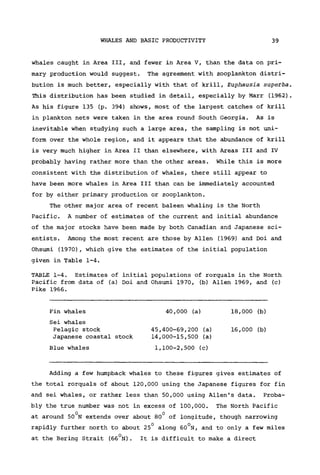
uptake, have been reviewed by El-Sayed (1968, 1970). These data are
entirely confined to a segment of the Antarctic running westward from
10°W south of South America and New Zealand to 140°E, south of Tas-
mania. In this segment the differences in productivity are most
52.
38 GULLAND
striking. Mostof the area south of the open Pacific (Areas VI and I)
is very unproductive, with a production in terms of carbon fixation
per unit volume at the surface of under 10 mg C/m^/hr, or, integrated
2
over the water column, under 30 mg C/m /hr. On the other hand, very
high values occur close to the Antarctic Peninsula, and high values
3 2
(over 30 mg C/m /hr or 60 mg C/m /hr) also occur in the Southwest
Atlantic, from Argentina to South Georgia and South Orkney (the west-
ern part of Area II) and between New Zealand and Tasmania and Antarc-
tica (Area V) .
The boundaries of high and low production areas do not agree too
well with the boundaries of the whaling areas, and in particular a
small part of the highly productive area round the Antarctic Peninsula
lies west of 60°W, in Area I. Otherwise the primary production in
Area I is poor, and ignoring this, the mean production per unit sur-
face area in both Area VI and Area I can be estimated, from Figure 8
2
of El-Sayed (1970), as about 20 mg C/m /hr. Comparable figures for
Areas II and V are 30 mg C and 55 mg C respectively. The figure for
Area II is possibly misleading. As the charts in El-Sayed (1968) show,
the samples in this area have been concentrated in the Weddell Sea,
especially in the southern part close to the ice edge. The samples
in the other areas (V, VI, and I) are more evenly spread through the
open ocean on both sides of the Antarctic Convergence. The few sam-
ples in the open ocean in Area II tend to show high production, com-
parable to Area V.
While no detailed studies of production in the remaining areas
(III and IV) appear to have been carried out using the carbon-14
technique, some generalized picture of the production in these areas
has been given. For instance, Figure 53 of Moiseev (1969) shows a
2
tongue of moderately high production (probably over 150 g C/m /yr)
projecting eastward from South Georgia southward of South Africa and
the Indian Ocean (see Fig. 1-1). This would suggest that Areas III
and IV are intermediate in production between the rich areas (II and
V), and the poor areas (I and VI).
The distribution of whales, or at least of whale catches, agrees
only in part with that of primary production. There have been more
53.
WHALES AND BASICPRODUCTIVITY 39
whales caught in Area III, and fewer in Area V, than the data on pri-
mary production would suggest. The agreement with Zooplankton distri-
bution is much better, especially with that of krill, Euphausia superba.
This distribution has been studied in detail, especially by Marr (1962).
As his figure 135 (p. 394) shows, most of the largest catches of krill
in plankton nets were taken in the area round South Georgia. As is
inevitable when studying such a large area, the sampling is not uni-
form over the whole region, and it appears that the abundance of krill
is very much higher in Area II than elsewhere, with Areas III and IV
probably having rather more than the other areas. While this is more
consistent with the distribution of whales, there still appear to
have been more whales in Area III than can be immediately accounted
for by either primary production or Zooplankton.
The other major area of recent baleen whaling is the North
Pacific. A number of estimates of the current and initial abundance
of the major stocks have been made by both Canadian and Japanese sci-
entists. Among the most recent are those by Allen (1969) and Doi and
Ohsumi (1970), which give the estimates of the initial population
given in Table 1-4.
TABLE 1-4. Estimates of initial populations of rorquals in the North
Pacific from data of (a) Doi and Ohsumi 1970, (b) Allen 1969, and (c)
Pike 1966.
Fin whales 40,000 (a) 18,000 (b)
Sei whales
Pelagic stock 45,400-69,200 (a) 16,000 (b)
Japanese coastal stock 14,000-15,500 (a)
Blue whales 1,100-2,500 (c)
Adding a few humpback whales to these figures gives estimates of
the total rorquals of about 120,000 using the Japanese figures for fin
and sei whales, or rather less than 50,000 using Allen's data. Proba-
bly the true number was not in excess of 100,000. The North Pacific
ο ο
at around 50 Ν extends over about 80 of longitude, though narrowing
rapidly further north to about 25° along 60°N, and to only a few miles
at the Bering Strait (66°N). It is difficult to make a direct
54.
40 GULLAND
comparison ofproduction per unit area with the Antarctic, where there
is little land in the latitudes where most whaling is done. If the
80° of longitude is taken as a fair measure of the extent of the area
inhabited by the stocks throughout the year, then for an initial popu-
lation of 100,000 animals the number of whales per degree will be 1.2
thousand. This value is almost half the average value for the Antarc-
tic, though a higher figure would of course be derived if a narrower
width were used.
Some data are also available from the North Atlantic. Allen
(1970) estimated that the number of fin whales in the west Atlantic
between Cape Cod and 57°N was about 7,000 animals, and that the initial
population of blue whales off Newfoundland and Labrador did not greatly
exceed 1,100. The humpback population was probably about the same.
No estimate was made for sei whales, though catches had been increasing.
The fin whale population had been exploited before the period analyzed
by Allen, but probably had not been greatly decreased below its initial
value. If the sei whale population is of about the same magnitude as
the fin whale stock, the initial population of all rorquals off the
North American east coast was about 20,000 animals (perhaps 8,000 to
9,000 each of fin and sei whales and 3,000 others). Possibly this
stock extends eastward to the longitude of Cape Farewell, about fif-
teen or twenty degrees of latitude. If so the number of whale per
degree—1.0 to 1.3 thousand—-is close to that estimated for the North
Pacific.
Relative Distribution and Abundance of Different Species of Rorquals
The various species of large rorquals differ in their habits and
food preferences, and these variations might be expected to be re-
flected in their distribution and abundance. The humpback whale is
somewhat of a special case, having a local and coastal distribution,
resulting in a rather low global abundance. The blue, fin, and sei
whale tend to be distributed successively in order of increasing dis-
tances from the pole; this zonation enabled the Antarctic industry
to concentrate its activities in turn on the three species, moving
successively further northward as the major interest changed from
containing a partof this work or any other work associated with
Project Gutenberg™.
1.E.5. Do not copy, display, perform, distribute or redistribute
this electronic work, or any part of this electronic work, without
prominently displaying the sentence set forth in paragraph 1.E.1
with active links or immediate access to the full terms of the
Project Gutenberg™ License.
1.E.6. You may convert to and distribute this work in any binary,
compressed, marked up, nonproprietary or proprietary form,
including any word processing or hypertext form. However, if
you provide access to or distribute copies of a Project
Gutenberg™ work in a format other than “Plain Vanilla ASCII” or
other format used in the official version posted on the official
Project Gutenberg™ website (www.gutenberg.org), you must,
at no additional cost, fee or expense to the user, provide a copy,
a means of exporting a copy, or a means of obtaining a copy
upon request, of the work in its original “Plain Vanilla ASCII” or
other form. Any alternate format must include the full Project
Gutenberg™ License as specified in paragraph 1.E.1.
1.E.7. Do not charge a fee for access to, viewing, displaying,
performing, copying or distributing any Project Gutenberg™
works unless you comply with paragraph 1.E.8 or 1.E.9.
1.E.8. You may charge a reasonable fee for copies of or
providing access to or distributing Project Gutenberg™
electronic works provided that:
• You pay a royalty fee of 20% of the gross profits you derive
from the use of Project Gutenberg™ works calculated using the
method you already use to calculate your applicable taxes. The
fee is owed to the owner of the Project Gutenberg™ trademark,
but he has agreed to donate royalties under this paragraph to
the Project Gutenberg Literary Archive Foundation. Royalty
57.
payments must bepaid within 60 days following each date on
which you prepare (or are legally required to prepare) your
periodic tax returns. Royalty payments should be clearly marked
as such and sent to the Project Gutenberg Literary Archive
Foundation at the address specified in Section 4, “Information
about donations to the Project Gutenberg Literary Archive
Foundation.”
• You provide a full refund of any money paid by a user who
notifies you in writing (or by e-mail) within 30 days of receipt
that s/he does not agree to the terms of the full Project
Gutenberg™ License. You must require such a user to return or
destroy all copies of the works possessed in a physical medium
and discontinue all use of and all access to other copies of
Project Gutenberg™ works.
• You provide, in accordance with paragraph 1.F.3, a full refund of
any money paid for a work or a replacement copy, if a defect in
the electronic work is discovered and reported to you within 90
days of receipt of the work.
• You comply with all other terms of this agreement for free
distribution of Project Gutenberg™ works.
1.E.9. If you wish to charge a fee or distribute a Project
Gutenberg™ electronic work or group of works on different
terms than are set forth in this agreement, you must obtain
permission in writing from the Project Gutenberg Literary
Archive Foundation, the manager of the Project Gutenberg™
trademark. Contact the Foundation as set forth in Section 3
below.
1.F.
1.F.1. Project Gutenberg volunteers and employees expend
considerable effort to identify, do copyright research on,
transcribe and proofread works not protected by U.S. copyright
58.
law in creatingthe Project Gutenberg™ collection. Despite these
efforts, Project Gutenberg™ electronic works, and the medium
on which they may be stored, may contain “Defects,” such as,
but not limited to, incomplete, inaccurate or corrupt data,
transcription errors, a copyright or other intellectual property
infringement, a defective or damaged disk or other medium, a
computer virus, or computer codes that damage or cannot be
read by your equipment.
1.F.2. LIMITED WARRANTY, DISCLAIMER OF DAMAGES - Except
for the “Right of Replacement or Refund” described in
paragraph 1.F.3, the Project Gutenberg Literary Archive
Foundation, the owner of the Project Gutenberg™ trademark,
and any other party distributing a Project Gutenberg™ electronic
work under this agreement, disclaim all liability to you for
damages, costs and expenses, including legal fees. YOU AGREE
THAT YOU HAVE NO REMEDIES FOR NEGLIGENCE, STRICT
LIABILITY, BREACH OF WARRANTY OR BREACH OF CONTRACT
EXCEPT THOSE PROVIDED IN PARAGRAPH 1.F.3. YOU AGREE
THAT THE FOUNDATION, THE TRADEMARK OWNER, AND ANY
DISTRIBUTOR UNDER THIS AGREEMENT WILL NOT BE LIABLE
TO YOU FOR ACTUAL, DIRECT, INDIRECT, CONSEQUENTIAL,
PUNITIVE OR INCIDENTAL DAMAGES EVEN IF YOU GIVE
NOTICE OF THE POSSIBILITY OF SUCH DAMAGE.
1.F.3. LIMITED RIGHT OF REPLACEMENT OR REFUND - If you
discover a defect in this electronic work within 90 days of
receiving it, you can receive a refund of the money (if any) you
paid for it by sending a written explanation to the person you
received the work from. If you received the work on a physical
medium, you must return the medium with your written
explanation. The person or entity that provided you with the
defective work may elect to provide a replacement copy in lieu
of a refund. If you received the work electronically, the person
or entity providing it to you may choose to give you a second
opportunity to receive the work electronically in lieu of a refund.
59.
If the secondcopy is also defective, you may demand a refund
in writing without further opportunities to fix the problem.
1.F.4. Except for the limited right of replacement or refund set
forth in paragraph 1.F.3, this work is provided to you ‘AS-IS’,
WITH NO OTHER WARRANTIES OF ANY KIND, EXPRESS OR
IMPLIED, INCLUDING BUT NOT LIMITED TO WARRANTIES OF
MERCHANTABILITY OR FITNESS FOR ANY PURPOSE.
1.F.5. Some states do not allow disclaimers of certain implied
warranties or the exclusion or limitation of certain types of
damages. If any disclaimer or limitation set forth in this
agreement violates the law of the state applicable to this
agreement, the agreement shall be interpreted to make the
maximum disclaimer or limitation permitted by the applicable
state law. The invalidity or unenforceability of any provision of
this agreement shall not void the remaining provisions.
1.F.6. INDEMNITY - You agree to indemnify and hold the
Foundation, the trademark owner, any agent or employee of the
Foundation, anyone providing copies of Project Gutenberg™
electronic works in accordance with this agreement, and any
volunteers associated with the production, promotion and
distribution of Project Gutenberg™ electronic works, harmless
from all liability, costs and expenses, including legal fees, that
arise directly or indirectly from any of the following which you
do or cause to occur: (a) distribution of this or any Project
Gutenberg™ work, (b) alteration, modification, or additions or
deletions to any Project Gutenberg™ work, and (c) any Defect
you cause.
Section 2. Information about the Mission
of Project Gutenberg™
60.
Project Gutenberg™ issynonymous with the free distribution of
electronic works in formats readable by the widest variety of
computers including obsolete, old, middle-aged and new
computers. It exists because of the efforts of hundreds of
volunteers and donations from people in all walks of life.
Volunteers and financial support to provide volunteers with the
assistance they need are critical to reaching Project
Gutenberg™’s goals and ensuring that the Project Gutenberg™
collection will remain freely available for generations to come. In
2001, the Project Gutenberg Literary Archive Foundation was
created to provide a secure and permanent future for Project
Gutenberg™ and future generations. To learn more about the
Project Gutenberg Literary Archive Foundation and how your
efforts and donations can help, see Sections 3 and 4 and the
Foundation information page at www.gutenberg.org.
Section 3. Information about the Project
Gutenberg Literary Archive Foundation
The Project Gutenberg Literary Archive Foundation is a non-
profit 501(c)(3) educational corporation organized under the
laws of the state of Mississippi and granted tax exempt status
by the Internal Revenue Service. The Foundation’s EIN or
federal tax identification number is 64-6221541. Contributions
to the Project Gutenberg Literary Archive Foundation are tax
deductible to the full extent permitted by U.S. federal laws and
your state’s laws.
The Foundation’s business office is located at 809 North 1500
West, Salt Lake City, UT 84116, (801) 596-1887. Email contact
links and up to date contact information can be found at the
Foundation’s website and official page at
www.gutenberg.org/contact
61.
Section 4. Informationabout Donations to
the Project Gutenberg Literary Archive
Foundation
Project Gutenberg™ depends upon and cannot survive without
widespread public support and donations to carry out its mission
of increasing the number of public domain and licensed works
that can be freely distributed in machine-readable form
accessible by the widest array of equipment including outdated
equipment. Many small donations ($1 to $5,000) are particularly
important to maintaining tax exempt status with the IRS.
The Foundation is committed to complying with the laws
regulating charities and charitable donations in all 50 states of
the United States. Compliance requirements are not uniform
and it takes a considerable effort, much paperwork and many
fees to meet and keep up with these requirements. We do not
solicit donations in locations where we have not received written
confirmation of compliance. To SEND DONATIONS or determine
the status of compliance for any particular state visit
www.gutenberg.org/donate.
While we cannot and do not solicit contributions from states
where we have not met the solicitation requirements, we know
of no prohibition against accepting unsolicited donations from
donors in such states who approach us with offers to donate.
International donations are gratefully accepted, but we cannot
make any statements concerning tax treatment of donations
received from outside the United States. U.S. laws alone swamp
our small staff.
Please check the Project Gutenberg web pages for current
donation methods and addresses. Donations are accepted in a
number of other ways including checks, online payments and
62.
credit card donations.To donate, please visit:
www.gutenberg.org/donate.
Section 5. General Information About
Project Gutenberg™ electronic works
Professor Michael S. Hart was the originator of the Project
Gutenberg™ concept of a library of electronic works that could
be freely shared with anyone. For forty years, he produced and
distributed Project Gutenberg™ eBooks with only a loose
network of volunteer support.
Project Gutenberg™ eBooks are often created from several
printed editions, all of which are confirmed as not protected by
copyright in the U.S. unless a copyright notice is included. Thus,
we do not necessarily keep eBooks in compliance with any
particular paper edition.
Most people start at our website which has the main PG search
facility: www.gutenberg.org.
This website includes information about Project Gutenberg™,
including how to make donations to the Project Gutenberg
Literary Archive Foundation, how to help produce our new
eBooks, and how to subscribe to our email newsletter to hear
about new eBooks.
63.
Welcome to ourwebsite – the perfect destination for book lovers and
knowledge seekers. We believe that every book holds a new world,
offering opportunities for learning, discovery, and personal growth.
That’s why we are dedicated to bringing you a diverse collection of
books, ranging from classic literature and specialized publications to
self-development guides and children's books.
More than just a book-buying platform, we strive to be a bridge
connecting you with timeless cultural and intellectual values. With an
elegant, user-friendly interface and a smart search system, you can
quickly find the books that best suit your interests. Additionally,
our special promotions and home delivery services help you save time
and fully enjoy the joy of reading.
Join us on a journey of knowledge exploration, passion nurturing, and
personal growth every day!
ebookbell.com




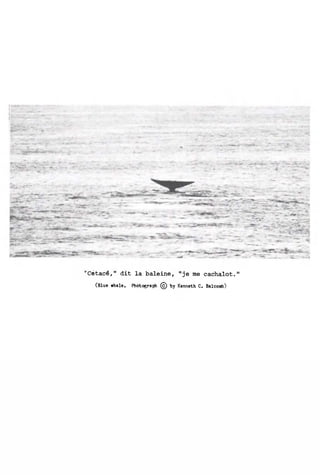

![PREFACE vii
Although in many areas whaling was prosecuted at excessive rates
during the first years of the International Whaling Commission, it
has not been entirely reasonable to scold this body for not saving
the world's whales from depletion. Many of its critics seem unaware
of the actual provisions of the Convention under which the Commission
was set up a quarter century ago. The Convention states, inter alia,
"that the whale stocks are susceptible of natural increases if whaling
is properly regulated and that increases in the size of whale stocks
will permit increases in the numbers of whales which may be captured
without endangering these natural resources; . . . [and] that it is
in the common interest to achieve the optimum level of whale stocks
as rapidly as possible without causing widespread economic and nutri-
tional distress." The Convention, in Article V, also protects the
national and industrial independence of its members, thus providing
for the weakening or evasion of amendments to the Schedule. The re-
sults have been that overfishing of some species has continued and
that the recommendations of concerned scientists have been repeatedly
ignored.
Nevertheless, the International Whaling Commission has taken some
positive actions toward conservation, and it should receive credit for
them. Long before the 1972 United Nations Conference on the Human
Environment at Stockholm, it imposed moratoria on certain species of
whales. At the time of its establishment, the Commission forbade
the taking or killing of gray and right whales. Subsequently, blue
and humpback whales were added to the list—though admittedly after
the species had been extremely depleted. The "right" whale, in the
language of the IWC, includes the bowhead, northern right, southern
right, and pygmy right whales. Thus seven zoological species are pro-
tected by IWC moratoria.
The excellent book by Dr. N. A. Mackintosh, "The Stocks of
Whales," published in London in 1965, may be considered a foundation
and point of departure for this book of ours. Ours is an attempt to
extend somewhat the basic work of Dr. Mackintosh, but we by no means
supplant it. The interested reader should have a copy at hand for
general information; besides, there are numerous references to it](https://image.slidesharecdn.com/25694810-250515091510-f6bbf912/85/The-Whale-Problem-A-Status-Report-William-E-Schevill-11-320.jpg)