The Value of Developing Relationships in Selling 
NextGen National Sales Meeting 2012 
By James Muir, VP Southwest Region
NextGen – The best job on the planet? 
•Perfect Alignment 
–Our software helps people 
–Help those who help others 
–You can affect many lives for good by helping care- givers be the best they can be 
•You can make a lot of money 
•I want that for all of you 
•But you will have to work for it 
–That’s what this session is about 
–To help you know what to work on.
The most important thing this week! 
•The most important part of this program and this week is… 
•…what you do afterwards.
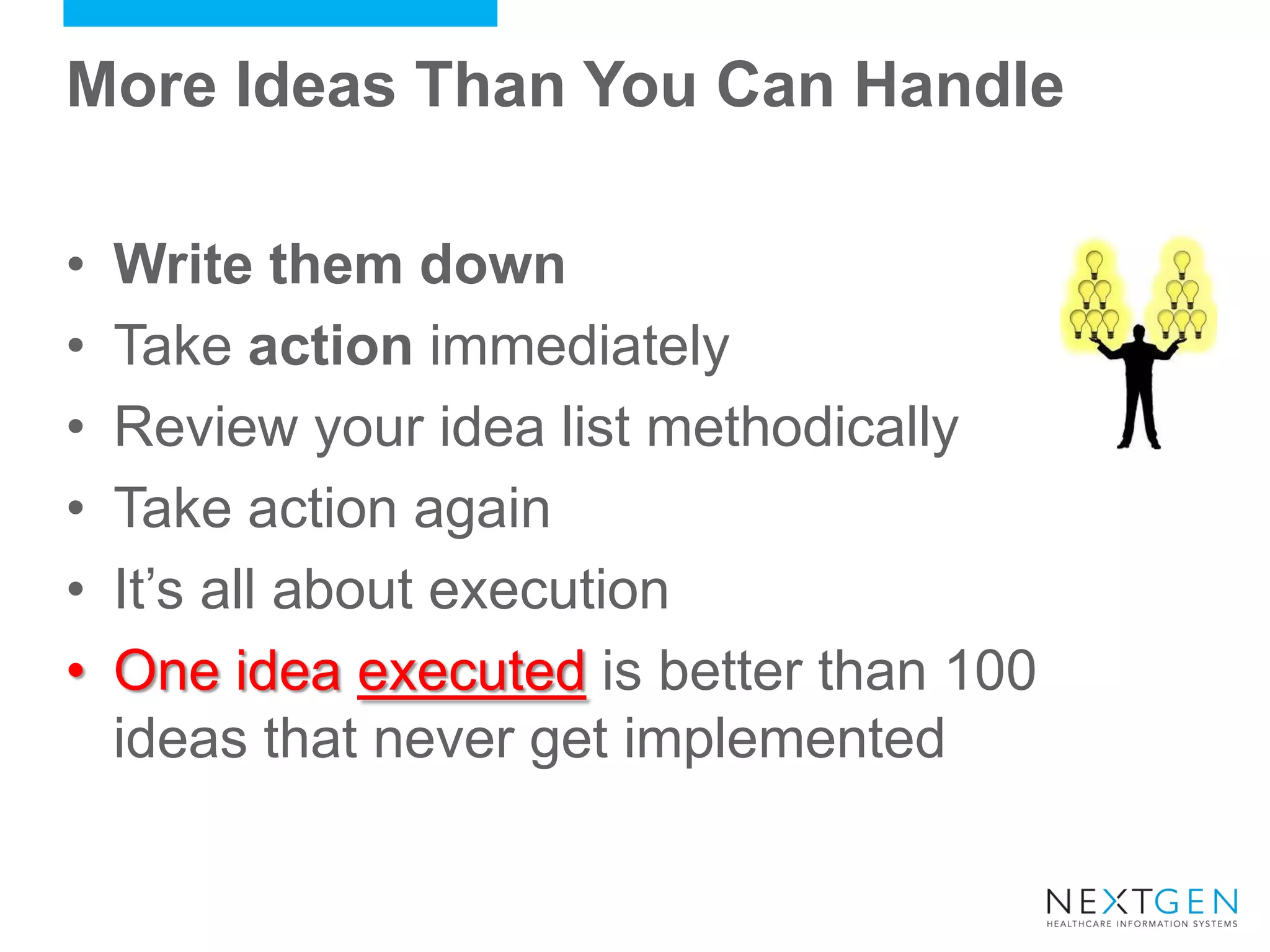
More Ideas Than You Can Handle 
•Write them down 
•Take action immediately 
•Review your idea list methodically 
•Take action again 
•It’s all about execution 
•One idea executed is better than 100 ideas that never get implemented
Drink From the Fire Hose
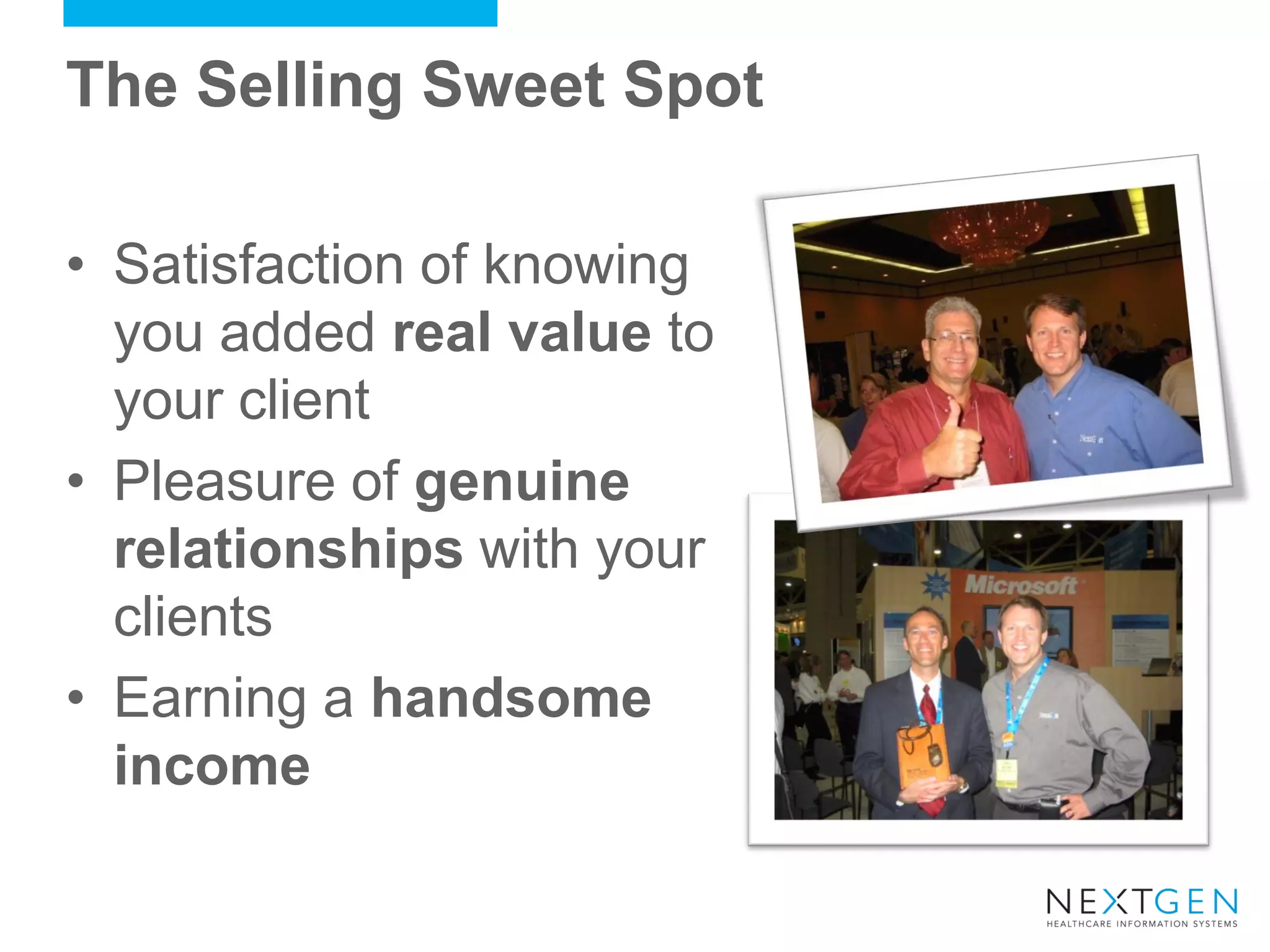
The Selling Sweet Spot 
•Satisfaction of knowing you added real value to your client 
•Pleasure of genuine relationships with your clients 
•Earning a handsome income
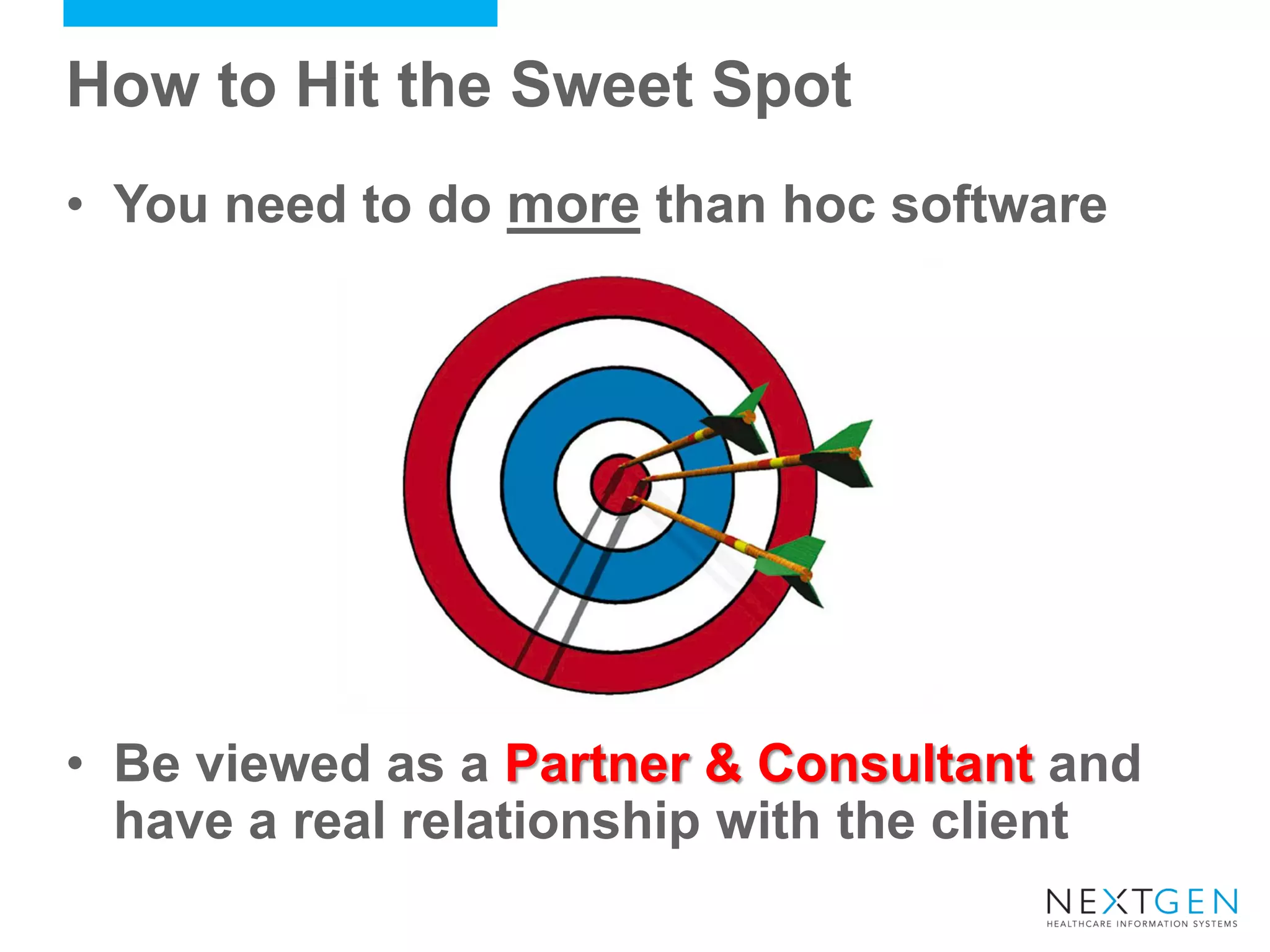
How to Hit the Sweet Spot 
•You need to do more than hoc software 
•Be viewed as a Partner & Consultant and have a real relationship with the client
Why develop relationships as part of my sales efforts? 
•Clients will share more information with you 
•Clients will ask for advice & accept your recommendations 
•Clients will refer you to others & be a reference for you 
•Clients will forgive your mistakes 
•Clients will protect & warn you 
•You will make more and bigger sales 
•“Trusted Advisors” are 70% more likely to come away with the sale. 
–Susan Mulcahy – “Evaluating the costs of sales calls in business to business markets: a study of more than 23,000 business” (Washibgtin: Cahners Research, January 2002), p.8 
•Ego stroke… 
Dave Kane Email 
•Go to Outlook…
How to Develop Valuable Relationships 
•But before that how about a quick survey? 
Self – Survey!
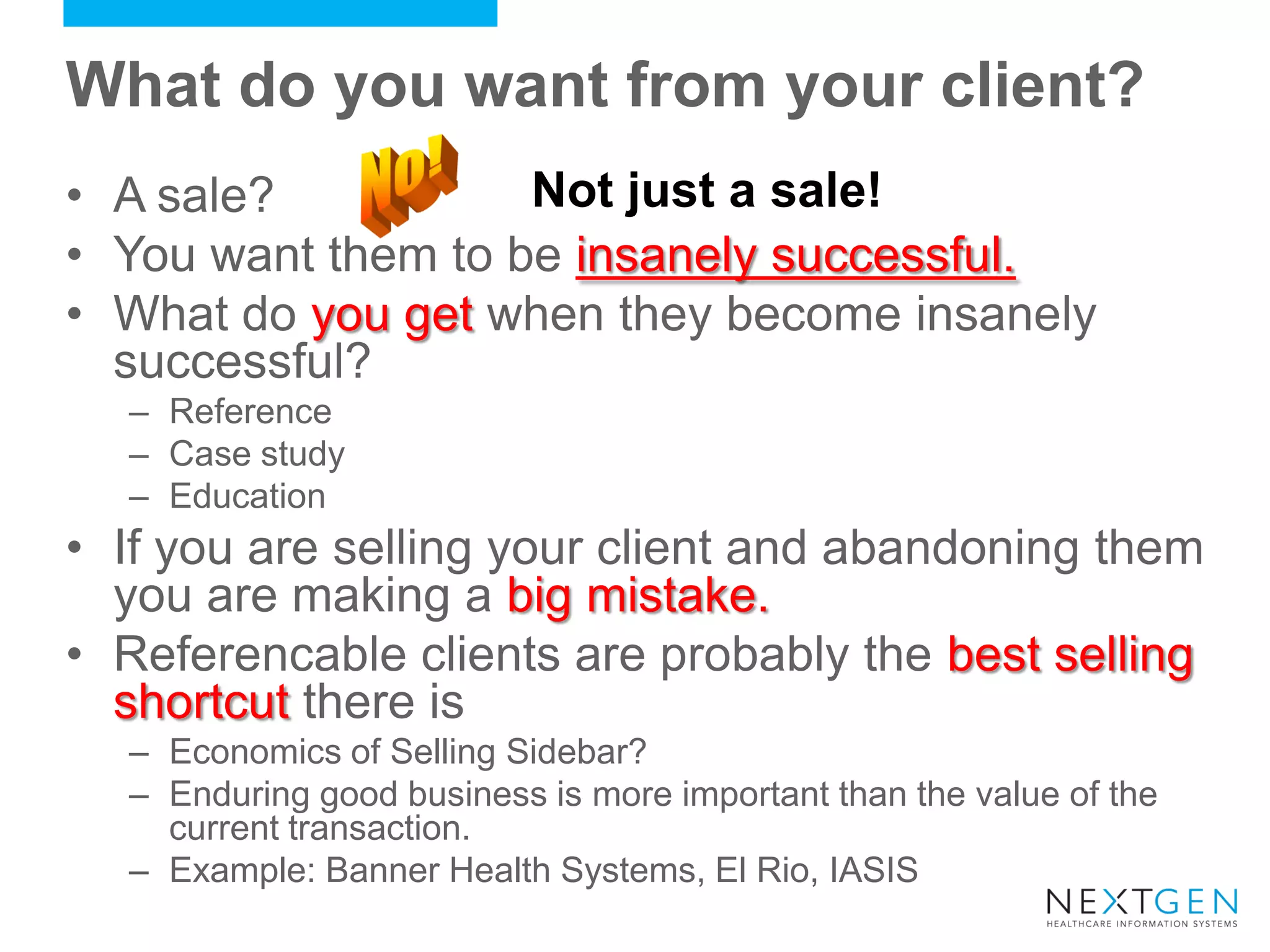
What do you want from your client? 
•A sale? 
•You want them to be insanely successful. 
•What do you get when they become insanely successful? 
–Reference 
–Case study 
–Education 
•If you are selling your client and abandoning them you are making a big mistake. 
•Referencable clients are probably the best selling shortcut there is 
–Economics of Selling Sidebar? 
–Enduring good business is more important than the value of the current transaction. 
–Example: Banner Health Systems, El Rio, IASIS 
Not just a sale!
How to Develop Valuable Relationships 
Actually Care 
•Two word formula:
If you are focused on their success they will focus on your success 
Once they understand that you are genuinely looking out for them and that you are a resource – everything changes.
What Specifically Can We Do to Develop Better Relationships? 
•Thanks for the platitudes James but specific things can I do to develop better relationships with prospects & clients?
What Clients Want in a Sales Person 
•What are the 4 most important factors when customers select vendor solutions? 
•Write down the top 7 things your clients want from you. 
Quiz!
Discussion 
•What did you come up with? 
What are the 4 most important factors when customers select vendor solutions? 
Write down the top 7 things your clients want from you.
HR Chally Exhaustive Study 
•Based on HR Chally’s 14 year study 
–Over 80,000 interviews with B2B customers 
–Data collected from over 7,200 sales forces
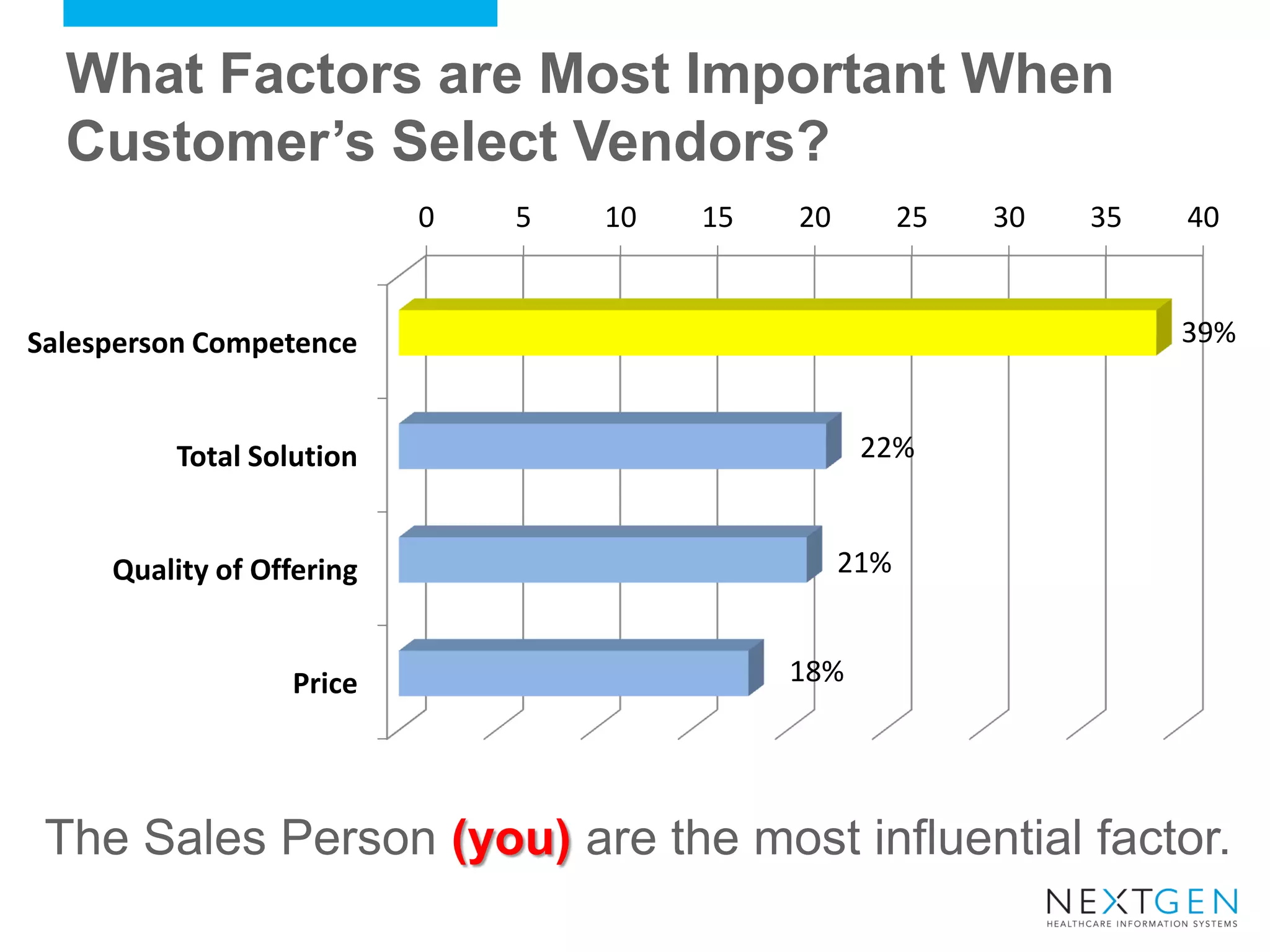
What Factors are Most Important When Customer’s Select Vendors? 
The Sales Person (you) are the most influential factor. 
0 
5 
10 
15 
20 
25 
30 
35 
40 
Salesperson Competence 
Total Solution 
Quality of Offering 
Price 
39% 
22% 
21% 
18%
The top 7 Things Clients Want From Their Sales Rep (You) 
•Are you ready?
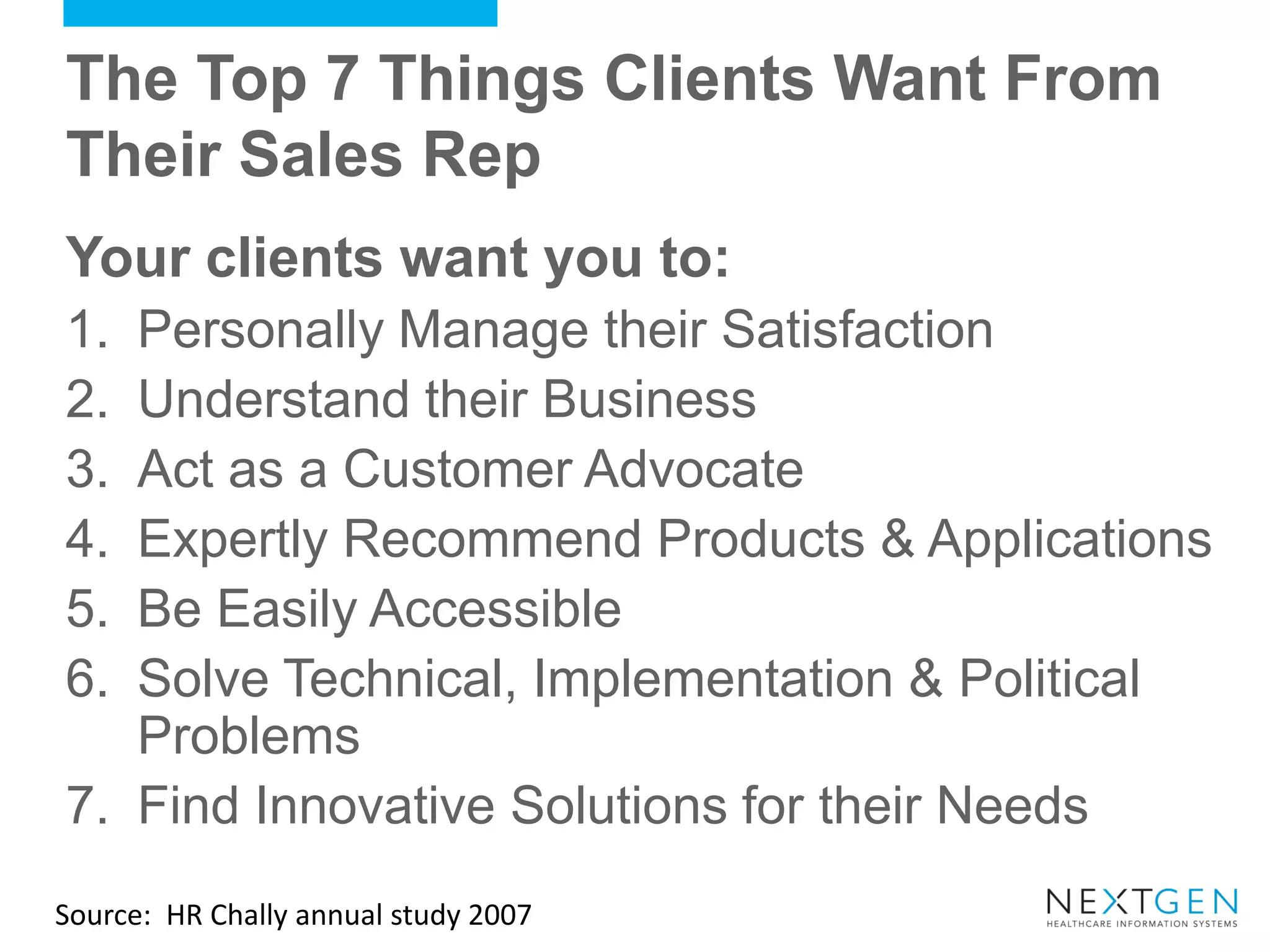
The Top 7 Things Clients Want From Their Sales Rep 
Your clients want you to: 
1.Personally Manage their Satisfaction 
2.Understand their Business 
3.Act as a Customer Advocate 
4.Expertly Recommend Products & Applications 
5.Be Easily Accessible 
6.Solve Technical, Implementation & Political Problems 
7.Find Innovative Solutions for their Needs 
Source: HR Chally annual study 2007
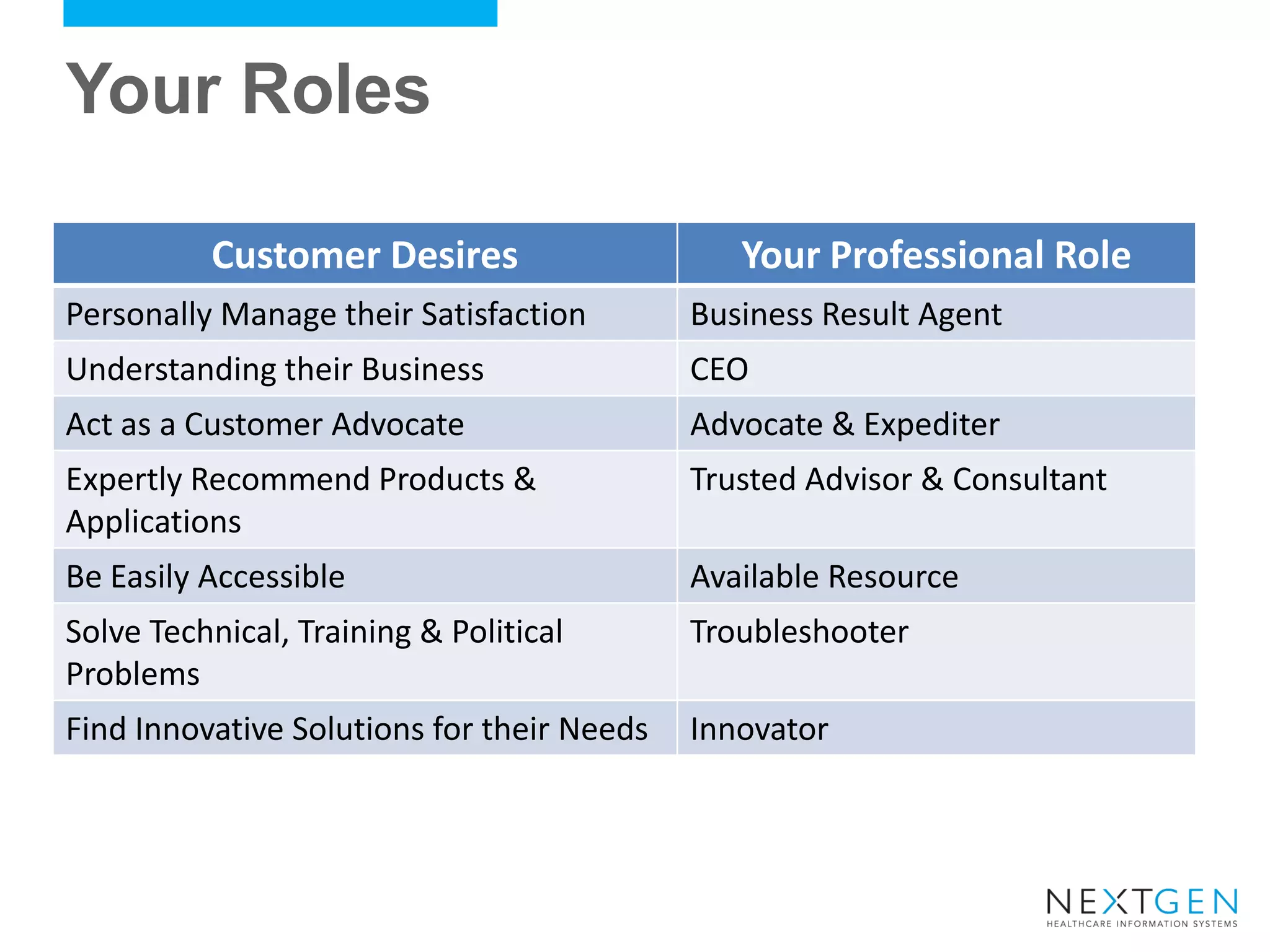
Your Roles 
Customer Desires 
Your Professional Role 
Personally Manage their Satisfaction 
Business Result Agent 
Understanding their Business 
CEO 
Act as a Customer Advocate 
Advocate & Expediter 
Expertly Recommend Products & Applications 
Trusted Advisor & Consultant 
Be Easily Accessible 
Available Resource 
Solve Technical, Training & Political Problems 
Troubleshooter 
Find Innovative Solutions for their Needs 
Innovator
QUIZ 
•What are our customers buying from us? *
#1 - Personally Manage their Satisfaction 
•Customer’s invest in results not products 
•Orient yourself toward outcomes 
–What outcomes does this customer want? 
•This means managing post-sales activities 
–Implementation & results 
•Are you a: 
–Closer? 
•Hit & Run (most) 
–Verifier? 
•Make sure it gets installed & services when necessary (fewer) 
–Outcome Manager? 
•Takes responsibility for the ultimate benefit that customer hope to receive (world-class – smallest percentage)
•Strategic Accounts 
–It takes 1/10 the time to do business with an existing customer than it does to acquire a new one. 
•McKinsey & Co. 2005 study, “Customer Acquisition Makes a Comeback”, Don Peppers 
–The 3 Greatest Skills for Accountability 
•Make yourself a major point of contact 
•Manage a team of experts 
•Being a ROI Expert 
•Sample statements to convey accountability: 
–“I am personally accountable to make sure we get these results.” 
–“I will help you do that.” 
–“Because I’m your rep we are married. I will be with you throughout your whole project.” 
#1 - Personally Manage their Satisfaction
QUIZ 
•What is the 1# Complaint about sales reps by B2B customers according to the extensive study by The HR Chally Group? 
•Answer: 
“The sales rep didn’t understand my business.”
Ask Yourself: 
•What are key performance indicators for this client? 
•A client has asked you to run their practice for the next 8 weeks. Are you in trouble? Are they in trouble?
#2 - Understanding their Business 
•The second most important thing to your customer is that you understand their business. 
•What do you need to know? You need: 
1.Vertical Knowledge 
•Ambulatory Healthcare 
•Clinical Workflow 
•Clinic Administration 
•Hospital Dynamics 
2.Horizontal Knowledge 
•Software 
•Computer Systems 
•Networking 
3.Specialized Knowledge 
•Specialties (Community Health, Ophthalmology, Cardiology, OBGYN, Derm, etc.) 
•NextGen Reports 
•Worklog 
•Etc. 
•84% of sales people do not adequately understand the business of their customers. 
–Intellexis Report, 2006
•How to convey you understand your client’s business 
–Learn, so you actually DO understand their business 
–Use inside jargon *they* understand in their business 
–Ask about possible outcomes when you hear issues 
•Example: “Oh, so does that mean you are experiencing X?” 
–Suggest solutions that reveal you understand their business 
–Tell them about, or send them an article you read in a industry journal 
–Etc. 
•Where can I go to learn my client’s business? 
–Attend Go-lives 
–Internet articles 
–Trade Show Sessions 
–Trade Journals (MGMA Journal, HFM, Physicians Practice, etc.) 
–PodCasts 
–Books (Greebach Publishing, MGMA, Physicians Practice) 
–FASTPractice 
–Workshops 
–James – Just ask me and I will help you. (Today’s Session) 
•What do I do until I have learned about their business? 
–LISTEN very carefully 
–Don’t assume anything 
#2 - Understanding their Business
#3 Act as a Customer Advocate 
•50-60% of salesperson time is spent addressing unresolved client issues 
•Facilitate & Delegate 
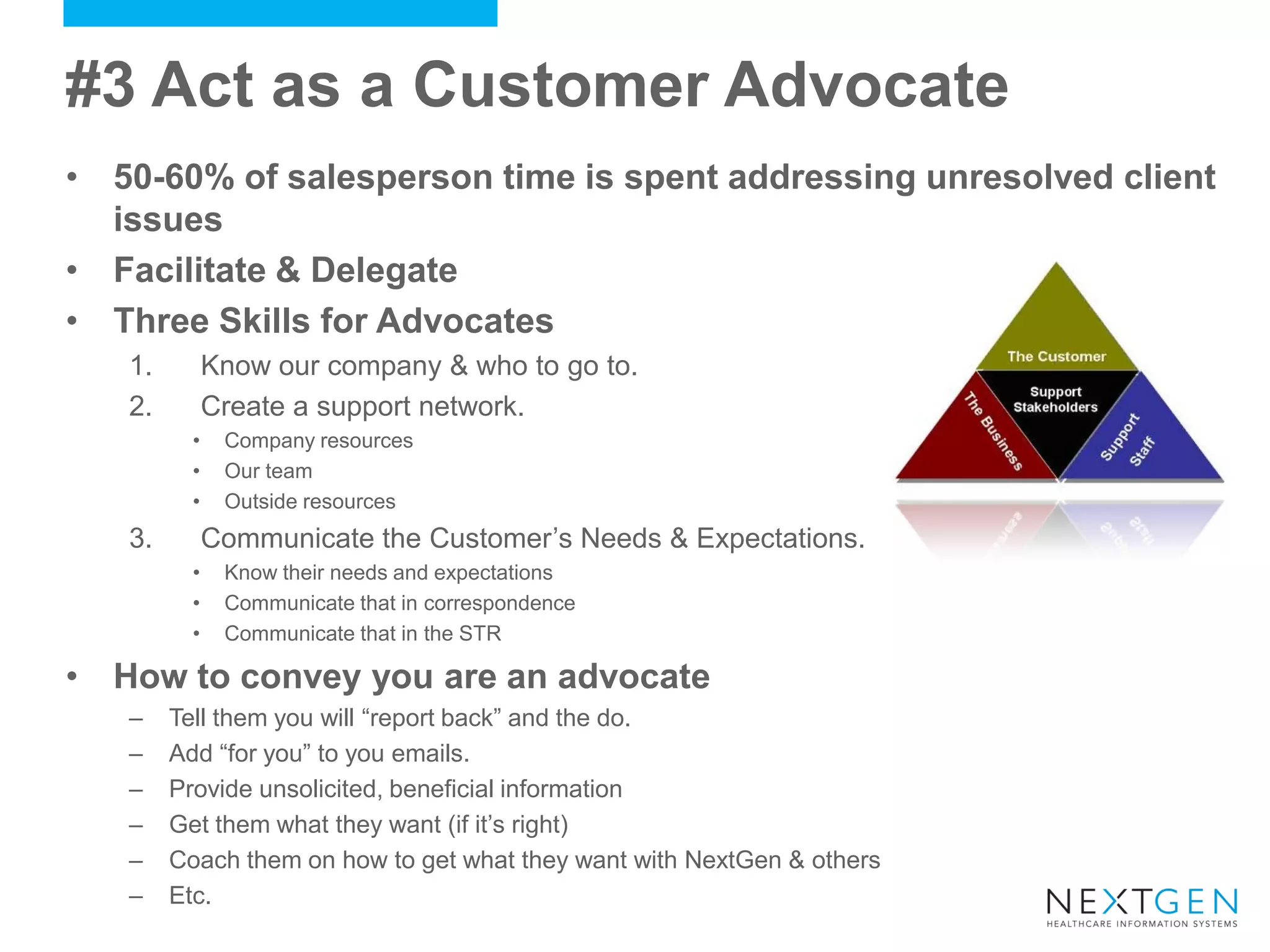
•Three Skills for Advocates 
1.Know our company & who to go to. 
2.Create a support network. 
•Company resources 
•Our team 
•Outside resources 
3.Communicate the Customer’s Needs & Expectations. 
•Know their needs and expectations 
•Communicate that in correspondence 
•Communicate that in the STR 
•How to convey you are an advocate 
–Tell them you will “report back” and the do. 
–Add “for you” to you emails. 
–Provide unsolicited, beneficial information 
–Get them what they want (if it’s right) 
–Coach them on how to get what they want with NextGen & others 
–Etc.
QUIZ (check for time) 
•Solving Business Problem With NextGen 
•DOC: NextGen – Name that tool
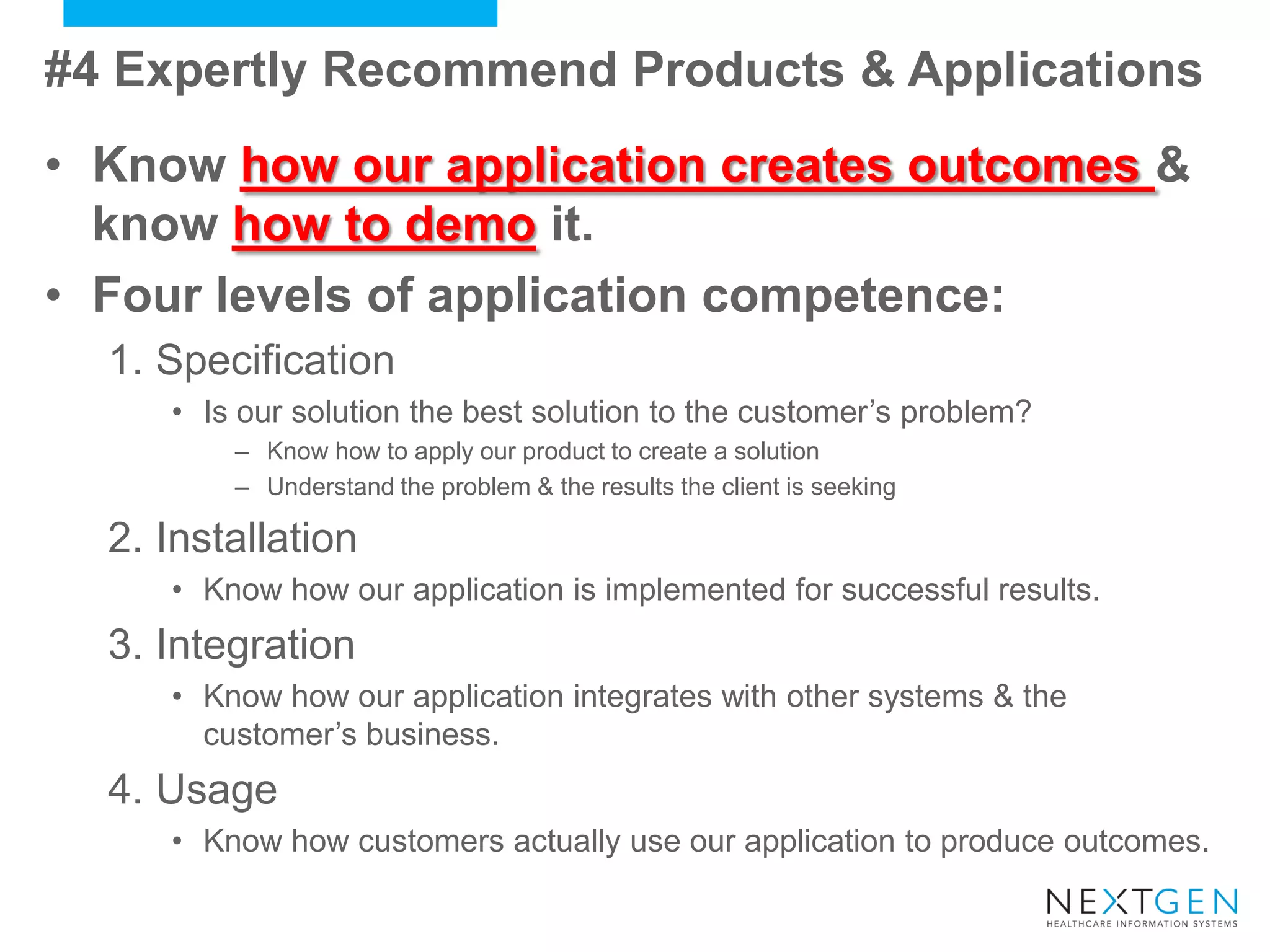
#4 Expertly Recommend Products & Applications 
•Know how our application creates outcomes & know how to demo it. 
•Four levels of application competence: 
1.Specification 
•Is our solution the best solution to the customer’s problem? 
–Know how to apply our product to create a solution 
–Understand the problem & the results the client is seeking 
2.Installation 
•Know how our application is implemented for successful results. 
3.Integration 
•Know how our application integrates with other systems & the customer’s business. 
4.Usage 
•Know how customers actually use our application to produce outcomes.
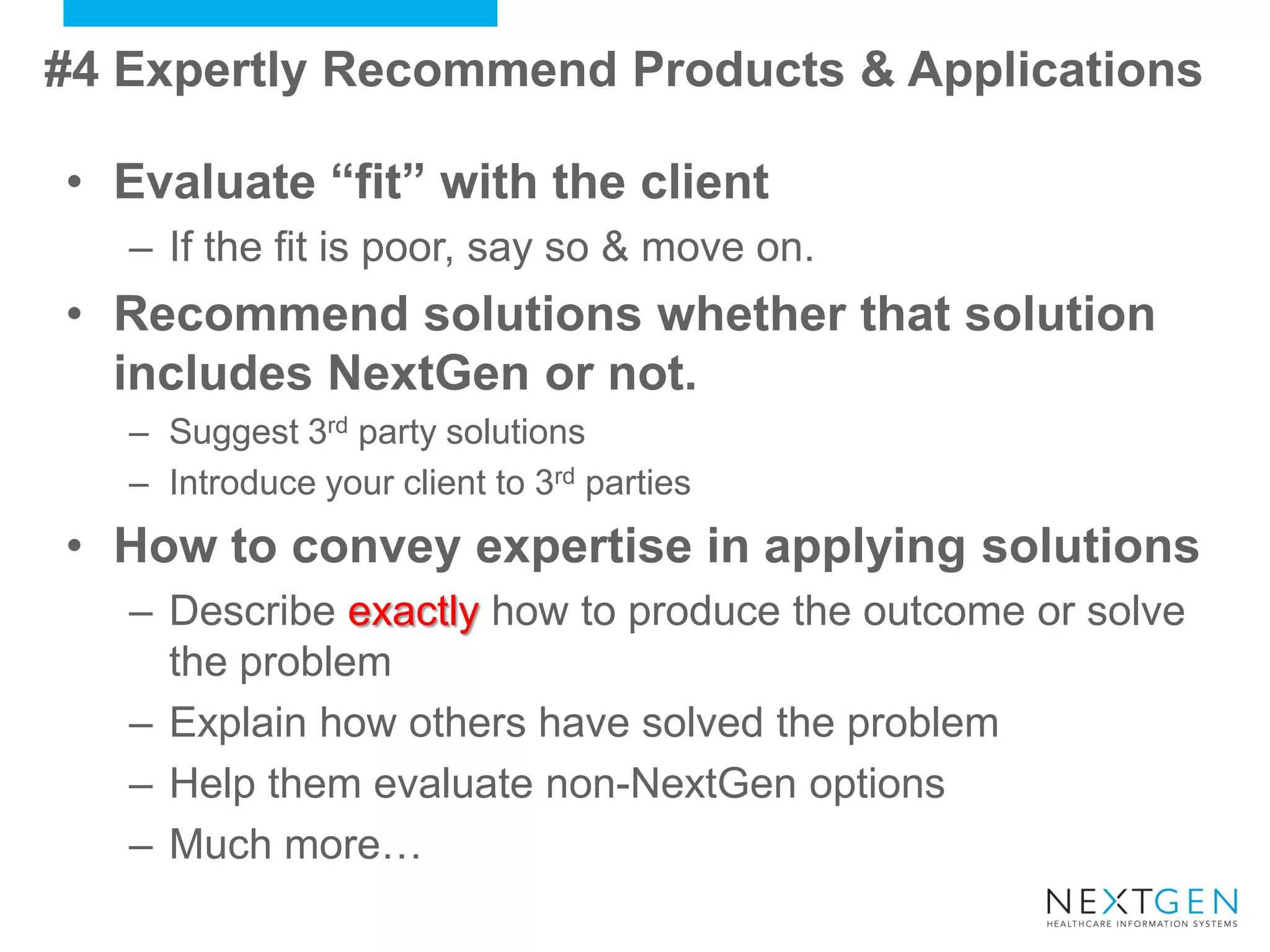
•Evaluate “fit” with the client 
–If the fit is poor, say so & move on. 
•Recommend solutions whether that solution includes NextGen or not. 
–Suggest 3rd party solutions 
–Introduce your client to 3rd parties 
•How to convey expertise in applying solutions 
–Describe exactly how to produce the outcome or solve the problem 
–Explain how others have solved the problem 
–Help them evaluate non-NextGen options 
–Much more… 
#4 Expertly Recommend Products & Applications
QUIZ 
•How likely are clients to be referencable when they know their rep vs. ones who don’t? 
•What kind of interaction creates the highest loyalty and satisfaction?
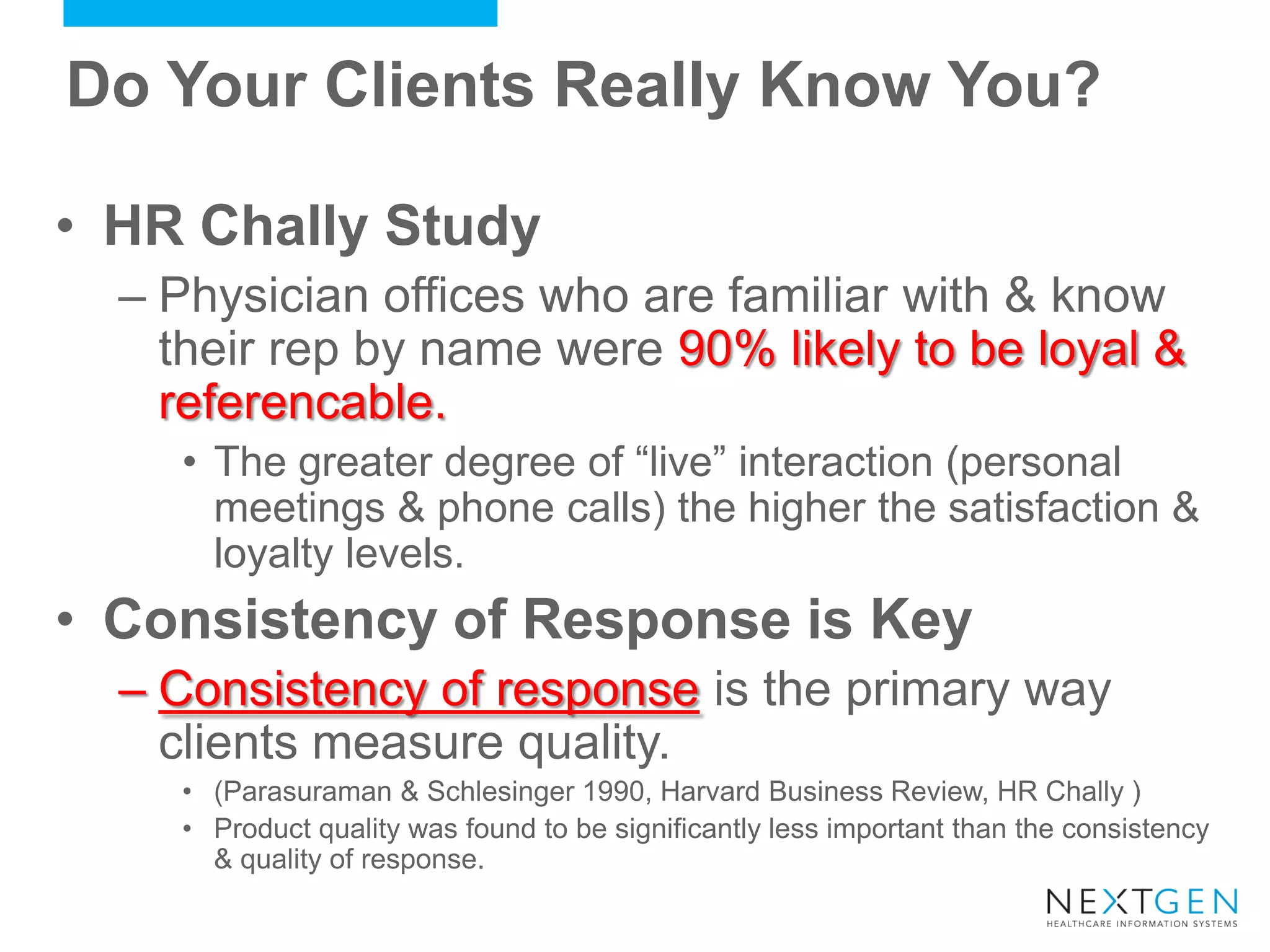
Do Your Clients Really Know You? 
•HR Chally Study 
–Physician offices who are familiar with & know their rep by name were 90% likely to be loyal & referencable. 
•The greater degree of “live” interaction (personal meetings & phone calls) the higher the satisfaction & loyalty levels. 
•Consistency of Response is Key 
–Consistency of response is the primary way clients measure quality. 
•(Parasuraman & Schlesinger 1990, Harvard Business Review, HR Chally ) 
•Product quality was found to be significantly less important than the consistency & quality of response.
#5 Be Easily Accessible 
•The 5th most important thing to your customer is that you be easily accessible. 
•Clients Measure Response Quality in 4 Ways: 
1.How quickly initial contact is established 
2.How soon the response is delivered 
3.How appropriate the response is 
4.The quality & follow-through of the response
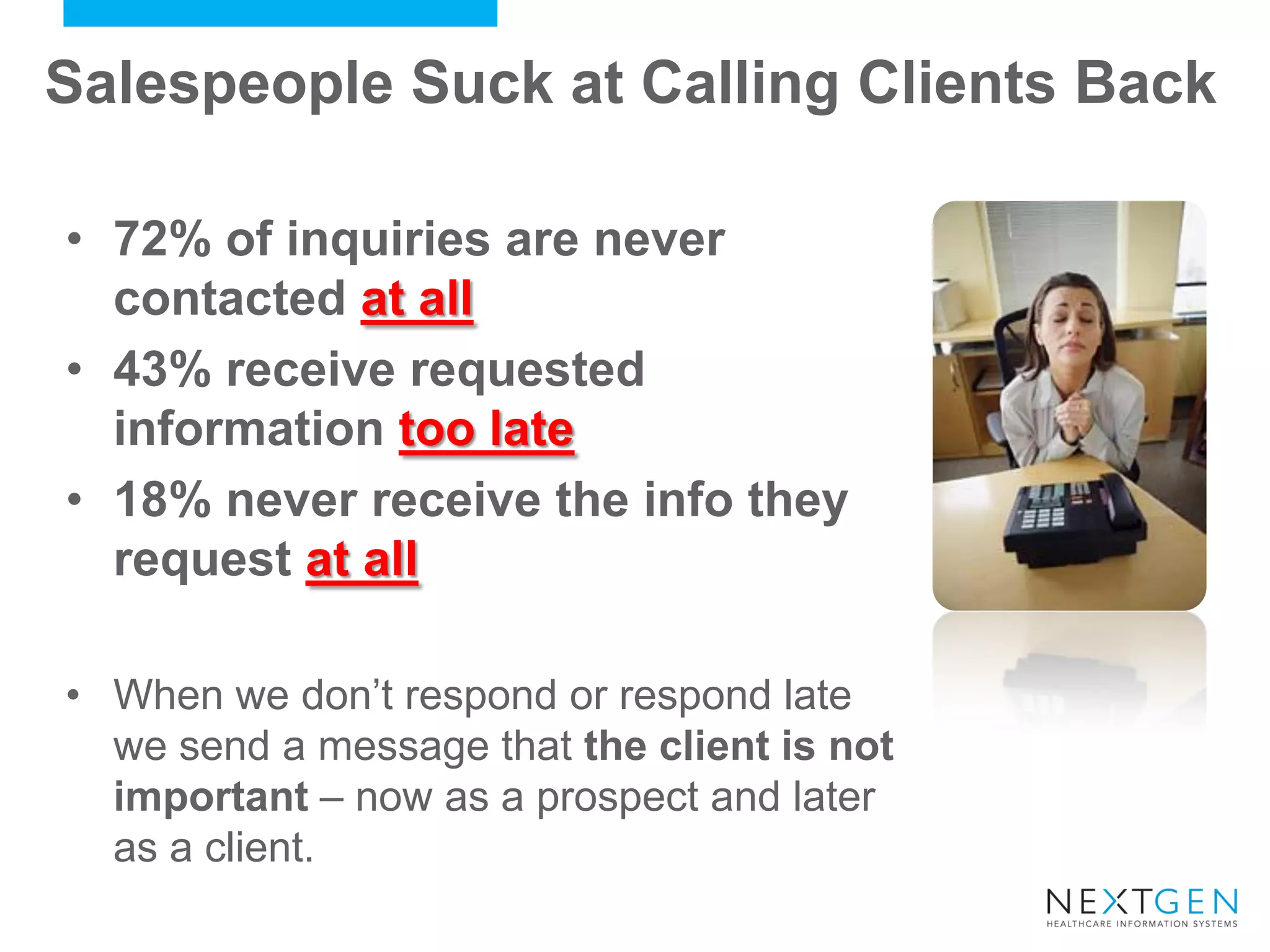
Salespeople Suck at Calling Clients Back 
•72% of inquiries are never contacted at all 
•43% receive requested information too late 
•18% never receive the info they request at all 
•When we don’t respond or respond late we send a message that the client is not important – now as a prospect and later as a client.
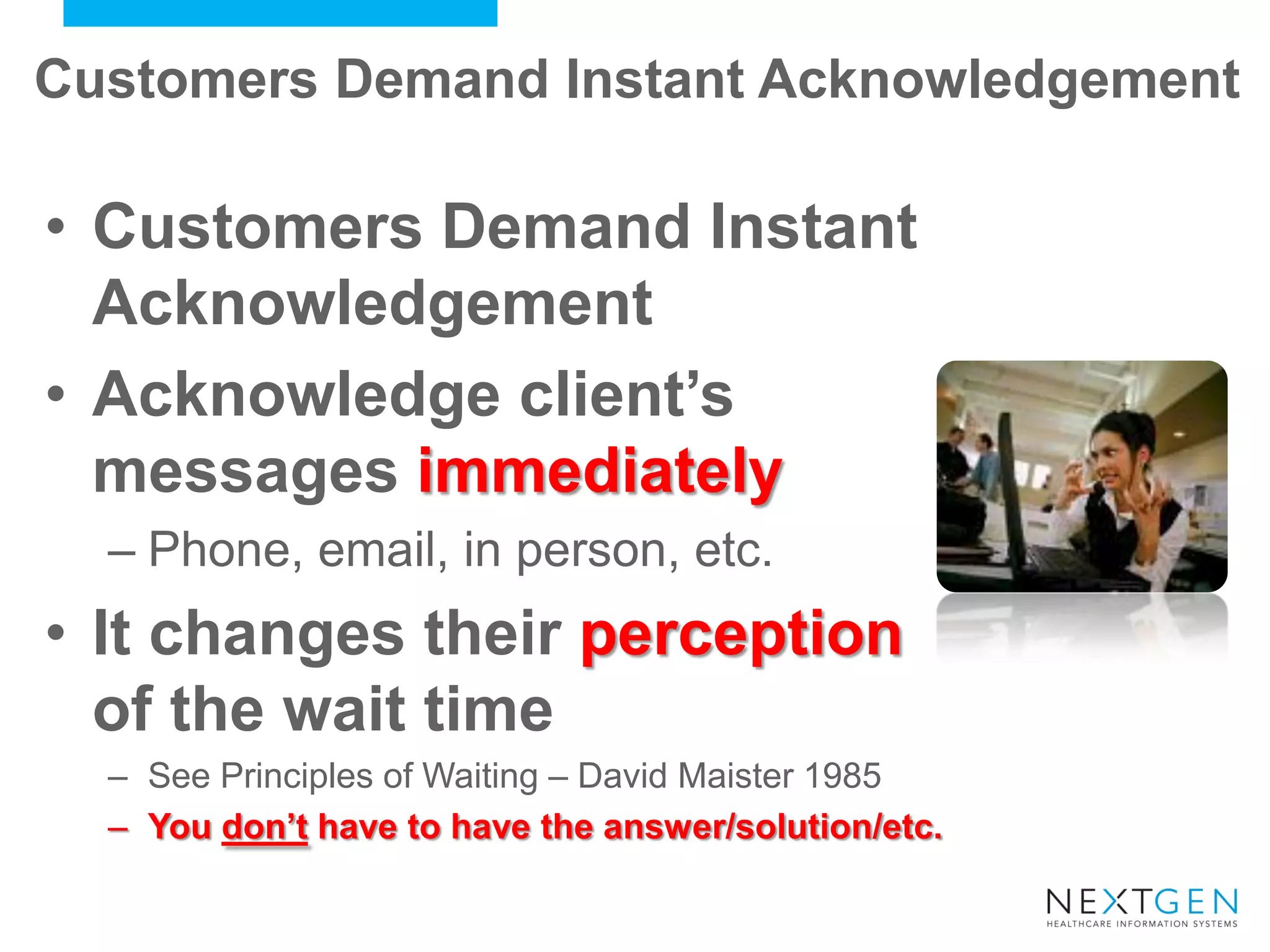
Customers Demand Instant Acknowledgement 
•Customers Demand Instant Acknowledgement 
•Acknowledge client’s messages immediately 
–Phone, email, in person, etc. 
•It changes their perception of the wait time 
–See Principles of Waiting – David Maister 1985 
–You don’t have to have the answer/solution/etc.
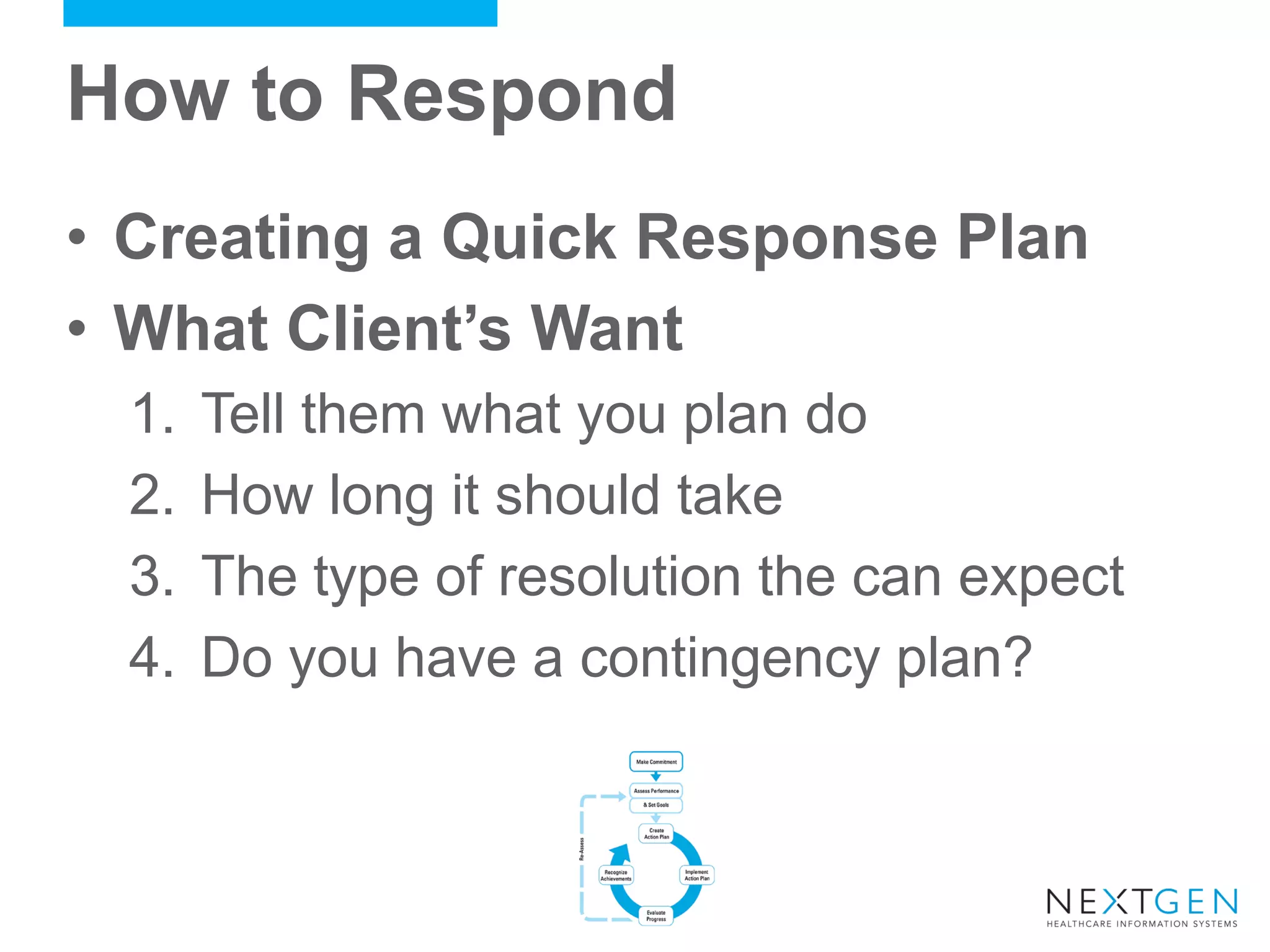
How to Respond 
•Creating a Quick Response Plan 
•What Client’s Want 
1.Tell them what you plan do 
2.How long it should take 
3.The type of resolution the can expect 
4.Do you have a contingency plan?
How to be Accessible 
•Use Technology 
–If you don’t use the technology to respond it backfires on you. 
–Email in your in-box (NextGen Phone System, GoogleVoice) 
–Email 
–Cell Phone (Text) 
•Offer alternative people they can contact 
•Regular contact improves the perception of accessibility 
–Schedule time to contact existing customers 
•Manage your time better 
–17% of salesperson time is completely wasted – salespeople think it’s 4% 
•Proudfoot Consulting study – 
•Already have answers to the questions you know they will have 
–Will I have to do this again? Then build it.
#6 Solve Technical, Training & Political Problems 
•Get used to (& good) at troubleshooting 
–On average salespeople spend 60% of their time resolving product & service issues 
–Facilitate & Delegate 
•Problems are Inevitable 
–Every vendor makes 3-5 mistakes per account per year on average 
•Problem-solving is an opportunity 
–Studies show good service recovery is better than avoiding an issue altogether 
•Blame is counterproductive 
–Studies show clients don’t care anyway – they just want results
•You are personally accountable for problem resolution. 
–At least that is what the customer wants & expects 
•Problem-solving steps 
1.Identify the Problem 
2.Investigate the Problem 
3.Report the investigation results 
4.Develop the response to the problem 
5.Manage the plan to ensure resolution 
•You are playing the Advocate role here 
#6 Solve Technical, Training & Political Problems
#7 Find Innovative Solutions for their Needs 
•38% of decision makers look to you for innovative ideas. 
–Global CEO Study, 2006 
•Providing innovative ideas gives you a direct channel to executives 
•Knowledge you need to provide innovative responses & solutions 
1.Technical Expertise 
•Knowing how to use the product 
2.Industry Expertise 
3.Cross-Functional Expertise 
•Applying knowledge from one area to another
The Magnificent Seven 
1.Personally Manage their Satisfaction 
2.Understanding their Business 
3.Act as a Customer Advocate 
4.Expertly Recommend Products & Applications 
5.Be Easily Accessible 
6.Solve Technical, Implementation & Political Problems 
7.Find Innovative Solutions for their Needs
Check for Time
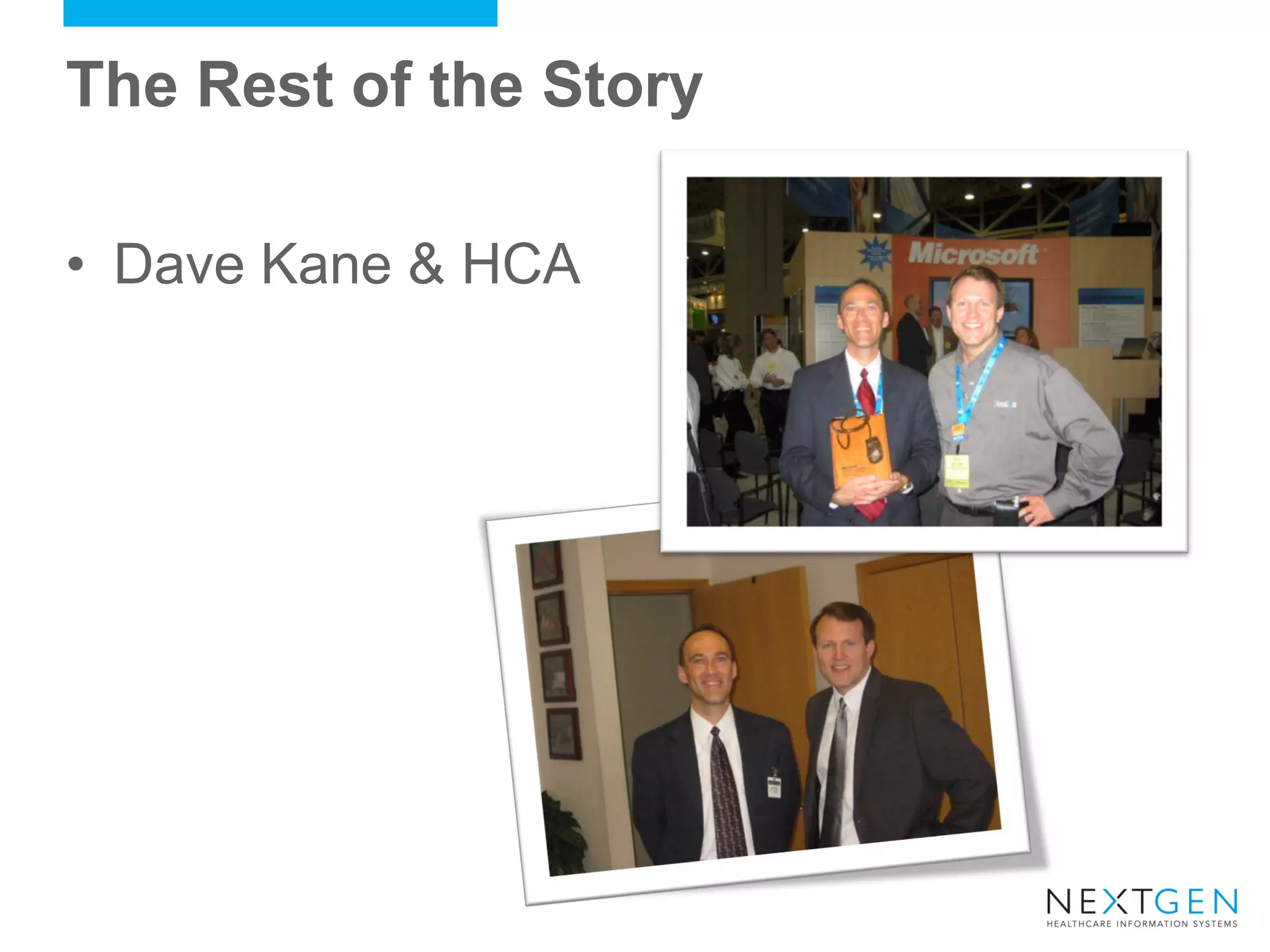
The Rest of the Story 
•Dave Kane & HCA
Conclusion 
To be successful developing your client relationships: 
1.Actually Care 
2.Intent counts more than technique 
3.Magnify your 7 roles with the customer 
•This week – Take Immediate Action on Your Ideas!
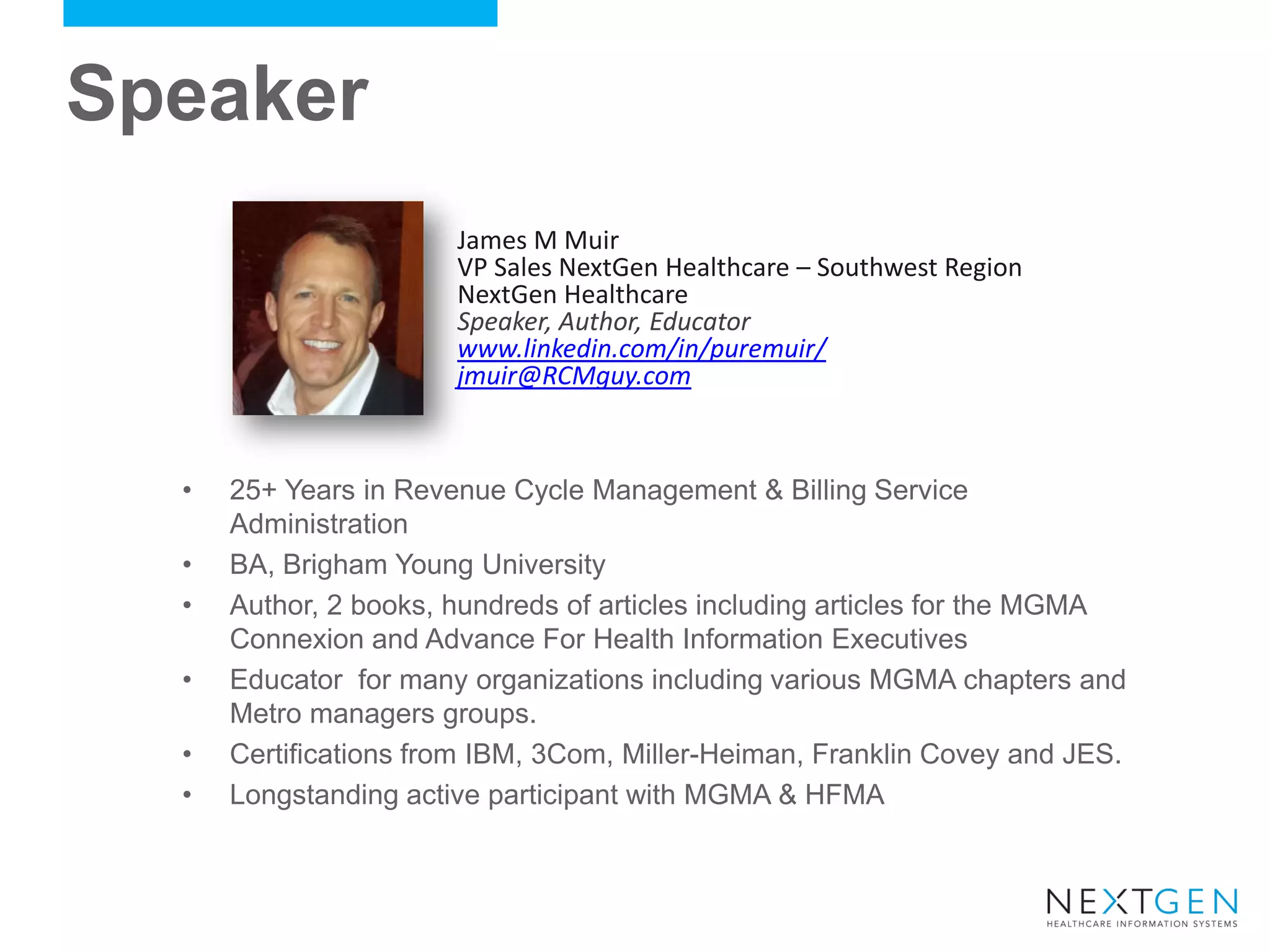
Speaker 
•25+ Years in Revenue Cycle Management & Billing Service Administration 
•BA, Brigham Young University 
•Author, 2 books, hundreds of articles including articles for the MGMA Connexion and Advance For Health Information Executives 
•Educator for many organizations including various MGMA chapters and Metro managers groups. 
•Certifications from IBM, 3Com, Miller-Heiman, Franklin Covey and JES. 
•Longstanding active participant with MGMA & HFMA 
James M Muir VP Sales NextGen Healthcare – Southwest Region NextGen Healthcare Speaker, Author, Educator www.linkedin.com/in/puremuir/ jmuir@RCMguy.com

The Value of Developing Relationships in Selling

  • 1.
    The Value ofDeveloping Relationships in Selling NextGen National Sales Meeting 2012 By James Muir, VP Southwest Region
  • 2.
    NextGen – Thebest job on the planet? •Perfect Alignment –Our software helps people –Help those who help others –You can affect many lives for good by helping care- givers be the best they can be •You can make a lot of money •I want that for all of you •But you will have to work for it –That’s what this session is about –To help you know what to work on.
  • 3.
    The most importantthing this week! •The most important part of this program and this week is… •…what you do afterwards.
  • 4.
    More Ideas ThanYou Can Handle •Write them down •Take action immediately •Review your idea list methodically •Take action again •It’s all about execution •One idea executed is better than 100 ideas that never get implemented
  • 5.
    Drink From theFire Hose
  • 6.
    The Selling SweetSpot •Satisfaction of knowing you added real value to your client •Pleasure of genuine relationships with your clients •Earning a handsome income
  • 7.
    How to Hitthe Sweet Spot •You need to do more than hoc software •Be viewed as a Partner & Consultant and have a real relationship with the client
  • 8.
    Why develop relationshipsas part of my sales efforts? •Clients will share more information with you •Clients will ask for advice & accept your recommendations •Clients will refer you to others & be a reference for you •Clients will forgive your mistakes •Clients will protect & warn you •You will make more and bigger sales •“Trusted Advisors” are 70% more likely to come away with the sale. –Susan Mulcahy – “Evaluating the costs of sales calls in business to business markets: a study of more than 23,000 business” (Washibgtin: Cahners Research, January 2002), p.8 •Ego stroke… 
  • 9.
    Dave Kane Email •Go to Outlook…
  • 10.
    How to DevelopValuable Relationships •But before that how about a quick survey? Self – Survey!
  • 11.
    What do youwant from your client? •A sale? •You want them to be insanely successful. •What do you get when they become insanely successful? –Reference –Case study –Education •If you are selling your client and abandoning them you are making a big mistake. •Referencable clients are probably the best selling shortcut there is –Economics of Selling Sidebar? –Enduring good business is more important than the value of the current transaction. –Example: Banner Health Systems, El Rio, IASIS Not just a sale!
  • 12.
    How to DevelopValuable Relationships Actually Care •Two word formula:
  • 13.
    If you arefocused on their success they will focus on your success Once they understand that you are genuinely looking out for them and that you are a resource – everything changes.
  • 14.
    What Specifically CanWe Do to Develop Better Relationships? •Thanks for the platitudes James but specific things can I do to develop better relationships with prospects & clients?
  • 15.
    What Clients Wantin a Sales Person •What are the 4 most important factors when customers select vendor solutions? •Write down the top 7 things your clients want from you. Quiz!
  • 16.
    Discussion •What didyou come up with? What are the 4 most important factors when customers select vendor solutions? Write down the top 7 things your clients want from you.
  • 17.
    HR Chally ExhaustiveStudy •Based on HR Chally’s 14 year study –Over 80,000 interviews with B2B customers –Data collected from over 7,200 sales forces
  • 18.
    What Factors areMost Important When Customer’s Select Vendors? The Sales Person (you) are the most influential factor. 0 5 10 15 20 25 30 35 40 Salesperson Competence Total Solution Quality of Offering Price 39% 22% 21% 18%
  • 19.
    The top 7Things Clients Want From Their Sales Rep (You) •Are you ready?
  • 20.
    The Top 7Things Clients Want From Their Sales Rep Your clients want you to: 1.Personally Manage their Satisfaction 2.Understand their Business 3.Act as a Customer Advocate 4.Expertly Recommend Products & Applications 5.Be Easily Accessible 6.Solve Technical, Implementation & Political Problems 7.Find Innovative Solutions for their Needs Source: HR Chally annual study 2007
  • 21.
    Your Roles CustomerDesires Your Professional Role Personally Manage their Satisfaction Business Result Agent Understanding their Business CEO Act as a Customer Advocate Advocate & Expediter Expertly Recommend Products & Applications Trusted Advisor & Consultant Be Easily Accessible Available Resource Solve Technical, Training & Political Problems Troubleshooter Find Innovative Solutions for their Needs Innovator
  • 22.
    QUIZ •What areour customers buying from us? *
  • 23.
    #1 - PersonallyManage their Satisfaction •Customer’s invest in results not products •Orient yourself toward outcomes –What outcomes does this customer want? •This means managing post-sales activities –Implementation & results •Are you a: –Closer? •Hit & Run (most) –Verifier? •Make sure it gets installed & services when necessary (fewer) –Outcome Manager? •Takes responsibility for the ultimate benefit that customer hope to receive (world-class – smallest percentage)
  • 24.
    •Strategic Accounts –Ittakes 1/10 the time to do business with an existing customer than it does to acquire a new one. •McKinsey & Co. 2005 study, “Customer Acquisition Makes a Comeback”, Don Peppers –The 3 Greatest Skills for Accountability •Make yourself a major point of contact •Manage a team of experts •Being a ROI Expert •Sample statements to convey accountability: –“I am personally accountable to make sure we get these results.” –“I will help you do that.” –“Because I’m your rep we are married. I will be with you throughout your whole project.” #1 - Personally Manage their Satisfaction
  • 25.
    QUIZ •What isthe 1# Complaint about sales reps by B2B customers according to the extensive study by The HR Chally Group? •Answer: “The sales rep didn’t understand my business.”
  • 26.
    Ask Yourself: •Whatare key performance indicators for this client? •A client has asked you to run their practice for the next 8 weeks. Are you in trouble? Are they in trouble?
  • 27.
    #2 - Understandingtheir Business •The second most important thing to your customer is that you understand their business. •What do you need to know? You need: 1.Vertical Knowledge •Ambulatory Healthcare •Clinical Workflow •Clinic Administration •Hospital Dynamics 2.Horizontal Knowledge •Software •Computer Systems •Networking 3.Specialized Knowledge •Specialties (Community Health, Ophthalmology, Cardiology, OBGYN, Derm, etc.) •NextGen Reports •Worklog •Etc. •84% of sales people do not adequately understand the business of their customers. –Intellexis Report, 2006
  • 28.
    •How to conveyyou understand your client’s business –Learn, so you actually DO understand their business –Use inside jargon *they* understand in their business –Ask about possible outcomes when you hear issues •Example: “Oh, so does that mean you are experiencing X?” –Suggest solutions that reveal you understand their business –Tell them about, or send them an article you read in a industry journal –Etc. •Where can I go to learn my client’s business? –Attend Go-lives –Internet articles –Trade Show Sessions –Trade Journals (MGMA Journal, HFM, Physicians Practice, etc.) –PodCasts –Books (Greebach Publishing, MGMA, Physicians Practice) –FASTPractice –Workshops –James – Just ask me and I will help you. (Today’s Session) •What do I do until I have learned about their business? –LISTEN very carefully –Don’t assume anything #2 - Understanding their Business
  • 29.
    #3 Act asa Customer Advocate •50-60% of salesperson time is spent addressing unresolved client issues •Facilitate & Delegate •Three Skills for Advocates 1.Know our company & who to go to. 2.Create a support network. •Company resources •Our team •Outside resources 3.Communicate the Customer’s Needs & Expectations. •Know their needs and expectations •Communicate that in correspondence •Communicate that in the STR •How to convey you are an advocate –Tell them you will “report back” and the do. –Add “for you” to you emails. –Provide unsolicited, beneficial information –Get them what they want (if it’s right) –Coach them on how to get what they want with NextGen & others –Etc.
  • 30.
    QUIZ (check fortime) •Solving Business Problem With NextGen •DOC: NextGen – Name that tool
  • 31.
    #4 Expertly RecommendProducts & Applications •Know how our application creates outcomes & know how to demo it. •Four levels of application competence: 1.Specification •Is our solution the best solution to the customer’s problem? –Know how to apply our product to create a solution –Understand the problem & the results the client is seeking 2.Installation •Know how our application is implemented for successful results. 3.Integration •Know how our application integrates with other systems & the customer’s business. 4.Usage •Know how customers actually use our application to produce outcomes.
  • 32.
    •Evaluate “fit” withthe client –If the fit is poor, say so & move on. •Recommend solutions whether that solution includes NextGen or not. –Suggest 3rd party solutions –Introduce your client to 3rd parties •How to convey expertise in applying solutions –Describe exactly how to produce the outcome or solve the problem –Explain how others have solved the problem –Help them evaluate non-NextGen options –Much more… #4 Expertly Recommend Products & Applications
  • 33.
    QUIZ •How likelyare clients to be referencable when they know their rep vs. ones who don’t? •What kind of interaction creates the highest loyalty and satisfaction?
  • 34.
    Do Your ClientsReally Know You? •HR Chally Study –Physician offices who are familiar with & know their rep by name were 90% likely to be loyal & referencable. •The greater degree of “live” interaction (personal meetings & phone calls) the higher the satisfaction & loyalty levels. •Consistency of Response is Key –Consistency of response is the primary way clients measure quality. •(Parasuraman & Schlesinger 1990, Harvard Business Review, HR Chally ) •Product quality was found to be significantly less important than the consistency & quality of response.
  • 35.
    #5 Be EasilyAccessible •The 5th most important thing to your customer is that you be easily accessible. •Clients Measure Response Quality in 4 Ways: 1.How quickly initial contact is established 2.How soon the response is delivered 3.How appropriate the response is 4.The quality & follow-through of the response
  • 36.
    Salespeople Suck atCalling Clients Back •72% of inquiries are never contacted at all •43% receive requested information too late •18% never receive the info they request at all •When we don’t respond or respond late we send a message that the client is not important – now as a prospect and later as a client.
  • 37.
    Customers Demand InstantAcknowledgement •Customers Demand Instant Acknowledgement •Acknowledge client’s messages immediately –Phone, email, in person, etc. •It changes their perception of the wait time –See Principles of Waiting – David Maister 1985 –You don’t have to have the answer/solution/etc.
  • 38.
    How to Respond •Creating a Quick Response Plan •What Client’s Want 1.Tell them what you plan do 2.How long it should take 3.The type of resolution the can expect 4.Do you have a contingency plan?
  • 39.
    How to beAccessible •Use Technology –If you don’t use the technology to respond it backfires on you. –Email in your in-box (NextGen Phone System, GoogleVoice) –Email –Cell Phone (Text) •Offer alternative people they can contact •Regular contact improves the perception of accessibility –Schedule time to contact existing customers •Manage your time better –17% of salesperson time is completely wasted – salespeople think it’s 4% •Proudfoot Consulting study – •Already have answers to the questions you know they will have –Will I have to do this again? Then build it.
  • 40.
    #6 Solve Technical,Training & Political Problems •Get used to (& good) at troubleshooting –On average salespeople spend 60% of their time resolving product & service issues –Facilitate & Delegate •Problems are Inevitable –Every vendor makes 3-5 mistakes per account per year on average •Problem-solving is an opportunity –Studies show good service recovery is better than avoiding an issue altogether •Blame is counterproductive –Studies show clients don’t care anyway – they just want results
  • 41.
    •You are personallyaccountable for problem resolution. –At least that is what the customer wants & expects •Problem-solving steps 1.Identify the Problem 2.Investigate the Problem 3.Report the investigation results 4.Develop the response to the problem 5.Manage the plan to ensure resolution •You are playing the Advocate role here #6 Solve Technical, Training & Political Problems
  • 42.
    #7 Find InnovativeSolutions for their Needs •38% of decision makers look to you for innovative ideas. –Global CEO Study, 2006 •Providing innovative ideas gives you a direct channel to executives •Knowledge you need to provide innovative responses & solutions 1.Technical Expertise •Knowing how to use the product 2.Industry Expertise 3.Cross-Functional Expertise •Applying knowledge from one area to another
  • 43.
    The Magnificent Seven 1.Personally Manage their Satisfaction 2.Understanding their Business 3.Act as a Customer Advocate 4.Expertly Recommend Products & Applications 5.Be Easily Accessible 6.Solve Technical, Implementation & Political Problems 7.Find Innovative Solutions for their Needs
  • 44.
  • 45.
    The Rest ofthe Story •Dave Kane & HCA
  • 46.
    Conclusion To besuccessful developing your client relationships: 1.Actually Care 2.Intent counts more than technique 3.Magnify your 7 roles with the customer •This week – Take Immediate Action on Your Ideas!
  • 47.
    Speaker •25+ Yearsin Revenue Cycle Management & Billing Service Administration •BA, Brigham Young University •Author, 2 books, hundreds of articles including articles for the MGMA Connexion and Advance For Health Information Executives •Educator for many organizations including various MGMA chapters and Metro managers groups. •Certifications from IBM, 3Com, Miller-Heiman, Franklin Covey and JES. •Longstanding active participant with MGMA & HFMA James M Muir VP Sales NextGen Healthcare – Southwest Region NextGen Healthcare Speaker, Author, Educator www.linkedin.com/in/puremuir/ jmuir@RCMguy.com