The talent factor in
purchasing
Nicolas Reinecke, Peter Spiller,
and Drew Ungerman


                                                                   Serge Bloch


Better purchasing can be beneficial in surprising ways, some far removed
from purchasing itself.

Executives know that talent matters          their organizations, respectively; the
in procurement. But how much does            corporate structure and systems that
it matter? A McKinsey global survey of       support purchasing; the management
purchasing executives at more than           techniques and business processes
200 companies finds that those setting       supporting it; and the contribution of
the pace in purchasing best practices        purchasers to their companies and
differ from ordinary companies along         the extent of the alignment between
three talent dimensions. Together, these     purchasing and corporate strategy. Two
dimensions are associated with nearly        interviewers independently assessed
60 percent of the difference between         the executives’ responses using a scale
the financial performance1 of these two      of one to five (five being the highest
classes of companies. The top-performing     score). Subsequent regression and cluster
ones hire better people in sourcing, set     analysis of the scores isolated 35 low-,
clearer performance aspirations for          106 moderate-, and 61 high-performing
them, and create strong sourcing cultures    organizations distributed across all of the
that encourage purchasers to align their     industries and geographies studied.3
activities with corporate strategy. The
payoff? Leading companies enjoy annual       When we compared the scores of these
cost savings from their overall sourcing     executives with the financial results of
efforts that are nearly six times greater    their companies’ purchasing efforts, we
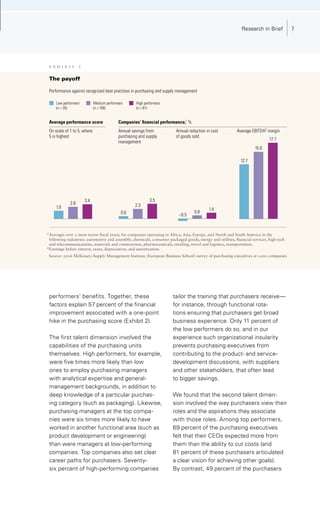
than the annual savings of low performers.   found a striking correlation (Exhibit 1).
Moreover, the winners are positioning        Top companies realized purchasing savings
themselves for broader strategic gains as    of more than 3 percent a year—two
the pressures of globalization intensify.    percentage points higher than the annual
                                             savings of the low performers.4 High
The survey,2 conducted together with         performers also had EBITDA 5 margins that
the Supply Management Institute of           were fully five percentage points higher
the European Business School, assessed       than those of low performers.
the performance of the respondents’
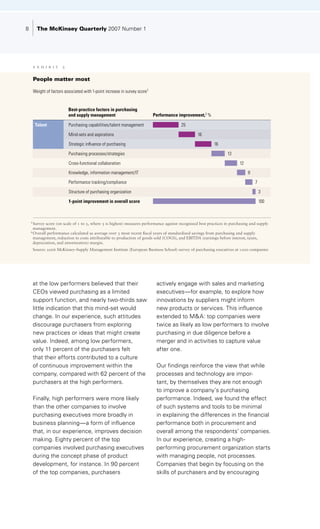
companies against recognized best            A closer look at the relationship between
practices in purchasing and supply man-      a company’s purchasing score and its
agement by analyzing responses along         overall financial performance revealed that
four dimensions: the capabilities and        three talent dimensions accounted for
cultures of purchasing professionals and     a disproportionate share of the top
Q1 2007
 Purchasing
 Exhibit 1 of 2                                                           Research in Brief                                              

 Glance: Good purchasing management and financial performance are strongly correlated.


              t

 The payoff

 Performance against recognized best practices in purchasing and supply management

     Low performers          Medium performers      High performers
     (n = 35)                (n = 106)              (n = 61)


 Average performance score                 Companies’ financial performance,1 %
 On scale of 1 to 5, where                 Annual savings from          Annual reduction in cost           Average EBITDA2 margin
 5 is highest                              purchasing and supply        of goods sold
                                                                                                                             17.7
                                           management
                                                                                                                     15.6

                                                                                                             12.7


                      3.4                                   3.5
             2.8                                    2.3
     1.9                                                                                   1.4
                                            0.6                                    0.8
                                                                          –0.5


  Averages over 3 most recent scal years; for companies operating in Africa, Asia, Europe, and North and South America in the
  following industries: automotive and assembly, chemicals, consumer packaged goods, energy and utilities, nancial services, high tech
  and telecommunications, materials and construction, pharmaceuticals, retailing, travel and logistics, transportation.
2 Earnings before interest, taxes, depreciation, and amortization.

 Source: 2006 McKinsey–Supply Management Institute (European Business School) survey of purchasing executives at 200 companies


 performers’ benefits. Together, these                                 tailor the training that purchasers receive—
 factors explain 5 percent of the financial                           for instance, through functional rota-
 improvement associated with a one-point                               tions ensuring that purchasers get broad
 hike in the purchasing score (Exhibit 2).                             business experience. Only 11 percent of
                                                                       the low performers do so, and in our
 The first talent dimension involved the                               experience such organizational insularity
 capabilities of the purchasing units                                  prevents purchasing executives from
 themselves. High performers, for example,                             contributing to the product- and service-
 were five times more likely than low                                  development discussions, with suppliers
 ones to employ purchasing managers                                    and other stakeholders, that often lead
 with analytical expertise and general-                                to bigger savings.
 management backgrounds, in addition to
 deep knowledge of a particular purchas-                               We found that the second talent dimen-
 ing category (such as packaging). Likewise,                           sion involved the way purchasers view their
 purchasing managers at the top compa-                                 roles and the aspirations they associate
 nies were six times more likely to have                               with those roles. Among top performers,
 worked in another functional area (such as                            69 percent of the purchasing executives
 product development or engineering)                                   felt that their CEOs expected more from
 than were managers at low-performing                                  them than the ability to cut costs (and
 companies. Top companies also set clear                               81 percent of these purchasers articulated
 career paths for purchasers. Seventy-                                 a clear vision for achieving other goals).
 six percent of high-performing companies                              By contrast, 49 percent of the purchasers
Q1 2007
  Purchasing
8 The McKinsey Quarterly 200 Number 1
  Exhibit 2 of 2
  Glance: Talent correlates with greater improvements in purchasing performance.


               t

  People matter most

  Weight of factors associated with 1-point increase in survey score1


                      Best-practice factors in purchasing
                      and supply management                             Performance improvement,2 %

   Talent             Purchasing capabilities/talent management                      25

                      Mind-sets and aspirations                                                16
                      Strategic influence of purchasing                                                  16

                      Purchasing processes/strategies                                                           13
                      Cross-functional collaboration                                                                  12
                      Knowledge, information management/IT                                                                 8
                      Performance tracking/compliance                                                                          7

                      Structure of purchasing organization                                                                         3
                      1-point improvement in overall score                                                                         100


  Survey score (on scale of 1 to 5, where 5 is highest) measures performance against recognized best practices in purchasing and supply
  management.
 2 Overall performance calculated as average over 3 most recent    scal years of standardized savings from purchasing and supply
  management, reduction in costs attributable to production of goods sold (COGS), and EBITDA (earnings before interest, taxes,
  depreciation, and amortization) margin.
  Source: 2006 McKinsey–Supply Management Institute (European Business School) survey of purchasing executives at 200 companies


  at the low performers believed that their                              actively engage with sales and marketing
  CEOs viewed purchasing as a limited                                    executives—for example, to explore how
  support function, and nearly two-thirds saw                            innovations by suppliers might inform
  little indication that this mind-set would                             new products or services. This influence
  change. In our experience, such attitudes                              extended to MA: top companies were
  discourage purchasers from exploring                                   twice as likely as low performers to involve
  new practices or ideas that might create                               purchasing in due diligence before a
  value. Indeed, among low performers,                                   merger and in activities to capture value
  only 11 percent of the purchasers felt                                 after one.
  that their efforts contributed to a culture
  of continuous improvement within the                                   Our findings reinforce the view that while
  company, compared with 62 percent of the                               processes and technology are impor-
  purchasers at the high performers.                                     tant, by themselves they are not enough
                                                                         to improve a company’s purchasing
  Finally, high performers were more likely                              performance. Indeed, we found the effect
  than the other companies to involve                                    of such systems and tools to be minimal
  purchasing executives more broadly in                                  in explaining the differences in the financial
  business planning—a form of influence                                  performance both in procurement and
  that, in our experience, improves decision                             overall among the respondents’ companies.
  making. Eighty percent of the top                                      In our experience, creating a high-
  companies involved purchasing executives                               performing procurement organization starts
  during the concept phase of product                                    with managing people, not processes.
  development, for instance. In 90 percent                               Companies that begin by focusing on the
  of the top companies, purchasers                                       skills of purchasers and by encouraging
Research in Brief       9


                                                   1	
collaboration between purchasing and                 For	the	purposes	of	this	article,	financial		
                                                   	 performance	comprises	annual	savings	from		
other functions often find that the benefits       	 purchasing	and	supply	management,	annual		
include not only lower costs but also              	 reduction	in	cost	of	goods	sold,	and	the	average		
higher-quality products, greater innovation,       	 margin	of	earnings	before	interest,	taxes,		
                                                   	 depreciation,	and	amortization	(EBITDA).	
and more value from MA. Reaping such              2	
                                                     We	surveyed	202	companies	operating	in	Africa,		
benefits will be increasingly important            	 Asia,	Europe,	and	North	and	South	America		
as the pressures of globalization intensify.       	 in	automotive	and	assembly,	chemicals,	consumer		
                                                   	 packaged	goods,	energy	and	utilities,	financial		
                                                   	 services,	high	tech	and	telecommunications,		
Nicolas Reinecke is a principal in McKinsey’s      	 materials	and	construction,	pharmaceuticals,		
Hamburg office, Peter Spiller is a principal       	 retailing,	travel	and	logistics,	and	transportation.		
in the Frankfurt office, and Drew Ungerman         	 Seventy	percent	of	the	companies	had	revenues		
is a principal in the Dallas office. Copyright ©   	 exceeding	$5	billion.	Twenty-four	of	the		
200 McKinsey  Company. All rights reserved.      	 respondents	represented	large,	autonomous		
                                                   	 business	units	organized	in	holding-company		
                                                   	 arrangements	under	a	parent	company.	For		
                                                   	 the	purposes	of	this	research	we	treated	these		
                                                   	 organizations	as	discrete	companies.	
                                                   3	
                                                     The	results	were	valid	at	a	95	percent	confidence		
                                                   	 level.	
                                                   4	
                                                     Average	savings	over	the	three	most	recent	fiscal		
                                                   	 years.	
                                                   5	
                                                     Earnings	before	interest,	taxes,	depreciation,		
                                                   	 and	amortization.

The Talent Factor In Purchasing 2007

  • 1.
    The talent factorin purchasing Nicolas Reinecke, Peter Spiller, and Drew Ungerman Serge Bloch Better purchasing can be beneficial in surprising ways, some far removed from purchasing itself. Executives know that talent matters their organizations, respectively; the in procurement. But how much does corporate structure and systems that it matter? A McKinsey global survey of support purchasing; the management purchasing executives at more than techniques and business processes 200 companies finds that those setting supporting it; and the contribution of the pace in purchasing best practices purchasers to their companies and differ from ordinary companies along the extent of the alignment between three talent dimensions. Together, these purchasing and corporate strategy. Two dimensions are associated with nearly interviewers independently assessed 60 percent of the difference between the executives’ responses using a scale the financial performance1 of these two of one to five (five being the highest classes of companies. The top-performing score). Subsequent regression and cluster ones hire better people in sourcing, set analysis of the scores isolated 35 low-, clearer performance aspirations for 106 moderate-, and 61 high-performing them, and create strong sourcing cultures organizations distributed across all of the that encourage purchasers to align their industries and geographies studied.3 activities with corporate strategy. The payoff? Leading companies enjoy annual When we compared the scores of these cost savings from their overall sourcing executives with the financial results of efforts that are nearly six times greater their companies’ purchasing efforts, we than the annual savings of low performers. found a striking correlation (Exhibit 1). Moreover, the winners are positioning Top companies realized purchasing savings themselves for broader strategic gains as of more than 3 percent a year—two the pressures of globalization intensify. percentage points higher than the annual savings of the low performers.4 High The survey,2 conducted together with performers also had EBITDA 5 margins that the Supply Management Institute of were fully five percentage points higher the European Business School, assessed than those of low performers. the performance of the respondents’ companies against recognized best A closer look at the relationship between practices in purchasing and supply man- a company’s purchasing score and its agement by analyzing responses along overall financial performance revealed that four dimensions: the capabilities and three talent dimensions accounted for cultures of purchasing professionals and a disproportionate share of the top
  • 2.
    Q1 2007 Purchasing Exhibit 1 of 2 Research in Brief Glance: Good purchasing management and financial performance are strongly correlated. t The payoff Performance against recognized best practices in purchasing and supply management Low performers Medium performers High performers (n = 35) (n = 106) (n = 61) Average performance score Companies’ financial performance,1 % On scale of 1 to 5, where Annual savings from Annual reduction in cost Average EBITDA2 margin 5 is highest purchasing and supply of goods sold 17.7 management 15.6 12.7 3.4 3.5 2.8 2.3 1.9 1.4 0.6 0.8 –0.5 Averages over 3 most recent scal years; for companies operating in Africa, Asia, Europe, and North and South America in the following industries: automotive and assembly, chemicals, consumer packaged goods, energy and utilities, nancial services, high tech and telecommunications, materials and construction, pharmaceuticals, retailing, travel and logistics, transportation. 2 Earnings before interest, taxes, depreciation, and amortization. Source: 2006 McKinsey–Supply Management Institute (European Business School) survey of purchasing executives at 200 companies performers’ benefits. Together, these tailor the training that purchasers receive— factors explain 5 percent of the financial for instance, through functional rota- improvement associated with a one-point tions ensuring that purchasers get broad hike in the purchasing score (Exhibit 2). business experience. Only 11 percent of the low performers do so, and in our The first talent dimension involved the experience such organizational insularity capabilities of the purchasing units prevents purchasing executives from themselves. High performers, for example, contributing to the product- and service- were five times more likely than low development discussions, with suppliers ones to employ purchasing managers and other stakeholders, that often lead with analytical expertise and general- to bigger savings. management backgrounds, in addition to deep knowledge of a particular purchas- We found that the second talent dimen- ing category (such as packaging). Likewise, sion involved the way purchasers view their purchasing managers at the top compa- roles and the aspirations they associate nies were six times more likely to have with those roles. Among top performers, worked in another functional area (such as 69 percent of the purchasing executives product development or engineering) felt that their CEOs expected more from than were managers at low-performing them than the ability to cut costs (and companies. Top companies also set clear 81 percent of these purchasers articulated career paths for purchasers. Seventy- a clear vision for achieving other goals). six percent of high-performing companies By contrast, 49 percent of the purchasers
  • 3.
    Q1 2007 Purchasing 8 The McKinsey Quarterly 200 Number 1 Exhibit 2 of 2 Glance: Talent correlates with greater improvements in purchasing performance. t People matter most Weight of factors associated with 1-point increase in survey score1 Best-practice factors in purchasing and supply management Performance improvement,2 % Talent Purchasing capabilities/talent management 25 Mind-sets and aspirations 16 Strategic influence of purchasing 16 Purchasing processes/strategies 13 Cross-functional collaboration 12 Knowledge, information management/IT 8 Performance tracking/compliance 7 Structure of purchasing organization 3 1-point improvement in overall score 100 Survey score (on scale of 1 to 5, where 5 is highest) measures performance against recognized best practices in purchasing and supply management. 2 Overall performance calculated as average over 3 most recent scal years of standardized savings from purchasing and supply management, reduction in costs attributable to production of goods sold (COGS), and EBITDA (earnings before interest, taxes, depreciation, and amortization) margin. Source: 2006 McKinsey–Supply Management Institute (European Business School) survey of purchasing executives at 200 companies at the low performers believed that their actively engage with sales and marketing CEOs viewed purchasing as a limited executives—for example, to explore how support function, and nearly two-thirds saw innovations by suppliers might inform little indication that this mind-set would new products or services. This influence change. In our experience, such attitudes extended to MA: top companies were discourage purchasers from exploring twice as likely as low performers to involve new practices or ideas that might create purchasing in due diligence before a value. Indeed, among low performers, merger and in activities to capture value only 11 percent of the purchasers felt after one. that their efforts contributed to a culture of continuous improvement within the Our findings reinforce the view that while company, compared with 62 percent of the processes and technology are impor- purchasers at the high performers. tant, by themselves they are not enough to improve a company’s purchasing Finally, high performers were more likely performance. Indeed, we found the effect than the other companies to involve of such systems and tools to be minimal purchasing executives more broadly in in explaining the differences in the financial business planning—a form of influence performance both in procurement and that, in our experience, improves decision overall among the respondents’ companies. making. Eighty percent of the top In our experience, creating a high- companies involved purchasing executives performing procurement organization starts during the concept phase of product with managing people, not processes. development, for instance. In 90 percent Companies that begin by focusing on the of the top companies, purchasers skills of purchasers and by encouraging
  • 4.
    Research in Brief 9 1 collaboration between purchasing and For the purposes of this article, financial performance comprises annual savings from other functions often find that the benefits purchasing and supply management, annual include not only lower costs but also reduction in cost of goods sold, and the average higher-quality products, greater innovation, margin of earnings before interest, taxes, depreciation, and amortization (EBITDA). and more value from MA. Reaping such 2 We surveyed 202 companies operating in Africa, benefits will be increasingly important Asia, Europe, and North and South America as the pressures of globalization intensify. in automotive and assembly, chemicals, consumer packaged goods, energy and utilities, financial services, high tech and telecommunications, Nicolas Reinecke is a principal in McKinsey’s materials and construction, pharmaceuticals, Hamburg office, Peter Spiller is a principal retailing, travel and logistics, and transportation. in the Frankfurt office, and Drew Ungerman Seventy percent of the companies had revenues is a principal in the Dallas office. Copyright © exceeding $5 billion. Twenty-four of the 200 McKinsey Company. All rights reserved. respondents represented large, autonomous business units organized in holding-company arrangements under a parent company. For the purposes of this research we treated these organizations as discrete companies. 3 The results were valid at a 95 percent confidence level. 4 Average savings over the three most recent fiscal years. 5 Earnings before interest, taxes, depreciation, and amortization.