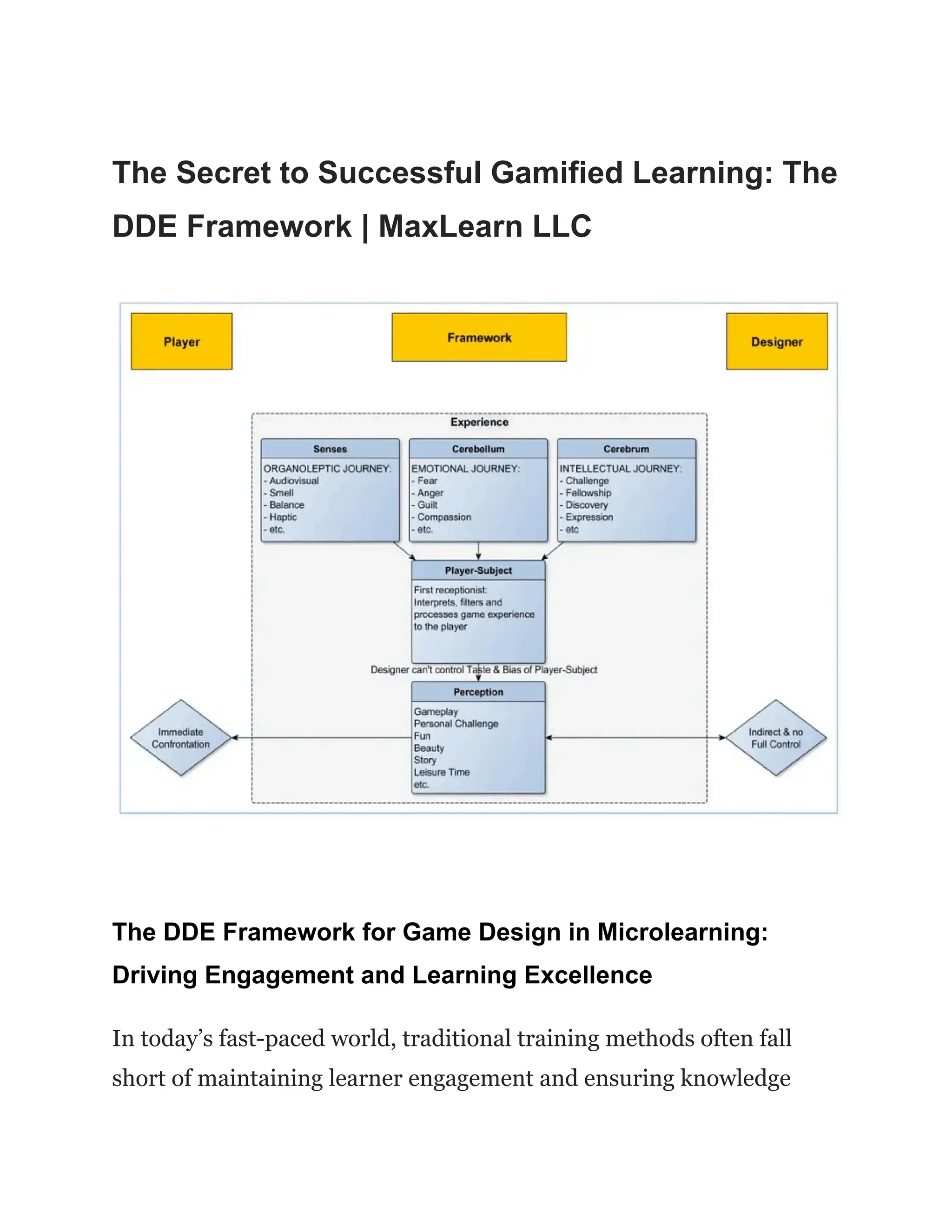
The Secret to Successful Gamified Learning: The
DDE Framework | MaxLearn LLC
The DDE Framework for Game Design in Microlearning:
Driving Engagement and Learning Excellence
In today’s fast-paced world, traditional training methods often fall
short of maintaining learner engagement and ensuring knowledge
retention. Microlearning has emerged as an innovative solution,
offering bite-sized, focused learning modules designed for quick
consumption. However, the true potential of microlearning lies in its
ability to be gamified, and the DDE Framework — Design,
Dynamics, and Engagement — is a powerful approach to make
this transformation a reality.
This article explores how the DDE Framework revolutionizes game
design in microlearning, fostering better engagement, deeper
understanding, and improved outcomes for learners and organizations
alike.
What is the DDE Framework?
The DDE Framework is a structured methodology that guides the
creation of gamified microlearning experiences. It breaks down the
process into three core components:
1.​ Design: Establishing the foundation of the gamified learning
experience.
2.​Dynamics: Implementing game mechanics and rules to
drive learner interaction.
3.​Engagement: Ensuring learners remain motivated and
connected throughout the learning journey.
Each element of the framework plays a vital role in crafting
microlearning modules that are not only educational but also engaging
and memorable.
Component 1: Design — The Blueprint of Gamified
Learning
Design is the initial phase of the DDE Framework and lays the
groundwork for the gamified microlearning experience. It involves
aligning game elements with learning objectives, ensuring content
relevance, and creating a user-friendly interface.
Key Elements of Effective Design
●​ Clear Learning Objectives: The foundation of any
successful learning program is a clear understanding of what
learners should achieve. For instance, a course on risk
management might aim to enhance decision-making skills in
high-pressure scenarios.
●​ Narrative Integration: Embedding a compelling story
adds context and meaning to the learning experience. A
cybersecurity course could involve a storyline where learners
must “save their organization” from a simulated cyberattack.
●​ Game Mechanics: Features like points, badges, levels, and
leaderboards are designed to motivate learners and provide
measurable progress indicators.
●​ User-Friendly Interface: The design should prioritize
simplicity and accessibility. Learners should easily navigate
the course without unnecessary complexity.
By focusing on robust design, microlearning modules become visually
appealing and intuitively aligned with learners’ needs, ensuring a
smooth and engaging experience.
Component 2: Dynamics — The Engine of Interaction
Once the design is in place, Dynamics bring the experience to life.
This component involves the application of game mechanics and rules
that sustain interest, promote interaction, and drive progression.
Core Dynamics in Microlearning Game Design
●​ Feedback Loops: Instant feedback on performance helps
learners understand their strengths and areas for
improvement. For example, quizzes with detailed
explanations reinforce correct answers and clarify mistakes.
●​ Challenge and Progression: Tasks should increase in
complexity as learners advance. Adaptive difficulty keeps
them engaged without overwhelming them.
●​ Rewards and Incentives: Virtual rewards, such as badges
or certificates, recognize achievements and encourage further
participation.
●​ Time Pressure: Timed challenges or scenarios create
urgency, helping learners focus and make quick decisions.
This is particularly useful for skills that require rapid
problem-solving.
Dynamic elements are critical to ensuring learners remain actively
involved, fostering a sense of accomplishment as they navigate the
gamified learning journey.
Component 3: Engagement — Capturing and
Sustaining Attention
The ultimate goal of the DDE Framework is Engagement —
capturing learners’ attention and motivating them to immerse
themselves in the content. Engagement is about creating emotional
and intellectual connections with the material.
Strategies to Enhance Engagement
●​ Personalization: Tailoring content to individual learners’
roles, preferences, or skill levels enhances relevance. For
example, an AI-powered microlearning platform might adjust
scenarios based on a learner’s past performance.
●​ Social Features: Collaborative elements such as group
challenges, discussion boards, or peer feedback create a sense
of community and encourage participation.
●​ Storytelling Techniques: Immersive narratives make the
learning experience more relatable and memorable. Story
arcs that evolve with learner progress add depth and intrigue.
●​ Intrinsic and Extrinsic Motivation: Balancing internal
drivers (e.g., a desire to master a skill) with external rewards
(e.g., earning badges) ensures sustained interest.
By focusing on engagement, gamified microlearning transcends
traditional training methods, offering experiences that learners
actively look forward to and remember long after the session ends.
Benefits of the DDE Framework in Microlearning
The DDE Framework provides a comprehensive approach to gamified
microlearning, delivering numerous advantages for learners and
organizations:
1.​ Enhanced Knowledge Retention: Gamified elements
combat the Ebbinghaus Forgetting Curve, helping
learners retain and apply knowledge effectively.
2.​Increased Motivation: Game mechanics such as rewards
and leaderboards tap into intrinsic and extrinsic motivators,
encouraging learners to complete courses.
3.​Scalability: The framework’s modular nature allows
organizations to easily scale and adapt learning programs
across various departments and roles.
4.​Data-Driven Insights: Real-time tracking of learner
performance provides valuable insights for refining training
strategies and addressing skill gaps.
5.​ Cost-Effectiveness: By improving learning efficiency and
reducing the need for extensive face-to-face training,
organizations can achieve significant cost savings.
Applications of the DDE Framework
The DDE Framework is versatile, with applications spanning diverse
industries and learning contexts:
Corporate Training
From onboarding new employees to upskilling existing staff, gamified
microlearning modules designed with the DDE Framework improve
knowledge retention and workplace performance. For example, a sales
training module might use leaderboards to incentivize top performers.
Healthcare and Pharmaceuticals
The healthcare sector benefits from simulations and scenarios created
with the DDE Framework. A medical microlearning course might
challenge professionals to diagnose a virtual patient, offering real-time
feedback.
Education and E-Learning
Schools and universities can adopt the DDE Framework to gamify
lessons, improving student engagement and comprehension.
Interactive quizzes and storytelling elements make learning fun and
impactful.
Challenges in Implementing the DDE Framework
While the DDE Framework offers significant benefits, implementing it
requires careful planning and resources. Common challenges include:
●​ Resource Constraints: Designing gamified experiences
can be time-intensive and may require expertise in
instructional design and game development.
●​ Technology Integration: Ensuring compatibility with
existing learning management systems (LMS) can be a
hurdle.
●​ Balancing Fun and Focus: Overemphasis on game
elements can distract from the primary learning objectives.
Overcoming Challenges
●​ Start small by piloting gamified modules before full-scale
implementation.
●​ Use AI-powered authoring tools to streamline design and
development.
●​ Gather learner feedback to refine the experience
continuously.
The Future of Gamified Microlearning with the DDE
Framework
As technology evolves, the potential of the DDE Framework continues
to grow. Emerging technologies such as augmented reality (AR),
virtual reality (VR), and AI-driven personalization promise to
revolutionize gamified microlearning. Imagine immersive AR
simulations for training frontline workers or AI tools offering tailored
coaching based on individual progress.
Conclusion
The DDE Framework — Design, Dynamics, and Engagement — is a
transformative approach to gamified microlearning. By focusing on
thoughtful design, interactive dynamics, and sustained engagement, it
creates impactful learning experiences that drive results.
MaxLearn’s application of the DDE Framework exemplifies its
commitment to innovation in learning and development. As
organizations continue to embrace gamified microlearning, the DDE
Framework will undoubtedly remain a cornerstone for crafting
effective and engaging learning solutions.
By combining the science of learning with the art of gamification, the
DDE Framework is shaping the future of education, one game at a
time.

The Secret to Successful Gamified Learning_ The DDE Framework _ MaxLearn LLC.pdf

  • 1.
    The Secret toSuccessful Gamified Learning: The DDE Framework | MaxLearn LLC The DDE Framework for Game Design in Microlearning: Driving Engagement and Learning Excellence In today’s fast-paced world, traditional training methods often fall short of maintaining learner engagement and ensuring knowledge
  • 2.
    retention. Microlearning hasemerged as an innovative solution, offering bite-sized, focused learning modules designed for quick consumption. However, the true potential of microlearning lies in its ability to be gamified, and the DDE Framework — Design, Dynamics, and Engagement — is a powerful approach to make this transformation a reality. This article explores how the DDE Framework revolutionizes game design in microlearning, fostering better engagement, deeper understanding, and improved outcomes for learners and organizations alike. What is the DDE Framework? The DDE Framework is a structured methodology that guides the creation of gamified microlearning experiences. It breaks down the process into three core components: 1.​ Design: Establishing the foundation of the gamified learning experience. 2.​Dynamics: Implementing game mechanics and rules to drive learner interaction. 3.​Engagement: Ensuring learners remain motivated and connected throughout the learning journey.
  • 3.
    Each element ofthe framework plays a vital role in crafting microlearning modules that are not only educational but also engaging and memorable. Component 1: Design — The Blueprint of Gamified Learning Design is the initial phase of the DDE Framework and lays the groundwork for the gamified microlearning experience. It involves aligning game elements with learning objectives, ensuring content relevance, and creating a user-friendly interface. Key Elements of Effective Design ●​ Clear Learning Objectives: The foundation of any successful learning program is a clear understanding of what learners should achieve. For instance, a course on risk management might aim to enhance decision-making skills in high-pressure scenarios. ●​ Narrative Integration: Embedding a compelling story adds context and meaning to the learning experience. A cybersecurity course could involve a storyline where learners must “save their organization” from a simulated cyberattack.
  • 4.
    ●​ Game Mechanics:Features like points, badges, levels, and leaderboards are designed to motivate learners and provide measurable progress indicators. ●​ User-Friendly Interface: The design should prioritize simplicity and accessibility. Learners should easily navigate the course without unnecessary complexity. By focusing on robust design, microlearning modules become visually appealing and intuitively aligned with learners’ needs, ensuring a smooth and engaging experience. Component 2: Dynamics — The Engine of Interaction Once the design is in place, Dynamics bring the experience to life. This component involves the application of game mechanics and rules that sustain interest, promote interaction, and drive progression. Core Dynamics in Microlearning Game Design ●​ Feedback Loops: Instant feedback on performance helps learners understand their strengths and areas for improvement. For example, quizzes with detailed explanations reinforce correct answers and clarify mistakes.
  • 5.
    ●​ Challenge andProgression: Tasks should increase in complexity as learners advance. Adaptive difficulty keeps them engaged without overwhelming them. ●​ Rewards and Incentives: Virtual rewards, such as badges or certificates, recognize achievements and encourage further participation. ●​ Time Pressure: Timed challenges or scenarios create urgency, helping learners focus and make quick decisions. This is particularly useful for skills that require rapid problem-solving. Dynamic elements are critical to ensuring learners remain actively involved, fostering a sense of accomplishment as they navigate the gamified learning journey. Component 3: Engagement — Capturing and Sustaining Attention The ultimate goal of the DDE Framework is Engagement — capturing learners’ attention and motivating them to immerse themselves in the content. Engagement is about creating emotional and intellectual connections with the material. Strategies to Enhance Engagement
  • 6.
    ●​ Personalization: Tailoringcontent to individual learners’ roles, preferences, or skill levels enhances relevance. For example, an AI-powered microlearning platform might adjust scenarios based on a learner’s past performance. ●​ Social Features: Collaborative elements such as group challenges, discussion boards, or peer feedback create a sense of community and encourage participation. ●​ Storytelling Techniques: Immersive narratives make the learning experience more relatable and memorable. Story arcs that evolve with learner progress add depth and intrigue. ●​ Intrinsic and Extrinsic Motivation: Balancing internal drivers (e.g., a desire to master a skill) with external rewards (e.g., earning badges) ensures sustained interest. By focusing on engagement, gamified microlearning transcends traditional training methods, offering experiences that learners actively look forward to and remember long after the session ends. Benefits of the DDE Framework in Microlearning The DDE Framework provides a comprehensive approach to gamified microlearning, delivering numerous advantages for learners and organizations:
  • 7.
    1.​ Enhanced KnowledgeRetention: Gamified elements combat the Ebbinghaus Forgetting Curve, helping learners retain and apply knowledge effectively. 2.​Increased Motivation: Game mechanics such as rewards and leaderboards tap into intrinsic and extrinsic motivators, encouraging learners to complete courses. 3.​Scalability: The framework’s modular nature allows organizations to easily scale and adapt learning programs across various departments and roles. 4.​Data-Driven Insights: Real-time tracking of learner performance provides valuable insights for refining training strategies and addressing skill gaps. 5.​ Cost-Effectiveness: By improving learning efficiency and reducing the need for extensive face-to-face training, organizations can achieve significant cost savings. Applications of the DDE Framework The DDE Framework is versatile, with applications spanning diverse industries and learning contexts: Corporate Training From onboarding new employees to upskilling existing staff, gamified microlearning modules designed with the DDE Framework improve
  • 8.
    knowledge retention andworkplace performance. For example, a sales training module might use leaderboards to incentivize top performers. Healthcare and Pharmaceuticals The healthcare sector benefits from simulations and scenarios created with the DDE Framework. A medical microlearning course might challenge professionals to diagnose a virtual patient, offering real-time feedback. Education and E-Learning Schools and universities can adopt the DDE Framework to gamify lessons, improving student engagement and comprehension. Interactive quizzes and storytelling elements make learning fun and impactful. Challenges in Implementing the DDE Framework While the DDE Framework offers significant benefits, implementing it requires careful planning and resources. Common challenges include: ●​ Resource Constraints: Designing gamified experiences can be time-intensive and may require expertise in instructional design and game development.
  • 9.
    ●​ Technology Integration:Ensuring compatibility with existing learning management systems (LMS) can be a hurdle. ●​ Balancing Fun and Focus: Overemphasis on game elements can distract from the primary learning objectives. Overcoming Challenges ●​ Start small by piloting gamified modules before full-scale implementation. ●​ Use AI-powered authoring tools to streamline design and development. ●​ Gather learner feedback to refine the experience continuously. The Future of Gamified Microlearning with the DDE Framework As technology evolves, the potential of the DDE Framework continues to grow. Emerging technologies such as augmented reality (AR), virtual reality (VR), and AI-driven personalization promise to revolutionize gamified microlearning. Imagine immersive AR simulations for training frontline workers or AI tools offering tailored coaching based on individual progress.
  • 10.
    Conclusion The DDE Framework— Design, Dynamics, and Engagement — is a transformative approach to gamified microlearning. By focusing on thoughtful design, interactive dynamics, and sustained engagement, it creates impactful learning experiences that drive results. MaxLearn’s application of the DDE Framework exemplifies its commitment to innovation in learning and development. As organizations continue to embrace gamified microlearning, the DDE Framework will undoubtedly remain a cornerstone for crafting effective and engaging learning solutions. By combining the science of learning with the art of gamification, the DDE Framework is shaping the future of education, one game at a time.