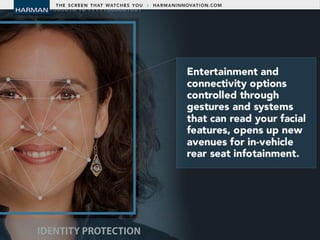
• Entertainment and connectivity options
controlled through gestures and systems that
can read your facial features, opens up new
avenues for in-vehicle rear seat infotainment.
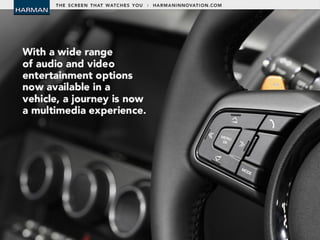
• With a wide range of audio and video
entertainment options now available in a
vehicle, a journey is now a multimedia
experience.
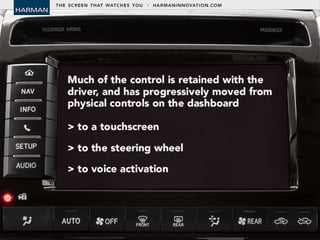
• Much of the control is retained with the
driver, and this has progressively moved from
physical controls on the dashboard …to a
touch-screen…to the steering wheel, and most
recently, voice activation.
• Most of these innovations have been focused
on making the driver’s seat the primary
control centre, leaving the rear seat
passengers with limited control over audio or
video content.
• While a wireless remote control offered the
backseat passenger direct access to the
control systems, it would mean controlling the
music or video within the entire automobile.
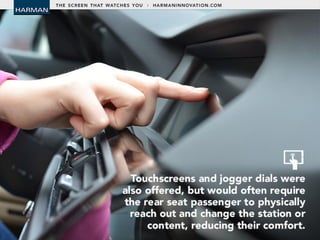
• Touchscreens and jogger dials were also
offered, but would often require the rear seat
passenger to physically reach out and change
the station or content, reducing their comfort.
• There has been significant innovation in
gesture-based control in the consumer
durable segment, televisions for example, and
it was a matter of time before this came into
the automotive segment.
• Engineers at HARMAN India have been
researching and developing prototype
solutions using the Computer Vision
technology for automobiles.
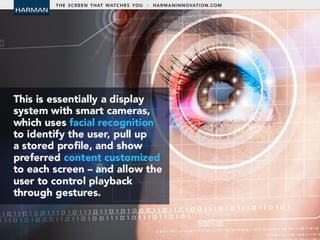
• This is essentially a display system with smart
cameras, which uses facial recognition to
identify the user, pull up a stored profile, and
show preferred content customized to each
screen – and allow the user to control
playback through gestures.
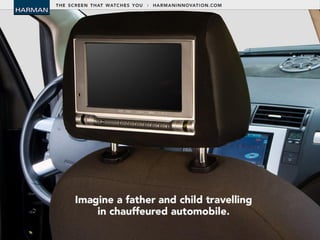
• Imagine a father and child travelling in
chauffeured automobile.
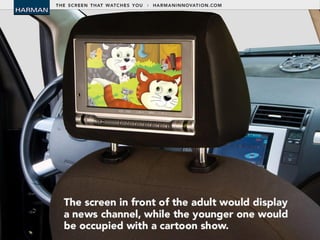
• The screen in front of the adult would display
a news channel, while the younger one would
be occupied with a cartoon show.
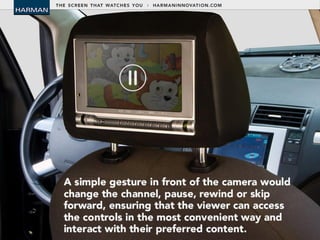
• A simple gesture in front of the camera would
change the channel, pause, rewind or skip
forward, ensuring that the viewer can access
the controls in the most convenient way and
interact with their preferred content.
• A simple gesture in front of the camera would
change the channel, pause, rewind or skip
forward, ensuring that the viewer can access
the controls in the most convenient way and
interact with their preferred content.
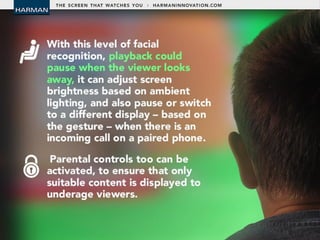
• With this level of facial recognition, playback
could pause when the viewer looks away, it can
adjust screen brightness based on ambient
lighting, and also pause or switch to a different
display – based on the gesture – when there is an
incoming call on a paired phone.
• Parental controls too can be activated, to ensure
that only suitable content is displayed to
underage viewers.
• The Computer Vision system uses the inputs from
two cameras to source a visual input and
interpret the gesture based on the content that is
being displayed.
• This level of independent intelligence effectively
makes the screen a zone that will react to
gestures within a certain visual capture area.
• This means that with two screens facing the rear
passengers, each of the screens can be operated
independently, and the content displayed on each
of them can be different.
• The automobile manufacturing sector is
already showing interest in this, supporting
Harman’s finding that rear-seat entertainment
is an area with huge potential, and an area in
which Harman’s expertise can position it as
the first-mover and the leader in the sector.

The Screen That Watches You

  • 2.
    • Entertainment andconnectivity options controlled through gestures and systems that can read your facial features, opens up new avenues for in-vehicle rear seat infotainment.
  • 3.
    • With awide range of audio and video entertainment options now available in a vehicle, a journey is now a multimedia experience.
  • 4.
    • Much ofthe control is retained with the driver, and this has progressively moved from physical controls on the dashboard …to a touch-screen…to the steering wheel, and most recently, voice activation.
  • 5.
    • Most ofthese innovations have been focused on making the driver’s seat the primary control centre, leaving the rear seat passengers with limited control over audio or video content. • While a wireless remote control offered the backseat passenger direct access to the control systems, it would mean controlling the music or video within the entire automobile.
  • 6.
    • Touchscreens andjogger dials were also offered, but would often require the rear seat passenger to physically reach out and change the station or content, reducing their comfort.
  • 7.
    • There hasbeen significant innovation in gesture-based control in the consumer durable segment, televisions for example, and it was a matter of time before this came into the automotive segment.
  • 8.
    • Engineers atHARMAN India have been researching and developing prototype solutions using the Computer Vision technology for automobiles.
  • 9.
    • This isessentially a display system with smart cameras, which uses facial recognition to identify the user, pull up a stored profile, and show preferred content customized to each screen – and allow the user to control playback through gestures.
  • 10.
    • Imagine afather and child travelling in chauffeured automobile.
  • 11.
    • The screenin front of the adult would display a news channel, while the younger one would be occupied with a cartoon show. • A simple gesture in front of the camera would change the channel, pause, rewind or skip forward, ensuring that the viewer can access the controls in the most convenient way and interact with their preferred content.
  • 12.
    • A simplegesture in front of the camera would change the channel, pause, rewind or skip forward, ensuring that the viewer can access the controls in the most convenient way and interact with their preferred content.
  • 13.
    • With thislevel of facial recognition, playback could pause when the viewer looks away, it can adjust screen brightness based on ambient lighting, and also pause or switch to a different display – based on the gesture – when there is an incoming call on a paired phone. • Parental controls too can be activated, to ensure that only suitable content is displayed to underage viewers.
  • 14.
    • The ComputerVision system uses the inputs from two cameras to source a visual input and interpret the gesture based on the content that is being displayed. • This level of independent intelligence effectively makes the screen a zone that will react to gestures within a certain visual capture area. • This means that with two screens facing the rear passengers, each of the screens can be operated independently, and the content displayed on each of them can be different.
  • 15.
    • The automobilemanufacturing sector is already showing interest in this, supporting Harman’s finding that rear-seat entertainment is an area with huge potential, and an area in which Harman’s expertise can position it as the first-mover and the leader in the sector.