The Sub-Carpathian Messenger – Number 48 (August 2018) Page 1
The Sub-Carpathian Messenger
Newsletter of the Study Circle
for the Postal History of the Carpatho-Ukraine
Number 48 – August 2018
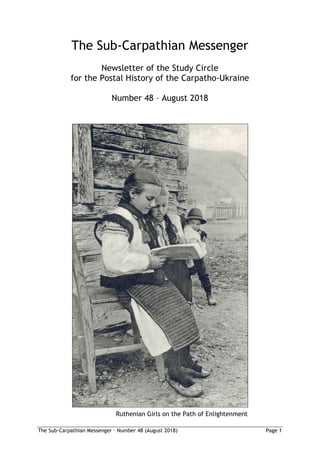
Ruthenian Girls on the Path of Enlightenment
The Sub-Carpathian Messenger – Number 48 (August 2018) Page 2
About us and the Newsletter
The Study Circle is a loose group of persons who are interested in the postal (and general)
history of the area known as Kárpátalja in Hungarian, as Podkarpatská Rus during the First
Czechoslovak Republic, which had a short day of independence as Carpatho Ukraine, and
later was integrated into the Ukrainian SSR in the Soviet Union as the ‘Zakarpatskaja Oblast’.
Since 1991 it is ЗАКАРПАТТЯ, the westernmost administrative district in the now indepen-
dent Ukraine.
The Newsletter came out of a meeting of a few collectors during the PRAHA 2008, its first
number appeared in November 2008. In the last years we have always produced at least four
issues per year but may not be able to keep this high level due to a substantial lack of
contributions. On the other hand, as we can see from the access counts at the public web
site, this Newsletter is read by hundreds of people.
This imbalance between supporters and consumers-only has finally brought the editor to the
decision that he will stop editing this magazine after ten years, i.e., with the issue of
November 2018. If someone wants to take over, he (or she) is very welcome.
We send our regards and best wishes to all members of the Study Circle.
Distribution method
All issues of the »Sub-Carpathian Messenger« can be browsed at and downloaded from the
Internet address
http://www.slideshare.net/subcarpathian
For those who have no Internet access and/or no e-mail, the distribution method is still the
same: you will receive a colour print-out by air/surface mail as you did in the past.
Everybody can freely access the uploaded numbers of the Newsletter but the notification
service for new numbers is limited to the actual members of the Study Circle.
Rules and Regulations
All articles in the Newsletter carrying the name of an author are the sole responsibility of
this author and should not be taken to represent the common opinion of the Study Circle.
Such articles are, if not marked otherwise, copyrighted by the respective author. Free use
within the Study Circle is granted. We thank our authors for their much appreciated work
and contribution.
Participation in the Study Circle is not bound to a formal membership and does not include
the duty to pay a membership fee. There is a moral obligation to support the Newsletter
from time to time by sending some article, some interesting piece of information, some
question, some answer or whatever, although a number of ‘members’ has chosen to dis-
respect even this minimal request for support.
We will “print” everything even only loosely connected with our subject of interest so any
contribution is certainly welcome. Please send it (as Word 2003, 2007 or 2010 document,
graphical elements in JPEG, 300 dpi or better) to the editor’s e-mail address (kb@aatc.at).
His traditional postal address, if you would need it, is:
Helmut Kobelbauer, Untergrossau 81, A-8261 Sinabelkirchen, Austria / Europe
The Sub-Carpathian Messenger – Number 48 (August 2018) Page 3
Helmut Kobelbauer
Auction News
Milan Černík’s 48th
auction (see www.pac-auction.com) offered a number of beautiful postal
history items from the Carpatho Ukraine.
Lot 1196: Hungarian postal stationery with additional stamps,
from the postal agency Felsősebestelep, 9 FEB 1920.
A very rare piece from a postal agency at the beginning of the Czechoslovak period. The call
was 2.000 Eur and the item was not sold. Possibly the call was too high even for the connoi-
sseur and enthusiast for such pieces.
Lot 1203: Czech postal stationery, Aknaslatina, June 10th, 1921. Stamp
“AKNASLATINA | * АКНАСЛАТИНА * | Č. S. P. | b” in perfect condition.
The Sub-Carpathian Messenger – Number 48 (August 2018) Page 4
Lot 1219: Picture post card of the Hebrew gymnasium in Mukačevo.
Helmut Kobelbauer
Another Cancellation from Rahó during the Period of the First
Austrian Issue
You may remember that for quite some time the single-circle canceller of Rahó on stamps
of the Austrian first issue (1850 to 1858) was not documented although this post office had
already been opened in 1854.
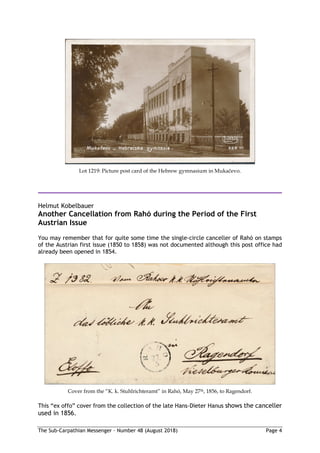
Cover from the “K. k. Stuhlrichteramt” in Rahó, May 27th, 1856, to Ragendorf.
This “ex offo” cover from the collection of the late Hans-Dieter Hanus shows the canceller
used in 1856.
The Sub-Carpathian Messenger – Number 48 (August 2018) Page 5
Helmut Kobelbauer
Another Bluish-Green Double-Circle Stamp from Ungvár
As you probably know, for certain Hungarian post offices we have bluish-green strikes of the
double-circle postmarks used from 1847. These strikes are rather rare and sometimes are
rather weak. I am showing one from January 26th
, 1849, so from the period of the “in-
dependent” Hungarian postal administration:
Official letter, Ungvár, January 26th, 1849, to Eperjes.
This item was sold at the 32nd
PAC auction (Prague, April 11th
, 2010; lot 1316) for approx. 60
Euro. Considering the rarity of such bluish-green postmarks (and taking into account the
obvious meagre quality of the item), this was a very reasonable price. It is a pity that this
item is a cover “only” and not a full letter. As far as I can decipher, it seems to have been
a letter from one court to another.
By the way, there is also a bluish-green double-circle postmark from ALSÓ-VERECZKE (see
above), although from much later, i.e. 1872.
The Sub-Carpathian Messenger – Number 48 (August 2018) Page 6
Helmut Kobelbauer
A Letter from Rawa Ruska to Beregszász
Some years ago by good luck I could buy the following letter in an Austrian auction:
“Abzug” letter from Rawa ruska, January 18th, 1850, at Bereg(h)szász.
This is one of the (very few) letters from the pre-stamp period sent from Galicia through the
Verecke saddle to Munkács and then on to Beregszász. The postal route as originally pre-
scribed was through Lemberg, Wien, Pest, Stryj, and Munkács. The part “Wien / Pest” was
cancelled out as “irrig” (erroneous) – since 1836 there was a shorter postal route from Stryj
to Munkács. As this letter was now transported along a different route, its fee (see the “12”
Kreuzer in black) had to be deducted from the originally planned route, therefore the short
hand-written mark “Abz” for “Abzugsbrief”.
The receiver is an “Oberleutnant Julius Graf Falkenhayn” at the 4th
Kaiser Franz Joseph
Ulanen regiment, so basically this is a “private” (non-official) military letter.
As Jan Rompes correctly stated in one of the last “Sub-Carpathian Messenger” issues, the
number of letters from the Kárpátalja to Galicia (or in the other direction) is very small.
This is rather surprising because one would believe that the Russian-Orthodox church (which
was dominant in Galicia) was using every opportunity to spread their beliefs to the brothers
and sisters on the south side of the Carpathians.
The letter carries a “Rawa ruska | 18. JAN.” cancellation and then a double-circle “MUNKÁCS
| 26/1” transit stamp. The year (i.e. 1850) can be found from the content of the letter.
We would welcome to see other such postal items from this obviously rarely used postal
route.
The Sub-Carpathian Messenger – Number 48 (August 2018) Page 7
Gábor Nagy
Once again about the Huculs
An interesting family collection reached my hands.
The expeditor is a mysterious Alexander, sometimes calling himself Gyuri. The addressee
continuously is Lahner Margó (sometimes in French: Margot) who lives in Szabadka under
Bercsényi street 351, than Katona 461, finally under Jukiceva (Katona) street 3. The addres-
see has nothing to do with the famous martyr of Arad, only the name is the same.
Máramarossziget is the capitol of the Máramaros county with 21.730 inhabitants. Its ethnic
composition was 10,5 % Hungarian, 17,3 % German, 24,3 % Romanian and 47,3 % Ruthenian
according to the census of 1910.
Szabadka is in the county of Bács-Bodrog, 94.610 inhabitants, ethnic composition was 58,8%
Hungarian, 2,0% German, 30,7% Serbian, and 36,5 % Bunyevatz.
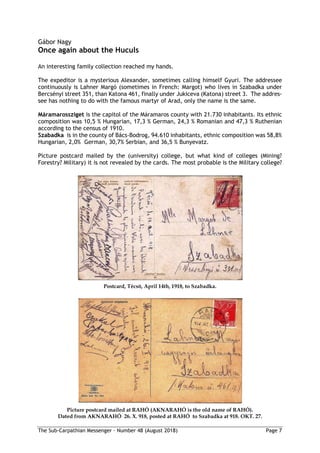
Picture postcard mailed by the (university) college, but what kind of colleges (Mining?
Forestry? Military) it is not revealed by the cards. The most probable is the Military college?
Postcard, Técsö, April 14th, 1918, to Szabadka.
Picture postcard mailed at RAHÓ (AKNARAHÓ is the old name of RAHÓ).
Dated from AKNARAHÓ 26. X. 918, posted at RAHÓ to Szabadka at 918. OKT. 27.
The Sub-Carpathian Messenger – Number 48 (August 2018) Page 8
Rahós ethnical composition is Hungarian 1177, German 917 and Ruthenian 4432.
Quoted work pages 11:
Sztepan Kolcsurak (1895-1980) returned as the officer of Austro-Hungarian Army on the 3rd
of November into the only town of Huculs to Körösmező (Jasina) and he became the Presi-
dent of the Hucul Peoples Counsel of 42 members on the 8th of November. (1500 Hungarian
of the 10000 inhabitants).
Quoted work is always the „The Subcarpathian copy-books Nr.3” by Horváth Lajos.
Picture postcard partly written in French, partly written in Hungarian,
dated in Máramarossziget 14. XI.918.,
mailed at Máramarossziget 918. NOV.15. to Szabadka.
Translation of the Hungarian text: ”(Restaurant Small-Pipe) 12 hours pm. The rover of the
night finally hunt out the right occupation.” Later: „We defend your city” Later: „ Handkiss
after a chaotic night”
What is this, if not a reconnaissance patrol to Rahó led by the Hungarian troops of Mára-
marossziget? But what soldiers? Hungarian soldiers „delegated by the Károlyi Government”?
On the 10th of December Kloscsurak took part on the conference in Budapest, but he
obstructed even the autonomy, which was prepared by the Hungarian Government. He
wanted to detach from Hungary.
„The Hucul People’s Counsel opened a representation in Stanislau in the West-Ukrainian
People’s Republic. Hungarian troops marched into Körösmező and the leaders of the Huculs
fled into the hills.”
Picture postcard to Szabadka dated in Máramarossziget 14.XI.918. mailed in Máramarossziget
929. NOV.17 (error in the date, the correct date 918.NOV.14), written in French. The arriving
date XI. 23. written by pencil.
The Sub-Carpathian Messenger – Number 48 (August 2018) Page 9
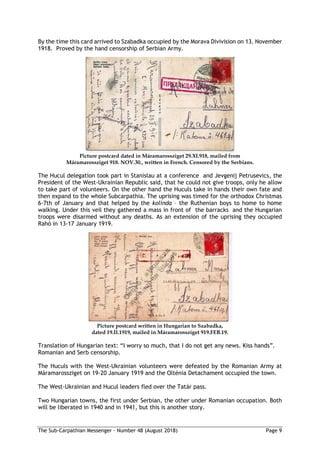
By the time this card arrived to Szabadka occupied by the Morava Divivision on 13. November
1918. Proved by the hand censorship of Serbian Army.
Picture postcard dated in Máramarossziget 29.XI.918, mailed from
Máramarossziget 918. NOV.30., written in French. Censored by the Serbians.
The Hucul delegation took part in Stanislau at a conference and Jevgenij Petrusevics, the
President of the West-Ukrainian Republic said, that he could not give troops, only he allow
to take part of volunteers. On the other hand the Huculs take in hands their own fate and
then expand to the whole Subcarpathia. The uprising was timed for the orthodox Christmas
6-7th of January and that helped by the kolinda – the Ruthenian boys to home to home
walking. Under this veil they gathered a mass in front of the barracks and the Hungarian
troops were disarmed without any deaths. As an extension of the uprising they occupied
Rahó in 13-17 January 1919.
Picture postcard written in Hungarian to Szabadka,
dated 19.II.1919, mailed in Máramarossziget 919.FEB.19.
Translation of Hungarian text: “I worry so much, that I do not get any news. Kiss hands”.
Romanian and Serb censorship.
The Huculs with the West-Ukrainian volunteers were defeated by the Romanian Army at
Máramarossziget on 19-20 January 1919 and the Olténia Detachament occupied the town.
The West-Ukrainian and Hucul leaders fled over the Tatár pass.
Two Hungarian towns, the first under Serbian, the other under Romanian occupation. Both
will be liberated in 1940 and in 1941, but this is another story.
The Sub-Carpathian Messenger – Number 48 (August 2018) Page 10
Helmut Kobelbauer
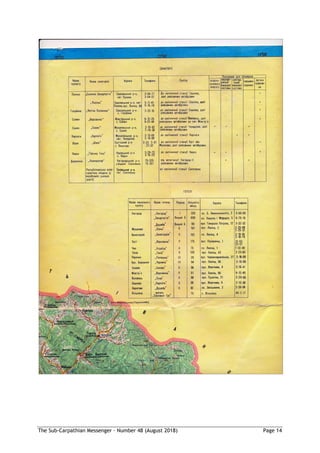
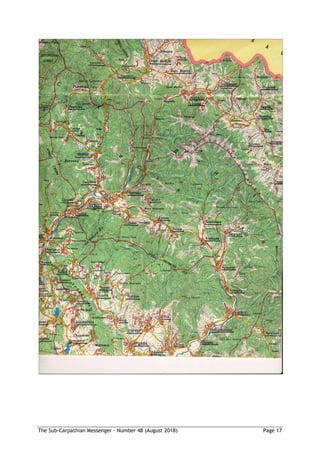
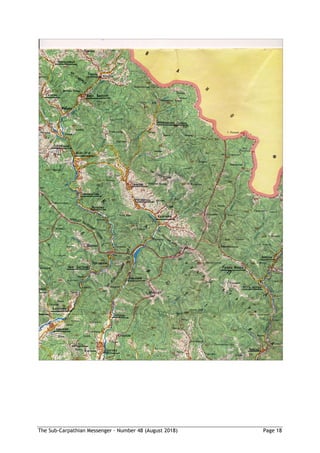
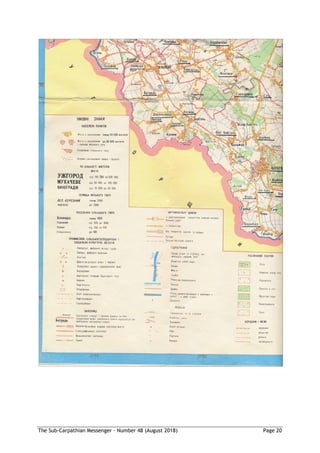
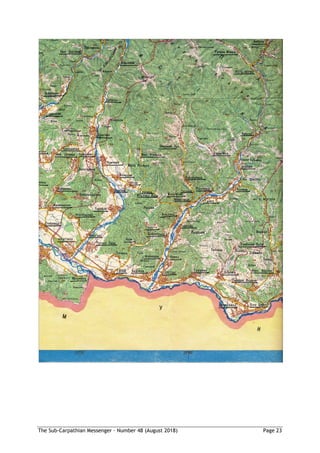
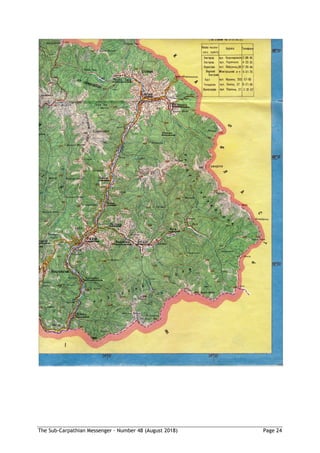
Ukrainian Map of the “Zakarpatska Oblast” from 1993
In the collection of my late friend Hans-Dieter Hanus I found the following map – please
excuse the overlaps between the sections shown. And be aware that some of the place names
have been changed in the last 25 years …
The Sub-Carpathian Messenger – Number 48 (August 2018) Page 11
The Sub-Carpathian Messenger – Number 48 (August 2018) Page 12
The Sub-Carpathian Messenger – Number 48 (August 2018) Page 13
The Sub-Carpathian Messenger – Number 48 (August 2018) Page 14
The Sub-Carpathian Messenger – Number 48 (August 2018) Page 15
The Sub-Carpathian Messenger – Number 48 (August 2018) Page 16
The Sub-Carpathian Messenger – Number 48 (August 2018) Page 17
The Sub-Carpathian Messenger – Number 48 (August 2018) Page 18
The Sub-Carpathian Messenger – Number 48 (August 2018) Page 19
The Sub-Carpathian Messenger – Number 48 (August 2018) Page 20
The Sub-Carpathian Messenger – Number 48 (August 2018) Page 21
The Sub-Carpathian Messenger – Number 48 (August 2018) Page 22
The Sub-Carpathian Messenger – Number 48 (August 2018) Page 23
The Sub-Carpathian Messenger – Number 48 (August 2018) Page 24

The SCM issue #048

  • 1.
    The Sub-Carpathian Messenger– Number 48 (August 2018) Page 1 The Sub-Carpathian Messenger Newsletter of the Study Circle for the Postal History of the Carpatho-Ukraine Number 48 – August 2018 Ruthenian Girls on the Path of Enlightenment
  • 2.
    The Sub-Carpathian Messenger– Number 48 (August 2018) Page 2 About us and the Newsletter The Study Circle is a loose group of persons who are interested in the postal (and general) history of the area known as Kárpátalja in Hungarian, as Podkarpatská Rus during the First Czechoslovak Republic, which had a short day of independence as Carpatho Ukraine, and later was integrated into the Ukrainian SSR in the Soviet Union as the ‘Zakarpatskaja Oblast’. Since 1991 it is ЗАКАРПАТТЯ, the westernmost administrative district in the now indepen- dent Ukraine. The Newsletter came out of a meeting of a few collectors during the PRAHA 2008, its first number appeared in November 2008. In the last years we have always produced at least four issues per year but may not be able to keep this high level due to a substantial lack of contributions. On the other hand, as we can see from the access counts at the public web site, this Newsletter is read by hundreds of people. This imbalance between supporters and consumers-only has finally brought the editor to the decision that he will stop editing this magazine after ten years, i.e., with the issue of November 2018. If someone wants to take over, he (or she) is very welcome. We send our regards and best wishes to all members of the Study Circle. Distribution method All issues of the »Sub-Carpathian Messenger« can be browsed at and downloaded from the Internet address http://www.slideshare.net/subcarpathian For those who have no Internet access and/or no e-mail, the distribution method is still the same: you will receive a colour print-out by air/surface mail as you did in the past. Everybody can freely access the uploaded numbers of the Newsletter but the notification service for new numbers is limited to the actual members of the Study Circle. Rules and Regulations All articles in the Newsletter carrying the name of an author are the sole responsibility of this author and should not be taken to represent the common opinion of the Study Circle. Such articles are, if not marked otherwise, copyrighted by the respective author. Free use within the Study Circle is granted. We thank our authors for their much appreciated work and contribution. Participation in the Study Circle is not bound to a formal membership and does not include the duty to pay a membership fee. There is a moral obligation to support the Newsletter from time to time by sending some article, some interesting piece of information, some question, some answer or whatever, although a number of ‘members’ has chosen to dis- respect even this minimal request for support. We will “print” everything even only loosely connected with our subject of interest so any contribution is certainly welcome. Please send it (as Word 2003, 2007 or 2010 document, graphical elements in JPEG, 300 dpi or better) to the editor’s e-mail address (kb@aatc.at). His traditional postal address, if you would need it, is: Helmut Kobelbauer, Untergrossau 81, A-8261 Sinabelkirchen, Austria / Europe
  • 3.
    The Sub-Carpathian Messenger– Number 48 (August 2018) Page 3 Helmut Kobelbauer Auction News Milan Černík’s 48th auction (see www.pac-auction.com) offered a number of beautiful postal history items from the Carpatho Ukraine. Lot 1196: Hungarian postal stationery with additional stamps, from the postal agency Felsősebestelep, 9 FEB 1920. A very rare piece from a postal agency at the beginning of the Czechoslovak period. The call was 2.000 Eur and the item was not sold. Possibly the call was too high even for the connoi- sseur and enthusiast for such pieces. Lot 1203: Czech postal stationery, Aknaslatina, June 10th, 1921. Stamp “AKNASLATINA | * АКНАСЛАТИНА * | Č. S. P. | b” in perfect condition.
  • 4.
    The Sub-Carpathian Messenger– Number 48 (August 2018) Page 4 Lot 1219: Picture post card of the Hebrew gymnasium in Mukačevo. Helmut Kobelbauer Another Cancellation from Rahó during the Period of the First Austrian Issue You may remember that for quite some time the single-circle canceller of Rahó on stamps of the Austrian first issue (1850 to 1858) was not documented although this post office had already been opened in 1854. Cover from the “K. k. Stuhlrichteramt” in Rahó, May 27th, 1856, to Ragendorf. This “ex offo” cover from the collection of the late Hans-Dieter Hanus shows the canceller used in 1856.
  • 5.
    The Sub-Carpathian Messenger– Number 48 (August 2018) Page 5 Helmut Kobelbauer Another Bluish-Green Double-Circle Stamp from Ungvár As you probably know, for certain Hungarian post offices we have bluish-green strikes of the double-circle postmarks used from 1847. These strikes are rather rare and sometimes are rather weak. I am showing one from January 26th , 1849, so from the period of the “in- dependent” Hungarian postal administration: Official letter, Ungvár, January 26th, 1849, to Eperjes. This item was sold at the 32nd PAC auction (Prague, April 11th , 2010; lot 1316) for approx. 60 Euro. Considering the rarity of such bluish-green postmarks (and taking into account the obvious meagre quality of the item), this was a very reasonable price. It is a pity that this item is a cover “only” and not a full letter. As far as I can decipher, it seems to have been a letter from one court to another. By the way, there is also a bluish-green double-circle postmark from ALSÓ-VERECZKE (see above), although from much later, i.e. 1872.
  • 6.
    The Sub-Carpathian Messenger– Number 48 (August 2018) Page 6 Helmut Kobelbauer A Letter from Rawa Ruska to Beregszász Some years ago by good luck I could buy the following letter in an Austrian auction: “Abzug” letter from Rawa ruska, January 18th, 1850, at Bereg(h)szász. This is one of the (very few) letters from the pre-stamp period sent from Galicia through the Verecke saddle to Munkács and then on to Beregszász. The postal route as originally pre- scribed was through Lemberg, Wien, Pest, Stryj, and Munkács. The part “Wien / Pest” was cancelled out as “irrig” (erroneous) – since 1836 there was a shorter postal route from Stryj to Munkács. As this letter was now transported along a different route, its fee (see the “12” Kreuzer in black) had to be deducted from the originally planned route, therefore the short hand-written mark “Abz” for “Abzugsbrief”. The receiver is an “Oberleutnant Julius Graf Falkenhayn” at the 4th Kaiser Franz Joseph Ulanen regiment, so basically this is a “private” (non-official) military letter. As Jan Rompes correctly stated in one of the last “Sub-Carpathian Messenger” issues, the number of letters from the Kárpátalja to Galicia (or in the other direction) is very small. This is rather surprising because one would believe that the Russian-Orthodox church (which was dominant in Galicia) was using every opportunity to spread their beliefs to the brothers and sisters on the south side of the Carpathians. The letter carries a “Rawa ruska | 18. JAN.” cancellation and then a double-circle “MUNKÁCS | 26/1” transit stamp. The year (i.e. 1850) can be found from the content of the letter. We would welcome to see other such postal items from this obviously rarely used postal route.
  • 7.
    The Sub-Carpathian Messenger– Number 48 (August 2018) Page 7 Gábor Nagy Once again about the Huculs An interesting family collection reached my hands. The expeditor is a mysterious Alexander, sometimes calling himself Gyuri. The addressee continuously is Lahner Margó (sometimes in French: Margot) who lives in Szabadka under Bercsényi street 351, than Katona 461, finally under Jukiceva (Katona) street 3. The addres- see has nothing to do with the famous martyr of Arad, only the name is the same. Máramarossziget is the capitol of the Máramaros county with 21.730 inhabitants. Its ethnic composition was 10,5 % Hungarian, 17,3 % German, 24,3 % Romanian and 47,3 % Ruthenian according to the census of 1910. Szabadka is in the county of Bács-Bodrog, 94.610 inhabitants, ethnic composition was 58,8% Hungarian, 2,0% German, 30,7% Serbian, and 36,5 % Bunyevatz. Picture postcard mailed by the (university) college, but what kind of colleges (Mining? Forestry? Military) it is not revealed by the cards. The most probable is the Military college? Postcard, Técsö, April 14th, 1918, to Szabadka. Picture postcard mailed at RAHÓ (AKNARAHÓ is the old name of RAHÓ). Dated from AKNARAHÓ 26. X. 918, posted at RAHÓ to Szabadka at 918. OKT. 27.
  • 8.
    The Sub-Carpathian Messenger– Number 48 (August 2018) Page 8 Rahós ethnical composition is Hungarian 1177, German 917 and Ruthenian 4432. Quoted work pages 11: Sztepan Kolcsurak (1895-1980) returned as the officer of Austro-Hungarian Army on the 3rd of November into the only town of Huculs to Körösmező (Jasina) and he became the Presi- dent of the Hucul Peoples Counsel of 42 members on the 8th of November. (1500 Hungarian of the 10000 inhabitants). Quoted work is always the „The Subcarpathian copy-books Nr.3” by Horváth Lajos. Picture postcard partly written in French, partly written in Hungarian, dated in Máramarossziget 14. XI.918., mailed at Máramarossziget 918. NOV.15. to Szabadka. Translation of the Hungarian text: ”(Restaurant Small-Pipe) 12 hours pm. The rover of the night finally hunt out the right occupation.” Later: „We defend your city” Later: „ Handkiss after a chaotic night” What is this, if not a reconnaissance patrol to Rahó led by the Hungarian troops of Mára- marossziget? But what soldiers? Hungarian soldiers „delegated by the Károlyi Government”? On the 10th of December Kloscsurak took part on the conference in Budapest, but he obstructed even the autonomy, which was prepared by the Hungarian Government. He wanted to detach from Hungary. „The Hucul People’s Counsel opened a representation in Stanislau in the West-Ukrainian People’s Republic. Hungarian troops marched into Körösmező and the leaders of the Huculs fled into the hills.” Picture postcard to Szabadka dated in Máramarossziget 14.XI.918. mailed in Máramarossziget 929. NOV.17 (error in the date, the correct date 918.NOV.14), written in French. The arriving date XI. 23. written by pencil.
  • 9.
    The Sub-Carpathian Messenger– Number 48 (August 2018) Page 9 By the time this card arrived to Szabadka occupied by the Morava Divivision on 13. November 1918. Proved by the hand censorship of Serbian Army. Picture postcard dated in Máramarossziget 29.XI.918, mailed from Máramarossziget 918. NOV.30., written in French. Censored by the Serbians. The Hucul delegation took part in Stanislau at a conference and Jevgenij Petrusevics, the President of the West-Ukrainian Republic said, that he could not give troops, only he allow to take part of volunteers. On the other hand the Huculs take in hands their own fate and then expand to the whole Subcarpathia. The uprising was timed for the orthodox Christmas 6-7th of January and that helped by the kolinda – the Ruthenian boys to home to home walking. Under this veil they gathered a mass in front of the barracks and the Hungarian troops were disarmed without any deaths. As an extension of the uprising they occupied Rahó in 13-17 January 1919. Picture postcard written in Hungarian to Szabadka, dated 19.II.1919, mailed in Máramarossziget 919.FEB.19. Translation of Hungarian text: “I worry so much, that I do not get any news. Kiss hands”. Romanian and Serb censorship. The Huculs with the West-Ukrainian volunteers were defeated by the Romanian Army at Máramarossziget on 19-20 January 1919 and the Olténia Detachament occupied the town. The West-Ukrainian and Hucul leaders fled over the Tatár pass. Two Hungarian towns, the first under Serbian, the other under Romanian occupation. Both will be liberated in 1940 and in 1941, but this is another story.
  • 10.
    The Sub-Carpathian Messenger– Number 48 (August 2018) Page 10 Helmut Kobelbauer Ukrainian Map of the “Zakarpatska Oblast” from 1993 In the collection of my late friend Hans-Dieter Hanus I found the following map – please excuse the overlaps between the sections shown. And be aware that some of the place names have been changed in the last 25 years …
  • 11.
    The Sub-Carpathian Messenger– Number 48 (August 2018) Page 11
  • 12.
    The Sub-Carpathian Messenger– Number 48 (August 2018) Page 12
  • 13.
    The Sub-Carpathian Messenger– Number 48 (August 2018) Page 13
  • 14.
    The Sub-Carpathian Messenger– Number 48 (August 2018) Page 14
  • 15.
    The Sub-Carpathian Messenger– Number 48 (August 2018) Page 15
  • 16.
    The Sub-Carpathian Messenger– Number 48 (August 2018) Page 16
  • 17.
    The Sub-Carpathian Messenger– Number 48 (August 2018) Page 17
  • 18.
    The Sub-Carpathian Messenger– Number 48 (August 2018) Page 18
  • 19.
    The Sub-Carpathian Messenger– Number 48 (August 2018) Page 19
  • 20.
    The Sub-Carpathian Messenger– Number 48 (August 2018) Page 20
  • 21.
    The Sub-Carpathian Messenger– Number 48 (August 2018) Page 21
  • 22.
    The Sub-Carpathian Messenger– Number 48 (August 2018) Page 22
  • 23.
    The Sub-Carpathian Messenger– Number 48 (August 2018) Page 23
  • 24.
    The Sub-Carpathian Messenger– Number 48 (August 2018) Page 24