SUMMIT PR CAMPAIGN PROPOSAL
SAN DIEGO STATE UNIVERSITY
FALL 2015
Community Engagement for Sustainable Cities
CREATED BY:
Hallie Hoffmann • Allison Bawden
Vivian Nguyen • Vy Truong
Oscar Sanchez • Colin Sanchez
Catalina Duarte • Melanie Ramirez
Marcela Orozco • Bianca Pires


Table of Contents
Section I: Situation Analysis……………………………………………………….……...………….3
Section II: Research….………………………………………………………………..……..………10
Section III: Planning………………………………………………………..…………………...……12
a. Audiences and Messages……………………………………………………………..…..…13
b. Objectives and Goals…………………………………………………………………………13
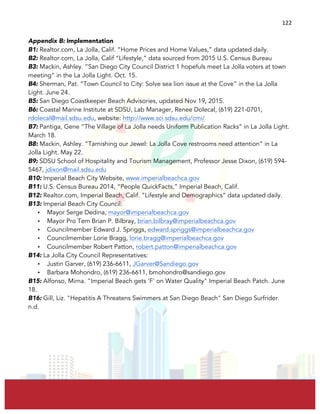
Section IV: Implementation…………………………………………………………………….……15
c. Strategy………………………………………………………………………………….…...…16
d. Tactics……………………………………………………………………………………......…16
e. City Proposals………………………………………………………………….………………18
Section V: Evaluation and Recommendations…………………………………..…………………39
Section VI: Budget…………………………………………………………...……………………….43
Section VII: Appendix……………………………………………………………………...…………54


3	
  
Section I: Situation Analysis


4	
  
Problem Statement
For the 2015-2016 school year, The Sage Project at San Diego State University received only
one request for proposal: a $50,000 budget for just two projects (from the city of Santee). This
proposal did not provide the funding Dr. Barlow needed in order to properly staff and run the
organization. Furthermore, the two projects were not broad enough to incorporate
campuswide engagement of at least 20 different disciplines and hundreds of students.
History
Modeled after the Sustainable City Program at the University of Oregon, The Sage Project
works to engage students, faculty and communities in creating sustainable projects to
enhance cities and further their community’s growth. The Sage Project philosophy works
under a one city per year model where it partners with local governments around San Diego
County.
This model works as a platform to connect students within interdisciplinary majors and help
them gain real-world experience by bridging innovative ideas overseen by faculty members.
The Sage Project begins its partnership by seeking cities in need of new development within
San Diego County. The process begins with proposals from city officials looking to partner
with Sage. Upon approval, the City must sustain the ability to finance the projects it seeks to
accomplish. This partnership then extends over the course of the academic year at San Diego
State University, where faculty members and students devote thousands of hours of research,
creativity, ideas and solutions to meet the city's overall goals. Students are able to propose
novel ideas toward stakeholders and community leaders to further communicate and
implement city objectives. All projects submitted are of high need to the community and
provide a service to its citizens.
The city partner for 2013-2014 was National City, the second-oldest city in San Diego County.
National City was the first city The Sage Project launched a partnership with. It is a low
income, high diversity city, with approximately 60,000 residents. Upon its partnership,
National City gained many benefits from the services provided by The Sage Project. Projects
proposed included: branding, budget solutions, store conversions, disaster preparedness and
response, Marina district redevelopment, freeway assessment, property management plans,
sustainability, craft beer industry, strategic planning, homelessness and policy alternatives, a
wayfinding system and public records act. Through these project proposals, National City
would engage students in multiple disciplines.


5	
  
Current State of Events
The start of the 2015-2016 academic year for The Sage Project was filled with many projects
that received the required funding to complete them. Upon conclusion of its second year
working with National City, The Sage Project was able to partner up with the city of Santee in
the east county of San Diego. Director Jessica Barlow had close ties with city officials of
Santee embarking the partnership for the 2015-2016 academic year. This partnership would
include the proposal of nine highly interdisciplinary projects that include: a new civic center
complex, iconic pedestrian bridge, water quality enhancement, city branding and homeless
intervention. The anticipated budget for these projects would be $200,000 and would
engage 11 disciplines, 16 faculty members, 22 courses and 1400 students. However, the
circumstances changed.
Due to budget restrictions, Santee withdrew almost completely from in its initial proposals.
Partnership reduced from the nine proposed projects to just two: the asset mapping GIS and
a water quality study. This reduction affected the budget The Sage Project initially had
leveraged going from $200,000 to $50,000 to cover project costs. Several factors that led to
these drastic changes were lack of communication, funding sources, timing of MOU and
project agreements and leaderships changes. Although The Sage Project was able to
maintain partnership with the City of Santee, the city's’ decision to reduce projects had direct
impact on its outlook of future partnerships. Currently, The Sage Project's goals is to maintain
it credibility, retain faculty confidence, increase funding and increase future partnerships with
San Diego County cities.
SWOT Analysis
Understanding the environment that surrounds The Sage Project will help to maximize the
positive outcomes and minimize the negative elements that affect the organization. In order
to determine which factors are helping or hindering in the organization, a detailed
comprehension of the internal and external environment is provided including strengths,
weaknesses, opportunities, and threats involved in the organization. In particular, identifying
and addressing these four key factors can help to understand key issues affecting the
performance of The Sage Project and potentially lead to solutions for improvement.
Internal Strengths
1. Positive practice framework
The Sage Project is a campus-wide engaged learning organization located at San Diego State
University. The organization is part of the Educational Partnerships for Innovation in
Communities (EPIC) Network, and is based on the highly successful and award winning
Sustainable City Year Program at the University of Oregon. By using this existing and highly
successful model, The Sage Project has direction and knowledge of what can work.
Specifically, the Sage Project partners with rural and urban communities across San Diego to


6	
  
develop partner-directed projects and address their priorities and sustainability goals for
advancing quality of life within the region. The Sage Project matches community needs with
the expertise and resources of the San Diego State University faculty and students.
2. Students engage and gain experience in community-involved projects
The Sage Project is a unique resource that helps students achieve academic and
professional success by offering project management, professional development and
administrative resources. Through project-based learning, students across the University can
apply what they learn to community-focused situations and develop an all-around enriching
education. As the students get involved with high-priority, high-need community projects,
interest and fresh ideas are willingly generated that create momentum and provide real
service to the community. Consequently, these community engagement activities allow
students to better prepared to be future leaders in the community.
3. Positive contributions to the community
Since its establishment in 2013, The Sage Project has worked with two city partners in San
Diego region and have completed 18 projects that have contributed significantly to the
advancement of our partnering communities’ economic, social and environmental
sustainability. In order to achieve this success, The Sage Project staff have implemented and
developed the community projects through close cooperation between community partners
and faculty members. The Sage Project has involved 55 classes, 35 faculty members, 23
disciplines and more than 2,000 students over the past two years.
Internal Weaknesses
1. Lack of funding and resources
One of the barriers that The Sage Project is facing is lack of funding to sustain the program.
Low levels of awareness within the sponsor and alumni community limit the funds coming in.
The organization currently does not have a fundraising strategy. Thus, the process of
identifying and securing funds is challenging. In addition, with only one part-time faculty
member directing the program and two other temporary assistants, there is a significant lack
of necessary resources within staffing to ensure long-term sustainability.
2. Lack of awareness and credibility
There seems to be a lack of awareness about the Sage Project specifically in regard to city
council members, city officials and potential sponsors. Despite the fact that The Sage Project
has only been established at San Diego State University for a short period of time (since 2013)
the level of awareness should be higher given the amount of resources provided by the
university and the program’s promising potential given the prior successful projects. There
was no significant attention given to the marketing, PR activities, and events in order to build
a specific image and credibility for The Sage Project. Since there have only been two cities


7	
  
that have been getting involved with The Sage Project on record; potential partners may
question the reliability and expertise of the program, thus resulting in missed opportunities of
partnerships.
External Opportunities
1. Working faculty & students with communities
The Sage Project at SDSU gives opportunities to students at one of the most competitive
state schools on the West Coast. They receive hands on experience by being able to design
projects and have the space to learn and grow from a qualified program.
2. National City and Santee Partnerships
These partnerships allow other cities to get insight on what successes the program completed
in the past. It gives more credibility to the program and makes it easier for new cities to be
convinced that Sage can provide them with the best plan.
3. Interns
The Sage Project gives even more opportunities for students looking for a part-time position
as an intern with the same hands-on experiences and qualifications needed to develop a
potential career.
4. Growing Market
The market for renovating and repairing city plans is huge and never-ending. Improvements
in sustainability help prosperity and maintenance in both the program and its selected areas.
External Threats
Although The Sage Project has grown significantly since its start, there are several obstacles
that threaten the success of this organization.
1. Resistance from city officials
One of The Sage Project’s biggest projects was with the city of Santee. The Sage Project and
Santee agreed to budget $200,000 and engage 11 disciplines, 16 faculty members, 22
courses and 1,400 students. Unexpectedly, Santee completely withdrew from most of the
project except asset mapping GIS and the water quality study. Instances like this pose an
enormous threat for this organization--where partnerships can be made almost definite and
city officials can later completely back up from a project.
2. Competition
There are several other organizations and private entities that threaten cities from selecting
The Sage Project to do their projects. Because this organization uses San Diego State
University’s students to complete these projects, some cities are skeptical to hire them due to


8	
  
the lack of experience some students may have. Some cities already have their own private
entities that are in charge of completing any projects the city needs to complete; therefore,
Sage must compete with not only other already hired professionals, but also other
organizations from different campuses that are just like them. UC San Diego’s Sustainability
Solutions Institute (SSI) and CSU San Marcos’ Community Engagement are organizations in
the greater area that aim to sustainably solve key problems facing society.
3. Limited Funding
This year, The Sage Project faced many financial problems that have hindered its ability to
grow and implement their ideas. Most of The Sage Project’s funds come from the cities it is
partnered with, however, in order to stay afloat every year, they need a minimum of $100,000
yearly budget. San Diego State University agreed to do an MOI (Memorandum of
Understanding) with The Sage Project. The purpose of this MOI was that San Diego State
University would only grant the organization $30,000 this one time in order to help them
continue to work this year. Without the appropriate funding, the project cannot strengthen its
goals to have a student-engaged organization and could overall disintegrate as an
organization.
4. Opposition from Community
As previously stated, one of the biggest reasons communities would be opposed to The Sage
Project participating in projects with cities is that students are known for not having enough
experience in their fields. Because of this, community individuals have difficulty trusting
students to partake in such intricate projects that involve taxpayer money. Instead, they would
rather trust experienced individuals/companies that cities have used in the past.
Competition
Overview
Sage faces a plethora of competition when it comes to helping communities and cities around
San Diego County. These competitors include other schools with programs similar to the
Sage Project, private contractors, other nonprofit organizations and other real-life,
government projects that revolve around bettering the community. However, Sage should
distinguish themselves from these competitors and make it the community’s first choice.
Other San Diego County Schools
The Sage Project faces competition against other colleges and universities in the San Diego
region. For example, UC San Diego’s Sustainability Solutions Institute (SSI) and CSU San
Marcos’ Community Engagement project both have various classes that assist in presenting
solutions to real-world problems. In comparison to UC San Diego, The Sage Project has a
more hands-on approach and tackle community issues. UC San Diego’s program is not as


9	
  
active. Their last Facebook post on the SSI page was posted over three years ago, and their
documents have not been updated on their website since 2010. In addition, calling the
telephone number for this program will result in no response. Sage will offer a quicker
response to inquiries due because it is a newer and passionate program.
CSU San Marcos offers a community outreach program that allows students to work in local
communities and address the particular region's most critical needs. The program focuses on
partnering with underrepresented students, tribal neighbors, military establishments, health
organizations and the business community to works on projects beneficial to these particular
communities. Students are given opportunities to help through service learning and civic
engagement. Furthermore, the faculty contributes to these projects through engaged
scholarships and research. This program directly competes with The Sage Project because it is
located within San Diego County, operates in the same service area as The Sage Project, and
addresses community problems through student ideas and work.
Other Nonprofit Organizations
Nonprofit organizations also pose as a threat. Community service and volunteer organizations
around the County may offer free labor. However, although The Sage Program is a program
that must be paid for, it has more positive attributes than volunteering does. The Sage Project
is more structured and each student that participates has a good understanding of the
situation, the solution, and the path to reach that solution. Students are able to gain real-
world experience as well as help their local communities at the same time. What makes it
unique from nonprofit organizations is that the students come up with the solutions, whereas
volunteers follow what they are told to do. The Sage Project also works with each city for a
year instead of volunteering from time to time like many nonprofit organizations.
Private Contractors
The Sage Project’s past efforts have focused on branding, budget solutions and strategic
planning among other services that are typically offered by private contractors. This makes
the contractors direct competitors with The Sage Project for city clients. The Sage Project
differentiates itself by supplying cities with thousands of hours of work done by SDSU
students over a year. In addition, the community partner gives students great opportunities to
gain real-world experiences through working on projects to benefit their city. Private
contractors may cost more money and be less flexible than San Diego State’s student work.
Government Projects
A situation The Sage Project may face is that local community problems already be in the
process of being addressed by the city itself. Instead of this being a competitor, it could
partner up with the plans that have already been made and either present more advice, learn
from those set plans or provide the man-power to put these plans into effect.


10	
  
Section II: Research


11	
  
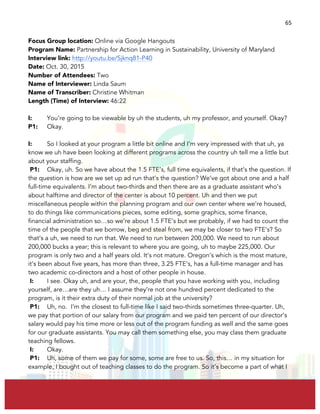
This secondary research is especially important because, as Portney discusses in the Abstract,
the “recurring theme in these cities is the role of public participation in shaping and
implementing these (sustainability) programs.” In his research, Portney notes that some cities
(like Seattle) owe the city’s push for sustainability entirely to public involvement. The research
looks at the shift to sustainable living at the end of the 20th century, and the roles both the
government and the public fulfilled. It also discusses the importance of civic engagement, and
potential problems that can arise. This research will help us to understand the original
sustainability movement, as well. For comparison, there are three specific cities cited in the
research that pushed for sustainability through civic/community engagement (Appendix A1).
Ziegler’s research discusses that though governments and society have acknowledged the
need for sustainable development and urban planning, it is not happening fast enough. He
discusses how previous ideas of “limitless growth” are now replaced by overpopulation that
must be addressed. Ziegler argues, “The truth of the matter is that cities are great at talking
the ‘green talk’ but actually quite lousy at walking the "green walk.” This is relevant to our
project because, as our client mentioned, city officials appeared to like the idea of the
project, but then did not participate (Appendix A2).
Primary Research: Qualitative and Quantitative
Qualitative Research
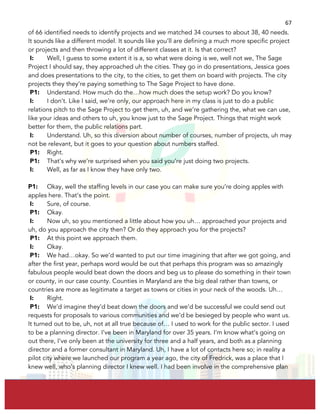
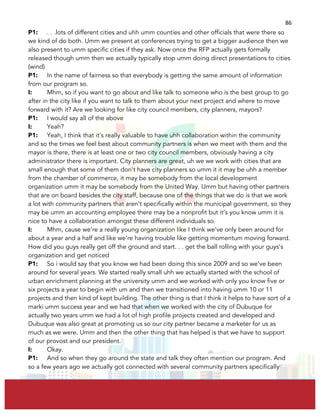
For our qualitative research, we made an excel sheet that listed the different Community
Engagement Programs around the nation similar to Sage. Then we chose six programs to
reach out to and conduct in-depth interviews about how they run their programs. Our
university project coordinator, Dr. Barlow, served as a baseline for Summit PR in order to
compare and contrast findings from the other interviews (Appendix A3-A5).
Quantitative Research
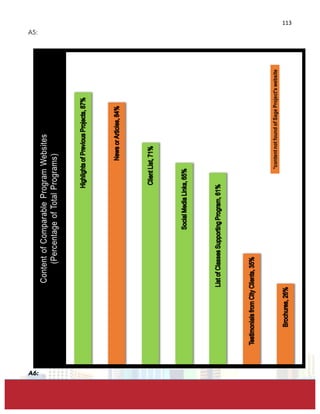
Summit PR compiled a list of questions and formatted them onto an Excel sheet for further
breakdown as to what each program contained. We comprised graphs based on the data
gathered from the document used for code sheet (Appendix A6-A8). The graphs list the
percentages of keywords and website content per program. For example: 26 percent of the
total programs presented brochures in their website content.
These multiple methods displayed different kinds of research, each displaying different
outcomes. We focused our attention on the investigation of other nationwide programs with
the same incentives. They altered in the way they approached the respective city council
depending on the needs and renovations specified in each location. This allows us to see
what works for other organizations and to have a broad idea of how to create success.


12	
  
Section III: Planning


13	
  
a. Audiences and Messages
Target Audiences
Proactive communication is essential to success. In order to generate new business
opportunities and heighten institutional awareness, Summit PR must continually reach out to
targeted publics including, but not limited to, SDSU faculty, students, potential sponsors and
city partners, through various public relations strategies. In order to convert latent or aware
publics to active publics, The Sage Project must effectively communicate with the appropriate
audiences.
Internal Audience:
• Faculty: SDSU professors from different departments that teach upper division classes
and are willing to integrate community engagement in their courses. Among SDSU
professors, there should be no latent public.
• Students: Upper division and graduate level SDSU students who, by participating, will
learn how their disciplinary expertise and competencies translates into addressing
community needs.
External Audience:
• Sponsors: Companies in the San Diego area that see past performances and future
potential of The Sage Project and are eager to invest in its growth.
• City partners: All cities that are within San Diego State University’s service area; the city
council members whose votes have the power to supply the Sage Project with funds
Key Messages
• Sage is willing to work with cities across Southern California
• Sage will work to make it as straightforward as possible to work with them
• Proposals will include long-term plans to guarantee cost savings and emphasis on the
most important needs of the community
• The quality of the work is thoroughly evaluated to provide cities with the best
proposed plans, chosen from a variety of work from many students
• Though The Sage Project strongly emphasizes sustainability, there is opportunity for a
multitude of different community improvement projects.
See Appendix A9 for a comprehensive FAQ and Media Response to Query, organized by
target audience.
b. Objectives and Goals
Goal #1: To increase The Sage Project’s partnerships with cities and communities in San
Diego County.
Objective #1: To establish a partnership with the La Jolla community by January 2016 and
undertake at least two community projects.
Objective #2: To establish a partnership with the city of Imperial Beach by January 2016


14	
  
and undertake at least two community projects.
Goal #2: To increase The Sage Project’s awareness about community issues within the San
Diego area.
Objective #1: To increase knowledge of community issues by 20 percent among target
cities.
Goal #3: To improve The Sage Project’s public communication on social media and to attract
more visitors to the site.
Objective #1: To maintain close relationship with target communities and SDSU faculty
and students and to enhance their engagement by 30 percent by February 2016.
Objective #2: To establish and expand business network for Sage Project on Twitter,
Instagram, Facebook, and LinkedIn by 20 percent by January 2016.


15	
  
Section IV: Implementation


16	
  
c. Strategy
Redesign The Sage Project’s Business Model
Rather than ask cities ‘what can we do for you?’ we will tell cities ‘this is why you
need us!’
Our team has compiled a highly detailed, specific template for pitching the Sage Project to
cities. In order to best prepare Dr. Barlow for the upcoming year, we have created two
potential proposals that can be pitched to the designated city.
The Old Model
• Currently, Dr. Barlow asks interested cities to submit a RFP, with a budget of how much
they’re willing to spend, how many projects plus what type of projects they want
completed.
• In order to determine which issues were more prevalent in the communities we
completed an environmental content scan of social and traditional media.
• This model puts most of the work on the cities to draft a proposal, compile projects
that are suited for students, and decide how much of a budget they can afford.
The New Model
• The new model centers around the idea that instead of asking cities to submit a RFP,
Dr. Barlow will actually reach out with a draft proposal that includes all of the same
elements from the RFP.
• By sourcing information from various cities General Plan’s, media outlets, and other
platforms, community members utilize these to directly voice what’s important to them.
• Dr. Barlow will present a proposal that incorporates issues the community has already
addressed as in need of attention.
• Dr. Barlow, with the help of SDSU students receiving course credit for their work, will
draft specific proposal specifically tailored to the needs of the community.
• This mutually beneficial model will allow Dr. Barlow to have more input regarding
which cities The Sage Project works with.
• We propose that Dr. Barlow alternate between more affluent cities who can afford
multiple and more expensive projects, and lower-income communities that may only
be able to fund a couple projects on a smaller scale.
d. Tactics
• Attend the La Jolla Town Council meeting in January to introduce The Sage Project to
council members and the community and to pitch suggestions for improving La Jolla’s
problems through the Sage Project’s services.
• Attend the La Jolla SunSetter Mixer Jan. 21 to build relationships and network with


17	
  
political community leaders, nonprofits, merchants, business professionals and
neighbors.
• Attend Imperial Beach City Council meetings Jan. 6 and/or Jan. 20 to introduce The
Sage Project to council members and the community while pitching suggestions for
improving Imperial Beach's problems through The Sage Project’s services.
• Conduct research on target cities monthly to keep up to date with the current situation
(e.g., population, socio-economic statistics).
• Check comments and reviews about target cities on social media twice a week.
• Conduct monthly surveys on target communities to learn about their existing issues.
• Create a Twitter and Facebook page to crowdsource ideas from community residents
about community problems and suggestions for improvements.
• Release a monthly media report to city officials to raise awareness for existing issues
and to assess the public’s thoughts and opinions on such issues
• Create a strategic social media content calendar for The Sage Project to ensure high-
quality, well-written, high-performing content pieces.
• Educate and deliver clear message about The Sage Project’s mission and vision.
• Update regularly with publics on current project progress, student involvement and
overall achievements of The Sage Project.
• Upload a link to The Sage Project’s online video portfolio on Facebook, Twitter and
Instagram.
Social Media Rebrand
The Sage Project has a disjunction between them and the communities they are targeting,
and that can be an attest to a lack of communication via social medias to identify issues these
cities are facing. An example of a city utilizing social media to the advantage of the city
officials and the citizens is found in St. Louis and its usage of Facebook and Twitter.
The City of St. Louis found Twitter to be an effective medium for researching its market. In this
case the medium was used in a nonprofit effort to find way to improve the city titled “Tweet
Me in St. Louis.” After establishing community-based website, the organization used
Facebook and Twitter for crowdsourcing ideas on how to improve the city as well
crowdfunding to raise money to support the ideas generated. The public was asked to tweet
in ideas in regards to cultural arts, education, housing or virtually anything else that they
thought needed improvements. After the period for submitting ideas was closed, participants
were asked to vote on the best ones- again by tweeting in their votes.
This approach to public engagement to gather data on popular opinions and ideas is not a
new one, but one The Sage Project should consider. By building a greater presence on social
media, and then using that following to take suggestions and votes on ideas, it will have a
greater understanding for their contingency, and the proposed ideas that they bring forth to
city officials will hold a greater weight when backed by votes and tweets.


18	
  
Social Media Calendar
While The Sage Project has existing pages on several social media platforms, the
presence is lacking. By utilizing sites including, but not limited to, Facebook, Instagram, and
Twitter, The Sage Project will promote awareness in the San Diego State community as well as
the entire San Diego area, promote sustainability and endorse community involvement. Being
active and visible on social media is crucial in today’s society in becoming a successful
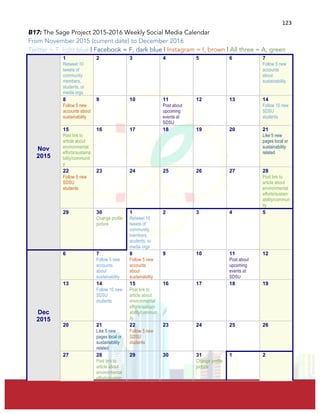
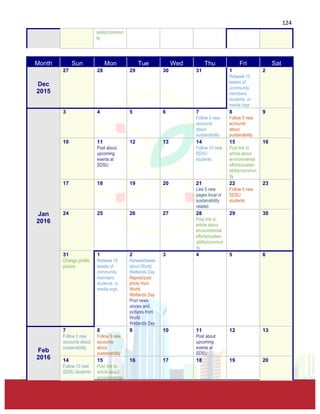
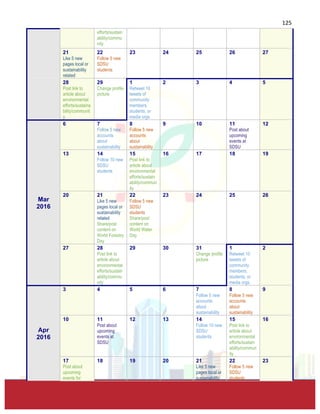
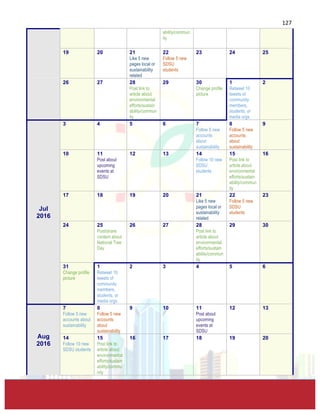
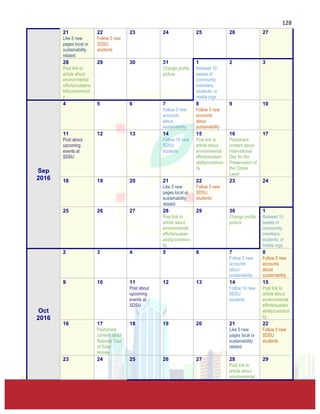
organization, and by following this enclosed social media calendar (See Appendix B17), which
extends all the way to the end of 2016, The Sage Project will benefit and grow.
e. City Proposals
La Jolla
INTRODUCTION
Also known as “The Jewel” in Spanish, La Jolla is one of the most attractive cities in San
Diego to visit. Located less than 15 miles north of Downtown San Diego, La Jolla is a vibrant
coastal community and highly sought after vacation destination due to its beautiful beaches
and wide assortment of upscale restaurants. In addition, the community is a desirable
destination as it is home to various prominent institutions such as Scripps Institution of
Oceanography, University of California, San Diego, the Stephen Birch Aquarium, and the San
Diego Museum of Contemporary Art.
The community is home to about 32,000 residents, and, according to The City of San Diego is
the wealthiest community in San Diego County. We propose The Sage Project partner with La
Jolla because the community is in need of improvements and renovations and can afford The
Sage Project’s services.
The community generates large amounts of money through property taxes and local sales tax
from purchases. For example, the average sale price of a home is $1,200,000, relative to the
average sale price of a home sold in San Diego County, which is $495,000, according to
realtor.com (see Appendix B1). Therefore residents pay larger amounts in property taxes that
can go toward funding projects that benefit their community. In addition, according to
realtor.com, which sourced their information from the 2015 U.S. Census Bureau statistics, the
median household income for La Jolla is $117,084 (see Appendix B2). According to the U.S.
Census Bureau, the median household income in San Diego County is $62, 692 (see
Appendix B2). Because La Jolla households on average earn more relative to San Diego
County residents, they have more disposable income to spend on both essentials and
nonessentials, which generates more money in sales tax. These funds can also go toward
projects to improve the community.


19	
  
In order for The Sage Project to work together with the community of La Jolla it will need to
develop a relationship with its City Council Representatives as they have the authority to
allocate funds to The Sage Project (see Appendix B14).
The community needs new long-term solutions to help protect sea lions residing in the La
Jolla Cove and improve the water quality at La Jolla Shores beach.
COMMUNITY ISSUES
Sea lion fecal stench and water bacteria levels at La Jolla Cove
The La Jolla Cove is home to a small population of sea lions that reside on the neighboring
rocks. Although the animals are a tourist attraction, the odor from their waste has been a
lingering problem for at least the past four years. The community needs a long-term solution
to mitigate the sea lion fecal stench.
According to an article about a La Jolla town meeting Oct. 8, 2015, Phyllis Pfeiffer, the
meeting’s moderator stated with respect to the Cove stench, “it breaks our heart to be asking
this because it’s the same question we asked the candidates running four years ago, and
nothing has changed” (see Appendix B3).
A long-term solution to the sea lion stench is important because the smell deters people from
frequenting the nearby due to the odors intolerableness.
According to an article, resident Jeff Chasan said “I won’t even take clients to restaurants if
they’re on the ocean side of Prospect Street because the smell is unbearable” (see Appendix
B4).
Various efforts have been made by the city including hiring marine mammal expert, Doyle
Hanan of Hanan & Associates to study the sea lions and formulate a solution to mitigate the
stench (see Appendix B4). The report has yet to be completed and released to the public nor
was it mentioned in the Oct. 8 town meeting. Mayor Kevin Faulconer is committing staff and
budget to spray an enzyme to help dissolve the sea lion waste, however, there is no clear sign
this is an effective or long-term solution (see Appendix B3).
Another issue is the water bacteria of the Children’s Pool. According to the San Diego
Coastkeeper, an organization that receives daily water quality reports from the county of San
Diego and the Department of Environmental Health, there is “ongoing contamination from
harbor seals” and people should avoid water contact in the Children’s Pool because the
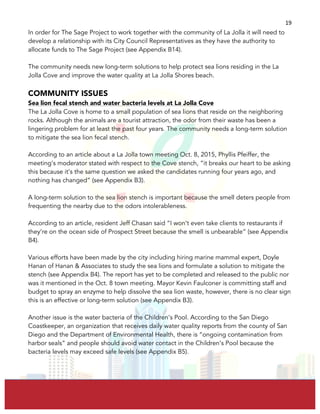
bacteria levels may exceed safe levels (see Appendix B5).


20	
  
(Screen shot from San Diego Coastkeeper, see Appendix B5).
Opportunity for Involvement
We propose that The Sage Project works with the La Jolla community on finding solutions to
mitigate the sea lion fecal stench and improve the water quality of the Children’s Pool. The
Coastal Marine Institute (CMI) at SDSU involves scientists, students and faculty researchers
who study the marine environments around the San Diego and Southern California region and
would be a great partnership for The Sage Project to develop. By The Sage Project
developing a relationship with the CMI they will gain access to the program’s faculty,
professors, students and expertise that can be used to study and solve the La Jolla Cove
stench and Children’s Pool bacteria problem. (For more information/contact information see
Appendix B6.)
The Sage Project will reach out to the following classes as possible candidates to conduct
research about improving the smell and water quality of La Jolla Cove:
• Biology 497: UNDERGRADUATE RESEARCH
o Class Description: Individual research project, supervised by faculty. Research
course with research paper or other presentation of results.
o How this will help the La Jolla Cove: Gives undergraduate students an
opportunity to conduct research on marine life while offering innovative
solutions to the Cove’s problems.
• Biology 540: Conservation Ecology
o Class Description: Human impacts on ecosystems, the resultant endangerment
and extinction of plant and animal species, and strategies for the protection and
recovery of threatened forms.
o How this will help the La Jolla Cove: Give students the opportunity to formulate


21	
  
a long-term plan for residents/tourists and the seals to cohabitate.
o
The Village of La Jolla needs uniform publication racks
According to La Jolla residents, it is time to replace the numerous outdoor newspaper and
magazine racks in the Village. They are unsightly and unpopular, and it would be in the best
interest of The Sage Project to target these racks and present an alternative solution because
these are the facts:
(See Appendix B7)
• The current racks are unattractive and do nothing to enhance the Village’s appeal.
• Most racks are not permanently mounted.
• There is no standardization in their appearance; racks vary in size, color, materials
and location.
• Most are in poor condition with broken doors, missing/broken windows and
battered/broken containers.
• There is not enough accountability/enforcement of maintaining the racks’
appearance.
The solution to this problem will not be completed by the collaboration of The Sage Project
and any ONE class.
• CP 630: Seminar in Urban Planning Implementation.
o Class Description: Analysis of the content and function of zoning, subdivision
regulation, codes, capital budgeting, urban renewal, model cities, and other
implementation methods and programs.
o How will this help Imperial Beach: This class discusses different implementation
methods concerning urban planning. The professor could have students come
up with plans to place, budget and install a replacement method of publication
racks that are more suitable to the La Jolla community, and do so in a way that is
current with regulations and also attractive.
• GEOG 370: Environmental and Natural Resource Conservation
o Class Description: Scientific understanding of human-environment systems;
sustainable management of natural resources under changing global conditions;
role of science in addressing environmental issues and development of
environmental and conservation policy.
o How will this help Imperial Beach: Have the students collaborate with other
courses in designing a sustainable replacement for the publication racks using
environmentally conscious methods and materials.


22	
  
Inadequate parks for local residents and visitors
Through the social medial and online communities, residents from Jolla have been expressed
their discomfort of the condition of park amenities at Kellogg Park. This park is a family-
friendly park located in La Jolla Shores. Restrooms and showers that are located at the
playground and picnic area need attention. The city has earmarked $950,000 for the Cove
restroom pavilion as part of its 2016 budget. However, a timeline has not been specifically set
for when this facility will be built. (see Appendix B8).
Screen shot by: Vivienne Troung, Copyright 2015


23	
  
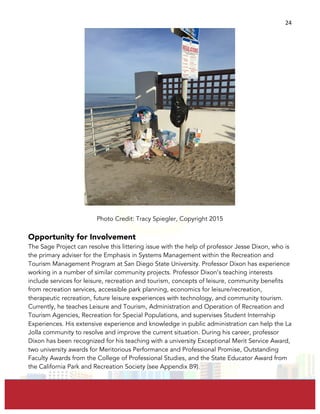
The current level of trash pickup is insufficient, especially considering the high-traffic during
the weekends and holidays. San Diego Police Lt. Scott Wahl addressed the La Jolla Shores
Association and said that residents are concerned about “the excessive use of barbecues; off-
leash dogs; people smoking cigarettes and marijuana; empty alcohol containers; overflowing
trashcans; a “crack pipe” left on a park bench; motorists stopping in a “no stopping anytime”
zone to load beach gear instead of using the designated loading zone in the parking lot; and
homeless people sleeping in the park. (See appendix B8).
Photo Credit: Caroline Chamales, Copyright 2014


24	
  
Photo Credit: Tracy Spiegler, Copyright 2015
Opportunity for Involvement
The Sage Project can resolve this littering issue with the help of professor Jesse Dixon, who is
the primary adviser for the Emphasis in Systems Management within the Recreation and
Tourism Management Program at San Diego State University. Professor Dixon has experience
working in a number of similar community projects. Professor Dixon’s teaching interests
include services for leisure, recreation and tourism, concepts of leisure, community benefits
from recreation services, accessible park planning, economics for leisure/recreation,
therapeutic recreation, future leisure experiences with technology, and community tourism.
Currently, he teaches Leisure and Tourism, Administration and Operation of Recreation and
Tourism Agencies, Recreation for Special Populations, and supervises Student Internship
Experiences. His extensive experience and knowledge in public administration can help the La
Jolla community to resolve and improve the current situation. During his career, professor
Dixon has been recognized for his teaching with a university Exceptional Merit Service Award,
two university awards for Meritorious Performance and Professional Promise, Outstanding
Faculty Awards from the College of Professional Studies, and the State Educator Award from
the California Park and Recreation Society (see Appendix B9).


25	
  
Imperial Beach
INTRODUCTION
Located close to the Mexican border, Imperial Beach is known as the most southern beach in
California. Imperial Beach’s motto is “Classic Southern California” and nationwide it is known
as the “Most Southwesterly City.” It is also the location of a U.S. Navy Facility, the Naval
Outlying Landing Field Imperial Beach, an outdoor surfboard museum, and more (Appendix
B10).
As written on their website, the city of Imperial Beach’s mission statement is “to maintain and
enhance Imperial Beach as "Classic Southern California"; a beach-oriented community with a
safe, small town, family atmosphere, rich in natural and cultural resources. (Appendix B10).
However, locals and neighboring community members commonly use the slogan “I.B. is OK,”
which shows that the “classic southern California” brand and vision still needs further
development. Through multiple projects, The Sage Project will rebrand Imperial Beach as a
beautiful coastal area instead of a city that is just considered “OK.” IB should not only equate
to Imperial Beach, but to “incredibly beautiful” as well instead of being an average city.
As of 2014, the U.S. Census Bureau reports the population of Imperial Beach as 27,149
(Appendix B11). According to realtor.com, the annual household income of Imperial Beach
residents is $57,795, 6 percent lower than that of San Diego County as a whole. (Appendix
B12).
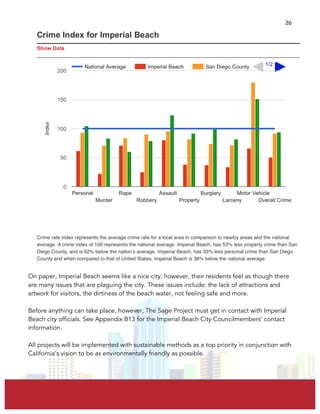
In addition, realtor.com also reports that crime rates in Imperial Beach are lower than national
averages and San Diego County as a whole. This can be seen in the chart on the following
page taken off realtor.com.


26	
  
On paper, Imperial Beach seems like a nice city; however, their residents feel as though there
are many issues that are plaguing the city. These issues include: the lack of attractions and
artwork for visitors, the dirtiness of the beach water, not feeling safe and more.
Before anything can take place, however, The Sage Project must get in contact with Imperial
Beach city officials. See Appendix B13 for the Imperial Beach City Councilmembers’ contact
information.
All projects will be implemented with sustainable methods as a top priority in conjunction with
California’s vision to be as environmentally friendly as possible.


27	
  
COMMUNITY ISSUES
Through research on the Imperial Beach community, we have accumulated information on the
issues and areas in which they could improve. Featured below are comments made from IB
residents and visitors that were found through Yelp, Facebook and other social media
platforms.
These comments include:
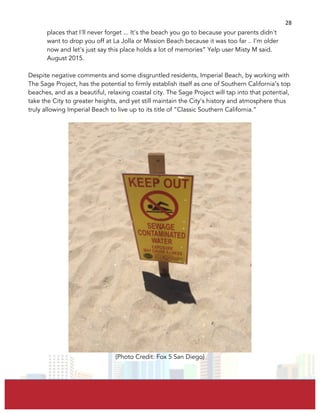
“IB is NOT ok...It wouldn't be a stretch to say that Imperial Beach is one of the worst
looking beach cities in California. They don't want to improve, develop, clean things
up. This beach is often closed after rain storms due to sewage-contaminated water
from the Tijuana river overflowing” Yelp user Marcus F. said. September 2015.
“I parked in front of the Police Department and my car was still broken into” Yelp user
Linda F. said. July 2015.
“Area around there seemed a bit sketchy, especially at night, when all the shady
people come out. That's probably the main (and only) downside of this beach” Yelp
user Jen N said. September 2015.
“It's polluted by sewage runoff from MX's neighboring Tijuana River - gracias, amigos!
- MUCH more often than it should be, especially after rainfall. I don't mind the sketchy
'hood and people too much, but this beach is simply DIRTY!” Yelp user Mike G. said.
Sept. 10 2015.
The city has discussed redesigning Imperial Beach’s pier. The idea of a total redesign,
however, is facing opposition from residents. The residents see the iconic restaurant “Tin
Fish” as a symbol of their city and a historical landmark unique to their community.
Despite the problems the city faces, residents and tourists of Imperial Beach still appreciate
their city. Some things worth noting is the interest that locals and visitors have taken in the
artwork around Imperial Beach, the pride they show in Imperial Beach’s laid-back atmosphere,
and the city’s role in forming great memories for all who have stepped foot on its beaches
and streets.
“At Pier Plaza there is also a beautiful cast bronze sculpture by artist Wyland called
"Ocean Riders-"which depicts 3 dolphins leaping from the waves. That is so
appropriate, because I always see dolphins frolicking offshore whenever I visit this pier”
Yelp user Gail P. said. February 2009.
“As a native to this part of San Diego, Imperial Beach will always be one of those


28	
  
places that I'll never forget ... It's the beach you go to because your parents didn't
want to drop you off at La Jolla or Mission Beach because it was too far .. I'm older
now and let's just say this place holds a lot of memories” Yelp user Misty M said.
August 2015.
Despite negative comments and some disgruntled residents, Imperial Beach, by working with
The Sage Project, has the potential to firmly establish itself as one of Southern California’s top
beaches, and as a beautiful, relaxing coastal city. The Sage Project will tap into that potential,
take the City to greater heights, and yet still maintain the City’s history and atmosphere thus
truly allowing Imperial Beach to live up to its title of “Classic Southern California.”
(Photo Credit: Fox 5 San Diego)


29	
  
(Photo Credit: City of Imperial Beach, for educational use only)
Imperial Beach Evaluation
The Sage Project allows hands-on opportunities for students to plan and strategically evaluate
community issues. Cities will collaborate with The Sage Project to determine the best
solutions for its problems. We have gathered prospective projects that The Sage Project can
take on. Through these projects, our goal is to rebrand Imperial Beach as a city with timeless
appeal that is more than just “OK.” We hope that an upgraded, renovated and transformed
Imperial Beach will attract more visitors and satisfy current residents.
Imperial Beach Culture and Atmosphere
Project Statement
Review and analyze current status of city amenities and landmarks. Evaluate potential areas
that can further be cultivated to demonstrate the “Classic Southern California” vibe of
Imperial Beach. Rebrand Imperial Beach as a clean, safe area and alter current perceptions
toward the city to more favorable views.


30	
  
Proposed Tasks and Student Resources Used to Fulfill Them
1. Artwork around Imperial Beach
Many have praised artworks like the various sculptures around the city. We feel like more
artwork can be installed throughout the city to further demonstrate Imperial Beach’s “Classic
Southern California” motto. Artwork that already exists may also be brushed up for a more
modern feel. The Sage Project will reach out to the following classes to see if they will be
interested in designing new art pieces or developing plans to improve Imperial Beach’s
current art displays:
o Art 445C: Senior Portfolio with professor Benzel
§ Class description: Planning, strategy, and development of a
comprehensive body of design work to be professionally presented in a
portfolio and/or exhibition format.
§ How this will help Imperial Beach: Students can either create designs for a
temporary art exhibit to be showcased somewhere in Imperial Beach or
develop ideas of artwork that could be implemented in the City. Some of
the artwork can also honor veterans as Imperial Beach is home to a Navy
facility.
o Art 516: Sculpture III with professor Keely
§ Class description: Advanced level investigations into sculptural ideas,
processes and materials.
§ How this will help Imperial Beach: Similar to Art 445C, students will be
given the opportunity to come up with sculpture ideas and even
implement them in Imperial Beach.
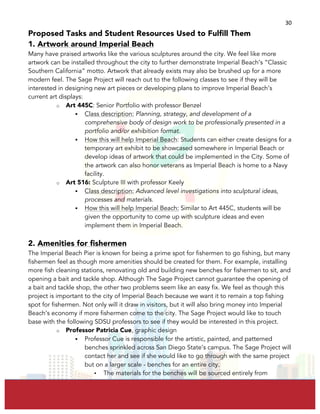
2. Amenities for fishermen
The Imperial Beach Pier is known for being a prime spot for fishermen to go fishing, but many
fishermen feel as though more amenities should be created for them. For example, installing
more fish cleaning stations, renovating old and building new benches for fishermen to sit, and
opening a bait and tackle shop. Although The Sage Project cannot guarantee the opening of
a bait and tackle shop, the other two problems seem like an easy fix. We feel as though this
project is important to the city of Imperial Beach because we want it to remain a top fishing
spot for fishermen. Not only will it draw in visitors, but it will also bring money into Imperial
Beach’s economy if more fishermen come to the city. The Sage Project would like to touch
base with the following SDSU professors to see if they would be interested in this project.
o Professor Patricia Cue, graphic design
§ Professor Cue is responsible for the artistic, painted, and patterned
benches sprinkled across San Diego State’s campus. The Sage Project will
contact her and see if she would like to go through with the same project
but on a larger scale - benches for an entire city.
• The materials for the benches will be sourced entirely from


31	
  
recycled materials from San Diego’s recycling center, and will be
painted by San Diego State students in a mural-like fashion that
highlights Imperial Beach’s culture and community.
• Examples of these benches can be found at
sdsuartbench.blogspot.com and can also be seen in the picture
below:
(Photo credit: sdsuartbench.blogspot.com)
o The Master of City Planning Program
§ Program description: The MCP Program is designed to provide the
students with the generalized skills and experience necessary to approach
creatively and professionally the process and problems of urban and
regional planning.
§ How it will help Imperial Beach: The courses in this program will help
develop plans on where and how to make the fish cleaning stations
around Imperial Beach.
3. Eradicate beliefs that Imperial Beach is unsafe
Another complaint that the city of Imperial Beach faces is the perception and stigma that the
city is unsafe. The Sage Project would like to further brand IB as a safe place to be. As said
earlier in our introduction to this city, it is a fairly safe place with crime rates below the
national average. The program would like to reach out to the following SDSU courses to see if
they would be interested in developing a campaign promoting IB as a relatively safe city
compared to the entire nation:


32	
  
o MIS 797 and MIS 798: Research and Special Study respectively with Dr. Easton
§ Class description: Research in the area of management information
systems.
§ How this will help Imperial Beach: The Sage Project has worked with Dr.
Shin’s MIS 797 and MIS 798 courses in the past to redevelop National
City’s police department website. Currently, Imperial Beach’s police
department website looks outdated and tacky. With a revamped website,
residents should hopefully find a more streamlined approach to get their
problems heard and processed. Since Dr. Shin is not teaching the course
next semester, we hope that Dr. Shin will speak with Dr. Easton about
continuing a working relationship with The Sage Project.
o PA 497: Investigation and Report with professor Abdel-Samad, professor Rea or
professor Caves.
§ Class description: Analysis of special topics.
§ How this will help Imperial Beach: Like MIS 797 and 798, The Sage
Project has worked with PA 497 in the past when Dr. Chanin taught it.
The class worked to examine police leadership in National City and
“evaluate organizational values, transparency and oversight.” By bringing
this to Imperial Beach, we hope that students will help find errors in
police conduct, values, or leadership and bring them to light so that the
city may actively work toward fixing it.
o JMS 480: Principles of Public Relations with Dr. Sweetser
§ Class description: Concepts, history, theory, social responsibility, ethics,
and management of public relations. Public relations strategic planning
process. Survey of problems and practices in corporations, government
and politics, health care, education, associations, and not-for-profit
organizations.
§ How this will help Imperial Beach: Each semester, Dr. Sweetser assigns a
semester-long project aimed toward creating a public relations campaign
for a real-life client. In future semesters, Dr. Sweetser may have her
students work on creating a PR campaign promoting how safe Imperial
Beach actually is so that Imperial Beach may draw in more tourists as well
as develop a more trusting relationship between Imperial Beach’s
residents and the city’s government.
• It is in the best interest of Imperial Beach and its residents that the installment of two or
three ‘Blue Light’ safety phones to keep the beach areas safe from crime and other
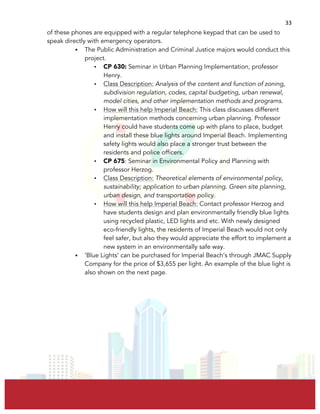
kinds of emergencies. The ‘Blue Light’ telephone networks are smaller than pay
phones, and easily identified at night and from a distance by bright blue lights. In case
of an emergency, one needs only to press the red button to alert the local police. Most


33	
  
of these phones are equipped with a regular telephone keypad that can be used to
speak directly with emergency operators.
§ The Public Administration and Criminal Justice majors would conduct this
project.
• CP 630: Seminar in Urban Planning Implementation, professor
Henry.
• Class Description: Analysis of the content and function of zoning,
subdivision regulation, codes, capital budgeting, urban renewal,
model cities, and other implementation methods and programs.
• How will this help Imperial Beach: This class discusses different
implementation methods concerning urban planning. Professor
Henry could have students come up with plans to place, budget
and install these blue lights around Imperial Beach. Implementing
safety lights would also place a stronger trust between the
residents and police officers.
• CP 675: Seminar in Environmental Policy and Planning with
professor Herzog.
• Class Description: Theoretical elements of environmental policy,
sustainability; application to urban planning. Green site planning,
urban design, and transportation policy.
• How will this help Imperial Beach: Contact professor Herzog and
have students design and plan environmentally friendly blue lights
using recycled plastic, LED lights and etc. With newly designed
eco-friendly lights, the residents of Imperial Beach would not only
feel safer, but also they would appreciate the effort to implement a
new system in an environmentally safe way.
§ ‘Blue Lights’ can be purchased for Imperial Beach’s through JMAC Supply
Company for the price of $3,655 per light. An example of the blue light is
also shown on the next page.


34	
  
(Photo credit: CSU Chico)
Resources
• Participating faculty and students from San Diego State University
• City of Imperial Beach
• San Diego County Sheriff’s Office - Imperial Beach
• Unified Port of San Diego


35	
  
Key Issues to Consider
• Previous engagement from San Diego State University staff and students has been
made in implementing measures to water quality enhancement and awareness.
• Re-evaluate previous tactics and measuring its current effects is essential and will need
to be examined in order to better understand where future engagement may need to
occur.
Imperial Beach Water Quality Enhancement
Project Statement
Review and analyze potential underdeveloped sites for water quality enhancement projects.
Study potential sites for stormwater treatment methods and evaluation of water quality
around Imperial Beach. View current awareness measures being implemented and find
potential areas of reevaluation.
Proposed Tasks and Student Resources Used to Fulfill Them
• Evaluate the Tijuana River’s impact of sewage, chemical and pollutants being discarded
into city’s beaches and work with Tijuana in analyzing key issues (see appendix B15).
o Political Science majors may be involved in evaluating the impact of Tijuana
River on Imperial Beach.
§ POL S 482: International Relations of the Latin American States
§ Class Description: Foreign policies of Latin American states; the
Organization of American States; relationships with the United Nations
and the United States.
§ How will this help Imperial Beach: Contact professor Kristen Hill Maher,
who has background in San Diego-Tijuana relations and evaluate border
relations can be used to identify possible solutions to Tijuana River impact
on IB beaches.
• Cross-analyze previous report cases of Hepatitis A from previous San Diego State
University faculty and students work and re-evaluate water quality and safety for
citizens.
o Public Health majors may establish and evaluate current measures being
initiated. Previous collaborations and attempts have been made and further
examination of continued strategies may need to be researched to see if
changes have occurred.
§ PH 639: Water Quality Investigation
§ Class Description: Human health problems associated with water usage
and with various aquatic environments.
§ How will this help Imperial Beach: Contact L. Wiborg. Engage students in


36	
  
water quality investigation, to determine health problems associated with
water usage and various aquatic environments.
§ Spring 2016 - Contact E. Hoh and have students study the environmental
hazards in areas of food protection, vector control, solid waste and
community issues.
• Collaborate with the County Department of Environmental Health on studies and
treatments of potential hazardous zones.
o Engage Public Health and Geography students in analyzing and creating
effective measures of awareness and treatment of potential health hazards
caused by water quality. There is currently many forms of communication being
displayed in the IB community, including beach signs indicating hazard zones
and media. The following courses may be able to evaluate the current tactics
being initiated and see if any further changes can occur.
§ PH 304: Environment and Public Health
§ Class Description: Environmental hazards of living and working in both
industrialized and lesser developed societies. Chemical, biological, and
physical agents in food, air, water, and soil.
§ How will this help Imperial Beach: Students can examine environmental
hazards by observing and analysing factors contributing to poor water
quality in Imperial Beach.
§ PH 402: Public Health Communications
§ Class Description: Effective communication techniques used in public
health campaigns, social marketing, and risk communication. Use of
technology to design and conduct public health campaigns which focus
on recognizing and overcoming communication barriers, including cross-
cultural issues.
§ How will this help Imperial Beach: Revising and establishing new methods
of communication to the public's can be designed by students. Analysis
of current tactics may need research to see what approaches are enacted
presently.
• Survey Imperial Beach surfers and target areas impacted at a greater capacity.
o Public Health and Geography students and evaluate areas that need attention
and examination of potential hazard zones. Within these disciplines, surveying
and analyzing data from citizens perspective can be essential in evaluating what
the people find as the most impact in their community. Possible courses that
may influence study in this area include:
§ GEOG 101: Earth’s Physical Environment
§ Class Description: Earth systems and the global environment to include
weather and climate, water, landforms, soils, and ecosystems. Distribution
of physical features on Earth’s surface and interactions between humans


37	
  
and environment, especially those involving global change.
§ How will this help Imperial Beach: Have the students study the coastal
environment including the climate, water, landforms, soils and
ecosystems. Notate the distributions of physical features on the Earth’s
surface and the interactions between humans and the environment;
especially with the involvement of change.
§ GEOG 102: People, Places, and Environment
§ Class Description: Introduction to human geography. Global and local
issues to include culture, development, migration, urbanization,
population growth, identity, globalization, geopolitics, and environmental
change. Field trips may be arranged.
§ How will this help Imperial Beach: Have students discover change in
environment, population growth, geopolitics, urbanization and
development.
§ GEOG 496: Environment and Development
§ Class Description: Geographic analysis of environmental and social issues
in the global south. How colonialism, development, and globalization
have shaped equity and sustainability issues and access to resources,
environmental health, migration, and poverty around the world. Field
trips may be arranged.
§ How will this help Imperial Beach: Have the students conduct research on
coastal resource management as well as the consequences and benefits
of human interactions with oceans and coastal ecosystems.
• Examine possible ecological and wildlife impacts of poor water quality measures.
o Geography students may be involved in studying the nature and geography of
Imperial Beach and the ideal conditions of safe zones for its citizens and wildlife.
The following are several courses that can be applied to the case.
§ ENV- Engineering 441: Water Treatment Engineering
§ Class Description: Basic water chemistry; water quality criteria and
standards; residential, industrial and commercial water usage; principles
of physical and chemical processes employed in water treatment; design
of selected water treatment units; new and emerging water treatment
technologies; and water distribution systems.
§ How will this help Imperial Beach: Contact professor T. Smith and have
students test basic water chemistry, establish water quality criteria and
standards, and create new and emerging water technologies within the
city’s water distribution systems, etc
§ GEOG 370: Environmental and Natural Resource Conservation
§ Class Description: Scientific understanding of human-environment
systems; sustainable management of natural resources under changing


38	
  
global conditions; role of science in addressing environmental issues and
development of environmental and conservation policy.
§ How will this help Imperial Beach: Have the students create sustainable
management of the natural resources under the changing condition and
address the environmental issues and development of environmental and
conservation policy.
Resources
• Participating faculty and students from San Diego State University
• County of Department of Environmental Health
• City of Imperial Beach
Key Issues to Consider
• Previous engagement from San Diego State University staff and students has been
made in implementing measures to water quality enhancement and awareness.
• Re-evaluate previous tactics and measuring its current effects is essential and will need
to be examined in order to better understand where future engagement may need to
occur.
CONCLUSION
Through the projects listed above, our team hopes to accomplish four things: 1) to solve the
fixable issues that are currently plaguing Imperial Beach, 2) to have the city of Imperial Beach
become a top tourist destination in Southern California, 3) to have the residents of Imperial
Beach develop a stronger sense of pride and affection for their community, and 4) to engage
San Diego State students in real-world problems and provide them with the opportunity to
find the solutions.


39	
  
Section V: Evaluations and
Recommendations


40	
  
Evaluation
Objective #1: OUTCOME TO BE DETERMINED
To establish a partnership with La Jolla local government by January 2016 and
undertake at least two community projects.
This objective will be met if, after Dr. Barlow attends the La Jolla Town Council meeting Jan.
14 and the SunSetter Mixer Jan. 21 to meet council representatives and community
influencers, she generates interest in The Sage Project and a partnership on at least two
community projects.
Objective #2: OUTCOME TO BE DETERMINED
To establish a partnership with the city of Imperial Beach by January 2016 and
undertake at least two community projects.
This objective will be met if, after Dr. Barlow attends the Imperial Beach City Council
meetings Jan. 6 and/or Jan. 20 to meet council representatives and community influencers,
she generates interest in The Sage Project and a partnership on at least two community
projects.
Objective #3: OUTCOME TO BE DETERMINED
To increase knowledge of community issues by 20 percent among target cities.
This objective will be met if The Sage Project creates one media report per month on target
cities and the top opportunities for The Sage Project based on information collected through
Internet searches, comments and reviews posted on social media, surveys on issues facing
target cities and community issues garnered from residents crowdsourcing their concerns via
Twitter and Facebook.
Objective #4: OUTCOME TO BE DETERMINED
To maintain a close relationship with target communities, SDSU faculty and students to
enhance their engagement by 20 percent by February 2016.
This objective will be met if The Sage Project conducts a pre-survey of target cities, SDSU
faculty and students before implementing their strategic social media calendar. The Sage
Project should then conduct an additional survey by the last day of February 2016 to evaluate
whether engagement with The Sage Project and target cities, SDSU faculty and students has
increased by 20 percent.
Objective #5: OUTCOME TO BE DETERMINED
To establish and expand the business network for The Sage Project on Twitter,
Instagram, Facebook, and LinkedIn by 20 percent by January 2016.
This objective will be met if The Sage Project’s business network increases by 20 percent
through assessing increases in followers and friends on various social media platforms such as
Facebook and connections on LinkedIn.


41	
  
Recommendations
Implementing all of the presented tactics might not be an attainable goal. Out of all the
presented tactics, Summit PR strongly recommends eliminating the focus on working with one
city per year and start compiling monthly media reports that identify community issues. These
focal points are projected to have the biggest impact on The Sage Project and the response
to it.
Eliminating the “One City, One Year” Model
The Sage Project needs to build its résumé and rapport with San Diego communities and their
officials. By focusing on only one city per year, The Sage Project does not allow itself to grow,
take on different opportunities, or help other communities in need. The Sage Project needs to
establish itself as a credible, quality program by working on projects with various cities
throughout the year. This will spread The Sage Project’s name and mission around San Diego
County, especially within city governments. By having a bigger portfolio of projects, The Sage
Project will also show how versatile its program is and that will also attract potential projects in
the future.
As a starting point, there are two proposed cities that The Sage Project should further look
into: La Jolla and Imperial Beach. La Jolla is an affluent city and Imperial Beach is a city that
has a greater need for the services The Sage Project can offer. By working with La Jolla, The
Sage Project demonstrates that any city - even wealthy cities - can have problems that The
Sage Project can address and resolve. Since La Jolla is affluent, the budget for The Sage
Project’s projects is more elastic which will result in more opportunities for The Sage Project’s
assistance. With Imperial Beach, The Sage Project stays close to its roots of helping less
affluent communities.
After extensive research, it was found that both La Jolla and Imperial Beach were plagued
with fixable problems. It is recommended that Dr. Barlow and The Sage Project team
approach the government officials of La Jolla and Imperial Beach about a potential
partnership with The Sage Project. After building their reputation through the multiple
programs, it is projected that other communities for help approach The Sage Project in the
future instead of the program initiating the first contact with cities.
Creating Monthly Media Reports
When The Sage Project reaches out to cities, they should supplement their proposals with
monthly media reports. These media reports will gather information on the public’s opinions
and complaints about certain community issues. For example, The Sage Project can gather
public input on wanting a bike lane from tweets, Facebook posts and more. Utilizing that
information, The Sage Project can pinpoint exactly what a community needs and can present


42	
  
their findings to city officials in an organized manner through the media reports. City officials
can find importance in these reports as they help increase the transparency between the
government and its people. Media research classes at San Diego State can conduct the
media reports.
Since the reports will be consistently sent out every month, it will further show city officials
that The Sage Project is a dependable, respectable and legitimate program.
If The Sage Project’s city proposals are approved, media reports may assist the program
further. The reports can be used as an evaluation tool to assess the progress of community
projects and gauge the community’s reactions toward the projects while they are in progress
and after they are completed.


43	
  
Section VI: Budget


44	
  
Budget
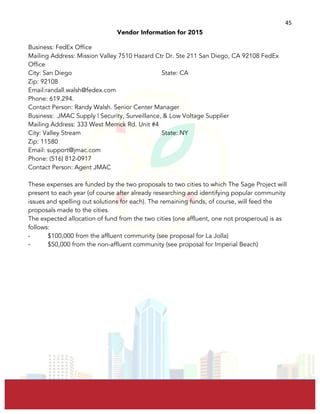
The Sage Project currently operates on a one city, one year basis. Therefore, the yearly
budget has fluctuated in the past depending on the success of its ability to form partnerships
with cities and ability to receive grant money from San Diego State University. This proposal
for improving The Sage Project includes a restructuring of the method and approach taken to
link with cities, and therefore the budget too will be altered. Without knowing the exact
specifications that will result from this new means that The Sage Project forms partnerships,
we offer this sample yearly budget, breaking down the distribution of funds in a way that
would best serve The Sage Project and its collaborators.
Cost breakdown:


45	
  
Vendor Information for 2015
Business: FedEx Office
Mailing Address: Mission Valley 7510 Hazard Ctr Dr. Ste 211 San Diego, CA 92108 FedEx
Office
City: San Diego State: CA
Zip: 92108
Email:randall.walsh@fedex.com
Phone: 619.294.
Contact Person: Randy Walsh. Senior Center Manager
Business: JMAC Supply | Security, Surveillance, & Low Voltage Supplier
Mailing Address: 333 West Merrick Rd. Unit #4
City: Valley Stream State: NY
Zip: 11580
Email: support@jmac.com
Phone: (516) 812-0917
Contact Person: Agent JMAC
These expenses are funded by the two proposals to two cities to which The Sage Project will
present to each year (of course after already researching and identifying popular community
issues and spelling out solutions for each). The remaining funds, of course, will feed the
proposals made to the cities.
The expected allocation of fund from the two cities (one affluent, one not prosperous) is as
follows:
- $100,000 from the affluent community (see proposal for La Jolla)
- $50,000 from the non-affluent community (see proposal for Imperial Beach)


46	
  
2015 VENDOR Information
The Sage Project
Business: FedEx Office
Mailing Address: Mission Valley 7510 Hazard Ctr Dr. Ste 211 San Diego, CA 92108 FedEx
Office
City: San Diego State: CA
Zip: 92108
Email:randall.walsh@fedex.com
Phone: 619.294.
Contact Person: Randy Walsh. Senior Center Manager
Business: JMAC Supply | Security, Surveillance, & Low Voltage Supplier
Mailing Address: 333 West Merrick Rd. Unit #4
City: Valley Stream State: NY
Zip: 11580
Email: support@jmac.com
Phone: (516) 812-0917
Contact Person: Agent JMAC


47	
  
RULES OF THE MARKET
1. We are a Farmers’ Market; therefore farm products are primary sales. Some craft or
bakery type items will be allowed.
2. All vendors are responsible for liability insurance and compliance with any and all
requirements of State of Delaware.
3. Any scale used for determining price will display a current legal inspection sticker.
4. All products will be displayed in a clean and safe manner.
5. Vendors are responsible for leaving a clean area at closing.
6. All vendors shall exhibit professional manners always.
7. Tables and canopies are available at the market.
8. Spaces shall be assigned by the Market Chairperson.
9. Applicable fees shall be paid each market day.
10.Collected fees go towards advertising, equipment, maintenance, and other items as
decided upon by the Farmers’ Market Committee.
I/WE agree to abide by all market rules.
Please print name_______________________________
Date__________________________________________
Signature______________________________________
Please return completed application to:
Downtown Milford, Inc.
7 S. Washington Street
Milford, DE 19963
302-839-1180
Please List Items for Sale


48	
  
RULES OF THE MARKET
11. We are a Farmers’ Market; therefore farm products are primary sales. Some handmade
craft or bakery type items will be allowed.
12. All vendors are responsible for liability insurance and compliance with any and all
requirements of State of Delaware.
13. Any scale used for determining price will display a current legal inspection sticker.
14. All products will be displayed in a clean and safe manner.
15. Vendors are responsible for leaving a clean area at closing.
16. All vendors shall exhibit professional manners always.
17. Tables and canopies are available at the market.
18. Spaces shall be assigned by the Market Chairperson.
19. Applicable fees shall be paid each market day.
20. Collected fees go towards advertising, equipment, maintenance, and other items as
decided upon by the Farmers’ Market Committee.
I/WE agree to abide by all market rules.
Please print
Name_______________________________Date________________________Signature_________
_____________________________
Please return completed application to:
Downtown Milford, Inc.
7 S. Washington Street
Milford, DE 19963
302-839-1180
TIMESHEETS
The timesheet on the following page is a complete breakdown of the hours dedicated
to this proposal for The Sage Project. The process has been broken down into the following
categories: research (91.5 hours), planning (103 hours), implementation (166.75 hours), and
evaluation (131.21 hours). These billable hours represent the costs that would be associated
with employing the services of Summit Public Relations. By the hour, our employees charge a
flat rate of $80.00 per hour. However, after 200 billable hours the client will receive a discount
of 10 percent, and a discount of 20 percent after 300 billable hours.


49	
  
RPIE Process Colin Sanchez RPIE Process Oscar Sanchez
Day of Week: Time In Time Out Total Hrs Day of Week: Time In Time Out Total Hrs
Research Research
Tue 9/29 8:00 AM 9:15 AM 1.25 Tue 9/29 8:00 AM 9:15 AM 1.25
Thu 10/08 8:00 AM 9:15 AM 1.25 Thu 10/08 8:00 AM 9:15 AM 1.25
Sun 10/11 8:30 PM 10:00 PM 1.50 Sun 10/11 8:30 PM 10:00 PM 1.50
Wed 10/14 7:00 PM 11:45 PM 4.75 Wed 10/14 7:00 PM 11:45 PM 4.75
Research Total: 8.75 Research Total: 8.75
Planning Planning
Day of Week: Time In Time Out Total Hrs Day of Week: Time In Time Out Total Hrs
Thu 10/22 8:00 AM 9:15 AM 1.25 Thu 10/22 8:00 AM 9:15 AM 1.25
Fri 10/23 3:15 PM 5:00 PM 1.75 Tue 11/3 5:00 PM 9:00 PM 3.00
Tue 10/27 9:30 AM 11:00 AM 1.50 Thu 11/12 9:00 PM 12:00 AM 3.00
Tue 11/03 3:30 PM 5:30 PM 2.00 Sat 11/14 8:00 AM 11:00 AM 3.00
Tue 11/10 8:00 AM 9:15 AM 1.25 Planning Total: 10.25
Thur 11/12 9:30 PM 11:45 PM 2.25
Planning Total: 10.00
Implementation Implementation
Mon 11/17 4:00 PM 6:30 PM 2.50 Tue 11/10 8:00 AM 9:15 AM 1.25
Thur 11/19 9:00 AM 11:00 AM 2.00 Tue 11/11 5:00 PM 8:30 PM 3.50
Sat 11/21 1:00 PM 5:00 PM 4.00 Mon 11/16 6:00 PM 11:00 PM 5.00
Sun 11/22 5:30 PM 11:45 PM 6.25 Wed 11/18 11:30 AM 1:30 PM 2.00
Mon 11/23 10:00 AM 1:00 PM 3.00
Implementation Total: 17.75 Implementation Total: 11.75
Evaluation Evaluation
Tue 11/24 8:00 AM 9:15 AM 1.25 Tue 11/24 8:00 AM 9:15 AM 1.25
Wed 11/25 12:30 PM 5:00 PM 4.50 Wed 11/25 2:30 PM 4:30 PM 2.00
Fri 11/27 3:00 PM 8:00 PM 5.00 Sat 11/28 1:00 PM 9:00 PM 8.00
Sat 11/28 5:00 PM 9:00 PM 4.00 Sun 11/29 8:00 PM 12:00 AM 4.00
Evaluation Total: 14.75 Mon 11/30 12:00 PM 5:00 PM 5.00
Evaluation Total: 20.25
Total Billable Hours: 51.25 Total Billable Hours: 51.00


50	


RPIE Process Allison Bawden RPIE Process Hallie Hoffmann
Day of Week: Time In Time Out Total Hrs Day of Week: Time In Time Out Total Hrs
Research Research
Tue 9/29 8:00 AM 9:15 AM 1.25 Tue 9/29 8:00 AM 9:15 AM 1.25
Thu 10/08 8:00 AM 9:15 AM 1.25 Thu 10/08 8:00 AM 9:15 AM 1.25
Sun 10/11 8:30 PM 10:00 PM 1.50 Sun 10/11 8:30 PM 10:00 PM 1.50
Wed 10/14 7:00 PM 11:45 PM 4.75 Wed 10/14 7:00 PM 11:45 PM 4.75
Research Total: 8.75 Research Total: 8.75
Planning Planning
Day of Week: Time In Time Out Total Hrs Day of Week: Time In Time Out Total Hrs
Wed 10/07 6:15 PM 7:30 PM 1.25 Thu 10/22 8:00 AM 9:15 AM 1.25
Fri 10/09 3:00 PM 4:30 PM 1.5 10/23/2015 8:00 AM 12:00 PM 4.00
Tue 10/13 2:00 PM 4:00 PM 2.00 10/27/2015 10:45
AM
3:00 PM 4.25
Wed 10/14 4:00 PM 7:00 PM 3.00 10/30/2015 10:00
AM
2:00 PM 4.00
Thu 10/22 8:00 AM 9:15 AM 1.25
Tue 10/27 4:00 PM 4:30 PM 0.50
Tue 11/03 1:00 PM 6:00 PM 5.00 Planning Total: 13.50
Sat 11/07 7:00 PM 9:30 PM 2.50 Implementation
Planning Total: 17.00 11/10/2015 8:00 AM 9:15 AM 1.25
Implementation 11/12/2015 9:30 AM 12:00 PM 2.50
Tue 11/10 8:00 AM 11:00 AM 3.00 11/17/2015 4:00 PM 8:00 PM 4.00
Mon 11/16 6:00 PM 11:00 PM 5.50 11/18/2015 11:30
AM
1:00 PM 1.50
Thu 11/19 4:00 PM 8:00 AM 4.00 11/28/2015 1:00 PM 11:00 PM 10.00
Sun 11/21 11:00
AM
2:00 PM 3.50 11/29/2015 6:00 PM 1:00 AM 7.00
Implementation Total: 16.00 Implementation Total: 26.25
Evaluation Evaluation
Tue 11/24 8:00 AM 9:15 AM 1.25 11/24/2015 8:00 AM 9:15 AM 1.25
Wed 11/25 12:30
PM
5:00 PM 4.50 11/25/2015 1:00 PM 7:00 PM 6.00
Fri 11/27 3:00 PM 5:00 PM 2.00 11/30/2015 6:00 PM 9:00 PM 3.00
Sat 11/28 4:00 PM 8:00 PM 4.00
Mon 11/30 5:00 PM 8:00 PM 3.00 Evaluation Total: 10.25
Evaluation Total: 14.75
Total Billable Hours: 58.75
Total Billable Hours: 56.50


51	


RPIE Process Catalina Duarte RPIE Process Marcela Orozco
Day of Week: Time In Time Out Total Hrs Day of Week: Time In Time Out Total Hrs
Research Research
Tue 9/29 8:00 AM 9:15 AM 1.25 Tue 9/29 8:00 AM 9:15 AM 1.25
Thu 10/08 8:00 AM 9:15 AM 1.25 Thu 10/08 8:00 AM 9:15 AM 1.25
Sun 10/11 8:30 PM 10:00 PM 1.50 Sun 10/11 8:30 PM 10:00 PM 1.50
Wed 10/14 3:00 PM 11:45 PM 8.75 Wed 10/4 7:00 PM 10:00 PM 3.00
Research Total: 12.75 Mon 11/2 10:40 AM 12:00 PM 1.75
Planning Mon 11/16 5:15 PM 10:00 PM 4.25
Day of Week: Time In Time Out Total Hrs Research Total: 13.00
Thu 10/22 8:00 AM 9:15 AM 1.25 Planning
Tue 10/27 9:30 AM 11:00 AM 1.50 Day of Week: Time In Time Out Total Hrs
Mon 11/16 8:00 AM 3:00 PM 7.00 Tue 11/10 8:00 AM 9:15 AM 1.25
Mon 11/16 6:30 PM 11:00 PM 5.50
Thu 11/19 4:00 PM 8:00 AM 4.00
Sun 11/21 11:00 AM 1:30 PM 3.50
Planning Total: 9.75 Planning Total: 14.25
Implementation Implementation
Fri 10/23 9:00 AM 3:00 PM 6.00 Tue 11/10 8:00 AM 9:15 AM 1.25
Thur 11/19 9:00 AM 11:00 AM 2.00 11/15/2015 6:00 PM 11:30 PM 5.50
Mon 11/23 2:00 PM 5:00 PM 3.00 11/16/2015 8:00 PM 11:30 PM 3.50
Wed 11/25 12:30 PM 5:00 PM 4.50 11/19/2015 9:30 AM 12:30 PM 3.00
Implementation Total: 15.50 11/24/2015 9:30 AM 5:30 PM 8.00
Evaluation Implementation Total: 21.25
Tue 11/24 8:00 AM 9:15 AM 1.25 Evaluation
Wed 11/25 2:00 AM 5:00 PM 15.00 Tue 11/24 8:00 AM 9:15 AM 1.25
Sun 11/29 9:00 PM 12:00 AM 3.00 11/27/2015 5:00 PM 9:00 AM 4:00
11/28/2015 1:00 PM 9:00 PM 8.00
Evaluation Total: 19.25 11/29/2015 7:00 PM 1:00 AM 6:00
11/30/2015 6:00 AM 1:00 AM 7:00
Total Billable Hours: 57.25 Evaluation Total: 9.96
Total Billable Hours: 58.46


52	


RPIE Process Melanie Ramirez RPIE Process Vivian Nguyen
Day of Week: Time In Time Out Total Hrs Day of Week: Time In Time Out Total Hrs
Research Research
Tue 9/29 8:00 AM 9:15 AM 1.25 Tue 9/29 8:00 AM 9:15 AM 1.25
Thu 10/08 8:00 AM 9:15 AM 1.25 Thu 10/08 8:00 AM 9:15 AM 1.25
Sun 10/11 8:30 PM 10:00 PM 1.50 Wed 10/14 7:00 PM 12:00 AM 5.00
Wed 10/14 7:00 PM 10:00 PM 3.00 Wed 11/18 4:00 PM 6:00 PM 2.00
Research Total: 7.00 Research Total: 9.50
Planning Planning
Day of Week: Time In Time Out Total Hrs Day of Week: Time In Time Out Total Hrs
Thu 10/22 8:00 AM 9:15 AM 1.25 Thu 10/22 8:00 AM 9:15 AM 1.25
Tue 11/03 1:00 PM 6:00 PM 5.00 Tue 11/3 7:00 PM 8:00 PM 1.00
Thu 11/12 9:30 PM 11:45 PM 2.25 Thu 11/12 9:00 PM 12:00 AM 3.00
Planning Total: 5.25
Planning Total: 8.50 Implementation
Implementation Tue 11/10 8:00 AM 9:15 AM 1.25
Tue 11/10 8:00 AM 9:15 AM 1.25 Sun 11/22 4:00 PM 1:30 AM 9.50
Sun 11/22 4:00 PM 7:00 PM 3.00 Sat 11/28 9:00 PM 11:00 PM 2.00
Mon 11/16 6:00 PM 11:00 PM 5.00
Implementation Total: 9.25 Implementation Total: 12.75
Evaluation Evaluation
Tue 11/24 8:00 AM 9:15 AM 1.25 Tue 11/24 8:00 AM 9:15 AM 1.25
Wed 11/25 2:30 PM 4:30 PM 2.00 Wed 11/25 5:00 PM 6:30 PM 1.50
Sun 11/29 6:00 PM 1:00 AM 7.00 Sun 11/29 9:00 PM 12:00 AM 3.00
Mon 11/30 6:30 PM 1:00 AM 6.50 Mon 11/30 4:00 PM 1:00 AM 9.00
Evaluation Total: 14.75
Evaluation Total: 16.75
Total Billable Hours: 42.25
Total Billable Hours: 41.50


53	


RPIE Process Bianca Pires RPIE Process Vivienne Truong
Day of Week: Time In Time Out Total Hrs Day of Week: Time In Time Out Total Hrs
Research Research
Tue 9/29 8:00 AM 9:15 AM 1.25 Tue 9/29 8:00 AM 9:15 AM 1.25
Thu 10/08 8:00 AM 9:15 AM 1.25 Thu 10/08 8:00 AM 9:15 AM 1.25
Thurs 11/12 2:00 PM 5:15 PM 3.25 Sun 10/11 8:30 PM 10:00 PM 1.50
Mon 10/12 9:00 AM 11:30 AM 2.50
Research Total: 5.75 Wed 10/14 10:00 PM 12:00 AM 2.00
Planning Research Total: 8.50
Day of Week: Time In Time Out Total Hrs Planning
Thu 10/22 8:00 AM 9:15 AM 1.25 Day of Week: Time In Time Out Total Hrs
Thu 10/22 7:00 PM 10:00 PM 3.00 Thu 10/22 8:15 AM 9:15 AM 1.00
Sun 10/25 11:00 AM 3:00 PM 4.00
Tue 11/03 7:00 PM 8:00 PM 1.00
Tue 11/10 8:00 AM 9:15 AM 1.25
Mon 11/23 2:00 PM 5:00 PM 3.00
Planning Total: 4.25
Implementation Planning Total: 10.25
Tue 11/10 8:00 AM 9:15 AM 1.25 Implementation
Thurs 11/12 9:30 PM 11:45 PM 2.25 Thu 10/08 9:30 AM 10:45 AM 1.25
Sun 11/16 8:00 PM 11:30 PM 3.50 Sat 10/24 9:00 AM 2:00 PM 5.00
Sun 11/22 4:00 PM 7:00 PM 3.00 Tue 10/27 9:30 AM 11:00 AM 1.50
Fri 11/27 4:00 PM 8:15 PM 4.25 Tue 11/10 8:00 AM 9:15 AM 1.25
Implementation Total: 14.25 Mon 11/16 8:00 AM 3:00 PM 7.00
Evaluation Thu 11/19 9:00 AM 11:00 AM 2.00
Tue 11/24 8:00 AM 9:15 AM 1.25 Wed 11/25 1:00 PM 5:00 PM 4.00
Fri 11/27 8:15 PM 9:00 PM 0.75
Mon 11/30 3:45 PM 5:30 PM 1.75 Implementation Total: 22.00
Evaluation
Evaluation Total: 3.75 Tue 11/24 8:00 AM 9:15 AM 1.25
Sun 11/29 9:00 PM 11:30 PM 2.50
Total Billable Hours: 28.00 Mon 11/30 2:00 PM 5:00 PM 3.00
Evaluation Total: 6.75
Total Billable Hours: 47.50


54	
  
Section VII: Appendix


55	
  
Appendix A: Situation Analysis, Research, and
Planning
A1: Secondary Research: “Civic Engagement and Sustainable Cities in the United States,”
by Portney, Kent. Public Administration Review Sept./Oct. 2005
A2: Secondary Research: “The Case for Megapolitan Growth Management in the 21st
Century: Regional Urban Planning and Sustainable Development in the United States,” by
Ziegler, Edward H. The Urban Lawyer. Winter 2009.
A3: Executive Summary
Introduction
The Sage Project at SDSU is currently amplifying its opportunities by improving their program
as an entirety. Students are the main contributors to this project, however ultimately it is
program founders and directors that manage how their program will set up proposals,
symposiums, outreach, funding, models, and implementation. This report summarizes findings
from projects similar to The Sage around the nation that are also located at universities and
have the same basics and goals.
Method
The data findings come from interviews of highly positioned staff members who are more
established and have great success with their program. In all we conducted a total of seven
interviews: two from Texas, one from Iowa, one from Maryland, one from Minnesota, one
from Tennessee, and our main focus, California.
Results
We found that most of the projects had similar responses to the questions. For example,
when we asked directors about their staffing and if they felt that they were fully staffed, all of
them felt that they needed more staff. The Sage Project’s “one city per year” model limits
their program expansion. However, Iowa Initiative for Sustainable Communities stated that
they started that way focusing on small projects and making sure they had the capacity and
success they needed before expanding to bigger platforms. These programs want to make
sure they are coming up with proposals that surpass expectations of city councils and their
citizens. Once attained, I think the money and credibility gained from previous partnerships
will definitely increase opportunities for new contracts.
Ultimately, programs get leads to work with a city by face to face outreach and word of
mouth. Both of these were greatly emphasized by all of the 7 projects and how important it is
to have that face to face interaction with leads. They provide them with a formal request for


56	
  
proposals after conducting research. The director from Minnesota mentioned to keep
proposals broad so that leads have a more generalized idea about what their city needs and
then once they agree to implement the plan, they get more detailed into research.
Participation in several presentations or attending conferences was also mentioned by all of
the interviewees. A few also mentioned grant support to aid their funding and provide better
proposals for a more guaranteed agreement.
When first approaching city councils, the program recognizes what that particular city they are
approaching needs. They make themselves familiar with the city profile and then sell their
program to them based on what they feel is most targetable to that city. Programs truly
emphasize how incredible it is for students at the University to be able to partially manage
these programs and do most of the work behind the scenes, giving students experience to
become future leaders in their fields. The program is required to display a mission statement
and provide them with plans that save them bulks of time and money.
Each state also has different approaches to language used to describe their program.
Oregon, being the oldest in all of the programs in the United States, focuses on sustainability
and climate. While the two Texas programs tend to shy away from the term “sustainability.”
They focus on hazards such as flooding, fires, and other offerings associated more closely with
the particular location. Social equity is another phrase used by some of these programs
inquiring a more personal and beneficial outlook for city residents rather than just city
environment.
Recommendations
-Take a multi-program approach rather than focusing on one city
-Communication to city council members is best when done face to face
-Update social media newsletters as often as possible
-Higher opportunities with more ample budget
-Reduce the number of projects if the work feels overwhelming
-Let cities reach out to you rather than imposing on them
Conclusion
Since The Sage Project is fairly new to San Diego, it must establish a rapport that eventually
warrants statewide recognition. Once The Sage Project becomes accountable for several
partnerships, funding should increase and the project will grow. Other university community
outreach programs across the nation initiate similar objectives to provide cities with
outstanding proposals. All in all, the more funding and dedication a program has, the more it
can employ students and staff, will result in an umbrella effect for cities in need of proposals.


57	
  
A4: INTERVIEWER GUIDE
This is the interviewer’s rough script of the interview.
THANK YOU FOR CONNECTING WITH ME TODAY! CAN YOU SEE AND HEAR ME OKAY?
[wait for response] I’M , AND I’M WORKING WITH A PROGRAM AT SAN DIEGO STATE VERY
SIMILAR TO YOURS. OUR PROGRAM IS CALLED THE SAGE PROJECT, AND IT IS PART OF
THE SAME EPIC NETWORK THAT YOUR PROGRAM IS IN. FIRST, I WANTED TO THANK
YOU TODAY FOR TAKING THE TIME TO CONNECT WITH ME. I WANT TO BE ABLE TO
SHARE THE GREAT THINGS YOU TELL ME TODAY ABOUT YOUR PROGRAM WITH MY
TEAM. IS IT OKAY IF I VIDEO RECORD THE CONVERSATION? [wait for response] OKAY,
GOOD. WE WILL START RECORDING IN A SECOND. I’M WORKING WITH SAGE TO HELP
THEM COMMUNICATE THE PROGRAM TO LOCAL CITIES AND GET THEM EXCITED
ABOUT THE STEWARDSHIP OPPORTUNITIES. BECAUSE OUR PROGRAM IS NEW, WE
THOUGHT TALKING TO SUCCESSFUL PROGRAMS LIKE YOURS WOULD HELP US
UNDERSTAND THE BEST PRACTICES. ARE YOU READY TO START? [wait for response]
[when ready, press the green “Start Broadcasting” button at the bottom of the screen] I
LOOKED AT YOUR PROGRAM ONLINE AND AM VERY IMPRESSED. TELL ME A LITTLE
ABOUT YOUR STAFFING. § PROBE: how many staff members do you have? § PROBE: are
people’s jobs 100% dedicated to the program or is it an extra duty in their normal job at the
university? § PROBE: do you feel you have enough staffing? HOW DO YOU GET LEADS TO
WORK WITH A CITY? § PROBE: do you approach them or do they approach you? § PROBE:
do you make presentations at meetings? § PROBE: do you tend to meet with the key
influencers one-on-one first or during the courting process? I’M SURE YOU HAVE A GREAT
ELEVATOR PITCH FOR THE PROGRAM. IF I WERE A CITY COUNCIL MEMBER & WE MET AT
A SOCIAL FUNCTION, HOW WOULD YOU FIRST TELL ME ABOUT YOUR PROGRAM TO
GET ME INTERESTED? § PROBE: encourage the program director to role play & provide give
that 30-second elevator speech THAT WAS GREAT! WHAT ASPECTS OF THE PROGRAM
HAVE YOU FOUND CITIES ARE MOST INTERESTED? § PROBE: what language do they seem
to react to when you describe the program? § PROBE: how do you talk about the program to
get cities interested? § PROBE: what are some of the first impressions you commonly get
when talking to cities about the program? § PROBE: what seem to be the biggest uphill
battles you face in trying to establish a project with a new city? WITH THE PROJECTS YOU’VE
DONE, WHICH APPROACH IS MORE ATTRACTIVE –EXCLUSIVE MULTI-PROJECT OR MANY
CITIES DOING SEPARATE SINGLE PROECTS? WHY? § PROBE: do cities like to seem
exclusive in being the only client? § PROBE: do cities like to just have one thing to focus on to
test out how helpful the program is to them? § PROBE: have cities asked you to change the
way your program is structured to better meet their needs?
IS THERE ANYTHING YOU’D LIKE TO ADD ABOUT HOW YOU COMMUNICATE ABOUT THE
PROGRAM IN GETTING CITIES TO SIGN UP FOR A PROJECT? THANK YOU FOR YOUR
TIME! § PROBE: say goodbye and hang up.


58	
  
A4: Interview Transcript
Program Location: University of Tennessee
Program Name: Smart Communities Initiative
Interview link: http://youtu.be/Ws9JAXEpyOc
Date: Nov. 2, 2015
Number of Interviewee: Kelly Ellenburg
Name of Interviewers: Melanie Ramirez and Marcela Orozco
Name of Transcribers: Vivian Nguyen, Oscar Sanchez, Melanie Ramirez, Marcela Orozco,
Hallie Hoffman, Bianca Pires, Allison Bawden
Length (Time) of Interview: 20:28
I: OKAY, IT IS STARTING. SO, UM I LOOKED AT YOUR PROGRAM ONLINE AND I
WAS CURIOUS TO KNOW ABOUT YOUR STAFFING AND HOW YOU CONTROL HOW YOU
CHOOSE TO STAFF PEOPLE, YOUR BUDGET ON THAT..
P1: YES..
I: AND YEAH..
P1: SURE AND THAT’S A REALLY GOOD QUESTION. SO RIGHT NOW, I AM A ONE
PERSON SHOW. UM I’M ALSO THE DIRECTOR OF SERVICE LEARNING FOR THE CAMPUS.
UM (STUTTER) OUR CAMPUS IS IN THIS REALLY TRANSITIONAL PLACE WHERE WE’RE
TRYING TO UH, BUILD OUT SERVICE LEARNING. UM LARGELY AS A PART OF OUR
QUALITY ENHANCEMENT PLAN
I: MHM..
P1: UM AND OUR SMART COMMUNITIES INITIATIVE PROGRAM UM FALLS UNDER-
CURRENTLY FALLS UNDER THIS SERVICE RUNNING UMBRELLA [CROSS TALK] UM SO AS
FAR AS STAFFING UM I-I DRAW COMPLETELY FROM THE SCI CONTRACT UM REALLY FOR
CONTRACT POSITIONS EITHER TEMPORARY UM POSITIONS OR STUDENT WORKER
POSITIONS BUT OTHER THAN THAT IT’S JUST ME
I: OKAY, SO...
P1: AND I, I WOULDN’T RECOMMEND IT
I & P1: (LAUGHTER)
P1: WITH THAT MODEL UM REALLY HOPING TO BE ABLE TO BUILD IN SOME FULL
TIME STAFF UM THE UNIVERSITY COVERS MY POSITION
I: OKAY
P1: UM
I: SO IF YOU WERE TO HAVE A HIRE YOU’D DO THAT?
P1: ABSOLUTELY (NODS) ABSOLUTELY.
I: UM... AND HOW DO YOU GET LEADS TO START WORKING WITH A
PARTICULAR CITY?
P1: YEA, UM, THAT’S A GOOD QUESTION. SO SOME OF IT IS WORD OF MOUTH I
THINK FROM UM OUR CURRENT CITY UM OR FACULTY THAT, THAT KNOW
ABOUT THE PROGRAM OR PARTICIPATED IN THE PROGRAM UM AND AND CITIES THAT


59	
  
THEY HAVE CONNECTIONS WITH. UM... ALSO I ATTEND, UM I TYPICALLY ATTEND THE
TENNESSEE UM AMERICAN PLANNING ASSOCIATION CONFERENCE. UM AND I ATTEND
SOME REGIONAL PLANNING CONFERENCES. UM I UM I SERVE ON THE BOARD OF EAST
TENNESSEE QUALITY GROVE, WHICH IS UM IT’S A NONPROFIT ORGANIZATION BUT IT,
IT’S UH REGIONAL IN SCALE AND IT DRAWS ITS MEMBERS FROM 18 COUNTIES, UM IN
EAST TENNESSEE SO IT’S A GOOD WAY TO GET THE WORD OUT ABOUT THE
PROGRAM. AND THEN I ALSO HAVE UM...A PRETTY GOOD RELATIONSHIP WITH SOME
FOLKS FROM THE CITY OF KNOXVILLE AND THEY HELP TO SPREAD THE WORD AS WELL.
SO UM IT’S KIND OF A MULTI UM, A MULTI-STRAND, AH, STRATEGY FOR RECRUITING.
BUT I MEAN IT’S I’M I’M ALWAYS RECRUITING REALLY SO UM IT’S EVERYTHING FROM
YOU KNOW CONFERENCE PRESENTATIONS TO JUST MAKING SURE THAT PEOPLE I
WORK WITH, OTHERWISE KNOW ABOUT THE PROGRAM [NODS] UM AND WHAT WE’RE
DOING.
I: OKAY, AND YOU OBVIOUSLY MAKE THE PRESENTATIONS AT THESE
CONFERENCES YOU ATTEND, CORRECT?
P1: UH TYPICALLY, HOWEVER, A LOT THE FACULTY WHO HAVE WORKED WITH US
ARE PRESENTING ABOUT THE PROGRAM AS WELL AND THE CONTEXT OF THE WORK
THEY’VE DONE. [NODS] SO [CROSS TALK] UM SO THAT HAPPENS TO AND IT’S REALLY
HELPFUL IN I THINK GETTING THE WORD OUT SO IT’S NOT JUST ME TRYING TO, UM,
TRYING TO RECRUIT BUT UM AND AND SORT OF LINEUP AND NETWORK OF POTENTIAL
PARTNERS BUT IT’S THE FACULTY UM BASED ON GOOD EXPERIENCES, YOU KNOW
WANTING TO SHARE THAT AS WELL.
I: OKAY...UM...LET’S SEE (PAUSE) AND OK I'M SURE YOU HAVE A GREAT
ELEVATOR PITCH FOR THE PROGRAM. IF I WERE A CITY COUNCIL MEMBER AND WE MET
AT A SOCIAL FUNCTION…HOW WOULD YOU FIRST TELL ME ABOUT THE PROGRAM TO
GET ME INTERESTED?
P1: OKAY [LAUGHS] UM I I THINK IT WOULD DEPEND ON WHAT YOUR, WHAT
YOUR CITY WAS AND AND THE PROFILE OF YOUR CITY AND IF YOU’RE A CITY WITH A
REALLY SMALL BUDGET...UM I WOULD PROBABLY START WITH SORT OF ASKING ABOUT
WHAT ARE WHAT ARE SOME OF YOUR MAJOR PRIORITIES UM WHAT ARE SOME OF THE
CHALLENGES THAT YOU FACE AND THEN SHARING WITH THEM SOME OF THE WAYS
THAT WE HAVE ADDRESSED SIMILAR CHALLENGES WITH OTHER CITIES AND THE WAY
IT’S UM ALLOWED THEM TO GROW THEIR CAPACITY AND ADDRESS UH PROBLEMS OR
PROJECTS THAT THEY WOULDN’T OTHERWISE BE ABLE TO DO, UM SORT OF BRINGING
UM, BRINGING THEIR GOALS MORE IN THE REALM OF UM UM SOMETHING THEY CAN
ACCOMPLISH. SO UM I’D PROBABLY START THERE, I’M NOT NECESSARILY THE BEST
SALES PERSON. SO I I DON’T KNOW, TYPICALLY THE CONVERSATIONS THAT I HAVE
ARE WITH PEOPLE I KNOW AND AND OR GET CONNECTED TO THROUGH SOME
OTHER...MECHANISM SO THERE’S UM TH-TH-THERE’S USUALLY NOT A WHOLE LOT OF
HAVING TO START FROM SCRATCH BUT UM I THINK THAT WOULD BE MY APPROACH IF I


60	
  
WERE WITH A CITY COUNCILPERSON YEAH [LAUGHS].
I: UM, DO YOU TYPICALLY LIKE TO GO FOR CITIES WITH A HIGHER BUDGET
THAN WITH A LOWER BUDGET?
P1: ANOTHER GREAT QUESTION, UM SO WE HAVE WORKED WITH TWO
CITIES SO- OR TWO COMMUNITIES SO FAR. THE FIRST ONE WAS WITH UM THE CITY OF
CLEVELAND AND OF TENNESSEE’S CITIES THEY ARE PROBABLY NUMBER FIVE UM IN
TERMS OF SIZE...AND I WOULD SAY BUDGET PROBABLY SOMEWHAT PROPORTIONATE
TO THAT. UM REALLY THERE’S ONLY A HANDFUL OF CITIES THAT CAN ACCOMMODATE
THE LARGE SCALE S-C-I PROGRAM, UM IN TERMS OF THEIR BUDGET AND SO UM AND
AND ALSO UM WE HAVE WE’RE DOING THIS WORK, I HAVE A FACULTY PLANNING TEAM
AS WELL UM THAT HELPED TO DEVELOP THE PROGRAM AND AND HELPS TO UM
OVERSEE IT AS WELL. BUT WE DEVELOPED AN AFFINITY FOR SMALLER CITIES WITH
SMALLER BUDGETS UM AND WE HAVE, WE’VE CONSIDERED SOME WAYS TO MODIFY
THE PROGRAM TO BETTER ACCOMMODATE THOSE COMMUNITIES UM ONE OF THEM
WAS, UM THIS PAST YEAR WE WORKED WITH A DEVELOPMENT DISTRICT, UM, THE
SOUTHEAST TENNESSEE DEVELOPMENT DISTRICT. AND THESE DEVELOPMENT
DISTRICTS ARE UM THEY’RE CONSIDERED REGIONAL CONSORTIUMS OF GOVERNMENT
SO THEY ACTUALLY COVER 10 COUNTIES [CROSS TALK] UM AND THEY ARE THEY ARE
THEMSELVES GOVERNMENT ENTITIES. BUT THEY ARE REALLY PUT IN PLACE TO UM
FACILITATE REGIONAL CONNECTIONS AND TO SERVE AS A PLANNING SORT OF
AGENCY ALMOST FOR SOME OF THE SMALLER LESS, LOWER-RESOURCED
COMMUNITIES. SO UM SO WE WE’RE WORKING WITH, THE ACRONYM IS SATDD; WE’RE
WORKING WITH THE SATDD WE WERE ABLE TO UM AH … WORK ON PROJECTS WITH A
WHOLE LOT OF UNDER RESOURCED COMMUNITIES UM … AND THEN WE’RE ALSO
BRINGING THEM ON AS A SUSTAINING PARTNER. UM SO EVERY YEAR WE’LL CONTINUE
TO RECRUIT A NEW PARTNER BUT THE SATDD WILL WE’LL CONTINUE TO WORK WITH
THEM, THEY’LL BE OUR PARTNER MOVING FORWARD AS FAR AS CONTINUING THE
PROJECTS WE HAVE STARTED OR LAUNCHING NEW PROJECTS. WE’LL JUST HAVE THEM
AS A RUNNING PARTNER. UM AND SO THAT’S ANOTHER WAY THAT WE’VE DONE IT...
BUT UM...I WOULD HAVE TO SAY I PREFER WORKING WITH SMALLER, LOW BUDGET
COMMUNITIES BECAUSE THEY NEED IT MOST. [CROSS TALK] UM BUT ANOTHER THING
THAT WE’RE DOING NEXT YEAR IS TO PACKAGE OUR PROGRAM AS AN S-C-I MINI, UM
AND AND WE’RE TALKING ABOUT IT IN TERMS OF 10, UH IM SORRY, 5 TO 10 PROJECTS
OVER THE COURSE OF THE YEAR. UM AND AND KEEPING IT REALLYYYY LOW COST UM
BUT THEN WE’RE ASKING THE UNIVERSITY TO SUBSIDIZE THE PROGRAM UM NEXT YEAR,
SO.
I: THAT’S INCREDIBLE, THAT'S A LOT OF CITIES TO TAKE CARE OF, BUT
[GIGGLE][CROSS TALK]
P1: IT’S FUN, IT KEEPS US BUSY. [GIGGLE]
I: YEAH...LET'S SEE, WHAT LANGUAGE DO YOU UH THE UM CITIES SEEM TO


61	
  
REACT TO WHEN YOU DESCRIBE THE PROGRAM?
P1: YEA, AND I’VE I’VE KIND OF PUSHED THE LIMITS WITH LANGUAGE A LITTLE
BIT. UM OF COURSE WE’RE IN THE SOUTH, AND AND UM THE CLIMATE IS PRETTY
CONSERVATIVE AND SO UM WORDS LIKE SUSTAINABILITY UM UM DON’T ALWAYS FLY
NECESSARILY, BUT I HAVE BEEN OF THE MINDSET THAT IF THE VALUE OF WHAT WE’RE
OFFERING IS, UM, HIGH ENOUGH THAT THEY WILL GET BEYOND SORT OF LANGUAGE
BARRIERS AND SO I HAVE EVEN SAID SOCIAL JUSTICE, I MEAN THAT’S ONE OF OUR BIG
VALUES UM IN OUR PROGRAM AND AND I’VE SAID IT IN IN AND UM TO AUDIENCES
THAT AFTERWARDS I THOUGHT YOU KNOW HAHA I DON'T KNOW IF I SHOULD HAVE
SAID THAT WORD OR OR THAT PHRASE AND I KNOW THAT UM THERE'S A LOT OF
CONTENTION AROUND THIS KIND OF LANGUAGE, SOCIAL JUSTICE AND
SUSTAINABILITY IN THESE REALLY CONSERVATIVE COMMUNITIES BUT UM IT’S OUR
VALUES AND UM I-I FEEL LIKE WE’RE GETTING TO THIS PLACE WHERE WE CAN SAVE
CITIES MONEY, YOU KNOW? WE CAN SAVE THEM TIME AND MONEY AND IF WE CAN
UM HOLD UP OUR OUR UM OUR (PAUSE) SORT OF MONETARY UM VALUE ADD UM AND
GET BACK TO A PLACE WHERE IT’S VALUABLE ENOUGH FOR THE COMMUNITY THEN
THEY CAN GET BEYOND POTENTIAL LANGUAGE INHIBITORS. BUT THAT IS KIND OF MY
PERSONAL STANCE AND I I I KNOW THAT FOLKS ARE ACROSS THE BOARD AND I CAN
CERTAINLY RESPECT SORT OF ADOPTING A NEW LANGUAGE TO BETTER
ACCOMMODATE COMMUNITIES. UM WE JUST HAVEN’T DONE A VERY GOOD JOB AT IT
PERHAPS [GIGGLES].
I: AND WITH THE PROJECTS YOU’VE DONE WHICH APPROACH IS MORE
ATTRACTIVE - IS THE EXCLUSIVE MULTI PROJECT OR MANY CITIES DOING SEPARATE
SINGLE PROJECTS?
P1: UM... WELL THIS PAST YEAR WE WORKED WITH A REGION AND IT WAS
INTERESTING TO GO FROM WORKING WITH A CITY TO WORKING WITH A REGION. UM
AND AND I THINK THE THE CITY REALLY IT WAS THE MULTIPLE PROJECTS WITH THE UM
WITH THE SINGLE COMMUNITY PARTNER AND NOW WE CAN REALLY SAY WE'VE GOT
PROJECTS HAPPENING WITH MULTIPLE PARTNERS BUT WE STILL HAVE THE REGIONAL
ORGANIZATION YOU KNOW THAT SERVES AS OUR LIAISON SORT OF. UM THERE’S
BENEFITS AND DRAWBACKS TO BOTH, SO WHEN WE WORKED WITH CLEVELAND LAST
YEAR UM IT WAS REALLY GOOD TO HAVE SO MANY PROJECTS HAPPENING IN UH A
RELATIVELY SMALL GEOGRAPHICAL AREA. THERE WAS A LOT OF SYNERGY ACROSS
THOSE PROJECTS, UM THERE WAS A LOT OF PRESS BECAUSE CLEVELAND UM (STATIC
LAG)... DID IT PAUSE?
I: YEA, UH IT PAUSED. [CROSS TALK]
P1: OK... PRESS BECAUSE CLEVELAND UM IT WAS REALLY EASY FOR THEM TO
ENGAGE THEIR LOCAL PRESS CHANNELS UM HOWEVER ONE OF THE DRAWBACKS WAS
WE FOUND THAT MANY OF THE CHALLENGES THAT THEY WERE FACING WERE
REGIONAL IN SCALE. THEY HAD REGIONAL IMPLICATIONS. UM AND SO IT SO


62	
  
HAPPENED THAT THE SOUTHEAST TENNESSEE DEVELOPMENT DISTRICT INCLUDES
CLEVELAND UM IT INCLUDES BRADLEY COUNTY IN WHICH CLEVELAND’S UM LOCATED,
AND SO WE WERE ACTUALLY ABLE TO SCALE UP FROM A CITY UM FOCUSED PROGRAM
TO A AH REGIONAL PROGRAM AND ADDRESSED PROBLEMS ON THE REGIONAL SCALE
THAT WE HAD FIND - FOUND THAT THE CITY SCALE WARRANTED. UM SO THAT WAS
...UH [STUTTER], THAT HAD A LOT OF VALUE IN ITSELF UM AND THINGS LIKE…
ADDRESSING THINGS LIKE REGIONAL WATER QUALITY. WATER QUALITY IS NOT REALLY
SOMETHING YOU CAN UM ADDRESS HOLISTICALLY ON A CITY SCALE BUT WE’RE ABLE
TO TO REALLY LOOK AT THAT KIND OF ISSUE AND PUBLIC HEALTH UM YOU KNOW OR
OR ISSUES THAT CROSS JURISDICTIONS UM AND UH SORT OF HAD TO DO WITH THE
THE BIGGER PICTURE UM OF OF THE HEALTH OR ECONOMY OR OR YOU KNOW THE
ENVIRONMENT OF THE REGION AND SO, UM,
THE DOWNSIDE OF WORKING ON A REGION, IS YOU DON’T GET THAT
CLUSTER OF PROJECTS NECESSARILY UM IN THE SAME COMMUNITY BUT UM AND WE
DIDN’T GET THE SAME KIND OF PRESS THAT WE GOT WITH CLEVELAND BECAUSE, FOR
A COMMUNITY TO HAVE ONE PROJECT, AND A LOT OF THESE ARE LOW RESOURCE
COMMUNITIES AND THEY DON’T HAVE A LOT OF, UM, THE, UM, THEY MAY HAVE A
LOCAL NEWSPAPER BUT UM IT’S JUST HARDER TO ENGAGE THE PRESS. UM, SO THERE’S
BENEFITS AND DRAWBACKS, BUT I’LL TELL YOU, THAT WORKING WITH THE
DEVELOPMENT DISTRICT THEY’VE ALWAYS GOT MONEY, THEY FILTER A LOT OF
GRANTS THROUGH THERE, AND THE MONEY IS INTENDED TO SERVE UM THE LOWER
RESOURCE COMMUNITIES AND SO IT'S A REALLY NICE CHANNEL TO PLUG INTO, BUT
DEFINITELY I THINK BENEFITS AND DRAWBACKS TO BOTH MODELS.
I: OKAY SO YOU DON’T PARTICULARLY HAVE A PREFERENCE? AS IN WORKING
WITH PROJECTS WITH LARGER...
P1: UM...HMM I THINK ABOUT IF WE HAVE WORKED WE’VE WORKED WITH
CHATTANOOGA OR SOMEBODY LIKE THAT AND... I THINK IT WOULD BE COOL AND I
THINK THE STUDENTS WOULD BE ENERGIZED BUT [CROSS TALK] UM IT IT IT’S THE COST
AND THEN THE FACT THAT CHATTANOOGA HAS SO MUCH, THEY HAVE SO MANY
RESOURCES AND THEY HAVE UM UM, THEY JUST HAVE SO MUCH GOING ON, IF WE
CAN WORK WITH COMMUNITIES LIKE PIKEVILLE AND ROOTLEYLOTTER LIKE SOME OF
THESE REALLY SMALL COMMUNITIES UM … YOU HAVE TO WORK WITH MULTIPLES TO
MAKE IT VIABLE. UM AND I THINK THERE’S BIGGER IMPACT THERE [NODS] UM SO…I
WOULD SAY PROBABLY SAY WORKING WITH THE MULTIPLE…UM IF I HAD TO CHOOSE
ABOUT THAT.
I: HMM ALRIGHT... UM SO THAT IS ALL. UM IS THERE ANYTHING THAT YOU
WOULD LIKE TO ADD ABOUT HOW YOU COMMUNICATE ABOUT THE PROGRAM AND
GETTING CITIES TO SIGN UP FOR A PROJECT?
P1: UM LET’S SEE...UM...AH ALRIGHT I THINK THE PACKAGING AS THE S-C-I MINI,
IS ONE WAY THAT WE’RE TRYING TO REACH, UM MAKE IT MORE ACCESSIBLE TO THE


63	
  
GREATER POP-POPULATIONS, CITY POPULATIONS. UM WE ALSO EVERY YEAR WE RUN
OUR…OUR RFP THROUGH OUR UM INSTITUTE FOR PUBLIC SERVICE AND ASK THEM TO
DISTRIBUTE ACROSS THE STATE. UM IT’S IT’S UM… IT’S A WAY TO USE AN EXISTING
CAMPUS UM SORT OF PSEUDO-CAMPUS, PSEUDO-MUNICIPAL, ORGANIZATION TO UM
TO GET THE WORD OUT AND SO THAT’S BEEN HELPFUL. EXTENSION HAS BEEN
EXTREMELY HELPFUL UM IN GETTING THE WORD OUT. AND WE HAVE BEEN A LOT OF
PROJECTS THIS YEAR THAT INVOLVE EXTENSION AS WELL. SO UM I THINK BRINGING
THE MORE STAKEHOLDERS YOU CAN INVOLVE IN THIS KIND OF WORK, THE EASIER IT IS
TO UM SO IT DOESN’T NECESSARILY FEEL LIKE A RECRUITMENT CAMPAIGN YOU KNOW
IT’S JUST YOU’RE ALWAYS LOOKING FOR NEW UM OPPORTUNITIES TO TO WORK WITH
NEW COMMUNITIES AND IT HAPPENS REAL ORGANICALLY UM THE MORE
STAKEHOLDERS I THINK YOU HAVE. SO THERE’S THAT AND.. LET ME THINK IF THERE’S
ANYTHING ELSE THAT’S THAT’S WORTH MENTIONING. UM WE’RE WE’RE PRETTY
EXCITED, ANOTHER THING THAT UM THE REGIONAL FOCUS HAS BROUGHT TO US IS
UM THAT, CHAT-, AND AND THIS IS SORT OF NEW NEWS RIGHT NOW, AND I’M HOPING
THAT IT MOVES FORWARD, BUT CHATANOOGA’S BROADCAST STATION MAY BE
INTERESTED IN DOING A DOCUMENTARY ON OUR S-C-I PROGRAM. UM SO THAT WAS
SOMETHING THAT, UM, WE REALLY HAVEN’T EVEN DONE A LOT WITH WORK WITH
CHATANOOGA BUT BECAUSE THE DEVELOPMENT DISTRICT UM IS HEADQUARTERED IN
CHATANOOGA, UM THEY HAVE THESE GREAT CONNECTIONS AND SO...UM...THAT’S
BEEN REALLY EXCITING AND I’M I’M REALLY HOPING TO SEE THAT MOVE FORWARD.
UM, BUT ANOTHER POTENTIALLY WORD OF ADVICE MAYBE...IS TO CONNECT WITH
STATE ORGANIZATIONS, UM, LIKE OUR UM T-DEBT, T-DEBT FEDERAL GRANTS
PROGRAM, UM OFFERS A LOT GRANTS TO LOW RESOURCE COMMUNITIES [NODS]. AND
UM WE ARE TRYING TO FORGE A CONNECTION WITH THEM, UM, TO TO MAKE THIS A
RESOURCE THAT THEY UM PUBLICIZE WIDELY AND SORT OF, UM, RECOMMEND TO
COMMUNITIES TO HELP BUILD THEIR CAPACITIES SO...UM...YET IT’S KIND OF MULTI-
PRONGED STRATEGY TOWARDS UM, JUST ONGOING RECRUITMENT.
I: OKAY, AND IS THAT ALL YOU’D LIKE TO ADD ABOUT THE PROGRAM?
P1: I THINK SO! IM SURE I’LL THINK OF PLENTY MORE, UM, WE’RE WE’RE
EXCITED. ONE OF THE THINGS THAT HAS BEEN I THINK SOMEWHAT UNIQUE UM TO
OUR PROGRAM BASED ON BEING BASED ON LOCATED IN THE PROVOST OFFICE,
MAYBE IT’S NOT UNIQUE ANYMORE, UM, WHAT THE BREADTH OF PARTICIPATION
ACROSS CAMPUS. SO, UM, WE HAVE BEEN REALLY EXCITED ABOUT THE UM RECEPTION
OF THE PROGRAM ON CAMPUS. SO, UM, WE, YOU KNOW, WE HAVE EVERYBODY FROM
LAW TO GRAPHIC DESIGN TO ECON TO, UM, SOCIAL WORKS, PUBLIC HEALTH, UM, SO
WE JUST TEND TO HAVE THESE REALLY DIVERSE PROGRAMS WHICH, I HAVE NOT SEEN
ANYTHING ELSE LIKE IT. UM, THE WAY IT CAN ENGAGE FOLKS ACROSS DISCIPLINES
AND REALLY START THINKING IN THIS INTERDISCIPLINARY WAY ABOUT, UM, THINGS
LIKE UM GAS AND PUBLIC HEALTH CARE SERVICES, YOU KNOW, WATER QUALITY OR,


64	
  
UM UM, LEGAL ISSUES AROUND HEALTH CARE OFFERINGS AND AND, UM, YEAH IT’S IT’S
BEEN A REALLY I THINK UNIQUE UH QUALITY OF THE PROGRAM
I: AND THEN IS THERE A PARTICULAR WAY TO ENGAGE PEOPLE FROM LAW OR
GRAPHIC DESIGN, OR ANY OTHER...
P1: FOR ME, UM FOR ME, IT HAS TO DO WITH THE FACT THAT I’M THE SERVICE
RUNNING DIRECTOR OF THE CAMPUS, [CROSS TALK] AND SO I AM ALREADY ENGAGING
THOSE PEOPLE FOR VARIOUS REASONS UM SO IT IS AN EXTENSION OF THAT WORK.
UM, UM BUT IT’S ALSO THAT I’M LOCATED IN THE PROVOST’S OFFICE AND WE’RE
CENTRAL (PAUSE) UM SO IT MAKES IT REALLY EASY TO UM ENGAGE WITH THOSE
POPULATIONS.
I: ALRIGHT [COUGHS] ALRIGHT. WELL, KELLY THANK YOU SO MUCH FOR YOUR
TIME AND CONNECTING WITH US ON THIS LOVELY MORNING I HOPE YOU HAVE AN
AWESOME REST OF THE DAY AND WE REALLY APPRECIATE YOU DOING THE INTERVIEW
WITH US AND WE WISH YOU THE BEST OF LUCK WITH YOUR PROGRAM AND HOPEFULLY
YOU’LL FIND SOME STAFF MEMBERS SOMETIME SOON.
P1: THANK YOU SO MUCH MARCELA, [CROSS TALK] HAVE A GOOD ONE.
I: YOU TOO, BYE
P1: BUH-BYE.
###END OF INTERVIEW###


65	
  
Focus Group location: Online via Google Hangouts
Program Name: Partnership for Action Learning in Sustainability, University of Maryland
Interview link: http://youtu.be/Sjknq81-P40
Date: Oct. 30, 2015
Number of Attendees: Two
Name of Interviewer: Linda Saum
Name of Transcriber: Christine Whitman
Length (Time) of Interview: 46:22
I: You’re going to be viewable by uh the students, uh my professor, and yourself. Okay?
P1: Okay.
I: So I looked at your program a little bit online and I’m very impressed with that uh, ya
know we uh have been looking at different programs across the country uh tell me a little but
about your staffing.
P1: Okay, uh. So we have about the 1.5 FTE’s, full time equivalents, if that’s the question. If
the question is how are we set up ad run that’s the question? We’ve got about one and a half
full-time equivalents. I’m about two-thirds and then there are as a graduate assistant who’s
about halftime and director of the center is about 10 percent. Uh and then we put
miscellaneous people within the planning program and our own center where we’re housed,
to do things like communications pieces, some editing, some graphics, some finance,
financial administration so…so we’re about 1.5 FTE’s but we probably, if we had to count the
time of the people that we borrow, beg and steal from, we may be closer to two FTE’s? So
that’s a uh, we need to run that. We need to run between 200,000. We need to run about
200,000 bucks a year; this is relevant to where you are going, uh to maybe 225,000. Our
program is only two and a half years old. It’s not mature. Oregon’s which is the most mature,
it’s been about five years, has more than three, 3.25 FTE’s, has a full-time manager and has
two academic co-directors and a host of other people in house.
I: I see. Okay uh, and are your, the, people that you have working with you, including
yourself, are…are they uh… I assume they’re not one hundred percent dedicated to the
program, is it their extra duty of their normal job at the university?
P1: Uh, no. I’m the closest to full-time like I said two-thirds sometimes three-quarter. Uh,
we pay that portion of our salary from our program and we paid ten percent of our director’s
salary would pay his time more or less out of the program funding as well and the same goes
for our graduate assistants. You may call them something else, you may class them graduate
teaching fellows.
I: Okay.
P1: Uh, some of them we pay for some, some are free to us. So, this… in my situation for
example, I bought out of teaching classes to do the program. So it’s become a part of what I


66	
  
define as my normal workload but I’m not teaching as resolved. So I don’t know if that exactly
answers your question. So it’s not over and above what I do, it’s just defined it as part of what
I do, uh, for all of us.
I: Okay.
P1: Does that get you enough [I] or was that not close enough?
I: No, that’s good, that’s good thank you. Uh, do you feel like you have enough staffing
for what you’re doing right now?
P1: We are stretched thin. So, a program like ours runs this year 34 courses in two…in two
entities, plus a little but into the city of Baltimore. 34 actually 36 classes with this level of
staffing, 500 students is probably stretching out thin. So no, I don’t think we’re quite staffed
enough.
I: Okay.
P1: How many programs do you run at San Diego State? And the courses on your project?
I: Well uh, right now they’re doing uh, one project, well I think it’s one or two projects for
the City of Santee project. There was to be more but then the city cut their budget. So uh, it
cut down on the number of projects that could be done. Uh, there’s a lot of interfacing with
classrooms, classes doing a lot of things.
P1: Your total number of courses that you’re running right now to the projects that you’re
running right now is two?
I: Not the courses the projects with the city.
P1: Oh, okay. How many courses does that include?
I: Uh, to be honest I don’t have that exact figure; I know that they’re bringing
in…uh…depending on the need of a project they’re reaching out to classes. Like for instance,
my uh class, is one class and we have seven groups that are working on proposal to The Sage
Project on the public relations piece of it. So we’re trying to come up with better public
relations options for them to get the word out to the cities to get more cities on board.
I: Any idea how many other course are attached to that project though?
P1: Probably at least 10.
I: Oh, okay. So we have different models. We have different models, which is why it’s
really important to get the terminology clear and the clear. I typically talk in terms of uh; I
typically talk in terms of courses rather than projects. So we’re running 34 different classes.
They are tackling probably something close to 40 projects and probably two or three projects
that have two or three courses attached to them. But we, unlike what I’m hearing from you,
we don’t tend to identify one or two big juicy products and throw multiple classes at them.
I: Okay.
P1: Ours is different. We asked different jurisdictions to identify their needs and their
projects and we then try to do a match one-to-one course for project. Or uh two course for
project perhaps. But we don’t pre-identify the projects ourselves, they identify them, and we
don’t ask them to identify small numbers. We ask them to tell us what their needs are. For
example now when you’re running 34 courses and more number of projects we get a universe


67	
  
of 66 identified needs to identify projects and we matched 34 courses to about 38, 40 needs.
It sounds like a different model. It sounds like you’ll are defining a much more specific project
or projects and then throwing a lot of different classes at it. Is that correct?
I: Well, I guess to some extent it is a, so what were doing is we, well not we, The Sage
Project I should say, they approached uh the cities. They go in do presentations, Jessica goes
and does presentations to the city, to the cities, to get them on board with projects. The city
projects they they’re paying something to The Sage Project to have done.
P1: Understand. How much do the…how much does the setup work? Do you know?
I: I don’t. Like I said, we’re only, our approach here in my class is just to do a public
relations pitch to the Sage Project to get them, uh, and we’re gathering the, what we can use,
like your ideas and others to uh, you know just to the Sage Project. Things that might work
better for them, the public relations part.
I: Understand. Uh, so this diversion about number of courses, number of projects, uh may
not be relevant, but it goes to your question about numbers staffed.
P1: Right.
P1: That’s why we’re surprised when you said you’re just doing two projects.
I: Well, as far as I know they have only two.
P1: Okay, well the staffing levels in our case you can make sure you’re doing apples with
apples here. That’s the point.
I: Sure, of course.
P1: Okay.
I: Now uh, so you mentioned a little about how you uh… approached your projects and
uh, do you approach the city then? Or do they approach you for the projects?
P1: At this point we approach them.
I: Okay.
P1: We had…okay. So we’d wanted to put our time imagining that after we got going, and
after the first year, perhaps word would be out that perhaps this program was so amazingly
fabulous people would beat down the doors and beg us to please do something in their town
or county, in our case county. Counties in Maryland are the big deal rather than towns, or
countries are more as legitimate a target as towns or cities in your neck of the woods. Uh…
I: Right.
P1: We’d imagine they’d beat down the doors and we’d be successful we could send out
requests for proposals to various communities and we’d be besieged by people who want us.
It turned out to be, uh, not at all true because of… I used to work for the public sector. I used
to be a planning director. I’ve been in Maryland for over 35 years. I’m know what’s going on
out there, I’ve only been at the university for three and a half years, and both as a planning
director and a former consultant in Maryland. Uh, I have a lot of contacts here so; in reality a
pilot city where we launched our program a year ago, the city of Fredrick, was a place that I
knew well, who’s planning director I knew well. I had been involve in the comprehensive plan


68	
  
myself some years back and it draws in effect to…we identified three or four candidates
that… and our criteria for identifying them. We wanted a small enough place to launch so it
would be manageable. We wanted a place that was big enough to manage this kind of a
project and finally a place that had the enthusiasm that wanted to do sustainable
development. And we identified three or four places that we thought met some [inaudible
segment] and we interviewed them. And it was clear to us that the city of Fredrick, which is a
city of 60,000 people, was the right scale, on the edge of commuting distance…it was an
hour away from campus, and uh had the capacity to do this. And so we met with them and we
launched 25 courses around probably 20 to 25 projects that we negotiated after they
identified them. Essentially we pay, the way the programs works is that jurisdiction pays
$5,000 per course.
I: Okay.
P1: It’s a very dumb system. They simply pay 5,000 per course up to a limit that they can
afford. So in our case they were able to afford 18 courses, 60,000 no, sorry, 90,000 dollars
and we have an internal grant from our provost. So we subsidized the remaining seven
courses. We launched here with 25 courses they paid for 18. We subsided seven from
money’s we get internally from the university from our provost.
I: Okay.
P1: So, that’s the way it worked in our pilot. After we got done with that, one of the
jurisdictions we’d approach for our pilot but didn’t want to do it because their account
executive was running for governor, or for lieutenant governor and didn’t want students
poking around discovering problems in their jurisdiction. Uh, we came back to them and three
other places all of which we knew well…we knew somewhat and we approached them. That’s
not correct. We tried an RFP process, we did try and RFP process we advertised a request for
proposals and uh we knew at most only one or two places were going to respond, so we
canceled it. We went out on our hunting trip again and negotiated with, in the end this one
county and in turn we launched with a very large association an NGO. Uh, we negotiated with
them and we agreed to it. They signed a letter of intent and that’s what’s launched our
current program. Next year, same deal. We identified good candidates, we try to persuade
them and seduce them into being part of the deal building on the strength of our current
program and we were able to snag them. We had two on the line as contenders and one
pulled the trigger and we snagged the upcoming one for next year. So no, uh we don’t yet
have the image name recognition and cost effectiveness aura around our program to make
anywhere out there jump at the opportunity and stand in line. We’ve done advertising, we go
to annual statewide conferences, and Maryland is a small state.
I: Yeah.
P1: We have annual conferences in one place, which all of the counties come to and we
have a booth there that we part out program banner up and we pitch it and we go to that for
the counties. We have equivalent for the cities and municipalities and we do the same thing
there. We have presence, we have sessions, we push, we sell we promote the program by


69	
  
describing it and maybe get subsequent questions. [I], stop me if we’re going to far.
I: It’s okay.
P1: Okay, we…we advertise, we describe our program in the APA News Letter, the
American Philosophical Association newsletter. Uh we get some news coverage in local
papers not regional papers. The Washington post and The Baltimore Sun don’t typically cover
us per say, they’re not interested in us although, we have gotten something in the Baltimore
Sun in the education section. So no, at this point in our early days it’s more a question of
hunting out candidates, snagging them, and eventually people uh, will knock on our door.
I: Sure, that’s always the goal right?
P1: I don’t know if anyone has realized it. I don’t even know if Portland, which has been
around for year, actually they have an RFP process they may have realized it, but it’s a little
different situation perhaps. They’ve got a few, they have several big cities and smaller towns,
which may or may not have the expertise that the university offers. Maryland has a lot of
planners and has a lot...has a lot… of, it’s not…it’s more than planning, only a third of our
courses are planning related to architecture or design we do across the board courses:
biology, journalism, engineering, agriculture you name it. But we tend to liaise with planners
and we have to pick the client’s side but not always. Uh, (sucks teeth) where was I going with
this, I think uh, I think that it’s really being uh at this stage uh all searching out and trying to,
trying to hunt them down and it’s really, it’s not, I mean t’s really not easy soliciting clients. I
mean, I did the current one 6 months ahead of the previous one is the first challenge.
I: Right. Do you uh, do you meet with the key influencers on a one first during the course
of the Recruiting process or you mentioned some of the larger meetings and so forth uh, have
you found that like maybe meeting with the key influencers in the city or the county uh has
been helpful? Have you done any of that?
P1: Sure, uh, so we tend to do try and do reconnaissance about candidate places probably
from the bottom up. From people we know, to people have may have actually been involved
in running the course. People who know course [cross talk] personal relationship dependent.
I: Okay.
P1: We try to get a sense of whether it’s a real candidate place or not, right to be a target
whether they have the interest, whether they have the capacity, whether they have other
distractions, so we tend to do some of the reconnaissance through internal contacts first I
would say. Uh just to get the sense of the viability of the project so it’s a bottom up process.
Uh, and that’s partly because of our networks, our contacts. If they look viable we either ask
the contacts to take it up the chain and ask the influencers or the decision makers if they are
really interested, or if we have contacts we may go to the top. Form our point of view we, our
model, is that these, or programs have to get tremendous support from the account executive
or the mayor. The top elected official has to want it personally and has to tell his staff that this
is important and that you will play ball. You will treat this as a priority if that’s not going to
happen, if that’s not going to happen you walk away.


70	
  
I: Okay.
P1: We do not want to think of our program as a couple of courses here and there are nice
down there, and we have a low profile. If we’re going to have any impact, and the goal of our
course, like yours, is to have some impact and have some transformative ability your going to
do that, it has to have the support of elected officials, council executives, mayors, whatever.
Otherwise it won’t work; it simply won’t work because jurisdictions are [inaudible segment]
and they’re burdened and they’re stretched thin. Unless someone in charge tells them this is
important the benefits may be evident to some of the staff level folks but that’s not enough. It
has to be evident to the elected officials and has to be politically on the agenda so, once
we’ve gotten a sense of the basic infrastructure includes to some capacity, we then go to the
top and see if we can get real support because it will take time away from the staff and it’s
going to cost them money, at least $100,000 right, in our case. Uh, and uh this is a big leap
for some jurisdictions so we tried then to get the influencers on board. This may be a direct
outreach or uh maybe to people that I know will influence them. So the uh, the challenge we
had with our current client, who as a candid launch client, the candid launch client launched
two years ago was a then democratic account executive. We thought his successor would be
the democratic candidate, a woman, and we’d been talking to her because we knew she was
going to run for executive. This is a county of about 40,000 people, turns out she lost the
election and a new republican executive came in who didn’t know us, we didn’t know him, so
it was a whole new ball game. We knew the staff, and we knew they wanted it, so we had to
approach some of his top policy people and others in the county which we knew and ask
them to take it up the chain.
I: Wow.
P1: The pitch we made, the pitch we made here, and we also used our prior client Fredrick,
to be available as a reference. The pitch we made here was extraordinarily cost effective as a
government program that in effect, you trade for ever dollar you spend you probably get ten
dollars back in product and value. We calculated from the city of Fredrick who paid us
$90,000, they got well over a million dollars worth of product had they hired consultants. And
I did that as an ex-consultant for thirty years looking at the value of what they got and pricing
it. That’s a good deal. So the account executive in this county in fact bought into it and in the
county address, his maiden voyage speech, he led off with how cost effective they’re going to
be and not waste money and hey, they’re going to be using local resources between the
college and the University of Maryland is going to provide their expertise and is going to
massively expand the staff capacity and isn’t that wonderful, and they’re going to get good
stuff cheap, and it worked.
I: There you go. (Chuckles)
P1: Yeah.
I: Uh…
P1: A big deal by the way was, so we talked to their cheap of policy who was an alum of
our university which made a difference, and he’s an adjunct, he’s an adjunct academic on


71	
  
campus which made a difference, and he’s a smart, bright, energetic guy, uh, we talked to
him, we talked to the deputy chief of staff who also knows the university, uh, and—and I think
they were advocates for us internal. Uh, and helps out upstairs, uh, and those were the, we
already had the planning folks more or less supportive of it, and a few other people more of
less supportive of it. So, so it was, it was touch and go and we were at the same time
negotiating with another jurisdiction actually or two. And we were using the treat of going
somewhere else to put pressure on them. You know, we’re talking to several people and by
the end of this month we need to make a decision. You need to think about it and get back to
us kind of thing.
I: That’s [cross talk] oh!
P1: And as it turns out, the second jurisdiction that we were taking to who didn’t pull the
trigger in time, is the jurisdiction that we’re going to do next year. And there…there the new
republican executive turnover went from being very blue to being purple. Their new
republican executive we encouraged to talk to our current client executive and learn about
how this would change their lives and remake western civilization, as we know it. So, uh, that
helped.
I: Good to have those references for sure.
P1: It’s key I think. It’s key yeah.
I: So, if you uh, I’m sure that you have a great elevator pitch for your program, if I were a
city council member and we met at a social function, how would you first tell me about your
program to get me interested?
P1: Hey, do you know a [I] in San Diego, talk to her man, that’s all.
I: (Laughs)
P1: That’s the beginning of an elevator pitch [I].
I: That’s it huh? (Chuckles)
P1: (Laughs) You like it? That’s it for you?
I: That’s, yeah sure, that’s great. (Laughs)
P1: All right.
I: You said my last name right. I am very impressed. (Laughs)
P1: Oh, it’s Saum. Oh really? Okay.
I: Yes.
P1: Absolutely.
I: Uh…
P1: Okay…elevator pitch, thirty seconds.
I: Yes.
P1: Yes okay, so it I’m talking to the chief of staff, let’s say of the county or the city, the
chief of staff, uh…We as the University of Maryland, just half an hour away from you have the
most incredibly cost-effective program that can expand your staff capacity massively, and cost
effectively allow you to deal with pressing problems with the ingenuity and smarts of


72	
  
University of Maryland’s students and faculty, and it will be great for you and it will be good
for the university and it’s got tremendously high profile for you, uh, politically and in all other
ways uh…so why don’t you talk to us about this in more detail. We just did it in Howard
County, uh; we did it the year before in Fredrick county There…there are fabulous references
for the value of engaging with this source of fresh and innovative ideas.
I: That was great.
P1: Sign on this dotted line or [I] will get you.
I: (Laughs) I’m signing. Uh, so what aspects of the program have you found uh, have you
found cities are most interested? What aspects to the cities or towns or counties find most
interesting about your program would you say?
P1: Uh, does your program pitch graduate courses or graduate courses to places?
I: I believe, yes I’m sure that when she’s pitching she does uh, bring in the fact that the
courses are involved, and yes there are some graduate and undergraduate.
P1: The majority of the courses we expect them to pay for are graduate courses. We now
this year we’ve probably got two-thirds graduate courses and one-third undergrad and we are
mostly paying for the undergrad courses, and I say that because it goes to the level of… of
advice and product we can offer. So, we find most places prefer graduate students, graduate
courses because they are, for obvious reasons, probably going to be a better quality, more
reliable, blah, blah, blah, blah, blah, not always. So…so uh, in terms of things that places are
interested in, uh, I guess the obvious, we’ve actually done a survey of this. We actually
solicited at our conference presentations at the county and municipal levels; we actually
solicited uh…attendees to write down their top five problems. And we organized, collected,
and analyzed them actually I don’t have that in hand, but if memory serves me, I think
revitalization, redevelopment, economic development; uh…issues probably top the list.
I: Okay.
P1: Uh, housing issues, environmental issues probably come next and then there’s a
miscellaneous grab bag of other things. The corrections department in our current jurisdiction
we’re doing three projects for; safety and emergency management, we’re doing two projects
for fire and rescue we’re doing two projects for so… uh it’s partly educating them about the
resources of the university, so it’s a two-way street. Uh, we have to explain to them what a flag
tip university of 32,000 students can provide, because they don’t automatically think of
corrections or library or computer apps. So we’re doing probably ten computer apps for
Howard County right now in a whole lot of different areas that they would not necessarily
have thought to ask for. So they take their best crack at what they think they need and we
take out best crack at trying to meet their needs but we also solicit ideas from our faculty and
ourselves. So we sit down with them, and it’s a creative exchange. So we can tell them, gee
we’ve done these five apps and suddenly it all lights up. Civil engagement, social media how
can you facilitate that? And that generates, it’s really a two-way street. So some departments
that we’ve recently brought on board within the campus, information management have
exploded into a whole number of projects. Uh, and we didn’t have them before. So, uh, the


73	
  
things that they don’t like to ask you to do are things that are somehow related politically. So
some of the public health projects, which may indeed uncover problems, they may be
nervous about. Lead paint, and aspects of…whatever. And also very sensitive negotiation
dependent projects are very hard for them to shove out. So, real estate deals that are
ongoing or projects that may be very delicate are off-limits. Uh, conflict resolution from the
outside is hard. Budgeting and financing, uh, is not easy. You’re really, if we work on a one-
semester module it’s hard to get into complex topics necessarily, and come in and come out
with a successful student product, and a satisfied client in 15 weeks. Uh, so… there’s no
reason why things can’t be done over two semesters, but that’s not as easy. So, so complex
things like budget and finance, even though there are courses in that and maybe faculty are
interested are difficult because they’re so close to the bone [cross talk] within the jurisdiction.
I: Okay.
P1: But, things that are less close to the bone, watershed…watershed ecologies, which
provide drinking waters to serve the city. Where you’re looking at the species of the…you
know, all vehicles, all whatever terrain vehicles, those kinds of environmental impacts in
situations where they may not have the resources to do it themselves, those are often times
very successful. Uh, Is that enough?
I: No, that’s great thank you.
P1: Yeah.
I: You actually answered a few questions there so that’s great.
P1: Okay.
I: I appreciate that. Have the cities ever asked you to change the way your program is
structured to better meet their needs? I know you said you’ve had back and forth discussions
about they give you their needs and they may have some other suggestions and things like
that. But have they ever asked you to change the way your program is structured?
P1: So when you say, change the way it’s structured, what do you really mean?
I: Uh, I guess the way that you’re presenting, uh, what you’re offering to them. Have they
asked you, or counter-offered as you say?
P1: Absolutely. Absolutely. So it’s really a back and forth, so, it really depends on, that’s
why I asked you what you meant by restructured. Uh, there’s lots of back and forth of
combining this course of that, let’s do this course or that, what about focusing on that, we
don’t have data, we need data for that, no we can’t provide data, you give us the GIS layers,
we will organize them, no we don’t have the GIS layers, this needs new data, we’re not in the
business of looking for new data. Our students need to only do this with existing data, we
can’t do that course, so that back and forth happens all the time. To me, if that’s what you
mean by restructuring, that’s negotiating the project parameters and the course focus. That
happens all the time.
I: But [cross talk]
P1: To me, restructuring is we want you to do this for a year, over two semesters, and we


74	
  
want you to stay with it for a year afterwards even if you’re moving onto another place. That’s
the big deal, uh, or if you want to include and involve in our community college, which we’ve
done in our current and our projected courses. Local and community colleges we’ve pulled in
because we think it’s good on all fronts. It’s good politically, it’s good for their students—it’s
good. But asking us to involve the community colleges is a structural issue. We’ve got to
figure out how to do that, how to make it work. So that’s occurred. Uh, the whole model that
we have of one city at a time, more or less, we’re actually doing one city, one NGO, this time
and a few courses in Baltimore city and a few courses in College park, the small city which
hosts the university. But our model is essentially one place with most of our courses for a year.
I: Okay.
P1: In theory, in theory, we could do multiple places if we had more staff and more money.
We could do multiple places if we wanted to, or we could do state agencies and locals and
work with state agencies and help them focus on locals at the same time and getting to help
them with grants, because we as a university could partner with local jurisdictions, which
would put them in a better position to get other grants.
I: Okay.
P1: So those are expansions of our model that would be restructurings. Uh, I don’t know if
that goes to where you wanted me to discuss [cross talk] restructuring.
I: Sure.
P1: Uh, so yeah so, so, uh, so we uh, sign a memorandum of understanding with them
which involves…includes in the appendix all the course curriculum that are drafted specifically
for them, this isn’t a part of the standard syllabus, this is what we’ll do for you and what you’ll
do for us and our expectations and your expectations… and this is what you’re paying us
5,000 dollars for. Uh… and that’s the basis for moving forward, uh, sometimes courses drop
out because faculty drop out or jurisdictions add courses in the duration of the year, but that’s
not restructuring. Sometimes they’re not happy with the product and that can be a problem.
Or sometimes we’re not happy with the way they’re not responsive. This is generally
negotiated out, but it doesn’t get to the level of restructuring.
I: Okay.
P1: Uh, is that enough? Or are you looking for even more?
I: Yeah, that’s enough. No, so it sounds like you’re not changing the entire way you do
your program you’re uh…just maybe in that agreement you’re making some adjustments.
P1: Correct. I mean people could ask the students to do more on site and less on campus.
I: Right.
P1: They could ask, the university to train staff. They could ask us to come and run
workshops for staff in certain areas. That would be different then our current mission. Our
mission to our faculties is to take your current courses and your current case study focus and
simply make it available to this jurisdiction. Your classes will be on campus, the staff will come
to you, you won’t come to them all the time, they’ll come to you most of the time, you’ll do
field visits etc. etc. That’s the pitch. If they were to say to us, no you need to spend three-


75	
  
quarters of your time on site or [inaudible segment] that’s restructuring for me, and we have
not done that. That’s not the model we subscribe to, and I don’t think it’s the model that EPIC
subscribes to. It’s not a municipal training project by faculty; it’s giving the students the real-
world experience at the same time as benefiting a community.
I: Right.
P1: So, if we can do stuff within those parameters, we’re flexible.
I: Exactly. That’s perfect. So uh, so uh, final question, and I greatly appreciate all your
time today on and off camera, I appreciate that.
P1: Mhm.
I: Uh, is there anything else you’d like to add about uh, how your project or organization
and/or how you communicate the program and get cities to sign up for a project.
P1: So uh, several things. We’ve gotten our video students, our video journalism classes to
create some PR videos for us.
I: Awesome.
P1: So, we market that, we have a great three-minute video that we market. I think Sage
has one as well.
I: Mhm.
P1: I think Jessica showed it to us. We have an incomparable one that we use as a PR tool
so you know we’ll send it to a jurisdiction and say you know don’t read anything, just take a
look at this three-minute video. And we’ve had students do great videos on organic farming
and communities and that places very well. We use that to sell the message and uh we also
do launch events if we can, and presentation events at the ends of the semester or at the end
of the year, which gives students a chance to be exposed to the public and elected officials
and the public and the newspapers and the elected officials to get to bask in the glory of this
initiative and get them press coverage. Those are important to our messaging internally and
externally. Uh, the other thing I wanted to mention as a really important educational goal and
it’s really important idea; is that one of the benefits of this kind of a program is you get
multiple disciplines to focus on the same project, the same problem, and you seem to be
doing that in your project, where you guys are, have the ability for cross-fertilization between
students and faculty is a big deal with this uniquely something these kinds of programs can
accomplish. So I try and look for those projects and those courses that can be synergistic ways
faculty and students can see things form multiple perspectives around the same problem.
That’s tremendous learning. The other thing that I try to push when I work with jurisdictions is
the potential for breaking down silos internally to jurisdictions. So often public works doesn’t
talk to planning, doesn’t talk to fire and police, doesn’t talk to civil services and housing,
they’re all siloes and one of the benefits to local government, and they’ve said this in or
organization follow-ups, is they get to talk more to each other, and that’s good internally they
find…they find…they find out things about each other they might not know who the project
is. Another thing that Fredrick mentioned, and this surprised us, we were not expecting it, it
was just fantastic staff to go back to school in a way, and interact with students on campus


76	
  
and be part of critics and reviews. It really got them enthusiastic and motivated and being
thought of experts on the public sector was good for their energy levels, good for their egos
and morale and they saw this as a real boost internally, which we had not used to sell our
program, but, as I talk about it and think about it, you know [I] I think that’s probably a selling
point. We should be saying, hey you know, send me your bored, your tired, and lazy, we will
reenergize them. (Laughs)
I: (Laughs) But… that’s true, that can only help everyone right?
P1: Yeah! Yeah, yeah, yeah, yeah, yeah.
I: [Inaudible segment]
P1: Now, those off hand are some other things of other things that we’ve uncovered.
I: Okay.
P1: Okay.
I: That’s great! Well, thank you so much for your time today; again like I said on and off
screen I really appreciate it.
P1: So, so…so are you going to send me the results of all those you know so, if you’re
going to synthesize advice on PR and outreach not just from me but from others as well, you’ll
send me that right?
I: Right, well sure yeah. I’ll be sure to mention it to the professor; she’s putting a lot of
this stuff together and then…
P1: Okay.
I: …we’re using some of it. So…yeah, absolutely.
P1: Yeah, if you can help us then my investment is worthwhile.
I: Absolutely, yeah, I will definitely make sure we give you feedback and uh you will be
able to access it, and uh you should be able to access it and see it again If you wanted to. Not
that you’d want to necessarily see me again after all this time but, (laughs)
P1: (Laughs) How would I do that? How might I access it?
I: I think you can do that because I sent you a link on uh viewing it in your email, the first
link I sent was to share or to see a video.
P1: Okay.
I: If you do that you should be able to get into it. But uh, let me know and then I’ll see
what we need to do.
P1: Okay, good luck thanks.
I: Thank you so much, have a great day.
P1: Okay.
I: Bye-bye.
P1: Bye!
### END OF INTERVIEW ###


77	
  
Interview Location: Skype Video Call
Program Name: Texas Target Communities
Interview link: https://youtu.be/NEhgFch181k
Date: 3 November 2015
Name of Interviewer: Jazmine Edwards
Name of Transcribers: Dayla Cogley, Cassidy Mcclain and Shayna Zeigan.
Length of Interview: 27 minutes and 25 seconds.
I: So, um, tell me a little bit about your staffing. Um, how many people do you have on
your team?
P: Okay, so, um, I’m the program coordinator and, um, I’m the main full-time staff person,
and then we also have a director and he is a faculty member, um, and he is basically half-time
as, um, kind of paid through our program, and then the other half and the department that he
is working with, um. And then, we have a bunch of student workers that really help us pull the
projects together, and they kind of, uh, range depending on the number of projects we have.
It’s kind of like an even flow, but, um, I would say on average we have about seven paid
student workers, and, um, and then we have a couple of volunteer student workers, um, who
just kind of give their time to the program, so.
I: Okay, so, um, are their jobs 100 percent dedicated to the program or is it, um, an extra
duty in their normal job at the university?
P: Uh, of each of the staff people?
I: Mmhmm.
P: Yeah, so, my job is 100 percent =Texas Target Communities= our outreach program,
um, though we try to be really interdisciplinary, so, a lot of times I get pulled into other sort of
research projects as sort of like a community engagement component, um, which is
sometimes separate from the… the basic projects that we work on, um. And, but, and then,
and like I said, our director, =John Cooper= he, um, he is, uh, has teaching responsibility and
so he is paid half-time with the =Department of Landscape, Architecture and Urban Planning=
inside of our =College of Architecture=. And, so, he’s got sort of other responsibilities on that
front. He’s also, um, uh, assistant… director or, uh, outreach director for the =Hazard
Reduction Recovery Center= which is a research center we have on campus here, um,
[inaudible segment]. And, um, and then our staff, the, our… our student worker staff,
they’re… they’re usually graduate students that we’re working with. Uh, occasionally, we’ll
hire undergrads, um, but they are usually just working 20 hours a week, so.
I: Oh, okay. So, do you think that you have enough staffing for your, um, program?
P: No [laughs], I don’t. Um, yeah, we, I think, um, we really need one more me, like one
more person who is really managing the projects, um, uh, because we… we don’t like, we like
to serve, um, uh, our program’s a little bit different I think, uh, I’m not exactly sure how =The
Sage Project= is, but we take on, we take on multiple projects, um, and it’s usually small, very
small communities. Um, usually either 15,000 in population or less as a city, and then this year


78	
  
we’re taking on a very rural county who’s facing a lot of, uh, development pressures, so, we
have sort of multiple, and… and because of the small nature of it we can’t you know charge
them an exorbitant rate, so, we have lots of small, um, uh, projects running. So, um, because
of that though, there’s a lot of need especially in =Texas= for, um, this types of things we’re
doing and we have like a really long waitlist of communities who are interested because they
don’t have the resources, whether it’s time or, um, technical [inaudible segment] to really pull
the types of things that they need together. So, um, we’re trying to find a way to hire another
me, um, but it… it, because we’re basically being funded off of the communities, um, and
what they’re paying, it’s, we… we can’t and so we’re trying to find sort of like a foundation or
a more stable funding source to kind of help us along.
I: So, how do you get leads to work with the city? Do you approach them or do they
approach you?
P: Um, there, well there’s different ways. Sometimes we get phone calls where they have
a particular need, um, and I basically work with faculty to find a good match. Um, recently
we’ve been working with, um, another program at =A&M= uh, the =Texas [inaudible
segment] Leadership Program= and what they do is they go into communities around the
state and they just train them. It’s like a 12 week leadership training, and at the end of that
training they identify, um, projects that they, um, feel they have a need to do and we’ve
found that it’s a really good, um, match because we have this cadre of new community
leaders and then.. and, and then they have identified this project and then we can come in
and help them with that project and so there’s that [inaudible segment], the community buy-
in, there’s people who are really excited and ready to move on the project. So, that is, um,
that’s a recent thing that we’ve just started this last year and, so, we’re finally working on a
community that went through that process now. And then, um, other ways, sometimes we
work with communities is through research projects, so, we have really interdisciplinary focus
and, so, we meet with lots of faculty and this, uh, one particular project in =Houston= we’re
working in an inner-city neighborhood that has lots of environmental justice issues and, um,
we… we would not have been on that project without the… the research component already
going and happening in place and, so, we’ve been able to kind of go in, talk to the people on
the ground and form relationships, and then out of that has come well, we really could use
help, and this and this and this. So, it kind of, there’s, uh, different organic ways the projects
emerge. But, we never, we don’t usually seek out people. Um, we have a very strong
philosophy that we want to be invited into a community and, so, we’re not going to try to
impose anything on them if they don’t want what we’re offering then there’s plenty of other
people who, um, have the needs that we provide, so.
I: [Inaudible segment] partner with a different program in hopes to help your [inaudible
segment]?
P: I think for sure because it’s kind of, I mean it’s always good when programs work
together, that you’re not just like [inaudible segment] and we’ve been able to make more


79	
  
connections with folks across campus. Um, that… that particular program is with our extension
based program, I don’t know if you have that at =San Diego=. But, basically because we are
uh a state-funded university we’re, originally we were a land-grant university and, um, we
were charged with every percentage of dollars we were supposed to give back to the citizens
of =Texas=. And, so, our extension program does that sort of outreach and, um, they
recognize the… the work that we are doing and, so, I think there’s, uh, we… we look more
legitimate of a program because we’re working with extension folks who are already doing
outreach in communities anyways, so, yeah.
I: Okay, so, I’m sure you have a great elevator pitch for the program. So, if I were a city
council member and we met at a social function, how would you first tell me about your
program to get me interested?
P: Uh, if… if you were a city council member?
I: Mmhmm.
P: Um, I would just say that we work with small communities throughout =Texas= and,
um, we provide, uh, a range of assistance. What we usually… we meet the communities
where they’re at and we like to say we wrap our arms around them with whatever particular
needs that they have [clears throat] and we… the great thing about it is the communities get,
um, expertise from across our campus and students benefit because they get to go into the
community and they get to learn about real life problems. And so, um, there’s this nice
feedback loop of knowledge transfer. We like to call it, um, it’s the knowledge from the
university going to action, so, knowledge to action. And then that action kind of transforming
the knowledge so it… it comes back to the university and we can, um, discover new
problems, new issues, and, um, reframe our research questions. And, um… so that’s probably
not exactly what I would say to them [waves hand] but… um, I’m going off on a tangent now
[laughs]. But, um, yeah that we…we are just a high end… but… I… I… we… we can use, like,
you know buzz words like high impact service learning but they don’t always respond to that.
Um, so, it kind of depends on the community. Uh, if it’s a real, rural =Texas= community, I
would probably say it very different than going to an inner city, um, =Houston= community.
So, either way, it’s… we get… we provide assistance to people and we try to make your…
those people’s lives better in different ways, so.
I: That is better!
P: Okay. Good [laughs].
I: Okay, so, what aspects of the program have you found cities are most interested in?
P: [Slight pause] Um, I… so, for us, um… a lot of… the… our program has really come out
of our urban planning department and we, we originally started by doing comprehensive
plans. Um, comprehensive land use plans for cities. And that is still a huge need. Um,
=Texas= doesn’t require any sort of planning at all… at the municipal level. Planning doesn’t
happen at all at the county level, they have no legal authority to plan, to zone, to do anything.
Um, so, there’s lots of development going on in =Texas= and lots of pressure and there’s lots
of hazards, um, that we are constantly dealing with that we feel like through land use planning


80	
  
we could mitigate a lot of those hazard impacts. So, um, I think we’re just constantly asked,
we just need planning help. We… we have a new highway coming through and we know that
the development is going to be marching toward us. And we don’t know what to do. And so,
um, you know I… I… I honestly thought that that would change as our program has grown.
But it really hasn’t changed [exasperated laugh]. It just over and over again, there’s… there’s
not consultants out there helping these small communities do that kind of work. And so, um,
we’re… I guess we’re filling a need that’s not there. Yeah.
I: What… what are some of the first impressions that you commonly get when talking to
cities about the program?
P: Say… say it again?
I: What are the, um, first impressions that you get when you’re talking to cities about the
program?
P: Um, the first impression that cities have?
I: Yeah.
P: Um… just… Oh my gosh, how can we get involved. How can, you know... how do we
learn more about, um, and how can we be a part of the program. Or… oh my gosh, I know
someone who is been talking exactly about what you’re talking about. So, it’s… I mean… we
usually get very positive, um, impressions [softly laughs] I guess, feedback. Yeah.
I: Okay. So, um, what are some of the biggest uphill battles that you establish… that you
face when you’re trying to establish, um, a project with a new city?
P: Um… I think, uh, common language, um, you know… we’ll say, um, we want a…
public, participatory process of highly engaged, with diverse groups of people and, um,
sometimes people will think… Oh! You want our oil industry to be here… and… and so, we…
that the common language… so, what we’re saying when we say public participation is very
different from what maybe a community or city council or whatever, they’re used to. So, we
have to really… spell it out [laughs]. We want these types of people. We want people who are
not usually at the meetings. We… even at our meetings we’ll… we’ll like write down how
many people were here of this race, how many people were here of that race, how many
people were young, how many were old. And, um, we are just really up front with them that
this project is not gonna… um… have the buy in and it’s ultimately not going to be successful
because we’ve experienced that, um, in our program when we have not fully engaged all folks
in the community. The projects are not, they don’t go through. They don’t happen, they’re
not implemented. So, um, we… we try to tell them real stories of the practicality of doing it.
Then there’s also just the value [laughs] of doing that… that that maybe, perhaps, you know,
it’s a good thing to work with everyone in the community. So, that’s like a big road block so
there’s a lot, lots of conversations. And now, I’m just like super up front about it with them.
I’m like look we’re not gonna come to your community unless these things happen. Um… the
other, another thing maybe that’s a road block… um… uh… [mumbles] let me think… is just
the… um… maybe the day to day, working with faculty members. Um, I think it’s hard


81	
  
sometimes for the faculty to really be able to translate it and work with the community in a
way that they need. Um, so there’s a lot of give and take of the community saying that’s too
ridiculous, um, we would never actually have, um, that in our community. And then the faculty
sort of, um… trying to make sure it fits within the course objective and the students are
actually learning, you know, innovative, um, interesting things. So, those, those dynamics are
always, I’m kind of tip toeing and bouncing back of making sure everyone feels comfortable
with, um, because there’s very different needs and desires. The faculty, it really doesn’t need
to be a part of the project. Their focus is on getting tenure and on research and so they have
different needs, um [clears throat] than a community’s needs.
I: Do cities like to seem to be exclusive in being the only client?
P: Okay, it cut out could you say it again?
I: Um, so, with the projects or cities like to seem to be exclusive in being the only client?
P: Um, so, we, like I said we… we are doing multiple projects, um, but, um, basically I
think what works best is what works best for the community. Um, so, we, uh, if they… they say
you know that we really need a downtown revitalization effort and a redesign and we also
realize we need a thorough fair plan and, um, among those things, um, we really need to
market the ecological assets of the community and oh my gosh you know, um, if we are going
to bring tourist and ecotourism to our community how can we um do that if um many of our
small town businesses they don't know how to you know welcome and sort of customer
service aspect of it, so, um. We get… we have lots of conversations that are these snow
balling and many different directions lots of tangential needs and we just we’ve been trying to
build relationships with faculty across campus so we know what’s out there and then we
match them. And, so, but I think that some communities need a lot, um, and we can find the
matches with the faculty to and the courses, um, like our current community we are working
with liberty county which is, um, north east of =Houston= and then some… some
communities they just, um, they're like look we just want this small parks plan and… and so
that’ll, that’s a very different size. So, we are we’re very flexible [laughs] we adapt to the
community’s needs. There’s benefits and drawbacks to both but I think that, um, since we are
serving communities that’s what we are trying to do we are trying to be flexible.
I: So, I read on your website you transitioned from short term projects to more long term
projects with a diverse… with an extensive and different types of, uh, programs do you think
that’s helped you with your type of, um, program or? Do cities like to just have one thing to
focus on to test out how helpful the program is to them?
P: Yeah, um, yes, so, originally our program was just on the short term projects just on the
semester really, um, and then it kind of grew to be a big okay we can do two semesters as
long as we can pair these certain courses together and you know this course starts the work
and this other course finishes the work, um, and… and yeah, now we’re, we try to establish
long term relationships with our communities, so, um. we don't want to just like throw a
design or plan at them and expect them to be able to implement it because usually it doesn't
happen especially with the audience that we are working with we are, again, working again


82	
  
with small cities and communities and sometimes they are like I don’t know what to do with
this it’s a great idea but how they are always saying how… how, so, we try to work with them
far after now and just kind of be on call and be available even once they’ve sent the final
invoice to us, we just try to be available to answer any questions and then if they realize they
have additional needs then we’ll begin other conversations, they’re like oh well you know this,
um, downtown revitalization plan was amazing and what we've identified is we’d really would
like a mural on this old brick wall, can you help us with this. And then, I say actually [laughs] I
know someone in the office who does murals in our office and then we’ll do some other spin
off projects from there.
I: Okay. Have cities asked you to change the way your program is structured to better
meet their needs?
P: A community?
I: Yeah. Have they ever asked you to change, to change the structure of your program to
better meet, um, what they’re expecting?
P: I think usually the main issue is always the semesters. Um, so, they're always like ah you
know our fiscal year is July, is when we’re finishing up and then you know we approve the
budget and then our new fiscal year is September and sometimes that doesn’t quite align
with, um, you know when we need to sign a contract and when we need to get things rolling.
So, that’s the most common thing, issue but I don’t know what to tell them [laughs]. I’m like
look they realize the constraints were in too, so, um, but the one way we work around it
sometimes is hiring our student workers, so that if they can’t for whatever reason we can’t fit it
within a student the class of course right away we’ll get a student worker to begin, um, some
things some of the elements of it, uh, but then of course there is another cost associated with
it because we’ve got to pay for our student but I think that if they are on a time crunch or
want to begin something right away that is kind of how we get around it.
I: Okay. Well is there anything you’d like to add about how you communicate about the
program in cities to sign up for a project?
P: How we communicate to cities? Is that what you were saying?
I: About getting them to sign up.
P: Uh, I mean honestly we don't want anyone else to sign up [laughs]. We’re a bit
overwhelmed, so, it’s a bit like I mean I’ve spoken to other folks I think at =Minnesota= before
about our project and um and I’ve gone to the =Oregon= conference twice now and I’ve
spoken there as well and I think there is a difference and not a big difference but a difference
in what we are doing here that I guess every program is, um, within a context, a different local
context, so, um, I, =Oregon’s= um, model is very environmental focused like environmental
sustainability, I mean of course we are pushing that but our language is a little bit different in
=Texas= um, we are not talking about sustainability, um, we are not going to say that we are
not going to talk about climate change, um, because lots of our rural communities, um, are
not really receptive of that but we will they do face, um, issues they face hazards we I don’t
know if you've kept up with the news but we've just had a bunch of flooding, um, we had fires


83	
  
in one of our communities just a month ago and we had another huge flood in June and one
of our communities we worked with they had over 100 days of flood waters in their
community, um, and they are like 20, 10 to 20 miles from the bay and, um, the sea level rise
projections are not super positive for them and then if you put on top of that the storm surge
models that they are already faced with from hurricanes it is… it’s not good. So, um, but we
don't have to talk about climate change and we don't have to talk about sustainability in order
for them to make good choices and, um.
I: Yeah.
P: And, so, um, I think, um, there is a difference in the way we go about things and then
the other thing that’s really different is that our program is very, very focused on equity issues,
so, the equity component to the three legged table of what sustainability is and a, um, a huge
issue in =Texas= and, um, you know, um, some places like a minority population might be
and this was one of the examples like from one of the conferences that I went to “our
community we worked with was very diverse and they had 15 percent minority” and I was just
like [laughs] and you know I wanted to laugh out loud [laughs] because there I don’t think
there is a community in =Texas= that exists that is like that, um, and, so, that but that does
mean that the power structures are still in place that, um, put, um, the white, um, good old
boy system up so like I said, um, I think that we are very much about trying to reach the
communities that are in the community to bring them to the table to you know have those
conversations, um, and, um, we will have pretty tough conversations about the… the past
about their shared history about, um, you know =Jim Crow= and you know like and we… we
have those conversations, so, I can’t remember what your original question was but, um,
[laughs] we, that’s sort of the angle we are going at and if we don't have that social equity
component as a foundation of what we are doing then there is no sustainability and there
certainly will not be any in =Texas=. So, I mean yeah, that… that is, that is a thing.
I: Thank you so much for taking the time to talk to me. Thank you so much [laughs].
P: Yeah, thank you Jazmine. Let me know if you have any other questions other than that.
I think I’m going to head to lunch
I: Okay, thank you again!
P: Mmhmm, bye!
I: Bye!
### END OF INTERVIEW ###


84	
  
Program Name: Iowa Initiative for Sustainable Communities
Date: Nov 2, 2015
Interview link: https://youtu.be/JOa0ZrKRc9w
Name of Interviewer: Mike Liaug
Name of Transcriber(s): Angela Hauser and Sarah Trenholme
Length (Time) of Interview: 17 minutes, 20 seconds.
P1: Uhh so the Iowa Initiative for Sustainable Communities at the University of Iowa is uhh
campus wide sustainability outreach program umm that connects with communities across the
state through umm pretty much every department and college at the University of Iowa uh we
do community based projects uhh with lots of different colleges and and departments uhh we
pick a few cities each year to work in so we usually pick between two-to-three cities, umm that
we work in. And one change we’ve made a little bit to the program over the last couple of
years is we actually now typically work on a two year contract bases with cities rather than
one. . . umm. And we’re based out of the provost offices at the University of Iowa so uhh the
provost office has an office of outreach and engagement. The Iowa initiative for sustainable
communities is one of six featured programs that’s apart of that office of outreach and
engagement.
I: Nice, so Hailey what is your role in the organization?
P2: So i do communications for the IISC umm so that means running their social media,
keeping their website updated, umm helping plan some large reports like our annual report
which will be released here pretty soon. umm and doing those kind of marketing needs.
I: Nice, so what does your guys’s staffing look like?
(pause)
P: So, we have one umm full time program coordinator, uhh Sarah SanGiovanni and then
Hailey and I work on the IISC umm definitely not full time, so Hailey is the office
communications coordinator for the entire office of outreach and engagement umm and I’m
the director of community development and outreach at the University so i work with all of the
programs in our office umm uhh so we have several other programs, umm and so we kind of
work on the ISC as kind of an add needed basis i guess so.
I: So you guys don’t really have any full time workers besides i mean you guys have one
full-time employee right?
P1: Yep, one full-time staff yep.
I: Okay, and then do you feel like you guys have enough staffing?
(pause, giggle)
P1: I mean you know i think that we umm. . . I think for the capacity that we’re at right now
we’re able to run an effective program umm obviously we have lots of plans and goals to try
and enhance the ISC, improve on the quality umm and for that you know we’d love to have


85	
  
more staff, umm but we feel good about our team I think we all work together pretty well, I
think that we all umm you know are kind of playing to our strengths in terms of being a
program coordinator and being a communications coordinator kind of helping to direct a bit
of the mission and so umm you know we feel okay about our staffing but of course we would
ta… to do the great things we’d love to do umm we of course would like to have more staff
so.
I: Mhm, do you guys have any interns?
P1: No, we don’t.
I: No interns. . .
P1: No interns.
I: What about graduate students?
P1: We don’t have any graduate students so, before Hailey came on board we actually had
a graduate student working uhh 10 hours a week for us doing marketing and communications
for us umm she graduated last year umm and with Hailey on board we we no longer have a
graduate assistant so.
I: Cause one of the problems that we have here is just getting enough staffing cause you
know like we have students and then they graduate then you have to train them again.
P1: Well yeah, I would say that umm even though Hailey and I don’t work full-time on the
IISC the fact that we are permanent staff, that we work year in and year out on the program is
really beneficial. That’s different than if we had like two graduate students working the same
amount of hours that Hailey and I are working because we know the program now we know
how it works so
I: So when you guys are like transitioning to approach a city how do you go about it? Do
you send out a bunch of proposals or. . . what is your guys’s process?
P1: So umm we have a formal request for proposals umm in fact we’re getting ready to
release one umm a new. . . our uhh next RFP here in about hopefully the next week umm and
so that request for proposals goes out to pretty much every municipality across the state of
Iowa in addition to county governments, umm councils of government, reshal entities umm
you know watershed planning organizations, various groups across the state. Umm and so, we
work through the formal requests for proposals process, communities submit their proposals
to us umm and we then have an advisory board umm here on campus that’s made up of
faculty and staff umm and they then umm choose our community partners based on the
proposals that we get from the communities. Umm and so that process usually takes three-to-
four months so if we release our RFP within this week or next week then umm we should be
selecting new communities like next February so.
I: Do you guys have to make like any formal presentations to the Cities?
P1: Umm we so we have made some formal presentations to specific cities we also made
presentations to umm conferences like we just presented at the state American planning
association conference in Iowa umm a couple weeks ago where. . .
I: Sounds like fun


86	
  
P1: . . .lots of different cities and uhh umm counties and other officials that were there so
we kind of do both. Umm we present at conferences trying to get a bigger audience then we
also present to umm specific cities if they ask. Now once the RFP actually gets formally
released though umm then we actually typically stop umm doing direct presentations to cities
(wind)
P1: In the name of fairness so that everybody is getting the same amount of information
from our program so.
I: Mhm, so if you want to go about and like talk to someone who is the best group to go
after in the city like if you want to talk to them about your next project and where to move
forward with it? Are we looking for like city council members, city planners, mayors?
P1: I would say all of the above
I: Yeah?
P1: Yeah, I think that it’s really valuable to have uhh collaboration within the community
and so the times we feel best about community partners is when we meet with them and the
mayor is there, there is at least one or two city council members, obviously having a city
administrator there is important. City planners are great, uh we we work with cities that are
small enough that some of them don’t have city planners so umm it it may be uhh a member
from the chamber of commerce, it may be somebody from the local development
organization umm it may be somebody from the United Way. Umm but having other partners
that are on board besides the city staff, because one of the things that we do is that we work
a lot with community partners that aren’t specifically within the municipal government, so they
may be umm an accounting employee there may be a nonprofit but it’s you know umm it is
nice to have a collaboration amongst these different individuals so.
I: Mhm, cause we’re a really young organization like I think we’ve only been around for
about a year and a half and like we’re having trouble like getting momentum moving forward.
How did you guys really get off the ground and start. . . get the ball rolling with your guys’s
organization and get noticed
P1: So i would say that you know we had been doing this since 2009 and so we’ve been
around for several years. We started really small uhh we actually started with the school of
urban enrichment planning at the university umm and we worked with only you know five or
six projects a year to begin with um and then we transitioned into having umm 10 or 11
projects and then kind of kept building. The other thing is that I think it helps to have sort of a
marki umm success year and we had that when we worked with the city of Dubuque for
actually two years umm we had a lot of high profile projects created and developed and
Dubuque was also great at promoting us so our city partner became a marketer for us as
much as we were. Umm and then the other thing that has helped is that we have to support
of our provost and our president.
I: Okay.
P1: And so when they go around the state and talk they often mention our program. And
so a few years ago we actually got connected with several community partners specifically


87	
  
because our provost had met with some people at rotary clubs and had mentioned our
programs as as something that would be useful so.
I: Hailey, so what does how does social media and communication and your role help
their organization?
P2: Yeah so we’re trying to find ways uhh to communicate meaningfully with our
community partners and with our campus community letting them know what we’re doing so
we use social media. Umm we connect with our community partners on there first which,
some of them have social media and some of them don’t you know it just depends on their
size. So we like to post a lot of pictures or updates from the projects that are going on kind of
like in a real time as best as we can umm which can be a challenge of it self. We do a monthly
newsletter that’s included in our office newsletter so it’s a little update about our program so
it’s nice that we’re reaching a larger audience with our other six featured programs. And then
as well working with our. . .
(computer ding)
P2: . . .Universities communication office and trying to find those meaningful stories that
they can help us promote, so they do some of their own reporting whether it’s written or
video and then we can help again kind of get that out there.
I: So when you guys start a new project, like if you’re about to do a new one do you guys
do like a media blitz type thing where you go on different news channels and talk about it and
promote it on social media?
P2: So we’re not doing too much of like the morning news cast or anything like that it’s
more social media kind of a grassroots effort i would say and it’s kind of both the community
partner or the community organization we’re working with umm and then our social media
council working together to promote what’s going on.
I: Nice, so we have one more question they want us to ask about an elevator pitch do
you guys have one, like a 30 second pitch that you guys use.
P1: So we actually typically get umm one of the things we did is we actually created a
mission statement umm uhh in one or two kind of blurb about the value of the IISC umm
which is to enhance the across the state of Iowa while transforming teaching and learning at
the University umm and so I think it’s valuable to have. . . I will say this I think your actually
changes depending on who you’re talking to so I think it’s important to have a pitch to
communities and important to have a pitch to students faculties and staff at the University,
depending on who you’re trying to get support from. I think that you know when we’re talking
about when we’re out in communities they really want to know. . . what is the value of the to
them, umm and in that we really want to talk about enhancing sustainability within their cities.
Here on campus we talk about that but we also really want to talk transforming and learning
umm in terms of students being able to have an experiential learning opportunities and so I
think it does matter. Umm we definitely have umm our mission statement is actually umm on a
lot of what we do. So we have it on our website we have it on our annual report umm and i
think it’s valuable to have that so.


88	
  
I: And what are some of the biggest uphill battles you face when talking to city council
members and just any body when you’re getting a new project started?
P1: Uh. . . do you mean in terms of creating a partnership or do you just mean if you’re
working like one on one with an individual project?
I: Creating, creating a partnership.
P1: Umm I think there’s a lot of hesitancy in terms of umm understanding what students
can bring to the table. Umm. . . I will say that we’re in a decent place now which is that there
is people sort of understand our organization because we’ve been around for long enough
umm so we don’t really face that as much anymore because I think -the other thing is that
uhh, the proof is in the pudding so to speak and so we have lots of projects that have been
completed now, you can go on our website you can see annual reports, or you know reports.
Umm we’ve had some projects be implemented so we’ve had the news cover that. umm so
we can kind of showcase that um when we’re meeting with cities or when we’re meeting with
city council. Umm but I think that the, the real is always to show that the public value of the
organization. So um, and there’s lots of different ways to do that whether it’s talking about the
actual work product that gets done, whether it’s talking about the students and their ability to
learn about a new city and then they become potential new employees for your businesses or
for you know the community you’re working in. Umm whether you talk about the process
itself, the fact that just by bringing in this many students and faculty into a community that is
enhancing community engagement within umm the community partner. So there’s different
ways to talk about that but I think that it’s always. . . that the number one thing is always
understanding the public value and being able to articulate that to your community partner.
I: Have you guys ever not delivered on a project?
P1: Umm yeah, yeah we have. Umm in the sense of. . . I. . . okay I should say we’ve always
given something to the community partner.
I: Ya, mhmm.
But there’s been times when the project hasn’t gone the way we wanted to. Umm we had an
example last year where a project didn’t go exactly as we wanted to. And so we… that’s
where having a good relationship with your community partner is valuable because if you’ve
got 15 projects in the and 14 go really well, they understand that something doesn’t go well
and so that, that 15th project that’s not, that doesn’t end up delivering ends up okay. And so
that’s when having a really good value. . . a really good strong relationship with your
community partner is important. umm But when you’re working with students and there’s a
dynamic a process as is in place with these kind of partnerships you’re inevitably going to
have some pitfalls and even projects that just don’t turn out the way you want them too.
I: So are you guys, are you the one like going and talking with them to establish that
great relationship with them or is it just based on like the body of work that you’re doing?
P1: We have to that relationship ourselves. Umm in addition I, I mean the body of work
umm allows you to get initial buy in, but like you know Hailey and Sarah and I work umm
pretty consistently throughout the course of the year, two years to to build that relationship so


89	
  
that for example at the end of year one if a project doesn’t go very well our community
partner understand this is still a really valuable partnership.
I: Yeah.
P1: We still have a lot of great things happen. And that would not happen without
continuous building that happens between our staff and the community partners so. . .
I: So we’re a young, like a said we’re a young organization and we don’t have that much
credibility in the sense that we’ve only done one real project and it’s nice, it’s turned out really
well, but if you could impart any advice to us like, getting started, what would you suggest?
P1: I think it’s hard to cope with that. Umm I think having higher Univ- higher
administration support is really, really valuable. I don’t think I can overestimate the value of
having a provost or president or a vice president really on your side because there’s so many
times when having that is valuable. Whether it’s funding or staff or whether it’s umm you know
like what came up before, the ability to connect with other community partners. Umm I think
that having people at the top. . . It’s really, really crucial. Umm and that’s a lot of what
marketing and should be doing within these programs is not only marketing to communities
but marketing yourself to your, to your administration.
I: Mhmm. Alright guys. Do you have anything else to add? Do you want to say anything
else Hailey?
P2: No I think Nick covered it.
I: Alright thank you guys so much. I appreciate you guys going through all the technical
difficulties and stuff like that.
P1: No problem. Thank you Mike.
Alright appreciate it. Have a good day!
P2: You too.
P1: You too. Goodbye.
I: Bye.
###END OF INTERVIEW###


90	
  
Location: San Diego State University
Program name: The Sage Project
Interview link: https://youtu.be/PoDfOgkudiM
Date: Nov. 6, 2015
Name of interviewer: Jonah Witters
Name of interviewee: Dr. Jessica Barlow
Name of transcribers: Arlette Kongawi, Jonah Witters
Length of interview: 19 minutes
I: Uh, can you tell me a little bit about your staffing?
P: Um, yeah. So we have, um, me, I’m at 50 percent, so the rest of the time I’m a
professor in speech, language, and hearing sciences. I have a graduate assistant who is
putting in about 10 hours a week at maximum. Um, I have a social media intern. I have, um,
currently three graphic design interns, that’s a little high, but we’re trying to catch up on some
projects, um, so usually I’ll have one or two in a, um, in an ongoing basis. Um, and then our
current dean of undergraduate studies helps out in some ca … in some situations, for
example with development for fundraising and things like that, but primarily that’s the extent
of our staff.
I: Okay. Uh, you mentioned that you are 50 percent, uh, time. Are the rest of your staff
members half-time or 100 percent dedicated to The Sage Project?
P: So, um, m … my graduate assistant is at ten hours a week. Um, and then the social
media intern is at about five hours a week. The graphic design interns vary from five to 15
hours a week. One of them is at 20 hours a week cause she’s only working for six weeks
straight for an internship.
I: Okay. Do you feel that you have enough staffing?
P: No, I do not (laughter).
I: [Inaudible segment].
P: (Laughter) Um, and so that’s one of the things we’re working on is, I once we are more
established and have a, um, consistent source of funding, so, you know, we get another city
partner that is able to p … put in, um, you know, uh, I think our minimum would be 150,000
to 200,000 dollars for our budget, then we could afford to pay a full-time project manager,
which I think would be great. Um, we actually, because of, I I shared with you our situation
with the City of Santee if you recall, um, so, um, fortunately we have a lot of great support
from the president’s office and the Provost Office here at SDSU they are really excited about
The Sage Project and are promoting what we’re doing to the chancellor’s office and things
like that, um, so when they heard about our, um, challenges with the City of Santee they, um,
provided us with some one-time funds and um, well we haven’t gotten it yet but they’ve
agreed to give us about 50,000 dollars in one-time funds, um, and so I’m hoping to use that
money to hire a half-time person, hopefully in the new year, and they would, and they would
work as a project manager.


91	
  
P: How do you get leads to work with the city?
I: The, um we, I do a lot of, um, reaching out, uh, call … you know, um, calling them,
emailing the, uh, people in different, from different cities in the, uh, last year I presented to
the county City Manager’s Association, did a presentation alongside the city manager and
assistant city manager for National City. I have presented to SANDAG San Diego Association
of Governments, on a few occasions. Um, the City of National City staff have … and council
have been also providing the program. Um, your professor actually connected me with
somebody in on council from the City of Coronado and I just met with him today and that was
great, so, it’s a lot of word of mouth and me, um, really reaching out to these different cities
and and asking if I can, you know, chat with them about what we can do, and what the
benefits are and so on.
I: Have you had any city approach you or do you always approach the city?
P: Um, well, um, let’s see, I’m trying to think … mostly its uh been me approaching the
city but it’s because I think we’re new enough that not everybody really knows what uh …
knows about it. Um, in the case of other cities outside of our region that have heard about it, I
have been approached by cities saying, “I want to see if there’s something we can do here
with our local university”. um, so I’ve been … people have reached out to me in that way, um,
but mostly I make the first contact and then, um, the cities follow up, and right now there is,
uh uh, it seems like a lot of cities are interested in us right now, so, which is good.
I: Okay. When you’re trying to attract a city, do you normally, uh, speak to key influencers
one-on-one, or is it more of a group meeting, uh, situation?
P: Um, I think key influencers is the … is really important, um so, but I mean, basically I’ll
take what I can get. Um I really try to talk to the City Manager’s Office because they are, um,
you really need buy in from that level and above. On occasion it works better to work with a
council member which is what I did today for the City of Coronado, and um, the … that
council member seems very excited and he’s gonna take it back to the rest of council and the
City Manager’s Office, so, um it really depends on, uh, the city and and sort of the dynamics
and politics of that city but, um, I have done presentations to uh, for example, before we even
started [missing segment] the same thing happened with the City of National City, but we had
already started conversations with city managers so I I [missing segment].
I: If you were a City Council member and we met at a social function, how would you first
tell me about your program to get me interested in the program?
P: Um, I usually, um, say something along the lines of, we are doing this amazing program
where we takes, um, all this energy, all this, all these, all this dedicated student re … these
dedicated student resources and direct them toward your city, your community, your projects
and so, um, we’re giving students, I don’t say it th … um, I say it a little more eloquently than
I’m saying it right now but, um, I say these are your projects, the things that you want done,
we have tons of students who want these experiences, who are already doing this kind of
work in their classes and they want the … a real world experience, they want their ideas to
matter, to be taken, um, you know, into consideration and possibly be implemented, and I


92	
  
say, uh, I talk about how with the City of National City we had, uh, you know, probably 40,000
hours of effort directed toward that city alone, and, and then I give examples where, um, and
I talk about money. So for example, I talk about how we did a way-finding system for the City
of National City. They paid 25,000 dollars for that project, um, and they ultimately decided
they didn’t want to implement the waste finding system that we developed but they used that
work to apply for a grant and got 800,000 dollar way-finding grant with our help. Um, I talk
about how we, um, did their long range property management plan, which is maybe is not
something that you know what that is but it’s something that cities are like, “wow, really”, um,
because, um, I know it’s a time saver, a money saver, um, and they, and they really
appreciated the, uh, um, kind of creative, um, thinking that students did. So I give examples
of real projects, um, and and ways that y … so that they realize they’re not just paying for
ideas, they’re actually paying for things that are actual deliverables that they can implement
and use.
I: Okay, so you focus on the deliverables that are relevant to them.
P: Yeah.
I: Okay, that makes sense.
P: And another thing that I mentioned is that these are students who are, um, gonna be
their future employees. We’re preparing them to be future leaders in our community and what
better way to prepare future leaders of their city by letti … helping students learn about their
city and get really in … you know have a lot of background about the issues that the city is
facing, the projects that the city is working on, challenges and opportunities that that city has.
I: Okay, um. What aspects of the program, uh, have you found are … the cities are most
interested in?
P: Um, a lot of transportation planning and ci … urban planning, so um, you know,
streets, bicycles, infrastructure, traffic, um, storm water, huge, storm water runoff is a huge
thing because it’s a legal, um, you know it’s a a a legal requirement that they have to follow,
uh, they have to be able to deal with storm water runoff, they have to divert the majority of
storm water, uh, I think by, it’s something like 96 percent of all storm water cannot go into the
oceans, the rivers and oceans, uh, which is a huge challenge. Um, that’s a big one, and
homelessness seems to be a big one as well.
I: Okay, um. What language do they seem to react to best when you describe the sage
program?
P: Can you give me an example? What do you mean?
I: Um, we were talking a moment ago about, uh, The Sage, uh, Project 30 second pitch,
like sort of elevator pitch.
P: Yeah.
P: Um, what sort of terminology, um, if any, have [cross talk] have you noticed has a
greater effect than other terminology that you may have used to try to per … convince
people or inform people about The Sage Project?
P: Um, definitely using, um, ci … city government speak, um, is good so talking


93	
  
specifically about, um, well I I think they respond well to referring to, um, helping them make
their communities better, you know, so making the quality of life for their residents better,
um, I think they, um, are especially interested in de … in adjusting things like, I … for example
I mentioned storm water runoff, the things that all cities have to do whether they want to or
not (laughter). Um, and, um, dealing with some of those, um, hot topics as well. Um, I think
they also res … um, is I haven’t had to think about this so I wasn’t really prepared to answer
the question but they … I mean definitely they respond to my making suggestions about how
it could impact their community rather than saying, “oh, won’t this be great for the students”
right, they they … that’s not on the top of their list. Um, some think it’s great, of course a lot
of them think it’s great, but they really … they want to know, what it is in it for us, how is this
going to be better for us than if we were just to go to our … go about our normal business.
And so I talk about it being a cost savings, but also, help gets projects unstuck, stagnant
project unstuck, I talk about how, um, they they … and they’ll get also creative fresh ideas as
opposed to, um, kinda the same old, same old.
I: Okay. When you speak to people about The Sage Project for the very first time, is
there any sort of common reactions that people have about The Sage Project?
P: Usually they think it’s amazing. Usually those … they are … uh, I get things like, “wow”
and “that is so cool” and “I want to learn more about that. Is there something I can do to get
involved?” Now that’s just the people generally. Do you mean cities specifically?
I: Uh, just anyone in general …
P: Anyone, yeah.
I: who … first impressions about The Sage Project.
P: Most of the time the first impression is, “that’s amazing, that is so cool”. That’s that’s
the common response I get. I think that sometimes though, especially with cities, there is the
challenge of them not quite getting it, um, not quite getting what it is and so, um, it … this is
why having a poss … um, in person meeting with folks is so important to me, um, because I
can show them reports, I can show them deliverables, I can really sit down and tell them some
stories about what we’ve done and how things have turned out and and talk about how
National City is one of our biggest champions and things like that, and if I just send them an
email and that’s it, they … it usually … the message doesn’t get through so I I usually really
try to follow up with an actual meeting with at least one person, ideally several.
I: Okay, um. In your opinion, uh, what do you think the biggest uphill battle is, uh, that
you face in trying to establish a project with a new ci … city?
P: Um, so once we’ve identified the city partner, going from there, is that what you
mean?
I: Um, to actually establish the the project, is it [cross talk] hard to talk to people who are
influencers, or … what exactly is the biggest hurdle that you face in, uh, getting a city to
agree to a project.
P: Um, so when you say project, you mean partnership, cause we often have multiple
projects, right? Okay. Um, we … I think the biggest challenge is just, um, getting the,


94	
  
um, City Council on board, um, so, and and … I mean that … and and often times it’s not a
challenge, but it can be, so I mean that was our big challenge with Santee. It was getting
them onboard to want to spend the money. Um, because, um, so that’s why communication is
so cor … critical giving them a really good understanding of what it is, and what we’ll provide,
and what we can do, um, is so important, so that … I think, um, getting buy-in from council,
especially if council has to make the decision. Um, not all cities work in the same way so, for
example, I think City of San Diego, it’s so big, they wouldn’t … I probably … if we partner
with them, we may not have to go through getting council approval cause it’s it’s pennies as
far as their budget is concerned, right? Um, I I … we’ll see, that may not … I may be wrong
about that, but um, at least we’re doing one single project with them, it doesn’t seem to be
that it’s gonna involve council at all. Um, but, um, but … so getting council’s buy-in, getting
them to understand that this is something that benefits the city as a cost savings for them that
will help move the city forward on their, um, their own projects so that they don’t, they don’t
think they’re doing us a favor, they don’t think that we’re coming in to their city to do
research, like is sometimes perceived, that we’re there to help them do what they want to do.
I: Okay, um. I know that we’re doing the one-year, one-partnership model, but we’re
considering … or that you’re considering, uh, doing a multi-partnership, uh, effort.
P: Mm-hmm.
I: How do cities view that? Do they seem to want to be exclusive or have they mentioned
anything about that?
P: I think it’s, I think it’s too soon to have a sense of what cities … ho … how cities view it.
I think we’re too new. I mean some cities we still are not even on their radar. Um, I think a city
like National City really gets it about ho … they saw how great it was to have that focus on
just them because there were … there was a whole bunch of value added stuff that came
along with it, so professors coming out of the woodwork saying, “hey, we want to do stuff
too” and so we were doing additional projects with them basically for free, just cause the
faculty wanted to do it. Um, so they got a lot more than they budgeted for, which was great.
Um, some cities though who don’t … so there’s a couple challenges. Some of the smaller
cities don’t feel that they can commit that minimum amount of 150,000 that we need to
sustain us, and so, um, they are reluctant to apply for that reason and so they would prefer to
do one or two projects but they don’t get that value add, they don’t get that focused
attention, that community kind of effort that that you get with the one-city, one um, one-year.
But, you know, I I think it’s just a matter of time because, for example, I had this conversation
with folks from Imperial Beach and, uh, this was last spring, and they originally thought, “Oh,
this is great but we’re a small city, we can’t afford that, that’s not possible, um, but let’s talk
about maybe applying for grant together, things like that.” And then now, just this semester,
I’ve been in conversation with the city manager, and he was like, “So you say you need like
150,000 for a year partnership, okay” you know, and just acting like we didn’t even have that
conversation (group laughter), um, so I think it’s a matter of they’re starting to see what we
can do, they’re starting to realize, it’s actually … we give them a lot for the amount of money


95	
  
that they’re paying, and so, it’s just a matter of them understanding, um, so I think some of
the smaller cities just don’t think it’s possible and in … for some of the really one … small
ones, they’re probably gonna have to team up with another city in a … in order to make it
work, um, I I … like if we worked with Del Mar, that’s 6,000 people, you know, there’s no way
they can afford a 150,000 dollar partnership, so I would see them teaming up with another
city, maybe, to partner with us, or something like that.
I: Okay. Uh, when speaking about The Sage Project to cities, do you find it common that
they wanna only do, say, one or two project … projects to minimize the risk and test the
waters?
P: Um, that’s a good question. Um, ye … again, since we’re fairly new, I haven’t had
enough experiences to to say whether there’s … that’s a pattern or a trend, but um, I think
that sort of what hap … is happening with Imperial Beach and City of San Diego, so because
we had this set back with Santee and we’re only doing two projects with them, I had to reach
out to other cities to see … you know, just to check in with them, remind them that we’re
doing stuff, and … even said we could do one project this year if you’re interested and I think
they look at that as a, “oh, okay, that’s a good idea. Let’s try that” and that’s actually, you
know, I I do, um, workshops to help other universities implement this program, um, in … at
their own institutions. I just did a site visit at Arizona State University to show them how to do
it. And one of the things we tell them to do for that first year for the program is, just do five
classes, do a just a small number of classes so they can figure it out, and so that makes sense
at least for the first city partner but hopefully, you know, as we get more established and
people know what we are and what we can do, we don’t have to do that kind of test the
waters with each new city partner.
I: Okay. Have you had a city ask you to change the program or modify it in some way to
better fit their needs?
P: Um, no except only in the sense of wanting to do one or two projects. That that’s the
only way, mm-hmm.
I: Uh, is there anything that you’d like to add about how you communicate about
the program and getting cities to sign up for a project?
P: Um, so we have a request for proposals. I, um, I’m not sure, I can’t remember if I
shared that with you all, um, when I did the presentation, I think I did. But yeah, so, um, when
we do … so it’ll go out again November fifteenth, that’s when we put it out last year as well,
um, or sometime in November, and it will be due in early February, and we send it out
generally but then I follow up, and I email each city manager and and now at this point I’m
also going to email other contacts that I’ve already established, um, to individually and say, I
don’t know if you saw this but, uh, we have this request for proposals, it would be really great
to partner with your city, I’m hoping, you know, please let me know if we can, um, uh, you
know meet to chat about this further, you know, that kind of thing, so I I reach out to them
individually as well. I think probably I I … one way I can improve on that is by calling them
directly as well.


96	
  
I: Okay. Well thank you so much Dr. Barlow for taking the time to speak to us and our
class today, I really appreciate it, it was very informative.
P: My pleasure, hopefully it was helpful, yeah (laughter).
I: Definitely, alright, well you have a great afternoon.
P: Thanks, you too.
I: Bye.
P: Bye.
### END OF INTERVIEW ###


97	
  
Program Name: Resilient Communities Project
Interview Link: http://youtu.be/WCMlLRoKQtw
Date: Nov. 2, 2015
Name of Interviewer: Brittany Carney
Name of Transcribers: Riley Joachims, Evie de Groot, Jana Stroop
Length of Interview: 24:15
I: [inaudible segment]
P1: Uh, I think ideally we would like two full time staff plus two graduate assistants. Um,
you know, um, we are kind of … at the maximum we can do given our staffing at this point
with a lot of ideas about how we want to grow the program but staffing is the biggest barrier
at this point I would say.
I: Okay, definitely. Um, how do you get leads to work with the city?
P1: Well, we, um, do a lot of outreach, um mostly you know face to face. We do uh
presentations through our uh state chapter of the American Planning Association so that
tends to get economic development folks, planners, um, you know those kind of folks who
often … are um involved in, in projects. Um, we do direct mailing to most of the major cities
and twin cities metro area, so you know the Minneapolis, Saint Paul area um every fall when
we do our request for proposals.
I: Uh huh.
P1: We do uh some networking with some other organizations that reach uh Greater
Minnesota, so outside twin cities Metro … and you know really a lot of it is word of mouth,
face to face meetings, we do presentations for any community that request more information
about the program. So… you know, every couple of months we will do a presentation to
senior staff of a city to just give them a sense of what the program is like and what’s involved
with applying, that sort of thing.
I: Uh huh.
P1: So that’s what we do for outreach for the most part.
I: Okay. Do you tend to meet with the key influencers one-to-one or um, do you do that
later on in the process?
P1: Usually, that is later on in the process. So if we have a community that really looks like
they are interested in applying… and have some good ideas for projects then I suggest that
we sit down with each of the senior staff in the city, um you know, from the departments that
are proposing projects, and that we talk through the projects one-on-one. Um, so that’s
usually a heavy investment upfront even before a community has applied. Um, really making
sure they understand whats involved and how much of a commitment they need to make, um
what staff would be part of the project. So we want to give them a realistic sense of what the
partnership is like before they, you know, take all that time to put together a proposal and
apply.
I: Definitely. So from what you’re saying it seems like you do a lot of outreach on your


98	
  
own. So, um, I’m sure you probably have a pretty solid pitch so if I were a council member
and we met at a social function how would you first tell me about your program to get me
interested?
P1: Well, I would probably talk about some of the previous communities that we have
worked with and kind of benefits they have seen. We often stress the capacity building that
the program provides, the ability to move projects that, um, are important but for whatever
reason are kind of stuck or um are not the highest priority for the community. So our program
is a really great way to kind of jumpstart those programs and get some foundational work
done that can make it easier for staff to take it to the next step. We talk a lot about the, the,
um, cost-savings that a community can realize from applying to our program. There is a fee to
participate as I’m sure is the same for the Sage project. Um, But when you break it down in
terms of what it would cost for students or consultants to do this kind of work, you know, this
is such a tremendous deal. So we um emphasize that. So ya, it really is focused on the
capacity building piece and um the ability to get projects moving again. That’s what seems to
interest communities the most.
I: Ok ya, so um… so what other aspects of the program would you say that um it’s mostly
the price and appeal of lower cost because of students or are there other aspects too that you
find that most cities are interested in?
P1: Well, I think um you know there are lots of them and it just depends on the community
[cross talk]. For us to deal with a smaller staff, I think that they have access to the entir
university and they can get um different perspectives on an issue than they might get if they
just had their, you know, planner or their economic development director working on it. Um,
so for any project we have the potential to match it with any course at the university that
could provide assistance. Um, so for smaller communities that is a real benefit. You know,
they don’t have many staff, they kind of have a narrow vision of what is possible and this
program really opens their horizons to other approaches. Um, for some it’s the sustainability
piece. Um, you know they want to be uh known as a community that is working for greater
sustainability and resilience and they see this as a way to highlight the work they are doing
and get some publicity for their efforts, um, partnering with a big research university is
obviously you know a feather in their cap if they can do that. So I think um that piece of it is
important to a lot of communities, especially larger communities that might not, you know,
um really have a focus on sustainability specifically but they see that a lot of the work they are
doing could fit into that rubric (hand clapping on chair). So I would say those are some of the
things we hear most often, are those kinds of things.
I: Definitely, so um what are some of the first impressions that you commonly get when
you talk to cities about your program?
P1: Hmm, well it varies quite a bit. You know, the amount we charge is fairly minimal
compared to the Oregon program, for example, which charge 200,000 to 300,000 dollars per
year.


99	
  
I: Uh huh.
P1: Um, to this point we have asked communities what is a reasonable contribution. So a
lot of the initial discussion is not surprisingly around you know, what is a reasonable
contribution, what is the minimum we can pay to participate in the program. And we try not
to have people think about the program in that way and but rather think of the value
added and um the additional capacity they can add for a relatively small amount of money.
Uh, we get a lot of questions about um, what are good and bad projects. What does a good
project look like and um, we tend to pull out each year that we have a partnership, you know
five to seven of the best examples of projects that we were able to um match a lot of courses
with and really provide something different and useful to the community (hands clapping on
chair) um as examples for people. Um, so you know a lot of questions about that, what
projects are relevant or what can we expect um, in terms of kinds of classes that would match
with projects.
I: Uh huh.
P1: Uh, I would say the biggest concern probably is just the scope of the partnership. A lot
of uh communities are worries about how much staff time it is going to take to participate and
um we are pretty upfront about that that it is a commitment of time and staff resources and
um that is why we emphasize the projects communities pitch to us should be projects they are
already working on.
I: Umhmm
P1: And, um that they are already investing time in. We aren't trying to create more work
for a community or for the staff but um, take advantage of the fact that they have projects that
are in the hopper already but um for whatever reason aren't moving forward. Um, so we get a
lot of questions about that. Um, you know how much time they are going to put into it. Um…
you know I would say those are typically the first reaction kinds of questions.
I: Mhm
P1: And things people want to know.
I: So um, you said that, when you are um talking to a city you pull out like five or seven
projects, like some of your best projects to kinda show them what your program does. Do you
have any specific projects in mind that um you usually bring up?
P1: Sure, um, well it kind of varies you know depending on the community we are talking
to and the types of projects they are interested in. But, we had a project a couple years ago in
North Saint Paul that was focused on aging and place. Um, North Saint Paul is a relatively
small inner ring suburb with an aging housing stock and it’s hard for um people who um want
to live in the community as they age to find alternative housing in the community because of
its size. Uh, so, we had a pretty comprehensive project or um, a couple projects around that
matching it with a social work class that went out and did um in-home assessments with about
a dozen of volunteer residents in the community just so that the city could get a better
understanding of what kinds of issues the residents were struggling with. We had, uh, another
class in gerontology that looked at, uh, the different aspects of aging that a community might


100	
  
be able to influence. So [cross talk] in this case the city focused mostly on housing, but
through this gerontology class you know they saw that things like transportation and access to
volunteering and employment opportunities, recreational opportunities, you know access to
medical care and social services, that those are all critical things to being able to age in place.
So that helped to kind of expand the perspective of the city. And then we had a couple
students work on housing problems specifically and identify programs that other communities
locally and throughout the nation are using to help um seniors age in place.
I: Uh huh.
P1: By providing different types of housing, uhm, which happened to fit basically with
other projects the city pitched to us. Um or helping, helping seniors retrofit their homes, to
make them more accessible, um more universal design and approach [cross talk]. Uhm, so
that was one where I think, you know at the end of the day, we are giving the city something
that is very usable. Uhm, including a checklist that they can kind of use, um with residence, to
help them asses their situation uhm plus some very concrete ideas for realistic programs the
city could implement to help people age in place. Um… another one that I think we had a lot
of different approaches to that benefited the community was uh greenhouse gas emissions. A
project last year in the city of Rosemont, which is an outer ring suburb in the city, so like a
third ring suburb and uhm you know they don’t have much access to transit, um it tends to be
um… very sprawling suburban community on many places, although you have an urban core
that’s an older part of the city. Um so, you know there are lots of large homes that probably
use a lot of energy [cross talk]. So they wanted to do initially just an assessment of their
greenhouse gas emissions and we had a um …course that was a cap stone course, (coughing)
sustainability planning doing an analysis of certain aspects of the cities operation itself in
terms of the greenhouse gas emissions to identify places where they could reduce their own
emissions you know their transportation fleet, retrofitting some of their buildings, that sort of
thing. We had another class do an um analysis of 10 different sectors that account for
greenhouse gas emissions for most communities. So things like, you know, energy use in
homes, um transportation, um water, um the electricity that goes into cleaning water and
providing fresh water, um a whole range of things. And uhm then the students did a wedge
analysis to identify which of those sectors the city could have the most impact in in terms of
reducing their greenhouse gas emissions. And I think kind of surprisingly to them …you know
most of the energy was transportation or home energy use related. Most of the other things
were pretty small contributors. So this really got them thinking differently about greenhouse
gas emissions [cross talk] and realizing that they really needed to do outreach to their
residence to get them to be thinking about things they could do in their own home and their
own personal lives to use emissions. And then another class (sneezing) that was an adult
education course and that course was asked to come up with an educational campaign the
city could use with residence to help them understand the importance of climate change and
what kinds of impacts it would have on the community as well as getting at some of these
things that they could do in their own lives to reduce greenhouse gas emissions. Um, so again


101	
  
it started out as
a kind of small project really focused on a particular thing and then by virtue of these different
classes and different disciplines we were really able to expand the communities’ horizons and
get them thinking differently about the issue.
I: That sounds like a great project, sounds like you guys have really expanded. Uhm, so
with the projects you’ve done what would you say is a more attractive approach? Would you
say exclusive multi project or many cities doing separate single projects?
P1: That is a good question. (cough) Um that’s something we’re grappling with right now.
Uhm, for a couple reasons, I think there is a danger that if the city is not uhm if the cities
doesn’t have sufficient staff and can’t really get by from a lot of different people in the city,
there is a real chance that you’ll overwhelm the community with too many projects [cross talk].
And I think to some degree we have seen that in um our last two communities. Uhm you know
I think we approached them after our yearlong partnership and said is there anything we can
do to help you, you know way through all this work that you got and all this information and
help you prioritize projects and move forward. And both said you know we need like a year to
read through everything, and kind of digest all of this. Uhm and that’s you know not ideal,
that is takes that long for them to do that, because there is a real danger that it won’t get
done. That those projects will just sit on the shelf and not move forward. So uhm largely
because of that we’ve been thinking about either doing smaller partnerships with a couple
communities or possibly as you suggested, you know maybe one year as an experiment we
open an RFP with any community that has you know three to five projects and do a much
much smaller partnership with you know five to seven communities or something. Uhm, so
that is what we are thinking through, what the best uh approach is in terms of that model,
uhm the other thing I would say is… in terms of funding for us, we are starting to look outside
of the university and beyond communities to find foundation funding [cross talk] and most of
the foundations we approach are really interested in the program, but they want to see a
bigger impact. And so working with one community for a year, is not the kind of impact they
are hoping to see for a program like this. And so that is what getting us thinking about
position us as a little bit differently… and maybe working with a range of communities each
year, just to have a kind of broader impact.
I: Definitely. So um would you say that cities like have one things to focus on first to kind
of test out your program or would you say that they come to you with multiple issues like right
of the bat.
P1: They usually come with multiple issues. Um, we encourage them to think about
clusters of projects, so …um… you know they might have five or six different housing related
projects that are distinct, but somehow overlap or at least have some relationship to each
other. Um and we find that if, we do that we tend to have um a little more flexibility [cross
talk] in terms of the projects we end up matching with the class. Um you know if that city
comes in with a very specific question it is often hard to find a good match to answer that
question directly. And so [cross talk], um the broader we can keep the discussion, I think the


102	
  
better chance we have of a good match and providing the city with something that is useful.
I: Definitely. So um in the past have cities asked you to change your program is
structured to kind of better meet their needs or would you say that, they kind of let you like
lead the way on the ideas?
P1: Um… Well you know no one has come to us in advance of the partnership and
suggested we do something differently but, um… Rosemont, our most recent community
definitely, um… suggested that fewer projects would have been more manageable for them
and I do think that next time we do an RFP we will probably reduce the number of projects we
ask a community to come forward with. Um, part of the reason we ask for so many is we know
we are not going to be able to match all of them. So if someone comes to us with 10 projects,
we might only be able to match… you know, six, or eight and we don’t want to put ourselves
in a situation where, um, we don’t have enough projects to sustain the partnership or make it
worthwhile. Um, which is another good reason to maybe ask for fewer projects from a couple
of different communities. Um, you know, we have…we have really struggled with the funding
issue, because we…um, we started out by saying you tell us what is a reasonable contribution
for the program, and everybody of course, you know, it’s a race to the bottom, how low can
we go and still get picked. Um… so we have had a couple of frank discussions with
communities about that and, um, I think we have discovered that… if we want more money
we need to issue the request for proposals earlier in the year, so that it corresponds with the
funding, you know, with the budgeting cycle of the communities.
I: Uh huh.
P1: And, that people are probably more comfortable with paying…um…not sure how to
explain it, so, when we tell people tell us what is a reasonable contribution, it’s tended to be
around 40 to 50,000 dollars.
I: Uh huh.
P1: Um, if we asked people to pay per project, for that same number of projects, they
seem more willing to pay more if it is tied to… you know, a specific project and how many
classes we match it with, than [cross talk] if we say we need 80.000 to make this work. So they
would happily pay 80.000 if it was a per project price… they are not keen on doing that if
they don’t know how many projects we are going to match upfront. So I think we are moving
toward, um, as a result of that feedback, moving toward a different model of funding over the
next couple of years that is based on a per project, you know, probably a flat price, per
project. Um, you know we are pretty good about following up with communities too, they ask
what kinds of things would help, um, you know, what should we change about the program.
And, I’d say the only other thing is, um…Rosemont, again, our most recent partner,
suggested, um, coming up with …some kind of a… two to three page summary of each
project that pulls out the key findings, key recommendations and maybe what the next steps
are to move this project forward. And that is something that we are thinking about doing
going forward, um, we probably have to charge the community an additional fee to do that,
just because that is work that will end up with probably a graduate intern to do, and they are


103	
  
expensive to hire.
I: Uh huh.
P1: So I think that is something that we will offer to our current community, ?(Karema)?
County, but um, that is not something we have done to date.
I: Definitely. Um, so is there anything else you would like to add about how you
communicate the program and kinda getting, your um program out there to other cities and
getting them to sign up for projects?
P1: Um, no, I would just say take a multipronged approach, and you know, every
opportunity we have to talk about the program we do, um, so when I am, you know, at
meetings and formally and people ask about the program I’m happy to describe it to them,
we do a lot of presentations at, um, state, um, you know professional organizations,
associations, so the state engineers conference, I mentioned ?(planning)? conference, um, we
did a lot of outreach to city administrators and their…um professional organizations in the
state, um, you know, we try to do presentations, take any opportunity we have to present to
program at um any local civic organization, so, um… the league of woman voters, we have
done a couple of presentations to their… um, constituencies, and that has gotten the word
out, um, we have a league of Minnesota cities, that’s an organization that represent city
governments, we’ve presented at their conference. So I think it’s really just, you know, get the
word out to everybody [cross talk], and a lot of it just happens by word of mouth, I mean I
hear people saying oh I was at such and such event and someone gave a presentation about
this and they mentioned RCP and said what a great opportunity it was, um so we benefit a lot
from that. Um but yeah, but honestly that hasn’t been a problem to date, we’ve not, um… we
don’t have a lack of communities interested in participating, I think, if anything, we have more
than we can handle with our current staffing.
I: Definitely. Um, well those are pretty much all the questions I have. That was really
helpful, like my whole class is definitely going to benefit from hearing this.
P1: Great! Good to hear that.
I: That’s, yeah thank you so much for your time. Do you have (laughing) any questions?
P1: Um, no, I’m just curious what your class is doing, is it a marketing class or is it?
I: It’s a public relations class, principles of public relations, and, um, we were kind of
given, we have different teams, and we are working with the Sage project, and we are kind of
um, they seem to have an issue with not getting enough cities on board [cross talk], so we are
working towards, um, a better public relations strategy to get more cities interested in
working with them, so um, we have a couple of groups that are um interviewing different
programs like yours, to see, um, because you guys seem to be pretty successful, you seem to
have, like you said, more cities than you can handle, which is definitely the opposite of our
problem (laughing). So, um, we are trying to see different tactics on how to approach this
situation to get our name out there, to get more cities on board for the Sage project. So,
hopefully they can be successful like yours in the near future.
P1: Well great, that sounds like a great project, and, um…you know, we have a couple of


104	
  
years on the Sage program, so I’m sure that’s part of it as well. We had, after a couple of
years we had a year where we only had two communities interested, um, you know, after we
had seven the second year of our program. So, I think… you know, sometimes it takes a while
for the word to get out and the interest to increase, but um, I know Jessica is doing a great
job and I am sure the program will um, will take off here very quickly in the next couple of
years.
I: Hopefully. Alright, well thank you so much for your time, like I said, this was really
helpful… um good luck with all your projects.
P1: [inaudible speech]
I: Perfect, thank you so much.
P1: Take care Brittany, bye.
I: Bye.
### END OF INTERVIEW ###


105	
  
Program Name: Texas City Lab
Date: Nov. 3, 2015
Name of Interviewer: Debbie Arreola
Name of Transcibers: Aeryonna Ware & Alexandra Sjostrand
Length (Time) of Interview: 23:35
I: Interested in hearing more about your staffing and um, maybe like how many members
you have and how that works?
P1: It’s cutting off just a li-, sorry, it’s cutting a little bit.
I: Oh, it is?
P1: Yeah, it might be my [inaudible segment] [cross talk] Right? Ok. Do you mind asking
that again?
I: Yeah, of course. So, um, I looked at your program and I was interested in knowing a
little more about your staffing and how many people you have and um… how many people
are a hundred percent uh… working with the program?
P1: Yeah, we’re pretty um, small in scope. This is our our second official program year
(clears throat) and um, we’re housed in the Center for Sustainable Development here at UT
Austin, and kinda the business model there is um, the priority is is providing employment for
students. So the way we’ve structured it is that depending on how much money we’re
receiving through the city we’re working with, I get about a month or maybe two months of
Summer funding, I’m I’m the faculty ?(PI)?, I’m P1, to kinda oversee the project; and then um,
depending on how much we brought in, some of the time of the CSD, the Center for
Sustainable Development pra- program and project grant manager, =Sarah Woo=, is
covered, it just depends on what’s going on. Um, but not full time. And then generally kinda
the bread and butter, the person, who has the most time allocated is, in this case it’s P2
(laughter) is a self-recruit. This year our graduate research assistant GRA but program
coordinator is her job title for for, uh, this program. And she’s on a um 20 hour a week… job
allocation, I guess is the word.
I: Ok.
P1: For the academic year, and for Summer too. So it’s, it’s been between- I think that’s
all we’ve done. We’ve done two 10s and [cross talk] Yeah, so sometimes, we split it so two
students are working but sometimes 10 hours each.
I: And you feel like you have enough staffing?
P1: Oh, not always (laughter) but you know it’s I think you know, just kinda the you know
we don’t have a, uh [inaudible segment] U of O’s SDI program they had startup funds from
the University, we didn’t have that, um, so we just do what we can (chuckle). But no, definitely
I think especially during you know, as we ramp up in getting the classes together towards the
end while we’re putting the report together, we could use more time, I would say. What do
you think, P2?
P2: Yeah, I think I mean any program, there’s kinda ebbs and flows of activity so definitely


106	
  
when we’re trying to recruit the classes and scope the classes it’s it’s a time for all hands on
deck, but once they’re kinda moving um things slow down a little bit and it works with the
number of staff we had and we can kinda sustain that way.
I: Ok, and um, how do you get leads to work with the city. Is it more mostly you
approach the city or the city approaches you.
P1: Yeah, that’s a good question. Um, let’s see. I think initially we started by um we had
some initial startup funding from an internal grant just to pay [inaudible segment] students
[inaudible segment] and she reached out to um to alumni from a planning academic program,
who are now working as planners um and cities around central Texas. And yeah, I don’t think
she did a lot of reach out, but contacted like 4 or 5 different people and of that, one city was
interested in working with us. Um, and at that point we decided that that was a good start.
We didn’t do a formal RFP. And then last Spring we were getting a lot of grants out to kinda
supplement financing for the program and I needed some letters of support, so um I
contacted two other cities, central Texas cities, just to say, you know, we talked to you a little
bit about our program would you be willing to write a letter of support? And they both were.
And we ended up not needing the letters because they’re ?(funding)? grants anyway, but just
that initial in contact again, um, made them think, “Oh! You know, maybe this is something
that we would like to do,” so reaching out for grant support actually ended up having both of
them invite us to come in and kinda pitch uh, City Lab to you know, various people in their
plane and City Council staffing, and of that, that’s how we got the next year. So we have, it’s
been kinda a little word of mouth at this point.
I: Ok.
P1: I think at this point until we either land a big grant to help support more staffing and
we can really ramp up the program, it’s been fine, I think.
P2: Mm-hmm.
I: Ok, and I’m sure you have a great elevator speech for the program; so if I were um a
City Council member, and we met, how would you first tell me about the program to get me
interested?
P1: That’s a good question, I had an elevator speech (laughter) two months ago when I
was still pitching it, but now we’re just doing it (laughter), so I don’t think I have one anymore.
Um, you know, I think we generally say something like, Texas City Lab is an interdisciplinary
[inaudible segment] program that next, University of Texas at Austin resources students and
faculty led research, um we’re a central Texas community, central Texas is has you know
maybe I don’t know if you know this (laughter), but it is one of the fastest growing regions um,
in the country and um they’re a lot of city governments out there that are ?(planting)? offices
who um, have interest in doing sustainability planning and sustainability work, but don’t have
the capacity in house to do it. So we see ourselves as that kinda bridging um, organization
that can bring the resources of the University [inaudible segment] of the University to uh
central Texas.
I: Ok. (laughter) And let’s see, uh, what aspects of the program have you found that


107	
  
the cities are most interested in?
P1: [inaudible segment]
P2: Um, well working with Leander right now and they [inaudible segment] they’re
looking to do a lot of work in terms of um like planning and development ‘cause they’re
growing so quickly. So their focus has been kinda um, like architectural design or urban
design historic preservation, and we’ve been able to partner classes with the city that, you
know, specialize in that, and that excites both the classes and the city. And they both get to
feel invested. We’ve had the uh city manager, I’m sorry, assistant city manager come down
multiple times and like do ?(desk scripts)? with the students, look at their reviews, or like
provide like direct you know commentary and feedback on their work. So that’s what I think
they get most excited about, is really getting to be and do with uh the students.
P1: Yeah, I wo- I would add to that. When I went up to, um, pitch this project to the city
council of that particular city, the city council I think my co-[inaudible segment] wasn’t sure
how it would go over. He was a little anxious about presentation to the city council and the
city council members were so excited, I mean they were excited to see me, but mostly they
were excited about this idea of students coming into Leander you know from UT, which is
kinda a big [inaudible segment] public university here; so students went out to Leander, you
know, seeing students doing research or out in the street doing things. So just as P2 was
saying, the connection to students [inaudible segment] I think has been um, a big connecting
point. I think there’s going to be acknowledgement that student work is not the same as
professional consulting work-
P2: Mm-hmm.
P1: You know, but some of it will be amazing and fantastic and I think some [inaudible
segment] maybe not, but uh, I think there’s good acknowledgment of that; but the
enthusiasm about the student involvement kinda overpowers that acknowledgement.
I: And-
P1: Um..
I: Oh, sorry.
P1: No, I was just thinking of anything else. Yeah, I think just the idea of having,
especially a lot of these communities our first pilot year was here on campus at UT which
?(means)? that UT Austin is our city in our backyard and that was like our client. And again the
the student connection was important to them because that’s you know it’s their clientele that
that’s who they are pitching through reorganizing there’s newer ways of recycling, you know
components of the campus that’s who needs to take engagement at the most the students,
so they really value the youth perspective, or the younger kinda young adult perspective; but
I think the same thing is true a lot of the central Texas communities because they are skewing
the demographics are skewing so young with new young families moving in and the
millennials moving in, so um you know not just their students per se, but that they’re kinda
younger Americans [inaudible segment].
I: And is that usually a reaction, a typical reaction that you get when you pitch the


108	
  
program they’re usually enthusiastic or… is it, does it vary?
P1: Yeah, it’s it’s hard ‘cause I guess I feel like I mostly deal with academic [inaudible
segment] so I you know I talk to [cross talk] like lots of other non-profit ED executive directors
about it and community folks, and they are all excited about it. Um actually probably the the
the least excitement we’ve had was from the uh, (clicks tongue) head of the facilities here at
UT Austin the first year when we did our pilot year with them. I mean you know I think he was
willing to give it a try, but over you know 30-40 year career he’s done so much work with
students I think he also knew the the flip side of it, which was that sometimes deadlines don’t
get made and the quality of work is not fantastic, it just depends. So, I mean he was um a
friendly guy and and [inaudible segment] the project was well received at the end and I think
he was a little more skeptical about quality control. Um, but in general yeah I think people
love the idea of um students having the opportune- opportunity to apply work in a kinda
connect ?(the)? tower with things on the ground and I think they kinda get that (snaps) pretty
quickly ?(that)? it’s a good fit.
I: Um, and for challenges that you face when trying to establish a project with a new
city I know you mentioned kinda being skeptical about the quality of work that the main
problem was there any other ones?
P1: (laughter) [inaudible segment] A couple dozen, do you wanna? [inaudible segment]
P2: I think the first thing that comes to mind is budget. We need a certain amount of
money to be made… program work, whether it’s funding for classes and funding for staff and
it’s not always feasible for a city to fit that into their budget because they have many other
obligations um… in their budget, so so that would be I guess the primary challenge for them
is you know is this worth our investment? Ok then how do we you know reallocate or allocate
funds to pay for it.
P1: Yeah I think that that’s been a challenge. Um, my husband was one of the co-
founders of SCI at U of O, =Robert Young= now he’s at UT Austin but I was, you know getting
the brain dump every evening when they were starting up. And the cool thing about Oregon
is that there’s enough Federal um funding coming in to a lot of these cities especially the I
think the head of the um transportation um committee was at that point in Oregon [inaudible
segment] that a lot of these cities had kinda leftover grant money that they needed to use up
by a deadline and a lot of it had something to do with outreach so they were able to kinda
package their SCI program as ?oh? this fulfills that piece of that existing grant that money was
going to get lost anyways so it was this nice buffer for, as P2 said, that the challenge of
actually having align within a city budget dedicated to this kind of work. Um Texas there’s not
a lot of um it’s a wealthy state in some ways but there’s not a lot of money at the local
government level necessarily, so just making the numbers work has been challenging for sure.
Um, and then the other thing that I think caught us all by surprise which is still a little hard to
juggle is you know our academic calendar and the fiscal year calendar for the
?(municipalities)? is off by several months so you know when we need to know for sure that a
city wants to go ahead and do the program year, so we can start lining up classes, it’s either


109	
  
kinda way before or way after kinda their city budget deadline; so we’re either playing catch
up or we’re like just kinda right down to the wire before we can say ok, this is going to
happen um we’ll just have to bridge you the money (laughter) till your fiscal year kicks off
October 1st
or whatnot with the academic year is starting you know in August. So that’s been
challenging, and I think, you know, as a program we might get bigger and just having that
little buffer is not such a big- big deal but for us we really are trying to be self-sufficient in
funding, so it’s just a little bit harder.
I: Ok, so you would say that budgeting and scheduling is probably the most
challenging parts
P1: Yea, just make it work I think everyone is enthusiastic to have it happen but it has
just taken more planning. Maybe than others pieces- but ya I think definitely umm you can
make the program more robust if for instance city taxes spend 2 or 3 times the amount that
they can allocate which is why we are looking for grants, to pump it up, for the first couple
years. Um, so ya it’s been, you know it’d nicer to offer bigger side (?), to the classes you know,
we have to make payroll, (?) that is an absolute essential. But, um, other things we had to cut
back on this year just because its been a tighter budget year which I think people will still all
end up fine but last year we had enough money to make a really (good?) report. Which is I
think is especially now that nothing gets credit, it’s really powerful to have those very beautiful
and potential (??). So, ya, making priorities and good choices about that. But I think overall its,
it’s I think people have been surprised on how well were managing our budget. Um, I’m trying
to think of other challenges, um, you know imagine eventually we will run out of classes who
want to participate. I think, faculty are happy to help but they don’t want to do it every year
because it is more work. And eventually um, we will run out of people within our circles, you
know, and it will be more work to go get different classes, so.
I: And uh with the project that’s you’ve done have they mostly been um, the exclusive
multi project to one city or many cities doing single projects and which one do you think is
more attractive to cities.
P1: Yeah were just on one city, but multiple projects per city which is kinda the way we
envisioned the project.
P2: Mhm.
P1: Um. You know as planners were gonna kinda descend upon your city.
P2: Yeah.
P1: Difficult to manage, (multiple cities)?.
P2: And to plan the program are one of things or one of the things I find most valuable
about the program is that all these different students from different disciplines its not just in
the school of architecture. They come from, you know, urban studies, or engineers, or umm,
advertising, is that they can all focus on one issue or several issues in one city and dive deep
where if it can be a broader program I can imagine that the coordination between classes and
all contributing from different lenses to one or, several problems would be, you know, you
wouldn’t really have that, you wouldn’t have that unity.


110	
  
P1: I think maybe philosophically too, having you know multiple city partners per year,
starts to me sounds a little bit more like consulting work and I think we try really hard to
distinguish ourselves with that A.) Because its not that necessarily that quality of work
although in some cases it is or even sees it but also because I mean I know just from hearing
from the U of O experience eventually an area of consultants get upset but you know
universities are coming in and doing this work at a much lower price now, um and u know you
can kinda say well wee doing something different here. Were doing a disciplinary program
you know last year we had a lot(11?) of different departments into one small city UTSSC, um
its different than what a consulting firm does but when its you know doing project here
project there project there, you can kinda see as a lot of things are going out. But, yeah I’m
sure there are many wonderful different ways to um structure it and like anything in planning it
just depends where you are, so, think of an area of lots of small cities maybe makes a lot of
sense to do it that way too.
I: So the cities that you have worked with more of being, um, on the exclusive side
you would say?
PI: I would say that’s probably important to both of cities.
P2: But we haven’t had the option or we haven’t made the option for ourselves to
contact with multiple cities at once so, it’s…, we, we might not know if they would like it or
not because that’s not just how we framed our program.
P1: Yeah that’s true, I mean, I can see u know, Salem Portland, oh you know were doing
this together and this is fun and lets see what the students come up with and lets have uh,
you know, it is to be together and be resourceful kinda exchange ideas. I can see it working
the other way too but um but I do feel like there is a little bit of ownership like we have UT
this year, their ours.
I: And have uh, the cities ever asked you to maybe restructure something to better
meet their needs to restructure something about the program?
PI: Let see I think there was credit. I think, I feel like and maybe like this is was just
because we’ve only been doing this for a couple years I think there is constant negotiation
about the um the focus of the classwork. Um of the applied piece of the classwork, and um
last year we have 5 different projects and had one city planning it and one of those projects
was just really tough to scope and we never quite got it and it just didn’t lend itself all that
well to the structure of the program I think it was abstracting it like too much long focused
attention rather than a couple weeks and weeks of it in the class um so we spent a lot of time
trying to kinda get it set and I think we salvage some of it I think but we definitely, it wasn’t
the strongest piece of the message. Um and this year same thing u know as a faculty member
I know during the semester and you’re thinking about this semester class and then you’re
done and then its time to think about the next semester so you kinda aren’t really planning
necessarily ahead and then all of the sudden you remember “oh I agreed to do something
but whelp what am I doing again?” you know there is a little bit of having to catching up with


111	
  
the faculty remind them what we spoke about 6 months before and make sure everyone is on
board, I do a lot of that in the spring… ya, so its not just going to bed it’s a lot of checking in
and come, I think , I think you know for our priority, yeah, I think our client was really happy
with our results um I think there were things that could have been done differently but I think
we were really open the entire year that we could have done differently showing them that we
are trying to do it a little bit differently um, this year I think we will just have to kinda stay on
the product, I can kinda see our client being pretty disappointed if nothing that’s really useful
comes out and is too abstract which I think is sometimes is always a risk into programs, um,
but you know our main contact with the city we have really good division of panels and ya he
is a really easy person to work with so no one can get too off tract.
P2: And he is super involved.
P1: Yes.
P2: And that’s key cause them being invested in the individual classwork.
P1: Yea, more than anything.
P2: Mhm.
P1: More than having a really amp. budget, if their not really into it is just not gonna
work out.
P2: Yeah, they’re not gonna use the product, as good of product.
I: And do you have any advice for getting them to be that involved or um, any advice
in how to communicate best with the cities that you are working with?
PI: Um yeah, good questions, I think it’s been a little self-selecting first so far. Like the
cities that want to try out this new program are cities that have a person who is really into
setting the idea or that has really fond memories of being a graduate student doing a project.
I think that’s been a big for both () students that we work with. Um, face-to-face has generally
been better you know its always tough to go back and fourth with email people are busy, its
hard to make the time face-to-face but I think that we need to make the time.
P2: Yeah, I think the key for or one keys for doing the city to be invested or involved is
you know that they have to start wanting it to begin with but then if you can fill the class or
create a class that really like nails down what they are looking for and what they need then it
will be much more interested in coming in and directly working or having students come up
to the city and working with them there because its mutually beneficial its not an abstract like,
“I’d like to see what park might look like somewhere in this city” its like right here at this block
were looking for certain you know acreage and it becomes real for both.
P1: Yeah, that, that is a lot is what it is in this program. We’ve been with this laundry list
of potential projects even if some of them are really close it is hard, its just that jelling if there
is something better and that you can get more specific on.
P2: Yup.
P1: Hahaha!
I: Well that’s all the questions I had for you, um, any last uh, thing you think I might


112	
  
have left out? Important, um, topics or I mean important information that uh, other projects
that might benefit from?
PI: Um, maybe just the other things we thought of as far as getting clients but we just
haven’t had to do it yet because, I’m not gonna say that it has fallen on our lap, but its been I
think easier than we expected, um, now that we have the report from the first year were
sending it out to with our cover letter to say hey this is what we’ve done, um, hear us out we
talked about going to some of our area planning conferences like the APA, Texas, chapter
complex representing places where you can get in front of a lot of people who have some
connection to the city governments. Um, its just at this point we haven’t had to so we’ve been
focusing around getting the scope of work done for the project year rather than outrage. But I
can see how if you had someone doing fulltime outrage, there will be a lot of opportunity to
get the word out and to also to get clients lined up into the future. Yeah. Good?
I: Okay.
PI: Good luck.
I: Thank you so much for all your useful information and um thank you for your time
again.
P2: You’re welcome. Yeah we hope it was useful and beneficial to your guy’s research.
I: It will be. Thank you so much. Have a great day.
P2: Bye.
P1: Take care.
I: Bye.
### END OF INTERVIEW ###


113	
  
A5:	


A6:


114	
  
A7: Nationwide Schools Included in Content Analysis


115	
  
Augustana College, Boston University, Cleveland State University, Cornell University
Earlham University, Harvard University, Johns Hopkins University, North Essex Community
College, Pennsylvania State University, San Diego State University, Sonoma State University,
Syracuse University, Temple University, Texas A&M, Ohio State University, University of
Alabama, UC Irvine, UCLA, University of Connecticut, University of Georgia, University of
Iowa, University of Miami, University of Michigan, University of Minnesota, USC, University of
Tennessee, University of Texas at Austin, University of Wisconsin-Milwaukee, Utah State
University, Yale University, University of South Florida, University of Maryland
A8: Coding Content Analysis


116	


117	


118	
  
A9: Media RTQ and FAQ
Frequently Asked Questions for The Sage
Project
Note: The Sage Project has a current frequently asked questions tab on their website, found
at http://sage.sdsu.edu/dus/sage/faq.aspx. The FAQ sections for cities and for students was
blank, while the FAQ section for faculty was very impressive and informative; as a result,
included below is merely additions and edits that we believe would be beneficial to The Sage
Project to work in combination and cohesion with their current FAQ sheet. These questions
are
Here are the additions and edits proposed to complement and improve The Sage Project’s
FAQ portion of their website, and in turn their image within the San Diego State community
and the surrounding areas: FILL in subcategories here. The additions of such a detailed
response page to Sage’s website will serve as a tool for media queries.
Questions from Students
The current Sage FAQ for students page is blank, save for the text “information coming
soon.”
Questions we believe that will help to inform the student population and drive interest in The
Sage Project from a younger generation include:
Q. What is The Sage Project?
The Sage Project is a partnership between San Diego State University students and staff and a
local government in the San Diego region. Students, through their coursework, engage in
meaningful real-world projects and contribute to pressing social needs in a community in
SDSU’s service area, as well as having the opportunity to earn course credit.
Q. What kind of projects does The Sage Project undertake, what skills/majors do you
require/work with?
The Sage Project is open to a wide variety of community geared projects that include but are
not limited to branding (graphic design), budget solutions (public administration), corner store
conversion (marketing), disaster preparedness and response (homeland security), marina
district redevelopment (geography, real estate and finance), port industry and freeway impact
assessment and mitigation (public health, audiology), property management plan (real estate
and finance), ‘Sustainable National City’ (sustainable development, graphic design, recreation
and tourism management), wayfinding system (graphic design, geography), craft beer industry
(public administration), homelessness and policy alternatives (political science), among others.


119	
  
For details and specific results see ‘National City 2013-2014’ and National City 2014-2015’
tabs under main page of The Sage Project’s website.
Q. How do students benefit from The Sage Project?
Benefits for students from participating in The Sage Project are as follows:
-Students will develop skills within an enhanced learning environment that will simulate real-
world activities that they will participate in once they graduate.
-Students will be able to develop their skills and further their experience that they will be able
to list on their resumes.
-Students will develop a personal connection to the city and it’s citizens through course-based
work. Questions from Faculty
The current FAQ page for The Sage Project is extensive and, overall, very informative. It is
easily the most thorough section of the FAQs. The link for this page can be found here:
http://sage.sdsu.edu/dus/sage/faqs_faculty.aspx
The additions and alterations that were decided upon are as follows:
Q. How do I get involved?
1. Let us know you are interested! Contact The Sage Project Director Jessica Barlow at
sage.cesc@sdsu.edu or 619-594-3807 to find out more or to share your ideas.
2. Come visit our office to get to know our employees and see what we are all about, at
the Administration Building, room 206.
3. Check out the list of projects identified by our city partner to connect with your course.
4. Meet with The Sage Project staff to link with community partners and develop your
course project.
5. Check us out and connect with us on social media!
Facebook: https://www.facebook.com/SDSUSageProject/?fref=ts
Twitter: https://twitter.com/SageProjectSDSU
Instagram : TO BE CREATED
Q. What are the consequences on the students who partake in The Sage Project?
Engagement in The Sage Project introduces students to the strategy, implementation and
assessment of energy and sustainability policy and promotion from local perspectives, and
provides them with the basic tools used to analyze and assess environmental needs within
communities As faculty members, your students will gain hands-on experiences within their
field as well as overlap into others, creating real life skills and knowledge that will reflect on
their work in the classroom.


120	
  
Questions from the Public
Environmental options. The course’s purpose is to benefit local communities and their
inhabitants, but also to give hands-on experience and the capabilities that will be necessary in
their impending careers. Coordinating on major projects such as the ones The Sage Project
undertakes with cities requires cooperation of professionals and students, and skills form that
students will utilize for years to come.
Q. How is The Sage Project being funded?
The Sage Project will use the method of tax increment financing (TIF) to fund the community
advancements. TIF is used as a public financing method that is used as a subsidy for
redevelopment, infrastructure, and other community-improvement projects throughout many
countries, including the United States.
Questions from City Officials
Q. How do I become a partner with The Sage Project?
Partner Application Process:
1. Let us know that you are interested so we can help! Contact program director Jessica
Barlow if your city might be interested. You may also reach our office by phone at 619-
594-3807.
2. The Sage Project's accepts applications for partnerships between December and
February of the following year.
3. Proposals due in February.
4. Partners selected in March.
Q. What happens during the year-long process?
In a typical year, The Sage Project addresses 10-20 projects through about 55 courses with
2000+ students across 23+ disciplines dedicating 20,000 hours of student work towards
communities. The work established focuses on sustainability measures through design,
analysis, economic development, cost-benefit analysis and community engagement.
Q. How do we get started with our proposal?
1. Dec. 2, 2015 - February 1, 2016: The Sage Project projects accept applications for the
2015-2016 partnership. The Sage Project Director will be available by phone and for
face-to-face meetings in order to discuss possible projects. It it is strongly
recommended that potential partners contact The Sage Project faculty and staff to
discuss ideas. The Sage Project staff can assist with making these connections. After
February 1, 2016 all question shall be directed to SDSU’s Contracts and Procurement
Office, RFP Contact; Jeff Fratt, jfratt@mail.sdsu.edu.


121	
  
2. February 16, 2016 by 3:00pm: Proposals are due to The Sage Project
3. February 16, 2016- February 24, 2016: The Project Review Board will review, select,
and notify its top choice for the 2016 - 2017 partnership.
4. March 3, 2016: Contract Awarded
5. March 4, 2016 - April 2016: Final draft of project list is completed. The Sage Project
and city partner will match the proposed projects with SDSU faculty and courses.
Contract with the city planner will be prepared, negotiated, and finalized.
6. April 2016: The Sage Project and the city partner will publicly announce the 2016-2017
partnership at the annual symposium and to the media.
Q. What are the community/agency benefits of The Sage Project?
New Ideas: Countless ideas are created over the course of the year in by which students draw
from in course teaching, training, and community expertise. Ideas are often publicly
presented in efforts to make recommendations to the city and community and The Sage
Project compiles these ideas into a professional report in which it can subsequently be
implemented upon community decision-making.
Expanded Conversation and Public Outreach: Students contributing to the program are able
to put ideas into the public with an open eye to creativity and advancement. Because ideas
proposed are submitted by students, there is often no degree of risk taken when ideas are
presented due to the preplanning phase. Students are able use imagination and engineer
various aspects of a community need. This lays a platform for future sustainability
development, projects, and plans towards partnered cities.
Q. What type of projects can The Sage Project address?
Cities can propose a range of projects and think “sustainably” when they make
recommendations. Past projects include, wayfinding systems, tourism promotion, long-range
property management plans, industry and freeway impact mitigation, and redevelopment of
“green streets.” Projects can be established on a city ‘need’ basis and include a variety of
departments from urban planning, economic development, recreation, public health, and
public safety. A list of previous projects is available on their website and The Sage Project
staff can direct you in tailoring specifically proposed project goals.
Q. How much does it cost?
The cost for The Sage Project varies depending on the number of projects and the number of
courses involved in each project (assuming each major will need a portion of the budget.
Fund from previous projects have been funded by general funds, grants, and school district
funds. Depending on the specific projects, each project cost can range from $10,000 to
$50,000. Budgets from previous partnerships ranged from $100,000 to $300,000 for a year-
long engagement.


122	
  
Appendix B: Implementation
B1: Realtor.com, La Jolla, Calif. “Home Prices and Home Values,” data updated daily.
B2: Realtor.com, La Jolla, Calif “Lifestyle,” data sourced from 2015 U.S. Census Bureau
B3: Mackin, Ashley. “San Diego City Council District 1 hopefuls meet La Jolla voters at town
meeting” in the La Jolla Light. Oct. 15.
B4: Sherman, Pat. “Town Council to City: Solve sea lion issue at the Cove” in the La Jolla
Light. June 24.
B5: San Diego Coastkeeper Beach Advisories, updated Nov 19, 2015.
B6: Coastal Marine Institute at SDSU, Lab Manager, Renee Dolecal, (619) 221-0701,
rdolecal@mail.sdsu.edu, website: http://www.sci.sdsu.edu/cmi/
B7: Pantiga, Gene “The Village of La Jolla needs Uniform Publication Racks” in La Jolla Light.
March 18.
B8: Mackin, Ashley. “Tarnishing our Jewel: La Jolla Cove restrooms need attention” in La
Jolla Light. May 22.
B9: SDSU School of Hospitality and Tourism Management, Professor Jesse Dixon, (619) 594-
5467, jdixon@mail.sdsu.edu
B10: Imperial Beach City Website, www.imperialbeachca.gov
B11: U.S. Census Bureau 2014, “People QuickFacts,” Imperial Beach, Calif.
B12: Realtor.com, Imperial Beach, Calif. “Lifestyle and Demographics” data updated daily.
B13: Imperial Beach City Council:
• Mayor Serge Dedina, mayor@imperialbeachca.gov
• Mayor Pro Tem Brian P. Bilbray, brian.bilbray@imperialbeachca.gov
• Councilmember Edward J. Spriggs, edward.spriggs@imperialbeachca.gov
• Councilmember Lorie Bragg, lorie.bragg@imperialbeachca.gov
• Councilmember Robert Patton, robert.patton@imperialbeachca.gov
B14: La Jolla City Council Representatives:
• Justin Garver, (619) 236-6611, JGarver@Sandiego.gov
• Barbara Mohondro, (619) 236-6611, bmohondro@sandiego.gov
B15: Alfonso, Mirna. "Imperial Beach gets 'F' on Water Quality" Imperial Beach Patch. June
18.
B16: Gill, Liz. "Hepatitis A Threatens Swimmers at San Diego Beach" San Diego Surfrider.
n.d.


123	
  
B17: The Sage Project 2015-2016 Weekly Social Media Calendar
From November 2015 (current date) to December 2016
Twitter = T, light blue | Facebook = F, dark blue | Instagram = I, brown | All three = A, green
Nov	
  
2015	
  
1 	
  
Retweet 10
tweets of
community
members,
students, or
media orgs	
  
2 	


3 	


4 	


5 	


6 	


7 	
  
Follow 5 new
accounts
about
sustainability 	
  
8 	
  
Follow 5 new
accounts about
sustainability 	
  
9 	


10 	


11 	
  
Post about
upcoming
events at
SDSU	
  
12 	


13 	


14 	
  
Follow 10 new
SDSU
students	
  
15 	
  
Post link to
article about
environmental
efforts/sustaina
bility/communit
y	
  
16 	


17 	


18 	


19 	


20 	


21 	
  
Like 5 new
pages local or
sustainability
related 	
  
22 	
  
Follow 5 new
SDSU
students	
  
23 	


24 	


25 	


26 	


27 	


28 	
  
Post link to
article about
environmental
efforts/sustain
ability/commun
ity	
  
29 	


30 	
  
Change profile
picture 	
  
1 	
  
Retweet 10
tweets of
community
members,
students, or
media orgs	
  
2 	


3 	


4 	


5 	


Dec	
  
2015	
  
6 	


7 	
  
Follow 5 new
accounts
about
sustainability	
  
8 	
  
Follow 5 new
accounts
about
sustainability	
  
9 	


10 	


11 	
  
Post about
upcoming
events at
SDSU	
  
12 	


13 	


14 	
  
Follow 10 new
SDSU
students	
  
15 	
  
Post link to
article about
environmental
efforts/sustain
ability/commun
ity	
  
16 	


17 	


18 	


19 	


20 	


21 	
  
Like 5 new
pages local or
sustainability
related 	
  
22 	
  
Follow 5 new
SDSU
students	
  
23 	


24 	


25 	


26 	


27 	


28 	
  
Post link to
article about
environmental
efforts/sustain
29 	


30 	


31 	
  
Change profile
picture	
  
1 	


2 	


124	
  
ability/commun
ity	


Month	
   Sun	
   Mon	
   Tue	
   Wed	
   Thu	
   Fri	
   Sat	
  
Dec	
  
2015	
  
27 	


28 	


29 	


30 	


31 	


1 	
  
Retweet 10
tweets of
community
members,
students, or
media orgs	
  
2 	


Jan	
  
2016	
  
3 	


4 	


5 	


6 	


7 	
  
Follow 5 new
accounts
about
sustainability	
  
8 	
  
Follow 5 new
accounts
about
sustainability	
  
9 	


10 	


11 	
  
Post about
upcoming
events at
SDSU	
  
12 	


13 	


14 	
  
Follow 10 new
SDSU
students	
  
15 	
  
Post link to
article about
environmental
efforts/sustain
ability/commun
ity	
  
16 	


17 	


18 	


19 	


20 	


21 	
  
Like 5 new
pages local or
sustainability
related 	
  
22 	
  
Follow 5 new
SDSU
students	
  
23 	


24 	


25 	


26 	


27 	


28 	
  
Post link to
article about
environmental
efforts/sustain
ability/commun
ity	
  
29 	


30 	


31 	
  
Change profile
picture	
  
1 	
  
Retweet 10
tweets of
community
members,
students, or
media orgs	
  
2 	
  
Retweet/tweet
about World
Wetlands Day	
  
Repost/post
photo from
World
Wetlands Day	
  
Post news
stories and
pictures from
World
Wetlands Day	
  
3 	


4 	


5 	


6 	


Feb	
  
2016	
  
7 	
  
Follow 5 new
accounts about
sustainability	
  
8 	
  
Follow 5 new
accounts
about
sustainability	
  
9 	


10 	


11 	
  
Post about
upcoming
events at
SDSU	
  
12 	


13 	


14 	
  
Follow 10 new
SDSU students	
  
15 	
  
Post link to
article about
environmental
16 	


17 	


18 	


19 	


20 	


125	
  
efforts/sustain
ability/commu
nity	
  
21 	
  
Like 5 new
pages local or
sustainability
related 	
  
22 	
  
Follow 5 new
SDSU
students	
  
23 	


24 	


25 	


26 	


27 	


28 	
  
Post link to
article about
environmental
efforts/sustaina
bility/communit
y	
  
29 	
  
Change profile
picture	
  
1 	
  
Retweet 10
tweets of
community
members,
students, or
media orgs	
  
2 	


3 	


4 	


5 	


Mar	
  
2016	
  
6 	


7 	
  
Follow 5 new
accounts
about
sustainability	
  
8 	
  
Follow 5 new
accounts
about
sustainability	
  
9 	


10 	


11 	
  
Post about
upcoming
events at
SDSU	
  
12 	


13 	


14 	
  
Follow 10 new
SDSU
students	
  
15 	
  
Post link to
article about
environmental
efforts/sustain
ability/commun
ity	
  
16 	


17 	


18 	


19 	


20 	


21 	
  
Like 5 new
pages local or
sustainability
related	
  
Share/post
content on
World Forestry
Day 	
  
22 	
  
Follow 5 new
SDSU
students	
  
Share/post
content on
World Water
Day	
  
23 	


24 	


25 	


26 	


27 	


28 	
  
Post link to
article about
environmental
efforts/sustain
ability/commu
nity	
  
29 	


30 	


31 	
  
Change profile
picture	
  
1 	
  
Retweet 10
tweets of
community
members,
students, or
media orgs	
  
2 	


Apr	
  
2016	
  
3 	


4 	


5 	


6 	


7 	
  
Follow 5 new
accounts
about
sustainability	
  
8 	
  
Follow 5 new
accounts
about
sustainability	
  
9 	


10 	


11 	
  
Post about
upcoming
events at
SDSU	
  
12 	


13 	


14 	
  
Follow 10 new
SDSU
students	
  
15 	
  
Post link to
article about
environmental
efforts/sustain
ability/commun
ity	
  
16 	


17 	
  
Post about
upcoming
events for
18 	


19 	


20 	


21 	
  
Like 5 new
pages local or
sustainability
22 	
  
Follow 5 new
SDSU
students	
  
23 	


126	
  
Earth Day on
SDSU Campus
and in the
nearby
communities	
  
related 	


Retweet/post
about Earth
Day	
  
Share/post
about Earth
Day	
  
Repost/post
about Earth
Day	
  
24 	
  
Post about
Arbor Day (Fri
the 29) tree
planting event
hosted by Sage	
  
25 	


26 	


27 	


28 	
  
Post link to
article about
environmental
efforts/sustain
ability/commun
ity	
  
29 	
  
Post photos
from Arbor
Day tree
planting event	
  
30 	
  
Change profile
picture	
  
May	
  
2016	
  
1 	
  
Retweet 10
tweets of
community
members,
students, or
media orgs	
  
2 	


3 	


4 	


5 	


6 	


7 	
  
Follow 5 new
accounts
about
sustainability	
  
8 	
  
Follow 5 new
accounts about
sustainability	
  
9 	


10 	


11 	
  
Post about
upcoming
events at
SDSU	
  
12 	


13 	


14 	
  
Follow 10 new
SDSU
students	
  
15 	
  
Post link to
article about
environmental
efforts/sustaina
bility/communit
y	
  
16 	


17 	


18 	
  
Post/share
content about
Plant
Conservation
Day	
  
19 	


20 	


21 	
  
Like 5 new
pages local or
sustainability
related 	
  
22 	
  
Follow 5 new
SDSU students	
  
23 	


24 	


25 	


26 	


27 	


28 	
  
Post link to
article about
environmental
efforts/sustain
ability/commun
ity	
  
29 	


30 	


31 	
  
Change profile
picture	
  
1 	
  
Retweet 10
tweets of
community
members,
students, or
media orgs	
  
2 	


3 	


4 	


Jun	
  
2016	
  
5 	
  
Post/share
content about
World
Environment
Day	
  
6 	


7 	
  
Follow 5 new
accounts
about
sustainability	
  
8 	
  
Follow 5 new
accounts
about
sustainability	
  
9 	


10 	


11 	
  
Post about
upcoming
events at
SDSU	
  
12 	


13 	


14 	
  
Follow 10 new
SDSU
students	
  
15 	
  
Post link to
article about
environmental
efforts/sustain
16 	


17 	
   18 	


127	
  
ability/commun
ity	
  
19 	


20 	


21 	
  
Like 5 new
pages local or
sustainability
related 	
  
22 	
  
Follow 5 new
SDSU
students	
  
23 	


24 	


25 	


26 	


27 	


28 	
  
Post link to
article about
environmental
efforts/sustain
ability/commun
ity	
  
29 	


30 	
  
Change profile
picture	
  
1 	
  
Retweet 10
tweets of
community
members,
students, or
media orgs	
  
2 	


Jul	
  
2016	
  
3 	


4 	


5 	


6 	


7 	
  
Follow 5 new
accounts
about
sustainability	
  
8 	
  
Follow 5 new
accounts
about
sustainability	
  
9 	


10 	


11 	
  
Post about
upcoming
events at
SDSU	
  
12 	


13 	


14 	
  
Follow 10 new
SDSU
students	
  
15 	
  
Post link to
article about
environmental
efforts/sustain
ability/commun
ity	
  
16 	


17 	


18 	


19 	


20 	


21 	
  
Like 5 new
pages local or
sustainability
related 	
  
22 	
  
Follow 5 new
SDSU
students	
  
23 	


24 	


25 	
  
Post/share
content about
National Tree
Day	
  
26 	


27 	


28 	
  
Post link to
article about
environmental
efforts/sustain
ability/commun
ity	
  
29 	


30 	


31 	
  
Change profile
picture	
  
1 	
  
Retweet 10
tweets of
community
members,
students, or
media orgs	
  
2 	


3 	


4 	


5 	


6 	


Aug	
  
2016	
  
7 	
  
Follow 5 new
accounts about
sustainability	
  
8 	
  
Follow 5 new
accounts
about
sustainability	
  
9 	


10 	


11 	
  
Post about
upcoming
events at
SDSU	
  
12 	


13 	


14 	
  
Follow 10 new
SDSU students	
  
15 	
  
Post link to
article about
environmental
efforts/sustain
ability/commu
nity	
  
16 	


17 	


18 	


19 	


20 	


128	
  
21 	
  
Like 5 new
pages local or
sustainability
related 	
  
22 	
  
Follow 5 new
SDSU
students	
  
23 	


24 	


25 	


26 	


27 	


28 	
  
Post link to
article about
environmental
efforts/sustaina
bility/communit
y	
  
29 	


30 	


31 	
  
Change profile
picture	
  
1 	
  
Retweet 10
tweets of
community
members,
students, or
media orgs	
  
2 	


3 	


Sep	
  
2016	
  
4 	


5 	


6 	


7 	
  
Follow 5 new
accounts
about
sustainability	
  
8 	
  
Follow 5 new
accounts
about
sustainability	
  
9 	


10 	


11 	
  
Post about
upcoming
events at
SDSU	
  
12 	


13 	


14 	
  
Follow 10 new
SDSU
students	
  
15 	
  
Post link to
article about
environmental
efforts/sustain
ability/commun
ity	
  
16 	
  
Post/share
content about
International
Day for the
Preservation of
the Ozone
Layer	
  
17 	


18 	


19 	


20 	


21 	
  
Like 5 new
pages local or
sustainability
related 	
  
22 	
  
Follow 5 new
SDSU
students	
  
23 	


24 	


25 	


26 	


27 	


28 	
  
Post link to
article about
environmental
efforts/sustain
ability/commun
ity	
  
29 	


30 	
  
Change profile
picture	
  
1 	
  
Retweet 10
tweets of
community
members,
students, or
media orgs	
  
Oct	
  
2016	
  
2 	


3 	


4 	


5 	


6 	


7 	
  
Follow 5 new
accounts
about
sustainability	
  
8 	
  
Follow 5 new
accounts
about
sustainability	
  
9 	


10 	


11 	
  
Post about
upcoming
events at
SDSU	
  
12 	


13 	


14 	
  
Follow 10 new
SDSU
students	
  
15 	
  
Post link to
article about
environmental
efforts/sustain
ability/commun
ity	
  
16 	


17 	
  
Post/share
content about
National Tour
of Solar
Homes 	
  
18 	


19 	


20 	


21 	
  
Like 5 new
pages local or
sustainability
related 	
  
22 	
  
Follow 5 new
SDSU
students	
  
23 	


24 	


25 	


26 	


27 	


28 	
  
Post link to
article about
environmental
29 	


129	
  
efforts/sustain
ability/commun
ity	
  
30 	


31 	
  
Change profile
picture	
  
1 	
  
Retweet 10
tweets of
community
members,
students, or
media orgs	


2 	


3 	


4 	


5 	


Nov	
  
2016	
  
6 	


7 	
  
Follow 5 new
accounts
about
sustainability	
  
8 	
  
Follow 5 new
accounts
about
sustainability	
  
9 	


10 	


11 	
  
Post about
upcoming
events at
SDSU	
  
12 	


13 	


14 	
  
Follow 10 new
SDSU
students	
  
15 	
  
Post link to
article about
environmental
efforts/sustain
ability/commun
ity	
  
16 	


17 	


18 	


19 	


20 	


21 	
  
Like 5 new
pages local or
sustainability
related 	
  
22 	
  
Follow 5 new
SDSU
students	
  
23 	


24 	


25 	


26 	


27 	


28 	
  
Post link to
article about
environmental
efforts/sustain
ability/commu
nity	
  
29 	


30 	
  
Change profile
picture	
  
1 	
  
Retweet 10
tweets of
community
members,
students, or
media orgs	
  
2 	


3 	


Dec	
  
2016	
  
4 	


5 	
  
Post/share
content about
International
Volunteer Day	
  
6 	


7 	
  
Follow 5 new
accounts
about
sustainability	
  
8 	
  
Follow 5 new
accounts
about
sustainability	
  
9 	


10 	


11 	
  
Post about
upcoming
events at
SDSU	
  
12 	


13 	


14 	
  
Follow 10 new
SDSU
students	
  
15 	
  
Post link to
article about
environmental
efforts/sustain
ability/commun
ity	
  
16 	


17 	


18 	


19 	


20 	


21 	
  
Like 5 new
pages local or
sustainability
related 	
  
22 	
  
Follow 5 new
SDSU
students	
  
23 	


24 	


25 	


26 	


27 	


28 	
  
Post link to
article about
environmental
efforts/sustain
ability/commun
ity	
  
29 	


30 	


31 	
  
Change profile
picture	


The Sage Project

  • 1.
        SUMMIT PRCAMPAIGN PROPOSAL SAN DIEGO STATE UNIVERSITY FALL 2015 Community Engagement for Sustainable Cities CREATED BY: Hallie Hoffmann • Allison Bawden Vivian Nguyen • Vy Truong Oscar Sanchez • Colin Sanchez Catalina Duarte • Melanie Ramirez Marcela Orozco • Bianca Pires
  • 2.
        Table ofContents Section I: Situation Analysis……………………………………………………….……...………….3 Section II: Research….………………………………………………………………..……..………10 Section III: Planning………………………………………………………..…………………...……12 a. Audiences and Messages……………………………………………………………..…..…13 b. Objectives and Goals…………………………………………………………………………13 Section IV: Implementation…………………………………………………………………….……15 c. Strategy………………………………………………………………………………….…...…16 d. Tactics……………………………………………………………………………………......…16 e. City Proposals………………………………………………………………….………………18 Section V: Evaluation and Recommendations…………………………………..…………………39 Section VI: Budget…………………………………………………………...……………………….43 Section VII: Appendix……………………………………………………………………...…………54
  • 3.
        3   SectionI: Situation Analysis
  • 4.
        4   ProblemStatement For the 2015-2016 school year, The Sage Project at San Diego State University received only one request for proposal: a $50,000 budget for just two projects (from the city of Santee). This proposal did not provide the funding Dr. Barlow needed in order to properly staff and run the organization. Furthermore, the two projects were not broad enough to incorporate campuswide engagement of at least 20 different disciplines and hundreds of students. History Modeled after the Sustainable City Program at the University of Oregon, The Sage Project works to engage students, faculty and communities in creating sustainable projects to enhance cities and further their community’s growth. The Sage Project philosophy works under a one city per year model where it partners with local governments around San Diego County. This model works as a platform to connect students within interdisciplinary majors and help them gain real-world experience by bridging innovative ideas overseen by faculty members. The Sage Project begins its partnership by seeking cities in need of new development within San Diego County. The process begins with proposals from city officials looking to partner with Sage. Upon approval, the City must sustain the ability to finance the projects it seeks to accomplish. This partnership then extends over the course of the academic year at San Diego State University, where faculty members and students devote thousands of hours of research, creativity, ideas and solutions to meet the city's overall goals. Students are able to propose novel ideas toward stakeholders and community leaders to further communicate and implement city objectives. All projects submitted are of high need to the community and provide a service to its citizens. The city partner for 2013-2014 was National City, the second-oldest city in San Diego County. National City was the first city The Sage Project launched a partnership with. It is a low income, high diversity city, with approximately 60,000 residents. Upon its partnership, National City gained many benefits from the services provided by The Sage Project. Projects proposed included: branding, budget solutions, store conversions, disaster preparedness and response, Marina district redevelopment, freeway assessment, property management plans, sustainability, craft beer industry, strategic planning, homelessness and policy alternatives, a wayfinding system and public records act. Through these project proposals, National City would engage students in multiple disciplines.
  • 5.
        5   CurrentState of Events The start of the 2015-2016 academic year for The Sage Project was filled with many projects that received the required funding to complete them. Upon conclusion of its second year working with National City, The Sage Project was able to partner up with the city of Santee in the east county of San Diego. Director Jessica Barlow had close ties with city officials of Santee embarking the partnership for the 2015-2016 academic year. This partnership would include the proposal of nine highly interdisciplinary projects that include: a new civic center complex, iconic pedestrian bridge, water quality enhancement, city branding and homeless intervention. The anticipated budget for these projects would be $200,000 and would engage 11 disciplines, 16 faculty members, 22 courses and 1400 students. However, the circumstances changed. Due to budget restrictions, Santee withdrew almost completely from in its initial proposals. Partnership reduced from the nine proposed projects to just two: the asset mapping GIS and a water quality study. This reduction affected the budget The Sage Project initially had leveraged going from $200,000 to $50,000 to cover project costs. Several factors that led to these drastic changes were lack of communication, funding sources, timing of MOU and project agreements and leaderships changes. Although The Sage Project was able to maintain partnership with the City of Santee, the city's’ decision to reduce projects had direct impact on its outlook of future partnerships. Currently, The Sage Project's goals is to maintain it credibility, retain faculty confidence, increase funding and increase future partnerships with San Diego County cities. SWOT Analysis Understanding the environment that surrounds The Sage Project will help to maximize the positive outcomes and minimize the negative elements that affect the organization. In order to determine which factors are helping or hindering in the organization, a detailed comprehension of the internal and external environment is provided including strengths, weaknesses, opportunities, and threats involved in the organization. In particular, identifying and addressing these four key factors can help to understand key issues affecting the performance of The Sage Project and potentially lead to solutions for improvement. Internal Strengths 1. Positive practice framework The Sage Project is a campus-wide engaged learning organization located at San Diego State University. The organization is part of the Educational Partnerships for Innovation in Communities (EPIC) Network, and is based on the highly successful and award winning Sustainable City Year Program at the University of Oregon. By using this existing and highly successful model, The Sage Project has direction and knowledge of what can work. Specifically, the Sage Project partners with rural and urban communities across San Diego to
  • 6.
        6   developpartner-directed projects and address their priorities and sustainability goals for advancing quality of life within the region. The Sage Project matches community needs with the expertise and resources of the San Diego State University faculty and students. 2. Students engage and gain experience in community-involved projects The Sage Project is a unique resource that helps students achieve academic and professional success by offering project management, professional development and administrative resources. Through project-based learning, students across the University can apply what they learn to community-focused situations and develop an all-around enriching education. As the students get involved with high-priority, high-need community projects, interest and fresh ideas are willingly generated that create momentum and provide real service to the community. Consequently, these community engagement activities allow students to better prepared to be future leaders in the community. 3. Positive contributions to the community Since its establishment in 2013, The Sage Project has worked with two city partners in San Diego region and have completed 18 projects that have contributed significantly to the advancement of our partnering communities’ economic, social and environmental sustainability. In order to achieve this success, The Sage Project staff have implemented and developed the community projects through close cooperation between community partners and faculty members. The Sage Project has involved 55 classes, 35 faculty members, 23 disciplines and more than 2,000 students over the past two years. Internal Weaknesses 1. Lack of funding and resources One of the barriers that The Sage Project is facing is lack of funding to sustain the program. Low levels of awareness within the sponsor and alumni community limit the funds coming in. The organization currently does not have a fundraising strategy. Thus, the process of identifying and securing funds is challenging. In addition, with only one part-time faculty member directing the program and two other temporary assistants, there is a significant lack of necessary resources within staffing to ensure long-term sustainability. 2. Lack of awareness and credibility There seems to be a lack of awareness about the Sage Project specifically in regard to city council members, city officials and potential sponsors. Despite the fact that The Sage Project has only been established at San Diego State University for a short period of time (since 2013) the level of awareness should be higher given the amount of resources provided by the university and the program’s promising potential given the prior successful projects. There was no significant attention given to the marketing, PR activities, and events in order to build a specific image and credibility for The Sage Project. Since there have only been two cities
  • 7.
        7   thathave been getting involved with The Sage Project on record; potential partners may question the reliability and expertise of the program, thus resulting in missed opportunities of partnerships. External Opportunities 1. Working faculty & students with communities The Sage Project at SDSU gives opportunities to students at one of the most competitive state schools on the West Coast. They receive hands on experience by being able to design projects and have the space to learn and grow from a qualified program. 2. National City and Santee Partnerships These partnerships allow other cities to get insight on what successes the program completed in the past. It gives more credibility to the program and makes it easier for new cities to be convinced that Sage can provide them with the best plan. 3. Interns The Sage Project gives even more opportunities for students looking for a part-time position as an intern with the same hands-on experiences and qualifications needed to develop a potential career. 4. Growing Market The market for renovating and repairing city plans is huge and never-ending. Improvements in sustainability help prosperity and maintenance in both the program and its selected areas. External Threats Although The Sage Project has grown significantly since its start, there are several obstacles that threaten the success of this organization. 1. Resistance from city officials One of The Sage Project’s biggest projects was with the city of Santee. The Sage Project and Santee agreed to budget $200,000 and engage 11 disciplines, 16 faculty members, 22 courses and 1,400 students. Unexpectedly, Santee completely withdrew from most of the project except asset mapping GIS and the water quality study. Instances like this pose an enormous threat for this organization--where partnerships can be made almost definite and city officials can later completely back up from a project. 2. Competition There are several other organizations and private entities that threaten cities from selecting The Sage Project to do their projects. Because this organization uses San Diego State University’s students to complete these projects, some cities are skeptical to hire them due to
  • 8.
        8   thelack of experience some students may have. Some cities already have their own private entities that are in charge of completing any projects the city needs to complete; therefore, Sage must compete with not only other already hired professionals, but also other organizations from different campuses that are just like them. UC San Diego’s Sustainability Solutions Institute (SSI) and CSU San Marcos’ Community Engagement are organizations in the greater area that aim to sustainably solve key problems facing society. 3. Limited Funding This year, The Sage Project faced many financial problems that have hindered its ability to grow and implement their ideas. Most of The Sage Project’s funds come from the cities it is partnered with, however, in order to stay afloat every year, they need a minimum of $100,000 yearly budget. San Diego State University agreed to do an MOI (Memorandum of Understanding) with The Sage Project. The purpose of this MOI was that San Diego State University would only grant the organization $30,000 this one time in order to help them continue to work this year. Without the appropriate funding, the project cannot strengthen its goals to have a student-engaged organization and could overall disintegrate as an organization. 4. Opposition from Community As previously stated, one of the biggest reasons communities would be opposed to The Sage Project participating in projects with cities is that students are known for not having enough experience in their fields. Because of this, community individuals have difficulty trusting students to partake in such intricate projects that involve taxpayer money. Instead, they would rather trust experienced individuals/companies that cities have used in the past. Competition Overview Sage faces a plethora of competition when it comes to helping communities and cities around San Diego County. These competitors include other schools with programs similar to the Sage Project, private contractors, other nonprofit organizations and other real-life, government projects that revolve around bettering the community. However, Sage should distinguish themselves from these competitors and make it the community’s first choice. Other San Diego County Schools The Sage Project faces competition against other colleges and universities in the San Diego region. For example, UC San Diego’s Sustainability Solutions Institute (SSI) and CSU San Marcos’ Community Engagement project both have various classes that assist in presenting solutions to real-world problems. In comparison to UC San Diego, The Sage Project has a more hands-on approach and tackle community issues. UC San Diego’s program is not as
  • 9.
        9   active.Their last Facebook post on the SSI page was posted over three years ago, and their documents have not been updated on their website since 2010. In addition, calling the telephone number for this program will result in no response. Sage will offer a quicker response to inquiries due because it is a newer and passionate program. CSU San Marcos offers a community outreach program that allows students to work in local communities and address the particular region's most critical needs. The program focuses on partnering with underrepresented students, tribal neighbors, military establishments, health organizations and the business community to works on projects beneficial to these particular communities. Students are given opportunities to help through service learning and civic engagement. Furthermore, the faculty contributes to these projects through engaged scholarships and research. This program directly competes with The Sage Project because it is located within San Diego County, operates in the same service area as The Sage Project, and addresses community problems through student ideas and work. Other Nonprofit Organizations Nonprofit organizations also pose as a threat. Community service and volunteer organizations around the County may offer free labor. However, although The Sage Program is a program that must be paid for, it has more positive attributes than volunteering does. The Sage Project is more structured and each student that participates has a good understanding of the situation, the solution, and the path to reach that solution. Students are able to gain real- world experience as well as help their local communities at the same time. What makes it unique from nonprofit organizations is that the students come up with the solutions, whereas volunteers follow what they are told to do. The Sage Project also works with each city for a year instead of volunteering from time to time like many nonprofit organizations. Private Contractors The Sage Project’s past efforts have focused on branding, budget solutions and strategic planning among other services that are typically offered by private contractors. This makes the contractors direct competitors with The Sage Project for city clients. The Sage Project differentiates itself by supplying cities with thousands of hours of work done by SDSU students over a year. In addition, the community partner gives students great opportunities to gain real-world experiences through working on projects to benefit their city. Private contractors may cost more money and be less flexible than San Diego State’s student work. Government Projects A situation The Sage Project may face is that local community problems already be in the process of being addressed by the city itself. Instead of this being a competitor, it could partner up with the plans that have already been made and either present more advice, learn from those set plans or provide the man-power to put these plans into effect.
  • 10.
        10   SectionII: Research
  • 11.
        11   Thissecondary research is especially important because, as Portney discusses in the Abstract, the “recurring theme in these cities is the role of public participation in shaping and implementing these (sustainability) programs.” In his research, Portney notes that some cities (like Seattle) owe the city’s push for sustainability entirely to public involvement. The research looks at the shift to sustainable living at the end of the 20th century, and the roles both the government and the public fulfilled. It also discusses the importance of civic engagement, and potential problems that can arise. This research will help us to understand the original sustainability movement, as well. For comparison, there are three specific cities cited in the research that pushed for sustainability through civic/community engagement (Appendix A1). Ziegler’s research discusses that though governments and society have acknowledged the need for sustainable development and urban planning, it is not happening fast enough. He discusses how previous ideas of “limitless growth” are now replaced by overpopulation that must be addressed. Ziegler argues, “The truth of the matter is that cities are great at talking the ‘green talk’ but actually quite lousy at walking the "green walk.” This is relevant to our project because, as our client mentioned, city officials appeared to like the idea of the project, but then did not participate (Appendix A2). Primary Research: Qualitative and Quantitative Qualitative Research For our qualitative research, we made an excel sheet that listed the different Community Engagement Programs around the nation similar to Sage. Then we chose six programs to reach out to and conduct in-depth interviews about how they run their programs. Our university project coordinator, Dr. Barlow, served as a baseline for Summit PR in order to compare and contrast findings from the other interviews (Appendix A3-A5). Quantitative Research Summit PR compiled a list of questions and formatted them onto an Excel sheet for further breakdown as to what each program contained. We comprised graphs based on the data gathered from the document used for code sheet (Appendix A6-A8). The graphs list the percentages of keywords and website content per program. For example: 26 percent of the total programs presented brochures in their website content. These multiple methods displayed different kinds of research, each displaying different outcomes. We focused our attention on the investigation of other nationwide programs with the same incentives. They altered in the way they approached the respective city council depending on the needs and renovations specified in each location. This allows us to see what works for other organizations and to have a broad idea of how to create success.
  • 12.
        12   SectionIII: Planning
  • 13.
        13   a.Audiences and Messages Target Audiences Proactive communication is essential to success. In order to generate new business opportunities and heighten institutional awareness, Summit PR must continually reach out to targeted publics including, but not limited to, SDSU faculty, students, potential sponsors and city partners, through various public relations strategies. In order to convert latent or aware publics to active publics, The Sage Project must effectively communicate with the appropriate audiences. Internal Audience: • Faculty: SDSU professors from different departments that teach upper division classes and are willing to integrate community engagement in their courses. Among SDSU professors, there should be no latent public. • Students: Upper division and graduate level SDSU students who, by participating, will learn how their disciplinary expertise and competencies translates into addressing community needs. External Audience: • Sponsors: Companies in the San Diego area that see past performances and future potential of The Sage Project and are eager to invest in its growth. • City partners: All cities that are within San Diego State University’s service area; the city council members whose votes have the power to supply the Sage Project with funds Key Messages • Sage is willing to work with cities across Southern California • Sage will work to make it as straightforward as possible to work with them • Proposals will include long-term plans to guarantee cost savings and emphasis on the most important needs of the community • The quality of the work is thoroughly evaluated to provide cities with the best proposed plans, chosen from a variety of work from many students • Though The Sage Project strongly emphasizes sustainability, there is opportunity for a multitude of different community improvement projects. See Appendix A9 for a comprehensive FAQ and Media Response to Query, organized by target audience. b. Objectives and Goals Goal #1: To increase The Sage Project’s partnerships with cities and communities in San Diego County. Objective #1: To establish a partnership with the La Jolla community by January 2016 and undertake at least two community projects. Objective #2: To establish a partnership with the city of Imperial Beach by January 2016
  • 14.
        14   andundertake at least two community projects. Goal #2: To increase The Sage Project’s awareness about community issues within the San Diego area. Objective #1: To increase knowledge of community issues by 20 percent among target cities. Goal #3: To improve The Sage Project’s public communication on social media and to attract more visitors to the site. Objective #1: To maintain close relationship with target communities and SDSU faculty and students and to enhance their engagement by 30 percent by February 2016. Objective #2: To establish and expand business network for Sage Project on Twitter, Instagram, Facebook, and LinkedIn by 20 percent by January 2016.
  • 15.
        15   SectionIV: Implementation
  • 16.
        16   c.Strategy Redesign The Sage Project’s Business Model Rather than ask cities ‘what can we do for you?’ we will tell cities ‘this is why you need us!’ Our team has compiled a highly detailed, specific template for pitching the Sage Project to cities. In order to best prepare Dr. Barlow for the upcoming year, we have created two potential proposals that can be pitched to the designated city. The Old Model • Currently, Dr. Barlow asks interested cities to submit a RFP, with a budget of how much they’re willing to spend, how many projects plus what type of projects they want completed. • In order to determine which issues were more prevalent in the communities we completed an environmental content scan of social and traditional media. • This model puts most of the work on the cities to draft a proposal, compile projects that are suited for students, and decide how much of a budget they can afford. The New Model • The new model centers around the idea that instead of asking cities to submit a RFP, Dr. Barlow will actually reach out with a draft proposal that includes all of the same elements from the RFP. • By sourcing information from various cities General Plan’s, media outlets, and other platforms, community members utilize these to directly voice what’s important to them. • Dr. Barlow will present a proposal that incorporates issues the community has already addressed as in need of attention. • Dr. Barlow, with the help of SDSU students receiving course credit for their work, will draft specific proposal specifically tailored to the needs of the community. • This mutually beneficial model will allow Dr. Barlow to have more input regarding which cities The Sage Project works with. • We propose that Dr. Barlow alternate between more affluent cities who can afford multiple and more expensive projects, and lower-income communities that may only be able to fund a couple projects on a smaller scale. d. Tactics • Attend the La Jolla Town Council meeting in January to introduce The Sage Project to council members and the community and to pitch suggestions for improving La Jolla’s problems through the Sage Project’s services. • Attend the La Jolla SunSetter Mixer Jan. 21 to build relationships and network with
  • 17.
        17   politicalcommunity leaders, nonprofits, merchants, business professionals and neighbors. • Attend Imperial Beach City Council meetings Jan. 6 and/or Jan. 20 to introduce The Sage Project to council members and the community while pitching suggestions for improving Imperial Beach's problems through The Sage Project’s services. • Conduct research on target cities monthly to keep up to date with the current situation (e.g., population, socio-economic statistics). • Check comments and reviews about target cities on social media twice a week. • Conduct monthly surveys on target communities to learn about their existing issues. • Create a Twitter and Facebook page to crowdsource ideas from community residents about community problems and suggestions for improvements. • Release a monthly media report to city officials to raise awareness for existing issues and to assess the public’s thoughts and opinions on such issues • Create a strategic social media content calendar for The Sage Project to ensure high- quality, well-written, high-performing content pieces. • Educate and deliver clear message about The Sage Project’s mission and vision. • Update regularly with publics on current project progress, student involvement and overall achievements of The Sage Project. • Upload a link to The Sage Project’s online video portfolio on Facebook, Twitter and Instagram. Social Media Rebrand The Sage Project has a disjunction between them and the communities they are targeting, and that can be an attest to a lack of communication via social medias to identify issues these cities are facing. An example of a city utilizing social media to the advantage of the city officials and the citizens is found in St. Louis and its usage of Facebook and Twitter. The City of St. Louis found Twitter to be an effective medium for researching its market. In this case the medium was used in a nonprofit effort to find way to improve the city titled “Tweet Me in St. Louis.” After establishing community-based website, the organization used Facebook and Twitter for crowdsourcing ideas on how to improve the city as well crowdfunding to raise money to support the ideas generated. The public was asked to tweet in ideas in regards to cultural arts, education, housing or virtually anything else that they thought needed improvements. After the period for submitting ideas was closed, participants were asked to vote on the best ones- again by tweeting in their votes. This approach to public engagement to gather data on popular opinions and ideas is not a new one, but one The Sage Project should consider. By building a greater presence on social media, and then using that following to take suggestions and votes on ideas, it will have a greater understanding for their contingency, and the proposed ideas that they bring forth to city officials will hold a greater weight when backed by votes and tweets.
  • 18.
        18   SocialMedia Calendar While The Sage Project has existing pages on several social media platforms, the presence is lacking. By utilizing sites including, but not limited to, Facebook, Instagram, and Twitter, The Sage Project will promote awareness in the San Diego State community as well as the entire San Diego area, promote sustainability and endorse community involvement. Being active and visible on social media is crucial in today’s society in becoming a successful organization, and by following this enclosed social media calendar (See Appendix B17), which extends all the way to the end of 2016, The Sage Project will benefit and grow. e. City Proposals La Jolla INTRODUCTION Also known as “The Jewel” in Spanish, La Jolla is one of the most attractive cities in San Diego to visit. Located less than 15 miles north of Downtown San Diego, La Jolla is a vibrant coastal community and highly sought after vacation destination due to its beautiful beaches and wide assortment of upscale restaurants. In addition, the community is a desirable destination as it is home to various prominent institutions such as Scripps Institution of Oceanography, University of California, San Diego, the Stephen Birch Aquarium, and the San Diego Museum of Contemporary Art. The community is home to about 32,000 residents, and, according to The City of San Diego is the wealthiest community in San Diego County. We propose The Sage Project partner with La Jolla because the community is in need of improvements and renovations and can afford The Sage Project’s services. The community generates large amounts of money through property taxes and local sales tax from purchases. For example, the average sale price of a home is $1,200,000, relative to the average sale price of a home sold in San Diego County, which is $495,000, according to realtor.com (see Appendix B1). Therefore residents pay larger amounts in property taxes that can go toward funding projects that benefit their community. In addition, according to realtor.com, which sourced their information from the 2015 U.S. Census Bureau statistics, the median household income for La Jolla is $117,084 (see Appendix B2). According to the U.S. Census Bureau, the median household income in San Diego County is $62, 692 (see Appendix B2). Because La Jolla households on average earn more relative to San Diego County residents, they have more disposable income to spend on both essentials and nonessentials, which generates more money in sales tax. These funds can also go toward projects to improve the community.
  • 19.
        19   Inorder for The Sage Project to work together with the community of La Jolla it will need to develop a relationship with its City Council Representatives as they have the authority to allocate funds to The Sage Project (see Appendix B14). The community needs new long-term solutions to help protect sea lions residing in the La Jolla Cove and improve the water quality at La Jolla Shores beach. COMMUNITY ISSUES Sea lion fecal stench and water bacteria levels at La Jolla Cove The La Jolla Cove is home to a small population of sea lions that reside on the neighboring rocks. Although the animals are a tourist attraction, the odor from their waste has been a lingering problem for at least the past four years. The community needs a long-term solution to mitigate the sea lion fecal stench. According to an article about a La Jolla town meeting Oct. 8, 2015, Phyllis Pfeiffer, the meeting’s moderator stated with respect to the Cove stench, “it breaks our heart to be asking this because it’s the same question we asked the candidates running four years ago, and nothing has changed” (see Appendix B3). A long-term solution to the sea lion stench is important because the smell deters people from frequenting the nearby due to the odors intolerableness. According to an article, resident Jeff Chasan said “I won’t even take clients to restaurants if they’re on the ocean side of Prospect Street because the smell is unbearable” (see Appendix B4). Various efforts have been made by the city including hiring marine mammal expert, Doyle Hanan of Hanan & Associates to study the sea lions and formulate a solution to mitigate the stench (see Appendix B4). The report has yet to be completed and released to the public nor was it mentioned in the Oct. 8 town meeting. Mayor Kevin Faulconer is committing staff and budget to spray an enzyme to help dissolve the sea lion waste, however, there is no clear sign this is an effective or long-term solution (see Appendix B3). Another issue is the water bacteria of the Children’s Pool. According to the San Diego Coastkeeper, an organization that receives daily water quality reports from the county of San Diego and the Department of Environmental Health, there is “ongoing contamination from harbor seals” and people should avoid water contact in the Children’s Pool because the bacteria levels may exceed safe levels (see Appendix B5).
  • 20.
        20   (Screenshot from San Diego Coastkeeper, see Appendix B5). Opportunity for Involvement We propose that The Sage Project works with the La Jolla community on finding solutions to mitigate the sea lion fecal stench and improve the water quality of the Children’s Pool. The Coastal Marine Institute (CMI) at SDSU involves scientists, students and faculty researchers who study the marine environments around the San Diego and Southern California region and would be a great partnership for The Sage Project to develop. By The Sage Project developing a relationship with the CMI they will gain access to the program’s faculty, professors, students and expertise that can be used to study and solve the La Jolla Cove stench and Children’s Pool bacteria problem. (For more information/contact information see Appendix B6.) The Sage Project will reach out to the following classes as possible candidates to conduct research about improving the smell and water quality of La Jolla Cove: • Biology 497: UNDERGRADUATE RESEARCH o Class Description: Individual research project, supervised by faculty. Research course with research paper or other presentation of results. o How this will help the La Jolla Cove: Gives undergraduate students an opportunity to conduct research on marine life while offering innovative solutions to the Cove’s problems. • Biology 540: Conservation Ecology o Class Description: Human impacts on ecosystems, the resultant endangerment and extinction of plant and animal species, and strategies for the protection and recovery of threatened forms. o How this will help the La Jolla Cove: Give students the opportunity to formulate
  • 21.
        21   along-term plan for residents/tourists and the seals to cohabitate. o The Village of La Jolla needs uniform publication racks According to La Jolla residents, it is time to replace the numerous outdoor newspaper and magazine racks in the Village. They are unsightly and unpopular, and it would be in the best interest of The Sage Project to target these racks and present an alternative solution because these are the facts: (See Appendix B7) • The current racks are unattractive and do nothing to enhance the Village’s appeal. • Most racks are not permanently mounted. • There is no standardization in their appearance; racks vary in size, color, materials and location. • Most are in poor condition with broken doors, missing/broken windows and battered/broken containers. • There is not enough accountability/enforcement of maintaining the racks’ appearance. The solution to this problem will not be completed by the collaboration of The Sage Project and any ONE class. • CP 630: Seminar in Urban Planning Implementation. o Class Description: Analysis of the content and function of zoning, subdivision regulation, codes, capital budgeting, urban renewal, model cities, and other implementation methods and programs. o How will this help Imperial Beach: This class discusses different implementation methods concerning urban planning. The professor could have students come up with plans to place, budget and install a replacement method of publication racks that are more suitable to the La Jolla community, and do so in a way that is current with regulations and also attractive. • GEOG 370: Environmental and Natural Resource Conservation o Class Description: Scientific understanding of human-environment systems; sustainable management of natural resources under changing global conditions; role of science in addressing environmental issues and development of environmental and conservation policy. o How will this help Imperial Beach: Have the students collaborate with other courses in designing a sustainable replacement for the publication racks using environmentally conscious methods and materials.
  • 22.
        22   Inadequateparks for local residents and visitors Through the social medial and online communities, residents from Jolla have been expressed their discomfort of the condition of park amenities at Kellogg Park. This park is a family- friendly park located in La Jolla Shores. Restrooms and showers that are located at the playground and picnic area need attention. The city has earmarked $950,000 for the Cove restroom pavilion as part of its 2016 budget. However, a timeline has not been specifically set for when this facility will be built. (see Appendix B8). Screen shot by: Vivienne Troung, Copyright 2015
  • 23.
        23   Thecurrent level of trash pickup is insufficient, especially considering the high-traffic during the weekends and holidays. San Diego Police Lt. Scott Wahl addressed the La Jolla Shores Association and said that residents are concerned about “the excessive use of barbecues; off- leash dogs; people smoking cigarettes and marijuana; empty alcohol containers; overflowing trashcans; a “crack pipe” left on a park bench; motorists stopping in a “no stopping anytime” zone to load beach gear instead of using the designated loading zone in the parking lot; and homeless people sleeping in the park. (See appendix B8). Photo Credit: Caroline Chamales, Copyright 2014
  • 24.
        24   PhotoCredit: Tracy Spiegler, Copyright 2015 Opportunity for Involvement The Sage Project can resolve this littering issue with the help of professor Jesse Dixon, who is the primary adviser for the Emphasis in Systems Management within the Recreation and Tourism Management Program at San Diego State University. Professor Dixon has experience working in a number of similar community projects. Professor Dixon’s teaching interests include services for leisure, recreation and tourism, concepts of leisure, community benefits from recreation services, accessible park planning, economics for leisure/recreation, therapeutic recreation, future leisure experiences with technology, and community tourism. Currently, he teaches Leisure and Tourism, Administration and Operation of Recreation and Tourism Agencies, Recreation for Special Populations, and supervises Student Internship Experiences. His extensive experience and knowledge in public administration can help the La Jolla community to resolve and improve the current situation. During his career, professor Dixon has been recognized for his teaching with a university Exceptional Merit Service Award, two university awards for Meritorious Performance and Professional Promise, Outstanding Faculty Awards from the College of Professional Studies, and the State Educator Award from the California Park and Recreation Society (see Appendix B9).
  • 25.
        25   ImperialBeach INTRODUCTION Located close to the Mexican border, Imperial Beach is known as the most southern beach in California. Imperial Beach’s motto is “Classic Southern California” and nationwide it is known as the “Most Southwesterly City.” It is also the location of a U.S. Navy Facility, the Naval Outlying Landing Field Imperial Beach, an outdoor surfboard museum, and more (Appendix B10). As written on their website, the city of Imperial Beach’s mission statement is “to maintain and enhance Imperial Beach as "Classic Southern California"; a beach-oriented community with a safe, small town, family atmosphere, rich in natural and cultural resources. (Appendix B10). However, locals and neighboring community members commonly use the slogan “I.B. is OK,” which shows that the “classic southern California” brand and vision still needs further development. Through multiple projects, The Sage Project will rebrand Imperial Beach as a beautiful coastal area instead of a city that is just considered “OK.” IB should not only equate to Imperial Beach, but to “incredibly beautiful” as well instead of being an average city. As of 2014, the U.S. Census Bureau reports the population of Imperial Beach as 27,149 (Appendix B11). According to realtor.com, the annual household income of Imperial Beach residents is $57,795, 6 percent lower than that of San Diego County as a whole. (Appendix B12). In addition, realtor.com also reports that crime rates in Imperial Beach are lower than national averages and San Diego County as a whole. This can be seen in the chart on the following page taken off realtor.com.
  • 26.
        26   Onpaper, Imperial Beach seems like a nice city; however, their residents feel as though there are many issues that are plaguing the city. These issues include: the lack of attractions and artwork for visitors, the dirtiness of the beach water, not feeling safe and more. Before anything can take place, however, The Sage Project must get in contact with Imperial Beach city officials. See Appendix B13 for the Imperial Beach City Councilmembers’ contact information. All projects will be implemented with sustainable methods as a top priority in conjunction with California’s vision to be as environmentally friendly as possible.
  • 27.
        27   COMMUNITYISSUES Through research on the Imperial Beach community, we have accumulated information on the issues and areas in which they could improve. Featured below are comments made from IB residents and visitors that were found through Yelp, Facebook and other social media platforms. These comments include: “IB is NOT ok...It wouldn't be a stretch to say that Imperial Beach is one of the worst looking beach cities in California. They don't want to improve, develop, clean things up. This beach is often closed after rain storms due to sewage-contaminated water from the Tijuana river overflowing” Yelp user Marcus F. said. September 2015. “I parked in front of the Police Department and my car was still broken into” Yelp user Linda F. said. July 2015. “Area around there seemed a bit sketchy, especially at night, when all the shady people come out. That's probably the main (and only) downside of this beach” Yelp user Jen N said. September 2015. “It's polluted by sewage runoff from MX's neighboring Tijuana River - gracias, amigos! - MUCH more often than it should be, especially after rainfall. I don't mind the sketchy 'hood and people too much, but this beach is simply DIRTY!” Yelp user Mike G. said. Sept. 10 2015. The city has discussed redesigning Imperial Beach’s pier. The idea of a total redesign, however, is facing opposition from residents. The residents see the iconic restaurant “Tin Fish” as a symbol of their city and a historical landmark unique to their community. Despite the problems the city faces, residents and tourists of Imperial Beach still appreciate their city. Some things worth noting is the interest that locals and visitors have taken in the artwork around Imperial Beach, the pride they show in Imperial Beach’s laid-back atmosphere, and the city’s role in forming great memories for all who have stepped foot on its beaches and streets. “At Pier Plaza there is also a beautiful cast bronze sculpture by artist Wyland called "Ocean Riders-"which depicts 3 dolphins leaping from the waves. That is so appropriate, because I always see dolphins frolicking offshore whenever I visit this pier” Yelp user Gail P. said. February 2009. “As a native to this part of San Diego, Imperial Beach will always be one of those
  • 28.
        28   placesthat I'll never forget ... It's the beach you go to because your parents didn't want to drop you off at La Jolla or Mission Beach because it was too far .. I'm older now and let's just say this place holds a lot of memories” Yelp user Misty M said. August 2015. Despite negative comments and some disgruntled residents, Imperial Beach, by working with The Sage Project, has the potential to firmly establish itself as one of Southern California’s top beaches, and as a beautiful, relaxing coastal city. The Sage Project will tap into that potential, take the City to greater heights, and yet still maintain the City’s history and atmosphere thus truly allowing Imperial Beach to live up to its title of “Classic Southern California.” (Photo Credit: Fox 5 San Diego)
  • 29.
        29   (PhotoCredit: City of Imperial Beach, for educational use only) Imperial Beach Evaluation The Sage Project allows hands-on opportunities for students to plan and strategically evaluate community issues. Cities will collaborate with The Sage Project to determine the best solutions for its problems. We have gathered prospective projects that The Sage Project can take on. Through these projects, our goal is to rebrand Imperial Beach as a city with timeless appeal that is more than just “OK.” We hope that an upgraded, renovated and transformed Imperial Beach will attract more visitors and satisfy current residents. Imperial Beach Culture and Atmosphere Project Statement Review and analyze current status of city amenities and landmarks. Evaluate potential areas that can further be cultivated to demonstrate the “Classic Southern California” vibe of Imperial Beach. Rebrand Imperial Beach as a clean, safe area and alter current perceptions toward the city to more favorable views.
  • 30.
        30   ProposedTasks and Student Resources Used to Fulfill Them 1. Artwork around Imperial Beach Many have praised artworks like the various sculptures around the city. We feel like more artwork can be installed throughout the city to further demonstrate Imperial Beach’s “Classic Southern California” motto. Artwork that already exists may also be brushed up for a more modern feel. The Sage Project will reach out to the following classes to see if they will be interested in designing new art pieces or developing plans to improve Imperial Beach’s current art displays: o Art 445C: Senior Portfolio with professor Benzel § Class description: Planning, strategy, and development of a comprehensive body of design work to be professionally presented in a portfolio and/or exhibition format. § How this will help Imperial Beach: Students can either create designs for a temporary art exhibit to be showcased somewhere in Imperial Beach or develop ideas of artwork that could be implemented in the City. Some of the artwork can also honor veterans as Imperial Beach is home to a Navy facility. o Art 516: Sculpture III with professor Keely § Class description: Advanced level investigations into sculptural ideas, processes and materials. § How this will help Imperial Beach: Similar to Art 445C, students will be given the opportunity to come up with sculpture ideas and even implement them in Imperial Beach. 2. Amenities for fishermen The Imperial Beach Pier is known for being a prime spot for fishermen to go fishing, but many fishermen feel as though more amenities should be created for them. For example, installing more fish cleaning stations, renovating old and building new benches for fishermen to sit, and opening a bait and tackle shop. Although The Sage Project cannot guarantee the opening of a bait and tackle shop, the other two problems seem like an easy fix. We feel as though this project is important to the city of Imperial Beach because we want it to remain a top fishing spot for fishermen. Not only will it draw in visitors, but it will also bring money into Imperial Beach’s economy if more fishermen come to the city. The Sage Project would like to touch base with the following SDSU professors to see if they would be interested in this project. o Professor Patricia Cue, graphic design § Professor Cue is responsible for the artistic, painted, and patterned benches sprinkled across San Diego State’s campus. The Sage Project will contact her and see if she would like to go through with the same project but on a larger scale - benches for an entire city. • The materials for the benches will be sourced entirely from
  • 31.
        31   recycledmaterials from San Diego’s recycling center, and will be painted by San Diego State students in a mural-like fashion that highlights Imperial Beach’s culture and community. • Examples of these benches can be found at sdsuartbench.blogspot.com and can also be seen in the picture below: (Photo credit: sdsuartbench.blogspot.com) o The Master of City Planning Program § Program description: The MCP Program is designed to provide the students with the generalized skills and experience necessary to approach creatively and professionally the process and problems of urban and regional planning. § How it will help Imperial Beach: The courses in this program will help develop plans on where and how to make the fish cleaning stations around Imperial Beach. 3. Eradicate beliefs that Imperial Beach is unsafe Another complaint that the city of Imperial Beach faces is the perception and stigma that the city is unsafe. The Sage Project would like to further brand IB as a safe place to be. As said earlier in our introduction to this city, it is a fairly safe place with crime rates below the national average. The program would like to reach out to the following SDSU courses to see if they would be interested in developing a campaign promoting IB as a relatively safe city compared to the entire nation:
  • 32.
        32   oMIS 797 and MIS 798: Research and Special Study respectively with Dr. Easton § Class description: Research in the area of management information systems. § How this will help Imperial Beach: The Sage Project has worked with Dr. Shin’s MIS 797 and MIS 798 courses in the past to redevelop National City’s police department website. Currently, Imperial Beach’s police department website looks outdated and tacky. With a revamped website, residents should hopefully find a more streamlined approach to get their problems heard and processed. Since Dr. Shin is not teaching the course next semester, we hope that Dr. Shin will speak with Dr. Easton about continuing a working relationship with The Sage Project. o PA 497: Investigation and Report with professor Abdel-Samad, professor Rea or professor Caves. § Class description: Analysis of special topics. § How this will help Imperial Beach: Like MIS 797 and 798, The Sage Project has worked with PA 497 in the past when Dr. Chanin taught it. The class worked to examine police leadership in National City and “evaluate organizational values, transparency and oversight.” By bringing this to Imperial Beach, we hope that students will help find errors in police conduct, values, or leadership and bring them to light so that the city may actively work toward fixing it. o JMS 480: Principles of Public Relations with Dr. Sweetser § Class description: Concepts, history, theory, social responsibility, ethics, and management of public relations. Public relations strategic planning process. Survey of problems and practices in corporations, government and politics, health care, education, associations, and not-for-profit organizations. § How this will help Imperial Beach: Each semester, Dr. Sweetser assigns a semester-long project aimed toward creating a public relations campaign for a real-life client. In future semesters, Dr. Sweetser may have her students work on creating a PR campaign promoting how safe Imperial Beach actually is so that Imperial Beach may draw in more tourists as well as develop a more trusting relationship between Imperial Beach’s residents and the city’s government. • It is in the best interest of Imperial Beach and its residents that the installment of two or three ‘Blue Light’ safety phones to keep the beach areas safe from crime and other kinds of emergencies. The ‘Blue Light’ telephone networks are smaller than pay phones, and easily identified at night and from a distance by bright blue lights. In case of an emergency, one needs only to press the red button to alert the local police. Most
  • 33.
        33   ofthese phones are equipped with a regular telephone keypad that can be used to speak directly with emergency operators. § The Public Administration and Criminal Justice majors would conduct this project. • CP 630: Seminar in Urban Planning Implementation, professor Henry. • Class Description: Analysis of the content and function of zoning, subdivision regulation, codes, capital budgeting, urban renewal, model cities, and other implementation methods and programs. • How will this help Imperial Beach: This class discusses different implementation methods concerning urban planning. Professor Henry could have students come up with plans to place, budget and install these blue lights around Imperial Beach. Implementing safety lights would also place a stronger trust between the residents and police officers. • CP 675: Seminar in Environmental Policy and Planning with professor Herzog. • Class Description: Theoretical elements of environmental policy, sustainability; application to urban planning. Green site planning, urban design, and transportation policy. • How will this help Imperial Beach: Contact professor Herzog and have students design and plan environmentally friendly blue lights using recycled plastic, LED lights and etc. With newly designed eco-friendly lights, the residents of Imperial Beach would not only feel safer, but also they would appreciate the effort to implement a new system in an environmentally safe way. § ‘Blue Lights’ can be purchased for Imperial Beach’s through JMAC Supply Company for the price of $3,655 per light. An example of the blue light is also shown on the next page.
  • 34.
        34   (Photocredit: CSU Chico) Resources • Participating faculty and students from San Diego State University • City of Imperial Beach • San Diego County Sheriff’s Office - Imperial Beach • Unified Port of San Diego
  • 35.
        35   KeyIssues to Consider • Previous engagement from San Diego State University staff and students has been made in implementing measures to water quality enhancement and awareness. • Re-evaluate previous tactics and measuring its current effects is essential and will need to be examined in order to better understand where future engagement may need to occur. Imperial Beach Water Quality Enhancement Project Statement Review and analyze potential underdeveloped sites for water quality enhancement projects. Study potential sites for stormwater treatment methods and evaluation of water quality around Imperial Beach. View current awareness measures being implemented and find potential areas of reevaluation. Proposed Tasks and Student Resources Used to Fulfill Them • Evaluate the Tijuana River’s impact of sewage, chemical and pollutants being discarded into city’s beaches and work with Tijuana in analyzing key issues (see appendix B15). o Political Science majors may be involved in evaluating the impact of Tijuana River on Imperial Beach. § POL S 482: International Relations of the Latin American States § Class Description: Foreign policies of Latin American states; the Organization of American States; relationships with the United Nations and the United States. § How will this help Imperial Beach: Contact professor Kristen Hill Maher, who has background in San Diego-Tijuana relations and evaluate border relations can be used to identify possible solutions to Tijuana River impact on IB beaches. • Cross-analyze previous report cases of Hepatitis A from previous San Diego State University faculty and students work and re-evaluate water quality and safety for citizens. o Public Health majors may establish and evaluate current measures being initiated. Previous collaborations and attempts have been made and further examination of continued strategies may need to be researched to see if changes have occurred. § PH 639: Water Quality Investigation § Class Description: Human health problems associated with water usage and with various aquatic environments. § How will this help Imperial Beach: Contact L. Wiborg. Engage students in
  • 36.
        36   waterquality investigation, to determine health problems associated with water usage and various aquatic environments. § Spring 2016 - Contact E. Hoh and have students study the environmental hazards in areas of food protection, vector control, solid waste and community issues. • Collaborate with the County Department of Environmental Health on studies and treatments of potential hazardous zones. o Engage Public Health and Geography students in analyzing and creating effective measures of awareness and treatment of potential health hazards caused by water quality. There is currently many forms of communication being displayed in the IB community, including beach signs indicating hazard zones and media. The following courses may be able to evaluate the current tactics being initiated and see if any further changes can occur. § PH 304: Environment and Public Health § Class Description: Environmental hazards of living and working in both industrialized and lesser developed societies. Chemical, biological, and physical agents in food, air, water, and soil. § How will this help Imperial Beach: Students can examine environmental hazards by observing and analysing factors contributing to poor water quality in Imperial Beach. § PH 402: Public Health Communications § Class Description: Effective communication techniques used in public health campaigns, social marketing, and risk communication. Use of technology to design and conduct public health campaigns which focus on recognizing and overcoming communication barriers, including cross- cultural issues. § How will this help Imperial Beach: Revising and establishing new methods of communication to the public's can be designed by students. Analysis of current tactics may need research to see what approaches are enacted presently. • Survey Imperial Beach surfers and target areas impacted at a greater capacity. o Public Health and Geography students and evaluate areas that need attention and examination of potential hazard zones. Within these disciplines, surveying and analyzing data from citizens perspective can be essential in evaluating what the people find as the most impact in their community. Possible courses that may influence study in this area include: § GEOG 101: Earth’s Physical Environment § Class Description: Earth systems and the global environment to include weather and climate, water, landforms, soils, and ecosystems. Distribution of physical features on Earth’s surface and interactions between humans
  • 37.
        37   andenvironment, especially those involving global change. § How will this help Imperial Beach: Have the students study the coastal environment including the climate, water, landforms, soils and ecosystems. Notate the distributions of physical features on the Earth’s surface and the interactions between humans and the environment; especially with the involvement of change. § GEOG 102: People, Places, and Environment § Class Description: Introduction to human geography. Global and local issues to include culture, development, migration, urbanization, population growth, identity, globalization, geopolitics, and environmental change. Field trips may be arranged. § How will this help Imperial Beach: Have students discover change in environment, population growth, geopolitics, urbanization and development. § GEOG 496: Environment and Development § Class Description: Geographic analysis of environmental and social issues in the global south. How colonialism, development, and globalization have shaped equity and sustainability issues and access to resources, environmental health, migration, and poverty around the world. Field trips may be arranged. § How will this help Imperial Beach: Have the students conduct research on coastal resource management as well as the consequences and benefits of human interactions with oceans and coastal ecosystems. • Examine possible ecological and wildlife impacts of poor water quality measures. o Geography students may be involved in studying the nature and geography of Imperial Beach and the ideal conditions of safe zones for its citizens and wildlife. The following are several courses that can be applied to the case. § ENV- Engineering 441: Water Treatment Engineering § Class Description: Basic water chemistry; water quality criteria and standards; residential, industrial and commercial water usage; principles of physical and chemical processes employed in water treatment; design of selected water treatment units; new and emerging water treatment technologies; and water distribution systems. § How will this help Imperial Beach: Contact professor T. Smith and have students test basic water chemistry, establish water quality criteria and standards, and create new and emerging water technologies within the city’s water distribution systems, etc § GEOG 370: Environmental and Natural Resource Conservation § Class Description: Scientific understanding of human-environment systems; sustainable management of natural resources under changing
  • 38.
        38   globalconditions; role of science in addressing environmental issues and development of environmental and conservation policy. § How will this help Imperial Beach: Have the students create sustainable management of the natural resources under the changing condition and address the environmental issues and development of environmental and conservation policy. Resources • Participating faculty and students from San Diego State University • County of Department of Environmental Health • City of Imperial Beach Key Issues to Consider • Previous engagement from San Diego State University staff and students has been made in implementing measures to water quality enhancement and awareness. • Re-evaluate previous tactics and measuring its current effects is essential and will need to be examined in order to better understand where future engagement may need to occur. CONCLUSION Through the projects listed above, our team hopes to accomplish four things: 1) to solve the fixable issues that are currently plaguing Imperial Beach, 2) to have the city of Imperial Beach become a top tourist destination in Southern California, 3) to have the residents of Imperial Beach develop a stronger sense of pride and affection for their community, and 4) to engage San Diego State students in real-world problems and provide them with the opportunity to find the solutions.
  • 39.
        39   SectionV: Evaluations and Recommendations
  • 40.
        40   Evaluation Objective#1: OUTCOME TO BE DETERMINED To establish a partnership with La Jolla local government by January 2016 and undertake at least two community projects. This objective will be met if, after Dr. Barlow attends the La Jolla Town Council meeting Jan. 14 and the SunSetter Mixer Jan. 21 to meet council representatives and community influencers, she generates interest in The Sage Project and a partnership on at least two community projects. Objective #2: OUTCOME TO BE DETERMINED To establish a partnership with the city of Imperial Beach by January 2016 and undertake at least two community projects. This objective will be met if, after Dr. Barlow attends the Imperial Beach City Council meetings Jan. 6 and/or Jan. 20 to meet council representatives and community influencers, she generates interest in The Sage Project and a partnership on at least two community projects. Objective #3: OUTCOME TO BE DETERMINED To increase knowledge of community issues by 20 percent among target cities. This objective will be met if The Sage Project creates one media report per month on target cities and the top opportunities for The Sage Project based on information collected through Internet searches, comments and reviews posted on social media, surveys on issues facing target cities and community issues garnered from residents crowdsourcing their concerns via Twitter and Facebook. Objective #4: OUTCOME TO BE DETERMINED To maintain a close relationship with target communities, SDSU faculty and students to enhance their engagement by 20 percent by February 2016. This objective will be met if The Sage Project conducts a pre-survey of target cities, SDSU faculty and students before implementing their strategic social media calendar. The Sage Project should then conduct an additional survey by the last day of February 2016 to evaluate whether engagement with The Sage Project and target cities, SDSU faculty and students has increased by 20 percent. Objective #5: OUTCOME TO BE DETERMINED To establish and expand the business network for The Sage Project on Twitter, Instagram, Facebook, and LinkedIn by 20 percent by January 2016. This objective will be met if The Sage Project’s business network increases by 20 percent through assessing increases in followers and friends on various social media platforms such as Facebook and connections on LinkedIn.
  • 41.
        41   Recommendations Implementingall of the presented tactics might not be an attainable goal. Out of all the presented tactics, Summit PR strongly recommends eliminating the focus on working with one city per year and start compiling monthly media reports that identify community issues. These focal points are projected to have the biggest impact on The Sage Project and the response to it. Eliminating the “One City, One Year” Model The Sage Project needs to build its résumé and rapport with San Diego communities and their officials. By focusing on only one city per year, The Sage Project does not allow itself to grow, take on different opportunities, or help other communities in need. The Sage Project needs to establish itself as a credible, quality program by working on projects with various cities throughout the year. This will spread The Sage Project’s name and mission around San Diego County, especially within city governments. By having a bigger portfolio of projects, The Sage Project will also show how versatile its program is and that will also attract potential projects in the future. As a starting point, there are two proposed cities that The Sage Project should further look into: La Jolla and Imperial Beach. La Jolla is an affluent city and Imperial Beach is a city that has a greater need for the services The Sage Project can offer. By working with La Jolla, The Sage Project demonstrates that any city - even wealthy cities - can have problems that The Sage Project can address and resolve. Since La Jolla is affluent, the budget for The Sage Project’s projects is more elastic which will result in more opportunities for The Sage Project’s assistance. With Imperial Beach, The Sage Project stays close to its roots of helping less affluent communities. After extensive research, it was found that both La Jolla and Imperial Beach were plagued with fixable problems. It is recommended that Dr. Barlow and The Sage Project team approach the government officials of La Jolla and Imperial Beach about a potential partnership with The Sage Project. After building their reputation through the multiple programs, it is projected that other communities for help approach The Sage Project in the future instead of the program initiating the first contact with cities. Creating Monthly Media Reports When The Sage Project reaches out to cities, they should supplement their proposals with monthly media reports. These media reports will gather information on the public’s opinions and complaints about certain community issues. For example, The Sage Project can gather public input on wanting a bike lane from tweets, Facebook posts and more. Utilizing that information, The Sage Project can pinpoint exactly what a community needs and can present
  • 42.
        42   theirfindings to city officials in an organized manner through the media reports. City officials can find importance in these reports as they help increase the transparency between the government and its people. Media research classes at San Diego State can conduct the media reports. Since the reports will be consistently sent out every month, it will further show city officials that The Sage Project is a dependable, respectable and legitimate program. If The Sage Project’s city proposals are approved, media reports may assist the program further. The reports can be used as an evaluation tool to assess the progress of community projects and gauge the community’s reactions toward the projects while they are in progress and after they are completed.
  • 43.
  • 44.
        44   Budget TheSage Project currently operates on a one city, one year basis. Therefore, the yearly budget has fluctuated in the past depending on the success of its ability to form partnerships with cities and ability to receive grant money from San Diego State University. This proposal for improving The Sage Project includes a restructuring of the method and approach taken to link with cities, and therefore the budget too will be altered. Without knowing the exact specifications that will result from this new means that The Sage Project forms partnerships, we offer this sample yearly budget, breaking down the distribution of funds in a way that would best serve The Sage Project and its collaborators. Cost breakdown:
  • 45.
        45   VendorInformation for 2015 Business: FedEx Office Mailing Address: Mission Valley 7510 Hazard Ctr Dr. Ste 211 San Diego, CA 92108 FedEx Office City: San Diego State: CA Zip: 92108 Email:randall.walsh@fedex.com Phone: 619.294. Contact Person: Randy Walsh. Senior Center Manager Business: JMAC Supply | Security, Surveillance, & Low Voltage Supplier Mailing Address: 333 West Merrick Rd. Unit #4 City: Valley Stream State: NY Zip: 11580 Email: support@jmac.com Phone: (516) 812-0917 Contact Person: Agent JMAC These expenses are funded by the two proposals to two cities to which The Sage Project will present to each year (of course after already researching and identifying popular community issues and spelling out solutions for each). The remaining funds, of course, will feed the proposals made to the cities. The expected allocation of fund from the two cities (one affluent, one not prosperous) is as follows: - $100,000 from the affluent community (see proposal for La Jolla) - $50,000 from the non-affluent community (see proposal for Imperial Beach)
  • 46.
        46   2015VENDOR Information The Sage Project Business: FedEx Office Mailing Address: Mission Valley 7510 Hazard Ctr Dr. Ste 211 San Diego, CA 92108 FedEx Office City: San Diego State: CA Zip: 92108 Email:randall.walsh@fedex.com Phone: 619.294. Contact Person: Randy Walsh. Senior Center Manager Business: JMAC Supply | Security, Surveillance, & Low Voltage Supplier Mailing Address: 333 West Merrick Rd. Unit #4 City: Valley Stream State: NY Zip: 11580 Email: support@jmac.com Phone: (516) 812-0917 Contact Person: Agent JMAC
  • 47.
        47   RULESOF THE MARKET 1. We are a Farmers’ Market; therefore farm products are primary sales. Some craft or bakery type items will be allowed. 2. All vendors are responsible for liability insurance and compliance with any and all requirements of State of Delaware. 3. Any scale used for determining price will display a current legal inspection sticker. 4. All products will be displayed in a clean and safe manner. 5. Vendors are responsible for leaving a clean area at closing. 6. All vendors shall exhibit professional manners always. 7. Tables and canopies are available at the market. 8. Spaces shall be assigned by the Market Chairperson. 9. Applicable fees shall be paid each market day. 10.Collected fees go towards advertising, equipment, maintenance, and other items as decided upon by the Farmers’ Market Committee. I/WE agree to abide by all market rules. Please print name_______________________________ Date__________________________________________ Signature______________________________________ Please return completed application to: Downtown Milford, Inc. 7 S. Washington Street Milford, DE 19963 302-839-1180 Please List Items for Sale
  • 48.
        48   RULESOF THE MARKET 11. We are a Farmers’ Market; therefore farm products are primary sales. Some handmade craft or bakery type items will be allowed. 12. All vendors are responsible for liability insurance and compliance with any and all requirements of State of Delaware. 13. Any scale used for determining price will display a current legal inspection sticker. 14. All products will be displayed in a clean and safe manner. 15. Vendors are responsible for leaving a clean area at closing. 16. All vendors shall exhibit professional manners always. 17. Tables and canopies are available at the market. 18. Spaces shall be assigned by the Market Chairperson. 19. Applicable fees shall be paid each market day. 20. Collected fees go towards advertising, equipment, maintenance, and other items as decided upon by the Farmers’ Market Committee. I/WE agree to abide by all market rules. Please print Name_______________________________Date________________________Signature_________ _____________________________ Please return completed application to: Downtown Milford, Inc. 7 S. Washington Street Milford, DE 19963 302-839-1180 TIMESHEETS The timesheet on the following page is a complete breakdown of the hours dedicated to this proposal for The Sage Project. The process has been broken down into the following categories: research (91.5 hours), planning (103 hours), implementation (166.75 hours), and evaluation (131.21 hours). These billable hours represent the costs that would be associated with employing the services of Summit Public Relations. By the hour, our employees charge a flat rate of $80.00 per hour. However, after 200 billable hours the client will receive a discount of 10 percent, and a discount of 20 percent after 300 billable hours.
  • 49.
        49   RPIEProcess Colin Sanchez RPIE Process Oscar Sanchez Day of Week: Time In Time Out Total Hrs Day of Week: Time In Time Out Total Hrs Research Research Tue 9/29 8:00 AM 9:15 AM 1.25 Tue 9/29 8:00 AM 9:15 AM 1.25 Thu 10/08 8:00 AM 9:15 AM 1.25 Thu 10/08 8:00 AM 9:15 AM 1.25 Sun 10/11 8:30 PM 10:00 PM 1.50 Sun 10/11 8:30 PM 10:00 PM 1.50 Wed 10/14 7:00 PM 11:45 PM 4.75 Wed 10/14 7:00 PM 11:45 PM 4.75 Research Total: 8.75 Research Total: 8.75 Planning Planning Day of Week: Time In Time Out Total Hrs Day of Week: Time In Time Out Total Hrs Thu 10/22 8:00 AM 9:15 AM 1.25 Thu 10/22 8:00 AM 9:15 AM 1.25 Fri 10/23 3:15 PM 5:00 PM 1.75 Tue 11/3 5:00 PM 9:00 PM 3.00 Tue 10/27 9:30 AM 11:00 AM 1.50 Thu 11/12 9:00 PM 12:00 AM 3.00 Tue 11/03 3:30 PM 5:30 PM 2.00 Sat 11/14 8:00 AM 11:00 AM 3.00 Tue 11/10 8:00 AM 9:15 AM 1.25 Planning Total: 10.25 Thur 11/12 9:30 PM 11:45 PM 2.25 Planning Total: 10.00 Implementation Implementation Mon 11/17 4:00 PM 6:30 PM 2.50 Tue 11/10 8:00 AM 9:15 AM 1.25 Thur 11/19 9:00 AM 11:00 AM 2.00 Tue 11/11 5:00 PM 8:30 PM 3.50 Sat 11/21 1:00 PM 5:00 PM 4.00 Mon 11/16 6:00 PM 11:00 PM 5.00 Sun 11/22 5:30 PM 11:45 PM 6.25 Wed 11/18 11:30 AM 1:30 PM 2.00 Mon 11/23 10:00 AM 1:00 PM 3.00 Implementation Total: 17.75 Implementation Total: 11.75 Evaluation Evaluation Tue 11/24 8:00 AM 9:15 AM 1.25 Tue 11/24 8:00 AM 9:15 AM 1.25 Wed 11/25 12:30 PM 5:00 PM 4.50 Wed 11/25 2:30 PM 4:30 PM 2.00 Fri 11/27 3:00 PM 8:00 PM 5.00 Sat 11/28 1:00 PM 9:00 PM 8.00 Sat 11/28 5:00 PM 9:00 PM 4.00 Sun 11/29 8:00 PM 12:00 AM 4.00 Evaluation Total: 14.75 Mon 11/30 12:00 PM 5:00 PM 5.00 Evaluation Total: 20.25 Total Billable Hours: 51.25 Total Billable Hours: 51.00
  • 50.
        50     RPIE Process Allison Bawden RPIE Process Hallie Hoffmann Day of Week: Time In Time Out Total Hrs Day of Week: Time In Time Out Total Hrs Research Research Tue 9/29 8:00 AM 9:15 AM 1.25 Tue 9/29 8:00 AM 9:15 AM 1.25 Thu 10/08 8:00 AM 9:15 AM 1.25 Thu 10/08 8:00 AM 9:15 AM 1.25 Sun 10/11 8:30 PM 10:00 PM 1.50 Sun 10/11 8:30 PM 10:00 PM 1.50 Wed 10/14 7:00 PM 11:45 PM 4.75 Wed 10/14 7:00 PM 11:45 PM 4.75 Research Total: 8.75 Research Total: 8.75 Planning Planning Day of Week: Time In Time Out Total Hrs Day of Week: Time In Time Out Total Hrs Wed 10/07 6:15 PM 7:30 PM 1.25 Thu 10/22 8:00 AM 9:15 AM 1.25 Fri 10/09 3:00 PM 4:30 PM 1.5 10/23/2015 8:00 AM 12:00 PM 4.00 Tue 10/13 2:00 PM 4:00 PM 2.00 10/27/2015 10:45 AM 3:00 PM 4.25 Wed 10/14 4:00 PM 7:00 PM 3.00 10/30/2015 10:00 AM 2:00 PM 4.00 Thu 10/22 8:00 AM 9:15 AM 1.25 Tue 10/27 4:00 PM 4:30 PM 0.50 Tue 11/03 1:00 PM 6:00 PM 5.00 Planning Total: 13.50 Sat 11/07 7:00 PM 9:30 PM 2.50 Implementation Planning Total: 17.00 11/10/2015 8:00 AM 9:15 AM 1.25 Implementation 11/12/2015 9:30 AM 12:00 PM 2.50 Tue 11/10 8:00 AM 11:00 AM 3.00 11/17/2015 4:00 PM 8:00 PM 4.00 Mon 11/16 6:00 PM 11:00 PM 5.50 11/18/2015 11:30 AM 1:00 PM 1.50 Thu 11/19 4:00 PM 8:00 AM 4.00 11/28/2015 1:00 PM 11:00 PM 10.00 Sun 11/21 11:00 AM 2:00 PM 3.50 11/29/2015 6:00 PM 1:00 AM 7.00 Implementation Total: 16.00 Implementation Total: 26.25 Evaluation Evaluation Tue 11/24 8:00 AM 9:15 AM 1.25 11/24/2015 8:00 AM 9:15 AM 1.25 Wed 11/25 12:30 PM 5:00 PM 4.50 11/25/2015 1:00 PM 7:00 PM 6.00 Fri 11/27 3:00 PM 5:00 PM 2.00 11/30/2015 6:00 PM 9:00 PM 3.00 Sat 11/28 4:00 PM 8:00 PM 4.00 Mon 11/30 5:00 PM 8:00 PM 3.00 Evaluation Total: 10.25 Evaluation Total: 14.75 Total Billable Hours: 58.75 Total Billable Hours: 56.50              
  • 51.
        51     RPIE Process Catalina Duarte RPIE Process Marcela Orozco Day of Week: Time In Time Out Total Hrs Day of Week: Time In Time Out Total Hrs Research Research Tue 9/29 8:00 AM 9:15 AM 1.25 Tue 9/29 8:00 AM 9:15 AM 1.25 Thu 10/08 8:00 AM 9:15 AM 1.25 Thu 10/08 8:00 AM 9:15 AM 1.25 Sun 10/11 8:30 PM 10:00 PM 1.50 Sun 10/11 8:30 PM 10:00 PM 1.50 Wed 10/14 3:00 PM 11:45 PM 8.75 Wed 10/4 7:00 PM 10:00 PM 3.00 Research Total: 12.75 Mon 11/2 10:40 AM 12:00 PM 1.75 Planning Mon 11/16 5:15 PM 10:00 PM 4.25 Day of Week: Time In Time Out Total Hrs Research Total: 13.00 Thu 10/22 8:00 AM 9:15 AM 1.25 Planning Tue 10/27 9:30 AM 11:00 AM 1.50 Day of Week: Time In Time Out Total Hrs Mon 11/16 8:00 AM 3:00 PM 7.00 Tue 11/10 8:00 AM 9:15 AM 1.25 Mon 11/16 6:30 PM 11:00 PM 5.50 Thu 11/19 4:00 PM 8:00 AM 4.00 Sun 11/21 11:00 AM 1:30 PM 3.50 Planning Total: 9.75 Planning Total: 14.25 Implementation Implementation Fri 10/23 9:00 AM 3:00 PM 6.00 Tue 11/10 8:00 AM 9:15 AM 1.25 Thur 11/19 9:00 AM 11:00 AM 2.00 11/15/2015 6:00 PM 11:30 PM 5.50 Mon 11/23 2:00 PM 5:00 PM 3.00 11/16/2015 8:00 PM 11:30 PM 3.50 Wed 11/25 12:30 PM 5:00 PM 4.50 11/19/2015 9:30 AM 12:30 PM 3.00 Implementation Total: 15.50 11/24/2015 9:30 AM 5:30 PM 8.00 Evaluation Implementation Total: 21.25 Tue 11/24 8:00 AM 9:15 AM 1.25 Evaluation Wed 11/25 2:00 AM 5:00 PM 15.00 Tue 11/24 8:00 AM 9:15 AM 1.25 Sun 11/29 9:00 PM 12:00 AM 3.00 11/27/2015 5:00 PM 9:00 AM 4:00 11/28/2015 1:00 PM 9:00 PM 8.00 Evaluation Total: 19.25 11/29/2015 7:00 PM 1:00 AM 6:00 11/30/2015 6:00 AM 1:00 AM 7:00 Total Billable Hours: 57.25 Evaluation Total: 9.96 Total Billable Hours: 58.46                  
  • 52.
        52     RPIE Process Melanie Ramirez RPIE Process Vivian Nguyen Day of Week: Time In Time Out Total Hrs Day of Week: Time In Time Out Total Hrs Research Research Tue 9/29 8:00 AM 9:15 AM 1.25 Tue 9/29 8:00 AM 9:15 AM 1.25 Thu 10/08 8:00 AM 9:15 AM 1.25 Thu 10/08 8:00 AM 9:15 AM 1.25 Sun 10/11 8:30 PM 10:00 PM 1.50 Wed 10/14 7:00 PM 12:00 AM 5.00 Wed 10/14 7:00 PM 10:00 PM 3.00 Wed 11/18 4:00 PM 6:00 PM 2.00 Research Total: 7.00 Research Total: 9.50 Planning Planning Day of Week: Time In Time Out Total Hrs Day of Week: Time In Time Out Total Hrs Thu 10/22 8:00 AM 9:15 AM 1.25 Thu 10/22 8:00 AM 9:15 AM 1.25 Tue 11/03 1:00 PM 6:00 PM 5.00 Tue 11/3 7:00 PM 8:00 PM 1.00 Thu 11/12 9:30 PM 11:45 PM 2.25 Thu 11/12 9:00 PM 12:00 AM 3.00 Planning Total: 5.25 Planning Total: 8.50 Implementation Implementation Tue 11/10 8:00 AM 9:15 AM 1.25 Tue 11/10 8:00 AM 9:15 AM 1.25 Sun 11/22 4:00 PM 1:30 AM 9.50 Sun 11/22 4:00 PM 7:00 PM 3.00 Sat 11/28 9:00 PM 11:00 PM 2.00 Mon 11/16 6:00 PM 11:00 PM 5.00 Implementation Total: 9.25 Implementation Total: 12.75 Evaluation Evaluation Tue 11/24 8:00 AM 9:15 AM 1.25 Tue 11/24 8:00 AM 9:15 AM 1.25 Wed 11/25 2:30 PM 4:30 PM 2.00 Wed 11/25 5:00 PM 6:30 PM 1.50 Sun 11/29 6:00 PM 1:00 AM 7.00 Sun 11/29 9:00 PM 12:00 AM 3.00 Mon 11/30 6:30 PM 1:00 AM 6.50 Mon 11/30 4:00 PM 1:00 AM 9.00 Evaluation Total: 14.75 Evaluation Total: 16.75 Total Billable Hours: 42.25 Total Billable Hours: 41.50                    
  • 53.
        53     RPIE Process Bianca Pires RPIE Process Vivienne Truong Day of Week: Time In Time Out Total Hrs Day of Week: Time In Time Out Total Hrs Research Research Tue 9/29 8:00 AM 9:15 AM 1.25 Tue 9/29 8:00 AM 9:15 AM 1.25 Thu 10/08 8:00 AM 9:15 AM 1.25 Thu 10/08 8:00 AM 9:15 AM 1.25 Thurs 11/12 2:00 PM 5:15 PM 3.25 Sun 10/11 8:30 PM 10:00 PM 1.50 Mon 10/12 9:00 AM 11:30 AM 2.50 Research Total: 5.75 Wed 10/14 10:00 PM 12:00 AM 2.00 Planning Research Total: 8.50 Day of Week: Time In Time Out Total Hrs Planning Thu 10/22 8:00 AM 9:15 AM 1.25 Day of Week: Time In Time Out Total Hrs Thu 10/22 7:00 PM 10:00 PM 3.00 Thu 10/22 8:15 AM 9:15 AM 1.00 Sun 10/25 11:00 AM 3:00 PM 4.00 Tue 11/03 7:00 PM 8:00 PM 1.00 Tue 11/10 8:00 AM 9:15 AM 1.25 Mon 11/23 2:00 PM 5:00 PM 3.00 Planning Total: 4.25 Implementation Planning Total: 10.25 Tue 11/10 8:00 AM 9:15 AM 1.25 Implementation Thurs 11/12 9:30 PM 11:45 PM 2.25 Thu 10/08 9:30 AM 10:45 AM 1.25 Sun 11/16 8:00 PM 11:30 PM 3.50 Sat 10/24 9:00 AM 2:00 PM 5.00 Sun 11/22 4:00 PM 7:00 PM 3.00 Tue 10/27 9:30 AM 11:00 AM 1.50 Fri 11/27 4:00 PM 8:15 PM 4.25 Tue 11/10 8:00 AM 9:15 AM 1.25 Implementation Total: 14.25 Mon 11/16 8:00 AM 3:00 PM 7.00 Evaluation Thu 11/19 9:00 AM 11:00 AM 2.00 Tue 11/24 8:00 AM 9:15 AM 1.25 Wed 11/25 1:00 PM 5:00 PM 4.00 Fri 11/27 8:15 PM 9:00 PM 0.75 Mon 11/30 3:45 PM 5:30 PM 1.75 Implementation Total: 22.00 Evaluation Evaluation Total: 3.75 Tue 11/24 8:00 AM 9:15 AM 1.25 Sun 11/29 9:00 PM 11:30 PM 2.50 Total Billable Hours: 28.00 Mon 11/30 2:00 PM 5:00 PM 3.00 Evaluation Total: 6.75 Total Billable Hours: 47.50
  • 54.
        54   SectionVII: Appendix
  • 55.
        55   AppendixA: Situation Analysis, Research, and Planning A1: Secondary Research: “Civic Engagement and Sustainable Cities in the United States,” by Portney, Kent. Public Administration Review Sept./Oct. 2005 A2: Secondary Research: “The Case for Megapolitan Growth Management in the 21st Century: Regional Urban Planning and Sustainable Development in the United States,” by Ziegler, Edward H. The Urban Lawyer. Winter 2009. A3: Executive Summary Introduction The Sage Project at SDSU is currently amplifying its opportunities by improving their program as an entirety. Students are the main contributors to this project, however ultimately it is program founders and directors that manage how their program will set up proposals, symposiums, outreach, funding, models, and implementation. This report summarizes findings from projects similar to The Sage around the nation that are also located at universities and have the same basics and goals. Method The data findings come from interviews of highly positioned staff members who are more established and have great success with their program. In all we conducted a total of seven interviews: two from Texas, one from Iowa, one from Maryland, one from Minnesota, one from Tennessee, and our main focus, California. Results We found that most of the projects had similar responses to the questions. For example, when we asked directors about their staffing and if they felt that they were fully staffed, all of them felt that they needed more staff. The Sage Project’s “one city per year” model limits their program expansion. However, Iowa Initiative for Sustainable Communities stated that they started that way focusing on small projects and making sure they had the capacity and success they needed before expanding to bigger platforms. These programs want to make sure they are coming up with proposals that surpass expectations of city councils and their citizens. Once attained, I think the money and credibility gained from previous partnerships will definitely increase opportunities for new contracts. Ultimately, programs get leads to work with a city by face to face outreach and word of mouth. Both of these were greatly emphasized by all of the 7 projects and how important it is to have that face to face interaction with leads. They provide them with a formal request for
  • 56.
        56   proposalsafter conducting research. The director from Minnesota mentioned to keep proposals broad so that leads have a more generalized idea about what their city needs and then once they agree to implement the plan, they get more detailed into research. Participation in several presentations or attending conferences was also mentioned by all of the interviewees. A few also mentioned grant support to aid their funding and provide better proposals for a more guaranteed agreement. When first approaching city councils, the program recognizes what that particular city they are approaching needs. They make themselves familiar with the city profile and then sell their program to them based on what they feel is most targetable to that city. Programs truly emphasize how incredible it is for students at the University to be able to partially manage these programs and do most of the work behind the scenes, giving students experience to become future leaders in their fields. The program is required to display a mission statement and provide them with plans that save them bulks of time and money. Each state also has different approaches to language used to describe their program. Oregon, being the oldest in all of the programs in the United States, focuses on sustainability and climate. While the two Texas programs tend to shy away from the term “sustainability.” They focus on hazards such as flooding, fires, and other offerings associated more closely with the particular location. Social equity is another phrase used by some of these programs inquiring a more personal and beneficial outlook for city residents rather than just city environment. Recommendations -Take a multi-program approach rather than focusing on one city -Communication to city council members is best when done face to face -Update social media newsletters as often as possible -Higher opportunities with more ample budget -Reduce the number of projects if the work feels overwhelming -Let cities reach out to you rather than imposing on them Conclusion Since The Sage Project is fairly new to San Diego, it must establish a rapport that eventually warrants statewide recognition. Once The Sage Project becomes accountable for several partnerships, funding should increase and the project will grow. Other university community outreach programs across the nation initiate similar objectives to provide cities with outstanding proposals. All in all, the more funding and dedication a program has, the more it can employ students and staff, will result in an umbrella effect for cities in need of proposals.
  • 57.
        57   A4:INTERVIEWER GUIDE This is the interviewer’s rough script of the interview. THANK YOU FOR CONNECTING WITH ME TODAY! CAN YOU SEE AND HEAR ME OKAY? [wait for response] I’M , AND I’M WORKING WITH A PROGRAM AT SAN DIEGO STATE VERY SIMILAR TO YOURS. OUR PROGRAM IS CALLED THE SAGE PROJECT, AND IT IS PART OF THE SAME EPIC NETWORK THAT YOUR PROGRAM IS IN. FIRST, I WANTED TO THANK YOU TODAY FOR TAKING THE TIME TO CONNECT WITH ME. I WANT TO BE ABLE TO SHARE THE GREAT THINGS YOU TELL ME TODAY ABOUT YOUR PROGRAM WITH MY TEAM. IS IT OKAY IF I VIDEO RECORD THE CONVERSATION? [wait for response] OKAY, GOOD. WE WILL START RECORDING IN A SECOND. I’M WORKING WITH SAGE TO HELP THEM COMMUNICATE THE PROGRAM TO LOCAL CITIES AND GET THEM EXCITED ABOUT THE STEWARDSHIP OPPORTUNITIES. BECAUSE OUR PROGRAM IS NEW, WE THOUGHT TALKING TO SUCCESSFUL PROGRAMS LIKE YOURS WOULD HELP US UNDERSTAND THE BEST PRACTICES. ARE YOU READY TO START? [wait for response] [when ready, press the green “Start Broadcasting” button at the bottom of the screen] I LOOKED AT YOUR PROGRAM ONLINE AND AM VERY IMPRESSED. TELL ME A LITTLE ABOUT YOUR STAFFING. § PROBE: how many staff members do you have? § PROBE: are people’s jobs 100% dedicated to the program or is it an extra duty in their normal job at the university? § PROBE: do you feel you have enough staffing? HOW DO YOU GET LEADS TO WORK WITH A CITY? § PROBE: do you approach them or do they approach you? § PROBE: do you make presentations at meetings? § PROBE: do you tend to meet with the key influencers one-on-one first or during the courting process? I’M SURE YOU HAVE A GREAT ELEVATOR PITCH FOR THE PROGRAM. IF I WERE A CITY COUNCIL MEMBER & WE MET AT A SOCIAL FUNCTION, HOW WOULD YOU FIRST TELL ME ABOUT YOUR PROGRAM TO GET ME INTERESTED? § PROBE: encourage the program director to role play & provide give that 30-second elevator speech THAT WAS GREAT! WHAT ASPECTS OF THE PROGRAM HAVE YOU FOUND CITIES ARE MOST INTERESTED? § PROBE: what language do they seem to react to when you describe the program? § PROBE: how do you talk about the program to get cities interested? § PROBE: what are some of the first impressions you commonly get when talking to cities about the program? § PROBE: what seem to be the biggest uphill battles you face in trying to establish a project with a new city? WITH THE PROJECTS YOU’VE DONE, WHICH APPROACH IS MORE ATTRACTIVE –EXCLUSIVE MULTI-PROJECT OR MANY CITIES DOING SEPARATE SINGLE PROECTS? WHY? § PROBE: do cities like to seem exclusive in being the only client? § PROBE: do cities like to just have one thing to focus on to test out how helpful the program is to them? § PROBE: have cities asked you to change the way your program is structured to better meet their needs? IS THERE ANYTHING YOU’D LIKE TO ADD ABOUT HOW YOU COMMUNICATE ABOUT THE PROGRAM IN GETTING CITIES TO SIGN UP FOR A PROJECT? THANK YOU FOR YOUR TIME! § PROBE: say goodbye and hang up.
  • 58.
        58   A4:Interview Transcript Program Location: University of Tennessee Program Name: Smart Communities Initiative Interview link: http://youtu.be/Ws9JAXEpyOc Date: Nov. 2, 2015 Number of Interviewee: Kelly Ellenburg Name of Interviewers: Melanie Ramirez and Marcela Orozco Name of Transcribers: Vivian Nguyen, Oscar Sanchez, Melanie Ramirez, Marcela Orozco, Hallie Hoffman, Bianca Pires, Allison Bawden Length (Time) of Interview: 20:28 I: OKAY, IT IS STARTING. SO, UM I LOOKED AT YOUR PROGRAM ONLINE AND I WAS CURIOUS TO KNOW ABOUT YOUR STAFFING AND HOW YOU CONTROL HOW YOU CHOOSE TO STAFF PEOPLE, YOUR BUDGET ON THAT.. P1: YES.. I: AND YEAH.. P1: SURE AND THAT’S A REALLY GOOD QUESTION. SO RIGHT NOW, I AM A ONE PERSON SHOW. UM I’M ALSO THE DIRECTOR OF SERVICE LEARNING FOR THE CAMPUS. UM (STUTTER) OUR CAMPUS IS IN THIS REALLY TRANSITIONAL PLACE WHERE WE’RE TRYING TO UH, BUILD OUT SERVICE LEARNING. UM LARGELY AS A PART OF OUR QUALITY ENHANCEMENT PLAN I: MHM.. P1: UM AND OUR SMART COMMUNITIES INITIATIVE PROGRAM UM FALLS UNDER- CURRENTLY FALLS UNDER THIS SERVICE RUNNING UMBRELLA [CROSS TALK] UM SO AS FAR AS STAFFING UM I-I DRAW COMPLETELY FROM THE SCI CONTRACT UM REALLY FOR CONTRACT POSITIONS EITHER TEMPORARY UM POSITIONS OR STUDENT WORKER POSITIONS BUT OTHER THAN THAT IT’S JUST ME I: OKAY, SO... P1: AND I, I WOULDN’T RECOMMEND IT I & P1: (LAUGHTER) P1: WITH THAT MODEL UM REALLY HOPING TO BE ABLE TO BUILD IN SOME FULL TIME STAFF UM THE UNIVERSITY COVERS MY POSITION I: OKAY P1: UM I: SO IF YOU WERE TO HAVE A HIRE YOU’D DO THAT? P1: ABSOLUTELY (NODS) ABSOLUTELY. I: UM... AND HOW DO YOU GET LEADS TO START WORKING WITH A PARTICULAR CITY? P1: YEA, UM, THAT’S A GOOD QUESTION. SO SOME OF IT IS WORD OF MOUTH I THINK FROM UM OUR CURRENT CITY UM OR FACULTY THAT, THAT KNOW ABOUT THE PROGRAM OR PARTICIPATED IN THE PROGRAM UM AND AND CITIES THAT
  • 59.
        59   THEYHAVE CONNECTIONS WITH. UM... ALSO I ATTEND, UM I TYPICALLY ATTEND THE TENNESSEE UM AMERICAN PLANNING ASSOCIATION CONFERENCE. UM AND I ATTEND SOME REGIONAL PLANNING CONFERENCES. UM I UM I SERVE ON THE BOARD OF EAST TENNESSEE QUALITY GROVE, WHICH IS UM IT’S A NONPROFIT ORGANIZATION BUT IT, IT’S UH REGIONAL IN SCALE AND IT DRAWS ITS MEMBERS FROM 18 COUNTIES, UM IN EAST TENNESSEE SO IT’S A GOOD WAY TO GET THE WORD OUT ABOUT THE PROGRAM. AND THEN I ALSO HAVE UM...A PRETTY GOOD RELATIONSHIP WITH SOME FOLKS FROM THE CITY OF KNOXVILLE AND THEY HELP TO SPREAD THE WORD AS WELL. SO UM IT’S KIND OF A MULTI UM, A MULTI-STRAND, AH, STRATEGY FOR RECRUITING. BUT I MEAN IT’S I’M I’M ALWAYS RECRUITING REALLY SO UM IT’S EVERYTHING FROM YOU KNOW CONFERENCE PRESENTATIONS TO JUST MAKING SURE THAT PEOPLE I WORK WITH, OTHERWISE KNOW ABOUT THE PROGRAM [NODS] UM AND WHAT WE’RE DOING. I: OKAY, AND YOU OBVIOUSLY MAKE THE PRESENTATIONS AT THESE CONFERENCES YOU ATTEND, CORRECT? P1: UH TYPICALLY, HOWEVER, A LOT THE FACULTY WHO HAVE WORKED WITH US ARE PRESENTING ABOUT THE PROGRAM AS WELL AND THE CONTEXT OF THE WORK THEY’VE DONE. [NODS] SO [CROSS TALK] UM SO THAT HAPPENS TO AND IT’S REALLY HELPFUL IN I THINK GETTING THE WORD OUT SO IT’S NOT JUST ME TRYING TO, UM, TRYING TO RECRUIT BUT UM AND AND SORT OF LINEUP AND NETWORK OF POTENTIAL PARTNERS BUT IT’S THE FACULTY UM BASED ON GOOD EXPERIENCES, YOU KNOW WANTING TO SHARE THAT AS WELL. I: OKAY...UM...LET’S SEE (PAUSE) AND OK I'M SURE YOU HAVE A GREAT ELEVATOR PITCH FOR THE PROGRAM. IF I WERE A CITY COUNCIL MEMBER AND WE MET AT A SOCIAL FUNCTION…HOW WOULD YOU FIRST TELL ME ABOUT THE PROGRAM TO GET ME INTERESTED? P1: OKAY [LAUGHS] UM I I THINK IT WOULD DEPEND ON WHAT YOUR, WHAT YOUR CITY WAS AND AND THE PROFILE OF YOUR CITY AND IF YOU’RE A CITY WITH A REALLY SMALL BUDGET...UM I WOULD PROBABLY START WITH SORT OF ASKING ABOUT WHAT ARE WHAT ARE SOME OF YOUR MAJOR PRIORITIES UM WHAT ARE SOME OF THE CHALLENGES THAT YOU FACE AND THEN SHARING WITH THEM SOME OF THE WAYS THAT WE HAVE ADDRESSED SIMILAR CHALLENGES WITH OTHER CITIES AND THE WAY IT’S UM ALLOWED THEM TO GROW THEIR CAPACITY AND ADDRESS UH PROBLEMS OR PROJECTS THAT THEY WOULDN’T OTHERWISE BE ABLE TO DO, UM SORT OF BRINGING UM, BRINGING THEIR GOALS MORE IN THE REALM OF UM UM SOMETHING THEY CAN ACCOMPLISH. SO UM I’D PROBABLY START THERE, I’M NOT NECESSARILY THE BEST SALES PERSON. SO I I DON’T KNOW, TYPICALLY THE CONVERSATIONS THAT I HAVE ARE WITH PEOPLE I KNOW AND AND OR GET CONNECTED TO THROUGH SOME OTHER...MECHANISM SO THERE’S UM TH-TH-THERE’S USUALLY NOT A WHOLE LOT OF HAVING TO START FROM SCRATCH BUT UM I THINK THAT WOULD BE MY APPROACH IF I
  • 60.
        60   WEREWITH A CITY COUNCILPERSON YEAH [LAUGHS]. I: UM, DO YOU TYPICALLY LIKE TO GO FOR CITIES WITH A HIGHER BUDGET THAN WITH A LOWER BUDGET? P1: ANOTHER GREAT QUESTION, UM SO WE HAVE WORKED WITH TWO CITIES SO- OR TWO COMMUNITIES SO FAR. THE FIRST ONE WAS WITH UM THE CITY OF CLEVELAND AND OF TENNESSEE’S CITIES THEY ARE PROBABLY NUMBER FIVE UM IN TERMS OF SIZE...AND I WOULD SAY BUDGET PROBABLY SOMEWHAT PROPORTIONATE TO THAT. UM REALLY THERE’S ONLY A HANDFUL OF CITIES THAT CAN ACCOMMODATE THE LARGE SCALE S-C-I PROGRAM, UM IN TERMS OF THEIR BUDGET AND SO UM AND AND ALSO UM WE HAVE WE’RE DOING THIS WORK, I HAVE A FACULTY PLANNING TEAM AS WELL UM THAT HELPED TO DEVELOP THE PROGRAM AND AND HELPS TO UM OVERSEE IT AS WELL. BUT WE DEVELOPED AN AFFINITY FOR SMALLER CITIES WITH SMALLER BUDGETS UM AND WE HAVE, WE’VE CONSIDERED SOME WAYS TO MODIFY THE PROGRAM TO BETTER ACCOMMODATE THOSE COMMUNITIES UM ONE OF THEM WAS, UM THIS PAST YEAR WE WORKED WITH A DEVELOPMENT DISTRICT, UM, THE SOUTHEAST TENNESSEE DEVELOPMENT DISTRICT. AND THESE DEVELOPMENT DISTRICTS ARE UM THEY’RE CONSIDERED REGIONAL CONSORTIUMS OF GOVERNMENT SO THEY ACTUALLY COVER 10 COUNTIES [CROSS TALK] UM AND THEY ARE THEY ARE THEMSELVES GOVERNMENT ENTITIES. BUT THEY ARE REALLY PUT IN PLACE TO UM FACILITATE REGIONAL CONNECTIONS AND TO SERVE AS A PLANNING SORT OF AGENCY ALMOST FOR SOME OF THE SMALLER LESS, LOWER-RESOURCED COMMUNITIES. SO UM SO WE WE’RE WORKING WITH, THE ACRONYM IS SATDD; WE’RE WORKING WITH THE SATDD WE WERE ABLE TO UM AH … WORK ON PROJECTS WITH A WHOLE LOT OF UNDER RESOURCED COMMUNITIES UM … AND THEN WE’RE ALSO BRINGING THEM ON AS A SUSTAINING PARTNER. UM SO EVERY YEAR WE’LL CONTINUE TO RECRUIT A NEW PARTNER BUT THE SATDD WILL WE’LL CONTINUE TO WORK WITH THEM, THEY’LL BE OUR PARTNER MOVING FORWARD AS FAR AS CONTINUING THE PROJECTS WE HAVE STARTED OR LAUNCHING NEW PROJECTS. WE’LL JUST HAVE THEM AS A RUNNING PARTNER. UM AND SO THAT’S ANOTHER WAY THAT WE’VE DONE IT... BUT UM...I WOULD HAVE TO SAY I PREFER WORKING WITH SMALLER, LOW BUDGET COMMUNITIES BECAUSE THEY NEED IT MOST. [CROSS TALK] UM BUT ANOTHER THING THAT WE’RE DOING NEXT YEAR IS TO PACKAGE OUR PROGRAM AS AN S-C-I MINI, UM AND AND WE’RE TALKING ABOUT IT IN TERMS OF 10, UH IM SORRY, 5 TO 10 PROJECTS OVER THE COURSE OF THE YEAR. UM AND AND KEEPING IT REALLYYYY LOW COST UM BUT THEN WE’RE ASKING THE UNIVERSITY TO SUBSIDIZE THE PROGRAM UM NEXT YEAR, SO. I: THAT’S INCREDIBLE, THAT'S A LOT OF CITIES TO TAKE CARE OF, BUT [GIGGLE][CROSS TALK] P1: IT’S FUN, IT KEEPS US BUSY. [GIGGLE] I: YEAH...LET'S SEE, WHAT LANGUAGE DO YOU UH THE UM CITIES SEEM TO
  • 61.
        61   REACTTO WHEN YOU DESCRIBE THE PROGRAM? P1: YEA, AND I’VE I’VE KIND OF PUSHED THE LIMITS WITH LANGUAGE A LITTLE BIT. UM OF COURSE WE’RE IN THE SOUTH, AND AND UM THE CLIMATE IS PRETTY CONSERVATIVE AND SO UM WORDS LIKE SUSTAINABILITY UM UM DON’T ALWAYS FLY NECESSARILY, BUT I HAVE BEEN OF THE MINDSET THAT IF THE VALUE OF WHAT WE’RE OFFERING IS, UM, HIGH ENOUGH THAT THEY WILL GET BEYOND SORT OF LANGUAGE BARRIERS AND SO I HAVE EVEN SAID SOCIAL JUSTICE, I MEAN THAT’S ONE OF OUR BIG VALUES UM IN OUR PROGRAM AND AND I’VE SAID IT IN IN AND UM TO AUDIENCES THAT AFTERWARDS I THOUGHT YOU KNOW HAHA I DON'T KNOW IF I SHOULD HAVE SAID THAT WORD OR OR THAT PHRASE AND I KNOW THAT UM THERE'S A LOT OF CONTENTION AROUND THIS KIND OF LANGUAGE, SOCIAL JUSTICE AND SUSTAINABILITY IN THESE REALLY CONSERVATIVE COMMUNITIES BUT UM IT’S OUR VALUES AND UM I-I FEEL LIKE WE’RE GETTING TO THIS PLACE WHERE WE CAN SAVE CITIES MONEY, YOU KNOW? WE CAN SAVE THEM TIME AND MONEY AND IF WE CAN UM HOLD UP OUR OUR UM OUR (PAUSE) SORT OF MONETARY UM VALUE ADD UM AND GET BACK TO A PLACE WHERE IT’S VALUABLE ENOUGH FOR THE COMMUNITY THEN THEY CAN GET BEYOND POTENTIAL LANGUAGE INHIBITORS. BUT THAT IS KIND OF MY PERSONAL STANCE AND I I I KNOW THAT FOLKS ARE ACROSS THE BOARD AND I CAN CERTAINLY RESPECT SORT OF ADOPTING A NEW LANGUAGE TO BETTER ACCOMMODATE COMMUNITIES. UM WE JUST HAVEN’T DONE A VERY GOOD JOB AT IT PERHAPS [GIGGLES]. I: AND WITH THE PROJECTS YOU’VE DONE WHICH APPROACH IS MORE ATTRACTIVE - IS THE EXCLUSIVE MULTI PROJECT OR MANY CITIES DOING SEPARATE SINGLE PROJECTS? P1: UM... WELL THIS PAST YEAR WE WORKED WITH A REGION AND IT WAS INTERESTING TO GO FROM WORKING WITH A CITY TO WORKING WITH A REGION. UM AND AND I THINK THE THE CITY REALLY IT WAS THE MULTIPLE PROJECTS WITH THE UM WITH THE SINGLE COMMUNITY PARTNER AND NOW WE CAN REALLY SAY WE'VE GOT PROJECTS HAPPENING WITH MULTIPLE PARTNERS BUT WE STILL HAVE THE REGIONAL ORGANIZATION YOU KNOW THAT SERVES AS OUR LIAISON SORT OF. UM THERE’S BENEFITS AND DRAWBACKS TO BOTH, SO WHEN WE WORKED WITH CLEVELAND LAST YEAR UM IT WAS REALLY GOOD TO HAVE SO MANY PROJECTS HAPPENING IN UH A RELATIVELY SMALL GEOGRAPHICAL AREA. THERE WAS A LOT OF SYNERGY ACROSS THOSE PROJECTS, UM THERE WAS A LOT OF PRESS BECAUSE CLEVELAND UM (STATIC LAG)... DID IT PAUSE? I: YEA, UH IT PAUSED. [CROSS TALK] P1: OK... PRESS BECAUSE CLEVELAND UM IT WAS REALLY EASY FOR THEM TO ENGAGE THEIR LOCAL PRESS CHANNELS UM HOWEVER ONE OF THE DRAWBACKS WAS WE FOUND THAT MANY OF THE CHALLENGES THAT THEY WERE FACING WERE REGIONAL IN SCALE. THEY HAD REGIONAL IMPLICATIONS. UM AND SO IT SO
  • 62.
        62   HAPPENEDTHAT THE SOUTHEAST TENNESSEE DEVELOPMENT DISTRICT INCLUDES CLEVELAND UM IT INCLUDES BRADLEY COUNTY IN WHICH CLEVELAND’S UM LOCATED, AND SO WE WERE ACTUALLY ABLE TO SCALE UP FROM A CITY UM FOCUSED PROGRAM TO A AH REGIONAL PROGRAM AND ADDRESSED PROBLEMS ON THE REGIONAL SCALE THAT WE HAD FIND - FOUND THAT THE CITY SCALE WARRANTED. UM SO THAT WAS ...UH [STUTTER], THAT HAD A LOT OF VALUE IN ITSELF UM AND THINGS LIKE… ADDRESSING THINGS LIKE REGIONAL WATER QUALITY. WATER QUALITY IS NOT REALLY SOMETHING YOU CAN UM ADDRESS HOLISTICALLY ON A CITY SCALE BUT WE’RE ABLE TO TO REALLY LOOK AT THAT KIND OF ISSUE AND PUBLIC HEALTH UM YOU KNOW OR OR ISSUES THAT CROSS JURISDICTIONS UM AND UH SORT OF HAD TO DO WITH THE THE BIGGER PICTURE UM OF OF THE HEALTH OR ECONOMY OR OR YOU KNOW THE ENVIRONMENT OF THE REGION AND SO, UM, THE DOWNSIDE OF WORKING ON A REGION, IS YOU DON’T GET THAT CLUSTER OF PROJECTS NECESSARILY UM IN THE SAME COMMUNITY BUT UM AND WE DIDN’T GET THE SAME KIND OF PRESS THAT WE GOT WITH CLEVELAND BECAUSE, FOR A COMMUNITY TO HAVE ONE PROJECT, AND A LOT OF THESE ARE LOW RESOURCE COMMUNITIES AND THEY DON’T HAVE A LOT OF, UM, THE, UM, THEY MAY HAVE A LOCAL NEWSPAPER BUT UM IT’S JUST HARDER TO ENGAGE THE PRESS. UM, SO THERE’S BENEFITS AND DRAWBACKS, BUT I’LL TELL YOU, THAT WORKING WITH THE DEVELOPMENT DISTRICT THEY’VE ALWAYS GOT MONEY, THEY FILTER A LOT OF GRANTS THROUGH THERE, AND THE MONEY IS INTENDED TO SERVE UM THE LOWER RESOURCE COMMUNITIES AND SO IT'S A REALLY NICE CHANNEL TO PLUG INTO, BUT DEFINITELY I THINK BENEFITS AND DRAWBACKS TO BOTH MODELS. I: OKAY SO YOU DON’T PARTICULARLY HAVE A PREFERENCE? AS IN WORKING WITH PROJECTS WITH LARGER... P1: UM...HMM I THINK ABOUT IF WE HAVE WORKED WE’VE WORKED WITH CHATTANOOGA OR SOMEBODY LIKE THAT AND... I THINK IT WOULD BE COOL AND I THINK THE STUDENTS WOULD BE ENERGIZED BUT [CROSS TALK] UM IT IT IT’S THE COST AND THEN THE FACT THAT CHATTANOOGA HAS SO MUCH, THEY HAVE SO MANY RESOURCES AND THEY HAVE UM UM, THEY JUST HAVE SO MUCH GOING ON, IF WE CAN WORK WITH COMMUNITIES LIKE PIKEVILLE AND ROOTLEYLOTTER LIKE SOME OF THESE REALLY SMALL COMMUNITIES UM … YOU HAVE TO WORK WITH MULTIPLES TO MAKE IT VIABLE. UM AND I THINK THERE’S BIGGER IMPACT THERE [NODS] UM SO…I WOULD SAY PROBABLY SAY WORKING WITH THE MULTIPLE…UM IF I HAD TO CHOOSE ABOUT THAT. I: HMM ALRIGHT... UM SO THAT IS ALL. UM IS THERE ANYTHING THAT YOU WOULD LIKE TO ADD ABOUT HOW YOU COMMUNICATE ABOUT THE PROGRAM AND GETTING CITIES TO SIGN UP FOR A PROJECT? P1: UM LET’S SEE...UM...AH ALRIGHT I THINK THE PACKAGING AS THE S-C-I MINI, IS ONE WAY THAT WE’RE TRYING TO REACH, UM MAKE IT MORE ACCESSIBLE TO THE
  • 63.
        63   GREATERPOP-POPULATIONS, CITY POPULATIONS. UM WE ALSO EVERY YEAR WE RUN OUR…OUR RFP THROUGH OUR UM INSTITUTE FOR PUBLIC SERVICE AND ASK THEM TO DISTRIBUTE ACROSS THE STATE. UM IT’S IT’S UM… IT’S A WAY TO USE AN EXISTING CAMPUS UM SORT OF PSEUDO-CAMPUS, PSEUDO-MUNICIPAL, ORGANIZATION TO UM TO GET THE WORD OUT AND SO THAT’S BEEN HELPFUL. EXTENSION HAS BEEN EXTREMELY HELPFUL UM IN GETTING THE WORD OUT. AND WE HAVE BEEN A LOT OF PROJECTS THIS YEAR THAT INVOLVE EXTENSION AS WELL. SO UM I THINK BRINGING THE MORE STAKEHOLDERS YOU CAN INVOLVE IN THIS KIND OF WORK, THE EASIER IT IS TO UM SO IT DOESN’T NECESSARILY FEEL LIKE A RECRUITMENT CAMPAIGN YOU KNOW IT’S JUST YOU’RE ALWAYS LOOKING FOR NEW UM OPPORTUNITIES TO TO WORK WITH NEW COMMUNITIES AND IT HAPPENS REAL ORGANICALLY UM THE MORE STAKEHOLDERS I THINK YOU HAVE. SO THERE’S THAT AND.. LET ME THINK IF THERE’S ANYTHING ELSE THAT’S THAT’S WORTH MENTIONING. UM WE’RE WE’RE PRETTY EXCITED, ANOTHER THING THAT UM THE REGIONAL FOCUS HAS BROUGHT TO US IS UM THAT, CHAT-, AND AND THIS IS SORT OF NEW NEWS RIGHT NOW, AND I’M HOPING THAT IT MOVES FORWARD, BUT CHATANOOGA’S BROADCAST STATION MAY BE INTERESTED IN DOING A DOCUMENTARY ON OUR S-C-I PROGRAM. UM SO THAT WAS SOMETHING THAT, UM, WE REALLY HAVEN’T EVEN DONE A LOT WITH WORK WITH CHATANOOGA BUT BECAUSE THE DEVELOPMENT DISTRICT UM IS HEADQUARTERED IN CHATANOOGA, UM THEY HAVE THESE GREAT CONNECTIONS AND SO...UM...THAT’S BEEN REALLY EXCITING AND I’M I’M REALLY HOPING TO SEE THAT MOVE FORWARD. UM, BUT ANOTHER POTENTIALLY WORD OF ADVICE MAYBE...IS TO CONNECT WITH STATE ORGANIZATIONS, UM, LIKE OUR UM T-DEBT, T-DEBT FEDERAL GRANTS PROGRAM, UM OFFERS A LOT GRANTS TO LOW RESOURCE COMMUNITIES [NODS]. AND UM WE ARE TRYING TO FORGE A CONNECTION WITH THEM, UM, TO TO MAKE THIS A RESOURCE THAT THEY UM PUBLICIZE WIDELY AND SORT OF, UM, RECOMMEND TO COMMUNITIES TO HELP BUILD THEIR CAPACITIES SO...UM...YET IT’S KIND OF MULTI- PRONGED STRATEGY TOWARDS UM, JUST ONGOING RECRUITMENT. I: OKAY, AND IS THAT ALL YOU’D LIKE TO ADD ABOUT THE PROGRAM? P1: I THINK SO! IM SURE I’LL THINK OF PLENTY MORE, UM, WE’RE WE’RE EXCITED. ONE OF THE THINGS THAT HAS BEEN I THINK SOMEWHAT UNIQUE UM TO OUR PROGRAM BASED ON BEING BASED ON LOCATED IN THE PROVOST OFFICE, MAYBE IT’S NOT UNIQUE ANYMORE, UM, WHAT THE BREADTH OF PARTICIPATION ACROSS CAMPUS. SO, UM, WE HAVE BEEN REALLY EXCITED ABOUT THE UM RECEPTION OF THE PROGRAM ON CAMPUS. SO, UM, WE, YOU KNOW, WE HAVE EVERYBODY FROM LAW TO GRAPHIC DESIGN TO ECON TO, UM, SOCIAL WORKS, PUBLIC HEALTH, UM, SO WE JUST TEND TO HAVE THESE REALLY DIVERSE PROGRAMS WHICH, I HAVE NOT SEEN ANYTHING ELSE LIKE IT. UM, THE WAY IT CAN ENGAGE FOLKS ACROSS DISCIPLINES AND REALLY START THINKING IN THIS INTERDISCIPLINARY WAY ABOUT, UM, THINGS LIKE UM GAS AND PUBLIC HEALTH CARE SERVICES, YOU KNOW, WATER QUALITY OR,
  • 64.
        64   UMUM, LEGAL ISSUES AROUND HEALTH CARE OFFERINGS AND AND, UM, YEAH IT’S IT’S BEEN A REALLY I THINK UNIQUE UH QUALITY OF THE PROGRAM I: AND THEN IS THERE A PARTICULAR WAY TO ENGAGE PEOPLE FROM LAW OR GRAPHIC DESIGN, OR ANY OTHER... P1: FOR ME, UM FOR ME, IT HAS TO DO WITH THE FACT THAT I’M THE SERVICE RUNNING DIRECTOR OF THE CAMPUS, [CROSS TALK] AND SO I AM ALREADY ENGAGING THOSE PEOPLE FOR VARIOUS REASONS UM SO IT IS AN EXTENSION OF THAT WORK. UM, UM BUT IT’S ALSO THAT I’M LOCATED IN THE PROVOST’S OFFICE AND WE’RE CENTRAL (PAUSE) UM SO IT MAKES IT REALLY EASY TO UM ENGAGE WITH THOSE POPULATIONS. I: ALRIGHT [COUGHS] ALRIGHT. WELL, KELLY THANK YOU SO MUCH FOR YOUR TIME AND CONNECTING WITH US ON THIS LOVELY MORNING I HOPE YOU HAVE AN AWESOME REST OF THE DAY AND WE REALLY APPRECIATE YOU DOING THE INTERVIEW WITH US AND WE WISH YOU THE BEST OF LUCK WITH YOUR PROGRAM AND HOPEFULLY YOU’LL FIND SOME STAFF MEMBERS SOMETIME SOON. P1: THANK YOU SO MUCH MARCELA, [CROSS TALK] HAVE A GOOD ONE. I: YOU TOO, BYE P1: BUH-BYE. ###END OF INTERVIEW###
  • 65.
        65   FocusGroup location: Online via Google Hangouts Program Name: Partnership for Action Learning in Sustainability, University of Maryland Interview link: http://youtu.be/Sjknq81-P40 Date: Oct. 30, 2015 Number of Attendees: Two Name of Interviewer: Linda Saum Name of Transcriber: Christine Whitman Length (Time) of Interview: 46:22 I: You’re going to be viewable by uh the students, uh my professor, and yourself. Okay? P1: Okay. I: So I looked at your program a little bit online and I’m very impressed with that uh, ya know we uh have been looking at different programs across the country uh tell me a little but about your staffing. P1: Okay, uh. So we have about the 1.5 FTE’s, full time equivalents, if that’s the question. If the question is how are we set up ad run that’s the question? We’ve got about one and a half full-time equivalents. I’m about two-thirds and then there are as a graduate assistant who’s about halftime and director of the center is about 10 percent. Uh and then we put miscellaneous people within the planning program and our own center where we’re housed, to do things like communications pieces, some editing, some graphics, some finance, financial administration so…so we’re about 1.5 FTE’s but we probably, if we had to count the time of the people that we borrow, beg and steal from, we may be closer to two FTE’s? So that’s a uh, we need to run that. We need to run between 200,000. We need to run about 200,000 bucks a year; this is relevant to where you are going, uh to maybe 225,000. Our program is only two and a half years old. It’s not mature. Oregon’s which is the most mature, it’s been about five years, has more than three, 3.25 FTE’s, has a full-time manager and has two academic co-directors and a host of other people in house. I: I see. Okay uh, and are your, the, people that you have working with you, including yourself, are…are they uh… I assume they’re not one hundred percent dedicated to the program, is it their extra duty of their normal job at the university? P1: Uh, no. I’m the closest to full-time like I said two-thirds sometimes three-quarter. Uh, we pay that portion of our salary from our program and we paid ten percent of our director’s salary would pay his time more or less out of the program funding as well and the same goes for our graduate assistants. You may call them something else, you may class them graduate teaching fellows. I: Okay. P1: Uh, some of them we pay for some, some are free to us. So, this… in my situation for example, I bought out of teaching classes to do the program. So it’s become a part of what I
  • 66.
        66   defineas my normal workload but I’m not teaching as resolved. So I don’t know if that exactly answers your question. So it’s not over and above what I do, it’s just defined it as part of what I do, uh, for all of us. I: Okay. P1: Does that get you enough [I] or was that not close enough? I: No, that’s good, that’s good thank you. Uh, do you feel like you have enough staffing for what you’re doing right now? P1: We are stretched thin. So, a program like ours runs this year 34 courses in two…in two entities, plus a little but into the city of Baltimore. 34 actually 36 classes with this level of staffing, 500 students is probably stretching out thin. So no, I don’t think we’re quite staffed enough. I: Okay. P1: How many programs do you run at San Diego State? And the courses on your project? I: Well uh, right now they’re doing uh, one project, well I think it’s one or two projects for the City of Santee project. There was to be more but then the city cut their budget. So uh, it cut down on the number of projects that could be done. Uh, there’s a lot of interfacing with classrooms, classes doing a lot of things. P1: Your total number of courses that you’re running right now to the projects that you’re running right now is two? I: Not the courses the projects with the city. P1: Oh, okay. How many courses does that include? I: Uh, to be honest I don’t have that exact figure; I know that they’re bringing in…uh…depending on the need of a project they’re reaching out to classes. Like for instance, my uh class, is one class and we have seven groups that are working on proposal to The Sage Project on the public relations piece of it. So we’re trying to come up with better public relations options for them to get the word out to the cities to get more cities on board. I: Any idea how many other course are attached to that project though? P1: Probably at least 10. I: Oh, okay. So we have different models. We have different models, which is why it’s really important to get the terminology clear and the clear. I typically talk in terms of uh; I typically talk in terms of courses rather than projects. So we’re running 34 different classes. They are tackling probably something close to 40 projects and probably two or three projects that have two or three courses attached to them. But we, unlike what I’m hearing from you, we don’t tend to identify one or two big juicy products and throw multiple classes at them. I: Okay. P1: Ours is different. We asked different jurisdictions to identify their needs and their projects and we then try to do a match one-to-one course for project. Or uh two course for project perhaps. But we don’t pre-identify the projects ourselves, they identify them, and we don’t ask them to identify small numbers. We ask them to tell us what their needs are. For example now when you’re running 34 courses and more number of projects we get a universe
  • 67.
        67   of66 identified needs to identify projects and we matched 34 courses to about 38, 40 needs. It sounds like a different model. It sounds like you’ll are defining a much more specific project or projects and then throwing a lot of different classes at it. Is that correct? I: Well, I guess to some extent it is a, so what were doing is we, well not we, The Sage Project I should say, they approached uh the cities. They go in do presentations, Jessica goes and does presentations to the city, to the cities, to get them on board with projects. The city projects they they’re paying something to The Sage Project to have done. P1: Understand. How much do the…how much does the setup work? Do you know? I: I don’t. Like I said, we’re only, our approach here in my class is just to do a public relations pitch to the Sage Project to get them, uh, and we’re gathering the, what we can use, like your ideas and others to uh, you know just to the Sage Project. Things that might work better for them, the public relations part. I: Understand. Uh, so this diversion about number of courses, number of projects, uh may not be relevant, but it goes to your question about numbers staffed. P1: Right. P1: That’s why we’re surprised when you said you’re just doing two projects. I: Well, as far as I know they have only two. P1: Okay, well the staffing levels in our case you can make sure you’re doing apples with apples here. That’s the point. I: Sure, of course. P1: Okay. I: Now uh, so you mentioned a little about how you uh… approached your projects and uh, do you approach the city then? Or do they approach you for the projects? P1: At this point we approach them. I: Okay. P1: We had…okay. So we’d wanted to put our time imagining that after we got going, and after the first year, perhaps word would be out that perhaps this program was so amazingly fabulous people would beat down the doors and beg us to please do something in their town or county, in our case county. Counties in Maryland are the big deal rather than towns, or countries are more as legitimate a target as towns or cities in your neck of the woods. Uh… I: Right. P1: We’d imagine they’d beat down the doors and we’d be successful we could send out requests for proposals to various communities and we’d be besieged by people who want us. It turned out to be, uh, not at all true because of… I used to work for the public sector. I used to be a planning director. I’ve been in Maryland for over 35 years. I’m know what’s going on out there, I’ve only been at the university for three and a half years, and both as a planning director and a former consultant in Maryland. Uh, I have a lot of contacts here so; in reality a pilot city where we launched our program a year ago, the city of Fredrick, was a place that I knew well, who’s planning director I knew well. I had been involve in the comprehensive plan
  • 68.
        68   myselfsome years back and it draws in effect to…we identified three or four candidates that… and our criteria for identifying them. We wanted a small enough place to launch so it would be manageable. We wanted a place that was big enough to manage this kind of a project and finally a place that had the enthusiasm that wanted to do sustainable development. And we identified three or four places that we thought met some [inaudible segment] and we interviewed them. And it was clear to us that the city of Fredrick, which is a city of 60,000 people, was the right scale, on the edge of commuting distance…it was an hour away from campus, and uh had the capacity to do this. And so we met with them and we launched 25 courses around probably 20 to 25 projects that we negotiated after they identified them. Essentially we pay, the way the programs works is that jurisdiction pays $5,000 per course. I: Okay. P1: It’s a very dumb system. They simply pay 5,000 per course up to a limit that they can afford. So in our case they were able to afford 18 courses, 60,000 no, sorry, 90,000 dollars and we have an internal grant from our provost. So we subsidized the remaining seven courses. We launched here with 25 courses they paid for 18. We subsided seven from money’s we get internally from the university from our provost. I: Okay. P1: So, that’s the way it worked in our pilot. After we got done with that, one of the jurisdictions we’d approach for our pilot but didn’t want to do it because their account executive was running for governor, or for lieutenant governor and didn’t want students poking around discovering problems in their jurisdiction. Uh, we came back to them and three other places all of which we knew well…we knew somewhat and we approached them. That’s not correct. We tried an RFP process, we did try and RFP process we advertised a request for proposals and uh we knew at most only one or two places were going to respond, so we canceled it. We went out on our hunting trip again and negotiated with, in the end this one county and in turn we launched with a very large association an NGO. Uh, we negotiated with them and we agreed to it. They signed a letter of intent and that’s what’s launched our current program. Next year, same deal. We identified good candidates, we try to persuade them and seduce them into being part of the deal building on the strength of our current program and we were able to snag them. We had two on the line as contenders and one pulled the trigger and we snagged the upcoming one for next year. So no, uh we don’t yet have the image name recognition and cost effectiveness aura around our program to make anywhere out there jump at the opportunity and stand in line. We’ve done advertising, we go to annual statewide conferences, and Maryland is a small state. I: Yeah. P1: We have annual conferences in one place, which all of the counties come to and we have a booth there that we part out program banner up and we pitch it and we go to that for the counties. We have equivalent for the cities and municipalities and we do the same thing there. We have presence, we have sessions, we push, we sell we promote the program by
  • 69.
        69   describingit and maybe get subsequent questions. [I], stop me if we’re going to far. I: It’s okay. P1: Okay, we…we advertise, we describe our program in the APA News Letter, the American Philosophical Association newsletter. Uh we get some news coverage in local papers not regional papers. The Washington post and The Baltimore Sun don’t typically cover us per say, they’re not interested in us although, we have gotten something in the Baltimore Sun in the education section. So no, at this point in our early days it’s more a question of hunting out candidates, snagging them, and eventually people uh, will knock on our door. I: Sure, that’s always the goal right? P1: I don’t know if anyone has realized it. I don’t even know if Portland, which has been around for year, actually they have an RFP process they may have realized it, but it’s a little different situation perhaps. They’ve got a few, they have several big cities and smaller towns, which may or may not have the expertise that the university offers. Maryland has a lot of planners and has a lot...has a lot… of, it’s not…it’s more than planning, only a third of our courses are planning related to architecture or design we do across the board courses: biology, journalism, engineering, agriculture you name it. But we tend to liaise with planners and we have to pick the client’s side but not always. Uh, (sucks teeth) where was I going with this, I think uh, I think that it’s really being uh at this stage uh all searching out and trying to, trying to hunt them down and it’s really, it’s not, I mean t’s really not easy soliciting clients. I mean, I did the current one 6 months ahead of the previous one is the first challenge. I: Right. Do you uh, do you meet with the key influencers on a one first during the course of the Recruiting process or you mentioned some of the larger meetings and so forth uh, have you found that like maybe meeting with the key influencers in the city or the county uh has been helpful? Have you done any of that? P1: Sure, uh, so we tend to do try and do reconnaissance about candidate places probably from the bottom up. From people we know, to people have may have actually been involved in running the course. People who know course [cross talk] personal relationship dependent. I: Okay. P1: We try to get a sense of whether it’s a real candidate place or not, right to be a target whether they have the interest, whether they have the capacity, whether they have other distractions, so we tend to do some of the reconnaissance through internal contacts first I would say. Uh just to get the sense of the viability of the project so it’s a bottom up process. Uh, and that’s partly because of our networks, our contacts. If they look viable we either ask the contacts to take it up the chain and ask the influencers or the decision makers if they are really interested, or if we have contacts we may go to the top. Form our point of view we, our model, is that these, or programs have to get tremendous support from the account executive or the mayor. The top elected official has to want it personally and has to tell his staff that this is important and that you will play ball. You will treat this as a priority if that’s not going to happen, if that’s not going to happen you walk away.
  • 70.
        70   I:Okay. P1: We do not want to think of our program as a couple of courses here and there are nice down there, and we have a low profile. If we’re going to have any impact, and the goal of our course, like yours, is to have some impact and have some transformative ability your going to do that, it has to have the support of elected officials, council executives, mayors, whatever. Otherwise it won’t work; it simply won’t work because jurisdictions are [inaudible segment] and they’re burdened and they’re stretched thin. Unless someone in charge tells them this is important the benefits may be evident to some of the staff level folks but that’s not enough. It has to be evident to the elected officials and has to be politically on the agenda so, once we’ve gotten a sense of the basic infrastructure includes to some capacity, we then go to the top and see if we can get real support because it will take time away from the staff and it’s going to cost them money, at least $100,000 right, in our case. Uh, and uh this is a big leap for some jurisdictions so we tried then to get the influencers on board. This may be a direct outreach or uh maybe to people that I know will influence them. So the uh, the challenge we had with our current client, who as a candid launch client, the candid launch client launched two years ago was a then democratic account executive. We thought his successor would be the democratic candidate, a woman, and we’d been talking to her because we knew she was going to run for executive. This is a county of about 40,000 people, turns out she lost the election and a new republican executive came in who didn’t know us, we didn’t know him, so it was a whole new ball game. We knew the staff, and we knew they wanted it, so we had to approach some of his top policy people and others in the county which we knew and ask them to take it up the chain. I: Wow. P1: The pitch we made, the pitch we made here, and we also used our prior client Fredrick, to be available as a reference. The pitch we made here was extraordinarily cost effective as a government program that in effect, you trade for ever dollar you spend you probably get ten dollars back in product and value. We calculated from the city of Fredrick who paid us $90,000, they got well over a million dollars worth of product had they hired consultants. And I did that as an ex-consultant for thirty years looking at the value of what they got and pricing it. That’s a good deal. So the account executive in this county in fact bought into it and in the county address, his maiden voyage speech, he led off with how cost effective they’re going to be and not waste money and hey, they’re going to be using local resources between the college and the University of Maryland is going to provide their expertise and is going to massively expand the staff capacity and isn’t that wonderful, and they’re going to get good stuff cheap, and it worked. I: There you go. (Chuckles) P1: Yeah. I: Uh… P1: A big deal by the way was, so we talked to their cheap of policy who was an alum of our university which made a difference, and he’s an adjunct, he’s an adjunct academic on
  • 71.
        71   campuswhich made a difference, and he’s a smart, bright, energetic guy, uh, we talked to him, we talked to the deputy chief of staff who also knows the university, uh, and—and I think they were advocates for us internal. Uh, and helps out upstairs, uh, and those were the, we already had the planning folks more or less supportive of it, and a few other people more of less supportive of it. So, so it was, it was touch and go and we were at the same time negotiating with another jurisdiction actually or two. And we were using the treat of going somewhere else to put pressure on them. You know, we’re talking to several people and by the end of this month we need to make a decision. You need to think about it and get back to us kind of thing. I: That’s [cross talk] oh! P1: And as it turns out, the second jurisdiction that we were taking to who didn’t pull the trigger in time, is the jurisdiction that we’re going to do next year. And there…there the new republican executive turnover went from being very blue to being purple. Their new republican executive we encouraged to talk to our current client executive and learn about how this would change their lives and remake western civilization, as we know it. So, uh, that helped. I: Good to have those references for sure. P1: It’s key I think. It’s key yeah. I: So, if you uh, I’m sure that you have a great elevator pitch for your program, if I were a city council member and we met at a social function, how would you first tell me about your program to get me interested? P1: Hey, do you know a [I] in San Diego, talk to her man, that’s all. I: (Laughs) P1: That’s the beginning of an elevator pitch [I]. I: That’s it huh? (Chuckles) P1: (Laughs) You like it? That’s it for you? I: That’s, yeah sure, that’s great. (Laughs) P1: All right. I: You said my last name right. I am very impressed. (Laughs) P1: Oh, it’s Saum. Oh really? Okay. I: Yes. P1: Absolutely. I: Uh… P1: Okay…elevator pitch, thirty seconds. I: Yes. P1: Yes okay, so it I’m talking to the chief of staff, let’s say of the county or the city, the chief of staff, uh…We as the University of Maryland, just half an hour away from you have the most incredibly cost-effective program that can expand your staff capacity massively, and cost effectively allow you to deal with pressing problems with the ingenuity and smarts of
  • 72.
        72   Universityof Maryland’s students and faculty, and it will be great for you and it will be good for the university and it’s got tremendously high profile for you, uh, politically and in all other ways uh…so why don’t you talk to us about this in more detail. We just did it in Howard County, uh; we did it the year before in Fredrick county There…there are fabulous references for the value of engaging with this source of fresh and innovative ideas. I: That was great. P1: Sign on this dotted line or [I] will get you. I: (Laughs) I’m signing. Uh, so what aspects of the program have you found uh, have you found cities are most interested? What aspects to the cities or towns or counties find most interesting about your program would you say? P1: Uh, does your program pitch graduate courses or graduate courses to places? I: I believe, yes I’m sure that when she’s pitching she does uh, bring in the fact that the courses are involved, and yes there are some graduate and undergraduate. P1: The majority of the courses we expect them to pay for are graduate courses. We now this year we’ve probably got two-thirds graduate courses and one-third undergrad and we are mostly paying for the undergrad courses, and I say that because it goes to the level of… of advice and product we can offer. So, we find most places prefer graduate students, graduate courses because they are, for obvious reasons, probably going to be a better quality, more reliable, blah, blah, blah, blah, blah, not always. So…so uh, in terms of things that places are interested in, uh, I guess the obvious, we’ve actually done a survey of this. We actually solicited at our conference presentations at the county and municipal levels; we actually solicited uh…attendees to write down their top five problems. And we organized, collected, and analyzed them actually I don’t have that in hand, but if memory serves me, I think revitalization, redevelopment, economic development; uh…issues probably top the list. I: Okay. P1: Uh, housing issues, environmental issues probably come next and then there’s a miscellaneous grab bag of other things. The corrections department in our current jurisdiction we’re doing three projects for; safety and emergency management, we’re doing two projects for fire and rescue we’re doing two projects for so… uh it’s partly educating them about the resources of the university, so it’s a two-way street. Uh, we have to explain to them what a flag tip university of 32,000 students can provide, because they don’t automatically think of corrections or library or computer apps. So we’re doing probably ten computer apps for Howard County right now in a whole lot of different areas that they would not necessarily have thought to ask for. So they take their best crack at what they think they need and we take out best crack at trying to meet their needs but we also solicit ideas from our faculty and ourselves. So we sit down with them, and it’s a creative exchange. So we can tell them, gee we’ve done these five apps and suddenly it all lights up. Civil engagement, social media how can you facilitate that? And that generates, it’s really a two-way street. So some departments that we’ve recently brought on board within the campus, information management have exploded into a whole number of projects. Uh, and we didn’t have them before. So, uh, the
  • 73.
        73   thingsthat they don’t like to ask you to do are things that are somehow related politically. So some of the public health projects, which may indeed uncover problems, they may be nervous about. Lead paint, and aspects of…whatever. And also very sensitive negotiation dependent projects are very hard for them to shove out. So, real estate deals that are ongoing or projects that may be very delicate are off-limits. Uh, conflict resolution from the outside is hard. Budgeting and financing, uh, is not easy. You’re really, if we work on a one- semester module it’s hard to get into complex topics necessarily, and come in and come out with a successful student product, and a satisfied client in 15 weeks. Uh, so… there’s no reason why things can’t be done over two semesters, but that’s not as easy. So, so complex things like budget and finance, even though there are courses in that and maybe faculty are interested are difficult because they’re so close to the bone [cross talk] within the jurisdiction. I: Okay. P1: But, things that are less close to the bone, watershed…watershed ecologies, which provide drinking waters to serve the city. Where you’re looking at the species of the…you know, all vehicles, all whatever terrain vehicles, those kinds of environmental impacts in situations where they may not have the resources to do it themselves, those are often times very successful. Uh, Is that enough? I: No, that’s great thank you. P1: Yeah. I: You actually answered a few questions there so that’s great. P1: Okay. I: I appreciate that. Have the cities ever asked you to change the way your program is structured to better meet their needs? I know you said you’ve had back and forth discussions about they give you their needs and they may have some other suggestions and things like that. But have they ever asked you to change the way your program is structured? P1: So when you say, change the way it’s structured, what do you really mean? I: Uh, I guess the way that you’re presenting, uh, what you’re offering to them. Have they asked you, or counter-offered as you say? P1: Absolutely. Absolutely. So it’s really a back and forth, so, it really depends on, that’s why I asked you what you meant by restructured. Uh, there’s lots of back and forth of combining this course of that, let’s do this course or that, what about focusing on that, we don’t have data, we need data for that, no we can’t provide data, you give us the GIS layers, we will organize them, no we don’t have the GIS layers, this needs new data, we’re not in the business of looking for new data. Our students need to only do this with existing data, we can’t do that course, so that back and forth happens all the time. To me, if that’s what you mean by restructuring, that’s negotiating the project parameters and the course focus. That happens all the time. I: But [cross talk] P1: To me, restructuring is we want you to do this for a year, over two semesters, and we
  • 74.
        74   wantyou to stay with it for a year afterwards even if you’re moving onto another place. That’s the big deal, uh, or if you want to include and involve in our community college, which we’ve done in our current and our projected courses. Local and community colleges we’ve pulled in because we think it’s good on all fronts. It’s good politically, it’s good for their students—it’s good. But asking us to involve the community colleges is a structural issue. We’ve got to figure out how to do that, how to make it work. So that’s occurred. Uh, the whole model that we have of one city at a time, more or less, we’re actually doing one city, one NGO, this time and a few courses in Baltimore city and a few courses in College park, the small city which hosts the university. But our model is essentially one place with most of our courses for a year. I: Okay. P1: In theory, in theory, we could do multiple places if we had more staff and more money. We could do multiple places if we wanted to, or we could do state agencies and locals and work with state agencies and help them focus on locals at the same time and getting to help them with grants, because we as a university could partner with local jurisdictions, which would put them in a better position to get other grants. I: Okay. P1: So those are expansions of our model that would be restructurings. Uh, I don’t know if that goes to where you wanted me to discuss [cross talk] restructuring. I: Sure. P1: Uh, so yeah so, so, uh, so we uh, sign a memorandum of understanding with them which involves…includes in the appendix all the course curriculum that are drafted specifically for them, this isn’t a part of the standard syllabus, this is what we’ll do for you and what you’ll do for us and our expectations and your expectations… and this is what you’re paying us 5,000 dollars for. Uh… and that’s the basis for moving forward, uh, sometimes courses drop out because faculty drop out or jurisdictions add courses in the duration of the year, but that’s not restructuring. Sometimes they’re not happy with the product and that can be a problem. Or sometimes we’re not happy with the way they’re not responsive. This is generally negotiated out, but it doesn’t get to the level of restructuring. I: Okay. P1: Uh, is that enough? Or are you looking for even more? I: Yeah, that’s enough. No, so it sounds like you’re not changing the entire way you do your program you’re uh…just maybe in that agreement you’re making some adjustments. P1: Correct. I mean people could ask the students to do more on site and less on campus. I: Right. P1: They could ask, the university to train staff. They could ask us to come and run workshops for staff in certain areas. That would be different then our current mission. Our mission to our faculties is to take your current courses and your current case study focus and simply make it available to this jurisdiction. Your classes will be on campus, the staff will come to you, you won’t come to them all the time, they’ll come to you most of the time, you’ll do field visits etc. etc. That’s the pitch. If they were to say to us, no you need to spend three-
  • 75.
        75   quartersof your time on site or [inaudible segment] that’s restructuring for me, and we have not done that. That’s not the model we subscribe to, and I don’t think it’s the model that EPIC subscribes to. It’s not a municipal training project by faculty; it’s giving the students the real- world experience at the same time as benefiting a community. I: Right. P1: So, if we can do stuff within those parameters, we’re flexible. I: Exactly. That’s perfect. So uh, so uh, final question, and I greatly appreciate all your time today on and off camera, I appreciate that. P1: Mhm. I: Uh, is there anything else you’d like to add about uh, how your project or organization and/or how you communicate the program and get cities to sign up for a project. P1: So uh, several things. We’ve gotten our video students, our video journalism classes to create some PR videos for us. I: Awesome. P1: So, we market that, we have a great three-minute video that we market. I think Sage has one as well. I: Mhm. P1: I think Jessica showed it to us. We have an incomparable one that we use as a PR tool so you know we’ll send it to a jurisdiction and say you know don’t read anything, just take a look at this three-minute video. And we’ve had students do great videos on organic farming and communities and that places very well. We use that to sell the message and uh we also do launch events if we can, and presentation events at the ends of the semester or at the end of the year, which gives students a chance to be exposed to the public and elected officials and the public and the newspapers and the elected officials to get to bask in the glory of this initiative and get them press coverage. Those are important to our messaging internally and externally. Uh, the other thing I wanted to mention as a really important educational goal and it’s really important idea; is that one of the benefits of this kind of a program is you get multiple disciplines to focus on the same project, the same problem, and you seem to be doing that in your project, where you guys are, have the ability for cross-fertilization between students and faculty is a big deal with this uniquely something these kinds of programs can accomplish. So I try and look for those projects and those courses that can be synergistic ways faculty and students can see things form multiple perspectives around the same problem. That’s tremendous learning. The other thing that I try to push when I work with jurisdictions is the potential for breaking down silos internally to jurisdictions. So often public works doesn’t talk to planning, doesn’t talk to fire and police, doesn’t talk to civil services and housing, they’re all siloes and one of the benefits to local government, and they’ve said this in or organization follow-ups, is they get to talk more to each other, and that’s good internally they find…they find…they find out things about each other they might not know who the project is. Another thing that Fredrick mentioned, and this surprised us, we were not expecting it, it was just fantastic staff to go back to school in a way, and interact with students on campus
  • 76.
        76   andbe part of critics and reviews. It really got them enthusiastic and motivated and being thought of experts on the public sector was good for their energy levels, good for their egos and morale and they saw this as a real boost internally, which we had not used to sell our program, but, as I talk about it and think about it, you know [I] I think that’s probably a selling point. We should be saying, hey you know, send me your bored, your tired, and lazy, we will reenergize them. (Laughs) I: (Laughs) But… that’s true, that can only help everyone right? P1: Yeah! Yeah, yeah, yeah, yeah, yeah. I: [Inaudible segment] P1: Now, those off hand are some other things of other things that we’ve uncovered. I: Okay. P1: Okay. I: That’s great! Well, thank you so much for your time today; again like I said on and off screen I really appreciate it. P1: So, so…so are you going to send me the results of all those you know so, if you’re going to synthesize advice on PR and outreach not just from me but from others as well, you’ll send me that right? I: Right, well sure yeah. I’ll be sure to mention it to the professor; she’s putting a lot of this stuff together and then… P1: Okay. I: …we’re using some of it. So…yeah, absolutely. P1: Yeah, if you can help us then my investment is worthwhile. I: Absolutely, yeah, I will definitely make sure we give you feedback and uh you will be able to access it, and uh you should be able to access it and see it again If you wanted to. Not that you’d want to necessarily see me again after all this time but, (laughs) P1: (Laughs) How would I do that? How might I access it? I: I think you can do that because I sent you a link on uh viewing it in your email, the first link I sent was to share or to see a video. P1: Okay. I: If you do that you should be able to get into it. But uh, let me know and then I’ll see what we need to do. P1: Okay, good luck thanks. I: Thank you so much, have a great day. P1: Okay. I: Bye-bye. P1: Bye! ### END OF INTERVIEW ###
  • 77.
        77   InterviewLocation: Skype Video Call Program Name: Texas Target Communities Interview link: https://youtu.be/NEhgFch181k Date: 3 November 2015 Name of Interviewer: Jazmine Edwards Name of Transcribers: Dayla Cogley, Cassidy Mcclain and Shayna Zeigan. Length of Interview: 27 minutes and 25 seconds. I: So, um, tell me a little bit about your staffing. Um, how many people do you have on your team? P: Okay, so, um, I’m the program coordinator and, um, I’m the main full-time staff person, and then we also have a director and he is a faculty member, um, and he is basically half-time as, um, kind of paid through our program, and then the other half and the department that he is working with, um. And then, we have a bunch of student workers that really help us pull the projects together, and they kind of, uh, range depending on the number of projects we have. It’s kind of like an even flow, but, um, I would say on average we have about seven paid student workers, and, um, and then we have a couple of volunteer student workers, um, who just kind of give their time to the program, so. I: Okay, so, um, are their jobs 100 percent dedicated to the program or is it, um, an extra duty in their normal job at the university? P: Uh, of each of the staff people? I: Mmhmm. P: Yeah, so, my job is 100 percent =Texas Target Communities= our outreach program, um, though we try to be really interdisciplinary, so, a lot of times I get pulled into other sort of research projects as sort of like a community engagement component, um, which is sometimes separate from the… the basic projects that we work on, um. And, but, and then, and like I said, our director, =John Cooper= he, um, he is, uh, has teaching responsibility and so he is paid half-time with the =Department of Landscape, Architecture and Urban Planning= inside of our =College of Architecture=. And, so, he’s got sort of other responsibilities on that front. He’s also, um, uh, assistant… director or, uh, outreach director for the =Hazard Reduction Recovery Center= which is a research center we have on campus here, um, [inaudible segment]. And, um, and then our staff, the, our… our student worker staff, they’re… they’re usually graduate students that we’re working with. Uh, occasionally, we’ll hire undergrads, um, but they are usually just working 20 hours a week, so. I: Oh, okay. So, do you think that you have enough staffing for your, um, program? P: No [laughs], I don’t. Um, yeah, we, I think, um, we really need one more me, like one more person who is really managing the projects, um, uh, because we… we don’t like, we like to serve, um, uh, our program’s a little bit different I think, uh, I’m not exactly sure how =The Sage Project= is, but we take on, we take on multiple projects, um, and it’s usually small, very small communities. Um, usually either 15,000 in population or less as a city, and then this year
  • 78.
        78   we’retaking on a very rural county who’s facing a lot of, uh, development pressures, so, we have sort of multiple, and… and because of the small nature of it we can’t you know charge them an exorbitant rate, so, we have lots of small, um, uh, projects running. So, um, because of that though, there’s a lot of need especially in =Texas= for, um, this types of things we’re doing and we have like a really long waitlist of communities who are interested because they don’t have the resources, whether it’s time or, um, technical [inaudible segment] to really pull the types of things that they need together. So, um, we’re trying to find a way to hire another me, um, but it… it, because we’re basically being funded off of the communities, um, and what they’re paying, it’s, we… we can’t and so we’re trying to find sort of like a foundation or a more stable funding source to kind of help us along. I: So, how do you get leads to work with the city? Do you approach them or do they approach you? P: Um, there, well there’s different ways. Sometimes we get phone calls where they have a particular need, um, and I basically work with faculty to find a good match. Um, recently we’ve been working with, um, another program at =A&M= uh, the =Texas [inaudible segment] Leadership Program= and what they do is they go into communities around the state and they just train them. It’s like a 12 week leadership training, and at the end of that training they identify, um, projects that they, um, feel they have a need to do and we’ve found that it’s a really good, um, match because we have this cadre of new community leaders and then.. and, and then they have identified this project and then we can come in and help them with that project and so there’s that [inaudible segment], the community buy- in, there’s people who are really excited and ready to move on the project. So, that is, um, that’s a recent thing that we’ve just started this last year and, so, we’re finally working on a community that went through that process now. And then, um, other ways, sometimes we work with communities is through research projects, so, we have really interdisciplinary focus and, so, we meet with lots of faculty and this, uh, one particular project in =Houston= we’re working in an inner-city neighborhood that has lots of environmental justice issues and, um, we… we would not have been on that project without the… the research component already going and happening in place and, so, we’ve been able to kind of go in, talk to the people on the ground and form relationships, and then out of that has come well, we really could use help, and this and this and this. So, it kind of, there’s, uh, different organic ways the projects emerge. But, we never, we don’t usually seek out people. Um, we have a very strong philosophy that we want to be invited into a community and, so, we’re not going to try to impose anything on them if they don’t want what we’re offering then there’s plenty of other people who, um, have the needs that we provide, so. I: [Inaudible segment] partner with a different program in hopes to help your [inaudible segment]? P: I think for sure because it’s kind of, I mean it’s always good when programs work together, that you’re not just like [inaudible segment] and we’ve been able to make more
  • 79.
        79   connectionswith folks across campus. Um, that… that particular program is with our extension based program, I don’t know if you have that at =San Diego=. But, basically because we are uh a state-funded university we’re, originally we were a land-grant university and, um, we were charged with every percentage of dollars we were supposed to give back to the citizens of =Texas=. And, so, our extension program does that sort of outreach and, um, they recognize the… the work that we are doing and, so, I think there’s, uh, we… we look more legitimate of a program because we’re working with extension folks who are already doing outreach in communities anyways, so, yeah. I: Okay, so, I’m sure you have a great elevator pitch for the program. So, if I were a city council member and we met at a social function, how would you first tell me about your program to get me interested? P: Uh, if… if you were a city council member? I: Mmhmm. P: Um, I would just say that we work with small communities throughout =Texas= and, um, we provide, uh, a range of assistance. What we usually… we meet the communities where they’re at and we like to say we wrap our arms around them with whatever particular needs that they have [clears throat] and we… the great thing about it is the communities get, um, expertise from across our campus and students benefit because they get to go into the community and they get to learn about real life problems. And so, um, there’s this nice feedback loop of knowledge transfer. We like to call it, um, it’s the knowledge from the university going to action, so, knowledge to action. And then that action kind of transforming the knowledge so it… it comes back to the university and we can, um, discover new problems, new issues, and, um, reframe our research questions. And, um… so that’s probably not exactly what I would say to them [waves hand] but… um, I’m going off on a tangent now [laughs]. But, um, yeah that we…we are just a high end… but… I… I… we… we can use, like, you know buzz words like high impact service learning but they don’t always respond to that. Um, so, it kind of depends on the community. Uh, if it’s a real, rural =Texas= community, I would probably say it very different than going to an inner city, um, =Houston= community. So, either way, it’s… we get… we provide assistance to people and we try to make your… those people’s lives better in different ways, so. I: That is better! P: Okay. Good [laughs]. I: Okay, so, what aspects of the program have you found cities are most interested in? P: [Slight pause] Um, I… so, for us, um… a lot of… the… our program has really come out of our urban planning department and we, we originally started by doing comprehensive plans. Um, comprehensive land use plans for cities. And that is still a huge need. Um, =Texas= doesn’t require any sort of planning at all… at the municipal level. Planning doesn’t happen at all at the county level, they have no legal authority to plan, to zone, to do anything. Um, so, there’s lots of development going on in =Texas= and lots of pressure and there’s lots of hazards, um, that we are constantly dealing with that we feel like through land use planning
  • 80.
        80   wecould mitigate a lot of those hazard impacts. So, um, I think we’re just constantly asked, we just need planning help. We… we have a new highway coming through and we know that the development is going to be marching toward us. And we don’t know what to do. And so, um, you know I… I… I honestly thought that that would change as our program has grown. But it really hasn’t changed [exasperated laugh]. It just over and over again, there’s… there’s not consultants out there helping these small communities do that kind of work. And so, um, we’re… I guess we’re filling a need that’s not there. Yeah. I: What… what are some of the first impressions that you commonly get when talking to cities about the program? P: Say… say it again? I: What are the, um, first impressions that you get when you’re talking to cities about the program? P: Um, the first impression that cities have? I: Yeah. P: Um… just… Oh my gosh, how can we get involved. How can, you know... how do we learn more about, um, and how can we be a part of the program. Or… oh my gosh, I know someone who is been talking exactly about what you’re talking about. So, it’s… I mean… we usually get very positive, um, impressions [softly laughs] I guess, feedback. Yeah. I: Okay. So, um, what are some of the biggest uphill battles that you establish… that you face when you’re trying to establish, um, a project with a new city? P: Um… I think, uh, common language, um, you know… we’ll say, um, we want a… public, participatory process of highly engaged, with diverse groups of people and, um, sometimes people will think… Oh! You want our oil industry to be here… and… and so, we… that the common language… so, what we’re saying when we say public participation is very different from what maybe a community or city council or whatever, they’re used to. So, we have to really… spell it out [laughs]. We want these types of people. We want people who are not usually at the meetings. We… even at our meetings we’ll… we’ll like write down how many people were here of this race, how many people were here of that race, how many people were young, how many were old. And, um, we are just really up front with them that this project is not gonna… um… have the buy in and it’s ultimately not going to be successful because we’ve experienced that, um, in our program when we have not fully engaged all folks in the community. The projects are not, they don’t go through. They don’t happen, they’re not implemented. So, um, we… we try to tell them real stories of the practicality of doing it. Then there’s also just the value [laughs] of doing that… that that maybe, perhaps, you know, it’s a good thing to work with everyone in the community. So, that’s like a big road block so there’s a lot, lots of conversations. And now, I’m just like super up front about it with them. I’m like look we’re not gonna come to your community unless these things happen. Um… the other, another thing maybe that’s a road block… um… uh… [mumbles] let me think… is just the… um… maybe the day to day, working with faculty members. Um, I think it’s hard
  • 81.
        81   sometimesfor the faculty to really be able to translate it and work with the community in a way that they need. Um, so there’s a lot of give and take of the community saying that’s too ridiculous, um, we would never actually have, um, that in our community. And then the faculty sort of, um… trying to make sure it fits within the course objective and the students are actually learning, you know, innovative, um, interesting things. So, those, those dynamics are always, I’m kind of tip toeing and bouncing back of making sure everyone feels comfortable with, um, because there’s very different needs and desires. The faculty, it really doesn’t need to be a part of the project. Their focus is on getting tenure and on research and so they have different needs, um [clears throat] than a community’s needs. I: Do cities like to seem to be exclusive in being the only client? P: Okay, it cut out could you say it again? I: Um, so, with the projects or cities like to seem to be exclusive in being the only client? P: Um, so, we, like I said we… we are doing multiple projects, um, but, um, basically I think what works best is what works best for the community. Um, so, we, uh, if they… they say you know that we really need a downtown revitalization effort and a redesign and we also realize we need a thorough fair plan and, um, among those things, um, we really need to market the ecological assets of the community and oh my gosh you know, um, if we are going to bring tourist and ecotourism to our community how can we um do that if um many of our small town businesses they don't know how to you know welcome and sort of customer service aspect of it, so, um. We get… we have lots of conversations that are these snow balling and many different directions lots of tangential needs and we just we’ve been trying to build relationships with faculty across campus so we know what’s out there and then we match them. And, so, but I think that some communities need a lot, um, and we can find the matches with the faculty to and the courses, um, like our current community we are working with liberty county which is, um, north east of =Houston= and then some… some communities they just, um, they're like look we just want this small parks plan and… and so that’ll, that’s a very different size. So, we are we’re very flexible [laughs] we adapt to the community’s needs. There’s benefits and drawbacks to both but I think that, um, since we are serving communities that’s what we are trying to do we are trying to be flexible. I: So, I read on your website you transitioned from short term projects to more long term projects with a diverse… with an extensive and different types of, uh, programs do you think that’s helped you with your type of, um, program or? Do cities like to just have one thing to focus on to test out how helpful the program is to them? P: Yeah, um, yes, so, originally our program was just on the short term projects just on the semester really, um, and then it kind of grew to be a big okay we can do two semesters as long as we can pair these certain courses together and you know this course starts the work and this other course finishes the work, um, and… and yeah, now we’re, we try to establish long term relationships with our communities, so, um. we don't want to just like throw a design or plan at them and expect them to be able to implement it because usually it doesn't happen especially with the audience that we are working with we are, again, working again
  • 82.
        82   withsmall cities and communities and sometimes they are like I don’t know what to do with this it’s a great idea but how they are always saying how… how, so, we try to work with them far after now and just kind of be on call and be available even once they’ve sent the final invoice to us, we just try to be available to answer any questions and then if they realize they have additional needs then we’ll begin other conversations, they’re like oh well you know this, um, downtown revitalization plan was amazing and what we've identified is we’d really would like a mural on this old brick wall, can you help us with this. And then, I say actually [laughs] I know someone in the office who does murals in our office and then we’ll do some other spin off projects from there. I: Okay. Have cities asked you to change the way your program is structured to better meet their needs? P: A community? I: Yeah. Have they ever asked you to change, to change the structure of your program to better meet, um, what they’re expecting? P: I think usually the main issue is always the semesters. Um, so, they're always like ah you know our fiscal year is July, is when we’re finishing up and then you know we approve the budget and then our new fiscal year is September and sometimes that doesn’t quite align with, um, you know when we need to sign a contract and when we need to get things rolling. So, that’s the most common thing, issue but I don’t know what to tell them [laughs]. I’m like look they realize the constraints were in too, so, um, but the one way we work around it sometimes is hiring our student workers, so that if they can’t for whatever reason we can’t fit it within a student the class of course right away we’ll get a student worker to begin, um, some things some of the elements of it, uh, but then of course there is another cost associated with it because we’ve got to pay for our student but I think that if they are on a time crunch or want to begin something right away that is kind of how we get around it. I: Okay. Well is there anything you’d like to add about how you communicate about the program in cities to sign up for a project? P: How we communicate to cities? Is that what you were saying? I: About getting them to sign up. P: Uh, I mean honestly we don't want anyone else to sign up [laughs]. We’re a bit overwhelmed, so, it’s a bit like I mean I’ve spoken to other folks I think at =Minnesota= before about our project and um and I’ve gone to the =Oregon= conference twice now and I’ve spoken there as well and I think there is a difference and not a big difference but a difference in what we are doing here that I guess every program is, um, within a context, a different local context, so, um, I, =Oregon’s= um, model is very environmental focused like environmental sustainability, I mean of course we are pushing that but our language is a little bit different in =Texas= um, we are not talking about sustainability, um, we are not going to say that we are not going to talk about climate change, um, because lots of our rural communities, um, are not really receptive of that but we will they do face, um, issues they face hazards we I don’t know if you've kept up with the news but we've just had a bunch of flooding, um, we had fires
  • 83.
        83   inone of our communities just a month ago and we had another huge flood in June and one of our communities we worked with they had over 100 days of flood waters in their community, um, and they are like 20, 10 to 20 miles from the bay and, um, the sea level rise projections are not super positive for them and then if you put on top of that the storm surge models that they are already faced with from hurricanes it is… it’s not good. So, um, but we don't have to talk about climate change and we don't have to talk about sustainability in order for them to make good choices and, um. I: Yeah. P: And, so, um, I think, um, there is a difference in the way we go about things and then the other thing that’s really different is that our program is very, very focused on equity issues, so, the equity component to the three legged table of what sustainability is and a, um, a huge issue in =Texas= and, um, you know, um, some places like a minority population might be and this was one of the examples like from one of the conferences that I went to “our community we worked with was very diverse and they had 15 percent minority” and I was just like [laughs] and you know I wanted to laugh out loud [laughs] because there I don’t think there is a community in =Texas= that exists that is like that, um, and, so, that but that does mean that the power structures are still in place that, um, put, um, the white, um, good old boy system up so like I said, um, I think that we are very much about trying to reach the communities that are in the community to bring them to the table to you know have those conversations, um, and, um, we will have pretty tough conversations about the… the past about their shared history about, um, you know =Jim Crow= and you know like and we… we have those conversations, so, I can’t remember what your original question was but, um, [laughs] we, that’s sort of the angle we are going at and if we don't have that social equity component as a foundation of what we are doing then there is no sustainability and there certainly will not be any in =Texas=. So, I mean yeah, that… that is, that is a thing. I: Thank you so much for taking the time to talk to me. Thank you so much [laughs]. P: Yeah, thank you Jazmine. Let me know if you have any other questions other than that. I think I’m going to head to lunch I: Okay, thank you again! P: Mmhmm, bye! I: Bye! ### END OF INTERVIEW ###
  • 84.
        84   ProgramName: Iowa Initiative for Sustainable Communities Date: Nov 2, 2015 Interview link: https://youtu.be/JOa0ZrKRc9w Name of Interviewer: Mike Liaug Name of Transcriber(s): Angela Hauser and Sarah Trenholme Length (Time) of Interview: 17 minutes, 20 seconds. P1: Uhh so the Iowa Initiative for Sustainable Communities at the University of Iowa is uhh campus wide sustainability outreach program umm that connects with communities across the state through umm pretty much every department and college at the University of Iowa uh we do community based projects uhh with lots of different colleges and and departments uhh we pick a few cities each year to work in so we usually pick between two-to-three cities, umm that we work in. And one change we’ve made a little bit to the program over the last couple of years is we actually now typically work on a two year contract bases with cities rather than one. . . umm. And we’re based out of the provost offices at the University of Iowa so uhh the provost office has an office of outreach and engagement. The Iowa initiative for sustainable communities is one of six featured programs that’s apart of that office of outreach and engagement. I: Nice, so Hailey what is your role in the organization? P2: So i do communications for the IISC umm so that means running their social media, keeping their website updated, umm helping plan some large reports like our annual report which will be released here pretty soon. umm and doing those kind of marketing needs. I: Nice, so what does your guys’s staffing look like? (pause) P: So, we have one umm full time program coordinator, uhh Sarah SanGiovanni and then Hailey and I work on the IISC umm definitely not full time, so Hailey is the office communications coordinator for the entire office of outreach and engagement umm and I’m the director of community development and outreach at the University so i work with all of the programs in our office umm uhh so we have several other programs, umm and so we kind of work on the ISC as kind of an add needed basis i guess so. I: So you guys don’t really have any full time workers besides i mean you guys have one full-time employee right? P1: Yep, one full-time staff yep. I: Okay, and then do you feel like you guys have enough staffing? (pause, giggle) P1: I mean you know i think that we umm. . . I think for the capacity that we’re at right now we’re able to run an effective program umm obviously we have lots of plans and goals to try and enhance the ISC, improve on the quality umm and for that you know we’d love to have
  • 85.
        85   morestaff, umm but we feel good about our team I think we all work together pretty well, I think that we all umm you know are kind of playing to our strengths in terms of being a program coordinator and being a communications coordinator kind of helping to direct a bit of the mission and so umm you know we feel okay about our staffing but of course we would ta… to do the great things we’d love to do umm we of course would like to have more staff so. I: Mhm, do you guys have any interns? P1: No, we don’t. I: No interns. . . P1: No interns. I: What about graduate students? P1: We don’t have any graduate students so, before Hailey came on board we actually had a graduate student working uhh 10 hours a week for us doing marketing and communications for us umm she graduated last year umm and with Hailey on board we we no longer have a graduate assistant so. I: Cause one of the problems that we have here is just getting enough staffing cause you know like we have students and then they graduate then you have to train them again. P1: Well yeah, I would say that umm even though Hailey and I don’t work full-time on the IISC the fact that we are permanent staff, that we work year in and year out on the program is really beneficial. That’s different than if we had like two graduate students working the same amount of hours that Hailey and I are working because we know the program now we know how it works so I: So when you guys are like transitioning to approach a city how do you go about it? Do you send out a bunch of proposals or. . . what is your guys’s process? P1: So umm we have a formal request for proposals umm in fact we’re getting ready to release one umm a new. . . our uhh next RFP here in about hopefully the next week umm and so that request for proposals goes out to pretty much every municipality across the state of Iowa in addition to county governments, umm councils of government, reshal entities umm you know watershed planning organizations, various groups across the state. Umm and so, we work through the formal requests for proposals process, communities submit their proposals to us umm and we then have an advisory board umm here on campus that’s made up of faculty and staff umm and they then umm choose our community partners based on the proposals that we get from the communities. Umm and so that process usually takes three-to- four months so if we release our RFP within this week or next week then umm we should be selecting new communities like next February so. I: Do you guys have to make like any formal presentations to the Cities? P1: Umm we so we have made some formal presentations to specific cities we also made presentations to umm conferences like we just presented at the state American planning association conference in Iowa umm a couple weeks ago where. . . I: Sounds like fun
  • 86.
        86   P1:. . .lots of different cities and uhh umm counties and other officials that were there so we kind of do both. Umm we present at conferences trying to get a bigger audience then we also present to umm specific cities if they ask. Now once the RFP actually gets formally released though umm then we actually typically stop umm doing direct presentations to cities (wind) P1: In the name of fairness so that everybody is getting the same amount of information from our program so. I: Mhm, so if you want to go about and like talk to someone who is the best group to go after in the city like if you want to talk to them about your next project and where to move forward with it? Are we looking for like city council members, city planners, mayors? P1: I would say all of the above I: Yeah? P1: Yeah, I think that it’s really valuable to have uhh collaboration within the community and so the times we feel best about community partners is when we meet with them and the mayor is there, there is at least one or two city council members, obviously having a city administrator there is important. City planners are great, uh we we work with cities that are small enough that some of them don’t have city planners so umm it it may be uhh a member from the chamber of commerce, it may be somebody from the local development organization umm it may be somebody from the United Way. Umm but having other partners that are on board besides the city staff, because one of the things that we do is that we work a lot with community partners that aren’t specifically within the municipal government, so they may be umm an accounting employee there may be a nonprofit but it’s you know umm it is nice to have a collaboration amongst these different individuals so. I: Mhm, cause we’re a really young organization like I think we’ve only been around for about a year and a half and like we’re having trouble like getting momentum moving forward. How did you guys really get off the ground and start. . . get the ball rolling with your guys’s organization and get noticed P1: So i would say that you know we had been doing this since 2009 and so we’ve been around for several years. We started really small uhh we actually started with the school of urban enrichment planning at the university umm and we worked with only you know five or six projects a year to begin with um and then we transitioned into having umm 10 or 11 projects and then kind of kept building. The other thing is that I think it helps to have sort of a marki umm success year and we had that when we worked with the city of Dubuque for actually two years umm we had a lot of high profile projects created and developed and Dubuque was also great at promoting us so our city partner became a marketer for us as much as we were. Umm and then the other thing that has helped is that we have to support of our provost and our president. I: Okay. P1: And so when they go around the state and talk they often mention our program. And so a few years ago we actually got connected with several community partners specifically
  • 87.
        87   becauseour provost had met with some people at rotary clubs and had mentioned our programs as as something that would be useful so. I: Hailey, so what does how does social media and communication and your role help their organization? P2: Yeah so we’re trying to find ways uhh to communicate meaningfully with our community partners and with our campus community letting them know what we’re doing so we use social media. Umm we connect with our community partners on there first which, some of them have social media and some of them don’t you know it just depends on their size. So we like to post a lot of pictures or updates from the projects that are going on kind of like in a real time as best as we can umm which can be a challenge of it self. We do a monthly newsletter that’s included in our office newsletter so it’s a little update about our program so it’s nice that we’re reaching a larger audience with our other six featured programs. And then as well working with our. . . (computer ding) P2: . . .Universities communication office and trying to find those meaningful stories that they can help us promote, so they do some of their own reporting whether it’s written or video and then we can help again kind of get that out there. I: So when you guys start a new project, like if you’re about to do a new one do you guys do like a media blitz type thing where you go on different news channels and talk about it and promote it on social media? P2: So we’re not doing too much of like the morning news cast or anything like that it’s more social media kind of a grassroots effort i would say and it’s kind of both the community partner or the community organization we’re working with umm and then our social media council working together to promote what’s going on. I: Nice, so we have one more question they want us to ask about an elevator pitch do you guys have one, like a 30 second pitch that you guys use. P1: So we actually typically get umm one of the things we did is we actually created a mission statement umm uhh in one or two kind of blurb about the value of the IISC umm which is to enhance the across the state of Iowa while transforming teaching and learning at the University umm and so I think it’s valuable to have. . . I will say this I think your actually changes depending on who you’re talking to so I think it’s important to have a pitch to communities and important to have a pitch to students faculties and staff at the University, depending on who you’re trying to get support from. I think that you know when we’re talking about when we’re out in communities they really want to know. . . what is the value of the to them, umm and in that we really want to talk about enhancing sustainability within their cities. Here on campus we talk about that but we also really want to talk transforming and learning umm in terms of students being able to have an experiential learning opportunities and so I think it does matter. Umm we definitely have umm our mission statement is actually umm on a lot of what we do. So we have it on our website we have it on our annual report umm and i think it’s valuable to have that so.
  • 88.
        88   I:And what are some of the biggest uphill battles you face when talking to city council members and just any body when you’re getting a new project started? P1: Uh. . . do you mean in terms of creating a partnership or do you just mean if you’re working like one on one with an individual project? I: Creating, creating a partnership. P1: Umm I think there’s a lot of hesitancy in terms of umm understanding what students can bring to the table. Umm. . . I will say that we’re in a decent place now which is that there is people sort of understand our organization because we’ve been around for long enough umm so we don’t really face that as much anymore because I think -the other thing is that uhh, the proof is in the pudding so to speak and so we have lots of projects that have been completed now, you can go on our website you can see annual reports, or you know reports. Umm we’ve had some projects be implemented so we’ve had the news cover that. umm so we can kind of showcase that um when we’re meeting with cities or when we’re meeting with city council. Umm but I think that the, the real is always to show that the public value of the organization. So um, and there’s lots of different ways to do that whether it’s talking about the actual work product that gets done, whether it’s talking about the students and their ability to learn about a new city and then they become potential new employees for your businesses or for you know the community you’re working in. Umm whether you talk about the process itself, the fact that just by bringing in this many students and faculty into a community that is enhancing community engagement within umm the community partner. So there’s different ways to talk about that but I think that it’s always. . . that the number one thing is always understanding the public value and being able to articulate that to your community partner. I: Have you guys ever not delivered on a project? P1: Umm yeah, yeah we have. Umm in the sense of. . . I. . . okay I should say we’ve always given something to the community partner. I: Ya, mhmm. But there’s been times when the project hasn’t gone the way we wanted to. Umm we had an example last year where a project didn’t go exactly as we wanted to. And so we… that’s where having a good relationship with your community partner is valuable because if you’ve got 15 projects in the and 14 go really well, they understand that something doesn’t go well and so that, that 15th project that’s not, that doesn’t end up delivering ends up okay. And so that’s when having a really good value. . . a really good strong relationship with your community partner is important. umm But when you’re working with students and there’s a dynamic a process as is in place with these kind of partnerships you’re inevitably going to have some pitfalls and even projects that just don’t turn out the way you want them too. I: So are you guys, are you the one like going and talking with them to establish that great relationship with them or is it just based on like the body of work that you’re doing? P1: We have to that relationship ourselves. Umm in addition I, I mean the body of work umm allows you to get initial buy in, but like you know Hailey and Sarah and I work umm pretty consistently throughout the course of the year, two years to to build that relationship so
  • 89.
        89   thatfor example at the end of year one if a project doesn’t go very well our community partner understand this is still a really valuable partnership. I: Yeah. P1: We still have a lot of great things happen. And that would not happen without continuous building that happens between our staff and the community partners so. . . I: So we’re a young, like a said we’re a young organization and we don’t have that much credibility in the sense that we’ve only done one real project and it’s nice, it’s turned out really well, but if you could impart any advice to us like, getting started, what would you suggest? P1: I think it’s hard to cope with that. Umm I think having higher Univ- higher administration support is really, really valuable. I don’t think I can overestimate the value of having a provost or president or a vice president really on your side because there’s so many times when having that is valuable. Whether it’s funding or staff or whether it’s umm you know like what came up before, the ability to connect with other community partners. Umm I think that having people at the top. . . It’s really, really crucial. Umm and that’s a lot of what marketing and should be doing within these programs is not only marketing to communities but marketing yourself to your, to your administration. I: Mhmm. Alright guys. Do you have anything else to add? Do you want to say anything else Hailey? P2: No I think Nick covered it. I: Alright thank you guys so much. I appreciate you guys going through all the technical difficulties and stuff like that. P1: No problem. Thank you Mike. Alright appreciate it. Have a good day! P2: You too. P1: You too. Goodbye. I: Bye. ###END OF INTERVIEW###
  • 90.
        90   Location:San Diego State University Program name: The Sage Project Interview link: https://youtu.be/PoDfOgkudiM Date: Nov. 6, 2015 Name of interviewer: Jonah Witters Name of interviewee: Dr. Jessica Barlow Name of transcribers: Arlette Kongawi, Jonah Witters Length of interview: 19 minutes I: Uh, can you tell me a little bit about your staffing? P: Um, yeah. So we have, um, me, I’m at 50 percent, so the rest of the time I’m a professor in speech, language, and hearing sciences. I have a graduate assistant who is putting in about 10 hours a week at maximum. Um, I have a social media intern. I have, um, currently three graphic design interns, that’s a little high, but we’re trying to catch up on some projects, um, so usually I’ll have one or two in a, um, in an ongoing basis. Um, and then our current dean of undergraduate studies helps out in some ca … in some situations, for example with development for fundraising and things like that, but primarily that’s the extent of our staff. I: Okay. Uh, you mentioned that you are 50 percent, uh, time. Are the rest of your staff members half-time or 100 percent dedicated to The Sage Project? P: So, um, m … my graduate assistant is at ten hours a week. Um, and then the social media intern is at about five hours a week. The graphic design interns vary from five to 15 hours a week. One of them is at 20 hours a week cause she’s only working for six weeks straight for an internship. I: Okay. Do you feel that you have enough staffing? P: No, I do not (laughter). I: [Inaudible segment]. P: (Laughter) Um, and so that’s one of the things we’re working on is, I once we are more established and have a, um, consistent source of funding, so, you know, we get another city partner that is able to p … put in, um, you know, uh, I think our minimum would be 150,000 to 200,000 dollars for our budget, then we could afford to pay a full-time project manager, which I think would be great. Um, we actually, because of, I I shared with you our situation with the City of Santee if you recall, um, so, um, fortunately we have a lot of great support from the president’s office and the Provost Office here at SDSU they are really excited about The Sage Project and are promoting what we’re doing to the chancellor’s office and things like that, um, so when they heard about our, um, challenges with the City of Santee they, um, provided us with some one-time funds and um, well we haven’t gotten it yet but they’ve agreed to give us about 50,000 dollars in one-time funds, um, and so I’m hoping to use that money to hire a half-time person, hopefully in the new year, and they would, and they would work as a project manager.
  • 91.
        91   P:How do you get leads to work with the city? I: The, um we, I do a lot of, um, reaching out, uh, call … you know, um, calling them, emailing the, uh, people in different, from different cities in the, uh, last year I presented to the county City Manager’s Association, did a presentation alongside the city manager and assistant city manager for National City. I have presented to SANDAG San Diego Association of Governments, on a few occasions. Um, the City of National City staff have … and council have been also providing the program. Um, your professor actually connected me with somebody in on council from the City of Coronado and I just met with him today and that was great, so, it’s a lot of word of mouth and me, um, really reaching out to these different cities and and asking if I can, you know, chat with them about what we can do, and what the benefits are and so on. I: Have you had any city approach you or do you always approach the city? P: Um, well, um, let’s see, I’m trying to think … mostly its uh been me approaching the city but it’s because I think we’re new enough that not everybody really knows what uh … knows about it. Um, in the case of other cities outside of our region that have heard about it, I have been approached by cities saying, “I want to see if there’s something we can do here with our local university”. um, so I’ve been … people have reached out to me in that way, um, but mostly I make the first contact and then, um, the cities follow up, and right now there is, uh uh, it seems like a lot of cities are interested in us right now, so, which is good. I: Okay. When you’re trying to attract a city, do you normally, uh, speak to key influencers one-on-one, or is it more of a group meeting, uh, situation? P: Um, I think key influencers is the … is really important, um so, but I mean, basically I’ll take what I can get. Um I really try to talk to the City Manager’s Office because they are, um, you really need buy in from that level and above. On occasion it works better to work with a council member which is what I did today for the City of Coronado, and um, the … that council member seems very excited and he’s gonna take it back to the rest of council and the City Manager’s Office, so, um it really depends on, uh, the city and and sort of the dynamics and politics of that city but, um, I have done presentations to uh, for example, before we even started [missing segment] the same thing happened with the City of National City, but we had already started conversations with city managers so I I [missing segment]. I: If you were a City Council member and we met at a social function, how would you first tell me about your program to get me interested in the program? P: Um, I usually, um, say something along the lines of, we are doing this amazing program where we takes, um, all this energy, all this, all these, all this dedicated student re … these dedicated student resources and direct them toward your city, your community, your projects and so, um, we’re giving students, I don’t say it th … um, I say it a little more eloquently than I’m saying it right now but, um, I say these are your projects, the things that you want done, we have tons of students who want these experiences, who are already doing this kind of work in their classes and they want the … a real world experience, they want their ideas to matter, to be taken, um, you know, into consideration and possibly be implemented, and I
  • 92.
        92   say,uh, I talk about how with the City of National City we had, uh, you know, probably 40,000 hours of effort directed toward that city alone, and, and then I give examples where, um, and I talk about money. So for example, I talk about how we did a way-finding system for the City of National City. They paid 25,000 dollars for that project, um, and they ultimately decided they didn’t want to implement the waste finding system that we developed but they used that work to apply for a grant and got 800,000 dollar way-finding grant with our help. Um, I talk about how we, um, did their long range property management plan, which is maybe is not something that you know what that is but it’s something that cities are like, “wow, really”, um, because, um, I know it’s a time saver, a money saver, um, and they, and they really appreciated the, uh, um, kind of creative, um, thinking that students did. So I give examples of real projects, um, and and ways that y … so that they realize they’re not just paying for ideas, they’re actually paying for things that are actual deliverables that they can implement and use. I: Okay, so you focus on the deliverables that are relevant to them. P: Yeah. I: Okay, that makes sense. P: And another thing that I mentioned is that these are students who are, um, gonna be their future employees. We’re preparing them to be future leaders in our community and what better way to prepare future leaders of their city by letti … helping students learn about their city and get really in … you know have a lot of background about the issues that the city is facing, the projects that the city is working on, challenges and opportunities that that city has. I: Okay, um. What aspects of the program, uh, have you found are … the cities are most interested in? P: Um, a lot of transportation planning and ci … urban planning, so um, you know, streets, bicycles, infrastructure, traffic, um, storm water, huge, storm water runoff is a huge thing because it’s a legal, um, you know it’s a a a legal requirement that they have to follow, uh, they have to be able to deal with storm water runoff, they have to divert the majority of storm water, uh, I think by, it’s something like 96 percent of all storm water cannot go into the oceans, the rivers and oceans, uh, which is a huge challenge. Um, that’s a big one, and homelessness seems to be a big one as well. I: Okay, um. What language do they seem to react to best when you describe the sage program? P: Can you give me an example? What do you mean? I: Um, we were talking a moment ago about, uh, The Sage, uh, Project 30 second pitch, like sort of elevator pitch. P: Yeah. P: Um, what sort of terminology, um, if any, have [cross talk] have you noticed has a greater effect than other terminology that you may have used to try to per … convince people or inform people about The Sage Project? P: Um, definitely using, um, ci … city government speak, um, is good so talking
  • 93.
        93   specificallyabout, um, well I I think they respond well to referring to, um, helping them make their communities better, you know, so making the quality of life for their residents better, um, I think they, um, are especially interested in de … in adjusting things like, I … for example I mentioned storm water runoff, the things that all cities have to do whether they want to or not (laughter). Um, and, um, dealing with some of those, um, hot topics as well. Um, I think they also res … um, is I haven’t had to think about this so I wasn’t really prepared to answer the question but they … I mean definitely they respond to my making suggestions about how it could impact their community rather than saying, “oh, won’t this be great for the students” right, they they … that’s not on the top of their list. Um, some think it’s great, of course a lot of them think it’s great, but they really … they want to know, what it is in it for us, how is this going to be better for us than if we were just to go to our … go about our normal business. And so I talk about it being a cost savings, but also, help gets projects unstuck, stagnant project unstuck, I talk about how, um, they they … and they’ll get also creative fresh ideas as opposed to, um, kinda the same old, same old. I: Okay. When you speak to people about The Sage Project for the very first time, is there any sort of common reactions that people have about The Sage Project? P: Usually they think it’s amazing. Usually those … they are … uh, I get things like, “wow” and “that is so cool” and “I want to learn more about that. Is there something I can do to get involved?” Now that’s just the people generally. Do you mean cities specifically? I: Uh, just anyone in general … P: Anyone, yeah. I: who … first impressions about The Sage Project. P: Most of the time the first impression is, “that’s amazing, that is so cool”. That’s that’s the common response I get. I think that sometimes though, especially with cities, there is the challenge of them not quite getting it, um, not quite getting what it is and so, um, it … this is why having a poss … um, in person meeting with folks is so important to me, um, because I can show them reports, I can show them deliverables, I can really sit down and tell them some stories about what we’ve done and how things have turned out and and talk about how National City is one of our biggest champions and things like that, and if I just send them an email and that’s it, they … it usually … the message doesn’t get through so I I usually really try to follow up with an actual meeting with at least one person, ideally several. I: Okay, um. In your opinion, uh, what do you think the biggest uphill battle is, uh, that you face in trying to establish a project with a new ci … city? P: Um, so once we’ve identified the city partner, going from there, is that what you mean? I: Um, to actually establish the the project, is it [cross talk] hard to talk to people who are influencers, or … what exactly is the biggest hurdle that you face in, uh, getting a city to agree to a project. P: Um, so when you say project, you mean partnership, cause we often have multiple projects, right? Okay. Um, we … I think the biggest challenge is just, um, getting the,
  • 94.
        94   um,City Council on board, um, so, and and … I mean that … and and often times it’s not a challenge, but it can be, so I mean that was our big challenge with Santee. It was getting them onboard to want to spend the money. Um, because, um, so that’s why communication is so cor … critical giving them a really good understanding of what it is, and what we’ll provide, and what we can do, um, is so important, so that … I think, um, getting buy-in from council, especially if council has to make the decision. Um, not all cities work in the same way so, for example, I think City of San Diego, it’s so big, they wouldn’t … I probably … if we partner with them, we may not have to go through getting council approval cause it’s it’s pennies as far as their budget is concerned, right? Um, I I … we’ll see, that may not … I may be wrong about that, but um, at least we’re doing one single project with them, it doesn’t seem to be that it’s gonna involve council at all. Um, but, um, but … so getting council’s buy-in, getting them to understand that this is something that benefits the city as a cost savings for them that will help move the city forward on their, um, their own projects so that they don’t, they don’t think they’re doing us a favor, they don’t think that we’re coming in to their city to do research, like is sometimes perceived, that we’re there to help them do what they want to do. I: Okay, um. I know that we’re doing the one-year, one-partnership model, but we’re considering … or that you’re considering, uh, doing a multi-partnership, uh, effort. P: Mm-hmm. I: How do cities view that? Do they seem to want to be exclusive or have they mentioned anything about that? P: I think it’s, I think it’s too soon to have a sense of what cities … ho … how cities view it. I think we’re too new. I mean some cities we still are not even on their radar. Um, I think a city like National City really gets it about ho … they saw how great it was to have that focus on just them because there were … there was a whole bunch of value added stuff that came along with it, so professors coming out of the woodwork saying, “hey, we want to do stuff too” and so we were doing additional projects with them basically for free, just cause the faculty wanted to do it. Um, so they got a lot more than they budgeted for, which was great. Um, some cities though who don’t … so there’s a couple challenges. Some of the smaller cities don’t feel that they can commit that minimum amount of 150,000 that we need to sustain us, and so, um, they are reluctant to apply for that reason and so they would prefer to do one or two projects but they don’t get that value add, they don’t get that focused attention, that community kind of effort that that you get with the one-city, one um, one-year. But, you know, I I think it’s just a matter of time because, for example, I had this conversation with folks from Imperial Beach and, uh, this was last spring, and they originally thought, “Oh, this is great but we’re a small city, we can’t afford that, that’s not possible, um, but let’s talk about maybe applying for grant together, things like that.” And then now, just this semester, I’ve been in conversation with the city manager, and he was like, “So you say you need like 150,000 for a year partnership, okay” you know, and just acting like we didn’t even have that conversation (group laughter), um, so I think it’s a matter of they’re starting to see what we can do, they’re starting to realize, it’s actually … we give them a lot for the amount of money
  • 95.
        95   thatthey’re paying, and so, it’s just a matter of them understanding, um, so I think some of the smaller cities just don’t think it’s possible and in … for some of the really one … small ones, they’re probably gonna have to team up with another city in a … in order to make it work, um, I I … like if we worked with Del Mar, that’s 6,000 people, you know, there’s no way they can afford a 150,000 dollar partnership, so I would see them teaming up with another city, maybe, to partner with us, or something like that. I: Okay. Uh, when speaking about The Sage Project to cities, do you find it common that they wanna only do, say, one or two project … projects to minimize the risk and test the waters? P: Um, that’s a good question. Um, ye … again, since we’re fairly new, I haven’t had enough experiences to to say whether there’s … that’s a pattern or a trend, but um, I think that sort of what hap … is happening with Imperial Beach and City of San Diego, so because we had this set back with Santee and we’re only doing two projects with them, I had to reach out to other cities to see … you know, just to check in with them, remind them that we’re doing stuff, and … even said we could do one project this year if you’re interested and I think they look at that as a, “oh, okay, that’s a good idea. Let’s try that” and that’s actually, you know, I I do, um, workshops to help other universities implement this program, um, in … at their own institutions. I just did a site visit at Arizona State University to show them how to do it. And one of the things we tell them to do for that first year for the program is, just do five classes, do a just a small number of classes so they can figure it out, and so that makes sense at least for the first city partner but hopefully, you know, as we get more established and people know what we are and what we can do, we don’t have to do that kind of test the waters with each new city partner. I: Okay. Have you had a city ask you to change the program or modify it in some way to better fit their needs? P: Um, no except only in the sense of wanting to do one or two projects. That that’s the only way, mm-hmm. I: Uh, is there anything that you’d like to add about how you communicate about the program and getting cities to sign up for a project? P: Um, so we have a request for proposals. I, um, I’m not sure, I can’t remember if I shared that with you all, um, when I did the presentation, I think I did. But yeah, so, um, when we do … so it’ll go out again November fifteenth, that’s when we put it out last year as well, um, or sometime in November, and it will be due in early February, and we send it out generally but then I follow up, and I email each city manager and and now at this point I’m also going to email other contacts that I’ve already established, um, to individually and say, I don’t know if you saw this but, uh, we have this request for proposals, it would be really great to partner with your city, I’m hoping, you know, please let me know if we can, um, uh, you know meet to chat about this further, you know, that kind of thing, so I I reach out to them individually as well. I think probably I I … one way I can improve on that is by calling them directly as well.
  • 96.
        96   I:Okay. Well thank you so much Dr. Barlow for taking the time to speak to us and our class today, I really appreciate it, it was very informative. P: My pleasure, hopefully it was helpful, yeah (laughter). I: Definitely, alright, well you have a great afternoon. P: Thanks, you too. I: Bye. P: Bye. ### END OF INTERVIEW ###
  • 97.
        97   ProgramName: Resilient Communities Project Interview Link: http://youtu.be/WCMlLRoKQtw Date: Nov. 2, 2015 Name of Interviewer: Brittany Carney Name of Transcribers: Riley Joachims, Evie de Groot, Jana Stroop Length of Interview: 24:15 I: [inaudible segment] P1: Uh, I think ideally we would like two full time staff plus two graduate assistants. Um, you know, um, we are kind of … at the maximum we can do given our staffing at this point with a lot of ideas about how we want to grow the program but staffing is the biggest barrier at this point I would say. I: Okay, definitely. Um, how do you get leads to work with the city? P1: Well, we, um, do a lot of outreach, um mostly you know face to face. We do uh presentations through our uh state chapter of the American Planning Association so that tends to get economic development folks, planners, um, you know those kind of folks who often … are um involved in, in projects. Um, we do direct mailing to most of the major cities and twin cities metro area, so you know the Minneapolis, Saint Paul area um every fall when we do our request for proposals. I: Uh huh. P1: We do uh some networking with some other organizations that reach uh Greater Minnesota, so outside twin cities Metro … and you know really a lot of it is word of mouth, face to face meetings, we do presentations for any community that request more information about the program. So… you know, every couple of months we will do a presentation to senior staff of a city to just give them a sense of what the program is like and what’s involved with applying, that sort of thing. I: Uh huh. P1: So that’s what we do for outreach for the most part. I: Okay. Do you tend to meet with the key influencers one-to-one or um, do you do that later on in the process? P1: Usually, that is later on in the process. So if we have a community that really looks like they are interested in applying… and have some good ideas for projects then I suggest that we sit down with each of the senior staff in the city, um you know, from the departments that are proposing projects, and that we talk through the projects one-on-one. Um, so that’s usually a heavy investment upfront even before a community has applied. Um, really making sure they understand whats involved and how much of a commitment they need to make, um what staff would be part of the project. So we want to give them a realistic sense of what the partnership is like before they, you know, take all that time to put together a proposal and apply. I: Definitely. So from what you’re saying it seems like you do a lot of outreach on your
  • 98.
        98   own.So, um, I’m sure you probably have a pretty solid pitch so if I were a council member and we met at a social function how would you first tell me about your program to get me interested? P1: Well, I would probably talk about some of the previous communities that we have worked with and kind of benefits they have seen. We often stress the capacity building that the program provides, the ability to move projects that, um, are important but for whatever reason are kind of stuck or um are not the highest priority for the community. So our program is a really great way to kind of jumpstart those programs and get some foundational work done that can make it easier for staff to take it to the next step. We talk a lot about the, the, um, cost-savings that a community can realize from applying to our program. There is a fee to participate as I’m sure is the same for the Sage project. Um, But when you break it down in terms of what it would cost for students or consultants to do this kind of work, you know, this is such a tremendous deal. So we um emphasize that. So ya, it really is focused on the capacity building piece and um the ability to get projects moving again. That’s what seems to interest communities the most. I: Ok ya, so um… so what other aspects of the program would you say that um it’s mostly the price and appeal of lower cost because of students or are there other aspects too that you find that most cities are interested in? P1: Well, I think um you know there are lots of them and it just depends on the community [cross talk]. For us to deal with a smaller staff, I think that they have access to the entir university and they can get um different perspectives on an issue than they might get if they just had their, you know, planner or their economic development director working on it. Um, so for any project we have the potential to match it with any course at the university that could provide assistance. Um, so for smaller communities that is a real benefit. You know, they don’t have many staff, they kind of have a narrow vision of what is possible and this program really opens their horizons to other approaches. Um, for some it’s the sustainability piece. Um, you know they want to be uh known as a community that is working for greater sustainability and resilience and they see this as a way to highlight the work they are doing and get some publicity for their efforts, um, partnering with a big research university is obviously you know a feather in their cap if they can do that. So I think um that piece of it is important to a lot of communities, especially larger communities that might not, you know, um really have a focus on sustainability specifically but they see that a lot of the work they are doing could fit into that rubric (hand clapping on chair). So I would say those are some of the things we hear most often, are those kinds of things. I: Definitely, so um what are some of the first impressions that you commonly get when you talk to cities about your program? P1: Hmm, well it varies quite a bit. You know, the amount we charge is fairly minimal compared to the Oregon program, for example, which charge 200,000 to 300,000 dollars per year.
  • 99.
        99   I:Uh huh. P1: Um, to this point we have asked communities what is a reasonable contribution. So a lot of the initial discussion is not surprisingly around you know, what is a reasonable contribution, what is the minimum we can pay to participate in the program. And we try not to have people think about the program in that way and but rather think of the value added and um the additional capacity they can add for a relatively small amount of money. Uh, we get a lot of questions about um, what are good and bad projects. What does a good project look like and um, we tend to pull out each year that we have a partnership, you know five to seven of the best examples of projects that we were able to um match a lot of courses with and really provide something different and useful to the community (hands clapping on chair) um as examples for people. Um, so you know a lot of questions about that, what projects are relevant or what can we expect um, in terms of kinds of classes that would match with projects. I: Uh huh. P1: Uh, I would say the biggest concern probably is just the scope of the partnership. A lot of uh communities are worries about how much staff time it is going to take to participate and um we are pretty upfront about that that it is a commitment of time and staff resources and um that is why we emphasize the projects communities pitch to us should be projects they are already working on. I: Umhmm P1: And, um that they are already investing time in. We aren't trying to create more work for a community or for the staff but um, take advantage of the fact that they have projects that are in the hopper already but um for whatever reason aren't moving forward. Um, so we get a lot of questions about that. Um, you know how much time they are going to put into it. Um… you know I would say those are typically the first reaction kinds of questions. I: Mhm P1: And things people want to know. I: So um, you said that, when you are um talking to a city you pull out like five or seven projects, like some of your best projects to kinda show them what your program does. Do you have any specific projects in mind that um you usually bring up? P1: Sure, um, well it kind of varies you know depending on the community we are talking to and the types of projects they are interested in. But, we had a project a couple years ago in North Saint Paul that was focused on aging and place. Um, North Saint Paul is a relatively small inner ring suburb with an aging housing stock and it’s hard for um people who um want to live in the community as they age to find alternative housing in the community because of its size. Uh, so, we had a pretty comprehensive project or um, a couple projects around that matching it with a social work class that went out and did um in-home assessments with about a dozen of volunteer residents in the community just so that the city could get a better understanding of what kinds of issues the residents were struggling with. We had, uh, another class in gerontology that looked at, uh, the different aspects of aging that a community might
  • 100.
        100   beable to influence. So [cross talk] in this case the city focused mostly on housing, but through this gerontology class you know they saw that things like transportation and access to volunteering and employment opportunities, recreational opportunities, you know access to medical care and social services, that those are all critical things to being able to age in place. So that helped to kind of expand the perspective of the city. And then we had a couple students work on housing problems specifically and identify programs that other communities locally and throughout the nation are using to help um seniors age in place. I: Uh huh. P1: By providing different types of housing, uhm, which happened to fit basically with other projects the city pitched to us. Um or helping, helping seniors retrofit their homes, to make them more accessible, um more universal design and approach [cross talk]. Uhm, so that was one where I think, you know at the end of the day, we are giving the city something that is very usable. Uhm, including a checklist that they can kind of use, um with residence, to help them asses their situation uhm plus some very concrete ideas for realistic programs the city could implement to help people age in place. Um… another one that I think we had a lot of different approaches to that benefited the community was uh greenhouse gas emissions. A project last year in the city of Rosemont, which is an outer ring suburb in the city, so like a third ring suburb and uhm you know they don’t have much access to transit, um it tends to be um… very sprawling suburban community on many places, although you have an urban core that’s an older part of the city. Um so, you know there are lots of large homes that probably use a lot of energy [cross talk]. So they wanted to do initially just an assessment of their greenhouse gas emissions and we had a um …course that was a cap stone course, (coughing) sustainability planning doing an analysis of certain aspects of the cities operation itself in terms of the greenhouse gas emissions to identify places where they could reduce their own emissions you know their transportation fleet, retrofitting some of their buildings, that sort of thing. We had another class do an um analysis of 10 different sectors that account for greenhouse gas emissions for most communities. So things like, you know, energy use in homes, um transportation, um water, um the electricity that goes into cleaning water and providing fresh water, um a whole range of things. And uhm then the students did a wedge analysis to identify which of those sectors the city could have the most impact in in terms of reducing their greenhouse gas emissions. And I think kind of surprisingly to them …you know most of the energy was transportation or home energy use related. Most of the other things were pretty small contributors. So this really got them thinking differently about greenhouse gas emissions [cross talk] and realizing that they really needed to do outreach to their residence to get them to be thinking about things they could do in their own home and their own personal lives to use emissions. And then another class (sneezing) that was an adult education course and that course was asked to come up with an educational campaign the city could use with residence to help them understand the importance of climate change and what kinds of impacts it would have on the community as well as getting at some of these things that they could do in their own lives to reduce greenhouse gas emissions. Um, so again
  • 101.
        101   itstarted out as a kind of small project really focused on a particular thing and then by virtue of these different classes and different disciplines we were really able to expand the communities’ horizons and get them thinking differently about the issue. I: That sounds like a great project, sounds like you guys have really expanded. Uhm, so with the projects you’ve done what would you say is a more attractive approach? Would you say exclusive multi project or many cities doing separate single projects? P1: That is a good question. (cough) Um that’s something we’re grappling with right now. Uhm, for a couple reasons, I think there is a danger that if the city is not uhm if the cities doesn’t have sufficient staff and can’t really get by from a lot of different people in the city, there is a real chance that you’ll overwhelm the community with too many projects [cross talk]. And I think to some degree we have seen that in um our last two communities. Uhm you know I think we approached them after our yearlong partnership and said is there anything we can do to help you, you know way through all this work that you got and all this information and help you prioritize projects and move forward. And both said you know we need like a year to read through everything, and kind of digest all of this. Uhm and that’s you know not ideal, that is takes that long for them to do that, because there is a real danger that it won’t get done. That those projects will just sit on the shelf and not move forward. So uhm largely because of that we’ve been thinking about either doing smaller partnerships with a couple communities or possibly as you suggested, you know maybe one year as an experiment we open an RFP with any community that has you know three to five projects and do a much much smaller partnership with you know five to seven communities or something. Uhm, so that is what we are thinking through, what the best uh approach is in terms of that model, uhm the other thing I would say is… in terms of funding for us, we are starting to look outside of the university and beyond communities to find foundation funding [cross talk] and most of the foundations we approach are really interested in the program, but they want to see a bigger impact. And so working with one community for a year, is not the kind of impact they are hoping to see for a program like this. And so that is what getting us thinking about position us as a little bit differently… and maybe working with a range of communities each year, just to have a kind of broader impact. I: Definitely. So um would you say that cities like have one things to focus on first to kind of test out your program or would you say that they come to you with multiple issues like right of the bat. P1: They usually come with multiple issues. Um, we encourage them to think about clusters of projects, so …um… you know they might have five or six different housing related projects that are distinct, but somehow overlap or at least have some relationship to each other. Um and we find that if, we do that we tend to have um a little more flexibility [cross talk] in terms of the projects we end up matching with the class. Um you know if that city comes in with a very specific question it is often hard to find a good match to answer that question directly. And so [cross talk], um the broader we can keep the discussion, I think the
  • 102.
        102   betterchance we have of a good match and providing the city with something that is useful. I: Definitely. So um in the past have cities asked you to change your program is structured to kind of better meet their needs or would you say that, they kind of let you like lead the way on the ideas? P1: Um… Well you know no one has come to us in advance of the partnership and suggested we do something differently but, um… Rosemont, our most recent community definitely, um… suggested that fewer projects would have been more manageable for them and I do think that next time we do an RFP we will probably reduce the number of projects we ask a community to come forward with. Um, part of the reason we ask for so many is we know we are not going to be able to match all of them. So if someone comes to us with 10 projects, we might only be able to match… you know, six, or eight and we don’t want to put ourselves in a situation where, um, we don’t have enough projects to sustain the partnership or make it worthwhile. Um, which is another good reason to maybe ask for fewer projects from a couple of different communities. Um, you know, we have…we have really struggled with the funding issue, because we…um, we started out by saying you tell us what is a reasonable contribution for the program, and everybody of course, you know, it’s a race to the bottom, how low can we go and still get picked. Um… so we have had a couple of frank discussions with communities about that and, um, I think we have discovered that… if we want more money we need to issue the request for proposals earlier in the year, so that it corresponds with the funding, you know, with the budgeting cycle of the communities. I: Uh huh. P1: And, that people are probably more comfortable with paying…um…not sure how to explain it, so, when we tell people tell us what is a reasonable contribution, it’s tended to be around 40 to 50,000 dollars. I: Uh huh. P1: Um, if we asked people to pay per project, for that same number of projects, they seem more willing to pay more if it is tied to… you know, a specific project and how many classes we match it with, than [cross talk] if we say we need 80.000 to make this work. So they would happily pay 80.000 if it was a per project price… they are not keen on doing that if they don’t know how many projects we are going to match upfront. So I think we are moving toward, um, as a result of that feedback, moving toward a different model of funding over the next couple of years that is based on a per project, you know, probably a flat price, per project. Um, you know we are pretty good about following up with communities too, they ask what kinds of things would help, um, you know, what should we change about the program. And, I’d say the only other thing is, um…Rosemont, again, our most recent partner, suggested, um, coming up with …some kind of a… two to three page summary of each project that pulls out the key findings, key recommendations and maybe what the next steps are to move this project forward. And that is something that we are thinking about doing going forward, um, we probably have to charge the community an additional fee to do that, just because that is work that will end up with probably a graduate intern to do, and they are
  • 103.
        103   expensiveto hire. I: Uh huh. P1: So I think that is something that we will offer to our current community, ?(Karema)? County, but um, that is not something we have done to date. I: Definitely. Um, so is there anything else you would like to add about how you communicate the program and kinda getting, your um program out there to other cities and getting them to sign up for projects? P1: Um, no, I would just say take a multipronged approach, and you know, every opportunity we have to talk about the program we do, um, so when I am, you know, at meetings and formally and people ask about the program I’m happy to describe it to them, we do a lot of presentations at, um, state, um, you know professional organizations, associations, so the state engineers conference, I mentioned ?(planning)? conference, um, we did a lot of outreach to city administrators and their…um professional organizations in the state, um, you know, we try to do presentations, take any opportunity we have to present to program at um any local civic organization, so, um… the league of woman voters, we have done a couple of presentations to their… um, constituencies, and that has gotten the word out, um, we have a league of Minnesota cities, that’s an organization that represent city governments, we’ve presented at their conference. So I think it’s really just, you know, get the word out to everybody [cross talk], and a lot of it just happens by word of mouth, I mean I hear people saying oh I was at such and such event and someone gave a presentation about this and they mentioned RCP and said what a great opportunity it was, um so we benefit a lot from that. Um but yeah, but honestly that hasn’t been a problem to date, we’ve not, um… we don’t have a lack of communities interested in participating, I think, if anything, we have more than we can handle with our current staffing. I: Definitely. Um, well those are pretty much all the questions I have. That was really helpful, like my whole class is definitely going to benefit from hearing this. P1: Great! Good to hear that. I: That’s, yeah thank you so much for your time. Do you have (laughing) any questions? P1: Um, no, I’m just curious what your class is doing, is it a marketing class or is it? I: It’s a public relations class, principles of public relations, and, um, we were kind of given, we have different teams, and we are working with the Sage project, and we are kind of um, they seem to have an issue with not getting enough cities on board [cross talk], so we are working towards, um, a better public relations strategy to get more cities interested in working with them, so um, we have a couple of groups that are um interviewing different programs like yours, to see, um, because you guys seem to be pretty successful, you seem to have, like you said, more cities than you can handle, which is definitely the opposite of our problem (laughing). So, um, we are trying to see different tactics on how to approach this situation to get our name out there, to get more cities on board for the Sage project. So, hopefully they can be successful like yours in the near future. P1: Well great, that sounds like a great project, and, um…you know, we have a couple of
  • 104.
        104   yearson the Sage program, so I’m sure that’s part of it as well. We had, after a couple of years we had a year where we only had two communities interested, um, you know, after we had seven the second year of our program. So, I think… you know, sometimes it takes a while for the word to get out and the interest to increase, but um, I know Jessica is doing a great job and I am sure the program will um, will take off here very quickly in the next couple of years. I: Hopefully. Alright, well thank you so much for your time, like I said, this was really helpful… um good luck with all your projects. P1: [inaudible speech] I: Perfect, thank you so much. P1: Take care Brittany, bye. I: Bye. ### END OF INTERVIEW ###
  • 105.
        105   ProgramName: Texas City Lab Date: Nov. 3, 2015 Name of Interviewer: Debbie Arreola Name of Transcibers: Aeryonna Ware & Alexandra Sjostrand Length (Time) of Interview: 23:35 I: Interested in hearing more about your staffing and um, maybe like how many members you have and how that works? P1: It’s cutting off just a li-, sorry, it’s cutting a little bit. I: Oh, it is? P1: Yeah, it might be my [inaudible segment] [cross talk] Right? Ok. Do you mind asking that again? I: Yeah, of course. So, um, I looked at your program and I was interested in knowing a little more about your staffing and how many people you have and um… how many people are a hundred percent uh… working with the program? P1: Yeah, we’re pretty um, small in scope. This is our our second official program year (clears throat) and um, we’re housed in the Center for Sustainable Development here at UT Austin, and kinda the business model there is um, the priority is is providing employment for students. So the way we’ve structured it is that depending on how much money we’re receiving through the city we’re working with, I get about a month or maybe two months of Summer funding, I’m I’m the faculty ?(PI)?, I’m P1, to kinda oversee the project; and then um, depending on how much we brought in, some of the time of the CSD, the Center for Sustainable Development pra- program and project grant manager, =Sarah Woo=, is covered, it just depends on what’s going on. Um, but not full time. And then generally kinda the bread and butter, the person, who has the most time allocated is, in this case it’s P2 (laughter) is a self-recruit. This year our graduate research assistant GRA but program coordinator is her job title for for, uh, this program. And she’s on a um 20 hour a week… job allocation, I guess is the word. I: Ok. P1: For the academic year, and for Summer too. So it’s, it’s been between- I think that’s all we’ve done. We’ve done two 10s and [cross talk] Yeah, so sometimes, we split it so two students are working but sometimes 10 hours each. I: And you feel like you have enough staffing? P1: Oh, not always (laughter) but you know it’s I think you know, just kinda the you know we don’t have a, uh [inaudible segment] U of O’s SDI program they had startup funds from the University, we didn’t have that, um, so we just do what we can (chuckle). But no, definitely I think especially during you know, as we ramp up in getting the classes together towards the end while we’re putting the report together, we could use more time, I would say. What do you think, P2? P2: Yeah, I think I mean any program, there’s kinda ebbs and flows of activity so definitely
  • 106.
        106   whenwe’re trying to recruit the classes and scope the classes it’s it’s a time for all hands on deck, but once they’re kinda moving um things slow down a little bit and it works with the number of staff we had and we can kinda sustain that way. I: Ok, and um, how do you get leads to work with the city. Is it more mostly you approach the city or the city approaches you. P1: Yeah, that’s a good question. Um, let’s see. I think initially we started by um we had some initial startup funding from an internal grant just to pay [inaudible segment] students [inaudible segment] and she reached out to um to alumni from a planning academic program, who are now working as planners um and cities around central Texas. And yeah, I don’t think she did a lot of reach out, but contacted like 4 or 5 different people and of that, one city was interested in working with us. Um, and at that point we decided that that was a good start. We didn’t do a formal RFP. And then last Spring we were getting a lot of grants out to kinda supplement financing for the program and I needed some letters of support, so um I contacted two other cities, central Texas cities, just to say, you know, we talked to you a little bit about our program would you be willing to write a letter of support? And they both were. And we ended up not needing the letters because they’re ?(funding)? grants anyway, but just that initial in contact again, um, made them think, “Oh! You know, maybe this is something that we would like to do,” so reaching out for grant support actually ended up having both of them invite us to come in and kinda pitch uh, City Lab to you know, various people in their plane and City Council staffing, and of that, that’s how we got the next year. So we have, it’s been kinda a little word of mouth at this point. I: Ok. P1: I think at this point until we either land a big grant to help support more staffing and we can really ramp up the program, it’s been fine, I think. P2: Mm-hmm. I: Ok, and I’m sure you have a great elevator speech for the program; so if I were um a City Council member, and we met, how would you first tell me about the program to get me interested? P1: That’s a good question, I had an elevator speech (laughter) two months ago when I was still pitching it, but now we’re just doing it (laughter), so I don’t think I have one anymore. Um, you know, I think we generally say something like, Texas City Lab is an interdisciplinary [inaudible segment] program that next, University of Texas at Austin resources students and faculty led research, um we’re a central Texas community, central Texas is has you know maybe I don’t know if you know this (laughter), but it is one of the fastest growing regions um, in the country and um they’re a lot of city governments out there that are ?(planting)? offices who um, have interest in doing sustainability planning and sustainability work, but don’t have the capacity in house to do it. So we see ourselves as that kinda bridging um, organization that can bring the resources of the University [inaudible segment] of the University to uh central Texas. I: Ok. (laughter) And let’s see, uh, what aspects of the program have you found that
  • 107.
        107   thecities are most interested in? P1: [inaudible segment] P2: Um, well working with Leander right now and they [inaudible segment] they’re looking to do a lot of work in terms of um like planning and development ‘cause they’re growing so quickly. So their focus has been kinda um, like architectural design or urban design historic preservation, and we’ve been able to partner classes with the city that, you know, specialize in that, and that excites both the classes and the city. And they both get to feel invested. We’ve had the uh city manager, I’m sorry, assistant city manager come down multiple times and like do ?(desk scripts)? with the students, look at their reviews, or like provide like direct you know commentary and feedback on their work. So that’s what I think they get most excited about, is really getting to be and do with uh the students. P1: Yeah, I wo- I would add to that. When I went up to, um, pitch this project to the city council of that particular city, the city council I think my co-[inaudible segment] wasn’t sure how it would go over. He was a little anxious about presentation to the city council and the city council members were so excited, I mean they were excited to see me, but mostly they were excited about this idea of students coming into Leander you know from UT, which is kinda a big [inaudible segment] public university here; so students went out to Leander, you know, seeing students doing research or out in the street doing things. So just as P2 was saying, the connection to students [inaudible segment] I think has been um, a big connecting point. I think there’s going to be acknowledgement that student work is not the same as professional consulting work- P2: Mm-hmm. P1: You know, but some of it will be amazing and fantastic and I think some [inaudible segment] maybe not, but uh, I think there’s good acknowledgment of that; but the enthusiasm about the student involvement kinda overpowers that acknowledgement. I: And- P1: Um.. I: Oh, sorry. P1: No, I was just thinking of anything else. Yeah, I think just the idea of having, especially a lot of these communities our first pilot year was here on campus at UT which ?(means)? that UT Austin is our city in our backyard and that was like our client. And again the the student connection was important to them because that’s you know it’s their clientele that that’s who they are pitching through reorganizing there’s newer ways of recycling, you know components of the campus that’s who needs to take engagement at the most the students, so they really value the youth perspective, or the younger kinda young adult perspective; but I think the same thing is true a lot of the central Texas communities because they are skewing the demographics are skewing so young with new young families moving in and the millennials moving in, so um you know not just their students per se, but that they’re kinda younger Americans [inaudible segment]. I: And is that usually a reaction, a typical reaction that you get when you pitch the
  • 108.
        108   programthey’re usually enthusiastic or… is it, does it vary? P1: Yeah, it’s it’s hard ‘cause I guess I feel like I mostly deal with academic [inaudible segment] so I you know I talk to [cross talk] like lots of other non-profit ED executive directors about it and community folks, and they are all excited about it. Um actually probably the the the least excitement we’ve had was from the uh, (clicks tongue) head of the facilities here at UT Austin the first year when we did our pilot year with them. I mean you know I think he was willing to give it a try, but over you know 30-40 year career he’s done so much work with students I think he also knew the the flip side of it, which was that sometimes deadlines don’t get made and the quality of work is not fantastic, it just depends. So, I mean he was um a friendly guy and and [inaudible segment] the project was well received at the end and I think he was a little more skeptical about quality control. Um, but in general yeah I think people love the idea of um students having the opportune- opportunity to apply work in a kinda connect ?(the)? tower with things on the ground and I think they kinda get that (snaps) pretty quickly ?(that)? it’s a good fit. I: Um, and for challenges that you face when trying to establish a project with a new city I know you mentioned kinda being skeptical about the quality of work that the main problem was there any other ones? P1: (laughter) [inaudible segment] A couple dozen, do you wanna? [inaudible segment] P2: I think the first thing that comes to mind is budget. We need a certain amount of money to be made… program work, whether it’s funding for classes and funding for staff and it’s not always feasible for a city to fit that into their budget because they have many other obligations um… in their budget, so so that would be I guess the primary challenge for them is you know is this worth our investment? Ok then how do we you know reallocate or allocate funds to pay for it. P1: Yeah I think that that’s been a challenge. Um, my husband was one of the co- founders of SCI at U of O, =Robert Young= now he’s at UT Austin but I was, you know getting the brain dump every evening when they were starting up. And the cool thing about Oregon is that there’s enough Federal um funding coming in to a lot of these cities especially the I think the head of the um transportation um committee was at that point in Oregon [inaudible segment] that a lot of these cities had kinda leftover grant money that they needed to use up by a deadline and a lot of it had something to do with outreach so they were able to kinda package their SCI program as ?oh? this fulfills that piece of that existing grant that money was going to get lost anyways so it was this nice buffer for, as P2 said, that the challenge of actually having align within a city budget dedicated to this kind of work. Um Texas there’s not a lot of um it’s a wealthy state in some ways but there’s not a lot of money at the local government level necessarily, so just making the numbers work has been challenging for sure. Um, and then the other thing that I think caught us all by surprise which is still a little hard to juggle is you know our academic calendar and the fiscal year calendar for the ?(municipalities)? is off by several months so you know when we need to know for sure that a city wants to go ahead and do the program year, so we can start lining up classes, it’s either
  • 109.
        109   kindaway before or way after kinda their city budget deadline; so we’re either playing catch up or we’re like just kinda right down to the wire before we can say ok, this is going to happen um we’ll just have to bridge you the money (laughter) till your fiscal year kicks off October 1st or whatnot with the academic year is starting you know in August. So that’s been challenging, and I think, you know, as a program we might get bigger and just having that little buffer is not such a big- big deal but for us we really are trying to be self-sufficient in funding, so it’s just a little bit harder. I: Ok, so you would say that budgeting and scheduling is probably the most challenging parts P1: Yea, just make it work I think everyone is enthusiastic to have it happen but it has just taken more planning. Maybe than others pieces- but ya I think definitely umm you can make the program more robust if for instance city taxes spend 2 or 3 times the amount that they can allocate which is why we are looking for grants, to pump it up, for the first couple years. Um, so ya it’s been, you know it’d nicer to offer bigger side (?), to the classes you know, we have to make payroll, (?) that is an absolute essential. But, um, other things we had to cut back on this year just because its been a tighter budget year which I think people will still all end up fine but last year we had enough money to make a really (good?) report. Which is I think is especially now that nothing gets credit, it’s really powerful to have those very beautiful and potential (??). So, ya, making priorities and good choices about that. But I think overall its, it’s I think people have been surprised on how well were managing our budget. Um, I’m trying to think of other challenges, um, you know imagine eventually we will run out of classes who want to participate. I think, faculty are happy to help but they don’t want to do it every year because it is more work. And eventually um, we will run out of people within our circles, you know, and it will be more work to go get different classes, so. I: And uh with the project that’s you’ve done have they mostly been um, the exclusive multi project to one city or many cities doing single projects and which one do you think is more attractive to cities. P1: Yeah were just on one city, but multiple projects per city which is kinda the way we envisioned the project. P2: Mhm. P1: Um. You know as planners were gonna kinda descend upon your city. P2: Yeah. P1: Difficult to manage, (multiple cities)?. P2: And to plan the program are one of things or one of the things I find most valuable about the program is that all these different students from different disciplines its not just in the school of architecture. They come from, you know, urban studies, or engineers, or umm, advertising, is that they can all focus on one issue or several issues in one city and dive deep where if it can be a broader program I can imagine that the coordination between classes and all contributing from different lenses to one or, several problems would be, you know, you wouldn’t really have that, you wouldn’t have that unity.
  • 110.
        110   P1:I think maybe philosophically too, having you know multiple city partners per year, starts to me sounds a little bit more like consulting work and I think we try really hard to distinguish ourselves with that A.) Because its not that necessarily that quality of work although in some cases it is or even sees it but also because I mean I know just from hearing from the U of O experience eventually an area of consultants get upset but you know universities are coming in and doing this work at a much lower price now, um and u know you can kinda say well wee doing something different here. Were doing a disciplinary program you know last year we had a lot(11?) of different departments into one small city UTSSC, um its different than what a consulting firm does but when its you know doing project here project there project there, you can kinda see as a lot of things are going out. But, yeah I’m sure there are many wonderful different ways to um structure it and like anything in planning it just depends where you are, so, think of an area of lots of small cities maybe makes a lot of sense to do it that way too. I: So the cities that you have worked with more of being, um, on the exclusive side you would say? PI: I would say that’s probably important to both of cities. P2: But we haven’t had the option or we haven’t made the option for ourselves to contact with multiple cities at once so, it’s…, we, we might not know if they would like it or not because that’s not just how we framed our program. P1: Yeah that’s true, I mean, I can see u know, Salem Portland, oh you know were doing this together and this is fun and lets see what the students come up with and lets have uh, you know, it is to be together and be resourceful kinda exchange ideas. I can see it working the other way too but um but I do feel like there is a little bit of ownership like we have UT this year, their ours. I: And have uh, the cities ever asked you to maybe restructure something to better meet their needs to restructure something about the program? PI: Let see I think there was credit. I think, I feel like and maybe like this is was just because we’ve only been doing this for a couple years I think there is constant negotiation about the um the focus of the classwork. Um of the applied piece of the classwork, and um last year we have 5 different projects and had one city planning it and one of those projects was just really tough to scope and we never quite got it and it just didn’t lend itself all that well to the structure of the program I think it was abstracting it like too much long focused attention rather than a couple weeks and weeks of it in the class um so we spent a lot of time trying to kinda get it set and I think we salvage some of it I think but we definitely, it wasn’t the strongest piece of the message. Um and this year same thing u know as a faculty member I know during the semester and you’re thinking about this semester class and then you’re done and then its time to think about the next semester so you kinda aren’t really planning necessarily ahead and then all of the sudden you remember “oh I agreed to do something but whelp what am I doing again?” you know there is a little bit of having to catching up with
  • 111.
        111   thefaculty remind them what we spoke about 6 months before and make sure everyone is on board, I do a lot of that in the spring… ya, so its not just going to bed it’s a lot of checking in and come, I think , I think you know for our priority, yeah, I think our client was really happy with our results um I think there were things that could have been done differently but I think we were really open the entire year that we could have done differently showing them that we are trying to do it a little bit differently um, this year I think we will just have to kinda stay on the product, I can kinda see our client being pretty disappointed if nothing that’s really useful comes out and is too abstract which I think is sometimes is always a risk into programs, um, but you know our main contact with the city we have really good division of panels and ya he is a really easy person to work with so no one can get too off tract. P2: And he is super involved. P1: Yes. P2: And that’s key cause them being invested in the individual classwork. P1: Yea, more than anything. P2: Mhm. P1: More than having a really amp. budget, if their not really into it is just not gonna work out. P2: Yeah, they’re not gonna use the product, as good of product. I: And do you have any advice for getting them to be that involved or um, any advice in how to communicate best with the cities that you are working with? PI: Um yeah, good questions, I think it’s been a little self-selecting first so far. Like the cities that want to try out this new program are cities that have a person who is really into setting the idea or that has really fond memories of being a graduate student doing a project. I think that’s been a big for both () students that we work with. Um, face-to-face has generally been better you know its always tough to go back and fourth with email people are busy, its hard to make the time face-to-face but I think that we need to make the time. P2: Yeah, I think the key for or one keys for doing the city to be invested or involved is you know that they have to start wanting it to begin with but then if you can fill the class or create a class that really like nails down what they are looking for and what they need then it will be much more interested in coming in and directly working or having students come up to the city and working with them there because its mutually beneficial its not an abstract like, “I’d like to see what park might look like somewhere in this city” its like right here at this block were looking for certain you know acreage and it becomes real for both. P1: Yeah, that, that is a lot is what it is in this program. We’ve been with this laundry list of potential projects even if some of them are really close it is hard, its just that jelling if there is something better and that you can get more specific on. P2: Yup. P1: Hahaha! I: Well that’s all the questions I had for you, um, any last uh, thing you think I might
  • 112.
        112   haveleft out? Important, um, topics or I mean important information that uh, other projects that might benefit from? PI: Um, maybe just the other things we thought of as far as getting clients but we just haven’t had to do it yet because, I’m not gonna say that it has fallen on our lap, but its been I think easier than we expected, um, now that we have the report from the first year were sending it out to with our cover letter to say hey this is what we’ve done, um, hear us out we talked about going to some of our area planning conferences like the APA, Texas, chapter complex representing places where you can get in front of a lot of people who have some connection to the city governments. Um, its just at this point we haven’t had to so we’ve been focusing around getting the scope of work done for the project year rather than outrage. But I can see how if you had someone doing fulltime outrage, there will be a lot of opportunity to get the word out and to also to get clients lined up into the future. Yeah. Good? I: Okay. PI: Good luck. I: Thank you so much for all your useful information and um thank you for your time again. P2: You’re welcome. Yeah we hope it was useful and beneficial to your guy’s research. I: It will be. Thank you so much. Have a great day. P2: Bye. P1: Take care. I: Bye. ### END OF INTERVIEW ###
  • 113.
  • 114.
        114   A7:Nationwide Schools Included in Content Analysis
  • 115.
        115   AugustanaCollege, Boston University, Cleveland State University, Cornell University Earlham University, Harvard University, Johns Hopkins University, North Essex Community College, Pennsylvania State University, San Diego State University, Sonoma State University, Syracuse University, Temple University, Texas A&M, Ohio State University, University of Alabama, UC Irvine, UCLA, University of Connecticut, University of Georgia, University of Iowa, University of Miami, University of Michigan, University of Minnesota, USC, University of Tennessee, University of Texas at Austin, University of Wisconsin-Milwaukee, Utah State University, Yale University, University of South Florida, University of Maryland A8: Coding Content Analysis
  • 116.
  • 117.
  • 118.
        118   A9:Media RTQ and FAQ Frequently Asked Questions for The Sage Project Note: The Sage Project has a current frequently asked questions tab on their website, found at http://sage.sdsu.edu/dus/sage/faq.aspx. The FAQ sections for cities and for students was blank, while the FAQ section for faculty was very impressive and informative; as a result, included below is merely additions and edits that we believe would be beneficial to The Sage Project to work in combination and cohesion with their current FAQ sheet. These questions are Here are the additions and edits proposed to complement and improve The Sage Project’s FAQ portion of their website, and in turn their image within the San Diego State community and the surrounding areas: FILL in subcategories here. The additions of such a detailed response page to Sage’s website will serve as a tool for media queries. Questions from Students The current Sage FAQ for students page is blank, save for the text “information coming soon.” Questions we believe that will help to inform the student population and drive interest in The Sage Project from a younger generation include: Q. What is The Sage Project? The Sage Project is a partnership between San Diego State University students and staff and a local government in the San Diego region. Students, through their coursework, engage in meaningful real-world projects and contribute to pressing social needs in a community in SDSU’s service area, as well as having the opportunity to earn course credit. Q. What kind of projects does The Sage Project undertake, what skills/majors do you require/work with? The Sage Project is open to a wide variety of community geared projects that include but are not limited to branding (graphic design), budget solutions (public administration), corner store conversion (marketing), disaster preparedness and response (homeland security), marina district redevelopment (geography, real estate and finance), port industry and freeway impact assessment and mitigation (public health, audiology), property management plan (real estate and finance), ‘Sustainable National City’ (sustainable development, graphic design, recreation and tourism management), wayfinding system (graphic design, geography), craft beer industry (public administration), homelessness and policy alternatives (political science), among others.
  • 119.
        119   Fordetails and specific results see ‘National City 2013-2014’ and National City 2014-2015’ tabs under main page of The Sage Project’s website. Q. How do students benefit from The Sage Project? Benefits for students from participating in The Sage Project are as follows: -Students will develop skills within an enhanced learning environment that will simulate real- world activities that they will participate in once they graduate. -Students will be able to develop their skills and further their experience that they will be able to list on their resumes. -Students will develop a personal connection to the city and it’s citizens through course-based work. Questions from Faculty The current FAQ page for The Sage Project is extensive and, overall, very informative. It is easily the most thorough section of the FAQs. The link for this page can be found here: http://sage.sdsu.edu/dus/sage/faqs_faculty.aspx The additions and alterations that were decided upon are as follows: Q. How do I get involved? 1. Let us know you are interested! Contact The Sage Project Director Jessica Barlow at sage.cesc@sdsu.edu or 619-594-3807 to find out more or to share your ideas. 2. Come visit our office to get to know our employees and see what we are all about, at the Administration Building, room 206. 3. Check out the list of projects identified by our city partner to connect with your course. 4. Meet with The Sage Project staff to link with community partners and develop your course project. 5. Check us out and connect with us on social media! Facebook: https://www.facebook.com/SDSUSageProject/?fref=ts Twitter: https://twitter.com/SageProjectSDSU Instagram : TO BE CREATED Q. What are the consequences on the students who partake in The Sage Project? Engagement in The Sage Project introduces students to the strategy, implementation and assessment of energy and sustainability policy and promotion from local perspectives, and provides them with the basic tools used to analyze and assess environmental needs within communities As faculty members, your students will gain hands-on experiences within their field as well as overlap into others, creating real life skills and knowledge that will reflect on their work in the classroom.
  • 120.
        120   Questionsfrom the Public Environmental options. The course’s purpose is to benefit local communities and their inhabitants, but also to give hands-on experience and the capabilities that will be necessary in their impending careers. Coordinating on major projects such as the ones The Sage Project undertakes with cities requires cooperation of professionals and students, and skills form that students will utilize for years to come. Q. How is The Sage Project being funded? The Sage Project will use the method of tax increment financing (TIF) to fund the community advancements. TIF is used as a public financing method that is used as a subsidy for redevelopment, infrastructure, and other community-improvement projects throughout many countries, including the United States. Questions from City Officials Q. How do I become a partner with The Sage Project? Partner Application Process: 1. Let us know that you are interested so we can help! Contact program director Jessica Barlow if your city might be interested. You may also reach our office by phone at 619- 594-3807. 2. The Sage Project's accepts applications for partnerships between December and February of the following year. 3. Proposals due in February. 4. Partners selected in March. Q. What happens during the year-long process? In a typical year, The Sage Project addresses 10-20 projects through about 55 courses with 2000+ students across 23+ disciplines dedicating 20,000 hours of student work towards communities. The work established focuses on sustainability measures through design, analysis, economic development, cost-benefit analysis and community engagement. Q. How do we get started with our proposal? 1. Dec. 2, 2015 - February 1, 2016: The Sage Project projects accept applications for the 2015-2016 partnership. The Sage Project Director will be available by phone and for face-to-face meetings in order to discuss possible projects. It it is strongly recommended that potential partners contact The Sage Project faculty and staff to discuss ideas. The Sage Project staff can assist with making these connections. After February 1, 2016 all question shall be directed to SDSU’s Contracts and Procurement Office, RFP Contact; Jeff Fratt, jfratt@mail.sdsu.edu.
  • 121.
        121   2.February 16, 2016 by 3:00pm: Proposals are due to The Sage Project 3. February 16, 2016- February 24, 2016: The Project Review Board will review, select, and notify its top choice for the 2016 - 2017 partnership. 4. March 3, 2016: Contract Awarded 5. March 4, 2016 - April 2016: Final draft of project list is completed. The Sage Project and city partner will match the proposed projects with SDSU faculty and courses. Contract with the city planner will be prepared, negotiated, and finalized. 6. April 2016: The Sage Project and the city partner will publicly announce the 2016-2017 partnership at the annual symposium and to the media. Q. What are the community/agency benefits of The Sage Project? New Ideas: Countless ideas are created over the course of the year in by which students draw from in course teaching, training, and community expertise. Ideas are often publicly presented in efforts to make recommendations to the city and community and The Sage Project compiles these ideas into a professional report in which it can subsequently be implemented upon community decision-making. Expanded Conversation and Public Outreach: Students contributing to the program are able to put ideas into the public with an open eye to creativity and advancement. Because ideas proposed are submitted by students, there is often no degree of risk taken when ideas are presented due to the preplanning phase. Students are able use imagination and engineer various aspects of a community need. This lays a platform for future sustainability development, projects, and plans towards partnered cities. Q. What type of projects can The Sage Project address? Cities can propose a range of projects and think “sustainably” when they make recommendations. Past projects include, wayfinding systems, tourism promotion, long-range property management plans, industry and freeway impact mitigation, and redevelopment of “green streets.” Projects can be established on a city ‘need’ basis and include a variety of departments from urban planning, economic development, recreation, public health, and public safety. A list of previous projects is available on their website and The Sage Project staff can direct you in tailoring specifically proposed project goals. Q. How much does it cost? The cost for The Sage Project varies depending on the number of projects and the number of courses involved in each project (assuming each major will need a portion of the budget. Fund from previous projects have been funded by general funds, grants, and school district funds. Depending on the specific projects, each project cost can range from $10,000 to $50,000. Budgets from previous partnerships ranged from $100,000 to $300,000 for a year- long engagement.
  • 122.
        122   AppendixB: Implementation B1: Realtor.com, La Jolla, Calif. “Home Prices and Home Values,” data updated daily. B2: Realtor.com, La Jolla, Calif “Lifestyle,” data sourced from 2015 U.S. Census Bureau B3: Mackin, Ashley. “San Diego City Council District 1 hopefuls meet La Jolla voters at town meeting” in the La Jolla Light. Oct. 15. B4: Sherman, Pat. “Town Council to City: Solve sea lion issue at the Cove” in the La Jolla Light. June 24. B5: San Diego Coastkeeper Beach Advisories, updated Nov 19, 2015. B6: Coastal Marine Institute at SDSU, Lab Manager, Renee Dolecal, (619) 221-0701, rdolecal@mail.sdsu.edu, website: http://www.sci.sdsu.edu/cmi/ B7: Pantiga, Gene “The Village of La Jolla needs Uniform Publication Racks” in La Jolla Light. March 18. B8: Mackin, Ashley. “Tarnishing our Jewel: La Jolla Cove restrooms need attention” in La Jolla Light. May 22. B9: SDSU School of Hospitality and Tourism Management, Professor Jesse Dixon, (619) 594- 5467, jdixon@mail.sdsu.edu B10: Imperial Beach City Website, www.imperialbeachca.gov B11: U.S. Census Bureau 2014, “People QuickFacts,” Imperial Beach, Calif. B12: Realtor.com, Imperial Beach, Calif. “Lifestyle and Demographics” data updated daily. B13: Imperial Beach City Council: • Mayor Serge Dedina, mayor@imperialbeachca.gov • Mayor Pro Tem Brian P. Bilbray, brian.bilbray@imperialbeachca.gov • Councilmember Edward J. Spriggs, edward.spriggs@imperialbeachca.gov • Councilmember Lorie Bragg, lorie.bragg@imperialbeachca.gov • Councilmember Robert Patton, robert.patton@imperialbeachca.gov B14: La Jolla City Council Representatives: • Justin Garver, (619) 236-6611, JGarver@Sandiego.gov • Barbara Mohondro, (619) 236-6611, bmohondro@sandiego.gov B15: Alfonso, Mirna. "Imperial Beach gets 'F' on Water Quality" Imperial Beach Patch. June 18. B16: Gill, Liz. "Hepatitis A Threatens Swimmers at San Diego Beach" San Diego Surfrider. n.d.
  • 123.
        123   B17:The Sage Project 2015-2016 Weekly Social Media Calendar From November 2015 (current date) to December 2016 Twitter = T, light blue | Facebook = F, dark blue | Instagram = I, brown | All three = A, green Nov   2015   1   Retweet 10 tweets of community members, students, or media orgs   2     3     4     5     6     7   Follow 5 new accounts about sustainability   8   Follow 5 new accounts about sustainability   9     10     11   Post about upcoming events at SDSU   12     13     14   Follow 10 new SDSU students   15   Post link to article about environmental efforts/sustaina bility/communit y   16     17     18     19     20     21   Like 5 new pages local or sustainability related   22   Follow 5 new SDSU students   23     24     25     26     27     28   Post link to article about environmental efforts/sustain ability/commun ity   29     30   Change profile picture   1   Retweet 10 tweets of community members, students, or media orgs   2     3     4     5     Dec   2015   6     7   Follow 5 new accounts about sustainability   8   Follow 5 new accounts about sustainability   9     10     11   Post about upcoming events at SDSU   12     13     14   Follow 10 new SDSU students   15   Post link to article about environmental efforts/sustain ability/commun ity   16     17     18     19     20     21   Like 5 new pages local or sustainability related   22   Follow 5 new SDSU students   23     24     25     26     27     28   Post link to article about environmental efforts/sustain 29     30     31   Change profile picture   1     2    
  • 124.
        124   ability/commun ity     Month   Sun   Mon   Tue   Wed   Thu   Fri   Sat   Dec   2015   27     28     29     30     31     1   Retweet 10 tweets of community members, students, or media orgs   2     Jan   2016   3     4     5     6     7   Follow 5 new accounts about sustainability   8   Follow 5 new accounts about sustainability   9     10     11   Post about upcoming events at SDSU   12     13     14   Follow 10 new SDSU students   15   Post link to article about environmental efforts/sustain ability/commun ity   16     17     18     19     20     21   Like 5 new pages local or sustainability related   22   Follow 5 new SDSU students   23     24     25     26     27     28   Post link to article about environmental efforts/sustain ability/commun ity   29     30     31   Change profile picture   1   Retweet 10 tweets of community members, students, or media orgs   2   Retweet/tweet about World Wetlands Day   Repost/post photo from World Wetlands Day   Post news stories and pictures from World Wetlands Day   3     4     5     6     Feb   2016   7   Follow 5 new accounts about sustainability   8   Follow 5 new accounts about sustainability   9     10     11   Post about upcoming events at SDSU   12     13     14   Follow 10 new SDSU students   15   Post link to article about environmental 16     17     18     19     20    
  • 125.
        125   efforts/sustain ability/commu nity   21   Like 5 new pages local or sustainability related   22   Follow 5 new SDSU students   23     24     25     26     27     28   Post link to article about environmental efforts/sustaina bility/communit y   29   Change profile picture   1   Retweet 10 tweets of community members, students, or media orgs   2     3     4     5     Mar   2016   6     7   Follow 5 new accounts about sustainability   8   Follow 5 new accounts about sustainability   9     10     11   Post about upcoming events at SDSU   12     13     14   Follow 10 new SDSU students   15   Post link to article about environmental efforts/sustain ability/commun ity   16     17     18     19     20     21   Like 5 new pages local or sustainability related   Share/post content on World Forestry Day   22   Follow 5 new SDSU students   Share/post content on World Water Day   23     24     25     26     27     28   Post link to article about environmental efforts/sustain ability/commu nity   29     30     31   Change profile picture   1   Retweet 10 tweets of community members, students, or media orgs   2     Apr   2016   3     4     5     6     7   Follow 5 new accounts about sustainability   8   Follow 5 new accounts about sustainability   9     10     11   Post about upcoming events at SDSU   12     13     14   Follow 10 new SDSU students   15   Post link to article about environmental efforts/sustain ability/commun ity   16     17   Post about upcoming events for 18     19     20     21   Like 5 new pages local or sustainability 22   Follow 5 new SDSU students   23    
  • 126.
        126   EarthDay on SDSU Campus and in the nearby communities   related     Retweet/post about Earth Day   Share/post about Earth Day   Repost/post about Earth Day   24   Post about Arbor Day (Fri the 29) tree planting event hosted by Sage   25     26     27     28   Post link to article about environmental efforts/sustain ability/commun ity   29   Post photos from Arbor Day tree planting event   30   Change profile picture   May   2016   1   Retweet 10 tweets of community members, students, or media orgs   2     3     4     5     6     7   Follow 5 new accounts about sustainability   8   Follow 5 new accounts about sustainability   9     10     11   Post about upcoming events at SDSU   12     13     14   Follow 10 new SDSU students   15   Post link to article about environmental efforts/sustaina bility/communit y   16     17     18   Post/share content about Plant Conservation Day   19     20     21   Like 5 new pages local or sustainability related   22   Follow 5 new SDSU students   23     24     25     26     27     28   Post link to article about environmental efforts/sustain ability/commun ity   29     30     31   Change profile picture   1   Retweet 10 tweets of community members, students, or media orgs   2     3     4     Jun   2016   5   Post/share content about World Environment Day   6     7   Follow 5 new accounts about sustainability   8   Follow 5 new accounts about sustainability   9     10     11   Post about upcoming events at SDSU   12     13     14   Follow 10 new SDSU students   15   Post link to article about environmental efforts/sustain 16     17   18    
  • 127.
        127   ability/commun ity   19     20     21   Like 5 new pages local or sustainability related   22   Follow 5 new SDSU students   23     24     25     26     27     28   Post link to article about environmental efforts/sustain ability/commun ity   29     30   Change profile picture   1   Retweet 10 tweets of community members, students, or media orgs   2     Jul   2016   3     4     5     6     7   Follow 5 new accounts about sustainability   8   Follow 5 new accounts about sustainability   9     10     11   Post about upcoming events at SDSU   12     13     14   Follow 10 new SDSU students   15   Post link to article about environmental efforts/sustain ability/commun ity   16     17     18     19     20     21   Like 5 new pages local or sustainability related   22   Follow 5 new SDSU students   23     24     25   Post/share content about National Tree Day   26     27     28   Post link to article about environmental efforts/sustain ability/commun ity   29     30     31   Change profile picture   1   Retweet 10 tweets of community members, students, or media orgs   2     3     4     5     6     Aug   2016   7   Follow 5 new accounts about sustainability   8   Follow 5 new accounts about sustainability   9     10     11   Post about upcoming events at SDSU   12     13     14   Follow 10 new SDSU students   15   Post link to article about environmental efforts/sustain ability/commu nity   16     17     18     19     20    
  • 128.
        128   21   Like 5 new pages local or sustainability related   22   Follow 5 new SDSU students   23     24     25     26     27     28   Post link to article about environmental efforts/sustaina bility/communit y   29     30     31   Change profile picture   1   Retweet 10 tweets of community members, students, or media orgs   2     3     Sep   2016   4     5     6     7   Follow 5 new accounts about sustainability   8   Follow 5 new accounts about sustainability   9     10     11   Post about upcoming events at SDSU   12     13     14   Follow 10 new SDSU students   15   Post link to article about environmental efforts/sustain ability/commun ity   16   Post/share content about International Day for the Preservation of the Ozone Layer   17     18     19     20     21   Like 5 new pages local or sustainability related   22   Follow 5 new SDSU students   23     24     25     26     27     28   Post link to article about environmental efforts/sustain ability/commun ity   29     30   Change profile picture   1   Retweet 10 tweets of community members, students, or media orgs   Oct   2016   2     3     4     5     6     7   Follow 5 new accounts about sustainability   8   Follow 5 new accounts about sustainability   9     10     11   Post about upcoming events at SDSU   12     13     14   Follow 10 new SDSU students   15   Post link to article about environmental efforts/sustain ability/commun ity   16     17   Post/share content about National Tour of Solar Homes   18     19     20     21   Like 5 new pages local or sustainability related   22   Follow 5 new SDSU students   23     24     25     26     27     28   Post link to article about environmental 29    
  • 129.
        129   efforts/sustain ability/commun ity   30     31   Change profile picture   1   Retweet 10 tweets of community members, students, or media orgs     2     3     4     5     Nov   2016   6     7   Follow 5 new accounts about sustainability   8   Follow 5 new accounts about sustainability   9     10     11   Post about upcoming events at SDSU   12     13     14   Follow 10 new SDSU students   15   Post link to article about environmental efforts/sustain ability/commun ity   16     17     18     19     20     21   Like 5 new pages local or sustainability related   22   Follow 5 new SDSU students   23     24     25     26     27     28   Post link to article about environmental efforts/sustain ability/commu nity   29     30   Change profile picture   1   Retweet 10 tweets of community members, students, or media orgs   2     3     Dec   2016   4     5   Post/share content about International Volunteer Day   6     7   Follow 5 new accounts about sustainability   8   Follow 5 new accounts about sustainability   9     10     11   Post about upcoming events at SDSU   12     13     14   Follow 10 new SDSU students   15   Post link to article about environmental efforts/sustain ability/commun ity   16     17     18     19     20     21   Like 5 new pages local or sustainability related   22   Follow 5 new SDSU students   23     24     25     26     27     28   Post link to article about environmental efforts/sustain ability/commun ity   29     30     31   Change profile picture  
  • 130.