/*Go-Faster*/ Consultancy
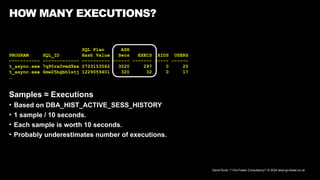
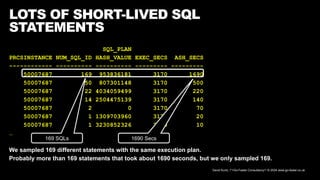
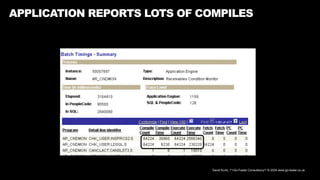
PRACTICAL USE OF
ACTIVE SESSION
HISTORY
THE
ASH MAN
COMETH!
/*Go-Faster*/ Consultancy
PRACTICAL USE
OF ACTIVE
SESSION HISTORY
DAVID KURTZ
UKOUG2024 /*+Go-Faster*/ Consultancy
David Kurtz, /*+Go-Faster Consultancy*/ © 2024 www.go-faster.co.uk
WHO AM I
Go-Faster Consultancy
• Performance tuning
• Oracle RDBMS
• PeopleSoft ERP
• www.go-faster.co.uk
• blog.go-faster.co.uk
• blog.psftdba.com
Oak Table
@go-faster.co.uk
David Kurtz, /*+Go-Faster Consultancy*/ © 2024 www.go-faster.co.uk
Performance
ASH Fundamentals
• What is it?
• How does it work?
Practical Examples
• Curated from real-life
AGENDA
Mining the ASH data
• ASH in Performance Tools
• Instrumentation
• Profiling DB Time
• Adaptive Plans
• Literals & Binds
• RAC
• Blocking Lock Analysis
• Temporary Tablespace/PGA Usage
• Index Usage
• Plan Stability
• Transactions & Executions
• Effective Parallelism
• Sources of physical I/O
• Things that can go wrong.
David Kurtz, /*+Go-Faster Consultancy*/ © 2024 www.go-faster.co.uk
FOLLOW THE MONEY
TIME = MONEY
David Kurtz, /*+Go-Faster Consultancy*/ © 2024 www.go-faster.co.uk
FOLLOW THE TIME
TIME = MONEY
David Kurtz, /*+Go-Faster Consultancy*/ © 2024 www.go-faster.co.uk
How much time did I spent
doing what?
What can I do about it?
THERE IS ONLY ONE QUESTION IN
PERFORMANCE OPTIMISATION
Often, the answer is to stop
doing it
David Kurtz, /*+Go-Faster Consultancy*/ © 2024 www.go-faster.co.uk
ASH FUNDAMENTALS
“Sir Charles had evidently stood there for five or ten minutes."
"How do you know that?"
"Because the ash had twice dropped from his cigar."
"Excellent! This is a colleague, Watson, after our own heart.”
David Kurtz, /*+Go-Faster Consultancy*/ © 2024 www.go-faster.co.uk
A number of slides in this opening section have been
lovingly ripped off from various presentations by
Graham Wood on the subject of ASH.
• Sifting through the ASHes (2004)
https://www.oracle.com/technetwork/database/manag
eability/ppt-active-session-history-129612.pdf
• ASH Architecture and Advanced Usage (2019) https://
youtu.be/rxQkvXIY7X0
• Database Time-Based Performance Tuning: From
Theory to Practice (2015) https://
youtu.be/Aknb_iZrPbc
John Beresniewicz
• Database Time Fundamentals (2020) https://
youtu.be/jKZXGWuLe-k
• DB Time basics (2020) https://youtu.be/xZViQXZPzx8
FURTHER READING
David Kurtz, /*+Go-Faster Consultancy*/ © 2024 www.go-faster.co.uk
ACTIVE SESSION HISTORY IS A SAMPLING
TECHNOLOGY
Sampling technology introduced in 10g
• Built into the database, so it is always on
• Low overhead, so still works well if system heavily loaded
• No locking or latching
• Only sessions that are currently active are collected by the
sampling process.
• Samples collected in memory
• 1 in 10 samples persisted to AWR
David Kurtz, /*+Go-Faster Consultancy*/ © 2024 www.go-faster.co.uk
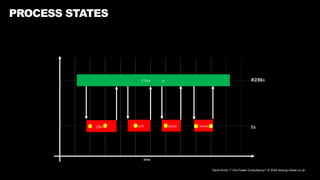
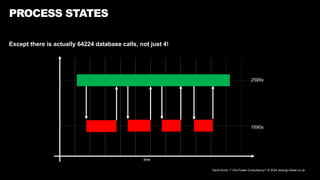
PROCESS STATES
time
Query Fetch Update Commit
Client Process
6s
10.25s
4.25s
David Kurtz, /*+Go-Faster Consultancy*/ © 2024 www.go-faster.co.uk
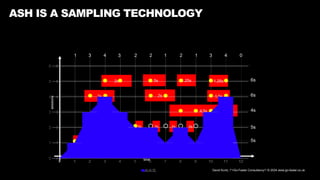
ASH IS A SAMPLING TECHNOLOGY
time
sessions
4.5s
4.5s
.5s .5s .5s .5s .5s .5s .5s .5s .5s
2s 2s
2s 1.5s
1.5s
1.25s 1.25s
5s
5s
6s
6s
4s
1 3 4 3 2 2 1 2 1 3 4 0
0 1 2 3 4 5 6 7 8 9 10 11 12
0
1
2
3
4
5
6
A.A.S.
0 1 2 3 4 5 6 7 8 9 10 11 12
0
1
2
3
4
5
6
A.A.S.
David Kurtz, /*+Go-Faster Consultancy*/ © 2024 www.go-faster.co.uk
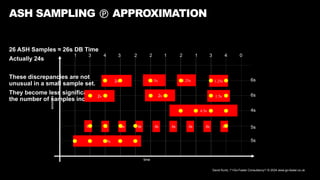
26 ASH Samples ≈ 26s DB Time
Actually 24s
These discrepancies are not
unusual in a small sample set.
They become less significant as
the number of samples increases.
ASH SAMPLING  APPROXIMATION
time
sessions
4.5s
4.5s
.5s .5s .5s .5s .5s .5s .5s .5s .5s
2s 2s
2s 1.5s
1.5s
1.25s 1.25s
5s
5s
6s
6s
4s
1 3 4 3 2 2 1 2 1 3 4 0
David Kurtz, /*+Go-Faster Consultancy*/ © 2024 www.go-faster.co.uk
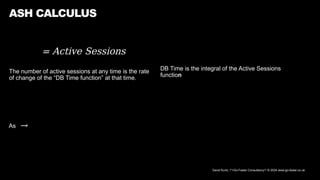
= Active Sessions
The number of active sessions at any time is the rate
of change of the “DB Time function” at that time.

ASH CALCULUS
DB Time is the integral of the Active Sessions
function
As →
David Kurtz, /*+Go-Faster Consultancy*/ © 2024 www.go-faster.co.uk
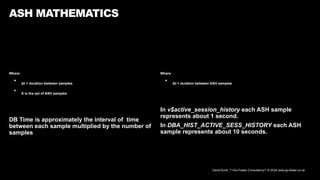
Where
• Δt = duration between samples
• S is the set of ASH samples
DB Time is approximately the interval of time
between each sample multiplied by the number of
samples
ASH MATHEMATICS
Where
• Δt = duration between ASH samples
In v$active_session_history each ASH sample
represents about 1 second.
In DBA_HIST_ACTIVE_SESS_HISTORY each ASH
sample represents about 10 seconds.
David Kurtz, /*+Go-Faster Consultancy*/ © 2024 www.go-faster.co.uk
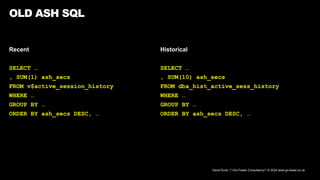
Recent
SELECT …
, SUM(1) ash_secs
FROM v$active_session_history
WHERE …
GROUP BY …
ORDER BY ash_secs DESC, …
OLD ASH SQL
Historical
SELECT …
, SUM(10) ash_secs
FROM dba_hist_active_sess_history
WHERE …
GROUP BY …
ORDER BY ash_secs DESC, …
David Kurtz, /*+Go-Faster Consultancy*/ © 2024 www.go-faster.co.uk
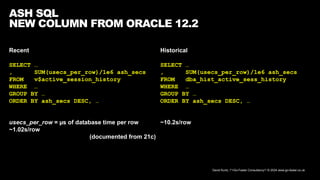
Recent
SELECT …
, SUM(usecs_per_row)/1e6 ash_secs
FROM v$active_session_history
WHERE …
GROUP BY …
ORDER BY ash_secs DESC, …
usecs_per_row = µs of database time per row
~1.02s/row
(documented from 21c)
ASH SQL
NEW COLUMN FROM ORACLE 12.2
Historical
SELECT …
, SUM(usecs_per_row)/1e6 ash_secs
FROM dba_hist_active_sess_history
WHERE …
GROUP BY …
ORDER BY ash_secs DESC, …
~10.2s/row
David Kurtz, /*+Go-Faster Consultancy*/ © 2024 www.go-faster.co.uk
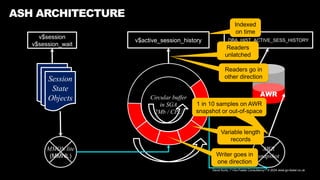
Circular buffer
in SGA
2Mb / CPU
ASH ARCHITECTURE
AWR
Session
State
Objects
Session
State
Objects
Session
State
Objects
MMON lite
(MMNL)
v$session
v$session_wait
v$active_session_history DBA_HIST_ACTIVE_SESS_HISTORY
AWR
snapshot
Readers
unlatched
Indexed
on time
Writer goes in
one direction
Readers go in
other direction
1 in 10 samples on AWR
snapshot or out-of-space
Variable length
records
David Kurtz, /*+Go-Faster Consultancy*/ © 2024 www.go-faster.co.uk
ASH is licenced as a part of the Diagnostics Pack
Only available on Enterprise Edition
• Database: $47,500/processor*
• Diagnostics: $7,500/processor*
• ⪅16% of license
What if you don’t have the licence?
What if you have Standard Edition
*Oracle Technology Global Price List, June 13, 2024
ASH LICENCING
Conceptually, ASH is sampling and storing
v$session
OraSASH or Oracle Simulation ASH
• Open source project
• http://pioro.github.io/orasash/
• Originated by Kyle Hailey
• Maintained by Marcin Przepiorowski
• PL/SQL procedure samples x$ksuse
• Run from database scheduler
• Writes persisted data across database link to
another database to minimize measurement
intrusion effect.
• Query the data in much the same way as real
ASH (as if on Oracle 10g).
David Kurtz, /*+Go-Faster Consultancy*/ © 2024 www.go-faster.co.uk
ASH
• Licensed
• Always there
• No marginal cost
• Real Time, Proactive
• Statistical data
• Who is blocking me?
• SQL and plan if captured by AWR
• Estimate of duration
• Per wait event
• Per Operation
ASH –V- SQL*TRACE
SQL*Trace
• Free
• Enable, Collect file, Profile
• Run-time overhead
• Reactive
• Every SQL & database call
• Being Blocked
• Actual SQL and execution plan
• Exact duration
• Individual waits on events
• Operations in Plan
David Kurtz, /*+Go-Faster Consultancy*/ © 2024 www.go-faster.co.uk
ASH can be used to resolve most of your
performance issues.
Sometimes, you will still need SQL*Trace
ASH –V- SQL*TRACE
From 12.2 you can also just query your trace
files.
• v$diag_trace_file
• v$diag_trace_file_contents
See also
• Tim Hall’s Oracle-Base blog: SQL trace, 10046,
trcsess and tkprof in Oracle
• https://
oracle-base.com/articles/misc/sql-trace-10046-
trcsess-and-tkprof#query_contents_of_trace_fi
les
David Kurtz, /*+Go-Faster Consultancy*/ © 2024 www.go-faster.co.uk
ASH FUNDEMENTALS
QUESTIONS?
David Kurtz, /*+Go-Faster Consultancy*/ © 2024 www.go-faster.co.uk
ASH: A DATA WAREHOUSE OF PERFORMANCE
METRICS
David Kurtz, /*+Go-Faster Consultancy*/ © 2024 www.go-faster.co.uk
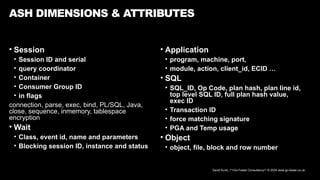
• Session
• Session ID and serial
• query coordinator
• Container
• Consumer Group ID
• in flags
connection, parse, exec, bind, PL/SQL, Java,
close, sequence, inmemory, tablespace
encryption
• Wait
• Class, event id, name and parameters
• Blocking session ID, instance and status
ASH DIMENSIONS & ATTRIBUTES
• Application
• program, machine, port,
• module, action, client_id, ECID …
• SQL
• SQL_ID, Op Code, plan hash, plan line id,
top level SQL ID, full plan hash value,
exec ID
• Transaction ID
• force matching signature
• PGA and Temp usage
• Object
• object, file, block and row number
David Kurtz, /*+Go-Faster Consultancy*/ © 2024 www.go-faster.co.uk
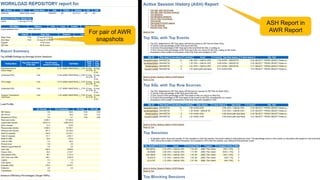
WHERE IS ASH REPORTED?
Enterprise Manager / Enterprise Manager Express
AWR Report
• including ASH Report within AWR Report
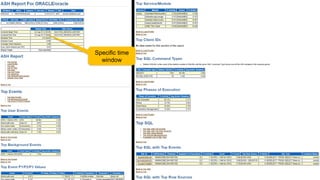
ASH Report
eDB360 / SQLD360
David Kurtz, /*+Go-Faster Consultancy*/ © 2024 www.go-faster.co.uk
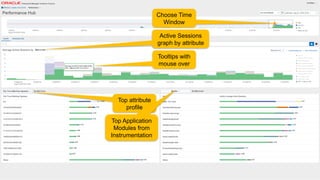
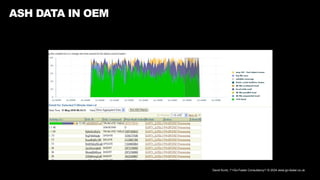
Tooltips with
mouse over
Active Sessions
graph by attribute
Top attribute
profile
Choose Time
Window
Top Application
Modules from
Instrumentation
David Kurtz, /*+Go-Faster Consultancy*/ © 2024 www.go-faster.co.uk
ASH Report in
AWR Report
For pair of AWR
snapshots
David Kurtz, /*+Go-Faster Consultancy*/ © 2024 www.go-faster.co.uk
Specific time
window
David Kurtz, /*+Go-Faster Consultancy*/ © 2024 www.go-faster.co.uk
ASH DATA IN OEM
David Kurtz, /*+Go-Faster Consultancy*/ © 2024 www.go-faster.co.uk
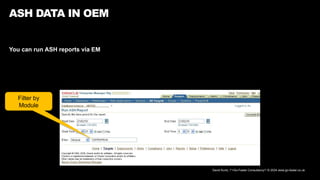
ASH DATA IN OEM
You can run ASH reports via EM
Filter by
Module
David Kurtz, /*+Go-Faster Consultancy*/ © 2024 www.go-faster.co.uk
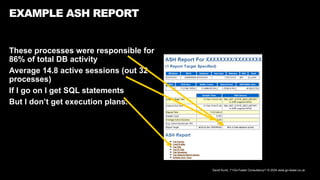
These processes were responsible for
86% of total DB activity
Average 14.8 active sessions (out 32
processes)
If I go on I get SQL statements
But I don’t get execution plans.
EXAMPLE ASH REPORT
David Kurtz, /*+Go-Faster Consultancy*/ © 2024 www.go-faster.co.uk
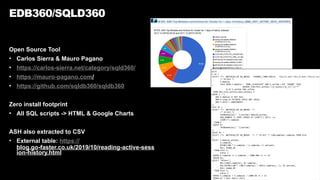
Open Source Tool
• Carlos Sierra & Mauro Pagano
• https://carlos-sierra.net/category/sqld360/
• https://mauro-pagano.com/
• https://github.com/sqldb360/sqldb360
Zero install footprint
• All SQL scripts -> HTML & Google Charts
ASH also extracted to CSV
• External table: https://
blog.go-faster.co.uk/2019/10/reading-active-sess
ion-history.html
EDB360/SQLD360
David Kurtz, /*+Go-Faster Consultancy*/ © 2024 www.go-faster.co.uk
Keep it
• 8-42 days locally
• Copy to central repository
• Retain for 400 days
• awrextr.sql / awrload.sql
• OEM 12c4 manage this
• Compare different databases
• Eg. artefacts common to multiple databases
might indicate an infrastucture issue?
DATA WAREHOUSE OF PERFORMANCE
METRICS
Multi-tenant database
• By default AWR snapshots run in CDB and
flushes ASH for all PDBS
• Can configure AWR snapshots in individual
PDBs
• if higher snapshot frequency required.
• Double capture of data.
• In PDB
• Can only see ASH from own PDB
• In CDB
• Can see ASH for all PDBs
David Kurtz, /*+Go-Faster Consultancy*/ © 2024 www.go-faster.co.uk
INSTRUMENTATION, INSTRUMENTATION,
INSTRUMENTATION.
David Kurtz, /*+Go-Faster Consultancy*/ © 2024 www.go-faster.co.uk
APPLICATION INSTRUMENTATION
It is essential to be able to match
• database sessions
• application processes
DBMS_APPLICATION_INFO
• set_module, set_action
• Set session module and action attributes
• Picked up by ASH, AWR and session trace
• Put calls in application
• Few packaged application vendors do this
David Kurtz, /*+Go-Faster Consultancy*/ © 2024 www.go-faster.co.uk
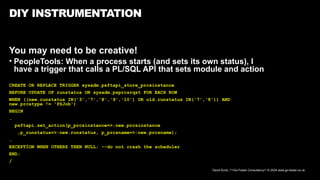
PL/SQL INSTRUMENTATION
k_module CONSTANT VARCHAR2(64) := $$PLSQL_UNIT;
…
PROCEDURE my_procedure IS
l_module VARCHAR2(64);
l_action VARCHAR2(64);
BEGIN
dbms_application_info.read_module(module_name=>l_module
,action_name=>l_action);
dbms_application_info.set_module(module_name=>k_module
,action_name=>'MY_PROCEDURE');
…
…
…
dbms_application_info.set_module(module_name=>l_module
,action_name=>l_action);
EXCEPTION
WHEN … THEN
dbms_application_info.set_module(module_name=>l_module
,action_name=>l_action);
RAISE / EXIT
…
END my_procedure;
David Kurtz, /*+Go-Faster Consultancy*/ © 2024 www.go-faster.co.uk
DIY INSTRUMENTATION
You may need to be creative!
• PeopleTools: When a process starts (and sets its own status), I
have a trigger that calls a PL/SQL API that sets module and action
CREATE OR REPLACE TRIGGER sysadm.psftapi_store_prcsinstance
BEFORE UPDATE OF runstatus ON sysadm.psprcsrqst FOR EACH ROW
WHEN ((new.runstatus IN('3','7','8','9','10') OR old.runstatus IN('7','8')) AND
new.prcstype != 'PSJob')
BEGIN
…
psftapi.set_action(p_prcsinstance=>:new.prcsinstance
,p_runstatus=>:new.runstatus, p_prcsname=>:new.prcsname);
…
EXCEPTION WHEN OTHERS THEN NULL; --do not crash the scheduler
END;
/
David Kurtz, /*+Go-Faster Consultancy*/ © 2024 www.go-faster.co.uk
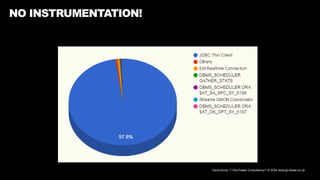
NO INSTRUMENTATION!
David Kurtz, /*+Go-Faster Consultancy*/ © 2024 www.go-faster.co.uk
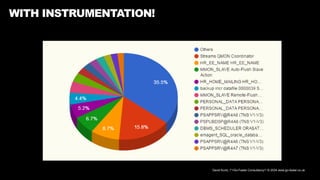
WITH INSTRUMENTATION!
David Kurtz, /*+Go-Faster Consultancy*/ © 2024 www.go-faster.co.uk
Map Session Attributes to Resource Consumer
Group
• Combinations of
• SERVICE, MODULE, ACTION,
• Also
• Oracle User, Client Program, OS User, Client ID
Consumer Group ID recorded on ASH record
RESOURCE MANAGER
MODULE / ACTION
• Session  ASH  AWR
• SQL Stats  AWR
• Consumer Group Mapping
• Automatically Enable/Disable SQL*Trace
David Kurtz, /*+Go-Faster Consultancy*/ © 2024 www.go-faster.co.uk
INSTRUMENTATION, INSTRUMENTATION,
INSTRUMENTATION.
QUESTIONS
David Kurtz, /*+Go-Faster Consultancy*/ © 2024 www.go-faster.co.uk
ASH MINING
David Kurtz, /*+Go-Faster Consultancy*/ © 2024 www.go-faster.co.uk
WHAT ARE YOU LOOKING FOR?
You need a clear idea of the question you are asking of the
ASH data.
What are you interested in?
• Time Window
• Recent –v- Historical
• Single Session / Group of Sessions / Whole Database
• All ASH Data / One Event / One SQL ID / One Plan
• Related ASH data (sessions blocked by lock)
David Kurtz, /*+Go-Faster Consultancy*/ © 2024 www.go-faster.co.uk
PROFILE DB TIME BY DIFFERENT ATTRIBUTE
TO FIND TOP SQLS
• SQL_ID
• FORCE_MATCHING_SIGNATURE – to treat literals as binds
• TOP_LEVEL_SQL_ID – PL/SQL call
• SQL_PLAN_HASH_VALUE
• SQL_PLAN_LINE_ID
• SQL_FULL_PLAN_HASH_VALUE – adaptive plan
• EVENT_CLASS
• EVENT
• IN_PARSE, IN_HARD_PARSE, IN_BIND, IN_SQL_EXECUTION, IN_PLSQL_EXECUTION,
IN_CURSOR_CLOSE
David Kurtz, /*+Go-Faster Consultancy*/ © 2024 www.go-faster.co.uk
QUERYING ASH REPOSITORY
DBA_HIST_ACTIVE_SESS_HISTORY
• WRH$_ACTIVE_SESSION_HISTORY partitioned on DBID and SNAP_ID
DBA_HIST_SNAPSHOT
• WRM$_SNAPSHOT
David Kurtz, /*+Go-Faster Consultancy*/ © 2024 www.go-faster.co.uk
QUERYING ASH REPOSITORY
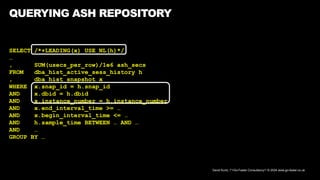
SELECT /*+LEADING(x) USE_NL(h)*/
…
, SUM(usecs_per_row)/1e6 ash_secs
FROM dba_hist_active_sess_history h
, dba_hist_snapshot x
WHERE x.snap_id = h.snap_id
AND x.dbid = h.dbid
AND x.instance_number = h.instance_number
AND x.end_interval_time >= …
AND x.begin_interval_time <= …
AND h.sample_time BETWEEN … AND …
AND …
GROUP BY …
David Kurtz, /*+Go-Faster Consultancy*/ © 2024 www.go-faster.co.uk
EXAMPLE
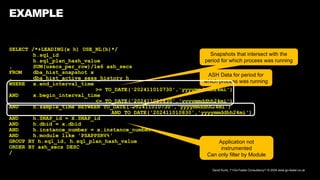
SELECT /*+LEADING(x h) USE_NL(h)*/
h.sql_id
h.sql_plan_hash_value
, SUM(usecs_per_row)/1e6 ash_secs
FROM dba_hist_snapshot x
, dba_hist_active_sess_history h
WHERE x.end_interval_time
>= TO_DATE('202411010730','yyyymmddhh24mi')
AND x.begin_interval_time
<= TO_DATE('202411010830','yyyymmddhh24mi')
AND h.sample_time BETWEEN TO_DATE('202411010730','yyyymmddhh24mi')
AND TO_DATE('202411010830','yyyymmddhh24mi')
AND h.SNAP_id = X.SNAP_id
AND h.dbid = x.dbid
AND h.instance_number = x.instance_number
AND h.module like 'PSAPPSRV%'
GROUP BY h.sql_id, h.sql_plan_hash_value
ORDER BY ash_secs DESC
/
Application not
instrumented
Can only filter by Module
Snapshots that intersect with the
period for which process was running
ASH Data for period for
which process was running
David Kurtz, /*+Go-Faster Consultancy*/ © 2024 www.go-faster.co.uk
TOP SQL
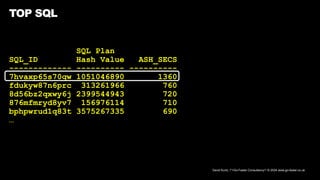
SQL Plan
SQL_ID Hash Value ASH_SECS
------------- ---------- ----------
7hvaxp65s70qw 1051046890 1360
fdukyw87n6prc 313261966 760
8d56bz2qxwy6j 2399544943 720
876mfmryd8yv7 156976114 710
bphpwrud1q83t 3575267335 690
…
David Kurtz, /*+Go-Faster Consultancy*/ © 2024 www.go-faster.co.uk
GET EXECUTION PLAN FROM AWR
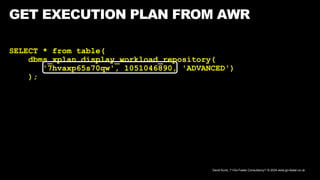
SELECT * from table(
dbms_xplan.display_workload_repository(
'7hvaxp65s70qw', 1051046890, 'ADVANCED')
);
David Kurtz, /*+Go-Faster Consultancy*/ © 2024 www.go-faster.co.uk
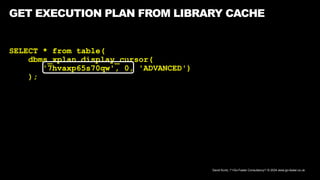
GET EXECUTION PLAN FROM LIBRARY CACHE
SELECT * from table(
dbms_xplan.display_cursor(
'7hvaxp65s70qw', 0, 'ADVANCED')
);
David Kurtz, /*+Go-Faster Consultancy*/ © 2024 www.go-faster.co.uk
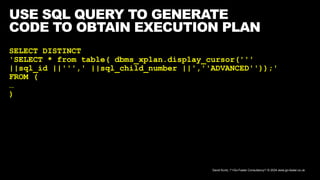
USE SQL QUERY TO GENERATE
CODE TO OBTAIN EXECUTION PLAN
SELECT DISTINCT
'SELECT * from table( dbms_xplan.display_cursor('''
||sql_id ||''',' ||sql_child_number ||',''ADVANCED''));'
FROM (
…
)
David Kurtz, /*+Go-Faster Consultancy*/ © 2024 www.go-faster.co.uk
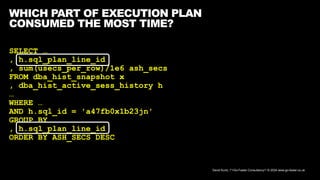
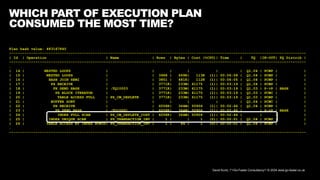
WHICH PART OF EXECUTION PLAN
CONSUMED THE MOST TIME?
SELECT …
, h.sql_plan_line_id
, sum(usecs_per_row)/1e6 ash_secs
FROM dba_hist_snapshot x
, dba_hist_active_sess_history h
…
WHERE …
AND h.sql_id = 'a47fb0x1b23jn'
GROUP BY …
, h.sql_plan_line_id
ORDER BY ASH_SECS DESC
David Kurtz, /*+Go-Faster Consultancy*/ © 2024 www.go-faster.co.uk
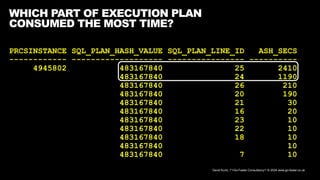
WHICH PART OF EXECUTION PLAN
CONSUMED THE MOST TIME?
PRCSINSTANCE SQL_PLAN_HASH_VALUE SQL_PLAN_LINE_ID ASH_SECS
------------ ------------------- ---------------- ----------
4945802 483167840 25 2410
483167840 24 1190
483167840 26 210
483167840 20 190
483167840 21 30
483167840 16 20
483167840 23 10
483167840 22 10
483167840 18 10
483167840 10
483167840 7 10
David Kurtz, /*+Go-Faster Consultancy*/ © 2024 www.go-faster.co.uk
WHICH PART OF EXECUTION PLAN
CONSUMED THE MOST TIME?
Plan hash value: 483167840
---------------------------------------------------------------------------------------------------------------------------------------
| Id | Operation | Name | Rows | Bytes | Cost (%CPU)| Time | TQ |IN-OUT| PQ Distrib |
---------------------------------------------------------------------------------------------------------------------------------------
…
| 14 | NESTED LOOPS | | | | | | Q1,04 | PCWP | |
| 15 | NESTED LOOPS | | 3988 | 669K| 113K (1)| 00:06:08 | Q1,04 | PCWP | |
| 16 | HASH JOIN SEMI | | 3851 | 481K| 112K (1)| 00:06:05 | Q1,04 | PCWP | |
| 17 | PX RECEIVE | | 3771K| 233M| 61175 (1)| 00:03:19 | Q1,04 | PCWP | |
| 18 | PX SEND HASH | :TQ10003 | 3771K| 233M| 61175 (1)| 00:03:19 | Q1,03 | P->P | HASH |
| 19 | PX BLOCK ITERATOR | | 3771K| 233M| 61175 (1)| 00:03:19 | Q1,03 | PCWC | |
| 20 | TABLE ACCESS FULL | PS_CM_DEPLETE | 3771K| 233M| 61175 (1)| 00:03:19 | Q1,03 | PCWP | |
| 21 | BUFFER SORT | | | | | | Q1,04 | PCWC | |
| 22 | PX RECEIVE | | 6058K| 364M| 50906 (1)| 00:02:46 | Q1,04 | PCWP | |
| 23 | PX SEND HASH | :TQ10001 | 6058K| 364M| 50906 (1)| 00:02:46 | | S->P | HASH |
| 24 | INDEX FULL SCAN | PS_CM_DEPLETE_COST | 6058K| 364M| 50906 (1)| 00:02:46 | | | |
| 25 | INDEX UNIQUE SCAN | PS_TRANSACTION_INV | 1 | | 1 (0)| 00:00:01 | Q1,04 | PCWP | |
| 26 | TABLE ACCESS BY INDEX ROWID| PS_TRANSACTION_INV | 1 | 44 | 1 (0)| 00:00:01 | Q1,04 | PCWP | |
…
---------------------------------------------------------------------------------------------------------------------------------------
David Kurtz, /*+Go-Faster Consultancy*/ © 2024 www.go-faster.co.uk
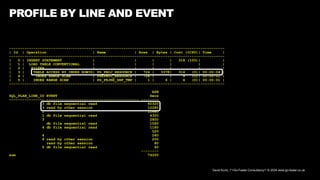
PROFILE BY LINE AND EVENT
--------------------------------------------------------------------------------------------------
| Id | Operation | Name | Rows | Bytes | Cost (%CPU)| Time |
--------------------------------------------------------------------------------------------------
| 0 | INSERT STATEMENT | | | | 318 (100)| |
| 1 | LOAD TABLE CONVENTIONAL | | | | | |
| 2 | FILTER | | | | | |
| 3 | TABLE ACCESS BY INDEX ROWID| PS_PROJ_RESOURCE | 724 | 337K| 314 (0)| 00:00:04 |
| 4 | INDEX RANGE SCAN | PSEPROJ_RESOURCE | 724 | | 9 (0)| 00:00:01 |
| 5 | INDEX RANGE SCAN | PS_PRJRE_SBF_TMP | 1 | 6 | 4 (0)| 00:00:01 |
--------------------------------------------------------------------------------------------------
ASH
SQL_PLAN_LINE_ID EVENT Secs
---------------- ------------------------------------------ --------
3 db file sequential read 40320
3 read by other session 12280
1 10680
1 db file sequential read 4320
3 2800
db file sequential read 1560
4 db file sequential read 1160
520
4 240
4 read by other session 200
read by other session 80
5 db file sequential read 40
--------
sum 74200
David Kurtz, /*+Go-Faster Consultancy*/ © 2024 www.go-faster.co.uk
ASH MINING
QUESTIONS?
David Kurtz, /*+Go-Faster Consultancy*/ © 2024 www.go-faster.co.uk
LITERALS –V – BIND VARIABLES
NON-SHARABLE SQL
David Kurtz, /*+Go-Faster Consultancy*/ © 2024 www.go-faster.co.uk
BIND VARIABLES
Developers Should Use Them!
Unfortunately…
David Kurtz, /*+Go-Faster Consultancy*/ © 2024 www.go-faster.co.uk
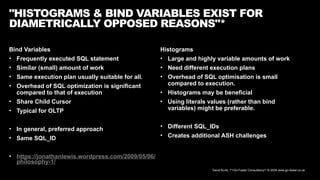
Bind Variables
• Frequently executed SQL statement
• Similar (small) amount of work
• Same execution plan usually suitable for all.
• Overhead of SQL optimization is significant
compared to that of execution
• Share Child Cursor
• Typical for OLTP
• In general, preferred approach
• Same SQL_ID
• https://jonathanlewis.wordpress.com/2009/05/06/
philosophy-1/
"HISTOGRAMS & BIND VARIABLES EXIST FOR
DIAMETRICALLY OPPOSED REASONS"*
Histograms
• Large and highly variable amounts of work
• Need different execution plans
• Overhead of SQL optimisation is small
compared to execution.
• Histograms may be beneficial
• Using literals values (rather than bind
variables) might be preferable.
• Different SQL_IDs
• Creates additional ASH challenges
David Kurtz, /*+Go-Faster Consultancy*/ © 2024 www.go-faster.co.uk
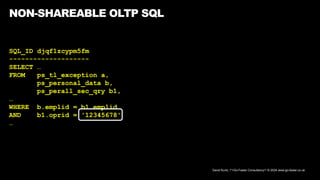
NON-SHAREABLE OLTP SQL
SQL_ID djqf1zcypm5fm
--------------------
SELECT …
FROM ps_tl_exception a,
ps_personal_data b,
ps_perall_sec_qry b1,
…
WHERE b.emplid = b1.emplid
AND b1.oprid = '12345678'
…
David Kurtz, /*+Go-Faster Consultancy*/ © 2024 www.go-faster.co.uk
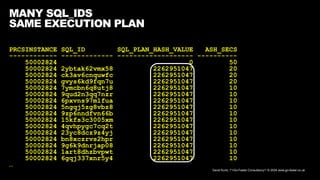
MANY SQL_IDS
SAME EXECUTION PLAN
PRCSINSTANCE SQL_ID SQL_PLAN_HASH_VALUE ASH_SECS
------------ ------------- ------------------- ----------
50002824 0 50
50002824 2ybtak62vmx58 2262951047 20
50002824 ck3av6cnquwfc 2262951047 20
50002824 gvys6kd9fqn7u 2262951047 20
50002824 7ymcbn6q8utj8 2262951047 10
50002824 9qud2n3qq7nzr 2262951047 10
50002824 6pxvns97m1fua 2262951047 10
50002824 5ngqj5zg8vbz8 2262951047 10
50002824 9zp6nndfvn66b 2262951047 10
50002824 15kfs3c3005xm 2262951047 10
50002824 4qvhpygc7cq2t 2262951047 10
50002824 23yc8dcz9z4yj 2262951047 10
50002824 bn8xczrvs2hpr 2262951047 10
50002824 9g6k9dnrjap08 2262951047 10
50002824 1art8dhzbvpwt 2262951047 10
50002824 6gqj337xnr5y4 2262951047 10
…
David Kurtz, /*+Go-Faster Consultancy*/ © 2024 www.go-faster.co.uk
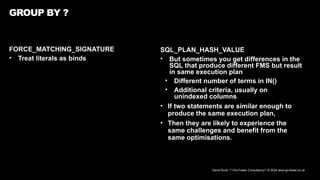
FORCE_MATCHING_SIGNATURE
• Treat literals as binds
GROUP BY ?
SQL_PLAN_HASH_VALUE
• But sometimes you get differences in the
SQL that produce different FMS but result
in same execution plan
• Different number of terms in IN()
• Additional criteria, usually on
unindexed columns
• If two statements are similar enough to
produce the same execution plan,
• Then they are likely to experience the
same challenges and benefit from the
same optimisations.
David Kurtz, /*+Go-Faster Consultancy*/ © 2024 www.go-faster.co.uk
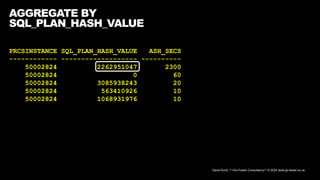
AGGREGATE BY
SQL_PLAN_HASH_VALUE
PRCSINSTANCE SQL_PLAN_HASH_VALUE ASH_SECS
------------ ------------------- ----------
50002824 2262951047 2300
50002824 0 60
50002824 3085938243 20
50002824 563410926 10
50002824 1068931976 10
David Kurtz, /*+Go-Faster Consultancy*/ © 2024 www.go-faster.co.uk
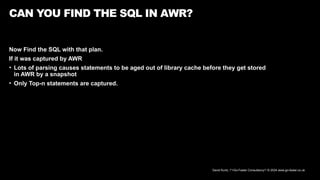
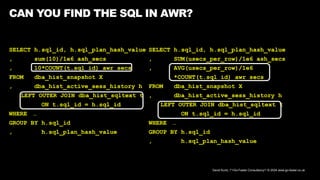
CAN YOU FIND THE SQL IN AWR?
Now Find the SQL with that plan.
If it was captured by AWR
• Lots of parsing causes statements to be aged out of library cache before they get stored
in AWR by a snapshot
• Only Top-n statements are captured.
David Kurtz, /*+Go-Faster Consultancy*/ © 2024 www.go-faster.co.uk
SELECT h.sql_id, h.sql_plan_hash_value
, sum(10)/1e6 ash_secs
, 10*COUNT(t.sql_id) awr_secs
FROM dba_hist_snapshot X
, dba_hist_active_sess_history h
LEFT OUTER JOIN dba_hist_sqltext t
ON t.sql_id = h.sql_id
WHERE …
GROUP BY h.sql_id
, h.sql_plan_hash_value
CAN YOU FIND THE SQL IN AWR?
SELECT h.sql_id, h.sql_plan_hash_value
, SUM(usecs_per_row)/1e6 ash_secs
, AVG(usecs_per_row)/1e6
*COUNT(t.sql_id) awr_secs
FROM dba_hist_snapshot X
, dba_hist_active_sess_history h
LEFT OUTER JOIN dba_hist_sqltext t
ON t.sql_id = h.sql_id
WHERE …
GROUP BY h.sql_id
, h.sql_plan_hash_value
David Kurtz, /*+Go-Faster Consultancy*/ © 2024 www.go-faster.co.uk
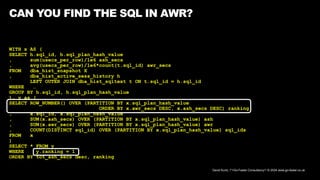
CAN YOU FIND THE SQL IN AWR?
WITH x AS (
SELECT h.sql_id, h.sql_plan_hash_value
, sum(usecs_per_row)/1e6 ash_secs
, avg(usecs_per_row)/1e6*count(t.sql_id) awr_secs
FROM dba_hist_snapshot X
, dba_hist_active_sess_history h
LEFT OUTER JOIN dba_hist_sqltext t ON t.sql_id = h.sql_id
WHERE …
GROUP BY h.sql_id, h.sql_plan_hash_value
), y as (
SELECT ROW_NUMBER() OVER (PARTITION BY x.sql_plan_hash_value
ORDER BY x.awr_secs DESC, x.ash_secs DESC) ranking
, x.sql_id, x.sql_plan_hash_value
, SUM(x.ash_secs) OVER (PARTITION BY x.sql_plan_hash_value) ash
, SUM(x.awr_secs) OVER (PARTITION BY x.sql_plan_hash_value) awr
, COUNT(DISTINCT sql_id) OVER (PARTITION BY x.sql_plan_hash_value) sql_ids
FROM x
)
SELECT * FROM y
WHERE y.ranking = 1
ORDER BY tot_ash_secs desc, ranking
David Kurtz, /*+Go-Faster Consultancy*/ © 2024 www.go-faster.co.uk
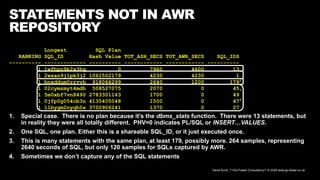
STATEMENTS NOT IN AWR
REPOSITORY
Longest SQL Plan
RANKING SQL_ID Hash Value TOT_ASH_SECS TOT_AWR_SECS SQL_IDS
---------- ------------- ---------- ------------ ------------ ----------
1 1wfhpn9k2x3hq 0 7960 4600 13
1 2wsan9j1pk3j2 1061502179 4230 4230 1
1 bnxddum0rrvyh 918066299 2640 1200 179
1 02cymzmyt4mdh 508527075 2070 0 45
1 5m0xbf7vn8490 2783301143 1700 0 49
1 0jfp0g054cb3n 4135405048 1500 0 47
1 11bygm2nyqh0s 3700906241 1370 0 27
1. Special case. There is no plan because it’s the dbms_stats function. There were 13 statements, but
in reality they were all totally different. PHV=0 indicates PL/SQL or INSERT…VALUES.
2. One SQL, one plan. Either this is a shareable SQL_ID, or it just executed once.
3. This is many statements with the same plan, at least 179, possibly more. 264 samples, representing
2640 seconds of SQL, but only 120 samples for SQLs captured by AWR.
4. Sometimes we don’t capture any of the SQL statements
1
2
3
4
David Kurtz, /*+Go-Faster Consultancy*/ © 2024 www.go-faster.co.uk
LITERALS –V- BIND VARIABLES
NON-SHAREABLE SQL
QUESTIONS?
David Kurtz, /*+Go-Faster Consultancy*/ © 2024 www.go-faster.co.uk
ADAPTIVE PLANS
David Kurtz, /*+Go-Faster Consultancy*/ © 2024 www.go-faster.co.uk
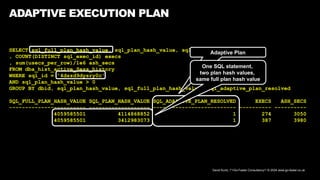
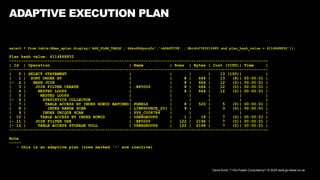
ADAPTIVE EXECUTION PLAN
SELECT sql_full_plan_hash_value, sql_plan_hash_value, sql_adaptive_plan_resolved
, COUNT(DISTINCT sql_exec_id) execs
, sum(usecs_per_row)/1e6 ash_secs
FROM dba_hist_active_Sess_history
WHERE sql_id = '4dszd9dysry0c'
AND sql_plan_hash_value > 0
GROUP BY dbid, sql_plan_hash_value, sql_full_plan_hash_value, sql_adaptive_plan_resolved
SQL_FULL_PLAN_HASH_VALUE SQL_PLAN_HASH_VALUE SQL_ADAPTIVE_PLAN_RESOLVED EXECS ASH_SECS
------------------------ ------------------- -------------------------- ---------- ----------
4059585501 4114868852 1 274 3050
4059585501 3412983073 1 387 3980
Adaptive Plan
One SQL statement,
two plan hash values,
same full plan hash value
David Kurtz, /*+Go-Faster Consultancy*/ © 2024 www.go-faster.co.uk
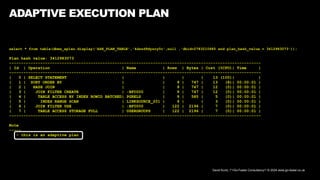
ADAPTIVE EXECUTION PLAN
select * from table(dbms_xplan.display('ASH_PLAN_TABLE','4dszd9dysry0c',null ,'dbid=2783210685 and plan_hash_value = 3412983073'));
Plan hash value: 3412983073
---------------------------------------------------------------------------------------------------------
| Id | Operation | Name | Rows | Bytes | Cost (%CPU)| Time |
---------------------------------------------------------------------------------------------------------
| 0 | SELECT STATEMENT | | | | 13 (100)| |
| 1 | SORT ORDER BY | | 9 | 747 | 13 (8)| 00:00:01 |
| 2 | HASH JOIN | | 9 | 747 | 12 (0)| 00:00:01 |
| 3 | JOIN FILTER CREATE | :BF0000 | 9 | 747 | 12 (0)| 00:00:01 |
| 4 | TABLE ACCESS BY INDEX ROWID BATCHED| PGRELS | 9 | 585 | 5 (0)| 00:00:01 |
| 5 | INDEX RANGE SCAN | LINKSOURCE_201 | 9 | | 3 (0)| 00:00:01 |
| 6 | JOIN FILTER USE | :BF0000 | 122 | 2196 | 7 (0)| 00:00:01 |
| 7 | TABLE ACCESS STORAGE FULL | USERGROUPS | 122 | 2196 | 7 (0)| 00:00:01 |
---------------------------------------------------------------------------------------------------------
Note
-----
- this is an adaptive plan
David Kurtz, /*+Go-Faster Consultancy*/ © 2024 www.go-faster.co.uk
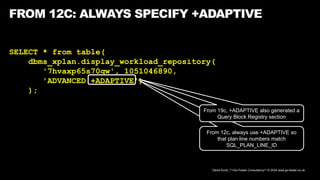
FROM 12C: ALWAYS SPECIFY +ADAPTIVE
SELECT * from table(
dbms_xplan.display_workload_repository(
'7hvaxp65s70qw', 1051046890,
'ADVANCED +ADAPTIVE')
);
From 12c, always use +ADAPTIVE so
that plan line numbers match
SQL_PLAN_LINE_ID
From 19c, +ADAPTIVE also generated a
Query Block Registry section
David Kurtz, /*+Go-Faster Consultancy*/ © 2024 www.go-faster.co.uk
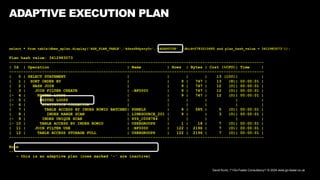
ADAPTIVE EXECUTION PLAN
select * from table(dbms_xplan.display('ASH_PLAN_TABLE','4dszd9dysry0c','+ADAPTIVE' ,'dbid=2783210685 and plan_hash_value = 3412983073'));
Plan hash value: 3412983073
------------------------------------------------------------------------------------------------------------
| Id | Operation | Name | Rows | Bytes | Cost (%CPU)| Time |
------------------------------------------------------------------------------------------------------------
| 0 | SELECT STATEMENT | | | | 13 (100)| |
| 1 | SORT ORDER BY | | 9 | 747 | 13 (8)| 00:00:01 |
| 2 | HASH JOIN | | 9 | 747 | 12 (0)| 00:00:01 |
| 3 | JOIN FILTER CREATE | :BF0000 | 9 | 747 | 12 (0)| 00:00:01 |
|- 4 | NESTED LOOPS | | 9 | 747 | 12 (0)| 00:00:01 |
|- 5 | NESTED LOOPS | | | | | |
|- 6 | STATISTICS COLLECTOR | | | | | |
| 7 | TABLE ACCESS BY INDEX ROWID BATCHED| PGRELS | 9 | 585 | 5 (0)| 00:00:01 |
| 8 | INDEX RANGE SCAN | LINKSOURCE_201 | 9 | | 3 (0)| 00:00:01 |
|- 9 | INDEX UNIQUE SCAN | SYS_C008784 | | | | |
|- 10 | TABLE ACCESS BY INDEX ROWID | USERGROUPS | 1 | 18 | 7 (0)| 00:00:01 |
| 11 | JOIN FILTER USE | :BF0000 | 122 | 2196 | 7 (0)| 00:00:01 |
| 12 | TABLE ACCESS STORAGE FULL | USERGROUPS | 122 | 2196 | 7 (0)| 00:00:01 |
------------------------------------------------------------------------------------------------------------
Note
-----
- this is an adaptive plan (rows marked '-' are inactive)
David Kurtz, /*+Go-Faster Consultancy*/ © 2024 www.go-faster.co.uk
ADAPTIVE EXECUTION PLAN
select * from table(dbms_xplan.display('ASH_PLAN_TABLE','4dszd9dysry0c','+ADAPTIVE' ,'dbid=2783210685 and plan_hash_value = 4114868852'));
Plan hash value: 4114868852
------------------------------------------------------------------------------------------------------------
| Id | Operation | Name | Rows | Bytes | Cost (%CPU)| Time |
------------------------------------------------------------------------------------------------------------
| 0 | SELECT STATEMENT | | | | 13 (100)| |
| 1 | SORT ORDER BY | | 8 | 664 | 13 (8)| 00:00:01 |
|- 2 | HASH JOIN | | 8 | 664 | 12 (0)| 00:00:01 |
| 3 | JOIN FILTER CREATE | :BF0000 | 8 | 664 | 12 (0)| 00:00:01 |
| 4 | NESTED LOOPS | | 8 | 664 | 12 (0)| 00:00:01 |
| 5 | NESTED LOOPS | | | | | |
|- 6 | STATISTICS COLLECTOR | | | | | |
| 7 | TABLE ACCESS BY INDEX ROWID BATCHED| PGRELS | 8 | 520 | 5 (0)| 00:00:01 |
| 8 | INDEX RANGE SCAN | LINKSOURCE_201 | 9 | | 3 (0)| 00:00:01 |
| 9 | INDEX UNIQUE SCAN | SYS_C008784 | | | | |
| 10 | TABLE ACCESS BY INDEX ROWID | USERGROUPS | 1 | 18 | 7 (0)| 00:00:01 |
|- 11 | JOIN FILTER USE | :BF0000 | 122 | 2196 | 7 (0)| 00:00:01 |
|- 12 | TABLE ACCESS STORAGE FULL | USERGROUPS | 122 | 2196 | 7 (0)| 00:00:01 |
------------------------------------------------------------------------------------------------------------
Note
-----
- this is an adaptive plan (rows marked '-' are inactive)
David Kurtz, /*+Go-Faster Consultancy*/ © 2024 www.go-faster.co.uk
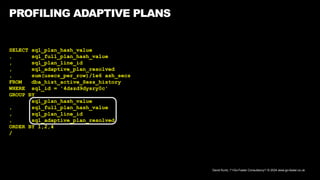
PROFILING ADAPTIVE PLANS
SELECT sql_plan_hash_value
, sql_full_plan_hash_value
, sql_plan_line_id
, sql_adaptive_plan_resolved
, sum(usecs_per_row)/1e6 ash_secs
FROM dba_hist_active_Sess_history
WHERE sql_id = '4dszd9dysry0c'
GROUP BY
sql_plan_hash_value
, sql_full_plan_hash_value
, sql_plan_line_id
, sql_adaptive_plan_resolved
ORDER BY 1,2,4
/
David Kurtz, /*+Go-Faster Consultancy*/ © 2024 www.go-faster.co.uk
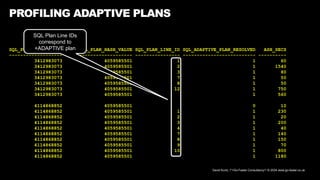
PROFILING ADAPTIVE PLANS
SQL_PLAN_HASH_VALUE SQL_FULL_PLAN_HASH_VALUE SQL_PLAN_LINE_ID SQL_ADAPTIVE_PLAN_RESOLVED ASH_SECS
------------------- ------------------------ ---------------- -------------------------- ----------
3412983073 4059585501 1 1 60
3412983073 4059585501 2 1 1540
3412983073 4059585501 3 1 80
3412983073 4059585501 7 1 50
3412983073 4059585501 8 1 50
3412983073 4059585501 12 1 750
3412983073 4059585501 1 560
4114868852 4059585501 0 10
4114868852 4059585501 1 1 230
4114868852 4059585501 2 1 20
4114868852 4059585501 3 1 200
4114868852 4059585501 4 1 40
4114868852 4059585501 7 1 140
4114868852 4059585501 8 1 150
4114868852 4059585501 9 1 70
4114868852 4059585501 10 1 800
4114868852 4059585501 1 1180
SQL Plan Line IDs
correspond to
+ADAPTIVE plan
David Kurtz, /*+Go-Faster Consultancy*/ © 2024 www.go-faster.co.uk
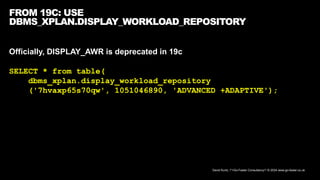
FROM 19C: USE
DBMS_XPLAN.DISPLAY_WORKLOAD_REPOSITORY
Officially, DISPLAY_AWR is deprecated in 19c
SELECT * from table(
dbms_xplan.display_workload_repository
('7hvaxp65s70qw', 1051046890, 'ADVANCED +ADAPTIVE');
David Kurtz, /*+Go-Faster Consultancy*/ © 2024 www.go-faster.co.uk
ADAPTIVE PLANS
QUESTIONS?
David Kurtz, /*+Go-Faster Consultancy*/ © 2024 www.go-faster.co.uk
ASH & RAC
David Kurtz, /*+Go-Faster Consultancy*/ © 2024 www.go-faster.co.uk
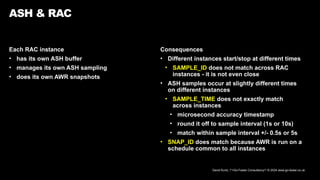
Each RAC instance
• has its own ASH buffer
• manages its own ASH sampling
• does its own AWR snapshots
ASH & RAC
Consequences
• Different instances start/stop at different times
• SAMPLE_ID does not match across RAC
instances - it is not even close
• ASH samples occur at slightly different times
on different instances
• SAMPLE_TIME does not exactly match
across instances
• microsecond accuracy timestamp
• round it off to sample interval (1s or 10s)
• match within sample interval +/- 0.5s or 5s
• SNAP_ID does match because AWR is run on a
schedule common to all instances
David Kurtz, /*+Go-Faster Consultancy*/ © 2024 www.go-faster.co.uk
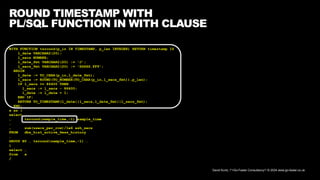
ROUND TIMESTAMP WITH
PL/SQL FUNCTION IN WITH CLAUSE
WITH FUNCTION tsround(p_in IN TIMESTAMP, p_len INTEGER) RETURN timestamp IS
l_date VARCHAR2(20);
l_secs NUMBER;
l_date_fmt VARCHAR2(20) := 'J';
l_secs_fmt VARCHAR2(20) := 'SSSSS.FF9';
BEGIN
l_date := TO_CHAR(p_in,l_date_fmt);
l_secs := ROUND(TO_NUMBER(TO_CHAR(p_in,l_secs_fmt)),p_len);
IF l_secs >= 86400 THEN
l_secs := l_secs - 86400;
l_date := l_date + 1;
END IF;
RETURN TO_TIMESTAMP(l_date||l_secs,l_date_fmt||l_secs_fmt);
END;
x as (
select …
, tsround(sample_time,-1) sample_time
…
, sum(usecs_per_row)/1e6 ash_secs
FROM dba_hist_active_Sess_history
…
GROUP BY … tsround(sample_time,-1) …
)
select …
from x
/
David Kurtz, /*+Go-Faster Consultancy*/ © 2024 www.go-faster.co.uk
LOCK ANALYSIS WITH ASH
David Kurtz, /*+Go-Faster Consultancy*/ © 2024 www.go-faster.co.uk
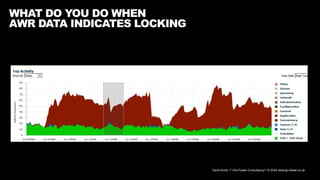
WHAT DO YOU DO WHEN
AWR DATA INDICATES LOCKING
David Kurtz, /*+Go-Faster Consultancy*/ © 2024 www.go-faster.co.uk
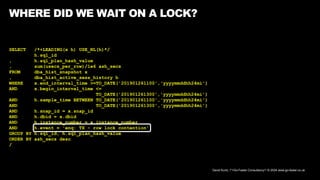
WHERE DID WE WAIT ON A LOCK?
SELECT /*+LEADING(x h) USE_NL(h)*/
h.sql_id
, h.sql_plan_hash_value
, sum(usecs_per_row)/1e6 ash_secs
FROM dba_hist_snapshot x
, dba_hist_active_sess_history h
WHERE x.end_interval_time >=TO_DATE('201901261100','yyyymmddhh24mi')
AND x.begin_interval_time <=
TO_DATE('201901261300','yyyymmddhh24mi')
AND h.sample_time BETWEEN TO_DATE('201901261100','yyyymmddhh24mi')
AND TO_DATE('201901261300','yyyymmddhh24mi')
AND h.snap_id = x.snap_id
AND h.dbid = x.dbid
AND h.instance_number = x.instance_number
AND h.event = 'enq: TX - row lock contention'
GROUP BY h.sql_id, h.sql_plan_hash_value
ORDER BY ash_secs desc
/
David Kurtz, /*+Go-Faster Consultancy*/ © 2024 www.go-faster.co.uk
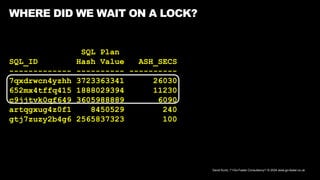
WHERE DID WE WAIT ON A LOCK?
SQL Plan
SQL_ID Hash Value ASH_SECS
------------- ---------- ----------
7qxdrwcn4yzhh 3723363341 26030
652mx4tffq415 1888029394 11230
c9jjtvk0qf649 3605988889 6090
artqgxug4z0f1 8450529 240
gtj7zuzy2b4g6 2565837323 100
David Kurtz, /*+Go-Faster Consultancy*/ © 2024 www.go-faster.co.uk
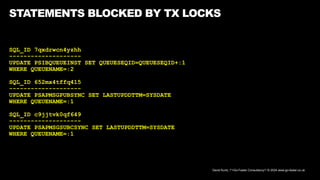
STATEMENTS BLOCKED BY TX LOCKS
SQL_ID 7qxdrwcn4yzhh
--------------------
UPDATE PSIBQUEUEINST SET QUEUESEQID=QUEUESEQID+:1
WHERE QUEUENAME=:2
SQL_ID 652mx4tffq415
--------------------
UPDATE PSAPMSGPUBSYNC SET LASTUPDDTTM=SYSDATE
WHERE QUEUENAME=:1
SQL_ID c9jjtvk0qf649
--------------------
UPDATE PSAPMSGSUBCSYNC SET LASTUPDDTTM=SYSDATE
WHERE QUEUENAME=:1
David Kurtz, /*+Go-Faster Consultancy*/ © 2024 www.go-faster.co.uk
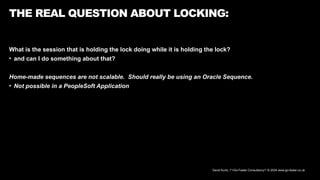
THE REAL QUESTION ABOUT LOCKING:
What is the session that is holding the lock doing while it is holding the lock?
• and can I do something about that?
Home-made sequences are not scalable. Should really be using an Oracle Sequence.
• Not possible in a PeopleSoft Application
David Kurtz, /*+Go-Faster Consultancy*/ © 2024 www.go-faster.co.uk
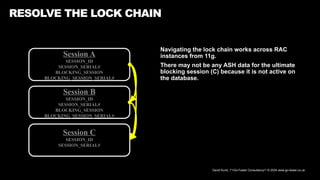
RESOLVE THE LOCK CHAIN
Navigating the lock chain works across RAC
instances from 11g.
There may not be any ASH data for the ultimate
blocking session (C) because it is not active on
the database.
Session A
SESSION_ID
SESSION_SERIAL#
BLOCKING_SESSION
BLOCKING_SESSION_SERIAL#
Session C
SESSION_ID
SESSION_SERIAL#
Session B
SESSION_ID
SESSION_SERIAL#
BLOCKING_SESSION
BLOCKING_SESSION_SERIAL#
David Kurtz, /*+Go-Faster Consultancy*/ © 2024 www.go-faster.co.uk
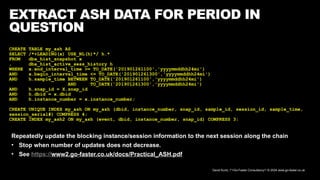
EXTRACT ASH DATA FOR PERIOD IN
QUESTION
CREATE TABLE my_ash AS
SELECT /*+LEADING(x) USE_NL(h)*/ h.*
FROM dba_hist_snapshot x
, dba_hist_active_sess_history h
WHERE x.end_interval_time >= TO_DATE('201901261100','yyyymmddhh24mi')
AND x.begin_interval_time <= TO_DATE('201901261300','yyyymmddhh24mi')
AND h.sample_time BETWEEN TO_DATE('201901261100','yyyymmddhh24mi')
AND TO_DATE('201901261300','yyyymmddhh24mi')
AND h.snap_id = X.snap_id
AND h.dbid = x.dbid
AND h.instance_number = x.instance_number;
CREATE UNIQUE INDEX my_ash ON my_ash (dbid, instance_number, snap_id, sample_id, session_id, sample_time,
session_serial#) COMPRESS 4;
CREATE INDEX my_ash2 ON my_ash (event, dbid, instance_number, snap_id) COMPRESS 3;
Repeatedly update the blocking instance/session information to the next session along the chain
• Stop when number of updates does not decrease.
• See https://www2.go-faster.co.uk/docs/Practical_ASH.pdf
David Kurtz, /*+Go-Faster Consultancy*/ © 2024 www.go-faster.co.uk
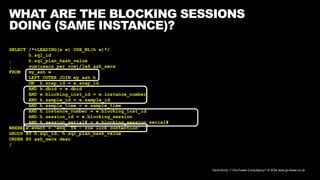
WHAT ARE THE BLOCKING SESSIONS
DOING (SAME INSTANCE)?
SELECT /*+LEADING(x w) USE_NL(h w)*/
h.sql_id
, h.sql_plan_hash_value
, sum(usecs_per_row)/1e6 ash_secs
FROM my_ash w
LEFT OUTER JOIN my_ash h
ON h.snap_id = w.snap_id
AND h.dbid = w.dbid
AND w.blocking_inst_id = w.instance_number
AND h.sample_id = w.sample_id
AND h.sample_time = w.sample_time
AND h.instance_number = w.blocking_inst_id
AND h.session_id = w.blocking_session
AND h.session_serial# = w.blocking_session_serial#
WHERE w.event = 'enq: TX - row lock contention'
GROUP BY h.sql_id, h.sql_plan_hash_value
ORDER BY ash_secs desc
/
David Kurtz, /*+Go-Faster Consultancy*/ © 2024 www.go-faster.co.uk
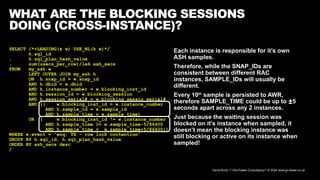
WHAT ARE THE BLOCKING SESSIONS
DOING (CROSS-INSTANCE)?
SELECT /*+LEADING(x w) USE_NL(h w)*/
h.sql_id
, h.sql_plan_hash_value
, sum(usecs_per_row)/1e6 ash_secs
FROM my_ash w
LEFT OUTER JOIN my_ash h
ON h.snap_id = w.snap_id
AND h.dbid = w.dbid
AND h.instance_number = w.blocking_inst_id
AND h.session_id = w.blocking_session
AND h.session_serial# = w.blocking_sessio_serial#
AND (( w.blocking_inst_id = w.instance_number
AND h.sample_id = w.sample_id
AND h.sample_time = w.sample_time)
OR ( w.blocking_inst_id != w.instance_number
AND h.sample_time >= w.sample_time-5/86400
AND h.sample_time < w.sample_time+5/86400))
WHERE w.event = 'enq: TX - row lock contention'
GROUP BY h.sql_id, h.sql_plan_hash_value
ORDER BY ash_secs desc
/
Each instance is responsible for it’s own
ASH samples.
Therefore, while the SNAP_IDs are
consistent between different RAC
instances, SAMPLE_IDs will usually be
different.
Every 10th
sample is persisted to AWR,
therefore SAMPLE_TIME could be up to ±5
seconds apart across any 2 instances.
Just because the waiting session was
blocked on it’s instance when sampled, it
doesn’t mean the blocking instance was
still blocking or active on its instance when
sampled!
David Kurtz, /*+Go-Faster Consultancy*/ © 2024 www.go-faster.co.uk
WHAT ARE THE BLOCKING
SESSIONS DOING?
SQL_ID SQL_PLAN_HASH_VALUE ASH_SECS
------------- ------------------- ----------
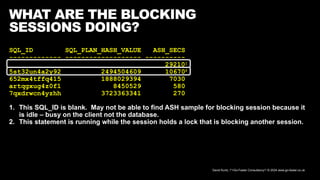
292101
5st32un4a2y92 2494504609 106702
652mx4tffq415 1888029394 7030
artqgxug4z0f1 8450529 580
7qxdrwcn4yzhh 3723363341 270
1. This SQL_ID is blank. May not be able to find ASH sample for blocking session because it
is idle – busy on the client not the database.
2. This statement is running while the session holds a lock that is blocking another session.
David Kurtz, /*+Go-Faster Consultancy*/ © 2024 www.go-faster.co.uk
AWR PLAN COST TRAP
David Kurtz, /*+Go-Faster Consultancy*/ © 2024 www.go-faster.co.uk
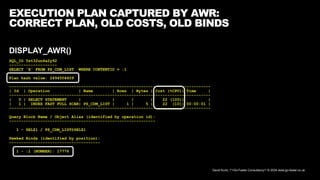
EXECUTION PLAN CAPTURED BY AWR:
CORRECT PLAN, OLD COSTS, OLD BINDS
DISPLAY_AWR()
SQL_ID 5st32un4a2y92
--------------------
SELECT 'X' FROM PS_CDM_LIST WHERE CONTENTID = :1
Plan hash value: 2494504609
------------------------------------------------------------------------------------
| Id | Operation | Name | Rows | Bytes | Cost (%CPU)| Time |
------------------------------------------------------------------------------------
| 0 | SELECT STATEMENT | | | | 22 (100)| |
| 1 | INDEX FAST FULL SCAN| PS_CDM_LIST | 1 | 5 | 22 (10)| 00:00:01 |
------------------------------------------------------------------------------------
Query Block Name / Object Alias (identified by operation id):
-------------------------------------------------------------
1 - SEL$1 / PS_CDM_LIST@SEL$1
Peeked Binds (identified by position):
--------------------------------------
1 - :1 (NUMBER): 17776
David Kurtz, /*+Go-Faster Consultancy*/ © 2024 www.go-faster.co.uk
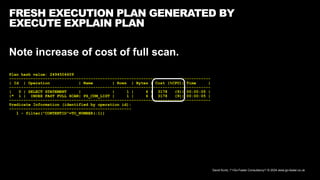
FRESH EXECUTION PLAN GENERATED BY
EXECUTE EXPLAIN PLAN
Note increase of cost of full scan.
Plan hash value: 2494504609
------------------------------------------------------------------------------------
| Id | Operation | Name | Rows | Bytes | Cost (%CPU)| Time |
------------------------------------------------------------------------------------
| 0 | SELECT STATEMENT | | 1 | 6 | 3178 (9)| 00:00:05 |
|* 1 | INDEX FAST FULL SCAN| PS_CDM_LIST | 1 | 6 | 3178 (9)| 00:00:05 |
------------------------------------------------------------------------------------
Predicate Information (identified by operation id):
---------------------------------------------------
1 - filter("CONTENTID"=TO_NUMBER(:1))
David Kurtz, /*+Go-Faster Consultancy*/ © 2024 www.go-faster.co.uk
EXECUTION PLAN CAPTURED BY AWR:
CORRECT PLAN, OLD COSTS, OLD BINDS
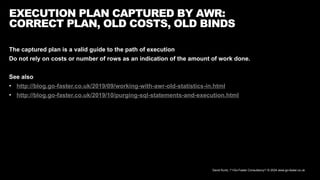
The captured plan is a valid guide to the path of execution
Do not rely on costs or number of rows as an indication of the amount of work done.
See also
• http://blog.go-faster.co.uk/2019/09/working-with-awr-old-statistics-in.html
• http://blog.go-faster.co.uk/2019/10/purging-sql-statements-and-execution.html
David Kurtz, /*+Go-Faster Consultancy*/ © 2024 www.go-faster.co.uk
IS YOUR PARALLELISM EFFECTIVE?
David Kurtz, /*+Go-Faster Consultancy*/ © 2024 www.go-faster.co.uk
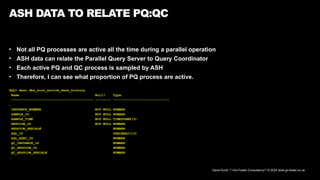
ASH DATA TO RELATE PQ:QC
• Not all PQ processes are active all the time during a parallel operation
• ASH data can relate the Parallel Query Server to Query Coordinator
• Each active PQ and QC process is sampled by ASH
• Therefore, I can see what proportion of PQ process are active.
SQL> desc dba_hist_active_Sess_history
Name Null? Type
----------------------------------------- -------- ----------------------------
…
INSTANCE_NUMBER NOT NULL NUMBER
SAMPLE_ID NOT NULL NUMBER
SAMPLE_TIME NOT NULL TIMESTAMP(3)
SESSION_ID NOT NULL NUMBER
SESSION_SERIAL# NUMBER
SQL_ID VARCHAR2(13)
SQL_EXEC_ID NUMBER
QC_INSTANCE_ID NUMBER
QC_SESSION_ID NUMBER
QC_SESSION_SERIAL# NUMBER
…
David Kurtz, /*+Go-Faster Consultancy*/ © 2024 www.go-faster.co.uk
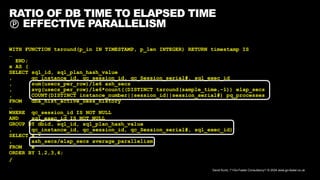
RATIO OF DB TIME TO ELAPSED TIME
 EFFECTIVE PARALLELISM
WITH FUNCTION tsround(p_in IN TIMESTAMP, p_len INTEGER) RETURN timestamp IS
…
END;
x AS (
SELECT sql_id, sql_plan_hash_value
, qc_instance_id, qc_session_id, qc_Session_serial#, sql_exec_id
, sum(usecs_per_row)/1e6 ash_secs
, avg(usecs_per_row)/1e6*count((DISTINCT tsround(sample_time,-1)) elap_secs
, COUNT(DISTINCT instance_number||session_id||session_serial#) pq_processes
FROM dba_hist_active_Sess_history
…
WHERE qc_session_id IS NOT NULL
AND sql_exec_id IS NOT NULL
GROUP BY dbid, sql_id, sql_plan_hash_value
, qc_instance_id, qc_session_id, qc_Session_serial#, sql_exec_id)
SELECT x.*
, ash_secs/elap_secs average_parallelism
FROM x
ORDER BY 1,2,3,4;
/
David Kurtz, /*+Go-Faster Consultancy*/ © 2024 www.go-faster.co.uk
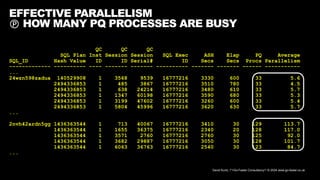
EFFECTIVE PARALLELISM
 HOW MANY PQ PROCESSES ARE BUSY
QC QC QC
SQL Plan Inst Session Session SQL Exec ASH Elap PQ Average
SQL_ID Hash Value ID ID Serial# ID Secs Secs Procs Parallelism
------------- ---------- ---- ------- ------- ---------- ------- ------- ------ -----------
...
24wzn598zadua 140529908 1 3568 9539 16777216 3330 600 33 5.6
2494336853 1 485 3867 16777216 3510 780 33 4.5
2494336853 1 638 24214 16777216 3480 610 33 5.7
2494336853 1 1347 60198 16777216 3590 680 33 5.3
2494336853 1 3199 47602 16777216 3260 600 33 5.4
2494336853 1 5804 45996 16777216 3620 630 33 5.7
...
2nvh42ardn5gg 1436363544 1 713 40067 16777216 3410 30 129 113.7
1436363544 1 1655 36375 16777216 2340 20 128 117.0
1436363544 1 3571 2760 16777216 2760 30 125 92.0
1436363544 1 3682 29887 16777216 3050 30 128 101.7
1436363544 1 6063 36763 16777216 2540 30 123 84.7
...
David Kurtz, /*+Go-Faster Consultancy*/ © 2024 www.go-faster.co.uk
PL/SQL
David Kurtz, /*+Go-Faster Consultancy*/ © 2024 www.go-faster.co.uk
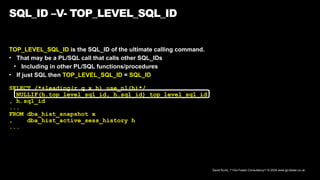
SQL_ID –V- TOP_LEVEL_SQL_ID
TOP_LEVEL_SQL_ID is the SQL_ID of the ultimate calling command.
• That may be a PL/SQL call that calls other SQL_IDs
• Including in other PL/SQL functions/procedures
• If just SQL then TOP_LEVEL_SQL_ID = SQL_ID
SELECT /*+leading(r q x h) use_nl(h)*/
NULLIF(h.top_level_sql_id, h.sql_id) top_level_sql_id
, h.sql_id
...
FROM dba_hist_snapshot x
, dba_hist_active_sess_history h
...
David Kurtz, /*+Go-Faster Consultancy*/ © 2024 www.go-faster.co.uk
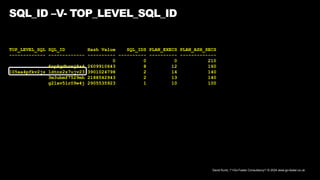
SQL_ID –V- TOP_LEVEL_SQL_ID
TOP_LEVEL_SQL SQL_ID Hash Value SQL_IDS PLAN_EXECS PLAN_ASH_SECS
------------- ------------- ---------- ---------- ---------- -------------
0 0 0 210
6np8gdbrmj8s4 2609910643 8 12 160
105xa4pfkv2jz 1dtnz2z7ujv23 3901024798 2 14 140
3m3ubmf7529mh 2188542943 2 13 140
g21xv51r09w4j 2905535923 1 10 100
David Kurtz, /*+Go-Faster Consultancy*/ © 2024 www.go-faster.co.uk
INVESTIGATING I/O
“Detection is, or ought to be, an exact science and should be treated
in the same cold and unemotional manner”.
David Kurtz, /*+Go-Faster Consultancy*/ © 2024 www.go-faster.co.uk
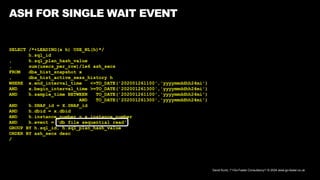
ASH FOR SINGLE WAIT EVENT
SELECT /*+LEADING(x h) USE_NL(h)*/
h.sql_id
, h.sql_plan_hash_value
, sum(usecs_per_row)/1e6 ash_secs
FROM dba_hist_snapshot x
, dba_hist_active_sess_history h
WHERE x.end_interval_time <=TO_DATE('202001261100','yyyymmddhh24mi')
AND x.begin_interval_time >=TO_DATE('202001261300','yyyymmddhh24mi')
AND h.sample_time BETWEEN TO_DATE('202001261100','yyyymmddhh24mi')
AND TO_DATE('202001261300','yyyymmddhh24mi')
AND h.SNAP_id = X.SNAP_id
AND h.dbid = x.dbid
AND h.instance_number = x.instance_number
AND h.event = 'db file sequential read'
GROUP BY h.sql_id, h.sql_plan_hash_value
ORDER BY ash_secs desc
/
David Kurtz, /*+Go-Faster Consultancy*/ © 2024 www.go-faster.co.uk
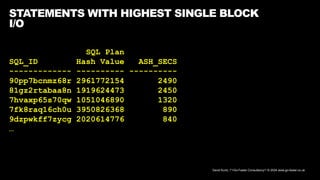
STATEMENTS WITH HIGHEST SINGLE BLOCK
I/O
SQL Plan
SQL_ID Hash Value ASH_SECS
------------- ---------- ----------
90pp7bcnmz68r 2961772154 2490
81gz2rtabaa8n 1919624473 2450
7hvaxp65s70qw 1051046890 1320
7fk8raq16ch0u 3950826368 890
9dzpwkff7zycg 2020614776 840
…
David Kurtz, /*+Go-Faster Consultancy*/ © 2024 www.go-faster.co.uk
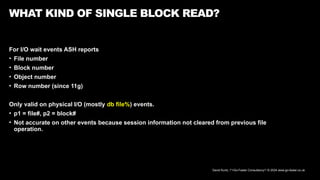
WHAT KIND OF SINGLE BLOCK READ?
For I/O wait events ASH reports
• File number
• Block number
• Object number
• Row number (since 11g)
Only valid on physical I/O (mostly db file%) events.
• p1 = file#, p2 = block#
• Not accurate on other events because session information not cleared from previous file
operation.
David Kurtz, /*+Go-Faster Consultancy*/ © 2024 www.go-faster.co.uk
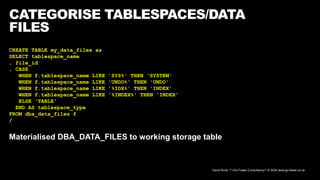
CATEGORISE TABLESPACES/DATA
FILES
CREATE TABLE my_data_files as
SELECT tablespace_name
, file_id
, CASE
WHEN f.tablespace_name LIKE 'SYS%' THEN 'SYSTEM'
WHEN f.tablespace_name LIKE 'UNDO%' THEN 'UNDO'
WHEN f.tablespace_name LIKE '%IDX%' THEN 'INDEX'
WHEN f.tablespace_name LIKE '%INDEX%' THEN 'INDEX'
ELSE 'TABLE'
END AS tablespace_type
FROM dba_data_files f
/
Materialised DBA_DATA_FILES to working storage table
David Kurtz, /*+Go-Faster Consultancy*/ © 2024 www.go-faster.co.uk
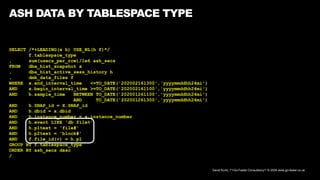
ASH DATA BY TABLESPACE TYPE
SELECT /*+LEADING(x h) USE_NL(h f)*/
f.tablespace_type
, sum(usecs_per_row)/1e6 ash_secs
FROM dba_hist_snapshot x
, dba_hist_active_sess_history h
, dmk_data_files f
WHERE x.end_interval_time <=TO_DATE('202002161300','yyyymmddhh24mi')
AND x.begin_interval_time >=TO_DATE('202002161100','yyyymmddhh24mi')
AND h.sample_time BETWEEN TO_DATE('202001261100','yyyymmddhh24mi')
AND TO_DATE('202001261300','yyyymmddhh24mi')
AND h.SNAP_id = X.SNAP_id
AND h.dbid = x.dbid
AND h.instance_number = x.instance_number
AND h.event LIKE 'db file%'
AND h.p1text = 'file#'
AND h.p2text = 'block#'
AND f.file_id(+) = h.p1
GROUP BY f.tablespace_type
ORDER BY ash_secs desc
/
David Kurtz, /*+Go-Faster Consultancy*/ © 2024 www.go-faster.co.uk
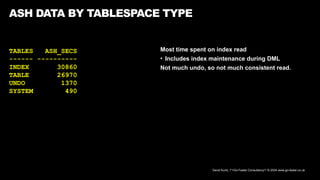
TABLES ASH_SECS
------ ----------
INDEX 30860
TABLE 26970
UNDO 1370
SYSTEM 490
ASH DATA BY TABLESPACE TYPE
Most time spent on index read
• Includes index maintenance during DML
Not much undo, so not much consistent read.
David Kurtz, /*+Go-Faster Consultancy*/ © 2024 www.go-faster.co.uk
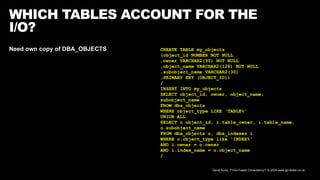
Need own copy of DBA_OBJECTS
WHICH TABLES ACCOUNT FOR THE
I/O?
CREATE TABLE my_objects
(object_id NUMBER NOT NULL
,owner VARCHAR2(30) NOT NULL
,object_name VARCHAR2(128) NOT NULL
,subobject_name VARCHAR2(30)
,PRIMARY KEY (OBJECT_ID))
/
INSERT INTO my_objects
SELECT object_id, owner, object_name,
subobject_name
FROM dba_objects
WHERE object_type LIKE 'TABLE%'
UNION ALL
SELECT o.object_id, i.table_owner, i.table_name,
o.subobject_name
FROM dba_objects o, dba_indexes i
WHERE o.object_type like 'INDEX%'
AND i.owner = o.owner
AND i.index_name = o.object_name
/
David Kurtz, /*+Go-Faster Consultancy*/ © 2024 www.go-faster.co.uk
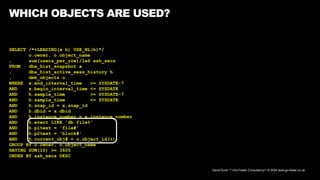
WHICH OBJECTS ARE USED?
SELECT /*+LEADING(x h) USE_NL(h)*/
o.owner, o.object_name
, sum(usecs_per_row)/1e6 ash_secs
FROM dba_hist_snapshot x
, dba_hist_active_sess_history h
, dmk_objects o
WHERE x.end_interval_time >= SYSDATE-7
AND x.begin_interval_time <= SYSDATE
AND h.sample_time >= SYSDATE-7
AND h.sample_time <= SYSDATE
AND h.snap_id = x.snap_id
AND h.dbid = x.dbid
AND h.instance_number = x.instance_number
AND h.event LIKE 'db file%'
AND h.p1text = 'file#'
AND h.p2text = 'block#'
AND h.current_obj# = o.object_id(+)
GROUP BY o.owner, o.object_name
HAVING SUM(10) >= 3600
ORDER BY ash_secs DESC
David Kurtz, /*+Go-Faster Consultancy*/ © 2024 www.go-faster.co.uk
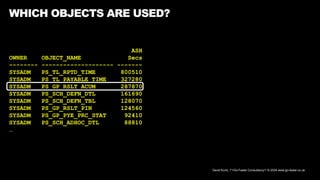
WHICH OBJECTS ARE USED?
ASH
OWNER OBJECT_NAME Secs
-------- -------------------- -------
SYSADM PS_TL_RPTD_TIME 800510
SYSADM PS_TL_PAYABLE_TIME 327280
SYSADM PS_GP_RSLT_ACUM 287870
SYSADM PS_SCH_DEFN_DTL 161690
SYSADM PS_SCH_DEFN_TBL 128070
SYSADM PS_GP_RSLT_PIN 124560
SYSADM PS_GP_PYE_PRC_STAT 92410
SYSADM PS_SCH_ADHOC_DTL 88810
…
David Kurtz, /*+Go-Faster Consultancy*/ © 2024 www.go-faster.co.uk
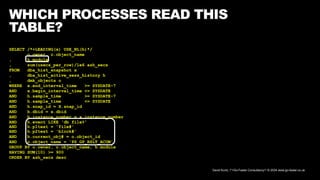
WHICH PROCESSES READ THIS
TABLE?
SELECT /*+LEADING(x) USE_NL(h)*/
o.owner, o.object_name
, h.module
, sum(usecs_per_row)/1e6 ash_secs
FROM dba_hist_snapshot x
, dba_hist_active_sess_history h
, dmk_objects o
WHERE x.end_interval_time >= SYSDATE-7
AND x.begin_interval_time <= SYSDATE
AND h.sample_time >= SYSDATE-7
AND h.sample_time <= SYSDATE
AND h.snap_id = X.snap_id
AND h.dbid = x.dbid
AND h.instance_number = x.instance_number
AND h.event LIKE 'db file%'
AND h.p1text = 'file#'
AND h.p2text = 'block#'
AND h.current_obj# = o.object_id
AND o.object_name = 'PS_GP_RSLT_ACUM'
GROUP BY o.owner, o.object_name, h.module
HAVING SUM(10) >= 900
ORDER BY ash_secs desc
David Kurtz, /*+Go-Faster Consultancy*/ © 2024 www.go-faster.co.uk
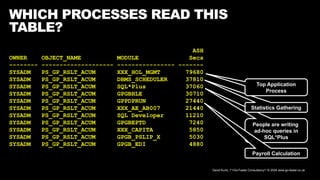
WHICH PROCESSES READ THIS
TABLE?
ASH
OWNER OBJECT_NAME MODULE Secs
-------- -------------------- ---------------- -------
SYSADM PS_GP_RSLT_ACUM XXX_HOL_MGMT 79680
SYSADM PS_GP_RSLT_ACUM DBMS_SCHEDULER 37810
SYSADM PS_GP_RSLT_ACUM SQL*Plus 37060
SYSADM PS_GP_RSLT_ACUM GPGBHLE 30710
SYSADM PS_GP_RSLT_ACUM GPPDPRUN 27440
SYSADM PS_GP_RSLT_ACUM XXX_AE_AB007 21440
SYSADM PS_GP_RSLT_ACUM SQL Developer 11210
SYSADM PS_GP_RSLT_ACUM GPGBEPTD 7240
SYSADM PS_GP_RSLT_ACUM XXX_CAPITA 5850
SYSADM PS_GP_RSLT_ACUM GPGB_PSLIP_X 5030
SYSADM PS_GP_RSLT_ACUM GPGB_EDI 4880
People are writing
ad-hoc queries in
SQL*Plus
Statistics Gathering
Top Application
Process
Payroll Calculation
David Kurtz, /*+Go-Faster Consultancy*/ © 2024 www.go-faster.co.uk
INVESTIGATING I/O
QUESTIONS
David Kurtz, /*+Go-Faster Consultancy*/ © 2024 www.go-faster.co.uk
MONITORING TEMPORARY SPACE AND PGA
USAGE WITH ASH
David Kurtz, /*+Go-Faster Consultancy*/ © 2024 www.go-faster.co.uk
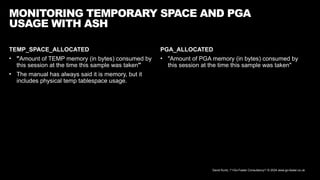
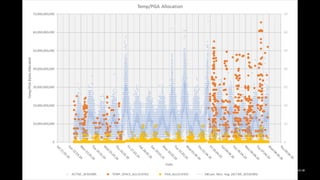
TEMP_SPACE_ALLOCATED
• "Amount of TEMP memory (in bytes) consumed by
this session at the time this sample was taken"
• The manual has always said it is memory, but it
includes physical temp tablespace usage.
MONITORING TEMPORARY SPACE AND PGA
USAGE WITH ASH
PGA_ALLOCATED
• "Amount of PGA memory (in bytes) consumed by
this session at the time this sample was taken"
David Kurtz, /*+Go-Faster Consultancy*/ © 2024 www.go-faster.co.uk
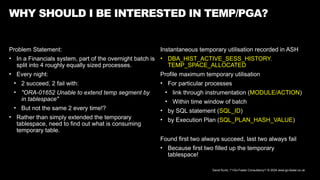
Problem Statement:
• In a Financials system, part of the overnight batch is
split into 4 roughly equally sized processes.
• Every night:
• 2 succeed, 2 fail with:
• "ORA-01652 Unable to extend temp segment by
in tablespace"
• But not the same 2 every time!?
• Rather than simply extended the temporary
tablespace, need to find out what is consuming
temporary table.
WHY SHOULD I BE INTERESTED IN TEMP/PGA?
Instantaneous temporary utilisation recorded in ASH
• DBA_HIST_ACTIVE_SESS_HISTORY.
TEMP_SPACE_ALLOCATED
Profile maximum temporary utilisation
• For particular processes
• link through instrumentation (MODULE/ACTION)
• Within time window of batch
• by SQL statement (SQL_ID)
• by Execution Plan (SQL_PLAN_HASH_VALUE)
Found first two always succeed, last two always fail
• Because first two filled up the temporary
tablespace!
David Kurtz, /*+Go-Faster Consultancy*/ © 2024 www.go-faster.co.uk
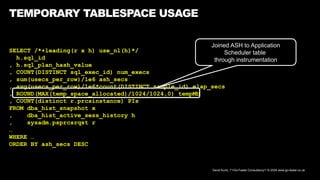
TEMPORARY TABLESPACE USAGE
SELECT /*+leading(r x h) use_nl(h)*/
h.sql_id
, h.sql_plan_hash_value
, COUNT(DISTINCT sql_exec_id) num_execs
, sum(usecs_per_row)/1e6 ash_secs
, avg(usecs_per_row)/1e6*count(DISTINCT sample_id) elap_secs
, ROUND(MAX(temp_space_allocated)/1024/1024,0) tempMb
, COUNT(distinct r.prcsinstance) PIs
FROM dba_hist_snapshot x
, dba_hist_active_sess_history h
, sysadm.psprcsrqst r
…
WHERE …
ORDER BY ash_secs DESC
Joined ASH to Application
Scheduler table
through instrumentation
David Kurtz, /*+Go-Faster Consultancy*/ © 2024 www.go-faster.co.uk
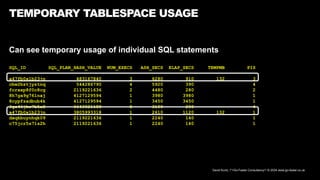
TEMPORARY TABLESPACE USAGE
Can see temporary usage of individual SQL statements
SQL_ID SQL_PLAN_HASH_VALUE NUM_EXECS ASH_SECS ELAP_SECS TEMPMB PIS
------------- ------------------- ---------- ---------- ---------- ---------- ----------
a47fb0x1b23jn 483167840 3 6280 910 132 3
cbw2bztjyztnq 544286790 4 5920 390 4
fcrxxp8f0c8cg 2119221636 2 4480 280 2
8h7ga9g761naj 4127129594 1 3980 3980 1
8cypfzadbub4k 4127129594 1 3450 3450 1
3gz46jhw7b5x8 3643021188 8 3190 200 4
a47fb0x1b23jn 3805993318 1 2610 1120 132 1
dxqkbuynhqk09 2119221636 1 2240 140 1
c75jcr5s71s2h 2119221636 1 2240 140 1
David Kurtz, /*+Go-Faster Consultancy*/ © 2024 www.go-faster.co.uk
Plan hash value: 709075361
--------------------------------------------------------------------------------------------------------------------------------------------------------------------------
| Id | Operation | Name | E-Rows |E-Bytes|E-Temp | Cost (%CPU)| E-Time | OMem | 1Mem | Used-Mem | Used-Tmp|
--------------------------------------------------------------------------------------------------------------------------------------------------------------------------
| 0 | SELECT STATEMENT | | | | | 1583K(100)| | | | | |
| 1 | SORT ORDER BY | | 471K| 4121M| 3680M| 1583K (1)| 00:01:02 | 7469M| 27M| 97M (1)| 6640K|
|* 2 | HASH JOIN RIGHT OUTER | | 471K| 4121M| | 684K (1)| 00:00:27 | 883K| 883K| 1336K (0)| |
| 3 | TABLE ACCESS FULL | TBL_P************ | 382 | 25976 | | 7 (0)| 00:00:01 | | | | |
| 4 | NESTED LOOPS OUTER | | 471K| 4091M| | 684K (1)| 00:00:27 | | | | |
|* 5 | HASH JOIN RIGHT OUTER | | 471K| 4061M| | 671K (1)| 00:00:27 | 7123K| 2452K| 7590K (0)| |
| 6 | TABLE ACCESS FULL | TBL_A****************** | 5467 | 336K| | 272 (0)| 00:00:01 | | | | |
|* 7 | HASH JOIN RIGHT OUTER | | 471K| 4031M| 53M| 671K (1)| 00:00:27 | 137M| 15M| 148M (0)| |
| 8 | TABLE ACCESS FULL | TBL_C**************** | 2535K| 24M| | 1285 (2)| 00:00:01 | | | | |
|* 9 | HASH JOIN RIGHT OUTER | | 471K| 4027M| | 467K (1)| 00:00:19 | 1070K| 1070K| 1411K (0)| |
| 10 | TABLE ACCESS FULL | TBL_M************** | 3220 | 100K| | 7 (0)| 00:00:01 | | | | |
|* 11 | HASH JOIN RIGHT OUTER | | 471K| 4012M| | 467K (1)| 00:00:19 | 1696K| 1696K| 1613K (0)| |
| 12 | VIEW | index$_join$_016 | 484 | 3388 | | 2 (0)| 00:00:01 | | | | |
|* 13 | HASH JOIN | | | | | | | 1519K| 1519K| 1588K (0)| |
| 14 | INDEX FAST FULL SCAN | IDX_S**************** | 484 | 3388 | | 1 (0)| 00:00:01 | | | | |
| 15 | INDEX FAST FULL SCAN | SYS_C00266671 | 484 | 3388 | | 1 (0)| 00:00:01 | | | | |
|* 16 | HASH JOIN RIGHT OUTER | | 471K| 4009M| | 467K (1)| 00:00:19 | 804K| 804K| 835K (0)| |
| 17 | TABLE ACCESS FULL | TBL_P************* | 7 | 917 | | 3 (0)| 00:00:01 | | | | |
|* 18 | HASH JOIN | | 471K| 3950M| 3296K| 467K (1)| 00:00:19 | 4421K| 1814K| 4629K (0)| |
| 19 | TABLE ACCESS FULL | TBL_P******* | 1151 | 3278K| | 136 (0)| 00:00:01 | | | | |
|* 20 | HASH JOIN | | 166K| 935M| 695M| 420K (1)| 00:00:17 | 1006M| 28M| 361M (1)| 2660K|
| 21 | NESTED LOOPS | | 917K| 685M| | 29731 (1)| 00:00:02 | | | | |
|* 22 | TABLE ACCESS BY INDEX ROWID BATCHED| TBL_U*** | 9780 | 2253K| | 381 (0)| 00:00:01 | | | | |
|* 23 | INDEX RANGE SCAN | IDX_U******** | 9827 | | | 30 (0)| 00:00:01 | | | | |
|* 24 | TABLE ACCESS BY INDEX ROWID BATCHED| TBL_A****** | 94 | 51418 | | 3 (0)| 00:00:01 | | | | |
|* 25 | INDEX RANGE SCAN | FK_A******** | 2 | | | 2 (0)| 00:00:01 | | | | |
|* 26 | TABLE ACCESS FULL | TBL_P******* | 443K| 2154M| | 249K (1)| 00:00:10 | | | | |
| 27 | TABLE ACCESS BY INDEX ROWID | TBL_A******************** | 1 | 68 | | 1 (0)| 00:00:01 | | | | |
|* 28 | INDEX UNIQUE SCAN | SYS_C00251697 | 1 | | | 0 (0)| | | | | |
--------------------------------------------------------------------------------------------------------------------------------------------------------------------------
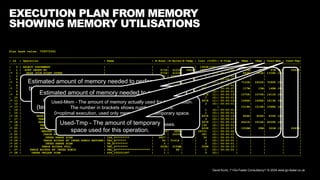
EXECUTION PLAN FROM MEMORY
SHOWING MEMORY UTILISATIONS
Estimated amount of memory needed to perform
the operation in memory only. This is also called
the optimal execution
Estimated amount of memory needed to perform the
operation in one pass (write to and read from disk
(temp) only once). This is called a one-pass execution.
Used-Mem - The amount of memory actually used for this operation.
The number in brackets shows number of passes.
0=optimal execution, used only memory and no temporary space.
1=one-pass execution.
>1=multi-pass execution, shows number of passes.
Used-Tmp - The amount of temporary
space used for this operation.
David Kurtz, /*+Go-Faster Consultancy*/ © 2024 www.go-faster.co.uk
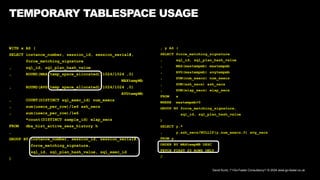
WITH x AS (
SELECT instance_number, session_id, session_serial#,
force_matching_signature
, sql_id, sql_plan_hash_value
, ROUND(MAX(temp_space_allocated)/1024/1024 ,0)
MAXtempMb
, ROUND(AVG(temp_space_allocated)/1024/1024 ,0)
AVGtempMb
, COUNT(DISTINCT sql_exec_id) num_execs
, sum(usecs_per_row)/1e6 ash_secs
, sum(usecs_per_row)/1e6
*count(DISTINCT sample_id) elap_secs
FROM dba_hist_active_sess_history h
…
GROUP BY instance_number, session_id, session_serial#,
force_matching_signature,
sql_id, sql_plan_hash_value, sql_exec_id
)
TEMPORARY TABLESPACE USAGE
, y AS (
SELECT force_matching_signature
, sql_id, sql_plan_hash_value
, MAX(maxtempmb) maxtempmb
, AVG(maxtempmb) avgtempmb
, SUM(num_execs) num_execs
, SUM(ash_secs) ash_secs
, SUM(elap_secs) elap_secs
FROM x
WHERE maxtempmb>0
GROUP BY force_matching_signature,
sql_id, sql_plan_hash_value
)
SELECT y.*
, y.ash_secs/NULLIF(y.num_execs,0) avg_secs
FROM y
ORDER BY MAXtempMB DESC
FETCH FIRST 20 ROWS ONLY
/
David Kurtz, /*+Go-Faster Consultancy*/ © 2024 www.go-faster.co.uk
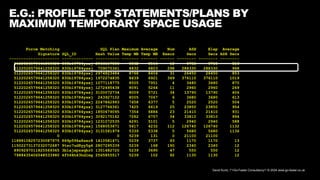
E.G.: PROFILE TOP STATEMENTS/PLANS BY
MAXIMUM TEMPORARY SPACE USAGE
Force Matching SQL Plan Maximum Average Num ASH Elap Average
Signature SQL_ID Hash Value Temp MB Temp MB Execs Secs Secs ASH Secs
--------------------- ------------- ---------- ------- ------- ------ -------- -------- --------
5122026579641258320 830b19784ysxj 2966117505 8862 8514 12 9750 9750 813
5122026579641258320 830b19784ysxj 709075361 8832 6803 298 288330 288330 968
5122026579641258320 830b19784ysxj 2974823484 8768 8404 31 26450 26450 853
5122026579641258320 830b19784ysxj 1972274835 8639 6921 369 376110 376110 1019
5122026579641258320 830b19784ysxj 1077118775 8505 7951 4 3480 3480 870
5122026579641258320 830b19784ysxj 1272495438 8091 5264 11 2960 2960 269
5122026579641258320 830b19784ysxj 3100072734 8009 5721 34 13790 13790 406
5122026579641258320 830b19784ysxj 243927102 8005 7067 6 3680 3680 613
5122026579641258320 830b19784ysxj 2247842993 7458 6377 5 2520 2520 504
5122026579641258320 830b19784ysxj 3127766361 7425 6619 25 23850 23850 954
5122026579641258320 830b19784ysxj 1850679095 7354 6884 23 21410 21410 931
5122026579641258320 830b19784ysxj 3092175162 7282 6757 34 33810 33810 994
5122026579641258320 830b19784ysxj 1231072535 6291 5101 5 2940 2940 588
5122026579641258320 830b19784ysxj 1568053671 5617 4232 112 126740 126740 1132
5122026579641258320 830b19784ysxj 3131581979 5339 5338 5 5680 5680 1136
0 0 5239 131 0 21100 21100
11888108257230087975 869p596a8sxr8 1410581471 5239 3737 93 1170 1170 13
11502273137232072687 9tsc7ud8yy5g4 2807295339 5239 168 190 2340 2340 12
8909297011825569365 3b1ajxpzxqkr0 1351482720 5239 3690 47 550 550 12
7988435406548533980 4f568h63hd1mg 2565855517 5239 102 92 1130 1130 12
David Kurtz, /*+Go-Faster Consultancy*/ © 2024 www.go-faster.co.uk
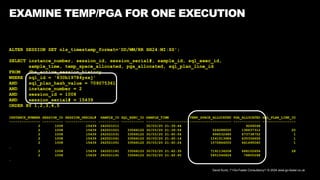
EXAMINE TEMP/PGA FOR ONE EXECUTION
ALTER SESSION SET nls_timestamp_format='DD/MM/RR HH24:MI:SS';
SELECT instance_number, session_id, session_serial#, sample_id, sql_exec_id,
sample_time, temp_space_allocated, pga_allocated, sql_plan_line_id
FROM dba_active_session_history
WHERE sql_id = '830b19784ysxj'
AND sql_plan_hash_value = 709075361
AND instance_number = 2
AND session_id = 1008
AND session_serial# = 15439
ORDER BY 1,2,3,4,5
INSTANCE_NUMBER SESSION_ID SESSION_SERIAL# SAMPLE_ID SQL_EXEC_ID SAMPLE_TIME TEMP_SPACE_ALLOCATED PGA_ALLOCATED SQL_PLAN_LINE_ID
--------------- ---------- --------------- ---------- ----------- -------------------- -------------------- ------------- ----------------
2 1008 15439 242021011 30/03/20 21:39:44 9269248
2 1008 15439 242021021 33566122 30/03/20 21:39:54 524288000 138637312 20
2 1008 15439 242021031 33566122 30/03/20 21:40:04 896532480 673738752 1
2 1008 15439 242021041 33566122 30/03/20 21:40:14 1241513984 635334656 1
2 1008 15439 242021051 33566122 30/03/20 21:40:24 1572864000 641495040 1
…
2 1008 15439 242021181 33566122 30/03/20 21:42:35 7191134208 668102656 28
2 1008 15439 242021191 33566122 30/03/20 21:42:45 5451546624 74805248
…
David Kurtz, /*+Go-Faster Consultancy*/ © 2024 www.go-faster.co.uk
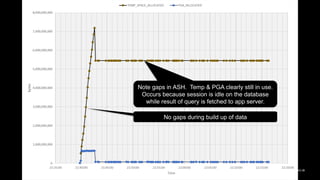
Note gaps in ASH. Temp & PGA clearly still in use.
Occurs because session is idle on the database
while result of query is fetched to app server.
No gaps during build up of data
David Kurtz, /*+Go-Faster Consultancy*/ © 2024 www.go-faster.co.uk
MONITOR PGA AND TEMP USAGE ACROSS
DATABASE
Cannot simply aggregate Temporary & PGA Allocations group by SAMPLE_ID. You will
miss inactive sessions.
• But I can interpolate the allocations between two points where I don't have samples.
• I need a temporary working storage table with one row
• for every known sample ID
• for each RAC instance.
• I need to round the sample times off to match across RAC nodes
• Then I will iterate though the statements that consumed PGA and Temp and build up a
total.
• Finally I can report from the working table (and aggregate across RAC nodes)
David Kurtz, /*+Go-Faster Consultancy*/ © 2024 www.go-faster.co.uk
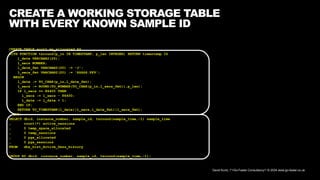
CREATE A WORKING STORAGE TABLE
WITH EVERY KNOWN SAMPLE ID
CREATE TABLE scott.my_allocated AS
WITH FUNCTION tsround(p_in IN TIMESTAMP, p_len INTEGER) RETURN timestamp IS
l_date VARCHAR2(20);
l_secs NUMBER;
l_date_fmt VARCHAR2(20) := 'J';
l_secs_fmt VARCHAR2(20) := 'SSSSS.FF9';
BEGIN
l_date := TO_CHAR(p_in,l_date_fmt);
l_secs := ROUND(TO_NUMBER(TO_CHAR(p_in,l_secs_fmt)),p_len);
IF l_secs >= 86400 THEN
l_secs := l_secs - 86400;
l_date := l_date + 1;
END IF;
RETURN TO_TIMESTAMP(l_date||l_secs,l_date_fmt||l_secs_fmt);
END;
SELECT dbid, instance_number, sample_id, tsround(sample_time,-1) sample_time
, count(*) active_sessions
, 0 temp_space_allocated
, 0 temp_sessions
, 0 pga_allocated
, 0 pga_sessions
FROM dba_hist_Active_Sess_history
…
GROUP BY dbid, instance_number, sample_id, tsround(sample_time,-1);
David Kurtz, /*+Go-Faster Consultancy*/ © 2024 www.go-faster.co.uk
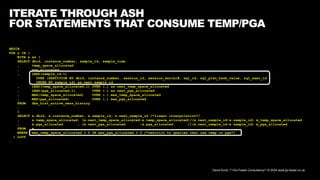
ITERATE THROUGH ASH
FOR STATEMENTS THAT CONSUME TEMP/PGA
BEGIN
FOR s IN (
WITH x as (
SELECT dbid, instance_number, sample_id, sample_time
, temp_space_allocated
, pga_allocated,
, LEAD(sample_id,1)
OVER (PARTITION BY dbid, instance_number, session_id, session_serial#, sql_id, sql_plan_hash_value, sql_exec_id
ORDER BY sample_id) as next_sample_id
, LEAD(temp_space_allocated,1) OVER (…) as next_temp_space_allocated
, LEAD(pga_allocated,1) OVER (…) as next_pga_allocated
, MAX(temp_space_allocated) OVER (…) max_temp_space_allocated
, MAX(pga_allocated) OVER (…) max_pga_allocated
FROM dba_hist_active_sess_history
…
)
SELECT x.dbid, x.instance_number, x.sample_id, x.next_sample_id /*linear interpolation*/
, x.temp_space_allocated, (x.next_temp_space_allocated-x.temp_space_allocated)/(x.next_sample_id-x.sample_id) m_temp_space_allocated
, x.pga_allocated , (x.next_pga_allocated -x.pga_allocated )/(x.next_sample_id-x.sample_id) m_pga_allocated
FROM x
WHERE max_temp_space_allocated > 0 OR max_pga_allocated > 0 /*restrict to queries that use temp or pga*/
) LOOP
…
David Kurtz, /*+Go-Faster Consultancy*/ © 2024 www.go-faster.co.uk
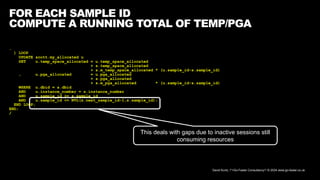
FOR EACH SAMPLE ID
COMPUTE A RUNNING TOTAL OF TEMP/PGA
…
) LOOP
UPDATE scott.my_allocated u
SET u.temp_space_allocated = u.temp_space_allocated
+ s.temp_space_allocated
+ s.m_temp_space_allocated * (u.sample_id-s.sample_id)
, u.pga_allocated = u.pga_allocated
+ s.pga_allocated
+ s.m_pga_allocated * (u.sample_id-s.sample_id)
WHERE u.dbid = s.dbid
AND u.instance_number = s.instance_number
AND u.sample_id >= s.sample_id
AND u.sample_id <= NVL(s.next_sample_id-1,s.sample_id);
END LOOP;
END;
/
This deals with gaps due to inactive sessions still
consuming resources
David Kurtz, /*+Go-Faster Consultancy*/ © 2024 www.go-faster.co.uk
MONITORING TEMPORARY SPACE AND PGA
USAGE WITH ASH
QUESTIONS?
David Kurtz, /*+Go-Faster Consultancy*/ © 2024 www.go-faster.co.uk
INDEX USAGE
David Kurtz, /*+Go-Faster Consultancy*/ © 2024 www.go-faster.co.uk
WHO IS USING THIS INDEX?
CURRENT_OBJ# has been suggested as a way to identify index usage.
• It only identifies index physical read
• So it also includes index maintenance during DML
• Doesn’t work if the index has been rebuilt since the ASH sample was taken
• and therefore has a new object number
David Kurtz, /*+Go-Faster Consultancy*/ © 2024 www.go-faster.co.uk
SQL PLANS CAPTURED BY AWR
SQL statements and plans captured during AWR snapshot
• Top N by Elapsed Time, CPU Time, Parse Calls, Shareable Memory, Version Count
DBA_HIST_SQL_PLAN
• OBJECT_ID
• OBJECT_OWNER
• OBJECT_TYPE
• OBJECT_NAME
David Kurtz, /*+Go-Faster Consultancy*/ © 2024 www.go-faster.co.uk
WHO IS USING THIS INDEX?
Join plans that reference an index to ASH data
• Join by SQL_PLAN_HASH_VALUE
• Do not join by SQL_ID
Filter out
• SQL*Plus, SQL Developer, Ad-Hoc query tools
• Statistics collection
David Kurtz, /*+Go-Faster Consultancy*/ © 2024 www.go-faster.co.uk
EXTRACT ASH FOR STATEMENTS THAT USE
SPECIFIED INDEXES
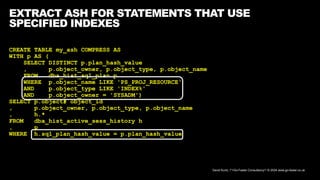
CREATE TABLE my_ash COMPRESS AS
WITH p AS (
SELECT DISTINCT p.plan_hash_value
, p.object_owner, p.object_type, p.object_name
FROM dba_hist_sql_plan p
WHERE p.object_name LIKE 'PS_PROJ_RESOURCE'
AND p.object_type LIKE 'INDEX%'
AND p.object_owner = 'SYSADM')
SELECT p.object# object_id
, p.object_owner, p.object_type, p.object_name
, h.*
FROM dba_hist_active_sess_history h
, p
WHERE h.sql_plan_hash_value = p.plan_hash_value
David Kurtz, /*+Go-Faster Consultancy*/ © 2024 www.go-faster.co.uk
PROFILE THE ASH EXTRACTED
WITH h AS (
SELECT object_name
, CASE WHEN h.module IS NULL THEN REGEXP_SUBSTR(h.program,'[^.@]+',1,1)
WHEN h.module LIKE 'PSAE.%' THEN REGEXP_SUBSTR(h.module,'[^.]+',1,2)
ELSE REGEXP_SUBSTR(h.program,'[^.@]+',1,1)
END as module
, CASE WHEN h.action LIKE 'PI=%' THEN NULL
ELSE h.action
END as action
, CAST(sample_time AS DATE) sample_time
, sql_id, sql_plan_hash_value, sql_exec_id
FROM my_ash h
)
SELECT object_name, module, action
, sum(usecs_per_row)/1e6 ash_secs
, COUNT(DISTINCT sql_plan_hash_value) sql_plans
, COUNT(DISTINCT sql_id||sql_plan_hash_value||sql_exec_id) sql_execs
, MAX(sample_time) max_sample_time
FROM h
WHERE NOT lower(module) IN('oracle','toad','sqlplus','sqlplusw')
AND NOT lower(module) LIKE 'sql%'
GROUP BY object_name, module, action
ORDER BY object_name, object_name, ash_secs desc
David Kurtz, /*+Go-Faster Consultancy*/ © 2024 www.go-faster.co.uk
PROFILE THE ASH EXTRACTED
ASH SQL SQL Last
OBJECT_NAME MODULE ACTION Secs Plans Execs Sample
------------------ -------------------- -------------------------------- ------- ----- ------ -------------------
…
PSMPROJ_RESOURCE PC_TL_TO_PC GF_PBINT_AE.XxBiEDM.Step07.S 60 2 6 18:35:18 20/05/2020
****************** -------
sum 60
PSNPROJ_RESOURCE PC_TL_TO_PC GF_PBINT_AE.CallmeA.Step26.S 6720 1 49 18:53:58 26/05/2020
PC_TL_TO_PC GF_PBINT_AE.CallmeA.Step30.S 3460 1 60 06:33:27 27/05/2020
GF_OA_CMSN GF_OA_CMSN.01INIT.Step01.S 2660 1 47 19:19:40 26/05/2020
PC_TL_TO_PC GF_PBINT_AE.CallmeA.Step06.S 1800 1 52 18:53:28 26/05/2020
PC_TL_TO_PC GF_PBINT_AE.CallmeG.Step01.S 1740 1 61 06:34:17 27/05/2020
PC_TL_TO_PC GF_PBINT_AE.CallmeA.Step02.S 1680 1 24 18:53:18 26/05/2020
PC_TL_TO_PC GF_PBINT_AE.CallmeA.Step10.S 1460 1 33 17:26:26 22/05/2020
PC_TL_TO_PC GF_PBINT_AE.CallmeA.Step08.S 920 1 26 17:26:16 22/05/2020
PC_TL_TO_PC GF_PBINT_AE.CallmeA.Step36.S 460 1 18 18:26:38 20/05/2020
PC_TL_TO_PC GF_PBINT_AE.CallmeA.Step09.S 420 1 16 06:33:07 27/05/2020
PC_PRICING GF_PBINT_AE.CallmeG.Step01.S 200 1 10 08:09:55 22/05/2020
PC_AP_TO_PC GF_PBINT_AE.CallmeH.Step00A.S 170 1 17 21:53:26 21/05/2020
PC_PRICING GF_PBINT_AE.CallmeA.Step36.S 20 1 1 08:02:46 05/05/2020
PC_PRICING GF_PBINT_AE.CallmeA.Step30.S 20 1 1 13:42:48 04/05/2020
PC_PRICING GF_PBINT_AE.CallmeA.Step06.S 20 1 1 15:58:35 28/07/2014
PC_TL_TO_PC GF_PBINT_AE.CallmeA.Pseudo.S 20 1 1 19:45:11 06/05/2020
****************** -------
sum 21770
…
This index used widely.
Probably can’t drop it.
This index used lightly.
Perhaps we don’t really need it.
Indexes that do not appear
may not be used.
David Kurtz, /*+Go-Faster Consultancy*/ © 2024 www.go-faster.co.uk
LIMITATIONS OF METHOD
AWR doesn’t capture all SQLs/Plans
• A very effective index that is only used occasionally might not be captured.
• Results are only indicative, not absolute.
ASH data purged after 8 days (by default)
• An index only be used for annual/monthly process might not be detected, but it might be
essential for that process
• Consider keeping ASH longer in production database. As long as typical cycle for
application.
• Consider establishing longer term repository, retaining perhaps 400 days.
• Consider how Automatic Indexing in 19c behaves
• By default, it waits 373 days before dropping an index
David Kurtz, /*+Go-Faster Consultancy*/ © 2024 www.go-faster.co.uk
BEFORE I CAN DROP AN INDEX…
Need to do a lot more analysis looking at whether this query needs this index.
Recommendation
• First make index invisible
• Drop it later if no negative consequences
David Kurtz, /*+Go-Faster Consultancy*/ © 2024 www.go-faster.co.uk
INDEX USAGE
QUESTIONS?
David Kurtz, /*+Go-Faster Consultancy*/ © 2024 www.go-faster.co.uk
MONITORING EXECUTION PLAN CHANGE AND
PLAN STABILITY
David Kurtz, /*+Go-Faster Consultancy*/ © 2024 www.go-faster.co.uk
DID MY EXECUTION PLAN CHANGE?
Can see change in execution plan and performance
• (same SQL, different literals, same force matching signature)
SQL_PLAN
PRCSINSTANCE BEGINDTTM SQL_ID HASH_VALUE EXEC_SECS ASH_SECS
------------ ------------------- ------------- ---------- --------- ---------
1964975 08:30:52 22/01/2020 46smbgcfcrb8d 2602481067 20379 20080
1965250 09:08:51 22/01/2020 fpftdx2405zyq 2602481067 20983 20690
1968443 16:42:51 22/01/2020 3rxad5z3ccusv 3398716340 105 80
1968469 16:47:21 22/01/2020 3rxad5z3ccusv 3398716340 90 70
1968485 16:50:19 22/01/2020 3rxad5z3ccusv 3398716340 62 40
1968698 17:40:01 22/01/2020 0ku8f514k3nt0 3398716340 76 50
1968866 18:19:19 22/01/2020 cbmyvpsxzyf5n 3398716340 139 120
1968966 18:34:24 22/01/2020 5jb1sgmjc7436 3398716340 187 170
David Kurtz, /*+Go-Faster Consultancy*/ © 2024 www.go-faster.co.uk
Problem Statement:
• Large Payroll
• Most of the employees
• Small Payroll
• Weekly payroll
• Different legislature
• Single employee recalculations
Poor payroll performance
• Because plans from small payroll used in large.
• We didn't get new child cursors
EFFECTIVENESS OF PLAN STABILITY
Stabilise plans in all payrolls with profiles based
on large payroll.
Three scenarios
1. Large payroll – collecting profiles, this is
the baseline
2. Small payroll – no profiles
3. Small payroll – with profiles applied
David Kurtz, /*+Go-Faster Consultancy*/ © 2024 www.go-faster.co.uk
EFFECT OF PLAN STABILITY
SELECT /*+ LEADING(@q1 r1@q1 x1@q1 h1@q1) USE_NL(h1@q1)
LEADING(@q2 r2@q2 x2@q2 h2@q2) USE_NL(h2@q2)
LEADING(@q3 r3@q3 x3@q3 h3@q3) USE_NL(h3@q3) */
q1.sql_id
, q1.sql_plan_hash_value, q1.ash_secs
, DECODE(q1.sql_plan_hash_value,q2.sql_plan_hash_value,'**SAME**',
q2.sql_plan_hash_value) sql_plan_hash_value2, q2.ash_secs
, DECODE(q1.sql_plan_hash_value,q3.sql_plan_hash_value,'**SAME**',
q3.sql_plan_hash_value) sql_plan_hash_value3, q3.ash_secs
FROM (…) Q1
LEFT OUTER JOIN (…) Q2 ON q1.sql_id = q2.sql_id
INNER JOIN (…) Q3 ON q1.sql_id = q3.sql_id
ORDER BY q3.ash_secs desc, q1.sql_id
/
Usual Query to profile DB Time by SQL_ID
and Plan Hash Value in each of three
in-line views, for different scenarios
David Kurtz, /*+Go-Faster Consultancy*/ © 2024 www.go-faster.co.uk
EFFECT OF PLAN STABILITY
SQL_ID SCENARIO 1 ASH_SECS SCENARIO 2 ASH_SECS SCENARIO 3 ASH_SECS
------------- ---------- -------- ---------- -------- ---------- --------
4uzmzh74rdrnz 2514155560 280 3829487612 >28750 **SAME** 50231
4n482cm7r9qyn 1595742310 680 869376931 140 **SAME** 8892
2f66y2u54ru1v 1145975676 630 **SAME** 531
1n2dfvb3jrn2m 1293172177 150 **SAME** 150
652y9682bqqvp 3325291917 30 **SAME** 110
d8gxmqp2zydta 1716202706 10 678016679 10 **SAME** 32
2np47twhd5nga 3496258537 10 **SAME** 27
4ru0618dswz3y 2621940820 10 539127764 223
4ru0618dswz3y 539127764 100 **SAME** 22
4ru0618dswz3y 3325291917 10 539127764 22
4ru0618dswz3y 1403673054 110 539127764 22
gnnu2hfkjm2yd 1559321680 80 **SAME** 19
1. Better with profile, but not great, but it did run
2. A little worse
3. 4 execution plans, now just 1, much better.
David Kurtz, /*+Go-Faster Consultancy*/ © 2024 www.go-faster.co.uk
INDEX USAGE
QUESTIONS?
David Kurtz, /*+Go-Faster Consultancy*/ © 2024 www.go-faster.co.uk
TRANSACTIONS & EXECUTIONS
David Kurtz, /*+Go-Faster Consultancy*/ © 2024 www.go-faster.co.uk
WHEN DID THE TRANSACTION BEGIN?
SELECT /*+leading(r h) use_nl(h)*/
h.sql_id, h.sql_plan_hash_value, h.xid
, SUM(1) ash_secs
, (NVL(r.enddttm,SYSDATE)-r.begindttm)*86400 exec_secs
, MIN(sample_time) first_sample_time
--, MAX(sample_time) last_sample_time
FROM gv$active_session_history h
, sysadm.psprcsrqst r
WHERE h.sample_time BETWEEN r.begindttm AND NVL(r.enddttm,SYSDATE)
AND h.module LIKE r.prcsname
AND h.action LIKE 'PI='||r.prcsinstance||'%'
AND r.prcsinstance = 10026580
AND h.sql_id = 'dungu07axr0z5'
GROUP BY r.prcsinstance, r.prcsname, r.begindttm, r.enddttm
, h.sql_id, h.sql_plan_hash_value, h.xid
ORDER BY last_sample_time, ash_secs desc
/
David Kurtz, /*+Go-Faster Consultancy*/ © 2024 www.go-faster.co.uk
WHEN DID THE TRANSACTION BEGIN?
SQL Plan ASH Exec
SQL_ID Hash Value XID Secs Secs First Running
------------- ---------- ---------------- ------ ------ -------------------------
7uj72ad03k13k 3087414546 82 1124 28-APR-20 04.42.48.662 PM
7uj72ad03k13k 3087414546 000A001400044C6D 1 1124 28-APR-20 04.44.11.672 PM
1ng9qkc0zspkh 3423396304 104 1124 28-APR-20 04.44.12.682 PM
1ng9qkc0zspkh 3423396304 0007002D0004116E 5 1124 28-APR-20 04.45.57.971 PM
Transaction ID only created when first row is modified
David Kurtz, /*+Go-Faster Consultancy*/ © 2024 www.go-faster.co.uk
WHEN DID THE TRANSACTION BEGIN?
DELETE /*GPPCANCL_D_ERNDGRP*/
FROM PS_GP_RSLT_ERN_DED
WHERE EMPLID BETWEEN :1 AND :2
AND CAL_RUN_ID= :3
AND EMPLID IN (SELECT EMPLID FROM PS_GP_GRP_LIST_RUN
WHERE RUN_CNTL_ID=:4 AND OPRID=:5)
AND EXISTS (SELECT 'X' FROM PS_GP_PYE_RCLC_WRK RW
WHERE RW.CAL_ID = PS_GP_RSLT_ERN_DED.CAL_ID
AND RW.CAL_RUN_ID = PS_GP_RSLT_ERN_DED.CAL_RUN_ID
AND RW.GP_PAYGROUP = PS_GP_RSLT_ERN_DED.GP_PAYGROUP
AND RW.EMPLID BETWEEN :6 AND :7
AND RW.CAL_RUN_ID = :8
AND RW.EMPLID = PS_GP_RSLT_ERN_DED.EMPLID
AND RW.EMPL_RCD = PS_GP_RSLT_ERN_DED.EMPL_RCD)
Depending on data, it could be a while before this statement found something to delete.
David Kurtz, /*+Go-Faster Consultancy*/ © 2024 www.go-faster.co.uk
HOW MANY EXECUTIONS
SELECT /*+LEADING(x h) USE_NL(h)*/ h.program
, h.sql_id, h.sql_plan_hash_value
, sum(usecs_per_row)/1e6 ash_secs
, COUNT(DISTINCT h.instance_number||h.session_id||h.session_serial#||h.sql_exec_id) execs
, COUNT(DISTINCT xid) XIDs
FROM dba_hist_snapshot x
, dba_hist_active_sess_history h
WHERE x.end_interval_time >= …
AND x.begin_interval_time <= …
AND h.sample_time >= …
AND h.sample_time <= …
AND h.snap_id = x.snap_id
AND h.dbid = x.dbid
AND h.instance_number = x.instance_number
GROUP BY h.program, h.sql_id, h.sql_plan_hash_value
ORDER BY ash_secs desc
/
David Kurtz, /*+Go-Faster Consultancy*/ © 2024 www.go-faster.co.uk
HOW MANY EXECUTIONS?
SQL Plan ASH
PROGRAM SQL_ID Hash Value Secs EXECS XIDS USERS
----------- ------------- ---------- ------ ------- ----- ------
t_async.exe 7q90ra0vmd9xx 2723153562 3020 297 0 20
t_async.exe 6mw25bgbh1stj 1229059401 320 32 0 17
…
Samples ≈ Executions
• Based on DBA_HIST_ACTIVE_SESS_HISTORY
• 1 sample / 10 seconds.
• Each sample is worth 10 seconds.
• Probably underestimates number of executions.
David Kurtz, /*+Go-Faster Consultancy*/ © 2024 www.go-faster.co.uk
LOTS OF SHORT-LIVED SQL
STATEMENTS
SQL_PLAN
PRCSINSTANCE NUM_SQL_ID HASH_VALUE EXEC_SECS ASH_SECS
------------ ---------- ---------- --------- ---------
50007687 169 953836181 3170 1690
50007687 50 807301148 3170 500
50007687 22 4034059499 3170 220
50007687 14 2504475139 3170 140
50007687 2 0 3170 70
50007687 1 1309703960 3170 20
50007687 1 3230852326 3170 10
…
We sampled 169 different statements with the same execution plan.
Probably more than 169 statements that took about 1690 seconds, but we only sampled 169.
169 SQLs 1690 Secs
David Kurtz, /*+Go-Faster Consultancy*/ © 2024 www.go-faster.co.uk
APPLICATION REPORTS LOTS OF COMPILES
David Kurtz, /*+Go-Faster Consultancy*/ © 2024 www.go-faster.co.uk
PROCESS STATES
Except there is actually 64224 database calls, not just 4!
time
1690s
2596s
David Kurtz, /*+Go-Faster Consultancy*/ © 2024 www.go-faster.co.uk
THINGS THAT CAN GO WRONG
David Kurtz, /*+Go-Faster Consultancy*/ © 2024 www.go-faster.co.uk
THINGS THAT CAN GO WRONG
WITH DBMS_XPLAN
Statement not in Library Cache
• Only Some Statements in Library Cache
• Lots of short-lived non-shareable SQL
DISPLAY_AWR
• ORA-6502 – very large SQL
• ORA-44002 – short-lived objects(?)
• ORA-1422 – duplicate SQL from cloning
SQL_PLAN_LINE_ID doesn't match the line number DBMS_XPLAN
David Kurtz, /*+Go-Faster Consultancy*/ © 2024 www.go-faster.co.uk
STATEMENT NOT IN LIBRARY CACHE
SELECT * FROM
table(dbms_xplan.display_cursor('gpdwr389mg61h',0,'ADVANCED'));
PLAN_TABLE_OUTPUT
-----------------------------------------------
SQL_ID: gpdwr389mg61h, child number: 0 cannot be found
David Kurtz, /*+Go-Faster Consultancy*/ © 2024 www.go-faster.co.uk
ORA-06502
This seems to be associated with very large SQL statements
SQL_ID 9vnan5kqsh1aq
--------------------
An uncaught error happened in prepare_sql_statement : ORA-06502: PL/SQL: numeric or value error
Plan hash value: 2262951047
---------------------------------------------------------------------------------------------------------------
| Id | Operation | Name | Rows | Bytes | Cost (%CPU)| Time |
---------------------------------------------------------------------------------------------------------------
| 0 | SELECT STATEMENT | | | | 1 (100)| |
| 1 | HASH GROUP BY | | 1 | 164 | 1 (100)| 00:00:01 |
…
David Kurtz, /*+Go-Faster Consultancy*/ © 2024 www.go-faster.co.uk
ORA-44002
I have seen this with Global Temporary Tables and with direct path mode (the APPEND hint).
PLAN_TABLE_OUTPUT
------------------------------------------------------
ERROR: cannot get definition for table 'BZTNCMUX31XP5'
ORA-44002: invalid object name
David Kurtz, /*+Go-Faster Consultancy*/ © 2024 www.go-faster.co.uk
ORA-01422
This happens on a database that has been cloned, often from production to test.
• Consider recreating AWR repository on clone?
An uncaught error happened in prepare_sql_statement :
ORA-01422: exact fetch returns more than requested
number of rows
David Kurtz, /*+Go-Faster Consultancy*/ © 2024 www.go-faster.co.uk
ORA-01422
Workaround
DELETE FROM sys.wrh$_sqltext t1
WHERE t1.dbid != (
SELECT d.dbid FROM v$database d)
AND EXISTS(
SELECT 'x'
FROM sys.wrh$_sqltext t2
WHERE t2.dbid = (
SELECT d.dbid FROM v$database d)
AND t2.sql_id = t1.sql_id)
David Kurtz, /*+Go-Faster Consultancy*/ © 2024 www.go-faster.co.uk
SQL_PLAN_LINE_ID DOESN'T MATCH PLAN
DUE TO AUTOMATIC STATISTICS COLLECTION
Presence of absence of OPTIMIZER STATISTICS GATHERING operation
• Doesn't change the PLAN_HASH_VALUE
• Does change the SQL_PLAN_LINE_ID of operations after it.
This can cause ASH profile by SQL Plan line ID not to match execution plans.
David Kurtz, /*+Go-Faster Consultancy*/ © 2024 www.go-faster.co.uk
NO STATISTICS COLLECTION
SQL_ID c4y8uxt5drk74, child number 0
-------------------------------------
insert into t with n as (select rownum n from dual connect by level <=
1000) select n.n, ceil(sqrt(n.n)), TO_CHAR(TO_DATE(n.n,'j'),'jsp') from n
Plan hash value: 761049541
--------------------------------------------------------------------------------------------------------------------
| Id | Operation | Name | E-Rows |E-Bytes| Cost (%CPU)| E-Time | OMem | 1Mem | Used-Mem |
--------------------------------------------------------------------------------------------------------------------
| 0 | INSERT STATEMENT | | | | 2 (100)| | | | |
| 1 | LOAD TABLE CONVENTIONAL | T | | | | | | | |
| 2 | VIEW | | 1 | 13 | 2 (0)| 00:00:01 | | | |
| 3 | COUNT | | | | | | | | |
| 4 | CONNECT BY WITHOUT FILTERING| | | | | | 2048 | 2048 | 2048 (0)|
| 5 | FAST DUAL | | 1 | | 2 (0)| 00:00:01 | | | |
--------------------------------------------------------------------------------------------------------------------
David Kurtz, /*+Go-Faster Consultancy*/ © 2024 www.go-faster.co.uk
REAL-TIME STATISTICS BEING GATHERED
SQL_ID c4y8uxt5drk74, child number 0
-------------------------------------
insert into t with n as (select rownum n from dual connect by level <=
1000) select n.n, ceil(sqrt(n.n)), TO_CHAR(TO_DATE(n.n,'j'),'jsp') from n
Plan hash value: 761049541
--------------------------------------------------------------------------------------------------------------------------------------------------------------
| Id | Operation | Name | Starts | E-Rows |E-Bytes| Cost (%CPU)| E-Time | A-Rows | A-Time | Buffers | OMem | 1Mem | Used-Mem |
--------------------------------------------------------------------------------------------------------------------------------------------------------------
| 0 | INSERT STATEMENT | | 1 | | | 2 (100)| | 0 |00:00:00.01 | 57 | | | |
| 1 | LOAD TABLE CONVENTIONAL | T | 1 | | | | | 0 |00:00:00.01 | 57 | | | |
| 2 | OPTIMIZER STATISTICS GATHERING | | 1 | 1 | 13 | 2 (0)| 00:00:01 | 1000 |00:00:00.01 | 0 | | | |
| 3 | VIEW | | 1 | 1 | 13 | 2 (0)| 00:00:01 | 1000 |00:00:00.01 | 0 | | | |
| 4 | COUNT | | 1 | | | | | 1000 |00:00:00.01 | 0 | | | |
| 5 | CONNECT BY WITHOUT FILTERING| | 1 | | | | | 1000 |00:00:00.01 | 0 | 2048 | 2048 | 2048 (0)|
| 6 | FAST DUAL | | 1 | 1 | | 2 (0)| 00:00:01 | 1 |00:00:00.01 | 0 | | | |
--------------------------------------------------------------------------------------------------------------------------------------------------------------
David Kurtz, /*+Go-Faster Consultancy*/ © 2024 www.go-faster.co.uk
HOW I WORK WITH ASH
David Kurtz, /*+Go-Faster Consultancy*/ © 2024 www.go-faster.co.uk
As Consultant
• I am here to provide advice and guidance
• Communicate that to other team members
• And also demonstrate how to obtain information
upon which to base advice.
Every piece of analysis produces a word document
• Copy and paste queries into SQL*Plus
• Adjust the queries to fit the circumstances
• Copy and paste results back into word
• Annotate results with comments and
recommendations
HOW I WORK WITH ASH
David Kurtz, /*+Go-Faster Consultancy*/ © 2024 www.go-faster.co.uk
CONCLUSION
ASH data
• Profiling DB response time is very valuable
• But there is lots more you can do
There are lots of ways to query the data
• Be imaginative!
Application instrumentation is essential
Consequences of sampling
Traps to fall into
David Kurtz, /*+Go-Faster Consultancy*/ © 2024 www.go-faster.co.uk
QUESTIONS
David Kurtz, /*+Go-Faster Consultancy*/ © 2024 www.go-faster.co.uk185
YOU KNOW MY METHODS
APPLY THEM
David Kurtz, /*+Go-Faster Consultancy*/ © 2024 www.go-faster.co.uk
QUESTIONS
David Kurtz, /*+Go-Faster Consultancy*/ © 2024 www.go-faster.co.uk
CONCLUSION
ASH data
• Profiling DB response time is very valuable
• But there is lots more you can do
There are lots of ways to query the data
• Be imaginative!
Application instrumentation is essential
Consequences of sampling
Traps to fall into

The Practical Use of Active Session History

  • 1.
    /*Go-Faster*/ Consultancy PRACTICAL USEOF ACTIVE SESSION HISTORY THE ASH MAN COMETH!
  • 2.
    /*Go-Faster*/ Consultancy PRACTICAL USE OFACTIVE SESSION HISTORY DAVID KURTZ UKOUG2024 /*+Go-Faster*/ Consultancy
  • 3.
    David Kurtz, /*+Go-FasterConsultancy*/ © 2024 www.go-faster.co.uk WHO AM I Go-Faster Consultancy • Performance tuning • Oracle RDBMS • PeopleSoft ERP • www.go-faster.co.uk • blog.go-faster.co.uk • blog.psftdba.com Oak Table @go-faster.co.uk
  • 4.
    David Kurtz, /*+Go-FasterConsultancy*/ © 2024 www.go-faster.co.uk Performance ASH Fundamentals • What is it? • How does it work? Practical Examples • Curated from real-life AGENDA Mining the ASH data • ASH in Performance Tools • Instrumentation • Profiling DB Time • Adaptive Plans • Literals & Binds • RAC • Blocking Lock Analysis • Temporary Tablespace/PGA Usage • Index Usage • Plan Stability • Transactions & Executions • Effective Parallelism • Sources of physical I/O • Things that can go wrong.
  • 5.
    David Kurtz, /*+Go-FasterConsultancy*/ © 2024 www.go-faster.co.uk FOLLOW THE MONEY TIME = MONEY
  • 6.
    David Kurtz, /*+Go-FasterConsultancy*/ © 2024 www.go-faster.co.uk FOLLOW THE TIME TIME = MONEY
  • 7.
    David Kurtz, /*+Go-FasterConsultancy*/ © 2024 www.go-faster.co.uk How much time did I spent doing what? What can I do about it? THERE IS ONLY ONE QUESTION IN PERFORMANCE OPTIMISATION Often, the answer is to stop doing it
  • 8.
    David Kurtz, /*+Go-FasterConsultancy*/ © 2024 www.go-faster.co.uk ASH FUNDAMENTALS “Sir Charles had evidently stood there for five or ten minutes." "How do you know that?" "Because the ash had twice dropped from his cigar." "Excellent! This is a colleague, Watson, after our own heart.”
  • 9.
    David Kurtz, /*+Go-FasterConsultancy*/ © 2024 www.go-faster.co.uk A number of slides in this opening section have been lovingly ripped off from various presentations by Graham Wood on the subject of ASH. • Sifting through the ASHes (2004) https://www.oracle.com/technetwork/database/manag eability/ppt-active-session-history-129612.pdf • ASH Architecture and Advanced Usage (2019) https:// youtu.be/rxQkvXIY7X0 • Database Time-Based Performance Tuning: From Theory to Practice (2015) https:// youtu.be/Aknb_iZrPbc John Beresniewicz • Database Time Fundamentals (2020) https:// youtu.be/jKZXGWuLe-k • DB Time basics (2020) https://youtu.be/xZViQXZPzx8 FURTHER READING
  • 10.
    David Kurtz, /*+Go-FasterConsultancy*/ © 2024 www.go-faster.co.uk ACTIVE SESSION HISTORY IS A SAMPLING TECHNOLOGY Sampling technology introduced in 10g • Built into the database, so it is always on • Low overhead, so still works well if system heavily loaded • No locking or latching • Only sessions that are currently active are collected by the sampling process. • Samples collected in memory • 1 in 10 samples persisted to AWR
  • 11.
    David Kurtz, /*+Go-FasterConsultancy*/ © 2024 www.go-faster.co.uk PROCESS STATES time Query Fetch Update Commit Client Process 6s 10.25s 4.25s
  • 12.
    David Kurtz, /*+Go-FasterConsultancy*/ © 2024 www.go-faster.co.uk ASH IS A SAMPLING TECHNOLOGY time sessions 4.5s 4.5s .5s .5s .5s .5s .5s .5s .5s .5s .5s 2s 2s 2s 1.5s 1.5s 1.25s 1.25s 5s 5s 6s 6s 4s 1 3 4 3 2 2 1 2 1 3 4 0 0 1 2 3 4 5 6 7 8 9 10 11 12 0 1 2 3 4 5 6 A.A.S. 0 1 2 3 4 5 6 7 8 9 10 11 12 0 1 2 3 4 5 6 A.A.S.
  • 13.
    David Kurtz, /*+Go-FasterConsultancy*/ © 2024 www.go-faster.co.uk 26 ASH Samples ≈ 26s DB Time Actually 24s These discrepancies are not unusual in a small sample set. They become less significant as the number of samples increases. ASH SAMPLING  APPROXIMATION time sessions 4.5s 4.5s .5s .5s .5s .5s .5s .5s .5s .5s .5s 2s 2s 2s 1.5s 1.5s 1.25s 1.25s 5s 5s 6s 6s 4s 1 3 4 3 2 2 1 2 1 3 4 0
  • 14.
    David Kurtz, /*+Go-FasterConsultancy*/ © 2024 www.go-faster.co.uk = Active Sessions The number of active sessions at any time is the rate of change of the “DB Time function” at that time. ASH CALCULUS DB Time is the integral of the Active Sessions function As →
  • 15.
    David Kurtz, /*+Go-FasterConsultancy*/ © 2024 www.go-faster.co.uk Where • Δt = duration between samples • S is the set of ASH samples DB Time is approximately the interval of time between each sample multiplied by the number of samples ASH MATHEMATICS Where • Δt = duration between ASH samples In v$active_session_history each ASH sample represents about 1 second. In DBA_HIST_ACTIVE_SESS_HISTORY each ASH sample represents about 10 seconds.
  • 16.
    David Kurtz, /*+Go-FasterConsultancy*/ © 2024 www.go-faster.co.uk Recent SELECT … , SUM(1) ash_secs FROM v$active_session_history WHERE … GROUP BY … ORDER BY ash_secs DESC, … OLD ASH SQL Historical SELECT … , SUM(10) ash_secs FROM dba_hist_active_sess_history WHERE … GROUP BY … ORDER BY ash_secs DESC, …
  • 17.
    David Kurtz, /*+Go-FasterConsultancy*/ © 2024 www.go-faster.co.uk Recent SELECT … , SUM(usecs_per_row)/1e6 ash_secs FROM v$active_session_history WHERE … GROUP BY … ORDER BY ash_secs DESC, … usecs_per_row = µs of database time per row ~1.02s/row (documented from 21c) ASH SQL NEW COLUMN FROM ORACLE 12.2 Historical SELECT … , SUM(usecs_per_row)/1e6 ash_secs FROM dba_hist_active_sess_history WHERE … GROUP BY … ORDER BY ash_secs DESC, … ~10.2s/row
  • 18.
    David Kurtz, /*+Go-FasterConsultancy*/ © 2024 www.go-faster.co.uk
  • 19.
    David Kurtz, /*+Go-FasterConsultancy*/ © 2024 www.go-faster.co.uk Circular buffer in SGA 2Mb / CPU ASH ARCHITECTURE AWR Session State Objects Session State Objects Session State Objects MMON lite (MMNL) v$session v$session_wait v$active_session_history DBA_HIST_ACTIVE_SESS_HISTORY AWR snapshot Readers unlatched Indexed on time Writer goes in one direction Readers go in other direction 1 in 10 samples on AWR snapshot or out-of-space Variable length records
  • 20.
    David Kurtz, /*+Go-FasterConsultancy*/ © 2024 www.go-faster.co.uk ASH is licenced as a part of the Diagnostics Pack Only available on Enterprise Edition • Database: $47,500/processor* • Diagnostics: $7,500/processor* • ⪅16% of license What if you don’t have the licence? What if you have Standard Edition *Oracle Technology Global Price List, June 13, 2024 ASH LICENCING Conceptually, ASH is sampling and storing v$session OraSASH or Oracle Simulation ASH • Open source project • http://pioro.github.io/orasash/ • Originated by Kyle Hailey • Maintained by Marcin Przepiorowski • PL/SQL procedure samples x$ksuse • Run from database scheduler • Writes persisted data across database link to another database to minimize measurement intrusion effect. • Query the data in much the same way as real ASH (as if on Oracle 10g).
  • 21.
    David Kurtz, /*+Go-FasterConsultancy*/ © 2024 www.go-faster.co.uk ASH • Licensed • Always there • No marginal cost • Real Time, Proactive • Statistical data • Who is blocking me? • SQL and plan if captured by AWR • Estimate of duration • Per wait event • Per Operation ASH –V- SQL*TRACE SQL*Trace • Free • Enable, Collect file, Profile • Run-time overhead • Reactive • Every SQL & database call • Being Blocked • Actual SQL and execution plan • Exact duration • Individual waits on events • Operations in Plan
  • 22.
    David Kurtz, /*+Go-FasterConsultancy*/ © 2024 www.go-faster.co.uk ASH can be used to resolve most of your performance issues. Sometimes, you will still need SQL*Trace ASH –V- SQL*TRACE From 12.2 you can also just query your trace files. • v$diag_trace_file • v$diag_trace_file_contents See also • Tim Hall’s Oracle-Base blog: SQL trace, 10046, trcsess and tkprof in Oracle • https:// oracle-base.com/articles/misc/sql-trace-10046- trcsess-and-tkprof#query_contents_of_trace_fi les
  • 23.
    David Kurtz, /*+Go-FasterConsultancy*/ © 2024 www.go-faster.co.uk ASH FUNDEMENTALS QUESTIONS?
  • 24.
    David Kurtz, /*+Go-FasterConsultancy*/ © 2024 www.go-faster.co.uk ASH: A DATA WAREHOUSE OF PERFORMANCE METRICS
  • 25.
    David Kurtz, /*+Go-FasterConsultancy*/ © 2024 www.go-faster.co.uk • Session • Session ID and serial • query coordinator • Container • Consumer Group ID • in flags connection, parse, exec, bind, PL/SQL, Java, close, sequence, inmemory, tablespace encryption • Wait • Class, event id, name and parameters • Blocking session ID, instance and status ASH DIMENSIONS & ATTRIBUTES • Application • program, machine, port, • module, action, client_id, ECID … • SQL • SQL_ID, Op Code, plan hash, plan line id, top level SQL ID, full plan hash value, exec ID • Transaction ID • force matching signature • PGA and Temp usage • Object • object, file, block and row number
  • 26.
    David Kurtz, /*+Go-FasterConsultancy*/ © 2024 www.go-faster.co.uk WHERE IS ASH REPORTED? Enterprise Manager / Enterprise Manager Express AWR Report • including ASH Report within AWR Report ASH Report eDB360 / SQLD360
  • 27.
    David Kurtz, /*+Go-FasterConsultancy*/ © 2024 www.go-faster.co.uk Tooltips with mouse over Active Sessions graph by attribute Top attribute profile Choose Time Window Top Application Modules from Instrumentation
  • 28.
    David Kurtz, /*+Go-FasterConsultancy*/ © 2024 www.go-faster.co.uk ASH Report in AWR Report For pair of AWR snapshots
  • 29.
    David Kurtz, /*+Go-FasterConsultancy*/ © 2024 www.go-faster.co.uk Specific time window
  • 30.
    David Kurtz, /*+Go-FasterConsultancy*/ © 2024 www.go-faster.co.uk ASH DATA IN OEM
  • 31.
    David Kurtz, /*+Go-FasterConsultancy*/ © 2024 www.go-faster.co.uk ASH DATA IN OEM You can run ASH reports via EM Filter by Module
  • 32.
    David Kurtz, /*+Go-FasterConsultancy*/ © 2024 www.go-faster.co.uk These processes were responsible for 86% of total DB activity Average 14.8 active sessions (out 32 processes) If I go on I get SQL statements But I don’t get execution plans. EXAMPLE ASH REPORT
  • 33.
    David Kurtz, /*+Go-FasterConsultancy*/ © 2024 www.go-faster.co.uk Open Source Tool • Carlos Sierra & Mauro Pagano • https://carlos-sierra.net/category/sqld360/ • https://mauro-pagano.com/ • https://github.com/sqldb360/sqldb360 Zero install footprint • All SQL scripts -> HTML & Google Charts ASH also extracted to CSV • External table: https:// blog.go-faster.co.uk/2019/10/reading-active-sess ion-history.html EDB360/SQLD360
  • 34.
    David Kurtz, /*+Go-FasterConsultancy*/ © 2024 www.go-faster.co.uk Keep it • 8-42 days locally • Copy to central repository • Retain for 400 days • awrextr.sql / awrload.sql • OEM 12c4 manage this • Compare different databases • Eg. artefacts common to multiple databases might indicate an infrastucture issue? DATA WAREHOUSE OF PERFORMANCE METRICS Multi-tenant database • By default AWR snapshots run in CDB and flushes ASH for all PDBS • Can configure AWR snapshots in individual PDBs • if higher snapshot frequency required. • Double capture of data. • In PDB • Can only see ASH from own PDB • In CDB • Can see ASH for all PDBs
  • 35.
    David Kurtz, /*+Go-FasterConsultancy*/ © 2024 www.go-faster.co.uk INSTRUMENTATION, INSTRUMENTATION, INSTRUMENTATION.
  • 36.
    David Kurtz, /*+Go-FasterConsultancy*/ © 2024 www.go-faster.co.uk APPLICATION INSTRUMENTATION It is essential to be able to match • database sessions • application processes DBMS_APPLICATION_INFO • set_module, set_action • Set session module and action attributes • Picked up by ASH, AWR and session trace • Put calls in application • Few packaged application vendors do this
  • 37.
    David Kurtz, /*+Go-FasterConsultancy*/ © 2024 www.go-faster.co.uk PL/SQL INSTRUMENTATION k_module CONSTANT VARCHAR2(64) := $$PLSQL_UNIT; … PROCEDURE my_procedure IS l_module VARCHAR2(64); l_action VARCHAR2(64); BEGIN dbms_application_info.read_module(module_name=>l_module ,action_name=>l_action); dbms_application_info.set_module(module_name=>k_module ,action_name=>'MY_PROCEDURE'); … … … dbms_application_info.set_module(module_name=>l_module ,action_name=>l_action); EXCEPTION WHEN … THEN dbms_application_info.set_module(module_name=>l_module ,action_name=>l_action); RAISE / EXIT … END my_procedure;
  • 38.
    David Kurtz, /*+Go-FasterConsultancy*/ © 2024 www.go-faster.co.uk DIY INSTRUMENTATION You may need to be creative! • PeopleTools: When a process starts (and sets its own status), I have a trigger that calls a PL/SQL API that sets module and action CREATE OR REPLACE TRIGGER sysadm.psftapi_store_prcsinstance BEFORE UPDATE OF runstatus ON sysadm.psprcsrqst FOR EACH ROW WHEN ((new.runstatus IN('3','7','8','9','10') OR old.runstatus IN('7','8')) AND new.prcstype != 'PSJob') BEGIN … psftapi.set_action(p_prcsinstance=>:new.prcsinstance ,p_runstatus=>:new.runstatus, p_prcsname=>:new.prcsname); … EXCEPTION WHEN OTHERS THEN NULL; --do not crash the scheduler END; /
  • 39.
    David Kurtz, /*+Go-FasterConsultancy*/ © 2024 www.go-faster.co.uk NO INSTRUMENTATION!
  • 40.
    David Kurtz, /*+Go-FasterConsultancy*/ © 2024 www.go-faster.co.uk WITH INSTRUMENTATION!
  • 41.
    David Kurtz, /*+Go-FasterConsultancy*/ © 2024 www.go-faster.co.uk Map Session Attributes to Resource Consumer Group • Combinations of • SERVICE, MODULE, ACTION, • Also • Oracle User, Client Program, OS User, Client ID Consumer Group ID recorded on ASH record RESOURCE MANAGER MODULE / ACTION • Session  ASH  AWR • SQL Stats  AWR • Consumer Group Mapping • Automatically Enable/Disable SQL*Trace
  • 42.
    David Kurtz, /*+Go-FasterConsultancy*/ © 2024 www.go-faster.co.uk INSTRUMENTATION, INSTRUMENTATION, INSTRUMENTATION. QUESTIONS
  • 43.
    David Kurtz, /*+Go-FasterConsultancy*/ © 2024 www.go-faster.co.uk ASH MINING
  • 44.
    David Kurtz, /*+Go-FasterConsultancy*/ © 2024 www.go-faster.co.uk WHAT ARE YOU LOOKING FOR? You need a clear idea of the question you are asking of the ASH data. What are you interested in? • Time Window • Recent –v- Historical • Single Session / Group of Sessions / Whole Database • All ASH Data / One Event / One SQL ID / One Plan • Related ASH data (sessions blocked by lock)
  • 45.
    David Kurtz, /*+Go-FasterConsultancy*/ © 2024 www.go-faster.co.uk PROFILE DB TIME BY DIFFERENT ATTRIBUTE TO FIND TOP SQLS • SQL_ID • FORCE_MATCHING_SIGNATURE – to treat literals as binds • TOP_LEVEL_SQL_ID – PL/SQL call • SQL_PLAN_HASH_VALUE • SQL_PLAN_LINE_ID • SQL_FULL_PLAN_HASH_VALUE – adaptive plan • EVENT_CLASS • EVENT • IN_PARSE, IN_HARD_PARSE, IN_BIND, IN_SQL_EXECUTION, IN_PLSQL_EXECUTION, IN_CURSOR_CLOSE
  • 46.
    David Kurtz, /*+Go-FasterConsultancy*/ © 2024 www.go-faster.co.uk QUERYING ASH REPOSITORY DBA_HIST_ACTIVE_SESS_HISTORY • WRH$_ACTIVE_SESSION_HISTORY partitioned on DBID and SNAP_ID DBA_HIST_SNAPSHOT • WRM$_SNAPSHOT
  • 47.
    David Kurtz, /*+Go-FasterConsultancy*/ © 2024 www.go-faster.co.uk QUERYING ASH REPOSITORY SELECT /*+LEADING(x) USE_NL(h)*/ … , SUM(usecs_per_row)/1e6 ash_secs FROM dba_hist_active_sess_history h , dba_hist_snapshot x WHERE x.snap_id = h.snap_id AND x.dbid = h.dbid AND x.instance_number = h.instance_number AND x.end_interval_time >= … AND x.begin_interval_time <= … AND h.sample_time BETWEEN … AND … AND … GROUP BY …
  • 48.
    David Kurtz, /*+Go-FasterConsultancy*/ © 2024 www.go-faster.co.uk EXAMPLE SELECT /*+LEADING(x h) USE_NL(h)*/ h.sql_id h.sql_plan_hash_value , SUM(usecs_per_row)/1e6 ash_secs FROM dba_hist_snapshot x , dba_hist_active_sess_history h WHERE x.end_interval_time >= TO_DATE('202411010730','yyyymmddhh24mi') AND x.begin_interval_time <= TO_DATE('202411010830','yyyymmddhh24mi') AND h.sample_time BETWEEN TO_DATE('202411010730','yyyymmddhh24mi') AND TO_DATE('202411010830','yyyymmddhh24mi') AND h.SNAP_id = X.SNAP_id AND h.dbid = x.dbid AND h.instance_number = x.instance_number AND h.module like 'PSAPPSRV%' GROUP BY h.sql_id, h.sql_plan_hash_value ORDER BY ash_secs DESC / Application not instrumented Can only filter by Module Snapshots that intersect with the period for which process was running ASH Data for period for which process was running
  • 49.
    David Kurtz, /*+Go-FasterConsultancy*/ © 2024 www.go-faster.co.uk TOP SQL SQL Plan SQL_ID Hash Value ASH_SECS ------------- ---------- ---------- 7hvaxp65s70qw 1051046890 1360 fdukyw87n6prc 313261966 760 8d56bz2qxwy6j 2399544943 720 876mfmryd8yv7 156976114 710 bphpwrud1q83t 3575267335 690 …
  • 50.
    David Kurtz, /*+Go-FasterConsultancy*/ © 2024 www.go-faster.co.uk GET EXECUTION PLAN FROM AWR SELECT * from table( dbms_xplan.display_workload_repository( '7hvaxp65s70qw', 1051046890, 'ADVANCED') );
  • 51.
    David Kurtz, /*+Go-FasterConsultancy*/ © 2024 www.go-faster.co.uk GET EXECUTION PLAN FROM LIBRARY CACHE SELECT * from table( dbms_xplan.display_cursor( '7hvaxp65s70qw', 0, 'ADVANCED') );
  • 52.
    David Kurtz, /*+Go-FasterConsultancy*/ © 2024 www.go-faster.co.uk USE SQL QUERY TO GENERATE CODE TO OBTAIN EXECUTION PLAN SELECT DISTINCT 'SELECT * from table( dbms_xplan.display_cursor(''' ||sql_id ||''',' ||sql_child_number ||',''ADVANCED''));' FROM ( … )
  • 53.
    David Kurtz, /*+Go-FasterConsultancy*/ © 2024 www.go-faster.co.uk WHICH PART OF EXECUTION PLAN CONSUMED THE MOST TIME? SELECT … , h.sql_plan_line_id , sum(usecs_per_row)/1e6 ash_secs FROM dba_hist_snapshot x , dba_hist_active_sess_history h … WHERE … AND h.sql_id = 'a47fb0x1b23jn' GROUP BY … , h.sql_plan_line_id ORDER BY ASH_SECS DESC
  • 54.
    David Kurtz, /*+Go-FasterConsultancy*/ © 2024 www.go-faster.co.uk WHICH PART OF EXECUTION PLAN CONSUMED THE MOST TIME? PRCSINSTANCE SQL_PLAN_HASH_VALUE SQL_PLAN_LINE_ID ASH_SECS ------------ ------------------- ---------------- ---------- 4945802 483167840 25 2410 483167840 24 1190 483167840 26 210 483167840 20 190 483167840 21 30 483167840 16 20 483167840 23 10 483167840 22 10 483167840 18 10 483167840 10 483167840 7 10
  • 55.
    David Kurtz, /*+Go-FasterConsultancy*/ © 2024 www.go-faster.co.uk WHICH PART OF EXECUTION PLAN CONSUMED THE MOST TIME? Plan hash value: 483167840 --------------------------------------------------------------------------------------------------------------------------------------- | Id | Operation | Name | Rows | Bytes | Cost (%CPU)| Time | TQ |IN-OUT| PQ Distrib | --------------------------------------------------------------------------------------------------------------------------------------- … | 14 | NESTED LOOPS | | | | | | Q1,04 | PCWP | | | 15 | NESTED LOOPS | | 3988 | 669K| 113K (1)| 00:06:08 | Q1,04 | PCWP | | | 16 | HASH JOIN SEMI | | 3851 | 481K| 112K (1)| 00:06:05 | Q1,04 | PCWP | | | 17 | PX RECEIVE | | 3771K| 233M| 61175 (1)| 00:03:19 | Q1,04 | PCWP | | | 18 | PX SEND HASH | :TQ10003 | 3771K| 233M| 61175 (1)| 00:03:19 | Q1,03 | P->P | HASH | | 19 | PX BLOCK ITERATOR | | 3771K| 233M| 61175 (1)| 00:03:19 | Q1,03 | PCWC | | | 20 | TABLE ACCESS FULL | PS_CM_DEPLETE | 3771K| 233M| 61175 (1)| 00:03:19 | Q1,03 | PCWP | | | 21 | BUFFER SORT | | | | | | Q1,04 | PCWC | | | 22 | PX RECEIVE | | 6058K| 364M| 50906 (1)| 00:02:46 | Q1,04 | PCWP | | | 23 | PX SEND HASH | :TQ10001 | 6058K| 364M| 50906 (1)| 00:02:46 | | S->P | HASH | | 24 | INDEX FULL SCAN | PS_CM_DEPLETE_COST | 6058K| 364M| 50906 (1)| 00:02:46 | | | | | 25 | INDEX UNIQUE SCAN | PS_TRANSACTION_INV | 1 | | 1 (0)| 00:00:01 | Q1,04 | PCWP | | | 26 | TABLE ACCESS BY INDEX ROWID| PS_TRANSACTION_INV | 1 | 44 | 1 (0)| 00:00:01 | Q1,04 | PCWP | | … ---------------------------------------------------------------------------------------------------------------------------------------
  • 56.
    David Kurtz, /*+Go-FasterConsultancy*/ © 2024 www.go-faster.co.uk PROFILE BY LINE AND EVENT -------------------------------------------------------------------------------------------------- | Id | Operation | Name | Rows | Bytes | Cost (%CPU)| Time | -------------------------------------------------------------------------------------------------- | 0 | INSERT STATEMENT | | | | 318 (100)| | | 1 | LOAD TABLE CONVENTIONAL | | | | | | | 2 | FILTER | | | | | | | 3 | TABLE ACCESS BY INDEX ROWID| PS_PROJ_RESOURCE | 724 | 337K| 314 (0)| 00:00:04 | | 4 | INDEX RANGE SCAN | PSEPROJ_RESOURCE | 724 | | 9 (0)| 00:00:01 | | 5 | INDEX RANGE SCAN | PS_PRJRE_SBF_TMP | 1 | 6 | 4 (0)| 00:00:01 | -------------------------------------------------------------------------------------------------- ASH SQL_PLAN_LINE_ID EVENT Secs ---------------- ------------------------------------------ -------- 3 db file sequential read 40320 3 read by other session 12280 1 10680 1 db file sequential read 4320 3 2800 db file sequential read 1560 4 db file sequential read 1160 520 4 240 4 read by other session 200 read by other session 80 5 db file sequential read 40 -------- sum 74200
  • 57.
    David Kurtz, /*+Go-FasterConsultancy*/ © 2024 www.go-faster.co.uk ASH MINING QUESTIONS?
  • 58.
    David Kurtz, /*+Go-FasterConsultancy*/ © 2024 www.go-faster.co.uk LITERALS –V – BIND VARIABLES NON-SHARABLE SQL
  • 59.
    David Kurtz, /*+Go-FasterConsultancy*/ © 2024 www.go-faster.co.uk BIND VARIABLES Developers Should Use Them! Unfortunately…
  • 60.
    David Kurtz, /*+Go-FasterConsultancy*/ © 2024 www.go-faster.co.uk Bind Variables • Frequently executed SQL statement • Similar (small) amount of work • Same execution plan usually suitable for all. • Overhead of SQL optimization is significant compared to that of execution • Share Child Cursor • Typical for OLTP • In general, preferred approach • Same SQL_ID • https://jonathanlewis.wordpress.com/2009/05/06/ philosophy-1/ "HISTOGRAMS & BIND VARIABLES EXIST FOR DIAMETRICALLY OPPOSED REASONS"* Histograms • Large and highly variable amounts of work • Need different execution plans • Overhead of SQL optimisation is small compared to execution. • Histograms may be beneficial • Using literals values (rather than bind variables) might be preferable. • Different SQL_IDs • Creates additional ASH challenges
  • 61.
    David Kurtz, /*+Go-FasterConsultancy*/ © 2024 www.go-faster.co.uk NON-SHAREABLE OLTP SQL SQL_ID djqf1zcypm5fm -------------------- SELECT … FROM ps_tl_exception a, ps_personal_data b, ps_perall_sec_qry b1, … WHERE b.emplid = b1.emplid AND b1.oprid = '12345678' …
  • 62.
    David Kurtz, /*+Go-FasterConsultancy*/ © 2024 www.go-faster.co.uk MANY SQL_IDS SAME EXECUTION PLAN PRCSINSTANCE SQL_ID SQL_PLAN_HASH_VALUE ASH_SECS ------------ ------------- ------------------- ---------- 50002824 0 50 50002824 2ybtak62vmx58 2262951047 20 50002824 ck3av6cnquwfc 2262951047 20 50002824 gvys6kd9fqn7u 2262951047 20 50002824 7ymcbn6q8utj8 2262951047 10 50002824 9qud2n3qq7nzr 2262951047 10 50002824 6pxvns97m1fua 2262951047 10 50002824 5ngqj5zg8vbz8 2262951047 10 50002824 9zp6nndfvn66b 2262951047 10 50002824 15kfs3c3005xm 2262951047 10 50002824 4qvhpygc7cq2t 2262951047 10 50002824 23yc8dcz9z4yj 2262951047 10 50002824 bn8xczrvs2hpr 2262951047 10 50002824 9g6k9dnrjap08 2262951047 10 50002824 1art8dhzbvpwt 2262951047 10 50002824 6gqj337xnr5y4 2262951047 10 …
  • 63.
    David Kurtz, /*+Go-FasterConsultancy*/ © 2024 www.go-faster.co.uk FORCE_MATCHING_SIGNATURE • Treat literals as binds GROUP BY ? SQL_PLAN_HASH_VALUE • But sometimes you get differences in the SQL that produce different FMS but result in same execution plan • Different number of terms in IN() • Additional criteria, usually on unindexed columns • If two statements are similar enough to produce the same execution plan, • Then they are likely to experience the same challenges and benefit from the same optimisations.
  • 64.
    David Kurtz, /*+Go-FasterConsultancy*/ © 2024 www.go-faster.co.uk AGGREGATE BY SQL_PLAN_HASH_VALUE PRCSINSTANCE SQL_PLAN_HASH_VALUE ASH_SECS ------------ ------------------- ---------- 50002824 2262951047 2300 50002824 0 60 50002824 3085938243 20 50002824 563410926 10 50002824 1068931976 10
  • 65.
    David Kurtz, /*+Go-FasterConsultancy*/ © 2024 www.go-faster.co.uk CAN YOU FIND THE SQL IN AWR? Now Find the SQL with that plan. If it was captured by AWR • Lots of parsing causes statements to be aged out of library cache before they get stored in AWR by a snapshot • Only Top-n statements are captured.
  • 66.
    David Kurtz, /*+Go-FasterConsultancy*/ © 2024 www.go-faster.co.uk SELECT h.sql_id, h.sql_plan_hash_value , sum(10)/1e6 ash_secs , 10*COUNT(t.sql_id) awr_secs FROM dba_hist_snapshot X , dba_hist_active_sess_history h LEFT OUTER JOIN dba_hist_sqltext t ON t.sql_id = h.sql_id WHERE … GROUP BY h.sql_id , h.sql_plan_hash_value CAN YOU FIND THE SQL IN AWR? SELECT h.sql_id, h.sql_plan_hash_value , SUM(usecs_per_row)/1e6 ash_secs , AVG(usecs_per_row)/1e6 *COUNT(t.sql_id) awr_secs FROM dba_hist_snapshot X , dba_hist_active_sess_history h LEFT OUTER JOIN dba_hist_sqltext t ON t.sql_id = h.sql_id WHERE … GROUP BY h.sql_id , h.sql_plan_hash_value
  • 67.
    David Kurtz, /*+Go-FasterConsultancy*/ © 2024 www.go-faster.co.uk CAN YOU FIND THE SQL IN AWR? WITH x AS ( SELECT h.sql_id, h.sql_plan_hash_value , sum(usecs_per_row)/1e6 ash_secs , avg(usecs_per_row)/1e6*count(t.sql_id) awr_secs FROM dba_hist_snapshot X , dba_hist_active_sess_history h LEFT OUTER JOIN dba_hist_sqltext t ON t.sql_id = h.sql_id WHERE … GROUP BY h.sql_id, h.sql_plan_hash_value ), y as ( SELECT ROW_NUMBER() OVER (PARTITION BY x.sql_plan_hash_value ORDER BY x.awr_secs DESC, x.ash_secs DESC) ranking , x.sql_id, x.sql_plan_hash_value , SUM(x.ash_secs) OVER (PARTITION BY x.sql_plan_hash_value) ash , SUM(x.awr_secs) OVER (PARTITION BY x.sql_plan_hash_value) awr , COUNT(DISTINCT sql_id) OVER (PARTITION BY x.sql_plan_hash_value) sql_ids FROM x ) SELECT * FROM y WHERE y.ranking = 1 ORDER BY tot_ash_secs desc, ranking
  • 68.
    David Kurtz, /*+Go-FasterConsultancy*/ © 2024 www.go-faster.co.uk STATEMENTS NOT IN AWR REPOSITORY Longest SQL Plan RANKING SQL_ID Hash Value TOT_ASH_SECS TOT_AWR_SECS SQL_IDS ---------- ------------- ---------- ------------ ------------ ---------- 1 1wfhpn9k2x3hq 0 7960 4600 13 1 2wsan9j1pk3j2 1061502179 4230 4230 1 1 bnxddum0rrvyh 918066299 2640 1200 179 1 02cymzmyt4mdh 508527075 2070 0 45 1 5m0xbf7vn8490 2783301143 1700 0 49 1 0jfp0g054cb3n 4135405048 1500 0 47 1 11bygm2nyqh0s 3700906241 1370 0 27 1. Special case. There is no plan because it’s the dbms_stats function. There were 13 statements, but in reality they were all totally different. PHV=0 indicates PL/SQL or INSERT…VALUES. 2. One SQL, one plan. Either this is a shareable SQL_ID, or it just executed once. 3. This is many statements with the same plan, at least 179, possibly more. 264 samples, representing 2640 seconds of SQL, but only 120 samples for SQLs captured by AWR. 4. Sometimes we don’t capture any of the SQL statements 1 2 3 4
  • 69.
    David Kurtz, /*+Go-FasterConsultancy*/ © 2024 www.go-faster.co.uk LITERALS –V- BIND VARIABLES NON-SHAREABLE SQL QUESTIONS?
  • 70.
    David Kurtz, /*+Go-FasterConsultancy*/ © 2024 www.go-faster.co.uk ADAPTIVE PLANS
  • 71.
    David Kurtz, /*+Go-FasterConsultancy*/ © 2024 www.go-faster.co.uk ADAPTIVE EXECUTION PLAN SELECT sql_full_plan_hash_value, sql_plan_hash_value, sql_adaptive_plan_resolved , COUNT(DISTINCT sql_exec_id) execs , sum(usecs_per_row)/1e6 ash_secs FROM dba_hist_active_Sess_history WHERE sql_id = '4dszd9dysry0c' AND sql_plan_hash_value > 0 GROUP BY dbid, sql_plan_hash_value, sql_full_plan_hash_value, sql_adaptive_plan_resolved SQL_FULL_PLAN_HASH_VALUE SQL_PLAN_HASH_VALUE SQL_ADAPTIVE_PLAN_RESOLVED EXECS ASH_SECS ------------------------ ------------------- -------------------------- ---------- ---------- 4059585501 4114868852 1 274 3050 4059585501 3412983073 1 387 3980 Adaptive Plan One SQL statement, two plan hash values, same full plan hash value
  • 72.
    David Kurtz, /*+Go-FasterConsultancy*/ © 2024 www.go-faster.co.uk ADAPTIVE EXECUTION PLAN select * from table(dbms_xplan.display('ASH_PLAN_TABLE','4dszd9dysry0c',null ,'dbid=2783210685 and plan_hash_value = 3412983073')); Plan hash value: 3412983073 --------------------------------------------------------------------------------------------------------- | Id | Operation | Name | Rows | Bytes | Cost (%CPU)| Time | --------------------------------------------------------------------------------------------------------- | 0 | SELECT STATEMENT | | | | 13 (100)| | | 1 | SORT ORDER BY | | 9 | 747 | 13 (8)| 00:00:01 | | 2 | HASH JOIN | | 9 | 747 | 12 (0)| 00:00:01 | | 3 | JOIN FILTER CREATE | :BF0000 | 9 | 747 | 12 (0)| 00:00:01 | | 4 | TABLE ACCESS BY INDEX ROWID BATCHED| PGRELS | 9 | 585 | 5 (0)| 00:00:01 | | 5 | INDEX RANGE SCAN | LINKSOURCE_201 | 9 | | 3 (0)| 00:00:01 | | 6 | JOIN FILTER USE | :BF0000 | 122 | 2196 | 7 (0)| 00:00:01 | | 7 | TABLE ACCESS STORAGE FULL | USERGROUPS | 122 | 2196 | 7 (0)| 00:00:01 | --------------------------------------------------------------------------------------------------------- Note ----- - this is an adaptive plan
  • 73.
    David Kurtz, /*+Go-FasterConsultancy*/ © 2024 www.go-faster.co.uk FROM 12C: ALWAYS SPECIFY +ADAPTIVE SELECT * from table( dbms_xplan.display_workload_repository( '7hvaxp65s70qw', 1051046890, 'ADVANCED +ADAPTIVE') ); From 12c, always use +ADAPTIVE so that plan line numbers match SQL_PLAN_LINE_ID From 19c, +ADAPTIVE also generated a Query Block Registry section
  • 74.
    David Kurtz, /*+Go-FasterConsultancy*/ © 2024 www.go-faster.co.uk ADAPTIVE EXECUTION PLAN select * from table(dbms_xplan.display('ASH_PLAN_TABLE','4dszd9dysry0c','+ADAPTIVE' ,'dbid=2783210685 and plan_hash_value = 3412983073')); Plan hash value: 3412983073 ------------------------------------------------------------------------------------------------------------ | Id | Operation | Name | Rows | Bytes | Cost (%CPU)| Time | ------------------------------------------------------------------------------------------------------------ | 0 | SELECT STATEMENT | | | | 13 (100)| | | 1 | SORT ORDER BY | | 9 | 747 | 13 (8)| 00:00:01 | | 2 | HASH JOIN | | 9 | 747 | 12 (0)| 00:00:01 | | 3 | JOIN FILTER CREATE | :BF0000 | 9 | 747 | 12 (0)| 00:00:01 | |- 4 | NESTED LOOPS | | 9 | 747 | 12 (0)| 00:00:01 | |- 5 | NESTED LOOPS | | | | | | |- 6 | STATISTICS COLLECTOR | | | | | | | 7 | TABLE ACCESS BY INDEX ROWID BATCHED| PGRELS | 9 | 585 | 5 (0)| 00:00:01 | | 8 | INDEX RANGE SCAN | LINKSOURCE_201 | 9 | | 3 (0)| 00:00:01 | |- 9 | INDEX UNIQUE SCAN | SYS_C008784 | | | | | |- 10 | TABLE ACCESS BY INDEX ROWID | USERGROUPS | 1 | 18 | 7 (0)| 00:00:01 | | 11 | JOIN FILTER USE | :BF0000 | 122 | 2196 | 7 (0)| 00:00:01 | | 12 | TABLE ACCESS STORAGE FULL | USERGROUPS | 122 | 2196 | 7 (0)| 00:00:01 | ------------------------------------------------------------------------------------------------------------ Note ----- - this is an adaptive plan (rows marked '-' are inactive)
  • 75.
    David Kurtz, /*+Go-FasterConsultancy*/ © 2024 www.go-faster.co.uk ADAPTIVE EXECUTION PLAN select * from table(dbms_xplan.display('ASH_PLAN_TABLE','4dszd9dysry0c','+ADAPTIVE' ,'dbid=2783210685 and plan_hash_value = 4114868852')); Plan hash value: 4114868852 ------------------------------------------------------------------------------------------------------------ | Id | Operation | Name | Rows | Bytes | Cost (%CPU)| Time | ------------------------------------------------------------------------------------------------------------ | 0 | SELECT STATEMENT | | | | 13 (100)| | | 1 | SORT ORDER BY | | 8 | 664 | 13 (8)| 00:00:01 | |- 2 | HASH JOIN | | 8 | 664 | 12 (0)| 00:00:01 | | 3 | JOIN FILTER CREATE | :BF0000 | 8 | 664 | 12 (0)| 00:00:01 | | 4 | NESTED LOOPS | | 8 | 664 | 12 (0)| 00:00:01 | | 5 | NESTED LOOPS | | | | | | |- 6 | STATISTICS COLLECTOR | | | | | | | 7 | TABLE ACCESS BY INDEX ROWID BATCHED| PGRELS | 8 | 520 | 5 (0)| 00:00:01 | | 8 | INDEX RANGE SCAN | LINKSOURCE_201 | 9 | | 3 (0)| 00:00:01 | | 9 | INDEX UNIQUE SCAN | SYS_C008784 | | | | | | 10 | TABLE ACCESS BY INDEX ROWID | USERGROUPS | 1 | 18 | 7 (0)| 00:00:01 | |- 11 | JOIN FILTER USE | :BF0000 | 122 | 2196 | 7 (0)| 00:00:01 | |- 12 | TABLE ACCESS STORAGE FULL | USERGROUPS | 122 | 2196 | 7 (0)| 00:00:01 | ------------------------------------------------------------------------------------------------------------ Note ----- - this is an adaptive plan (rows marked '-' are inactive)
  • 76.
    David Kurtz, /*+Go-FasterConsultancy*/ © 2024 www.go-faster.co.uk PROFILING ADAPTIVE PLANS SELECT sql_plan_hash_value , sql_full_plan_hash_value , sql_plan_line_id , sql_adaptive_plan_resolved , sum(usecs_per_row)/1e6 ash_secs FROM dba_hist_active_Sess_history WHERE sql_id = '4dszd9dysry0c' GROUP BY sql_plan_hash_value , sql_full_plan_hash_value , sql_plan_line_id , sql_adaptive_plan_resolved ORDER BY 1,2,4 /
  • 77.
    David Kurtz, /*+Go-FasterConsultancy*/ © 2024 www.go-faster.co.uk PROFILING ADAPTIVE PLANS SQL_PLAN_HASH_VALUE SQL_FULL_PLAN_HASH_VALUE SQL_PLAN_LINE_ID SQL_ADAPTIVE_PLAN_RESOLVED ASH_SECS ------------------- ------------------------ ---------------- -------------------------- ---------- 3412983073 4059585501 1 1 60 3412983073 4059585501 2 1 1540 3412983073 4059585501 3 1 80 3412983073 4059585501 7 1 50 3412983073 4059585501 8 1 50 3412983073 4059585501 12 1 750 3412983073 4059585501 1 560 4114868852 4059585501 0 10 4114868852 4059585501 1 1 230 4114868852 4059585501 2 1 20 4114868852 4059585501 3 1 200 4114868852 4059585501 4 1 40 4114868852 4059585501 7 1 140 4114868852 4059585501 8 1 150 4114868852 4059585501 9 1 70 4114868852 4059585501 10 1 800 4114868852 4059585501 1 1180 SQL Plan Line IDs correspond to +ADAPTIVE plan
  • 78.
    David Kurtz, /*+Go-FasterConsultancy*/ © 2024 www.go-faster.co.uk FROM 19C: USE DBMS_XPLAN.DISPLAY_WORKLOAD_REPOSITORY Officially, DISPLAY_AWR is deprecated in 19c SELECT * from table( dbms_xplan.display_workload_repository ('7hvaxp65s70qw', 1051046890, 'ADVANCED +ADAPTIVE');
  • 79.
    David Kurtz, /*+Go-FasterConsultancy*/ © 2024 www.go-faster.co.uk ADAPTIVE PLANS QUESTIONS?
  • 80.
    David Kurtz, /*+Go-FasterConsultancy*/ © 2024 www.go-faster.co.uk ASH & RAC
  • 81.
    David Kurtz, /*+Go-FasterConsultancy*/ © 2024 www.go-faster.co.uk Each RAC instance • has its own ASH buffer • manages its own ASH sampling • does its own AWR snapshots ASH & RAC Consequences • Different instances start/stop at different times • SAMPLE_ID does not match across RAC instances - it is not even close • ASH samples occur at slightly different times on different instances • SAMPLE_TIME does not exactly match across instances • microsecond accuracy timestamp • round it off to sample interval (1s or 10s) • match within sample interval +/- 0.5s or 5s • SNAP_ID does match because AWR is run on a schedule common to all instances
  • 82.
    David Kurtz, /*+Go-FasterConsultancy*/ © 2024 www.go-faster.co.uk ROUND TIMESTAMP WITH PL/SQL FUNCTION IN WITH CLAUSE WITH FUNCTION tsround(p_in IN TIMESTAMP, p_len INTEGER) RETURN timestamp IS l_date VARCHAR2(20); l_secs NUMBER; l_date_fmt VARCHAR2(20) := 'J'; l_secs_fmt VARCHAR2(20) := 'SSSSS.FF9'; BEGIN l_date := TO_CHAR(p_in,l_date_fmt); l_secs := ROUND(TO_NUMBER(TO_CHAR(p_in,l_secs_fmt)),p_len); IF l_secs >= 86400 THEN l_secs := l_secs - 86400; l_date := l_date + 1; END IF; RETURN TO_TIMESTAMP(l_date||l_secs,l_date_fmt||l_secs_fmt); END; x as ( select … , tsround(sample_time,-1) sample_time … , sum(usecs_per_row)/1e6 ash_secs FROM dba_hist_active_Sess_history … GROUP BY … tsround(sample_time,-1) … ) select … from x /
  • 83.
    David Kurtz, /*+Go-FasterConsultancy*/ © 2024 www.go-faster.co.uk LOCK ANALYSIS WITH ASH
  • 84.
    David Kurtz, /*+Go-FasterConsultancy*/ © 2024 www.go-faster.co.uk WHAT DO YOU DO WHEN AWR DATA INDICATES LOCKING
  • 85.
    David Kurtz, /*+Go-FasterConsultancy*/ © 2024 www.go-faster.co.uk WHERE DID WE WAIT ON A LOCK? SELECT /*+LEADING(x h) USE_NL(h)*/ h.sql_id , h.sql_plan_hash_value , sum(usecs_per_row)/1e6 ash_secs FROM dba_hist_snapshot x , dba_hist_active_sess_history h WHERE x.end_interval_time >=TO_DATE('201901261100','yyyymmddhh24mi') AND x.begin_interval_time <= TO_DATE('201901261300','yyyymmddhh24mi') AND h.sample_time BETWEEN TO_DATE('201901261100','yyyymmddhh24mi') AND TO_DATE('201901261300','yyyymmddhh24mi') AND h.snap_id = x.snap_id AND h.dbid = x.dbid AND h.instance_number = x.instance_number AND h.event = 'enq: TX - row lock contention' GROUP BY h.sql_id, h.sql_plan_hash_value ORDER BY ash_secs desc /
  • 86.
    David Kurtz, /*+Go-FasterConsultancy*/ © 2024 www.go-faster.co.uk WHERE DID WE WAIT ON A LOCK? SQL Plan SQL_ID Hash Value ASH_SECS ------------- ---------- ---------- 7qxdrwcn4yzhh 3723363341 26030 652mx4tffq415 1888029394 11230 c9jjtvk0qf649 3605988889 6090 artqgxug4z0f1 8450529 240 gtj7zuzy2b4g6 2565837323 100
  • 87.
    David Kurtz, /*+Go-FasterConsultancy*/ © 2024 www.go-faster.co.uk STATEMENTS BLOCKED BY TX LOCKS SQL_ID 7qxdrwcn4yzhh -------------------- UPDATE PSIBQUEUEINST SET QUEUESEQID=QUEUESEQID+:1 WHERE QUEUENAME=:2 SQL_ID 652mx4tffq415 -------------------- UPDATE PSAPMSGPUBSYNC SET LASTUPDDTTM=SYSDATE WHERE QUEUENAME=:1 SQL_ID c9jjtvk0qf649 -------------------- UPDATE PSAPMSGSUBCSYNC SET LASTUPDDTTM=SYSDATE WHERE QUEUENAME=:1
  • 88.
    David Kurtz, /*+Go-FasterConsultancy*/ © 2024 www.go-faster.co.uk THE REAL QUESTION ABOUT LOCKING: What is the session that is holding the lock doing while it is holding the lock? • and can I do something about that? Home-made sequences are not scalable. Should really be using an Oracle Sequence. • Not possible in a PeopleSoft Application
  • 89.
    David Kurtz, /*+Go-FasterConsultancy*/ © 2024 www.go-faster.co.uk RESOLVE THE LOCK CHAIN Navigating the lock chain works across RAC instances from 11g. There may not be any ASH data for the ultimate blocking session (C) because it is not active on the database. Session A SESSION_ID SESSION_SERIAL# BLOCKING_SESSION BLOCKING_SESSION_SERIAL# Session C SESSION_ID SESSION_SERIAL# Session B SESSION_ID SESSION_SERIAL# BLOCKING_SESSION BLOCKING_SESSION_SERIAL#
  • 90.
    David Kurtz, /*+Go-FasterConsultancy*/ © 2024 www.go-faster.co.uk EXTRACT ASH DATA FOR PERIOD IN QUESTION CREATE TABLE my_ash AS SELECT /*+LEADING(x) USE_NL(h)*/ h.* FROM dba_hist_snapshot x , dba_hist_active_sess_history h WHERE x.end_interval_time >= TO_DATE('201901261100','yyyymmddhh24mi') AND x.begin_interval_time <= TO_DATE('201901261300','yyyymmddhh24mi') AND h.sample_time BETWEEN TO_DATE('201901261100','yyyymmddhh24mi') AND TO_DATE('201901261300','yyyymmddhh24mi') AND h.snap_id = X.snap_id AND h.dbid = x.dbid AND h.instance_number = x.instance_number; CREATE UNIQUE INDEX my_ash ON my_ash (dbid, instance_number, snap_id, sample_id, session_id, sample_time, session_serial#) COMPRESS 4; CREATE INDEX my_ash2 ON my_ash (event, dbid, instance_number, snap_id) COMPRESS 3; Repeatedly update the blocking instance/session information to the next session along the chain • Stop when number of updates does not decrease. • See https://www2.go-faster.co.uk/docs/Practical_ASH.pdf
  • 91.
    David Kurtz, /*+Go-FasterConsultancy*/ © 2024 www.go-faster.co.uk WHAT ARE THE BLOCKING SESSIONS DOING (SAME INSTANCE)? SELECT /*+LEADING(x w) USE_NL(h w)*/ h.sql_id , h.sql_plan_hash_value , sum(usecs_per_row)/1e6 ash_secs FROM my_ash w LEFT OUTER JOIN my_ash h ON h.snap_id = w.snap_id AND h.dbid = w.dbid AND w.blocking_inst_id = w.instance_number AND h.sample_id = w.sample_id AND h.sample_time = w.sample_time AND h.instance_number = w.blocking_inst_id AND h.session_id = w.blocking_session AND h.session_serial# = w.blocking_session_serial# WHERE w.event = 'enq: TX - row lock contention' GROUP BY h.sql_id, h.sql_plan_hash_value ORDER BY ash_secs desc /
  • 92.
    David Kurtz, /*+Go-FasterConsultancy*/ © 2024 www.go-faster.co.uk WHAT ARE THE BLOCKING SESSIONS DOING (CROSS-INSTANCE)? SELECT /*+LEADING(x w) USE_NL(h w)*/ h.sql_id , h.sql_plan_hash_value , sum(usecs_per_row)/1e6 ash_secs FROM my_ash w LEFT OUTER JOIN my_ash h ON h.snap_id = w.snap_id AND h.dbid = w.dbid AND h.instance_number = w.blocking_inst_id AND h.session_id = w.blocking_session AND h.session_serial# = w.blocking_sessio_serial# AND (( w.blocking_inst_id = w.instance_number AND h.sample_id = w.sample_id AND h.sample_time = w.sample_time) OR ( w.blocking_inst_id != w.instance_number AND h.sample_time >= w.sample_time-5/86400 AND h.sample_time < w.sample_time+5/86400)) WHERE w.event = 'enq: TX - row lock contention' GROUP BY h.sql_id, h.sql_plan_hash_value ORDER BY ash_secs desc / Each instance is responsible for it’s own ASH samples. Therefore, while the SNAP_IDs are consistent between different RAC instances, SAMPLE_IDs will usually be different. Every 10th sample is persisted to AWR, therefore SAMPLE_TIME could be up to ±5 seconds apart across any 2 instances. Just because the waiting session was blocked on it’s instance when sampled, it doesn’t mean the blocking instance was still blocking or active on its instance when sampled!
  • 93.
    David Kurtz, /*+Go-FasterConsultancy*/ © 2024 www.go-faster.co.uk WHAT ARE THE BLOCKING SESSIONS DOING? SQL_ID SQL_PLAN_HASH_VALUE ASH_SECS ------------- ------------------- ---------- 292101 5st32un4a2y92 2494504609 106702 652mx4tffq415 1888029394 7030 artqgxug4z0f1 8450529 580 7qxdrwcn4yzhh 3723363341 270 1. This SQL_ID is blank. May not be able to find ASH sample for blocking session because it is idle – busy on the client not the database. 2. This statement is running while the session holds a lock that is blocking another session.
  • 94.
    David Kurtz, /*+Go-FasterConsultancy*/ © 2024 www.go-faster.co.uk AWR PLAN COST TRAP
  • 95.
    David Kurtz, /*+Go-FasterConsultancy*/ © 2024 www.go-faster.co.uk EXECUTION PLAN CAPTURED BY AWR: CORRECT PLAN, OLD COSTS, OLD BINDS DISPLAY_AWR() SQL_ID 5st32un4a2y92 -------------------- SELECT 'X' FROM PS_CDM_LIST WHERE CONTENTID = :1 Plan hash value: 2494504609 ------------------------------------------------------------------------------------ | Id | Operation | Name | Rows | Bytes | Cost (%CPU)| Time | ------------------------------------------------------------------------------------ | 0 | SELECT STATEMENT | | | | 22 (100)| | | 1 | INDEX FAST FULL SCAN| PS_CDM_LIST | 1 | 5 | 22 (10)| 00:00:01 | ------------------------------------------------------------------------------------ Query Block Name / Object Alias (identified by operation id): ------------------------------------------------------------- 1 - SEL$1 / PS_CDM_LIST@SEL$1 Peeked Binds (identified by position): -------------------------------------- 1 - :1 (NUMBER): 17776
  • 96.
    David Kurtz, /*+Go-FasterConsultancy*/ © 2024 www.go-faster.co.uk FRESH EXECUTION PLAN GENERATED BY EXECUTE EXPLAIN PLAN Note increase of cost of full scan. Plan hash value: 2494504609 ------------------------------------------------------------------------------------ | Id | Operation | Name | Rows | Bytes | Cost (%CPU)| Time | ------------------------------------------------------------------------------------ | 0 | SELECT STATEMENT | | 1 | 6 | 3178 (9)| 00:00:05 | |* 1 | INDEX FAST FULL SCAN| PS_CDM_LIST | 1 | 6 | 3178 (9)| 00:00:05 | ------------------------------------------------------------------------------------ Predicate Information (identified by operation id): --------------------------------------------------- 1 - filter("CONTENTID"=TO_NUMBER(:1))
  • 97.
    David Kurtz, /*+Go-FasterConsultancy*/ © 2024 www.go-faster.co.uk EXECUTION PLAN CAPTURED BY AWR: CORRECT PLAN, OLD COSTS, OLD BINDS The captured plan is a valid guide to the path of execution Do not rely on costs or number of rows as an indication of the amount of work done. See also • http://blog.go-faster.co.uk/2019/09/working-with-awr-old-statistics-in.html • http://blog.go-faster.co.uk/2019/10/purging-sql-statements-and-execution.html
  • 98.
    David Kurtz, /*+Go-FasterConsultancy*/ © 2024 www.go-faster.co.uk IS YOUR PARALLELISM EFFECTIVE?
  • 99.
    David Kurtz, /*+Go-FasterConsultancy*/ © 2024 www.go-faster.co.uk ASH DATA TO RELATE PQ:QC • Not all PQ processes are active all the time during a parallel operation • ASH data can relate the Parallel Query Server to Query Coordinator • Each active PQ and QC process is sampled by ASH • Therefore, I can see what proportion of PQ process are active. SQL> desc dba_hist_active_Sess_history Name Null? Type ----------------------------------------- -------- ---------------------------- … INSTANCE_NUMBER NOT NULL NUMBER SAMPLE_ID NOT NULL NUMBER SAMPLE_TIME NOT NULL TIMESTAMP(3) SESSION_ID NOT NULL NUMBER SESSION_SERIAL# NUMBER SQL_ID VARCHAR2(13) SQL_EXEC_ID NUMBER QC_INSTANCE_ID NUMBER QC_SESSION_ID NUMBER QC_SESSION_SERIAL# NUMBER …
  • 100.
    David Kurtz, /*+Go-FasterConsultancy*/ © 2024 www.go-faster.co.uk RATIO OF DB TIME TO ELAPSED TIME  EFFECTIVE PARALLELISM WITH FUNCTION tsround(p_in IN TIMESTAMP, p_len INTEGER) RETURN timestamp IS … END; x AS ( SELECT sql_id, sql_plan_hash_value , qc_instance_id, qc_session_id, qc_Session_serial#, sql_exec_id , sum(usecs_per_row)/1e6 ash_secs , avg(usecs_per_row)/1e6*count((DISTINCT tsround(sample_time,-1)) elap_secs , COUNT(DISTINCT instance_number||session_id||session_serial#) pq_processes FROM dba_hist_active_Sess_history … WHERE qc_session_id IS NOT NULL AND sql_exec_id IS NOT NULL GROUP BY dbid, sql_id, sql_plan_hash_value , qc_instance_id, qc_session_id, qc_Session_serial#, sql_exec_id) SELECT x.* , ash_secs/elap_secs average_parallelism FROM x ORDER BY 1,2,3,4; /
  • 101.
    David Kurtz, /*+Go-FasterConsultancy*/ © 2024 www.go-faster.co.uk EFFECTIVE PARALLELISM  HOW MANY PQ PROCESSES ARE BUSY QC QC QC SQL Plan Inst Session Session SQL Exec ASH Elap PQ Average SQL_ID Hash Value ID ID Serial# ID Secs Secs Procs Parallelism ------------- ---------- ---- ------- ------- ---------- ------- ------- ------ ----------- ... 24wzn598zadua 140529908 1 3568 9539 16777216 3330 600 33 5.6 2494336853 1 485 3867 16777216 3510 780 33 4.5 2494336853 1 638 24214 16777216 3480 610 33 5.7 2494336853 1 1347 60198 16777216 3590 680 33 5.3 2494336853 1 3199 47602 16777216 3260 600 33 5.4 2494336853 1 5804 45996 16777216 3620 630 33 5.7 ... 2nvh42ardn5gg 1436363544 1 713 40067 16777216 3410 30 129 113.7 1436363544 1 1655 36375 16777216 2340 20 128 117.0 1436363544 1 3571 2760 16777216 2760 30 125 92.0 1436363544 1 3682 29887 16777216 3050 30 128 101.7 1436363544 1 6063 36763 16777216 2540 30 123 84.7 ...
  • 102.
    David Kurtz, /*+Go-FasterConsultancy*/ © 2024 www.go-faster.co.uk PL/SQL
  • 103.
    David Kurtz, /*+Go-FasterConsultancy*/ © 2024 www.go-faster.co.uk SQL_ID –V- TOP_LEVEL_SQL_ID TOP_LEVEL_SQL_ID is the SQL_ID of the ultimate calling command. • That may be a PL/SQL call that calls other SQL_IDs • Including in other PL/SQL functions/procedures • If just SQL then TOP_LEVEL_SQL_ID = SQL_ID SELECT /*+leading(r q x h) use_nl(h)*/ NULLIF(h.top_level_sql_id, h.sql_id) top_level_sql_id , h.sql_id ... FROM dba_hist_snapshot x , dba_hist_active_sess_history h ...
  • 104.
    David Kurtz, /*+Go-FasterConsultancy*/ © 2024 www.go-faster.co.uk SQL_ID –V- TOP_LEVEL_SQL_ID TOP_LEVEL_SQL SQL_ID Hash Value SQL_IDS PLAN_EXECS PLAN_ASH_SECS ------------- ------------- ---------- ---------- ---------- ------------- 0 0 0 210 6np8gdbrmj8s4 2609910643 8 12 160 105xa4pfkv2jz 1dtnz2z7ujv23 3901024798 2 14 140 3m3ubmf7529mh 2188542943 2 13 140 g21xv51r09w4j 2905535923 1 10 100
  • 105.
    David Kurtz, /*+Go-FasterConsultancy*/ © 2024 www.go-faster.co.uk INVESTIGATING I/O “Detection is, or ought to be, an exact science and should be treated in the same cold and unemotional manner”.
  • 106.
    David Kurtz, /*+Go-FasterConsultancy*/ © 2024 www.go-faster.co.uk ASH FOR SINGLE WAIT EVENT SELECT /*+LEADING(x h) USE_NL(h)*/ h.sql_id , h.sql_plan_hash_value , sum(usecs_per_row)/1e6 ash_secs FROM dba_hist_snapshot x , dba_hist_active_sess_history h WHERE x.end_interval_time <=TO_DATE('202001261100','yyyymmddhh24mi') AND x.begin_interval_time >=TO_DATE('202001261300','yyyymmddhh24mi') AND h.sample_time BETWEEN TO_DATE('202001261100','yyyymmddhh24mi') AND TO_DATE('202001261300','yyyymmddhh24mi') AND h.SNAP_id = X.SNAP_id AND h.dbid = x.dbid AND h.instance_number = x.instance_number AND h.event = 'db file sequential read' GROUP BY h.sql_id, h.sql_plan_hash_value ORDER BY ash_secs desc /
  • 107.
    David Kurtz, /*+Go-FasterConsultancy*/ © 2024 www.go-faster.co.uk STATEMENTS WITH HIGHEST SINGLE BLOCK I/O SQL Plan SQL_ID Hash Value ASH_SECS ------------- ---------- ---------- 90pp7bcnmz68r 2961772154 2490 81gz2rtabaa8n 1919624473 2450 7hvaxp65s70qw 1051046890 1320 7fk8raq16ch0u 3950826368 890 9dzpwkff7zycg 2020614776 840 …
  • 108.
    David Kurtz, /*+Go-FasterConsultancy*/ © 2024 www.go-faster.co.uk WHAT KIND OF SINGLE BLOCK READ? For I/O wait events ASH reports • File number • Block number • Object number • Row number (since 11g) Only valid on physical I/O (mostly db file%) events. • p1 = file#, p2 = block# • Not accurate on other events because session information not cleared from previous file operation.
  • 109.
    David Kurtz, /*+Go-FasterConsultancy*/ © 2024 www.go-faster.co.uk CATEGORISE TABLESPACES/DATA FILES CREATE TABLE my_data_files as SELECT tablespace_name , file_id , CASE WHEN f.tablespace_name LIKE 'SYS%' THEN 'SYSTEM' WHEN f.tablespace_name LIKE 'UNDO%' THEN 'UNDO' WHEN f.tablespace_name LIKE '%IDX%' THEN 'INDEX' WHEN f.tablespace_name LIKE '%INDEX%' THEN 'INDEX' ELSE 'TABLE' END AS tablespace_type FROM dba_data_files f / Materialised DBA_DATA_FILES to working storage table
  • 110.
    David Kurtz, /*+Go-FasterConsultancy*/ © 2024 www.go-faster.co.uk ASH DATA BY TABLESPACE TYPE SELECT /*+LEADING(x h) USE_NL(h f)*/ f.tablespace_type , sum(usecs_per_row)/1e6 ash_secs FROM dba_hist_snapshot x , dba_hist_active_sess_history h , dmk_data_files f WHERE x.end_interval_time <=TO_DATE('202002161300','yyyymmddhh24mi') AND x.begin_interval_time >=TO_DATE('202002161100','yyyymmddhh24mi') AND h.sample_time BETWEEN TO_DATE('202001261100','yyyymmddhh24mi') AND TO_DATE('202001261300','yyyymmddhh24mi') AND h.SNAP_id = X.SNAP_id AND h.dbid = x.dbid AND h.instance_number = x.instance_number AND h.event LIKE 'db file%' AND h.p1text = 'file#' AND h.p2text = 'block#' AND f.file_id(+) = h.p1 GROUP BY f.tablespace_type ORDER BY ash_secs desc /
  • 111.
    David Kurtz, /*+Go-FasterConsultancy*/ © 2024 www.go-faster.co.uk TABLES ASH_SECS ------ ---------- INDEX 30860 TABLE 26970 UNDO 1370 SYSTEM 490 ASH DATA BY TABLESPACE TYPE Most time spent on index read • Includes index maintenance during DML Not much undo, so not much consistent read.
  • 112.
    David Kurtz, /*+Go-FasterConsultancy*/ © 2024 www.go-faster.co.uk Need own copy of DBA_OBJECTS WHICH TABLES ACCOUNT FOR THE I/O? CREATE TABLE my_objects (object_id NUMBER NOT NULL ,owner VARCHAR2(30) NOT NULL ,object_name VARCHAR2(128) NOT NULL ,subobject_name VARCHAR2(30) ,PRIMARY KEY (OBJECT_ID)) / INSERT INTO my_objects SELECT object_id, owner, object_name, subobject_name FROM dba_objects WHERE object_type LIKE 'TABLE%' UNION ALL SELECT o.object_id, i.table_owner, i.table_name, o.subobject_name FROM dba_objects o, dba_indexes i WHERE o.object_type like 'INDEX%' AND i.owner = o.owner AND i.index_name = o.object_name /
  • 113.
    David Kurtz, /*+Go-FasterConsultancy*/ © 2024 www.go-faster.co.uk WHICH OBJECTS ARE USED? SELECT /*+LEADING(x h) USE_NL(h)*/ o.owner, o.object_name , sum(usecs_per_row)/1e6 ash_secs FROM dba_hist_snapshot x , dba_hist_active_sess_history h , dmk_objects o WHERE x.end_interval_time >= SYSDATE-7 AND x.begin_interval_time <= SYSDATE AND h.sample_time >= SYSDATE-7 AND h.sample_time <= SYSDATE AND h.snap_id = x.snap_id AND h.dbid = x.dbid AND h.instance_number = x.instance_number AND h.event LIKE 'db file%' AND h.p1text = 'file#' AND h.p2text = 'block#' AND h.current_obj# = o.object_id(+) GROUP BY o.owner, o.object_name HAVING SUM(10) >= 3600 ORDER BY ash_secs DESC
  • 114.
    David Kurtz, /*+Go-FasterConsultancy*/ © 2024 www.go-faster.co.uk WHICH OBJECTS ARE USED? ASH OWNER OBJECT_NAME Secs -------- -------------------- ------- SYSADM PS_TL_RPTD_TIME 800510 SYSADM PS_TL_PAYABLE_TIME 327280 SYSADM PS_GP_RSLT_ACUM 287870 SYSADM PS_SCH_DEFN_DTL 161690 SYSADM PS_SCH_DEFN_TBL 128070 SYSADM PS_GP_RSLT_PIN 124560 SYSADM PS_GP_PYE_PRC_STAT 92410 SYSADM PS_SCH_ADHOC_DTL 88810 …
  • 115.
    David Kurtz, /*+Go-FasterConsultancy*/ © 2024 www.go-faster.co.uk WHICH PROCESSES READ THIS TABLE? SELECT /*+LEADING(x) USE_NL(h)*/ o.owner, o.object_name , h.module , sum(usecs_per_row)/1e6 ash_secs FROM dba_hist_snapshot x , dba_hist_active_sess_history h , dmk_objects o WHERE x.end_interval_time >= SYSDATE-7 AND x.begin_interval_time <= SYSDATE AND h.sample_time >= SYSDATE-7 AND h.sample_time <= SYSDATE AND h.snap_id = X.snap_id AND h.dbid = x.dbid AND h.instance_number = x.instance_number AND h.event LIKE 'db file%' AND h.p1text = 'file#' AND h.p2text = 'block#' AND h.current_obj# = o.object_id AND o.object_name = 'PS_GP_RSLT_ACUM' GROUP BY o.owner, o.object_name, h.module HAVING SUM(10) >= 900 ORDER BY ash_secs desc
  • 116.
    David Kurtz, /*+Go-FasterConsultancy*/ © 2024 www.go-faster.co.uk WHICH PROCESSES READ THIS TABLE? ASH OWNER OBJECT_NAME MODULE Secs -------- -------------------- ---------------- ------- SYSADM PS_GP_RSLT_ACUM XXX_HOL_MGMT 79680 SYSADM PS_GP_RSLT_ACUM DBMS_SCHEDULER 37810 SYSADM PS_GP_RSLT_ACUM SQL*Plus 37060 SYSADM PS_GP_RSLT_ACUM GPGBHLE 30710 SYSADM PS_GP_RSLT_ACUM GPPDPRUN 27440 SYSADM PS_GP_RSLT_ACUM XXX_AE_AB007 21440 SYSADM PS_GP_RSLT_ACUM SQL Developer 11210 SYSADM PS_GP_RSLT_ACUM GPGBEPTD 7240 SYSADM PS_GP_RSLT_ACUM XXX_CAPITA 5850 SYSADM PS_GP_RSLT_ACUM GPGB_PSLIP_X 5030 SYSADM PS_GP_RSLT_ACUM GPGB_EDI 4880 People are writing ad-hoc queries in SQL*Plus Statistics Gathering Top Application Process Payroll Calculation
  • 117.
    David Kurtz, /*+Go-FasterConsultancy*/ © 2024 www.go-faster.co.uk INVESTIGATING I/O QUESTIONS
  • 118.
    David Kurtz, /*+Go-FasterConsultancy*/ © 2024 www.go-faster.co.uk MONITORING TEMPORARY SPACE AND PGA USAGE WITH ASH
  • 119.
    David Kurtz, /*+Go-FasterConsultancy*/ © 2024 www.go-faster.co.uk TEMP_SPACE_ALLOCATED • "Amount of TEMP memory (in bytes) consumed by this session at the time this sample was taken" • The manual has always said it is memory, but it includes physical temp tablespace usage. MONITORING TEMPORARY SPACE AND PGA USAGE WITH ASH PGA_ALLOCATED • "Amount of PGA memory (in bytes) consumed by this session at the time this sample was taken"
  • 120.
    David Kurtz, /*+Go-FasterConsultancy*/ © 2024 www.go-faster.co.uk Problem Statement: • In a Financials system, part of the overnight batch is split into 4 roughly equally sized processes. • Every night: • 2 succeed, 2 fail with: • "ORA-01652 Unable to extend temp segment by in tablespace" • But not the same 2 every time!? • Rather than simply extended the temporary tablespace, need to find out what is consuming temporary table. WHY SHOULD I BE INTERESTED IN TEMP/PGA? Instantaneous temporary utilisation recorded in ASH • DBA_HIST_ACTIVE_SESS_HISTORY. TEMP_SPACE_ALLOCATED Profile maximum temporary utilisation • For particular processes • link through instrumentation (MODULE/ACTION) • Within time window of batch • by SQL statement (SQL_ID) • by Execution Plan (SQL_PLAN_HASH_VALUE) Found first two always succeed, last two always fail • Because first two filled up the temporary tablespace!
  • 121.
    David Kurtz, /*+Go-FasterConsultancy*/ © 2024 www.go-faster.co.uk TEMPORARY TABLESPACE USAGE SELECT /*+leading(r x h) use_nl(h)*/ h.sql_id , h.sql_plan_hash_value , COUNT(DISTINCT sql_exec_id) num_execs , sum(usecs_per_row)/1e6 ash_secs , avg(usecs_per_row)/1e6*count(DISTINCT sample_id) elap_secs , ROUND(MAX(temp_space_allocated)/1024/1024,0) tempMb , COUNT(distinct r.prcsinstance) PIs FROM dba_hist_snapshot x , dba_hist_active_sess_history h , sysadm.psprcsrqst r … WHERE … ORDER BY ash_secs DESC Joined ASH to Application Scheduler table through instrumentation
  • 122.
    David Kurtz, /*+Go-FasterConsultancy*/ © 2024 www.go-faster.co.uk TEMPORARY TABLESPACE USAGE Can see temporary usage of individual SQL statements SQL_ID SQL_PLAN_HASH_VALUE NUM_EXECS ASH_SECS ELAP_SECS TEMPMB PIS ------------- ------------------- ---------- ---------- ---------- ---------- ---------- a47fb0x1b23jn 483167840 3 6280 910 132 3 cbw2bztjyztnq 544286790 4 5920 390 4 fcrxxp8f0c8cg 2119221636 2 4480 280 2 8h7ga9g761naj 4127129594 1 3980 3980 1 8cypfzadbub4k 4127129594 1 3450 3450 1 3gz46jhw7b5x8 3643021188 8 3190 200 4 a47fb0x1b23jn 3805993318 1 2610 1120 132 1 dxqkbuynhqk09 2119221636 1 2240 140 1 c75jcr5s71s2h 2119221636 1 2240 140 1
  • 123.
    David Kurtz, /*+Go-FasterConsultancy*/ © 2024 www.go-faster.co.uk Plan hash value: 709075361 -------------------------------------------------------------------------------------------------------------------------------------------------------------------------- | Id | Operation | Name | E-Rows |E-Bytes|E-Temp | Cost (%CPU)| E-Time | OMem | 1Mem | Used-Mem | Used-Tmp| -------------------------------------------------------------------------------------------------------------------------------------------------------------------------- | 0 | SELECT STATEMENT | | | | | 1583K(100)| | | | | | | 1 | SORT ORDER BY | | 471K| 4121M| 3680M| 1583K (1)| 00:01:02 | 7469M| 27M| 97M (1)| 6640K| |* 2 | HASH JOIN RIGHT OUTER | | 471K| 4121M| | 684K (1)| 00:00:27 | 883K| 883K| 1336K (0)| | | 3 | TABLE ACCESS FULL | TBL_P************ | 382 | 25976 | | 7 (0)| 00:00:01 | | | | | | 4 | NESTED LOOPS OUTER | | 471K| 4091M| | 684K (1)| 00:00:27 | | | | | |* 5 | HASH JOIN RIGHT OUTER | | 471K| 4061M| | 671K (1)| 00:00:27 | 7123K| 2452K| 7590K (0)| | | 6 | TABLE ACCESS FULL | TBL_A****************** | 5467 | 336K| | 272 (0)| 00:00:01 | | | | | |* 7 | HASH JOIN RIGHT OUTER | | 471K| 4031M| 53M| 671K (1)| 00:00:27 | 137M| 15M| 148M (0)| | | 8 | TABLE ACCESS FULL | TBL_C**************** | 2535K| 24M| | 1285 (2)| 00:00:01 | | | | | |* 9 | HASH JOIN RIGHT OUTER | | 471K| 4027M| | 467K (1)| 00:00:19 | 1070K| 1070K| 1411K (0)| | | 10 | TABLE ACCESS FULL | TBL_M************** | 3220 | 100K| | 7 (0)| 00:00:01 | | | | | |* 11 | HASH JOIN RIGHT OUTER | | 471K| 4012M| | 467K (1)| 00:00:19 | 1696K| 1696K| 1613K (0)| | | 12 | VIEW | index$_join$_016 | 484 | 3388 | | 2 (0)| 00:00:01 | | | | | |* 13 | HASH JOIN | | | | | | | 1519K| 1519K| 1588K (0)| | | 14 | INDEX FAST FULL SCAN | IDX_S**************** | 484 | 3388 | | 1 (0)| 00:00:01 | | | | | | 15 | INDEX FAST FULL SCAN | SYS_C00266671 | 484 | 3388 | | 1 (0)| 00:00:01 | | | | | |* 16 | HASH JOIN RIGHT OUTER | | 471K| 4009M| | 467K (1)| 00:00:19 | 804K| 804K| 835K (0)| | | 17 | TABLE ACCESS FULL | TBL_P************* | 7 | 917 | | 3 (0)| 00:00:01 | | | | | |* 18 | HASH JOIN | | 471K| 3950M| 3296K| 467K (1)| 00:00:19 | 4421K| 1814K| 4629K (0)| | | 19 | TABLE ACCESS FULL | TBL_P******* | 1151 | 3278K| | 136 (0)| 00:00:01 | | | | | |* 20 | HASH JOIN | | 166K| 935M| 695M| 420K (1)| 00:00:17 | 1006M| 28M| 361M (1)| 2660K| | 21 | NESTED LOOPS | | 917K| 685M| | 29731 (1)| 00:00:02 | | | | | |* 22 | TABLE ACCESS BY INDEX ROWID BATCHED| TBL_U*** | 9780 | 2253K| | 381 (0)| 00:00:01 | | | | | |* 23 | INDEX RANGE SCAN | IDX_U******** | 9827 | | | 30 (0)| 00:00:01 | | | | | |* 24 | TABLE ACCESS BY INDEX ROWID BATCHED| TBL_A****** | 94 | 51418 | | 3 (0)| 00:00:01 | | | | | |* 25 | INDEX RANGE SCAN | FK_A******** | 2 | | | 2 (0)| 00:00:01 | | | | | |* 26 | TABLE ACCESS FULL | TBL_P******* | 443K| 2154M| | 249K (1)| 00:00:10 | | | | | | 27 | TABLE ACCESS BY INDEX ROWID | TBL_A******************** | 1 | 68 | | 1 (0)| 00:00:01 | | | | | |* 28 | INDEX UNIQUE SCAN | SYS_C00251697 | 1 | | | 0 (0)| | | | | | -------------------------------------------------------------------------------------------------------------------------------------------------------------------------- EXECUTION PLAN FROM MEMORY SHOWING MEMORY UTILISATIONS Estimated amount of memory needed to perform the operation in memory only. This is also called the optimal execution Estimated amount of memory needed to perform the operation in one pass (write to and read from disk (temp) only once). This is called a one-pass execution. Used-Mem - The amount of memory actually used for this operation. The number in brackets shows number of passes. 0=optimal execution, used only memory and no temporary space. 1=one-pass execution. >1=multi-pass execution, shows number of passes. Used-Tmp - The amount of temporary space used for this operation.
  • 124.
    David Kurtz, /*+Go-FasterConsultancy*/ © 2024 www.go-faster.co.uk WITH x AS ( SELECT instance_number, session_id, session_serial#, force_matching_signature , sql_id, sql_plan_hash_value , ROUND(MAX(temp_space_allocated)/1024/1024 ,0) MAXtempMb , ROUND(AVG(temp_space_allocated)/1024/1024 ,0) AVGtempMb , COUNT(DISTINCT sql_exec_id) num_execs , sum(usecs_per_row)/1e6 ash_secs , sum(usecs_per_row)/1e6 *count(DISTINCT sample_id) elap_secs FROM dba_hist_active_sess_history h … GROUP BY instance_number, session_id, session_serial#, force_matching_signature, sql_id, sql_plan_hash_value, sql_exec_id ) TEMPORARY TABLESPACE USAGE , y AS ( SELECT force_matching_signature , sql_id, sql_plan_hash_value , MAX(maxtempmb) maxtempmb , AVG(maxtempmb) avgtempmb , SUM(num_execs) num_execs , SUM(ash_secs) ash_secs , SUM(elap_secs) elap_secs FROM x WHERE maxtempmb>0 GROUP BY force_matching_signature, sql_id, sql_plan_hash_value ) SELECT y.* , y.ash_secs/NULLIF(y.num_execs,0) avg_secs FROM y ORDER BY MAXtempMB DESC FETCH FIRST 20 ROWS ONLY /
  • 125.
    David Kurtz, /*+Go-FasterConsultancy*/ © 2024 www.go-faster.co.uk E.G.: PROFILE TOP STATEMENTS/PLANS BY MAXIMUM TEMPORARY SPACE USAGE Force Matching SQL Plan Maximum Average Num ASH Elap Average Signature SQL_ID Hash Value Temp MB Temp MB Execs Secs Secs ASH Secs --------------------- ------------- ---------- ------- ------- ------ -------- -------- -------- 5122026579641258320 830b19784ysxj 2966117505 8862 8514 12 9750 9750 813 5122026579641258320 830b19784ysxj 709075361 8832 6803 298 288330 288330 968 5122026579641258320 830b19784ysxj 2974823484 8768 8404 31 26450 26450 853 5122026579641258320 830b19784ysxj 1972274835 8639 6921 369 376110 376110 1019 5122026579641258320 830b19784ysxj 1077118775 8505 7951 4 3480 3480 870 5122026579641258320 830b19784ysxj 1272495438 8091 5264 11 2960 2960 269 5122026579641258320 830b19784ysxj 3100072734 8009 5721 34 13790 13790 406 5122026579641258320 830b19784ysxj 243927102 8005 7067 6 3680 3680 613 5122026579641258320 830b19784ysxj 2247842993 7458 6377 5 2520 2520 504 5122026579641258320 830b19784ysxj 3127766361 7425 6619 25 23850 23850 954 5122026579641258320 830b19784ysxj 1850679095 7354 6884 23 21410 21410 931 5122026579641258320 830b19784ysxj 3092175162 7282 6757 34 33810 33810 994 5122026579641258320 830b19784ysxj 1231072535 6291 5101 5 2940 2940 588 5122026579641258320 830b19784ysxj 1568053671 5617 4232 112 126740 126740 1132 5122026579641258320 830b19784ysxj 3131581979 5339 5338 5 5680 5680 1136 0 0 5239 131 0 21100 21100 11888108257230087975 869p596a8sxr8 1410581471 5239 3737 93 1170 1170 13 11502273137232072687 9tsc7ud8yy5g4 2807295339 5239 168 190 2340 2340 12 8909297011825569365 3b1ajxpzxqkr0 1351482720 5239 3690 47 550 550 12 7988435406548533980 4f568h63hd1mg 2565855517 5239 102 92 1130 1130 12
  • 126.
    David Kurtz, /*+Go-FasterConsultancy*/ © 2024 www.go-faster.co.uk EXAMINE TEMP/PGA FOR ONE EXECUTION ALTER SESSION SET nls_timestamp_format='DD/MM/RR HH24:MI:SS'; SELECT instance_number, session_id, session_serial#, sample_id, sql_exec_id, sample_time, temp_space_allocated, pga_allocated, sql_plan_line_id FROM dba_active_session_history WHERE sql_id = '830b19784ysxj' AND sql_plan_hash_value = 709075361 AND instance_number = 2 AND session_id = 1008 AND session_serial# = 15439 ORDER BY 1,2,3,4,5 INSTANCE_NUMBER SESSION_ID SESSION_SERIAL# SAMPLE_ID SQL_EXEC_ID SAMPLE_TIME TEMP_SPACE_ALLOCATED PGA_ALLOCATED SQL_PLAN_LINE_ID --------------- ---------- --------------- ---------- ----------- -------------------- -------------------- ------------- ---------------- 2 1008 15439 242021011 30/03/20 21:39:44 9269248 2 1008 15439 242021021 33566122 30/03/20 21:39:54 524288000 138637312 20 2 1008 15439 242021031 33566122 30/03/20 21:40:04 896532480 673738752 1 2 1008 15439 242021041 33566122 30/03/20 21:40:14 1241513984 635334656 1 2 1008 15439 242021051 33566122 30/03/20 21:40:24 1572864000 641495040 1 … 2 1008 15439 242021181 33566122 30/03/20 21:42:35 7191134208 668102656 28 2 1008 15439 242021191 33566122 30/03/20 21:42:45 5451546624 74805248 …
  • 127.
    David Kurtz, /*+Go-FasterConsultancy*/ © 2024 www.go-faster.co.uk Note gaps in ASH. Temp & PGA clearly still in use. Occurs because session is idle on the database while result of query is fetched to app server. No gaps during build up of data
  • 128.
    David Kurtz, /*+Go-FasterConsultancy*/ © 2024 www.go-faster.co.uk MONITOR PGA AND TEMP USAGE ACROSS DATABASE Cannot simply aggregate Temporary & PGA Allocations group by SAMPLE_ID. You will miss inactive sessions. • But I can interpolate the allocations between two points where I don't have samples. • I need a temporary working storage table with one row • for every known sample ID • for each RAC instance. • I need to round the sample times off to match across RAC nodes • Then I will iterate though the statements that consumed PGA and Temp and build up a total. • Finally I can report from the working table (and aggregate across RAC nodes)
  • 129.
    David Kurtz, /*+Go-FasterConsultancy*/ © 2024 www.go-faster.co.uk CREATE A WORKING STORAGE TABLE WITH EVERY KNOWN SAMPLE ID CREATE TABLE scott.my_allocated AS WITH FUNCTION tsround(p_in IN TIMESTAMP, p_len INTEGER) RETURN timestamp IS l_date VARCHAR2(20); l_secs NUMBER; l_date_fmt VARCHAR2(20) := 'J'; l_secs_fmt VARCHAR2(20) := 'SSSSS.FF9'; BEGIN l_date := TO_CHAR(p_in,l_date_fmt); l_secs := ROUND(TO_NUMBER(TO_CHAR(p_in,l_secs_fmt)),p_len); IF l_secs >= 86400 THEN l_secs := l_secs - 86400; l_date := l_date + 1; END IF; RETURN TO_TIMESTAMP(l_date||l_secs,l_date_fmt||l_secs_fmt); END; SELECT dbid, instance_number, sample_id, tsround(sample_time,-1) sample_time , count(*) active_sessions , 0 temp_space_allocated , 0 temp_sessions , 0 pga_allocated , 0 pga_sessions FROM dba_hist_Active_Sess_history … GROUP BY dbid, instance_number, sample_id, tsround(sample_time,-1);
  • 130.
    David Kurtz, /*+Go-FasterConsultancy*/ © 2024 www.go-faster.co.uk ITERATE THROUGH ASH FOR STATEMENTS THAT CONSUME TEMP/PGA BEGIN FOR s IN ( WITH x as ( SELECT dbid, instance_number, sample_id, sample_time , temp_space_allocated , pga_allocated, , LEAD(sample_id,1) OVER (PARTITION BY dbid, instance_number, session_id, session_serial#, sql_id, sql_plan_hash_value, sql_exec_id ORDER BY sample_id) as next_sample_id , LEAD(temp_space_allocated,1) OVER (…) as next_temp_space_allocated , LEAD(pga_allocated,1) OVER (…) as next_pga_allocated , MAX(temp_space_allocated) OVER (…) max_temp_space_allocated , MAX(pga_allocated) OVER (…) max_pga_allocated FROM dba_hist_active_sess_history … ) SELECT x.dbid, x.instance_number, x.sample_id, x.next_sample_id /*linear interpolation*/ , x.temp_space_allocated, (x.next_temp_space_allocated-x.temp_space_allocated)/(x.next_sample_id-x.sample_id) m_temp_space_allocated , x.pga_allocated , (x.next_pga_allocated -x.pga_allocated )/(x.next_sample_id-x.sample_id) m_pga_allocated FROM x WHERE max_temp_space_allocated > 0 OR max_pga_allocated > 0 /*restrict to queries that use temp or pga*/ ) LOOP …
  • 131.
    David Kurtz, /*+Go-FasterConsultancy*/ © 2024 www.go-faster.co.uk FOR EACH SAMPLE ID COMPUTE A RUNNING TOTAL OF TEMP/PGA … ) LOOP UPDATE scott.my_allocated u SET u.temp_space_allocated = u.temp_space_allocated + s.temp_space_allocated + s.m_temp_space_allocated * (u.sample_id-s.sample_id) , u.pga_allocated = u.pga_allocated + s.pga_allocated + s.m_pga_allocated * (u.sample_id-s.sample_id) WHERE u.dbid = s.dbid AND u.instance_number = s.instance_number AND u.sample_id >= s.sample_id AND u.sample_id <= NVL(s.next_sample_id-1,s.sample_id); END LOOP; END; / This deals with gaps due to inactive sessions still consuming resources
  • 132.
    David Kurtz, /*+Go-FasterConsultancy*/ © 2024 www.go-faster.co.uk
  • 133.
    David Kurtz, /*+Go-FasterConsultancy*/ © 2024 www.go-faster.co.uk MONITORING TEMPORARY SPACE AND PGA USAGE WITH ASH QUESTIONS?
  • 134.
    David Kurtz, /*+Go-FasterConsultancy*/ © 2024 www.go-faster.co.uk INDEX USAGE
  • 135.
    David Kurtz, /*+Go-FasterConsultancy*/ © 2024 www.go-faster.co.uk WHO IS USING THIS INDEX? CURRENT_OBJ# has been suggested as a way to identify index usage. • It only identifies index physical read • So it also includes index maintenance during DML • Doesn’t work if the index has been rebuilt since the ASH sample was taken • and therefore has a new object number
  • 136.
    David Kurtz, /*+Go-FasterConsultancy*/ © 2024 www.go-faster.co.uk SQL PLANS CAPTURED BY AWR SQL statements and plans captured during AWR snapshot • Top N by Elapsed Time, CPU Time, Parse Calls, Shareable Memory, Version Count DBA_HIST_SQL_PLAN • OBJECT_ID • OBJECT_OWNER • OBJECT_TYPE • OBJECT_NAME
  • 137.
    David Kurtz, /*+Go-FasterConsultancy*/ © 2024 www.go-faster.co.uk WHO IS USING THIS INDEX? Join plans that reference an index to ASH data • Join by SQL_PLAN_HASH_VALUE • Do not join by SQL_ID Filter out • SQL*Plus, SQL Developer, Ad-Hoc query tools • Statistics collection
  • 138.
    David Kurtz, /*+Go-FasterConsultancy*/ © 2024 www.go-faster.co.uk EXTRACT ASH FOR STATEMENTS THAT USE SPECIFIED INDEXES CREATE TABLE my_ash COMPRESS AS WITH p AS ( SELECT DISTINCT p.plan_hash_value , p.object_owner, p.object_type, p.object_name FROM dba_hist_sql_plan p WHERE p.object_name LIKE 'PS_PROJ_RESOURCE' AND p.object_type LIKE 'INDEX%' AND p.object_owner = 'SYSADM') SELECT p.object# object_id , p.object_owner, p.object_type, p.object_name , h.* FROM dba_hist_active_sess_history h , p WHERE h.sql_plan_hash_value = p.plan_hash_value
  • 139.
    David Kurtz, /*+Go-FasterConsultancy*/ © 2024 www.go-faster.co.uk PROFILE THE ASH EXTRACTED WITH h AS ( SELECT object_name , CASE WHEN h.module IS NULL THEN REGEXP_SUBSTR(h.program,'[^.@]+',1,1) WHEN h.module LIKE 'PSAE.%' THEN REGEXP_SUBSTR(h.module,'[^.]+',1,2) ELSE REGEXP_SUBSTR(h.program,'[^.@]+',1,1) END as module , CASE WHEN h.action LIKE 'PI=%' THEN NULL ELSE h.action END as action , CAST(sample_time AS DATE) sample_time , sql_id, sql_plan_hash_value, sql_exec_id FROM my_ash h ) SELECT object_name, module, action , sum(usecs_per_row)/1e6 ash_secs , COUNT(DISTINCT sql_plan_hash_value) sql_plans , COUNT(DISTINCT sql_id||sql_plan_hash_value||sql_exec_id) sql_execs , MAX(sample_time) max_sample_time FROM h WHERE NOT lower(module) IN('oracle','toad','sqlplus','sqlplusw') AND NOT lower(module) LIKE 'sql%' GROUP BY object_name, module, action ORDER BY object_name, object_name, ash_secs desc
  • 140.
    David Kurtz, /*+Go-FasterConsultancy*/ © 2024 www.go-faster.co.uk PROFILE THE ASH EXTRACTED ASH SQL SQL Last OBJECT_NAME MODULE ACTION Secs Plans Execs Sample ------------------ -------------------- -------------------------------- ------- ----- ------ ------------------- … PSMPROJ_RESOURCE PC_TL_TO_PC GF_PBINT_AE.XxBiEDM.Step07.S 60 2 6 18:35:18 20/05/2020 ****************** ------- sum 60 PSNPROJ_RESOURCE PC_TL_TO_PC GF_PBINT_AE.CallmeA.Step26.S 6720 1 49 18:53:58 26/05/2020 PC_TL_TO_PC GF_PBINT_AE.CallmeA.Step30.S 3460 1 60 06:33:27 27/05/2020 GF_OA_CMSN GF_OA_CMSN.01INIT.Step01.S 2660 1 47 19:19:40 26/05/2020 PC_TL_TO_PC GF_PBINT_AE.CallmeA.Step06.S 1800 1 52 18:53:28 26/05/2020 PC_TL_TO_PC GF_PBINT_AE.CallmeG.Step01.S 1740 1 61 06:34:17 27/05/2020 PC_TL_TO_PC GF_PBINT_AE.CallmeA.Step02.S 1680 1 24 18:53:18 26/05/2020 PC_TL_TO_PC GF_PBINT_AE.CallmeA.Step10.S 1460 1 33 17:26:26 22/05/2020 PC_TL_TO_PC GF_PBINT_AE.CallmeA.Step08.S 920 1 26 17:26:16 22/05/2020 PC_TL_TO_PC GF_PBINT_AE.CallmeA.Step36.S 460 1 18 18:26:38 20/05/2020 PC_TL_TO_PC GF_PBINT_AE.CallmeA.Step09.S 420 1 16 06:33:07 27/05/2020 PC_PRICING GF_PBINT_AE.CallmeG.Step01.S 200 1 10 08:09:55 22/05/2020 PC_AP_TO_PC GF_PBINT_AE.CallmeH.Step00A.S 170 1 17 21:53:26 21/05/2020 PC_PRICING GF_PBINT_AE.CallmeA.Step36.S 20 1 1 08:02:46 05/05/2020 PC_PRICING GF_PBINT_AE.CallmeA.Step30.S 20 1 1 13:42:48 04/05/2020 PC_PRICING GF_PBINT_AE.CallmeA.Step06.S 20 1 1 15:58:35 28/07/2014 PC_TL_TO_PC GF_PBINT_AE.CallmeA.Pseudo.S 20 1 1 19:45:11 06/05/2020 ****************** ------- sum 21770 … This index used widely. Probably can’t drop it. This index used lightly. Perhaps we don’t really need it. Indexes that do not appear may not be used.
  • 141.
    David Kurtz, /*+Go-FasterConsultancy*/ © 2024 www.go-faster.co.uk LIMITATIONS OF METHOD AWR doesn’t capture all SQLs/Plans • A very effective index that is only used occasionally might not be captured. • Results are only indicative, not absolute. ASH data purged after 8 days (by default) • An index only be used for annual/monthly process might not be detected, but it might be essential for that process • Consider keeping ASH longer in production database. As long as typical cycle for application. • Consider establishing longer term repository, retaining perhaps 400 days. • Consider how Automatic Indexing in 19c behaves • By default, it waits 373 days before dropping an index
  • 142.
    David Kurtz, /*+Go-FasterConsultancy*/ © 2024 www.go-faster.co.uk BEFORE I CAN DROP AN INDEX… Need to do a lot more analysis looking at whether this query needs this index. Recommendation • First make index invisible • Drop it later if no negative consequences
  • 143.
    David Kurtz, /*+Go-FasterConsultancy*/ © 2024 www.go-faster.co.uk INDEX USAGE QUESTIONS?
  • 144.
    David Kurtz, /*+Go-FasterConsultancy*/ © 2024 www.go-faster.co.uk MONITORING EXECUTION PLAN CHANGE AND PLAN STABILITY
  • 145.
    David Kurtz, /*+Go-FasterConsultancy*/ © 2024 www.go-faster.co.uk DID MY EXECUTION PLAN CHANGE? Can see change in execution plan and performance • (same SQL, different literals, same force matching signature) SQL_PLAN PRCSINSTANCE BEGINDTTM SQL_ID HASH_VALUE EXEC_SECS ASH_SECS ------------ ------------------- ------------- ---------- --------- --------- 1964975 08:30:52 22/01/2020 46smbgcfcrb8d 2602481067 20379 20080 1965250 09:08:51 22/01/2020 fpftdx2405zyq 2602481067 20983 20690 1968443 16:42:51 22/01/2020 3rxad5z3ccusv 3398716340 105 80 1968469 16:47:21 22/01/2020 3rxad5z3ccusv 3398716340 90 70 1968485 16:50:19 22/01/2020 3rxad5z3ccusv 3398716340 62 40 1968698 17:40:01 22/01/2020 0ku8f514k3nt0 3398716340 76 50 1968866 18:19:19 22/01/2020 cbmyvpsxzyf5n 3398716340 139 120 1968966 18:34:24 22/01/2020 5jb1sgmjc7436 3398716340 187 170
  • 146.
    David Kurtz, /*+Go-FasterConsultancy*/ © 2024 www.go-faster.co.uk Problem Statement: • Large Payroll • Most of the employees • Small Payroll • Weekly payroll • Different legislature • Single employee recalculations Poor payroll performance • Because plans from small payroll used in large. • We didn't get new child cursors EFFECTIVENESS OF PLAN STABILITY Stabilise plans in all payrolls with profiles based on large payroll. Three scenarios 1. Large payroll – collecting profiles, this is the baseline 2. Small payroll – no profiles 3. Small payroll – with profiles applied
  • 147.
    David Kurtz, /*+Go-FasterConsultancy*/ © 2024 www.go-faster.co.uk EFFECT OF PLAN STABILITY SELECT /*+ LEADING(@q1 r1@q1 x1@q1 h1@q1) USE_NL(h1@q1) LEADING(@q2 r2@q2 x2@q2 h2@q2) USE_NL(h2@q2) LEADING(@q3 r3@q3 x3@q3 h3@q3) USE_NL(h3@q3) */ q1.sql_id , q1.sql_plan_hash_value, q1.ash_secs , DECODE(q1.sql_plan_hash_value,q2.sql_plan_hash_value,'**SAME**', q2.sql_plan_hash_value) sql_plan_hash_value2, q2.ash_secs , DECODE(q1.sql_plan_hash_value,q3.sql_plan_hash_value,'**SAME**', q3.sql_plan_hash_value) sql_plan_hash_value3, q3.ash_secs FROM (…) Q1 LEFT OUTER JOIN (…) Q2 ON q1.sql_id = q2.sql_id INNER JOIN (…) Q3 ON q1.sql_id = q3.sql_id ORDER BY q3.ash_secs desc, q1.sql_id / Usual Query to profile DB Time by SQL_ID and Plan Hash Value in each of three in-line views, for different scenarios
  • 148.
    David Kurtz, /*+Go-FasterConsultancy*/ © 2024 www.go-faster.co.uk EFFECT OF PLAN STABILITY SQL_ID SCENARIO 1 ASH_SECS SCENARIO 2 ASH_SECS SCENARIO 3 ASH_SECS ------------- ---------- -------- ---------- -------- ---------- -------- 4uzmzh74rdrnz 2514155560 280 3829487612 >28750 **SAME** 50231 4n482cm7r9qyn 1595742310 680 869376931 140 **SAME** 8892 2f66y2u54ru1v 1145975676 630 **SAME** 531 1n2dfvb3jrn2m 1293172177 150 **SAME** 150 652y9682bqqvp 3325291917 30 **SAME** 110 d8gxmqp2zydta 1716202706 10 678016679 10 **SAME** 32 2np47twhd5nga 3496258537 10 **SAME** 27 4ru0618dswz3y 2621940820 10 539127764 223 4ru0618dswz3y 539127764 100 **SAME** 22 4ru0618dswz3y 3325291917 10 539127764 22 4ru0618dswz3y 1403673054 110 539127764 22 gnnu2hfkjm2yd 1559321680 80 **SAME** 19 1. Better with profile, but not great, but it did run 2. A little worse 3. 4 execution plans, now just 1, much better.
  • 149.
    David Kurtz, /*+Go-FasterConsultancy*/ © 2024 www.go-faster.co.uk INDEX USAGE QUESTIONS?
  • 150.
    David Kurtz, /*+Go-FasterConsultancy*/ © 2024 www.go-faster.co.uk TRANSACTIONS & EXECUTIONS
  • 151.
    David Kurtz, /*+Go-FasterConsultancy*/ © 2024 www.go-faster.co.uk WHEN DID THE TRANSACTION BEGIN? SELECT /*+leading(r h) use_nl(h)*/ h.sql_id, h.sql_plan_hash_value, h.xid , SUM(1) ash_secs , (NVL(r.enddttm,SYSDATE)-r.begindttm)*86400 exec_secs , MIN(sample_time) first_sample_time --, MAX(sample_time) last_sample_time FROM gv$active_session_history h , sysadm.psprcsrqst r WHERE h.sample_time BETWEEN r.begindttm AND NVL(r.enddttm,SYSDATE) AND h.module LIKE r.prcsname AND h.action LIKE 'PI='||r.prcsinstance||'%' AND r.prcsinstance = 10026580 AND h.sql_id = 'dungu07axr0z5' GROUP BY r.prcsinstance, r.prcsname, r.begindttm, r.enddttm , h.sql_id, h.sql_plan_hash_value, h.xid ORDER BY last_sample_time, ash_secs desc /
  • 152.
    David Kurtz, /*+Go-FasterConsultancy*/ © 2024 www.go-faster.co.uk WHEN DID THE TRANSACTION BEGIN? SQL Plan ASH Exec SQL_ID Hash Value XID Secs Secs First Running ------------- ---------- ---------------- ------ ------ ------------------------- 7uj72ad03k13k 3087414546 82 1124 28-APR-20 04.42.48.662 PM 7uj72ad03k13k 3087414546 000A001400044C6D 1 1124 28-APR-20 04.44.11.672 PM 1ng9qkc0zspkh 3423396304 104 1124 28-APR-20 04.44.12.682 PM 1ng9qkc0zspkh 3423396304 0007002D0004116E 5 1124 28-APR-20 04.45.57.971 PM Transaction ID only created when first row is modified
  • 153.
    David Kurtz, /*+Go-FasterConsultancy*/ © 2024 www.go-faster.co.uk WHEN DID THE TRANSACTION BEGIN? DELETE /*GPPCANCL_D_ERNDGRP*/ FROM PS_GP_RSLT_ERN_DED WHERE EMPLID BETWEEN :1 AND :2 AND CAL_RUN_ID= :3 AND EMPLID IN (SELECT EMPLID FROM PS_GP_GRP_LIST_RUN WHERE RUN_CNTL_ID=:4 AND OPRID=:5) AND EXISTS (SELECT 'X' FROM PS_GP_PYE_RCLC_WRK RW WHERE RW.CAL_ID = PS_GP_RSLT_ERN_DED.CAL_ID AND RW.CAL_RUN_ID = PS_GP_RSLT_ERN_DED.CAL_RUN_ID AND RW.GP_PAYGROUP = PS_GP_RSLT_ERN_DED.GP_PAYGROUP AND RW.EMPLID BETWEEN :6 AND :7 AND RW.CAL_RUN_ID = :8 AND RW.EMPLID = PS_GP_RSLT_ERN_DED.EMPLID AND RW.EMPL_RCD = PS_GP_RSLT_ERN_DED.EMPL_RCD) Depending on data, it could be a while before this statement found something to delete.
  • 154.
    David Kurtz, /*+Go-FasterConsultancy*/ © 2024 www.go-faster.co.uk HOW MANY EXECUTIONS SELECT /*+LEADING(x h) USE_NL(h)*/ h.program , h.sql_id, h.sql_plan_hash_value , sum(usecs_per_row)/1e6 ash_secs , COUNT(DISTINCT h.instance_number||h.session_id||h.session_serial#||h.sql_exec_id) execs , COUNT(DISTINCT xid) XIDs FROM dba_hist_snapshot x , dba_hist_active_sess_history h WHERE x.end_interval_time >= … AND x.begin_interval_time <= … AND h.sample_time >= … AND h.sample_time <= … AND h.snap_id = x.snap_id AND h.dbid = x.dbid AND h.instance_number = x.instance_number GROUP BY h.program, h.sql_id, h.sql_plan_hash_value ORDER BY ash_secs desc /
  • 155.
    David Kurtz, /*+Go-FasterConsultancy*/ © 2024 www.go-faster.co.uk HOW MANY EXECUTIONS? SQL Plan ASH PROGRAM SQL_ID Hash Value Secs EXECS XIDS USERS ----------- ------------- ---------- ------ ------- ----- ------ t_async.exe 7q90ra0vmd9xx 2723153562 3020 297 0 20 t_async.exe 6mw25bgbh1stj 1229059401 320 32 0 17 … Samples ≈ Executions • Based on DBA_HIST_ACTIVE_SESS_HISTORY • 1 sample / 10 seconds. • Each sample is worth 10 seconds. • Probably underestimates number of executions.
  • 156.
    David Kurtz, /*+Go-FasterConsultancy*/ © 2024 www.go-faster.co.uk LOTS OF SHORT-LIVED SQL STATEMENTS SQL_PLAN PRCSINSTANCE NUM_SQL_ID HASH_VALUE EXEC_SECS ASH_SECS ------------ ---------- ---------- --------- --------- 50007687 169 953836181 3170 1690 50007687 50 807301148 3170 500 50007687 22 4034059499 3170 220 50007687 14 2504475139 3170 140 50007687 2 0 3170 70 50007687 1 1309703960 3170 20 50007687 1 3230852326 3170 10 … We sampled 169 different statements with the same execution plan. Probably more than 169 statements that took about 1690 seconds, but we only sampled 169. 169 SQLs 1690 Secs
  • 157.
    David Kurtz, /*+Go-FasterConsultancy*/ © 2024 www.go-faster.co.uk APPLICATION REPORTS LOTS OF COMPILES
  • 158.
    David Kurtz, /*+Go-FasterConsultancy*/ © 2024 www.go-faster.co.uk PROCESS STATES Except there is actually 64224 database calls, not just 4! time 1690s 2596s
  • 159.
    David Kurtz, /*+Go-FasterConsultancy*/ © 2024 www.go-faster.co.uk THINGS THAT CAN GO WRONG
  • 160.
    David Kurtz, /*+Go-FasterConsultancy*/ © 2024 www.go-faster.co.uk THINGS THAT CAN GO WRONG WITH DBMS_XPLAN Statement not in Library Cache • Only Some Statements in Library Cache • Lots of short-lived non-shareable SQL DISPLAY_AWR • ORA-6502 – very large SQL • ORA-44002 – short-lived objects(?) • ORA-1422 – duplicate SQL from cloning SQL_PLAN_LINE_ID doesn't match the line number DBMS_XPLAN
  • 161.
    David Kurtz, /*+Go-FasterConsultancy*/ © 2024 www.go-faster.co.uk STATEMENT NOT IN LIBRARY CACHE SELECT * FROM table(dbms_xplan.display_cursor('gpdwr389mg61h',0,'ADVANCED')); PLAN_TABLE_OUTPUT ----------------------------------------------- SQL_ID: gpdwr389mg61h, child number: 0 cannot be found
  • 162.
    David Kurtz, /*+Go-FasterConsultancy*/ © 2024 www.go-faster.co.uk ORA-06502 This seems to be associated with very large SQL statements SQL_ID 9vnan5kqsh1aq -------------------- An uncaught error happened in prepare_sql_statement : ORA-06502: PL/SQL: numeric or value error Plan hash value: 2262951047 --------------------------------------------------------------------------------------------------------------- | Id | Operation | Name | Rows | Bytes | Cost (%CPU)| Time | --------------------------------------------------------------------------------------------------------------- | 0 | SELECT STATEMENT | | | | 1 (100)| | | 1 | HASH GROUP BY | | 1 | 164 | 1 (100)| 00:00:01 | …
  • 163.
    David Kurtz, /*+Go-FasterConsultancy*/ © 2024 www.go-faster.co.uk ORA-44002 I have seen this with Global Temporary Tables and with direct path mode (the APPEND hint). PLAN_TABLE_OUTPUT ------------------------------------------------------ ERROR: cannot get definition for table 'BZTNCMUX31XP5' ORA-44002: invalid object name
  • 164.
    David Kurtz, /*+Go-FasterConsultancy*/ © 2024 www.go-faster.co.uk ORA-01422 This happens on a database that has been cloned, often from production to test. • Consider recreating AWR repository on clone? An uncaught error happened in prepare_sql_statement : ORA-01422: exact fetch returns more than requested number of rows
  • 165.
    David Kurtz, /*+Go-FasterConsultancy*/ © 2024 www.go-faster.co.uk ORA-01422 Workaround DELETE FROM sys.wrh$_sqltext t1 WHERE t1.dbid != ( SELECT d.dbid FROM v$database d) AND EXISTS( SELECT 'x' FROM sys.wrh$_sqltext t2 WHERE t2.dbid = ( SELECT d.dbid FROM v$database d) AND t2.sql_id = t1.sql_id)
  • 166.
    David Kurtz, /*+Go-FasterConsultancy*/ © 2024 www.go-faster.co.uk SQL_PLAN_LINE_ID DOESN'T MATCH PLAN DUE TO AUTOMATIC STATISTICS COLLECTION Presence of absence of OPTIMIZER STATISTICS GATHERING operation • Doesn't change the PLAN_HASH_VALUE • Does change the SQL_PLAN_LINE_ID of operations after it. This can cause ASH profile by SQL Plan line ID not to match execution plans.
  • 167.
    David Kurtz, /*+Go-FasterConsultancy*/ © 2024 www.go-faster.co.uk NO STATISTICS COLLECTION SQL_ID c4y8uxt5drk74, child number 0 ------------------------------------- insert into t with n as (select rownum n from dual connect by level <= 1000) select n.n, ceil(sqrt(n.n)), TO_CHAR(TO_DATE(n.n,'j'),'jsp') from n Plan hash value: 761049541 -------------------------------------------------------------------------------------------------------------------- | Id | Operation | Name | E-Rows |E-Bytes| Cost (%CPU)| E-Time | OMem | 1Mem | Used-Mem | -------------------------------------------------------------------------------------------------------------------- | 0 | INSERT STATEMENT | | | | 2 (100)| | | | | | 1 | LOAD TABLE CONVENTIONAL | T | | | | | | | | | 2 | VIEW | | 1 | 13 | 2 (0)| 00:00:01 | | | | | 3 | COUNT | | | | | | | | | | 4 | CONNECT BY WITHOUT FILTERING| | | | | | 2048 | 2048 | 2048 (0)| | 5 | FAST DUAL | | 1 | | 2 (0)| 00:00:01 | | | | --------------------------------------------------------------------------------------------------------------------
  • 168.
    David Kurtz, /*+Go-FasterConsultancy*/ © 2024 www.go-faster.co.uk REAL-TIME STATISTICS BEING GATHERED SQL_ID c4y8uxt5drk74, child number 0 ------------------------------------- insert into t with n as (select rownum n from dual connect by level <= 1000) select n.n, ceil(sqrt(n.n)), TO_CHAR(TO_DATE(n.n,'j'),'jsp') from n Plan hash value: 761049541 -------------------------------------------------------------------------------------------------------------------------------------------------------------- | Id | Operation | Name | Starts | E-Rows |E-Bytes| Cost (%CPU)| E-Time | A-Rows | A-Time | Buffers | OMem | 1Mem | Used-Mem | -------------------------------------------------------------------------------------------------------------------------------------------------------------- | 0 | INSERT STATEMENT | | 1 | | | 2 (100)| | 0 |00:00:00.01 | 57 | | | | | 1 | LOAD TABLE CONVENTIONAL | T | 1 | | | | | 0 |00:00:00.01 | 57 | | | | | 2 | OPTIMIZER STATISTICS GATHERING | | 1 | 1 | 13 | 2 (0)| 00:00:01 | 1000 |00:00:00.01 | 0 | | | | | 3 | VIEW | | 1 | 1 | 13 | 2 (0)| 00:00:01 | 1000 |00:00:00.01 | 0 | | | | | 4 | COUNT | | 1 | | | | | 1000 |00:00:00.01 | 0 | | | | | 5 | CONNECT BY WITHOUT FILTERING| | 1 | | | | | 1000 |00:00:00.01 | 0 | 2048 | 2048 | 2048 (0)| | 6 | FAST DUAL | | 1 | 1 | | 2 (0)| 00:00:01 | 1 |00:00:00.01 | 0 | | | | --------------------------------------------------------------------------------------------------------------------------------------------------------------
  • 169.
    David Kurtz, /*+Go-FasterConsultancy*/ © 2024 www.go-faster.co.uk HOW I WORK WITH ASH
  • 170.
    David Kurtz, /*+Go-FasterConsultancy*/ © 2024 www.go-faster.co.uk As Consultant • I am here to provide advice and guidance • Communicate that to other team members • And also demonstrate how to obtain information upon which to base advice. Every piece of analysis produces a word document • Copy and paste queries into SQL*Plus • Adjust the queries to fit the circumstances • Copy and paste results back into word • Annotate results with comments and recommendations HOW I WORK WITH ASH
  • 171.
    David Kurtz, /*+Go-FasterConsultancy*/ © 2024 www.go-faster.co.uk CONCLUSION ASH data • Profiling DB response time is very valuable • But there is lots more you can do There are lots of ways to query the data • Be imaginative! Application instrumentation is essential Consequences of sampling Traps to fall into
  • 172.
    David Kurtz, /*+Go-FasterConsultancy*/ © 2024 www.go-faster.co.uk QUESTIONS
  • 173.
    David Kurtz, /*+Go-FasterConsultancy*/ © 2024 www.go-faster.co.uk185 YOU KNOW MY METHODS APPLY THEM
  • 174.
    David Kurtz, /*+Go-FasterConsultancy*/ © 2024 www.go-faster.co.uk QUESTIONS
  • 175.
    David Kurtz, /*+Go-FasterConsultancy*/ © 2024 www.go-faster.co.uk CONCLUSION ASH data • Profiling DB response time is very valuable • But there is lots more you can do There are lots of ways to query the data • Be imaginative! Application instrumentation is essential Consequences of sampling Traps to fall into

Editor's Notes

  • #3 Who am I I am an independent consultant specialising in Oracle database performance consultancy. I write about the Oracle database and performance tuning, often in the context of PeopleSoft ERP. I am member of the OakTable. It was created to promote the idea of treating the administration of the database in general, and performance optimisation in particular as a rigorous, often experimental, science. I am also a member of the Oracle ACE Program. Which means I like sharing the research I do on the database
  • #4 I am going to explain the basics of active session history: what it is, how it works, the mathematical basis for how to use it, and I will compare and contrast it to trace. It is critically important to instrument an application in order to get the best out of ASH, you can take the analysis much further In particular I want to demonstrate how to mine ASH data yourself. Something that I think is an under-rated technique, but I think is very useful. Exactly how you approach individual problems vary depending upon circumstances, but mostly Performance tuning is about working out where you spent time and minimising that time. When we work with ASH data we profile that time by various attributes.
  • #5 Bob Woodward (r) and Carl Bernstein (l)
  • #7 There is really only one question in performance optimisation: how much time did you spend doing what? And you just have to ask that question relentlessly as you drill down into what matters. And what matters most are the things that take the most time. And what matters most to the users is what they spend the most time waiting for. ASH is used to find out where the time is spent. Then you have to do something about it. Often the answer is to stop doing the things that consume that time.
  • #9 Hound of the Baskervilles – 1901-02 “Sir Charles had evidently stood there for five or ten minutes." "How do you know that?" "Because the ash had twice dropped from his cigar." "Excellent! This is a colleague, Watson, after our own heart.” “When I see a cigarette stub marked Bradley, Oxford Street, I know my friend Watson is in the neighborhood.”
  • #13 ASH is a sampling technology, the database samples every session every second. If a session is active when the samples it gets recorded in the ASH buffer. You can count a second of database time for each sample. The number of seconds for which a process is active on the database is approximately equal to the number of samples. This approximation is more accurate on larger populations. Here I have 3 processes each of which were active on the database for 4.5s of database time. That is to say that they each consumed 4.5 seconds of database time. So, they each got sampled 4 or 5 times. So I can count 4 or 5 seconds of time for each process. I can do this across several processes or even the whole database. I can calculate how much database time was consumed in each session I can calculate how many processes were active at each point in time. It is sampled data, so it is an average of the active sessions, and so Oracle calls this Average Active Sessions. So if I have aggregated all the sessions, that is essentially the system load, and I could draw it as a bar chart. That blue area is proportional to the total database time. Instead of the bar chart, I could just join up the points with straight lines, and this blue area has exactly the same area as did with the bar chart. Now it is starting to look like the top activity chart in OEM, or other performance measurement tools. Effectively, some of those tools query the ASH data.
  • #14 The more perceptive will have noted 24s of DB time, but 26 ASH samples. This also happens in real life!
  • #16 The more perceptive will have noted 24s of DB time, but 26 ASH samples. This also happens in real life!
  • #18 I had to sit in Graham Wood's presentations more than once before I got it: That you can provide statement performance with SQL.
  • #19 From Oracle 12.2, there is a new column usecs_per_rows. It is documented in 21c as the number of microseconds since the last database sample. The interval between ASH samples. I find it is around 1.02s on v$active_session_History and 10.2s on DBA_HIST_ACTIVE_SESS_HISTORY. So you can just sum that value to calculate DB time and your SQL is the same for both recent and historical ASH.
  • #20 https://leatassiewriter.com/2018/05/13/better-than-a-slap-in-the-face-with-a-cold-fish/ better than a slap in the face with a cold fish – c1908, so predates Monty Python!
  • #23 ASH and SQL*Trace are not the same thing, but both are valuable tools for finding out about where processes spend time. SQL*Trace (or event 10046 as we used to call it) has been my weapon of choice for solving performance issues for a very long time, and it is extremely effective, and there is still a place for it. There are difficulties with using SQL trace, especially in a production environment. Firstly, it does have a run time overhead. You could afford to trace a single process, but you certainly couldn’t trace the entire database. You have to work with trace in a reactive way. You will probably not already be tracing a process when you experience a performance problem, so you need to run the process again and reproduce the poor performance with trace. Trace will tell you if a session is blocked waiting on a lock. However, it will not tell you who is blocking you. ASH will do this (although there are limitations). A trace file records everything that happens in a session, whereas ASH data samples the session every seconds. Short-lived events will be missed, so the data has to be handled statistically (see page 11). There are problems with both approaches if you have the kind of application where you have lots of different SQL statements because the application uses literal values rather than bind variables (and cursor sharing is EXACT). Oracle TKPROF trace file profilers cannot aggregate these statements, but I have found another called ORASRP (www.oracledba.ru/orasrp) that can. With ASH, you will see different SQL_IDs, but it can be effective to group statements with the same execution plan. You may have trouble finding the SQL text in the SGA (or via the DBMS_XPLAN package) because it has already been aged out of the library cache. You may have similar problems with historical ASH data because the statement had been aged out when the AWR snapshot was taken. Through the rest of this document you will see SQL_IDs. However, in a SQL trace the statements are identified by hash_value. Those hash values do not show up if you profile your trace file with tkprof, but they do if you use OraSRP. SQL_ID is just a fancy representation of hash value, so you can convert from a SQL_ID to a hash_value. Oracle supply function DBMS_UTILITY.SQLID_TO_SQLHASH(), but as the comment on the blog says Tanel’s script is much cooler[1]. You can’t get the whole of the SQL_ID back from the hash values (because it is trimmed off), but you can get the last 5 or 6 characters it help you find or match SQL statements[2] [1] See Tanel Poder’s blog: http://blog.tanelpoder.com/2009/02/22/sql_id-is-just-a-fancy-representation-of-hash-value/ [2] And I could never have written this without seeing Tanel’s code! CREATE OR REPLACE FUNCTION h2i (p_hash_value NUMBER) RETURN VARCHAR2 IS l_output VARCHAR2(10) := ''; BEGIN FOR i IN ( select substr('0123456789abcdfghjkmnpqrstuvwxyz',1+floor(mod(p_hash_value/(POWER(32,LEVEL-1)),32)),1) sqlidchar FROM dual CONNECT BY LEVEL <= LN(p_hash_value)/LN(32) ORDER BY LEVEL DESC ) LOOP l_output := l_output || i.sqlidchar; END LOOP; RETURN l_output; END; /
  • #27 Most of the columns on v$active_session_history are taken directly from column of the same name on v$session, some have different name, and there is some additional information that is not available elsewhere. ECID=Execution Context ID https://blogs.oracle.com/sduloutr/using-execution-context-id-ecid
  • #34 Of course, OEM provides a way to run ASH reports, and here you see I have picked a particular time window, and I have specified a module name – in this case the main payroll calculation process.
  • #35 And this is great. The report is easy to produce, and it tells you lots of things. Which SQL statements are consuming the most time, which objects have the most I You can see in this example I picked a module that was responsible for 86% of the total, and there were an average of 14.8 active sessions (I know there were 32 concurrent processes). But, you don’t get execution plans, and for that you will need to dig deeper yourself, and learn to use the DBMS_XPLAN package.
  • #39 Application Instrumentation Oracle has provided a package called DBMS_APPLICATION_INFO since at least Oracle 8. This allows you to set two attributes; MODULE and ACTION for a session. That value then appears in v$session, and can be very useful to help you identify what database sessions relate to what part of an application. These values are also captured by ASH, and without sensible values in these columns you may struggle to identify ASH data for the sessions which are of interest. These values are not set by default. Instead DBAs are dependent on developers to include them in their code. For example, Oracle E-Business Suite has built this into the application.
  • #41 PeopleSoft Specific Instrumentation However, other application vendors have not. PeopleSoft, for example, only write the name of the executable into the module. This is really no help at all because the executable name is held in another column. For batch processes, I have developed a trigger which is fired by batch processes as they start and which sets a meaningful process name, and puts the unique process instance number into the action. Later, you will see the value of this instrumentation as I use it to join a combination of data in the application about batch processes with the ASH repository to identify where a given process spent time.
  • #47 Ask yourself what you are trying to find out. Are you interested in a single database session, or a group of sessions, or the whole database? All ASH Data –v- One Wait Event Time Window
  • #49 ASH History is exposed by the view DBA_HIST_ACTIVE_SESSION_HISTORY. It is stored in the table SYS. WRH$_ACTIVE_SESSION_HISTORY which is range partitioned on DBID and SNAP_ID. To make the SQL work efficiently you need to specify the snap ID, for that I use DBA_HIST_SNAPSHOTS to identify the range of snapshots that you want to use, and the partitions first so that you eliminate unwanted partitions.
  • #51 From Oracle 12.2, there is a new column usecs_per_rows. It is documented in 21c as the number of microseconds since the last database sample. The interval between ASH samples. I find it is around 1.02s on v$active_session_History and 10.2s on DBA_HIST_ACTIVE_SESS_HISTORY. So you can just sum that value to calculate DB time and your SQL is the same for both recent and historical ASH.
  • #52 You may need the LEADING hint to force Oracle to start with the snapshot view, and then the USE_NL hint to force it to work through each snapshot, which will guarantee a single partition access. Otherwise your queries could run for ever!
  • #54 At least most of the SQL in the on-line application uses bind variables (except for certain bits of dynamically generated code), so it does aggregate properly in the ASH data.
  • #63 The way SQL code is written can affect how you analyse the ASH database. The use of literals versus bind variables has consequences for how we analyse ASH data.
  • #65 I came across this blog post by Jonathan Lewis. In general SQL should be written with bind variables because it is more efficient. If you execute a statement frequently, because you are doing roughly the same, and probably relatively small amount of, work each time, you don't want to reparse it every time to generally get the same execution plan. You want to be able to share the same child cursor. Thus you get more consistent performance, and where you need to intervene there are various Oracle technologies that work on individual SQL_IDs. However, there are occasions, often where large and variable amounts of work are being done, where it is legitimate to use literal values to facilitate histograms. Unfortunately it is all too common to see literal used simply because it was expedient for the develops so to do. Either way, analysing ASH for similar statements with different SQL_IDs requires a slightly different approach. BIND_AWARE hint
  • #66 This is what happens when developers do not use Bind Variables. It happens in PeopleSoft Application Engine programs if developers do not use the ReUse statement option, which is not enabled by default. It can also happen when a process uses dynamically generated SQL. I got lots of SQL statements with the same execution plan. That is going to happen when the statements are very similar, and/or when the only differences are the values of literals in the SQL. SQL*Trace profiled TKPROF has the same problem. This is a challenge that I face very frequently, and ORASRP is a better profiling tool.
  • #67 This is an example of a security query from a T&L system. In this example the operator ID has been grafted onto a security query. A distinct version for this statement is generated for every operator who performs this function.
  • #68 When we profile the ASH data we get many SQL_IDs that produce the same execution plan. However, a totally different statement is at the top of the profile. Profile this kind of application by SQL_IDs might not lead you to the thing that is consuming the most time.
  • #69 If, instead, we profile by SQL_PLAN_HASH_VALUE, it is obvious where the time goes. If statements are similar enough to produce the same execution plan, then it follows that they have similar characteristics, and their performance will be similarly affected
  • #70 If, instead, we profile by SQL_PLAN_HASH_VALUE, it is obvious where the time goes. If statements are similar enough to produce the same execution plan, then it follows that they have similar characteristics, and their performance will be similarly affected
  • #71 If you SQL has literals, and lots of executions with different literal values, the problem is that it is less likely to be captured by the AWR snapshot process. First because it is more likely to have been aged out of the shared pool. One tactic is to increase the snapshot frequency. I often advise setting it to every 15 minutes on PeopleSoft. The minimum interval is 10 minutes, 6 snapshots per hour. Secondly, because individual statements are less likely to by picked up by the top-30 in any of 5 sort orders because the overhead of each individual statement is low
  • #72 By outer joining the ASH data to DBA_HIST_SQLTEXT we can check whether the statement was captures by AWR. And by counting the SQL_ID on the outer joined table we can determine which statement for which we captured the SQL accumulated the most DB time
  • #73 This query groups the SQL by SQL_ID and SQL PLAN hash plan, but reports the total amount of time for each plan in ASH, It aggregates by SQL PLAN HASH VALUE Then it ranks the statements within each plan by the amount of time recorded against statements captured by AWR.
  • #77 SQL_ADAPTIVE_PLAN_RESOLVED=0 only while the SQL plan is currently being adapted — once it is adapted, SQL_ADAPTIVE_PLAN_RESOLVED=1. If the plan adaption is disabled, it SQL_ADAPTIVE_PLAN_RESOVLED will always = 1 because the SQL plan is never in adaption. See https://antognini.ch/2017/12/sql_adaptive_plan_resolved-is-broken/
  • #88 See also https://oracle-base.com/articles/12c/with-clause-enhancements-12cr1#functions
  • #90 This graph is derived from AWR data[1], and it shows a period of time when a system exhibited a lot of time lost to row level wait. We lost 13 hours of user time in the two hour period from 11am to 1pm. [1] This blog extra explains how to produce such a graph: http://blog.go-faster.co.uk/2008/12/graphing-awr-data-in-excel.html
  • #91 Lets take a look at the historical ASH data in the AWR snapshots, and see where we lost time to row level locking in that period across the whole database.b
  • #92 And rather reassuringly the ASH total agrees quite well with AWR. The top statement alone is costing us nearly 5 hours.
  • #93 Let’s look at the statements involved. They all come from the PeopleSoft Publish and Subcribe Servers. The first statement shows a homemade sequence. PeopleSoft is a platform agnostic development, so it doesn’t use Oracle sequence objects. The other two statements show an update to a queue management table. There is nothing I can do about any of these because the code is deep inside PeopleTools and cannot be changed. This is the way that the Integration Broker works. I cannot find the statement that is blocking these statements. Oracle doesn’t hold that information. It is probably another instance of the same statement, but that it isn’t the question. The real question is ‘what is the session that is holding the lock doing while it is holding the lock, and can I do something about that?’
  • #94 I cannot find the statement that is blocking these statements. Oracle doesn’t hold that information. It is probably another instance of the same statement, but that it isn’t the question. The real question is ‘what is the session that is holding the lock doing while it is holding the lock, and can I do something about that?’.
  • #96 The queries that I need to write don’t perform well on the ASH views, so I am going to extract them to a temporary working storage table.
  • #97 The queries that I need to write don’t perform well on the ASH views, so I am going to extract them to a temporary working storage table.
  • #98 The queries that I need to write don’t perform well on the ASH views, so I am going to extract them to a temporary working storage table.
  • #113 I was working on a system that reported a large amount of single block I/O. We could see the big blue stripe in OEM. A profile of DB time by event confirmed our problem was DB file sequential read. A simple variant on the usual query, and we can look for the statement with the highest I/O overhead.
  • #114 So, here at the top statements, and we can look into them.
  • #115 We can look at which single block was being read.
  • #116 We had been speculating that we had a consistent read problem. And if that was the case there would significant read on the undo tablespace. So we categorised the single block I/O by tablespace. I created a temporary working storage table with a classification for each tablespace. Here my classification is by object type in the tablespace. This is relatively easy if you have a reasonable tablespace naming convention.
  • #118 Of course, you could classify your tablespaces differently. You might have different applications all in one database. You might want to know how much of the load comes from which application. I suppose you could look go down to each individual object being accessed, but that will be more involved, and I haven’t tried that.
  • #119 ASH holds object number data. But I want to work in terms of tables. So, I am going to produce my own version of DBA_OBJECTS. I want to be able to easily group all the objects in a table, its indexes, their partitions and sub-partitions
  • #130 https://dba.stackexchange.com/questions/84012/what-are-the-omem-and-1mem-columns-in-the-plan-output 7 OMem - Estimated amount of memory needed to perform the operation in memory only. This is also called the optimal execution. 1Mem - Estimated amount of memory needed to perform the operation in one pass (write to and read from disk (temp) only once). This is called a one-pass execution. A multi-pass execution is where the same data is written to and read from disk more than once. Think about sorting, where the database has to sort large amount data in a small PGA/sort area. Since you query plan statistics with ALLSTATS LAST, some extra columns: Used-Mem - The amount of memory actually used for this operation. Also there is a number in brackets in this column. If the number is 0, then it was an optimal execution, used only memory and no temporary space. If the number is 1, then it was a one-pass execution. If the number is greater than 1, it was a multi-pass execution, and that number is the number of passes. Used-Tmp - The amount of temporary space used for this operation. Here is a presentation about the execution passes starting at page 28: http://www.nocoug.org/download/2003-08/how_cbo_works.ppt
  • #137 Get the next sample ID for same execution of same statement on same instance Where temp/pga used
  • #142 ASH identifies that a physical read has occurred on an object. But you might get false positives. Indexes might be physically read during maintenance during DML, although the index is not used to query data in the execution plan.
  • #143 AWR captures the Top-n (by default 30) plans by any of 5 different sort orders. You can see which plans reference a certain index, and then how much DB time was consumed by the statements that produced those plans.
  • #152 We were experiencing a problem with a query in a particular report. We fixed it by adding a hint. I wanted to prove that when the hint was put into production, the execution plan changed. This query is very similar to the one described in Batch Processes (see page 13), but here I want to list all the queries run by all instances of a named report, and see if the execution plan changed. And we can see that after the fix was applied and the users were told they could start to run this report again, the execution plan changed and the run time was much better. So, not only have I diagnosed a problem with ASH, I have also proven that the fix, when applied to production has successfully resolved the issue.
  • #155 [1] On the small payroll calculation, without outlines, this statement move than 100 times longer. It had not completed by this stage – the process was cancelled. With outlines enabled this statement used the same execution plan as in scenario 1. It didn’t perform that well compared to the large payroll calculation; clearly more work is required for this statement. However, at least it did complete and it did result in improved performance for the small payroll. [2] This is an example of a statement that performed better on the small payroll without an outline. So, sometimes it is better to let the optimiser change the plan! [3] This statement executed with 4 different execution plans during the large payroll, but once the outline was applied only one was used, and this seems to be
  • #166 876s additional exec time + 30s compile time
  • #185 Last slide - More Sherlock Holmes.