The Power of IoT Sensor
Integration in Smart
Infrastructure and
Automation
www.rejigdigital.com
Unlock seamless automation, real-time insights, and intelligent decision-making through advanced
IoT sensor integration in modern infrastructure.
Introduction
Smart infrastructure is becoming essential for modern cities
and industries, enabling efficient, sustainable, and connected
operations. While traditional automation has helped
streamline processes, it lacks the flexibility to adapt to real-
time conditions. This is where IoT sensor integration plays a
vital role—providing continuous data from the physical
environment to support intelligent, responsive decision-
making.
By bridging the gap between the physical and digital
worlds, IoT sensors empower systems with real-time
insights. This leads to smarter energy management,
predictive maintenance, improved safety, and greater
operational efficiency. The result is a shift from basic
automation to intelligent automation—where
infrastructure can learn, adapt, and evolve with demand.
What Is IoT
Sensor
Integration?
Smart Sensors
Cloud & Edge
Computing
IoT Devices &
Gateways
Data Analytics
Platforms
IoT Sensor Integration is the process of embedding and
connecting smart sensors within IoT networks to monitor
real-world conditions. These sensors collect and transmit
real-time data to cloud or edge platforms. The data is
then analyzed to drive intelligent automation, improve
efficiency, and enable faster decision-making.
Detect and measure key
environmental and operational
parameters such as temperature,
humidity, motion, vibration, gas
levels, and more.
Enable scalable, real-time data
processing—edge computing
supports low-latency responses,
while cloud systems offer
advanced analytics and
centralized control.
Serve as communication bridges,
aggregating sensor data and
securely transmitting it to
processing platforms.
Transform raw sensor data into
meaningful insights using AI,
machine learning, and
visualization tools to support
predictive, automated decision-
making. Read More
Why Sensor
Integration
Matters
03 Reduced
Downtime
Minimizes manual
checks and
unexpected
breakdowns by
automating alerts
and decision
workflows.
02 Predictive
Automation
Anticipates
equipment failures
and process
deviations, allowing
proactive
maintenance and
operational
adjustments.
01
Enables continuous
monitoring of
assets, processes,
and environments
for immediate
insights and faster
responses.
Real-Time
Operational
Visibility
Integrating sensors into IoT systems is not just a technological
upgrade — it’s a strategic necessity for building smarter, safer,
and more efficient operations. By embedding sensors across
critical assets and environments, organizations unlock real-time
insights and enable a new level of automation and control. Here's
why sensor integration is essential:
Key Components in
IoT Sensor
Integration
Understanding the key components of IoT sensor
integration is vital for building efficient and scalable
systems. Smart sensors collect real-time data, while
connectivity technologies like Wi-Fi, LPWAN, and 5G
ensure seamless data flow. Edge devices process data
locally for faster response, and IoT platforms centralize
and analyze this information. APIs and integration layers
connect the IoT ecosystem to enterprise systems like ERP
and SCADA. Selecting interoperable, secure, and future-
ready components enables predictive automation, real-
time decision-making, and long-term ROI. Together,
these elements transform physical environments into
intelligent, data-driven systems.
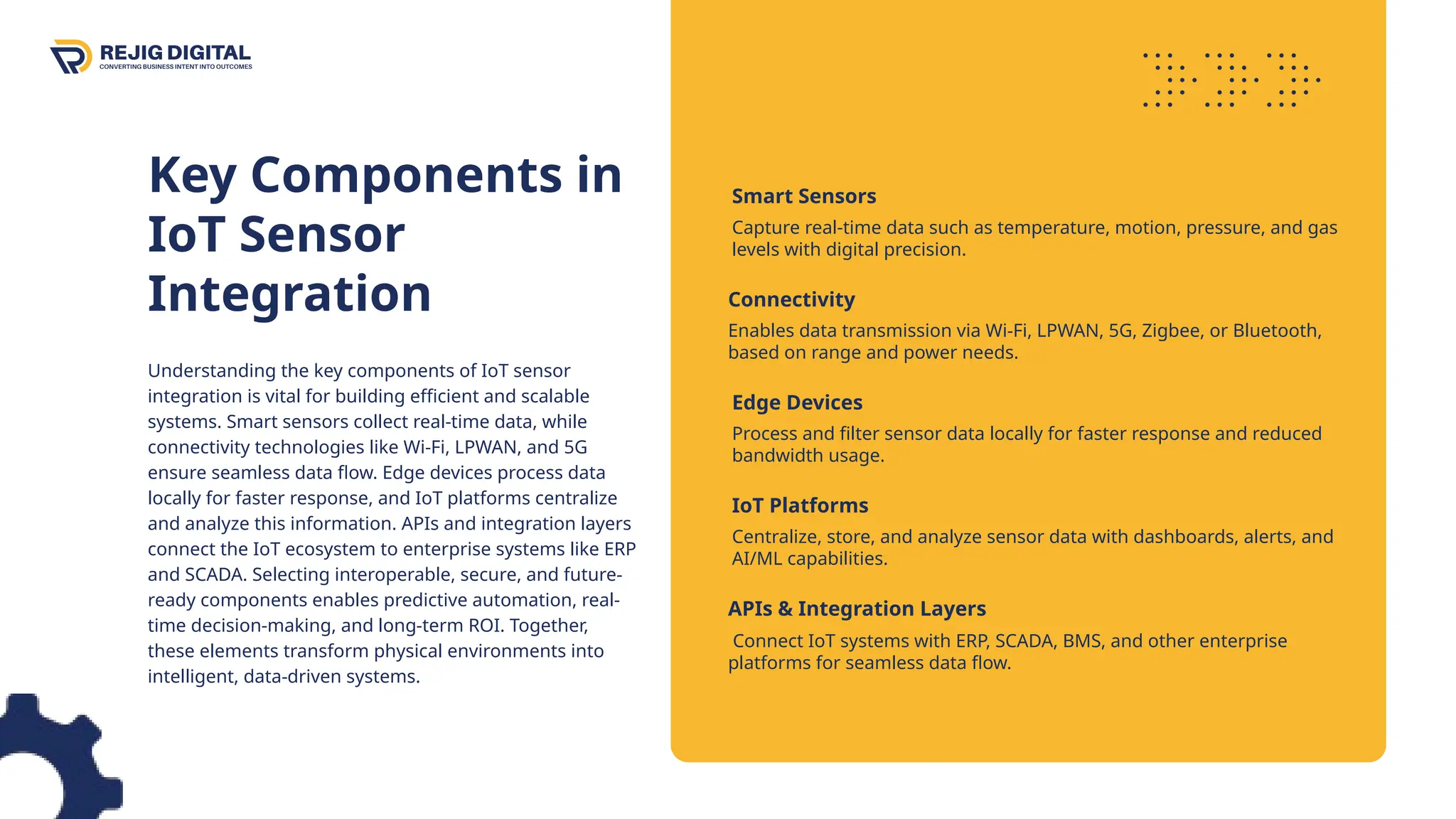
Smart Sensors
Capture real-time data such as temperature, motion, pressure, and gas
levels with digital precision.
Connectivity
Enables data transmission via Wi-Fi, LPWAN, 5G, Zigbee, or Bluetooth,
based on range and power needs.
Edge Devices
Process and filter sensor data locally for faster response and reduced
bandwidth usage.
IoT Platforms
Centralize, store, and analyze sensor data with dashboards, alerts, and
AI/ML capabilities.
APIs & Integration Layers
Connect IoT systems with ERP, SCADA, BMS, and other enterprise
platforms for seamless data flow.
Challenges in Integration
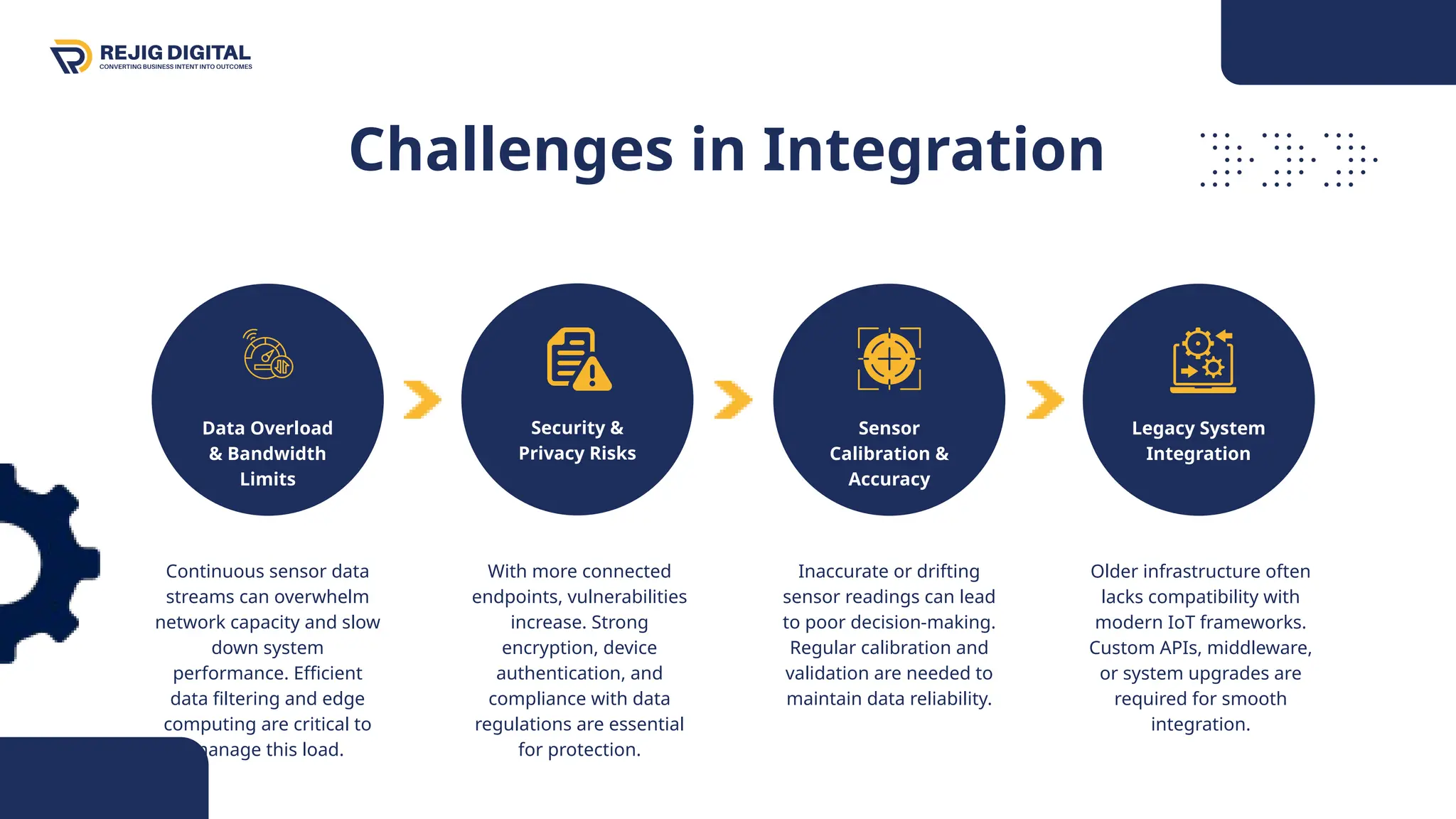
Data Overload
& Bandwidth
Limits
Security &
Privacy Risks
Sensor
Calibration &
Accuracy
Legacy System
Integration
With more connected
endpoints, vulnerabilities
increase. Strong
encryption, device
authentication, and
compliance with data
regulations are essential
for protection.
Continuous sensor data
streams can overwhelm
network capacity and slow
down system
performance. Efficient
data filtering and edge
computing are critical to
manage this load.
Inaccurate or drifting
sensor readings can lead
to poor decision-making.
Regular calibration and
validation are needed to
maintain data reliability.
Older infrastructure often
lacks compatibility with
modern IoT frameworks.
Custom APIs, middleware,
or system upgrades are
required for smooth
integration.
HVAC Optimization Lighting
Automation
Adjusts heating/cooling based
on real-time usage.
Turns lights on/off based on
occupancy or daylight.
Traffic & Parking
Sensors
Smart Waste
Management
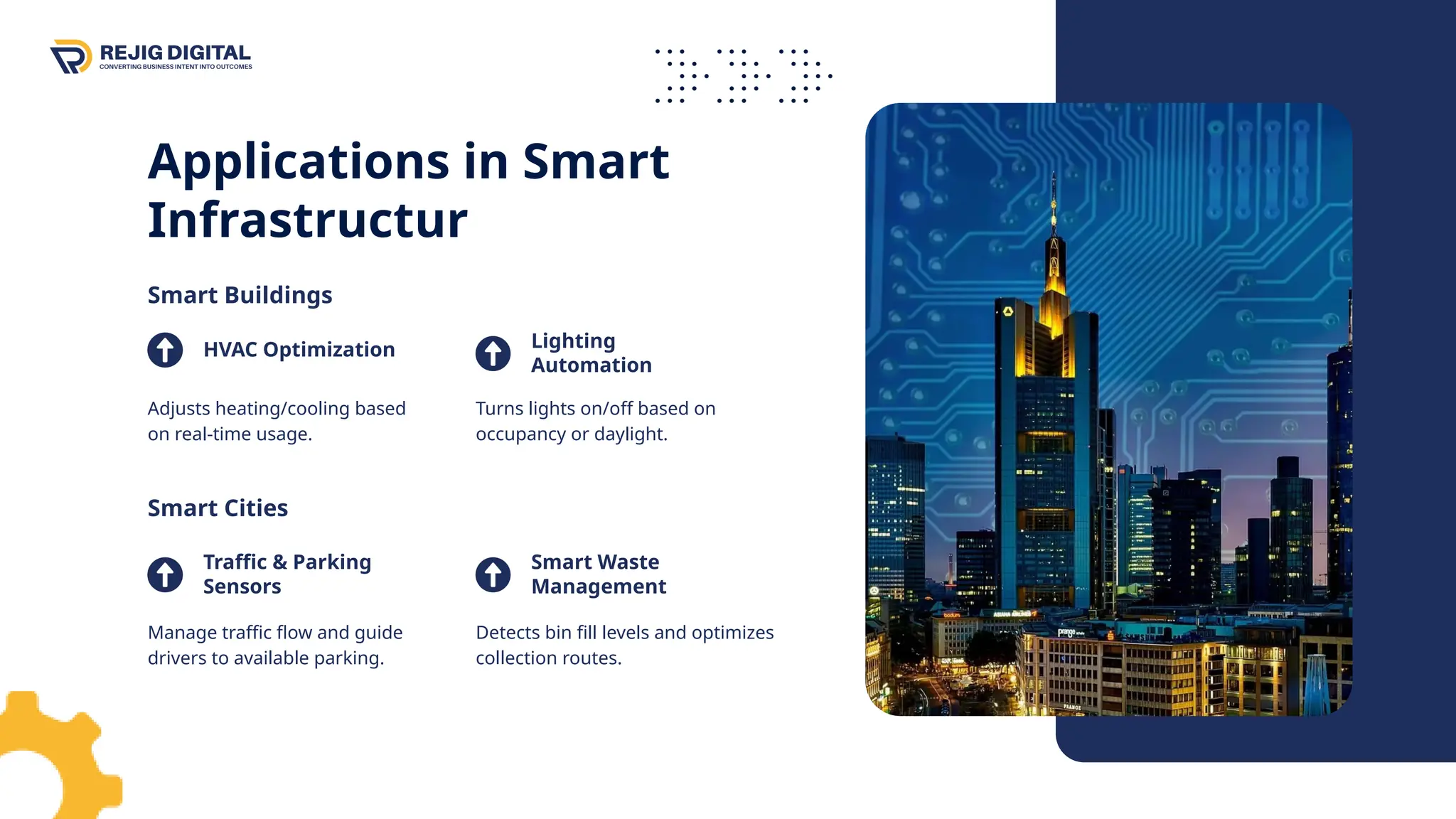
Applications in Smart
Infrastructur
Manage traffic flow and guide
drivers to available parking.
Detects bin fill levels and optimizes
collection routes.
Smart Buildings
Smart Cities
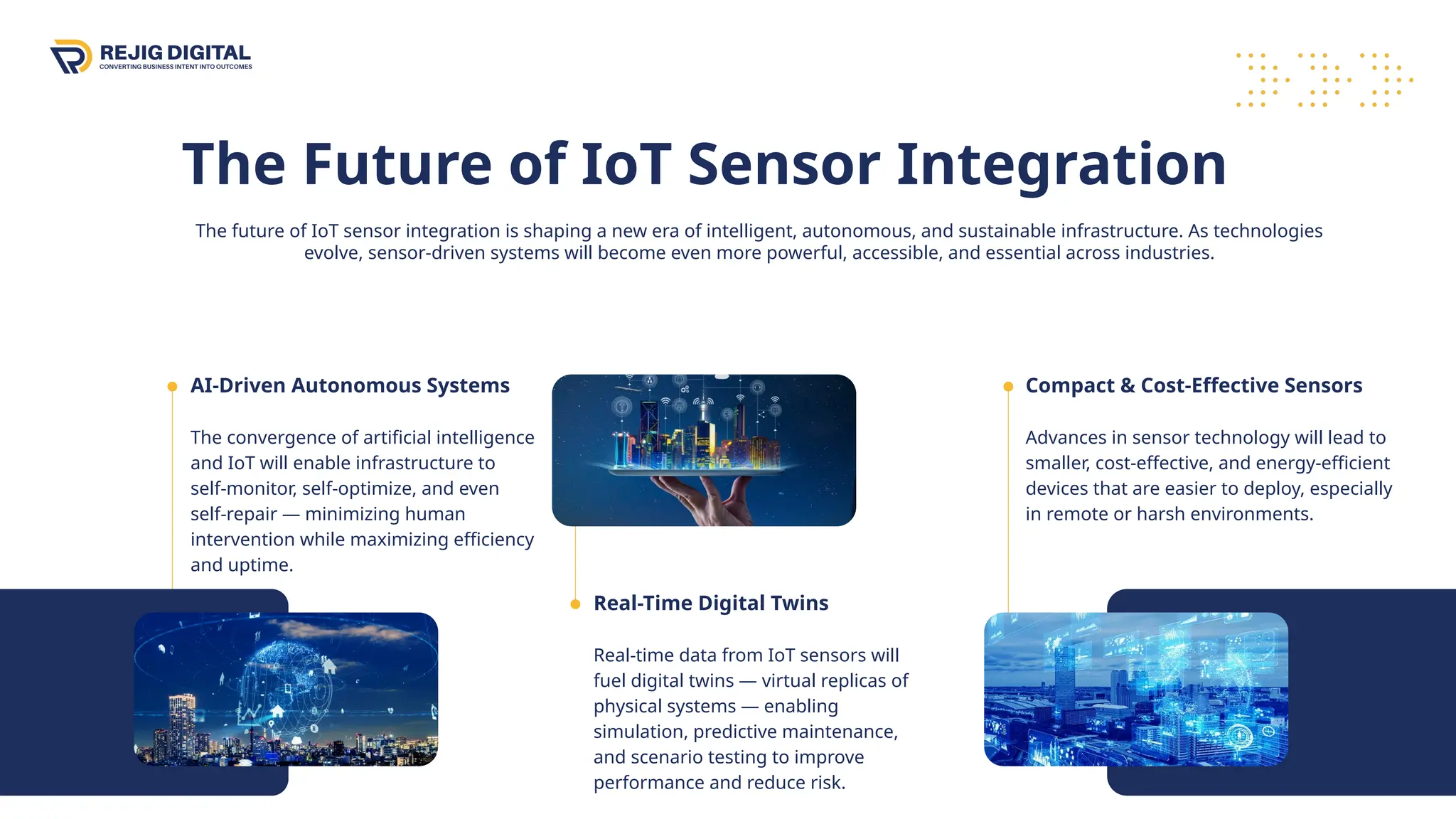
The Future of IoT Sensor Integration
The convergence of artificial intelligence
and IoT will enable infrastructure to
self-monitor, self-optimize, and even
self-repair — minimizing human
intervention while maximizing efficiency
and uptime.
Real-time data from IoT sensors will
fuel digital twins — virtual replicas of
physical systems — enabling
simulation, predictive maintenance,
and scenario testing to improve
performance and reduce risk.
Advances in sensor technology will lead to
smaller, cost-effective, and energy-efficient
devices that are easier to deploy, especially
in remote or harsh environments.
AI-Driven Autonomous Systems
Real-Time Digital Twins
Compact & Cost-Effective Sensors
The future of IoT sensor integration is shaping a new era of intelligent, autonomous, and sustainable infrastructure. As technologies
evolve, sensor-driven systems will become even more powerful, accessible, and essential across industries.
Data-Driven Decision
Making – The Core Value
of IoT Sensor Integration
The true power of IoT sensor integration lies in its ability to turn
real-time data into smart decisions. By constantly monitoring
factors like temperature, pressure, energy use, or equipment
status, sensors give organizations instant visibility into their
operations. This helps detect issues early, reduce downtime,
and improve efficiency.
Instead of reacting to problems, businesses can now predict
and prevent them. From optimizing energy in smart buildings to
enabling predictive maintenance in factories, sensor data
empowers teams to make faster, more accurate decisions—
leading to better performance, cost savings, and long-term
growth.
Let’s Build the
Future Together
At Rejig Digital, we are committed to empowering businesses
through advanced IoT sensor integration and intelligent
infrastructure solutions. Our expertise drives digital
transformation, helping organizations achieve greater efficiency,
sustainability, and competitive advantage.
For inquiries, partnership opportunities, or to explore how we can
support your digital journey, please contact us:
info@rejigdigital.com
www.rejigdigital.com
+1 (510) 956 6572

The Power of IoT Sensor Integration in Smart Infrastructure and Automation.pptx

  • 1.
    The Power ofIoT Sensor Integration in Smart Infrastructure and Automation www.rejigdigital.com Unlock seamless automation, real-time insights, and intelligent decision-making through advanced IoT sensor integration in modern infrastructure.
  • 2.
    Introduction Smart infrastructure isbecoming essential for modern cities and industries, enabling efficient, sustainable, and connected operations. While traditional automation has helped streamline processes, it lacks the flexibility to adapt to real- time conditions. This is where IoT sensor integration plays a vital role—providing continuous data from the physical environment to support intelligent, responsive decision- making. By bridging the gap between the physical and digital worlds, IoT sensors empower systems with real-time insights. This leads to smarter energy management, predictive maintenance, improved safety, and greater operational efficiency. The result is a shift from basic automation to intelligent automation—where infrastructure can learn, adapt, and evolve with demand.
  • 3.
    What Is IoT Sensor Integration? SmartSensors Cloud & Edge Computing IoT Devices & Gateways Data Analytics Platforms IoT Sensor Integration is the process of embedding and connecting smart sensors within IoT networks to monitor real-world conditions. These sensors collect and transmit real-time data to cloud or edge platforms. The data is then analyzed to drive intelligent automation, improve efficiency, and enable faster decision-making. Detect and measure key environmental and operational parameters such as temperature, humidity, motion, vibration, gas levels, and more. Enable scalable, real-time data processing—edge computing supports low-latency responses, while cloud systems offer advanced analytics and centralized control. Serve as communication bridges, aggregating sensor data and securely transmitting it to processing platforms. Transform raw sensor data into meaningful insights using AI, machine learning, and visualization tools to support predictive, automated decision- making. Read More
  • 4.
    Why Sensor Integration Matters 03 Reduced Downtime Minimizesmanual checks and unexpected breakdowns by automating alerts and decision workflows. 02 Predictive Automation Anticipates equipment failures and process deviations, allowing proactive maintenance and operational adjustments. 01 Enables continuous monitoring of assets, processes, and environments for immediate insights and faster responses. Real-Time Operational Visibility Integrating sensors into IoT systems is not just a technological upgrade — it’s a strategic necessity for building smarter, safer, and more efficient operations. By embedding sensors across critical assets and environments, organizations unlock real-time insights and enable a new level of automation and control. Here's why sensor integration is essential:
  • 5.
    Key Components in IoTSensor Integration Understanding the key components of IoT sensor integration is vital for building efficient and scalable systems. Smart sensors collect real-time data, while connectivity technologies like Wi-Fi, LPWAN, and 5G ensure seamless data flow. Edge devices process data locally for faster response, and IoT platforms centralize and analyze this information. APIs and integration layers connect the IoT ecosystem to enterprise systems like ERP and SCADA. Selecting interoperable, secure, and future- ready components enables predictive automation, real- time decision-making, and long-term ROI. Together, these elements transform physical environments into intelligent, data-driven systems. Smart Sensors Capture real-time data such as temperature, motion, pressure, and gas levels with digital precision. Connectivity Enables data transmission via Wi-Fi, LPWAN, 5G, Zigbee, or Bluetooth, based on range and power needs. Edge Devices Process and filter sensor data locally for faster response and reduced bandwidth usage. IoT Platforms Centralize, store, and analyze sensor data with dashboards, alerts, and AI/ML capabilities. APIs & Integration Layers Connect IoT systems with ERP, SCADA, BMS, and other enterprise platforms for seamless data flow.
  • 6.
    Challenges in Integration DataOverload & Bandwidth Limits Security & Privacy Risks Sensor Calibration & Accuracy Legacy System Integration With more connected endpoints, vulnerabilities increase. Strong encryption, device authentication, and compliance with data regulations are essential for protection. Continuous sensor data streams can overwhelm network capacity and slow down system performance. Efficient data filtering and edge computing are critical to manage this load. Inaccurate or drifting sensor readings can lead to poor decision-making. Regular calibration and validation are needed to maintain data reliability. Older infrastructure often lacks compatibility with modern IoT frameworks. Custom APIs, middleware, or system upgrades are required for smooth integration.
  • 7.
    HVAC Optimization Lighting Automation Adjustsheating/cooling based on real-time usage. Turns lights on/off based on occupancy or daylight. Traffic & Parking Sensors Smart Waste Management Applications in Smart Infrastructur Manage traffic flow and guide drivers to available parking. Detects bin fill levels and optimizes collection routes. Smart Buildings Smart Cities
  • 8.
    The Future ofIoT Sensor Integration The convergence of artificial intelligence and IoT will enable infrastructure to self-monitor, self-optimize, and even self-repair — minimizing human intervention while maximizing efficiency and uptime. Real-time data from IoT sensors will fuel digital twins — virtual replicas of physical systems — enabling simulation, predictive maintenance, and scenario testing to improve performance and reduce risk. Advances in sensor technology will lead to smaller, cost-effective, and energy-efficient devices that are easier to deploy, especially in remote or harsh environments. AI-Driven Autonomous Systems Real-Time Digital Twins Compact & Cost-Effective Sensors The future of IoT sensor integration is shaping a new era of intelligent, autonomous, and sustainable infrastructure. As technologies evolve, sensor-driven systems will become even more powerful, accessible, and essential across industries.
  • 9.
    Data-Driven Decision Making –The Core Value of IoT Sensor Integration The true power of IoT sensor integration lies in its ability to turn real-time data into smart decisions. By constantly monitoring factors like temperature, pressure, energy use, or equipment status, sensors give organizations instant visibility into their operations. This helps detect issues early, reduce downtime, and improve efficiency. Instead of reacting to problems, businesses can now predict and prevent them. From optimizing energy in smart buildings to enabling predictive maintenance in factories, sensor data empowers teams to make faster, more accurate decisions— leading to better performance, cost savings, and long-term growth.
  • 10.
    Let’s Build the FutureTogether At Rejig Digital, we are committed to empowering businesses through advanced IoT sensor integration and intelligent infrastructure solutions. Our expertise drives digital transformation, helping organizations achieve greater efficiency, sustainability, and competitive advantage. For inquiries, partnership opportunities, or to explore how we can support your digital journey, please contact us: info@rejigdigital.com www.rejigdigital.com +1 (510) 956 6572