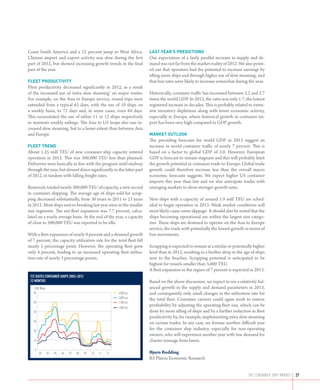
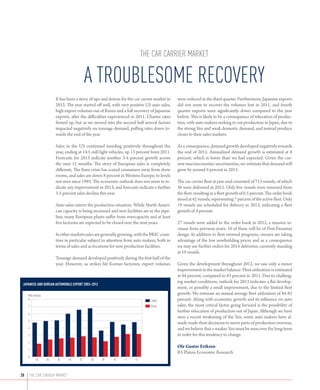
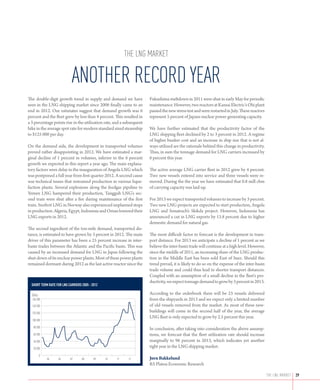
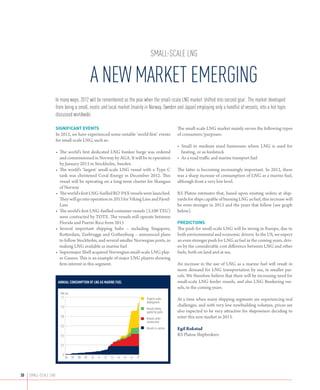
the platou report
      2013
Contents
introduction........................................................................................................ 3
the shipping environment ................................................................................. 7
the shipbuilding market .................................................................................. 12
the tanker market ............................................................................................ 16
the dry bulk market ......................................................................................... 21
the container ship market .............................................................................. 26
the car carrier market.................................................................................... 28
the lng market................................................................................................... 29
small-scale lng................................................................................................. 30
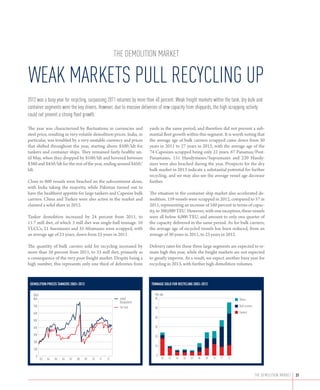
the demolition market...................................................................................... 31
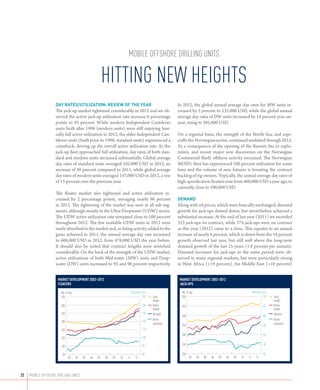
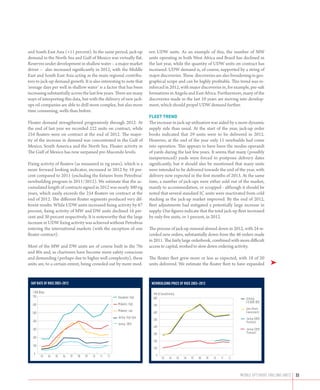
mobile offshore drilling units...................................................................... 32
the offshore support vessel market............................................................ 35
the offshore contruction vessel market..................................................... 38
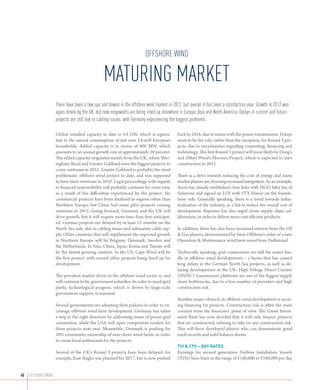
Offshore Wind .................................................................................................. 40
rs platou markets............................................................................................. 42
rs platou finans................................................................................................ 45
rs platou real estate........................................................................................ 48
statistics............................................................................................................. 50
Contacts.............................................................................................................. 56


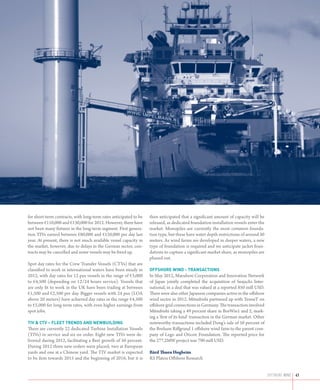
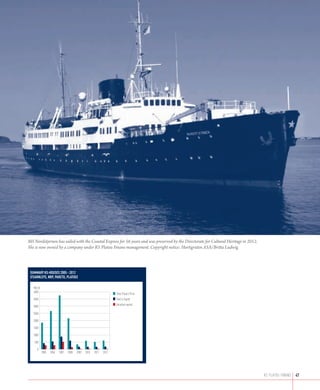
                                         Cover photo: Farstad Shipping
Shipping & Offshore:

     Shaping the world of energy
Shipping                                                              Offshore
Commercial shipping companies transport 90 percent of global          The recent tragedy at the gas produc-
goods by weight and volume. Considering its importance, if the        tion facility in Algeria brought home
world was just ONE country, shipping would most likely have           the vulnerability of onshore installa-
been a public utility!                                                tions in North Africa and the Middle
                                                                      East when it comes to terrorist at-
Instead, private owners and capital dominate international            tacks. The Arab Spring has turned into
shipping. It is up to them to solve the logistical challenges that    a shaky Winter, as unrest continues to
arise in our constantly changing markets.                             spread and escalate in this important
                                                                      energy- exporting region.
For example, there is currently an intense debate in the US
Congress over whether to approve exports of (shale gas) LNG           Some oil company executives believe
from the US. The Department of Energy has approved several            offshore energy production is easier to
LNG export licenses, but the majority of Democrats, and quite         defend from terrorist attacks, than for
a few Republicans, would like to keep this “new” gas inside na-       example onshore installations in North
tional borders.                                                       Africa and the Middle East.

Meanwhile, independent ship owners have ordered additional            There was a succession of major off-
LNG tonnage in anticipation of US exports from 2015/16. The           shore discoveries during 2012 and we
world needs all the energy it can get from politically low-risk       continue to believe in increased ac-
countries, so it is important that Washington does not ham-           tivity for offshore rigs in general and
string oil and gas exploration and production in the US. The          ultra-deep water rigs in particular. The       peter m. anker, Managing Partner & CEO
country’s stunning transformation from the world’s biggest im-        growth in demand for subsea construc-
porter of petroleum products to its (almost) biggest exporter,        tion vessels will continue to accelerate in the years to come. The
feeding the emerging economies in Latin America and Africa,           fleet is not only growing by numbers, but also by complexity
is a case in point.                                                   of the vessels. We are entering into the development phase of
                                                                      many deep water projects that demands larger subsea structures
The prospect of serious long-haul LNG volumes coming out of           and more complex installation operations.
Canada also looks very promising. It raises the question, could
Canada be the new Qatar of the Americas?                              Conclusion
                                                                      While the world has been focused on various macroeconomic cri-
The first quarter of 2013 is characterized by a mixture of signifi-   ses during the last few years, the energy markets have undergone
cant uncertainty and opportunity for shipowners and investors.        dramatic changes in supply and trading patterns ‘under the radar’.
The markets are in a bottom cycle, with second hand and new
building prices at cyclically low levels. At the same time, the       We believe these changes will become much clearer once the
world economy is showing some potential for a strong recovery         world economy picks up steam, and could offer positive sur-
soon, and new fuel-efficient designs are an added incentive for       prises for both the shipping and offshore markets.
calling the shipyards. Taking this into consideration, we may
well see a nascent recovery in most shipping markets in 2014          Yours Sincerely,
and 2015.                                                             Peter M. Anker,
                                                                      Managing Partner & CEO, RS Platou ASA


                                                                                                                                                 introduction   3
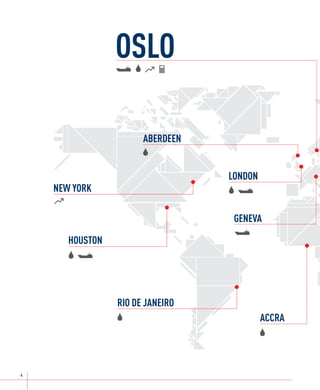
OSLO

                        ABERDEEN


                                   LONDON
     NEW YORK

                                    GENEVA

        HOUSTON


                  RIO DE JANEIRO
                                            ACCRA


4
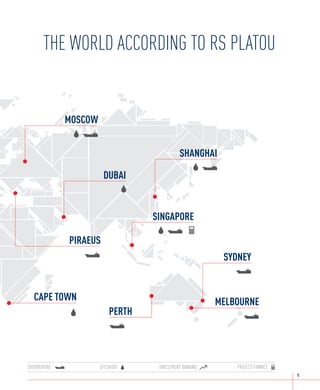
THE WORLD ACCORDING TO RS PLATOU
        the world according to RS Platou


               MOSCOW


                                              SHANGHAI

                         DUBAI


                                    SINGAPORE

               PIRAEUS
                                                           SYDNEY


    CAPE TOWN                                             MELBOURNE
                            PERTH


 SHIPBROKING            OFFSHORE     INVESTMENT BANKING       PROJECT FINANCE
                                                                                5
6	THE SHIPPING ENVIRONMENT
the shipping environment

                       World shipping 2012;
                        Down, but not out
2012 turned out to be just as difficult for the shipping markets as we feared it would be. The performance of the world economy was even
weaker than reflected in downbeat expectations at the start of the year, while fleet expansion remained above any reasonably sustainable
long-term growth trend for the fourth consecutive year. Despite another stellar performance from the LNG market and a modest tightening
of the tanker market, capacity utilization for the world’s merchant fleet fell by an estimated 1 percentage point to 84 percent, the lowest
level since the full force Financial Crisis hit in 2009.


Nevertheless, the past year was not without bright spots, despite      the fascinating complexities of tonnage demand. Most notably,
the very challenging conditions for many segments. Most obvi-          there were significant shifts in transportation distances for both
ously, the fact that both the tanker and dry bulk freight markets      tankers (longer) as well as dry bulk (moderately shorter), while
saw periodic rallies through the year is a clear indication that       the markedly longer distances seen in the LNG market in 2011
the level of over-capacity is relatively moderate, compared to         were sustained in 2012. Furthermore, fleet productivity fell in
what was seen in the 1970s and ‘80s. This is partly due to ton-        response to higher bunker prices and increased average vessel
nage demand having enjoyed a surprisingly strong year despite          size. Lastly, it was a big year for inventory swings with both tank
an overall weak world economy, as the increased weight of the          and dry bulk seeing bigger than normal inventory related trade
commodity intensive non-OECD economies offset weaknesses               movement in response to geopolitical factors (tank) and rela-
in the OECD.                                                           tive commodity prices (dry bulk).

Another important development was the continued sharp de-              Another year of above-trend fleet growth,
cline in the fleet orderbook which declined from 20 percent of         but delivery pipeline is emptying
the fleet a year ago to 14 percent at the end of 2012, as new or-      The world’s merchant fleet continued its pattern of robust
ders fell to a decade low. Whatever the reasons for this – more        growth, adding another 7.8 percent, only slightly less than the
prudent owners, insufficient cash flow, continued challenging          record 8.2 percent seen in 2011. This marked the eighth con-
financial conditions – the fact that fleet capacity is responding      secutive year where growth exceeded 7 percent. The contribu-
rationally to market conditions raises hope that the industry          tors to growth were widely spread among key segments, with
will avoid a repeat of the protracted structural downturn seen         dry bulk in front at 12.6 percent and LNG carriers in the back at
in the past.                                                           a modest 1.4 percent, which made that segment the place to be
                                                                       for the second straight year.
Tonnage demand slowed less than the
world economy                                                          Overall fleet utilization dropped by
2012 was yet another year dominated by crisis headlines on the         1 percentage point to 84 percent
economic front, as the Euro Crisis not only rolled on but gath-        A sizable 4 percent drop in dry bulk fleet utilization, the larg-
ered in strength through the first half of the year. Despite world     est segment of the merchant fleet, dragged down overall fleet
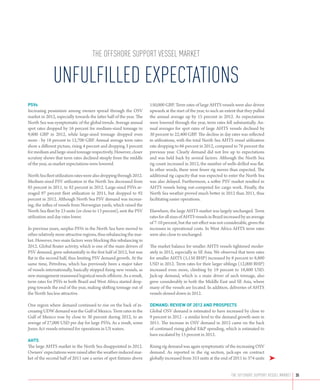
GDP growth coming in at a lackluster 3.2 percent, tonnage de-          capacity utilization. The container fleet also contributed to
mand registered a healthy rise of 7.1 percent, down from 7.7           this decline, while improvements for the LNG, car carrier and
percent in 2011. The year gave us important demonstrations of          tanker segment moderated the drop.The level of 84 percent uti-         ➤


                                                                                                                                  THE SHIPPING ENVIRONMENT   7
lization is nonetheless weak. According to our records it is the                                          erage earnings rose from $14,800 per day in 2011, to $17,100
                    second lowest level seen in the past decade, although it is still                                         per day in 2012.
                    well above the bottom level of 82 percent, seen in 2009.
                                                                                                                              Dry bulk in 2012: Substantial drop in freight
                    Asset values continued falling but rate of                                                                rates
                    decline eased                                                                                             Market fundamentals deteriorated further during 2012 caused
                    It was yet another year of falling asset values, but the pace of                                          by another year with record high deliveries. Even though scrap-
                    decline slowed and the performance across sectors was more                                                ping also rose to the highest level registered, the net fleet ex-
                    varied than in 2011. The least variation was seen in newbuilding                                          pansion was above 12 percent from the year before. Despite
                    prices, which fell across the board by 5 - 10 percent for most size                                       weaker global economic growth, tonnage demand increased
                    classes. Secondhand values declined as well, due not only to the                                          by a healthy 7 percent thanks to China, which utilized huge ar-
                    weaker freight market but also because of the emergence of fuel                                           bitrage in iron ore and coal prices, importing much more dry
                    efficient newbuildings, a possibly important shift in shipping                                            bulk commodities than the underlying demand for steel, energy
                    technology and design. Values declined, with dry bulk vessels                                             and so forth would suggest. However, the fleet utilization rate
                    recording significant declines of 20-30 percent, tankers fell by                                          dropped from 87 percent in 2011 to 83 percent in 2012, and this
                    5-10 percent. It was the fourth straight year of declining asset                                          caused a drop in freight rates of between 40 and 50 percent and
                    values, and accompanied by poor cash flows it put the indus-                                              in ship values by 20- 30 percent.
                    try’s balance sheets under further, severe pressure.
                                                                                                                              The container market in 2012: Box rates and
                    Tankers in 2012: Little relief, despite demand                                                            timecharter rates part company
                    boom                                                                                                      The container ship market in 2012 was characterized by higher
                    The tanker market experienced some improvement, although                                                  average box rates than in 2011, but substantially lower char-
                    this was unevenly spread between segments and seasons, dem-                                               ter rates. Operators managed to raise the utilization rate, and
                    onstrating the fragile nature of this market. The good news was                                           thereby freight rates, of the operating fleet by idling more ton-
                    an estimated 8 percent spike in tonnage demand. This was due                                              nage and creating a higher demand increase through lower fleet
                    to a combination of increased volume growth and longer dis-                                               productivity. Non-operating owners faced a very difficult year
                    tances as importers rushed to cover the loss of Iranian oil. Pro-                                         as liners had limited need for the chartering of extra tonnage.
                    ductivity also fell, as it did for all other segments. These factors                                      Total container ship capacity increased by 7.7 percent, while the
                    boosted the crude market during the first months of the year,                                             operating fleet grew by 4.5 percent. Tonnage demand is estimat-
                    and the clean market during the last months. The period in be-                                            ed to have escalated by around 7 percent, with 5 percent higher
                    tween, on the other hand, was dismal, with most crude carriers                                            trade volume and a drop of 2 percent in fleet productivity. The
                    in particular consistently trading at, or below, operating costs.                                         low growth in container movements was related to a drop of 3
                    Fleet growth remained high at 7.2 percent, which prevented any                                            percent in European containerized imports.
                    sustained increase in rates. For the year, our Tanker Index of av-


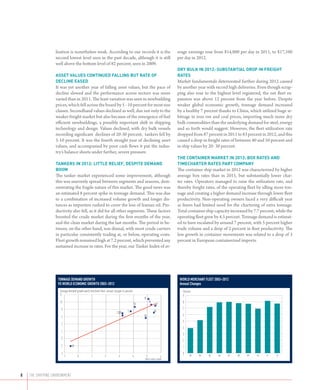
                     tonnage demand growth                                                                                     World merchant fleet 2003–2012
                     vs world economic growth 2003–2012                                                                        Annual Changes
                      Tonnage demand growth world merchant fleet, annual changes in percent                                      Percent
                      12                                                                                                         9
                                                                                                       10
                      10                                                                                    04                   8
                                                                                                  03                07
                       8                                                                                                         7
                                                                                      11                          06
                                                                            12/08
                       6                                                                               05                        6
                                                                                                                                 5
                       4
                                                                                                                                 4
                       2
                                                                                                                                 3
                       0
                                                                                                                                 2
                      -2         09                                                                                              1
                       -4                                                                                                        0
                            -1        0            1            2             3               4          5               6            03   04   05    06    07   08   09   10   11   12
                                                                                                        World output growth


8	   THE SHIPPING ENVIRONMENT
LNG in 2012: Longer and stronger                                       World economy and world shipping
The LNG shipping market tightened further during 2012 de-              2012 was not a good year for the world economy with, growth
spite the fact that demand growth slipped into single digits for       slipping to little more than 3 percent, the lowest level for a de-
the first time in seven years. The 6 percent growth in tonnage         cade, barring the Financial Crisis. Under these circumstances,
demand was mainly due to longer average distances, as the              it came as no surprise that the year also witnessed a slowdown
inter-basin trade from the Atlantic to the Pacific continued to        in tonnage demand growth. That said, growth of 7.1 percent
expand. Trade volume, in fact, declined by 1 percent. Lower            was better than might have been expected, as it represented
fleet productivity also contributed to the demand increase.            a more moderate slowdown than that experienced by GDP.
Productivity fell by an estimated 2 - 3 percent owing to high          While there were some special situations, as always, we view
bunker prices and increased average vessel size. The LNG fleet         this relatively strong performance in trade growth as a con-
grew only 4 percent and thus lifted the fleet utilization rate to 95   firmation of the changing, and more shipping intensive,
percent, which resulted in an average spot rate of $125,000 per        composition of the world economy. The commodity inten-
day, up from $93,000 per day in 2011.                                  sive non-OECD economies are increasing in size in relation
                                                                       to the mature, service-oriented OECD economies. Based on
Car carriers: Uneven improvement                                       the IMF’s current forecasts the former group is on course to
The car carrier market has seen another year of fluctuations in        overtake the latter in absolute size, in 2013. This long-term
tonnage demand. 2012 started off well with export volumes              trend will underpin overall shipping demand in the years
rising from the recovery of the Japanese automobile industry,          to come and gives reasons for optimism regarding recovery.
strong Korean exports and growing US auto sales. However, the          The increasing weight of the non-OECD economies was ably
Euro crisis took its toll on European car sales and along with         demonstrated this year by the extent to which mere inventory
strikes in Korea, contributed to a fall in export volumes dur-         swings in iron ore and coal in China moved the entire dry bulk
ing the second half of the year. Due to reasonably modest fleet        market.
growth, the average market balance improved somewhat from
2011, climbing to an estimated 84 percent fleet utilization rate.      Status and prospects for the world economy
Prospects for tonnage demand going forward depend heavily              2012 began with forecasters in a downbeat and highly uncer-
on the economic development in key sales markets, as well as           tain mood, after 2011 turned into yet another false dawn for the
the possibility of relocation of car production from Japan to          world economy. Most notably it became clear that politicians
overseas markets as a result of the strong Yen.                        were still behind the curve in the Eurozone crisis. In addition,     ➤

                                                                                                                                THE SHIPPING ENVIRONMENT   9
the US seemed unable to move out of its 2 percent sluggish               anything, falling farther behind the curve. It took a more prag-
                       growth rate range, regardless of any kind of monetary stimulus           matic approach from the ECB with regards to supporting the
                       thrown at it, while, in the face of all this, China (as well as other    region’s bond markets, in order to nudge politicians into agree-
                       emerging markets) was showing signs of a significant slow-               ing on several difficult issues, including debt write down and
                       down. Forecasters turned out to be relatively accurate in their          continued restructuring of the most fragile economies. That in
                       downbeat view of the world economy, as (preliminary) full year           turn improved market sentiment regarding the risk of a breakup
                       growth figures show an estimated 3.2 per cent increase, not too          of the entire Eurozone.
                       far off the 3.3 percent forecast at the start of the year. Prospects
                       for 2013 are for a moderate pickup in growth but this will still         The troubles in Europe shielded the US from the storm for most
                       be below the long-term trend.                                            of the year, but the country’s tepid, and disappointing, growth
                                                                                                of around 2 percent slowed further in the fourth quarter, as poli-
                       The challenges for the world economy differ between the ma-              ticians battled over how to avoid the Fiscal Cliff of automatic
                       ture economies of the OECD and the ‘growth’ economies of                 tax hikes and spending cuts. Although a last minute deal was
                       the non-OECD. The former group is struggling with the very               reached, unsurprisingly, no fundamental problems were solved
                       difficult combination of reducing national debts and deficits,           and the challenges of dealing with the deficit and national debt
                       while at the same time avoiding a relapse into recession, mak-           are set to re-emerge in 2013.
                       ing that very task next to impossible. Emerging economies, on
                       the other hand, are feeling some growth pains from their force-          Emerging markets became emerging
                       ful response to the Financial Crisis, which boosted inflationary         risks to growth
                       pressures in the respective economies via higher commodity               A year ago, we discussed the risk of a slowdown in emerging
                       and property prices.                                                     markets and the impact on tonnage demand. The scenario
                                                                                                turned out to be all too realistic, as 2012 featured a broad based
                       The more positive sentiment visible at the start of 2013 can be          slowdown across-the- board in such countries: China’s growth
                       attributed to two main factors. Number one, that key econo-              slowed from 9.5 percent in 2011 to a run rate of 7.5 percent in
                       mies were pushed to the brink in 2012 – and survived. Sec-               2012. India slowed from 7 percent to 5 percent; Brazil from 4
                       ondly, leadership changes in the world’s two largest economies           percent to 1 percent; and Russia from 5 percent to 4 percent.
                       went smoothly, reinforcing the notion that the leaders in the US         The combination of tighter monetary policy, due to budding
                       and China are firmly committed to sustained and uninterrupted            inflationary pressures in recent years and weaker export mar-
                       growth.                                                                  kets, had visible effects and combined to bring GDP growth for
                                                                                                the group classified as ‘developing economies’ below 6 percent
                       Europe and the US: Muddling through                                      for only the second time in a decade. This, unsurprisingly, had a
                       In terms of ‘stress tests’, Europe was in the spotlight, as talk of a    negative impact on trade growth due to the commodity inten-
                       ‘Grexit’ increasingly dominated the front pages, while, for every        sive nature of these economies.
                       new ‘crisis’ meeting, it became clear that the politicians were, if


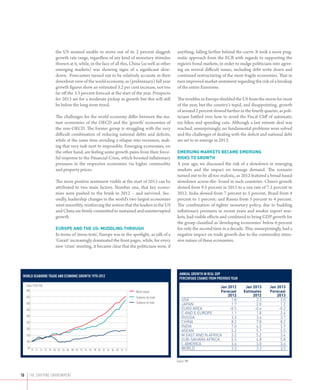
                                                                                                  ANNUAL GROWTH IN REAL GDP		
 world seaborne trade and economic growth 1970-2012
                                                                                                  Percentage change from previous year			
   Index 1970=100                                                                                   	                  Jan 2012	  Jan 2013	  Jan 2013	
   500                                                                     World output              	Forecast 	Estimates	Forecast	
   450                                                                                               	                     2012	      2012	      2013
                                                                           Seaborne dry trade
                                                                                                    USA	                     1.8	       2.3	       2.0
   400                                                                     Seaborne oil trade       JAPAN	                   1.7	       2.0	       1.2
   350                                                                                              EURO AREA	              -0.5	      -0.4	      -0.2
                                                                                                    C AND E EUROPE	          1.1	       1.8	       2.4
   300                                                                                              RUSSIA	                  3.3	       3.6	       3.7
   250                                                                                              CHINA	                   8.2	       7.8	       8.2
                                                                                                    INDIA	                   7.0	       4.5	       5.9
   200
                                                                                                    ASEAN	                   5.2	       5.7	       5.5
   150                                                                                              M EAST AND N AFRICA	     3.2	       5.2	       3.4
                                                                                                    SUB-SAHARA AFRICA	       5.5	       4.8	       5.8
   100
                                                                                                    L AMERICA	               3.6	       3.0	       3.6
    50 70 72 74 76 78 80 82 84 86 88 90 92 94 96 98 00 02 04 06 08 10 12                            WORLD	                   3.3	       3.2	       3.5


                                                                                                Source: IMF	


10	 THE SHIPPING ENVIRONMENT
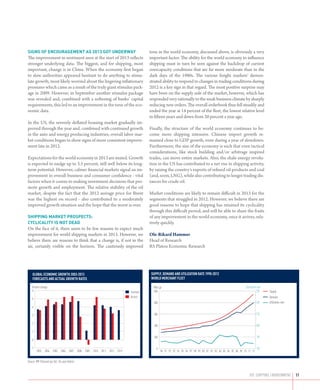
Signs of encouragement as 2013 got underway                                 tone in the world economy, discussed above, is obviously a very
The improvement in sentiment seen at the start of 2013 reflects             important factor. The ability for the world economy to influence
stronger underlying data. The biggest, and for shipping, most               shipping must in turn be seen against the backdrop of current
important, change is in China. When the economy first began                 overcapacity conditions that are far more moderate than in the
to slow authorities appeared hesitant to do anything to stimu-              dark days of the 1980s. The various freight markets’ demon-
late growth, most likely worried about the lingering inflationary           strated ability to respond to changes in trading conditions during
pressures which came as a result of the truly giant stimulus pack-          2012 is a key sign in that regard. The most positive surprise may
age in 2009. However, in September another stimulus package                 have been on the supply side of the market, however, which has
was revealed and, combined with a softening of banks’ capital               responded very rationally to the weak business climate by sharply
requirements, this led to an improvement in the tone of the eco-            reducing new orders. The overall orderbook thus fell steadily and
nomic data.                                                                 ended the year at 14 percent of the fleet, the lowest relative level
                                                                            in fifteen years and down from 20 percent a year ago.
In the US, the severely deflated housing market gradually im-
proved through the year and, combined with continued growth                 Finally, the structure of the world economy continues to be-
in the auto and energy producing industries, overall labor mar-             come more shipping intensive. Chinese import growth re-
ket conditions began to show signs of more consistent improve-              mained close to GDP growth, even during a year of slowdown.
ment late in 2012.                                                          Furthermore, the size of the economy is such that even tactical
                                                                            considerations, like stock building and/or arbitrage inspired
Expectations for the world economy in 2013 are muted. Growth                trades, can move entire markets. Also, the shale energy revolu-
is expected to nudge up to 3.5 percent, still well below its long-          tion in the US has contributed to a net rise in shipping activity,
term potential. However, calmer financial markets signal an im-             by raising the country’s exports of refined oil products and coal
provement in overall business and consumer confidence - vital               (and, soon, LNG), while also contributing to longer trading dis-
factors when it comes to making investment decisions that pro-              tances for crude oil.
mote growth and employment. The relative stability of the oil
market, despite the fact that the 2012 average price for Brent              Market conditions are likely to remain difficult in 2013 for the
was the highest on record - also contributed to a moderately                segments that struggled in 2012. However, we believe there are
improved growth situation and the hope that the worst is over.              good reasons to hope that shipping has retained its cyclicality
                                                                            through this difficult period, and will be able to share the fruits
Shipping market prospects:                                                  of any improvement in the world economy, once it arrives, rela-
Cyclicality is not dead                                                     tively quickly.
On the face of it, there seem to be few reasons to expect much
improvement for world shipping markets in 2013. However, we                 Ole-Rikard Hammer
believe there are reasons to think that a change is, if not in the          Head of Research
air, certainly visible on the horizon. The cautiously improved              RS Platou Economic Research


    GLOBAL ECONOMIC GROWTH 2003-2013                                         supply, demand and utilization rate 1990-2012
    Forecasts and actual growth rates                                        World merchant fleet

    Percent change                                                            Mill cgt                                                           Utilization rate
    6                                                            Forecast     500                                                                           130     Supply
                                                                 Actual                                                                                             Demand
    5
                                                                              400                                                                          120      Utilization rate
    4

    3                                                                         300                                                                          110

    2
                                                                              200                                                                          100
    1
                                                                              100                                                                            90
    0

   -1                                                                           0                                                                            80
        2003 2004 2005 2006 2007 2008 2009 2010 2011 2012 2013                      90 91 92 93 94 95 96 97 98 99 00 01 02 03 04 05 06 07 08 09 10 11 12


Source: IMF (Forecast per Oct. the year before)


                                                                                                                                                    THE SHIPPING ENVIRONMENT           11
the shipbuilding market

                                                             Building prices at
                                                              a ten-year low
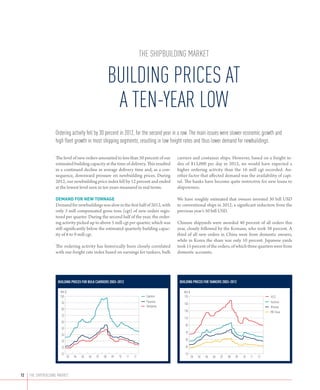
                   Ordering activity fell by 30 percent in 2012, for the second year in a row. The main issues were slower economic growth and
                   high fleet growth in most shipping segments, resulting in low freight rates and thus lower demand for newbuildings.

                   The level of new orders amounted to less than 50 percent of our            carriers and container ships. However, based on a freight in-
                   estimated building capacity at the time of delivery. This resulted         dex of $13,000 per day in 2012, we would have expected a
                   in a continued decline in average delivery time and, as a con-             higher ordering activity than the 16 mill cgt recorded. An-
                   sequence, downward pressure on newbuilding prices. During                  other factor that affected demand was the availability of capi-
                   2012, our newbuilding price index fell by 12 percent and ended             tal. The banks have become quite restrictive for new loans to
                   at the lowest level seen in ten years measured in real terms.              shipowners.

                   Demand for new tonnage                                                     We have roughly estimated that owners invested 30 bill USD
                   Demand for newbuildings was slow in the first half of 2012, with           in conventional ships in 2012, a significant reduction from the
                   only 3 mill compensated gross tons (cgt) of new orders regis-              previous year’s 50 bill USD.
                   tered per quarter. During the second half of the year, the order-
                   ing activity picked up to above 5 mill cgt per quarter, which was          Chinese shipyards were awarded 40 percent of all orders this
                   still significantly below the estimated quarterly building capac-          year, closely followed by the Koreans, who took 38 percent. A
                   ity of 8 to 9 mill cgt.                                                    third of all new orders in China were from domestic owners,
                                                                                              while in Korea the share was only 10 percent. Japanese yards
                   The ordering activity has historically been closely correlated             took 15 percent of the orders, of which three quarters were from
                   with our freight rate index based on earnings for tankers, bulk            domestic accounts.


                     building prices for bulk carriers 2003–2012                               building prices for tankers 2003–2012

                      Mill $                                                                     Mill $
                      100                                                          Capesize      170                                                        VLCC
                       90                                                          Panamax                                                                  Suezmax
                                                                                                  150
                                                                                   Handymax                                                                 Aframax
                       80
                                                                                                  130                                                       MR Clean
                       70
                                                                                                  110
                       60
                                                                                                   90
                       50
                                                                                                   70
                       40
                       30                                                                          50

                       20                                                                          30

                       10                                                                          10
                               03   04   05   06   07   08   09   10   11   12                            03   04   05   06   07   08   09   10   11   12


12	 THE SHIPBUILDING MARKET
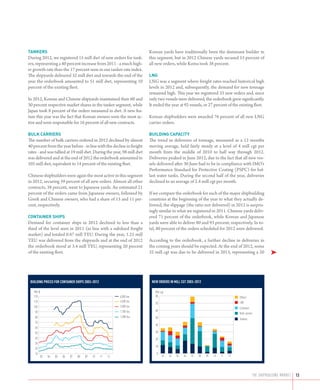
TankerS                                                                   Korean yards have traditionally been the dominant builder in
During 2012, we registered 15 mill dwt of new orders for tank-            this segment, but in 2012 Chinese yards secured 53 percent of
ers, representing a 40 percent increase from 2011 - a much high-          all new orders, while Korea took 38 percent.
er growth rate than the 17 percent seen in our tanker rate index.
The shipyards delivered 32 mill dwt and towards the end of the            lng
year the orderbook amounted to 51 mill dwt, representing 10               LNG was a segment where freight rates reached historical high
percent of the existing fleet.                                            levels in 2012 and, subsequently, the demand for new tonnage
                                                                          remained high. This year we registered 33 new orders and, since
In 2012, Korean and Chinese shipyards maintained their 60 and             only two vessels were delivered, the orderbook grew significantly.
30 percent respective market shares in the tanker segment, while          It ended the year at 92 vessels, or 27 percent of the existing fleet.
Japan took 8 percent of the orders measured in dwt. A new fea-
ture this year was the fact that Korean owners were the most ac-          Korean shipbuilders were awarded 76 percent of all new LNG
tive and were responsible for 16 percent of all new contracts.            carrier orders.

bulk CarrierS                                                             building CapaCiTy
The number of bulk carriers ordered in 2012 declined by almost            The trend in deliveries of tonnage, measured as a 12 months
40 percent from the year before - in line with the decline in freight     moving average, held fairly steady at a level of 4 mill cgt per
rates - and was tallied at 19 mill dwt. During the year, 98 mill dwt      month from the middle of 2010 to half way through 2012.
was delivered and at the end of 2012 the orderbook amounted to            Deliveries peaked in June 2012, due to the fact that all new ves-
105 mill dwt, equivalent to 14 percent of the existing fleet.             sels delivered after 30 June had to be in compliance with IMO’s
                                                                          Performance Standard for Protective Coating (PSPC) for bal-
Chinese shipbuilders were again the most active in this segment           last water tanks. During the second half of the year, deliveries
in 2012, securing 59 percent of all new orders. Almost all other          declined to an average of 2.4 mill cgt per month.
contracts, 38 percent, went to Japanese yards. An estimated 21
percent of the orders came from Japanese owners, followed by              If we compare the orderbook for each of the major shipbuilding
Greek and Chinese owners, who had a share of 13 and 11 per-               countries at the beginning of the year to what they actually de-
cent, respectively.                                                       livered, the slippage (the ratio not delivered) in 2012 is surpris-
                                                                          ingly similar to what we registered in 2011. Chinese yards deliv-
COnTainer ShipS                                                           ered 71 percent of the orderbook, while Korean and Japanese
Demand for container ships in 2012 declined to less than a                yards were able to deliver 80 and 93 percent, respectively. In to-
third of the level seen in 2011 (in line with a subdued freight           tal, 80 percent of the orders scheduled for 2012 were delivered.
market) and totaled 0.47 mill TEU. During the year, 1.25 mill
TEU was delivered from the shipyards and at the end of 2012               According to the orderbook, a further decline in deliveries in
the orderbook stood at 3.4 mill TEU, representing 20 percent              the coming years should be expected. At the end of 2012, some
of the existing fleet.                                                    32 mill cgt was due to be delivered in 2013, representing a 20                    ➤


 bUilding Prices for container shiPs 2003–2012                             neW orders in mill cgt 2003–2012

   Mill $                                                                    Mill cgt
   120                                                        6,000 teu      80                                                      Others
   110                                                        4,500 teu                                                              LNG
                                                                             70
   100                                                        3,000 teu
                                                                                                                                     Container
    90                                                        1,700 teu      60
                                                                                                                                     Bulk carriers
    80                                                        1,000 teu      50                                                      Tankers
    70
                                                                             40
    60
    50                                                                       30
    40                                                                       20
    30
                                                                             10
    20
    10                                                                        0
            03   04   05   06   07   08   09   10   11   12                        03   04   05   06   07   08   09   10   11   12


                                                                                                                                                 the shipbuilding market   13
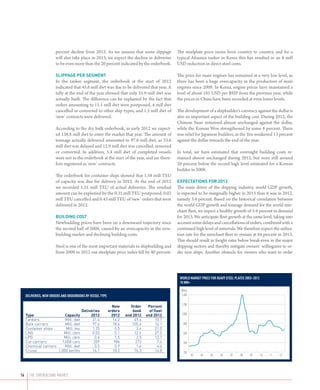
percent decline from 2012. As we assume that some slippage           The steelplate price varies from country to country, and for a
                     will also take place in 2013, we expect the decline in deliveries    typical Aframax tanker in Korea this has resulted in an 8 mill
                     to be even more than the 20 percent indicated by the orderbook.      USD reduction in direct steel costs.

                     Slippage per segment                                                 The price for main engines has remained at a very low level, as
                     In the tanker segment, the orderbook at the start of 2012            there has been a huge overcapacity in the production of main
                     ­indicated that 45.6 mill dwt was due to be delivered that year. A   engines since 2008. In Korea, engine prices have maintained a
                      tally at the end of the year showed that only 31.9 mill dwt was     level of about 185 USD per BHP from the previous year, while
                      actually built. The difference can be explained by the fact that    the prices in China have been recorded at even lower levels.
                      orders amounting to 11.1 mill dwt were postponed, 4 mill dwt
                      cancelled or converted to other ship types, and 1.5 mill dwt of     The development of a shipbuilder’s currency against the dollar is
                      ‘new’ contracts were delivered.                                     also an important aspect of the building cost. During 2012, the
                                                                                          Chinese Yuan remained almost unchanged against the dollar,
                     According to the dry bulk orderbook, in early 2012 we expect-        while the Korean Won strengthened by some 8 percent. There
                     ed 138.8 mill dwt to enter the market that year. The amount of       was relief for Japanese builders, as the Yen weakened 13 percent
                     tonn­ ge actually delivered amounted to 97.6 mill dwt, as 33.6
                          a                                                               against the dollar towards the end of the year.
                     mill dwt was delayed and 12.9 mill dwt was cancelled, removed
                     or converted. In addition, 5.4 mill dwt of completed vessels         In total, we have estimated that overnight building costs re-
                     were not in the orderbook at the start of the year, and are there-   mained almost unchanged during 2012, but were still around
                     fore registered as ‘new’ contracts.                                  20 percent below the record high level estimated for a Korean
                                                                                          builder in 2008.
                     The orderbook for container ships showed that 1.58 mill TEU
                     of capacity was due for delivery in 2012. At the end of 2012         Expectations for 2013
                     we recorded 1.25 mill TEU of actual deliveries. The residual         The main driver of the shipping industry, world GDP growth,
                     amount can be explained by the 0.35 mill TEU postponed, 0.02         is expected to be marginally higher in 2013 than it was in 2012,
                     mill TEU cancelled and 0.43 mill TEU of ‘new’ orders that were       namely 3.4 percent. Based on the historical correlation between
                     delivered in 2012.                                                   the world GDP growth and tonnage demand for the world mer-
                                                                                          chant fleet, we expect a healthy growth of 5-6 percent in demand
                     Building cost                                                        for 2013. We anticipate fleet growth at the same level, taking into
                     Newbuilding prices have been on a downward trajectory since          account some delays and cancellations of orders, combined with a
                     the second half of 2008, caused by an overcapacity in the new-       continued high level of removals. We therefore expect the utiliza-
                     building market and declining building costs.                        tion rate for the merchant fleet to remain at 84 percent in 2013.
                                                                                          This should result in freight rates below break-even in the major
                     Steel is one of the most important materials in shipbuilding and     shipping sectors and thereby mitigate owners’ willingness to or-
                     from 2008 to 2012 our steelplate price index fell by 40 percent.     der new ships. Another obstacle for owners who want to order


                                                                                           world market price for heavy steel plates 2003–2012
                                                                                           10 mm+
                                                                                            $/ton
  DELIVERIES, NEW ORDERS AND ORDERBOOKS BY VESSEL TYPE                                      1,400

                                                                                            1,200
  			New	 Order	Percent
  		Deliveries	                            orders	     book	   of fleet
  Type	                  Capacity	  2012	    2012	 end 2012	 end 2012                       1,000
  Tankers	               Mill. dwt	  31.4	    14.2	     49.4	      10.7
  Bulk carriers	         Mill. dwt	  97.6	    18.6	   105.4	       16.1                      800
  Container ships	       Mill. teu	  1.25	     0.5	      3.4	      21.0
  LNG	                  Mill. cbm	   0.03	     5.1	     12.6	      27.0                      600
  LPG	                  Mill. cbm	    0.6	     1.5	      2.5	      12.7
  Car carriers	        1,000 cars	    209	     986	      273	       7.4                      400
  Chemical carriers	     Mill. dwt	   0.5	     0.9	      1.6	       4.4
  Cruise	            1,000 berths	   16.1	    18.3	     74.3	      14.8                      200
                                                                                                    03   04   05    06     07    08    09        10   11   12


14	 THE SHIPBUILDING MARKET
new tonnage is securing finance, as banks have become more         roughly 35 mill cgt, within a couple of years as some shipbuild-
reluctant to finance projects without any charter commitments.     ers will cease to exist and others will do their utmost to reduce
                                                                   capacity in order to survive.
With low demand from the major segments, a higher focus may
be seen on smaller, industrial segments. We also see an increas-   In conclusion, we therefore expect a continued downward pres-
ing interest in new eco-designed ships. However, all in all we     sure on newbuilding prices in 2013. However, as the price level
expect total demand to remain subdued. According to our esti-      at the end of 2012 is getting close to the variable cost level, we
mates, demand may reach 20 - 25 mill cgt in 2013.                  do not expect a significant drop in the already low prices, unless
                                                                   there is a meaningful change in input prices or exchange rates.
Building capacity is expected to decline, as shipbuilders are
struggling in a low price environment. At the present price lev-   Jørn Bakkelund
el, we have estimated that building capacity may be reduced to     RS Platou Economic Research


                                                                                                                             the shipbuilding market   15
the tanker market

                                     Spike in tonnage demand
                                    offers only partial relief
                      Tanker freight rates improved in 2012 from the exceptionally weak levels of 2011. Statistics show a spike in tonnage demand, but the
                      majority of participants may not have felt it this way. We estimate that tonnage demand jumped by an exceptional 8 percent, but the
                      most tangible part of demand growth, trade volume, made only a modest contribution. Longer average distance and reduced productivity
                      were more important contributory factors. Continued high fleet growth, even higher than 2011, restricted the improvement in average
                      fleet utilization to a modest 1 percentage point, virtually all of it during the first half of 2012.

                      The year was split in two for the crude and the clean segments.       disrupting refineries, locking up tonnage and rerouting trade
                      Crude tanker rates experienced a fairly strong start to the year,     flows, a combination of factors that caused fundamentals to
                      particularly for VLCCs, as Saudi Arabia raised production and         tighten further. Spot market rates rose markedly, particularly in
                      importers scrambled to build inventory and adjust to the EU’s         the Atlantic Basin, but TC rates remained relatively stable.
                      pending embargo of Iranian oil. Once the market had made
                      these adjustments, tonnage demand growth slowed and freight           For the full year, our tonnage-weighted Tanker Index of freight
                      rates for VLCCs and Suezmaxes immediately collapsed through           rates rose from $14,800 per day to $17,200 per day, a rise of
                      the summer before experiencing a modest seasonal rebound in           16 percent. With the exception of Suezmaxes, which bore the
                      the fourth quarter.                                                   brunt of the decline in US imports, all segments contributed
                                                                                            to the increase. For the crude carrier segment, VLCCs saw the
                      The clean market experienced the opposite development: the            largest improvement going from $15,000 to $21,000 per day, a
                      first half of the year was weak and uneventful but trade growth       rise of 40 percent. Meanwhile, for clean tankers LR1 earnings
                      picked up in the second half as the rise in crude supply which        rose more than 50 percent from $11,000 to $17,000 per day.
                      took place in the first half of the year passed through refineries.
                      Then, Hurricane Sandy hit the US East Coast in late October,          Asset values still under pressure,
                                                                                            but some divergences
                                                                                            Vessel prices remained under pressure during the year. While
freight rates – single voyage 2003–2012                                                     newbuilding prices fell across-the-board by 5 to 10 percent,
Crude carriers
                                                                                            trends in secondhand values were more mixed than in 2011.
  1,000 $/day                                                                               Values for modern VLCCs and Suezmaxes saw only moderate
  200                                                                      VLCC             declines, while prices for Aframaxes and smaller vessels fell by
                                                                           Suezmax
                                                                                            a further 10 to 20 percent. Values for units 10 years and older,
                                                                           Aframax
   150


                                                                                              average freight rates $1,000 per day
   100                                                                                        Single voyage
                                                                                              	                                 2010	 2011	2012
    50                                                                                        VLCC	                             34.8	 14.9	20.9
                                                                                              Suezmax	                          28.0	 16.7	14.7
                                                                                              Aframax	                          21.4	 12.9	15.4
                                                                                              LR 2 product	                     16.2	 12.5	 14.3
     0
          03    04    05     06      07   08   09    10    11     12                          MR product	                        8.9	 11.3	 13.0


16	 THE tanker MARKET
which had been converging on scrap value, experienced some             EU’s announcement in January that it would undertake an em-
improvement.                                                           bargo of Iranian oil effective from 1 July 2012 triggered a rush
                                                                       to build inventories, notably in China. Oil prices jumped as the
A strong but uneven year for tonnage                                   market refocused on the supply risk in an environment of low
demand growth                                                          spare production capacity.                                                                             ➤
Tonnage demand rose markedly during the first months of the
year, but was unable to sustain this rate of growth, as the main
driver had been oil inventory building rather than consumption.         Tanker market index 2003–2012
                                                                        Annual averages (weighted by dwt)
Longer trading distances made a major contribution to tonnage             1,000 $/day
demand growth, increasing by an estimated 3 percent, com-                 70
pared to trade growth of 1 percent. Average trading distances
                                                                           60
lengthened to China and, particularly, to the US. The latter was
surprising, given the focus on reduced overall imports. How­               50
ever, all of the reduction came from light, sweet oil imports,             40
mainly from West Africa, while long- haul imports from the
                                                                           30
Middle East increased market share and allowed average dis-
tances to the US to rise by 9 percent ( January to September).             20
The shift still had important freight market consequences, how-            10
ever, as VLCCs benefitted at the expense of Suezmaxes.
                                                                            0
                                                                                 03      04    05        06         07         08         09        10        11    12
Asian imports had yet another strong year, as China, Japan, In-
dia and Korea all increased imports. All countries, at least pe-
riodically, reduced imports from Iran and replaced these with           tanker FLEET 2003–2012
increased imports from West Africa and Latin America. As a              Average annual changes
result, average trading distances increased to this region, as well.      Percent
                                                                          8
Europe, on the other hand, reduced its average distances. In               7
contrast to the US, import volume increased, mainly due to
                                                                           6
lower North Sea production, but the impact on ton-miles was
                                                                           5
more than negated by the return of short-haul Libyan crude.
The Iranian embargo also allowed for increased shorter haul im-            4
ports from West Africa and Russia.                                         3

                                                                           2
Reduced fleet productivity contributed to
                                                                           1
demand growth
There were important developments in the opaque area of fleet              0
                                                                                03      04    05        06         07         08         09     10       11        12
productivity. Most obviously, average fleet speed continued to de-
cline, falling by an estimated 0.5 knots, to 12 knots. Higher bunker
prices, particularly early in the year, caused a significant drop in    freight rates – single voyage 2003–2012
optimal vessel speed. Changes in average vessel size and ballast        Clean carriers
time also contributed. To surmise, we estimate that fleet produc-         1,000 $/day
tivity was reduced by an estimated 3 to 4 percent, which increased        90                                                                                                     85/110,000 dwt
tonnage demand by the same amount. For more details on this               80                                                                                                     70/85,000 dwt
and the complexities of fleet productivity, please see the enclosed       70                                                                                                     45,000 dwt
box article ‘Is the tanker market driven by fundamentals?’                60
                                                                          50
Oil market remained stubbornly tight                                      40
World oil production rose by 2.9 percent in 2012, the largest             30
increase since 2004. This easily overtook the increase in world
                                                                          20
oil demand, which rose by only 1.1 percent, thanks to the weak
                                                                          10
world economy. However, the increase in production failed to
                                                                           0
dent prices, which remained stubbornly high for most of the                     03       04        05         06         07         08         09        10        11    12
year. Brent averaged 113 USD per barrel, a record high. The

                                                                                                                                                                          THE tanker MARKET       17
The increase in production was driven by Libya, but also by the         In 2013 we predict relatively similar developments to what we
                       US. For the tanker market, the latter restricted the increase in        forecast a year ago, but with the important caveat that it will be
                       seaborne trade to a moderate 1 percent, a smaller figure than           more difficult to repeat the many positive surprises of 2012. We
                       might normally have been expected from the observed rise in             expect tonnage demand growth to slow significantly, as OPEC’s
                       oil production.                                                         biggest producer, Saudi Arabia, already began to scale back pro-
                                                                                               duction in late 2012.
                       Fleet capacity growth: High, going on higher, but
                       orderbook drop continues                                                Fleet growth will, finally, begin to slow, but probably not
                       Fleet growth developed in line with expectations and was, if any-       rapidly enough to improve capacity utilization significantly
                       thing, somewhat faster than anticipated. Although newbuilding           already this year. Deliveries should be lower than in 2012
                       deliveries fell to 31 mill dwt, down from the record 40 mill dwt        and we also expect an increase in scrapping. However, both
                       in 2011, average fleet growth accelerated from 5.8 percent to 7.2       of these assumptions may prove tenuous. Deliveries will be
                       percent. This was due to the relatively low level of scrapping, less    affected by slippage, both from 2012 and 2013. Meanwhile,
                       than 15 mill dwt. With single hull tankers having been removed          scrapping has proved difficult to get off the ground, because
                       from the active fleet, the average age of the fleet has declined to     of the relatively young fleet. We expect the volume to increase,
                       about eight years and there is thus a shortage of natural scrapping     as more vessels are due for special survey from 2012 onwards.
                       candidates. A drop in scrap prices, combined with a moderate in-        However, any positive sentiment with regards to an impend-
                       crease in asset values for the oldest vessels, as the freight market    ing freight market recovery will also affect owners of older
                       improved, made scrapping decisions more difficult for owners.           tonnage and possibly delay their scrapping decisions. We ex-
                                                                                               pect fleet growth to slow from 7 percent to less than 4 percent,
                       The real news was another year of exceptionally low ordering, 14        the lowest rate in four years.
                       mill dwt, far below the rate of deliveries, which caused the order-
                       book to decline further. The fact that yet another drop in new-         China, Iran and the US capable of market surprises
                       building prices failed to attract more interest only serves as an in-   Positive surprises are again more likely to come from the de-
                       dication of the tough financing conditions for shipping at present.     mand side of the market. Chinese oil imports may increase
                                                                                               more than expected as the economy appears to be picking up
                       Given these developments, the tanker orderbook tumbled from             steam, and, particularly, if plans for significant increases in re-
                       75 mill dwt to 49 mill dwt through the course of the year - the         finery capacity go ahead. Likewise, any resolution to the Iranian
                       lowest level, relative to the size of the fleet, in twelve years.       conflict would most likely increase the volume of seaborne oil
                                                                                               trade, at least temporarily.
                       Market outlook: Challenging 2013, but finally
                       some light at the end of the tunnel?                                    On the negative side, if US production of light, tight crude con-
                       A year ago we said the market in 2012 would be ‘flat, but not           tinues to beat expectations, seaborne imports will come under
                       the without potential for surprises.’ We outlined the potential         further pressure. Global tanker demand will suffer unless the
                       for a restocking of oil inventories as a possible surprise scenario.    displaced oil can find other markets with at least equal trans-
                       That indeed turned out to be the case, except to a much stronger        portation distances or unless Middle East exporters to the US
                       degree than expected.                                                   can continue to increase their market share.                            ➤

 deliveries and removals of tankers 2003–2012
 Excluding chemical carriers                                                                    world oil production and trade 2003–2012

  Mill dwt                                                                                        MBD
  50                                                                                              55                                                      Non-OPEC
                                                                             Removals
  45                                                                                                                                                      production
                                                                             Deliveries
  40                                                                                                                                                      World oil
                                                                                                  45                                                      trade
  35
                                                                                                                                                          OPEC
  30                                                                                                                                                      production
  25                                                                                              35
  20
  15
                                                                                                  25
  10
   5
   0                                                                                              15
             03   04   05    06     07     08   09     10    11     12                                  03   04   05   06   07   08   09   10   11   12


18	 THE tanker MARKET
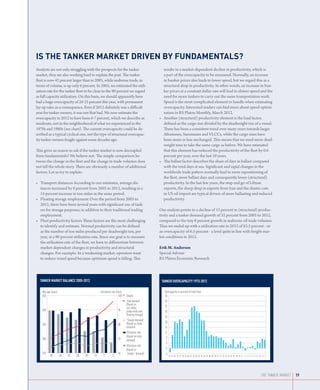
IS THE TANKER MARKET DRIVEN BY FUNDAMENTALS?
Analysts are not only struggling with the prospects for the tanker                                results in a market-dependent decline in productivity, which is
market, they are also working hard to explain the past. The tanker                                a part of the overcapacity to be measured. Normally, an increase
fleet is now 42 percent larger than in 2005, while seaborne trade, in                             in bunker prices also leads to lower speed, but we regard this as a
terms of volume, is up only 6 percent. In 2005, we estimated the utili-                           structural drop in productivity. In other words, an increase in bun-
zation rate for the tanker fleet to be close to the 90 percent we regard                          ker prices at a constant dollar rate will lead to slower speed and the
as full capacity utilization. On this basis, we should apparently have                            need for more tankers to carry out the same transportation work.
had a huge overcapacity of 20-25 percent this year, with permanent                                Speed is the most complicated element to handle when estimating
lay-up rates as a consequence. Even if 2012 definitely was a difficult                            over­capacity. Interested readers can find more about speed optimi-
year for tanker owners, it was not that bad. We now estimate the                                  zation in RS Platou Monthly, March 2012.
overcapacity in 2012 to have been 6-7 percent, which we describe as                           •	 Another (structural) productivity element is the load factor,
moderate, not in the neighborhood of what we experienced in the                                   defined as the cargo size divided by the deadweight ton of a vessel.
1970s and 1980s (see chart). The current overcapacity could be de-                                There has been a consistent trend over many years towards larger
scribed as a typical cyclical one, not the type of structural overcapac-                          Aframaxes, Suezmaxes and VLCCs, while the cargo sizes have
ity tanker owners fought against some decades ago.                                                been more or less unchanged. This means that we need more dead-
                                                                                                  weight tons to take the same cargo as before. We have estimated
This gives us reason to ask if the tanker market is now decoupled                                 that this element has reduced the productivity of the fleet by 0.6
from fundamentals? We believe not. The simple comparison be-                                      percent per year, over the last 10 years.
tween the change in the fleet and the change in trade volumes does                            •	 The ballast factor describes the share of days in ballast compared
not tell the whole story. There are obviously a number of additional                              with the total days at sea. Significant and rapid changes in the
factors. Let us try to explain:                                                                   worldwide trade pattern normally lead to more repositioning of
                                                                                                  the fleet, more ballast days and consequently lower (structural)
•	 Transport distances According to our estimates, average dis-                                  productivity. In the last few years, the stop and go of Libyan
    tances increased by 8 percent from 2005 to 2012, resulting in a                               exports, the sharp drop in exports from Iran and the drastic cuts
    14 percent increase in ton-miles in the same period.                                          in US oil import are typical drivers of more ballasting and reduced
•	 Floating storage employment Over the period from 2005 to                                      productivity.
    2012, there have been several years with significant use of tank-
    ers for storage purposes, in addition to their traditional trading                        Our analysis points to a decline of 13 percent in (structural) produc-
    employment.                                                                               tivity and a tanker demand growth of 32 percent from 2005 to 2012,
•	 Fleet productivity factors These factors are the most challenging                         compared to the tiny 6 percent growth in seaborne oil trade volumes.
    to identify and estimate. Normal productivity can be defined                              Thus we ended up with a utilization rate in 2012 of 83.5 percent - or
    as the number of ton-miles produced per deadweight ton, per                               an overcapacity of 6.5 percent - a level quite in line with freight mar-
    year, at a 90 percent utilization rate. Since our goal is to measure                      ket conditions in 2012.
    the utilization rate of the fleet, we have to differentiate between
    market-dependent changes in productivity and structural                                   Erik M. Andersen
    changes. For example: In a weakening market, operators want                               Special Adviser
    to reduce vessel speed because optimum speed is falling. This                             RS Platou Economic Research


  TANKER MARKET BALANCE 2005-2012                                                              Tanker overcapacity 1973-2012

    Mill dwt (lines)                            Utilization rate (bars)                          Overcapacity in percent of total fleet
    450                                                            100    Supply                 40
                                                                          Total demand           36
                                                                          (Based on
                                                                          ton-miles,             32
    400                                                            90     productivity and       28
                                                                          floating storage)
                                                                                                 24
                                                                          Simple demand
                                                                          (Based on trade        20
    350                                                            80
                                                                          volumes)               16
                                                                          Utilization rate       12
                                                                          (Based on total         8
    300                                                            70     demand)
                                                                                                  4
                                                                          Utilization rate
                                                                          (Based on               0
    250                                                            60     “simple” demand)       -4
            05         06   07   08   09   10     11        12                                        73 74 75 76 77 78 79 80 81 82 83 84 85 86 87 88 89 90 91 92 93 94 95 96 97 98 99 0 1 2 3 4 5 6 7 8 9 10 11 12


                                                                                                                                                                                                             THE tanker MARKET   19
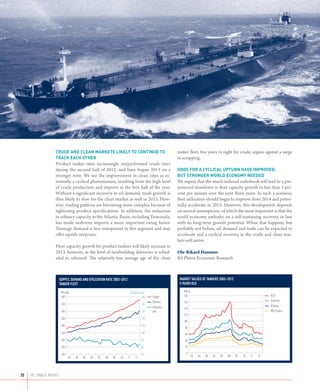
Crude and Clean markeTS likely TO COnTinue TO                                          tanker fleet, five years vs eight for crude, argues against a surge
                   TraCk eaCh OTher                                                                       in scrapping.
                   Product tanker rates increasingly outperformed crude rates
                   during the second half of 2012, and have begun 2013 on a                               OddS fOr a CyCliCal upTurn have imprOved,
                   stronger note. We see the improvement in clean rates as es-                            buT STrOnger wOrld eCOnOmy needed
                   sentially a cyclical phenomenon, resulting from the high level                         We expect that the much-reduced orderbook will lead to a pro-
                   of crude production and imports in the first half of the year.                         nounced slowdown in fleet capacity growth to less than 3 per-
                   Without a significant recovery in oil demand, trade growth is                          cent per annum over the next three years. In such a scenario,
                   thus likely to slow for the clean market as well in 2013. How-                         fleet utilization should begin to improve from 2014 and poten-
                   ever, trading patterns are becoming more complex because of                            tially accelerate in 2015. However, this development depends
                   tightening product specifications. In addition, the reduction                          on several assumptions, of which the most important is that the
                   in refinery capacity in the Atlantic Basin, including Venezuela,                       world economy embarks on a self-sustaining recovery in line
                   has made seaborne imports a more important swing factor.                               with its long-term growth potential. When that happens, but
                   Tonnage demand is less transparent in this segment and may                             probably not before, oil demand and trade can be expected to
                   offer upside surprises.                                                                accelerate and a cyclical recovery in the crude and clean mar-
                                                                                                          kets will arrive.
                   Fleet capacity growth for product tankers will likely increase in
                   2013, however, as the level of newbuilding deliveries is sched-                        Ole-Rikard Hammer
                   uled to rebound. The relatively low average age of the clean                           RS Platou Economic Research


                     sUPPly, demand and Utilization rate 2003–2012                                         market valUes of tankers 2003–2012
                     tanker fleet                                                                          5 years old

                         Mill dwt                                        Utilization rate                    Mill $
                         500                                                          150   Supply           180                                                        VLCC
                                                                                            Demand           160                                                        Suezmax
                         450                                                         140                                                                                Aframax
                                                                                            Utilization      140
                         400                                                         130    rate                                                                        MR Product
                                                                                                             120
                         350                                                         120
                                                                                                             100
                         300                                                         110
                                                                                                              80
                         250                                                         100                      60
                         200                                                         90                       40
                         150                                                         80                       20

                         100                                                         70                        0
                                03   04   05   06   07   08   09   10   11    12                                      03   04   05   06   07   08   09   10   11   12


20   the tanker market
the dry bulk market

                                   Substantial drop in
                                      freight rates
Market fundamentals deteriorated further during 2012, as a result of another year with record high deliveries. Despite weaker
global economic growth, tonnage demand increased at a healthy rate thanks to China, which utilized huge arbitrage in iron
ore and coal prices, importing far more dry bulk commodities than the underlying demand for steel, energy and so forth would
usually dictate.


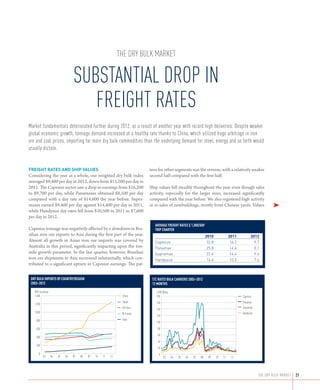
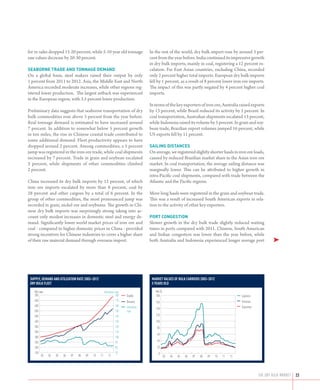
FREIGHT RATES AND SHIP VALUES                                                tern for other segments was the reverse; with a relatively weaker
Considering the year as a whole, our weighted dry bulk index                 second half compared with the first half.
averaged $9,400 per day in 2012, down from $15,200 per day in
2011. The Capesize sector saw a drop in earnings from $16,200                Ship values fell steadily throughout the year even though sales
to $9,700 per day, while Panamaxes obtained $8,100 per day                   activity, especially for the larger sizes, increased significantly
compared with a day rate of $14,600 the year before. Supra-                  compared with the year before. We also registered high activity
maxes earned $9,400 per day against $14,400 per day in 2011,                 in re-sales of newbuildings, mostly from Chinese yards. Values                    ➤
while Handysize day rates fell from $10,500 in 2011 to $7,600
per day in 2012.
                                                                                average freight rates $ 1,000/day
Capesize tonnage was negatively affected by a slowdown in Bra-                  Trip charter
zilian iron ore exports to Asia during the first part of the year.              			                                    2010	 2011	 2012
Almost all growth in Asian iron ore imports was covered by                      Capesize	                               32.8	16.2	 9.7
Australia in this period, significantly impacting upon the ton-                 Panamax	                                25.8	14.6	 8.1
mile growth parameter. In the last quarter, however, Brazilian                  Supramax	                               22.4	14.4	 9.4
iron ore shipments to Asia recovered substantially, which con-                  Handysize	                              16.4	10.5	 7.6
tributed to a significant upturn in Capesize earnings. The pat-


 DRY BULK IMPORTS BY COUNTRY/REGION                                           t/c rates bulk carriers 2003–2012
 2003–2012                                                                    12 months

   Mill tons/year                                                               1,000 $/day
   1,400                                                          China         180                                                        Capesize
                                                                  Japan          160                                                       Panamax
   1,200
                                                                  Oth Asia       140                                                       Supramax
   1,000                                                          W.Europe                                                                 Handysize
                                                                                 120
    800                                                           India
                                                                                 100
    600                                                                           80
                                                                                  60
    400
                                                                                  40
    200
                                                                                  20
       0                                                                           0
           03       04   05   06   07   08   09   10   11   12                         03     04   05   06   07   08   09   10   11   12


                                                                                                                                                       THE dry bulk MARKET   21
22	 THE DRY BULK MARKET
22	 THE dry bulk MARKET
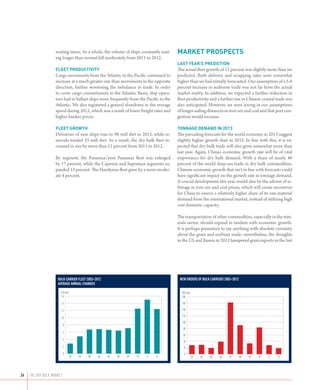
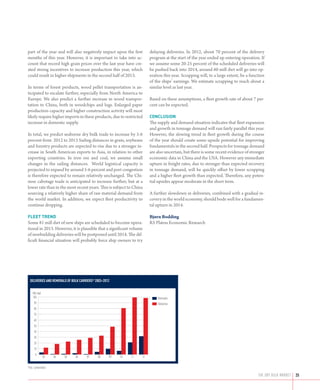
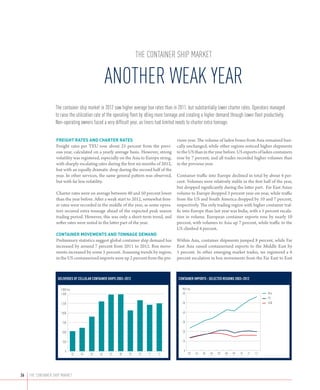
for re-sales dropped 15-20 percent, while 5-10 year old tonnage                        In the rest of the world, dry bulk import rose by around 3 per-
saw values decrease by 20-30 percent.                                                  cent from the year before. India continued its impressive growth
                                                                                       in dry bulk imports, mainly in coal, registering a 12 percent es-
SEABORNE TRADE AND TONNAGE DEMAND                                                      calation. Far East Asian countries, excluding China, recorded
On a global basis, steel makers raised their output by only                            only 2 percent higher total imports. European dry bulk imports
1 percent from 2011 to 2012. Asia, the Middle East and North                           fell by 1 percent, as a result of 8 percent lower iron ore imports.
America recorded moderate increases, while other regions reg-                          The impact of this was partly negated by 4 percent higher coal
istered lower production. The largest setback was experienced                          imports.
in the European region, with 3.5 percent lower production.
                                                                                       In terms of the key exporters of iron ore, Australia raised exports
Preliminary data suggests that seaborne transportation of dry                          by 13 percent, while Brazil reduced its activity by 1 percent. In
bulk commodities rose above 5 percent from the year before.                            coal transportation, Australian shipments escalated 13 percent,
Real tonnage demand is estimated to have increased around                              while Indonesia raised its volume by 5 percent. In grain and soy-
7 percent. In addition to somewhat below 5 percent growth                              bean trade, Brazilian export volumes jumped 16 percent, while
in ton miles, the rise in Chinese coastal trade contributed to                         US exports fell by 11 percent.
some additional demand. Fleet productivity appears to have
dropped around 2 percent. Among commodities, a 5 percent                               SAILING DISTANCES
jump was registered in the iron ore trade, while coal shipments                        On average, we registered slightly shorter hauls in iron ore loads,
increased by 7 percent. Trade in grain and soybean escalated                           caused by reduced Brazilian market share in the Asian iron ore
3 percent, while shipments of other commodities climbed                                market. In coal transportation, the average sailing distance was
2 percent.                                                                             marginally lower. This can be attributed to higher growth in
                                                                                       intra-Pacific coal shipments, compared with trade between the
China increased its dry bulk imports by 12 percent, of which                           Atlantic and the Pacific regions.
iron ore imports escalated by more than 8 percent, coal by
28 percent and other cargoes by a total of 6 percent. In the                           More long hauls were registered in the grain and soybean trade.
group of other commodities, the most pronounced jump was                               This was a result of increased South American exports in rela-
recorded in grain, nickel ore and soybeans. The growth in Chi-                         tion to the activity of other key exporters.
nese dry bulk imports was surprisingly strong taking into ac-
count only modest increases in domestic steel and energy de-                           PORT CONGESTION
mand. Significantly lower world market prices of iron ore and                          Slower growth in the dry bulk trade slightly reduced waiting
coal - compared to higher domestic prices in China - provided                          times in ports compared with 2011. Chinese, South American
strong incentives for Chinese industries to cover a higher share                       and Indian congestion was lower than the year before, while
of their raw material demand through overseas import.                                  both Australia and Indonesia experienced longer average port                     ➤


 supply, demand and utilization rate 2003–2012                                          market Values of Bulk Carriers 2003–2012
 Dry bulk fleet                                                                         5 years old

   Mill dwt                                           Utilization rate                    Mill $
   700                                                             180   Supply           180                                                        Capesize
   650                                                            170    Demand           160                                                        Panamax
   600                                                            160    Utilization                                                                 Supramax
                                                                                          140
   550                                                            150    rate
   500                                                            140                     120
   450                                                            130                     100
   400                                                            120                      80
   350                                                            110
                                                                                           60
   300                                                            100
   250                                                            90                       40
   200                                                            80                       20
   150                                                            70                        0
         03   04   05   06   07   08   09   10   11       12                                       03   04   05   06   07   08   09   10   11   12


                                                                                                                                                                THE dry bulk MARKET   23
waiting times. As a whole, the volume of ships constantly wait-     MARKET PROSPECTS
                   ing longer than normal fell moderately from 2011 to 2012.
                                                                                       Last year’s prediction
                   FLEET PRODUCTIVITY                                                  The actual fleet growth of 12 percent was slightly more than we
                   Cargo movements from the Atlantic to the Pacific continued to       predicted. Both delivery and scrapping rates were somewhat
                   increase at a much greater rate than movements in the opposite      higher than we had initially forecasted. Our assumption of a 5-6
                   direction, further worsening the imbalance in trade. In order       percent increase in seaborne trade was not far from the actual
                   to cover cargo commitments in the Atlantic Basin, ship opera-       market reality. In addition, we expected a further reduction in
                   tors had to ballast ships more frequently from the Pacific to the   fleet productivity and a further rise in Chinese coastal trade was
                   Atlantic. We also registered a general slowdown in the average      also anticipated. However, we were wrong in our assumptions
                   speed during 2012, which was a result of lower freight rates and    of longer sailing distances in iron ore and coal and that port con-
                   higher bunker prices.                                               gestion would increase.

                   FLEET GROWTH                                                        TONNAGE DEMAND IN 2013
                   Deliveries of new ships rose to 98 mill dwt in 2012, while re-      The prevailing forecasts for the world economy in 2013 suggest
                   movals totaled 33 mill dwt. As a result, the dry bulk fleet in-     slightly higher growth than in 2012. In line with this, it is ex-
                   creased in size by more than 12 percent from 2011 to 2012.          pected that dry bulk trade will also grow somewhat more than
                                                                                       last year. Again, China’s economic growth rate will be of vital
                   By segment, the Panamax/post Panamax fleet was enlarged             importance for dry bulk demand. With a share of nearly 40
                   by 17 percent, while the Capesize and Supramax segments ex-         percent of the world deep-sea trade in dry bulk commodities,
                   panded 13 percent. The Handysize fleet grew by a more moder-        Chinese economic growth that isn’t in line with forecasts could
                   ate 4 percent.                                                      have significant impact on the growth rate in tonnage demand.
                                                                                       A crucial development this year would also be the advent of ar-
                                                                                       bitrage in iron ore and coal prices, which will create incentives
                                                                                       for China to source a relatively higher share of its raw material
                                                                                       demand from the international market, instead of utilizing high
                                                                                       cost domestic capacity.

                                                                                       The transportation of other commodities, especially in the min-
                                                                                       erals sector, should expand in tandem with economic growth.
                                                                                       It is perhaps premature to say anything with absolute certainty
                                                                                       about the grain and soybean trade; nevertheless, the droughts
                                                                                       in the US and Russia in 2012 hampered grain exports in the last


                    bulk carrier fleet 2003–2012                                        New orders of bulk carriers 2003–2012
                    Average annual changes

                      Percent                                                            Mill dwt
                      16                                                                 180
                      14                                                                 160

                      12                                                                 140
                                                                                         120
                      10
                                                                                         100
                          8
                                                                                          80
                          6
                                                                                          60
                          4
                                                                                          40
                          2                                                               20
                          0                                                                0
                                03   04   05   06   07   08   09   10   11   12                     03   04   05   06   07      08   09   10   11   12


24	 THE dry bulk MARKET
part of the year and will also negatively impact upon the first         delaying deliveries. In 2012, about 70 percent of the delivery
months of this year. However, it is important to take into ac-          program at the start of the year ended up entering operation. If
count that record high grain prices over the last year have cre-        we assume some 20-25 percent of the scheduled deliveries will
ated strong incentives to increase production this year, which          be pushed back into 2014, around 60 mill dwt will go into op-
could result in higher shipments in the second half of 2013.            eration this year. Scrapping will, to a large extent, be a function
                                                                        of the ships’ earnings. We estimate scrapping to reach about a
In terms of forest products, wood pellet transportation is an-          similar level as last year.
ticipated to escalate further, especially from North America to
Europe. We also predict a further increase in wood transpor-            Based on these assumptions, a fleet growth rate of about 7 per-
tation to China, both in woodchips and logs. Enlarged paper             cent can be expected.
production capacity and higher construction activity will most
likely require higher imports in these products, due to restricted      CONCLUSION
increase in domestic supply.                                            The supply and demand situation indicates that fleet expansion
                                                                        and growth in tonnage demand will run fairly parallel this year.
In total, we predict seaborne dry bulk trade to increase by 5-6         However, the slowing trend in fleet growth during the course
percent from 2012 to 2013 Sailing distances in grain, soybeans          of the year should create some upside potential for improving
and forestry products are expected to rise due to a stronger in-        fundamentals in the second half. Prospects for tonnage demand
crease in South American exports to Asia, in relation to other          are also uncertain, but there is some recent evidence of stronger
exporting countries. In iron ore and coal, we assume small              economic data in China and the USA. However any immediate
changes in the sailing distances. World logistical capacity is          upturn in freight rates, due to stronger than expected recovery
projected to expand by around 5-6 percent and port congestion           in tonnage demand, will be quickly offset by lower scrapping
is therefore expected to remain relatively unchanged. The Chi-          and a higher fleet growth than expected. Therefore, any poten-
nese cabotage trade is anticipated to increase further, but at a        tial upsides appear moderate in the short term.
lower rate than in the most recent years. This is subject to China
sourcing a relatively higher share of raw material demand from          A further slowdown in deliveries, combined with a gradual re-
the world market. In addition, we expect fleet productivity to          covery in the world economy, should bode well for a fundamen-
continue dropping.                                                      tal upturn in 2014.

FLEET TREND                                                             Bjørn Bodding
Some 81 mill dwt of new ships are scheduled to become opera-            RS Platou Economic Research
tional in 2013. However, it is plausible that a significant volume
of newbuilding deliveries will be postponed until 2014. The dif-
ficult financial situation will probably force ship owners to try


  deliveries and Removals of bulk carriers* 2003–2012


     Mill dwt
     100                                                                    Removals
      90                                                                    Deliveries
      80
      70
      60
      50
      40
      30
      20
      10
       0
                03   04   05   06     07     08     09   10   11   12


*Incl. conversions

                                                                                                                                       THE dry bulk MARKET   25
the container ship market

                                                      ANOTHER WEAK YEAR
                   The container ship market in 2012 saw higher average box rates than in 2011, but substantially lower charter rates. Operators managed
                   to raise the utilization rate of the operating fleet by idling more tonnage and creating a higher demand through lower fleet productivity.
                   Non-operating owners faced a very difficult year, as liners had limited needs to charter extra tonnage.

                    FREIGHT RATES AND CHARTER RATES                                        vious year. The volume of laden boxes from Asia remained basi-
                    Freight rates per TEU rose about 25 percent from the previ-            cally unchanged, while other regions noticed higher shipments
                    ous year, calculated on a yearly average basis. However, strong        to the US than in the year before. US exports of laden containers
                    volatility was registered, especially on the Asia to Europe string,    rose by 7 percent, and all trades recorded higher volumes than
                    with sharply escalating rates during the first six months of 2012,     in the previous year.
                    but with an equally dramatic drop during the second half of the
                    year. In other services, the same general pattern was observed,        Container traffic into Europe declined in total by about 4 per-
                    but with far less volatility.                                          cent. Volumes were relatively stable in the first half of the year,
                                                                                           but dropped significantly during the latter part. Far East Asian
                    Charter rates were on average between 40 and 50 percent lower          volume to Europe dropped 3 percent year-on-year, while traffic
                    than the year before. After a weak start to 2012, somewhat firm-       from the US and South America dropped by 10 and 7 percent,
                    er rates were recorded in the middle of the year, as some opera-       respectively. The only trading region with higher container traf-
                    tors secured extra tonnage ahead of the expected peak season           fic into Europe than last year was India, with a 5 percent escala-
                    trading period. However, this was only a short-term trend, and         tion in volume. European container exports rose by nearly 10
                    softer rates were noted in the latter part of the year.                percent, with volumes to Asia up 7 percent, while traffic to the
                                                                                           US climbed 4 percent.
                    CONTAINER MOVEMENTS AND TONNAGE DEMAND
                    Preliminary statistics suggest global container ship demand has        Within Asia, container shipments jumped 8 percent, while Far
                    increased by around 7 percent from 2011 to 2012. Box move-             East Asia raised containerized exports to the Middle East by
                    ments increased by some 5 percent. Assessing trends by region,         5 percent. In other emerging market trades, we registered a 6
                    in the US containerized imports were up 2 percent from the pre-        percent escalation in box movements from the Far East to East


                     DELIVERIES OF CELLULAR CONTAINER SHIPS 2003–2012                        CONTAINER IMPORTS - SELECTED REGIONS 2003–2012

                      1,000 teu                                                                Mill teu
                      1,500                                                                    60                                                      Asia
                                                                                                                                                       EU
                      1,250                                                                    50                                                      USA

                      1,000                                                                    40

                        750                                                                    30

                        500                                                                    20

                        250                                                                    10

                          0                                                                     0
                                  03   04   05   06    07    08    09    10   11   12               03    04   05   06   07   08   09   10   11   12


26	 THE container ship market
Coast South America and a 12 percent jump to West Africa.                 LAST YEAR’S PREDICTIONS
Chinese import and export activity was slow during the first              Our expectation of a fairly parallel increase in supply and de-
part of 2012, but showed increasing growth trends in the final            mand was not far from the market reality of 2012. We also point-
part of the year.                                                         ed out that operators had the potential to increase earnings by
                                                                          idling more ships and through higher use of slow steaming, and
FLEET PRODUCTIVITY                                                        that box rates were likely to increase somewhat during the year.
Fleet productivity decreased significantly in 2012, as a result
of the increased use of ‘extra slow steaming’ on major routes.            Historically, container traffic has increased between 2.2 and 2.7
For example, on the Asia to Europe service, round trips were              times the world GDP. In 2012, the ratio was only 1.7, the lowest
extended from a typical 63 days, with the use of 10 ships on              registered increase in decades. This is probably related to exten-
a weekly basis, to 72 days and, in some cases, even 84 days.              sive inventory depletions along with lower economic activity,
This necessitated the use of either 11 or 12 ships respectively           especially in Europe, where historical growth in container im-
to maintain weekly sailings. The Asia to US loops also saw in-            port has been very high compared to GDP growth.
creased slow steaming, but to a lesser extent than between Asia
and Europe.                                                               MARKET OUTLOOK
                                                                          The prevailing forecasts for world GDP in 2013 suggest an
FLEET TREND                                                               increase in world container traffic of nearly 7 percent. This is
About 1.25 mill TEU of new container ship capacity entered                based on a factor to global GDP of 2.0. However, European
operation in 2012. This was 300,000 TEU less than planned.                GDP is forecast to remain stagnant and this will probably limit
Deliveries were basically in line with the program until midway           the growth potential in container trade to Europe. Global trade
through the year, but slowed down significantly in the latter part        growth could therefore increase less than the overall macro
of 2012, in tandem with falling freight rates.                            economic forecasts suggests. We expect higher US container
                                                                          imports this year than last and we also anticipate trades with
Removals totaled nearly 300,000 TEU of capacity, a new record             emerging markets to show stronger growth rates.
in container shipping. The average age of ships sold for scrap-
ping decreased substantially, from 30 years in 2011 to 23 years           New ships with a capacity of around 1.9 mill TEU are sched-
in 2012. Most ships sent to breaking last year were in the smaller        uled to begin operation in 2013. Weak market conditions will
size segments. The net fleet expansion was 7.7 percent, calcu-            most likely cause some slippage. It should also be noted that the
lated on a yearly average basis. At the end of the year, a capacity       ships becoming operational are within the largest size catego-
of close to 500,000 TEU was reported to be idle.                          ries. These ships are destined to operate on the Asia to Europe
                                                                          service, the trade with potentially the lowest growth in terms of
With a fleet expansion of nearly 8 percent and a demand growth            box movements.
of 7 percent, the capacity utilization rate for the total fleet fell
nearly 1 percentage point. However, the operating fleet grew              Scrapping is expected to remain at a similar or potentially higher
only 4 percent, leading to an increased operating fleet utiliza-          level than in 2012, resulting in a further drop in the age of ships
tion rate of nearly 3 percentage points.                                  sent to the beaches. Scrapping potential is anticipated to be
                                                                          highest for vessels smaller than 3,000 TEU.
                                                                          A fleet expansion in the region of 7 percent is expected in 2013.
 T/C rates container ships 2003–2012
 12 months                                                                Based on the above discussion, we expect to see a relatively bal-
   1,000 $/day                                                            anced growth in the supply and demand parameters in 2013,
   60                                                         4,500 teu   and consequently only small changes in the utilization rate for
                                                              3,000 teu   the total fleet. Container carriers could again work to restore
   50                                                         1,700 teu
                                                              1,000 teu
                                                                          profitability by adjusting the operating fleet size, which can be
   40                                                                     done by more idling of ships and by a further reduction in fleet
                                                                          productivity by, for example, implementing extra slow steaming
   30                                                                     on certain trades. In any case, we foresee another difficult year
   20
                                                                          for the container ship industry, especially for non-operating
                                                                          owners, who will experience another year with low demand for
   10                                                                     charter tonnage from liners.
    0
        03       04   05   06   07   08   09   10   11   12               Bjørn Bodding
                                                                          RS Platou Economic Research


                                                                                                                                   THE container ship market   27
the car carrier market

                                            A troublesome recovery
                         It has been a story of ups and downs for the car carrier market in    were reduced in the third quarter. Furthermore, Japanese exports
                         2012. The year started off well, with very positive US auto sales,    did not seem to recover the volumes lost in 2011, and fourth
                         high export volumes out of Korea and a full recovery of Japanese      quarter exports were significantly down compared to the year
                         exports, after the difficulties experienced in 2011. Charter rates    before. This is likely to be a consequence of relocation of produc-
                         firmed up, but as we moved into the second half several factors       tion, with auto makers seeking to cut production in Japan, due to
                         impacted negatively on tonnage demand, pulling rates down to-         the strong Yen and weak domestic demand, and instead produce
                         wards the end of the year.                                            closer to their sales markets.

                         Sales in the US continued trending positively throughout the          As a consequence, demand growth developed negatively towards
                         year, ending at 14.5 mill light vehicles, up 13 percent from 2011.    the end of 2012. Annualized demand growth is estimated at 8
                         Forecasts for 2013 indicate another 3-4 percent growth across         percent, which is lower than we had expected. Given the cur-
                         the next 12 months. The story of European sales is completely         rent macroeconomic uncertainties, we estimate that demand will
                         different; The Euro crisis has scared consumers away from show        grow by around 4 percent in 2013.
                         rooms, and sales are down 8 percent in Western Europe, to levels
                         not seen since 1993. The economic outlook does not seem to in-        The car carrier fleet at year-end consisted of 713 vessels, of which
                         dicate any improvement in 2013, and forecasts indicate a further      36 were delivered in 2012. Only five vessels were removed from
                         3-5 percent sales decline this year.                                  the fleet, resulting in a fleet growth of 6.5 percent. The order book
                                                                                               stood at 42 vessels, representing 7 percent of the active fleet. Only
                         Auto sales mirror the production situation: While North Ameri-        19 vessels are scheduled for delivery in 2013, indicating a fleet
                         can capacity is being increased and new facilities are in the pipe-   growth of 4 percent.
                         line, many European plants suffer from overcapacity and at least
                         five factories are expected to be closed over the next years.         27 vessels were added to the order book in 2012, a massive in-
                                                                                               crease from previous years. 10 of these will be of Post-Panamax
                         In other markets sales are generally growing, with the BRIC coun-     design. In addition to fleet renewal programs, owners are taking
                         tries in particular subject to attention from auto makers, both in    advantage of the low newbuilding prices and as a consequence
                         terms of sales and as locations for new production facilities.        we may see further orders for 2014 deliveries, currently standing
                                                                                               at 19 vessels.
                         Tonnage demand developed positively during the first half of the
                         year. However, as strikes hit Korean factories, export volumes        Given the development throughout 2012, we saw only a minor
                                                                                               improvement in the market balance: Fleet utilization is estimated
                                                                                               at 84 percent, compared to 83 percent in 2011. Due to challeng-
                                                                                               ing market conditions, outlook for 2013 indicates a flat develop-
 JAPANESE AND KOREAN AUTOMOBILE EXPORT 2003–2012
                                                                                               ment, or possibly a small improvement, due to the limited fleet
    Mill vehicles
                                                                                               growth. We estimate an annual average fleet utilization of 84-85
    8                                                                           Japan          percent. Along with economic growth and its influence on auto
    7                                                                           Korea          sales, the most critical factor going forward is the possibility of
                                                                                               further relocation of production out of Japan. Although we have
    6
                                                                                               seen a recent weakening of the Yen, some auto makers have al-
    5
                                                                                               ready made their decisions to move parts of production overseas,
    4                                                                                          and we believe that a weaker Yen must be seen over the long-term
    3                                                                                          in order for this tendency to change.
    2
                                                                                               Ole Gustav Eriksen
    1
                                                                                               RS Platou Economic Research
    0
           03       04    05    06     07    08     09    10     11    12


28	 THE car carrier market
the lng market

                            Another record year
The double-digit growth trend in supply and demand we have             Fukushima meltdown in 2011 were shut in early May for periodic
seen in the LNG shipping market since 2006 finally came to an          maintenance. However, two reactors at Kansai Electric’s Ohi plant
end in 2012. Our estimates suggest that demand growth was 6            passed the new stress test and were restarted in July. These reactors
percent and the fleet grew by less than 4 percent. This resulted in    represent 5 percent of Japans nuclear power generating capacity.
a 3 percentage points rise in the utilization rate, and a subsequent
hike in the average spot rate for modern standard sized steamship      We have further estimated that the productivity factor of the
to $125 000 per day.                                                   LNG shipping fleet declined by 2 to 3 percent in 2012. A regime
                                                                       of higher bunker cost and an increase in ship size that is not al-
On the demand side, the development in transported volumes             ways utilized are the rationale behind this change in productivity.
proved rather disappointing in 2012. We have estimated a mar-          Thus, in sum the tonnage demand for LNG carriers increased by
ginal decline of 1 percent in volumes, inferior to the 6 percent       6 percent this year.
growth we expected in this report a year ago. The main explana-
tory factors were delay in the inauguration of Angola LNG which        The active average LNG carrier fleet in 2012 grew by 4 percent.
was postponed a full year from first quarter 2012. A second cause      Two new vessels entered into service and three vessels were re-
was technical issues that restrained production in various lique-      moved. During the the year we have estimated that 0.8 mill cbm
faction plants. Several explosions along the feedgas pipeline to       of carrying capacity was laid-up.
Yemen LNG hampered their production, Tangguh LNG’s sec-
ond train were shut after a fire during maintenance of the first       For 2013 we expect transported volumes to increase by 3 percent.
train. Snohvit LNG in Norway also experienced unplanned stops          Two new LNG projects are expected to start production, Angola
in production. Algeria, Egypt, Indonesia and Oman lowered their        LNG and Sonatrach’s Skikda project. However, Indonesia has
LNG exports in 2012.                                                   announced a cut in LNG exports by 13.8 percent due to higher
                                                                       domestic demand for natural gas.
The second ingredient of the ton-mile demand, transported dis-
tance, is estimated to have grown by 3 percent in 2012. The main       The most difficult factor to forecast is the development in trans-
driver of this parameter has been a 25 percent increase in inter-      port distance. For 2013 we anticipate a decline of 1 percent as we
basin trades between the Atlantic and the Pacific basin. This was      believe the inter-basin trade will continue at a high level. However,
caused by an increased demand for LNG in Japan following the           since the middle of 2011, an increasing share of the LNG produc-
shut-down of its nuclear power plants. Most of these power plants      tion in the Middle East has been sold East of Suez. Should this
remained dormant during 2012 as the last active reactor since the      trend prevail, it is likely to do so on the expense of the inter-basin
                                                                       trade volume and could thus lead to shorter transport distances.
                                                                       Coupled with an assumption of a small decline in the fleet’s pro-
                                                                       ductivity, we expect tonnage demand to grow by 3 percent in 2013.
  Short term rate for LNG carriers 2005 - 2012

  $/day                                                                According to the orderbook there will be 23 vessels delivered
  160 000                                                              from the shipyards in 2013 and we expect only a limited number
  140 000                                                              of old vessels removed from the market. As most of these new-
  120 000
                                                                       buildings will come in the second half of the year, the average
                                                                       LNG fleet is only expected to grow by 2.5 percent this year.
  100 000

   80 000                                                              In conclusion, after taking into consideration the above assump-
   60 000                                                              tions, we forecast that the fleet utilization rate should increase
   40 000                                                              marginally to 96 percent in 2013, which indicates yet another
   20 000
                                                                       tight year in the LNG shipping market.
       0
            05      06     07      08      09    10   11    12         Jørn Bakkelund
                                                                       RS Platou Economic Research

                                                                                                                                                THE LNG MARKET   29
Small-scale LNG

                                                   A NEW MARKET EMERGING
                      In many ways, 2012 will be remembered as the year when the small-scale LNG market ‘shifted into second gear’. The market developed
                      from being a small, exotic and local market (mainly in Norway, Sweden and Japan) employing only a handful of vessels, into a hot topic
                      discussed worldwide.

                      SIGNIFICANT EVENTS                                                                        The small-scale LNG market mainly serves the following types
                      In 2012, we have experienced some notable ‘world first’ events                            of consumers/purposes:
                      for small-scale LNG, such as:
                                                                                                                •	 Small to medium sized businesses where LNG is used for
                      •	 The world’s first dedicated LNG bunker barge was ordered                                 heating, or as feedstock
                          and commissioned in Norway by AGA. It will be in operation                            •	 As a road traffic and marine transport fuel
                          by January 2013 in Stockholm, Sweden
                      •	 The world’s ‘largest’ small-scale LNG vessel with a Type C                            The latter is becoming increasingly important. In 2012, there
                          tank was christened Coral Energy in December 2012. This                               was a sharp increase of consumption of LNG as a marine fuel,
                          vessel will be operating on a long-term charter for Skangass                          although from a very low level.
                          of Norway
                      •	 The world’s first LNG-fuelled RO-PAX vessels were launched.                           RS Platou estimates that, based upon existing orders at ship-
                          They will go into operation in 2013 for Viking Line and Fjord-                        yards for ships capable of burning LNG as fuel, this increase will
                         Line                                                                                   be even stronger in 2013 and the years that follow (see graph
                      •	 The world’s first LNG-fuelled container vessels (3,100 TEU)                           below).
                          were contracted by TOTE. The vessels will operate between
                          Florida and Puerto Rico from 2015                                                     PREDICTIONS
                      •	 Several important shipping hubs – including Singapore,                                The push for small-scale LNG will be strong in Europe, due to
                          Rotter­ am, Zeebrugge and Gothenburg – announced plans
                                 d                                                                              both environmental and economic drivers. In the US, we expect
                          to follow Stockholm, and several smaller Norwegian ports, in                          an even stronger push for LNG as fuel in the coming years, driv-
                          making LNG available as marine fuel                                                   en by the considerable cost difference between LNG and other
                      •	 Supermajor Shell acquired Norwegian small-scale LNG play-                             fuels, both on land and at sea.
                         er Gasnor. This is an example of major LNG players showing
                         firm interest in this segment.                                                         An increase in the use of LNG as a marine fuel will result in
                                                                                                                more demand for LNG transportation by sea, in smaller par-
                                                                                                                cels. We therefore believe that there will be increasing need for
                       Annual consumption of LNG as marine fuel                                                 small-scale LNG feeder vessels, and also LNG Bunkering ves-
                                                                                                                sels, in the coming years.
                        Mill mt
                        1,2                                                                Projects under       At a time when many shipping segments are experiencing real
                                                                                           development
                         1,0                                                                                    challenges, and with very low newbuilding volumes, prices are
                                                                                           Vessels beiing
                                                                                           quoted by yards      also expected to be very attractive for shipowners deciding to
                         0,8
                                                                                           Vessels under        enter this new market in 2013.
                                                                                           construction
                         0,6
                                                                                           Vessels in-service   Egil Rokstad
                         0,4                                                                                    RS Platou Shipbrokers

                         0,2

                          0
                               06   07   08   09   10   11   12   13   14   15   16   17


30	 Small-scale LNG
the demolition market

Weak markets pull recycling up
2012 was a busy year for recycling, surpassing 2011 volumes by more than 40 percent. Weak freight markets within the tank, dry bulk and
container segments were the key drivers. However, due to massive deliveries of new capacity from shipyards, the high scrapping activity
could not prevent a strong fleet growth.

The year was characterized by fluctuations in currencies and                yards in the same period, and therefore did not prevent a sub-
steel price, resulting in very volatile demolition prices. India, in        stantial fleet growth within this segment. It is worth noting that
particular, was troubled by a very unstable currency and prices             the average age of bulk carriers scrapped came down from 30
that shifted throughout the year, starting above $500/ldt for               years in 2011 to 27 years in 2012, with the average age of the
tankers and container ships. They remained fairly healthy un-               74 Capesizes scrapped being only 22 years. 67 Panamax/Post-
til May, when they dropped by $100/ldt and hovered between                  Panamaxes, 151 Handymaxes/Supramaxes and 220 Handy-
$380 and $450/ldt for the rest of the year, ending around $450/             sizes were also beached during the year. Prospects for the dry
ldt.                                                                        bulk market in 2013 indicate a substantial potential for further
                                                                            recycling, and we may also see the average vessel age decrease
Close to 800 vessels were beached on the subcontinent alone,                further.
with India taking the majority, while Pakistan turned out to
have the healthiest appetite for large tankers and Capesize bulk            The situation in the container ship market also accelerated de-
carriers. China and Turkey were also active in the market and               molition. 159 vessels were scrapped in 2012, compared to 57 in
claimed a solid share in 2012.                                              2011, representing an increase of 160 percent in terms of capac-
                                                                            ity, to 300,000 TEU. However, with one exception, these vessels
Tanker demolition increased by 24 percent from 2011, to                     were all below 4,000 TEU, and amount to only one quarter of
11.7 mill dwt, of which 3 mill dwt was single-hull tonnage. 10              the capacity delivered in the same period. As for bulk carriers,
VLCCs, 21 Suezmaxes and 35 Aframaxes were scrapped, with                    the average age of recycled vessels has been reduced, from an
an average age of 23 years, down from 25 years in 2011.                     average of 30 years in 2011, to 23 years in 2012.

The quantity of bulk carriers sold for recycling increased by               Delivery rates for these three large segments are expected to re-
more than 50 percent from 2011, to 33 mill dwt, primarily as                main high this year, while the freight markets are not expected
a consequence of the very poor freight market. Despite being a              to greatly improve. As a result, we expect another busy year for
high number, this represents only one third of deliveries from              recycling in 2013, with further high demolition volumes.


 demolition prices tankers 2003–2012                                         Tonnage sold for recycling 2003–2012

   $/ldt                                                                       Mill dwt
   800                                                         India/          60                                                      Others
                                                               Bangladesh
   700                                                         Far East                                                                Bulk carriers
                                                                               50
   600                                                                                                                                 Tankers
                                                                               40
   500

   400                                                                         30

   300                                                                         20
   200
                                                                               10
   100

     0                                                                          0
           03   04   05   06   07   08   09   10   11   12                           03   04   05   06   07   08   09   10   11   12


                                                                                                                                                       THE demolition market   31
mobile offshore drilling units

                                                         Hitting new heights
                    Day rates/Utilization: review of the year                                                 In 2012, the global annual average day rates for MW units in-
                    The jack-up market tightened considerably in 2012 and we ob-                              creased by 5 percent to 235,000 USD, while the global annual
                    served the active jack-up utilization rate increase 6 percentage                          average day rates of DW units increased by 14 percent year-on-
                    points to 92 percent. While modern Independent Cantilever                                 year, rising to 305,000 USD.
                    units built after 1998 (modern units) were still enjoying basi-
                    cally full active utilization in 2012, the older Independent Can-                         On a regional basis, the strength of the North Sea, and espe-
                    tilever units (built prior to 1998, standard units) experienced a                         cially the Norwegian sector, continued unabated through 2012.
                    comeback, driving up the overall active utilization rate. As the                          As a consequence of the opening of the Barents Sea to explo-
                    jack-up fleet approached full utilization, day rates of both stan-                        ration, and recent major new discoveries on the Norwegian
                    dard and modern units increased substantially. Global average                             Continental Shelf, offshore activity increased. The Norwegian
                    day rates of standard units averaged 102,000 USD in 2012, an                              MODU fleet has experienced 100 percent utilization for some
                    increase of 30 percent compared to 2011, while global average                             time and the volume of new fixtures is boosting the contract
                    day rates of modern units averaged 147,000 USD in 2012, a rise                            backlog of rig owners. Typically, the annual average day rates of
                    of 15 percent over the previous year.                                                     high-specification floaters rose from 460,000 USD a year ago, to
                                                                                                              currently close to 590,000 USD.
                    The floater market also tightened and active utilization in-
                    creased by 2 percentage points, averaging nearly 96 percent                               Demand
                    in 2012. The tightening of the market was seen in all sub-seg-                            Along with oil prices, which were basically unchanged, demand
                    ments, although mostly in the Ultra-Deepwater (UDW) sector.                               growth for jack-ups slowed down, but nevertheless achieved a
                    The UDW active utilization rate remained close to 100 percent                             substantial increase. At the end of last year (2011) we recorded
                    throughout 2012. The few available UDW units in 2012 were                                 353 jack-ups on contract, while 374 jack-ups were on contract
                    easily absorbed in the market and, as fixing activity added to the                        as this year (2012) came to a close. This equates to an annual
                    gains achieved in 2011, the annual average day rate increased                             increase of nearly 6 percent, which is down from the 18 percent
                    to 606,000 USD in 2012, from 478,000 USD the year before.                                 growth observed last year, but still well above the long-term
                    It should also be noted that contract lengths were stretched                              demand growth of the last 25 years (1.8 percent per annum).
                    considerably. On the back of the strength of the UDW market,                              Demand increases for jack-ups in the same period were ob-
                    active utilizations of both Mid-water (MW) units and Deep-                                served in many regional markets, but were particularly strong
                    water (DW) units increased to 92 and 96 percent respectively.                             in West Africa (+19 percent), the Middle East (+10 percent)


                     market development 2003–2012                                                              market development 2003–2012
                     Floaters                                                                                  Jack-ups

                       No. of rigs                                           Utilization rate                   No. of rigs                                           Utilization rate
                       320                                                               150    Total           500                                                               190    Total
                                                                                                supply                                                                                   supply
                       280                                                               140    Active          450                                                              170     Active
                                                                                                supply                                                                                   supply
                       240                                                               130    Demand                                                                                   Demand
                                                                                                                400                                                              150
                                                                                                Active                                                                                   Active
                       200                                                               120
                                                                                                utilization                                                                              utilization
                                                                                                                350                                                              130
                       160                                                               110
                                                                                                                300                                                              110
                       120                                                               100

                                                                                         90                     250                                                               90
                        80

                        40                                                               80                     200                                                               70
                             03      04   05   06   07   08   09   10   11       12                                   03      04   05   06   07   08   09   10   11       12


32	 MOBILE OFFSHORE drilling UNITS
and South East Asia (+11 percent). In the same period, jack-up                   ern UDW units. As an example of this, the number of MW
demand in the North Sea and Gulf of Mexico was virtually flat.                   units operating in both West Africa and Brazil has declined in
Reserves under development in shallow water – a major market                     the last year, while the quantity of UDW units on contract has
driver – also increased significantly in 2012, with the Middle                   increased. UDW demand is, of course, supported by a string of
East and South East Asia acting as the main regional contribu-                   major discoveries. These discoveries are also broadening in geo-
tors to jack-up demand growth. It is also interesting to note that               graphical scope and can be highly profitable. This trend was re-
‘average days per well in shallow water’ is a factor that has been               inforced in 2012, with major discoveries in, for example, pre-salt
increasing substantially across the last few years. There are many               formations in Angola and East Africa. Furthermore, many of the
ways of interpreting this data, but with the delivery of new jack-               discoveries made in the last 10 years are moving into develop-
ups oil companies are able to drill more complex, but also more                  ment, which should propel UDW demand further.
time consuming, wells than before.
                                                                                 Fleet trend
Floater demand strengthened progressively through 2012. At                       The increase in jack-up utilization was aided by a more dynamic
the end of last year we recorded 222 units on contract, while                    supply side than usual. At the start of the year, jack-up order
254 floaters were on contract at the end of 2012. The major-                     books indicated that 29 units were to be delivered in 2012.
ity of the increase in demand was concentrated in the Gulf of                    However, at the end of the year only 11 newbuilds had come
Mexico, South America and the North Sea. Floater activity in                     into operation. This appears to have been the modus operandi
The Gulf of Mexico has now surpassed pre-Macondo levels.                         of yards during the last few years. It seems that many (possibly
                                                                                 inexperienced) yards were forced to postpone delivery dates
Fixing activity of floaters (as measured in rig years), which is a               significantly, but it should also be mentioned that many units
more forward looking indicator, increased in 2012 by 18 per-                     were intended to be delivered towards the end of the year, with
cent compared to 2011 (excluding the fixtures from Petrobras’                    delivery now expected in the first months of 2013. At the same
newbuilding program in 2011/2012). We estimate that the ac-                      time, a number of jack-ups were either sold out of the market,
cumulated length of contracts signed in 2012 was nearly 300 rig                  mainly to accommodation, or scrapped - although it should be
years, which easily exceeds the 254 floaters on contract at the                  noted that several standard IC units were reactivated from cold
end of 2012. The different floater segments produced very dif-                   stacking as the jack-up market improved. By the end of 2012,
ferent results. While UDW units increased fixing activity by 67                  fleet adjustments had mitigated a potentially large increase in
percent, fixing activity of MW and DW units declined 16 per-                     supply. Our figures indicate that the total jack-up fleet increased
cent and 30 percent respectively. It is noteworthy that the large                by only five units, or 1 percent, in 2012.
increase in UDW fixing activity was achieved without Petrobras
entering the international markets (with the exception of one                    The process of jack-up renewal slowed down in 2012, with 24 re-
floater contract).                                                               corded new orders, substantially down from the 46 orders made
                                                                                 in 2011. The fairly large orderbook, combined with more difficult
Most of the MW and DW units are of course built in the 70s                       access to capital, worked to slow down ordering activity.
and 80s and, as charterers have become more safety conscious
and demanding (perhaps due to higher well complexity), these                     The floater fleet grew more or less as expected, with 18 of 20
units are, to a certain extent, being crowded out by more mod-                   units delivered. We estimate the floater fleet to have expanded                      ➤

 day rate of rigs 2003–2012                                                       NEWBUILDING PRICE OF RIGS 2003–2012

  1,000 $/day                                                                      Mill $ Semi/Drillship
  700                                                        Deepwater, High       800                                                                Drillship
                                                                                                                                                      (10,000ft WD)
  600                                                        Midwater, High        700
                                                                                                                                                      Semi (Harsh
                                                             Midwater, Low                                                                            Environment)
  500                                                                              600
                                                             Jackup, High Spec                                                                        Jackup (400ft
  400                                                                              500
                                                                                                                                                      Premium)
                                                             Jackup, 300ft
                                                                                   400
  300                                                                                                                                                 Jackup (350ft
                                                                                   300                                                                Premium)
  200
                                                                                   200
  100
                                                                                   100
   0                                                                                 0
         03     04   05   06   07   08   09   10   11   12
                                                                                           03     04       05   06   07   08   09   10   11   12


                                                                                                                                                   MOBILE OFFSHORE drilling UNITS   33
by 23 units, or 8.5 percent, in 2012. The newbuilding market            Fleet trend
                    for floaters was seemingly active in 2012, with 38 drill ships and      The current jack-up orderbook indicates that 63 units will be
                    15 semi-submersibles ordered. The level of semi-submersible             delivered in 2013 and 23 units will be delivered in 2014. De-
                    ordering was influenced by the tight market on the Norwegian            lays, which were widespread in 2011 and 2012, are gradually
                    Continental Shelf. A further breakdown reveals, however, that           expected to subside in 2013, as a larger proportion of units will
                    26 of the units were part of the Petrobras newbuild program             be delivered from established/experienced yards. That said, a
                    and many units were options declared. Furthermore, the five             recent accident at an established jack-up yard raises questions
                    Ocean Rig floaters, which were part of Petrobras’ newbuilding           about delivery certainty from even the most experienced yards.
                    program, seem to have been cancelled. Outside of Brazil, the            It is, as ever, difficult to estimate the scrapping/removal of older
                    majority of contracts were once again placed at Daewoo, Hyun-           standard units, but there has been an increasing trend to re-
                    dai and Samsung.                                                        move them. In 2012, close to 15 units were removed and it will
                                                                                            come as no surprise if that number is surpassed in 2013. This
                                                                                            means the jack-up fleet is expected to grow by close to 7 percent
                    Market Prospects                                                        in 2013, before slowing down to 4 percent in 2014.

                    Fixing activity and rig demand                                          The current floater orderbook indicates 20 units will be deliv-
                    Given the current economic climate and oil supply dynamics,             ered in 2013 and 23 units in 2014. There have, historically, been
                    oil prices are expected to decline somewhat (~10 percent) in            fewer delays at floater yards and we expect this trend to con-
                    2013. Oil prices are, unsurprisingly, vital to rig demand, as the       tinue in 2013 and 2014. Scrapping/removals are also expected
                    link between oil and gas companies’ incomes and the level of rig        to be insignificant. The floater fleet should therefore grow by
                    fixing activity has historically been strong. Total rig fixing activ-   9-10 percent in 2013 and by 4-5 percent in 2014.
                    ity is therefore expected to decline by 5-10 percent in 2012.
                                                                                            Conclusions
                    Jack-up fixing activity, and the resultant demand, is therefore         Active jack-up utilization in 2013 is expected to average be-
                    currently moving into a cyclical headwind. Although shallow             tween 87-90 percent, which is 2-4 percentage points below the
                    water fields under development have been rising in recent               active utilization of 2012. In 2013, short-term strength is likely
                    years, a softer macro environment could slow down growth.               to be followed by weakness, as a consequence of substantial
                    Oil and gas discoveries in maturing shallow water basins have           fleet expansion. Modern units are still likely to command high
                    also been following a flat/declining trend for a number of years,       utilizations, but, as older units come off contract, day rates are
                    thus removing upside for jack-up demand. However, more time             likely to come under pressure for both types of assets. A weak-
                    consuming, complex wells could add to jack-up demand and es-            ening of fundamentals may give owners the impetus to remove
                    pecially demand for modern units. Given the above, demand is            parts of the standard units built in the 70s and 80s.
                    expected to increase between 2 and 4 percent in 2012.
                                                                                            Active utilization for floaters is also expected to remain at a high
                    We expect a continued increase in preference for deepwater              level in 2013. Fixing activity should be more than sufficient to
                    plays among oil and gas companies. Floater demand is therefore          fully employ most units this year. Close to full utilization is ex-
                    expected to grow substantially. Demand will, to a large extent,         pected in most segments, and particularly the UDW segment.
                    be governed by the growth of the floater fleet itself, as close to
                    100 percent utilization is expected. Lower rig productivity, as a       Sven Ziegler
                    result of difficult geology and increasing complexity in deeper         RS Platou Offshore Research
                    waters, could add to rig demand.


                     rig market key figures

                      	End 95	End 00	End 05	End 08	End 09	End 10	End 11	End 12
                      Oil price (Brent, $/barrel)	         17.8	   25.5	   56.8	   40.2	   74.3	 91.7	  108	 109.6
                      Gas price (Henry Hub, $/bcf)	        2.57	   8.90	  13.05	   5.82	   5.35	 4.25	 3.20	  3.34
                      Oil consumption (mbd) 	              70.0	   79.2	   83.3	   85.5	   86.9	 90.8	 90.2	  91.6
                      Total rig demand	                     413	    461	    488	    552	    496	  508	  576	   628
                      Total rig supply	                     513	    560	    562	    622	    667	  701	  726	   753
                      Rig utilization (on total supply)	 80.5%	  82.3%	  86.8%	  88.7%	  74.4%	  72%	  79%	   83%


34	 MOBILE OFFSHORE drilling UNITS
the offshore support vessel market

               Unfulfilled expectations
PSVs                                                                   150,000 GBP. Term rates of large AHTS vessels were also driven
Increasing pessimism among owners spread through the OSV               upwards at the start of the year, to such an extent that they pulled
market in 2012, especially towards the latter half of the year. The    the annual average up by 15 percent in 2012. As expectations
North Sea was symptomatic of the global trends. Average annual         were lowered through the year, term rates fell substantially. An-
spot rates dropped by 16 percent for medium-sized tonnage to           nual averages for spot rates of large AHTS vessels declined by
9,800 GBP in 2012, while large-sized tonnage dropped even              30 percent to 22,400 GBP. The decline in day rates was reflected
more - by 18 percent to 12,700 GBP. Annual average term rates          in utilizations, with the total North Sea AHTS vessel utilization
show a different picture, rising 4 percent and dropping 3 percent      rate dropping to 66 percent in 2012, compared to 76 percent the
for medium and large-sized tonnage respectively. However, closer       previous year. Clearly demand did not live up to expectations
scrutiny shows that term rates declined steeply from the middle        and was held back by several factors. Although the North Sea
of the year, as market expectations were lowered.                      rig count increased in 2012, the number of wells drilled was flat.
                                                                       In other words, there were fewer rig moves than expected. The
North Sea fleet utilization rates were also dropping through 2012.     additional rig capacity that was expected to enter the North Sea
Medium-sized PSV utilization in the North Sea decreased from           was also delayed. Furthermore, a softer PSV market resulted in
85 percent in 2011, to 82 percent in 2012. Large-sized PSVs av-        AHTS vessels being out-competed for cargo work. Finally, the
eraged 97 percent fleet utilization in 2011, but dropped to 92         North Sea weather proved much better in 2012 than 2011, thus
percent in 2012. Although North Sea PSV demand was increas-            facilitating easier operations.
ing, the influx of vessels from Norwegian yards, which raised the
North Sea fleet by 23 units (or close to 13 percent), sent the PSV     Elsewhere, the large AHTS market was largely unchanged. Term
utilization and day rates lower.                                       rates for all sizes of AHTS vessels in Brazil increased by an average
                                                                       of 7-10 percent, but the net effect was not considerable, given the
In previous years, surplus PSVs in the North Sea have moved to         increases in operational costs. In West Africa AHTS term rates
other relatively more attractive regions, thus rebalancing the mar-    were also close to unchanged.
ket. However, two main factors were blocking this rebalancing in
2012. Global floater activity, which is one of the main drivers of     The market balance for smaller AHTS vessels tightened moder-
PSV demand, grew substantially in the first half of 2012, but was      ately in 2012, especially in SE Asia. We observed that term rates
flat in the second half, thus limiting PSV demand growth. At the       for smaller AHTS (5,150 BHP) increased by 8 percent to 8,800
same time, Petrobras, which has previously been a major taker          USD in 2012. Term rates for their larger siblings (12,000 BHP)
of vessels internationally, basically stopped fixing new vessels, as   increased even more, climbing by 19 percent to 18,800 USD.
new management reassessed logistical needs offshore. As a result,      Jack-up demand, which is a main driver of such tonnage, also
term rates for PSVs in both Brazil and West Africa started drop-       grew considerably in both the Middle East and SE Asia, where
ping towards the end of the year, making shifting tonnage out of       many of the vessels are located. In addition, deliveries of AHTS
the North Sea less attractive.                                         vessels slowed down in 2012.

One region where demand continued to rise on the back of in-           Demand: Review of 2012 and prospects
creasing UDW demand was the Gulf of Mexico. Term rates in the          Global OSV demand is estimated to have increased by close to
Gulf of Mexico rose by close to 30 percent during 2012, to an          9 percent in 2012 - a similar level to the demand growth seen in
average of 27,000 USD per day for large PSVs. As a result, some        2011. The increase in OSV demand in 2012 came on the back
Jones Act vessels returned for operations in US waters.                of continued rising global EP spending, which is estimated to
                                                                       have escalated by 15 percent in 2012.
AHTS
The large AHTS market in the North Sea disappointed in 2012.           Rising rig demand was again symptomatic of the increasing OSV
Owners’ expectations were raised after the weather-induced mar-        demand. As reported in the rig section, jack-ups on contract
ket of the second half of 2011 saw a series of spot fixtures above     globally increased from 353 units at the end of 2011 to 374 units       ➤

                                                                                                                        The offshore support vessel market   35
in December 2012, a rise of 6 percent. Similarly, floater activity         more, scrapping was insignificant in 2012. Our figures indicate
                   was significantly higher and our figures show global demand in-            only five AHTS vessels and two PSVs were scrapped. As a result
                   creased 12 percent - from 226 units at the end of 2011, to 254             of these developments, total fleet growth in 2012 was 6 percent
                   units a year later. As mentioned earlier, the number of rising float-      and 9 percent for the AHTS and PSV fleets respectively.
                   ers on contract was greater towards the first half of 2012. The
                   floater fleet was close to fully utilized during the year, with an in-     Trends in new orders in 2012 showed a continued divergence in
                   crease in working units resulting mainly from newbuilds entering           preference regarding tonnage. Our records show that 187 PSVs
                   operation. The second half of 2012 experienced a temporary lull            and 86 AHTS were ordered in 2012. Most of the AHTS ordered
                   in floater newbuilds entering the market, thus impacting nega-             were in the smallest category (66 units), with few new orders of
                   tively on OSV demand growth.                                               larger AHTS vessels. The record levels of PSV investments should
                                                                                              be seen in relation to increasing expectations for deepwater activ-
                   Global OSV demand is expected to continue to grow by between               ity, and the growing preference for investments in UDW floaters.
                   8 and 10 percent in 2013. OSV demand growth is likely to be
                   driven by a further focus on exploring and developing deepwater            The current AHTS orderbook indicates that 131 units will be
                   assets. From the second quarter of 2013, we expect an additional           delivered in 2013 and 21 units will be delivered in 2014. How-
                   23 UDW floaters to be delivered over the course of the year. As            ever, it is expected that delays at yards, which have been exten-
                   vessels per rig serviced in deepwater tend to be relatively high,          sive over the last few years, will continue in 2013 and mitigate
                   and distances from shore-base to offshore locations tend to be             some of the fleet growth. Scrapping/removal of tonnage is ex-
                   further, demand for OSVs is expected to receive an additional              pected to remain insignificant, despite a large part of the fleet
                   boost. On a regional basis, we expect OSV demand growth to be              being built as early as the 70s/80s. Although, it must be said,
                   driven strongly by additional deepwater activity in West and East          there is an increased focus from charterers on the age of ves-
                   Africa and the Gulf of Mexico. In South America, Petrobras is un-          sels and vessel specifications. Many charterers are, for example,
                   likely to be the same driver of tonnage demand, as it is now close         demanding vessels that are no older than 10-15 years, while DP
                   to having contracted its stated goal of deepwater offshore rigs.           II has become the industry standard. Many of the older, lower
                   Further gains in jack-up demand in the Middle East and South               specification vessels are therefore removed from actively par-
                   East Asia will also boost demand of small/mid-size AHTS vessels            ticipating in the offshore markets. Due to their low scrapping
                   (see rig section).                                                         value they are not sent to the breakers, but rather ‘idled’. The
                                                                                              competitive fleet may therefore be smaller than indicated in the
                   fleeT Trend and new OrderS                                                 fleet counts. This also applies to the PSV fleet. Given the above,
                   The fleet grew considerably less than the orderbook suggested at           we expect the total AHTS fleet will probably grow by close to 4
                   the start of 2012. Our records show 119 AHTS vessels and 105               percent in 2013.
                   PSVs were delivered in 2012, while, at the start of the year, 200
                   AHTS and 170 PSVs were scheduled for delivery. Inexperience,               The current PSV orderbook indicates that 230 units will be de-
                   especially in the final construction stages, is quoted as the main         livered in 2013 and 116 units in 2014. However, significant de-
                   reason for delays. Many new yards are located in the Asian region          lays are also expected for PSVs in 2013. Yards have managed to
                   and they appear to be responsible for the majority of delays. Once         deliver a maximum of 25-30 vessels per quarter over the last few


                     north sea tonnage 2003–2012                                               north sea tonnage 2003–2012
                     ahts average t/c rates (rePorted and estimated)                           Psv average t/c rates (rePorted and estimated)

                       £/day                                                                     £/day
                       45,000                                                     20,000+         30000                                                     900+ m2
                                                                                  BHP                                                                       deck area
                       40,000
                                                                                  16-19,999       25000                                                     750-899 m2
                       35,000                                                     BHP                                                                       deck area
                                                                                  10-15,999
                       30,000                                                                     20000                                                     500-749 m2
                                                                                  BHP
                       25,000                                                     8-9,999                                                                   deck area
                                                                                  BHP             15000                                                     3,100+ dwt
                       20,000
                                                                                                                                                            2,200 -3,099
                       15,000                                                                     10000                                                     dwt
                       10,000                                                                                                                               2,200+ dwt
                                                                                                  5000
                        5,000
                           0                                                                         0
                                03   04   05   06   07   08   09   10   11   12                           03   04   05   06   07   08   09   10   11   12


36   the offshore support vessel market
years. However, if the productivity of new yards, especially the       Seasonal demand drivers, such as new Greenland campaigns,
Chinese yards, improves, then the delivery rate per quarter has        will not kick in before 2014 and 2015. Past experience of similar
the potential to increase. We currently expect the PSV fleet to        campaigns has shown a pattern of high vessel intensity per rig,
grow by 120 vessels, or 10 percent, in 2013. If yard productivity      which could work to boost OSV demand. The North Sea AHTS
improves this figure might prove to be conservative.                   market balance is therefore unlikely to tighten considerably
                                                                       before 2014. However, as before, the harsh environment and
Conclusions                                                            weather will have the final say in the strength of the large AHTS
On a global basis, OSV day rates and fleet utilization for OSVs        market in the North Sea. Elsewhere, this market could be fur-
are forecast to rise moderately in 2013. This means the loosen-        ther marginalized as ageing, conventionally-moored floaters are
ing of the OSV balance, seen in particular during the second           being crowded out by new, dynamically-positioned UDW float-
half of 2012, is expected to be reversed in 2013. The main driver      ers. The conventionally-moored floaters are of course a main
of the change will be new UDW floaters entering service, espe-         demand driver in the large AHTS market.
cially from the second quarter of 2013, resulting in increased
demand for additional DP II PSVs.                                      Day rates for smaller/medium-sized AHTS vessels in the main
                                                                       markets of Asia and West Africa should be fairly balanced in
The North Sea PSV market will still see additional units being         2013, given the number of expected deliveries in relation to in-
delivered from Norwegian yards. However, increasing income             creasing jack-up demand.
differentials between the North Sea and other regions will
probably lead to vessels leaving the North Sea, thus tightening        Sven Ziegler
the supply-demand balance.                                             RS Platou Offshore Research


 AHTS/PSV new orders per year
                                                                        AHTS/PSV FLEET OVERVIEW
  No. of vessels
  250
                                                                AHTS     	                   In Service	Orderbook
                                                                         	Total	Total
                                                                PSV      AHTS 4-7,999 BHP	      1,140	        89
  200
                                                                         AHTS 8-9,999 BHP	         212	         6
                                                                         AHTS 10-15,999 BHP	       314	       26
  150                                                                    AHTS 16-19,999 BHP	       112	       19
                                                                         AHTS 20,000+ BHP	          67	       13
                                                                         AHTS Total	              1,845	      153
  100                                                                    PSV 500 m2	              364	       56
                                                                         PSV 500-749 m2	           436	       47
   50                                                                    PSV 750-899 m2	            91	      109
                                                                         PSV 900+ m2	              245	      148
                                                                         PSV Total	                1136	      360
    0                                                                    Total Orderbook	          2981	      513
          03       04   05   06   07   08   09   10   11   12


                                                                                                                     the offshore support vessel market   37
the offshore construction vessel market

                                                                 Newbuilding bonanza
                                        2012 has been an active year in the subsea market, especially in terms of the number of newbuilding orders at Norwegian yards, and
                                        collaboration arrangements between contractors. The growth in the subsea construction fleet will continue to accelerate in the years to
                                        come. The fleet is not growing only by numbers but also by complexity of the vessels, which is driven by larger projects and larger subsea
                                        structures in increasing water depths.

                                        Compared to 2011, the number of subsea, fixed platform and                              order activity in the two first quarters was due to contractors
                                        floating platform installations has increased. Asia/Pacific,                            being selective with regard to which projects to take on. We an-
                                        Northern Europe and West Africa have all been growth mar-                               ticipate a very strong fourth quarter in 2012, based on several
                                        kets, while the subsea installation sector in the Gulf of Mexico                        large contract awards for the two main contractors in the subsea
                                        has been struggling due to a lack of contract awards between                            segment.
                                        2008 and 2011. This reduced activity is mainly a result of the
                                        Macondo accident, and partly down to repercussions from the                             The current DP construction fleet consists of 364 vessels in ser-
                                        financial crisis of 2007-2008.                                                          vice and 50 vessels on order. 20 vessels were delivered in 2012,
                                                                                                                                producing a fleet growth of almost 6 percent. Newbuilding ac-
                                        It is anticipated that there will be strong development in the                          tivity has been very high, as a result of increasing day rates and a
                                        subsea and floating production installation market in the next                          positive outlook for the subsea market.
                                        few years. The increase will be driven by high activity in Asia/
                                        Pacific and West Africa, and a normalization in the Gulf of                             Day rates for modern subsea tonnage have been climbing in
                                        Mexico region. The fixed installation market is expected to see                         2012, due to increased activity and only moderate fleet growth.
                                        a reduction of activity in the long run, as a result of depleting                       Vessels with 150 to 250 ton cranes have been achieving rates
                                        shallow water reserves.                                                                 of around $45,000-65,000 per day. For vessels with a 400 ton
                                                                                                                                crane, rates are in the range of $90,000-110,000 per day. There
                                        Order intake for subsea contractors was not particularly strong                         is a significant disparity in the specification of the different Div-
                                        in the first two quarters of 2012, but the third quarter enjoyed                        ing Support Vessels, but day rates for modern tonnage are esti-
                                        strong ordering levels. It has been speculated that the drop in                         mated to be around $100,000-140,000 per day.

                                                                                                                                Norwegian yards have had a high order intake thanks to a sub-
Order backlog and inbound orders
Selcted subsea companies                                                                                                        stantial number of new orders in the subsea segment. In total,
                                                                                                                                17 subsea vessels (with LOA over 80 meters) have been or-
                         25                                                                7                          Inbound   dered. Siem Offshore has been the most active player, ordering
                                                                                                                      orders
                                                                                           6
                                                                                                                                four new vessels at STX yards and one new light construction/
                                                                                                                      Order
                         20
                                                                                                                      backlog   renewables vessel at Fjellstrand. Some of the newbuildings
                                                                                           5                                    have been fixed on long-term charters, but the majority of the
  Subsea backlog BNUSD


                                                                                               Inbound orders BNUSD


                         15                                                                4                                    newbuildings is still open for charter. In terms of vessels with
                                                                                                                                LOA of more than 150 meters, the large contractors have been
                                                                                           3
                         10                                                                                                     committing to long-term charters in order to increase the sup-
                                                                                           2                                    ply side of the market. However, in the past almost all subsea
                          5                                                                                                     vessels were built ‘on speculation’ by Norwegian owners. The
                                                                                           1
                                                                                                                                strained financial market and the high capital cost of larger high-
                          0                                                                0
                              03   04    05    06     07    08     09    10    11     12                                        end vessels are believed to be the main reasons for the increased
                                                                                                                                willingness from contractors to commit to newbuildings.


38	 the offshore construction vessel market
Against the backdrop of reduced activity in the conventional
shipbuilding market, many yards have shown interest in vessels
with an LOA of more than 150m. If the conventional shipping
market continues to be weak, there could be a shift from North-
west Europe to the Far East in terms of shipbuilding location.

In 2012, several noteworthy alliances were formed, with Tech-
nip and Heerema signing a worldwide agreement on the ultra-
deepwater subsea construction market. McDermott also signed
an exclusive alliance with Ocean Installer on rigid pipe laying in
the North Sea just prior to the end of the year. This means that
McDermott is making a return to the North Sea, while Ocean In-
staller can now compete for EPC/EPCI projects in the area.

In addition, EMAS AMC took control over Caesar and Express
from Helix, enabling them to deliver a wider service in the rigid
pipe laying market. The mergers and ventures between larger sub-
sea contractors has open up a window for new players to enter
the scene, those new entrants are supported by the end clients in
order to generate competition. The new players consist of con-
tractors lower down in the food chain that now would like to have
a bigger bite of the market. However, in order to do so they need
new and additional vessels that can perform the required work.

Ocean Installer, the newcomer in the SURF segment, has en-
joyed great success establishing itself as a serious player in the
market. In June this year, the firm teamed up with Solstad for
a new high-specification subsea construction vessel, which will
be an important asset in its portfolio when delivered.

With increased EP spending and a high oil price, global oil
and gas companies are expected to take on new projects and
increase activity in the subsea construction market. Deep-wa-
ter demand is expected to be particular strong as the trend for
more and more equipment being put on the seabed will con-
tinue. One factor that will contribute to increase the growth in
demand for subsea vessels is the renewable market, which has
absorbed several vessels during 2012. Conclusion is that the
market will continue to need even larger and more sophisticat-
ed vessels in the years to come. This has and will continue to be
confirmed by the fact that all speculative large new buildings to
date have found a “home” before delivery from the yard.

Bård Thuen Høgheim
RS Platou Offshore Research
                                                                     the offshore construction vessel market   39
offshore wind

                                                Maturing market
                    There have been a few ups and downs in the offshore wind market in 2012, but overall it has been a satisfactory year. Growth in 2012 was
                    again driven by the UK, but new megawatts are being lined up elsewhere in Europe, Asia and North America. Delays in current and future
                    projects are still due to cabling issues, with Germany experiencing the biggest problems.

                    Global installed capacity to date is 4.9 GW, which is equiva-         back to 2018, due to issues with the power transmission. Delays
                    lent to the annual consumption of just over 2.8 mill European         seem to be the rule, rather than the exception, for Round 3 pro­
                    households. Added capacity is in excess of 800 MW, which              jects, due to uncertainties regarding consenting, financing and
                    amounts to an annual growth rate of approximately 20 percent.         technology. The first Round 3 project will most likely be Dong’s
                    The added capacity originates mainly from the UK, where Sher-         and SMart Wind’s Hornsea Project, which is expected to start
                    ingham Shoal and Greater Gabbard were the biggest projects to         construction in 2015.
                    come onstream in 2012. Greater Gabbard is probably the most
                    problematic offshore wind project to date, and was supposed           There is a drive towards reducing the cost of energy and many
                    to have been onstream in 2010. Legal proceedings with regards         market players are choosing increased integration. As an example,
                    to financial responsibility will probably continue for some time      Areva has already established close links with HGO Infra Sea of
                    as a result of the difficulties experienced by the project. No        Solutions and signed an LOI with STX France on the founda-
                    commercial projects have been finalized in regions other than         tions side. Generally speaking, there is a trend towards indus-
                    Northern Europe, but China had some pilot projects coming             trialization of the industry, in a bid to reduce the overall cost of
                    onstream in 2012. Going forward, Germany and the UK will              development. Repower has also urged closer supply chain col-
                    drive growth, but it will require more time than first anticipat-     laboration, in order to deliver more cost efficient products.
                    ed. German projects are delayed by at least 12 months on the
                    North Sea side, due to cabling issues and submarine cable sup-        In addition, there has also been increased interest from the Oil
                    ply. Other countries that will supplement the expected growth          Gas players, demonstrated by Siem Offshore’s order of a new
                    in Northern Europe will be Belgium, Denmark, Sweden and               Operation  Maintenance wind farm vessel from Fjellstrand.
                    the Netherlands. In Asia, China, Japan, Korea and Taiwan will
                    be the fastest growing markets. In the US, Cape Wind will be          Technically speaking, grid connections are still the major hur-
                    the first project, with several other projects being lined up for     dle in offshore wind developments – a factor that has caused
                    development.                                                          long delays in the German North Sea projects, as well as de-
                                                                                          laying developments in the UK. High Voltage Direct Current
                    The prevalent market driver in the offshore wind sector is, and       (HVDC) transmission platforms are one of the biggest supply
                    will continue to be, government subsidies. In order to reach grid     chain bottlenecks, due to a low number of providers and high
                    parity, technological progress, which is driven by large-scale        construction risk.
                    government support, is essential.
                                                                                          Another major obstacle in offshore wind development is secur-
                    Several governments are adjusting their policies in order to en-      ing financing for projects. Construction risk is often the main
                    courage offshore wind farm development. Germany has taken             concern from the financiers’ point of view. The Green Invest-
                    a step in the right direction by addressing issues of power grid      ment Bank has now decided that it will only finance projects
                    connection, while the USA will open competitive tenders for           that are constructed, refusing to take on any construction risk.
                    three projects next year. Meanwhile, Denmark is pushing for           This will favor developed players who can demonstrate good
                    20% community ownership of near-shore wind farms, in order            track records and solid balance sheets.
                    to create local enthusiasm for the projects.
                                                                                          TIV  CTV – Day rates
                    Several of the UK’s Round 3 projects have been delayed; for           Earnings for second generation Turbine Installation Vessels
                    example, East Anglia was planned for 2017, but is now pushed          (TIVs) have been in the range of €140,000 to €160,000 per day


40	 offshore wind
for short-term contracts, with long-term rates anticipated to be   then anticipated that a significant amount of capacity will be
between €110,000 and €130,000 for 2012. However, there have        released, as dedicated foundation installation vessels enter the
not been many fixtures in the long-term segment. First genera-     market. Monopiles are currently the most common founda-
tion TIVs earned between €80,000 and €120,000 per day last         tion type, but these have water depth restrictions of around 30
year. At present, there is not much available vessel capacity in   meters. As wind farms are developed in deeper waters, a new
the market, however, due to delays in the German sector, con-      type of foundation is required and we anticipate jacket foun-
tracts may be cancelled and some vessels may be freed up.          dations to capture a significant market share, as monopiles are
                                                                   phased out.
Spot day rates for the Crew Transfer Vessels (CTVs) that are
classified to work in international waters have been steady in     Offshore wind - Transactions
2012, with day rates for 12 pax vessels in the range of €3,000     In May 2012, Marubeni Corporation and Innovation Network
to €4,500 (depending on 12/24 hours service). Vessels that         of Japan jointly completed the acquisition of Seajacks Inter-
are only fit to work in the UK have been trading at between        national, in a deal that was valued at a reported 850 mill USD.
€1,500 and €2,500 per day. Bigger vessels with 24 pax (LOA         There were also other Japanese companies active in the offshore
above 20 meters) have achieved day rates in the range €4,500       wind sector in 2012. Mitsubishi partnered up with TenneT on
to €5,000 for long-term rates, with even higher earnings from      offshore grid connections in Germany. The transaction involved
spot jobs.                                                         Mitsubishi taking a 49 percent share in BorWin1 and 2, mark-
                                                                   ing a ‘first of its kind’ transaction in the German market. Other
TIV  CTV – Fleet trends and newbuilding                           noteworthy transactions included Dong’s sale of 50 percent of
There are currently 22 dedicated Turbine Installation Vessels      the Borkum Riffgrund 1 offshore wind farm to the parent com-
(TIVs) in service and six on order. Eight new TIVs were de-        pany of Lego and Oticon Foundation. The reported price for
livered during 2012, facilitating a fleet growth of 50 percent.    the 277,2MW project was 790 mill USD.
During 2012 three new orders were placed; two at European
yards and one at a Chinese yard. The TIV market is expected        Bård Thuen Høgheim
to be firm towards 2015 and the beginning of 2016, but it is       RS Platou Offshore Research


                                                                                                                                       offshore wind   41
42	 RS PLATOU MARKETS
rs platou markets

      A Quiet Bull Market on a
   turbulent Rollercoaster ride
2012 will go down in the history books as one of the most turbulent financial years in memory, with governmental intervention,
a presidential election and an imminent fiscal cliff hanging like a dark cloud over the slow global economy. Despite the bumpy ride,
  ­
global equity markets grew between 15 and 17 percent from the beginning of the year, while the oil price remained steady at a high level.


After several years of upheaval, 2012 finally gave investors a           Following a difficult second quarter, global equity markets re-
year many had wished for. The year featured slow and steady              versed course again and advanced during the third quarter of
gains, as the stock market overcame a world of worries.                  2012, assisted by additional monetary policies announced in
                                                                         Europe and the United States to accommodate for the gener-
The first quarter of 2012 started optimistically, with a posi-           ally weak economic backdrop. The world’s leading central banks
tive development in the financial markets for both shares and            stole the spotlight this quarter, as weak global growth, high un-
corporate bonds, and especially high-yield bonds. However,               employment rates and rumblings about a potential collapse of
the crisis in Europe spoiled the party somewhat, despite an              the Eurozone created a climate for yet another bank interven-
improving outlook for stronger economic growth in the Unit-              tion, which came with a ‘whatever it takes’ approach from the
ed States. By April 2012, the party was definitely over. During          European Central Bank. The back-and-forth between risk-tak-
the second quarter, equity markets were hit by news out of               ing and risk-aversion in the fixed income market continued dur-
Europe, as investors worried about the ability of several Euro-          ing the third quarter, and riskier, higher-yielding assets returned
pean countries to repay their sovereign debt, and that a weak            to favor. Investor demand for yield, combined with additional
European economy could trigger a U.S. recession. Despite                 monetary easing, fueled the gains.
these uncertainties, many companies took advantage of the
low interest rates to refinance debt. During the first quarter,          The third quarter was a difficult quarter, with many bumps in
RS Platou Markets completed five high-yield debt transac-                the road. However, RS Platou Markets advised, and had a role
tions with a total value of approximately NOK 3.7 billion.               in, a total of six transactions, both of debt and equity raising and
                                                                         MA, with a total value of NOK 1.7 billion.
Stock markets dropped sharply in May, as investors realized
that the Euro crisis was developing into something far more              The fourth quarter mirrored the second quarter’s weakness, in
serious, eroding their appetite for risk. At the same time, gov-         the aftermath of the central bank-driven rally. Companies be-
ernment bond yields in the United States, Germany, Sweden                gan to take a more cautious approach, wary of the presidential
and Norway dropped to historically low levels. The first half of         election, uncertainty of the Congressional budget negotiations
2012 ended as it had started, with a fateful summit in the Eu-           and the fiscal cliff. Despite a sideways Norwegian stock market,
rozone. Despite the generally difficult market conditions, RS            global stock markets rallied yet again, paving the way for a trans-
Platou Markets participated in four equity transactions during           action effective quarter.
the second quarter of the year, raising a total of approximately
NOK 2 billion. In addition, we participated in various MA               RS Platou Markets participated in eight transactions, divided
transactions, including one together with our parent compa-              equally between debt and equity. One deal of note was a USD
ny, RS Platou ASA, showing the strengthening collaboration               132 million registered directed offering in the US-listed Scorpio
between the companies.                                                   Tankers Inc.                                                            ➤

                                                                                                                                            RS PLATOU MARKETS   43
Despite this rollercoaster ride in the financial markets, the OSE     edging higher into 2013. Lastly, European officials have turned
                  Benchmark Index gained approximately 15 percent during the            more positive to the economic outlook which adds to the mar-
                  year, compared to the SP500 with 16 percent. The Interna-            ket sentiment.
                  tional Equity markets also performed very well, with gains rang-
                  ing from 15 to 17 percent.                                            Corporations may take advantage of a fixed income market re-
                                                                                        turning to more healthy interest rates both for investment grade
                  The high oil price has been stable throughout 2012 and there          and high-yield issuers. 2012 was a year where several issuers used
                  are no signals that this should change in the immediate future.       the Norwegian bond market to refinance maturing debt. At time
                  Unlike during the financial crisis in 2008 and 2009, the oil price    of writing, high-yield bond market spreads are at the lowest since
                  has this time withstood the economic turbulence.                      2011. This may lead to new first time issuers of corporate bond
                                                                                        debt entering the market. A trend which mushroomed during
                  In a market with a high degree of uncertainty and reduced risk        2012 was the switch from bank debt to bond debt. Banks are
                  appetite, companies with a desire to list have endured a chal-        reducing balance sheets to stay compliant with new regulations
                  lenging year. We have seen some periods with increased opti-          and risk measures which lead to corporates seeking other financ-
                  mism, producing occasional windows of opportunities, but              ing sources. As the new regulations are becoming tighter rather
                  taken as a whole, global IPO issuance suffered in 2012. The year      than looser, we could expect this trend to continue through 2013.
                  started off slowly in the IPO market, but picked up somewhat          With “risk-free” interest rates expected to stay subdued, inves-
                  by the fourth quarter, with over 200 deals recorded for a total       tors should continue to inject funds into risky asset classes such
                  value of approximately USD 100 billion. The US market ac-             as equities and high yield bonds. Furthermore, at some point we
                  counted for 80 IPOs, with a total deal value of approximately         are bound to see a reversal of the unconventional relationship of
                  USD 40 billion, greatly helped by the massive USD 16 billion          tight safe-haven yields combined with high returns in equities
                  Facebook listing. In Europe, approximately USD 10 billion was         and tighter high yield spreads.
                  raised from 12 IPOs, while Asia counted approximately 90,
                  with a value of approximately USD 42 billion. As a comparison,        We also expect stock markets to continue to grow throughout
                  Norway only had eight listings this year, with a total value of ap-   2013, as Europe is stabilizing, Chinese growth is strengthening
                  proximately USD 2 billion.                                            and there is political stability. However, there can be no assur-
                                                                                        ance that these factors will endure.
                  Other noteworthy news in 2012 was the sale of NYSE Euron-
                  ext to the Intercontinental Exchange for USD 8.2 billion. The         We expect an average oil price for 2013 of USD 100 per barrel.
                  deal, announced in December 2012, is still pending regula-            This will translate into an EP spending growth of between 6
                  tory approvals. In Norway, the Oslo Stock Exchange changed            and 7 percent. This is yet another sign that we are in an oil ser-
                  its opening hours and is now closing at 16:30 CET. This has           vices super-cycle, despite the fact that this growth is somewhat
                  helped investment banks in Norway, who can now contact                down from 2012. Increased oil demand, combined with higher
                  investors earlier during capital raisings outside the opening         depletion rate in existing producing fields, forces EP compa-
                  hours of the stock exchange. The new opening hours are cur-           nies to increase their efforts to reverse this trend. Although we
                  rently subject to a six month trial period, which expires in          are experiencing a sharp increase in output from the shale oil/
                  February 2013. However, it is expected that the Oslo Stock            gas play in North America, we do not expect this to have a nega-
                  Exchange will introduce these opening hours on a permanent            tive effect on our oil price scenario, or on EP spending. As a
                  basis.                                                                result, we expect the increased EP spending to have a positive
                                                                                        effect on the oil services stock during 2013.
                  OUTLOOK FOR 2013
                  2012 has cleared up many political and economic uncertainties.        Following several years with a depressed shipping market, we
                  Although political and economic risks remain, they are signifi-       expect 2013 to be a turning point. Fleet growth is expected to
                  cantly reduced due to US growth in fundamentals such as con-          slow considerably during 2013/14, which should have a posi-
                  sumer goods and housing markets. Another important driver             tive effect on freight rates. With ship values already at a 20 year
                  of global growth is Chinese GDP growth which is estimated to          low, we believe that the stage is now set for a revaluation of ship-
                  have bottomed out in 2012 at its lowest level since 2009 and          ping stocks.


44	 RS PLATOU MARKETS
rs platou finans

                 PROJECT FINANCE
           IS STILL AT CHALLENGE IN ALL
                SHIPPING MARKETS
How do we structure project finance when the time charter levels in most shipping markets barely cover operating costs?
When ‘KS’ financing re-emerged in the early 2000s, the typical deal was based on sale/leaseback structures, whereby the shipowner
sold a second hand vessel to swap book equity with cash and reinvesting in new tonnage. The deal would also generate a positive
cashflow to the shipowner, based on operating income, less operating costs, on top of the agreed bareboat rate.

This is not the case today. The average annual time charter earn-    charter earnings are covering the operating costs, the equity in-
ings for tankers, bulkers and container vessels are entering a       vestors are willing to wait for improved market conditions and
fifth consecutive year where the rates do not cover the financial    make a profit on the basis of an ‘asset play’ scenario.
and operating costs for modern tonnage.
                                                                     In addition, the equity is less exposed when there is no mort-
At the same time, most shipping banks are taking a hit on existing   gage on the vessel.
shipping loans and have limited capacity to consider new busi-
ness. The big drop in the US interest rate level does not compen-    Both newbuilding and second hand prices have dropped to a
sate for the increased margins now being offered by the banks.       historical low level. The potential upside is exciting and it is all a
                                                                     question about buying the right vessel at the right time.
On top of this, the tightening of conditions required in order
to get bank financing is limiting the number of possible sale/       RS Platou Finans believes the KS market will enter a period
leaseback deals. The conditions/criteria for financing include,      with various asset play projects being offered to shipping inves-
among others; only modern vessels, only assets that are easy to      tors. Both the dry bulk and container markets are showing signs
sell, only charterers with a strong balance sheet, short loan pro-   of improvement. More buyers are inspecting vessels and the
file, low gearing level and higher arrangement fees.                 volume of transactions is picking up.

The likely alternative is therefore to find other sources of fund-   A growing share of Norwegian KS projects have been invest-
ing.                                                                 ments in the offshore sector. A stable oil price, financially strong
                                                                     end users, and long-term time charter and bareboat contracts
Many shipowners have decided to test the bond market. This           (with a profit margin for both the investors and the operators)
has become a competitive alternative, with flexible terms and        have continued throughout the financial crisis.
better cashflow. However, bond financing is more difficult to ar-
range for project finance, as most bond investors will require       All the KS houses have experienced projects with financial dif-
backing from a strong balance sheet.                                 ficulties within the majority of shipping markets during the last
                                                                     four years. However, offshore projects with long-term charter
The likely alternative in the present financial climate is to fi-    contracts have been performing well, and have been able to pay
nance new projects with 100 percent equity. As long as the time      the investors a steady dividend throughout the same period.              ➤


                                                                                                                                          rs platou finans   45
The nOrwegian kS markeT in 2012                                           ing scrapped and few newbuildings being delivered, the market
                    The reported project volume among the top four KS houses in               conditions have remained weak.
                    2012 was in excess of 600 mill USD. The level of activity is still
                    limited compared to the top year of 2007, when the total in-              Two bulk projects were merged into a new company and the
                    vestments reached 5 bill USD. However, the trend is positive,             investors injected fresh equity. At the same time, a new charter
                    despite the lack of bank funding, and 2012 was the year with the          agreement was made and the bank restructured the debt. The
                    highest activity since the start of the financial crisis.                 new company is now performing well.

                    About 75 percent of the projects were related to offshore invest-         On the positive side, we sold some PSVs and a cement ship with
                    ments, with a mix of newbuilding asset play deals and long-term           good returns to the investors. The second shipping fund that was
                    bareboat contracts involving modern OSVs. The banks still                 established prior to the financial crisis also ended with a positive
                    have some funding available for these projects, as long as the            return, despite investment in some loss making projects.
                    end user is a financially strong company.
                                                                                              The majority of existing projects are now performing well after
                    The expected interest in asset play deals in the traditional              some years with restructuring and sales. Dividends are paid out
                    shipping segments did not materialize last year. The recover-             on a regular basis and the charterers are paying on time.
                    ies in container, dry bulk and tanker markets were postponed
                    for another year, with analysts now expecting the first half of           A total of four new projects were completed in 2012, includ-
                    2014 to be the period with improving utilization rates and                ing two offshore projects, one bulker and one small passenger
                    better earnings.                                                          vessel.

                    Apart from the offshore projects and a couple of container asset          In total, RS Platou Finans is now the corporate manager of 45
                    play deals, the project houses concluded some long-term char-             projects, consisting of more than 90 vessels with a value close to
                    ter projects in other industrial shipping markets.                        2 bill USD. The portfolio is dominated by offshore projects, but
                                                                                              we expect the activity level in the traditional shipping markets
                    rS plaTOu finanS’ pOrTfOliO Of prOJeCTS                                   to pick up in the near future.
                    Ten projects in RS Platou Finans’ exsiting portfolio were sold
                    last year. Some projects made a good return, but there were               The corporate management also includes some projects limited
                    also some losses. After several years with very bad market con-           to pure accounting services. There is a market for professional
                    ditions, all the reefer projects ended with the majority of eq-           independent corporate management services and RS Platou
                    uity lost. The specialized reefer vessels have been replaced by           Finans has been appointed by several domestic and foreign
                    container vessels and, even with a large number of vessels be-            shipowners to perform this job.


                        total ProJects by emPloyment                                           total ProJects by segments


                                                                    Funds 4%                                                               Other 5%
                                                    Asset play 4%
                                                                                                                      Product tankers 7%

                                  Timecharter 16%                                                            Shipping founds 4%
                                                                                                                                                                                 Offshore/
                                                                                                          Cable layers 4%                                                         Supply 39%
                                                                               Bareboat 76%

                                                                                                       Reefer vessels 9%


                                                                                                              Bulk carrier 16%


                                                                                                                                                      LPG/Chemical tankers 16%


46   rs platou finans
MS Nordstjernen has sailed with the Coastal Express for 56 years and was preserved by the Directorate for Cultural Heritage in 2012.
She is now owned by a company under RS Platou Finans management. Copyright notice: Hurtigruten ASA/Britta Ludwig.


 sUmmary ks-hoUses 2005 - 2012
 (fearnleys, nrP, Pareto, PlatoU)

   Mill $
   4000
                                                                    Total Project Price
   3500                                                             Paid in Equity
                                                                    Uncalled capital
   3000

   2500

   2000

   1500

   1000

    500

      0
            2005   2006   2007   2008   2009   2010   2011   2012


                                                                                                                                       rs platou finans   47
rs platou real estate

                                            2012 transaCtion
                                        market dominated by large
                                              single assets
                    nOrwegian markeT 2012                                                             prime assets that generate a predictable low-risk cash flow, or
                    In 2012, Platou Real Estate concluded 12 projects with an in-                     high-risk conversion/development projects with a potential for
                    vestment value of 1.5 bill NOK – making us one of the largest                     higher returns. Due to a very strong housing market fueled by
                    syndicate players in the market. The total transaction market                     high demand and marginal supply, many professional, financial,
                    appeared to exceed around 50 bill NOK, and was dominated                          investors are pursuing opportunities in the housing-develop-
                    by large single asset transactions; such as the new Statoil ASA                   ment market. Following this trend, Platou Real Estate is also
                    headquarters (3.0 bill NOK), the new DNB Bank ASA head-                           involved in the largest housing transformation plan initiated by
                    quarters (4.8 bill NOK) and in addition a portfolio of shopping                   the municipality of Oslo - the Ensjøplan. At present, we are de-
                    centers in central parts of Norway – Sector Shopping (7.0 bill                    veloping approximately 200 residential units, and actively look-
                    NOK).                                                                             ing for additional projects in the Ensjø area.

                    In spite of the challenging market conditions, RS Platou Real                     finanCing
                    Estate has also sold two projects during 2012. Both have deliv-                   The financing difficulties we experienced in 2011 intensified in
                    ered solid returns to the shareholders, with an internal rate of                  2012, and even some of Norway’s largest, industrial real estate
                    return (IRR) of 12 percent and 35 percent respectively.                           players did not get traditional bank financing. For example, the
                                                                                                      Sector Shopping transaction was financed both in the bank and
                    As we reported last year, professional investors dominate the                     the bond market. The banks, in general, are adapting to new EU
                    equity market. Most of them are searching for either secure                       regulations regarding risk and equity and are offloading their
                                                                                                      balances for real estate. The financial climate and lack of tradi-
                                                                                                      tional bank credit has boosted the private bond market, which
                      transaction market volUme - norWay (billion nok)
                                                                                                      was fifteen times higher in 2012 than in 2011. Both institutional
                                                                                                      and private investors revealed a growing appetite for 5-7 year
                        80
                                                                                                      single asset real estate bonds, yielding from 5-7 percent per an-
                                                                                       Retail         num. As regards restructuring of existing funds, larger entities,
                                                                                       Professional
                                                                                                      and/or other real estate vehicles, falling interest rates have made
                        60                                                                            the interest derivatives too expensive to break up and contri-
                                                                                                      buted to an expectant market.
                        40
                                                                                                      The eurOpean real eSTaTe markeT 2012
                                                                                                      The eurOpean real eSTaTe markeT
                        20                                                                            – CharaCTeriSTiCS Of 2012
                                                                                                      As Europe fell back into recession at the close of the year, the
                                                                                                      commercial real estate market suffered as a result. Investment
                         0
                              04        05   06   07   08   09   10   11   12   13E                   activity decreased and was particularly hit by the lack of avail-
                                                                                                      ability of debt financing, as banks focused on managing their ex-
                    source: rs platou


48   rs platou real estate
Grenseveien 97: a housing project under development in a joint venture between Platou Real Estate and Scandinavian Development
(one of the most experienced and well-respected developers in Norway).

isting loans and adjusting to new, stricter capital requirements.   Seeing greaT OppOrTuniTieS in The SeCOndary
At the same time, the investment market remains tight in the        real eSTaTe markeT
major markets of Northern Europe, such as the UK, Germany           Since 2009, RS Platou Fund Management has launched three
and Scandinavia. While peripheral markets are experiencing a        funds investing in the Nordic secondary real estate market.
low appetite for investment, considerable equity is chasing se-     These investments capitalize on mispricing in the secondary
cure, income-producing core assets in Northern Europe, keep-        market. Exploiting the management’s unique insight into Nor-
ing prime yields at low levels. The flavor of the investment mar-   dic unlisted real estate vehicles, the funds have great value appre-
ket is very much characterized by an aversion to risk.              ciation potential. The track record after four years is very good
                                                                    with a two digit IRR. As we continue to see great potential in
The occupier market is suffering from the economic slowdown,        the secondary market, RS Platou Fund Management will carry
and the focus remains on cost cutting. Generally, rents in prime    on building platforms upon which our investors can participate
markets are stable or slightly increasing, while more peripheral    in this opportunity. We are increasingly experiencing appetite
markets are experiencing the opposite. The retail market is suf-    among international investors for this investment strategy.
fering as a consequence of low income growth, increasing un-
employment and falling consumer confidence. In the logistics
market, weak trade volume and economic uncertainty has re-
duced demand for logistics space.

The trend for lower new-building levels over the past few years
is now functioning as a partial cushion against reduced demand.
However, in the light of the economic uncertainty and restric-
tive financing conditions, we expect 2013 to continue in much
the same way as 2012 ended.

rS plaTOu’S eurOpean real eSTaTe fundS
Since 2007, RS Platou Fund Management has managed two
pan-European, opportunistic real estate funds. Despite the
negative developments in the European real estate market,
the funds have delivered performances in the top quartile. We
have succeeded in offsetting the effects of the negative mar-
kets by active asset management, repositioning and develop-
ment. Main exposures are in France and Germany, as well as
two development projects in Poland. We expect 2013 to con-          Piastow Office Centre in Szczecin, Poland – an 18,000 sqm office building
tinue to be challenging, but are seeing some signs of market        under construction. The development project is managed by RS Platou
improvement.                                                        Fund Management. Its first phase will be finalized in Q1 2013.


                                                                                                                                   rs platou real estate   49
statistics

                  1   World fleet develoPment
                      mill dwt

                        start
                        2003
                        2004
                                                          tankers
                                                             270.7
                                                             279.1
                                                                                  chemical
                                                                                   carriers
                                                                                       23.1
                                                                                       25.0
                                                                                                    bulk
                                                                                               carriers*
                                                                                                    289.1
                                                                                                    297.4
                                                                                                            combined
                                                                                                             carriers
                                                                                                                 12.6
                                                                                                                 12.1
                                                                                                                         others
                                                                                                                           181.2
                                                                                                                           189.6
                                                                                                                                      total
                                                                                                                                      776.8
                                                                                                                                      803.3
                        2005                                 295.0                     25.7         314.9        11.6      200.5      847.6
                        2006                                 317.7                     26.9         336.0        11.6      213.3      905.4
                        2007                                 334.7                     29.0         359.2        11.2      232.5      966.7
                        2008                                 352.3                     31.7         387.1        11.2      254.2    1 036.4
                        2009                                 369.0                     34.0         415.0        10.4      278.3    1 106.7
                        2010                                 396.2                     35.8         453.4         9.6      300.0    1 194.9
                        2011                                 413.1                     36.1         527.7         6.8      315.1    1 298.8
                        2012                                 439.0                     36.5         609.2                  330.9    1 415.6
                        2013                                460.5                     36.6         673.5                  350.1    1 520.7
                      * from 2012 combined carriers incl. in bulk carrier fleet


                  2   deliveries
                      mill dwt


                        2003
                        2004
                                                          tankers
                                                              27.9
                                                              26.4
                                                                                  chemical
                                                                                   carriers
                                                                                         2.0
                                                                                         0.8
                                                                                                    bulk
                                                                                               carriers*
                                                                                                     11.8
                                                                                                     18.3
                                                                                                            combined
                                                                                                             carriers
                                                                                                                   0.2
                                                                                                                     -
                                                                                                                         others
                                                                                                                            11.2
                                                                                                                            11.9
                                                                                                                                    total
                                                                                                                                      53.1
                                                                                                                                      57.4
                        2005                                  28.0                       1.5         22.3            -      13.8      65.6
                        2006                                  23.0                       2.4         25.5            -      20.3      71.1
                        2007                                  28.7                       3.0         28.6            -      23.0      83.3
                        2008                                  33.2                       2.9         32.6            -      28.4      97.2
                        2009                                  45.7                       2.2         48.3            -      28.4     124.7
                        2010                                  38.9                       1.7         80.6          0.6      22.7     144.5
                        2011                                  39.7                       1.0         99.2          1.0      22.7     163.6
                        2012                                 31.4                       0.5         98.2                   19.2     149.4
                      * incl. conversions


                  3   neW orders
                      mill dwt

                        2003
                        2004
                                                          tankers
                                                              47.9
                                                              34.0
                                                                                  chemical
                                                                                   carriers
                                                                                         1.4
                                                                                         2.2
                                                                                                   bulk
                                                                                                carriers
                                                                                                    27.9
                                                                                                    28.8
                                                                                                            combined
                                                                                                             carriers
                                                                                                                    -
                                                                                                                    -
                                                                                                                         others
                                                                                                                            27.5
                                                                                                                            28.1
                                                                                                                                     total
                                                                                                                                     104.7
                                                                                                                                       93.1
                        2005                                  24.0                       0.9        16.8            -       25.9       67.6
                        2006                                  74.7                       6.8        39.0            -       25.7     146.2
                        2007                                  42.1                     10.1        161.6          3.4       52.4     269.6
                        2008                                  47.4                       2.7        91.4            -       20.4     161.9
                        2009                                  10.3                       0.8        33.6            -        1.5       46.2
                        2010                                  38.5                       1.6        83.5            -       10.8     134.4
                        2011                                   9.2                       0.5        28.0            -       25.7       63.3
                        2012                                 14.2                       0.9        18.6             -      11.1       44.8


                  4   order book
                      mill dwt

                        start
                        2003
                        2004
                                                          tankers
                                                              45.3
                                                              65.1
                                                                                  chemical
                                                                                   carriers
                                                                                       10.8
                                                                                       10.2
                                                                                                   bulk
                                                                                                carriers
                                                                                                    30.3
                                                                                                    48.4
                                                                                                            combined
                                                                                                             carriers
                                                                                                                   0.2
                                                                                                                     -
                                                                                                                         others
                                                                                                                            22.9
                                                                                                                            41.2
                                                                                                                                    total
                                                                                                                                     109.5
                                                                                                                                     164.8
                        2005                                  72.0                     11.6         60.6             -      56.2     200.4
                        2006                                  76.5                       3.3        61.4             -      68.1     209.3
                        2007                                 128.7                     11.0         78.9             -      80.0     298.6
                        2008                                 147.7                     19.0        216.1           3.4     105.7     491.9
                        2009                                 164.0                     18.4        286.3           3.4      92.2     564.3
                        2010                                 120.6                     13.9        268.7           3.4      70.5     477.1
                        2011                                 113.4                       9.7       246.5         2.76       53.7     426.0
                        2011                                  75.0                       1.4       191.5                    53.7     321.5
                        2012                                 49.4                       1.6       105.4                    54.6     211.0

50   statistiCs
5   tonnage sold for scraPPing, lost and other removals
    mill dwt


      2003
      2004
                          tankers
                              19.5
                              10.6
                                        chemical
                                         carriers
                                              0.1
                                              0.1
                                                           bulk
                                                        carriers
                                                             3.5
                                                             0.8
                                                                             combined
                                                                              carriers
                                                                                   0.7
                                                                                   0.5
                                                                                                      others
                                                                                                         2.8
                                                                                                         1.0
                                                                                                               total
                                                                                                                 26.6
                                                                                                                 13.0
      2005                     5.3            0.3            1.2                   0.0                   1.0      7.8
      2006                     6.0            0.2            2.2                   0.3                   1.1      9.8
      2007                    11.1            0.4            0.7                   0.0                   1.4     13.6
      2008                    16.6            0.5            4.7                   0.8                   4.3     26.9
      2009                    18.4            0.5            9.9                   0.9                   6.7     36.4
      2010                    22.0            1.3            6.3                   0.1                   7.7     37.3
      2011                    13.8            0.6           23.2                                         6.9     44.5
      2012                   11.7             0.8          34.8                                         11.6    59.0


6
    tanker fleet by size (incl. chemical carriers)
    mill dwt

      start                 10-69,999          70-119,999     120-199,999                200,000+              total
      2003                        64.3                63.8            35.0                   130.7              293.8
      2004                        66.0                69.9            37.5                   130.9              304.1
      2005                        68.8                75.6            39.7                   136.6              320.7
      2006                        73.4                83.5            42.9                   144.6              344.5
      2007                        79.4                89.6            46.2                   148.6              363.7
      2008                        85.9                97.1            48.4                   152.6              383.9
      2009                        93.6               103.6            47.8                   157.9              403.0
      2010                       106.5               108.5            59.4                   157.6              432.0
      2011                       109.1               116.0            62.6                   161.5              449.3
      2012                       112.2               121.0            68.2                   174.2              475.6
      2013                      114.3               123.8            72.8                   186.2              497.1


7   tanker deliveries by size (incl. chemical carriers)
    TANKER DELIVERIES BY SIZE (incl. chemical carriers)
    mill dwt
    Mill dwt

      2003
      2004
                          10-69,999
                                  5.2
                                  5.8
                                              70-119,999
                                                       9.7
                                                       8.6
                                                           120-199,999
                                                                    4.2
                                                                    3.7
                                                                                         200,000+
                                                                                               10.7
                                                                                                9.1
                                                                                                               total
                                                                                                                 29.9
                                                                                                                 27.2
      2005                        6.7                  9.6          4.0                         9.1              29.5
      2006                        8.1                  7.9          4.0                         5.5              25.4
      2007                        9.4                  8.6          4.2                         9.5              31.7
      2008                       11.2                 10.3          2.2                        12.4              36.1
      2009                       16.4                  7.3         13.3                        11.0              48.0
      2010                        8.4                  9.9          5.7                        16.6              40.5
      2011                        5.9                  8.4          7.0                        19.4              40.7
      2012                        3.4                  5.8          7.4                       15.4              32.0


8
    neW orders of tankers by size (incl. chemical carriers)
    mill dwt

                            10-69,999         70-119,999      120-199,999                200,000+              total
     2003                         10.0               15.2              8.7                    15.5               49.3
     2004                          7.8               10.9              4.5                    13.0               36.2
     2005                          7.0                5.8              1.1                    11.0               24.9
     2006                         16.2               21.6             13.3                    30.3               81.5
     2007                         15.4               13.5              8.3                    15.0               52.2
     2008                          6.3                5.3              5.8                    32.8               50.1
     2009                          1.4                0.6              3.3                     5.8               11.1
     2010                          2.1                6.8             11.3                    19.9               40.1
     2011                          2.7                1.9              2.8                     2.2                9.6
     2012                          6.1                1.1              2.5                     5.3              15.1


                                                                                                                        statistiCs   51
9   neW orders of tankers by size - QUarterly (incl. chemical carriers)
                       mill dwt and number of vessels


                          2011            1
                                          2
                                                        10-69,999
                                                       dwt
                                                        0.3
                                                        0.7
                                                               no
                                                                13
                                                                16
                                                                         70-119,999
                                                                        dwt
                                                                         0.3
                                                                         0.5
                                                                                 no
                                                                                  4
                                                                                  5
                                                                                        120-199,999
                                                                                        dwt
                                                                                         1.0
                                                                                         1.5
                                                                                                 no
                                                                                                  7
                                                                                                 10
                                                                                                      dwt
                                                                                                       2.2
                                                                                                       0.0
                                                                                                          200,000+
                                                                                                                no
                                                                                                                  7
                                                                                                                  0
                                                                                                                      dwt
                                                                                                                       3.9
                                                                                                                       2.7
                                                                                                                              total
                                                                                                                                no
                                                                                                                                 31
                                                                                                                                 31
                                          3             0.7     24       1.0     10      0.2      1    0.0        0    1.9       35
                                          4             0.9     18       0.1      1      0.1      1    0.0        0    1.1       20
                          2012            1             1.0     23       0.3      3      0.2      1    1.3        4    2.8       31
                                          2             1.3     27       0.6      6      0.3      2    0.6        2    2.8       37
                                          3             1.3     26       0.1      1      0.2      2    0.3        1    1.9       30
                                          4             2.6     56       0.1      1      1.8     14    3.2       10    7.7       81


                  10
                       tankers sold for scraPPing by size (incl. chemical carriers)
                       mill dwt

                                                   10-69,999         70-119,999       120-199,999      200,000+               total
                          2003                            3.5                3.5               1.8           9.0                17.8
                          2004                            2.8                2.6               1.3           1.5                 8.2
                          2005                            1.9                1.5               0.4           0.0                 3.8
                          2006                            2.0                1.2               0.0           0.0                 3.2
                          2007                            2.6                0.7               0.2           0.0                 3.5
                          2008                            1.8                0.8               0.2           1.3                 4.0
                          2009                            3.0                1.3               1.1           2.4                 7.7
                          2010                            5.3                1.8               1.4           3.4                11.9
                          2011                            2.4                2.6               1.0           3.0                 9.0
                          2012                           1.1                3.7               3.2            2.8               10.8


                  11
                       bUlk carrier fleet by size
                       mill dwt

                         start                                           10-59,999       60-79,999       80,000+             total
                         2003                                                 120.5            75.1          93.6             289.1
                         2004                                                 123.1            75.8          98.4             297.4
                         2005                                                 128.5            81.1         105.3             314.9
                         2006                                                 135.1            86.5         114.5             336.0
                         2007                                                 140.6            90.8         127.8             359.2
                         2008                                                 149.3            94.8         143.1             387.1
                         2009                                                 156.5            97.6         160.9             415.0
                         2010                                                 163.6            98.9         190.9             453.4
                         2011                                                 184.0           102.8         240.9             527.7
                         2012                                                 204.4           106.5         294.5             605.5
                         2013                                                219.0           108.3         343.3             670.7


                  12   bUlk carriers deliveries by size
                       mill dwt


                         2003
                         2004
                                                                         10-59,999
                                                                                5.1
                                                                                6.1
                                                                                         60-79,999
                                                                                                1.3
                                                                                                5.3
                                                                                                         80,000+
                                                                                                               5.4
                                                                                                               6.9
                                                                                                                             total
                                                                                                                               11.8
                                                                                                                               18.3
                         2005                                                   7.3             5.6            9.4             22.3
                         2006                                                   6.7             4.9           13.9             25.5
                         2007                                                   9.2             4.1           15.3             28.6
                         2008                                                   9.1             4.1           19.4             32.6
                         2009                                                  13.5             3.2           31.6             48.3
                         2010                                                  23.3             4.3           53.0             80.6
                         2011                                                  27.3             7.6           64.3             99.2
                         2012                                                 26.0             9.4           62.8             98.2
                       * incl. converted tonnage


52   statistiCs
13   neW orders of bUlk carriers by size
     NEW ORDERS OF BULK CARRIERS BY SIZE
     mill dwt
     Mill dwt

      2003
      2004
                                         10-59,999
                                                7.7
                                                9.5
                                                                        60-79,999
                                                                               7.7
                                                                               4.5
                                                                                                80,000+
                                                                                                    12.6
                                                                                                    14.8
                                                                                                                            total
                                                                                                                              27.9
                                                                                                                              28.8
      2005                                      6.0                            1.8                   9.0                      16.8
      2006                                     14.6                            2.3                  22.2                      39.0
      2007                                     38.6                            7.1                 115.9                    161.6
      2008                                     31.7                            5.1                  54.6                      91.4
      2009                                     11.8                            3.4                  18.4                      33.6
      2010                                     21.1                            6.3                  56.0                      83.5
      2011                                     16.2                            8.0                   3.8                      28.0
      2012                                      7.4                           4.5                    6.8                     18.6


14
     neW orders of bUlk carriers by size - QUarterly
     mill dwt and number of vessels
                                               10-59,999                60-79,999               80,000+                     total
                                             dwt      no               dwt no               dwt      no              dwt      no
      2011          1                         9.2     70                 3.3    68           1.0     14              13.6     152
                    2                         2.7     23                 0.8    21           0.5      7               4.0      51
                    3                         2.8     19                 1.4    33           1.3     18               5.5      70
                    4                         1.5     10                 2.4    59           0.9     13               4.9      82
      2012          1                         0.8     26                 0.9    13           2.2     15               4.0      54
                    2                         2.3     57                 1.4    21           0.5      6               4.2      84
                    3                         2.7     69                 1.5    23           1.9     16               6.1     108
                    4                         1.6     38                 0.6     9           2.2     18               4.4      65


15   bUlk carriers sold for recycling by size
     mill dwt


       2003
       2004
                                                       10-59,999
                                                              2.4
                                                              0.6
                                                                        60-79,999
                                                                               0.5
                                                                               0.1
                                                                                                80,000+
                                                                                                      0.6
                                                                                                      0.1
                                                                                                                            total
                                                                                                                               3.4
                                                                                                                               0.8
       2005                                                   0.6              0.2                    0.2                      1.1
       2006                                                   1.1              0.6                    0.5                      2.2
       2007                                                   0.5              0.1                    0.1                      0.7
       2008                                                   1.8              1.2                    1.5                      4.6
       2009                                                   6.3              1.8                    1.6                      9.8
       2010                                                   2.7              0.4                    2.9                      5.9
       2011                                                   6.6              3.7                   10.7                     21.1
       2012                                                 11.4              7.6                   14.0                     33.0


16   age Profile for tankers
     mill dwt (incl. chemical carriers) - 1.1.2013


       10-69,999
       70-119,999
                                          -92
                                          12.9
                                           6.2
                                                     93-97
                                                        9.0
                                                        8.2
                                                                    98-02
                                                                         year of built

                                                                      15.2
                                                                      17.3
                                                                                       03-07
                                                                                         36.8
                                                                                         43.7
                                                                                                            08-12
                                                                                                              40.4
                                                                                                              48.4
                                                                                                                            total
                                                                                                                             114.3
                                                                                                                             123.8
       120-199,999                         2.0          6.2           14.8               20.2                 29.6            72.8
       200,000+                            1.1         16.3           43.4               44.5                 80.9           186.2
       total                             22.3         39.6           90.7              145.1                199.3           497.1


                                                                                                                                     statistiCs   53
17   age Profile for bUlk carriers
                       mill dwt - 1.1.2012


                        10-59,999
                        60-79,999
                                                     -92
                                                     37.5
                                                     14.9
                                                                      93-97
                                                                        21.8
                                                                        19.1
                                                                               98-02
                                                                                    year of built

                                                                                 24.2
                                                                                 24.9
                                                                                                  03-07
                                                                                                    31.1
                                                                                                    20.7
                                                                                                                 08-12
                                                                                                                  104.5
                                                                                                                   28.9
                                                                                                                              total
                                                                                                                               219.0
                                                                                                                               108.3
                        80,000+                      24.8               36.7     21.9               51.3          208.5        343.3
                        total                       77.1               77.6     71.0              103.1          341.9        670.7


                  18   orderbook by year of delivery - tankers
                       mill dwt (incl. chemical carriers)- 1.1.2013

                        size
                        10-69,999
                        70-119,999
                                                            total on order
                                                                       11.5
                                                                        5.6
                                                                                                  2013
                                                                                                    6.2
                                                                                                    3.7
                                                                                                           delivery schedule
                                                                                                                  2014
                                                                                                                    3.6
                                                                                                                    1.9
                                                                                                                             2015+
                                                                                                                                1.8
                                                                                                                                0.0
                        120-199,999                                    12.6                         8.2             1.5         2.9
                        200,000+                                       21.2                        14.6             6.3         0.3
                        total                                         51.0                        32.7            13.2          5.0


                  19   orderbook by year of delivery - bUlk carriers
                       mill dwt - 1.1.2013

                        size
                        10-59,999
                        60-79,999
                                                            total on order
                                                                       25.5
                                                                       15.5
                                                                                                  2013
                                                                                                   19.4
                                                                                                   12.3
                                                                                                           delivery schedule
                                                                                                                  2014
                                                                                                                    4.5
                                                                                                                    2.9
                                                                                                                             2015+
                                                                                                                                1.6
                                                                                                                                0.2
                        80,000+                                        64.5                        49.6            13.3         1.6
                        total                                        105.4                        81.3            20.7          3.4


                  20   orderbook by year of delivery - container shiPs
                       1,000 teu - 1.1.2013

                        size
                        below 1,000
                        1,000 - 1,999
                                                            total on order
                                                                        1.8
                                                                       80.1
                                                                                                  2013
                                                                                                    1.8
                                                                                                   52.0
                                                                                                           delivery schedule
                                                                                                                  2014
                                                                                                                    0.0
                                                                                                                   25.8
                                                                                                                             2015+
                                                                                                                                 0.0
                                                                                                                                 2.2
                        2,000 - 3,999                                 247.4                       180.7            26.5         40.3
                        4,000+                                      3 091.3                      1644.8          1070.1        376.4
                        total                                      3 420.6                      1879.4          1122.4        418.9


54   statistiCs
21   second hand Prices of 5 year old tankers
     mill $

      start
      2003
      2004
                                                mr Product
                                                       19.5
                                                       28.0
                                                               aframax
                                                                    26.5
                                                                    38.0
                                                                           suezmax
                                                                                37.0
                                                                                48.0
                                                                                          vlcc
                                                                                            51.0
                                                                                            72.0
      2005                                             39.0         56.0        71.5      106.0
      2006                                             45.0         61.5        75.0      113.5
      2007                                             45.0         64.0        81.0      118.0
      2008                                             50.0         68.0        93.0      136.0
      2009                                             38.0         53.0        71.0      102.0
      2010                                             25.0         40.0        56.0        82.0
      2011                                             27.0         40.0        58.0        85.0
      2012                                             27.0         35.0        45.0        62.0
      2013                                            24.0         28.0        44.0        60.0


22   second hand Prices of 5 year old bUlk carriers
     mill $

      start
      2003
      2004
                                                              handymax
                                                                    14.8
                                                                    20.5
                                                                           Panamax
                                                                                16.5
                                                                                27.5
                                                                                       capesize
                                                                                            27.5
                                                                                            45.0
      2005                                                          31.0        38.0        64.0
      2006                                                          25.5        29.0        55.0
      2007                                                          40.5        45.5        80.0
      2008                                                          73.0        88.0      138.0
      2009                                                          26.5        30.0        49.0
      2010                                                          28.0        34.0        55.0
      2011                                                          31.5        37.5        52.0
      2012                                                          25.0        26.0        38.0
      2013                                                         19.0        19.0        31.0


                                                                                                   statistiCs   55
Contacts
               Oslo                                                                     Aberdeen	                        Houston	
               RS Platou ASA                                                            The Stewart Group Limited        Lone Star RS Platou Inc.	
               Haakon VII’s gate 10                                                     City Wharf	                      363 N. Sam Houston Parkway E.				
               N-0119 Oslo                                                              Shiprow	                         Suite 125, Houston						
               Norway                                                                   Aberdeen AB11 5BY	               Texas 77060						
               Tel:	 +47 2311 2000		                                                    United Kingdom	                  USA						
               Fax:	+47 2311 2300		                                                     Tel:	 +44 1224 256 600	          Tel:	 +1 281 445 5600
               office@platou.com                                                        aberdeen@stewartgroup.co.uk	     Fax:	+1 281 445 1090
                                                                                        	                                tankers@lsrsp.com						
               RS Platou Shipbrokers                                                    Accra	                           ops@lsrsp.com						
               Tel:	 +47 2311 2000	                                                     Stewart Group (Ghana) Limited	   snp@lsrsp.com						
               Fax:	+47 2311 2300	                                                      No.33 Sir Arku Korsah Road	      gas-chems@lsrsp.com						
               office@platou.com                                                        Airport Residential Area	        	
                                                                                        Accra	                           RS Platou (USA) Inc.	
               Sale and Purchase	   +47 2311 2500	 snp@platou.com                       Ghana	                           15995 N. Barkers Landing
               Newbuilding	         +47 2311 2650	 new@platou.com                       Tel:	 +44 1224 256 650	          Suite 310, Houston
               Dry Cargo	           +47 2311 2450	 dry@platou.com                       accra@stewartoffshoreghana.com   Texas 77079
               Car	                 +47 2311 2600	 car@platou.com	                      	                                USA	
               Economic Research	   +47 2311 2000	 ecr@platou.com	                      Cape Town	                       Tel:	 +1 281 260 9980
               	                                                                        RS Platou Africa Limited	        Fax:	+1 281 260 9981
               RS Platou Offshore                                                       7C4 Somerset Square	             offshore@platouusa.com						
               Tel:	 +47 2311 2700				                                                  High Field Road, Green Point	    	
               Fax:	+47 2311 2388                                                       Cape Town	                       London	
               off@platou.com                                                           South Africa	             RS Platou London	
                                                                                        Tel:	 +27 21 418 1896	    Floor 38A, Tower 42
               Drilling Units	             +47 2311 2700	   rig@platou.com	             Fax:	+27 21 418 1902			   25 Old Broad Street	
               Field Development	          +47 2311 2700	   fpso@platou.com	            africa@platou.com				     London EC2V 1HQ	
               Offshore Support Vessels	   +47 2311 2700	   off@platou.com	             	                         United Kingdom	
               	 Chartering	               +47 2311 2700	   osv.chartering@platou.com   Dubai		Tel:	 +44 20 7448 7110	
               	 Specialized vessels	      +47 2311 2700	   osv.special@platou.com      Rigships FZCO	            Fax:	+44 20 7448 7111	
               	 SnP and Newbuilding	      +47 2311 2700	   osv.projects@platou.com     Building W3, Office 512	  snp@platoulondon.com	
               	 Operations	               +47 2311 2700	   osv.operations@platou.com   Dubai Airport Free Zone	  gas@platoulondon.com	
               Economic Research	          +47 2311 2700	   ofr@platou.com	             Dubai, P.O. Box 371014	
                                                                                        United Arab Emirates	     Luxembourg
               RS Platou Markets AS	                                                    Tel:	 +971 4299 7885	     RS Platou Fund Management AS		
               Tel:	 +47 2201 6300	                                                     info@rig-ships.com	       16, rue Beck		
               Fax:	+47 2311 6310	                                                      	                         L-1222 Luxembourg		
               office@platou.com	                                                       Geneva	                   Tel:	 +352 2621 1767	
               	                                                                        RS Platou Geneve SA	      Fax:	+352 26 21 17 69	
               RS Platou Finans AS	                                                     19, Rue de la Corraterie	 realestate@platou.com						
               Tel:	 +47 2311 2000	                                                     CH-1204 Geneva	           	
               Fax:	+47 2311 2327	                                                      Switzerland	              Melbourne	
               finans@platou.com	                                                       Tel:	 +41 22 715 1800	    RS Platou Melbourne SA	
               	                                                                        Fax:	+41 22 715 1820	     Office 2, Level 10	
               RS Platou Real Estate AS	                                                dry@platou.ch				         499 St. Kilda	
               Tel:	 +47 2311 2000	                                                                               Melbourne 3004	
               Fax:	+47 2311 2323			                                                                              Victoria, Australia	
               realestate@platou.com                                                                              Tel:	 +61 613 9867 1466	
                                                                                                                  Fax:	+61 613 9820 0106	
                                                                                                                  drycargo.australia@platou.com	


56	 contacts
Moscow	                                  Shanghai	
            RS Platou ASA, Moscow	                   RS Platou ASA Shanghai Repr. Office	
    				    Bronnaya Plaza, Bldg. 1, Floor 7	        Lippo Plaza, Unit 2212-2213				
  						    32, Sadova-Kudrinskaya St.	              222 Huai Hai Zhong Road	
 						     Moscow 123001                            Shanghai 200021,
						      Russia Federation	                       People’s Republic of China	
            Tel:	 +7 495 787 9922	                   Tel:	 +86 21 5396 5959	
            Fax:	+7 495 787 9929	                    Fax:	+86 21 5396 5665	
  						    moscow@platou.com	                       pshang@platoushanghai.com				
 						     	                                        new@platoushanghai.com					
 						     New York	                                snp@platoushanghai.com					
   						   RS Platou Markets Inc.	                  	
            410 Park Avenue, 7th floor, Suite 710	   Singapore	
            New York, NY 10022	                      RS Platou (Asia) Pte. Ltd.	
            United States			                         3 Temasek Avenue	
            Tel: 	+1 212 317 7080	                   # 20-01 Centennial Tower	
            Fax:	+1 212 207 9043                     Singapore 039190	
            office@platou.com			                     Tel:	 +65 6336 8733	
            			                                      Fax:	+65 6336 8740	
            Perth                                    snp@platou.com.sg	
   						   RS Platou Perth SA	                      newbuild@platou.com.sg	
            8/38 Colin St.	                          dry@platou.com.sg	
            West Perth 6005	                         offshore@platou.com.sg	
            WA, Australia	
            Tel:	 +61 618 9226 0618	                 RS Platou Finans Singapore Pte. Ltd.	
            Fax:	+61 618 9486 8120	                  3 Temasek Avenue
            drycargo.australia@platou.com	           # 20-01 Centennial Tower					
            	                                        Singapore 039190
            Piraeus	                                 Tel:	 +65 6306 3400				
            RS Platou Hellas Ltd.	                   Fax:	+65 6306 8890				
            1-3 Filellinon Str.	                     finans@platou.com.sg	           				
            185 36 Piraeus	                          			
            Greece	                                  Sydney	
            Tel:	 +30 210 4294 070	                  RS Platou Sydney SA	
            Fax:	+30 210 4294 071	                   Ground Floor, 174 Willoughby Road	
            snp@platou.gr	                           Crows Nest, Sydney 2065	
            dry@platou.gr	                           NSW, Australia	
            	                                        Tel:	 +61 612 9937 8800	
            Rio de Janeiro	                          Fax:	+61 612 9437 0036	
  						    RS Platou (Brasil) Ltda.	                drycargo.australia@platou.com			
            Av. Rio Branco 89, Sala 1601	
            CEP 20.040-004 Centro	
            Rio de Janeiro	
            Brazil	
            Tel:	 +55 21 2233 3840	
            south.america@platou.com
www.platou.com

The Platou report 2013

  • 1.
  • 2.
    Contents introduction........................................................................................................ 3 the shippingenvironment ................................................................................. 7 the shipbuilding market .................................................................................. 12 the tanker market ............................................................................................ 16 the dry bulk market ......................................................................................... 21 the container ship market .............................................................................. 26 the car carrier market.................................................................................... 28 the lng market................................................................................................... 29 small-scale lng................................................................................................. 30 the demolition market...................................................................................... 31 mobile offshore drilling units...................................................................... 32 the offshore support vessel market............................................................ 35 the offshore contruction vessel market..................................................... 38 Offshore Wind .................................................................................................. 40 rs platou markets............................................................................................. 42 rs platou finans................................................................................................ 45 rs platou real estate........................................................................................ 48 statistics............................................................................................................. 50 Contacts.............................................................................................................. 56 Cover photo: Farstad Shipping
  • 3.
    Shipping & Offshore: Shaping the world of energy Shipping Offshore Commercial shipping companies transport 90 percent of global The recent tragedy at the gas produc- goods by weight and volume. Considering its importance, if the tion facility in Algeria brought home world was just ONE country, shipping would most likely have the vulnerability of onshore installa- been a public utility! tions in North Africa and the Middle East when it comes to terrorist at- Instead, private owners and capital dominate international tacks. The Arab Spring has turned into shipping. It is up to them to solve the logistical challenges that a shaky Winter, as unrest continues to arise in our constantly changing markets. spread and escalate in this important energy- exporting region. For example, there is currently an intense debate in the US Congress over whether to approve exports of (shale gas) LNG Some oil company executives believe from the US. The Department of Energy has approved several offshore energy production is easier to LNG export licenses, but the majority of Democrats, and quite defend from terrorist attacks, than for a few Republicans, would like to keep this “new” gas inside na- example onshore installations in North tional borders. Africa and the Middle East. Meanwhile, independent ship owners have ordered additional There was a succession of major off- LNG tonnage in anticipation of US exports from 2015/16. The shore discoveries during 2012 and we world needs all the energy it can get from politically low-risk continue to believe in increased ac- countries, so it is important that Washington does not ham- tivity for offshore rigs in general and string oil and gas exploration and production in the US. The ultra-deep water rigs in particular. The peter m. anker, Managing Partner & CEO country’s stunning transformation from the world’s biggest im- growth in demand for subsea construc- porter of petroleum products to its (almost) biggest exporter, tion vessels will continue to accelerate in the years to come. The feeding the emerging economies in Latin America and Africa, fleet is not only growing by numbers, but also by complexity is a case in point. of the vessels. We are entering into the development phase of many deep water projects that demands larger subsea structures The prospect of serious long-haul LNG volumes coming out of and more complex installation operations. Canada also looks very promising. It raises the question, could Canada be the new Qatar of the Americas? Conclusion While the world has been focused on various macroeconomic cri- The first quarter of 2013 is characterized by a mixture of signifi- ses during the last few years, the energy markets have undergone cant uncertainty and opportunity for shipowners and investors. dramatic changes in supply and trading patterns ‘under the radar’. The markets are in a bottom cycle, with second hand and new building prices at cyclically low levels. At the same time, the We believe these changes will become much clearer once the world economy is showing some potential for a strong recovery world economy picks up steam, and could offer positive sur- soon, and new fuel-efficient designs are an added incentive for prises for both the shipping and offshore markets. calling the shipyards. Taking this into consideration, we may well see a nascent recovery in most shipping markets in 2014 Yours Sincerely, and 2015. Peter M. Anker, Managing Partner & CEO, RS Platou ASA introduction 3
  • 4.
    OSLO ABERDEEN LONDON NEW YORK GENEVA HOUSTON RIO DE JANEIRO ACCRA 4
  • 5.
    THE WORLD ACCORDINGTO RS PLATOU the world according to RS Platou MOSCOW SHANGHAI DUBAI SINGAPORE PIRAEUS SYDNEY CAPE TOWN MELBOURNE PERTH SHIPBROKING OFFSHORE INVESTMENT BANKING PROJECT FINANCE 5
  • 6.
  • 7.
    the shipping environment World shipping 2012; Down, but not out 2012 turned out to be just as difficult for the shipping markets as we feared it would be. The performance of the world economy was even weaker than reflected in downbeat expectations at the start of the year, while fleet expansion remained above any reasonably sustainable long-term growth trend for the fourth consecutive year. Despite another stellar performance from the LNG market and a modest tightening of the tanker market, capacity utilization for the world’s merchant fleet fell by an estimated 1 percentage point to 84 percent, the lowest level since the full force Financial Crisis hit in 2009. Nevertheless, the past year was not without bright spots, despite the fascinating complexities of tonnage demand. Most notably, the very challenging conditions for many segments. Most obvi- there were significant shifts in transportation distances for both ously, the fact that both the tanker and dry bulk freight markets tankers (longer) as well as dry bulk (moderately shorter), while saw periodic rallies through the year is a clear indication that the markedly longer distances seen in the LNG market in 2011 the level of over-capacity is relatively moderate, compared to were sustained in 2012. Furthermore, fleet productivity fell in what was seen in the 1970s and ‘80s. This is partly due to ton- response to higher bunker prices and increased average vessel nage demand having enjoyed a surprisingly strong year despite size. Lastly, it was a big year for inventory swings with both tank an overall weak world economy, as the increased weight of the and dry bulk seeing bigger than normal inventory related trade commodity intensive non-OECD economies offset weaknesses movement in response to geopolitical factors (tank) and rela- in the OECD. tive commodity prices (dry bulk). Another important development was the continued sharp de- Another year of above-trend fleet growth, cline in the fleet orderbook which declined from 20 percent of but delivery pipeline is emptying the fleet a year ago to 14 percent at the end of 2012, as new or- The world’s merchant fleet continued its pattern of robust ders fell to a decade low. Whatever the reasons for this – more growth, adding another 7.8 percent, only slightly less than the prudent owners, insufficient cash flow, continued challenging record 8.2 percent seen in 2011. This marked the eighth con- financial conditions – the fact that fleet capacity is responding secutive year where growth exceeded 7 percent. The contribu- rationally to market conditions raises hope that the industry tors to growth were widely spread among key segments, with will avoid a repeat of the protracted structural downturn seen dry bulk in front at 12.6 percent and LNG carriers in the back at in the past. a modest 1.4 percent, which made that segment the place to be for the second straight year. Tonnage demand slowed less than the world economy Overall fleet utilization dropped by 2012 was yet another year dominated by crisis headlines on the 1 percentage point to 84 percent economic front, as the Euro Crisis not only rolled on but gath- A sizable 4 percent drop in dry bulk fleet utilization, the larg- ered in strength through the first half of the year. Despite world est segment of the merchant fleet, dragged down overall fleet GDP growth coming in at a lackluster 3.2 percent, tonnage de- capacity utilization. The container fleet also contributed to mand registered a healthy rise of 7.1 percent, down from 7.7 this decline, while improvements for the LNG, car carrier and percent in 2011. The year gave us important demonstrations of tanker segment moderated the drop.The level of 84 percent uti- ➤ THE SHIPPING ENVIRONMENT 7
  • 8.
    lization is nonethelessweak. According to our records it is the erage earnings rose from $14,800 per day in 2011, to $17,100 second lowest level seen in the past decade, although it is still per day in 2012. well above the bottom level of 82 percent, seen in 2009. Dry bulk in 2012: Substantial drop in freight Asset values continued falling but rate of rates decline eased Market fundamentals deteriorated further during 2012 caused It was yet another year of falling asset values, but the pace of by another year with record high deliveries. Even though scrap- decline slowed and the performance across sectors was more ping also rose to the highest level registered, the net fleet ex- varied than in 2011. The least variation was seen in newbuilding pansion was above 12 percent from the year before. Despite prices, which fell across the board by 5 - 10 percent for most size weaker global economic growth, tonnage demand increased classes. Secondhand values declined as well, due not only to the by a healthy 7 percent thanks to China, which utilized huge ar- weaker freight market but also because of the emergence of fuel bitrage in iron ore and coal prices, importing much more dry efficient newbuildings, a possibly important shift in shipping bulk commodities than the underlying demand for steel, energy technology and design. Values declined, with dry bulk vessels and so forth would suggest. However, the fleet utilization rate recording significant declines of 20-30 percent, tankers fell by dropped from 87 percent in 2011 to 83 percent in 2012, and this 5-10 percent. It was the fourth straight year of declining asset caused a drop in freight rates of between 40 and 50 percent and values, and accompanied by poor cash flows it put the indus- in ship values by 20- 30 percent. try’s balance sheets under further, severe pressure. The container market in 2012: Box rates and Tankers in 2012: Little relief, despite demand timecharter rates part company boom The container ship market in 2012 was characterized by higher The tanker market experienced some improvement, although average box rates than in 2011, but substantially lower char- this was unevenly spread between segments and seasons, dem- ter rates. Operators managed to raise the utilization rate, and onstrating the fragile nature of this market. The good news was thereby freight rates, of the operating fleet by idling more ton- an estimated 8 percent spike in tonnage demand. This was due nage and creating a higher demand increase through lower fleet to a combination of increased volume growth and longer dis- productivity. Non-operating owners faced a very difficult year tances as importers rushed to cover the loss of Iranian oil. Pro- as liners had limited need for the chartering of extra tonnage. ductivity also fell, as it did for all other segments. These factors Total container ship capacity increased by 7.7 percent, while the boosted the crude market during the first months of the year, operating fleet grew by 4.5 percent. Tonnage demand is estimat- and the clean market during the last months. The period in be- ed to have escalated by around 7 percent, with 5 percent higher tween, on the other hand, was dismal, with most crude carriers trade volume and a drop of 2 percent in fleet productivity. The in particular consistently trading at, or below, operating costs. low growth in container movements was related to a drop of 3 Fleet growth remained high at 7.2 percent, which prevented any percent in European containerized imports. sustained increase in rates. For the year, our Tanker Index of av- tonnage demand growth World merchant fleet 2003–2012 vs world economic growth 2003–2012 Annual Changes Tonnage demand growth world merchant fleet, annual changes in percent Percent 12 9 10 10 04 8 03 07 8 7 11 06 12/08 6 05 6 5 4 4 2 3 0 2 -2 09 1 -4 0 -1 0 1 2 3 4 5 6 03 04 05 06 07 08 09 10 11 12 World output growth 8 THE SHIPPING ENVIRONMENT
  • 9.
    LNG in 2012:Longer and stronger World economy and world shipping The LNG shipping market tightened further during 2012 de- 2012 was not a good year for the world economy with, growth spite the fact that demand growth slipped into single digits for slipping to little more than 3 percent, the lowest level for a de- the first time in seven years. The 6 percent growth in tonnage cade, barring the Financial Crisis. Under these circumstances, demand was mainly due to longer average distances, as the it came as no surprise that the year also witnessed a slowdown inter-basin trade from the Atlantic to the Pacific continued to in tonnage demand growth. That said, growth of 7.1 percent expand. Trade volume, in fact, declined by 1 percent. Lower was better than might have been expected, as it represented fleet productivity also contributed to the demand increase. a more moderate slowdown than that experienced by GDP. Productivity fell by an estimated 2 - 3 percent owing to high While there were some special situations, as always, we view bunker prices and increased average vessel size. The LNG fleet this relatively strong performance in trade growth as a con- grew only 4 percent and thus lifted the fleet utilization rate to 95 firmation of the changing, and more shipping intensive, percent, which resulted in an average spot rate of $125,000 per composition of the world economy. The commodity inten- day, up from $93,000 per day in 2011. sive non-OECD economies are increasing in size in relation to the mature, service-oriented OECD economies. Based on Car carriers: Uneven improvement the IMF’s current forecasts the former group is on course to The car carrier market has seen another year of fluctuations in overtake the latter in absolute size, in 2013. This long-term tonnage demand. 2012 started off well with export volumes trend will underpin overall shipping demand in the years rising from the recovery of the Japanese automobile industry, to come and gives reasons for optimism regarding recovery. strong Korean exports and growing US auto sales. However, the The increasing weight of the non-OECD economies was ably Euro crisis took its toll on European car sales and along with demonstrated this year by the extent to which mere inventory strikes in Korea, contributed to a fall in export volumes dur- swings in iron ore and coal in China moved the entire dry bulk ing the second half of the year. Due to reasonably modest fleet market. growth, the average market balance improved somewhat from 2011, climbing to an estimated 84 percent fleet utilization rate. Status and prospects for the world economy Prospects for tonnage demand going forward depend heavily 2012 began with forecasters in a downbeat and highly uncer- on the economic development in key sales markets, as well as tain mood, after 2011 turned into yet another false dawn for the the possibility of relocation of car production from Japan to world economy. Most notably it became clear that politicians overseas markets as a result of the strong Yen. were still behind the curve in the Eurozone crisis. In addition, ➤ THE SHIPPING ENVIRONMENT 9
  • 10.
    the US seemedunable to move out of its 2 percent sluggish anything, falling farther behind the curve. It took a more prag- growth rate range, regardless of any kind of monetary stimulus matic approach from the ECB with regards to supporting the thrown at it, while, in the face of all this, China (as well as other region’s bond markets, in order to nudge politicians into agree- emerging markets) was showing signs of a significant slow- ing on several difficult issues, including debt write down and down. Forecasters turned out to be relatively accurate in their continued restructuring of the most fragile economies. That in downbeat view of the world economy, as (preliminary) full year turn improved market sentiment regarding the risk of a breakup growth figures show an estimated 3.2 per cent increase, not too of the entire Eurozone. far off the 3.3 percent forecast at the start of the year. Prospects for 2013 are for a moderate pickup in growth but this will still The troubles in Europe shielded the US from the storm for most be below the long-term trend. of the year, but the country’s tepid, and disappointing, growth of around 2 percent slowed further in the fourth quarter, as poli- The challenges for the world economy differ between the ma- ticians battled over how to avoid the Fiscal Cliff of automatic ture economies of the OECD and the ‘growth’ economies of tax hikes and spending cuts. Although a last minute deal was the non-OECD. The former group is struggling with the very reached, unsurprisingly, no fundamental problems were solved difficult combination of reducing national debts and deficits, and the challenges of dealing with the deficit and national debt while at the same time avoiding a relapse into recession, mak- are set to re-emerge in 2013. ing that very task next to impossible. Emerging economies, on the other hand, are feeling some growth pains from their force- Emerging markets became emerging ful response to the Financial Crisis, which boosted inflationary risks to growth pressures in the respective economies via higher commodity A year ago, we discussed the risk of a slowdown in emerging and property prices. markets and the impact on tonnage demand. The scenario turned out to be all too realistic, as 2012 featured a broad based The more positive sentiment visible at the start of 2013 can be slowdown across-the- board in such countries: China’s growth attributed to two main factors. Number one, that key econo- slowed from 9.5 percent in 2011 to a run rate of 7.5 percent in mies were pushed to the brink in 2012 – and survived. Sec- 2012. India slowed from 7 percent to 5 percent; Brazil from 4 ondly, leadership changes in the world’s two largest economies percent to 1 percent; and Russia from 5 percent to 4 percent. went smoothly, reinforcing the notion that the leaders in the US The combination of tighter monetary policy, due to budding and China are firmly committed to sustained and uninterrupted inflationary pressures in recent years and weaker export mar- growth. kets, had visible effects and combined to bring GDP growth for the group classified as ‘developing economies’ below 6 percent Europe and the US: Muddling through for only the second time in a decade. This, unsurprisingly, had a In terms of ‘stress tests’, Europe was in the spotlight, as talk of a negative impact on trade growth due to the commodity inten- ‘Grexit’ increasingly dominated the front pages, while, for every sive nature of these economies. new ‘crisis’ meeting, it became clear that the politicians were, if ANNUAL GROWTH IN REAL GDP world seaborne trade and economic growth 1970-2012 Percentage change from previous year Index 1970=100 Jan 2012 Jan 2013 Jan 2013 500 World output Forecast Estimates Forecast 450 2012 2012 2013 Seaborne dry trade USA 1.8 2.3 2.0 400 Seaborne oil trade JAPAN 1.7 2.0 1.2 350 EURO AREA -0.5 -0.4 -0.2 C AND E EUROPE 1.1 1.8 2.4 300 RUSSIA 3.3 3.6 3.7 250 CHINA 8.2 7.8 8.2 INDIA 7.0 4.5 5.9 200 ASEAN 5.2 5.7 5.5 150 M EAST AND N AFRICA 3.2 5.2 3.4 SUB-SAHARA AFRICA 5.5 4.8 5.8 100 L AMERICA 3.6 3.0 3.6 50 70 72 74 76 78 80 82 84 86 88 90 92 94 96 98 00 02 04 06 08 10 12 WORLD 3.3 3.2 3.5 Source: IMF 10 THE SHIPPING ENVIRONMENT
  • 11.
    Signs of encouragementas 2013 got underway tone in the world economy, discussed above, is obviously a very The improvement in sentiment seen at the start of 2013 reflects important factor. The ability for the world economy to influence stronger underlying data. The biggest, and for shipping, most shipping must in turn be seen against the backdrop of current important, change is in China. When the economy first began overcapacity conditions that are far more moderate than in the to slow authorities appeared hesitant to do anything to stimu- dark days of the 1980s. The various freight markets’ demon- late growth, most likely worried about the lingering inflationary strated ability to respond to changes in trading conditions during pressures which came as a result of the truly giant stimulus pack- 2012 is a key sign in that regard. The most positive surprise may age in 2009. However, in September another stimulus package have been on the supply side of the market, however, which has was revealed and, combined with a softening of banks’ capital responded very rationally to the weak business climate by sharply requirements, this led to an improvement in the tone of the eco- reducing new orders. The overall orderbook thus fell steadily and nomic data. ended the year at 14 percent of the fleet, the lowest relative level in fifteen years and down from 20 percent a year ago. In the US, the severely deflated housing market gradually im- proved through the year and, combined with continued growth Finally, the structure of the world economy continues to be- in the auto and energy producing industries, overall labor mar- come more shipping intensive. Chinese import growth re- ket conditions began to show signs of more consistent improve- mained close to GDP growth, even during a year of slowdown. ment late in 2012. Furthermore, the size of the economy is such that even tactical considerations, like stock building and/or arbitrage inspired Expectations for the world economy in 2013 are muted. Growth trades, can move entire markets. Also, the shale energy revolu- is expected to nudge up to 3.5 percent, still well below its long- tion in the US has contributed to a net rise in shipping activity, term potential. However, calmer financial markets signal an im- by raising the country’s exports of refined oil products and coal provement in overall business and consumer confidence - vital (and, soon, LNG), while also contributing to longer trading dis- factors when it comes to making investment decisions that pro- tances for crude oil. mote growth and employment. The relative stability of the oil market, despite the fact that the 2012 average price for Brent Market conditions are likely to remain difficult in 2013 for the was the highest on record - also contributed to a moderately segments that struggled in 2012. However, we believe there are improved growth situation and the hope that the worst is over. good reasons to hope that shipping has retained its cyclicality through this difficult period, and will be able to share the fruits Shipping market prospects: of any improvement in the world economy, once it arrives, rela- Cyclicality is not dead tively quickly. On the face of it, there seem to be few reasons to expect much improvement for world shipping markets in 2013. However, we Ole-Rikard Hammer believe there are reasons to think that a change is, if not in the Head of Research air, certainly visible on the horizon. The cautiously improved RS Platou Economic Research GLOBAL ECONOMIC GROWTH 2003-2013 supply, demand and utilization rate 1990-2012 Forecasts and actual growth rates World merchant fleet Percent change Mill cgt Utilization rate 6 Forecast 500 130 Supply Actual Demand 5 400 120 Utilization rate 4 3 300 110 2 200 100 1 100 90 0 -1 0 80 2003 2004 2005 2006 2007 2008 2009 2010 2011 2012 2013 90 91 92 93 94 95 96 97 98 99 00 01 02 03 04 05 06 07 08 09 10 11 12 Source: IMF (Forecast per Oct. the year before) THE SHIPPING ENVIRONMENT 11
  • 12.
    the shipbuilding market Building prices at a ten-year low Ordering activity fell by 30 percent in 2012, for the second year in a row. The main issues were slower economic growth and high fleet growth in most shipping segments, resulting in low freight rates and thus lower demand for newbuildings. The level of new orders amounted to less than 50 percent of our carriers and container ships. However, based on a freight in- estimated building capacity at the time of delivery. This resulted dex of $13,000 per day in 2012, we would have expected a in a continued decline in average delivery time and, as a con- higher ordering activity than the 16 mill cgt recorded. An- sequence, downward pressure on newbuilding prices. During other factor that affected demand was the availability of capi- 2012, our newbuilding price index fell by 12 percent and ended tal. The banks have become quite restrictive for new loans to at the lowest level seen in ten years measured in real terms. shipowners. Demand for new tonnage We have roughly estimated that owners invested 30 bill USD Demand for newbuildings was slow in the first half of 2012, with in conventional ships in 2012, a significant reduction from the only 3 mill compensated gross tons (cgt) of new orders regis- previous year’s 50 bill USD. tered per quarter. During the second half of the year, the order- ing activity picked up to above 5 mill cgt per quarter, which was Chinese shipyards were awarded 40 percent of all orders this still significantly below the estimated quarterly building capac- year, closely followed by the Koreans, who took 38 percent. A ity of 8 to 9 mill cgt. third of all new orders in China were from domestic owners, while in Korea the share was only 10 percent. Japanese yards The ordering activity has historically been closely correlated took 15 percent of the orders, of which three quarters were from with our freight rate index based on earnings for tankers, bulk domestic accounts. building prices for bulk carriers 2003–2012 building prices for tankers 2003–2012 Mill $ Mill $ 100 Capesize 170 VLCC 90 Panamax Suezmax 150 Handymax Aframax 80 130 MR Clean 70 110 60 90 50 70 40 30 50 20 30 10 10 03 04 05 06 07 08 09 10 11 12 03 04 05 06 07 08 09 10 11 12 12 THE SHIPBUILDING MARKET
  • 13.
    TankerS Korean yards have traditionally been the dominant builder in During 2012, we registered 15 mill dwt of new orders for tank- this segment, but in 2012 Chinese yards secured 53 percent of ers, representing a 40 percent increase from 2011 - a much high- all new orders, while Korea took 38 percent. er growth rate than the 17 percent seen in our tanker rate index. The shipyards delivered 32 mill dwt and towards the end of the lng year the orderbook amounted to 51 mill dwt, representing 10 LNG was a segment where freight rates reached historical high percent of the existing fleet. levels in 2012 and, subsequently, the demand for new tonnage remained high. This year we registered 33 new orders and, since In 2012, Korean and Chinese shipyards maintained their 60 and only two vessels were delivered, the orderbook grew significantly. 30 percent respective market shares in the tanker segment, while It ended the year at 92 vessels, or 27 percent of the existing fleet. Japan took 8 percent of the orders measured in dwt. A new fea- ture this year was the fact that Korean owners were the most ac- Korean shipbuilders were awarded 76 percent of all new LNG tive and were responsible for 16 percent of all new contracts. carrier orders. bulk CarrierS building CapaCiTy The number of bulk carriers ordered in 2012 declined by almost The trend in deliveries of tonnage, measured as a 12 months 40 percent from the year before - in line with the decline in freight moving average, held fairly steady at a level of 4 mill cgt per rates - and was tallied at 19 mill dwt. During the year, 98 mill dwt month from the middle of 2010 to half way through 2012. was delivered and at the end of 2012 the orderbook amounted to Deliveries peaked in June 2012, due to the fact that all new ves- 105 mill dwt, equivalent to 14 percent of the existing fleet. sels delivered after 30 June had to be in compliance with IMO’s Performance Standard for Protective Coating (PSPC) for bal- Chinese shipbuilders were again the most active in this segment last water tanks. During the second half of the year, deliveries in 2012, securing 59 percent of all new orders. Almost all other declined to an average of 2.4 mill cgt per month. contracts, 38 percent, went to Japanese yards. An estimated 21 percent of the orders came from Japanese owners, followed by If we compare the orderbook for each of the major shipbuilding Greek and Chinese owners, who had a share of 13 and 11 per- countries at the beginning of the year to what they actually de- cent, respectively. livered, the slippage (the ratio not delivered) in 2012 is surpris- ingly similar to what we registered in 2011. Chinese yards deliv- COnTainer ShipS ered 71 percent of the orderbook, while Korean and Japanese Demand for container ships in 2012 declined to less than a yards were able to deliver 80 and 93 percent, respectively. In to- third of the level seen in 2011 (in line with a subdued freight tal, 80 percent of the orders scheduled for 2012 were delivered. market) and totaled 0.47 mill TEU. During the year, 1.25 mill TEU was delivered from the shipyards and at the end of 2012 According to the orderbook, a further decline in deliveries in the orderbook stood at 3.4 mill TEU, representing 20 percent the coming years should be expected. At the end of 2012, some of the existing fleet. 32 mill cgt was due to be delivered in 2013, representing a 20 ➤ bUilding Prices for container shiPs 2003–2012 neW orders in mill cgt 2003–2012 Mill $ Mill cgt 120 6,000 teu 80 Others 110 4,500 teu LNG 70 100 3,000 teu Container 90 1,700 teu 60 Bulk carriers 80 1,000 teu 50 Tankers 70 40 60 50 30 40 20 30 10 20 10 0 03 04 05 06 07 08 09 10 11 12 03 04 05 06 07 08 09 10 11 12 the shipbuilding market 13
  • 14.
    percent decline from2012. As we assume that some slippage The steelplate price varies from country to country, and for a will also take place in 2013, we expect the decline in deliveries typical Aframax tanker in Korea this has resulted in an 8 mill to be even more than the 20 percent indicated by the orderbook. USD reduction in direct steel costs. Slippage per segment The price for main engines has remained at a very low level, as In the tanker segment, the orderbook at the start of 2012 there has been a huge overcapacity in the production of main ­indicated that 45.6 mill dwt was due to be delivered that year. A engines since 2008. In Korea, engine prices have maintained a tally at the end of the year showed that only 31.9 mill dwt was level of about 185 USD per BHP from the previous year, while actually built. The difference can be explained by the fact that the prices in China have been recorded at even lower levels. orders amounting to 11.1 mill dwt were postponed, 4 mill dwt cancelled or converted to other ship types, and 1.5 mill dwt of The development of a shipbuilder’s currency against the dollar is ‘new’ contracts were delivered. also an important aspect of the building cost. During 2012, the Chinese Yuan remained almost unchanged against the dollar, According to the dry bulk orderbook, in early 2012 we expect- while the Korean Won strengthened by some 8 percent. There ed 138.8 mill dwt to enter the market that year. The amount of was relief for Japanese builders, as the Yen weakened 13 percent tonn­ ge actually delivered amounted to 97.6 mill dwt, as 33.6 a against the dollar towards the end of the year. mill dwt was delayed and 12.9 mill dwt was cancelled, removed or converted. In addition, 5.4 mill dwt of completed vessels In total, we have estimated that overnight building costs re- were not in the orderbook at the start of the year, and are there- mained almost unchanged during 2012, but were still around fore registered as ‘new’ contracts. 20 percent below the record high level estimated for a Korean builder in 2008. The orderbook for container ships showed that 1.58 mill TEU of capacity was due for delivery in 2012. At the end of 2012 Expectations for 2013 we recorded 1.25 mill TEU of actual deliveries. The residual The main driver of the shipping industry, world GDP growth, amount can be explained by the 0.35 mill TEU postponed, 0.02 is expected to be marginally higher in 2013 than it was in 2012, mill TEU cancelled and 0.43 mill TEU of ‘new’ orders that were namely 3.4 percent. Based on the historical correlation between delivered in 2012. the world GDP growth and tonnage demand for the world mer- chant fleet, we expect a healthy growth of 5-6 percent in demand Building cost for 2013. We anticipate fleet growth at the same level, taking into Newbuilding prices have been on a downward trajectory since account some delays and cancellations of orders, combined with a the second half of 2008, caused by an overcapacity in the new- continued high level of removals. We therefore expect the utiliza- building market and declining building costs. tion rate for the merchant fleet to remain at 84 percent in 2013. This should result in freight rates below break-even in the major Steel is one of the most important materials in shipbuilding and shipping sectors and thereby mitigate owners’ willingness to or- from 2008 to 2012 our steelplate price index fell by 40 percent. der new ships. Another obstacle for owners who want to order world market price for heavy steel plates 2003–2012 10 mm+ $/ton DELIVERIES, NEW ORDERS AND ORDERBOOKS BY VESSEL TYPE 1,400 1,200 New Order Percent Deliveries orders book of fleet Type Capacity 2012 2012 end 2012 end 2012 1,000 Tankers Mill. dwt 31.4 14.2 49.4 10.7 Bulk carriers Mill. dwt 97.6 18.6 105.4 16.1 800 Container ships Mill. teu 1.25 0.5 3.4 21.0 LNG Mill. cbm 0.03 5.1 12.6 27.0 600 LPG Mill. cbm 0.6 1.5 2.5 12.7 Car carriers 1,000 cars 209 986 273 7.4 400 Chemical carriers Mill. dwt 0.5 0.9 1.6 4.4 Cruise 1,000 berths 16.1 18.3 74.3 14.8 200 03 04 05 06 07 08 09 10 11 12 14 THE SHIPBUILDING MARKET
  • 15.
    new tonnage issecuring finance, as banks have become more roughly 35 mill cgt, within a couple of years as some shipbuild- reluctant to finance projects without any charter commitments. ers will cease to exist and others will do their utmost to reduce capacity in order to survive. With low demand from the major segments, a higher focus may be seen on smaller, industrial segments. We also see an increas- In conclusion, we therefore expect a continued downward pres- ing interest in new eco-designed ships. However, all in all we sure on newbuilding prices in 2013. However, as the price level expect total demand to remain subdued. According to our esti- at the end of 2012 is getting close to the variable cost level, we mates, demand may reach 20 - 25 mill cgt in 2013. do not expect a significant drop in the already low prices, unless there is a meaningful change in input prices or exchange rates. Building capacity is expected to decline, as shipbuilders are struggling in a low price environment. At the present price lev- Jørn Bakkelund el, we have estimated that building capacity may be reduced to RS Platou Economic Research the shipbuilding market 15
  • 16.
    the tanker market Spike in tonnage demand offers only partial relief Tanker freight rates improved in 2012 from the exceptionally weak levels of 2011. Statistics show a spike in tonnage demand, but the majority of participants may not have felt it this way. We estimate that tonnage demand jumped by an exceptional 8 percent, but the most tangible part of demand growth, trade volume, made only a modest contribution. Longer average distance and reduced productivity were more important contributory factors. Continued high fleet growth, even higher than 2011, restricted the improvement in average fleet utilization to a modest 1 percentage point, virtually all of it during the first half of 2012. The year was split in two for the crude and the clean segments. disrupting refineries, locking up tonnage and rerouting trade Crude tanker rates experienced a fairly strong start to the year, flows, a combination of factors that caused fundamentals to particularly for VLCCs, as Saudi Arabia raised production and tighten further. Spot market rates rose markedly, particularly in importers scrambled to build inventory and adjust to the EU’s the Atlantic Basin, but TC rates remained relatively stable. pending embargo of Iranian oil. Once the market had made these adjustments, tonnage demand growth slowed and freight For the full year, our tonnage-weighted Tanker Index of freight rates for VLCCs and Suezmaxes immediately collapsed through rates rose from $14,800 per day to $17,200 per day, a rise of the summer before experiencing a modest seasonal rebound in 16 percent. With the exception of Suezmaxes, which bore the the fourth quarter. brunt of the decline in US imports, all segments contributed to the increase. For the crude carrier segment, VLCCs saw the The clean market experienced the opposite development: the largest improvement going from $15,000 to $21,000 per day, a first half of the year was weak and uneventful but trade growth rise of 40 percent. Meanwhile, for clean tankers LR1 earnings picked up in the second half as the rise in crude supply which rose more than 50 percent from $11,000 to $17,000 per day. took place in the first half of the year passed through refineries. Then, Hurricane Sandy hit the US East Coast in late October, Asset values still under pressure, but some divergences Vessel prices remained under pressure during the year. While freight rates – single voyage 2003–2012 newbuilding prices fell across-the-board by 5 to 10 percent, Crude carriers trends in secondhand values were more mixed than in 2011. 1,000 $/day Values for modern VLCCs and Suezmaxes saw only moderate 200 VLCC declines, while prices for Aframaxes and smaller vessels fell by Suezmax a further 10 to 20 percent. Values for units 10 years and older, Aframax 150 average freight rates $1,000 per day 100 Single voyage 2010 2011 2012 50 VLCC 34.8 14.9 20.9 Suezmax 28.0 16.7 14.7 Aframax 21.4 12.9 15.4 LR 2 product 16.2 12.5 14.3 0 03 04 05 06 07 08 09 10 11 12 MR product 8.9 11.3 13.0 16 THE tanker MARKET
  • 17.
    which had beenconverging on scrap value, experienced some EU’s announcement in January that it would undertake an em- improvement. bargo of Iranian oil effective from 1 July 2012 triggered a rush to build inventories, notably in China. Oil prices jumped as the A strong but uneven year for tonnage market refocused on the supply risk in an environment of low demand growth spare production capacity. ➤ Tonnage demand rose markedly during the first months of the year, but was unable to sustain this rate of growth, as the main driver had been oil inventory building rather than consumption. Tanker market index 2003–2012 Annual averages (weighted by dwt) Longer trading distances made a major contribution to tonnage 1,000 $/day demand growth, increasing by an estimated 3 percent, com- 70 pared to trade growth of 1 percent. Average trading distances 60 lengthened to China and, particularly, to the US. The latter was surprising, given the focus on reduced overall imports. How­ 50 ever, all of the reduction came from light, sweet oil imports, 40 mainly from West Africa, while long- haul imports from the 30 Middle East increased market share and allowed average dis- tances to the US to rise by 9 percent ( January to September). 20 The shift still had important freight market consequences, how- 10 ever, as VLCCs benefitted at the expense of Suezmaxes. 0 03 04 05 06 07 08 09 10 11 12 Asian imports had yet another strong year, as China, Japan, In- dia and Korea all increased imports. All countries, at least pe- riodically, reduced imports from Iran and replaced these with tanker FLEET 2003–2012 increased imports from West Africa and Latin America. As a Average annual changes result, average trading distances increased to this region, as well. Percent 8 Europe, on the other hand, reduced its average distances. In 7 contrast to the US, import volume increased, mainly due to 6 lower North Sea production, but the impact on ton-miles was 5 more than negated by the return of short-haul Libyan crude. The Iranian embargo also allowed for increased shorter haul im- 4 ports from West Africa and Russia. 3 2 Reduced fleet productivity contributed to 1 demand growth There were important developments in the opaque area of fleet 0 03 04 05 06 07 08 09 10 11 12 productivity. Most obviously, average fleet speed continued to de- cline, falling by an estimated 0.5 knots, to 12 knots. Higher bunker prices, particularly early in the year, caused a significant drop in freight rates – single voyage 2003–2012 optimal vessel speed. Changes in average vessel size and ballast Clean carriers time also contributed. To surmise, we estimate that fleet produc- 1,000 $/day tivity was reduced by an estimated 3 to 4 percent, which increased 90 85/110,000 dwt tonnage demand by the same amount. For more details on this 80 70/85,000 dwt and the complexities of fleet productivity, please see the enclosed 70 45,000 dwt box article ‘Is the tanker market driven by fundamentals?’ 60 50 Oil market remained stubbornly tight 40 World oil production rose by 2.9 percent in 2012, the largest 30 increase since 2004. This easily overtook the increase in world 20 oil demand, which rose by only 1.1 percent, thanks to the weak 10 world economy. However, the increase in production failed to 0 dent prices, which remained stubbornly high for most of the 03 04 05 06 07 08 09 10 11 12 year. Brent averaged 113 USD per barrel, a record high. The THE tanker MARKET 17
  • 18.
    The increase inproduction was driven by Libya, but also by the In 2013 we predict relatively similar developments to what we US. For the tanker market, the latter restricted the increase in forecast a year ago, but with the important caveat that it will be seaborne trade to a moderate 1 percent, a smaller figure than more difficult to repeat the many positive surprises of 2012. We might normally have been expected from the observed rise in expect tonnage demand growth to slow significantly, as OPEC’s oil production. biggest producer, Saudi Arabia, already began to scale back pro- duction in late 2012. Fleet capacity growth: High, going on higher, but orderbook drop continues Fleet growth will, finally, begin to slow, but probably not Fleet growth developed in line with expectations and was, if any- rapidly enough to improve capacity utilization significantly thing, somewhat faster than anticipated. Although newbuilding already this year. Deliveries should be lower than in 2012 deliveries fell to 31 mill dwt, down from the record 40 mill dwt and we also expect an increase in scrapping. However, both in 2011, average fleet growth accelerated from 5.8 percent to 7.2 of these assumptions may prove tenuous. Deliveries will be percent. This was due to the relatively low level of scrapping, less affected by slippage, both from 2012 and 2013. Meanwhile, than 15 mill dwt. With single hull tankers having been removed scrapping has proved difficult to get off the ground, because from the active fleet, the average age of the fleet has declined to of the relatively young fleet. We expect the volume to increase, about eight years and there is thus a shortage of natural scrapping as more vessels are due for special survey from 2012 onwards. candidates. A drop in scrap prices, combined with a moderate in- However, any positive sentiment with regards to an impend- crease in asset values for the oldest vessels, as the freight market ing freight market recovery will also affect owners of older improved, made scrapping decisions more difficult for owners. tonnage and possibly delay their scrapping decisions. We ex- pect fleet growth to slow from 7 percent to less than 4 percent, The real news was another year of exceptionally low ordering, 14 the lowest rate in four years. mill dwt, far below the rate of deliveries, which caused the order- book to decline further. The fact that yet another drop in new- China, Iran and the US capable of market surprises building prices failed to attract more interest only serves as an in- Positive surprises are again more likely to come from the de- dication of the tough financing conditions for shipping at present. mand side of the market. Chinese oil imports may increase more than expected as the economy appears to be picking up Given these developments, the tanker orderbook tumbled from steam, and, particularly, if plans for significant increases in re- 75 mill dwt to 49 mill dwt through the course of the year - the finery capacity go ahead. Likewise, any resolution to the Iranian lowest level, relative to the size of the fleet, in twelve years. conflict would most likely increase the volume of seaborne oil trade, at least temporarily. Market outlook: Challenging 2013, but finally some light at the end of the tunnel? On the negative side, if US production of light, tight crude con- A year ago we said the market in 2012 would be ‘flat, but not tinues to beat expectations, seaborne imports will come under the without potential for surprises.’ We outlined the potential further pressure. Global tanker demand will suffer unless the for a restocking of oil inventories as a possible surprise scenario. displaced oil can find other markets with at least equal trans- That indeed turned out to be the case, except to a much stronger portation distances or unless Middle East exporters to the US degree than expected. can continue to increase their market share. ➤ deliveries and removals of tankers 2003–2012 Excluding chemical carriers world oil production and trade 2003–2012 Mill dwt MBD 50 55 Non-OPEC Removals 45 production Deliveries 40 World oil 45 trade 35 OPEC 30 production 25 35 20 15 25 10 5 0 15 03 04 05 06 07 08 09 10 11 12 03 04 05 06 07 08 09 10 11 12 18 THE tanker MARKET
  • 19.
    IS THE TANKERMARKET DRIVEN BY FUNDAMENTALS? Analysts are not only struggling with the prospects for the tanker results in a market-dependent decline in productivity, which is market, they are also working hard to explain the past. The tanker a part of the overcapacity to be measured. Normally, an increase fleet is now 42 percent larger than in 2005, while seaborne trade, in in bunker prices also leads to lower speed, but we regard this as a terms of volume, is up only 6 percent. In 2005, we estimated the utili- structural drop in productivity. In other words, an increase in bun- zation rate for the tanker fleet to be close to the 90 percent we regard ker prices at a constant dollar rate will lead to slower speed and the as full capacity utilization. On this basis, we should apparently have need for more tankers to carry out the same transportation work. had a huge overcapacity of 20-25 percent this year, with permanent Speed is the most complicated element to handle when estimating lay-up rates as a consequence. Even if 2012 definitely was a difficult over­capacity. Interested readers can find more about speed optimi- year for tanker owners, it was not that bad. We now estimate the zation in RS Platou Monthly, March 2012. overcapacity in 2012 to have been 6-7 percent, which we describe as • Another (structural) productivity element is the load factor, moderate, not in the neighborhood of what we experienced in the defined as the cargo size divided by the deadweight ton of a vessel. 1970s and 1980s (see chart). The current overcapacity could be de- There has been a consistent trend over many years towards larger scribed as a typical cyclical one, not the type of structural overcapac- Aframaxes, Suezmaxes and VLCCs, while the cargo sizes have ity tanker owners fought against some decades ago. been more or less unchanged. This means that we need more dead- weight tons to take the same cargo as before. We have estimated This gives us reason to ask if the tanker market is now decoupled that this element has reduced the productivity of the fleet by 0.6 from fundamentals? We believe not. The simple comparison be- percent per year, over the last 10 years. tween the change in the fleet and the change in trade volumes does • The ballast factor describes the share of days in ballast compared not tell the whole story. There are obviously a number of additional with the total days at sea. Significant and rapid changes in the factors. Let us try to explain: worldwide trade pattern normally lead to more repositioning of the fleet, more ballast days and consequently lower (structural) • Transport distances According to our estimates, average dis- productivity. In the last few years, the stop and go of Libyan tances increased by 8 percent from 2005 to 2012, resulting in a exports, the sharp drop in exports from Iran and the drastic cuts 14 percent increase in ton-miles in the same period. in US oil import are typical drivers of more ballasting and reduced • Floating storage employment Over the period from 2005 to productivity. 2012, there have been several years with significant use of tank- ers for storage purposes, in addition to their traditional trading Our analysis points to a decline of 13 percent in (structural) produc- employment. tivity and a tanker demand growth of 32 percent from 2005 to 2012, • Fleet productivity factors These factors are the most challenging compared to the tiny 6 percent growth in seaborne oil trade volumes. to identify and estimate. Normal productivity can be defined Thus we ended up with a utilization rate in 2012 of 83.5 percent - or as the number of ton-miles produced per deadweight ton, per an overcapacity of 6.5 percent - a level quite in line with freight mar- year, at a 90 percent utilization rate. Since our goal is to measure ket conditions in 2012. the utilization rate of the fleet, we have to differentiate between market-dependent changes in productivity and structural Erik M. Andersen changes. For example: In a weakening market, operators want Special Adviser to reduce vessel speed because optimum speed is falling. This RS Platou Economic Research TANKER MARKET BALANCE 2005-2012 Tanker overcapacity 1973-2012 Mill dwt (lines) Utilization rate (bars) Overcapacity in percent of total fleet 450 100 Supply 40 Total demand 36 (Based on ton-miles, 32 400 90 productivity and 28 floating storage) 24 Simple demand (Based on trade 20 350 80 volumes) 16 Utilization rate 12 (Based on total 8 300 70 demand) 4 Utilization rate (Based on 0 250 60 “simple” demand) -4 05 06 07 08 09 10 11 12 73 74 75 76 77 78 79 80 81 82 83 84 85 86 87 88 89 90 91 92 93 94 95 96 97 98 99 0 1 2 3 4 5 6 7 8 9 10 11 12 THE tanker MARKET 19
  • 20.
    Crude and CleanmarkeTS likely TO COnTinue TO tanker fleet, five years vs eight for crude, argues against a surge TraCk eaCh OTher in scrapping. Product tanker rates increasingly outperformed crude rates during the second half of 2012, and have begun 2013 on a OddS fOr a CyCliCal upTurn have imprOved, stronger note. We see the improvement in clean rates as es- buT STrOnger wOrld eCOnOmy needed sentially a cyclical phenomenon, resulting from the high level We expect that the much-reduced orderbook will lead to a pro- of crude production and imports in the first half of the year. nounced slowdown in fleet capacity growth to less than 3 per- Without a significant recovery in oil demand, trade growth is cent per annum over the next three years. In such a scenario, thus likely to slow for the clean market as well in 2013. How- fleet utilization should begin to improve from 2014 and poten- ever, trading patterns are becoming more complex because of tially accelerate in 2015. However, this development depends tightening product specifications. In addition, the reduction on several assumptions, of which the most important is that the in refinery capacity in the Atlantic Basin, including Venezuela, world economy embarks on a self-sustaining recovery in line has made seaborne imports a more important swing factor. with its long-term growth potential. When that happens, but Tonnage demand is less transparent in this segment and may probably not before, oil demand and trade can be expected to offer upside surprises. accelerate and a cyclical recovery in the crude and clean mar- kets will arrive. Fleet capacity growth for product tankers will likely increase in 2013, however, as the level of newbuilding deliveries is sched- Ole-Rikard Hammer uled to rebound. The relatively low average age of the clean RS Platou Economic Research sUPPly, demand and Utilization rate 2003–2012 market valUes of tankers 2003–2012 tanker fleet 5 years old Mill dwt Utilization rate Mill $ 500 150 Supply 180 VLCC Demand 160 Suezmax 450 140 Aframax Utilization 140 400 130 rate MR Product 120 350 120 100 300 110 80 250 100 60 200 90 40 150 80 20 100 70 0 03 04 05 06 07 08 09 10 11 12 03 04 05 06 07 08 09 10 11 12 20 the tanker market
  • 21.
    the dry bulkmarket Substantial drop in freight rates Market fundamentals deteriorated further during 2012, as a result of another year with record high deliveries. Despite weaker global economic growth, tonnage demand increased at a healthy rate thanks to China, which utilized huge arbitrage in iron ore and coal prices, importing far more dry bulk commodities than the underlying demand for steel, energy and so forth would usually dictate. FREIGHT RATES AND SHIP VALUES tern for other segments was the reverse; with a relatively weaker Considering the year as a whole, our weighted dry bulk index second half compared with the first half. averaged $9,400 per day in 2012, down from $15,200 per day in 2011. The Capesize sector saw a drop in earnings from $16,200 Ship values fell steadily throughout the year even though sales to $9,700 per day, while Panamaxes obtained $8,100 per day activity, especially for the larger sizes, increased significantly compared with a day rate of $14,600 the year before. Supra- compared with the year before. We also registered high activity maxes earned $9,400 per day against $14,400 per day in 2011, in re-sales of newbuildings, mostly from Chinese yards. Values ➤ while Handysize day rates fell from $10,500 in 2011 to $7,600 per day in 2012. average freight rates $ 1,000/day Capesize tonnage was negatively affected by a slowdown in Bra- Trip charter zilian iron ore exports to Asia during the first part of the year. 2010 2011 2012 Almost all growth in Asian iron ore imports was covered by Capesize 32.8 16.2 9.7 Australia in this period, significantly impacting upon the ton- Panamax 25.8 14.6 8.1 mile growth parameter. In the last quarter, however, Brazilian Supramax 22.4 14.4 9.4 iron ore shipments to Asia recovered substantially, which con- Handysize 16.4 10.5 7.6 tributed to a significant upturn in Capesize earnings. The pat- DRY BULK IMPORTS BY COUNTRY/REGION t/c rates bulk carriers 2003–2012 2003–2012 12 months Mill tons/year 1,000 $/day 1,400 China 180 Capesize Japan 160 Panamax 1,200 Oth Asia 140 Supramax 1,000 W.Europe Handysize 120 800 India 100 600 80 60 400 40 200 20 0 0 03 04 05 06 07 08 09 10 11 12 03 04 05 06 07 08 09 10 11 12 THE dry bulk MARKET 21
  • 22.
    22 THE DRYBULK MARKET 22 THE dry bulk MARKET
  • 23.
    for re-sales dropped15-20 percent, while 5-10 year old tonnage In the rest of the world, dry bulk import rose by around 3 per- saw values decrease by 20-30 percent. cent from the year before. India continued its impressive growth in dry bulk imports, mainly in coal, registering a 12 percent es- SEABORNE TRADE AND TONNAGE DEMAND calation. Far East Asian countries, excluding China, recorded On a global basis, steel makers raised their output by only only 2 percent higher total imports. European dry bulk imports 1 percent from 2011 to 2012. Asia, the Middle East and North fell by 1 percent, as a result of 8 percent lower iron ore imports. America recorded moderate increases, while other regions reg- The impact of this was partly negated by 4 percent higher coal istered lower production. The largest setback was experienced imports. in the European region, with 3.5 percent lower production. In terms of the key exporters of iron ore, Australia raised exports Preliminary data suggests that seaborne transportation of dry by 13 percent, while Brazil reduced its activity by 1 percent. In bulk commodities rose above 5 percent from the year before. coal transportation, Australian shipments escalated 13 percent, Real tonnage demand is estimated to have increased around while Indonesia raised its volume by 5 percent. In grain and soy- 7 percent. In addition to somewhat below 5 percent growth bean trade, Brazilian export volumes jumped 16 percent, while in ton miles, the rise in Chinese coastal trade contributed to US exports fell by 11 percent. some additional demand. Fleet productivity appears to have dropped around 2 percent. Among commodities, a 5 percent SAILING DISTANCES jump was registered in the iron ore trade, while coal shipments On average, we registered slightly shorter hauls in iron ore loads, increased by 7 percent. Trade in grain and soybean escalated caused by reduced Brazilian market share in the Asian iron ore 3 percent, while shipments of other commodities climbed market. In coal transportation, the average sailing distance was 2 percent. marginally lower. This can be attributed to higher growth in intra-Pacific coal shipments, compared with trade between the China increased its dry bulk imports by 12 percent, of which Atlantic and the Pacific regions. iron ore imports escalated by more than 8 percent, coal by 28 percent and other cargoes by a total of 6 percent. In the More long hauls were registered in the grain and soybean trade. group of other commodities, the most pronounced jump was This was a result of increased South American exports in rela- recorded in grain, nickel ore and soybeans. The growth in Chi- tion to the activity of other key exporters. nese dry bulk imports was surprisingly strong taking into ac- count only modest increases in domestic steel and energy de- PORT CONGESTION mand. Significantly lower world market prices of iron ore and Slower growth in the dry bulk trade slightly reduced waiting coal - compared to higher domestic prices in China - provided times in ports compared with 2011. Chinese, South American strong incentives for Chinese industries to cover a higher share and Indian congestion was lower than the year before, while of their raw material demand through overseas import. both Australia and Indonesia experienced longer average port ➤ supply, demand and utilization rate 2003–2012 market Values of Bulk Carriers 2003–2012 Dry bulk fleet 5 years old Mill dwt Utilization rate Mill $ 700 180 Supply 180 Capesize 650 170 Demand 160 Panamax 600 160 Utilization Supramax 140 550 150 rate 500 140 120 450 130 100 400 120 80 350 110 60 300 100 250 90 40 200 80 20 150 70 0 03 04 05 06 07 08 09 10 11 12 03 04 05 06 07 08 09 10 11 12 THE dry bulk MARKET 23
  • 24.
    waiting times. Asa whole, the volume of ships constantly wait- MARKET PROSPECTS ing longer than normal fell moderately from 2011 to 2012. Last year’s prediction FLEET PRODUCTIVITY The actual fleet growth of 12 percent was slightly more than we Cargo movements from the Atlantic to the Pacific continued to predicted. Both delivery and scrapping rates were somewhat increase at a much greater rate than movements in the opposite higher than we had initially forecasted. Our assumption of a 5-6 direction, further worsening the imbalance in trade. In order percent increase in seaborne trade was not far from the actual to cover cargo commitments in the Atlantic Basin, ship opera- market reality. In addition, we expected a further reduction in tors had to ballast ships more frequently from the Pacific to the fleet productivity and a further rise in Chinese coastal trade was Atlantic. We also registered a general slowdown in the average also anticipated. However, we were wrong in our assumptions speed during 2012, which was a result of lower freight rates and of longer sailing distances in iron ore and coal and that port con- higher bunker prices. gestion would increase. FLEET GROWTH TONNAGE DEMAND IN 2013 Deliveries of new ships rose to 98 mill dwt in 2012, while re- The prevailing forecasts for the world economy in 2013 suggest movals totaled 33 mill dwt. As a result, the dry bulk fleet in- slightly higher growth than in 2012. In line with this, it is ex- creased in size by more than 12 percent from 2011 to 2012. pected that dry bulk trade will also grow somewhat more than last year. Again, China’s economic growth rate will be of vital By segment, the Panamax/post Panamax fleet was enlarged importance for dry bulk demand. With a share of nearly 40 by 17 percent, while the Capesize and Supramax segments ex- percent of the world deep-sea trade in dry bulk commodities, panded 13 percent. The Handysize fleet grew by a more moder- Chinese economic growth that isn’t in line with forecasts could ate 4 percent. have significant impact on the growth rate in tonnage demand. A crucial development this year would also be the advent of ar- bitrage in iron ore and coal prices, which will create incentives for China to source a relatively higher share of its raw material demand from the international market, instead of utilizing high cost domestic capacity. The transportation of other commodities, especially in the min- erals sector, should expand in tandem with economic growth. It is perhaps premature to say anything with absolute certainty about the grain and soybean trade; nevertheless, the droughts in the US and Russia in 2012 hampered grain exports in the last bulk carrier fleet 2003–2012 New orders of bulk carriers 2003–2012 Average annual changes Percent Mill dwt 16 180 14 160 12 140 120 10 100 8 80 6 60 4 40 2 20 0 0 03 04 05 06 07 08 09 10 11 12 03 04 05 06 07 08 09 10 11 12 24 THE dry bulk MARKET
  • 25.
    part of theyear and will also negatively impact upon the first delaying deliveries. In 2012, about 70 percent of the delivery months of this year. However, it is important to take into ac- program at the start of the year ended up entering operation. If count that record high grain prices over the last year have cre- we assume some 20-25 percent of the scheduled deliveries will ated strong incentives to increase production this year, which be pushed back into 2014, around 60 mill dwt will go into op- could result in higher shipments in the second half of 2013. eration this year. Scrapping will, to a large extent, be a function of the ships’ earnings. We estimate scrapping to reach about a In terms of forest products, wood pellet transportation is an- similar level as last year. ticipated to escalate further, especially from North America to Europe. We also predict a further increase in wood transpor- Based on these assumptions, a fleet growth rate of about 7 per- tation to China, both in woodchips and logs. Enlarged paper cent can be expected. production capacity and higher construction activity will most likely require higher imports in these products, due to restricted CONCLUSION increase in domestic supply. The supply and demand situation indicates that fleet expansion and growth in tonnage demand will run fairly parallel this year. In total, we predict seaborne dry bulk trade to increase by 5-6 However, the slowing trend in fleet growth during the course percent from 2012 to 2013 Sailing distances in grain, soybeans of the year should create some upside potential for improving and forestry products are expected to rise due to a stronger in- fundamentals in the second half. Prospects for tonnage demand crease in South American exports to Asia, in relation to other are also uncertain, but there is some recent evidence of stronger exporting countries. In iron ore and coal, we assume small economic data in China and the USA. However any immediate changes in the sailing distances. World logistical capacity is upturn in freight rates, due to stronger than expected recovery projected to expand by around 5-6 percent and port congestion in tonnage demand, will be quickly offset by lower scrapping is therefore expected to remain relatively unchanged. The Chi- and a higher fleet growth than expected. Therefore, any poten- nese cabotage trade is anticipated to increase further, but at a tial upsides appear moderate in the short term. lower rate than in the most recent years. This is subject to China sourcing a relatively higher share of raw material demand from A further slowdown in deliveries, combined with a gradual re- the world market. In addition, we expect fleet productivity to covery in the world economy, should bode well for a fundamen- continue dropping. tal upturn in 2014. FLEET TREND Bjørn Bodding Some 81 mill dwt of new ships are scheduled to become opera- RS Platou Economic Research tional in 2013. However, it is plausible that a significant volume of newbuilding deliveries will be postponed until 2014. The dif- ficult financial situation will probably force ship owners to try deliveries and Removals of bulk carriers* 2003–2012 Mill dwt 100 Removals 90 Deliveries 80 70 60 50 40 30 20 10 0 03 04 05 06 07 08 09 10 11 12 *Incl. conversions THE dry bulk MARKET 25
  • 26.
    the container shipmarket ANOTHER WEAK YEAR The container ship market in 2012 saw higher average box rates than in 2011, but substantially lower charter rates. Operators managed to raise the utilization rate of the operating fleet by idling more tonnage and creating a higher demand through lower fleet productivity. Non-operating owners faced a very difficult year, as liners had limited needs to charter extra tonnage. FREIGHT RATES AND CHARTER RATES vious year. The volume of laden boxes from Asia remained basi- Freight rates per TEU rose about 25 percent from the previ- cally unchanged, while other regions noticed higher shipments ous year, calculated on a yearly average basis. However, strong to the US than in the year before. US exports of laden containers volatility was registered, especially on the Asia to Europe string, rose by 7 percent, and all trades recorded higher volumes than with sharply escalating rates during the first six months of 2012, in the previous year. but with an equally dramatic drop during the second half of the year. In other services, the same general pattern was observed, Container traffic into Europe declined in total by about 4 per- but with far less volatility. cent. Volumes were relatively stable in the first half of the year, but dropped significantly during the latter part. Far East Asian Charter rates were on average between 40 and 50 percent lower volume to Europe dropped 3 percent year-on-year, while traffic than the year before. After a weak start to 2012, somewhat firm- from the US and South America dropped by 10 and 7 percent, er rates were recorded in the middle of the year, as some opera- respectively. The only trading region with higher container traf- tors secured extra tonnage ahead of the expected peak season fic into Europe than last year was India, with a 5 percent escala- trading period. However, this was only a short-term trend, and tion in volume. European container exports rose by nearly 10 softer rates were noted in the latter part of the year. percent, with volumes to Asia up 7 percent, while traffic to the US climbed 4 percent. CONTAINER MOVEMENTS AND TONNAGE DEMAND Preliminary statistics suggest global container ship demand has Within Asia, container shipments jumped 8 percent, while Far increased by around 7 percent from 2011 to 2012. Box move- East Asia raised containerized exports to the Middle East by ments increased by some 5 percent. Assessing trends by region, 5 percent. In other emerging market trades, we registered a 6 in the US containerized imports were up 2 percent from the pre- percent escalation in box movements from the Far East to East DELIVERIES OF CELLULAR CONTAINER SHIPS 2003–2012 CONTAINER IMPORTS - SELECTED REGIONS 2003–2012 1,000 teu Mill teu 1,500 60 Asia EU 1,250 50 USA 1,000 40 750 30 500 20 250 10 0 0 03 04 05 06 07 08 09 10 11 12 03 04 05 06 07 08 09 10 11 12 26 THE container ship market
  • 27.
    Coast South Americaand a 12 percent jump to West Africa. LAST YEAR’S PREDICTIONS Chinese import and export activity was slow during the first Our expectation of a fairly parallel increase in supply and de- part of 2012, but showed increasing growth trends in the final mand was not far from the market reality of 2012. We also point- part of the year. ed out that operators had the potential to increase earnings by idling more ships and through higher use of slow steaming, and FLEET PRODUCTIVITY that box rates were likely to increase somewhat during the year. Fleet productivity decreased significantly in 2012, as a result of the increased use of ‘extra slow steaming’ on major routes. Historically, container traffic has increased between 2.2 and 2.7 For example, on the Asia to Europe service, round trips were times the world GDP. In 2012, the ratio was only 1.7, the lowest extended from a typical 63 days, with the use of 10 ships on registered increase in decades. This is probably related to exten- a weekly basis, to 72 days and, in some cases, even 84 days. sive inventory depletions along with lower economic activity, This necessitated the use of either 11 or 12 ships respectively especially in Europe, where historical growth in container im- to maintain weekly sailings. The Asia to US loops also saw in- port has been very high compared to GDP growth. creased slow steaming, but to a lesser extent than between Asia and Europe. MARKET OUTLOOK The prevailing forecasts for world GDP in 2013 suggest an FLEET TREND increase in world container traffic of nearly 7 percent. This is About 1.25 mill TEU of new container ship capacity entered based on a factor to global GDP of 2.0. However, European operation in 2012. This was 300,000 TEU less than planned. GDP is forecast to remain stagnant and this will probably limit Deliveries were basically in line with the program until midway the growth potential in container trade to Europe. Global trade through the year, but slowed down significantly in the latter part growth could therefore increase less than the overall macro of 2012, in tandem with falling freight rates. economic forecasts suggests. We expect higher US container imports this year than last and we also anticipate trades with Removals totaled nearly 300,000 TEU of capacity, a new record emerging markets to show stronger growth rates. in container shipping. The average age of ships sold for scrap- ping decreased substantially, from 30 years in 2011 to 23 years New ships with a capacity of around 1.9 mill TEU are sched- in 2012. Most ships sent to breaking last year were in the smaller uled to begin operation in 2013. Weak market conditions will size segments. The net fleet expansion was 7.7 percent, calcu- most likely cause some slippage. It should also be noted that the lated on a yearly average basis. At the end of the year, a capacity ships becoming operational are within the largest size catego- of close to 500,000 TEU was reported to be idle. ries. These ships are destined to operate on the Asia to Europe service, the trade with potentially the lowest growth in terms of With a fleet expansion of nearly 8 percent and a demand growth box movements. of 7 percent, the capacity utilization rate for the total fleet fell nearly 1 percentage point. However, the operating fleet grew Scrapping is expected to remain at a similar or potentially higher only 4 percent, leading to an increased operating fleet utiliza- level than in 2012, resulting in a further drop in the age of ships tion rate of nearly 3 percentage points. sent to the beaches. Scrapping potential is anticipated to be highest for vessels smaller than 3,000 TEU. A fleet expansion in the region of 7 percent is expected in 2013. T/C rates container ships 2003–2012 12 months Based on the above discussion, we expect to see a relatively bal- 1,000 $/day anced growth in the supply and demand parameters in 2013, 60 4,500 teu and consequently only small changes in the utilization rate for 3,000 teu the total fleet. Container carriers could again work to restore 50 1,700 teu 1,000 teu profitability by adjusting the operating fleet size, which can be 40 done by more idling of ships and by a further reduction in fleet productivity by, for example, implementing extra slow steaming 30 on certain trades. In any case, we foresee another difficult year 20 for the container ship industry, especially for non-operating owners, who will experience another year with low demand for 10 charter tonnage from liners. 0 03 04 05 06 07 08 09 10 11 12 Bjørn Bodding RS Platou Economic Research THE container ship market 27
  • 28.
    the car carriermarket A troublesome recovery It has been a story of ups and downs for the car carrier market in were reduced in the third quarter. Furthermore, Japanese exports 2012. The year started off well, with very positive US auto sales, did not seem to recover the volumes lost in 2011, and fourth high export volumes out of Korea and a full recovery of Japanese quarter exports were significantly down compared to the year exports, after the difficulties experienced in 2011. Charter rates before. This is likely to be a consequence of relocation of produc- firmed up, but as we moved into the second half several factors tion, with auto makers seeking to cut production in Japan, due to impacted negatively on tonnage demand, pulling rates down to- the strong Yen and weak domestic demand, and instead produce wards the end of the year. closer to their sales markets. Sales in the US continued trending positively throughout the As a consequence, demand growth developed negatively towards year, ending at 14.5 mill light vehicles, up 13 percent from 2011. the end of 2012. Annualized demand growth is estimated at 8 Forecasts for 2013 indicate another 3-4 percent growth across percent, which is lower than we had expected. Given the cur- the next 12 months. The story of European sales is completely rent macroeconomic uncertainties, we estimate that demand will different; The Euro crisis has scared consumers away from show grow by around 4 percent in 2013. rooms, and sales are down 8 percent in Western Europe, to levels not seen since 1993. The economic outlook does not seem to in- The car carrier fleet at year-end consisted of 713 vessels, of which dicate any improvement in 2013, and forecasts indicate a further 36 were delivered in 2012. Only five vessels were removed from 3-5 percent sales decline this year. the fleet, resulting in a fleet growth of 6.5 percent. The order book stood at 42 vessels, representing 7 percent of the active fleet. Only Auto sales mirror the production situation: While North Ameri- 19 vessels are scheduled for delivery in 2013, indicating a fleet can capacity is being increased and new facilities are in the pipe- growth of 4 percent. line, many European plants suffer from overcapacity and at least five factories are expected to be closed over the next years. 27 vessels were added to the order book in 2012, a massive in- crease from previous years. 10 of these will be of Post-Panamax In other markets sales are generally growing, with the BRIC coun- design. In addition to fleet renewal programs, owners are taking tries in particular subject to attention from auto makers, both in advantage of the low newbuilding prices and as a consequence terms of sales and as locations for new production facilities. we may see further orders for 2014 deliveries, currently standing at 19 vessels. Tonnage demand developed positively during the first half of the year. However, as strikes hit Korean factories, export volumes Given the development throughout 2012, we saw only a minor improvement in the market balance: Fleet utilization is estimated at 84 percent, compared to 83 percent in 2011. Due to challeng- ing market conditions, outlook for 2013 indicates a flat develop- JAPANESE AND KOREAN AUTOMOBILE EXPORT 2003–2012 ment, or possibly a small improvement, due to the limited fleet Mill vehicles growth. We estimate an annual average fleet utilization of 84-85 8 Japan percent. Along with economic growth and its influence on auto 7 Korea sales, the most critical factor going forward is the possibility of further relocation of production out of Japan. Although we have 6 seen a recent weakening of the Yen, some auto makers have al- 5 ready made their decisions to move parts of production overseas, 4 and we believe that a weaker Yen must be seen over the long-term 3 in order for this tendency to change. 2 Ole Gustav Eriksen 1 RS Platou Economic Research 0 03 04 05 06 07 08 09 10 11 12 28 THE car carrier market
  • 29.
    the lng market Another record year The double-digit growth trend in supply and demand we have Fukushima meltdown in 2011 were shut in early May for periodic seen in the LNG shipping market since 2006 finally came to an maintenance. However, two reactors at Kansai Electric’s Ohi plant end in 2012. Our estimates suggest that demand growth was 6 passed the new stress test and were restarted in July. These reactors percent and the fleet grew by less than 4 percent. This resulted in represent 5 percent of Japans nuclear power generating capacity. a 3 percentage points rise in the utilization rate, and a subsequent hike in the average spot rate for modern standard sized steamship We have further estimated that the productivity factor of the to $125 000 per day. LNG shipping fleet declined by 2 to 3 percent in 2012. A regime of higher bunker cost and an increase in ship size that is not al- On the demand side, the development in transported volumes ways utilized are the rationale behind this change in productivity. proved rather disappointing in 2012. We have estimated a mar- Thus, in sum the tonnage demand for LNG carriers increased by ginal decline of 1 percent in volumes, inferior to the 6 percent 6 percent this year. growth we expected in this report a year ago. The main explana- tory factors were delay in the inauguration of Angola LNG which The active average LNG carrier fleet in 2012 grew by 4 percent. was postponed a full year from first quarter 2012. A second cause Two new vessels entered into service and three vessels were re- was technical issues that restrained production in various lique- moved. During the the year we have estimated that 0.8 mill cbm faction plants. Several explosions along the feedgas pipeline to of carrying capacity was laid-up. Yemen LNG hampered their production, Tangguh LNG’s sec- ond train were shut after a fire during maintenance of the first For 2013 we expect transported volumes to increase by 3 percent. train. Snohvit LNG in Norway also experienced unplanned stops Two new LNG projects are expected to start production, Angola in production. Algeria, Egypt, Indonesia and Oman lowered their LNG and Sonatrach’s Skikda project. However, Indonesia has LNG exports in 2012. announced a cut in LNG exports by 13.8 percent due to higher domestic demand for natural gas. The second ingredient of the ton-mile demand, transported dis- tance, is estimated to have grown by 3 percent in 2012. The main The most difficult factor to forecast is the development in trans- driver of this parameter has been a 25 percent increase in inter- port distance. For 2013 we anticipate a decline of 1 percent as we basin trades between the Atlantic and the Pacific basin. This was believe the inter-basin trade will continue at a high level. However, caused by an increased demand for LNG in Japan following the since the middle of 2011, an increasing share of the LNG produc- shut-down of its nuclear power plants. Most of these power plants tion in the Middle East has been sold East of Suez. Should this remained dormant during 2012 as the last active reactor since the trend prevail, it is likely to do so on the expense of the inter-basin trade volume and could thus lead to shorter transport distances. Coupled with an assumption of a small decline in the fleet’s pro- ductivity, we expect tonnage demand to grow by 3 percent in 2013. Short term rate for LNG carriers 2005 - 2012 $/day According to the orderbook there will be 23 vessels delivered 160 000 from the shipyards in 2013 and we expect only a limited number 140 000 of old vessels removed from the market. As most of these new- 120 000 buildings will come in the second half of the year, the average LNG fleet is only expected to grow by 2.5 percent this year. 100 000 80 000 In conclusion, after taking into consideration the above assump- 60 000 tions, we forecast that the fleet utilization rate should increase 40 000 marginally to 96 percent in 2013, which indicates yet another 20 000 tight year in the LNG shipping market. 0 05 06 07 08 09 10 11 12 Jørn Bakkelund RS Platou Economic Research THE LNG MARKET 29
  • 30.
    Small-scale LNG A NEW MARKET EMERGING In many ways, 2012 will be remembered as the year when the small-scale LNG market ‘shifted into second gear’. The market developed from being a small, exotic and local market (mainly in Norway, Sweden and Japan) employing only a handful of vessels, into a hot topic discussed worldwide. SIGNIFICANT EVENTS The small-scale LNG market mainly serves the following types In 2012, we have experienced some notable ‘world first’ events of consumers/purposes: for small-scale LNG, such as: • Small to medium sized businesses where LNG is used for • The world’s first dedicated LNG bunker barge was ordered heating, or as feedstock and commissioned in Norway by AGA. It will be in operation • As a road traffic and marine transport fuel by January 2013 in Stockholm, Sweden • The world’s ‘largest’ small-scale LNG vessel with a Type C The latter is becoming increasingly important. In 2012, there tank was christened Coral Energy in December 2012. This was a sharp increase of consumption of LNG as a marine fuel, vessel will be operating on a long-term charter for Skangass although from a very low level. of Norway • The world’s first LNG-fuelled RO-PAX vessels were launched. RS Platou estimates that, based upon existing orders at ship- They will go into operation in 2013 for Viking Line and Fjord- yards for ships capable of burning LNG as fuel, this increase will Line be even stronger in 2013 and the years that follow (see graph • The world’s first LNG-fuelled container vessels (3,100 TEU) below). were contracted by TOTE. The vessels will operate between Florida and Puerto Rico from 2015 PREDICTIONS • Several important shipping hubs – including Singapore, The push for small-scale LNG will be strong in Europe, due to Rotter­ am, Zeebrugge and Gothenburg – announced plans d both environmental and economic drivers. In the US, we expect to follow Stockholm, and several smaller Norwegian ports, in an even stronger push for LNG as fuel in the coming years, driv- making LNG available as marine fuel en by the considerable cost difference between LNG and other • Supermajor Shell acquired Norwegian small-scale LNG play- fuels, both on land and at sea. er Gasnor. This is an example of major LNG players showing firm interest in this segment. An increase in the use of LNG as a marine fuel will result in more demand for LNG transportation by sea, in smaller par- cels. We therefore believe that there will be increasing need for Annual consumption of LNG as marine fuel small-scale LNG feeder vessels, and also LNG Bunkering ves- sels, in the coming years. Mill mt 1,2 Projects under At a time when many shipping segments are experiencing real development 1,0 challenges, and with very low newbuilding volumes, prices are Vessels beiing quoted by yards also expected to be very attractive for shipowners deciding to 0,8 Vessels under enter this new market in 2013. construction 0,6 Vessels in-service Egil Rokstad 0,4 RS Platou Shipbrokers 0,2 0 06 07 08 09 10 11 12 13 14 15 16 17 30 Small-scale LNG
  • 31.
    the demolition market Weakmarkets pull recycling up 2012 was a busy year for recycling, surpassing 2011 volumes by more than 40 percent. Weak freight markets within the tank, dry bulk and container segments were the key drivers. However, due to massive deliveries of new capacity from shipyards, the high scrapping activity could not prevent a strong fleet growth. The year was characterized by fluctuations in currencies and yards in the same period, and therefore did not prevent a sub- steel price, resulting in very volatile demolition prices. India, in stantial fleet growth within this segment. It is worth noting that particular, was troubled by a very unstable currency and prices the average age of bulk carriers scrapped came down from 30 that shifted throughout the year, starting above $500/ldt for years in 2011 to 27 years in 2012, with the average age of the tankers and container ships. They remained fairly healthy un- 74 Capesizes scrapped being only 22 years. 67 Panamax/Post- til May, when they dropped by $100/ldt and hovered between Panamaxes, 151 Handymaxes/Supramaxes and 220 Handy- $380 and $450/ldt for the rest of the year, ending around $450/ sizes were also beached during the year. Prospects for the dry ldt. bulk market in 2013 indicate a substantial potential for further recycling, and we may also see the average vessel age decrease Close to 800 vessels were beached on the subcontinent alone, further. with India taking the majority, while Pakistan turned out to have the healthiest appetite for large tankers and Capesize bulk The situation in the container ship market also accelerated de- carriers. China and Turkey were also active in the market and molition. 159 vessels were scrapped in 2012, compared to 57 in claimed a solid share in 2012. 2011, representing an increase of 160 percent in terms of capac- ity, to 300,000 TEU. However, with one exception, these vessels Tanker demolition increased by 24 percent from 2011, to were all below 4,000 TEU, and amount to only one quarter of 11.7 mill dwt, of which 3 mill dwt was single-hull tonnage. 10 the capacity delivered in the same period. As for bulk carriers, VLCCs, 21 Suezmaxes and 35 Aframaxes were scrapped, with the average age of recycled vessels has been reduced, from an an average age of 23 years, down from 25 years in 2011. average of 30 years in 2011, to 23 years in 2012. The quantity of bulk carriers sold for recycling increased by Delivery rates for these three large segments are expected to re- more than 50 percent from 2011, to 33 mill dwt, primarily as main high this year, while the freight markets are not expected a consequence of the very poor freight market. Despite being a to greatly improve. As a result, we expect another busy year for high number, this represents only one third of deliveries from recycling in 2013, with further high demolition volumes. demolition prices tankers 2003–2012 Tonnage sold for recycling 2003–2012 $/ldt Mill dwt 800 India/ 60 Others Bangladesh 700 Far East Bulk carriers 50 600 Tankers 40 500 400 30 300 20 200 10 100 0 0 03 04 05 06 07 08 09 10 11 12 03 04 05 06 07 08 09 10 11 12 THE demolition market 31
  • 32.
    mobile offshore drillingunits Hitting new heights Day rates/Utilization: review of the year In 2012, the global annual average day rates for MW units in- The jack-up market tightened considerably in 2012 and we ob- creased by 5 percent to 235,000 USD, while the global annual served the active jack-up utilization rate increase 6 percentage average day rates of DW units increased by 14 percent year-on- points to 92 percent. While modern Independent Cantilever year, rising to 305,000 USD. units built after 1998 (modern units) were still enjoying basi- cally full active utilization in 2012, the older Independent Can- On a regional basis, the strength of the North Sea, and espe- tilever units (built prior to 1998, standard units) experienced a cially the Norwegian sector, continued unabated through 2012. comeback, driving up the overall active utilization rate. As the As a consequence of the opening of the Barents Sea to explo- jack-up fleet approached full utilization, day rates of both stan- ration, and recent major new discoveries on the Norwegian dard and modern units increased substantially. Global average Continental Shelf, offshore activity increased. The Norwegian day rates of standard units averaged 102,000 USD in 2012, an MODU fleet has experienced 100 percent utilization for some increase of 30 percent compared to 2011, while global average time and the volume of new fixtures is boosting the contract day rates of modern units averaged 147,000 USD in 2012, a rise backlog of rig owners. Typically, the annual average day rates of of 15 percent over the previous year. high-specification floaters rose from 460,000 USD a year ago, to currently close to 590,000 USD. The floater market also tightened and active utilization in- creased by 2 percentage points, averaging nearly 96 percent Demand in 2012. The tightening of the market was seen in all sub-seg- Along with oil prices, which were basically unchanged, demand ments, although mostly in the Ultra-Deepwater (UDW) sector. growth for jack-ups slowed down, but nevertheless achieved a The UDW active utilization rate remained close to 100 percent substantial increase. At the end of last year (2011) we recorded throughout 2012. The few available UDW units in 2012 were 353 jack-ups on contract, while 374 jack-ups were on contract easily absorbed in the market and, as fixing activity added to the as this year (2012) came to a close. This equates to an annual gains achieved in 2011, the annual average day rate increased increase of nearly 6 percent, which is down from the 18 percent to 606,000 USD in 2012, from 478,000 USD the year before. growth observed last year, but still well above the long-term It should also be noted that contract lengths were stretched demand growth of the last 25 years (1.8 percent per annum). considerably. On the back of the strength of the UDW market, Demand increases for jack-ups in the same period were ob- active utilizations of both Mid-water (MW) units and Deep- served in many regional markets, but were particularly strong water (DW) units increased to 92 and 96 percent respectively. in West Africa (+19 percent), the Middle East (+10 percent) market development 2003–2012 market development 2003–2012 Floaters Jack-ups No. of rigs Utilization rate No. of rigs Utilization rate 320 150 Total 500 190 Total supply supply 280 140 Active 450 170 Active supply supply 240 130 Demand Demand 400 150 Active Active 200 120 utilization utilization 350 130 160 110 300 110 120 100 90 250 90 80 40 80 200 70 03 04 05 06 07 08 09 10 11 12 03 04 05 06 07 08 09 10 11 12 32 MOBILE OFFSHORE drilling UNITS
  • 33.
    and South EastAsia (+11 percent). In the same period, jack-up ern UDW units. As an example of this, the number of MW demand in the North Sea and Gulf of Mexico was virtually flat. units operating in both West Africa and Brazil has declined in Reserves under development in shallow water – a major market the last year, while the quantity of UDW units on contract has driver – also increased significantly in 2012, with the Middle increased. UDW demand is, of course, supported by a string of East and South East Asia acting as the main regional contribu- major discoveries. These discoveries are also broadening in geo- tors to jack-up demand growth. It is also interesting to note that graphical scope and can be highly profitable. This trend was re- ‘average days per well in shallow water’ is a factor that has been inforced in 2012, with major discoveries in, for example, pre-salt increasing substantially across the last few years. There are many formations in Angola and East Africa. Furthermore, many of the ways of interpreting this data, but with the delivery of new jack- discoveries made in the last 10 years are moving into develop- ups oil companies are able to drill more complex, but also more ment, which should propel UDW demand further. time consuming, wells than before. Fleet trend Floater demand strengthened progressively through 2012. At The increase in jack-up utilization was aided by a more dynamic the end of last year we recorded 222 units on contract, while supply side than usual. At the start of the year, jack-up order 254 floaters were on contract at the end of 2012. The major- books indicated that 29 units were to be delivered in 2012. ity of the increase in demand was concentrated in the Gulf of However, at the end of the year only 11 newbuilds had come Mexico, South America and the North Sea. Floater activity in into operation. This appears to have been the modus operandi The Gulf of Mexico has now surpassed pre-Macondo levels. of yards during the last few years. It seems that many (possibly inexperienced) yards were forced to postpone delivery dates Fixing activity of floaters (as measured in rig years), which is a significantly, but it should also be mentioned that many units more forward looking indicator, increased in 2012 by 18 per- were intended to be delivered towards the end of the year, with cent compared to 2011 (excluding the fixtures from Petrobras’ delivery now expected in the first months of 2013. At the same newbuilding program in 2011/2012). We estimate that the ac- time, a number of jack-ups were either sold out of the market, cumulated length of contracts signed in 2012 was nearly 300 rig mainly to accommodation, or scrapped - although it should be years, which easily exceeds the 254 floaters on contract at the noted that several standard IC units were reactivated from cold end of 2012. The different floater segments produced very dif- stacking as the jack-up market improved. By the end of 2012, ferent results. While UDW units increased fixing activity by 67 fleet adjustments had mitigated a potentially large increase in percent, fixing activity of MW and DW units declined 16 per- supply. Our figures indicate that the total jack-up fleet increased cent and 30 percent respectively. It is noteworthy that the large by only five units, or 1 percent, in 2012. increase in UDW fixing activity was achieved without Petrobras entering the international markets (with the exception of one The process of jack-up renewal slowed down in 2012, with 24 re- floater contract). corded new orders, substantially down from the 46 orders made in 2011. The fairly large orderbook, combined with more difficult Most of the MW and DW units are of course built in the 70s access to capital, worked to slow down ordering activity. and 80s and, as charterers have become more safety conscious and demanding (perhaps due to higher well complexity), these The floater fleet grew more or less as expected, with 18 of 20 units are, to a certain extent, being crowded out by more mod- units delivered. We estimate the floater fleet to have expanded ➤ day rate of rigs 2003–2012 NEWBUILDING PRICE OF RIGS 2003–2012 1,000 $/day Mill $ Semi/Drillship 700 Deepwater, High 800 Drillship (10,000ft WD) 600 Midwater, High 700 Semi (Harsh Midwater, Low Environment) 500 600 Jackup, High Spec Jackup (400ft 400 500 Premium) Jackup, 300ft 400 300 Jackup (350ft 300 Premium) 200 200 100 100 0 0 03 04 05 06 07 08 09 10 11 12 03 04 05 06 07 08 09 10 11 12 MOBILE OFFSHORE drilling UNITS 33
  • 34.
    by 23 units,or 8.5 percent, in 2012. The newbuilding market Fleet trend for floaters was seemingly active in 2012, with 38 drill ships and The current jack-up orderbook indicates that 63 units will be 15 semi-submersibles ordered. The level of semi-submersible delivered in 2013 and 23 units will be delivered in 2014. De- ordering was influenced by the tight market on the Norwegian lays, which were widespread in 2011 and 2012, are gradually Continental Shelf. A further breakdown reveals, however, that expected to subside in 2013, as a larger proportion of units will 26 of the units were part of the Petrobras newbuild program be delivered from established/experienced yards. That said, a and many units were options declared. Furthermore, the five recent accident at an established jack-up yard raises questions Ocean Rig floaters, which were part of Petrobras’ newbuilding about delivery certainty from even the most experienced yards. program, seem to have been cancelled. Outside of Brazil, the It is, as ever, difficult to estimate the scrapping/removal of older majority of contracts were once again placed at Daewoo, Hyun- standard units, but there has been an increasing trend to re- dai and Samsung. move them. In 2012, close to 15 units were removed and it will come as no surprise if that number is surpassed in 2013. This means the jack-up fleet is expected to grow by close to 7 percent Market Prospects in 2013, before slowing down to 4 percent in 2014. Fixing activity and rig demand The current floater orderbook indicates 20 units will be deliv- Given the current economic climate and oil supply dynamics, ered in 2013 and 23 units in 2014. There have, historically, been oil prices are expected to decline somewhat (~10 percent) in fewer delays at floater yards and we expect this trend to con- 2013. Oil prices are, unsurprisingly, vital to rig demand, as the tinue in 2013 and 2014. Scrapping/removals are also expected link between oil and gas companies’ incomes and the level of rig to be insignificant. The floater fleet should therefore grow by fixing activity has historically been strong. Total rig fixing activ- 9-10 percent in 2013 and by 4-5 percent in 2014. ity is therefore expected to decline by 5-10 percent in 2012. Conclusions Jack-up fixing activity, and the resultant demand, is therefore Active jack-up utilization in 2013 is expected to average be- currently moving into a cyclical headwind. Although shallow tween 87-90 percent, which is 2-4 percentage points below the water fields under development have been rising in recent active utilization of 2012. In 2013, short-term strength is likely years, a softer macro environment could slow down growth. to be followed by weakness, as a consequence of substantial Oil and gas discoveries in maturing shallow water basins have fleet expansion. Modern units are still likely to command high also been following a flat/declining trend for a number of years, utilizations, but, as older units come off contract, day rates are thus removing upside for jack-up demand. However, more time likely to come under pressure for both types of assets. A weak- consuming, complex wells could add to jack-up demand and es- ening of fundamentals may give owners the impetus to remove pecially demand for modern units. Given the above, demand is parts of the standard units built in the 70s and 80s. expected to increase between 2 and 4 percent in 2012. Active utilization for floaters is also expected to remain at a high We expect a continued increase in preference for deepwater level in 2013. Fixing activity should be more than sufficient to plays among oil and gas companies. Floater demand is therefore fully employ most units this year. Close to full utilization is ex- expected to grow substantially. Demand will, to a large extent, pected in most segments, and particularly the UDW segment. be governed by the growth of the floater fleet itself, as close to 100 percent utilization is expected. Lower rig productivity, as a Sven Ziegler result of difficult geology and increasing complexity in deeper RS Platou Offshore Research waters, could add to rig demand. rig market key figures End 95 End 00 End 05 End 08 End 09 End 10 End 11 End 12 Oil price (Brent, $/barrel) 17.8 25.5 56.8 40.2 74.3 91.7 108 109.6 Gas price (Henry Hub, $/bcf) 2.57 8.90 13.05 5.82 5.35 4.25 3.20 3.34 Oil consumption (mbd) 70.0 79.2 83.3 85.5 86.9 90.8 90.2 91.6 Total rig demand 413 461 488 552 496 508 576 628 Total rig supply 513 560 562 622 667 701 726 753 Rig utilization (on total supply) 80.5% 82.3% 86.8% 88.7% 74.4% 72% 79% 83% 34 MOBILE OFFSHORE drilling UNITS
  • 35.
    the offshore supportvessel market Unfulfilled expectations PSVs 150,000 GBP. Term rates of large AHTS vessels were also driven Increasing pessimism among owners spread through the OSV upwards at the start of the year, to such an extent that they pulled market in 2012, especially towards the latter half of the year. The the annual average up by 15 percent in 2012. As expectations North Sea was symptomatic of the global trends. Average annual were lowered through the year, term rates fell substantially. An- spot rates dropped by 16 percent for medium-sized tonnage to nual averages for spot rates of large AHTS vessels declined by 9,800 GBP in 2012, while large-sized tonnage dropped even 30 percent to 22,400 GBP. The decline in day rates was reflected more - by 18 percent to 12,700 GBP. Annual average term rates in utilizations, with the total North Sea AHTS vessel utilization show a different picture, rising 4 percent and dropping 3 percent rate dropping to 66 percent in 2012, compared to 76 percent the for medium and large-sized tonnage respectively. However, closer previous year. Clearly demand did not live up to expectations scrutiny shows that term rates declined steeply from the middle and was held back by several factors. Although the North Sea of the year, as market expectations were lowered. rig count increased in 2012, the number of wells drilled was flat. In other words, there were fewer rig moves than expected. The North Sea fleet utilization rates were also dropping through 2012. additional rig capacity that was expected to enter the North Sea Medium-sized PSV utilization in the North Sea decreased from was also delayed. Furthermore, a softer PSV market resulted in 85 percent in 2011, to 82 percent in 2012. Large-sized PSVs av- AHTS vessels being out-competed for cargo work. Finally, the eraged 97 percent fleet utilization in 2011, but dropped to 92 North Sea weather proved much better in 2012 than 2011, thus percent in 2012. Although North Sea PSV demand was increas- facilitating easier operations. ing, the influx of vessels from Norwegian yards, which raised the North Sea fleet by 23 units (or close to 13 percent), sent the PSV Elsewhere, the large AHTS market was largely unchanged. Term utilization and day rates lower. rates for all sizes of AHTS vessels in Brazil increased by an average of 7-10 percent, but the net effect was not considerable, given the In previous years, surplus PSVs in the North Sea have moved to increases in operational costs. In West Africa AHTS term rates other relatively more attractive regions, thus rebalancing the mar- were also close to unchanged. ket. However, two main factors were blocking this rebalancing in 2012. Global floater activity, which is one of the main drivers of The market balance for smaller AHTS vessels tightened moder- PSV demand, grew substantially in the first half of 2012, but was ately in 2012, especially in SE Asia. We observed that term rates flat in the second half, thus limiting PSV demand growth. At the for smaller AHTS (5,150 BHP) increased by 8 percent to 8,800 same time, Petrobras, which has previously been a major taker USD in 2012. Term rates for their larger siblings (12,000 BHP) of vessels internationally, basically stopped fixing new vessels, as increased even more, climbing by 19 percent to 18,800 USD. new management reassessed logistical needs offshore. As a result, Jack-up demand, which is a main driver of such tonnage, also term rates for PSVs in both Brazil and West Africa started drop- grew considerably in both the Middle East and SE Asia, where ping towards the end of the year, making shifting tonnage out of many of the vessels are located. In addition, deliveries of AHTS the North Sea less attractive. vessels slowed down in 2012. One region where demand continued to rise on the back of in- Demand: Review of 2012 and prospects creasing UDW demand was the Gulf of Mexico. Term rates in the Global OSV demand is estimated to have increased by close to Gulf of Mexico rose by close to 30 percent during 2012, to an 9 percent in 2012 - a similar level to the demand growth seen in average of 27,000 USD per day for large PSVs. As a result, some 2011. The increase in OSV demand in 2012 came on the back Jones Act vessels returned for operations in US waters. of continued rising global EP spending, which is estimated to have escalated by 15 percent in 2012. AHTS The large AHTS market in the North Sea disappointed in 2012. Rising rig demand was again symptomatic of the increasing OSV Owners’ expectations were raised after the weather-induced mar- demand. As reported in the rig section, jack-ups on contract ket of the second half of 2011 saw a series of spot fixtures above globally increased from 353 units at the end of 2011 to 374 units ➤ The offshore support vessel market 35
  • 36.
    in December 2012,a rise of 6 percent. Similarly, floater activity more, scrapping was insignificant in 2012. Our figures indicate was significantly higher and our figures show global demand in- only five AHTS vessels and two PSVs were scrapped. As a result creased 12 percent - from 226 units at the end of 2011, to 254 of these developments, total fleet growth in 2012 was 6 percent units a year later. As mentioned earlier, the number of rising float- and 9 percent for the AHTS and PSV fleets respectively. ers on contract was greater towards the first half of 2012. The floater fleet was close to fully utilized during the year, with an in- Trends in new orders in 2012 showed a continued divergence in crease in working units resulting mainly from newbuilds entering preference regarding tonnage. Our records show that 187 PSVs operation. The second half of 2012 experienced a temporary lull and 86 AHTS were ordered in 2012. Most of the AHTS ordered in floater newbuilds entering the market, thus impacting nega- were in the smallest category (66 units), with few new orders of tively on OSV demand growth. larger AHTS vessels. The record levels of PSV investments should be seen in relation to increasing expectations for deepwater activ- Global OSV demand is expected to continue to grow by between ity, and the growing preference for investments in UDW floaters. 8 and 10 percent in 2013. OSV demand growth is likely to be driven by a further focus on exploring and developing deepwater The current AHTS orderbook indicates that 131 units will be assets. From the second quarter of 2013, we expect an additional delivered in 2013 and 21 units will be delivered in 2014. How- 23 UDW floaters to be delivered over the course of the year. As ever, it is expected that delays at yards, which have been exten- vessels per rig serviced in deepwater tend to be relatively high, sive over the last few years, will continue in 2013 and mitigate and distances from shore-base to offshore locations tend to be some of the fleet growth. Scrapping/removal of tonnage is ex- further, demand for OSVs is expected to receive an additional pected to remain insignificant, despite a large part of the fleet boost. On a regional basis, we expect OSV demand growth to be being built as early as the 70s/80s. Although, it must be said, driven strongly by additional deepwater activity in West and East there is an increased focus from charterers on the age of ves- Africa and the Gulf of Mexico. In South America, Petrobras is un- sels and vessel specifications. Many charterers are, for example, likely to be the same driver of tonnage demand, as it is now close demanding vessels that are no older than 10-15 years, while DP to having contracted its stated goal of deepwater offshore rigs. II has become the industry standard. Many of the older, lower Further gains in jack-up demand in the Middle East and South specification vessels are therefore removed from actively par- East Asia will also boost demand of small/mid-size AHTS vessels ticipating in the offshore markets. Due to their low scrapping (see rig section). value they are not sent to the breakers, but rather ‘idled’. The competitive fleet may therefore be smaller than indicated in the fleeT Trend and new OrderS fleet counts. This also applies to the PSV fleet. Given the above, The fleet grew considerably less than the orderbook suggested at we expect the total AHTS fleet will probably grow by close to 4 the start of 2012. Our records show 119 AHTS vessels and 105 percent in 2013. PSVs were delivered in 2012, while, at the start of the year, 200 AHTS and 170 PSVs were scheduled for delivery. Inexperience, The current PSV orderbook indicates that 230 units will be de- especially in the final construction stages, is quoted as the main livered in 2013 and 116 units in 2014. However, significant de- reason for delays. Many new yards are located in the Asian region lays are also expected for PSVs in 2013. Yards have managed to and they appear to be responsible for the majority of delays. Once deliver a maximum of 25-30 vessels per quarter over the last few north sea tonnage 2003–2012 north sea tonnage 2003–2012 ahts average t/c rates (rePorted and estimated) Psv average t/c rates (rePorted and estimated) £/day £/day 45,000 20,000+ 30000 900+ m2 BHP deck area 40,000 16-19,999 25000 750-899 m2 35,000 BHP deck area 10-15,999 30,000 20000 500-749 m2 BHP 25,000 8-9,999 deck area BHP 15000 3,100+ dwt 20,000 2,200 -3,099 15,000 10000 dwt 10,000 2,200+ dwt 5000 5,000 0 0 03 04 05 06 07 08 09 10 11 12 03 04 05 06 07 08 09 10 11 12 36 the offshore support vessel market
  • 37.
    years. However, ifthe productivity of new yards, especially the Seasonal demand drivers, such as new Greenland campaigns, Chinese yards, improves, then the delivery rate per quarter has will not kick in before 2014 and 2015. Past experience of similar the potential to increase. We currently expect the PSV fleet to campaigns has shown a pattern of high vessel intensity per rig, grow by 120 vessels, or 10 percent, in 2013. If yard productivity which could work to boost OSV demand. The North Sea AHTS improves this figure might prove to be conservative. market balance is therefore unlikely to tighten considerably before 2014. However, as before, the harsh environment and Conclusions weather will have the final say in the strength of the large AHTS On a global basis, OSV day rates and fleet utilization for OSVs market in the North Sea. Elsewhere, this market could be fur- are forecast to rise moderately in 2013. This means the loosen- ther marginalized as ageing, conventionally-moored floaters are ing of the OSV balance, seen in particular during the second being crowded out by new, dynamically-positioned UDW float- half of 2012, is expected to be reversed in 2013. The main driver ers. The conventionally-moored floaters are of course a main of the change will be new UDW floaters entering service, espe- demand driver in the large AHTS market. cially from the second quarter of 2013, resulting in increased demand for additional DP II PSVs. Day rates for smaller/medium-sized AHTS vessels in the main markets of Asia and West Africa should be fairly balanced in The North Sea PSV market will still see additional units being 2013, given the number of expected deliveries in relation to in- delivered from Norwegian yards. However, increasing income creasing jack-up demand. differentials between the North Sea and other regions will probably lead to vessels leaving the North Sea, thus tightening Sven Ziegler the supply-demand balance. RS Platou Offshore Research AHTS/PSV new orders per year AHTS/PSV FLEET OVERVIEW No. of vessels 250 AHTS In Service Orderbook Total Total PSV AHTS 4-7,999 BHP 1,140 89 200 AHTS 8-9,999 BHP 212 6 AHTS 10-15,999 BHP 314 26 150 AHTS 16-19,999 BHP 112 19 AHTS 20,000+ BHP 67 13 AHTS Total 1,845 153 100 PSV 500 m2 364 56 PSV 500-749 m2 436 47 50 PSV 750-899 m2 91 109 PSV 900+ m2 245 148 PSV Total 1136 360 0 Total Orderbook 2981 513 03 04 05 06 07 08 09 10 11 12 the offshore support vessel market 37
  • 38.
    the offshore constructionvessel market Newbuilding bonanza 2012 has been an active year in the subsea market, especially in terms of the number of newbuilding orders at Norwegian yards, and collaboration arrangements between contractors. The growth in the subsea construction fleet will continue to accelerate in the years to come. The fleet is not growing only by numbers but also by complexity of the vessels, which is driven by larger projects and larger subsea structures in increasing water depths. Compared to 2011, the number of subsea, fixed platform and order activity in the two first quarters was due to contractors floating platform installations has increased. Asia/Pacific, being selective with regard to which projects to take on. We an- Northern Europe and West Africa have all been growth mar- ticipate a very strong fourth quarter in 2012, based on several kets, while the subsea installation sector in the Gulf of Mexico large contract awards for the two main contractors in the subsea has been struggling due to a lack of contract awards between segment. 2008 and 2011. This reduced activity is mainly a result of the Macondo accident, and partly down to repercussions from the The current DP construction fleet consists of 364 vessels in ser- financial crisis of 2007-2008. vice and 50 vessels on order. 20 vessels were delivered in 2012, producing a fleet growth of almost 6 percent. Newbuilding ac- It is anticipated that there will be strong development in the tivity has been very high, as a result of increasing day rates and a subsea and floating production installation market in the next positive outlook for the subsea market. few years. The increase will be driven by high activity in Asia/ Pacific and West Africa, and a normalization in the Gulf of Day rates for modern subsea tonnage have been climbing in Mexico region. The fixed installation market is expected to see 2012, due to increased activity and only moderate fleet growth. a reduction of activity in the long run, as a result of depleting Vessels with 150 to 250 ton cranes have been achieving rates shallow water reserves. of around $45,000-65,000 per day. For vessels with a 400 ton crane, rates are in the range of $90,000-110,000 per day. There Order intake for subsea contractors was not particularly strong is a significant disparity in the specification of the different Div- in the first two quarters of 2012, but the third quarter enjoyed ing Support Vessels, but day rates for modern tonnage are esti- strong ordering levels. It has been speculated that the drop in mated to be around $100,000-140,000 per day. Norwegian yards have had a high order intake thanks to a sub- Order backlog and inbound orders Selcted subsea companies stantial number of new orders in the subsea segment. In total, 17 subsea vessels (with LOA over 80 meters) have been or- 25 7 Inbound dered. Siem Offshore has been the most active player, ordering orders 6 four new vessels at STX yards and one new light construction/ Order 20 backlog renewables vessel at Fjellstrand. Some of the newbuildings 5 have been fixed on long-term charters, but the majority of the Subsea backlog BNUSD Inbound orders BNUSD 15 4 newbuildings is still open for charter. In terms of vessels with LOA of more than 150 meters, the large contractors have been 3 10 committing to long-term charters in order to increase the sup- 2 ply side of the market. However, in the past almost all subsea 5 vessels were built ‘on speculation’ by Norwegian owners. The 1 strained financial market and the high capital cost of larger high- 0 0 03 04 05 06 07 08 09 10 11 12 end vessels are believed to be the main reasons for the increased willingness from contractors to commit to newbuildings. 38 the offshore construction vessel market
  • 39.
    Against the backdropof reduced activity in the conventional shipbuilding market, many yards have shown interest in vessels with an LOA of more than 150m. If the conventional shipping market continues to be weak, there could be a shift from North- west Europe to the Far East in terms of shipbuilding location. In 2012, several noteworthy alliances were formed, with Tech- nip and Heerema signing a worldwide agreement on the ultra- deepwater subsea construction market. McDermott also signed an exclusive alliance with Ocean Installer on rigid pipe laying in the North Sea just prior to the end of the year. This means that McDermott is making a return to the North Sea, while Ocean In- staller can now compete for EPC/EPCI projects in the area. In addition, EMAS AMC took control over Caesar and Express from Helix, enabling them to deliver a wider service in the rigid pipe laying market. The mergers and ventures between larger sub- sea contractors has open up a window for new players to enter the scene, those new entrants are supported by the end clients in order to generate competition. The new players consist of con- tractors lower down in the food chain that now would like to have a bigger bite of the market. However, in order to do so they need new and additional vessels that can perform the required work. Ocean Installer, the newcomer in the SURF segment, has en- joyed great success establishing itself as a serious player in the market. In June this year, the firm teamed up with Solstad for a new high-specification subsea construction vessel, which will be an important asset in its portfolio when delivered. With increased EP spending and a high oil price, global oil and gas companies are expected to take on new projects and increase activity in the subsea construction market. Deep-wa- ter demand is expected to be particular strong as the trend for more and more equipment being put on the seabed will con- tinue. One factor that will contribute to increase the growth in demand for subsea vessels is the renewable market, which has absorbed several vessels during 2012. Conclusion is that the market will continue to need even larger and more sophisticat- ed vessels in the years to come. This has and will continue to be confirmed by the fact that all speculative large new buildings to date have found a “home” before delivery from the yard. Bård Thuen Høgheim RS Platou Offshore Research the offshore construction vessel market 39
  • 40.
    offshore wind Maturing market There have been a few ups and downs in the offshore wind market in 2012, but overall it has been a satisfactory year. Growth in 2012 was again driven by the UK, but new megawatts are being lined up elsewhere in Europe, Asia and North America. Delays in current and future projects are still due to cabling issues, with Germany experiencing the biggest problems. Global installed capacity to date is 4.9 GW, which is equiva- back to 2018, due to issues with the power transmission. Delays lent to the annual consumption of just over 2.8 mill European seem to be the rule, rather than the exception, for Round 3 pro­ households. Added capacity is in excess of 800 MW, which jects, due to uncertainties regarding consenting, financing and amounts to an annual growth rate of approximately 20 percent. technology. The first Round 3 project will most likely be Dong’s The added capacity originates mainly from the UK, where Sher- and SMart Wind’s Hornsea Project, which is expected to start ingham Shoal and Greater Gabbard were the biggest projects to construction in 2015. come onstream in 2012. Greater Gabbard is probably the most problematic offshore wind project to date, and was supposed There is a drive towards reducing the cost of energy and many to have been onstream in 2010. Legal proceedings with regards market players are choosing increased integration. As an example, to financial responsibility will probably continue for some time Areva has already established close links with HGO Infra Sea of as a result of the difficulties experienced by the project. No Solutions and signed an LOI with STX France on the founda- commercial projects have been finalized in regions other than tions side. Generally speaking, there is a trend towards indus- Northern Europe, but China had some pilot projects coming trialization of the industry, in a bid to reduce the overall cost of onstream in 2012. Going forward, Germany and the UK will development. Repower has also urged closer supply chain col- drive growth, but it will require more time than first anticipat- laboration, in order to deliver more cost efficient products. ed. German projects are delayed by at least 12 months on the North Sea side, due to cabling issues and submarine cable sup- In addition, there has also been increased interest from the Oil ply. Other countries that will supplement the expected growth Gas players, demonstrated by Siem Offshore’s order of a new in Northern Europe will be Belgium, Denmark, Sweden and Operation Maintenance wind farm vessel from Fjellstrand. the Netherlands. In Asia, China, Japan, Korea and Taiwan will be the fastest growing markets. In the US, Cape Wind will be Technically speaking, grid connections are still the major hur- the first project, with several other projects being lined up for dle in offshore wind developments – a factor that has caused development. long delays in the German North Sea projects, as well as de- laying developments in the UK. High Voltage Direct Current The prevalent market driver in the offshore wind sector is, and (HVDC) transmission platforms are one of the biggest supply will continue to be, government subsidies. In order to reach grid chain bottlenecks, due to a low number of providers and high parity, technological progress, which is driven by large-scale construction risk. government support, is essential. Another major obstacle in offshore wind development is secur- Several governments are adjusting their policies in order to en- ing financing for projects. Construction risk is often the main courage offshore wind farm development. Germany has taken concern from the financiers’ point of view. The Green Invest- a step in the right direction by addressing issues of power grid ment Bank has now decided that it will only finance projects connection, while the USA will open competitive tenders for that are constructed, refusing to take on any construction risk. three projects next year. Meanwhile, Denmark is pushing for This will favor developed players who can demonstrate good 20% community ownership of near-shore wind farms, in order track records and solid balance sheets. to create local enthusiasm for the projects. TIV CTV – Day rates Several of the UK’s Round 3 projects have been delayed; for Earnings for second generation Turbine Installation Vessels example, East Anglia was planned for 2017, but is now pushed (TIVs) have been in the range of €140,000 to €160,000 per day 40 offshore wind
  • 41.
    for short-term contracts,with long-term rates anticipated to be then anticipated that a significant amount of capacity will be between €110,000 and €130,000 for 2012. However, there have released, as dedicated foundation installation vessels enter the not been many fixtures in the long-term segment. First genera- market. Monopiles are currently the most common founda- tion TIVs earned between €80,000 and €120,000 per day last tion type, but these have water depth restrictions of around 30 year. At present, there is not much available vessel capacity in meters. As wind farms are developed in deeper waters, a new the market, however, due to delays in the German sector, con- type of foundation is required and we anticipate jacket foun- tracts may be cancelled and some vessels may be freed up. dations to capture a significant market share, as monopiles are phased out. Spot day rates for the Crew Transfer Vessels (CTVs) that are classified to work in international waters have been steady in Offshore wind - Transactions 2012, with day rates for 12 pax vessels in the range of €3,000 In May 2012, Marubeni Corporation and Innovation Network to €4,500 (depending on 12/24 hours service). Vessels that of Japan jointly completed the acquisition of Seajacks Inter- are only fit to work in the UK have been trading at between national, in a deal that was valued at a reported 850 mill USD. €1,500 and €2,500 per day. Bigger vessels with 24 pax (LOA There were also other Japanese companies active in the offshore above 20 meters) have achieved day rates in the range €4,500 wind sector in 2012. Mitsubishi partnered up with TenneT on to €5,000 for long-term rates, with even higher earnings from offshore grid connections in Germany. The transaction involved spot jobs. Mitsubishi taking a 49 percent share in BorWin1 and 2, mark- ing a ‘first of its kind’ transaction in the German market. Other TIV CTV – Fleet trends and newbuilding noteworthy transactions included Dong’s sale of 50 percent of There are currently 22 dedicated Turbine Installation Vessels the Borkum Riffgrund 1 offshore wind farm to the parent com- (TIVs) in service and six on order. Eight new TIVs were de- pany of Lego and Oticon Foundation. The reported price for livered during 2012, facilitating a fleet growth of 50 percent. the 277,2MW project was 790 mill USD. During 2012 three new orders were placed; two at European yards and one at a Chinese yard. The TIV market is expected Bård Thuen Høgheim to be firm towards 2015 and the beginning of 2016, but it is RS Platou Offshore Research offshore wind 41
  • 42.
    42 RS PLATOUMARKETS
  • 43.
    rs platou markets A Quiet Bull Market on a turbulent Rollercoaster ride 2012 will go down in the history books as one of the most turbulent financial years in memory, with governmental intervention, a presidential election and an imminent fiscal cliff hanging like a dark cloud over the slow global economy. Despite the bumpy ride, ­ global equity markets grew between 15 and 17 percent from the beginning of the year, while the oil price remained steady at a high level. After several years of upheaval, 2012 finally gave investors a Following a difficult second quarter, global equity markets re- year many had wished for. The year featured slow and steady versed course again and advanced during the third quarter of gains, as the stock market overcame a world of worries. 2012, assisted by additional monetary policies announced in Europe and the United States to accommodate for the gener- The first quarter of 2012 started optimistically, with a posi- ally weak economic backdrop. The world’s leading central banks tive development in the financial markets for both shares and stole the spotlight this quarter, as weak global growth, high un- corporate bonds, and especially high-yield bonds. However, employment rates and rumblings about a potential collapse of the crisis in Europe spoiled the party somewhat, despite an the Eurozone created a climate for yet another bank interven- improving outlook for stronger economic growth in the Unit- tion, which came with a ‘whatever it takes’ approach from the ed States. By April 2012, the party was definitely over. During European Central Bank. The back-and-forth between risk-tak- the second quarter, equity markets were hit by news out of ing and risk-aversion in the fixed income market continued dur- Europe, as investors worried about the ability of several Euro- ing the third quarter, and riskier, higher-yielding assets returned pean countries to repay their sovereign debt, and that a weak to favor. Investor demand for yield, combined with additional European economy could trigger a U.S. recession. Despite monetary easing, fueled the gains. these uncertainties, many companies took advantage of the low interest rates to refinance debt. During the first quarter, The third quarter was a difficult quarter, with many bumps in RS Platou Markets completed five high-yield debt transac- the road. However, RS Platou Markets advised, and had a role tions with a total value of approximately NOK 3.7 billion. in, a total of six transactions, both of debt and equity raising and MA, with a total value of NOK 1.7 billion. Stock markets dropped sharply in May, as investors realized that the Euro crisis was developing into something far more The fourth quarter mirrored the second quarter’s weakness, in serious, eroding their appetite for risk. At the same time, gov- the aftermath of the central bank-driven rally. Companies be- ernment bond yields in the United States, Germany, Sweden gan to take a more cautious approach, wary of the presidential and Norway dropped to historically low levels. The first half of election, uncertainty of the Congressional budget negotiations 2012 ended as it had started, with a fateful summit in the Eu- and the fiscal cliff. Despite a sideways Norwegian stock market, rozone. Despite the generally difficult market conditions, RS global stock markets rallied yet again, paving the way for a trans- Platou Markets participated in four equity transactions during action effective quarter. the second quarter of the year, raising a total of approximately NOK 2 billion. In addition, we participated in various MA RS Platou Markets participated in eight transactions, divided transactions, including one together with our parent compa- equally between debt and equity. One deal of note was a USD ny, RS Platou ASA, showing the strengthening collaboration 132 million registered directed offering in the US-listed Scorpio between the companies. Tankers Inc. ➤ RS PLATOU MARKETS 43
  • 44.
    Despite this rollercoasterride in the financial markets, the OSE edging higher into 2013. Lastly, European officials have turned Benchmark Index gained approximately 15 percent during the more positive to the economic outlook which adds to the mar- year, compared to the SP500 with 16 percent. The Interna- ket sentiment. tional Equity markets also performed very well, with gains rang- ing from 15 to 17 percent. Corporations may take advantage of a fixed income market re- turning to more healthy interest rates both for investment grade The high oil price has been stable throughout 2012 and there and high-yield issuers. 2012 was a year where several issuers used are no signals that this should change in the immediate future. the Norwegian bond market to refinance maturing debt. At time Unlike during the financial crisis in 2008 and 2009, the oil price of writing, high-yield bond market spreads are at the lowest since has this time withstood the economic turbulence. 2011. This may lead to new first time issuers of corporate bond debt entering the market. A trend which mushroomed during In a market with a high degree of uncertainty and reduced risk 2012 was the switch from bank debt to bond debt. Banks are appetite, companies with a desire to list have endured a chal- reducing balance sheets to stay compliant with new regulations lenging year. We have seen some periods with increased opti- and risk measures which lead to corporates seeking other financ- mism, producing occasional windows of opportunities, but ing sources. As the new regulations are becoming tighter rather taken as a whole, global IPO issuance suffered in 2012. The year than looser, we could expect this trend to continue through 2013. started off slowly in the IPO market, but picked up somewhat With “risk-free” interest rates expected to stay subdued, inves- by the fourth quarter, with over 200 deals recorded for a total tors should continue to inject funds into risky asset classes such value of approximately USD 100 billion. The US market ac- as equities and high yield bonds. Furthermore, at some point we counted for 80 IPOs, with a total deal value of approximately are bound to see a reversal of the unconventional relationship of USD 40 billion, greatly helped by the massive USD 16 billion tight safe-haven yields combined with high returns in equities Facebook listing. In Europe, approximately USD 10 billion was and tighter high yield spreads. raised from 12 IPOs, while Asia counted approximately 90, with a value of approximately USD 42 billion. As a comparison, We also expect stock markets to continue to grow throughout Norway only had eight listings this year, with a total value of ap- 2013, as Europe is stabilizing, Chinese growth is strengthening proximately USD 2 billion. and there is political stability. However, there can be no assur- ance that these factors will endure. Other noteworthy news in 2012 was the sale of NYSE Euron- ext to the Intercontinental Exchange for USD 8.2 billion. The We expect an average oil price for 2013 of USD 100 per barrel. deal, announced in December 2012, is still pending regula- This will translate into an EP spending growth of between 6 tory approvals. In Norway, the Oslo Stock Exchange changed and 7 percent. This is yet another sign that we are in an oil ser- its opening hours and is now closing at 16:30 CET. This has vices super-cycle, despite the fact that this growth is somewhat helped investment banks in Norway, who can now contact down from 2012. Increased oil demand, combined with higher investors earlier during capital raisings outside the opening depletion rate in existing producing fields, forces EP compa- hours of the stock exchange. The new opening hours are cur- nies to increase their efforts to reverse this trend. Although we rently subject to a six month trial period, which expires in are experiencing a sharp increase in output from the shale oil/ February 2013. However, it is expected that the Oslo Stock gas play in North America, we do not expect this to have a nega- Exchange will introduce these opening hours on a permanent tive effect on our oil price scenario, or on EP spending. As a basis. result, we expect the increased EP spending to have a positive effect on the oil services stock during 2013. OUTLOOK FOR 2013 2012 has cleared up many political and economic uncertainties. Following several years with a depressed shipping market, we Although political and economic risks remain, they are signifi- expect 2013 to be a turning point. Fleet growth is expected to cantly reduced due to US growth in fundamentals such as con- slow considerably during 2013/14, which should have a posi- sumer goods and housing markets. Another important driver tive effect on freight rates. With ship values already at a 20 year of global growth is Chinese GDP growth which is estimated to low, we believe that the stage is now set for a revaluation of ship- have bottomed out in 2012 at its lowest level since 2009 and ping stocks. 44 RS PLATOU MARKETS
  • 45.
    rs platou finans PROJECT FINANCE IS STILL AT CHALLENGE IN ALL SHIPPING MARKETS How do we structure project finance when the time charter levels in most shipping markets barely cover operating costs? When ‘KS’ financing re-emerged in the early 2000s, the typical deal was based on sale/leaseback structures, whereby the shipowner sold a second hand vessel to swap book equity with cash and reinvesting in new tonnage. The deal would also generate a positive cashflow to the shipowner, based on operating income, less operating costs, on top of the agreed bareboat rate. This is not the case today. The average annual time charter earn- charter earnings are covering the operating costs, the equity in- ings for tankers, bulkers and container vessels are entering a vestors are willing to wait for improved market conditions and fifth consecutive year where the rates do not cover the financial make a profit on the basis of an ‘asset play’ scenario. and operating costs for modern tonnage. In addition, the equity is less exposed when there is no mort- At the same time, most shipping banks are taking a hit on existing gage on the vessel. shipping loans and have limited capacity to consider new busi- ness. The big drop in the US interest rate level does not compen- Both newbuilding and second hand prices have dropped to a sate for the increased margins now being offered by the banks. historical low level. The potential upside is exciting and it is all a question about buying the right vessel at the right time. On top of this, the tightening of conditions required in order to get bank financing is limiting the number of possible sale/ RS Platou Finans believes the KS market will enter a period leaseback deals. The conditions/criteria for financing include, with various asset play projects being offered to shipping inves- among others; only modern vessels, only assets that are easy to tors. Both the dry bulk and container markets are showing signs sell, only charterers with a strong balance sheet, short loan pro- of improvement. More buyers are inspecting vessels and the file, low gearing level and higher arrangement fees. volume of transactions is picking up. The likely alternative is therefore to find other sources of fund- A growing share of Norwegian KS projects have been invest- ing. ments in the offshore sector. A stable oil price, financially strong end users, and long-term time charter and bareboat contracts Many shipowners have decided to test the bond market. This (with a profit margin for both the investors and the operators) has become a competitive alternative, with flexible terms and have continued throughout the financial crisis. better cashflow. However, bond financing is more difficult to ar- range for project finance, as most bond investors will require All the KS houses have experienced projects with financial dif- backing from a strong balance sheet. ficulties within the majority of shipping markets during the last four years. However, offshore projects with long-term charter The likely alternative in the present financial climate is to fi- contracts have been performing well, and have been able to pay nance new projects with 100 percent equity. As long as the time the investors a steady dividend throughout the same period. ➤ rs platou finans 45
  • 46.
    The nOrwegian kSmarkeT in 2012 ing scrapped and few newbuildings being delivered, the market The reported project volume among the top four KS houses in conditions have remained weak. 2012 was in excess of 600 mill USD. The level of activity is still limited compared to the top year of 2007, when the total in- Two bulk projects were merged into a new company and the vestments reached 5 bill USD. However, the trend is positive, investors injected fresh equity. At the same time, a new charter despite the lack of bank funding, and 2012 was the year with the agreement was made and the bank restructured the debt. The highest activity since the start of the financial crisis. new company is now performing well. About 75 percent of the projects were related to offshore invest- On the positive side, we sold some PSVs and a cement ship with ments, with a mix of newbuilding asset play deals and long-term good returns to the investors. The second shipping fund that was bareboat contracts involving modern OSVs. The banks still established prior to the financial crisis also ended with a positive have some funding available for these projects, as long as the return, despite investment in some loss making projects. end user is a financially strong company. The majority of existing projects are now performing well after The expected interest in asset play deals in the traditional some years with restructuring and sales. Dividends are paid out shipping segments did not materialize last year. The recover- on a regular basis and the charterers are paying on time. ies in container, dry bulk and tanker markets were postponed for another year, with analysts now expecting the first half of A total of four new projects were completed in 2012, includ- 2014 to be the period with improving utilization rates and ing two offshore projects, one bulker and one small passenger better earnings. vessel. Apart from the offshore projects and a couple of container asset In total, RS Platou Finans is now the corporate manager of 45 play deals, the project houses concluded some long-term char- projects, consisting of more than 90 vessels with a value close to ter projects in other industrial shipping markets. 2 bill USD. The portfolio is dominated by offshore projects, but we expect the activity level in the traditional shipping markets rS plaTOu finanS’ pOrTfOliO Of prOJeCTS to pick up in the near future. Ten projects in RS Platou Finans’ exsiting portfolio were sold last year. Some projects made a good return, but there were The corporate management also includes some projects limited also some losses. After several years with very bad market con- to pure accounting services. There is a market for professional ditions, all the reefer projects ended with the majority of eq- independent corporate management services and RS Platou uity lost. The specialized reefer vessels have been replaced by Finans has been appointed by several domestic and foreign container vessels and, even with a large number of vessels be- shipowners to perform this job. total ProJects by emPloyment total ProJects by segments Funds 4% Other 5% Asset play 4% Product tankers 7% Timecharter 16% Shipping founds 4% Offshore/ Cable layers 4% Supply 39% Bareboat 76% Reefer vessels 9% Bulk carrier 16% LPG/Chemical tankers 16% 46 rs platou finans
  • 47.
    MS Nordstjernen hassailed with the Coastal Express for 56 years and was preserved by the Directorate for Cultural Heritage in 2012. She is now owned by a company under RS Platou Finans management. Copyright notice: Hurtigruten ASA/Britta Ludwig. sUmmary ks-hoUses 2005 - 2012 (fearnleys, nrP, Pareto, PlatoU) Mill $ 4000 Total Project Price 3500 Paid in Equity Uncalled capital 3000 2500 2000 1500 1000 500 0 2005 2006 2007 2008 2009 2010 2011 2012 rs platou finans 47
  • 48.
    rs platou realestate 2012 transaCtion market dominated by large single assets nOrwegian markeT 2012 prime assets that generate a predictable low-risk cash flow, or In 2012, Platou Real Estate concluded 12 projects with an in- high-risk conversion/development projects with a potential for vestment value of 1.5 bill NOK – making us one of the largest higher returns. Due to a very strong housing market fueled by syndicate players in the market. The total transaction market high demand and marginal supply, many professional, financial, appeared to exceed around 50 bill NOK, and was dominated investors are pursuing opportunities in the housing-develop- by large single asset transactions; such as the new Statoil ASA ment market. Following this trend, Platou Real Estate is also headquarters (3.0 bill NOK), the new DNB Bank ASA head- involved in the largest housing transformation plan initiated by quarters (4.8 bill NOK) and in addition a portfolio of shopping the municipality of Oslo - the Ensjøplan. At present, we are de- centers in central parts of Norway – Sector Shopping (7.0 bill veloping approximately 200 residential units, and actively look- NOK). ing for additional projects in the Ensjø area. In spite of the challenging market conditions, RS Platou Real finanCing Estate has also sold two projects during 2012. Both have deliv- The financing difficulties we experienced in 2011 intensified in ered solid returns to the shareholders, with an internal rate of 2012, and even some of Norway’s largest, industrial real estate return (IRR) of 12 percent and 35 percent respectively. players did not get traditional bank financing. For example, the Sector Shopping transaction was financed both in the bank and As we reported last year, professional investors dominate the the bond market. The banks, in general, are adapting to new EU equity market. Most of them are searching for either secure regulations regarding risk and equity and are offloading their balances for real estate. The financial climate and lack of tradi- tional bank credit has boosted the private bond market, which transaction market volUme - norWay (billion nok) was fifteen times higher in 2012 than in 2011. Both institutional and private investors revealed a growing appetite for 5-7 year 80 single asset real estate bonds, yielding from 5-7 percent per an- Retail num. As regards restructuring of existing funds, larger entities, Professional and/or other real estate vehicles, falling interest rates have made 60 the interest derivatives too expensive to break up and contri- buted to an expectant market. 40 The eurOpean real eSTaTe markeT 2012 The eurOpean real eSTaTe markeT 20 – CharaCTeriSTiCS Of 2012 As Europe fell back into recession at the close of the year, the commercial real estate market suffered as a result. Investment 0 04 05 06 07 08 09 10 11 12 13E activity decreased and was particularly hit by the lack of avail- ability of debt financing, as banks focused on managing their ex- source: rs platou 48 rs platou real estate
  • 49.
    Grenseveien 97: ahousing project under development in a joint venture between Platou Real Estate and Scandinavian Development (one of the most experienced and well-respected developers in Norway). isting loans and adjusting to new, stricter capital requirements. Seeing greaT OppOrTuniTieS in The SeCOndary At the same time, the investment market remains tight in the real eSTaTe markeT major markets of Northern Europe, such as the UK, Germany Since 2009, RS Platou Fund Management has launched three and Scandinavia. While peripheral markets are experiencing a funds investing in the Nordic secondary real estate market. low appetite for investment, considerable equity is chasing se- These investments capitalize on mispricing in the secondary cure, income-producing core assets in Northern Europe, keep- market. Exploiting the management’s unique insight into Nor- ing prime yields at low levels. The flavor of the investment mar- dic unlisted real estate vehicles, the funds have great value appre- ket is very much characterized by an aversion to risk. ciation potential. The track record after four years is very good with a two digit IRR. As we continue to see great potential in The occupier market is suffering from the economic slowdown, the secondary market, RS Platou Fund Management will carry and the focus remains on cost cutting. Generally, rents in prime on building platforms upon which our investors can participate markets are stable or slightly increasing, while more peripheral in this opportunity. We are increasingly experiencing appetite markets are experiencing the opposite. The retail market is suf- among international investors for this investment strategy. fering as a consequence of low income growth, increasing un- employment and falling consumer confidence. In the logistics market, weak trade volume and economic uncertainty has re- duced demand for logistics space. The trend for lower new-building levels over the past few years is now functioning as a partial cushion against reduced demand. However, in the light of the economic uncertainty and restric- tive financing conditions, we expect 2013 to continue in much the same way as 2012 ended. rS plaTOu’S eurOpean real eSTaTe fundS Since 2007, RS Platou Fund Management has managed two pan-European, opportunistic real estate funds. Despite the negative developments in the European real estate market, the funds have delivered performances in the top quartile. We have succeeded in offsetting the effects of the negative mar- kets by active asset management, repositioning and develop- ment. Main exposures are in France and Germany, as well as two development projects in Poland. We expect 2013 to con- Piastow Office Centre in Szczecin, Poland – an 18,000 sqm office building tinue to be challenging, but are seeing some signs of market under construction. The development project is managed by RS Platou improvement. Fund Management. Its first phase will be finalized in Q1 2013. rs platou real estate 49
  • 50.
    statistics 1 World fleet develoPment mill dwt start 2003 2004 tankers 270.7 279.1 chemical carriers 23.1 25.0 bulk carriers* 289.1 297.4 combined carriers 12.6 12.1 others 181.2 189.6 total 776.8 803.3 2005 295.0 25.7 314.9 11.6 200.5 847.6 2006 317.7 26.9 336.0 11.6 213.3 905.4 2007 334.7 29.0 359.2 11.2 232.5 966.7 2008 352.3 31.7 387.1 11.2 254.2 1 036.4 2009 369.0 34.0 415.0 10.4 278.3 1 106.7 2010 396.2 35.8 453.4 9.6 300.0 1 194.9 2011 413.1 36.1 527.7 6.8 315.1 1 298.8 2012 439.0 36.5 609.2 330.9 1 415.6 2013 460.5 36.6 673.5 350.1 1 520.7 * from 2012 combined carriers incl. in bulk carrier fleet 2 deliveries mill dwt 2003 2004 tankers 27.9 26.4 chemical carriers 2.0 0.8 bulk carriers* 11.8 18.3 combined carriers 0.2 - others 11.2 11.9 total 53.1 57.4 2005 28.0 1.5 22.3 - 13.8 65.6 2006 23.0 2.4 25.5 - 20.3 71.1 2007 28.7 3.0 28.6 - 23.0 83.3 2008 33.2 2.9 32.6 - 28.4 97.2 2009 45.7 2.2 48.3 - 28.4 124.7 2010 38.9 1.7 80.6 0.6 22.7 144.5 2011 39.7 1.0 99.2 1.0 22.7 163.6 2012 31.4 0.5 98.2 19.2 149.4 * incl. conversions 3 neW orders mill dwt 2003 2004 tankers 47.9 34.0 chemical carriers 1.4 2.2 bulk carriers 27.9 28.8 combined carriers - - others 27.5 28.1 total 104.7 93.1 2005 24.0 0.9 16.8 - 25.9 67.6 2006 74.7 6.8 39.0 - 25.7 146.2 2007 42.1 10.1 161.6 3.4 52.4 269.6 2008 47.4 2.7 91.4 - 20.4 161.9 2009 10.3 0.8 33.6 - 1.5 46.2 2010 38.5 1.6 83.5 - 10.8 134.4 2011 9.2 0.5 28.0 - 25.7 63.3 2012 14.2 0.9 18.6 - 11.1 44.8 4 order book mill dwt start 2003 2004 tankers 45.3 65.1 chemical carriers 10.8 10.2 bulk carriers 30.3 48.4 combined carriers 0.2 - others 22.9 41.2 total 109.5 164.8 2005 72.0 11.6 60.6 - 56.2 200.4 2006 76.5 3.3 61.4 - 68.1 209.3 2007 128.7 11.0 78.9 - 80.0 298.6 2008 147.7 19.0 216.1 3.4 105.7 491.9 2009 164.0 18.4 286.3 3.4 92.2 564.3 2010 120.6 13.9 268.7 3.4 70.5 477.1 2011 113.4 9.7 246.5 2.76 53.7 426.0 2011 75.0 1.4 191.5 53.7 321.5 2012 49.4 1.6 105.4 54.6 211.0 50 statistiCs
  • 51.
    5 tonnage sold for scraPPing, lost and other removals mill dwt 2003 2004 tankers 19.5 10.6 chemical carriers 0.1 0.1 bulk carriers 3.5 0.8 combined carriers 0.7 0.5 others 2.8 1.0 total 26.6 13.0 2005 5.3 0.3 1.2 0.0 1.0 7.8 2006 6.0 0.2 2.2 0.3 1.1 9.8 2007 11.1 0.4 0.7 0.0 1.4 13.6 2008 16.6 0.5 4.7 0.8 4.3 26.9 2009 18.4 0.5 9.9 0.9 6.7 36.4 2010 22.0 1.3 6.3 0.1 7.7 37.3 2011 13.8 0.6 23.2 6.9 44.5 2012 11.7 0.8 34.8 11.6 59.0 6 tanker fleet by size (incl. chemical carriers) mill dwt start 10-69,999 70-119,999 120-199,999 200,000+ total 2003 64.3 63.8 35.0 130.7 293.8 2004 66.0 69.9 37.5 130.9 304.1 2005 68.8 75.6 39.7 136.6 320.7 2006 73.4 83.5 42.9 144.6 344.5 2007 79.4 89.6 46.2 148.6 363.7 2008 85.9 97.1 48.4 152.6 383.9 2009 93.6 103.6 47.8 157.9 403.0 2010 106.5 108.5 59.4 157.6 432.0 2011 109.1 116.0 62.6 161.5 449.3 2012 112.2 121.0 68.2 174.2 475.6 2013 114.3 123.8 72.8 186.2 497.1 7 tanker deliveries by size (incl. chemical carriers) TANKER DELIVERIES BY SIZE (incl. chemical carriers) mill dwt Mill dwt 2003 2004 10-69,999 5.2 5.8 70-119,999 9.7 8.6 120-199,999 4.2 3.7 200,000+ 10.7 9.1 total 29.9 27.2 2005 6.7 9.6 4.0 9.1 29.5 2006 8.1 7.9 4.0 5.5 25.4 2007 9.4 8.6 4.2 9.5 31.7 2008 11.2 10.3 2.2 12.4 36.1 2009 16.4 7.3 13.3 11.0 48.0 2010 8.4 9.9 5.7 16.6 40.5 2011 5.9 8.4 7.0 19.4 40.7 2012 3.4 5.8 7.4 15.4 32.0 8 neW orders of tankers by size (incl. chemical carriers) mill dwt 10-69,999 70-119,999 120-199,999 200,000+ total 2003 10.0 15.2 8.7 15.5 49.3 2004 7.8 10.9 4.5 13.0 36.2 2005 7.0 5.8 1.1 11.0 24.9 2006 16.2 21.6 13.3 30.3 81.5 2007 15.4 13.5 8.3 15.0 52.2 2008 6.3 5.3 5.8 32.8 50.1 2009 1.4 0.6 3.3 5.8 11.1 2010 2.1 6.8 11.3 19.9 40.1 2011 2.7 1.9 2.8 2.2 9.6 2012 6.1 1.1 2.5 5.3 15.1 statistiCs 51
  • 52.
    9 neW orders of tankers by size - QUarterly (incl. chemical carriers) mill dwt and number of vessels 2011 1 2 10-69,999 dwt 0.3 0.7 no 13 16 70-119,999 dwt 0.3 0.5 no 4 5 120-199,999 dwt 1.0 1.5 no 7 10 dwt 2.2 0.0 200,000+ no 7 0 dwt 3.9 2.7 total no 31 31 3 0.7 24 1.0 10 0.2 1 0.0 0 1.9 35 4 0.9 18 0.1 1 0.1 1 0.0 0 1.1 20 2012 1 1.0 23 0.3 3 0.2 1 1.3 4 2.8 31 2 1.3 27 0.6 6 0.3 2 0.6 2 2.8 37 3 1.3 26 0.1 1 0.2 2 0.3 1 1.9 30 4 2.6 56 0.1 1 1.8 14 3.2 10 7.7 81 10 tankers sold for scraPPing by size (incl. chemical carriers) mill dwt 10-69,999 70-119,999 120-199,999 200,000+ total 2003 3.5 3.5 1.8 9.0 17.8 2004 2.8 2.6 1.3 1.5 8.2 2005 1.9 1.5 0.4 0.0 3.8 2006 2.0 1.2 0.0 0.0 3.2 2007 2.6 0.7 0.2 0.0 3.5 2008 1.8 0.8 0.2 1.3 4.0 2009 3.0 1.3 1.1 2.4 7.7 2010 5.3 1.8 1.4 3.4 11.9 2011 2.4 2.6 1.0 3.0 9.0 2012 1.1 3.7 3.2 2.8 10.8 11 bUlk carrier fleet by size mill dwt start 10-59,999 60-79,999 80,000+ total 2003 120.5 75.1 93.6 289.1 2004 123.1 75.8 98.4 297.4 2005 128.5 81.1 105.3 314.9 2006 135.1 86.5 114.5 336.0 2007 140.6 90.8 127.8 359.2 2008 149.3 94.8 143.1 387.1 2009 156.5 97.6 160.9 415.0 2010 163.6 98.9 190.9 453.4 2011 184.0 102.8 240.9 527.7 2012 204.4 106.5 294.5 605.5 2013 219.0 108.3 343.3 670.7 12 bUlk carriers deliveries by size mill dwt 2003 2004 10-59,999 5.1 6.1 60-79,999 1.3 5.3 80,000+ 5.4 6.9 total 11.8 18.3 2005 7.3 5.6 9.4 22.3 2006 6.7 4.9 13.9 25.5 2007 9.2 4.1 15.3 28.6 2008 9.1 4.1 19.4 32.6 2009 13.5 3.2 31.6 48.3 2010 23.3 4.3 53.0 80.6 2011 27.3 7.6 64.3 99.2 2012 26.0 9.4 62.8 98.2 * incl. converted tonnage 52 statistiCs
  • 53.
    13 neW orders of bUlk carriers by size NEW ORDERS OF BULK CARRIERS BY SIZE mill dwt Mill dwt 2003 2004 10-59,999 7.7 9.5 60-79,999 7.7 4.5 80,000+ 12.6 14.8 total 27.9 28.8 2005 6.0 1.8 9.0 16.8 2006 14.6 2.3 22.2 39.0 2007 38.6 7.1 115.9 161.6 2008 31.7 5.1 54.6 91.4 2009 11.8 3.4 18.4 33.6 2010 21.1 6.3 56.0 83.5 2011 16.2 8.0 3.8 28.0 2012 7.4 4.5 6.8 18.6 14 neW orders of bUlk carriers by size - QUarterly mill dwt and number of vessels 10-59,999 60-79,999 80,000+ total dwt no dwt no dwt no dwt no 2011 1 9.2 70 3.3 68 1.0 14 13.6 152 2 2.7 23 0.8 21 0.5 7 4.0 51 3 2.8 19 1.4 33 1.3 18 5.5 70 4 1.5 10 2.4 59 0.9 13 4.9 82 2012 1 0.8 26 0.9 13 2.2 15 4.0 54 2 2.3 57 1.4 21 0.5 6 4.2 84 3 2.7 69 1.5 23 1.9 16 6.1 108 4 1.6 38 0.6 9 2.2 18 4.4 65 15 bUlk carriers sold for recycling by size mill dwt 2003 2004 10-59,999 2.4 0.6 60-79,999 0.5 0.1 80,000+ 0.6 0.1 total 3.4 0.8 2005 0.6 0.2 0.2 1.1 2006 1.1 0.6 0.5 2.2 2007 0.5 0.1 0.1 0.7 2008 1.8 1.2 1.5 4.6 2009 6.3 1.8 1.6 9.8 2010 2.7 0.4 2.9 5.9 2011 6.6 3.7 10.7 21.1 2012 11.4 7.6 14.0 33.0 16 age Profile for tankers mill dwt (incl. chemical carriers) - 1.1.2013 10-69,999 70-119,999 -92 12.9 6.2 93-97 9.0 8.2 98-02 year of built 15.2 17.3 03-07 36.8 43.7 08-12 40.4 48.4 total 114.3 123.8 120-199,999 2.0 6.2 14.8 20.2 29.6 72.8 200,000+ 1.1 16.3 43.4 44.5 80.9 186.2 total 22.3 39.6 90.7 145.1 199.3 497.1 statistiCs 53
  • 54.
    17 age Profile for bUlk carriers mill dwt - 1.1.2012 10-59,999 60-79,999 -92 37.5 14.9 93-97 21.8 19.1 98-02 year of built 24.2 24.9 03-07 31.1 20.7 08-12 104.5 28.9 total 219.0 108.3 80,000+ 24.8 36.7 21.9 51.3 208.5 343.3 total 77.1 77.6 71.0 103.1 341.9 670.7 18 orderbook by year of delivery - tankers mill dwt (incl. chemical carriers)- 1.1.2013 size 10-69,999 70-119,999 total on order 11.5 5.6 2013 6.2 3.7 delivery schedule 2014 3.6 1.9 2015+ 1.8 0.0 120-199,999 12.6 8.2 1.5 2.9 200,000+ 21.2 14.6 6.3 0.3 total 51.0 32.7 13.2 5.0 19 orderbook by year of delivery - bUlk carriers mill dwt - 1.1.2013 size 10-59,999 60-79,999 total on order 25.5 15.5 2013 19.4 12.3 delivery schedule 2014 4.5 2.9 2015+ 1.6 0.2 80,000+ 64.5 49.6 13.3 1.6 total 105.4 81.3 20.7 3.4 20 orderbook by year of delivery - container shiPs 1,000 teu - 1.1.2013 size below 1,000 1,000 - 1,999 total on order 1.8 80.1 2013 1.8 52.0 delivery schedule 2014 0.0 25.8 2015+ 0.0 2.2 2,000 - 3,999 247.4 180.7 26.5 40.3 4,000+ 3 091.3 1644.8 1070.1 376.4 total 3 420.6 1879.4 1122.4 418.9 54 statistiCs
  • 55.
    21 second hand Prices of 5 year old tankers mill $ start 2003 2004 mr Product 19.5 28.0 aframax 26.5 38.0 suezmax 37.0 48.0 vlcc 51.0 72.0 2005 39.0 56.0 71.5 106.0 2006 45.0 61.5 75.0 113.5 2007 45.0 64.0 81.0 118.0 2008 50.0 68.0 93.0 136.0 2009 38.0 53.0 71.0 102.0 2010 25.0 40.0 56.0 82.0 2011 27.0 40.0 58.0 85.0 2012 27.0 35.0 45.0 62.0 2013 24.0 28.0 44.0 60.0 22 second hand Prices of 5 year old bUlk carriers mill $ start 2003 2004 handymax 14.8 20.5 Panamax 16.5 27.5 capesize 27.5 45.0 2005 31.0 38.0 64.0 2006 25.5 29.0 55.0 2007 40.5 45.5 80.0 2008 73.0 88.0 138.0 2009 26.5 30.0 49.0 2010 28.0 34.0 55.0 2011 31.5 37.5 52.0 2012 25.0 26.0 38.0 2013 19.0 19.0 31.0 statistiCs 55
  • 56.
    Contacts Oslo Aberdeen Houston RS Platou ASA The Stewart Group Limited Lone Star RS Platou Inc. Haakon VII’s gate 10 City Wharf 363 N. Sam Houston Parkway E. N-0119 Oslo Shiprow Suite 125, Houston Norway Aberdeen AB11 5BY Texas 77060 Tel: +47 2311 2000 United Kingdom USA Fax: +47 2311 2300 Tel: +44 1224 256 600 Tel: +1 281 445 5600 office@platou.com aberdeen@stewartgroup.co.uk Fax: +1 281 445 1090 tankers@lsrsp.com RS Platou Shipbrokers Accra ops@lsrsp.com Tel: +47 2311 2000 Stewart Group (Ghana) Limited snp@lsrsp.com Fax: +47 2311 2300 No.33 Sir Arku Korsah Road gas-chems@lsrsp.com office@platou.com Airport Residential Area Accra RS Platou (USA) Inc. Sale and Purchase +47 2311 2500 snp@platou.com Ghana 15995 N. Barkers Landing Newbuilding +47 2311 2650 new@platou.com Tel: +44 1224 256 650 Suite 310, Houston Dry Cargo +47 2311 2450 dry@platou.com accra@stewartoffshoreghana.com Texas 77079 Car +47 2311 2600 car@platou.com USA Economic Research +47 2311 2000 ecr@platou.com Cape Town Tel: +1 281 260 9980 RS Platou Africa Limited Fax: +1 281 260 9981 RS Platou Offshore 7C4 Somerset Square offshore@platouusa.com Tel: +47 2311 2700 High Field Road, Green Point Fax: +47 2311 2388 Cape Town London off@platou.com South Africa RS Platou London Tel: +27 21 418 1896 Floor 38A, Tower 42 Drilling Units +47 2311 2700 rig@platou.com Fax: +27 21 418 1902 25 Old Broad Street Field Development +47 2311 2700 fpso@platou.com africa@platou.com London EC2V 1HQ Offshore Support Vessels +47 2311 2700 off@platou.com United Kingdom Chartering +47 2311 2700 osv.chartering@platou.com Dubai Tel: +44 20 7448 7110 Specialized vessels +47 2311 2700 osv.special@platou.com Rigships FZCO Fax: +44 20 7448 7111 SnP and Newbuilding +47 2311 2700 osv.projects@platou.com Building W3, Office 512 snp@platoulondon.com Operations +47 2311 2700 osv.operations@platou.com Dubai Airport Free Zone gas@platoulondon.com Economic Research +47 2311 2700 ofr@platou.com Dubai, P.O. Box 371014 United Arab Emirates Luxembourg RS Platou Markets AS Tel: +971 4299 7885 RS Platou Fund Management AS Tel: +47 2201 6300 info@rig-ships.com 16, rue Beck Fax: +47 2311 6310 L-1222 Luxembourg office@platou.com Geneva Tel: +352 2621 1767 RS Platou Geneve SA Fax: +352 26 21 17 69 RS Platou Finans AS 19, Rue de la Corraterie realestate@platou.com Tel: +47 2311 2000 CH-1204 Geneva Fax: +47 2311 2327 Switzerland Melbourne finans@platou.com Tel: +41 22 715 1800 RS Platou Melbourne SA Fax: +41 22 715 1820 Office 2, Level 10 RS Platou Real Estate AS dry@platou.ch 499 St. Kilda Tel: +47 2311 2000 Melbourne 3004 Fax: +47 2311 2323 Victoria, Australia realestate@platou.com Tel: +61 613 9867 1466 Fax: +61 613 9820 0106 drycargo.australia@platou.com 56 contacts
  • 57.
    Moscow Shanghai RS Platou ASA, Moscow RS Platou ASA Shanghai Repr. Office Bronnaya Plaza, Bldg. 1, Floor 7 Lippo Plaza, Unit 2212-2213 32, Sadova-Kudrinskaya St. 222 Huai Hai Zhong Road Moscow 123001 Shanghai 200021, Russia Federation People’s Republic of China Tel: +7 495 787 9922 Tel: +86 21 5396 5959 Fax: +7 495 787 9929 Fax: +86 21 5396 5665 moscow@platou.com pshang@platoushanghai.com new@platoushanghai.com New York snp@platoushanghai.com RS Platou Markets Inc. 410 Park Avenue, 7th floor, Suite 710 Singapore New York, NY 10022 RS Platou (Asia) Pte. Ltd. United States 3 Temasek Avenue Tel: +1 212 317 7080 # 20-01 Centennial Tower Fax: +1 212 207 9043 Singapore 039190 office@platou.com Tel: +65 6336 8733 Fax: +65 6336 8740 Perth snp@platou.com.sg RS Platou Perth SA newbuild@platou.com.sg 8/38 Colin St. dry@platou.com.sg West Perth 6005 offshore@platou.com.sg WA, Australia Tel: +61 618 9226 0618 RS Platou Finans Singapore Pte. Ltd. Fax: +61 618 9486 8120 3 Temasek Avenue drycargo.australia@platou.com # 20-01 Centennial Tower Singapore 039190 Piraeus Tel: +65 6306 3400 RS Platou Hellas Ltd. Fax: +65 6306 8890 1-3 Filellinon Str. finans@platou.com.sg 185 36 Piraeus Greece Sydney Tel: +30 210 4294 070 RS Platou Sydney SA Fax: +30 210 4294 071 Ground Floor, 174 Willoughby Road snp@platou.gr Crows Nest, Sydney 2065 dry@platou.gr NSW, Australia Tel: +61 612 9937 8800 Rio de Janeiro Fax: +61 612 9437 0036 RS Platou (Brasil) Ltda. drycargo.australia@platou.com Av. Rio Branco 89, Sala 1601 CEP 20.040-004 Centro Rio de Janeiro Brazil Tel: +55 21 2233 3840 south.america@platou.com
  • 58.