The Pillars of Green Computing:
A Comprehensive Roadmap
Welcome to this detailed overview of Green Computing. Given the increasing energy
demands of IT infrastructure—from massive data centres to individual devices—
sustainability has transitioned from a niche concern to a critical imperative. This
presentation is designed for IT sustainability managers, researchers, and project leads,
providing a comprehensive breakdown of the core principles, technical subtopics, and
strategic implementation areas necessary for achieving carbon-neutral and resource-
efficient computing environments. We will explore everything from hardware efficiency
and green software development to advanced e-waste management and global policy
frameworks, offering a robust foundation for informed decision-making and project
research.
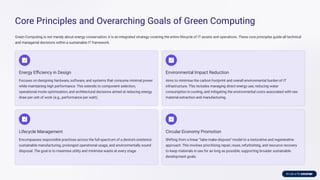
Core Principles and Overarching Goals of Green Computing
Green Computing is not merely about energy conservation; it is an integrated strategy covering the entire lifecycle of IT assets and operations. These core principles guide all technical
and managerial decisions within a sustainable IT framework.
Energy Efficiency in Design
Focuses on designing hardware, software, and systems that consume minimal power
while maintaining high performance. This extends to component selection,
operational mode optimization, and architectural decisions aimed at reducing energy
draw per unit of work (e.g., performance per watt).
Environmental Impact Reduction
Aims to minimise the carbon footprint and overall environmental burden of IT
infrastructure. This includes managing direct energy use, reducing water
consumption in cooling, and mitigating the environmental costs associated with raw
material extraction and manufacturing.
Lifecycle Management
Encompasses responsible practices across the full spectrum of a device’s existence:
sustainable manufacturing, prolonged operational usage, and environmentally sound
disposal. The goal is to maximise utility and minimise waste at every stage.
Circular Economy Promotion
Shifting from a linear "take-make-dispose" model to a restorative and regenerative
approach. This involves prioritising repair, reuse, refurbishing, and resource recovery
to keep materials in use for as long as possible, supporting broader sustainable
development goals.
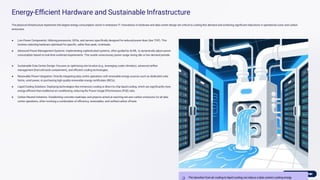
Energy-Efficient Hardware and Sustainable Infrastructure
The physical infrastructure represents the largest energy consumption vector in enterprise IT. Innovations in hardware and data centre design are critical to curbing this demand and achieving significant reductions in operational costs and carbon
emissions.
● Low-Power Components: Utilising processors, GPUs, and servers specifically designed for reduced power draw (low TDP). This
involves selecting hardware optimised for specific, rather than peak, workloads.
● Advanced Power Management Systems: Implementing sophisticated systems, often guided by AI/ML, to dynamically adjust power
consumption based on real-time workload requirements. This avoids unnecessary power usage during idle or low-demand periods.
● Sustainable Data Centre Design: Focuses on optimising site location (e.g., leveraging cooler climates), advanced airflow
management (hot/cold aisle containment), and efficient cooling technologies.
● Renewable Power Integration: Directly integrating data centre operations with renewable energy sources such as dedicated solar
farms, wind power, or purchasing high-quality renewable energy certificates (RECs).
● Liquid Cooling Solutions: Deploying technologies like immersion cooling or direct-to-chip liquid cooling, which are significantly more
energy-efficient than traditional air conditioning, reducing the Power Usage Effectiveness (PUE) ratio.
● Carbon-Neutral Initiatives: Establishing concrete roadmaps and projects aimed at reaching net-zero carbon emissions for all data
centre operations, often involving a combination of efficiency, renewables, and verified carbon offsets.
The transition from air cooling to liquid cooling can reduce a data centre's cooling energy
Green Software Development and Optimisation
While hardware consumes power, software dictates how that power is consumed. Green Software Engineering focuses on writing efficient, resource-minimal code that extends device
lifespan and reduces cloud infrastructure load.
Energy-Efficient Code
Writing algorithms and code structures that achieve the required result with the
fewest computational cycles. This includes optimising database queries, minimising
network latency, and choosing high-performance, low-level languages where
appropriate.
Minimising Computational Load
Reducing the reliance on constant background processing, unnecessary data
transfers, and excessive user interface rendering. The direct impact is extending the
battery life of end-user devices, thereby extending their useful lifespan.
Software Parallelism and Workload Management
Designing software to utilise multi-core architectures effectively, ensuring that
resources are utilised efficiently and not left idle. Workload management involves
intelligently scheduling tasks during periods of low energy demand or when
renewable energy is abundant.
Virtualization and Containerization
Leveraging server virtualization to consolidate multiple workloads onto fewer
physical machines, drastically increasing hardware utilisation rates. Containerization
further enhances this efficiency by isolating applications with minimal overhead.
The focus here is to make every line of code environmentally conscious, viewing CPU cycles and memory usage not just as performance metrics, but as measures of energy
consumption.
The Cloud and Sustainable Computing Models
Cloud computing offers significant opportunities for sustainability by centralising resources and leveraging hyper-efficient, large-scale data centres. However, "Green Cloud Computing" requires careful selection of service providers
and architecture.
Server Virtualization
A foundational step for resource optimisation, enabling high utilisation of physical server capacity and
drastically reducing the idle power consumption associated with dedicated, underutilised hardware.
Containerization (e.g., Kubernetes)
Offers lightweight deployment and scaling, reducing the computational overhead compared to full
virtual machines. This translates directly to less resource consumption per running application.
Green Cloud Provider Selection
Choosing cloud providers who commit to energy-efficient service models, transparent carbon reporting,
and verifiable reliance on renewably powered data centres (e.g., using specific regions with high
renewable energy grid penetration). Optimised Service Architectures
Adopting Serverless (Functions as a Service) and Platformas a Service (PaaS) models often leads to
better sustainability outcomes, as infrastructure resources are only consumed when computation is
actively required.
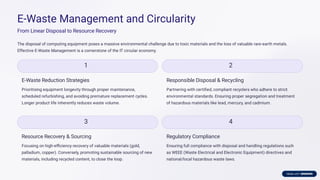
E-Waste Management and Circularity
From Linear Disposal to Resource Recovery
The disposal of computing equipment poses a massive environmental challenge due to toxic materials and the loss of valuable rare-earth metals.
Effective E-Waste Management is a cornerstone of the IT circular economy.
1
E-Waste Reduction Strategies
Prioritising equipment longevity through proper maintenance,
scheduled refurbishing, and avoiding premature replacement cycles.
Longer product life inherently reduces waste volume.
2
Responsible Disposal & Recycling
Partnering with certified, compliant recyclers who adhere to strict
environmental standards. Ensuring proper segregation and treatment
of hazardous materials like lead, mercury, and cadmium.
3
Resource Recovery & Sourcing
Focusing on high-efficiency recovery of valuable materials (gold,
palladium, copper). Conversely, promoting sustainable sourcing of new
materials, including recycled content, to close the loop.
4
Regulatory Compliance
Ensuring full compliance with disposal and handling regulations such
as WEEE (Waste Electrical and Electronic Equipment) directives and
national/local hazardous waste laws.
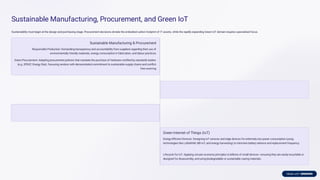
Sustainable Manufacturing, Procurement, and Green IoT
Sustainability must begin at the design and purchasing stage. Procurement decisions dictate the embodied carbon footprint of IT assets, while the rapidly expanding Green IoT domain requires specialised focus.
Sustainable Manufacturing & Procurement
Responsible Production: Demanding transparency and accountability from suppliers regarding their use of
environmentally friendly materials, energy consumption in fabrication, and labour practices.
Green Procurement: Adopting procurement policies that mandate the purchase of hardware certified by standards bodies
(e.g., EPEAT, Energy Star), favouring vendors with demonstrated commitment to sustainable supply chains and conflict-
free sourcing.
Green Internet of Things (IoT)
Energy-Efficient Devices: Designing IoT sensors and edge devices for extremely low power consumption (using
technologies like LoRaWAN, NB-IoT, and energy harvesting) to minimise battery reliance and replacement frequency.
Lifecycle for IoT: Applying circular economy principles to billions of small devices—ensuring they are easily recyclable or
designed for disassembly, and using biodegradable or sustainable casing materials.
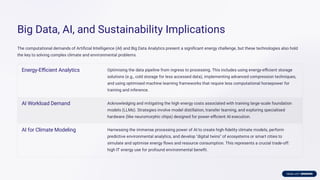
Big Data, AI, and Sustainability Implications
The computational demands of Artificial Intelligence (AI) and Big Data Analytics present a significant energy challenge, but these technologies also hold
the key to solving complex climate and environmental problems.
Energy-Efficient Analytics Optimising the data pipeline from ingress to processing. This includes using energy-efficient storage
solutions (e.g., cold storage for less accessed data), implementing advanced compression techniques,
and using optimised machine learning frameworks that require less computational horsepower for
training and inference.
AI Workload Demand Acknowledging and mitigating the high energy costs associated with training large-scale foundation
models (LLMs). Strategies involve model distillation, transfer learning, and exploring specialised
hardware (like neuromorphic chips) designed for power-efficient AI execution.
AI for Climate Modeling Harnessing the immense processing power of AI to create high-fidelity climate models, perform
predictive environmental analytics, and develop "digital twins" of ecosystems or smart cities to
simulate and optimise energy flows and resource consumption. This represents a crucial trade-off:
high IT energy use for profound environmental benefit.
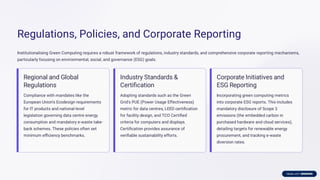
Regulations, Policies, and Corporate Reporting
Institutionalising Green Computing requires a robust framework of regulations, industry standards, and comprehensive corporate reporting mechanisms,
particularly focusing on environmental, social, and governance (ESG) goals.
Regional and Global
Regulations
Compliance with mandates like the
European Union's Ecodesign requirements
for IT products and national-level
legislation governing data centre energy
consumption and mandatory e-waste take-
back schemes. These policies often set
minimum efficiency benchmarks.
Industry Standards &
Certification
Adopting standards such as the Green
Grid's PUE (Power Usage Effectiveness)
metric for data centres, LEED certification
for facility design, and TCO Certified
criteria for computers and displays.
Certification provides assurance of
verifiable sustainability efforts.
Corporate Initiatives and
ESG Reporting
Incorporating green computing metrics
into corporate ESG reports. This includes
mandatory disclosure of Scope 3
emissions (the embedded carbon in
purchased hardware and cloud services),
detailing targets for renewable energy
procurement, and tracking e-waste
diversion rates.
Strategic Implementation and Future Outlook
Integrating Sustainability into IT Operations
Remote Work & Behaviour
Promoting power-saving defaults on employee devices
and educating users on sustainable computing habits,
such as cloud storage consolidation and proper monitor
energy settings.
Research & Case Studies
Learning from successful climate-neutral IT operations
implemented in large government bodies, research
institutions, and major corporations. Applying these
proven models to internal projects.
Education and Training
Mandatory training for all IT professionals—from
software developers to infrastructure managers—
on the principles and practices of Green Computing
to ensure cultural adoption.
Climate-Neutral IT Operations
Establishing concrete, measurable goals for achieving
net-zero emissions within defined timelines across all
owned and operated IT assets, backed by capital
investment in renewable infrastructure.
Innovation Focus
Investing in future technologies like quantum computing
(for high-efficiency problem-solving) and fully
decentralised computing models that distribute load
and utilise local, cleaner energy sources.

The-Pillars-of-Green-Computing-A-Comprehensive-Roadmap.pdf

  • 1.
    The Pillars ofGreen Computing: A Comprehensive Roadmap Welcome to this detailed overview of Green Computing. Given the increasing energy demands of IT infrastructure—from massive data centres to individual devices— sustainability has transitioned from a niche concern to a critical imperative. This presentation is designed for IT sustainability managers, researchers, and project leads, providing a comprehensive breakdown of the core principles, technical subtopics, and strategic implementation areas necessary for achieving carbon-neutral and resource- efficient computing environments. We will explore everything from hardware efficiency and green software development to advanced e-waste management and global policy frameworks, offering a robust foundation for informed decision-making and project research.
  • 2.
    Core Principles andOverarching Goals of Green Computing Green Computing is not merely about energy conservation; it is an integrated strategy covering the entire lifecycle of IT assets and operations. These core principles guide all technical and managerial decisions within a sustainable IT framework. Energy Efficiency in Design Focuses on designing hardware, software, and systems that consume minimal power while maintaining high performance. This extends to component selection, operational mode optimization, and architectural decisions aimed at reducing energy draw per unit of work (e.g., performance per watt). Environmental Impact Reduction Aims to minimise the carbon footprint and overall environmental burden of IT infrastructure. This includes managing direct energy use, reducing water consumption in cooling, and mitigating the environmental costs associated with raw material extraction and manufacturing. Lifecycle Management Encompasses responsible practices across the full spectrum of a device’s existence: sustainable manufacturing, prolonged operational usage, and environmentally sound disposal. The goal is to maximise utility and minimise waste at every stage. Circular Economy Promotion Shifting from a linear "take-make-dispose" model to a restorative and regenerative approach. This involves prioritising repair, reuse, refurbishing, and resource recovery to keep materials in use for as long as possible, supporting broader sustainable development goals.
  • 3.
    Energy-Efficient Hardware andSustainable Infrastructure The physical infrastructure represents the largest energy consumption vector in enterprise IT. Innovations in hardware and data centre design are critical to curbing this demand and achieving significant reductions in operational costs and carbon emissions. ● Low-Power Components: Utilising processors, GPUs, and servers specifically designed for reduced power draw (low TDP). This involves selecting hardware optimised for specific, rather than peak, workloads. ● Advanced Power Management Systems: Implementing sophisticated systems, often guided by AI/ML, to dynamically adjust power consumption based on real-time workload requirements. This avoids unnecessary power usage during idle or low-demand periods. ● Sustainable Data Centre Design: Focuses on optimising site location (e.g., leveraging cooler climates), advanced airflow management (hot/cold aisle containment), and efficient cooling technologies. ● Renewable Power Integration: Directly integrating data centre operations with renewable energy sources such as dedicated solar farms, wind power, or purchasing high-quality renewable energy certificates (RECs). ● Liquid Cooling Solutions: Deploying technologies like immersion cooling or direct-to-chip liquid cooling, which are significantly more energy-efficient than traditional air conditioning, reducing the Power Usage Effectiveness (PUE) ratio. ● Carbon-Neutral Initiatives: Establishing concrete roadmaps and projects aimed at reaching net-zero carbon emissions for all data centre operations, often involving a combination of efficiency, renewables, and verified carbon offsets. The transition from air cooling to liquid cooling can reduce a data centre's cooling energy
  • 4.
    Green Software Developmentand Optimisation While hardware consumes power, software dictates how that power is consumed. Green Software Engineering focuses on writing efficient, resource-minimal code that extends device lifespan and reduces cloud infrastructure load. Energy-Efficient Code Writing algorithms and code structures that achieve the required result with the fewest computational cycles. This includes optimising database queries, minimising network latency, and choosing high-performance, low-level languages where appropriate. Minimising Computational Load Reducing the reliance on constant background processing, unnecessary data transfers, and excessive user interface rendering. The direct impact is extending the battery life of end-user devices, thereby extending their useful lifespan. Software Parallelism and Workload Management Designing software to utilise multi-core architectures effectively, ensuring that resources are utilised efficiently and not left idle. Workload management involves intelligently scheduling tasks during periods of low energy demand or when renewable energy is abundant. Virtualization and Containerization Leveraging server virtualization to consolidate multiple workloads onto fewer physical machines, drastically increasing hardware utilisation rates. Containerization further enhances this efficiency by isolating applications with minimal overhead. The focus here is to make every line of code environmentally conscious, viewing CPU cycles and memory usage not just as performance metrics, but as measures of energy consumption.
  • 5.
    The Cloud andSustainable Computing Models Cloud computing offers significant opportunities for sustainability by centralising resources and leveraging hyper-efficient, large-scale data centres. However, "Green Cloud Computing" requires careful selection of service providers and architecture. Server Virtualization A foundational step for resource optimisation, enabling high utilisation of physical server capacity and drastically reducing the idle power consumption associated with dedicated, underutilised hardware. Containerization (e.g., Kubernetes) Offers lightweight deployment and scaling, reducing the computational overhead compared to full virtual machines. This translates directly to less resource consumption per running application. Green Cloud Provider Selection Choosing cloud providers who commit to energy-efficient service models, transparent carbon reporting, and verifiable reliance on renewably powered data centres (e.g., using specific regions with high renewable energy grid penetration). Optimised Service Architectures Adopting Serverless (Functions as a Service) and Platformas a Service (PaaS) models often leads to better sustainability outcomes, as infrastructure resources are only consumed when computation is actively required.
  • 6.
    E-Waste Management andCircularity From Linear Disposal to Resource Recovery The disposal of computing equipment poses a massive environmental challenge due to toxic materials and the loss of valuable rare-earth metals. Effective E-Waste Management is a cornerstone of the IT circular economy. 1 E-Waste Reduction Strategies Prioritising equipment longevity through proper maintenance, scheduled refurbishing, and avoiding premature replacement cycles. Longer product life inherently reduces waste volume. 2 Responsible Disposal & Recycling Partnering with certified, compliant recyclers who adhere to strict environmental standards. Ensuring proper segregation and treatment of hazardous materials like lead, mercury, and cadmium. 3 Resource Recovery & Sourcing Focusing on high-efficiency recovery of valuable materials (gold, palladium, copper). Conversely, promoting sustainable sourcing of new materials, including recycled content, to close the loop. 4 Regulatory Compliance Ensuring full compliance with disposal and handling regulations such as WEEE (Waste Electrical and Electronic Equipment) directives and national/local hazardous waste laws.
  • 7.
    Sustainable Manufacturing, Procurement,and Green IoT Sustainability must begin at the design and purchasing stage. Procurement decisions dictate the embodied carbon footprint of IT assets, while the rapidly expanding Green IoT domain requires specialised focus. Sustainable Manufacturing & Procurement Responsible Production: Demanding transparency and accountability from suppliers regarding their use of environmentally friendly materials, energy consumption in fabrication, and labour practices. Green Procurement: Adopting procurement policies that mandate the purchase of hardware certified by standards bodies (e.g., EPEAT, Energy Star), favouring vendors with demonstrated commitment to sustainable supply chains and conflict- free sourcing. Green Internet of Things (IoT) Energy-Efficient Devices: Designing IoT sensors and edge devices for extremely low power consumption (using technologies like LoRaWAN, NB-IoT, and energy harvesting) to minimise battery reliance and replacement frequency. Lifecycle for IoT: Applying circular economy principles to billions of small devices—ensuring they are easily recyclable or designed for disassembly, and using biodegradable or sustainable casing materials.
  • 8.
    Big Data, AI,and Sustainability Implications The computational demands of Artificial Intelligence (AI) and Big Data Analytics present a significant energy challenge, but these technologies also hold the key to solving complex climate and environmental problems. Energy-Efficient Analytics Optimising the data pipeline from ingress to processing. This includes using energy-efficient storage solutions (e.g., cold storage for less accessed data), implementing advanced compression techniques, and using optimised machine learning frameworks that require less computational horsepower for training and inference. AI Workload Demand Acknowledging and mitigating the high energy costs associated with training large-scale foundation models (LLMs). Strategies involve model distillation, transfer learning, and exploring specialised hardware (like neuromorphic chips) designed for power-efficient AI execution. AI for Climate Modeling Harnessing the immense processing power of AI to create high-fidelity climate models, perform predictive environmental analytics, and develop "digital twins" of ecosystems or smart cities to simulate and optimise energy flows and resource consumption. This represents a crucial trade-off: high IT energy use for profound environmental benefit.
  • 9.
    Regulations, Policies, andCorporate Reporting Institutionalising Green Computing requires a robust framework of regulations, industry standards, and comprehensive corporate reporting mechanisms, particularly focusing on environmental, social, and governance (ESG) goals. Regional and Global Regulations Compliance with mandates like the European Union's Ecodesign requirements for IT products and national-level legislation governing data centre energy consumption and mandatory e-waste take- back schemes. These policies often set minimum efficiency benchmarks. Industry Standards & Certification Adopting standards such as the Green Grid's PUE (Power Usage Effectiveness) metric for data centres, LEED certification for facility design, and TCO Certified criteria for computers and displays. Certification provides assurance of verifiable sustainability efforts. Corporate Initiatives and ESG Reporting Incorporating green computing metrics into corporate ESG reports. This includes mandatory disclosure of Scope 3 emissions (the embedded carbon in purchased hardware and cloud services), detailing targets for renewable energy procurement, and tracking e-waste diversion rates.
  • 10.
    Strategic Implementation andFuture Outlook Integrating Sustainability into IT Operations Remote Work & Behaviour Promoting power-saving defaults on employee devices and educating users on sustainable computing habits, such as cloud storage consolidation and proper monitor energy settings. Research & Case Studies Learning from successful climate-neutral IT operations implemented in large government bodies, research institutions, and major corporations. Applying these proven models to internal projects. Education and Training Mandatory training for all IT professionals—from software developers to infrastructure managers— on the principles and practices of Green Computing to ensure cultural adoption. Climate-Neutral IT Operations Establishing concrete, measurable goals for achieving net-zero emissions within defined timelines across all owned and operated IT assets, backed by capital investment in renewable infrastructure. Innovation Focus Investing in future technologies like quantum computing (for high-efficiency problem-solving) and fully decentralised computing models that distribute load and utilise local, cleaner energy sources.