The New Workplace A Guide To The Human Impact Of
Modern Working Practices 1st Edition David
Holman download
https://ebookbell.com/product/the-new-workplace-a-guide-to-the-
human-impact-of-modern-working-practices-1st-edition-david-
holman-2134916
Explore and download more ebooks at ebookbell.com
Here are some recommended products that we believe you will be
interested in. You can click the link to download.
The Essentials Of The New Workplace A Guide To The Human Impact Of
Modern Working Practices 1st Edition David Holman
https://ebookbell.com/product/the-essentials-of-the-new-workplace-a-
guide-to-the-human-impact-of-modern-working-practices-1st-edition-
david-holman-923594
Reading Work Literacies In The New Workplace Illustrated Edition Mary
Ellen Belfiore
https://ebookbell.com/product/reading-work-literacies-in-the-new-
workplace-illustrated-edition-mary-ellen-belfiore-986244
From Sabotage To Support A New Vision For Feminist Solidarity In The
Workplace Joy L Wiggins
https://ebookbell.com/product/from-sabotage-to-support-a-new-vision-
for-feminist-solidarity-in-the-workplace-joy-l-wiggins-33982968
Neuroorganizational Culture A New Approach To Understanding Human
Behavior And Interaction In The Workplace Garo D Reisyan
https://ebookbell.com/product/neuroorganizational-culture-a-new-
approach-to-understanding-human-behavior-and-interaction-in-the-
workplace-garo-d-reisyan-52250448
Continuing Professional Development Preparing For New Roles In
Libraries A Voyage Of Discovery Sixth World Conference On Continuing
Professional Development And Workplace Learning For The Library And
Information Professions Paul Genoni Editor Graham Walton Editor
https://ebookbell.com/product/continuing-professional-development-
preparing-for-new-roles-in-libraries-a-voyage-of-discovery-sixth-
world-conference-on-continuing-professional-development-and-workplace-
learning-for-the-library-and-information-professions-paul-genoni-
editor-graham-walton-editor-50993654
All Edge Inside The New Workplace Networks Clay Spinuzzi
https://ebookbell.com/product/all-edge-inside-the-new-workplace-
networks-clay-spinuzzi-51445274
All Edge Inside The New Workplace Networks Clay Spinuzzi
https://ebookbell.com/product/all-edge-inside-the-new-workplace-
networks-clay-spinuzzi-5240294
Its Always Personal Navigating Emotion In The New Workplace Reprint
Anne Kreamer
https://ebookbell.com/product/its-always-personal-navigating-emotion-
in-the-new-workplace-reprint-anne-kreamer-4660996
Its Always Personal Navigating Emotion In The New Workplace Anne
Kreamer
https://ebookbell.com/product/its-always-personal-navigating-emotion-
in-the-new-workplace-anne-kreamer-52032224
The New Workplace
A Guide to the Human Impact
of Modern Working Practices
Edited by
David Holman, Toby D. Wall and
Chris W. Clegg
University of Sheffield, UK
Paul Sparrow
University of Manchester, UK
and
Ann Howard
Development Dimensions International,
New Jersey, USA
The New Workplace
The New Workplace
A Guide to the Human Impact
of Modern Working Practices
Edited by
David Holman, Toby D. Wall and
Chris W. Clegg
University of Sheffield, UK
Paul Sparrow
University of Manchester, UK
and
Ann Howard
Development Dimensions International,
New Jersey, USA
Copyright C
 2003 John Wiley  Sons, Ltd, The Atrium, Southern Gate, Chichester,
West Sussex PO19 8SQ, UK
Telephone (+44) 1243 779777
Email (for orders and customer service enquiries): cs-books@wiley.co.uk
Visit our Home Page on: http://www.wileyeurope.com or http://www.wiley.com
All Rights Reserved. No part of this publication may be reproduced, stored in a retrieval system or
transmitted in any form or by any means, electronic, mechanical, photocopying, recording, scanning or
otherwise, except under the terms of the Copyright, Designs and Patents Act 1988 or under the terms of
a licence issued by the Copyright Licensing Agency Ltd, 90 Tottenham Court Road, London W1T 4LP,
UK, without the permission in writing of the Publisher. Requests to the Publisher should be addressed
to the Permissions Department, John Wiley  Sons Ltd, The Atrium, Southern Gate, Chichester, West
Sussex PO19 8SQ, England, or e-mailed to permreq@wiley.co.uk, or faxed to (+44) 1243 770620.
This publication is designed to provide accurate and authoritative information in regard to the subject
matter covered. It is sold on the understanding that the Publisher is not engaged in rendering
professional services. If professional advice or other expert assistance is required, the services of a
competent professional should be sought.
Other Wiley Editorial Offices
John Wiley  Sons Inc., 111 River Street, Hoboken, NJ 07030, USA
Jossey-Bass, 989 Market Street, San Francisco, CA 94103-1741, USA
Wiley-VCH Verlag GmbH, Boschstr. 12, D-69469 Weinheim, Germany
John Wiley  Sons Australia Ltd, 33 Park Road, Milton, Queensland 4064, Australia
John Wiley  Sons (Asia) Pte Ltd, 2 Clementi Loop #02-01, Jin Xing Distripark, Singapore 129809
John Wiley  Sons Canada Ltd, 22 Worcester Road, Etobicoke, Ontario, Canada M9W 1L1
Wiley also publishes its books in a variety of electronic formats. Some content that appears in print
may not be available in electronic books.
Library of Congress Cataloging-in-Publication Data
The new workplace : a guide to the human impact of modern working practices / edited
by David Holman . . . [et al.].
p. cm.
Includes bibliographical references and indexes.
ISBN 0-471-48543-8
1. Quality of work life. 2. Job satisfaction. 3. Psychology, Industrial. 4. Work environment.
5. Work design. 6. Human-machine systems. 7. Industrial relations. I. Holman, David.
HD6955 .N495 2002
331.2–dc21 2002028874
British Library Cataloguing in Publication Data
A catalogue record for this book is available from the British Library
ISBN 0-471-48543-8
Typeset in 10/12pt Times by Techbooks Electronic Services Pvt Ltd, New Delhi, India
Printed and bound in Great Britain by Biddles Ltd, Guildford and King’s Lynn
This book is printed on acid-free paper responsibly manufactured from sustainable forestry
in which at least two trees are planted for each one used for paper production.
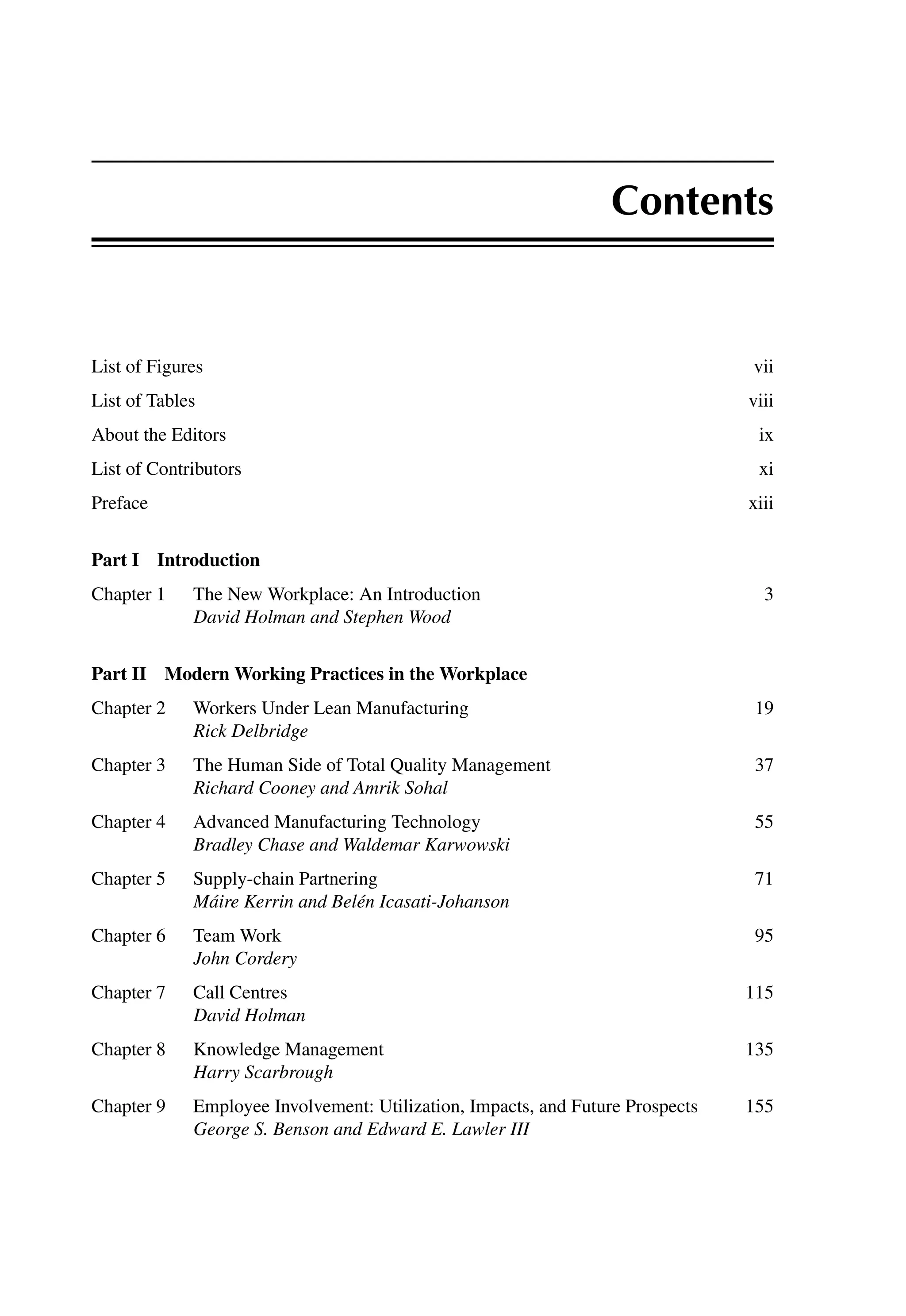
Contents
List of Figures vii
List of Tables viii
About the Editors ix
List of Contributors xi
Preface xiii
Part I Introduction
Chapter 1 The New Workplace: An Introduction 3
David Holman and Stephen Wood
Part II Modern Working Practices in the Workplace
Chapter 2 Workers Under Lean Manufacturing 19
Rick Delbridge
Chapter 3 The Human Side of Total Quality Management 37
Richard Cooney and Amrik Sohal
Chapter 4 Advanced Manufacturing Technology 55
Bradley Chase and Waldemar Karwowski
Chapter 5 Supply-chain Partnering 71
Máire Kerrin and Belén Icasati-Johanson
Chapter 6 Team Work 95
John Cordery
Chapter 7 Call Centres 115
David Holman
Chapter 8 Knowledge Management 135
Harry Scarbrough
Chapter 9 Employee Involvement: Utilization, Impacts, and Future Prospects 155
George S. Benson and Edward E. Lawler III
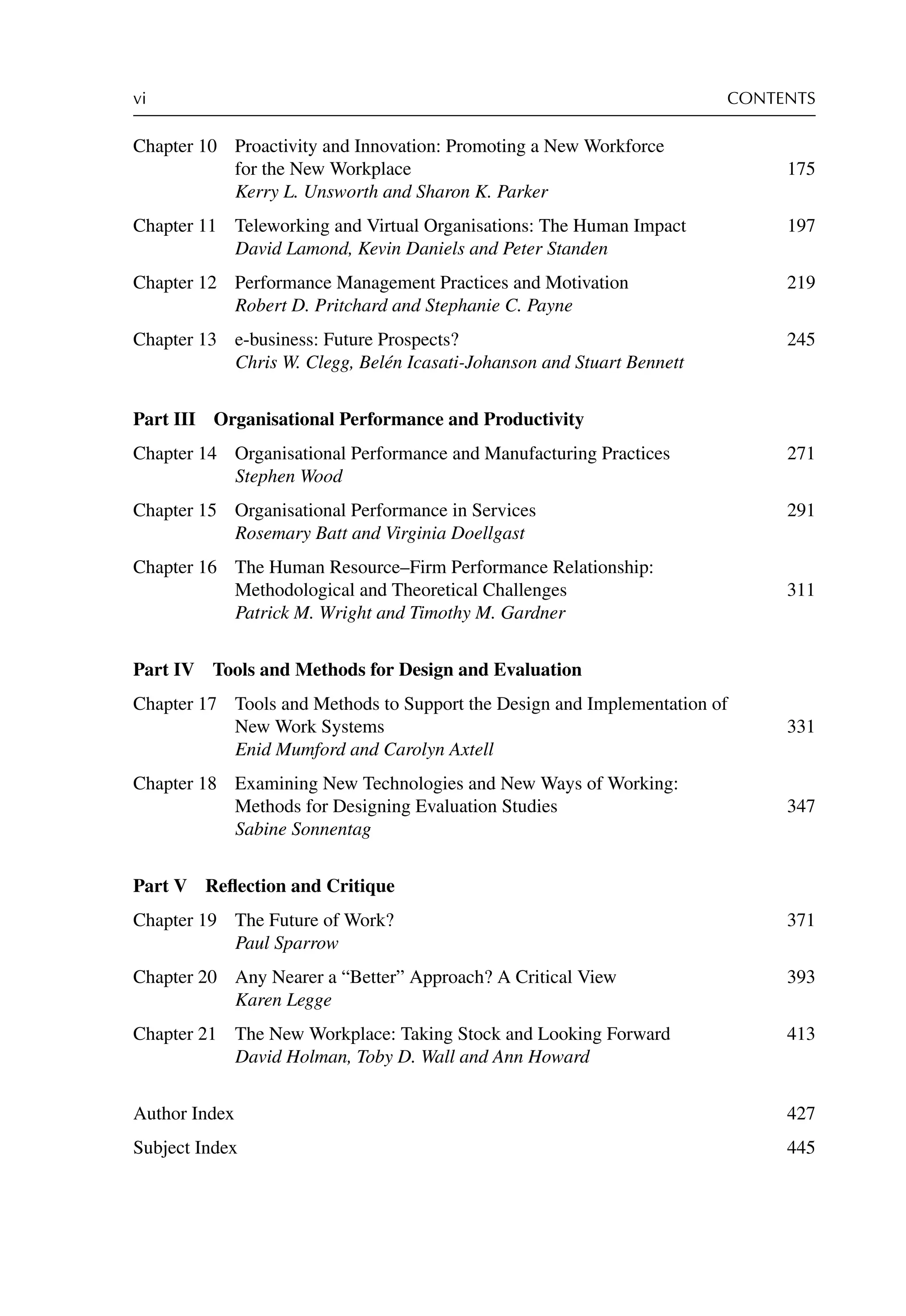
vi CONTENTS
Chapter 10 Proactivity and Innovation: Promoting a New Workforce
for the New Workplace 175
Kerry L. Unsworth and Sharon K. Parker
Chapter 11 Teleworking and Virtual Organisations: The Human Impact 197
David Lamond, Kevin Daniels and Peter Standen
Chapter 12 Performance Management Practices and Motivation 219
Robert D. Pritchard and Stephanie C. Payne
Chapter 13 e-business: Future Prospects? 245
Chris W. Clegg, Belén Icasati-Johanson and Stuart Bennett
Part III Organisational Performance and Productivity
Chapter 14 Organisational Performance and Manufacturing Practices 271
Stephen Wood
Chapter 15 Organisational Performance in Services 291
Rosemary Batt and Virginia Doellgast
Chapter 16 The Human Resource–Firm Performance Relationship:
Methodological and Theoretical Challenges 311
Patrick M. Wright and Timothy M. Gardner
Part IV Tools and Methods for Design and Evaluation
Chapter 17 Tools and Methods to Support the Design and Implementation of
New Work Systems 331
Enid Mumford and Carolyn Axtell
Chapter 18 Examining New Technologies and New Ways of Working:
Methods for Designing Evaluation Studies 347
Sabine Sonnentag
Part V Reflection and Critique
Chapter 19 The Future of Work? 371
Paul Sparrow
Chapter 20 Any Nearer a “Better” Approach? A Critical View 393
Karen Legge
Chapter 21 The New Workplace: Taking Stock and Looking Forward 413
David Holman, Toby D. Wall and Ann Howard
Author Index 427
Subject Index 445
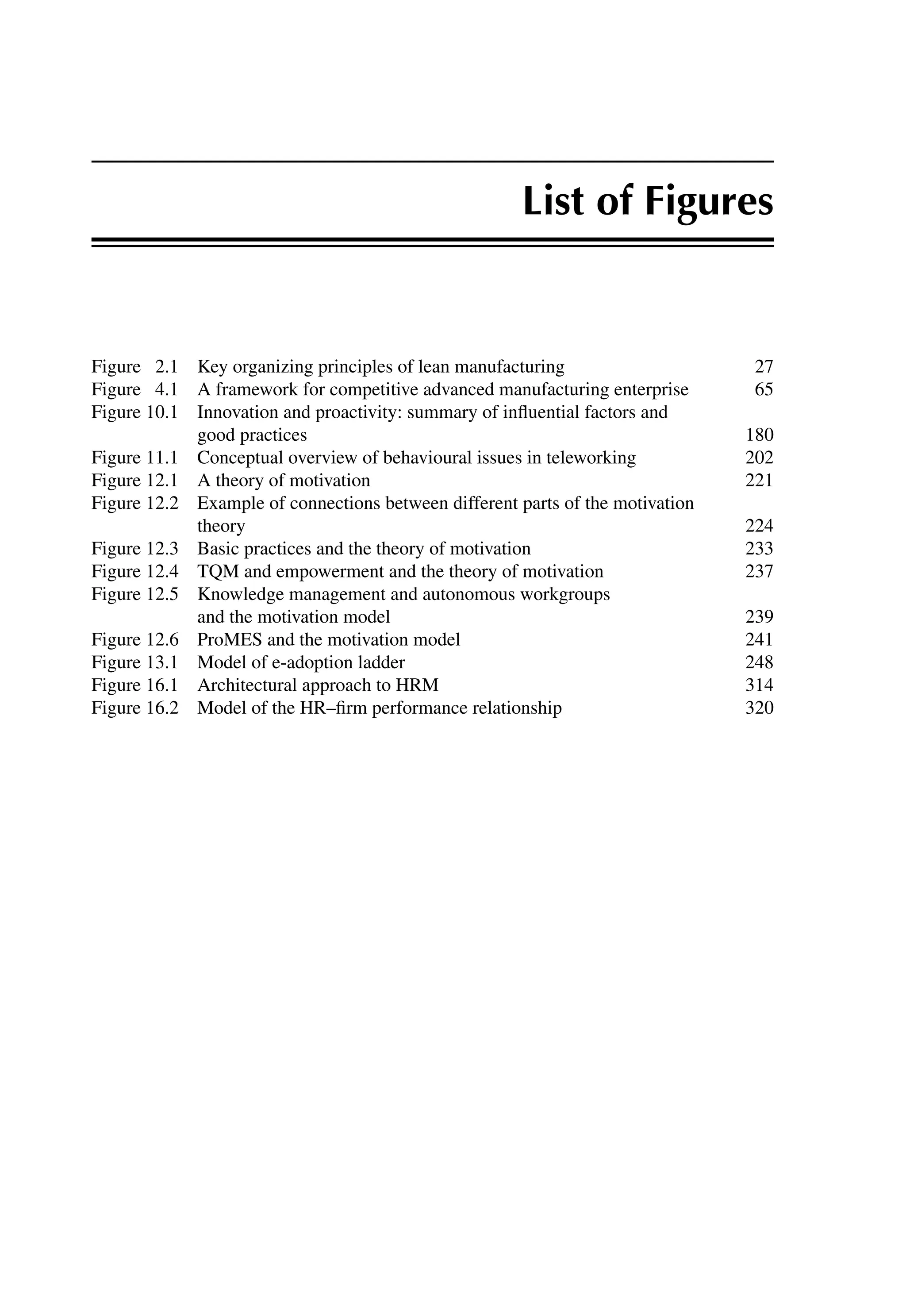
List of Figures
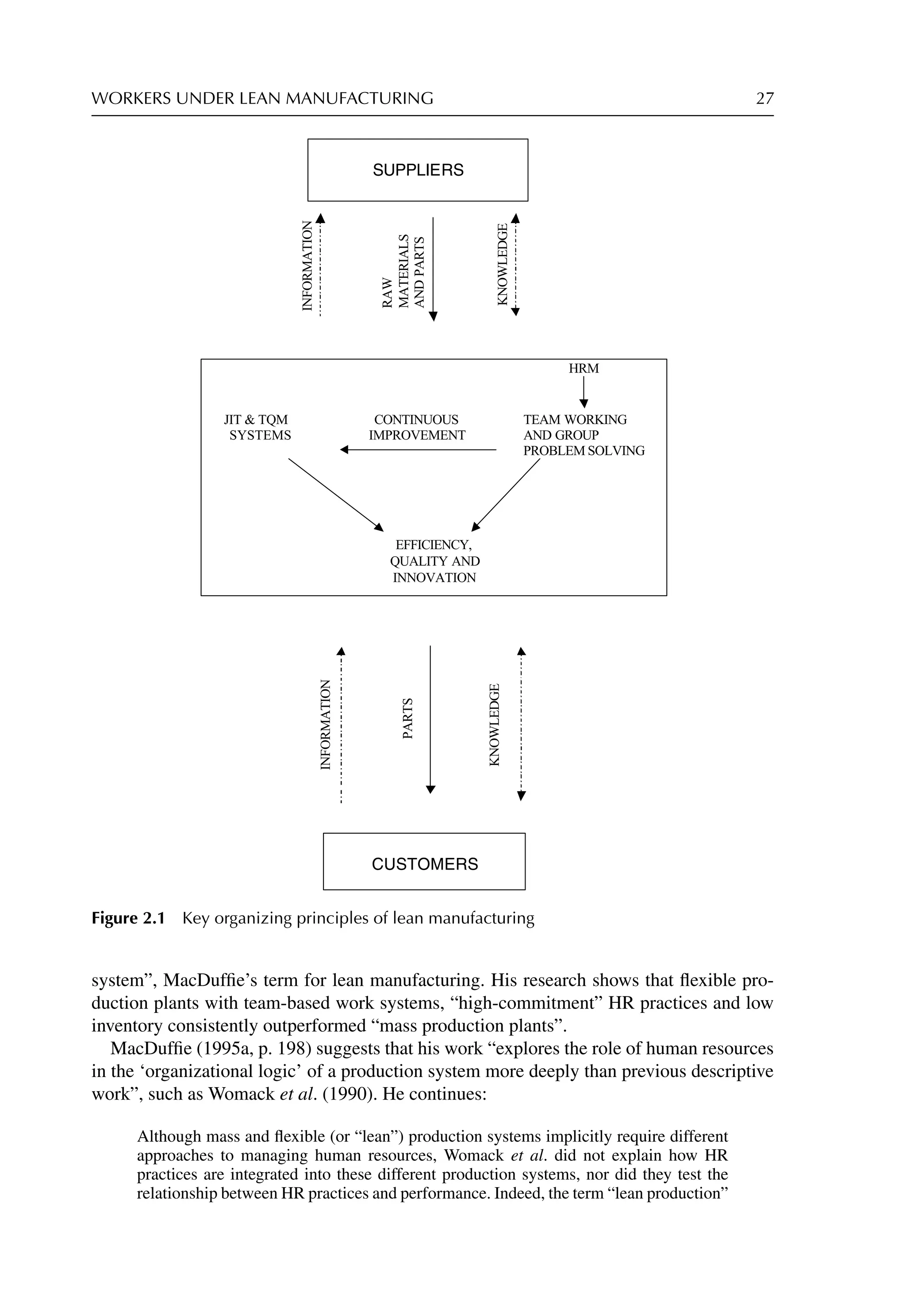
Figure 2.1 Key organizing principles of lean manufacturing 27
Figure 4.1 A framework for competitive advanced manufacturing enterprise 65
Figure 10.1 Innovation and proactivity: summary of influential factors and
good practices 180
Figure 11.1 Conceptual overview of behavioural issues in teleworking 202
Figure 12.1 A theory of motivation 221
Figure 12.2 Example of connections between different parts of the motivation
theory 224
Figure 12.3 Basic practices and the theory of motivation 233
Figure 12.4 TQM and empowerment and the theory of motivation 237
Figure 12.5 Knowledge management and autonomous workgroups
and the motivation model 239
Figure 12.6 ProMES and the motivation model 241
Figure 13.1 Model of e-adoption ladder 248
Figure 16.1 Architectural approach to HRM 314
Figure 16.2 Model of the HR–firm performance relationship 320
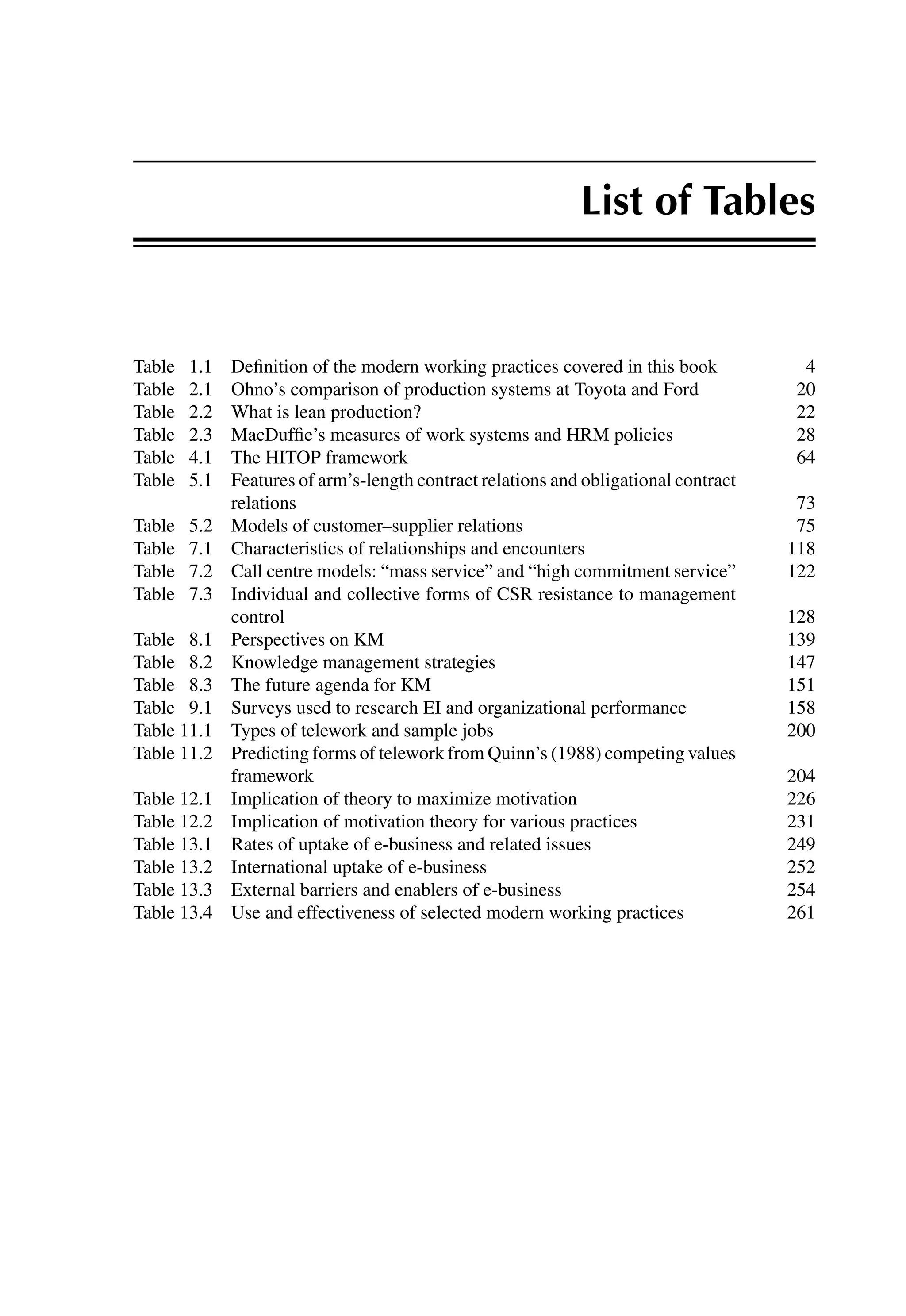
List of Tables
Table 1.1 Definition of the modern working practices covered in this book 4
Table 2.1 Ohno’s comparison of production systems at Toyota and Ford 20
Table 2.2 What is lean production? 22
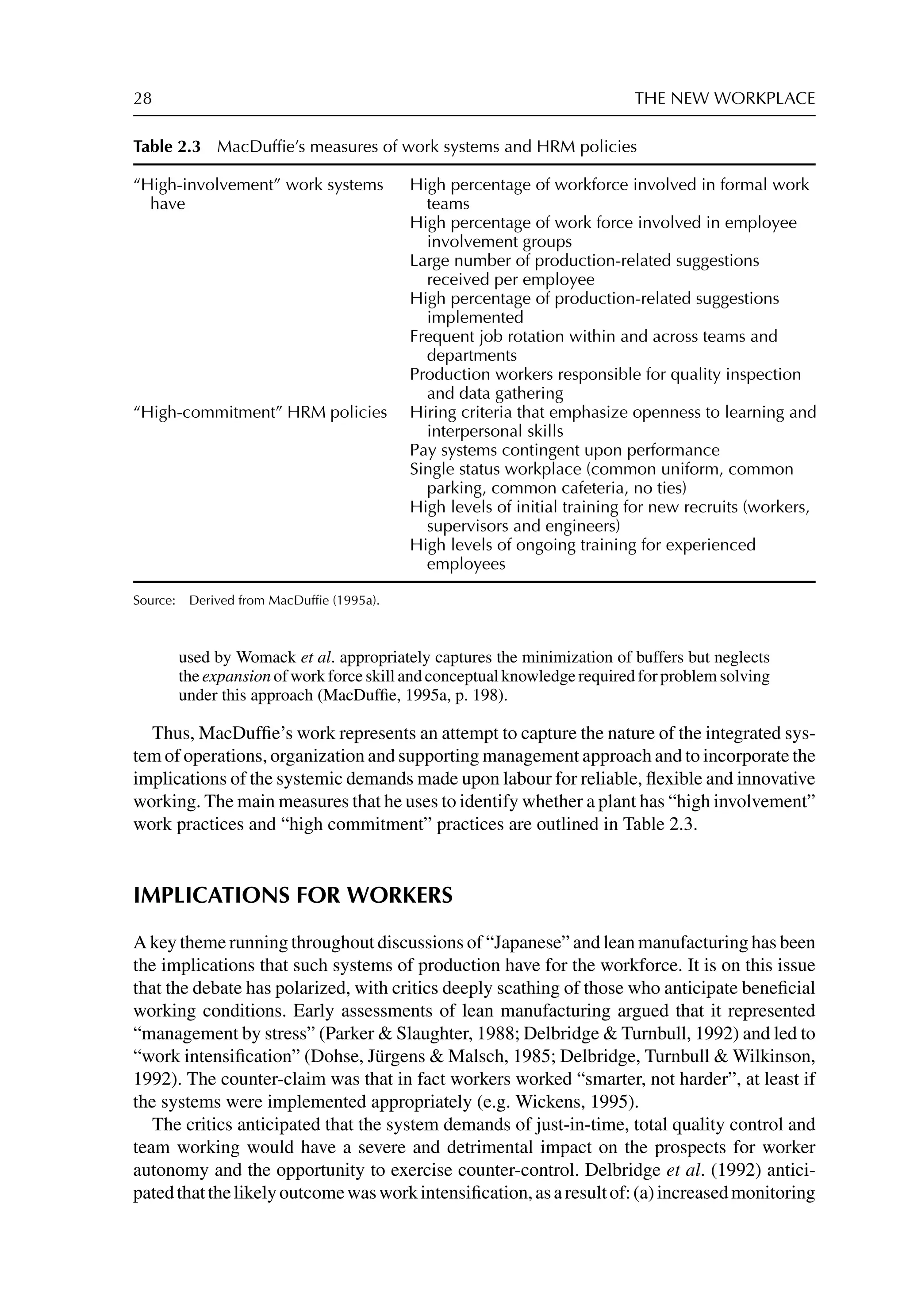
Table 2.3 MacDuffie’s measures of work systems and HRM policies 28
Table 4.1 The HITOP framework 64
Table 5.1 Features of arm’s-length contract relations and obligational contract
relations 73
Table 5.2 Models of customer–supplier relations 75
Table 7.1 Characteristics of relationships and encounters 118
Table 7.2 Call centre models: “mass service” and “high commitment service” 122
Table 7.3 Individual and collective forms of CSR resistance to management
control 128
Table 8.1 Perspectives on KM 139
Table 8.2 Knowledge management strategies 147
Table 8.3 The future agenda for KM 151
Table 9.1 Surveys used to research EI and organizational performance 158
Table 11.1 Types of telework and sample jobs 200
Table 11.2 Predicting forms of telework from Quinn’s (1988) competing values
framework 204
Table 12.1 Implication of theory to maximize motivation 226
Table 12.2 Implication of motivation theory for various practices 231
Table 13.1 Rates of uptake of e-business and related issues 249
Table 13.2 International uptake of e-business 252
Table 13.3 External barriers and enablers of e-business 254
Table 13.4 Use and effectiveness of selected modern working practices 261
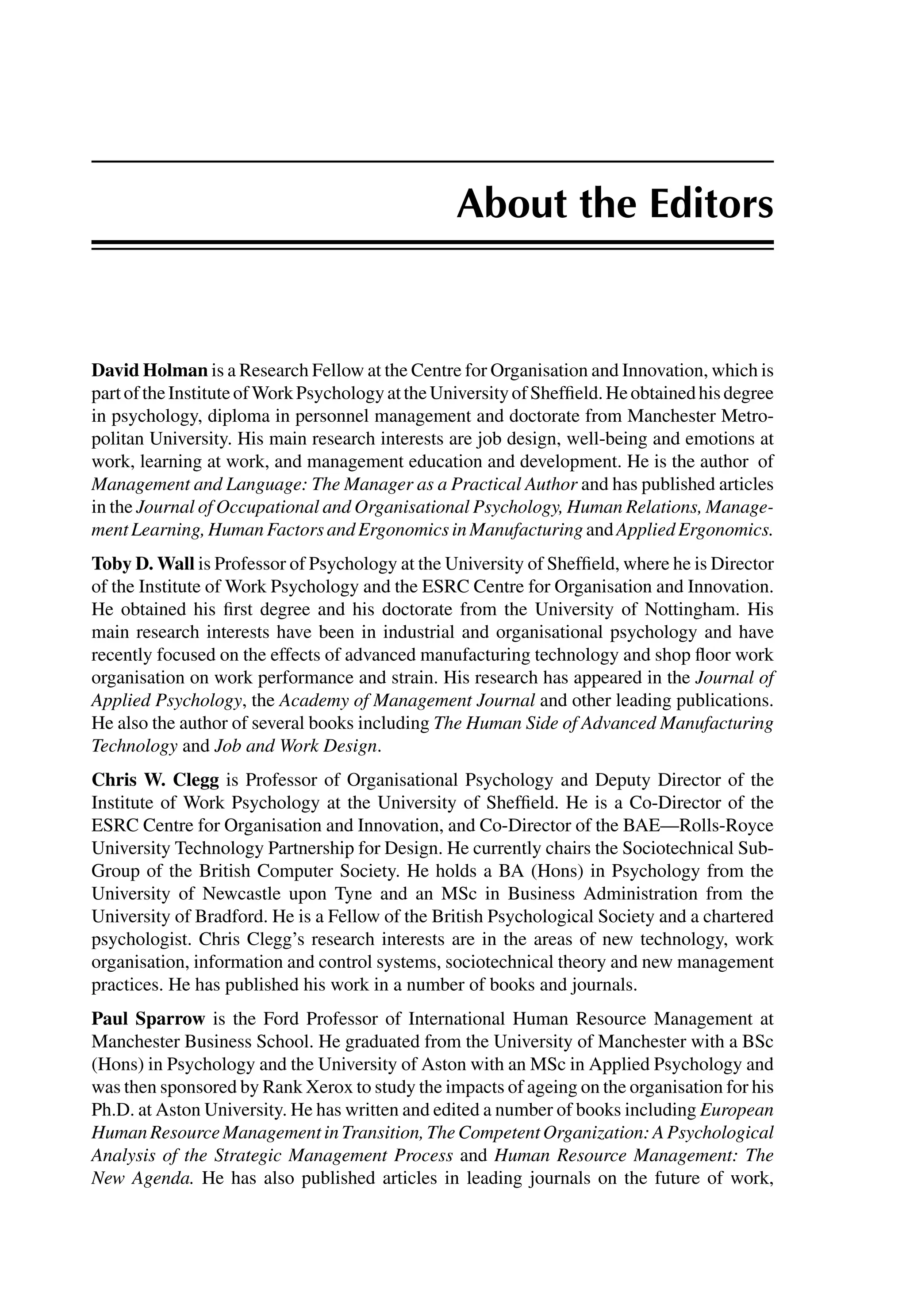
About the Editors
David Holman is a Research Fellow at the Centre for Organisation and Innovation, which is
partoftheInstituteofWorkPsychologyattheUniversityofSheffield.Heobtainedhisdegree
in psychology, diploma in personnel management and doctorate from Manchester Metro-
politan University. His main research interests are job design, well-being and emotions at
work, learning at work, and management education and development. He is the author of
Management and Language: The Manager as a Practical Author and has published articles
in the Journal of Occupational and Organisational Psychology, Human Relations, Manage-
mentLearning,HumanFactorsandErgonomicsinManufacturing and AppliedErgonomics.
Toby D. Wall is Professor of Psychology at the University of Sheffield, where he is Director
of the Institute of Work Psychology and the ESRC Centre for Organisation and Innovation.
He obtained his first degree and his doctorate from the University of Nottingham. His
main research interests have been in industrial and organisational psychology and have
recently focused on the effects of advanced manufacturing technology and shop floor work
organisation on work performance and strain. His research has appeared in the Journal of
Applied Psychology, the Academy of Management Journal and other leading publications.
He also the author of several books including The Human Side of Advanced Manufacturing
Technology and Job and Work Design.
Chris W. Clegg is Professor of Organisational Psychology and Deputy Director of the
Institute of Work Psychology at the University of Sheffield. He is a Co-Director of the
ESRC Centre for Organisation and Innovation, and Co-Director of the BAE—Rolls-Royce
University Technology Partnership for Design. He currently chairs the Sociotechnical Sub-
Group of the British Computer Society. He holds a BA (Hons) in Psychology from the
University of Newcastle upon Tyne and an MSc in Business Administration from the
University of Bradford. He is a Fellow of the British Psychological Society and a chartered
psychologist. Chris Clegg’s research interests are in the areas of new technology, work
organisation, information and control systems, sociotechnical theory and new management
practices. He has published his work in a number of books and journals.
Paul Sparrow is the Ford Professor of International Human Resource Management at
Manchester Business School. He graduated from the University of Manchester with a BSc
(Hons) in Psychology and the University of Aston with an MSc in Applied Psychology and
was then sponsored by Rank Xerox to study the impacts of ageing on the organisation for his
Ph.D. at Aston University. He has written and edited a number of books including European
HumanResourceManagementinTransition,TheCompetentOrganization:APsychological
Analysis of the Strategic Management Process and Human Resource Management: The
New Agenda. He has also published articles in leading journals on the future of work,
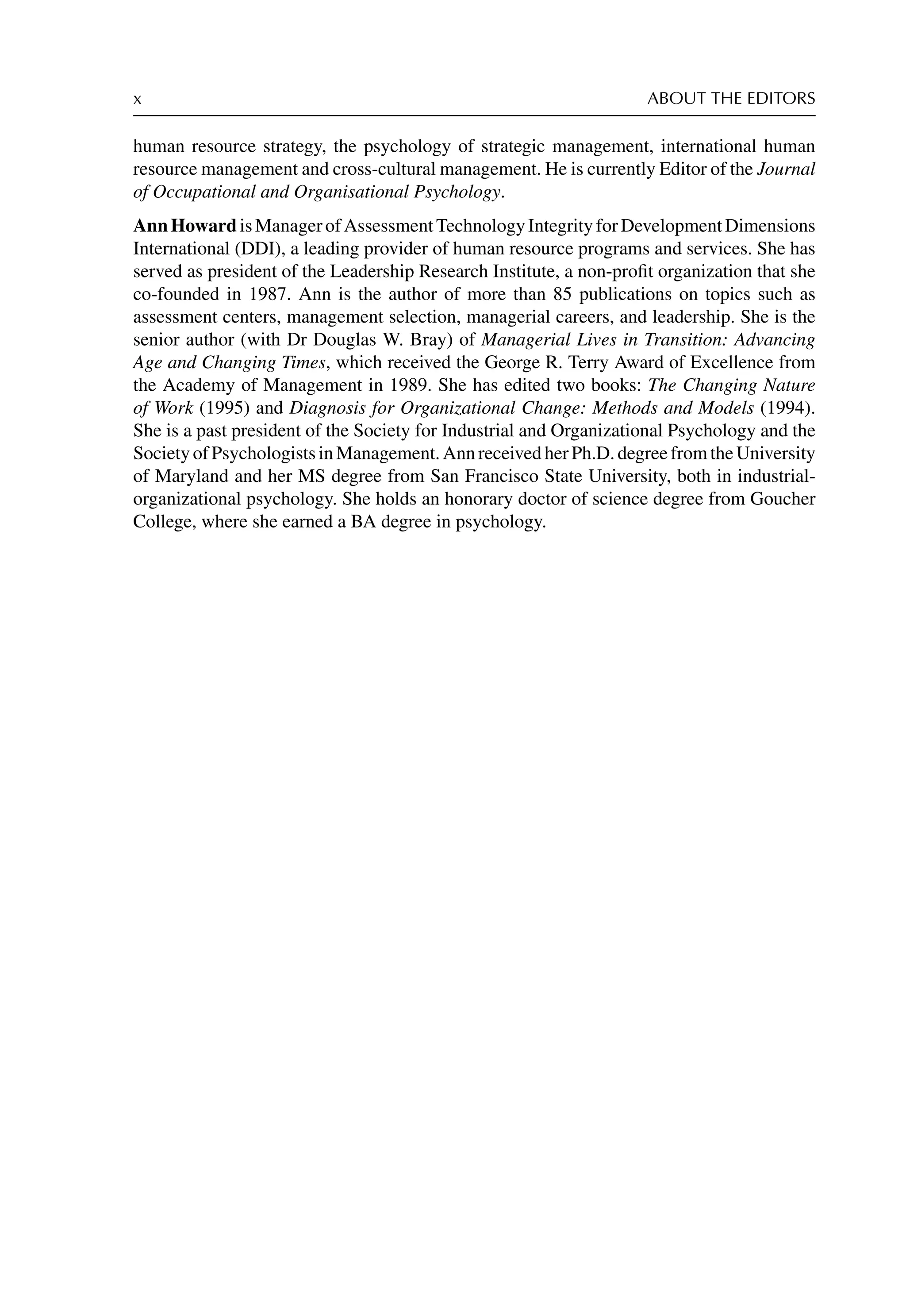
x ABOUT THE EDITORS
human resource strategy, the psychology of strategic management, international human
resource management and cross-cultural management. He is currently Editor of the Journal
of Occupational and Organisational Psychology.
AnnHowardisManagerofAssessmentTechnologyIntegrityforDevelopmentDimensions
International (DDI), a leading provider of human resource programs and services. She has
served as president of the Leadership Research Institute, a non-profit organization that she
co-founded in 1987. Ann is the author of more than 85 publications on topics such as
assessment centers, management selection, managerial careers, and leadership. She is the
senior author (with Dr Douglas W. Bray) of Managerial Lives in Transition: Advancing
Age and Changing Times, which received the George R. Terry Award of Excellence from
the Academy of Management in 1989. She has edited two books: The Changing Nature
of Work (1995) and Diagnosis for Organizational Change: Methods and Models (1994).
She is a past president of the Society for Industrial and Organizational Psychology and the
SocietyofPsychologistsinManagement.AnnreceivedherPh.D.degreefromtheUniversity
of Maryland and her MS degree from San Francisco State University, both in industrial-
organizational psychology. She holds an honorary doctor of science degree from Goucher
College, where she earned a BA degree in psychology.
List of Contributors
Carolyn Axtell, Institute of Work Psychology, University of Sheffield, Mushroom Lane,
Sheffield S10 2TN, UK
Professor Rosemary Batt, School of Industrial and Labor Relations, Cornell University,
387 Ives Hall, Ithaca, NY 14853, USA
Dr Stuart Bennett, Automatic Control and Systems Engineering, University of Sheffield,
Mappin Street, Sheffield S1 3JD, UK
Dr George S. Benson, Department of Management, The University of Texas at Arlington,
College of Business, BOC 19467, Arlington, TX 76019, USA
Dr Bradley Chase, Industrial and Systems Engineering, University of San Diego, 5998
Alcala Park, San Diego, CA 92110–2492, USA
Professor Chris W. Clegg, Institute of Work Psychology, University of Sheffield,
Mushroom Lane, Sheffield S10 2TN, UK
Dr Richard Cooney, Department of Management, Monash University, Caulfield Campus,
900 Dandenong Road, East Caulfield, Victoria 3145, Australia
Professor John Cordery, Department of Organizational and Labour Studies, University
of Western Australia, Nedlands, Perth, WA 6907, Australia
Dr Kevin Daniels, Nottingham University Business School, University of Nottingham,
Wollaton Road, Nottingham NG8 1BB, UK
Professor Rick Delbridge, Cardiff Business School, Cardiff University, Colum Drive,
Cardiff CF10 3EU, UK
Virginia Doellgast, School of Industrial and Labor Relations, Cornell University, 387
Ives Hall, Ithaca, NY 14853, USA
Dr Timothy M. Gardner, Marriott School of Management, Brigham Young University,
Tanner Building, Provo, UT 84602–3113, USA
Dr David Holman, Institute of Work Psychology, University of Sheffield, Mushroom
Lane, Sheffield S10 2TN, UK
Dr Ann Howard, Development Dimensions International, 21 Knoll Road, Tenafly, NJ
07670, USA
Belén Icasati-Johanson, Institute of Work Psychology, University of Sheffield, Mushroom
Lane, Sheffield S10 2TN, UK
xii LIST OF CONTRIBUTORS
Professor Waldemar Karwowski, Center for Industrial Ergonomics, University of
Louisville, Room 445, Lutz Hall, KY 40292, USA
Dr Máire Kerrin, Institute for Employment Studies, Mantell Building, Falmer, Brighton
BN1 9RF, UK
Professor David Lamond, Sydney Graduate School of Management, University of
Western Sydney, PO Box 6145, Paramatta Delivery Centre, NSW 2150, Australia
Professor Edward E. Lawler III, Center for Effective Organizations, Marshall Business
School, University of Southern California, Los Angeles, CA 90089–1421, USA
Professor Karen Legge, Industrial Relations and Organisational Behaviour Group,
Warwick Business School, University of Warwick, Coventry CV4 7AL, UK
Professor Enid Mumford, Manchester Business School, University of Manchester, Booth
Street West, Manchester M15 6PB, UK
Dr Sharon K. Parker, Australian Graduate School of Management, University of New
South Wales, Sydney, NSW 2052, Australia
Dr Stephanie C. Payne, Department of Psychology, Texas AM University, 4235 TAMU,
College Station, Texas 77843–4235, USA
Professor Robert D. Pritchard, Department of Psychology, Texas AM University, 4235
TAMU, College Station, Texas 77843–4235, USA
Professor Harry Scarbrough, Warwick Business School, Warwick University, Coventry
CV4 7AL, UK
Professor Amrik Sohal, Department of Management, Monash University, Caulfield
Campus, 900 Dandenong Road, East Caulfield, Victoria 3145, Australia
Professor Sabine Sonnentag, Technical University of Braunschweig, Institute of
Psychology, Spielmannstrasse 19, D-38092 Braunschweig, Germany
Professor Paul Sparrow, Manchester Business School, University of Manchester, Booth
Street West, Manchester M15 6PB, UK
Dr Peter Standen, Department of Management, Edith Cowan University, Pearson St
Churchlands, WA 6018, Australia
Dr Kerrie L. Unsworth, School of Management, Queensland University of Technology,
PO Box 2434, Brisbane, Queensland 4001, Australia
Professor Toby D. Wall, Institute of Work Psychology, University of Sheffield, Mushroom
Lane, Sheffield S10 2TN, UK
Professor Stephen Wood, Institute of Work Psychology, University of Sheffield,
Mushroom Lane, Sheffield S10 2TN, UK
Professor Patrick M. Wright, Human Resource Studies, 387 Ives Hall, Cornell
University, ILR School, Ithaca, NY 14853–3901, USA
Preface
The make-up of today’s workplace is characterised by the use of a wide array of mod-
ern working practices and technologies. Lean manufacturing, total quality management,
advanced manufacturing technology, call centres, team working, knowledge management
and e-business are just a few of the practices that organisations are using in their search
for effectiveness. The introduction and use of these practices has provoked much debate
and research on their nature and effects. A consistent theme within this has been that the
social, psychological and organisational aspects of modern working practices and tech-
nologies must be considered in order to understand, design and manage them effectively. In
order to bring this research together in one volume, we have invited leading authors from
around the world to provide an up-to-date assessment of research on the main working
practices that are shaping today’s workplace. Where authors have been invited to write
on a particular practice, we have asked them to comment on its extent, to review its im-
pact on employees’ experience of work and to consider the human resource management
implications of the practice. This book also focuses on the effects that modern working
practices have on performance. Thus, where possible, chapters on individual working prac-
tices consider their impact on performance. In addition, a series of chapters are devoted
to examining whether modern working practices and human resource practices have an
effect on organisational performance in manufacturing and service sectors. We also wanted
the book to have a practical focus and so included a section on the tools and methods
that can be used to jointly design and evaluate the social and technical aspects of working
practices.
The breadth of working practices covered, the multi-disciplinary nature of the chapters,
the focus on performance and the practical suggestions on design and evaluation distinguish
this book from others. We believe that this will help the reader gain a comprehensive under-
standing of the social, psychological and organisational aspects of modern working prac-
tices. Ultimately, though, this book is designed to make a contribution to the understanding,
design and effective management of modern working practices. The book’s breadth will
appeal to those with an interest in industrial/organisational psychology, human resource
management, management and business studies, manufacturing, production engineering
and change management, as well as those who are involved in the design, implementation
and effective management of innovative working practices.
The editors would like to state that this book is part of the programme of the ESRC
Centre for Organisation and Innovation, at the Institute of Work Psychology, University
of Sheffield, UK. The editors therefore acknowledge the support of the Economic and
Social Research Council (ESRC) (UK). David Holman would particularly like to thank the
xiv PREFACE
Holman family, Curtis Wilson, David Wilson, Julia Eaton and Kate Fields for their support
throughout all the stages of writing this book.
David Holman
Toby D. Wall
Chris W. Clegg
Paul Sparrow
Ann Howard
PART I
Introduction
CHAPTER 1
The New Workplace:
An Introduction
David Holman and Stephen Wood
Institute of Work Psychology, University of Sheffield, UK
Modern working practices and technologies are typically implemented because they have
a significant capacity to shape the nature of work and its effect on individuals’ behaviour.
They include, for example, lean manufacturing, advanced manufacturing technology, total
quality management (TQM), call centres, supply-chain partnering (SCP), knowledge man-
agement and e-business. Furthermore, surveys show that these practices are increasingly
prevalent in organisations in advanced industrial societies (Lawler, Mohrman  Ledford,
1995; Osterman, 1994; Waterson et al., 1999). Yet when modern working practices are
implemented they can sometimes alter work in unintended ways, have deleterious effects
on employees and not produce the hoped for improvements in employee and organisational
performance (Clegg et al., 1997; Parker  Wall, 1998; Waterson et al., 1999). Indeed,
the design, implementation and management of modern working practices often create
problems for employees at all levels in the organisation. It therefore seems essential that we
understand the nature of modern working practices, the effects that they have on employees,
the extent of their use, their effect on organisational performance, and how they can be more
effectively designed, implemented, evaluated and managed.
Needless to say, considerable research has already been conducted on these issues in
disciplines such as human resource management, occupational psychology, strategic man-
agement, operations management and sociology; and one of the strongest messages to come
out of this research is that the social, psychological and organisational aspects of working
practices and technologies must be considered in order to understand, design and manage
them effectively (Cherns, 1987; McLoughlin  Harris, 1997; Salvendy, 1997; Storey, 1994;
Wall, Clegg  Kemp, 1987). As such, the main premise of this book is that the human side
of workplace practices and technologies must be addressed. To do this, the book has the
following five aims:
1. To examine the nature and extent of modern working practices and technologies.
2. To review and evaluate the impact modern working practices have on how people work
and their experience of work.
3. To examine the human resource management implications of such practices.
4. To examine the effect that these practices have on productivity and firm performance.
The New Workplace: A Guide to the Human Impact of Modern Working Practices.
Edited by David Holman, Toby D. Wall, Chris W. Clegg, Paul Sparrow and Ann Howard. C
 2003 John Wiley  Sons, Ltd.
4 THE NEW WORKPLACE
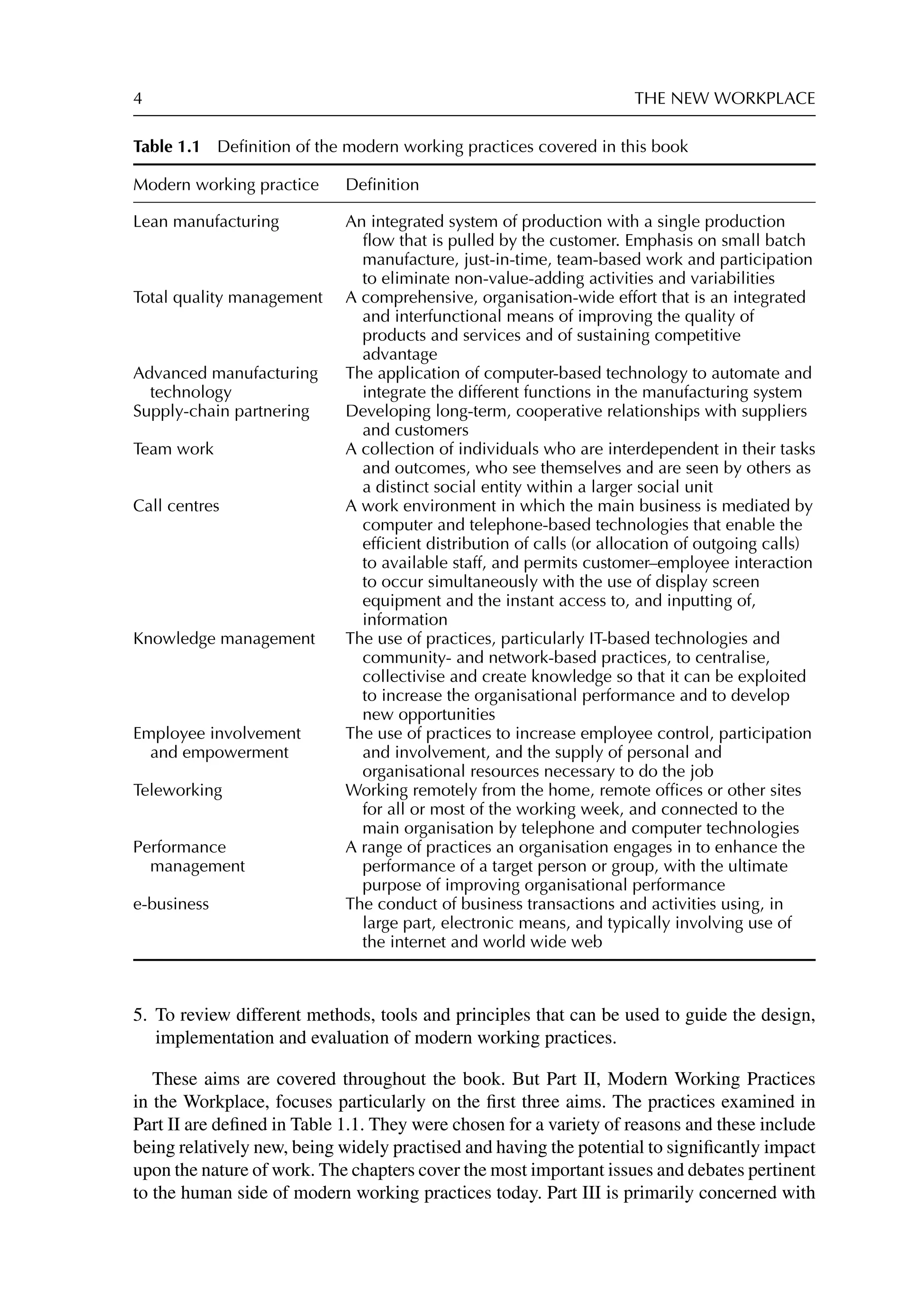
Table 1.1 Definition of the modern working practices covered in this book
Modern working practice Definition
Lean manufacturing An integrated system of production with a single production
flow that is pulled by the customer. Emphasis on small batch
manufacture, just-in-time, team-based work and participation
to eliminate non-value-adding activities and variabilities
Total quality management A comprehensive, organisation-wide effort that is an integrated
and interfunctional means of improving the quality of
products and services and of sustaining competitive
advantage
Advanced manufacturing
technology
The application of computer-based technology to automate and
integrate the different functions in the manufacturing system
Supply-chain partnering Developing long-term, cooperative relationships with suppliers
and customers
Team work A collection of individuals who are interdependent in their tasks
and outcomes, who see themselves and are seen by others as
a distinct social entity within a larger social unit
Call centres A work environment in which the main business is mediated by
computer and telephone-based technologies that enable the
efficient distribution of calls (or allocation of outgoing calls)
to available staff, and permits customer–employee interaction
to occur simultaneously with the use of display screen
equipment and the instant access to, and inputting of,
information
Knowledge management The use of practices, particularly IT-based technologies and
community- and network-based practices, to centralise,
collectivise and create knowledge so that it can be exploited
to increase the organisational performance and to develop
new opportunities
Employee involvement
and empowerment
The use of practices to increase employee control, participation
and involvement, and the supply of personal and
organisational resources necessary to do the job
Teleworking Working remotely from the home, remote offices or other sites
for all or most of the working week, and connected to the
main organisation by telephone and computer technologies
Performance
management
A range of practices an organisation engages in to enhance the
performance of a target person or group, with the ultimate
purpose of improving organisational performance
e-business The conduct of business transactions and activities using, in
large part, electronic means, and typically involving use of
the internet and world wide web
5. To review different methods, tools and principles that can be used to guide the design,
implementation and evaluation of modern working practices.
These aims are covered throughout the book. But Part II, Modern Working Practices
in the Workplace, focuses particularly on the first three aims. The practices examined in
Part II are defined in Table 1.1. They were chosen for a variety of reasons and these include
being relatively new, being widely practised and having the potential to significantly impact
upon the nature of work. The chapters cover the most important issues and debates pertinent
to the human side of modern working practices today. Part III is primarily concerned with
INTRODUCTION 5
the fourth aim of the book, the relationship between modern working practices, human
resource management and organisational performance. The first two chapters in Part III
examine the impact of modern working practices in the manufacturing and service sectors,
while the third considers the impact of human resource practices.
Part IV meets the fifth aim of the book by illustrating some of the tools and methods
that can be used to contribute to the effective design, implementation and evaluation of
new working practices. The tools and methods outlined all attempt to give explicit attention
to the social, human and organisational aspects of the new ways of working, areas of
concern often neglected by managers and technologists. Finally, the concluding section,
Part V, looks to the future. It does this first by considering how future economic conditions
and organisational forms might affect employee behaviour and human resource practice;
second, by critically evaluating the research, including that covered in this book, from a
Critical perspective; and third, by identifying fruitful avenues for future research.
The rest of this chapter is devoted to setting out the context in which modern work-
ing practices have been implemented, and some of the main debates and issues that have
concerned researchers when examining them.
CHANGE AND CONTINUITY IN THE WORKPLACE
Most of us are now fairly well versed in the changes occurring in the economic, political and
social landscape. These include: the internationalisation of the economy; a reduction in
trade barriers between countries; the deregulation of markets; privatisation and the end-
ing of state monopolies; increasing demands for greater accountability and efficiency in
the public sector; demographic changes in the workforce (e.g. increased female participa-
tion, better educated workforce); and changing consumer demand (e.g. a desire for more
customised products, for better quality) (Doganis, 2000; Gabriel  Lang, 1998; Katz,
1997; Pollitt, 1993). These changes have intensified competition. They have also meant
that much competition has become based on cost and quality, innovation and customisation
(Appelbaum  Batt, 1994; Piore  Sabel, 1984). Similar demands for cost efficiencies,
quality and customized services are evident in the public and not-for-profit sectors (Peters,
1992). In addition, knowledge is increasingly recognised as a basis for competition and
it is thought that, in many industrial sectors, competitive advantage will primarily flow
from the creation, ownership and management of knowledge-based assets (see Scarbrough,
Chapter 8, on Knowledge Management).
In response to these changes and the expectation of these changes (Sparrow  Cooper,
1998), it is claimed that many organisations have sought to move away from Fordist,
large-scale, hierarchical bureaucracies of mass production and mass service, and towards
flexible organisations that can respond quickly and efficiently to rapidly changing market
and consumer demands (Amin, 1994; Kumar, 1992; Schneider  Bowen, 1995). Flexibility
is seen as a key component of organisational effectiveness. Managers have sought to achieve
organisational flexibility by experimenting with new organisational forms and new working
practices. There are a number of flexibilities that organisations have sought (Sparrow 
Marchington, 1998):
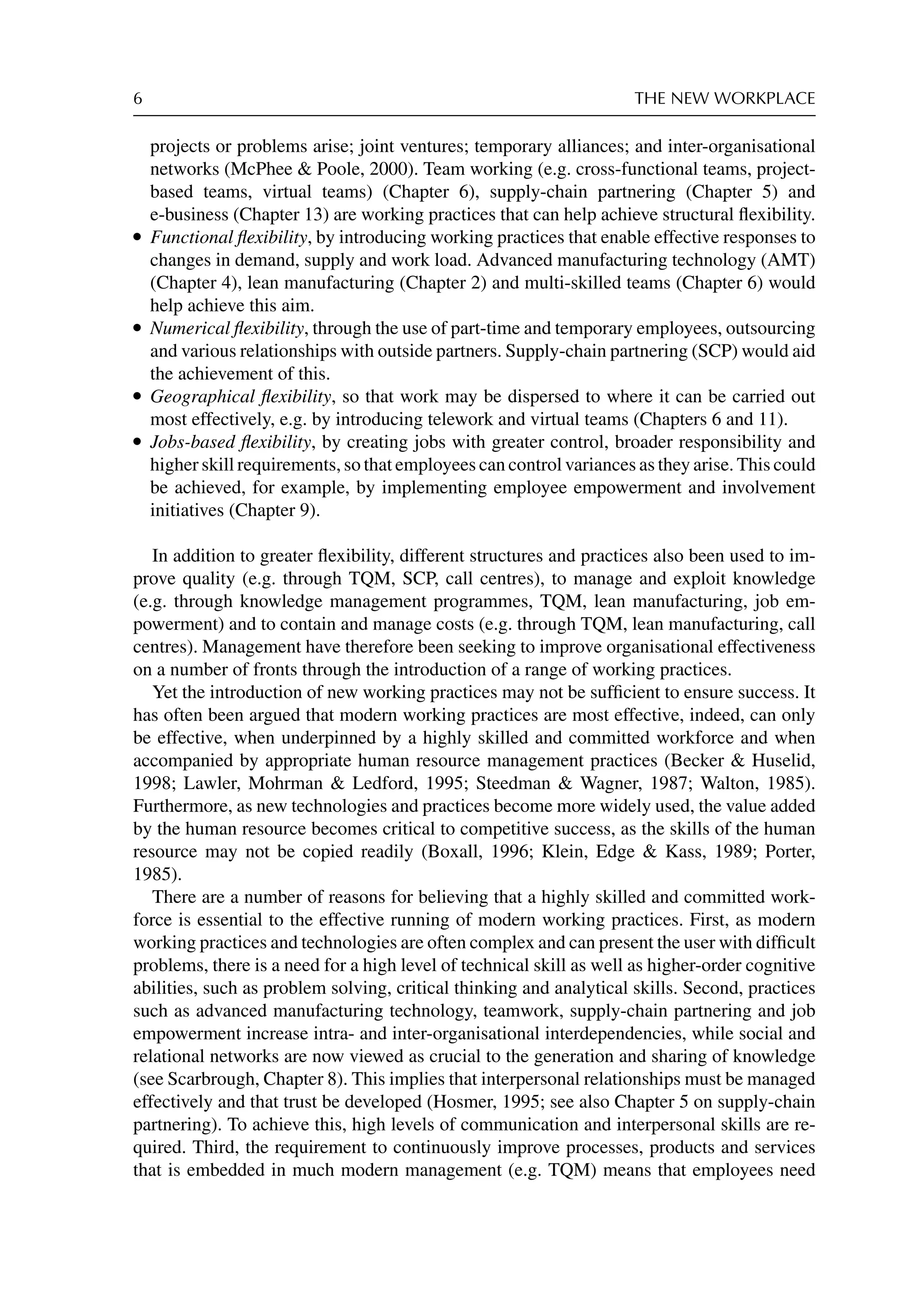
r Structural flexibility, by introducing, either together or in isolation, flatter hierarchies and
horizontal coordination between units; modular structures that can be reconfigured as new
6 THE NEW WORKPLACE
projects or problems arise; joint ventures; temporary alliances; and inter-organisational
networks (McPhee  Poole, 2000). Team working (e.g. cross-functional teams, project-
based teams, virtual teams) (Chapter 6), supply-chain partnering (Chapter 5) and
e-business (Chapter 13) are working practices that can help achieve structural flexibility.
r Functional flexibility, by introducing working practices that enable effective responses to
changes in demand, supply and work load. Advanced manufacturing technology (AMT)
(Chapter 4), lean manufacturing (Chapter 2) and multi-skilled teams (Chapter 6) would
help achieve this aim.
r Numerical flexibility, through the use of part-time and temporary employees, outsourcing
and various relationships with outside partners. Supply-chain partnering (SCP) would aid
the achievement of this.
r Geographical flexibility, so that work may be dispersed to where it can be carried out
most effectively, e.g. by introducing telework and virtual teams (Chapters 6 and 11).
r Jobs-based flexibility, by creating jobs with greater control, broader responsibility and
higher skill requirements, so that employees can control variances as they arise. This could
be achieved, for example, by implementing employee empowerment and involvement
initiatives (Chapter 9).
In addition to greater flexibility, different structures and practices also been used to im-
prove quality (e.g. through TQM, SCP, call centres), to manage and exploit knowledge
(e.g. through knowledge management programmes, TQM, lean manufacturing, job em-
powerment) and to contain and manage costs (e.g. through TQM, lean manufacturing, call
centres). Management have therefore been seeking to improve organisational effectiveness
on a number of fronts through the introduction of a range of working practices.
Yet the introduction of new working practices may not be sufficient to ensure success. It
has often been argued that modern working practices are most effective, indeed, can only
be effective, when underpinned by a highly skilled and committed workforce and when
accompanied by appropriate human resource management practices (Becker  Huselid,
1998; Lawler, Mohrman  Ledford, 1995; Steedman  Wagner, 1987; Walton, 1985).
Furthermore, as new technologies and practices become more widely used, the value added
by the human resource becomes critical to competitive success, as the skills of the human
resource may not be copied readily (Boxall, 1996; Klein, Edge  Kass, 1989; Porter,
1985).
There are a number of reasons for believing that a highly skilled and committed work-
force is essential to the effective running of modern working practices. First, as modern
working practices and technologies are often complex and can present the user with difficult
problems, there is a need for a high level of technical skill as well as higher-order cognitive
abilities, such as problem solving, critical thinking and analytical skills. Second, practices
such as advanced manufacturing technology, teamwork, supply-chain partnering and job
empowerment increase intra- and inter-organisational interdependencies, while social and
relational networks are now viewed as crucial to the generation and sharing of knowledge
(see Scarbrough, Chapter 8). This implies that interpersonal relationships must be managed
effectively and that trust be developed (Hosmer, 1995; see also Chapter 5 on supply-chain
partnering). To achieve this, high levels of communication and interpersonal skills are re-
quired. Third, the requirement to continuously improve processes, products and services
that is embedded in much modern management (e.g. TQM) means that employees need
INTRODUCTION 7
to be creative and innovative (see Chapter 10; Amabile, 1988; West  Farr, 1990; Wolfe,
1994). Fourth, as new practices can increase the degree of discretion and responsibility,
employees must be able to regulate their own behaviour (i.e. to act without close supervi-
sion and management control), respond to variances in the work process as they occur and
exhibit discretionary behaviours (Susman  Chase, 1986). This means that employees need
to be proactive (see Chapter 10), have the skills to deal with variances in the work process
and have the skills necessary to engage in discretionary behaviour.
Given the proposed importance of a skilled and committed workforce, human resource
management practices are now viewed as playing a necessarily crucial role in securing,
maintaining and developing an organisation’s skill base through well-resourced selection
and recruitment procedures, high levels of initial and continued training, and performance
management practices (see Chapter 12). The use of human resource management to secure,
maintain and develop a highly skilled and committed workforce has been labelled a “high
commitment” or “high involvement” approach (see Chapters 9, 14, 15, 16; Lawler, 1986;
Walton, 1985). A number of surveys have documented the increasing use of human resource
practices that are associated with this and the way these may be linked to modern working
practices and operational management methods.
Organisational change is undoubtedly taking place but the jury is still out on the ex-
tent to which this represents a radical change across the whole economy (see Fincham 
Rhodes, 1992). First, the continued influence of Taylorist and Fordist ideas would chal-
lenge such a view, e.g. in the service sector, some call centres represent an advanced form
of Taylorism (Taylor  Bain, 1999) and the “McDonaldization” of service work has been
well documented (Ritzer, 1998). Likewise, just-in-time (JIT), an essential component of
lean manufacturing, can be viewed as an extension and revitalisation of Fordist principles,
rather than a break from them (Tomaney, 1994; Wood, 1989). The “new workplace” is,
so the argument would go, a mixture of “old” and “new” working practices (Blyton 
Turnbull, 1994). Second, even where new practices are being introduced, this may not
always be done as a package. Modern flexible working practices, in particular, may not
necessarily be accompanied by high-commitment human resource practices, or vice versa.
However, it is precisely the integration of these two facets that fundamentally transforms
workplaces (Lawler et al., 1995; Storey, 1994; see also Wood, Chapter 14). Just as there
are questions about the extent and nature of workplace change, questions are also being
asked about whether the effects of change are as beneficial as many imply (Philimore,
1989). Modern working practices and high commitment human resource practices are often
portrayed as leading to a win–win situation for the employee and the organisation. But
while there are accounts demonstrating that the introduction of modern working practices
can lead to more interesting work, more highly skilled work and lower levels of stress, there
is also research showing that the introduction of modern working practices can intensify
work, de-skill employees and lower their well-being (Adler  Borys, 1996; Braverman,
1974; Klein, 1989; Knights, Willmott  Collinson, 1985; Parker  Wall, 1998; Sturdy,
Knights  Willmott, 1992). A modern working practice can have different effects. The
effects of a flexible working practice are dependent on how it is implemented, designed and
managed and are not solely dependent on some intrinsic feature of the working practice
itself.
In summary, as organisations have sought to adapt to changing economic and social
circumstances, they have become a patchwork of “new” working practices, “old” working
8 THE NEW WORKPLACE
practices, “new” working practices that are extensions of old principles and ideas, and
different types of human resource management practice. In addition, there appears to be no
straightforward relationship between a working practice and its effects.
Two perspectives that have helped in understanding this complex picture are (a) job
design theory and (b) research that has examined the link between human resource man-
agement and organisational performance. Job design theory is important, as the effects of
a working practice are significantly affected by the job design of the working practice in
question (Parker  Wall, 1998). This means that, for a full understanding of why work-
ing practices have varying effects in different contexts, it is necessary to establish the job
characteristics present in a particular working practice and the processes by which job
characteristics are related to specific outcomes. Job and work design is also an important
factor in research examining the human resource (HR)–organisational performance link.
This research is important, as it draws together two key characteristics of organisational
change over the last 30 years (i.e. the movement towards flexible working practices and
high-commitment HR practices), and seeks to explain their separate and joint effects on
firm performance.
The following sections outline the main issues and theories in job design theory and focus
on research examining the HR–organisational performance link. The issues and themes
within them run throughout many of the chapters in Parts II and III. In particular, job design
theory is central to many of the debates in Part II, while the issues and debates regarding
the HR–performance link are central to Part III. An appreciation of these areas is therefore
crucial to understanding many of the chapters in this book.
JOB AND WORK DESIGN THEORY
Historically, the main focus of job design research has been on the psychological conse-
quences of work simplification brought about through the pervasive adoption of Taylorist
and Fordist approaches to work organization. Two approaches, job characteristics and socio-
technical theories, have been particularly influential (for fuller discussion of the main job
designtraditions,theirlimitationsandfutureprospects,seeHolmanetal.,2002;Parkeretal.,
2001).
The job characteristics approach to job design has been strongly influenced by
Hackman  Oldham’s (1976) Job Characteristics Model (JCM). They proposed five core
job dimensions (autonomy, feedback, skill variety, task identity, task significance) and these
are seen to be determinants of three “critical psychological states”: autonomy to experi-
enced responsibility; feedback to knowledge of results; and skill variety, task identity and
task significance to experienced meaningfulness. Collectively, these critical psychological
states are seen to affect work satisfaction, internal work motivation, performance, absence
and turnover. Research has generally demonstrated the effect of core job characteristics
on affective outcomes (satisfaction, motivation) but the effects on employee behaviour
(performance, turnover, absence) are less consistent (Parker  Wall, 1998). The motivating
potential of job design has been an central issue within this research tradition (Campion 
McClelland, 1993; Wall  Martin, 1987), as it also has been within debates on modern
working practices and high-commitment human resource practices. Pritchard  Payne ad-
dress this important issue in Chapter 12. In particular, they examine how modern working
practices and human resource practices affect employee motivation.
INTRODUCTION 9
Karaseck  Theorell’s (1990) control-demands model is another job characteristic ap-
proach that has been influential1
. It predicts that “high-strain jobs” are those characterised
by high work demands and low control. Although the evidence for a proposed interactive
effect of control and demand is inconclusive (Van Der Doef  Maes, 1999), numerous
studies have confirmed that the absence of control and the presence of high job demands
are consistent predictors of job-related strain (O’Driscoll  Cooper, 1996).
The second main approach to job design has been socio-technical theory. Socio-technical
theory is concerned with the design of work systems and posits that it is comprised of a
technical system and a social system. These subsystems are seen as interdependent and
shouldthereforebejointlydesignedinsuchawaythattheoverallsystemisoptimal(deSitter,
den Hertog  Dankbaar, 1997). Socio-technical theory has made a number of contributions
to our understanding of job design. It is best known for its articulation of a set of design
principles(Cherns,1987;Clegg,2000);forasetofcriteriaofwhatcomprisesawelldesigned
job; and for the innovation of autonomous work groups (Emery, 1964). Its design principles
include: methods of working should be minimally specified; variances in work processes
should be handled at source; and boundaries should not be drawn to impede the sharing of
information, learning and knowledge. Desirable job characteristics are thus assumed to be
a reasonable level of demand, opportunities for learning, an area of decision-making owned
by the operator, and social support and recognition. These principles of design and desirable
job characteristics are seen to be best expressed in autonomous work groups (AWGs), and
much socio-technical research and practice has been focused at a group level. Although it
has been suggested that an ‘underlying lack of specificity about the nature and effects of such
initiatives (i.e. AWGs) makes a coherent assessment of their outcomes difficult’ (Parker,
Wall  Cordery, 2001, p. 416), research demonstrates that AWGs can have positive effects
on well-being and productivity (Parker  Wall, 1998).
An important focus of the job characteristic and socio-technical approaches has been
job redesign (e.g. enlargement, job enrichment, AWGs) and the tools necessary to do this.
Mumford  Axtell in Chapter 17 explore tools that can be used for job redesign. It can also
be noted here that organisations often fail to properly evaluate the effect of interventions,
and thus valuable information about how the practice could be improved may be lost. To
address this, Sonnentag in Chapter 18 examines the different ways that organisations and
researchers can evaluate the effectiveness of new working practices.
Another notable feature of job design research is that it has reflected many of the debates
and issues concerned with the changing nature of work. For example, the recent interest in
cognition and knowledge at work has focused attention on:
r Cognitive and knowledge-based job characteristics, such as problem-solving demands,
attention demand, (Jackson et al., 1993), non-routine knowledge work (Mohrman,
Cohen  Mohrman, 1995), knowledge intensity (see Lamond, Daniels  Standen,
Chapter 11) and the opportunity to develop and utilise skills (O’Brien, 1986).
r Knowledge-based job outcomes, e.g. skill, self-efficacy (Parker  Wall, 1998).
r Knowledge based-mechanisms that link job characteristics to job outcomes, i.e. jobs with
high control and challenging demands promote the development of skills and knowledge
1
Other job characteristic approaches include social information processing theory (Salanick  Pfeffer, 1978) and the multi-
disciplinary approach of Campion and colleagues (Campion  McClelland, 1993; Medsker  Campion, 1997). The latter
approach categorises job characteristics into “mechanistic” (e.g. specialisation of tools and procedures, skill simplification, rep-
etition),“motivational”(e.g.autonomy,jobfeedback,socialinteraction,taskclarity,participation),“perceptual/motor”(e.g.light-
ing, displays, workplace layout, information requirements), and “biological” (e.g. strength, seating, noise, wrist movement).
10 THE NEW WORKPLACE
(Wall et al., 1990). Better knowledge enhances performance, as employees are better able
to deal with variances in the work process (Miller  Monge, 1986) and choose the most
appropriate strategies to deal with a situation (Frese  Zapf, 1994).
In summary, job design research has coalesced around some key questions and these will
be addressed throughout the book:
r What are the impacts of new technologies and new working practices on job content?
r What are the core job characteristics of modern working practices?
r What effects do the particular job designs of working practices have on psychological
well-being and performance?
r Through what mechanisms do job characteristics effect job outcomes in modern working
practices?
r What methods, tools and principles can be used to design and evaluate new technologies
and working practices?
HUMAN RESOURCE MANAGEMENT AND
ORGANISATIONAL PERFORMANCE
Key concepts in human resource management (HRM) theory are fit and synergy (Wood,
1999). Three types of fit can be identified: (a) the internal fit between human resource (HR)
practices; (b) the organisational fit between HR systems—coherent sets of HR practices—
and other systems within the organisations; and (c) the strategic fit between HR systems
and organisational strategy.
The discussion of internal fit centred on the idea that some HR practices combine better
than others, and that coherent bundles of practice will have synergistic effects. A corollary
of this is that part of the explained variance in observed differences in organisational perfor-
mance will be caused by the differential usage of synergistic bundles of practice. When the
terms “high-commitment” and “high-involvement” have been used, authors have differed
as to their precise content. But they are generally seen to include many of the follow-
ing: teamwork, high control or empowered job designs; employee participation schemes;
job flexibility; high quality and continued training; performance appraisal; well-resourced
selection and recruitment procedures; performance-contingent incentive payment systems
(including group-based pay and profit sharing); and minimal status differences (Wood,
1999). In this book, we have decided to let individual authors use their own preferred terms
and constructs rather than impose a view.
A key debate is whether high commitment/involvement HR systems are universally rele-
vant or whether their effectiveness is contingent upon its alignment with other organisational
practices, i.e. an organisational fit, and whether their effectiveness is contingent upon its
alignment with the organisation’s strategy, i.e. the strategic fit. Universalist approaches
tend to assume that high-commitment HR systems reverse features of past Tayloristic,
bureaucratic and low-commitment approaches to organisation and will generally have pos-
itive effects on organisational performance. A variant of the universalist argument is that a
high-commitment HR system is a necessary but not sufficient basis for high performance.
Rather, there needs to be a fit or alignment between high-commitment HR systems and
modern working practices, such as TQM and lean manufacturing (Kochan  Osterman,
INTRODUCTION 11
1995; Beaumont, 1995). This “high road” approach is universalistic, as it suggests that
high performance will only be attained through the synergy created by these two factors.
A contingency-based approach proposes that performance will be superior when there is
an organisational and strategic fit, and that the HR system chosen should flow from the
organisation’s strategy. It is argued that a Tayloristic/low-commitment HR system will fit
a cost-minimisation strategy and that a high commitment HR system will fit an innova-
tion/quality strategy (Batt, 2000; Hoque, 1999; Schuler  Jackson, 1987). These different
approaches are presented and discussed in more depth in Part III, and also in Chapter 9,
Employee Involvement.
SOCIAL AND POLITICAL PROCESSES IN THE DESIGN AND
MANAGEMENT OF MODERN WORKING PRACTICES
A basic assumption of this book is that job design and human resource management are
fundamental to an understanding of modern working practices. However, while much job
design and HRM research accepts that modern manufacturing practices may differ in form,
they have little to offer on why or how a particular practice has taken the form it has.
Neither do they have much to say on the active role that employees play in shaping them.
For example, interpretivist research has illuminated how the political and social assumptions
of those involved in the design and introduction of new technology become embedded within
the technology, in the form of prescriptive design rationales which automate a particular
view of how work is undertaken (Moran  Carroll, 1996). The “final” configuration of a
technology and the social practices that surround it can be seen as an outcome of social and
political negotiation between various groups over time (Barley, 1990; Buchanan  Boddy,
1983; Mueller et al., 1986; Orlikowski, 1992). Technologies can therefore be understood as
“a frozen assemblage of practices, assumptions, beliefs [and] language” that have become
“fixed” in a material form (Cooper  Woolgar, 1993, p. 2). In this way, the design and
configuration process can have lasting effects on job design, productivity and the quality of
working life.
Critical research within the labour process tradition has drawn attention to how man-
agement attempt to instil within workers the belief that organisational objectives are their
own and to ensure that these objectives are considered when making judgements at work.
Modern working practices are thus mechanisms through which the worker becomes “self-
disciplined” into making “positive” productive responses (Grenier, 1988; Knights  Sturdy,
1990). Sakolosky (1992, p. 246) has concluded that control becomes “embedded not just in
the machinery of production or surveillance, but in the worker’s psyche”. But workers are
not seen as passive reactors to management initiatives. Rather, labour process theory treats
workers as active agents who resist, consent and comply with managerial efforts to control
them and that these resistance practices shape working conditions and working practices
(Burawoy, 1979; Collinson, 1994; Knights, 1990; Sturdy, Knights  Willmott, 1992).
Thesetwoareasofresearchrevealthesocialandpoliticalprocessesinvolvedinthedesign,
introduction and management of modern working practices. They paint a more dynamic
picture of organisational life, in which employees actively shape working practices and
one in which there may be conflicting interests over the use and aims of modern working
practices. In doing so they offer different perspectives and ask different questions about
modern working practices. They include: How do the designs of modern working practices
12 THE NEW WORKPLACE
arise? How are they shaped and configured by the various actors in the process? What are
the values and goals of the actors? Do these values conflict, and, if they do, how is this
expressed?
CONCLUSION
The main purpose of this chapter has been to set the scene for the rest of the book by
articulating the changing economic conditions, the working practices that organisations are
using to respond to this changing landscape, and to cover the main issues, debates and
theoretical approaches to the human side of modern working practices. Four factors are
crucial for an understanding of this discussion. They are:
r The knowledge, skills and abilities of the human resource.
r The job and work design of the modern working practice.
r The human resource practices that are used in conjunction with the modern working
practice.
r The social and political processes involved in the design and use of modern working
practices.
These factors are recurrent themes throughout the book. Taken together, the chapters
in this book present a comprehensive overview of the study of working practices, an area
with a long history, whilst introducing the reader to emerging new forms of work and the
perspectives that these are engendering.
REFERENCES
Adler, P.  Borys, B. (1996). Two types of bureaucracy: enabling and coercive. Administrative Science
Quarterly, 41, 61–89.
Amabile, T. M. (1988). A model of creativity and innovation in organizations. In B. M. Staw 
L. L. Cummings (Eds), Research in Organizational Behavior, Vol. 10 (pp. 123–167). Greewich,
CT: JAI Press.
Amin, A. (Ed.) (1994). Post-Fordism: A Reader. Oxford: Blackwell.
Appelbaum, E.  Batt, R. (1994). The New American Workplace: Transforming Work Systems in the
United States. Ithaca, NY: Cornell ILR Press.
Barley, S. R. (1990). The alignment of technology and structure through roles and networks.
Administrative Science Quarterly, 35, 61–103.
Batt, R. (2000). Strategic segmentation in front line services: matching customers, employees and
human resource systems. International Journal of Human Resource Management, 11, 540–561.
Becker, B. E.  Huselid, M. A. (1998). High performance work systems and firm performance: a
synthesis of research and managerial implications. In G. R. Ferris (Ed.), Research in Personnel
and Human Resources, Vol. 16. Stamford, CT: JAI Press.
Beaumont, P. (1995). The Future of Employment Relations. London: Sage.
Blyton, P.  Turnbull, P. (1994). The Dynamics of Employee Relations. London: Macmillan.
Boxall, P. (1996). The strategic HRM debate and the resource based view of the firm. Human Resource
Management Journal, 6, 59–75.
Braverman, H. (1974). Labour and Monopoly Capital. New York: Monthly Review Press.
Buchanan, D.  Boddy, D. (1983). Organizations in the Computer Age. Aldershot: Gower.
Burawoy, M. (1979). Manufacturing Consent. Chicago: Chicago University Press.
INTRODUCTION 13
Campion, M. A.  McClelland, C. L. (1993). Follow-up and extension of the interdisciplinary cost
and benefits of enlarged jobs. Journal of Applied Psychology, 78, 339–351.
Cherns, A. (1987). Principles of socio-technical design revisited. Human Relations, 40, 153–162.
Clegg, C. W. (2000). Sociotechnical principles for system design. Applied Ergonomics, 31, 463–477.
Clegg, C. W., Axtell, C. M., Damodaran, L., Farbey, B., Hull, R., Lloyd-Jones, R., Nicholls, J., Sell,
R.  Tomlinson, C. (1997). Information technology: a study of performance and the role of human
and organizational factors. Ergonomics, 40, 851–871.
Collinson, D. (1994). Strategies of resistance: power, knowledge and subjectivity in the workplace.
In J. Jermier, D. Knights  W. Nord (Eds), Resistance and Power in Organizations: Agency,
Subjectivity and the Labour Process (pp. 25–68). London: Routledge.
Cooper, G.  Woolgar, S. (1993). Software Is Society Made Malleable: the Importance of Concep-
tions of Audience in Software Research and Practice. PICT Policy Research Paper 25. London:
Programme in Information and Communication Technologies.
Doganis, R. (2000). The Airline Business in the Twenty-first Century. London: Routledge.
Emery, F. (1964). Report of the Hunfoss Project. Tavistock Document Series. London: Tavistock.
Fincham, R.  Rhodes, P. (1992). The Individual, Work and Organisation. London: Weidenfield and
Nicolson.
Frese, M.  Zapf, D. (1994). Action as the core of work psychology: a German approach. In
H. C. Triandis, M. D. Dunnette  L. M. Hough (Eds), Handbook of Industrial and Organisa-
tional Psychology (pp. 271–340). Palo Alto, CA: Consulting Psychologists Press.
Gabriel, Y.  Lang, T. (1998). The Unmanageable Consumer: Contemporary Consumption and Its
Fragmentations. London: Sage.
Grenier, G. (1988). Inhuman Relations: Quality circles and Anti-unionism in American Industry,
Philadelphia, PA: Temple University Press.
Hackman, J.  Oldham, G. (1976). Motivation through the design of work: test of a theory. Organi-
zational Behaviour and Human Performance, 15, 250–279.
Hoque, K. (1999). Human resource management and performance in the UK hotel industry. British
Journal of Industrial Relations, 37, 419–443.
Holman, D, Clegg, C. W.  Waterson, P. (2002). Navigating the territory of job design. Applied
Ergonomics, 33, 197–205.
Hosmer, L. T. (1995). Trust: the connecting link between organisation theory and philosophical ethics.
Academy of Management Review, 20, 379–403.
Jackson, P. R., Wall, T. D., Martin, R.  Davids, K. (1993). New measures of job control, cognitive
demand and production responsibility. Journal of Applied Psychology, 78, 753–762.
Karasek, R.  Theorell, T. (1990). Healthy Work: Stress, Productivity, and the Reconstruction of
Working Life. New York: Basic Books.
Katz, H. C. (1997). Telecommunications: Restructuring Work and Employment Relations Worldwide.
Ithaca, NY: ILR Press.
Klien, J. A. (1989). The human costs of manufacturing reform. Harvard Business Review, 67,
60–66.
Klein, J., Edge, G.  Kass, T. (1989). Skill-based competition. Journal of General Management, 16,
1–15.
Knights, D. (1990). Subjectivity, power and the labour process. In D. Knights  H. Willmott (Eds),
Labour Process Theory (pp. 297–336). London: Macmillan.
Knights, D.  Sturdy, A. (1990). New technology and the self-disciplined worker in the insurance
industry.In I.Varcoe,M.McNeilS.Yearly(Eds),DecipheringScienceandTechnology(pp.126–
154). London: Macmillan.
Knights, D., Willmott, H.  Collinson, D. (eds) (1985). Job Redesign: Critical Perspectives on the
Labour Process. Aldershot: Gower.
Kochan, T.  Osterman, P. (1995). Mutual Gains. Boston, MA: Harvard Business School.
Kumar, K. (1992). New theories of industrial society. In P. Brown  H. Lauder (Eds), Education for
Economic Survival: from Fordism to Post-Fordism. London: Rouledge.
Lawler, E. E. (1986). High-involvement Management, San Fransisco, CA: Jossey-Bass.
Lawler, E. E., Mohrman, S.  Ledford, G. (1995). Creating High Performance Organisations:
Practices and Results of Employee Involvement and Total Quality Management in Fortune 1000
Companies, San Fransisco, CA: Jossey-Bass.
14 THE NEW WORKPLACE
McLoughlin, I.  Harris, M. (1997). Innovation, Organizational Change and Technology, London:
Thompson Business Press.
McPhee, R. D.  Poole, M. P. (2000). Organizational Structures and Configurations. In F. M. Jablin 
L. Putnam (Eds), The New Handbook of Organizational Communication: Advances in Theory,
Research and Methods. London: Sage.
Medsker, G. J.  Campion, M. A. (1997). Job and team design. In G. Salvendy (Ed.), Handbook of
Human Factors and Ergonomics. London: Wiley.
Mueller, W. et al. (1986). Pluralist beliefs about new technology within a manufacturing organization.
New Technology, Work and Employment, 1, 127–139.
Miller, K. I.  Monge, P. R. (1986). Participation, satisfaction and productivity: a meta-analytic
review. Academy of Management Journal, 29, 727–753.
Mohrman, S. A., Cohen, S. G.  Mohrman, A. M. Jr (1995). Designing Team-based Organizations:
New Forms for Knowledge and Work. San Fransisco, CA: Jossey-Bass.
Moran, T. P.  Carroll, C. M. (Eds) (1996). Design Rationale. Hove: Erlbaum.
O’Brien, G. E. (1986). Psychology of Work and Unemployment. Chichester: Wiley.
O’Driscoll, M. P.  Cooper, C. L. (1996). Sources and management of excessive job stress and
burnout. In P. B. Warr (Ed.), Psychology at Work, 4th edn. Harmondsworth: Penguin.
Orlikowski, W. (1992). The duality of technology: rethinking the concept of technology in organiza-
tions. Organizational Science, 3, 398–427.
Osterman, P. (1994). How common is workplace transformation and who adopts it? Industrial and
Labour Relations Review, 47, 173–188.
Parker, S. K.  Wall, T. D. (1998). Job and Work Design. London: Sage.
Parker, S. K., Wall, T. D.  Cordery, J. L. (2001). Future work design and practice: towards an
elaborated model of work design. Journal of Occupational and Organisational Psychology, 74,
413–440.
Peters, M. (1992). Performance and accountability in the “Post-Industrial Society”: the crisis of British
universities. Studies in Higher Education, 17, 123–139.
Philimore, J. (1989). Flexible specialisation, work organisation and skills. New Technology, Work and
Employment, 4, 79–91.
Piore, M.  Sabel, C. (1984). The Second Industrial Divide. New York: Basic Books.
Pollitt, C. (1993). Managerialism and the Public Services: Cuts or Change in the 1980s. Oxford:
Blackwell.
Porter, M. (1985). Competitive Advantage. New York: Free Press.
Ritzer, R. (1998). The McDonaldization Thesis: Explorations and Extensions. Thousand Oaks, CA:
Sage.
Salanick, G.  Pfeffer, J. (1978). A social information processing approach to job attitudes and task
design. Administrative Science Quarterly, 23, 224–253.
Salvendy, G. (Ed.) (1997). Handbook of Human Factors and Ergonomics, 2nd edn. New York: Wiley.
Sakolosky, G. (1992). Disciplinary power and the labour process. In A. Sturdy, D. Knights 
H. Willmott (Eds), Skill and Consent (pp. 235–254). London: Routledge.
Schneider, B.  Bowen, D. (1995). Winning the Service Game. Boston, MA: Harvard Business School
Press.
Schuler, R.  Jackson, S. (1987). Linking competitive strategies with human resource management
practices. Academy of Management Executive, 1, 207–219.
Sewell, G.  Wilkinson, B. (1992). “Someone to watch over me”: surveillance, discipline and the
just-in-time process. Sociology, 26, 271–289.
de Sitter, L., den Hertog, J.  Dankbaar, B. (1997). From complex organizations with simple jobs to
simple organizations with complex jobs. Human Relations, 50, 497–534.
Sparrow, P. R.  Cooper, C. L. (1998). New organizational forms: the strategic relevance of future
psychological contract scenarios. Canadian Journal of Administrative Sciences, 15(4), 356–
371.
Sparrow, P. R.  Marchington, M. (Eds) (1998). Human Resource Management: the New Agenda.
London: Financial Times Pitman Publications.
Steedman, H.  Wagner, K. (1987). A second look at productivity, machinery and skills in Britain
and Germany. NI Economic Review, November.
Storey, J. (1994). New Wave Manufacturing Practices: Organizational and Human Resource
Management Dimensions. London: Chapman Paul.
INTRODUCTION 15
Sturdy, A. Knights, D.  Willmott, H. (Eds) (1992). Skill and Consent. London: Routledge.
Susman, G.  Chase R. (1986). A sociotechnical systems analysis of the integrated factory. Journal
of Applied Behavioral Science, 22, 257–270.
Taylor, P.  Bain, P. (1999). An assembly line in the head: the call centre labour process. Industrial
Relations Journal, 30, 101–117.
Tomaney, J. (1994). A new paradigm of work organisation and technology? In A. Amin (Ed.), Post-
Fordism: a Reader. Oxford: Blackwell.
Van Der Doef, M.  Maes, S. (1999). The job demand-control (-support) model and psychological
well-being: a review of 20 years of empirical research. Work and Stress, 13, 87–114.
Wall, T. D., Clegg, C. W.  Kemp, N. J. (Eds) (1987). The Human Side of Advanced Manufacturing
Technology. Chichester: Wiley.
Wall, T. D., Corbett, J. M., Martin, R., Clegg, C. W.  Jackson, P. R. (1990). Advanced manufacturing
technology, work design and performance: a change study. Journal of Applied Psychology, 75,
691–697.
Wall, T. D.  Martin, R. (1987). Job and work design. In C. L. Cooper  I. T. Robertson (Eds),
International Review of Industrial and Organisational Psychology. Chichester: Wiley.
Walton, R. (1985). From ‘control’ to ‘commitment’ in the workplace. Harvard Business Review, 63,
77–84.
Waterson, P. E., Clegg, C. W., Bolden, R., Pepper, K., Warr, P. B.  Wall, T. D. (1999). The use and
effectiveness of modern manufacturing practices: a survey of UK industry. International Journal
of Production Research, 37, 2271–2292.
West, M. A.  Farr, J. L. (1990). Innovation and Creativity at Work. Chichester: Wiley.
Wolfe, R. A. (1994). Organizational innovation: review, critique and suggested research directions.
Journal of Management Studies, 31, 405–431.
Wood, S. (1989). The Transformation of Work? Skill, Flexibility and the Labour Process. London:
Unwin Hyman.
Wood, S. (1999). Human resource management and performance. International Journal of
Management Review, 1, 367–413.
PART II
Modern Working Practices
in the Workplace
CHAPTER 2
Workers Under Lean
Manufacturing
Rick Delbridge
Cardiff Business School, Cardiff University, UK
Few management ideas have been as influential in their field as lean production techniques
in manufacturing industry. Initially, the interest surrounded a relatively small number of
companies that were perceived to be operating in a different way to that prescribed un-
der traditional Western manufacturing methods. Particularly since the rise of the Japanese
economy in the 1980s, there has been an increasing interest in the company philosophy and
management techniques utilized by such companies as Toyota (Fujimoto, 1999), Nissan
(Wickens, 1995) and Toshiba (Fruin, 1997). During the 1980s, numerous authors advo-
cated the adoption of Japanese techniques (e.g. Pascale  Athos, 1982) or the moulding
of such approaches to Western contexts (e.g. Ouchi, 1981). In addition to the research
on Japanese organizations in Japan, there has been an enormous amount of research un-
dertaken to assess the activities of Japanese organizations operating overseas, e.g. in the
USA (e.g. Abo, 1994; Fucini  Fucini, 1990; Kenney  Florida, 1993; Milkman, 1991),
in the UK (e.g. Morris, Munday  Wilkinson, 1993; Oliver  Wilkinson, 1992) and in the
Asia–Pacific region (e.g. Dedoussis, 1995; Abdullah  Keenoy, 1995). There has also been
prolonged debate over the “transferability” of “Japanese” techniques by Western capital
(e.g. Ackroyd et al., 1988; Elger  Smith, 1994; Oliver  Wilkinson, 1992). As we will
discuss, the origins of lean manufacturing lie firmly in Japanese industry. However, over
the past decade the association of lean manufacturing with Japan has weakened and “lean”
has become an international standard in many industry sectors.
Lean manufacturing is now understood as an integrated system of production that in-
corporates work organization, operations, logistics, human resource management and sup-
ply chain relations. While there is debate over whether lean manufacturing represents a
“toolbox” of techniques or a “philosophy” of management (see Oliver  Wilkinson, 1992),
over the past 10 years a consensus has emerged over the key organizational and operating
principles of the system. This level of consensus has not been sustained when assessment
has turned to the implications for workers that such a system may involve.
In this chapter, we begin with an outline of the origins of lean manufacturing, commencing
with an overview of the Toyota Production System and, in particular, the ideas of Taiichi
Ohno, the main architect of just-in-time (JIT). Following this we review the emergence
The New Workplace: A Guide to the Human Impact of Modern Working Practices.
Edited by David Holman, Toby D. Wall, Chris W. Clegg, Paul Sparrow and Ann Howard. C
 2003 John Wiley  Sons, Ltd.
20 THE NEW WORKPLACE
of “lean” with specific reference to the main work which popularized the ideas of lean
production—the International Motor Vehicle Program (IMVP) and the major publication
from that study, The Machine that Changed the World (Womack, Jones  Roos, 1990). In
the next section, we distil and articulate the key organizing principles of lean manufacturing.
Following this, there are two sections which review, first, competing views on the potential
implicationsforworkersandthentheresearchevidenceontheshopfloorexperienceofwork-
ing under lean manufacturing. A final section reviews current debates and flags future issues.
THE ORIGINS OF LEAN MANUFACTURING
While there has been some debate over how “Japanese” the different components of the
“Japanese manufacturing system” are (see Graham, 1988), the origins of JIT can be clearly
traced to the Toyota Motor Company of Japan, and in particular the work of one of its
industrial engineers during the 1960s and 1970s, Taiichi Ohno. Ohno (1988) clearly outlines
his ideas in his book, Just-in-Time: For Today and Tomorrow. The holistic and integrative
nature of lean manufacturing is to be found in his initial comments that “the business world
is a trinity of the market, the factory and the company as a whole,” with company strategy
designed to fine-tune the factory’s processes in line with the immediate and real-time needs
of the marketplace. Ohno’s overarching concern is the elimination of the different forms of
waste, which he associates with traditional Fordist methods of production. He lists various
forms of waste, including overproduction, waiting time, transportation costs, unnecessary
stock,unnecessarymovementandtheproductionofdefectivegoods.HecontraststheToyota
production system with the Fordist production system and, in particular, with the fact that
Fordism is a planned production system which “pushes” products onto the market, rather
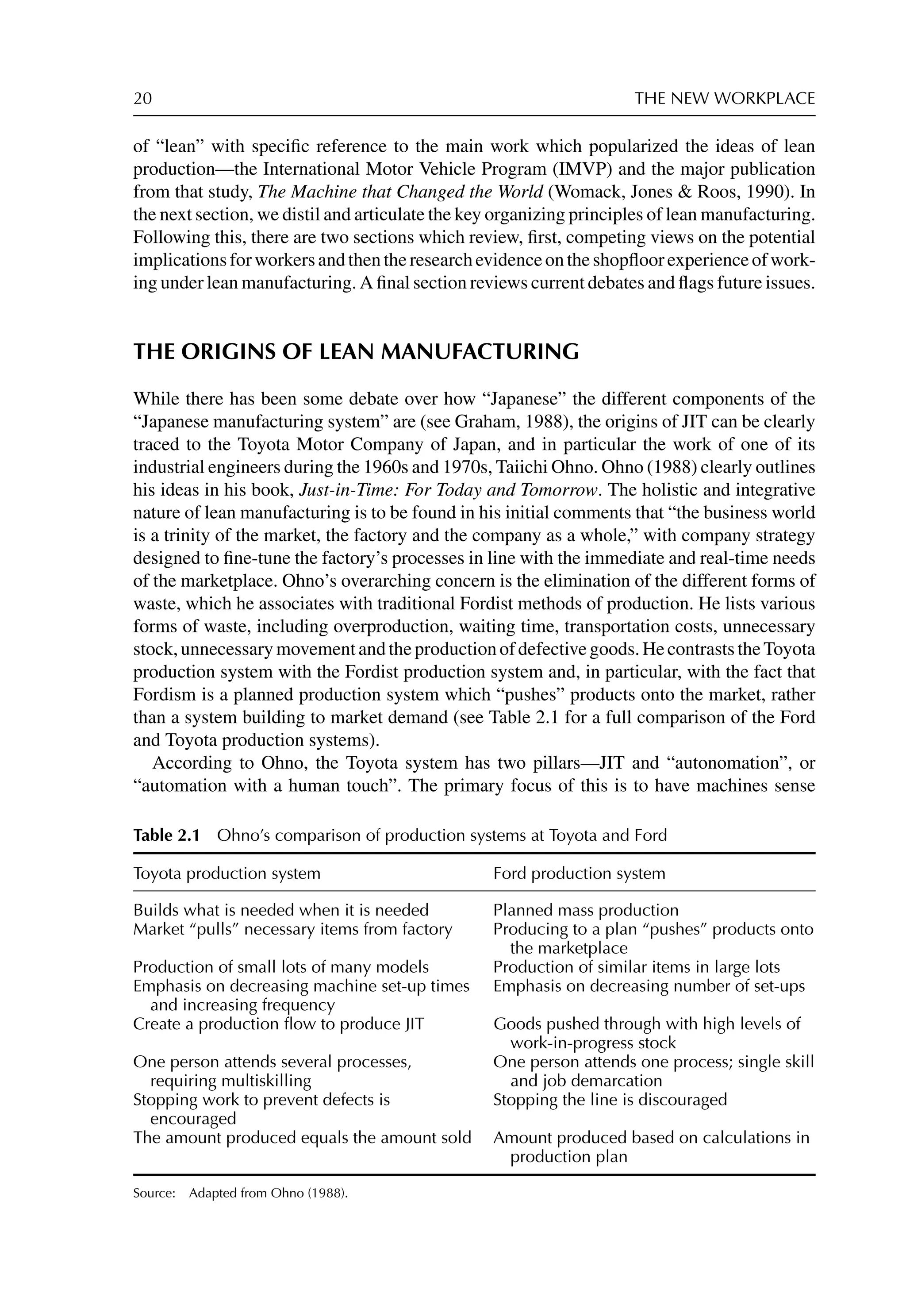
than a system building to market demand (see Table 2.1 for a full comparison of the Ford
and Toyota production systems).
According to Ohno, the Toyota system has two pillars—JIT and “autonomation”, or
“automation with a human touch”. The primary focus of this is to have machines sense
Table 2.1 Ohno’s comparison of production systems at Toyota and Ford
Toyota production system Ford production system
Builds what is needed when it is needed Planned mass production
Market “pulls” necessary items from factory Producing to a plan “pushes” products onto
the marketplace
Production of small lots of many models Production of similar items in large lots
Emphasis on decreasing machine set-up times
and increasing frequency
Emphasis on decreasing number of set-ups
Create a production flow to produce JIT Goods pushed through with high levels of
work-in-progress stock
One person attends several processes,
requiring multiskilling
One person attends one process; single skill
and job demarcation
Stopping work to prevent defects is
encouraged
Stopping the line is discouraged
The amount produced equals the amount sold Amount produced based on calculations in
production plan
Source: Adapted from Ohno (1988).
WORKERS UNDER LEAN MANUFACTURING 21
problems and automatically stop producing when defective work arises. A fully automated
machine operating smoothly does not need a worker in attendance. Only when a problem
occurs is an operator summoned to the machine, generally through a light and/or alarm
system. The concept of pokeyoke, or foolproofing, attempts to guard against defective pro-
duction by having automatic cut-outs in a similar way. While the latter idea of autonomation
impacts directly on the role of labour, e.g. in the expectation that workers will mind several
machines or processes, giving rise to Ohno’s prospect of multiskilling for those workers, the
former pillar also has significant direct and indirect implications. In Toyota, a simple phys-
ical pull system involving coloured cards, called kanban, is utilized to try to smooth flow
and tie upstream and downstream production processes. The cards cycle between processes
triggering build at upstream operations to replenish those downstream. Kanban work in a
number of ways to reduce the prospects of waste, e.g. by restricting the number of cards,
inventories cannot build up; by acting as a work order, the cards prevent overproduction;
and, since the card moves with goods in small lots, it allows a swift tracing of any goods
found to be defective. The heightened visibility and close coupling of work activities have
a number of implications for workers. Ohno himself describes kanban as the “autonomic
nervous system” of the plant, not only making clear the role of controllers and supervisors,
but also indicating to workers when operations should begin and when overtime is necessary
(Ohno, 1988, p. 20).
A central feature of the Toyota production system is its close linking of supplier and
customer plants, as well as work stations internal to the factory. In the advanced form of
JIT adopted by Toyota and key suppliers, kanban cards flow between organizations, trig-
gering build, managing inventory and providing identification of batches. The close linking
and transparency between buyer and supplier are an important context to the activities of
shopfloor employees. Ohno ascribes the successful adoption of JIT across the supplier base
to the economic shock of the first oil crisis in 1973. It was at this time that both Toyota
and its suppliers became convinced of the benefits of JIT. As Ohno makes clear, running a
JIT system places heavy responsibility on both suppliers and customers. Customers must
supply smooth and reliable schedule information upon which suppliers can depend, while
the suppliers must deliver reliable quality and to tight time horizons. Organizational slack
is removed both within and between members of the supply chain. It is for these reasons
that right-first-time build quality is so important in lean manufacturing systems. For many
years it has been common to talk of the Japanese system as a combination of JIT and total
quality management (TQM).
Along with tight internal process control and the close operational integration of the
supply chain, the third significant aspect of the Toyota production system, as outlined by
Ohno, is “innovation”. Again, Ohno is at pains to emphasize a holistic and integrated view.
Withregardtoinnovationwithinanorganization,hecommentsthattechnologicalinnovation
is only possible when the marketplace, the factory and the research and development (RD)
department are united. He argues that:
Workplace management does not aim simply for cost reduction through vigorous use
of production management techniques. The ultimate goal must be the attainment of
innovation through the aggressive development of new products and new techniques
(Ohno, 1988, p. 81).
Notably, he recognizes both the importance of top-down management leadership and the
bottom-up contribution of shopfloor employees in achieving improvement. Here again, the
22 THE NEW WORKPLACE
Toyota production system represents a significant break from Western manufacturing tra-
ditions, in this instance regarding the division of labour. Under Fordist production, drawing
on the ideas of Taylor’s scientific management, there was a clear demarcation of responsi-
bility between those who planned production and those who carried out the manual tasks
prescribed. Under the Toyota system, it is expected that workers will make a contribution
to improving how their own job is designed and organized. Moreover, Ohno argues that JIT
and autonomation create a synergy between individual skill and team work. The importance
of formalized team working and small-group problem solving represent a further depar-
ture from much that is commonly associated with traditional Western work organization
practices.
From JIT to Lean
As we have seen, the work of Ohno provides an integrated and holistic manufacturing man-
agement template, at least with regards to the operations aspects. Concern with the human
resource issues of Japanese manufacturing initially focused on the unique nature of Japan’s
sociocultural and historical context. Authors such as Pascale  Athos (1982) and Ouchi
(1981) placed great emphasis on Japan’s culture and traditions when seeking to explain the
success of its manufacturing industry. However, this success soon led to debates over what
could and should be learned from the Japanese and adopted by Western manufacturers. An
important contribution to this transferability debate was made by the various researchers
involved in the International Motor Vehicle Program (IMVP), coordinated at Massachusetts
Institute of Technology (MIT).
The IMVP was a five year, $5 million study of the world’s major car assemblers. The main
publication from the programme, which still runs, was The Machine that Changed the World
(Womack et al., 1990). This has been perhaps the single most influential book on manu-
facturing management of the last 20 years and its primary objective was to “de-Japanize”
the Toyota production system and argue for its efficacy and efficiency irrespective of con-
text. The book reported data from the various projects within the IMVP, including claims
that the adoption of “lean production” led to major gains in both productivity and quality
performance, although some of these findings have been contested (see Williams et al.,
1994). As can be seen from the summary in Table 2.2, much of the substantive content
of the lean production model is readily recognizable as the Toyota production system
Table 2.2 What is lean production?
r Integrated single piece production flow, with low inventories, small batches made just in
time
r Defect prevention rather than rectification
r Production is pulled by the customer and not pushed to suit machine loading, and level
scheduling is employed
r Team-based work organization, with flexible multiskilled operators and few indirect staff
r Active involvement in root-cause problem solving to eliminate all non-value-adding steps,
interruptions and variability
r Close integration of the whole value stream from raw material to finished customer,
through partnerships with suppliers and dealers
Source: Derived from Womack et al. (1990).
WORKERS UNDER LEAN MANUFACTURING 23
described by Ohno (1988) and others (e.g. Monden, 1983; Shingo, 1988). Womack et al.
(1990, p. 49) themselves cite Toyota as “the birthplace” of lean production. The book itself
contains relatively little about the nature or practices of lean production that is distinct from
what had been reported previously, but its major success was in propagating the ideas of
Toyota and advocating the wholesale adoption of what were previously seen as “Japanese”
management practices.
From the outset, Womack et al. (1990, p. 9) distance themselves from those who at-
tributed Japanese corporate success to the country’s culture or history, “We believe that the
fundamental ideas of lean production are universal—applicable anywhere by anyone—and
that many non-Japanese companies have already learned this”. They are also unequivocal
in advocating the adoption of lean production techniques:
Our conclusion is simple: lean production is a superior way for humans to make
things . . . It follows that the whole world should adopt lean production, and as quickly
as possible (Womack et al., 1990, p. 225).
For Womack et al., the “one best way” of Fordism has been supplanted by the “one best
way” of lean production. Such universalism has, of course, attracted considerable criticism
(e.g. Elger  Smith, 1994; Thompson  McHugh, 1995).
The book itself concentrates primarily on the technical aspects of the system and there
is little detail on the role of workers or the likely implications of adopting lean production
techniques. There are stylized accounts contrasting “dispirited” General Motors’ workers
with the “sense of purposefulness” to be found amongst Toyota’s shopfloor employees, but
there is little depth to the discussion of workers’ experiences under lean manufacturing.
The role of labour is dealt with in a broad-brush manner:
The truly lean plant . . . transfers the maximum number of tasks and responsibilities to
those workers actually adding value to the car on the line . . . It is the dynamic work team
that emerges as the heart of the lean factory (Womack et al., 1990, p. 99).
The authors contrast the “mind-numbing stress” of mass production with the “creative
tension” of lean production which is particularly engendered by the expectation for worker
participation in problem solving and continuous improvement. Rather optimistically, they
anticipate that shop floor work will begin to resemble that of professionals and that man-
agement will need to encourage “reciprocal obligation” in order that employees contribute
to solving problems. Womack et al. (1990, p. 102) expect to see investment in automating
repetitive tasks and thus anticipate that “. . . by the end of the [twentieth] century we expect
that lean-assembly plants will be populated almost entirely by highly skilled problem solvers
whose task will be to think continually of ways to make the system run more smoothly and
productively”. We will review the research evidence on the extent to which this appears an
accurate prediction in a later section of the chapter. Before this, in the following sections
we outline the key organizing principles of lean manufacturing and tease out the likely
implications for workers.
ORGANIZING PRINCIPLES OF LEAN MANUFACTURING
Particularly in early research into Japanese manufacturing during the 1980s, the em-
phasis was very much upon the technical/systems aspects of practice (e.g. Schonberger,
1982; Voss  Robinson, 1987). However, increasingly the debates have turned to the
24 THE NEW WORKPLACE
organizational and work implications of lean manufacturing. Some consensus has emerged
that the innovative nature of the interdependent and interorganizational nature of the system
requires “new types of relationships among workers, between workers and management,
and between firms and their buyers and suppliers” (Sayer, 1986, p. 43). It is the nature and
implications of these new types of relationship that have been hotly debated.
Oliver  Wilkinson (1992), in their book exploring the prospects for the “Japanization”
of British industry, argue that the essence of understanding Japanese methods lies in the
recognition that they:
. . . dramatically increase the interdependencies between the actors involved in the whole
production process, and that these heightened dependencies demand a whole set of
supporting conditions if they are to be managed successfully (Oliver  Wilkinson,
1992, p. 68).
Greater interdependence is founded upon the removal of “organizational slack” or loose
coupling arrangements both between processes and between firms. Organizational slack has
been the traditional approach to managing uncertainty; actions consistent with coping with
uncertainty tend to lead to the creation of slack or “buffers”, e.g. buffers may take the form
of large levels of stock between firms or between processes or of lengthy order to delivery
time periods. Such buffers may be characteristic of Western manufacturers but constitute
the “waste” that Ohno set out to eradicate with the Toyota production system. Thus, if firms
are not to accept reduced levels of performance, managers are left to seek ways of reducing
uncertainty or of coping with it in ways that do not increase slack.
In removing the buffers or safeguards against disruption typically present under tradi-
tional Fordist mass production, lean manufacturing requires that uncertainty be minimized
and, where possible, eradicated. Equally, in increasing the various actors’ interdependence,
organizations face a greater imperative to manage these relationships, both internally and
externally, so as to reduce uncertainty. For example, if inventories are minimized, then
production equipment must be reliable. Similarly, while introducing internal production,
flexibility can partially compensate for unpredictability in market demand; supplier per-
formance in terms of quality and delivery must be reliable and predictable if buffers are
removed. Thus, the necessity for lean manufacturers to minimize uncertainty results in a
need for a fundamentally reliable and largely stable and predictable set of external relations
with other actors. This has led to considerable attention being focused on the nature of
supply chain relations in lean manufacturing, particularly the Japanese automotive industry
(Turnbull, Oliver  Wilkinson, 1989; Sako, 1992). A number of commentators have con-
cluded that these relationships are best characterized as “high-trust partnerships” (e.g.
Lamming, 1993; Womack et al., 1990).
In a very similar fashion to the mutual dependence of the supply chain, lean manu-
facturers are also highly dependent upon their workforce working reliably and flexibly,
since a central aspect of lean is to operate with the minimum possible level of employees.
This has dual implications for individual workers. The first is that, since market demand
is unlikely to prove entirely predictable and stable, employees must work on tasks as they
become necessary. While some workers may concentrate their efforts in a narrowly de-
fined area, at least some workers are likely to have to rotate through different tasks as and
when required by demand. Second, the desire to run at minimal levels of staffing means
that absenteeism poses a particular problem for management. Under a lean system there
simply is not the spare labour to cover illness or other forms of absence. Workers must
WORKERS UNDER LEAN MANUFACTURING 25
themselves meet the need for reliability and predictability central to lean manufacturing.
Similarly, the emphasis is on stable industrial relations. As Turnbull (1988) notes, lean
production is highly susceptible to disruption through even low-cost forms of industrial
action. Rather as with the buyer–supplier relations of lean manufacturers, some commen-
tators have concluded that these demands result in high trust partnerships between labour
and management (Wickens, 1987; Womack et al., 1990). We will discuss this in more detail
below.
Alongside reliability of current processes, the further feature of lean manufacturing is its
dynamic nature—the continual search for ways of improving performance. The drive for
continuous improvement under lean manufacturing is derived from the Japanese concept
of kaizen. As with the other aspects of lean manufacturing, this feature of contemporary
management “best practice” has permeated widely through industry. Increasingly, contem-
porarymanufacturingischaracterizedasinvolving(semi-)permanentinnovation(Kenney
Florida, 1993; Cooke  Morgan, 1998) as managers seek to continually improve operating
efficiencies and develop and introduce new products to the market. For its advocates, kaizen
is the primary feature of the Japanese manufacturing model:
KAIZEN strategy is the single most important concept in Japanese management—the
key to Japanese competitive success. KAIZEN means improvement . . . KAIZEN means
ongoing improvement involving everyone—top management, managers and workers
(Imai, 1986: xxix, emphasis in original).
There are a number of organizational structures and processes that are associated with
kaizen. Most notable of those involving lower-level workers are employee suggestion
schemes and small group problem-solving activities, or quality circles, which involve
shopfloor workers in meeting, discussing problems and generating ideas and solutions.
Such activities offer the opportunity for employees to make suggestions for change. Clearly
the effective operation of such activities places an emphasis on training and development
of workers’ skills and on engendering the appropriate employment relationship, such that
workers feel willing and able to make such contributions. These further considerations
compound the importance of workers and employment relations given the fragility of lean
manufacturing, discussed above.
The nature of HRM and industrial relations under lean manufacturing, and particularly in
Japanese firms, has been a major area of study and debate. Indeed, Japanese companies have
made an influential contribution to the emergence of HRM, providing role models for the
West, with their so-called “Type J” organization characterized by high levels of worker com-
mitment and company loyalty (Ouchi, 1981; Alston, 1986). The key objectives for Japanese
personnel practices, and for HRM in support of lean manufacturing more broadly, are clearly
derived from the nature of the production system outlined above. Thurley (1982) identi-
fies these as being performance, motivation, flexibility and mobility, secured through an
array of complementary policies, such as self-appraisal and feedback, consultation, status/
grading progress, organizational or group bonuses, job rotation and retraining, transfer
policies, self-education and organizational redesign. These are portrayed as characteristic
of Japanese employers, although it should be remembered that at best they refer to the
employment relationship of the “permanent” staff in large Japanese corporations and that
Japan has a significant duality to its economy (Chalmers, 1989). Nevertheless, the approach
to HRM of lean manufacturers outside Japan has drawn heavily upon the perceived advan-
tages of the Japanese model.
26 THE NEW WORKPLACE
According to Peter Wickens, the Personnel Director of Nissan Motor Manufacturing
UK when it was founded in the mid-1980s, the secret of Japan’s success was a so-called
“Japanese tripod” of team work, quality consciousness and flexibility. Wickens himself
promoted Nissan’s approach to HRM through published articles (Wickens, 1985) and books
(Wickens, 1987). He argued that workers at Nissan regarded themselves as part of the team
(and company), that quality was emphasized through work, and that the employees’ genuine
involvement in the company through team work and quality led naturally to flexibility. The
result, according to the company, was to create a “harmonious and productive working
environment” (The Guardian, 8 September 1987). This view of the employment relationship
at Nissan was specifically criticized by research conducted with workers from the plant
(Garrahan  Stewart, 1992) and the perceived harmony and mutuality of Japanese IR
and HRM has been questioned more generally (e.g. Delbridge  Turnbull, 1992; Gordon,
1985).
The link between workplace harmony and manufacturing productivity has been ques-
tioned on two different but inter-related points. First, while the distinctive production
methods of lean manufacturing have been linked to high productivity in Japanese plants
(Oliver, Delbridge  Lowe, 1996), there has been no such clear link evident for loyalty,
commitment or “corporate culture” (Dunphy, 1986). Neither do Japanese HRM policies
necessarily generate higher levels of worker satisfaction (Briggs, 1988; Dunphy, 1986). As
Lincoln  Kalleberg (1990, p. 60) comment, “. . . a striking finding, which has appeared
with remarkable consistency in comparative survey research on industrial attitudes, is that
the levels of job satisfaction reported by the Japanese are lower than in the Western indus-
trialized countries”. Second, as discussed above, the key role of HRM as a strategically
integrated subsystem within the organizing principles of lean manufacturing is to make
workers feel obliged to contribute to the performance of the organization and to iden-
tify with its competitive success. For this reason, Wickens’ “tripod of success” has been
re-labelled a “tripod of subjugation”, where team work represents “management through
compliance”, quality consciousness results in “management through blame” and flexibil-
ity leads to “management by stress” (Delbridge  Turnbull, 1992). These competing in-
terpretations of the HRM approach needed to underpin to lean manufacturing may be
characterized as a divergence of opinion over whether workers are prepared to meet the
demands of the production system because of their levels of commitment or due to their
subordination to management and their subsequent coercion to comply with production re-
quirements. Both schools of thought concur, however, that the particular technical/systems
characteristics of lean manufacturing—minimal buffers, tight coupling, high quality and
the drive for continuous improvement—make specific demands upon workers and conse-
quently require supportive HR practices. A schematic representation of the key organizing
principles, both within and between plants operating under lean manufacturing, is given in
Figure 2.1.
The clearest research-based articulation and advocacy of these principles and their re-
lationship to organizational performance has been provided by the work of MacDuffie
(1995a), who was a researcher on the original IMVP and has subsequently further de-
veloped this work. He presents data from a survey of 62 car assembly plants in support
of two related arguments: first, that what he calls “innovative HR practices” affect per-
formance as inter-related elements in an internally consistent HR “bundle”; second, that
these bundles contribute most to assembly plant productivity and quality when they are inte-
grated with manufacturing policies under the “organizational logic” of a “flexible production
WORKERS UNDER LEAN MANUFACTURING 27
SUPPLIERS
HRM
JIT  TQM CONTINUOUS TEAM WORKING
SYSTEMS IMPROVEMENT AND GROUP
PROBLEM SOLVING
EFFICIENCY,
QUALITY AND
INNOVATION
INFORMATION
RAW
MATERIALS
AND
PARTS
CUSTOMERS
KNOWLEDGE
INFORMATION
PARTS
KNOWLEDGE
Figure 2.1 Key organizing principles of lean manufacturing
system”, MacDuffie’s term for lean manufacturing. His research shows that flexible pro-
duction plants with team-based work systems, “high-commitment” HR practices and low
inventory consistently outperformed “mass production plants”.
MacDuffie (1995a, p. 198) suggests that his work “explores the role of human resources
in the ‘organizational logic’ of a production system more deeply than previous descriptive
work”, such as Womack et al. (1990). He continues:
Although mass and flexible (or “lean”) production systems implicitly require different
approaches to managing human resources, Womack et al. did not explain how HR
practices are integrated into these different production systems, nor did they test the
relationship between HR practices and performance. Indeed, the term “lean production”
28 THE NEW WORKPLACE
Table 2.3 MacDuffie’s measures of work systems and HRM policies
“High-involvement” work systems
have
High percentage of workforce involved in formal work
teams
High percentage of work force involved in employee
involvement groups
Large number of production-related suggestions
received per employee
High percentage of production-related suggestions
implemented
Frequent job rotation within and across teams and
departments
Production workers responsible for quality inspection
and data gathering
“High-commitment” HRM policies Hiring criteria that emphasize openness to learning and
interpersonal skills
Pay systems contingent upon performance
Single status workplace (common uniform, common
parking, common cafeteria, no ties)
High levels of initial training for new recruits (workers,
supervisors and engineers)
High levels of ongoing training for experienced
employees
Source: Derived from MacDuffie (1995a).
used by Womack et al. appropriately captures the minimization of buffers but neglects
the expansion of work force skill and conceptual knowledge required for problem solving
under this approach (MacDuffie, 1995a, p. 198).
Thus, MacDuffie’s work represents an attempt to capture the nature of the integrated sys-
tem of operations, organization and supporting management approach and to incorporate the
implications of the systemic demands made upon labour for reliable, flexible and innovative
working. The main measures that he uses to identify whether a plant has “high involvement”
work practices and “high commitment” practices are outlined in Table 2.3.
IMPLICATIONS FOR WORKERS
A key theme running throughout discussions of “Japanese” and lean manufacturing has been
the implications that such systems of production have for the workforce. It is on this issue
that the debate has polarized, with critics deeply scathing of those who anticipate beneficial
working conditions. Early assessments of lean manufacturing argued that it represented
“management by stress” (Parker  Slaughter, 1988; Delbridge  Turnbull, 1992) and led to
“work intensification” (Dohse, Jürgens  Malsch, 1985; Delbridge, Turnbull  Wilkinson,
1992). The counter-claim was that in fact workers worked “smarter, not harder”, at least if
the systems were implemented appropriately (e.g. Wickens, 1995).
The critics anticipated that the system demands of just-in-time, total quality control and
team working would have a severe and detrimental impact on the prospects for worker
autonomy and the opportunity to exercise counter-control. Delbridge et al. (1992) antici-
patedthatthelikelyoutcomewasworkintensification,asaresultof:(a)increasedmonitoring
WORKERS UNDER LEAN MANUFACTURING 29
and surveillance of workers’ activities; (b) heightened responsibility and individual account-
ability; (c) the harnessing of peer pressure within teams and via “customers”; and (d) the
fostering of involvement in waste elimination and the continuous improvement of the pro-
duction process. They concluded that lean factory regimes potentially consolidated and
reproduced management control over the labour process in a more complete way than had
been the case under traditional bureaucratic regimes. These conclusions contrast with the
expectations of proponents of lean manufacturing, who have anticipated that workers will
experience increased autonomy and involvement in decision making, primarily through
their participation in problem-solving activities (e.g. Womack et al., 1990). Before exam-
ining this debate in more detail, we shall consider exactly what workers are expected to do
under lean manufacturing.
MacDuffie (1995b) reviews the part of workers in lean production and identifies three
primary roles. These are “doing” work, “thinking” work and “team” work. As he notes,
and contrary to some of the wilder speculations of Womack et al. (1990), under lean
manufacturing “first and foremost is the provision of manual effort” and, as he further
recognizes:
Most production work at an auto assembly plant continues to require difficult and
demanding physical labor . . . The fact that lean production shares with mass production
the use of a moving assembly line and a narrow division of labor means that the physical
experienceof“doing”workisnotdramaticallydifferentinthesetwosettings(MacDuffie,
1995b, p. 55).
It is with regard to the notions of “thinking” and “team” work that MacDuffie sees a
break from Taylorist traditions. For him, the key distinction surrounds the demands which
stem from the drive for continuous improvement. These mean that workers must have a
broader contextual knowledge of their production system so that they can link their specific,
and often tacit, knowledge of their tasks to the upstream and downstream processes to
which they are coupled. Further, he cites the “deliberate organization of work to encourage
worker ideas to be surfaced, specified, and legitimized as an input to making changes in
the production process”, i.e. the process of kaizen (MacDuffie, 1995b, p. 56). However, he
is realistic about where the decision-making authority lies under the system, recognizing
that workers are not the dominant influence within a lean factory and that engineers still
establish the initial process specifications. Moreover, worker suggestions for change are
closely scrutinized and must be approved by engineers or managers before adoption. Even
an advocate like MacDuffie realizes that there are important limits to the extent to which
workers are empowered to take decisions and make changes within lean manufacturing.
On the other hand, it is important to acknowledge that under these systems the cognitive
inputs of workers are legitimized and valued; this reverses the separation of conception and
execution under Taylorism.
The third role raised by MacDuffie is that of team member. This, he argues, “legitimizes
the informal social network in a company as an important source of coordination and
commitment” (MacDuffie, 1995b, p. 57). However, on closer inspection, MacDuffie’s view
is rather unitarist:
The most important social relationship under lean production is with the company:
identification with company goals around performance, competitiveness and survival
pulls workers towards identifying their interests as overlapping with managers at their
company . . . (MacDuffie, 1995b, p. 57; emphasis in original).
30 THE NEW WORKPLACE
The other aspect of organizing the informal social network in the production system
is aligning employee interests as closely as possible with company goals. This is vital,
as MacDuffie anticipates, because of the strain that lean manufacturing can put on inter-
worker relationships, particularly when buffers are reduced to a minimum and quality
control requires a tracing of all faults to the root cause (and culpable worker). He notes
that the peer controls under such circumstances can “easily turn poisonous” unless there is
group cohesion, a process of close and swift dispute resolution, personal influence based on
expertise rather than seniority, and incentives that align team member interests with each
other and the other teams within the organization. As we will see in the following section,
case evidence suggests that organizations operating a lean manufacturing system appear to
have had difficulty in meeting the requirements needed to avoid the negative perception of
peer pressure amongst workers themselves.
The role of workers in teams has been a major area of study across all sectors of business
and industry (see Procter  Mueller, 2000). Since team working is seen to lie at the heart
of the lean shopfloor, it is worth looking at the role of workers in lean teams in more detail.
Delbridge, Lowe  Oliver (2000) report managerial views of the responsibilities of teams,
team members and functional specialists based on an international study of lean production
practices in the automotive components industry. The paper reports management responses
at 30 plants using lean team working to questions regarding the distribution of responsibility
for different types of shopfloor task. The findings provide something of a contrast to those
of MacDuffie  Pil (1997), who concluded that lean production results in fewer functional
specialists and more multiskilled workers, greater decentralization of authority and a higher
degree of integration between conceptual activity and production tasks from their research
into car assembly plants.
According to the managers in the study of automotive components plants, the technical
role of production workers in lean manufacturing is rather limited. Operators have primary
responsibility for routine quality tasks, but have not been significantly upskilled in order
to play major roles in more technically complex areas, such as maintenance. Indeed, these
technical tasks remain the responsibility of blue-collar skilled specialists and typically
lie outside of the individual team. These results are not consistent with the findings of
MacDuffie  Pil (1997). Neither is the fact that respondents report very little responsibility
at operator level for the management of production activities. The findings show limited
evidence of worker autonomy under lean team working. However, there is evidence to
support the changing role of labour with regard to innovation and improvement activities.
Managers reported significant worker responsibility for problem solving and both quality
and process improvements, and this does match the findings of MacDuffie  Pil (1997) at
the car assembly plants. Thus, the Taylorist separation of planning and execution appears
to be partially reversed, but the position that emerges for workers is one of increasing
responsibility without any increase in autonomy.
The other important finding of the research into roles under lean team working was the
relative significance of the team’s leader. The team leaders had primary responsibility for
process improvement, the allocation of work amongst the team and the setting of work pace,
as well as training and the settling of grievances. These findings suggest a pivotal role for
the leaders of lean teams as the first line of management, able to contribute through both
technical competence and social skills. In combination with the continuing importance of
skilled blue-collar specialists, the significance of the team leader appears to have “hollowed
out” the roles of middle management in the areas of engineering and quality. The findings
WORKERS UNDER LEAN MANUFACTURING 31
of Delbridge et al. (2000) suggest that lean manufacturing may have even greater impli-
cations for the roles and work experiences of first-line supervisors, specialists and middle
managers than it does for shopfloor operators. These are questions that currently remain
under-researched.
In our final substantive section, we turn attention to the case study evidence regarding
the experience of shopfloor workers under lean manufacturing.
CASES OF LEAN WORKING
The evidence reported in Womack et al. (1990), MacDuffie (1995a), MacDuffie  Pil (1997)
and Delbridge et al. (2000) was all gathered through a similar research approach, namely,
plant-level questionnaires completed with managers during plant visits by the research
teams. This approach provides valuable data, but does not give the best insights into the
experience of workers under lean manufacturing. For this we need a research approach that
is focused on the workers and the shopfloor specifically. Of necessity, these more in-depth
studies are concentrated on particular organizations and there have been a number of such
case studies conducted into lean manufacturing sites over the last decade or so. Naturally
enough, given the rise of lean in the motor industry, the majority of these have been centred
upon car assembly plants (e.g. Fucini  Fucini, 1990; Garrahan  Stewart, 1992; Graham,
1995). Each of these studies has reported criticism of the implications of lean production
for workers and has reported worker dissatisfaction and negative experiences. There has
been a fair degree of consistency in these findings across different case plants.
In this section we review the work of Rinehart, Huxley  Robertson (1997) in more
detail, as a good and representative example of the findings of case-based studies at car
assembly plants; their research findings are reported in a book entitled Just Another Car
Factory?, which reports a longitudinal study of the CAMI Automotive car assembly plant
located in Ontario, Canada. CAMI is a joint venture between General Motors and Suzuki,
which was heralded as a model of lean production when it opened in 1989. The research
was jointly conducted by academics and the Canadian Auto Workers (CAW) trade union
and involved worker surveys, interviews and observations conducted by a team between
early 1990 and mid-1996. The authors report that, when it opened, CAMI promised work-
ers something different from traditional plants—a humane work environment, team-based
empowerment and cooperative labour–management relations—as is to be expected under
the lean manufacturing model. The book systematically documents the degree to which
CAMI, in the eyes of its own workers, lives up to these expectations, particularly with
regard to its own “core values” of empowerment, kaizen, open communications and team
spirit. According to Rinehart et al. (1997), the initial enthusiasm felt by workers during
their recruitment and orientation steadily dissipated, as indeed did their willingness to be
involved in discretionary participation activities. Workers came to describe CAMI as “just
another car factory”.
The authors report extensive and detailed findings on issues such as multiskilling, team
working and continuous improvement and, for example, their chapter on team working
confirms other work that has questioned the relative autonomy of the team, the significance
and divisiveness of peer pressure and the central role of the team leader. Rinehart et al.
(1997, p. 201) conclude that while the implementation of techniques such as JIT and kanban
distinguishes CAMI from traditional mass production plants, these developments in the
32 THE NEW WORKPLACE
production system are better conceived as “refinements of Fordism” than a paradigmatic
shift in organizational logic, since “The lean environment is characterized by standardized,
short-cycled, heavily loaded jobs” (Rinehart et al., 1997, p. 202). Some of the findings
from the researchers’ worker survey are particularly striking: 88.3% viewed CAMI as no
different from other companies; over 90% felt that single status trappings merely masked
power differentials; and over 80% felt that the plant environment was competitive and
stressful (Rinehart et al., 1997, p. 160).
Overall, the authors conclude that workers at CAMI were no more committed than work-
ers elsewhere and report both formal and informal resistance, including strike action, as
evidence of worker discontent. Graham’s (1995) participant observation study of another
North American car plant, Subaru-Isuzu, also reports evidence of both individual and collec-
tive worker resistance. Both studies call into serious doubt the extent to which workers are
able to participate in decision making. Consistent with the plant survey findings reported in
Delbridge et al. (2000), Graham (1995, p. 137) reports that the production system at Subaru-
Isuzu“neitherengagesworkersinmanagerialaspectsoftheirjobsnorprovidesanavenuefor
real involvement in decision making . . . When workers did manage to have input into deci-
sions affecting the quality of their lives, it was because they went outside the [Japanese/lean]
model’s boundaries and approached the company as its adversary”. Rinehart et al. (1997)
conclude from their results that lean production does not rely on committed workers and
that the system works so long as everyone does his/her job competently and does not create
disruptions. This position correlates with the need for reliable and flexible workers, as out-
lined in the earlier section on lean’s key organizing principles. This conclusion, however,
overlooks the discretionary contribution required of workers under kaizen activities if the
lean model’s innovation and continuous improvement dynamics are to be achieved.
This problem was prominent in the ethnographic study of a Japanese-owned colour
television plant in the UK which was reported in Delbridge (1998). This research identifies
a low trust–high surveillance shopfloor which workers find stressful and intimidating. The
tightqualitycontrolintheplantresultsinacultureofblameandworkersareactivelyengaged
in seeking to avoid being held responsible for defects to the extent that on occasion they
accuse each other, even within their own team. This fragments the notion of a shopfloor
collective and undermines any suggestion that the team may provide some form of social
or emotional support. Workers had responded by withdrawing from discretionary activities
and did not participate in suggestion schemes nor in small group problem solving. Rinehart
et al. (1997) also report the withholding of tacit knowledge by workers. If innovation and
operational learning are seen as fundamental to the lean model, then these plants are failing
to deliver. This suggests an essential tension in the lean model between the desire to operate
without waste and at maximum efficiency, leading to stress and alienation on the part of
workers, while at the same time anticipating active worker involvement in problem solving.
Authors have differed in the extent to which they perceive these findings to reflect the unique
history and context of the individual plants and the degree to which the problems reported
are due to the inadequate or inappropriate implementation of lean production or this more
deep-seated contradiction between control and commitment.
In contrast to the more critical and pessimistic accounts above, Adler’s (1993) research
at NUMMI, the GM–Toyota joint venture in California, found evidence of high levels of
productivity, continuous improvement and employee motivation. He reported a standardized
and formal set of work routines that had been designed to promote learning rather than to
enforce compliance, a variation on bureaucracy which he labelled “learning bureaucracy”.
WORKERS UNDER LEAN MANUFACTURING 33
Adler (1993, p. 111) shares MacDuffie’s (1995b) unitarism and anticipates “a workforce
assumed to share a common goal of production efficiency and quality”. There may be some
initial justification for this view, since the GM-Fremont plant had been closed and workers
laid off in 1982 before the instigation of the joint venture which saved the operation in
1984. In his discussion, Adler (1993, p. 183) ascribes much of the situation to the “unique
conditions of NUMMI’s start-up”. Nevertheless, the case of NUMMI is interesting in the
way it appears to run contrary to the findings of other studies. The explanation may be found
in Adler’s own conclusion, when he comments that trust, respect, employee participation
in defining key standards and policies, and the balancing of power between employees and
management are “the conditions of existence” for a learning bureaucracy.
CURRENT DEBATES AND FUTURE ISSUES
Current debates surrounding the experience of working under lean manufacturing centre
on the competing explanations for why case-based research, which looks in depth at the
circumstances and views of shopfloor workers generally, fails to supply support for the
proposition that lean systems can provide, indeed rely on, employment relations and work
conditions that foster commitment and the willingness of workers to participate in dis-
cretionary activities. There are a range of views that extend from the radical critics of
lean manufacturing, who argue that at its very heart lean production represents a system of
management control wherein there is a false rhetoric of worker involvement, autonomy and
upskilling (e.g. Parker  Slaughter, 1988), through to the more contingent view of those
who ascribe the negative findings of individual case studies to failings in implementation
or the strategic choices made by managers (e.g. Klein, 1989).
Inarecentreviewofresearchintoleanproduction,andinparticularevidenceontheimpact
on worker health, Landsbergis, Cahill  Schall (1999, p. 122) conclude that recent survey
work has tended to confirm case evidence that lean production in auto manufacturing creates
an intensified work pace, modest or temporary increases in decision authority and skill, with
the decision-making latitude of workers remaining low. Such work has inherent strains, and
Landsbergis et al. (1999) argue that these may lead to various health problems, such as
work-related musculoskeletal disorders (e.g. tendinitis and carpal tunnel syndrome) and the
potential for increases in hypertension and cardiovascular disease. However, Landsbergis
et al. (1999) acknowledge the limits of current evidence and note that there have been few
well-designed research studies looking specifically at the impact of lean manufacturing and
worker health. This is an area where further research is overdue.
One particular avenue for fruitful further research is more systematic assessment of the
psychological impact of working under lean manufacturing systems. This is the conclusion
put forward in a recent article by Conti  Gill (1998), who review current understanding of
work under lean manufacturing and proceed to identify a series of hypotheses regarding the
potential effects of JIT and lean production on job stress. Their primary concern is to seek
to generalize from the detailed case evidence that has highlighted the potentially negative
effects of lean production. Their position is consistent with the contingent view, and is that
there will be varying job stress effects, dependent upon the range of management choices
exercised in the design and operation of a lean production system.
Conti  Gill (1998) draw upon the Karasek–Theorell model of job stress, which suggests
that high levels of stress are associated with high job demands, low job control and low
34 THE NEW WORKPLACE
levels of social support. Coming from the contingent view of lean implementation, Conti 
Gill (1998, p. 163) suggest that the implications for job demands are not determined and
argue that, “There is nothing inherent in the structure of JIT/LP that requires the use of
greater than normal pace and intensity [work] levels”, but note that “there are structural
characteristics of JIT/LP that inherently restrict worker control and autonomy”. Thus, one of
their hypotheses is that, “The stress levels exhibited in firms will increase as the proportion
of production organized as JIT/LP increases” (Conti  Gill, 1998, p. 164). From this,
however, they argue that management has two avenues open to it through which job stress
may be alleviated: “the proper use of continuous improvement programs and providing
some degree of autonomy in job design” (Conti  Gill, 1998, p. 165).
The prospect for meaningful involvement in decision making is a central component of
the rhetoric of lean manufacturing but the case evidence suggests that often managers do
not make available the opportunities for workers to secure any form of autonomy and/or
other aspects of the employment relationship, or workers’ experiences, lead them to decline
from any voluntary participation. It has been argued that off-line activities, such as quality
circles, give workers a degree of job control and that these may thus help to offset the low
level of on-line control (e.g. Conti  Gill, 1998). The case evidence does not support this
view, however, and recent analysis of the Workplace Employment Relations Survey, which
has responses from 28 323 employees (see Cully et al., 1998), also indicates that workers
do not perceive that narrow, “point of production” participation schemes, such as quality
circles, provide meaningful opportunity for influence over their jobs (Delbridge  Whitfield,
2001). The other way, according to Conti  Gill (1998), that the stress inherent in the JIT
system may be offset is through the resources and emotional support provided by working in
teams. Again, this is an empirical question worthy of further investigation, but the case study
evidence indicates that the particular pressures of lean manufacturing may fragment team
loyalties and undermine the prospects of team-based support. At the very least, the research
evidence indicates that managers seeking to ensure that innovation and improvement are a
central part of their lean manufacturing system will need to reflect carefully on how they
can mediate the stressful aspects inherent in such a system. In addition, they will need to
integrate work, organization and supporting HR policies, such that workers perceive they
have a vested interest in contributing their discretionary effort and tacit knowledge in order
to make the lean shopfloor an ever more efficient and yet harmonious workplace. The current
signs are that, even if managers are so inclined, this may prove beyond them.
REFERENCES
Abdullah,S.Keenoy,T.(1995).JapanesemanagerialpracticesintheMalaysianelectronicsindustry:
two case studies. Journal of Management Studies, 32(6), 747–766.
Abo, T. (1994). The Hybrid Factory: the Japanese Production System in the United States. Oxford:
Oxford University Press.
Ackroyd, S., Burrell, G., Hughes, M.  Whitaker, A. (1988). The Japanisation of British industry.
Industrial Relations Journal, 19(1), 11–23.
Adler, P. (1993). The “learning bureaucracy”: New United Motor Manufacturing, Inc. Research in
Organizational Behavior, 15, 111–194.
Alston, J. (1986). The American Samurai: Blending American and Japanese Managerial Practices.
New York: de Gruyter.
Briggs, P. (1988). The Japanese at work: illusions of the ideal. Industrial Relations Journal, 19(1),
24–30.
Other documents randomly have
different content
with the modes in which the forces of the world may be grouped under their
control; with the manifold combinations which finally enable one supreme
power to absorb all the rest, so that a god of the sky, like the Greek Zeus,
may become a god of rain and sunshine and atmospheric change, of earth
and sea, and of the nether world; and may thus be presented as the sole and
universal energy, not only of all outward things but also of the inner world
of thought. Of this immense development language, archæology, literature,
the dedications of worship, the testimonies of the ancient students of their
still more ancient past in ritual and belief, contain the scattered witness,
which the student of to-day laboriously gathers and interprets. It is the
humbler object of a little manual of Comparative Religion to set some of
the principal issues of such historic evolution side by side, and show how
similar reactions of the mind of man upon the field of his experience have
wrought like results.
As the inquirer casts his eye over the manifold varieties of the world's
faiths, he sees that they are always conditioned by the stage of social culture
out of which they emerge. The hunter who lives by the chase, and must
range over large areas for means of support; the pastoral herdsman who has
acquired the art of breeding cattle and sheep, and slowly moves from one
set of feeding-grounds to another; the agriculturist who has learned to rely
on the co-operation of earth and sky in the annual round,—have each their
own way of expressing their view of the Powers on which they depend.
Little by little they are arranged in groups. The Celts, for instance,
coming to river after river in their onward march, employed the same name
again and again, Deuona, divine (still surviving in this country in
different forms, Devon, Dee, etc.), as though all rivers belonged to one
power. They were the givers of life and health and plenty, to whom costly
sacrifices must be made. So they might bear the title Mother, and were
akin to the powers of fertility living in the soil, the Mothers (Matres or
Matronæ), cognate with the Mothers who fulfil similar functions in
modern India. The adjacent Teutonic peoples filled forest and field with
wood-sprites and elves, dwellers in the air and the sunlight. The springs, the
streams, and the lakes, were the home of the water-sprites or nixes; in the
fall of the mighty torrent, among the rocks on the mountain heights, in the
fury of the storm or the severity of the frost, was the strength of the giants.
Yet further east and north the Finnic races looked out on a land of forest
and waters, of mists and winds. The spirits were ranged beneath rulers who
were figured in human form. The huntsman prayed with vow and sacrifice
to the aged Tapio, god of the woods and the wild animals. Kekri watched
over the increase of the herd, while Hillervo protected them on the summer
pastures. The grains and herbs—of less importance to tribes only
imperfectly agricultural—were ascribed to the care of Pellervoinen, who
falls into the background and receives but little veneration. Water, once
worshipped as a living element (vesi), is gradually supplanted by a water-
god (Ahto) who rules over the spirits of lakes and rivers, wells and springs.
Mother-earth still designates in the oldest poetry the living energy of the
ground, though she afterwards becomes the lady of the earth and consort
of the lord of the sky. The sky, Jumala, was first of all conceived as itself
living; Jumala's weather was like Zeus's shower to an ancient Greek.
And then, under the name Ukko, the sky becomes a personal ruler, with
clouds and rain, thunder and hail, beneath his sway; who can be addressed
as—
Ukko, thou of gods the highest,
Ukko, thou our Heavenly Father.
Many causes contribute to the enlargement and stability of such
conceptions. Tribes of limited local range and a meagre past without
traditions may conceive the world around them on a feeble scale. But
migration helps to enlarge the outlook. Local powers cannot accompany
tribes upon the march. Either they must be left behind and drop out of
remembrance, or they must be identified with new scenes and adapted to
fresh environments. When the horizon moves ever further forwards with
each advance, earth and sky loom vaster before the imagination, and sun
and moon, the companion of each day or the protector of each night, gain a
more stately predominance. The ancestors of the Hindus, the Greeks, the
Romans, the Teutons, carried with them the worship of the sky-god under a
common name, derived from the root div, to shine (Dyaus = Zeus = Jovis
= old High German Tiu, as in Tuesday). Other names gathered around the
person in the actual firmament, such as the Sanskrit Varuna (still recognised
by some scholars as identical with the Greek Ouranos, heaven), loftiest of
all the Vedic gods. The Aryan immigrants are already organised under
kings, and Varuna sits enthroned in sovereignty. His palace is supported by
a thousand pillars, and a thousand doors provide open access for his
worshippers. But he is in some sense omnipresent, and one of the ancient
poets sang—
If a man stands or walks or hides, if he goes to lie down or to get up,
what two people sitting together whisper, King Varuna knows it, he is there
as the third.
This earth, too, belongs to Varuna, the king, and this wide sky with its
ends far apart. The two seas (sky and ocean) are Varuna's loins; he is also
contained in this small drop of water.
He who should flee far beyond the sky, even he would not be rid of
Varuna, the king.
The supreme power of the universe is here conceived under a political
image. Conceptions of government and social order supply another line of
advance, parallel with the forces of nature. On the African Gold Coast, after
eighteen years' observation, Cruickshank ranged the objects of worship in
three ranks: (1) the stone, the tree, the river, the snake, the alligator, the
bundle of rags, which constituted the private fetish of the individual; (2) the
greater family deity whose aid was sought by all alike, sometimes in a
singular act of communion which involved the swallowing of the god (p.
144); and (3) the deity of the whole town, to whom the entire people had
recourse in times of calamity and suffering.
The conception of the deity of a tribe or nation may be greatly developed
under the influence of victory. War becomes a struggle between rival gods.
Jephthah the Gileadite, after recounting the triumphs of Israel to the hostile
Ammonite king, states the case with the most naked simplicity: Yahweh,
Israel's god, hath dispossessed the Amorites from before his people Israel,
and shouldest thou possess them? Wilt thou not possess that which
Chemosh thy god giveth thee to possess? So whomsoever Yahweh our god
hath dispossessed from before us, them will we possess (Judges xi. 23, 24).
The land of Canaan was the gift of Israel's God, but at first his power was
limited by its boundaries: to be driven from the country was to be alienated
from the right to offer him worship or receive from him protection. In the
famous battle with the Hittites, celebrated by the court-poet of Rameses the
Great (1300-1234 B.C.), the king, endangered by the flight of his troops,
appeals to the great god Amen, a form of the solar deity Rê, with
confidence of help, Amen shall bring to nought the ignorers of God: and
the answer comes, I am with thee, I am thy father, my hand is with thee, I
am more excellent for thee than hundreds of thousands united in one.
Success thus enhanced the glory of the victor's gods. Like the Incas of Peru
in later days, the Assyrian sovereigns confirmed their power by bringing the
deities of tributary peoples in a captive train to their own capital: and the
Hebrew prophet opens his description of the fall of Babylon by depicting
the images of the great gods Bel and Nebo as packed for deportation on the
transport-animals of the conqueror.
Other causes further tended to give distinction to the personality of
deities, and define their spheres. A promiscuous horde of spirits has no
family relationships. A god may have a pedigree; a consort is at his side;
and the mysterious divine power reappears in a son. Instead of the political
analogy of a sovereign and his attendants, the family conception expresses
itself in a divine father, mother and child. Thus the Ibani of Southern
Nigeria recognised Adum as the father of all gods except Tamuno the
creator, espoused to Okoba the principal goddess, and mother of Eberebo,
represented as a boy, to whom children were dedicated. The Egyptian triad,
Osiris, Isis and Horus, is well known; and the divine mother with the babe
upon her lap passed into the Christian Church in the form of the Virgin
Mary and her infant son.
The divisions of the universe suggested another grouping. The Vedic
poets arranged their deities in three zones: the sky above, the intervening
atmosphere, and the earth beneath. Babylonian cosmology placed Anu in
the heaven, Bel on the earth, and Ea in the great deep, and these three
became the symbols of the order of nature, and the divine embodiments of
physical law. Homer already divides the world between the sky-god Zeus,
Poseidon of earth and sea, and Hades of the nether realm: and Rome has its
triads, like Jupiter, Mars, and Quirinus, or again Jupiter, Juno, and Minerva.
Whatever be the origin of the number three in this connection, it reproduces
itself with strange reiteration in both hemispheres. Other groups are
suggested by the sun and moon and the five planets, and appear in sets of
seven. Egyptian summaries recognised gods in the sky, on earth, and in the
water; and the theologians of different sanctuaries loved to arrange them in
systems of nine, or three times three.
Out of this vast and motley multitude emerge certain leading types in
correspondence with certain modes of human thought, with certain hopes
and fears arising out of the changes of the human lot. Curiosity begins to
ask questions about the scene around. The child, when it has grasped some
simple view of the world, will inquire who made it; and to the usual answer
will by and by rejoin And who made God? Elementary speculation does
not advance so far: it is content to rest if necessary in darkness and the void,
provided there is a power which can light the sun, and set man on his feet.
But the intellectual range of thought even in the lower culture is much
wider than might have been anticipated; while the higher religions contain
abundant survivals of the cruder imagination which simply loves a tale.
Sometimes the creative power (especially on the American continent) is
figured as a marvellous animal, a wondrous raven, a bird-serpent, a great
hare, a mighty beaver. Or the dome of sky suggests an original world-egg,
which has been divided to make heaven and earth. Even the Australians,
whose characteristics are variously interpreted as indications of extreme
backwardness or of long decline, show figures which belong to what Mr.
Andrew Lang designated the High Gods of Low Races. Among the
Narrinyeri in the west Nurrundere was said to have made all things on the
earth; the Wiimbaio told how Nurelli had made the whole country with the
rivers, trees, and animals. Among the Western Bantu on the African
continent Nzambi (a name with many variants over a large area) is
described as Maker and Father. Our forefathers told us that name.
Njambi is the One-who-made-us. He is our Father, he made these trees, that
mountain, this river, these goats and chickens, and us people. That is the
simple African version of the ever-and-beyond. But as with so many of
the chief gods, not only on the dark continent, but elsewhere, he is regarded
as a non-interfering and therefore negligible deity.
Sometimes speculation takes a higher flight. The Zuñis of Mexico have
remained in possession of ancient traditions, uninfluenced by any imported
Christianity. After many years' residence among them Mr. Cushing was able
to gather their ideas of the origin of the world. Awona-wilona was the
Maker and Container of all, the All-Father-Father. Through the great space
of the ages there was nothing else whatever, only black darkness
everywhere. Then in the beginning of the new-made Awona-wilona
conceived within himself, and thought outward in space, whereby mists
of increase, steams potent of growth, were evolved and uplifted. Thus by
means of his innate knowledge the All-Container made himself in the
person and form of the sun. With his appearance came the brightening of
the spaces with light, and with the brightening of the spaces the great mist-
clouds were thickened together and fell. Thereby was evolved water in
water, yea and the world-holding sea. And then came the production of the
Fourfold-Containing Mother-Earth and the All-Covering Father-Sky.
With a yet bolder leap of imagination did a Polynesian poet picture the
great process. From island to island between Hawaii and New Zealand is a
high god known as Taaroa, Tangaloa, Tangaroa, and Kanaroa. The
Samoans said that he existed in space and wished for some place to dwell
in, so he made the heavens; and then wished to have a place under the
heavens, so he made the earth. Tahitian mythology declared (the versions of
priests and wise men differed) that he was born of night or darkness. Then
he embraced a rock, the imagined foundation of all things, which brought
forth earth and sea; the heavens were created with sun, moon, and stars,
clouds, wind, and rain, and the dry land appeared below. The whole process
was summed up in a hymn—
He was: Taaroa was his name.
He abode in the void; no earth, no sea, no sky.
Taaroa calls, but nought answers,
Then, alone existing, he became the universe.
The relations of these creative Powers to man are conceived very
differently. The Maker of the world may be continually interested in it, and
may continue to administer the processes which he has begun. The Akkra
negro looks up to the living sky, Nyongmo, as the author of all things, who
is benevolently active day by day: We see every day, said a fetish-man,
how the grass, the corn, and the trees, spring forth through the rain and
sunshine sent by Nyongmo [Nyongmo ne = 'Nyongmo rains'], how should
he not be the creator? So he is invoked with prayer and rite. The great
Babylonian god, Marduk, son of Ea (god of wisdom and spells), alone
succeeds in overcoming the might of Tiamat (the Hebrew tehôm or deep),
the primeval chaos with her hideous brood of monsters, and out of her
carcass makes the firmament of heaven. He arranges the stations of the
stars, he founds the earth, and places man upon it. His word is
established, cries the poet, his command is unchangeable: wide is his
heart, broad is his compassion. A conqueror so splendid could not
relinquish his energy, or rest on his achievements: he must remain on the
throne of the world to direct and support its ways. Here is a prayer of
Nebuchadrezzar to this lofty deity—
O eternal ruler, lord of all being, grant that the name of the king thou
lovest, whose name thou hast proclaimed, may flourish as seems pleasing to
thee. Lead him in the right way. I am the prince that obeys thee, the creature
of thy hand. Thou hast created me, and hast entrusted to me dominion over
mankind. According to thy mercy, O lord, which thou bestowest upon all,
may thy supreme rule be merciful! The worship of thy divinity implant
within my heart. Grant me what seems good to thee, for thou art he that hast
fashioned my life.
On the other hand, the High Gods of Low Races often seem to fade
away and become inactive, or at least are out of relations to man. Olorun,
lord of the sky among the African Egbas, also bore the title of Eleda, the
Creator. But he was too remote and exalted to be the object of human
worship, and no prayer was offered to him. Among the southern Arunta of
central Australia, reports Mr. Strehlow, Altjira is believed to live in the sky.
He is like a strong man save that he has emu feet. He created the heavenly
bodies, sun, moon, and stars. When rain-clouds come up, it is Altjira
walking through the sky. Altjira shows himself to man in the lightning, the
thunder is his voice. But though thus animate, he is no object of worship.
Altjira is a good god; he never punishes man; therefore the blacks do not
fear him, and render him neither prayer nor sacrifice. In Indian theology
the reason for the discontinuance of homage was thus frankly stated by one
of the poets of the great epic, the Mahābhārata; Men worship Çiva the
destroyer because they fear him; Vishnu the preserver, because they hope
from him; but who worships Brahman the creator? His work is done.[1]
[1] Hopkins, India, Old and New, p. 113. Prof. Hopkins adds that in
India to-day there are thousands of temples to Çiva and Vishnu, but only
two to Brahman.
If the deity who has provided the scene of existence thus recedes into the
background, it is otherwise with the powers which maintain and foster life.
Among the impulses which drive man to action is the need of food; and the
sources of its supply are among the earliest objects of his regard. A large
group of agencies thus gradually wins recognition, out of which emerge
lofty forms endowed with functions far transcending the simple energies at
first ascribed to them. Even the rude tribes of Australia, possessing no
definite worship, perform pantomimic ceremonies of a magical kind,
designed to stimulate the food supply. The men of the plum-tree totem will
pretend to knock down plums and eat them; in the initiation ceremony of
the eagle-hawks two representatives will imitate the flapping of wings and
the movements of attack, and one will finally wrench a piece of meat out of
the other's mouth. At a higher stage of animism the Indians of British North
America pray to the spirit of the wild raspberry. When the young shoots are
six or eight inches high above the ground, a small bundle is picked by the
wife or daughters of the chief and cooked in a new pot. The settlement
assembles in a great circle, with the presiding chief and the medicine-man
in the midst. All close their eyes, except certain assisting elders, while the
chief offers a silent prayer that the spirit of the plants will be propitious to
them, and grant them a good supply of suckers.
Here the whole class of plants is already conceived as under the control
of a single power. In ruder stages the hunter will address his petitions to the
individual bear, before whose massive stature he feels a certain awe,
entreating him not to be angry or fight, but to take pity on him. Pastoral
peoples will employ domesticated animals in sacrifice, while the products
of the field occupy a second place; the cow may become sacred, and the
daily work of the dairy may rise, as among the Todas, to the rank of
religious ritual. Some element of mysterious energy will even lie in the
weapons of the chase, in the net or the canoe, and may be found still
lingering in the implements of agriculture, such as the plough.
Among settled communities which live by tillage the succession of the
crops from year to year acquires immense importance. Earth and sky, the
sun, the rain, and time itself in the background, are all contributory powers,
but attention is fastened upon the spirit of the grains. The Iroquois look on
the spirits of corn, of squashes, and of beans, as three sisters, who are
known collectively as Our Life or Our Supporters. In central America
each class of food-plants had its corresponding spirit, which presided over
its germination, nourishment, and growth. This was called the mama or
mother of the plant: in Peru there was a cocoa-mother, a potato-mother, a
maize-mother; just as in India the cotton-spirit is worshipped as cotton-
mother. A maize-mother, made of the finest stalks, was renewed at each
harvest, that the seed might preserve its vitality. The figure, richly clothed,
was ceremoniously installed, and watched for three nights. Sacrifice was
solemnly offered, and the interpreter inquired, Maize-mother, canst thou
live till next year? If the spirit answered affirmatively, the figure remained
for a twelvemonth; if no reply was vouchsafed, it was taken away and
burnt, and a fresh one was consecrated. In Mexico maize was a much more
important food than in Peru, and the maize-deity acquired in consequence a
much higher rank. She became a great harvest goddess. Temple and altar
were dedicated to her; spring and summer festivals were celebrated in her
honour; and a youthful victim was slain, whose vitality might enter the soil,
and recruit her exhausted energies.
The ceremonies connected with the cultus of the rice-spirit in the East
Indies still perpetuate in living faith beliefs once vital in the peasantry of
Europe, and surviving to this day (as Mannhardt and Frazer have shown) in
many a usage of the harvest-field. Out of this group of ideas arise divine
forms which express mysteries of life and time. What is it that guides the
circle of the year? What power brings forth the blade out of the ground, and
clothes the woods with verdure? As the months follow their constant
course, are not the seasons the organs of some sacred force, lovely figures
as Greek poets taught, born of Zeus and Themis (holy law); or angels of the
Most High, ruling over heat and cold, summer and winter, spring and
autumn, as the later Israel conceived the continuance of God's creative
work? And when the fields are bare and the leaves fall, have not the
energies of vegetation suffered an arrest, to come to life again when the
great quickening of the spring returns? So while here and there dim
speculations (as in India or Persia or the Orphic hymns of Greece) hover
round Time, the generator of all things, and the recurring periodicity of the
Year, more concrete imagination conceives the processes of the growth,
decay, and revival of vegetation under the symbols of the life, the death,
and resurrection of the deities of corn and tree.
To such a group belong different forms in Egypt, Syria and Greece,
whose precise origin cannot always be traced amid the bewildering variety
of functions which they came to fulfil. But they all illustrate the same
general theme. In the ritual of their worship similar motives and symbols
may be traced; and the incidents of their life-course were presented in a sort
of sacred drama which reproduced the central mystery. Such were Osiris in
Egypt, Adonis (as the Greeks called the Syrian form of the ancient
Babylonian Tammuz), Attis of Phrygia in Asia Minor, and in Greece the
Thracian Dionysus, and the divine pair Demeter and her daughter
Persephonê blended with the figure of Korê the Maid.
The worship of Osiris early spread throughout Egypt, and its various
phases have given rise to many interpretations of his origin and nature.
Recent studies have converged upon the view that he was primarily a
vegetation deity. In the festival of sowing, small images of the god formed
out of sand or vegetable earth and corn, with yellow faces and green cheek-
bones, were solemnly buried, those of the preceding year being removed.
On the temple wall of his chamber at Philæ stalks of corn were depicted
springing from his dead body, while a priest poured water on them from a
pitcher. This was the mystery of him who springs from the returning
waters. The annual inundation brought quickening to the seed, and in the
silence and darkness of the earth it died to live.
Of this process Osiris became the type for thousands of years. Already in
the earliest days of the Egyptian monarchy he is presented as the divine-
human king, benevolent, wise, just. To him in later times the arts and laws
of civilised life could be traced back; he was the founder of the social order
and the worship of the gods. But the jealousy of his brother Set brought
about his death. The ancient texts do not explicitly state what followed. But
his body was cut to pieces and his limbs were scattered, until his son Horus
effected their reunion. Restored to life, he ascended to the skies, and
became Chief of the Powers, so that he could be addressed as the Great
God. There by his resurrection he became the pledge of immortality. Each
man who died looked to him for the gift of life. Mystically identified with
him, the deceased bore the god's name and was thus admitted into
fellowship with him. Over his body the ceremonies once performed upon
Osiris were repeated, the same formulæ were recited, with the conviction
that as surely as Osiris lives, so shall he live also. But magic was early
checked by morals, and by the sixth dynasty Osiris had also become the
august and impartial judge (p. 8).
Such might be the splendid evolution of a deity of the grains. But food
was not, of course, the only need. The family as well as each individual
must be maintained. Mysterious powers wrought through sex. Strange
energies pulsed in processes of quickening, and these, too, were interpreted
in terms of divine agency. They found their parallels in the operations of
nature (like the Yang and Yin of ancient China), and begot new series of
heavenly forms. The greater gods all had their consorts. Birth must be
placed under divine protection, just as the organ of generation might itself
be sacred. The Babylonian looked to the spouse of Marduk, creator of all
things, to whom as Zēr-panîtum, seed-creatress, the processes of
generation were especially referred. Or with ceremony and incantation the
child was set beneath the care of Ishtar, queen of Nineveh, and goddess of
the planet Venus. The Greek prayed to Hera, Artemis, or Eileithyia; and all
round the world superhuman powers, for good or ill, gathered round the
infant life, whose aid must be sought, or whose hurt averted. Dread
agencies of disease, like fever, smallpox, or cholera, were in like manner
personalised. Demonic forces cut short the tale of years. From the equator
to the arctic zone Death is ascribed in the lowest culture to witchcraft.
Strange stories were told of his intrusion into the world, commonly through
man's transgression of some divine command. And gradually the other
world must be ruled like this; the multitudes of the dead need a sovereign
like the living; and after the fashion of Osiris the Indian Yama, first to spy
out the path to the unseen realm, becomes the King of Righteousness
before whom all must in due time give their account (p. 244).
Such deities, however, represent much more than the physical life. They
have a social character, and have become the expression of organised
morality. On this field another group of divine powers comes into view,
symbols of order in the home or the city, charged with the maintenance of
the family or the State. Round the hearth-fire gathers a peculiar sanctity.
There is the common centre of domestic interests; there, too, the agent by
which gifts are conveyed to the spirits of the dead. There, then, was a sacred
force, dwelling in the hearth itself, and animating the fire that burned upon
it. The Greek Hestia seems originally to have been not the goddess who
made the hearth holy, nor the sacrificial fire which it sustained, but the
mysterious energy in the actual stones upholding the consecrated flame. All
kinds of associations were attached to it; and though her personality
remained somewhat dim and indistinct, and carven forms of her were rare,
and her worship was never sacerdotalised like that of the Latin Vesta, she
nevertheless had the first place in sacrifice and prayer. She was worshipped
in the city council-hall. Athenian colonists carried her sacred fire across the
seas. The poets provided her with a pedigree, and made her sister of God
most high, and of Hera the partner of his throne. The sculptor placed her
statue at Athens beside that of Peace. The family deity expanded into an
emblem of the unity of government and race. But the primitive character of
the ancient hearth-power still clung to her. She never rose into the lofty
functions of guide and protector of moral order like the great city-gods
Zeus, Athena, or Apollo.
In Rome numerous powers were recognised in early days as guardians of
the home and the farm-lands. Vesta had her seat upon the hearth, which was
the centre of the family worship, and afterwards became the object of an
important city-cult. The store-chamber behind was the dwelling-place of the
Penates, and with its contents no impure person might meddle. Where farm
met farm stood the chapel of the local Lares, and there whole households
assembled, masters and slaves together, in annual rejoicings and good
fellowship. Brought into the home, the Lar became the symbol of the family
life, and the ancestral pieties gathered round him. More vague and elastic
was the conception of the Genius, a kind of spiritual double who watched
over the fortunes of the head of the home, and through the marriage-bed
provided for the continuity of descent. This protecting power could take
many forms with continually expanding jurisdiction. The city, the colony,
the province, the land of Britain, Rome, the Emperor himself, were thus
placed under divine care, or rather were viewed as in some way the organs
of superhuman power. In the energy which built up states and brought
peoples into order lived something that was creative and divine.
From distant times in many forms of society it was felt that there was
something mysterious in sovereignty. The king (once connected with the
priest) was hedged round with some sort of divinity which expressed itself
in language amazing to the modern mind. In the ancient monarchies of
Egypt and Babylon the royal deity was the fundamental assumption of
government, and it was represented upon the monuments beside the Nile
with startling realism. In later days the Greek title Theos (god) was boldly
assumed by the sovereigns of Egypt and Syria. It was conferred, with the
associated epithet Sotér (Saviour or Preserver), as early as 307 B.C., on
Demetrius and his father Antigonus, who liberated Athens from the tyranny
of Cassander. On the Rosetta stone (in the British Museum) Ptolemy V, 205
B.C., claims the same dignity, and is described as eternal-lived, and the
living image of Zeus. Ephesus designated Julius Cæsar as God manifest
and the common Saviour of human life.
This is something more than the extravagance of court-scribes, or the
fawning adulation of oriental dependents. In the worship paid to the Roman
Emperor many feelings and associations were involved. The power which
had brought peace, law, order, into the midst of a multitude of nations and
languages, and subdued to itself the jarring wills of men, seemed something
more than human. When Tertullian of Carthage coined the strange word
Romanity, he summed up the infinite variety of energies which spread
one culture from the Persian Gulf to the Atlantic, from the cataracts of the
Nile to the sources of the Tyne. Of this mysterious force the Emperor was
the symbol. So Augustus was saluted throughout the East as Son of God,
and in inscriptions recently discovered in Asia Minor, and referred by the
historian Mommsen to the year 11 or 9 B.C., we read the startling words:
the birthday of the God is become the beginning of glad tidings
(evangelia[2]) through him to the world. He is described as the Saviour of
the whole human race; he is the beginning of life and the end of sorrow
that ever man was born. An inscription at Philæ on the Nile equated him
with the greatest of Greek deities, for he is star of all Greece who has
arisen as great Saviour Zeus.
[2] The word which designates our Gospels.
This is the most highly developed form of the doctrine of the divine
king, which the Far East has retained for the sovereigns of China and Japan
to our own day. The language and practice of Roman imperialism called
forth the impassioned resistance of the early Christians, and the clash of
opposing religions is nowhere portrayed with more desperate intensity than
in the Book of Revelation at the close of our New Testament, where Rome
and her false worship are identified with the power of the Opposer or
Sâtân, and are hurled with all their trappings of wealth and luxury into the
abyss.
The conception of a god as saviour or deliverer is founded on incidents
in personal or national experience, when some unexpected event opens a
way of escape from pressing danger. When the Gauls were advancing
against Rome in 388 B.C., a strange voice of warning was heard in the
street. It was neglected, but when they had been repelled, Camillus erected
an altar and temple to the mysterious Speaker, Aius Locutius, whose
prophetic energy was thus manifested. In the second Punic war, when the
Carthaginian general, Hannibal, was marching against the city in 211 B.C.,
he suddenly changed his course near the Capena gate. Again the might of an
unknown deity was displayed, and the grateful Romans raised a shrine to
him under the name of Tutanus Rediculus, the god who protects and turns
back. It might be the attack of an enemy, it might be the imminence of
shipwreck, it might be a desolating plague, or any one of the vicissitudes of
fortune, the distresses and anxieties of the soul or of the State, in the power
which brought rescue or health or peace to body or mind, or life hereafter in
a better world, the grateful believer recognised the energy of some
superhuman being. Just as the making of the world required a creative hand,
just as the arts and laws of social life were the product of some divine
initiative (p. 171), just as the higher virtues belonged to a band of spiritual
forces which had a kind of individuality of their own, so the shaping of
affairs bore witness to the interest and intervention of wills above those of
man. All through the countries of the Eastern Mediterranean the greater
deities, such as Apollo, Artemis, Athena, Æsculapius, Dionysus, Isis, Zeus,
bore the title of Deliverer. And in the mysteries which drew so many
worshippers to their rites in the first centuries of our era, this deliverance
took the form of salvation from sin, and carried with it the promise of re-
birth into eternal life.
Similar conceptions are seen in India. The founder of Buddhism, Gotama
of the Sākyan clan, was believed to have attained the Enlightenment which
enabled him to discern the whole secret of existence. After a long series of
preparatory labours in previous lives he had appeared as a man in his last
birth, to lift off from the world the veils of ignorance and sin. He had
himself repudiated all ontological conceptions; he had explained the human
being without the hypothesis of a soul or self, and the world without the
ideas of substance or God. But in due time the rejected metaphysics insisted
on recognition; and some three hundred years or more after his death a new
interpretation of his person arose. Under the stress of pious affection, the
influence of philosophical Brahmanism, and the need of permanent spiritual
help, he was conceived as a manifestation of the Infinite and Eternal, who
for the sake of suffering humanity from time to time condescended to seem
to be born and die, that in the likeness of a man he might impart the saving
truth. So he was presented as the Self-Existent, the Father of the world, the
Protector of all creatures, the Healer of men's sicknesses and sins.
Over against this great figure Brahmanism placed another, that of
Vishnu, with his series of descents, in which the Buddha was formally
incorporated as the ninth. The most famous of these were the heroes Rama
and Krishna; and Krishna became the subject of the best-known book of
Indian devotion, the Bhagavad-Gita or the Divine Lay, which has been
sometimes supposed to show traces of the influence of the Gospel of St.
John. Here was a religion founded on the idea of divine grace or favour on
the one part, and adoring love and devotion on the other. Krishna, also,
taught a way of deliverance from the evils of human passion and attachment
to the world; and Vishnu came to be the embodiment of divine beneficence,
at once the power which maintained the universe and revealed himself from
time to time to man.
Vishnu was an ancient Vedic deity connected with the sun; and by his
side Hindu theology set another god of venerable antiquity, once fierce and
destructive, but now known under the name of Çiva, the auspicious. The
great epic entitled the Mahābhārata does not conceal their rivalry; but with
the facility of identification characteristic of Indian thought, either deity
could be interpreted as a form of the other. Çiva became the representative
of the energies of dissolution and reproduction; and his worship begot in the
hearts of the mediæval poets an ardent piety, while in other aspects it
degenerated into physical passion on the one side and extreme asceticism
on the other. But in association with Brahma, Vishnu and Çiva constituted
the Trimurti, or triple form, embracing the principles of the creation,
preservation, destruction, and renewal of the world. Symbolised, like the
Christian Trinity, by three heads growing on one stem,[3] these lofty figures
were the personal manifestations of the Universal Spirit, the Sole Existence,
the ultimate Being, Intelligence, and Bliss.
[3] Some of the Celtic deities are three-faced, or three-headed.
By various paths was the goal of monotheism approached, but popular
practice perpetually clung to lower worships, and philosophy could often
accommodate them with ingenious justifications. A bold and decisive
judgment like that of the Egyptian Akhnaton might fix on one of the great
powers of nature—the sun—as the most suitable emblem of Deity to be
adored, and forbid all other cults. Or the various groups and ranks of divine
beings might be addressed in a kind of collective totality, like the all-gods
of the Vedic hymns. At Olympia there was a common altar for all the gods;
and a frequent dedication of Roman altars in later days consecrated them
to Jupiter Greatest and Best, and the Other Immortal Gods. If reflection
was sufficiently advanced to coin abstract terms for deity, like the
Babylonian 'ilûth, or the Vedic asuratva or devatva, some poet might
apprehend the ultimate unity, and lay it down that the great asuratva of the
devas is one. Both India and Greece reached the conception of a unity of
energy in diversity of operation; the One with many names was the theme
of the ancient Hindu seers long before Æschylus in almost identical words
proclaimed One form with many names. The great sky-god Zeus, whose
personality could be almost completely detached from the visible
firmament, brought the whole world under his sway, and from the fifth
century before Christ Greek poetry abounded in lofty monotheistic
language which the early Christian apologists freely quoted in their own
defence. A philosophic sovereign like Nezahuatl, lord of Tezcuco, might
build a temple to the Unknown God, the Cause of Causes, where no idol
should be reared for worship, nor any sacrifice of blood be offered. But
other motives were more often at work. Conquest led to the identification of
the deities of the victor and the vanquished; and the importance of military
triumph enhanced the majesty of the successful god. In his great inscription
on Mount Behistun Darius celebrated the grandeur of Ahura Mazda, Lord
All-Wise, in language resembling that of a Hebrew psalm, A great God is
Ahura Mazda, the greatest of the gods. Under the Roman Empire the
principle of delegated authority could be invoked to explain the unity of the
Godhead above inferior agencies; in the heavenly order there was but one
sovereign, though there were many functionaries. Even Israel had its
hierarchy of ministering spirits, and the Synagogue found it necessary to
forbid pious Jews to pray to Michael or to Gabriel.
When the unity of the moral order was combined with the unity of
creative might, the transition to monotheism was even more complete. It
could, indeed, be deferred. In the ancient poems of the great religious
reformer whom the Greeks called Zoroaster, Ahura Mazda is the supremely
Good. Beside him are the Immortal Holy Ones, Holy Spirit, Good Mind,
Righteous Order, and the rest. True, in the oppositions of light and darkness,
heat and cold, health and sickness, plenty and want, life and death, he is for
a time hampered by the enmity of the Lie; but the power of evil would be
finally destroyed, and the sovereignty of Ahura established for ever (p.
247).
From another point of view the divine purpose of deliverance must be
conceived upon an equally world-wide scale. One type of Indian Buddhism
looked to Avalokiteçvara (Chinese Kwanyin, Japanese Kwannon), who
made the famous vow not to enter into final peace until all beings—even
the worst of demons in the lowest hell—should know the saving truth and
be converted. And in the Far East rises the figure of the Buddha of Infinite
Light, who is also the Buddha of Infinite Life, whose grace will avail for
universal redemption (p. 18). The motive of creation falls away. The world
is the scene of the moral forces set in motion under the mysterious power of
the Deed. No praise rises to Amida for the wonders of the universe or the
blessings of life. But to no other may worship be offered. Here is a
monotheism where love reigns supreme, and it is content to trust that
Infinite Mercy will achieve its end.
CHAPTER V
SACRED ACTS
One morning, Plato tells us, as Socrates was in the Porch of the King
Archon, he met Euthyphro, a learned Athenian soothsayer, on his way to
accuse his father of impiety for having caused the death of a slave. Socrates,
who was also expecting an accusation against himself, engaged him in a
conversation, as his manner was, on the nature of impiety, and its opposite,
piety. The talk leads Euthyphro to maintain that piety or holiness consists in
learning how to please the gods in word and deed, by prayers and sacrifices.
Then, inquires Socrates, sacrifice is giving to the gods, and prayer is
asking of the gods? and Euthyphro is driven to assent to the conclusion
that piety is an art which gods and men have of doing business with one
another. It was a satirical description of the popular Greek view.
But the argument of Socrates really corresponds to world-wide practice.
However dim and confused the elements of belief may be, every tribe has
some rites and ceremonies which express the desire to get the Powers which
encompass it upon its side. And when this desire, after many ineffectual
trials, has succeeded in establishing suitable methods of approach, the
endeavours which produce the result tend to become fixed; they are
cherished from generation to generation; they form solemn customs which
must be maintained with strict inviolate order, even though their original
meaning may have been long forgotten. Belief may fluctuate in a kind of
fluid medium of imagination, but action cannot have this indeterminate and
elastic character. Action is the mode through which feeling obtains
expression, while it helps at the same time to intensify the emotion which
calls it forth. The rite must be done or omitted; it cannot trail off into
shadow and vagueness. And it gathers the whole weight of tribal sanction
around it; so that even the simplest elements of common usage are moulded
under the powerful pressure of the weight of ages.
The active side of religion may be considered under two aspects. There
is, on the one hand, the effort to enter into helpful relations with the
energies which pervade nature and operate on man. Such efforts spring
from manifold emotions of hope and fear, of affection and reverence. They
seek to inaugurate such relations; to maintain them through the vicissitudes
of experience, the phases of life, the sequences of time; and to renew them
when they have suffered sudden shock or gradual decay. By such action the
original emotion is reawakened when it has declined, and is raised to
greater vividness and higher tension. It may be summed up in the term
worship, including sacrifice and prayer, often associated with a wide range
of acts cognate in purpose, as well as with manifold varieties of sacred
persons and sacred products (Chap. VI).
And, secondly, apart from public or private acts of homage,
thanksgiving, submission, propitiation, addressed specifically to the higher
Powers, there are modes of behaviour which are believed to be pleasing or
displeasing to them. Some things may be done, and others may not. Certain
acts, or words, or even thoughts, are forbidden; others are enjoined. The
sphere of daily conduct is thus brought into connection with what is
above. Act, said the Japanese teacher of Shinto, Hirata, in the last
century, so that you shall not be ashamed before the Kami (p. 93). It was a
universal rule. Morality is thus placed under the guardianship of religion
(Chap. VII).
At the funeral of Lord Palmerston (1865), the chief mourner was
observed to drop several diamond and gold rings upon the coffin as it was
lowered into the grave. A little child, seeing a steam-tram advance with
irresistible might along the road, offered it her bun. It may be surprising to
meet with a piece of the primitive ritual of the dead in the midst of a
sophisticated and conventional society; but when strong feeling is excited
something must be done to give it relief, and in parting with his rings the
donor found the outlet for his emotion as irrationally as the child before the
monster which excited at once her wonder and her impulse of goodwill. Out
of such impulses of self-expression, it may be suggested, arises the largest
class of sacrifices, when gifts are made in doing various kinds of business
with the gods.
In its widest use the word covers an extensive range of purposes, and
begets a large variety of questions. On whose behalf is the offering made, a
single individual, or some social group, his family or clan, a secret society,
a tribe, a nation? What persons are required for the due performance of the
rite, the head of the family, the village magistrate, the fetish man, the priest?
A complicated Vedic sacrifice needed the co-operation of various orders of
priests. What objects are effected by it, a house or city-gate to be protected,
a river to be crossed, a battle to be won, a covenant or contract to be sealed?
To what powers does the worshipper address himself, in gratitude, homage,
or submission, seeking renewal of favour, or purging himself of some sin,
or desiring actual fellowship with his god? Behind these external features
lie more difficult problems in connection especially with animal sacrifices,
concerned with the victim's qualities, and the appropriation of them by the
deity or the worshipper; with the peculiar sanctity of blood, and the
mysterious properties which it can impart; with the notion of the
transmission of the life of which it was the vehicle; and the whole set of
indefinite influences capable of propagation by contact, like the clean and
the unclean, the common and the holy. And why, when the victim was
offered, was the god supposed to be satisfied with bones and entrails and a
modest piece of meat, all wrapped in fat? Greek wonder at so strange a
practice could find no better answer than the tale of how Prometheus once
cheated the gods of their share, and men had ever since followed his
example. These questions belong to the obscure realm of beginnings, in
which various answers are possible. All that can be attempted here is to
offer a few illustrations of the different motives that seem to lie behind
different forms of rite.
Offerings to the dead pass through a long series of stages, from the
simple provision for the wants of the dead man in the grave up to his proper
equipment with all that is due to his rank and state in the next life, or the
maintenance of the ties of guardianship and protection over unborn
generations. The earliest human remains imply some dim belief that the
grave was the dead man's dwelling (p. 20), and there he must be supplied
with the requisites for some kind of continued existence. All over the world,
food, weapons, ornaments, utensils, are found deposited in barrow and
tomb; and this practice culminates in the complicated arrangements of an
Egyptian sepulchre, where the wealthy landowner constructed an enduring
home for his double, and filled it with representations and objects which
could be magically converted to his entertainment after death. When the
dead man passes into another world, and enters a land resembling that
which he has left (Chap. VIII), he may need wives and slaves appropriate to
his rank. From ancient Japan and still more ancient China all round the
globe to Mexico are traces of such ritual murder. The widow's self-devotion
was exalted in India to religious duty, and cases still occasionally occur
when (in spite of the British Government) she seeks to mount the pyre and
immolate herself beside her husband's corpse. In West Africa the ghastly
tale of the Grand Customs of Dahomey in the last century is well known;
and it is supposed that thousands of lives are still annually sacrificed in the
Dark Continent to this belief. Other personal needs must be supplied, and
on the Gold Coast in the last century an observer saw fine clothes and gold
buried with the chief; and a flask of rum, his pipe and tobacco, were laid
ready to his hand. Moreover, goods of all kinds can be made over by fire;
and in the funeral rites of a Chinese family a paper house with paper
furniture and large quantities of paper money may be burned for the
endowment of a departed member in his next life.
Or the offering may be made for the cherishing of the dead in their
former home. The simplest and the most common sacrificial act in
Melanesia, Bishop Codrington tells us, is that of throwing a small portion of
food to the dead. It may be nothing more than a bit of yam or a morsel of
betel-nut; it is not for food, but for remembrance and affection. But
sometimes it is for actual nourishment. The dead in ancient India who had
none to render to them the needful sustenance, wandered as dismal ghosts
round their former dwellings, or haunted the cross roads, compelled to feed
themselves on the garbage of the streets. The funeral meals, continued at
intervals, were celebrated for the purpose of providing the departed with
new forms, and converting them into the higher rank of Fathers. In many
lands, from Europe to Japan and Central America, an annual feast for the
dead has been maintained in various modes both in classic antiquity and in
modern usage; and the ancient practice still survives in strangely altered
fashion in the cakes and confectionery carried on All Souls' Day to the
graves in the great Parisian cemetery of Père Lachaise.
Such acts of recognition and fellowship pass through very different
stages. They begin with a desire for self-identification with the mysterious
power which helps or hurts; as the power is conceived on a greater and
more personal scale they turn into tribute and homage. The West African
negro passing a big rock or an unusually large tree will add a stone or bit of
wood or tuft of grass to the little heap of such trifles at its foot; it is for the
Ombwiri, or spirit of the place. After the harvest on the plateau of Lake
Tanganyika, pilgrimages are made to the mountain of Fwambo-Liamba; at
the top is a sort of altar of small stones, and there scraps of calico, bits of
wood, flowers, beads, are laid in honour of a vague High God called
Lesa. The nature of such gifts may be traced through all gradations of
economic advance, just as the mode of conveying it passes through various
phases from the coarse to the refined. The pastoral nomad brings the
firstling of his flocks; the more advanced agriculturist adds the produce of
the ground. The immigrant Hebrew under Canaanite tuition adopted the
Welcome to our website – the perfect destination for book lovers and
knowledge seekers. We believe that every book holds a new world,
offering opportunities for learning, discovery, and personal growth.
That’s why we are dedicated to bringing you a diverse collection of
books, ranging from classic literature and specialized publications to
self-development guides and children's books.
More than just a book-buying platform, we strive to be a bridge
connecting you with timeless cultural and intellectual values. With an
elegant, user-friendly interface and a smart search system, you can
quickly find the books that best suit your interests. Additionally,
our special promotions and home delivery services help you save time
and fully enjoy the joy of reading.
Join us on a journey of knowledge exploration, passion nurturing, and
personal growth every day!
ebookbell.com

The New Workplace A Guide To The Human Impact Of Modern Working Practices 1st Edition David Holman

  • 1.
    The New WorkplaceA Guide To The Human Impact Of Modern Working Practices 1st Edition David Holman download https://ebookbell.com/product/the-new-workplace-a-guide-to-the- human-impact-of-modern-working-practices-1st-edition-david- holman-2134916 Explore and download more ebooks at ebookbell.com
  • 2.
    Here are somerecommended products that we believe you will be interested in. You can click the link to download. The Essentials Of The New Workplace A Guide To The Human Impact Of Modern Working Practices 1st Edition David Holman https://ebookbell.com/product/the-essentials-of-the-new-workplace-a- guide-to-the-human-impact-of-modern-working-practices-1st-edition- david-holman-923594 Reading Work Literacies In The New Workplace Illustrated Edition Mary Ellen Belfiore https://ebookbell.com/product/reading-work-literacies-in-the-new- workplace-illustrated-edition-mary-ellen-belfiore-986244 From Sabotage To Support A New Vision For Feminist Solidarity In The Workplace Joy L Wiggins https://ebookbell.com/product/from-sabotage-to-support-a-new-vision- for-feminist-solidarity-in-the-workplace-joy-l-wiggins-33982968 Neuroorganizational Culture A New Approach To Understanding Human Behavior And Interaction In The Workplace Garo D Reisyan https://ebookbell.com/product/neuroorganizational-culture-a-new- approach-to-understanding-human-behavior-and-interaction-in-the- workplace-garo-d-reisyan-52250448

  • 3.
    Continuing Professional DevelopmentPreparing For New Roles In Libraries A Voyage Of Discovery Sixth World Conference On Continuing Professional Development And Workplace Learning For The Library And Information Professions Paul Genoni Editor Graham Walton Editor https://ebookbell.com/product/continuing-professional-development- preparing-for-new-roles-in-libraries-a-voyage-of-discovery-sixth- world-conference-on-continuing-professional-development-and-workplace- learning-for-the-library-and-information-professions-paul-genoni- editor-graham-walton-editor-50993654 All Edge Inside The New Workplace Networks Clay Spinuzzi https://ebookbell.com/product/all-edge-inside-the-new-workplace- networks-clay-spinuzzi-51445274 All Edge Inside The New Workplace Networks Clay Spinuzzi https://ebookbell.com/product/all-edge-inside-the-new-workplace- networks-clay-spinuzzi-5240294 Its Always Personal Navigating Emotion In The New Workplace Reprint Anne Kreamer https://ebookbell.com/product/its-always-personal-navigating-emotion- in-the-new-workplace-reprint-anne-kreamer-4660996 Its Always Personal Navigating Emotion In The New Workplace Anne Kreamer https://ebookbell.com/product/its-always-personal-navigating-emotion- in-the-new-workplace-anne-kreamer-52032224
  • 5.
    The New Workplace AGuide to the Human Impact of Modern Working Practices Edited by David Holman, Toby D. Wall and Chris W. Clegg University of Sheffield, UK Paul Sparrow University of Manchester, UK and Ann Howard Development Dimensions International, New Jersey, USA
  • 7.
  • 9.
    The New Workplace AGuide to the Human Impact of Modern Working Practices Edited by David Holman, Toby D. Wall and Chris W. Clegg University of Sheffield, UK Paul Sparrow University of Manchester, UK and Ann Howard Development Dimensions International, New Jersey, USA
  • 10.
    Copyright C 2003John Wiley Sons, Ltd, The Atrium, Southern Gate, Chichester, West Sussex PO19 8SQ, UK Telephone (+44) 1243 779777 Email (for orders and customer service enquiries): cs-books@wiley.co.uk Visit our Home Page on: http://www.wileyeurope.com or http://www.wiley.com All Rights Reserved. No part of this publication may be reproduced, stored in a retrieval system or transmitted in any form or by any means, electronic, mechanical, photocopying, recording, scanning or otherwise, except under the terms of the Copyright, Designs and Patents Act 1988 or under the terms of a licence issued by the Copyright Licensing Agency Ltd, 90 Tottenham Court Road, London W1T 4LP, UK, without the permission in writing of the Publisher. Requests to the Publisher should be addressed to the Permissions Department, John Wiley Sons Ltd, The Atrium, Southern Gate, Chichester, West Sussex PO19 8SQ, England, or e-mailed to permreq@wiley.co.uk, or faxed to (+44) 1243 770620. This publication is designed to provide accurate and authoritative information in regard to the subject matter covered. It is sold on the understanding that the Publisher is not engaged in rendering professional services. If professional advice or other expert assistance is required, the services of a competent professional should be sought. Other Wiley Editorial Offices John Wiley Sons Inc., 111 River Street, Hoboken, NJ 07030, USA Jossey-Bass, 989 Market Street, San Francisco, CA 94103-1741, USA Wiley-VCH Verlag GmbH, Boschstr. 12, D-69469 Weinheim, Germany John Wiley Sons Australia Ltd, 33 Park Road, Milton, Queensland 4064, Australia John Wiley Sons (Asia) Pte Ltd, 2 Clementi Loop #02-01, Jin Xing Distripark, Singapore 129809 John Wiley Sons Canada Ltd, 22 Worcester Road, Etobicoke, Ontario, Canada M9W 1L1 Wiley also publishes its books in a variety of electronic formats. Some content that appears in print may not be available in electronic books. Library of Congress Cataloging-in-Publication Data The new workplace : a guide to the human impact of modern working practices / edited by David Holman . . . [et al.]. p. cm. Includes bibliographical references and indexes. ISBN 0-471-48543-8 1. Quality of work life. 2. Job satisfaction. 3. Psychology, Industrial. 4. Work environment. 5. Work design. 6. Human-machine systems. 7. Industrial relations. I. Holman, David. HD6955 .N495 2002 331.2–dc21 2002028874 British Library Cataloguing in Publication Data A catalogue record for this book is available from the British Library ISBN 0-471-48543-8 Typeset in 10/12pt Times by Techbooks Electronic Services Pvt Ltd, New Delhi, India Printed and bound in Great Britain by Biddles Ltd, Guildford and King’s Lynn This book is printed on acid-free paper responsibly manufactured from sustainable forestry in which at least two trees are planted for each one used for paper production.
  • 11.
    Contents List of Figuresvii List of Tables viii About the Editors ix List of Contributors xi Preface xiii Part I Introduction Chapter 1 The New Workplace: An Introduction 3 David Holman and Stephen Wood Part II Modern Working Practices in the Workplace Chapter 2 Workers Under Lean Manufacturing 19 Rick Delbridge Chapter 3 The Human Side of Total Quality Management 37 Richard Cooney and Amrik Sohal Chapter 4 Advanced Manufacturing Technology 55 Bradley Chase and Waldemar Karwowski Chapter 5 Supply-chain Partnering 71 Máire Kerrin and Belén Icasati-Johanson Chapter 6 Team Work 95 John Cordery Chapter 7 Call Centres 115 David Holman Chapter 8 Knowledge Management 135 Harry Scarbrough Chapter 9 Employee Involvement: Utilization, Impacts, and Future Prospects 155 George S. Benson and Edward E. Lawler III
  • 12.
    vi CONTENTS Chapter 10Proactivity and Innovation: Promoting a New Workforce for the New Workplace 175 Kerry L. Unsworth and Sharon K. Parker Chapter 11 Teleworking and Virtual Organisations: The Human Impact 197 David Lamond, Kevin Daniels and Peter Standen Chapter 12 Performance Management Practices and Motivation 219 Robert D. Pritchard and Stephanie C. Payne Chapter 13 e-business: Future Prospects? 245 Chris W. Clegg, Belén Icasati-Johanson and Stuart Bennett Part III Organisational Performance and Productivity Chapter 14 Organisational Performance and Manufacturing Practices 271 Stephen Wood Chapter 15 Organisational Performance in Services 291 Rosemary Batt and Virginia Doellgast Chapter 16 The Human Resource–Firm Performance Relationship: Methodological and Theoretical Challenges 311 Patrick M. Wright and Timothy M. Gardner Part IV Tools and Methods for Design and Evaluation Chapter 17 Tools and Methods to Support the Design and Implementation of New Work Systems 331 Enid Mumford and Carolyn Axtell Chapter 18 Examining New Technologies and New Ways of Working: Methods for Designing Evaluation Studies 347 Sabine Sonnentag Part V Reflection and Critique Chapter 19 The Future of Work? 371 Paul Sparrow Chapter 20 Any Nearer a “Better” Approach? A Critical View 393 Karen Legge Chapter 21 The New Workplace: Taking Stock and Looking Forward 413 David Holman, Toby D. Wall and Ann Howard Author Index 427 Subject Index 445
  • 13.
    List of Figures Figure2.1 Key organizing principles of lean manufacturing 27 Figure 4.1 A framework for competitive advanced manufacturing enterprise 65 Figure 10.1 Innovation and proactivity: summary of influential factors and good practices 180 Figure 11.1 Conceptual overview of behavioural issues in teleworking 202 Figure 12.1 A theory of motivation 221 Figure 12.2 Example of connections between different parts of the motivation theory 224 Figure 12.3 Basic practices and the theory of motivation 233 Figure 12.4 TQM and empowerment and the theory of motivation 237 Figure 12.5 Knowledge management and autonomous workgroups and the motivation model 239 Figure 12.6 ProMES and the motivation model 241 Figure 13.1 Model of e-adoption ladder 248 Figure 16.1 Architectural approach to HRM 314 Figure 16.2 Model of the HR–firm performance relationship 320
  • 14.
    List of Tables Table1.1 Definition of the modern working practices covered in this book 4 Table 2.1 Ohno’s comparison of production systems at Toyota and Ford 20 Table 2.2 What is lean production? 22 Table 2.3 MacDuffie’s measures of work systems and HRM policies 28 Table 4.1 The HITOP framework 64 Table 5.1 Features of arm’s-length contract relations and obligational contract relations 73 Table 5.2 Models of customer–supplier relations 75 Table 7.1 Characteristics of relationships and encounters 118 Table 7.2 Call centre models: “mass service” and “high commitment service” 122 Table 7.3 Individual and collective forms of CSR resistance to management control 128 Table 8.1 Perspectives on KM 139 Table 8.2 Knowledge management strategies 147 Table 8.3 The future agenda for KM 151 Table 9.1 Surveys used to research EI and organizational performance 158 Table 11.1 Types of telework and sample jobs 200 Table 11.2 Predicting forms of telework from Quinn’s (1988) competing values framework 204 Table 12.1 Implication of theory to maximize motivation 226 Table 12.2 Implication of motivation theory for various practices 231 Table 13.1 Rates of uptake of e-business and related issues 249 Table 13.2 International uptake of e-business 252 Table 13.3 External barriers and enablers of e-business 254 Table 13.4 Use and effectiveness of selected modern working practices 261
  • 15.
    About the Editors DavidHolman is a Research Fellow at the Centre for Organisation and Innovation, which is partoftheInstituteofWorkPsychologyattheUniversityofSheffield.Heobtainedhisdegree in psychology, diploma in personnel management and doctorate from Manchester Metro- politan University. His main research interests are job design, well-being and emotions at work, learning at work, and management education and development. He is the author of Management and Language: The Manager as a Practical Author and has published articles in the Journal of Occupational and Organisational Psychology, Human Relations, Manage- mentLearning,HumanFactorsandErgonomicsinManufacturing and AppliedErgonomics. Toby D. Wall is Professor of Psychology at the University of Sheffield, where he is Director of the Institute of Work Psychology and the ESRC Centre for Organisation and Innovation. He obtained his first degree and his doctorate from the University of Nottingham. His main research interests have been in industrial and organisational psychology and have recently focused on the effects of advanced manufacturing technology and shop floor work organisation on work performance and strain. His research has appeared in the Journal of Applied Psychology, the Academy of Management Journal and other leading publications. He also the author of several books including The Human Side of Advanced Manufacturing Technology and Job and Work Design. Chris W. Clegg is Professor of Organisational Psychology and Deputy Director of the Institute of Work Psychology at the University of Sheffield. He is a Co-Director of the ESRC Centre for Organisation and Innovation, and Co-Director of the BAE—Rolls-Royce University Technology Partnership for Design. He currently chairs the Sociotechnical Sub- Group of the British Computer Society. He holds a BA (Hons) in Psychology from the University of Newcastle upon Tyne and an MSc in Business Administration from the University of Bradford. He is a Fellow of the British Psychological Society and a chartered psychologist. Chris Clegg’s research interests are in the areas of new technology, work organisation, information and control systems, sociotechnical theory and new management practices. He has published his work in a number of books and journals. Paul Sparrow is the Ford Professor of International Human Resource Management at Manchester Business School. He graduated from the University of Manchester with a BSc (Hons) in Psychology and the University of Aston with an MSc in Applied Psychology and was then sponsored by Rank Xerox to study the impacts of ageing on the organisation for his Ph.D. at Aston University. He has written and edited a number of books including European HumanResourceManagementinTransition,TheCompetentOrganization:APsychological Analysis of the Strategic Management Process and Human Resource Management: The New Agenda. He has also published articles in leading journals on the future of work,
  • 16.
    x ABOUT THEEDITORS human resource strategy, the psychology of strategic management, international human resource management and cross-cultural management. He is currently Editor of the Journal of Occupational and Organisational Psychology. AnnHowardisManagerofAssessmentTechnologyIntegrityforDevelopmentDimensions International (DDI), a leading provider of human resource programs and services. She has served as president of the Leadership Research Institute, a non-profit organization that she co-founded in 1987. Ann is the author of more than 85 publications on topics such as assessment centers, management selection, managerial careers, and leadership. She is the senior author (with Dr Douglas W. Bray) of Managerial Lives in Transition: Advancing Age and Changing Times, which received the George R. Terry Award of Excellence from the Academy of Management in 1989. She has edited two books: The Changing Nature of Work (1995) and Diagnosis for Organizational Change: Methods and Models (1994). She is a past president of the Society for Industrial and Organizational Psychology and the SocietyofPsychologistsinManagement.AnnreceivedherPh.D.degreefromtheUniversity of Maryland and her MS degree from San Francisco State University, both in industrial- organizational psychology. She holds an honorary doctor of science degree from Goucher College, where she earned a BA degree in psychology.
  • 17.
    List of Contributors CarolynAxtell, Institute of Work Psychology, University of Sheffield, Mushroom Lane, Sheffield S10 2TN, UK Professor Rosemary Batt, School of Industrial and Labor Relations, Cornell University, 387 Ives Hall, Ithaca, NY 14853, USA Dr Stuart Bennett, Automatic Control and Systems Engineering, University of Sheffield, Mappin Street, Sheffield S1 3JD, UK Dr George S. Benson, Department of Management, The University of Texas at Arlington, College of Business, BOC 19467, Arlington, TX 76019, USA Dr Bradley Chase, Industrial and Systems Engineering, University of San Diego, 5998 Alcala Park, San Diego, CA 92110–2492, USA Professor Chris W. Clegg, Institute of Work Psychology, University of Sheffield, Mushroom Lane, Sheffield S10 2TN, UK Dr Richard Cooney, Department of Management, Monash University, Caulfield Campus, 900 Dandenong Road, East Caulfield, Victoria 3145, Australia Professor John Cordery, Department of Organizational and Labour Studies, University of Western Australia, Nedlands, Perth, WA 6907, Australia Dr Kevin Daniels, Nottingham University Business School, University of Nottingham, Wollaton Road, Nottingham NG8 1BB, UK Professor Rick Delbridge, Cardiff Business School, Cardiff University, Colum Drive, Cardiff CF10 3EU, UK Virginia Doellgast, School of Industrial and Labor Relations, Cornell University, 387 Ives Hall, Ithaca, NY 14853, USA Dr Timothy M. Gardner, Marriott School of Management, Brigham Young University, Tanner Building, Provo, UT 84602–3113, USA Dr David Holman, Institute of Work Psychology, University of Sheffield, Mushroom Lane, Sheffield S10 2TN, UK Dr Ann Howard, Development Dimensions International, 21 Knoll Road, Tenafly, NJ 07670, USA Belén Icasati-Johanson, Institute of Work Psychology, University of Sheffield, Mushroom Lane, Sheffield S10 2TN, UK
  • 18.
    xii LIST OFCONTRIBUTORS Professor Waldemar Karwowski, Center for Industrial Ergonomics, University of Louisville, Room 445, Lutz Hall, KY 40292, USA Dr Máire Kerrin, Institute for Employment Studies, Mantell Building, Falmer, Brighton BN1 9RF, UK Professor David Lamond, Sydney Graduate School of Management, University of Western Sydney, PO Box 6145, Paramatta Delivery Centre, NSW 2150, Australia Professor Edward E. Lawler III, Center for Effective Organizations, Marshall Business School, University of Southern California, Los Angeles, CA 90089–1421, USA Professor Karen Legge, Industrial Relations and Organisational Behaviour Group, Warwick Business School, University of Warwick, Coventry CV4 7AL, UK Professor Enid Mumford, Manchester Business School, University of Manchester, Booth Street West, Manchester M15 6PB, UK Dr Sharon K. Parker, Australian Graduate School of Management, University of New South Wales, Sydney, NSW 2052, Australia Dr Stephanie C. Payne, Department of Psychology, Texas AM University, 4235 TAMU, College Station, Texas 77843–4235, USA Professor Robert D. Pritchard, Department of Psychology, Texas AM University, 4235 TAMU, College Station, Texas 77843–4235, USA Professor Harry Scarbrough, Warwick Business School, Warwick University, Coventry CV4 7AL, UK Professor Amrik Sohal, Department of Management, Monash University, Caulfield Campus, 900 Dandenong Road, East Caulfield, Victoria 3145, Australia Professor Sabine Sonnentag, Technical University of Braunschweig, Institute of Psychology, Spielmannstrasse 19, D-38092 Braunschweig, Germany Professor Paul Sparrow, Manchester Business School, University of Manchester, Booth Street West, Manchester M15 6PB, UK Dr Peter Standen, Department of Management, Edith Cowan University, Pearson St Churchlands, WA 6018, Australia Dr Kerrie L. Unsworth, School of Management, Queensland University of Technology, PO Box 2434, Brisbane, Queensland 4001, Australia Professor Toby D. Wall, Institute of Work Psychology, University of Sheffield, Mushroom Lane, Sheffield S10 2TN, UK Professor Stephen Wood, Institute of Work Psychology, University of Sheffield, Mushroom Lane, Sheffield S10 2TN, UK Professor Patrick M. Wright, Human Resource Studies, 387 Ives Hall, Cornell University, ILR School, Ithaca, NY 14853–3901, USA
  • 19.
    Preface The make-up oftoday’s workplace is characterised by the use of a wide array of mod- ern working practices and technologies. Lean manufacturing, total quality management, advanced manufacturing technology, call centres, team working, knowledge management and e-business are just a few of the practices that organisations are using in their search for effectiveness. The introduction and use of these practices has provoked much debate and research on their nature and effects. A consistent theme within this has been that the social, psychological and organisational aspects of modern working practices and tech- nologies must be considered in order to understand, design and manage them effectively. In order to bring this research together in one volume, we have invited leading authors from around the world to provide an up-to-date assessment of research on the main working practices that are shaping today’s workplace. Where authors have been invited to write on a particular practice, we have asked them to comment on its extent, to review its im- pact on employees’ experience of work and to consider the human resource management implications of the practice. This book also focuses on the effects that modern working practices have on performance. Thus, where possible, chapters on individual working prac- tices consider their impact on performance. In addition, a series of chapters are devoted to examining whether modern working practices and human resource practices have an effect on organisational performance in manufacturing and service sectors. We also wanted the book to have a practical focus and so included a section on the tools and methods that can be used to jointly design and evaluate the social and technical aspects of working practices. The breadth of working practices covered, the multi-disciplinary nature of the chapters, the focus on performance and the practical suggestions on design and evaluation distinguish this book from others. We believe that this will help the reader gain a comprehensive under- standing of the social, psychological and organisational aspects of modern working prac- tices. Ultimately, though, this book is designed to make a contribution to the understanding, design and effective management of modern working practices. The book’s breadth will appeal to those with an interest in industrial/organisational psychology, human resource management, management and business studies, manufacturing, production engineering and change management, as well as those who are involved in the design, implementation and effective management of innovative working practices. The editors would like to state that this book is part of the programme of the ESRC Centre for Organisation and Innovation, at the Institute of Work Psychology, University of Sheffield, UK. The editors therefore acknowledge the support of the Economic and Social Research Council (ESRC) (UK). David Holman would particularly like to thank the
  • 20.
    xiv PREFACE Holman family,Curtis Wilson, David Wilson, Julia Eaton and Kate Fields for their support throughout all the stages of writing this book. David Holman Toby D. Wall Chris W. Clegg Paul Sparrow Ann Howard
  • 21.
  • 23.
    CHAPTER 1 The NewWorkplace: An Introduction David Holman and Stephen Wood Institute of Work Psychology, University of Sheffield, UK Modern working practices and technologies are typically implemented because they have a significant capacity to shape the nature of work and its effect on individuals’ behaviour. They include, for example, lean manufacturing, advanced manufacturing technology, total quality management (TQM), call centres, supply-chain partnering (SCP), knowledge man- agement and e-business. Furthermore, surveys show that these practices are increasingly prevalent in organisations in advanced industrial societies (Lawler, Mohrman Ledford, 1995; Osterman, 1994; Waterson et al., 1999). Yet when modern working practices are implemented they can sometimes alter work in unintended ways, have deleterious effects on employees and not produce the hoped for improvements in employee and organisational performance (Clegg et al., 1997; Parker Wall, 1998; Waterson et al., 1999). Indeed, the design, implementation and management of modern working practices often create problems for employees at all levels in the organisation. It therefore seems essential that we understand the nature of modern working practices, the effects that they have on employees, the extent of their use, their effect on organisational performance, and how they can be more effectively designed, implemented, evaluated and managed. Needless to say, considerable research has already been conducted on these issues in disciplines such as human resource management, occupational psychology, strategic man- agement, operations management and sociology; and one of the strongest messages to come out of this research is that the social, psychological and organisational aspects of working practices and technologies must be considered in order to understand, design and manage them effectively (Cherns, 1987; McLoughlin Harris, 1997; Salvendy, 1997; Storey, 1994; Wall, Clegg Kemp, 1987). As such, the main premise of this book is that the human side of workplace practices and technologies must be addressed. To do this, the book has the following five aims: 1. To examine the nature and extent of modern working practices and technologies. 2. To review and evaluate the impact modern working practices have on how people work and their experience of work. 3. To examine the human resource management implications of such practices. 4. To examine the effect that these practices have on productivity and firm performance. The New Workplace: A Guide to the Human Impact of Modern Working Practices. Edited by David Holman, Toby D. Wall, Chris W. Clegg, Paul Sparrow and Ann Howard. C 2003 John Wiley Sons, Ltd.
  • 24.
    4 THE NEWWORKPLACE Table 1.1 Definition of the modern working practices covered in this book Modern working practice Definition Lean manufacturing An integrated system of production with a single production flow that is pulled by the customer. Emphasis on small batch manufacture, just-in-time, team-based work and participation to eliminate non-value-adding activities and variabilities Total quality management A comprehensive, organisation-wide effort that is an integrated and interfunctional means of improving the quality of products and services and of sustaining competitive advantage Advanced manufacturing technology The application of computer-based technology to automate and integrate the different functions in the manufacturing system Supply-chain partnering Developing long-term, cooperative relationships with suppliers and customers Team work A collection of individuals who are interdependent in their tasks and outcomes, who see themselves and are seen by others as a distinct social entity within a larger social unit Call centres A work environment in which the main business is mediated by computer and telephone-based technologies that enable the efficient distribution of calls (or allocation of outgoing calls) to available staff, and permits customer–employee interaction to occur simultaneously with the use of display screen equipment and the instant access to, and inputting of, information Knowledge management The use of practices, particularly IT-based technologies and community- and network-based practices, to centralise, collectivise and create knowledge so that it can be exploited to increase the organisational performance and to develop new opportunities Employee involvement and empowerment The use of practices to increase employee control, participation and involvement, and the supply of personal and organisational resources necessary to do the job Teleworking Working remotely from the home, remote offices or other sites for all or most of the working week, and connected to the main organisation by telephone and computer technologies Performance management A range of practices an organisation engages in to enhance the performance of a target person or group, with the ultimate purpose of improving organisational performance e-business The conduct of business transactions and activities using, in large part, electronic means, and typically involving use of the internet and world wide web 5. To review different methods, tools and principles that can be used to guide the design, implementation and evaluation of modern working practices. These aims are covered throughout the book. But Part II, Modern Working Practices in the Workplace, focuses particularly on the first three aims. The practices examined in Part II are defined in Table 1.1. They were chosen for a variety of reasons and these include being relatively new, being widely practised and having the potential to significantly impact upon the nature of work. The chapters cover the most important issues and debates pertinent to the human side of modern working practices today. Part III is primarily concerned with
  • 25.
    INTRODUCTION 5 the fourthaim of the book, the relationship between modern working practices, human resource management and organisational performance. The first two chapters in Part III examine the impact of modern working practices in the manufacturing and service sectors, while the third considers the impact of human resource practices. Part IV meets the fifth aim of the book by illustrating some of the tools and methods that can be used to contribute to the effective design, implementation and evaluation of new working practices. The tools and methods outlined all attempt to give explicit attention to the social, human and organisational aspects of the new ways of working, areas of concern often neglected by managers and technologists. Finally, the concluding section, Part V, looks to the future. It does this first by considering how future economic conditions and organisational forms might affect employee behaviour and human resource practice; second, by critically evaluating the research, including that covered in this book, from a Critical perspective; and third, by identifying fruitful avenues for future research. The rest of this chapter is devoted to setting out the context in which modern work- ing practices have been implemented, and some of the main debates and issues that have concerned researchers when examining them. CHANGE AND CONTINUITY IN THE WORKPLACE Most of us are now fairly well versed in the changes occurring in the economic, political and social landscape. These include: the internationalisation of the economy; a reduction in trade barriers between countries; the deregulation of markets; privatisation and the end- ing of state monopolies; increasing demands for greater accountability and efficiency in the public sector; demographic changes in the workforce (e.g. increased female participa- tion, better educated workforce); and changing consumer demand (e.g. a desire for more customised products, for better quality) (Doganis, 2000; Gabriel Lang, 1998; Katz, 1997; Pollitt, 1993). These changes have intensified competition. They have also meant that much competition has become based on cost and quality, innovation and customisation (Appelbaum Batt, 1994; Piore Sabel, 1984). Similar demands for cost efficiencies, quality and customized services are evident in the public and not-for-profit sectors (Peters, 1992). In addition, knowledge is increasingly recognised as a basis for competition and it is thought that, in many industrial sectors, competitive advantage will primarily flow from the creation, ownership and management of knowledge-based assets (see Scarbrough, Chapter 8, on Knowledge Management). In response to these changes and the expectation of these changes (Sparrow Cooper, 1998), it is claimed that many organisations have sought to move away from Fordist, large-scale, hierarchical bureaucracies of mass production and mass service, and towards flexible organisations that can respond quickly and efficiently to rapidly changing market and consumer demands (Amin, 1994; Kumar, 1992; Schneider Bowen, 1995). Flexibility is seen as a key component of organisational effectiveness. Managers have sought to achieve organisational flexibility by experimenting with new organisational forms and new working practices. There are a number of flexibilities that organisations have sought (Sparrow Marchington, 1998): r Structural flexibility, by introducing, either together or in isolation, flatter hierarchies and horizontal coordination between units; modular structures that can be reconfigured as new
  • 26.
    6 THE NEWWORKPLACE projects or problems arise; joint ventures; temporary alliances; and inter-organisational networks (McPhee Poole, 2000). Team working (e.g. cross-functional teams, project- based teams, virtual teams) (Chapter 6), supply-chain partnering (Chapter 5) and e-business (Chapter 13) are working practices that can help achieve structural flexibility. r Functional flexibility, by introducing working practices that enable effective responses to changes in demand, supply and work load. Advanced manufacturing technology (AMT) (Chapter 4), lean manufacturing (Chapter 2) and multi-skilled teams (Chapter 6) would help achieve this aim. r Numerical flexibility, through the use of part-time and temporary employees, outsourcing and various relationships with outside partners. Supply-chain partnering (SCP) would aid the achievement of this. r Geographical flexibility, so that work may be dispersed to where it can be carried out most effectively, e.g. by introducing telework and virtual teams (Chapters 6 and 11). r Jobs-based flexibility, by creating jobs with greater control, broader responsibility and higher skill requirements, so that employees can control variances as they arise. This could be achieved, for example, by implementing employee empowerment and involvement initiatives (Chapter 9). In addition to greater flexibility, different structures and practices also been used to im- prove quality (e.g. through TQM, SCP, call centres), to manage and exploit knowledge (e.g. through knowledge management programmes, TQM, lean manufacturing, job em- powerment) and to contain and manage costs (e.g. through TQM, lean manufacturing, call centres). Management have therefore been seeking to improve organisational effectiveness on a number of fronts through the introduction of a range of working practices. Yet the introduction of new working practices may not be sufficient to ensure success. It has often been argued that modern working practices are most effective, indeed, can only be effective, when underpinned by a highly skilled and committed workforce and when accompanied by appropriate human resource management practices (Becker Huselid, 1998; Lawler, Mohrman Ledford, 1995; Steedman Wagner, 1987; Walton, 1985). Furthermore, as new technologies and practices become more widely used, the value added by the human resource becomes critical to competitive success, as the skills of the human resource may not be copied readily (Boxall, 1996; Klein, Edge Kass, 1989; Porter, 1985). There are a number of reasons for believing that a highly skilled and committed work- force is essential to the effective running of modern working practices. First, as modern working practices and technologies are often complex and can present the user with difficult problems, there is a need for a high level of technical skill as well as higher-order cognitive abilities, such as problem solving, critical thinking and analytical skills. Second, practices such as advanced manufacturing technology, teamwork, supply-chain partnering and job empowerment increase intra- and inter-organisational interdependencies, while social and relational networks are now viewed as crucial to the generation and sharing of knowledge (see Scarbrough, Chapter 8). This implies that interpersonal relationships must be managed effectively and that trust be developed (Hosmer, 1995; see also Chapter 5 on supply-chain partnering). To achieve this, high levels of communication and interpersonal skills are re- quired. Third, the requirement to continuously improve processes, products and services that is embedded in much modern management (e.g. TQM) means that employees need
  • 27.
    INTRODUCTION 7 to becreative and innovative (see Chapter 10; Amabile, 1988; West Farr, 1990; Wolfe, 1994). Fourth, as new practices can increase the degree of discretion and responsibility, employees must be able to regulate their own behaviour (i.e. to act without close supervi- sion and management control), respond to variances in the work process as they occur and exhibit discretionary behaviours (Susman Chase, 1986). This means that employees need to be proactive (see Chapter 10), have the skills to deal with variances in the work process and have the skills necessary to engage in discretionary behaviour. Given the proposed importance of a skilled and committed workforce, human resource management practices are now viewed as playing a necessarily crucial role in securing, maintaining and developing an organisation’s skill base through well-resourced selection and recruitment procedures, high levels of initial and continued training, and performance management practices (see Chapter 12). The use of human resource management to secure, maintain and develop a highly skilled and committed workforce has been labelled a “high commitment” or “high involvement” approach (see Chapters 9, 14, 15, 16; Lawler, 1986; Walton, 1985). A number of surveys have documented the increasing use of human resource practices that are associated with this and the way these may be linked to modern working practices and operational management methods. Organisational change is undoubtedly taking place but the jury is still out on the ex- tent to which this represents a radical change across the whole economy (see Fincham Rhodes, 1992). First, the continued influence of Taylorist and Fordist ideas would chal- lenge such a view, e.g. in the service sector, some call centres represent an advanced form of Taylorism (Taylor Bain, 1999) and the “McDonaldization” of service work has been well documented (Ritzer, 1998). Likewise, just-in-time (JIT), an essential component of lean manufacturing, can be viewed as an extension and revitalisation of Fordist principles, rather than a break from them (Tomaney, 1994; Wood, 1989). The “new workplace” is, so the argument would go, a mixture of “old” and “new” working practices (Blyton Turnbull, 1994). Second, even where new practices are being introduced, this may not always be done as a package. Modern flexible working practices, in particular, may not necessarily be accompanied by high-commitment human resource practices, or vice versa. However, it is precisely the integration of these two facets that fundamentally transforms workplaces (Lawler et al., 1995; Storey, 1994; see also Wood, Chapter 14). Just as there are questions about the extent and nature of workplace change, questions are also being asked about whether the effects of change are as beneficial as many imply (Philimore, 1989). Modern working practices and high commitment human resource practices are often portrayed as leading to a win–win situation for the employee and the organisation. But while there are accounts demonstrating that the introduction of modern working practices can lead to more interesting work, more highly skilled work and lower levels of stress, there is also research showing that the introduction of modern working practices can intensify work, de-skill employees and lower their well-being (Adler Borys, 1996; Braverman, 1974; Klein, 1989; Knights, Willmott Collinson, 1985; Parker Wall, 1998; Sturdy, Knights Willmott, 1992). A modern working practice can have different effects. The effects of a flexible working practice are dependent on how it is implemented, designed and managed and are not solely dependent on some intrinsic feature of the working practice itself. In summary, as organisations have sought to adapt to changing economic and social circumstances, they have become a patchwork of “new” working practices, “old” working
  • 28.
    8 THE NEWWORKPLACE practices, “new” working practices that are extensions of old principles and ideas, and different types of human resource management practice. In addition, there appears to be no straightforward relationship between a working practice and its effects. Two perspectives that have helped in understanding this complex picture are (a) job design theory and (b) research that has examined the link between human resource man- agement and organisational performance. Job design theory is important, as the effects of a working practice are significantly affected by the job design of the working practice in question (Parker Wall, 1998). This means that, for a full understanding of why work- ing practices have varying effects in different contexts, it is necessary to establish the job characteristics present in a particular working practice and the processes by which job characteristics are related to specific outcomes. Job and work design is also an important factor in research examining the human resource (HR)–organisational performance link. This research is important, as it draws together two key characteristics of organisational change over the last 30 years (i.e. the movement towards flexible working practices and high-commitment HR practices), and seeks to explain their separate and joint effects on firm performance. The following sections outline the main issues and theories in job design theory and focus on research examining the HR–organisational performance link. The issues and themes within them run throughout many of the chapters in Parts II and III. In particular, job design theory is central to many of the debates in Part II, while the issues and debates regarding the HR–performance link are central to Part III. An appreciation of these areas is therefore crucial to understanding many of the chapters in this book. JOB AND WORK DESIGN THEORY Historically, the main focus of job design research has been on the psychological conse- quences of work simplification brought about through the pervasive adoption of Taylorist and Fordist approaches to work organization. Two approaches, job characteristics and socio- technical theories, have been particularly influential (for fuller discussion of the main job designtraditions,theirlimitationsandfutureprospects,seeHolmanetal.,2002;Parkeretal., 2001). The job characteristics approach to job design has been strongly influenced by Hackman Oldham’s (1976) Job Characteristics Model (JCM). They proposed five core job dimensions (autonomy, feedback, skill variety, task identity, task significance) and these are seen to be determinants of three “critical psychological states”: autonomy to experi- enced responsibility; feedback to knowledge of results; and skill variety, task identity and task significance to experienced meaningfulness. Collectively, these critical psychological states are seen to affect work satisfaction, internal work motivation, performance, absence and turnover. Research has generally demonstrated the effect of core job characteristics on affective outcomes (satisfaction, motivation) but the effects on employee behaviour (performance, turnover, absence) are less consistent (Parker Wall, 1998). The motivating potential of job design has been an central issue within this research tradition (Campion McClelland, 1993; Wall Martin, 1987), as it also has been within debates on modern working practices and high-commitment human resource practices. Pritchard Payne ad- dress this important issue in Chapter 12. In particular, they examine how modern working practices and human resource practices affect employee motivation.
  • 29.
    INTRODUCTION 9 Karaseck Theorell’s (1990) control-demands model is another job characteristic ap- proach that has been influential1 . It predicts that “high-strain jobs” are those characterised by high work demands and low control. Although the evidence for a proposed interactive effect of control and demand is inconclusive (Van Der Doef Maes, 1999), numerous studies have confirmed that the absence of control and the presence of high job demands are consistent predictors of job-related strain (O’Driscoll Cooper, 1996). The second main approach to job design has been socio-technical theory. Socio-technical theory is concerned with the design of work systems and posits that it is comprised of a technical system and a social system. These subsystems are seen as interdependent and shouldthereforebejointlydesignedinsuchawaythattheoverallsystemisoptimal(deSitter, den Hertog Dankbaar, 1997). Socio-technical theory has made a number of contributions to our understanding of job design. It is best known for its articulation of a set of design principles(Cherns,1987;Clegg,2000);forasetofcriteriaofwhatcomprisesawelldesigned job; and for the innovation of autonomous work groups (Emery, 1964). Its design principles include: methods of working should be minimally specified; variances in work processes should be handled at source; and boundaries should not be drawn to impede the sharing of information, learning and knowledge. Desirable job characteristics are thus assumed to be a reasonable level of demand, opportunities for learning, an area of decision-making owned by the operator, and social support and recognition. These principles of design and desirable job characteristics are seen to be best expressed in autonomous work groups (AWGs), and much socio-technical research and practice has been focused at a group level. Although it has been suggested that an ‘underlying lack of specificity about the nature and effects of such initiatives (i.e. AWGs) makes a coherent assessment of their outcomes difficult’ (Parker, Wall Cordery, 2001, p. 416), research demonstrates that AWGs can have positive effects on well-being and productivity (Parker Wall, 1998). An important focus of the job characteristic and socio-technical approaches has been job redesign (e.g. enlargement, job enrichment, AWGs) and the tools necessary to do this. Mumford Axtell in Chapter 17 explore tools that can be used for job redesign. It can also be noted here that organisations often fail to properly evaluate the effect of interventions, and thus valuable information about how the practice could be improved may be lost. To address this, Sonnentag in Chapter 18 examines the different ways that organisations and researchers can evaluate the effectiveness of new working practices. Another notable feature of job design research is that it has reflected many of the debates and issues concerned with the changing nature of work. For example, the recent interest in cognition and knowledge at work has focused attention on: r Cognitive and knowledge-based job characteristics, such as problem-solving demands, attention demand, (Jackson et al., 1993), non-routine knowledge work (Mohrman, Cohen Mohrman, 1995), knowledge intensity (see Lamond, Daniels Standen, Chapter 11) and the opportunity to develop and utilise skills (O’Brien, 1986). r Knowledge-based job outcomes, e.g. skill, self-efficacy (Parker Wall, 1998). r Knowledge based-mechanisms that link job characteristics to job outcomes, i.e. jobs with high control and challenging demands promote the development of skills and knowledge 1 Other job characteristic approaches include social information processing theory (Salanick Pfeffer, 1978) and the multi- disciplinary approach of Campion and colleagues (Campion McClelland, 1993; Medsker Campion, 1997). The latter approach categorises job characteristics into “mechanistic” (e.g. specialisation of tools and procedures, skill simplification, rep- etition),“motivational”(e.g.autonomy,jobfeedback,socialinteraction,taskclarity,participation),“perceptual/motor”(e.g.light- ing, displays, workplace layout, information requirements), and “biological” (e.g. strength, seating, noise, wrist movement).
  • 30.
    10 THE NEWWORKPLACE (Wall et al., 1990). Better knowledge enhances performance, as employees are better able to deal with variances in the work process (Miller Monge, 1986) and choose the most appropriate strategies to deal with a situation (Frese Zapf, 1994). In summary, job design research has coalesced around some key questions and these will be addressed throughout the book: r What are the impacts of new technologies and new working practices on job content? r What are the core job characteristics of modern working practices? r What effects do the particular job designs of working practices have on psychological well-being and performance? r Through what mechanisms do job characteristics effect job outcomes in modern working practices? r What methods, tools and principles can be used to design and evaluate new technologies and working practices? HUMAN RESOURCE MANAGEMENT AND ORGANISATIONAL PERFORMANCE Key concepts in human resource management (HRM) theory are fit and synergy (Wood, 1999). Three types of fit can be identified: (a) the internal fit between human resource (HR) practices; (b) the organisational fit between HR systems—coherent sets of HR practices— and other systems within the organisations; and (c) the strategic fit between HR systems and organisational strategy. The discussion of internal fit centred on the idea that some HR practices combine better than others, and that coherent bundles of practice will have synergistic effects. A corollary of this is that part of the explained variance in observed differences in organisational perfor- mance will be caused by the differential usage of synergistic bundles of practice. When the terms “high-commitment” and “high-involvement” have been used, authors have differed as to their precise content. But they are generally seen to include many of the follow- ing: teamwork, high control or empowered job designs; employee participation schemes; job flexibility; high quality and continued training; performance appraisal; well-resourced selection and recruitment procedures; performance-contingent incentive payment systems (including group-based pay and profit sharing); and minimal status differences (Wood, 1999). In this book, we have decided to let individual authors use their own preferred terms and constructs rather than impose a view. A key debate is whether high commitment/involvement HR systems are universally rele- vant or whether their effectiveness is contingent upon its alignment with other organisational practices, i.e. an organisational fit, and whether their effectiveness is contingent upon its alignment with the organisation’s strategy, i.e. the strategic fit. Universalist approaches tend to assume that high-commitment HR systems reverse features of past Tayloristic, bureaucratic and low-commitment approaches to organisation and will generally have pos- itive effects on organisational performance. A variant of the universalist argument is that a high-commitment HR system is a necessary but not sufficient basis for high performance. Rather, there needs to be a fit or alignment between high-commitment HR systems and modern working practices, such as TQM and lean manufacturing (Kochan Osterman,
  • 31.
    INTRODUCTION 11 1995; Beaumont,1995). This “high road” approach is universalistic, as it suggests that high performance will only be attained through the synergy created by these two factors. A contingency-based approach proposes that performance will be superior when there is an organisational and strategic fit, and that the HR system chosen should flow from the organisation’s strategy. It is argued that a Tayloristic/low-commitment HR system will fit a cost-minimisation strategy and that a high commitment HR system will fit an innova- tion/quality strategy (Batt, 2000; Hoque, 1999; Schuler Jackson, 1987). These different approaches are presented and discussed in more depth in Part III, and also in Chapter 9, Employee Involvement. SOCIAL AND POLITICAL PROCESSES IN THE DESIGN AND MANAGEMENT OF MODERN WORKING PRACTICES A basic assumption of this book is that job design and human resource management are fundamental to an understanding of modern working practices. However, while much job design and HRM research accepts that modern manufacturing practices may differ in form, they have little to offer on why or how a particular practice has taken the form it has. Neither do they have much to say on the active role that employees play in shaping them. For example, interpretivist research has illuminated how the political and social assumptions of those involved in the design and introduction of new technology become embedded within the technology, in the form of prescriptive design rationales which automate a particular view of how work is undertaken (Moran Carroll, 1996). The “final” configuration of a technology and the social practices that surround it can be seen as an outcome of social and political negotiation between various groups over time (Barley, 1990; Buchanan Boddy, 1983; Mueller et al., 1986; Orlikowski, 1992). Technologies can therefore be understood as “a frozen assemblage of practices, assumptions, beliefs [and] language” that have become “fixed” in a material form (Cooper Woolgar, 1993, p. 2). In this way, the design and configuration process can have lasting effects on job design, productivity and the quality of working life. Critical research within the labour process tradition has drawn attention to how man- agement attempt to instil within workers the belief that organisational objectives are their own and to ensure that these objectives are considered when making judgements at work. Modern working practices are thus mechanisms through which the worker becomes “self- disciplined” into making “positive” productive responses (Grenier, 1988; Knights Sturdy, 1990). Sakolosky (1992, p. 246) has concluded that control becomes “embedded not just in the machinery of production or surveillance, but in the worker’s psyche”. But workers are not seen as passive reactors to management initiatives. Rather, labour process theory treats workers as active agents who resist, consent and comply with managerial efforts to control them and that these resistance practices shape working conditions and working practices (Burawoy, 1979; Collinson, 1994; Knights, 1990; Sturdy, Knights Willmott, 1992). Thesetwoareasofresearchrevealthesocialandpoliticalprocessesinvolvedinthedesign, introduction and management of modern working practices. They paint a more dynamic picture of organisational life, in which employees actively shape working practices and one in which there may be conflicting interests over the use and aims of modern working practices. In doing so they offer different perspectives and ask different questions about modern working practices. They include: How do the designs of modern working practices
  • 32.
    12 THE NEWWORKPLACE arise? How are they shaped and configured by the various actors in the process? What are the values and goals of the actors? Do these values conflict, and, if they do, how is this expressed? CONCLUSION The main purpose of this chapter has been to set the scene for the rest of the book by articulating the changing economic conditions, the working practices that organisations are using to respond to this changing landscape, and to cover the main issues, debates and theoretical approaches to the human side of modern working practices. Four factors are crucial for an understanding of this discussion. They are: r The knowledge, skills and abilities of the human resource. r The job and work design of the modern working practice. r The human resource practices that are used in conjunction with the modern working practice. r The social and political processes involved in the design and use of modern working practices. These factors are recurrent themes throughout the book. Taken together, the chapters in this book present a comprehensive overview of the study of working practices, an area with a long history, whilst introducing the reader to emerging new forms of work and the perspectives that these are engendering. REFERENCES Adler, P. Borys, B. (1996). Two types of bureaucracy: enabling and coercive. Administrative Science Quarterly, 41, 61–89. Amabile, T. M. (1988). A model of creativity and innovation in organizations. In B. M. Staw L. L. Cummings (Eds), Research in Organizational Behavior, Vol. 10 (pp. 123–167). Greewich, CT: JAI Press. Amin, A. (Ed.) (1994). Post-Fordism: A Reader. Oxford: Blackwell. Appelbaum, E. Batt, R. (1994). The New American Workplace: Transforming Work Systems in the United States. Ithaca, NY: Cornell ILR Press. Barley, S. R. (1990). The alignment of technology and structure through roles and networks. Administrative Science Quarterly, 35, 61–103. Batt, R. (2000). Strategic segmentation in front line services: matching customers, employees and human resource systems. International Journal of Human Resource Management, 11, 540–561. Becker, B. E. Huselid, M. A. (1998). High performance work systems and firm performance: a synthesis of research and managerial implications. In G. R. Ferris (Ed.), Research in Personnel and Human Resources, Vol. 16. Stamford, CT: JAI Press. Beaumont, P. (1995). The Future of Employment Relations. London: Sage. Blyton, P. Turnbull, P. (1994). The Dynamics of Employee Relations. London: Macmillan. Boxall, P. (1996). The strategic HRM debate and the resource based view of the firm. Human Resource Management Journal, 6, 59–75. Braverman, H. (1974). Labour and Monopoly Capital. New York: Monthly Review Press. Buchanan, D. Boddy, D. (1983). Organizations in the Computer Age. Aldershot: Gower. Burawoy, M. (1979). Manufacturing Consent. Chicago: Chicago University Press.
  • 33.
    INTRODUCTION 13 Campion, M.A. McClelland, C. L. (1993). Follow-up and extension of the interdisciplinary cost and benefits of enlarged jobs. Journal of Applied Psychology, 78, 339–351. Cherns, A. (1987). Principles of socio-technical design revisited. Human Relations, 40, 153–162. Clegg, C. W. (2000). Sociotechnical principles for system design. Applied Ergonomics, 31, 463–477. Clegg, C. W., Axtell, C. M., Damodaran, L., Farbey, B., Hull, R., Lloyd-Jones, R., Nicholls, J., Sell, R. Tomlinson, C. (1997). Information technology: a study of performance and the role of human and organizational factors. Ergonomics, 40, 851–871. Collinson, D. (1994). Strategies of resistance: power, knowledge and subjectivity in the workplace. In J. Jermier, D. Knights W. Nord (Eds), Resistance and Power in Organizations: Agency, Subjectivity and the Labour Process (pp. 25–68). London: Routledge. Cooper, G. Woolgar, S. (1993). Software Is Society Made Malleable: the Importance of Concep- tions of Audience in Software Research and Practice. PICT Policy Research Paper 25. London: Programme in Information and Communication Technologies. Doganis, R. (2000). The Airline Business in the Twenty-first Century. London: Routledge. Emery, F. (1964). Report of the Hunfoss Project. Tavistock Document Series. London: Tavistock. Fincham, R. Rhodes, P. (1992). The Individual, Work and Organisation. London: Weidenfield and Nicolson. Frese, M. Zapf, D. (1994). Action as the core of work psychology: a German approach. In H. C. Triandis, M. D. Dunnette L. M. Hough (Eds), Handbook of Industrial and Organisa- tional Psychology (pp. 271–340). Palo Alto, CA: Consulting Psychologists Press. Gabriel, Y. Lang, T. (1998). The Unmanageable Consumer: Contemporary Consumption and Its Fragmentations. London: Sage. Grenier, G. (1988). Inhuman Relations: Quality circles and Anti-unionism in American Industry, Philadelphia, PA: Temple University Press. Hackman, J. Oldham, G. (1976). Motivation through the design of work: test of a theory. Organi- zational Behaviour and Human Performance, 15, 250–279. Hoque, K. (1999). Human resource management and performance in the UK hotel industry. British Journal of Industrial Relations, 37, 419–443. Holman, D, Clegg, C. W. Waterson, P. (2002). Navigating the territory of job design. Applied Ergonomics, 33, 197–205. Hosmer, L. T. (1995). Trust: the connecting link between organisation theory and philosophical ethics. Academy of Management Review, 20, 379–403. Jackson, P. R., Wall, T. D., Martin, R. Davids, K. (1993). New measures of job control, cognitive demand and production responsibility. Journal of Applied Psychology, 78, 753–762. Karasek, R. Theorell, T. (1990). Healthy Work: Stress, Productivity, and the Reconstruction of Working Life. New York: Basic Books. Katz, H. C. (1997). Telecommunications: Restructuring Work and Employment Relations Worldwide. Ithaca, NY: ILR Press. Klien, J. A. (1989). The human costs of manufacturing reform. Harvard Business Review, 67, 60–66. Klein, J., Edge, G. Kass, T. (1989). Skill-based competition. Journal of General Management, 16, 1–15. Knights, D. (1990). Subjectivity, power and the labour process. In D. Knights H. Willmott (Eds), Labour Process Theory (pp. 297–336). London: Macmillan. Knights, D. Sturdy, A. (1990). New technology and the self-disciplined worker in the insurance industry.In I.Varcoe,M.McNeilS.Yearly(Eds),DecipheringScienceandTechnology(pp.126– 154). London: Macmillan. Knights, D., Willmott, H. Collinson, D. (eds) (1985). Job Redesign: Critical Perspectives on the Labour Process. Aldershot: Gower. Kochan, T. Osterman, P. (1995). Mutual Gains. Boston, MA: Harvard Business School. Kumar, K. (1992). New theories of industrial society. In P. Brown H. Lauder (Eds), Education for Economic Survival: from Fordism to Post-Fordism. London: Rouledge. Lawler, E. E. (1986). High-involvement Management, San Fransisco, CA: Jossey-Bass. Lawler, E. E., Mohrman, S. Ledford, G. (1995). Creating High Performance Organisations: Practices and Results of Employee Involvement and Total Quality Management in Fortune 1000 Companies, San Fransisco, CA: Jossey-Bass.
  • 34.
    14 THE NEWWORKPLACE McLoughlin, I. Harris, M. (1997). Innovation, Organizational Change and Technology, London: Thompson Business Press. McPhee, R. D. Poole, M. P. (2000). Organizational Structures and Configurations. In F. M. Jablin L. Putnam (Eds), The New Handbook of Organizational Communication: Advances in Theory, Research and Methods. London: Sage. Medsker, G. J. Campion, M. A. (1997). Job and team design. In G. Salvendy (Ed.), Handbook of Human Factors and Ergonomics. London: Wiley. Mueller, W. et al. (1986). Pluralist beliefs about new technology within a manufacturing organization. New Technology, Work and Employment, 1, 127–139. Miller, K. I. Monge, P. R. (1986). Participation, satisfaction and productivity: a meta-analytic review. Academy of Management Journal, 29, 727–753. Mohrman, S. A., Cohen, S. G. Mohrman, A. M. Jr (1995). Designing Team-based Organizations: New Forms for Knowledge and Work. San Fransisco, CA: Jossey-Bass. Moran, T. P. Carroll, C. M. (Eds) (1996). Design Rationale. Hove: Erlbaum. O’Brien, G. E. (1986). Psychology of Work and Unemployment. Chichester: Wiley. O’Driscoll, M. P. Cooper, C. L. (1996). Sources and management of excessive job stress and burnout. In P. B. Warr (Ed.), Psychology at Work, 4th edn. Harmondsworth: Penguin. Orlikowski, W. (1992). The duality of technology: rethinking the concept of technology in organiza- tions. Organizational Science, 3, 398–427. Osterman, P. (1994). How common is workplace transformation and who adopts it? Industrial and Labour Relations Review, 47, 173–188. Parker, S. K. Wall, T. D. (1998). Job and Work Design. London: Sage. Parker, S. K., Wall, T. D. Cordery, J. L. (2001). Future work design and practice: towards an elaborated model of work design. Journal of Occupational and Organisational Psychology, 74, 413–440. Peters, M. (1992). Performance and accountability in the “Post-Industrial Society”: the crisis of British universities. Studies in Higher Education, 17, 123–139. Philimore, J. (1989). Flexible specialisation, work organisation and skills. New Technology, Work and Employment, 4, 79–91. Piore, M. Sabel, C. (1984). The Second Industrial Divide. New York: Basic Books. Pollitt, C. (1993). Managerialism and the Public Services: Cuts or Change in the 1980s. Oxford: Blackwell. Porter, M. (1985). Competitive Advantage. New York: Free Press. Ritzer, R. (1998). The McDonaldization Thesis: Explorations and Extensions. Thousand Oaks, CA: Sage. Salanick, G. Pfeffer, J. (1978). A social information processing approach to job attitudes and task design. Administrative Science Quarterly, 23, 224–253. Salvendy, G. (Ed.) (1997). Handbook of Human Factors and Ergonomics, 2nd edn. New York: Wiley. Sakolosky, G. (1992). Disciplinary power and the labour process. In A. Sturdy, D. Knights H. Willmott (Eds), Skill and Consent (pp. 235–254). London: Routledge. Schneider, B. Bowen, D. (1995). Winning the Service Game. Boston, MA: Harvard Business School Press. Schuler, R. Jackson, S. (1987). Linking competitive strategies with human resource management practices. Academy of Management Executive, 1, 207–219. Sewell, G. Wilkinson, B. (1992). “Someone to watch over me”: surveillance, discipline and the just-in-time process. Sociology, 26, 271–289. de Sitter, L., den Hertog, J. Dankbaar, B. (1997). From complex organizations with simple jobs to simple organizations with complex jobs. Human Relations, 50, 497–534. Sparrow, P. R. Cooper, C. L. (1998). New organizational forms: the strategic relevance of future psychological contract scenarios. Canadian Journal of Administrative Sciences, 15(4), 356– 371. Sparrow, P. R. Marchington, M. (Eds) (1998). Human Resource Management: the New Agenda. London: Financial Times Pitman Publications. Steedman, H. Wagner, K. (1987). A second look at productivity, machinery and skills in Britain and Germany. NI Economic Review, November. Storey, J. (1994). New Wave Manufacturing Practices: Organizational and Human Resource Management Dimensions. London: Chapman Paul.
  • 35.
    INTRODUCTION 15 Sturdy, A.Knights, D. Willmott, H. (Eds) (1992). Skill and Consent. London: Routledge. Susman, G. Chase R. (1986). A sociotechnical systems analysis of the integrated factory. Journal of Applied Behavioral Science, 22, 257–270. Taylor, P. Bain, P. (1999). An assembly line in the head: the call centre labour process. Industrial Relations Journal, 30, 101–117. Tomaney, J. (1994). A new paradigm of work organisation and technology? In A. Amin (Ed.), Post- Fordism: a Reader. Oxford: Blackwell. Van Der Doef, M. Maes, S. (1999). The job demand-control (-support) model and psychological well-being: a review of 20 years of empirical research. Work and Stress, 13, 87–114. Wall, T. D., Clegg, C. W. Kemp, N. J. (Eds) (1987). The Human Side of Advanced Manufacturing Technology. Chichester: Wiley. Wall, T. D., Corbett, J. M., Martin, R., Clegg, C. W. Jackson, P. R. (1990). Advanced manufacturing technology, work design and performance: a change study. Journal of Applied Psychology, 75, 691–697. Wall, T. D. Martin, R. (1987). Job and work design. In C. L. Cooper I. T. Robertson (Eds), International Review of Industrial and Organisational Psychology. Chichester: Wiley. Walton, R. (1985). From ‘control’ to ‘commitment’ in the workplace. Harvard Business Review, 63, 77–84. Waterson, P. E., Clegg, C. W., Bolden, R., Pepper, K., Warr, P. B. Wall, T. D. (1999). The use and effectiveness of modern manufacturing practices: a survey of UK industry. International Journal of Production Research, 37, 2271–2292. West, M. A. Farr, J. L. (1990). Innovation and Creativity at Work. Chichester: Wiley. Wolfe, R. A. (1994). Organizational innovation: review, critique and suggested research directions. Journal of Management Studies, 31, 405–431. Wood, S. (1989). The Transformation of Work? Skill, Flexibility and the Labour Process. London: Unwin Hyman. Wood, S. (1999). Human resource management and performance. International Journal of Management Review, 1, 367–413.
  • 37.
    PART II Modern WorkingPractices in the Workplace
  • 39.
    CHAPTER 2 Workers UnderLean Manufacturing Rick Delbridge Cardiff Business School, Cardiff University, UK Few management ideas have been as influential in their field as lean production techniques in manufacturing industry. Initially, the interest surrounded a relatively small number of companies that were perceived to be operating in a different way to that prescribed un- der traditional Western manufacturing methods. Particularly since the rise of the Japanese economy in the 1980s, there has been an increasing interest in the company philosophy and management techniques utilized by such companies as Toyota (Fujimoto, 1999), Nissan (Wickens, 1995) and Toshiba (Fruin, 1997). During the 1980s, numerous authors advo- cated the adoption of Japanese techniques (e.g. Pascale Athos, 1982) or the moulding of such approaches to Western contexts (e.g. Ouchi, 1981). In addition to the research on Japanese organizations in Japan, there has been an enormous amount of research un- dertaken to assess the activities of Japanese organizations operating overseas, e.g. in the USA (e.g. Abo, 1994; Fucini Fucini, 1990; Kenney Florida, 1993; Milkman, 1991), in the UK (e.g. Morris, Munday Wilkinson, 1993; Oliver Wilkinson, 1992) and in the Asia–Pacific region (e.g. Dedoussis, 1995; Abdullah Keenoy, 1995). There has also been prolonged debate over the “transferability” of “Japanese” techniques by Western capital (e.g. Ackroyd et al., 1988; Elger Smith, 1994; Oliver Wilkinson, 1992). As we will discuss, the origins of lean manufacturing lie firmly in Japanese industry. However, over the past decade the association of lean manufacturing with Japan has weakened and “lean” has become an international standard in many industry sectors. Lean manufacturing is now understood as an integrated system of production that in- corporates work organization, operations, logistics, human resource management and sup- ply chain relations. While there is debate over whether lean manufacturing represents a “toolbox” of techniques or a “philosophy” of management (see Oliver Wilkinson, 1992), over the past 10 years a consensus has emerged over the key organizational and operating principles of the system. This level of consensus has not been sustained when assessment has turned to the implications for workers that such a system may involve. In this chapter, we begin with an outline of the origins of lean manufacturing, commencing with an overview of the Toyota Production System and, in particular, the ideas of Taiichi Ohno, the main architect of just-in-time (JIT). Following this we review the emergence The New Workplace: A Guide to the Human Impact of Modern Working Practices. Edited by David Holman, Toby D. Wall, Chris W. Clegg, Paul Sparrow and Ann Howard. C 2003 John Wiley Sons, Ltd.
  • 40.
    20 THE NEWWORKPLACE of “lean” with specific reference to the main work which popularized the ideas of lean production—the International Motor Vehicle Program (IMVP) and the major publication from that study, The Machine that Changed the World (Womack, Jones Roos, 1990). In the next section, we distil and articulate the key organizing principles of lean manufacturing. Following this, there are two sections which review, first, competing views on the potential implicationsforworkersandthentheresearchevidenceontheshopfloorexperienceofwork- ing under lean manufacturing. A final section reviews current debates and flags future issues. THE ORIGINS OF LEAN MANUFACTURING While there has been some debate over how “Japanese” the different components of the “Japanese manufacturing system” are (see Graham, 1988), the origins of JIT can be clearly traced to the Toyota Motor Company of Japan, and in particular the work of one of its industrial engineers during the 1960s and 1970s, Taiichi Ohno. Ohno (1988) clearly outlines his ideas in his book, Just-in-Time: For Today and Tomorrow. The holistic and integrative nature of lean manufacturing is to be found in his initial comments that “the business world is a trinity of the market, the factory and the company as a whole,” with company strategy designed to fine-tune the factory’s processes in line with the immediate and real-time needs of the marketplace. Ohno’s overarching concern is the elimination of the different forms of waste, which he associates with traditional Fordist methods of production. He lists various forms of waste, including overproduction, waiting time, transportation costs, unnecessary stock,unnecessarymovementandtheproductionofdefectivegoods.HecontraststheToyota production system with the Fordist production system and, in particular, with the fact that Fordism is a planned production system which “pushes” products onto the market, rather than a system building to market demand (see Table 2.1 for a full comparison of the Ford and Toyota production systems). According to Ohno, the Toyota system has two pillars—JIT and “autonomation”, or “automation with a human touch”. The primary focus of this is to have machines sense Table 2.1 Ohno’s comparison of production systems at Toyota and Ford Toyota production system Ford production system Builds what is needed when it is needed Planned mass production Market “pulls” necessary items from factory Producing to a plan “pushes” products onto the marketplace Production of small lots of many models Production of similar items in large lots Emphasis on decreasing machine set-up times and increasing frequency Emphasis on decreasing number of set-ups Create a production flow to produce JIT Goods pushed through with high levels of work-in-progress stock One person attends several processes, requiring multiskilling One person attends one process; single skill and job demarcation Stopping work to prevent defects is encouraged Stopping the line is discouraged The amount produced equals the amount sold Amount produced based on calculations in production plan Source: Adapted from Ohno (1988).
  • 41.
    WORKERS UNDER LEANMANUFACTURING 21 problems and automatically stop producing when defective work arises. A fully automated machine operating smoothly does not need a worker in attendance. Only when a problem occurs is an operator summoned to the machine, generally through a light and/or alarm system. The concept of pokeyoke, or foolproofing, attempts to guard against defective pro- duction by having automatic cut-outs in a similar way. While the latter idea of autonomation impacts directly on the role of labour, e.g. in the expectation that workers will mind several machines or processes, giving rise to Ohno’s prospect of multiskilling for those workers, the former pillar also has significant direct and indirect implications. In Toyota, a simple phys- ical pull system involving coloured cards, called kanban, is utilized to try to smooth flow and tie upstream and downstream production processes. The cards cycle between processes triggering build at upstream operations to replenish those downstream. Kanban work in a number of ways to reduce the prospects of waste, e.g. by restricting the number of cards, inventories cannot build up; by acting as a work order, the cards prevent overproduction; and, since the card moves with goods in small lots, it allows a swift tracing of any goods found to be defective. The heightened visibility and close coupling of work activities have a number of implications for workers. Ohno himself describes kanban as the “autonomic nervous system” of the plant, not only making clear the role of controllers and supervisors, but also indicating to workers when operations should begin and when overtime is necessary (Ohno, 1988, p. 20). A central feature of the Toyota production system is its close linking of supplier and customer plants, as well as work stations internal to the factory. In the advanced form of JIT adopted by Toyota and key suppliers, kanban cards flow between organizations, trig- gering build, managing inventory and providing identification of batches. The close linking and transparency between buyer and supplier are an important context to the activities of shopfloor employees. Ohno ascribes the successful adoption of JIT across the supplier base to the economic shock of the first oil crisis in 1973. It was at this time that both Toyota and its suppliers became convinced of the benefits of JIT. As Ohno makes clear, running a JIT system places heavy responsibility on both suppliers and customers. Customers must supply smooth and reliable schedule information upon which suppliers can depend, while the suppliers must deliver reliable quality and to tight time horizons. Organizational slack is removed both within and between members of the supply chain. It is for these reasons that right-first-time build quality is so important in lean manufacturing systems. For many years it has been common to talk of the Japanese system as a combination of JIT and total quality management (TQM). Along with tight internal process control and the close operational integration of the supply chain, the third significant aspect of the Toyota production system, as outlined by Ohno, is “innovation”. Again, Ohno is at pains to emphasize a holistic and integrated view. Withregardtoinnovationwithinanorganization,hecommentsthattechnologicalinnovation is only possible when the marketplace, the factory and the research and development (RD) department are united. He argues that: Workplace management does not aim simply for cost reduction through vigorous use of production management techniques. The ultimate goal must be the attainment of innovation through the aggressive development of new products and new techniques (Ohno, 1988, p. 81). Notably, he recognizes both the importance of top-down management leadership and the bottom-up contribution of shopfloor employees in achieving improvement. Here again, the
  • 42.
    22 THE NEWWORKPLACE Toyota production system represents a significant break from Western manufacturing tra- ditions, in this instance regarding the division of labour. Under Fordist production, drawing on the ideas of Taylor’s scientific management, there was a clear demarcation of responsi- bility between those who planned production and those who carried out the manual tasks prescribed. Under the Toyota system, it is expected that workers will make a contribution to improving how their own job is designed and organized. Moreover, Ohno argues that JIT and autonomation create a synergy between individual skill and team work. The importance of formalized team working and small-group problem solving represent a further depar- ture from much that is commonly associated with traditional Western work organization practices. From JIT to Lean As we have seen, the work of Ohno provides an integrated and holistic manufacturing man- agement template, at least with regards to the operations aspects. Concern with the human resource issues of Japanese manufacturing initially focused on the unique nature of Japan’s sociocultural and historical context. Authors such as Pascale Athos (1982) and Ouchi (1981) placed great emphasis on Japan’s culture and traditions when seeking to explain the success of its manufacturing industry. However, this success soon led to debates over what could and should be learned from the Japanese and adopted by Western manufacturers. An important contribution to this transferability debate was made by the various researchers involved in the International Motor Vehicle Program (IMVP), coordinated at Massachusetts Institute of Technology (MIT). The IMVP was a five year, $5 million study of the world’s major car assemblers. The main publication from the programme, which still runs, was The Machine that Changed the World (Womack et al., 1990). This has been perhaps the single most influential book on manu- facturing management of the last 20 years and its primary objective was to “de-Japanize” the Toyota production system and argue for its efficacy and efficiency irrespective of con- text. The book reported data from the various projects within the IMVP, including claims that the adoption of “lean production” led to major gains in both productivity and quality performance, although some of these findings have been contested (see Williams et al., 1994). As can be seen from the summary in Table 2.2, much of the substantive content of the lean production model is readily recognizable as the Toyota production system Table 2.2 What is lean production? r Integrated single piece production flow, with low inventories, small batches made just in time r Defect prevention rather than rectification r Production is pulled by the customer and not pushed to suit machine loading, and level scheduling is employed r Team-based work organization, with flexible multiskilled operators and few indirect staff r Active involvement in root-cause problem solving to eliminate all non-value-adding steps, interruptions and variability r Close integration of the whole value stream from raw material to finished customer, through partnerships with suppliers and dealers Source: Derived from Womack et al. (1990).
  • 43.
    WORKERS UNDER LEANMANUFACTURING 23 described by Ohno (1988) and others (e.g. Monden, 1983; Shingo, 1988). Womack et al. (1990, p. 49) themselves cite Toyota as “the birthplace” of lean production. The book itself contains relatively little about the nature or practices of lean production that is distinct from what had been reported previously, but its major success was in propagating the ideas of Toyota and advocating the wholesale adoption of what were previously seen as “Japanese” management practices. From the outset, Womack et al. (1990, p. 9) distance themselves from those who at- tributed Japanese corporate success to the country’s culture or history, “We believe that the fundamental ideas of lean production are universal—applicable anywhere by anyone—and that many non-Japanese companies have already learned this”. They are also unequivocal in advocating the adoption of lean production techniques: Our conclusion is simple: lean production is a superior way for humans to make things . . . It follows that the whole world should adopt lean production, and as quickly as possible (Womack et al., 1990, p. 225). For Womack et al., the “one best way” of Fordism has been supplanted by the “one best way” of lean production. Such universalism has, of course, attracted considerable criticism (e.g. Elger Smith, 1994; Thompson McHugh, 1995). The book itself concentrates primarily on the technical aspects of the system and there is little detail on the role of workers or the likely implications of adopting lean production techniques. There are stylized accounts contrasting “dispirited” General Motors’ workers with the “sense of purposefulness” to be found amongst Toyota’s shopfloor employees, but there is little depth to the discussion of workers’ experiences under lean manufacturing. The role of labour is dealt with in a broad-brush manner: The truly lean plant . . . transfers the maximum number of tasks and responsibilities to those workers actually adding value to the car on the line . . . It is the dynamic work team that emerges as the heart of the lean factory (Womack et al., 1990, p. 99). The authors contrast the “mind-numbing stress” of mass production with the “creative tension” of lean production which is particularly engendered by the expectation for worker participation in problem solving and continuous improvement. Rather optimistically, they anticipate that shop floor work will begin to resemble that of professionals and that man- agement will need to encourage “reciprocal obligation” in order that employees contribute to solving problems. Womack et al. (1990, p. 102) expect to see investment in automating repetitive tasks and thus anticipate that “. . . by the end of the [twentieth] century we expect that lean-assembly plants will be populated almost entirely by highly skilled problem solvers whose task will be to think continually of ways to make the system run more smoothly and productively”. We will review the research evidence on the extent to which this appears an accurate prediction in a later section of the chapter. Before this, in the following sections we outline the key organizing principles of lean manufacturing and tease out the likely implications for workers. ORGANIZING PRINCIPLES OF LEAN MANUFACTURING Particularly in early research into Japanese manufacturing during the 1980s, the em- phasis was very much upon the technical/systems aspects of practice (e.g. Schonberger, 1982; Voss Robinson, 1987). However, increasingly the debates have turned to the
  • 44.
    24 THE NEWWORKPLACE organizational and work implications of lean manufacturing. Some consensus has emerged that the innovative nature of the interdependent and interorganizational nature of the system requires “new types of relationships among workers, between workers and management, and between firms and their buyers and suppliers” (Sayer, 1986, p. 43). It is the nature and implications of these new types of relationship that have been hotly debated. Oliver Wilkinson (1992), in their book exploring the prospects for the “Japanization” of British industry, argue that the essence of understanding Japanese methods lies in the recognition that they: . . . dramatically increase the interdependencies between the actors involved in the whole production process, and that these heightened dependencies demand a whole set of supporting conditions if they are to be managed successfully (Oliver Wilkinson, 1992, p. 68). Greater interdependence is founded upon the removal of “organizational slack” or loose coupling arrangements both between processes and between firms. Organizational slack has been the traditional approach to managing uncertainty; actions consistent with coping with uncertainty tend to lead to the creation of slack or “buffers”, e.g. buffers may take the form of large levels of stock between firms or between processes or of lengthy order to delivery time periods. Such buffers may be characteristic of Western manufacturers but constitute the “waste” that Ohno set out to eradicate with the Toyota production system. Thus, if firms are not to accept reduced levels of performance, managers are left to seek ways of reducing uncertainty or of coping with it in ways that do not increase slack. In removing the buffers or safeguards against disruption typically present under tradi- tional Fordist mass production, lean manufacturing requires that uncertainty be minimized and, where possible, eradicated. Equally, in increasing the various actors’ interdependence, organizations face a greater imperative to manage these relationships, both internally and externally, so as to reduce uncertainty. For example, if inventories are minimized, then production equipment must be reliable. Similarly, while introducing internal production, flexibility can partially compensate for unpredictability in market demand; supplier per- formance in terms of quality and delivery must be reliable and predictable if buffers are removed. Thus, the necessity for lean manufacturers to minimize uncertainty results in a need for a fundamentally reliable and largely stable and predictable set of external relations with other actors. This has led to considerable attention being focused on the nature of supply chain relations in lean manufacturing, particularly the Japanese automotive industry (Turnbull, Oliver Wilkinson, 1989; Sako, 1992). A number of commentators have con- cluded that these relationships are best characterized as “high-trust partnerships” (e.g. Lamming, 1993; Womack et al., 1990). In a very similar fashion to the mutual dependence of the supply chain, lean manu- facturers are also highly dependent upon their workforce working reliably and flexibly, since a central aspect of lean is to operate with the minimum possible level of employees. This has dual implications for individual workers. The first is that, since market demand is unlikely to prove entirely predictable and stable, employees must work on tasks as they become necessary. While some workers may concentrate their efforts in a narrowly de- fined area, at least some workers are likely to have to rotate through different tasks as and when required by demand. Second, the desire to run at minimal levels of staffing means that absenteeism poses a particular problem for management. Under a lean system there simply is not the spare labour to cover illness or other forms of absence. Workers must
  • 45.
    WORKERS UNDER LEANMANUFACTURING 25 themselves meet the need for reliability and predictability central to lean manufacturing. Similarly, the emphasis is on stable industrial relations. As Turnbull (1988) notes, lean production is highly susceptible to disruption through even low-cost forms of industrial action. Rather as with the buyer–supplier relations of lean manufacturers, some commen- tators have concluded that these demands result in high trust partnerships between labour and management (Wickens, 1987; Womack et al., 1990). We will discuss this in more detail below. Alongside reliability of current processes, the further feature of lean manufacturing is its dynamic nature—the continual search for ways of improving performance. The drive for continuous improvement under lean manufacturing is derived from the Japanese concept of kaizen. As with the other aspects of lean manufacturing, this feature of contemporary management “best practice” has permeated widely through industry. Increasingly, contem- porarymanufacturingischaracterizedasinvolving(semi-)permanentinnovation(Kenney Florida, 1993; Cooke Morgan, 1998) as managers seek to continually improve operating efficiencies and develop and introduce new products to the market. For its advocates, kaizen is the primary feature of the Japanese manufacturing model: KAIZEN strategy is the single most important concept in Japanese management—the key to Japanese competitive success. KAIZEN means improvement . . . KAIZEN means ongoing improvement involving everyone—top management, managers and workers (Imai, 1986: xxix, emphasis in original). There are a number of organizational structures and processes that are associated with kaizen. Most notable of those involving lower-level workers are employee suggestion schemes and small group problem-solving activities, or quality circles, which involve shopfloor workers in meeting, discussing problems and generating ideas and solutions. Such activities offer the opportunity for employees to make suggestions for change. Clearly the effective operation of such activities places an emphasis on training and development of workers’ skills and on engendering the appropriate employment relationship, such that workers feel willing and able to make such contributions. These further considerations compound the importance of workers and employment relations given the fragility of lean manufacturing, discussed above. The nature of HRM and industrial relations under lean manufacturing, and particularly in Japanese firms, has been a major area of study and debate. Indeed, Japanese companies have made an influential contribution to the emergence of HRM, providing role models for the West, with their so-called “Type J” organization characterized by high levels of worker com- mitment and company loyalty (Ouchi, 1981; Alston, 1986). The key objectives for Japanese personnel practices, and for HRM in support of lean manufacturing more broadly, are clearly derived from the nature of the production system outlined above. Thurley (1982) identi- fies these as being performance, motivation, flexibility and mobility, secured through an array of complementary policies, such as self-appraisal and feedback, consultation, status/ grading progress, organizational or group bonuses, job rotation and retraining, transfer policies, self-education and organizational redesign. These are portrayed as characteristic of Japanese employers, although it should be remembered that at best they refer to the employment relationship of the “permanent” staff in large Japanese corporations and that Japan has a significant duality to its economy (Chalmers, 1989). Nevertheless, the approach to HRM of lean manufacturers outside Japan has drawn heavily upon the perceived advan- tages of the Japanese model.
  • 46.
    26 THE NEWWORKPLACE According to Peter Wickens, the Personnel Director of Nissan Motor Manufacturing UK when it was founded in the mid-1980s, the secret of Japan’s success was a so-called “Japanese tripod” of team work, quality consciousness and flexibility. Wickens himself promoted Nissan’s approach to HRM through published articles (Wickens, 1985) and books (Wickens, 1987). He argued that workers at Nissan regarded themselves as part of the team (and company), that quality was emphasized through work, and that the employees’ genuine involvement in the company through team work and quality led naturally to flexibility. The result, according to the company, was to create a “harmonious and productive working environment” (The Guardian, 8 September 1987). This view of the employment relationship at Nissan was specifically criticized by research conducted with workers from the plant (Garrahan Stewart, 1992) and the perceived harmony and mutuality of Japanese IR and HRM has been questioned more generally (e.g. Delbridge Turnbull, 1992; Gordon, 1985). The link between workplace harmony and manufacturing productivity has been ques- tioned on two different but inter-related points. First, while the distinctive production methods of lean manufacturing have been linked to high productivity in Japanese plants (Oliver, Delbridge Lowe, 1996), there has been no such clear link evident for loyalty, commitment or “corporate culture” (Dunphy, 1986). Neither do Japanese HRM policies necessarily generate higher levels of worker satisfaction (Briggs, 1988; Dunphy, 1986). As Lincoln Kalleberg (1990, p. 60) comment, “. . . a striking finding, which has appeared with remarkable consistency in comparative survey research on industrial attitudes, is that the levels of job satisfaction reported by the Japanese are lower than in the Western indus- trialized countries”. Second, as discussed above, the key role of HRM as a strategically integrated subsystem within the organizing principles of lean manufacturing is to make workers feel obliged to contribute to the performance of the organization and to iden- tify with its competitive success. For this reason, Wickens’ “tripod of success” has been re-labelled a “tripod of subjugation”, where team work represents “management through compliance”, quality consciousness results in “management through blame” and flexibil- ity leads to “management by stress” (Delbridge Turnbull, 1992). These competing in- terpretations of the HRM approach needed to underpin to lean manufacturing may be characterized as a divergence of opinion over whether workers are prepared to meet the demands of the production system because of their levels of commitment or due to their subordination to management and their subsequent coercion to comply with production re- quirements. Both schools of thought concur, however, that the particular technical/systems characteristics of lean manufacturing—minimal buffers, tight coupling, high quality and the drive for continuous improvement—make specific demands upon workers and conse- quently require supportive HR practices. A schematic representation of the key organizing principles, both within and between plants operating under lean manufacturing, is given in Figure 2.1. The clearest research-based articulation and advocacy of these principles and their re- lationship to organizational performance has been provided by the work of MacDuffie (1995a), who was a researcher on the original IMVP and has subsequently further de- veloped this work. He presents data from a survey of 62 car assembly plants in support of two related arguments: first, that what he calls “innovative HR practices” affect per- formance as inter-related elements in an internally consistent HR “bundle”; second, that these bundles contribute most to assembly plant productivity and quality when they are inte- grated with manufacturing policies under the “organizational logic” of a “flexible production
  • 47.
    WORKERS UNDER LEANMANUFACTURING 27 SUPPLIERS HRM JIT TQM CONTINUOUS TEAM WORKING SYSTEMS IMPROVEMENT AND GROUP PROBLEM SOLVING EFFICIENCY, QUALITY AND INNOVATION INFORMATION RAW MATERIALS AND PARTS CUSTOMERS KNOWLEDGE INFORMATION PARTS KNOWLEDGE Figure 2.1 Key organizing principles of lean manufacturing system”, MacDuffie’s term for lean manufacturing. His research shows that flexible pro- duction plants with team-based work systems, “high-commitment” HR practices and low inventory consistently outperformed “mass production plants”. MacDuffie (1995a, p. 198) suggests that his work “explores the role of human resources in the ‘organizational logic’ of a production system more deeply than previous descriptive work”, such as Womack et al. (1990). He continues: Although mass and flexible (or “lean”) production systems implicitly require different approaches to managing human resources, Womack et al. did not explain how HR practices are integrated into these different production systems, nor did they test the relationship between HR practices and performance. Indeed, the term “lean production”
  • 48.
    28 THE NEWWORKPLACE Table 2.3 MacDuffie’s measures of work systems and HRM policies “High-involvement” work systems have High percentage of workforce involved in formal work teams High percentage of work force involved in employee involvement groups Large number of production-related suggestions received per employee High percentage of production-related suggestions implemented Frequent job rotation within and across teams and departments Production workers responsible for quality inspection and data gathering “High-commitment” HRM policies Hiring criteria that emphasize openness to learning and interpersonal skills Pay systems contingent upon performance Single status workplace (common uniform, common parking, common cafeteria, no ties) High levels of initial training for new recruits (workers, supervisors and engineers) High levels of ongoing training for experienced employees Source: Derived from MacDuffie (1995a). used by Womack et al. appropriately captures the minimization of buffers but neglects the expansion of work force skill and conceptual knowledge required for problem solving under this approach (MacDuffie, 1995a, p. 198). Thus, MacDuffie’s work represents an attempt to capture the nature of the integrated sys- tem of operations, organization and supporting management approach and to incorporate the implications of the systemic demands made upon labour for reliable, flexible and innovative working. The main measures that he uses to identify whether a plant has “high involvement” work practices and “high commitment” practices are outlined in Table 2.3. IMPLICATIONS FOR WORKERS A key theme running throughout discussions of “Japanese” and lean manufacturing has been the implications that such systems of production have for the workforce. It is on this issue that the debate has polarized, with critics deeply scathing of those who anticipate beneficial working conditions. Early assessments of lean manufacturing argued that it represented “management by stress” (Parker Slaughter, 1988; Delbridge Turnbull, 1992) and led to “work intensification” (Dohse, Jürgens Malsch, 1985; Delbridge, Turnbull Wilkinson, 1992). The counter-claim was that in fact workers worked “smarter, not harder”, at least if the systems were implemented appropriately (e.g. Wickens, 1995). The critics anticipated that the system demands of just-in-time, total quality control and team working would have a severe and detrimental impact on the prospects for worker autonomy and the opportunity to exercise counter-control. Delbridge et al. (1992) antici- patedthatthelikelyoutcomewasworkintensification,asaresultof:(a)increasedmonitoring
  • 49.
    WORKERS UNDER LEANMANUFACTURING 29 and surveillance of workers’ activities; (b) heightened responsibility and individual account- ability; (c) the harnessing of peer pressure within teams and via “customers”; and (d) the fostering of involvement in waste elimination and the continuous improvement of the pro- duction process. They concluded that lean factory regimes potentially consolidated and reproduced management control over the labour process in a more complete way than had been the case under traditional bureaucratic regimes. These conclusions contrast with the expectations of proponents of lean manufacturing, who have anticipated that workers will experience increased autonomy and involvement in decision making, primarily through their participation in problem-solving activities (e.g. Womack et al., 1990). Before exam- ining this debate in more detail, we shall consider exactly what workers are expected to do under lean manufacturing. MacDuffie (1995b) reviews the part of workers in lean production and identifies three primary roles. These are “doing” work, “thinking” work and “team” work. As he notes, and contrary to some of the wilder speculations of Womack et al. (1990), under lean manufacturing “first and foremost is the provision of manual effort” and, as he further recognizes: Most production work at an auto assembly plant continues to require difficult and demanding physical labor . . . The fact that lean production shares with mass production the use of a moving assembly line and a narrow division of labor means that the physical experienceof“doing”workisnotdramaticallydifferentinthesetwosettings(MacDuffie, 1995b, p. 55). It is with regard to the notions of “thinking” and “team” work that MacDuffie sees a break from Taylorist traditions. For him, the key distinction surrounds the demands which stem from the drive for continuous improvement. These mean that workers must have a broader contextual knowledge of their production system so that they can link their specific, and often tacit, knowledge of their tasks to the upstream and downstream processes to which they are coupled. Further, he cites the “deliberate organization of work to encourage worker ideas to be surfaced, specified, and legitimized as an input to making changes in the production process”, i.e. the process of kaizen (MacDuffie, 1995b, p. 56). However, he is realistic about where the decision-making authority lies under the system, recognizing that workers are not the dominant influence within a lean factory and that engineers still establish the initial process specifications. Moreover, worker suggestions for change are closely scrutinized and must be approved by engineers or managers before adoption. Even an advocate like MacDuffie realizes that there are important limits to the extent to which workers are empowered to take decisions and make changes within lean manufacturing. On the other hand, it is important to acknowledge that under these systems the cognitive inputs of workers are legitimized and valued; this reverses the separation of conception and execution under Taylorism. The third role raised by MacDuffie is that of team member. This, he argues, “legitimizes the informal social network in a company as an important source of coordination and commitment” (MacDuffie, 1995b, p. 57). However, on closer inspection, MacDuffie’s view is rather unitarist: The most important social relationship under lean production is with the company: identification with company goals around performance, competitiveness and survival pulls workers towards identifying their interests as overlapping with managers at their company . . . (MacDuffie, 1995b, p. 57; emphasis in original).
  • 50.
    30 THE NEWWORKPLACE The other aspect of organizing the informal social network in the production system is aligning employee interests as closely as possible with company goals. This is vital, as MacDuffie anticipates, because of the strain that lean manufacturing can put on inter- worker relationships, particularly when buffers are reduced to a minimum and quality control requires a tracing of all faults to the root cause (and culpable worker). He notes that the peer controls under such circumstances can “easily turn poisonous” unless there is group cohesion, a process of close and swift dispute resolution, personal influence based on expertise rather than seniority, and incentives that align team member interests with each other and the other teams within the organization. As we will see in the following section, case evidence suggests that organizations operating a lean manufacturing system appear to have had difficulty in meeting the requirements needed to avoid the negative perception of peer pressure amongst workers themselves. The role of workers in teams has been a major area of study across all sectors of business and industry (see Procter Mueller, 2000). Since team working is seen to lie at the heart of the lean shopfloor, it is worth looking at the role of workers in lean teams in more detail. Delbridge, Lowe Oliver (2000) report managerial views of the responsibilities of teams, team members and functional specialists based on an international study of lean production practices in the automotive components industry. The paper reports management responses at 30 plants using lean team working to questions regarding the distribution of responsibility for different types of shopfloor task. The findings provide something of a contrast to those of MacDuffie Pil (1997), who concluded that lean production results in fewer functional specialists and more multiskilled workers, greater decentralization of authority and a higher degree of integration between conceptual activity and production tasks from their research into car assembly plants. According to the managers in the study of automotive components plants, the technical role of production workers in lean manufacturing is rather limited. Operators have primary responsibility for routine quality tasks, but have not been significantly upskilled in order to play major roles in more technically complex areas, such as maintenance. Indeed, these technical tasks remain the responsibility of blue-collar skilled specialists and typically lie outside of the individual team. These results are not consistent with the findings of MacDuffie Pil (1997). Neither is the fact that respondents report very little responsibility at operator level for the management of production activities. The findings show limited evidence of worker autonomy under lean team working. However, there is evidence to support the changing role of labour with regard to innovation and improvement activities. Managers reported significant worker responsibility for problem solving and both quality and process improvements, and this does match the findings of MacDuffie Pil (1997) at the car assembly plants. Thus, the Taylorist separation of planning and execution appears to be partially reversed, but the position that emerges for workers is one of increasing responsibility without any increase in autonomy. The other important finding of the research into roles under lean team working was the relative significance of the team’s leader. The team leaders had primary responsibility for process improvement, the allocation of work amongst the team and the setting of work pace, as well as training and the settling of grievances. These findings suggest a pivotal role for the leaders of lean teams as the first line of management, able to contribute through both technical competence and social skills. In combination with the continuing importance of skilled blue-collar specialists, the significance of the team leader appears to have “hollowed out” the roles of middle management in the areas of engineering and quality. The findings
  • 51.
    WORKERS UNDER LEANMANUFACTURING 31 of Delbridge et al. (2000) suggest that lean manufacturing may have even greater impli- cations for the roles and work experiences of first-line supervisors, specialists and middle managers than it does for shopfloor operators. These are questions that currently remain under-researched. In our final substantive section, we turn attention to the case study evidence regarding the experience of shopfloor workers under lean manufacturing. CASES OF LEAN WORKING The evidence reported in Womack et al. (1990), MacDuffie (1995a), MacDuffie Pil (1997) and Delbridge et al. (2000) was all gathered through a similar research approach, namely, plant-level questionnaires completed with managers during plant visits by the research teams. This approach provides valuable data, but does not give the best insights into the experience of workers under lean manufacturing. For this we need a research approach that is focused on the workers and the shopfloor specifically. Of necessity, these more in-depth studies are concentrated on particular organizations and there have been a number of such case studies conducted into lean manufacturing sites over the last decade or so. Naturally enough, given the rise of lean in the motor industry, the majority of these have been centred upon car assembly plants (e.g. Fucini Fucini, 1990; Garrahan Stewart, 1992; Graham, 1995). Each of these studies has reported criticism of the implications of lean production for workers and has reported worker dissatisfaction and negative experiences. There has been a fair degree of consistency in these findings across different case plants. In this section we review the work of Rinehart, Huxley Robertson (1997) in more detail, as a good and representative example of the findings of case-based studies at car assembly plants; their research findings are reported in a book entitled Just Another Car Factory?, which reports a longitudinal study of the CAMI Automotive car assembly plant located in Ontario, Canada. CAMI is a joint venture between General Motors and Suzuki, which was heralded as a model of lean production when it opened in 1989. The research was jointly conducted by academics and the Canadian Auto Workers (CAW) trade union and involved worker surveys, interviews and observations conducted by a team between early 1990 and mid-1996. The authors report that, when it opened, CAMI promised work- ers something different from traditional plants—a humane work environment, team-based empowerment and cooperative labour–management relations—as is to be expected under the lean manufacturing model. The book systematically documents the degree to which CAMI, in the eyes of its own workers, lives up to these expectations, particularly with regard to its own “core values” of empowerment, kaizen, open communications and team spirit. According to Rinehart et al. (1997), the initial enthusiasm felt by workers during their recruitment and orientation steadily dissipated, as indeed did their willingness to be involved in discretionary participation activities. Workers came to describe CAMI as “just another car factory”. The authors report extensive and detailed findings on issues such as multiskilling, team working and continuous improvement and, for example, their chapter on team working confirms other work that has questioned the relative autonomy of the team, the significance and divisiveness of peer pressure and the central role of the team leader. Rinehart et al. (1997, p. 201) conclude that while the implementation of techniques such as JIT and kanban distinguishes CAMI from traditional mass production plants, these developments in the
  • 52.
    32 THE NEWWORKPLACE production system are better conceived as “refinements of Fordism” than a paradigmatic shift in organizational logic, since “The lean environment is characterized by standardized, short-cycled, heavily loaded jobs” (Rinehart et al., 1997, p. 202). Some of the findings from the researchers’ worker survey are particularly striking: 88.3% viewed CAMI as no different from other companies; over 90% felt that single status trappings merely masked power differentials; and over 80% felt that the plant environment was competitive and stressful (Rinehart et al., 1997, p. 160). Overall, the authors conclude that workers at CAMI were no more committed than work- ers elsewhere and report both formal and informal resistance, including strike action, as evidence of worker discontent. Graham’s (1995) participant observation study of another North American car plant, Subaru-Isuzu, also reports evidence of both individual and collec- tive worker resistance. Both studies call into serious doubt the extent to which workers are able to participate in decision making. Consistent with the plant survey findings reported in Delbridge et al. (2000), Graham (1995, p. 137) reports that the production system at Subaru- Isuzu“neitherengagesworkersinmanagerialaspectsoftheirjobsnorprovidesanavenuefor real involvement in decision making . . . When workers did manage to have input into deci- sions affecting the quality of their lives, it was because they went outside the [Japanese/lean] model’s boundaries and approached the company as its adversary”. Rinehart et al. (1997) conclude from their results that lean production does not rely on committed workers and that the system works so long as everyone does his/her job competently and does not create disruptions. This position correlates with the need for reliable and flexible workers, as out- lined in the earlier section on lean’s key organizing principles. This conclusion, however, overlooks the discretionary contribution required of workers under kaizen activities if the lean model’s innovation and continuous improvement dynamics are to be achieved. This problem was prominent in the ethnographic study of a Japanese-owned colour television plant in the UK which was reported in Delbridge (1998). This research identifies a low trust–high surveillance shopfloor which workers find stressful and intimidating. The tightqualitycontrolintheplantresultsinacultureofblameandworkersareactivelyengaged in seeking to avoid being held responsible for defects to the extent that on occasion they accuse each other, even within their own team. This fragments the notion of a shopfloor collective and undermines any suggestion that the team may provide some form of social or emotional support. Workers had responded by withdrawing from discretionary activities and did not participate in suggestion schemes nor in small group problem solving. Rinehart et al. (1997) also report the withholding of tacit knowledge by workers. If innovation and operational learning are seen as fundamental to the lean model, then these plants are failing to deliver. This suggests an essential tension in the lean model between the desire to operate without waste and at maximum efficiency, leading to stress and alienation on the part of workers, while at the same time anticipating active worker involvement in problem solving. Authors have differed in the extent to which they perceive these findings to reflect the unique history and context of the individual plants and the degree to which the problems reported are due to the inadequate or inappropriate implementation of lean production or this more deep-seated contradiction between control and commitment. In contrast to the more critical and pessimistic accounts above, Adler’s (1993) research at NUMMI, the GM–Toyota joint venture in California, found evidence of high levels of productivity, continuous improvement and employee motivation. He reported a standardized and formal set of work routines that had been designed to promote learning rather than to enforce compliance, a variation on bureaucracy which he labelled “learning bureaucracy”.
  • 53.
    WORKERS UNDER LEANMANUFACTURING 33 Adler (1993, p. 111) shares MacDuffie’s (1995b) unitarism and anticipates “a workforce assumed to share a common goal of production efficiency and quality”. There may be some initial justification for this view, since the GM-Fremont plant had been closed and workers laid off in 1982 before the instigation of the joint venture which saved the operation in 1984. In his discussion, Adler (1993, p. 183) ascribes much of the situation to the “unique conditions of NUMMI’s start-up”. Nevertheless, the case of NUMMI is interesting in the way it appears to run contrary to the findings of other studies. The explanation may be found in Adler’s own conclusion, when he comments that trust, respect, employee participation in defining key standards and policies, and the balancing of power between employees and management are “the conditions of existence” for a learning bureaucracy. CURRENT DEBATES AND FUTURE ISSUES Current debates surrounding the experience of working under lean manufacturing centre on the competing explanations for why case-based research, which looks in depth at the circumstances and views of shopfloor workers generally, fails to supply support for the proposition that lean systems can provide, indeed rely on, employment relations and work conditions that foster commitment and the willingness of workers to participate in dis- cretionary activities. There are a range of views that extend from the radical critics of lean manufacturing, who argue that at its very heart lean production represents a system of management control wherein there is a false rhetoric of worker involvement, autonomy and upskilling (e.g. Parker Slaughter, 1988), through to the more contingent view of those who ascribe the negative findings of individual case studies to failings in implementation or the strategic choices made by managers (e.g. Klein, 1989). Inarecentreviewofresearchintoleanproduction,andinparticularevidenceontheimpact on worker health, Landsbergis, Cahill Schall (1999, p. 122) conclude that recent survey work has tended to confirm case evidence that lean production in auto manufacturing creates an intensified work pace, modest or temporary increases in decision authority and skill, with the decision-making latitude of workers remaining low. Such work has inherent strains, and Landsbergis et al. (1999) argue that these may lead to various health problems, such as work-related musculoskeletal disorders (e.g. tendinitis and carpal tunnel syndrome) and the potential for increases in hypertension and cardiovascular disease. However, Landsbergis et al. (1999) acknowledge the limits of current evidence and note that there have been few well-designed research studies looking specifically at the impact of lean manufacturing and worker health. This is an area where further research is overdue. One particular avenue for fruitful further research is more systematic assessment of the psychological impact of working under lean manufacturing systems. This is the conclusion put forward in a recent article by Conti Gill (1998), who review current understanding of work under lean manufacturing and proceed to identify a series of hypotheses regarding the potential effects of JIT and lean production on job stress. Their primary concern is to seek to generalize from the detailed case evidence that has highlighted the potentially negative effects of lean production. Their position is consistent with the contingent view, and is that there will be varying job stress effects, dependent upon the range of management choices exercised in the design and operation of a lean production system. Conti Gill (1998) draw upon the Karasek–Theorell model of job stress, which suggests that high levels of stress are associated with high job demands, low job control and low
  • 54.
    34 THE NEWWORKPLACE levels of social support. Coming from the contingent view of lean implementation, Conti Gill (1998, p. 163) suggest that the implications for job demands are not determined and argue that, “There is nothing inherent in the structure of JIT/LP that requires the use of greater than normal pace and intensity [work] levels”, but note that “there are structural characteristics of JIT/LP that inherently restrict worker control and autonomy”. Thus, one of their hypotheses is that, “The stress levels exhibited in firms will increase as the proportion of production organized as JIT/LP increases” (Conti Gill, 1998, p. 164). From this, however, they argue that management has two avenues open to it through which job stress may be alleviated: “the proper use of continuous improvement programs and providing some degree of autonomy in job design” (Conti Gill, 1998, p. 165). The prospect for meaningful involvement in decision making is a central component of the rhetoric of lean manufacturing but the case evidence suggests that often managers do not make available the opportunities for workers to secure any form of autonomy and/or other aspects of the employment relationship, or workers’ experiences, lead them to decline from any voluntary participation. It has been argued that off-line activities, such as quality circles, give workers a degree of job control and that these may thus help to offset the low level of on-line control (e.g. Conti Gill, 1998). The case evidence does not support this view, however, and recent analysis of the Workplace Employment Relations Survey, which has responses from 28 323 employees (see Cully et al., 1998), also indicates that workers do not perceive that narrow, “point of production” participation schemes, such as quality circles, provide meaningful opportunity for influence over their jobs (Delbridge Whitfield, 2001). The other way, according to Conti Gill (1998), that the stress inherent in the JIT system may be offset is through the resources and emotional support provided by working in teams. Again, this is an empirical question worthy of further investigation, but the case study evidence indicates that the particular pressures of lean manufacturing may fragment team loyalties and undermine the prospects of team-based support. At the very least, the research evidence indicates that managers seeking to ensure that innovation and improvement are a central part of their lean manufacturing system will need to reflect carefully on how they can mediate the stressful aspects inherent in such a system. In addition, they will need to integrate work, organization and supporting HR policies, such that workers perceive they have a vested interest in contributing their discretionary effort and tacit knowledge in order to make the lean shopfloor an ever more efficient and yet harmonious workplace. The current signs are that, even if managers are so inclined, this may prove beyond them. REFERENCES Abdullah,S.Keenoy,T.(1995).JapanesemanagerialpracticesintheMalaysianelectronicsindustry: two case studies. Journal of Management Studies, 32(6), 747–766. Abo, T. (1994). The Hybrid Factory: the Japanese Production System in the United States. Oxford: Oxford University Press. Ackroyd, S., Burrell, G., Hughes, M. Whitaker, A. (1988). The Japanisation of British industry. Industrial Relations Journal, 19(1), 11–23. Adler, P. (1993). The “learning bureaucracy”: New United Motor Manufacturing, Inc. Research in Organizational Behavior, 15, 111–194. Alston, J. (1986). The American Samurai: Blending American and Japanese Managerial Practices. New York: de Gruyter. Briggs, P. (1988). The Japanese at work: illusions of the ideal. Industrial Relations Journal, 19(1), 24–30.
  • 55.
    Other documents randomlyhave different content
  • 56.
    with the modesin which the forces of the world may be grouped under their control; with the manifold combinations which finally enable one supreme power to absorb all the rest, so that a god of the sky, like the Greek Zeus, may become a god of rain and sunshine and atmospheric change, of earth and sea, and of the nether world; and may thus be presented as the sole and universal energy, not only of all outward things but also of the inner world of thought. Of this immense development language, archæology, literature, the dedications of worship, the testimonies of the ancient students of their still more ancient past in ritual and belief, contain the scattered witness, which the student of to-day laboriously gathers and interprets. It is the humbler object of a little manual of Comparative Religion to set some of the principal issues of such historic evolution side by side, and show how similar reactions of the mind of man upon the field of his experience have wrought like results. As the inquirer casts his eye over the manifold varieties of the world's faiths, he sees that they are always conditioned by the stage of social culture out of which they emerge. The hunter who lives by the chase, and must range over large areas for means of support; the pastoral herdsman who has acquired the art of breeding cattle and sheep, and slowly moves from one set of feeding-grounds to another; the agriculturist who has learned to rely on the co-operation of earth and sky in the annual round,—have each their own way of expressing their view of the Powers on which they depend. Little by little they are arranged in groups. The Celts, for instance, coming to river after river in their onward march, employed the same name again and again, Deuona, divine (still surviving in this country in different forms, Devon, Dee, etc.), as though all rivers belonged to one power. They were the givers of life and health and plenty, to whom costly sacrifices must be made. So they might bear the title Mother, and were akin to the powers of fertility living in the soil, the Mothers (Matres or Matronæ), cognate with the Mothers who fulfil similar functions in modern India. The adjacent Teutonic peoples filled forest and field with wood-sprites and elves, dwellers in the air and the sunlight. The springs, the streams, and the lakes, were the home of the water-sprites or nixes; in the fall of the mighty torrent, among the rocks on the mountain heights, in the fury of the storm or the severity of the frost, was the strength of the giants.
  • 57.
    Yet further eastand north the Finnic races looked out on a land of forest and waters, of mists and winds. The spirits were ranged beneath rulers who were figured in human form. The huntsman prayed with vow and sacrifice to the aged Tapio, god of the woods and the wild animals. Kekri watched over the increase of the herd, while Hillervo protected them on the summer pastures. The grains and herbs—of less importance to tribes only imperfectly agricultural—were ascribed to the care of Pellervoinen, who falls into the background and receives but little veneration. Water, once worshipped as a living element (vesi), is gradually supplanted by a water- god (Ahto) who rules over the spirits of lakes and rivers, wells and springs. Mother-earth still designates in the oldest poetry the living energy of the ground, though she afterwards becomes the lady of the earth and consort of the lord of the sky. The sky, Jumala, was first of all conceived as itself living; Jumala's weather was like Zeus's shower to an ancient Greek. And then, under the name Ukko, the sky becomes a personal ruler, with clouds and rain, thunder and hail, beneath his sway; who can be addressed as— Ukko, thou of gods the highest, Ukko, thou our Heavenly Father. Many causes contribute to the enlargement and stability of such conceptions. Tribes of limited local range and a meagre past without traditions may conceive the world around them on a feeble scale. But migration helps to enlarge the outlook. Local powers cannot accompany tribes upon the march. Either they must be left behind and drop out of remembrance, or they must be identified with new scenes and adapted to fresh environments. When the horizon moves ever further forwards with each advance, earth and sky loom vaster before the imagination, and sun and moon, the companion of each day or the protector of each night, gain a more stately predominance. The ancestors of the Hindus, the Greeks, the Romans, the Teutons, carried with them the worship of the sky-god under a common name, derived from the root div, to shine (Dyaus = Zeus = Jovis = old High German Tiu, as in Tuesday). Other names gathered around the person in the actual firmament, such as the Sanskrit Varuna (still recognised
  • 58.
    by some scholarsas identical with the Greek Ouranos, heaven), loftiest of all the Vedic gods. The Aryan immigrants are already organised under kings, and Varuna sits enthroned in sovereignty. His palace is supported by a thousand pillars, and a thousand doors provide open access for his worshippers. But he is in some sense omnipresent, and one of the ancient poets sang— If a man stands or walks or hides, if he goes to lie down or to get up, what two people sitting together whisper, King Varuna knows it, he is there as the third. This earth, too, belongs to Varuna, the king, and this wide sky with its ends far apart. The two seas (sky and ocean) are Varuna's loins; he is also contained in this small drop of water. He who should flee far beyond the sky, even he would not be rid of Varuna, the king. The supreme power of the universe is here conceived under a political image. Conceptions of government and social order supply another line of advance, parallel with the forces of nature. On the African Gold Coast, after eighteen years' observation, Cruickshank ranged the objects of worship in three ranks: (1) the stone, the tree, the river, the snake, the alligator, the bundle of rags, which constituted the private fetish of the individual; (2) the greater family deity whose aid was sought by all alike, sometimes in a singular act of communion which involved the swallowing of the god (p. 144); and (3) the deity of the whole town, to whom the entire people had recourse in times of calamity and suffering. The conception of the deity of a tribe or nation may be greatly developed under the influence of victory. War becomes a struggle between rival gods. Jephthah the Gileadite, after recounting the triumphs of Israel to the hostile Ammonite king, states the case with the most naked simplicity: Yahweh, Israel's god, hath dispossessed the Amorites from before his people Israel,
  • 59.
    and shouldest thoupossess them? Wilt thou not possess that which Chemosh thy god giveth thee to possess? So whomsoever Yahweh our god hath dispossessed from before us, them will we possess (Judges xi. 23, 24). The land of Canaan was the gift of Israel's God, but at first his power was limited by its boundaries: to be driven from the country was to be alienated from the right to offer him worship or receive from him protection. In the famous battle with the Hittites, celebrated by the court-poet of Rameses the Great (1300-1234 B.C.), the king, endangered by the flight of his troops, appeals to the great god Amen, a form of the solar deity Rê, with confidence of help, Amen shall bring to nought the ignorers of God: and the answer comes, I am with thee, I am thy father, my hand is with thee, I am more excellent for thee than hundreds of thousands united in one. Success thus enhanced the glory of the victor's gods. Like the Incas of Peru in later days, the Assyrian sovereigns confirmed their power by bringing the deities of tributary peoples in a captive train to their own capital: and the Hebrew prophet opens his description of the fall of Babylon by depicting the images of the great gods Bel and Nebo as packed for deportation on the transport-animals of the conqueror. Other causes further tended to give distinction to the personality of deities, and define their spheres. A promiscuous horde of spirits has no family relationships. A god may have a pedigree; a consort is at his side; and the mysterious divine power reappears in a son. Instead of the political analogy of a sovereign and his attendants, the family conception expresses itself in a divine father, mother and child. Thus the Ibani of Southern Nigeria recognised Adum as the father of all gods except Tamuno the creator, espoused to Okoba the principal goddess, and mother of Eberebo, represented as a boy, to whom children were dedicated. The Egyptian triad, Osiris, Isis and Horus, is well known; and the divine mother with the babe upon her lap passed into the Christian Church in the form of the Virgin Mary and her infant son. The divisions of the universe suggested another grouping. The Vedic poets arranged their deities in three zones: the sky above, the intervening atmosphere, and the earth beneath. Babylonian cosmology placed Anu in the heaven, Bel on the earth, and Ea in the great deep, and these three became the symbols of the order of nature, and the divine embodiments of
  • 60.
    physical law. Homeralready divides the world between the sky-god Zeus, Poseidon of earth and sea, and Hades of the nether realm: and Rome has its triads, like Jupiter, Mars, and Quirinus, or again Jupiter, Juno, and Minerva. Whatever be the origin of the number three in this connection, it reproduces itself with strange reiteration in both hemispheres. Other groups are suggested by the sun and moon and the five planets, and appear in sets of seven. Egyptian summaries recognised gods in the sky, on earth, and in the water; and the theologians of different sanctuaries loved to arrange them in systems of nine, or three times three. Out of this vast and motley multitude emerge certain leading types in correspondence with certain modes of human thought, with certain hopes and fears arising out of the changes of the human lot. Curiosity begins to ask questions about the scene around. The child, when it has grasped some simple view of the world, will inquire who made it; and to the usual answer will by and by rejoin And who made God? Elementary speculation does not advance so far: it is content to rest if necessary in darkness and the void, provided there is a power which can light the sun, and set man on his feet. But the intellectual range of thought even in the lower culture is much wider than might have been anticipated; while the higher religions contain abundant survivals of the cruder imagination which simply loves a tale. Sometimes the creative power (especially on the American continent) is figured as a marvellous animal, a wondrous raven, a bird-serpent, a great hare, a mighty beaver. Or the dome of sky suggests an original world-egg, which has been divided to make heaven and earth. Even the Australians, whose characteristics are variously interpreted as indications of extreme backwardness or of long decline, show figures which belong to what Mr. Andrew Lang designated the High Gods of Low Races. Among the Narrinyeri in the west Nurrundere was said to have made all things on the earth; the Wiimbaio told how Nurelli had made the whole country with the rivers, trees, and animals. Among the Western Bantu on the African continent Nzambi (a name with many variants over a large area) is described as Maker and Father. Our forefathers told us that name. Njambi is the One-who-made-us. He is our Father, he made these trees, that mountain, this river, these goats and chickens, and us people. That is the simple African version of the ever-and-beyond. But as with so many of
  • 61.
    the chief gods,not only on the dark continent, but elsewhere, he is regarded as a non-interfering and therefore negligible deity. Sometimes speculation takes a higher flight. The Zuñis of Mexico have remained in possession of ancient traditions, uninfluenced by any imported Christianity. After many years' residence among them Mr. Cushing was able to gather their ideas of the origin of the world. Awona-wilona was the Maker and Container of all, the All-Father-Father. Through the great space of the ages there was nothing else whatever, only black darkness everywhere. Then in the beginning of the new-made Awona-wilona conceived within himself, and thought outward in space, whereby mists of increase, steams potent of growth, were evolved and uplifted. Thus by means of his innate knowledge the All-Container made himself in the person and form of the sun. With his appearance came the brightening of the spaces with light, and with the brightening of the spaces the great mist- clouds were thickened together and fell. Thereby was evolved water in water, yea and the world-holding sea. And then came the production of the Fourfold-Containing Mother-Earth and the All-Covering Father-Sky. With a yet bolder leap of imagination did a Polynesian poet picture the great process. From island to island between Hawaii and New Zealand is a high god known as Taaroa, Tangaloa, Tangaroa, and Kanaroa. The Samoans said that he existed in space and wished for some place to dwell in, so he made the heavens; and then wished to have a place under the heavens, so he made the earth. Tahitian mythology declared (the versions of priests and wise men differed) that he was born of night or darkness. Then he embraced a rock, the imagined foundation of all things, which brought forth earth and sea; the heavens were created with sun, moon, and stars, clouds, wind, and rain, and the dry land appeared below. The whole process was summed up in a hymn— He was: Taaroa was his name. He abode in the void; no earth, no sea, no sky. Taaroa calls, but nought answers, Then, alone existing, he became the universe.
  • 62.
    The relations ofthese creative Powers to man are conceived very differently. The Maker of the world may be continually interested in it, and may continue to administer the processes which he has begun. The Akkra negro looks up to the living sky, Nyongmo, as the author of all things, who is benevolently active day by day: We see every day, said a fetish-man, how the grass, the corn, and the trees, spring forth through the rain and sunshine sent by Nyongmo [Nyongmo ne = 'Nyongmo rains'], how should he not be the creator? So he is invoked with prayer and rite. The great Babylonian god, Marduk, son of Ea (god of wisdom and spells), alone succeeds in overcoming the might of Tiamat (the Hebrew tehôm or deep), the primeval chaos with her hideous brood of monsters, and out of her carcass makes the firmament of heaven. He arranges the stations of the stars, he founds the earth, and places man upon it. His word is established, cries the poet, his command is unchangeable: wide is his heart, broad is his compassion. A conqueror so splendid could not relinquish his energy, or rest on his achievements: he must remain on the throne of the world to direct and support its ways. Here is a prayer of Nebuchadrezzar to this lofty deity— O eternal ruler, lord of all being, grant that the name of the king thou lovest, whose name thou hast proclaimed, may flourish as seems pleasing to thee. Lead him in the right way. I am the prince that obeys thee, the creature of thy hand. Thou hast created me, and hast entrusted to me dominion over mankind. According to thy mercy, O lord, which thou bestowest upon all, may thy supreme rule be merciful! The worship of thy divinity implant within my heart. Grant me what seems good to thee, for thou art he that hast fashioned my life. On the other hand, the High Gods of Low Races often seem to fade away and become inactive, or at least are out of relations to man. Olorun, lord of the sky among the African Egbas, also bore the title of Eleda, the Creator. But he was too remote and exalted to be the object of human worship, and no prayer was offered to him. Among the southern Arunta of central Australia, reports Mr. Strehlow, Altjira is believed to live in the sky.
  • 63.
    He is likea strong man save that he has emu feet. He created the heavenly bodies, sun, moon, and stars. When rain-clouds come up, it is Altjira walking through the sky. Altjira shows himself to man in the lightning, the thunder is his voice. But though thus animate, he is no object of worship. Altjira is a good god; he never punishes man; therefore the blacks do not fear him, and render him neither prayer nor sacrifice. In Indian theology the reason for the discontinuance of homage was thus frankly stated by one of the poets of the great epic, the Mahābhārata; Men worship Çiva the destroyer because they fear him; Vishnu the preserver, because they hope from him; but who worships Brahman the creator? His work is done.[1] [1] Hopkins, India, Old and New, p. 113. Prof. Hopkins adds that in India to-day there are thousands of temples to Çiva and Vishnu, but only two to Brahman. If the deity who has provided the scene of existence thus recedes into the background, it is otherwise with the powers which maintain and foster life. Among the impulses which drive man to action is the need of food; and the sources of its supply are among the earliest objects of his regard. A large group of agencies thus gradually wins recognition, out of which emerge lofty forms endowed with functions far transcending the simple energies at first ascribed to them. Even the rude tribes of Australia, possessing no definite worship, perform pantomimic ceremonies of a magical kind, designed to stimulate the food supply. The men of the plum-tree totem will pretend to knock down plums and eat them; in the initiation ceremony of the eagle-hawks two representatives will imitate the flapping of wings and the movements of attack, and one will finally wrench a piece of meat out of the other's mouth. At a higher stage of animism the Indians of British North America pray to the spirit of the wild raspberry. When the young shoots are six or eight inches high above the ground, a small bundle is picked by the wife or daughters of the chief and cooked in a new pot. The settlement assembles in a great circle, with the presiding chief and the medicine-man in the midst. All close their eyes, except certain assisting elders, while the
  • 64.
    chief offers asilent prayer that the spirit of the plants will be propitious to them, and grant them a good supply of suckers. Here the whole class of plants is already conceived as under the control of a single power. In ruder stages the hunter will address his petitions to the individual bear, before whose massive stature he feels a certain awe, entreating him not to be angry or fight, but to take pity on him. Pastoral peoples will employ domesticated animals in sacrifice, while the products of the field occupy a second place; the cow may become sacred, and the daily work of the dairy may rise, as among the Todas, to the rank of religious ritual. Some element of mysterious energy will even lie in the weapons of the chase, in the net or the canoe, and may be found still lingering in the implements of agriculture, such as the plough. Among settled communities which live by tillage the succession of the crops from year to year acquires immense importance. Earth and sky, the sun, the rain, and time itself in the background, are all contributory powers, but attention is fastened upon the spirit of the grains. The Iroquois look on the spirits of corn, of squashes, and of beans, as three sisters, who are known collectively as Our Life or Our Supporters. In central America each class of food-plants had its corresponding spirit, which presided over its germination, nourishment, and growth. This was called the mama or mother of the plant: in Peru there was a cocoa-mother, a potato-mother, a maize-mother; just as in India the cotton-spirit is worshipped as cotton- mother. A maize-mother, made of the finest stalks, was renewed at each harvest, that the seed might preserve its vitality. The figure, richly clothed, was ceremoniously installed, and watched for three nights. Sacrifice was solemnly offered, and the interpreter inquired, Maize-mother, canst thou live till next year? If the spirit answered affirmatively, the figure remained for a twelvemonth; if no reply was vouchsafed, it was taken away and burnt, and a fresh one was consecrated. In Mexico maize was a much more important food than in Peru, and the maize-deity acquired in consequence a much higher rank. She became a great harvest goddess. Temple and altar were dedicated to her; spring and summer festivals were celebrated in her honour; and a youthful victim was slain, whose vitality might enter the soil, and recruit her exhausted energies.
  • 65.
    The ceremonies connectedwith the cultus of the rice-spirit in the East Indies still perpetuate in living faith beliefs once vital in the peasantry of Europe, and surviving to this day (as Mannhardt and Frazer have shown) in many a usage of the harvest-field. Out of this group of ideas arise divine forms which express mysteries of life and time. What is it that guides the circle of the year? What power brings forth the blade out of the ground, and clothes the woods with verdure? As the months follow their constant course, are not the seasons the organs of some sacred force, lovely figures as Greek poets taught, born of Zeus and Themis (holy law); or angels of the Most High, ruling over heat and cold, summer and winter, spring and autumn, as the later Israel conceived the continuance of God's creative work? And when the fields are bare and the leaves fall, have not the energies of vegetation suffered an arrest, to come to life again when the great quickening of the spring returns? So while here and there dim speculations (as in India or Persia or the Orphic hymns of Greece) hover round Time, the generator of all things, and the recurring periodicity of the Year, more concrete imagination conceives the processes of the growth, decay, and revival of vegetation under the symbols of the life, the death, and resurrection of the deities of corn and tree. To such a group belong different forms in Egypt, Syria and Greece, whose precise origin cannot always be traced amid the bewildering variety of functions which they came to fulfil. But they all illustrate the same general theme. In the ritual of their worship similar motives and symbols may be traced; and the incidents of their life-course were presented in a sort of sacred drama which reproduced the central mystery. Such were Osiris in Egypt, Adonis (as the Greeks called the Syrian form of the ancient Babylonian Tammuz), Attis of Phrygia in Asia Minor, and in Greece the Thracian Dionysus, and the divine pair Demeter and her daughter Persephonê blended with the figure of Korê the Maid. The worship of Osiris early spread throughout Egypt, and its various phases have given rise to many interpretations of his origin and nature. Recent studies have converged upon the view that he was primarily a vegetation deity. In the festival of sowing, small images of the god formed out of sand or vegetable earth and corn, with yellow faces and green cheek- bones, were solemnly buried, those of the preceding year being removed.
  • 66.
    On the templewall of his chamber at Philæ stalks of corn were depicted springing from his dead body, while a priest poured water on them from a pitcher. This was the mystery of him who springs from the returning waters. The annual inundation brought quickening to the seed, and in the silence and darkness of the earth it died to live. Of this process Osiris became the type for thousands of years. Already in the earliest days of the Egyptian monarchy he is presented as the divine- human king, benevolent, wise, just. To him in later times the arts and laws of civilised life could be traced back; he was the founder of the social order and the worship of the gods. But the jealousy of his brother Set brought about his death. The ancient texts do not explicitly state what followed. But his body was cut to pieces and his limbs were scattered, until his son Horus effected their reunion. Restored to life, he ascended to the skies, and became Chief of the Powers, so that he could be addressed as the Great God. There by his resurrection he became the pledge of immortality. Each man who died looked to him for the gift of life. Mystically identified with him, the deceased bore the god's name and was thus admitted into fellowship with him. Over his body the ceremonies once performed upon Osiris were repeated, the same formulæ were recited, with the conviction that as surely as Osiris lives, so shall he live also. But magic was early checked by morals, and by the sixth dynasty Osiris had also become the august and impartial judge (p. 8). Such might be the splendid evolution of a deity of the grains. But food was not, of course, the only need. The family as well as each individual must be maintained. Mysterious powers wrought through sex. Strange energies pulsed in processes of quickening, and these, too, were interpreted in terms of divine agency. They found their parallels in the operations of nature (like the Yang and Yin of ancient China), and begot new series of heavenly forms. The greater gods all had their consorts. Birth must be placed under divine protection, just as the organ of generation might itself be sacred. The Babylonian looked to the spouse of Marduk, creator of all things, to whom as Zēr-panîtum, seed-creatress, the processes of generation were especially referred. Or with ceremony and incantation the child was set beneath the care of Ishtar, queen of Nineveh, and goddess of the planet Venus. The Greek prayed to Hera, Artemis, or Eileithyia; and all
  • 67.
    round the worldsuperhuman powers, for good or ill, gathered round the infant life, whose aid must be sought, or whose hurt averted. Dread agencies of disease, like fever, smallpox, or cholera, were in like manner personalised. Demonic forces cut short the tale of years. From the equator to the arctic zone Death is ascribed in the lowest culture to witchcraft. Strange stories were told of his intrusion into the world, commonly through man's transgression of some divine command. And gradually the other world must be ruled like this; the multitudes of the dead need a sovereign like the living; and after the fashion of Osiris the Indian Yama, first to spy out the path to the unseen realm, becomes the King of Righteousness before whom all must in due time give their account (p. 244). Such deities, however, represent much more than the physical life. They have a social character, and have become the expression of organised morality. On this field another group of divine powers comes into view, symbols of order in the home or the city, charged with the maintenance of the family or the State. Round the hearth-fire gathers a peculiar sanctity. There is the common centre of domestic interests; there, too, the agent by which gifts are conveyed to the spirits of the dead. There, then, was a sacred force, dwelling in the hearth itself, and animating the fire that burned upon it. The Greek Hestia seems originally to have been not the goddess who made the hearth holy, nor the sacrificial fire which it sustained, but the mysterious energy in the actual stones upholding the consecrated flame. All kinds of associations were attached to it; and though her personality remained somewhat dim and indistinct, and carven forms of her were rare, and her worship was never sacerdotalised like that of the Latin Vesta, she nevertheless had the first place in sacrifice and prayer. She was worshipped in the city council-hall. Athenian colonists carried her sacred fire across the seas. The poets provided her with a pedigree, and made her sister of God most high, and of Hera the partner of his throne. The sculptor placed her statue at Athens beside that of Peace. The family deity expanded into an emblem of the unity of government and race. But the primitive character of the ancient hearth-power still clung to her. She never rose into the lofty functions of guide and protector of moral order like the great city-gods Zeus, Athena, or Apollo.
  • 68.
    In Rome numerouspowers were recognised in early days as guardians of the home and the farm-lands. Vesta had her seat upon the hearth, which was the centre of the family worship, and afterwards became the object of an important city-cult. The store-chamber behind was the dwelling-place of the Penates, and with its contents no impure person might meddle. Where farm met farm stood the chapel of the local Lares, and there whole households assembled, masters and slaves together, in annual rejoicings and good fellowship. Brought into the home, the Lar became the symbol of the family life, and the ancestral pieties gathered round him. More vague and elastic was the conception of the Genius, a kind of spiritual double who watched over the fortunes of the head of the home, and through the marriage-bed provided for the continuity of descent. This protecting power could take many forms with continually expanding jurisdiction. The city, the colony, the province, the land of Britain, Rome, the Emperor himself, were thus placed under divine care, or rather were viewed as in some way the organs of superhuman power. In the energy which built up states and brought peoples into order lived something that was creative and divine. From distant times in many forms of society it was felt that there was something mysterious in sovereignty. The king (once connected with the priest) was hedged round with some sort of divinity which expressed itself in language amazing to the modern mind. In the ancient monarchies of Egypt and Babylon the royal deity was the fundamental assumption of government, and it was represented upon the monuments beside the Nile with startling realism. In later days the Greek title Theos (god) was boldly assumed by the sovereigns of Egypt and Syria. It was conferred, with the associated epithet Sotér (Saviour or Preserver), as early as 307 B.C., on Demetrius and his father Antigonus, who liberated Athens from the tyranny of Cassander. On the Rosetta stone (in the British Museum) Ptolemy V, 205 B.C., claims the same dignity, and is described as eternal-lived, and the living image of Zeus. Ephesus designated Julius Cæsar as God manifest and the common Saviour of human life. This is something more than the extravagance of court-scribes, or the fawning adulation of oriental dependents. In the worship paid to the Roman Emperor many feelings and associations were involved. The power which had brought peace, law, order, into the midst of a multitude of nations and
  • 69.
    languages, and subduedto itself the jarring wills of men, seemed something more than human. When Tertullian of Carthage coined the strange word Romanity, he summed up the infinite variety of energies which spread one culture from the Persian Gulf to the Atlantic, from the cataracts of the Nile to the sources of the Tyne. Of this mysterious force the Emperor was the symbol. So Augustus was saluted throughout the East as Son of God, and in inscriptions recently discovered in Asia Minor, and referred by the historian Mommsen to the year 11 or 9 B.C., we read the startling words: the birthday of the God is become the beginning of glad tidings (evangelia[2]) through him to the world. He is described as the Saviour of the whole human race; he is the beginning of life and the end of sorrow that ever man was born. An inscription at Philæ on the Nile equated him with the greatest of Greek deities, for he is star of all Greece who has arisen as great Saviour Zeus. [2] The word which designates our Gospels. This is the most highly developed form of the doctrine of the divine king, which the Far East has retained for the sovereigns of China and Japan to our own day. The language and practice of Roman imperialism called forth the impassioned resistance of the early Christians, and the clash of opposing religions is nowhere portrayed with more desperate intensity than in the Book of Revelation at the close of our New Testament, where Rome and her false worship are identified with the power of the Opposer or Sâtân, and are hurled with all their trappings of wealth and luxury into the abyss. The conception of a god as saviour or deliverer is founded on incidents in personal or national experience, when some unexpected event opens a way of escape from pressing danger. When the Gauls were advancing against Rome in 388 B.C., a strange voice of warning was heard in the street. It was neglected, but when they had been repelled, Camillus erected an altar and temple to the mysterious Speaker, Aius Locutius, whose prophetic energy was thus manifested. In the second Punic war, when the
  • 70.
    Carthaginian general, Hannibal,was marching against the city in 211 B.C., he suddenly changed his course near the Capena gate. Again the might of an unknown deity was displayed, and the grateful Romans raised a shrine to him under the name of Tutanus Rediculus, the god who protects and turns back. It might be the attack of an enemy, it might be the imminence of shipwreck, it might be a desolating plague, or any one of the vicissitudes of fortune, the distresses and anxieties of the soul or of the State, in the power which brought rescue or health or peace to body or mind, or life hereafter in a better world, the grateful believer recognised the energy of some superhuman being. Just as the making of the world required a creative hand, just as the arts and laws of social life were the product of some divine initiative (p. 171), just as the higher virtues belonged to a band of spiritual forces which had a kind of individuality of their own, so the shaping of affairs bore witness to the interest and intervention of wills above those of man. All through the countries of the Eastern Mediterranean the greater deities, such as Apollo, Artemis, Athena, Æsculapius, Dionysus, Isis, Zeus, bore the title of Deliverer. And in the mysteries which drew so many worshippers to their rites in the first centuries of our era, this deliverance took the form of salvation from sin, and carried with it the promise of re- birth into eternal life. Similar conceptions are seen in India. The founder of Buddhism, Gotama of the Sākyan clan, was believed to have attained the Enlightenment which enabled him to discern the whole secret of existence. After a long series of preparatory labours in previous lives he had appeared as a man in his last birth, to lift off from the world the veils of ignorance and sin. He had himself repudiated all ontological conceptions; he had explained the human being without the hypothesis of a soul or self, and the world without the ideas of substance or God. But in due time the rejected metaphysics insisted on recognition; and some three hundred years or more after his death a new interpretation of his person arose. Under the stress of pious affection, the influence of philosophical Brahmanism, and the need of permanent spiritual help, he was conceived as a manifestation of the Infinite and Eternal, who for the sake of suffering humanity from time to time condescended to seem to be born and die, that in the likeness of a man he might impart the saving truth. So he was presented as the Self-Existent, the Father of the world, the Protector of all creatures, the Healer of men's sicknesses and sins.
  • 71.
    Over against thisgreat figure Brahmanism placed another, that of Vishnu, with his series of descents, in which the Buddha was formally incorporated as the ninth. The most famous of these were the heroes Rama and Krishna; and Krishna became the subject of the best-known book of Indian devotion, the Bhagavad-Gita or the Divine Lay, which has been sometimes supposed to show traces of the influence of the Gospel of St. John. Here was a religion founded on the idea of divine grace or favour on the one part, and adoring love and devotion on the other. Krishna, also, taught a way of deliverance from the evils of human passion and attachment to the world; and Vishnu came to be the embodiment of divine beneficence, at once the power which maintained the universe and revealed himself from time to time to man. Vishnu was an ancient Vedic deity connected with the sun; and by his side Hindu theology set another god of venerable antiquity, once fierce and destructive, but now known under the name of Çiva, the auspicious. The great epic entitled the Mahābhārata does not conceal their rivalry; but with the facility of identification characteristic of Indian thought, either deity could be interpreted as a form of the other. Çiva became the representative of the energies of dissolution and reproduction; and his worship begot in the hearts of the mediæval poets an ardent piety, while in other aspects it degenerated into physical passion on the one side and extreme asceticism on the other. But in association with Brahma, Vishnu and Çiva constituted the Trimurti, or triple form, embracing the principles of the creation, preservation, destruction, and renewal of the world. Symbolised, like the Christian Trinity, by three heads growing on one stem,[3] these lofty figures were the personal manifestations of the Universal Spirit, the Sole Existence, the ultimate Being, Intelligence, and Bliss. [3] Some of the Celtic deities are three-faced, or three-headed. By various paths was the goal of monotheism approached, but popular practice perpetually clung to lower worships, and philosophy could often accommodate them with ingenious justifications. A bold and decisive
  • 72.
    judgment like thatof the Egyptian Akhnaton might fix on one of the great powers of nature—the sun—as the most suitable emblem of Deity to be adored, and forbid all other cults. Or the various groups and ranks of divine beings might be addressed in a kind of collective totality, like the all-gods of the Vedic hymns. At Olympia there was a common altar for all the gods; and a frequent dedication of Roman altars in later days consecrated them to Jupiter Greatest and Best, and the Other Immortal Gods. If reflection was sufficiently advanced to coin abstract terms for deity, like the Babylonian 'ilûth, or the Vedic asuratva or devatva, some poet might apprehend the ultimate unity, and lay it down that the great asuratva of the devas is one. Both India and Greece reached the conception of a unity of energy in diversity of operation; the One with many names was the theme of the ancient Hindu seers long before Æschylus in almost identical words proclaimed One form with many names. The great sky-god Zeus, whose personality could be almost completely detached from the visible firmament, brought the whole world under his sway, and from the fifth century before Christ Greek poetry abounded in lofty monotheistic language which the early Christian apologists freely quoted in their own defence. A philosophic sovereign like Nezahuatl, lord of Tezcuco, might build a temple to the Unknown God, the Cause of Causes, where no idol should be reared for worship, nor any sacrifice of blood be offered. But other motives were more often at work. Conquest led to the identification of the deities of the victor and the vanquished; and the importance of military triumph enhanced the majesty of the successful god. In his great inscription on Mount Behistun Darius celebrated the grandeur of Ahura Mazda, Lord All-Wise, in language resembling that of a Hebrew psalm, A great God is Ahura Mazda, the greatest of the gods. Under the Roman Empire the principle of delegated authority could be invoked to explain the unity of the Godhead above inferior agencies; in the heavenly order there was but one sovereign, though there were many functionaries. Even Israel had its hierarchy of ministering spirits, and the Synagogue found it necessary to forbid pious Jews to pray to Michael or to Gabriel. When the unity of the moral order was combined with the unity of creative might, the transition to monotheism was even more complete. It could, indeed, be deferred. In the ancient poems of the great religious reformer whom the Greeks called Zoroaster, Ahura Mazda is the supremely
  • 73.
    Good. Beside himare the Immortal Holy Ones, Holy Spirit, Good Mind, Righteous Order, and the rest. True, in the oppositions of light and darkness, heat and cold, health and sickness, plenty and want, life and death, he is for a time hampered by the enmity of the Lie; but the power of evil would be finally destroyed, and the sovereignty of Ahura established for ever (p. 247). From another point of view the divine purpose of deliverance must be conceived upon an equally world-wide scale. One type of Indian Buddhism looked to Avalokiteçvara (Chinese Kwanyin, Japanese Kwannon), who made the famous vow not to enter into final peace until all beings—even the worst of demons in the lowest hell—should know the saving truth and be converted. And in the Far East rises the figure of the Buddha of Infinite Light, who is also the Buddha of Infinite Life, whose grace will avail for universal redemption (p. 18). The motive of creation falls away. The world is the scene of the moral forces set in motion under the mysterious power of the Deed. No praise rises to Amida for the wonders of the universe or the blessings of life. But to no other may worship be offered. Here is a monotheism where love reigns supreme, and it is content to trust that Infinite Mercy will achieve its end. CHAPTER V SACRED ACTS One morning, Plato tells us, as Socrates was in the Porch of the King Archon, he met Euthyphro, a learned Athenian soothsayer, on his way to accuse his father of impiety for having caused the death of a slave. Socrates, who was also expecting an accusation against himself, engaged him in a conversation, as his manner was, on the nature of impiety, and its opposite, piety. The talk leads Euthyphro to maintain that piety or holiness consists in learning how to please the gods in word and deed, by prayers and sacrifices. Then, inquires Socrates, sacrifice is giving to the gods, and prayer is
  • 74.
    asking of thegods? and Euthyphro is driven to assent to the conclusion that piety is an art which gods and men have of doing business with one another. It was a satirical description of the popular Greek view. But the argument of Socrates really corresponds to world-wide practice. However dim and confused the elements of belief may be, every tribe has some rites and ceremonies which express the desire to get the Powers which encompass it upon its side. And when this desire, after many ineffectual trials, has succeeded in establishing suitable methods of approach, the endeavours which produce the result tend to become fixed; they are cherished from generation to generation; they form solemn customs which must be maintained with strict inviolate order, even though their original meaning may have been long forgotten. Belief may fluctuate in a kind of fluid medium of imagination, but action cannot have this indeterminate and elastic character. Action is the mode through which feeling obtains expression, while it helps at the same time to intensify the emotion which calls it forth. The rite must be done or omitted; it cannot trail off into shadow and vagueness. And it gathers the whole weight of tribal sanction around it; so that even the simplest elements of common usage are moulded under the powerful pressure of the weight of ages. The active side of religion may be considered under two aspects. There is, on the one hand, the effort to enter into helpful relations with the energies which pervade nature and operate on man. Such efforts spring from manifold emotions of hope and fear, of affection and reverence. They seek to inaugurate such relations; to maintain them through the vicissitudes of experience, the phases of life, the sequences of time; and to renew them when they have suffered sudden shock or gradual decay. By such action the original emotion is reawakened when it has declined, and is raised to greater vividness and higher tension. It may be summed up in the term worship, including sacrifice and prayer, often associated with a wide range of acts cognate in purpose, as well as with manifold varieties of sacred persons and sacred products (Chap. VI). And, secondly, apart from public or private acts of homage, thanksgiving, submission, propitiation, addressed specifically to the higher Powers, there are modes of behaviour which are believed to be pleasing or
  • 75.
    displeasing to them.Some things may be done, and others may not. Certain acts, or words, or even thoughts, are forbidden; others are enjoined. The sphere of daily conduct is thus brought into connection with what is above. Act, said the Japanese teacher of Shinto, Hirata, in the last century, so that you shall not be ashamed before the Kami (p. 93). It was a universal rule. Morality is thus placed under the guardianship of religion (Chap. VII). At the funeral of Lord Palmerston (1865), the chief mourner was observed to drop several diamond and gold rings upon the coffin as it was lowered into the grave. A little child, seeing a steam-tram advance with irresistible might along the road, offered it her bun. It may be surprising to meet with a piece of the primitive ritual of the dead in the midst of a sophisticated and conventional society; but when strong feeling is excited something must be done to give it relief, and in parting with his rings the donor found the outlet for his emotion as irrationally as the child before the monster which excited at once her wonder and her impulse of goodwill. Out of such impulses of self-expression, it may be suggested, arises the largest class of sacrifices, when gifts are made in doing various kinds of business with the gods. In its widest use the word covers an extensive range of purposes, and begets a large variety of questions. On whose behalf is the offering made, a single individual, or some social group, his family or clan, a secret society, a tribe, a nation? What persons are required for the due performance of the rite, the head of the family, the village magistrate, the fetish man, the priest? A complicated Vedic sacrifice needed the co-operation of various orders of priests. What objects are effected by it, a house or city-gate to be protected, a river to be crossed, a battle to be won, a covenant or contract to be sealed? To what powers does the worshipper address himself, in gratitude, homage, or submission, seeking renewal of favour, or purging himself of some sin, or desiring actual fellowship with his god? Behind these external features lie more difficult problems in connection especially with animal sacrifices, concerned with the victim's qualities, and the appropriation of them by the deity or the worshipper; with the peculiar sanctity of blood, and the
  • 76.
    mysterious properties whichit can impart; with the notion of the transmission of the life of which it was the vehicle; and the whole set of indefinite influences capable of propagation by contact, like the clean and the unclean, the common and the holy. And why, when the victim was offered, was the god supposed to be satisfied with bones and entrails and a modest piece of meat, all wrapped in fat? Greek wonder at so strange a practice could find no better answer than the tale of how Prometheus once cheated the gods of their share, and men had ever since followed his example. These questions belong to the obscure realm of beginnings, in which various answers are possible. All that can be attempted here is to offer a few illustrations of the different motives that seem to lie behind different forms of rite. Offerings to the dead pass through a long series of stages, from the simple provision for the wants of the dead man in the grave up to his proper equipment with all that is due to his rank and state in the next life, or the maintenance of the ties of guardianship and protection over unborn generations. The earliest human remains imply some dim belief that the grave was the dead man's dwelling (p. 20), and there he must be supplied with the requisites for some kind of continued existence. All over the world, food, weapons, ornaments, utensils, are found deposited in barrow and tomb; and this practice culminates in the complicated arrangements of an Egyptian sepulchre, where the wealthy landowner constructed an enduring home for his double, and filled it with representations and objects which could be magically converted to his entertainment after death. When the dead man passes into another world, and enters a land resembling that which he has left (Chap. VIII), he may need wives and slaves appropriate to his rank. From ancient Japan and still more ancient China all round the globe to Mexico are traces of such ritual murder. The widow's self-devotion was exalted in India to religious duty, and cases still occasionally occur when (in spite of the British Government) she seeks to mount the pyre and immolate herself beside her husband's corpse. In West Africa the ghastly tale of the Grand Customs of Dahomey in the last century is well known; and it is supposed that thousands of lives are still annually sacrificed in the Dark Continent to this belief. Other personal needs must be supplied, and on the Gold Coast in the last century an observer saw fine clothes and gold buried with the chief; and a flask of rum, his pipe and tobacco, were laid
  • 77.
    ready to hishand. Moreover, goods of all kinds can be made over by fire; and in the funeral rites of a Chinese family a paper house with paper furniture and large quantities of paper money may be burned for the endowment of a departed member in his next life. Or the offering may be made for the cherishing of the dead in their former home. The simplest and the most common sacrificial act in Melanesia, Bishop Codrington tells us, is that of throwing a small portion of food to the dead. It may be nothing more than a bit of yam or a morsel of betel-nut; it is not for food, but for remembrance and affection. But sometimes it is for actual nourishment. The dead in ancient India who had none to render to them the needful sustenance, wandered as dismal ghosts round their former dwellings, or haunted the cross roads, compelled to feed themselves on the garbage of the streets. The funeral meals, continued at intervals, were celebrated for the purpose of providing the departed with new forms, and converting them into the higher rank of Fathers. In many lands, from Europe to Japan and Central America, an annual feast for the dead has been maintained in various modes both in classic antiquity and in modern usage; and the ancient practice still survives in strangely altered fashion in the cakes and confectionery carried on All Souls' Day to the graves in the great Parisian cemetery of Père Lachaise. Such acts of recognition and fellowship pass through very different stages. They begin with a desire for self-identification with the mysterious power which helps or hurts; as the power is conceived on a greater and more personal scale they turn into tribute and homage. The West African negro passing a big rock or an unusually large tree will add a stone or bit of wood or tuft of grass to the little heap of such trifles at its foot; it is for the Ombwiri, or spirit of the place. After the harvest on the plateau of Lake Tanganyika, pilgrimages are made to the mountain of Fwambo-Liamba; at the top is a sort of altar of small stones, and there scraps of calico, bits of wood, flowers, beads, are laid in honour of a vague High God called Lesa. The nature of such gifts may be traced through all gradations of economic advance, just as the mode of conveying it passes through various phases from the coarse to the refined. The pastoral nomad brings the firstling of his flocks; the more advanced agriculturist adds the produce of the ground. The immigrant Hebrew under Canaanite tuition adopted the
  • 78.
    Welcome to ourwebsite – the perfect destination for book lovers and knowledge seekers. We believe that every book holds a new world, offering opportunities for learning, discovery, and personal growth. That’s why we are dedicated to bringing you a diverse collection of books, ranging from classic literature and specialized publications to self-development guides and children's books. More than just a book-buying platform, we strive to be a bridge connecting you with timeless cultural and intellectual values. With an elegant, user-friendly interface and a smart search system, you can quickly find the books that best suit your interests. Additionally, our special promotions and home delivery services help you save time and fully enjoy the joy of reading. Join us on a journey of knowledge exploration, passion nurturing, and personal growth every day! ebookbell.com