themyth/legend/folktale.
MYTH OF RUMANIA
DRACULA
Due to some novels and film versions of Dracula, many people think that Stoker based his character on a historical
figure: Vlad Tepes, or Vlad "the Impaler", and on vampire legends circulating in Eastern Europe. But in fact Vlad lived
in the fifteenth century and was Prince of Wallachia, (which together with Moldova and Transylvania became the
kingdom of Romania).
From a very young age, Vlad III showed a morbid fascination for the dungeons of his father's castle. He is a hero in his land, by the fierce resistance
that opposed the advance of the Ottomans. However, he was extremely cruel to his enemies, whom he condemned to capital imprisonment. It tells
the story, and in fact there are engravings that support it, that Vlad the Impaler threw in a bowl the blood of its victims and wet in it the bread while it
ate. The term Dracula derives from the Romanian "dracula", meaning "son of Drácul", name with which his father was known, that integrated of the
Order of the Dragon, founded by the king Sigismund I of Luxembourg, and whose attire was a layer Black, then popularized in the movies. In turn, the
Romanian term "drácul" means "devil", but in the sense that here we translate by "phenomenon" or "expert" in something. In modern Romania, Bran
Castle and the region in which this character lived are today a major tourist destination.
LEGEND OF RUMANIA
THE SCHOLOMANCE OF THE DEVIL
According to the legend, the Scholomance was a school of black magic led by the Devil, supposedly
located near an unnamed lake, in the mountains south of the city of Hermanstadt (Nagyszeben in
Hungarian, now called Sibiu in Romanian) in Transylvania .
The Dracula were, according to Arminius, a noble and great race, although from time to time there were
offshoots of which their contemporaries suspected that they had had pacts with the Devil. They learned
their secrets in the Scholomance between the mountains surrounding Lake Hermanstadt, where the devil
has a disciple of every ten inhabitants.
Parc Aventura Brasov
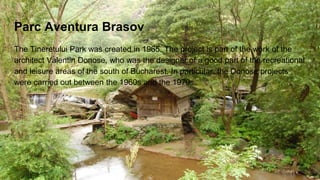
The Tineretului Park was created in 1965. The project is part of the work of the
architect Valentin Donose, who was the designer of a good part of the recreational
and leisure areas of the south of Bucharest. In particular, the Donose projects
were carried out between the 1960s and the 1970s.

The myth%2 flegend%2ffolktale.

  • 1.
  • 2.
    MYTH OF RUMANIA DRACULA Dueto some novels and film versions of Dracula, many people think that Stoker based his character on a historical figure: Vlad Tepes, or Vlad "the Impaler", and on vampire legends circulating in Eastern Europe. But in fact Vlad lived in the fifteenth century and was Prince of Wallachia, (which together with Moldova and Transylvania became the kingdom of Romania). From a very young age, Vlad III showed a morbid fascination for the dungeons of his father's castle. He is a hero in his land, by the fierce resistance that opposed the advance of the Ottomans. However, he was extremely cruel to his enemies, whom he condemned to capital imprisonment. It tells the story, and in fact there are engravings that support it, that Vlad the Impaler threw in a bowl the blood of its victims and wet in it the bread while it ate. The term Dracula derives from the Romanian "dracula", meaning "son of Drácul", name with which his father was known, that integrated of the Order of the Dragon, founded by the king Sigismund I of Luxembourg, and whose attire was a layer Black, then popularized in the movies. In turn, the Romanian term "drácul" means "devil", but in the sense that here we translate by "phenomenon" or "expert" in something. In modern Romania, Bran Castle and the region in which this character lived are today a major tourist destination.
  • 3.
    LEGEND OF RUMANIA THESCHOLOMANCE OF THE DEVIL According to the legend, the Scholomance was a school of black magic led by the Devil, supposedly located near an unnamed lake, in the mountains south of the city of Hermanstadt (Nagyszeben in Hungarian, now called Sibiu in Romanian) in Transylvania . The Dracula were, according to Arminius, a noble and great race, although from time to time there were offshoots of which their contemporaries suspected that they had had pacts with the Devil. They learned their secrets in the Scholomance between the mountains surrounding Lake Hermanstadt, where the devil has a disciple of every ten inhabitants.
  • 4.
    Parc Aventura Brasov TheTineretului Park was created in 1965. The project is part of the work of the architect Valentin Donose, who was the designer of a good part of the recreational and leisure areas of the south of Bucharest. In particular, the Donose projects were carried out between the 1960s and the 1970s.