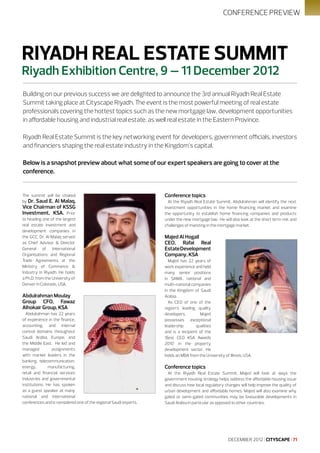
PHASE ONE

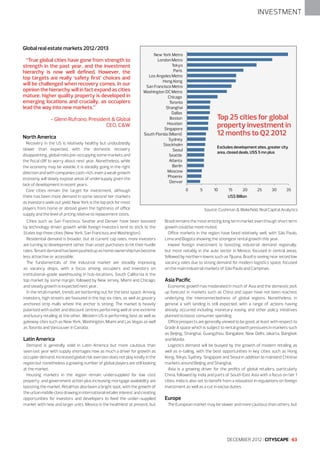
SOLD OUT

Register online @ www.mnhd.com or call us on
Egypt
UAE
KSA

16750
800 02000 369
800 8200 368

Visit our new sales center:
Extension of Thawra st.,
Suez Road & Ring Road Intersection, Cairo, Egypt
DECEMBER 2012

THE CITYSCAPE
ANNUAL REAL
ESTATE REVIEW
Our comprehensive
review of the real
estate markets of
the UAE, Qatar, Egypt,
Saudi Arabia and Turkey
reveals positive growth
for the entire region.

SPECIAL FOCUS:
SOUTH AFRICA
Africa’s economic
powerhouse stands out
as an internationally
preferred location
for doing business
due to its undoubted
growth opportunities.

GLOBAL
INVESTMENT
OUTLOOK 2013

Licensed by
International Media Production Zone

Who are the winning
cities in today’s
international real estate
investment market?
We highlight this year’s
top markets and take a
look at the year ahead.

SPECIAL
SUPPLEMENT:
INVEST IN RUSSIA
Investment overview
Tourism
Retail
Russia & the UAE
CALENDAR OF EVENTS
Jeddah

Jeddah Centre for Forums and Events, Jeddah, Saudi Arabia

2 ~ 4 March 2013

Egypt

Cairo International Convention and Exhibition Center, Cairo, Egypt

28 ~ 31 March 2013

Abu Dhabi

Abu Dhabi National Exhibition Centre, Abu Dhabi, UAE

16 ~ 18 April 2013

Qatar

Doha Exhibition Centre, Doha, Qatar

27 ~ 29 May 2013

Asia

Shanghai Convention Center, Shanghai, China

4 ~ 6 September 2013

Latin America

Amcham Business Center, Sao Paulo, Brazil

1 ~ 3 October 2013

Global

Dubai International Convention & Exhibition Centre, Dubai, UAE

8 ~ 10 October 2013

Riyadh

Riyadh International Exhibition Centre, Riyadh, Saudi Arabia

8 ~ 10 December 2013

Your Guide To

Emerging Real Estate Markets
www.cityscape.org
Hyde Park Properties for Development is a leading developer of integrated mixed-use
developments, with a unique vision to create truly world class communities that contain
within their boundaries every service and amenity a modern resident aspires.
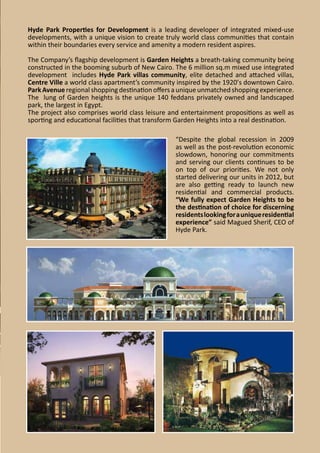
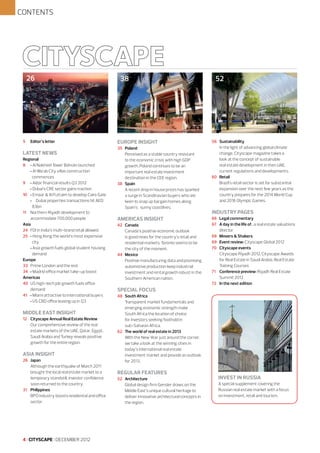
The Company’s flagship development is Garden Heights a breath-taking community being
constructed in the booming suburb of New Cairo. The 6 million sq.m mixed use integrated
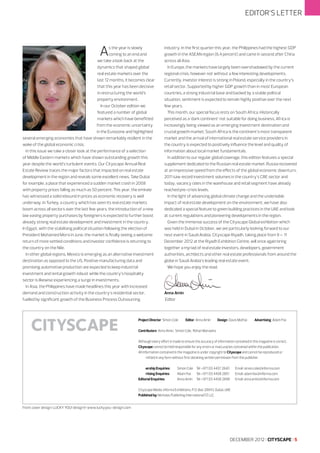
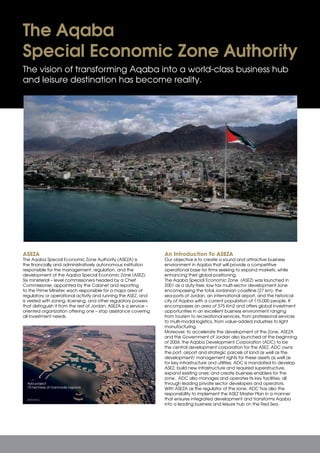
development includes Hyde Park villas community, elite detached and attached villas,
Centre Ville a world class apartment’s community inspired by the 1920’s downtown Cairo.
Park Avenue regional shopping destination offers a unique unmatched shopping experience.
The lung of Garden heights is the unique 140 feddans privately owned and landscaped
park, the largest in Egypt.
The project also comprises world class leisure and entertainment propositions as well as
sporting and educational facilities that transform Garden Heights into a real destination.
“Despite the global recession in 2009
as well as the post-revolution economic
slowdown, honoring our commitments
and serving our clients continues to be
on top of our priorities. We not only
started delivering our units in 2012, but
are also getting ready to launch new
residential and commercial products.
“We fully expect Garden Heights to be
the destination of choice for discerning
residents looking for a unique residential
experience” said Magued Sherif, CEO of
Hyde Park.
CONTENTS

26

5	

Editor’s letter

LATEST NEWS
Regional
8	 • Al Nakheel Tower Bahrain launched
	
• Al Wa’ab City villas construction 		
	
commences
9	 • Aldar financial results Q3 2012
	
• Dubai’s CRE sector gains traction
10	 • Emaar & Al Futtaim to develop Cairo Gate
	 • Dubai properties transactions hit AED 	
	
83bn
11	 Northern Riyadh development to 		
	
accommodate 700,000 people
Asia
24	 FDI in India’s multi-brand retail allowed
25	 • Hong Kong the world’s most expensive 	
	
city
	
• Asia growth fuels global student housing 	
	
demand
Europe
33	 Prime London and the rest
34	 • Madrid office market take-up boost
Americas
40	 US high-tech job growth fuels office 		
	demand
41	 • Miami attractive to international buyers
	
• US CBD office leasing up in Q3
	

MIDDLE EAST INSIGHT
12	


Cityscape Annual Real Estate Review
Our comprehensive review of the real 		
estate markets of the UAE, Qatar, Egypt, 	
Saudi Arabia and Turkey reveals positive 	
growth for the entire region.

ASIA INSIGHT
26	 Japan
	
Although the earthquake of March 2011 	
	
brought the local real estate market to a 	
	
temporary standstill, investor confidence 	
	
soon returned to the country.
31	 Philippines
	
BPO industry boosts residential and office 	
	sector.

4 I CITYSCAPE I DECEMBER 2012

38

EUROPE INSIGHT
35	Poland
	
Perceived as a stable country resistant 	
	
to the economic crisis with high GDP 		
	
growth, Poland continues to be an 		
	
important real estate investment 		
	
destination in the CEE region.
38	 Spain
	
A recent drop in house prices has sparked
	
a surge in Scandinavian buyers who are 	
	
keen to snap up bargain homes along
	
Spain’s sunny coastlines.

AMERICAS INSIGHT
42	


44	


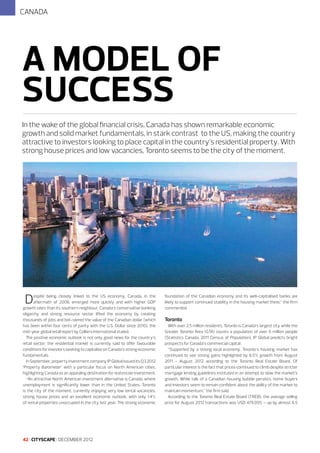
Canada
Canada’s positive economic outlook 		
is good news for the country’s retail and 	
residential markets; Toronto seems to be 	
the city of the moment.
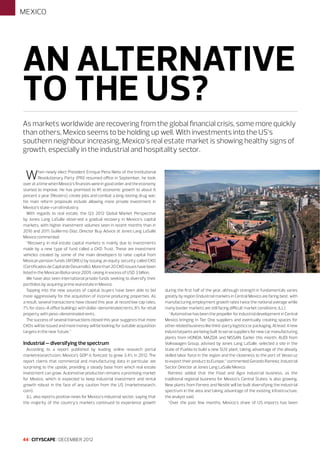
Mexico
Positive manufacturing data and promising 	
automotive production keep industrial
investment and rental growth robust in the 	
Southern American nation.

52

56	


60	


Sustainability
In the light of advancing global climate 		
change, Cityscape magazine takes a 		
look at the concept of sustainable 		
real estate development in then UAE, 		
current regulations and developments.
Retail
Brazil’s retail sector is set for substantial 	
expansion over the next few years as the 	
country prepares for the 2014 World Cup 	
and 2016 Olympic Games.

INDUSTRY PAGES
66	 Legal commentary
67	 A day in the life of…a real estate valuations 	
	director
68	 Movers & Shakers
69	 Event review: Cityscape Global 2012
70	 Cityscape events
	
Cityscape Riyadh 2012, Cityscape Awards 	
	
for Real Estate in Saudi Arabia, Real Estate 	
	
Training Courses
71	 Conference preview: Riyadh Real Estate 	
	
Summit 2012
72	 In the next edition

SPECIAL FOCUS
48	


62	


South Africa
Transparent market fundamentals and 		
emerging economic strength make 		
South Africa the location of choice 		
for investors seeking foothold in 		
sub-Saharan Africa.
The world of real estate in 2013
With the New Year just around the corner, 	
we take a look at the winning cities in 		
today’s international real estate 		
investment market and provide an outlook 	
for 2013.

REGULAR FEATURES
52	


Architecture
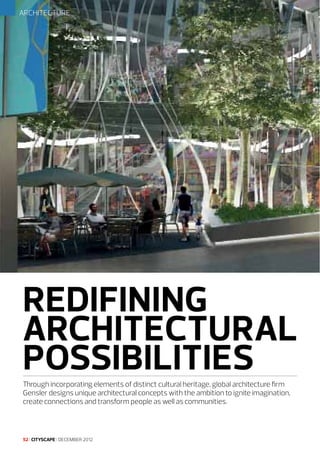
Global design firm Gensler draws on the 	
Middle East’s unique cultural heritage to 	
deliver innovative architectural concepts in 	
the region.

Invest in Russia
A special supplement covering the
Russian real estate market with a focus
on investment, retail and tourism.
EDITOR’S LETTER

A

s the year is slowly
coming to an end and
we take a look back at the
dynamics that shaped global
real estate markets over the
last 12 months, it becomes clear
that this year has been decisive
in restructuring the world’s
property environment.
In our October edition we
featured a number of global
markets which have benefitted
from the economic uncertainty
in the Eurozone and highlighted
several emerging economies that have shown remarkably resilient in the
wake of the global economic crisis.
In this issue we take a closer look at the performance of a selection
of Middle Eastern markets which have shown outstanding growth this
year despite the world’s turbulent events. Our Cityscape Annual Real
Estate Review traces the major factors that impacted on real estate
development in the region and reveals some excellent news. Take Dubai
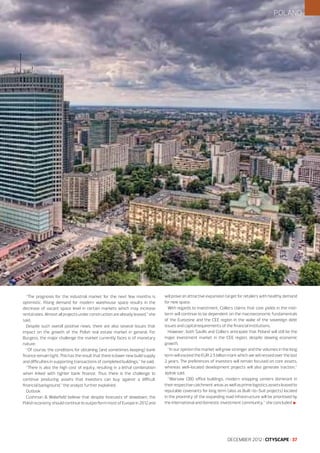
for example, a place that experienced a sudden market crash in 2008
with property prices falling as much as 50 percent. This year, the emirate
has witnessed a solid rebound in prices as economic recovery is well
underway. In Turkey, a country which has seen its real estate markets
boom across all sectors over the last few years, the introduction of a new
law easing property purchases by foreigners is expected to further boost
already strong real estate development and investment in the country.
In Egypt, with the stabilising political situation following the election of
President Mohamed Morsi in June, the market is finally seeing a welcome
return of more settled conditions and investor confidence is returning to
the country on the Nile.
In other global regions, Mexico is emerging as an alternative investment
destination as opposed to the US. Positive manufacturing data and
promising automotive production are expected to keep industrial
investment and rental growth robust while the country’s hospitality
sector is likewise experiencing a surge in investments.
In Asia, the Philippines have made headlines this year with increased
demand and construction activity in the country’s residential sector,
fuelled by significant growth of the Business Process Outsourcing

industry. In the first quarter this year, the Philippines had the highest GDP
growth in the ASEAN region (6.4 percent) and came in second after China
across all Asia.
In Europe, the markets have largely been overshadowed by the current
regional crisis, however not without a few interesting developments.
Currently, investor interest is strong in Poland, especially in the country’s
retail sector. Supported by higher GDP growth than in most European
countries, a strong industrial base and backed by a stable political
situation, sentiment is expected to remain highly positive over the next
few years.
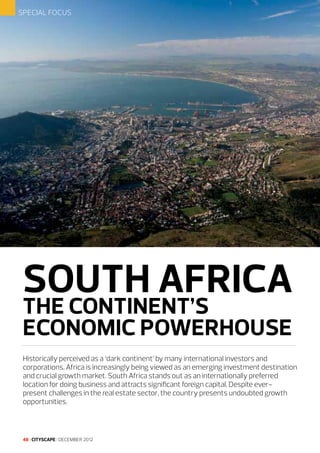
This month, our special focus rests on South Africa. Historically
perceived as a ‘dark continent’ not suitable for doing business, Africa is
increasingly being viewed as an emerging investment destination and
crucial growth market. South Africa is the continent’s most transparent
market and the arrival of international real estate service providers in
the country is expected to positively influence the level and quality of
information about local market fundamentals.
In addition to our regular global coverage, this edition features a special
supplement dedicated to the Russian real estate market. Russia recovered
at an impressive speed from the effects of the global economic downturn;
2011 saw record investment volumes in the country’s CRE sector and
today, vacancy rates in the warehouse and retail segment have already
reached pre-crisis levels.
In the light of advancing global climate change and the undeniable
impact of real estate development on the environment, we have also
dedicated a special feature to green building practices in the UAE and look
at current regulations and pioneering developments in the region.
Given the immense success of the Cityscape Global exhibition which
was held in Dubai in October, we are particularly looking forward to our
next event in Saudi Arabia. Cityscape Riyadh, taking place from 9 – 11
December 2012 at the Riyadh Exhibition Centre, will once again bring
together a myriad of real estate investors, developers, government
authorities, architects and other real estate professionals from around the
globe in Saudi Arabia’s leading real estate event.
We hope you enjoy the read.

Anna Amin
Editor

Project Director Simon Cole

Editor Anna Amin

Design Davis Mathai 	

Advertising Adam Fox

Contributors Anna Amin, Simon Cole, Rohan Marwaha
Although every effort is made to ensure the accuracy of information contained in this magazine is correct,
Cityscape cannot be held responsible for any errors or inaccuracies contained within the publication.
All information contained in the magazine is under copyright to Cityscape and cannot be reproduced or
transmitted in any form without first obtaining written permission from the publisher.
Partnership Enquiries: 	
Advertising Enquiries: 	
Editorial Enquiries:	

Simon Cole 	 Tel: +971 (0) 4407 2640	
Adam Fox 	 Tel: +971 (0) 4408 2801	
Anna Amin	 Tel: +971 (0) 4408 2898	

Email: simon.cole@informa.com
Email: adam.fox@informa.com
Email: anna.amin@informa.com

Cityscape Media, Informa Exhibitions, P.O. Box 28943, Dubai, UAE
Published by: Nicholas Publishing International FZ LLC
Front cover design: LUCKY YOU! design® www.luckyyou-design.com

DECEMBER 2012 I CITYSCAPE I 5
The Aqaba
Special Economic Zone Authority
The vision of transforming Aqaba into a world-class business hub
and leisure destination has become reality.

ASEZA

The Aqaba Special Economic Zone Authority (ASEZA) is
the financially and administratively autonomous institution
responsible for the management, regulation, and the
development of the Aqaba Special Economic Zone (ASEZ).
Six ministerial – level commissioners headed by a Chief
Commissioner, appointed by the Cabinet and reporting
to the Prime Minister, each responsible for a major area of
regulatory or operational activity and running the ASEZ, and
is vested with zoning, licensing, and other regulatory powers
that distinguish it from the rest of Jordan. ASEZA is a service –
oriented organization offering one – stop assistance covering
all investment needs.

Ayla project
75 hectares of manmade lagoons

An Introduction To ASEZA

Our objective is to create a sound and attractive business
environment in Aqaba that will provide a competitive
operational base for firms seeking to expand markets, while
enhancing their global positioning.
The Aqaba Special Economic Zone (ASEZ) was launched in
2001 as a duty-free, low tax multi-sector development zone
encompassing the total Jordanian coastline (27 km), the
sea-ports of Jordan, an international airport, and the historical
city of Aqaba with a current population of 115,000 people. It
encompasses an area of 375 Km2 and offers global investment
opportunities in an excellent business environment ranging
from tourism to recreational services, from professional services
to multi-modal logistics, from value-added industries to light
manufacturing.
Moreover, to accelerate the development of the Zone, ASEZA
and the Government of Jordan also launched at the beginning
of 2004, the Aqaba Development Corporation (ADC) to be
the central development corporation for the ASEZ. ADC owns
the port, airport and strategic parcels of land as well as the
development/ management rights for these assets as well as
for key infrastructure and utilities. ADC is mandated to develop
ASEZ; build new infrastructure and required superstructure,
expand existing ones; and create business enablers for the
zone. ADC also manages and operates its key facilities; all
through leading private sector developers and operators.
With ASEZA as the regulator of the zone, ADC has also the
responsibility to implement the ASEZ Master Plan in a manner
that ensures integrated development and transforms Aqaba
into a leading business and leisure hub on the Red Sea.
ADVERTORIAL

Marsa Zayed Project

Leisure Destination

Aqaba is a naturally attractive tourism destination. Its most
precious coral reefs and unique marine environment make it a
must for divers and those who enjoy water sports. Furthermore,
its proximity to Petra and the beautiful landscape of Wadi Rum
(Jordan Golden Triangle) makes it a convenient and relaxing
stop on visitors’ itineraries. Aqaba Special Economic Zone
Authority (ASEZA), fully realize Aqaba’s potential and have
anticipated in the master plan that no less 50% of investment
will take place in the tourism sector

Investments attraction

• 375 SQKM of investment opportunities within a duty-free
zone ranging from tourism to recreational activities, from
professional services to multimodal logistics, and from value
added industries to manufacturing.
• Ability to expand markets in the Middle East & North Africa
region (Gateway into Levant and the wider Middle East and
connecting GCC with the Levant and North Africa).
• A major trade hub and corridor for the reconstruction efforts
in Iraq.
• Ability to create pools of multinational work teams.
• Ability to penetrate existing/new markets in a preferential
manner (Free Trade access to the EU, US, Singapore and most
Arab Countries and WTO member)
• Multi-modal transport hub whereby investors/traders can
bring goods & passengers by land, air or sea
• Hub for regional distribution with free zone storage with full
service seaports that handle all kinds of cargoes and an
international airport which operates under an open skies
policy.
• Serviced land/facilities for light / medium manufacturing,
warehousing, residential and commercial uses.

Saraya Aqaba Master Plan

Benefits of Doing Business in the ASEZ:
The ASEZ enjoys a special fiscal regime, which is much milder
than that of the rest of Jordan; any “Registered Enterprise”
status in the zone confers the following benefits:
• 5% income tax on income generated from activities inside
the ASEZ or outside Jordan except for banking, insurance and
land transport services.
• Exemption form sales tax on final consumption of goods and
services, except for:
o 7% sales tax limited to final consumption of selected
goods
o 7% sales tax on hotel, restaurant and car rental services
o Special variable tax on alcohol and tobacco
o 7% tax on cement and steel for construction purposes
• Duty-free import of goods in commercial quantities from the
National Customs Territory and overseas (except cars)
• Exemption from Social Service Tax
• Exemption from Sales Tax on vast majority of goods and
services
• Exemption from annual land and building taxes on utilized
property
• Exemption from taxes on distribution of dividends and profits
on activities in the ASEZ and outside Jordan.
• No foreign equity restrictions on investment in tourism, industry,
retail, and other commercial services (100% foreign ownership
allowed)
• No tariffs or import taxes on imported goods for individual
consumption and Registered Enterprises
• No foreign currency restrictions and full repatriation of profits
and capital
• Streamlined labor and immigration procedures (a project
may employ up to 70% in foreign labor as an automatic right)
REGIONAL NEWS

Al Nakheel Tower Bahrain reaches
40% occupancy just three months
after completion

E

arlier this month, Cluttons announced the successful launch of Al Nakheel Tower
in Manama, Bahrain, as demonstrated by high occupancy levels of 40%, just three
months after completion, with further space currently under negotiation.
The building, located in the Seef District, was handed over in August 2012 and comprises
of over 5,600 sqm of commercial space. It has established itself quickly as the address
of choice for a number of leading international firms, including Bahrain International
Medicine, Majali Enterprises, Grant Thornton and Qatar Airways. Further discussions for
increased space are underway with a selection of other potential tenants.
Al Nakheel Tower has proven attractive to tenants due to its combination of competitive
rates, option of fitted out space, flexible floor plates, quality finishing, a well-calculated
car parking ratio including 120 car parking spaces and professional property management
by Cluttons in Bahrain. In addition, the Seef District has established itself as a highly
desirable office location due to its combination of easy access and good parking, which
adds further to the popularity of Al Nakheel Tower.
Harry Goodson-Wickes, head of country for Cluttons in Bahrain commented: “I’m very
pleased that Cluttons has been appointed to manage the Al Nakheel Tower. This type of
prestigious, well serviced development with a range of amenities is just what the current
market demands and both the tenants and landlords will benefit from our dedicated
property management expertise. There is such a strong appetite for this type of tower
that we’ve managed to let almost half the available space within a matter of weeks from
completion. We expect demand from tenants to continue to grow.”

QATAR’S Al Wa’ab City celebrates the
commencement of construction for
Deluxe Villas

A

l Wa’ab City, one of the largest privately owned real estate developments in Qatar, last month
has officially announced the re-launch of construction works for both Nour Al Wa’ab and
Janayin Al Wa’ab Villas.
As of October 1st, main contractor Arabtec started remobilisation and has resumed full
construction work by the first of November 2012. Al Wa’ab City expects to deliver the first set of
fully fitted villas by July 2013.
Commenting on the announcement, Sheikha Hanadi Bint Nasser Al Thani, CEO of Al Wa’ab City
said: “We are very pleased to announce this ground-breaking milestone towards project completion.
After completing Al Wa’ab showrooms and launching of Al Wa’ab offices, the delivery of the villas
represents Al Wa’ab City’s commitment towards the full vision of the project to create lifestyle
senses where life is celebrated at its fullest. This step reflects the company’s growing stature as a
credible business partner and a key player in Qatar’s economic diversification strategy. With strengthened rejuvenation, we renew our commitment
to provide viable quality propositions of genuine value to Al Wa’ab residents, clients and partners.”
As of now, the company started receiving individual and corporate requests for residential leasing and sales opportunities at Al Wa’ab City. The
prime investment value is inherent in the villas’ high standards that are set in exclusive gated communities, inspired by Qatari architecture, designed
with contemporary quality finishes, and complemented with high-end amenities.
Nour A Waab Villas consist of 92 villas, with an area of 850 square metres each, with high quality finishes, fixtures and fittings, 5 master bedrooms,
internal elevators, 3 car garages along with a private garden and a swimming pool. Nour Al Wa`ab private villas sit within secure, gated communities
and are inspired by thoughtful Arabian architecture complemented by contemporary high-end finishes.
Janayin Al Wa’ab Villas consist of 181 distinct 4 bedrooms villas, with an area of 450 square metres each, 2 car garages, offering a contemporary
living environment with a subtle hint of Arabian architecture while encompassing quality finishes. Set amidst landscaped surroundings, the Janayin
Al Wa`ab homes are the perfect setting for families to thrive within a secure, well-maintained environment, complemented by neighborhood facilities
such as clubhouses, swimming pools, sports courts and children`s play areas.
All villas will be maintained via the Al Wa`ab City facilities management service. Al Wa’ab City is planning to fully deliver the entire 273 villas within
2 years from today along with all recreational amenities.

8 I CITYSCAPE I DECEMBER 2012
REGIONAL NEWS

Aldar reports strong financial results for third
quarter of 2012

A

t the beginning of this month, Aldar Properties PJSC, one of
Abu Dhabi›s leading property development, investment and
management companies, announced strong financial results for the
third quarter of 2012 with revenue for the period of AED 1,604.5 million
(Q3 2011: AED 3,132.9 million) and net profit of AED 205.7 million up 43%
from AED 144.0 million during the same period last year. Revenues were
driven mainly by the delivery and handover of 132 residential units, and
25 land plots at Al Raha Beach.
The company continues to have strong ongoing revenue and cash
flow visibility with AED 12.0 billion cash still to be received, and AED
2.6 billion of revenue still to be recognised from land sales at Al Raha
Beach, following the three main asset sale agreements signed with the
Government of Abu Dhabi between 2009 and 2011.
Recurring revenues from investment properties and operating
businesses were up 8% to AED 306.0 million in the third quarter (Q3
2011: AED 282.9 million) and broke through the AED 1.0 billion mark
over the first nine months of the year. These were driven by increased
occupancy year-on-year from the office portfolio, notably HQ, and
maturing retail operations, in particular Gardens Plaza and IKEA.
Aldar has ample working capital and liquidity to deliver on its business
plan. At the end of the period, free cash balances were AED 888.2
million, in addition to available and undrawn liquidity of AED 3.2 billion
through revolving credit facility agreed earlier in the year.

The company’s ongoing programme of debt reduction followed a
normal schedule of repayments during the quarter with AED 63.4
million repaid. A further AED 309.4 million will be retired on schedule in
Q4. Aldar’s total borrowings stood at AED 14,429.3 million compared to
AED 18,295.5 million as of 31 December 2011.
As a result of the recent detailed valuation exercise relating to
the potential merger with Sorouh Real Estate PJSC, the company
has updated the valuation of certain of its assets to reflect current
conditions. The company has therefore elected to write down the value
of its assets by a net amount of AED 737.1 million reflecting principally
impairments to its hotel assets that are partially offset by fair value
gains on Yas Mall. As a further result of the valuation exercise, the
Company has written back AED 431.5 million of excess accruals and
recoverable costs, which had been written off in previous periods.
Ali Eid AlMheiri, Chairman of Aldar Properties commented:
“We are pleased to see that Aldar’s communities are starting to
thrive as more customers occupy our developments. We are proud
of our contribution to Abu Dhabi’s ongoing growth and that our
established delivery record continues to produce stable cashflows
and profits for our shareholders. We have moved from strength
to strength – both financially and operationally – and remain well
positioned to execute our business plan and confirm our position as
Abu Dhabi’s premier developer.”

Dubai’s commercial real
estate sector gains traction
in third quarter of 2012

P

remier property services company Hamptons MENA has highlighted
that commercial real estate in Dubai has gained traction in the third
quarter (July to September) of 2012.
Recording robust growth in commercial leasing deals and enquiries since
the beginning of the third quarter, Hamptons MENA reports an increase
in demand for office space in areas such as Downtown Dubai and Dubai
International Financial Centre (DIFC).
Among the key drivers of demand for commercial real estate are factors such as large corporations continuing to show interest in upgrading their
premises with more flexibility in terms of leases, and limited new supply entering the market.
“Large investors have started to draw their attention to the UAE’s property market, in particular the Dubai commercial property market as a source
of stable returns,” said Niraj Masand, Head of Operations, Hamptons MENA. “Investors are more interested in buying commercial property that is
currently occupied by tenants as a source of definitive returns on their investment.”
“The growth trend of the commercial sector is a strong demonstration of Dubai’s positive growth across all sectors of its economy. The city is
underlining its credentials as a tourism and business hub, and this is reflected in the strong demand for commercial space,” he added.
Central business districts such as Downtown Dubai and DIFC have limited supply of single ownership space prompting companies to start looking
at built to suit options. In line with global trends, occupier consolidation and portfolio optimisation remain the key focus in Dubai. Short term annual
renewable leases have been replaced with long-term leases often in excess of three years, offering more security and consistency to both the
tenant and the landlord.
New commercial developments such as Emaar’s Boulevard Plaza in Downtown Dubai records strong demand, according to Hamptons MENA. High quality
commercial towers such as Currency House 2 in DIFC, Emaar Square and The H Dubai Office Tower on Sheikh Zayed Road welcomed new occupiers.
With restrictions on free zone businesses becoming less stringent and licensing made easier, a number of companies are taking advantage and
relocating to offshore (free zone) areas. This has led to multinationals looking to rent commercial property.
Earlier this year Dubai Economic Department (DED) had announced that it would implement a ‘120-days hassle-free license’ initiative, aimed to
give businesses in Dubai a head start and promote the emirate’s competitiveness, by the end of 2012. The new initiative will allow investors to have
their licenses issued immediately from DED depending on the risk factors of the intended business activity. This, in turn, is expected to further drive
demand for commercial real estate in Dubai.

DECEMBER 2012 I CITYSCAPE I 9
REGIONAL NEWS

Dubai Properties
transactions hit AED 83
billion in 9 months

S

Emaar and Al-Futtaim join forces
to develop EGP 5 billion Cairo Gate

A

l-Futtaim Group and Emaar, the two UAE based international real
estate giants, last month announced an initial intention to enter into
an EGP 5 billion joint venture agreement to develop ‘Cairo Gate’, the largest
lifestyle and entertainment development on an Emaar Misr property of
160 acres of prime land on the Cairo- Alexandria desert highway.
Cairo Gate will not only cater to discerning shoppers from Egypt and
the world over, but also to those who appreciate a trendy lifestyle that
has come of age. While the mega shopping mall will be the centerpiece of
the development, Cairo Gate will be complemented by an office park with
world-class facilities including a luxury hotel, schools, medical facilities
and residences ranging from townhouses to villas and apartments.
Mr. Mohamed Alabbar, Chairman of Emaar Properties PJSC, said “We
are proud of this partnership which will add tremendous value to the real
estate and retail industry sectors at large, and we look forward to working
together with Al-Futtaim Group and realising the full potential of this
venture.”
Commenting on the prospects of the Egyptian market, he added, “As
we boost our continued development portfolio in the Egyptian market we
also demonstrate our belief in Egypt, its economy and its people”.
The first phase of Cairo Gate development will comprise a mall with a
gross leasable area of 120,000 sqm, and will be anchored by Al-Futtaim’s
retail brands such as IKEA, Marks & Spencer, Toys ‘R’ Us, ACE, Intersport,
Guess, Esprit as well as a multitude of additional world-class shopping
brands apart from restaurants, cafés and leisure outlets with a strong
outdoor theme.
Mr Omar Al-Futtaim, Vice Chairman and Group CEO said: “This
agreement represents a significant and long-term partnership between
Al-Futtaim Group and Emaar who are on a new path for growth in Egypt.
The agreement demonstrates our confidence in the Egyptian economy
and will raise Egypt’s profile as a nation focused on innovation, excellence,
and dynamic sustainable development in the retail and real estate sectors.
Our Cairo Festival City development is already making strong headway in
establishing Egypt as Centrepoint for the North African retail industry.
The joint venture will further demonstrate our firm commitment to not
only enhance Egypt’s development, but amplify the country’s leadership
positioning within the regional and global economy.”
Mr Al-Futtaim added: “This is clear evidence to our positive view on the
Egyptian economy and we are confident of the investor-friendly direction
of the Egyptian Government especially in resolving any investors’
disputes.”
Cairo Gate has a frontage of one kilometre along the Cairo-Alexandria
Desert Road near the Smart Village commercial precinct, and will
complement the residential, hospitality and commercial components
of Emaar Misr’s development. The primary catchment areas including 6
October City and Giza have a population of over six million residents.

10 I CITYSCAPE I DECEMBER 2012

ultan Butti Bin Mejrin, Director General of the Dubai Land
Department (DLD) announced last month that the total value of
property transactions in Dubai reached more than AED 83 billion in the
first 9 months of 2012.
The transactions were documented officially by the DLD’s Real
Estate Development Department and consisted of 27,452 transactions
dominated by sale and mortgage, and fewer number of usufruct
rights registration (Musataha), donations and other types of property
transactions.
The property transactions have become more mature and the
investors are now much more aware. The market offers multiplechoices and Dubai property sector showed high flexibility in dealing
with investors’ requirements and trends during the first 9 months,
most notably first time investors who seek to benefit from investment
opportunities that emerged due to price correction witnessed by the
market over the past two years, according to Bin Mejren.
He noted that the price indication took a upward trend during the past
few months due to the demand and purchase transactions of land, villas
and apartments in certain distinguished projects in Dubai.
The lion›s share of total transactions was dominated by sale with
20,925 transactions at the value of more than AED 43 billion. The sale
accounted for 52% of the total transactions in the first 9 months of this
year while mortgages accounted for 44% of the total transactions at
the value of AED 36.3 billion through 5,042 transactions.
The director general of DLD added that 1,485 transactions were
registered as usufruct rights (Musataha), donations and other types of
property transactions at the value of AED 3.7 billion which represented
4% of the total transactions. The 9 months results showed 65% of
transactions were on land sale and mortgage, while apartments’ sale
and mortgage exceeded the same transactions on buildings and villas
by 86%.
He noted that the total number of land sale and mortgage of all kinds
reached 5,488 transactions at more than AED 54 billion. There were
3,327 Land sale transactions of various types worth more than AED
20.5 billion, while land mortgage transactions were around 1,636 worth
more than AED 30.9 billion.
The total number of sale and mortgage transactions on buildings and
villas in the same period hits 1,451 transactions worth more than AED
4 billion, while the number of building sale reached 917 buildings worth
more than AED 2 billion. The total number of mortgage transactions on
buildings reached 487 building worth more than AED 1.6 billion.
The sale and mortgage on residential and commercial units reached
20,513 transactions valuing at around AED 25 billion whereas the sale
transactions on units reached 16,681 transactions worth AED 2 billion
while mortgage on other units reached 2919 at the value of AED 3.6 billion.
The vacant lands dominated the land transactions with 57% compared
to lands with properties built on them. The transactions on units exceed
those on buildings by 86%, according to Bin Mejren.
The DLD recorded Wadi Al Safa 5 as the most traded areas in term of
a number of land transactions with 403 transactions. Burj Khalifa tops
list of most traded areas in units terms with 3,305 sale transactions.
While in the land mortgage transactions, Al Barsha South First was the
most traded areas with 203 transactions whilst the Burj Khalifa saw
442 apartment mortgage transactions.
REGIONAL NEWS

Urban development projects in Northern Riyadh to
accommodate 700,000 people by 2030
Real estate investments in Northern Riyadh are expected to grow
stronger in line with the increasing focus across the region on residential
and urban development, according to a recent report released by Injaz
Development Co. The promising investment outlook coincides with
the newly enacted Saudi Real Estate Mortgage Law, which has been
introduced to provide funding for urban development projects across
Saudi Arabia and ultimately boost the Saudi economy.
The report has emphasised the importance of the Real Estate Mortgage
Law in sustaining the long term urban development initiatives being
undertaken in Northern Riyadh and across the country, particularly in
light of higher growth rates being observed in the real estate industry.
Industry analysts have further pointed out that the real estate mortgage
system will serve as a pillar for strategic Public Private Partnerships
(PPP) in the country. PPP has been recognised as a driving force behind
the growing number of residential and urban development projects
across the country, which are vital to address the burgeoning demand
for residential property, particularly with respect to the Kingdom’s fast
growing population of which 60 per cent are youth.
The report further pointed out that real estate development activities
have achieved positive growth overall across the country, with Northern
Riyadh’s real estate sector growing by 43.42 per cent, based on Jones
Lang LaSalle’s Riyadh Real Estate Market Performance Index Q2 2012,
triggering radical changes in its urban and real estate landscape. The
High Commission for the Development of Arriyadh (HCDA), on the other
hand, has announced major developments in Northern Riyadh following
the completion of several key infrastructure projects, including road
networks, residential facilities and hospitality developments. Some of
the latest projects that have been undertaken in Northern Riyadh include
the Prince Sultan Bin Abdulaziz Humanitarian City and the 3.2 square
kilometre Prince Salman Park in Banban.
As part of its commitment to promote Northern Riyadh as one of the
most attractive investment destinations worldwide, Injaz Development
Co. has been actively involved in projects that complement ongoing efforts
to achieve a well balanced, sustainable urban development. The Riyadhbased master developer and property investment firm has launched a
number of projects that support the urban development strategy being
implemented in Northern Riyadh. The urban development projects in the
region ultimately aim to accommodate the needs of its rapidly growing
population, which is expected to reach over 700,000 by 2030. Moreover,
it will create more job opportunities for residents and generate greater
economic contributions from the private sector.
Taking advantage of the favorable market conditions in Northern Riyadh,
Injaz has revealed plans to launch new projects in the region, including Al
Gamra 10, one of the four blocks in Al Gamra Project – a 2.5 million sqm
project with a strategic location in Northern Riyadh. With 403 land plots
spread over a total area of 566,000 sqm, Al Gamra 10 is an integrated
project offering ready-made residential, commercial and investment
building blocks that are specifically designed to meet the needs of
residents and businesses. The project will include infrastructure for
electricity, water, lighting and road networks, making it an ideal residential
destination in the region.
Omar Al-Kadi, CEO and Managing Director, Injaz Development Co.,
said: “The real estate boom in Saudi Arabia is mainly driven by the newly
introduced Real Estate Mortgage system, which is part of a five-point
system to generate real estate funding in the country. The favorable
market outlook as well as several other influential factors will stimulate

Omar Al-Kadi, CEO and Managing Director, Injaz Development Co.
urban development in Northern Riyadh, particularly in the development of
high quality residential properties of varying sizes. Moreover, we can also
expect the rapid development of other key amenities, including service
centers, integrated services, modern road networks and interactive public
transportation systems.”
“We expect a continued flow of investments for urban development
across Northern Riyadh in the foreseeable future to meet the demands
of the region’s growing population. The development of a central road
network within Northern Riyadh, along with a number of other vital
projects, including the King Abdullah Financial District and the Princess
Nora Bint Abdul Rahman University, will help reinforce the reputation of
Riyadh as a first class investment destination. In this regard, the Al Gamra
10 project is being undertaken to complement the government’s urban
development plans, as it will serve as a tool to generate more investments
in Northern Riyadh,” concluded Al-Kadi.

DECEMBER 2012 I CITYSCAPE I 11
Middle East

THE CITYSCAPE
ANNUAL 2012
MENA REAL ESTATE
REVIEW
Against a backdrop of volatility in the global property market, many emerging regions
including the Middle East have proven remarkably resilient to the economic crisis
and have emerged as favourable real estate investment destinations. The Cityscape
2012 Annual Review looks back at the performance of the markets of the UAE, Qatar,
Egypt, Saudi Arabia and Turkey and provides an outlook for 2013. Although market
fundamentals differ within the respective countries, the region as a whole is headed for
a promising future.

Introduction:

O

n a global level, sentiment and levels of activity in the world’s major
real estate markets experienced many ups and downs during the
first half of 2012. Although the second quarter saw a modest rebound in
investment and leasing turnover after a slow start to the year, economic
uncertainty continues to affect investor sentiment, the Jones Lang LaSalle
Global Market Perspective Q3 2012 observed. “Deals are taking longer to
close and the market remains polarised as investors steer clear of risky
assets, focusing instead on prime product in core markets like London,
Paris and New York,” the report said.
Amidst the global economic uncertainty and the deepening of the
Eurozone crisis, many emerging markets around the world, in particular
in the Middle East, have shown noticeable resilience and have gained
increasing attention as safe havens for international investors.
The UAE is probably the most striking example of healthy recovery in
2012 so far. Heavily hit by the financial crisis in 2008, Dubai’s property
prices had fallen as much as 50%. This year, property prices have bounced
back in key locations in the emirate and experts predict a bright future for
Dubai’s real estate market.
Qatar, the world’s richest country by per capita GDP has continued with
high economic growth, thanks to a rebound in oil prices and its massive
natural gas reserves. In 2012, the Gulf State has continued with massive

12 I CITYSCAPE I DECEMBER 2012

infrastructure and real estate developments in anticipation of the FIFA
2022 World Cup, which will transform Qatar’s real estate landscape.
In Egypt, the last months of this year have for the first time seen a
welcome return to more settled and stable conditions in the market.
Following the election of President Morsi in June, investor confidence has
begun returning to the market as the country regains political stability.
Saudi Arabia, as the Middle’s East’s largest economy, has introduced its
long awaited mortgage law this year which, if fully realised, will help combat
the lack of availability of housing for low to mid-low income earners and
encourage greater professionalism in the home building industry.
Finally, Turkey, which has seen its real estate markets boom across all
sectors in recent years, continues to attract significant interest from foreign
investors, which is further heighted by the introduction of the Reciprocity
Law that came into effect in May. The law lifts the condition of reciprocity
for private persons to buy property in Turkey and is expected to further
boost development and investment activity in the real estate market.
Following the immense success of the Cityscape Global exhibition, held
in Dubai in October this year, it becomes clear that emerging economies
around the world are shifting the dynamics of the global real estate
landscape and are gaining increasing attraction as real estate investment
destinations.
MIDDLE EAST

UNITED ARAB EMIRATES

DUBAI

After over three years of declining rents and limited sales activity, in 2012,
Dubai’s property marked has bounced back as rents and sales prices in the
emirate’s most sought after areas have increased. Supported by a steady
increase in tourist arrivals, investor confidence is returning to the market.
According to statistics complied by Dubai FDI, the foreign investment
office in the emirate›s Department of Economic Development (DED),
Dubai attracted AED 16.5 billion (USD 4.5 billion) in foreign direct investment
during the first six months of 2012, marking a 7% increase from the same
period last year. According to Dubai FDI, this increase reflects a heightened
confidence globally on the growth prospects across key sectors of the
emirate’s economy, including real estate.
According to the Dubai Land Department (DLD), Dubai property
transactions grew 21% to AED 63 billion (USD 17.15 billion) in the first
half of 2012, compared to Q3 and Q4 2011. Figures published by the
Dubai Government show that foreign investors buying real estate were
responsible for acquisitions of AED 28.3 billion (USD 7.7 billion) in the first
half of 2012, up 36% from the same period last year.
Niall McLoughlin, Senior Vice President of DAMAC Properties, commented:
“The Dubai property market has performed strongly throughout 2012
and we expect this growth to continue well into 2013. There is a mid to
long-term view of investment in Dubai’s property market now which
will see consistent growth in the coming years. This is a natural cycle for
a maturing real estate industry which will create many opportunities for
impressive returns in both rental income and capital gains, outstripping the
money markets.”
Looking at the residential sector, Jones Lang LaSalle (JLL) says that the
first half of 2012 has seen higher levels of residential sales activity and
the overall market is now considered to have bottomed out. According
to the firm, the recovery in prices is most pronounced in the villa sector
where sales prices have increased 21% in the year to May. With regards to
rental prices for quality residential developments, property management
company Asteco reports an average rental increase of 6% and 9% for
apartments and villas respectively (Q2 2012).
However, improvement in prices is largely confined to high-end products
in prime locations, with less established locations still experiencing
declines in both rents and prices.
“Luxury apartments have continued to drive the resurgence in Dubai’s
real estate market through 2012. Recent reports has valuations up nearly

14 I CITYSCAPE I DECEMBER 2012

Population: 8,264,070 (2010 estimate)
Capital City: Abu Dhabi
Largest City: Dubai
Currency: UAE dirham (AED)
GDP: $258.825 billion (2011 estimate)

5% and closing in on 2008 peak prices,” McLoughlin said.
“As liquidity returns to the market investors are looking to ensure they
have a well balanced portfolio and real estate is a key element of that.
As the market has matured and the speculators have moved out, mid to
long-term investors recognise the intrinsic value of real estate in Dubai. We
believe this steady growth will continue well into 2013.”
On the commercial side, although there has been no movement in office
sales and rental prices due to a lack of demand and transaction activity
throughout the most part of 2012 (Asteco), the outlook for investment
in the sector is nevertheless one of cautious optimism. According to real
estate specialist Cluttons, a surprising number of transactions were
recorded during the normally quiet summer months this year, totalling
AED 2 billion (USD 545 million), with major commercial deals taking place in
DIFC, TECOM and Downtown areas.
According to Cluttons, the hospitality sector has been enjoying sustained
occupancy levels and profitable room rates, boosted by Dubai’s ranking
as the world’s eighth most attractive tourist destination by MasterCard’s
Worldwide Index of Global Destination Cities.
McLoughlin agrees, adding that now is a good time to get into the
emirate’s luxury hotel market.
“Investors can see hotels in Dubai more than 80% full across the whole
year and RevPAR [Revenue Per Available Room] rates in excess of USD
100. Dubai’s hotel serviced apartments sector is currently under supplied
and this is the ideal opportunity for buyers to get into the luxury hotel
industry,” he said.
Looking at opportunities in Dubai’s residential real estate market in the
coming year, McLoughlin commented:
“We will see the biggest expansions in serviced apartments as
developers bring this relatively new investment opportunity into the Dubai
property market. Elsewhere, there will be a lot of work completed on Al
Khail Road and other developing areas. Where infrastructure is already in
place such as Sheikh Zayed Road, the Burj Area and Dubai Marina, luxury
properties are commanding a premium price.”
“Location and quality remain the two factors which people use to decide
where to live and these areas are currently attracting huge interest. Where
infrastructure is still under development, such as around the projects on
Al Khail Road, there are many opportunities available to investors. Prices in
Jumeirah Village Circle and IMPZ, for example, will increase dramatically in
the next couple of years and are great investments for the medium term,”
he concluded.

Dubai 2012 Highlights

• 	 Economic recovery well underway due to strong growth 	
•	
•

of key sectors such as tourism, commerce, retail, hospitality and
logistics
Residential property prices up for the first time in 3 years
Strong performance of the hotel sector due to an increase in
tourism, occupancy levels close to 80%
MIDDLE EAST

ABU DHABI

The development of the market in the UAE’s capital has been quite
different to that of its neighbour Dubai. Here, selective new prime
developments offering high quality finishes and amenities have generally
been able to sustain rental levels over the last quarter given strong levels
of demand (Asteco Q3 Abu Dhabi report).
Ahmed Al Fahim, Executive Director of Marketing, Communications, Sales
and Leasing at Tourism Development and Investment Company (TDIC),
a master developer of major tourism destinations and prime residential
projects in Abu Dhabi, commented:
“We are pleased to see that the property market has started to show
healthy signs of recovery during the year, which is evident through the
increased interest in TDIC’s residential offerings.”
TDIC has received high levels of interest for their top-end residential
projects, particularly in areas such as Saadiyat Island, a leisure, residential
and tourism hub expected to become the capital’s cultural centre.
However, the residential market is currently experiencing polarised
performance. Older buildings formerly considered prime have seen
vacancy levels increasing as tenants relocate to new developments,
leading to landlords reducing rents (Asteco).
Matthew Green, Head of Research UAE for CBRE Middle East, commented:
“The residential market in the capital will experience further rental
deflation over the next six months, although performance will be highly
polarised. Premium properties are expected to hold quite firm on rents,
with secondary locations off-island forecast to see a more pronounced dip
in rates as occupiers continue to upscale amidst greater affordability.”
In addition to the increased demand in prime property, recent legislative
changes may also impact on the shape of the emirate’s residential
landscape. The Abu Dhabi government is implementing new regulations
with regards to linking the renewal of residency visas with accommodation
arrangements, which is expected to have an impact on the residential
market with an increase in demand for mid- to low budget apartments in
the centre of the capital (Asteco).
On the whole, the Abu Dhabi market started the year in quite subdued
fashion and this trend has continued throughout the rest of the year with
weak occupier demand prevailing, Green commented.

“The emirate is experiencing a sustained period of downward rental
pressures as supply and demand imbalances persist within segments of
the residential and office sectors.
Significant new supply has been delivered over the course of the year
across virtually every asset class. This has heightened already competitive
leasing conditions, emphasising the tenant led market scenario,” Green
said.
While leasing in the commercial sector has continued to improve with
tenants taking advantage of the availability of higher quality office space
and attractive lease terms (Asteco Q3 report), secondary and inferior
office products continue to suffer from widespread rental deflation which
has averaged 8% since the start of 2012, the CBRE Q2 2012 Abu Dhabi
Marketview said.
According to Green, the retail sector currently seems to be showing the
most stability despite the fact that a considerable amount of new supply
will be delivered to the market over the next four years. Depending on the
pace of ongoing construction works, total retail supply could potentially be
doubling by 2015, he said.
TDIC also commented that during 2012, the residential and retail sectors
have been very appealing to various types of investors, prospective
tenants and homeowners. “There’s a strong appetite for residential
developments across Abu Dhabi especially for those who are looking for
unparalleled quality of homes and prominent locations,” Al Fahim said.
The company says it has already leased out 98 percent of its apartments
at The Residences at The St. Regis Saadiyat, sold out 80 percent of its
high-end luxury Saadiyat Beach Villas and leased out 75 percent of its
first phase of luxury Eastern Mangroves Residences within a month of its
launch.
Looking ahead, TDIC is optimistic about the emirate’s residential market
performance:
“The property market has started to show healthy signs of recovery
during the year and we anticipate that the residential market keeps
the same momentum hopefully next year. We believe that [distinctive
properties] will remain attractive to a wide range of prospective
homeowners and tenants in 2013, whilst offering unparalleled high quality
homes and flexible financing options,” Al Fahim said.
As for the future performance of Abu Dhabi’s real estate market on the
whole, Green commented:
“The market is likely to remain constrained amidst ongoing demand and
supply imbalances brought about by the influx of new inventory. Greater
stability may start to be felt towards the end of 2013, as the impact of
recent Government legislation changes start to take effect.”

Abu Dhabi 2012 Highlights

•	 Market tenant favorable across all asset classes
• 	 Residential market continued to see sale price and rent declines
• 	 New hotel supply in Q4 expected to put downward pressure on
Average Daily Rates

DECEMBER 2012 I CITYSCAPE I 15
MIDDLE EAST

QATAR

OATAR

Qatar has prospered in the last few years with continued high real GDP
growth, making it the world’s fastest growing economy in 2010. This year,
the Gulf State was named the world’s richest country by Forbes magazine,
with an average annual per capita income exceeding USD 88,000.
Although the country felt the delayed impact of the global financial crisis,
Qatar has weathered the global downturn better than many economies
around the world.
Dr. Bassim Halaby, CEO Benchmark International, Al Wa’ab City Executive
Management commented:
“The delayed impact was relatively mild when compared with other GCC
countries such as the UAE, with several factors contributing to Qatar’s
resilience; from the announcement of the Qatar National Vision (QNV)
2030 in the same year, to the surplus liquidity from rising oil prices in 2009,
to the successful bid to host the World Cup 2022 in 2010, and finally to the
announcement of the National Development Strategy (NDS) in 2011. Real
estate recovery was not only inevitable but a more sustainable route to a
diversified economy has been paved.”
According to Jed Wolfe, Managing Director of Asteco Qatar, the elated
market sentiment of 2011 has calmed slightly this year.
“There was a great deal of euphoria and consequential market
expectation in 2011, following FIFA’s announcement that Qatar was to hold
the 2022 World Cup. 2012 started with a more realistic market outlook
with the understanding that the World Cup alone would not mitigate any
negative global economic factors. There was also a wider understanding
that the benefits of such an event would be realised over time and that
there was much work to do to meet the country’s development schedule,”
Wolfe explained.
“I think 2012 has been a year of reassessing one’s holdings and real
estate strategies in order to maximise returns in the lead up to the World
Cup,” he further said.
Commenting on the dynamics of the Qatari real estate market this year,
Halaby said:
“Leading up to 2012, preliminary application of [the 2030] vision is
evidenced through the renovation of Doha Airport, the installation of
Lusail City infrastructure, the launch of Musheireb project as a major
urban renewal project, and the upgrade of the city road network. Although
executed over a delayed timeline, moderate growth in the real estate sector

16 I CITYSCAPE I DECEMBER 2012

Population: 1,757,540 (October 2012)
Capital City: Doha
Largest City: Doha
Currency: Riyal (QAR)
GDP: $182.004 billion (2011 estimate)

is still witnessed in 2012 through improved volume and value of sales
transactions, higher land valuation, and increased demand for residential
and commercial spaces.”
In the residential sector, marginal residential rental increases were
witnessed across most of the locations during Q2 2012, according to the
latest Asteco report. Rental rates increased by up to 8% for one- and twobedroom apartments in certain locations while villa rental rates increased
by 4% on average. This was mainly due to limited supply and waiting lists are
now being seen at the very best quality villa compounds (Asteco).
“The growth in this market has been stimulated by a steady increase
in population and undersupply of certain types of product. I believe the
population growth will continue but supply will increase. Indeed, our
research for quarter 3 indicates rents have stabilised again, [which is due]
to the delivery of more residential product,” Wolfe said.
According to Halaby, a distinctive feature of the Qatari market is not only
that it has grown rapidly in the past 10 years, but that there has been a
growing trend to decentralised ‘lifestyle centres’, breaking away from the
centre of Doha. One of such sub-centres is Al Wa’ab City, a large-scale
mixed-use development covering an area of 1.25 million square metres.
“Coupled with local ownership restrictions, this growing trend of
decentralised ‘lifestyle centres’ has led to stronger family-based
transactions and more inherent, less speculative land purchases. Needless
to say, this has shielded the real estate sector from any bubble threats in
the forthcoming future,” he said.
Other sub-centres include the historic downtown of Musheireb, the
festival city of Doha, Lusail City and the Pearl.
Looking at 2013, Wolfe sees a healthy year ahead.
“In my opinion 2013 will be more positive than 2012. The Government
seems to be very close to announcing finalised plans for a number of
infrastructure projects. If this happens and contractors and developers
mobilise to begin these works, 2013 could be a healthy year for real estate.
Real estate markets the world over have found recent years a tough
challenge. I believe developers who focus on providing quality assets at
the right price points will realise the greatest returns,” he said.
According to Halaby, the outlook for 2013 is one of continued growth.
“The government continues with its diversification mission to endorse
real estate developments in the sports, cultural, and educational
sectors sustained by public transit systems, medical facilities, residential
communities and commercial corridors. This strategy will transform Qatar
into an advanced country that provides a high standard of living for all its
inhabitants – for generations to come,” he concluded.

Qatar 2012 Highlights

•	 The government’s economic diversification program boosts
quality community real estate developments
•	 Rental rates up to 8% for apartments and 4% for villas
•	 Waiting lists are now being seen at the very best quality villa
	compounds
Smarter Solutions
for Places That Matter

SMART

Yardi Voyager for Office, Retail, Industrial and Residential

SMARTER

YARDI Property Management
Deliver a smarter approach to property

Yardi Voyager plus Yardi Orion and the Yardi Commercial Suite

YARDI Voyager

TM

End-to-end software enables smart, highly efficient
management of the entire real estate lifecycle

YARDI Orion for SharePoint
TM

management with a single platform for
the entire real estate lifecycle that enables
managers to maximise NOI, drive asset value
for the owner and provide the best customer
service to tenants and their employees.

®

Out-of-the-box business intelligence dashboards, document management
and portals—built for SharePoint integrated with Yardi Voyager

YARDI Advanced Budgeting & Forecasting

TM

Make quick, highly accurate projections and forecasts to
help maximise profitability across your entire portfolio

YARDI CRM

TM

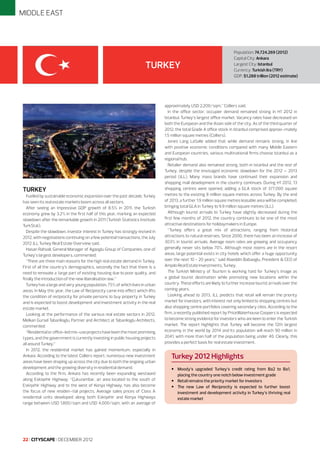
Shorten leasing lifecycles and deliver increased operational
efficiency in work practices to drive revenue enhancement

YARDI PAYscan

TM

Improve efficiency and save costs with automatied
invoice processing and online approval workflow

For more information call +971 55 910 4815
or visit www.yardi.com

Yardi Systems Middle East - Investment, Asset & Property Management Software

Unit 333 | Building 16 | Dubai Internet City | Dubai | UAE | Tel: + 971 55 910 4815 | Email: middle-east@yardi.com
MIDDLE EAST

EGYPT

EGYPT

Following the Revolution of February 2011 which ousted former President
Hosni Mubarak, Egypt was struggling to regain political and economic
stability which had an immediate impact on the country’s once thriving real
estate market. Now, things are finally looking up.
After one and a half years of civil unrest and political turmoil, the past
three months have seen a welcome return to more settled and stable
conditions following the election of President Mohamed Morsi and the
appointment of a new government, the latest Jones Lang LaSalle Cairo Real
Estate Market Overview said.
While Egypt’s economy was hit hard by the Revolution, with real GDP
of just 1.8% recorded last year, the new government is aiming to achieve
nominal growth of 4% to 5% this year (JLL).
According to JLL, an indication of returning economic confidence is
that 703 new companies have started operations across Egypt. The
government is also undertaking major efforts to boost tourism as this
sector contributes to 12% of GDP and employs 4 million workers (12.6% of
the labour force).
With a large, young and growing population, Egypt presents numerous
opportunities to real estate investors.

18 I CITYSCAPE I DECEMBER 2012

Population: 82,000,000 (2012 census)
Capital City: Cairo
Largest City: Cairo
Currency: Egyptian pound (EGP)
GDP: $533.739 billion (2012 estimate)

“[Egypt’s] most distinctive characteristic when compared with other
parts of the MENA region is the inherent demand for residential properties
due to the continuous annual population growth, plus the backlog of
demand which hasn’t been fulfilled to date. [There are] 500,000 new
marriages [and a] 1.8 million net population growth per annum. No other
market in the region has that kind of demand,” commented Ibrahim
El Missiri, Development Director at Madinet Nasr for Housing and
Development (MNHD).

Residential
In 2012, the residential middle-income sector has witnessed the
most activity and currently experiences the strongest demand, with a
huge spike in activity and demand since September 2012, El Missiri said.
Coldwell Banker New Homes, one of Egypt’s premier real estate agents,
confirmed this while adding that the strongest demand is directed towards
apartments within gated compounds.
This is supported by JLL, who have reported a major shift from high end
luxury villas to apartments aimed at middle income earners within gated
compounds over the past two years, as this sector was previously under
supplied.
MIDDLE EAST

“The bulk of the supply pre-revolution was for the high-end, this has now
shifted to the under supplied middle-income [sector] which is the where
the bulk of the demand is. It’s now about providing high-end lifestyles to
the middle-income market,” El Missiri explained.
As a result of the high demand for apartments, sales prices for
apartments have increased in both New Cairo and 6th of October City;
Cairo’s satellite cites which hold the majority of the capital’s gated
compound developments.
According to JLL, in New Cairo, the average price for apartments has
increased 1.5% per square metre from Q2, currently sitting at USD 1,198.
The firm says similar trends have been experienced in 6th of October City,
with apartment prices up 8% to USD 990 per square metre.
The provision of affordable homes has also been a major topic in the
Egyptian residential market, with the country currently facing an immense
shortfall of 1,500,000 affordable homes. As a measure to combat this
shortage, last year the Ministry of Housing announced plans to construct
one million residential units throughout Egypt over the next five years.
In addition to this, in 2012 the government has been going forward with
providing low income housing under the Youth housing program launched
in 2007 (JLL).
However, in order to be able to reach the high demand for affordable
homes, experts believe government action alone is not sufficient.
“In order to overcome and reduce this gap between supply and demand, a
major strategic collaboration between the government and private sector
should take place, as well as input of the mortgage finance system in order
to spread awareness [about the availability of home financing services]
among the low-income population,” Coldwell Banker New Homes
commented.

Retail
For the retail market, 2012 is proving to be a much more positive year than
2011, with sales figures starting to pick up and purchasing habits returning
to a more normal pattern, JLL said.
According to the firm, despite further expected delays in many projects,
the supply of retail malls is expected to increase significantly in 2013 and
2014. The major new addition in 2013 will be Cairo Festival City, which will
include IKEA (34,000 square metres) and Kidzania, along with 15 other
major anchors.
“Egypt has a significant shortage of supply for retail space, hence the
significant number of shopping centres in the pipeline,” El Missiri said.
“Expressing their confidence in the future of the Cairo real estate
market, Al-Futtaim Group and Emaar Properties (two of the UAE’s largest
developers) have announced plans to join forces to develop Cairo Gate, a
USD 830 million retail and entertainment complex on a 16 acre site on the
Cairo Alexandria desert highway,” JLL further commented.
Majid Al-Futtaim (MAF) is also continuing its expansion plans in Greater
Cairo, with the announcement of a major new centre ‘Mall of Egypt’ located
in 6th of October City. Construction of this 163,000 square metre centre
(with around 380 shops) is due to commence by the end of 2012 for
completion in mid 2015 (JLL).

Commercial
In the office sector, Cairo has not witnessed any significant completions
in Q3 and the current stock of office space in Cairo therefore remains
unchanged at around 744,000 square metres. Vacancies in Grade A
buildings have dropped to 31% (from 38% in Q2) due to increased take-up,
mainly on the east side of Cairo (New Cairo & Maadi) (JLL).
“Given Cairo’s over crowded downtown and old districts, most of the
new office supply to be delivered over the next few years will be in New
Cairo and 6th of October. Demand is increasing in these locations as
more residential projects are completed in the new urban settlements,”
JLL said.

Outlook
Looking at the year ahead for the Cairo market, El Missiri predicts positive
performance for the residential sector.
“The middle-income residential sector will remain strong, within gated
compounds. The high-end residential demand will start to increase as the
country becomes more stable. We’ve seen a spike that has been sustained
since the election of the President,” he said.
Coldwell Banker New Homes shares an optimistic outlook for the
residential market in 2013, given the increase in sales volume during both
Q3 and the first month of Q4 2012.
In the office sector, the picture is slightly different. “The administrative
units’ market segment will continue to struggle along with the economy
as businesses are not investing in new office space until there is clarity and
the economy starts to move. Most of the work in 2012 was the completion
of pre-revolution projects that had stalled,” El Missiri commented.
Despite current economic challenges, the Egyptian real estate market
offers attractive real estate investment opportunities.
“People are investing [in Egypt] due to the fact that it is a resilient market
that has inherent strong local demand. It is not an opportunistic market
that is driven by external demand or speculation. This is apparent in the
fact that the prices have held throughout the past two years,” El Missiri
said.
“Opportunities lie in the better developed middle-income housing
compounds where the demand is high and rental yields are high,” he
concluded.

Egypt 2012 Highlights

•	 With a stabilising political situation, investor confidence is
returning to the market
•	 Significant amount of quality retail stock soon to enter
•

the market with major shopping centres currently under
development
	 Residential sales volumes have increased with a preference for
apartments in New Cairo and 6th of October City

DECEMBER 2012 I CITYSCAPE I 19
MIDDLE EAST

SAUDI ARABIA

RIYADH
Saudi Arabia has one of the world’s largest oil reserves and oil revenues
continue to boost the Kingdom’s budgetary position. In 2012, real GDP is
expected to grow by 5.1% (Jones Lang LaSalle Riyadh Real Estate Overview
Q2 2012).
With high oil revenues enabling the government to post large budget
surpluses, Riyadh has been able to substantially boost spending on job
training and education, infrastructure development, and government
salaries. 2012 has also been a good year for the capital’s real estate market.
Kristian Syson, Director of Professional Services at Cluttons Bahrain
commented:
“Year-on-year the real estate market in Saudi tends to perform well, as
real estate has been seen by Saudis as a safe investment, to be handed
down to future generations.”
This year’s biggest news in the Saudi real estate market came with the
announcement of the approval of the Kingdom’s long awaited Mortgage
Law. According to JLL, the law is a very important step in broadening home
ownership across the Kingdom and will help tackle one of the country›s
most pressing social issues. It is also expected to generate significant
benefits for the economy and should, encourage greater professionalism
in the home building industry.
However, it will take some time before the full benefits of the mortgage
law are realised and its initial impact will be limited, experts believe.
“In order for [the mortgage law] to function effectively, a change is
required to the legal frame work surrounding the law. For example, a
review of the foreclosure system is necessary as under Sharia law, it is
not permitted to take someone’s home. The land registry process will also
need to be reviewed in order to give lenders comfort that the property
which they are taking charge over is actually owned by the borrower,”
Syson explained.
“Whilst it is not doubted that the introduction and implementation of the
mortgage law will open up the possibility of home ownership to a larger
proportion of the market, many commentators have suggested that the
main benefit will be to provide cheaper real estate finance to the affluent
parts of society and will not address the needs of the growing younger
generation of the population,” he further commented.
However, it is understood that a number of large employers in the

20 I CITYSCAPE I DECEMBER 2012

Population: 28,376,355 (2011 census)
Capital City: Riyadh
Largest City: Riyadh
Currency: Saudi riyal (SAR)
GDP: $733.143 billion (2012 estimate)

Kingdom and the Government are looking at ways in which they can
support their employees in obtaining mortgage finance once the law is
implemented, Syson added.
Looking at Riyadh’s performance in the residential sector, average villa
prices have increased across most districts, however average prices in
the centre area have declined in Q2 as most sales have been of older/
refurbished projects due to the lack of new product available for sale (JLL).
During Q2, the average sale price of apartments has increased in Riyadh’s
districts to the east, south and west of Riyadh.
“Increases in rates are a product of a slight imbalance in supply and
demand in favour of the property developer (in the case of sales) and in
favour of the owner (in the case of rentals). In the more popular areas of
the Kingdom this imbalance is driving up prices as people wish to relocate
to newer products. It should also be noted that these increases are not
startling and in most cases are limited to single digit percentage increases,”
Syson commented.
Riyadh’s office market will see a major increase in new supply in 2013
when the first office buildings in both the King Abdullah Financial District
(KAFD) and the Information Technology and Communication Complex
(ITCC) projects will enter the market. Despite the substantial addition
of new supply (over 1 million sqm by 2014), JLL says demand for high
quality space will remain strong, mainly driven by the Government, Saudi
conglomerates and the multinational sector.
Looking at the year ahead, Syson commented:
“The general market outlook for 2013 remains positive, as the
Government continues to invest heavily in infrastructure, education and
healthcare projects within the Kingdom.”
However, potential oversupply in certain sectors will pose a challenge to
the performance of the Riyadh real estate market in the near future.
“The main challenge in 2013 will be the inelastic nature of the real estate
sector which will generate a potential oversupply in certain sectors, such
as office and hospitality in Riyadh, and a potential undersupply in other
areas, such as international grade industrial, warehouse and logistics space
across the Kingdom,” Syson said.
“A real concern in the medium to long term is the generation of demand
for the sectors which are currently oversupplied and whether this
oversupply situation will have, as is expected, a negative impact on the
surrounding market as occupiers will look to relocate to cheaper, better
quality accommodation for less cost,” Syson concluded.

Riyadh 2012 Highlights

•	
•	
•	

Approval of the long awaited Mortgage Law by the Council of
Ministers
Expansion of King Khalid International Airport (KKIA)
commenced in November, tripling its capacity within 3 years
Retail point of sales have grown by 17% YOY in Q2, reflecting
continuous growth in retail spending
MIDDLE EAST

JEDDAH

2012 was a fairly good year for Saudi Arabia’s Red Sea destination.
Martin Cooper, Head of Consulting Middle East, DTZ, commented:
“Jeddah’s real estate market has performed relatively well for the most
part of 2012. There continues to be strong levels of demand, particularly in
the residential (primary accommodation) and hospitality sectors.”
While residential sales prices for both villas and apartments rents have
increased significantly during the first quarter of 2012 (JLL), this was
confined to certain locations.
“Residential sales prices in Jeddah have escalated in certain prime
locations in the city. However, sales prices (and volumes) on the Jeddah
Corniche remain below the peaks reached in 2007 as full confidence has
yet to return to the investment market. Levels of primary residential
demand remain high in the city and this means that well located, designed
and built properties will remain good prospects,” Cooper explained.
On the rental front, villa rents have increased by 3% in the preferred
Northern regions of Jeddah in Q2 2012, says the Jones Lang LaSalle Q2
Jeddah Real Estate Overview. Villas located in residential compounds have
shown the greatest increase in rents, due to the preferences of many
expatriate families to live within gated compounds, the JLL report further
said.
As with many countries in the MENA region, the provision of affordable
housing is a pressing issue in Jeddah.
According to the latest JLL report, government and semi government
entities are working on different projects to develop affordable housing in
Jeddah as the private sector is finding it challenging to provide solutions for
lower income households.
According to the firm, the Ministry of Housing has identified two locations
in Jeddah for affordable housing projects, however no details are available
yet as to what those projects include.
“There are a number of government initiatives in place to address the
shortfall of affordable homes in the Kingdom (which typically target
those in the lowest third of income groups in The Kingdom of Saudi
Arabia [KSA]). These initiatives include increasing the supply of longterm housing loans disbursed through the Real Estate Development

Fund (REDF); a commitment to develop 500,000 new affordable homes
across the Kingdom over the next five years; and residential public
private partnerships (PPPs), such as the Jeddah Development & Urban
Regeneration Company’s Al Ruwais and Qasr Khozam projects,” Cooper of
DTZ commented.
JLL added that in a rare private project aimed at the affordable sector, the
Henaki Group has started a 1,000 unit apartment project in the Kandarah
area, which will be one of the first large scale projects targeting low to
middle income families.
In the office sector, annual performance so far has been affected by
oversupply in the sector.
“Demand for office accommodation in Jeddah continues to be dominated
by relatively small requirements (between 100 and 350 square metres) for
space in multi-tenanted buildings, rather than large single tenant occupiers
looking for sizable floor plates. Some key office schemes in the city have
yet to reach full occupancy,” Cooper said.
According to JLL, a total of around 125,000 square metres of office space
is expected to complete in the second half of 2012, bringing total CBD stock
to around 699,000 square metres. The firm further added that although
the credit situation has eased, actual project deliveries may be lower than
expected in 2012 as developers perceive the over supply situation could
worsen over the coming year.
The hotel market has performed extremely well in 2012. According to
JLL, Jeddah has been one of the best performing markets in the Middle
East during H1 2012, with strong growth recorded in both occupancies and
Average Daily Rates. During the first half of 2012, occupancy rates have
averaged 80%, marking a significant 11% increase compared to the same
period last year. JLL believes the strong performance of the hotel sector
reflects the continued attractiveness of Jeddah as a leisure destination for
Saudi families.
Looking at the city’s future performance, Cooper commented:
“Overall, real estate market prospects within KSA remain strong. The
fundamental drivers of the KSA real estate market (a population of around
28 million and a labour force of around 8 million) are the strongest in the
GCC.”
“However, risks remain around inflationary pressures, as well as potential
oversupply in the office sector in key cities in the Kingdom. Supply
shortages are also likely to remain in the residential sector within KSA, with
an estimated 50% supply gap in Jeddah over the next 2-3 years,” Cooper
concluded.

Jeddah 2012 Highlights

•	 Strong levels of demand in primary residential sector
•	 The hotel sector recorded strong growth in both occupancies
and Average Daily Rates
•	 Government and private sector are increasingly looking at
providing solutions for the provision of affordable housing

DECEMBER 2012 I CITYSCAPE I 21
MIDDLE EAST

TURKEY

TURKEY

Fuelled by sustainable economic expansion over the past decade, Turkey
has seen its real estate markets boom across all sectors.
After seeing an impressive GDP growth of 8.5% in 2011, the Turkish
economy grew by 3.2% in the first half of this year, marking an expected
slowdown after the remarkable growth in 2011 (Turkish Statistics Institute
TurkStat).
Despite the slowdown, investor interest in Turkey has strongly revived in
2012, with negotiations continuing on a few potential transactions, the July
2012 JLL Turkey Real Estate Overview said.
Hasan Rahvali, General Manager of Agaoglu Group of Companies, one of
Turkey’s largest developers, commented:
“There are three main reasons for the high real estate demand in Turkey.
First of all the country’s demographics, secondly the fact that there is a
need to renovate a large part of existing housing due to poor quality, and
finally the introduction of the new liberalisation law.”
Turkey has a large and very young population, 75% of which lives in urban
areas. In May this year, the Law of Reciprocity came into effect which lifts
the condition of reciprocity for private persons to buy property in Turkey
and is expected to boost development and investment activity in the real
estate market.
Looking at the performance of the various real estate sectors in 2012,
Melkan Gursel Tabanlioglu, Partner and Architect at Tabanlioglu Architects,
commented:
“Residential or office-led mix-use projects have been the most promising
types, and the government is currently investing in public housing projects
all around Turkey.”
In 2012, the residential market has gained momentum, especially in
Ankara. According to the latest Colliers report, numerous new investment
areas have been shaping up across the city due to both the ongoing urban
development and the growing diversity in residential demand.
According to the firm, Ankara has recently been expanding westward
along Eskişehir Highway. “Çukurambar, an area located to the south of
Eskişehir Highway and to the west of Konya Highway, has also become
the focus of new residen¬tial projects. Average sales prices of Class A
residential units developed along both Eskişehir and Konya Highways
range between USD 1,800/sqm and USD 4,000/sqm, with an average of

22 I CITYSCAPE I DECEMBER 2012

Population: 74.724.269 (2012)
Capital City: Ankara
Largest City: Istanbul
Currency: Turkish lira (TRY)
GDP: $1.288 trillion (2012 estimate)

approximately USD 2,200/sqm,” Colliers said.
In the office sector, occupier demand remained strong in H1 2012 in
Istanbul, Turkey’s largest office market. Vacancy rates have decreased on
both the European and the Asian side of the city. As of the third quarter of
2012, the total Grade A office stock in Istanbul comprised approxi¬mately
1.5 million square metres (Colliers).
Jones Lang LaSalle added that while demand remains strong, in line
with positive economic conditions compared with many Middle Eastern
and European countries, various multinational firms choose Istanbul as a
regional hub.
Retailer demand also remained strong, both in Istanbul and the rest of
Turkey, despite the envisaged economic slowdown for the 2012 – 2013
period (JLL). Many mass brands have continued their expansion and
shopping mall development in the country continues. During H1 2012, 13
shopping centres were opened, adding a GLA stock of 377,000 square
metres to the existing 8 million square metres across Turkey. By the end
of 2013, a further 1.9 million square metres leasable area will be completed,
bringing total GLA in Turkey to 9.9 million square metres (JLL).
Although tourist arrivals to Turkey have slightly decreased during the
first few months of 2012, the country continues to be one of the most
attractive destinations for holidaymakers in Europe.
“Turkey offers a great mix of attractions, ranging from historical
attractions to natural reserves. Since 2000, there has been an increase of
303% in tourist arrivals. Average room rates are growing and occupancy
generally never sits below 70%. Although most rooms are in the resort
areas, large potential exists in city hotels which offer a huge opportunity
over the next 10 - 20 years,” said Alaeddin Babaoglu, President & CEO of
Ampilo Real Estate Investments, Turkey.
The Turkish Ministry of Tourism is working hard for Turkey’s image as
a global tourist destination while promoting new locations within the
country. These efforts are likely to further increase tourist arrivals over the
coming years.
Looking ahead to 2013, JLL predicts that retail will remain the priority
market for investors, with interest not only limited to shopping centres but
also shopping centre portfolios covering secondary cites. According to the
firm, a recently published report by PriceWaterhouse Coopers is expected
to become strong evidence for investors who are keen to enter the Turkish
market. The report highlights that Turkey will become the 12th largest
economy in the world by 2014 and its population will reach 90 million in
2041, with more than half of the population being under 40. Clearly, this
provides a perfect basis for real estate investment.

Turkey 2012 Highlights

•	 Moody’s upgraded Turkey’s credit rating from Ba2 to Ba1,
placing the country one notch below investment grade
•	 Retail remains the priority market for investors
•	 The new Law of Reciprocity is expected to further boost
investment and development activity in Turkey’s thriving real
estate market
HAPPY NEW HOME...
Asia NEWS

INDIA: FDI in Multi-Brand Retail - The Gateway Finally Opens

W

ith the recent decision by the Indian government to allow foreign
direct investment in multi-brand retail, this topic currently attracts
a lot of attention.
Pankaj Renjhen, Managing Director of Retail Services at Jones Lang
LaSalle India shares his view.
“There are various points of view regarding the impact it will have on
the retail sector in specific and the Indian economy in general, but the
decision is a big step in the direction of strengthening organised retail in
the country. To get the complete picture, it is important to understand the
situation which exists currently and how the new regulations are going to
change the retail landscape.
Till recently, FDI in retail (except under single-brand product retailing, with
conditions) was not allowed in India. In other words, for a company to be
able to get foreign funding, products sold by it to the general public needed
to be of a ‘single-brand’. The government has now opened a gateway for
foreign funding into the sector. In 1997, FDI in cash-and-carry (wholesale)
with 100% ownership was allowed under the government approval route.
It was brought under the automatic route in 2006. 51% investment in a
single-brand retail outlet was also permitted in 2006. FDI in multi-brand
retailing was prohibited in India.
This was changed to increases FDI in single-brand retail to 100% while
creating a path for FDI in multi-brand retail to the tune of 51%. Cities with
populations of more than 10 million are eligible for this. With yesterday’s
announcement, 51% FDI has been permitted in multi-brand retail - with
certain caveats, and also subject to final the approval from respective
states to allow implementation within these states.
There are still some apprehensions on how this policy will be implemented
due to the given caveats. However, it does signify a strong positive outlook
for this sector.
The retail sector in India has been plagued with problems at all the areas
of its life cycle - back end, technology, supply chain, real estate and human
resources. There has been a lack of investment in all of these areas.
Consequently, the retail sector has not been able to match the pace of
other growing sectors in India. There has been a lack of investment in the
logistics of the retail chain, leading to an inefficient market mechanism.
Lack of storage infrastructure has been one of the most alarming of these
infrastructure gaps.
The technology being used in Indian retail is largely obsolete and does
not meet international standards, resulting in poor efficiency at the supply
side and average consumer experience on the demand side. Intermediaries
often bypass the ‘mandi’ norms and their pricing lacks transparency. The
public procurement and distribution system calls for a lot of improvement.

24 I CITYSCAPE I DECEMBER 2012

In spite of heavy subsidies, overall food based inflation has been a matter
of great concern.
FDI will be a powerful catalyst to the required growth in the retail industry
and, in long term, will prove beneficial to all the major stakeholders. The
new policy can benefit both foreign retailers and their Indian partners. The
benefits to foreign players will be access to local market knowledge and
an increased consumer base, while Indian companies will benefit by global
best management practices and technological know-how. There will be
investment in storage and transportation infrastructure, technology and
supply chain operations.
The increased flow of capital, if used effectively, will benefit both the
farmers and the consumers. Farmers will benefit from the better price
indexing and direct selling to the retailer. The consumer, in addition to
having a better shopping experience, will benefit from the competition
and the resultant reduced prices.
The real estate retail industry will benefit immensely due to increase in
demand and increased investor confidence. We can also expect increased
transparency in the retail real estate sector. Additionally, the country
will flourish in terms of quality standards and consumer expectations,
since the inflow of FDI into the retail sector is bound to pull up the quality
standards and cost-competitiveness of Indian producers in all the
segments.
In the light of above, it would be prudent to encourage FDI in retail further.
Of course, sufficient consideration should be given to the interests of
SMEs, farmers and consumers while finalising this decision.
With this move, along with the caveats, the Government has indeed
taken an important step. From a retail real estate point of view, it will be
open up immense opportunities in the medium and long term, as the
demand for quality real estate will rise. Currently, some retailers are cashstrapped and this will provide a sort of bail-out option to them. Overall, the
investment by local and new international retailers that are likely to flow
into the sector will definitely also take the form of investments into real
estate at the front end in terms of retail store spaces and of the back end
in terms of better quality warehouses.
The new international entrants will be willing to take longer term
bets and invest in stores which will be sustainable over the long haul.
Competition will increase as Indian retailers shape up and intensify their
expansion plans - which had been fairly low over the past few years. Also,
it will increase the interest and confidence level of real estate developers
to set up quality shopping centres. They now have reason to set behind
them their experiences post 2008 and can once again consider investing
in this asset class with a clear vision to long-term profit.”
ASIA NEWS

GLOBAL RESIDENTAIL PRICE GROWTH:
HONG KONG TOPS THE TABLE
This year the residential markets of the world’s leading cities have become
more localised. The strongest price growth has been seen in those world cities
that were buoyed by domestic demand, while international investor cash
has retreated to a few core markets with established, long-term investment
credentials, said international real estate advisor Savills.
The firm’s Autumn World Cities Review, published last month, reveals that
the top performing markets are fuelled by domestic wealth generation. Hong
Kong topped the list with half year price growth of 7.4%, followed by Moscow
and Sydney, which recorded 5.5% and 3.7% respectively, all well ahead of the
index average of just 1.2%. This confirms Hong Kong’s position as the world’s
most expensive city, with values now 82% ahead of second most expensive
London and five times those of Mumbai.
‘Old world’ markets of London and New York continued to attract
international equity seeking long term stability and growth, with values rising
2.8% and 1.1% respectively. The biggest fallers were Paris (-3.4%), Shanghai
(-2.6%) and Mumbai (-1.7%), which suffered as investor sentiment wavered.

Outlook
Hong Kong has been the real winner so far this year. Mainstream market
recovery, supported by domestic buyers and a loosening of mortgage
availability, helped to boost values to another all time high in June. Although
it seems that the price falls of late 2011 were a temporary blip, this is a volatile
market that could turn negative again.
At the other end of the scale, Paris is the biggest loser of 2012 and faces
a period of uncertainty.
The Eurozone crisis continues to discourage
investment in euro-denominated assets, and the market has been dealt a
double blow by President Hollande’s proposed increases to taxes on high end
property and investor gains. Further price falls now seem unavoidable in the
French capital, and London is the potential beneficiary as international money
seeks an alternative haven within the geography of Europe, but outside the
Eurozone.
London remains the second most expensive world-class market, but
uncertainty regarding the impact of new stamp duty rules, announced in the
March budget, has already slowed activity and price growth at the top of the
market. A period of flat prices now seems likely, though market fundamentals
(high occupier demand and limited supply) favour growth longer term.

Cities set for growth
The outlook for many of the ‘new world’ cities in the Savills index (e.g.
Shanghai, Mumbai, Moscow) depends on their ability to continue to generate
wealth, and for that wealth to be invested in real estate. Singapore’s strong
domestic market suggests the potential for further growth, while Hong Kong
continues to ‘defy gravity’ thanks to its proximity to its mainland ‘domestic’
market.
“Emerging markets, and Chinese buyers in particular, still have the potential
to move other world city markets,” says Yolande Barnes, director of Savills
Global Research. “Last year we said that the unleashing of high net worth
Chinese investor monies could boost London’s prime markets by 15% and the
same must be true of other top cities, but this will require the relaxation of
currency export controls and overseas ownership restrictions.
“By contrast, China’s lead world city, Shanghai, will need to see its market
adjust to a more sustainable domestic consumption model in the future
before significant price growth can resume.
“What is clear is that - whether boosted by international or domestic
wealth-generation- the select band of cities that are measured in our index
have increasingly more in common with each other than with their own
domestic markets or economies.”

Asia Growth Fuels Rise
of Student Housing as a
Global Real Estate Asset
Class
The increasing number of students from Asia choosing to study
outside of their home country has played a key role in developing the
student housing sector into a global real estate asset class, according
to Jones Lang LaSalle’s new Global Student Housing Report, released
earlier this month.
In recent years, Asia has increased its market share as a source
market for international students from 48 percent in 2004 to 52
percent in 2009. In fact, the top five source markets globally are China,
India and South Korea, followed by Germany and France in fourth and
fifth. On the flip side, the most popular destinations for these students
are the US, the UK, Australia, Germany and France.
“Strong economic growth in the key Asian markets has fuelled
higher education enrolments globally. Over the past decade,
countries like China, India and Vietnam have experienced rapid growth
in the wealthier middle class, which has spurred demand for higher
education and better housing options in destination countries,” said
Philip Hillman, Lead Director, Student Housing and Higher Education,
Jones Lang LaSalle.
Globally, the student housing market as a whole is estimated to
be worth in excess of USD 200 billion, with study-abroad student
numbers expected to increase from around 165 million today to 263
million by 2025. Market transaction volumes worldwide for the year
ending June 2012 were USD 4.7 billion, with more assets trading above
USD 50 million, showing healthy investor appetite for this asset class.
While ownership of student housing has traditionally been dominated
by developer-operators, increasingly, equity funds, sovereign wealth
funds, pension funds, investment managers and REITs are entering
the market. The sector’s solid investment fundamentals have been
characterised by its counter cyclical nature, high occupancy rates,
strong demand drivers and positive income and rental growth.
“Student housing is one of the most vibrant Indian real estate
markets in the foreseeable future,” said Anuj Puri, Chairman &
Country Head, Jones Lang LaSalle India. “Dense student populations
that exist around prominent colleges positively affect the demand for
residential spaces as well as restaurants and small retail spaces. As
such, educational institutions lend value to a location.”
In fact, the future of this sector in India is extremely promising.
“The country’s top 10-15 corporate schools have plans to develop
a total of 800–1000 schools over the next decade, aiming to deliver
quality education to far-flung parts of the country,” Puri said. “The
corporate higher education industry is expected to build close to 10
million square feet of educational institution space over the next few
years - and this does not include the rapid expansion plans that are
underway to build new IITs, IIMs, SPAs and other reputed educational
institutions. The demand for the right kind of student housing that
such a scenario presents can well be imagined.”
Hillman added: “Institutional investors in this sector require scalability
– the potential to secure significant operational portfolios with a
development pipeline. The biggest barrier to major financial institutions
investing in many of the emerging student accommodation markets
is the lack of quality stock to invest in. However the sector in these
emerging markets should benefit from an accelerated acceptance of
the investment characteristics of the sector, as a result of the growth
of the UK and US markets.”

DECEMBER 2012 I CITYSCAPE I 25
JAPAN

LEADING THE REGION’S
INVESTMENT REBOUND
The earthquake of March 2011 hit at a time when Japan’s real-estate market was
showing signs of recovery, especially in Tokyo and a handful of other cities popular with
foreign investors. Although the natural disaster brought the real estate market to a
temporary standstill, investor confidence soon returned and in Q2 2012, Japan led Asia
Pacific’s rebound in investment volumes.

26 I CITYSCAPE I DECEMBER 2012
JAPAN

I

n the wake of recovery from the global financial crisis, Asia Pacific
markets will continue to drive global growth for the remainder of
the year, according to the Jones Lang LaSalle (JLL) Q3 Global Market
Perspective.
According to JLL , in Q2 2012, Asia Pacific was the only global region to
show a year-on-year (YOY) increase in investor activity, up 30 per cent
compared to last year, while Japan led the rebound in investment volumes
(+290% YOY) on the back of recovery from the earthquake in March 2011.
According to a 2011 research report by Nomura Research Institute, despite
the weak economic growth of last year, Japan is expected to remain ahead
of high-growth countries including India, Brazil and Russia up to at least
2020. Tokyo will remain the world’s top metropolis in terms of population
and GDP.
The Japanese market, of which Tokyo represents 70%, is the third
largest in the world after the US and China. Compared to the US and China,
however, Japan, which has investable properties worth more than USD 2
trillion, has a much smaller land area. Therefore, most of the properties are
concentrated in a few cities. In fact, the Tokyo region alone accounts for
70% of the total value of investable properties in Japan (Source: Nomura
Research Institute).

Real estate post March 2011
The tragic earthquake of 2011 evidently had an immediate effect on the
country’s real estate market, however investor confidence soon returned.
Will Johnson, Associate at Savills Japan, commented:
“The market ground to a standstill in the first quarter following
the earthquake. Overseas investors were concerned in the months
immediately following the disaster but this has subsided as reported
damage to property was negligible and the risk of radioactive
contamination in the major cities non-existent. After the initial post-quake
shock, domestic firms resumed investment activity within the quarter and
the debt markets reopened in earnest.”
The earthquake has also brought several pre-existing concerns to the
foreground.
“Seismic resistance has always been a factor in building selection, but
it has become a higher priority. The market was in a beginning phase of
a recovery when the earthquake struck and soon after the Euro crisis
[started]. This had a dampening effect on the recovery [of the market],”
commented James Fink, Senior Managing Director at Colliers International
Japan.
Will Johnson further added:
“From a leasing perspective, tenants are showing a strong preference
for modern properties built to up-to-date seismic codes. Newly built
properties equipped with latest seismic technology are achieving a demand
premium, especially those with independent power generation facilities.”

“The Tokyo residential market is
a stable investment environment
most suited for investors seeking
core/core-plus returns. Rents in
the mid-market are not prone to
volatile fluctuation and occupancy
rates have remained consistently
high since the global financial crisis.”

Residential
Generally more stable than retail and office, the residential sector is
currently said to offer the most attractive investment opportunities in
the country. According to the Q1 2012 Japan Investment Update Report
by Colliers International, middle income and compact rental units have
performed much more steadily than the high-end subsector in Tokyo, with
relatively strong rental demand and have continued to be relatively stable
investments in terms of rents and occupancy.
According to the Q2 2012 Savills Residential Research Report, “residential
demand for mid-market assets in Tokyo’s central wards in recent quarters
has been supported not only by the capital’s dominant concentration of
economic infrastructure and sheer weight of people, but also by continued
in-migration from regional towns and cities.” The firm expects the midmarket segment to remain robust over the short to mid term, supported
by the influx of new residents from regional towns.

Will Johnson, Associate, Research & Consultancy at Savills Japan,
commented:
“The Tokyo residential market is a stable investment environment
most suited for investors seeking core/core-plus returns. Rents in the
mid-market are not prone to volatile fluctuation and occupancy rates
have remained consistently high since the global financial crisis. Given its
stability, Tokyo mid-market residential assets benefit from strong and
steady demand from domestic institutional investors, including Japanese
corporates and the J-REITs. This mitigates exit strategy risk for foreign
funds and institutional investors active in this sector.”
Johnson adds that since 2008/2009, liquidity has dramatically improved,
with domestic lenders favouring Tokyo residential above any other sector
and in some cases willing to offer LTVs of up to 70-75% on well-positioned
assets, which has increased competition for Tokyo mid-market residential.

DECEMBER 2012 I CITYSCAPE I 27
JAPAN

Office
Since 2008, vacancy rates sit at a relatively high level of about 8%
(Colliers), however experts predict the office sector will be one of the key
asset classes for investment opportunities in the coming year while the
Tokyo Government is working on re-invigorating external demand.
“The Tokyo Metropolitan Government has adopted policy measures to
provide assistance to multi-national entities that specifically locate within
so-called Comprehensive Special Zones for International Competitiveness
Development, which may act to bolster external demand going forward.
The proposals include a system of tax breaks and incentives to reduce
corporate taxes for new international occupiers from approx. 40% to the
mid-20% range, making Tokyo more competitive as an Asian headquarters
location and a base for R&D,” Johnson said.
“[The Government] aims to see at least 50 companies in five years
establish integrated back-office operations and R&D centres for their Asian
business and to attract at least 500 other global companies. The zones
will target selected growth industries, including ITC , content and creative,
medical and chemical, electronics and precision equipment, and finance and
brokerage. The geographical areas selected for the zones include central
Tokyo and waterfront sites incorporating 1) Tokyo, Shimbashi, Roppongi,
Toyosu and Ariake stations; 2) the area around Shinagawa and Tamachi

stations; 3) the Shinjuku Station area; 4) the Shibuya Station area, and 5)
land by Haneda Airport,” Johnson further explained.

Retail
“Despite its relatively small population, Japan remains the third largest
economy in the world with GDP per capita over 8 times larger than that
of China. (IMF World Economic Outlook, April 2012). Although higher
growth markets get the bulk of the media limelight, the sheer depth of the
Japanese retail market makes it one that can’t be ignored for investors with
diversified portfolios,” Johnson commented.
Looking at the current performance of the sector, the decline in monthly
household income and a drop in monthly household spending over the
last 12 months have caused consumer demand to remain relatively weak
(Colliers). The firm says there has been a noticeable shift away from luxury
goods to reasonably priced casual fashion competing for the most prime
sites.
“While still demonstrating a strong appreciation for high-quality products,
Japanese consumers have become more price conscious since the global
financial crisis. High street brands that provide the right balance between
quality and price are therefore performing strongly. Fast-fashion retailers
are tapping into this demand, with domestic brands such as UNIQLO and

“Although higher growth markets get the bulk of the media limelight, the sheer
depth of the Japanese retail market makes it one that can’t be ignored for
investors with diversified portfolios.”

28 I CITYSCAPE I DECEMBER 2012
JAPAN

G.U. as well as overseas rivals such as H&M and Zara pursuing aggressive
expansion strategies in Japan,” Johnson added.
Johnson also mentioned that 2012 has seen notable new entrants to
the market including Zara’s sister brand Bershka, Forever 21, Old Navy and
American Eagle Outfitters, while the latter’s two new locations in Tokyo are
reported to have received over 100,000 visitors during their five days of
opening, with 1,000 people queuing outside to enter.
“For both mainstream and high-end brands, location will remain key.
Strong demand for prime retail space will keep vacancy close to zero and
support rents in the main commercial districts of Japan’s major cities,”
Johnson further commented.
The analyst also said that the traditional department store format
appears to have gone out of favour with many younger Japanese
consumers. “However, given their location on some of the country’s
strongest retail thoroughfares, they have attracted popular casual fashion
brands such as Forever 21 and H&M as flagship tenants. This trend has the
potential to continue provided department stores adapt and evolve their
retail strategies to fit consumer tastes and should help to support their
profit margins going forward,” he said.
Looking at the dynamics of the sector and opportunities for retailer
expansion, Fink commented:
“Prime retail always has demand. When the luxury sector lags, value
retailers move in and the trend reverses somewhat when retail rents
strengthen. Large scale retail is still relatively limited so brands like Ikea and
COSTCO have room for further expansion.”

Outlook/Investment opportunities
Looking at the sectors offering the most attractive investment
opportunities, both Johnson and Fink identify residential (as the long time
favourite), office and prime retail.
According to Johnson, investors should consider core residential assets
in major markets outside of the capital, such as Osaka, Fukuoka and
Sapporo. “Like Tokyo, ongoing urbanisation in these markets is supporting
demand for mid-market residential. Moreover, the acquisition yields
commanded by such assets tend to be comparatively higher than those
in Tokyo,” he said.
In addition to residential assets, Johnson says new mid-large sized
offices in Tokyo offer good opportunities. “In terms of market cycle, rents
are at historic lows and supply is high, therefore there is scope for rental
growth and capital appreciation when the market enters an up-swing,” he
explained.
Fink agrees, saying that there is a growing sense that the Tokyo office
market may start to bottom and that the best opportunities going forward
are in the office sector.
Lastly, prime high street retail assets in Japan’s major urban centres, such
as Tokyo, Osaka, Kyoto and Fukuoka are interesting products according
to Johnson. “Such properties are often leased on long fixed-term leases
with strong tenant covenants, so can provide solid, stable returns. If the
acquisition price is right, high demand for such assets from domestic and
overseas investors, both institutional and private/family office, may help to
achieve yield compression over the holding term,” he concluded l

DECEMBER 2012 I CITYSCAPE I 29
PHILIPPINES

RESHAPING MANILA’S
URBAN LANDSCAPE
Significant growth of the Business Process Outsourcing industry coupled with an
increasing inflow of Overseas Filipino Workers’ remittances have lead to increased
construction activity in the country’s office and residential sectors. Backed by the
highest GDP growth rate in the ASEAN region during the first quarter this year,
international real estate investors have their eyes set on the Southeast Asian islands.

I

n Q1 2012, the Philippine economy grew by an impressive 6.4%, higher
than the 4.9% registered in the same period last year, the Q2 2012
Philippine Real Estate Market overview by Colliers International showed.
The country’s GDP for the period was the highest in the ASEAN region
and came in second after China (8.1%) across all of Asia, the report further
stated. Amid the global economic slowdown, the strong economic growth
was mainly attributable to higher government expenditures (+24%),
robust consumer spending (+6.6%) and a resilient service sector (8.5%), of
which the real estate subsector contributed a remarkable 24.3% growth,
Colliers said.
“Business executives are now more optimistic on the economy, given
the country’s healthy investment scenario and strong macroeconomic
fundamentals,” the firm commented. With regards to the property sector,
real estate loans grew by 20% year-on-year to PHP 524 billion (USD 13 billion);
the interest rate is at its lowest levels with lending rates sitting between 5% –
8% as opposed to the range of 12% – 15% a decade ago (Colliers).
Rick Santos, Chairman and Founder of CBRE Philippines, commented:

“We’re seeing the strongest market and best fundamentals in the last 20
years. The Philippines has cut through the global headwinds to progress
as one of the best performing real estate markets. We have a booming
office market, an expanding retail industry driven by the large working
population and robust spending, a strong residential sector and a growing
leisure/tourism sector which is catching up the pace of our neighbours.
The country will see more real estate developments from local companies
and increasing investments from foreign businesses.”
One factor which has proven highly advantageous to the Philippine
economy and real estate sector is that the country finds itself ideally
positioned to take advantage of the global outsourcing boom. In 2011,
employment in the Philippine Information Technology and Business
Process Outsourcing (IT-BPO) industry grew by 22% to 638,000 people,
according to the Business Processing Association of the Philippines (BPAP).
The BPO industry had USD 10.9 billion in revenues in 2011, but is expected
to employ 1.3 million workers and generate USD 25 billion in revenues by
2016 (BPAP). If the target is reached, the BPO sector will become one of

DECEMBER 2012 I CITYSCAPE I 31
PHILIPPINES

the largest contributors of foreign exchange revenues in the country.

Office sector growth
So far, the office sector has benefitted the most from the country’s BPO
boom.
“Strong demand from local and multinational companies and the
continued evolution of the Business Process Outsourcing industry may
propel the Philippine office property market to become one of the major
markets in the Asia Pacific region in the next few years,” commented Jones
Lang LaSalle Leechiu (JLLL).
Colliers further added that currently, strong demand from the Offshore
and Outsourcing sectors has resulted in increased construction activities;
the firm says total office stock is projected to reach 7 million square metres
in 2014, over 20% higher than the previous year.
“The Philippines is becoming the lifeboat for many US & European
companies that need to outsource in order for their businesses to survive
and actually preserve jobs back in the US and Europe. We expect the
outsourcing and offshoring industry to expand at a compounded annual
growth rate of 18% within a 5-year horizon,” commented Santos of CBRE.
“By 2016, the target is to reach at least 10% of global revenues.
Also, because of the strong economy, we see that more multinational
companies will be expanding their base in the country. The office sector will
go from strength to strength, with the Philippines being one of the most
cost-effective destinations in Asia. Demand is catching up with supply, and
with strong pre-leasing commitments,” Santos further explained.
According to JLL, over the next three years, five new BPO firms are
expected to enter the country with six existing firms planning to expand,
potentially creating jobs for an estimated 20,0000 Filipinos. Major players
that will be expanding include Sutherland, Accenture, Teleperformance,
SPI, Infosys and IBM.

Strong residential demand
“The Philippines is experiencing democratisation in the housing sector—
from a nation of renters to owners—through low interest rates and flexible
financing schemes. With rising income, a huge housing backlog and a very
liquid market, the strong demand for residential projects is sustained,”
commented Santos of CBRE.
“The increasing inflow of OFW [Overseas Filipino Workers] remittances
is supporting the residential market. While a huge proportion of demand
is coming from OFW families, the improving local labour markets are giving
other buyers like start-up families and young professionals the means to
purchase residential properties,” Santos further commented.
Colliers reports that total residential stock is forecast to grow 30% by
2014. According to the firm, Makati and Fort Bonifacio (Metro Manila)
currently have the strongest residential development activity. In Makati,
total new supply will reach to 1,750 units this year, 5% more than in 2011,
while Fort Bonifacio is projected to deliver 1,600 units in the second half to
reach 4,511 units for the year, Colliers stated. Furthermore to Colliers, takeup in Metro Manila remains consistently strong despite the substantial
number of supply in the pipeline.
While Overseas Filipinos’ remittances power the low-end to mid-range
residential property market, premium residences have continuously been
supported by expatriate demand. As of Q2 2012, the vacancy level for
prime condominiums sat at a low 5% and luxury 3-bedroom rental rates in
the Makati CBD increased by 6% (Colliers).
“The continuous growth in expatriate population spurs the demand for
luxury condominium units. A growing BPO industry translates not only to
more expatriate buyers but also to more investor buyers. Strong leasing
demand from expatriates is keeping the rental market active, making
luxury condominiums more appealing to investors, particularly those
looking for yield-accretive assets,” Santos said.

32 I CITYSCAPE I DECEMBER 2012

“The Philippines is experiencing
democratisation in the housing
sector—from a nation of renters to
owners—through low interest rates
and flexible financing schemes.
With rising income, a huge housing
backlog and a very liquid market,
the strong demand for residential
projects is sustained.”

Increased tourist arrivals boost hotel sector
According to the Department of Tourism, tourist arrivals to the Philippines
have witnessed a 14.6% growth YOY (June 2012).
Colliers reports that in 2011, tourist arrivals in the Philippines breached
the government’s forecast to reach 3.9 million. According to the firm, the
influx of foreign travellers is a good indicator that the government will hit
its target of about 4.6 million visitors in 2012 and eventually its 10-million
target by 2016.
“This growth potential has encouraged developers to venture into
hospitality-related projects all over the country. In Metro Manila alone,
over 11,000 new hotel rooms are expected to be completed in the span of
five years,” Colliers said, adding that new supply this year may reach 2,340
units, 1,500 units more than the new rooms introduced in 2011.
Santos added that the rising inflow of tourists also prompted the surge
in the construction of new resorts, hotels and condominium hotels in
key destinations like Cebu, Davao, Palawan and Boracay. “Likewise, older
hotels are being renovated to be at par with the newer ones. Leisure and
hospitality facilities are becoming attractive investment opportunities and
we are seeing investors actively seeking condominium hotels for long-term
leases or bulk acquisitions to be operated for recurring income,” he said.

Long term opportunities
Looking at long term investment opportunities in the Philippines, Santos
identifies several promising options.
“Considering the long term, [placing capital] in the leisure/gaming/
tourism sector will be a very sound investment. There is optimism in
this area because of the Philippines advantage in having varied tourist
attractions.
Likewise, the office market will remain a major driver of the local real
estate market. The growth in the office market will not be limited to Metro
Manila but will extend to major cities in the provinces.
Massive infrastructure investments planned for the Philippines will be able
to support the expansion of offices outside Metro Manila. The sustained
growth of the BPO industry will continue to generate opportunities in the
office market,” he said.
On a final note, Santos commented on the importance of the Philippines
spreading its positive image.
“The Philippine property market is resilient, and is at its best from the
past 20 years. A crucial role the government, media, and stakeholders have
to perform is to ensure that a positive and enticing image of the country is
promoted not only within the country, but also outside the country,” he
concluded l
EUROPE NEWS

A STORY OF PRIME LONDON AND THE REST

A

fter three and half years of price growth, prime London house
prices are likely to see a period of little or no growth says global
real estate provider, Savills in its forecasts, released earlier this month.
This slowdown comes on the back of high price rises since 2009, which
have completely bucked the trend in the rest of the country and leave
prime central London values 22% above their 2007 peak.
“Prime London is an equity-driven, volatile market which experiences
regular, short-lived adjustments when it is fully-valued,” said Yolande
Barnes, Director of Savills World Research. “After such strong growth,
we now expect prices to plateau in 2013. Increased taxation, including
the stamp duty levy, strengthening Sterling and a weakened global
economic outlook could all provide catalysts for a slowdown, but the
fundamentals in prime London remain strong so we expect that growth
will resume in 2014.”
Prime central London has seen price growth of 53 per cent since
bottoming out in the first quarter of 2009, rising to 58.4 per cent for
ultra prime (av value >£15m). This growth has been driven primarily
by inflows of international equity and net new money flowing into this
market has totalled an estimated £19.5 billion since 2007 according
to Savills research. London remains a major world city destination for
real asset investment and this is likely to continue after the brief lull
expected in 2013.
Prime central London is expected to outperform all other market
sectors over the mid term, with price growth totalling 26 per cent by
the end of 2017. The very best ultra prime properties and high spec
new developments are expected to continue to buck wider economic
trends and outperform the prime central London average.
“It became clear last year that the UK’s residential property market
had polarised between prime London and the rest, and this distinction
has become increasingly entrenched,” said Barnes. “We knew there
would be a lull in prime central London price growth, but were not sure
what the trigger would be. Increased taxation could prove to be the
catalyst and it certainly will take time for the market to absorb the
change.
“There are still clear global reasons to invest in real assets and we
are confident that London will remain on the shopping list of world city
buyers. Yields remain solid, the market remains stock constrained and
the prospects for global wealth generation amongst core buyer groups
are sound over the medium term. We have, however, noticed less
urgency among buyers of late and even a stalling of purchasing plans
until the rules surrounding taxation and stamp duty are made clearer.
Sellers may need to reduce their expectations for all but the very best
properties in 2013.”

Outer prime London markets
Beyond the prime central locations, London’s other prime markets
have traditionally been more heavily dependent on domestic wealth
generation, particularly in the past from the financial sector. Prices
recently have been boosted by a recycling of domestic wealth from
buyers reluctant to relocate out to the commuter zone and some
displacement of international wealth from prime central London.
Prime property values in areas such as southwest and north London
are now 12 per cent above their previous peak levels. They are expected
to plateau in 2013, rise by 3.5 per cent in 2014 and grow by 22.1 per cent
by the end of 2017.
“In the absence of significant new City wealth generation, we expect
these prime outer London prime locations to be increasingly reliant on
the displacement of wealth from prime central London,” said Barnes.
Evidence of this trend is already clear in Fulham, for example, where
international buyers now account for around 44 per cent of the market
compared to just 20 per cent two years ago.

Beyond London – commuter hotspots to see
growth in 2013
Rarely, if ever, has there been a bigger gap between what is happening
in prime London and what is happening in prime markets outside
London. The weak economic recovery has continued to suppress
sentiment across the prime regional markets, with key commuter
hotspots only a very recent exception.
Savills expects the long-awaited ripple of wealth to be seen in the
prime commuter zone around London next year, meaning locations
such as Sevenoaks, Guildford and Beaconsfield will see values rise by 1.0
per cent, making this the only part of the prime market to see any price
growth in 2013. Five year price growth will total 21 per cent in the prime
inner commuter zone and 19 per cent in the outer commuter zone.
Further afield, prime regional markets will begin to bottom out in 2013,
before resuming growth in 2014, but the further they are from London,
the weaker the expected growth will be. Consequently, Savills expects
many prime regional markets will perform closer to the mainstream
market.
“Although the gap between prime London and prime regional prices
has never been wider, buyers have lacked the confidence during the
recession to exploit this gap,” said Barnes. “As the economy, and
particularly confidence improves, we expect that this will begin to
change, but it will require London and the prime suburbs to remain
active and it could be 2016 before the effects of wealth migration are
felt right across the UK’s prime markets.”

Source: Savills Residential Property Focus London Q4 2024

DECEMBER 2012 I CITYSCAPE I 33
EUROPE NEWS

Madrid office market sees Q3 take-up boost despite
continued economic strain

A

ccording to Savills latest Madrid office market report, take-up
in the third quarter of 2012 exceeded all expectations reaching
70,000 sqm, despite ongoing economic difficulties. The firm noted that
this boost was primarily due to a number of larger transactions of over
5,000 sqm, which accounted for 26% of take-up during this period.
The international real estate advisor finds that the increase of
refurbished space coming to the market was an instrumental factor in
Q3 12 take-up numbers with three of the largest transactions in this
time period agreed on this type of space, including Alcalá 65, Paseo de
la Castellana 50 and Almagro 40.
Despite a higher than expected take-up in Q3 12, the total accumulated
figures since January stand at 210,000 sqm, which is down 16% YOY.
Savills predicts that the total take-up for 2012 will be approximately
300,000 sqm.
Savills reports that supply in the Madrid office market rose to 1.6
million sqm in Q3, up from 1.55 million sqm in the previous quarter. This
has pushed the average vacancy rate in the city up to 12%, from 11.75%
in Q2 12, and marks an all time high in terms of supply and vacancy rate.
However, the firm notes that the CBD vacancy rate remained below
4% during the third quarter and highlights that the increase in supply
is predominantly due to occupiers vacating existing space rather than
new space being delivered. Looking forward to 2013 an additional
150,000 sq m of offices are due to come to the market, 70% of which

is refurbished space.
Ana Zavala, director of office agency at Savills Spain, comments: “The
deterioration of the country’s economic climate has had a direct effect
on the Madrid office market, with rents on a continued downward spiral,
excess supply and limited take-up. However, we have recorded a higher
than expected take-up in Q3 and vacancy rates remain at a low level
in the CBD compared to other markets. The prospect for the office
market is largely dependent on an improvement in the wider economic
recovery, which remains uncertain.”
The office investment market in Madrid remains stagnant according
to Savills as a result of the fragile economy. Total investment volumes
in the city from January to September 2012 stand at €100m, excluding
the €400 million sale of Torre Picasso, which is a 56% YOY decrease.
Pablo Pavía, capital markets director at Savills Spain, commented:
“We do have a small group of active domestic investors in the market
and they are looking for very specific types of property, however the
supply is just not fitting their requirements. Of the little investment we
have seen, both sale and leaseback opportunities and properties with
the potential for residential use have proved popular.”
Yields in both the CBD and the prime areas outside the M-30 are
currently 100 basis points higher than in Q3 2011 at 6% and 7.50%
respectively. Savills predicts yields will remain stable towards the end
of 2012.

If you’re looking to make a property move in
Greece’s exclusive areas, you need a team on
your side that will give you an edge and a
tangible advantage in the market.

HOTELS AND INTEGRATED RESORTS
BEACHFRONT LAND PLOTS
LUXURY VILLAS

WE HAVE THE POWER TO MOVE YOU.
Savills Greece
64 Louise Riencourt str.,
Athens, Greece
+30 210 6996 311

savills.gr

34 I CITYSCAPE I DECEMBER 2012
POLAND

THE PEARL OF CENTRAL
& EASTERN EUROPE
2012 has seen strong investor interest in Poland so far, especially in the retail sector. Supported by
higher GDP growth than in most European countries, increasing retail sales and a stable political
situation, investment sentiment is expected to remain highly positive.

S

ince the fall of the communist government in 1989, Poland has
steadfastly pursued a policy of liberalising the economy and today
stands out as a successful example of the transition from a centrally
planned economy to a primarily market-based economy. On 1 May 2004,
the post-communist nation became a member of the European Union
(EU) and in 2009, Poland had the highest GDP growth in the Union. As of
February 2012, although the Polish economy’s growth did slow down in the
wake of the global financial crisis, the country avoided full recession thanks
to its very low private debt, robust domestic demand and flexible currency,
a report by global business news provider Bloomberg has claimed.
Brian Burgess, Managing Director of Savills Poland commented:
“The economy continues with positive GDP growth, higher than average
EU growth. Poland’s economy is also positively supported by the effect of
EU funds, which is expected to stay this way for the next 3 years or so.

[…]The political situation is stable and there is a [good] production and
industrial base in the country.”
Looking at investment, Savills Poland has reported that despite the
lower number of transactions, investment activity in H1 2012 confirmed
that Poland is still the major investment market in the Central and Eastern
Europe (CEE) region. In the first half of 2012, the total volume of commercial
property transactions was EUR 856 million (USD 1.1 billion).
According to Dominika Jędrak, Director of Research and Consultancy
Services at Colliers International, Poland, several different factors make the
CEE nation an attractive country for real estate investments:
“Poland continued to be an important country in the CEE region for real
estate investments thanks to its attractiveness in terms of liquidity and
available investment opportunities. It is perceived as a stable country,
resistant to the economic crisis and with a high GDP growth (2.5%, Q2

DECEMBER 2012 I CITYSCAPE I 35
POLAND

“The prognosis for the industrial
market for the next few months
is optimistic. Rising demand for
modern warehouse space results in
the decrease of vacant space level in
certain markets which may increase
rental rates.”

2012), high purchasing power (1.2% higher in Q1 2012 in comparison to
Q1 2011), relatively low level of inflation (4%, July 2012) and pretty high
consumer optimism ratio,” she commented.
“[The] country [has] a large population (over 38.5 million) which is an
important argument for investors from the retail sector. There is also a
well educated labour power. There are low labour costs when compared to
western, ‘old’ Europe. Poland is centrally located in Europe, the real estate
market in general is still not saturated and the consumer market is still
emerging,” Jędrak further said.
Burgess of Savills added that one of the reasons why Poland is one of
the most demanded occupier destinations is the fact that the country has
a favourable investment framework.
“There is a transparent legal and planning structure, modern triple-net
lease format, low transaction costs and understandable tax and company
structures. In a sentence, transacting property investment in Poland is
transparent and inexpensive,” he said.

Retail
The first half of 2012 has seen strong investor interest in the Polish
market, especially in the retail sector. Retail sales have also continued
to grow, with volume increasing by 4.3% year-on-year in May this year
(Cushman & Wakefield Q2 2012 Poland Retail Snapshot).
Jędrak of Colliers commented:
“In H1 2012, Poland’s retail market was relatively stable; over 250,000
square metres of modern retail space were delivered to the Polish market.
This result is comparable with the level recorded in H1 2011. Nearly half of the
new retail supply was delivered in smaller cities. Both small cities (30,000
– 100,000 population) and city agglomerations, especially Warsaw and
Silesia can still offer attractive locations for retail concepts.”
According to Colliers, retail has recently accounted for approximately
45 percent of the total investment volume. Investor interest is spread
nationwide with a focus on Warsaw and major secondary cities, including
Kraków, Wrocław and Katowice. With regards to products, Colliers said the
most sought-after shopping centres are those which are food-anchored
and dominant within their respective catchment areas.
In smaller cities however, the situation is slightly different. Here, the
picture of the local retail market is predominantly determined by the
presence of a modern shopping centre, one that is able to attract bigger,
well known retail chains.
“In general what really determines the success of a planned investment
in a particular location is, among others, local authorities’ attitude and
infrastructure development. These factors may facilitate the investment
process, or, on the contrary make it almost impossible. Identifying a
particular location requires detailed analysis of local conditions, both
in terms of existing and future competition, as well as socio-economic

36 I CITYSCAPE I DECEMBER 2012

situation and planned infrastructure investment etc.,” Jędrak said.
Burgess of Savills further added:
“Much of the focus remains on the development of shopping centres
in the large cities and the re-commercialisation of older centres in good
locations. For specialist investors there are also retail parks and factory
outlets offering cheaper forms of retail sales for those [with limited
purchasing power].”

Industrial
In addition to the retail sector, 2012 has also seen a stable interest from
investors in the industrial market and activity is expected to increase
further (Savills Q1 2012 Poland Investment Market Report).
“Investors are watching the activity in the occupier market (leasing
as well as design & build), which has picked up recently. Also there is the
potential for growth, bearing in mind that rents are [currently] at a low level,
meaning that a modest increase could return a relatively high percentage
growth on the investment,” Burgess explained.
Jędrak shares Burgess’ view on the positive outlook of Poland’s industrial
market:
POLAND

“The prognosis for the industrial market for the next few months is
optimistic. Rising demand for modern warehouse space results in the
decrease of vacant space level in certain markets which may increase
rental rates. Almost all projects under construction are already leased,” she
said.
Despite such overall positive news, there are also several issues that
impact on the growth of the Polish real estate market in general. For
Burgess, the major challenge the market currently faces is of monetary
nature:
“Of course, the conditions for obtaining (and sometimes keeping) bank
finance remain tight. This has the result that there is lower new build supply
and difficulties in supporting transactions of completed buildings,” he said.
“There is also the high cost of equity, resulting in a lethal combination
when linked with tighter bank finance. Thus there is the challenge to
continue producing assets that investors can buy against a difficult
financial background,” the analyst further explained.
Outlook
Cushman & Wakefield believe that despite forecasts of slowdown, the
Polish economy should continue to outperform most of Europe in 2012 and

will prove an attractive expansion target for retailers with healthy demand
for new space.
With regards to investment, Colliers claims that core yields in the midterm will continue to be dependent on the macroeconomic fundamentals
of the Eurozone and the CEE region in the wake of the sovereign debt
issues and capital requirements of the financial institutions.
However, both Savills and Colliers anticipate that Poland will still be the
major investment market in the CEE region, despite slowing economic
growth.
“In our opinion the market will grow stronger and the volumes in the long
term will exceed the EUR 2.5 billion mark which we witnessed over the last
2 years. The preferences of investors will remain focused on core assets,
whereas well-located development projects will also generate traction,”
Jędrak said.
“Warsaw CBD office buildings, modern shopping centers dominant in
their respective catchment areas as well as prime logistics assets leased to
reputable covenants for long term (also as Built-to-Suit projects) located
in the proximity of the expanding road infrastructure will be prioritised by
the international and domestic investment community,” she concluded l

DECEMBER 2012 I CITYSCAPE I 37
SPAIN

SPAIN’S COSTAS
MORE ATTRACTIVE
THAN EVER
While Spain has always been among the top destinations for foreign property buyers
with regards to holiday homes, a recent drop in house prices has now sparked a surge in
buyers from Scandinavian countries who are keen to snap up bargain homes along the
country’s sunny coastlines.

T

he Eurozone recession has had an impact on almost all global real
estate markets, but especially on a number of south European
markets. In our October edition, the Cityscape magazine featured Greece
and showed how the drastic drop in house prices has lured herds of
overseas investors to purchase property in one of Europe’s most popular
holiday destinations.
A similar ‘success’ can be attributed to Spain which has remained the
most popular country regarding property purchases in August this year,
thanks to a large number of distressed properties on the market, according
to data from TheMoveChannel.com, a leading independent website for
international property.
Dan Johnson, Director of TheMoveChannel.com commented: “It’s hard to
remember a time when real estate headlines were not overshadowed by

38 I CITYSCAPE I AUGUST 2012

the Eurozone crisis. The recession has meant different things for different
countries. Despite Spain’s poor financial outlook, international buyers have
seized the chance to snap up bargain holiday homes along the Costas.”
In October, specialist property sales portal Kyero released its Q3 2012
House Price Index, stating that over the last 12 months, the average
asking price of Spanish property has decreased from EUR 267,000 to
EUR 244,000, indicating an 8.5% reduction. House prices are highest
in Barcelona with an average asking price of EUR 606,500 (248% above
national average), followed by Mallorca and Girona.
David Vaughan, International Residential at Savills UK, commented:
“In Spain, where unemployment has reached 25%, [property prices]
along all of the Costas have fallen considerably and further in areas such
as Marbella where there has been an enormous amount of construction of
SPAIN

new apartments, townhouses and villas over the last 25 years.”
Vaughan added that even in areas where the developer has not overbuilt, such as Sotogrande, new properties sales have already doubled this
year compared to 2011 and re-sale properties have sold at an average of a
30% discount.
Estimates in price drops are even more drastic according to the Savills
Sotogrande office.
“There is a general feeling among estate agents that the market for
quality property has bottomed. It is off between 35% and 40% from 2007
and even more if you take into account some sellers’ crazy perceptions as
to the value of their property at the top of the market. Anybody not making
this adjustment will not sell unless their property has a particularly unique
quality. The market has officially dropped 32.9%,” the firm said.
Buyer interest in Spanish holiday homes is coming from mostly European
countries.
“Around a majority of the Costas, the buyers have been mostly from
eastern and western Europe with a small number from the USA and the
Middle East. The UK buyers have been the most prolific for the last 30
years and in the last 20 years, there has been a large amount of buyers
from Germany in Spain and especially Mallorca,” Vaughan said.
“The Germans remain the largest buyers in Mallorca and in the last years
the buyers in the Costas have been mostly Scandinavian and predominately
Norwegian and Swedish. After them there has been a far greater amount
of different nationalities from the Ukraine and Russia coming to Spain to
catch the bottom of the market,” he further commented.
Property sales portal Kyero confirms that there has been a recent surge
of Scandinavian buyers in Spain. According to the portal, several factors
(besides the warmer climate) are responsible for the fact that Spanish
property sales to foreigners, particularly to those from Scandinavian
countries, are on the rise.
First of all, countries such as Norway and Sweden have strong local
economies, meaning there are funds available for investment. Secondly,
traditional, in-country investments are producing modest gains while
strong local currencies give Scandinavian buyers even more leverage when
buying property in Euros. Lastly, reduced property prices in Spain help
mitigate the currency and property market risk (Kyero).
While British buyers have traditionally been by far the most active ones
in Spain, accounting for over 30% of foreign buyers, this has changed since
2009.
“Because of the exchange rate drop to near parity between the euro and
the pound in 2009, British buyers practically disappeared, however a rate
of around EUR 1.25 over the last months has brought more British buyers
back showing interest,” Savills Sotogrande said.
In terms of geographical regions, Spain’s south is undoubtedly the winner
in attracting buyer interest.
“The south of Spain from Sotogrande in Andalucía to Murcia in the east is
the warmest and most popular area and has outstanding communications
with international airports and motorways. The south of Spain also has
the leading residential and sporting developments like Sotogrande and
La Zagaleta and the largest amount of superstores and international
shopping, golf courses, sporting facilities, medical centres, schools,
colleges and many of the finest gastronomic restaurants in Europe,”
Vaughan commented.
In addition to the Costa del Sol and the Costa Blanca, the Balearic Islands
will always be popular among property buyers not only because of their
weather but also because of their unique charm, Savills Sotogrande added.
Looking ahead at price growth in the near future, property portal Kyero
commented:
“Starting in 2013, we expect a slight upturn in prices will signal a more
widespread return of buyer confidence, and the start of the next upswing
in Spanish house prices. Hopefully, the drastic market peaks and troughs

of former years will be tempered by more sustainable lending practices.”
“If the market continues to exhibit a 10 year peak to trough cycle, we
should see steady house price growth in Spain between 2013 and 2018,”
the firm further added.
Savills Sotogrande has a slightly different view, saying that before any
price growth can take place, buyers will have to accept that the market
has bottomed, which, according to Savills, has already happened. The firm
believes sales volumes will gradually increase through 2013 but does not
see any significant price increases until 2014 at the earliest.
Vaughan added:
“Nobody can predict what the markets are going to do in Spain or
anywhere elsewhere until we see a united Europe, a strong growth in the
USA and a time when the banks will lend again to stimulate growth” l

“It’s hard to remember a time when
real estate headlines were not
overshadowed by the Eurozone
crisis. The recession has meant
different things for different
countries. Despite Spain’s poor
financial outlook, international
buyers have seized the chance to
snap up bargain holiday homes
along the Costas.”

DECEMBER 2012 I CITYSCAPE I 39
AMERICAS NEWS

High-tech services job growth more than double rate of
other office users

I

n a year of tepid overall employment growth, job gains in software
and other high-tech services have provided a welcome infusion of
economic activity and demand for office space in select markets across
the nation, says Jones Lang LaSalle in San Francisco. The high-tech
services segment added 108,500 jobs in the 12 months ended Aug.
31, an increase of 4.6 percent. That growth rate is more than 2.5 times
faster than in overall office-using employment, which increased by 2.3
percent with the addition of 28.5 million jobs in the same period, the
firm said.
While the impact of the sector’s employment growth is strongest in
long-established hubs including San Francisco, Seattle, New York and
Boston, mobile technologies pioneered by the industry have enabled its
employers to branch out and permeate major office markets across the
nation. In a promising development for landlords, a growing scarcity of
available, qualified workers in established innovation centers is driving
new clusters of activity in Phoenix, Las Vegas and other emerging
markets.
“The high-tech industry is driving employment gains throughout
the country at a much faster rate than almost any other sector,” said
Amber Schiada, Research Manager for Northern California at Jones
Lang LaSalle. “The labor pool is tighter in more established tech markets
such as the Silicon Valley, Austin, and Seattle, prompting companies
to look for space and set up shop in less-traditional markets such as
Atlanta, Chicago, and Washington, DC.”
With high-tech companies providing one of the strongest engines
of job growth and demand for office space, savvy landlords are
increasingly catering to the technology sector’s preferences for open
space, quirky buildings and amenity-rich, urban environments where
‘less is best.’ Jones Lang LaSalle delineates these trends and others in
its 2012 High-Technology Outlook report that tracks 20 US markets
and provides an overview of the sector’s impact on office space supply,
demand and pricing conditions.

were the only two markets posting high-tech job losses, with minimal
contractions in each.
In a herald of real estate demand to come, venture capital activity is
ramping up and supporting start-up activity that will likely bring future
job creation as new firms gain their footing and begin to grow. Venture
capital dollars flowing into high-tech companies totaled USD 15.5 billion
in the four quarters through June 2012, up 13.1 percent from the same
period a year ago. Start-up activity is concentrated around markets
with high intellectual capital, typically university centers and urban
locales.

Forecast 2013
High-tech clusters accounted for nearly one-third of net absorption
gains in the past year. For a sector with a proportionately smaller job
base, this speaks volumes about the impact this industry is having on
the office market as a whole.
Jones Lang LaSalle expects this trend will continue into 2013; strong
global consumer demand for an ever more social and mobile world will
drive industry growth and venture capital funding for the foreseeable
future. The high-tech industry is in the early stages of the business
cycle and has room to grow.
Innovators face fewer barriers to entry to get a company off the
ground in this tech cycle than they did 12 years ago. Reliance on the
cloud rather than numerous servers, multi-channel advertising that
better targets consumers and a larger potential customer base
overall are driving company formation and reducing the initial capital
investment required. While it may be easier for more businesses to
be formed, longer-term, the industry will work through merger and
acquisition activity and show signs of maturation.
Jones Lang LaSalle predicts steady employment growth and
continued demand for real estate throughout the country from this
unique industry cluster.

Battle for High-Tech Talent
The high-tech industry has experienced a fundamental shift since
the dot.com bust, with concentrated investment in hardware and chip
manufacturing giving way to a more recent explosion in services and
software development in particular. Mobile phone applications, cloud
computing, social media, and game developers are shaping the tech
industry of today, and unfettered by manufacturing activities that tied
an earlier generation of companies to specific markets.
Technology companies today are more likely to base site-selection
decisions on access to intellectual capital, and favor markets that offer
the urban living and amenities that young knowledge workers seem to
prefer. Even in largely suburban communities such as San Diego, Austin,
and Phoenix, tech activity is increasingly clustered in urban cores.
Rather than go head-to-head with other employers to hire
programmers, marketers, and business developers, a growing number
of companies are locating in emerging markets that offer lower costs
and more affordable space. Las Vegas, for example, added 6,898
tech jobs in 2011 for a 22.9 percent year-over-year gain, taking the
No. 2 spot on Jones Lang LaSalle’s ranking of markets by high-tech
employment growth. San Francisco retained the lead with 28.6 percent
annual job growth in 2011, the most recent year for which individual
market numbers are available.
On the opposite end of the spectrum, Orange County and Los Angeles

40 I CITYSCAPE I DECEMBER 2012

High-Tech Report Highlights
just 8.6 percent
• High-tech services make upbut accounted forof17
office-using jobs in the U.S.
percent of annual employment growth. Of the
more than 653,000 office-using jobs created in
the four quarters through August 2012, 108,500
were in high-tech services.

high•Total venture capital dollars flowing into the four
tech companies reached $15.5 billion in

quarters through June 2012, up 13.1 percent from
the year-ago period.

cycle
•Total IPO activity is off significantly in this the
compared with 1999 and 2000, reflecting

move toward mergers and/or acquisitions as the
exit strategy, rather than reliance on the public
markets.
AMERICAS NEWS

Miami continues to see strong demand from
international buyers

S

trong demand from buyers in Miami mean that the total number
of listings, including single family homes and condominiums that
pended last month increased by 40%, a recent report by global property
news service Propertywire claimed.
Compared to September 2011, the number of single family and
condominium listings that pended in September increased 58.5% and
27.5% respectively (Miami Association of Realtors).
“The Miami market needs more inventory to satisfy strong demand
for local properties. Since pending sales are an indicator of future closed
sales, this activity points to continued demand. This is an excellent time
for sellers who have been waiting to put their homes on the market to
do so, as limited supply and significant demand continue to drive price
appreciation,” Martha Pomares, Chairman of the Board of the Miami
Association of Realtors told Propertywire.
Despite the dwindling supply, Miami’s real estate market continues to
perform robustly, particularly when compared to the rest of the nation,
explained Patricia Delinois, Residential President of the association.
“Our market is by a wide margin the top choice for international
buyers and investors, who along with population growth continue to
fuel demand for local housing, boost the local economy, and greatly
enhance our communities,” she said.
Nationally, the Pending Home Sales Index, a forward looking indicator
based on contract signings, rose 0.3% to 99.5 in September from 99.2 in
August, according to the National Association of Realtors. The index is
14.5% higher than the 86.9 index reported in September 2011.
Increased pending sales are an indication of increased future sales. A
sale is listed as pending when a contract is signed but the transaction
has not closed, though the sale usually is finalized within one or two
months of signing.
Meanwhile, the most recent RE/MAX National Housing Report, which
covers data from 52 metropolitan areas, shows August home prices

were flat compared with July, but 6.3% higher than prices seen in
August 2011.
Median home prices have risen above last year’s prices for seven
consecutive months and home sales were 8.5% above the mark set
last year, and for fourteen straight months have pushed higher than
last year.
“As we move from summer to fall it’s very encouraging that this year’s
home selling season began strong and finished even stronger,” Margaret
Kelly, CEO of RE/MAX told Propertywire. “Nearly every month in 2012
experienced increased sales and prices over 2011, showing that we’ve
definitely passed the bottom and we’re looking forward to 2013 being
an even better year,” she added.
August home sales rose 2.5% higher than sales in July and 8.5%
higher than sales at the same time last year. August marks the 14th
consecutive month with sales higher than the same month in the
previous year. Despite the apparent loss of sales to a tight inventory,
historically low interest rates and renewed consumer interest have
resulted in strong sales in August and through the entire summer.
Of the 52 metro areas surveyed 44 saw higher sales than a year
ago and 29 of those metro areas saw double digit increases including
Trenton, New Jersey up 35.6%, Raleigh Durham in North Carolina up
28.9%, Chicago up 28.1% and Nashville up 27.8%.
The median sales price of homes sold in August was USD 168,685,
which was essentially flat from July, down only 0.2%. Prices peaked this
summer in June, but remained higher than 2011 in both July and August.
The August median price was 6.3% higher than last year, which marks
the seventh month in a row with a YOY increase. Of the 52 metro areas
surveyed 46 reported price increases over last year, with 15 metro
areas experiencing double digit gains including Phoenix with a 33.9%
increase in median prices, San Francisco up 22.6%, Las Vegas up 19%,
and Miami up 17.8%.

U.S. CBD Office Leasing Up in Q3, Though Down Year-Over-Year

N

ew leasing activity in U.S. office markets picked up during the third
quarter of 2012, though levels are down from this time last year,
according to Cushman & Wakefield’s third quarter statistics for the U.S.
Central Business District (CBD) office market.
Overall leasing activity for U.S. CBDs totaled 47.9 million square feet at
the end of the third quarter of 2012, with 18.1 million square feet leased
from July through September, compared to 14.2 million square feet leased
during the second quarter and 15.6 million square feet leased during the
first quarter. Year-over-year, overall leasing activity for 2012 is down
18.4 percent from the 58.7 million square feet leased at this time last
year. While leasing activity declined year-over-year in the majority of
U.S. CBDs tracked by Cushman & Wakefield, some markets, including San
Francisco, Boston and Philadelphia saw increases of at least 10 percent.
“This quarter has seen a growing demand for office space, albeit
slowly,” said Maria Sicola, Executive Managing Director and Head of
Americas Research for Cushman & Wakefield. “While leasing activity
in CBDs is down nearly 20 percent compared to last year, we›ve seen
less of a significant decline in the suburbs, suggesting that pricing is still
playing a role in companies’ real estate decisions.”
The overall vacancy rate for U.S. CBDs remained at 13.4 percent at the
end of the third quarter, unchanged from the previous quarter, and at its
lowest level since the first quarter of 2009, when the overall vacancy
rate was 12.5 percent. Year-over-year, the overall vacancy rate declined

0.4 percentage points from 13.8 percent at this time last year. Quarterover-quarter, overall vacancy declined in 15 of the 30 U.S. CBDs tracked
by Cushman & Wakefield, increased in 13 and remained unchanged in
two. The largest quarter-over-quarter declines were in Jacksonville, Fla.
(down 2.6 percentage points), Houston (down 1.8 percentage points),
and Miami (down 1.8 percentage points).
Overall rental rates averaged USD 38.61 per square foot at the end of
the third quarter, a USD 0.59 or 1.6 percent increase from USD 38.02 per
square foot at midyear 2012, and up USD 1.81 or 4.9 percent from USD
36.80 per square foot at this time last year. San Francisco, Denver and
Boston were among the markets with the greatest increases in asking
rents.
Overall absorption - the net change in occupied space - was positive
year-to-date, totaling 2.5 million square feet, though down from the
positive 11.2 million square feet of absorption at this time last year.
Eighteen of the 30 markets tracked by Cushman & Wakefield recorded
positive absorption in the first nine months of the year.
No new construction was delivered to U.S. CBDs in the third quarter.
Year-to-date, 503,805 square feet of new construction has been
added to the U.S. CBD office market, including new buildings in Portland
and Washington, D.C. An additional 11.5 million square feet is currently
under construction, with projects throughout the U.S. expected to be
completed through 2014.

DECEMBER 2012 I CITYSCAPE I 41
CANADA

A MODEL OF
SUCCESS
In the wake of the global financial crisis, Canada has shown remarkable economic
growth and solid market fundamentals, in stark contrast to the US, making the country
attractive to investors looking to place capital in the country’s residential property. With
strong house prices and low vacancies, Toronto seems to be the city of the moment.

D

espite being closely linked to the US economy, Canada, in the
aftermath of 2008, emerged more quickly and with higher GDP
growth rates than its southern neighbour. Canada’s conservative banking
oligarchy and strong resource sector lifted the economy by creating
thousands of jobs and bol¬stered the value of the Canadian dollar (which
has been within four cents of parity with the U.S. Dollar since 2010), the
mid-year global retail report by Colliers International stated.
The positive economic outlook is not only good news for the country’s
retail sector; the residential market is currently said to offer favourable
conditions for investors seeking to capitalise on Canada’s strong economic
fundamentals.
In September, property investment company IP Global issued its Q3 2012
‘Property Barometer’ with a particular focus on North American cities,
highlighting Canada as an appealing destination for real estate investment.
“An attractive North American investment alternative is Canada, where
unemployment is significantly lower than in the United States. Toronto
is the city of the moment, currently enjoying very low rental vacancies,
strong house prices and an excellent economic outlook, with only 1.4%
of rental properties unoccupied in the city last year. The strong economic

42 I CITYSCAPE I DECEMBER 2012

foundation of the Canadian economy and its well-capitalised banks are
likely to support continued stability in the housing market there,” the firm
commented.

Toronto
With over 2.5 million residents, Toronto is Canada’s largest city while the
Greater Toronto Area (GTA) counts a population of over 6 million people
(Statistics Canada, 2011 Census of Population). IP Global predicts bright
prospects for Canada’s commercial capital:
“Supported by a strong local economy, Toronto’s housing market has
continued to see strong gains highlighted by 6.5% growth from August
2011 - August 2012 according to the Toronto Real Estate Board. Of
particular interest is the fact that prices continued to climb despite stricter
mortgage lending guidelines instituted in an attempt to slow the market’s
growth. While talk of a Canadian housing bubble persists, home buyers
and investors seem to remain confident about the ability of the market to
maintain momentum,” the firm said.
According to the Toronto Real Estate Board (TREB), the average selling
price for August 2012 transactions was USD 479,095 – up by almost 6.5
CANADA

per cent compared to August 2011.
“Strong ownership demand relative to the number of homes available
for sale has resulted in strong year-over-year rates of price increase. This
has especially been the case for low-rise home types, including singledetached and semi-detached houses and town homes,” commented
Jason Mercer, Senior Manager, Market Analysis, TREB.
Mercer also added that price growth on the sale side for condominiums
has not been as strong. “With many new projects completing over the past
year, the number of units listed in the resale market has expanded. With
more choice for buyers, the pace of average price growth has slowed for
condos,” he said.
Looking at the rental performance of the GTA condominium apartment
market however, figures are more positive. “Investors looking to rent their
units have benefited from strong demand relative to supply, resulting in
average rent increases above the rate of inflation for one bedroom and two
bedroom units,” Mercer explained, adding that condominium apartments
are sought after by tennants because of their modern finishes and
amenities coupled with locations close to transportation alternatives.
Looking ahead, Mercer sees an overall positive picture in terms of future
price growth for the region. “The average rate of price growth for all home
types will be in the high single digits for 2012 as a whole. The average selling
price will continue to grow in 2013, but at a slower pace - likely in the low to
mid single digits. The slower pace of price growth will result from a better
supplied market, with buyers benefiting from more choice,” he concluded.

Vancouver
Predictions for Vancouver vary. According to IP Global, prospects for
Canada’s coastal city are not as bright as those for Toronto.
“Talk of an overheated property market in Vancouver has continued
despite the city’s strong economic fundamentals, as evidenced by
flat price growth and rental growth only just beating inflation. Stable
transaction volumes suggest that a significant market correct is unlikely;
investors appear to be content to take a wait and see approach until the
long term direction of the market becomes clearer,” the firm commented.
Scott Brown, Senior Vice President, Western Canada at Colliers
International Residential Marketing, believes pessimistic views about
Vancouver’s real estate market result from one-sided research.
“The market has only experienced flat price growth recently yet tends
not to over inflate anyhow. The more expensive areas of Vancouver are
being driven up by offshore demand and influx of wealthy [individuals]
from around the world. This is expected to be a long term trend and should
see values in Vancouver downtown for instance increase from USD 700
per square foot on average to USD 1,000 per square foot ,” he commented.
Brown added that recent commentaries about Vancouver’s housing
market have been focused primarily on USD 1,500,000+ single family
dwellings in prestigious Westside neighbourhoods, although this market
only represents a small portion of the overall market, thus creating a
distorted view.
“Outside downtown, the market is driven by end users and remains
stable. We do expect a number of successful launches in the next 3 - 6
months that will show the resilience of the market once again. All of
these projects will attract the local and foreign investor because they are
integrated into our evolving rapid transit system and therefore prime for
rental. Rental rate growth here has been stable but is expected to increase
in these key areas over the next 5 - 10 years,” he explained.
According to the analyst, the future of Vancouver’s real estate market is
certainly a bright one.
“The long term outlook sees average prices in key areas rising by 10 to 20%.
We also expect to see international and local investors very active in select areas
with the former being driven to Vancouver in part by restrictive investment
measures being implemented in the UK and Australia,” Brown concluded l

DECEMBER 2012 I CITYSCAPE I 43
MEXICO

AN ALTERNATIVE
TO THE US?
As markets worldwide are recovering from the global financial crisis, some more quickly
than others, Mexico seems to be holding up well. With investments into the US’s
southern neighbour increasing, Mexico’s real estate market is showing healthy signs of
growth, especially in the industrial and hospitality sector.

W

hen newly elect President Enrique Pena Nieto of the Institutional
Revolutionary Party (PRI) resumed office in September, he took
over at a time when Mexico’s finances were in good order and the economy
started to improve. He has promised to lift economic growth to about 6
percent a year (Reuters), create jobs and combat a long-lasting drug war;
his main reform proposals include allowing more private investment in
Mexico’s state-run oil industry.
With regards to real estate, the Q3 2012 Global Market Perspective
by Jones Lang LaSalle observed a gradual recovery in Mexico’s capital
markets, with higher investment volumes seen in recent months than in
2010 and 2011. Guillermo Diaz, Director Buy Advice at Jones Lang LaSalle
Mexico commented:
“Recovery in real estate capital markets is mainly due to investments
made by a new type of fund called a CKD Trust. These are investment
vehicles created by some of the main developers to raise capital from
Mexican pension funds (AFOREs) by issuing an equity security called CKD
(Certificados de Capital de Desarrollo). More than 20 CKD issues have been
listed in the Mexican Bolsa since 2009, raising in excess of USD 3 billion.
We have also seen international private funds seeking to diversify their
portfolios by acquiring prime real estate in Mexico.
Tapping into the new sources of capital, buyers have been able to bid
more aggressively for the acquisition of income producing properties. As
a result, several transactions have closed this year at record low cap rates,
7% for class-A office buildings with dollar-denominated rents, 8% for retail
property with peso-denominated rents.
The success of several transactions closed this year suggests that more
CKDs will be issued and more money will be looking for suitable acquisition
targets in the near future.”

Industrial – diversifying the spectrum
According to a report published by leading online research portal
marketresearch.com, Mexico’s GDP is forecast to grow 3.4% in 2012. The
report claims that commercial and manufacturing data in particular are
surprising to the upside, providing a steady base from which real estate
investment can grow. Automotive production remains a promising market
for Mexico, which is expected to keep industrial investment and rental
growth robust in the face of any caution from the US (marketresearch.
com).
JLL also reports positive news for Mexico’s industrial sector, saying that
the majority of the country’s markets continued to experience growth

44 I CITYSCAPE I DECEMBER 2012

during the first half of the year, although strength in fundamentals varies
greatly by region (industrial markets in Central Mexico are faring best, with
manufacturing employment growth rates twice the national average while
many border markets are still facing difficult market conditions; JLL).
“Automotive has been the propeller for industrial development in Central
Mexico bringing in Tier One suppliers and eventually creating spaces for
other related business like third-party logistics or packaging. At least 4 new
industrial parks are being built to serve suppliers for new car manufacturing
plants from HONDA, MAZDA and NISSAN. Earlier this month, AUDI from
Volkswagen Group, advised by Jones Lang LaSalle, selected a site in the
state of Puebla to build a new SUV plant, taking advantage of the already
skilled labor force in the region and the closeness to the port of Veracruz
to export their product to Europe,” commented Gerardo Ramirez, Industrial
Sector Director at Jones Lang LaSalle Mexico.
Ramirez added that the Food and Agro industrial business, as the
traditional regional business for Mexico’s Central States, is also growing.
New plants from Ferrero and Nestlé will be built diversifying the industrial
spectrum in the area and taking advantage of the existing infrastructure,
the analyst said.
“Over the past few months, Mexico’s share of US imports has been
MEXICO

“As long as
consumer
confidence
in the US
continues
to recover,
sustained
growth can
be expected
in Mexico’s
industrial
sector.”

DECEMBER 2012 I CITYSCAPE I 45
MEXICO

growing, signaling a good outlook for the sector. However, it is important
to keep in mind that the growth of the industrial sector in Mexico is highly
correlated to the health of the US economy, since Mexico is mainly a
durable-goods manufacturing platform for the US market. As long as
consumer confidence in the US continues to recover, sustained growth can
be expected in Mexico’s industrial sector,” Ramirez concluded.

Hotel investment on the rise
According to JLL, Mexico experienced a high level of activity in the first six
months of the year, totalling USD 266.5 million. Part of the reason for the
increased volume during H1 2012 were several large transactions such as
the sale of the Nikko Hotel in Mexico City to Hyatt and the Rosewood Hotel
in San Miguel de Allende to a group of private investors, JLL said.
“The main driver, however, is the realisation by opportunistic investors
that the market has passed the bottom of the cycle and both the tourism
industry and the real estate market have started a sustained recovery. This
recovery is reflected in hotel occupancy statistics which are recovering to
pre-crisis levels,” the firm said.
Gilberto Riojas, Tourism Sector Director at Jones Lang LaSalle Mexico
further elaborated:
“Distressed hotel sales are finally getting scarce, visitor numbers are
back to 2007 levels and although ADRs (Average Daily Rates) [have not
yet increased], occupancy and the industry in general is again growing...
investors are looking at an imminent growth cycle. The future of the
hospitality and second home industry will grow solidly as the basic
motivators for US visitors/investors (although losing some ground to
their European and South American peers, still by far the largest in Mexico)
remain unchanged.”
According to Riojas, these motivators include proximity and ease of travel
from and to the US, familiarity in hotel brands in both seaside and inner city
destinations, excellent CCC offer (Culture, Climate, Cuisine) and the region’s
best hospitality grade.
Looking at investment in other sectors, experts believe both the retail as
well as the industrial sector currently provide prime opportunities.
“In the retail sector, large funds such as MRP and Planigrupo are
aggressively looking for acquisitions which should translate into an
increased level of transaction activity,” commented Jorge Velasco,
Research Analyst at Jones Lang LaSalle Mexico.

46 I CITYSCAPE I DECEMBER 2012

As mentioned earlier, Mexico’s performance in the industrial sector is
largely dependent on the performance of the US economy.
“In the industrial sector, the key driver is the speed of recovery of the
US economy, which is reflected in the level of activity in the Mexican
manufacturing sector and then in the industrial real estate market. Since
no significant change in the US economy is expected in the short term,
things will remain stable for the remainder of this year in the Mexican
industrial market,” Velasco concluded.
In general, the outlook for Mexico’s real estate market is positive, JLL
believes.
“The implications for the future of the real estate market are that the
transaction volume is likely to increase, as both owners and investors arrive
at the conclusion that property prices will start to increase. As a result,
more owners will seek to sell some properties, as prices reach acceptable
levels, and more buyers will jump into the market in search of the remaining
bargains,” the firm said.

New governance, old challenges
Although President Nieto is seeking to promote structural changes in
the Mexican oil industry, quick, dramatic change is unlikely, Diaz explained,
saying that in order to promote the development of the real estate market,
a few major challenges need to be overcome which cannot be addressed by
government action only.
The analyst identifies two main obstacles:
“The income flat tax (IETU) is the major obstacle in closing real estate
transactions, since it burdens the sale of property developed or acquired
before 2008 with a 17.5% tax against which no deductions can be made.
For property acquired after 1.1.2008, there is no problem since the
acquisition cost can be deducted from the sale price. It is uncertain if the
new administration is willing to make the necessary changes to the tax
code to solve this problem.
Secondly, in the office sector, the main challenge is the mismatch in cap
rate expectations between buyers and sellers, mostly due to unrealistically
high price expectations by sellers. As a result there is an acute scarcity of
product available for sale. The new financing alternatives described above
are narrowing the gap, and some potential sellers are becoming interested
in considering offers at current (historically low) market cap rates,” Diaz
concluded l
ADVERTORIAL

Rick Harrison Site Design Studio (RHSDS)
enters into the Middle East Markets
The ‘land plan’ is essentially a developers ‘business plan’ and is the basis for a
regions growth. RHSDS introduces Prefurbia; a new more profitable and sustainable
development standard to the Middle East and Asia
Dubai’s beautiful new towers reaching for the sky is an urban growth
model. However, once leaving this vibrant core a different living
environment emerges. There are two forms of growth: dense vertical
towers, and less dense horizontal neighborhoods. Horizontal growth,
or ‘suburbia’, is the subject of this article. Today’s Middle Eastern
suburbia flourishes as home buyers demand space for their families,
emulating the sprawling developments in the USA, however, often at
greater densities sacrificing the space that makes suburbia desirable.
Suburban developers seeking to maximize density squeeze as many
units as possible using minimum dimensions allowed by regulations.
The typical suburban ‘cookie-cutter’ pattern is limited by CAD
(Computer Aided Design) automation which inhibits more imaginative
approaches. ‘Repetitive’ CAD functions are why newer suburban
development lacks variety making new developments worse – not
better. Governments seek sustainability, yet the suburban landscape
sprawls with unsustainable wasteful patterns designed as if the TeeSquare and Triangle were the latest technologies.

Prefurbia – A preferred way to develop land:

Rick Harrison Site Design Studio (RHSDS) was formed to solve these
suburban growth problems. Over two decades RHSDS pioneered
design methods and technologies to create better places to live while
reducing infrastructure (i.e. costs). To date, over 300 developers
commissioned over 750 projects in 46 US States, and in 17 countries
to use methods collectively coined: Prefurbia.
Exceeding Regulations: Traditional design seeks to reduce building
sites to the absolute minimum (guaranteeing minimal ’value’). Prefurbia
gains efficiency by exceeding minimal requirements (increasing value)
and guaranteeing approval. This provides more space for families
without sacrificing density! You may think that increasing efficiency by
exceeding minimums is impossible. That ‘SmartPhone’ in your pocket
would have been thought impossible just 30 years ago. We live in a
world of possible!

Reducing Infrastructure: Exceeding minimums without
sacrificing density is made possible by decreasing length of
infrastructure (streets, walks, utilities). Reducing infrastructure has a
greater impact on a developers profits than squeezing an extra home
or two on a site. Prefurbia reduces infrastructure compared to an
existing conventional ‘before’ plan a demonstrated average of 25%.
Safe and efficient connectivity:

Prefurbia provides greater
separation of vehicular traffic and pedestrian systems. Reducing
infrastructure gains space allowing walks to gracefully meander and

direct pedestrian routes to be created. The Prefurbia science of ‘flow’
reduces vehicular energy consumption while also reduces time in
transit and discourages speeding (eliminating the need for irritating
speed bumps). To enhance flow, Prefurbia replaces traffic circles
(roundabouts) ‘diffusers’ which maintains traffic flow and avoiding
backups and long waiting.

Enhanced Architectural Opportunities: Prefurbia
housing design blends living spaces within the home to surrounding
open spaces. Imagine providing homes that take advantage of views
to enhance livability (and value) at virtually any income level. Housing
at higher densities no longer have to sacrifice curb appeal and
marketability.
Land Use Transitions: The most important impression of
a neighborhood is the first one, yet in many large developments of
mixed housing prices, a planner locates the lowest valued housing
at entrances. This lowers the perception of the neighborhood and
reduces values. Prefurbia solves those problems.
Summary:

Advancing design is impossible to accomplish within
a robotic CAD system designed to expedite design. Rick Harrison
Site Design Studio created Prefurbia to create the best possible
neighborhoods. Over the next five years RHSDS will be introducing
these methods into the Middle East, in an uncompromising
movement that will forever provide a ‘preferred’ environment for
people to live, work and play – sustainably.

Visit our Rick Harrison Site Design Studio exhibit at CityScape Jeddah 2013 or contact us directly with information
about your current development plans at: Rick Harrison Site Design Studio – 8832 7th Ave North – Golden Valley,
Minnesota USA 55427 – Phone +1-763-595-0055 www.rhsdplanning.com or E-Mail direct rharrison@rhsdplanning.com
SPECIAL FOCUS

SOUTH AFRICA
THE CONTINENT’S
ECONOMIC POWERHOUSE

Historically perceived as a ‘dark continent’ by many international investors and
corporations, Africa is increasingly being viewed as an emerging investment destination
and crucial growth market. South Africa stands out as an internationally preferred
location for doing business and attracts significant foreign capital. Despite everpresent challenges in the real estate sector, the country presents undoubted growth
opportunities.

48 I CITYSCAPE I DECEMBER 2012
SPECIAL FOCUS

T

he days when foreign investors tended to forego Africa as a place
not suitable for doing business seem to be over. This is not to say
that challenges don’t exist, however growing volumes of foreign capital
investment in the continent are evidence that the perception about Africa
is changing, said Jones Lang LaSalle (JLL).
The JLL Global Foresight Series 2012 on sub-Saharan Africa commented:
“As mature economies continue to face economic challenges and
stagnating growth, ever more international corporations and investors are
considering expanding into Africa to benefit from its high growth potential.
This is resulting in a growing demand for real estate, corporate headquarters
and the subsequent development of the commercial real estate sector.”

Background
South Africa’s economy has been completely overhauled since the
advent of democracy in 1994. According to Webber Wentzel, a leading
corporate law firm in the country, South Africa’s abundance of natural
resources (particularly gold, platinum group metals and a wide variety of
other minerals), well developed and highly regarded banking and financial
sector, growing manufacturing sector and considerable tourism potential
all contribute to its vibrant emerging market economy.
Prior to the global financial crisis, South Africa enjoyed an unprecedented
62 quarters of uninterrupted economic growth, the firm said. “Although
growth was brought to a halt by the global financial crisis, thanks to its gold
exports however the impact of the recession was softened. In 2010, the
economy began to recover and after only two quarters of negative growth,
GDP increased during the fourth quarter of 2010. That year South Africa
was also host to the FIFA World Cup and the overhaul of the country’s
infrastructure fuelled by the advent of the tournament is expected to
impact on economic and social development in subsequent years,”
Webber Wentzel said.

Economy today
2012 presents a slightly different picture. The IMF continues with its

downward revision of the world growth outlook including regions such as
the United States, Europe, China and India, which are South Africa’s major
trading partners. The World Bank and the Reserve Bank have subsequently
revised South Africa’s growth expectation down to 2.5% following the
disappointing output from the country’s major trading partners and
moderate consumer spending.
In addition to the pessimistic global growth outlook, a series of strikes
that have swept the country since August this year is having a damaging
effect on the economy. Finance Minister Pravin Gordhan told Bloomberg
in November that strikes in South Africa’s mining industry are expected
to reduce exports by 12.5 billion rand (USD 1.4 billion) and cut GDP by 0.5
percent this year. He also commented that export losses exceed direct
losses as mining has strong links with other sectors of the economy, which
are also negatively affected.
In an effort to stimulate economic demand and boost spending in both
business and consumer sectors, the Reserve Bank cut the bank lending
rate by 50 basis points in July this year (JLL). “Bank lending rates are now
at their lowest level since the 1970s. It is unlikely however that the rate cut
will immediately boost growth and employment but it is expected to uplift
the consumer and business confidence that has been dwindling since early
2011,” JLL said.

Real estate
According to the Jones Lang LaSalle Global Real Estate Transparency
Index (GRETI)*, South Africa is the continent’s most transparent market
and the only country in Africa to sit in the ‘Transparent’ category (ranked
21st globally in the GRETI). South Africa is also ahead of all the fellow
members of BRICS (Brazil, Russia, India, China and South Africa), which it
joined in 2011.

*The Jones Lang LaSalle Global Real Estate Transparency Index (GRETI) quantifies real estate market
transparency across 97 markets worldwide. South Africa has featured in the index since 2008.

DECEMBER 2012 I CITYSCAPE I 49
SPECIAL FOCUS

“As mature
economies continue
to face economic
challenges and
stagnating
growth, ever more
international
corporations
and investors
are considering
expanding into
Africa to benefit
from its high growth
potential.”

“The high ranking is a result of several factors, including rigid listed vehicle
governance, strong auditing and reporting standards, a highly-developed
legal system, the fairness and efficiency of the regulatory framework
relating to real estate taxation, planning and building codes, enforceability
of contracts and title and a strong tradition of property rights,” the Jones
Lang LaSalle Global Real Estate Transparency Index 2012 report on subSaharan Africa said.
Sanett Uys, Group Research Manager at Broll South Africa, a CBRE
affiliate, added:
“From an institutional and legal framework South Africa is very
transparent. There is good governance in place and the property industry
is part of the legal framework. However, we are not that transparent when
it comes to the sharing of property information and statistics.”
The increasing entry of international real estate providers into South
Africa however is likely to positively impact on the availability of property
related information in the country.
“The quality of data is improving with a number of real estate service
providers and data companies making inroads across different real
estate sectors and encouraging an improvement in the quality of market
analysis. The entrance of international real estate service providers is
likely to further influence the level and depth of information on market
fundamentals (JLL).”
According to Uys, over the last 6 to 12 months, the South African real
estate market remained fairly stable with no major movements.
“The prime areas have continued to perform well and the secondary
areas continue to have vacancies and rental adjustments. South Africa
has annual rental escalations so rentals continue to grow at a rate of
approximately 8 - 10%. However, we are seeing that rentals which have
escalated above market related rentals are being adjusted back to current
market rental levels,” she said.
The analyst further commented that prime properties in all sectors
continue to post solid performance. In addition to this, there continues to

50 I CITYSCAPE I DECEMBER 2012

be a shortage of prime industrial units in some regions, she said.
South Africa is home to the continent’s most mature office market.
Johannesburg, the country’s largest city, continues to be the focus of
occupier demand. According to data from JLL, office stock in Johannesburg
increased by 41,000 square metres in Q2 2012, while most completions
were seen in the preferred nodes of Rosebank and Illovo. Commitments for
developments slowed in Q2, reflecting a cautionary response in the market
due to the subdued economic outlook. The development pipeline has also
declined since 2009 (JLL).
On a national level, Broll is expecting the office market to remain stable
throughout 2013 with no major movements. New businesses expanding
their footprint as well as new businesses and retailers entering the
market are the current main drivers of demand for office space, Uys
commented.
In Johannesburg, the Central Business District is regaining favour with
occupiers and property investors as improving security and building decay
are addressed by the authorities and developers, JLL reports. According
to the firm, this confidence is further boosted by the recent building
development for the international insurer Zurich.
Discussing the major challenges the South African real estate market
faces at the end of 2012, Uys said those were the same factors that
influence most markets, including economic growth, both locally and
globally, political stability, new space [entering the market], the suitability
of space and parking ratios.
“We are expecting a positive festive season,” she said.
JLL is optimistic about South Africa’s future.
“South Africa showcased its strong project management skills and
developing infrastructure during the successful 2010 FIFA Wold Cup. Its
deep pool of skilled labour, emerging economic strength and improving
transparency are increasingly making it the location of choice for
international companies and investors seeking foothold in sub-Saharan
Africa,” the firm concluded l
ARCHITECTURE

REDIFINING
ARCHITECTURAL
POSSIBILITIES
Through incorporating elements of distinct cultural heritage, global architecture firm
Gensler designs unique architectural concepts with the ambition to ignite imagination,
create connections and transform people as well as communities.

52 I CITYSCAPE I DECEMBER 2012
ARCHITECTURE

M

any architects would agree that their industry has never provided
more possibilities than in today’s age. The total conceptual freedom
of 21st century architecture allows architects and designers to give free
reign to their imagination and to bring to life unique architectural projects
that only a few decades ago would have been unimaginable.
In the Middle East, global design firm Gensler is currently expanding its
presence from the company’s base in Abu Dhabi. Networked across 42
locations in five continents, Gensler have been active in the Gulf for the
past 18 years and are the creative force behind a number of high profile
planning, architectural and interior schemes in the region.
The firm’s portfolio includes the masterplan for Saadiyat Island, Maryah
Island and the flagship development Tameer Towers in Abu Dhabi; the
headquarters for the Abu Dhabi Commercial Bank and the Abu Dhabi
Investment Authority; the masterplan for the Dubai International Financial
Centre (DIFC), the DIFC Gate Building and the new Ritz Carlton in Dubai, as
well as masterplans in Doha, Mecca and Oman.
Tareq Abu-Sukheila, Managing Director at Gensler Abu Dhabi, says the
company is driven by the belief that design has the power to transform
people, organisations and communities on many different levels.
“Our philosophy centres on redefining what’s possible, through design
that’s inspirational as well as performance-driven, and founded in the

specific vision and aspirations of each client,” he said.
This year, Gensler has been going forward with two major projects in
the region: The World Trade Centre (WTC) at the King Abdullah Financial
District (KAFD) in Riyadh, Saudi Arabia, scheduled to open in 2014, and
the District Expansion of The Avenues shopping centre in Kuwait City,
Kuwait’s largest shopping destination, which had its soft opening midNovember this year.

World Trade Centre KAFD, Riyadh
After successfully winning an international competition for the design of
the tower, Gensler were commissioned by the development’s owner, the
Riyadh Investment Company, and its builder, the Saudi Bin Laden Group, to
design the 303 metre tall tower.
The WTC will occupy a significant corner site in KAFD’s Financial Plaza.
Envisioned by Gensler as a gateway for international trade, the tower is
differentiated by its positioning to attract small to medium sized tenants
requiring the prestige and facilities normally associated with global
headquarters.
“As a fully speculative office building, the WTC has been designed with
the ’little guy’ in mind. This means that priority has been given to small
tenants,” commented Nathan Morgan, Senior Associate at Gensler.

DECEMBER 2012 I CITYSCAPE I 53
ARCHITECTURE

“The typical office floor plate has been designed in a way which provides
all tenants with a prominent ‘Front Door’ from the central atrium volume
which links all internal functions. This flexible multi-tenant layout promotes
interconnectivity and interaction in shared public spaces, creating a living
environment at the heart of the tower. The floor plate has also been
designed in a way which eliminates the multi-tenant common landlord
corridor, therefore, efficiency is maximised and the floors benefit from a
more open feel,” he said.
Morgan explains that in order to further enhance the office space provided
for the ‘little guy’, priority is given to shared amenity space throughout
the building. “16% of the GFA [Gross Floor Area] has been dedicated for
business lounges, conference centres, meeting suites, restaurants, cafes,
an auditorium and an observation deck.
These spaces are centred around the public realm which is extended from
the business centre at the base of the tower through the central atrium
and onto the three double stacked sky lobbies. These hubs promote
interchange and a shared atmosphere for the business community
providing a headquarters environment for every tenant,” he said.
As the WTC’s completion date should coincide with completion of the
infrastructure for the entire KAFD development, tenants will be able
occupy space immediately, Gensler added.

Architecture and culture
The interconnectedness of architecture and culture is particularly evident
in developments in global regions which carry thousands of years of
unique cultural heritage, such as the Middle East.

54 I CITYSCAPE I DECEMBER 2012

For Gensler, the incorporation of cultural aspects in contemporary design
forms the basis of successful projects.
“Attending to cultural sensitivities is a primary driver in our design
process, and if done well right from the beginning of a project, this is hardly
noticeable as they are ‘built-in’ versus being a forced element of the
design,” Abu-Sukheila commented.
“Gensler views design as an opportunity to ignite imagination, reinforce
institutional identity and create a connection to the community, and we
incorporate these aspects into our design approach consistently across all
our global offices.
The intent is to create experiences that work toward the ‘purpose’ on
every level. Ultimately, a successful design means transforming a client’s
vision and expectations within the context of how they carry out their
activities, their traditions and cultural norms, and then collaboratively
developing a project scope that facilitates innovative design,” he further
explained.

The Avenues District Expansion, Kuwait City
This link between regional traditions and architectural design is in fact
part of the major challenge Gensler identified in delivering the concept for
the District Expansion of The Avenues shopping mall in Kuwait.
“Designing retail environments in Kuwait is challenging on several different
levels. The two main factors which stem from these different challenges are
climate and culture,” commented Tariq Shaikh, Senior Associate at Gensler.
“Culturally, Kuwaitis are very sociable people with extended families
and large circles of friends. Being a ‘dry’ country, there are no bars or
ARCHITECTURE

“Design is ever innovating and transforming.
Today’s designers have seemingly unlimited
access to a plethora of materials and
technologies to create new forms, structures
and institutions, that often limited bygone
eras, where there was distinct architectural
homogeny.”
Tareq Abu-Sukheila
Managing Director, Gensler Abu Dhabi

nightclubs in Kuwait. People find their entertainment in other ways such
as hosting or visiting friends, shopping or going out to eat. Often these
are combined. Kuwaitis are also generally wealthy and well travelled, and
although the country is predominantly Muslim, they are aware of the latest
fashions and happy to wear either traditional or western style clothes,”
Shaikh explained.
Kuwait has a population of about 3.5 million, including 2 million expatriates.
The car is heavily relied upon as a form of transport, with most families
owning several while taxis or public transport are seldom used by Kuwaitis.
“With these conditions in mind, creating a new and exciting retail
environment for Kuwaitis was our challenge. There are already three big
malls in Kuwait, and we were extending onto one of the larger and more
successful malls. However, we felt that just another mall was not what
Kuwait needed. It needed something new and exciting that Kuwaitis
haven’t seen before,” Shaikh commented.
According to Gensler, the massive expansion which doubled the mall’s
size, is as much about ‘placemaking’ as it is about retail design. Rather than
entice customers to spend money quickly and leave, the intention at The
Avenues is to invite them to come, linger, shop, dine, enjoy—and return the
next day.
“We set out to create a large central pedestrianised high street
environment as one might find in any large city. The scale of the street
is wide enough to allow Kuwaitis to walk in their social or family groups
abreast of each other as they like to do. There are mini places of interest
along the length of the Avenue which open up off the high street into
further retail districts, each with its own unique identity,” Shaikh said.

Gensler divided the project into distinct districts, each with its own
character. The Grand Avenue is the organising spine that runs through the
retail city and establishes the overarching natural theme. Other districts
include The Mall, which links the new addition to the existing sections;
SoKu, an acronym for South of Kuwait which borrows from the SoHo
district of New York; The Prestige district, home to high-end brands and
the Souk for small retailers.
In addition to regional cultural customs, the harsh Kuwaiti climate was
also determining in Gensler’s design approach to the mall’s expansion.
Given the high summer temperatures and frequent dust storms, the highend mall had to be enclosed, resulting in The Avenues expansion becoming
a small retail city under one roof. In order to create a park-like setting and
engender the feeling of outdoor gathering spots, the architects placed high
importance on natural lighting and views of the sky. Natural light pours in
through the transparent roof, enabling an interior environment where
trees and plants can thrive, resulting in a family-friendly refuge from the
intense heat outdoors l
The Avenues District Expansion Facts
Architect: Gensler
Developer: Mabanee
Retail space: 900,000 square feet
Shops: 400+
Food outlets: 40+
Completion date: November 2012

DECEMBER 2012 I CITYSCAPE I 55
SUSTAINABILITY

GREEN BUILDING
IN THE UAE
In the light of advancing global climate change and the undeniable impact of real estate
development on the environment, Cityscape magazine looks at sustainable real estate
as a whole, its meaning, importance and challenges as well as at current regulations and
examples in the region. Lastly, transcending various disciplines relating to real estate,
we look at sustainable urban design and the particular importance of this concept for
both the population and the environment of the UAE.

I

n today’s age, ‘green debate’ is an intrinsic part of public discourse
relating to almost all aspects of daily life. In recent years, the concept
of ‘green building’ has also become an increasingly important topic as
it becomes clear that real estate has an important part to play in the
conservation of our natural resources.
In the UAE, a major role with regards to the implementation of sustainable
real estate development is inherited by the Emirates Green Building Council
(EmiratesGBC). Formed in 2006 as an independent, non-governmental
entity, the EmiratesGBC helps advance green building practices in the UAE
through encouraging all stakeholders to become active participants in the
move towards sustainability in the built environment.
Sustainable real estate, to a large part, comes down to developing energy
efficient buildings.
Adnan Sharafi, Chairman of the EmiratesGBC commented: “Sustainable
real estate development is the integration of ‘green’ practices in any built
environment – be it buildings under construction or existing buildings
that are being modified and revamped to incorporate energy efficiency
measures. The essence of sustainable green buildings is the application

of initiatives that will promote energy efficiency – right from design to
various aspects of construction to eventually building operation.”
Further to this, Saeed Alabbar, Director at Alabbar Energy and
Sustainability Group (AESG) added: “Sustainable real estate development
in its simplest sense means developing better buildings. That is buildings
that consume less energy and water, cost less to operate, use materials
in an environmentally responsible manner, provide a healthy and safe
environment for occupants and workers, are better integrated with
the surrounding environment and infrastructure and are crucially more
economically viable.”
Why is sustainable real estate development so important?
According to the International Iron & Steel Institute, the building
construction industry consumes more natural resources than any other
human activity: 40% of all raw material consumption, 17% of all fresh water
usage, 40% of all energy produced, 25% of global wood harvest and 40%
of global greenhouse gas emissions. It is therefore absolutely vital for any
nation to implement sustainable practices in their built environments in
order to minimise the impact on the environment.
“Adhering to sustainable building practices is important given the role
that the construction sector plays in accelerating global warming and
contributing to greenhouse gases. According to estimates, nearly 5% of all
global man-made carbon dioxide emissions are from the cement sector
alone,” Sharafi said.
Alabbar agreed, adding that since buildings account for the majority of
carbon emissions worldwide, developing sustainable real estate is one of
the most effective means to combat global climate change.
“Also, given the rising consumption in energy demand, and with the
Middle East region focusing on massive infrastructure development, it
is important to focus on energy efficiency measures in the buildings,
to manage the rising consumption of energy and water resources. The
UAE is expecting a 71% increase in primary energy demand by 2019, and
by adopting green building practices, we can further ease the burden on
energy needs,” Sharafi added.
In addition to conserving our planet’s natural resources and minimising
impact on the environment, Alabbar added that employing green practices
is also vital because there is an increasing future demand for green
buildings.
“Tenants are beginning to demand that their buildings are sustainable so
“Adhering to sustainable building
practices is important given the role
that the construction sector plays
in accelerating global warming and
contributing to greenhouse gases.
According to estimates, nearly 5% of
all global man-made carbon dioxide
emissions are from the cement
sector alone.”
developing unsustainable real estate is a risky venture as the asset would
not be future proofed for future demand,” he said.

Looking at some examples of pioneering ‘green’ buildings in the
region, Sharafi identifies the Dubai Chamber of Commerce & Industry
headquarters, the first existing building in the Arab world and fourth outside
North America to receive a LEED (Leadership in Energy and Environmental
Design) certification for existing buildings from the United States Green
Building Council (USGBC).
“Its retrofit initiatives generated savings of around AED 7.1 million [USD
1.9 million] from reducing its water consumption by 77% and energy by
47%. The building uses grey water for landscaping and flushing toilets, as
well as light censors and energy saving bulbs to conserve electricity and
follows an effective recycling programme,” he said.
Sharafi also mentioned Majid Al Futtaim Properties’ Mirdif City Centre
which was built according to LEED standards, making it the region’s first
‘green’ shopping mall.
Furthermore, “ten government schools located in the Abu Dhabi suburbs
were designed to comply with Abu Dhabi Urban Planning Council’s Estidama
under the Abu Dhabi Education Council’s Future School Programme. The
schools are the first buildings to receive three-pearl rating certification.
The initiative is a part of ADEC’s ten year strategic plan to transform Abu
Dhabi’s education system,” Sharafi said.
Alabbar also highlighted the Standard Chartered Tower, an office building
in Downtown Burj Khalifa, Dubai, which is currently well on track to achieve
a LEED Gold Rating.
“One of the most impressive aspects is the water efficiency of the
building. [It] has been designed to consume less than half the water that
a similar building in the US consumes. Furthermore, [it] is predicted to be
approximately 20% more energy efficient than similar buildings in the UAE.
This is achieved primarily by a well insulated facade and the incorporation
of appropriate technology such as energy recovery units, day lighting
controls, efficient lighting and a solar hot water system,” he said.

the UAE’s carbon footprint by 2015, the Abu Dhabi Urban Planning Council
has implemented its Estidama Pearl Rating System, which requires new
buildings to meet strict sustainability requirements in respect of energy
and water consumption efficiency to receive approval for construction in
Abu Dhabi.
“Such regulations further encourage the developers to follow them as
they serve as an industry guideline,” Sharafi said.
“Developers can utilise the system as a referral point in streamlining
their operations effectively according to the governmental requirements.
The Pearl Rating can be beneficial in considering various factors such as
the operation of buildings, how developers fit into the urban environment
– including aspects of transport and logistics – as well as general human
behaviour,” he further added.
In other emirates, Dubai Municipality has likewise published green building
regulations and specifications in line with the Dubai Strategic Plan 2015,
which will be implemented in the near future. In addition to this, LEED is
currently mandated by a number of developers in the UAE and is enforced
across all projects within Dubai World’s jurisdiction, Alabbar said.
Sharjah is also increasingly looking at enhancing general sustainability
awareness through organising seminars with an objective to advocate
balanced and sustainable growth based on the principle of responsible use
of energy resources.
The Northern Emirates are also making increasing efforts towards green
practices, as Sharafi explains:
“The Lands Department and Properties in Ras Al Khaimah has set a
regulation on the application of green spaces in its buildings. The initiative
aims to contribute to the country’s sustainable development, in line with
the overall strategic plan of the country.”
Lastly, although not directly related to real estate, Fujairah Municipality
joined hands with EWS-WWF to establish a sustainable natural reservation
in an effort to protect the country’s water reservoir from over usage.
“The purpose was also to find an economic incentive consistent with the
concept of protecting the environment, while making the project a unique
model and an example to follow in the area,” Sharafi said.

Current regulations and rating systems

The myth of cost

‘Green’ buildings in the UAE

As part of the UAE Governments’ target to achieve a 120% reduction in

With all the benefits and rising popularity of green building practices,

DECEMBER 2012 I CITYSCAPE I 57
SUSTAINABILITY

how come there still are so many misconceptions about sustainable
development, especially with regards to cost?
“A lot of people think that going green means investing into solar panels
and expensive equipment. However, there are numerous strategies that
can be incorporated in building designs that add no cost; such as optimising
building form and orientation, optimising glazing ratio or maximising the
insulation of the facade. Studies worldwide have shown that sustainable
buildings do not need to cost more than standard buildings and this is
something that we have also seen on projects we have worked on in the
region,” Alabbar said.
Another factor is realising that initial investments translate into long term
savings, as Sharafi explained:
“Technology systems used in retrofitting or constructing a building and
initial higher operational costs are often misunderstood as ‘expensive’. It
has to be realised that these investments actually turn into a benefit in
the long run as adapting sustainable practices enhance operational and
economic efficiencies.”
“The key consideration is the design: this could involve optimising building
orientation and insulation or maximising the use of day lighting while the
actual construction practices can include the use of concrete mixes and
other building materials that are environmentally less polluting,” Sharafi
added.
Thus, “when approached correctly from the start of design, buildings can
be made to be far more sustainable, energy efficient and water efficient at
absolutely no extra cost. This is not only a benefit for the environment but
also improves the value of the asset,” Alabbar said.
Public misperceptions about cost and a lacking awareness of green
practices are also the main challenges with regards to spreading
sustainable development in the region.

“When approached correctly from
the start of design, buildings can be
made to be far more sustainable,
energy efficient and water efficient
at absolutely no extra cost. This is
not only a benefit for the
environment but also improves
the value of the asset.”

58 I CITYSCAPE I DECEMBER 2012

“The biggest challenge when we set up operations was to enhance
awareness – and we believe we have been able to make a clear difference.
This is underlined by the strong interest to our membership drive – we
already have over 120 corporate members in our organisation and the
numbers are growing,” Sharafi said, adding that since its inception, the
EmiratesGBC has seen a significant change in the attitudes and demands
related to the sustainable built environment.
Alabbar agrees, saying that while the biggest challenge of sustainable
real estate development is often cited as the climate (which can be
overcome with cost effective design solutions), he feels that the biggest
challenge is perception in the market.
“Mindsets are certainly changing but as an industry we need to definitely
look at the issue of sustainability in buildings more seriously as we
are currently at cross-roads where energy consumption worldwide is
increasing at an alarming rate. Therefore, drastic steps need to still be taken
to tackle the challenges of resource scarcity and climate change,” he said.

Sustainable urban design
In discussing the importance of sustainability in relation to real estate, it
is also vital to take a look at the broader picture, at the buildings that form
entire communities and towns.
Parvathi Nampoothiri, Senior Urban Designer at Abu Dhabi-based
multidisciplinary design firm Otak International, commented:
“At the crossroads of urban planning, architecture and landscape
architecture, urban design is the work of shaping spaces in our cities to
improve the overall quality of life for their residents and visitors. Urban
designers aim to make these spaces not just beautiful but also more
active, better connected to the natural and built environment, and respond
better to the economic and cultural needs. The work is collaborative and
transcends various disciplines as it moves through stages from visioning
to implementation.”
From an urban design perspective, sustainable real estate development
in the UAE is essential for several reasons.
“Demand for affordable housing and increasing economic activity in the
region are two important factors that make sustainable practices essential
to the real estate industry. A growing population and availability of land
in the vast expanses of the desert makes sprawl the obvious choice,”
Nampoothiri said.
“However, this leads to extensive investments in infrastructure, inefficient
street and utility networks and increased pollution, and puts more strain on
the economy and environment. Developments that support a mix of uses
and encourage density can meet these needs more effectively leading to
efficient use of land, water and fossil fuels,” he explained.
In addition to creating connected communities based on an increasing
population and its related infrastructure development, sustainable urban
design in the UAE also faces several other challenges.
“The extreme climatic conditions pose challenges to sustainable
development. Soaring temperature during the summer months requires
extensive air conditioned spaces and the limited availability of potable
water pose the need for energy intensive solutions like desalination.
Another key challenge is the heavy subsidy on utilities, providing little
incentive for users to conserve water and power usage in their homes and
places of work. Such subsidies need to be minimised to create monetary
benefit to conservation, which has been very effective in other parts of the
world,” Nampoothiri commented.
“Finally, the transient nature of the expat individuals and families, who
constitute the majority of UAE’s population, pose challenges to creating
a cohesive, vested community that participates in the implementation
of sustainable practices. This also makes the efforts at sustainability
awareness and education of the wider population much more challenging,”
he concluded l
– Advertorial –

www.workingbuildings.sa.com
RETAIL

BRIGHT PROSPECTS
FOR BRAZIL
With high GDP growth, a rapidly growing middle class and two major global sporting
events just around the corner, Brazil’s retail sector is set for substantial expansion over
the next few years as foreign investor interest in the sector is increasing.

I

n our last edition we featured Brazil, which, due to its rapidly emerging
middle class and immense housing supply deficit, is firmly on the radar of
foreign investors seeking to capitalise on the country’s booming economy.
Earlier this fall, at a Cityscape Global conference session on assessing the
shape of the global real estate markets following the Eurozone crisis, the
expert speaker panel agreed that Brazil offers some of the most promising
investment opportunities in 2013. While our October article on investment
in Brazil largely focused on the residential sector, the heightened investor
interest in South America’s largest economy is also directed to the
country’s retail real estate.
The latest Colliers International mid-year global retail report commented:
“As much of the global economy flounders, Latin America presents
a far rosier scenario for retail real estate. LATAM countries’ GDP grew by
an average of 4.4% in 2011; the 2012 regional forecast, 3.7%, is one of the
world’s most robust. Mexico, Brazil, Chile, Peru, and Colombia have become
attractive destinations for expansion-minded foreign brands, developers,

60 I CITYSCAPE I DECEMBER 2012

and investors.”
Colliers said reasons for this are a combination of attractive demographics,
low import tariffs and open economies that allow for easier repatriation
of foreign capital. Inflation remains under control for most of the region’s
major economies except Argentina (Colliers).

International brands expanding in Brazil
A.T. Kearney’s Global Consumer Institute’s 2012 Global Retail
Development Index ranked Brazil the top developing economy for retail
expansion for the second year in a row. Retail sales per capita in Brazil
have grown 12% per year over the last four years and the size of the retail
market increased 15% in 2011. (Source: Cushman & Wakefield Global Cities
Retail Guide 2012)
“Brazilians’ wealth is growing, both among the ranks of a swelling middleclass and newly minted millionaires, fostering huge consumer demand for
luxury products. MCF Consultancy estimated the country’s luxury market
“As much of the
global economy
flounders, Latin
America presents a
far rosier scenario
for retail real estate.
LATAM countries’ GDP
grew by an average of
4.4% in 2011; the 2012
regional forecast,
3.7%, is one of the
world’s most robust.”
at approximately USD 9.2 billion, with more than half (53%) of luxury
consum¬ers living in São Paulo,” Colliers said.
Rents on São Paulo’s Oscar Freire, a luxurious shopping street in the
city’s Jardins district, rose nearly 20% YOY, the most rapid growth rate
on the continent, to USD 122/sqm. Earlier this year, Iguatemi Group’s JK
Iguatemi mall opened to record crowds; international brands make up onethird of the mall’s tenant mix and 30 retailers, many of them luxury, are
new to Brazil (Colliers).
“Although São Paulo and Rio de Janeiro continue to dominate the
market in terms of quality, international brands have begun to consider
expan¬sions into other parts of the country including Recife, Salvador, and
Belo Horizonte, Brasília, and Porto Alegre—all locations for 2014 World Cup
matches. Low vacancy rates are also common in the Midwestern part of
the country, which includes the states of Mato Grosso, Mato Grosso do
Sul, and Goiás. Lower unemployment and higher incomes have increased
demand for retail space, as has wider availability of consumer credit,”
Colliers said.
Brazil has also attracted the attention of three of the world’s largest
regional mall developers. General Growth Properties, which has invested in
Bra¬zil for the better part of a decade, partnered with Nacional Iguatemi
and Gávea Investimentos to form Aliansce Shopping Centers and holds a
non-ownership interest in 16 retail properties. In August 2011, Australiabased Westfield acquired a 50% stake in the Almeida Junior Shopping
Centers, which operates four centers with a fifth opening later this year.
Then, in April 2012, Simon Property Group formed a joint venture with Riobased BR Malls Participacoes SA to develop outlet centers in Brazil; the first
will open next year in Sao Paulo, with a goal of building 12 new projects by
2019, Colliers said.

FIFA World Cup and Olympic Games to boost growth
In addition to Brazil’s favorable demographic profile and increasing private
wealth, the anticipation of the 2014 FIFA World Cup as well as the 2016
Olympic Games are major draws for internationals retailers seeking to
enter the market.
Leandro Angelino, Research & Market Intelligence Coordinator at Colliers
International, Brazil, commented:
“The supermarkets and hypermarkets sector is likely to continue to
grow. Over the coming years, there will be a marked increase in foreign
participation in the sector with new investments coming directly or
institutionally.”
In a similar fashion, the apparel sector is expected to experience strong
growth and foreign investor interest in the sector is rising, Angelino said. To
date, C&A is the only apparel company which is directly controlled by an

international group.

E-commerce
Whilst being a total novelty only two decades ago, online retail today is
an intrinsic part of the overall retail experience. E-commerce is on the rise
globally, with more and more retailers ‘opening’ their online stores.
In Brazil, since 1994, with the stabilisation of the Brazilian currency, the
development of e-commerce and the arrival of international networks,
competition in the retail scene increased, forcing the industry to meet and
integrate with international management standards, Angelino explained.
However, several factors prevent the local online retail sector from
flourishing.
“Although e-commerce business in Brazil has gained BRL 10.2 billion
(USD 5 billion) in the first half of 2012, the lack of knowledge in technology,
difficulties on the part of service providers and the scarcity of fast, dynamic
internet services make Brazil’s entry into the world of online shopping
difficult,” Angelino said.
“Many established companies still hesitate to open an online shop,
despite the optimistic figures in the industry. Research shows that Brazil
has 37.6 million e-commerce users. On top of that, 2012 is expected to end
with a 20% increase in online sales compared to 2011,” Angelino further
said.

Brazilian shopping malls in the future
The concept of the shopping mall as a point of social gathering rather than
as a place where people simply shop is something that has determined
shopping centre development in many parts of the world for a long time
now.
In Latin America however, the idea of malls primarily serving as meeting
places where people network, socialise and enjoy themselves is somewhat
new. In the future, developers will have to incorporate this phenomenon
into their shopping centres if they are to be successful, Angelino claims.
“Elements such as architecture and landscaping will become very
important in the development of new malls. The store mix and shopping
service has to adjust to the new consumer motivation. Affordable fashion,
wellness and personal care will gain more space, as well as entertainment
options.
Future malls will also have more good restaurants as a growing number
of customers will want to sit comfortably at tables with friends and family
instead of eating at fast food outlets,” the analyst said.
“In a nutshell, the keyword for successful malls in the future is
‘relationships.’ In a way, shopping is going to become almost like an offline
social network,” Angelino concluded l

DECEMBER 2012 I CITYSCAPE I 61
INVESTMENT

THE WORLD OF
REAL ESTATE IN 2013
With the New Year just around the corner, it’s worth taking a look at the dynamics of
today’s global real estate investment landscape and what’s in store for 2013. A recently
published research report by global real estate solutions provider Cushman & Wakefield
titled ‘Winning in Growth Cities’ identifies the winning cities in today’s international real
estate investment market. Against a backdrop of volatile sentiment and activity in the
global property market, major cities have continued to buck the trend by seeing better
demand and more stable pricing, with New York leading the way as the world’s largest
investment market.

62 I CITYSCAPE I DECEMBER 2012
INVESTMENT

Global real estate markets 2012/2013
“True global cities have gone from strength to
strength in the past year, and the investment
hierarchy is now well defined. However, the
top targets are really ‘safety first’ choices and
will be challenged when recovery comes. In our
opinion the hierarchy will in fact expand as cities
mature, higher quality property is developed in
emerging locations and crucially, as occupiers
lead the way into new markets.”
- Glenn Rufrano, President & Global
CEO, C&W
North America
Recovery in the US is relatively healthy but undoubtedly
slower than expected, with the domestic recovery
disappointing, global risks pre-occupying some markets and
the fiscal cliff to worry about next year. Nonetheless, while
the economy may be volatile, it is steadily going in the right
direction and with companies cash-rich, even a weak growth
economy will slowly expose areas of undersupply given the
lack of development in recent years.
Core cities remain the target for investment, although
there has been more demand in some second tier markets
as investors seek out yield. New York is the top pick for most
players from home or abroad given the tightness of office
supply and the level of pricing relative to replacement costs.

New York Metro
London Metro
Tokyo
Paris
Los Angeles Metro
Hong Kong
San Francisco Metro
Washington DC Metro
Chicago
Toronto
Shanghai
Dallas
Boston
Houston
Singapore
South Florida (Miami)
Sydney
Stockholm
Seoul
Seattle
Atlanta
Berlin
Moscow
Phoenix
Denver

Cities such as San Francisco, Seattle and Denver have been boosted
by technology driven growth while foreign investors tend to stick to the
States top three cities (New York, San Francisco and Washington).
Residential demand is broader, but at current cap rates, more investors
are turning to development rather than asset purchases to hit their hurdle
rates. Tenant demand has been pushed up as home ownership has become
less attractive or accessible.
The fundamentals of the industrial market are steadily improving
as vacancy drops, with a focus among occupiers and investors on
institutional-grade warehousing in hub-locations. South California is the
top market by some margin, followed by New Jersey, Miami and Chicago,
and steady growth is expected next year.
In the retail market, trends are bottoming out for the best space. Among
investors, high streets are favoured in the top six cites, as well as grocery
anchored strip malls where the anchor is strong. The market is heavily
polarised with outlet and discount centres performing well at one extreme
and luxury retailing at the other. Western US is performing best as well as
gateway cites such as New York, Washington, Miami and Las Vegas as well
as Toronto and Vancouver in Canada.

Latin America
Demand is generally solid in Latin America but more cautious than
seen last year with supply shortages now as much a driver for growth as
occupier demand. Increased global risk aversion does not play kindly in the
region but nonetheless a growing number of global players are still looking
at the market.
Housing markets in the region remain undersupplied for low cost
property, and government action plus increasing mortgage availability are
boosting the market. Retail has also been a bright spot, with the growth of
the urban middle class drawing in international retailer interest and creating
opportunities for investors and developers to feed the under-supplied
market with new and larger units. Mexico is the healthiest at present, but

Top 25 cities for global
property investment in
12 months to Q2 2012	
		
Excludes development sites, greater city
area, closed deals, US$ 5 mn plus	
	

0

5

10

15

20

25

30

35

US$ Billion

Source: Cushman & Wakefield, Real Capital Analytics
Brazil remains the most enticing long term market even though short term
growth could be more muted.
Office markets in the region have fared relatively well, with São Paulo,
Lima and Bogota showing the strongest rental growth this year.
Inward foreign investment is boosting industrial demand regionally,
but most notably in the auto sector in Mexico, focused in central areas,
followed by northern towns such as Tijuana. Brazil is seeing near record low
vacancy rates due to strong demand for modern logistics space, focused
on the main industrial markets of São Paulo and Campinas.

Asia Pacific
Economic growth has moderated in much of Asia and the domestic pick
up forecast in markets such as China and Japan have not been reached,
underlying the interconnectedness of global regions. Nonetheless, in
general a soft landing is still expected, with a range of actions having
already occurred including monetary easing and other policy initiatives
planned to boost consumer spending.
Office prospects are generally viewed to be good, at least with respect to
Grade A space which is subject to rental growth pressures in markets such
as Beijing, Shanghai, Guangzhou, Bangalore, New Delhi, Jakarta, Bangkok
and Manila.
Logistics demand will be buoyed by the growth of modern retailing as
well as e-tailing, with the best opportunities in key cities such as Hong
Kong, Tokyo, Sydney, Singapore and Seoul in addition to mainland Chinese
markets around Beijing and Shanghai.
Asia is a growing driver for the profits of global retailers, particularly
China, followed by India and parts of South East Asia with a focus on tier 1
cities. India is also set to benefit from a relaxation in regulations on foreign
investment as well as a cut in excise duties.

Europe
The European market may be slower and more cautious than others, but

DECEMBER 2012 I CITYSCAPE I 63
INVESTMENT

high demand continues for quality property in core cities.
In the light of current economic conditions, buyers remain focused on
historic areas of strength to a large degree. Strong bidding has continued
in London as well as in the top German cities and in Paris, with a handful of
foreign players dominating the Paris market of late.
Office markets have suffered increased uncertainty due to the renewed
weakness of the economy as well as the troubles facing the banking sector.
However, it has gained in popularity among investors, taking 54% of trading
activity in the first half of the year versus 41% in the first half of 2011.
Industrial markets face similar pressures with occupier caution,
consolidation driven demand and limited development. Retailers are
the most active players of the demand profile with e-commerce driving
change and leading to a polarisation between major distribution hubs
that are seeing activity continue and other markets where demand and
activity have weakened.
Emerging markets are more in favour among retailers than they were
before and typically still offer a better supply of new shopping centre
space, particularly in Russia and Turkey. In Central Europe, Poland is the top
pick for both retail and offices.

Top destinations for investment in property
Whilst falling in recent months, overall trading volumes in 2012 (twelve
months from Q2 2011 to Q2 2012) were a marginal 0.8% ahead compared
with the previous year. The top four spots for property investment in 2012
were the same as in 2011, with the wider New York City Metro attracting
the most capital for real estate (excluding development sites), followed by
Greater London, Tokyo and Paris.
The fifth to eighth places in the ranking were also consistent with those of
2011, although the order has slightly changed to the following: Los Angeles
Metro (5th), Hong Kong, San Francisco Metro and Washington Metro (8th).
Since the onset of the financial crisis, the prime end of the market
has seen the bulk of activity. As a result, the gap between primary and
secondary markets has continued to widen further.

“Investors are focusing on top-quality core assets in
‘international’ cities that – despite the fragility in the
global economy – are holding their value. Although overall
tolerance and interest for second tier cities and product has
waned slightly, it is set to grow as occupier confidence in
the market stirs.”

Top destinations for office investment
Overall trading volumes in the global office market were up by 2.3% in the
twelve months to Q2 2012, with London once again taking the top place
for office property investment as investors look to safe havens during the
current turbulent times. The top five spots in 2012 are the same as in 2011,
with New York second place, followed by Paris, Tokyo and Washington DC.
In this year’s ranking, the top 5 locations recorded a total of USD 68.8 billion
worth of transactions – a marginal increase of 2.4% compared with the
twelve months to Q2 2011, albeit driven by growth in Paris and New York.

“Centrally located offices dominate the sector, with a
clear preference for schemes that possess good covenants
which support their income streams. While investors are
seeking yield in some areas, secondary quality buildings or
those located in secondary locations are still largely being
ignored.”
Top destinations for industrial investment
Los Angeles comes out on top for 2012, moving up one place from 2011.
North American cities as a whole dominated industrial investment activity
this year, with the region taking 15 of the top 25 places in the ranking.
However, there have been signs that over time, North America is beginning
to lose ground to the increasingly competitive Asia Pacific markets.
Tokyo was the most active Asia Pacific city, displacing Singapore from
first place (which consequently fell to 14th place). A number of markets
in the region, both emerging (e.g. China) and mature (e.g. Japan) have an
undersupply of Grade A space, causing prices to come under pressure and
sparking increased investor interest. Europe also managed to squeeze
into the top 25 cities ranking, securing three places. E-tailing continues
to be a driver of logistics globally and key locations are expected to see
an increased level of activity over the next 12 months. As sustainability
becomes increasingly important to occupiers as companies look to future
costs, green schemes will become more of an interest in the industrial
market too.

“Overall investment globally into the industrial market
was slower in 2012 than the previous 12 months as both the
uncertain economic environment and the limited availability
of prime product in core markets impact on activity.”
Top destinations for hotel investments

Top destinations for retail investment
Hong Kong retained the top spot for retail sector investment over the
twelve months to Q2 2012, with volumes reaching USD 8.7 billion, boosted
by the substantial USD 2.4 billion sale of Festival Walk. London claimed the
second position, moving up three places due to the sale of a 50% share of
Westfield Stratford City for USD 1.4 billion. Tokyo climbed from sixth place to
third, with Los Angeles and New York taking fourth and fifth, respectively.
South American cities, although not in the top 50 globally, are witnessing
good interest, underpinned by positive economic fundamentals. Although
a lack of supply has been a key inhibitor to improved investment and
leasing, activity is increasing as global interest grows in these rapidly
expanding markets.

“Demand for retail investment is increasing as investors –
particularly cross-border players – look for safe areas with
long term growth potential. Shopping centres are the best
performing retail sub-sector, with investors seeking either
established ‘elite’ schemes or those that can offer active
management angles.”

Helped no doubt by the Olympics, London rose to claim first place as
top destination for hotel investment, surpassing New York in the process.
Down from six in 2011, five of the top ten cities by trading volumes were
in the USA, making way for the reappearance of Hong Kong from the Asia
Pacific region and first time entrants Tokyo and Osaka.
Globally, investment into the hotel sector was down 12.4% in the twelve
months to Q2 2012 compared with the previous year as economic
headwinds have lengthened deal closing times and slowed activity. Given
the constraints on lending by banks, equity investors and high net worth
individuals, alongside sovereign wealth funds, are expected to continue
to be most active players in the sector. These investors will focus on core
products leased to top branded operators with proven income streams. As
a result, the gap between the first tier and the rest of the market is likely
to widen further.

“Gateway locations with proven business and tourist
footfall will serve as target markets for investors, although
brand positioning will also remain a key factor in the
decision-making process.”
Source: Cushman & Wakefield, ‘Winning in Growth Cities’, October 2012

64 I CITYSCAPE I DECEMBER 2012
16-18 APRIL 2013
ADNEC, ABU DHABI, UAE

interiors
kitchens

build

t e ch n ol ogy

newable
recycled
st r uctu re

l i g h t i n g renewa b le

ceramics
kitchens

lighting

cement natura
eco r e n e w a b l e

sustainable
waste management

interiors

natural technol o g y
n a t ur a l
renewable b u ild
tiles structure
technology
natural re n e wab le
technology bu ild

e q u ip ment

natural

rec ycled

n a t u ra l
re cycle d

cement

technolog

technology

construct

eco

re newabl e

n a t u r a l renewable t e ch n
products e

ceramics
kitchens

ecos
ki t ch e n

cement
products
sustainable
eco ceramics
interiors
bathrooms

cement

eco

waste management

equipment
build ceramics kitch e n s
n a t ural ceme
structure b uild lighting
bu ild
equipment lighting lighting
t ec hnology
recycled
b u ild tec hnol ogy
structure lighting
n a t u ra l equi pm ent
b u ild lig h t in g
b a t h ro o ms
lighting
structure lighting
c y c led stone
bathrooms
k i t chens

stone
sustainable ren ewab l e
re cycle d

waste management
s t ru c t u re
c
structure
e q u ipme n t recycled b a t hk itmsh e n s
ro o
ghting
w a st e ma n a g e me n t
build waste management
amics b a th r o oms nat ur al
build bathrooms

eco

stone

susta

Hosted alongside

For information about exhibiting or sponsoring contact tom.rhodes@informa.com or call +971 4 407 2557

www.ecoConstructexpo.com
LEGAL COMMENTARY

COMMERCIAL REAL ESTATE
INVESTMENT IN THE UAE FOR
OVERSEAS INVESTORS:
SOME KEY LEGAL CONSIDERATIONS
Adrian King, Senior Associate at Clifford Chance’s real estate team,
Niketan Gawade, into some key considerations for provides
provides an insightInternational Property Consultant,investors an
insight into some key
looking to place capital considerations for investors looking sector.
in the UAE’s commercial real estate to place
capital in the UAE’s commercial real estate sector.
Clifford Chance is an international law firm with specialists in and
Niketan is a consulting strategist for developers, corporate the
real estate investors. one of the leading real estate practices in the
individual sector and
Middle East. The entire property ‘life-cycle’ from initial acquisition,
He handles the firm handles the entire property ‘life-cycle’ from
development, leasing, joint venturing joint venturing and financing
initial acquisition, development, leasing,and financing through to
the final exit final exit and advises individuals and companies
through to theand advises individuals and companies wishing to
invest
wishingor conduct real estate transactions in the region. region.
to invest or conduct real estate transactions in the
With recovering rental rates and real estate values in general, there are
opportunities for investors in the UAE. This article sets out an overview
of some of the key legal issues which overseas investors should consider
before venturing into the real estate market in Dubai or Abu Dhabi.

Where can I invest?
Unlike many jurisdictions, there are restrictions in the UAE both on
where non-UAE nationals (including entities wholly owned by them) can
hold property interests and what those property interests can be. These
ownership restrictions are prescribed on an emirate by emirate basis.

Dubai
In Dubai, non-UAE/GCC nationals are only permitted to own property
“freehold” in certain areas which have been designated for foreign
ownership pursuant to relevant legislation. Outside of these areas, nonUAE/GCC nationals are only permitted to hold short-term leasehold
interests (i.e. less than 10 years) which do not require registration with the
Dubai Land Department. These “designated areas” include:
Downtown Dubai
Business Bay
The Dubai International Financial Centre (DIFC)

•
•
•

A number of the “free zones” in Dubai also offer freehold ownership to
non-UAE/GCC nationals. However, not all of them do and some will only
grant long-term leasehold or usufruct interests. Such interests offer the
security to the tenant of being registrable with the Dubai Land Department
and being capable of being mortgaged while also allowing the landlord to
retain control of the freehold and take the property back at the expiry of
the term of the lease or usufruct.

Abu Dhabi
The position is more restrictive in terms of ownership in Abu Dhabi where
only UAE nationals and entities wholly owned by them are permitted to
own property throughout Abu Dhabi. GCC nationals are permitted to own
property within certain “investment zones” (these are conceptually the
same as the “designated areas” in Dubai referred to above) and non-GCC
nationals are permitted to own “floors” in buildings constructed within
such investment zones but not the underlying land.
Non-GCC nationals are permitted to hold long-term leasehold/usufruct
interests in investment zones and also rights of musataha. A right of

66 I CITYSCAPE I DECEMBER 2012

musataha is akin to a development lease and the grantee (or musateh)
is granted a right to use and construct upon the land which is the subject
of the musataha. Rights of musataha offer the same level of security of
tenure as usufruct interests but specifically provide for development of
the relevant land. It is because of these characteristics coupled with the
fact that a right of musataha can be held by non-GCC nationals that it is a
commonly used interest for commercial/industrial premises in Abu Dhabi
and it is the primary interest granted to entities taking industrial premises
at KIZAD, the new industrial zone in Abu Dhabi.

Other considerations for potential investors
There are other legal issues which an investor will need to consider
depending on what type of real estate asset the investor is looking to
acquire, be it bare land to develop and then hold or sell on, finished assets
(tenanted or untenanted) or part of a building.

Bare land
One important consideration for any investor who is looking at developing
a plot of land is that in order to be licensed as a contractor in the UAE, the
relevant development company is likely to be required to have the majority
of its shares held by UAE nationals. This means that there is necessarily a
limit as to what proportion of the shareholding of the relevant development
company foreign investors can hold (i.e. no more than 49% in aggregate).
This will need to be borne in mind when considering the most appropriate
investment structure to hold and develop the land and we would recommend
engaging specialist advisors in order to put in place a suitable structure.

Completed assets
The position is, in theory, more straightforward for investing in completed
assets. Provided that the interest is one which can be validly held by a
foreign investor (see previous section), no specific licenses will be required
to be an owner of the relevant property. A license may be required for
leasing and asset management services if these are to be undertaken by
the owner/investor itself but such license is open to non-GCC nationals
and should not be particularly onerous to obtain. In our experience, the main
difficulty to date has been locating suitable Grade A commercial properties
to invest in. As the market continues to mature and grow however, property
owners and developers in the UAE are increasingly understanding what
international investors are looking for in real estate assets and as a result
we are seeing improved real estate opportunities for foreign investors l
INDUSTRY INSIGHT

A DAY IN THE LIFE OF...
A REAL ESTATE
VALUATIONS DIRECTOR
Stephen Flanagan
Director of Professional Services
Knight Frank
UAE
How would you describe your role?
I have responsibility for the Professional Services business line at Knight
Frank in the UAE. The core functions of Professional Services include
provision of real estate valuation advice, feasibility studies, highest and
best use analysis and market research as well as consultancy work. The
majority of our work is providing clients with real estate valuation advice
on the value of land and or property assets.
My role is focused around winning new business, managing existing
client relationships and servicing existing clients. I oversee the work of
the team, write reports and am responsible for quality assurance and
delivery to clients. Our team works closely with the Leasing, Residential
and Investment teams within Knight Frank in order to share up-to-date
information on the market and to identify business opportunities.
How did you get into the real estate business?
I gained work experience in the real estate profession whilst at school on
a work placement, enjoyed it, took a Bachelors Degree in Real Estate and
have worked in the real estate sector ever since.
Could you give us a rundown of what is a typical day for you?
A typical day would involve team meetings where we will review existing
workloads, identify new business targets and identify outstanding debtors
(clients do not pay on time in the UAE!!). A large part of my role is meeting
clients to understand their needs and preparing bids and proposals for
new work – often Government and quasi-governmental entities have to
go through a tender process and seek competitive bids, hence the need to
pitch for this type of work.
Where we have instructions from clients, much of our time is spent
inspecting real estate, whether this be raw land, commercial or residential
property, hotels or industrial property. This involves site meetings,
photographs, inspections and measurement of property and collection of
market data in the form of sales prices and rents which will enable us to
most accurately and comprehensively assess the value of the property.
Where we have successfully completed the inspection of a report, our
time is spent compiling a comprehensive report identifying the market
value of the property. This involves report writing, detailed analysis of
data, and then running cash flows on properties to understand what the
potential value could be. Our reports need to stand up to scrutiny from
banks, developers and any third parties relying upon the report, and so all
the teams’ reports have a peer review prior to being sent out to clients to
ensure presentation and content are satisfactory.
What do you enjoy most in your job?
Knight Frank is a privately owned partnership which allows us to be
flexible and focus directly on the needs of our clients. We have an excellent
team, working closely together across the different service lines we offer
in the UAE, and everybody is pulling for the success of the business in the

same direction. The offices in the UAE have an excellent atmosphere and it
is enjoyable to go into the office for work every day.
I also greatly enjoy getting out of the office and meeting new, interesting
people most days of the week, in a professional capacity. I have been fortunate
enough to be able to visit different countries for business in my 6 years in the
UAE and have been able to undertake work in the UAE, KSA, Bahrain, Qatar,
Oman, Pakistan, Syria, Egypt, Jordan and Kuwait from my UAE base.
What are the main skills your role requires?
My role is very client facing, and as such it requires strong interpersonal
skills, being able to deal with clients of different cultural backgrounds,
different languages and different ways of looking at real estate. It requires
great patience, and strong client management skills, understanding what
your client wants, and how you can best help him achieve it. Managing
client expectations and deliverables is an important part of my job.
My role involves presenting to potential clients and bidding for
assignments, presenting Knight Frank and myself personally in a favorable
and professional light. I could be presenting to a room full of investors or
a consortium of clients, and therefore I need to have good presentational
skills. Being computer literate is definitely a huge plus given the work that is
needed on presentations to clients!
Providing comprehensive valuation advice to clients requires strong
financial and numerical skills, as clients are often CFO’s, accountants or
financial professionals and need our advice on the value of their assets for
a wide variety of purposes – for example they may be planning a stock
market or sukuk flotation, preparing their year-end financial statements
or be planning to raise debt against the value of their real estate assets as
part of a wider financial transaction.
Clients are extremely reliant on our reports, as banks will provide finance
to a client, but will rarely ever see the asset they are financing. Therefore
we need to have strong report writing skills, describing property and
highlighting all positive and negative aspects of it, so that clients can make
informed decisions.
What would you describe as the major challenges in your role?
The major challenge I face day to day includes educating clients on how
we actually do our job. Everybody has an opinion on what real estate is
worth, and half of the challenge is being objective. Telling an investor his
real estate is worth half what he paid for it 2 years ago is a major challenge!
The real estate market in the UAE is still very opaque and we face
challenges in obtaining accurate, truthful information on real estate
transactions. The market in the UAE is still to some degree very secretive,
with people very reluctant to share information on prices paid, despite
much information being openly available from the various land registries.
We truly hope that as the market matures, information will be more freely
available as it is in more mature western markets.
Encouraging clients to pay on time is a major challenge we face! l

DECEMBER 2012 I CITYSCAPE I 67
INDUSTRY NEWS

MOVERS & SHAKERS
Each edition we profile a selection of real estate professionals who have recently taken
on new positions across the MENA region. Read on to find out what your industry
colleagues have been up to…
Jones Lang LaSalle appoints Peter
Bibby FRICS as National Director
and Co-Head of its Saudi Arabian
operations
Jones Lang LaSalle has appointed
Peter Bibby, a Fellow of the Royal
Institution of Chartered Surveyors
(FRICS) in the UK and a long standing
expert on the Saudi real estate
market, as its new National Director
and Co-Head of its Saudi Arabian
Operations.
Working alongside John Harris, the company’s other National Director in
Saudi Arabia, Peter brings over 30 years of experience in the real estate
industry. He started his career in London working for Jones Lang Wootton
(the predecessor firm of Jones Lang LaSalle) and has subsequently
worked across major markets including the USA, the UK, Europe and the
Middle East. In addition, he has worked in both East Africa and Bangladesh
on behalf of occupational clients. Up until 2010 Peter was the Country
Manager for DTZ in Saudi Arabia and has extensive experience advising on
real estate projects in the Kingdom.
DTZ appoints Adrian Powell as Head
of EMEA Retail
Adrian has been with DTZ since the
acquisition of Donaldsons in 2007,
having joined the retail specialist firm
in 1994. Most recently his role has
been Head of Retail Development at
DTZ. On behalf of core DTZ clients,
Adrian’s team has been responsible
for many of the most significant UK
regeneration projects and shopping
centres opened in recent years and proposed schemes in the development
pipeline.
Reporting to John Forrester, Head of EMEA, Adrian’s new role involves
responsibility for go-to-market retail services in Continental Europe,
Middle East and Africa with the UK and Ireland. These services include
retail Real Estate Management Services, leasing, valuation, investment,
development and research across the 31 countries that make up the DTZ
EMEA Region.
Matt Kitson New Regional Director for
Hilson Moran Qatar
Kitson,
whose
career
with
engineering consultancy Hilson Moran
spans more than 12 years, is based in
the company’s new office, located in
the West Bay region of Doha. In his
new role as Regional Director, Kitson
will strengthen the existing team with

68 I CITYSCAPE I DECEMBER 2012

his expertise in sustainability having led the development of an industryleading environmental and sustainability modeling tool within the firm.
Matt has provided expert engineering and sustainability advice on a
wide range of landmark projects across the UK, Europe and the Middle
East, including the re-masterplan for North YAS in Abu Dhabi and the
environmentally progressive and iconic ‘Gherkin’ building in London.
Sleiman Mallat appointed as Senior
Mall Manager for Beirut City Centre
A Lebanon native with extensive
retail experience in the market, Mallat
brings a wealth of knowledge and
management proficiency, enhancing
the Beirut City Centre management
team. Set to open in the first half of
2013, Majid Al Futtaim Properties›
Beirut City Centre is currently under
development and will be one of
Lebanon’s largest shopping and entertainment destinations.
As Senior Mall Manager for Beirut City Centre, Mallat brings more than
seven years of experience in the Lebanese shopping malls market where
he diversified his retail industry experience across asset management,
operations, customer service and retail delivery. Now taking up his position
with Majid Al Futtaim Properties, Mr. Mallat›s key objectives for Beirut City
Centre include ensuring all targets are met, recruiting a team of strong local
and regional Lebanese talent and setting new standard levels for malls in
the region.
Murray Strang, Associate Director at
Cluttons in Dubai elected to the RICS
board
Real estate specialist Cluttons
recently announced the appointment
of Murray Strang to the UAE RICS
(Royal Institution of Chartered
Surveyors) National Association
Board.
The RICS is the world’s leading
professional body for qualifications
and standards in land, property and
construction. RICS accreditation ensures that a company can be trusted to
act and provide services in line with the strict global standards set by the
organisation. Clients have the assurance that companies accredited by the
RICS must be ethical, diligent and professional. Strang was elected onto the
board having been an active member of the institution for over nine years in
both the UK and now the UAE.
RICS board members are expected to demonstrate a desire and
enthusiasm to improve market awareness of their membership base and
the body’s objectives, along with dedication to drive forward the standard
of the services provided, both to the members and the UAE’s wider real
estate market.
EVENT REVIEW

CITYSCAPE GLOBAL 2012:
A RESOUNDING SUCCESS
A review of the region’s most influential real estate investment and development event

H

eld at the Dubai International Convention & Exhibition Centre from 2 – 4 October 2012,
Cityscape Global’s 11th edition was a resounding success with a 50% increase in size as
compared to last year. More than 40% of the exhibition consisted of international real estate
companies.
“This year’s Cityscape has beaten all expectations and has certainly been the busiest show in
four years. Cityscape Global remains a bellwether for the industry in the region and continues
to influence the trends defining the market today. This is our tenth year at the show and it has
been one of the most influential in many ways.” Niall McLoughlin, Senior Vice President, DAMAC
Properties
2012 provided to be a record year in terms of dedicated international pavilions, with country
pavilions from Turkey, Russia, Qatar, Egypt, USA, UK, India and Iraq taking centre stage. Many of
the exhibitors at these pavilions used the event to launch flagship projects. Major international
exhibitors taking part included: the Ministry of Construction and Housing of Iraq (Iraq Pavilion),
Tata Housing Development Company (India Pavilion), Agaoglu and Tahincioglu (Turkey Pavillion),
the United Development Company and Barwa (Qatar Pavilion) and Northern Caucasus Resorts
Company (Russia Pavilion) to name but a few.
A major development at this year’s Cityscape Global 2012 was the announcement of Turkey as
the Country of Honour. This coincides with the new Law of Reciprocity introduced in May 2012,
which allows foreign nationals to invest in Turkey and eases foreign investment restrictions.
“Cityscape Global was identified as a key platform for Agaoglu Corporations Group to globally
launch our new development and showcase Turkish real estate. It is the first time we have
launched a development during an exhibition, but we have seen increasing investment interest
being shown by GCC and Middle East countries in our developments and we have had very positive
conversations during the event.” Ali Agaoglu, Chairman of Agaoglu

Cityscape Awards for Emerging Markets
Celebrating excellence in real estate development and architecture, the 2012 Cityscape Awards
for Emerging Markets brought together key architects, developers and industry VIPs from around
the world, in Dubai. Held at the highly exclusive Armani Hotel, Burj Khalifa (the tallest building in the
world), there was no better place to celebrate and reward the innovators and initiators behind some
of the world’s most high profile real estate projects.
“The entries for this year’s awards took a big step forward with all projects demonstrating an
impressive depth of field in terms of geography, creativity and ingenuity. The quality of the entries
has definitely improved, raising the bar further and bringing the Cityscape Awards for Emerging
Markets increasing credibility on an international scale.” Chris Seymour, Managing Director,
ARCADIS Gulf & Judge of 2012 Cityscape Awards for Emerging Markets

Conferences
The Global Real Estate Summit, Retail City, World Architecture Congress and Alternative Dispute
Resolution Conference were the highlights of the event as they brought the latest news, analysis
and insights on the world’s foremost real estate markets, involving the most influential and
respected
leaders in the industry. The four conferences attracted 929 participants, proving to be an integral
part of the Cityscape Global event.
“Cityscape Global is the premier event for the real estate industry and we want to reassure
people and inform the public about the role of the Dubai Land Department and our initiatives. This
is first time we have held a conference on alternative dispute resolutions and we are very proud
to have partnered with RICS to produce such a forum on a global stage.” Eng. Marwan bin Ghalaita,
CEO, Real Estate Regulatory Agency (RERA)

Cityscape Global 2012 Show Profile
Number of participants: 25,053
Participating countries: 93
Exhibitors: 172
Exhibiting countries: 31
Floor space occupied: 20,000 sqm

“This year’s Cityscape
has beaten all
expectations and
has certainly been
the busiest show in
four years. Cityscape
Global remains a
bellwether for the
industry in the region
and continues to
influence the trends
defining the market
today. This is our tenth
year at the show and
it has been one of the
most influential in
many ways.”
Niall McLoughlin
Senior Vice President
DAMAC Properties

DECEMBER 2012 I CITYSCAPE I 69
CITYSCAPE EVENTS

CITYSCAPE RIYADH 2012

Riyadh Exhibition Centre, Saudi Arabia, 9 – 11 December 2012
Cityscape Riyadh will once again bring together the full spectrum of real estate professionals to network and discuss critical issues affecting business
decisions in the Riyadh and Saudi Arabian real estate market.
Cityscape Riyadh 2012 will prove to be the arena for Saudi real estate stakeholders to showcase their projects and services, network with key investors
and developers from around the world and participate in content driven discussions with industry leaders.
The event is a unique opportunity to network with the most liquid real estate investors, real estate developers, government authorities, architects,
consultants and other senior level real estate professionals involved in the design and construction of major public and private commercial real estate
developments.
Taking place alongside the three-day high powered exhibition will be the Riyadh Real Estate Summit, the most important gathering of real estate
professionals in the Kingdom. Please refer to the opposite page for detailed information about the conferences.

CITYSCAPE AWARDS FOR
REAL ESTATE IN SAUDI ARABIA
9 December 2012, Riyadh, Saudi Arabia

Now in its 4th year with previous ceremonies taking place at our Cityscape Jeddah event, the Cityscape Awards for Real Estate in Saudi Arabia will once
again reward industry professionals and companies that have shown outstanding real estate development and architecture for both built and future
projects in the Kingdom.
The prestigious annual event is intended as an incentive for the continued pursuit of excellence for those in Saudi Arabia’s real estate industry and to focus
attention on their contribution to architecture, culture, invention and imagination, respect for people, the planet and environmental awareness.
As the largest urban center of the region and home to the nation’s government agencies, the City of Riyadh provides the ideal venue to showcase the
Kingdom’s ambitious growth plans to Cityscape’s global audience at the Cityscape Awards for Real Estate in Saudi Arabia.

REAL ESTATE TRAINING
Certificate in Real Estate Finance and Investment
17 – 20 February 2013
30 June – 3 July 2013

Certificate in Real Estate Investment, Leasing and Management
19 – 22 May 2013
24 – 27 November 2013

Certificate in Real Estate Modelling
25 – 28 March 2013
15 – 18 September 2013

Certificate in Real Estate Development
23 – 26 June 2013
8 – 11 December 2013

Certificate in Real Estate Valuation
14 – 17 April 2013
20 – 23 October 2013

Visit www.iirme.com for more details.

70 I CITYSCAPE I DECEMBER 2012
CONFERENCE PREVIEW

RIYADH REAL ESTATE SUMMIT
Riyadh Exhibition Centre, 9 – 11 December 2012

Building on our previous success we are delighted to announce the 3rd annual Riyadh Real Estate
Summit taking place at Cityscape Riyadh. The event is the most powerful meeting of real estate
professionals covering the hottest topics such as the new mortgage law, development opportunities
in affordable housing and industrial real estate, as well real estate in the Eastern Province.
Riyadh Real Estate Summit is the key networking event for developers, government officials, investors
and financiers shaping the real estate industry in the Kingdom’s capital.
Below is a snapshot preview about what some of our expert speakers are going to cover at the
conference.

The summit will be chaired
by Dr. Saud E. Al Malaq,

Vice Chairman of KSSG
Investment, KSA. Prior

to heading one of the largest
real estate investment and
development companies in
the GCC, Dr. Al Malaq served
as Chief Advisor & Director
General of International
Organisations and Regional
Trade Agreements at the
Ministry of Commerce &
Industry in Riyadh. He holds
a Ph.D. from the University of
Denver in Colorado, USA.

Abdulrahman Moulay
Group CFO, Fawaz
Alhokair Group, KSA
Abdulrahman has 22 years
of experience in the finance,
accounting, and internal
control domains throughout
Saudi Arabia, Europe, and
the Middle East. He led and
managed
assignments
with market leaders in the
banking, telecommunication,
energy,
manufacturing,
retail and financial services
industries and governmental
institutions. He has spoken
as a guest speaker at many
national and international
conferences and is considered one of the regional Saudi experts.

Conference topics
At the Riyadh Real Estate Summit, Abdulrahman will identify the next
investment opportunities in the home financing market and examine
the opportunity to establish home financing companies and products
under the new mortgage law. He will also look at the short term risk and
challenges of investing in the mortgage market.

Majed Al Hogail
CEO, Rafal Real
Estate Development
Company, KSA
Majed has 22 years of
work experience and held
many senior positions
in SAMA, national and
multi-national companies
in the Kingdom of Saudi
Arabia.
As CEO of one of the
region’s leading quality
developers,
Majed
possesses exceptional
leadership
qualities
and is a recipient of the
‘Best CEO KSA Awards
2010’ in the property
development sector. He
holds an MBA from the University of Illinois, USA.

Conference topics
At the Riyadh Real Estate Summit, Majed will look at ways the
government housing strategy helps address the affordable housing issue
and discuss how local regulatory changes will help improve the quality of
urban development and affordable homes. Majed will also examine why
gated or semi-gated communities may be favourable developments in
Saudi Arabia in particular as opposed to other countries.

DECEMBER 2012 I CITYSCAPE I 71
IN THE NEXT EDITION

A Middle East perspective on global real estate

CITYSCAPE MAGAZINE MARCH 2013
Next year, Cityscape magazine will be produced quarterly with our first edition to be published in
March.
In addition to our regular features on architecture, retail and sustainability we will once again cover
some of the world’s most promising real estate investment markets and highlight their most lucrative
opportunities.

MARCH EDITORAL HIGHLIGHTS
Egyptian Affordable Housing
With a current shortfall of 1.5 million affordable homes, the largest number in the MENA region,
Egypt offers excellent investment opportunities in the low to mid-low income housing sector.

Africa Focus
Africa is increasingly being viewed as an emerging investment destination and crucial growth
market. This chance in perceptions is evidenced by growing volumes of foreign capital investment
in the continent and intra-regional trade, particularly in areas that were once marred by conflict and
are now achieving sustainable growth. Cityscape magazine takes a closer look at a selection of
African countries, their opportunities and developments.

Spotlight on Europe
How has the Eurozone crisis affected real estate development in the region? Has the distribution of
‘power’ changed in the wake of the crisis and if so, who are today’s top performers in the European
market? Cityscape magazine takes a look at current market dynamics.

Ew
ThE n

Of
faCE

–
CapE
CITys

zInE
maga
mEnT
vEsT
RTy In
ROpE
Bal p
glO
yOuR

BER
OCTO

ive on

rspect

st pe

dle Ea

A Mid

global

2012

tate

real es

ARE YOU A SUBSCRIBER?
If not, now is the time to join our community.
Go to www.cityscape.org/magazine and subscribe
today to stay on top of global property investment news.

72 I CITYSCAPE I DECEMBER 2012

n Zone LLC
uctio
by
nal FZ
ia Prod
Licensed nal Med g Internatio
InternatioPublishin
Nicholas

t in
es
Inv
l
nt lega
d rece rkey.
em an
l syst ent into Tu
ancia
le fin ty investm
EnT
akes
er
y, stab
sTm
wer m ion.
InvE ng econom reign prop
sing po r expans
fo
rcha
ile
A stro s boost
ge
sing pu for reta
chan
increa markets
with
untry
class attractive
e
Il
the co
ross
RETa ing middl e most
ns ac
.
A grow one of th
locatiois booming
new
Turkey
g and tel sector
easin
m
e incr Turkey’s ho
Is
ar
TOuR arrivals pular;
Tourist e more po
m
beco

d
an
m o
ste int
r
l sy t
we
cia tmen
po
an
ing r
fin inves
as aile
ble
rch ret
sta perty
y,
g pu for
r
s
om n pro
sin ts
on cto
on eig
rea rke
ati se
inc ma
g ec for
loc tel
th tive
on ost
w ho
wi
A str s bo
d ne y’s
ss attrac
t: ge
g an ; Turke
le cla st
en an
sin
dd
tm ch
mi the mo
rea pular
es legal
ng
inc po
Inv ent
wi e of
re
ls are mo
rec rkey. A gro y on
iva me
Tu
Il: rke
arr
ta Tu .
st beco
Re kes ion
uri
: To untry
ma pans
Ism co
ex
uR s the .
to ros ing
ac boom
is

The Magazine Cityscape December 2012

  • 1.
    PHASE ONE SOLD OUT Registeronline @ www.mnhd.com or call us on Egypt UAE KSA 16750 800 02000 369 800 8200 368 Visit our new sales center: Extension of Thawra st., Suez Road & Ring Road Intersection, Cairo, Egypt
  • 2.
    DECEMBER 2012 THE CITYSCAPE ANNUALREAL ESTATE REVIEW Our comprehensive review of the real estate markets of the UAE, Qatar, Egypt, Saudi Arabia and Turkey reveals positive growth for the entire region. SPECIAL FOCUS: SOUTH AFRICA Africa’s economic powerhouse stands out as an internationally preferred location for doing business due to its undoubted growth opportunities. GLOBAL INVESTMENT OUTLOOK 2013 Licensed by International Media Production Zone Who are the winning cities in today’s international real estate investment market? We highlight this year’s top markets and take a look at the year ahead. SPECIAL SUPPLEMENT: INVEST IN RUSSIA Investment overview Tourism Retail Russia & the UAE
  • 4.
    CALENDAR OF EVENTS Jeddah JeddahCentre for Forums and Events, Jeddah, Saudi Arabia 2 ~ 4 March 2013 Egypt Cairo International Convention and Exhibition Center, Cairo, Egypt 28 ~ 31 March 2013 Abu Dhabi Abu Dhabi National Exhibition Centre, Abu Dhabi, UAE 16 ~ 18 April 2013 Qatar Doha Exhibition Centre, Doha, Qatar 27 ~ 29 May 2013 Asia Shanghai Convention Center, Shanghai, China 4 ~ 6 September 2013 Latin America Amcham Business Center, Sao Paulo, Brazil 1 ~ 3 October 2013 Global Dubai International Convention & Exhibition Centre, Dubai, UAE 8 ~ 10 October 2013 Riyadh Riyadh International Exhibition Centre, Riyadh, Saudi Arabia 8 ~ 10 December 2013 Your Guide To Emerging Real Estate Markets www.cityscape.org
  • 7.
    Hyde Park Propertiesfor Development is a leading developer of integrated mixed-use developments, with a unique vision to create truly world class communities that contain within their boundaries every service and amenity a modern resident aspires. The Company’s flagship development is Garden Heights a breath-taking community being constructed in the booming suburb of New Cairo. The 6 million sq.m mixed use integrated development includes Hyde Park villas community, elite detached and attached villas, Centre Ville a world class apartment’s community inspired by the 1920’s downtown Cairo. Park Avenue regional shopping destination offers a unique unmatched shopping experience. The lung of Garden heights is the unique 140 feddans privately owned and landscaped park, the largest in Egypt. The project also comprises world class leisure and entertainment propositions as well as sporting and educational facilities that transform Garden Heights into a real destination. “Despite the global recession in 2009 as well as the post-revolution economic slowdown, honoring our commitments and serving our clients continues to be on top of our priorities. We not only started delivering our units in 2012, but are also getting ready to launch new residential and commercial products. “We fully expect Garden Heights to be the destination of choice for discerning residents looking for a unique residential experience” said Magued Sherif, CEO of Hyde Park.
  • 8.
    CONTENTS 26 5 Editor’s letter LATEST NEWS Regional 8 • Al Nakheel Tower Bahrain launched • Al Wa’ab City villas construction commences 9 • Aldar financial results Q3 2012 • Dubai’s CRE sector gains traction 10 • Emaar & Al Futtaim to develop Cairo Gate • Dubai properties transactions hit AED 83bn 11 Northern Riyadh development to accommodate 700,000 people Asia 24 FDI in India’s multi-brand retail allowed 25 • Hong Kong the world’s most expensive city • Asia growth fuels global student housing demand Europe 33 Prime London and the rest 34 • Madrid office market take-up boost Americas 40 US high-tech job growth fuels office demand 41 • Miami attractive to international buyers • US CBD office leasing up in Q3 MIDDLE EAST INSIGHT 12 Cityscape Annual Real Estate Review Our comprehensive review of the real estate markets of the UAE, Qatar, Egypt, Saudi Arabia and Turkey reveals positive growth for the entire region. ASIA INSIGHT 26 Japan Although the earthquake of March 2011 brought the local real estate market to a temporary standstill, investor confidence soon returned to the country. 31 Philippines BPO industry boosts residential and office sector. 4 I CITYSCAPE I DECEMBER 2012 38 EUROPE INSIGHT 35 Poland Perceived as a stable country resistant to the economic crisis with high GDP growth, Poland continues to be an important real estate investment destination in the CEE region. 38 Spain A recent drop in house prices has sparked a surge in Scandinavian buyers who are keen to snap up bargain homes along Spain’s sunny coastlines. AMERICAS INSIGHT 42 44 Canada Canada’s positive economic outlook is good news for the country’s retail and residential markets; Toronto seems to be the city of the moment. Mexico Positive manufacturing data and promising automotive production keep industrial investment and rental growth robust in the Southern American nation. 52 56 60 Sustainability In the light of advancing global climate change, Cityscape magazine takes a look at the concept of sustainable real estate development in then UAE, current regulations and developments. Retail Brazil’s retail sector is set for substantial expansion over the next few years as the country prepares for the 2014 World Cup and 2016 Olympic Games. INDUSTRY PAGES 66 Legal commentary 67 A day in the life of…a real estate valuations director 68 Movers & Shakers 69 Event review: Cityscape Global 2012 70 Cityscape events Cityscape Riyadh 2012, Cityscape Awards for Real Estate in Saudi Arabia, Real Estate Training Courses 71 Conference preview: Riyadh Real Estate Summit 2012 72 In the next edition SPECIAL FOCUS 48 62 South Africa Transparent market fundamentals and emerging economic strength make South Africa the location of choice for investors seeking foothold in sub-Saharan Africa. The world of real estate in 2013 With the New Year just around the corner, we take a look at the winning cities in today’s international real estate investment market and provide an outlook for 2013. REGULAR FEATURES 52 Architecture Global design firm Gensler draws on the Middle East’s unique cultural heritage to deliver innovative architectural concepts in the region. Invest in Russia A special supplement covering the Russian real estate market with a focus on investment, retail and tourism.
  • 9.
    EDITOR’S LETTER A s theyear is slowly coming to an end and we take a look back at the dynamics that shaped global real estate markets over the last 12 months, it becomes clear that this year has been decisive in restructuring the world’s property environment. In our October edition we featured a number of global markets which have benefitted from the economic uncertainty in the Eurozone and highlighted several emerging economies that have shown remarkably resilient in the wake of the global economic crisis. In this issue we take a closer look at the performance of a selection of Middle Eastern markets which have shown outstanding growth this year despite the world’s turbulent events. Our Cityscape Annual Real Estate Review traces the major factors that impacted on real estate development in the region and reveals some excellent news. Take Dubai for example, a place that experienced a sudden market crash in 2008 with property prices falling as much as 50 percent. This year, the emirate has witnessed a solid rebound in prices as economic recovery is well underway. In Turkey, a country which has seen its real estate markets boom across all sectors over the last few years, the introduction of a new law easing property purchases by foreigners is expected to further boost already strong real estate development and investment in the country. In Egypt, with the stabilising political situation following the election of President Mohamed Morsi in June, the market is finally seeing a welcome return of more settled conditions and investor confidence is returning to the country on the Nile. In other global regions, Mexico is emerging as an alternative investment destination as opposed to the US. Positive manufacturing data and promising automotive production are expected to keep industrial investment and rental growth robust while the country’s hospitality sector is likewise experiencing a surge in investments. In Asia, the Philippines have made headlines this year with increased demand and construction activity in the country’s residential sector, fuelled by significant growth of the Business Process Outsourcing industry. In the first quarter this year, the Philippines had the highest GDP growth in the ASEAN region (6.4 percent) and came in second after China across all Asia. In Europe, the markets have largely been overshadowed by the current regional crisis, however not without a few interesting developments. Currently, investor interest is strong in Poland, especially in the country’s retail sector. Supported by higher GDP growth than in most European countries, a strong industrial base and backed by a stable political situation, sentiment is expected to remain highly positive over the next few years. This month, our special focus rests on South Africa. Historically perceived as a ‘dark continent’ not suitable for doing business, Africa is increasingly being viewed as an emerging investment destination and crucial growth market. South Africa is the continent’s most transparent market and the arrival of international real estate service providers in the country is expected to positively influence the level and quality of information about local market fundamentals. In addition to our regular global coverage, this edition features a special supplement dedicated to the Russian real estate market. Russia recovered at an impressive speed from the effects of the global economic downturn; 2011 saw record investment volumes in the country’s CRE sector and today, vacancy rates in the warehouse and retail segment have already reached pre-crisis levels. In the light of advancing global climate change and the undeniable impact of real estate development on the environment, we have also dedicated a special feature to green building practices in the UAE and look at current regulations and pioneering developments in the region. Given the immense success of the Cityscape Global exhibition which was held in Dubai in October, we are particularly looking forward to our next event in Saudi Arabia. Cityscape Riyadh, taking place from 9 – 11 December 2012 at the Riyadh Exhibition Centre, will once again bring together a myriad of real estate investors, developers, government authorities, architects and other real estate professionals from around the globe in Saudi Arabia’s leading real estate event. We hope you enjoy the read. Anna Amin Editor Project Director Simon Cole Editor Anna Amin Design Davis Mathai Advertising Adam Fox Contributors Anna Amin, Simon Cole, Rohan Marwaha Although every effort is made to ensure the accuracy of information contained in this magazine is correct, Cityscape cannot be held responsible for any errors or inaccuracies contained within the publication. All information contained in the magazine is under copyright to Cityscape and cannot be reproduced or transmitted in any form without first obtaining written permission from the publisher. Partnership Enquiries: Advertising Enquiries: Editorial Enquiries: Simon Cole Tel: +971 (0) 4407 2640 Adam Fox Tel: +971 (0) 4408 2801 Anna Amin Tel: +971 (0) 4408 2898 Email: simon.cole@informa.com Email: adam.fox@informa.com Email: anna.amin@informa.com Cityscape Media, Informa Exhibitions, P.O. Box 28943, Dubai, UAE Published by: Nicholas Publishing International FZ LLC Front cover design: LUCKY YOU! design® www.luckyyou-design.com DECEMBER 2012 I CITYSCAPE I 5
  • 10.
    The Aqaba Special EconomicZone Authority The vision of transforming Aqaba into a world-class business hub and leisure destination has become reality. ASEZA The Aqaba Special Economic Zone Authority (ASEZA) is the financially and administratively autonomous institution responsible for the management, regulation, and the development of the Aqaba Special Economic Zone (ASEZ). Six ministerial – level commissioners headed by a Chief Commissioner, appointed by the Cabinet and reporting to the Prime Minister, each responsible for a major area of regulatory or operational activity and running the ASEZ, and is vested with zoning, licensing, and other regulatory powers that distinguish it from the rest of Jordan. ASEZA is a service – oriented organization offering one – stop assistance covering all investment needs. Ayla project 75 hectares of manmade lagoons An Introduction To ASEZA Our objective is to create a sound and attractive business environment in Aqaba that will provide a competitive operational base for firms seeking to expand markets, while enhancing their global positioning. The Aqaba Special Economic Zone (ASEZ) was launched in 2001 as a duty-free, low tax multi-sector development zone encompassing the total Jordanian coastline (27 km), the sea-ports of Jordan, an international airport, and the historical city of Aqaba with a current population of 115,000 people. It encompasses an area of 375 Km2 and offers global investment opportunities in an excellent business environment ranging from tourism to recreational services, from professional services to multi-modal logistics, from value-added industries to light manufacturing. Moreover, to accelerate the development of the Zone, ASEZA and the Government of Jordan also launched at the beginning of 2004, the Aqaba Development Corporation (ADC) to be the central development corporation for the ASEZ. ADC owns the port, airport and strategic parcels of land as well as the development/ management rights for these assets as well as for key infrastructure and utilities. ADC is mandated to develop ASEZ; build new infrastructure and required superstructure, expand existing ones; and create business enablers for the zone. ADC also manages and operates its key facilities; all through leading private sector developers and operators. With ASEZA as the regulator of the zone, ADC has also the responsibility to implement the ASEZ Master Plan in a manner that ensures integrated development and transforms Aqaba into a leading business and leisure hub on the Red Sea.
  • 11.
    ADVERTORIAL Marsa Zayed Project LeisureDestination Aqaba is a naturally attractive tourism destination. Its most precious coral reefs and unique marine environment make it a must for divers and those who enjoy water sports. Furthermore, its proximity to Petra and the beautiful landscape of Wadi Rum (Jordan Golden Triangle) makes it a convenient and relaxing stop on visitors’ itineraries. Aqaba Special Economic Zone Authority (ASEZA), fully realize Aqaba’s potential and have anticipated in the master plan that no less 50% of investment will take place in the tourism sector Investments attraction • 375 SQKM of investment opportunities within a duty-free zone ranging from tourism to recreational activities, from professional services to multimodal logistics, and from value added industries to manufacturing. • Ability to expand markets in the Middle East & North Africa region (Gateway into Levant and the wider Middle East and connecting GCC with the Levant and North Africa). • A major trade hub and corridor for the reconstruction efforts in Iraq. • Ability to create pools of multinational work teams. • Ability to penetrate existing/new markets in a preferential manner (Free Trade access to the EU, US, Singapore and most Arab Countries and WTO member) • Multi-modal transport hub whereby investors/traders can bring goods & passengers by land, air or sea • Hub for regional distribution with free zone storage with full service seaports that handle all kinds of cargoes and an international airport which operates under an open skies policy. • Serviced land/facilities for light / medium manufacturing, warehousing, residential and commercial uses. Saraya Aqaba Master Plan Benefits of Doing Business in the ASEZ: The ASEZ enjoys a special fiscal regime, which is much milder than that of the rest of Jordan; any “Registered Enterprise” status in the zone confers the following benefits: • 5% income tax on income generated from activities inside the ASEZ or outside Jordan except for banking, insurance and land transport services. • Exemption form sales tax on final consumption of goods and services, except for: o 7% sales tax limited to final consumption of selected goods o 7% sales tax on hotel, restaurant and car rental services o Special variable tax on alcohol and tobacco o 7% tax on cement and steel for construction purposes • Duty-free import of goods in commercial quantities from the National Customs Territory and overseas (except cars) • Exemption from Social Service Tax • Exemption from Sales Tax on vast majority of goods and services • Exemption from annual land and building taxes on utilized property • Exemption from taxes on distribution of dividends and profits on activities in the ASEZ and outside Jordan. • No foreign equity restrictions on investment in tourism, industry, retail, and other commercial services (100% foreign ownership allowed) • No tariffs or import taxes on imported goods for individual consumption and Registered Enterprises • No foreign currency restrictions and full repatriation of profits and capital • Streamlined labor and immigration procedures (a project may employ up to 70% in foreign labor as an automatic right)
  • 12.
    REGIONAL NEWS Al NakheelTower Bahrain reaches 40% occupancy just three months after completion E arlier this month, Cluttons announced the successful launch of Al Nakheel Tower in Manama, Bahrain, as demonstrated by high occupancy levels of 40%, just three months after completion, with further space currently under negotiation. The building, located in the Seef District, was handed over in August 2012 and comprises of over 5,600 sqm of commercial space. It has established itself quickly as the address of choice for a number of leading international firms, including Bahrain International Medicine, Majali Enterprises, Grant Thornton and Qatar Airways. Further discussions for increased space are underway with a selection of other potential tenants. Al Nakheel Tower has proven attractive to tenants due to its combination of competitive rates, option of fitted out space, flexible floor plates, quality finishing, a well-calculated car parking ratio including 120 car parking spaces and professional property management by Cluttons in Bahrain. In addition, the Seef District has established itself as a highly desirable office location due to its combination of easy access and good parking, which adds further to the popularity of Al Nakheel Tower. Harry Goodson-Wickes, head of country for Cluttons in Bahrain commented: “I’m very pleased that Cluttons has been appointed to manage the Al Nakheel Tower. This type of prestigious, well serviced development with a range of amenities is just what the current market demands and both the tenants and landlords will benefit from our dedicated property management expertise. There is such a strong appetite for this type of tower that we’ve managed to let almost half the available space within a matter of weeks from completion. We expect demand from tenants to continue to grow.” QATAR’S Al Wa’ab City celebrates the commencement of construction for Deluxe Villas A l Wa’ab City, one of the largest privately owned real estate developments in Qatar, last month has officially announced the re-launch of construction works for both Nour Al Wa’ab and Janayin Al Wa’ab Villas. As of October 1st, main contractor Arabtec started remobilisation and has resumed full construction work by the first of November 2012. Al Wa’ab City expects to deliver the first set of fully fitted villas by July 2013. Commenting on the announcement, Sheikha Hanadi Bint Nasser Al Thani, CEO of Al Wa’ab City said: “We are very pleased to announce this ground-breaking milestone towards project completion. After completing Al Wa’ab showrooms and launching of Al Wa’ab offices, the delivery of the villas represents Al Wa’ab City’s commitment towards the full vision of the project to create lifestyle senses where life is celebrated at its fullest. This step reflects the company’s growing stature as a credible business partner and a key player in Qatar’s economic diversification strategy. With strengthened rejuvenation, we renew our commitment to provide viable quality propositions of genuine value to Al Wa’ab residents, clients and partners.” As of now, the company started receiving individual and corporate requests for residential leasing and sales opportunities at Al Wa’ab City. The prime investment value is inherent in the villas’ high standards that are set in exclusive gated communities, inspired by Qatari architecture, designed with contemporary quality finishes, and complemented with high-end amenities. Nour A Waab Villas consist of 92 villas, with an area of 850 square metres each, with high quality finishes, fixtures and fittings, 5 master bedrooms, internal elevators, 3 car garages along with a private garden and a swimming pool. Nour Al Wa`ab private villas sit within secure, gated communities and are inspired by thoughtful Arabian architecture complemented by contemporary high-end finishes. Janayin Al Wa’ab Villas consist of 181 distinct 4 bedrooms villas, with an area of 450 square metres each, 2 car garages, offering a contemporary living environment with a subtle hint of Arabian architecture while encompassing quality finishes. Set amidst landscaped surroundings, the Janayin Al Wa`ab homes are the perfect setting for families to thrive within a secure, well-maintained environment, complemented by neighborhood facilities such as clubhouses, swimming pools, sports courts and children`s play areas. All villas will be maintained via the Al Wa`ab City facilities management service. Al Wa’ab City is planning to fully deliver the entire 273 villas within 2 years from today along with all recreational amenities. 8 I CITYSCAPE I DECEMBER 2012
  • 13.
    REGIONAL NEWS Aldar reportsstrong financial results for third quarter of 2012 A t the beginning of this month, Aldar Properties PJSC, one of Abu Dhabi›s leading property development, investment and management companies, announced strong financial results for the third quarter of 2012 with revenue for the period of AED 1,604.5 million (Q3 2011: AED 3,132.9 million) and net profit of AED 205.7 million up 43% from AED 144.0 million during the same period last year. Revenues were driven mainly by the delivery and handover of 132 residential units, and 25 land plots at Al Raha Beach. The company continues to have strong ongoing revenue and cash flow visibility with AED 12.0 billion cash still to be received, and AED 2.6 billion of revenue still to be recognised from land sales at Al Raha Beach, following the three main asset sale agreements signed with the Government of Abu Dhabi between 2009 and 2011. Recurring revenues from investment properties and operating businesses were up 8% to AED 306.0 million in the third quarter (Q3 2011: AED 282.9 million) and broke through the AED 1.0 billion mark over the first nine months of the year. These were driven by increased occupancy year-on-year from the office portfolio, notably HQ, and maturing retail operations, in particular Gardens Plaza and IKEA. Aldar has ample working capital and liquidity to deliver on its business plan. At the end of the period, free cash balances were AED 888.2 million, in addition to available and undrawn liquidity of AED 3.2 billion through revolving credit facility agreed earlier in the year. The company’s ongoing programme of debt reduction followed a normal schedule of repayments during the quarter with AED 63.4 million repaid. A further AED 309.4 million will be retired on schedule in Q4. Aldar’s total borrowings stood at AED 14,429.3 million compared to AED 18,295.5 million as of 31 December 2011. As a result of the recent detailed valuation exercise relating to the potential merger with Sorouh Real Estate PJSC, the company has updated the valuation of certain of its assets to reflect current conditions. The company has therefore elected to write down the value of its assets by a net amount of AED 737.1 million reflecting principally impairments to its hotel assets that are partially offset by fair value gains on Yas Mall. As a further result of the valuation exercise, the Company has written back AED 431.5 million of excess accruals and recoverable costs, which had been written off in previous periods. Ali Eid AlMheiri, Chairman of Aldar Properties commented: “We are pleased to see that Aldar’s communities are starting to thrive as more customers occupy our developments. We are proud of our contribution to Abu Dhabi’s ongoing growth and that our established delivery record continues to produce stable cashflows and profits for our shareholders. We have moved from strength to strength – both financially and operationally – and remain well positioned to execute our business plan and confirm our position as Abu Dhabi’s premier developer.” Dubai’s commercial real estate sector gains traction in third quarter of 2012 P remier property services company Hamptons MENA has highlighted that commercial real estate in Dubai has gained traction in the third quarter (July to September) of 2012. Recording robust growth in commercial leasing deals and enquiries since the beginning of the third quarter, Hamptons MENA reports an increase in demand for office space in areas such as Downtown Dubai and Dubai International Financial Centre (DIFC). Among the key drivers of demand for commercial real estate are factors such as large corporations continuing to show interest in upgrading their premises with more flexibility in terms of leases, and limited new supply entering the market. “Large investors have started to draw their attention to the UAE’s property market, in particular the Dubai commercial property market as a source of stable returns,” said Niraj Masand, Head of Operations, Hamptons MENA. “Investors are more interested in buying commercial property that is currently occupied by tenants as a source of definitive returns on their investment.” “The growth trend of the commercial sector is a strong demonstration of Dubai’s positive growth across all sectors of its economy. The city is underlining its credentials as a tourism and business hub, and this is reflected in the strong demand for commercial space,” he added. Central business districts such as Downtown Dubai and DIFC have limited supply of single ownership space prompting companies to start looking at built to suit options. In line with global trends, occupier consolidation and portfolio optimisation remain the key focus in Dubai. Short term annual renewable leases have been replaced with long-term leases often in excess of three years, offering more security and consistency to both the tenant and the landlord. New commercial developments such as Emaar’s Boulevard Plaza in Downtown Dubai records strong demand, according to Hamptons MENA. High quality commercial towers such as Currency House 2 in DIFC, Emaar Square and The H Dubai Office Tower on Sheikh Zayed Road welcomed new occupiers. With restrictions on free zone businesses becoming less stringent and licensing made easier, a number of companies are taking advantage and relocating to offshore (free zone) areas. This has led to multinationals looking to rent commercial property. Earlier this year Dubai Economic Department (DED) had announced that it would implement a ‘120-days hassle-free license’ initiative, aimed to give businesses in Dubai a head start and promote the emirate’s competitiveness, by the end of 2012. The new initiative will allow investors to have their licenses issued immediately from DED depending on the risk factors of the intended business activity. This, in turn, is expected to further drive demand for commercial real estate in Dubai. DECEMBER 2012 I CITYSCAPE I 9
  • 14.
    REGIONAL NEWS Dubai Properties transactionshit AED 83 billion in 9 months S Emaar and Al-Futtaim join forces to develop EGP 5 billion Cairo Gate A l-Futtaim Group and Emaar, the two UAE based international real estate giants, last month announced an initial intention to enter into an EGP 5 billion joint venture agreement to develop ‘Cairo Gate’, the largest lifestyle and entertainment development on an Emaar Misr property of 160 acres of prime land on the Cairo- Alexandria desert highway. Cairo Gate will not only cater to discerning shoppers from Egypt and the world over, but also to those who appreciate a trendy lifestyle that has come of age. While the mega shopping mall will be the centerpiece of the development, Cairo Gate will be complemented by an office park with world-class facilities including a luxury hotel, schools, medical facilities and residences ranging from townhouses to villas and apartments. Mr. Mohamed Alabbar, Chairman of Emaar Properties PJSC, said “We are proud of this partnership which will add tremendous value to the real estate and retail industry sectors at large, and we look forward to working together with Al-Futtaim Group and realising the full potential of this venture.” Commenting on the prospects of the Egyptian market, he added, “As we boost our continued development portfolio in the Egyptian market we also demonstrate our belief in Egypt, its economy and its people”. The first phase of Cairo Gate development will comprise a mall with a gross leasable area of 120,000 sqm, and will be anchored by Al-Futtaim’s retail brands such as IKEA, Marks & Spencer, Toys ‘R’ Us, ACE, Intersport, Guess, Esprit as well as a multitude of additional world-class shopping brands apart from restaurants, cafés and leisure outlets with a strong outdoor theme. Mr Omar Al-Futtaim, Vice Chairman and Group CEO said: “This agreement represents a significant and long-term partnership between Al-Futtaim Group and Emaar who are on a new path for growth in Egypt. The agreement demonstrates our confidence in the Egyptian economy and will raise Egypt’s profile as a nation focused on innovation, excellence, and dynamic sustainable development in the retail and real estate sectors. Our Cairo Festival City development is already making strong headway in establishing Egypt as Centrepoint for the North African retail industry. The joint venture will further demonstrate our firm commitment to not only enhance Egypt’s development, but amplify the country’s leadership positioning within the regional and global economy.” Mr Al-Futtaim added: “This is clear evidence to our positive view on the Egyptian economy and we are confident of the investor-friendly direction of the Egyptian Government especially in resolving any investors’ disputes.” Cairo Gate has a frontage of one kilometre along the Cairo-Alexandria Desert Road near the Smart Village commercial precinct, and will complement the residential, hospitality and commercial components of Emaar Misr’s development. The primary catchment areas including 6 October City and Giza have a population of over six million residents. 10 I CITYSCAPE I DECEMBER 2012 ultan Butti Bin Mejrin, Director General of the Dubai Land Department (DLD) announced last month that the total value of property transactions in Dubai reached more than AED 83 billion in the first 9 months of 2012. The transactions were documented officially by the DLD’s Real Estate Development Department and consisted of 27,452 transactions dominated by sale and mortgage, and fewer number of usufruct rights registration (Musataha), donations and other types of property transactions. The property transactions have become more mature and the investors are now much more aware. The market offers multiplechoices and Dubai property sector showed high flexibility in dealing with investors’ requirements and trends during the first 9 months, most notably first time investors who seek to benefit from investment opportunities that emerged due to price correction witnessed by the market over the past two years, according to Bin Mejren. He noted that the price indication took a upward trend during the past few months due to the demand and purchase transactions of land, villas and apartments in certain distinguished projects in Dubai. The lion›s share of total transactions was dominated by sale with 20,925 transactions at the value of more than AED 43 billion. The sale accounted for 52% of the total transactions in the first 9 months of this year while mortgages accounted for 44% of the total transactions at the value of AED 36.3 billion through 5,042 transactions. The director general of DLD added that 1,485 transactions were registered as usufruct rights (Musataha), donations and other types of property transactions at the value of AED 3.7 billion which represented 4% of the total transactions. The 9 months results showed 65% of transactions were on land sale and mortgage, while apartments’ sale and mortgage exceeded the same transactions on buildings and villas by 86%. He noted that the total number of land sale and mortgage of all kinds reached 5,488 transactions at more than AED 54 billion. There were 3,327 Land sale transactions of various types worth more than AED 20.5 billion, while land mortgage transactions were around 1,636 worth more than AED 30.9 billion. The total number of sale and mortgage transactions on buildings and villas in the same period hits 1,451 transactions worth more than AED 4 billion, while the number of building sale reached 917 buildings worth more than AED 2 billion. The total number of mortgage transactions on buildings reached 487 building worth more than AED 1.6 billion. The sale and mortgage on residential and commercial units reached 20,513 transactions valuing at around AED 25 billion whereas the sale transactions on units reached 16,681 transactions worth AED 2 billion while mortgage on other units reached 2919 at the value of AED 3.6 billion. The vacant lands dominated the land transactions with 57% compared to lands with properties built on them. The transactions on units exceed those on buildings by 86%, according to Bin Mejren. The DLD recorded Wadi Al Safa 5 as the most traded areas in term of a number of land transactions with 403 transactions. Burj Khalifa tops list of most traded areas in units terms with 3,305 sale transactions. While in the land mortgage transactions, Al Barsha South First was the most traded areas with 203 transactions whilst the Burj Khalifa saw 442 apartment mortgage transactions.
  • 15.
    REGIONAL NEWS Urban developmentprojects in Northern Riyadh to accommodate 700,000 people by 2030 Real estate investments in Northern Riyadh are expected to grow stronger in line with the increasing focus across the region on residential and urban development, according to a recent report released by Injaz Development Co. The promising investment outlook coincides with the newly enacted Saudi Real Estate Mortgage Law, which has been introduced to provide funding for urban development projects across Saudi Arabia and ultimately boost the Saudi economy. The report has emphasised the importance of the Real Estate Mortgage Law in sustaining the long term urban development initiatives being undertaken in Northern Riyadh and across the country, particularly in light of higher growth rates being observed in the real estate industry. Industry analysts have further pointed out that the real estate mortgage system will serve as a pillar for strategic Public Private Partnerships (PPP) in the country. PPP has been recognised as a driving force behind the growing number of residential and urban development projects across the country, which are vital to address the burgeoning demand for residential property, particularly with respect to the Kingdom’s fast growing population of which 60 per cent are youth. The report further pointed out that real estate development activities have achieved positive growth overall across the country, with Northern Riyadh’s real estate sector growing by 43.42 per cent, based on Jones Lang LaSalle’s Riyadh Real Estate Market Performance Index Q2 2012, triggering radical changes in its urban and real estate landscape. The High Commission for the Development of Arriyadh (HCDA), on the other hand, has announced major developments in Northern Riyadh following the completion of several key infrastructure projects, including road networks, residential facilities and hospitality developments. Some of the latest projects that have been undertaken in Northern Riyadh include the Prince Sultan Bin Abdulaziz Humanitarian City and the 3.2 square kilometre Prince Salman Park in Banban. As part of its commitment to promote Northern Riyadh as one of the most attractive investment destinations worldwide, Injaz Development Co. has been actively involved in projects that complement ongoing efforts to achieve a well balanced, sustainable urban development. The Riyadhbased master developer and property investment firm has launched a number of projects that support the urban development strategy being implemented in Northern Riyadh. The urban development projects in the region ultimately aim to accommodate the needs of its rapidly growing population, which is expected to reach over 700,000 by 2030. Moreover, it will create more job opportunities for residents and generate greater economic contributions from the private sector. Taking advantage of the favorable market conditions in Northern Riyadh, Injaz has revealed plans to launch new projects in the region, including Al Gamra 10, one of the four blocks in Al Gamra Project – a 2.5 million sqm project with a strategic location in Northern Riyadh. With 403 land plots spread over a total area of 566,000 sqm, Al Gamra 10 is an integrated project offering ready-made residential, commercial and investment building blocks that are specifically designed to meet the needs of residents and businesses. The project will include infrastructure for electricity, water, lighting and road networks, making it an ideal residential destination in the region. Omar Al-Kadi, CEO and Managing Director, Injaz Development Co., said: “The real estate boom in Saudi Arabia is mainly driven by the newly introduced Real Estate Mortgage system, which is part of a five-point system to generate real estate funding in the country. The favorable market outlook as well as several other influential factors will stimulate Omar Al-Kadi, CEO and Managing Director, Injaz Development Co. urban development in Northern Riyadh, particularly in the development of high quality residential properties of varying sizes. Moreover, we can also expect the rapid development of other key amenities, including service centers, integrated services, modern road networks and interactive public transportation systems.” “We expect a continued flow of investments for urban development across Northern Riyadh in the foreseeable future to meet the demands of the region’s growing population. The development of a central road network within Northern Riyadh, along with a number of other vital projects, including the King Abdullah Financial District and the Princess Nora Bint Abdul Rahman University, will help reinforce the reputation of Riyadh as a first class investment destination. In this regard, the Al Gamra 10 project is being undertaken to complement the government’s urban development plans, as it will serve as a tool to generate more investments in Northern Riyadh,” concluded Al-Kadi. DECEMBER 2012 I CITYSCAPE I 11
  • 16.
    Middle East THE CITYSCAPE ANNUAL2012 MENA REAL ESTATE REVIEW Against a backdrop of volatility in the global property market, many emerging regions including the Middle East have proven remarkably resilient to the economic crisis and have emerged as favourable real estate investment destinations. The Cityscape 2012 Annual Review looks back at the performance of the markets of the UAE, Qatar, Egypt, Saudi Arabia and Turkey and provides an outlook for 2013. Although market fundamentals differ within the respective countries, the region as a whole is headed for a promising future. Introduction: O n a global level, sentiment and levels of activity in the world’s major real estate markets experienced many ups and downs during the first half of 2012. Although the second quarter saw a modest rebound in investment and leasing turnover after a slow start to the year, economic uncertainty continues to affect investor sentiment, the Jones Lang LaSalle Global Market Perspective Q3 2012 observed. “Deals are taking longer to close and the market remains polarised as investors steer clear of risky assets, focusing instead on prime product in core markets like London, Paris and New York,” the report said. Amidst the global economic uncertainty and the deepening of the Eurozone crisis, many emerging markets around the world, in particular in the Middle East, have shown noticeable resilience and have gained increasing attention as safe havens for international investors. The UAE is probably the most striking example of healthy recovery in 2012 so far. Heavily hit by the financial crisis in 2008, Dubai’s property prices had fallen as much as 50%. This year, property prices have bounced back in key locations in the emirate and experts predict a bright future for Dubai’s real estate market. Qatar, the world’s richest country by per capita GDP has continued with high economic growth, thanks to a rebound in oil prices and its massive natural gas reserves. In 2012, the Gulf State has continued with massive 12 I CITYSCAPE I DECEMBER 2012 infrastructure and real estate developments in anticipation of the FIFA 2022 World Cup, which will transform Qatar’s real estate landscape. In Egypt, the last months of this year have for the first time seen a welcome return to more settled and stable conditions in the market. Following the election of President Morsi in June, investor confidence has begun returning to the market as the country regains political stability. Saudi Arabia, as the Middle’s East’s largest economy, has introduced its long awaited mortgage law this year which, if fully realised, will help combat the lack of availability of housing for low to mid-low income earners and encourage greater professionalism in the home building industry. Finally, Turkey, which has seen its real estate markets boom across all sectors in recent years, continues to attract significant interest from foreign investors, which is further heighted by the introduction of the Reciprocity Law that came into effect in May. The law lifts the condition of reciprocity for private persons to buy property in Turkey and is expected to further boost development and investment activity in the real estate market. Following the immense success of the Cityscape Global exhibition, held in Dubai in October this year, it becomes clear that emerging economies around the world are shifting the dynamics of the global real estate landscape and are gaining increasing attraction as real estate investment destinations.
  • 18.
    MIDDLE EAST UNITED ARABEMIRATES DUBAI After over three years of declining rents and limited sales activity, in 2012, Dubai’s property marked has bounced back as rents and sales prices in the emirate’s most sought after areas have increased. Supported by a steady increase in tourist arrivals, investor confidence is returning to the market. According to statistics complied by Dubai FDI, the foreign investment office in the emirate›s Department of Economic Development (DED), Dubai attracted AED 16.5 billion (USD 4.5 billion) in foreign direct investment during the first six months of 2012, marking a 7% increase from the same period last year. According to Dubai FDI, this increase reflects a heightened confidence globally on the growth prospects across key sectors of the emirate’s economy, including real estate. According to the Dubai Land Department (DLD), Dubai property transactions grew 21% to AED 63 billion (USD 17.15 billion) in the first half of 2012, compared to Q3 and Q4 2011. Figures published by the Dubai Government show that foreign investors buying real estate were responsible for acquisitions of AED 28.3 billion (USD 7.7 billion) in the first half of 2012, up 36% from the same period last year. Niall McLoughlin, Senior Vice President of DAMAC Properties, commented: “The Dubai property market has performed strongly throughout 2012 and we expect this growth to continue well into 2013. There is a mid to long-term view of investment in Dubai’s property market now which will see consistent growth in the coming years. This is a natural cycle for a maturing real estate industry which will create many opportunities for impressive returns in both rental income and capital gains, outstripping the money markets.” Looking at the residential sector, Jones Lang LaSalle (JLL) says that the first half of 2012 has seen higher levels of residential sales activity and the overall market is now considered to have bottomed out. According to the firm, the recovery in prices is most pronounced in the villa sector where sales prices have increased 21% in the year to May. With regards to rental prices for quality residential developments, property management company Asteco reports an average rental increase of 6% and 9% for apartments and villas respectively (Q2 2012). However, improvement in prices is largely confined to high-end products in prime locations, with less established locations still experiencing declines in both rents and prices. “Luxury apartments have continued to drive the resurgence in Dubai’s real estate market through 2012. Recent reports has valuations up nearly 14 I CITYSCAPE I DECEMBER 2012 Population: 8,264,070 (2010 estimate) Capital City: Abu Dhabi Largest City: Dubai Currency: UAE dirham (AED) GDP: $258.825 billion (2011 estimate) 5% and closing in on 2008 peak prices,” McLoughlin said. “As liquidity returns to the market investors are looking to ensure they have a well balanced portfolio and real estate is a key element of that. As the market has matured and the speculators have moved out, mid to long-term investors recognise the intrinsic value of real estate in Dubai. We believe this steady growth will continue well into 2013.” On the commercial side, although there has been no movement in office sales and rental prices due to a lack of demand and transaction activity throughout the most part of 2012 (Asteco), the outlook for investment in the sector is nevertheless one of cautious optimism. According to real estate specialist Cluttons, a surprising number of transactions were recorded during the normally quiet summer months this year, totalling AED 2 billion (USD 545 million), with major commercial deals taking place in DIFC, TECOM and Downtown areas. According to Cluttons, the hospitality sector has been enjoying sustained occupancy levels and profitable room rates, boosted by Dubai’s ranking as the world’s eighth most attractive tourist destination by MasterCard’s Worldwide Index of Global Destination Cities. McLoughlin agrees, adding that now is a good time to get into the emirate’s luxury hotel market. “Investors can see hotels in Dubai more than 80% full across the whole year and RevPAR [Revenue Per Available Room] rates in excess of USD 100. Dubai’s hotel serviced apartments sector is currently under supplied and this is the ideal opportunity for buyers to get into the luxury hotel industry,” he said. Looking at opportunities in Dubai’s residential real estate market in the coming year, McLoughlin commented: “We will see the biggest expansions in serviced apartments as developers bring this relatively new investment opportunity into the Dubai property market. Elsewhere, there will be a lot of work completed on Al Khail Road and other developing areas. Where infrastructure is already in place such as Sheikh Zayed Road, the Burj Area and Dubai Marina, luxury properties are commanding a premium price.” “Location and quality remain the two factors which people use to decide where to live and these areas are currently attracting huge interest. Where infrastructure is still under development, such as around the projects on Al Khail Road, there are many opportunities available to investors. Prices in Jumeirah Village Circle and IMPZ, for example, will increase dramatically in the next couple of years and are great investments for the medium term,” he concluded. Dubai 2012 Highlights • Economic recovery well underway due to strong growth • • of key sectors such as tourism, commerce, retail, hospitality and logistics Residential property prices up for the first time in 3 years Strong performance of the hotel sector due to an increase in tourism, occupancy levels close to 80%
  • 19.
    MIDDLE EAST ABU DHABI Thedevelopment of the market in the UAE’s capital has been quite different to that of its neighbour Dubai. Here, selective new prime developments offering high quality finishes and amenities have generally been able to sustain rental levels over the last quarter given strong levels of demand (Asteco Q3 Abu Dhabi report). Ahmed Al Fahim, Executive Director of Marketing, Communications, Sales and Leasing at Tourism Development and Investment Company (TDIC), a master developer of major tourism destinations and prime residential projects in Abu Dhabi, commented: “We are pleased to see that the property market has started to show healthy signs of recovery during the year, which is evident through the increased interest in TDIC’s residential offerings.” TDIC has received high levels of interest for their top-end residential projects, particularly in areas such as Saadiyat Island, a leisure, residential and tourism hub expected to become the capital’s cultural centre. However, the residential market is currently experiencing polarised performance. Older buildings formerly considered prime have seen vacancy levels increasing as tenants relocate to new developments, leading to landlords reducing rents (Asteco). Matthew Green, Head of Research UAE for CBRE Middle East, commented: “The residential market in the capital will experience further rental deflation over the next six months, although performance will be highly polarised. Premium properties are expected to hold quite firm on rents, with secondary locations off-island forecast to see a more pronounced dip in rates as occupiers continue to upscale amidst greater affordability.” In addition to the increased demand in prime property, recent legislative changes may also impact on the shape of the emirate’s residential landscape. The Abu Dhabi government is implementing new regulations with regards to linking the renewal of residency visas with accommodation arrangements, which is expected to have an impact on the residential market with an increase in demand for mid- to low budget apartments in the centre of the capital (Asteco). On the whole, the Abu Dhabi market started the year in quite subdued fashion and this trend has continued throughout the rest of the year with weak occupier demand prevailing, Green commented. “The emirate is experiencing a sustained period of downward rental pressures as supply and demand imbalances persist within segments of the residential and office sectors. Significant new supply has been delivered over the course of the year across virtually every asset class. This has heightened already competitive leasing conditions, emphasising the tenant led market scenario,” Green said. While leasing in the commercial sector has continued to improve with tenants taking advantage of the availability of higher quality office space and attractive lease terms (Asteco Q3 report), secondary and inferior office products continue to suffer from widespread rental deflation which has averaged 8% since the start of 2012, the CBRE Q2 2012 Abu Dhabi Marketview said. According to Green, the retail sector currently seems to be showing the most stability despite the fact that a considerable amount of new supply will be delivered to the market over the next four years. Depending on the pace of ongoing construction works, total retail supply could potentially be doubling by 2015, he said. TDIC also commented that during 2012, the residential and retail sectors have been very appealing to various types of investors, prospective tenants and homeowners. “There’s a strong appetite for residential developments across Abu Dhabi especially for those who are looking for unparalleled quality of homes and prominent locations,” Al Fahim said. The company says it has already leased out 98 percent of its apartments at The Residences at The St. Regis Saadiyat, sold out 80 percent of its high-end luxury Saadiyat Beach Villas and leased out 75 percent of its first phase of luxury Eastern Mangroves Residences within a month of its launch. Looking ahead, TDIC is optimistic about the emirate’s residential market performance: “The property market has started to show healthy signs of recovery during the year and we anticipate that the residential market keeps the same momentum hopefully next year. We believe that [distinctive properties] will remain attractive to a wide range of prospective homeowners and tenants in 2013, whilst offering unparalleled high quality homes and flexible financing options,” Al Fahim said. As for the future performance of Abu Dhabi’s real estate market on the whole, Green commented: “The market is likely to remain constrained amidst ongoing demand and supply imbalances brought about by the influx of new inventory. Greater stability may start to be felt towards the end of 2013, as the impact of recent Government legislation changes start to take effect.” Abu Dhabi 2012 Highlights • Market tenant favorable across all asset classes • Residential market continued to see sale price and rent declines • New hotel supply in Q4 expected to put downward pressure on Average Daily Rates DECEMBER 2012 I CITYSCAPE I 15
  • 20.
    MIDDLE EAST QATAR OATAR Qatar hasprospered in the last few years with continued high real GDP growth, making it the world’s fastest growing economy in 2010. This year, the Gulf State was named the world’s richest country by Forbes magazine, with an average annual per capita income exceeding USD 88,000. Although the country felt the delayed impact of the global financial crisis, Qatar has weathered the global downturn better than many economies around the world. Dr. Bassim Halaby, CEO Benchmark International, Al Wa’ab City Executive Management commented: “The delayed impact was relatively mild when compared with other GCC countries such as the UAE, with several factors contributing to Qatar’s resilience; from the announcement of the Qatar National Vision (QNV) 2030 in the same year, to the surplus liquidity from rising oil prices in 2009, to the successful bid to host the World Cup 2022 in 2010, and finally to the announcement of the National Development Strategy (NDS) in 2011. Real estate recovery was not only inevitable but a more sustainable route to a diversified economy has been paved.” According to Jed Wolfe, Managing Director of Asteco Qatar, the elated market sentiment of 2011 has calmed slightly this year. “There was a great deal of euphoria and consequential market expectation in 2011, following FIFA’s announcement that Qatar was to hold the 2022 World Cup. 2012 started with a more realistic market outlook with the understanding that the World Cup alone would not mitigate any negative global economic factors. There was also a wider understanding that the benefits of such an event would be realised over time and that there was much work to do to meet the country’s development schedule,” Wolfe explained. “I think 2012 has been a year of reassessing one’s holdings and real estate strategies in order to maximise returns in the lead up to the World Cup,” he further said. Commenting on the dynamics of the Qatari real estate market this year, Halaby said: “Leading up to 2012, preliminary application of [the 2030] vision is evidenced through the renovation of Doha Airport, the installation of Lusail City infrastructure, the launch of Musheireb project as a major urban renewal project, and the upgrade of the city road network. Although executed over a delayed timeline, moderate growth in the real estate sector 16 I CITYSCAPE I DECEMBER 2012 Population: 1,757,540 (October 2012) Capital City: Doha Largest City: Doha Currency: Riyal (QAR) GDP: $182.004 billion (2011 estimate) is still witnessed in 2012 through improved volume and value of sales transactions, higher land valuation, and increased demand for residential and commercial spaces.” In the residential sector, marginal residential rental increases were witnessed across most of the locations during Q2 2012, according to the latest Asteco report. Rental rates increased by up to 8% for one- and twobedroom apartments in certain locations while villa rental rates increased by 4% on average. This was mainly due to limited supply and waiting lists are now being seen at the very best quality villa compounds (Asteco). “The growth in this market has been stimulated by a steady increase in population and undersupply of certain types of product. I believe the population growth will continue but supply will increase. Indeed, our research for quarter 3 indicates rents have stabilised again, [which is due] to the delivery of more residential product,” Wolfe said. According to Halaby, a distinctive feature of the Qatari market is not only that it has grown rapidly in the past 10 years, but that there has been a growing trend to decentralised ‘lifestyle centres’, breaking away from the centre of Doha. One of such sub-centres is Al Wa’ab City, a large-scale mixed-use development covering an area of 1.25 million square metres. “Coupled with local ownership restrictions, this growing trend of decentralised ‘lifestyle centres’ has led to stronger family-based transactions and more inherent, less speculative land purchases. Needless to say, this has shielded the real estate sector from any bubble threats in the forthcoming future,” he said. Other sub-centres include the historic downtown of Musheireb, the festival city of Doha, Lusail City and the Pearl. Looking at 2013, Wolfe sees a healthy year ahead. “In my opinion 2013 will be more positive than 2012. The Government seems to be very close to announcing finalised plans for a number of infrastructure projects. If this happens and contractors and developers mobilise to begin these works, 2013 could be a healthy year for real estate. Real estate markets the world over have found recent years a tough challenge. I believe developers who focus on providing quality assets at the right price points will realise the greatest returns,” he said. According to Halaby, the outlook for 2013 is one of continued growth. “The government continues with its diversification mission to endorse real estate developments in the sports, cultural, and educational sectors sustained by public transit systems, medical facilities, residential communities and commercial corridors. This strategy will transform Qatar into an advanced country that provides a high standard of living for all its inhabitants – for generations to come,” he concluded. Qatar 2012 Highlights • The government’s economic diversification program boosts quality community real estate developments • Rental rates up to 8% for apartments and 4% for villas • Waiting lists are now being seen at the very best quality villa compounds
  • 21.
    Smarter Solutions for PlacesThat Matter SMART Yardi Voyager for Office, Retail, Industrial and Residential SMARTER YARDI Property Management Deliver a smarter approach to property Yardi Voyager plus Yardi Orion and the Yardi Commercial Suite YARDI Voyager TM End-to-end software enables smart, highly efficient management of the entire real estate lifecycle YARDI Orion for SharePoint TM management with a single platform for the entire real estate lifecycle that enables managers to maximise NOI, drive asset value for the owner and provide the best customer service to tenants and their employees. ® Out-of-the-box business intelligence dashboards, document management and portals—built for SharePoint integrated with Yardi Voyager YARDI Advanced Budgeting & Forecasting TM Make quick, highly accurate projections and forecasts to help maximise profitability across your entire portfolio YARDI CRM TM Shorten leasing lifecycles and deliver increased operational efficiency in work practices to drive revenue enhancement YARDI PAYscan TM Improve efficiency and save costs with automatied invoice processing and online approval workflow For more information call +971 55 910 4815 or visit www.yardi.com Yardi Systems Middle East - Investment, Asset & Property Management Software Unit 333 | Building 16 | Dubai Internet City | Dubai | UAE | Tel: + 971 55 910 4815 | Email: middle-east@yardi.com
  • 22.
    MIDDLE EAST EGYPT EGYPT Following theRevolution of February 2011 which ousted former President Hosni Mubarak, Egypt was struggling to regain political and economic stability which had an immediate impact on the country’s once thriving real estate market. Now, things are finally looking up. After one and a half years of civil unrest and political turmoil, the past three months have seen a welcome return to more settled and stable conditions following the election of President Mohamed Morsi and the appointment of a new government, the latest Jones Lang LaSalle Cairo Real Estate Market Overview said. While Egypt’s economy was hit hard by the Revolution, with real GDP of just 1.8% recorded last year, the new government is aiming to achieve nominal growth of 4% to 5% this year (JLL). According to JLL, an indication of returning economic confidence is that 703 new companies have started operations across Egypt. The government is also undertaking major efforts to boost tourism as this sector contributes to 12% of GDP and employs 4 million workers (12.6% of the labour force). With a large, young and growing population, Egypt presents numerous opportunities to real estate investors. 18 I CITYSCAPE I DECEMBER 2012 Population: 82,000,000 (2012 census) Capital City: Cairo Largest City: Cairo Currency: Egyptian pound (EGP) GDP: $533.739 billion (2012 estimate) “[Egypt’s] most distinctive characteristic when compared with other parts of the MENA region is the inherent demand for residential properties due to the continuous annual population growth, plus the backlog of demand which hasn’t been fulfilled to date. [There are] 500,000 new marriages [and a] 1.8 million net population growth per annum. No other market in the region has that kind of demand,” commented Ibrahim El Missiri, Development Director at Madinet Nasr for Housing and Development (MNHD). Residential In 2012, the residential middle-income sector has witnessed the most activity and currently experiences the strongest demand, with a huge spike in activity and demand since September 2012, El Missiri said. Coldwell Banker New Homes, one of Egypt’s premier real estate agents, confirmed this while adding that the strongest demand is directed towards apartments within gated compounds. This is supported by JLL, who have reported a major shift from high end luxury villas to apartments aimed at middle income earners within gated compounds over the past two years, as this sector was previously under supplied.
  • 23.
    MIDDLE EAST “The bulkof the supply pre-revolution was for the high-end, this has now shifted to the under supplied middle-income [sector] which is the where the bulk of the demand is. It’s now about providing high-end lifestyles to the middle-income market,” El Missiri explained. As a result of the high demand for apartments, sales prices for apartments have increased in both New Cairo and 6th of October City; Cairo’s satellite cites which hold the majority of the capital’s gated compound developments. According to JLL, in New Cairo, the average price for apartments has increased 1.5% per square metre from Q2, currently sitting at USD 1,198. The firm says similar trends have been experienced in 6th of October City, with apartment prices up 8% to USD 990 per square metre. The provision of affordable homes has also been a major topic in the Egyptian residential market, with the country currently facing an immense shortfall of 1,500,000 affordable homes. As a measure to combat this shortage, last year the Ministry of Housing announced plans to construct one million residential units throughout Egypt over the next five years. In addition to this, in 2012 the government has been going forward with providing low income housing under the Youth housing program launched in 2007 (JLL). However, in order to be able to reach the high demand for affordable homes, experts believe government action alone is not sufficient. “In order to overcome and reduce this gap between supply and demand, a major strategic collaboration between the government and private sector should take place, as well as input of the mortgage finance system in order to spread awareness [about the availability of home financing services] among the low-income population,” Coldwell Banker New Homes commented. Retail For the retail market, 2012 is proving to be a much more positive year than 2011, with sales figures starting to pick up and purchasing habits returning to a more normal pattern, JLL said. According to the firm, despite further expected delays in many projects, the supply of retail malls is expected to increase significantly in 2013 and 2014. The major new addition in 2013 will be Cairo Festival City, which will include IKEA (34,000 square metres) and Kidzania, along with 15 other major anchors. “Egypt has a significant shortage of supply for retail space, hence the significant number of shopping centres in the pipeline,” El Missiri said. “Expressing their confidence in the future of the Cairo real estate market, Al-Futtaim Group and Emaar Properties (two of the UAE’s largest developers) have announced plans to join forces to develop Cairo Gate, a USD 830 million retail and entertainment complex on a 16 acre site on the Cairo Alexandria desert highway,” JLL further commented. Majid Al-Futtaim (MAF) is also continuing its expansion plans in Greater Cairo, with the announcement of a major new centre ‘Mall of Egypt’ located in 6th of October City. Construction of this 163,000 square metre centre (with around 380 shops) is due to commence by the end of 2012 for completion in mid 2015 (JLL). Commercial In the office sector, Cairo has not witnessed any significant completions in Q3 and the current stock of office space in Cairo therefore remains unchanged at around 744,000 square metres. Vacancies in Grade A buildings have dropped to 31% (from 38% in Q2) due to increased take-up, mainly on the east side of Cairo (New Cairo & Maadi) (JLL). “Given Cairo’s over crowded downtown and old districts, most of the new office supply to be delivered over the next few years will be in New Cairo and 6th of October. Demand is increasing in these locations as more residential projects are completed in the new urban settlements,” JLL said. Outlook Looking at the year ahead for the Cairo market, El Missiri predicts positive performance for the residential sector. “The middle-income residential sector will remain strong, within gated compounds. The high-end residential demand will start to increase as the country becomes more stable. We’ve seen a spike that has been sustained since the election of the President,” he said. Coldwell Banker New Homes shares an optimistic outlook for the residential market in 2013, given the increase in sales volume during both Q3 and the first month of Q4 2012. In the office sector, the picture is slightly different. “The administrative units’ market segment will continue to struggle along with the economy as businesses are not investing in new office space until there is clarity and the economy starts to move. Most of the work in 2012 was the completion of pre-revolution projects that had stalled,” El Missiri commented. Despite current economic challenges, the Egyptian real estate market offers attractive real estate investment opportunities. “People are investing [in Egypt] due to the fact that it is a resilient market that has inherent strong local demand. It is not an opportunistic market that is driven by external demand or speculation. This is apparent in the fact that the prices have held throughout the past two years,” El Missiri said. “Opportunities lie in the better developed middle-income housing compounds where the demand is high and rental yields are high,” he concluded. Egypt 2012 Highlights • With a stabilising political situation, investor confidence is returning to the market • Significant amount of quality retail stock soon to enter • the market with major shopping centres currently under development Residential sales volumes have increased with a preference for apartments in New Cairo and 6th of October City DECEMBER 2012 I CITYSCAPE I 19
  • 24.
    MIDDLE EAST SAUDI ARABIA RIYADH SaudiArabia has one of the world’s largest oil reserves and oil revenues continue to boost the Kingdom’s budgetary position. In 2012, real GDP is expected to grow by 5.1% (Jones Lang LaSalle Riyadh Real Estate Overview Q2 2012). With high oil revenues enabling the government to post large budget surpluses, Riyadh has been able to substantially boost spending on job training and education, infrastructure development, and government salaries. 2012 has also been a good year for the capital’s real estate market. Kristian Syson, Director of Professional Services at Cluttons Bahrain commented: “Year-on-year the real estate market in Saudi tends to perform well, as real estate has been seen by Saudis as a safe investment, to be handed down to future generations.” This year’s biggest news in the Saudi real estate market came with the announcement of the approval of the Kingdom’s long awaited Mortgage Law. According to JLL, the law is a very important step in broadening home ownership across the Kingdom and will help tackle one of the country›s most pressing social issues. It is also expected to generate significant benefits for the economy and should, encourage greater professionalism in the home building industry. However, it will take some time before the full benefits of the mortgage law are realised and its initial impact will be limited, experts believe. “In order for [the mortgage law] to function effectively, a change is required to the legal frame work surrounding the law. For example, a review of the foreclosure system is necessary as under Sharia law, it is not permitted to take someone’s home. The land registry process will also need to be reviewed in order to give lenders comfort that the property which they are taking charge over is actually owned by the borrower,” Syson explained. “Whilst it is not doubted that the introduction and implementation of the mortgage law will open up the possibility of home ownership to a larger proportion of the market, many commentators have suggested that the main benefit will be to provide cheaper real estate finance to the affluent parts of society and will not address the needs of the growing younger generation of the population,” he further commented. However, it is understood that a number of large employers in the 20 I CITYSCAPE I DECEMBER 2012 Population: 28,376,355 (2011 census) Capital City: Riyadh Largest City: Riyadh Currency: Saudi riyal (SAR) GDP: $733.143 billion (2012 estimate) Kingdom and the Government are looking at ways in which they can support their employees in obtaining mortgage finance once the law is implemented, Syson added. Looking at Riyadh’s performance in the residential sector, average villa prices have increased across most districts, however average prices in the centre area have declined in Q2 as most sales have been of older/ refurbished projects due to the lack of new product available for sale (JLL). During Q2, the average sale price of apartments has increased in Riyadh’s districts to the east, south and west of Riyadh. “Increases in rates are a product of a slight imbalance in supply and demand in favour of the property developer (in the case of sales) and in favour of the owner (in the case of rentals). In the more popular areas of the Kingdom this imbalance is driving up prices as people wish to relocate to newer products. It should also be noted that these increases are not startling and in most cases are limited to single digit percentage increases,” Syson commented. Riyadh’s office market will see a major increase in new supply in 2013 when the first office buildings in both the King Abdullah Financial District (KAFD) and the Information Technology and Communication Complex (ITCC) projects will enter the market. Despite the substantial addition of new supply (over 1 million sqm by 2014), JLL says demand for high quality space will remain strong, mainly driven by the Government, Saudi conglomerates and the multinational sector. Looking at the year ahead, Syson commented: “The general market outlook for 2013 remains positive, as the Government continues to invest heavily in infrastructure, education and healthcare projects within the Kingdom.” However, potential oversupply in certain sectors will pose a challenge to the performance of the Riyadh real estate market in the near future. “The main challenge in 2013 will be the inelastic nature of the real estate sector which will generate a potential oversupply in certain sectors, such as office and hospitality in Riyadh, and a potential undersupply in other areas, such as international grade industrial, warehouse and logistics space across the Kingdom,” Syson said. “A real concern in the medium to long term is the generation of demand for the sectors which are currently oversupplied and whether this oversupply situation will have, as is expected, a negative impact on the surrounding market as occupiers will look to relocate to cheaper, better quality accommodation for less cost,” Syson concluded. Riyadh 2012 Highlights • • • Approval of the long awaited Mortgage Law by the Council of Ministers Expansion of King Khalid International Airport (KKIA) commenced in November, tripling its capacity within 3 years Retail point of sales have grown by 17% YOY in Q2, reflecting continuous growth in retail spending
  • 25.
    MIDDLE EAST JEDDAH 2012 wasa fairly good year for Saudi Arabia’s Red Sea destination. Martin Cooper, Head of Consulting Middle East, DTZ, commented: “Jeddah’s real estate market has performed relatively well for the most part of 2012. There continues to be strong levels of demand, particularly in the residential (primary accommodation) and hospitality sectors.” While residential sales prices for both villas and apartments rents have increased significantly during the first quarter of 2012 (JLL), this was confined to certain locations. “Residential sales prices in Jeddah have escalated in certain prime locations in the city. However, sales prices (and volumes) on the Jeddah Corniche remain below the peaks reached in 2007 as full confidence has yet to return to the investment market. Levels of primary residential demand remain high in the city and this means that well located, designed and built properties will remain good prospects,” Cooper explained. On the rental front, villa rents have increased by 3% in the preferred Northern regions of Jeddah in Q2 2012, says the Jones Lang LaSalle Q2 Jeddah Real Estate Overview. Villas located in residential compounds have shown the greatest increase in rents, due to the preferences of many expatriate families to live within gated compounds, the JLL report further said. As with many countries in the MENA region, the provision of affordable housing is a pressing issue in Jeddah. According to the latest JLL report, government and semi government entities are working on different projects to develop affordable housing in Jeddah as the private sector is finding it challenging to provide solutions for lower income households. According to the firm, the Ministry of Housing has identified two locations in Jeddah for affordable housing projects, however no details are available yet as to what those projects include. “There are a number of government initiatives in place to address the shortfall of affordable homes in the Kingdom (which typically target those in the lowest third of income groups in The Kingdom of Saudi Arabia [KSA]). These initiatives include increasing the supply of longterm housing loans disbursed through the Real Estate Development Fund (REDF); a commitment to develop 500,000 new affordable homes across the Kingdom over the next five years; and residential public private partnerships (PPPs), such as the Jeddah Development & Urban Regeneration Company’s Al Ruwais and Qasr Khozam projects,” Cooper of DTZ commented. JLL added that in a rare private project aimed at the affordable sector, the Henaki Group has started a 1,000 unit apartment project in the Kandarah area, which will be one of the first large scale projects targeting low to middle income families. In the office sector, annual performance so far has been affected by oversupply in the sector. “Demand for office accommodation in Jeddah continues to be dominated by relatively small requirements (between 100 and 350 square metres) for space in multi-tenanted buildings, rather than large single tenant occupiers looking for sizable floor plates. Some key office schemes in the city have yet to reach full occupancy,” Cooper said. According to JLL, a total of around 125,000 square metres of office space is expected to complete in the second half of 2012, bringing total CBD stock to around 699,000 square metres. The firm further added that although the credit situation has eased, actual project deliveries may be lower than expected in 2012 as developers perceive the over supply situation could worsen over the coming year. The hotel market has performed extremely well in 2012. According to JLL, Jeddah has been one of the best performing markets in the Middle East during H1 2012, with strong growth recorded in both occupancies and Average Daily Rates. During the first half of 2012, occupancy rates have averaged 80%, marking a significant 11% increase compared to the same period last year. JLL believes the strong performance of the hotel sector reflects the continued attractiveness of Jeddah as a leisure destination for Saudi families. Looking at the city’s future performance, Cooper commented: “Overall, real estate market prospects within KSA remain strong. The fundamental drivers of the KSA real estate market (a population of around 28 million and a labour force of around 8 million) are the strongest in the GCC.” “However, risks remain around inflationary pressures, as well as potential oversupply in the office sector in key cities in the Kingdom. Supply shortages are also likely to remain in the residential sector within KSA, with an estimated 50% supply gap in Jeddah over the next 2-3 years,” Cooper concluded. Jeddah 2012 Highlights • Strong levels of demand in primary residential sector • The hotel sector recorded strong growth in both occupancies and Average Daily Rates • Government and private sector are increasingly looking at providing solutions for the provision of affordable housing DECEMBER 2012 I CITYSCAPE I 21
  • 26.
    MIDDLE EAST TURKEY TURKEY Fuelled bysustainable economic expansion over the past decade, Turkey has seen its real estate markets boom across all sectors. After seeing an impressive GDP growth of 8.5% in 2011, the Turkish economy grew by 3.2% in the first half of this year, marking an expected slowdown after the remarkable growth in 2011 (Turkish Statistics Institute TurkStat). Despite the slowdown, investor interest in Turkey has strongly revived in 2012, with negotiations continuing on a few potential transactions, the July 2012 JLL Turkey Real Estate Overview said. Hasan Rahvali, General Manager of Agaoglu Group of Companies, one of Turkey’s largest developers, commented: “There are three main reasons for the high real estate demand in Turkey. First of all the country’s demographics, secondly the fact that there is a need to renovate a large part of existing housing due to poor quality, and finally the introduction of the new liberalisation law.” Turkey has a large and very young population, 75% of which lives in urban areas. In May this year, the Law of Reciprocity came into effect which lifts the condition of reciprocity for private persons to buy property in Turkey and is expected to boost development and investment activity in the real estate market. Looking at the performance of the various real estate sectors in 2012, Melkan Gursel Tabanlioglu, Partner and Architect at Tabanlioglu Architects, commented: “Residential or office-led mix-use projects have been the most promising types, and the government is currently investing in public housing projects all around Turkey.” In 2012, the residential market has gained momentum, especially in Ankara. According to the latest Colliers report, numerous new investment areas have been shaping up across the city due to both the ongoing urban development and the growing diversity in residential demand. According to the firm, Ankara has recently been expanding westward along Eskişehir Highway. “Çukurambar, an area located to the south of Eskişehir Highway and to the west of Konya Highway, has also become the focus of new residen¬tial projects. Average sales prices of Class A residential units developed along both Eskişehir and Konya Highways range between USD 1,800/sqm and USD 4,000/sqm, with an average of 22 I CITYSCAPE I DECEMBER 2012 Population: 74.724.269 (2012) Capital City: Ankara Largest City: Istanbul Currency: Turkish lira (TRY) GDP: $1.288 trillion (2012 estimate) approximately USD 2,200/sqm,” Colliers said. In the office sector, occupier demand remained strong in H1 2012 in Istanbul, Turkey’s largest office market. Vacancy rates have decreased on both the European and the Asian side of the city. As of the third quarter of 2012, the total Grade A office stock in Istanbul comprised approxi¬mately 1.5 million square metres (Colliers). Jones Lang LaSalle added that while demand remains strong, in line with positive economic conditions compared with many Middle Eastern and European countries, various multinational firms choose Istanbul as a regional hub. Retailer demand also remained strong, both in Istanbul and the rest of Turkey, despite the envisaged economic slowdown for the 2012 – 2013 period (JLL). Many mass brands have continued their expansion and shopping mall development in the country continues. During H1 2012, 13 shopping centres were opened, adding a GLA stock of 377,000 square metres to the existing 8 million square metres across Turkey. By the end of 2013, a further 1.9 million square metres leasable area will be completed, bringing total GLA in Turkey to 9.9 million square metres (JLL). Although tourist arrivals to Turkey have slightly decreased during the first few months of 2012, the country continues to be one of the most attractive destinations for holidaymakers in Europe. “Turkey offers a great mix of attractions, ranging from historical attractions to natural reserves. Since 2000, there has been an increase of 303% in tourist arrivals. Average room rates are growing and occupancy generally never sits below 70%. Although most rooms are in the resort areas, large potential exists in city hotels which offer a huge opportunity over the next 10 - 20 years,” said Alaeddin Babaoglu, President & CEO of Ampilo Real Estate Investments, Turkey. The Turkish Ministry of Tourism is working hard for Turkey’s image as a global tourist destination while promoting new locations within the country. These efforts are likely to further increase tourist arrivals over the coming years. Looking ahead to 2013, JLL predicts that retail will remain the priority market for investors, with interest not only limited to shopping centres but also shopping centre portfolios covering secondary cites. According to the firm, a recently published report by PriceWaterhouse Coopers is expected to become strong evidence for investors who are keen to enter the Turkish market. The report highlights that Turkey will become the 12th largest economy in the world by 2014 and its population will reach 90 million in 2041, with more than half of the population being under 40. Clearly, this provides a perfect basis for real estate investment. Turkey 2012 Highlights • Moody’s upgraded Turkey’s credit rating from Ba2 to Ba1, placing the country one notch below investment grade • Retail remains the priority market for investors • The new Law of Reciprocity is expected to further boost investment and development activity in Turkey’s thriving real estate market
  • 27.
  • 28.
    Asia NEWS INDIA: FDIin Multi-Brand Retail - The Gateway Finally Opens W ith the recent decision by the Indian government to allow foreign direct investment in multi-brand retail, this topic currently attracts a lot of attention. Pankaj Renjhen, Managing Director of Retail Services at Jones Lang LaSalle India shares his view. “There are various points of view regarding the impact it will have on the retail sector in specific and the Indian economy in general, but the decision is a big step in the direction of strengthening organised retail in the country. To get the complete picture, it is important to understand the situation which exists currently and how the new regulations are going to change the retail landscape. Till recently, FDI in retail (except under single-brand product retailing, with conditions) was not allowed in India. In other words, for a company to be able to get foreign funding, products sold by it to the general public needed to be of a ‘single-brand’. The government has now opened a gateway for foreign funding into the sector. In 1997, FDI in cash-and-carry (wholesale) with 100% ownership was allowed under the government approval route. It was brought under the automatic route in 2006. 51% investment in a single-brand retail outlet was also permitted in 2006. FDI in multi-brand retailing was prohibited in India. This was changed to increases FDI in single-brand retail to 100% while creating a path for FDI in multi-brand retail to the tune of 51%. Cities with populations of more than 10 million are eligible for this. With yesterday’s announcement, 51% FDI has been permitted in multi-brand retail - with certain caveats, and also subject to final the approval from respective states to allow implementation within these states. There are still some apprehensions on how this policy will be implemented due to the given caveats. However, it does signify a strong positive outlook for this sector. The retail sector in India has been plagued with problems at all the areas of its life cycle - back end, technology, supply chain, real estate and human resources. There has been a lack of investment in all of these areas. Consequently, the retail sector has not been able to match the pace of other growing sectors in India. There has been a lack of investment in the logistics of the retail chain, leading to an inefficient market mechanism. Lack of storage infrastructure has been one of the most alarming of these infrastructure gaps. The technology being used in Indian retail is largely obsolete and does not meet international standards, resulting in poor efficiency at the supply side and average consumer experience on the demand side. Intermediaries often bypass the ‘mandi’ norms and their pricing lacks transparency. The public procurement and distribution system calls for a lot of improvement. 24 I CITYSCAPE I DECEMBER 2012 In spite of heavy subsidies, overall food based inflation has been a matter of great concern. FDI will be a powerful catalyst to the required growth in the retail industry and, in long term, will prove beneficial to all the major stakeholders. The new policy can benefit both foreign retailers and their Indian partners. The benefits to foreign players will be access to local market knowledge and an increased consumer base, while Indian companies will benefit by global best management practices and technological know-how. There will be investment in storage and transportation infrastructure, technology and supply chain operations. The increased flow of capital, if used effectively, will benefit both the farmers and the consumers. Farmers will benefit from the better price indexing and direct selling to the retailer. The consumer, in addition to having a better shopping experience, will benefit from the competition and the resultant reduced prices. The real estate retail industry will benefit immensely due to increase in demand and increased investor confidence. We can also expect increased transparency in the retail real estate sector. Additionally, the country will flourish in terms of quality standards and consumer expectations, since the inflow of FDI into the retail sector is bound to pull up the quality standards and cost-competitiveness of Indian producers in all the segments. In the light of above, it would be prudent to encourage FDI in retail further. Of course, sufficient consideration should be given to the interests of SMEs, farmers and consumers while finalising this decision. With this move, along with the caveats, the Government has indeed taken an important step. From a retail real estate point of view, it will be open up immense opportunities in the medium and long term, as the demand for quality real estate will rise. Currently, some retailers are cashstrapped and this will provide a sort of bail-out option to them. Overall, the investment by local and new international retailers that are likely to flow into the sector will definitely also take the form of investments into real estate at the front end in terms of retail store spaces and of the back end in terms of better quality warehouses. The new international entrants will be willing to take longer term bets and invest in stores which will be sustainable over the long haul. Competition will increase as Indian retailers shape up and intensify their expansion plans - which had been fairly low over the past few years. Also, it will increase the interest and confidence level of real estate developers to set up quality shopping centres. They now have reason to set behind them their experiences post 2008 and can once again consider investing in this asset class with a clear vision to long-term profit.”
  • 29.
    ASIA NEWS GLOBAL RESIDENTAILPRICE GROWTH: HONG KONG TOPS THE TABLE This year the residential markets of the world’s leading cities have become more localised. The strongest price growth has been seen in those world cities that were buoyed by domestic demand, while international investor cash has retreated to a few core markets with established, long-term investment credentials, said international real estate advisor Savills. The firm’s Autumn World Cities Review, published last month, reveals that the top performing markets are fuelled by domestic wealth generation. Hong Kong topped the list with half year price growth of 7.4%, followed by Moscow and Sydney, which recorded 5.5% and 3.7% respectively, all well ahead of the index average of just 1.2%. This confirms Hong Kong’s position as the world’s most expensive city, with values now 82% ahead of second most expensive London and five times those of Mumbai. ‘Old world’ markets of London and New York continued to attract international equity seeking long term stability and growth, with values rising 2.8% and 1.1% respectively. The biggest fallers were Paris (-3.4%), Shanghai (-2.6%) and Mumbai (-1.7%), which suffered as investor sentiment wavered. Outlook Hong Kong has been the real winner so far this year. Mainstream market recovery, supported by domestic buyers and a loosening of mortgage availability, helped to boost values to another all time high in June. Although it seems that the price falls of late 2011 were a temporary blip, this is a volatile market that could turn negative again. At the other end of the scale, Paris is the biggest loser of 2012 and faces a period of uncertainty. The Eurozone crisis continues to discourage investment in euro-denominated assets, and the market has been dealt a double blow by President Hollande’s proposed increases to taxes on high end property and investor gains. Further price falls now seem unavoidable in the French capital, and London is the potential beneficiary as international money seeks an alternative haven within the geography of Europe, but outside the Eurozone. London remains the second most expensive world-class market, but uncertainty regarding the impact of new stamp duty rules, announced in the March budget, has already slowed activity and price growth at the top of the market. A period of flat prices now seems likely, though market fundamentals (high occupier demand and limited supply) favour growth longer term. Cities set for growth The outlook for many of the ‘new world’ cities in the Savills index (e.g. Shanghai, Mumbai, Moscow) depends on their ability to continue to generate wealth, and for that wealth to be invested in real estate. Singapore’s strong domestic market suggests the potential for further growth, while Hong Kong continues to ‘defy gravity’ thanks to its proximity to its mainland ‘domestic’ market. “Emerging markets, and Chinese buyers in particular, still have the potential to move other world city markets,” says Yolande Barnes, director of Savills Global Research. “Last year we said that the unleashing of high net worth Chinese investor monies could boost London’s prime markets by 15% and the same must be true of other top cities, but this will require the relaxation of currency export controls and overseas ownership restrictions. “By contrast, China’s lead world city, Shanghai, will need to see its market adjust to a more sustainable domestic consumption model in the future before significant price growth can resume. “What is clear is that - whether boosted by international or domestic wealth-generation- the select band of cities that are measured in our index have increasingly more in common with each other than with their own domestic markets or economies.” Asia Growth Fuels Rise of Student Housing as a Global Real Estate Asset Class The increasing number of students from Asia choosing to study outside of their home country has played a key role in developing the student housing sector into a global real estate asset class, according to Jones Lang LaSalle’s new Global Student Housing Report, released earlier this month. In recent years, Asia has increased its market share as a source market for international students from 48 percent in 2004 to 52 percent in 2009. In fact, the top five source markets globally are China, India and South Korea, followed by Germany and France in fourth and fifth. On the flip side, the most popular destinations for these students are the US, the UK, Australia, Germany and France. “Strong economic growth in the key Asian markets has fuelled higher education enrolments globally. Over the past decade, countries like China, India and Vietnam have experienced rapid growth in the wealthier middle class, which has spurred demand for higher education and better housing options in destination countries,” said Philip Hillman, Lead Director, Student Housing and Higher Education, Jones Lang LaSalle. Globally, the student housing market as a whole is estimated to be worth in excess of USD 200 billion, with study-abroad student numbers expected to increase from around 165 million today to 263 million by 2025. Market transaction volumes worldwide for the year ending June 2012 were USD 4.7 billion, with more assets trading above USD 50 million, showing healthy investor appetite for this asset class. While ownership of student housing has traditionally been dominated by developer-operators, increasingly, equity funds, sovereign wealth funds, pension funds, investment managers and REITs are entering the market. The sector’s solid investment fundamentals have been characterised by its counter cyclical nature, high occupancy rates, strong demand drivers and positive income and rental growth. “Student housing is one of the most vibrant Indian real estate markets in the foreseeable future,” said Anuj Puri, Chairman & Country Head, Jones Lang LaSalle India. “Dense student populations that exist around prominent colleges positively affect the demand for residential spaces as well as restaurants and small retail spaces. As such, educational institutions lend value to a location.” In fact, the future of this sector in India is extremely promising. “The country’s top 10-15 corporate schools have plans to develop a total of 800–1000 schools over the next decade, aiming to deliver quality education to far-flung parts of the country,” Puri said. “The corporate higher education industry is expected to build close to 10 million square feet of educational institution space over the next few years - and this does not include the rapid expansion plans that are underway to build new IITs, IIMs, SPAs and other reputed educational institutions. The demand for the right kind of student housing that such a scenario presents can well be imagined.” Hillman added: “Institutional investors in this sector require scalability – the potential to secure significant operational portfolios with a development pipeline. The biggest barrier to major financial institutions investing in many of the emerging student accommodation markets is the lack of quality stock to invest in. However the sector in these emerging markets should benefit from an accelerated acceptance of the investment characteristics of the sector, as a result of the growth of the UK and US markets.” DECEMBER 2012 I CITYSCAPE I 25
  • 30.
    JAPAN LEADING THE REGION’S INVESTMENTREBOUND The earthquake of March 2011 hit at a time when Japan’s real-estate market was showing signs of recovery, especially in Tokyo and a handful of other cities popular with foreign investors. Although the natural disaster brought the real estate market to a temporary standstill, investor confidence soon returned and in Q2 2012, Japan led Asia Pacific’s rebound in investment volumes. 26 I CITYSCAPE I DECEMBER 2012
  • 31.
    JAPAN I n the wakeof recovery from the global financial crisis, Asia Pacific markets will continue to drive global growth for the remainder of the year, according to the Jones Lang LaSalle (JLL) Q3 Global Market Perspective. According to JLL , in Q2 2012, Asia Pacific was the only global region to show a year-on-year (YOY) increase in investor activity, up 30 per cent compared to last year, while Japan led the rebound in investment volumes (+290% YOY) on the back of recovery from the earthquake in March 2011. According to a 2011 research report by Nomura Research Institute, despite the weak economic growth of last year, Japan is expected to remain ahead of high-growth countries including India, Brazil and Russia up to at least 2020. Tokyo will remain the world’s top metropolis in terms of population and GDP. The Japanese market, of which Tokyo represents 70%, is the third largest in the world after the US and China. Compared to the US and China, however, Japan, which has investable properties worth more than USD 2 trillion, has a much smaller land area. Therefore, most of the properties are concentrated in a few cities. In fact, the Tokyo region alone accounts for 70% of the total value of investable properties in Japan (Source: Nomura Research Institute). Real estate post March 2011 The tragic earthquake of 2011 evidently had an immediate effect on the country’s real estate market, however investor confidence soon returned. Will Johnson, Associate at Savills Japan, commented: “The market ground to a standstill in the first quarter following the earthquake. Overseas investors were concerned in the months immediately following the disaster but this has subsided as reported damage to property was negligible and the risk of radioactive contamination in the major cities non-existent. After the initial post-quake shock, domestic firms resumed investment activity within the quarter and the debt markets reopened in earnest.” The earthquake has also brought several pre-existing concerns to the foreground. “Seismic resistance has always been a factor in building selection, but it has become a higher priority. The market was in a beginning phase of a recovery when the earthquake struck and soon after the Euro crisis [started]. This had a dampening effect on the recovery [of the market],” commented James Fink, Senior Managing Director at Colliers International Japan. Will Johnson further added: “From a leasing perspective, tenants are showing a strong preference for modern properties built to up-to-date seismic codes. Newly built properties equipped with latest seismic technology are achieving a demand premium, especially those with independent power generation facilities.” “The Tokyo residential market is a stable investment environment most suited for investors seeking core/core-plus returns. Rents in the mid-market are not prone to volatile fluctuation and occupancy rates have remained consistently high since the global financial crisis.” Residential Generally more stable than retail and office, the residential sector is currently said to offer the most attractive investment opportunities in the country. According to the Q1 2012 Japan Investment Update Report by Colliers International, middle income and compact rental units have performed much more steadily than the high-end subsector in Tokyo, with relatively strong rental demand and have continued to be relatively stable investments in terms of rents and occupancy. According to the Q2 2012 Savills Residential Research Report, “residential demand for mid-market assets in Tokyo’s central wards in recent quarters has been supported not only by the capital’s dominant concentration of economic infrastructure and sheer weight of people, but also by continued in-migration from regional towns and cities.” The firm expects the midmarket segment to remain robust over the short to mid term, supported by the influx of new residents from regional towns. Will Johnson, Associate, Research & Consultancy at Savills Japan, commented: “The Tokyo residential market is a stable investment environment most suited for investors seeking core/core-plus returns. Rents in the mid-market are not prone to volatile fluctuation and occupancy rates have remained consistently high since the global financial crisis. Given its stability, Tokyo mid-market residential assets benefit from strong and steady demand from domestic institutional investors, including Japanese corporates and the J-REITs. This mitigates exit strategy risk for foreign funds and institutional investors active in this sector.” Johnson adds that since 2008/2009, liquidity has dramatically improved, with domestic lenders favouring Tokyo residential above any other sector and in some cases willing to offer LTVs of up to 70-75% on well-positioned assets, which has increased competition for Tokyo mid-market residential. DECEMBER 2012 I CITYSCAPE I 27
  • 32.
    JAPAN Office Since 2008, vacancyrates sit at a relatively high level of about 8% (Colliers), however experts predict the office sector will be one of the key asset classes for investment opportunities in the coming year while the Tokyo Government is working on re-invigorating external demand. “The Tokyo Metropolitan Government has adopted policy measures to provide assistance to multi-national entities that specifically locate within so-called Comprehensive Special Zones for International Competitiveness Development, which may act to bolster external demand going forward. The proposals include a system of tax breaks and incentives to reduce corporate taxes for new international occupiers from approx. 40% to the mid-20% range, making Tokyo more competitive as an Asian headquarters location and a base for R&D,” Johnson said. “[The Government] aims to see at least 50 companies in five years establish integrated back-office operations and R&D centres for their Asian business and to attract at least 500 other global companies. The zones will target selected growth industries, including ITC , content and creative, medical and chemical, electronics and precision equipment, and finance and brokerage. The geographical areas selected for the zones include central Tokyo and waterfront sites incorporating 1) Tokyo, Shimbashi, Roppongi, Toyosu and Ariake stations; 2) the area around Shinagawa and Tamachi stations; 3) the Shinjuku Station area; 4) the Shibuya Station area, and 5) land by Haneda Airport,” Johnson further explained. Retail “Despite its relatively small population, Japan remains the third largest economy in the world with GDP per capita over 8 times larger than that of China. (IMF World Economic Outlook, April 2012). Although higher growth markets get the bulk of the media limelight, the sheer depth of the Japanese retail market makes it one that can’t be ignored for investors with diversified portfolios,” Johnson commented. Looking at the current performance of the sector, the decline in monthly household income and a drop in monthly household spending over the last 12 months have caused consumer demand to remain relatively weak (Colliers). The firm says there has been a noticeable shift away from luxury goods to reasonably priced casual fashion competing for the most prime sites. “While still demonstrating a strong appreciation for high-quality products, Japanese consumers have become more price conscious since the global financial crisis. High street brands that provide the right balance between quality and price are therefore performing strongly. Fast-fashion retailers are tapping into this demand, with domestic brands such as UNIQLO and “Although higher growth markets get the bulk of the media limelight, the sheer depth of the Japanese retail market makes it one that can’t be ignored for investors with diversified portfolios.” 28 I CITYSCAPE I DECEMBER 2012
  • 33.
    JAPAN G.U. as wellas overseas rivals such as H&M and Zara pursuing aggressive expansion strategies in Japan,” Johnson added. Johnson also mentioned that 2012 has seen notable new entrants to the market including Zara’s sister brand Bershka, Forever 21, Old Navy and American Eagle Outfitters, while the latter’s two new locations in Tokyo are reported to have received over 100,000 visitors during their five days of opening, with 1,000 people queuing outside to enter. “For both mainstream and high-end brands, location will remain key. Strong demand for prime retail space will keep vacancy close to zero and support rents in the main commercial districts of Japan’s major cities,” Johnson further commented. The analyst also said that the traditional department store format appears to have gone out of favour with many younger Japanese consumers. “However, given their location on some of the country’s strongest retail thoroughfares, they have attracted popular casual fashion brands such as Forever 21 and H&M as flagship tenants. This trend has the potential to continue provided department stores adapt and evolve their retail strategies to fit consumer tastes and should help to support their profit margins going forward,” he said. Looking at the dynamics of the sector and opportunities for retailer expansion, Fink commented: “Prime retail always has demand. When the luxury sector lags, value retailers move in and the trend reverses somewhat when retail rents strengthen. Large scale retail is still relatively limited so brands like Ikea and COSTCO have room for further expansion.” Outlook/Investment opportunities Looking at the sectors offering the most attractive investment opportunities, both Johnson and Fink identify residential (as the long time favourite), office and prime retail. According to Johnson, investors should consider core residential assets in major markets outside of the capital, such as Osaka, Fukuoka and Sapporo. “Like Tokyo, ongoing urbanisation in these markets is supporting demand for mid-market residential. Moreover, the acquisition yields commanded by such assets tend to be comparatively higher than those in Tokyo,” he said. In addition to residential assets, Johnson says new mid-large sized offices in Tokyo offer good opportunities. “In terms of market cycle, rents are at historic lows and supply is high, therefore there is scope for rental growth and capital appreciation when the market enters an up-swing,” he explained. Fink agrees, saying that there is a growing sense that the Tokyo office market may start to bottom and that the best opportunities going forward are in the office sector. Lastly, prime high street retail assets in Japan’s major urban centres, such as Tokyo, Osaka, Kyoto and Fukuoka are interesting products according to Johnson. “Such properties are often leased on long fixed-term leases with strong tenant covenants, so can provide solid, stable returns. If the acquisition price is right, high demand for such assets from domestic and overseas investors, both institutional and private/family office, may help to achieve yield compression over the holding term,” he concluded l DECEMBER 2012 I CITYSCAPE I 29
  • 35.
    PHILIPPINES RESHAPING MANILA’S URBAN LANDSCAPE Significantgrowth of the Business Process Outsourcing industry coupled with an increasing inflow of Overseas Filipino Workers’ remittances have lead to increased construction activity in the country’s office and residential sectors. Backed by the highest GDP growth rate in the ASEAN region during the first quarter this year, international real estate investors have their eyes set on the Southeast Asian islands. I n Q1 2012, the Philippine economy grew by an impressive 6.4%, higher than the 4.9% registered in the same period last year, the Q2 2012 Philippine Real Estate Market overview by Colliers International showed. The country’s GDP for the period was the highest in the ASEAN region and came in second after China (8.1%) across all of Asia, the report further stated. Amid the global economic slowdown, the strong economic growth was mainly attributable to higher government expenditures (+24%), robust consumer spending (+6.6%) and a resilient service sector (8.5%), of which the real estate subsector contributed a remarkable 24.3% growth, Colliers said. “Business executives are now more optimistic on the economy, given the country’s healthy investment scenario and strong macroeconomic fundamentals,” the firm commented. With regards to the property sector, real estate loans grew by 20% year-on-year to PHP 524 billion (USD 13 billion); the interest rate is at its lowest levels with lending rates sitting between 5% – 8% as opposed to the range of 12% – 15% a decade ago (Colliers). Rick Santos, Chairman and Founder of CBRE Philippines, commented: “We’re seeing the strongest market and best fundamentals in the last 20 years. The Philippines has cut through the global headwinds to progress as one of the best performing real estate markets. We have a booming office market, an expanding retail industry driven by the large working population and robust spending, a strong residential sector and a growing leisure/tourism sector which is catching up the pace of our neighbours. The country will see more real estate developments from local companies and increasing investments from foreign businesses.” One factor which has proven highly advantageous to the Philippine economy and real estate sector is that the country finds itself ideally positioned to take advantage of the global outsourcing boom. In 2011, employment in the Philippine Information Technology and Business Process Outsourcing (IT-BPO) industry grew by 22% to 638,000 people, according to the Business Processing Association of the Philippines (BPAP). The BPO industry had USD 10.9 billion in revenues in 2011, but is expected to employ 1.3 million workers and generate USD 25 billion in revenues by 2016 (BPAP). If the target is reached, the BPO sector will become one of DECEMBER 2012 I CITYSCAPE I 31
  • 36.
    PHILIPPINES the largest contributorsof foreign exchange revenues in the country. Office sector growth So far, the office sector has benefitted the most from the country’s BPO boom. “Strong demand from local and multinational companies and the continued evolution of the Business Process Outsourcing industry may propel the Philippine office property market to become one of the major markets in the Asia Pacific region in the next few years,” commented Jones Lang LaSalle Leechiu (JLLL). Colliers further added that currently, strong demand from the Offshore and Outsourcing sectors has resulted in increased construction activities; the firm says total office stock is projected to reach 7 million square metres in 2014, over 20% higher than the previous year. “The Philippines is becoming the lifeboat for many US & European companies that need to outsource in order for their businesses to survive and actually preserve jobs back in the US and Europe. We expect the outsourcing and offshoring industry to expand at a compounded annual growth rate of 18% within a 5-year horizon,” commented Santos of CBRE. “By 2016, the target is to reach at least 10% of global revenues. Also, because of the strong economy, we see that more multinational companies will be expanding their base in the country. The office sector will go from strength to strength, with the Philippines being one of the most cost-effective destinations in Asia. Demand is catching up with supply, and with strong pre-leasing commitments,” Santos further explained. According to JLL, over the next three years, five new BPO firms are expected to enter the country with six existing firms planning to expand, potentially creating jobs for an estimated 20,0000 Filipinos. Major players that will be expanding include Sutherland, Accenture, Teleperformance, SPI, Infosys and IBM. Strong residential demand “The Philippines is experiencing democratisation in the housing sector— from a nation of renters to owners—through low interest rates and flexible financing schemes. With rising income, a huge housing backlog and a very liquid market, the strong demand for residential projects is sustained,” commented Santos of CBRE. “The increasing inflow of OFW [Overseas Filipino Workers] remittances is supporting the residential market. While a huge proportion of demand is coming from OFW families, the improving local labour markets are giving other buyers like start-up families and young professionals the means to purchase residential properties,” Santos further commented. Colliers reports that total residential stock is forecast to grow 30% by 2014. According to the firm, Makati and Fort Bonifacio (Metro Manila) currently have the strongest residential development activity. In Makati, total new supply will reach to 1,750 units this year, 5% more than in 2011, while Fort Bonifacio is projected to deliver 1,600 units in the second half to reach 4,511 units for the year, Colliers stated. Furthermore to Colliers, takeup in Metro Manila remains consistently strong despite the substantial number of supply in the pipeline. While Overseas Filipinos’ remittances power the low-end to mid-range residential property market, premium residences have continuously been supported by expatriate demand. As of Q2 2012, the vacancy level for prime condominiums sat at a low 5% and luxury 3-bedroom rental rates in the Makati CBD increased by 6% (Colliers). “The continuous growth in expatriate population spurs the demand for luxury condominium units. A growing BPO industry translates not only to more expatriate buyers but also to more investor buyers. Strong leasing demand from expatriates is keeping the rental market active, making luxury condominiums more appealing to investors, particularly those looking for yield-accretive assets,” Santos said. 32 I CITYSCAPE I DECEMBER 2012 “The Philippines is experiencing democratisation in the housing sector—from a nation of renters to owners—through low interest rates and flexible financing schemes. With rising income, a huge housing backlog and a very liquid market, the strong demand for residential projects is sustained.” Increased tourist arrivals boost hotel sector According to the Department of Tourism, tourist arrivals to the Philippines have witnessed a 14.6% growth YOY (June 2012). Colliers reports that in 2011, tourist arrivals in the Philippines breached the government’s forecast to reach 3.9 million. According to the firm, the influx of foreign travellers is a good indicator that the government will hit its target of about 4.6 million visitors in 2012 and eventually its 10-million target by 2016. “This growth potential has encouraged developers to venture into hospitality-related projects all over the country. In Metro Manila alone, over 11,000 new hotel rooms are expected to be completed in the span of five years,” Colliers said, adding that new supply this year may reach 2,340 units, 1,500 units more than the new rooms introduced in 2011. Santos added that the rising inflow of tourists also prompted the surge in the construction of new resorts, hotels and condominium hotels in key destinations like Cebu, Davao, Palawan and Boracay. “Likewise, older hotels are being renovated to be at par with the newer ones. Leisure and hospitality facilities are becoming attractive investment opportunities and we are seeing investors actively seeking condominium hotels for long-term leases or bulk acquisitions to be operated for recurring income,” he said. Long term opportunities Looking at long term investment opportunities in the Philippines, Santos identifies several promising options. “Considering the long term, [placing capital] in the leisure/gaming/ tourism sector will be a very sound investment. There is optimism in this area because of the Philippines advantage in having varied tourist attractions. Likewise, the office market will remain a major driver of the local real estate market. The growth in the office market will not be limited to Metro Manila but will extend to major cities in the provinces. Massive infrastructure investments planned for the Philippines will be able to support the expansion of offices outside Metro Manila. The sustained growth of the BPO industry will continue to generate opportunities in the office market,” he said. On a final note, Santos commented on the importance of the Philippines spreading its positive image. “The Philippine property market is resilient, and is at its best from the past 20 years. A crucial role the government, media, and stakeholders have to perform is to ensure that a positive and enticing image of the country is promoted not only within the country, but also outside the country,” he concluded l
  • 37.
    EUROPE NEWS A STORYOF PRIME LONDON AND THE REST A fter three and half years of price growth, prime London house prices are likely to see a period of little or no growth says global real estate provider, Savills in its forecasts, released earlier this month. This slowdown comes on the back of high price rises since 2009, which have completely bucked the trend in the rest of the country and leave prime central London values 22% above their 2007 peak. “Prime London is an equity-driven, volatile market which experiences regular, short-lived adjustments when it is fully-valued,” said Yolande Barnes, Director of Savills World Research. “After such strong growth, we now expect prices to plateau in 2013. Increased taxation, including the stamp duty levy, strengthening Sterling and a weakened global economic outlook could all provide catalysts for a slowdown, but the fundamentals in prime London remain strong so we expect that growth will resume in 2014.” Prime central London has seen price growth of 53 per cent since bottoming out in the first quarter of 2009, rising to 58.4 per cent for ultra prime (av value >£15m). This growth has been driven primarily by inflows of international equity and net new money flowing into this market has totalled an estimated £19.5 billion since 2007 according to Savills research. London remains a major world city destination for real asset investment and this is likely to continue after the brief lull expected in 2013. Prime central London is expected to outperform all other market sectors over the mid term, with price growth totalling 26 per cent by the end of 2017. The very best ultra prime properties and high spec new developments are expected to continue to buck wider economic trends and outperform the prime central London average. “It became clear last year that the UK’s residential property market had polarised between prime London and the rest, and this distinction has become increasingly entrenched,” said Barnes. “We knew there would be a lull in prime central London price growth, but were not sure what the trigger would be. Increased taxation could prove to be the catalyst and it certainly will take time for the market to absorb the change. “There are still clear global reasons to invest in real assets and we are confident that London will remain on the shopping list of world city buyers. Yields remain solid, the market remains stock constrained and the prospects for global wealth generation amongst core buyer groups are sound over the medium term. We have, however, noticed less urgency among buyers of late and even a stalling of purchasing plans until the rules surrounding taxation and stamp duty are made clearer. Sellers may need to reduce their expectations for all but the very best properties in 2013.” Outer prime London markets Beyond the prime central locations, London’s other prime markets have traditionally been more heavily dependent on domestic wealth generation, particularly in the past from the financial sector. Prices recently have been boosted by a recycling of domestic wealth from buyers reluctant to relocate out to the commuter zone and some displacement of international wealth from prime central London. Prime property values in areas such as southwest and north London are now 12 per cent above their previous peak levels. They are expected to plateau in 2013, rise by 3.5 per cent in 2014 and grow by 22.1 per cent by the end of 2017. “In the absence of significant new City wealth generation, we expect these prime outer London prime locations to be increasingly reliant on the displacement of wealth from prime central London,” said Barnes. Evidence of this trend is already clear in Fulham, for example, where international buyers now account for around 44 per cent of the market compared to just 20 per cent two years ago. Beyond London – commuter hotspots to see growth in 2013 Rarely, if ever, has there been a bigger gap between what is happening in prime London and what is happening in prime markets outside London. The weak economic recovery has continued to suppress sentiment across the prime regional markets, with key commuter hotspots only a very recent exception. Savills expects the long-awaited ripple of wealth to be seen in the prime commuter zone around London next year, meaning locations such as Sevenoaks, Guildford and Beaconsfield will see values rise by 1.0 per cent, making this the only part of the prime market to see any price growth in 2013. Five year price growth will total 21 per cent in the prime inner commuter zone and 19 per cent in the outer commuter zone. Further afield, prime regional markets will begin to bottom out in 2013, before resuming growth in 2014, but the further they are from London, the weaker the expected growth will be. Consequently, Savills expects many prime regional markets will perform closer to the mainstream market. “Although the gap between prime London and prime regional prices has never been wider, buyers have lacked the confidence during the recession to exploit this gap,” said Barnes. “As the economy, and particularly confidence improves, we expect that this will begin to change, but it will require London and the prime suburbs to remain active and it could be 2016 before the effects of wealth migration are felt right across the UK’s prime markets.” Source: Savills Residential Property Focus London Q4 2024 DECEMBER 2012 I CITYSCAPE I 33
  • 38.
    EUROPE NEWS Madrid officemarket sees Q3 take-up boost despite continued economic strain A ccording to Savills latest Madrid office market report, take-up in the third quarter of 2012 exceeded all expectations reaching 70,000 sqm, despite ongoing economic difficulties. The firm noted that this boost was primarily due to a number of larger transactions of over 5,000 sqm, which accounted for 26% of take-up during this period. The international real estate advisor finds that the increase of refurbished space coming to the market was an instrumental factor in Q3 12 take-up numbers with three of the largest transactions in this time period agreed on this type of space, including Alcalá 65, Paseo de la Castellana 50 and Almagro 40. Despite a higher than expected take-up in Q3 12, the total accumulated figures since January stand at 210,000 sqm, which is down 16% YOY. Savills predicts that the total take-up for 2012 will be approximately 300,000 sqm. Savills reports that supply in the Madrid office market rose to 1.6 million sqm in Q3, up from 1.55 million sqm in the previous quarter. This has pushed the average vacancy rate in the city up to 12%, from 11.75% in Q2 12, and marks an all time high in terms of supply and vacancy rate. However, the firm notes that the CBD vacancy rate remained below 4% during the third quarter and highlights that the increase in supply is predominantly due to occupiers vacating existing space rather than new space being delivered. Looking forward to 2013 an additional 150,000 sq m of offices are due to come to the market, 70% of which is refurbished space. Ana Zavala, director of office agency at Savills Spain, comments: “The deterioration of the country’s economic climate has had a direct effect on the Madrid office market, with rents on a continued downward spiral, excess supply and limited take-up. However, we have recorded a higher than expected take-up in Q3 and vacancy rates remain at a low level in the CBD compared to other markets. The prospect for the office market is largely dependent on an improvement in the wider economic recovery, which remains uncertain.” The office investment market in Madrid remains stagnant according to Savills as a result of the fragile economy. Total investment volumes in the city from January to September 2012 stand at €100m, excluding the €400 million sale of Torre Picasso, which is a 56% YOY decrease. Pablo Pavía, capital markets director at Savills Spain, commented: “We do have a small group of active domestic investors in the market and they are looking for very specific types of property, however the supply is just not fitting their requirements. Of the little investment we have seen, both sale and leaseback opportunities and properties with the potential for residential use have proved popular.” Yields in both the CBD and the prime areas outside the M-30 are currently 100 basis points higher than in Q3 2011 at 6% and 7.50% respectively. Savills predicts yields will remain stable towards the end of 2012. If you’re looking to make a property move in Greece’s exclusive areas, you need a team on your side that will give you an edge and a tangible advantage in the market. HOTELS AND INTEGRATED RESORTS BEACHFRONT LAND PLOTS LUXURY VILLAS WE HAVE THE POWER TO MOVE YOU. Savills Greece 64 Louise Riencourt str., Athens, Greece +30 210 6996 311 savills.gr 34 I CITYSCAPE I DECEMBER 2012
  • 39.
    POLAND THE PEARL OFCENTRAL & EASTERN EUROPE 2012 has seen strong investor interest in Poland so far, especially in the retail sector. Supported by higher GDP growth than in most European countries, increasing retail sales and a stable political situation, investment sentiment is expected to remain highly positive. S ince the fall of the communist government in 1989, Poland has steadfastly pursued a policy of liberalising the economy and today stands out as a successful example of the transition from a centrally planned economy to a primarily market-based economy. On 1 May 2004, the post-communist nation became a member of the European Union (EU) and in 2009, Poland had the highest GDP growth in the Union. As of February 2012, although the Polish economy’s growth did slow down in the wake of the global financial crisis, the country avoided full recession thanks to its very low private debt, robust domestic demand and flexible currency, a report by global business news provider Bloomberg has claimed. Brian Burgess, Managing Director of Savills Poland commented: “The economy continues with positive GDP growth, higher than average EU growth. Poland’s economy is also positively supported by the effect of EU funds, which is expected to stay this way for the next 3 years or so. […]The political situation is stable and there is a [good] production and industrial base in the country.” Looking at investment, Savills Poland has reported that despite the lower number of transactions, investment activity in H1 2012 confirmed that Poland is still the major investment market in the Central and Eastern Europe (CEE) region. In the first half of 2012, the total volume of commercial property transactions was EUR 856 million (USD 1.1 billion). According to Dominika Jędrak, Director of Research and Consultancy Services at Colliers International, Poland, several different factors make the CEE nation an attractive country for real estate investments: “Poland continued to be an important country in the CEE region for real estate investments thanks to its attractiveness in terms of liquidity and available investment opportunities. It is perceived as a stable country, resistant to the economic crisis and with a high GDP growth (2.5%, Q2 DECEMBER 2012 I CITYSCAPE I 35
  • 40.
    POLAND “The prognosis forthe industrial market for the next few months is optimistic. Rising demand for modern warehouse space results in the decrease of vacant space level in certain markets which may increase rental rates.” 2012), high purchasing power (1.2% higher in Q1 2012 in comparison to Q1 2011), relatively low level of inflation (4%, July 2012) and pretty high consumer optimism ratio,” she commented. “[The] country [has] a large population (over 38.5 million) which is an important argument for investors from the retail sector. There is also a well educated labour power. There are low labour costs when compared to western, ‘old’ Europe. Poland is centrally located in Europe, the real estate market in general is still not saturated and the consumer market is still emerging,” Jędrak further said. Burgess of Savills added that one of the reasons why Poland is one of the most demanded occupier destinations is the fact that the country has a favourable investment framework. “There is a transparent legal and planning structure, modern triple-net lease format, low transaction costs and understandable tax and company structures. In a sentence, transacting property investment in Poland is transparent and inexpensive,” he said. Retail The first half of 2012 has seen strong investor interest in the Polish market, especially in the retail sector. Retail sales have also continued to grow, with volume increasing by 4.3% year-on-year in May this year (Cushman & Wakefield Q2 2012 Poland Retail Snapshot). Jędrak of Colliers commented: “In H1 2012, Poland’s retail market was relatively stable; over 250,000 square metres of modern retail space were delivered to the Polish market. This result is comparable with the level recorded in H1 2011. Nearly half of the new retail supply was delivered in smaller cities. Both small cities (30,000 – 100,000 population) and city agglomerations, especially Warsaw and Silesia can still offer attractive locations for retail concepts.” According to Colliers, retail has recently accounted for approximately 45 percent of the total investment volume. Investor interest is spread nationwide with a focus on Warsaw and major secondary cities, including Kraków, Wrocław and Katowice. With regards to products, Colliers said the most sought-after shopping centres are those which are food-anchored and dominant within their respective catchment areas. In smaller cities however, the situation is slightly different. Here, the picture of the local retail market is predominantly determined by the presence of a modern shopping centre, one that is able to attract bigger, well known retail chains. “In general what really determines the success of a planned investment in a particular location is, among others, local authorities’ attitude and infrastructure development. These factors may facilitate the investment process, or, on the contrary make it almost impossible. Identifying a particular location requires detailed analysis of local conditions, both in terms of existing and future competition, as well as socio-economic 36 I CITYSCAPE I DECEMBER 2012 situation and planned infrastructure investment etc.,” Jędrak said. Burgess of Savills further added: “Much of the focus remains on the development of shopping centres in the large cities and the re-commercialisation of older centres in good locations. For specialist investors there are also retail parks and factory outlets offering cheaper forms of retail sales for those [with limited purchasing power].” Industrial In addition to the retail sector, 2012 has also seen a stable interest from investors in the industrial market and activity is expected to increase further (Savills Q1 2012 Poland Investment Market Report). “Investors are watching the activity in the occupier market (leasing as well as design & build), which has picked up recently. Also there is the potential for growth, bearing in mind that rents are [currently] at a low level, meaning that a modest increase could return a relatively high percentage growth on the investment,” Burgess explained. Jędrak shares Burgess’ view on the positive outlook of Poland’s industrial market:
  • 41.
    POLAND “The prognosis forthe industrial market for the next few months is optimistic. Rising demand for modern warehouse space results in the decrease of vacant space level in certain markets which may increase rental rates. Almost all projects under construction are already leased,” she said. Despite such overall positive news, there are also several issues that impact on the growth of the Polish real estate market in general. For Burgess, the major challenge the market currently faces is of monetary nature: “Of course, the conditions for obtaining (and sometimes keeping) bank finance remain tight. This has the result that there is lower new build supply and difficulties in supporting transactions of completed buildings,” he said. “There is also the high cost of equity, resulting in a lethal combination when linked with tighter bank finance. Thus there is the challenge to continue producing assets that investors can buy against a difficult financial background,” the analyst further explained. Outlook Cushman & Wakefield believe that despite forecasts of slowdown, the Polish economy should continue to outperform most of Europe in 2012 and will prove an attractive expansion target for retailers with healthy demand for new space. With regards to investment, Colliers claims that core yields in the midterm will continue to be dependent on the macroeconomic fundamentals of the Eurozone and the CEE region in the wake of the sovereign debt issues and capital requirements of the financial institutions. However, both Savills and Colliers anticipate that Poland will still be the major investment market in the CEE region, despite slowing economic growth. “In our opinion the market will grow stronger and the volumes in the long term will exceed the EUR 2.5 billion mark which we witnessed over the last 2 years. The preferences of investors will remain focused on core assets, whereas well-located development projects will also generate traction,” Jędrak said. “Warsaw CBD office buildings, modern shopping centers dominant in their respective catchment areas as well as prime logistics assets leased to reputable covenants for long term (also as Built-to-Suit projects) located in the proximity of the expanding road infrastructure will be prioritised by the international and domestic investment community,” she concluded l DECEMBER 2012 I CITYSCAPE I 37
  • 42.
    SPAIN SPAIN’S COSTAS MORE ATTRACTIVE THANEVER While Spain has always been among the top destinations for foreign property buyers with regards to holiday homes, a recent drop in house prices has now sparked a surge in buyers from Scandinavian countries who are keen to snap up bargain homes along the country’s sunny coastlines. T he Eurozone recession has had an impact on almost all global real estate markets, but especially on a number of south European markets. In our October edition, the Cityscape magazine featured Greece and showed how the drastic drop in house prices has lured herds of overseas investors to purchase property in one of Europe’s most popular holiday destinations. A similar ‘success’ can be attributed to Spain which has remained the most popular country regarding property purchases in August this year, thanks to a large number of distressed properties on the market, according to data from TheMoveChannel.com, a leading independent website for international property. Dan Johnson, Director of TheMoveChannel.com commented: “It’s hard to remember a time when real estate headlines were not overshadowed by 38 I CITYSCAPE I AUGUST 2012 the Eurozone crisis. The recession has meant different things for different countries. Despite Spain’s poor financial outlook, international buyers have seized the chance to snap up bargain holiday homes along the Costas.” In October, specialist property sales portal Kyero released its Q3 2012 House Price Index, stating that over the last 12 months, the average asking price of Spanish property has decreased from EUR 267,000 to EUR 244,000, indicating an 8.5% reduction. House prices are highest in Barcelona with an average asking price of EUR 606,500 (248% above national average), followed by Mallorca and Girona. David Vaughan, International Residential at Savills UK, commented: “In Spain, where unemployment has reached 25%, [property prices] along all of the Costas have fallen considerably and further in areas such as Marbella where there has been an enormous amount of construction of
  • 43.
    SPAIN new apartments, townhousesand villas over the last 25 years.” Vaughan added that even in areas where the developer has not overbuilt, such as Sotogrande, new properties sales have already doubled this year compared to 2011 and re-sale properties have sold at an average of a 30% discount. Estimates in price drops are even more drastic according to the Savills Sotogrande office. “There is a general feeling among estate agents that the market for quality property has bottomed. It is off between 35% and 40% from 2007 and even more if you take into account some sellers’ crazy perceptions as to the value of their property at the top of the market. Anybody not making this adjustment will not sell unless their property has a particularly unique quality. The market has officially dropped 32.9%,” the firm said. Buyer interest in Spanish holiday homes is coming from mostly European countries. “Around a majority of the Costas, the buyers have been mostly from eastern and western Europe with a small number from the USA and the Middle East. The UK buyers have been the most prolific for the last 30 years and in the last 20 years, there has been a large amount of buyers from Germany in Spain and especially Mallorca,” Vaughan said. “The Germans remain the largest buyers in Mallorca and in the last years the buyers in the Costas have been mostly Scandinavian and predominately Norwegian and Swedish. After them there has been a far greater amount of different nationalities from the Ukraine and Russia coming to Spain to catch the bottom of the market,” he further commented. Property sales portal Kyero confirms that there has been a recent surge of Scandinavian buyers in Spain. According to the portal, several factors (besides the warmer climate) are responsible for the fact that Spanish property sales to foreigners, particularly to those from Scandinavian countries, are on the rise. First of all, countries such as Norway and Sweden have strong local economies, meaning there are funds available for investment. Secondly, traditional, in-country investments are producing modest gains while strong local currencies give Scandinavian buyers even more leverage when buying property in Euros. Lastly, reduced property prices in Spain help mitigate the currency and property market risk (Kyero). While British buyers have traditionally been by far the most active ones in Spain, accounting for over 30% of foreign buyers, this has changed since 2009. “Because of the exchange rate drop to near parity between the euro and the pound in 2009, British buyers practically disappeared, however a rate of around EUR 1.25 over the last months has brought more British buyers back showing interest,” Savills Sotogrande said. In terms of geographical regions, Spain’s south is undoubtedly the winner in attracting buyer interest. “The south of Spain from Sotogrande in Andalucía to Murcia in the east is the warmest and most popular area and has outstanding communications with international airports and motorways. The south of Spain also has the leading residential and sporting developments like Sotogrande and La Zagaleta and the largest amount of superstores and international shopping, golf courses, sporting facilities, medical centres, schools, colleges and many of the finest gastronomic restaurants in Europe,” Vaughan commented. In addition to the Costa del Sol and the Costa Blanca, the Balearic Islands will always be popular among property buyers not only because of their weather but also because of their unique charm, Savills Sotogrande added. Looking ahead at price growth in the near future, property portal Kyero commented: “Starting in 2013, we expect a slight upturn in prices will signal a more widespread return of buyer confidence, and the start of the next upswing in Spanish house prices. Hopefully, the drastic market peaks and troughs of former years will be tempered by more sustainable lending practices.” “If the market continues to exhibit a 10 year peak to trough cycle, we should see steady house price growth in Spain between 2013 and 2018,” the firm further added. Savills Sotogrande has a slightly different view, saying that before any price growth can take place, buyers will have to accept that the market has bottomed, which, according to Savills, has already happened. The firm believes sales volumes will gradually increase through 2013 but does not see any significant price increases until 2014 at the earliest. Vaughan added: “Nobody can predict what the markets are going to do in Spain or anywhere elsewhere until we see a united Europe, a strong growth in the USA and a time when the banks will lend again to stimulate growth” l “It’s hard to remember a time when real estate headlines were not overshadowed by the Eurozone crisis. The recession has meant different things for different countries. Despite Spain’s poor financial outlook, international buyers have seized the chance to snap up bargain holiday homes along the Costas.” DECEMBER 2012 I CITYSCAPE I 39
  • 44.
    AMERICAS NEWS High-tech servicesjob growth more than double rate of other office users I n a year of tepid overall employment growth, job gains in software and other high-tech services have provided a welcome infusion of economic activity and demand for office space in select markets across the nation, says Jones Lang LaSalle in San Francisco. The high-tech services segment added 108,500 jobs in the 12 months ended Aug. 31, an increase of 4.6 percent. That growth rate is more than 2.5 times faster than in overall office-using employment, which increased by 2.3 percent with the addition of 28.5 million jobs in the same period, the firm said. While the impact of the sector’s employment growth is strongest in long-established hubs including San Francisco, Seattle, New York and Boston, mobile technologies pioneered by the industry have enabled its employers to branch out and permeate major office markets across the nation. In a promising development for landlords, a growing scarcity of available, qualified workers in established innovation centers is driving new clusters of activity in Phoenix, Las Vegas and other emerging markets. “The high-tech industry is driving employment gains throughout the country at a much faster rate than almost any other sector,” said Amber Schiada, Research Manager for Northern California at Jones Lang LaSalle. “The labor pool is tighter in more established tech markets such as the Silicon Valley, Austin, and Seattle, prompting companies to look for space and set up shop in less-traditional markets such as Atlanta, Chicago, and Washington, DC.” With high-tech companies providing one of the strongest engines of job growth and demand for office space, savvy landlords are increasingly catering to the technology sector’s preferences for open space, quirky buildings and amenity-rich, urban environments where ‘less is best.’ Jones Lang LaSalle delineates these trends and others in its 2012 High-Technology Outlook report that tracks 20 US markets and provides an overview of the sector’s impact on office space supply, demand and pricing conditions. were the only two markets posting high-tech job losses, with minimal contractions in each. In a herald of real estate demand to come, venture capital activity is ramping up and supporting start-up activity that will likely bring future job creation as new firms gain their footing and begin to grow. Venture capital dollars flowing into high-tech companies totaled USD 15.5 billion in the four quarters through June 2012, up 13.1 percent from the same period a year ago. Start-up activity is concentrated around markets with high intellectual capital, typically university centers and urban locales. Forecast 2013 High-tech clusters accounted for nearly one-third of net absorption gains in the past year. For a sector with a proportionately smaller job base, this speaks volumes about the impact this industry is having on the office market as a whole. Jones Lang LaSalle expects this trend will continue into 2013; strong global consumer demand for an ever more social and mobile world will drive industry growth and venture capital funding for the foreseeable future. The high-tech industry is in the early stages of the business cycle and has room to grow. Innovators face fewer barriers to entry to get a company off the ground in this tech cycle than they did 12 years ago. Reliance on the cloud rather than numerous servers, multi-channel advertising that better targets consumers and a larger potential customer base overall are driving company formation and reducing the initial capital investment required. While it may be easier for more businesses to be formed, longer-term, the industry will work through merger and acquisition activity and show signs of maturation. Jones Lang LaSalle predicts steady employment growth and continued demand for real estate throughout the country from this unique industry cluster. Battle for High-Tech Talent The high-tech industry has experienced a fundamental shift since the dot.com bust, with concentrated investment in hardware and chip manufacturing giving way to a more recent explosion in services and software development in particular. Mobile phone applications, cloud computing, social media, and game developers are shaping the tech industry of today, and unfettered by manufacturing activities that tied an earlier generation of companies to specific markets. Technology companies today are more likely to base site-selection decisions on access to intellectual capital, and favor markets that offer the urban living and amenities that young knowledge workers seem to prefer. Even in largely suburban communities such as San Diego, Austin, and Phoenix, tech activity is increasingly clustered in urban cores. Rather than go head-to-head with other employers to hire programmers, marketers, and business developers, a growing number of companies are locating in emerging markets that offer lower costs and more affordable space. Las Vegas, for example, added 6,898 tech jobs in 2011 for a 22.9 percent year-over-year gain, taking the No. 2 spot on Jones Lang LaSalle’s ranking of markets by high-tech employment growth. San Francisco retained the lead with 28.6 percent annual job growth in 2011, the most recent year for which individual market numbers are available. On the opposite end of the spectrum, Orange County and Los Angeles 40 I CITYSCAPE I DECEMBER 2012 High-Tech Report Highlights just 8.6 percent • High-tech services make upbut accounted forof17 office-using jobs in the U.S. percent of annual employment growth. Of the more than 653,000 office-using jobs created in the four quarters through August 2012, 108,500 were in high-tech services. high•Total venture capital dollars flowing into the four tech companies reached $15.5 billion in quarters through June 2012, up 13.1 percent from the year-ago period. cycle •Total IPO activity is off significantly in this the compared with 1999 and 2000, reflecting move toward mergers and/or acquisitions as the exit strategy, rather than reliance on the public markets.
  • 45.
    AMERICAS NEWS Miami continuesto see strong demand from international buyers S trong demand from buyers in Miami mean that the total number of listings, including single family homes and condominiums that pended last month increased by 40%, a recent report by global property news service Propertywire claimed. Compared to September 2011, the number of single family and condominium listings that pended in September increased 58.5% and 27.5% respectively (Miami Association of Realtors). “The Miami market needs more inventory to satisfy strong demand for local properties. Since pending sales are an indicator of future closed sales, this activity points to continued demand. This is an excellent time for sellers who have been waiting to put their homes on the market to do so, as limited supply and significant demand continue to drive price appreciation,” Martha Pomares, Chairman of the Board of the Miami Association of Realtors told Propertywire. Despite the dwindling supply, Miami’s real estate market continues to perform robustly, particularly when compared to the rest of the nation, explained Patricia Delinois, Residential President of the association. “Our market is by a wide margin the top choice for international buyers and investors, who along with population growth continue to fuel demand for local housing, boost the local economy, and greatly enhance our communities,” she said. Nationally, the Pending Home Sales Index, a forward looking indicator based on contract signings, rose 0.3% to 99.5 in September from 99.2 in August, according to the National Association of Realtors. The index is 14.5% higher than the 86.9 index reported in September 2011. Increased pending sales are an indication of increased future sales. A sale is listed as pending when a contract is signed but the transaction has not closed, though the sale usually is finalized within one or two months of signing. Meanwhile, the most recent RE/MAX National Housing Report, which covers data from 52 metropolitan areas, shows August home prices were flat compared with July, but 6.3% higher than prices seen in August 2011. Median home prices have risen above last year’s prices for seven consecutive months and home sales were 8.5% above the mark set last year, and for fourteen straight months have pushed higher than last year. “As we move from summer to fall it’s very encouraging that this year’s home selling season began strong and finished even stronger,” Margaret Kelly, CEO of RE/MAX told Propertywire. “Nearly every month in 2012 experienced increased sales and prices over 2011, showing that we’ve definitely passed the bottom and we’re looking forward to 2013 being an even better year,” she added. August home sales rose 2.5% higher than sales in July and 8.5% higher than sales at the same time last year. August marks the 14th consecutive month with sales higher than the same month in the previous year. Despite the apparent loss of sales to a tight inventory, historically low interest rates and renewed consumer interest have resulted in strong sales in August and through the entire summer. Of the 52 metro areas surveyed 44 saw higher sales than a year ago and 29 of those metro areas saw double digit increases including Trenton, New Jersey up 35.6%, Raleigh Durham in North Carolina up 28.9%, Chicago up 28.1% and Nashville up 27.8%. The median sales price of homes sold in August was USD 168,685, which was essentially flat from July, down only 0.2%. Prices peaked this summer in June, but remained higher than 2011 in both July and August. The August median price was 6.3% higher than last year, which marks the seventh month in a row with a YOY increase. Of the 52 metro areas surveyed 46 reported price increases over last year, with 15 metro areas experiencing double digit gains including Phoenix with a 33.9% increase in median prices, San Francisco up 22.6%, Las Vegas up 19%, and Miami up 17.8%. U.S. CBD Office Leasing Up in Q3, Though Down Year-Over-Year N ew leasing activity in U.S. office markets picked up during the third quarter of 2012, though levels are down from this time last year, according to Cushman & Wakefield’s third quarter statistics for the U.S. Central Business District (CBD) office market. Overall leasing activity for U.S. CBDs totaled 47.9 million square feet at the end of the third quarter of 2012, with 18.1 million square feet leased from July through September, compared to 14.2 million square feet leased during the second quarter and 15.6 million square feet leased during the first quarter. Year-over-year, overall leasing activity for 2012 is down 18.4 percent from the 58.7 million square feet leased at this time last year. While leasing activity declined year-over-year in the majority of U.S. CBDs tracked by Cushman & Wakefield, some markets, including San Francisco, Boston and Philadelphia saw increases of at least 10 percent. “This quarter has seen a growing demand for office space, albeit slowly,” said Maria Sicola, Executive Managing Director and Head of Americas Research for Cushman & Wakefield. “While leasing activity in CBDs is down nearly 20 percent compared to last year, we›ve seen less of a significant decline in the suburbs, suggesting that pricing is still playing a role in companies’ real estate decisions.” The overall vacancy rate for U.S. CBDs remained at 13.4 percent at the end of the third quarter, unchanged from the previous quarter, and at its lowest level since the first quarter of 2009, when the overall vacancy rate was 12.5 percent. Year-over-year, the overall vacancy rate declined 0.4 percentage points from 13.8 percent at this time last year. Quarterover-quarter, overall vacancy declined in 15 of the 30 U.S. CBDs tracked by Cushman & Wakefield, increased in 13 and remained unchanged in two. The largest quarter-over-quarter declines were in Jacksonville, Fla. (down 2.6 percentage points), Houston (down 1.8 percentage points), and Miami (down 1.8 percentage points). Overall rental rates averaged USD 38.61 per square foot at the end of the third quarter, a USD 0.59 or 1.6 percent increase from USD 38.02 per square foot at midyear 2012, and up USD 1.81 or 4.9 percent from USD 36.80 per square foot at this time last year. San Francisco, Denver and Boston were among the markets with the greatest increases in asking rents. Overall absorption - the net change in occupied space - was positive year-to-date, totaling 2.5 million square feet, though down from the positive 11.2 million square feet of absorption at this time last year. Eighteen of the 30 markets tracked by Cushman & Wakefield recorded positive absorption in the first nine months of the year. No new construction was delivered to U.S. CBDs in the third quarter. Year-to-date, 503,805 square feet of new construction has been added to the U.S. CBD office market, including new buildings in Portland and Washington, D.C. An additional 11.5 million square feet is currently under construction, with projects throughout the U.S. expected to be completed through 2014. DECEMBER 2012 I CITYSCAPE I 41
  • 46.
    CANADA A MODEL OF SUCCESS Inthe wake of the global financial crisis, Canada has shown remarkable economic growth and solid market fundamentals, in stark contrast to the US, making the country attractive to investors looking to place capital in the country’s residential property. With strong house prices and low vacancies, Toronto seems to be the city of the moment. D espite being closely linked to the US economy, Canada, in the aftermath of 2008, emerged more quickly and with higher GDP growth rates than its southern neighbour. Canada’s conservative banking oligarchy and strong resource sector lifted the economy by creating thousands of jobs and bol¬stered the value of the Canadian dollar (which has been within four cents of parity with the U.S. Dollar since 2010), the mid-year global retail report by Colliers International stated. The positive economic outlook is not only good news for the country’s retail sector; the residential market is currently said to offer favourable conditions for investors seeking to capitalise on Canada’s strong economic fundamentals. In September, property investment company IP Global issued its Q3 2012 ‘Property Barometer’ with a particular focus on North American cities, highlighting Canada as an appealing destination for real estate investment. “An attractive North American investment alternative is Canada, where unemployment is significantly lower than in the United States. Toronto is the city of the moment, currently enjoying very low rental vacancies, strong house prices and an excellent economic outlook, with only 1.4% of rental properties unoccupied in the city last year. The strong economic 42 I CITYSCAPE I DECEMBER 2012 foundation of the Canadian economy and its well-capitalised banks are likely to support continued stability in the housing market there,” the firm commented. Toronto With over 2.5 million residents, Toronto is Canada’s largest city while the Greater Toronto Area (GTA) counts a population of over 6 million people (Statistics Canada, 2011 Census of Population). IP Global predicts bright prospects for Canada’s commercial capital: “Supported by a strong local economy, Toronto’s housing market has continued to see strong gains highlighted by 6.5% growth from August 2011 - August 2012 according to the Toronto Real Estate Board. Of particular interest is the fact that prices continued to climb despite stricter mortgage lending guidelines instituted in an attempt to slow the market’s growth. While talk of a Canadian housing bubble persists, home buyers and investors seem to remain confident about the ability of the market to maintain momentum,” the firm said. According to the Toronto Real Estate Board (TREB), the average selling price for August 2012 transactions was USD 479,095 – up by almost 6.5
  • 47.
    CANADA per cent comparedto August 2011. “Strong ownership demand relative to the number of homes available for sale has resulted in strong year-over-year rates of price increase. This has especially been the case for low-rise home types, including singledetached and semi-detached houses and town homes,” commented Jason Mercer, Senior Manager, Market Analysis, TREB. Mercer also added that price growth on the sale side for condominiums has not been as strong. “With many new projects completing over the past year, the number of units listed in the resale market has expanded. With more choice for buyers, the pace of average price growth has slowed for condos,” he said. Looking at the rental performance of the GTA condominium apartment market however, figures are more positive. “Investors looking to rent their units have benefited from strong demand relative to supply, resulting in average rent increases above the rate of inflation for one bedroom and two bedroom units,” Mercer explained, adding that condominium apartments are sought after by tennants because of their modern finishes and amenities coupled with locations close to transportation alternatives. Looking ahead, Mercer sees an overall positive picture in terms of future price growth for the region. “The average rate of price growth for all home types will be in the high single digits for 2012 as a whole. The average selling price will continue to grow in 2013, but at a slower pace - likely in the low to mid single digits. The slower pace of price growth will result from a better supplied market, with buyers benefiting from more choice,” he concluded. Vancouver Predictions for Vancouver vary. According to IP Global, prospects for Canada’s coastal city are not as bright as those for Toronto. “Talk of an overheated property market in Vancouver has continued despite the city’s strong economic fundamentals, as evidenced by flat price growth and rental growth only just beating inflation. Stable transaction volumes suggest that a significant market correct is unlikely; investors appear to be content to take a wait and see approach until the long term direction of the market becomes clearer,” the firm commented. Scott Brown, Senior Vice President, Western Canada at Colliers International Residential Marketing, believes pessimistic views about Vancouver’s real estate market result from one-sided research. “The market has only experienced flat price growth recently yet tends not to over inflate anyhow. The more expensive areas of Vancouver are being driven up by offshore demand and influx of wealthy [individuals] from around the world. This is expected to be a long term trend and should see values in Vancouver downtown for instance increase from USD 700 per square foot on average to USD 1,000 per square foot ,” he commented. Brown added that recent commentaries about Vancouver’s housing market have been focused primarily on USD 1,500,000+ single family dwellings in prestigious Westside neighbourhoods, although this market only represents a small portion of the overall market, thus creating a distorted view. “Outside downtown, the market is driven by end users and remains stable. We do expect a number of successful launches in the next 3 - 6 months that will show the resilience of the market once again. All of these projects will attract the local and foreign investor because they are integrated into our evolving rapid transit system and therefore prime for rental. Rental rate growth here has been stable but is expected to increase in these key areas over the next 5 - 10 years,” he explained. According to the analyst, the future of Vancouver’s real estate market is certainly a bright one. “The long term outlook sees average prices in key areas rising by 10 to 20%. We also expect to see international and local investors very active in select areas with the former being driven to Vancouver in part by restrictive investment measures being implemented in the UK and Australia,” Brown concluded l DECEMBER 2012 I CITYSCAPE I 43
  • 48.
    MEXICO AN ALTERNATIVE TO THEUS? As markets worldwide are recovering from the global financial crisis, some more quickly than others, Mexico seems to be holding up well. With investments into the US’s southern neighbour increasing, Mexico’s real estate market is showing healthy signs of growth, especially in the industrial and hospitality sector. W hen newly elect President Enrique Pena Nieto of the Institutional Revolutionary Party (PRI) resumed office in September, he took over at a time when Mexico’s finances were in good order and the economy started to improve. He has promised to lift economic growth to about 6 percent a year (Reuters), create jobs and combat a long-lasting drug war; his main reform proposals include allowing more private investment in Mexico’s state-run oil industry. With regards to real estate, the Q3 2012 Global Market Perspective by Jones Lang LaSalle observed a gradual recovery in Mexico’s capital markets, with higher investment volumes seen in recent months than in 2010 and 2011. Guillermo Diaz, Director Buy Advice at Jones Lang LaSalle Mexico commented: “Recovery in real estate capital markets is mainly due to investments made by a new type of fund called a CKD Trust. These are investment vehicles created by some of the main developers to raise capital from Mexican pension funds (AFOREs) by issuing an equity security called CKD (Certificados de Capital de Desarrollo). More than 20 CKD issues have been listed in the Mexican Bolsa since 2009, raising in excess of USD 3 billion. We have also seen international private funds seeking to diversify their portfolios by acquiring prime real estate in Mexico. Tapping into the new sources of capital, buyers have been able to bid more aggressively for the acquisition of income producing properties. As a result, several transactions have closed this year at record low cap rates, 7% for class-A office buildings with dollar-denominated rents, 8% for retail property with peso-denominated rents. The success of several transactions closed this year suggests that more CKDs will be issued and more money will be looking for suitable acquisition targets in the near future.” Industrial – diversifying the spectrum According to a report published by leading online research portal marketresearch.com, Mexico’s GDP is forecast to grow 3.4% in 2012. The report claims that commercial and manufacturing data in particular are surprising to the upside, providing a steady base from which real estate investment can grow. Automotive production remains a promising market for Mexico, which is expected to keep industrial investment and rental growth robust in the face of any caution from the US (marketresearch. com). JLL also reports positive news for Mexico’s industrial sector, saying that the majority of the country’s markets continued to experience growth 44 I CITYSCAPE I DECEMBER 2012 during the first half of the year, although strength in fundamentals varies greatly by region (industrial markets in Central Mexico are faring best, with manufacturing employment growth rates twice the national average while many border markets are still facing difficult market conditions; JLL). “Automotive has been the propeller for industrial development in Central Mexico bringing in Tier One suppliers and eventually creating spaces for other related business like third-party logistics or packaging. At least 4 new industrial parks are being built to serve suppliers for new car manufacturing plants from HONDA, MAZDA and NISSAN. Earlier this month, AUDI from Volkswagen Group, advised by Jones Lang LaSalle, selected a site in the state of Puebla to build a new SUV plant, taking advantage of the already skilled labor force in the region and the closeness to the port of Veracruz to export their product to Europe,” commented Gerardo Ramirez, Industrial Sector Director at Jones Lang LaSalle Mexico. Ramirez added that the Food and Agro industrial business, as the traditional regional business for Mexico’s Central States, is also growing. New plants from Ferrero and Nestlé will be built diversifying the industrial spectrum in the area and taking advantage of the existing infrastructure, the analyst said. “Over the past few months, Mexico’s share of US imports has been
  • 49.
    MEXICO “As long as consumer confidence inthe US continues to recover, sustained growth can be expected in Mexico’s industrial sector.” DECEMBER 2012 I CITYSCAPE I 45
  • 50.
    MEXICO growing, signaling agood outlook for the sector. However, it is important to keep in mind that the growth of the industrial sector in Mexico is highly correlated to the health of the US economy, since Mexico is mainly a durable-goods manufacturing platform for the US market. As long as consumer confidence in the US continues to recover, sustained growth can be expected in Mexico’s industrial sector,” Ramirez concluded. Hotel investment on the rise According to JLL, Mexico experienced a high level of activity in the first six months of the year, totalling USD 266.5 million. Part of the reason for the increased volume during H1 2012 were several large transactions such as the sale of the Nikko Hotel in Mexico City to Hyatt and the Rosewood Hotel in San Miguel de Allende to a group of private investors, JLL said. “The main driver, however, is the realisation by opportunistic investors that the market has passed the bottom of the cycle and both the tourism industry and the real estate market have started a sustained recovery. This recovery is reflected in hotel occupancy statistics which are recovering to pre-crisis levels,” the firm said. Gilberto Riojas, Tourism Sector Director at Jones Lang LaSalle Mexico further elaborated: “Distressed hotel sales are finally getting scarce, visitor numbers are back to 2007 levels and although ADRs (Average Daily Rates) [have not yet increased], occupancy and the industry in general is again growing... investors are looking at an imminent growth cycle. The future of the hospitality and second home industry will grow solidly as the basic motivators for US visitors/investors (although losing some ground to their European and South American peers, still by far the largest in Mexico) remain unchanged.” According to Riojas, these motivators include proximity and ease of travel from and to the US, familiarity in hotel brands in both seaside and inner city destinations, excellent CCC offer (Culture, Climate, Cuisine) and the region’s best hospitality grade. Looking at investment in other sectors, experts believe both the retail as well as the industrial sector currently provide prime opportunities. “In the retail sector, large funds such as MRP and Planigrupo are aggressively looking for acquisitions which should translate into an increased level of transaction activity,” commented Jorge Velasco, Research Analyst at Jones Lang LaSalle Mexico. 46 I CITYSCAPE I DECEMBER 2012 As mentioned earlier, Mexico’s performance in the industrial sector is largely dependent on the performance of the US economy. “In the industrial sector, the key driver is the speed of recovery of the US economy, which is reflected in the level of activity in the Mexican manufacturing sector and then in the industrial real estate market. Since no significant change in the US economy is expected in the short term, things will remain stable for the remainder of this year in the Mexican industrial market,” Velasco concluded. In general, the outlook for Mexico’s real estate market is positive, JLL believes. “The implications for the future of the real estate market are that the transaction volume is likely to increase, as both owners and investors arrive at the conclusion that property prices will start to increase. As a result, more owners will seek to sell some properties, as prices reach acceptable levels, and more buyers will jump into the market in search of the remaining bargains,” the firm said. New governance, old challenges Although President Nieto is seeking to promote structural changes in the Mexican oil industry, quick, dramatic change is unlikely, Diaz explained, saying that in order to promote the development of the real estate market, a few major challenges need to be overcome which cannot be addressed by government action only. The analyst identifies two main obstacles: “The income flat tax (IETU) is the major obstacle in closing real estate transactions, since it burdens the sale of property developed or acquired before 2008 with a 17.5% tax against which no deductions can be made. For property acquired after 1.1.2008, there is no problem since the acquisition cost can be deducted from the sale price. It is uncertain if the new administration is willing to make the necessary changes to the tax code to solve this problem. Secondly, in the office sector, the main challenge is the mismatch in cap rate expectations between buyers and sellers, mostly due to unrealistically high price expectations by sellers. As a result there is an acute scarcity of product available for sale. The new financing alternatives described above are narrowing the gap, and some potential sellers are becoming interested in considering offers at current (historically low) market cap rates,” Diaz concluded l
  • 51.
    ADVERTORIAL Rick Harrison SiteDesign Studio (RHSDS) enters into the Middle East Markets The ‘land plan’ is essentially a developers ‘business plan’ and is the basis for a regions growth. RHSDS introduces Prefurbia; a new more profitable and sustainable development standard to the Middle East and Asia Dubai’s beautiful new towers reaching for the sky is an urban growth model. However, once leaving this vibrant core a different living environment emerges. There are two forms of growth: dense vertical towers, and less dense horizontal neighborhoods. Horizontal growth, or ‘suburbia’, is the subject of this article. Today’s Middle Eastern suburbia flourishes as home buyers demand space for their families, emulating the sprawling developments in the USA, however, often at greater densities sacrificing the space that makes suburbia desirable. Suburban developers seeking to maximize density squeeze as many units as possible using minimum dimensions allowed by regulations. The typical suburban ‘cookie-cutter’ pattern is limited by CAD (Computer Aided Design) automation which inhibits more imaginative approaches. ‘Repetitive’ CAD functions are why newer suburban development lacks variety making new developments worse – not better. Governments seek sustainability, yet the suburban landscape sprawls with unsustainable wasteful patterns designed as if the TeeSquare and Triangle were the latest technologies. Prefurbia – A preferred way to develop land: Rick Harrison Site Design Studio (RHSDS) was formed to solve these suburban growth problems. Over two decades RHSDS pioneered design methods and technologies to create better places to live while reducing infrastructure (i.e. costs). To date, over 300 developers commissioned over 750 projects in 46 US States, and in 17 countries to use methods collectively coined: Prefurbia. Exceeding Regulations: Traditional design seeks to reduce building sites to the absolute minimum (guaranteeing minimal ’value’). Prefurbia gains efficiency by exceeding minimal requirements (increasing value) and guaranteeing approval. This provides more space for families without sacrificing density! You may think that increasing efficiency by exceeding minimums is impossible. That ‘SmartPhone’ in your pocket would have been thought impossible just 30 years ago. We live in a world of possible! Reducing Infrastructure: Exceeding minimums without sacrificing density is made possible by decreasing length of infrastructure (streets, walks, utilities). Reducing infrastructure has a greater impact on a developers profits than squeezing an extra home or two on a site. Prefurbia reduces infrastructure compared to an existing conventional ‘before’ plan a demonstrated average of 25%. Safe and efficient connectivity: Prefurbia provides greater separation of vehicular traffic and pedestrian systems. Reducing infrastructure gains space allowing walks to gracefully meander and direct pedestrian routes to be created. The Prefurbia science of ‘flow’ reduces vehicular energy consumption while also reduces time in transit and discourages speeding (eliminating the need for irritating speed bumps). To enhance flow, Prefurbia replaces traffic circles (roundabouts) ‘diffusers’ which maintains traffic flow and avoiding backups and long waiting. Enhanced Architectural Opportunities: Prefurbia housing design blends living spaces within the home to surrounding open spaces. Imagine providing homes that take advantage of views to enhance livability (and value) at virtually any income level. Housing at higher densities no longer have to sacrifice curb appeal and marketability. Land Use Transitions: The most important impression of a neighborhood is the first one, yet in many large developments of mixed housing prices, a planner locates the lowest valued housing at entrances. This lowers the perception of the neighborhood and reduces values. Prefurbia solves those problems. Summary: Advancing design is impossible to accomplish within a robotic CAD system designed to expedite design. Rick Harrison Site Design Studio created Prefurbia to create the best possible neighborhoods. Over the next five years RHSDS will be introducing these methods into the Middle East, in an uncompromising movement that will forever provide a ‘preferred’ environment for people to live, work and play – sustainably. Visit our Rick Harrison Site Design Studio exhibit at CityScape Jeddah 2013 or contact us directly with information about your current development plans at: Rick Harrison Site Design Studio – 8832 7th Ave North – Golden Valley, Minnesota USA 55427 – Phone +1-763-595-0055 www.rhsdplanning.com or E-Mail direct rharrison@rhsdplanning.com
  • 52.
    SPECIAL FOCUS SOUTH AFRICA THECONTINENT’S ECONOMIC POWERHOUSE Historically perceived as a ‘dark continent’ by many international investors and corporations, Africa is increasingly being viewed as an emerging investment destination and crucial growth market. South Africa stands out as an internationally preferred location for doing business and attracts significant foreign capital. Despite everpresent challenges in the real estate sector, the country presents undoubted growth opportunities. 48 I CITYSCAPE I DECEMBER 2012
  • 53.
    SPECIAL FOCUS T he dayswhen foreign investors tended to forego Africa as a place not suitable for doing business seem to be over. This is not to say that challenges don’t exist, however growing volumes of foreign capital investment in the continent are evidence that the perception about Africa is changing, said Jones Lang LaSalle (JLL). The JLL Global Foresight Series 2012 on sub-Saharan Africa commented: “As mature economies continue to face economic challenges and stagnating growth, ever more international corporations and investors are considering expanding into Africa to benefit from its high growth potential. This is resulting in a growing demand for real estate, corporate headquarters and the subsequent development of the commercial real estate sector.” Background South Africa’s economy has been completely overhauled since the advent of democracy in 1994. According to Webber Wentzel, a leading corporate law firm in the country, South Africa’s abundance of natural resources (particularly gold, platinum group metals and a wide variety of other minerals), well developed and highly regarded banking and financial sector, growing manufacturing sector and considerable tourism potential all contribute to its vibrant emerging market economy. Prior to the global financial crisis, South Africa enjoyed an unprecedented 62 quarters of uninterrupted economic growth, the firm said. “Although growth was brought to a halt by the global financial crisis, thanks to its gold exports however the impact of the recession was softened. In 2010, the economy began to recover and after only two quarters of negative growth, GDP increased during the fourth quarter of 2010. That year South Africa was also host to the FIFA World Cup and the overhaul of the country’s infrastructure fuelled by the advent of the tournament is expected to impact on economic and social development in subsequent years,” Webber Wentzel said. Economy today 2012 presents a slightly different picture. The IMF continues with its downward revision of the world growth outlook including regions such as the United States, Europe, China and India, which are South Africa’s major trading partners. The World Bank and the Reserve Bank have subsequently revised South Africa’s growth expectation down to 2.5% following the disappointing output from the country’s major trading partners and moderate consumer spending. In addition to the pessimistic global growth outlook, a series of strikes that have swept the country since August this year is having a damaging effect on the economy. Finance Minister Pravin Gordhan told Bloomberg in November that strikes in South Africa’s mining industry are expected to reduce exports by 12.5 billion rand (USD 1.4 billion) and cut GDP by 0.5 percent this year. He also commented that export losses exceed direct losses as mining has strong links with other sectors of the economy, which are also negatively affected. In an effort to stimulate economic demand and boost spending in both business and consumer sectors, the Reserve Bank cut the bank lending rate by 50 basis points in July this year (JLL). “Bank lending rates are now at their lowest level since the 1970s. It is unlikely however that the rate cut will immediately boost growth and employment but it is expected to uplift the consumer and business confidence that has been dwindling since early 2011,” JLL said. Real estate According to the Jones Lang LaSalle Global Real Estate Transparency Index (GRETI)*, South Africa is the continent’s most transparent market and the only country in Africa to sit in the ‘Transparent’ category (ranked 21st globally in the GRETI). South Africa is also ahead of all the fellow members of BRICS (Brazil, Russia, India, China and South Africa), which it joined in 2011. *The Jones Lang LaSalle Global Real Estate Transparency Index (GRETI) quantifies real estate market transparency across 97 markets worldwide. South Africa has featured in the index since 2008. DECEMBER 2012 I CITYSCAPE I 49
  • 54.
    SPECIAL FOCUS “As mature economiescontinue to face economic challenges and stagnating growth, ever more international corporations and investors are considering expanding into Africa to benefit from its high growth potential.” “The high ranking is a result of several factors, including rigid listed vehicle governance, strong auditing and reporting standards, a highly-developed legal system, the fairness and efficiency of the regulatory framework relating to real estate taxation, planning and building codes, enforceability of contracts and title and a strong tradition of property rights,” the Jones Lang LaSalle Global Real Estate Transparency Index 2012 report on subSaharan Africa said. Sanett Uys, Group Research Manager at Broll South Africa, a CBRE affiliate, added: “From an institutional and legal framework South Africa is very transparent. There is good governance in place and the property industry is part of the legal framework. However, we are not that transparent when it comes to the sharing of property information and statistics.” The increasing entry of international real estate providers into South Africa however is likely to positively impact on the availability of property related information in the country. “The quality of data is improving with a number of real estate service providers and data companies making inroads across different real estate sectors and encouraging an improvement in the quality of market analysis. The entrance of international real estate service providers is likely to further influence the level and depth of information on market fundamentals (JLL).” According to Uys, over the last 6 to 12 months, the South African real estate market remained fairly stable with no major movements. “The prime areas have continued to perform well and the secondary areas continue to have vacancies and rental adjustments. South Africa has annual rental escalations so rentals continue to grow at a rate of approximately 8 - 10%. However, we are seeing that rentals which have escalated above market related rentals are being adjusted back to current market rental levels,” she said. The analyst further commented that prime properties in all sectors continue to post solid performance. In addition to this, there continues to 50 I CITYSCAPE I DECEMBER 2012 be a shortage of prime industrial units in some regions, she said. South Africa is home to the continent’s most mature office market. Johannesburg, the country’s largest city, continues to be the focus of occupier demand. According to data from JLL, office stock in Johannesburg increased by 41,000 square metres in Q2 2012, while most completions were seen in the preferred nodes of Rosebank and Illovo. Commitments for developments slowed in Q2, reflecting a cautionary response in the market due to the subdued economic outlook. The development pipeline has also declined since 2009 (JLL). On a national level, Broll is expecting the office market to remain stable throughout 2013 with no major movements. New businesses expanding their footprint as well as new businesses and retailers entering the market are the current main drivers of demand for office space, Uys commented. In Johannesburg, the Central Business District is regaining favour with occupiers and property investors as improving security and building decay are addressed by the authorities and developers, JLL reports. According to the firm, this confidence is further boosted by the recent building development for the international insurer Zurich. Discussing the major challenges the South African real estate market faces at the end of 2012, Uys said those were the same factors that influence most markets, including economic growth, both locally and globally, political stability, new space [entering the market], the suitability of space and parking ratios. “We are expecting a positive festive season,” she said. JLL is optimistic about South Africa’s future. “South Africa showcased its strong project management skills and developing infrastructure during the successful 2010 FIFA Wold Cup. Its deep pool of skilled labour, emerging economic strength and improving transparency are increasingly making it the location of choice for international companies and investors seeking foothold in sub-Saharan Africa,” the firm concluded l
  • 56.
    ARCHITECTURE REDIFINING ARCHITECTURAL POSSIBILITIES Through incorporating elementsof distinct cultural heritage, global architecture firm Gensler designs unique architectural concepts with the ambition to ignite imagination, create connections and transform people as well as communities. 52 I CITYSCAPE I DECEMBER 2012
  • 57.
    ARCHITECTURE M any architects wouldagree that their industry has never provided more possibilities than in today’s age. The total conceptual freedom of 21st century architecture allows architects and designers to give free reign to their imagination and to bring to life unique architectural projects that only a few decades ago would have been unimaginable. In the Middle East, global design firm Gensler is currently expanding its presence from the company’s base in Abu Dhabi. Networked across 42 locations in five continents, Gensler have been active in the Gulf for the past 18 years and are the creative force behind a number of high profile planning, architectural and interior schemes in the region. The firm’s portfolio includes the masterplan for Saadiyat Island, Maryah Island and the flagship development Tameer Towers in Abu Dhabi; the headquarters for the Abu Dhabi Commercial Bank and the Abu Dhabi Investment Authority; the masterplan for the Dubai International Financial Centre (DIFC), the DIFC Gate Building and the new Ritz Carlton in Dubai, as well as masterplans in Doha, Mecca and Oman. Tareq Abu-Sukheila, Managing Director at Gensler Abu Dhabi, says the company is driven by the belief that design has the power to transform people, organisations and communities on many different levels. “Our philosophy centres on redefining what’s possible, through design that’s inspirational as well as performance-driven, and founded in the specific vision and aspirations of each client,” he said. This year, Gensler has been going forward with two major projects in the region: The World Trade Centre (WTC) at the King Abdullah Financial District (KAFD) in Riyadh, Saudi Arabia, scheduled to open in 2014, and the District Expansion of The Avenues shopping centre in Kuwait City, Kuwait’s largest shopping destination, which had its soft opening midNovember this year. World Trade Centre KAFD, Riyadh After successfully winning an international competition for the design of the tower, Gensler were commissioned by the development’s owner, the Riyadh Investment Company, and its builder, the Saudi Bin Laden Group, to design the 303 metre tall tower. The WTC will occupy a significant corner site in KAFD’s Financial Plaza. Envisioned by Gensler as a gateway for international trade, the tower is differentiated by its positioning to attract small to medium sized tenants requiring the prestige and facilities normally associated with global headquarters. “As a fully speculative office building, the WTC has been designed with the ’little guy’ in mind. This means that priority has been given to small tenants,” commented Nathan Morgan, Senior Associate at Gensler. DECEMBER 2012 I CITYSCAPE I 53
  • 58.
    ARCHITECTURE “The typical officefloor plate has been designed in a way which provides all tenants with a prominent ‘Front Door’ from the central atrium volume which links all internal functions. This flexible multi-tenant layout promotes interconnectivity and interaction in shared public spaces, creating a living environment at the heart of the tower. The floor plate has also been designed in a way which eliminates the multi-tenant common landlord corridor, therefore, efficiency is maximised and the floors benefit from a more open feel,” he said. Morgan explains that in order to further enhance the office space provided for the ‘little guy’, priority is given to shared amenity space throughout the building. “16% of the GFA [Gross Floor Area] has been dedicated for business lounges, conference centres, meeting suites, restaurants, cafes, an auditorium and an observation deck. These spaces are centred around the public realm which is extended from the business centre at the base of the tower through the central atrium and onto the three double stacked sky lobbies. These hubs promote interchange and a shared atmosphere for the business community providing a headquarters environment for every tenant,” he said. As the WTC’s completion date should coincide with completion of the infrastructure for the entire KAFD development, tenants will be able occupy space immediately, Gensler added. Architecture and culture The interconnectedness of architecture and culture is particularly evident in developments in global regions which carry thousands of years of unique cultural heritage, such as the Middle East. 54 I CITYSCAPE I DECEMBER 2012 For Gensler, the incorporation of cultural aspects in contemporary design forms the basis of successful projects. “Attending to cultural sensitivities is a primary driver in our design process, and if done well right from the beginning of a project, this is hardly noticeable as they are ‘built-in’ versus being a forced element of the design,” Abu-Sukheila commented. “Gensler views design as an opportunity to ignite imagination, reinforce institutional identity and create a connection to the community, and we incorporate these aspects into our design approach consistently across all our global offices. The intent is to create experiences that work toward the ‘purpose’ on every level. Ultimately, a successful design means transforming a client’s vision and expectations within the context of how they carry out their activities, their traditions and cultural norms, and then collaboratively developing a project scope that facilitates innovative design,” he further explained. The Avenues District Expansion, Kuwait City This link between regional traditions and architectural design is in fact part of the major challenge Gensler identified in delivering the concept for the District Expansion of The Avenues shopping mall in Kuwait. “Designing retail environments in Kuwait is challenging on several different levels. The two main factors which stem from these different challenges are climate and culture,” commented Tariq Shaikh, Senior Associate at Gensler. “Culturally, Kuwaitis are very sociable people with extended families and large circles of friends. Being a ‘dry’ country, there are no bars or
  • 59.
    ARCHITECTURE “Design is everinnovating and transforming. Today’s designers have seemingly unlimited access to a plethora of materials and technologies to create new forms, structures and institutions, that often limited bygone eras, where there was distinct architectural homogeny.” Tareq Abu-Sukheila Managing Director, Gensler Abu Dhabi nightclubs in Kuwait. People find their entertainment in other ways such as hosting or visiting friends, shopping or going out to eat. Often these are combined. Kuwaitis are also generally wealthy and well travelled, and although the country is predominantly Muslim, they are aware of the latest fashions and happy to wear either traditional or western style clothes,” Shaikh explained. Kuwait has a population of about 3.5 million, including 2 million expatriates. The car is heavily relied upon as a form of transport, with most families owning several while taxis or public transport are seldom used by Kuwaitis. “With these conditions in mind, creating a new and exciting retail environment for Kuwaitis was our challenge. There are already three big malls in Kuwait, and we were extending onto one of the larger and more successful malls. However, we felt that just another mall was not what Kuwait needed. It needed something new and exciting that Kuwaitis haven’t seen before,” Shaikh commented. According to Gensler, the massive expansion which doubled the mall’s size, is as much about ‘placemaking’ as it is about retail design. Rather than entice customers to spend money quickly and leave, the intention at The Avenues is to invite them to come, linger, shop, dine, enjoy—and return the next day. “We set out to create a large central pedestrianised high street environment as one might find in any large city. The scale of the street is wide enough to allow Kuwaitis to walk in their social or family groups abreast of each other as they like to do. There are mini places of interest along the length of the Avenue which open up off the high street into further retail districts, each with its own unique identity,” Shaikh said. Gensler divided the project into distinct districts, each with its own character. The Grand Avenue is the organising spine that runs through the retail city and establishes the overarching natural theme. Other districts include The Mall, which links the new addition to the existing sections; SoKu, an acronym for South of Kuwait which borrows from the SoHo district of New York; The Prestige district, home to high-end brands and the Souk for small retailers. In addition to regional cultural customs, the harsh Kuwaiti climate was also determining in Gensler’s design approach to the mall’s expansion. Given the high summer temperatures and frequent dust storms, the highend mall had to be enclosed, resulting in The Avenues expansion becoming a small retail city under one roof. In order to create a park-like setting and engender the feeling of outdoor gathering spots, the architects placed high importance on natural lighting and views of the sky. Natural light pours in through the transparent roof, enabling an interior environment where trees and plants can thrive, resulting in a family-friendly refuge from the intense heat outdoors l The Avenues District Expansion Facts Architect: Gensler Developer: Mabanee Retail space: 900,000 square feet Shops: 400+ Food outlets: 40+ Completion date: November 2012 DECEMBER 2012 I CITYSCAPE I 55
  • 60.
    SUSTAINABILITY GREEN BUILDING IN THEUAE In the light of advancing global climate change and the undeniable impact of real estate development on the environment, Cityscape magazine looks at sustainable real estate as a whole, its meaning, importance and challenges as well as at current regulations and examples in the region. Lastly, transcending various disciplines relating to real estate, we look at sustainable urban design and the particular importance of this concept for both the population and the environment of the UAE. I n today’s age, ‘green debate’ is an intrinsic part of public discourse relating to almost all aspects of daily life. In recent years, the concept of ‘green building’ has also become an increasingly important topic as it becomes clear that real estate has an important part to play in the conservation of our natural resources. In the UAE, a major role with regards to the implementation of sustainable real estate development is inherited by the Emirates Green Building Council (EmiratesGBC). Formed in 2006 as an independent, non-governmental entity, the EmiratesGBC helps advance green building practices in the UAE through encouraging all stakeholders to become active participants in the move towards sustainability in the built environment. Sustainable real estate, to a large part, comes down to developing energy efficient buildings. Adnan Sharafi, Chairman of the EmiratesGBC commented: “Sustainable real estate development is the integration of ‘green’ practices in any built environment – be it buildings under construction or existing buildings that are being modified and revamped to incorporate energy efficiency measures. The essence of sustainable green buildings is the application of initiatives that will promote energy efficiency – right from design to various aspects of construction to eventually building operation.” Further to this, Saeed Alabbar, Director at Alabbar Energy and Sustainability Group (AESG) added: “Sustainable real estate development in its simplest sense means developing better buildings. That is buildings that consume less energy and water, cost less to operate, use materials in an environmentally responsible manner, provide a healthy and safe environment for occupants and workers, are better integrated with the surrounding environment and infrastructure and are crucially more economically viable.” Why is sustainable real estate development so important? According to the International Iron & Steel Institute, the building construction industry consumes more natural resources than any other human activity: 40% of all raw material consumption, 17% of all fresh water usage, 40% of all energy produced, 25% of global wood harvest and 40% of global greenhouse gas emissions. It is therefore absolutely vital for any nation to implement sustainable practices in their built environments in order to minimise the impact on the environment. “Adhering to sustainable building practices is important given the role that the construction sector plays in accelerating global warming and contributing to greenhouse gases. According to estimates, nearly 5% of all global man-made carbon dioxide emissions are from the cement sector alone,” Sharafi said. Alabbar agreed, adding that since buildings account for the majority of carbon emissions worldwide, developing sustainable real estate is one of the most effective means to combat global climate change. “Also, given the rising consumption in energy demand, and with the Middle East region focusing on massive infrastructure development, it is important to focus on energy efficiency measures in the buildings, to manage the rising consumption of energy and water resources. The UAE is expecting a 71% increase in primary energy demand by 2019, and by adopting green building practices, we can further ease the burden on energy needs,” Sharafi added. In addition to conserving our planet’s natural resources and minimising impact on the environment, Alabbar added that employing green practices is also vital because there is an increasing future demand for green buildings. “Tenants are beginning to demand that their buildings are sustainable so
  • 61.
    “Adhering to sustainablebuilding practices is important given the role that the construction sector plays in accelerating global warming and contributing to greenhouse gases. According to estimates, nearly 5% of all global man-made carbon dioxide emissions are from the cement sector alone.” developing unsustainable real estate is a risky venture as the asset would not be future proofed for future demand,” he said. Looking at some examples of pioneering ‘green’ buildings in the region, Sharafi identifies the Dubai Chamber of Commerce & Industry headquarters, the first existing building in the Arab world and fourth outside North America to receive a LEED (Leadership in Energy and Environmental Design) certification for existing buildings from the United States Green Building Council (USGBC). “Its retrofit initiatives generated savings of around AED 7.1 million [USD 1.9 million] from reducing its water consumption by 77% and energy by 47%. The building uses grey water for landscaping and flushing toilets, as well as light censors and energy saving bulbs to conserve electricity and follows an effective recycling programme,” he said. Sharafi also mentioned Majid Al Futtaim Properties’ Mirdif City Centre which was built according to LEED standards, making it the region’s first ‘green’ shopping mall. Furthermore, “ten government schools located in the Abu Dhabi suburbs were designed to comply with Abu Dhabi Urban Planning Council’s Estidama under the Abu Dhabi Education Council’s Future School Programme. The schools are the first buildings to receive three-pearl rating certification. The initiative is a part of ADEC’s ten year strategic plan to transform Abu Dhabi’s education system,” Sharafi said. Alabbar also highlighted the Standard Chartered Tower, an office building in Downtown Burj Khalifa, Dubai, which is currently well on track to achieve a LEED Gold Rating. “One of the most impressive aspects is the water efficiency of the building. [It] has been designed to consume less than half the water that a similar building in the US consumes. Furthermore, [it] is predicted to be approximately 20% more energy efficient than similar buildings in the UAE. This is achieved primarily by a well insulated facade and the incorporation of appropriate technology such as energy recovery units, day lighting controls, efficient lighting and a solar hot water system,” he said. the UAE’s carbon footprint by 2015, the Abu Dhabi Urban Planning Council has implemented its Estidama Pearl Rating System, which requires new buildings to meet strict sustainability requirements in respect of energy and water consumption efficiency to receive approval for construction in Abu Dhabi. “Such regulations further encourage the developers to follow them as they serve as an industry guideline,” Sharafi said. “Developers can utilise the system as a referral point in streamlining their operations effectively according to the governmental requirements. The Pearl Rating can be beneficial in considering various factors such as the operation of buildings, how developers fit into the urban environment – including aspects of transport and logistics – as well as general human behaviour,” he further added. In other emirates, Dubai Municipality has likewise published green building regulations and specifications in line with the Dubai Strategic Plan 2015, which will be implemented in the near future. In addition to this, LEED is currently mandated by a number of developers in the UAE and is enforced across all projects within Dubai World’s jurisdiction, Alabbar said. Sharjah is also increasingly looking at enhancing general sustainability awareness through organising seminars with an objective to advocate balanced and sustainable growth based on the principle of responsible use of energy resources. The Northern Emirates are also making increasing efforts towards green practices, as Sharafi explains: “The Lands Department and Properties in Ras Al Khaimah has set a regulation on the application of green spaces in its buildings. The initiative aims to contribute to the country’s sustainable development, in line with the overall strategic plan of the country.” Lastly, although not directly related to real estate, Fujairah Municipality joined hands with EWS-WWF to establish a sustainable natural reservation in an effort to protect the country’s water reservoir from over usage. “The purpose was also to find an economic incentive consistent with the concept of protecting the environment, while making the project a unique model and an example to follow in the area,” Sharafi said. Current regulations and rating systems The myth of cost ‘Green’ buildings in the UAE As part of the UAE Governments’ target to achieve a 120% reduction in With all the benefits and rising popularity of green building practices, DECEMBER 2012 I CITYSCAPE I 57
  • 62.
    SUSTAINABILITY how come therestill are so many misconceptions about sustainable development, especially with regards to cost? “A lot of people think that going green means investing into solar panels and expensive equipment. However, there are numerous strategies that can be incorporated in building designs that add no cost; such as optimising building form and orientation, optimising glazing ratio or maximising the insulation of the facade. Studies worldwide have shown that sustainable buildings do not need to cost more than standard buildings and this is something that we have also seen on projects we have worked on in the region,” Alabbar said. Another factor is realising that initial investments translate into long term savings, as Sharafi explained: “Technology systems used in retrofitting or constructing a building and initial higher operational costs are often misunderstood as ‘expensive’. It has to be realised that these investments actually turn into a benefit in the long run as adapting sustainable practices enhance operational and economic efficiencies.” “The key consideration is the design: this could involve optimising building orientation and insulation or maximising the use of day lighting while the actual construction practices can include the use of concrete mixes and other building materials that are environmentally less polluting,” Sharafi added. Thus, “when approached correctly from the start of design, buildings can be made to be far more sustainable, energy efficient and water efficient at absolutely no extra cost. This is not only a benefit for the environment but also improves the value of the asset,” Alabbar said. Public misperceptions about cost and a lacking awareness of green practices are also the main challenges with regards to spreading sustainable development in the region. “When approached correctly from the start of design, buildings can be made to be far more sustainable, energy efficient and water efficient at absolutely no extra cost. This is not only a benefit for the environment but also improves the value of the asset.” 58 I CITYSCAPE I DECEMBER 2012 “The biggest challenge when we set up operations was to enhance awareness – and we believe we have been able to make a clear difference. This is underlined by the strong interest to our membership drive – we already have over 120 corporate members in our organisation and the numbers are growing,” Sharafi said, adding that since its inception, the EmiratesGBC has seen a significant change in the attitudes and demands related to the sustainable built environment. Alabbar agrees, saying that while the biggest challenge of sustainable real estate development is often cited as the climate (which can be overcome with cost effective design solutions), he feels that the biggest challenge is perception in the market. “Mindsets are certainly changing but as an industry we need to definitely look at the issue of sustainability in buildings more seriously as we are currently at cross-roads where energy consumption worldwide is increasing at an alarming rate. Therefore, drastic steps need to still be taken to tackle the challenges of resource scarcity and climate change,” he said. Sustainable urban design In discussing the importance of sustainability in relation to real estate, it is also vital to take a look at the broader picture, at the buildings that form entire communities and towns. Parvathi Nampoothiri, Senior Urban Designer at Abu Dhabi-based multidisciplinary design firm Otak International, commented: “At the crossroads of urban planning, architecture and landscape architecture, urban design is the work of shaping spaces in our cities to improve the overall quality of life for their residents and visitors. Urban designers aim to make these spaces not just beautiful but also more active, better connected to the natural and built environment, and respond better to the economic and cultural needs. The work is collaborative and transcends various disciplines as it moves through stages from visioning to implementation.” From an urban design perspective, sustainable real estate development in the UAE is essential for several reasons. “Demand for affordable housing and increasing economic activity in the region are two important factors that make sustainable practices essential to the real estate industry. A growing population and availability of land in the vast expanses of the desert makes sprawl the obvious choice,” Nampoothiri said. “However, this leads to extensive investments in infrastructure, inefficient street and utility networks and increased pollution, and puts more strain on the economy and environment. Developments that support a mix of uses and encourage density can meet these needs more effectively leading to efficient use of land, water and fossil fuels,” he explained. In addition to creating connected communities based on an increasing population and its related infrastructure development, sustainable urban design in the UAE also faces several other challenges. “The extreme climatic conditions pose challenges to sustainable development. Soaring temperature during the summer months requires extensive air conditioned spaces and the limited availability of potable water pose the need for energy intensive solutions like desalination. Another key challenge is the heavy subsidy on utilities, providing little incentive for users to conserve water and power usage in their homes and places of work. Such subsidies need to be minimised to create monetary benefit to conservation, which has been very effective in other parts of the world,” Nampoothiri commented. “Finally, the transient nature of the expat individuals and families, who constitute the majority of UAE’s population, pose challenges to creating a cohesive, vested community that participates in the implementation of sustainable practices. This also makes the efforts at sustainability awareness and education of the wider population much more challenging,” he concluded l
  • 63.
  • 64.
    RETAIL BRIGHT PROSPECTS FOR BRAZIL Withhigh GDP growth, a rapidly growing middle class and two major global sporting events just around the corner, Brazil’s retail sector is set for substantial expansion over the next few years as foreign investor interest in the sector is increasing. I n our last edition we featured Brazil, which, due to its rapidly emerging middle class and immense housing supply deficit, is firmly on the radar of foreign investors seeking to capitalise on the country’s booming economy. Earlier this fall, at a Cityscape Global conference session on assessing the shape of the global real estate markets following the Eurozone crisis, the expert speaker panel agreed that Brazil offers some of the most promising investment opportunities in 2013. While our October article on investment in Brazil largely focused on the residential sector, the heightened investor interest in South America’s largest economy is also directed to the country’s retail real estate. The latest Colliers International mid-year global retail report commented: “As much of the global economy flounders, Latin America presents a far rosier scenario for retail real estate. LATAM countries’ GDP grew by an average of 4.4% in 2011; the 2012 regional forecast, 3.7%, is one of the world’s most robust. Mexico, Brazil, Chile, Peru, and Colombia have become attractive destinations for expansion-minded foreign brands, developers, 60 I CITYSCAPE I DECEMBER 2012 and investors.” Colliers said reasons for this are a combination of attractive demographics, low import tariffs and open economies that allow for easier repatriation of foreign capital. Inflation remains under control for most of the region’s major economies except Argentina (Colliers). International brands expanding in Brazil A.T. Kearney’s Global Consumer Institute’s 2012 Global Retail Development Index ranked Brazil the top developing economy for retail expansion for the second year in a row. Retail sales per capita in Brazil have grown 12% per year over the last four years and the size of the retail market increased 15% in 2011. (Source: Cushman & Wakefield Global Cities Retail Guide 2012) “Brazilians’ wealth is growing, both among the ranks of a swelling middleclass and newly minted millionaires, fostering huge consumer demand for luxury products. MCF Consultancy estimated the country’s luxury market
  • 65.
    “As much ofthe global economy flounders, Latin America presents a far rosier scenario for retail real estate. LATAM countries’ GDP grew by an average of 4.4% in 2011; the 2012 regional forecast, 3.7%, is one of the world’s most robust.” at approximately USD 9.2 billion, with more than half (53%) of luxury consum¬ers living in São Paulo,” Colliers said. Rents on São Paulo’s Oscar Freire, a luxurious shopping street in the city’s Jardins district, rose nearly 20% YOY, the most rapid growth rate on the continent, to USD 122/sqm. Earlier this year, Iguatemi Group’s JK Iguatemi mall opened to record crowds; international brands make up onethird of the mall’s tenant mix and 30 retailers, many of them luxury, are new to Brazil (Colliers). “Although São Paulo and Rio de Janeiro continue to dominate the market in terms of quality, international brands have begun to consider expan¬sions into other parts of the country including Recife, Salvador, and Belo Horizonte, Brasília, and Porto Alegre—all locations for 2014 World Cup matches. Low vacancy rates are also common in the Midwestern part of the country, which includes the states of Mato Grosso, Mato Grosso do Sul, and Goiás. Lower unemployment and higher incomes have increased demand for retail space, as has wider availability of consumer credit,” Colliers said. Brazil has also attracted the attention of three of the world’s largest regional mall developers. General Growth Properties, which has invested in Bra¬zil for the better part of a decade, partnered with Nacional Iguatemi and Gávea Investimentos to form Aliansce Shopping Centers and holds a non-ownership interest in 16 retail properties. In August 2011, Australiabased Westfield acquired a 50% stake in the Almeida Junior Shopping Centers, which operates four centers with a fifth opening later this year. Then, in April 2012, Simon Property Group formed a joint venture with Riobased BR Malls Participacoes SA to develop outlet centers in Brazil; the first will open next year in Sao Paulo, with a goal of building 12 new projects by 2019, Colliers said. FIFA World Cup and Olympic Games to boost growth In addition to Brazil’s favorable demographic profile and increasing private wealth, the anticipation of the 2014 FIFA World Cup as well as the 2016 Olympic Games are major draws for internationals retailers seeking to enter the market. Leandro Angelino, Research & Market Intelligence Coordinator at Colliers International, Brazil, commented: “The supermarkets and hypermarkets sector is likely to continue to grow. Over the coming years, there will be a marked increase in foreign participation in the sector with new investments coming directly or institutionally.” In a similar fashion, the apparel sector is expected to experience strong growth and foreign investor interest in the sector is rising, Angelino said. To date, C&A is the only apparel company which is directly controlled by an international group. E-commerce Whilst being a total novelty only two decades ago, online retail today is an intrinsic part of the overall retail experience. E-commerce is on the rise globally, with more and more retailers ‘opening’ their online stores. In Brazil, since 1994, with the stabilisation of the Brazilian currency, the development of e-commerce and the arrival of international networks, competition in the retail scene increased, forcing the industry to meet and integrate with international management standards, Angelino explained. However, several factors prevent the local online retail sector from flourishing. “Although e-commerce business in Brazil has gained BRL 10.2 billion (USD 5 billion) in the first half of 2012, the lack of knowledge in technology, difficulties on the part of service providers and the scarcity of fast, dynamic internet services make Brazil’s entry into the world of online shopping difficult,” Angelino said. “Many established companies still hesitate to open an online shop, despite the optimistic figures in the industry. Research shows that Brazil has 37.6 million e-commerce users. On top of that, 2012 is expected to end with a 20% increase in online sales compared to 2011,” Angelino further said. Brazilian shopping malls in the future The concept of the shopping mall as a point of social gathering rather than as a place where people simply shop is something that has determined shopping centre development in many parts of the world for a long time now. In Latin America however, the idea of malls primarily serving as meeting places where people network, socialise and enjoy themselves is somewhat new. In the future, developers will have to incorporate this phenomenon into their shopping centres if they are to be successful, Angelino claims. “Elements such as architecture and landscaping will become very important in the development of new malls. The store mix and shopping service has to adjust to the new consumer motivation. Affordable fashion, wellness and personal care will gain more space, as well as entertainment options. Future malls will also have more good restaurants as a growing number of customers will want to sit comfortably at tables with friends and family instead of eating at fast food outlets,” the analyst said. “In a nutshell, the keyword for successful malls in the future is ‘relationships.’ In a way, shopping is going to become almost like an offline social network,” Angelino concluded l DECEMBER 2012 I CITYSCAPE I 61
  • 66.
    INVESTMENT THE WORLD OF REALESTATE IN 2013 With the New Year just around the corner, it’s worth taking a look at the dynamics of today’s global real estate investment landscape and what’s in store for 2013. A recently published research report by global real estate solutions provider Cushman & Wakefield titled ‘Winning in Growth Cities’ identifies the winning cities in today’s international real estate investment market. Against a backdrop of volatile sentiment and activity in the global property market, major cities have continued to buck the trend by seeing better demand and more stable pricing, with New York leading the way as the world’s largest investment market. 62 I CITYSCAPE I DECEMBER 2012
  • 67.
    INVESTMENT Global real estatemarkets 2012/2013 “True global cities have gone from strength to strength in the past year, and the investment hierarchy is now well defined. However, the top targets are really ‘safety first’ choices and will be challenged when recovery comes. In our opinion the hierarchy will in fact expand as cities mature, higher quality property is developed in emerging locations and crucially, as occupiers lead the way into new markets.” - Glenn Rufrano, President & Global CEO, C&W North America Recovery in the US is relatively healthy but undoubtedly slower than expected, with the domestic recovery disappointing, global risks pre-occupying some markets and the fiscal cliff to worry about next year. Nonetheless, while the economy may be volatile, it is steadily going in the right direction and with companies cash-rich, even a weak growth economy will slowly expose areas of undersupply given the lack of development in recent years. Core cities remain the target for investment, although there has been more demand in some second tier markets as investors seek out yield. New York is the top pick for most players from home or abroad given the tightness of office supply and the level of pricing relative to replacement costs. New York Metro London Metro Tokyo Paris Los Angeles Metro Hong Kong San Francisco Metro Washington DC Metro Chicago Toronto Shanghai Dallas Boston Houston Singapore South Florida (Miami) Sydney Stockholm Seoul Seattle Atlanta Berlin Moscow Phoenix Denver Cities such as San Francisco, Seattle and Denver have been boosted by technology driven growth while foreign investors tend to stick to the States top three cities (New York, San Francisco and Washington). Residential demand is broader, but at current cap rates, more investors are turning to development rather than asset purchases to hit their hurdle rates. Tenant demand has been pushed up as home ownership has become less attractive or accessible. The fundamentals of the industrial market are steadily improving as vacancy drops, with a focus among occupiers and investors on institutional-grade warehousing in hub-locations. South California is the top market by some margin, followed by New Jersey, Miami and Chicago, and steady growth is expected next year. In the retail market, trends are bottoming out for the best space. Among investors, high streets are favoured in the top six cites, as well as grocery anchored strip malls where the anchor is strong. The market is heavily polarised with outlet and discount centres performing well at one extreme and luxury retailing at the other. Western US is performing best as well as gateway cites such as New York, Washington, Miami and Las Vegas as well as Toronto and Vancouver in Canada. Latin America Demand is generally solid in Latin America but more cautious than seen last year with supply shortages now as much a driver for growth as occupier demand. Increased global risk aversion does not play kindly in the region but nonetheless a growing number of global players are still looking at the market. Housing markets in the region remain undersupplied for low cost property, and government action plus increasing mortgage availability are boosting the market. Retail has also been a bright spot, with the growth of the urban middle class drawing in international retailer interest and creating opportunities for investors and developers to feed the under-supplied market with new and larger units. Mexico is the healthiest at present, but Top 25 cities for global property investment in 12 months to Q2 2012 Excludes development sites, greater city area, closed deals, US$ 5 mn plus 0 5 10 15 20 25 30 35 US$ Billion Source: Cushman & Wakefield, Real Capital Analytics Brazil remains the most enticing long term market even though short term growth could be more muted. Office markets in the region have fared relatively well, with São Paulo, Lima and Bogota showing the strongest rental growth this year. Inward foreign investment is boosting industrial demand regionally, but most notably in the auto sector in Mexico, focused in central areas, followed by northern towns such as Tijuana. Brazil is seeing near record low vacancy rates due to strong demand for modern logistics space, focused on the main industrial markets of São Paulo and Campinas. Asia Pacific Economic growth has moderated in much of Asia and the domestic pick up forecast in markets such as China and Japan have not been reached, underlying the interconnectedness of global regions. Nonetheless, in general a soft landing is still expected, with a range of actions having already occurred including monetary easing and other policy initiatives planned to boost consumer spending. Office prospects are generally viewed to be good, at least with respect to Grade A space which is subject to rental growth pressures in markets such as Beijing, Shanghai, Guangzhou, Bangalore, New Delhi, Jakarta, Bangkok and Manila. Logistics demand will be buoyed by the growth of modern retailing as well as e-tailing, with the best opportunities in key cities such as Hong Kong, Tokyo, Sydney, Singapore and Seoul in addition to mainland Chinese markets around Beijing and Shanghai. Asia is a growing driver for the profits of global retailers, particularly China, followed by India and parts of South East Asia with a focus on tier 1 cities. India is also set to benefit from a relaxation in regulations on foreign investment as well as a cut in excise duties. Europe The European market may be slower and more cautious than others, but DECEMBER 2012 I CITYSCAPE I 63
  • 68.
    INVESTMENT high demand continuesfor quality property in core cities. In the light of current economic conditions, buyers remain focused on historic areas of strength to a large degree. Strong bidding has continued in London as well as in the top German cities and in Paris, with a handful of foreign players dominating the Paris market of late. Office markets have suffered increased uncertainty due to the renewed weakness of the economy as well as the troubles facing the banking sector. However, it has gained in popularity among investors, taking 54% of trading activity in the first half of the year versus 41% in the first half of 2011. Industrial markets face similar pressures with occupier caution, consolidation driven demand and limited development. Retailers are the most active players of the demand profile with e-commerce driving change and leading to a polarisation between major distribution hubs that are seeing activity continue and other markets where demand and activity have weakened. Emerging markets are more in favour among retailers than they were before and typically still offer a better supply of new shopping centre space, particularly in Russia and Turkey. In Central Europe, Poland is the top pick for both retail and offices. Top destinations for investment in property Whilst falling in recent months, overall trading volumes in 2012 (twelve months from Q2 2011 to Q2 2012) were a marginal 0.8% ahead compared with the previous year. The top four spots for property investment in 2012 were the same as in 2011, with the wider New York City Metro attracting the most capital for real estate (excluding development sites), followed by Greater London, Tokyo and Paris. The fifth to eighth places in the ranking were also consistent with those of 2011, although the order has slightly changed to the following: Los Angeles Metro (5th), Hong Kong, San Francisco Metro and Washington Metro (8th). Since the onset of the financial crisis, the prime end of the market has seen the bulk of activity. As a result, the gap between primary and secondary markets has continued to widen further. “Investors are focusing on top-quality core assets in ‘international’ cities that – despite the fragility in the global economy – are holding their value. Although overall tolerance and interest for second tier cities and product has waned slightly, it is set to grow as occupier confidence in the market stirs.” Top destinations for office investment Overall trading volumes in the global office market were up by 2.3% in the twelve months to Q2 2012, with London once again taking the top place for office property investment as investors look to safe havens during the current turbulent times. The top five spots in 2012 are the same as in 2011, with New York second place, followed by Paris, Tokyo and Washington DC. In this year’s ranking, the top 5 locations recorded a total of USD 68.8 billion worth of transactions – a marginal increase of 2.4% compared with the twelve months to Q2 2011, albeit driven by growth in Paris and New York. “Centrally located offices dominate the sector, with a clear preference for schemes that possess good covenants which support their income streams. While investors are seeking yield in some areas, secondary quality buildings or those located in secondary locations are still largely being ignored.” Top destinations for industrial investment Los Angeles comes out on top for 2012, moving up one place from 2011. North American cities as a whole dominated industrial investment activity this year, with the region taking 15 of the top 25 places in the ranking. However, there have been signs that over time, North America is beginning to lose ground to the increasingly competitive Asia Pacific markets. Tokyo was the most active Asia Pacific city, displacing Singapore from first place (which consequently fell to 14th place). A number of markets in the region, both emerging (e.g. China) and mature (e.g. Japan) have an undersupply of Grade A space, causing prices to come under pressure and sparking increased investor interest. Europe also managed to squeeze into the top 25 cities ranking, securing three places. E-tailing continues to be a driver of logistics globally and key locations are expected to see an increased level of activity over the next 12 months. As sustainability becomes increasingly important to occupiers as companies look to future costs, green schemes will become more of an interest in the industrial market too. “Overall investment globally into the industrial market was slower in 2012 than the previous 12 months as both the uncertain economic environment and the limited availability of prime product in core markets impact on activity.” Top destinations for hotel investments Top destinations for retail investment Hong Kong retained the top spot for retail sector investment over the twelve months to Q2 2012, with volumes reaching USD 8.7 billion, boosted by the substantial USD 2.4 billion sale of Festival Walk. London claimed the second position, moving up three places due to the sale of a 50% share of Westfield Stratford City for USD 1.4 billion. Tokyo climbed from sixth place to third, with Los Angeles and New York taking fourth and fifth, respectively. South American cities, although not in the top 50 globally, are witnessing good interest, underpinned by positive economic fundamentals. Although a lack of supply has been a key inhibitor to improved investment and leasing, activity is increasing as global interest grows in these rapidly expanding markets. “Demand for retail investment is increasing as investors – particularly cross-border players – look for safe areas with long term growth potential. Shopping centres are the best performing retail sub-sector, with investors seeking either established ‘elite’ schemes or those that can offer active management angles.” Helped no doubt by the Olympics, London rose to claim first place as top destination for hotel investment, surpassing New York in the process. Down from six in 2011, five of the top ten cities by trading volumes were in the USA, making way for the reappearance of Hong Kong from the Asia Pacific region and first time entrants Tokyo and Osaka. Globally, investment into the hotel sector was down 12.4% in the twelve months to Q2 2012 compared with the previous year as economic headwinds have lengthened deal closing times and slowed activity. Given the constraints on lending by banks, equity investors and high net worth individuals, alongside sovereign wealth funds, are expected to continue to be most active players in the sector. These investors will focus on core products leased to top branded operators with proven income streams. As a result, the gap between the first tier and the rest of the market is likely to widen further. “Gateway locations with proven business and tourist footfall will serve as target markets for investors, although brand positioning will also remain a key factor in the decision-making process.” Source: Cushman & Wakefield, ‘Winning in Growth Cities’, October 2012 64 I CITYSCAPE I DECEMBER 2012
  • 69.
    16-18 APRIL 2013 ADNEC,ABU DHABI, UAE interiors kitchens build t e ch n ol ogy newable recycled st r uctu re l i g h t i n g renewa b le ceramics kitchens lighting cement natura eco r e n e w a b l e sustainable waste management interiors natural technol o g y n a t ur a l renewable b u ild tiles structure technology natural re n e wab le technology bu ild e q u ip ment natural rec ycled n a t u ra l re cycle d cement technolog technology construct eco re newabl e n a t u r a l renewable t e ch n products e ceramics kitchens ecos ki t ch e n cement products sustainable eco ceramics interiors bathrooms cement eco waste management equipment build ceramics kitch e n s n a t ural ceme structure b uild lighting bu ild equipment lighting lighting t ec hnology recycled b u ild tec hnol ogy structure lighting n a t u ra l equi pm ent b u ild lig h t in g b a t h ro o ms lighting structure lighting c y c led stone bathrooms k i t chens stone sustainable ren ewab l e re cycle d waste management s t ru c t u re c structure e q u ipme n t recycled b a t hk itmsh e n s ro o ghting w a st e ma n a g e me n t build waste management amics b a th r o oms nat ur al build bathrooms eco stone susta Hosted alongside For information about exhibiting or sponsoring contact tom.rhodes@informa.com or call +971 4 407 2557 www.ecoConstructexpo.com
  • 70.
    LEGAL COMMENTARY COMMERCIAL REALESTATE INVESTMENT IN THE UAE FOR OVERSEAS INVESTORS: SOME KEY LEGAL CONSIDERATIONS Adrian King, Senior Associate at Clifford Chance’s real estate team, Niketan Gawade, into some key considerations for provides provides an insightInternational Property Consultant,investors an insight into some key looking to place capital considerations for investors looking sector. in the UAE’s commercial real estate to place capital in the UAE’s commercial real estate sector. Clifford Chance is an international law firm with specialists in and Niketan is a consulting strategist for developers, corporate the real estate investors. one of the leading real estate practices in the individual sector and Middle East. The entire property ‘life-cycle’ from initial acquisition, He handles the firm handles the entire property ‘life-cycle’ from development, leasing, joint venturing joint venturing and financing initial acquisition, development, leasing,and financing through to the final exit final exit and advises individuals and companies through to theand advises individuals and companies wishing to invest wishingor conduct real estate transactions in the region. region. to invest or conduct real estate transactions in the With recovering rental rates and real estate values in general, there are opportunities for investors in the UAE. This article sets out an overview of some of the key legal issues which overseas investors should consider before venturing into the real estate market in Dubai or Abu Dhabi. Where can I invest? Unlike many jurisdictions, there are restrictions in the UAE both on where non-UAE nationals (including entities wholly owned by them) can hold property interests and what those property interests can be. These ownership restrictions are prescribed on an emirate by emirate basis. Dubai In Dubai, non-UAE/GCC nationals are only permitted to own property “freehold” in certain areas which have been designated for foreign ownership pursuant to relevant legislation. Outside of these areas, nonUAE/GCC nationals are only permitted to hold short-term leasehold interests (i.e. less than 10 years) which do not require registration with the Dubai Land Department. These “designated areas” include: Downtown Dubai Business Bay The Dubai International Financial Centre (DIFC) • • • A number of the “free zones” in Dubai also offer freehold ownership to non-UAE/GCC nationals. However, not all of them do and some will only grant long-term leasehold or usufruct interests. Such interests offer the security to the tenant of being registrable with the Dubai Land Department and being capable of being mortgaged while also allowing the landlord to retain control of the freehold and take the property back at the expiry of the term of the lease or usufruct. Abu Dhabi The position is more restrictive in terms of ownership in Abu Dhabi where only UAE nationals and entities wholly owned by them are permitted to own property throughout Abu Dhabi. GCC nationals are permitted to own property within certain “investment zones” (these are conceptually the same as the “designated areas” in Dubai referred to above) and non-GCC nationals are permitted to own “floors” in buildings constructed within such investment zones but not the underlying land. Non-GCC nationals are permitted to hold long-term leasehold/usufruct interests in investment zones and also rights of musataha. A right of 66 I CITYSCAPE I DECEMBER 2012 musataha is akin to a development lease and the grantee (or musateh) is granted a right to use and construct upon the land which is the subject of the musataha. Rights of musataha offer the same level of security of tenure as usufruct interests but specifically provide for development of the relevant land. It is because of these characteristics coupled with the fact that a right of musataha can be held by non-GCC nationals that it is a commonly used interest for commercial/industrial premises in Abu Dhabi and it is the primary interest granted to entities taking industrial premises at KIZAD, the new industrial zone in Abu Dhabi. Other considerations for potential investors There are other legal issues which an investor will need to consider depending on what type of real estate asset the investor is looking to acquire, be it bare land to develop and then hold or sell on, finished assets (tenanted or untenanted) or part of a building. Bare land One important consideration for any investor who is looking at developing a plot of land is that in order to be licensed as a contractor in the UAE, the relevant development company is likely to be required to have the majority of its shares held by UAE nationals. This means that there is necessarily a limit as to what proportion of the shareholding of the relevant development company foreign investors can hold (i.e. no more than 49% in aggregate). This will need to be borne in mind when considering the most appropriate investment structure to hold and develop the land and we would recommend engaging specialist advisors in order to put in place a suitable structure. Completed assets The position is, in theory, more straightforward for investing in completed assets. Provided that the interest is one which can be validly held by a foreign investor (see previous section), no specific licenses will be required to be an owner of the relevant property. A license may be required for leasing and asset management services if these are to be undertaken by the owner/investor itself but such license is open to non-GCC nationals and should not be particularly onerous to obtain. In our experience, the main difficulty to date has been locating suitable Grade A commercial properties to invest in. As the market continues to mature and grow however, property owners and developers in the UAE are increasingly understanding what international investors are looking for in real estate assets and as a result we are seeing improved real estate opportunities for foreign investors l
  • 71.
    INDUSTRY INSIGHT A DAYIN THE LIFE OF... A REAL ESTATE VALUATIONS DIRECTOR Stephen Flanagan Director of Professional Services Knight Frank UAE How would you describe your role? I have responsibility for the Professional Services business line at Knight Frank in the UAE. The core functions of Professional Services include provision of real estate valuation advice, feasibility studies, highest and best use analysis and market research as well as consultancy work. The majority of our work is providing clients with real estate valuation advice on the value of land and or property assets. My role is focused around winning new business, managing existing client relationships and servicing existing clients. I oversee the work of the team, write reports and am responsible for quality assurance and delivery to clients. Our team works closely with the Leasing, Residential and Investment teams within Knight Frank in order to share up-to-date information on the market and to identify business opportunities. How did you get into the real estate business? I gained work experience in the real estate profession whilst at school on a work placement, enjoyed it, took a Bachelors Degree in Real Estate and have worked in the real estate sector ever since. Could you give us a rundown of what is a typical day for you? A typical day would involve team meetings where we will review existing workloads, identify new business targets and identify outstanding debtors (clients do not pay on time in the UAE!!). A large part of my role is meeting clients to understand their needs and preparing bids and proposals for new work – often Government and quasi-governmental entities have to go through a tender process and seek competitive bids, hence the need to pitch for this type of work. Where we have instructions from clients, much of our time is spent inspecting real estate, whether this be raw land, commercial or residential property, hotels or industrial property. This involves site meetings, photographs, inspections and measurement of property and collection of market data in the form of sales prices and rents which will enable us to most accurately and comprehensively assess the value of the property. Where we have successfully completed the inspection of a report, our time is spent compiling a comprehensive report identifying the market value of the property. This involves report writing, detailed analysis of data, and then running cash flows on properties to understand what the potential value could be. Our reports need to stand up to scrutiny from banks, developers and any third parties relying upon the report, and so all the teams’ reports have a peer review prior to being sent out to clients to ensure presentation and content are satisfactory. What do you enjoy most in your job? Knight Frank is a privately owned partnership which allows us to be flexible and focus directly on the needs of our clients. We have an excellent team, working closely together across the different service lines we offer in the UAE, and everybody is pulling for the success of the business in the same direction. The offices in the UAE have an excellent atmosphere and it is enjoyable to go into the office for work every day. I also greatly enjoy getting out of the office and meeting new, interesting people most days of the week, in a professional capacity. I have been fortunate enough to be able to visit different countries for business in my 6 years in the UAE and have been able to undertake work in the UAE, KSA, Bahrain, Qatar, Oman, Pakistan, Syria, Egypt, Jordan and Kuwait from my UAE base. What are the main skills your role requires? My role is very client facing, and as such it requires strong interpersonal skills, being able to deal with clients of different cultural backgrounds, different languages and different ways of looking at real estate. It requires great patience, and strong client management skills, understanding what your client wants, and how you can best help him achieve it. Managing client expectations and deliverables is an important part of my job. My role involves presenting to potential clients and bidding for assignments, presenting Knight Frank and myself personally in a favorable and professional light. I could be presenting to a room full of investors or a consortium of clients, and therefore I need to have good presentational skills. Being computer literate is definitely a huge plus given the work that is needed on presentations to clients! Providing comprehensive valuation advice to clients requires strong financial and numerical skills, as clients are often CFO’s, accountants or financial professionals and need our advice on the value of their assets for a wide variety of purposes – for example they may be planning a stock market or sukuk flotation, preparing their year-end financial statements or be planning to raise debt against the value of their real estate assets as part of a wider financial transaction. Clients are extremely reliant on our reports, as banks will provide finance to a client, but will rarely ever see the asset they are financing. Therefore we need to have strong report writing skills, describing property and highlighting all positive and negative aspects of it, so that clients can make informed decisions. What would you describe as the major challenges in your role? The major challenge I face day to day includes educating clients on how we actually do our job. Everybody has an opinion on what real estate is worth, and half of the challenge is being objective. Telling an investor his real estate is worth half what he paid for it 2 years ago is a major challenge! The real estate market in the UAE is still very opaque and we face challenges in obtaining accurate, truthful information on real estate transactions. The market in the UAE is still to some degree very secretive, with people very reluctant to share information on prices paid, despite much information being openly available from the various land registries. We truly hope that as the market matures, information will be more freely available as it is in more mature western markets. Encouraging clients to pay on time is a major challenge we face! l DECEMBER 2012 I CITYSCAPE I 67
  • 72.
    INDUSTRY NEWS MOVERS &SHAKERS Each edition we profile a selection of real estate professionals who have recently taken on new positions across the MENA region. Read on to find out what your industry colleagues have been up to… Jones Lang LaSalle appoints Peter Bibby FRICS as National Director and Co-Head of its Saudi Arabian operations Jones Lang LaSalle has appointed Peter Bibby, a Fellow of the Royal Institution of Chartered Surveyors (FRICS) in the UK and a long standing expert on the Saudi real estate market, as its new National Director and Co-Head of its Saudi Arabian Operations. Working alongside John Harris, the company’s other National Director in Saudi Arabia, Peter brings over 30 years of experience in the real estate industry. He started his career in London working for Jones Lang Wootton (the predecessor firm of Jones Lang LaSalle) and has subsequently worked across major markets including the USA, the UK, Europe and the Middle East. In addition, he has worked in both East Africa and Bangladesh on behalf of occupational clients. Up until 2010 Peter was the Country Manager for DTZ in Saudi Arabia and has extensive experience advising on real estate projects in the Kingdom. DTZ appoints Adrian Powell as Head of EMEA Retail Adrian has been with DTZ since the acquisition of Donaldsons in 2007, having joined the retail specialist firm in 1994. Most recently his role has been Head of Retail Development at DTZ. On behalf of core DTZ clients, Adrian’s team has been responsible for many of the most significant UK regeneration projects and shopping centres opened in recent years and proposed schemes in the development pipeline. Reporting to John Forrester, Head of EMEA, Adrian’s new role involves responsibility for go-to-market retail services in Continental Europe, Middle East and Africa with the UK and Ireland. These services include retail Real Estate Management Services, leasing, valuation, investment, development and research across the 31 countries that make up the DTZ EMEA Region. Matt Kitson New Regional Director for Hilson Moran Qatar Kitson, whose career with engineering consultancy Hilson Moran spans more than 12 years, is based in the company’s new office, located in the West Bay region of Doha. In his new role as Regional Director, Kitson will strengthen the existing team with 68 I CITYSCAPE I DECEMBER 2012 his expertise in sustainability having led the development of an industryleading environmental and sustainability modeling tool within the firm. Matt has provided expert engineering and sustainability advice on a wide range of landmark projects across the UK, Europe and the Middle East, including the re-masterplan for North YAS in Abu Dhabi and the environmentally progressive and iconic ‘Gherkin’ building in London. Sleiman Mallat appointed as Senior Mall Manager for Beirut City Centre A Lebanon native with extensive retail experience in the market, Mallat brings a wealth of knowledge and management proficiency, enhancing the Beirut City Centre management team. Set to open in the first half of 2013, Majid Al Futtaim Properties› Beirut City Centre is currently under development and will be one of Lebanon’s largest shopping and entertainment destinations. As Senior Mall Manager for Beirut City Centre, Mallat brings more than seven years of experience in the Lebanese shopping malls market where he diversified his retail industry experience across asset management, operations, customer service and retail delivery. Now taking up his position with Majid Al Futtaim Properties, Mr. Mallat›s key objectives for Beirut City Centre include ensuring all targets are met, recruiting a team of strong local and regional Lebanese talent and setting new standard levels for malls in the region. Murray Strang, Associate Director at Cluttons in Dubai elected to the RICS board Real estate specialist Cluttons recently announced the appointment of Murray Strang to the UAE RICS (Royal Institution of Chartered Surveyors) National Association Board. The RICS is the world’s leading professional body for qualifications and standards in land, property and construction. RICS accreditation ensures that a company can be trusted to act and provide services in line with the strict global standards set by the organisation. Clients have the assurance that companies accredited by the RICS must be ethical, diligent and professional. Strang was elected onto the board having been an active member of the institution for over nine years in both the UK and now the UAE. RICS board members are expected to demonstrate a desire and enthusiasm to improve market awareness of their membership base and the body’s objectives, along with dedication to drive forward the standard of the services provided, both to the members and the UAE’s wider real estate market.
  • 73.
    EVENT REVIEW CITYSCAPE GLOBAL2012: A RESOUNDING SUCCESS A review of the region’s most influential real estate investment and development event H eld at the Dubai International Convention & Exhibition Centre from 2 – 4 October 2012, Cityscape Global’s 11th edition was a resounding success with a 50% increase in size as compared to last year. More than 40% of the exhibition consisted of international real estate companies. “This year’s Cityscape has beaten all expectations and has certainly been the busiest show in four years. Cityscape Global remains a bellwether for the industry in the region and continues to influence the trends defining the market today. This is our tenth year at the show and it has been one of the most influential in many ways.” Niall McLoughlin, Senior Vice President, DAMAC Properties 2012 provided to be a record year in terms of dedicated international pavilions, with country pavilions from Turkey, Russia, Qatar, Egypt, USA, UK, India and Iraq taking centre stage. Many of the exhibitors at these pavilions used the event to launch flagship projects. Major international exhibitors taking part included: the Ministry of Construction and Housing of Iraq (Iraq Pavilion), Tata Housing Development Company (India Pavilion), Agaoglu and Tahincioglu (Turkey Pavillion), the United Development Company and Barwa (Qatar Pavilion) and Northern Caucasus Resorts Company (Russia Pavilion) to name but a few. A major development at this year’s Cityscape Global 2012 was the announcement of Turkey as the Country of Honour. This coincides with the new Law of Reciprocity introduced in May 2012, which allows foreign nationals to invest in Turkey and eases foreign investment restrictions. “Cityscape Global was identified as a key platform for Agaoglu Corporations Group to globally launch our new development and showcase Turkish real estate. It is the first time we have launched a development during an exhibition, but we have seen increasing investment interest being shown by GCC and Middle East countries in our developments and we have had very positive conversations during the event.” Ali Agaoglu, Chairman of Agaoglu Cityscape Awards for Emerging Markets Celebrating excellence in real estate development and architecture, the 2012 Cityscape Awards for Emerging Markets brought together key architects, developers and industry VIPs from around the world, in Dubai. Held at the highly exclusive Armani Hotel, Burj Khalifa (the tallest building in the world), there was no better place to celebrate and reward the innovators and initiators behind some of the world’s most high profile real estate projects. “The entries for this year’s awards took a big step forward with all projects demonstrating an impressive depth of field in terms of geography, creativity and ingenuity. The quality of the entries has definitely improved, raising the bar further and bringing the Cityscape Awards for Emerging Markets increasing credibility on an international scale.” Chris Seymour, Managing Director, ARCADIS Gulf & Judge of 2012 Cityscape Awards for Emerging Markets Conferences The Global Real Estate Summit, Retail City, World Architecture Congress and Alternative Dispute Resolution Conference were the highlights of the event as they brought the latest news, analysis and insights on the world’s foremost real estate markets, involving the most influential and respected leaders in the industry. The four conferences attracted 929 participants, proving to be an integral part of the Cityscape Global event. “Cityscape Global is the premier event for the real estate industry and we want to reassure people and inform the public about the role of the Dubai Land Department and our initiatives. This is first time we have held a conference on alternative dispute resolutions and we are very proud to have partnered with RICS to produce such a forum on a global stage.” Eng. Marwan bin Ghalaita, CEO, Real Estate Regulatory Agency (RERA) Cityscape Global 2012 Show Profile Number of participants: 25,053 Participating countries: 93 Exhibitors: 172 Exhibiting countries: 31 Floor space occupied: 20,000 sqm “This year’s Cityscape has beaten all expectations and has certainly been the busiest show in four years. Cityscape Global remains a bellwether for the industry in the region and continues to influence the trends defining the market today. This is our tenth year at the show and it has been one of the most influential in many ways.” Niall McLoughlin Senior Vice President DAMAC Properties DECEMBER 2012 I CITYSCAPE I 69
  • 74.
    CITYSCAPE EVENTS CITYSCAPE RIYADH2012 Riyadh Exhibition Centre, Saudi Arabia, 9 – 11 December 2012 Cityscape Riyadh will once again bring together the full spectrum of real estate professionals to network and discuss critical issues affecting business decisions in the Riyadh and Saudi Arabian real estate market. Cityscape Riyadh 2012 will prove to be the arena for Saudi real estate stakeholders to showcase their projects and services, network with key investors and developers from around the world and participate in content driven discussions with industry leaders. The event is a unique opportunity to network with the most liquid real estate investors, real estate developers, government authorities, architects, consultants and other senior level real estate professionals involved in the design and construction of major public and private commercial real estate developments. Taking place alongside the three-day high powered exhibition will be the Riyadh Real Estate Summit, the most important gathering of real estate professionals in the Kingdom. Please refer to the opposite page for detailed information about the conferences. CITYSCAPE AWARDS FOR REAL ESTATE IN SAUDI ARABIA 9 December 2012, Riyadh, Saudi Arabia Now in its 4th year with previous ceremonies taking place at our Cityscape Jeddah event, the Cityscape Awards for Real Estate in Saudi Arabia will once again reward industry professionals and companies that have shown outstanding real estate development and architecture for both built and future projects in the Kingdom. The prestigious annual event is intended as an incentive for the continued pursuit of excellence for those in Saudi Arabia’s real estate industry and to focus attention on their contribution to architecture, culture, invention and imagination, respect for people, the planet and environmental awareness. As the largest urban center of the region and home to the nation’s government agencies, the City of Riyadh provides the ideal venue to showcase the Kingdom’s ambitious growth plans to Cityscape’s global audience at the Cityscape Awards for Real Estate in Saudi Arabia. REAL ESTATE TRAINING Certificate in Real Estate Finance and Investment 17 – 20 February 2013 30 June – 3 July 2013 Certificate in Real Estate Investment, Leasing and Management 19 – 22 May 2013 24 – 27 November 2013 Certificate in Real Estate Modelling 25 – 28 March 2013 15 – 18 September 2013 Certificate in Real Estate Development 23 – 26 June 2013 8 – 11 December 2013 Certificate in Real Estate Valuation 14 – 17 April 2013 20 – 23 October 2013 Visit www.iirme.com for more details. 70 I CITYSCAPE I DECEMBER 2012
  • 75.
    CONFERENCE PREVIEW RIYADH REALESTATE SUMMIT Riyadh Exhibition Centre, 9 – 11 December 2012 Building on our previous success we are delighted to announce the 3rd annual Riyadh Real Estate Summit taking place at Cityscape Riyadh. The event is the most powerful meeting of real estate professionals covering the hottest topics such as the new mortgage law, development opportunities in affordable housing and industrial real estate, as well real estate in the Eastern Province. Riyadh Real Estate Summit is the key networking event for developers, government officials, investors and financiers shaping the real estate industry in the Kingdom’s capital. Below is a snapshot preview about what some of our expert speakers are going to cover at the conference. The summit will be chaired by Dr. Saud E. Al Malaq, Vice Chairman of KSSG Investment, KSA. Prior to heading one of the largest real estate investment and development companies in the GCC, Dr. Al Malaq served as Chief Advisor & Director General of International Organisations and Regional Trade Agreements at the Ministry of Commerce & Industry in Riyadh. He holds a Ph.D. from the University of Denver in Colorado, USA. Abdulrahman Moulay Group CFO, Fawaz Alhokair Group, KSA Abdulrahman has 22 years of experience in the finance, accounting, and internal control domains throughout Saudi Arabia, Europe, and the Middle East. He led and managed assignments with market leaders in the banking, telecommunication, energy, manufacturing, retail and financial services industries and governmental institutions. He has spoken as a guest speaker at many national and international conferences and is considered one of the regional Saudi experts. Conference topics At the Riyadh Real Estate Summit, Abdulrahman will identify the next investment opportunities in the home financing market and examine the opportunity to establish home financing companies and products under the new mortgage law. He will also look at the short term risk and challenges of investing in the mortgage market. Majed Al Hogail CEO, Rafal Real Estate Development Company, KSA Majed has 22 years of work experience and held many senior positions in SAMA, national and multi-national companies in the Kingdom of Saudi Arabia. As CEO of one of the region’s leading quality developers, Majed possesses exceptional leadership qualities and is a recipient of the ‘Best CEO KSA Awards 2010’ in the property development sector. He holds an MBA from the University of Illinois, USA. Conference topics At the Riyadh Real Estate Summit, Majed will look at ways the government housing strategy helps address the affordable housing issue and discuss how local regulatory changes will help improve the quality of urban development and affordable homes. Majed will also examine why gated or semi-gated communities may be favourable developments in Saudi Arabia in particular as opposed to other countries. DECEMBER 2012 I CITYSCAPE I 71
  • 76.
    IN THE NEXTEDITION A Middle East perspective on global real estate CITYSCAPE MAGAZINE MARCH 2013 Next year, Cityscape magazine will be produced quarterly with our first edition to be published in March. In addition to our regular features on architecture, retail and sustainability we will once again cover some of the world’s most promising real estate investment markets and highlight their most lucrative opportunities. MARCH EDITORAL HIGHLIGHTS Egyptian Affordable Housing With a current shortfall of 1.5 million affordable homes, the largest number in the MENA region, Egypt offers excellent investment opportunities in the low to mid-low income housing sector. Africa Focus Africa is increasingly being viewed as an emerging investment destination and crucial growth market. This chance in perceptions is evidenced by growing volumes of foreign capital investment in the continent and intra-regional trade, particularly in areas that were once marred by conflict and are now achieving sustainable growth. Cityscape magazine takes a closer look at a selection of African countries, their opportunities and developments. Spotlight on Europe How has the Eurozone crisis affected real estate development in the region? Has the distribution of ‘power’ changed in the wake of the crisis and if so, who are today’s top performers in the European market? Cityscape magazine takes a look at current market dynamics. Ew ThE n Of faCE – CapE CITys zInE maga mEnT vEsT RTy In ROpE Bal p glO yOuR BER OCTO ive on rspect st pe dle Ea A Mid global 2012 tate real es ARE YOU A SUBSCRIBER? If not, now is the time to join our community. Go to www.cityscape.org/magazine and subscribe today to stay on top of global property investment news. 72 I CITYSCAPE I DECEMBER 2012 n Zone LLC uctio by nal FZ ia Prod Licensed nal Med g Internatio InternatioPublishin Nicholas t in es Inv l nt lega d rece rkey. em an l syst ent into Tu ancia le fin ty investm EnT akes er y, stab sTm wer m ion. InvE ng econom reign prop sing po r expans fo rcha ile A stro s boost ge sing pu for reta chan increa markets with untry class attractive e Il the co ross RETa ing middl e most ns ac . A grow one of th locatiois booming new Turkey g and tel sector easin m e incr Turkey’s ho Is ar TOuR arrivals pular; Tourist e more po m beco d an m o ste int r l sy t we cia tmen po an ing r fin inves as aile ble rch ret sta perty y, g pu for r s om n pro sin ts on cto on eig rea rke ati se inc ma g ec for loc tel th tive on ost w ho wi A str s bo d ne y’s ss attrac t: ge g an ; Turke le cla st en an sin dd tm ch mi the mo rea pular es legal ng inc po Inv ent wi e of re ls are mo rec rkey. A gro y on iva me Tu Il: rke arr ta Tu . st beco Re kes ion uri : To untry ma pans Ism co ex uR s the . to ros ing ac boom is