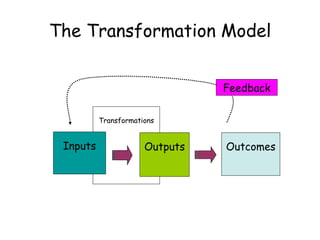
The Transformation Model Outcomes Transformations Inputs Outputs Feedback
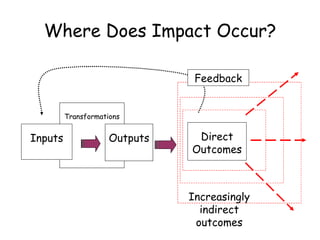
Where Does Impact Occur? Direct Outcomes Increasingly indirect outcomes Feedback Transformations Inputs Outputs
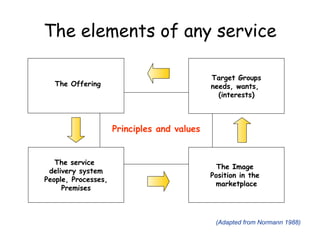
The elements of any service (Adapted from Normann 1988) Principles and values The Offering The service  delivery system People, Processes, Premises The Image  Position in the  marketplace Target Groups needs, wants,  (interests)
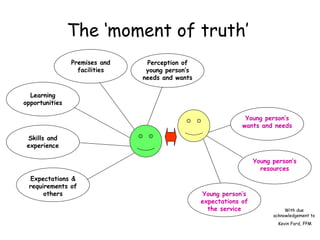
The ‘moment of truth’ With due acknowledgement to Kevin Ford, FPM Learning opportunities Skills and experience Premises and facilities Perception of young person’s needs and wants Young person’s expectations of the service Young person’s resources Young person’s wants and needs Expectations & requirements of others

The Impact Model

  • 1.
    The Transformation ModelOutcomes Transformations Inputs Outputs Feedback
  • 2.
    Where Does ImpactOccur? Direct Outcomes Increasingly indirect outcomes Feedback Transformations Inputs Outputs
  • 3.
    The elements ofany service (Adapted from Normann 1988) Principles and values The Offering The service delivery system People, Processes, Premises The Image Position in the marketplace Target Groups needs, wants, (interests)
  • 4.
    The ‘moment oftruth’ With due acknowledgement to Kevin Ford, FPM Learning opportunities Skills and experience Premises and facilities Perception of young person’s needs and wants Young person’s expectations of the service Young person’s resources Young person’s wants and needs Expectations & requirements of others

Editor's Notes

  • #3 We are getting better at measuring outputs. Also at direct outcomes (such as young peoples’ achievement). As the spotlight moves to outcomes which are further from our control (increasingly indirect) it is increasingly difficult both to measure impact. Even if it can be measured, it may be difficult to demonstrate a clear connection between the youth work we have done and the outcome that is measured. When it comes to measuring collective impact or impact on communities as a whole) it becomes very hard indeed to demonstrate how the work of a youth work organisation has actually led to the results seen. Ways forward include social auditing, assessing changes in “social capital”, reviewing the perceptions in the community etc. The work in Northern Ireland by the DHSS provides a useful lead on this.
  • #4 This model breaks down the service system into key elements For a service or organisation to be effective it must be clear and effective in all five areas. Make sure you overtly include voluntary with statutory in this (not much mention of voluntary in the reader) Youth services and organisations have often lacked clarity in their target groups (is it targeted or universal - better named open access as average service reaches up to 25% of the population); their service offering (huge and varied activities from a very small resource) and their image and position in the marketplace. In contrast many have devoted more time and effort into understanding their values and principles, and in focussing on the service delivery system: buildings, staffing, processes and activities. Local councillors often add to this pressure for buildings. Do not make this too negative - there are excellent examples too. Are the principles and values core to the work now or are some mantras which are repeated without thinking as received truths, which need to be adapted to take account of the present internal and external environments? E.g. the Government is pathologising young people, this is a deficit model are in our view mantras. Contact Sarah for more on this if you want to. Vol sector mantras might include: we never have the resources we need and we are always innovative and no one values us enough.