The Gothic VisionaryPerspective Barbara Nolan
download
https://ebookbell.com/product/the-gothic-visionary-perspective-
barbara-nolan-51957086
Explore and download more ebooks at ebookbell.com
2.
Here are somerecommended products that we believe you will be
interested in. You can click the link to download.
The Gothic Simon Bacon
https://ebookbell.com/product/the-gothic-simon-bacon-48775964
The Gothic Version Of The Gospels And Pauline Epistles Cultural
Background Transmission And Character Carla Falluomini
https://ebookbell.com/product/the-gothic-version-of-the-gospels-and-
pauline-epistles-cultural-background-transmission-and-character-carla-
falluomini-49050346
The Gothic Enterprise A Guide To Understanding The Medieval Cathedral
Robert A Scott
https://ebookbell.com/product/the-gothic-enterprise-a-guide-to-
understanding-the-medieval-cathedral-robert-a-scott-51815366
The Gothic Tradition In Fiction Elizabeth Macandrew
https://ebookbell.com/product/the-gothic-tradition-in-fiction-
elizabeth-macandrew-51910068
3.
The Gothic TextMarshall Brown
https://ebookbell.com/product/the-gothic-text-marshall-brown-51942330
The Gothic Cathedral Origins Of Gothic Architecture And The Medieval
Concept Of Order Expanded Edition Otto Georg Von Simson
https://ebookbell.com/product/the-gothic-cathedral-origins-of-gothic-
architecture-and-the-medieval-concept-of-order-expanded-edition-otto-
georg-von-simson-51955266
The Gothic Forms Of Victorian Poetry Olivia Loksing Moy
https://ebookbell.com/product/the-gothic-forms-of-victorian-poetry-
olivia-loksing-moy-51961014
The Gothic And Theory An Edinburgh Companion Jerrold E Hogle Robert
Miles
https://ebookbell.com/product/the-gothic-and-theory-an-edinburgh-
companion-jerrold-e-hogle-robert-miles-51970618
The Gothic War Gordon Rennie
https://ebookbell.com/product/the-gothic-war-gordon-rennie-54396264
5.
T H EG O T H I C V I S I O N A R Y P E R S P E C T I V E
6.
""
1
I
I'
I
A(t od
the endof his visions, St. John kneels before Christ. Lambeth Palace Library MS 209
ml -r3th Co) fol. 39v 0
Ion blessis homalle þat þis boke reden
Wit gode entent, and hor god dreden,
Or heren hit red wit gode wille
In al hor mygt hit to fulfille;
ffor þ)is blessing iche mon shulde wirke
To knowe hit & mayntene Holy [Kirke].
Hit tellis of peynes & sorowes sere
pat here shal falle to cristis dere;
poo J)at ben trewe & stiffly stonde,
pei shal be hatid þorwout þo londe—
Of deefe & blinde þat wil not se,
Ne here hor fautes heeUd to be.
Herefore crist counfortis his chirche
And biddes hom alle with pacience wirche.
pis way went I to teche gou alle
Hou 5e shal enter to heuenly halle,
pere to duelle euere in pees,
In ioye & blis Jjat neuer shal cees.
Amen
Cambridge, Magdalene College, MS. 5
printed in R. H. Robbins, Secular
Lyrics of the Fourteenth and Fifteenth
Centuries (Oxford, 7952), pp.
13.
C O NT E N T S
List of Illustrations
xi
Preface
xiii
ONE
New Directions in Twelfth-Century Spirituality
3
T W O
Anagogy, Aevum and Two Later Medieval Visionary Arts
35
T H R E E
The Vita Nuova: Dante's Boo of Revelation
84
F O U R
The Later Medieval Spiritual Quest: Through Time to Aevum
124
F I V E
Pearl: A Fourteenth-Century Vision in August
156
S I X
Will's Dar Visions of Piers the Plowman
205
Index
259
15.
L I ST O F I L L U S T R A T I O N S
Frontispiece. St. John kneels before Christ. Lambeth Palace Library,
MS. 209 (mid-13th c.), fol. 39V.
Figures 1-22 may be found following page 62
1. Rome, Biblioteca Apostolica Vaticana, MS. Vat. lat. 4860, fol. 289r.
Tree of Human History from Joachim of Fiore's Liber Concordie
2. St.-Lazare, Autun. Central Portal (Archives Photographiques)
3. Abbey Church, St.-Denis, Central Tympanum (Archives
Photographiques)
4. St.-Denis. Gilded Doors (Archives Photographiques)
5. Silos Apocalypse (1109). British Museum, MS. Add. 11695, F
O
L
-2
6. Silos Apocalypse (1109). British Museum, MS. Add. 11695, 21
7. Silos Apocalypse (1109). British Museum, MS. Add. 11695,
8. Oxford, Bodleian Library, MS. Bodley 352 (early 12th c.), fol. 5
9. Oxford, Bodleian Library, MS. Bodley 352 (early 12th c.), fol. 5V.
10. Cambrai, Bibliotheque municipale, MS. 386 (9th-10th c.), fol. 9V.
11. Cambrai, Bibliotheque municipale, MS. 386 (9th-10th c.), fol. 10v.
12. Trier, Stadtbibliothek, MS. 31 (9th c.), fol. 15V.
13. Trier, Stadtbibliothek, MS. 31 (9th c.), fol. i6v.
14. Trier, Stadtbibliothek, MS. 31 (9th c.), fol. 17V.
15. Trier, Stadtbibliothek, MS. 31 (9th c.), fol. i8v.
16. Oxford, Bodleian Library, MS. Bodley 352 (early 12th c.), fol. 6r.
17. Cambridge, Trinity College, MS. R. 16.2 (mid-i3th c.), fol. 4
18. Cambridge, Trinity College, MS. R. 16.2 (mid-i3th c.), fol. 5r.
19. Cambridge, Trinity College, MS. R. 16.2 (mid-i3th c.), fol. 14V.
20. Pierpont Morgan Library, MS. Morgan 524 (mid-i3th c.), fol. yv.
21.Pierpont Morgan Library, MS. Morgan 524 (mid-i^th c.), fol. i6v.
22. British Museum, MS. Royal 2. xiii (14th c.), fol. 48V.
17.
PREFACE
A CHANCE encounterwith a thirteenth-century English illustrated Apoca
lypse on exhibit in the British Museum first suggested the directions of
this book. I had been studying a group of thirteenth- and fourteenth-
century French, Italian and English poems concerning eschatological vi
sions when I came upon an illuminated manuscript in its glass case
opened to a vision of the New Jerusalem. Closer examination revealed
striking similarities between the elegant miniatures in this book and the
poems I had been reading. Was it simple coincidence that two artistic
modes for treating visions of the eschaton should appear during the same
period and should seem to mirror each other in tone and themes as well
as narrative method?
My initial question led to further and broader inquiries. It became in
creasingly clear that novel attitudes toward the vision of the Last Things
and the end of time—and new terms for treating it—had shaped both the
form and content of some of the finest examples of later medieval art:
the sculptural programs, stained glass windows and architectural design
of many Gothic cathedrals; ninety or more surviving Anglo-Norman and
Latin illustrated Apocalypses—many containing sequences of miniatures
of the highest order; Giotto's frescoes of the Last Judgment at Padua; the
early thirteenth-century prose Queste del Saint Graal Wolfram von Esch-
enbach's Parzival; the pilgrimage poems of Raoul de Houdenc, Huon de
Meri, Rutebeuf, Deguileville, Dante, Langland and the Pearl poet; the
English play cycles written for the feast of Corpus Christi.
Anyone who examines these masterworks as a group must be struck
by a special coherence among them. They are related not only by their
interest in describing visions but also by their effort to represent men alive
in time approaching the eschaton, imagining the state of beatific joy, par
ticipating in the glory of the heavenly court. Galahad's quest for the Grail
brings him to a transforming final revelation. Dante's pilgrim reaches the
empyrean. The Pearl narrator looks on the procession of the Lamb in the
18.
xiv Preface
heavenly city.Langland's Will experiences a series of dreams which lead
him toward Antichrist's coming. Giotto, Fra Angelico, and the cathedral
sculptors represent themselves, their patrons, contemporary saints actually
present in the heavenly realm. Artists of the illustrated Apocalypses con
temporize St. John and describe precisely his human, affective responses
as he studies the figures of the eschaton. The actors of the Corpus Christi
play cycles used their own time, language and gestures to act out the
entire history of salvation from Genesis until their final judgment at
doomsday. In a variety of modes, artists had undertaken to examine the
ways in which they and their contemporaries might both participate in
sacred history leading to the eschaton and perceive the joy of beatitude,
and their art asserted that such experiences need not be relegated entirely
to life after death.
Above all, a faith that visions were not only possible but probable in this
world suggested to theorists and artists the possibility of transforming
matter into spirit, of spiritualizing human sight and understanding, of
transmuting word and story, stone, glass and contemporary history. Mate
rial substances were to be accidental "integuments" for spiritual presence.
The model for such transformations may well have been the Eucharist.
In that sacrament, as it was redefined by the Fourth Lateran Council of
1215, "a unique and wonderful changing" took place by which the "whole
substance of the bread was transformed into the body, the whole substance
of the wine into the blood of Christ." Through the forms of art and the
visionary possibilities inherent in the soul, the materials of cathedrals
might be somehow analogously transubstantiated by intellect and imag
ination, becoming shimmering models of the visio pads·, the verses of a
poem might form the precise and luminiscent representation of ecstatic
experience, a prelude to the beatific vision itself; a personal history might
be raised up and transformed into a segment of salvation history. Never
before in the history of Christian art had artists so consciously labored to
translate time, space and matter, to devise through the conformations of
number and the materials of the created world "models" of divine realities.
Gothic architects, painters, sculptors, saints, hagiographers and poets came
to see and show the elements of the physical universe and human history
as necessary stepping stones to the world of the spirit. The aesthetic theory
supporting this transformation affected not only the form of the art object
itself, but also its calculated effect on its audience. The form, in all its
details, was intended to project a spiritual reality and thereby lead audi
ences through a process of purification and discovery toward their own
19.
Preface xv
transformation. Gothicvisionary art was essentially an art of edification
in the root sense of that word: the formal construction was to effect
spiritual reconstruction, reshaping the souls of observers within the pat
terns of sacred history in order to transport them even before death into
the company of the saved.
In the early stages of planning this book, I had intended simply to set
side by side descriptive analyses of several major art works of the later
Middle Ages (c. 1150-1400), all of which represent vision as an informing
metaphor or outline the way to, and nature of, visionary experience. But
1 became more and more aware that common spiritual backgrounds must
have supported the pervasive and long-lived persistence of the several "arts
of vision" once they had been invented during the twelfth century. Be
cause my central emphasis remains with the works themselves, I do not
want to argue for causal relationships between the twelfth-century com
mentaries on the Apocalypse and treatises on vision discussed in Chapter
One and the art works examined in subsequent chapters. But I would sug
gest, at least tentatively, that each of the artifacts I describe—the Gothic
cathedral envisioned by Abbot Suger and realized at Chartres, the illus
trated Apocalypses, the thirteenth-century French visionary quests, the
Vita Nuova, Pearl, and Piers Plowman—can be more fully understood if
considered within the context of attitudes toward history, prophecy and
vision developed by monastic and clerical writers of the twelfth and early
thirteenth centuries. It seems to me that by defining this context we can
more clearly perceive the terms that shape the narrative structures and
thematic forms of all these visionary works, both in the visual and the
verbal arts.
The essays which follow explore a few of the most important moments
in the history of a "Gothic visionary perspective." I begin with descrip
tions of that perspective in its purest forms as it appeared in commen
taries and treatises and in the work of some of the twelfth century's most
imaginative and influential artists. The commentaries of Rupert of Deutz,
Richard of St. Victor and Joachim of Fiore and the architectural ideas of
Abbot Suger caught and stirred the imaginations of men of genius. New
attitudes toward the process of sacred history, the end of the world, vision,
aevum (eternal time) and anagogy spurred artists to create powerful and
durable new forms of thought and expression. I devote particular attention
in the second chapter to the Gothic cathedral and the illustrated Apoca
lypse. Both these modes reflect the presence and power of new attitudes
toward history and vision before the beginning of the thirteenth century.
20.
xvi Preface
Through formaldesign, architect, sculptor and illuminator alike began to
assert that divine revelation and human beatitude were to be examined
and realized preeminently within the context of history—both mankind's
and one's own. They demonstrated that vision belongs necessarily to the
working out of God's temporal plan for man. Hence, linear narrative—
telling the story of divine revelation and personal salvation from Adam
until the Apocalypse—became as central to the artistic form as the rep
resentation of visionary experience.
The third chapter is devoted to the Vita ~Nuova. Dante's earliest master
piece offers us a remarkable version of the visionary perspective filtered
through the refined atmosphere of the stilnovisti poets. Dante chooses to
make linear narrative the principal means for expressing the transforma
tion of disparate experiences into the story of his own salvation. Certainly
the Commedia is far grander and more total in its achievement of a simi
lar purpose. But I have preferred to study the Vita Nuova precisely be
cause of its far smaller compass. It allows us to follow in detail the narra
tive method whereby Dante translates personal history into a process of
beatification through a series of visionary experiences. His method here
predicts the Commedia. It also exemplifies clearly the kind of double form
—a temporally based historia shaped by spiritual purpose—which served
the best vision poets of the later Middle Ages.
The fourth chapter defines a later medieval mode comparable in its dif
fusion and public appeal to the Gothic cathedral. Like the rise of romance
in France, the emergence of the visionary quest in the early thirteenth
century is a phenomenon directly related to the rapid development of the
vernacular as a literary language. It is also dependent on the increased
importance given to the sacrament of Penance and the consequent need
for persuasive manuals of instruction. But above all, the new visionary
quest—even in its most pedestrian manifestations—articulates those his
torical and prophetic interests described in Chapter One. Poets make lin
ear narrative their central concern. In their fictions, they "place" the
hero-soul on a temporal course leading through visions to salvation. Per
haps most remarkably, they can insist on the close relationship between
personal beatitude and the spiritual transformation of the world. Thir
teenth-century vision poets drew on earlier monastic forms as they devel
oped this Gothic mode, but their novel translations of the older conven
tions led ultimately to three of the finest and most complex compositions
of the later Middle Ages—the Commedia, Pearl, and Piers Plowman.
The last two chapters chart the fate of the Gothic visionary perspective
21.
Preface xvii
near theend of its history. A century and a half—and the vicissitudes of
war, plague, charges of heresy—separate the pure impulses of twelfth-cen
tury spiritual writers and artists from the writing of Pearl and Piers
Plowman. The visionary quest came late to England, and the two major
English examples show the influence of earlier continental efforts. But
both the Pearl poet and Langland imbue the mode with a distinctly Eng
lish genius even as they reflect respectively the development and break
down of earlier dreams.
The fifth chapter offers a close reading of Pearl. This detailed analysis
may appeal chiefly to those who have followed the scholarly conversation
over that very difficult poem during the last century. Those who know its
critical history will recognize my considerable debt to other readers in
defining the problems which have led to my own discussion. But such
close study also serves the argument of this book. It demonstrates how,
and in what terms, the Pearl poet developed that visionary perspective
described in Chapter One. Through form and imagery meticulously ar
ranged, he, like the designers of the cathedrals and like Dante, can still
insist that history and time may point the way to the vision of God.
I have chosen to conclude with a discussion of Piers Plowman because
this long, confusing poem heralds the disappearance of those attitudes
toward history and vision which so powerfully shaped the arts of vision
in the later Middle Ages. Langland's is an art which reaches with appar
ent anguish toward the affirmation of a visionary perspective in the face of
impossible worldly pressures. The poet draws fully on the conventions of
the vision quest only to find that they cannot bring his Will to the spiritual
peace enjoyed by his forebears. Yet even at the end of the poem, after the
greatest hardships and suffering, Will persists in his dream. An Age of the
Spirit—a kingdom of love and brotherhood on earth—still remains a
possibility, if only in poetry.
Though a continuous argument concerning the nature and forms of the
Gothic visionary perspective unites each of the studies in this book, many
readers may prefer not to read from beginning to end. Each of the essays
is also intended to exist as an independent entity; this is particularly true
of the chapters on the Vita Nuova, Pearl, and Piers Plowman. In an effort
to define a "visionary movement" in the later Middle Ages, many exam
ples would have served as well as the ones I have chosen. The early thir
teenth-century Queste del Saint Graal, Wolfram's Parzival, the Fioretti,
the English Corpus Christi plays have all presented themselves as likely
candidates. But the selections I have finally made have the double claim
22.
xviii Preface
of beingcentral and major examples of the movement and also of seeming
especially puzzling, and therefore challenging, to many readers, including
this one.
Grateful acknowledgment is made to His Grace the Archbishop of
Canterbury and the Trustees of Lambeth Palace Library, the Master and
Fellows of Trinity College, Cambridge, the Bodleian Library, Oxford,
the British Library Board, the Bibliotheque Municipale, Cambrai, the
Stadtbibliothek, Trier, the Biblioteca Vaticana, Rome, and the Pierpont
Morgan Library, New York, for permission to publish photographs of
materials in their possession; and to the Archives Photographiques, Paris,
for permission to use their photographs of French monuments. I would
also like to thank the Fulbright Commission, the National Endowment
for the Humanities, the American Council of Learned Societies and
Washington University for grants in aid of this project over the past ten
years.
I take great pleasure in acknowledging particular debts of gratitude,
first to my parents without whose interest and help this book could not
have been written; to Professors Nancy P. Brown and Madeleine Doran
whose example and instruction introduced me to the joys and demands
of scholarship; to Professor Morton Bloomfield who criticized a version
of my chapter on Piers Plowman and who continues to provide a model
of humanistic scholarship at its most rigorous and generous; to Professor
Chauncey Finch for expert and painstaking advice on paleographical ques
tions; to Professors Douglas Kelly, Stanley Fish, Valerie Lagorio, Peter
Riesenburg, Beatrice White, John Grigsby and Mr. Albert Lebowitz who
kindly read and criticized portions of my book at various stages; to Pro
fessors George Pepe and Stephen F. Brown for their careful correction
and refinement of my Latin translations; to Fr. Lowrie Daly, S.J. and Dr.
Charles Ermatinger of the Vatican Film Library for their gracious assist
ance during my work with materials in their care; to Margot Cutter
of Princeton University Press and to the Press's readers for meticulous
attention to form and substance; and to Mrs. Grace Nicholson and Mrs.
Eleanor Van Sant for their preparation of the typescript. Finally, I thank
my husband, Richard Ruland, for his close reading, apposite criticism, and
constant encouragement during crises of confidence.
St. Louis
December, /975
BARBARA NOLAN
O N E
NE W D I R E C T I O N S I N T W E L F T H - C E N T U R Y
S P I R I T U A L I T Y
FROM BEDE TO ALEXANDER OF BREMEN: TRADITION AND
TRANSFORMATION IN COMMENTARIES ON THE APOCALYPSE
At least from the time of Eusebius, the whole history of the world from
Adam until the Apocalypse had been divided into six ages. The first five
ages had already been thoroughly detailed in sacred scripture. The early
Fathers, by studying types and antitypes in the Old aind New Testaments,
had made it clear that there was a progressive improvement in the quality
of human time through the course of the Old Testament to the coming
of Christ; that is, they demonstrated that the intensity and fullness of the
divine presence was greater at the time of the Incarnation than it had
been immediately after Adam's fall. The period before Moses was de
scribed as the time before the law, and, in terms of human knowledge of
divinity, the time in which man knew only the shadows of truth. In this
dispensation, man was a "slave." He continued to live as a slave during
the age from Abraham until the coming of Christ. This was the time
under the law in which he knew truth only through images and figures.
Then, with the coming of Christ, the law was replaced by grace, the shad
ows and figures by the corpus veritatis. In the "fullness of time," man
encountered truth itself and was infused with saving grace.
But what then? The Fathers called the time after Christ's incarnation
the Sixth Age. It would continue until the events of the Apocalypse
brought the eternal sabbath. But they were unwilling to assert that God
would continue to reveal himself systematically and progressively to his
Church. Nor could they suggest that the Book of Revelation, the final
prophecy of the New Testament, might describe systematically the prog
ress of the Church step by step from Pentecost until the end of the world.
Of this last temporal age St. Augustine, the antique harbinger of the
26.
4 Chapter One
MiddleAges, says, "Sexta nunc agitur nullo generationum numero me-
tienda propter id quod dictum est: Non est uestrum scire tempora, quae
Pater posuit in sua potestate" (The Sixth Age is now proceeding, not
measured by any number of generations because of that which has been
said: "It is not for you to know those times which the Father has placed
in his own power").1 Augustine removes a sense of climax from the day
of the Last Judgment by making it only one of all the judgments made
by God from the time of Adam's eviction from paradise: "Ideo autem,
cum diem iudicii Dei dicimus, addimus ultimum uel nouissimum, quia et
nunc iudicat et ab humani generis initio iudicauit dimittens de paradiso
et a ligno uitae separans primos homines peccati magni perpetratores"
(Therefore when we say the day of God's judgment, we add "ultimate"
or "last" because he judges now and he has judged from the beginning
of the human race, casting out and separating the first men from paradise
and the Tree of Life as perpetrators of a great sin).2 For St. Augustine
and early medieval commentators the possibility of mankind moving pro
gressively in time toward total spiritual perfection and knowledge during
the Sixth Age was overshadowed by emphasis on the individual soul mov
ing with great difficulty out of time toward its own eschaton. The vision
ary approach to God was personal and vertical rather than social and
historical.
Augustine's reluctance to discover a systematic relationship between
specific events in contemporary history and God's progressive movement
of the pentecostal Church toward the eschaton is eloquently reflected in
early medieval monastic commentaries on St. John's Apocalypse. That dif
ficult book of the New Testament—which was to become a favorite sub
ject in later medieval art—had, in its earliest interpretations, been taken
for a prophecy concerning the imminent end of the world.3 Its subsequent
fate in commentaries from the early to the high Middle Ages is fascinating
in its own right.4 But its changing fortune has a special relevance for the
1 De civitate Dei xxn, 30, PL XLI, 804; CCSL XLVIII, pp. 865-866.
2 D e civ. xx, i, PL XLI, 659; CCSL XLVIII, p. 699.
3 See, for example, St. Justin, Dialogus cum Tryphone, 81, PG vi, 670; St. Irenaeus,
Contra haereses v, 28-36, PG VII, 1197-1224; St. Victorinus, Scholia in Apocalypsim,
PL v, 317-344; and Lactantius, Institutiones divinae VII, 14-25, PL vi, 779-813.
4 For an interesting summary of this history in relation to the development of
attitudes toward the Virgin Mary, see P. Prigent, L'Apocalypse 12. Histoire de
I'Exegese (Tubingen, 1959). The best history of commentaries on the Apocalypse
before Joachim of Fiore is that of W. Kamlah, Apocalypse und Geschichtstheologie.
27.
New Directions 5
developmentof those arts of vision which are the subject of this book.
Here, following the developments from Bede's influential exposition to
Alexander of Bremen's, I trace only two aspects of the commentaries:
(1) the explicit relationship which the commentator establishes between
himself, St. John and the text; and (2) the ties he discovers between the
imagery of the Apocalypse, the movements of time and contemporary his
tory. The history of these developments shows, as we shall see, the dra
matic emergence among twelfth- and thirteenth-century exegetes of new
attitudes toward contemporary time and visionary spirituality which are
to be found simultaneously in art and literature—both in the commenta
tor's stance toward his material and in his interpretation of the apoca
lyptic imagery. Without suggesting a causal relationship between these
new commentaries and concurrent developments in the arts, it is interest
ing to observe that trends in exegesis exactly parallel experiments in
church architecture and decoration, book illustrations for the Apocalypse,
and most important for our purposes, in literary vision quests, which use
the Apocalypse either allusively or as a central subject.
For Bede, whose commentary was to exert an enormous influence
throughout the earlier Middle Ages, the Apocalypse was taken to be an
"intellectual vision" to be understood chiefly by reference to the exegesis of
the Fathers. Bede is a compiler, and, following the advice of St. Augustine,
he makes no claim to the privileges of divine illumination.5 He evokes
the rules of Tychonius as a guide for wresting meaning from John's
obscure symbolism.® And in order to give the narration a manageable
order, he divides it into seven parts. His rhetorical learning not only
prompted him to organize the parts of the Book of Revelation but also
to comment on its form. In his description of the second division, he
suggests that his expectations for narrative order have been disappointed.
St. John, "according to the custom of this book," interrupts narrative
order to recapitulate, to begin again, to plunge into the "midst of time,"
or to describe the final tribulations.7 As a scholarly rhetorician, Bede sets
himself apart from the text of the Apocalypse both in these formal con-
Historische Studien, v. 285 (Berlin, 1935). See also H. Swete, The Apocalypse of
St. John (London, 1906), pp. cxciii-ccxv.
5See Beryl Smalley, The Study of the Bible in the Middle Ages (Oxford, 1952)
for a brief but precise description of Bede's general attitudes as an exegete, esp. pp.
26-36.
6 Explanatio Apocalypsis, PL xcm, 131-134.
7 PL xcm, 130-131.
28.
6 Chapter One
siderationsand in his humble acknowledgment of the exegetical tradition
in which he labors. He is anxious to find the universal moral significance
of St. John's prophecy and to present its teaching to the lethargic English
as tersely, directly and memorably as he can.8
Bede's method of exegesis is to translate each of John's symbolic images,
taken singly, by means of logical analysis. For example, in his interpre
tation of the Whore of Babylon's purple and scarlet garments, he says;
"In purpura fucus simulati regiminis, in coccino cruentus habitus impi-
etatis demonstratur" (In purple, the red dye [dissimulation] of deceitful
government is demonstrated, in scarlet, the bloody appearance of impi
ety).9 Here Bede savors the multivalent figural significances of the scrip
tural litera. To suit his purpose, he first translates "purpura" into a syno
nym, "fucus," since the latter carries both the literal meaning, "red dye"
and the transferred sense, "face painting," and "dissimulation." From this
transferred sense, he derives his moral interpretation of the purple garment
as deceitful government.10 Next, he considers the adjective "coccineus,"
derived from the noun "coccum," meaning the berry that grows on the
scarlet oak from which cloth was colored scarlet.11 No doubt with full
knowledge of forethought, Bede discovers a special relationship of simili
tude between the berry juice coloring the Whore's clothing and the blood
marring the appearance of the impious. Not only in this treatment of the
Whore's garments, but also in his interpretations of all John's vivid, often
bizarre imagery, Bede is preeminently interested in nouns and adjectives,
not in verbs, in moral essences, not in historical or narrative action, and in
the verbal play which can lead by logic to the inner moral significance
of the Divine Word.
Alcuin, who builds his commentary on Bede's work and that of the
French Benedictine, Ambrose Autpert (d. 778 or 781), gives us an even
clearer picture of early medieval monastic attitudes toward the Apoca
lypse. Charlemagne's schoolmaster is, if anything, more devoted to au
thority than his master, Bede. He quotes Bede at length in his prologue,
reminding readers of Bede's seven divisions and Tychonius' rules. He
dutifully rehearses the list of patristic commentators on the Apocalypse—•
8PL xciii, 134. 9 P L xciii, 183.
10In this verbal play, in which the word "fucus" carries in part the meaning
"face painting, make-up," we may see one possible source for a long iconographical
tradition that interprets the Whore of Babylon both as Luxuria, holding a cup of
blood, and Vanitas, holding a mirror and combing her hair.
11 Cf. Pliny, Historia Naturalis, 24, 4, 4, sec. 8.
29.
New Directions η
Victorinus,Jerome, Tychonius, Primasius, and of course, Bede. Enlarg
ing on Bede's description of Revelation's form and the nature and mean
ing of its imagery, he articulates unequivocally a mode of reading the
Apocalypse which characterizes early medieval monastic commentators
generally. For Alcuin, Revelation signifies "nothing historical." It is an
"intellectual vision" in which the truth of things is manifested directly
to the intuition without the mediation of corporeal things or "similitudes"
for things. To support his definition of the Apocalypse as "intellectual
vision," Alcuin, borrowing from Ambrose Autpert, describes the nonlin
ear foim of the whole book:
Ordo vero narrationis hie est. Aliquando ab adventu Domini inchoat,
et perducit usque ad finem saeculi. Aliquando ab adventu Domini in
choat, et antequam finiat, ad initium redit, et ea quae dimiserat, sive
quae dixerat, diversis figuris repetens, ad secundum Domini adventum
percurrit. Aliquando incipit a novissima persecutione; sed antequam ad
finem veniat, recapitulando utraque conjungit. Aliquando ad enarran-
dum proposita paululum intermittit, et aliud non ad hoc pertinens inter-
ponit; post quod ordine conciso quae coeperat perdocet. Aliquando in
ipso genere locutionis sic mutata figura quasi alia permiscet, ut non nil
aliud significet quam quod narrare coeperat. Et nota quia rarissime in
hac revelatione vel angelus, vel Joannes proprias tenent personas.12
(This is the sequence of the narration. Sometimes it starts with the ar
rival of the Lord and carries through to the end of time. Sometimes it
starts with the arrival of the Lord, and before it finishes, it returns to
the beginning and by repeating in different figures both what it has
left out and what it has said, it hastens to the second coming of the
Lord. Sometimes it begins with the last persecution. But before it comes
to the end it recapitulates and connects both [beginning and end]. Some
times in order to narrate, it temporarily abandons its themes and intro
duces something totally unconnected. Afterward in concise order it
teaches thoroughly what it had begun. Sometimes in this kind of style,
a figure is changed in such a way that it is confused, as it were, with
other things so that it signifies something quite other than what it
began to represent. And you should note that very rarely in the revela
tion do the Angel or John retain their own persons.)
12PL c, 1089. See Ambrosius Autpertus, In Apocalypsin, in Opera, ed. R. Weber
(Turnholt, 1975), pp. 13-14.
30.
8 Chapter One
Becausethe vision is intellectual, Alcuin argues, one cannot expect the
linear narrative order proper to history, nor stable images with univocal
meanings. John's vision, then, is allegory and not entirely coherent alle
gory at that. The litera must melt as its spiritual meanings are perceived.
Bede had noted the apparent disorder of John's narration but had not dis
cussed its implications. Alcuin, on the other hand, seeking a divine ra
tionale for the surface difficulties of the story, had found it in his defini
tion of "intellectual vision." In this way, narrative order, the sequence of
imagery, the progress of the historia could all be subordinated to a moral
(and preeminently rational) interpretation of individual images. Further
more, since John, in Alcuin's reading, "rarely retains his own person,"
there could be no point in studying his responses to his vision either in
themselves or as potential examples intended for the reader.
Bede and Alcuin, as compilers and rhetoricians, were important for the
future development of the exegetical tradition. But it was two much less
prominent figures, Haimo of Auxerre (fl. 840-870) and Beatus of Liebana
(d. 798), whose commentaries enjoyed particularly wide currency from
the ninth to the thirteenth century.
As a Spaniard, largely removed from the mainstream of the Carolingian
renaissance, Beatus might well have slipped into oblivion—an obscure
provincial polemicist—had it not been for the major cycle of illustrations
designed to accompany his commentary. The commentary itself, like
Bede's and Alcuin's, participates in the Tychonian tradition of allegorical
interpretation. But Beatus was also a keen opponent of a local heresy and
his interpretation reflects his position. He used his exposition in part to
celebrate the divinity of Christ, glorifying the risen, victorious Jesus
against those who would make the incarnate Christ merely the adopted
son of God. Because the effects of this particular emphasis—and especially
the heightening of a traditional monastic reticence before John's mysteri
ous images—were to be transmitted more dramatically through the Beatus
cycles of illustrations than through the commentary itself, fuller discus
sion of Beatus will be reserved for the next chapter. Haimo, on the other
hand, who was a direct heir to the central Carolingian tradition, produced
a commentary which was to exert a significant influence on the most im
portant twelfth-century exegetes, including Rupert of Deutz and Richard
of St. Victor.13
13 The influence of Haimo's commentary on eleventh- and twelfth-century exegetes
was extraordinary. See Kamlah, esp. pp. 14, 17, 22-23, 30 and passim. Haimo's iden
tity is open to some question. See C. Spicq, Esquisse d'une histoire de Vexegese latine
31.
New Directions 9
Haimofully assented to the Carolingian exegetical habits of abstraction
and allegorization. St. John's visions are, for him, "intellectuale," contain
ing "nihil historicus." Yet a close scrutiny of his commentary also reveals
hints of innovation. Without in any way developing its implications,
Haimo touches very briefly on the significance of St. John's spiritual ex
perience as an example for holy readers seeking beatitude. In describing
John's exile on Patmos, for example, he explains the importance of such
isolation for contemplative experience generally:
Ubi quanto magis putabatur vinciri custodia humana, tanto magis hu-
manitatis transcendens, meruit videre coelestia. Et cui certa negabantur
spatia terrarum excedere, secreta sunt concessa penetrare coelestia. Et
quanto magis destitutus est humano solatio, tanto ei adfuit divinum.14
(By however much more he is thought to be held down there by human
bondage, so much the more, transcending humanity, he deserves to see
heavenly things. And to him to whom it is denied to go beyond defined
earthly limits, it is allowed to penetrate heavenly mysteries. And the
more he is deprived of human consolation, the more the divine is pres
ent to him.)
And again, interpreting the name "Patmos" allegorically, Haimo argues
that John's suffering should serve as an example to all the holy, for
"quanto magis enim sancti in praesenti vita affliguntur, eo amplius illis
secreta coelestia manifestantur" (for the more the holy are afflicted in this
present life, so much the more are heavenly secrets shown to them).15 In
deed, he concludes one cannot possess the kingdom unless he practices
such tribulation. To be sure, Haimo speaks only briefly of St. John's ex
perience and even here his chief concern is with the visionary's general
allegorical significance for all the faithful. But it may have been precisely
such fleeting hints as these, pointing to the personal spiritual significance
of Revelation, which made his commentary particularly interesting to
twelfth-century exegetes.
The most original of the early commentaries—that of Berengaudus—
presents difficulties because it cannot be dated with certainty.16 It has been
au moyen age (Paris, 1944), pp. 50-51; B. Smalley, Study of the Bible, p. 39; Kam-
lah, p. 14 and n. 24.
14 PL cxvii, 937. Compare Ambrosius Autpertus, Opera, In Apocalypdn, p. 9.
15 PL CXVII, 949.
16The first editor of Berengaudus' commentary, Cuthbert Tunstall (Paris, 1548)
attributed it to St. Ambrose and placed it among Ambrose's work. Tunstall omitted
32.
ίο Chapter One
calledthe first of the "historico-prophetic" interpretations, and therefore
placed closer to the twelfth than the ninth century. Yet, although Beren-
gaudus' originality sets him apart from the major Carolingian compilers,
he remains essentially of the monastic, allegorical school. For him, as for
Bede, Alcuin, Beatus and Haimo, the universal Church in all times and
places is the general subject hidden in the images of the Apocalypse.
But it is only a short logical step from this omnitemporal concern for
the one, universal Church to a systematic reading of the "sevens" so per
vasively present in the Book of Revelation as the seven ages of the Church
from the time before the Flood until the Last Judgment. And Berengau-
dus was the first to make this connection.17 "If you look closely," he says,
"you will discover that the holy city of God,"
. . . quae ex omnibus electis constat, quae ab initio usque ad finem
tendit, . . . in septem partes divisam. Prima igitur pars ejus sunt electi,
qui ab initio usque ad diluvium fuerunt: secunda, patriarchae et caeteri
justi usque ad legem datam: tertia, hi qui sub lege fuerunt: quarta,
prophetae: quinto, apostoli et qui ex Judaeis crediderunt: sexta vero
pars est gentium multitudo quae ad fidem venit: septima, electi qui in
fine mundi nascituri sunt, et contra Antrichristum pugnaturi.18
(. . . which is built from all the elect which stretches from the begin
ning even to the end is divided into seven parts. The first part of the
elect are those who lived from the beginning until the flood; the second,
the patriarchs and other just men until the law was given; the third,
a note at the beginning of the epilogue which directs the reader to find the author's
name in the capitals beginning each of the seven visions (BRNGVDS). That the author's
name is Berengaudus is confirmed by a notation in B.N. MS. lat. 2467 in the original
scribe's hand: "Auctor huius libri Berengaudus appellatur." Berengaudus was first
identified as a Benedictine monk of the Abbey of Ferrieres (Maurist Fathers, His-
toire litteraire de la France ν [1740], pp. 653^). A few scholars have put forward
a date as late as the eleventh or twelfth century for Berengaudus: see esp. R. Lauren-
tin, Court Traite de Theologie Mariale (1953), p. 123. R. Weber in his recent edition
of Ambrose Autpert's commentary leaves the question open: "Berengaudus could be
either Berengaudus of Auxerre who lived in the ninth century or his homonym of
the twelfth century who lived in Angers" (xiv). The best summary of the debate
over Berengaudus' identity is to be found in F. Vigouroux, Dictionnaire de la Bible,
vol. i, pt. 2 (Paris, 1926), cols. 1610-1611.
17
Berengaudus makes this leap early in his commentary as he interprets the seven
candelabra and seven stars of Rev. 1, 15.
l s
P L xvii, 851.
33.
New Directions II
thosewho lived under the law; the fourth, the prophets; the fifth, apos
tles and those among the Jews who believed; the sixth part, truly is the
multitude of peoples who have come to the faith; the seventh, those
elect who will be born at the end of the world and will wage war
against Antichrist.)
Once the seven partes of sacred history had been invoked as Revelation's
specific subject, Berengaudus could read each image of the Apocalypse as
a piece in a puzzle, the total picture of which would be the life of the
Church in its "seven times."
Berengaudus' interest in the "sevens" of Revelation also led him to
divide the scriptural text into seven visions, each of which would be ex
plicated as a separate unit. In addition, he had sought to discover a logical
and narrative rationale for the seven visions he had distinguished. Thus,
while the first vision describes the form of the whole Church under the
figure of the seven churches of Asia, the second, which invites St. John
to "ascend," signifies that the faithful must rise up to heavenly virtue in
order to perceive the sublimity of the Church more fully. Then, "not un
suitably," the third vision unfolds the opening of the Book with Seven
Seals, that is, the Old and New Testaments as they were expounded after
the founding of the Church by the holy doctors according to the Apos
tolic faith. Next, "according to the order of reason," the figure of the
seven angels blowing their trumpets must signify the holy doctors them
selves who expound the scriptures to the elect and reprobate alike while
the angels pouring out their vials represent those same doctors, preaching
now only to the reprobate. Finally, Berengaudus concludes that while all
the first five visions describe the general history of the Church, the last
two, following the order of time, describe particularly the general resur
rection at the end of the world, the damnation of the wicked, the glorifi
cation of the just and the life of the blessed after the resurrection.
In his comparison of the "sevens" of Revelation, Berengaudus discov
ered an intricate network of correspondences whereby John's visions sym
bolically represent, over and over, the history of the Church leading in-
eluctably to the coming of Antichrist. Thus the Apocalypse becomes for
him as much a story about the passage of time from Adam until the
Apocalypse, as of the omnitemporal struggle between the devil and the
Church. Berengaudus' special interest in the times of the Church led him
to a far more literal and concrete imagination of the "time" of Antichrist
and the blessed time after the general resurrection than can be found in
34.
12 Chapter One
eitherAlcuin or Haimo. Though he does not relate the apocalyptic sym
bolism specifically to the course of the present time, he prepares the way,
suggesting for instance not only that the seven heads of the beast repre
sent the reprobate through whom the devil deceives the human race, but
also that "five of the heads have already fallen and that the seventh is not
yet come."19
But in his treatment of St. John, Berengaudus follows a traditional
monastic pattern: John is a minor figure in the narrative, the transparent
instrument through whom the vision is presented. He is shown to be
awe-struck by his vision and he reveals his "humana fragilitas" when he
falls down as if dead in the face of God's immensity:
Ecce Joannes, qui sibi stare videbatur, viso Domino, cecidit tanquam
mortuus; quia unusquisque vir sanctus quantum se ad contemplandam
divinitatem Dei altius erexerit, tanta apud se introrsus inferius cadit;
quia in comparatione Dei ejus magnitudo quam parva sit, facile per-
spicit.20
(Behold John, who seems to stand before Him, before the vision of the
Lord, he fell as if dead; because each and every holy man, as much as
he is raised on high for the contemplation of God, so much he falls
down into himself; because in comparison to God he easily perceives
that his size is tiny. Whence he falls as if dead because in comparison
to God he perceives that he is nothing.)
Although Berengaudus must be considered closer to the Carolingians than
to the twelfth century in his interests and in his methods, his innovative
concern with the Apocalypse as a narrative sequence arranged in seven
visions and revealing the course of sacred history are significant enough
to set him apart as a link between the early compilers and the writers of
original commentaries who were to come.
The only other major commentary now extant produced between the
end of the ninth and the beginning of the twelfth century was that of
Bruno of Segni (1049-1123), a politically active churchman and counselor
to three popes, who finally sought the quiet of the cloister at Monte Cas-
19 PL xvii, 999. Berengaudus may owe his treatment of Antichrist in part to Greg
ory the Great whom he cites as a source and who was himself anti-Augustinian in
his anticipation of the world's imminent end.
2 0 PL XVII, 775.
35.
New Directions 13
sino.21On the whole, Bruno follows earlier tradition both in his inter
pretation of St. John and his moralization of the text. But at several points,
easy to overlook but nonetheless significant, he develops traditional exege
sis in new directions. Though Bruno humbly and sincerely acknowledges
the authority of his forebears, he is not loathe to launch out on his own,
perhaps in part because he is writing for friends. In both the freedom and
fullness of his exposition, he presages the far more daring work of twelfth-
century exegetes to follow.
Like Berengaudus, Bruno makes a seven-part division of Revelation
corresponding to seven distinct visions. In the orderly procession of these
visions, he discovers a striking pattern of recapitulations: each vision but
the last, according to Bruno, recounts the progressive history of the Church
from its beginnings until the eternal sabbath of the blessed. One of his
dominant interests—the centrality of preaching for the Church's develop
ment—leads him to find over and over in the figures of the first six visions
the successive appearance of good preachers in the face of changing per
secutions. For example, in his account of the horses of the first four seals,
the white horse signifies the purity of the primitive Church while the red,
black and pale horses (or the changing colors of the single horse) demon
strate the series of persecutions from Nero onward in successive times of
preaching.22 Following the curve of history, the fifth, sixth and seventh
seals point to the final movements in the Church's history, the concluding
periods of preaching, the coming of Antichrist and the eternal sabbath.
The seven trumpeting angels likewise mark out stages in the history of
preaching, this time particularly against heresy. The trumpet of the fourth
angel sounds against the heretics, Arius and Sabellius, while the fifth and
sixth angels preach in the time of Antichrist, and the seventh marks the
end of all preaching as the action of grace fills all souls with God's praise.23
Bruno reserves the last book of his commentary exclusively for the final
vision of the New Jerusalem. For him, the heavenly city in all its details
signifies the joy of the universal Church omnitemporally practicing vir
tue, preaching truth and preparing for the eternal sabbath. A few of the
sacred figures in this last vision also lead him to imagine aspects of that
final state, for example the beauty of wisdom as it will be enjoyed by the
blessed:
21 Prigent, p. 22; Kamlah, p. 16. For the existence of other commentaries on the
Apocalypse between the ninth and eleventh centuries, see Kamlah, p. 15, n. 6.
22 PL CLXV, 633-636. 23 PL CLXV, 646-666.
36.
14 Chapter One
Atvero ipsa civitas est de auro munda, quod simile est vitro mundo,
quia ipsius civitatis domus, turres et palatia ex illo metallo composita
sunt, quod caeteris omnibus clarius et dignius est, per quod sapientiam
intelligimus, de qua dicitur: "Sapientia aedificavit sibi domum." Sed
quam domum, nisi hanc nobilissimam civitatemP Nusquam ergo in ea
tenebrae, nusquam caecitatis ignorantiaeque caligo, ubique aurum ful-
get, ubique sapientiae luce cuncta resplendent, et se vicissim omnes
contemplantes, nihil est in alicujus conscientia, quod ab omnibus non
videatur. Unde et vitro mundo hoc aurum simile dicitur, aurum enim
et si fulgeat, non tamen videtur quod intra se habet; in vitro autem, si
mundum est, nihil est interius quod exterius non appareat. Merito igitur
illius civitatis aurum mundo vitro similes perhibetur, siquidem omnia
ibi clara et manifesta erunt, et nihil ibi obscurum et tenbrosum, nihil
quod insipientium oculos ofiendere possit.24
(But truly this city is of pure gold, which is like clear glass, for the
dwelling place of this city, the towers and the roof are made from that
metal which is clearer and more worthy than all others, by which we
understand wisdom, concerning which it is said: "Wisdom has built a
house for herself." But what is this house except this most noble city?
Nowhere shadows in it, nowhere the cloud of blindness and ignorance,
everywhere gold shines, everywhere all things shine with the light of
wisdom, and all those contemplating each other in turn, there is noth
ing in any consciousness which is not seen by all. Whence this gold is
said to be like clear glass, for gold may shine, but what is within is not
seen; in glass however, if it is clear, nothing is within which does not
appear outside. With reason therefore is it asserted that the gold of this
city is like clear glass for here all will be clear and evident, and nothing
here will be hidden or shadowy, nothing foolish which could offend
the eyes.)
Such imaginations as these are more frequent in Bruno than in earlier
medieval commentary generally and may have helped to prepare the
ground for the far fuller images of heavenly bliss to be developed in suc
ceeding centuries.
Finally, the bishop of Segni shows more than a passing interest in the
nature of St. John's experience as it bears on the reader's. For example,
when he describes the evangelist's first stunning vision, he explains John's
state and then exhorts his readers to a like response:
24 PL CLXV, 724-725.
37.
New Directions 15
Conversusnamque ad spiritualem intelligentiam beatus Joannes vidit
et intellexit vocem illam, quae cum eo loquebatur. Convertere ergo et tu,
quicunque banc prophetiam intelligere cupis, ut nihil carnaliter sapiens,
totus ad spiritualem intellectum rapiaris.25
(Having turned around for spiritual understanding, blessed John saw
and understood that voice which spoke with him. Therefore you, who
ever desire to understand this prophecy, turn around so that, knowing
nothing carnally, you may be wholly drawn up to spiritual comprehen
sion.)
And again, as he speaks of St. John being carried to a mountain to per
ceive the heavenly city, he suggests, by using the first person plural, that
his readers may share the visionary's experience:
Et sustulit me in spiritu in montem magnum et altum, per quem ec-
stasim et mentis excessum intelligimus, in quem nullis aliis quam
spiritualibus pedibus ascendere possumus.26
(And he carried me in spirit onto a great and high mountain, through
which we understand ecstasy and mental rapture, into which we can
ascend by no other means than by spiritual feet.)
Yet for all his innovation, Bruno remains firmly placed in his own time,
a romanesque writer carefully but freely developing the directions of his
Carolingian forebears. His commentary gives only the barest hints of the
amazing developments to come in the twelfth century.
In a prefatory letter appended to his Expositio in Apocalypsim (written
between 1117-1126), Rupert of Deutz, a German monk well educated in
Liege and finally Abbot of Deutz, sounded a new note. He proposes not
to gather the flowers of earlier commentators but to offer an original in
terpretation, something other and better than his forebears, the "anti-
quores patres." Though Rupert frames his daring proposal in a discourse
on meekness and develops the metaphor of the Scriptures as a field in
order to justify this new plowing, his intention to be original sets his
commentary apart. Further, Rupert makes the rationale for his new work
his personal experience of the Scriptures' power to excite the soul."What,"
he asks, "is Sacred Scriptures but the Promised Land? What it was for
those to leave Egypt and to enter into that Land of Promise, that it is for
us to leave the shadowsof ignorance, and enter into the knowledge of God
25 PL CLXV, 611. 2ePL cLxv, 720-721.
38.
16 Chapter One
throughthe truth of Scriptures."27
In this regard, Rupert's commentary is
to be an example. It will show readers how they, too, may find their per
sonal liberation and the beginning of divine wisdom by likewise studying
and grasping God's word.28
Rupert is explicit in describing what the reader is to find in the Apoca
lypse and how he will discover its mysteries:
Horum omnium temporum, sive de omnibus his temporibus, scilicet de
praeterito, de praesenti et de futuro, haec prophetia contexitur, quia
videlicet qualis fuisset, qualis tunc esset, qualis futurus esset Ecclesiae
status, hac Apocalypsi revelavit huic dilecto suo Jesus Christus, sicut ex
ipsa serie mirabili, eodem Jesu Christo dante, cognoscere potest lector,
sive auditor beatus.29
(This prophecy is comprised of all times, or concerning all times, name
ly concerning the past, present and future, so that Jesus Christ revealed
to his loved one [John] what had been, what then was and what the
future status of the Church would be, just as by that wonderful series,
the reader or blessed hearer can know, if Jesus Christ grants it.)
Here he explains that we (as well as John) are led into this prophecy by
our leader Jesus Christ. Then "legentes pariter audiamus, foris legendo Iit-
teram, intus audiendo mysteria" (when we read let us listen equally: by
reading the letter without, by hearing the mystery within).30 Implicitly
Rupert puts the reader in John's place and offers him the exciting possi
bility of experiencing the letter of his vision and simultaneously under
standing its mysteries.
Rupert's notion of reading—which gives greater significance to the letter
than heretofore—required a redefinition of "intellectual vision" as Alcuin
had described it. And he does not fail to make the adjustment. Instead of
being a vision which requires no forms or similitudes of things, "intellec
tual vision" is for Rupert a mode of understanding whereby "mens a
Spiritu sancto illuminatur, ut intelligat, quomodo intellexit Joseph, quid
per easdem imagines significaretur" (the mind is illuminated by the Holy
Spirit so that it understands, as Joseph understood, what is signified
27 PL CLXIX, 825-828.
28 PL CLXIX, 850. This same interpretation is repeated a century later by the Fran
ciscan expositor, Alexander of Bremen, who gives a far more historical and personal
interpretation of the Apocalypse than Rupert.
29PL CLXIX, 831. 30Ibid.
39.
New Directions 17
throughthese images).31 The difference between the two definitions—
Alcuin's and Rupert's—is a subtle one, but it makes a significant differ
ence in the way the images are handled. For Rupert, the apocalyptic
images signal both particular moments in the history of God's revelation
to man through the Old and New Testaments and the mystery of divine
and diabolic power omnipresent in the world. Thus, for example, the
apocalyptic red horse signifies the "bloodied populace of the devil's city,
the city of Babylon." But it also includes particular moments of blood and
death in the course of sacred history: the blood of the just Abel, and of
Zacharias, son of Barach, and the blood of Christ through the actions of
the gentile, Pontius Pilate.32 Rupert goes on to name the bloodied tyrants
of the early Church, Titus and Vespasian. Likewise, in his discussion of
the pale horse—the heretics—he names the fourth-century heretic, Arius.
Rupert's interpretation of the apocalyptic imagery as signifying particular
historical moments differs substantially from Berengaudus' more general,
schematic exegesis. Unlike Berengaudus, he discovers the dynamic move
ment of powerful forces through specific historical moments hidden in
John's symbols. And although he himself ties the Book of Revelation more
fully to Old than New Testament history, his historicization of the
apocalyptic images would be carried in new directions in the interpreta
tions of Anselm of Havelburg and Richard of St. Victor, and transformed
by Joachim of Fiore and Alexander of Bremen.
But what is most strikingly innovative is Rupert's discovery of a di
vinely arranged memory system in the mysterious imagery of the Apoca
lypse. Framed by his commentary, the Book of Revelation becomes an
intricately organized book of meditation—a systematic guide to spiritual
consolation, and finally, to beatitude. Haimo of Auxerre, who was Ru
pert's principal model, had, like Alcuin, confessed to bewilderment in
the face of Revelation's apparently repetitive and digressive imagery in
which he could find "nihil historicus." As a consequence, he had tried to
explicate the intellectual meaning of discrete figures, always following the
31 PL CLXIX, 852. Rupert's definition may owe its inspiration direcdy or indirecdy
to St. Augustine's distinctions regarding the three kinds of vision. In his De Genesi
ad litteram Augustine describes St. John's visions as both spiritual and intellectual:
the evangelist perceived his vision through similitudes of things, but then understood
with perfect intellectual clarity the truth contained in the revelation. See De Genesi
xii, 9 and 26 in PL xxxiv, 461 and 476. See also Ambrosius Autpertus, In Apocalyp-
sin, p. 13.
32 PL CLXIX, 943.
40.
i8 Chapter One
Rulesof Tychonius, seeking the genus within the species. By contrast,
Rupert insists on the importance not only of the images per se but of
their order. By systematic meditation on the sacred "imagines" "per ordin-
em" he argues, the blessed reader will be able to draw his soul toward
beatitude, conforming it to the seven spirits who stand before the throne
of the apocalyptic Lord. If he reads and understands the book aright, such
a reader will, like St. John, behold the door of heaven opened to him,
inviting him to enter in and converse with the blessed.
That such an experience is within his reader's reach, Rupert confirms
as he explicates the opening of John's second vision: Post haec vidi, et ecce
ostium apertum in coelo (Apoc. 4). For the reader, as well as John, that
"heaven which is opened" signifies "coelestem vitam . . . ad quam nuper
resurgendo Christus a mortuis, universam Ecclesiam suscitaverat consur-
gentem secum, resurrectione prima." Because of Christ's saving death and
resurrection, "regnum Dei intra nos est." Thus by the opening of the
door, the mysteries of Scriptures are opened, which "to understand spirit
ually, and to live according to them, is to reign already in the kingdom
of heaven and to have conversation in heaven."33
But in order to "reign now in the Kingdom," Rupert argues, the reader
must dispose himself properly, and then, opening the Book of Revelation,
he must await that inspiration from God which will clarify the mysteries
of its images. In the prologue to the second book of his commentary, Ru
pert defines the kind of preparation he envisions for his ideal audience
as they approach St. John's revelations: "With great desire to taste the
sweetness of the divine Word, and with humility, we hasten to seek and
find so that the door will be opened to us. What we seek is not the milk
of babies, but the solid food of the perfecti. For all those things which are
contained in that mystery are as strong as wine, and wine, even as the
bride of the Song of Songs says, most sweet and excellent, worthy for
drinking by my beloved, and for savoring with lips and teeth." "There
fore," Rupert concludes, "we seek so that we may discover, we knock with
perseverance so that it may be opened to us."34 With so urgent and burning
a desire, then, the soul may, with John, obey the command, "Ascende
hue," that is, as Rupert explains, "in spiritu excedere omnes sensus carnis
atque spiritualia videre oculis spiritualibus" (in spirit to pass beyond every
sense of the body and to see spiritual things with spiritual eyes) .35
The commentary of Rupert, then, leads the reader through a meditation
following the order of the apocalyptic images to a final discovery—
33 PL CLXIX, 903-904. 34 PL CLXIX, 863-866. 35 PL CLXIX, 905.
41.
New Directions 19
glimpsedthrough the sacred figure of the heavenly Jerusalem—of the
glory of the blessed after the general resurrection. In his exposition, the
images have become signs of spiritual progress, leading by ordered stages
to the experience of beatitude, which as Rupert suggests, is symbolically
present to the readers' spiritual eye (and imagination) in the picture of the
heavenly city descending from heaven.
With Anselm of Havelburg's exposition of the seven seals, we encoun
ter for the first time a full reading of apocalyptic imagery as specifically
symbolic of the progressive order of history leading to the present time.36
Anselm did not write a complete commentary, and so his work cannot
offer us as much information about changing attitudes toward the Book
of Revelation as later texts do. But it is nevertheless important as it her
alds, early in the twelfth century, what can be regarded as a revolution
in the history of Apocalypse commentaries.
For Anselm the seven seals represent clearly definable, successive stages
in the history of the pentecostal Church. Of the seals, four have already
been opened—indeed, the present age is in the midst of the status of the
pale horse. In Anselm's scheme of the four horses, we recognize a broad
leap beyond Rupert's suggestive interpretation. The white horse signifies
the first status of the Church, clear and beautiful with the whiteness of
miracles.37 In the red horse, Anselm discovers the bloodshed of the mar
tyrs which began with St. Stephen.38 The black horse stands for the
poisoned doctrine of heretics—Arius, Sabellius, Nestorius, Eutyches, Mace-
donius, Donatus, Photinus, Manes.39 But the pale horse affords the most
fruitful field for Anselm. Here he develops a history of holiness in the
pentecostal Church, showing its growth in brightness in the midst of
blackness—for the horse is pale to suggest a mixture of black and white.
Anselm traces the development of "religious men, lovers of truth, found
ers of religions," concentrating especially on the late eleventh and early
twelfth centuries. With the efforts of men like St. Norbert (1085-1134),
founder of the Premonstratensians, "religion, greatly renewed, began to
increase, and it has been diffused throughout the world." Anselm also
praises St. Bernard of Clairvaux, the Knights Templar who defend
Christ's sepulcher against the Saracens, and the congregations of the East-
36Anselm of Havelburg, Dialogues, ed. G. Salet (Paris, 1966). Anselm, probably
born in the Rhineland and educated at Laon, became a Premonstratensian under the
influence of his teacher, St. Norbert. In one of his letters he mentions Rupert of
Deutz.
37 Dialogues, pp. 68-70. 38 Dialogues, p. 72. 39 Dialogues, pp. 77-83.
42.
20 Chapter One
ernChurch which he had visited in Constantinople.40
From this brief
account he draws a most astonishing conclusion, but one which would be
in perfect accord with those other twelfth-century writers who also dis
covered an increase of grace through New Testament history even to their
own time:
Et fit mira Dei dispensatione, quod a generatione in generationem suc-
crescente semper nova religione, renovatur ut aquilae juventus Ecclesiae,
quo et sublimius in contemplatione volare queat et subtilius quasi ir-
reverberatis oculis radios veri solis contueri valeat.41
(And by the marvelous dispensation of God it happens that, the new
religion always increasing from generation to generation, the youth of
the Church, as of an eagle, is renewed, whereby it is able to fly higher
in contemplation and more subtly to behold the rays of the true sun as
it were with unflinching eyes.)
We have only to compare Anselm's sense of history's dynamic move
ment toward the seventh seal and the eternal sabbath with Alcuin's sche
matic moralization of John's visions to measure the distance we have trav
eled. The earlier exegetical cast of mind has been decisively superseded by
new historical and spiritual concerns which were to appear in various
guises in three major commentaries of the twelfth and early thirteenth
centuries—those of Richard of St. Victor, Joachim of Fiore, and Alexander
of Bremen.
The importance of Richard of St. Victor (d. 1173) for the development
of later medieval spiritual attitudes cannot be overstated.42 Dante fittingly
40 Dialogues, pp. 84-107.
41 Dialogues, p. 104.
42 Though Hugh of St. Victor's broad and original explorations, including his
commentary on Pseudo-Dionysius' Celestial Hierarchy, decisively shaped Richard's
spiritual thought, the latter's concentrated interest in the visionary ascent to God
gave him a special role in later medieval spiritual history. Thus St. Bonaventure
places him in the development of Christian thought: Primum maxime docet Augus-
tinus, secundum maxime docet Gregorius, tertium vero docet Dionysius-AnseImus
sequitur Augustinum, Bernardus sequitur Gregorium, Richardus seqitur Dionysium,
quia Anselmus in ratiocinatione, Bernardus in praedicatione, Richardus in contem
platione (De reductione artium ad theologiam, 5, in Opera theologica selecta, ed.
minor, torn, ν [Quaracchi, 1964], p. 221). For a brief history of the origin and de
velopment of the school of St. Victor in the twelfth century, and of the relationship
between Hugh and Richard, see R. Baron, Hugues et Richard de St-Victor (Paris,
1961), pp. 7-50.
43.
New Directions 21
honorshim in the heavenly sphere of contemplatives and describes him as
"piu che viro" (Para. x, 132). But the "magnus contemplator" also has
particular relevance for this study, and his name will appear frequently
in the following pages. Richard gives the first full and systematic inter
pretation of the Book of Revelation as a linear narrative centering upon
the quality of John's visions and directed toward the spiritual education
of the reader. The experience of John, the seer, becomes in Richard's expo
sition as central to the narrative as the series of images he perceives.
Whereas Bede and his successors in the earlier Middle Ages were con
cerned with the universal moral significance of discrete images, Richard
even more fully than Rupert, attends to the actions of Revelation and to
the spiritual conditions which accompany John's (and the reader's) prog
ress through a sequence of temporally organized scenes leading to a vision
of the heavenly city.
Two simple comparisons will epitomize the changes Richard wrought
in the monastic exegetical tradition. In his exposition of Revelation 21, de
scribing the descent of the New Jerusalem, Bede had written: "De coelo
descendere ista civitas dicitur, quoniam coelestis est gratia, qua Deus earn
fecit" (That city is said to descend from heaven because it is the grace of
heaven, where God made it).43 Beatus gives a longer and likewise moral
exposition:
...et ostendit mihi civitatem sanctam lerusalem, descendentem de caelo
a Deo. haec est ecclesia, civitas in monte constituta, sponsa agni, quia
non est alia ecclesia et alia civitas, quia una est, quia semper in penitentia
de caelo descendet a Deo, quia filium Dei imitando in penitentia de
scendere dicitur in humilitate.44
(And he showed me the holy city, Jerusalem, descending from heaven
from God. This is the Church, the city built on the mountain, the spouse
of the lamb, because there is not one Church and another city, for it is
one because the Church by imitating the Son of God in penance is said
to descend from heaven in humility.)
By contrast, Richard looks excitedly through John's eyes on the shimmer
ing, bejeweled image of the City and discovers its spiritual meaning ema
nating from the surface of the figure:
43 PL xciii, 194.
44H. A. Sanders, Beati in Apocalypsin (Rome, 1930), p. 623.
44.
22 Chapter One
Agitautem haec septima et sacratissima visio de innovatione futura
elementorum, et glorificatione justorum et coelestium mansionum, atque
bonorum jucunditatem, multiformium figurarum qualitatibus pulchre
describens, et humanum animum ad summi boni appetitum atque dul-
cedinem mirabiliter trahens. Nam si quis etiam solam verborum pulch-
ritudinem in serie visionis hujus diligentius ac studiosius attenderet,
unde semetipsum ad tanti boni concupiscentiam excitaret, perfectissime
reperiret, et tam pulchrae ac jucundae civitatis habitator fieri votis omni
bus exoptaret.45
(This seventh and most sacred vision tells of the future renewal of the
elements and the glorification of the just and of the heavenly mansions,
and the joy of the good, describing them beautifully with the properties
of multiform figures, and drawing out wonderfully the desire and sweet
ness of the highest good. For if one would even attend to the beauty of
the words in the sequence of the vision diligently and studiously, then
he would stir himself up to the desire of such good. He would most per
fectly perceive it and greatly desire to be made an inhabitant of so
beautiful and joyful a city in all his prayers.)
Furthermore, while earlier monastic exegetes had attended more to dis
crete images than to John's actions in seeing his visions, Richard makes
understanding that action both literally and spiritually a central concern
in his interpretation. When Bede explains the sentence of Revelation 17:3,
"Et abstulit me in desertum in spiritu," he writes simply:"Desertum ponit
divinitatis absentiam, cujus praesentia paradisus est" (The desert signifies
the absence of divinity whose presence is paradise) .46 What interests Rich
ard, on the other hand, is the import of the verb: What was the "I" doing?
For what reason did the angel carry John into the desert? Hence he ex
plains the same statement, concentrating on the nature of John's experi
ence, and using the "me" ambiguously to signify at once St. John himself,
and the reader: "Et abstulit me in spiritu, ad sublimiora videlicet videnda,
in desertum, ad contemplanda reproborum corda, quae sunt a Deo deserta"
(And he carried me in spirit, namely for a higher seeing, into the desert,
for contemplating the hearts of the reprobate who are deserted by God) 47
Richard justifies his method of interpreting John's revelations by refer
ence to his important redefinition of the class of vision into which the
Apocalypse falls. Following Pseudo-Dionysius and his teacher, Hugh of
St. Victor, Richard rejects Alcuin's description of the Apocalypse as an
45 PL cxcvi, 858-859. 46 PL xciii, 182. 47 PL cxcvi, 832-833.
45.
New Directions 23
"intellectual"vision. For him, it is, rather, symbolic—an apparition in
which "aliquando per signa sensibilibus similia invisibilia demonstrata
sunt" (sometimes invisible things are shown forth through signs like
things perceived by sense).48 Richard had criticized the Fathers' habit of
bypassing the historia in favor of allegorical interpretation in his commen
tary on Ezekiel.49 So here, too, he insists on the substantiality and neces
sity of St. John's images:
Liquet igitur quod earn tertio videndi modo contemplatus sit, eo prae-
sertim quod liber iste formalibus rerum temporalium plenus sit simili-
tudinibus, videlicet coeli, solis, lunae, nubium, imbrium, grandinum,
fulgurum, tonitruorum, ventorum, avium, piscium, bestiarum, animali-
um, serpentium, reptilium, arborum, montium, collium, aeris, maris,
terrae et aliarum rerum, quae modo sensui non occurrunt. Necessarium
erat enim nostrae infirmitati quae summa nonnisi per ima, spiritualia
nonnisi per corporalia valet capere, non ignota per ignoriora, sed ignota
per cognita noscere.50
(It is therefore manifest that he has seen it in the third kind of seeing,
especially because the book is full of formal likenesses of temporal
things, namely the heavens, the sun, moon, clouds, rains, hail, lightning,
thunder, winds, birds, fish, beasts, animals, serpents, reptiles, trees,
mountains, hills, air, sea, earth, and other things present to the senses.
It was necessary for our weakness which is able to grasp the highest only
through the lowest, the spiritual only through the corporeal, to learn the
unknown not through the more unknown but through the known.)
Like Rupert and Anselm, Richard insists, too, on the significance of the
Apocalypse as a symbolic representation of the history of the pentecostal
Church. When he describes the opening of the seven seals, he reads their
meaning as successive stages in the Church's history:
Quae vero in septem succedentibus capitulis sequuntur, et septem sigil-
lorum apertione distinguuntur, ad sequentis temporis redemptionem, et
ordinem referuntur."
(Those which follow in the seven succeeding chapters, and which are
separated by the opening of the seven seals, refer to the redemption and
order of the following time.)
48 PL cxcvi, 687.
51 PL cxcvi, 760.
49 PL cxcvi, 527-528. 50 PL cxcvi, 687.
46.
24 Chapter One
Hegoes on to stress the orderly historical arrangement of John's images:
In quibus videlicet sequentibus electorum virtutes et reproborum in
electos persecutiones, et patientium tribulationes ab exordio nascentis
Ecclesiae usque in finem mundi describuntur, et non simul, et semel,
sed secundum dispositionem, et apertionem sigillorum, et processum
temporum paulatim et succedenter praedicta compleri, et occulta mani-
festari multiformiter ostendunt.52
(In what follows, the virtues of the elect and the persecutions of the
reprobate toward the elect and the tribulations of the patient from the
beginning of the Church even to the end of the world are described;
and not altogether or at once, but according to the arrangement, i.e. the
opening of the seals and the procession of times make it clear that the
prophecies are gradually fulfilled and the hidden are manifested in a
variety of ways.)
Not only does Richard find historical order in the imagery of the seven
seals, he also speaks of the process of grace increasing as the course of time
moves God's revelation to completion. When he interprets the red horse
of the second seal as the cruel worldly rulers, red with the blood of mar
tyrs, he adds, "Et cum aperuisset sigillum secundum, id est, cum, crescente
gratia,amplius coepisset exhiberi et compleri promissio divina et aperiri et
manifestari quod praemissum, et promissum erat in Scripturis. ..." (And
when he had opened the second seal, that is, when, with the increase of
grace, the divine prophecy began to be shown forth and to be completed,
and that which had been prophesied and what had been promised in
Scriptures began to be opened up and clarified).53
Richard's confidence that the apocalyptic imagery should be interpreted
historically is even more dramatically evident in his reading of the seventh
seal. Rupert and Anselm read the seven seals as symbolic of the stages in
the Church's development leading to the visio pacts. And so does Richard.
But they describe the seventh "status" as occurring beyond time, when, as
Anselm writes, "annus jubilaeu instaurabitur, octava infinitae beatitudinis
celebratur. . . ." (the jubilee year will be instituted, the octave of infinite
blessedness will be celebrated).54 By contrast, Richard allows that marvel
ous peace to occur within the confines of the world's time. For him, the
seventh seal marks the final time just preceding eternity:
52 Ibid. 5 3 PL cxcvi,762-763. 5
4 Dialogues, p. 114.
47.
New Directions 25
Infine visionis describit ea quae contingent in fine temporis. Et cum
aperuisset sigillum septimum, id est cum per extremitatem saeculi prae-
sentis inciperet demonstrare in sacra visione jam compleri mysterium
humanae redemptionis.55
(At the end of the vision he describes those things which will pertain to
the end of time. And when he has opened the seventh seal, that is
in the last part of the present age, he will begin to show forth in sacred
vision the mystery of human redemption now completed.)
He goes on to summarize his historical interpretation of the seven seals,
concluding with a brief description of that final time: ". . . de parvi tem
poris pace, et tranquillitate quae eis post Antichristum in fine mundi, et
in his omnibus de justorum probatione, et ad coelestem gloriam praepara-
tione, et de profunditate coelestium mysteriorum of the peace and
tranquility of the brief time which is to come after Antichrist at the end
of the world, both for the trial of the just in all these things, and by way
of preparation for heavenly glory, in the depths of heavenly mysteries).56
The most imaginative and innovative effort to describe the meaning of
St. John's revelation as it affected contemporary time and involved the
contemporary reader was that of Abbot Joachim of Fiore (c. 1135-1202).
His is a commentary which carries the directions set by Rupert, Anselm
and Richard of St. Victor to their logical conclusion and in the process
transforms them. The Expositio in Apocalypsim, written near the end of
the twelfth century, is at once wholly personal and radically historical.
Joachim follows Rupert and Richard in insisting on the centrality of a
personal affective interaction between Revelation and the reader. But he
takes their argument further: he claims that he himself experienced a
marvelous spiritual illumination, as if the stone had been rolled away from
Christ's sepulcher. Then as if seeing the apocalyptic imagery as John had,
suddenly he understood both the full prophetic meaning of Revelation and
its complex symbolic representation of all sacred history from Adam until
the Last Judgment.57 In that moment of illumination, he perceived a sys
tem of concordances between the events of Old Testament history and
their antitypes in the New Testament which fully accounted for the course
of Church history from the birth of John the Baptist to his own time.
55 PL cxcvi, 775. 56 PL cxcvi, 776.
57 Expositio in Apocalypsim (Venice, 1527), fol. 39r-v quoted in M. Reeves, The
Influence oj Prophecy in the Later Middle Ages (Oxford, 1969), p. 22.
48.
26 Chapter One
Beyondthat, he predicted the emergence of a final time, near at hand,
not unlike the time of the seventh seal described by Richard of St. Victor.
In the time of that status, all men would enjoy a heightened spirituality
preparatory to the eternal peace of the New Jerusalem. The "Tree of
Human History" from Joachim's Liber concordie (Fig. i) is but one
example of his extraordinary conceptualization of God's systematic revela
tion to mankind moving toward its spiritual completion in the present
time near the end of the Last Age.
Joachim's grand vision for the course of history posits in a systematic
way what Anselm and Richard had suggested, namely an incremental
growth in the human knowledge of God extending from Adam until the
end of the world. In Joachim's figures, neither the people of God in the
time under the law nor those in the time under the gospel had enjoyed
the spiritual perspecuity of those who came after the Incarnation and As
cension. For like himself these privileged souls could put together the
events of the Old and New Testaments and understand their typological
relationships. Further (and of most importance for Joachim) beyond this
typological understanding, in the period just preceding the end of the
world, man would be given an "anagogical" understanding of divinity.
Then before the end of the world he would pass beyond typological un
derstanding of the concordances between Old and New Testament history
to perceptual participation in God's glory. For Joachim, this historical proc
ess was particularly interesting when viewed as moving mankind towards
a sanctified world dominated by the spiritually free contemplative who,
within time, would enjoy this clear vision of God.
To explain the emergence of a universal spiritual life in the Church,
Joachim developed his concept of the three status with emphasis on their
relative spiritual values in the progress of history.58 The first status, he
said, was initiated at the time of Adam and made manifest from the time
58 St. Augustine, by way of comparison, describes the three ages, which he calls
tempora as opposed to Joachim's status, in this way:
Deinde ita quaeritur quomodo quinquagenarius de quadragenario numero existat,
qui non mediocriter in nostra religione sacratus est propter Pentecosten (Act. 2)
et quomodo ter ductus propter tria tempora, ante Legem, sub Lege, sub Gratia,
vel propter nomen Patris, et Filii, et Spiritus sancti, adjuncta eminentius ipsa
Trinitate, ad purgatissimae Ecclesiae mysterium referatur (De doctrina 11, 16,
PL xxxiv, 48).
For a vivid figural representation of the three status, see L. Tondelli, ed., Il Libra
delle figure dell'Abate Giochino da Fiore (Turin, 1953), 2nd ed., vol. 1, Tavola XII.
49.
New Directions 27
ofAbraham until the time of Ozias. Men in this spiritual "state" under
the law were poor slaves. They were dominated by the elements of their
world, "non valens adipisci libertatem spiritus quousque veniret ille
(not yet being strong enough to attain the freedom of the spirit until He
should come . . .).59 The time of the second status, begun under Ozias
and manifested from the birth of John the Baptist "usque nunc" (until
now), was the time "sub evangelio" (under the gospel). Then men were
partly freed. Their spiritual liberation extended to the past but not to the
future. The third status, not yet made manifest, was to occur near the end
of the world. At that time, the veil of the letter would be removed and the
spirit would emerge "plena spiritus libertate" (in full freedom of spirit).
This third status, Joachim's most pressing and novel concern in the Ex-
positio, although not yet a dominant chord in history, had already begun
to present itself. It had been foreshadowed and predicted in the person of
St. Benedict whose "precellens claritas" is regarded as an anticipation of
the status of the Holy Spirit.60
Obeying the "decorum of similitude," Joachim taught that each of the
three persons of the Trinity presides over one of the three status. God the
Father was most fully revealed in the First Age, represented in the letter
of the Old Testament. The Son was presented to man in the time of the
second status, described in the letter of the New Testament. But the Holy
Spirit, the fullness of the Godhead, would be manifested fully only in that
third "time" presaged by St. Benedict in which mankind would possess
a spiritual understanding of both Testaments. By means of generation,
just as the Father had begotten the Son and the Holy Spirit proceeded
from the Father and the Son, so the New Testament was begotten of the
Old, and a spiritual understanding would proceed from both Testaments.
The three status are organically related to one another, with the third spir
itual state emerging as the fruit and culmination of the first two.
Like Berengaudus and Richard of St. Victor, Joachim divides the Apoc
alypse into seven parts corresponding to seven visions. But for Joachim, the
seven sections also correspond precisely to the progress of the Church's
history from Christ until the end of time:
Sex sunt itaque libri partes et totidem tempora pertinentia ad secundum
statum in quarum consumatione iudicata prius meretrice magna que
sedet super aquas multas. Capietur bestia et cum ilia pseudo propheta
ut mittantur simul in stagnum ignis. Quamvis et diabolus qui auctor est
59 Expositio, fol. 5r, col. 2. 60 Expositio, fol. 5r, col. 2.
50.
28 Chapter One
tantimali claudendus est in abysso ut non seducat amplius gentes usque
ad extrema tempora tertii status.61
(Thus there are six parts of the book and just as many times pertaining
to the second status at the end of which the great Whore who sits upon
many waters will be judged first. The beast will be captured and with
it the false prophet so that they may be sent together into the lake of
fire. Moreover, even the devil, who is the author of such a great deal of
evil, will have to be closed up in the abyss so that he may no longer
seduce people even to the final times of the third status.)
The seventh part of the Apocalypse, then, will correspond to the "extrema
tempora tertii status" (the final times of the third status). Then there will
be peace and comfort in Christ's Church and the spiritual Church will be
one, dominated by contemplatives "even to the consummation of the
world."62
In his temporal and spatial figures describing the course of human his
tory, Joachim foresees the entire world as a cloistral Utopia governed by
monks and representing the final flowering of human spirituality before
the Last Judgment. He imagines a moment in history when all political
and social values—the entire world and time itself—will be lifted to a
divine plane. Then all human action will serve God in preparation for the
descent of the New Jerusalem. Joachim's scheme—not wholly unlike those
of Anselm and Richard of St. Victor—represents a rich, creative person
alizing and contemporizing of St. John's eschatological imagery. In his
vision, the world's space and time must finally become the cathedral of
man's contemplation as the whole race prepares to enter the heavenly city.
Like Joachim, the early thirteenth-century Franciscan friar, Alexander
of Bremen, claims the gift of a special and personal illumination from
heaven as the muse for his commentary. In an autobiographical sketch at
the beginning of his exposition, he tells us that on a certain Sunday (the
same day on which John had received his vision), he had been wrestling
vainly with the text of the Apocalypse, hoping to discover in it some
prophecy concerning the deeds of the Church. While he was preparing for
Communion, the knotty problem continued to haunt him. But then, after
he had "received the body of Our Lord Jesus Christ," suddenly he under
stood the meaning of the Apocalypse fully, "secundum ordinem histori-
arum."63 Whereas Richard of St. Victor, and to a certain extent Rupert of
61 Expositio, fol. ii, col. 2. 62 I bid.
63 Alexander Minorita, Expositio in Apocalypsim, ed. A. Wachtel (Weimar,
1955)» P- 6·
51.
New Directions 29
Deutz,had only suggested the possibility that readers of Revelation might
experience spiritual understanding like John's, Joachim and Alexander
give testimony to their own participation in the Johannine vision. The
exegetical tradition has here been superseded by a personal, divinely sanc
tioned direct interaction through John's example between the scriptural
text and the individual reader.64
In this context, it is not surprising that Alexander, like Joachim, finds
contemporary relevance for the imagery of the Apocalypse, and particu
larly for those images that describe the New Jerusalem. For Joachim, the
seventh part of the Book of Revelation had symbolized the final time of
the third status—that last phase of human history in which man would
participate "anagogically" in God's Truth. For Alexander the imagery of
the heavenly city actually interpenetrates the history of contemporary spir
ituality. Particularly in the persons of St. Francis and St. Dominic he
discovers a kind of holiness which can only presage the end of the world
and the eternal sabbath:
Per istam civitatem designantur fratres Minores, qui secundum his-
toriam vitam apostolorum imitantur, et Praedicatores, qui apostolum
Paulum in praedicatione sequuntur. Isti omnes Jherusalem vocantur,
quia ad visionem pacis aeternae iam tendunt.65
(The Friars Minor are designated through this city, who imitate the life
of the Apostles according to history, and the Preachers, who follow the
Apostle Paul in preaching. All these are called Jerusalem because they
now tend toward the vision of eternal peace.)
RICHARD OF ST. VICTOR AND VISIONS IN THE EVENING OF THE WORLD
In Richard's and Joachim's predictions of a contemplative Church near
the end of time, they were in part extending an ancient Benedictine ideal
to serve the lives of all men living near the end of the Last Age. Benedict's
rule had called for the incorporation of all a monk's time in the service
64But it should be noted that Alexander draws on other commentators for the
interpretation of particular images. Rupert of Deutz seems to have been a particular
source of inspiration for both Joachim and Alexander. Compare, for example, Ru
pert's reading of John's place of exile (PL CLXIX, 850) with that of Joachim (Expos.,
fol. 39) and of Alexander (Expos., p. 14). Alexander explicitly acknowledges his
debt to Joachim by quoting from his Concordia novi et veteri Testamenti (Expos.,
P- 351)·
65 Expositio, p. 469.
52.
30 Chapter One
ofprayer. His days, months and years were to be transformed by their
inclusion in the opus Dei. And the liturgical works themselves—the read
ing of Scripture and the divine office, as well as the intellectual and man
ual labors—were to be performed so as to transvalue ordinary time. In this
way, holy men might begin to escape the constrictions of the material
world and enter for privileged moments into the angelic life. By such
transformation or transvaluation, the "time" and "place" of the cloister
could be seen ideally as an imitation and intimation of the angel's vision
ary state.66 During the twelfth century, this ideal of an angelic life on
earth was not only preached with new urgency; it was also historicized
and personalized by spiritual thinkers like Anselm of Havelburg, Richard
and Joachim. Several writers gave assurance that the soul might apprehend
angelic joy, and that visionary experience might be enjoyed more fully by
Christians nearing the end of the Last Age.67
Among the most important and long-lived of such descriptions are
Richard of St. Victor's Benjamin Minor and Benjamin Major (1158-1162).
For the first time in the medieval Christian West, Richard offered a phe
nomenology of personal vision to be experienced by those who awaited
the opening of the seventh seal.St. Augustine had cautioned even the most
spiritual of Christians against expecting to enjoy God's presence while still
bound to time:
Nam in tantum uident, in quantum moriuntur huic saeculo, in quan
tum autem huic uiuunt, non uident. Et ideo quamuis iam certior, et
eeSee J. Leclercq, The Life of Perfection, trans. L. Doyle (Maryland, 1961),
chap. I.
67 See for example William of St. Thierry, De contemplando Deo; Aelred of
Rievaulx, Speculum caritatis; Hildegard of Bingen, Scivias. Twelfth-century writers
like William of St. Thierry and Hildegard of Bingen who were indirectly or directly
influenced by eastern thought, particularly through the writings of Dionysius the
Pseudo-Areopagite and his commentators, emphatically affirmed the possibility of
visions in this life. For Hildegard's access to Greek spirituality, see H. Schipperges,
Die Welt der Engel bei Hildegard von Bingen (Salzburg, 1963), pp. 37-39. For the
influence of Dionysian thought and Eriugena's commentary on St. Bernard's illus
trious disciple, see William of St. Thierry, On Contemplating God, trans. Sr. Penel
ope CSMV (Spencer, Mass., 1971), pp. 29-30. The general presence and influence
of eastern spiritual thought on twelfth-century thinkers, which certainly aroused
new interest in the question of visionary experience, is very well summarized by
M.-D. Chenu, La Theologie au XIIe siecle (Paris, 1957), pp. 274-308. For a brief
history of Pseudo-Dionysius, his translators and commentators through the thirteenth
century, see H. F. Dondaine, Le Corpus Dionysien de I'Universite de Paris au XllIe
siecle (Rome, 1953), esp. pp. 24-66.
53.
New Directions 31
nonsolum tolerabilior, sed etiam iucundior species lucis illius incipiat
apparere, in aenigmate adhuc tamen et per speculum uideri dicitur, quia
magis per fidem quam per speciem ambulatur, cum in hac uita pere-
grinamur, quamuis conuersationem habeamus in caelis.68
(For they are able to see only in so far as they die to this world; in so
far as they live for it, they do not see. And now although the light of
the Trinity begins to appear more certain and not only more tolerable
but also more joyful, it is still said to appear "through a glass darkly"
for "we walk more by faith than by sight" when we make our pil
grimage in this world, although our "community is in heaven.")
But the Abbot of St. Victor wrote his treatises for those who aspired to
heights and frequencies of vision undreamed by Augustine. He outlines
a life lived in expectation of vision, and he promises participation in the
divine spirit by means of prayer, virtue, devotion and meditation. The
speculative men are those, he says, "qui caelestibus intendunt, qui invisi-
bilia Dei per speculum in aenigmate vident. Qui eopse speculativi dicti
sunt, quia nonnisi per speculum et in aenigmate videre possunt" (who
study heavenly things and are able to see the invisibilia of God through a
mirror in enigma, because they cannot see except through a mirror and
in enigma).69 These are St. Augustine's men of faith. But those for whom
Richard wrote his guidebooks were the contemplatives; those "quibus
68 De doctrina Christiana n, 7, in PL xxxiv, 40; the translation is that of D. W.
Robertson, Jr. On Christian Doctrine (New York, 1958), p. 40. It is interesting to
observe that the young Augustine, having, as he tells us in the Confessions, begun
to read certain Platonic books, espoused the Plotinian notion that good men could
experience visions of God in this life. Indeed, both Book VII of the Confessions and
the Cassiciacum Dialogues give evidence that Augustine had himself attempted a
graduated ascent to vision not unlike that described by Richard nearly eight cen
turies later. Augustine later rejected his belief in the possibility of such visions in
this life. See especially the Retractationes I, 19, 1. By 395 A.D., in his Expositio epis-
tolae ad Galatos, Augustine had, according to Fr. Frederick Van Fleteren, "explicitly
rejected the possibility of ultimate happiness through the vision of God in this life"
(Paper delivered at the 1976 Medieval Institute). I am gratefully indebted to Fr.
Van Fleteren for calling my attention to the very interesting question of Augustine's
changing attitude toward visionary experience. See especially his essay, "Augustine's
ascent of the Soul in Book vii of the Confessions·, a Reconsideration," Augustinian
Studies ν (1974), pp. 29-72. See also P. Courcelle, Recherches sur Ies Confessions
de Saint Augustine (Paris, 1950), pp. 157-174; A. Mandouze, Saint Augustin:
L'Aventure de la raison et de la grace (Paris, 1968), pp. 688ff.
09
Adnotationes mysticae in Psalmos cxm, in PL cxcvi, 337.
54.
32 Chapter One
datumest facie ad faciem videre, qui gloriam Domini revelata facie con-
templando, veritatem sine involucro vident in sua simplicitate sine speculo
et absque aenigmate" (those to whom it is given to see face to face, who,
contemplating the glory of God when his face is unveiled, see truth with
out a covering in its simplicity without a mirror or enigma).70
In this raising of the mind beyond itself, the Abbot of St. Victor dis
covers the transformation of the spirit as it is translated into the heavenly
regions:
Magnitudine admirationis anima humana supra semetipsam ducitur,
quando divino lumine irradiata, et in summae pulchritudinis admira-
tione suspensa, tam vehementi stupore concutitur, ut a suo statu funditus
excutiatur, et in modum fulguris coruscantis, quanto profundius per de-
spectum sui invisae pulchritudinis respectu, in ima dejicitur, tanto subli-
mius, tanto celerius per summorum desiderium reverberata, et super
semetipsam rapta, in sublimia elevatur. Magnitudine jucunditatis et ex-
ultationis mens hominis a seipsa alienatur, quando intima ilia internae
suavitatis abundantia potata, immo plene inebriata, quid sit, quid fuerit,
penitus obliviscitur, et in abalienationis excessum, tripudii sui nimietate
traducitur, et in supermundanum quemdam affectum, sub quodam
mirae felicitatis statu raptim transformatur.71
(By the greatness of wonder, the human soul is led above itself, irradi
ated by divine light and suspended in wonder before the greatest beauty.
So vehemently is it shaken by bewilderment that it is utterly torn from
its foundation. The more it is cast to the depths in contempt of self by
comparison with beauty—shaken by its desire for the highest things—
so much the higher and faster will it be raised into the sublime and
carried above itself like a lightning flash. With the greatness of its joy
and exultation the mind of man is alienated from itself. Drunk with
the inner abundance of interior sweetness—utterly inebriated—it com
pletely forgets what is and what it has been. In an excess consisting in
self-alienation, it is translated by the fervor of its dance, and in some su
pernatural feeling, in some state of wonderful happiness, it is suddenly
transformed.)
Only superlatives and similes can convey Richard's sense of the soul's vi
sionary dance. As he expresses it, the soul ascends like lightning into sub
limia. In this heavenly "place," spirit itself is transformed. The result is a
70 Ibid. 71 Benjamin Major v, 5, in PL cxcvi, 174.
enlighten them? Nota word of it. Do they propose to discuss their
claims? Not a bit of it. How then are they doing this work?
Insidiously. It is all in the dark, except an occasional demonstration
like that we had here on the first Lord’s day in July. What were the
people taught on that day? Did any one hear any instruction?
Thousands of dollars were expended. Thousands of people were
weary and exhausted, but no one was enlightened. No one was
taught even Romanism, except those, who from the word of God
have learned the power of the grand delusion, the mystery of
iniquity that now works. They can understand the power of the
sorceries practiced to deceive and allure unwary souls.
57.
UNIVERSALISM UNBELIEF.
HE missionof unbelief, in this direction, is—
First. To force the Bible to agree with the Atheist, in
theory, that a man’s conduct in this life, no matter what it
may be, can not destroy his happiness in another life.
Second. That there shall be no reward in another world,
for virtue, righteousness and obedience rendered to God in this life.
Third. That there shall be no punishments in the world to come,
for disobedience, corruption, and crime, committed in this life.
Fourth. That the death of Christ amounts to nothing, as the
consequences of sin all follow now, and fall upon man just as they
did before he died.
Fifth. That repentance amounts to nothing, as the punishment of
sin is simply the natural result of a violation of a natural law, and
must follow its violation whether you repent or not.
Sixth. That there is no pardon of sin—that as you put your hand
in the fire, the burn must follow—as you spend your money, you
must become poor—as you dissipate, your physical energies must be
impaired; so, as you sin, in all cases the penalty must follow.
Seventh. All this being conceded, the grace of God is at an end.
There is no such an attribute as mercy in the government of
Jehovah.
Eighth. No love of God is manifested either in the life or death of
Jesus, nor has his death produced any change in the world.
No wonder that infidels hail this theory with joyfulness, flock
around the Universalian preacher, and call him “brother.” His
operations are fatal to the Bible, to the mission and divine authority
58.
of the LordJesus, and better calculated to turn the whole subject of
religion into ridicule, than any open infidelity ever advocated in the
world. By this kind of circumlocution, the Bible is now sought to be
subverted, and its influence upon the world destroyed. But all men
of discernment can see, that this is only a scheme to pull down and
destroy—that it has no efficacy to save, to make good, or improve
mankind—that it can do no good, in any event, to one soul of our
race, either in this world or the world to come. It is only an
instrument, one of the most effectual instruments of unbelief, in
destroying all good, all virtue, and all piety.
59.
PERSONALITY OF THEDEVIL.
ENYING the personality of the Devil. Here we have more
negative preaching—more denying. What a world of
gospel there is in this! Who is to be saved by denying the
personality of the Devil? Who is comforted and built up
with this sort of stuff? The infidel laughs. The Universalist
nods assent; but who repents? The scoffer is delighted.
That is the man for him! But does he quit scoffing? We have recently
heard of a man who had stripped his feet bare after a rain of a warm
summer’s day, and, walking up through the mud to an old preacher,
denied the personality of the Devil; when the preacher, pointing
behind the man, replied: “He must be alive and personal, for there is
his track fresh in the mud!” Another preacher allowed that when the
Devil has a man so completely blinded that he does not believe there
is any Devil, or that he is a personal being, he never expects to have
any more trouble with him. He will never listen to the truth any
more.
60.
CLERICAL YOUNG PASTORS.
HATthere should be occasionally a young man, with the
views that have been fostered and encouraged by some
among us, of a “pastorate,” who would assume authority to
cast persons out of the church, and give letters of
commendation, is not strange. There were some even in
the time of the apostles, when no such views of a
“pastorate” existed, who assumed such prerogatives and “prated
against us” (the apostles.) In III. John 9, 10, we have a reference to
one of them. “I wrote to the church,” says John, “but Diotrephes,
who loves to have the pre-eminence among them, receives us not.
Wherefore, if I come, I will remember his deeds which he does,
prating against us with malicious words: and not content therewith,
neither does he himself receive the brethren, and forbids them that
would, and casts them out of the church.” We have fallen on the
track of a few young men, and some old ones, of this stripe; but
their race is short. The brethren, whatever else is true of them, are
not prepared for clerical assumptions. They will not have the
manacles put on them. Such men will not trouble us long. Some of
them will go over to sectarianism at once, thinking that the shortest
road to a “pastorate.” Others will go to law, medicine, or to nothing.
But the main body of our young men are true and noble in the
highest sense, as humble and faithful as can be found anywhere.
They are studying to know and do the will of God. We are not sure
that, as a class, they are not generally sounder than their instructors
in the gospel.
We regret to see anything like collision or rivalry between old and
young preachers. Young men get a little fast sometimes, and old
men become a little cross; but these matters will all work their way
out. As a humorous writer said some years ago, after writing a long
61.
piece about nothing,as a burlesque on certain persons, “We are all
poor critters.” We need a great deal of mercy and grace.
It is a little trying for old men, after toiling a lifetime in the cause,
and when they are struggling under the infirmities of age, to be
shoved aside, as we know some of them are, and treated with
contempt by the young men who ought to be a comfort and
consolation to them. The cause is the Lord’s, and we are his, and we
shall all give account to him. Let us keep pure ourselves, and keep
the church pure; let us make a record of which we shall not be
ashamed when the Lord shall come. We must study to bear our
burdens, and to do so without murmuring. What we can not cure,
we must endure.
62.
EVERLASTING AND ETERNAL.
VERLASTINGand eternal are from the same in the original.
“Everlasting punishment,” and not everlasting annihilation,
nor everlasting extinction of being, nor everlasting non-
existence, is what the Lord threatens. Matt. xxv. 46. At the
same time the righteous enter into “life eternal,” the wicked
“go away into everlasting punishment.” The original word
aionion here is translated, in the common version, “eternal” in one
place, and “everlasting” in the other. There is no reason for not
translating this word the same way in both places. It means
precisely the same in both places. At the same time we repeat, that
the righteous enter into “life eternal,” the wicked “go away into
eternal punishment.” The same word used by the Lord, in the same
sentence to express the duration of the life of the saints, is used to
express the duration of the punishment of the wicked. It is as likely
that the life of the saints shall terminate, as that the punishment of
the wicked shall cease. There is no word in any language that more
certainly expresses unlimited duration than this word aionion. It is
used to express the duration of the life of the saints, the praises of
God, and even the existence of God. A word may be used with less
than its full import, but never with more.
63.
ENDURING HARDNESS ASGOOD
SOLDIERS.
T matters not from what cause we suffer, whether inability on
the part of brethren, or parsimoniousness, we must bear
hardness as good soldiers of Jesus Christ, suffer and toil on,
for we shall reap if we faint not. We must not raise up a
money-loving and worldly people; and in order to this end we
must not be money-loving preachers, nor worldly men
ourselves. This is our security against the evil of
covetousness.
We do not believe the Lord will accept meeting in two or three
conventions in a year, and making three or four contributions and a
few speeches for missionary work. We must have more telling
evangelizing than this. This kind of work is demoralizing the brethren
and drying up all the veins of generosity in them. We shall have
more and more dying churches till we change our course and go out
into the field as we did thirty-five and forty years ago, and hunt up
these churches and wake them up. We must not live with the idea of
sending some one to them, but we must go to them; and they must
not be helpless creatures, and think to support those who go to their
relief by relating their stories about their being few and poor, but do
according to their ability, and not let the preacher who visits them
sacrifice more than a dozen of them, and they only do their little
occasionally, and he making his sacrifices every meeting. This will
not stand in the day of judgment.
64.
HOW A PREACHERMAY STAND
FAIR.
LL we have to do to stand right before the people, is to be
sound in heart, in the faith, in the life; true to the gospel
of our Lord Jesus Christ; honest and faithful in the whole
matter; maintaining, defending, advocating it, as the only
divine and gracious system for the salvation of a lost
world; enforcing it on men for its own sake, and for the
sake of humanity. Our safety is not in a tribunal of learned men, who
are censors for us, but in the judgment of an intelligent and
enlightened brotherhood. They render no hasty judgment and make
no uncertain decisions. They do not anathematize nor hate any man.
They do not pronounce on a man for a single utterance or an
inadvertence. But when a man becomes perverse, his general course
and bearing evincing alienation, and a disposition to be in the wrong
—an aversion to the good, the true and the faithful—they begin to
lose their interest in him. Every step he takes in the wrong direction
lessens the affection for him in the hearts of the people of God, till
he finds himself cut off, if not literally by the action of a church, that
which is equally as fatal, the general turning away from him, and
utter failure in any sense to support him.
May we all maintain soundness in the faith, in the gospel,
integrity to it, faithfulness to it in all things, soundness in character,
purity and holiness. May we strive to live nearer and still nearer to
God.
65.
DELAY IN TURNINGTO THE LORD.
F a person has delayed turning to the Lord, till some hindrance
comes, so that he can not take the steps, or do what the Lord
has commanded, to become a christian, he has simply
delayed till he can not become a christian. If he defers on any
account, he simply defers becoming a christian. At some
point, a man passes the possibility of becoming a christian.
That point, or period, is generally thought to be at death.
Some still sing, “While the lamp holds out to burn, the vilest sinner
may return,” but this is not true. It is true that after death none can
turn to God, but it is not true that before death all can turn to God.
The apostle speaks of some men who were living in the literal sense,
but whom he compares to “trees twice dead and plucked up by the
roots. Such a tree as that never grows again.” He speaks of other
men “past feeling,” and others, still living, for whom nothing remains
“but a fearful looking for of judgment and fiery indignation, which
shall devour the adversaries,” and still others for whom nothing
remains but “the blackness of darkness forever.” Some are given
over to believe the lie and be condemned.
Our opinions are worth nothing in reference to those who can not
do what the Lord commands. We do not know a thing about the
salvation of any person only as the Lord has promised. He has
promised that “He who believes and is immersed, shall be saved,”
and commanded, “Repent, and be immersed every one of you, in
the name of Jesus Christ, for the remission of sins.” He who obeys
the command has the promise. Outside of this we know nothing
about it. Not only so, but if we give some charitable opinions for
those who can not obey, or in reference to deferring, on account of
hindrances, these cases will become more frequent, and these
opinions will be applied not simply to cases where persons can not
obey, but where they can not conveniently, and in a short time we
66.
have a systemof salvation for those who never obey, and the gospel
is set aside by our opinions.
There are but few sick persons that can not be immersed. We
have immersed some half-dozen in the most critical situations, and
some of them in less than two days of their death, without any
physical injury, and with great relief to the mind. But we only allude
to this to show that there are not many cases where it is not
possible to obey the gospel, and not because this is the time to
obey. It is not the proper time to be baptized, or to make a
profession. The proper time is when persons first hear and believe
the gospel; when their health, and strength, and reason, are
unimpaired, and they can voluntarily yield themselves to the service
of God. When we come to die, one promise of God is worth more
than all the opinions of uninspired men put together.
67.
WIELDING THE SWORDOF THE
SPIRIT.
HE sword of the Spirit” is defined by the Spirit himself,
through Paul. It is the word of God. “Why is it called
the sword of the Spirit? Because the Spirit gave it, and
not because he uses or wields it.” The Spirit gave it to
men that they might use or wield it. There is not a
more unsupported theory in this apostate age than
the one that teaches that the Spirit wields the sword. He did not do
this even in the age of miracles. Jesus said to his Father “The words
that thou gavest me I have given them.” Given to whom? To the
apostles. What did he tell them to do with these words, or, which is
the same, the gospel? He commanded them, “Go into all the world
and preach the gospel to every creature.” Preaching the gospel is
preaching the word, or wielding the sword of the Spirit, which is the
word of God. After Jesus died and rose and ascended into heaven,
he sent the Spirit to guide the apostles into all truth; to bring all
things to their remembrance. On Pentecost the Spirit came, and they
spake as the Spirit gave them utterance. The history says, “When
they heard this”—the word spoken—“they were pierced in their
heart.” The Spirit brought the word to their remembrance, and the
apostles preached it—spake as the Spirit gave them utterance. In
Solomon’s porch, Peter preached, or wielded the sword—the word of
God. Philip wielded the sword in Samaria. Peter wielded the sword at
the house of Cornelius. Paul commanded Timothy to “Preach the
word.” This was wielding the sword of the Spirit, the word of God.
This whole theory about the word being a dead letter, whether so
intended or not, is the very thing to neutralize the gospel, and cause
honest people who believe the gospel, to wait for some immediate
power to do something more for them before they come to God.
68.
This very theory,in the place of being Scriptural, is directly opposed
to the very spirit and intention of the Scriptures, and is, we doubt
not, chargeable with hindering more souls from turning to the Lord
and receiving the salvation of God than all the out-and-out infidelity
in the country. They hear the word of God—the gospel of their
salvation—the power of God to salvation to every one that believe it,
and honestly believe it. They hear the preaching of the cross of
Christ, the wisdom of God and the power of God, and believe it with
their whole hearts; but the preacher says you must wait till the Spirit
makes it effectual, and till the Spirit quickens you and prepares you
to receive it, about which there is not one word in the book of God.
69.
WE ARE NOSECT.
E belong to no sect or heresy, no “denomination,” and
recognize none in any sense, only as existing in
opposition to the will of God—in a rebellion against the
government of God. We know sects only as
antagonistic powers to the law and kingdom of God.
They are heretical and schismatical, in alienation to
each other and to the kingdom of God. We find them in no complete
union on anything of importance, except in opposing the gospel of
Christ. In this they are a unit. Never did loving brethren more
completely unite than they one and all do in this. One voice
sounding out the gospel precisely as preached by the apostles, and
propounding the terms of pardon as they came from the
ambassador of Jesus, to whom he gave the keys of the kingdom of
God, will silence all their jars among themselves, their differences
and disputes, and bring them all around side by side, facing the
common foe. It will call out their confusion of tongues, and the cry,
“Lo! here, and lo there,” will be heard on all hands. The cry is raised.
“To your tents, O Israel! to your tents! Danger! danger! dangerous
doctrine! Do not hear him! Keep away! keep away! He will unsettle
your views!”
Why are they all opposed to this? There is a very good reason for
it. It is opposed to all of them. In its very nature it proposes to
sweep them all away. It leaves not an inch of ground for one of
them to stand on. We came not with a new doctrine, but with the
gospel of Christ, a distinct entity in itself, not only having no
fellowship with any other gospel, but pronouncing a curse on man or
angel who shall preach any other, no matter whether near like it or
not near like it—a perversion of it or mutilation. The gospel of Christ
itself is the thing to be preached, and nothing else; the power of
70.
God to salvationto every one that believes; the preaching of the
cross, the wisdom of God, and the power of God. To this nothing is
to be added, and from it nothing is to be taken away. In this gospel,
Christ, the “one Shepherd,” is presented, and the one kingdom of
God, or one body of Christ. All the followers of Christ are members
of this one body, or citizens of this one kingdom. There are no
“denominations” of them. They are all members of his body, citizens
of his kingdom by faith, the children of Abraham, heirs of God and
joint-heirs with Christ, saints, holy brethren. They know no other
king but the “King of kings, and Lord of lords.” Their King, in his
times, will “show who is the only Potentate.” Their King has no
negotiations with any other spiritual kings. He puts them down
against him. He has no communications nor negotiations with Pope
Pius, or any other Pope. He has no fraternal greetings for any of
them, but his Father has sworn with an oath that he shall reign till
he shall put down all rule and all authority and power—till he has put
all his enemies under his feet.
The kingdom of Christ recognizes no other kingdom. It is an
absolute monarchy. Christ is the Monarch. He has no Parliament, no
Senate or Congress, no legislative body in his kingdom. As the
rightful Sovereign and the absolute Monarch, he is the Law-giver. His
will is the law, as spread on the pages of Scripture—the absolute
authority—and his subjects have simply to consult the law, ascertain
what it requires, and obey it. They are not responsible for the law.
They need not trouble themselves about results or consequences.
Do as the Supreme Authority commands, and leave the
consequences with him. He is so wise, good and great, that he will
bring all out right, for all those that put their trust in him. His
subjects stop not to counsel with those who have other laws, to
compare them with the law of the Lord Messiah, to see how near
they are to his, or how far from it. They have no authority to make
any other laws, no matter how near like his law, or how far from it.
Their business is to throw aside all other laws, and accept him as
their Monarch, and his law, and obey it. This is simply all there is of
it. He who is not for him is against him.
71.
The citizens ofhis kingdom have no authority from him for
negotiating with any sectarian party, about union with his people,
comparing their views and determining how nearly they agree. He
has left them no discretionary power to compromise with anybody,
or to stipulate terms of union and fellowship. He has stipulated the
terms for us all. If we comply with these terms he receives us, and
we are bound to receive each other, and certainly will desire to do
so. If we comply not with these terms he will not receive us, and no
saint has any right to receive us. No man has a right to prescribe
terms on which to receive any man. The terms are already
prescribed in the law of the great King. We must not go to man, but
to the King, to know who shall be received. It is not a question
whether man will receive us, but whether the Lord will receive us.
72.
MAINTAIN A PUREFAITH AND
WORSHIP.
HO, in the midst of all this demoralization, will stand for
God, for the anointed and for the eternal Spirit; for the
only supreme and absolute, the final authority, the
revelation from God to man, as set forth in the Bible?
We must maintain this or we shall be ruined forever.
We must resist all broad-guagism, liberalism, this
terrible demoralization, and maintain the purity of the religion of
Christ itself. We have taken our stand on the highest ground and
must maintain the highest purity and order, the greatest perfection
and refinement of which we are capable. We must maintain pure
morality, pure faith and worship, utter abstinence from follies and all
doubtful practices, all things held in suspicion among good people. It
is a time for general humiliation and supplication—one mighty and
united appeal of all the true and holy to heaven to save us from the
general avalanche of iniquity that threatens the ruin of the country,
and specially of religion. Jews may look on with a sneer, infidels may
mock and scoff, and hell may appear to exult; but the Lord God the
Omnipotent reigns, and the wicked will be overthrown. It matters
not how popular they may be, how great their talent, how much
money they may have, nor how great their number, the strong arm
of the Almighty can reach them and bring them down. Their doom is
certain.
73.
THINGS NOT FORBIDDEN.
HEREhas God forbidden infant baptism? Where has he
forbidden sprinkling for baptism? Where has he
forbidden the offering of incense, the counting of
beads, in worship? What harm is there in all this? This
is sophistry, deception, delusion, and that, too, of a
very low and unworthy order at that. Where is the
divine authority for doing this or that? If there is no divine authority
for doing this or that, in religion, or worship, that very circumstance
is divine authority against it. “Who hath required this at your hand?”
is the inquiry of the word of God, to all such as introduce things into
religion or worship, not authorized in Scripture. We may add nothing
to the religion of Christ, the faith or practice, the precept or
example, the worship, the rewards or punishments.
Those who consider themselves free to do anything not forbidden
in Scripture, are out at sea, pretty much cut loose from the Bible.
They have in their horizon a broad range. They are not in search of
divine authority, not engaged in that for which there is divine
authority, but things for which there is no divine authority—things
not forbidden. They are not studying how to do the commandments,
but whether men can not be saved without doing the
commandments; how to obey the gospel, but how men can be
saved without obeying the gospel; not how to build up the church of
God, set it in order and keep it in order; how to worship according to
the Scriptures; but how to make the church attractive, entertaining
and popular. Their theme is not the gospel, nor is their mission
turning the world from darkness to light, and from the power of
Satan to God; but to so model and fashion the church as to please
the world as it is, in its unconverted state, without the work of
turning it to God. Let them have their way, and the church, in a
74.
short time, willbe so let down that men will need no conversion to
come into it. There will be no cross nor self denial in it. Be careful
and not fall “into the trap,” as Luther did. If there is no divine
authority for a thing, that is enough. We need no Scripture
forbidding it.
We can unite on the things required in Scripture—the things
commanded—but we never can unite on the things not forbidden.
There are too many of this latter class; they are too various,
contradictory and inconsistent. Let us stick to the things that are
written. These are divinely authorized. The things not written are not
divinely authorized. Let us stand to the prescribed terms of pardon,
the prescribed life of the saints, and the prescribed worship. Those
who depart from this are going back.
75.
BRANCHES OF THECHURCH.
HEN we say the body, we do not mean any sort of
body, or any kind of body, but the body of Christ; the
one body into which all were immersed in the time of
the apostles. This is the same as in “the Church of
God,” “the kingdom of God.” The body of Christ has no
branches except the individual members. There are no
branch bodies. The kingdom of God has no branches. Every citizen is
in the kingdom, and those not in the kingdom are not citizens at all.
The Church of God, the body of Christ, or the kingdom, is a
divine institution. The Lord built his church on the rock, and no man
who understands the matter, “loves the Lord Jesus Christ with all his
soul” while he says, “I care not to what church a man identifies
himself.” The man who identifies himself with the Church of God, or
the body of Christ, identifies himself with God, Christ and the Holy
Spirit—with the entire heavenly family. This is what we care for. But
identifying a man with those bodies styled branches is another
matter. We can not love the Lord Jesus Christ with all the soul and
care not whether we are identified with his body, or, which is the
same, with him or some other body or person.
But let us inquire about these branches. Are they branches of the
Church of God? The Church of God has never branched any that we
know of. The body of Christ has no branches except the individual
members and they all belong to the body, and not to a branch of the
body. A man is simply in the body, or not in it. The kingdom of God
has no branches. A man is simply a citizen, or he is not. If our
correspondent desires to know whether he is in a branch of the
Church of God let him trace the branch with which he is identified
back to where it branched off, and see what it branched off from;
whether it branched off from another branch, or from the main body.
76.
If it branchedoff from another branch, then he might trace that
other branch and see what it branched off from. Before he gets back
to the body he may find some branches that are no credit to
anybody.
The departures from the body and from the law of God are not
honored as branches of the body. They are styled in Scripture a
“falling away,” the apostasy. They are departures from God, from
Christ and from the Holy Spirit. The great apostasy is styled the Man
of Sin, the Son of Perdition. That is the first branch. We do not want
to be identified with it, or any branch of it, or any branch of a branch
of it. We have gone back to the body of Christ from which it
departed, and become identified with that body itself, and will
recognize no departure from it, no matter how many pretty names
may be given to it, nor how many good people belong to it, but will
still hold it to be an apostasy, or a departure from God. There can be
no union in branches only branch union; there can be union in the
one body, in the one faith, under the one Lord, and nowhere else,
such as the Lord will approve.
77.
WHOM THE LORDRECEIVES.
HERE is no half-way fellowship to which we can receive
persons, and allow them all the privileges we enjoy, and
they not in full fellowship. It is not a question about our
receiving a person, but the Lord receiving the person. The
very act in which the penitent sinner comes and is received
by the Lord is baptism. When he comes in full assurance of
faith and penitence, and is immersed into Christ, the Lord receives
him. All we do in the matter is to execute the law of Christ. The
entire matter of inquiry is about how the Lord receives persons. This
is all we inquire about.
When we turn aside from the way the Lord receives persons, and
receive them in some other way, it is no difference what that other
way is. It may be styled more liberal than the way in which the Lord
receives persons, but the Lord does not propose to present
something more liberal than men; but he is a Law-giver, and lays
down the law on which he will receive men, and if men desire him to
receive them, they must come in the way laid down in his law. But if
we only desire to be received by men, we can consult them and
learn the terms on which they will receive us; but when we act thus
we must not deceive ourselves, and think we are becoming servants
of the Lord in so doing. We are simply becoming servants of men.
78.
NOT OF ONECLASS.
N what sense except an extremely general one are the
Romish, Episcopalian, Methodist and Presbyterian clergy of
one class? Not that there is much fraternity, fellowship or
agreement among them; nor even that there is any general
sympathy, harmony or co-operation; nor that they are
engaged in one work. They belong to separate kingdoms. In
their official acts they never act together. If they act together
at all, it is not officially, nor in any sense, only on certain occasions,
to be friendly, courteous and polite toward each other, but with the
distinct understanding that it is not official. Their actions are as
distinct as those of a United States Congressman and a member of
the British Parliament. They are both officers of State, and so far on
common ground, and, as such, treat each other with respect and
courtesy; but, in their official acts, they have no fellowship, and are
not under the same government. In the same way the clergy of the
different parties we have mentioned, in their official acts never act
together, and have no fraternity. They are not acting under the same
government, nor are they officers in the same kingdom. The official
acts of one of them are not regarded by another at all.
In what sense, then, are they classed together, or what is it that
is common among them? Simply that they are ministers of religion,
or men whose lives are devoted to religious instruction, and matters
of church. But not of the same order, nor of the same church; not of
the same religion; not of the same faith, nor of the same practice.
They do not speak the “same thing,” nor are they of the “same mind
and the same judgment,” or “perfectly joined together.” They are not
of the “one fold and one shepherd.” They are not “one as we” (the
Father and the Son) “are one;” nor were they “all baptized into one
body,” nor are they in “one body,” with “one Spirit” and “one hope,”
79.
under “one Lord,”and with “one faith,” and “one baptism,” and “one
God and Father of all, who is above all, and in you all.”
We have not a railing accusation to bring against these men as a
class, nor do we hate or denounce them; nor have we an unkind
feeling toward them. We can recognize every good trait they have;
all the moral influence, the learning and intelligence, as well as their
devotion to their several causes. We can make all reasonable
allowance for early training, association and education, and admit all
their good intentions. We can treat them with all the common
courtesies and civilities of an enlightened and a refined age, as
gentlemen, and moral and orderly men. All this and much more we
can do. What we can not do is not from any unkind feeling toward
them, nor because they have treated us with a special indignity, or
given us any personal offence, or anything of the kind. But it is
because we can not, without setting aside principle that we are as
certain is correct as we are that the Bible contains a revelation from
God, recognize their airs, pretensions and claims. We can not
without ignoring, overriding and utterly disregarding matters of the
most vital, fundamental and central importance. It is not the class of
men that we denounce, or that we speak against, but the positions
they assume, the work they are doing and the obstruction they are
in the way of the work of Christ.
80.
HOW THE WORLDREGARDS
DANCERS.
HE people of the world look upon a member of the church,
that enters the dance, as let down, degraded, and his
profession trailed in the dust. “Look there,” he exclaims,
“that lady is a member of the church. I saw her immersed,
and have seen her commune; she is no better than I am,
and I know I am no Christian.” If the dancing professors
could hear the numerous remarks thus made, in regard to their
letting themselves down, degrading their profession and putting
themselves on a level with the world, or below that level, their faces
would burn, if they were not too much hardened to exercise a lively
conscience.
We are only deceiving ourselves, and that too, most woefully, if
we think that the dancers, theater-goers, horse-racers, gamblers and
drunkards, claiming to be members of a church, are on their way to
heaven. Their baptism is all nothing. Their communion is mockery,
an insult to the Majesty of heaven and earth. Their sitting in choirs
and taking into their polluted lips the pure words of praises,
supplications and thanksgiving, in the midst of the pure worship of
saints, is a desecration of the appointments of God.
When we think of saving men, we must not think merely of
getting them into immersion, or into the church, but, in the true
sense, we must turn them to God—turn them from their sins. The
love of sin must be destroyed in them, and the love of God
established. They must, in the full import of the term, be made “new
creatures,” conformed to the image of Christ. We must see in them
not simply a desire to see how near they can be like the world, and
not be excluded from the church; how deep they can dip into the
81.
follies of theworld, and not be lost; how near the verge of perdition
they can run and not fall in. But they must “love not the world, nor
the things of the world,” make it a matter of prayer, and study how
to live and walk with God; how to have the continual care and
gracious providence of God over them. No man is a profitable
member of the church, that simply escapes being turned out, any
more than he is a good citizen who barely escapes fines,
imprisonment and the gallows, or who does everything and any
thing that the law does not expressly forbid. A man may be a bad
and worthless fellow and not be fined nor imprisoned. So a member
of the church may be bad, and not only worthless but injurious to
the church, and not be turned out. There may not be enough
spiritual life, moral standing and respect for the law of God, in the
church, to enforce the law of Christ.
May we awake to the state of things, cry aloud and spare not,
and never cease our supplications to heaven till we see an
improvement. We are only deceived in dancers to allow them to
remain in the church, and thus permit them to enjoy the idea that
they are Christians.
82.
Welcome to ourwebsite – the perfect destination for book lovers and
knowledge seekers. We believe that every book holds a new world,
offering opportunities for learning, discovery, and personal growth.
That’s why we are dedicated to bringing you a diverse collection of
books, ranging from classic literature and specialized publications to
self-development guides and children's books.
More than just a book-buying platform, we strive to be a bridge
connecting you with timeless cultural and intellectual values. With an
elegant, user-friendly interface and a smart search system, you can
quickly find the books that best suit your interests. Additionally,
our special promotions and home delivery services help you save time
and fully enjoy the joy of reading.
Join us on a journey of knowledge exploration, passion nurturing, and
personal growth every day!
ebookbell.com



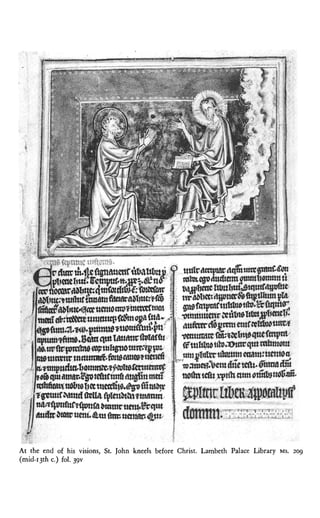


![Ion blessis hom alle þat þis boke reden
Wit gode entent, and hor god dreden,
Or heren hit red wit gode wille
In al hor mygt hit to fulfille;
ffor þ)is blessing iche mon shulde wirke
To knowe hit & mayntene Holy [Kirke].
Hit tellis of peynes & sorowes sere
pat here shal falle to cristis dere;
poo J)at ben trewe & stiffly stonde,
pei shal be hatid þorwout þo londe—
Of deefe & blinde þat wil not se,
Ne here hor fautes heeUd to be.
Herefore crist counfortis his chirche
And biddes hom alle with pacience wirche.
pis way went I to teche gou alle
Hou 5e shal enter to heuenly halle,
pere to duelle euere in pees,
In ioye & blis Jjat neuer shal cees.
Amen
Cambridge, Magdalene College, MS. 5
printed in R. H. Robbins, Secular
Lyrics of the Fourteenth and Fifteenth
Centuries (Oxford, 7952), pp.](https://image.slidesharecdn.com/25978543-250514124619-a104a569/85/The-Gothic-Visionary-Perspective-Barbara-Nolan-11-320.jpg)





![6 Chapter One
siderations and in his humble acknowledgment of the exegetical tradition
in which he labors. He is anxious to find the universal moral significance
of St. John's prophecy and to present its teaching to the lethargic English
as tersely, directly and memorably as he can.8
Bede's method of exegesis is to translate each of John's symbolic images,
taken singly, by means of logical analysis. For example, in his interpre
tation of the Whore of Babylon's purple and scarlet garments, he says;
"In purpura fucus simulati regiminis, in coccino cruentus habitus impi-
etatis demonstratur" (In purple, the red dye [dissimulation] of deceitful
government is demonstrated, in scarlet, the bloody appearance of impi
ety).9 Here Bede savors the multivalent figural significances of the scrip
tural litera. To suit his purpose, he first translates "purpura" into a syno
nym, "fucus," since the latter carries both the literal meaning, "red dye"
and the transferred sense, "face painting," and "dissimulation." From this
transferred sense, he derives his moral interpretation of the purple garment
as deceitful government.10 Next, he considers the adjective "coccineus,"
derived from the noun "coccum," meaning the berry that grows on the
scarlet oak from which cloth was colored scarlet.11 No doubt with full
knowledge of forethought, Bede discovers a special relationship of simili
tude between the berry juice coloring the Whore's clothing and the blood
marring the appearance of the impious. Not only in this treatment of the
Whore's garments, but also in his interpretations of all John's vivid, often
bizarre imagery, Bede is preeminently interested in nouns and adjectives,
not in verbs, in moral essences, not in historical or narrative action, and in
the verbal play which can lead by logic to the inner moral significance
of the Divine Word.
Alcuin, who builds his commentary on Bede's work and that of the
French Benedictine, Ambrose Autpert (d. 778 or 781), gives us an even
clearer picture of early medieval monastic attitudes toward the Apoca
lypse. Charlemagne's schoolmaster is, if anything, more devoted to au
thority than his master, Bede. He quotes Bede at length in his prologue,
reminding readers of Bede's seven divisions and Tychonius' rules. He
dutifully rehearses the list of patristic commentators on the Apocalypse—•
8PL xciii, 134. 9 P L xciii, 183.
10In this verbal play, in which the word "fucus" carries in part the meaning
"face painting, make-up," we may see one possible source for a long iconographical
tradition that interprets the Whore of Babylon both as Luxuria, holding a cup of
blood, and Vanitas, holding a mirror and combing her hair.
11 Cf. Pliny, Historia Naturalis, 24, 4, 4, sec. 8.](https://image.slidesharecdn.com/25978543-250514124619-a104a569/85/The-Gothic-Visionary-Perspective-Barbara-Nolan-28-320.jpg)
![New Directions η
Victorinus, Jerome, Tychonius, Primasius, and of course, Bede. Enlarg
ing on Bede's description of Revelation's form and the nature and mean
ing of its imagery, he articulates unequivocally a mode of reading the
Apocalypse which characterizes early medieval monastic commentators
generally. For Alcuin, Revelation signifies "nothing historical." It is an
"intellectual vision" in which the truth of things is manifested directly
to the intuition without the mediation of corporeal things or "similitudes"
for things. To support his definition of the Apocalypse as "intellectual
vision," Alcuin, borrowing from Ambrose Autpert, describes the nonlin
ear foim of the whole book:
Ordo vero narrationis hie est. Aliquando ab adventu Domini inchoat,
et perducit usque ad finem saeculi. Aliquando ab adventu Domini in
choat, et antequam finiat, ad initium redit, et ea quae dimiserat, sive
quae dixerat, diversis figuris repetens, ad secundum Domini adventum
percurrit. Aliquando incipit a novissima persecutione; sed antequam ad
finem veniat, recapitulando utraque conjungit. Aliquando ad enarran-
dum proposita paululum intermittit, et aliud non ad hoc pertinens inter-
ponit; post quod ordine conciso quae coeperat perdocet. Aliquando in
ipso genere locutionis sic mutata figura quasi alia permiscet, ut non nil
aliud significet quam quod narrare coeperat. Et nota quia rarissime in
hac revelatione vel angelus, vel Joannes proprias tenent personas.12
(This is the sequence of the narration. Sometimes it starts with the ar
rival of the Lord and carries through to the end of time. Sometimes it
starts with the arrival of the Lord, and before it finishes, it returns to
the beginning and by repeating in different figures both what it has
left out and what it has said, it hastens to the second coming of the
Lord. Sometimes it begins with the last persecution. But before it comes
to the end it recapitulates and connects both [beginning and end]. Some
times in order to narrate, it temporarily abandons its themes and intro
duces something totally unconnected. Afterward in concise order it
teaches thoroughly what it had begun. Sometimes in this kind of style,
a figure is changed in such a way that it is confused, as it were, with
other things so that it signifies something quite other than what it
began to represent. And you should note that very rarely in the revela
tion do the Angel or John retain their own persons.)
12PL c, 1089. See Ambrosius Autpertus, In Apocalypsin, in Opera, ed. R. Weber
(Turnholt, 1975), pp. 13-14.](https://image.slidesharecdn.com/25978543-250514124619-a104a569/85/The-Gothic-Visionary-Perspective-Barbara-Nolan-29-320.jpg)
![ίο Chapter One
called the first of the "historico-prophetic" interpretations, and therefore
placed closer to the twelfth than the ninth century. Yet, although Beren-
gaudus' originality sets him apart from the major Carolingian compilers,
he remains essentially of the monastic, allegorical school. For him, as for
Bede, Alcuin, Beatus and Haimo, the universal Church in all times and
places is the general subject hidden in the images of the Apocalypse.
But it is only a short logical step from this omnitemporal concern for
the one, universal Church to a systematic reading of the "sevens" so per
vasively present in the Book of Revelation as the seven ages of the Church
from the time before the Flood until the Last Judgment. And Berengau-
dus was the first to make this connection.17 "If you look closely," he says,
"you will discover that the holy city of God,"
. . . quae ex omnibus electis constat, quae ab initio usque ad finem
tendit, . . . in septem partes divisam. Prima igitur pars ejus sunt electi,
qui ab initio usque ad diluvium fuerunt: secunda, patriarchae et caeteri
justi usque ad legem datam: tertia, hi qui sub lege fuerunt: quarta,
prophetae: quinto, apostoli et qui ex Judaeis crediderunt: sexta vero
pars est gentium multitudo quae ad fidem venit: septima, electi qui in
fine mundi nascituri sunt, et contra Antrichristum pugnaturi.18
(. . . which is built from all the elect which stretches from the begin
ning even to the end is divided into seven parts. The first part of the
elect are those who lived from the beginning until the flood; the second,
the patriarchs and other just men until the law was given; the third,
a note at the beginning of the epilogue which directs the reader to find the author's
name in the capitals beginning each of the seven visions (BRNGVDS). That the author's
name is Berengaudus is confirmed by a notation in B.N. MS. lat. 2467 in the original
scribe's hand: "Auctor huius libri Berengaudus appellatur." Berengaudus was first
identified as a Benedictine monk of the Abbey of Ferrieres (Maurist Fathers, His-
toire litteraire de la France ν [1740], pp. 653^). A few scholars have put forward
a date as late as the eleventh or twelfth century for Berengaudus: see esp. R. Lauren-
tin, Court Traite de Theologie Mariale (1953), p. 123. R. Weber in his recent edition
of Ambrose Autpert's commentary leaves the question open: "Berengaudus could be
either Berengaudus of Auxerre who lived in the ninth century or his homonym of
the twelfth century who lived in Angers" (xiv). The best summary of the debate
over Berengaudus' identity is to be found in F. Vigouroux, Dictionnaire de la Bible,
vol. i, pt. 2 (Paris, 1926), cols. 1610-1611.
17
Berengaudus makes this leap early in his commentary as he interprets the seven
candelabra and seven stars of Rev. 1, 15.
l s
P L xvii, 851.](https://image.slidesharecdn.com/25978543-250514124619-a104a569/85/The-Gothic-Visionary-Perspective-Barbara-Nolan-32-320.jpg)
![16 Chapter One
through the truth of Scriptures."27
In this regard, Rupert's commentary is
to be an example. It will show readers how they, too, may find their per
sonal liberation and the beginning of divine wisdom by likewise studying
and grasping God's word.28
Rupert is explicit in describing what the reader is to find in the Apoca
lypse and how he will discover its mysteries:
Horum omnium temporum, sive de omnibus his temporibus, scilicet de
praeterito, de praesenti et de futuro, haec prophetia contexitur, quia
videlicet qualis fuisset, qualis tunc esset, qualis futurus esset Ecclesiae
status, hac Apocalypsi revelavit huic dilecto suo Jesus Christus, sicut ex
ipsa serie mirabili, eodem Jesu Christo dante, cognoscere potest lector,
sive auditor beatus.29
(This prophecy is comprised of all times, or concerning all times, name
ly concerning the past, present and future, so that Jesus Christ revealed
to his loved one [John] what had been, what then was and what the
future status of the Church would be, just as by that wonderful series,
the reader or blessed hearer can know, if Jesus Christ grants it.)
Here he explains that we (as well as John) are led into this prophecy by
our leader Jesus Christ. Then "legentes pariter audiamus, foris legendo Iit-
teram, intus audiendo mysteria" (when we read let us listen equally: by
reading the letter without, by hearing the mystery within).30 Implicitly
Rupert puts the reader in John's place and offers him the exciting possi
bility of experiencing the letter of his vision and simultaneously under
standing its mysteries.
Rupert's notion of reading—which gives greater significance to the letter
than heretofore—required a redefinition of "intellectual vision" as Alcuin
had described it. And he does not fail to make the adjustment. Instead of
being a vision which requires no forms or similitudes of things, "intellec
tual vision" is for Rupert a mode of understanding whereby "mens a
Spiritu sancto illuminatur, ut intelligat, quomodo intellexit Joseph, quid
per easdem imagines significaretur" (the mind is illuminated by the Holy
Spirit so that it understands, as Joseph understood, what is signified
27 PL CLXIX, 825-828.
28 PL CLXIX, 850. This same interpretation is repeated a century later by the Fran
ciscan expositor, Alexander of Bremen, who gives a far more historical and personal
interpretation of the Apocalypse than Rupert.
29PL CLXIX, 831. 30Ibid.](https://image.slidesharecdn.com/25978543-250514124619-a104a569/85/The-Gothic-Visionary-Perspective-Barbara-Nolan-38-320.jpg)
![20 Chapter One
ern Church which he had visited in Constantinople.40
From this brief
account he draws a most astonishing conclusion, but one which would be
in perfect accord with those other twelfth-century writers who also dis
covered an increase of grace through New Testament history even to their
own time:
Et fit mira Dei dispensatione, quod a generatione in generationem suc-
crescente semper nova religione, renovatur ut aquilae juventus Ecclesiae,
quo et sublimius in contemplatione volare queat et subtilius quasi ir-
reverberatis oculis radios veri solis contueri valeat.41
(And by the marvelous dispensation of God it happens that, the new
religion always increasing from generation to generation, the youth of
the Church, as of an eagle, is renewed, whereby it is able to fly higher
in contemplation and more subtly to behold the rays of the true sun as
it were with unflinching eyes.)
We have only to compare Anselm's sense of history's dynamic move
ment toward the seventh seal and the eternal sabbath with Alcuin's sche
matic moralization of John's visions to measure the distance we have trav
eled. The earlier exegetical cast of mind has been decisively superseded by
new historical and spiritual concerns which were to appear in various
guises in three major commentaries of the twelfth and early thirteenth
centuries—those of Richard of St. Victor, Joachim of Fiore, and Alexander
of Bremen.
The importance of Richard of St. Victor (d. 1173) for the development
of later medieval spiritual attitudes cannot be overstated.42 Dante fittingly
40 Dialogues, pp. 84-107.
41 Dialogues, p. 104.
42 Though Hugh of St. Victor's broad and original explorations, including his
commentary on Pseudo-Dionysius' Celestial Hierarchy, decisively shaped Richard's
spiritual thought, the latter's concentrated interest in the visionary ascent to God
gave him a special role in later medieval spiritual history. Thus St. Bonaventure
places him in the development of Christian thought: Primum maxime docet Augus-
tinus, secundum maxime docet Gregorius, tertium vero docet Dionysius-AnseImus
sequitur Augustinum, Bernardus sequitur Gregorium, Richardus seqitur Dionysium,
quia Anselmus in ratiocinatione, Bernardus in praedicatione, Richardus in contem
platione (De reductione artium ad theologiam, 5, in Opera theologica selecta, ed.
minor, torn, ν [Quaracchi, 1964], p. 221). For a brief history of the origin and de
velopment of the school of St. Victor in the twelfth century, and of the relationship
between Hugh and Richard, see R. Baron, Hugues et Richard de St-Victor (Paris,
1961), pp. 7-50.](https://image.slidesharecdn.com/25978543-250514124619-a104a569/85/The-Gothic-Visionary-Perspective-Barbara-Nolan-42-320.jpg)