The Global Economy
Monthly letter from Swedbank’s Economic Research Department
by Cecilia Hermansson                                                                                                      No.8 • 11 November, 2010


                        The G20 countries have to put an end to the
                          world economy’s destructive behaviour
     • The global recovery is continuing, with signs of both positive and negative data.
       The bright spots in the US include small businesses and the labour market. In
       Europe, financial concerns are growing at the same time that budget consolidation
       and the stronger euro are hurting growth prospects.

     • In many cases, expectations going into to the G20 summit are low. Rhetorically
       correct statements, but a lack of practical action, are pretty much what can be
       expected. The US has toned down its demands to cap current account surpluses
       and deficits, probably to mollify criticism about its new round of quantitative easing.
       There is still a risk for a negative spiral of easing, carry trade, capital flows to
       emerging countries, capital controls and taxes on derivatives trading, currency
       interventions and in the long run potentially protectionism as well. It is vital that the
       G20 breaks this destructive pattern and finds a framework that gradually reduces
       imbalances.

Global demand: Mixed signals
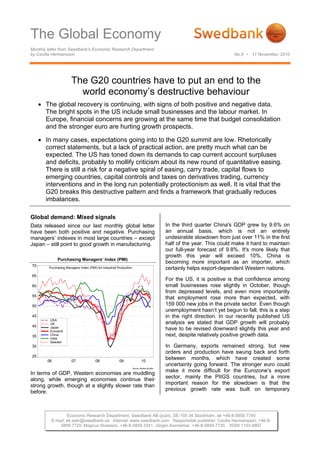
Data released since our last monthly global letter                                            In the third quarter China's GDP grew by 9.6% on
have been both positive and negative. Purchasing                                              an annual basis, which is not an entirely
managers’ indexes in most large countries – except                                            undesirable slowdown from just over 11% in the first
Japan – still point to good growth in manufacturing.                                          half of the year. This could make it hard to maintain
                                                                                              our full-year forecast of 9.8%. It's more likely that
                                                                                              growth this year will exceed 10%. China is
              Purchasing Managers’ Index (PMI)
                                                                                              becoming more important as an importer, which
70       Purchasing Managers Index (PMI) for Industrial Production                            certainly helps export-dependent Western nations.
65
                                                                                              For the US, it is positive is that confidence among
60                                                                                            small businesses rose slightly in October, though
                                                                                              from depressed levels, and even more importantly
55
                                                                                              that employment rose more than expected, with
50                                                                                            159 000 new jobs in the private sector. Even though
                                                                                              unemployment hasn’t yet begun to fall, this is a step
45                                                                                            in the right direction. In our recently published US
         USA
         UK                                                                                   analysis we stated that GDP growth will probably
40       Japan
         Euroland
                                                                                              have to be revised downward slightly this year and
35       China                                                                                next, despite relatively positive growth data.
         India
         Sweden
30                                                                                            In Germany, exports remained strong, but new
                                                                                              orders and production have swung back and forth
25
        06              07              08               09                   10
                                                                                              between months, which have created some
                                                                                              uncertainty going forward. The stronger euro could
                                                                     Source: Reuters EcoWin

In terms of GDP, Western economies are muddling                                               make it more difficult for the Eurozone’s export
along, while emerging economies continue their                                                sector, mainly the PIIGS countries, but a more
strong growth, though at a slightly slower rate than                                          important reason for the slowdown is that the
before.                                                                                       previous growth rate was built on temporary


                  Economic Research Department, Swedbank AB (publ), SE-105 34 Stockholm, tel +46-8-5859 7740
          E-mail: ek.sekr@swedbank.se Internet: www.swedbank.com Responsible publisher: Cecilia Hermansson, +46-8-
              5859 7720, Magnus Alvesson, +46-8-5859 3341, Jörgen Kennemar, +46-8-5859 7730, ISSN 1103-4897
The Global Economy

                      Monthly newsletter from Swedbank’s Economic Research Department, continued

                                             No. 8 • 11 November 2010


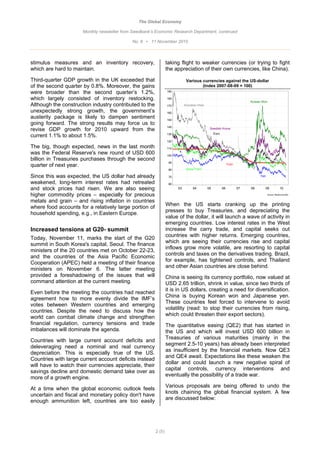
stimulus measures and an inventory recovery,                    taking flight to weaker currencies (or trying to fight
which are hard to maintain.                                     the appreciation of their own currencies, like China).

Third-quarter GDP growth in the UK exceeded that                            Various currencies against the US-dollar
of the second quarter by 0.8%. Moreover, the gains                                  (Index 2007-08-09 = 100)
were broader than the second quarter’s 1.2%,                    190

which largely consisted of inventory restocking.                180
                                                                                                                         Korean Won
Although the construction industry contributed to the           170        Brazilean Real

unexpectedly strong growth, the government’s                    160
austerity package is likely to dampen sentiment                 150
going forward. The strong results may force us to
                                                                140
revise GDP growth for 2010 upward from the                                                   Swedish Krona
                                                                130                              Euro
current 1.1% to about 1.5%.
                                                                120

The big, though expected, news in the last month                110
was the Federal Reserve's new round of USD 600                  100
billion in Treasuries purchases through the second
                                                                 90
quarter of next year.                                                                                        Yuan
                                                                 80         Swiss Franc

Since this was expected, the US dollar had already               70                                                           Yen

weakened, long-term interest rates had retreated                 60
and stock prices had risen. We are also seeing                        03         04         05          06          07   08      09               10

higher commodity prices – especially for precious                                                                                     Source: Reuters EcoWin


metals and grain – and rising inflation in countries
                                                                When the US starts cranking up the printing
where food accounts for a relatively large portion of
                                                                presses to buy Treasuries, and depreciating the
household spending, e.g., in Eastern Europe.
                                                                value of the dollar, it will launch a wave of activity in
                                                                emerging countries. Low interest rates in the West
Increased tensions at G20- summit                               increase the carry trade, and capital seeks out
                                                                countries with higher returns. Emerging countries,
Today, November 11, marks the start of the G20
                                                                which are seeing their currencies rise and capital
summit in South Korea's capital, Seoul. The finance
                                                                inflows grow more volatile, are resorting to capital
ministers of the 20 countries met on October 22-23,
                                                                controls and taxes on the derivatives trading. Brazil,
and the countries of the Asia Pacific Economic
                                                                for example, has tightened controls, and Thailand
Cooperation (APEC) held a meeting of their finance
                                                                and other Asian countries are close behind.
ministers on November 6. The latter meeting
provided a foreshadowing of the issues that will                China is seeing its currency portfolio, now valued at
command attention at the current meeting.                       USD 2.65 trillion, shrink in value, since two thirds of
                                                                it is in US dollars, creating a need for diversification.
Even before the meeting the countries had reached
                                                                China is buying Korean won and Japanese yen.
agreement how to more evenly divide the IMF’s
                                                                These countries feel forced to intervene to avoid
votes between Western countries and emerging
                                                                volatility (read: to stop their currencies from rising,
countries. Despite the need to discuss how the
                                                                which could threaten their export sectors).
world can combat climate change and strengthen
financial regulation, currency tensions and trade               The quantitative easing (QE2) that has started in
imbalances will dominate the agenda.                            the US and which will invest USD 600 billion in
                                                                Treasuries of various maturities (mainly in the
Countries with large current account deficits and
                                                                segment 2.5-10 years) has already been interpreted
deleveraging need a nominal and real currency
                                                                as insufficient by the financial markets. Now QE3
depreciation. This is especially true of the US.
                                                                and QE4 await. Expectations like these weaken the
Countries with large current account deficits instead
                                                                dollar and could launch a new negative spiral of
will have to watch their currencies appreciate, their
                                                                capital controls, currency interventions and
savings decline and domestic demand take over as
                                                                eventually the possibility of a trade war.
more of a growth engine.
                                                                Various proposals are being offered to undo the
At a time when the global economic outlook feels
                                                                knots chaining the global financial system. A few
uncertain and fiscal and monetary policy don't have
                                                                are discussed below:
enough ammunition left, countries are too easily


                                                        2 (5)
The Global Economy

                                   Monthly newsletter from Swedbank’s Economic Research Department, continued

                                                               No. 8 • 11 November 2010


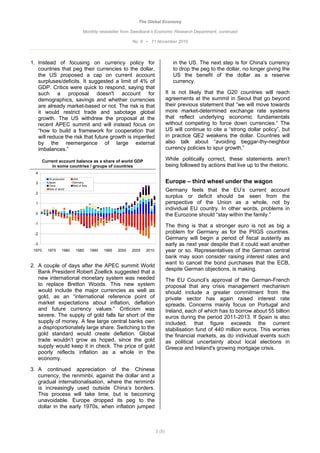
1. Instead of focusing on currency policy for                                           in the US. The next step is for China's currency
   countries that peg their currencies to the dollar,                                   to drop the peg to the dollar, no longer giving the
   the US proposed a cap on current account                                             US the benefit of the dollar as a reserve
   surpluses/deficits. It suggested a limit of 4% of                                    currency.
   GDP. Critics were quick to respond, saying that
   such a proposal doesn't account for                                               It is not likely that the G20 countries will reach
   demographics, savings and whether currencies                                      agreements at the summit in Seoul that go beyond
   are already market-based or not. The risk is that                                 their previous statement that “we will move towards
   it would restrict trade and sabotage global                                       more market-determined exchange rate systems
   growth. The US withdrew the proposal at the                                       that reflect underlying economic fundamentals
   recent APEC summit and will instead focus on                                      without competing to force down currencies.” The
   “how to build a framework for cooperation that                                    US will continue to cite a “strong dollar policy”, but
   will reduce the risk that future growth is imperiled                              in practice QE2 weakens the dollar. Countries will
   by the reemergence of large external                                              also talk about “avoiding beggar-thy-neighbor
   imbalances.”                                                                      currency policies to spur growth.”

        Current account balance as a share of world GDP                              While politically correct, these statements aren’t
            in some countries / groups of countries                                  being followed by actions that live up to the rhetoric.
  4
          Oil producers    USA
  3       Japan            Germany                                                   Europe – third wheel under the wagon
          China            Rest of Asia
          Rest of world
                                                                                     Germany feels that the EU’s current account
  2
                                                                                     surplus or deficit should be seen from the
  1                                                                                  perspective of the Union as a whole, not by
                                                                                     individual EU country. In other words, problems in
  0                                                                                  the Eurozone should “stay within the family.”
 -1
                                                                                     The thing is that a stronger euro is not as big a
 -2                                                                                  problem for Germany as for the PIIGS countries.
                                                                                     Germany will begin a period of fiscal austerity as
 -3                                                                                  early as next year despite that it could wait another
 1970     1975      1980     1985         1990   1995   2000   2005   2010           year or so. Representatives of the German central
                                                                                     bank may soon consider raising interest rates and
                                                                                     want to cancel the bond purchases that the ECB,
2. A couple of days after the APEC summit World
                                                                                     despite German objections, is making.
   Bank President Robert Zoellick suggested that a
   new international monetary system was needed                                      The EU Council’s approval of the German-French
   to replace Bretton Woods. This new system                                         proposal that any crisis management mechanism
   would include the major currencies as well as                                     should include a greater commitment from the
   gold, as an “international reference point of                                     private sector has again raised interest rate
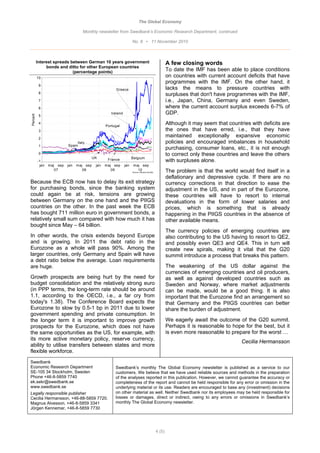
   market expectations about inflation, deflation                                    spreads. Concerns mainly focus on Portugal and
   and future currency values.” Criticism was                                        Ireland, each of which has to borrow about 55 billion
   severe. The supply of gold falls far short of the                                 euros during the period 2011-2013. If Spain is also
   supply of money. A few large central banks own                                    included, that figure exceeds the current
   a disproportionately large share. Switching to the                                stabilisation fund of 440 million euros. This worries
   gold standard would create deflation. Global                                      the financial markets, as do individual events such
   trade wouldn’t grow as hoped, since the gold                                      as political uncertainty about local elections in
   supply would keep it in check. The price of gold                                  Greece and Ireland's growing mortgage crisis.
   poorly reflects inflation as a whole in the
   economy.

3. A continued appreciation of the Chinese
   currency, the renminbi, against the dollar and a
   gradual internationalisation, where the renminbi
   is increasingly used outside China’s borders.
   This process will take time, but is becoming
   unavoidable. Europe dropped its peg to the
   dollar in the early 1970s, when inflation jumped


                                                                             3 (5)
The Global Economy

                                   Monthly newsletter from Swedbank’s Economic Research Department, continued

                                                                     No. 8 • 11 November 2010


          Interest spreads between German 10 years government                                         A few closing words
               bonds and ditto for other European countries
                            (percentage points)                                                       To date the IMF has been able to place conditions
          10                                                                                          on countries with current account deficits that have
                                                                                                      programmes with the IMF. On the other hand, it
           9
                                                       Greece                                         lacks the means to pressure countries with
           8
                                                                                                      surpluses that don't have programmes with the IMF,
           7                                                                                          i.e., Japan, China, Germany and even Sweden,
           6                                                                                          where the current account surplus exceeds 6-7% of
                                                     Ireland                                          GDP.
Percent


           5

           4
                                                  Portugal
                                                                                                      Although it may seem that countries with deficits are
           3                                                                                          the ones that have erred, i.e., that they have
           2
                                                                                                      maintained exceptionally expansive economic
                                Italy                                                                 policies and encouraged imbalances in household
           1               Spain
                                                                                                      purchasing, consumer loans, etc., it is not enough
           0                                                                                          to correct only these countries and leave the others
                                           UK                        Belgium
          -1                                       France                                             with surpluses alone.
           jan   maj sep   jan   maj sep    jan   maj sep      jan    maj sep
                    07              08               09                 10                            The problem is that the world would find itself in a
                                                                     Source: Reuters EcoWin


                                                                                                      deflationary and depressive cycle. If there are no
Because the ECB now has to delay its exit strategy                                                    currency corrections in that direction to ease the
for purchasing bonds, since the banking system                                                        adjustment in the US, and in part of the Eurozone,
could again be at risk, tensions are growing                                                          these countries will have to resort to internal
between Germany on the one hand and the PIIGS                                                         devaluations in the form of lower salaries and
countries on the other. In the past week the ECB                                                      prices, which is something that is already
has bought 711 million euro in government bonds, a                                                    happening in the PIIGS countries in the absence of
relatively small sum compared with how much it has                                                    other available means.
bought since May – 64 billion.
                                                                                                      The currency policies of emerging countries are
In other words, the crisis extends beyond Europe                                                      also contributing to the US having to resort to QE2,
and is growing. In 2011 the debt ratio in the                                                         and possibly even QE3 and QE4. This in turn will
Eurozone as a whole will pass 90%. Among the                                                          create new spirals, making it vital that the G20
larger countries, only Germany and Spain will have                                                    summit introduce a process that breaks this pattern.
a debt ratio below the average. Loan requirements
are huge.                                                                                             The weakening of the US dollar against the
                                                                                                      currencies of emerging countries and oil producers,
Growth prospects are being hurt by the need for                                                       as well as against developed countries such as
budget consolidation and the relatively strong euro                                                   Sweden and Norway, where market adjustments
(in PPP terms, the long-term rate should be around                                                    can be made, would be a good thing. It is also
1.1, according to the OECD, i.e., a far cry from                                                      important that the Eurozone find an arrangement so
today's 1.38). The Conference Board expects the                                                       that Germany and the PIIGS countries can better
Eurozone to slow by 0.5-1 bp in 2011 due to lower                                                     share the burden of adjustment.
government spending and private consumption. In
the longer term it is important to improve growth                                                     We eagerly await the outcome of the G20 summit.
prospects for the Eurozone, which does not have                                                       Perhaps it is reasonable to hope for the best, but it
the same opportunities as the US, for example, with                                                   is even more reasonable to prepare for the worst …
its more active monetary policy, reserve currency,
                                                                                                                                      Cecilia Hermansson
ability to utilise transfers between states and more
flexible workforce.
Swedbank
Economic Research Department                           Swedbank’s monthly The Global Economy newsletter is published as a service to our
SE-105 34 Stockholm, Sweden                            customers. We believe that we have used reliable sources and methods in the preparation
Phone +46-8-5859 7740                                  of the analyses reported in this publication. However, we cannot guarantee the accuracy or
ek.sekr@swedbank.se                                    completeness of the report and cannot be held responsible for any error or omission in the
www.swedbank.se                                        underlying material or its use. Readers are encouraged to base any (investment) decisions
Legally responsible publisher                          on other material as well. Neither Swedbank nor its employees may be held responsible for
Cecilia Hermansson, +46-88-5859 7720.                  losses or damages, direct or indirect, owing to any errors or omissions in Swedbank’s
Magnus Alvesson, +46-8-5859 3341                       monthly The Global Economy newsletter.
Jörgen Kennemar, +46-8-5859 7730


                                                                                              4 (5)

The Global Economy

  • 1.
    The Global Economy Monthlyletter from Swedbank’s Economic Research Department by Cecilia Hermansson No.8 • 11 November, 2010 The G20 countries have to put an end to the world economy’s destructive behaviour • The global recovery is continuing, with signs of both positive and negative data. The bright spots in the US include small businesses and the labour market. In Europe, financial concerns are growing at the same time that budget consolidation and the stronger euro are hurting growth prospects. • In many cases, expectations going into to the G20 summit are low. Rhetorically correct statements, but a lack of practical action, are pretty much what can be expected. The US has toned down its demands to cap current account surpluses and deficits, probably to mollify criticism about its new round of quantitative easing. There is still a risk for a negative spiral of easing, carry trade, capital flows to emerging countries, capital controls and taxes on derivatives trading, currency interventions and in the long run potentially protectionism as well. It is vital that the G20 breaks this destructive pattern and finds a framework that gradually reduces imbalances. Global demand: Mixed signals Data released since our last monthly global letter In the third quarter China's GDP grew by 9.6% on have been both positive and negative. Purchasing an annual basis, which is not an entirely managers’ indexes in most large countries – except undesirable slowdown from just over 11% in the first Japan – still point to good growth in manufacturing. half of the year. This could make it hard to maintain our full-year forecast of 9.8%. It's more likely that growth this year will exceed 10%. China is Purchasing Managers’ Index (PMI) becoming more important as an importer, which 70 Purchasing Managers Index (PMI) for Industrial Production certainly helps export-dependent Western nations. 65 For the US, it is positive is that confidence among 60 small businesses rose slightly in October, though from depressed levels, and even more importantly 55 that employment rose more than expected, with 50 159 000 new jobs in the private sector. Even though unemployment hasn’t yet begun to fall, this is a step 45 in the right direction. In our recently published US USA UK analysis we stated that GDP growth will probably 40 Japan Euroland have to be revised downward slightly this year and 35 China next, despite relatively positive growth data. India Sweden 30 In Germany, exports remained strong, but new orders and production have swung back and forth 25 06 07 08 09 10 between months, which have created some uncertainty going forward. The stronger euro could Source: Reuters EcoWin In terms of GDP, Western economies are muddling make it more difficult for the Eurozone’s export along, while emerging economies continue their sector, mainly the PIIGS countries, but a more strong growth, though at a slightly slower rate than important reason for the slowdown is that the before. previous growth rate was built on temporary Economic Research Department, Swedbank AB (publ), SE-105 34 Stockholm, tel +46-8-5859 7740 E-mail: ek.sekr@swedbank.se Internet: www.swedbank.com Responsible publisher: Cecilia Hermansson, +46-8- 5859 7720, Magnus Alvesson, +46-8-5859 3341, Jörgen Kennemar, +46-8-5859 7730, ISSN 1103-4897
  • 2.
    The Global Economy Monthly newsletter from Swedbank’s Economic Research Department, continued No. 8 • 11 November 2010 stimulus measures and an inventory recovery, taking flight to weaker currencies (or trying to fight which are hard to maintain. the appreciation of their own currencies, like China). Third-quarter GDP growth in the UK exceeded that Various currencies against the US-dollar of the second quarter by 0.8%. Moreover, the gains (Index 2007-08-09 = 100) were broader than the second quarter’s 1.2%, 190 which largely consisted of inventory restocking. 180 Korean Won Although the construction industry contributed to the 170 Brazilean Real unexpectedly strong growth, the government’s 160 austerity package is likely to dampen sentiment 150 going forward. The strong results may force us to 140 revise GDP growth for 2010 upward from the Swedish Krona 130 Euro current 1.1% to about 1.5%. 120 The big, though expected, news in the last month 110 was the Federal Reserve's new round of USD 600 100 billion in Treasuries purchases through the second 90 quarter of next year. Yuan 80 Swiss Franc Since this was expected, the US dollar had already 70 Yen weakened, long-term interest rates had retreated 60 and stock prices had risen. We are also seeing 03 04 05 06 07 08 09 10 higher commodity prices – especially for precious Source: Reuters EcoWin metals and grain – and rising inflation in countries When the US starts cranking up the printing where food accounts for a relatively large portion of presses to buy Treasuries, and depreciating the household spending, e.g., in Eastern Europe. value of the dollar, it will launch a wave of activity in emerging countries. Low interest rates in the West Increased tensions at G20- summit increase the carry trade, and capital seeks out countries with higher returns. Emerging countries, Today, November 11, marks the start of the G20 which are seeing their currencies rise and capital summit in South Korea's capital, Seoul. The finance inflows grow more volatile, are resorting to capital ministers of the 20 countries met on October 22-23, controls and taxes on the derivatives trading. Brazil, and the countries of the Asia Pacific Economic for example, has tightened controls, and Thailand Cooperation (APEC) held a meeting of their finance and other Asian countries are close behind. ministers on November 6. The latter meeting provided a foreshadowing of the issues that will China is seeing its currency portfolio, now valued at command attention at the current meeting. USD 2.65 trillion, shrink in value, since two thirds of it is in US dollars, creating a need for diversification. Even before the meeting the countries had reached China is buying Korean won and Japanese yen. agreement how to more evenly divide the IMF’s These countries feel forced to intervene to avoid votes between Western countries and emerging volatility (read: to stop their currencies from rising, countries. Despite the need to discuss how the which could threaten their export sectors). world can combat climate change and strengthen financial regulation, currency tensions and trade The quantitative easing (QE2) that has started in imbalances will dominate the agenda. the US and which will invest USD 600 billion in Treasuries of various maturities (mainly in the Countries with large current account deficits and segment 2.5-10 years) has already been interpreted deleveraging need a nominal and real currency as insufficient by the financial markets. Now QE3 depreciation. This is especially true of the US. and QE4 await. Expectations like these weaken the Countries with large current account deficits instead dollar and could launch a new negative spiral of will have to watch their currencies appreciate, their capital controls, currency interventions and savings decline and domestic demand take over as eventually the possibility of a trade war. more of a growth engine. Various proposals are being offered to undo the At a time when the global economic outlook feels knots chaining the global financial system. A few uncertain and fiscal and monetary policy don't have are discussed below: enough ammunition left, countries are too easily 2 (5)
  • 3.
    The Global Economy Monthly newsletter from Swedbank’s Economic Research Department, continued No. 8 • 11 November 2010 1. Instead of focusing on currency policy for in the US. The next step is for China's currency countries that peg their currencies to the dollar, to drop the peg to the dollar, no longer giving the the US proposed a cap on current account US the benefit of the dollar as a reserve surpluses/deficits. It suggested a limit of 4% of currency. GDP. Critics were quick to respond, saying that such a proposal doesn't account for It is not likely that the G20 countries will reach demographics, savings and whether currencies agreements at the summit in Seoul that go beyond are already market-based or not. The risk is that their previous statement that “we will move towards it would restrict trade and sabotage global more market-determined exchange rate systems growth. The US withdrew the proposal at the that reflect underlying economic fundamentals recent APEC summit and will instead focus on without competing to force down currencies.” The “how to build a framework for cooperation that US will continue to cite a “strong dollar policy”, but will reduce the risk that future growth is imperiled in practice QE2 weakens the dollar. Countries will by the reemergence of large external also talk about “avoiding beggar-thy-neighbor imbalances.” currency policies to spur growth.” Current account balance as a share of world GDP While politically correct, these statements aren’t in some countries / groups of countries being followed by actions that live up to the rhetoric. 4 Oil producers USA 3 Japan Germany Europe – third wheel under the wagon China Rest of Asia Rest of world Germany feels that the EU’s current account 2 surplus or deficit should be seen from the 1 perspective of the Union as a whole, not by individual EU country. In other words, problems in 0 the Eurozone should “stay within the family.” -1 The thing is that a stronger euro is not as big a -2 problem for Germany as for the PIIGS countries. Germany will begin a period of fiscal austerity as -3 early as next year despite that it could wait another 1970 1975 1980 1985 1990 1995 2000 2005 2010 year or so. Representatives of the German central bank may soon consider raising interest rates and want to cancel the bond purchases that the ECB, 2. A couple of days after the APEC summit World despite German objections, is making. Bank President Robert Zoellick suggested that a new international monetary system was needed The EU Council’s approval of the German-French to replace Bretton Woods. This new system proposal that any crisis management mechanism would include the major currencies as well as should include a greater commitment from the gold, as an “international reference point of private sector has again raised interest rate market expectations about inflation, deflation spreads. Concerns mainly focus on Portugal and and future currency values.” Criticism was Ireland, each of which has to borrow about 55 billion severe. The supply of gold falls far short of the euros during the period 2011-2013. If Spain is also supply of money. A few large central banks own included, that figure exceeds the current a disproportionately large share. Switching to the stabilisation fund of 440 million euros. This worries gold standard would create deflation. Global the financial markets, as do individual events such trade wouldn’t grow as hoped, since the gold as political uncertainty about local elections in supply would keep it in check. The price of gold Greece and Ireland's growing mortgage crisis. poorly reflects inflation as a whole in the economy. 3. A continued appreciation of the Chinese currency, the renminbi, against the dollar and a gradual internationalisation, where the renminbi is increasingly used outside China’s borders. This process will take time, but is becoming unavoidable. Europe dropped its peg to the dollar in the early 1970s, when inflation jumped 3 (5)
  • 4.
    The Global Economy Monthly newsletter from Swedbank’s Economic Research Department, continued No. 8 • 11 November 2010 Interest spreads between German 10 years government A few closing words bonds and ditto for other European countries (percentage points) To date the IMF has been able to place conditions 10 on countries with current account deficits that have programmes with the IMF. On the other hand, it 9 Greece lacks the means to pressure countries with 8 surpluses that don't have programmes with the IMF, 7 i.e., Japan, China, Germany and even Sweden, 6 where the current account surplus exceeds 6-7% of Ireland GDP. Percent 5 4 Portugal Although it may seem that countries with deficits are 3 the ones that have erred, i.e., that they have 2 maintained exceptionally expansive economic Italy policies and encouraged imbalances in household 1 Spain purchasing, consumer loans, etc., it is not enough 0 to correct only these countries and leave the others UK Belgium -1 France with surpluses alone. jan maj sep jan maj sep jan maj sep jan maj sep 07 08 09 10 The problem is that the world would find itself in a Source: Reuters EcoWin deflationary and depressive cycle. If there are no Because the ECB now has to delay its exit strategy currency corrections in that direction to ease the for purchasing bonds, since the banking system adjustment in the US, and in part of the Eurozone, could again be at risk, tensions are growing these countries will have to resort to internal between Germany on the one hand and the PIIGS devaluations in the form of lower salaries and countries on the other. In the past week the ECB prices, which is something that is already has bought 711 million euro in government bonds, a happening in the PIIGS countries in the absence of relatively small sum compared with how much it has other available means. bought since May – 64 billion. The currency policies of emerging countries are In other words, the crisis extends beyond Europe also contributing to the US having to resort to QE2, and is growing. In 2011 the debt ratio in the and possibly even QE3 and QE4. This in turn will Eurozone as a whole will pass 90%. Among the create new spirals, making it vital that the G20 larger countries, only Germany and Spain will have summit introduce a process that breaks this pattern. a debt ratio below the average. Loan requirements are huge. The weakening of the US dollar against the currencies of emerging countries and oil producers, Growth prospects are being hurt by the need for as well as against developed countries such as budget consolidation and the relatively strong euro Sweden and Norway, where market adjustments (in PPP terms, the long-term rate should be around can be made, would be a good thing. It is also 1.1, according to the OECD, i.e., a far cry from important that the Eurozone find an arrangement so today's 1.38). The Conference Board expects the that Germany and the PIIGS countries can better Eurozone to slow by 0.5-1 bp in 2011 due to lower share the burden of adjustment. government spending and private consumption. In the longer term it is important to improve growth We eagerly await the outcome of the G20 summit. prospects for the Eurozone, which does not have Perhaps it is reasonable to hope for the best, but it the same opportunities as the US, for example, with is even more reasonable to prepare for the worst … its more active monetary policy, reserve currency, Cecilia Hermansson ability to utilise transfers between states and more flexible workforce. Swedbank Economic Research Department Swedbank’s monthly The Global Economy newsletter is published as a service to our SE-105 34 Stockholm, Sweden customers. We believe that we have used reliable sources and methods in the preparation Phone +46-8-5859 7740 of the analyses reported in this publication. However, we cannot guarantee the accuracy or ek.sekr@swedbank.se completeness of the report and cannot be held responsible for any error or omission in the www.swedbank.se underlying material or its use. Readers are encouraged to base any (investment) decisions Legally responsible publisher on other material as well. Neither Swedbank nor its employees may be held responsible for Cecilia Hermansson, +46-88-5859 7720. losses or damages, direct or indirect, owing to any errors or omissions in Swedbank’s Magnus Alvesson, +46-8-5859 3341 monthly The Global Economy newsletter. Jörgen Kennemar, +46-8-5859 7730 4 (5)