@ema_research
| @ema_research
Dan Twing
President and COO
Principal Analyst, Intelligent
Automation
EMA
The Future of Workload
Automation and Orchestration:
Driving Digital Transformation with
Orchestration and Generative AI
March 11, 2025
@ema_research
| @ema_research 2
Watch the On-Demand Webinar
• The Future of Workload Automation and Orchestration: Driving Digital
Transformation with Generative AI On-Demand Webinar:
https://info.enterprisemanagement.com/workload-automation-and-
orchestration-2025-webinar-ss
© 2025 Enterprise Management Associates, Inc.
@ema_research
| @ema_research
@ema_research
| @ema_research
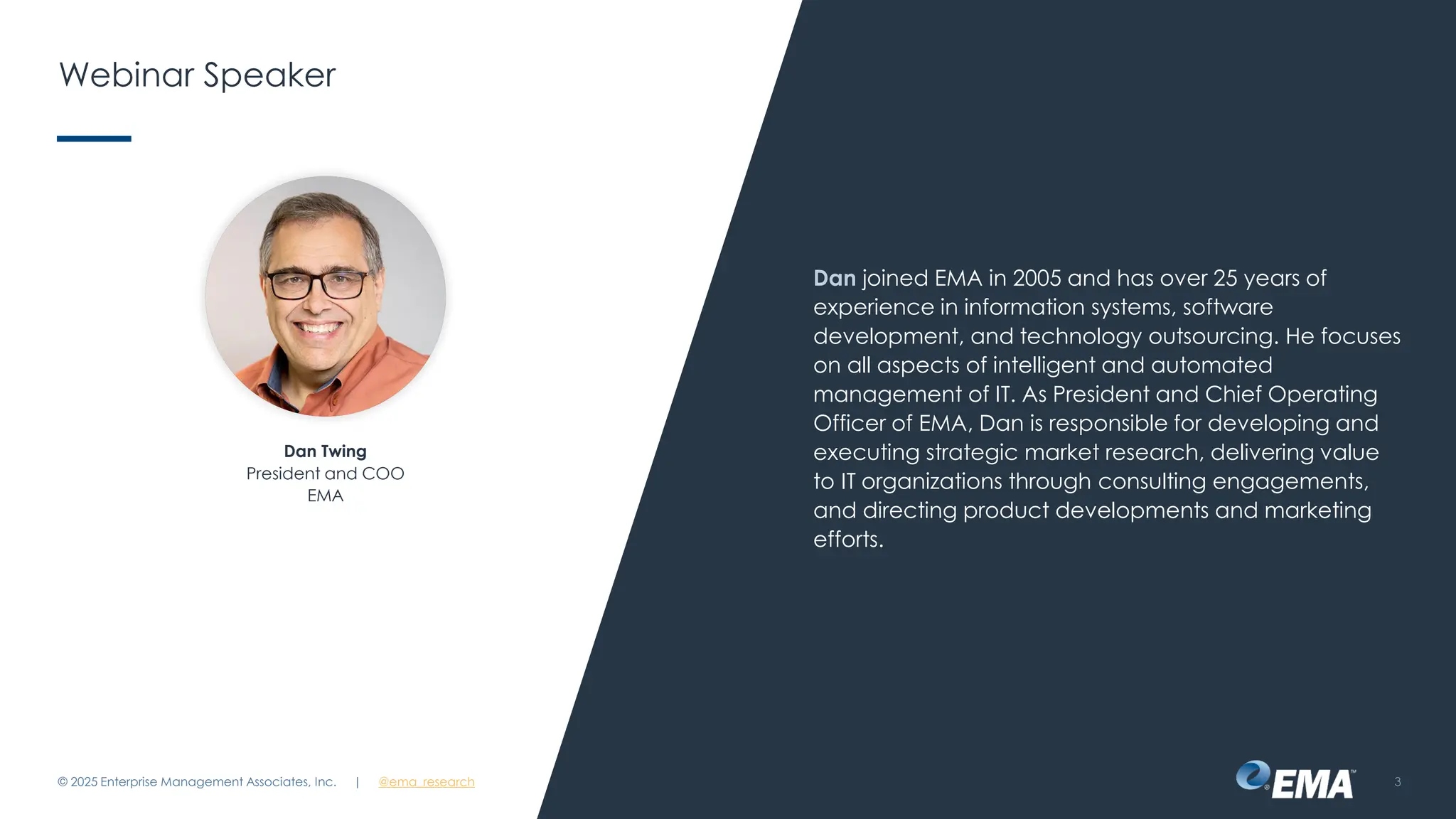
Webinar Speaker
Dan joined EMA in 2005 and has over 25 years of
experience in information systems, software
development, and technology outsourcing. He focuses
on all aspects of intelligent and automated
management of IT. As President and Chief Operating
Officer of EMA, Dan is responsible for developing and
executing strategic market research, delivering value
to IT organizations through consulting engagements,
and directing product developments and marketing
efforts.
© 2025 Enterprise Management Associates, Inc. 3
Dan Twing
President and COO
EMA
@ema_research
| @ema_research
@ema_research
| @ema_research
Sponsors
© 2025 Enterprise Management Associates, Inc. 4
@ema_research
| @ema_research
@ema_research
| @ema_research
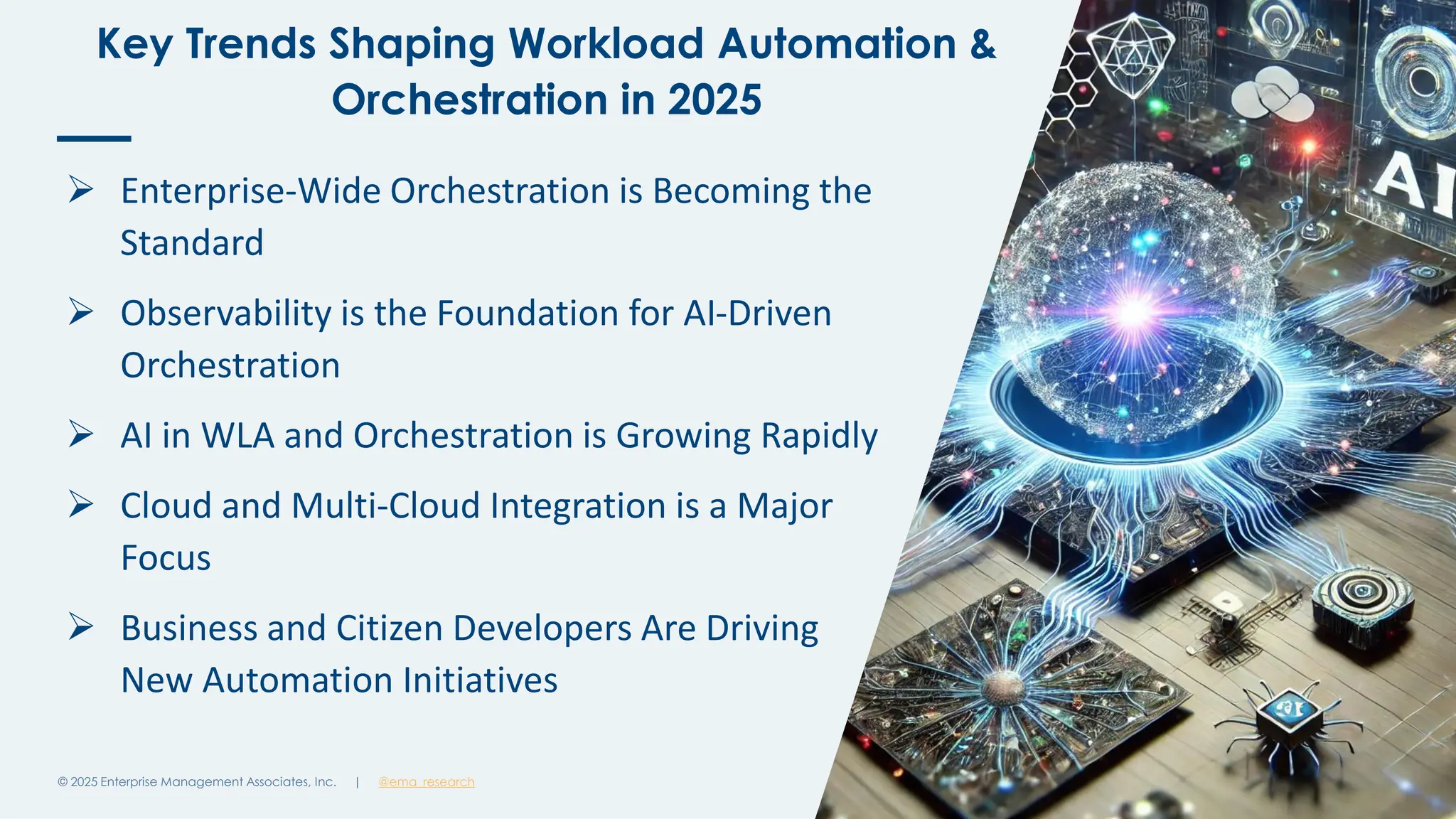
Key Trends Shaping Workload Automation &
Orchestration in 2025
© 2025 Enterprise Management Associates, Inc. 5
➢ Enterprise-Wide Orchestration is Becoming the
Standard
➢ Observability is the Foundation for AI-Driven
Orchestration
➢ AI in WLA and Orchestration is Growing Rapidly
➢ Cloud and Multi-Cloud Integration is a Major
Focus
➢ Business and Citizen Developers Are Driving
New Automation Initiatives
@ema_research
| @ema_research
@ema_research
| @ema_research
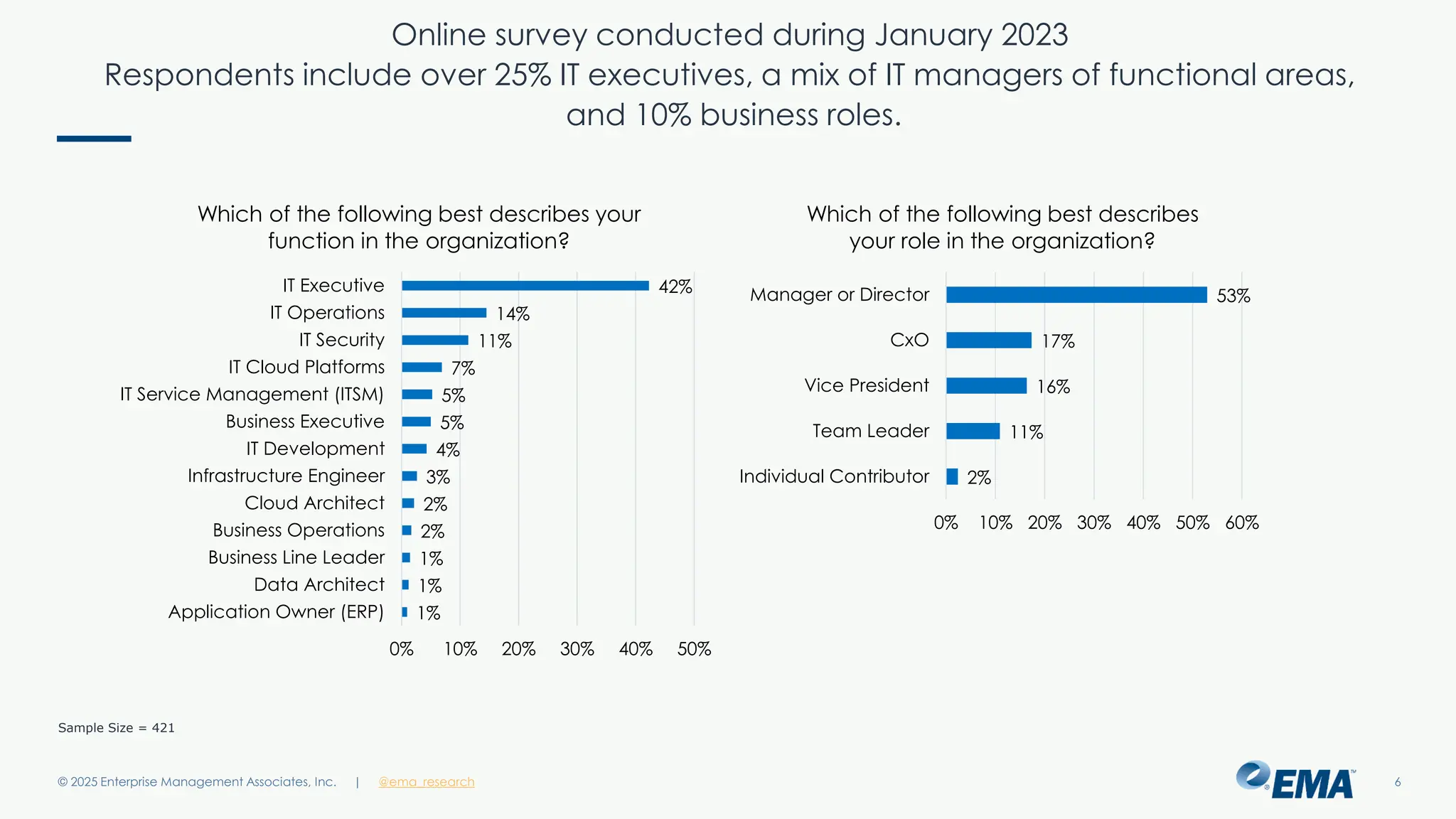
Online survey conducted during January 2023
Respondents include over 25% IT executives, a mix of IT managers of functional areas,
and 10% business roles.
© 2025 Enterprise Management Associates, Inc. 6
Sample Size = 421
42%
14%
11%
7%
5%
5%
4%
3%
2%
2%
1%
1%
1%
0% 10% 20% 30% 40% 50%
IT Executive
IT Operations
IT Security
IT Cloud Platforms
IT Service Management (ITSM)
Business Executive
IT Development
Infrastructure Engineer
Cloud Architect
Business Operations
Business Line Leader
Data Architect
Application Owner (ERP)
Which of the following best describes your
function in the organization?
53%
17%
16%
11%
2%
0% 10% 20% 30% 40% 50% 60%
Manager or Director
CxO
Vice President
Team Leader
Individual Contributor
Which of the following best describes
your role in the organization?
@ema_research
| @ema_research
@ema_research
| @ema_research
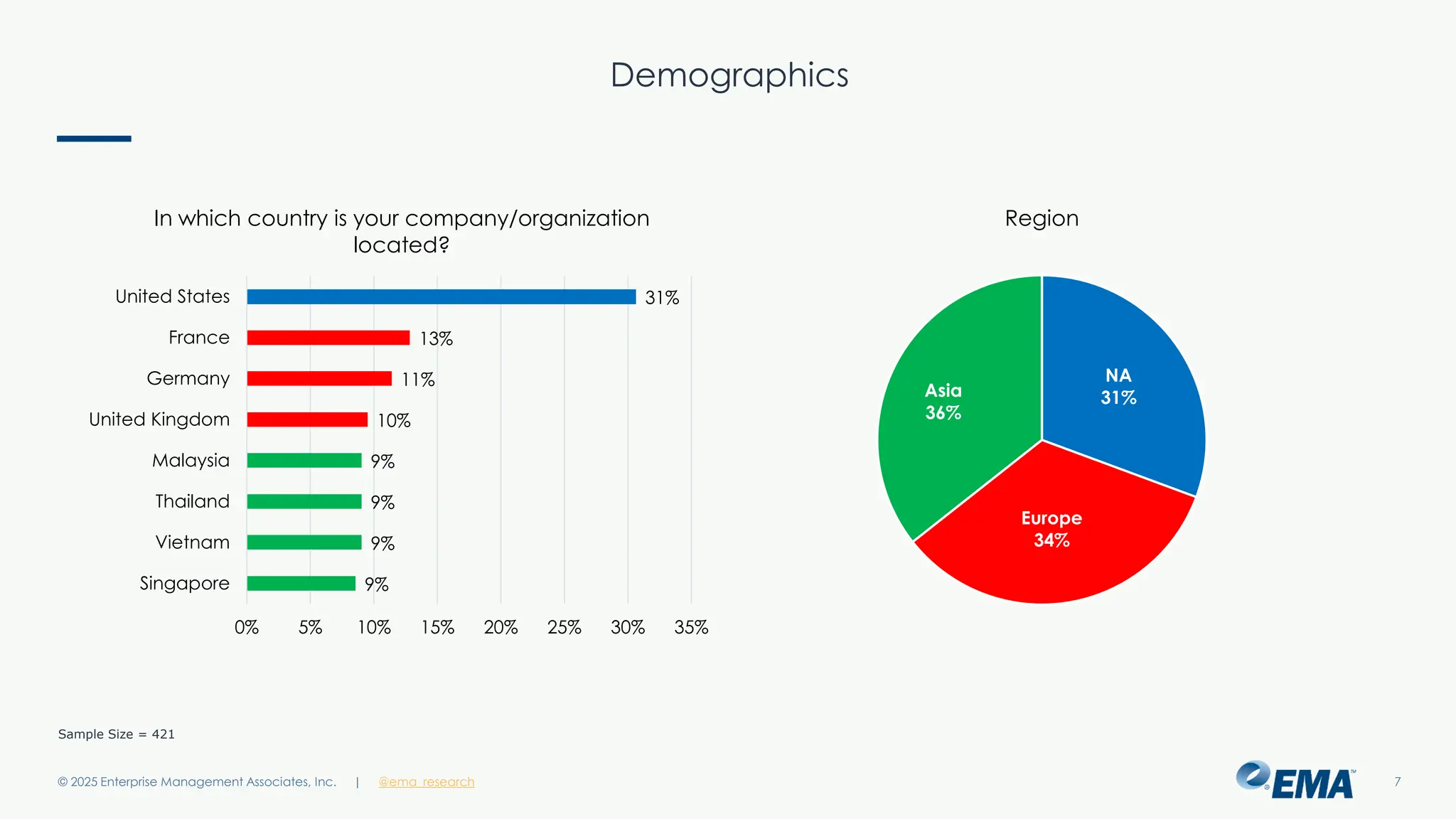
Demographics
© 2025 Enterprise Management Associates, Inc. 7
Sample Size = 421
31%
13%
11%
10%
9%
9%
9%
9%
0% 5% 10% 15% 20% 25% 30% 35%
United States
France
Germany
United Kingdom
Malaysia
Thailand
Vietnam
Singapore
In which country is your company/organization
located?
NA
31%
Europe
34%
Asia
36%
Region
@ema_research
| @ema_research
@ema_research
| @ema_research
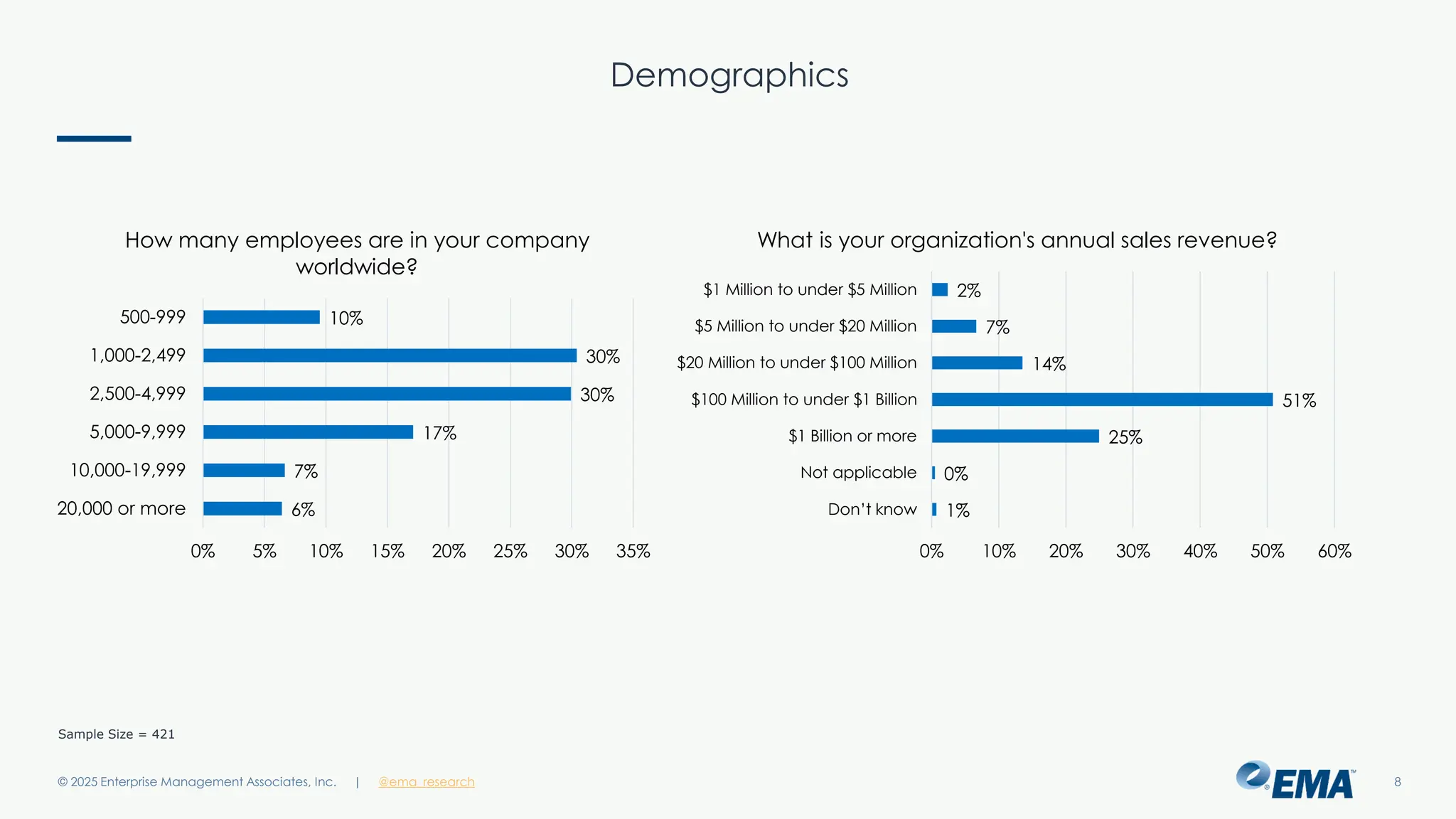
Demographics
© 2025 Enterprise Management Associates, Inc. 8
Sample Size = 421
10%
30%
30%
17%
7%
6%
0% 5% 10% 15% 20% 25% 30% 35%
500-999
1,000-2,499
2,500-4,999
5,000-9,999
10,000-19,999
20,000 or more
How many employees are in your company
worldwide?
2%
7%
14%
51%
25%
0%
1%
0% 10% 20% 30% 40% 50% 60%
$1 Million to under $5 Million
$5 Million to under $20 Million
$20 Million to under $100 Million
$100 Million to under $1 Billion
$1 Billion or more
Not applicable
Don’t know
What is your organization's annual sales revenue?
@ema_research
| @ema_research
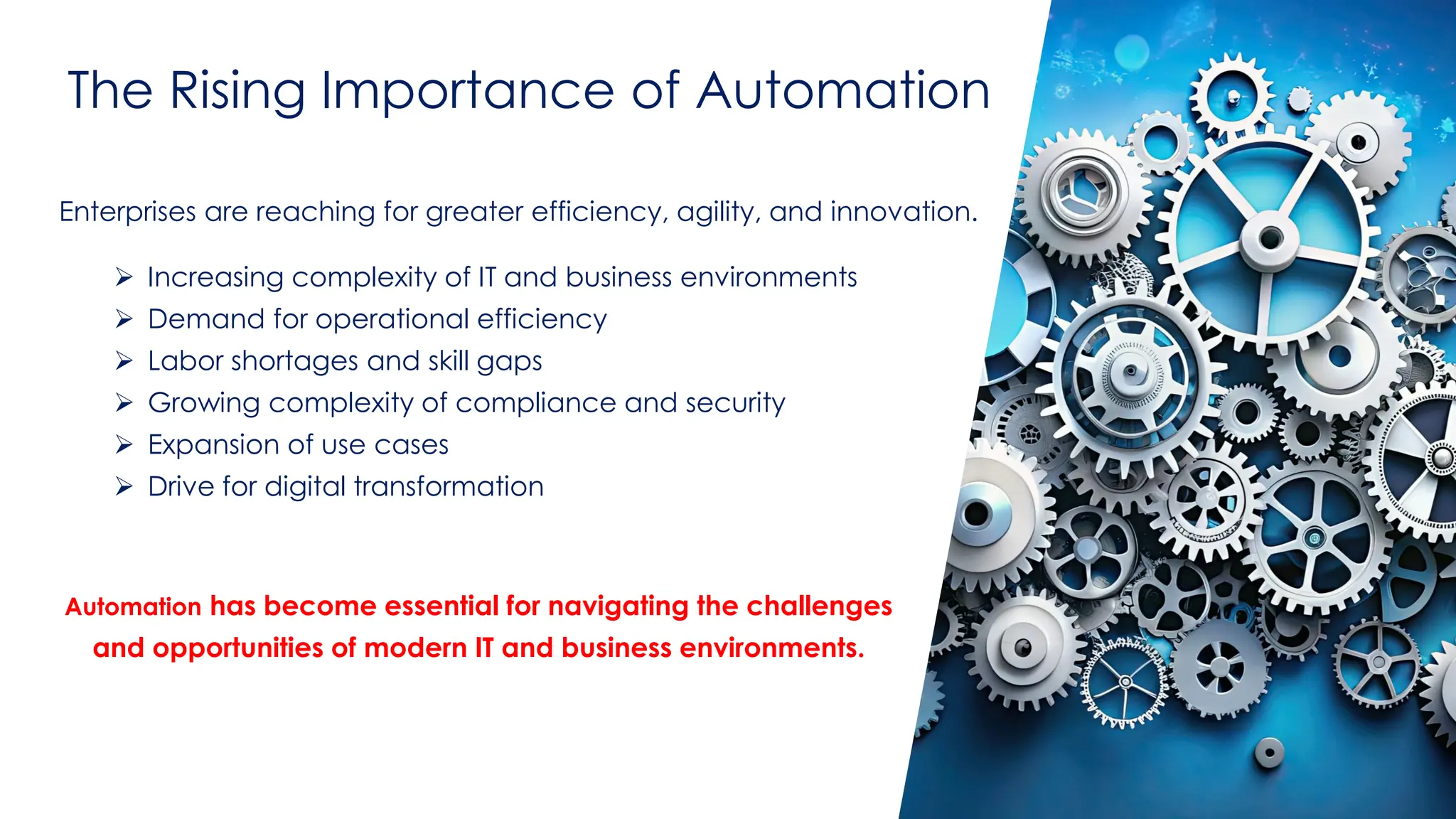
The Rising Importance of Automation
Enterprises are reaching for greater efficiency, agility, and innovation.
➢ Increasing complexity of IT and business environments
➢ Demand for operational efficiency
➢ Labor shortages and skill gaps
➢ Growing complexity of compliance and security
➢ Expansion of use cases
➢ Drive for digital transformation
Automation has become essential for navigating the challenges
and opportunities of modern IT and business environments.
@ema_research
| @ema_research
@ema_research
| @ema_research
© 2024 Enterprise Management Associates, Inc. 10
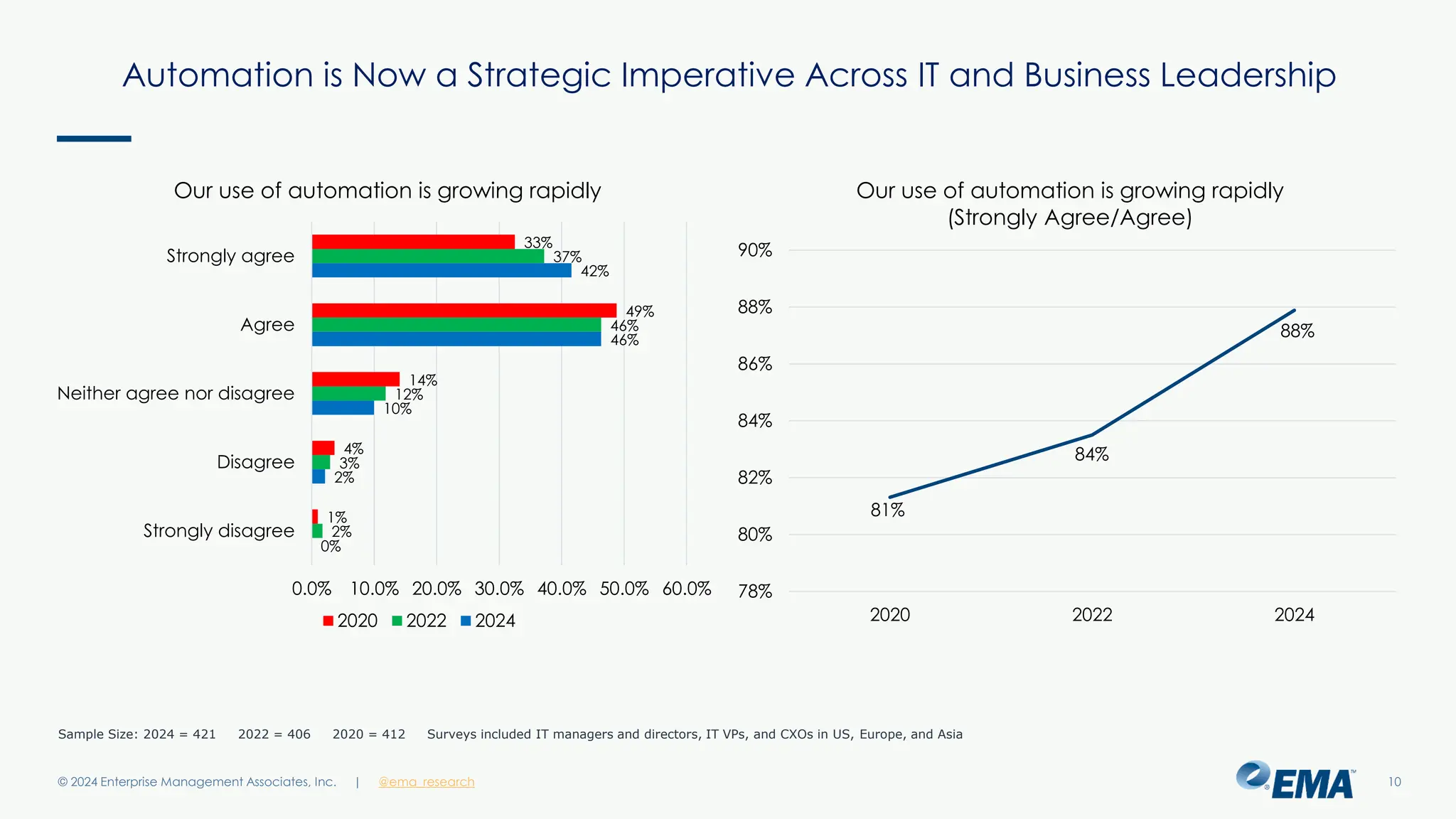
Automation is Now a Strategic Imperative Across IT and Business Leadership
0%
2%
10%
46%
42%
2%
3%
12%
46%
37%
1%
4%
14%
49%
33%
0.0% 10.0% 20.0% 30.0% 40.0% 50.0% 60.0%
Strongly disagree
Disagree
Neither agree nor disagree
Agree
Strongly agree
Our use of automation is growing rapidly
2020 2022 2024
88%
84%
81%
78%
80%
82%
84%
86%
88%
90%
2024
2022
2020
Our use of automation is growing rapidly
(Strongly Agree/Agree)
Sample Size: 2024 = 421 2022 = 406 2020 = 412 Surveys included IT managers and directors, IT VPs, and CXOs in US, Europe, and Asia
@ema_research
| @ema_research
@ema_research
| @ema_research
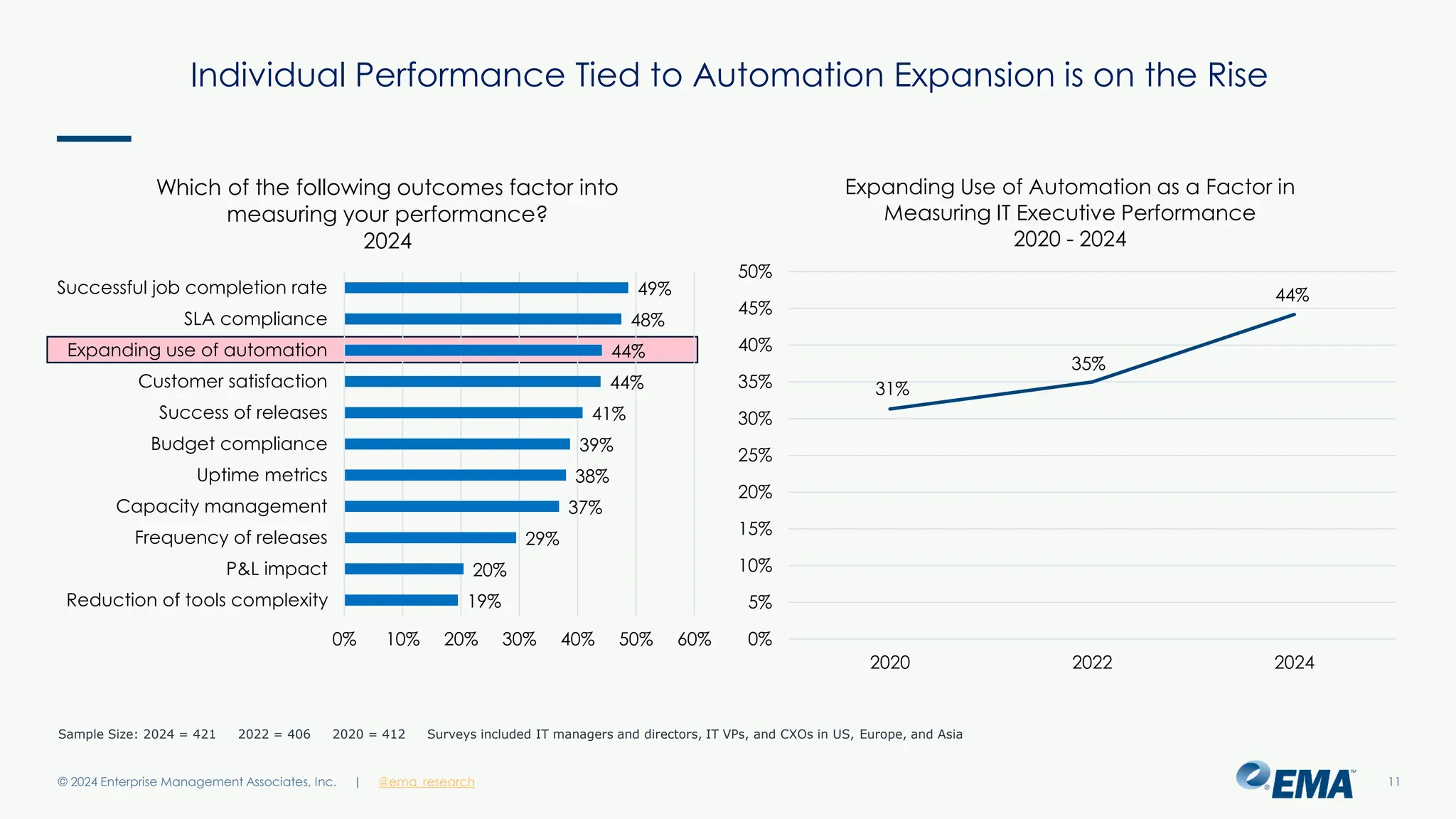
Individual Performance Tied to Automation Expansion is on the Rise
© 2024 Enterprise Management Associates, Inc. 11
44%
35%
31%
0%
5%
10%
15%
20%
25%
30%
35%
40%
45%
50%
2024
2022
2020
Expanding Use of Automation as a Factor in
Measuring IT Executive Performance
2020 - 2024
19%
20%
29%
37%
38%
39%
41%
44%
44%
48%
49%
0% 10% 20% 30% 40% 50% 60%
Reduction of tools complexity
P&L impact
Frequency of releases
Capacity management
Uptime metrics
Budget compliance
Success of releases
Customer satisfaction
Expanding use of automation
SLA compliance
Successful job completion rate
Which of the following outcomes factor into
measuring your performance?
2024
Sample Size: 2024 = 421 2022 = 406 2020 = 412 Surveys included IT managers and directors, IT VPs, and CXOs in US, Europe, and Asia
@ema_research
| @ema_research
@ema_research
| @ema_research
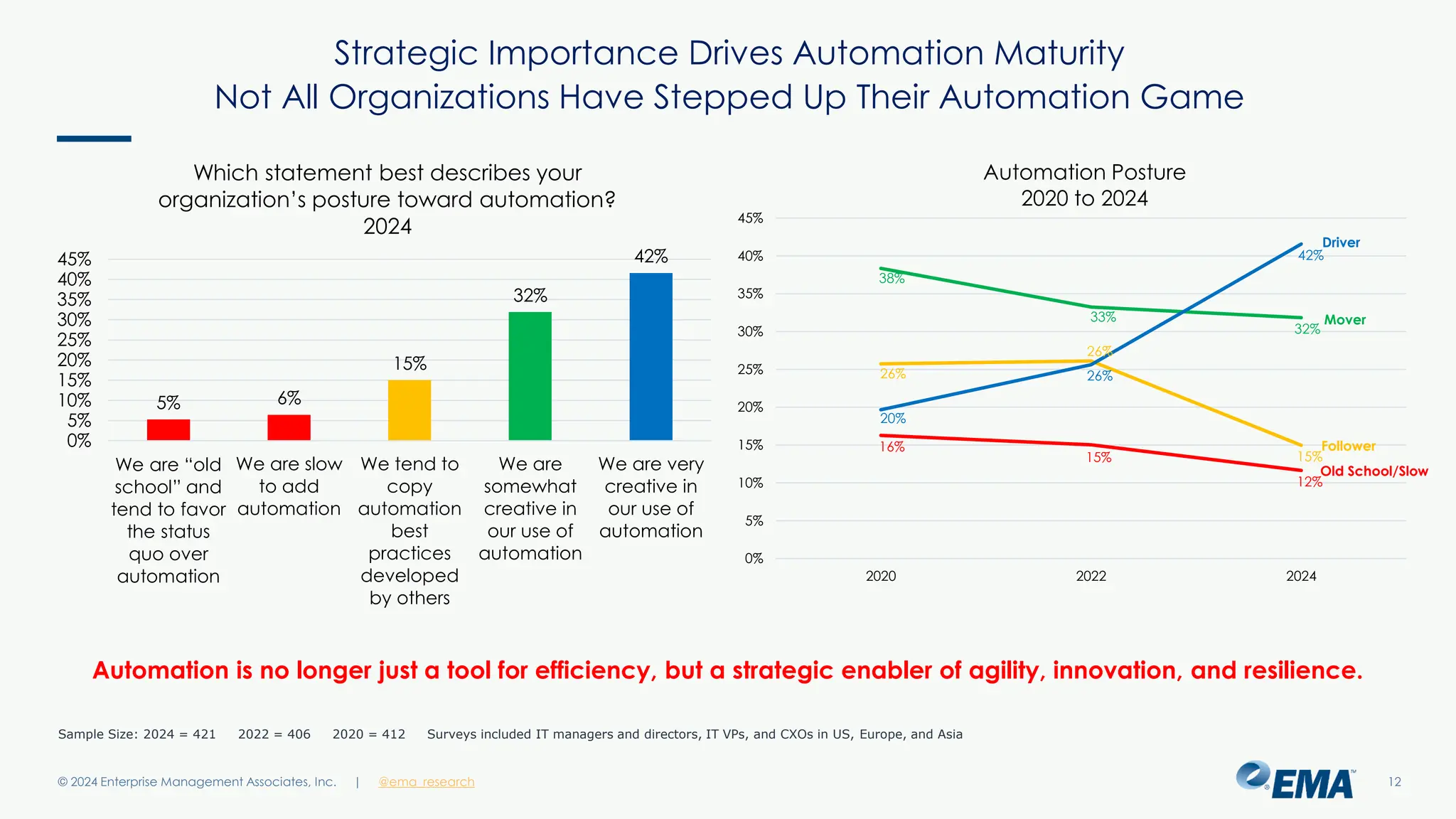
Strategic Importance Drives Automation Maturity
Not All Organizations Have Stepped Up Their Automation Game
© 2024 Enterprise Management Associates, Inc. 12
5% 6%
15%
32%
42%
0%
5%
10%
15%
20%
25%
30%
35%
40%
45%
We are “old
school” and
tend to favor
the status
quo over
automation
We are slow
to add
automation
We tend to
copy
automation
best
practices
developed
by others
We are
somewhat
creative in
our use of
automation
We are very
creative in
our use of
automation
Which statement best describes your
organization’s posture toward automation?
2024
12%
15%
16%
15%
26%
26%
32%
33%
38%
42%
26%
20%
0%
5%
10%
15%
20%
25%
30%
35%
40%
45%
2024
2022
2020
Automation Posture
2020 to 2024
Driver
Mover
Follower
Old School/Slow
Sample Size: 2024 = 421 2022 = 406 2020 = 412 Surveys included IT managers and directors, IT VPs, and CXOs in US, Europe, and Asia
Automation is no longer just a tool for efficiency, but a strategic enabler of agility, innovation, and resilience.
@ema_research
| @ema_research
@ema_research
| @ema_research
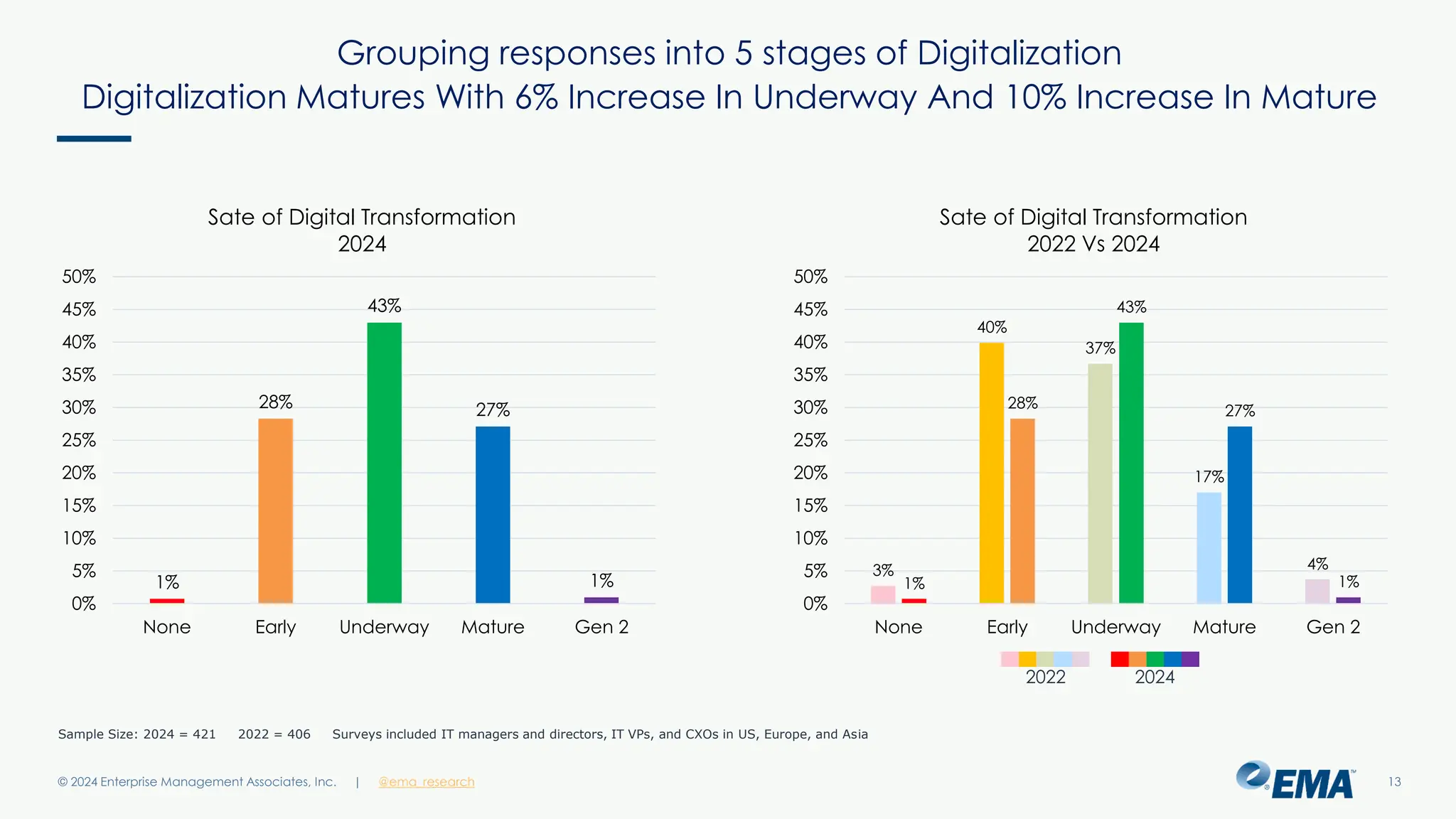
Grouping responses into 5 stages of Digitalization
Digitalization Matures With 6% Increase In Underway And 10% Increase In Mature
© 2024 Enterprise Management Associates, Inc. 13
1%
28%
43%
27%
1%
0%
5%
10%
15%
20%
25%
30%
35%
40%
45%
50%
None Early Underway Mature Gen 2
Sate of Digital Transformation
2024
3%
40%
37%
17%
4%
1%
28%
43%
27%
1%
0%
5%
10%
15%
20%
25%
30%
35%
40%
45%
50%
None Early Underway Mature Gen 2
Sate of Digital Transformation
2022 Vs 2024
2022 2024
Sample Size: 2024 = 421 2022 = 406 Surveys included IT managers and directors, IT VPs, and CXOs in US, Europe, and Asia
@ema_research
| @ema_research
@ema_research
| @ema_research
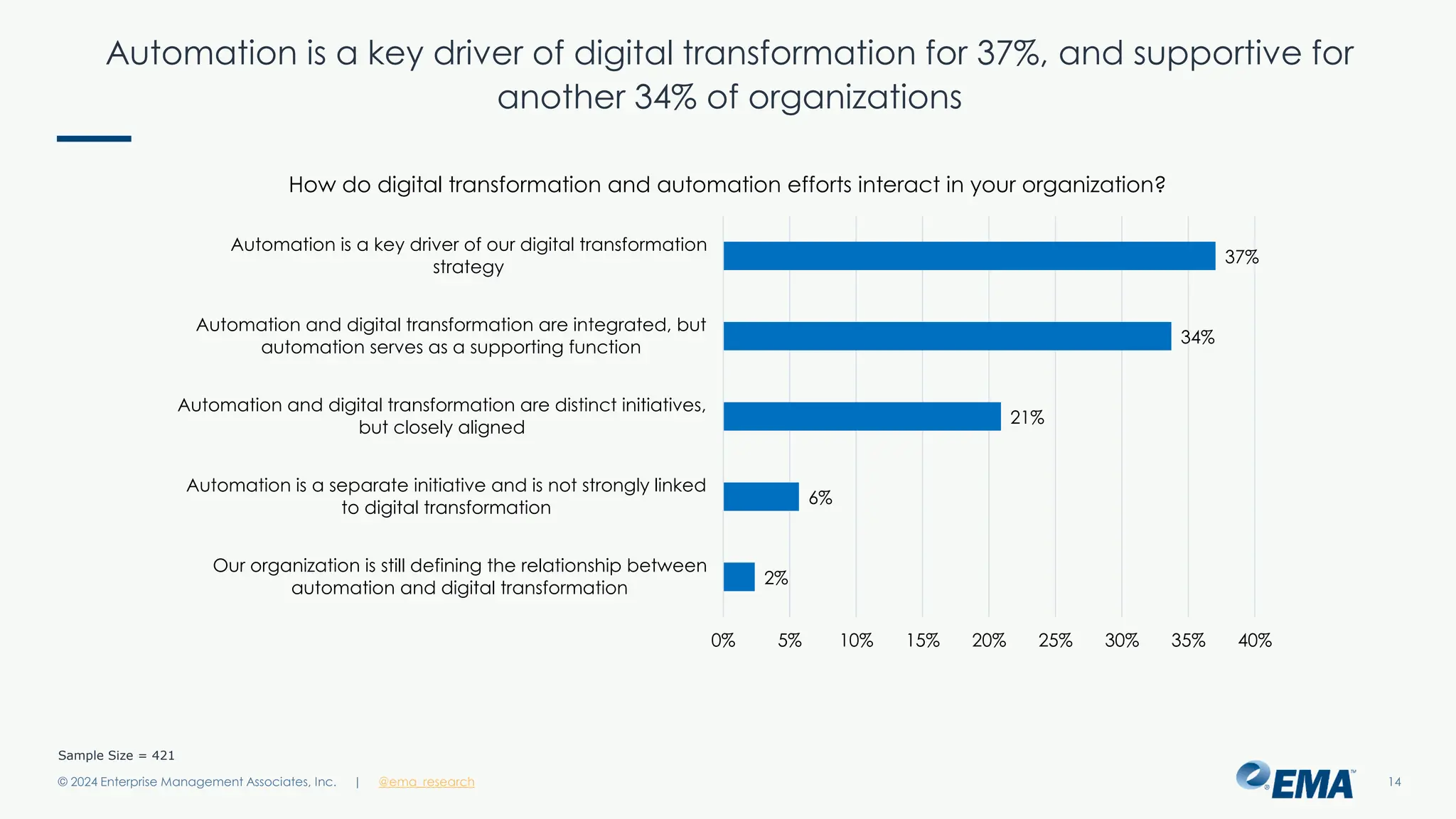
Automation is a key driver of digital transformation for 37%, and supportive for
another 34% of organizations
© 2024 Enterprise Management Associates, Inc. 14
Sample Size = 421
37%
34%
21%
6%
2%
0% 5% 10% 15% 20% 25% 30% 35% 40%
Automation is a key driver of our digital transformation
strategy
Automation and digital transformation are integrated, but
automation serves as a supporting function
Automation and digital transformation are distinct initiatives,
but closely aligned
Automation is a separate initiative and is not strongly linked
to digital transformation
Our organization is still defining the relationship between
automation and digital transformation
How do digital transformation and automation efforts interact in your organization?
@ema_research
| @ema_research
@ema_research
| @ema_research
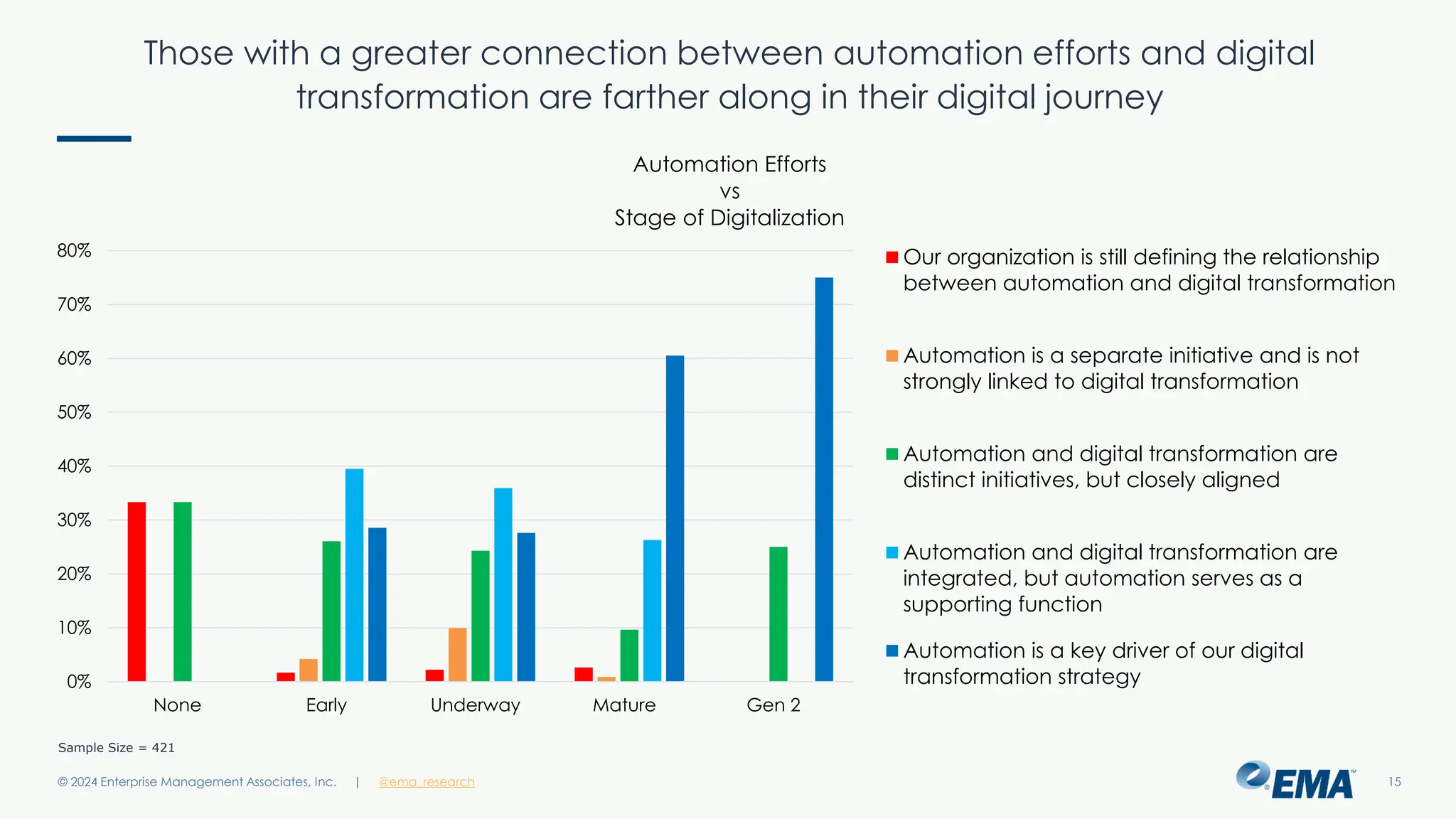
Those with a greater connection between automation efforts and digital
transformation are farther along in their digital journey
© 2024 Enterprise Management Associates, Inc. 15
0%
10%
20%
30%
40%
50%
60%
70%
80%
None Early Underway Mature Gen 2
Automation Efforts
vs
Stage of Digitalization
Our organization is still defining the relationship
between automation and digital transformation
Automation is a separate initiative and is not
strongly linked to digital transformation
Automation and digital transformation are
distinct initiatives, but closely aligned
Automation and digital transformation are
integrated, but automation serves as a
supporting function
Automation is a key driver of our digital
transformation strategy
Sample Size = 421
@ema_research
| @ema_research
@ema_research
| @ema_research
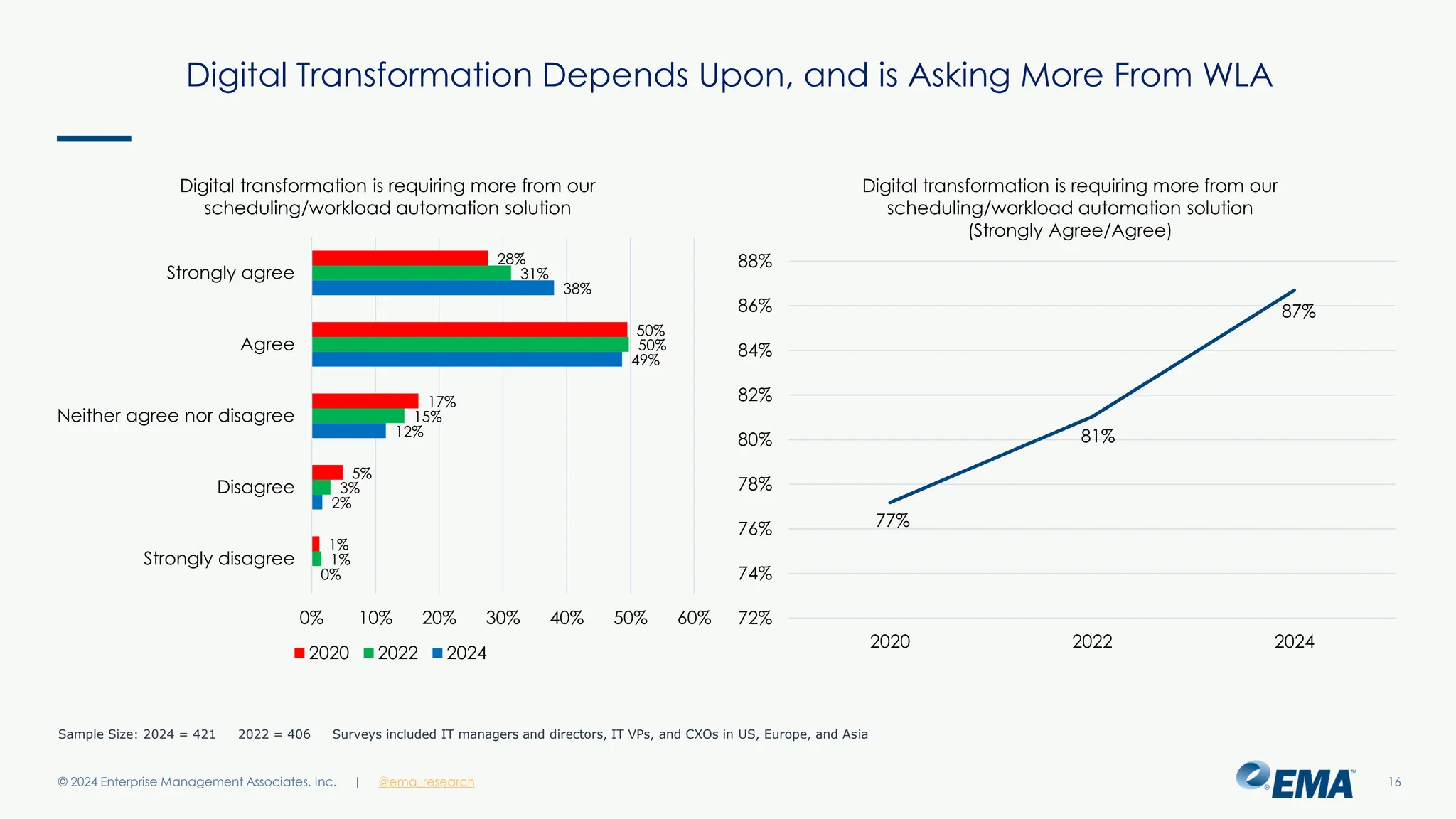
Digital Transformation Depends Upon, and is Asking More From WLA
© 2024 Enterprise Management Associates, Inc. 16
0%
2%
12%
49%
38%
1%
3%
15%
50%
31%
1%
5%
17%
50%
28%
0% 10% 20% 30% 40% 50% 60%
Strongly disagree
Disagree
Neither agree nor disagree
Agree
Strongly agree
Digital transformation is requiring more from our
scheduling/workload automation solution
2020 2022 2024
87%
81%
77%
72%
74%
76%
78%
80%
82%
84%
86%
88%
2024
2022
2020
Digital transformation is requiring more from our
scheduling/workload automation solution
(Strongly Agree/Agree)
Sample Size: 2024 = 421 2022 = 406 Surveys included IT managers and directors, IT VPs, and CXOs in US, Europe, and Asia
@ema_research
| @ema_research
@ema_research
| @ema_research
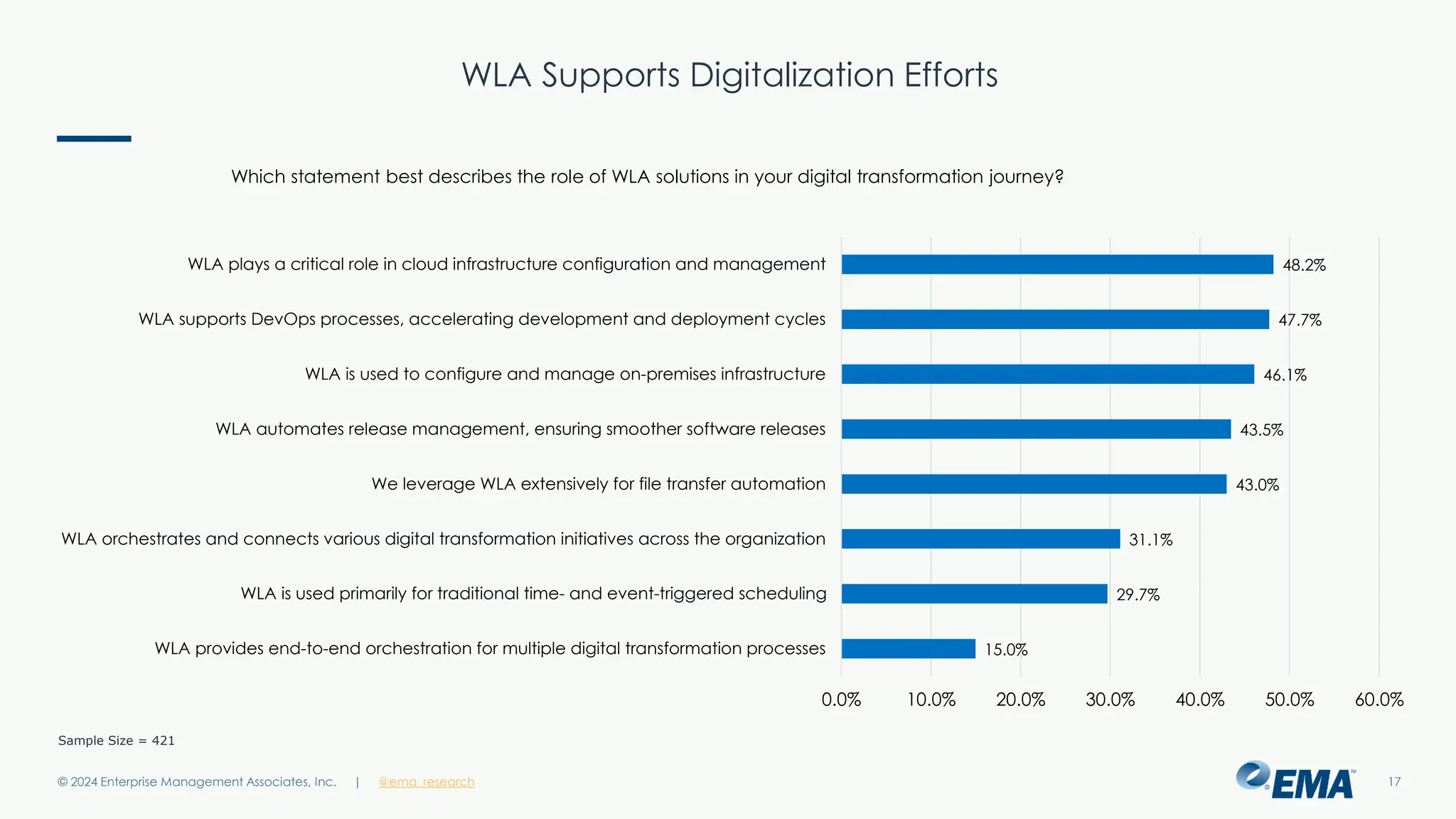
WLA Supports Digitalization Efforts
© 2024 Enterprise Management Associates, Inc. 17
Sample Size = 421
48.2%
47.7%
46.1%
43.5%
43.0%
31.1%
29.7%
15.0%
0.0% 10.0% 20.0% 30.0% 40.0% 50.0% 60.0%
WLA plays a critical role in cloud infrastructure configuration and management
WLA supports DevOps processes, accelerating development and deployment cycles
WLA is used to configure and manage on-premises infrastructure
WLA automates release management, ensuring smoother software releases
We leverage WLA extensively for file transfer automation
WLA orchestrates and connects various digital transformation initiatives across the organization
WLA is used primarily for traditional time- and event-triggered scheduling
WLA provides end-to-end orchestration for multiple digital transformation processes
Which statement best describes the role of WLA solutions in your digital transformation journey?
@ema_research
| @ema_research
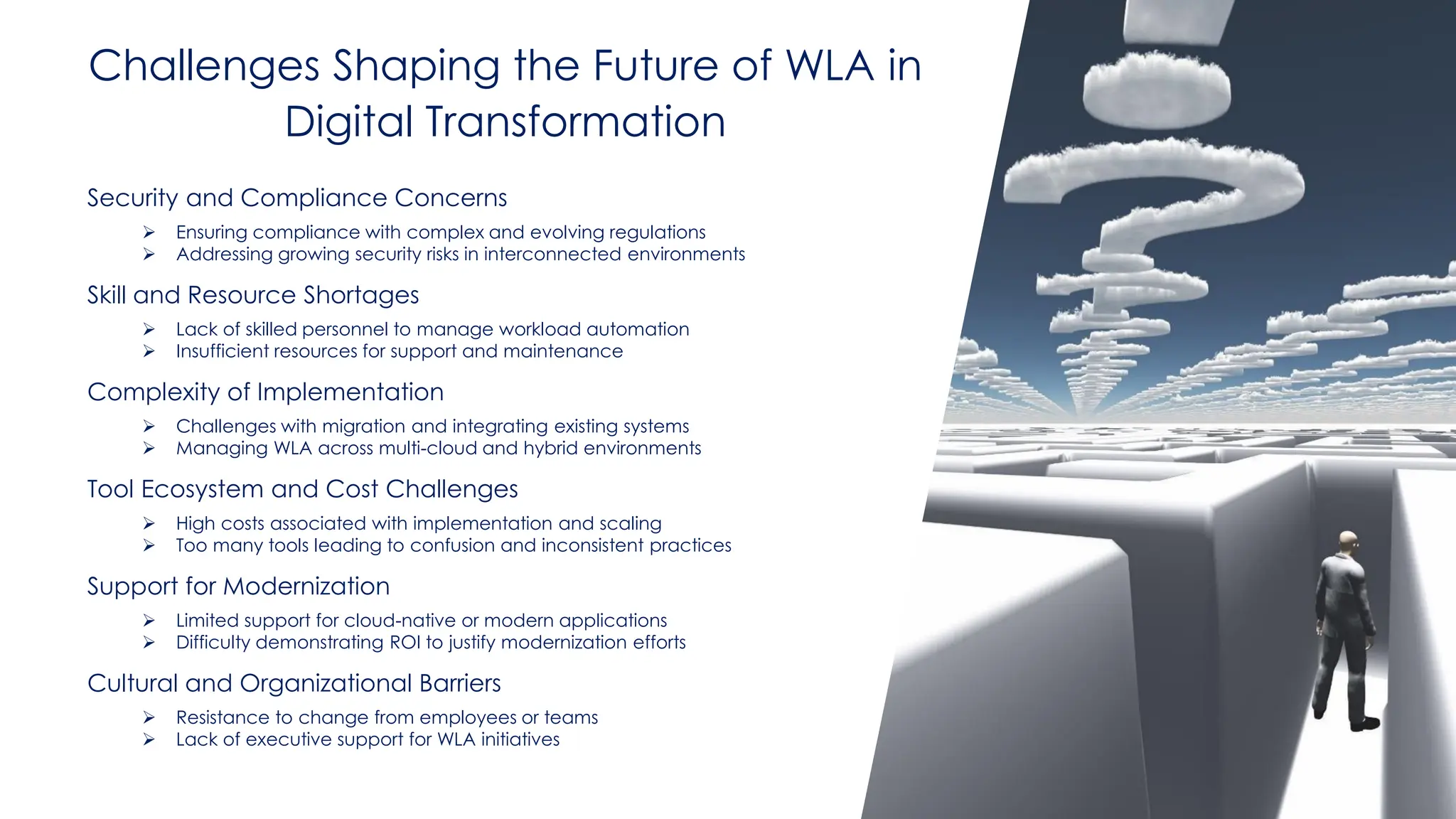
Challenges Shaping the Future of WLA in
Digital Transformation
Security and Compliance Concerns
➢ Ensuring compliance with complex and evolving regulations
➢ Addressing growing security risks in interconnected environments
Skill and Resource Shortages
➢ Lack of skilled personnel to manage workload automation
➢ Insufficient resources for support and maintenance
Complexity of Implementation
➢ Challenges with migration and integrating existing systems
➢ Managing WLA across multi-cloud and hybrid environments
Tool Ecosystem and Cost Challenges
➢ High costs associated with implementation and scaling
➢ Too many tools leading to confusion and inconsistent practices
Support for Modernization
➢ Limited support for cloud-native or modern applications
➢ Difficulty demonstrating ROI to justify modernization efforts
Cultural and Organizational Barriers
➢ Resistance to change from employees or teams
➢ Lack of executive support for WLA initiatives
@ema_research
| @ema_research
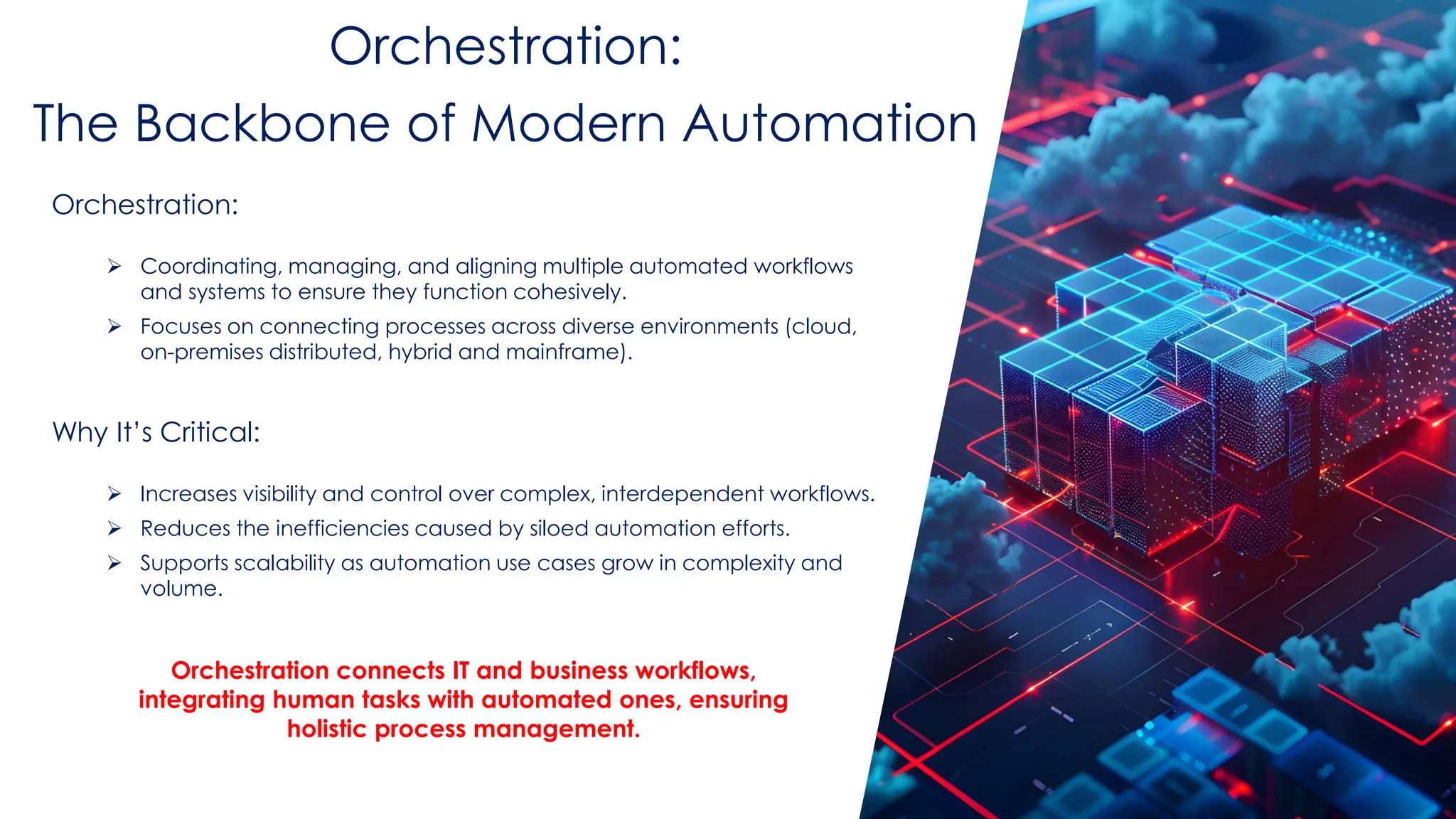
Orchestration:
The Backbone of Modern Automation
Orchestration:
➢ Coordinating, managing, and aligning multiple automated workflows
and systems to ensure they function cohesively.
➢ Focuses on connecting processes across diverse environments (cloud,
on-premises distributed, hybrid and mainframe).
Why It’s Critical:
➢ Increases visibility and control over complex, interdependent workflows.
➢ Reduces the inefficiencies caused by siloed automation efforts.
➢ Supports scalability as automation use cases grow in complexity and
volume.
Orchestration connects IT and business workflows,
integrating human tasks with automated ones, ensuring
holistic process management.
@ema_research
| @ema_research
@ema_research
| @ema_research
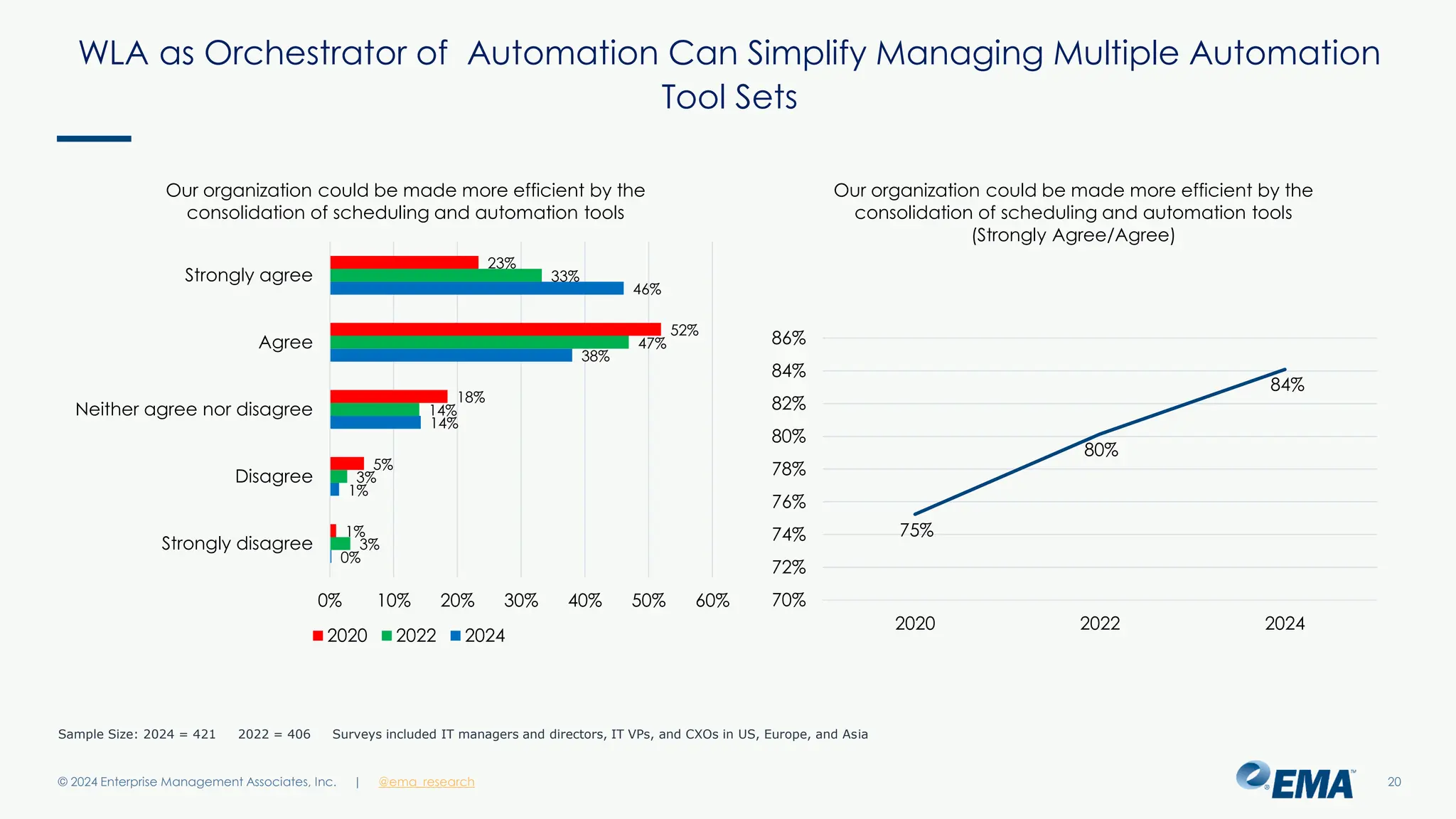
WLA as Orchestrator of Automation Can Simplify Managing Multiple Automation
Tool Sets
© 2024 Enterprise Management Associates, Inc. 20
84%
80%
75%
70%
72%
74%
76%
78%
80%
82%
84%
86%
2024
2022
2020
Our organization could be made more efficient by the
consolidation of scheduling and automation tools
(Strongly Agree/Agree)
0%
1%
14%
38%
46%
3%
3%
14%
47%
33%
1%
5%
18%
52%
23%
0% 10% 20% 30% 40% 50% 60%
Strongly disagree
Disagree
Neither agree nor disagree
Agree
Strongly agree
Our organization could be made more efficient by the
consolidation of scheduling and automation tools
2020 2022 2024
Sample Size: 2024 = 421 2022 = 406 Surveys included IT managers and directors, IT VPs, and CXOs in US, Europe, and Asia
@ema_research
| @ema_research
@ema_research
| @ema_research
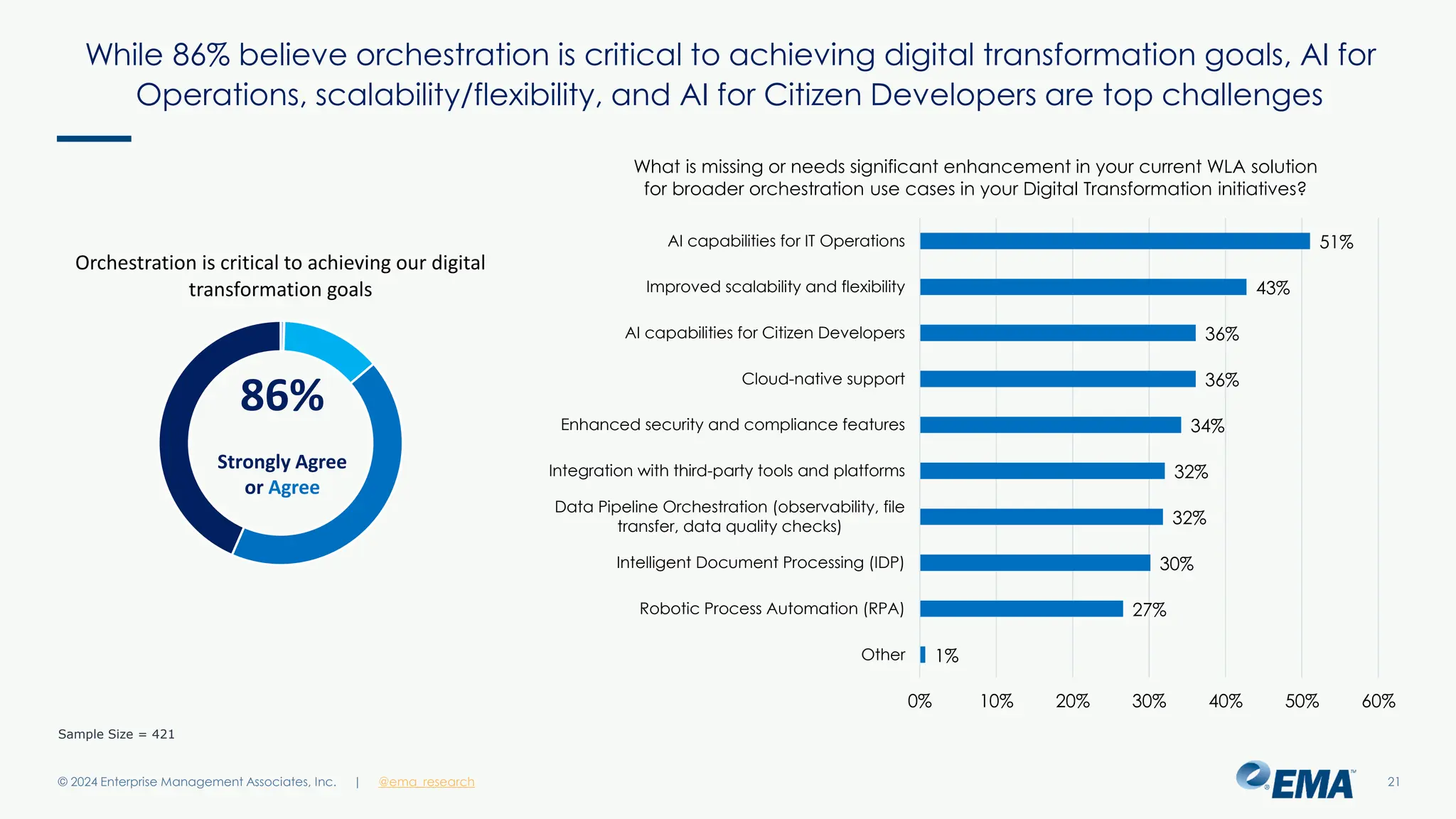
While 86% believe orchestration is critical to achieving digital transformation goals, AI for
Operations, scalability/flexibility, and AI for Citizen Developers are top challenges
© 2024 Enterprise Management Associates, Inc. 21
Sample Size = 421
1%
27%
30%
32%
32%
34%
36%
36%
43%
51%
0% 10% 20% 30% 40% 50% 60%
Other
Robotic Process Automation (RPA)
Intelligent Document Processing (IDP)
Data Pipeline Orchestration (observability, file
transfer, data quality checks)
Integration with third-party tools and platforms
Enhanced security and compliance features
Cloud-native support
AI capabilities for Citizen Developers
Improved scalability and flexibility
AI capabilities for IT Operations
What is missing or needs significant enhancement in your current WLA solution
for broader orchestration use cases in your Digital Transformation initiatives?
Orchestration is critical to achieving our digital
transformation goals
86%
Strongly Agree
or Agree
@ema_research
| @ema_research
@ema_research
| @ema_research
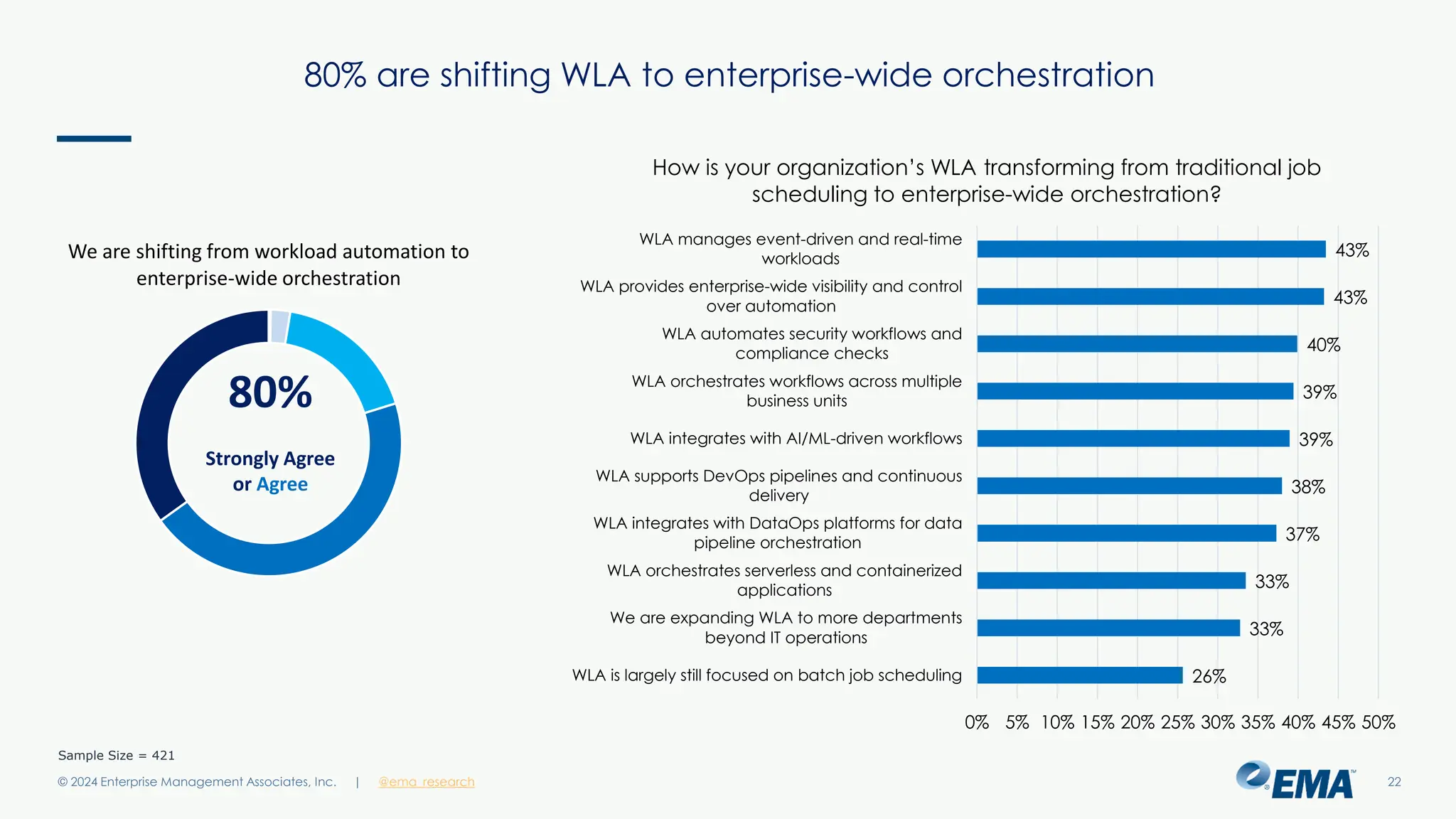
80% are shifting WLA to enterprise-wide orchestration
© 2024 Enterprise Management Associates, Inc. 22
Sample Size = 421
26%
33%
33%
37%
38%
39%
39%
40%
43%
43%
0% 5% 10% 15% 20% 25% 30% 35% 40% 45% 50%
WLA is largely still focused on batch job scheduling
We are expanding WLA to more departments
beyond IT operations
WLA orchestrates serverless and containerized
applications
WLA integrates with DataOps platforms for data
pipeline orchestration
WLA supports DevOps pipelines and continuous
delivery
WLA integrates with AI/ML-driven workflows
WLA orchestrates workflows across multiple
business units
WLA automates security workflows and
compliance checks
WLA provides enterprise-wide visibility and control
over automation
WLA manages event-driven and real-time
workloads
How is your organization’s WLA transforming from traditional job
scheduling to enterprise-wide orchestration?
We are shifting from workload automation to
enterprise-wide orchestration
80%
Strongly Agree
or Agree
@ema_research
| @ema_research
@ema_research
| @ema_research
© 2024 Enterprise Management Associates, Inc. 23
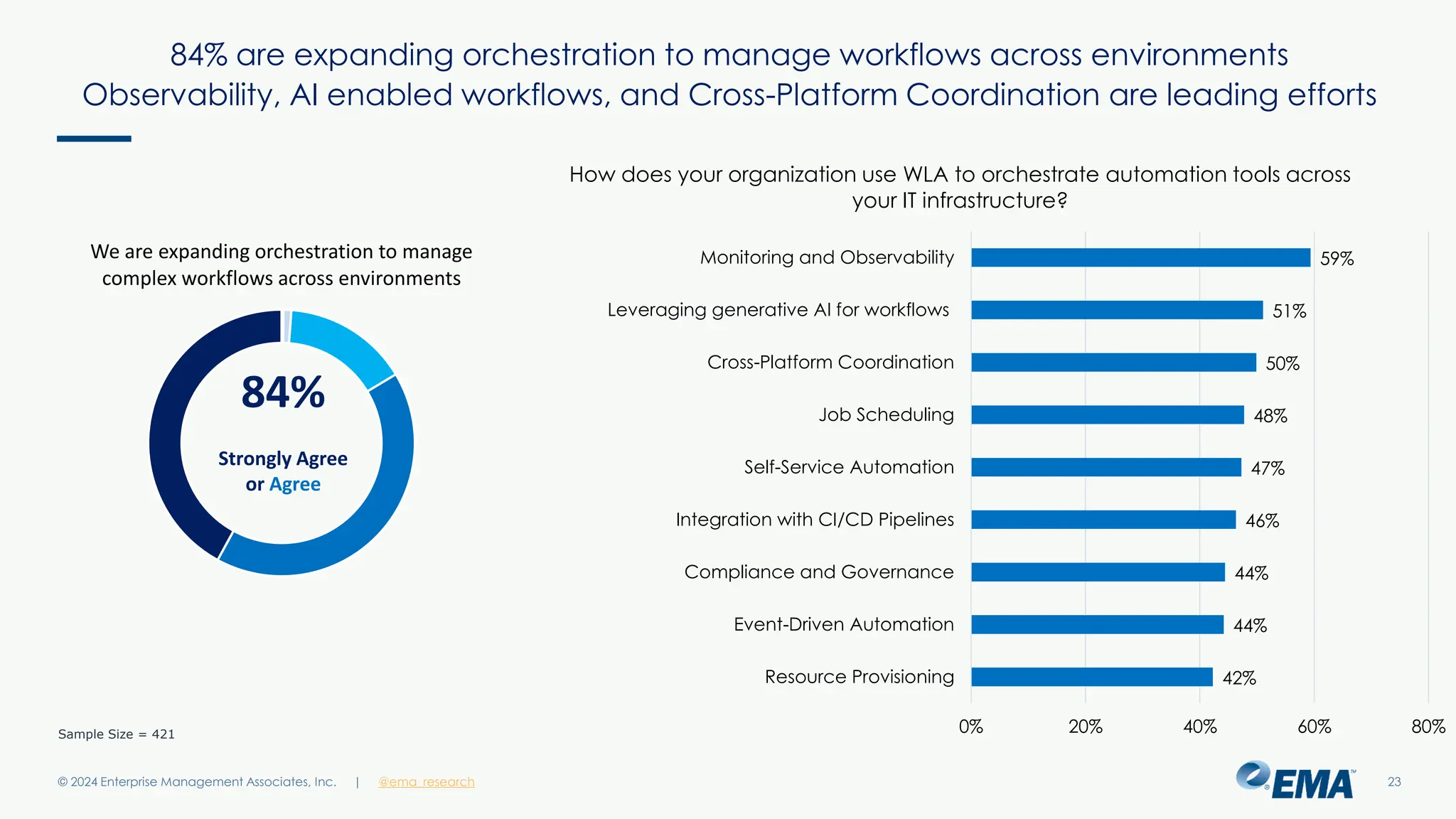
84% are expanding orchestration to manage workflows across environments
Observability, AI enabled workflows, and Cross-Platform Coordination are leading efforts
42%
44%
44%
46%
47%
48%
50%
51%
59%
0% 20% 40% 60% 80%
Resource Provisioning
Event-Driven Automation
Compliance and Governance
Integration with CI/CD Pipelines
Self-Service Automation
Job Scheduling
Cross-Platform Coordination
Leveraging generative AI for workflows
Monitoring and Observability
How does your organization use WLA to orchestrate automation tools across
your IT infrastructure?
Sample Size = 421
We are expanding orchestration to manage
complex workflows across environments
84%
Strongly Agree
or Agree
@ema_research
| @ema_research
Rising Importance of
Observability
@ema_research
| @ema_research
@ema_research
| @ema_research
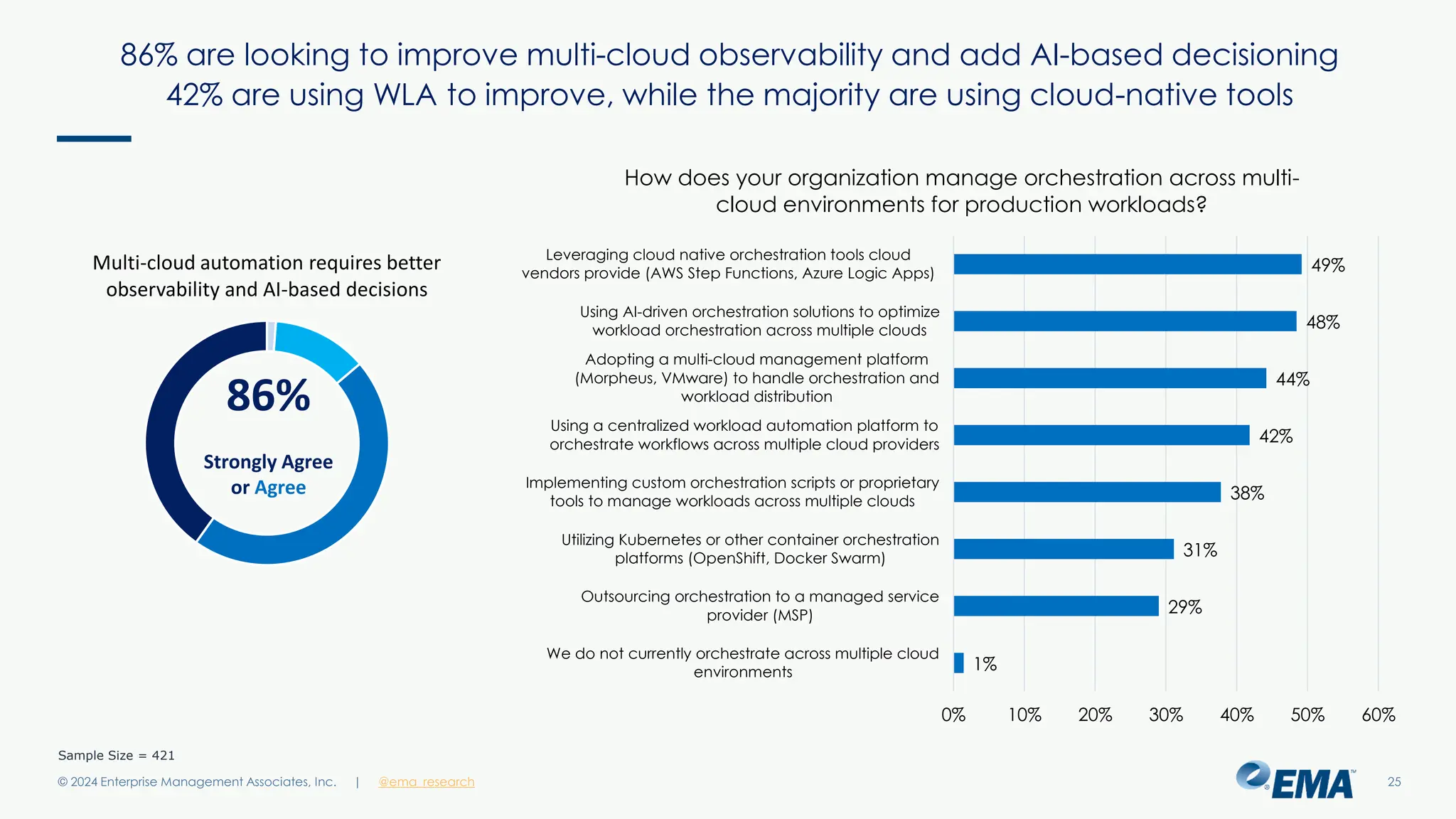
86% are looking to improve multi-cloud observability and add AI-based decisioning
42% are using WLA to improve, while the majority are using cloud-native tools
© 2024 Enterprise Management Associates, Inc. 25
1%
29%
31%
38%
42%
44%
48%
49%
0% 10% 20% 30% 40% 50% 60%
We do not currently orchestrate across multiple cloud
environments
Outsourcing orchestration to a managed service
provider (MSP)
Utilizing Kubernetes or other container orchestration
platforms (OpenShift, Docker Swarm)
Implementing custom orchestration scripts or proprietary
tools to manage workloads across multiple clouds
Using a centralized workload automation platform to
orchestrate workflows across multiple cloud providers
Adopting a multi-cloud management platform
(Morpheus, VMware) to handle orchestration and
workload distribution
Using AI-driven orchestration solutions to optimize
workload orchestration across multiple clouds
Leveraging cloud native orchestration tools cloud
vendors provide (AWS Step Functions, Azure Logic Apps)
How does your organization manage orchestration across multi-
cloud environments for production workloads?
Multi-cloud automation requires better
observability and AI-based decisions
86%
Strongly Agree
or Agree
Sample Size = 421
@ema_research
| @ema_research
@ema_research
| @ema_research
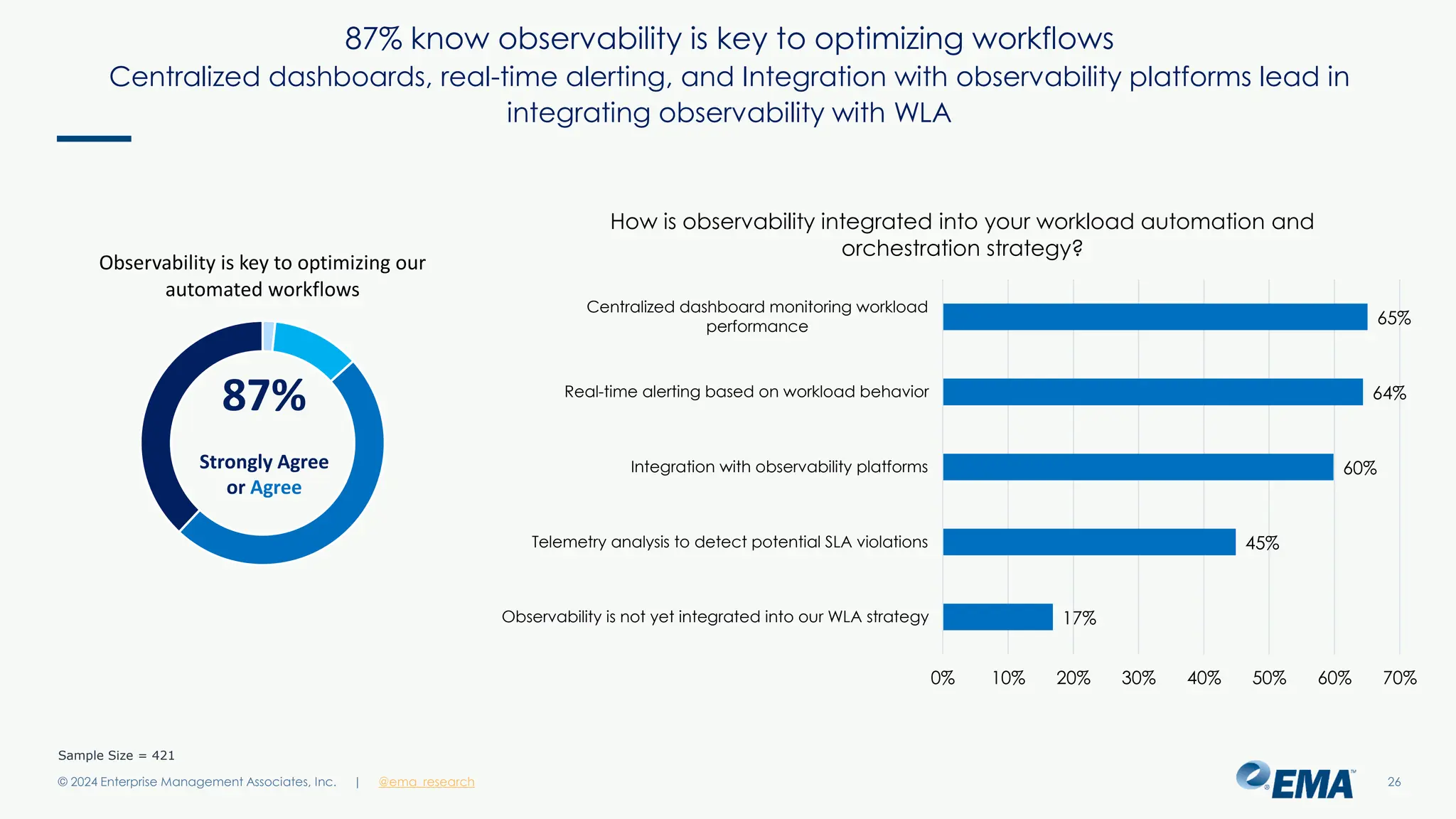
87% know observability is key to optimizing workflows
Centralized dashboards, real-time alerting, and Integration with observability platforms lead in
integrating observability with WLA
© 2024 Enterprise Management Associates, Inc. 26
Sample Size = 421
17%
45%
60%
64%
65%
0% 10% 20% 30% 40% 50% 60% 70%
Observability is not yet integrated into our WLA strategy
Telemetry analysis to detect potential SLA violations
Integration with observability platforms
Real-time alerting based on workload behavior
Centralized dashboard monitoring workload
performance
How is observability integrated into your workload automation and
orchestration strategy?
Observability is key to optimizing our
automated workflows
87%
Strongly Agree
or Agree
@ema_research
| @ema_research
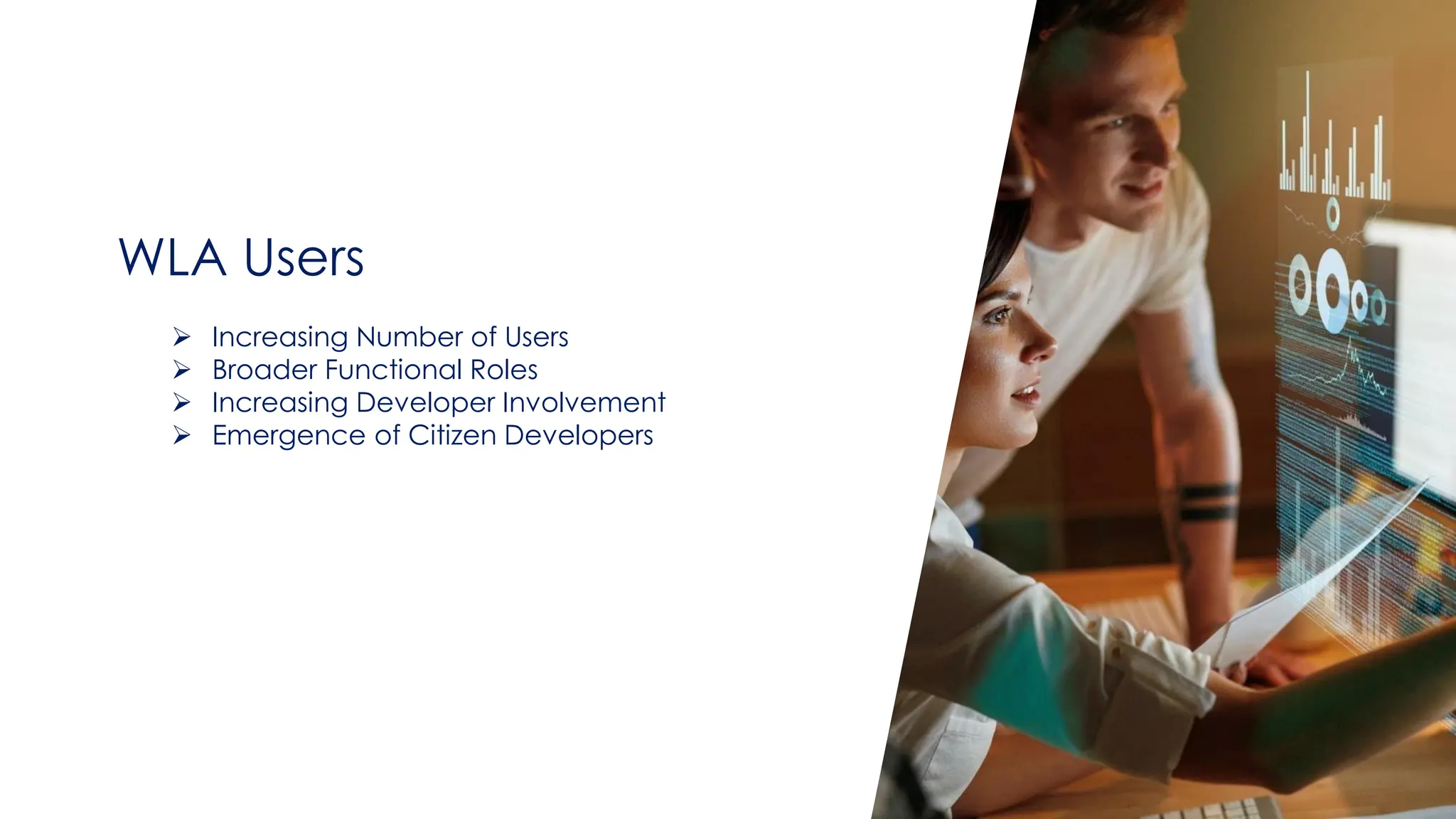
WLA Users
➢ Increasing Number of Users
➢ Broader Functional Roles
➢ Increasing Developer Involvement
➢ Emergence of Citizen Developers
@ema_research
| @ema_research
@ema_research
| @ema_research
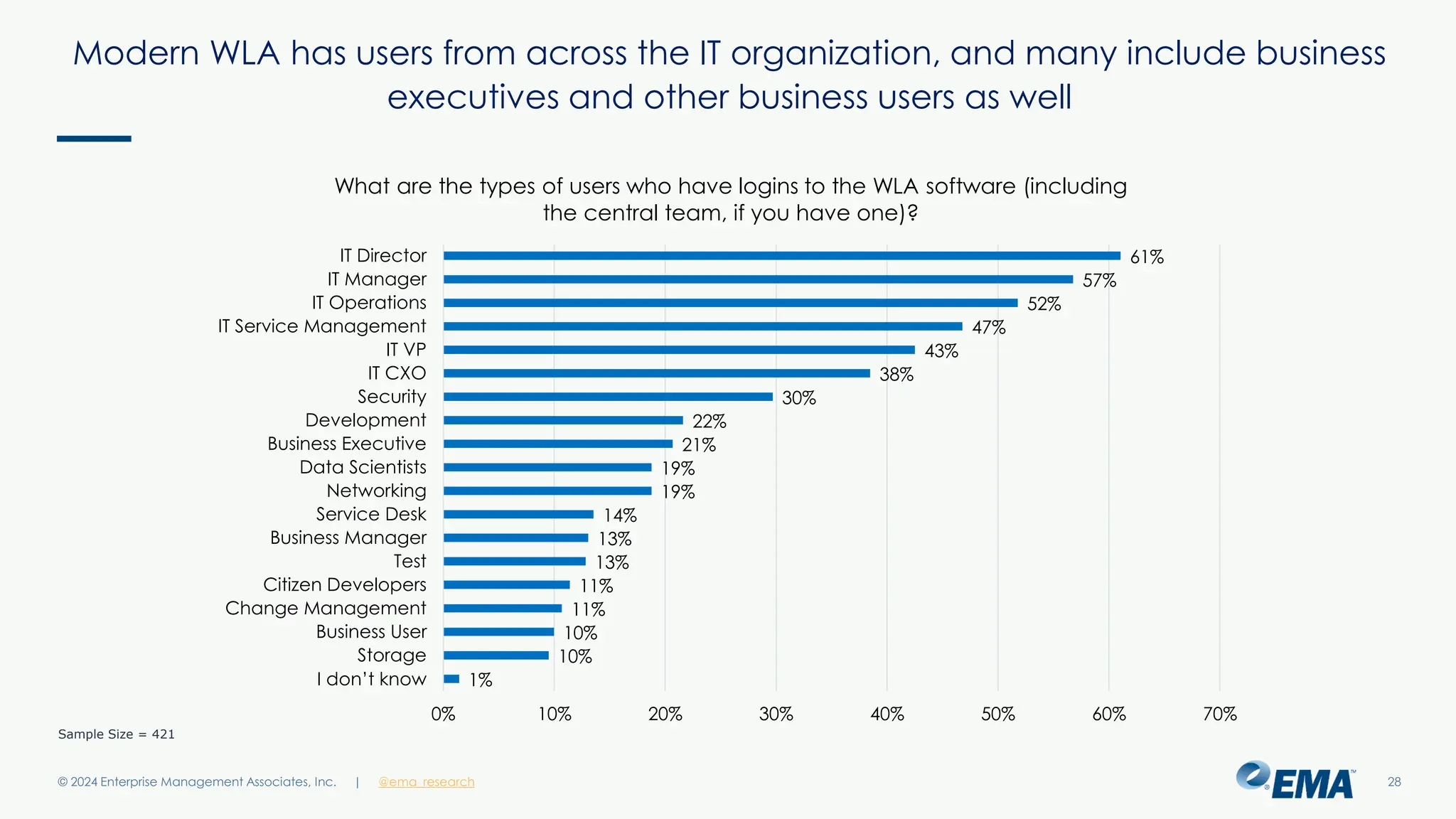
Modern WLA has users from across the IT organization, and many include business
executives and other business users as well
© 2024 Enterprise Management Associates, Inc. 28
Sample Size = 421
1%
10%
10%
11%
11%
13%
13%
14%
19%
19%
21%
22%
30%
38%
43%
47%
52%
57%
61%
0% 10% 20% 30% 40% 50% 60% 70%
I don’t know
Storage
Business User
Change Management
Citizen Developers
Test
Business Manager
Service Desk
Networking
Data Scientists
Business Executive
Development
Security
IT CXO
IT VP
IT Service Management
IT Operations
IT Manager
IT Director
What are the types of users who have logins to the WLA software (including
the central team, if you have one)?
@ema_research
| @ema_research
@ema_research
| @ema_research
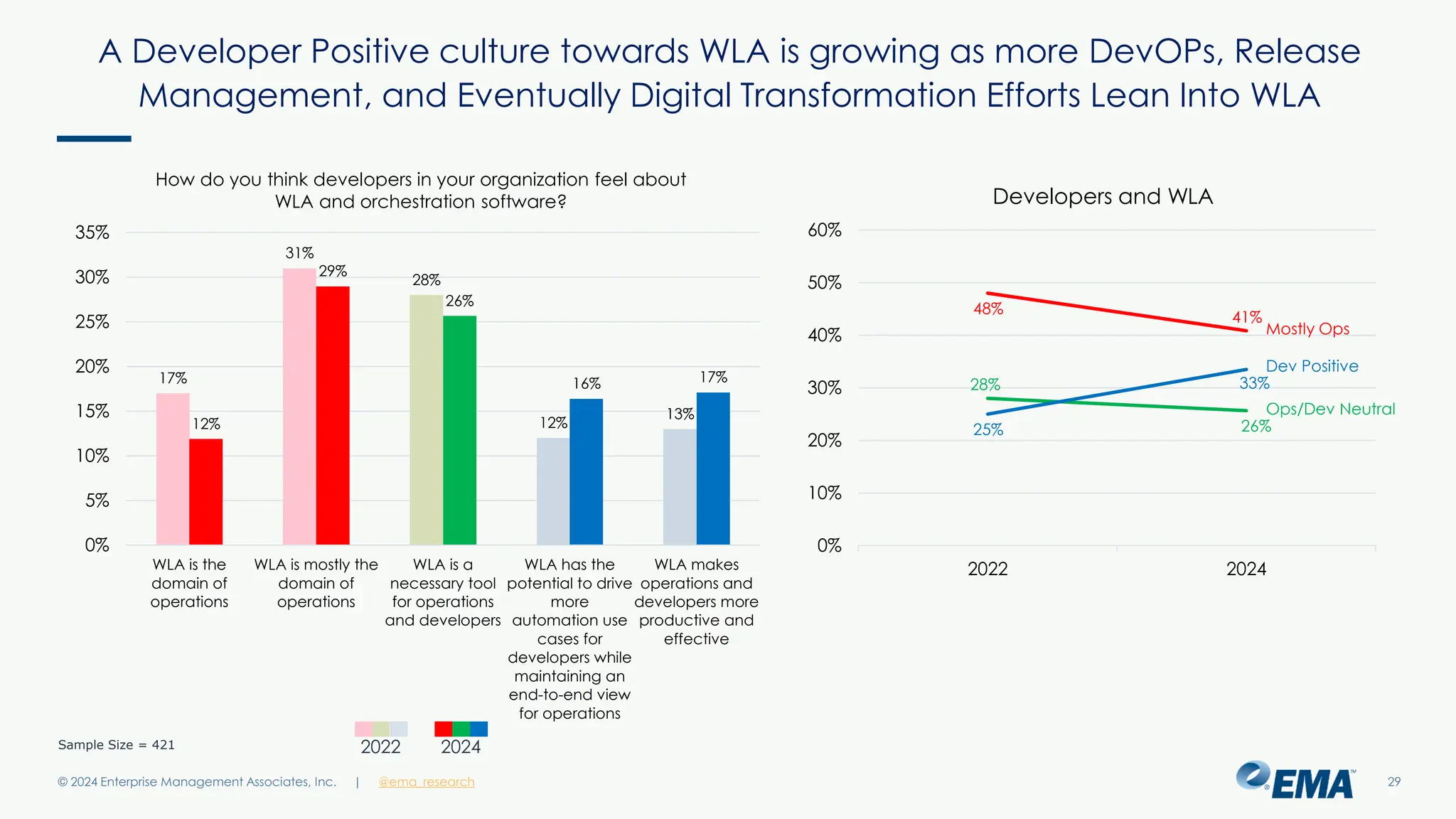
A Developer Positive culture towards WLA is growing as more DevOPs, Release
Management, and Eventually Digital Transformation Efforts Lean Into WLA
© 2024 Enterprise Management Associates, Inc. 29
Sample Size = 421
17%
31%
28%
12%
13%
12%
29%
26%
16% 17%
0%
5%
10%
15%
20%
25%
30%
35%
WLA is the
domain of
operations
WLA is mostly the
domain of
operations
WLA is a
necessary tool
for operations
and developers
WLA has the
potential to drive
more
automation use
cases for
developers while
maintaining an
end-to-end view
for operations
WLA makes
operations and
developers more
productive and
effective
How do you think developers in your organization feel about
WLA and orchestration software?
2022 2024
41%
48%
26%
28% 33%
25%
0%
10%
20%
30%
40%
50%
60%
2024
2022
Developers and WLA
Ops/Dev Neutral
Dev Positive
Mostly Ops
@ema_research
| @ema_research
@ema_research
| @ema_research
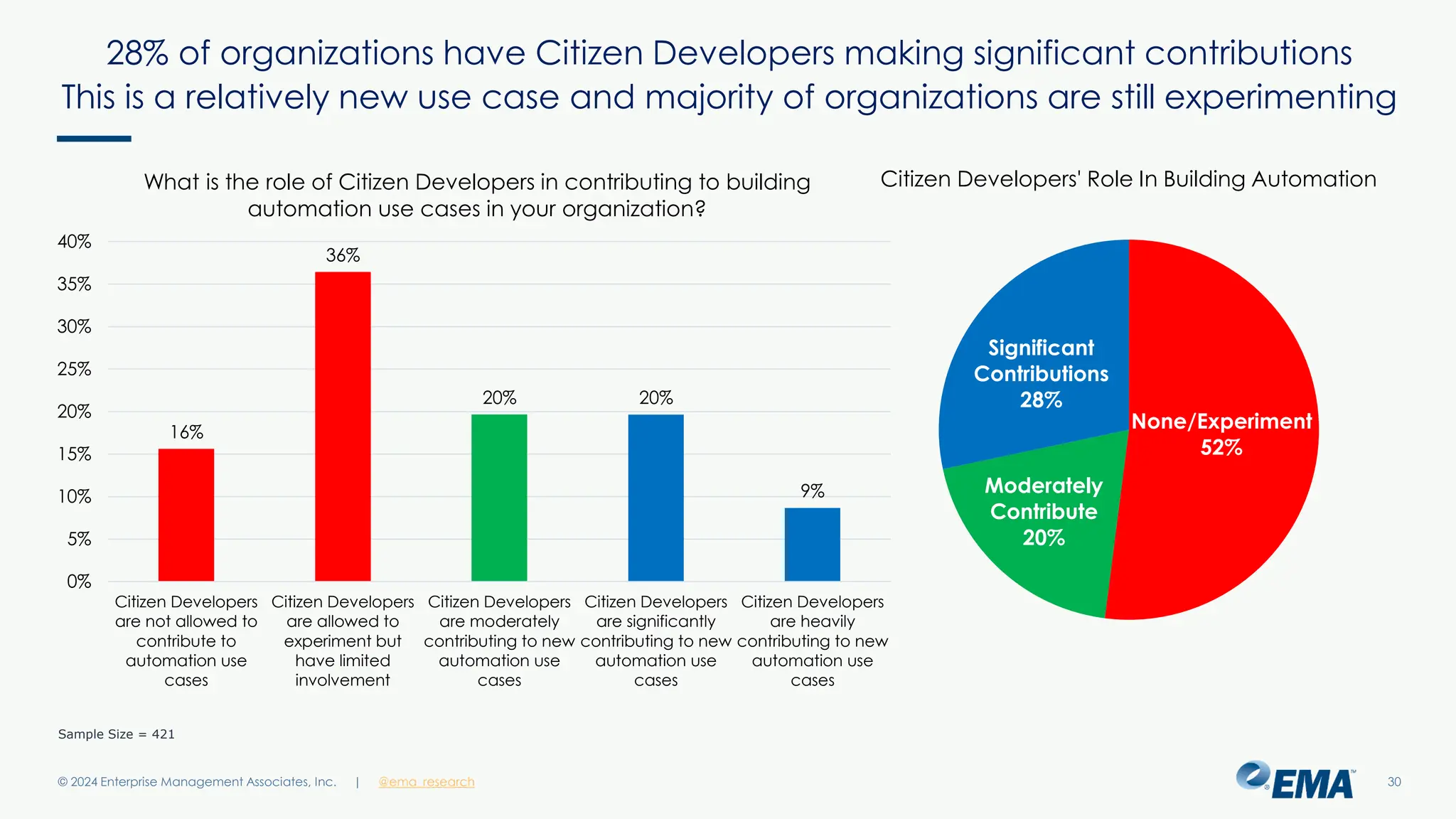
28% of organizations have Citizen Developers making significant contributions
This is a relatively new use case and majority of organizations are still experimenting
© 2024 Enterprise Management Associates, Inc. 30
Sample Size = 421
16%
36%
20% 20%
9%
0%
5%
10%
15%
20%
25%
30%
35%
40%
Citizen Developers
are not allowed to
contribute to
automation use
cases
Citizen Developers
are allowed to
experiment but
have limited
involvement
Citizen Developers
are moderately
contributing to new
automation use
cases
Citizen Developers
are significantly
contributing to new
automation use
cases
Citizen Developers
are heavily
contributing to new
automation use
cases
What is the role of Citizen Developers in contributing to building
automation use cases in your organization?
None/Experiment
52%
Moderately
Contribute
20%
Significant
Contributions
28%
Citizen Developers' Role In Building Automation
@ema_research
| @ema_research
@ema_research
| @ema_research
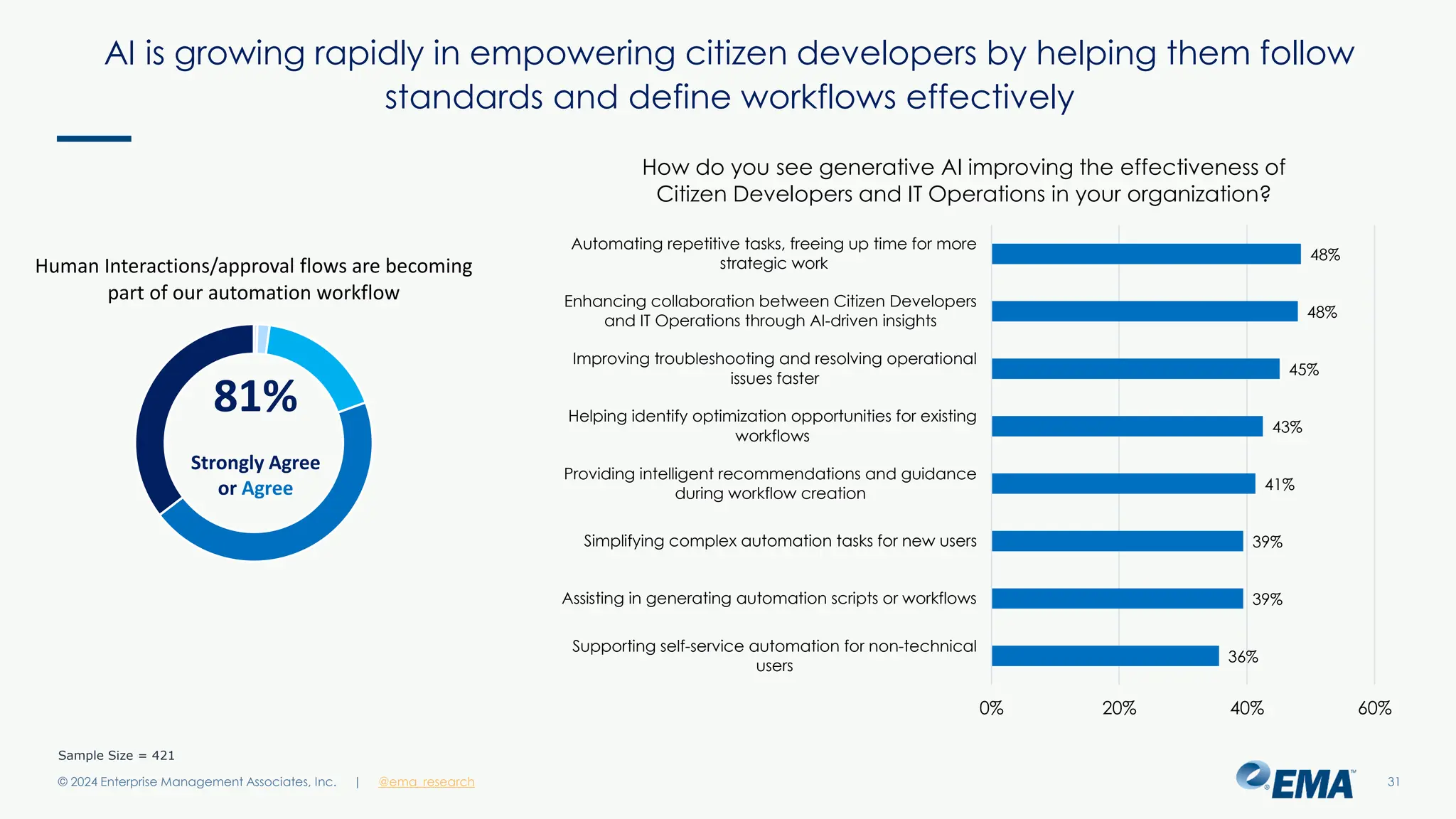
AI is growing rapidly in empowering citizen developers by helping them follow
standards and define workflows effectively
© 2024 Enterprise Management Associates, Inc. 31
Sample Size = 421
36%
39%
39%
41%
43%
45%
48%
48%
0% 20% 40% 60%
Supporting self-service automation for non-technical
users
Assisting in generating automation scripts or workflows
Simplifying complex automation tasks for new users
Providing intelligent recommendations and guidance
during workflow creation
Helping identify optimization opportunities for existing
workflows
Improving troubleshooting and resolving operational
issues faster
Enhancing collaboration between Citizen Developers
and IT Operations through AI-driven insights
Automating repetitive tasks, freeing up time for more
strategic work
How do you see generative AI improving the effectiveness of
Citizen Developers and IT Operations in your organization?
Human Interactions/approval flows are becoming
part of our automation workflow
81%
Strongly Agree
or Agree
@ema_research
| @ema_research
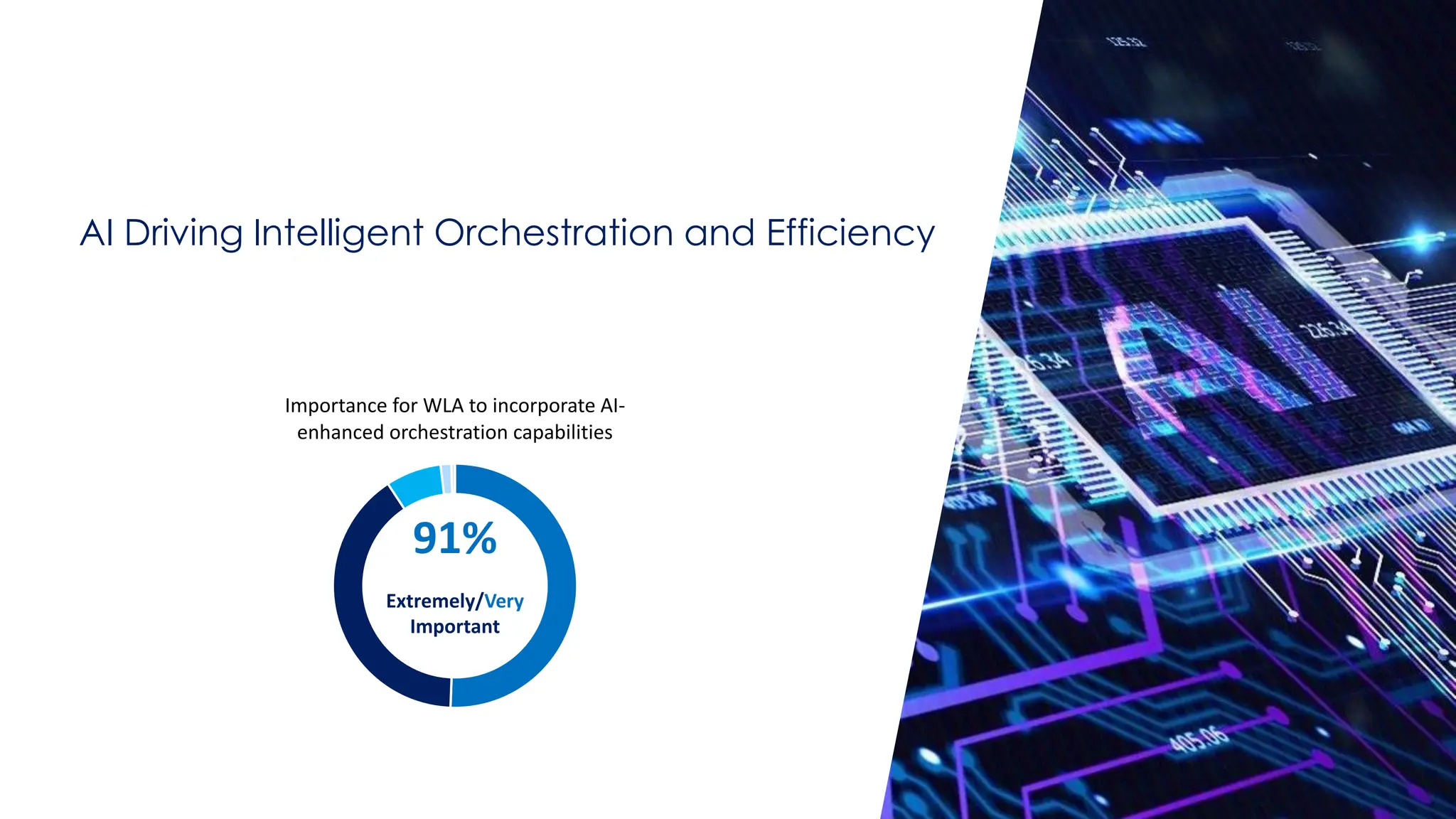
AI Driving Intelligent Orchestration and Efficiency
Importance for WLA to incorporate AI-
enhanced orchestration capabilities
91%
Extremely/Very
Important
@ema_research
| @ema_research
@ema_research
| @ema_research
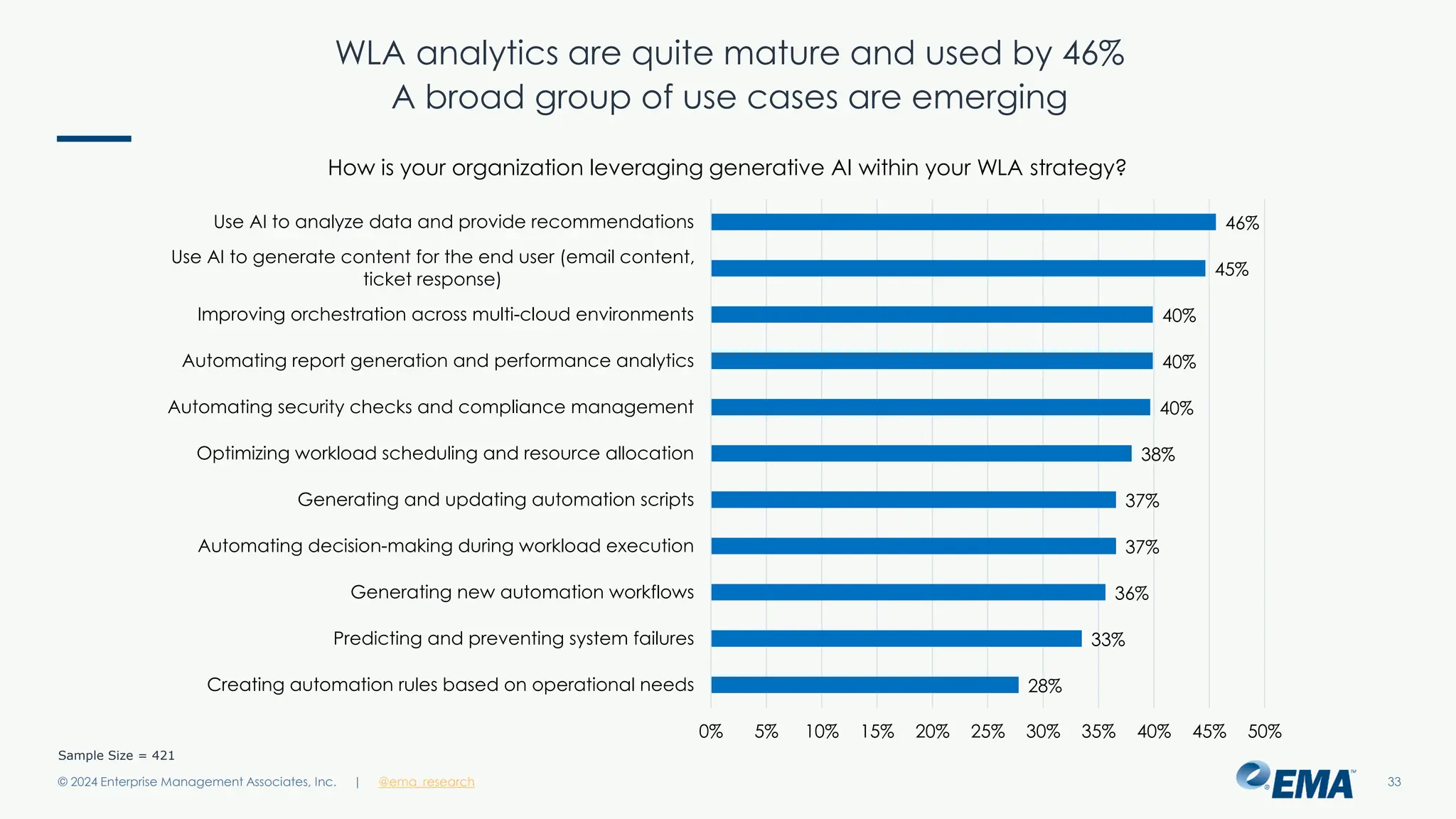
WLA analytics are quite mature and used by 46%
A broad group of use cases are emerging
© 2024 Enterprise Management Associates, Inc. 33
Sample Size = 421
28%
33%
36%
37%
37%
38%
40%
40%
40%
45%
46%
0% 5% 10% 15% 20% 25% 30% 35% 40% 45% 50%
Creating automation rules based on operational needs
Predicting and preventing system failures
Generating new automation workflows
Automating decision-making during workload execution
Generating and updating automation scripts
Optimizing workload scheduling and resource allocation
Automating security checks and compliance management
Automating report generation and performance analytics
Improving orchestration across multi-cloud environments
Use AI to generate content for the end user (email content,
ticket response)
Use AI to analyze data and provide recommendations
How is your organization leveraging generative AI within your WLA strategy?
@ema_research
| @ema_research
@ema_research
| @ema_research
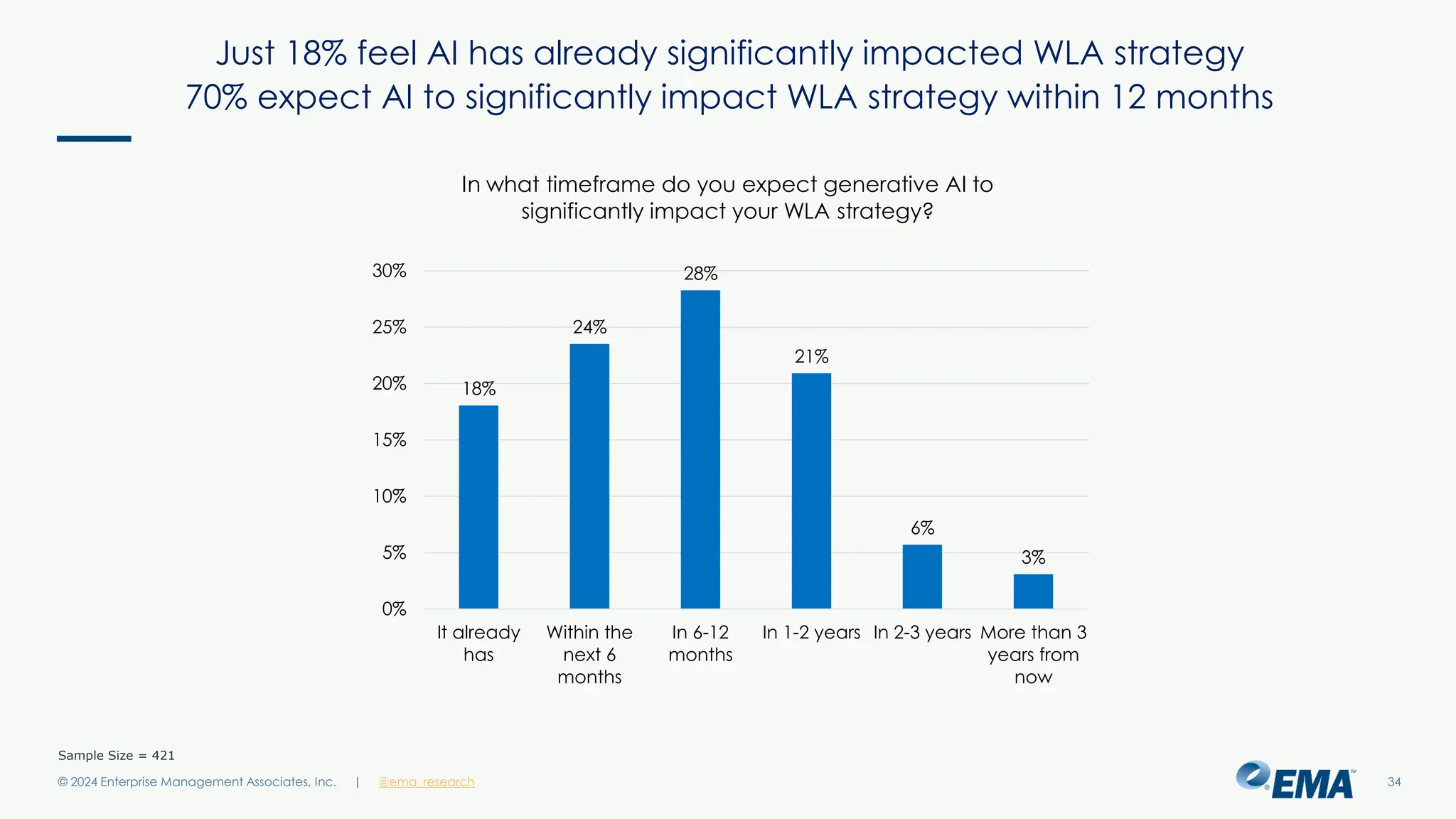
Just 18% feel AI has already significantly impacted WLA strategy
70% expect AI to significantly impact WLA strategy within 12 months
© 2024 Enterprise Management Associates, Inc. 34
Sample Size = 421
18%
24%
28%
21%
6%
3%
0%
5%
10%
15%
20%
25%
30%
It already
has
Within the
next 6
months
In 6-12
months
In 1-2 years In 2-3 years More than 3
years from
now
In what timeframe do you expect generative AI to
significantly impact your WLA strategy?
@ema_research
| @ema_research
@ema_research
| @ema_research
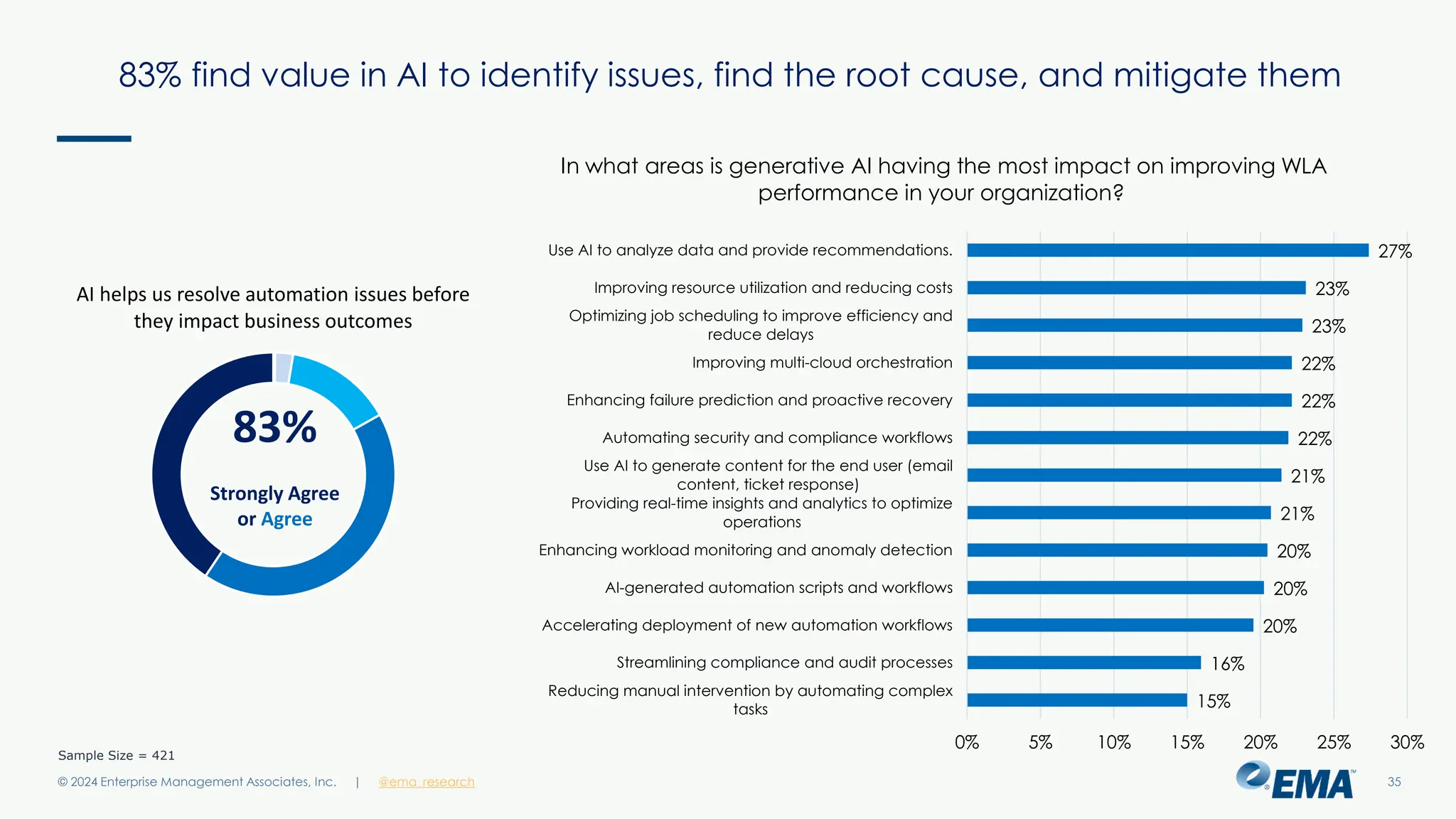
83% find value in AI to identify issues, find the root cause, and mitigate them
© 2024 Enterprise Management Associates, Inc. 35
Sample Size = 421
15%
16%
20%
20%
20%
21%
21%
22%
22%
22%
23%
23%
27%
0% 5% 10% 15% 20% 25% 30%
Reducing manual intervention by automating complex
tasks
Streamlining compliance and audit processes
Accelerating deployment of new automation workflows
AI-generated automation scripts and workflows
Enhancing workload monitoring and anomaly detection
Providing real-time insights and analytics to optimize
operations
Use AI to generate content for the end user (email
content, ticket response)
Automating security and compliance workflows
Enhancing failure prediction and proactive recovery
Improving multi-cloud orchestration
Optimizing job scheduling to improve efficiency and
reduce delays
Improving resource utilization and reducing costs
Use AI to analyze data and provide recommendations.
In what areas is generative AI having the most impact on improving WLA
performance in your organization?
AI helps us resolve automation issues before
they impact business outcomes
83%
Strongly Agree
or Agree
@ema_research
| @ema_research
@ema_research
| @ema_research
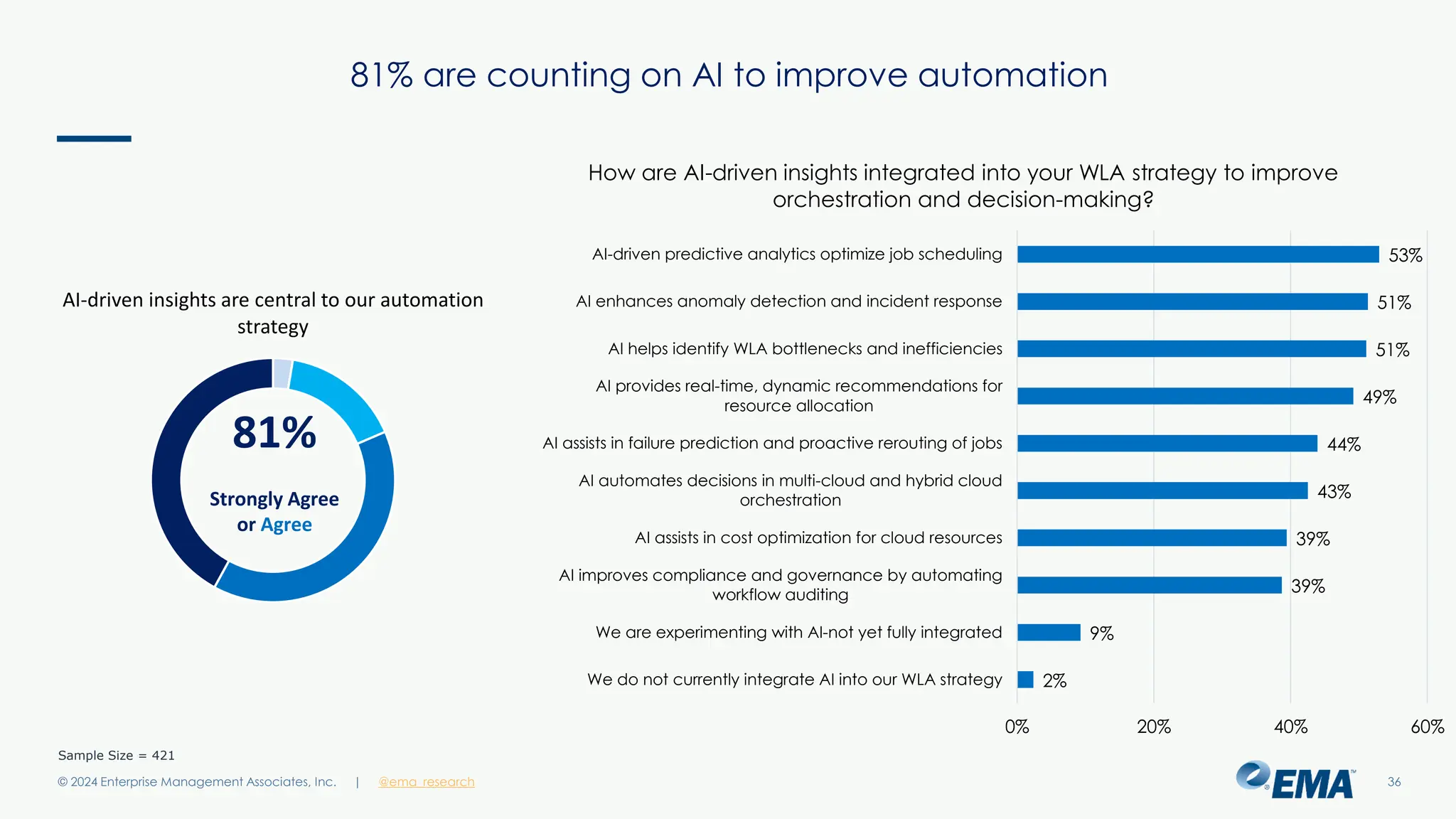
81% are counting on AI to improve automation
© 2024 Enterprise Management Associates, Inc. 36
Sample Size = 421
2%
9%
39%
39%
43%
44%
49%
51%
51%
53%
0% 20% 40% 60%
We do not currently integrate AI into our WLA strategy
We are experimenting with AI-not yet fully integrated
AI improves compliance and governance by automating
workflow auditing
AI assists in cost optimization for cloud resources
AI automates decisions in multi-cloud and hybrid cloud
orchestration
AI assists in failure prediction and proactive rerouting of jobs
AI provides real-time, dynamic recommendations for
resource allocation
AI helps identify WLA bottlenecks and inefficiencies
AI enhances anomaly detection and incident response
AI-driven predictive analytics optimize job scheduling
How are AI-driven insights integrated into your WLA strategy to improve
orchestration and decision-making?
AI-driven insights are central to our automation
strategy
81%
Strongly Agree
or Agree
@ema_research
| @ema_research
@ema_research
| @ema_research
© 2024 Enterprise Management Associates, Inc. 37
https://open.spotify.com/show/4sCXnASOz8Dekr9E7iviSS
@ema_research
| @ema_research
@ema_research
| @ema_research
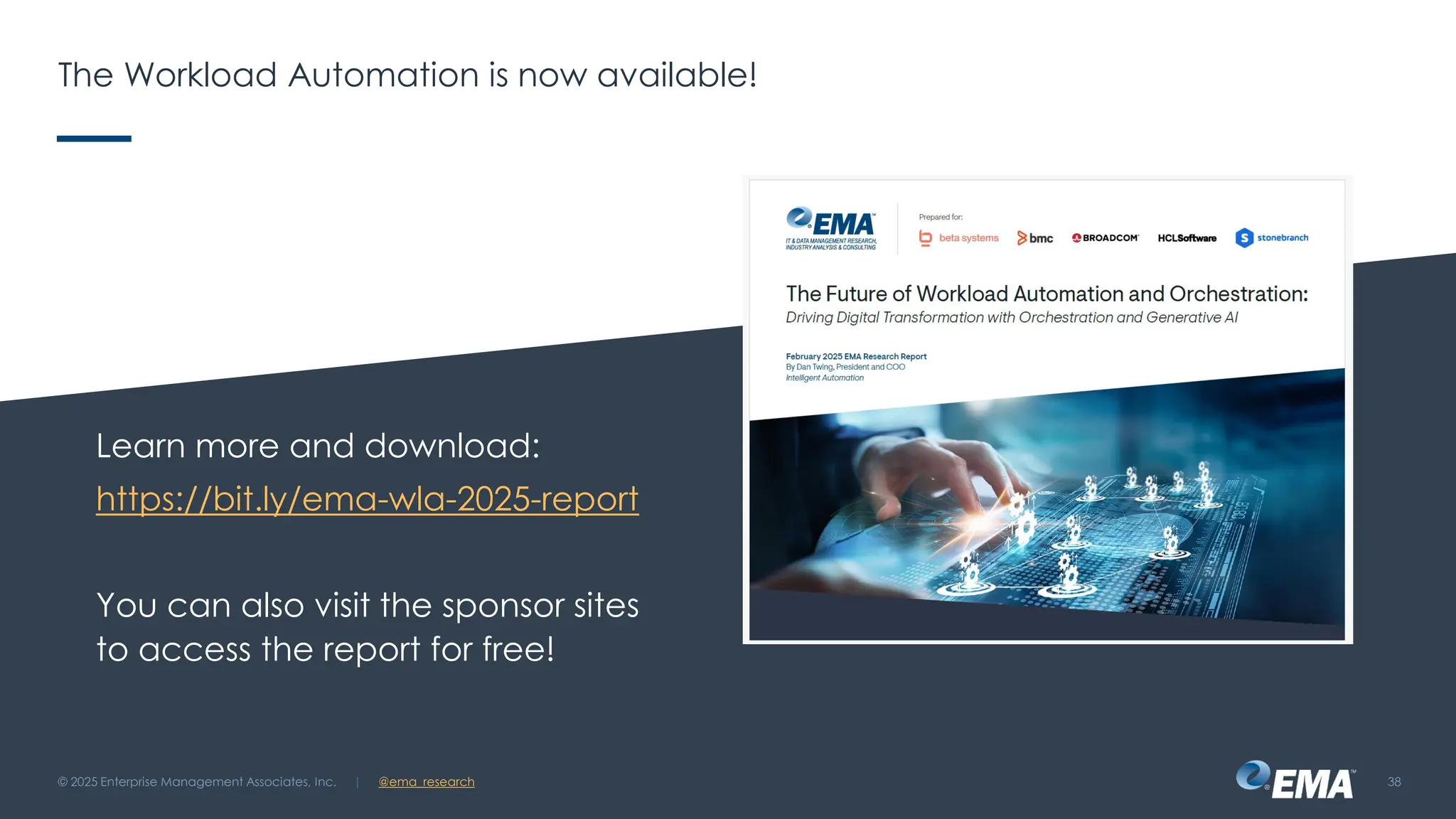
The Workload Automation is now available!
Learn more and download:
https://bit.ly/ema-wla-2025-report
You can also visit the sponsor sites
to access the report for free!
© 2025 Enterprise Management Associates, Inc. 38

The Future of Workload Automation and Orchestration: Driving Digital Transformation with Generative AI

  • 1.
    @ema_research | @ema_research Dan Twing Presidentand COO Principal Analyst, Intelligent Automation EMA The Future of Workload Automation and Orchestration: Driving Digital Transformation with Orchestration and Generative AI March 11, 2025
  • 2.
    @ema_research | @ema_research 2 Watchthe On-Demand Webinar • The Future of Workload Automation and Orchestration: Driving Digital Transformation with Generative AI On-Demand Webinar: https://info.enterprisemanagement.com/workload-automation-and- orchestration-2025-webinar-ss © 2025 Enterprise Management Associates, Inc.
  • 3.
    @ema_research | @ema_research @ema_research | @ema_research WebinarSpeaker Dan joined EMA in 2005 and has over 25 years of experience in information systems, software development, and technology outsourcing. He focuses on all aspects of intelligent and automated management of IT. As President and Chief Operating Officer of EMA, Dan is responsible for developing and executing strategic market research, delivering value to IT organizations through consulting engagements, and directing product developments and marketing efforts. © 2025 Enterprise Management Associates, Inc. 3 Dan Twing President and COO EMA
  • 4.
  • 5.
    @ema_research | @ema_research @ema_research | @ema_research KeyTrends Shaping Workload Automation & Orchestration in 2025 © 2025 Enterprise Management Associates, Inc. 5 ➢ Enterprise-Wide Orchestration is Becoming the Standard ➢ Observability is the Foundation for AI-Driven Orchestration ➢ AI in WLA and Orchestration is Growing Rapidly ➢ Cloud and Multi-Cloud Integration is a Major Focus ➢ Business and Citizen Developers Are Driving New Automation Initiatives
  • 6.
    @ema_research | @ema_research @ema_research | @ema_research Onlinesurvey conducted during January 2023 Respondents include over 25% IT executives, a mix of IT managers of functional areas, and 10% business roles. © 2025 Enterprise Management Associates, Inc. 6 Sample Size = 421 42% 14% 11% 7% 5% 5% 4% 3% 2% 2% 1% 1% 1% 0% 10% 20% 30% 40% 50% IT Executive IT Operations IT Security IT Cloud Platforms IT Service Management (ITSM) Business Executive IT Development Infrastructure Engineer Cloud Architect Business Operations Business Line Leader Data Architect Application Owner (ERP) Which of the following best describes your function in the organization? 53% 17% 16% 11% 2% 0% 10% 20% 30% 40% 50% 60% Manager or Director CxO Vice President Team Leader Individual Contributor Which of the following best describes your role in the organization?
  • 7.
    @ema_research | @ema_research @ema_research | @ema_research Demographics ©2025 Enterprise Management Associates, Inc. 7 Sample Size = 421 31% 13% 11% 10% 9% 9% 9% 9% 0% 5% 10% 15% 20% 25% 30% 35% United States France Germany United Kingdom Malaysia Thailand Vietnam Singapore In which country is your company/organization located? NA 31% Europe 34% Asia 36% Region
  • 8.
    @ema_research | @ema_research @ema_research | @ema_research Demographics ©2025 Enterprise Management Associates, Inc. 8 Sample Size = 421 10% 30% 30% 17% 7% 6% 0% 5% 10% 15% 20% 25% 30% 35% 500-999 1,000-2,499 2,500-4,999 5,000-9,999 10,000-19,999 20,000 or more How many employees are in your company worldwide? 2% 7% 14% 51% 25% 0% 1% 0% 10% 20% 30% 40% 50% 60% $1 Million to under $5 Million $5 Million to under $20 Million $20 Million to under $100 Million $100 Million to under $1 Billion $1 Billion or more Not applicable Don’t know What is your organization's annual sales revenue?
  • 9.
    @ema_research | @ema_research The RisingImportance of Automation Enterprises are reaching for greater efficiency, agility, and innovation. ➢ Increasing complexity of IT and business environments ➢ Demand for operational efficiency ➢ Labor shortages and skill gaps ➢ Growing complexity of compliance and security ➢ Expansion of use cases ➢ Drive for digital transformation Automation has become essential for navigating the challenges and opportunities of modern IT and business environments.
  • 10.
    @ema_research | @ema_research @ema_research | @ema_research ©2024 Enterprise Management Associates, Inc. 10 Automation is Now a Strategic Imperative Across IT and Business Leadership 0% 2% 10% 46% 42% 2% 3% 12% 46% 37% 1% 4% 14% 49% 33% 0.0% 10.0% 20.0% 30.0% 40.0% 50.0% 60.0% Strongly disagree Disagree Neither agree nor disagree Agree Strongly agree Our use of automation is growing rapidly 2020 2022 2024 88% 84% 81% 78% 80% 82% 84% 86% 88% 90% 2024 2022 2020 Our use of automation is growing rapidly (Strongly Agree/Agree) Sample Size: 2024 = 421 2022 = 406 2020 = 412 Surveys included IT managers and directors, IT VPs, and CXOs in US, Europe, and Asia
  • 11.
    @ema_research | @ema_research @ema_research | @ema_research IndividualPerformance Tied to Automation Expansion is on the Rise © 2024 Enterprise Management Associates, Inc. 11 44% 35% 31% 0% 5% 10% 15% 20% 25% 30% 35% 40% 45% 50% 2024 2022 2020 Expanding Use of Automation as a Factor in Measuring IT Executive Performance 2020 - 2024 19% 20% 29% 37% 38% 39% 41% 44% 44% 48% 49% 0% 10% 20% 30% 40% 50% 60% Reduction of tools complexity P&L impact Frequency of releases Capacity management Uptime metrics Budget compliance Success of releases Customer satisfaction Expanding use of automation SLA compliance Successful job completion rate Which of the following outcomes factor into measuring your performance? 2024 Sample Size: 2024 = 421 2022 = 406 2020 = 412 Surveys included IT managers and directors, IT VPs, and CXOs in US, Europe, and Asia
  • 12.
    @ema_research | @ema_research @ema_research | @ema_research StrategicImportance Drives Automation Maturity Not All Organizations Have Stepped Up Their Automation Game © 2024 Enterprise Management Associates, Inc. 12 5% 6% 15% 32% 42% 0% 5% 10% 15% 20% 25% 30% 35% 40% 45% We are “old school” and tend to favor the status quo over automation We are slow to add automation We tend to copy automation best practices developed by others We are somewhat creative in our use of automation We are very creative in our use of automation Which statement best describes your organization’s posture toward automation? 2024 12% 15% 16% 15% 26% 26% 32% 33% 38% 42% 26% 20% 0% 5% 10% 15% 20% 25% 30% 35% 40% 45% 2024 2022 2020 Automation Posture 2020 to 2024 Driver Mover Follower Old School/Slow Sample Size: 2024 = 421 2022 = 406 2020 = 412 Surveys included IT managers and directors, IT VPs, and CXOs in US, Europe, and Asia Automation is no longer just a tool for efficiency, but a strategic enabler of agility, innovation, and resilience.
  • 13.
    @ema_research | @ema_research @ema_research | @ema_research Groupingresponses into 5 stages of Digitalization Digitalization Matures With 6% Increase In Underway And 10% Increase In Mature © 2024 Enterprise Management Associates, Inc. 13 1% 28% 43% 27% 1% 0% 5% 10% 15% 20% 25% 30% 35% 40% 45% 50% None Early Underway Mature Gen 2 Sate of Digital Transformation 2024 3% 40% 37% 17% 4% 1% 28% 43% 27% 1% 0% 5% 10% 15% 20% 25% 30% 35% 40% 45% 50% None Early Underway Mature Gen 2 Sate of Digital Transformation 2022 Vs 2024 2022 2024 Sample Size: 2024 = 421 2022 = 406 Surveys included IT managers and directors, IT VPs, and CXOs in US, Europe, and Asia
  • 14.
    @ema_research | @ema_research @ema_research | @ema_research Automationis a key driver of digital transformation for 37%, and supportive for another 34% of organizations © 2024 Enterprise Management Associates, Inc. 14 Sample Size = 421 37% 34% 21% 6% 2% 0% 5% 10% 15% 20% 25% 30% 35% 40% Automation is a key driver of our digital transformation strategy Automation and digital transformation are integrated, but automation serves as a supporting function Automation and digital transformation are distinct initiatives, but closely aligned Automation is a separate initiative and is not strongly linked to digital transformation Our organization is still defining the relationship between automation and digital transformation How do digital transformation and automation efforts interact in your organization?
  • 15.
    @ema_research | @ema_research @ema_research | @ema_research Thosewith a greater connection between automation efforts and digital transformation are farther along in their digital journey © 2024 Enterprise Management Associates, Inc. 15 0% 10% 20% 30% 40% 50% 60% 70% 80% None Early Underway Mature Gen 2 Automation Efforts vs Stage of Digitalization Our organization is still defining the relationship between automation and digital transformation Automation is a separate initiative and is not strongly linked to digital transformation Automation and digital transformation are distinct initiatives, but closely aligned Automation and digital transformation are integrated, but automation serves as a supporting function Automation is a key driver of our digital transformation strategy Sample Size = 421
  • 16.
    @ema_research | @ema_research @ema_research | @ema_research DigitalTransformation Depends Upon, and is Asking More From WLA © 2024 Enterprise Management Associates, Inc. 16 0% 2% 12% 49% 38% 1% 3% 15% 50% 31% 1% 5% 17% 50% 28% 0% 10% 20% 30% 40% 50% 60% Strongly disagree Disagree Neither agree nor disagree Agree Strongly agree Digital transformation is requiring more from our scheduling/workload automation solution 2020 2022 2024 87% 81% 77% 72% 74% 76% 78% 80% 82% 84% 86% 88% 2024 2022 2020 Digital transformation is requiring more from our scheduling/workload automation solution (Strongly Agree/Agree) Sample Size: 2024 = 421 2022 = 406 Surveys included IT managers and directors, IT VPs, and CXOs in US, Europe, and Asia
  • 17.
    @ema_research | @ema_research @ema_research | @ema_research WLASupports Digitalization Efforts © 2024 Enterprise Management Associates, Inc. 17 Sample Size = 421 48.2% 47.7% 46.1% 43.5% 43.0% 31.1% 29.7% 15.0% 0.0% 10.0% 20.0% 30.0% 40.0% 50.0% 60.0% WLA plays a critical role in cloud infrastructure configuration and management WLA supports DevOps processes, accelerating development and deployment cycles WLA is used to configure and manage on-premises infrastructure WLA automates release management, ensuring smoother software releases We leverage WLA extensively for file transfer automation WLA orchestrates and connects various digital transformation initiatives across the organization WLA is used primarily for traditional time- and event-triggered scheduling WLA provides end-to-end orchestration for multiple digital transformation processes Which statement best describes the role of WLA solutions in your digital transformation journey?
  • 18.
    @ema_research | @ema_research Challenges Shapingthe Future of WLA in Digital Transformation Security and Compliance Concerns ➢ Ensuring compliance with complex and evolving regulations ➢ Addressing growing security risks in interconnected environments Skill and Resource Shortages ➢ Lack of skilled personnel to manage workload automation ➢ Insufficient resources for support and maintenance Complexity of Implementation ➢ Challenges with migration and integrating existing systems ➢ Managing WLA across multi-cloud and hybrid environments Tool Ecosystem and Cost Challenges ➢ High costs associated with implementation and scaling ➢ Too many tools leading to confusion and inconsistent practices Support for Modernization ➢ Limited support for cloud-native or modern applications ➢ Difficulty demonstrating ROI to justify modernization efforts Cultural and Organizational Barriers ➢ Resistance to change from employees or teams ➢ Lack of executive support for WLA initiatives
  • 19.
    @ema_research | @ema_research Orchestration: The Backboneof Modern Automation Orchestration: ➢ Coordinating, managing, and aligning multiple automated workflows and systems to ensure they function cohesively. ➢ Focuses on connecting processes across diverse environments (cloud, on-premises distributed, hybrid and mainframe). Why It’s Critical: ➢ Increases visibility and control over complex, interdependent workflows. ➢ Reduces the inefficiencies caused by siloed automation efforts. ➢ Supports scalability as automation use cases grow in complexity and volume. Orchestration connects IT and business workflows, integrating human tasks with automated ones, ensuring holistic process management.
  • 20.
    @ema_research | @ema_research @ema_research | @ema_research WLAas Orchestrator of Automation Can Simplify Managing Multiple Automation Tool Sets © 2024 Enterprise Management Associates, Inc. 20 84% 80% 75% 70% 72% 74% 76% 78% 80% 82% 84% 86% 2024 2022 2020 Our organization could be made more efficient by the consolidation of scheduling and automation tools (Strongly Agree/Agree) 0% 1% 14% 38% 46% 3% 3% 14% 47% 33% 1% 5% 18% 52% 23% 0% 10% 20% 30% 40% 50% 60% Strongly disagree Disagree Neither agree nor disagree Agree Strongly agree Our organization could be made more efficient by the consolidation of scheduling and automation tools 2020 2022 2024 Sample Size: 2024 = 421 2022 = 406 Surveys included IT managers and directors, IT VPs, and CXOs in US, Europe, and Asia
  • 21.
    @ema_research | @ema_research @ema_research | @ema_research While86% believe orchestration is critical to achieving digital transformation goals, AI for Operations, scalability/flexibility, and AI for Citizen Developers are top challenges © 2024 Enterprise Management Associates, Inc. 21 Sample Size = 421 1% 27% 30% 32% 32% 34% 36% 36% 43% 51% 0% 10% 20% 30% 40% 50% 60% Other Robotic Process Automation (RPA) Intelligent Document Processing (IDP) Data Pipeline Orchestration (observability, file transfer, data quality checks) Integration with third-party tools and platforms Enhanced security and compliance features Cloud-native support AI capabilities for Citizen Developers Improved scalability and flexibility AI capabilities for IT Operations What is missing or needs significant enhancement in your current WLA solution for broader orchestration use cases in your Digital Transformation initiatives? Orchestration is critical to achieving our digital transformation goals 86% Strongly Agree or Agree
  • 22.
    @ema_research | @ema_research @ema_research | @ema_research 80%are shifting WLA to enterprise-wide orchestration © 2024 Enterprise Management Associates, Inc. 22 Sample Size = 421 26% 33% 33% 37% 38% 39% 39% 40% 43% 43% 0% 5% 10% 15% 20% 25% 30% 35% 40% 45% 50% WLA is largely still focused on batch job scheduling We are expanding WLA to more departments beyond IT operations WLA orchestrates serverless and containerized applications WLA integrates with DataOps platforms for data pipeline orchestration WLA supports DevOps pipelines and continuous delivery WLA integrates with AI/ML-driven workflows WLA orchestrates workflows across multiple business units WLA automates security workflows and compliance checks WLA provides enterprise-wide visibility and control over automation WLA manages event-driven and real-time workloads How is your organization’s WLA transforming from traditional job scheduling to enterprise-wide orchestration? We are shifting from workload automation to enterprise-wide orchestration 80% Strongly Agree or Agree
  • 23.
    @ema_research | @ema_research @ema_research | @ema_research ©2024 Enterprise Management Associates, Inc. 23 84% are expanding orchestration to manage workflows across environments Observability, AI enabled workflows, and Cross-Platform Coordination are leading efforts 42% 44% 44% 46% 47% 48% 50% 51% 59% 0% 20% 40% 60% 80% Resource Provisioning Event-Driven Automation Compliance and Governance Integration with CI/CD Pipelines Self-Service Automation Job Scheduling Cross-Platform Coordination Leveraging generative AI for workflows Monitoring and Observability How does your organization use WLA to orchestrate automation tools across your IT infrastructure? Sample Size = 421 We are expanding orchestration to manage complex workflows across environments 84% Strongly Agree or Agree
  • 24.
  • 25.
    @ema_research | @ema_research @ema_research | @ema_research 86%are looking to improve multi-cloud observability and add AI-based decisioning 42% are using WLA to improve, while the majority are using cloud-native tools © 2024 Enterprise Management Associates, Inc. 25 1% 29% 31% 38% 42% 44% 48% 49% 0% 10% 20% 30% 40% 50% 60% We do not currently orchestrate across multiple cloud environments Outsourcing orchestration to a managed service provider (MSP) Utilizing Kubernetes or other container orchestration platforms (OpenShift, Docker Swarm) Implementing custom orchestration scripts or proprietary tools to manage workloads across multiple clouds Using a centralized workload automation platform to orchestrate workflows across multiple cloud providers Adopting a multi-cloud management platform (Morpheus, VMware) to handle orchestration and workload distribution Using AI-driven orchestration solutions to optimize workload orchestration across multiple clouds Leveraging cloud native orchestration tools cloud vendors provide (AWS Step Functions, Azure Logic Apps) How does your organization manage orchestration across multi- cloud environments for production workloads? Multi-cloud automation requires better observability and AI-based decisions 86% Strongly Agree or Agree Sample Size = 421
  • 26.
    @ema_research | @ema_research @ema_research | @ema_research 87%know observability is key to optimizing workflows Centralized dashboards, real-time alerting, and Integration with observability platforms lead in integrating observability with WLA © 2024 Enterprise Management Associates, Inc. 26 Sample Size = 421 17% 45% 60% 64% 65% 0% 10% 20% 30% 40% 50% 60% 70% Observability is not yet integrated into our WLA strategy Telemetry analysis to detect potential SLA violations Integration with observability platforms Real-time alerting based on workload behavior Centralized dashboard monitoring workload performance How is observability integrated into your workload automation and orchestration strategy? Observability is key to optimizing our automated workflows 87% Strongly Agree or Agree
  • 27.
    @ema_research | @ema_research WLA Users ➢Increasing Number of Users ➢ Broader Functional Roles ➢ Increasing Developer Involvement ➢ Emergence of Citizen Developers
  • 28.
    @ema_research | @ema_research @ema_research | @ema_research ModernWLA has users from across the IT organization, and many include business executives and other business users as well © 2024 Enterprise Management Associates, Inc. 28 Sample Size = 421 1% 10% 10% 11% 11% 13% 13% 14% 19% 19% 21% 22% 30% 38% 43% 47% 52% 57% 61% 0% 10% 20% 30% 40% 50% 60% 70% I don’t know Storage Business User Change Management Citizen Developers Test Business Manager Service Desk Networking Data Scientists Business Executive Development Security IT CXO IT VP IT Service Management IT Operations IT Manager IT Director What are the types of users who have logins to the WLA software (including the central team, if you have one)?
  • 29.
    @ema_research | @ema_research @ema_research | @ema_research ADeveloper Positive culture towards WLA is growing as more DevOPs, Release Management, and Eventually Digital Transformation Efforts Lean Into WLA © 2024 Enterprise Management Associates, Inc. 29 Sample Size = 421 17% 31% 28% 12% 13% 12% 29% 26% 16% 17% 0% 5% 10% 15% 20% 25% 30% 35% WLA is the domain of operations WLA is mostly the domain of operations WLA is a necessary tool for operations and developers WLA has the potential to drive more automation use cases for developers while maintaining an end-to-end view for operations WLA makes operations and developers more productive and effective How do you think developers in your organization feel about WLA and orchestration software? 2022 2024 41% 48% 26% 28% 33% 25% 0% 10% 20% 30% 40% 50% 60% 2024 2022 Developers and WLA Ops/Dev Neutral Dev Positive Mostly Ops
  • 30.
    @ema_research | @ema_research @ema_research | @ema_research 28%of organizations have Citizen Developers making significant contributions This is a relatively new use case and majority of organizations are still experimenting © 2024 Enterprise Management Associates, Inc. 30 Sample Size = 421 16% 36% 20% 20% 9% 0% 5% 10% 15% 20% 25% 30% 35% 40% Citizen Developers are not allowed to contribute to automation use cases Citizen Developers are allowed to experiment but have limited involvement Citizen Developers are moderately contributing to new automation use cases Citizen Developers are significantly contributing to new automation use cases Citizen Developers are heavily contributing to new automation use cases What is the role of Citizen Developers in contributing to building automation use cases in your organization? None/Experiment 52% Moderately Contribute 20% Significant Contributions 28% Citizen Developers' Role In Building Automation
  • 31.
    @ema_research | @ema_research @ema_research | @ema_research AIis growing rapidly in empowering citizen developers by helping them follow standards and define workflows effectively © 2024 Enterprise Management Associates, Inc. 31 Sample Size = 421 36% 39% 39% 41% 43% 45% 48% 48% 0% 20% 40% 60% Supporting self-service automation for non-technical users Assisting in generating automation scripts or workflows Simplifying complex automation tasks for new users Providing intelligent recommendations and guidance during workflow creation Helping identify optimization opportunities for existing workflows Improving troubleshooting and resolving operational issues faster Enhancing collaboration between Citizen Developers and IT Operations through AI-driven insights Automating repetitive tasks, freeing up time for more strategic work How do you see generative AI improving the effectiveness of Citizen Developers and IT Operations in your organization? Human Interactions/approval flows are becoming part of our automation workflow 81% Strongly Agree or Agree
  • 32.
    @ema_research | @ema_research AI DrivingIntelligent Orchestration and Efficiency Importance for WLA to incorporate AI- enhanced orchestration capabilities 91% Extremely/Very Important
  • 33.
    @ema_research | @ema_research @ema_research | @ema_research WLAanalytics are quite mature and used by 46% A broad group of use cases are emerging © 2024 Enterprise Management Associates, Inc. 33 Sample Size = 421 28% 33% 36% 37% 37% 38% 40% 40% 40% 45% 46% 0% 5% 10% 15% 20% 25% 30% 35% 40% 45% 50% Creating automation rules based on operational needs Predicting and preventing system failures Generating new automation workflows Automating decision-making during workload execution Generating and updating automation scripts Optimizing workload scheduling and resource allocation Automating security checks and compliance management Automating report generation and performance analytics Improving orchestration across multi-cloud environments Use AI to generate content for the end user (email content, ticket response) Use AI to analyze data and provide recommendations How is your organization leveraging generative AI within your WLA strategy?
  • 34.
    @ema_research | @ema_research @ema_research | @ema_research Just18% feel AI has already significantly impacted WLA strategy 70% expect AI to significantly impact WLA strategy within 12 months © 2024 Enterprise Management Associates, Inc. 34 Sample Size = 421 18% 24% 28% 21% 6% 3% 0% 5% 10% 15% 20% 25% 30% It already has Within the next 6 months In 6-12 months In 1-2 years In 2-3 years More than 3 years from now In what timeframe do you expect generative AI to significantly impact your WLA strategy?
  • 35.
    @ema_research | @ema_research @ema_research | @ema_research 83%find value in AI to identify issues, find the root cause, and mitigate them © 2024 Enterprise Management Associates, Inc. 35 Sample Size = 421 15% 16% 20% 20% 20% 21% 21% 22% 22% 22% 23% 23% 27% 0% 5% 10% 15% 20% 25% 30% Reducing manual intervention by automating complex tasks Streamlining compliance and audit processes Accelerating deployment of new automation workflows AI-generated automation scripts and workflows Enhancing workload monitoring and anomaly detection Providing real-time insights and analytics to optimize operations Use AI to generate content for the end user (email content, ticket response) Automating security and compliance workflows Enhancing failure prediction and proactive recovery Improving multi-cloud orchestration Optimizing job scheduling to improve efficiency and reduce delays Improving resource utilization and reducing costs Use AI to analyze data and provide recommendations. In what areas is generative AI having the most impact on improving WLA performance in your organization? AI helps us resolve automation issues before they impact business outcomes 83% Strongly Agree or Agree
  • 36.
    @ema_research | @ema_research @ema_research | @ema_research 81%are counting on AI to improve automation © 2024 Enterprise Management Associates, Inc. 36 Sample Size = 421 2% 9% 39% 39% 43% 44% 49% 51% 51% 53% 0% 20% 40% 60% We do not currently integrate AI into our WLA strategy We are experimenting with AI-not yet fully integrated AI improves compliance and governance by automating workflow auditing AI assists in cost optimization for cloud resources AI automates decisions in multi-cloud and hybrid cloud orchestration AI assists in failure prediction and proactive rerouting of jobs AI provides real-time, dynamic recommendations for resource allocation AI helps identify WLA bottlenecks and inefficiencies AI enhances anomaly detection and incident response AI-driven predictive analytics optimize job scheduling How are AI-driven insights integrated into your WLA strategy to improve orchestration and decision-making? AI-driven insights are central to our automation strategy 81% Strongly Agree or Agree
  • 37.
    @ema_research | @ema_research @ema_research | @ema_research ©2024 Enterprise Management Associates, Inc. 37 https://open.spotify.com/show/4sCXnASOz8Dekr9E7iviSS
  • 38.
    @ema_research | @ema_research @ema_research | @ema_research TheWorkload Automation is now available! Learn more and download: https://bit.ly/ema-wla-2025-report You can also visit the sponsor sites to access the report for free! © 2025 Enterprise Management Associates, Inc. 38