By: Matthew Fagerson & Jacob Wilson
Period 3
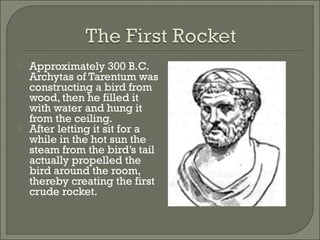
 Approximately 300 B.C.
Archytas of Tarentum was
constructing a bird from
wood, then he filled it
with water and hung it
from the ceiling.
 After letting it sit for a
while in the hot sun the
steam from the bird’s tail
actually propelled the
bird around the room,
thereby creating the first
crude rocket.
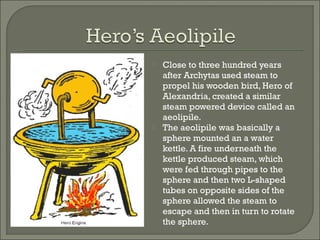
 Close to three hundred years
after Archytas used steam to
propel his wooden bird, Hero of
Alexandria, created a similar
steam powered device called an
aeolipile.
 The aeolipile was basically a
sphere mounted an a water
kettle. A fire underneath the
kettle produced steam, which
were fed through pipes to the
sphere and then two L-shaped
tubes on opposite sides of the
sphere allowed the steam to
escape and then in turn to rotate
the sphere.
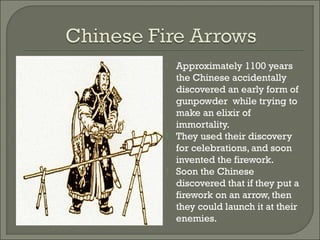
 Approximately 1100 years
the Chinese accidentally
discovered an early form of
gunpowder while trying to
make an elixir of
immortality.
 They used their discovery
for celebrations, and soon
invented the firework.
 Soon the Chinese
discovered that if they put a
firework on an arrow, then
they could launch it at their
enemies.
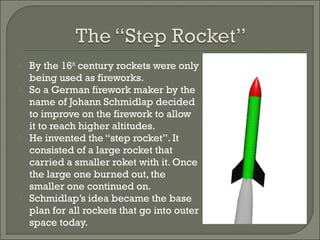
 By the 16th
century rockets were only
being used as fireworks.
 So a German firework maker by the
name of Johann Schmidlap decided
to improve on the firework to allow
it to reach higher altitudes.
 He invented the “step rocket”. It
consisted of a large rocket that
carried a smaller roket with it. Once
the large one burned out, the
smaller one continued on.
 Schmidlap’s idea became the base
plan for all rockets that go into outer
space today.
 In the early 20th
century, a man by the name of
Robert H. Goddard started to become
interested in how to achieve higher altitudes
than had ever been done before.
 He started experimenting with different
propellants that would achieve his goal. After
many experiments he became convinced that
the answer to his problem was liquid
propellants, not solid ones.
 But the problem with liquid propellants is it
was a much more difficult task to accomplish.
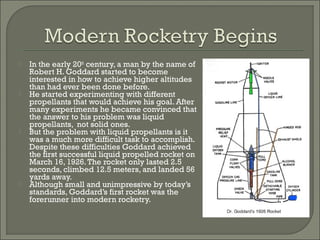
Despite these difficulties Goddard achieved
the first successful liquid propelled rocket on
March 16, 1926.The rocket only lasted 2.5
seconds, climbed 12.5 meters, and landed 56
yards away.
 Although small and unimpressive by today’s
standards, Goddard’s first rocket was the
forerunner into modern rocketry.
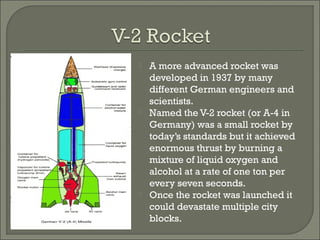
 A more advanced rocket was
developed in 1937 by many
different German engineers and
scientists.
 Named the V-2 rocket (or A-4 in
Germany) was a small rocket by
today’s standards but it achieved
enormous thrust by burning a
mixture of liquid oxygen and
alcohol at a rate of one ton per
every seven seconds.
 Once the rocket was launched it
could devastate multiple city
blocks.
 On October 4, 1957, the
world’s first satellite was
launched into space. Its
name was Sputnik.
 This event was the spark the
world needed to start trying
to become the first to go into
space, land on the moon, etc.
 So people started
developing bigger and
better rockets to accomplish
different goals in space
 http://space.about.com/od/spaceexplor
ationhistory/ss/rockethistory1_3.htm
 http://www.absolutechinatours.com/chin
a-travel/Four-Inventions.html
 http://www.grc.nasa.gov/WWW/k-
12/TRC/Rockets/history_of_rockets.html
 http://history.msfc.nasa.gov/rocketry/tl3.
html

The evolution of the rocket 2 real one

  • 1.
    By: Matthew Fagerson& Jacob Wilson Period 3
  • 2.
     Approximately 300B.C. Archytas of Tarentum was constructing a bird from wood, then he filled it with water and hung it from the ceiling.  After letting it sit for a while in the hot sun the steam from the bird’s tail actually propelled the bird around the room, thereby creating the first crude rocket.
  • 3.
     Close tothree hundred years after Archytas used steam to propel his wooden bird, Hero of Alexandria, created a similar steam powered device called an aeolipile.  The aeolipile was basically a sphere mounted an a water kettle. A fire underneath the kettle produced steam, which were fed through pipes to the sphere and then two L-shaped tubes on opposite sides of the sphere allowed the steam to escape and then in turn to rotate the sphere.
  • 4.
     Approximately 1100years the Chinese accidentally discovered an early form of gunpowder while trying to make an elixir of immortality.  They used their discovery for celebrations, and soon invented the firework.  Soon the Chinese discovered that if they put a firework on an arrow, then they could launch it at their enemies.
  • 5.
     By the16th century rockets were only being used as fireworks.  So a German firework maker by the name of Johann Schmidlap decided to improve on the firework to allow it to reach higher altitudes.  He invented the “step rocket”. It consisted of a large rocket that carried a smaller roket with it. Once the large one burned out, the smaller one continued on.  Schmidlap’s idea became the base plan for all rockets that go into outer space today.
  • 6.
     In theearly 20th century, a man by the name of Robert H. Goddard started to become interested in how to achieve higher altitudes than had ever been done before.  He started experimenting with different propellants that would achieve his goal. After many experiments he became convinced that the answer to his problem was liquid propellants, not solid ones.  But the problem with liquid propellants is it was a much more difficult task to accomplish. Despite these difficulties Goddard achieved the first successful liquid propelled rocket on March 16, 1926.The rocket only lasted 2.5 seconds, climbed 12.5 meters, and landed 56 yards away.  Although small and unimpressive by today’s standards, Goddard’s first rocket was the forerunner into modern rocketry.
  • 7.
     A moreadvanced rocket was developed in 1937 by many different German engineers and scientists.  Named the V-2 rocket (or A-4 in Germany) was a small rocket by today’s standards but it achieved enormous thrust by burning a mixture of liquid oxygen and alcohol at a rate of one ton per every seven seconds.  Once the rocket was launched it could devastate multiple city blocks.
  • 8.
     On October4, 1957, the world’s first satellite was launched into space. Its name was Sputnik.  This event was the spark the world needed to start trying to become the first to go into space, land on the moon, etc.  So people started developing bigger and better rockets to accomplish different goals in space
  • 10.
     http://space.about.com/od/spaceexplor ationhistory/ss/rockethistory1_3.htm  http://www.absolutechinatours.com/chin a-travel/Four-Inventions.html http://www.grc.nasa.gov/WWW/k- 12/TRC/Rockets/history_of_rockets.html  http://history.msfc.nasa.gov/rocketry/tl3. html