Era of Web2.0 —— 陈琰 厦门大学教育研究院 2008.12.12 Distance Education in Web 2.0 in Britain 第三小组组员:许文静,陈琰
2.
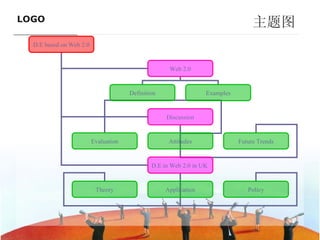
主题图 ———————————— D.Ebased on Web 2.0 Web 2.0 Discussion D.E in Web 2.0 in UK Definition Examples Evaluation Attitudes Future Trends Theory Application Policy
3.
目录 什么是 Web2.0 ? Web 2.0 的特征 Web 2.0 与 Web 1.0 的对比 教育中如何运用 Web 2.0 的? 在 Web 2.0 之后?? ————————————
4.
什么是 Web 2.0? Web2.0 的概念产生于加 04 年 10 月由 O’Reilly 公司和 MediaLive 国际公司之间进行的头脑风暴的会议中。它是相对于 Web 1.0 的新的一代互联网应用的统称。 Web 2.0 是指以 Flickr 、 Craigslist 、 Del.icio.us 、 43Things.com 等网站为代表,以 Blog 、 TAG 、 SNS 、 RSS 、 Wiki 等应用为核心,依据六度分隔、 XML 、 Ajax 等新理论和技术实现的互联网新一代模式。它的核心理念就是用户的可读写,提倡个性化服务,实现人的互联。 ————————————
5.
什么是 Web 2.0? Blog : Weblog 的简称,是个人或群体以时间顺序所作的一种记录,且不断更新。 Blog 之间的交流主要是通过反向引用 (TrackBack) 和留言 / 评论 (Comment) 的方式来进行的。 Blog 的作者 (Blogger) ,既是这个 Blog 的创作人,也是其档案管理人。 ————————————
6.
什么是 Web 2.0? TAG : Tag( 中文叫做“标签” ) 是一种新的组织和管理在线信息的方式。它不同于传统的、针对文件本身的关键字检索,而是一种模糊化、智能化的分类。 ————————————
7.
什么是 Web 2.0? SNS : Social Network Service ,社会性网络软件,依据六度理论,以认识朋友的朋友为基础,扩展自己的人脉。并且无限扩张自己的人脉,在需要的时候,可以随时获取一点,得到该人脉的帮助。 ————————————
8.
什么是 Web 2.0? RSS : Really Simple Syndication 或 Rich Site Summary 或 RDF Site Summary 的简称,是一种用于共享新闻和其他 Web 内容的数据交换规范。读者可以通过 RSS 订阅一个 Blog ,了解该 Blog 最近的更新。 ————————————
9.
什么是 Web 2.0? Wiki : 来源于夏威夷语的 wee kee wee kee ,是一种提供「共同创作 (collaborative) 」环境的网站,也就是说,每个人都可以任意修改网站上的页面资料。 ————————————
10.
Web 2.0 的特征 第一, Web 2.0 以满足单个用户的多种需求为目的,这是比较本质的原则。要把单个用户放在你的服务架构下面,让他们能够在这里充分地表达自己,以此为家。 第二, Web 2.0 是以互动为主要形式的。互动主要指的是传播者和被传播者,主动者和被动者地位之间基本平等,可以交换信息、愿望、物品等。 第三, Web 2.0 是以服务为中心展开的。 ————————————
11.
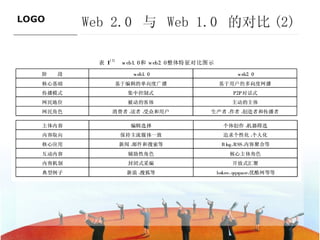
Web 2.0 与 Web 1.0 的对比 (1) “ 互联网上没有人知道你是条狗” —— Web 1.0 时代 “ 互联网上一定要让人知道你是一条怎样的狗” —— Web 2.0 时代 ————————————
教育中如何运用 Web 2.0的? (2) ———————————— Social and Scientific Implications of Science Blogging (Janet Stemwedel) To present first thoughts on the impact of popular and open science on society and on science. A scientist and philosopher from ScienceBlogs.com will present. Her talk focuses on why scientific communication in general is critical to the mission of science, and how blogs and wikis facilitate communication not only in quantity but in greater quality.
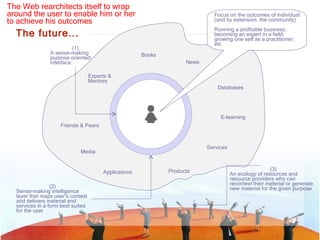
The future... Focuson the outcomes of individual (and by extension, the community) Running a profitable business; becoming an expert in a field; growing one self as a practitioner; etc (1) A sense-making purpose oriented interface (2) Sense-making intelligence layer that maps user’s context and delivers material and services in a form best suited for the user Books Media News Databases E-learning Services Products Applications Friends & Peers Experts & Mentors The Web rearchitects itself to wrap around the user to enable him or her to achieve his outcomes (3) An ecology of resources and resource providers who can recontext their material or generate new material for the given purpose




![Web2[1]](https://cdn.slidesharecdn.com/ss_thumbnails/web21-1200224040762003-3-thumbnail.jpg?width=640&height=640&fit=bounds)


