The Dynamics of Change
Ch,18 & 30 Nowak 2019
CHAPTER OUTLINE
Physical Changes
Body
Craniofacial Changes
Dental Changes
Cognitive Changes
Emotional Changes
Social Changes
The Primary Dentition Years:
Three to Six Years
Physical Changes
Body :
Growth slows during the preschool years
More important than a child’s weight or height during this time is the maintenance of their rate of
growth
Body elongation continues to be apparent during the preschool years
Head growth seems slow, whereas limb growth seems extremely rapid
 Trunk growth can be regarded as intermediate
Both the heart rate and the respiration rate slow down and blood pressure rises
75% of a child’s acquired weight during the fifth year of development is the result of muscle
acquisition
The cartilage in the skeletal system is being increasingly replaced by bone, and all the bones of the
body become more calcified and harder.
Craniofacial Changes
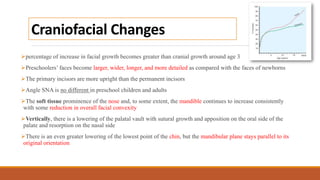
percentage of increase in facial growth becomes greater than cranial growth around age 3
Preschoolers’ faces become larger, wider, longer, and more detailed as compared with the faces of newborns
The primary incisors are more upright than the permanent incisors
Angle SNA is no different in preschool children and adults
The soft tissue prominence of the nose and, to some extent, the mandible continues to increase consistently
with some reduction in overall facial convexity
Vertically, there is a lowering of the palatal vault with sutural growth and apposition on the oral side of the
palate and resorption on the nasal side
There is an even greater lowering of the lowest point of the chin, but the mandibular plane stays parallel to its
original orientation
Craniofacial Changes
Transverse growth → comes to an end earlier than growth in other dimensions
Transverse maxillary growth during this period is largely the result of midpalatal sutural changes
Growth of the body and angles of the mandible are the result of apposition and resorption
Posterior maxillary and mandibular growth (sutural growth in the maxilla and endochondral
growth in the mandible) help to accommodate the emerging permanent first molars
permanent anterior teeth will occupy a more anterior and protrusive position in the face
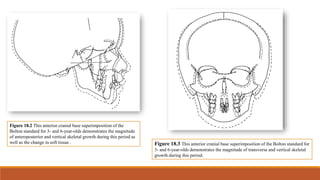
Figure 18.2 This anterior cranial base superimposition of the
Bolton standard for 3- and 6-year-olds demonstrates the magnitude
of anteroposterior and vertical skeletal growth during this period as
well as the change in soft tissue . Figure 18.3 This anterior cranial base superimposition of the Bolton standard for
3- and 6-year-olds demonstrates the magnitude of transverse and vertical skeletal
growth during this period.
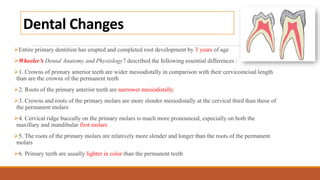
Dental Changes
Entire primary dentition has erupted and completed root development by 3 years of age
Wheeler’s Dental Anatomy and Physiology7 described the following essential differences :
1. Crowns of primary anterior teeth are wider mesiodistally in comparison with their cervicoincisal length
than are the crowns of the permanent teeth
2. Roots of the primary anterior teeth are narrower mesiodistally.
3. Crowns and roots of the primary molars are more slender mesiodistally at the cervical third than those of
the permanent molars
4. Cervical ridge buccally on the primary molars is much more pronounced, especially on both the
maxillary and mandibular first molars
5. The roots of the primary molars are relatively more slender and longer than the roots of the permanent
molars
6. Primary teeth are usually lighter in color than the permanent teeth
Cognitive Changes
Language is developing rapidly , Tell stories
Children in this age group can speak in sentences of at least five words
Preschooler’s power of reasoning is also growing substantially
Piaget’s categorization of cognitive intelligencethe →preoperational
During the preconceptual phase, the child’s mind and mental prowess develop at a rapid rate
 Ability to play and fantasize using mental imagery
Child in the preconceptual stage still generalizes all entities
Preconceptual mind is also centered → focusing all thought and reasoning of any mental problem on only one aspect
of the whole of the structure
Child’s thought during these years is irreversible
 After the preconceptual stage, the child enters a stage called the period of intuitive thought, which lasts until age 7
→ child’s abilities to group objects according to class
Emotional Changes
Diminished fear strangers, separation from their parents
Control of emotions, such as fear and frustration, develops dramatically between the ages of 3
and 6
Child’s concept of self-esteem and sense of gender identity emerge
Development of self-control
Conscience develops
Aggression→instrumental aggression / hostile aggression
During the preschool years, the frequency of instrumental aggression should decline
6 years of age → susceptible to praise and can suffer hurt feelings / capable of feeling
friendship and hostility
Social Changes
learn to take turns and play cooperatively, and they develop friendships
1. Psychoanalytic theory→
Form of an unusual feeling for the parent of the opposite sex (Oedipus or Electra complex )
2. Social learning theories →
Changes during this period as the product of the influences of parenting and parental behavior
 Toxic stress in early childhood can have lasting effects on health and behavior
Boyce described → “dandelion child,” who will remain healthy no matter the environment, and
the “orchid child,” who is highly susceptible to suffering negative health outcomes when he or
she had faced adversity
The Transitional Years:
Six to Twelve Years
Physical Changes
Body :
This is a time of substantial continuous growth
During the period between the ages of 6 and 10 years, boys as a group are generally slightly taller than girls until
around age 10 years
From age 10 years to around age 15 years, girls are slightly taller than boys
From a weight standpoint, boys are slightly heavier than girls until around age 11 years, when girls overtake boys
in weight for a brief time
The real difference between boys and girls in terms of sexual and physical maturation is actually about 1 year
increases in blood pressure, continuing decreases in the pulse rate
increased mineralization of the skeleton
increases in muscular tissue.
lymphatic tissues reach a peak of development during these years, to the point where they exceed the amounts
found in adults
Craniofacial Changes
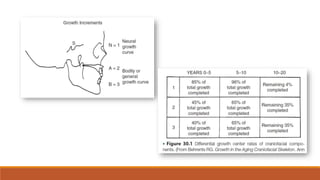
The period from ages 6 through 12 years represents a continuous progression of the growth in the head and
neck
Neural and cranial growth are found to be almost entirely complete
Jaws grow at a faster rate than the cranium
Nasal cartilage and mandibular condyle continue to grow by endochondral bone formation for some time
Female mandibular growth spurt is most likely completed,whereas the mandibular growth spurt in males is
yet to come
Vertically, there is a continued lowering of the palatal vault with sutural growth and apposition on the oral
side of the palate and resorption on the nasal side as the intramembranous process of bone formation
continues
Vertical facial growth is also complemented by dentoalveolar growth as the permanent teeth erupt and the
alveolar ridges develop
Craniofacial Changes
Transverse appositional widening of the alveolar ridge occurs with eruption of the permanent
teeth
 Widening of the anterior arch accompanies lateral incisor eruption and is followed by width
increases in the canines and premolars
Anteroposterior growth modification for class III problems should be attempted during this time
For class II problems, growth modification can be attempted now or during early adolescence
with equivalent results
Transverse changes should be completed using lingual arch–type appliances or rapid palatal
expansion
Vertical growth will continue in the face through late adolescence
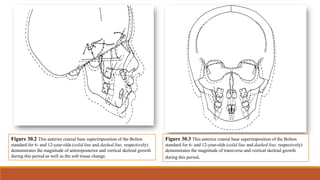
Figure 30.3 This anterior cranial base superimposition of the Bolton
standard for 6- and 12-year-olds (solid line and dashed line, respectively)
demonstrates the magnitude of transverse and vertical skeletal growth
during this period.
Figure 30.2 This anterior cranial base superimposition of the Bolton
standard for 6- and 12-year-olds (solid line and dashed line, respectively)
demonstrates the magnitude of anteroposterior and vertical skeletal growth
during this period as well as the soft tissue change.
Dental Changes
Early during this period most children experience the eruption of all four first permanent molars and the
exfoliation of the mandibular and maxillary primary central and lateral incisors
 The permanent incisors erupt between the ages of 6 and 7 years
It is not unusual for the maxillary permanent lateral incisors to erupt later than age 7 years in some
children
Except for third molars, all of the permanent teeth usually have erupted by the end of the 12th year
Permanent tooth enamel formation is complete by age 8 years(Except for third molars)
In the mandibular arch (except for the first permanent molar), molars erupt in immediate succession, that
is, 1→ 2, 3, 4 and 5, and 7 from 6 to 7 years through 11 to 13 years of age
For the maxillary canine, which usually erupts after one or both premolars and at about the same time as
or before the eruption of the second permanent molars
Dental Changes
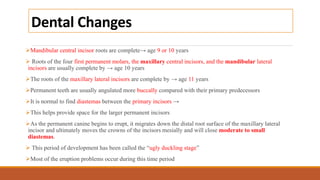
Mandibular central incisor roots are complete→ age 9 or 10 years
 Roots of the four first permanent molars, the maxillary central incisors, and the mandibular lateral
incisors are usually complete by → age 10 years
The roots of the maxillary lateral incisors are complete by → age 11 years
Permanent teeth are usually angulated more buccally compared with their primary predecessors
It is normal to find diastemas between the primary incisors →
This helps provide space for the larger permanent incisors
As the permanent canine begins to erupt, it migrates down the distal root surface of the maxillary lateral
incisor and ultimately moves the crowns of the incisors mesially and will close moderate to small
diastemas.
 This period of development has been called the “ugly duckling stage”
Most of the eruption problems occur during this time period
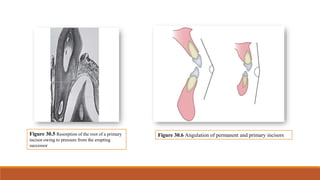
Figure 30.5 Resorption of the root of a primary
incisor owing to pressure from the erupting
successor
Figure 30.6 Angulation of permanent and primary incisors
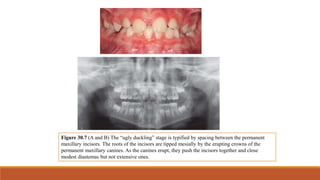
Figure 30.7 (A and B) The “ugly duckling” stage is typified by spacing between the permanent
maxillary incisors. The roots of the incisors are tipped mesially by the erupting crowns of the
permanent maxillary canines. As the canines erupt, they push the incisors together and close
modest diastemas but not extensive ones.
Cognitive Changes
Mental capacity alone grows extensively
Attention span of the child older than 7 years is substantially greater than that of the child
younger than 5 years
According to Piaget, the ages between 6 and 12 years roughly approximate the third major
developmental stage of → concrete operations
Mental representations of actions become a part of the cognitive abilities of the child during
these years
Children acquire the ability to understand the constancies between length, mass, number, and
weight despite external differences
Relativity also emerges in the child’s evaluation system
Emotional Changes
The period from 6 to 12 years is one of advancement toward the acceptance by the child of
societal norms of behavior
Child in the transitional years masters the emotional ability to delay gratification
Ability to use life’s tasks to effectively stave off boredom
Need for adults to direct the child’s attention rapidly recedes, and by age 12 years a child usually
has a ledger of wants and desires
Body image starts to become an emotional feature of the child’s life
It is important for the child to become emotionally resilient
Abilities to handle and recover from humiliation, frustration, loss, and disappointment should at
least begin to emerge during these years
Social Changes
Increasing importance of peers
Most children anticipate school positively and remain enthusiastic about their experiences there
Children’s self-importance, self-control, and ability to be independent increase quickly during
the first few months of school
Self-confidence and motivation tend to decline later in the elementary school years, and this
trend continues through adolescence
The peer group that a child joins also can be a powerful socializing force
This is the advent of increasingly stronger, more stable, and more meaningful friendships
Generally friendships are made with children of the same gender
Social cruelty and bullying also increase

The Dynamics of Change.pptx

  • 1.
    The Dynamics ofChange Ch,18 & 30 Nowak 2019
  • 2.
    CHAPTER OUTLINE Physical Changes Body CraniofacialChanges Dental Changes Cognitive Changes Emotional Changes Social Changes
  • 3.
    The Primary DentitionYears: Three to Six Years
  • 4.
    Physical Changes Body : Growthslows during the preschool years More important than a child’s weight or height during this time is the maintenance of their rate of growth Body elongation continues to be apparent during the preschool years Head growth seems slow, whereas limb growth seems extremely rapid  Trunk growth can be regarded as intermediate Both the heart rate and the respiration rate slow down and blood pressure rises 75% of a child’s acquired weight during the fifth year of development is the result of muscle acquisition The cartilage in the skeletal system is being increasingly replaced by bone, and all the bones of the body become more calcified and harder.
  • 5.
    Craniofacial Changes percentage ofincrease in facial growth becomes greater than cranial growth around age 3 Preschoolers’ faces become larger, wider, longer, and more detailed as compared with the faces of newborns The primary incisors are more upright than the permanent incisors Angle SNA is no different in preschool children and adults The soft tissue prominence of the nose and, to some extent, the mandible continues to increase consistently with some reduction in overall facial convexity Vertically, there is a lowering of the palatal vault with sutural growth and apposition on the oral side of the palate and resorption on the nasal side There is an even greater lowering of the lowest point of the chin, but the mandibular plane stays parallel to its original orientation
  • 6.
    Craniofacial Changes Transverse growth→ comes to an end earlier than growth in other dimensions Transverse maxillary growth during this period is largely the result of midpalatal sutural changes Growth of the body and angles of the mandible are the result of apposition and resorption Posterior maxillary and mandibular growth (sutural growth in the maxilla and endochondral growth in the mandible) help to accommodate the emerging permanent first molars permanent anterior teeth will occupy a more anterior and protrusive position in the face
  • 7.
    Figure 18.2 Thisanterior cranial base superimposition of the Bolton standard for 3- and 6-year-olds demonstrates the magnitude of anteroposterior and vertical skeletal growth during this period as well as the change in soft tissue . Figure 18.3 This anterior cranial base superimposition of the Bolton standard for 3- and 6-year-olds demonstrates the magnitude of transverse and vertical skeletal growth during this period.
  • 8.
    Dental Changes Entire primarydentition has erupted and completed root development by 3 years of age Wheeler’s Dental Anatomy and Physiology7 described the following essential differences : 1. Crowns of primary anterior teeth are wider mesiodistally in comparison with their cervicoincisal length than are the crowns of the permanent teeth 2. Roots of the primary anterior teeth are narrower mesiodistally. 3. Crowns and roots of the primary molars are more slender mesiodistally at the cervical third than those of the permanent molars 4. Cervical ridge buccally on the primary molars is much more pronounced, especially on both the maxillary and mandibular first molars 5. The roots of the primary molars are relatively more slender and longer than the roots of the permanent molars 6. Primary teeth are usually lighter in color than the permanent teeth
  • 9.
    Cognitive Changes Language isdeveloping rapidly , Tell stories Children in this age group can speak in sentences of at least five words Preschooler’s power of reasoning is also growing substantially Piaget’s categorization of cognitive intelligencethe →preoperational During the preconceptual phase, the child’s mind and mental prowess develop at a rapid rate  Ability to play and fantasize using mental imagery Child in the preconceptual stage still generalizes all entities Preconceptual mind is also centered → focusing all thought and reasoning of any mental problem on only one aspect of the whole of the structure Child’s thought during these years is irreversible  After the preconceptual stage, the child enters a stage called the period of intuitive thought, which lasts until age 7 → child’s abilities to group objects according to class
  • 10.
    Emotional Changes Diminished fearstrangers, separation from their parents Control of emotions, such as fear and frustration, develops dramatically between the ages of 3 and 6 Child’s concept of self-esteem and sense of gender identity emerge Development of self-control Conscience develops Aggression→instrumental aggression / hostile aggression During the preschool years, the frequency of instrumental aggression should decline 6 years of age → susceptible to praise and can suffer hurt feelings / capable of feeling friendship and hostility
  • 11.
    Social Changes learn totake turns and play cooperatively, and they develop friendships 1. Psychoanalytic theory→ Form of an unusual feeling for the parent of the opposite sex (Oedipus or Electra complex ) 2. Social learning theories → Changes during this period as the product of the influences of parenting and parental behavior  Toxic stress in early childhood can have lasting effects on health and behavior Boyce described → “dandelion child,” who will remain healthy no matter the environment, and the “orchid child,” who is highly susceptible to suffering negative health outcomes when he or she had faced adversity
  • 12.
  • 13.
    Physical Changes Body : Thisis a time of substantial continuous growth During the period between the ages of 6 and 10 years, boys as a group are generally slightly taller than girls until around age 10 years From age 10 years to around age 15 years, girls are slightly taller than boys From a weight standpoint, boys are slightly heavier than girls until around age 11 years, when girls overtake boys in weight for a brief time The real difference between boys and girls in terms of sexual and physical maturation is actually about 1 year increases in blood pressure, continuing decreases in the pulse rate increased mineralization of the skeleton increases in muscular tissue. lymphatic tissues reach a peak of development during these years, to the point where they exceed the amounts found in adults
  • 14.
    Craniofacial Changes The periodfrom ages 6 through 12 years represents a continuous progression of the growth in the head and neck Neural and cranial growth are found to be almost entirely complete Jaws grow at a faster rate than the cranium Nasal cartilage and mandibular condyle continue to grow by endochondral bone formation for some time Female mandibular growth spurt is most likely completed,whereas the mandibular growth spurt in males is yet to come Vertically, there is a continued lowering of the palatal vault with sutural growth and apposition on the oral side of the palate and resorption on the nasal side as the intramembranous process of bone formation continues Vertical facial growth is also complemented by dentoalveolar growth as the permanent teeth erupt and the alveolar ridges develop
  • 15.
    Craniofacial Changes Transverse appositionalwidening of the alveolar ridge occurs with eruption of the permanent teeth  Widening of the anterior arch accompanies lateral incisor eruption and is followed by width increases in the canines and premolars Anteroposterior growth modification for class III problems should be attempted during this time For class II problems, growth modification can be attempted now or during early adolescence with equivalent results Transverse changes should be completed using lingual arch–type appliances or rapid palatal expansion Vertical growth will continue in the face through late adolescence
  • 17.
    Figure 30.3 Thisanterior cranial base superimposition of the Bolton standard for 6- and 12-year-olds (solid line and dashed line, respectively) demonstrates the magnitude of transverse and vertical skeletal growth during this period. Figure 30.2 This anterior cranial base superimposition of the Bolton standard for 6- and 12-year-olds (solid line and dashed line, respectively) demonstrates the magnitude of anteroposterior and vertical skeletal growth during this period as well as the soft tissue change.
  • 18.
    Dental Changes Early duringthis period most children experience the eruption of all four first permanent molars and the exfoliation of the mandibular and maxillary primary central and lateral incisors  The permanent incisors erupt between the ages of 6 and 7 years It is not unusual for the maxillary permanent lateral incisors to erupt later than age 7 years in some children Except for third molars, all of the permanent teeth usually have erupted by the end of the 12th year Permanent tooth enamel formation is complete by age 8 years(Except for third molars) In the mandibular arch (except for the first permanent molar), molars erupt in immediate succession, that is, 1→ 2, 3, 4 and 5, and 7 from 6 to 7 years through 11 to 13 years of age For the maxillary canine, which usually erupts after one or both premolars and at about the same time as or before the eruption of the second permanent molars
  • 19.
    Dental Changes Mandibular centralincisor roots are complete→ age 9 or 10 years  Roots of the four first permanent molars, the maxillary central incisors, and the mandibular lateral incisors are usually complete by → age 10 years The roots of the maxillary lateral incisors are complete by → age 11 years Permanent teeth are usually angulated more buccally compared with their primary predecessors It is normal to find diastemas between the primary incisors → This helps provide space for the larger permanent incisors As the permanent canine begins to erupt, it migrates down the distal root surface of the maxillary lateral incisor and ultimately moves the crowns of the incisors mesially and will close moderate to small diastemas.  This period of development has been called the “ugly duckling stage” Most of the eruption problems occur during this time period
  • 20.
    Figure 30.5 Resorptionof the root of a primary incisor owing to pressure from the erupting successor Figure 30.6 Angulation of permanent and primary incisors
  • 21.
    Figure 30.7 (Aand B) The “ugly duckling” stage is typified by spacing between the permanent maxillary incisors. The roots of the incisors are tipped mesially by the erupting crowns of the permanent maxillary canines. As the canines erupt, they push the incisors together and close modest diastemas but not extensive ones.
  • 22.
    Cognitive Changes Mental capacityalone grows extensively Attention span of the child older than 7 years is substantially greater than that of the child younger than 5 years According to Piaget, the ages between 6 and 12 years roughly approximate the third major developmental stage of → concrete operations Mental representations of actions become a part of the cognitive abilities of the child during these years Children acquire the ability to understand the constancies between length, mass, number, and weight despite external differences Relativity also emerges in the child’s evaluation system
  • 23.
    Emotional Changes The periodfrom 6 to 12 years is one of advancement toward the acceptance by the child of societal norms of behavior Child in the transitional years masters the emotional ability to delay gratification Ability to use life’s tasks to effectively stave off boredom Need for adults to direct the child’s attention rapidly recedes, and by age 12 years a child usually has a ledger of wants and desires Body image starts to become an emotional feature of the child’s life It is important for the child to become emotionally resilient Abilities to handle and recover from humiliation, frustration, loss, and disappointment should at least begin to emerge during these years
  • 24.
    Social Changes Increasing importanceof peers Most children anticipate school positively and remain enthusiastic about their experiences there Children’s self-importance, self-control, and ability to be independent increase quickly during the first few months of school Self-confidence and motivation tend to decline later in the elementary school years, and this trend continues through adolescence The peer group that a child joins also can be a powerful socializing force This is the advent of increasingly stronger, more stable, and more meaningful friendships Generally friendships are made with children of the same gender Social cruelty and bullying also increase