The dualo principle
by Jules Hotrique
The dualo principle
Foreword............................................................................................................ 3
The dualo principle...........................................................................................4
The chromatic dualo........................................................................................ 5
Notes...................................................................................................................6
Intervals.............................................................................................................. 7
Triads................................................................................................................... 8
Tetrachords........................................................................................................ 9
Scales................................................................................................................. 10
Figuring............................................................................................................. 11
Modes................................................................................................................12
2 Dualo, 2012
Foreword
The following booklet addresses musicians who already have notions of music
harmony.The notation used may be more familiar to jazz musicians than to classical
musicians, but the ideas that will be presented will be of interest to both.
The dualo principle is a concept that allows the musician to display the notes on a
fat surface. It is based on fundamentals of tonal harmony and is inspired from
African thumb piano.
This new notation of music uses traditional staves as a writing support with the
dualo key symbol : . But as opposed to indicating the absolute pitch of the notes,
it shows their relative pitch between one another. Thus, lines and interlines show a
succession of thirds. Many interesting harmonic properties result from this. I have
kept this booklet simple so you can discover this properties by yourself.
I imagined this new disposition of notes in 2007 after theoretical refexions. It is now
the basis of a new instrutment, the du-touch, manufactured and distributed by the
company Dualo. Do not hesitate to contact us at contact@dualo.org if you need
further explanations.
Jules Hotrique,August 2012
3 Dualo, 2012
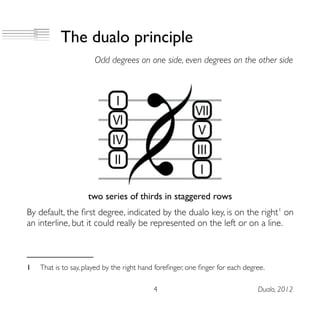
The dualo principle
Odd degrees on one side, even degrees on the other side
two series of thirds in staggered rows
By default, the first degree, indicated by the dualo key, is on the right1
on
an interline, but it could really be represented on the left or on a line.
1 That is to say, played by the right hand forefinger, one finger for each degree.
4 Dualo, 2012
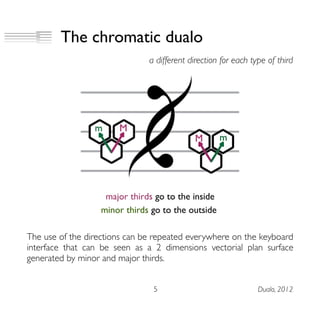
The chromatic dualo
a different direction for each type of third
major thirds go to the inside
minor thirds go to the outside
The use of the directions can be repeated everywhere on the keyboard
interface that can be seen as a 2 dimensions vectorial plan surface
generated by minor and major thirds.
5 Dualo, 2012
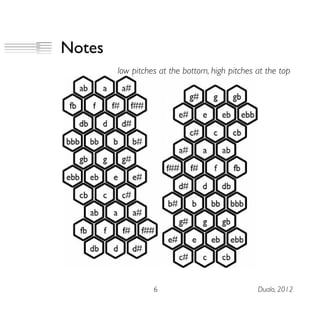
Notes
low pitches at the bottom, high pitches at the top
6 Dualo, 2012
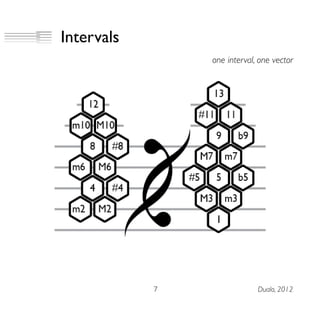
Intervals
one interval, one vector
7 Dualo, 2012
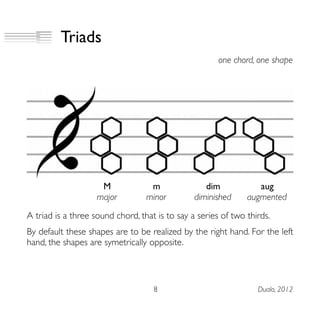
Triads
one chord, one shape
M
major
m
minor
dim
diminished
aug
augmented
A triad is a three sound chord, that is to say a series of two thirds.
By default these shapes are to be realized by the right hand. For the left
hand, the shapes are symetrically opposite.
8 Dualo, 2012
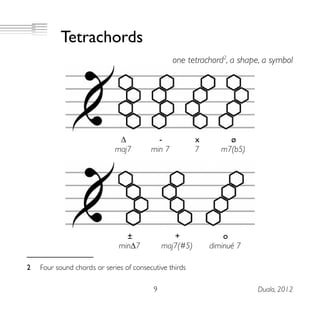
Tetrachords
one tetrachord2
, a shape, a symbol
∆
maj7
-
min 7
x
7
ø
m7(b5)
±
min∆7
+
maj7(#5)
o
diminué 7
2 Four sound chords or series of consecutive thirds
9 Dualo, 2012
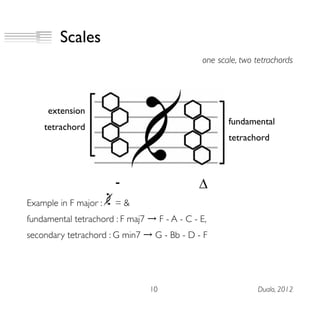
Scales
one scale, two tetrachords
extension
tetrachord
fundamental
tetrachord
Example in F major : = &
fundamental tetrachord : F maj7 → F - A - C - E,
secondary tetrachord : G min7 → G - Bb - D - F
10 Dualo, 2012
- ∆
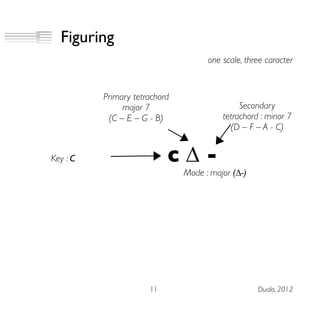
Figuring
one scale, three caracter
11 Dualo, 2012
Key : C
Primary tetrachord
major 7
(C – E – G - B)
c ∆ -
Secondary
tetrachord : minor 7
(D – F – A - C)
Mode : major (∆-)
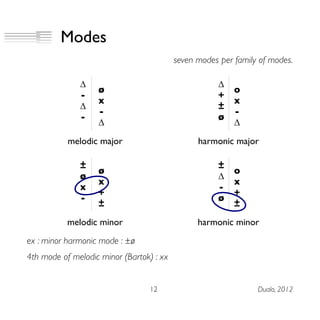
Modes
seven modes per family of modes.
∆
-
∆
-
ø
x
-
∆
∆
+
±
ø
o
x
-
∆
melodic major harmonic major
±
ø
x
-
ø
x
+
±
±
∆
-
ø
o
x
+
±
melodic minor harmonic minor
ex : minor harmonic mode : ±ø
4th mode of melodic minor (Bartok) : xx
12 Dualo, 2012
dualo.org
Dualo SAS – +33 9 50 52 62 32 – contact@dualo.org
Pépinière de la Courneuve – 1, Ccial laTour, 93120 La Courneuve
13 Dualo, 2012

The dualo principle

  • 1.
    The dualo principle byJules Hotrique
  • 2.
    The dualo principle Foreword............................................................................................................3 The dualo principle...........................................................................................4 The chromatic dualo........................................................................................ 5 Notes...................................................................................................................6 Intervals.............................................................................................................. 7 Triads................................................................................................................... 8 Tetrachords........................................................................................................ 9 Scales................................................................................................................. 10 Figuring............................................................................................................. 11 Modes................................................................................................................12 2 Dualo, 2012
  • 3.
    Foreword The following bookletaddresses musicians who already have notions of music harmony.The notation used may be more familiar to jazz musicians than to classical musicians, but the ideas that will be presented will be of interest to both. The dualo principle is a concept that allows the musician to display the notes on a fat surface. It is based on fundamentals of tonal harmony and is inspired from African thumb piano. This new notation of music uses traditional staves as a writing support with the dualo key symbol : . But as opposed to indicating the absolute pitch of the notes, it shows their relative pitch between one another. Thus, lines and interlines show a succession of thirds. Many interesting harmonic properties result from this. I have kept this booklet simple so you can discover this properties by yourself. I imagined this new disposition of notes in 2007 after theoretical refexions. It is now the basis of a new instrutment, the du-touch, manufactured and distributed by the company Dualo. Do not hesitate to contact us at contact@dualo.org if you need further explanations. Jules Hotrique,August 2012 3 Dualo, 2012
  • 4.
    The dualo principle Odddegrees on one side, even degrees on the other side two series of thirds in staggered rows By default, the first degree, indicated by the dualo key, is on the right1 on an interline, but it could really be represented on the left or on a line. 1 That is to say, played by the right hand forefinger, one finger for each degree. 4 Dualo, 2012
  • 5.
    The chromatic dualo adifferent direction for each type of third major thirds go to the inside minor thirds go to the outside The use of the directions can be repeated everywhere on the keyboard interface that can be seen as a 2 dimensions vectorial plan surface generated by minor and major thirds. 5 Dualo, 2012
  • 6.
    Notes low pitches atthe bottom, high pitches at the top 6 Dualo, 2012
  • 7.
    Intervals one interval, onevector 7 Dualo, 2012
  • 8.
    Triads one chord, oneshape M major m minor dim diminished aug augmented A triad is a three sound chord, that is to say a series of two thirds. By default these shapes are to be realized by the right hand. For the left hand, the shapes are symetrically opposite. 8 Dualo, 2012
  • 9.
    Tetrachords one tetrachord2 , ashape, a symbol ∆ maj7 - min 7 x 7 ø m7(b5) ± min∆7 + maj7(#5) o diminué 7 2 Four sound chords or series of consecutive thirds 9 Dualo, 2012
  • 10.
    Scales one scale, twotetrachords extension tetrachord fundamental tetrachord Example in F major : = & fundamental tetrachord : F maj7 → F - A - C - E, secondary tetrachord : G min7 → G - Bb - D - F 10 Dualo, 2012 - ∆
  • 11.
    Figuring one scale, threecaracter 11 Dualo, 2012 Key : C Primary tetrachord major 7 (C – E – G - B) c ∆ - Secondary tetrachord : minor 7 (D – F – A - C) Mode : major (∆-)
  • 12.
    Modes seven modes perfamily of modes. ∆ - ∆ - ø x - ∆ ∆ + ± ø o x - ∆ melodic major harmonic major ± ø x - ø x + ± ± ∆ - ø o x + ± melodic minor harmonic minor ex : minor harmonic mode : ±ø 4th mode of melodic minor (Bartok) : xx 12 Dualo, 2012
  • 13.
    dualo.org Dualo SAS –+33 9 50 52 62 32 – contact@dualo.org Pépinière de la Courneuve – 1, Ccial laTour, 93120 La Courneuve 13 Dualo, 2012