
The cyber terrain Dr Ian Brown Oxford Internet Institute University of Oxford
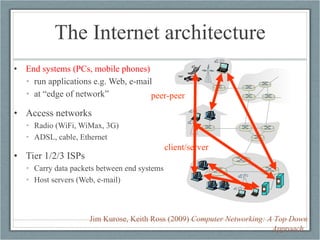
The Internet architecture End systems (PCs, mobile phones) run applications e.g. Web, e-mail at “edge of network” Access networks Radio (WiFi, WiMax, 3G) ADSL, cable, Ethernet Tier 1/2/3 ISPs Carry data packets between end systems Host servers (Web, e-mail) Jim Kurose, Keith Ross (2009)  Computer Networking: A Top Down Approach  client/server peer-peer
Botnets Source: Damballa, Inc.
What is “cyberwar”? “ The ‘Korean’ cyber incidents of early July did not rise to the level of an act of war. They were annoying and for some agencies, embarrassing, but there was no violence or destruction... Cybercrime does not rise to the level of an act of war, even when there is state complicity, nor does espionage – [which] are the activities that currently dominate cyber conflict... Estonia and Georgia  …  came under limited cyber attack as part of larger conflicts with Russia, but in neither case were there casualties, loss of territory, destruction, or serious disruption of critical services. The ‘denial of service’ attacks used against these countries sought to create political pressure and coerce the target governments, but how to respond to such coercion remains an open question, particularly in light of the uncertain attribution and deniability” (Lewis, 2009: 2—3).  “ At best, these operations can confuse and frustrate operators of military systems, and then only temporarily. Thus, cyberwar can only be a support function for other elements of warfare”   (Libicki, 2009: xiv—xv)
Deterrence and preemption “ [W]e need to reengineer the Internet [for] attribution, geolocation, intelligence analysis and impact assessment” –Mike McConnell, 28/2/10 “ [C]aution is necessary when contemplating cyberdeterrence. Attribution, predictable response, the ability to continue attack, and the lack of a counterforce option are all significant barriers… cyberdefense remains the Air Force’s most important activity within cyberspace.” (Libicki, 2009: xix-xx)
Reducing systemic risk Isolate critical systems from public Internet Enhance risk management, robustness and continuity planning in Critical National Infrastructure systems Use Content Distribution Networks and other load balancing systems to increase performance  and  resilience of public-facing systems Better align private and social incentives in securing systems, esp. on software security
References I. Brown and P. Sommer (forthcoming)  Characterising and reducing systemic cybersecurity risks , OECD, Paris House of Lords Science and Technology Committee (2007)  Personal Internet Security , HL Paper 165, London House of Lords European Union Committee (2010)  Protecting Europe against large-scale cyber-attacks , HL Paper 68, London  J. A. Lewis (2009)  The "Korean" Cyber Attacks and Their Implications for Cyber Conflict , Center for Strategic and International Studies, Washington, D.C.  M. C. Libicki (2009)  Cyberdeterrence and Cyberwar , RAND Corporation, Santa Monica.

The cyber terrain

  • 1.
    The cyber terrainDr Ian Brown Oxford Internet Institute University of Oxford
  • 2.
    The Internet architectureEnd systems (PCs, mobile phones) run applications e.g. Web, e-mail at “edge of network” Access networks Radio (WiFi, WiMax, 3G) ADSL, cable, Ethernet Tier 1/2/3 ISPs Carry data packets between end systems Host servers (Web, e-mail) Jim Kurose, Keith Ross (2009) Computer Networking: A Top Down Approach client/server peer-peer
  • 3.
  • 4.
    What is “cyberwar”?“ The ‘Korean’ cyber incidents of early July did not rise to the level of an act of war. They were annoying and for some agencies, embarrassing, but there was no violence or destruction... Cybercrime does not rise to the level of an act of war, even when there is state complicity, nor does espionage – [which] are the activities that currently dominate cyber conflict... Estonia and Georgia … came under limited cyber attack as part of larger conflicts with Russia, but in neither case were there casualties, loss of territory, destruction, or serious disruption of critical services. The ‘denial of service’ attacks used against these countries sought to create political pressure and coerce the target governments, but how to respond to such coercion remains an open question, particularly in light of the uncertain attribution and deniability” (Lewis, 2009: 2—3). “ At best, these operations can confuse and frustrate operators of military systems, and then only temporarily. Thus, cyberwar can only be a support function for other elements of warfare” (Libicki, 2009: xiv—xv)
  • 5.
    Deterrence and preemption“ [W]e need to reengineer the Internet [for] attribution, geolocation, intelligence analysis and impact assessment” –Mike McConnell, 28/2/10 “ [C]aution is necessary when contemplating cyberdeterrence. Attribution, predictable response, the ability to continue attack, and the lack of a counterforce option are all significant barriers… cyberdefense remains the Air Force’s most important activity within cyberspace.” (Libicki, 2009: xix-xx)
  • 6.
    Reducing systemic riskIsolate critical systems from public Internet Enhance risk management, robustness and continuity planning in Critical National Infrastructure systems Use Content Distribution Networks and other load balancing systems to increase performance and resilience of public-facing systems Better align private and social incentives in securing systems, esp. on software security
  • 7.
    References I. Brownand P. Sommer (forthcoming) Characterising and reducing systemic cybersecurity risks , OECD, Paris House of Lords Science and Technology Committee (2007) Personal Internet Security , HL Paper 165, London House of Lords European Union Committee (2010) Protecting Europe against large-scale cyber-attacks , HL Paper 68, London J. A. Lewis (2009) The "Korean" Cyber Attacks and Their Implications for Cyber Conflict , Center for Strategic and International Studies, Washington, D.C. M. C. Libicki (2009) Cyberdeterrence and Cyberwar , RAND Corporation, Santa Monica.