LAWS OF KENYA
The Constitution of Kenya
Revised Edition 2010
Published by the National Council for Law Reporting
with the Authority of the Attorney General
Constitution of Kenya2 [Rev. 2010
THE CONSTITUTION OF KENYA
ARRANGEMENT OF ARTICLES
PREAMBLE
CHAPTER ONE—SOVEREIGNTY OF THE PEOPLE AND
SUPREMACY OF THIS CONSTITUTION
1—Sovereignty of the people.
2—Supremacy of this Constitution.
3—Defence of this Constitution.
CHAPTER TWO—THE REPUBLIC
4—Declaration of the Republic.
5—Territory of Kenya.
6—Devolution and access to services.
7—National, official and other languages.
8—State and religion.
9—National symbols and national days.
10—National values and principles of governance.
11—Culture.
CHAPTER THREE—CITIZENSHIP
12—Entitlements of citizens.
13—Retention and acquisition of citizenship.
14—Citizenship by birth.
15—Citizenship by registration.
16—Dual citizenship.
17—Revocation of citizenship.
18—Legislation on citizenship.
CHAPTER FOUR—THE BILL OF RIGHTS
Part 1—General Provisions Relating to the Bill of Rights
19—Rights and fundamental freedoms.
20—Application of Bill of Rights.
21—Implementation of rights and fundamental freedoms.
22—Enforcement of Bill of Rights.
23—Authority of courts to uphold and enforce the Bill of
Rights.
24—Limitation of rights or fundamental freedoms.
25—Fundamental Rights and freedoms that may not be limited.
Constitution of Kenya 3Rev. 2010]
Part 2—Rights and Fundamental Freedoms
26—Right to life.
27—Equality and freedom from discrimination.
28—Human dignity.
29—Freedom and security of the person.
30—Slavery, servitude and forced labour.
31—Privacy.
32—Freedom of conscience, religion, belief and opinion.
33—Freedom of expression.
34—Freedom of the media.
35—Access to information.
36—Freedom of association.
37—Assembly, demonstration, picketing and petition.
38—Political rights.
39—Freedom of movement and residence.
40—Protection of right to property.
41—Labour relations.
42—Environment.
43—Economic and social rights.
44—Language and culture.
45—Family.
46—Consumer rights.
47—Fair administrative action.
48—Access to justice.
49—Rights of arrested persons.
50—Fair hearing.
51—Rights of persons detained, held in custody or imprisoned.
Part 3—Specific Application of Rights
52—Interpretation of Part.
53—Children.
54—Persons with disabilities.
55—Youth.
56—Minorities and marginalised groups.
57—Older members of society.
Part 4—State of Emergency
58—State of emergency.
Part 5—Kenya National Human Rights and
Equality Commission
59—Kenya National Human Rights and Equality Commission.
Constitution of Kenya4 [Rev. 2010
CHAPTER FIVE—LAND AND ENVIRONMENT
Part 1—Land
60—Principles of land policy.
61—Classification of land.
62—Public land.
63—Community land.
64—Private land.
65—Landholding by non-citizens.
66—Regulation of land use and property.
67—National Land Commission.
68—Legislation on land.
Part 2— Environment and Natural Resources
69—Obligations in respect of the environment.
70—Enforcement of environmental rights.
71—Agreements relating to natural resources.
72—Legislation relating to the environment.
CHAPTER SIX—LEADERSHIP AND INTEGRITY
73—Responsibilities of leadership.
74—Oath of office of State officers.
75—Conduct of State officers.
76—Financial probity of State officers.
77—Restriction on activities of State officers.
78—Citizenship and leadership.
79—Legislation to establish the ethics and anti-corruption
commission.
80—Legislation on leadership.
CHAPTER SEVEN—REPRESENTATION OF THE PEOPLE
Part 1—Electoral System and Process
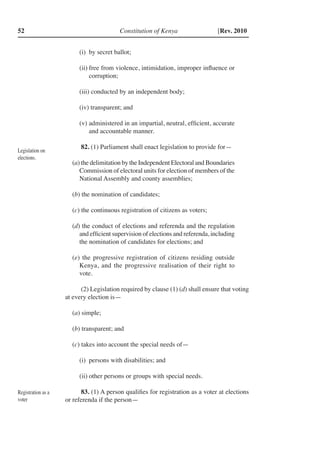
81—General principles for the electoral system.
82—Legislation on elections.
83—Registration as a voter.
84—Candidates for election and political parties to comply with
code of conduct.
85—Eligibility to stand as an independent candidate.
86—Voting.
87—Electoral disputes.
Constitution of Kenya 5Rev. 2010]
Part 2—Independent Electoral and Boundaries Commission and
Delimitation of Electoral Units
88—Independent Electoral and Boundaries Commission.
89—Delimitation of electoral units.
90—Allocation of party list seats.
Part 3—Political Parties
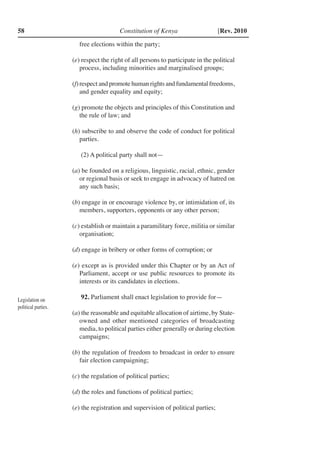
91—Basic requirements for political parties.
92—Legislation on political parties.
CHAPTER EIGHT—THE LEGISLATURE
Part 1—Establishment and Role of Parliament
93—Establishment of Parliament.
94—Role of Parliament.
95—Role of the National Assembly.
96—Role of the Senate.
Part 2—Composition and Membership of Parliament
97—Membership of the National Assembly.
98—Membership of the Senate.
99—Qualifications and disqualifications for election as member
of Parliament.
100—Promotion of representation of marginalised groups.
101—Election of members of Parliament.
102—Term of Parliament.
103—Vacation of office of member of Parliament.
104—Right of recall.
105—Determination of questions of membership.
Part 3—Offices of Parliament
106—Speakers and Deputy Speakers of Parliament.
107—Presiding in Parliament.
108—Party leaders.
Part 4—Procedures for Enacting Legislation
109—Exercise of legislative powers.
110—Bills concerning county government.
111—Special Bills concerning county governments.
112—Ordinary Bills concerning county governments.
113—Mediation committees.
114—Money Bills.
115—Presidential assent and referral.
116—Coming into force of laws.
Constitution of Kenya6 [Rev. 2010
Part 5—Parliament’s General Procedures and Rules
117—Powers, privileges and immunities.
118—Public access and participation.
119—Right to petition Parliament.
120—Official languages of Parliament.
121—Quorum.
122—Voting in Parliament.
123—Decisions of Senate.
124—Committees and Standing Orders.
125—Power to call for evidence.
Part 6—Miscellaneous
126—Location of sittings of Parliament.
127—Parliamentary Service Commission.
128—Clerks and staff of Parliament.
CHAPTER NINE—THE EXECUTIVE
Part 1—Principles and Structure of the National Executive
129—Principles of executive authority.
130—The National Executive.
Part 2—The President and Deputy President
131—Authority of the President.
132—Functions of the President.
133—Power of mercy.
134—Exercise of presidential powers during temporary
incumbency.
135—Decisions of the President.
136—Election of the President.
137—Qualifications and disqualifications for election as
President.
138—Procedure at presidential election.
139—Death before assuming office.
140—Questions as to validity of presidential election.
141—Assumption of office of President.
142—Term of office of President.
143—Protection from legal proceedings.
144—Removal of President on grounds of incapacity.
145—Removal of President by impeachment.
146—Vacancy in the office of President.
147—Functions of the Deputy President.
148—Election and swearing-in of Deputy President.
Constitution of Kenya 7Rev. 2010]
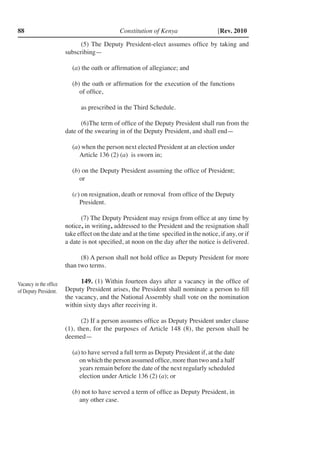
149—Vacancy in the office of Deputy President.
150—Removal of Deputy President.
151—Remuneration and benefits of President and Deputy
President.
Part 3—The Cabinet
152—Cabinet.
153—Decisions, responsibility and accountability of the
Cabinet.
153—Secretary to the Cabinet.
155—Principal Secretaries.
Part 4—Other Offices
156—Attorney-General.
157—Director of Public Prosecutions.
158—Removal and resignation of Director of Public
Prosecutions.
CHAPTER TEN—JUDICIARY
Part 1—Judicial Authority and Legal System
159—Judicial authority.
160—Independence of the Judiciary.
161—Judicial offices and officers.
162—System of courts.
Part 2—Superior Courts
163—Supreme Court.
164—Court of Appeal.
165—High Court.
166—Appointment of Chief Justice, Deputy Chief Justice and
other judges.
167—Tenure of office of the Chief Justice and other judges.
168—Removal from office.
Part 3—Subordinate Courts
169—Subordinate courts.
170—Kadhis’ Courts.
Part 4—Judicial Service Commission
171—Establishment of the Judicial Service Commission.
172—Functions of the Judicial Service Commission.
173—Judiciary Fund.
Constitution of Kenya8 [Rev. 2010
CHAPTER ELEVEN—DEVOLVED GOVERNMENT
Part 1—Objects and Principles of Devolved Government
174—Objects of devolution.
175—Principles of devolved government.
Part 2—County Governments
176—County governments.
177—Membership of county assembly.
178—Speaker of a county assembly.
179—County executive committees.
180—Election of county governor and deputy county governor.
181—Removal of a county government.
182—Vacancy in the office of county governor.
183—Functions of county executive committees.
184—Urban areas and cities.
185—Legislative authority of county assemblies.
Part 3—Functions and Powers of County Governments
186—Respective functions and powers of national and county
governments.
187—Transfer of functions and powers between levels of
government.
Part 4—The Boundaries of Counties
188—Boundaries of counties.
Part 5—Relationships Between Governments
189—Cooperation between national and county governments.
190—Support for county governments.
191—Conflict of laws.
Part 6—Suspension of County Governments
192—Suspension of county government.
Part 7—General
193—Qualifications for election as member of county
assembly.
194—Vacation of office of member of county assembly.
195—County assembly power to summon witnesses.
196—Public participation and county assembly powers, privileges
and immunities.
197—County assembly gender balance and diversity.
Constitution of Kenya 9Rev. 2010]
198—County government during transition.
199—Publication of county legislation.
200— Legislation on Chapter.
CHAPTER TWELVE—PUBLIC FINANCE
Part I—Principles and Framework of Public Finance
201—Principles of public finance.
202—Equitable sharing of national revenue.
203—Equitable share and other financial laws.
204—Equalisation Fund.
205—Consultation on financial legislation affecting counties.
Part 2—Other Public Funds
206—Consolidated Fund and other public funds.
207—Revenue Funds for county governments.
208—Contingencies Fund.
Part 3—Revenue-Raising Powers and the Public Debt
209—Power to impose taxes and charges.
210—Imposition of tax.
211—Borrowing by national government.
212—Borrowing by counties.
213—Loan guarantees by national government.
214—Public debt.
Part 4—Revenue Allocation
215—Commission on Revenue Allocation
216—Functions of the Commission on Revenue Allocation
217—Division of revenue
218—Annual Division and Allocation of Revenue Bills
219—Transfer of equitable share
Part 5—Budgets and Spending
220—Form, content and timing of budgets.
221—Budget estimates and annual Appropriation Bill.
222—Expenditure before annual budget is passed.
223—Supplementary appropriation.
224—County appropriation Bills.
Part 6—Control of Public Money
225—Financial control.
226—Accounts and audit of public entities.
227—Procurement of public goods and services.
Constitution of Kenya10 [Rev. 2010
Part 7— Financial Officers and Institutions
228—Controller of Budget.
229—Auditor-General.
230—Salaries and Remuneration Commission.
231—Central Bank of Kenya.
CHAPTER THIRTEEN—THE PUBLIC SERVICE
Part 1—Values and Principles of Public Service
232—Values and principles of public service.
Part 2—The Public Service Commission
233—The Public Service Commission.
234—Functions and powers of the Public Service Commission.
235—Staffing of county governments.
236—Protection of public officers.
Part 3—Teachers Service Commission
237—Teachers Service Commission.
CHAPTER FOURTEEN—NATIONAL SECURITY
Part 1—National Security Organs
238—Principles of national security.
239—National security organs.
240—Establishment of the National Security Council.
Part 2—The Kenya Defence Forces
241—Establishment of Defence Forces and Defence Council.
Part 3—The National Intelligence Service
242—Establishment of National Intelligence Service.
Part 4—The National Police Service
243—Establishment of the National Police Service.
244—Objects and functions of the National Police Service.
245—Command of the National Police Service.
246—National Police Service Commission.
247—Other police services.
Constitution of Kenya 11Rev. 2010]
CHAPTER FIFTEEN—COMMISSIONS AND
INDEPENDENT OFFICES
248—Application of Chapter.
249—Objects, authority and funding of commissions and
independent offices.
250—Composition, appointment and terms of office.
251—Removal from office.
252—General functions and powers.
253—Incorporation of commissions and independent offices.
254—Reporting by commissions and independent offices.
CHAPTER SIXTEEN—AMENDMENT OF THIS
CONSTITUTION
255—Amendment of this Constitution.
256—Amendment by parliamentary initiative.
257—Amendment by popular initiative.
CHAPTER SEVENTEEN—GENERAL PROVISIONS
258—Enforcement of this Constitution.
259—Construing this Constitution.
260—Interpretation.
CHAPTER EIGHTEEN—TRANSITIONAL AND
CONSEQUENTIAL PROVISIONS
261—Consequential legislation.
262—Transitional and consequential provisions.
263—Effective Date.
264—Repeal of previous constitution.
SCHEDULES
First Schedule	 Counties
Second Schedule	 National symbols
Third Schedule 	 National Oaths and affirmations
Fourth Schedule Distribution of functions between National
and the county governments
Fifth Schedule	 Legislation to be enacted by Parliament
Sixth Schedule	 Transitional and consequential provisions
Constitution of Kenya12 [Rev. 2010
PREAMBLE
We, the people of Kenya—
ACKNOWLEDGING the supremacy of the Almighty God of
all creation:
HONOURING those who heroically struggled to bring freedom
and justice to our land:
PROUD of our ethnic, cultural and religious diversity, and
determined to live in peace and unity as one indivisible sovereign
nation:
RESPECTFUL of the environment, which is our heritage, and
determined to sustain it for the benefit of future generations:
COMMITTED to nurturing and protecting the well-being of the
individual, the family, communities and the nation:
RECOGNISING the aspirations of all Kenyans for a government
based on the essential values of human rights, equality, freedom,
democracy, social justice and the rule of law:
EXERCISING our sovereign and inalienable right to determine
the form of governance of our country and having participated
fully in the making of this Constitution:
ADOPT, ENACT and give this Constitution to ourselves and to
our future generations.
GOD BLESS KENYA
Constitution of Kenya 13Rev. 2010]
THE CONSTITUTION OF KENYA
CHAPTER ONE––SOVEREIGNTY OF THE PEOPLE AND
SUPREMACY OF THIS CONSTITUTION
1.	 (1) All sovereign power belongs to the people of Kenya and
shall be exercised only in accordance with this Constitution.
(2)	The people may exercise their sovereign power either directly
or through their democratically elected representatives.
(3)	Sovereign power under this Constitution is delegated to
the following State organs, which shall perform their functions in
accordance with this Constitution––
(a) Parliament and the legislative assemblies in the county
governments;
(b) the national executive and the executive structures in the
county governments; and
(c) the Judiciary and independent tribunals.
(4)	The sovereign power of the people is exercised at––
(a) the national level; and
(b) the county level.
2.	 (1) This Constitution is the supreme law of the Republic and
binds all persons and all State organs at both levels of government.
(2)	No person may claim or exercise State authority except as
authorised under this Constitution.
(3)	The validity or legality of this Constitution is not subject to
challenge by or before any court or other State organ.
(4) Any law, including customary law, that is inconsistent with
this Constitution is void to the extent of the inconsistency, and any act
or omission in contravention of this Constitution is invalid.
(5)	The general rules of international law shall form part of the
law of Kenya.
Sovereignty of the
people.
Supremacy of this
Constitution.
Constitution of Kenya14 [Rev. 2010
(6) Any treaty or convention ratified by Kenya shall form part of
the law of Kenya under this Constitution.
3.	 (1) Every person has an obligation to respect, uphold and
defend this Constitution.
(2)	Any attempt to establish a government otherwise than in
compliance with this Constitution is unlawful.
CHAPTER TWO––THE REPUBLIC
4.	 (1) Kenya is a sovereign Republic.
(2)	 The Republic of Kenya shall be a multi-party democratic State
founded on the national values and principles of governance referred
to in Article 10.
5.	 Kenya consists of the territory and territorial waters comprising
Kenya on the effective date, and any additional territory and territorial
waters as defined by an Act of Parliament.
6.	 (1) The territory of Kenya is divided into the counties specified
in the First Schedule.
(2)	The governments at the national and county levels are distinct
and inter-dependent and shall conduct their mutual relations on the basis
of consultation and cooperation.
(3)	A national State organ shall ensure reasonable access to its
services in all parts of the Republic, so far as it is appropriate to do so
having regard to the nature of the service.
7.	 (1) The national language of the Republic is Kiswahili.
(2)	The official languages of the Republic are Kiswahili and
English.
(3) The State shall––
(a) promote and protect the diversity of language of the people
of Kenya; and
(b) promote the development and use of indigenous languages,
Kenyan Sign language, Braille and other communication
formats and technologies accessible to persons with
disabilities.
Defence of this
Constitution.
Declaration of the
Republic.
Territory of Kenya.
Devolution and
access to services.
National, official and
other languages.
Constitution of Kenya 15Rev. 2010]
8.	 There shall be no State religion.
9.	 (1) The national symbols of the Republic are––
(a) the national flag;
(b) the national anthem;
(c) the coat of arms; and
(d) the public seal.
(2)	The national symbols are as set out in the Second Schedule.
(3) The national days are––
(a) Madaraka Day, to be observed on 1st
June;
(b) Mashujaa Day, to be observed on 20th
October; and
(c) Jamhuri Day, to be observed on 12th
December.
(4) A national day shall be a public holiday.
(5) Parliament may enact legislation prescribing other public
holidays, and providing for observance of public holidays.
10. (1) The national values and principles of governance in this
Article bind all State organs, State officers, public officers and all persons
whenever any of them––
(a) applies or interprets this Constitution;
(b) enacts, applies or interprets any law; or
(c) makes or implements public policy decisions.
(2) The national values and principles of governance include––
(a) patriotism, national unity, sharing and devolution of power,
the rule of law, democracy and participation of the people;
(b) human dignity, equity, social justice, inclusiveness, equality,
human rights, non-discrimination and protection of the
marginalised;
(c) good governance, integrity, transparency and accountability;
and
State and religion.
National symbols and
national days.
National values
and principles of
governance.
Constitution of Kenya16 [Rev. 2010
(d) sustainable development.
11. (1) This Constitution recognises culture as the foundation
of the nation and as the cumulative civilization of the Kenyan people
and nation.
(2) The State shall—
(a) promote all forms of national and cultural expression
through literature, the arts, traditional celebrations, science,
communication, information, mass media, publications,
libraries and other cultural heritage;
(b) recognise the role of science and indigenous technologies
in the development of the nation; and
(c) promote the intellectual property rights of the people of
Kenya.
(3) Parliament shall enact legislation to—
(a) ensure that communities receive compensation or royalties
for the use of their cultures and cultural heritage; and
(b) recognise and protect the ownership of indigenous seeds
and plant varieties, their genetic and diverse characteristics
and their use by the communities of Kenya.
CHAPTER THREE––CITIZENSHIP
12. (1) Every citizen is entitled to––
(a) the rights, privileges and benefits of citizenship, subject to
the limits provided or permitted by this Constitution; and
(b) a Kenyan passport and any document of registration or
identification issued by the State to citizens.
(2)	Apassport or other document referred to in clause (1) (b) may
be denied, suspended or confiscated only in accordance with an Act of
Parliament that satisfies the criteria mentioned in Article 24.
13. (1) Every person who was a citizen immediately before the
effective date retains the same citizenship status as of that date.
(2) Citizenship may be acquired by birth or registration.
Culture.
Entitlements of
citizens.
Retention and
acquisition of
citizenship.
Constitution of Kenya 17Rev. 2010]
(3) Citizenship is not lost through marriage or the dissolution of
marriage.
14. (1) A person is a citizen by birth if on the day of the person’s
birth, whether or not the person is born in Kenya, either the mother or
father of the person is a citizen.
(2) Clause (1) applies equally to a person born before the effective
date, whether or not the person was born in Kenya, if either the mother
or father of the person is or was a citizen.
(3)	 Parliament may enact legislation limiting the effect of clauses
(1) and (2) on the descendents of Kenyan citizens who are born outside
Kenya.
(4)	A child found in Kenya who is, or appears to be, less than
eight years of age, and whose nationality and parents are not known, is
presumed to be a citizen by birth.
(5)	A person who is a Kenyan citizen by birth and who, on the
effective date, has ceased to be a Kenyan citizen because the person
acquired citizenship of another country, is entitled on application to
regain Kenyan citizenship.
15. (1) A person who has been married to a citizen for a period
of at least seven years is entitled on application to be registered as a
citizen.
(2) A person who has been lawfully resident in Kenya for a
continuous period of at least seven years, and who satisfies the conditions
prescribed by an Act of Parliament, may apply to be registered as a
citizen.
(3) A child who is not a citizen, but is adopted by a citizen, is
entitled on application to be registered as a citizen.
(4) Parliament shall enact legislation establishing conditions on
which citizenship may be granted to individuals who are citizens of
other countries.
(5)	This Article applies to a person as from the effective date,
but any requirements that must be satisfied before the person is entitled
to be registered as a citizen shall be regarded as having been satisfied
irrespective of whether the person satisfied them before or after the
effective date, or partially before, and partially after, the effective
date.
Citizenship by birth.
Citizenship by
registration.
Constitution of Kenya18 [Rev. 2010
16. A citizen by birth does not lose citizenship by acquiring the
citizenship of another country.
17. (1) If a person acquired citizenship by registration, the
citizenship may be revoked if the person––
(a) acquired the citizenship by fraud, false representation or
concealment of any material fact;
(b) has, during any war in which Kenya was engaged, unlawfully
traded or communicated with an enemy or been engaged in
or associated with any business that was knowingly carried
on in such a manner as to assist an enemy in that war;
(c) has, within five years after registration, been convicted of
an offence and sentenced to imprisonment for a term of three
years or longer; or
(d) has, at any time after registration, been convicted of treason,
or of an offence for which––
(i)	 a penalty of at least seven years imprisonment may be
imposed; or
(ii)	a more severe penalty may be imposed.
(2) The citizenship of a person who was presumed to be a citizen
by birth, as contemplated in Article 14 (4), may be revoked if––
(a) the citizenship was acquired by fraud, false representation
or concealment of any material fact by any person;
(b) the nationality or parentage of the person becomes known,
and reveals that the person was a citizen of another country;
or
(c) the age of the person becomes known, and reveals that the
person was older than eight years when found in Kenya.
18. Parliament shall enact legislation—
(a) prescribing procedures by which a person may become a
citizen;
(b) governing entry into and residence in Kenya;
Dual citizenship.
Revocation of
citizenship.
Legislation on
citizenship.
Constitution of Kenya 19Rev. 2010]
(c) providing for the status of permanent residents;
(d) providing for voluntary renunciation of citizenship;
(e) prescribing procedures for revocation of citizenship;
(f) prescribing the duties and rights of citizens; and
(g) generally giving effect to the provisions of this Chapter.
CHAPTER FOUR––THE BILL OF RIGHTS
Part 1—General Provisions Relating to the Bill of Rights
19. (1) The Bill of Rights is an integral part of Kenya’s democratic
state and is the framework for social, economic and cultural policies.
(2) The purpose of recognising and protecting human rights and
fundamental freedoms is to preserve the dignity of individuals and
communities and to promote social justice and the realisation of the
potential of all human beings.
(3) The rights and fundamental freedoms in the Bill of
Rights—
(a) belong to each individual and are not granted by the
State;
(b) do not exclude other rights and fundamental freedoms not
in the Bill of Rights, but recognised or conferred by law,
except to the extent that they are inconsistent with this
Chapter; and
(c) are subject only to the limitations contemplated in this
Constitution.
20. (1) The Bill of Rights applies to all law and binds all State
organs and all persons.
(2) Every person shall enjoy the rights and fundamental freedoms
in the Bill of Rights to the greatest extent consistent with the nature of
the right or fundamental freedom.
(3) In applying a provision of the Bill of Rights, a court shall—
(a) develop the law to the extent that it does not give effect to
a right or fundamental freedom; and
Rights and
fundamental
freedoms.
Application of Bill of
Rights.
Constitution of Kenya20 [Rev. 2010
(b) adopt the interpretation that most favours the enforcement
of a right or fundamental freedom.
(4) In interpreting the Bill of Rights, a court, tribunal or other
authority shall promote––
(a) the values that underlie an open and democratic society
based on human dignity, equality, equity and freedom; and
(b) the spirit, purport and objects of the Bill of Rights.
(5) In applying any right under Article 43, if the State claims that
it does not have the resources to implement the right, a court, tribunal
or other authority shall be guided by the following principles––
(a) it is the responsibility of the State to show that the resources
are not available;
(b)inallocatingresources,theStateshallgiveprioritytoensuring
the widest possible enjoyment of the right or fundamental
freedom having regard to prevailing circumstances, including
the vulnerability of particular groups or individuals; and
(c) the court, tribunal or other authority may not interfere with
a decision by a State organ concerning the allocation of
available resources, solely on the basis that it would have
reached a different conclusion.
21. (1) It is a fundamental duty of the State and every State organ to
observe, respect, protect, promote and fulfil the rights and fundamental
freedoms in the Bill of Rights.
(2) The State shall take legislative, policy and other measures,
including the setting of standards, to achieve the progressive realisation
of the rights guaranteed under Article 43.
(3)All State organs and all public officers have the duty to address
the needs of vulnerable groups within society, including women, older
members of society, persons with disabilities, children, youth, members
of minority or marginalised communities, and members of particular
ethnic, religious or cultural communities.
(4) The State shall enact and implement legislation to fulfil its
international obligations in respect of human rights and fundamental
freedoms.
Implementation
of rights and
fundamental
freedoms.
Constitution of Kenya 21Rev. 2010]
22. (1) Every person has the right to institute court proceedings
claiming that a right or fundamental freedom in the Bill of Rights has
been denied, violated or infringed, or is threatened.
(2)	In addition to a person acting in their own interest, court
proceedings under clause (1) may be instituted by––
(a) a person acting on behalf of another person who cannot act
in their own name;
(b) a person acting as a member of, or in the interest of, a group
or class of persons;
(c) a person acting in the public interest; or
(d) an association acting in the interest of one or more of its
members.
(3) The Chief Justice shall make rules providing for the court
proceedings referred to in this Article, which shall satisfy the criteria
that––
(a) the rights of standing provided for in clause (2) are fully
facilitated;
(b) formalities relating to the proceedings, including
commencement of the proceedings, are kept to the minimum,
and in particular that the court shall, if necessary, entertain
proceedings on the basis of informal documentation;
(c) no fee may be charged for commencing the proceedings;
(d) the court, while observing the rules of natural justice, shall
not be unreasonably restricted by procedural technicalities;
and
(e) an organisation or individual with particular expertise may,
with the leave of the court, appear as a friend of the court.
(4) The absence of rules contemplated in clause (3) does not
limit the right of any person to commence court proceedings under this
Article, and to have the matter heard and determined by a court.
23. (1) The High Court has jurisdiction, in accordance withArticle
165, to hear and determine applications for redress of a denial, violation
or infringement of, or threat to, a right or fundamental freedom in the
Bill of Rights.
Enforcement of Bill
of Rights.
Authority of courts to
uphold and enforce
the Bill of Rights.
Constitution of Kenya22 [Rev. 2010
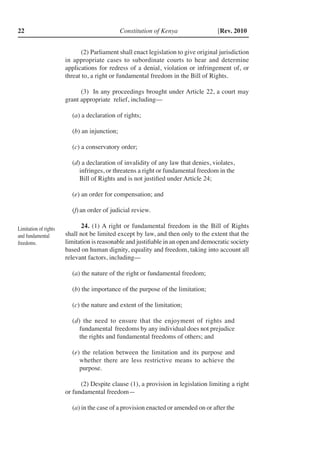
(2)	Parliament shall enact legislation to give original jurisdiction
in appropriate cases to subordinate courts to hear and determine
applications for redress of a denial, violation or infringement of, or
threat to, a right or fundamental freedom in the Bill of Rights.
(3) In any proceedings brought under Article 22, a court may
grant appropriate relief, including––
(a) a declaration of rights;
(b) an injunction;
(c) a conservatory order;
(d) a declaration of invalidity of any law that denies, violates,
infringes, or threatens a right or fundamental freedom in the
Bill of Rights and is not justified under Article 24;
(e) an order for compensation; and
(f)	an order of judicial review.
24. (1) A right or fundamental freedom in the Bill of Rights
shall not be limited except by law, and then only to the extent that the
limitation is reasonable and justifiable in an open and democratic society
based on human dignity, equality and freedom, taking into account all
relevant factors, including––
(a) the nature of the right or fundamental freedom;
(b) the importance of the purpose of the limitation;
(c) the nature and extent of the limitation;
(d) the need to ensure that the enjoyment of rights and
fundamental freedoms by any individual does not prejudice
the rights and fundamental freedoms of others; and
(e) the relation between the limitation and its purpose and
whether there are less restrictive means to achieve the
purpose.
(2) Despite clause (1), a provision in legislation limiting a right
or fundamental freedom—
(a) in the case of a provision enacted or amended on or after the
Limitation of rights
and fundamental
freedoms.
Constitution of Kenya 23Rev. 2010]
effective date, is not valid unless the legislation specifically
expresses the intention to limit that right or fundamental
freedom, and the nature and extent of the limitation;
(b) shall not be construed as limiting the right or fundmental
freedom unless the provision is clear and specific about the
right or freedom to be limited and the nature and extent of
the limitation; and
(c) shall not limit the right or fundamental freedom so far as to
derogate from its core or essential content.
(3)	The State or a person seeking to justify a particular limitation
shall demonstrate to the court, tribunal or other authority that the
requirements of this Article have been satisfied.
(4) The provisions of this Chapter on equality shall be qualified to
the extent strictly necessary for the application of Muslim law before the
Kadhis’ courts, to persons who profess the Muslim religion, in matters
relating to personal status, marriage, divorce and inheritance.
(5) Despite clause (1) and (2), a provision in legislation may limit
the application of the rights or fundamental freedoms in the following
provisions to persons serving in the Kenya Defence Forces or the
National Police Service––
(a) Article 31—Privacy;
(b) Article 36—Freedom of association;
(c) Article 37—Assembly, demonstration, picketing and
petition;
(d) Article 41—Labour relations;
(e) Article 43—Economic and social rights; and
(f) Article 49—Rights of arrested persons.
25. Despite any other provision in this Constitution, the following
rights and fundamental freedoms shall not be limited––
(a) freedom from torture and cruel, inhuman or degrading
treatment or punishment;
(b) freedom from slavery or servitude;
Fundamental Rights
and freedoms that
may not be limited.
Constitution of Kenya24 [Rev. 2010
(c) the right to a fair trial; and
(d) the right to an order of habeas corpus.
Part 2––Rights and Fundamental Freedoms
26. (1) Every person has the right to life.
(2) The life of a person begins at conception.
(3)	A person shall not be deprived of life intentionally, except to
the extent authorised by this Constitution or other written law.
(4) Abortion is not permitted unless, in the opinion of a trained
health professional, there is need for emergency treatment, or the life
or health of the mother is in danger, or if permitted by any other written
law.
27. (1) Every person is equal before the law and has the right to
equal protection and equal benefit of the law.
(2) Equality includes the full and equal enjoyment of all rights
and fundamental freedoms.
(3) Women and menhave the right to equal treatment, including
the right to equal opportunities in political, economic, cultural and
social spheres.
(4)	The State shall not discriminate directly or indirectly against
any person on any ground, including race, sex, pregnancy, marital status,
health status, ethnic or social origin, colour, age, disability, religion,
conscience, belief, culture, dress, language or birth.
(5)	A person shall not discriminate directly or indirectly against
another person on any of the grounds specified or contemplated in
clause (4).
(6) To give full effect to the realisation of the rights guaranteed
under this Article, the State shall take legislative and other measures,
including affirmative action programmes and policies designed to
redress any disadvantage suffered by individuals or groups because of
past discrimination.
(7)	Any measure taken under clause (6) shall adequately provide
for any benefits to be on the basis of genuine need.
(8) In addition to the measures contemplated in clause (6), the
Right to life.
Equality and freedom
from discrimination.
Constitution of Kenya 25Rev. 2010]
State shall take legislative and other measures to implement the principle
that not more than two-thirds of the members of elective or appointive
bodies shall be of the same gender.
28. Every person has inherent dignity and the right to have that
dignity respected and protected.
29. Every person has the right to freedom and security of the
person, which includes the right not to be—
(a) deprived of freedom arbitrarily or without just cause;
(b) detained without trial, except during a state of emergency,
in which case the detention is subject to Article 58;
(c) subjected to any form of violence from either public or
private sources;
(d) subjected to torture in any manner, whether physical or
psychological;
(e) subjected to corporal punishment; or
(f) treated or punished in a cruel, inhuman or degrading
manner.
30. (1) A person shall not be held in slavery or servitude.
(2) A person shall not be required to perform forced labour.
31. Every person has the right to privacy, which includes the
right not to have—
(a) their person, home or property searched;
(b) their possessions seized;
(c) information relating to their family or private affairs
unnecessarily required or revealed; or
(d) the privacy of their communications infringed.
32. (1) Every person has the right to freedom of conscience,
religion, thought, belief and opinion.
(2) Every person has the right, either individually or in community
with others, in public or in private, to manifest any religion or belief
Human dignity.
Freedom and security
of the person.
Slavery, servitude
and forced labour.
Privacy.
Freedom of
conscience, religion,
belief and opinion.
Constitution of Kenya26 [Rev. 2010
through worship, practice, teaching or observance, including observance
of a day of worship.
(3) A person may not be denied access to any institution,
employment or facility, or the enjoyment of any right, because of the
person’s belief or religion.
(4) A person shall not be compelled to act, or engage in any act,
that is contrary to the person’s belief or religion.
33. (1) Every person has the right to freedom of expression,
which includes—
(a) freedom to seek, receive or impart information or ideas;
(b) freedom of artistic creativity; and
(c) academic freedom and freedom of scientific research.
(2) The right to freedom of expression does not extend to—
(a) propaganda for war;
(b) incitement to violence;
(c) hate speech; or
(d) advocacy of hatred that—
(i) constitutes ethnic incitement, vilification of others or
incitement to cause harm; or
(ii) is based on any ground of discrimination specified or
contemplated in Article 27 (4).
(3) In the exercise of the right to freedom of expression, every
person shall respect the rights and reputation of others.
34. (1) Freedom and independence of electronic, print and all other
types of media is guaranteed, but does not extend to any expression
specified in Article 33 (2).
(2) The State shall not—
(a) exercise control over or interfere with any person engaged in
broadcasting, the production or circulation of any publication
or the dissemination of information by any medium; or
Freedom of
expression.
Freedom of the
media.
Constitution of Kenya 27Rev. 2010]
(b) penalise any person for any opinion or view or the content
of any broadcast, publication or dissemination.
(3) Broadcasting and other electronic media have freedom of
establishment, subject only to licensing procedures that—
(a) are necessary to regulate the airwaves and other forms of
signal distribution; and
(b) are independent of control by government, political interests
or commercial interests.
(4) All State-owned media shall—
(a) be free to determine independently the editorial content of
their broadcasts or other communications;
(b) be impartial; and
(c) afford fair opportunity for the presentation of divergent
views and dissenting opinions.
(5) Parliament shall enact legislation that provides for the
establishment of a body, which shall—
(a) be independent of control by government, political interests
or commercial interests;
(b) reflect the interests of all sections of the society; and
(c) set media standards and regulate and monitor compliance
with those standards.
35. (1) Every citizen has the right of access to—
(a) information held by the State; and
(b) information held by another person and required for
the exercise or protection of any right or fundamental
freedom.
(2) Every person has the right to the correction or deletion of
untrue or misleading information that affects the person.
(3)The State shall publish and publicise any important information
affecting the nation.
Access to
information.
Constitution of Kenya28 [Rev. 2010
36. (1) Every person has the right to freedom of association,
which includes the right to form, join or participate in the activities of
an association of any kind.
(2) A person shall not be compelled to join an association of any
kind.
(3) Any legislation that requires registration of an association of
any kind shall provide that—
(a) registration may not be withheld or withdrawn unreasonably;
and
(b) there shall be a right to have a fair hearing before a
registration is cancelled.
37. Every person has the right, peaceably and unarmed, to
assemble, to demonstrate, to picket, and to present petitions to public
authorities.
38. (1) Every citizen is free to make political choices, which
includes the right—
(a) to form, or participate in forming, a political party;
(b) to participate in the activities of, or recruit members for, a
political party; or
(c) to campaign for a political party or cause.
(2) Every citizen has the right to free, fair and regular elections
based on universal suffrage and the free expression of the will of the
electors for—
(a) any elective public body or office established under this
Constitution; or
(b) any office of any political party of which the citizen is a
member.
(3) Every adult citizen has the right, without unreasonable
restrictions—
(a) to be registered as a voter;
(b) to vote by secret ballot in any election or referendum; and
Freedom of
association.
Assembly,
demonstration,
picketing and
petition.
Political rights.
Constitution of Kenya 29Rev. 2010]
(c) to be a candidate for public office, or office within a political
party of which the citizen is a member and, if elected, to
hold office.
39. (1) Every person has the right to freedom of movement.
(2) Every person has the right to leave Kenya.
(3) Every citizen has the right to enter, remain in and reside
anywhere in Kenya.
40. (1) Subject to Article 65, every person has the right,
either individually or in association with others, to acquire and own
property––
(a) of any description; and
(b) in any part of Kenya.
(2) Parliament shall not enact a law that permits the State or any
person—
(a) to arbitrarily deprive a person of property of any description
or of any interest in, or right over, any property of any
description; or
(b) to limit, or in any way restrict the enjoyment of any right
under thisArticle on the basis of any of the grounds specified
or contemplated in Article 27 (4).
(3) The State shall not deprive a person of property of any
description, or of any interest in, or right over, property of any
description, unless the deprivation—
(a) results from an acquisition of land or an interest in land
or a conversion of an interest in land, or title to land, in
accordance with Chapter Five; or
(b) is for a public purpose or in the public interest and is carried
out in accordance with this Constitution and any Act of
Parliament that—
(i) requires prompt payment in full, of just compensation to
the person; and
(ii) allows any person who has an interest in, or right over,
that property a right of access to a court of law.
Freedom of
movement and
residence.
Protection of right to
property.
Constitution of Kenya30 [Rev. 2010
(4) Provision may be made for compensation to be paid to
occupants in good faith of land acquired under clause (3) who may not
hold title to the land.
(5) The State shall support, promote and protect the intellectual
property rights of the people of Kenya.
(6) The rights under this Article do not extend to any property
that has been found to have been unlawfully acquired.
41. (1) Every person has the right to fair labour practices.
(2) Every worker has the right—
(a) to fair remuneration;
(b) to reasonable working conditions;
(c) to form, join or participate in the activities and programmes
of a trade union; and
(d) to go on strike.
(3) Every employer has the right—
(e) to form and join an employers organisation; and
(f) to participate in the activities and programmes of an
employers organisation.
(4) Every trade union and every employers’ organisation has the
right—
(a) to determine its own administration, programmes and
activities;
(b) to organise; and
(c) to form and join a federation.
(5) Every trade union, employers’organisation and employer has
the right to engage in collective bargaining.
42. Every person has the right to a clean and healthy environment,
which includes the right—
Labour relations.
Environment.
Constitution of Kenya 31Rev. 2010]
(a) to have the environment protected for the benefit of present
and future generations through legislative and other measures,
particularly those contemplated in Article 69; and
(b) to have obligations relating to the environment fulfilled
under Article 70.
43. (1) Every person has the right—
(a) to the highest attainable standard of health, which includes
the right to health care services, including reproductive
health care;
(b) to accessible and adequate housing, and to reasonable
standards of sanitation;
(c) to be free from hunger, and to have adequate food of
acceptable quality;
(d) to clean and safe water in adequate quantities;
(e) to social security; and
(f) to education.
(2) A person shall not be denied emergency medical treatment.
(3) The State shall provide appropriate social security to persons
who are unable to support themselves and their dependants.
44. (1) Every person has the right to use the language, and to
participate in the cultural life, of the person’s choice.
(2) A person belonging to a cultural or linguistic community has
the right, with other members of that community—
(a) to enjoy the person’s culture and use the person’s language;
or
(b) to form, join and maintain cultural and linguistic associations
and other organs of civil society.
(3)Aperson shall not compel another person to perform, observe
or undergo any cultural practice or rite.
45. (1) The family is the natural and fundamental unit of society
and the necessary basis of social order, and shall enjoy the recognition
Economic and social
rights.
Language and
culture.
Family.
Constitution of Kenya32 [Rev. 2010
and protection of the State.
(2) Every adult has the right to marry a person of the opposite
sex, based on the free consent of the parties.
(3) Parties to a marriage are entitled to equal rights at the time
of the marriage, during the marriage and at the dissolution of the
marriage.
(4) Parliament shall enact legislation that recognises—
(a) marriages concluded under any tradition, or system of
religious, personal or family law; and
(b) any system of personal and family law under any tradition,
or adhered to by persons professing a particular religion,
to the extent that any such marriages or systems of law are consistent
with this Constitution.
46. (1) Consumers have the right—
(a) to goods and services of reasonable quality;
(b) to the information necessary for them to gain full benefit
from goods and services;
(c) to the protection of their health, safety, and economic
interests; and
(d) to compensation for loss or injury arising from defects in
goods or services.
(2) Parliament shall enact legislation to provide for consumer
protection and for fair, honest and decent advertising.
(3) This Article applies to goods and services offered by public
entities or private persons.
47. (1) Every person has the right to administrative action that is
expeditious, efficient, lawful, reasonable and procedurally fair.
(2) If a right or fundamental freedom of a person has been or is
likely to be adversely affected by administrative action, the person has
the right to be given written reasons for the action.
(3) Parliament shall enact legislation to give effect to the rights
Consumer rights.
Fair administrative
action.
Constitution of Kenya 33Rev. 2010]
in clause (1) and that legislation shall—
(a) provide for the review of administrative action by a court or,
if appropriate, an independent and impartial tribunal; and
(b) promote efficient administration.
48. The State shall ensure access to justice for all persons and, if
any fee is required, it shall be reasonable and shall not impede access
to justice.
49. (1) An arrested person has the right—
(a) to be informed promptly, in language that the person
understands, of—
(i) the reason for the arrest;
(ii) the right to remain silent; and
(iii) the consequences of not remaining silent;
(b) to remain silent;
(c) to communicate with an advocate, and other persons whose
assistance is necessary;
(d) not to be compelled to make any confession or admission
that could be used in evidence against the person;
(e) to be held separately from persons who are serving a
sentence;
(f) to be brought before a court as soon as reasonably possible,
but not later than––
(i) twenty-four hours after being arrested; or
(ii) if the twenty-four hours ends outside ordinary court
hours, or on a day that is not an ordinary court day, the
end of the next court day;
(g) at the first court appearance, to be charged or informed of the
reason for the detention continuing, or to be released; and
(h) to be released on bond or bail, on reasonable conditions,
pending a charge or trial, unless there are compelling reasons
Access to justice.
Rights of arrested
persons.
Constitution of Kenya34 [Rev. 2010
not to be released.
(2) A person shall not be remanded in custody for an offence if
the offence is punishable by a fine only or by imprisonment for not
more than six months.
50. (1) Every person has the right to have any dispute that can be
resolved by the application of law decided in a fair and public hearing
before a court or, if appropriate, another independent and impartial
tribunal or body.
(2) Every accused person has the right to a fair trial, which
includes the right—
(a) to be presumed innocent until the contrary is proved;
(b) to be informed of the charge, with sufficient detail to
answer it;
(c) to have adequate time and facilities to prepare a defence;
(d) to a public trial before a court established under this
Constitution;
(e) to have the trial begin and conclude without unreasonable
delay;
(f) to be present when being tried, unless the conduct of
the accused person makes it impossible for the trial to
proceed;
(g) to choose, and be represented by, an advocate, and to be
informed of this right promptly;
(h) to have an advocate assigned to the accused person by the
State and at State expense, if substantial injustice would
otherwise result, and to be informed of this right promptly;
(i) to remain silent, and not to testify during the proceedings;
(j) to be informed in advance of the evidence the prosecution
intends to rely on, and to have reasonable access to that
evidence;
(k) to adduce and challenge evidence;
(l) to refuse to give self-incriminating evidence;
Fair hearing.
Constitution of Kenya 35Rev. 2010]
(m) to have the assistance of an interpreter without payment
if the accused person cannot understand the language used
at the trial;
(n) not to be convicted for an act or omission that at the time it
was committed or omitted was not—
(i) an offence in Kenya; or
(ii) a crime under international law;
(o) not to be tried for an offence in respect of an act or omission
for which the accused person has previously been either
acquitted or convicted;
(p) to the benefit of the least severe of the prescribed punishments
for an offence, if the prescribed punishment for the offence
has been changed between the time that the offence was
committed and the time of sentencing; and
(q) if convicted, to appeal to, or apply for review by, a higher
court as prescribed by law.
(3) If thisArticle requires information to be given to a person, the
information shall be given in language that the person understands.
(4) Evidence obtained in a manner that violates any right or
fundamental freedom in the Bill of Rights shall be excluded if the
admission of that evidence would render the trial unfair, or would
otherwise be detrimental to the administration of justice.
(5) An accused person—
(a) charged with an offence, other than an offence that the
court may try by summary procedures, is entitled during the
trial to a copy of the record of the proceedings of the trial
on request; and
(b) has the right to a copy of the record of the proceedings within
a reasonable period after they are concluded, in return for a
reasonable fee as prescribed by law.
(6)	A person who is convicted of a criminal offence may petition
the High Court for a new trial if––
(a) the person’s appeal, if any, has been dismissed by the highest
Constitution of Kenya36 [Rev. 2010
court to which the person is entitled to appeal, or the person
did not appeal within the time allowed for appeal; and
(b) new and compelling evidence has become available.
(7) In the interest of justice, a court may allow an intermediary
to assist a complainant or an accused person to communicate with the
court.
(8) This Article does not prevent the exclusion of the press or
other members of the public from any proceedings if the exclusion
is necessary, in a free and democratic society, to protect witnesses or
vulnerable persons, morality, public order or national security.
(9) Parliament shall enact legislation providing for the protection,
rights and welfare of victims of offences.
51. (1) A person who is detained, held in custody or imprisoned
under the law, retains all the rights and fundamental freedoms in the Bill
of Rights, except to the extent that any particular right or a fundamental
freedom is clearly incompatible with the fact that the person is detained,
held in custody or imprisoned.
(2) A person who is detained or held in custody is entitled to
petition for an order of habeas corpus.
(3) Parliament shall enact legislation that––
(a) provides for the humane treatment of persons detained, held
in custody or imprisoned; and
(b) takes into account the relevant international human rights
instruments.
Part 3––Specific Application of Rights
52. (1) This Part elaborates certain rights to ensure greater
certainty as to the application of those rights and fundamental freedoms
to certain groups of persons.
(2) This Part shall not be construed as limiting or qualifying any
right.
53. (1) Every child has the right––
(a) to a name and nationality from birth;
Rights of persons
detained, held
in custody or
imprisoned.
Interpretation of this
Part.
Children.
Constitution of Kenya 37Rev. 2010]
(b) to free and compulsory basic education;
(c) to basic nutrition, shelter and health care;
(d) to be protected from abuse, neglect, harmful cultural
practices, all forms of violence, inhuman treatment and
punishment, and hazardous or exploitative labour;
(e) to parental care and protection, which includes equal
responsibility of the mother and father to provide for the
child, whether they are married to each other or not; and
(f) not to be detained, except as a measure of last resort, and
when detained, to be held –
(i)	 for the shortest appropriate period of time; and
(ii)	separate from adults and in conditions that take account
of the child’s sex and age.
(2) A child’s best interests are of paramount importance in every
matter concerning the child.
54. (1) A person with any disability is entitled––
(a) to be treated with dignity and respect and to be addressed
and referred to in a manner that is not demeaning;
(b) to access educational institutions and facilities for persons
with disabilities that are integrated into society to the extent
compatible with the interests of the person;
(c) to reasonable access to all places, public transport and
information;
(d) to use Sign language, Braille or other appropriate means of
communication; and
(e) to access materials and devices to overcome constraints
arising from the person’s disability.
(2) The State shall ensure the progressive implementation of the
principle that at least five percent of the members of the public in elective
and appointive bodies are persons with disabilities.
55. The State shall take measures, including affirmative action
programmes, to ensure that the youth—
Persons with
disabilities.
Youth.
Constitution of Kenya38 [Rev. 2010
(a) access relevant education and training;
(b) have opportunities to associate, be represented and
participate in political, social, economic and other spheres
of life;
(c) access employment; and
(d) are protected from harmful cultural practices and
exploitation.
56. The State shall put in place affirmative action programmes
designed to ensure that minorities and marginalised groups—
(a) participate and are represented in governance and other
spheres of life;
(b) are provided special opportunities in educational and
economic fields;
(c) are provided special opportunities for access to
employment;
(d) develop their cultural values, languages and practices;
and
(e) have reasonable access to water, health services and
infrastructure.
57. The State shall take measures to ensure the rights of older
persons––
(a) to fully participate in the affairs of society;
(b) to pursue their personal development;
(c) to live in dignity and respect and be free from abuse; and
(d) to receive reasonable care and assistance from their family
and the State.
Part 4––State of Emergency
58. (1) A state of emergency may be declared only under Article
132 (4) (d) and only when––
(a) the State is threatened by war, invasion, general insurrection,
Minorities and
marginalised groups.
Older members of
society.
State of emergency.
Constitution of Kenya 39Rev. 2010]
disorder, natural disaster or other public emergency; and
(b) the declaration is necessary to meet the circumstances for
which the emergency is declared.
(2) A declaration of a state of emergency, and any legislation
enacted or other action taken in consequence of the declaration, shall
be effective only—
(a) prospectively; and
(b) for not longer than fourteen days from the date of the
declaration, unless the NationalAssembly resolves to extend
the declaration.
(3) The National Assembly may extend a declaration of a state
of emergency—
(a) by resolution adopted—
(i) following a public debate in the National Assembly;
and
(ii)	by the majorities specified in clause (4); and
(b) for not longer than two months at a time.
(4) The first extension of the declaration of a state of emergency
requires a supporting vote of at least two-thirds of all the members
of the National Assembly, and any subsequent extension requires a
supporting vote of at least three-quarters of all the members of the
National Assembly.
(5)	The Supreme Court may decide on the validity of—
(a) a declaration of a state of emergency;
(b) any extension of a declaration of a state of emergency;
and
(c) any legislation enacted, or other action taken, in consequence
of a declaration of a state of emergency.
(6) Any legislation enacted in consequence of a declaration of a
state of emergency––
(a) may limit a right or fundamental freedom in the Bill of
Constitution of Kenya40 [Rev. 2010
Rights only to the extent that—
(i)	the limitation is strictly required by the emergency;
and
(ii)	the legislation is consistent with the Republic’s obliga-
tions under international law applicable to a state of
emergency; and
(b) shall not take effect until it is published in the Gazette.
(7)Adeclaration of a state of emergency, or legislation enacted or
other action taken in consequence of any declaration, may not permit or
authorise the indemnification of the State, or of any person, in respect
of any unlawful act or omission.
Part 5––Kenya National Human Rights and
Equality Commission
59. (1) There is established the Kenya National Human Rights
and Equality Commission.	
(2) The functions of the Commission are—
(a) to promote respect for human rights and develop a culture
of human rights in the Republic;
(b) to promote gender equality and equity generally and to
coordinate and facilitate gender mainstreaming in national
development;
(c) to promote the protection, and observance of human rights
in public and private institutions;
(d) to monitor, investigate and report on the observance of
human rights in all spheres of life in the Republic, including
observance by the national security organs;
(e) to receive and investigate complaints about alleged abuses
of human rights and take steps to secure appropriate redress
where human rights have been violated;
(f) on its own initiative or on the basis of complaints, to
investigate or research a matter in respect of human rights,
and make recommendations to improve the functioning of
State organs;
Kenya National
Human Rights
and Equality
Commission.
Constitution of Kenya 41Rev. 2010]
(g) to act as the principal organ of the State in ensuring
compliance with obligations under treaties and conventions
relating to human rights;
(h) to investigate any conduct in state affairs, or any act
or omission in public administration in any sphere of
government, that is alleged or suspected to be prejudicial or
improper or to result in any impropriety or prejudice;
(i)	to investigate complaints of abuse of power, unfair treatment,
manifest injustice or unlawful, oppressive, unfair or
unresponsive official conduct;
(j) to report on complaints investigated under paragraphs (h)
and (i) and take remedial action; and
(k) to perform any other functions prescribed by legislation.
(3) Every person has the right to complain to the Commission,
alleging that a right or fundamental freedom in the Bill of Rights has
been denied, violated or infringed, or is threatened.
(4) Parliament shall enact legislation to give full effect to this Part,
and any such legislation may restructure the Commission into two or
more separate commissions.
(5) If Parliament enacts legislation restructuring the Commission
under clause (4)––
(a) that legislation shall assign each function of the Commission
mentioned in thisArticle to one or the other of the successor
commissions;
(b) each of the successor commissions shall have powers
equivalent to the powers of the Commission under this
Article; and
(c) each successor commission shall be a commission within
the meaning of Chapter Fifteen, and shall have the status and
powers of a commission under that Chapter.
CHAPTER FIVE––LAND AND ENVIRONMENT
Part 1—Land
60. (1) Land in Kenya shall be held, used and managed in a
manner that is equitable, efficient, productive and sustainable, and in
Principles of land
policy.
Constitution of Kenya42 [Rev. 2010
accordance with the following principles—
(a) equitable access to land;
(b) security of land rights;
(c) sustainable and productive management of land
resources;
(d) transparent and cost effective administration of land;
(e) sound conservation and protection of ecologically sensitive
areas;
(f) elimination of gender discrimination in law, customs and
practices related to land and property in land; and
(g) encouragement of communities to settle land disputes
through recognised local community initiatives consistent
with this Constitution.
(2) These principles shall be implemented through a national land
policy developed and reviewed regularly by the national government
and through legislation.
61. (1) All land in Kenya belongs to the people of Kenya
collectively as a nation, as communities and as individuals.
(2) Land in Kenya is classified as public, community or private.
62. (1) Public land is—
(a) land which at the effective date was unalienated government
land as defined by an Act of Parliament in force at the
effective date;
(b) land lawfully held, used or occupied by any State organ,
except any such land that is occupied by the State organ as
lessee under a private lease;
(c) land transferred to the State by way of sale, reversion or
surrender;
(d) land in respect of which no individual or community
ownership can be established by any legal process;
(e) land in respect of which no heir can be identified by any
Classification of land.
Public land.
Constitution of Kenya 43Rev. 2010]
legal process;
(f) all minerals and mineral oils as defined by law;
(g) government forests other than forests to whichArticle 63 (2)
(d) (i) applies, government game reserves, water catchment
areas, national parks, government animal sanctuaries, and
specially protected areas;
(h) all roads and thoroughfares provided for by an Act of
Parliament;
(i)	all rivers, lakes and other water bodies as defined by an Act
of Parliament;
(j)	the territorial sea, the exclusive economic zone and the sea
bed;
(k) the continental shelf;
(l) all land between the high and low water marks;
(m) any land not classified as private or community land under
this Constitution; and
(n) any other land declared to be public land by an Act of
Parliament—
(i)	 in force at the effective date; or
(ii)	enacted after the effective date.
(2) Public land shall vest in and be held by a county government
in trust for the people resident in the county, and shall be administered
on their behalf by the National Land Commission, if it is classified
under—
(a) clause (1) (a), (c), (d) or (e); and
(b) clause (1) (b), other than land held, used or occupied by a
national State organ.
(3) Public land classified under clause (1) (f) to (m) shall vest
in and be held by the national government in trust for the people of
Kenya and shall be administered on their behalf by the National Land
Commission.
Constitution of Kenya44 [Rev. 2010
(4) Public land shall not be disposed of or otherwise used except
in terms of an Act of Parliament specifying the nature and terms of that
disposal or use.
63. (1) Community land shall vest in and be held by communities
identified on the basis of ethnicity, culture or similar community of
interest.
(2) Community land consists of—
(a) land lawfully registered in the name of group representatives
under the provisions of any law;
(b) land lawfully transferred to a specific community by any
process of law;
(c) any other land declared to be community land by an Act of
Parliament; and
(d) land that is—
(i)	 lawfully held, managed or used by specific communities
as community forests, grazing areas or shrines;
(ii)	ancestral lands and lands traditionally occupied by
hunter-gatherer communities; or
(iii) lawfully held as trust land by the county governments,
but not including any public land held in trust by the county
government under Article 62 (2).
(3) Any unregistered community land shall be held in trust by
county governments on behalf of the communities for which it is
held.
(4) Community land shall not be disposed of or otherwise used
except in terms of legislation specifying the nature and extent of the
rights of members of each community individually and collectively.
(5) Parliament shall enact legislation to give effect to this
Article.
64. Private land consists of —
(a) registered land held by any person under any freehold
tenure;
Community land.
Private land.
Constitution of Kenya 45Rev. 2010]
(b) land held by any person under leasehold tenure; and
(c) any other land declared private land under an Act of
Parliament.
65. (1) A person who is not a citizen may hold land on the basis
of leasehold tenure only, and any such lease, however granted, shall
not exceed ninety-nine years.
(2) If a provision of any agreement, deed, conveyance or document
of whatever nature purports to confer on a person who is not a citizen an
interest in land greater than a ninety-nine year lease, the provision shall
be regarded as conferring on the person a ninety-nine year leasehold
interest, and no more.
(3) For purposes of this Article—
(a) a body corporate shall be regarded as a citizen only if the
body corporate is wholly owned by one or more citizens;
and
(b) property held in trust shall be regarded as being held by a
citizen only if all of the beneficial interest of the trust is held
by persons who are citizens.
(4) Parliament may enact legislation to make further provision
for the operation of this Article.
66. (1) The State may regulate the use of any land, or any interest
in or right over any land, in the interest of defence, public safety, public
order, public morality, public health, or land use planning.
(2) Parliament shall enact legislation ensuring that investments
in property benefit local communities and their economies.
67. (1) There is established the National Land Commission.
(2) The functions of the National Land Commission are—
(a) to manage public land on behalf of the national and county
governments;
(b) to recommend a national land policy to the national
government;
(c) to advise the national government on a comprehensive
Landholding by
non-citizens.
Regulation of land
use and property.
National Land
Commission.
Constitution of Kenya46 [Rev. 2010
programme for the registration of title in land throughout
Kenya;
(d) to conduct research related to land and the use of natural
resources, and make recommendations to appropriate
authorities;
(e) to initiate investigations, on its own initiative or on a
complaint, into present or historical land injustices, and
recommend appropriate redress;
(f)	to encourage the application of traditional dispute resolution
mechanisms in land conflicts;
(g) to assess tax on land and premiums on immovable property
in any area designated by law; and
(h) to monitor and have oversight responsibilities over land use
planning throughout the country.
(3) The National Land Commission may perform any other
functions prescribed by national legislation.
68. Parliament shall—
(a) revise, consolidate and rationalise existing land laws;
(b) revise sectoral land use laws in accordance with the
principles set out in Article 60 (1); and
(c) enact legislation—
(i) to prescribe minimum and maximum land holding acre-
ages in respect of private land;
(ii)	to regulate the manner in which any land may be con-
verted from one category to another;
(iii) to regulate the recognition and protection of matrimonial
property and in particular the matrimonial home during
and on the termination of marriage;
(iv) to protect, conserve and provide access to all public
land;
(v)	to enable the review of all grants or dispositions of public
land to establish their propriety or legality;
Legislation on land.
Constitution of Kenya 47Rev. 2010]
(vi) to protect the dependants of deceased persons holding
interests in any land, including the interests of spouses
in actual occupation of land; and
(vii) to provide for any other matter necessary to give effect
to the provisions of this Chapter.
Part 2—Environment and Natural Resources
69. (1) The State shall—
(a) ensure sustainable exploitation, utilisation, management and
conservation of the environment and natural resources, and
ensure the equitable sharing of the accruing benefits;
(b) work to achieve and maintain a tree cover of at least ten per
cent of the land area of Kenya;
(c) protect and enhance intellectual property in, and indigenous
knowledge of, biodiversity and the genetic resources of the
communities;
(d) encourage public participation in the management,
protection and conservation of the environment;
(e) protect genetic resources and biological diversity;
(f) establish systems of environmental impact assessment,
environmental audit and monitoring of the environment;
(g) eliminate processes and activities that are likely to endanger
the environment; and
(h) utilise the environment and natural resources for the benefit
of the people of Kenya.
(2) Every person has a duty to cooperate with State organs and
other persons to protect and conserve the environment and ensure
ecologically sustainable development and use of natural resources.
70. (1) If a person alleges that a right to a clean and healthy
environment recognised and protected under Article 42 has been, is
being or is likely to be, denied, violated, infringed or threatened, the
person may apply to a court for redress in addition to any other legal
remedies that are available in respect to the same matter.
Obligations in respect
of the environment.
Enforcement of
environmental rights.
Constitution of Kenya48 [Rev. 2010
(2) On application under clause (1), the court may make any order,
or give any directions, it considers appropriate––
(a) to prevent, stop or discontinue any act or omission that is
harmful to the environment;
(b) to compel any public officer to take measures to prevent
or discontinue any act or omission that is harmful to the
environment; or
(c) to provide compensation for any victim of a violation of the
right to a clean and healthy environment.
(3) For the purposes of this Article, an applicant does not have to
demonstrate that any person has incurred loss or suffered injury.
71. (1) A transaction is subject to ratification by Parliament if
it––
(a) involves the grant of a right or concession by or on behalf
of any person, including the national government, to another
person for the exploitation of any natural resource of Kenya;
and
(b) is entered into on or after the effective date.
(2) Parliament shall enact legislation providing for the classes of
transactions subject to ratification under clause (1).
72. Parliament shall enact legislation to give full effect to the
provisions of this Part.
CHAPTER SIX––LEADERSHIPAND INTEGRITY
73. (1) Authority assigned to a State officer—
(a) is a public trust to be exercised in a manner that—
(i) is consistent with the purposes and objects of this Con-
stitution;
(ii) demonstrates respect for the people;
(iii) brings honour to the nation and dignity to the office;
and
(iv) promotes public confidence in the integrity of the
office; and
Agreements relating
to natural resources.
Legislation relating
to the environment.
Responsibilities of
leadership.
Constitution of Kenya 49Rev. 2010]
(b) vests in the State officer the responsibility to serve the
people, rather than the power to rule them.
(2) The guiding principles of leadership and integrity include—
(a) selection on the basis of personal integrity, competence and
suitability, or election in free and fair elections;
(b) objectivity and impartiality in decision making, and in
ensuring that decisions are not influenced by nepotism,
favouritism, other improper motives or corrupt practices;
(c) selfless service based solely on the public interest,
demonstrated by—
(i)	 honesty in the execution of public duties; and
(ii)	the declaration of any personal interest that may conflict
with public duties;
(d) accountability to the public for decisions and actions; and
(e) discipline and commitment in service to the people.
74. Before assuming a State office, acting in a State office, or
performing any functions of a State office, a person shall take and
subscribe the oath or affirmation of office, in the manner and form
prescribed by the Third Schedule or under an Act of Parliament.
75. (1)AState officer shall behave, whether in public and official
life, in private life, or in association with other persons, in a manner
that avoids—
(a) any conflict between personal interests and public or official
duties;
(b) compromising any public or official interest in favour of a
personal interest; or
(c) demeaning the office the officer holds.
(2) A person who contravenes clause (1), or Article 76, 77 or 78
(2)—
(a) shall be subject to the applicable disciplinary procedure for
the relevant office; and
Oath of office of
State officers.
Conduct of State
officers.
Constitution of Kenya50 [Rev. 2010
(b) may, in accordance with the disciplinary procedure referred
to in paragraph (a), be dismissed or otherwise removed from
office.
(3)Aperson who has been dismissed or otherwise removed from
office for a contravention of the provisions mentioned in clause (2) is
disqualified from holding any other State office.
76. (1) A gift or donation to a State officer on a public or official
occasion is a gift or donation to the Republic and shall be delivered to
the State unless exempted under an Act of Parliament.
(2) A State officer shall not—
(a) maintain a bank account outside Kenya except in accordance
with an Act of Parliament; or
(b) seek or accept a personal loan or benefit in circumstances
that compromise the integrity of the State officer.
77. (1) A full-time State officer shall not participate in any other
gainful employment.
(2) Any appointed State officer shall not hold office in a political
party.
(3) A retired State officer who is receiving a pension from public
funds shall not hold more than two concurrent remunerative positions
as chairperson, director or employee of—
(a) a company owned or controlled by the State; or
(b) a State organ.
(4) A retired State officer shall not receive remuneration from
public funds other than as contemplated in clause (3).
78. (1) A person is not eligible for election or appointment to a
State office unless the person is a citizen of Kenya.
(2) A State officer or a member of the defence forces shall not
hold dual citizenship.
(3) Clauses (1) and (2) do not apply to—
(a) judges and members of commissions; or
Financial probity of
State officers.
Restriction on
activities of State
officers.
Citizenship and
leadership.
Constitution of Kenya 51Rev. 2010]
(b) any person who has been made a citizen of another country
by operation of that country’s law, without ability to opt
out.
79. Parliament shall enact legislation to establish an independent
ethics and anti-corruption commission, which shall be and have the
status and powers of a commission under Chapter Fifteen, for purposes
of ensuring compliance with, and enforcement of, the provisions of
this Chapter.
80. Parliament shall enact legislation—
(a) establishing procedures and mechanisms for the effective
administration of this Chapter;
(b) prescribing the penalties, in addition to the penalties referred
to in Article 75, that may be imposed for a contravention of
this Chapter;
(c) providing for the application of this Chapter, with the
necessary modifications, to public officers; and
(d) making any other provision necessary for ensuring the
promotion of the principles of leadership and integrity
mentioned in this Chapter, and the enforcement of this
Chapter.
CHAPTER SEVEN––REPRESENTATION OF THE PEOPLE
Part 1––Electoral System and Process
81. The electoral system shall comply with the following
principles––
(a) freedom of citizens to exercise their political rights under
Article 38;
(b) not more than two-thirds of the members of elective public
bodies shall be of the same gender;
(c) fair representation of persons with disabilities;
(d) universal suffrage based on the aspiration for fair
representation and equality of vote; and
(e) free and fair elections, which are—
Legislation to
establish the ethics
and anti-corruption
commission.
Legislation on
leadership.
General principles
for the electoral
system.
Constitution of Kenya52 [Rev. 2010
(i)	 by secret ballot;
(ii)	free from violence, intimidation, improper influence or
corruption;
(iii) conducted by an independent body;
(iv) transparent; and
(v)	administered in an impartial, neutral, efficient, accurate
and accountable manner.
82. (1) Parliament shall enact legislation to provide for—
(a) the delimitation by the Independent Electoral and Boundaries
Commission of electoral units for election of members of the
National Assembly and county assemblies;
(b) the nomination of candidates;
(c) the continuous registration of citizens as voters;
(d) the conduct of elections and referenda and the regulation
and efficient supervision of elections and referenda, including
the nomination of candidates for elections; and
(e) the progressive registration of citizens residing outside
Kenya, and the progressive realisation of their right to
vote.
(2) Legislation required by clause (1) (d) shall ensure that voting
at every election is—	
(a) simple;
(b) transparent; and
(c) takes into account the special needs of—
(i)	 persons with disabilities; and
(ii)	other persons or groups with special needs.
83. (1) A person qualifies for registration as a voter at elections
or referenda if the person—
Legislation on
elections.
Registration as a
voter
Constitution of Kenya 53Rev. 2010]
(a) is an adult citizen;
(b) is not declared to be of unsound mind; and
(c) has not been convicted of an election offence during the
preceding five years.
(2) A citizen who qualifies for registration as a voter shall be
registered at only one registration centre.
(3)Administrative arrangements for the registration of voters and
the conduct of elections shall be designed to facilitate, and shall not
deny, an eligible citizen the right to vote or stand for election.
84. In every election, all candidates and all political parties shall
comply with the code of conduct prescribed by the Independent Electoral
and Boundaries Commission.
85. Any person is eligible to stand as an independent candidate
for election if the person––
(a) is not a member of a registered political party and has not
been a member for at least three months immediately before
the date of the election; and
(b) satisfies the requirements of––
(i)	 Article 99 (1) (c) (i) or (ii), in the case of a candidate
for election to the National Assembly or the Senate,
respectively; or
(ii)	Article 193 (1) (c) (ii), in the case of a candidate for
election to a county assembly.
86. At every election, the Independent Electoral and Boundaries
Commission shall ensure that—
(a) whatever voting method is used, the system is simple,
accurate, verifiable, secure, accountable and transparent;
(b) the votes cast are counted, tabulated and the results
announced promptly by the presiding officer at each polling
station;
(c) the results from the polling stations are openly and accurately
collated and promptly announced by the returning officer;
and
Candidates for
election and political
parties to comply
with code of conduct.
Eligibility to stand
as an independent
candidate.
Voting.
Constitution of Kenya54 [Rev. 2010
(d) appropriate structures and mechanisms to eliminate electoral
malpractice are put in place, including the safekeeping of
election materials.
87. (1) Parliament shall enact legislation to establish mechanisms
for timely settling of electoral disputes.
(2) Petitions concerning an election, other than a presidential
election, shall be filed within twenty-eight days after the declaration
of the election results by the Independent Electoral and Boundaries
Commission.
(3) Service of a petition may be direct or by advertisement in a
newspaper with national circulation.
Part 2—Independent Electoral and Boundaries Commission
and Delimitation of Electoral Units
88. (1) There is established the Independent Electoral and
Boundaries Commission.
(2) A person is not eligible for appointment as a member of the
Commission if the person—
(a) has, at any time within the preceding five years, held office,
or stood for election as—
(i)	 a member of Parliament or of a county assembly; or
(ii)	a member of the governing body of a political party; or
(b) holds any State office.
(3) A member of the Commission shall not hold another public
office.
(4) The Commission is responsible for conducting or supervising
referenda and elections to any elective body or office established by
this Constitution, and any other elections as prescribed by an Act of
Parliament and, in particular, for—
(a) the continuous registration of citizens as voters;
(b) the regular revision of the voters’ roll;
(c) the delimitation of constituencies and wards;
Electoral disputes.
Independent Electoral
and Boundaries
Commission.
Constitution of Kenya 55Rev. 2010]
(d) the regulation of the process by which parties nominate
candidates for elections;
(e) the settlement of electoral disputes, including disputes
relating to or arising from nominations but excluding
election petitions and disputes subsequent to the declaration
of election results;
(f) the registration of candidates for election;
(g) voter education;
(h) the facilitation of the observation, monitoring and evaluation
of elections;
(i)	the regulation of the amount of money that may be spent by or
on behalf of a candidate or party in respect of any election;
(j) the development of a code of conduct for candidates and
parties contesting elections; and
(k) the monitoring of compliance with the legislation required
by Article 82 (1) (b) relating to nomination of candidates
by parties.
(5) The Commission shall exercise its powers and perform
its functions in accordance with this Constitution and national
legislation.
89. (1) There shall be two hundred and ninety constituencies for
the purposes of the election of the members of the National Assembly
provided for in Article 97 (1) (a).
(2) The Independent Electoral and Boundaries Commission shall
review the names and boundaries of constituencies at intervals of not
less than eight years, and not more than twelve years, but any review
shall be completed at least twelve months before a general election of
members of Parliament.
(3)The Commission shall review the number, names and
boundaries of wards periodically.
(4) If a general election is to be held within twelve months after
the completion of a review by the Commission, the new boundaries
shall not take effect for purposes of that election.
Delimitation of
electoral units.
Constitution of Kenya56 [Rev. 2010
(5) The boundaries of each constituency shall be such that the
number of inhabitants in the constituency is, as nearly as possible, equal
to the population quota, but the number of inhabitants of a constituency
may be greater or lesser than the population quota in the manner
mentioned in clause (6) to take account of—
(a) geographical features and urban centres;
(b) community of interest, historical, economic and cultural
ties; and
(c) means of communication.
(6) The number of inhabitants of a constituency or ward may
be greater or lesser than the population quota by a margin of not more
than—
(a) forty per cent for cities and sparsely populated areas;
and
(b) thirty per cent for the other areas.
(7) In reviewing constituency and ward boundaries the
Commission shall––
(a) consult all interested parties; and
(b) progressively work towards ensuring that the number of
inhabitants in each constituency and ward is, as nearly as
possible, equal to the population quota.
(8) If necessary, the Commission shall alter the names and
boundaries of constituencies, and the number, names and boundaries
of wards.
(9) Subject to clauses (1), (2), (3) and (4), the names and details
of the boundaries of constituencies and wards determined by the
Commission shall be published in the Gazette, and shall come into effect
on the dissolution of Parliament first following their publication.
(10)Aperson may apply to the High Court for review of a decision
of the Commission made under this Article.
(11) An application for the review of a decision made under this
Article shall be filed within thirty days of the publication of the decision
in the Gazette and shall be heard and determined within three months
of the date on which it is filed.
Constitution of Kenya 57Rev. 2010]
(12) For the purposes of this Article, “population quota” means
the number obtained by dividing the number of inhabitants of Kenya
by the number of constituencies or wards, as applicable, into which
Kenya is divided under this Article.
90. (1) Elections for the seats in Parliament provided for under
Articles 97(1) (c) and 98 (1) (b), (c) and (d), and for the members of
county assemblies under 177 (1) (b) and (c), shall be on the basis of
proportional representation by use of party lists.
(2) The Independent Electoral and Boundaries Commission shall
be responsible for the conduct and supervision of elections for seats
provided for under clause (1) and shall ensure that—
(a) each political party participating in a general election
nominates and submits a list of all the persons who would
stand elected if the party were to be entitled to all the seats
provided for under clause (1), within the time prescribed by
national legislation;
(b) except in the case of the seats provided for underArticle 98
(1) (b), each party list comprises the appropriate number of
qualified candidates and alternates between male and female
candidates in the priority in which they are listed; and
(c) except in the case of county assembly seats, each party list
reflects the regional and ethnic diversity of the people of
Kenya.
(3) The seats mentioned in clause (1) shall be allocated to political
parties in proportion to the total number of seats won by candidates of
the political party at the general election.
Part 3—Political Parties
91. (1) Every political party shall—
(a) have a national character as prescribed by an Act of
Parliament;
(b) have a democratically elected governing body;
(c) promote and uphold national unity;
(d) abide by the democratic principles of good governance,
promote and practise democracy through regular, fair and
Allocation of party
list seats.
Basic requirements
for political parties.
Constitution of Kenya58 [Rev. 2010
free elections within the party;
(e) respect the right of all persons to participate in the political
process, including minorities and marginalised groups;
(f)	respect and promote human rights and fundamental freedoms,
and gender equality and equity;
(g) promote the objects and principles of this Constitution and
the rule of law; and
(h) subscribe to and observe the code of conduct for political
parties.
(2) A political party shall not—
(a) be founded on a religious, linguistic, racial, ethnic, gender
or regional basis or seek to engage in advocacy of hatred on
any such basis;
(b) engage in or encourage violence by, or intimidation of, its
members, supporters, opponents or any other person;
(c) establish or maintain a paramilitary force, militia or similar
organisation;
(d) engage in bribery or other forms of corruption; or
(e) except as is provided under this Chapter or by an Act of
Parliament, accept or use public resources to promote its
interests or its candidates in elections.
92. Parliament shall enact legislation to provide for—
(a) the reasonable and equitable allocation of airtime, by State-
owned and other mentioned categories of broadcasting
media, to political parties either generally or during election
campaigns;
(b) the regulation of freedom to broadcast in order to ensure
fair election campaigning;
(c) the regulation of political parties;
(d) the roles and functions of political parties;
(e) the registration and supervision of political parties;
Legislation on
political parties.
Constitution of Kenya 59Rev. 2010]
(f) the establishment and management of a political parties
fund;
(g) the accounts and audit of political parties;
(h) restrictions on the use of public resources to promote the
interests of political parties; and
(i) any other matters necessary for the management of politcal
parties.
CHAPTER EIGHT––THE LEGISLATURE
Part 1—Establishment and Role of Parliament
93. (1) There is established a Parliament of Kenya, which shall
consist of the National Assembly and the Senate.
(2) The National Assembly and the Senate shall perform their
respective functions in accordance with this Constitution.
94. (1) The legislative authority of the Republic is derived from
the people and, at the national level, is vested in and exercised by
Parliament.
(2) Parliament manifests the diversity of the nation, represents
the will of the people, and exercises their sovereignty.
(3) Parliament may consider and pass amendments to this
Constitution, and alter county boundaries as provided for in this
Constitution.
(4) Parliament shall protect this Constitution and promote the
democratic governance of the Republic.
(5) No person or body, other than Parliament, has the power to
make provision having the force of law in Kenya except under authority
conferred by this Constitution or by legislation.
(6)AnAct of Parliament, or legislation of a county, that confers on
any State organ, State officer or person the authority to make provision
having the force of law in Kenya, as contemplated in clause (5), shall
expressly specify the purpose and objectives for which that authority
is conferred, the limits of the authority, the nature and scope of the law
that may be made, and the principles and standards applicable to the
law made under the authority.
Establishment of
Parliament.
Role of Parliament.
Constitution of Kenya60 [Rev. 2010
95. (1) The National Assembly represents the people of the
constituencies and special interests in the National Assembly.
(2) The National Assembly deliberates on and resolves issues of
concern to the people.
(3) The National Assembly enacts legislation in accordance with
Part 4 of this Chapter.
(4) The National Assembly––
(a) determines the allocation of national revenue between
the levels of government, as provided in Part 4 of Chapter
Twelve;
(b) appropriates funds for expenditure by the national
government and other national State organs; and
(c) exercises oversight over national revenue and its
expediture.
(5) The National Assembly—
(a) reviews the conduct in office of the President, the Deputy
President and other State officers and initiates the process
of removing them from office; and
(b) exercises oversight of State organs.
(6) The National Assembly approves declarations of war and
extensions of states of emergency.
96. (1) The Senate represents the counties, and serves to protect
the interests of the counties and their governments.
(2)	The Senate participates in the law-making function of
Parliament by considering, debating and approving Bills concerning
counties, as provided in Articles 109 to 113.
(3)	The Senate determines the allocation of national revenue
among counties, as provided in Article 217, and exercises oversight
over national revenue allocated to the county governments.
(4)	The Senate participates in the oversight of State officers by
considering and determining any resolution to remove the President or
Deputy President from office in accordance with Article 145.
Role of the National
Assembly.
Role of the Senate.
Constitution of Kenya 61Rev. 2010]
Part 2—Composition and Membership of Parliament
97. (1) The National Assembly consists of—
(a) two hundred and ninety members, each elected by the
registered voters of single member constituencies;
(b) forty-seven women, each elected by the registered voters
of the counties, each county constituting a single member
constituency;
(c) twelve members nominated by parliamentary political
parties according to their proportion of members of the
National Assembly in accordance with Article 90, to
represent special interests including the youth, persons with
disabilities and workers; and
(d) the Speaker, who is an ex officio member.
(2) Nothing in this Article shall be construed as excluding any
person from contesting an election under clause (1) (a).
98. (1) The Senate consists of—
(a) forty-seven members each elected by the registered voters
of the counties, each county constituting a single member
constituency;
(b) sixteen women members who shall be nominated by
political parties according to their proportion of members
of the Senate elected under clause (a) in accordance with
Article 90;
(c) two members, being one man and one woman, representing
the youth;
(d) two members, being one man and one woman, representing
persons with disabilities; and
(e) the Speaker, who shall be an ex officio member.
(2) The members referred to in clause (1) (c) and (d) shall be
elected in accordance with Article 90.
(3) Nothing in this Article shall be construed as excluding any
person from contesting an election under clause (1) (a).
Membership of the
National Assembly.
Membership of the
Senate.
Constitution of Kenya62 [Rev. 2010
99. (1) Unless disqualified under clause (2), a person is eligible
for election as a member of Parliament if the person—
(a) is registered as a voter;
(b) satisfies any educational, moral and ethical requirements
prescribed by this Constitution or by an Act of Parliament;
and
(c) is nominated by a political party, or is an independent
candidate who is supported––
(i)	 in the case of election to the National Assembly, by at
least one thousand registered voters in the constituency;
or
(ii)	in the case of election to the Senate, by at least two
thousand registered voters in the county.
(2) A person is disqualified from being elected a member of
Parliament if the person—
(a) is a State officer or other public officer, other than a member
of Parliament;
(b) has, at any time within the five years immediately
preceding the date of election, held office as a member of the
Independent Electoral and Boundaries Commission;
(c) has not been a citizen of Kenya for at least the ten years
immediately preceding the date of election;
(d) is a member of a county assembly;
(e) is of unsound mind;
(f)	is an undischarged bankrupt;
(g) is subject to a sentence of imprisonment of at least six
months, as at the date of registration as a candidate, or at
the date of election; or
(h) is found, in accordance with any law, to have misused or
abused a State office or public office or in any way to have
contravened Chapter Six.
Qualifications and
disqualifications for
election as member
of Parliament.
Constitution of Kenya 63Rev. 2010]
(3) A person is not disqualified under clause (2) unless all
possibility of appeal or review of the relevant sentence or decision has
been exhausted.
100.Parliamentshallenactlegislationtopromotetherepresentation
in Parliament of—
(a) women;
(b) persons with disabilities;
(c) youth;
(d) ethnic and other minorities; and
(e) marginalised communities.
101. (1) A general election of members of Parliament shall be
held on the second Tuesday in August in every fifth year.
(2) Whenever a vacancy occurs in the office of a member of the
National Assembly under Article 97 (1) (c), or of the Senate under
Article 98 (1) (b), (c) or (d), the respective Speaker shall, within twenty-
one days of the occurrence of the vacancy, give notice in writing of the
vacancy to—
(a) the Independent Electoral and Boundaries Commission;
and
(b) the political party on whose party list the member was
elected or nominated.
(3) A vacancy mentioned in clause (2) shall, subject to clause
(5), be filled in the manner prescribed by an Act of Parliament within
twenty-one days of the notification by the respective Speaker.
(4) Whenever a vacancy occurs in the office of a member of the
National Assembly elected under Article 97 (1) (a) or (b), or of the
Senate elected under Article 98 (1) (a)—
(a) the respective Speaker shall, within twenty-one days after
the occurrence of the vacancy, give notice in writing of
the vacancy to the Independent Electoral and Boundaries
Commission; and
(b) a by-election shall be held within ninety days of the
occurrence of the vacancy, subject to clause (5).
Promotion of
representation of
marginalised groups.
Election of members
of Parliament.
Constitution of Kenya64 [Rev. 2010
(5) A vacancy referred to in clause (4) shall not be filled within
the three months immediately before a general election.
102. (1) The term of each House of Parliament expires on the date
of the next general election.
(2) When Kenya is at war, Parliament may, by resolution
supported in each House by at least two-thirds of all the members of the
House, from time to time extend the term of Parliament by not more
than six months at a time.
(3)	The term of Parliament shall not be extended under clause (2)
for a total of more than twelve months.
103. (1) The office of a member of Parliament becomes
vacant—
(a) if the member dies;
(b) if, during any session of Parliament, the member is
absent from eight sittings of the relevant House without
permission, in writing, from the Speaker, and is unable to
offer a satisfactory explanation for the absence to the relevant
committee;
(c) if the member is otherwise removed from office under this
Constitution or legislation enacted under Article 80;
(d) if the member resigns from Parliament in writing to the
Speaker;
(e) if, having been elected to Parliament––
(i)	as a member of a political party, the member resigns
from that party or is deemed to have resigned from the
party as determined in accordance with the legislation
contemplated in clause (2); or
(ii)	as an independent candidate, the member joins a political
party;
(f)	at the end of the term of the relevant House; or
(g) if the member becomes disqualified for election to
Parliament under Article 99 (2) (d) to (h).
Term of Parliament.
Vacation of office
of member of
Parliament.
Constitution of Kenya 65Rev. 2010]
(3) Parliament shall enact legislation providing for the
circumstances under which a member of a political party shall be
deemed, for the purposes of clause (1) (e), to have resigned from the
party.
104. (1) The electorate under Articles 97 and 98 have the right to
recall the member of Parliament representing their constituency before
the end of the term of the relevant House of Parliament.
(2) Parliament shall enact legislation to provide for the grounds on
which a member may be recalled and the procedure to be followed.
105. (1) The High Court shall hear and determine any question
whether—
(a) a person has been validly elected as a member of Parliament;
or
(b) the seat of a member has become vacant.
(2) A question under clause (1) shall be heard and determined
within six months of the date of lodging the petition.
(3) Parliament shall enact legislation to give full effect to this
Article.
Part 3—Offices of Parliament
106. (1) There shall be—
(a) a Speaker for each House of Parliament, who shall be elected
by that House in accordance with the Standing Orders, from
among persons who are qualified to be elected as members
of Parliament but are not such members; and
(b) a Deputy Speaker for each House of Parliament, who shall
be elected by that House in accordance with the Standing
Orders, from among the members of that House.
(2) The office of Speaker or Deputy Speaker shall become
vacant—
(a) when a new House of Parliament first meets after an
election;
(b) if the office holder, as a member of the relevant House,
vacates office under Article 103;
Right of recall.
Determination
of questions of
membership.
Speakers and
Deputy Speakers of
Parliament.
Constitution of Kenya66 [Rev. 2010
(c) if the relevant House so resolves by resolution supported by
the votes of at least two-thirds of its members; or
(d) if the office holder resigns from office in a letter addressed
to the relevant House.
107. (1) At any sitting of a House of Parliament—
(a) the Speaker presides;
(b) in the absence of the Speaker, the Deputy Speaker presides;
and
(c) in the absence of the Speaker and the Deputy Speaker, another
member of the House elected by the House presides.
(2) At a joint sitting of the Houses of Parliament, the Speaker
of the National Assembly shall preside, assisted by the Speaker of the
Senate.
108. (1) There shall be a leader of the majority party and a leader
of the minority party.
(2) The leader of the majority party shall be the person who is
the leader in the National Assembly of the largest party or coalition of
parties.
(3) The leader of the minority party shall be the person who
is the leader in the National Assembly of the second largest party or
coalition of parties.
(4) The following order of precedence shall be observed in the
National Assembly––
(a) the Speaker of the National Assembly;
(b) the leader of the majority party; and
(c) the leader of the minority party.
Part 4—Procedures for Enacting Legislation
109. (1) Parliament shall exercise its legislative power through
Bills passed by Parliament and assented to by the President.
(2) Any Bill may originate in the National Assembly.
Presiding in
Parliament.
Party leaders.
Exercise of
legislative powers.
Constitution of Kenya 67Rev. 2010]
(3) A Bill not concerning county government is considered only
in the National Assembly, and passed in accordance with Article 122
and the Standing Orders of the Assembly.
(4) A Bill concerning county government may originate in the
National Assembly or the Senate, and is passed in accordance with
Articles 110 to 113, Articles 122 and 123 and the Standing Orders of
the Houses.
(5)ABill may be introduced by any member or committee of the
relevant House of Parliament, but a money Bill may be introduced only
in the National Assembly in accordance with Article 114.
110. (1) In this Constitution, “a Bill concerning county
government” means––
(a) a Bill containing provisions affecting the functions and
powers of the county governments set out in the Fourth
Schedule;
(b) a Bill relating to the election of members of a county
assembly or a county executive; and
(c) a Bill referred to in Chapter Twelve affecting the finances
of county governments.
(2) A Bill concerning county governments is––
(a) a special Bill, which shall be considered under Article 111,
if it––
(i)	 relates to the election of members of a county assembly
or a county executive; or
(ii)	is the annual County Allocation of Revenue Bill men-
tioned in Article 218; or
(b) an ordinary Bill, which shall be considered under Article
112, in any other case.
(3) Before either House considers a Bill, the Speakers of the
National Assembly and Senate shall jointly resolve any question as
to whether it is a Bill concerning counties and, if it is, whether it is a
special or an ordinary Bill.
(4) When any Bill concerning county government has been passed
Bills concerning
county government.
Constitution of Kenya68 [Rev. 2010
by one House of Parliament, the Speaker of that House shall refer it to
the Speaker of the other House.
(5) If both Houses pass the Bill in the same form, the Speaker of
the House in which the Bill originated shall, within seven days, refer
the Bill to the President for assent.
111. (1) A special Bill concerning a county government shall
proceed in the same manner as an ordinary Bill concerning county
government, subject to clauses (2) and (3).
(2) The NationalAssembly may amend or veto a special Bill that
has been passed by the Senate only by a resolution supported by at least
two-thirds of the members of the Assembly.
(3) If a resolution in the National Assembly to amend or veto
a special Bill fails to pass, the Speaker of the Assembly shall, within
seven days, refer the Bill, in the form adopted by the Senate, to the
President for assent.
112. (1) If one House passes an ordinary Bill concerning counties,
and the second House––
(a) rejects the Bill, it shall be referred to a mediation committee
appointed under Article 113; or
(b) passes the Bill in an amended form, it shall be referred back
to the originating House for reconsideration.
(2) If, after the originating House has reconsidered a Bill referred
back to it under clause (1) (b), that House––
(a) passes the Bill as amended, the Speaker of that House
shall refer the Bill to the President within seven days for
assent; or
(b) rejects the Bill as amended, the Bill shall be referred to a
mediation committee under Article 113.
113. (1) If a Bill is referred to a mediation committee underArticle
112, the Speakers of both Houses shall appoint a mediation committee
consisting of equal numbers of members of each House to attempt to
develop a version of the Bill that both Houses will pass.
(2) If the mediation committee agrees on a version of the Bill,
each House shall vote to approve or reject that version of the Bill.
Special Bills
concerning county
governments.
Ordinary Bills
concerning county
governments.
Mediation
committees.
Constitution of Kenya 69Rev. 2010]
(3) If both Houses approve the version of the Bill proposed by
the mediation committee, the Speaker of the National Assembly shall
refer the Bill to the President within seven days for assent.
(4)	If the mediation committee fails to agree on a version of the
Bill within thirty days, or if a version proposed by the committee is
rejected by either House, the Bill is defeated.
114. (1) A money Bill may not deal with any matter other than
those listed in the definition of “ a money Bill” in clause (3).
(2) If, in the opinion of the Speaker of the National Assembly,
a motion makes provision for a matter mentioned in the definition of
“a money Bill”, the Assembly may proceed only in accordance with
the recommendation of the relevant Committee of the Assembly after
taking into account the views of the Cabinet Secretary responsible for
finance.
(3) In this Constitution, “a money Bill” means a Bill, other than a
Bill specified in Article 218, that contains provisions dealing with—
(a) taxes;
(b) the imposition of charges on a public fund or the variation
or repeal of any of those charges;
(c) the appropriation, receipt, custody, investment or issue of
public money;
(d) the raising or guaranteeing of any loan or its repayment;
or
(e) matters incidental to any of those matters.
(4) In clause (3), “tax”, “public money”, and “loan” do not include
any tax, public money or loan raised by a county.
115. (1) Within fourteen days after receipt of a Bill, the President
shall—
(a) assent to the Bill; or
(b) refer the Bill back to Parliament for reconsideration by
Parliament, noting any reservations that the President has
concerning the Bill.
(2)IfthePresidentrefersaBillbackforreconsideration,Parliament
may, following the appropriate procedures under this Part—
Money Bills.
Presidential assent
and referral.
Constitution of Kenya70 [Rev. 2010
(a) amend the Bill in light of the President’s reservations; or
(b) pass the Bill a second time without amendment.
(3) If Parliament amendeds the Bill fully accommodating the
President’s reservations, the appropriate Speaker shall re-submit it to
the President for assent.
(4) Parliament, after considering the President’s reservations, may
pass the Bill a second time, without amendment, or with amendments
that do not fully accommodate the President’s reservations, by a vote
supported—
(a) by two-thirds of members of the National Assembly; and
(b) two-thirds of the delegations in the Senate, if it is a Bill that
requires the approval of the Senate.
(5) If Parliament has passed a Bill under clause (4)—
(a) the appropriate Speaker shall within seven days re-submit
it to the President; and
(b) the President shall within seven days assent to the Bill.
(6) If the President does not assent to a Bill or refer it back within
the period prescribed in clause (1), or assent to it under (5) (b), the Bill
shall be taken to have been assented to on the expiry of that period.
116. (1) A Bill passed by Parliament and assented to by the
President shall be published in the Gazette as an Act of Parliament
within seven days after assent.
(2) Subject to clause (3), an Act of Parliament comes into force
on the fourteenth day after its publication in the Gazette, unless theAct
stipulates a different date on or time at which it will come into force.
(3) An Act of Parliament that confers a direct pecuniary interest
on members of Parliament shall not come into force until after the next
general election of members of Parliament.
(4) Clause (3) does not apply to an interest that members of
Parliament have as members of the public.
Part 5—Parliament’s General Procedures and Rules
117. (1)There shall be freedom of speech and debate in Parliament.
Coming into force
of laws.
Powers, privileges
and immunities.
Constitution of Kenya 71Rev. 2010]
(2) Parliament may, for the purpose of the orderly and effective
discharge of the business of Parliament, provide for the powers,
privileges and immunities of Parliament, its committees, the leader of
the majority party, the leader of the minority party, the chairpersons of
committees and members.
118. (1) Parliament shall—
(a) conduct its business in an open manner, and its sittings and
those of its committees shall be open to the public; and
(b) facilitate public participation and involvement in the
legislative and other business of Parliament and its
committees.
(2) Parliament may not exclude the public, or any media, from
any sitting unless in exceptional circumstances the relevant Speaker has
determined that there are justifiable reasons for the exclusion.
119. (1) Every person has a right to petition Parliament to consider
any matter within its authority, including to enact, amend or repeal any
legislation.
(2) Parliament shall make provision for the procedure for the
exercise of this right.
120. (1) The official languages of Parliament shall be Kiswahili,
English and Kenyan Sign language, and the business of Parliament may
be conducted in English, Kiswahili and Kenyan Sign language.
(2) In case of a conflict between different language versions of an
Act of Parliament, the version signed by the President shall prevail.
121. The quorum of Parliament shall be––
(a) fifty members, in the case of the National Assembly; or
(b) fifteen members, in the case of the Senate.
122. (1) Except as otherwise provided in this Constitution, any
question proposed for decision in either House of Parliament shall be
determined by a majority of the members in that House, present and
voting.
(2) On a question proposed for decision in either House—
(a) the Speaker has no vote; and
Public access and
participation.
Right to petition
Parliament.
Official languages of
Parliament.
Quorum.
Voting in Parliament.
Constitution of Kenya72 [Rev. 2010
(b) in the case of a tie, the question is lost.
(3)Amember shall not vote on any question in which the member
has a pecuniary interest.
(4) In reckoning the number of members of a House of Parliament
for any purpose of voting in that House, the Speaker of that House shall
not be counted as a member.
123. (1) On election, all the members of the Senate who were
registered as voters in a particular county shall collectively constitute
a single delegation for purposes of clause (4) and the member elected
under Article 98 (1) (a) shall be the head of the delegation.
(2) When the Senate is to vote on any matter other than a Bill,
the Speaker shall rule on whether the matter affects or does not affect
counties.
(3)When the Senate votes on a matter that does not affect counties,
each senator has one vote.
(4) Except as provided otherwise in this Constitution, in any
matter in the Senate affecting counties—
(a) each county delegation shall have one vote to be cast on
behalf of the county by the head of the county delegation
or, in the absence of the head of the delegation, by another
member of the delegation designated by the head of the
delegation;
(b) the person who votes on behalf of a delegation shall
determine whether or not to vote in support of, or against, the
matter, after consulting the other members of the delegation;
and
(c) the matter is carried only if it is supported by a majority of
all the delegations.
124. (1) Each House of Parliament may establish committees, and
shall make Standing Orders for the orderly conduct of its proceedings,
including the proceedings of its committees.
(2) Parliament may establish joint committees consisting of
members of both Houses and may jointly regulate the procedure of
those committees.
Decisions of Senate.
Committees and
Standing Orders.
Constitution of Kenya 73Rev. 2010]
(3) The proceedings of either House are not invalid just because
of—
(a) a vacancy in its membership; or
(b) the presence or participation of any person not entitled to
be present at, or to participate in, the proceedings of the
House.
(4) When a House of Parliament considers any appointment
for which its approval is required under this Constitution or an Act of
Parliament––
(a) the appointment shall be considered by a committee of the
relevant House;
(b) the committee’s recommendation shall be tabled in the
House for approval; and
(c) the proceedings of the committee and the House shall be
open to the public.
125. (1) Either House of Parliament, and any of its committees,
has power to summon any person to appear before it for the purpose of
giving evidence or providing information.
(2) For the purposes of clause (1), a House of Parliament and any
of its committees has the same powers as the High Court—
(a) to enforce the attendance of witnesses and examine them
on oath, affirmation or otherwise;
(b) to compel the production of documents; and
(c) to issue a commission or request to examine witnesses
abroad.
Part 6—Miscellaneous
126. (1)Asitting of either House may be held at any place within
Kenya and may commence at any time that the House appoints.
(2) Whenever a new House is elected, the President, by notice in
the Gazette, shall appoint the place and date for the first sitting of the new
House, which shall be not more than thirty days after the election.
127. (1) There is established the Parliamentary Service
Commission.
Power to call for
evidence.
Location of sittings
of Parliament.
Parliamentary
Service Commission.
Constitution of Kenya74 [Rev. 2010
(2) The Commission consists of—
(a) the Speaker of the National Assembly, as chairperson;
(b) a vice-chairperson elected by the Commission from the
members appointed under paragraph (c);
(c) seven members appointed by Parliament from among its
members of whom—
(i)	four shall be nominated equally from both Houses by the
party or coalition of parties forming the national govern-
ment, of whom at least two shall be women; and
(ii)	three shall be nominated by the parties not forming
the national government, at least one of whom shall be
nominated from each House and at least one of whom
shall be a woman; and
(d) one man and one woman appointed by Parliament from
among persons who are experienced in public affairs, but
are not members of Parliament.
(3) The Clerk of the Senate shall be the Secretary to the
Commission.
(4) A member of the Commission shall vacate office—
(a) if the person is a member of Parliament—
(i)	 at the end of the term of the House of which the person
is a member; or
(ii)	if the person ceases to be a member of Parliament; or
(b) if the person is an appointed member, on revocation of the
person’s appointment by Parliament.
(5) Despite clause (4), when the term of a House of Parliament
ends, a member of the Commission appointed under clause (2) (c)
shall continue in office until a new member has been appointed in the
member’s place by the next House.
(6) The Commission is responsible for—
(a) providing services and facilities to ensure the efficient and
effective functioning of Parliament;
Constitution of Kenya 75Rev. 2010]
(b) constituting offices in the parliamentary service, and
appointing and supervising office holders;
(c)preparingannualestimatesofexpenditureoftheparliamentary
service and submitting them to the National Assembly
for approval, and exercising budgetary control over the
service;
(d) undertaking, singly or jointly with other relevant
organisations, programmes to promote the ideals of
parliamentary democracy; and
(e) performing other functions—
(i)	 necessary for the well-being of the members and staff of
Parliament; or
(ii)	prescribed by national legislation.
128. (1) There shall be a Clerk for each House of Parliament,
appointed by the Parliamentary Service Commission with the approval
of the relevant House.
(2)	The offices of the Clerks and offices of members of the staff
of the Clerks shall be offices in the Parliamentary Service.
CHAPTER NINE—THE EXECUTIVE
Part 1—Principles and Structure of the National Executive
129. (1) Executive authority derives from the people of Kenya
and shall be exercised in accordance with this Constitution.
(2) Executive authority shall be exercised in a manner compatible
with the principle of service to the people of Kenya, and for their well-
being and benefit.
130. (1) The national executive of the Republic comprises the
President, the Deputy President and the rest of the Cabinet.
(2) The composition of the national executive shall reflect the
regional and ethnic diversity of the people of Kenya.
Part 2—The President and Deputy President
131. (1) The President—
(a) is the Head of State and Government;
Clerks and staff of
Parliament.
Principles of
executive authority.
The National
Executive.
Authority of the
President
Constitution of Kenya76 [Rev. 2010
(b) exercises the executive authority of the Republic, with
the assistance of the Deputy President and Cabinet
Secretaries;
(c) is the Commander-in-Chief of the Kenya Defence Forces;
(d) is the chairperson of the National Security Council; and
(e) is a symbol of national unity.
(2) The President shall—
(a) respect, uphold and safeguard this Constitution;
(b) safeguard the sovereignty of the Republic;
(c) promote and enhance the unity of the nation;
(d) promote respect for the diversity of the people and
communities of Kenya; and
(e) ensure the protection of human rights and fundamental
freedoms and the rule of law.
(3) The President shall not hold any other State or public office.
132. (1) The President shall—
(a) address the opening of each newly elected Parliament;
(b) address a special sitting of Parliament once every year and
may address Parliament at any other time; and
(c) once every year—
(i)	 report, in an address to the nation, on all the measures
taken and the progress achieved in the realisation of the
national values, referred to in Article 10;
(ii)	publish in the Gazette the details of the measures and
progress under sub-paragraph (i); and
(iii) submit a report for debate to the National Assembly
on the progress made in fulfilling the international
obligations of the Republic.
Functions of the
President.
Constitution of Kenya 77Rev. 2010]
(2) The President shall nominate and, with the approval of the
National Assembly, appoint, and may dismiss—
(a) the Cabinet Secretaries, in accordance with Article 152;
(b) the Attorney-General, in accordance with Article 156;
(c) the Secretary to the Cabinet in accordance with Article
154;
(d) Principal Secretaries in accordance with Article 155;
(e) high commissioners, ambassadors and diplomatic and
consular representatives; and
(f) in accordance with this Constitution, any other State or
public officer whom this Constitution requires or empowers
the President to appoint or dismiss.
(3) The President shall—
(a) chair Cabinet meetings;
(b) direct and co-ordinate the functions of ministries and
government departments; and
(c) by a decision published in the Gazette, assign responsibility
for the implementation and administration of any Act
of Parliament to a Cabinet Secretary, to the extent not
inconsistent with any Act of Parliament.
(4) The President may—
(a) perform any other executive function provided for in this
Constitution or in national legislation and, except as otherwise
provided for in this Constitution, may establish an office in
the public service in accordance with the recommendation
of the Public Service Commission;
(b) receive foreign diplomatic and consular representatives;
(c) confer honours in the name of the people and the
Republic;
(d) subject to Article 58, declare a state of emergency; and
(e) with the approval of Parliament, declare war.
Constitution of Kenya78 [Rev. 2010
(5) The President shall ensure that the international obligations
of the Republic are fulfilled through the actions of the relevant Cabinet
Secretaries.
133. (1) On the petition of any person, the President may exercise
a power of mercy in accordance with the advice of the Advisory
Committee established under clause (2), by—
(a) granting a free or conditional pardon to a person convicted
of an offence;
(b) postponing the carrying out of a punishment, either for a
specified or indefinite period;
(c) substituting a less severe form of punishment; or
(d) remitting all or part of a punishment.
(2) There shall be anAdvisory Committee on the Power of Mercy,
comprising—
(a) the Attorney-General;
(b) the Cabinet Secretary responsible for correctional services;
and
(c) at least five other members as prescribed by an Act of
Parliament, none of whom may be a State officer or in
public service.
(3) Parliament shall enact legislation to provide for—
(a) the tenure of the members of the Advisory Committee;
(b) the procedure of the Advisory Committee; and
(c) criteria that shall be applied by the Advisory Committee in
formulating its advice.
(4) The Advisory Committee may take into account the views of
the victims of the offence in respect of which it is considering making
recommendations to the President.
134. (1) A person who holds the office of President or who is
authorised in terms of this Constitution to exercise the powers of the
President —
Power of mercy.
Exercise of
presidential powers
during temporary
incumbency.
Constitution of Kenya 79Rev. 2010]
(a) during the period commencing on the date of the first vote
in a presidential election, and ending when the newly elected
President assumes office; or
(b) while the President is absent or incapacitated, or at other
times contemplated in Article 147 (3),
may not exercise the powers of the President specified in
clause (2).
(2) The powers referred to in clause (1) are—
(a) the nomination or appointment of the judges of the superior
courts;
(b) the nomination or appointment of any other public officer
whom this Constitution or legislation requires the President
to appoint;
(c) the nomination or appointment or dismissal of Cabinet
Secretaries and other State or Public officers;
(d) the nomination or appointment or dismissal of a high
commissioner, ambassador, or diplomatic or consular
representative;
(e) the power of mercy; and
(f) the authority to confer honours in the name of the people
and the Republic.
135. Adecision of the President in the performance of any function
of the President under this Constitution shall be in writing and shall
bear the seal and signature of the President.
136. (1) The President shall be elected by registered voters in a
national election conducted in accordance with this Constitution and
any Act of Parliament regulating presidential elections.
(2) An election of the President shall be held––
(a) on the same day as a general election of Members of
Parliament, being the second Tuesday in August, in every
fifth year; or
(b) in the circumstances contemplated in Article 146.
Decisions of the
President.
Election of the
President.
Constitution of Kenya80 [Rev. 2010
137. (1) A person qualifies for nomination as a presidential
candidate if the person—
(a) is a citizen by birth;
(b) is qualified to stand for election as a member of
Parliament;
(c) is nominated by a political party, or is an independent
candidate; and
(d) is nominated by not fewer than two thousand voters from
each of a majority of the counties.
(2) A person is not qualified for nomination as a presidential
candidate if the person—
(a) owes allegiance to a foreign state; or
(b) is a public officer, or is acting in any State or other public
office.
(3) Clause (2) (b) shall not apply to—
(a) the President;
(b) the Deputy President; or
(c) a member of Parliament.
138. (1) If only one candidate for President is nominated, that
candidate shall be declared elected.
(2) If two or more candidates for President are nominated, an
election shall be held in each constituency.
(3) In a presidential election—
(a) all persons registered as voters for the purposes of
parliamentary elections are entitled to vote;
(b) the poll shall be taken by secret ballot on the day specified
inArticle 101 (1) at the time, in the places and in the manner
prescribed under an Act of Parliament; and
(c) after counting the votes in the polling stations, the
Qualifications and
disqualifications for
election as President.
Procedure at
presidential election.
Constitution of Kenya 81Rev. 2010]
Independent Electoral and Boundaries Commission shall
tally and verify the count and declare the result.
(4) A candidate shall be declared elected as President if the
candidate receives—
(a) more than half of all the votes cast in the election; and
(b) at least twenty-five per cent of the votes cast in each of more
than half of the counties.
(5)	If no candidate is elected, a fresh election shall be held within
thirty days after the previous election and in that fresh election the only
candidates shall be—
(a) the candidate, or the candidates, who received the greatest
number of votes; and
(b) the candidate, or the candidates, who received the second
greatest number of votes.
(6) If more than one candidate receives the greatest number of
votes, clause (5) (b) shall not apply and the only candidates in the fresh
election shall be those contemplated in clause (5) (a).
(7) The candidate who receives the most votes in the fresh election
shall be declared elected as President.
(8) A presidential election shall be cancelled and a new election
held if—
(a) no person has been nominated as a candidate before the
expiry of the period set for the delivery of nominations;
(b) a candidate for election as President or Deputy President
dies on or before the scheduled election date; or
(c) a candidate who would have been entitled to be declared
elected as President, dies before being declared elected as
President.
(9)Anew presidential election under clause (8) shall be held within
sixty days after the date set for the previous presidential election.
(10) Within seven days after the presidential election, the
chairperson of the Independent Electoral and Boundaries Commission
shall—
Constitution of Kenya82 [Rev. 2010
(a) declare the result of the election; and
(b) deliver a written notification of the result to the Chief Justice
and the incumbent President.
139. (1) If a President-elect dies after being declared elected as
President, but before assuming office––
(a) the Deputy President-elect shall be sworn in as acting
President on the date on which the President-elect would
otherwise have been sworn-in; and
(b) a fresh election to the office of President shall be held within
sixty days after the death of the President-elect.
(2) If the Deputy President-elect dies before assuming office, the
office of the Deputy President shall be declared vacant on the assumption
of office by the person declared elected as the President.
(3) If both the persons declared elected as the President and the
Deputy President die before assuming office––
(a) the Speaker of the NationalAssembly shall act as President
from the date on which the President-elect would otherwise
have been sworn-in; and
(b) a fresh presidential election shall be conducted within sixty
days after the second death.
140. (1) A person may file a petition in the Supreme Court to
challenge the election of the President-elect within seven days after the
date of the declaration of the results of the presidential election.
(2) Within fourteen days after the filing of a petition under clause
(1), the Supreme Court shall hear and determine the petition and its
decision shall be final.
(3) If the Supreme Court determines the election of the President-
elect to be invalid, a fresh election shall be held within sixty days after
the determination.
141. (1) The swearing in of the President-elect shall be in public
before the Chief Justice, or, in the absence of the Chief Justice, the
Deputy Chief Justice.
(2) The President-elect shall be sworn in on the first Tuesday
Death before
assuming office.
Questions as
to validity of
presidential election.
Assumption of office
of President.
Constitution of Kenya 83Rev. 2010]
following––
(a) the fourteenth day after the date of the declaration of the
result of the presidential election, if no petition has been filed
under Article 140; or
(b) the seventh day following the date on which the court renders
a decision declaring the election to be valid, if any petition
has been filed under Article 140.
(3) The President-elect assumes office by taking and subscribing
the oath or affirmation of allegiance, and the oath or affirmation for
the execution of the functions of office, as prescribed in the Third
Schedule.
(4) Parliament shall by legislation provide for the procedure and
ceremony for the swearing-in of a President-elect.
142. (1) The President shall hold office for a term beginning on
the date on which the President was sworn in, and ending when the
person next elected President in accordance with Article 136 (2) (a)
is sworn in.
(2) A person shall not hold office as President for more than two
terms.
143. (1) Criminal proceedings shall not be instituted or continued
in any court against the President or a person performing the functions
of that office, during their tenure of office.
(2) Civil proceedings shall not be instituted in any court against
the President or the person performing the functions of that office
during their tenure of office in respect of anything done or not done in
the exercise of their powers under this Constitution.
(3) Where provision is made in law limiting the time within
which proceedings under clause (1) or (2) may be brought against a
person, a period of time during which the person holds or performs the
functions of the office of the President shall not be taken into account
in calculating the period of time prescribed by that law.
(4) The immunity of the President under this Article shall not
extend to a crime for which the President may be prosecuted under any
treaty to which Kenya is party and which prohibits such immunity.
144. (1)Amember of the NationalAssembly, supported by at least
a quarter of all the members, may move a motion for the investigation
Term of office of
President.
Protection from legal
proceedings.
Removal of President
on grounds of
incapacity.
Constitution of Kenya84 [Rev. 2010
of the President’s physical or mental capacity to perform the functions
of office.
(2) If a motion under clause (1) is supported by a majority of all
the members of the National Assembly—
(a) the Speaker shall inform the Chief Justice of that resolution
within two days; and
(b) the President shall continue to perform the functions of the
office pending the outcome of the proceedings required by
this Article.
(3) Within seven days after receiving notice of the resolution from
the Speaker, the Chief Justice shall appoint a tribunal consisting of—
(a) three persons who are qualified to practise medicine under
the laws of Kenya, nominated by the body which by law
is responsible for regulating the professional practice of
medicine;
(b) one advocate of the High Court nominated by the body
which by law is responsible for regulating the professional
practice of advocates; and
(c) one person nominated by the President.
(4) If the Chief Justice is unable to appoint a tribunal under clause
(3), the Deputy Chief Justice shall appoint such a tribunal.
(5) If the President is unable to nominate the person required to be
nominated under clause (3) (c), the person shall be nominated by––
(a) a member of the family of the President; or
(b) if no such member is willing or able to make the nomination,
by a close relative of the President.
(6) The tribunal shall inquire into the matter and, within fourteen
days after the appointment, report to the Chief Justice and to the Speaker
of the National Assembly.
(7) The Speaker shall cause the report of the tribunal to be tabled
before the National Assembly within seven days after receiving it.
(8)The report of the tribunal shall be final and not subject to appeal
and if the tribunal reports that the President is capable of performing
Constitution of Kenya 85Rev. 2010]
the functions of the office, the Speaker of the National Assembly shall
so announce in the National Assembly.
(9) If the tribunal reports that the President is incapable of
performing the functions of the office, the NationalAssembly shall vote
on whether to ratify the report.
(10) If a majority of all the members of the National Assembly
vote in favour of ratifying the report, the President shall cease to hold
office.
145. (1)Amember of the NationalAssembly, supported by at least
a third of all the members, may move a motion for the impeachment
of the President—
(a) on the ground of a gross violation of a provision of this
Constitution or of any other law;
(b) where there are serious reasons for believing that the
President has committed a crime under national or
international law; or
(c) for gross misconduct.
(2) If a motion under clause (1) is supported by at least two-thirds
of all the members of the National Assembly—
(a) the Speaker shall inform the Speaker of the Senate of that
resolution within two days; and
(b) the President shall continue to perform the functions of the
office pending the outcome of the proceedings required by
this Article.
(3) Within seven days after receiving notice of a resolution from
the Speaker of the National Assembly—
(a) the Speaker of the Senate shall convene a meeting of the
Senate to hear charges against the President; and
(b) the Senate, by resolution, may appoint a special committee
comprising eleven of its members to investigate the
matter.
(4) A special committee appointed under clause (3) (b) shall—
(a) investigate the matter; and
Removal of President
by impeachment.
Constitution of Kenya86 [Rev. 2010
(b) report to the Senate within ten days whether it finds the
particulars of the allegations against the President to have
been substantiated.
(5) The President shall have the right to appear and be represented
before the special committee during its investigations.
(6) If the special committee reports that the particulars of any
allegation against the President—
(a) have not been substantiated, further proceedings shall not be
taken under this Article in respect of that allegation; or
(b) have been substantiated, the Senate shall, after according
the President an opportunity to be heard, vote on the
impeachment charges.
(7) If at least two-thirds of all the members of the Senate vote
to uphold any impeachment charge, the President shall cease to hold
office.
146. (1) The office of President shall become vacant if the holder
of the office—
(a) dies;
(b) resigns, in writing, addressed to the Speaker of the National
Assembly; or
(c) otherwise ceases to hold office under Article 144 or 145 or
under any other provision of this Constitution.
(2) When a vacancy occurs in the office of President—
(a) the Deputy President shall assume office as President for
the remainder of the term of the President; or
(b) if the office of Deputy President is vacant, or the Deputy
President is unable to assume the office of President, the
Speaker of the National Assembly shall act as President and
an election to the office of President shall be held within sixty
days after the vacancy arose in the office of President.
(3) A person who assumes the office of President under clause
(2) (a), or following an election required by clause (2) (b), shall, unless
otherwise removed from office under this Constitution, hold office
Vacancy in the office
of President.
Constitution of Kenya 87Rev. 2010]
until a newly elected President is sworn in following the next regularly
scheduled election under Article 136 (2) (a).
(4) If the Deputy President assumes office as President under
clause (2) (a), or a person is elected to the office of President under
clause (2) (b), the Deputy President, or the person elected, shall be
deemed for the purposes of Article 142 (2)—
(a) to have served a full term as President if, at the date on
which the person assumed office, more than two and a half
years remain before the date of the next regularly scheduled
election under Article 136 (2) (a); or
(b) not to have served a term of office as President, in any
other case.
147. (1) The Deputy President shall be the principal assistant of
the President and shall deputise for the President in the execution of
the President’s functions.
(2) The Deputy President shall perform the functions conferred
by this Constitution and any other functions of the President as the
President may assign.
(3) Subject to Article 134, when the President is absent or is
temporarily incapacitated, and during any other period that the President
decides, the Deputy President shall act as the President.
(4) The Deputy President shall not hold any other State or public
office.
148. (1) Each candidate in a presidential election shall nominate
a person who is qualified for nomination for election as President, as a
candidate for Deputy President.
(2) For the purposes of clause (1), there shall be no separate
nomination process for the Deputy President and Article 137 (1) (d)
shall not apply to a candidate for Deputy President.
(3) The Independent Electoral and Boundaries Commission shall
declare the candidate nominated by the person who is elected as the
President to be elected as the Deputy President.
(4) The swearing in of the Deputy President-elect shall be before
the Chief Justice or, in the absence of the Chief Justice, the Deputy
Chief Justice and in public.
Functions of the
Deputy President.
Election and
swearing in of
Deputy President.
Constitution of Kenya88 [Rev. 2010
(5) The Deputy President-elect assumes office by taking and
subscribing—
(a) the oath or affirmation of allegiance; and
(b) the oath or affirmation for the execution of the functions
of office,
as prescribed in the Third Schedule.
(6)	The term of office of the Deputy President shall run from the
date of the swearing in of the Deputy President, and shall end—
(a) when the person next elected President at an election under
Article 136 (2) (a) is sworn in;
(b) on the Deputy President assuming the office of President;
or
(c) on resignation, death or removal from office of the Deputy
President.
(7) The Deputy President may resign from office at any time by
notice, in writing, addressed to the President and the resignation shall
take effect on the date and at the time specified in the notice, if any, or if
a date is not specified, at noon on the day after the notice is delivered.
(8) A person shall not hold office as Deputy President for more
than two terms.
149. (1) Within fourteen days after a vacancy in the office of
Deputy President arises, the President shall nominate a person to fill
the vacancy, and the National Assembly shall vote on the nomination
within sixty days after receiving it.
(2) If a person assumes office as Deputy President under clause
(1), then, for the purposes of Article 148 (8), the person shall be
deemed—
(a) to have served a full term as Deputy President if, at the date
on which the person assumed office, more than two and a half
years remain before the date of the next regularly scheduled
election under Article 136 (2) (a); or
(b) not to have served a term of office as Deputy President, in
any other case.
Vacancy in the office
of Deputy President.
Constitution of Kenya 89Rev. 2010]
150. (1) The Deputy President may be removed from office—
(a) on the ground of physical or mental incapacity to perform
the functions of the office; or
(b) on impeachment—
(i) on the ground of a gross violation of a provision of this
Constitution or any other law;
(ii)	where there are serious reasons to believe that the Deputy
President has committed a crime under national or inter-
national law; or
(iii) for gross misconduct.
(2) The provisions ofArticles 144 and 145 relating to the removal
of the President shall apply, with the necessary modifications, to the
removal of the Deputy President.
151. (1) The remuneration and benefits payable to the President
and the Deputy President shall be a charge on the Consolidated Fund.
(2) The remuneration, benefits and privileges of the President
and Deputy President shall not be varied to their disadvantage while
in office.
(3) The retirement benefits payable to a former President and a
former Deputy President, the facilities available to and the privileges
enjoyed by them, shall not be varied to their disadvantage during their
lifetime.
Part 3 – The Cabinet
152. (1) The Cabinet consists of—
(a) the President;
(b) the Deputy President;
(c) the Attorney-General; and
(d) not fewer than fourteen and not more than twenty-two
Cabinet Secretaries.
(2) The President shall nominate and, with the approval of the
National Assembly, appoint Cabinet Secretaries.
Removal of Deputy
President.
Remuneration
and benefits of
President and Deputy
President.
Cabinet.
Constitution of Kenya90 [Rev. 2010
(3) A Cabinet Secretary shall not be a Member of Parliament.
(4) Each person appointed as a Cabinet Secretary—
(a) assumes office by swearing or affirming faithfulness to the
people and the Republic of Kenya and obedience to this
Constitution, before the President and in accordance with
the Third Schedule; and
(b) may resign by delivering a written statement of resignation
to the President.
(5) The President––
(a) may­­re-assign a Cabinet Secretary;
(b) may dismiss a Cabinet Secretary; and
(c) shall dismiss a Cabinet Secretary if required to do so by a
resolution adopted under clauses (6) to (10).
(6)	A member of the National Assembly, supported by at least
one-quarter of all the members of theAssembly, may propose a motion
requiring the President to dismiss a Cabinet Secretary—
(a) on the ground of a gross violation of a provision of this
Constitution or of any other law;
(b) where there are serious reasons for believing that the
Cabinet Secretary has committed a crime under national or
international law; or
(c) for gross misconduct.
(7) If a motion under clause (6) is supported by at least one-third
of the members of the National Assembly—
(a) the Assembly shall appoint a select committee comprising
eleven of its members to investigate the matter; and
(b) the select committee shall, within ten days, report to the
Assembly whether it finds the allegations against the Cabinet
Secretary to be substantiated.
(8) The Cabinet Secretary has the right to appear and be
represented before the select committee during its investigations.
Constitution of Kenya 91Rev. 2010]
(9) If the select committee reports that it finds the allegations
(a) unsubstantiated, no further proceedings shall be taken; or
(b) substantiated, the National Assembly shall––
(i) afford the Cabinet Secretary an opportunity to be heard;
and
(ii)	vote whether to approve the resolution requiring the
Cabinet Secretary to be dismissed.
(10) If a resolution under clause (9) (b) (ii) requiring the President
to dismiss a Cabinet Secretary is supported by a majority of the members
of the National Assembly––
(a) the Speaker shall promptly deliver the resolution to the
President; and
(b) the President shall dismiss the Cabinet Secretary.
153. (1) A decision by the Cabinet shall be in writing.
(2) Cabinet Secretaries are accountable individually, and
collectively, to the President for the exercise of their powers and the
performance of their functions.
(3) A Cabinet Secretary shall attend before a committee of the
National Assembly, or the Senate, when required by the committee,
and answer any question concerning a matter for which the Cabinet
Secretary is responsible.
(4) Cabinet Secretaries shall––
(a) act in accordance with this Constitution; and
(b) provide Parliament with full and regular reports concerning
matters under their control.
154. (1) There is established the office of Secretary to the Cabinet,
which is an office in the public service.
(2) The Secretary to the Cabinet shall—
(a) be nominated and, with the approval of the National
Assembly, appointed by the President; and
Decisions,
responsibility and
accountability of the
Cabinet.
Secretary to the
Cabinet.
Constitution of Kenya92 [Rev. 2010
(b) may be dismissed by the President.
(3) The Secretary to the Cabinet shall—
(a) have charge of the Cabinet office;
(b) be responsible, subject to the directions of the Cabinet,
for arranging the business, and keeping the minutes, of the
Cabinet;
(c) convey the decisions of the Cabinet to the appropriate
persons or authorities; and
(d) have other functions as directed by the Cabinet.
(4) The Secretary to the Cabinet may resign from office by giving
notice, in writing, to the President.
155. (1) There is established the office of Principal Secretary,
which is an office in the public service.
(2) Each State department shall be under the administration of a
Principal Secretary.
(3) The President shall—
(a) nominate a person for appointment as Principal Secretary
from among persons recommended by the Public Service
Commission; and
(b) with the approval of the National Assembly, appoint
Principal Secretaries.
(4) The President may re-assign a Principal Secretary.
(5)APrincipal Secretary may resign from office by giving notice,
in writing, to the President.
Part 4—Other Offices
156. (1) There is established the office of Attorney-General.
(2) The Attorney-General shall be nominated by the President
and, with the approval of the National Assembly, appointed by the
President.
Principal Secretaries.
Attorney-General.
Constitution of Kenya 93Rev. 2010]
(3) The qualifications for appointment as Attorney-General are
the same as for appointment to the office of Chief Justice.
(4) The Attorney-General—
(a) is the principal legal adviser to the Government;
(b) shall represent the national government in court or in any
other legal proceedings to which the national government is
a party, other than criminal proceedings; and
(c) shall perform any other functions conferred on the office by
an Act of Parliament or by the President.
(5) The Attorney-General shall have authority, with the leave of
the court, to appear as a friend of the court in any civil proceedings to
which the Government is not a party.
(6)	The Attorney-General shall promote, protect and uphold the
rule of law and defend the public interest.
(7) The powers of the Attorney-General may be exercised in
person or by subordinate officers acting in accordance with general or
special instructions.
157. (1) There is established the office of Director of Public
Prosecutions.
(2) The Director of Public Prosecutions shall be nominated
and, with the approval of the National Assembly, appointed by the
President.
(3) The qualifications for appointment as Director of Public
Prosecutions are the same as for the appointment as a judge of the
High Court.
(4) The Director of Public Prosecutions shall have power to direct
the Inspector-General of the National Police Service to investigate any
information or allegation of criminal conduct and the Inspector-General
shall comply with any such direction.
(5) The Director of Public Prosecutions shall hold office for a term
of eight years and shall not be eligible for re-appointment.
(6)The Director of Public Prosecutions shall exercise State powers
of prosecution and may—
Director of Public
Prosecutions.
Constitution of Kenya94 [Rev. 2010
(a) institute and undertake criminal proceedings against any
person before any court (other than a court martial) in respect
of any offence alleged to have been committed;
(b) take over and continue any criminal proceedings commenced
in any court (other than a court martial) that have been
instituted or undertaken by another person or authority, with
the permission of the person or authority; and
(c) subject to clause (7) and (8), discontinue at any stage before
judgment is delivered any criminal proceedings instituted
by the Director of Public Prosecutions or taken over by the
Director of Public Prosecutions under paragraph (b).
(7) If the discontinuance of any proceedings under clause (6)
(c) takes place after the close of the prosecution’s case, the defendant
shall be acquitted.
(8)	The Director of Public Prosecutions may not discontinue a
prosecution without the permission of the court.
(9) The powers of the Director of Public Prosecutions may be
exercised in person or by subordinate officers acting in accordance with
general or special instructions.
(10) The Director of Public Prosecutions shall not require the
consent of any person or authority for the commencement of criminal
proceedings and in the exercise of his or her powers or functions, shall
not be under the direction or control of any person or authority.
(11) In exercising the powers conferred by this Article, the
Director of Public Prosecutions shall have regard to the public interest,
the interests of the administration of justice and the need to prevent and
avoid abuse of the legal process.
(12) Parliament may enact legislation conferring powers
of prosecution on authorities other than the Director of Public
Prosecutions.
158. (1) The Director of Public Prosecutions may be removed
from office only on the grounds of—
(a) inability to perform the functions of office arising from
mental or physical incapacity;
(b) non-compliance with Chapter Six;
Removal and
resignation of
Director of Public
Prosecutions.
Constitution of Kenya 95Rev. 2010]
(c) bankruptcy;
(d) incompetence; or	
(e) gross misconduct or misbehaviour.
(2) A person desiring the removal of the Director of Public
Prosecutions may present a petition to the Public Service Commission
which, shall be in writing, setting out the alleged facts constituting the
grounds for the removal of the Director.
(3) The Public Service Commission shall consider the petition
and, if it is satisfied that it discloses the existence of a ground under
clause (1), it shall send the petition to the President.
(4) On receipt and examination of the petition, the President shall,
within fourteen days, suspend the Director of Public Prosecutions from
office pending action by the President in accordance with clause (5)
and shall, acting in accordance with the advice of the Public Service
Commission, appoint a tribunal consisting of—
(a) four members from among persons who hold or have held
office as a judge of a superior court, or who are qualified to
be appointed as such;
(b) one advocate of at least fifteen years’standing nominated by
the statutory body responsible for the professional regulation
of advocates; and
(c) two other persons with experience in public affairs.
(5) The tribunal shall inquire into the matter expeditiously and
report on the facts and make recommendations to the President, who
shall act in accordance with the recommendations of the tribunal.
(6) A Director of Public Prosecutions who is suspended from
office under clause (4) shall be entitled to half of their remuneration
until removed from, or reinstated in, office.
(7)Atribunal appointed under clause (4) shall elect a chairperson
from among its members.
(8) A tribunal appointed under clause (4) shall be responsible for
the regulation of its proceedings.
(9) The Director of Public Prosecutions may resign from office
by giving notice, in writing, to the President.
Constitution of Kenya96 [Rev. 2010
CHAPTER TEN—JUDICIARY
Part 1—Judicial Authority and Legal System
159. (1) Judicial authority is derived from the people and vests
in, and shall be exercised by, the courts and tribunals established by or
under this Constitution.
(2) In exercising judicial authority, the courts and tribunals shall
be guided by the following principles—
(a) justice shall be done to all, irrespective of status;
(b) justice shall not be delayed;
(c) alternative forms of dispute resolution including
reconciliation, mediation, arbitration and traditional dispute
resolution mechanisms shall be promoted, subject to clause
(3);
(d) justice shall be administered without undue regard to
procedural technicalities; and
(e) the purpose and principles of this Constitution shall be
protected and promoted.
(3) Traditional dispute resolution mechanisms shall not be used
in a way that—
(a) contravenes the Bill of Rights;
(b) is repugnant to justice and morality or results in outcomes
that are repugnant to justice or morality; or
(c) is inconsistent with this Constitution or any written law.
160. (1) In the exercise of judicial authority, the Judiciary, as
constituted by Article 161, shall be subject only to this Constitution
and the law and shall not be subject to the control or direction of any
person or authority.
(2) The office of a judge of a superior court shall not be abolished
while there is a substantive holder of the office.
(3) The remuneration and benefits payable to or in respect of
judges shall be a charge on the Consolidated Fund.
Judicial authority.
Independence of the
Judiciary.
Constitution of Kenya 97Rev. 2010]
(4) Subject toArticle 168(6), the remuneration and benefits payable
to, or in respect of, a judge shall not be varied to the disadvantage of
that judge, and the retirement benefits of a retired judge shall not be
varied to the disadvantage of the retired judge during the lifetime of
that retired judge.
(5) A member of the Judiciary is not liable in an action or suit
in respect of anything done or omitted to be done in good faith in the
lawful performance of a judicial function.
161. (1) The Judiciary consists of the judges of the superior courts,
magistrates, other judicial officers and staff.
(2) There is established the office of––
(a) Chief Justice, who shall be the Head of the Judiciary;
(b) Deputy Chief Justice, who shall be the Deputy Head of the
Judiciary; and
(c) Chief Registrar of the Judiciary, who shall be the chief
administrator and accounting officer of the Judiciary.
(3) The Judicial Service Commission may establish other offices
of registrar as may be necessary.
162. (1) The superior courts are the Supreme Court, the Court of
Appeal, the High Court and the courts mentioned in clause (2).
(2) Parliament shall establish courts with the status of the High
Court to hear and determine disputes relating to—
(a) employment and labour relations; and
(b) the environment and the use and occupation of, and title
to, land.
(3) Parliament shall determine the jurisdiction and functions of
the courts contemplated in clause (2).
(4) The subordinate courts are the courts established underArticle
169, or by Parliament in accordance with that Article.
Part 2—Superior Courts
163. (1) There is established the Supreme Court, which shall
consists of—
Judicial offices and
officers.
System of courts.
Supreme Court.
Constitution of Kenya98 [Rev. 2010
(a) the Chief Justice, who shall be the president of the court;
(b) the Deputy Chief Justice, who shall—
(i)	 deputise for the Chief Justice; and
(ii)	be the vice-president of the court; and
(c) five other judges.
(2) The Supreme Court shall be properly constituted for the
purposes of its proceedings if it is composed of five judges.
(3) The Supreme Court shall have—
(a) exclusive original jurisdiction to hear and determine disputes
relating to the elections to the office of President arising
under Article 140; and
(b) subject to clause (4) and (5), appellate jurisdiction to hear
and determine appeals from—
(i)	 the Court of Appeal; and
(ii)	any other court or tribunal as prescribed by national
legislation.
(4) Appeals shall lie from the Court of Appeal to the Supreme
Court—
(a) as of right in any case involving the interpretation or
application of this Constitution; and
(b) in any other case in which the Supreme Court, or the Court
ofAppeal, certifies that a matter of general public importance
is involved, subject to clause (5).
(5) A certification by the Court of Appeal under clause (4) (b)
may be reviewed by the Supreme Court, and either affirmed, varied
or overturned.
(6)The Supreme Court may give an advisory opinion at the request
of the national government, any State organ, or any county government
with respect to any matter concerning county government.
(7) All courts, other than the Supreme Court, are bound by the
Constitution of Kenya 99Rev. 2010]
decisions of the Supreme Court.
(8) The Supreme Court shall make rules for the exercise of its
jurisdiction.
(9) An Act of Parliament may make further provision for the
operation of the Supreme Court.
164. (1) There is established the Court of Appeal, which—
(a) shall consist of the number of judges, being not fewer than
twelve, as may be prescribed by an Act of Parliament; and
(b) shall be organised and administered in the manner prescribed
by an Act of Parliament.
(2) There shall be a president of the Court ofAppeal who shall be
elected by the judges of the Court of Appeal from among themselves.
(3) The Court of Appeal has jurisdiction to hear appeals from—
(a) the High Court; and
(b) any other court or tribunal as prescribed by an Act of
Parliament.
165. (1) There is established the High Court, which—
(a) shall consist of the number of judges prescribed by an Act
of Parliament; and
(b) shall be organised and administered in the manner prescribed
by an Act of Parliament.
(2) There shall be a Principal Judge of the High Court, who shall
be elected by the judges of the High Court from among themselves.
(3) Subject to clause (5), the High Court shall have—
(a) unlimited original jurisdiction in criminal and civil
matters;
(b) jurisdiction to determine the question whether a right or
fundamental freedom in the Bill of Rights has been denied,
violated, infringed or threatened;
(c) jurisdiction to hear an appeal from a decision of a tribunal
Court of Appeal.
High Court.
Constitution of Kenya100 [Rev. 2010
appointed under this Constitution to consider the removal of
a person from office, other than a tribunal appointed under
Article 144;
(d) jurisdiction to hear any question respecting the interpretation
of this Constitution including the determination of—
(i) the question whether any law is inconsistent with or in
contravention of this Constitution;
(ii)	 the question whether anything said to be done under the
authority of this Constitution or of any law is inconsistent
with, or in contravention of, this Constitution;
(iii) any matter relating to constitutional powers of State
organs in respect of county governments and any matter
relating to the constitutional relationship between the
levels of government; and
(iv) a question relating to conflict of laws under Article
191; and
(e) any other jurisdiction, original or appellate, conferred on
it by legislation.
(4) Any matter certified by the court as raising a substantial
question of law under clause (3) (b) or (d) shall be heard by an uneven
number of judges, being not less than three, assigned by the Chief
Justice.
(5) The High Court shall not have jurisdiction in respect of
matters—
(a) reserved for the exclusive jurisdiction of the Supreme Court
under this Constitution; or
(b) falling within the jurisdiction of the courts contemplated
in Article 162 (2).
(6) The High Court has supervisory jurisdiction over the
subordinate courts and over any person, body or authority exercising a
judicial or quasi-judicial function, but not over a superior court.
(7) For the purposes of clause (6), the High Court may call for the
record of any proceedings before any subordinate court or person, body
or authority referred to in clause (6), and may make any order or give
any direction it considers appropriate to ensure the fair administration
Constitution of Kenya 101Rev. 2010]
of justice.
166. (1) The President shall appoint—
(a) the Chief Justice and the Deputy Chief Justice, in accordance
withtherecommendationoftheJudicialServiceCommission,
and subject to the approval of the National Assembly; and
(b) all other judges, in accordance with the recommendation of
the Judicial Service Commission.
(2) Each judge of a superior court shall be appointed from among
persons who—
(a) hold a law degree from a recognised university, or are
advocates of the High Court of Kenya, or possess an
equivalent qualification in a common-law jurisdiction;
(b) possess the experience required under clause (3) to (6)
as applicable, irrespective of whether that experience was
gained in Kenya or in another Commonwealth common-law
jurisdiction; and
(c) have a high moral character, integrity and impartiality.
(3) The Chief Justice and other judges of the Supreme Court shall
be appointed from among persons who have—
(a) at least fifteen years experience as a superior court judge;
or
(b) at least fifteen years’experience as a distinguished academic,
judicial officer, legal practitioner or such experience in other
relevant legal field; or
(c) held the qualifications mentioned in paragraphs (a) and (b)
for a period amounting, in the aggregate, to fifteen years;
(4) Each judge of the Court of Appeal shall be appointed from
among persons who have—
(a) at least ten years’ experience as a superior court judge; or
(b) at least ten years’ experience as a distinguished academic
or legal practitioner or such experience in other relevant
legal field; or
Appointment of
Chief Justice, Deputy
Chief Justice and
other judges.
Constitution of Kenya102 [Rev. 2010
(c) held the qualifications mentioned in paragraphs (a) and (b)
for a period amounting, in the aggregate, to ten years.
(5) Each judge of the High Court shall be appointed from among
persons who have—
(a) at least ten years’ experience as a superior court judge or
professionally qualified magistrate; or
(b) at least ten years’ experience as a distinguished academic
or legal practitioner or such experience in other relevant
legal field; or
(c) held the qualifications specified in paragraphs (a) and (b)
for a period amounting, in the aggregate, to ten years.
167. (1) A judge shall retire from office on attaining the age of
seventy years, but may elect to retire at any time after attaining the age
of sixty-five years.
(2) The Chief Justice shall hold office for a maximum of ten years
or until retiring under clause (1), whichever is the earlier.
(3) If the Chief Justice’s term of office expires before the Chief
Justice retires under clause (1), the Chief Justice may continue in office
as a judge of the Supreme Court.
(4) If, on the expiry of the term of office of a Chief Justice, the
Chief Justice opts to remain on the Supreme Court under clause (3), the
next person appointed as Chief Justice may be selected in accordance
with Article 166 (1), even though that appointment may result in there
being more than the maximum permitted number of Supreme Court
judges holding office.
(5) The Chief Justice and any other judge may resign from office
by giving notice, in writing, to the President.
168. (1) A judge of a superior court may be removed from office
only on the grounds of—
(a) inability to perform the functions of office arising from
mental or physical incapacity;
(b) a breach of a code of conduct prescribed for judges of the
superior courts by an Act of Parliament;
(c) bankruptcy;
Tenure of office of
the Chief Justice and
other judges.
Removal from office.
Constitution of Kenya 103Rev. 2010]
(d) incompetence; or
(e) gross misconduct or misbehaviour.
(2) The removal of a judge may be initiated only by the Judicial
Service Commission acting on its own motion, or on the petition of any
person to the Judicial Service Commission.
(3) A petition by a person to the Judicial Service Commission
under clause (2) shall be in writing, setting out the alleged facts
constituting the grounds for the judges removal.
(4) The Judicial Service Commission shall consider the petition
and, if it is satisfied that the petition discloses a ground for removal
under clause (1), send the petition to the President.
(5) The President shall, within fourteen days after receiving the
petition, suspend the judge from office and, acting in accordance with
the recommendation of the Judicial Service Commission—
(a) in the case of the Chief Justice, appoint a tribunal consisting
of—
(i) the Speaker of the National Assembly, as chairperson;
(ii)	three superior court judges from common-law jurisdic-
tions;
(iii) one advocate of fifteen years standing; and
(iv) two other persons with experience in public affairs; or
(b) in the case of a judge other than the Chief Justice, appoint
a tribunal consisting of—
(i)	a chairperson and three other members from among
persons who hold or have held office as a judge of a
superior court, or who are qualified to be appointed as
such but who, in either case, have not been members of
the Judicial Service Commission at any time within the
immediately preceding three years;
(ii)	one advocate of fifteen years standing; and
(iii) two other persons with experience in public affairs.
Constitution of Kenya104 [Rev. 2010
(6) DespiteArticle 160 (4), the remuneration and benefits payable
to a judge who is suspended from office under clause (5) shall be
adjusted to one half until such time as the judge is removed from, or
reinstated in, office.
(7) A tribunal appointed under clause (5) shall—
(a) be responsible for the regulation of its proceedings, subject
to any legislation contemplated in clause (10); and
(b) inquire into the matter expeditiously and report on the facts
and make binding recommendations to the President.
(8) A judge who is aggrieved by a decision of the tribunal under
thisArticle may appeal against the decision to the Supreme Court, within
ten days after the tribunal makes its recommendations.
(9)ThePresidentshallactinaccordancewiththerecommendations
made by the tribunal on the later of—
(a) the expiry of the time allowed for an appeal under clause
(8), if no such appeal is taken; or
(b) the completion of all rights of appeal in any proceedings
allowed for under clause (8), if such an appeal is taken
and the final order in the matter affirms the tribunal’s
recommendations.
(10) Parliament shall enact legislation providing for the procedure
of a tribunal appointed under this Article.
Part 3—Subordinate Courts
169. (1) The subordinate courts are—
(a) the Magistrates courts;
(b) the Kadhis’ courts;
(c) the Courts Martial; and
(d) any other court or local tribunal as may be established by
an Act of Parliament, other than the courts established as
required by Article 162 (2).
(2) Parliament shall enact legislation conferring jurisdiction,
functions and powers on the courts established under clause (1).
Subordinate courts.
Constitution of Kenya 105Rev. 2010]
170. (1) There shall be a Chief Kadhi and such number, being
not fewer than three, of other Kadhis as may be prescribed under an
Act of Parliament.
(2) A person shall not be qualified to be appointed to hold or act
in the office of Kadhi unless the person—
(a) professes the Muslim religion; and
(b) possesses such knowledge of the Muslim law applicable to
any sects of Muslims as qualifies the person, in the opinion of
the Judicial Service Commission, to hold a Kadhi’s court.
(3) Parliament shall establish Kadhis’courts, each of which shall
have the jurisdiction and powers conferred on it by legislation, subject
to clause (5).
(4) The Chief Kadhi and the other Kadhis, or the Chief Kadhi and
such of the other Kadhis (not being fewer than three in number) as may
be prescribed under an Act of Parliament, shall each be empowered to
hold a Kadhi’s court having jurisdiction within Kenya.
(5) The jurisdiction of a Kadhis’ court shall be limited to the
determination of questions of Muslim law relating to personal status,
marriage, divorce or inheritance in proceedings in which all the parties
profess the Muslim religion and submit to the jurisdiction of the Kadhi’s
courts.
Part 4—Judicial Service Commission
171. (1) There is established the Judicial Service Commission.
(2) The Commission shall consist of—
(a) the Chief Justice, who shall be the chairperson of the
Commission;
(b) one Supreme Court judge elected by the judges of the
Supreme Court;
(c) one Court of Appeal judge elected by the judges of the
Court of Appeal;
(d) one High Court judge and one magistrate, one a woman
and one a man, elected by the members of the association
of judges and magistrates;
Kadhis’Courts.
Establishment of
the Judicial Service
Commission.
Constitution of Kenya106 [Rev. 2010
(e) the Attorney-General;
(f) two advocates, one a woman and one a man, each of whom
has at least fifteen years’experience, elected by the members
of the statutory body responsible for the professional
regulation of advocates;
(g) one person nominated by the Public Service Commission;
and
(h) one woman and one man to represent the public, not being
lawyers, appointed by the President with the approval of the
National Assembly.
(3) The Chief Registrar of the Judiciary shall be the Secretary to
the Commission.
(4) Members of the Commission, apart from the Chief Justice
and the Attorney-General, shall hold office, provided that they remain
qualified, for a term of five years and shall be eligible to be nominated
for one further term of five years.
172. (1) The Judicial Service Commission shall promote and
facilitate the independence and accountability of the judiciary and
the efficient, effective and transparent administration of justice and
shall—
(a) recommend to the President persons for appointment as
judges;
(b) review and make recommendations on the conditions of
service of—
(i)	 judges and judicial officers, other than their remuneration;
and
(ii)	the staff of the Judiciary;
(c) appoint, receive complaints against, investigate and remove
from office or otherwise discipline registrars, magistrates,
other judicial officers and other staff of the Judiciary, in the
manner prescribed by an Act of Parliament;
(d) prepare and implement programmes for the continuing
education and training of judges and judicial officers; and
Functions of the
Judicial Service
Commission.
Constitution of Kenya 107Rev. 2010]
(e) advise the national government on improving the efficiency
of the administration of justice.
(2) In the performance of its functions, the Commission shall be
guided by the following—
(a) competitiveness and transparent processes of appointment
of judicial officers and other staff of the judiciary; and
(b) the promotion of gender equality.
173. (1) There is established a fund to be known as the Judiciary
Fund which shall be administered by the Chief Registrar of the
Judiciary.
(2) The Fund shall be used for administrative expenses of the
Judiciary and such other purposes as may be necessary for the discharge
of the functions of the Judiciary.
(3) Each financial year, the Chief Registrar shall prepare estimates
of expenditure for the following year, and submit them to the National
Assembly for approval.
(4) On approval of the estimates by the National Assembly, the
expenditure of the Judiciary shall be a charge on the Consolidated Fund
and the funds shall be paid directly into the Judicary Fund.
(5) Parliament shall enact legislation to provide for the regulation
of the Fund.
CHAPTER ELEVEN—DEVOLVED GOVERNMENT
Part 1—Objects and Principles of Devolved Government
174. The objects of the devolution of government are—
(a) to promote democratic and accountable exercise of
power;
(b) to foster national unity by recognising diversity;
(c) to give powers of self-governance to the people and enhance
the participation of the people in the exercise of the powers
of the State and in making decisions affecting them;
(d) to recognise the right of communities to manage their own
affairs and to further their development;
Judiciary Fund.
Objects of
devolution.
Constitution of Kenya108 [Rev. 2010
(e) to protect and promote the interests and rights of minorities
and marginalised communities;
(f) to promote social and economic development and the
provision of proximate, easily accessible services throughout
Kenya;
(g) to ensure equitable sharing of national and local resources
throughout Kenya;
(h) to facilitate the decentralisation of State organs, their
functions and services, from the capital of Kenya; and
(i)	to enhance checks and balances and the separation of
powers.
175. County governments established under this Constitution
shall reflect the following principles––
(a) county governments shall be based on democratic principles
and the separation of powers;
(b) county governments shall have reliable sources of revenue to
enable them to govern and deliver services effectively; and
(c) no more than two-thirds of the members of representative
bodies in each county government shall be of the same
gender.
Part 2—County Governments
176. (1) There shall be a county government for each county,
consisting of a county assembly and a county executive.
(2) Every county government shall decentralise its functions
and the provision of its services to the extent that it is efficient and
practicable to do so.
177. (1) A county assembly consists of—
(a) members elected by the registered voters of the wards, each
ward constituting a single member constituency, on the same
day as a general election of Members of Parliament, being
the second Tuesday in August, in every fifth year;
(b) the number of special seat members necessary to ensure that
Principles
of devolved
government.
County governments.
Membership of
county assembly.
Constitution of Kenya 109Rev. 2010]
no more than two-thirds of the membership of the assembly
are of the same gender;
(c) the number of members of marginalised groups, including
persons with disabilities and the youth, prescribed by anAct
of Parliament; and
(d) the Speaker, who is an ex officio member.
(2) The members contemplated in clause (1) (b) and (c) shall, in
each case, be nominated by political parties in proportion to the seats
received in that election in that county by each political party under
paragraph (a) in accordance with Article 90.
(3) The filling of special seats under clause (1) (b) shall be
determined after declaration of elected members from each ward.
(4) A county assembly is elected for a term of five years.
178. (1) Each county assembly shall have a speaker elected by
the county assembly from among persons who are not members of the
assembly.
(2) A sitting of the county assembly shall be presided over by––
(a) the speaker of the assembly; or
(b) in the absence of the speaker, another member of the
assembly elected by the assembly.
(3) Parliament shall enact legislation providing for the election
and removal from office of speakers of the county assemblies.
179. (1) The executive authority of the county is vested in, and
exercised by, a county executive committee.
(2) The county executive committee consists of—
(a) the county governor and the deputy county governor; and
(b) members appointed by the county governor, with the
approval of the assembly, from among persons who are not
members of the assembly.
(3) The number of members appointed under clause (2) (b) shall
not exceed—
Speaker of a county
assembly.
County executive
committees.
Constitution of Kenya110 [Rev. 2010
(a) one-third of the number of members of the county assembly,
if the assembly has less than thirty members; or
(b) ten, if the assembly has thirty or more members.
(4) The county governor and the deputy county governor
are the chief executive and deputy chief executive of the county,
respectively.
(5) When the county governor is absent, the deputy county
governor shall act as the county governor.
(6) Members of a county executive committee are accountable to
the county governor for the performance of their functions and exercise
of their powers.
(7) If a vacancy arises in the office of the county governor, the
members of the county executive committee appointed under clause
(2) (b) cease to hold office.
180. (1) The county governor shall be directly elected by the
voters registered in the county, on the same day as a general election
of Members of Parliament, being the second Tuesday in August, in
every fifth year.
(2) To be eligible for election as county governor, a person must
be eligible for election as a member of the county assembly.
(3)	If only one candidate for county governor is nominated, that
candidate shall be declared elected.
(4) If two or more candidates are nominated, an election shall be
held in the county and the candidate who receives the greatest number
of votes shall be declared elected.
(5) Each candidate for election as county governor shall nominate
a person who is qualified for nomination for election as county governor
as a candidate for deputy governor.
(6) The Independent Electoral and Boundaries Commission shall
not conduct a separate election for the deputy governor but shall declare
the candidate nominated by the person who is elected county governor
to have been elected as the deputy governor.
(7) A person shall not hold office––
(a) as a county governor for more than two terms; or
Election of county
governor and deputy
county governor.
Constitution of Kenya 111Rev. 2010]
(b) as a deputy county governor for more than two terms.
(8) For the purposes of clause (7), a person who has assumed the
office of county governor shall be deemed to have served a full term,
subject only to Article 182 (3) (b).
181. (1) A county governor may be removed from office on any
of the following grounds––
(a) gross violation of this Constitution or any other law;
(b) where there are serious reasons for believing that the
county governor has committed a crime under national or
international law;
(c) abuse of office or gross misconduct; or
(d) physical or mental incapacity to perform the functions of
office of county governor.
(2) Parliament shall enact legislation providing for the procedure
of removal of a county governor on any of the grounds mentioned in
clause (1).
182. (1) The office of the county governor shall become vacant
if the holder of the office—
(a) dies;
(b) resigns, in writing, addressed to the speaker of the county
assembly;
(c) ceases to be eligible to be elected county governor under
Article 180 (2);
(d) is convicted of an offence punishable by imprisonment for
at least twelve months; or
(e) is removed from office under this Constitution.
(2) If a vacancy occurs in the office of county governor, the
deputy county governor shall assume office as county governor for the
remainder of the term of the county governor.
(3) If a person assumes office as county governor under clause (2),
the person shall be deemed for the purposes of Article 180 (7)—
Removal of a county
governor.
Vacancy in the office
of county governor.
Constitution of Kenya112 [Rev. 2010
(a) to have served a full term as county governor if, at the date
on which the person assumed office, more than two and a half
years remain before the date of the next regularly scheduled
election under Article 180 (1); or
(b) not to have served a term of office as county governor, in
any other case.
(4) If a vacancy occurs in the office of county governor and that
of deputy county governor, or if the deputy county governor is unable to
act, the speaker of the county assembly shall act as county governor.
(5) If a vacancy occurs in the circumstances contemplated
by clause (4), an election to the office of county governor shall be
held within sixty days after the speaker assumes the office of county
governor.
(6) A person who assumes the office of county governor under
this Article shall, unless otherwise removed from office under this
Constitution, hold office until the newly elected county governor
assumes office following the next election held under Article 180 (1).
183. (1) A county executive committee shall—
(a) implement county legislation;
(b) implement, within the county, national legislation to the
extent that the legislation so requires;
(c) manage and coordinate the functions of the county
administration and its departments; and
(d) perform any other functions conferred on it by this
Constitution or national legislation.
(2) A county executive committee may prepare proposed
legislation for consideration by the county assembly.
(3) The county executive committee shall provide the county
assembly with full and regular reports on matters relating to the
county.
184. (1) National legislation shall provide for the governance and
management of urban areas and cities and shall, in particular—
(a) establish criteria for classifying areas as urban areas and
cities,
Functions of
county executive
committees.
Urban areas and
cities.
Constitution of Kenya 113Rev. 2010]
(b) establish the principles of governance and management of
urban areas and cities; and
(c) provide for participation by residents in the governance of
urban areas and cities.
(2) National legislation contemplated in clause (1) may include
mechanisms for identifying different categories of urban areas and cities,
and for their governance.
185. (1) The legislative authority of a county is vested in, and
exercised by, its county assembly.
(2)Acounty assembly may make any laws that are necessary for,
or incidental to, the effective performance of the functions and exercise
of the powers of the county government under the Fourth Schedule.
(3) A county assembly, while respecting the principle of the
separation of powers, may exercise oversight over the county executive
committee and any other county executive organs.
(4)Acounty assembly may receive and approve plans and policies
for—
(a) the management and exploitation of the county’s resources;
and
(b) the development and management of its infrastructure and
institutions.
Part 3—Functions and Powers of County Governments
186. (1) Except as otherwise provided by this Constitution,
the functions and powers of the national government and the county
governments, respectively, are as set out in the Fourth Schedule.
(2) A function or power that is conferred on more than one level
of government is a function or power within the concurrent jurisdiction
of each of those levels of government.
(3) A function or power not assigned by this Constitution or
national legislation to a county is a function or power of the national
government.
(4) For greater certainty, Parliament may legislate for the Republic
on any matter.
Legislative authority
of county assemblies.
Respective functions
and powers of
national and county
governments.
Constitution of Kenya114 [Rev. 2010
187. (1) A function or power of government at one level may be
transferred to a government at the other level by agreement between
the governments if—
(a) the function or power would be more effectively performed
or exercised by the receiving government; and
(b) the transfer of the function or power is not prohibited by the
legislation under which it is to be performed or exercised.
(2) If a function or power is transferred from a government at one
level to a government at the other level—
(a) arrangements shall be put in place to ensure that the
resources necessary for the performance of the function or
exercise of the power are transferred; and
(b) constitutional responsibility for the performance of
the function or exercise of the power shall remain with
the government to which it is assigned by the Fourth
Schedule.
Part 4—The Boundaries of Counties
188. (1) The boundaries of a county may be altered only by a
resolution––
(a) recommended by an independent commission set up for that
purpose by Parliament; and
(b) passed by––
(i)	 the National Assembly, with the support of at least two-
thirds of all of the members of the Assembly; and
(ii)	the Senate, with the support of at least two-thirds of all
of the county delegations.
(2) The boundaries of a county may be altered to take into
account—
(a) population density and demographic trends;
(b) physical and human infrastructure;
(c) historical and cultural ties;
Transfer of functions
and powers between
levels of government.
Boundaries of
counties.
Constitution of Kenya 115Rev. 2010]
(d) the cost of administration;
(e) the views of the communities affected;
(f) the objects of devolution of government; and
(g) geographical features.
Part 5—Relationships Between Governments
189. (1) Government at either level shall—
(a) perform its functions, and exercise its powers, in a manner
that respects the functional and institutional integrity of
government at the other level, and respects the constitutional
status and institutions of government at the other level and,
in the case of county government, within the county level;
(b) assist, support and consult and, as appropriate, implement
the legislation of the other level of government; and
(c) liaise with government at the other level for the purpose
of exchanging information, coordinating policies and
administration and enhancing capacity.
(2) Government at each level, and different governments at the
county level, shall co-operate in the performance of functions and
exercise of powers and, for that purpose, may set up joint committees
and joint authorities.
(3) In any dispute between governments, the governments shall
make every reasonable effort to settle the dispute, including by means
of procedures provided under national legislation.
(4) National legislation shall provide procedures for settling inter-
governmental disputes by alternative dispute resolution mechanisms,
including negotiation, mediation and arbitration.
190. (1) Parliament shall by legislation ensure that county
governments have adequate support to enable them to perform their
functions.
(2) County governments shall operate financial management
systems that comply with any requirements prescribed by national
legislation.
Cooperation between
national and county
governments.
Support for county
governments.
Constitution of Kenya116 [Rev. 2010
(3) Parliament shall, by legislation, provide for intervention by
the national government if a county government—
(a) is unable to perform its functions; or
(b) does not operate a financial management system that
complies with the requirements prescribed by national
legislation.
(4) Legislation under clause (3) may, in particular, authorise the
national government—
(a) to take appropriate steps to ensure that the county
government’s functions are performed and that it operates
a financial management system that complies with the
prescribed requirements; and
(b) if necessary, to assume responsibility for the relevant
functions.
(5) The legislation under clause (3) shall—
(a) require notice to be given to a county government of any
measures that the national government intends to take;
(b) permit the national government to take only measures that
are necessary;
(c) require the national government, when it intervenes, to take
measures that will assist the county government to resume
full responsibility for its functions; and
(d) provide for a process by which the Senate may bring the
intervention by the national government to an end.
191. (1) This Article applies to conflicts between national and
county legislation in respect of matters falling within the concurrent
jurisdiction of both levels of government.
(2) National legislation prevails over county legislation if—
(a) the national legislation applies uniformly throughout
Kenya and any of the conditions specified in clause (3) is
satisfied; or
(b) the national legislation is aimed at preventing unreasonable
action by a county that—
Conflict of laws.
Constitution of Kenya 117Rev. 2010]
(i)	 is prejudicial to the economic, health or security interests
of Kenya or another county; or
(ii) impedes the implementation of national economic
policy.
(3) The following are the conditions referred to in clause (2)
(a)––
(a) the national legislation provides for a matter that cannot be
regulated effectively by legislation enacted by the individual
counties;
(b) the national legislation provides for a matter that, to be
dealt with effectively, requires uniformity across the nation,
and the national legislation provides that uniformity by
establishing—
(i)	 norms and standards; or
(ii)	national policies; or
(c) the national legislation is necessary for—
(i)	the maintenance of national security;
(ii)	the maintenance of economic unity;
(iii) the protection of the common market in respect of the
mobility of goods, services, capital and labour;
(iv) the promotion of economic activities across county
boundaries;
(v)	the promotion of equal opportunity or equal access to
government services; or
(vi) the protection of the environment.
(4) County legislation prevails over national legislation if neither
of the circumstances contemplated in clause (2) apply.
(5) In considering an apparent conflict between legislation
of different levels of government, a court shall prefer a reasonable
interpretation of the legislation that avoids a conflict to an alternative
interpretation that results in conflict.
Constitution of Kenya118 [Rev. 2010
(6) A decision by a court that a provision of legislation of one
level of government prevails over a provision of legislation of another
level of government does not invalidate the other provision, but the other
provision is inoperative to the extent of the inconsistency.
Part 6—Suspension of County Governments
192. (1) The President may suspend a county government—
(a) in an emergency arising out of internal conflict or war; or
(b) in any other exceptional circumstances.
(2) A county government shall not be suspended under clause
(1) (b) unless an independent commission of inquiry has investigated
allegations against the county government, the President is satisfied
that the allegations are justified and the Senate has authorised the
suspension.
(3) During a suspension under thisArticle, arrangements shall be
made for the performance of the functions of a county government in
accordance with an Act of Parliament.
(4) The Senate may at any time terminate the suspension.
(5) A suspension under this Article shall not extend beyond a
period of ninety days.
(6) On the expiry of the period provided for under clause (5),
elections for the relevant county government shall be held.
Part 7—General
193. (1) Unless disqualified under clause (2), a person is eligible
for election as a member of a county assembly if the person—
(a) is registered as a voter;
(b) satisfies any educational, moral and ethical requirements
prescribed by this Constitution or an Act of Parliament;
and
(c) is either—
(i)	 nominated by a political party; or
Suspension of a
county government.
Qualifications for
election as member
of county assembly.
Constitution of Kenya 119Rev. 2010]
(ii)	an independent candidate supported by at least five hun-
dred registered voters in the ward concerned.
(2) A person is disqualified from being elected a member of a
county assembly if the person—
(a) is a State officer or other public officer, other than a member
of the county assembly;
(b) has, at any time within the five years immediately before the
date of election, held office as a member of the Independent
Electoral and Boundaries Commission;
(c) has not been a citizen of Kenya for at least the ten years
immediately preceding the date of election;
(d) is of unsound mind;
(e) is an undischarged bankrupt;
(f) is serving a sentence of imprisonment of at least six months;
or
(g) has been found, in accordance with any law, to have
misused or abused a State office or public office or to have
contravened Chapter Six.
(3) A person is not disqualified under clause (2) unless all
possibility of appeal or review of the relevant sentence or decision has
been exhausted.
194. (1) The office of a member of a county assembly becomes
vacant—
(a) if the member dies;
(b) if the member is absent from eight sittings of the assembly
without permission, in writing, of the speaker of the
assembly, and is unable to offer satisfactory explanation for
the absence;
(c) if the member is removed from office under this Constitution
or legislation enacted under Article 80;
(d) if the member resigns in writing addressed to the speaker
of the assembly;
Vacation of office of
member of county
assembly.
Constitution of Kenya120 [Rev. 2010
(e) if, having been elected to the assembly––
(i)	as a member of a political party, the member resigns
from the party, or is deemed to have resigned from the
party as determined in accordance with the legislation
contemplated in clause (2); or
(ii) as an independent candidate, the member joins a politi-
cal party;
(f)	at the end of the term of the assembly; or
(g) if the member becomes disqualified for election on grounds
specified in Article 193 (2).
(2) Parliament shall enact legislation providing for the
circumstances under which a member of a political party shall be
deemed, for the purposes of clause (1) (e), to have resigned from the
party.
195. (1) A county assembly or any of its committees has power
to summon any person to appear before it for the purpose of giving
evidence or providing information.
(2) For the purposes of clause (1), an assembly has the same
powers as the High Court to—
(a) enforce the attendance of witnesses and examining them on
oath, affirmation or otherwise;
(b) compel the production of documents; and
(c) issue a commission or request to examine witnesses
abroad.
196. (1) A county assembly shall—
(a) conduct its business in an open manner, and hold its sittings
and those of its committees, in public; and
(b) facilitate public participation and involvement in the
legislative and other business of the assembly and its
committees.
(2)Acounty assembly may not exclude the public, or any media,
from any sitting unless in exceptional circumstances the speaker has
determined that there are justifiable reasons for doing so.
County assembly
power to summon
witnesses.
Public participation
and county assembly
powers, privileges
and immunities.
Constitution of Kenya 121Rev. 2010]
(3) Parliament shall enact legislation providing for the powers,
privileges and immunities of county assemblies, their committees and
members.
197. (1) Not more than two-thirds of the members of any county
assembly or county executive committee shall be of the same gender.
(2) Parliament shall enact legislation to—
(a) ensure that the community and cultural diversity of a county
is reflected in its county assembly and county executive
committee; and
(b) prescribe mechanisms to protect minorities within
counties.
198. While an election is being held to constitute a county
assembly under this Chapter, the executive committee of the county, as
last constituted remains competent to perform administrative functions
until a new executive committee is constituted after the election.
199. (1) County legislation does not take effect unless published
in the Gazette.
(2) National and county legislation may prescribe additional
requirements in respect of the publication of county legislation.
200. (1) Parliament shall enact legislation providing for all matters
necessary or convenient to give effect to this Chapter.
(2) In particular, provision may be made with respect to––
(a) the governance of the capital city, other cities and urban
areas;
(b) the transfer of functions and powers by one level
of government to another, including the transfer of
legislative powers from the national government to county
governments;
(c) the manner of election or appointment of persons to, and
their removal from, offices in county governments, including
the qualifications of voters and candidates;
(d) the procedure of assemblies and executive committees
including the chairing and frequency of meetings, quorums
County assembly
gender balance and
diversity.
County government
during transition.
Publication of county
legislation.
Legislation on
Chapter.
Constitution of Kenya122 [Rev. 2010
and voting; and
(e) the suspension of assemblies and executive committees.
CHAPTER TWELVE––PUBLIC FINANCE
Part I—Principles and Framework of Public Finance
201. The following principles shall guide all aspects of public
finance in the Republic—
(a) there shall be openness and accountability, including public
participation in financial matters;
(b) the public finance system shall promote an equitable society,
and in particular—
(i)	 the burden of taxation shall be shared fairly;
(ii)	revenue raised nationally shall be shared equitably among
national and county governments; and
(iii) expenditure shall promote the equitable development of
the country, including by making special provision for
marginalised groups and areas;
(c) the burdens and benefits of the use of resources and public
borrowing shall be shared equitably between present and
future generations;
(d) public money shall be used in a prudent and responsible
way; and
(e) financial management shall be responsible, and fiscal
reporting shall be clear.
202. (1) Revenue raised nationally shall be shared equitably
among the national and county governments.
(2) County governments may be given additional allocations from
the national government’s share of the revenue, either conditionally or
unconditionally.
203. (1) The following criteria shall be taken into account in
determining the equitable shares provided for under Article 202 and
in all national legislation concerning county government enacted in
terms of this Chapter—
Principles of public
finance.
Equitable sharing of
national revenue.
Equitable share and
other financial laws.
Constitution of Kenya 123Rev. 2010]
(a) the national interest;
(b) any provision that must be made in respect of the public
debt and other national obligations;
(c) the needs of the national government, determined by
objective criteria;
(d) the need to ensure that county governments are able to
perform the functions allocated to them;
(e) the fiscal capacity and efficiency of county governments;
(f)	developmental and other needs of counties;
(g) economic disparities within and among counties and the
need to remedy them;
(h) the need for affirmative action in respect of disadvantaged
areas and groups;
(i)	the need for economic optimisation of each county and to
provide incentives for each county to optimise its capacity
to raise revenue;
(j)	the desirability of stable and predictable allocations of
revenue; and
(k) the need for flexibility in responding to emergencies and
other temporary needs, based on similar objective criteria.
(2) For every financial year, the equitable share of the revenue
raised nationally that is allocated to county governments shall be
not less than fifteen per cent of all revenue collected by the national
government.
(3) The amount referred to in clause (2) shall be calculated on
the basis of the most recent audited accounts of revenue received, as
approved by the National Assembly.
204. (1) There is established an Equalisation Fund into which shall
be paid one half per cent of all the revenue collected by the national
government each year calculated on the basis of the most recent audited
accounts of revenue received, as approved by the National Assembly.
(2) The national government shall use the Equalisation Fund only
Equalisation Fund.
Constitution of Kenya124 [Rev. 2010
to provide basic services including water, roads, health facilities and
electricity to marginalised areas to the extent necessary to bring the
quality of those services in those areas to the level generally enjoyed
by the rest of the nation, so far as possible.
(3) The national government may use the Equalisation Fund––
(a) only to the extent that the expenditure of those funds
has been approved in an Appropriation Bill enacted by
Parliament; and
(b) either directly, or indirectly through conditional grants to
counties in which marginalised communities exist.
(4) The Commission on Revenue Allocation shall be consulted
and its recommendations considered before Parliament passes any Bill
appropriating money out of the Equalisation Fund.
(5)Any unexpended money in the Equalisation Fund at the end of
a particular financial year shall remain in that Fund for use in accordance
with clauses (2) and (3) during any subsequent financial year.
(6) ThisArticle lapses twenty years after the effective date, subject
to clause (7).
(7) Parliament may enact legislation suspending the effect of
clause (6) for a further fixed period of years, subject to clause (8).
(8) Legislation under clause (7) shall be supported by more than
half of all the members of the National Assembly, and more than half
of all the county delegations in the Senate.
(9) Money shall not be withdrawn from the Equalisation Fund
unless the Controller of Budget has approved the withdrawal.
205. (1) When a Bill that includes provisions dealing with
the sharing of revenue, or any financial matter concerning county
governments is published, the Commission on Revenue Allocation
shall consider those provisions and may make recommendations to the
National Assembly and the Senate.
(2)Any recommendations made by the Commission shall be tabled
in Parliament, and each House shall consider the recommendations
before voting on the Bill.
Consultation on
financial legislation
affecting counties.
Constitution of Kenya 125Rev. 2010]
Part 2—Other Public Funds
206. (1) There is established the Consolidated Fund into which
shall be paid all money raised or received by or on behalf of the national
government, except money that—
(a) is reasonably excluded from the Fund by an Act of
Parliament and payable into another public fund established
for a specific purpose; or
(b) may, under an Act of Parliament, be retained by the State
organ that received it for the purpose of defraying the
expenses of the State organ.
(2) Money may be withdrawn from the Consolidated Fund
only—
(a) in accordance with an appropriation by an Act of
Parliament;
(b) in accordance with Article 222 or 223; or
(c) as a charge against the Fund as authorised by this Constitution
or an Act of Parliament.
(3) Money shall not be withdrawn from any national public fund
other than the Consolidated Fund, unless the withdrawal of the money
has been authorised by an Act of Parliament.
(4) Money shall not be withdrawn from the Consolidated Fund
unless the Controller of Budget has approved the withdrawal.
207. (1)There shall be established a Revenue Fund for each county
government, into which shall be paid all money raised or received by or
on behalf of the county government, except money reasonably excluded
by an Act of Parliament.
(2) Money may be withdrawn from the Revenue Fund of a county
government only—
(a) as a charge against the Revenue Fund that is provided for by
an Act of Parliament or by legislation of the county; or
(b) as authorised by an appropriation by legislation of the
county.
(3) Money shall not be withdrawn from a Revenue Fund unless
the Controller of Budget has approved the withdrawal.
Consolidated Fund
and other public
funds.
Revenue Funds for
county governments.
Constitution of Kenya126 [Rev. 2010
(4) An Act of Parliament may—
(a) make further provision for the withdrawal of funds from a
county Revenue Fund; and
(b) provide for the establishment of other funds by counties and
the management of those funds.
208. (1) There is established a Contingencies Fund, the operation
of which shall be in accordance with an Act of Parliament.
(2) An Act of Parliament shall provide for advances from the
Contingencies Fund if the Cabinet Secretary responsible for finance is
satisfied that there is an urgent and unforeseen need for expenditure for
which there is no other authority.
Part 3—Revenue-Raising Powers and the Public Debt
209. (1) Only the national government may impose—
(a) income tax;
(b) value-added tax;
(c) customs duties and other duties on import and export goods;
and
(d) excise tax.
(2) An Act of Parliament may authorise the national government
to impose any other tax or duty, except a tax specified in clause (3)
(a) or (b).
(3) A county may impose—
(a) property rates;
(b) entertainment taxes; and
(c) any other tax that it is authorised to impose by an Act of
Parliament.
(4) The national and county governments may impose charges
for the services they provide.
(5) The taxation and other revenue-raising powers of a county
Contingencies Fund.
Power to impose
taxes and charges.
Constitution of Kenya 127Rev. 2010]
shall not be exercised in a way that prejudices national economic
policies, economic activities across county boundaries or the national
mobility of goods, services, capital or labour.
210. (1) No tax or licensing fee may be imposed, waived or varied
except as provided by legislation.	
(2) If legislation permits the waiver of any tax or licensing
fee—
(a) a public record of each waiver shall be maintained together
with the reason for the waiver; and
(b) each waiver, and the reason for it, shall be reported to the
Auditor-General.
(3) No law may exclude or authorise the exclusion of a State
officer from payment of tax by reason of—
(a) the office held by that State officer; or
(b) the nature of the work of the State officer.
211. (1) Parliament may, by legislation—
(a) prescribe the terms on which the national government may
borrow; and
(b) impose reporting requirements.
(2) Within seven days after either House of Parliament so requests
by resolution, the Cabinet Secretary responsible for finance shall present
to the relevant committee, information concerning any particular loan
or guarantee, including all information necessary to show—
(a) the extent of the total indebtedness by way of principal and
accumulated interest;
(b) the use made or to be made of the proceeds of the loan;
(c) the provision made for servicing or repayment of the loan;
and
(d) the progress made in the repayment of the loan.
212. A county government may borrow only—
Imposition of tax.
Borrowing by
national government.
Borrowing by
counties.
Constitution of Kenya128 [Rev. 2010
(a) if the national government guarantees the loan; and
(b) with the approval of the county government’s assembly.
213. (1)AnAct of Parliament shall prescribe terms and conditions
under which the national government may guarantee loans.
(2) Within two months after the end of each financial year, the
national government shall publish a report on the guarantees that it
gave during that year.
214. (1) The public debt is a charge on the Consolidated Fund, but
an Act of Parliament may provide for charging all or part of the public
debt to other public funds.
(2) For the purposes of this Article, “the public debt” means
all financial obligations attendant to loans raised or guaranteed and
securities issued or guaranteed by the national government.
Part 4—Revenue Allocation
215. (1) There is established the Commission on Revenue
Allocation.
(2) The Commission shall consist of the following persons
appointed by the President—
(a) a chairperson, who shall be nominated by the President and
approved by the National Assembly;
(b) two persons nominated by the political parties represented
in the National Assembly according to their proportion of
members in the Assembly;
(c) five persons nominated by the political parties represented
in the Senate according to their proportion of members in
the Senate; and
(d) the Principal Secretary in the Ministry responsible for
finance.
(3) The persons nominated under clause (2) shall not be members
of Parliament.
(4)To be qualified to be a member of the Commission under clause
(2) (a), (b) or (c), a person shall have extensive professional experience
in financial and economic matters.
Loan guarantees by
national government.
Public debt.
Commission on
Revenue Allocation.
Constitution of Kenya 129Rev. 2010]
216. (1) The principal function of the Commission on Revenue
Allocation is to make recommendations concerning the basis for the
equitable sharing of revenue raised by the national government––
(a) between the national and county governments; and
(b) among the county governments.
(2) The Commission shall also make recommendations on other
matters concerning the financing of, and financial management by,
county governments, as required by this Constitution and national
legislation.
(3) In formulating recommendations, the Commission shall
seek––
(a) to promote and give effect to the criteria mentioned in
Article 203 (1);
(b) when appropriate, to define and enhance the revenue sources
of the national and county governments; and
(c) to encourage fiscal responsibility.
(4) The Comission shall determine, publish and regularly review
a policy in which it sets out the criteria by which to identify the
marginalised areas for purposes of Article 204 (2).
(5) The Commission shall submit its recommendations to
the Senate, the National Assembly, the national executive, county
assemblies and county executives.
217. (1) Once every five years, the Senate shall, by resolution,
determine the basis for allocating among the counties the share of
national revenue that is annually allocated to the county level of
government.
(2) In determining the basis of revenue sharing under clause (1),
the Senate shall—
(a) take the criteria in Article 203 (1) into account;
(b) request and consider recommendations from the Commission
on Revenue Allocation;
(c) consult the county governors, the Cabinet Secretary
Functions of the
Commission on
Revenue Allocation.
Division of revenue.
Constitution of Kenya130 [Rev. 2010
responsible for finance and any organisation of county
governments; and
(d) invite the public, including professional bodies, to make
submissions to it on the matter.
(3) Within ten days after the Senate adopts a resolution under
clause (1), the Speaker of the Senate shall refer the resolution to the
Speaker of the National Assembly.
(4) Within sixty days after the Senate’s resolution is referred under
clause (3), the NationalAssembly may consider the resolution, and vote
to approve it, with or without amendments, or to reject it.
(5) If the National Assembly––
(a) does not vote on the resolution within sixty days, the
resolution shall be regarded as having been approved by
the National Assembly without amendment; or
(b) votes on the resolution, the resolution shall have been––
(i) amended only if at least two-thirds of the members of the
Assembly vote in support of an amendment;
(ii)	rejected only if at least two-thirds of the members of the
Assembly vote against it, irrespective whether it has first
been amended by the Assembly; or
(iii) approved, in any other case.
(6) If the National Assembly approves an amended version of
the resolution, or rejects the resolution, the Senate, at its option, may
either––
(a) adopt a new resolution under clause (1), in which case
the provisions of this clause and clause (4) and (5) apply
afresh; or
(b) request that the matter be referred to a joint committee of
the two Houses of Parliament for mediation under Article
113, applied with the necessary modifications.
(7)Aresolution under thisArticle that is approved under clause (5)
shall be binding until a subsequent resolution has been approved.
(8) Despite clause (1), the Senate may, by resolution supported
Constitution of Kenya 131Rev. 2010]
by at least two-thirds of its members, amend a resolution at any time
after it has been approved.
(9) Clauses (2) to (8), with the necessary modifications, apply to
a resolution under clause (8).
218. (1)At least two months before the end of each financial year,
there shall be introduced in Parliament––
(a) a Division of Revenue Bill, which shall divide revenue
raised by the national government among the national
and county levels of government in accordance with this
Constitution; and
(b) a County Allocation of Revenue Bill, which shall divide
among the counties the revenue allocated to the county level
of government on the basis determined in accordance with
the resolution in force under Article 217.
(2) Each Bill required by clause (1) shall be accompanied by a
memorandum setting out––
(a) an explanation of revenue allocation as proposed by the
Bill;
(b) an evaluation of the Bill in relation to the criteria mentioned
in Article 203 (1); and
(c) a summary of any significant deviation from the Commission
on Revenue Allocation’s recommendations, with an
explanation for each such deviation.
219. A county’s share of revenue raised by the national
government shall be transferred to the county without undue delay and
without deduction, except when the transfer has been stopped under
Article 225.
Part 5—Budgets and Spending
220. (1) Budgets of the national and county governments shall
contain—
(a) estimates of revenue and expenditure, differentiating
between recurrent and development expenditure;
(b) proposals for financing any anticipated deficit for the period
to which they apply; and
Annual Division
and Allocation of
Revenue Bills.
Transfer of equitable
share.
Form, content and
timing of budgets.
Constitution of Kenya132 [Rev. 2010
(c) proposals regarding borrowing and other forms of public
liability that will increase public debt during the following
year.
(2) National legislation shall prescribe—
(a) the structure of the development plans and budgets of
counties;
(b) when the plans and budgets of the counties shall be tabled
in the county assemblies; and
(c) the form and manner of consultation between the national
government and county governments in the process of
preparing plans and budgets.
221. (1) At least two months before the end of each financial
year, the Cabinet Secretary responsible for finance shall submit to
the National Assembly estimates of the revenue and expenditure of
the national government for the next financial year to be tabled in the
National Assembly.
(2) The estimates mentioned in clause (1) shall––
(a) include estimates for expenditure from the Equalisation
Fund; and
(b) be in the form, and according to the procedure, prescribed
by an Act of Parliament.
(3) The National Assembly shall consider the estimates
submitted under clause (1) together with the estimates submitted by
the Parliamentary Service Commission and the Chief Registrar of the
Judiciary under Articles 127 and 173 respectively.
(4) Before the National Assembly considers the estimates of
revenue and expenditure, a committee of theAssembly shall discuss and
review the estimates and make recommendations to the Assembly.
(5) In discussing and reviewing the estimates, the committee shall
seek representations from the public and the recommendations shall be
taken into account when the committee makes its recommendations to
the National Assembly.
(6) When the estimates of national government expenditure,
and the estimates of expenditure for the Judiciary and Parliament
Budget estimates and
annual Appropriation
Bill.
Constitution of Kenya 133Rev. 2010]
have been approved by the National Assembly, they shall be included
in an Appropriation Bill, which shall be introduced into the National
Assembly to authorise the withdrawal from the Consolidated Fund of
the money needed for the expenditure, and for the appropriation of that
money for the purposes mentioned in the Bill.
(7) The Appropriation Bill mentioned in clause (6) shall not
include expenditures that are charged on the Consolidated Fund by this
Constitution or an Act of Parliament.
222. (1) If theAppropriationAct for a financial year has not been
assented to, or is not likely to be assented to, by the beginning of that
financial year, the National Assembly may authorise the withdrawal of
money from the Consolidated Fund.
(2) Money withdrawn under clause (1) shall—
(a) be for the purpose of meeting expenditure necessary to carry
on the services of the national government during that year
until such time as the Appropriation Act is assented to;
(b) not exceed in total one-half of the amount included in the
estimates of expenditure for that year that have been tabled
in the National Assembly; and
(c) be included, under separate votes for the several services in
respect of which they were withdrawn, in the Appropriation
Act.
223. (1) Subject to clauses (2) to (4), the national government
may spend money that has not been appropriated if—
(a) the amount appropriated for any purpose under the
Appropriation Act is insufficient or a need has arisen for
expenditure for a purpose for which no amount has been
appropriated by that Act; or
(b) money has been withdrawn from the Contingencies Fund.
(2) The approval of Parliament for any spending under thisArticle
shall be sought within two months after the first withdrawal of the
money, subject to clause (3).
(3) If Parliament is not sitting during the time contemplated in
clause (2), or is sitting but adjourns before the approval has been sought,
the approval shall be sought within two weeks after it next sits.
Expenditure before
annual budget is
passed.
Supplementary
appropriation.
Constitution of Kenya134 [Rev. 2010
County appropriation
Bills.
Financial control.	
(4) When the National Assembly has approved spending under
clause (2), an appropriation Bill shall be introduced for the appropriation
of the money spent.
(5) In any particular financial year, the national government
may not spend under this Article more than ten per cent of the sum
appropriated by Parliament for that financial year unless, in special
circumstances, Parliament has approved a higher percentage.
224. On the basis of the Division of Revenue Bill passed by
Parliament under Article 218, each county government shall prepare
and adopt its own annual budget and appropriation Bill in the form, and
according to the procedure, prescribed in an Act of Parliament.
Part 6—Control of Public Money
225. (1)AnAct of Parliament shall provide for the establishment,
functions and responsibilities of the national Treasury.
(2) Parliament shall enact legislation to ensure both expenditure
control and transparency in all governments and establish mechanisms
to ensure their implementation.
(3) Legislation under clause (2) may authorise the Cabinet
Secretary responsible for finance to stop the transfer of funds to a State
organ or any other public entity—
(a) only for a serious material breach or persistent material
breaches of the measures established under that legislation;
and
(b) subject to the requirements of clauses (4) to (7).
(4) A decision to stop the transfer of funds under clause (3) may
not stop the transfer of more than fifty per cent of funds due to a county
government.
(5) A decision to stop the transfer of funds as contemplated in
clause (3)—
(a) shall not stop the transfer of funds for more than sixty
days; and
(b) may be enforced immediately, but will lapse retrospectively
unless, within thirty days after the date of the decision,
Parliament approves it by resolution passed by both
Houses.
Constitution of Kenya 135Rev. 2010]
Accounts and audit
of public entities.
Procurement of
public goods and
services.
(6) Parliament may renew a decision to stop the transfer of funds
but for no more than sixty days at a time.
(7) Parliament may not approve or renew a decision to stop the
transfer of funds unless—
(a) the Controller of Budget has presented a report on the matter
to Parliament; and
(b) the public entity has been given an opportunity to answer
the allegations against it, and to state its case, before the
relevant parliamentary committee.
226. (1) An Act of Parliament shall provide for—
(a) the keeping of financial records and the auditing of accounts
of all governments and other public entities, and prescribe
other measures for securing efficient and transparent fiscal
management; and
(b) the designation of an accounting officer in every public entity
at the national and county level of government.
(2) The accounting officer of a national public entity is
accountable to the National Assembly for its financial management,
and the accounting officer of a county public entity is accountable to
the county assembly for its financial management.
(3) Subject to clause (4), the accounts of all governments and
State organs shall be audited by the Auditor-General.
(4) The accounts of the office of the Auditor-General shall
be audited and reported on by a professionally qualified accountant
appointed by the National Assembly.
(5) If the holder of a public office, including a political office,
directs or approves the use of public funds contrary to law or instructions,
the person is liable for any loss arising from that use and shall make good
the loss, whether the person remains the holder of the office or not.
227. (1) When a State organ or any other public entity contracts
for goods or services, it shall do so in accordance with a system that is
fair, equitable, transparent, competitive and cost-effective.
(2)AnAct of Parliament shall prescribe a framework within which
policies relating to procurement and asset disposal shall be implemented
Constitution of Kenya136 [Rev. 2010
Controller of Budget.
Auditor-General.
and may provide for all or any of the following—
(a) categories of preference in the allocation of contracts;
(b) the protection or advancement of persons, categories of
persons or groups previously disadvantaged by unfair
competition or discrimination;
(c) sanctions against contractors that have not performed
according to professionally regulated procedures, contractual
agreements or legislation; and
(d) sanctions against persons who have defaulted on their tax
obligations, or have been guilty of corrupt practices or serious
violations of fair employment laws and practices.
Part 6— Financial Officers and Institutions
228. (1) There shall be a Controller of Budget who shall be
nominated by the President and, with the approval of the National
Assembly, appointed by the President.
(2) To be qualified to be the Controller, a person shall have
extensive knowledge of public finance or at least ten years experience
in auditing public finance management.
(3) The Controller shall, subject to Article 251, hold office for a
term of eight years and shall not be eligible for re-appointment.
(4) The Controller of Budget shall oversee the implementation
of the budgets of the national and county governments by authorising
withdrawals from public funds under Articles 204, 206 and 207.
(5) The Controller shall not approve any withdrawal from a public
fund unless satisfied that the withdrawal is authorised by law.
(6) Every four months, the Controller shall submit to each House
of Parliament a report on the implementation of the budgets of the
national and county governments.
229. (1)There shall be anAuditor-General who shall be nominated
by the President and, with the approval of the National Assembly,
appointed by the President.
(2) To be qualified to be theAuditor-General, a person shall have
extensive knowledge of public finance or at least ten years experience
in auditing or public finance management.
Constitution of Kenya 137Rev. 2010]
Salaries and
Remuneration
Commission.
(3) TheAuditor-General holds office, subject toArticle 251, for a
term of eight years and shall not be eligible for re-appointment.
(4) Within six months after the end of each financial year, the
Auditor-General shall audit and report, in respect of that financial
year, on—
(a) the accounts of the national and county governments;
(b) the accounts of all funds and authorities of the national and
county governments;
(c) the accounts of all courts;
(d) the accounts of every commission and independent office
established by this Constitution;
(e) the accounts of the National Assembly, the Senate and the
county assemblies;
(f) the accounts of political parties funded from public funds;
(g) the public debt; and
(h) the accounts of any other entity that legislation requires the
Auditor-General to audit.
(5) The Auditor-General may audit and report on the accounts of
any entity that is funded from public funds.
(6) An audit report shall confirm whether or not public money
has been applied lawfully and in an effective way.
(7) Audit reports shall be submitted to Parliament or the relevant
county assembly.
(8)Within three months after receiving an audit report, Parliament
or the county assembly shall debate and consider the report and take
appropriate action.
230. (1) There is established the Salaries and Remuneration
Commission.
(2) The Salaries and Remuneration Commission consists of the
following persons appointed by the President—
Constitution of Kenya138 [Rev. 2010
(a) a chairperson;
(b) one person each nominated by the following bodies from
among persons who are not members or employees of those
bodies—
(i)	 the Parliamentary Service Commission;
(ii)	the Public Service Commission;
(iii) the Judicial Service Commission;
(iv) the Teachers Service Commission;
(v) the National Police Service Commission;
(vi) the Defence Council; and
(vii) the Senate, on behalf of the county governments;
(c) one person each nominated by—
(i) an umbrella body representing trade unions;
(ii) an umbrella body representing employers; and
(iii) a joint forum of professional bodies as provided by
legislation;
(d) one person each nominated by—
(i) the Cabinet Secretary responsible for finance; and
(ii) the Attorney-General; and
(e) one person who has experience in the management of human
resources in the public service, nominated by the Cabinet
Secretary responsible for public service.
(3) The Commissioners under clause (1) (d) and (e) shall have
no vote.
(4) The powers and functions of the Salaries and Remuneration
Commission shall be to—
(a) set and regularly review the remuneration and benefits of
all State officers; and
Constitution of Kenya 139Rev. 2010]
Central Bank of
Kenya.
Values and principles
of public service.
(b) advise the national and county governments on the
remuneration and benefits of all other public officers.
(5) In performing its functions, the Commission shall take the
following principles into account—
(a) the need to ensure that the total public compensation bill is
fiscally sustainable;
(b) the need to ensure that the public services are able to attract
and retain the skills required to execute their functions;
(c) the need to recognise productivity and performance; and
(d) transparency and fairness.
231. (1) There is established the Central Bank of Kenya.
(2) The Central Bank of Kenya shall be responsible for
formulating monetary policy, promoting price stability, issuing
currency and performing other functions conferred on it by an Act of
Parliament.
(3) The Central Bank of Kenya shall not be under the direction
or control of any person or authority in the exercise of its powers or in
the performance of its functions.
(4) Notes and coins issued by the Central Bank of Kenya may
bear images that depict or symbolise Kenya or an aspect of Kenya but
shall not bear the portrait of any individual.
(5) An Act of Parliament shall provide for the composition,
powers, functions and operations of the Central Bank of Kenya.
CHAPTER THIRTEEN—THE PUBLIC SERVICE
Part 1—Values and Principles of Public Service
232. (1) The values and principles of public service include—
(a) high standards of professional ethics;
(b) efficient, effective and economic use of resources;
(c) responsive, prompt, effective, impartial and equitable
provision of services;
Constitution of Kenya140 [Rev. 2010
The Public Service
Commission.
(d) involvement of the people in the process of policy
making;
(e) accountability for administrative acts;
(f)	transparency and provision to the public of timely, accurate
information;
(g) subject to paragraphs (h) and (i), fair competition and merit
as the basis of appointments and promotions;
(h) representation of Kenya’s diverse communities; and
(i)	affording adequate and equal opportunities for appointment,
training and advancement, at all levels of the public service,
of––
(i)	 men and women;
(ii)	the members of all ethnic groups; and
(iii) persons with disabilities.
(2) The values and principles of public service apply to public
service in—
(a) all State organs in both levels of government; and
(b) all State corporations.
(3) Parliament shall enact legislation to give full effect to this
Article.
Part 2––The Public Service Commission
233. (1) There is established the Public Service Commission.
(2) The Public Service Commission consists of a chairperson, a
vice chairperson and seven other members appointed by the President
with the approval of the National Assembly.
(3) Subject to clause (4), a person is not eligible for appointment
as a member of the Commission if the person––
(a) has, at any time within the preceding five years, held office,
or stood for election as—
Constitution of Kenya 141Rev. 2010]
Functions and powers
of the Public Service
Commission.
(i) a member of Parliament or of a county assembly; or
(ii)	a member of the governing body of a political party; or
(b) holds any State office;
(c) is, or has at any time been, a candidate for election as a
member of Parliament or of a county assembly; or
(d) is, or has at any time been, the holder of an office in any
political organisation that sponsors or otherwise supports,
or has at any time sponsored or otherwise supported, a
candidate for election as a member of Parliament or of a
county assembly.
(4) Clause (3) (c) and (d) cease to apply to a person after two
general elections for Parliament have been held since the person ceased
to be such a candidate or office holder.
(5) There shall be a secretary to the Commission.
(6) The secretary––
(a) is the chief executive of the Commission; and
(b) shall be appointed by the Commission for a term of five
years, and is eligible for re-appointment once.
234. (1) The functions and powers of the Commission are as set
out in this Article.
(2) The Commission shall—
(a) subject to this Constitution and legislation––
(i) establish and abolish offices in the public service; and
(ii)	appoint persons to hold or act in those offices, and to
confirm appointments;
(b) exercise disciplinary control over and remove persons
holding or acting in those offices;
(c) promote the values and principles mentioned in Articles 10
and 232 throughout the public service;
Constitution of Kenya142 [Rev. 2010
(d) investigate, monitor and evaluate the organisation,
administration and personnel practices of the public
service;
(e) ensure that the public service is efficient and effective;
(f) develop human resources in the public service;
(g) review and make recommendations to the national
government in respect of conditions of service, code of
conduct and qualifications of officers in the public service;
(h) evaluate and report to the President and Parliament on
the extent to which the values and principles mentioned in
Articles 10 and 232 are complied with in the public service;
(i) hear and determine appeals in respect of county governments’
public service; and
(j) perform any other functions and exercise any other powers
conferred by national legislation.
(3) Clauses (1) and (2) shall not apply to any of the following
offices in the public service––
(a) State offices;
(b) an office of high commissioner, ambassador or other
diplomatic or consular representative of the Republic;
(c) an office or position subject to––
(i)	 the Parliamentary Service Commission;
(ii)	the Judicial Service Commission;
(iii) the Teachers Service Commission;
(iv) the National Police Service Commission; or
(b) an office in the service of a county government, except as
contemplated in clause (2) (i).
(4) The Commission shall not appoint a person under clause (2)
to hold or act in any office on the personal staff of the President or a
retired President, except with the consent of the President or retired
President.
Constitution of Kenya 143Rev. 2010]
(5) The Commission may delegate, in writing, with or without
conditions, any of its functions and powers under this Article to any
one or more of its members, or to any officer, body or authority in the
public service.
235. (1)Acounty government is responsible, within a framework
of uniform norms and standards prescribed by an Act of Parliament,
for––
(a) establishing and abolishing offices in its public service;
(b) appointing persons to hold or act in those offices, and
confirming appointments; and
(c) exercising disciplinary control over and removing persons
holding or acting in those offices.
(2) Clause (1) shall not apply to any office or position subject to
the Teachers Service Commission. 
236. A public officer shall not be—
(a) victimised or discriminated against for having performed
the functions of office in accordance with this Constitution
or any other law; or
(b) dismissed, removed from office, demoted in rank or
otherwise subjected to disciplinary action without due
process of law.
Part 3—Teachers Service Commission
237. (1) There is established the Teachers Service Commission.
(2) The functions of the Commission are—
(a) to register trained teachers;
(b) to recruit and employ registered teachers;
(c) to assign teachers employed by the Commission for service
in any public school or institution;
(d) to promote and transfer teachers;
(e) to exercise disciplinary control over teachers; and
Staffing of county
governments.
Protection of public
officers.
Teachers Service
Commission.
Constitution of Kenya144 [Rev. 2010
(f) to terminate the employment of teachers.
(3) The Commission shall––
(a) review the standards of education and training of persons
entering the teaching service;
(b) review the demand for and the supply of teachers; and
(c) advise the national government on matters relating to the
teaching profession.
CHAPTER FOURTEEN––NATIONAL SECURITY
Part 1—National Security Organs
238. (1) National security is the protection against internal and
external threats to Kenya’s territorial integrity and sovereignty, its
people, their rights, freedoms, property, peace, stability and prosperity,
and other national interests.
(2) The national security of Kenya shall be promoted and
guaranteed in accordance with the following principles––
(a) national security is subject to the authority of this
Constitution and Parliament;
(b) national security shall be pursued in compliance with the law
and with the utmost respect for the rule of law, democracy,
human rights and fundamental freedoms;
(c) in performing their functions and exercising their powers,
national security organs shall respect the diverse culture of
the communities within Kenya; and
(d) recruitment by the national security organs shall reflect the
diversity of the Kenyan people in equitable proportions.
National security organs
239. (1) The national security organs are—
(a) the Kenya Defence Forces;
(b) the National Intelligence Service; and
(c) the National Police Service.
Principles of national
security.
National security
organs.
Constitution of Kenya 145Rev. 2010]
(2) The primary object of the national security organs and security
system is to promote and guarantee national security in accordance with
the principles mentioned in Article 238 (2).
(3) In performing their functions and exercising their powers,
the national security organs and every member of the national security
organs shall not—
(a) act in a partisan manner;
(b) further any interest of a political party or cause; or
(c) prejudice a political interest or political cause that is
legitimate under this Constitution.
(4)Aperson shall not establish a military, paramilitary, or similar
organisation that purports to promote and guarantee national security,
except as provided for by this Constitution or an Act of Parliament.
(5) The national security organs are subordinate to civilian
authority.
(6) Parliament shall enact legislation to provide for the functions,
organisation and administration of the national security organs.
240. (1) There is established a National Security Council.
(2) The Council consists of—
(a) the President;
(b) the Deputy President;
(c) the Cabinet Secretary responsible for defence;
(d) the Cabinet Secretary responsible for foreign affairs;
(e) the Cabinet Secretary responsible for internal security;
(f) the Attorney-General;
(g) the Chief of Kenya Defence Forces;
(h) the Director-General of the National Intelligence Service;
and
Establishment of the
National Security
Council.
Constitution of Kenya146 [Rev. 2010
(i)	the Inspector-General of the National Police Service.
(3) The Council shall exercise supervisory control over national
security organs and perform any other functions prescribed by national
legislation.
(4) The President shall preside at meetings of the Council.
(5) The Council shall appoint its secretary.
(6) The Council shall—
(a) integrate the domestic, foreign and military policies relating
to national security in order to enable the national security
organs to co-operate and function effectively; and
(b) assess and appraise the objectives, commitments and risks
to the Republic in respect of actual and potential national
security capabilities.
(7) The Council shall report annually to Parliament on the state
of the security of Kenya.
(8) The Council may, with the approval of Parliament—
(a) deploy national forces outside Kenya for—
(i)	 regional or international peace support operations; or
(ii)	other support operations; and
(b) approve the deployment of foreign forces in Kenya.
Part 2—The Kenya Defence Forces
241. (1) There are established the Kenya Defence Forces.
(2) The Defence Forces consist of—
(a) the Kenya Army;
(b) the Kenya Air Force; and
(c) the Kenya Navy.
(3) The Defence Forces—
Establishment of
Defence Forces and
Defence Council.
Constitution of Kenya 147Rev. 2010]
(a) are responsible for the defence and protection of the
sovereignty and territorial integrity of the Republic;
(b) shall assist and cooperate with other authorities in situations
of emergency or disaster, and report to the NationalAssembly
whenever deployed in such circumstances; and
(c) may be deployed to restore peace in any part of Kenya
affected by unrest or instability only with the approval of
the National Assembly.
(4) The composition of the command of the Defence Forces shall
reflect the regional and ethnic diversity of the people of Kenya.
(5) There is established a Defence Council.
(6) The Council consist of—
(a) the Cabinet Secretary responsible for defence, who is the
chairperson;
(b) the Chief of the Kenya Defence Forces;
(c) the three commanders of the defence forces; and
(d) the Principal Secretary in the Ministry responsible for
defence.
(7) The Council––
(a) is responsible for the overall policy, control, and supervision
of the Kenya Defence Forces; and
(b) performs any other functions prescribed by national
legislation.
Part 3—The National Intelligence Service
242. (1) There is established the National Intelligence Service.
(2) The National Intelligence Service––
(a) is responsible for security intelligence and counter
intelligence to enhance national security in accordance with
this Constitution; and
Establishment of
National Intelligence
Service.
Constitution of Kenya148 [Rev. 2010
(b) performs any other functions prescribed by national
legislation.
Part 4—The National Police Service
243. (1) There is established the National Police Service.
(2) The National Police Service consists of—
(a) the Kenya Police Service; and
(b) the Administration Police Service.
(3) The National Police Service is a national service and shall
function throughout Kenya.
(4) Parliament shall enact legislation to give full effect to this
Article.
244. The National Police Service shall—
(a) strive for the highest standards of professionalism and
discipline among its members;
(b) prevent corruption and promote and practice transparency
and accountability;
(c) comply with constitutional standards of human rights and
fundamental freedoms;
(d) train staff to the highest possible standards of competence
and integrity and to respect human rights and fundamental
freedoms and dignity; and
(e) foster and promote relationships with the broader society.
245. (1) There is established the office of the Inspector-General
of the National Police Service.
(2) The Inspector-General––
(a) is appointed by the President with the approval of
Parliament; and
(b) shall exercise independent command over the National
Police Service, and perform any other functions prescribed
by national legislation.
Establishment of
the National Police
Service.
Objects and functions
of the National Police
Service.
Command of the
National Police
Service.
Constitution of Kenya 149Rev. 2010]
(3) The Kenya Police Service and the Administration Police
Service shall each be headed by a Deputy Inspector-General appointed
by the President in accordance with the recommendation of the National
Police Service Commission.
(4) The Cabinet secretary responsible for police services may
lawfully give a direction to the Inspector-General with respect to any
matter of policy for the National Police Service, but no person may give
a direction to the Inspector-General with respect to—
(a) the investigation of any particular offence or offences;
(b) the enforcement of the law against any particular person
or persons; or
(c) the employment, assignment, promotion, suspension or
dismissal of any member of the National Police Service.
(5) Any direction given to the Inspector-General by the Cabinet
secretary responsible for police services under clause (4), or any
direction given to the Inspector-General by the Director of Public
Prosecutions under Article 157(4), shall be in writing.
(6) The Inspector-General shall be appointed for a single four-year
term, and is not eligible for re-appointment.
(7) The Inspector-General may be removed from office by the
President only on the grounds of—
(a) serious violation of this Constitution or any other law,
including a contravention of Chapter Six;
(b) gross misconduct whether in the performance of the office
holder’s functions or otherwise;
(c) physical or mental incapacity to perform the functions of
office;
(d) incompetence;
(e) bankruptcy; or
(f) any other just cause.
(8) Parliament shall enact legislation to give full effect to this
Article.
Constitution of Kenya150 [Rev. 2010
246. (1) There is established the National Police Service
Commission.
(2) The Commission consists of—
(a) the following persons, each appointed by the President—
(i)	 a person who is qualified to be appointed as a High Court
Judge;
(ii)	two retired senior police officers; and
(iii) three persons of integrity who have served the public
with distinction;
(b) the Inspector-General of the National Police Service; and
(c) both Deputy Inspectors-General of the National Police
Service.
(3) The Commission shall—
(a) recruit and appoint persons to hold or act in offices in the
service, confirm appointments, and determine promotions
and transfers within the National Police Service;
(b) observing due process, exercise disciplinary control over
and remove persons holding or acting in offices within the
Service; and
(c) perform any other functions prescribed by national
legislation.
(4) The composition of the National Police Service shall reflect
the regional and ethnic diversity of the people of Kenya.
247. Parliament may enact legislation establishing other police
services under the supervision of the National Police Service and the
command of the Inspector-General of the Service.
CHAPTER FIFTEEN—COMMISSIONS AND
INDEPENDENT OFFICES
248. (1) This Chapter applies to the commissions specified in
clause (2) and the independent offices specified in clause (3), except to
the extent that this Constitution provides otherwise.
National Police
Service Commission.
Other police services.
Application of
Chapter.
Constitution of Kenya 151Rev. 2010]
(2) The commissions are—
(a) the Kenya National Human Rights and Equality
Commission;
(b) the National Land Commission;
(c) the Independent Electoral and Boundaries Commission;
(d) the Parliamentary Service Commission;
(e) the Judicial Service Commission;
(f) the Commission on Revenue Allocation;
(g) the Public Service Commission;
(h) the Salaries and Remuneration Commission;
(i) the Teachers Service Commission; and
(j) the National Police Service Commission.
(3) The independent offices are—
(a) the Auditor-General; and
(b) the Controller of Budget.
249. (1) The objects of the commissions and the independent
offices are to—
(a) protect the sovereignty of the people;
(b) secure the observance by all State organs of democratic
values and principles; and
(c) promote constitutionalism.
(2) The commissions and the holders of independent offices—
(a) are subject only to this Constitution and the law; and
(b) are independent and not subject to direction or control by
any person or authority.
Objects, authority
and funding of
commissions and
independent offices.
Constitution of Kenya152 [Rev. 2010
(3) Parliament shall allocate adequate funds to enable each
commission and independent office to perform its functions and the
budget of each commission and independent office shall be a separate
vote.
250. (1) Each commission shall consist of at least three, but not
more than nine, members.
(2) The chairperson and each member of a commission, and the
holder of an independent office, shall be—
(a) identified and recommended for appointment in a manner
prescribed by national legislation;
(b) approved by the National Assembly; and
(c) appointed by the President.
(3) To be appointed, a person shall have the specific qualifications
required by this Constitution or national legislation.
(4) Appointments to commissions and independent offices shall
take into account the national values mentioned in Article 10, and the
principle that the composition of the commissions and offices, taken
as a whole, shall reflect the regional and ethnic diversity of the people
of Kenya.
(5) A member of a commission may serve on a part-time
basis.
(6) A member of a commission, or the holder of an independent
office—
(a) unless ex officio, shall be appointed for a single term of six
years and is not eligible for re-appointment; and
(b) unless ex officio or part-time, shall not hold any other office
or employment for profit, whether public or private.
(7) The remuneration and benefits payable to or in respect of a
commissioner or the holder of an independent office shall be a charge
on the Consolidated Fund.
(8) The remuneration and benefits payable to, or in respect of, a
commissioner or the holder of an indepenedent office shall not be varied
to the disadvantage of that commissioner or holder of an independent
office.
Composition,
appointment and
terms of office.
Constitution of Kenya 153Rev. 2010]
(9) A member of a commission, or the holder of an independent
office, is not liable for anything done in good faith in the performance
of a function of office.
(10) The members of a commission shall elect a vice-chairperson
from among themselves—
(a) at the first sitting of the commission; and
(b) whenever it is necessary to fill a vacancy in the office of
the vice-chairperson.
(11) The chairperson and vice-chairperson of a commission shall
not be of the same gender.
(12) There shall be a Secretary to each commission who shall
be—
(a) appointed by the commission; and
(b) the chief executive officer of the commission.
251. (1) A member of a commission (other than an ex officio
member), or the holder of an independent office, may be removed from
office only for—
(a) serious violation of this Constitution or any other law,
including a contravention of Chapter Six;
(b) gross misconduct, whether in the performance of the
member’s or office holder’s functions or otherwise;
(c) physical or mental incapacity to perform the functions of
office;
(d) incompetence; or
(e) bankruptcy.
(2) A person desiring the removal of a member of a commission
or of a holder of an independent office on any ground specified in
clause (1) may present a petition to the National Assembly setting out
the alleged facts constituting that ground.
(3) The National Assembly shall consider the petition and, if it
is satisfied that it discloses a ground under clause (1), shall send the
Removal from office.
Constitution of Kenya154 [Rev. 2010
petition to the President.
(4) On receiving a petition under clause (3), the President—
(a) may suspend the member or office holder pending the
outcome of the complaint; and
(b) shall appoint a tribunal in accordance with clause (5).
(5) The tribunal shall consist of—
(a) a person who holds or has held office as a judge of a superior
court, who shall be the chairperson;
(b) at least two persons who are qualified to be appointed as
High Court judges; and
(c) one other member who is qualified to assess the facts in
respect of the particular ground for removal.
(6) The tribunal shall investigate the matter expeditiously, report
on the facts and make a binding recommendation to the President, who
shall act in accordance with the recommendation within thirty days.
(7) A person suspended under this Article is entitled to continue
to receive one-half of the remuneration and benefits of the office while
suspended.
252. (1) Each commission, and each holder of an independent
office—
(a) may conduct investigations on its own initiative or on a
complaint made by a member of the public;
(b) has the powers necessary for conciliation, mediation and
negotiation;
(c) shall recruit its own staff; and
(d) may perform any functions and exercise any powers
prescribed by legislation, in addition to the functions and
powers conferred by this Constitution.
(2) A complaint to a commission or the holder of an independent
office may be made by any person entitled to institute court proceedings
under Article 22 (1) and (2).
General functions
and powers.
Constitution of Kenya 155Rev. 2010]
(3) The following commissions and independent offices have the
power to issue a summons to a witness to assist for the purposes of its
investigations—
(a) the Kenya National Human Rights and Equality
Commission;
(b) the Judicial Service Commission;
(c) the National Land Commission; and
(d) the Auditor-General.
253. Each commission and each independent office—
(a) is a body corporate with perpetual succession and a seal;
and
(b) is capable of suing and being sued in its corporate name.
254. (1) As soon as practicable after the end of each financial
year, each commission, and each holder of an independent office, shall
submit a report to the President and to Parliament.
(2)At any time, the President, the NationalAssembly or the Senate
may require a commission or holder of an independent office to submit
a report on a particular issue.
(3) Every report required from a commisssion or holder of
an independent office under this Article shall be published and
publicised.
CHAPTER SIXTEEN––AMENDMENT OF THIS
CONSTITUTION
255. (1) A proposed amendment to this Constitution shall be
enacted in accordance with Article 256 or 257, and approved in
accordance with clause (2) by a referendum, if the amendment relates
to any of the following matters—
(a) the supremacy of this Constitution;
(b) the territory of Kenya;
(c) the sovereignty of the people;
Incorporation of
commissions and
independent offices.
Reporting by
commissions and
independent offices.
Amendment of this
Constitution.
Constitution of Kenya156 [Rev. 2010
(d) the national values and principles of governance mentioned
in Article 10 (2) (a) to (d);
(e) the Bill of Rights;
(f) the term of office of the President;
(g) the independence of the Judiciary and the commissions and
independent offices to which Chapter Fifteen applies;
(h) the functions of Parliament;
(i) the objects, principles and structure of devolved government;
or
(j)	the provisions of this Chapter.
(2) A proposed amendment shall be approved by a referendum
under clause (1) if—
(a) at least twenty per cent of the registered voters in each of at
least half of the counties vote in the referendum; and
(b) the amendment is supported by a simple majority of the
citizens voting in the referendum.
(3) An amendment to this Constitution that does not relate to a
matter mentioned in clause (1) shall be enacted either—
(a) by Parliament, in accordance with Article 256; or
(b) by the people and Parliament, in accordance with Article
257.
256. (1) A Bill to amend this Constitution—
(a) may be introduced in either House of Parliament;
(b) may not address any other matter apart from consequential
amendments to legislation arising from the Bill;
(c) shall not be called for second reading in either House
within ninety days after the first reading of the Bill in that
House; and
(d) shall have been passed by Parliament when each House of
Parliament has passed the Bill, in both its second and third
Amendment by
parliamentary
initiative.
Constitution of Kenya 157Rev. 2010]
readings, by not less than two-thirds of all the members of
that House.
(2) Parliament shall publicise any Bill to amend this Constitution,
and facilitate public discussion about the Bill.
(3) After Parliament passes a Bill to amend this Constitution,
the Speakers of the two Houses of Parliament shall jointly submit to
the President—
(a) the Bill, for assent and publication; and
(b) a certificate that the Bill has been passed by Parliament in
accordance with this Article.
(4) Subject to clause (5), the President shall assent to the Bill
and cause it to be published within thirty days after the Bill is enacted
by Parliament.
(5) If a Bill to amend this Constitution proposes an amendment
relating to a matter mentioned in Article 255 (1)—
(a) the President shall, before assenting to the Bill, request
the Independent Electoral and Boundaries Commission
to conduct, within ninety days, a national referendum for
approval of the Bill; and
(b) within thirty days after the chairperson of the Independent
Electoral and Boundaries Commission has certified to the
President that the Bill has been approved in accordance with
Article 255 (2), the President shall assent to the Bill and
cause it to be published.
257. (1) An amendment to this Constitution may be proposed by
a popular initiative signed by at least one million registered voters.
(2)Apopular initiative for an amendment to this Constitution may
be in the form of a general suggestion or a formulated draft Bill.
(3) If a popular initiative is in the form of a general suggestion, the
promoters of that popular initiative shall formulate it into a draft Bill.
(4) The promoters of a popular initiative shall deliver the draft
Bill and the supporting signatures to the Independent Electoral and
Boundaries Commission, which shall verify that the initiative is
supported by at least one million registered voters.
Amendment by
popular initiative.
Constitution of Kenya158 [Rev. 2010
(5) If the Independent Electoral and Boundaries Commission is
satisfied that the initiative meets the requirements of this Article, the
Commission shall submit the draft Bill to each county assembly for
consideration within three months after the date it was submitted by
the Commission.
(6) If a county assembly approves the draft Bill within three
months after the date it was submitted by the Commission, the speaker
of the county assembly shall deliver a copy of the draft Bill jointly to
the Speakers of the two Houses of Parliament, with a certificate that
the county assembly has approved it.
(7) If a draft Bill has been approved by a majority of the county
assemblies, it shall be introduced in Parliament without delay.
(8) A Bill under this Article is passed by Parliament if supported
by a majority of the members of each House.
(9) If Parliament passes the Bill, it shall be submitted to the
President for assent in accordance with Articles 256 (4) and (5).
(10) If either House of Parliament fails to pass the Bill, or the
Bill relates to a matter mentioned in 255 (1), the proposed amendment
shall be submitted to the people in a referendum.
(11)Article 255 (2) applies, with any necessary modifications, to
a referendum under clause (10).
CHAPTER SEVENTEEN—GENERAL PROVISIONS
258. (1) Every person has the right to institute court proceedings,
claiming that this Constitution has been contravened, or is threatened
with contravention.
(2) In addition to a person acting in their own interest, court
proceedings under clause (1) may be instituted by—
(a) a person acting on behalf of another person who cannot act
in their own name;
(b) a person acting as a member of, or in the interest of, a group
or class of persons;
(c) a person acting in the public interest; or
(d) an association acting in the interest of one or more of its
members.
Enforcement of this
Constitution.
Constitution of Kenya 159Rev. 2010]
259. (1) This Constitution shall be interpreted in a manner
that—
(a) promotes its purposes, values and principles;
(b) advances the rule of law, and the human rights and
fundamental freedoms in the Bill of Rights;
(c) permits the development of the law; and
(d) contributes to good governance.
(2) If there is a conflict between different language versions of
this Constitution, the English language version prevails.
(3) Every provision of this Constitution shall be construed
according to the doctrine of interpretation that the law is always speaking
and, therefore, among other things—
(a) a function or power conferred by this Constitution on an
office may be performed or exercised as occasion requires,
by the person holding the office;
(b) any reference in this Constitution to a State or other public
office or officer, or a person holding such an office, includes
a reference to the person acting in or otherwise performing
the functions of the office at any particular time;
(c) a reference in this Constitution to an office, State organ or
locality named in this Constitution shall be read with any
formal alteration necessary to make it applicable in the
circumstances; and
(d) a reference in this Constitution to an office, body or
organisation is, if the office, body or organisation has ceased
to exist, a reference to its successor or to the equivalent office,
body or organisation.
(4) In this Constitution, unless the context otherwise requires—
(a) if a word or expression is defined in this Constitution, any
grammatical variation or cognate expression of the word
or expression has a corresponding meaning, read with the
changes required by the context; and
(b) the word “includes” means “includes, but is not limited
to”.
Construing this
Constitution.
Constitution of Kenya160 [Rev. 2010
(5) In calculating time between two events for any purpose under
this Constitution, if the time is expressed—
(a) as days, the day on which the first event occurs shall be
excluded, and the day by which the last event may occur
shall be included;
(b) as months, the time period ends at the beginning of the day
in the relevant month—
(i)	 that has the same number as the date on which the period
began, if that month has a corresponding date; or
(ii)	that is the last day of that month, in any other case; or
(c) as years, the period of time ends at the beginning of the date
of the relevant year that corresponds to the date on which
the period began.
(6) If a period of time prescribed by this Constitution for any
purpose is six days or less, Sundays and public holidays shall not count
when calculating the time.
(7) If, in any particular circumstances, the period of time
prescribed by this Constitution ends on a Sunday or a public holiday,
the period extends to the first subsequent day that is not a Sunday or
public holiday.
(8) If a particular time is not prescribed by this Constitution for
performing a required act, the act shall be done without unreasonable
delay, and as often as occasion arises.
(9) If any person or State organ has authority under this
Constitution to extend a period of time prescribed by this Constitution,
the authority may be exercised either before or after the end of the period,
unless a contrary intention is expressly mentioned in the provision
conferring the authority.
(10) Except to the extent that this Constitution provides otherwise,
if a person has vacated an office established under this Constitution,
the person may, if qualified, again be appointed, elected or otherwise
selected to hold the office in accordance with this Constitution.
(11) If a function or power conferred on a person under this
Constitution is exercisable by the person only on the advice or
recommendation, with the approval or consent of, or on consultation
Constitution of Kenya 161Rev. 2010]
with, another person, the function may be performed or the power
exercised only on that advice, recommendation, with that approval
or consent, or after that consultation, except to the extent that this
Constitution provides otherwise.
260. In this Constitution, unless the context requires
otherwise—
“adult” means an individual who has attained the age of eighteen
years;
“affirmative action” includes any measure designed to overcome
or ameliorate an inequity or the systemic denial or infringement of a
right or fundamental freedom;
“child” means an individual who has not attained the age of
eighteen years;
“contravene” includes fail to comply with;
“county legislation” means a law made by a county government
or under under authority conferred by a county Assembly;
“disability” includes any physical, sensory, mental, psychological
or other impairment, condition or illness that has, or is perceived by
significant sectors of the community to have, a substantial or long-
term effect on an individual’s ability to carry out ordinary day-to-day
activities;
“document” includes––
(a) any publication, or any matter written, expressed, or
inscribed on any substance by means of letters, figures or
marks, or by more than one of those means, that is intended
to be used or may be used for the purpose of recording that
matter; and
(b) electronic files;
“effective date” means the date that this Constitution came into
force;
“fail” includes refuse;
“financial year” means the period of twelve months ending on
the thirtieth day of June or other day prescribed by national legislation,
but the initial financial year of any entity is the period of time from its
Interpretation.
Constitution of Kenya162 [Rev. 2010
coming into existence until the immediately following thirtieth day of
June, or other day prescribed by national legislation;
“Gazette” means the Kenya Gazette published by authority of the
national government, or a supplement to the Kenya Gazette;
“guarantee” means any absolute or conditional promise,
commitment or undertaking by the national government to partially or
completely re-pay any loan to a county government or any person;
“judicial officer” means a registrar, deputy registrar, magistrate,
Kadhi or the presiding officer of a court established under Article 169
(1) (d);
“land” includes—
(a) the surface of the earth and the subsurface rock;
(b) any body of water on or under the surface;
(c) marine waters in the territorial sea and exclusive economic
zone;
(d) natural resources completely contained on or under the
surface; and
(e) the air space above the surface;
“legislation” includes––
(a) an Act of Parliament, or a law made under authority
conferred by an Act of Parliament; or
(b) a law made by an assembly of a county government, or
under authority conferred by such a law;
“loan” includes any form of borrowing, lending or deferred
payment in respect of which money from a public fund may be used,
or is required to be used, for payment or repayment;
“marginalised community” means—
(a) a community that, because of its relatively small population
or for any other reason, has been unable to fully participate
in the integrated social and economic life of Kenya as a
whole;
Constitution of Kenya 163Rev. 2010]
(b) a traditional community that, out of a need or desire to
preserve its unique culture and identity from assimilation,
has remained outside the integrated social and economic life
of Kenya as a whole;
(c) an indigenous community that has retained and maintained
a traditional lifestyle and livelihood based on a hunter or
gatherer economy; or
(d) pastoral persons and communities, whether they are—
(i)	 nomadic; or
(ii)	a settled community that, because of its relative geograph-
ic isolation, has experienced only marginal participation
in the integrated social and economic life of Kenya as a
whole;
“marginalised group” means a group of people who, because
of laws or practices before, on, or after the effective date, were or are
disadvantaged by discrimination on one or more of the grounds in
Article 27 (4);
“national legislation” means anAct of Parliament, or a law made
under authority conferred by an Act of Parliament;
“natural resources” means the physical non-human factors and
components, whether renewable or non-renewable, including—
(a) sunlight;
(b) surface and groundwater;
(c) forests, biodiversity and genetic resources; and
(d) rocks, minerals, fossil fuels and other sources of energy;
“older member of society” means a person who has attained the
age of sixty years;
“person” includes a company, association or other body of persons
whether incorporated or unincorporated;
“political party” means an association contemplated in Part 3 of
Chapter Seven;
“property” includes any vested or contingent right to, or interest
Constitution of Kenya164 [Rev. 2010
in or arising from—
(a) land, or permanent fixtures on, or improvements to, land;
(b) goods or personal property;
(c) intellectual property; or
(d) money, choses in action or negotiable instruments;
“public officer” means—
(a) any State officer; or
(b) any person, other that a State Officer, who holds a public
office;
“public office” means an office in the national government, a
county government or the public service, if the remuneration and benefits
of the office are payable directly from the Consolidated Fund or directly
out of money provided by Parliament;
“public service” means the collectivity of all individuals, other
than State officers, performing a function within a State organ;
“Republic” means the Republic of Kenya;
“State”, when used as a noun, means the collectivity of offices,
organs and other entities comprising the government of the Republic
under this Constitution;
“State office” means any of the following offices—
(a) President;
(b) Deputy President;
(c) Cabinet Secretary;
(d) Member of Parliament;
(e) Judges and Magistrates;
(f) member of a commission to which Chapter Fifteen
applies;
(g) holder of an independent office to which Chapter Fifteen
applies;
Constitution of Kenya 165Rev. 2010]
(h) member of a county assembly, governor or deputy governor
of a county, or other member of the executive committee of
a county government;
(i) Attorney-General;
(j) Director of Public Prosecutions;
(k) Secretary to the Cabinet;
(l) Principal Secretary;
(m) Chief of the Kenya Defence Forces;
(n) commander of a service of the Kenya Defence Forces;
(o) Director-General of the National Intelligence Service;
(p) Inspector-General, and the Deputy Inspectors-General, of
the National Police Service; or
(q) an office established and designated as a State office by
national legislation;
“State officer” means a person holding a State office;
“State organ” means a commission, office, agency or other body
established under this Constitution;
“writing” includes printing, photography, lithography, typewriting,
Braille, and any other means of representing or reproducing words in
a visible form; and
“youth” means the collectivity of all individuals in the Republic
who—
(a) have attained the age of eighteen years; but
(b) have not attained the age of thirty-five years.
CHAPTER EIGHTEEN—TRANSITIONALAND
CONSEQUENTIAL PROVISIONS
261. (1) Parliament shall enact any legislation required by this
Constitution to be enacted to govern a particular matter within the period
specified in the Fifth Schedule, commencing on the effective date.
Consequential
legislation.
Constitution of Kenya166 [Rev. 2010
(2) Despite clause (1), the NationalAssembly may, by resolution
supported by the votes of at least two-thirds of all the members of
the National Assembly, extend the period prescribed in respect of
any particular matter under clause (1), by a period not exceeding one
year.
(3) The power of the National Assembly contemplated under
clause (2), may be exercised—
(a) only once in respect of any particular matter; and
(b) only in exceptional circumstances to be certified by the
Speaker of the National Assembly.
(4) For the purposes of clause (1), the Attorney-General, in
consultation with the Commission for the Implementation of the
Constitution, shall prepare the relevant Bills for tabling before
Parliament, as soon as reasonably practicable, to enable Parliament to
enact the legislation within the period specified.
(5) If Parliament fails to enact any particular legislation within the
specified time, any person may petition the High Court on the matter.
(6) The High Court in determining a petition under clause (5)
may—
(a) make a declaratory order on the matter; and
(b) transmit an order directing Parliament and the Attorney-
General to take steps to ensure that the required legislation
is enacted, within the period specified in the order, and to
report the progress to the Chief Justice.
(7) If Parliament fails to enact legislation in accordance with an
order under clause (6) (b), the Chief Justice shall advise the President
to dissolve Parliament and the President shall dissolve Parliament.
(8) If Parliament has been dissolved under clause (7), the
new Parliament shall enact the required legislation within the
periods mentioned in the Fifth Schedule beginning with the date of
commencement of the term of the new Parliament.
(9) If the new Parliament fails to enact legislation in accordance
with clause (8), the provisions of clauses (1) to (8) shall apply afresh.
262. The transitional and consequential provisions set out in the
Sixth Schedule shall take effect on the effective date.
Transitional and
consequential
provisions.
Constitution of Kenya 167Rev. 2010]
263. This Constitution shall come into force on its promulgation
by the President or on the expiry of a period of fourteen days from the
date of the publication in the Gazette of the final result of the referendum
ratifying this Constitution, whichever is the earlier.
264. The Constitution in force immediately before the effective
date shall stand repealed on the effective date, subject to the Sixth
Schedule.
SCHEDULES
FIRST SCHEDULE (Article 6 (1))
COUNTIES
1. Mombasa
2. Kwale
3. Kilifi
4. Tana River
5. Lamu
6. Taita/Taveta
7. Garissa
8. Wajir
9. Mandera
10. Marsabit
11. Isiolo
12. Meru
13. Tharaka-Nithi
14. Embu
15. Kitui
16. Machakos
17. Makueni
18. Nyandarua
19. Nyeri
20. Kirinyaga
21. Murang’a
22. Kiambu
23. Turkana
24. West Pokot
25. Samburu
26. Trans Nzoia
27. Uasin Gishu
28. Elgeyo/Marakwet
29. Nandi
30. Baringo
31. Laikipia
Effective Date.
Repeal of previous
constitution.
Constitution of Kenya168 [Rev. 2010
32. Nakuru
33. Narok
34. Kajiado
35. Kericho
36. Bomet
37. Kakamega
38. Vihiga
39. Bungoma
40. Busia
41. Siaya
42. Kisumu
43. Homa Bay
44. Migori
45. Kisii
46. Nyamira
47. Nairobi City
SECOND SCHEDULE (Article 9 (2))
NATIONAL SYMBOLS
(a) The National Flag
Note–– All dimensions given do not necessarily represent any particular
measurement and are merely proportional.
Description––
Three major strips of equal width coloured from top to bottom black,
red and green and separated by narrow white strips, with a symmetrical
shield and white spears superimposed centrally.
Constitution of Kenya 169Rev. 2010]
(b)	 The National Anthem
							
1 1
Ee Mungu nguvu yetu O God of all creation
Ilete baraka kwetu. Bless this our land and nation.
Haki iwe ngao na mlinzi Justice be our shield and defender
	 Natukae na undugu May we dwell in unity
Amani na uhuru Peace and liberty
Raha tupate na ustawi Plenty be found within our
borders.
2 2
Amkeni ndugu zetu Let one and all arise
	 Tufanye sote bidii With hearts both strong and true.
Nasi tujitoe kwa nguvu Service be our earnest endeavour,
	 Nchi yetu ya Kenya, And our Homeland of Kenya
Tunayoipenda Heritage of splendour,
	 Tuwe tayari kuilinda. Firm may we stand to defend.
	 3 3
Natujenge taifa letu Let all with one accord
	 Ee, ndio wajibu wetu In common bond united,
Kenya istahili heshima Build this our nation together
	 Tuungane mikono And the glory of Kenya
Pamoja kazini The fruit of our labour
Kila siku tuwe na shukrani. Fill every heart with thanksgiving
Constitution of Kenya170 [Rev. 2010
(c) The Coat of Arms
(d) The Public Seal
Constitution of Kenya 171Rev. 2010]
THIRD SCHEDULE (Articles 74, 141 (3), 148 (5) and 152(4))
NATIONAL OATHS AND AFFIRMATIONS
OATH OR SOLEMN AFFIRMATION OF ALLEGIANCE OF
THE PRESIDENT/ACTING PRESIDENT AND THE DEPUTY
PRESIDENT
I, ………...............................................……. , in full realisation
of the high calling I assume as President/Acting President/ Deputy
President of the Republic of Kenya, do swear/solemnly affirm that I
will be faithful and bear true allegiance to the Republic of Kenya; that
I will obey, preserve, protect and defend this Constitution of Kenya, as
by law established, and all other laws of the Republic; and that I will
protect and uphold the sovereignty, integrity and dignity of the people
of Kenya. (In the case of an oath–– So help me God.)
OATH OR SOLEMN AFFIRMATION OF DUE EXECUTION OF
OFFICE FOR THE PRESIDENT/ACTING PRESIDENT
I, ……….............................................……… , swear/solemnly
affirm that I will truly and diligently serve the people and the Republic
of Kenya in the office of the President/Acting President of the Republic
of Kenya; that I will diligently discharge my duties and perform my
functions in the Office of President/Acting President of the Republic of
Kenya; and I will do justice to all in accordance with this Constitution,
as by law established, and the laws of Kenya, without fear, favour,
affection or ill-will. (In the case of an oath–– So help me God.)
OATH OR SOLEMN AFFIRMATION OF DUE EXECUTION
OF OFFICE FOR THE DEPUTY PRESIDENT
I, ……….................................................……… , do swear/
solemnly affirm that I will always truly and diligently serve the people
and the Republic of Kenya in the office of the Deputy President of
the Republic of Kenya; that I will diligently discharge my duties and
perform my functions in the said office, to the best of my judgment;
that I will at all times, when so required, faithfully and truly give my
counsel and advice to the President of the Republic of Kenya; that I
will do justice to all without fear, favour, affection or ill-will; and that
I will not directly or indirectly reveal such matters as shall come to my
knowledge in the discharge of my duties and committed to my secrecy.
(In the case of an oath–– So help me God.)
Constitution of Kenya172 [Rev. 2010
OATH OR SOLEMN AFFIRMATION OF DUE EXECUTION OF
OFFICE FOR A CABINET SECRETARY
I, ……....................................……………, being appointed a
Cabinet Secretary of Kenya, do swear/solemnly affirm that I will at all
times be faithful to the Republic of Kenya; that I will obey, respect and
uphold this Constitution of Kenya and all other laws of the Republic;
that I will well and truly serve the people and the Republic of Kenya
in the Office of a Cabinet Secretary; that I undertake to hold my office
as Cabinet Secretary with honour and dignity; that I will be a true and
faithful counsellor to the Presidentfor the good management of the
public affairs of the Republic of Kenya; that I will not divulge directly or
indirectly such matters as shall come to my knowledge in the discharge
of my duties and committed to my secrecy except as may be required
for the due discharge of my duties as Cabinet Secretary; and that I will
perform the functions of my office conscientiously and to the best of
my ability. (In the case of an oath–– So help me God.).
OATH OR SOLEMN AFFIRMATION OF DUE EXECUTION OF
OFFICE FOR SECRETARY TO THE CABINET/ A PRINCIPAL
SECRETARY
I, …….....................................………………, being called on to
exercise the functions of Secretary to the Cabinet /a Principal Secretary,
do swear/solemnly affirm that, except with the authority of the President,
I will not directly or indirectly reveal the nature or contents of any
business, proceedings or document of the Cabinet committed to my
secrecy, except as may be required for the due discharge of my duties
as Secretary to the Cabinet /such Principal Secretary. (In the case of an
oath–– So help me God.
OATHS FOR THE CHIEF JUSTICE /PRESIDENT OF THE
SUPREME COURT, JUDGES OF THE SUPREME COURT,
JUDGES OF THE COURT OF APPEAL AND JUDGES OF THE
HIGH COURT.
I, ……………......................................………, (The Chief
Justice/President of the Supreme Court, a judge of the Supreme Court,
a judge of the Court of Appeal, a judge of the High Court) do (swear
in the name of the Almighty God)/(solemnly affirm) to diligently serve
the people and the Republic of Kenya and to impartially do Justice in
accordance with this Constitution as by law established, and the laws
and customs of the Republic, without any fear, favour, bias, affection,
ill-will, prejudice or any political, religious or other influence. In the
exercise of the judicial functions entrusted to me, I will at all times, and
Constitution of Kenya 173Rev. 2010]
to the best of my knowledge and ability, protect, administer and defend
this Constitution with a view to upholding the dignity and the respect for
the judiciary and the judicial system of Kenya and promoting fairness,
independence, competence and integrity within it. (So help me God.)
OATH /AFFIRMATION OF MEMBER OF PARLIAMENT
(SENATE/ NATIONAL ASSEMBLY)
I,………...................................……………, having been elected a
member of the Senate/National Assembly do swear (in the name of the
Almighty God) (solemnly affirm) that I will bear true faith and allegiance
to the People and the Republic of Kenya; that I will obey, respect,
uphold, preserve, protect and defend this Constitution of the Republic
of Kenya; and that I will faithfully and conscientiously discharge the
duties of a member of Parliament. (So help me God).
OATH FOR SPEAKER/DEPUTY SPEAKER OF THE SENATE/
NATIONAL ASSEMBLY
I, ...............................................................……………, having
been elected as Speaker/Deputy Speaker of the Senate/ National
Assembly do swear (in the name of theAlmighty God) (solemnly affirm)
that I will bear true faith and allegiance to the people and the Republic
of Kenya; that I will faithfully and conscientiously discharge my duties
as Speaker/Deputy Speaker of the Senate/NationalAssembly; that I will
obey, respect, uphold, preserve, protect and defend this Constitution
of the Republic of Kenya; and that I will do right to all manner of
persons in accordance with this Constitution of Kenya and the laws
and conventions of Parliament without fear or favour, affection or ill
will (So help me God).
Constitution of Kenya174 [Rev. 2010
FOURTH SCHEDULE (Article 185 (2), 186 (1) and 187 (2))
DISTRIBUTION OF FUNCTIONS BETWEEN THE
NATIONAL GOVERNMENT AND THE COUNTY
GOVERNMENTS
Part 1—National Government
1.	 Foreign affairs, foreign policy and international trade.
2.	 The use of international waters and water resources.
3.	 Immigration and citizenship.
4.	 The relationship between religion and state.
5.	 Language policy and the promotion of official and local
languages.
6.	 National defence and the use of the national defence services.
7.	 Police services, including—
(a) the setting of standards of recruitment, training of police
and use of police services;
(b) criminal law; and
(c) correctional services.
8.	Courts.
9.	 National economic policy and planning.
10.	Monetary policy, currency, banking (including central banking), the
incorporation and regulation of banking, insurance and financial
corporations.
11.	National statistics and data on population, the economy and society
generally.
12.	Intellectual property rights.
13.	Labour standards.
14.	Consumer protection, including standards for social security and
professional pension plans.
15.	Education policy, standards, curricula, examinations and the granting
of university charters.
16.	Universities, tertiary educational institutions and other institutions of
research and higher learning and primary schools , special education,
secondary schools and special education institutions.
17.	Promotion of sports and sports education.
18.	Transport and communications, including, in particular—
(a) road traffic;
Constitution of Kenya 175Rev. 2010]
(b) the construction and operation of national trunk roads;
(c) standards for the construction and maintenance of other
roads by counties;
(d) railways;
(e) pipelines;
(f) marine navigation;
(g) civil aviation;
(h) space travel;
(i) postal services;
(j) telecommunications; and
(k) radio and television broadcasting.
19.	National public works.
20.	Housing policy.
21.	General principles of land planning and the co-ordination of planning
by the counties.
22.	Protection of the environment and natural resources with a view
to establishing a durable and sustainable system of development,
including, in particular—
(a) fishing, hunting and gathering;
(b) protection of animals and wildlife;
(c) water protection, securing sufficient residual water,
hydraulic engineering and the safety of dams; and
(d) energy policy.
23.	National referral health facilities.
24.	Disaster management.
25.	Ancient and historical monuments of national importance.
26.	National elections.
28.	Health policy.
29.	Agricultural policy.
30.	Veterinary policy.
31.	Energy policy including electricity and gas reticulation and energy
regulation.
32.	Capacity building and technical assistance to the counties.
33.	Public investment.
34. National betting, casinos and other forms of gambling.
35. Tourism policy and development.
Constitution of Kenya176 [Rev. 2010
Part 2—County Governments
The functions and powers of the county are—
1. Agriculture, including—
(a)	 crop and animal husbandry;
(b)	 livestock sale yards;
(c)	 county abattoirs;
(d)	 plant and animal disease control; and
(e)	 fisheries.
2. County health services, including, in particular—
(a) county health facilities and pharmacies;
(b) ambulance services;
(c) promotion of primary health care;
(d) licensing and control of undertakings that sell food to
the public;
(e) veterinary services (excluding regulation of the
profession);
(f) cemeteries, funeral parlours and crematoria; and
(g)	refuse removal, refuse dumps and solid waste disposal.
3. Control of air pollution, noise pollution, other public nuisances and
outdoor advertising.
4. Cultural activities, public entertainment and public amenities,
including—
(a) betting, casinos and other forms of gambling;
(b) racing;
(c) liquor licensing;
(d) cinemas;
(e) video shows and hiring;
(f) libraries;
(g) museums;
(h) sports and cultural activities and facilities; and
(i) county parks, beaches and recreation facilities.
5. County transport, including—
(a) county roads;
(b) street lighting;
(c) traffic and parking;
Constitution of Kenya 177Rev. 2010]
(d) public road transport; and
(e) ferries and harbours, excluding the regulation of
international and national shipping and matters related
thereto.
6. Animal control and welfare, including—
(a) licensing of dogs; and
(b) facilities for the accommodation, care and burial of
animals.
7. Trade development and regulation, including—
(a) markets;
(b) trade licences (excluding regulation of professions);
(c) fair trading practices;
(d) local tourism; and
(e) cooperative societies.
8. County planning and development, including—
(a) statistics;
(b) land survey and mapping;
(c) boundaries and fencing;
(d) housing; and
(e) electricity and gas reticulation and energy regulation.
9. Pre-primary education, village polytechnics, homecraft centres and
childcare facilities.
10. Implementation of specific national government policies on natural
resources and environmental conservation, including—
(a) soil and water conservation; and
(b) forestry.
11. County public works and services, including—
(a) storm water management systems in built-up areas;
and
(b) water and sanitation services.
12.	 Fire fighting services and disaster management.
13.	 Control of drugs and pornography.
14.	 Ensuring and coordinating the participation of communities and
locations in governance at the local level and assisting communities
and locations to develop the administrative capacity for the
effective exercise of the functions and powers and participation in
governance at the local level.
Constitution of Kenya178 [Rev. 2010
FIFTH SCHEDULE (Article 261 (1))
LEGISLATION TO BE ENACTED BY PARLIAMENT
Chapter and Article Time
Specification
Chapter Two—Republic
Legislation in respect of culture (Article 11 (3)) Five years
Chapter Three–– Citizenship
Legislation on citizenship (Article 18) One year
Chapter Four—the Bill of Rights
Freedom of the media (Article 34) Three years
Family (Article 45) Five years
Consumer protection (Article 46) Four years
Fair administrative action (Article 47) Four years
Fair hearing (Article 50) Four years
Rights of persons detained, held in custody or detained (Article
51)
Four years
Kenya National Human Rights and Equality Commission
(Article 59)
One year
Chapter Five—Land and Environment
Community land (Article 63) Five years
Regulation of land use and property (Article 66) Five years
Legislation on land (Article 68) 18 months
Agreements relating to natural resources (Article 71) Five years
Legislation regarding environment (Article 72) Four years
Chapter Six—Leadership and Integrity
Ethics and anti-corruption commission (Article 79) One year
Legislation on leadership (Article 80) Two years
Chapter Seven—Representation of the People
Legislation on elections (Article 82) One year
Electoral disputes (Article 87) One year
Independent Electoral and Boundaries Commission (Article
88)
One year
Legislation on political parties (Article 92) One year
Chapter Eight—the Legislature
Promotion of representation of marginalised groups (Article
100)
Five years
Vacation of office of member of Parliament (Article 103) One year
Right of recall (Article 104) Two years
Constitution of Kenya 179Rev. 2010]
Chapter and Article Time
Specification
Determination of questions of membership of Parliament (Article
105)
Two years
Right to petition Parliament (Article 119) Two years
Chapter Nine—Executive
Power of mercy (Article 133) One year
Assumption of office of president (Article 141) Two years
Chapter Ten—Judiciary
System of courts (Article 162) One year
Removal from office (Article 168) One year
Judiciary Fund (Article 173) Two years
Vetting of judges and magistrates (Sixth schedule, Section 23) One year
Chapter Eleven—Devolved Government
Speaker of a county assembly (Article 178) One year
Urban areas and cities (Article 183) One year
Support for county governments (Article 190) Three years
Removal of a county governor (Article 181) 18 months
Vacation of office of member of county assembly (Article 194) 18 months
Public participation and county assembly powers, privileges and
immunities (Article 196)
Three years
County assembly gender balance and diversity (Article 197) Three years
Legislation to effect Chapter eleven (Article 200 and Sixth
Schedule, section 15) and
18 months
Chapter Twelve—Public Finance
Revenue Funds for county governments (Article 207) 18 months
Contingencies Fund (Article 208) One year
Loan guarantees by national government (Article 213) One year
Financial control (Article 225) Two years
Accounts and audit of public entities (Article 226) Four years
Procurement of public goods and services (Article 227) Four years
Chapter Thirteen—public Service
Values and principles of public service (Article 232) Four years
Chapter Fourteen—national Security
National security organs (Article 239) Two years
Command of the National Police Service (Article 245) Two years
General
Any other legislation required by this Constitution Five years
Constitution of Kenya180 [Rev. 2010
SIXTH SCHEDULE (Article 262)
TRANSITIONALAND CONSEQUENTIAL PROVISIONS
Part 1—General
1. In this Schedule, unless the context requires otherwise—
(a) “Boundaries Commission” means Interim Independent
Boundaries Commission;
(b) “Electoral Commission” means Interim Independent
Electoral Commission;
(c) “former Constitution” means the Constitution in force before
this Constitution came into force.
2. (1) The following provisions of this Constitution are suspended
until the final announcement of all the results of the first elections for
Parliament under this Constitution––
(a) Chapter Seven, except that the provisions of the Chapter shall
apply to the first general elections under this Constitution.
(b) Chapter Eight, except that the provisions of the Chapter
relating to the election of the National Assembly and the
Senate shall apply to the first general elections under this
Constitution; and
(c) Articles 129 to 155 of Chapter Nine, except that the
provisions of the Chapter relating to the election of the
President shall apply to the first general elections under this
Constitution.
(2) The provisions of this Constitution relating to devolved
government, including Article 187, are suspended until the date of
the first elections for county assemblies and governors held under this
Constitution.
(3)	Despite subsection (2)—
(a) elections for county assemblies and governors shall be held
in accordance withArticles 177 and 180 of this Constitution;
and
(b) the laws relating to devolved government, required by
this Schedule and Chapters Eleven and Twelve of this
Interpretation.
Suspension of
provisions of this
Constitution.
Constitution of Kenya 181Rev. 2010]
Constitution, shall be enacted within the period stipulated
in the Fifth Schedule.
(4) Article 62 (2) and (3) is suspended until the National Land
Commission is established.
3.	 (1) Until Parliament passes the Act anticipated in Articles 15
and 18, section 93 of the former Constitution continues to apply.
(2) Sections 30 to 40, 43 to 46 and 48 to 58 of the former
Constitution, the provisions of the former Constitution concerning
the executive, and the National Accord and Reconciliation Act, shall
continue to operate until the first general elections held under this
Constitution, but the provisions of this Constitution concerning the
system of elections, eligibility for election and the electoral process
shall apply to that election.
(3) Until the National Police Service Commission mentioned in
Article 246 is established, section 108(2) of the former Constitution
applies to appointments, discipline and the removal of persons from
office in the National Police Service.
4.	 There shall be a select committee of Parliament to be known
as the Constitutional Implementation Oversight Committee which shall
be responsible for overseeing the implementation of this Constitution
and which, among other things—
(a) shall receive regular reports from the Commission on the
Implementation of the Constitution on the implementation
of this Constitution including reports concerning—
(i)	 the preparation of the legislation required by this Con-
stitution and any challenges in that regard;
(ii) the process of establishing the new commissions;
(iii) the process of establishing the infrastructure necessary
for the proper operation of each county including progress
on locating offices and assemblies and establishment and
transfers of staff;
(iv) the devolution of powers and functions to the counties
under the legislation contemplated in section 15 of this
Schedule; and
(v)	any impediments to the process of implementing this
Constitution;
Extension of
application of
provisions of the
former constitution.
Parliamentary Select
Committee.
Constitution of Kenya182 [Rev. 2010
(b) coordinate with the Attorney-General, the Commission
on the Implementation of the Constitution and relevant
parliamentary committees to ensure the timely introduction
and passage of the legislation required by this Constitution;
and
(c) take appropriate action on the reports including addressing
any problems in the implementation of this Constitution.
5.	 (1)There is established the Commission for the Implementation
of the Constitution.
(2) The Commission consists of—
(a) a chairperson; and
(b) eight other members.
(3) The members of the Commission shall—
(a) include persons with experience in public administration,
human rights and government; and
(b) not include any person who served as a member of the
Committee of Experts appointed under the Constitution of
Kenya Review Act, 2008.
(4) Articles 248 to 254 apply to the Commission.
(5) After the Commission on Revenue Allocation has been
established, the Commission for the Implementation of the Constitution
shall send a notice of its meetings to that Commission, and a member
of the Commission on Revenue Allocation shall be permitted to attend
and participate in any such meeting, but shall not vote.
(6) The functions of the Commission shall be to—
(a) monitor, facilitate and oversee the development of legislation
and administrative procedures required to implement this
Constitution;
(b) co-ordinate with the Attorney-General and the Kenya Law
Reform Commission in preparing, for tabling in Parliament,
the legislation required to implement this Constitution;
(c) report regularly to the Constitutional Implementation
Commission for the
Implementation of
the Constitution.
Constitution of Kenya 183Rev. 2010]
Oversight Committee on—
(i)	progress in the implementation of this Constitution;
and
(ii)	any impediments to its implementation; and
(d) work with each constitutional commission to ensure that the
letter and spirit of this Constitution is respected.
(7) The Commission for the Implementation of the Constitution
shall stand dissolved five years after it is established or at the full
implementation of this Constitution as determined by Parliament,
whichever is sooner, but the National Assembly may, by resolution,
extend its life.
Part 2—Existing Obligations, Laws and Rights
6.	 Except to the extent that this Constitution expressly provides
to the contrary, all rights and obligations, however arising, of the
Government or the Republic and subsisting immediately before the
effective date shall continue as rights and obligations of the national
government or the Republic under this Constitution.
7.	(1) All law in force immediately before the effective
date continues in force and shall be construed with the alterations,
adaptations, qualifications and exceptions necessary to bring it into
conformity with this Constitution.
(2) If, with respect to any particular matter—
(a) a law that was in effect immediately before the effective
date assigns responsibility for that matter to a particular State
organ or public officer; and
(b) a provision of this Constitution that is in effect assigns
responsibility for that matter to a different State organ or
public officer,
the provisions of this Constitution prevail to the extent of the
conflict.
8.	 (1) On the effective date, any freehold interest in land in Kenya
held by a person who is not a citizen shall revert to the Republic of
Kenya to be held on behalf of the people of Kenya, and the State shall
grant to the person a ninety-nine year lease at a peppercorn rent.
Rights, duties and
obligations of the
State.
Existing laws.
Existing land
holdings and
agreements relating
to natural resources.
Constitution of Kenya184 [Rev. 2010
(2) On the effective date, any other interest in land in Kenya
greater than a ninety-nine year lease held by a person who is not a
citizen shall be converted to a ninety-nine year lease.
(3) The provisions of Article 71 shall not take effect until the
legislation contemplated under that Article is enacted.
Part 3—National Government
9.	 (1) The first elections for the President, the NationalAssembly,
the Senate, county assemblies and county governors under this
Constitution shall be held at the same time, within sixty days after the
dissolution of the National Assembly at the end of its term.
(2) Despite subsection (1), if the coalition established under the
National Accord is dissolved and general elections are held before
2012, elections for the first county assemblies and governors shall be
held during 2012.
10. The National Assembly existing immediately before the
effective date shall continue as the NationalAssembly for the purposes
of this Constitution for its unexpired term.
11. (1) Until the first Senate has been elected under this
Constitution—
(a) the functions of the Senate shall be exercised by the National
Assembly; and
(b) any function or power that is required to be performed or
exercised by both Houses, acting jointly or one after the other,
shall be performed or exercised by the National Assembly.
(2) Any function or power of the Senate shall, if performed or
exercised by the National Assembly before the date contemplated in
subsection (1), be deemed to have been duly performed or exercised
by the Senate.
12. (1) The persons occupying the offices of President and Prime
Minister immediately before the effective date shall continue to serve
as President and Prime Minister respectively, in accordance with the
former Constitution and the National Accord and Reconciliation Act,
2008 until the first general elections held under this Constitution, unless
they vacate office in terms of the former Constitution and the Accord.
(2) The persons occupying the offices of Vice-President and
Deputy Prime Minister or holding a position in the Cabinet or as an
Elections and
by-elections.
National Assembly.
The Senate.
The Executive.
Constitution of Kenya 185Rev. 2010]
Assistant Minister immediately before the effective date shall continue
to serve in accordance with the former Constitution until the first general
elections held under this Constitution unless they vacate or are removed
from office in accordance with the former Constitution and the National
Accord and Reconciliation Act.
(3)Aperson who was elected President before the effective date is
not eligible to stand for election as President under this Constitution.
13. On the effective date, the President and any State officer or
other person who had, before the effective date, taken and subscribed
an oath or affirmation of office under the former Constitution, or who is
required to take and subscribe an oath or affirmation of office under this
Constitution, shall take and subscribe the appropriate oath or affirmation
under this Constitution.
Part 4—Devolved Government
14. (1) The laws contemplated in section 2 (3) (b) and section
15 may be enacted only after the Commission on the Implementation
of the Constitution and, if it has been established, the Commission on
RevenueAllocation, have been consulted and any recommendations of
the Commissions have been considered by Parliament.
(2) The Commissions shall be given at least thirty days to consider
legislation under subsection (1).
(3) Subsections (1) and (2) lapse when the Commission on the
Implementation of the Constitution is dissolved.
15. (1) Parliament shall, by legislation, make provision for the
phased transfer, over a period of not more than three years from the date
of the first election of county assemblies, from the national government
to county governments of the functions assigned to them under Article
185.
(2) The legislation mentioned in subsection (1) shall—
(a) provide for the way in which the national government
shall—
(i)	 facilitate the devolution of power;
(ii)	assist county governments in building their capacity to
govern effectively and provide the services for which
they are responsible; and
Oath of allegiance to
this Constitution.
Operation of
provisions relating
to devolved
government.
Provision for
devolution of
functions to be made
by Act of Parliament.
Constitution of Kenya186 [Rev. 2010
(iii) support county governments;
(b) establish criteria that must be met before particular functions
are devolved to county governments to ensure that those
governments are not given functions which they cannot
perform;
(c) permit the asymmetrical devolution of powers to ensure
that functions are devolved promptly to counties that have
the capacity to perform them but that no county is given
functions it cannot perform; and
(d) provide mechanisms that ensure that the Commission on
the Implementation of the Constitution can perform its role
in monitoring the implementation of the system of devolved
government effectively.
16. Despite Article 217 (1), the first and second determinations
of the basis of the division of revenue among the counties shall be
made at three year intervals, rather than every five years as provided
in that Article.
17. Within five years after the effective date, the national
government shall restructure the system of administration commonly
known as the provincial administration to accord with and respect the
system of devolved government established under this Constitution.
18. All local authorities established under the Local Government
Act (Cap. 265) existing immediately before the effective date shall
continue to exist subject to any law that might be enacted.
Part 5 – Administration of Justice
19. Until the Chief Justice makes the rules contemplated byArticle
22, the Rules for the enforcement of the fundamental rights and freedoms
under section 84 (6) of the former Constitution shall continue in force
with the alterations, adaptations, qualifications and exceptions as may
be necessary to bring them into conformity with Article 22.
20. (1)The Judicial Service Commission shall be appointed within
sixty days after the effective date and the Commission shall be deemed
to be properly constituted under this Constitution despite the fact that
there may be a vacancy in its membership because of any of the bodies
nominating or electing members have not done so.
(2) Despite subsection (1), the Judicial Service Commission may
not perform its functions unless five members have been appointed.
Division of revenue.
Provincial
Administration.
Local Authorities.
Rules for the
enforcement of the
Bill of Rights.
The Judicial Service
Commission.
Constitution of Kenya 187Rev. 2010]
(3) To ensure continuity in the operation of the Judicial Service
Commission, despite Article 171 (4), when the Commission is first
constituted the following members shall be appointed to serve for three
years only—
(a) the Court of Appeal judge appointed under Article 171 (4)
(c);
(b) the High Court judge appointed under Article 171 (4) (d);
(c) one of the advocates appointed under Article 171 (4) (f),
to be identified by the statutory body responsible for the
professional regulation of advocates; and
(d) one of the members appointed by the President underArticle
171 (4) (h), to be identified by the President.
(4) Until the Public Service Commission contemplated in
Article 233 is established, a person nominated by the Public Service
Commission established under section 106 of the former Constitution
shall serve on the Judicial Service Commission but, when the new
Public Service Commission is established, the person shall cease to
be a member of the Judicial Service Commission and the new Public
Service Commission shall nominate a person to serve on the Judicial
Service Commission.
21. (1) The establishment of, and appointment of judges to, the
Supreme Court shall be completed within one year after the effective
date.
(2) Until the Supreme Court is established, the Court of Appeal
shall have jurisdiction over matters assigned to the Supreme Court.
22. All judicial proceedings pending before any court shall
continue to be heard and shall be determined by the same court or a
corresponding court established under this Constitution or as directed
by the Chief Justice or the Registrar of the High Court.
23. (1) Within one year after the effective date, Parliament shall
enact legislation, which shall operate despite Article 160, 167 and 168,
establishing mechanisms and procedures for vetting, within a timeframe
to be determined in the legislation, the suitability of all judges and
magistrates who were in office on the effective date to continue to
serve in accordance with the values and principles set out in Articles
10 and 159.
Establishment of the
Supreme Court.
Judicial proceedings
and pending matters.
Judges.
Constitution of Kenya188 [Rev. 2010
(2) A removal, or a process leading to the removal, of a judge,
from office by virtue of the operation of legislation contemplated
under subsection (1) shall not be subject to question in, or review by,
any court.
24. (1) The Chief Justice in office immediately before the effective
date shall, within six months after the effective date, vacate office and
may choose either—
(a) to retire from the judiciary; or
(b) subject to the process of vetting under section 23, to continue
to serve on the Court of Appeal.
(2) A new Chief Justice shall be appointed by the President,
subject to the National Accord and Reconciliation Act, and after
consultation with the Prime Minister and with the approval of the
National Assembly.
(3) Subsection (2) also applies if there are further vacancies in
the office of Chief Justice before the first general elections under this
Constitution.
Part 6 – Commissions and Offices
25. (1)The Commission on the Implementation of the Constitution
and the Commission on RevenueAllocation shall be constituted within
ninety days after the effective date.
(2)The Salaries and Remuneration Commission shall be
constituted within nine months after the effective date.
(3) Until the legislation anticipated in Article 250 is in force,
the persons appointed as members or as chairperson of the Salaries
and Remuneration Commission shall be appointed by the President,
subject to the National Accord and Reconciliation Act, and after
consultation with the Prime Minister and with the approval of the
National Assembly.
26. (1) The commissioners of the Kenya National Commission
on Human Rights appointed under the Kenya National Commission
on Human Rights Act, 2002 (No. 9 of 2002) and the commissioners
of the National Commission on Gender and Development, appointed
under the National Commission on Gender and Development Act,
2003 (No. 13 of 2003) other than the Permanent Secretaries and the
Attorney-General or a representative of the Attorney-General, shall
become members of the Kenya National Human Rights and Equality
Chief Justice.
Constitutional
Commissions.
The Kenya National
Human Rights
and Equality
Commission.
Constitution of Kenya 189Rev. 2010]
Commission for their unexpired term but each shall retain the terms of
service as at the effective date.
(2)The chairperson of the Kenya National Commission on Human
Rights shall be the chairperson of the Kenya National Human Rights and
Equality Commission for the unexpired term of that chairperson, and the
chairperson of the National Commission on Gender and Development
shall be the Vice- Chairperson of the Kenya National Human Rights and
Equality Commission for that chairperson’s unexpired term.
27. (1) The Boundaries Commission established under the
former Constitution shall continue to function as constituted under that
Constitution and in terms of sections 41B and 41C but—
(a) it shall not determine the boundaries of the counties
established under this Constitution;
(b) it shall determine the boundaries of constituencies and wards
using the criteria mentioned in this Constitution; and
(c) members of the Commission shall be subject to Chapter
Seven of this Constitution.
(3) The requirement inArticle 89(2) that a review of constituency
and ward boundaries shall be completed at least twelve months before
a general election does not apply to the review of boundaries preceding
the first elections under this Constitution.
(4) The Boundaries Commission shall ensure that the first review
of constituencies undertaken in terms of this Constitution shall not result
in the loss of a constituency existing on the effective date.
28. (1)The Interim Independent Electoral Commission established
under section 41 of the former Constitution shall continue in office
in terms of the former Constitution for its unexpired term or until the
Independent Electoral and Boundaries Commission established under
this Constitution is established, whichever is later.
(2)	When members of the Independent Electoral and Boundaries
Commission are selected, regard shall be had to the need for continuity
and the retention of expertise and experience.
29. (1) The process of appointment of persons to fill vacancies
arising in consequence of the coming into force of this Constitution shall
begin on the effective date and be finalised within one year.
(2) Unless this Schedule prescribes otherwise, when this
The Interim
Independent
Boundaries
Commission.
The Interim
Independent Electoral
Commission and
Independent Electoral
and Boundaries
Commission.
New appointments.
Constitution of Kenya190 [Rev. 2010
Citizenship by birth.
Existing offices.
Constitution requires an appointment to be made by the President with
the approval of the NationalAssembly, until after the first elections under
this Constitution, the President shall, subject to the NationalAccord and
Reconciliation Act, appoint a person after consultation with the Prime
Minister and with the approval of the National Assembly.
Part 6—Miscellaneous Matters
30. A Kenyan citizen is a citizen by birth if that citizen—
(1) acquired citizenship under Article 87 or 88 (1) of the former
Constitution; or
(2) would have acquired citizenship if Article 87 (2) read as
follows:
“Every person who, having been born outside Kenya, is on 11th
December, 1963 a citizen of the United Kingdom and Colonies or a
British protected person shall, if his father or mother becomes, or would
but for his or her death have become, a citizen of Kenya by virtue of
subsection (1), become a citizen of Kenya on 12th December, 1963.”
31. (1) Unless this Schedule provides otherwise, a person who
immediately before the effective date, held or was acting in an office
established by the former Constitution shall on the effective date
continue to hold or act in that office under this Constitution for the
unexpired period, if any, of the term of the person.
(2) Subject to subsection (7) and section 24, a person who
immediately before the effective date held or was acting in a public
office established by law, so far as is consistent with this Constitution,
shall continue to hold or act in that office as if appointed to that position
under this Constitution.
(3) The provisions of this section shall not affect the powers
conferred on any person or authority under this Constitution or
legislation to abolish offices or remove persons from an office
contemplated in subsection (2).
(4) If a person has vacated an office that the person held before
the effective date, and that office is retained or established under this
Constitution, the person may, if qualified, again be appointed, elected, or
otherwise selected to hold that office in accordance with the provisions
of this Constitution, except to the extent that this Constitution expressly
provides otherwise.
(5) The functions of the Director of Public Prosecutions shall
Constitution of Kenya 191Rev. 2010]
Pensions, gratuities
and other benefits.
Succession of
institutions, offices,
assets and liabilities.
Currency.
be performed by the Attorney-General until a Director of Public
Prosecutions is appointed under this Constitution.
(6) The functions of the Controller of Budget shall be performed
by the Auditor-General until a Controller of Budget is appointed under
this Constitution.
(7) Despite subsection (1), theAttorney-General and theAuditor-
General shall continue in office for a period of no more than twelve
months after the effective date and the subsequent appointments to
those offices shall be made under this Constitution.
32. The law applicable to pensions in respect of holders of
constitutional offices under the former Constitution shall be either the
law that was in force at the date on which those benefits were granted
or any law in force at a later date that is not less favourable to the
person.
33. An office or institution established under this Constitution is
the legal successor of the corresponding office or institution, established
under the former Constitution or by an Act of Parliament in force
immediately before the effective date, whether known by the same or
a new name.
34. Nothing in Article 231 (4) affects the validity of coins and
notes issued before the effective date.

The constitution of kenya

  • 1.
    LAWS OF KENYA TheConstitution of Kenya Revised Edition 2010 Published by the National Council for Law Reporting with the Authority of the Attorney General
  • 2.
    Constitution of Kenya2[Rev. 2010 THE CONSTITUTION OF KENYA ARRANGEMENT OF ARTICLES PREAMBLE CHAPTER ONE—SOVEREIGNTY OF THE PEOPLE AND SUPREMACY OF THIS CONSTITUTION 1—Sovereignty of the people. 2—Supremacy of this Constitution. 3—Defence of this Constitution. CHAPTER TWO—THE REPUBLIC 4—Declaration of the Republic. 5—Territory of Kenya. 6—Devolution and access to services. 7—National, official and other languages. 8—State and religion. 9—National symbols and national days. 10—National values and principles of governance. 11—Culture. CHAPTER THREE—CITIZENSHIP 12—Entitlements of citizens. 13—Retention and acquisition of citizenship. 14—Citizenship by birth. 15—Citizenship by registration. 16—Dual citizenship. 17—Revocation of citizenship. 18—Legislation on citizenship. CHAPTER FOUR—THE BILL OF RIGHTS Part 1—General Provisions Relating to the Bill of Rights 19—Rights and fundamental freedoms. 20—Application of Bill of Rights. 21—Implementation of rights and fundamental freedoms. 22—Enforcement of Bill of Rights. 23—Authority of courts to uphold and enforce the Bill of Rights. 24—Limitation of rights or fundamental freedoms. 25—Fundamental Rights and freedoms that may not be limited.
  • 3.
    Constitution of Kenya3Rev. 2010] Part 2—Rights and Fundamental Freedoms 26—Right to life. 27—Equality and freedom from discrimination. 28—Human dignity. 29—Freedom and security of the person. 30—Slavery, servitude and forced labour. 31—Privacy. 32—Freedom of conscience, religion, belief and opinion. 33—Freedom of expression. 34—Freedom of the media. 35—Access to information. 36—Freedom of association. 37—Assembly, demonstration, picketing and petition. 38—Political rights. 39—Freedom of movement and residence. 40—Protection of right to property. 41—Labour relations. 42—Environment. 43—Economic and social rights. 44—Language and culture. 45—Family. 46—Consumer rights. 47—Fair administrative action. 48—Access to justice. 49—Rights of arrested persons. 50—Fair hearing. 51—Rights of persons detained, held in custody or imprisoned. Part 3—Specific Application of Rights 52—Interpretation of Part. 53—Children. 54—Persons with disabilities. 55—Youth. 56—Minorities and marginalised groups. 57—Older members of society. Part 4—State of Emergency 58—State of emergency. Part 5—Kenya National Human Rights and Equality Commission 59—Kenya National Human Rights and Equality Commission.
  • 4.
    Constitution of Kenya4[Rev. 2010 CHAPTER FIVE—LAND AND ENVIRONMENT Part 1—Land 60—Principles of land policy. 61—Classification of land. 62—Public land. 63—Community land. 64—Private land. 65—Landholding by non-citizens. 66—Regulation of land use and property. 67—National Land Commission. 68—Legislation on land. Part 2— Environment and Natural Resources 69—Obligations in respect of the environment. 70—Enforcement of environmental rights. 71—Agreements relating to natural resources. 72—Legislation relating to the environment. CHAPTER SIX—LEADERSHIP AND INTEGRITY 73—Responsibilities of leadership. 74—Oath of office of State officers. 75—Conduct of State officers. 76—Financial probity of State officers. 77—Restriction on activities of State officers. 78—Citizenship and leadership. 79—Legislation to establish the ethics and anti-corruption commission. 80—Legislation on leadership. CHAPTER SEVEN—REPRESENTATION OF THE PEOPLE Part 1—Electoral System and Process 81—General principles for the electoral system. 82—Legislation on elections. 83—Registration as a voter. 84—Candidates for election and political parties to comply with code of conduct. 85—Eligibility to stand as an independent candidate. 86—Voting. 87—Electoral disputes.
  • 5.
    Constitution of Kenya5Rev. 2010] Part 2—Independent Electoral and Boundaries Commission and Delimitation of Electoral Units 88—Independent Electoral and Boundaries Commission. 89—Delimitation of electoral units. 90—Allocation of party list seats. Part 3—Political Parties 91—Basic requirements for political parties. 92—Legislation on political parties. CHAPTER EIGHT—THE LEGISLATURE Part 1—Establishment and Role of Parliament 93—Establishment of Parliament. 94—Role of Parliament. 95—Role of the National Assembly. 96—Role of the Senate. Part 2—Composition and Membership of Parliament 97—Membership of the National Assembly. 98—Membership of the Senate. 99—Qualifications and disqualifications for election as member of Parliament. 100—Promotion of representation of marginalised groups. 101—Election of members of Parliament. 102—Term of Parliament. 103—Vacation of office of member of Parliament. 104—Right of recall. 105—Determination of questions of membership. Part 3—Offices of Parliament 106—Speakers and Deputy Speakers of Parliament. 107—Presiding in Parliament. 108—Party leaders. Part 4—Procedures for Enacting Legislation 109—Exercise of legislative powers. 110—Bills concerning county government. 111—Special Bills concerning county governments. 112—Ordinary Bills concerning county governments. 113—Mediation committees. 114—Money Bills. 115—Presidential assent and referral. 116—Coming into force of laws.
  • 6.
    Constitution of Kenya6[Rev. 2010 Part 5—Parliament’s General Procedures and Rules 117—Powers, privileges and immunities. 118—Public access and participation. 119—Right to petition Parliament. 120—Official languages of Parliament. 121—Quorum. 122—Voting in Parliament. 123—Decisions of Senate. 124—Committees and Standing Orders. 125—Power to call for evidence. Part 6—Miscellaneous 126—Location of sittings of Parliament. 127—Parliamentary Service Commission. 128—Clerks and staff of Parliament. CHAPTER NINE—THE EXECUTIVE Part 1—Principles and Structure of the National Executive 129—Principles of executive authority. 130—The National Executive. Part 2—The President and Deputy President 131—Authority of the President. 132—Functions of the President. 133—Power of mercy. 134—Exercise of presidential powers during temporary incumbency. 135—Decisions of the President. 136—Election of the President. 137—Qualifications and disqualifications for election as President. 138—Procedure at presidential election. 139—Death before assuming office. 140—Questions as to validity of presidential election. 141—Assumption of office of President. 142—Term of office of President. 143—Protection from legal proceedings. 144—Removal of President on grounds of incapacity. 145—Removal of President by impeachment. 146—Vacancy in the office of President. 147—Functions of the Deputy President. 148—Election and swearing-in of Deputy President.
  • 7.
    Constitution of Kenya7Rev. 2010] 149—Vacancy in the office of Deputy President. 150—Removal of Deputy President. 151—Remuneration and benefits of President and Deputy President. Part 3—The Cabinet 152—Cabinet. 153—Decisions, responsibility and accountability of the Cabinet. 153—Secretary to the Cabinet. 155—Principal Secretaries. Part 4—Other Offices 156—Attorney-General. 157—Director of Public Prosecutions. 158—Removal and resignation of Director of Public Prosecutions. CHAPTER TEN—JUDICIARY Part 1—Judicial Authority and Legal System 159—Judicial authority. 160—Independence of the Judiciary. 161—Judicial offices and officers. 162—System of courts. Part 2—Superior Courts 163—Supreme Court. 164—Court of Appeal. 165—High Court. 166—Appointment of Chief Justice, Deputy Chief Justice and other judges. 167—Tenure of office of the Chief Justice and other judges. 168—Removal from office. Part 3—Subordinate Courts 169—Subordinate courts. 170—Kadhis’ Courts. Part 4—Judicial Service Commission 171—Establishment of the Judicial Service Commission. 172—Functions of the Judicial Service Commission. 173—Judiciary Fund.
  • 8.
    Constitution of Kenya8[Rev. 2010 CHAPTER ELEVEN—DEVOLVED GOVERNMENT Part 1—Objects and Principles of Devolved Government 174—Objects of devolution. 175—Principles of devolved government. Part 2—County Governments 176—County governments. 177—Membership of county assembly. 178—Speaker of a county assembly. 179—County executive committees. 180—Election of county governor and deputy county governor. 181—Removal of a county government. 182—Vacancy in the office of county governor. 183—Functions of county executive committees. 184—Urban areas and cities. 185—Legislative authority of county assemblies. Part 3—Functions and Powers of County Governments 186—Respective functions and powers of national and county governments. 187—Transfer of functions and powers between levels of government. Part 4—The Boundaries of Counties 188—Boundaries of counties. Part 5—Relationships Between Governments 189—Cooperation between national and county governments. 190—Support for county governments. 191—Conflict of laws. Part 6—Suspension of County Governments 192—Suspension of county government. Part 7—General 193—Qualifications for election as member of county assembly. 194—Vacation of office of member of county assembly. 195—County assembly power to summon witnesses. 196—Public participation and county assembly powers, privileges and immunities. 197—County assembly gender balance and diversity.
  • 9.
    Constitution of Kenya9Rev. 2010] 198—County government during transition. 199—Publication of county legislation. 200— Legislation on Chapter. CHAPTER TWELVE—PUBLIC FINANCE Part I—Principles and Framework of Public Finance 201—Principles of public finance. 202—Equitable sharing of national revenue. 203—Equitable share and other financial laws. 204—Equalisation Fund. 205—Consultation on financial legislation affecting counties. Part 2—Other Public Funds 206—Consolidated Fund and other public funds. 207—Revenue Funds for county governments. 208—Contingencies Fund. Part 3—Revenue-Raising Powers and the Public Debt 209—Power to impose taxes and charges. 210—Imposition of tax. 211—Borrowing by national government. 212—Borrowing by counties. 213—Loan guarantees by national government. 214—Public debt. Part 4—Revenue Allocation 215—Commission on Revenue Allocation 216—Functions of the Commission on Revenue Allocation 217—Division of revenue 218—Annual Division and Allocation of Revenue Bills 219—Transfer of equitable share Part 5—Budgets and Spending 220—Form, content and timing of budgets. 221—Budget estimates and annual Appropriation Bill. 222—Expenditure before annual budget is passed. 223—Supplementary appropriation. 224—County appropriation Bills. Part 6—Control of Public Money 225—Financial control. 226—Accounts and audit of public entities. 227—Procurement of public goods and services.
  • 10.
    Constitution of Kenya10[Rev. 2010 Part 7— Financial Officers and Institutions 228—Controller of Budget. 229—Auditor-General. 230—Salaries and Remuneration Commission. 231—Central Bank of Kenya. CHAPTER THIRTEEN—THE PUBLIC SERVICE Part 1—Values and Principles of Public Service 232—Values and principles of public service. Part 2—The Public Service Commission 233—The Public Service Commission. 234—Functions and powers of the Public Service Commission. 235—Staffing of county governments. 236—Protection of public officers. Part 3—Teachers Service Commission 237—Teachers Service Commission. CHAPTER FOURTEEN—NATIONAL SECURITY Part 1—National Security Organs 238—Principles of national security. 239—National security organs. 240—Establishment of the National Security Council. Part 2—The Kenya Defence Forces 241—Establishment of Defence Forces and Defence Council. Part 3—The National Intelligence Service 242—Establishment of National Intelligence Service. Part 4—The National Police Service 243—Establishment of the National Police Service. 244—Objects and functions of the National Police Service. 245—Command of the National Police Service. 246—National Police Service Commission. 247—Other police services.
  • 11.
    Constitution of Kenya11Rev. 2010] CHAPTER FIFTEEN—COMMISSIONS AND INDEPENDENT OFFICES 248—Application of Chapter. 249—Objects, authority and funding of commissions and independent offices. 250—Composition, appointment and terms of office. 251—Removal from office. 252—General functions and powers. 253—Incorporation of commissions and independent offices. 254—Reporting by commissions and independent offices. CHAPTER SIXTEEN—AMENDMENT OF THIS CONSTITUTION 255—Amendment of this Constitution. 256—Amendment by parliamentary initiative. 257—Amendment by popular initiative. CHAPTER SEVENTEEN—GENERAL PROVISIONS 258—Enforcement of this Constitution. 259—Construing this Constitution. 260—Interpretation. CHAPTER EIGHTEEN—TRANSITIONAL AND CONSEQUENTIAL PROVISIONS 261—Consequential legislation. 262—Transitional and consequential provisions. 263—Effective Date. 264—Repeal of previous constitution. SCHEDULES First Schedule Counties Second Schedule National symbols Third Schedule National Oaths and affirmations Fourth Schedule Distribution of functions between National and the county governments Fifth Schedule Legislation to be enacted by Parliament Sixth Schedule Transitional and consequential provisions
  • 12.
    Constitution of Kenya12[Rev. 2010 PREAMBLE We, the people of Kenya— ACKNOWLEDGING the supremacy of the Almighty God of all creation: HONOURING those who heroically struggled to bring freedom and justice to our land: PROUD of our ethnic, cultural and religious diversity, and determined to live in peace and unity as one indivisible sovereign nation: RESPECTFUL of the environment, which is our heritage, and determined to sustain it for the benefit of future generations: COMMITTED to nurturing and protecting the well-being of the individual, the family, communities and the nation: RECOGNISING the aspirations of all Kenyans for a government based on the essential values of human rights, equality, freedom, democracy, social justice and the rule of law: EXERCISING our sovereign and inalienable right to determine the form of governance of our country and having participated fully in the making of this Constitution: ADOPT, ENACT and give this Constitution to ourselves and to our future generations. GOD BLESS KENYA
  • 13.
    Constitution of Kenya13Rev. 2010] THE CONSTITUTION OF KENYA CHAPTER ONE––SOVEREIGNTY OF THE PEOPLE AND SUPREMACY OF THIS CONSTITUTION 1. (1) All sovereign power belongs to the people of Kenya and shall be exercised only in accordance with this Constitution. (2) The people may exercise their sovereign power either directly or through their democratically elected representatives. (3) Sovereign power under this Constitution is delegated to the following State organs, which shall perform their functions in accordance with this Constitution–– (a) Parliament and the legislative assemblies in the county governments; (b) the national executive and the executive structures in the county governments; and (c) the Judiciary and independent tribunals. (4) The sovereign power of the people is exercised at–– (a) the national level; and (b) the county level. 2. (1) This Constitution is the supreme law of the Republic and binds all persons and all State organs at both levels of government. (2) No person may claim or exercise State authority except as authorised under this Constitution. (3) The validity or legality of this Constitution is not subject to challenge by or before any court or other State organ. (4) Any law, including customary law, that is inconsistent with this Constitution is void to the extent of the inconsistency, and any act or omission in contravention of this Constitution is invalid. (5) The general rules of international law shall form part of the law of Kenya. Sovereignty of the people. Supremacy of this Constitution.
  • 14.
    Constitution of Kenya14[Rev. 2010 (6) Any treaty or convention ratified by Kenya shall form part of the law of Kenya under this Constitution. 3. (1) Every person has an obligation to respect, uphold and defend this Constitution. (2) Any attempt to establish a government otherwise than in compliance with this Constitution is unlawful. CHAPTER TWO––THE REPUBLIC 4. (1) Kenya is a sovereign Republic. (2) The Republic of Kenya shall be a multi-party democratic State founded on the national values and principles of governance referred to in Article 10. 5. Kenya consists of the territory and territorial waters comprising Kenya on the effective date, and any additional territory and territorial waters as defined by an Act of Parliament. 6. (1) The territory of Kenya is divided into the counties specified in the First Schedule. (2) The governments at the national and county levels are distinct and inter-dependent and shall conduct their mutual relations on the basis of consultation and cooperation. (3) A national State organ shall ensure reasonable access to its services in all parts of the Republic, so far as it is appropriate to do so having regard to the nature of the service. 7. (1) The national language of the Republic is Kiswahili. (2) The official languages of the Republic are Kiswahili and English. (3) The State shall–– (a) promote and protect the diversity of language of the people of Kenya; and (b) promote the development and use of indigenous languages, Kenyan Sign language, Braille and other communication formats and technologies accessible to persons with disabilities. Defence of this Constitution. Declaration of the Republic. Territory of Kenya. Devolution and access to services. National, official and other languages.
  • 15.
    Constitution of Kenya15Rev. 2010] 8. There shall be no State religion. 9. (1) The national symbols of the Republic are–– (a) the national flag; (b) the national anthem; (c) the coat of arms; and (d) the public seal. (2) The national symbols are as set out in the Second Schedule. (3) The national days are–– (a) Madaraka Day, to be observed on 1st June; (b) Mashujaa Day, to be observed on 20th October; and (c) Jamhuri Day, to be observed on 12th December. (4) A national day shall be a public holiday. (5) Parliament may enact legislation prescribing other public holidays, and providing for observance of public holidays. 10. (1) The national values and principles of governance in this Article bind all State organs, State officers, public officers and all persons whenever any of them–– (a) applies or interprets this Constitution; (b) enacts, applies or interprets any law; or (c) makes or implements public policy decisions. (2) The national values and principles of governance include–– (a) patriotism, national unity, sharing and devolution of power, the rule of law, democracy and participation of the people; (b) human dignity, equity, social justice, inclusiveness, equality, human rights, non-discrimination and protection of the marginalised; (c) good governance, integrity, transparency and accountability; and State and religion. National symbols and national days. National values and principles of governance.
  • 16.
    Constitution of Kenya16[Rev. 2010 (d) sustainable development. 11. (1) This Constitution recognises culture as the foundation of the nation and as the cumulative civilization of the Kenyan people and nation. (2) The State shall— (a) promote all forms of national and cultural expression through literature, the arts, traditional celebrations, science, communication, information, mass media, publications, libraries and other cultural heritage; (b) recognise the role of science and indigenous technologies in the development of the nation; and (c) promote the intellectual property rights of the people of Kenya. (3) Parliament shall enact legislation to— (a) ensure that communities receive compensation or royalties for the use of their cultures and cultural heritage; and (b) recognise and protect the ownership of indigenous seeds and plant varieties, their genetic and diverse characteristics and their use by the communities of Kenya. CHAPTER THREE––CITIZENSHIP 12. (1) Every citizen is entitled to–– (a) the rights, privileges and benefits of citizenship, subject to the limits provided or permitted by this Constitution; and (b) a Kenyan passport and any document of registration or identification issued by the State to citizens. (2) Apassport or other document referred to in clause (1) (b) may be denied, suspended or confiscated only in accordance with an Act of Parliament that satisfies the criteria mentioned in Article 24. 13. (1) Every person who was a citizen immediately before the effective date retains the same citizenship status as of that date. (2) Citizenship may be acquired by birth or registration. Culture. Entitlements of citizens. Retention and acquisition of citizenship.
  • 17.
    Constitution of Kenya17Rev. 2010] (3) Citizenship is not lost through marriage or the dissolution of marriage. 14. (1) A person is a citizen by birth if on the day of the person’s birth, whether or not the person is born in Kenya, either the mother or father of the person is a citizen. (2) Clause (1) applies equally to a person born before the effective date, whether or not the person was born in Kenya, if either the mother or father of the person is or was a citizen. (3) Parliament may enact legislation limiting the effect of clauses (1) and (2) on the descendents of Kenyan citizens who are born outside Kenya. (4) A child found in Kenya who is, or appears to be, less than eight years of age, and whose nationality and parents are not known, is presumed to be a citizen by birth. (5) A person who is a Kenyan citizen by birth and who, on the effective date, has ceased to be a Kenyan citizen because the person acquired citizenship of another country, is entitled on application to regain Kenyan citizenship. 15. (1) A person who has been married to a citizen for a period of at least seven years is entitled on application to be registered as a citizen. (2) A person who has been lawfully resident in Kenya for a continuous period of at least seven years, and who satisfies the conditions prescribed by an Act of Parliament, may apply to be registered as a citizen. (3) A child who is not a citizen, but is adopted by a citizen, is entitled on application to be registered as a citizen. (4) Parliament shall enact legislation establishing conditions on which citizenship may be granted to individuals who are citizens of other countries. (5) This Article applies to a person as from the effective date, but any requirements that must be satisfied before the person is entitled to be registered as a citizen shall be regarded as having been satisfied irrespective of whether the person satisfied them before or after the effective date, or partially before, and partially after, the effective date. Citizenship by birth. Citizenship by registration.
  • 18.
    Constitution of Kenya18[Rev. 2010 16. A citizen by birth does not lose citizenship by acquiring the citizenship of another country. 17. (1) If a person acquired citizenship by registration, the citizenship may be revoked if the person–– (a) acquired the citizenship by fraud, false representation or concealment of any material fact; (b) has, during any war in which Kenya was engaged, unlawfully traded or communicated with an enemy or been engaged in or associated with any business that was knowingly carried on in such a manner as to assist an enemy in that war; (c) has, within five years after registration, been convicted of an offence and sentenced to imprisonment for a term of three years or longer; or (d) has, at any time after registration, been convicted of treason, or of an offence for which–– (i) a penalty of at least seven years imprisonment may be imposed; or (ii) a more severe penalty may be imposed. (2) The citizenship of a person who was presumed to be a citizen by birth, as contemplated in Article 14 (4), may be revoked if–– (a) the citizenship was acquired by fraud, false representation or concealment of any material fact by any person; (b) the nationality or parentage of the person becomes known, and reveals that the person was a citizen of another country; or (c) the age of the person becomes known, and reveals that the person was older than eight years when found in Kenya. 18. Parliament shall enact legislation— (a) prescribing procedures by which a person may become a citizen; (b) governing entry into and residence in Kenya; Dual citizenship. Revocation of citizenship. Legislation on citizenship.
  • 19.
    Constitution of Kenya19Rev. 2010] (c) providing for the status of permanent residents; (d) providing for voluntary renunciation of citizenship; (e) prescribing procedures for revocation of citizenship; (f) prescribing the duties and rights of citizens; and (g) generally giving effect to the provisions of this Chapter. CHAPTER FOUR––THE BILL OF RIGHTS Part 1—General Provisions Relating to the Bill of Rights 19. (1) The Bill of Rights is an integral part of Kenya’s democratic state and is the framework for social, economic and cultural policies. (2) The purpose of recognising and protecting human rights and fundamental freedoms is to preserve the dignity of individuals and communities and to promote social justice and the realisation of the potential of all human beings. (3) The rights and fundamental freedoms in the Bill of Rights— (a) belong to each individual and are not granted by the State; (b) do not exclude other rights and fundamental freedoms not in the Bill of Rights, but recognised or conferred by law, except to the extent that they are inconsistent with this Chapter; and (c) are subject only to the limitations contemplated in this Constitution. 20. (1) The Bill of Rights applies to all law and binds all State organs and all persons. (2) Every person shall enjoy the rights and fundamental freedoms in the Bill of Rights to the greatest extent consistent with the nature of the right or fundamental freedom. (3) In applying a provision of the Bill of Rights, a court shall— (a) develop the law to the extent that it does not give effect to a right or fundamental freedom; and Rights and fundamental freedoms. Application of Bill of Rights.
  • 20.
    Constitution of Kenya20[Rev. 2010 (b) adopt the interpretation that most favours the enforcement of a right or fundamental freedom. (4) In interpreting the Bill of Rights, a court, tribunal or other authority shall promote–– (a) the values that underlie an open and democratic society based on human dignity, equality, equity and freedom; and (b) the spirit, purport and objects of the Bill of Rights. (5) In applying any right under Article 43, if the State claims that it does not have the resources to implement the right, a court, tribunal or other authority shall be guided by the following principles–– (a) it is the responsibility of the State to show that the resources are not available; (b)inallocatingresources,theStateshallgiveprioritytoensuring the widest possible enjoyment of the right or fundamental freedom having regard to prevailing circumstances, including the vulnerability of particular groups or individuals; and (c) the court, tribunal or other authority may not interfere with a decision by a State organ concerning the allocation of available resources, solely on the basis that it would have reached a different conclusion. 21. (1) It is a fundamental duty of the State and every State organ to observe, respect, protect, promote and fulfil the rights and fundamental freedoms in the Bill of Rights. (2) The State shall take legislative, policy and other measures, including the setting of standards, to achieve the progressive realisation of the rights guaranteed under Article 43. (3)All State organs and all public officers have the duty to address the needs of vulnerable groups within society, including women, older members of society, persons with disabilities, children, youth, members of minority or marginalised communities, and members of particular ethnic, religious or cultural communities. (4) The State shall enact and implement legislation to fulfil its international obligations in respect of human rights and fundamental freedoms. Implementation of rights and fundamental freedoms.
  • 21.
    Constitution of Kenya21Rev. 2010] 22. (1) Every person has the right to institute court proceedings claiming that a right or fundamental freedom in the Bill of Rights has been denied, violated or infringed, or is threatened. (2) In addition to a person acting in their own interest, court proceedings under clause (1) may be instituted by–– (a) a person acting on behalf of another person who cannot act in their own name; (b) a person acting as a member of, or in the interest of, a group or class of persons; (c) a person acting in the public interest; or (d) an association acting in the interest of one or more of its members. (3) The Chief Justice shall make rules providing for the court proceedings referred to in this Article, which shall satisfy the criteria that–– (a) the rights of standing provided for in clause (2) are fully facilitated; (b) formalities relating to the proceedings, including commencement of the proceedings, are kept to the minimum, and in particular that the court shall, if necessary, entertain proceedings on the basis of informal documentation; (c) no fee may be charged for commencing the proceedings; (d) the court, while observing the rules of natural justice, shall not be unreasonably restricted by procedural technicalities; and (e) an organisation or individual with particular expertise may, with the leave of the court, appear as a friend of the court. (4) The absence of rules contemplated in clause (3) does not limit the right of any person to commence court proceedings under this Article, and to have the matter heard and determined by a court. 23. (1) The High Court has jurisdiction, in accordance withArticle 165, to hear and determine applications for redress of a denial, violation or infringement of, or threat to, a right or fundamental freedom in the Bill of Rights. Enforcement of Bill of Rights. Authority of courts to uphold and enforce the Bill of Rights.
  • 22.
    Constitution of Kenya22[Rev. 2010 (2) Parliament shall enact legislation to give original jurisdiction in appropriate cases to subordinate courts to hear and determine applications for redress of a denial, violation or infringement of, or threat to, a right or fundamental freedom in the Bill of Rights. (3) In any proceedings brought under Article 22, a court may grant appropriate relief, including–– (a) a declaration of rights; (b) an injunction; (c) a conservatory order; (d) a declaration of invalidity of any law that denies, violates, infringes, or threatens a right or fundamental freedom in the Bill of Rights and is not justified under Article 24; (e) an order for compensation; and (f) an order of judicial review. 24. (1) A right or fundamental freedom in the Bill of Rights shall not be limited except by law, and then only to the extent that the limitation is reasonable and justifiable in an open and democratic society based on human dignity, equality and freedom, taking into account all relevant factors, including–– (a) the nature of the right or fundamental freedom; (b) the importance of the purpose of the limitation; (c) the nature and extent of the limitation; (d) the need to ensure that the enjoyment of rights and fundamental freedoms by any individual does not prejudice the rights and fundamental freedoms of others; and (e) the relation between the limitation and its purpose and whether there are less restrictive means to achieve the purpose. (2) Despite clause (1), a provision in legislation limiting a right or fundamental freedom— (a) in the case of a provision enacted or amended on or after the Limitation of rights and fundamental freedoms.
  • 23.
    Constitution of Kenya23Rev. 2010] effective date, is not valid unless the legislation specifically expresses the intention to limit that right or fundamental freedom, and the nature and extent of the limitation; (b) shall not be construed as limiting the right or fundmental freedom unless the provision is clear and specific about the right or freedom to be limited and the nature and extent of the limitation; and (c) shall not limit the right or fundamental freedom so far as to derogate from its core or essential content. (3) The State or a person seeking to justify a particular limitation shall demonstrate to the court, tribunal or other authority that the requirements of this Article have been satisfied. (4) The provisions of this Chapter on equality shall be qualified to the extent strictly necessary for the application of Muslim law before the Kadhis’ courts, to persons who profess the Muslim religion, in matters relating to personal status, marriage, divorce and inheritance. (5) Despite clause (1) and (2), a provision in legislation may limit the application of the rights or fundamental freedoms in the following provisions to persons serving in the Kenya Defence Forces or the National Police Service–– (a) Article 31—Privacy; (b) Article 36—Freedom of association; (c) Article 37—Assembly, demonstration, picketing and petition; (d) Article 41—Labour relations; (e) Article 43—Economic and social rights; and (f) Article 49—Rights of arrested persons. 25. Despite any other provision in this Constitution, the following rights and fundamental freedoms shall not be limited–– (a) freedom from torture and cruel, inhuman or degrading treatment or punishment; (b) freedom from slavery or servitude; Fundamental Rights and freedoms that may not be limited.
  • 24.
    Constitution of Kenya24[Rev. 2010 (c) the right to a fair trial; and (d) the right to an order of habeas corpus. Part 2––Rights and Fundamental Freedoms 26. (1) Every person has the right to life. (2) The life of a person begins at conception. (3) A person shall not be deprived of life intentionally, except to the extent authorised by this Constitution or other written law. (4) Abortion is not permitted unless, in the opinion of a trained health professional, there is need for emergency treatment, or the life or health of the mother is in danger, or if permitted by any other written law. 27. (1) Every person is equal before the law and has the right to equal protection and equal benefit of the law. (2) Equality includes the full and equal enjoyment of all rights and fundamental freedoms. (3) Women and menhave the right to equal treatment, including the right to equal opportunities in political, economic, cultural and social spheres. (4) The State shall not discriminate directly or indirectly against any person on any ground, including race, sex, pregnancy, marital status, health status, ethnic or social origin, colour, age, disability, religion, conscience, belief, culture, dress, language or birth. (5) A person shall not discriminate directly or indirectly against another person on any of the grounds specified or contemplated in clause (4). (6) To give full effect to the realisation of the rights guaranteed under this Article, the State shall take legislative and other measures, including affirmative action programmes and policies designed to redress any disadvantage suffered by individuals or groups because of past discrimination. (7) Any measure taken under clause (6) shall adequately provide for any benefits to be on the basis of genuine need. (8) In addition to the measures contemplated in clause (6), the Right to life. Equality and freedom from discrimination.
  • 25.
    Constitution of Kenya25Rev. 2010] State shall take legislative and other measures to implement the principle that not more than two-thirds of the members of elective or appointive bodies shall be of the same gender. 28. Every person has inherent dignity and the right to have that dignity respected and protected. 29. Every person has the right to freedom and security of the person, which includes the right not to be— (a) deprived of freedom arbitrarily or without just cause; (b) detained without trial, except during a state of emergency, in which case the detention is subject to Article 58; (c) subjected to any form of violence from either public or private sources; (d) subjected to torture in any manner, whether physical or psychological; (e) subjected to corporal punishment; or (f) treated or punished in a cruel, inhuman or degrading manner. 30. (1) A person shall not be held in slavery or servitude. (2) A person shall not be required to perform forced labour. 31. Every person has the right to privacy, which includes the right not to have— (a) their person, home or property searched; (b) their possessions seized; (c) information relating to their family or private affairs unnecessarily required or revealed; or (d) the privacy of their communications infringed. 32. (1) Every person has the right to freedom of conscience, religion, thought, belief and opinion. (2) Every person has the right, either individually or in community with others, in public or in private, to manifest any religion or belief Human dignity. Freedom and security of the person. Slavery, servitude and forced labour. Privacy. Freedom of conscience, religion, belief and opinion.
  • 26.
    Constitution of Kenya26[Rev. 2010 through worship, practice, teaching or observance, including observance of a day of worship. (3) A person may not be denied access to any institution, employment or facility, or the enjoyment of any right, because of the person’s belief or religion. (4) A person shall not be compelled to act, or engage in any act, that is contrary to the person’s belief or religion. 33. (1) Every person has the right to freedom of expression, which includes— (a) freedom to seek, receive or impart information or ideas; (b) freedom of artistic creativity; and (c) academic freedom and freedom of scientific research. (2) The right to freedom of expression does not extend to— (a) propaganda for war; (b) incitement to violence; (c) hate speech; or (d) advocacy of hatred that— (i) constitutes ethnic incitement, vilification of others or incitement to cause harm; or (ii) is based on any ground of discrimination specified or contemplated in Article 27 (4). (3) In the exercise of the right to freedom of expression, every person shall respect the rights and reputation of others. 34. (1) Freedom and independence of electronic, print and all other types of media is guaranteed, but does not extend to any expression specified in Article 33 (2). (2) The State shall not— (a) exercise control over or interfere with any person engaged in broadcasting, the production or circulation of any publication or the dissemination of information by any medium; or Freedom of expression. Freedom of the media.
  • 27.
    Constitution of Kenya27Rev. 2010] (b) penalise any person for any opinion or view or the content of any broadcast, publication or dissemination. (3) Broadcasting and other electronic media have freedom of establishment, subject only to licensing procedures that— (a) are necessary to regulate the airwaves and other forms of signal distribution; and (b) are independent of control by government, political interests or commercial interests. (4) All State-owned media shall— (a) be free to determine independently the editorial content of their broadcasts or other communications; (b) be impartial; and (c) afford fair opportunity for the presentation of divergent views and dissenting opinions. (5) Parliament shall enact legislation that provides for the establishment of a body, which shall— (a) be independent of control by government, political interests or commercial interests; (b) reflect the interests of all sections of the society; and (c) set media standards and regulate and monitor compliance with those standards. 35. (1) Every citizen has the right of access to— (a) information held by the State; and (b) information held by another person and required for the exercise or protection of any right or fundamental freedom. (2) Every person has the right to the correction or deletion of untrue or misleading information that affects the person. (3)The State shall publish and publicise any important information affecting the nation. Access to information.
  • 28.
    Constitution of Kenya28[Rev. 2010 36. (1) Every person has the right to freedom of association, which includes the right to form, join or participate in the activities of an association of any kind. (2) A person shall not be compelled to join an association of any kind. (3) Any legislation that requires registration of an association of any kind shall provide that— (a) registration may not be withheld or withdrawn unreasonably; and (b) there shall be a right to have a fair hearing before a registration is cancelled. 37. Every person has the right, peaceably and unarmed, to assemble, to demonstrate, to picket, and to present petitions to public authorities. 38. (1) Every citizen is free to make political choices, which includes the right— (a) to form, or participate in forming, a political party; (b) to participate in the activities of, or recruit members for, a political party; or (c) to campaign for a political party or cause. (2) Every citizen has the right to free, fair and regular elections based on universal suffrage and the free expression of the will of the electors for— (a) any elective public body or office established under this Constitution; or (b) any office of any political party of which the citizen is a member. (3) Every adult citizen has the right, without unreasonable restrictions— (a) to be registered as a voter; (b) to vote by secret ballot in any election or referendum; and Freedom of association. Assembly, demonstration, picketing and petition. Political rights.
  • 29.
    Constitution of Kenya29Rev. 2010] (c) to be a candidate for public office, or office within a political party of which the citizen is a member and, if elected, to hold office. 39. (1) Every person has the right to freedom of movement. (2) Every person has the right to leave Kenya. (3) Every citizen has the right to enter, remain in and reside anywhere in Kenya. 40. (1) Subject to Article 65, every person has the right, either individually or in association with others, to acquire and own property–– (a) of any description; and (b) in any part of Kenya. (2) Parliament shall not enact a law that permits the State or any person— (a) to arbitrarily deprive a person of property of any description or of any interest in, or right over, any property of any description; or (b) to limit, or in any way restrict the enjoyment of any right under thisArticle on the basis of any of the grounds specified or contemplated in Article 27 (4). (3) The State shall not deprive a person of property of any description, or of any interest in, or right over, property of any description, unless the deprivation— (a) results from an acquisition of land or an interest in land or a conversion of an interest in land, or title to land, in accordance with Chapter Five; or (b) is for a public purpose or in the public interest and is carried out in accordance with this Constitution and any Act of Parliament that— (i) requires prompt payment in full, of just compensation to the person; and (ii) allows any person who has an interest in, or right over, that property a right of access to a court of law. Freedom of movement and residence. Protection of right to property.
  • 30.
    Constitution of Kenya30[Rev. 2010 (4) Provision may be made for compensation to be paid to occupants in good faith of land acquired under clause (3) who may not hold title to the land. (5) The State shall support, promote and protect the intellectual property rights of the people of Kenya. (6) The rights under this Article do not extend to any property that has been found to have been unlawfully acquired. 41. (1) Every person has the right to fair labour practices. (2) Every worker has the right— (a) to fair remuneration; (b) to reasonable working conditions; (c) to form, join or participate in the activities and programmes of a trade union; and (d) to go on strike. (3) Every employer has the right— (e) to form and join an employers organisation; and (f) to participate in the activities and programmes of an employers organisation. (4) Every trade union and every employers’ organisation has the right— (a) to determine its own administration, programmes and activities; (b) to organise; and (c) to form and join a federation. (5) Every trade union, employers’organisation and employer has the right to engage in collective bargaining. 42. Every person has the right to a clean and healthy environment, which includes the right— Labour relations. Environment.
  • 31.
    Constitution of Kenya31Rev. 2010] (a) to have the environment protected for the benefit of present and future generations through legislative and other measures, particularly those contemplated in Article 69; and (b) to have obligations relating to the environment fulfilled under Article 70. 43. (1) Every person has the right— (a) to the highest attainable standard of health, which includes the right to health care services, including reproductive health care; (b) to accessible and adequate housing, and to reasonable standards of sanitation; (c) to be free from hunger, and to have adequate food of acceptable quality; (d) to clean and safe water in adequate quantities; (e) to social security; and (f) to education. (2) A person shall not be denied emergency medical treatment. (3) The State shall provide appropriate social security to persons who are unable to support themselves and their dependants. 44. (1) Every person has the right to use the language, and to participate in the cultural life, of the person’s choice. (2) A person belonging to a cultural or linguistic community has the right, with other members of that community— (a) to enjoy the person’s culture and use the person’s language; or (b) to form, join and maintain cultural and linguistic associations and other organs of civil society. (3)Aperson shall not compel another person to perform, observe or undergo any cultural practice or rite. 45. (1) The family is the natural and fundamental unit of society and the necessary basis of social order, and shall enjoy the recognition Economic and social rights. Language and culture. Family.
  • 32.
    Constitution of Kenya32[Rev. 2010 and protection of the State. (2) Every adult has the right to marry a person of the opposite sex, based on the free consent of the parties. (3) Parties to a marriage are entitled to equal rights at the time of the marriage, during the marriage and at the dissolution of the marriage. (4) Parliament shall enact legislation that recognises— (a) marriages concluded under any tradition, or system of religious, personal or family law; and (b) any system of personal and family law under any tradition, or adhered to by persons professing a particular religion, to the extent that any such marriages or systems of law are consistent with this Constitution. 46. (1) Consumers have the right— (a) to goods and services of reasonable quality; (b) to the information necessary for them to gain full benefit from goods and services; (c) to the protection of their health, safety, and economic interests; and (d) to compensation for loss or injury arising from defects in goods or services. (2) Parliament shall enact legislation to provide for consumer protection and for fair, honest and decent advertising. (3) This Article applies to goods and services offered by public entities or private persons. 47. (1) Every person has the right to administrative action that is expeditious, efficient, lawful, reasonable and procedurally fair. (2) If a right or fundamental freedom of a person has been or is likely to be adversely affected by administrative action, the person has the right to be given written reasons for the action. (3) Parliament shall enact legislation to give effect to the rights Consumer rights. Fair administrative action.
  • 33.
    Constitution of Kenya33Rev. 2010] in clause (1) and that legislation shall— (a) provide for the review of administrative action by a court or, if appropriate, an independent and impartial tribunal; and (b) promote efficient administration. 48. The State shall ensure access to justice for all persons and, if any fee is required, it shall be reasonable and shall not impede access to justice. 49. (1) An arrested person has the right— (a) to be informed promptly, in language that the person understands, of— (i) the reason for the arrest; (ii) the right to remain silent; and (iii) the consequences of not remaining silent; (b) to remain silent; (c) to communicate with an advocate, and other persons whose assistance is necessary; (d) not to be compelled to make any confession or admission that could be used in evidence against the person; (e) to be held separately from persons who are serving a sentence; (f) to be brought before a court as soon as reasonably possible, but not later than–– (i) twenty-four hours after being arrested; or (ii) if the twenty-four hours ends outside ordinary court hours, or on a day that is not an ordinary court day, the end of the next court day; (g) at the first court appearance, to be charged or informed of the reason for the detention continuing, or to be released; and (h) to be released on bond or bail, on reasonable conditions, pending a charge or trial, unless there are compelling reasons Access to justice. Rights of arrested persons.
  • 34.
    Constitution of Kenya34[Rev. 2010 not to be released. (2) A person shall not be remanded in custody for an offence if the offence is punishable by a fine only or by imprisonment for not more than six months. 50. (1) Every person has the right to have any dispute that can be resolved by the application of law decided in a fair and public hearing before a court or, if appropriate, another independent and impartial tribunal or body. (2) Every accused person has the right to a fair trial, which includes the right— (a) to be presumed innocent until the contrary is proved; (b) to be informed of the charge, with sufficient detail to answer it; (c) to have adequate time and facilities to prepare a defence; (d) to a public trial before a court established under this Constitution; (e) to have the trial begin and conclude without unreasonable delay; (f) to be present when being tried, unless the conduct of the accused person makes it impossible for the trial to proceed; (g) to choose, and be represented by, an advocate, and to be informed of this right promptly; (h) to have an advocate assigned to the accused person by the State and at State expense, if substantial injustice would otherwise result, and to be informed of this right promptly; (i) to remain silent, and not to testify during the proceedings; (j) to be informed in advance of the evidence the prosecution intends to rely on, and to have reasonable access to that evidence; (k) to adduce and challenge evidence; (l) to refuse to give self-incriminating evidence; Fair hearing.
  • 35.
    Constitution of Kenya35Rev. 2010] (m) to have the assistance of an interpreter without payment if the accused person cannot understand the language used at the trial; (n) not to be convicted for an act or omission that at the time it was committed or omitted was not— (i) an offence in Kenya; or (ii) a crime under international law; (o) not to be tried for an offence in respect of an act or omission for which the accused person has previously been either acquitted or convicted; (p) to the benefit of the least severe of the prescribed punishments for an offence, if the prescribed punishment for the offence has been changed between the time that the offence was committed and the time of sentencing; and (q) if convicted, to appeal to, or apply for review by, a higher court as prescribed by law. (3) If thisArticle requires information to be given to a person, the information shall be given in language that the person understands. (4) Evidence obtained in a manner that violates any right or fundamental freedom in the Bill of Rights shall be excluded if the admission of that evidence would render the trial unfair, or would otherwise be detrimental to the administration of justice. (5) An accused person— (a) charged with an offence, other than an offence that the court may try by summary procedures, is entitled during the trial to a copy of the record of the proceedings of the trial on request; and (b) has the right to a copy of the record of the proceedings within a reasonable period after they are concluded, in return for a reasonable fee as prescribed by law. (6) A person who is convicted of a criminal offence may petition the High Court for a new trial if–– (a) the person’s appeal, if any, has been dismissed by the highest
  • 36.
    Constitution of Kenya36[Rev. 2010 court to which the person is entitled to appeal, or the person did not appeal within the time allowed for appeal; and (b) new and compelling evidence has become available. (7) In the interest of justice, a court may allow an intermediary to assist a complainant or an accused person to communicate with the court. (8) This Article does not prevent the exclusion of the press or other members of the public from any proceedings if the exclusion is necessary, in a free and democratic society, to protect witnesses or vulnerable persons, morality, public order or national security. (9) Parliament shall enact legislation providing for the protection, rights and welfare of victims of offences. 51. (1) A person who is detained, held in custody or imprisoned under the law, retains all the rights and fundamental freedoms in the Bill of Rights, except to the extent that any particular right or a fundamental freedom is clearly incompatible with the fact that the person is detained, held in custody or imprisoned. (2) A person who is detained or held in custody is entitled to petition for an order of habeas corpus. (3) Parliament shall enact legislation that–– (a) provides for the humane treatment of persons detained, held in custody or imprisoned; and (b) takes into account the relevant international human rights instruments. Part 3––Specific Application of Rights 52. (1) This Part elaborates certain rights to ensure greater certainty as to the application of those rights and fundamental freedoms to certain groups of persons. (2) This Part shall not be construed as limiting or qualifying any right. 53. (1) Every child has the right–– (a) to a name and nationality from birth; Rights of persons detained, held in custody or imprisoned. Interpretation of this Part. Children.
  • 37.
    Constitution of Kenya37Rev. 2010] (b) to free and compulsory basic education; (c) to basic nutrition, shelter and health care; (d) to be protected from abuse, neglect, harmful cultural practices, all forms of violence, inhuman treatment and punishment, and hazardous or exploitative labour; (e) to parental care and protection, which includes equal responsibility of the mother and father to provide for the child, whether they are married to each other or not; and (f) not to be detained, except as a measure of last resort, and when detained, to be held – (i) for the shortest appropriate period of time; and (ii) separate from adults and in conditions that take account of the child’s sex and age. (2) A child’s best interests are of paramount importance in every matter concerning the child. 54. (1) A person with any disability is entitled–– (a) to be treated with dignity and respect and to be addressed and referred to in a manner that is not demeaning; (b) to access educational institutions and facilities for persons with disabilities that are integrated into society to the extent compatible with the interests of the person; (c) to reasonable access to all places, public transport and information; (d) to use Sign language, Braille or other appropriate means of communication; and (e) to access materials and devices to overcome constraints arising from the person’s disability. (2) The State shall ensure the progressive implementation of the principle that at least five percent of the members of the public in elective and appointive bodies are persons with disabilities. 55. The State shall take measures, including affirmative action programmes, to ensure that the youth— Persons with disabilities. Youth.
  • 38.
    Constitution of Kenya38[Rev. 2010 (a) access relevant education and training; (b) have opportunities to associate, be represented and participate in political, social, economic and other spheres of life; (c) access employment; and (d) are protected from harmful cultural practices and exploitation. 56. The State shall put in place affirmative action programmes designed to ensure that minorities and marginalised groups— (a) participate and are represented in governance and other spheres of life; (b) are provided special opportunities in educational and economic fields; (c) are provided special opportunities for access to employment; (d) develop their cultural values, languages and practices; and (e) have reasonable access to water, health services and infrastructure. 57. The State shall take measures to ensure the rights of older persons–– (a) to fully participate in the affairs of society; (b) to pursue their personal development; (c) to live in dignity and respect and be free from abuse; and (d) to receive reasonable care and assistance from their family and the State. Part 4––State of Emergency 58. (1) A state of emergency may be declared only under Article 132 (4) (d) and only when–– (a) the State is threatened by war, invasion, general insurrection, Minorities and marginalised groups. Older members of society. State of emergency.
  • 39.
    Constitution of Kenya39Rev. 2010] disorder, natural disaster or other public emergency; and (b) the declaration is necessary to meet the circumstances for which the emergency is declared. (2) A declaration of a state of emergency, and any legislation enacted or other action taken in consequence of the declaration, shall be effective only— (a) prospectively; and (b) for not longer than fourteen days from the date of the declaration, unless the NationalAssembly resolves to extend the declaration. (3) The National Assembly may extend a declaration of a state of emergency— (a) by resolution adopted— (i) following a public debate in the National Assembly; and (ii) by the majorities specified in clause (4); and (b) for not longer than two months at a time. (4) The first extension of the declaration of a state of emergency requires a supporting vote of at least two-thirds of all the members of the National Assembly, and any subsequent extension requires a supporting vote of at least three-quarters of all the members of the National Assembly. (5) The Supreme Court may decide on the validity of— (a) a declaration of a state of emergency; (b) any extension of a declaration of a state of emergency; and (c) any legislation enacted, or other action taken, in consequence of a declaration of a state of emergency. (6) Any legislation enacted in consequence of a declaration of a state of emergency–– (a) may limit a right or fundamental freedom in the Bill of
  • 40.
    Constitution of Kenya40[Rev. 2010 Rights only to the extent that— (i) the limitation is strictly required by the emergency; and (ii) the legislation is consistent with the Republic’s obliga- tions under international law applicable to a state of emergency; and (b) shall not take effect until it is published in the Gazette. (7)Adeclaration of a state of emergency, or legislation enacted or other action taken in consequence of any declaration, may not permit or authorise the indemnification of the State, or of any person, in respect of any unlawful act or omission. Part 5––Kenya National Human Rights and Equality Commission 59. (1) There is established the Kenya National Human Rights and Equality Commission. (2) The functions of the Commission are— (a) to promote respect for human rights and develop a culture of human rights in the Republic; (b) to promote gender equality and equity generally and to coordinate and facilitate gender mainstreaming in national development; (c) to promote the protection, and observance of human rights in public and private institutions; (d) to monitor, investigate and report on the observance of human rights in all spheres of life in the Republic, including observance by the national security organs; (e) to receive and investigate complaints about alleged abuses of human rights and take steps to secure appropriate redress where human rights have been violated; (f) on its own initiative or on the basis of complaints, to investigate or research a matter in respect of human rights, and make recommendations to improve the functioning of State organs; Kenya National Human Rights and Equality Commission.
  • 41.
    Constitution of Kenya41Rev. 2010] (g) to act as the principal organ of the State in ensuring compliance with obligations under treaties and conventions relating to human rights; (h) to investigate any conduct in state affairs, or any act or omission in public administration in any sphere of government, that is alleged or suspected to be prejudicial or improper or to result in any impropriety or prejudice; (i) to investigate complaints of abuse of power, unfair treatment, manifest injustice or unlawful, oppressive, unfair or unresponsive official conduct; (j) to report on complaints investigated under paragraphs (h) and (i) and take remedial action; and (k) to perform any other functions prescribed by legislation. (3) Every person has the right to complain to the Commission, alleging that a right or fundamental freedom in the Bill of Rights has been denied, violated or infringed, or is threatened. (4) Parliament shall enact legislation to give full effect to this Part, and any such legislation may restructure the Commission into two or more separate commissions. (5) If Parliament enacts legislation restructuring the Commission under clause (4)–– (a) that legislation shall assign each function of the Commission mentioned in thisArticle to one or the other of the successor commissions; (b) each of the successor commissions shall have powers equivalent to the powers of the Commission under this Article; and (c) each successor commission shall be a commission within the meaning of Chapter Fifteen, and shall have the status and powers of a commission under that Chapter. CHAPTER FIVE––LAND AND ENVIRONMENT Part 1—Land 60. (1) Land in Kenya shall be held, used and managed in a manner that is equitable, efficient, productive and sustainable, and in Principles of land policy.
  • 42.
    Constitution of Kenya42[Rev. 2010 accordance with the following principles— (a) equitable access to land; (b) security of land rights; (c) sustainable and productive management of land resources; (d) transparent and cost effective administration of land; (e) sound conservation and protection of ecologically sensitive areas; (f) elimination of gender discrimination in law, customs and practices related to land and property in land; and (g) encouragement of communities to settle land disputes through recognised local community initiatives consistent with this Constitution. (2) These principles shall be implemented through a national land policy developed and reviewed regularly by the national government and through legislation. 61. (1) All land in Kenya belongs to the people of Kenya collectively as a nation, as communities and as individuals. (2) Land in Kenya is classified as public, community or private. 62. (1) Public land is— (a) land which at the effective date was unalienated government land as defined by an Act of Parliament in force at the effective date; (b) land lawfully held, used or occupied by any State organ, except any such land that is occupied by the State organ as lessee under a private lease; (c) land transferred to the State by way of sale, reversion or surrender; (d) land in respect of which no individual or community ownership can be established by any legal process; (e) land in respect of which no heir can be identified by any Classification of land. Public land.
  • 43.
    Constitution of Kenya43Rev. 2010] legal process; (f) all minerals and mineral oils as defined by law; (g) government forests other than forests to whichArticle 63 (2) (d) (i) applies, government game reserves, water catchment areas, national parks, government animal sanctuaries, and specially protected areas; (h) all roads and thoroughfares provided for by an Act of Parliament; (i) all rivers, lakes and other water bodies as defined by an Act of Parliament; (j) the territorial sea, the exclusive economic zone and the sea bed; (k) the continental shelf; (l) all land between the high and low water marks; (m) any land not classified as private or community land under this Constitution; and (n) any other land declared to be public land by an Act of Parliament— (i) in force at the effective date; or (ii) enacted after the effective date. (2) Public land shall vest in and be held by a county government in trust for the people resident in the county, and shall be administered on their behalf by the National Land Commission, if it is classified under— (a) clause (1) (a), (c), (d) or (e); and (b) clause (1) (b), other than land held, used or occupied by a national State organ. (3) Public land classified under clause (1) (f) to (m) shall vest in and be held by the national government in trust for the people of Kenya and shall be administered on their behalf by the National Land Commission.
  • 44.
    Constitution of Kenya44[Rev. 2010 (4) Public land shall not be disposed of or otherwise used except in terms of an Act of Parliament specifying the nature and terms of that disposal or use. 63. (1) Community land shall vest in and be held by communities identified on the basis of ethnicity, culture or similar community of interest. (2) Community land consists of— (a) land lawfully registered in the name of group representatives under the provisions of any law; (b) land lawfully transferred to a specific community by any process of law; (c) any other land declared to be community land by an Act of Parliament; and (d) land that is— (i) lawfully held, managed or used by specific communities as community forests, grazing areas or shrines; (ii) ancestral lands and lands traditionally occupied by hunter-gatherer communities; or (iii) lawfully held as trust land by the county governments, but not including any public land held in trust by the county government under Article 62 (2). (3) Any unregistered community land shall be held in trust by county governments on behalf of the communities for which it is held. (4) Community land shall not be disposed of or otherwise used except in terms of legislation specifying the nature and extent of the rights of members of each community individually and collectively. (5) Parliament shall enact legislation to give effect to this Article. 64. Private land consists of — (a) registered land held by any person under any freehold tenure; Community land. Private land.
  • 45.
    Constitution of Kenya45Rev. 2010] (b) land held by any person under leasehold tenure; and (c) any other land declared private land under an Act of Parliament. 65. (1) A person who is not a citizen may hold land on the basis of leasehold tenure only, and any such lease, however granted, shall not exceed ninety-nine years. (2) If a provision of any agreement, deed, conveyance or document of whatever nature purports to confer on a person who is not a citizen an interest in land greater than a ninety-nine year lease, the provision shall be regarded as conferring on the person a ninety-nine year leasehold interest, and no more. (3) For purposes of this Article— (a) a body corporate shall be regarded as a citizen only if the body corporate is wholly owned by one or more citizens; and (b) property held in trust shall be regarded as being held by a citizen only if all of the beneficial interest of the trust is held by persons who are citizens. (4) Parliament may enact legislation to make further provision for the operation of this Article. 66. (1) The State may regulate the use of any land, or any interest in or right over any land, in the interest of defence, public safety, public order, public morality, public health, or land use planning. (2) Parliament shall enact legislation ensuring that investments in property benefit local communities and their economies. 67. (1) There is established the National Land Commission. (2) The functions of the National Land Commission are— (a) to manage public land on behalf of the national and county governments; (b) to recommend a national land policy to the national government; (c) to advise the national government on a comprehensive Landholding by non-citizens. Regulation of land use and property. National Land Commission.
  • 46.
    Constitution of Kenya46[Rev. 2010 programme for the registration of title in land throughout Kenya; (d) to conduct research related to land and the use of natural resources, and make recommendations to appropriate authorities; (e) to initiate investigations, on its own initiative or on a complaint, into present or historical land injustices, and recommend appropriate redress; (f) to encourage the application of traditional dispute resolution mechanisms in land conflicts; (g) to assess tax on land and premiums on immovable property in any area designated by law; and (h) to monitor and have oversight responsibilities over land use planning throughout the country. (3) The National Land Commission may perform any other functions prescribed by national legislation. 68. Parliament shall— (a) revise, consolidate and rationalise existing land laws; (b) revise sectoral land use laws in accordance with the principles set out in Article 60 (1); and (c) enact legislation— (i) to prescribe minimum and maximum land holding acre- ages in respect of private land; (ii) to regulate the manner in which any land may be con- verted from one category to another; (iii) to regulate the recognition and protection of matrimonial property and in particular the matrimonial home during and on the termination of marriage; (iv) to protect, conserve and provide access to all public land; (v) to enable the review of all grants or dispositions of public land to establish their propriety or legality; Legislation on land.
  • 47.
    Constitution of Kenya47Rev. 2010] (vi) to protect the dependants of deceased persons holding interests in any land, including the interests of spouses in actual occupation of land; and (vii) to provide for any other matter necessary to give effect to the provisions of this Chapter. Part 2—Environment and Natural Resources 69. (1) The State shall— (a) ensure sustainable exploitation, utilisation, management and conservation of the environment and natural resources, and ensure the equitable sharing of the accruing benefits; (b) work to achieve and maintain a tree cover of at least ten per cent of the land area of Kenya; (c) protect and enhance intellectual property in, and indigenous knowledge of, biodiversity and the genetic resources of the communities; (d) encourage public participation in the management, protection and conservation of the environment; (e) protect genetic resources and biological diversity; (f) establish systems of environmental impact assessment, environmental audit and monitoring of the environment; (g) eliminate processes and activities that are likely to endanger the environment; and (h) utilise the environment and natural resources for the benefit of the people of Kenya. (2) Every person has a duty to cooperate with State organs and other persons to protect and conserve the environment and ensure ecologically sustainable development and use of natural resources. 70. (1) If a person alleges that a right to a clean and healthy environment recognised and protected under Article 42 has been, is being or is likely to be, denied, violated, infringed or threatened, the person may apply to a court for redress in addition to any other legal remedies that are available in respect to the same matter. Obligations in respect of the environment. Enforcement of environmental rights.
  • 48.
    Constitution of Kenya48[Rev. 2010 (2) On application under clause (1), the court may make any order, or give any directions, it considers appropriate–– (a) to prevent, stop or discontinue any act or omission that is harmful to the environment; (b) to compel any public officer to take measures to prevent or discontinue any act or omission that is harmful to the environment; or (c) to provide compensation for any victim of a violation of the right to a clean and healthy environment. (3) For the purposes of this Article, an applicant does not have to demonstrate that any person has incurred loss or suffered injury. 71. (1) A transaction is subject to ratification by Parliament if it–– (a) involves the grant of a right or concession by or on behalf of any person, including the national government, to another person for the exploitation of any natural resource of Kenya; and (b) is entered into on or after the effective date. (2) Parliament shall enact legislation providing for the classes of transactions subject to ratification under clause (1). 72. Parliament shall enact legislation to give full effect to the provisions of this Part. CHAPTER SIX––LEADERSHIPAND INTEGRITY 73. (1) Authority assigned to a State officer— (a) is a public trust to be exercised in a manner that— (i) is consistent with the purposes and objects of this Con- stitution; (ii) demonstrates respect for the people; (iii) brings honour to the nation and dignity to the office; and (iv) promotes public confidence in the integrity of the office; and Agreements relating to natural resources. Legislation relating to the environment. Responsibilities of leadership.
  • 49.
    Constitution of Kenya49Rev. 2010] (b) vests in the State officer the responsibility to serve the people, rather than the power to rule them. (2) The guiding principles of leadership and integrity include— (a) selection on the basis of personal integrity, competence and suitability, or election in free and fair elections; (b) objectivity and impartiality in decision making, and in ensuring that decisions are not influenced by nepotism, favouritism, other improper motives or corrupt practices; (c) selfless service based solely on the public interest, demonstrated by— (i) honesty in the execution of public duties; and (ii) the declaration of any personal interest that may conflict with public duties; (d) accountability to the public for decisions and actions; and (e) discipline and commitment in service to the people. 74. Before assuming a State office, acting in a State office, or performing any functions of a State office, a person shall take and subscribe the oath or affirmation of office, in the manner and form prescribed by the Third Schedule or under an Act of Parliament. 75. (1)AState officer shall behave, whether in public and official life, in private life, or in association with other persons, in a manner that avoids— (a) any conflict between personal interests and public or official duties; (b) compromising any public or official interest in favour of a personal interest; or (c) demeaning the office the officer holds. (2) A person who contravenes clause (1), or Article 76, 77 or 78 (2)— (a) shall be subject to the applicable disciplinary procedure for the relevant office; and Oath of office of State officers. Conduct of State officers.
  • 50.
    Constitution of Kenya50[Rev. 2010 (b) may, in accordance with the disciplinary procedure referred to in paragraph (a), be dismissed or otherwise removed from office. (3)Aperson who has been dismissed or otherwise removed from office for a contravention of the provisions mentioned in clause (2) is disqualified from holding any other State office. 76. (1) A gift or donation to a State officer on a public or official occasion is a gift or donation to the Republic and shall be delivered to the State unless exempted under an Act of Parliament. (2) A State officer shall not— (a) maintain a bank account outside Kenya except in accordance with an Act of Parliament; or (b) seek or accept a personal loan or benefit in circumstances that compromise the integrity of the State officer. 77. (1) A full-time State officer shall not participate in any other gainful employment. (2) Any appointed State officer shall not hold office in a political party. (3) A retired State officer who is receiving a pension from public funds shall not hold more than two concurrent remunerative positions as chairperson, director or employee of— (a) a company owned or controlled by the State; or (b) a State organ. (4) A retired State officer shall not receive remuneration from public funds other than as contemplated in clause (3). 78. (1) A person is not eligible for election or appointment to a State office unless the person is a citizen of Kenya. (2) A State officer or a member of the defence forces shall not hold dual citizenship. (3) Clauses (1) and (2) do not apply to— (a) judges and members of commissions; or Financial probity of State officers. Restriction on activities of State officers. Citizenship and leadership.
  • 51.
    Constitution of Kenya51Rev. 2010] (b) any person who has been made a citizen of another country by operation of that country’s law, without ability to opt out. 79. Parliament shall enact legislation to establish an independent ethics and anti-corruption commission, which shall be and have the status and powers of a commission under Chapter Fifteen, for purposes of ensuring compliance with, and enforcement of, the provisions of this Chapter. 80. Parliament shall enact legislation— (a) establishing procedures and mechanisms for the effective administration of this Chapter; (b) prescribing the penalties, in addition to the penalties referred to in Article 75, that may be imposed for a contravention of this Chapter; (c) providing for the application of this Chapter, with the necessary modifications, to public officers; and (d) making any other provision necessary for ensuring the promotion of the principles of leadership and integrity mentioned in this Chapter, and the enforcement of this Chapter. CHAPTER SEVEN––REPRESENTATION OF THE PEOPLE Part 1––Electoral System and Process 81. The electoral system shall comply with the following principles–– (a) freedom of citizens to exercise their political rights under Article 38; (b) not more than two-thirds of the members of elective public bodies shall be of the same gender; (c) fair representation of persons with disabilities; (d) universal suffrage based on the aspiration for fair representation and equality of vote; and (e) free and fair elections, which are— Legislation to establish the ethics and anti-corruption commission. Legislation on leadership. General principles for the electoral system.
  • 52.
    Constitution of Kenya52[Rev. 2010 (i) by secret ballot; (ii) free from violence, intimidation, improper influence or corruption; (iii) conducted by an independent body; (iv) transparent; and (v) administered in an impartial, neutral, efficient, accurate and accountable manner. 82. (1) Parliament shall enact legislation to provide for— (a) the delimitation by the Independent Electoral and Boundaries Commission of electoral units for election of members of the National Assembly and county assemblies; (b) the nomination of candidates; (c) the continuous registration of citizens as voters; (d) the conduct of elections and referenda and the regulation and efficient supervision of elections and referenda, including the nomination of candidates for elections; and (e) the progressive registration of citizens residing outside Kenya, and the progressive realisation of their right to vote. (2) Legislation required by clause (1) (d) shall ensure that voting at every election is— (a) simple; (b) transparent; and (c) takes into account the special needs of— (i) persons with disabilities; and (ii) other persons or groups with special needs. 83. (1) A person qualifies for registration as a voter at elections or referenda if the person— Legislation on elections. Registration as a voter
  • 53.
    Constitution of Kenya53Rev. 2010] (a) is an adult citizen; (b) is not declared to be of unsound mind; and (c) has not been convicted of an election offence during the preceding five years. (2) A citizen who qualifies for registration as a voter shall be registered at only one registration centre. (3)Administrative arrangements for the registration of voters and the conduct of elections shall be designed to facilitate, and shall not deny, an eligible citizen the right to vote or stand for election. 84. In every election, all candidates and all political parties shall comply with the code of conduct prescribed by the Independent Electoral and Boundaries Commission. 85. Any person is eligible to stand as an independent candidate for election if the person–– (a) is not a member of a registered political party and has not been a member for at least three months immediately before the date of the election; and (b) satisfies the requirements of–– (i) Article 99 (1) (c) (i) or (ii), in the case of a candidate for election to the National Assembly or the Senate, respectively; or (ii) Article 193 (1) (c) (ii), in the case of a candidate for election to a county assembly. 86. At every election, the Independent Electoral and Boundaries Commission shall ensure that— (a) whatever voting method is used, the system is simple, accurate, verifiable, secure, accountable and transparent; (b) the votes cast are counted, tabulated and the results announced promptly by the presiding officer at each polling station; (c) the results from the polling stations are openly and accurately collated and promptly announced by the returning officer; and Candidates for election and political parties to comply with code of conduct. Eligibility to stand as an independent candidate. Voting.
  • 54.
    Constitution of Kenya54[Rev. 2010 (d) appropriate structures and mechanisms to eliminate electoral malpractice are put in place, including the safekeeping of election materials. 87. (1) Parliament shall enact legislation to establish mechanisms for timely settling of electoral disputes. (2) Petitions concerning an election, other than a presidential election, shall be filed within twenty-eight days after the declaration of the election results by the Independent Electoral and Boundaries Commission. (3) Service of a petition may be direct or by advertisement in a newspaper with national circulation. Part 2—Independent Electoral and Boundaries Commission and Delimitation of Electoral Units 88. (1) There is established the Independent Electoral and Boundaries Commission. (2) A person is not eligible for appointment as a member of the Commission if the person— (a) has, at any time within the preceding five years, held office, or stood for election as— (i) a member of Parliament or of a county assembly; or (ii) a member of the governing body of a political party; or (b) holds any State office. (3) A member of the Commission shall not hold another public office. (4) The Commission is responsible for conducting or supervising referenda and elections to any elective body or office established by this Constitution, and any other elections as prescribed by an Act of Parliament and, in particular, for— (a) the continuous registration of citizens as voters; (b) the regular revision of the voters’ roll; (c) the delimitation of constituencies and wards; Electoral disputes. Independent Electoral and Boundaries Commission.
  • 55.
    Constitution of Kenya55Rev. 2010] (d) the regulation of the process by which parties nominate candidates for elections; (e) the settlement of electoral disputes, including disputes relating to or arising from nominations but excluding election petitions and disputes subsequent to the declaration of election results; (f) the registration of candidates for election; (g) voter education; (h) the facilitation of the observation, monitoring and evaluation of elections; (i) the regulation of the amount of money that may be spent by or on behalf of a candidate or party in respect of any election; (j) the development of a code of conduct for candidates and parties contesting elections; and (k) the monitoring of compliance with the legislation required by Article 82 (1) (b) relating to nomination of candidates by parties. (5) The Commission shall exercise its powers and perform its functions in accordance with this Constitution and national legislation. 89. (1) There shall be two hundred and ninety constituencies for the purposes of the election of the members of the National Assembly provided for in Article 97 (1) (a). (2) The Independent Electoral and Boundaries Commission shall review the names and boundaries of constituencies at intervals of not less than eight years, and not more than twelve years, but any review shall be completed at least twelve months before a general election of members of Parliament. (3)The Commission shall review the number, names and boundaries of wards periodically. (4) If a general election is to be held within twelve months after the completion of a review by the Commission, the new boundaries shall not take effect for purposes of that election. Delimitation of electoral units.
  • 56.
    Constitution of Kenya56[Rev. 2010 (5) The boundaries of each constituency shall be such that the number of inhabitants in the constituency is, as nearly as possible, equal to the population quota, but the number of inhabitants of a constituency may be greater or lesser than the population quota in the manner mentioned in clause (6) to take account of— (a) geographical features and urban centres; (b) community of interest, historical, economic and cultural ties; and (c) means of communication. (6) The number of inhabitants of a constituency or ward may be greater or lesser than the population quota by a margin of not more than— (a) forty per cent for cities and sparsely populated areas; and (b) thirty per cent for the other areas. (7) In reviewing constituency and ward boundaries the Commission shall–– (a) consult all interested parties; and (b) progressively work towards ensuring that the number of inhabitants in each constituency and ward is, as nearly as possible, equal to the population quota. (8) If necessary, the Commission shall alter the names and boundaries of constituencies, and the number, names and boundaries of wards. (9) Subject to clauses (1), (2), (3) and (4), the names and details of the boundaries of constituencies and wards determined by the Commission shall be published in the Gazette, and shall come into effect on the dissolution of Parliament first following their publication. (10)Aperson may apply to the High Court for review of a decision of the Commission made under this Article. (11) An application for the review of a decision made under this Article shall be filed within thirty days of the publication of the decision in the Gazette and shall be heard and determined within three months of the date on which it is filed.
  • 57.
    Constitution of Kenya57Rev. 2010] (12) For the purposes of this Article, “population quota” means the number obtained by dividing the number of inhabitants of Kenya by the number of constituencies or wards, as applicable, into which Kenya is divided under this Article. 90. (1) Elections for the seats in Parliament provided for under Articles 97(1) (c) and 98 (1) (b), (c) and (d), and for the members of county assemblies under 177 (1) (b) and (c), shall be on the basis of proportional representation by use of party lists. (2) The Independent Electoral and Boundaries Commission shall be responsible for the conduct and supervision of elections for seats provided for under clause (1) and shall ensure that— (a) each political party participating in a general election nominates and submits a list of all the persons who would stand elected if the party were to be entitled to all the seats provided for under clause (1), within the time prescribed by national legislation; (b) except in the case of the seats provided for underArticle 98 (1) (b), each party list comprises the appropriate number of qualified candidates and alternates between male and female candidates in the priority in which they are listed; and (c) except in the case of county assembly seats, each party list reflects the regional and ethnic diversity of the people of Kenya. (3) The seats mentioned in clause (1) shall be allocated to political parties in proportion to the total number of seats won by candidates of the political party at the general election. Part 3—Political Parties 91. (1) Every political party shall— (a) have a national character as prescribed by an Act of Parliament; (b) have a democratically elected governing body; (c) promote and uphold national unity; (d) abide by the democratic principles of good governance, promote and practise democracy through regular, fair and Allocation of party list seats. Basic requirements for political parties.
  • 58.
    Constitution of Kenya58[Rev. 2010 free elections within the party; (e) respect the right of all persons to participate in the political process, including minorities and marginalised groups; (f) respect and promote human rights and fundamental freedoms, and gender equality and equity; (g) promote the objects and principles of this Constitution and the rule of law; and (h) subscribe to and observe the code of conduct for political parties. (2) A political party shall not— (a) be founded on a religious, linguistic, racial, ethnic, gender or regional basis or seek to engage in advocacy of hatred on any such basis; (b) engage in or encourage violence by, or intimidation of, its members, supporters, opponents or any other person; (c) establish or maintain a paramilitary force, militia or similar organisation; (d) engage in bribery or other forms of corruption; or (e) except as is provided under this Chapter or by an Act of Parliament, accept or use public resources to promote its interests or its candidates in elections. 92. Parliament shall enact legislation to provide for— (a) the reasonable and equitable allocation of airtime, by State- owned and other mentioned categories of broadcasting media, to political parties either generally or during election campaigns; (b) the regulation of freedom to broadcast in order to ensure fair election campaigning; (c) the regulation of political parties; (d) the roles and functions of political parties; (e) the registration and supervision of political parties; Legislation on political parties.
  • 59.
    Constitution of Kenya59Rev. 2010] (f) the establishment and management of a political parties fund; (g) the accounts and audit of political parties; (h) restrictions on the use of public resources to promote the interests of political parties; and (i) any other matters necessary for the management of politcal parties. CHAPTER EIGHT––THE LEGISLATURE Part 1—Establishment and Role of Parliament 93. (1) There is established a Parliament of Kenya, which shall consist of the National Assembly and the Senate. (2) The National Assembly and the Senate shall perform their respective functions in accordance with this Constitution. 94. (1) The legislative authority of the Republic is derived from the people and, at the national level, is vested in and exercised by Parliament. (2) Parliament manifests the diversity of the nation, represents the will of the people, and exercises their sovereignty. (3) Parliament may consider and pass amendments to this Constitution, and alter county boundaries as provided for in this Constitution. (4) Parliament shall protect this Constitution and promote the democratic governance of the Republic. (5) No person or body, other than Parliament, has the power to make provision having the force of law in Kenya except under authority conferred by this Constitution or by legislation. (6)AnAct of Parliament, or legislation of a county, that confers on any State organ, State officer or person the authority to make provision having the force of law in Kenya, as contemplated in clause (5), shall expressly specify the purpose and objectives for which that authority is conferred, the limits of the authority, the nature and scope of the law that may be made, and the principles and standards applicable to the law made under the authority. Establishment of Parliament. Role of Parliament.
  • 60.
    Constitution of Kenya60[Rev. 2010 95. (1) The National Assembly represents the people of the constituencies and special interests in the National Assembly. (2) The National Assembly deliberates on and resolves issues of concern to the people. (3) The National Assembly enacts legislation in accordance with Part 4 of this Chapter. (4) The National Assembly–– (a) determines the allocation of national revenue between the levels of government, as provided in Part 4 of Chapter Twelve; (b) appropriates funds for expenditure by the national government and other national State organs; and (c) exercises oversight over national revenue and its expediture. (5) The National Assembly— (a) reviews the conduct in office of the President, the Deputy President and other State officers and initiates the process of removing them from office; and (b) exercises oversight of State organs. (6) The National Assembly approves declarations of war and extensions of states of emergency. 96. (1) The Senate represents the counties, and serves to protect the interests of the counties and their governments. (2) The Senate participates in the law-making function of Parliament by considering, debating and approving Bills concerning counties, as provided in Articles 109 to 113. (3) The Senate determines the allocation of national revenue among counties, as provided in Article 217, and exercises oversight over national revenue allocated to the county governments. (4) The Senate participates in the oversight of State officers by considering and determining any resolution to remove the President or Deputy President from office in accordance with Article 145. Role of the National Assembly. Role of the Senate.
  • 61.
    Constitution of Kenya61Rev. 2010] Part 2—Composition and Membership of Parliament 97. (1) The National Assembly consists of— (a) two hundred and ninety members, each elected by the registered voters of single member constituencies; (b) forty-seven women, each elected by the registered voters of the counties, each county constituting a single member constituency; (c) twelve members nominated by parliamentary political parties according to their proportion of members of the National Assembly in accordance with Article 90, to represent special interests including the youth, persons with disabilities and workers; and (d) the Speaker, who is an ex officio member. (2) Nothing in this Article shall be construed as excluding any person from contesting an election under clause (1) (a). 98. (1) The Senate consists of— (a) forty-seven members each elected by the registered voters of the counties, each county constituting a single member constituency; (b) sixteen women members who shall be nominated by political parties according to their proportion of members of the Senate elected under clause (a) in accordance with Article 90; (c) two members, being one man and one woman, representing the youth; (d) two members, being one man and one woman, representing persons with disabilities; and (e) the Speaker, who shall be an ex officio member. (2) The members referred to in clause (1) (c) and (d) shall be elected in accordance with Article 90. (3) Nothing in this Article shall be construed as excluding any person from contesting an election under clause (1) (a). Membership of the National Assembly. Membership of the Senate.
  • 62.
    Constitution of Kenya62[Rev. 2010 99. (1) Unless disqualified under clause (2), a person is eligible for election as a member of Parliament if the person— (a) is registered as a voter; (b) satisfies any educational, moral and ethical requirements prescribed by this Constitution or by an Act of Parliament; and (c) is nominated by a political party, or is an independent candidate who is supported–– (i) in the case of election to the National Assembly, by at least one thousand registered voters in the constituency; or (ii) in the case of election to the Senate, by at least two thousand registered voters in the county. (2) A person is disqualified from being elected a member of Parliament if the person— (a) is a State officer or other public officer, other than a member of Parliament; (b) has, at any time within the five years immediately preceding the date of election, held office as a member of the Independent Electoral and Boundaries Commission; (c) has not been a citizen of Kenya for at least the ten years immediately preceding the date of election; (d) is a member of a county assembly; (e) is of unsound mind; (f) is an undischarged bankrupt; (g) is subject to a sentence of imprisonment of at least six months, as at the date of registration as a candidate, or at the date of election; or (h) is found, in accordance with any law, to have misused or abused a State office or public office or in any way to have contravened Chapter Six. Qualifications and disqualifications for election as member of Parliament.
  • 63.
    Constitution of Kenya63Rev. 2010] (3) A person is not disqualified under clause (2) unless all possibility of appeal or review of the relevant sentence or decision has been exhausted. 100.Parliamentshallenactlegislationtopromotetherepresentation in Parliament of— (a) women; (b) persons with disabilities; (c) youth; (d) ethnic and other minorities; and (e) marginalised communities. 101. (1) A general election of members of Parliament shall be held on the second Tuesday in August in every fifth year. (2) Whenever a vacancy occurs in the office of a member of the National Assembly under Article 97 (1) (c), or of the Senate under Article 98 (1) (b), (c) or (d), the respective Speaker shall, within twenty- one days of the occurrence of the vacancy, give notice in writing of the vacancy to— (a) the Independent Electoral and Boundaries Commission; and (b) the political party on whose party list the member was elected or nominated. (3) A vacancy mentioned in clause (2) shall, subject to clause (5), be filled in the manner prescribed by an Act of Parliament within twenty-one days of the notification by the respective Speaker. (4) Whenever a vacancy occurs in the office of a member of the National Assembly elected under Article 97 (1) (a) or (b), or of the Senate elected under Article 98 (1) (a)— (a) the respective Speaker shall, within twenty-one days after the occurrence of the vacancy, give notice in writing of the vacancy to the Independent Electoral and Boundaries Commission; and (b) a by-election shall be held within ninety days of the occurrence of the vacancy, subject to clause (5). Promotion of representation of marginalised groups. Election of members of Parliament.
  • 64.
    Constitution of Kenya64[Rev. 2010 (5) A vacancy referred to in clause (4) shall not be filled within the three months immediately before a general election. 102. (1) The term of each House of Parliament expires on the date of the next general election. (2) When Kenya is at war, Parliament may, by resolution supported in each House by at least two-thirds of all the members of the House, from time to time extend the term of Parliament by not more than six months at a time. (3) The term of Parliament shall not be extended under clause (2) for a total of more than twelve months. 103. (1) The office of a member of Parliament becomes vacant— (a) if the member dies; (b) if, during any session of Parliament, the member is absent from eight sittings of the relevant House without permission, in writing, from the Speaker, and is unable to offer a satisfactory explanation for the absence to the relevant committee; (c) if the member is otherwise removed from office under this Constitution or legislation enacted under Article 80; (d) if the member resigns from Parliament in writing to the Speaker; (e) if, having been elected to Parliament–– (i) as a member of a political party, the member resigns from that party or is deemed to have resigned from the party as determined in accordance with the legislation contemplated in clause (2); or (ii) as an independent candidate, the member joins a political party; (f) at the end of the term of the relevant House; or (g) if the member becomes disqualified for election to Parliament under Article 99 (2) (d) to (h). Term of Parliament. Vacation of office of member of Parliament.
  • 65.
    Constitution of Kenya65Rev. 2010] (3) Parliament shall enact legislation providing for the circumstances under which a member of a political party shall be deemed, for the purposes of clause (1) (e), to have resigned from the party. 104. (1) The electorate under Articles 97 and 98 have the right to recall the member of Parliament representing their constituency before the end of the term of the relevant House of Parliament. (2) Parliament shall enact legislation to provide for the grounds on which a member may be recalled and the procedure to be followed. 105. (1) The High Court shall hear and determine any question whether— (a) a person has been validly elected as a member of Parliament; or (b) the seat of a member has become vacant. (2) A question under clause (1) shall be heard and determined within six months of the date of lodging the petition. (3) Parliament shall enact legislation to give full effect to this Article. Part 3—Offices of Parliament 106. (1) There shall be— (a) a Speaker for each House of Parliament, who shall be elected by that House in accordance with the Standing Orders, from among persons who are qualified to be elected as members of Parliament but are not such members; and (b) a Deputy Speaker for each House of Parliament, who shall be elected by that House in accordance with the Standing Orders, from among the members of that House. (2) The office of Speaker or Deputy Speaker shall become vacant— (a) when a new House of Parliament first meets after an election; (b) if the office holder, as a member of the relevant House, vacates office under Article 103; Right of recall. Determination of questions of membership. Speakers and Deputy Speakers of Parliament.
  • 66.
    Constitution of Kenya66[Rev. 2010 (c) if the relevant House so resolves by resolution supported by the votes of at least two-thirds of its members; or (d) if the office holder resigns from office in a letter addressed to the relevant House. 107. (1) At any sitting of a House of Parliament— (a) the Speaker presides; (b) in the absence of the Speaker, the Deputy Speaker presides; and (c) in the absence of the Speaker and the Deputy Speaker, another member of the House elected by the House presides. (2) At a joint sitting of the Houses of Parliament, the Speaker of the National Assembly shall preside, assisted by the Speaker of the Senate. 108. (1) There shall be a leader of the majority party and a leader of the minority party. (2) The leader of the majority party shall be the person who is the leader in the National Assembly of the largest party or coalition of parties. (3) The leader of the minority party shall be the person who is the leader in the National Assembly of the second largest party or coalition of parties. (4) The following order of precedence shall be observed in the National Assembly–– (a) the Speaker of the National Assembly; (b) the leader of the majority party; and (c) the leader of the minority party. Part 4—Procedures for Enacting Legislation 109. (1) Parliament shall exercise its legislative power through Bills passed by Parliament and assented to by the President. (2) Any Bill may originate in the National Assembly. Presiding in Parliament. Party leaders. Exercise of legislative powers.
  • 67.
    Constitution of Kenya67Rev. 2010] (3) A Bill not concerning county government is considered only in the National Assembly, and passed in accordance with Article 122 and the Standing Orders of the Assembly. (4) A Bill concerning county government may originate in the National Assembly or the Senate, and is passed in accordance with Articles 110 to 113, Articles 122 and 123 and the Standing Orders of the Houses. (5)ABill may be introduced by any member or committee of the relevant House of Parliament, but a money Bill may be introduced only in the National Assembly in accordance with Article 114. 110. (1) In this Constitution, “a Bill concerning county government” means–– (a) a Bill containing provisions affecting the functions and powers of the county governments set out in the Fourth Schedule; (b) a Bill relating to the election of members of a county assembly or a county executive; and (c) a Bill referred to in Chapter Twelve affecting the finances of county governments. (2) A Bill concerning county governments is–– (a) a special Bill, which shall be considered under Article 111, if it–– (i) relates to the election of members of a county assembly or a county executive; or (ii) is the annual County Allocation of Revenue Bill men- tioned in Article 218; or (b) an ordinary Bill, which shall be considered under Article 112, in any other case. (3) Before either House considers a Bill, the Speakers of the National Assembly and Senate shall jointly resolve any question as to whether it is a Bill concerning counties and, if it is, whether it is a special or an ordinary Bill. (4) When any Bill concerning county government has been passed Bills concerning county government.
  • 68.
    Constitution of Kenya68[Rev. 2010 by one House of Parliament, the Speaker of that House shall refer it to the Speaker of the other House. (5) If both Houses pass the Bill in the same form, the Speaker of the House in which the Bill originated shall, within seven days, refer the Bill to the President for assent. 111. (1) A special Bill concerning a county government shall proceed in the same manner as an ordinary Bill concerning county government, subject to clauses (2) and (3). (2) The NationalAssembly may amend or veto a special Bill that has been passed by the Senate only by a resolution supported by at least two-thirds of the members of the Assembly. (3) If a resolution in the National Assembly to amend or veto a special Bill fails to pass, the Speaker of the Assembly shall, within seven days, refer the Bill, in the form adopted by the Senate, to the President for assent. 112. (1) If one House passes an ordinary Bill concerning counties, and the second House–– (a) rejects the Bill, it shall be referred to a mediation committee appointed under Article 113; or (b) passes the Bill in an amended form, it shall be referred back to the originating House for reconsideration. (2) If, after the originating House has reconsidered a Bill referred back to it under clause (1) (b), that House–– (a) passes the Bill as amended, the Speaker of that House shall refer the Bill to the President within seven days for assent; or (b) rejects the Bill as amended, the Bill shall be referred to a mediation committee under Article 113. 113. (1) If a Bill is referred to a mediation committee underArticle 112, the Speakers of both Houses shall appoint a mediation committee consisting of equal numbers of members of each House to attempt to develop a version of the Bill that both Houses will pass. (2) If the mediation committee agrees on a version of the Bill, each House shall vote to approve or reject that version of the Bill. Special Bills concerning county governments. Ordinary Bills concerning county governments. Mediation committees.
  • 69.
    Constitution of Kenya69Rev. 2010] (3) If both Houses approve the version of the Bill proposed by the mediation committee, the Speaker of the National Assembly shall refer the Bill to the President within seven days for assent. (4) If the mediation committee fails to agree on a version of the Bill within thirty days, or if a version proposed by the committee is rejected by either House, the Bill is defeated. 114. (1) A money Bill may not deal with any matter other than those listed in the definition of “ a money Bill” in clause (3). (2) If, in the opinion of the Speaker of the National Assembly, a motion makes provision for a matter mentioned in the definition of “a money Bill”, the Assembly may proceed only in accordance with the recommendation of the relevant Committee of the Assembly after taking into account the views of the Cabinet Secretary responsible for finance. (3) In this Constitution, “a money Bill” means a Bill, other than a Bill specified in Article 218, that contains provisions dealing with— (a) taxes; (b) the imposition of charges on a public fund or the variation or repeal of any of those charges; (c) the appropriation, receipt, custody, investment or issue of public money; (d) the raising or guaranteeing of any loan or its repayment; or (e) matters incidental to any of those matters. (4) In clause (3), “tax”, “public money”, and “loan” do not include any tax, public money or loan raised by a county. 115. (1) Within fourteen days after receipt of a Bill, the President shall— (a) assent to the Bill; or (b) refer the Bill back to Parliament for reconsideration by Parliament, noting any reservations that the President has concerning the Bill. (2)IfthePresidentrefersaBillbackforreconsideration,Parliament may, following the appropriate procedures under this Part— Money Bills. Presidential assent and referral.
  • 70.
    Constitution of Kenya70[Rev. 2010 (a) amend the Bill in light of the President’s reservations; or (b) pass the Bill a second time without amendment. (3) If Parliament amendeds the Bill fully accommodating the President’s reservations, the appropriate Speaker shall re-submit it to the President for assent. (4) Parliament, after considering the President’s reservations, may pass the Bill a second time, without amendment, or with amendments that do not fully accommodate the President’s reservations, by a vote supported— (a) by two-thirds of members of the National Assembly; and (b) two-thirds of the delegations in the Senate, if it is a Bill that requires the approval of the Senate. (5) If Parliament has passed a Bill under clause (4)— (a) the appropriate Speaker shall within seven days re-submit it to the President; and (b) the President shall within seven days assent to the Bill. (6) If the President does not assent to a Bill or refer it back within the period prescribed in clause (1), or assent to it under (5) (b), the Bill shall be taken to have been assented to on the expiry of that period. 116. (1) A Bill passed by Parliament and assented to by the President shall be published in the Gazette as an Act of Parliament within seven days after assent. (2) Subject to clause (3), an Act of Parliament comes into force on the fourteenth day after its publication in the Gazette, unless theAct stipulates a different date on or time at which it will come into force. (3) An Act of Parliament that confers a direct pecuniary interest on members of Parliament shall not come into force until after the next general election of members of Parliament. (4) Clause (3) does not apply to an interest that members of Parliament have as members of the public. Part 5—Parliament’s General Procedures and Rules 117. (1)There shall be freedom of speech and debate in Parliament. Coming into force of laws. Powers, privileges and immunities.
  • 71.
    Constitution of Kenya71Rev. 2010] (2) Parliament may, for the purpose of the orderly and effective discharge of the business of Parliament, provide for the powers, privileges and immunities of Parliament, its committees, the leader of the majority party, the leader of the minority party, the chairpersons of committees and members. 118. (1) Parliament shall— (a) conduct its business in an open manner, and its sittings and those of its committees shall be open to the public; and (b) facilitate public participation and involvement in the legislative and other business of Parliament and its committees. (2) Parliament may not exclude the public, or any media, from any sitting unless in exceptional circumstances the relevant Speaker has determined that there are justifiable reasons for the exclusion. 119. (1) Every person has a right to petition Parliament to consider any matter within its authority, including to enact, amend or repeal any legislation. (2) Parliament shall make provision for the procedure for the exercise of this right. 120. (1) The official languages of Parliament shall be Kiswahili, English and Kenyan Sign language, and the business of Parliament may be conducted in English, Kiswahili and Kenyan Sign language. (2) In case of a conflict between different language versions of an Act of Parliament, the version signed by the President shall prevail. 121. The quorum of Parliament shall be–– (a) fifty members, in the case of the National Assembly; or (b) fifteen members, in the case of the Senate. 122. (1) Except as otherwise provided in this Constitution, any question proposed for decision in either House of Parliament shall be determined by a majority of the members in that House, present and voting. (2) On a question proposed for decision in either House— (a) the Speaker has no vote; and Public access and participation. Right to petition Parliament. Official languages of Parliament. Quorum. Voting in Parliament.
  • 72.
    Constitution of Kenya72[Rev. 2010 (b) in the case of a tie, the question is lost. (3)Amember shall not vote on any question in which the member has a pecuniary interest. (4) In reckoning the number of members of a House of Parliament for any purpose of voting in that House, the Speaker of that House shall not be counted as a member. 123. (1) On election, all the members of the Senate who were registered as voters in a particular county shall collectively constitute a single delegation for purposes of clause (4) and the member elected under Article 98 (1) (a) shall be the head of the delegation. (2) When the Senate is to vote on any matter other than a Bill, the Speaker shall rule on whether the matter affects or does not affect counties. (3)When the Senate votes on a matter that does not affect counties, each senator has one vote. (4) Except as provided otherwise in this Constitution, in any matter in the Senate affecting counties— (a) each county delegation shall have one vote to be cast on behalf of the county by the head of the county delegation or, in the absence of the head of the delegation, by another member of the delegation designated by the head of the delegation; (b) the person who votes on behalf of a delegation shall determine whether or not to vote in support of, or against, the matter, after consulting the other members of the delegation; and (c) the matter is carried only if it is supported by a majority of all the delegations. 124. (1) Each House of Parliament may establish committees, and shall make Standing Orders for the orderly conduct of its proceedings, including the proceedings of its committees. (2) Parliament may establish joint committees consisting of members of both Houses and may jointly regulate the procedure of those committees. Decisions of Senate. Committees and Standing Orders.
  • 73.
    Constitution of Kenya73Rev. 2010] (3) The proceedings of either House are not invalid just because of— (a) a vacancy in its membership; or (b) the presence or participation of any person not entitled to be present at, or to participate in, the proceedings of the House. (4) When a House of Parliament considers any appointment for which its approval is required under this Constitution or an Act of Parliament–– (a) the appointment shall be considered by a committee of the relevant House; (b) the committee’s recommendation shall be tabled in the House for approval; and (c) the proceedings of the committee and the House shall be open to the public. 125. (1) Either House of Parliament, and any of its committees, has power to summon any person to appear before it for the purpose of giving evidence or providing information. (2) For the purposes of clause (1), a House of Parliament and any of its committees has the same powers as the High Court— (a) to enforce the attendance of witnesses and examine them on oath, affirmation or otherwise; (b) to compel the production of documents; and (c) to issue a commission or request to examine witnesses abroad. Part 6—Miscellaneous 126. (1)Asitting of either House may be held at any place within Kenya and may commence at any time that the House appoints. (2) Whenever a new House is elected, the President, by notice in the Gazette, shall appoint the place and date for the first sitting of the new House, which shall be not more than thirty days after the election. 127. (1) There is established the Parliamentary Service Commission. Power to call for evidence. Location of sittings of Parliament. Parliamentary Service Commission.
  • 74.
    Constitution of Kenya74[Rev. 2010 (2) The Commission consists of— (a) the Speaker of the National Assembly, as chairperson; (b) a vice-chairperson elected by the Commission from the members appointed under paragraph (c); (c) seven members appointed by Parliament from among its members of whom— (i) four shall be nominated equally from both Houses by the party or coalition of parties forming the national govern- ment, of whom at least two shall be women; and (ii) three shall be nominated by the parties not forming the national government, at least one of whom shall be nominated from each House and at least one of whom shall be a woman; and (d) one man and one woman appointed by Parliament from among persons who are experienced in public affairs, but are not members of Parliament. (3) The Clerk of the Senate shall be the Secretary to the Commission. (4) A member of the Commission shall vacate office— (a) if the person is a member of Parliament— (i) at the end of the term of the House of which the person is a member; or (ii) if the person ceases to be a member of Parliament; or (b) if the person is an appointed member, on revocation of the person’s appointment by Parliament. (5) Despite clause (4), when the term of a House of Parliament ends, a member of the Commission appointed under clause (2) (c) shall continue in office until a new member has been appointed in the member’s place by the next House. (6) The Commission is responsible for— (a) providing services and facilities to ensure the efficient and effective functioning of Parliament;
  • 75.
    Constitution of Kenya75Rev. 2010] (b) constituting offices in the parliamentary service, and appointing and supervising office holders; (c)preparingannualestimatesofexpenditureoftheparliamentary service and submitting them to the National Assembly for approval, and exercising budgetary control over the service; (d) undertaking, singly or jointly with other relevant organisations, programmes to promote the ideals of parliamentary democracy; and (e) performing other functions— (i) necessary for the well-being of the members and staff of Parliament; or (ii) prescribed by national legislation. 128. (1) There shall be a Clerk for each House of Parliament, appointed by the Parliamentary Service Commission with the approval of the relevant House. (2) The offices of the Clerks and offices of members of the staff of the Clerks shall be offices in the Parliamentary Service. CHAPTER NINE—THE EXECUTIVE Part 1—Principles and Structure of the National Executive 129. (1) Executive authority derives from the people of Kenya and shall be exercised in accordance with this Constitution. (2) Executive authority shall be exercised in a manner compatible with the principle of service to the people of Kenya, and for their well- being and benefit. 130. (1) The national executive of the Republic comprises the President, the Deputy President and the rest of the Cabinet. (2) The composition of the national executive shall reflect the regional and ethnic diversity of the people of Kenya. Part 2—The President and Deputy President 131. (1) The President— (a) is the Head of State and Government; Clerks and staff of Parliament. Principles of executive authority. The National Executive. Authority of the President
  • 76.
    Constitution of Kenya76[Rev. 2010 (b) exercises the executive authority of the Republic, with the assistance of the Deputy President and Cabinet Secretaries; (c) is the Commander-in-Chief of the Kenya Defence Forces; (d) is the chairperson of the National Security Council; and (e) is a symbol of national unity. (2) The President shall— (a) respect, uphold and safeguard this Constitution; (b) safeguard the sovereignty of the Republic; (c) promote and enhance the unity of the nation; (d) promote respect for the diversity of the people and communities of Kenya; and (e) ensure the protection of human rights and fundamental freedoms and the rule of law. (3) The President shall not hold any other State or public office. 132. (1) The President shall— (a) address the opening of each newly elected Parliament; (b) address a special sitting of Parliament once every year and may address Parliament at any other time; and (c) once every year— (i) report, in an address to the nation, on all the measures taken and the progress achieved in the realisation of the national values, referred to in Article 10; (ii) publish in the Gazette the details of the measures and progress under sub-paragraph (i); and (iii) submit a report for debate to the National Assembly on the progress made in fulfilling the international obligations of the Republic. Functions of the President.
  • 77.
    Constitution of Kenya77Rev. 2010] (2) The President shall nominate and, with the approval of the National Assembly, appoint, and may dismiss— (a) the Cabinet Secretaries, in accordance with Article 152; (b) the Attorney-General, in accordance with Article 156; (c) the Secretary to the Cabinet in accordance with Article 154; (d) Principal Secretaries in accordance with Article 155; (e) high commissioners, ambassadors and diplomatic and consular representatives; and (f) in accordance with this Constitution, any other State or public officer whom this Constitution requires or empowers the President to appoint or dismiss. (3) The President shall— (a) chair Cabinet meetings; (b) direct and co-ordinate the functions of ministries and government departments; and (c) by a decision published in the Gazette, assign responsibility for the implementation and administration of any Act of Parliament to a Cabinet Secretary, to the extent not inconsistent with any Act of Parliament. (4) The President may— (a) perform any other executive function provided for in this Constitution or in national legislation and, except as otherwise provided for in this Constitution, may establish an office in the public service in accordance with the recommendation of the Public Service Commission; (b) receive foreign diplomatic and consular representatives; (c) confer honours in the name of the people and the Republic; (d) subject to Article 58, declare a state of emergency; and (e) with the approval of Parliament, declare war.
  • 78.
    Constitution of Kenya78[Rev. 2010 (5) The President shall ensure that the international obligations of the Republic are fulfilled through the actions of the relevant Cabinet Secretaries. 133. (1) On the petition of any person, the President may exercise a power of mercy in accordance with the advice of the Advisory Committee established under clause (2), by— (a) granting a free or conditional pardon to a person convicted of an offence; (b) postponing the carrying out of a punishment, either for a specified or indefinite period; (c) substituting a less severe form of punishment; or (d) remitting all or part of a punishment. (2) There shall be anAdvisory Committee on the Power of Mercy, comprising— (a) the Attorney-General; (b) the Cabinet Secretary responsible for correctional services; and (c) at least five other members as prescribed by an Act of Parliament, none of whom may be a State officer or in public service. (3) Parliament shall enact legislation to provide for— (a) the tenure of the members of the Advisory Committee; (b) the procedure of the Advisory Committee; and (c) criteria that shall be applied by the Advisory Committee in formulating its advice. (4) The Advisory Committee may take into account the views of the victims of the offence in respect of which it is considering making recommendations to the President. 134. (1) A person who holds the office of President or who is authorised in terms of this Constitution to exercise the powers of the President — Power of mercy. Exercise of presidential powers during temporary incumbency.
  • 79.
    Constitution of Kenya79Rev. 2010] (a) during the period commencing on the date of the first vote in a presidential election, and ending when the newly elected President assumes office; or (b) while the President is absent or incapacitated, or at other times contemplated in Article 147 (3), may not exercise the powers of the President specified in clause (2). (2) The powers referred to in clause (1) are— (a) the nomination or appointment of the judges of the superior courts; (b) the nomination or appointment of any other public officer whom this Constitution or legislation requires the President to appoint; (c) the nomination or appointment or dismissal of Cabinet Secretaries and other State or Public officers; (d) the nomination or appointment or dismissal of a high commissioner, ambassador, or diplomatic or consular representative; (e) the power of mercy; and (f) the authority to confer honours in the name of the people and the Republic. 135. Adecision of the President in the performance of any function of the President under this Constitution shall be in writing and shall bear the seal and signature of the President. 136. (1) The President shall be elected by registered voters in a national election conducted in accordance with this Constitution and any Act of Parliament regulating presidential elections. (2) An election of the President shall be held–– (a) on the same day as a general election of Members of Parliament, being the second Tuesday in August, in every fifth year; or (b) in the circumstances contemplated in Article 146. Decisions of the President. Election of the President.
  • 80.
    Constitution of Kenya80[Rev. 2010 137. (1) A person qualifies for nomination as a presidential candidate if the person— (a) is a citizen by birth; (b) is qualified to stand for election as a member of Parliament; (c) is nominated by a political party, or is an independent candidate; and (d) is nominated by not fewer than two thousand voters from each of a majority of the counties. (2) A person is not qualified for nomination as a presidential candidate if the person— (a) owes allegiance to a foreign state; or (b) is a public officer, or is acting in any State or other public office. (3) Clause (2) (b) shall not apply to— (a) the President; (b) the Deputy President; or (c) a member of Parliament. 138. (1) If only one candidate for President is nominated, that candidate shall be declared elected. (2) If two or more candidates for President are nominated, an election shall be held in each constituency. (3) In a presidential election— (a) all persons registered as voters for the purposes of parliamentary elections are entitled to vote; (b) the poll shall be taken by secret ballot on the day specified inArticle 101 (1) at the time, in the places and in the manner prescribed under an Act of Parliament; and (c) after counting the votes in the polling stations, the Qualifications and disqualifications for election as President. Procedure at presidential election.
  • 81.
    Constitution of Kenya81Rev. 2010] Independent Electoral and Boundaries Commission shall tally and verify the count and declare the result. (4) A candidate shall be declared elected as President if the candidate receives— (a) more than half of all the votes cast in the election; and (b) at least twenty-five per cent of the votes cast in each of more than half of the counties. (5) If no candidate is elected, a fresh election shall be held within thirty days after the previous election and in that fresh election the only candidates shall be— (a) the candidate, or the candidates, who received the greatest number of votes; and (b) the candidate, or the candidates, who received the second greatest number of votes. (6) If more than one candidate receives the greatest number of votes, clause (5) (b) shall not apply and the only candidates in the fresh election shall be those contemplated in clause (5) (a). (7) The candidate who receives the most votes in the fresh election shall be declared elected as President. (8) A presidential election shall be cancelled and a new election held if— (a) no person has been nominated as a candidate before the expiry of the period set for the delivery of nominations; (b) a candidate for election as President or Deputy President dies on or before the scheduled election date; or (c) a candidate who would have been entitled to be declared elected as President, dies before being declared elected as President. (9)Anew presidential election under clause (8) shall be held within sixty days after the date set for the previous presidential election. (10) Within seven days after the presidential election, the chairperson of the Independent Electoral and Boundaries Commission shall—
  • 82.
    Constitution of Kenya82[Rev. 2010 (a) declare the result of the election; and (b) deliver a written notification of the result to the Chief Justice and the incumbent President. 139. (1) If a President-elect dies after being declared elected as President, but before assuming office–– (a) the Deputy President-elect shall be sworn in as acting President on the date on which the President-elect would otherwise have been sworn-in; and (b) a fresh election to the office of President shall be held within sixty days after the death of the President-elect. (2) If the Deputy President-elect dies before assuming office, the office of the Deputy President shall be declared vacant on the assumption of office by the person declared elected as the President. (3) If both the persons declared elected as the President and the Deputy President die before assuming office–– (a) the Speaker of the NationalAssembly shall act as President from the date on which the President-elect would otherwise have been sworn-in; and (b) a fresh presidential election shall be conducted within sixty days after the second death. 140. (1) A person may file a petition in the Supreme Court to challenge the election of the President-elect within seven days after the date of the declaration of the results of the presidential election. (2) Within fourteen days after the filing of a petition under clause (1), the Supreme Court shall hear and determine the petition and its decision shall be final. (3) If the Supreme Court determines the election of the President- elect to be invalid, a fresh election shall be held within sixty days after the determination. 141. (1) The swearing in of the President-elect shall be in public before the Chief Justice, or, in the absence of the Chief Justice, the Deputy Chief Justice. (2) The President-elect shall be sworn in on the first Tuesday Death before assuming office. Questions as to validity of presidential election. Assumption of office of President.
  • 83.
    Constitution of Kenya83Rev. 2010] following–– (a) the fourteenth day after the date of the declaration of the result of the presidential election, if no petition has been filed under Article 140; or (b) the seventh day following the date on which the court renders a decision declaring the election to be valid, if any petition has been filed under Article 140. (3) The President-elect assumes office by taking and subscribing the oath or affirmation of allegiance, and the oath or affirmation for the execution of the functions of office, as prescribed in the Third Schedule. (4) Parliament shall by legislation provide for the procedure and ceremony for the swearing-in of a President-elect. 142. (1) The President shall hold office for a term beginning on the date on which the President was sworn in, and ending when the person next elected President in accordance with Article 136 (2) (a) is sworn in. (2) A person shall not hold office as President for more than two terms. 143. (1) Criminal proceedings shall not be instituted or continued in any court against the President or a person performing the functions of that office, during their tenure of office. (2) Civil proceedings shall not be instituted in any court against the President or the person performing the functions of that office during their tenure of office in respect of anything done or not done in the exercise of their powers under this Constitution. (3) Where provision is made in law limiting the time within which proceedings under clause (1) or (2) may be brought against a person, a period of time during which the person holds or performs the functions of the office of the President shall not be taken into account in calculating the period of time prescribed by that law. (4) The immunity of the President under this Article shall not extend to a crime for which the President may be prosecuted under any treaty to which Kenya is party and which prohibits such immunity. 144. (1)Amember of the NationalAssembly, supported by at least a quarter of all the members, may move a motion for the investigation Term of office of President. Protection from legal proceedings. Removal of President on grounds of incapacity.
  • 84.
    Constitution of Kenya84[Rev. 2010 of the President’s physical or mental capacity to perform the functions of office. (2) If a motion under clause (1) is supported by a majority of all the members of the National Assembly— (a) the Speaker shall inform the Chief Justice of that resolution within two days; and (b) the President shall continue to perform the functions of the office pending the outcome of the proceedings required by this Article. (3) Within seven days after receiving notice of the resolution from the Speaker, the Chief Justice shall appoint a tribunal consisting of— (a) three persons who are qualified to practise medicine under the laws of Kenya, nominated by the body which by law is responsible for regulating the professional practice of medicine; (b) one advocate of the High Court nominated by the body which by law is responsible for regulating the professional practice of advocates; and (c) one person nominated by the President. (4) If the Chief Justice is unable to appoint a tribunal under clause (3), the Deputy Chief Justice shall appoint such a tribunal. (5) If the President is unable to nominate the person required to be nominated under clause (3) (c), the person shall be nominated by–– (a) a member of the family of the President; or (b) if no such member is willing or able to make the nomination, by a close relative of the President. (6) The tribunal shall inquire into the matter and, within fourteen days after the appointment, report to the Chief Justice and to the Speaker of the National Assembly. (7) The Speaker shall cause the report of the tribunal to be tabled before the National Assembly within seven days after receiving it. (8)The report of the tribunal shall be final and not subject to appeal and if the tribunal reports that the President is capable of performing
  • 85.
    Constitution of Kenya85Rev. 2010] the functions of the office, the Speaker of the National Assembly shall so announce in the National Assembly. (9) If the tribunal reports that the President is incapable of performing the functions of the office, the NationalAssembly shall vote on whether to ratify the report. (10) If a majority of all the members of the National Assembly vote in favour of ratifying the report, the President shall cease to hold office. 145. (1)Amember of the NationalAssembly, supported by at least a third of all the members, may move a motion for the impeachment of the President— (a) on the ground of a gross violation of a provision of this Constitution or of any other law; (b) where there are serious reasons for believing that the President has committed a crime under national or international law; or (c) for gross misconduct. (2) If a motion under clause (1) is supported by at least two-thirds of all the members of the National Assembly— (a) the Speaker shall inform the Speaker of the Senate of that resolution within two days; and (b) the President shall continue to perform the functions of the office pending the outcome of the proceedings required by this Article. (3) Within seven days after receiving notice of a resolution from the Speaker of the National Assembly— (a) the Speaker of the Senate shall convene a meeting of the Senate to hear charges against the President; and (b) the Senate, by resolution, may appoint a special committee comprising eleven of its members to investigate the matter. (4) A special committee appointed under clause (3) (b) shall— (a) investigate the matter; and Removal of President by impeachment.
  • 86.
    Constitution of Kenya86[Rev. 2010 (b) report to the Senate within ten days whether it finds the particulars of the allegations against the President to have been substantiated. (5) The President shall have the right to appear and be represented before the special committee during its investigations. (6) If the special committee reports that the particulars of any allegation against the President— (a) have not been substantiated, further proceedings shall not be taken under this Article in respect of that allegation; or (b) have been substantiated, the Senate shall, after according the President an opportunity to be heard, vote on the impeachment charges. (7) If at least two-thirds of all the members of the Senate vote to uphold any impeachment charge, the President shall cease to hold office. 146. (1) The office of President shall become vacant if the holder of the office— (a) dies; (b) resigns, in writing, addressed to the Speaker of the National Assembly; or (c) otherwise ceases to hold office under Article 144 or 145 or under any other provision of this Constitution. (2) When a vacancy occurs in the office of President— (a) the Deputy President shall assume office as President for the remainder of the term of the President; or (b) if the office of Deputy President is vacant, or the Deputy President is unable to assume the office of President, the Speaker of the National Assembly shall act as President and an election to the office of President shall be held within sixty days after the vacancy arose in the office of President. (3) A person who assumes the office of President under clause (2) (a), or following an election required by clause (2) (b), shall, unless otherwise removed from office under this Constitution, hold office Vacancy in the office of President.
  • 87.
    Constitution of Kenya87Rev. 2010] until a newly elected President is sworn in following the next regularly scheduled election under Article 136 (2) (a). (4) If the Deputy President assumes office as President under clause (2) (a), or a person is elected to the office of President under clause (2) (b), the Deputy President, or the person elected, shall be deemed for the purposes of Article 142 (2)— (a) to have served a full term as President if, at the date on which the person assumed office, more than two and a half years remain before the date of the next regularly scheduled election under Article 136 (2) (a); or (b) not to have served a term of office as President, in any other case. 147. (1) The Deputy President shall be the principal assistant of the President and shall deputise for the President in the execution of the President’s functions. (2) The Deputy President shall perform the functions conferred by this Constitution and any other functions of the President as the President may assign. (3) Subject to Article 134, when the President is absent or is temporarily incapacitated, and during any other period that the President decides, the Deputy President shall act as the President. (4) The Deputy President shall not hold any other State or public office. 148. (1) Each candidate in a presidential election shall nominate a person who is qualified for nomination for election as President, as a candidate for Deputy President. (2) For the purposes of clause (1), there shall be no separate nomination process for the Deputy President and Article 137 (1) (d) shall not apply to a candidate for Deputy President. (3) The Independent Electoral and Boundaries Commission shall declare the candidate nominated by the person who is elected as the President to be elected as the Deputy President. (4) The swearing in of the Deputy President-elect shall be before the Chief Justice or, in the absence of the Chief Justice, the Deputy Chief Justice and in public. Functions of the Deputy President. Election and swearing in of Deputy President.
  • 88.
    Constitution of Kenya88[Rev. 2010 (5) The Deputy President-elect assumes office by taking and subscribing— (a) the oath or affirmation of allegiance; and (b) the oath or affirmation for the execution of the functions of office, as prescribed in the Third Schedule. (6) The term of office of the Deputy President shall run from the date of the swearing in of the Deputy President, and shall end— (a) when the person next elected President at an election under Article 136 (2) (a) is sworn in; (b) on the Deputy President assuming the office of President; or (c) on resignation, death or removal from office of the Deputy President. (7) The Deputy President may resign from office at any time by notice, in writing, addressed to the President and the resignation shall take effect on the date and at the time specified in the notice, if any, or if a date is not specified, at noon on the day after the notice is delivered. (8) A person shall not hold office as Deputy President for more than two terms. 149. (1) Within fourteen days after a vacancy in the office of Deputy President arises, the President shall nominate a person to fill the vacancy, and the National Assembly shall vote on the nomination within sixty days after receiving it. (2) If a person assumes office as Deputy President under clause (1), then, for the purposes of Article 148 (8), the person shall be deemed— (a) to have served a full term as Deputy President if, at the date on which the person assumed office, more than two and a half years remain before the date of the next regularly scheduled election under Article 136 (2) (a); or (b) not to have served a term of office as Deputy President, in any other case. Vacancy in the office of Deputy President.
  • 89.
    Constitution of Kenya89Rev. 2010] 150. (1) The Deputy President may be removed from office— (a) on the ground of physical or mental incapacity to perform the functions of the office; or (b) on impeachment— (i) on the ground of a gross violation of a provision of this Constitution or any other law; (ii) where there are serious reasons to believe that the Deputy President has committed a crime under national or inter- national law; or (iii) for gross misconduct. (2) The provisions ofArticles 144 and 145 relating to the removal of the President shall apply, with the necessary modifications, to the removal of the Deputy President. 151. (1) The remuneration and benefits payable to the President and the Deputy President shall be a charge on the Consolidated Fund. (2) The remuneration, benefits and privileges of the President and Deputy President shall not be varied to their disadvantage while in office. (3) The retirement benefits payable to a former President and a former Deputy President, the facilities available to and the privileges enjoyed by them, shall not be varied to their disadvantage during their lifetime. Part 3 – The Cabinet 152. (1) The Cabinet consists of— (a) the President; (b) the Deputy President; (c) the Attorney-General; and (d) not fewer than fourteen and not more than twenty-two Cabinet Secretaries. (2) The President shall nominate and, with the approval of the National Assembly, appoint Cabinet Secretaries. Removal of Deputy President. Remuneration and benefits of President and Deputy President. Cabinet.
  • 90.
    Constitution of Kenya90[Rev. 2010 (3) A Cabinet Secretary shall not be a Member of Parliament. (4) Each person appointed as a Cabinet Secretary— (a) assumes office by swearing or affirming faithfulness to the people and the Republic of Kenya and obedience to this Constitution, before the President and in accordance with the Third Schedule; and (b) may resign by delivering a written statement of resignation to the President. (5) The President–– (a) may­­re-assign a Cabinet Secretary; (b) may dismiss a Cabinet Secretary; and (c) shall dismiss a Cabinet Secretary if required to do so by a resolution adopted under clauses (6) to (10). (6) A member of the National Assembly, supported by at least one-quarter of all the members of theAssembly, may propose a motion requiring the President to dismiss a Cabinet Secretary— (a) on the ground of a gross violation of a provision of this Constitution or of any other law; (b) where there are serious reasons for believing that the Cabinet Secretary has committed a crime under national or international law; or (c) for gross misconduct. (7) If a motion under clause (6) is supported by at least one-third of the members of the National Assembly— (a) the Assembly shall appoint a select committee comprising eleven of its members to investigate the matter; and (b) the select committee shall, within ten days, report to the Assembly whether it finds the allegations against the Cabinet Secretary to be substantiated. (8) The Cabinet Secretary has the right to appear and be represented before the select committee during its investigations.
  • 91.
    Constitution of Kenya91Rev. 2010] (9) If the select committee reports that it finds the allegations (a) unsubstantiated, no further proceedings shall be taken; or (b) substantiated, the National Assembly shall–– (i) afford the Cabinet Secretary an opportunity to be heard; and (ii) vote whether to approve the resolution requiring the Cabinet Secretary to be dismissed. (10) If a resolution under clause (9) (b) (ii) requiring the President to dismiss a Cabinet Secretary is supported by a majority of the members of the National Assembly–– (a) the Speaker shall promptly deliver the resolution to the President; and (b) the President shall dismiss the Cabinet Secretary. 153. (1) A decision by the Cabinet shall be in writing. (2) Cabinet Secretaries are accountable individually, and collectively, to the President for the exercise of their powers and the performance of their functions. (3) A Cabinet Secretary shall attend before a committee of the National Assembly, or the Senate, when required by the committee, and answer any question concerning a matter for which the Cabinet Secretary is responsible. (4) Cabinet Secretaries shall–– (a) act in accordance with this Constitution; and (b) provide Parliament with full and regular reports concerning matters under their control. 154. (1) There is established the office of Secretary to the Cabinet, which is an office in the public service. (2) The Secretary to the Cabinet shall— (a) be nominated and, with the approval of the National Assembly, appointed by the President; and Decisions, responsibility and accountability of the Cabinet. Secretary to the Cabinet.
  • 92.
    Constitution of Kenya92[Rev. 2010 (b) may be dismissed by the President. (3) The Secretary to the Cabinet shall— (a) have charge of the Cabinet office; (b) be responsible, subject to the directions of the Cabinet, for arranging the business, and keeping the minutes, of the Cabinet; (c) convey the decisions of the Cabinet to the appropriate persons or authorities; and (d) have other functions as directed by the Cabinet. (4) The Secretary to the Cabinet may resign from office by giving notice, in writing, to the President. 155. (1) There is established the office of Principal Secretary, which is an office in the public service. (2) Each State department shall be under the administration of a Principal Secretary. (3) The President shall— (a) nominate a person for appointment as Principal Secretary from among persons recommended by the Public Service Commission; and (b) with the approval of the National Assembly, appoint Principal Secretaries. (4) The President may re-assign a Principal Secretary. (5)APrincipal Secretary may resign from office by giving notice, in writing, to the President. Part 4—Other Offices 156. (1) There is established the office of Attorney-General. (2) The Attorney-General shall be nominated by the President and, with the approval of the National Assembly, appointed by the President. Principal Secretaries. Attorney-General.
  • 93.
    Constitution of Kenya93Rev. 2010] (3) The qualifications for appointment as Attorney-General are the same as for appointment to the office of Chief Justice. (4) The Attorney-General— (a) is the principal legal adviser to the Government; (b) shall represent the national government in court or in any other legal proceedings to which the national government is a party, other than criminal proceedings; and (c) shall perform any other functions conferred on the office by an Act of Parliament or by the President. (5) The Attorney-General shall have authority, with the leave of the court, to appear as a friend of the court in any civil proceedings to which the Government is not a party. (6) The Attorney-General shall promote, protect and uphold the rule of law and defend the public interest. (7) The powers of the Attorney-General may be exercised in person or by subordinate officers acting in accordance with general or special instructions. 157. (1) There is established the office of Director of Public Prosecutions. (2) The Director of Public Prosecutions shall be nominated and, with the approval of the National Assembly, appointed by the President. (3) The qualifications for appointment as Director of Public Prosecutions are the same as for the appointment as a judge of the High Court. (4) The Director of Public Prosecutions shall have power to direct the Inspector-General of the National Police Service to investigate any information or allegation of criminal conduct and the Inspector-General shall comply with any such direction. (5) The Director of Public Prosecutions shall hold office for a term of eight years and shall not be eligible for re-appointment. (6)The Director of Public Prosecutions shall exercise State powers of prosecution and may— Director of Public Prosecutions.
  • 94.
    Constitution of Kenya94[Rev. 2010 (a) institute and undertake criminal proceedings against any person before any court (other than a court martial) in respect of any offence alleged to have been committed; (b) take over and continue any criminal proceedings commenced in any court (other than a court martial) that have been instituted or undertaken by another person or authority, with the permission of the person or authority; and (c) subject to clause (7) and (8), discontinue at any stage before judgment is delivered any criminal proceedings instituted by the Director of Public Prosecutions or taken over by the Director of Public Prosecutions under paragraph (b). (7) If the discontinuance of any proceedings under clause (6) (c) takes place after the close of the prosecution’s case, the defendant shall be acquitted. (8) The Director of Public Prosecutions may not discontinue a prosecution without the permission of the court. (9) The powers of the Director of Public Prosecutions may be exercised in person or by subordinate officers acting in accordance with general or special instructions. (10) The Director of Public Prosecutions shall not require the consent of any person or authority for the commencement of criminal proceedings and in the exercise of his or her powers or functions, shall not be under the direction or control of any person or authority. (11) In exercising the powers conferred by this Article, the Director of Public Prosecutions shall have regard to the public interest, the interests of the administration of justice and the need to prevent and avoid abuse of the legal process. (12) Parliament may enact legislation conferring powers of prosecution on authorities other than the Director of Public Prosecutions. 158. (1) The Director of Public Prosecutions may be removed from office only on the grounds of— (a) inability to perform the functions of office arising from mental or physical incapacity; (b) non-compliance with Chapter Six; Removal and resignation of Director of Public Prosecutions.
  • 95.
    Constitution of Kenya95Rev. 2010] (c) bankruptcy; (d) incompetence; or (e) gross misconduct or misbehaviour. (2) A person desiring the removal of the Director of Public Prosecutions may present a petition to the Public Service Commission which, shall be in writing, setting out the alleged facts constituting the grounds for the removal of the Director. (3) The Public Service Commission shall consider the petition and, if it is satisfied that it discloses the existence of a ground under clause (1), it shall send the petition to the President. (4) On receipt and examination of the petition, the President shall, within fourteen days, suspend the Director of Public Prosecutions from office pending action by the President in accordance with clause (5) and shall, acting in accordance with the advice of the Public Service Commission, appoint a tribunal consisting of— (a) four members from among persons who hold or have held office as a judge of a superior court, or who are qualified to be appointed as such; (b) one advocate of at least fifteen years’standing nominated by the statutory body responsible for the professional regulation of advocates; and (c) two other persons with experience in public affairs. (5) The tribunal shall inquire into the matter expeditiously and report on the facts and make recommendations to the President, who shall act in accordance with the recommendations of the tribunal. (6) A Director of Public Prosecutions who is suspended from office under clause (4) shall be entitled to half of their remuneration until removed from, or reinstated in, office. (7)Atribunal appointed under clause (4) shall elect a chairperson from among its members. (8) A tribunal appointed under clause (4) shall be responsible for the regulation of its proceedings. (9) The Director of Public Prosecutions may resign from office by giving notice, in writing, to the President.
  • 96.
    Constitution of Kenya96[Rev. 2010 CHAPTER TEN—JUDICIARY Part 1—Judicial Authority and Legal System 159. (1) Judicial authority is derived from the people and vests in, and shall be exercised by, the courts and tribunals established by or under this Constitution. (2) In exercising judicial authority, the courts and tribunals shall be guided by the following principles— (a) justice shall be done to all, irrespective of status; (b) justice shall not be delayed; (c) alternative forms of dispute resolution including reconciliation, mediation, arbitration and traditional dispute resolution mechanisms shall be promoted, subject to clause (3); (d) justice shall be administered without undue regard to procedural technicalities; and (e) the purpose and principles of this Constitution shall be protected and promoted. (3) Traditional dispute resolution mechanisms shall not be used in a way that— (a) contravenes the Bill of Rights; (b) is repugnant to justice and morality or results in outcomes that are repugnant to justice or morality; or (c) is inconsistent with this Constitution or any written law. 160. (1) In the exercise of judicial authority, the Judiciary, as constituted by Article 161, shall be subject only to this Constitution and the law and shall not be subject to the control or direction of any person or authority. (2) The office of a judge of a superior court shall not be abolished while there is a substantive holder of the office. (3) The remuneration and benefits payable to or in respect of judges shall be a charge on the Consolidated Fund. Judicial authority. Independence of the Judiciary.
  • 97.
    Constitution of Kenya97Rev. 2010] (4) Subject toArticle 168(6), the remuneration and benefits payable to, or in respect of, a judge shall not be varied to the disadvantage of that judge, and the retirement benefits of a retired judge shall not be varied to the disadvantage of the retired judge during the lifetime of that retired judge. (5) A member of the Judiciary is not liable in an action or suit in respect of anything done or omitted to be done in good faith in the lawful performance of a judicial function. 161. (1) The Judiciary consists of the judges of the superior courts, magistrates, other judicial officers and staff. (2) There is established the office of–– (a) Chief Justice, who shall be the Head of the Judiciary; (b) Deputy Chief Justice, who shall be the Deputy Head of the Judiciary; and (c) Chief Registrar of the Judiciary, who shall be the chief administrator and accounting officer of the Judiciary. (3) The Judicial Service Commission may establish other offices of registrar as may be necessary. 162. (1) The superior courts are the Supreme Court, the Court of Appeal, the High Court and the courts mentioned in clause (2). (2) Parliament shall establish courts with the status of the High Court to hear and determine disputes relating to— (a) employment and labour relations; and (b) the environment and the use and occupation of, and title to, land. (3) Parliament shall determine the jurisdiction and functions of the courts contemplated in clause (2). (4) The subordinate courts are the courts established underArticle 169, or by Parliament in accordance with that Article. Part 2—Superior Courts 163. (1) There is established the Supreme Court, which shall consists of— Judicial offices and officers. System of courts. Supreme Court.
  • 98.
    Constitution of Kenya98[Rev. 2010 (a) the Chief Justice, who shall be the president of the court; (b) the Deputy Chief Justice, who shall— (i) deputise for the Chief Justice; and (ii) be the vice-president of the court; and (c) five other judges. (2) The Supreme Court shall be properly constituted for the purposes of its proceedings if it is composed of five judges. (3) The Supreme Court shall have— (a) exclusive original jurisdiction to hear and determine disputes relating to the elections to the office of President arising under Article 140; and (b) subject to clause (4) and (5), appellate jurisdiction to hear and determine appeals from— (i) the Court of Appeal; and (ii) any other court or tribunal as prescribed by national legislation. (4) Appeals shall lie from the Court of Appeal to the Supreme Court— (a) as of right in any case involving the interpretation or application of this Constitution; and (b) in any other case in which the Supreme Court, or the Court ofAppeal, certifies that a matter of general public importance is involved, subject to clause (5). (5) A certification by the Court of Appeal under clause (4) (b) may be reviewed by the Supreme Court, and either affirmed, varied or overturned. (6)The Supreme Court may give an advisory opinion at the request of the national government, any State organ, or any county government with respect to any matter concerning county government. (7) All courts, other than the Supreme Court, are bound by the
  • 99.
    Constitution of Kenya99Rev. 2010] decisions of the Supreme Court. (8) The Supreme Court shall make rules for the exercise of its jurisdiction. (9) An Act of Parliament may make further provision for the operation of the Supreme Court. 164. (1) There is established the Court of Appeal, which— (a) shall consist of the number of judges, being not fewer than twelve, as may be prescribed by an Act of Parliament; and (b) shall be organised and administered in the manner prescribed by an Act of Parliament. (2) There shall be a president of the Court ofAppeal who shall be elected by the judges of the Court of Appeal from among themselves. (3) The Court of Appeal has jurisdiction to hear appeals from— (a) the High Court; and (b) any other court or tribunal as prescribed by an Act of Parliament. 165. (1) There is established the High Court, which— (a) shall consist of the number of judges prescribed by an Act of Parliament; and (b) shall be organised and administered in the manner prescribed by an Act of Parliament. (2) There shall be a Principal Judge of the High Court, who shall be elected by the judges of the High Court from among themselves. (3) Subject to clause (5), the High Court shall have— (a) unlimited original jurisdiction in criminal and civil matters; (b) jurisdiction to determine the question whether a right or fundamental freedom in the Bill of Rights has been denied, violated, infringed or threatened; (c) jurisdiction to hear an appeal from a decision of a tribunal Court of Appeal. High Court.
  • 100.
    Constitution of Kenya100[Rev. 2010 appointed under this Constitution to consider the removal of a person from office, other than a tribunal appointed under Article 144; (d) jurisdiction to hear any question respecting the interpretation of this Constitution including the determination of— (i) the question whether any law is inconsistent with or in contravention of this Constitution; (ii) the question whether anything said to be done under the authority of this Constitution or of any law is inconsistent with, or in contravention of, this Constitution; (iii) any matter relating to constitutional powers of State organs in respect of county governments and any matter relating to the constitutional relationship between the levels of government; and (iv) a question relating to conflict of laws under Article 191; and (e) any other jurisdiction, original or appellate, conferred on it by legislation. (4) Any matter certified by the court as raising a substantial question of law under clause (3) (b) or (d) shall be heard by an uneven number of judges, being not less than three, assigned by the Chief Justice. (5) The High Court shall not have jurisdiction in respect of matters— (a) reserved for the exclusive jurisdiction of the Supreme Court under this Constitution; or (b) falling within the jurisdiction of the courts contemplated in Article 162 (2). (6) The High Court has supervisory jurisdiction over the subordinate courts and over any person, body or authority exercising a judicial or quasi-judicial function, but not over a superior court. (7) For the purposes of clause (6), the High Court may call for the record of any proceedings before any subordinate court or person, body or authority referred to in clause (6), and may make any order or give any direction it considers appropriate to ensure the fair administration
  • 101.
    Constitution of Kenya101Rev. 2010] of justice. 166. (1) The President shall appoint— (a) the Chief Justice and the Deputy Chief Justice, in accordance withtherecommendationoftheJudicialServiceCommission, and subject to the approval of the National Assembly; and (b) all other judges, in accordance with the recommendation of the Judicial Service Commission. (2) Each judge of a superior court shall be appointed from among persons who— (a) hold a law degree from a recognised university, or are advocates of the High Court of Kenya, or possess an equivalent qualification in a common-law jurisdiction; (b) possess the experience required under clause (3) to (6) as applicable, irrespective of whether that experience was gained in Kenya or in another Commonwealth common-law jurisdiction; and (c) have a high moral character, integrity and impartiality. (3) The Chief Justice and other judges of the Supreme Court shall be appointed from among persons who have— (a) at least fifteen years experience as a superior court judge; or (b) at least fifteen years’experience as a distinguished academic, judicial officer, legal practitioner or such experience in other relevant legal field; or (c) held the qualifications mentioned in paragraphs (a) and (b) for a period amounting, in the aggregate, to fifteen years; (4) Each judge of the Court of Appeal shall be appointed from among persons who have— (a) at least ten years’ experience as a superior court judge; or (b) at least ten years’ experience as a distinguished academic or legal practitioner or such experience in other relevant legal field; or Appointment of Chief Justice, Deputy Chief Justice and other judges.
  • 102.
    Constitution of Kenya102[Rev. 2010 (c) held the qualifications mentioned in paragraphs (a) and (b) for a period amounting, in the aggregate, to ten years. (5) Each judge of the High Court shall be appointed from among persons who have— (a) at least ten years’ experience as a superior court judge or professionally qualified magistrate; or (b) at least ten years’ experience as a distinguished academic or legal practitioner or such experience in other relevant legal field; or (c) held the qualifications specified in paragraphs (a) and (b) for a period amounting, in the aggregate, to ten years. 167. (1) A judge shall retire from office on attaining the age of seventy years, but may elect to retire at any time after attaining the age of sixty-five years. (2) The Chief Justice shall hold office for a maximum of ten years or until retiring under clause (1), whichever is the earlier. (3) If the Chief Justice’s term of office expires before the Chief Justice retires under clause (1), the Chief Justice may continue in office as a judge of the Supreme Court. (4) If, on the expiry of the term of office of a Chief Justice, the Chief Justice opts to remain on the Supreme Court under clause (3), the next person appointed as Chief Justice may be selected in accordance with Article 166 (1), even though that appointment may result in there being more than the maximum permitted number of Supreme Court judges holding office. (5) The Chief Justice and any other judge may resign from office by giving notice, in writing, to the President. 168. (1) A judge of a superior court may be removed from office only on the grounds of— (a) inability to perform the functions of office arising from mental or physical incapacity; (b) a breach of a code of conduct prescribed for judges of the superior courts by an Act of Parliament; (c) bankruptcy; Tenure of office of the Chief Justice and other judges. Removal from office.
  • 103.
    Constitution of Kenya103Rev. 2010] (d) incompetence; or (e) gross misconduct or misbehaviour. (2) The removal of a judge may be initiated only by the Judicial Service Commission acting on its own motion, or on the petition of any person to the Judicial Service Commission. (3) A petition by a person to the Judicial Service Commission under clause (2) shall be in writing, setting out the alleged facts constituting the grounds for the judges removal. (4) The Judicial Service Commission shall consider the petition and, if it is satisfied that the petition discloses a ground for removal under clause (1), send the petition to the President. (5) The President shall, within fourteen days after receiving the petition, suspend the judge from office and, acting in accordance with the recommendation of the Judicial Service Commission— (a) in the case of the Chief Justice, appoint a tribunal consisting of— (i) the Speaker of the National Assembly, as chairperson; (ii) three superior court judges from common-law jurisdic- tions; (iii) one advocate of fifteen years standing; and (iv) two other persons with experience in public affairs; or (b) in the case of a judge other than the Chief Justice, appoint a tribunal consisting of— (i) a chairperson and three other members from among persons who hold or have held office as a judge of a superior court, or who are qualified to be appointed as such but who, in either case, have not been members of the Judicial Service Commission at any time within the immediately preceding three years; (ii) one advocate of fifteen years standing; and (iii) two other persons with experience in public affairs.
  • 104.
    Constitution of Kenya104[Rev. 2010 (6) DespiteArticle 160 (4), the remuneration and benefits payable to a judge who is suspended from office under clause (5) shall be adjusted to one half until such time as the judge is removed from, or reinstated in, office. (7) A tribunal appointed under clause (5) shall— (a) be responsible for the regulation of its proceedings, subject to any legislation contemplated in clause (10); and (b) inquire into the matter expeditiously and report on the facts and make binding recommendations to the President. (8) A judge who is aggrieved by a decision of the tribunal under thisArticle may appeal against the decision to the Supreme Court, within ten days after the tribunal makes its recommendations. (9)ThePresidentshallactinaccordancewiththerecommendations made by the tribunal on the later of— (a) the expiry of the time allowed for an appeal under clause (8), if no such appeal is taken; or (b) the completion of all rights of appeal in any proceedings allowed for under clause (8), if such an appeal is taken and the final order in the matter affirms the tribunal’s recommendations. (10) Parliament shall enact legislation providing for the procedure of a tribunal appointed under this Article. Part 3—Subordinate Courts 169. (1) The subordinate courts are— (a) the Magistrates courts; (b) the Kadhis’ courts; (c) the Courts Martial; and (d) any other court or local tribunal as may be established by an Act of Parliament, other than the courts established as required by Article 162 (2). (2) Parliament shall enact legislation conferring jurisdiction, functions and powers on the courts established under clause (1). Subordinate courts.
  • 105.
    Constitution of Kenya105Rev. 2010] 170. (1) There shall be a Chief Kadhi and such number, being not fewer than three, of other Kadhis as may be prescribed under an Act of Parliament. (2) A person shall not be qualified to be appointed to hold or act in the office of Kadhi unless the person— (a) professes the Muslim religion; and (b) possesses such knowledge of the Muslim law applicable to any sects of Muslims as qualifies the person, in the opinion of the Judicial Service Commission, to hold a Kadhi’s court. (3) Parliament shall establish Kadhis’courts, each of which shall have the jurisdiction and powers conferred on it by legislation, subject to clause (5). (4) The Chief Kadhi and the other Kadhis, or the Chief Kadhi and such of the other Kadhis (not being fewer than three in number) as may be prescribed under an Act of Parliament, shall each be empowered to hold a Kadhi’s court having jurisdiction within Kenya. (5) The jurisdiction of a Kadhis’ court shall be limited to the determination of questions of Muslim law relating to personal status, marriage, divorce or inheritance in proceedings in which all the parties profess the Muslim religion and submit to the jurisdiction of the Kadhi’s courts. Part 4—Judicial Service Commission 171. (1) There is established the Judicial Service Commission. (2) The Commission shall consist of— (a) the Chief Justice, who shall be the chairperson of the Commission; (b) one Supreme Court judge elected by the judges of the Supreme Court; (c) one Court of Appeal judge elected by the judges of the Court of Appeal; (d) one High Court judge and one magistrate, one a woman and one a man, elected by the members of the association of judges and magistrates; Kadhis’Courts. Establishment of the Judicial Service Commission.
  • 106.
    Constitution of Kenya106[Rev. 2010 (e) the Attorney-General; (f) two advocates, one a woman and one a man, each of whom has at least fifteen years’experience, elected by the members of the statutory body responsible for the professional regulation of advocates; (g) one person nominated by the Public Service Commission; and (h) one woman and one man to represent the public, not being lawyers, appointed by the President with the approval of the National Assembly. (3) The Chief Registrar of the Judiciary shall be the Secretary to the Commission. (4) Members of the Commission, apart from the Chief Justice and the Attorney-General, shall hold office, provided that they remain qualified, for a term of five years and shall be eligible to be nominated for one further term of five years. 172. (1) The Judicial Service Commission shall promote and facilitate the independence and accountability of the judiciary and the efficient, effective and transparent administration of justice and shall— (a) recommend to the President persons for appointment as judges; (b) review and make recommendations on the conditions of service of— (i) judges and judicial officers, other than their remuneration; and (ii) the staff of the Judiciary; (c) appoint, receive complaints against, investigate and remove from office or otherwise discipline registrars, magistrates, other judicial officers and other staff of the Judiciary, in the manner prescribed by an Act of Parliament; (d) prepare and implement programmes for the continuing education and training of judges and judicial officers; and Functions of the Judicial Service Commission.
  • 107.
    Constitution of Kenya107Rev. 2010] (e) advise the national government on improving the efficiency of the administration of justice. (2) In the performance of its functions, the Commission shall be guided by the following— (a) competitiveness and transparent processes of appointment of judicial officers and other staff of the judiciary; and (b) the promotion of gender equality. 173. (1) There is established a fund to be known as the Judiciary Fund which shall be administered by the Chief Registrar of the Judiciary. (2) The Fund shall be used for administrative expenses of the Judiciary and such other purposes as may be necessary for the discharge of the functions of the Judiciary. (3) Each financial year, the Chief Registrar shall prepare estimates of expenditure for the following year, and submit them to the National Assembly for approval. (4) On approval of the estimates by the National Assembly, the expenditure of the Judiciary shall be a charge on the Consolidated Fund and the funds shall be paid directly into the Judicary Fund. (5) Parliament shall enact legislation to provide for the regulation of the Fund. CHAPTER ELEVEN—DEVOLVED GOVERNMENT Part 1—Objects and Principles of Devolved Government 174. The objects of the devolution of government are— (a) to promote democratic and accountable exercise of power; (b) to foster national unity by recognising diversity; (c) to give powers of self-governance to the people and enhance the participation of the people in the exercise of the powers of the State and in making decisions affecting them; (d) to recognise the right of communities to manage their own affairs and to further their development; Judiciary Fund. Objects of devolution.
  • 108.
    Constitution of Kenya108[Rev. 2010 (e) to protect and promote the interests and rights of minorities and marginalised communities; (f) to promote social and economic development and the provision of proximate, easily accessible services throughout Kenya; (g) to ensure equitable sharing of national and local resources throughout Kenya; (h) to facilitate the decentralisation of State organs, their functions and services, from the capital of Kenya; and (i) to enhance checks and balances and the separation of powers. 175. County governments established under this Constitution shall reflect the following principles–– (a) county governments shall be based on democratic principles and the separation of powers; (b) county governments shall have reliable sources of revenue to enable them to govern and deliver services effectively; and (c) no more than two-thirds of the members of representative bodies in each county government shall be of the same gender. Part 2—County Governments 176. (1) There shall be a county government for each county, consisting of a county assembly and a county executive. (2) Every county government shall decentralise its functions and the provision of its services to the extent that it is efficient and practicable to do so. 177. (1) A county assembly consists of— (a) members elected by the registered voters of the wards, each ward constituting a single member constituency, on the same day as a general election of Members of Parliament, being the second Tuesday in August, in every fifth year; (b) the number of special seat members necessary to ensure that Principles of devolved government. County governments. Membership of county assembly.
  • 109.
    Constitution of Kenya109Rev. 2010] no more than two-thirds of the membership of the assembly are of the same gender; (c) the number of members of marginalised groups, including persons with disabilities and the youth, prescribed by anAct of Parliament; and (d) the Speaker, who is an ex officio member. (2) The members contemplated in clause (1) (b) and (c) shall, in each case, be nominated by political parties in proportion to the seats received in that election in that county by each political party under paragraph (a) in accordance with Article 90. (3) The filling of special seats under clause (1) (b) shall be determined after declaration of elected members from each ward. (4) A county assembly is elected for a term of five years. 178. (1) Each county assembly shall have a speaker elected by the county assembly from among persons who are not members of the assembly. (2) A sitting of the county assembly shall be presided over by–– (a) the speaker of the assembly; or (b) in the absence of the speaker, another member of the assembly elected by the assembly. (3) Parliament shall enact legislation providing for the election and removal from office of speakers of the county assemblies. 179. (1) The executive authority of the county is vested in, and exercised by, a county executive committee. (2) The county executive committee consists of— (a) the county governor and the deputy county governor; and (b) members appointed by the county governor, with the approval of the assembly, from among persons who are not members of the assembly. (3) The number of members appointed under clause (2) (b) shall not exceed— Speaker of a county assembly. County executive committees.
  • 110.
    Constitution of Kenya110[Rev. 2010 (a) one-third of the number of members of the county assembly, if the assembly has less than thirty members; or (b) ten, if the assembly has thirty or more members. (4) The county governor and the deputy county governor are the chief executive and deputy chief executive of the county, respectively. (5) When the county governor is absent, the deputy county governor shall act as the county governor. (6) Members of a county executive committee are accountable to the county governor for the performance of their functions and exercise of their powers. (7) If a vacancy arises in the office of the county governor, the members of the county executive committee appointed under clause (2) (b) cease to hold office. 180. (1) The county governor shall be directly elected by the voters registered in the county, on the same day as a general election of Members of Parliament, being the second Tuesday in August, in every fifth year. (2) To be eligible for election as county governor, a person must be eligible for election as a member of the county assembly. (3) If only one candidate for county governor is nominated, that candidate shall be declared elected. (4) If two or more candidates are nominated, an election shall be held in the county and the candidate who receives the greatest number of votes shall be declared elected. (5) Each candidate for election as county governor shall nominate a person who is qualified for nomination for election as county governor as a candidate for deputy governor. (6) The Independent Electoral and Boundaries Commission shall not conduct a separate election for the deputy governor but shall declare the candidate nominated by the person who is elected county governor to have been elected as the deputy governor. (7) A person shall not hold office–– (a) as a county governor for more than two terms; or Election of county governor and deputy county governor.
  • 111.
    Constitution of Kenya111Rev. 2010] (b) as a deputy county governor for more than two terms. (8) For the purposes of clause (7), a person who has assumed the office of county governor shall be deemed to have served a full term, subject only to Article 182 (3) (b). 181. (1) A county governor may be removed from office on any of the following grounds–– (a) gross violation of this Constitution or any other law; (b) where there are serious reasons for believing that the county governor has committed a crime under national or international law; (c) abuse of office or gross misconduct; or (d) physical or mental incapacity to perform the functions of office of county governor. (2) Parliament shall enact legislation providing for the procedure of removal of a county governor on any of the grounds mentioned in clause (1). 182. (1) The office of the county governor shall become vacant if the holder of the office— (a) dies; (b) resigns, in writing, addressed to the speaker of the county assembly; (c) ceases to be eligible to be elected county governor under Article 180 (2); (d) is convicted of an offence punishable by imprisonment for at least twelve months; or (e) is removed from office under this Constitution. (2) If a vacancy occurs in the office of county governor, the deputy county governor shall assume office as county governor for the remainder of the term of the county governor. (3) If a person assumes office as county governor under clause (2), the person shall be deemed for the purposes of Article 180 (7)— Removal of a county governor. Vacancy in the office of county governor.
  • 112.
    Constitution of Kenya112[Rev. 2010 (a) to have served a full term as county governor if, at the date on which the person assumed office, more than two and a half years remain before the date of the next regularly scheduled election under Article 180 (1); or (b) not to have served a term of office as county governor, in any other case. (4) If a vacancy occurs in the office of county governor and that of deputy county governor, or if the deputy county governor is unable to act, the speaker of the county assembly shall act as county governor. (5) If a vacancy occurs in the circumstances contemplated by clause (4), an election to the office of county governor shall be held within sixty days after the speaker assumes the office of county governor. (6) A person who assumes the office of county governor under this Article shall, unless otherwise removed from office under this Constitution, hold office until the newly elected county governor assumes office following the next election held under Article 180 (1). 183. (1) A county executive committee shall— (a) implement county legislation; (b) implement, within the county, national legislation to the extent that the legislation so requires; (c) manage and coordinate the functions of the county administration and its departments; and (d) perform any other functions conferred on it by this Constitution or national legislation. (2) A county executive committee may prepare proposed legislation for consideration by the county assembly. (3) The county executive committee shall provide the county assembly with full and regular reports on matters relating to the county. 184. (1) National legislation shall provide for the governance and management of urban areas and cities and shall, in particular— (a) establish criteria for classifying areas as urban areas and cities, Functions of county executive committees. Urban areas and cities.
  • 113.
    Constitution of Kenya113Rev. 2010] (b) establish the principles of governance and management of urban areas and cities; and (c) provide for participation by residents in the governance of urban areas and cities. (2) National legislation contemplated in clause (1) may include mechanisms for identifying different categories of urban areas and cities, and for their governance. 185. (1) The legislative authority of a county is vested in, and exercised by, its county assembly. (2)Acounty assembly may make any laws that are necessary for, or incidental to, the effective performance of the functions and exercise of the powers of the county government under the Fourth Schedule. (3) A county assembly, while respecting the principle of the separation of powers, may exercise oversight over the county executive committee and any other county executive organs. (4)Acounty assembly may receive and approve plans and policies for— (a) the management and exploitation of the county’s resources; and (b) the development and management of its infrastructure and institutions. Part 3—Functions and Powers of County Governments 186. (1) Except as otherwise provided by this Constitution, the functions and powers of the national government and the county governments, respectively, are as set out in the Fourth Schedule. (2) A function or power that is conferred on more than one level of government is a function or power within the concurrent jurisdiction of each of those levels of government. (3) A function or power not assigned by this Constitution or national legislation to a county is a function or power of the national government. (4) For greater certainty, Parliament may legislate for the Republic on any matter. Legislative authority of county assemblies. Respective functions and powers of national and county governments.
  • 114.
    Constitution of Kenya114[Rev. 2010 187. (1) A function or power of government at one level may be transferred to a government at the other level by agreement between the governments if— (a) the function or power would be more effectively performed or exercised by the receiving government; and (b) the transfer of the function or power is not prohibited by the legislation under which it is to be performed or exercised. (2) If a function or power is transferred from a government at one level to a government at the other level— (a) arrangements shall be put in place to ensure that the resources necessary for the performance of the function or exercise of the power are transferred; and (b) constitutional responsibility for the performance of the function or exercise of the power shall remain with the government to which it is assigned by the Fourth Schedule. Part 4—The Boundaries of Counties 188. (1) The boundaries of a county may be altered only by a resolution–– (a) recommended by an independent commission set up for that purpose by Parliament; and (b) passed by–– (i) the National Assembly, with the support of at least two- thirds of all of the members of the Assembly; and (ii) the Senate, with the support of at least two-thirds of all of the county delegations. (2) The boundaries of a county may be altered to take into account— (a) population density and demographic trends; (b) physical and human infrastructure; (c) historical and cultural ties; Transfer of functions and powers between levels of government. Boundaries of counties.
  • 115.
    Constitution of Kenya115Rev. 2010] (d) the cost of administration; (e) the views of the communities affected; (f) the objects of devolution of government; and (g) geographical features. Part 5—Relationships Between Governments 189. (1) Government at either level shall— (a) perform its functions, and exercise its powers, in a manner that respects the functional and institutional integrity of government at the other level, and respects the constitutional status and institutions of government at the other level and, in the case of county government, within the county level; (b) assist, support and consult and, as appropriate, implement the legislation of the other level of government; and (c) liaise with government at the other level for the purpose of exchanging information, coordinating policies and administration and enhancing capacity. (2) Government at each level, and different governments at the county level, shall co-operate in the performance of functions and exercise of powers and, for that purpose, may set up joint committees and joint authorities. (3) In any dispute between governments, the governments shall make every reasonable effort to settle the dispute, including by means of procedures provided under national legislation. (4) National legislation shall provide procedures for settling inter- governmental disputes by alternative dispute resolution mechanisms, including negotiation, mediation and arbitration. 190. (1) Parliament shall by legislation ensure that county governments have adequate support to enable them to perform their functions. (2) County governments shall operate financial management systems that comply with any requirements prescribed by national legislation. Cooperation between national and county governments. Support for county governments.
  • 116.
    Constitution of Kenya116[Rev. 2010 (3) Parliament shall, by legislation, provide for intervention by the national government if a county government— (a) is unable to perform its functions; or (b) does not operate a financial management system that complies with the requirements prescribed by national legislation. (4) Legislation under clause (3) may, in particular, authorise the national government— (a) to take appropriate steps to ensure that the county government’s functions are performed and that it operates a financial management system that complies with the prescribed requirements; and (b) if necessary, to assume responsibility for the relevant functions. (5) The legislation under clause (3) shall— (a) require notice to be given to a county government of any measures that the national government intends to take; (b) permit the national government to take only measures that are necessary; (c) require the national government, when it intervenes, to take measures that will assist the county government to resume full responsibility for its functions; and (d) provide for a process by which the Senate may bring the intervention by the national government to an end. 191. (1) This Article applies to conflicts between national and county legislation in respect of matters falling within the concurrent jurisdiction of both levels of government. (2) National legislation prevails over county legislation if— (a) the national legislation applies uniformly throughout Kenya and any of the conditions specified in clause (3) is satisfied; or (b) the national legislation is aimed at preventing unreasonable action by a county that— Conflict of laws.
  • 117.
    Constitution of Kenya117Rev. 2010] (i) is prejudicial to the economic, health or security interests of Kenya or another county; or (ii) impedes the implementation of national economic policy. (3) The following are the conditions referred to in clause (2) (a)–– (a) the national legislation provides for a matter that cannot be regulated effectively by legislation enacted by the individual counties; (b) the national legislation provides for a matter that, to be dealt with effectively, requires uniformity across the nation, and the national legislation provides that uniformity by establishing— (i) norms and standards; or (ii) national policies; or (c) the national legislation is necessary for— (i) the maintenance of national security; (ii) the maintenance of economic unity; (iii) the protection of the common market in respect of the mobility of goods, services, capital and labour; (iv) the promotion of economic activities across county boundaries; (v) the promotion of equal opportunity or equal access to government services; or (vi) the protection of the environment. (4) County legislation prevails over national legislation if neither of the circumstances contemplated in clause (2) apply. (5) In considering an apparent conflict between legislation of different levels of government, a court shall prefer a reasonable interpretation of the legislation that avoids a conflict to an alternative interpretation that results in conflict.
  • 118.
    Constitution of Kenya118[Rev. 2010 (6) A decision by a court that a provision of legislation of one level of government prevails over a provision of legislation of another level of government does not invalidate the other provision, but the other provision is inoperative to the extent of the inconsistency. Part 6—Suspension of County Governments 192. (1) The President may suspend a county government— (a) in an emergency arising out of internal conflict or war; or (b) in any other exceptional circumstances. (2) A county government shall not be suspended under clause (1) (b) unless an independent commission of inquiry has investigated allegations against the county government, the President is satisfied that the allegations are justified and the Senate has authorised the suspension. (3) During a suspension under thisArticle, arrangements shall be made for the performance of the functions of a county government in accordance with an Act of Parliament. (4) The Senate may at any time terminate the suspension. (5) A suspension under this Article shall not extend beyond a period of ninety days. (6) On the expiry of the period provided for under clause (5), elections for the relevant county government shall be held. Part 7—General 193. (1) Unless disqualified under clause (2), a person is eligible for election as a member of a county assembly if the person— (a) is registered as a voter; (b) satisfies any educational, moral and ethical requirements prescribed by this Constitution or an Act of Parliament; and (c) is either— (i) nominated by a political party; or Suspension of a county government. Qualifications for election as member of county assembly.
  • 119.
    Constitution of Kenya119Rev. 2010] (ii) an independent candidate supported by at least five hun- dred registered voters in the ward concerned. (2) A person is disqualified from being elected a member of a county assembly if the person— (a) is a State officer or other public officer, other than a member of the county assembly; (b) has, at any time within the five years immediately before the date of election, held office as a member of the Independent Electoral and Boundaries Commission; (c) has not been a citizen of Kenya for at least the ten years immediately preceding the date of election; (d) is of unsound mind; (e) is an undischarged bankrupt; (f) is serving a sentence of imprisonment of at least six months; or (g) has been found, in accordance with any law, to have misused or abused a State office or public office or to have contravened Chapter Six. (3) A person is not disqualified under clause (2) unless all possibility of appeal or review of the relevant sentence or decision has been exhausted. 194. (1) The office of a member of a county assembly becomes vacant— (a) if the member dies; (b) if the member is absent from eight sittings of the assembly without permission, in writing, of the speaker of the assembly, and is unable to offer satisfactory explanation for the absence; (c) if the member is removed from office under this Constitution or legislation enacted under Article 80; (d) if the member resigns in writing addressed to the speaker of the assembly; Vacation of office of member of county assembly.
  • 120.
    Constitution of Kenya120[Rev. 2010 (e) if, having been elected to the assembly–– (i) as a member of a political party, the member resigns from the party, or is deemed to have resigned from the party as determined in accordance with the legislation contemplated in clause (2); or (ii) as an independent candidate, the member joins a politi- cal party; (f) at the end of the term of the assembly; or (g) if the member becomes disqualified for election on grounds specified in Article 193 (2). (2) Parliament shall enact legislation providing for the circumstances under which a member of a political party shall be deemed, for the purposes of clause (1) (e), to have resigned from the party. 195. (1) A county assembly or any of its committees has power to summon any person to appear before it for the purpose of giving evidence or providing information. (2) For the purposes of clause (1), an assembly has the same powers as the High Court to— (a) enforce the attendance of witnesses and examining them on oath, affirmation or otherwise; (b) compel the production of documents; and (c) issue a commission or request to examine witnesses abroad. 196. (1) A county assembly shall— (a) conduct its business in an open manner, and hold its sittings and those of its committees, in public; and (b) facilitate public participation and involvement in the legislative and other business of the assembly and its committees. (2)Acounty assembly may not exclude the public, or any media, from any sitting unless in exceptional circumstances the speaker has determined that there are justifiable reasons for doing so. County assembly power to summon witnesses. Public participation and county assembly powers, privileges and immunities.
  • 121.
    Constitution of Kenya121Rev. 2010] (3) Parliament shall enact legislation providing for the powers, privileges and immunities of county assemblies, their committees and members. 197. (1) Not more than two-thirds of the members of any county assembly or county executive committee shall be of the same gender. (2) Parliament shall enact legislation to— (a) ensure that the community and cultural diversity of a county is reflected in its county assembly and county executive committee; and (b) prescribe mechanisms to protect minorities within counties. 198. While an election is being held to constitute a county assembly under this Chapter, the executive committee of the county, as last constituted remains competent to perform administrative functions until a new executive committee is constituted after the election. 199. (1) County legislation does not take effect unless published in the Gazette. (2) National and county legislation may prescribe additional requirements in respect of the publication of county legislation. 200. (1) Parliament shall enact legislation providing for all matters necessary or convenient to give effect to this Chapter. (2) In particular, provision may be made with respect to–– (a) the governance of the capital city, other cities and urban areas; (b) the transfer of functions and powers by one level of government to another, including the transfer of legislative powers from the national government to county governments; (c) the manner of election or appointment of persons to, and their removal from, offices in county governments, including the qualifications of voters and candidates; (d) the procedure of assemblies and executive committees including the chairing and frequency of meetings, quorums County assembly gender balance and diversity. County government during transition. Publication of county legislation. Legislation on Chapter.
  • 122.
    Constitution of Kenya122[Rev. 2010 and voting; and (e) the suspension of assemblies and executive committees. CHAPTER TWELVE––PUBLIC FINANCE Part I—Principles and Framework of Public Finance 201. The following principles shall guide all aspects of public finance in the Republic— (a) there shall be openness and accountability, including public participation in financial matters; (b) the public finance system shall promote an equitable society, and in particular— (i) the burden of taxation shall be shared fairly; (ii) revenue raised nationally shall be shared equitably among national and county governments; and (iii) expenditure shall promote the equitable development of the country, including by making special provision for marginalised groups and areas; (c) the burdens and benefits of the use of resources and public borrowing shall be shared equitably between present and future generations; (d) public money shall be used in a prudent and responsible way; and (e) financial management shall be responsible, and fiscal reporting shall be clear. 202. (1) Revenue raised nationally shall be shared equitably among the national and county governments. (2) County governments may be given additional allocations from the national government’s share of the revenue, either conditionally or unconditionally. 203. (1) The following criteria shall be taken into account in determining the equitable shares provided for under Article 202 and in all national legislation concerning county government enacted in terms of this Chapter— Principles of public finance. Equitable sharing of national revenue. Equitable share and other financial laws.
  • 123.
    Constitution of Kenya123Rev. 2010] (a) the national interest; (b) any provision that must be made in respect of the public debt and other national obligations; (c) the needs of the national government, determined by objective criteria; (d) the need to ensure that county governments are able to perform the functions allocated to them; (e) the fiscal capacity and efficiency of county governments; (f) developmental and other needs of counties; (g) economic disparities within and among counties and the need to remedy them; (h) the need for affirmative action in respect of disadvantaged areas and groups; (i) the need for economic optimisation of each county and to provide incentives for each county to optimise its capacity to raise revenue; (j) the desirability of stable and predictable allocations of revenue; and (k) the need for flexibility in responding to emergencies and other temporary needs, based on similar objective criteria. (2) For every financial year, the equitable share of the revenue raised nationally that is allocated to county governments shall be not less than fifteen per cent of all revenue collected by the national government. (3) The amount referred to in clause (2) shall be calculated on the basis of the most recent audited accounts of revenue received, as approved by the National Assembly. 204. (1) There is established an Equalisation Fund into which shall be paid one half per cent of all the revenue collected by the national government each year calculated on the basis of the most recent audited accounts of revenue received, as approved by the National Assembly. (2) The national government shall use the Equalisation Fund only Equalisation Fund.
  • 124.
    Constitution of Kenya124[Rev. 2010 to provide basic services including water, roads, health facilities and electricity to marginalised areas to the extent necessary to bring the quality of those services in those areas to the level generally enjoyed by the rest of the nation, so far as possible. (3) The national government may use the Equalisation Fund–– (a) only to the extent that the expenditure of those funds has been approved in an Appropriation Bill enacted by Parliament; and (b) either directly, or indirectly through conditional grants to counties in which marginalised communities exist. (4) The Commission on Revenue Allocation shall be consulted and its recommendations considered before Parliament passes any Bill appropriating money out of the Equalisation Fund. (5)Any unexpended money in the Equalisation Fund at the end of a particular financial year shall remain in that Fund for use in accordance with clauses (2) and (3) during any subsequent financial year. (6) ThisArticle lapses twenty years after the effective date, subject to clause (7). (7) Parliament may enact legislation suspending the effect of clause (6) for a further fixed period of years, subject to clause (8). (8) Legislation under clause (7) shall be supported by more than half of all the members of the National Assembly, and more than half of all the county delegations in the Senate. (9) Money shall not be withdrawn from the Equalisation Fund unless the Controller of Budget has approved the withdrawal. 205. (1) When a Bill that includes provisions dealing with the sharing of revenue, or any financial matter concerning county governments is published, the Commission on Revenue Allocation shall consider those provisions and may make recommendations to the National Assembly and the Senate. (2)Any recommendations made by the Commission shall be tabled in Parliament, and each House shall consider the recommendations before voting on the Bill. Consultation on financial legislation affecting counties.
  • 125.
    Constitution of Kenya125Rev. 2010] Part 2—Other Public Funds 206. (1) There is established the Consolidated Fund into which shall be paid all money raised or received by or on behalf of the national government, except money that— (a) is reasonably excluded from the Fund by an Act of Parliament and payable into another public fund established for a specific purpose; or (b) may, under an Act of Parliament, be retained by the State organ that received it for the purpose of defraying the expenses of the State organ. (2) Money may be withdrawn from the Consolidated Fund only— (a) in accordance with an appropriation by an Act of Parliament; (b) in accordance with Article 222 or 223; or (c) as a charge against the Fund as authorised by this Constitution or an Act of Parliament. (3) Money shall not be withdrawn from any national public fund other than the Consolidated Fund, unless the withdrawal of the money has been authorised by an Act of Parliament. (4) Money shall not be withdrawn from the Consolidated Fund unless the Controller of Budget has approved the withdrawal. 207. (1)There shall be established a Revenue Fund for each county government, into which shall be paid all money raised or received by or on behalf of the county government, except money reasonably excluded by an Act of Parliament. (2) Money may be withdrawn from the Revenue Fund of a county government only— (a) as a charge against the Revenue Fund that is provided for by an Act of Parliament or by legislation of the county; or (b) as authorised by an appropriation by legislation of the county. (3) Money shall not be withdrawn from a Revenue Fund unless the Controller of Budget has approved the withdrawal. Consolidated Fund and other public funds. Revenue Funds for county governments.
  • 126.
    Constitution of Kenya126[Rev. 2010 (4) An Act of Parliament may— (a) make further provision for the withdrawal of funds from a county Revenue Fund; and (b) provide for the establishment of other funds by counties and the management of those funds. 208. (1) There is established a Contingencies Fund, the operation of which shall be in accordance with an Act of Parliament. (2) An Act of Parliament shall provide for advances from the Contingencies Fund if the Cabinet Secretary responsible for finance is satisfied that there is an urgent and unforeseen need for expenditure for which there is no other authority. Part 3—Revenue-Raising Powers and the Public Debt 209. (1) Only the national government may impose— (a) income tax; (b) value-added tax; (c) customs duties and other duties on import and export goods; and (d) excise tax. (2) An Act of Parliament may authorise the national government to impose any other tax or duty, except a tax specified in clause (3) (a) or (b). (3) A county may impose— (a) property rates; (b) entertainment taxes; and (c) any other tax that it is authorised to impose by an Act of Parliament. (4) The national and county governments may impose charges for the services they provide. (5) The taxation and other revenue-raising powers of a county Contingencies Fund. Power to impose taxes and charges.
  • 127.
    Constitution of Kenya127Rev. 2010] shall not be exercised in a way that prejudices national economic policies, economic activities across county boundaries or the national mobility of goods, services, capital or labour. 210. (1) No tax or licensing fee may be imposed, waived or varied except as provided by legislation. (2) If legislation permits the waiver of any tax or licensing fee— (a) a public record of each waiver shall be maintained together with the reason for the waiver; and (b) each waiver, and the reason for it, shall be reported to the Auditor-General. (3) No law may exclude or authorise the exclusion of a State officer from payment of tax by reason of— (a) the office held by that State officer; or (b) the nature of the work of the State officer. 211. (1) Parliament may, by legislation— (a) prescribe the terms on which the national government may borrow; and (b) impose reporting requirements. (2) Within seven days after either House of Parliament so requests by resolution, the Cabinet Secretary responsible for finance shall present to the relevant committee, information concerning any particular loan or guarantee, including all information necessary to show— (a) the extent of the total indebtedness by way of principal and accumulated interest; (b) the use made or to be made of the proceeds of the loan; (c) the provision made for servicing or repayment of the loan; and (d) the progress made in the repayment of the loan. 212. A county government may borrow only— Imposition of tax. Borrowing by national government. Borrowing by counties.
  • 128.
    Constitution of Kenya128[Rev. 2010 (a) if the national government guarantees the loan; and (b) with the approval of the county government’s assembly. 213. (1)AnAct of Parliament shall prescribe terms and conditions under which the national government may guarantee loans. (2) Within two months after the end of each financial year, the national government shall publish a report on the guarantees that it gave during that year. 214. (1) The public debt is a charge on the Consolidated Fund, but an Act of Parliament may provide for charging all or part of the public debt to other public funds. (2) For the purposes of this Article, “the public debt” means all financial obligations attendant to loans raised or guaranteed and securities issued or guaranteed by the national government. Part 4—Revenue Allocation 215. (1) There is established the Commission on Revenue Allocation. (2) The Commission shall consist of the following persons appointed by the President— (a) a chairperson, who shall be nominated by the President and approved by the National Assembly; (b) two persons nominated by the political parties represented in the National Assembly according to their proportion of members in the Assembly; (c) five persons nominated by the political parties represented in the Senate according to their proportion of members in the Senate; and (d) the Principal Secretary in the Ministry responsible for finance. (3) The persons nominated under clause (2) shall not be members of Parliament. (4)To be qualified to be a member of the Commission under clause (2) (a), (b) or (c), a person shall have extensive professional experience in financial and economic matters. Loan guarantees by national government. Public debt. Commission on Revenue Allocation.
  • 129.
    Constitution of Kenya129Rev. 2010] 216. (1) The principal function of the Commission on Revenue Allocation is to make recommendations concerning the basis for the equitable sharing of revenue raised by the national government–– (a) between the national and county governments; and (b) among the county governments. (2) The Commission shall also make recommendations on other matters concerning the financing of, and financial management by, county governments, as required by this Constitution and national legislation. (3) In formulating recommendations, the Commission shall seek–– (a) to promote and give effect to the criteria mentioned in Article 203 (1); (b) when appropriate, to define and enhance the revenue sources of the national and county governments; and (c) to encourage fiscal responsibility. (4) The Comission shall determine, publish and regularly review a policy in which it sets out the criteria by which to identify the marginalised areas for purposes of Article 204 (2). (5) The Commission shall submit its recommendations to the Senate, the National Assembly, the national executive, county assemblies and county executives. 217. (1) Once every five years, the Senate shall, by resolution, determine the basis for allocating among the counties the share of national revenue that is annually allocated to the county level of government. (2) In determining the basis of revenue sharing under clause (1), the Senate shall— (a) take the criteria in Article 203 (1) into account; (b) request and consider recommendations from the Commission on Revenue Allocation; (c) consult the county governors, the Cabinet Secretary Functions of the Commission on Revenue Allocation. Division of revenue.
  • 130.
    Constitution of Kenya130[Rev. 2010 responsible for finance and any organisation of county governments; and (d) invite the public, including professional bodies, to make submissions to it on the matter. (3) Within ten days after the Senate adopts a resolution under clause (1), the Speaker of the Senate shall refer the resolution to the Speaker of the National Assembly. (4) Within sixty days after the Senate’s resolution is referred under clause (3), the NationalAssembly may consider the resolution, and vote to approve it, with or without amendments, or to reject it. (5) If the National Assembly–– (a) does not vote on the resolution within sixty days, the resolution shall be regarded as having been approved by the National Assembly without amendment; or (b) votes on the resolution, the resolution shall have been–– (i) amended only if at least two-thirds of the members of the Assembly vote in support of an amendment; (ii) rejected only if at least two-thirds of the members of the Assembly vote against it, irrespective whether it has first been amended by the Assembly; or (iii) approved, in any other case. (6) If the National Assembly approves an amended version of the resolution, or rejects the resolution, the Senate, at its option, may either–– (a) adopt a new resolution under clause (1), in which case the provisions of this clause and clause (4) and (5) apply afresh; or (b) request that the matter be referred to a joint committee of the two Houses of Parliament for mediation under Article 113, applied with the necessary modifications. (7)Aresolution under thisArticle that is approved under clause (5) shall be binding until a subsequent resolution has been approved. (8) Despite clause (1), the Senate may, by resolution supported
  • 131.
    Constitution of Kenya131Rev. 2010] by at least two-thirds of its members, amend a resolution at any time after it has been approved. (9) Clauses (2) to (8), with the necessary modifications, apply to a resolution under clause (8). 218. (1)At least two months before the end of each financial year, there shall be introduced in Parliament–– (a) a Division of Revenue Bill, which shall divide revenue raised by the national government among the national and county levels of government in accordance with this Constitution; and (b) a County Allocation of Revenue Bill, which shall divide among the counties the revenue allocated to the county level of government on the basis determined in accordance with the resolution in force under Article 217. (2) Each Bill required by clause (1) shall be accompanied by a memorandum setting out–– (a) an explanation of revenue allocation as proposed by the Bill; (b) an evaluation of the Bill in relation to the criteria mentioned in Article 203 (1); and (c) a summary of any significant deviation from the Commission on Revenue Allocation’s recommendations, with an explanation for each such deviation. 219. A county’s share of revenue raised by the national government shall be transferred to the county without undue delay and without deduction, except when the transfer has been stopped under Article 225. Part 5—Budgets and Spending 220. (1) Budgets of the national and county governments shall contain— (a) estimates of revenue and expenditure, differentiating between recurrent and development expenditure; (b) proposals for financing any anticipated deficit for the period to which they apply; and Annual Division and Allocation of Revenue Bills. Transfer of equitable share. Form, content and timing of budgets.
  • 132.
    Constitution of Kenya132[Rev. 2010 (c) proposals regarding borrowing and other forms of public liability that will increase public debt during the following year. (2) National legislation shall prescribe— (a) the structure of the development plans and budgets of counties; (b) when the plans and budgets of the counties shall be tabled in the county assemblies; and (c) the form and manner of consultation between the national government and county governments in the process of preparing plans and budgets. 221. (1) At least two months before the end of each financial year, the Cabinet Secretary responsible for finance shall submit to the National Assembly estimates of the revenue and expenditure of the national government for the next financial year to be tabled in the National Assembly. (2) The estimates mentioned in clause (1) shall–– (a) include estimates for expenditure from the Equalisation Fund; and (b) be in the form, and according to the procedure, prescribed by an Act of Parliament. (3) The National Assembly shall consider the estimates submitted under clause (1) together with the estimates submitted by the Parliamentary Service Commission and the Chief Registrar of the Judiciary under Articles 127 and 173 respectively. (4) Before the National Assembly considers the estimates of revenue and expenditure, a committee of theAssembly shall discuss and review the estimates and make recommendations to the Assembly. (5) In discussing and reviewing the estimates, the committee shall seek representations from the public and the recommendations shall be taken into account when the committee makes its recommendations to the National Assembly. (6) When the estimates of national government expenditure, and the estimates of expenditure for the Judiciary and Parliament Budget estimates and annual Appropriation Bill.
  • 133.
    Constitution of Kenya133Rev. 2010] have been approved by the National Assembly, they shall be included in an Appropriation Bill, which shall be introduced into the National Assembly to authorise the withdrawal from the Consolidated Fund of the money needed for the expenditure, and for the appropriation of that money for the purposes mentioned in the Bill. (7) The Appropriation Bill mentioned in clause (6) shall not include expenditures that are charged on the Consolidated Fund by this Constitution or an Act of Parliament. 222. (1) If theAppropriationAct for a financial year has not been assented to, or is not likely to be assented to, by the beginning of that financial year, the National Assembly may authorise the withdrawal of money from the Consolidated Fund. (2) Money withdrawn under clause (1) shall— (a) be for the purpose of meeting expenditure necessary to carry on the services of the national government during that year until such time as the Appropriation Act is assented to; (b) not exceed in total one-half of the amount included in the estimates of expenditure for that year that have been tabled in the National Assembly; and (c) be included, under separate votes for the several services in respect of which they were withdrawn, in the Appropriation Act. 223. (1) Subject to clauses (2) to (4), the national government may spend money that has not been appropriated if— (a) the amount appropriated for any purpose under the Appropriation Act is insufficient or a need has arisen for expenditure for a purpose for which no amount has been appropriated by that Act; or (b) money has been withdrawn from the Contingencies Fund. (2) The approval of Parliament for any spending under thisArticle shall be sought within two months after the first withdrawal of the money, subject to clause (3). (3) If Parliament is not sitting during the time contemplated in clause (2), or is sitting but adjourns before the approval has been sought, the approval shall be sought within two weeks after it next sits. Expenditure before annual budget is passed. Supplementary appropriation.
  • 134.
    Constitution of Kenya134[Rev. 2010 County appropriation Bills. Financial control. (4) When the National Assembly has approved spending under clause (2), an appropriation Bill shall be introduced for the appropriation of the money spent. (5) In any particular financial year, the national government may not spend under this Article more than ten per cent of the sum appropriated by Parliament for that financial year unless, in special circumstances, Parliament has approved a higher percentage. 224. On the basis of the Division of Revenue Bill passed by Parliament under Article 218, each county government shall prepare and adopt its own annual budget and appropriation Bill in the form, and according to the procedure, prescribed in an Act of Parliament. Part 6—Control of Public Money 225. (1)AnAct of Parliament shall provide for the establishment, functions and responsibilities of the national Treasury. (2) Parliament shall enact legislation to ensure both expenditure control and transparency in all governments and establish mechanisms to ensure their implementation. (3) Legislation under clause (2) may authorise the Cabinet Secretary responsible for finance to stop the transfer of funds to a State organ or any other public entity— (a) only for a serious material breach or persistent material breaches of the measures established under that legislation; and (b) subject to the requirements of clauses (4) to (7). (4) A decision to stop the transfer of funds under clause (3) may not stop the transfer of more than fifty per cent of funds due to a county government. (5) A decision to stop the transfer of funds as contemplated in clause (3)— (a) shall not stop the transfer of funds for more than sixty days; and (b) may be enforced immediately, but will lapse retrospectively unless, within thirty days after the date of the decision, Parliament approves it by resolution passed by both Houses.
  • 135.
    Constitution of Kenya135Rev. 2010] Accounts and audit of public entities. Procurement of public goods and services. (6) Parliament may renew a decision to stop the transfer of funds but for no more than sixty days at a time. (7) Parliament may not approve or renew a decision to stop the transfer of funds unless— (a) the Controller of Budget has presented a report on the matter to Parliament; and (b) the public entity has been given an opportunity to answer the allegations against it, and to state its case, before the relevant parliamentary committee. 226. (1) An Act of Parliament shall provide for— (a) the keeping of financial records and the auditing of accounts of all governments and other public entities, and prescribe other measures for securing efficient and transparent fiscal management; and (b) the designation of an accounting officer in every public entity at the national and county level of government. (2) The accounting officer of a national public entity is accountable to the National Assembly for its financial management, and the accounting officer of a county public entity is accountable to the county assembly for its financial management. (3) Subject to clause (4), the accounts of all governments and State organs shall be audited by the Auditor-General. (4) The accounts of the office of the Auditor-General shall be audited and reported on by a professionally qualified accountant appointed by the National Assembly. (5) If the holder of a public office, including a political office, directs or approves the use of public funds contrary to law or instructions, the person is liable for any loss arising from that use and shall make good the loss, whether the person remains the holder of the office or not. 227. (1) When a State organ or any other public entity contracts for goods or services, it shall do so in accordance with a system that is fair, equitable, transparent, competitive and cost-effective. (2)AnAct of Parliament shall prescribe a framework within which policies relating to procurement and asset disposal shall be implemented
  • 136.
    Constitution of Kenya136[Rev. 2010 Controller of Budget. Auditor-General. and may provide for all or any of the following— (a) categories of preference in the allocation of contracts; (b) the protection or advancement of persons, categories of persons or groups previously disadvantaged by unfair competition or discrimination; (c) sanctions against contractors that have not performed according to professionally regulated procedures, contractual agreements or legislation; and (d) sanctions against persons who have defaulted on their tax obligations, or have been guilty of corrupt practices or serious violations of fair employment laws and practices. Part 6— Financial Officers and Institutions 228. (1) There shall be a Controller of Budget who shall be nominated by the President and, with the approval of the National Assembly, appointed by the President. (2) To be qualified to be the Controller, a person shall have extensive knowledge of public finance or at least ten years experience in auditing public finance management. (3) The Controller shall, subject to Article 251, hold office for a term of eight years and shall not be eligible for re-appointment. (4) The Controller of Budget shall oversee the implementation of the budgets of the national and county governments by authorising withdrawals from public funds under Articles 204, 206 and 207. (5) The Controller shall not approve any withdrawal from a public fund unless satisfied that the withdrawal is authorised by law. (6) Every four months, the Controller shall submit to each House of Parliament a report on the implementation of the budgets of the national and county governments. 229. (1)There shall be anAuditor-General who shall be nominated by the President and, with the approval of the National Assembly, appointed by the President. (2) To be qualified to be theAuditor-General, a person shall have extensive knowledge of public finance or at least ten years experience in auditing or public finance management.
  • 137.
    Constitution of Kenya137Rev. 2010] Salaries and Remuneration Commission. (3) TheAuditor-General holds office, subject toArticle 251, for a term of eight years and shall not be eligible for re-appointment. (4) Within six months after the end of each financial year, the Auditor-General shall audit and report, in respect of that financial year, on— (a) the accounts of the national and county governments; (b) the accounts of all funds and authorities of the national and county governments; (c) the accounts of all courts; (d) the accounts of every commission and independent office established by this Constitution; (e) the accounts of the National Assembly, the Senate and the county assemblies; (f) the accounts of political parties funded from public funds; (g) the public debt; and (h) the accounts of any other entity that legislation requires the Auditor-General to audit. (5) The Auditor-General may audit and report on the accounts of any entity that is funded from public funds. (6) An audit report shall confirm whether or not public money has been applied lawfully and in an effective way. (7) Audit reports shall be submitted to Parliament or the relevant county assembly. (8)Within three months after receiving an audit report, Parliament or the county assembly shall debate and consider the report and take appropriate action. 230. (1) There is established the Salaries and Remuneration Commission. (2) The Salaries and Remuneration Commission consists of the following persons appointed by the President—
  • 138.
    Constitution of Kenya138[Rev. 2010 (a) a chairperson; (b) one person each nominated by the following bodies from among persons who are not members or employees of those bodies— (i) the Parliamentary Service Commission; (ii) the Public Service Commission; (iii) the Judicial Service Commission; (iv) the Teachers Service Commission; (v) the National Police Service Commission; (vi) the Defence Council; and (vii) the Senate, on behalf of the county governments; (c) one person each nominated by— (i) an umbrella body representing trade unions; (ii) an umbrella body representing employers; and (iii) a joint forum of professional bodies as provided by legislation; (d) one person each nominated by— (i) the Cabinet Secretary responsible for finance; and (ii) the Attorney-General; and (e) one person who has experience in the management of human resources in the public service, nominated by the Cabinet Secretary responsible for public service. (3) The Commissioners under clause (1) (d) and (e) shall have no vote. (4) The powers and functions of the Salaries and Remuneration Commission shall be to— (a) set and regularly review the remuneration and benefits of all State officers; and
  • 139.
    Constitution of Kenya139Rev. 2010] Central Bank of Kenya. Values and principles of public service. (b) advise the national and county governments on the remuneration and benefits of all other public officers. (5) In performing its functions, the Commission shall take the following principles into account— (a) the need to ensure that the total public compensation bill is fiscally sustainable; (b) the need to ensure that the public services are able to attract and retain the skills required to execute their functions; (c) the need to recognise productivity and performance; and (d) transparency and fairness. 231. (1) There is established the Central Bank of Kenya. (2) The Central Bank of Kenya shall be responsible for formulating monetary policy, promoting price stability, issuing currency and performing other functions conferred on it by an Act of Parliament. (3) The Central Bank of Kenya shall not be under the direction or control of any person or authority in the exercise of its powers or in the performance of its functions. (4) Notes and coins issued by the Central Bank of Kenya may bear images that depict or symbolise Kenya or an aspect of Kenya but shall not bear the portrait of any individual. (5) An Act of Parliament shall provide for the composition, powers, functions and operations of the Central Bank of Kenya. CHAPTER THIRTEEN—THE PUBLIC SERVICE Part 1—Values and Principles of Public Service 232. (1) The values and principles of public service include— (a) high standards of professional ethics; (b) efficient, effective and economic use of resources; (c) responsive, prompt, effective, impartial and equitable provision of services;
  • 140.
    Constitution of Kenya140[Rev. 2010 The Public Service Commission. (d) involvement of the people in the process of policy making; (e) accountability for administrative acts; (f) transparency and provision to the public of timely, accurate information; (g) subject to paragraphs (h) and (i), fair competition and merit as the basis of appointments and promotions; (h) representation of Kenya’s diverse communities; and (i) affording adequate and equal opportunities for appointment, training and advancement, at all levels of the public service, of–– (i) men and women; (ii) the members of all ethnic groups; and (iii) persons with disabilities. (2) The values and principles of public service apply to public service in— (a) all State organs in both levels of government; and (b) all State corporations. (3) Parliament shall enact legislation to give full effect to this Article. Part 2––The Public Service Commission 233. (1) There is established the Public Service Commission. (2) The Public Service Commission consists of a chairperson, a vice chairperson and seven other members appointed by the President with the approval of the National Assembly. (3) Subject to clause (4), a person is not eligible for appointment as a member of the Commission if the person–– (a) has, at any time within the preceding five years, held office, or stood for election as—
  • 141.
    Constitution of Kenya141Rev. 2010] Functions and powers of the Public Service Commission. (i) a member of Parliament or of a county assembly; or (ii) a member of the governing body of a political party; or (b) holds any State office; (c) is, or has at any time been, a candidate for election as a member of Parliament or of a county assembly; or (d) is, or has at any time been, the holder of an office in any political organisation that sponsors or otherwise supports, or has at any time sponsored or otherwise supported, a candidate for election as a member of Parliament or of a county assembly. (4) Clause (3) (c) and (d) cease to apply to a person after two general elections for Parliament have been held since the person ceased to be such a candidate or office holder. (5) There shall be a secretary to the Commission. (6) The secretary–– (a) is the chief executive of the Commission; and (b) shall be appointed by the Commission for a term of five years, and is eligible for re-appointment once. 234. (1) The functions and powers of the Commission are as set out in this Article. (2) The Commission shall— (a) subject to this Constitution and legislation–– (i) establish and abolish offices in the public service; and (ii) appoint persons to hold or act in those offices, and to confirm appointments; (b) exercise disciplinary control over and remove persons holding or acting in those offices; (c) promote the values and principles mentioned in Articles 10 and 232 throughout the public service;
  • 142.
    Constitution of Kenya142[Rev. 2010 (d) investigate, monitor and evaluate the organisation, administration and personnel practices of the public service; (e) ensure that the public service is efficient and effective; (f) develop human resources in the public service; (g) review and make recommendations to the national government in respect of conditions of service, code of conduct and qualifications of officers in the public service; (h) evaluate and report to the President and Parliament on the extent to which the values and principles mentioned in Articles 10 and 232 are complied with in the public service; (i) hear and determine appeals in respect of county governments’ public service; and (j) perform any other functions and exercise any other powers conferred by national legislation. (3) Clauses (1) and (2) shall not apply to any of the following offices in the public service–– (a) State offices; (b) an office of high commissioner, ambassador or other diplomatic or consular representative of the Republic; (c) an office or position subject to–– (i) the Parliamentary Service Commission; (ii) the Judicial Service Commission; (iii) the Teachers Service Commission; (iv) the National Police Service Commission; or (b) an office in the service of a county government, except as contemplated in clause (2) (i). (4) The Commission shall not appoint a person under clause (2) to hold or act in any office on the personal staff of the President or a retired President, except with the consent of the President or retired President.
  • 143.
    Constitution of Kenya143Rev. 2010] (5) The Commission may delegate, in writing, with or without conditions, any of its functions and powers under this Article to any one or more of its members, or to any officer, body or authority in the public service. 235. (1)Acounty government is responsible, within a framework of uniform norms and standards prescribed by an Act of Parliament, for–– (a) establishing and abolishing offices in its public service; (b) appointing persons to hold or act in those offices, and confirming appointments; and (c) exercising disciplinary control over and removing persons holding or acting in those offices. (2) Clause (1) shall not apply to any office or position subject to the Teachers Service Commission.  236. A public officer shall not be— (a) victimised or discriminated against for having performed the functions of office in accordance with this Constitution or any other law; or (b) dismissed, removed from office, demoted in rank or otherwise subjected to disciplinary action without due process of law. Part 3—Teachers Service Commission 237. (1) There is established the Teachers Service Commission. (2) The functions of the Commission are— (a) to register trained teachers; (b) to recruit and employ registered teachers; (c) to assign teachers employed by the Commission for service in any public school or institution; (d) to promote and transfer teachers; (e) to exercise disciplinary control over teachers; and Staffing of county governments. Protection of public officers. Teachers Service Commission.
  • 144.
    Constitution of Kenya144[Rev. 2010 (f) to terminate the employment of teachers. (3) The Commission shall–– (a) review the standards of education and training of persons entering the teaching service; (b) review the demand for and the supply of teachers; and (c) advise the national government on matters relating to the teaching profession. CHAPTER FOURTEEN––NATIONAL SECURITY Part 1—National Security Organs 238. (1) National security is the protection against internal and external threats to Kenya’s territorial integrity and sovereignty, its people, their rights, freedoms, property, peace, stability and prosperity, and other national interests. (2) The national security of Kenya shall be promoted and guaranteed in accordance with the following principles–– (a) national security is subject to the authority of this Constitution and Parliament; (b) national security shall be pursued in compliance with the law and with the utmost respect for the rule of law, democracy, human rights and fundamental freedoms; (c) in performing their functions and exercising their powers, national security organs shall respect the diverse culture of the communities within Kenya; and (d) recruitment by the national security organs shall reflect the diversity of the Kenyan people in equitable proportions. National security organs 239. (1) The national security organs are— (a) the Kenya Defence Forces; (b) the National Intelligence Service; and (c) the National Police Service. Principles of national security. National security organs.
  • 145.
    Constitution of Kenya145Rev. 2010] (2) The primary object of the national security organs and security system is to promote and guarantee national security in accordance with the principles mentioned in Article 238 (2). (3) In performing their functions and exercising their powers, the national security organs and every member of the national security organs shall not— (a) act in a partisan manner; (b) further any interest of a political party or cause; or (c) prejudice a political interest or political cause that is legitimate under this Constitution. (4)Aperson shall not establish a military, paramilitary, or similar organisation that purports to promote and guarantee national security, except as provided for by this Constitution or an Act of Parliament. (5) The national security organs are subordinate to civilian authority. (6) Parliament shall enact legislation to provide for the functions, organisation and administration of the national security organs. 240. (1) There is established a National Security Council. (2) The Council consists of— (a) the President; (b) the Deputy President; (c) the Cabinet Secretary responsible for defence; (d) the Cabinet Secretary responsible for foreign affairs; (e) the Cabinet Secretary responsible for internal security; (f) the Attorney-General; (g) the Chief of Kenya Defence Forces; (h) the Director-General of the National Intelligence Service; and Establishment of the National Security Council.
  • 146.
    Constitution of Kenya146[Rev. 2010 (i) the Inspector-General of the National Police Service. (3) The Council shall exercise supervisory control over national security organs and perform any other functions prescribed by national legislation. (4) The President shall preside at meetings of the Council. (5) The Council shall appoint its secretary. (6) The Council shall— (a) integrate the domestic, foreign and military policies relating to national security in order to enable the national security organs to co-operate and function effectively; and (b) assess and appraise the objectives, commitments and risks to the Republic in respect of actual and potential national security capabilities. (7) The Council shall report annually to Parliament on the state of the security of Kenya. (8) The Council may, with the approval of Parliament— (a) deploy national forces outside Kenya for— (i) regional or international peace support operations; or (ii) other support operations; and (b) approve the deployment of foreign forces in Kenya. Part 2—The Kenya Defence Forces 241. (1) There are established the Kenya Defence Forces. (2) The Defence Forces consist of— (a) the Kenya Army; (b) the Kenya Air Force; and (c) the Kenya Navy. (3) The Defence Forces— Establishment of Defence Forces and Defence Council.
  • 147.
    Constitution of Kenya147Rev. 2010] (a) are responsible for the defence and protection of the sovereignty and territorial integrity of the Republic; (b) shall assist and cooperate with other authorities in situations of emergency or disaster, and report to the NationalAssembly whenever deployed in such circumstances; and (c) may be deployed to restore peace in any part of Kenya affected by unrest or instability only with the approval of the National Assembly. (4) The composition of the command of the Defence Forces shall reflect the regional and ethnic diversity of the people of Kenya. (5) There is established a Defence Council. (6) The Council consist of— (a) the Cabinet Secretary responsible for defence, who is the chairperson; (b) the Chief of the Kenya Defence Forces; (c) the three commanders of the defence forces; and (d) the Principal Secretary in the Ministry responsible for defence. (7) The Council–– (a) is responsible for the overall policy, control, and supervision of the Kenya Defence Forces; and (b) performs any other functions prescribed by national legislation. Part 3—The National Intelligence Service 242. (1) There is established the National Intelligence Service. (2) The National Intelligence Service–– (a) is responsible for security intelligence and counter intelligence to enhance national security in accordance with this Constitution; and Establishment of National Intelligence Service.
  • 148.
    Constitution of Kenya148[Rev. 2010 (b) performs any other functions prescribed by national legislation. Part 4—The National Police Service 243. (1) There is established the National Police Service. (2) The National Police Service consists of— (a) the Kenya Police Service; and (b) the Administration Police Service. (3) The National Police Service is a national service and shall function throughout Kenya. (4) Parliament shall enact legislation to give full effect to this Article. 244. The National Police Service shall— (a) strive for the highest standards of professionalism and discipline among its members; (b) prevent corruption and promote and practice transparency and accountability; (c) comply with constitutional standards of human rights and fundamental freedoms; (d) train staff to the highest possible standards of competence and integrity and to respect human rights and fundamental freedoms and dignity; and (e) foster and promote relationships with the broader society. 245. (1) There is established the office of the Inspector-General of the National Police Service. (2) The Inspector-General–– (a) is appointed by the President with the approval of Parliament; and (b) shall exercise independent command over the National Police Service, and perform any other functions prescribed by national legislation. Establishment of the National Police Service. Objects and functions of the National Police Service. Command of the National Police Service.
  • 149.
    Constitution of Kenya149Rev. 2010] (3) The Kenya Police Service and the Administration Police Service shall each be headed by a Deputy Inspector-General appointed by the President in accordance with the recommendation of the National Police Service Commission. (4) The Cabinet secretary responsible for police services may lawfully give a direction to the Inspector-General with respect to any matter of policy for the National Police Service, but no person may give a direction to the Inspector-General with respect to— (a) the investigation of any particular offence or offences; (b) the enforcement of the law against any particular person or persons; or (c) the employment, assignment, promotion, suspension or dismissal of any member of the National Police Service. (5) Any direction given to the Inspector-General by the Cabinet secretary responsible for police services under clause (4), or any direction given to the Inspector-General by the Director of Public Prosecutions under Article 157(4), shall be in writing. (6) The Inspector-General shall be appointed for a single four-year term, and is not eligible for re-appointment. (7) The Inspector-General may be removed from office by the President only on the grounds of— (a) serious violation of this Constitution or any other law, including a contravention of Chapter Six; (b) gross misconduct whether in the performance of the office holder’s functions or otherwise; (c) physical or mental incapacity to perform the functions of office; (d) incompetence; (e) bankruptcy; or (f) any other just cause. (8) Parliament shall enact legislation to give full effect to this Article.
  • 150.
    Constitution of Kenya150[Rev. 2010 246. (1) There is established the National Police Service Commission. (2) The Commission consists of— (a) the following persons, each appointed by the President— (i) a person who is qualified to be appointed as a High Court Judge; (ii) two retired senior police officers; and (iii) three persons of integrity who have served the public with distinction; (b) the Inspector-General of the National Police Service; and (c) both Deputy Inspectors-General of the National Police Service. (3) The Commission shall— (a) recruit and appoint persons to hold or act in offices in the service, confirm appointments, and determine promotions and transfers within the National Police Service; (b) observing due process, exercise disciplinary control over and remove persons holding or acting in offices within the Service; and (c) perform any other functions prescribed by national legislation. (4) The composition of the National Police Service shall reflect the regional and ethnic diversity of the people of Kenya. 247. Parliament may enact legislation establishing other police services under the supervision of the National Police Service and the command of the Inspector-General of the Service. CHAPTER FIFTEEN—COMMISSIONS AND INDEPENDENT OFFICES 248. (1) This Chapter applies to the commissions specified in clause (2) and the independent offices specified in clause (3), except to the extent that this Constitution provides otherwise. National Police Service Commission. Other police services. Application of Chapter.
  • 151.
    Constitution of Kenya151Rev. 2010] (2) The commissions are— (a) the Kenya National Human Rights and Equality Commission; (b) the National Land Commission; (c) the Independent Electoral and Boundaries Commission; (d) the Parliamentary Service Commission; (e) the Judicial Service Commission; (f) the Commission on Revenue Allocation; (g) the Public Service Commission; (h) the Salaries and Remuneration Commission; (i) the Teachers Service Commission; and (j) the National Police Service Commission. (3) The independent offices are— (a) the Auditor-General; and (b) the Controller of Budget. 249. (1) The objects of the commissions and the independent offices are to— (a) protect the sovereignty of the people; (b) secure the observance by all State organs of democratic values and principles; and (c) promote constitutionalism. (2) The commissions and the holders of independent offices— (a) are subject only to this Constitution and the law; and (b) are independent and not subject to direction or control by any person or authority. Objects, authority and funding of commissions and independent offices.
  • 152.
    Constitution of Kenya152[Rev. 2010 (3) Parliament shall allocate adequate funds to enable each commission and independent office to perform its functions and the budget of each commission and independent office shall be a separate vote. 250. (1) Each commission shall consist of at least three, but not more than nine, members. (2) The chairperson and each member of a commission, and the holder of an independent office, shall be— (a) identified and recommended for appointment in a manner prescribed by national legislation; (b) approved by the National Assembly; and (c) appointed by the President. (3) To be appointed, a person shall have the specific qualifications required by this Constitution or national legislation. (4) Appointments to commissions and independent offices shall take into account the national values mentioned in Article 10, and the principle that the composition of the commissions and offices, taken as a whole, shall reflect the regional and ethnic diversity of the people of Kenya. (5) A member of a commission may serve on a part-time basis. (6) A member of a commission, or the holder of an independent office— (a) unless ex officio, shall be appointed for a single term of six years and is not eligible for re-appointment; and (b) unless ex officio or part-time, shall not hold any other office or employment for profit, whether public or private. (7) The remuneration and benefits payable to or in respect of a commissioner or the holder of an independent office shall be a charge on the Consolidated Fund. (8) The remuneration and benefits payable to, or in respect of, a commissioner or the holder of an indepenedent office shall not be varied to the disadvantage of that commissioner or holder of an independent office. Composition, appointment and terms of office.
  • 153.
    Constitution of Kenya153Rev. 2010] (9) A member of a commission, or the holder of an independent office, is not liable for anything done in good faith in the performance of a function of office. (10) The members of a commission shall elect a vice-chairperson from among themselves— (a) at the first sitting of the commission; and (b) whenever it is necessary to fill a vacancy in the office of the vice-chairperson. (11) The chairperson and vice-chairperson of a commission shall not be of the same gender. (12) There shall be a Secretary to each commission who shall be— (a) appointed by the commission; and (b) the chief executive officer of the commission. 251. (1) A member of a commission (other than an ex officio member), or the holder of an independent office, may be removed from office only for— (a) serious violation of this Constitution or any other law, including a contravention of Chapter Six; (b) gross misconduct, whether in the performance of the member’s or office holder’s functions or otherwise; (c) physical or mental incapacity to perform the functions of office; (d) incompetence; or (e) bankruptcy. (2) A person desiring the removal of a member of a commission or of a holder of an independent office on any ground specified in clause (1) may present a petition to the National Assembly setting out the alleged facts constituting that ground. (3) The National Assembly shall consider the petition and, if it is satisfied that it discloses a ground under clause (1), shall send the Removal from office.
  • 154.
    Constitution of Kenya154[Rev. 2010 petition to the President. (4) On receiving a petition under clause (3), the President— (a) may suspend the member or office holder pending the outcome of the complaint; and (b) shall appoint a tribunal in accordance with clause (5). (5) The tribunal shall consist of— (a) a person who holds or has held office as a judge of a superior court, who shall be the chairperson; (b) at least two persons who are qualified to be appointed as High Court judges; and (c) one other member who is qualified to assess the facts in respect of the particular ground for removal. (6) The tribunal shall investigate the matter expeditiously, report on the facts and make a binding recommendation to the President, who shall act in accordance with the recommendation within thirty days. (7) A person suspended under this Article is entitled to continue to receive one-half of the remuneration and benefits of the office while suspended. 252. (1) Each commission, and each holder of an independent office— (a) may conduct investigations on its own initiative or on a complaint made by a member of the public; (b) has the powers necessary for conciliation, mediation and negotiation; (c) shall recruit its own staff; and (d) may perform any functions and exercise any powers prescribed by legislation, in addition to the functions and powers conferred by this Constitution. (2) A complaint to a commission or the holder of an independent office may be made by any person entitled to institute court proceedings under Article 22 (1) and (2). General functions and powers.
  • 155.
    Constitution of Kenya155Rev. 2010] (3) The following commissions and independent offices have the power to issue a summons to a witness to assist for the purposes of its investigations— (a) the Kenya National Human Rights and Equality Commission; (b) the Judicial Service Commission; (c) the National Land Commission; and (d) the Auditor-General. 253. Each commission and each independent office— (a) is a body corporate with perpetual succession and a seal; and (b) is capable of suing and being sued in its corporate name. 254. (1) As soon as practicable after the end of each financial year, each commission, and each holder of an independent office, shall submit a report to the President and to Parliament. (2)At any time, the President, the NationalAssembly or the Senate may require a commission or holder of an independent office to submit a report on a particular issue. (3) Every report required from a commisssion or holder of an independent office under this Article shall be published and publicised. CHAPTER SIXTEEN––AMENDMENT OF THIS CONSTITUTION 255. (1) A proposed amendment to this Constitution shall be enacted in accordance with Article 256 or 257, and approved in accordance with clause (2) by a referendum, if the amendment relates to any of the following matters— (a) the supremacy of this Constitution; (b) the territory of Kenya; (c) the sovereignty of the people; Incorporation of commissions and independent offices. Reporting by commissions and independent offices. Amendment of this Constitution.
  • 156.
    Constitution of Kenya156[Rev. 2010 (d) the national values and principles of governance mentioned in Article 10 (2) (a) to (d); (e) the Bill of Rights; (f) the term of office of the President; (g) the independence of the Judiciary and the commissions and independent offices to which Chapter Fifteen applies; (h) the functions of Parliament; (i) the objects, principles and structure of devolved government; or (j) the provisions of this Chapter. (2) A proposed amendment shall be approved by a referendum under clause (1) if— (a) at least twenty per cent of the registered voters in each of at least half of the counties vote in the referendum; and (b) the amendment is supported by a simple majority of the citizens voting in the referendum. (3) An amendment to this Constitution that does not relate to a matter mentioned in clause (1) shall be enacted either— (a) by Parliament, in accordance with Article 256; or (b) by the people and Parliament, in accordance with Article 257. 256. (1) A Bill to amend this Constitution— (a) may be introduced in either House of Parliament; (b) may not address any other matter apart from consequential amendments to legislation arising from the Bill; (c) shall not be called for second reading in either House within ninety days after the first reading of the Bill in that House; and (d) shall have been passed by Parliament when each House of Parliament has passed the Bill, in both its second and third Amendment by parliamentary initiative.
  • 157.
    Constitution of Kenya157Rev. 2010] readings, by not less than two-thirds of all the members of that House. (2) Parliament shall publicise any Bill to amend this Constitution, and facilitate public discussion about the Bill. (3) After Parliament passes a Bill to amend this Constitution, the Speakers of the two Houses of Parliament shall jointly submit to the President— (a) the Bill, for assent and publication; and (b) a certificate that the Bill has been passed by Parliament in accordance with this Article. (4) Subject to clause (5), the President shall assent to the Bill and cause it to be published within thirty days after the Bill is enacted by Parliament. (5) If a Bill to amend this Constitution proposes an amendment relating to a matter mentioned in Article 255 (1)— (a) the President shall, before assenting to the Bill, request the Independent Electoral and Boundaries Commission to conduct, within ninety days, a national referendum for approval of the Bill; and (b) within thirty days after the chairperson of the Independent Electoral and Boundaries Commission has certified to the President that the Bill has been approved in accordance with Article 255 (2), the President shall assent to the Bill and cause it to be published. 257. (1) An amendment to this Constitution may be proposed by a popular initiative signed by at least one million registered voters. (2)Apopular initiative for an amendment to this Constitution may be in the form of a general suggestion or a formulated draft Bill. (3) If a popular initiative is in the form of a general suggestion, the promoters of that popular initiative shall formulate it into a draft Bill. (4) The promoters of a popular initiative shall deliver the draft Bill and the supporting signatures to the Independent Electoral and Boundaries Commission, which shall verify that the initiative is supported by at least one million registered voters. Amendment by popular initiative.
  • 158.
    Constitution of Kenya158[Rev. 2010 (5) If the Independent Electoral and Boundaries Commission is satisfied that the initiative meets the requirements of this Article, the Commission shall submit the draft Bill to each county assembly for consideration within three months after the date it was submitted by the Commission. (6) If a county assembly approves the draft Bill within three months after the date it was submitted by the Commission, the speaker of the county assembly shall deliver a copy of the draft Bill jointly to the Speakers of the two Houses of Parliament, with a certificate that the county assembly has approved it. (7) If a draft Bill has been approved by a majority of the county assemblies, it shall be introduced in Parliament without delay. (8) A Bill under this Article is passed by Parliament if supported by a majority of the members of each House. (9) If Parliament passes the Bill, it shall be submitted to the President for assent in accordance with Articles 256 (4) and (5). (10) If either House of Parliament fails to pass the Bill, or the Bill relates to a matter mentioned in 255 (1), the proposed amendment shall be submitted to the people in a referendum. (11)Article 255 (2) applies, with any necessary modifications, to a referendum under clause (10). CHAPTER SEVENTEEN—GENERAL PROVISIONS 258. (1) Every person has the right to institute court proceedings, claiming that this Constitution has been contravened, or is threatened with contravention. (2) In addition to a person acting in their own interest, court proceedings under clause (1) may be instituted by— (a) a person acting on behalf of another person who cannot act in their own name; (b) a person acting as a member of, or in the interest of, a group or class of persons; (c) a person acting in the public interest; or (d) an association acting in the interest of one or more of its members. Enforcement of this Constitution.
  • 159.
    Constitution of Kenya159Rev. 2010] 259. (1) This Constitution shall be interpreted in a manner that— (a) promotes its purposes, values and principles; (b) advances the rule of law, and the human rights and fundamental freedoms in the Bill of Rights; (c) permits the development of the law; and (d) contributes to good governance. (2) If there is a conflict between different language versions of this Constitution, the English language version prevails. (3) Every provision of this Constitution shall be construed according to the doctrine of interpretation that the law is always speaking and, therefore, among other things— (a) a function or power conferred by this Constitution on an office may be performed or exercised as occasion requires, by the person holding the office; (b) any reference in this Constitution to a State or other public office or officer, or a person holding such an office, includes a reference to the person acting in or otherwise performing the functions of the office at any particular time; (c) a reference in this Constitution to an office, State organ or locality named in this Constitution shall be read with any formal alteration necessary to make it applicable in the circumstances; and (d) a reference in this Constitution to an office, body or organisation is, if the office, body or organisation has ceased to exist, a reference to its successor or to the equivalent office, body or organisation. (4) In this Constitution, unless the context otherwise requires— (a) if a word or expression is defined in this Constitution, any grammatical variation or cognate expression of the word or expression has a corresponding meaning, read with the changes required by the context; and (b) the word “includes” means “includes, but is not limited to”. Construing this Constitution.
  • 160.
    Constitution of Kenya160[Rev. 2010 (5) In calculating time between two events for any purpose under this Constitution, if the time is expressed— (a) as days, the day on which the first event occurs shall be excluded, and the day by which the last event may occur shall be included; (b) as months, the time period ends at the beginning of the day in the relevant month— (i) that has the same number as the date on which the period began, if that month has a corresponding date; or (ii) that is the last day of that month, in any other case; or (c) as years, the period of time ends at the beginning of the date of the relevant year that corresponds to the date on which the period began. (6) If a period of time prescribed by this Constitution for any purpose is six days or less, Sundays and public holidays shall not count when calculating the time. (7) If, in any particular circumstances, the period of time prescribed by this Constitution ends on a Sunday or a public holiday, the period extends to the first subsequent day that is not a Sunday or public holiday. (8) If a particular time is not prescribed by this Constitution for performing a required act, the act shall be done without unreasonable delay, and as often as occasion arises. (9) If any person or State organ has authority under this Constitution to extend a period of time prescribed by this Constitution, the authority may be exercised either before or after the end of the period, unless a contrary intention is expressly mentioned in the provision conferring the authority. (10) Except to the extent that this Constitution provides otherwise, if a person has vacated an office established under this Constitution, the person may, if qualified, again be appointed, elected or otherwise selected to hold the office in accordance with this Constitution. (11) If a function or power conferred on a person under this Constitution is exercisable by the person only on the advice or recommendation, with the approval or consent of, or on consultation
  • 161.
    Constitution of Kenya161Rev. 2010] with, another person, the function may be performed or the power exercised only on that advice, recommendation, with that approval or consent, or after that consultation, except to the extent that this Constitution provides otherwise. 260. In this Constitution, unless the context requires otherwise— “adult” means an individual who has attained the age of eighteen years; “affirmative action” includes any measure designed to overcome or ameliorate an inequity or the systemic denial or infringement of a right or fundamental freedom; “child” means an individual who has not attained the age of eighteen years; “contravene” includes fail to comply with; “county legislation” means a law made by a county government or under under authority conferred by a county Assembly; “disability” includes any physical, sensory, mental, psychological or other impairment, condition or illness that has, or is perceived by significant sectors of the community to have, a substantial or long- term effect on an individual’s ability to carry out ordinary day-to-day activities; “document” includes–– (a) any publication, or any matter written, expressed, or inscribed on any substance by means of letters, figures or marks, or by more than one of those means, that is intended to be used or may be used for the purpose of recording that matter; and (b) electronic files; “effective date” means the date that this Constitution came into force; “fail” includes refuse; “financial year” means the period of twelve months ending on the thirtieth day of June or other day prescribed by national legislation, but the initial financial year of any entity is the period of time from its Interpretation.
  • 162.
    Constitution of Kenya162[Rev. 2010 coming into existence until the immediately following thirtieth day of June, or other day prescribed by national legislation; “Gazette” means the Kenya Gazette published by authority of the national government, or a supplement to the Kenya Gazette; “guarantee” means any absolute or conditional promise, commitment or undertaking by the national government to partially or completely re-pay any loan to a county government or any person; “judicial officer” means a registrar, deputy registrar, magistrate, Kadhi or the presiding officer of a court established under Article 169 (1) (d); “land” includes— (a) the surface of the earth and the subsurface rock; (b) any body of water on or under the surface; (c) marine waters in the territorial sea and exclusive economic zone; (d) natural resources completely contained on or under the surface; and (e) the air space above the surface; “legislation” includes–– (a) an Act of Parliament, or a law made under authority conferred by an Act of Parliament; or (b) a law made by an assembly of a county government, or under authority conferred by such a law; “loan” includes any form of borrowing, lending or deferred payment in respect of which money from a public fund may be used, or is required to be used, for payment or repayment; “marginalised community” means— (a) a community that, because of its relatively small population or for any other reason, has been unable to fully participate in the integrated social and economic life of Kenya as a whole;
  • 163.
    Constitution of Kenya163Rev. 2010] (b) a traditional community that, out of a need or desire to preserve its unique culture and identity from assimilation, has remained outside the integrated social and economic life of Kenya as a whole; (c) an indigenous community that has retained and maintained a traditional lifestyle and livelihood based on a hunter or gatherer economy; or (d) pastoral persons and communities, whether they are— (i) nomadic; or (ii) a settled community that, because of its relative geograph- ic isolation, has experienced only marginal participation in the integrated social and economic life of Kenya as a whole; “marginalised group” means a group of people who, because of laws or practices before, on, or after the effective date, were or are disadvantaged by discrimination on one or more of the grounds in Article 27 (4); “national legislation” means anAct of Parliament, or a law made under authority conferred by an Act of Parliament; “natural resources” means the physical non-human factors and components, whether renewable or non-renewable, including— (a) sunlight; (b) surface and groundwater; (c) forests, biodiversity and genetic resources; and (d) rocks, minerals, fossil fuels and other sources of energy; “older member of society” means a person who has attained the age of sixty years; “person” includes a company, association or other body of persons whether incorporated or unincorporated; “political party” means an association contemplated in Part 3 of Chapter Seven; “property” includes any vested or contingent right to, or interest
  • 164.
    Constitution of Kenya164[Rev. 2010 in or arising from— (a) land, or permanent fixtures on, or improvements to, land; (b) goods or personal property; (c) intellectual property; or (d) money, choses in action or negotiable instruments; “public officer” means— (a) any State officer; or (b) any person, other that a State Officer, who holds a public office; “public office” means an office in the national government, a county government or the public service, if the remuneration and benefits of the office are payable directly from the Consolidated Fund or directly out of money provided by Parliament; “public service” means the collectivity of all individuals, other than State officers, performing a function within a State organ; “Republic” means the Republic of Kenya; “State”, when used as a noun, means the collectivity of offices, organs and other entities comprising the government of the Republic under this Constitution; “State office” means any of the following offices— (a) President; (b) Deputy President; (c) Cabinet Secretary; (d) Member of Parliament; (e) Judges and Magistrates; (f) member of a commission to which Chapter Fifteen applies; (g) holder of an independent office to which Chapter Fifteen applies;
  • 165.
    Constitution of Kenya165Rev. 2010] (h) member of a county assembly, governor or deputy governor of a county, or other member of the executive committee of a county government; (i) Attorney-General; (j) Director of Public Prosecutions; (k) Secretary to the Cabinet; (l) Principal Secretary; (m) Chief of the Kenya Defence Forces; (n) commander of a service of the Kenya Defence Forces; (o) Director-General of the National Intelligence Service; (p) Inspector-General, and the Deputy Inspectors-General, of the National Police Service; or (q) an office established and designated as a State office by national legislation; “State officer” means a person holding a State office; “State organ” means a commission, office, agency or other body established under this Constitution; “writing” includes printing, photography, lithography, typewriting, Braille, and any other means of representing or reproducing words in a visible form; and “youth” means the collectivity of all individuals in the Republic who— (a) have attained the age of eighteen years; but (b) have not attained the age of thirty-five years. CHAPTER EIGHTEEN—TRANSITIONALAND CONSEQUENTIAL PROVISIONS 261. (1) Parliament shall enact any legislation required by this Constitution to be enacted to govern a particular matter within the period specified in the Fifth Schedule, commencing on the effective date. Consequential legislation.
  • 166.
    Constitution of Kenya166[Rev. 2010 (2) Despite clause (1), the NationalAssembly may, by resolution supported by the votes of at least two-thirds of all the members of the National Assembly, extend the period prescribed in respect of any particular matter under clause (1), by a period not exceeding one year. (3) The power of the National Assembly contemplated under clause (2), may be exercised— (a) only once in respect of any particular matter; and (b) only in exceptional circumstances to be certified by the Speaker of the National Assembly. (4) For the purposes of clause (1), the Attorney-General, in consultation with the Commission for the Implementation of the Constitution, shall prepare the relevant Bills for tabling before Parliament, as soon as reasonably practicable, to enable Parliament to enact the legislation within the period specified. (5) If Parliament fails to enact any particular legislation within the specified time, any person may petition the High Court on the matter. (6) The High Court in determining a petition under clause (5) may— (a) make a declaratory order on the matter; and (b) transmit an order directing Parliament and the Attorney- General to take steps to ensure that the required legislation is enacted, within the period specified in the order, and to report the progress to the Chief Justice. (7) If Parliament fails to enact legislation in accordance with an order under clause (6) (b), the Chief Justice shall advise the President to dissolve Parliament and the President shall dissolve Parliament. (8) If Parliament has been dissolved under clause (7), the new Parliament shall enact the required legislation within the periods mentioned in the Fifth Schedule beginning with the date of commencement of the term of the new Parliament. (9) If the new Parliament fails to enact legislation in accordance with clause (8), the provisions of clauses (1) to (8) shall apply afresh. 262. The transitional and consequential provisions set out in the Sixth Schedule shall take effect on the effective date. Transitional and consequential provisions.
  • 167.
    Constitution of Kenya167Rev. 2010] 263. This Constitution shall come into force on its promulgation by the President or on the expiry of a period of fourteen days from the date of the publication in the Gazette of the final result of the referendum ratifying this Constitution, whichever is the earlier. 264. The Constitution in force immediately before the effective date shall stand repealed on the effective date, subject to the Sixth Schedule. SCHEDULES FIRST SCHEDULE (Article 6 (1)) COUNTIES 1. Mombasa 2. Kwale 3. Kilifi 4. Tana River 5. Lamu 6. Taita/Taveta 7. Garissa 8. Wajir 9. Mandera 10. Marsabit 11. Isiolo 12. Meru 13. Tharaka-Nithi 14. Embu 15. Kitui 16. Machakos 17. Makueni 18. Nyandarua 19. Nyeri 20. Kirinyaga 21. Murang’a 22. Kiambu 23. Turkana 24. West Pokot 25. Samburu 26. Trans Nzoia 27. Uasin Gishu 28. Elgeyo/Marakwet 29. Nandi 30. Baringo 31. Laikipia Effective Date. Repeal of previous constitution.
  • 168.
    Constitution of Kenya168[Rev. 2010 32. Nakuru 33. Narok 34. Kajiado 35. Kericho 36. Bomet 37. Kakamega 38. Vihiga 39. Bungoma 40. Busia 41. Siaya 42. Kisumu 43. Homa Bay 44. Migori 45. Kisii 46. Nyamira 47. Nairobi City SECOND SCHEDULE (Article 9 (2)) NATIONAL SYMBOLS (a) The National Flag Note–– All dimensions given do not necessarily represent any particular measurement and are merely proportional. Description–– Three major strips of equal width coloured from top to bottom black, red and green and separated by narrow white strips, with a symmetrical shield and white spears superimposed centrally.
  • 169.
    Constitution of Kenya169Rev. 2010] (b) The National Anthem 1 1 Ee Mungu nguvu yetu O God of all creation Ilete baraka kwetu. Bless this our land and nation. Haki iwe ngao na mlinzi Justice be our shield and defender Natukae na undugu May we dwell in unity Amani na uhuru Peace and liberty Raha tupate na ustawi Plenty be found within our borders. 2 2 Amkeni ndugu zetu Let one and all arise Tufanye sote bidii With hearts both strong and true. Nasi tujitoe kwa nguvu Service be our earnest endeavour, Nchi yetu ya Kenya, And our Homeland of Kenya Tunayoipenda Heritage of splendour, Tuwe tayari kuilinda. Firm may we stand to defend. 3 3 Natujenge taifa letu Let all with one accord Ee, ndio wajibu wetu In common bond united, Kenya istahili heshima Build this our nation together Tuungane mikono And the glory of Kenya Pamoja kazini The fruit of our labour Kila siku tuwe na shukrani. Fill every heart with thanksgiving
  • 170.
    Constitution of Kenya170[Rev. 2010 (c) The Coat of Arms (d) The Public Seal
  • 171.
    Constitution of Kenya171Rev. 2010] THIRD SCHEDULE (Articles 74, 141 (3), 148 (5) and 152(4)) NATIONAL OATHS AND AFFIRMATIONS OATH OR SOLEMN AFFIRMATION OF ALLEGIANCE OF THE PRESIDENT/ACTING PRESIDENT AND THE DEPUTY PRESIDENT I, ………...............................................……. , in full realisation of the high calling I assume as President/Acting President/ Deputy President of the Republic of Kenya, do swear/solemnly affirm that I will be faithful and bear true allegiance to the Republic of Kenya; that I will obey, preserve, protect and defend this Constitution of Kenya, as by law established, and all other laws of the Republic; and that I will protect and uphold the sovereignty, integrity and dignity of the people of Kenya. (In the case of an oath–– So help me God.) OATH OR SOLEMN AFFIRMATION OF DUE EXECUTION OF OFFICE FOR THE PRESIDENT/ACTING PRESIDENT I, ……….............................................……… , swear/solemnly affirm that I will truly and diligently serve the people and the Republic of Kenya in the office of the President/Acting President of the Republic of Kenya; that I will diligently discharge my duties and perform my functions in the Office of President/Acting President of the Republic of Kenya; and I will do justice to all in accordance with this Constitution, as by law established, and the laws of Kenya, without fear, favour, affection or ill-will. (In the case of an oath–– So help me God.) OATH OR SOLEMN AFFIRMATION OF DUE EXECUTION OF OFFICE FOR THE DEPUTY PRESIDENT I, ……….................................................……… , do swear/ solemnly affirm that I will always truly and diligently serve the people and the Republic of Kenya in the office of the Deputy President of the Republic of Kenya; that I will diligently discharge my duties and perform my functions in the said office, to the best of my judgment; that I will at all times, when so required, faithfully and truly give my counsel and advice to the President of the Republic of Kenya; that I will do justice to all without fear, favour, affection or ill-will; and that I will not directly or indirectly reveal such matters as shall come to my knowledge in the discharge of my duties and committed to my secrecy. (In the case of an oath–– So help me God.)
  • 172.
    Constitution of Kenya172[Rev. 2010 OATH OR SOLEMN AFFIRMATION OF DUE EXECUTION OF OFFICE FOR A CABINET SECRETARY I, ……....................................……………, being appointed a Cabinet Secretary of Kenya, do swear/solemnly affirm that I will at all times be faithful to the Republic of Kenya; that I will obey, respect and uphold this Constitution of Kenya and all other laws of the Republic; that I will well and truly serve the people and the Republic of Kenya in the Office of a Cabinet Secretary; that I undertake to hold my office as Cabinet Secretary with honour and dignity; that I will be a true and faithful counsellor to the Presidentfor the good management of the public affairs of the Republic of Kenya; that I will not divulge directly or indirectly such matters as shall come to my knowledge in the discharge of my duties and committed to my secrecy except as may be required for the due discharge of my duties as Cabinet Secretary; and that I will perform the functions of my office conscientiously and to the best of my ability. (In the case of an oath–– So help me God.). OATH OR SOLEMN AFFIRMATION OF DUE EXECUTION OF OFFICE FOR SECRETARY TO THE CABINET/ A PRINCIPAL SECRETARY I, …….....................................………………, being called on to exercise the functions of Secretary to the Cabinet /a Principal Secretary, do swear/solemnly affirm that, except with the authority of the President, I will not directly or indirectly reveal the nature or contents of any business, proceedings or document of the Cabinet committed to my secrecy, except as may be required for the due discharge of my duties as Secretary to the Cabinet /such Principal Secretary. (In the case of an oath–– So help me God. OATHS FOR THE CHIEF JUSTICE /PRESIDENT OF THE SUPREME COURT, JUDGES OF THE SUPREME COURT, JUDGES OF THE COURT OF APPEAL AND JUDGES OF THE HIGH COURT. I, ……………......................................………, (The Chief Justice/President of the Supreme Court, a judge of the Supreme Court, a judge of the Court of Appeal, a judge of the High Court) do (swear in the name of the Almighty God)/(solemnly affirm) to diligently serve the people and the Republic of Kenya and to impartially do Justice in accordance with this Constitution as by law established, and the laws and customs of the Republic, without any fear, favour, bias, affection, ill-will, prejudice or any political, religious or other influence. In the exercise of the judicial functions entrusted to me, I will at all times, and
  • 173.
    Constitution of Kenya173Rev. 2010] to the best of my knowledge and ability, protect, administer and defend this Constitution with a view to upholding the dignity and the respect for the judiciary and the judicial system of Kenya and promoting fairness, independence, competence and integrity within it. (So help me God.) OATH /AFFIRMATION OF MEMBER OF PARLIAMENT (SENATE/ NATIONAL ASSEMBLY) I,………...................................……………, having been elected a member of the Senate/National Assembly do swear (in the name of the Almighty God) (solemnly affirm) that I will bear true faith and allegiance to the People and the Republic of Kenya; that I will obey, respect, uphold, preserve, protect and defend this Constitution of the Republic of Kenya; and that I will faithfully and conscientiously discharge the duties of a member of Parliament. (So help me God). OATH FOR SPEAKER/DEPUTY SPEAKER OF THE SENATE/ NATIONAL ASSEMBLY I, ...............................................................……………, having been elected as Speaker/Deputy Speaker of the Senate/ National Assembly do swear (in the name of theAlmighty God) (solemnly affirm) that I will bear true faith and allegiance to the people and the Republic of Kenya; that I will faithfully and conscientiously discharge my duties as Speaker/Deputy Speaker of the Senate/NationalAssembly; that I will obey, respect, uphold, preserve, protect and defend this Constitution of the Republic of Kenya; and that I will do right to all manner of persons in accordance with this Constitution of Kenya and the laws and conventions of Parliament without fear or favour, affection or ill will (So help me God).
  • 174.
    Constitution of Kenya174[Rev. 2010 FOURTH SCHEDULE (Article 185 (2), 186 (1) and 187 (2)) DISTRIBUTION OF FUNCTIONS BETWEEN THE NATIONAL GOVERNMENT AND THE COUNTY GOVERNMENTS Part 1—National Government 1. Foreign affairs, foreign policy and international trade. 2. The use of international waters and water resources. 3. Immigration and citizenship. 4. The relationship between religion and state. 5. Language policy and the promotion of official and local languages. 6. National defence and the use of the national defence services. 7. Police services, including— (a) the setting of standards of recruitment, training of police and use of police services; (b) criminal law; and (c) correctional services. 8. Courts. 9. National economic policy and planning. 10. Monetary policy, currency, banking (including central banking), the incorporation and regulation of banking, insurance and financial corporations. 11. National statistics and data on population, the economy and society generally. 12. Intellectual property rights. 13. Labour standards. 14. Consumer protection, including standards for social security and professional pension plans. 15. Education policy, standards, curricula, examinations and the granting of university charters. 16. Universities, tertiary educational institutions and other institutions of research and higher learning and primary schools , special education, secondary schools and special education institutions. 17. Promotion of sports and sports education. 18. Transport and communications, including, in particular— (a) road traffic;
  • 175.
    Constitution of Kenya175Rev. 2010] (b) the construction and operation of national trunk roads; (c) standards for the construction and maintenance of other roads by counties; (d) railways; (e) pipelines; (f) marine navigation; (g) civil aviation; (h) space travel; (i) postal services; (j) telecommunications; and (k) radio and television broadcasting. 19. National public works. 20. Housing policy. 21. General principles of land planning and the co-ordination of planning by the counties. 22. Protection of the environment and natural resources with a view to establishing a durable and sustainable system of development, including, in particular— (a) fishing, hunting and gathering; (b) protection of animals and wildlife; (c) water protection, securing sufficient residual water, hydraulic engineering and the safety of dams; and (d) energy policy. 23. National referral health facilities. 24. Disaster management. 25. Ancient and historical monuments of national importance. 26. National elections. 28. Health policy. 29. Agricultural policy. 30. Veterinary policy. 31. Energy policy including electricity and gas reticulation and energy regulation. 32. Capacity building and technical assistance to the counties. 33. Public investment. 34. National betting, casinos and other forms of gambling. 35. Tourism policy and development.
  • 176.
    Constitution of Kenya176[Rev. 2010 Part 2—County Governments The functions and powers of the county are— 1. Agriculture, including— (a) crop and animal husbandry; (b) livestock sale yards; (c) county abattoirs; (d) plant and animal disease control; and (e) fisheries. 2. County health services, including, in particular— (a) county health facilities and pharmacies; (b) ambulance services; (c) promotion of primary health care; (d) licensing and control of undertakings that sell food to the public; (e) veterinary services (excluding regulation of the profession); (f) cemeteries, funeral parlours and crematoria; and (g) refuse removal, refuse dumps and solid waste disposal. 3. Control of air pollution, noise pollution, other public nuisances and outdoor advertising. 4. Cultural activities, public entertainment and public amenities, including— (a) betting, casinos and other forms of gambling; (b) racing; (c) liquor licensing; (d) cinemas; (e) video shows and hiring; (f) libraries; (g) museums; (h) sports and cultural activities and facilities; and (i) county parks, beaches and recreation facilities. 5. County transport, including— (a) county roads; (b) street lighting; (c) traffic and parking;
  • 177.
    Constitution of Kenya177Rev. 2010] (d) public road transport; and (e) ferries and harbours, excluding the regulation of international and national shipping and matters related thereto. 6. Animal control and welfare, including— (a) licensing of dogs; and (b) facilities for the accommodation, care and burial of animals. 7. Trade development and regulation, including— (a) markets; (b) trade licences (excluding regulation of professions); (c) fair trading practices; (d) local tourism; and (e) cooperative societies. 8. County planning and development, including— (a) statistics; (b) land survey and mapping; (c) boundaries and fencing; (d) housing; and (e) electricity and gas reticulation and energy regulation. 9. Pre-primary education, village polytechnics, homecraft centres and childcare facilities. 10. Implementation of specific national government policies on natural resources and environmental conservation, including— (a) soil and water conservation; and (b) forestry. 11. County public works and services, including— (a) storm water management systems in built-up areas; and (b) water and sanitation services. 12. Fire fighting services and disaster management. 13. Control of drugs and pornography. 14. Ensuring and coordinating the participation of communities and locations in governance at the local level and assisting communities and locations to develop the administrative capacity for the effective exercise of the functions and powers and participation in governance at the local level.
  • 178.
    Constitution of Kenya178[Rev. 2010 FIFTH SCHEDULE (Article 261 (1)) LEGISLATION TO BE ENACTED BY PARLIAMENT Chapter and Article Time Specification Chapter Two—Republic Legislation in respect of culture (Article 11 (3)) Five years Chapter Three–– Citizenship Legislation on citizenship (Article 18) One year Chapter Four—the Bill of Rights Freedom of the media (Article 34) Three years Family (Article 45) Five years Consumer protection (Article 46) Four years Fair administrative action (Article 47) Four years Fair hearing (Article 50) Four years Rights of persons detained, held in custody or detained (Article 51) Four years Kenya National Human Rights and Equality Commission (Article 59) One year Chapter Five—Land and Environment Community land (Article 63) Five years Regulation of land use and property (Article 66) Five years Legislation on land (Article 68) 18 months Agreements relating to natural resources (Article 71) Five years Legislation regarding environment (Article 72) Four years Chapter Six—Leadership and Integrity Ethics and anti-corruption commission (Article 79) One year Legislation on leadership (Article 80) Two years Chapter Seven—Representation of the People Legislation on elections (Article 82) One year Electoral disputes (Article 87) One year Independent Electoral and Boundaries Commission (Article 88) One year Legislation on political parties (Article 92) One year Chapter Eight—the Legislature Promotion of representation of marginalised groups (Article 100) Five years Vacation of office of member of Parliament (Article 103) One year Right of recall (Article 104) Two years
  • 179.
    Constitution of Kenya179Rev. 2010] Chapter and Article Time Specification Determination of questions of membership of Parliament (Article 105) Two years Right to petition Parliament (Article 119) Two years Chapter Nine—Executive Power of mercy (Article 133) One year Assumption of office of president (Article 141) Two years Chapter Ten—Judiciary System of courts (Article 162) One year Removal from office (Article 168) One year Judiciary Fund (Article 173) Two years Vetting of judges and magistrates (Sixth schedule, Section 23) One year Chapter Eleven—Devolved Government Speaker of a county assembly (Article 178) One year Urban areas and cities (Article 183) One year Support for county governments (Article 190) Three years Removal of a county governor (Article 181) 18 months Vacation of office of member of county assembly (Article 194) 18 months Public participation and county assembly powers, privileges and immunities (Article 196) Three years County assembly gender balance and diversity (Article 197) Three years Legislation to effect Chapter eleven (Article 200 and Sixth Schedule, section 15) and 18 months Chapter Twelve—Public Finance Revenue Funds for county governments (Article 207) 18 months Contingencies Fund (Article 208) One year Loan guarantees by national government (Article 213) One year Financial control (Article 225) Two years Accounts and audit of public entities (Article 226) Four years Procurement of public goods and services (Article 227) Four years Chapter Thirteen—public Service Values and principles of public service (Article 232) Four years Chapter Fourteen—national Security National security organs (Article 239) Two years Command of the National Police Service (Article 245) Two years General Any other legislation required by this Constitution Five years
  • 180.
    Constitution of Kenya180[Rev. 2010 SIXTH SCHEDULE (Article 262) TRANSITIONALAND CONSEQUENTIAL PROVISIONS Part 1—General 1. In this Schedule, unless the context requires otherwise— (a) “Boundaries Commission” means Interim Independent Boundaries Commission; (b) “Electoral Commission” means Interim Independent Electoral Commission; (c) “former Constitution” means the Constitution in force before this Constitution came into force. 2. (1) The following provisions of this Constitution are suspended until the final announcement of all the results of the first elections for Parliament under this Constitution–– (a) Chapter Seven, except that the provisions of the Chapter shall apply to the first general elections under this Constitution. (b) Chapter Eight, except that the provisions of the Chapter relating to the election of the National Assembly and the Senate shall apply to the first general elections under this Constitution; and (c) Articles 129 to 155 of Chapter Nine, except that the provisions of the Chapter relating to the election of the President shall apply to the first general elections under this Constitution. (2) The provisions of this Constitution relating to devolved government, including Article 187, are suspended until the date of the first elections for county assemblies and governors held under this Constitution. (3) Despite subsection (2)— (a) elections for county assemblies and governors shall be held in accordance withArticles 177 and 180 of this Constitution; and (b) the laws relating to devolved government, required by this Schedule and Chapters Eleven and Twelve of this Interpretation. Suspension of provisions of this Constitution.
  • 181.
    Constitution of Kenya181Rev. 2010] Constitution, shall be enacted within the period stipulated in the Fifth Schedule. (4) Article 62 (2) and (3) is suspended until the National Land Commission is established. 3. (1) Until Parliament passes the Act anticipated in Articles 15 and 18, section 93 of the former Constitution continues to apply. (2) Sections 30 to 40, 43 to 46 and 48 to 58 of the former Constitution, the provisions of the former Constitution concerning the executive, and the National Accord and Reconciliation Act, shall continue to operate until the first general elections held under this Constitution, but the provisions of this Constitution concerning the system of elections, eligibility for election and the electoral process shall apply to that election. (3) Until the National Police Service Commission mentioned in Article 246 is established, section 108(2) of the former Constitution applies to appointments, discipline and the removal of persons from office in the National Police Service. 4. There shall be a select committee of Parliament to be known as the Constitutional Implementation Oversight Committee which shall be responsible for overseeing the implementation of this Constitution and which, among other things— (a) shall receive regular reports from the Commission on the Implementation of the Constitution on the implementation of this Constitution including reports concerning— (i) the preparation of the legislation required by this Con- stitution and any challenges in that regard; (ii) the process of establishing the new commissions; (iii) the process of establishing the infrastructure necessary for the proper operation of each county including progress on locating offices and assemblies and establishment and transfers of staff; (iv) the devolution of powers and functions to the counties under the legislation contemplated in section 15 of this Schedule; and (v) any impediments to the process of implementing this Constitution; Extension of application of provisions of the former constitution. Parliamentary Select Committee.
  • 182.
    Constitution of Kenya182[Rev. 2010 (b) coordinate with the Attorney-General, the Commission on the Implementation of the Constitution and relevant parliamentary committees to ensure the timely introduction and passage of the legislation required by this Constitution; and (c) take appropriate action on the reports including addressing any problems in the implementation of this Constitution. 5. (1)There is established the Commission for the Implementation of the Constitution. (2) The Commission consists of— (a) a chairperson; and (b) eight other members. (3) The members of the Commission shall— (a) include persons with experience in public administration, human rights and government; and (b) not include any person who served as a member of the Committee of Experts appointed under the Constitution of Kenya Review Act, 2008. (4) Articles 248 to 254 apply to the Commission. (5) After the Commission on Revenue Allocation has been established, the Commission for the Implementation of the Constitution shall send a notice of its meetings to that Commission, and a member of the Commission on Revenue Allocation shall be permitted to attend and participate in any such meeting, but shall not vote. (6) The functions of the Commission shall be to— (a) monitor, facilitate and oversee the development of legislation and administrative procedures required to implement this Constitution; (b) co-ordinate with the Attorney-General and the Kenya Law Reform Commission in preparing, for tabling in Parliament, the legislation required to implement this Constitution; (c) report regularly to the Constitutional Implementation Commission for the Implementation of the Constitution.
  • 183.
    Constitution of Kenya183Rev. 2010] Oversight Committee on— (i) progress in the implementation of this Constitution; and (ii) any impediments to its implementation; and (d) work with each constitutional commission to ensure that the letter and spirit of this Constitution is respected. (7) The Commission for the Implementation of the Constitution shall stand dissolved five years after it is established or at the full implementation of this Constitution as determined by Parliament, whichever is sooner, but the National Assembly may, by resolution, extend its life. Part 2—Existing Obligations, Laws and Rights 6. Except to the extent that this Constitution expressly provides to the contrary, all rights and obligations, however arising, of the Government or the Republic and subsisting immediately before the effective date shall continue as rights and obligations of the national government or the Republic under this Constitution. 7. (1) All law in force immediately before the effective date continues in force and shall be construed with the alterations, adaptations, qualifications and exceptions necessary to bring it into conformity with this Constitution. (2) If, with respect to any particular matter— (a) a law that was in effect immediately before the effective date assigns responsibility for that matter to a particular State organ or public officer; and (b) a provision of this Constitution that is in effect assigns responsibility for that matter to a different State organ or public officer, the provisions of this Constitution prevail to the extent of the conflict. 8. (1) On the effective date, any freehold interest in land in Kenya held by a person who is not a citizen shall revert to the Republic of Kenya to be held on behalf of the people of Kenya, and the State shall grant to the person a ninety-nine year lease at a peppercorn rent. Rights, duties and obligations of the State. Existing laws. Existing land holdings and agreements relating to natural resources.
  • 184.
    Constitution of Kenya184[Rev. 2010 (2) On the effective date, any other interest in land in Kenya greater than a ninety-nine year lease held by a person who is not a citizen shall be converted to a ninety-nine year lease. (3) The provisions of Article 71 shall not take effect until the legislation contemplated under that Article is enacted. Part 3—National Government 9. (1) The first elections for the President, the NationalAssembly, the Senate, county assemblies and county governors under this Constitution shall be held at the same time, within sixty days after the dissolution of the National Assembly at the end of its term. (2) Despite subsection (1), if the coalition established under the National Accord is dissolved and general elections are held before 2012, elections for the first county assemblies and governors shall be held during 2012. 10. The National Assembly existing immediately before the effective date shall continue as the NationalAssembly for the purposes of this Constitution for its unexpired term. 11. (1) Until the first Senate has been elected under this Constitution— (a) the functions of the Senate shall be exercised by the National Assembly; and (b) any function or power that is required to be performed or exercised by both Houses, acting jointly or one after the other, shall be performed or exercised by the National Assembly. (2) Any function or power of the Senate shall, if performed or exercised by the National Assembly before the date contemplated in subsection (1), be deemed to have been duly performed or exercised by the Senate. 12. (1) The persons occupying the offices of President and Prime Minister immediately before the effective date shall continue to serve as President and Prime Minister respectively, in accordance with the former Constitution and the National Accord and Reconciliation Act, 2008 until the first general elections held under this Constitution, unless they vacate office in terms of the former Constitution and the Accord. (2) The persons occupying the offices of Vice-President and Deputy Prime Minister or holding a position in the Cabinet or as an Elections and by-elections. National Assembly. The Senate. The Executive.
  • 185.
    Constitution of Kenya185Rev. 2010] Assistant Minister immediately before the effective date shall continue to serve in accordance with the former Constitution until the first general elections held under this Constitution unless they vacate or are removed from office in accordance with the former Constitution and the National Accord and Reconciliation Act. (3)Aperson who was elected President before the effective date is not eligible to stand for election as President under this Constitution. 13. On the effective date, the President and any State officer or other person who had, before the effective date, taken and subscribed an oath or affirmation of office under the former Constitution, or who is required to take and subscribe an oath or affirmation of office under this Constitution, shall take and subscribe the appropriate oath or affirmation under this Constitution. Part 4—Devolved Government 14. (1) The laws contemplated in section 2 (3) (b) and section 15 may be enacted only after the Commission on the Implementation of the Constitution and, if it has been established, the Commission on RevenueAllocation, have been consulted and any recommendations of the Commissions have been considered by Parliament. (2) The Commissions shall be given at least thirty days to consider legislation under subsection (1). (3) Subsections (1) and (2) lapse when the Commission on the Implementation of the Constitution is dissolved. 15. (1) Parliament shall, by legislation, make provision for the phased transfer, over a period of not more than three years from the date of the first election of county assemblies, from the national government to county governments of the functions assigned to them under Article 185. (2) The legislation mentioned in subsection (1) shall— (a) provide for the way in which the national government shall— (i) facilitate the devolution of power; (ii) assist county governments in building their capacity to govern effectively and provide the services for which they are responsible; and Oath of allegiance to this Constitution. Operation of provisions relating to devolved government. Provision for devolution of functions to be made by Act of Parliament.
  • 186.
    Constitution of Kenya186[Rev. 2010 (iii) support county governments; (b) establish criteria that must be met before particular functions are devolved to county governments to ensure that those governments are not given functions which they cannot perform; (c) permit the asymmetrical devolution of powers to ensure that functions are devolved promptly to counties that have the capacity to perform them but that no county is given functions it cannot perform; and (d) provide mechanisms that ensure that the Commission on the Implementation of the Constitution can perform its role in monitoring the implementation of the system of devolved government effectively. 16. Despite Article 217 (1), the first and second determinations of the basis of the division of revenue among the counties shall be made at three year intervals, rather than every five years as provided in that Article. 17. Within five years after the effective date, the national government shall restructure the system of administration commonly known as the provincial administration to accord with and respect the system of devolved government established under this Constitution. 18. All local authorities established under the Local Government Act (Cap. 265) existing immediately before the effective date shall continue to exist subject to any law that might be enacted. Part 5 – Administration of Justice 19. Until the Chief Justice makes the rules contemplated byArticle 22, the Rules for the enforcement of the fundamental rights and freedoms under section 84 (6) of the former Constitution shall continue in force with the alterations, adaptations, qualifications and exceptions as may be necessary to bring them into conformity with Article 22. 20. (1)The Judicial Service Commission shall be appointed within sixty days after the effective date and the Commission shall be deemed to be properly constituted under this Constitution despite the fact that there may be a vacancy in its membership because of any of the bodies nominating or electing members have not done so. (2) Despite subsection (1), the Judicial Service Commission may not perform its functions unless five members have been appointed. Division of revenue. Provincial Administration. Local Authorities. Rules for the enforcement of the Bill of Rights. The Judicial Service Commission.
  • 187.
    Constitution of Kenya187Rev. 2010] (3) To ensure continuity in the operation of the Judicial Service Commission, despite Article 171 (4), when the Commission is first constituted the following members shall be appointed to serve for three years only— (a) the Court of Appeal judge appointed under Article 171 (4) (c); (b) the High Court judge appointed under Article 171 (4) (d); (c) one of the advocates appointed under Article 171 (4) (f), to be identified by the statutory body responsible for the professional regulation of advocates; and (d) one of the members appointed by the President underArticle 171 (4) (h), to be identified by the President. (4) Until the Public Service Commission contemplated in Article 233 is established, a person nominated by the Public Service Commission established under section 106 of the former Constitution shall serve on the Judicial Service Commission but, when the new Public Service Commission is established, the person shall cease to be a member of the Judicial Service Commission and the new Public Service Commission shall nominate a person to serve on the Judicial Service Commission. 21. (1) The establishment of, and appointment of judges to, the Supreme Court shall be completed within one year after the effective date. (2) Until the Supreme Court is established, the Court of Appeal shall have jurisdiction over matters assigned to the Supreme Court. 22. All judicial proceedings pending before any court shall continue to be heard and shall be determined by the same court or a corresponding court established under this Constitution or as directed by the Chief Justice or the Registrar of the High Court. 23. (1) Within one year after the effective date, Parliament shall enact legislation, which shall operate despite Article 160, 167 and 168, establishing mechanisms and procedures for vetting, within a timeframe to be determined in the legislation, the suitability of all judges and magistrates who were in office on the effective date to continue to serve in accordance with the values and principles set out in Articles 10 and 159. Establishment of the Supreme Court. Judicial proceedings and pending matters. Judges.
  • 188.
    Constitution of Kenya188[Rev. 2010 (2) A removal, or a process leading to the removal, of a judge, from office by virtue of the operation of legislation contemplated under subsection (1) shall not be subject to question in, or review by, any court. 24. (1) The Chief Justice in office immediately before the effective date shall, within six months after the effective date, vacate office and may choose either— (a) to retire from the judiciary; or (b) subject to the process of vetting under section 23, to continue to serve on the Court of Appeal. (2) A new Chief Justice shall be appointed by the President, subject to the National Accord and Reconciliation Act, and after consultation with the Prime Minister and with the approval of the National Assembly. (3) Subsection (2) also applies if there are further vacancies in the office of Chief Justice before the first general elections under this Constitution. Part 6 – Commissions and Offices 25. (1)The Commission on the Implementation of the Constitution and the Commission on RevenueAllocation shall be constituted within ninety days after the effective date. (2)The Salaries and Remuneration Commission shall be constituted within nine months after the effective date. (3) Until the legislation anticipated in Article 250 is in force, the persons appointed as members or as chairperson of the Salaries and Remuneration Commission shall be appointed by the President, subject to the National Accord and Reconciliation Act, and after consultation with the Prime Minister and with the approval of the National Assembly. 26. (1) The commissioners of the Kenya National Commission on Human Rights appointed under the Kenya National Commission on Human Rights Act, 2002 (No. 9 of 2002) and the commissioners of the National Commission on Gender and Development, appointed under the National Commission on Gender and Development Act, 2003 (No. 13 of 2003) other than the Permanent Secretaries and the Attorney-General or a representative of the Attorney-General, shall become members of the Kenya National Human Rights and Equality Chief Justice. Constitutional Commissions. The Kenya National Human Rights and Equality Commission.
  • 189.
    Constitution of Kenya189Rev. 2010] Commission for their unexpired term but each shall retain the terms of service as at the effective date. (2)The chairperson of the Kenya National Commission on Human Rights shall be the chairperson of the Kenya National Human Rights and Equality Commission for the unexpired term of that chairperson, and the chairperson of the National Commission on Gender and Development shall be the Vice- Chairperson of the Kenya National Human Rights and Equality Commission for that chairperson’s unexpired term. 27. (1) The Boundaries Commission established under the former Constitution shall continue to function as constituted under that Constitution and in terms of sections 41B and 41C but— (a) it shall not determine the boundaries of the counties established under this Constitution; (b) it shall determine the boundaries of constituencies and wards using the criteria mentioned in this Constitution; and (c) members of the Commission shall be subject to Chapter Seven of this Constitution. (3) The requirement inArticle 89(2) that a review of constituency and ward boundaries shall be completed at least twelve months before a general election does not apply to the review of boundaries preceding the first elections under this Constitution. (4) The Boundaries Commission shall ensure that the first review of constituencies undertaken in terms of this Constitution shall not result in the loss of a constituency existing on the effective date. 28. (1)The Interim Independent Electoral Commission established under section 41 of the former Constitution shall continue in office in terms of the former Constitution for its unexpired term or until the Independent Electoral and Boundaries Commission established under this Constitution is established, whichever is later. (2) When members of the Independent Electoral and Boundaries Commission are selected, regard shall be had to the need for continuity and the retention of expertise and experience. 29. (1) The process of appointment of persons to fill vacancies arising in consequence of the coming into force of this Constitution shall begin on the effective date and be finalised within one year. (2) Unless this Schedule prescribes otherwise, when this The Interim Independent Boundaries Commission. The Interim Independent Electoral Commission and Independent Electoral and Boundaries Commission. New appointments.
  • 190.
    Constitution of Kenya190[Rev. 2010 Citizenship by birth. Existing offices. Constitution requires an appointment to be made by the President with the approval of the NationalAssembly, until after the first elections under this Constitution, the President shall, subject to the NationalAccord and Reconciliation Act, appoint a person after consultation with the Prime Minister and with the approval of the National Assembly. Part 6—Miscellaneous Matters 30. A Kenyan citizen is a citizen by birth if that citizen— (1) acquired citizenship under Article 87 or 88 (1) of the former Constitution; or (2) would have acquired citizenship if Article 87 (2) read as follows: “Every person who, having been born outside Kenya, is on 11th December, 1963 a citizen of the United Kingdom and Colonies or a British protected person shall, if his father or mother becomes, or would but for his or her death have become, a citizen of Kenya by virtue of subsection (1), become a citizen of Kenya on 12th December, 1963.” 31. (1) Unless this Schedule provides otherwise, a person who immediately before the effective date, held or was acting in an office established by the former Constitution shall on the effective date continue to hold or act in that office under this Constitution for the unexpired period, if any, of the term of the person. (2) Subject to subsection (7) and section 24, a person who immediately before the effective date held or was acting in a public office established by law, so far as is consistent with this Constitution, shall continue to hold or act in that office as if appointed to that position under this Constitution. (3) The provisions of this section shall not affect the powers conferred on any person or authority under this Constitution or legislation to abolish offices or remove persons from an office contemplated in subsection (2). (4) If a person has vacated an office that the person held before the effective date, and that office is retained or established under this Constitution, the person may, if qualified, again be appointed, elected, or otherwise selected to hold that office in accordance with the provisions of this Constitution, except to the extent that this Constitution expressly provides otherwise. (5) The functions of the Director of Public Prosecutions shall
  • 191.
    Constitution of Kenya191Rev. 2010] Pensions, gratuities and other benefits. Succession of institutions, offices, assets and liabilities. Currency. be performed by the Attorney-General until a Director of Public Prosecutions is appointed under this Constitution. (6) The functions of the Controller of Budget shall be performed by the Auditor-General until a Controller of Budget is appointed under this Constitution. (7) Despite subsection (1), theAttorney-General and theAuditor- General shall continue in office for a period of no more than twelve months after the effective date and the subsequent appointments to those offices shall be made under this Constitution. 32. The law applicable to pensions in respect of holders of constitutional offices under the former Constitution shall be either the law that was in force at the date on which those benefits were granted or any law in force at a later date that is not less favourable to the person. 33. An office or institution established under this Constitution is the legal successor of the corresponding office or institution, established under the former Constitution or by an Act of Parliament in force immediately before the effective date, whether known by the same or a new name. 34. Nothing in Article 231 (4) affects the validity of coins and notes issued before the effective date.