




Report


The CMO’s Imperative
   Tackling New Digital Realities
The Boston Consulting Group (BCG) is a global manage-
ment consulting firm and the world’s leading advisor on
business strategy. We partner with clients in all sectors
and regions to identify their highest-value opportunities,
address their most critical challenges, and transform their
businesses. Our customized approach combines deep
insight into the dynamics of companies and markets with
close collaboration at all levels of the client organization.
This ensures that our clients achieve sustainable compet-
itive advantage, build more capable organizations, and
secure lasting results. Founded in 1963, BCG is a private
company with 71 offices in 41 countries. For more infor-
mation, please visit www.bcg.com.
The CMO’s Imperative
   Tackling New Digital Realities


              Ed Busby
            Dominic Field
            Patrick Forth
            Jens Harsaae
             John Rose
             Henri Salha


             November 2010


               bcg.com
© The Boston Consulting Group, Inc. 2010. All rights reserved.

For information or permission to reprint, please contact BCG at:
E-mail: bcg-info@bcg.com
Fax:     +1 617 850 3901, attention BCG/Permissions
Mail: BCG/Permissions
         The Boston Consulting Group, Inc.
         One Beacon Street
         Boston, MA 02108
         USA
Contents
Executive Summary                                4

Back to the Future                               7

An Inflection Point: Why Now?                    10

Change on Every Front                            12
Social Media                                     12
Mobile Advertising                               14
Television and Online Video                      16
Print Media and the Promise of the Tablet        18
Measured Internet Media                          19

The Marketer’s Response                          21
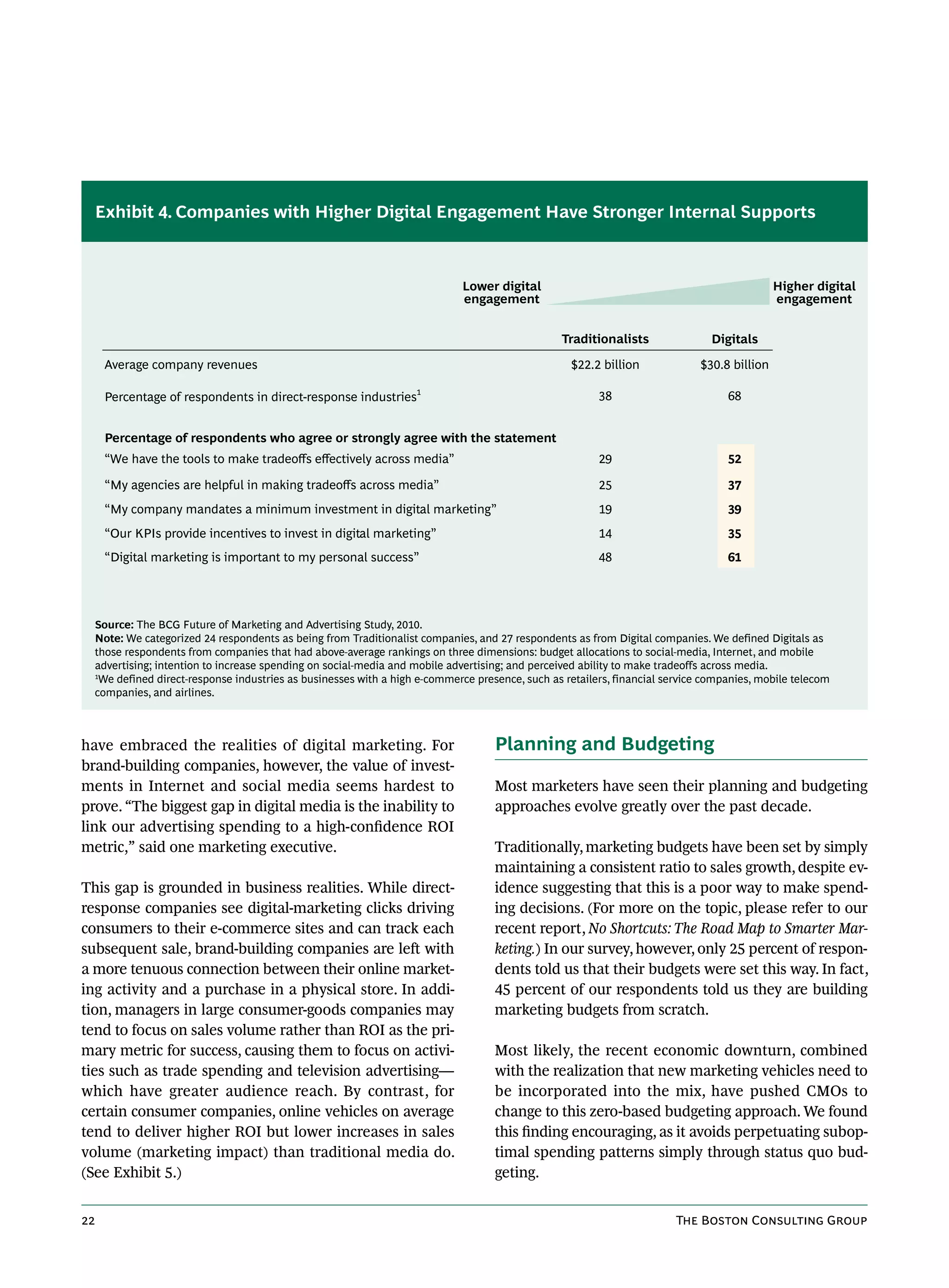
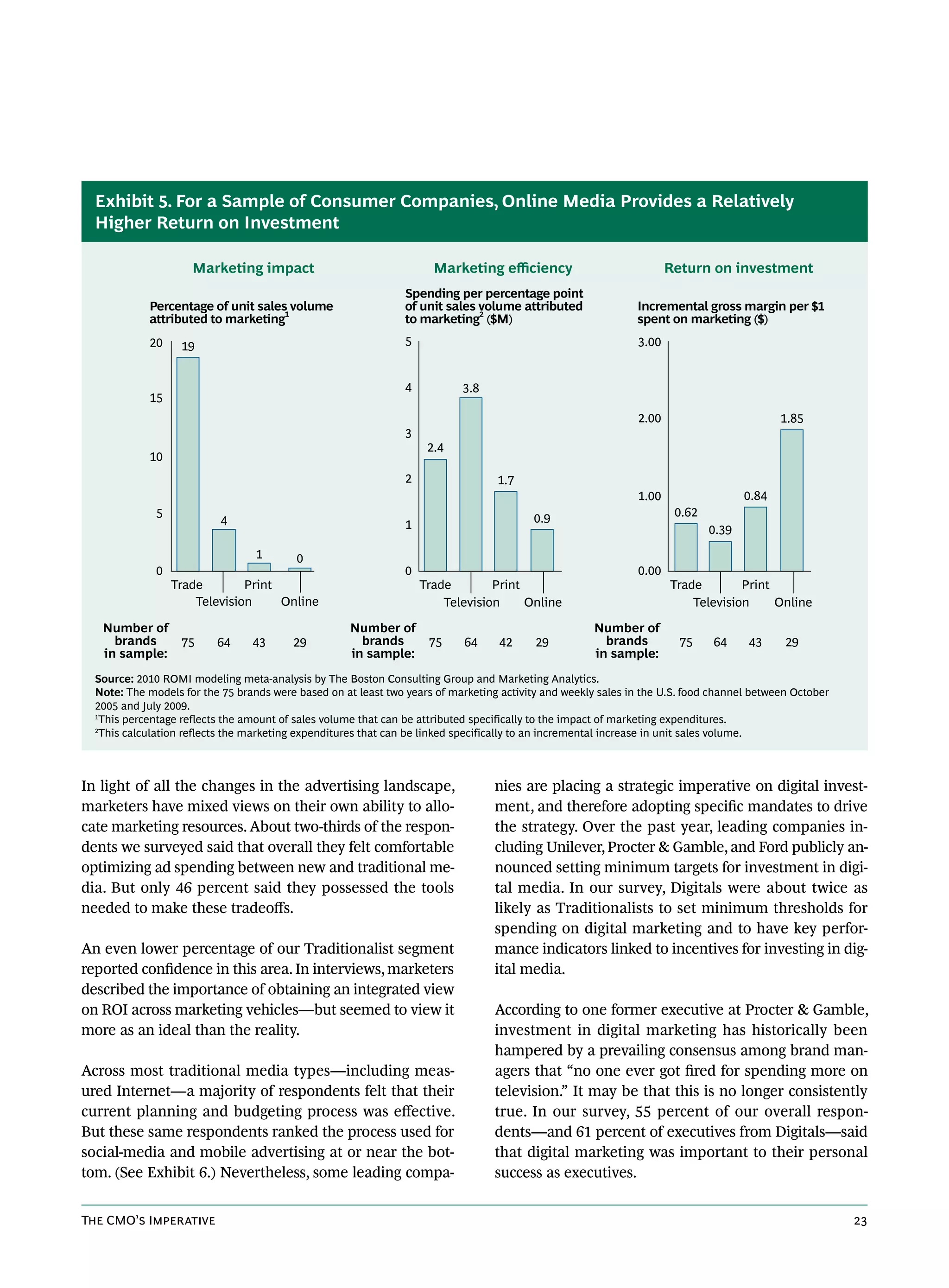
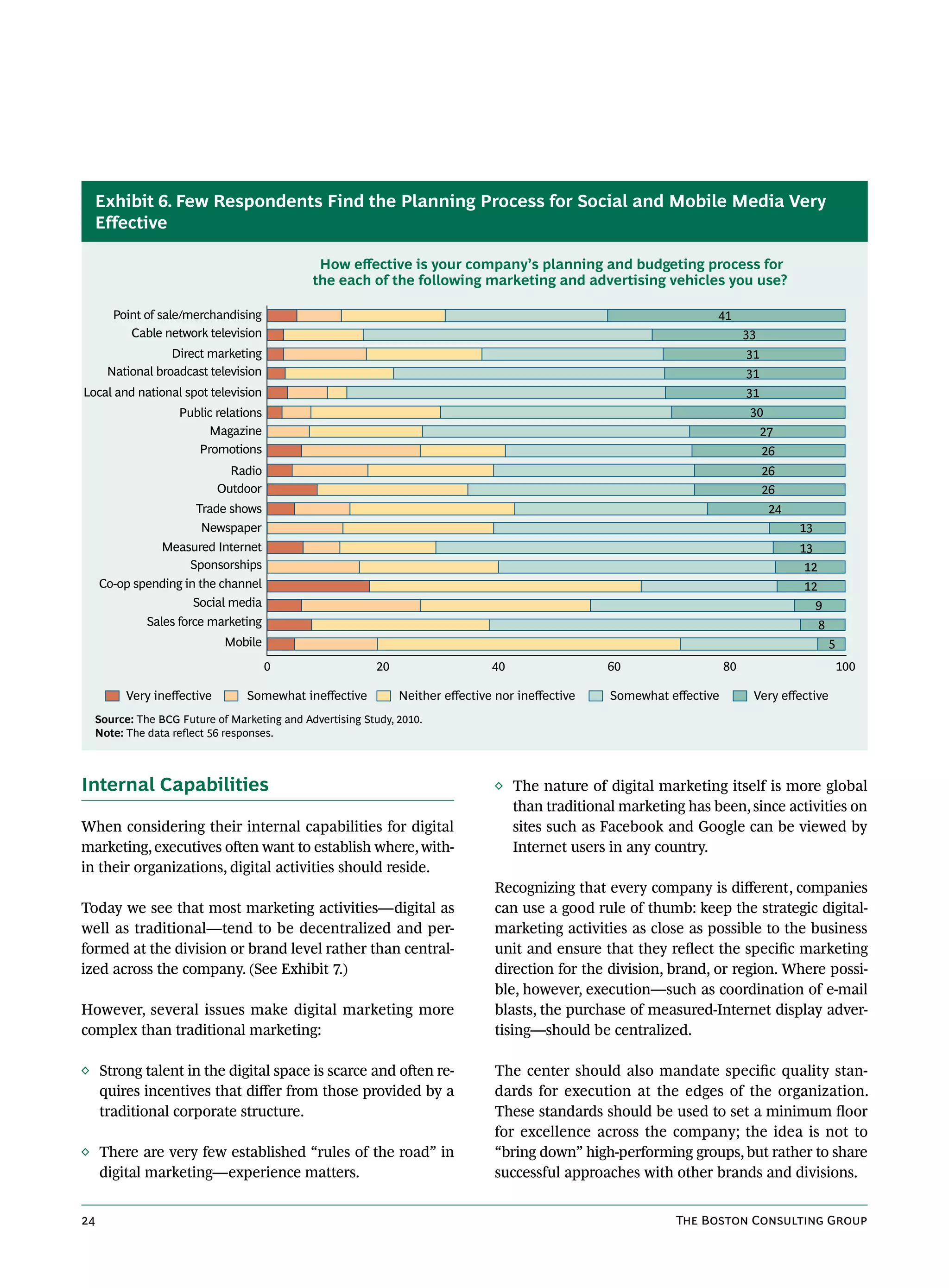
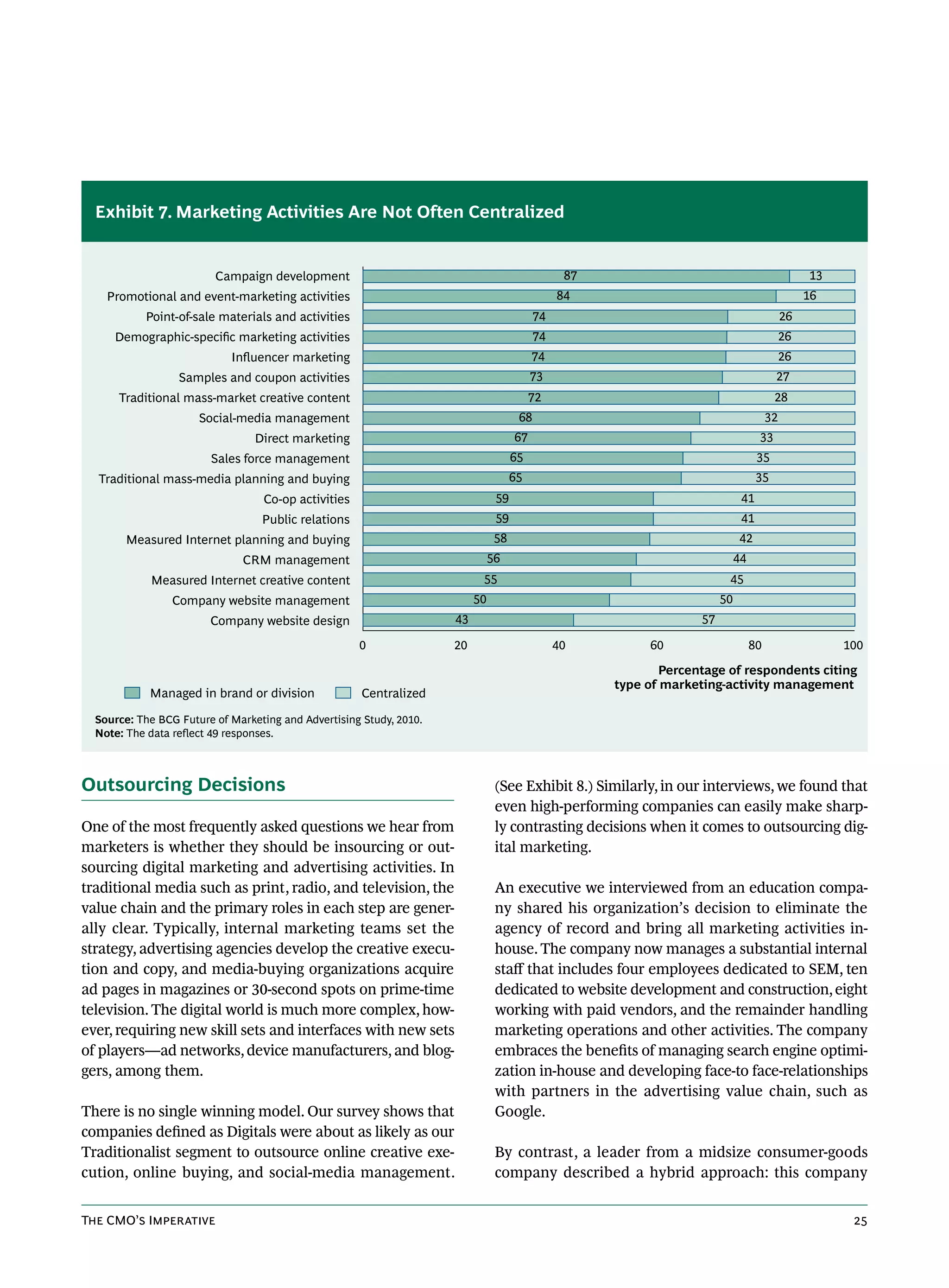
Planning and Budgeting                           22
Internal Capabilities                            24
Outsourcing Decisions                            25
Agency Navigation                                26

Launch Your Mission                              28

For Further Reading                              32

Note to the Reader                               33


The CMO’s Imperative                              3
Executive Summary


N
                 ew digital media—including online video,        ◊ The balance of investment is shifting as companies
                 social media, and mobile advertising—are          spend less on media purchases and more on labor-in-
                 transforming the marketing landscape. The         tensive tasks such as managing digital content.
                 Boston Consulting Group has spoken to doz-
                 ens of chief marketing officers (CMOs) and      As the list of digital-marketing options grows, compa-
other leaders who realize that 50 years of marketing-man-        nies are reshaping their media expenditures.
agement approaches must change dramatically. These mar-
keters don’t need a call to action. Rather, they are actively    ◊ Newer digital media are finally meeting marketers’
seeking to build a twenty-first-century marketing capability       main criteria for investment: scale, audience targeting,
that can navigate whatever comes next.                             standards, a common marketplace (for the buying and
                                                                   selling of ads), and measurement.
In this report, BCG offers new insight derived from The BCG
Future of Marketing and Advertising Study, 2010, which en-       ◊ Dollars are actively shifting to digital media: around
compasses a quantitative survey of marketing executives, one-      90 percent of our survey respondents expect to spend
on-one industry interviews, and benchmarking research. This        more on Internet, social-media, and mobile advertis-
report is a follow-up to our 2009 White Paper, The CMO’s Di-       ing over the next three years.
lemma: Can You Reach the Masses Without Mass Media? It
is also the second release in our new Marketing in the Digital   ◊ However, traditional media—in particular, television—
Economy publication series. Over time, this series will exam-      still garner the majority of spending and will for years
ine a variety of digital-marketing topics: word-of-mouth ad-       to come.
vocacy, digital listening, organizational capabilities, multi-
channel implications, and more.                                  Making the right tradeoffs across digital- and tradi-
                                                                 tional-marketing vehicles today depends on under-
After years of evolutionary change, emerging digital             standing how each media category will evolve.
media have brought marketing communications to a
breakpoint.                                                      ◊ Companies have been surprisingly quick to adopt so-
                                                                   cial-media vehicles such as Facebook, Twitter, and You-
◊ The new watchwords for marketers are transparency,               Tube as part of their media mix. But there are real risks
  authenticity, and engagement—a significant change                if companies execute poorly in these areas. Companies
  from centrally created, custom-crafted broadcast mes-            are starting to build better internal capabilities to deal
  sages.                                                           with the specific challenges of social-media marketing.

◊ The sheer complexity of marketing vehicles and                 ◊ Mobile advertising, long a fixture of advanced markets
  the rapid pace of changes in the field are overwhelm-            such as Japan, is finally beginning to realize its poten-
  ing the traditional approaches to marketing man-                 tial in Western countries. More than 80 percent of sur-
  agement.                                                         vey respondents plan to increase their spending on


4                                                                                             The Boston Consulting Group
mobile advertising, albeit from a very small base. Driv-   ◊ Although all marketing activities tend to be decentral-
  ers of growth include the proliferation of smartphones,      ized today, marketers shared sincere ambivalence
  the development of advertising marketplaces, and a           about the best organizational “home” for digital activ-
  host of new start-ups. Now is the time to take these         ities.
  media seriously.
                                                             No one has yet developed the winning formula—but
◊ Television still remains one of the few mass-marketing     some patterns are emerging that suggest how compa-
  vehicles that can reach millions of consumers at once.     nies could build their digital capabilities.
  But the shift from traditional television viewing to on-
  line video viewing will happen more quickly than           ◊ The executives in our survey who were most commit-
  many observers expect, as Internet-connected televi-         ted to digital marketing share several traits in com-
  sions roll out over the next few years. Marketers must       mon. Their companies establish minimum levels for
  rethink their approaches to traditional television—and       digital investment firmwide and possess the tools re-
  experiment actively with online video.                       quired to make tradeoffs across media vehicles. And
                                                               they believe that digital marketing is important to
◊ Print media stand at a crossroads. While print has lost      their personal success.
  a massive share of ad spending to the Internet, tablets
  and e-readers offer some hope for the future—at least      ◊ To lower barriers to digital investment, brand-building
  for magazines. As the ecosystem of tablet advertising        businesses (such as those in the food and beverage
  begins to form, marketers and the publishing industry        sector) may need to rethink their emphasis on metrics
  must work together to help shape the future.                 that track short-term increases in volume sales. They
                                                               will also need to look at return on investment (ROI),
◊ Measured Internet media, such as search and display          customer engagement, and word-of-mouth referrals.
  advertising, is among the more stable categories now.
  True, online targeting technologies have improved          ◊ A good rule of thumb is to develop digital-marketing
  somewhat ahead of marketers’ abilities to utilize            strategies as closely as possible to the business unit.
  them—and they raise some privacy concerns. But lead-         The center, however, should own standards of excel-
  ing companies are increasing their allocation to meas-       lence, best-practice sharing, and the basics of techni-
  ured Internet ads and cautiously taking advantage of         cal execution (such as the coordination of e-mail
  the new opportunities to target consumers.                   blasts).

Marketers understand the urgency to adopt digital            Instead of trying to guess the perfect marketing mod-
media—but need answers on many issues including              el in a fluid landscape, companies need to think about
optimizing spending, budgeting, organizing, and nav-         maintaining maximum flexibility and adaptability.
igating agencies.
                                                             ◊ A more dynamic approach to strategy—one that em-
◊ Only 46 percent of our respondents said they have            phasizes iterative experimentation in order to keep
  the tools required to make tradeoffs across media ve-        pace with incessant change—delivers what BCG calls
  hicles.                                                      “adaptive advantage.”

◊ Respondents were comfortable with their companies’         ◊ To determine what works, companies should start by
  planning approaches for most media vehicles, but they        piloting a 360-degree digital-marketing plan for a
  ranked planning processes for social-media and mo-           brand or category in a single region. Experimentation,
  bile advertising at or near the bottom.                      at this point, is preferable to inaction.

◊ Only about one-third of our survey respondents said        ◊ Over the next five years, we anticipate a significant
  they felt their advertising agencies were helpful in         skills-based battle to define the next generation of
  making the right tradeoffs between digital and tradi-        marketing leadership. Your company can’t stay on the
  tional media.                                                sidelines.


The CMO’s Imperative                                                                                                5
About the Authors                                             managing director in the firm’s Copenhagen office and
Ed Busby is a partner and managing director in the New        global leader of BCG’s marketing topic. You may contact
York office of The Boston Consulting Group and leader of      him by e-mail at harsaae.jens@bcg.com. John Rose is a
The BCG Future of Marketing and Advertising Study,            senior partner and managing director in the firm’s New
2010. You may contact him by e-mail at busby.ed@bcg.          York office, global leader of the Media sector for BCG’s
com. Dominic Field is a partner and managing director         Technology, Media & Telecommunications practice, and
in the firm’s Los Angeles office and U.S. leader of the Me-   global leader of the firm’s special iniative on conver-
dia sector for BCG’s Technology, Media & Telecommuni-         gence. You may contact him by e-mail at rose.john@bcg.
cations practice. You may contact him by e-mail at field.     com. Henri Salha is a partner and managing director in
dominic@bcg.com. Patrick Forth is a senior partner and        the firm’s Paris office and global leader of BCG’s Internet
managing director in BCG’s Sydney office and leader of        Advantage topic. You may contact him by e-mail at salha.
the firm’s Technology, Media & Telecommunications             henri@bcg.com.
practice in Asia-Pacific. You may contact him by e-mail at
forth.patrick@bcg.com. Jens Harsaae is a partner and


6                                                                                         The Boston Consulting Group
Back to the Future


I
       magine the year is 1960. In the United States,         the early days of television, is that no one yet has the for-
       there are only three television networks: NBC,         mula for success. In addition, the challenge now is even
       CBS, and ABC. Most programs are still broadcast        tougher than it was then.
       live and sponsored by advertisers. The now-ubiq-
       uitous “30-second spot” has yet to be standard-        To develop a snapshot of current changes and future
ized as an ad unit. Radio is still a powerful force.          plans, The Boston Consulting Group launched The BCG
                                                              Future of Marketing and Advertising Study, 2010. We
Marketing in this era seems simple and straightforward        tapped into the views of almost 100 industry experts,
to us today, but for consumer marketing companies and         leaders at advertising agencies, and marketing executives
for Madison Avenue’s ad agencies then (currently show-        across industry sectors. We conducted a quantitative
cased in the popular Mad Men series on cable television),     survey, one-on-one interviews, and research on best prac-
it was not. Television was an emerging medium, not yet        tices.1
found in every home. No one knew how television would
evolve, or which advertising formats would break through.     While our participants were based primarily in the Unit-
Marketers had limited syndicated data—from The Niels-         ed States, the study has relevance for all global compa-
en Company or elsewhere—to guide decision making.             nies, and our work includes many examples from other
However, some companies, such as Procter & Gamble,            regions. The findings help to scope the current media
worked closely with their ad agencies and took bold steps     landscape, anticipate what’s coming next, and under-
to invest in new and untested brand building via televi-      stand how companies are reallocating budgets and build-
sion. Even amid massive uncertainty, they shifted market      ing capabilities to prepare for the future.
share and created powerful brand positions, setting the
foundation for 50 years of competitive advantage.             After 50 years of evolutionary change, BCG’s analysis
                                                              shows, we are at a breakpoint in marketing communica-
Today, some companies are shifting their spending from        tions.
television and traditional media to Facebook, blogs, and
their own purpose-built websites. They are experiment-        The watchwords of the new marketing environment
ing with advertising on computer tablets and with loca-       are transparency, authenticity, and engagement. This
tion-specific mobile targeting. What’s more, consumers        shift represents a significant change over centrally creat-
are having real-time online conversations with one an-        ed, custom-crafted broadcast messages. Digital-marketing
other about marketers’ products and messaging.                vehicles enable interactive communication: between
                                                              marketers and consumers (sending messages down the
In short, we believe that it is 1960 all over again. Those
marketers that figure out not only how to use the new         1. We had 56 survey respondents and interviewed 45 experts from
tools but also how to integrate them with traditional me-     various types of companies including advertisers, venture capital
                                                              firms, media firms, and ad networks. Most of the respondents and
dia will build brands and shift market share just as in the   experts worked in the United States; however, many represented
days of the gurus of Madison Avenue. The problem, as in       multinational companies with global experience.


The CMO’s Imperative                                                                                                         7
historic one-way path); between consumers and advertis-                                                                                                        or externally. Advertisers are struggling to integrate func-
ers (engaging in a dialogue); and among consumers (com-                                                                                                        tional capabilities within brand teams; agencies and spe-
menting on and calibrating the messages being received).                                                                                                       cialty third-party service providers are struggling to pro-
Such interaction is changing the nature of marketing                                                                                                           vide integrated advice and services.
communications from crafting one-to-many brand mes-
sages to curating conversations about the brand among                                                                                                          Companies are shifting the balance between internal
consumers.                                                                                                                                                     and external spending on marketing. Managing an ef-
                                                                                                                                                               fective communications program in a real-time, interac-
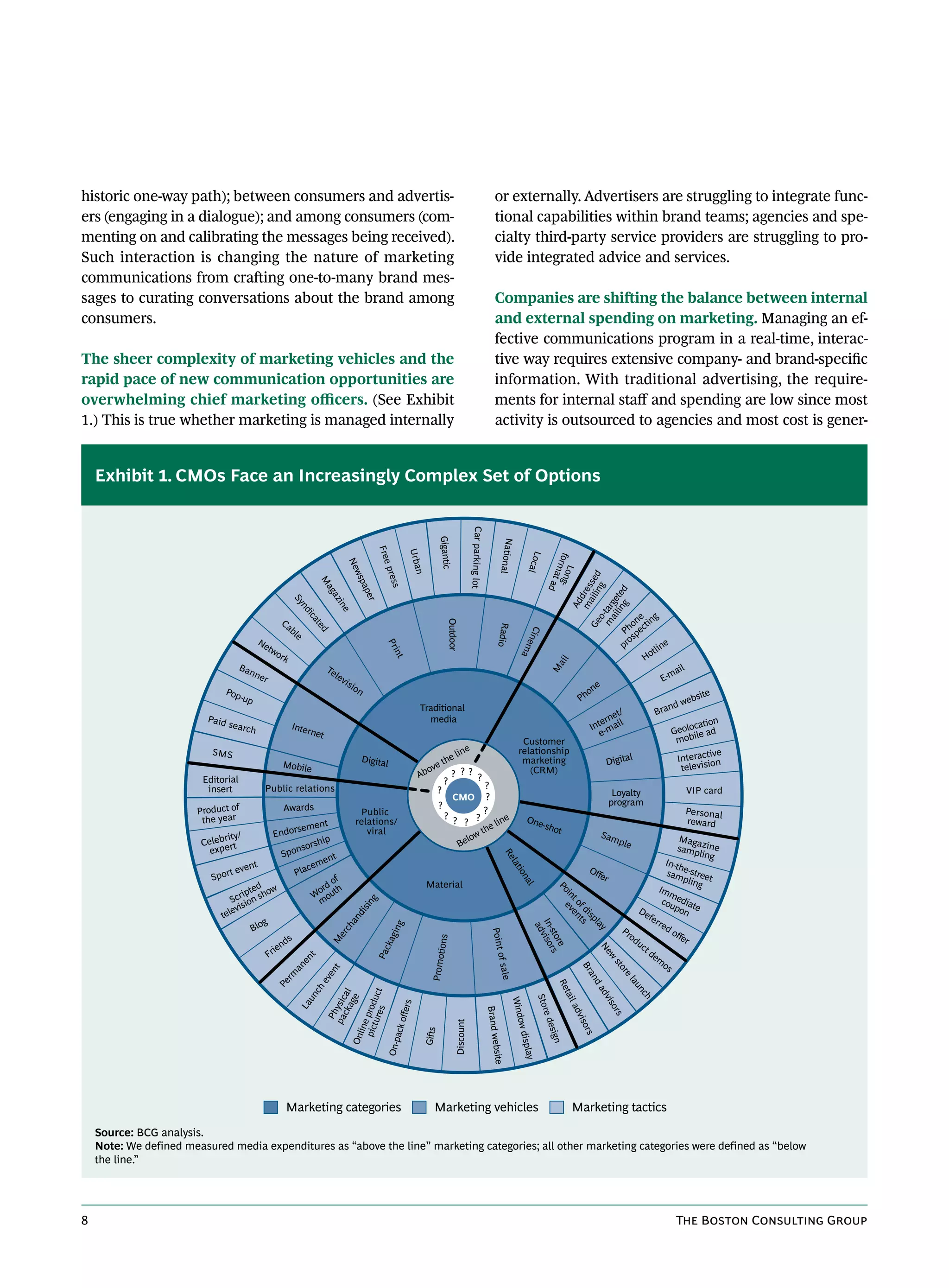
The sheer complexity of marketing vehicles and the                                                                                                             tive way requires extensive company- and brand-specific
rapid pace of new communication opportunities are                                                                                                              information. With traditional advertising, the require-
overwhelming chief marketing officers. (See Exhibit                                                                                                            ments for internal staff and spending are low since most
1.) This is true whether marketing is managed internally                                                                                                       activity is outsourced to agencies and most cost is gener-


    Exhibit 1. CMOs Face an Increasingly Complex Set of Options                                                                         Car parking lot
                                                                                                                  Gigantic


                                                                                                                                                                   National
                                                                           Free


                                                                                                      Urba


                                                                                                                                                                               Loca

                                                                                                                                                                                       formong-
                                                                              Ne


                                                                                                                                                                                          L
                                                                                pres


                                                                                                                                                                                   l
                                                                                                          n


                                                                                                                                                                                            at a
                                                                                 ws


                                                                                                                                                                                                      ilin sed
                                                       M


                                                                                   pap


                                                                                                                                                                                                          g
                                                                                     s


                                                                                                                                                                                                d


                                                                                                                                                                                                   madres
                                                         ag


                                                                                                                                                                                                  in ted
                                                           az


                                                                                       er
                                                            Sy


                                                                                                                                                                                               ail ge
                                                                                                                                                                                                   Ad
                                                              in


                                                                                                                                                                                                    g
                                                               nd


                                                                                                                                                                                             m -tar
                                                                 e


                                                                                                                                                                                                                     e g
                                                                   ica


                                                  Ca                                                                                                                                                               on tin
                                                                                                                                                                                               o
                                                                                                                      Outdoor


                                                                                                                                                                                             Ge


                                                     bl                                                                                                                                                         Ph pec
                                                                      te


                                                                                                                                                                 Radio


                                                                                                                                                                              Cin


                                                       e
                                                                        d


                                           Ne                                                                                                                                                                     os
                                                                                                                                                                                                                pr           e
                                                                                                                                                                                 em


                                             tw                                                                                                                                                                          tlin
                                                                                            Pr


                                               ork
                                                                                                                                                                                                                      Ho
                                                                                                int


                                                                                                                                                                                   a


                                                                                                                                                                                        ail


                                    Ba                            Te                                                                                                                                                          ail
                                      nne
                                                                                                                                                                                       M


                                            r                        le   vis                                                                                                                                              E-m
                                                                                ion                                                                                                                     e
                              Pop                                                                                                                                                                     on                            ite
                                  -up                                                                                                                                                               Ph                          ebs
                                                                                                         Traditional                                                                                                        nd w
                                                                                                                                                                                                            et/          Bra
                          Paid                                                                             media                                                                                         ern l                    cation
                               s   earch               Inter
                                                            net                                                                                                                                       Int -mai               Geoloile ad
                                                                                                                                                                                                         e
                                                                                                                                       Customer                                                                               mob
                                                                                                                       e              relationship
                           SMS                                                                                     lin                                                                                                                    ive
                                                                                      Digital                  the                     marketing                                                            Digita
                                                                                                                                                                                                                  l              Interact on
                                                   Mobile                                                                                                                                                                         televisi
                                                                                                           ove ? ? ?                     (CRM)
                         Editorial                                                                      Ab                 ?
                                                                                                               ?              ?
                          insert            Public relations                                                 ?                                                                                                Loyalty               VIP card
                                                                                                                  CMO ?
                                                                                                             ?                                                                                               program
                        Product of                 Awards                         Public                                      ?                                                                                                     Personal
                         the year                                                                               ?
                                                            t                    relations/                       ? ? ?          lin
                                                                                                                                    e   One                                                                                         reward
                                                     emen                                                                    the
                                                                                                                                            -sho
                              rity/          Endors                                 viral
                                                                                                                        low
                                                                                                                                                t                                                       Sam                      Maga
                         Celeb ert                      rshi
                                                            p                                                       Be                                                                                         ple
                           exp                     nso                                                                                                                                                                           samp zine
                                               Spo            nt
                                                                                                                                                                                                                                       ling
                                                                                                                                                                     Re


                                        t              ce me                                                                                                                                                                 In-th
                                 even
                                                                                                                                                                       lat


                            port                   Pla                                                                                                                                                Off
                                                                                                                                                                                                        er                   same-stree
                                                                                                                                                                          ion


                           S                                   of                                                                                                                                                                  plin t
                                                                                                              Material                                                                                                                 g
                                       ed                 ord h
                                                                                                                                                                             al


                                                                                                                                                                                                                           Im
                                    ipt how              W out
                                                                                                                                                                                         Po


                                                                                                                                                                                                                              m
                                Scr ion s                                                                                                                                                                                   cou ediat
                                                                                                                                                                                           in ev


                                                           m
                                                                                               g


                                   s
                                                                                                                                                                                             t o en


                                evi                                                                                                                                                                                             pon e
                                                                                            sin


                                                                                                                                                                                                                    De
                             tel
                                                                                                                                                                                                f d ts


                                                                                                                                                                                                                       fer
                                                                                          di


                                                                                                                                                                                                   isp


                                          g                                                                                                                                                                                red
                                                                                        an


                                       Blo
                                                                                                                                                                                In- viso
                                                                                        g


                                                                                                                                                                                                               Pr
                                                                                                                                                                                                      la
                                                                                                                                                                                 ad
                                                                                      ch


                                                                                                                                                                                                                               off
                                                                                    gin


                                                                                                                                                                                                        y


                                                                                                                                                                                                                 od
                                                                                                                                                             Point


                                                                                                                                                                                   sto rs


                                                ds                                                                                                                                                                                er
                                                                                   er


                                                                                                                     ons


                                                                                                                                                                                                                   uc
                                                                                  M


                                                                               c ka


                                             ien
                                                                                                                                                                                      re


                                                                                                                                                                                                                     td
                                           Fr
                                                                                                                                                                          Ne


                                                                                                                                                                                                                        em
                                                                                                              Promoti
                                                                            Pa


                                                                                                                                                                   o
                                                                             t


                                                                                                                                                                            w
                                                                           en


                                                                                                                                                                                                                            os
                                                                                                                                                                 f sale


                                                                                                                                                                              sto
                                                                        an


                                                                                                                                                                               Br
                                                                         t
                                                                       en


                                                                                                                                                                                 re
                                                                      rm


                                                                                                                                                                                  an
                                                                     ev


                                                                                                                                                                                    la
                                                                    Pe


                                                                                                                                                                                     Re


                                                                                                                                                                                     da


                                                                                                                                                                                      un
                                                                  ch


                                                         ure uct
                                                           ck a l


                                                                                                                                                                                        tai


                                                                                                                                                                                        dv


                                                                                                                                                                                         ch
                                                               un


                                                                                                                                                                                          Stor
                                                                e
                                                        pa ysic


                                                                                                                                                                                          Wind
                                                              ag


                                                                                                                                                                                           iso
                                                          ffers


                                                                                                                                                                                            la
                                                     pict prod
                                                             La


                                                                                                                                                          Brand web
                                                            s


                                                                                                                                                                                               dvi


                                                                                                                                                                                               rs
                                                          Ph


                                                                                                                                                                                               e de
                                                    ack o


                                                                                                                                                                                                  ow dis
                                                                                                                             Discount
                                                      ine


                                                                                                                                                                                                   sor
                                                                                                         Gis


                                                                                                                                                                                                     sign
                                                  Onl


                                                                                                                                                                                                       s
                                                On-p


                                                                                                                                                                                                         play
                                                                                                                                                                   site


                                                    Marketing categories                                        Marketing vehicles                                                            Marketing tactics
    Source: BCG analysis.
    Note: We defined measured media expenditures as “above the line” marketing categories; all other marketing categories were defined as “below
    the line.”


8                                                                                                                                                                                                                                The Boston Consulting Group
ated by the purchasing of media. In the new world, com-         formance. The mission control center allows Gatorade to
panies invest less in media purchasing and more in devel-       identify conversations in progress and proactively engage
oping content and maintaining customer dialogue—and             in discussions with consumers.
the cost of managing and updating digital content can be
high, whether companies outsource it or manage it them-         Companies outside traditional consumer goods are also
selves. For example, while some companies assign their          building their social-marketing capabilities. Even main-
public relations firms or digital agencies responsibility for   stream banking firms such as Wells Fargo and Bank of
maintaining a brand’s Facebook presence, others view            America actively leverage social media with activities
this as a critical brand touchpoint to be controlled inter-     that include soliciting user-generated product reviews on-
nally.                                                          line, providing customer service on Twitter, and develop-
                                                                ing online communities for small business owners.
Take the example of the beverage brand Gatorade, which
has made significant investments in social media and dig-       Chief marketing officers (CMOs) are tackling a critical
ital listening (monitoring consumers’ online comments).         mission: transition from the marketing organization that
Gatorade maintains an actual “mission control” center in        worked in 1960 to a twenty-first-century marketing capa-
its Chicago headquarters, featuring a panel of screens          bility that can navigate the future. To pursue this goal,
reminiscent of NASA. Relying on five full-time marketing        companies are taking widely different approaches, even
employees, the company tracks a wide variety of conver-         within the same industries. Some best practices, however,
sations through blogs and Twitter conversations, online-        are starting to emerge.
media performance, sports trends, and social-media per-


The CMO’s Imperative                                                                                                    9
An Inflection Point
                                                    Why Now?


A
              s digital-marketing options expand, com-         Scale. Digital vehicles are finally reaching the point at
              panies are reshaping their media expen-          which they deliver sufficient reach with targeted audi-
              ditures—and reshaping them so pro-               ences. Before CMOs in most major corporations are will-
              foundly that we can no longer accurately         ing to invest heavily in a medium, they need to be able
              project spending trends based on the past        to reach 40 to 60 percent of the target population through
five decades of experience.                                    that medium. They can accomplish their goals today
                                                               through most online display advertising and through
We expect that traditional spending on above-the-line          some social media, such as Facebook, with its 500 mil-
(mass-market) “measured media” will not continue its           lion global members. In order to experiment with new
past pattern of rising and falling in sync with the econo-     media, however, CMOs may require a minimum reach of
my. Instead, as developed markets continue their slow re-      only 1 million to 5 million adults—as long as there is a
covery, we believe overall ad spending will anchor near        visible path to broader reach in the near future. Mobile
current levels and grow at a lower rate than it historically   advertising and other social media are beginning to hit,
has. Companies will permanently replace big-dollar ad          and in some cases vastly exceed, these thresholds.
purchases in television and print media with less-expen-
sive, unmeasured investments in digital media. And they        Targeting. The clear advantage in audience targeting
will reallocate marketing budgets from media spending          goes to online and mobile media, since, compared with
to spending on the head count and technology needed to         traditional media, they offer marketers access to more so-
support digital marketing in-house.                            phisticated, context-driven, and location-driven targeting.
                                                               Traditional media such as television and print have got-
The marketing executives we surveyed cited decisive            ten by for a long time with targeting that is based on sim-
plans to increase spending in social-media, measured In-       ple demographics linked to the type of content, but mar-
ternet, and mobile advertising over the next three years.2     keters are starting to see the advantages of trading broad
The move to these categories will come at the expense of       reach for deeper relevance.
print newspaper and magazine advertising, and, to some
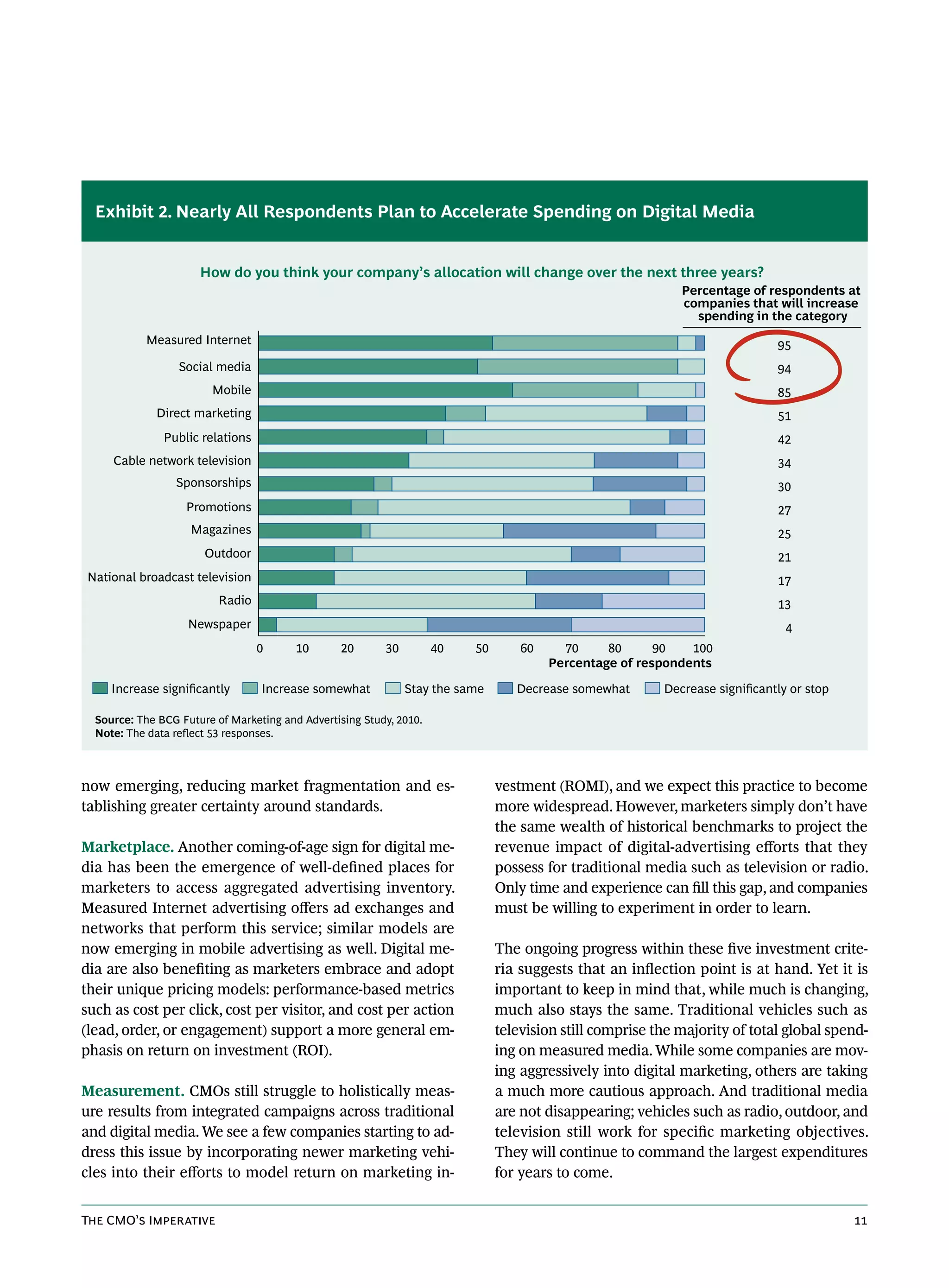
extent, traditional television advertising. (See Exhibit 2.)   Standards. As technologies, formats, and ad-serving
Few of the executives we surveyed are ignoring social          mechanisms in mobile advertising mature, the barriers to
media: at least 80 percent—and as much as 90 percent—          marketer commitment will fall. The lack of standards for
of our survey respondents told us they are using, experi-      ad units and creative formats, such as standard sizes for
menting with, or planning to try social-network and viral      banner-ad displays, has hindered the development of mo-
marketing.                                                     bile advertising. However, a few smartphone winners are

Why has this shift become more pronounced? What’s re-
ally changed? In fact, a number of marketers’ criteria for     2. Measured Internet advertising refers to traditional online-adver-
                                                               tising spending that is tracked by third-party research firms. It in-
investing in emerging marketing vehicles—such as social        cludes online search advertisements and display ads—such as ban-
media and mobile—have finally been reached:                    ners, videos in static webpages, and pop-up ads.


10                                                                                              The Boston Consulting Group
Exhibit 2. Nearly All Respondents Plan to Accelerate Spending on Digital Media


                      How do you think your company’s allocation will change over the next three years?
                                                                                                             Percentage of respondents at
                                                                                                             companies that will increase
                                                                                                               spending in the category
            Measured Internet                                                                                                 95
                  Social media                                                                                                94
                        Mobile                                                                                                85
             Direct marketing                                                                                                 51
               Public relations                                                                                               42
     Cable network television                                                                                                 34
                 Sponsorships                                                                                                 30
                   Promotions                                                                                                 27
                    Magazines                                                                                                 25
                       Outdoor                                                                                                21
National broadcast television                                                                                                 17
                          Radio                                                                                               13
                    Newspaper                                                                                                  4
                                  0      10       20      30         40   50       60     70     80      90   100
                                                                                        Percentage of respondents

     Increase significantly        Increase somewhat            Stay the same      Decrease somewhat       Decrease significantly or stop

  Source: The BCG Future of Marketing and Advertising Study, 2010.
  Note: The data reflect 53 responses.


now emerging, reducing market fragmentation and es-                            vestment (ROMI), and we expect this practice to become
tablishing greater certainty around standards.                                 more widespread. However, marketers simply don’t have
                                                                               the same wealth of historical benchmarks to project the
Marketplace. Another coming-of-age sign for digital me-                        revenue impact of digital-advertising efforts that they
dia has been the emergence of well-defined places for                          possess for traditional media such as television or radio.
marketers to access aggregated advertising inventory.                          Only time and experience can fill this gap, and companies
Measured Internet advertising offers ad exchanges and                          must be willing to experiment in order to learn.
networks that perform this service; similar models are
now emerging in mobile advertising as well. Digital me-                        The ongoing progress within these five investment crite-
dia are also benefiting as marketers embrace and adopt                         ria suggests that an inflection point is at hand. Yet it is
their unique pricing models: performance-based metrics                         important to keep in mind that, while much is changing,
such as cost per click, cost per visitor, and cost per action                  much also stays the same. Traditional vehicles such as
(lead, order, or engagement) support a more general em-                        television still comprise the majority of total global spend-
phasis on return on investment (ROI).                                          ing on measured media. While some companies are mov-
                                                                               ing aggressively into digital marketing, others are taking
Measurement. CMOs still struggle to holistically meas-                         a much more cautious approach. And traditional media
ure results from integrated campaigns across traditional                       are not disappearing; vehicles such as radio, outdoor, and
and digital media. We see a few companies starting to ad-                      television still work for specific marketing objectives.
dress this issue by incorporating newer marketing vehi-                        They will continue to command the largest expenditures
cles into their efforts to model return on marketing in-                       for years to come.


The CMO’s Imperative                                                                                                                      11
Change on Every Front


M
                 aking the right tradeoffs across market-    years. A few pioneering companies, such The LEGO
                 ing vehicles today depends on under-        Group in Europe, can point to social-marketing efforts as
                 standing how each media category will       a cornerstone of recent successes. (See the sidebar “Trans-
                 evolve tomorrow. Does measured In-          forming Marketing Brick by Brick.”)
                 ternet advertising still have the capac-
ity to grow? Is mobile advertising finally poised to take    Across the social-media and marketing landscape, a few
off? Can tablets rescue print media? Is television dead?     social-media sites have emerged as the current front-
                                                             runners.
We hear very little agreement within the marketing com-
munity on these issues, even among the most successful       Facebook. Almost all the respondents in our survey said
business leaders. Few executives have a holistic and de-     that their companies have built a presence on Facebook.
tailed view of how the media landscape is changing in        The site now boasts 500 million users and extensive glob-
every key category, how various media are converging,        al reach. The social-networking site is translated into 60
and how the entire media ecosystem is likely to evolve in    languages and draws 70 percent of its users from outside
the future.                                                  the United States. Given its draw, advertisers feel unable
                                                             to sit on the sidelines, and CMOs are working Facebook
Some of the following findings may seem old hat to some      activities into integrated media campaigns. Facebook is
CMOs, but when considered collectively, they suggest the     now developing applications, games, and commerce en-
contours of the new world. We hope that many leaders         gines (such as Deals for Facebook Places) that expand op-
will want to engage broadly on the integrated perspec-       portunities for marketers.
tives that follow—and in such an uncertain space, we
hope that many different opinions will abound.               Twitter. Another ubiquitous social-network-marketing
                                                             opportunity is Twitter, which boasts more than 100 mil-
                                                             lion user accounts. Limited to 140-character messaging
Social Media                                                 bursts, Twitter is ideally suited for promotional activity
                                                             such as announcing new-product introductions and spe-
Companies have been surprisingly quick to begin experi-      cial events, driving word of mouth, and responding to
menting with and, in some cases, adopting as part of their   consumer complaints. Humphry Slocombe, a 14-seat ice-
media mix such social-media vehicles as social network-      cream shop in San Francisco, announces its new flavors
ing, viral videos on YouTube, blogs, and branded web-        in edgy and entertaining Tweets (one printable example:
sites. In our survey, 61 percent of the marketing execu-     “Oh Carrot Mango, I thought love was only true in fairy
tives we interviewed said that they were already             tales, meant for someone else but not for me”). These
experimenting with social media, and 27 percent had ad-      have gained the store more than 300,000 followers on
opted the vehicle as a core part of their media mix. More    Twitter, compared with fewer than 25,000 followers for
than 90 percent of executives in our survey planned to       national chains Dairy Queen and Baskin-Robbins com-
increase spending on these activities in the next few        bined.


12                                                                                       The Boston Consulting Group
Transforming Marketing Brick by Brick


  The LEGO Group is the owner of an iconic brand, a recipi-     ◊ The next stage of the journey features the launch of
  ent of multiple awards for marketing excellence. Yet, as        LEGO Universe, a multiplayer online world created to
  recently as 2004, the company was struggling. Since then,       offer fans from all over the globe opportunities to safe-
  under a dynamic, young leadership team, the company             ly build, play, and socialize together online.
  has accelerated out of the downturn stronger than ever.
  Transformation of marketing has been a key contributor        Although some of these initiatives may sound sophisticat-
  to its success.                                               ed, the company is acutely aware that digital integration
                                                                must not become a barrier to experiencing the brand. To
  Traditional marketing to children will continue to play a     succeed, it must balance aggressive expansion of digital
  crucial role, but The LEGO Group has increasingly made        media with continued exploitation of traditional media.
  social media, viral media, and networks an integral part of
  the mix. The purpose of the evolving approach is not          The LEGO Group considers internal capabilities a critical
  merely to add another medium but also to enhance the          asset on this continuing journey. The company seeks both
  experience of physical play and build brand loyalty. Creat-   to work with external partners and to develop internal re-
  ing platforms for communities also builds customer advo-      sources. Standard technical platforms are also critical.
  cacy for the brand.                                           Management of digital marketing has been fairly central-
                                                                ized until now, but it will increasingly become a distribut-
  ◊ Online mini-movies, featuring properties such as Star       ed capability.
    Wars and Indiana Jones, provide inspiration for play.
                                                                This experience illustrates how the new digital reality re-
  ◊ “Design byME” enables online users to design unique         quires a companywide perspective that fosters working
    products and ship them directly to their homes.             across functional silos to encompass traditional market-
                                                                ing strategy, product development, and supply chain ca-
  ◊ LEGO Club, with more than 3 million members, offers         pabilities.
    even very young aficionados access to the brand.

  ◊ Legoclick.com is an online community platform with
    posts, Tweets, and a link to an iPhone application.


YouTube. YouTube is one of the most popular websites             Groupon. Groupon became the most-visited coupon des-
in the world, with more than 2 billion views a day. Of           tination online in August 2010, with more than 6 million
the top 100 advertisers (as measured by Advertising Age),        unique visitors. The site combines elements of traditional
94 have run a campaign on the site. YouTube offers both          promotions, digital media, and social networking by en-
an advertising platform and—increasingly—a social-               couraging users to bring their friends on board. Groupon
networking opportunity through the active comments               has been embraced by major retail chains such as Gap,
section and extensive links with other social sites and          along with smaller local businesses. The number of on-
blogs. In September 2010, YouTube’s number-one spon-             line visits and redemption rates at Groupon are high, in
sor (measured by page views) was the skin care brand             part because consumers commit by purchasing coupons
Old Spice. The reason? The brand posted more than                up front.
100 customized video responses to individual user com-
ments taken from Facebook, Twitter, and blogs; each re-          In the emerging category of social media, we’ve observed
sponse was personally delivered by the actor playing the         a few best practices.
“Old Spice Guy” in television commercials. The cam-
paign has gained wide recognition as a best-practice             Listen to what consumers are saying. Companies have
illustration of social-network marketing: it deploys             shown they can gain valuable consumer input from on-
humor, rapid response, and personalized customer en-             line communities to drive innovation, customer service,
gagement and taps the viral nature of Internet commu-            and other critical operations. There is an increasing num-
nities.                                                          ber of tools to help companies monitor consumers’ con-


The CMO’s Imperative                                                                                                       13
versations on blogs, social networks, and other places on          tial marketing and ethical issues, companies that engage
the Internet.                                                      with customers via social media and blogs may face a
                                                                   real and increasing threat of legal action. Last year, the
Begin to (cautiously) curate conversations with con-               Federal Trade Commission issued guidelines that require
sumers. To take advantage of blogs and use them as a               companies to disclose “material connections” to bloggers,
marketing vehicle, marketers must adopt a new role in a            and the agency began initiating investigations against
dialogue, becoming the curators of consumers’ conversa-            companies that crossed into gray areas, such as offering
tions—participating, sparking discussion, and shaping              bloggers the opportunity to win prizes for their postings
positive word of mouth. Maintaining dialogues with and             without providing sufficient instructions about the need
among consumers is often a very resource-intensive activ-          for disclosure.
ity. These dialogues can also entail a degree of risk if they
are not monitored properly.
                                                                   Mobile Advertising
Integrate social media online with your offline strat-
egy. Both social media and blog conversations present              Mobile advertising is a fixture in some advanced markets,
excellent ways to amplify a brand, but it is quite difficult       such as Japan and South Korea. (See the sidebar “Mobile
to scale up efforts in these areas. Therefore, the most suc-       in Japan.”) However in the United States and Europe, mo-
cessful strategies integrate social-media initiatives with         bile telecommunications has long been known by most
other, more traditional media strategies to extend the             marketers as the medium whose future is always around
brand. Examples include using targeted television cam-             the corner yet never quite arrives. Mobile advertising en-
paigns to drive users to Facebook pages or linking spon-           compasses several categories of ad vehicles, including
sored events to social-media outlets.                              SMS/text messaging, mobile display and in-application
                                                                   advertising, promotional applications, and sponsored ap-
Ensure that conversations are authentic and trans-                 plications.
parent. Consumers demand honesty. In fact, in a survey
of 5,000 consumers that BCG conducted across five coun-            For most Western companies, mobile advertising has ac-
tries earlier this year, respondents selected transparency         counted for a very small percentage of the marketing
(from a list of 12 options) as the top priority for online         budget (typically less than 2 percent for our survey re-
advertising. In addition to exposing themselves to poten-          spondents) and often has been the first victim of budget


  Mobile in Japan


  Throughout much of the world, the mobile medium has             their food orders. McDonald’s can even push targeted
  been—up to now at least—an insignificant piece of the           coupons to the users based on their purchasing patterns.
  advertising puzzle. Not so in Japan, where mobile pay-
  ments have been used for about five years and have been         Another DoCoMo innovation is its i-concier offering, a mo-
  adopted by more than 20 percent of consumers. These             bile personal-assistant service that provides weather,
  payment technologies have several implications for ad-          transportation, sports, and, of course, coupons to more
  vertisers: they provide a wealth of targeting data; allow for   than 5 million users. With i-concier, users can customize
  point-of-purchase promotions and next-generation loyalty        their services and manage their loyalty programs in a way
  programs; and enable much better measurement of ROI             that minimizes unwanted spam. The service incorporates
  on mobile campaigns.                                            data from a variety of sources including user preferences
                                                                  and GPS location-based data to ensure that the right of-
  NTT DoCoMo has been one of the leaders in this space. In        fers are targeted to the right people.
  2007, the company created a joint venture with McDon-
  ald’s to manage McDonald’s mobile communications to
  its loyalty club, including e-coupons and mobile cam-
  paigns. Consumers can download coupons to their phones
  while waiting in line, and then use them when they place


14                                                                                             The Boston Consulting Group
cuts. Globally in 2009, the tracking service TNS reported        alty program that allows users to check into locations in
only $1.7 billion in expenditures on mobile advertising,         return for special promotions. Another example, Shop-
including both SMS and mobile display ads, compared              kick, launched its application earlier this year, enabling
with $182 billion spent on television advertising.               its users to receive special promotions depending on
                                                                 where they are in its retail partners’ stores. Most of these
We believe, however, that mobile media appear at long            applications are still in the very early stages of develop-
last to be coming of age, even in the United States. In fact,    ment, and it still is not clear who the winners and losers
more than 70 percent of survey respondents said they             will be. Even the success of Foursquare has been called
plan to increase their allocation to mobile advertising          into question after the launch of Facebook Places, the so-
over the next three years. As one participant explained,         cial-media giant’s competing platform.
“Mobile is a small area of our overall inventory, but it is
a big investment area.”                                          Some companies are even designing or sponsoring mo-
                                                                 bile applications of their own to appeal to consumers.
Growth in mobile advertising has been boosted by the             The most successful applications manage simultaneously
proliferation of smartphones. Now that there are more            to offer value to the consumer and closely reinforce brand
than 50 million smartphones in use in the United States,         equity. For example, Procter & Gamble’s Charmin part-
marketers are getting excited about mobile display, such         ners with Sit or Squat, an application that provides user-
as mobile banner ads, and in-application advertisements.         generated listings of public restrooms, complete with
These advertisements allow companies to deliver an in-           hours of operation and user ratings.
credibly rich media experience to consumers using very
specific targeting at the individual level, including geo-       Given this type of news-catching “sizzle” in the mobile-
specific, demographic, and even behavioral targeting.            advertising market, many marketers are still asking,
One major driver behind growth in mobile display adver-          “Where’s the steak?” Admittedly, the large-scale effective-
tising has been iAd—Apple’s mobile advertising network.          ness of mobile advertising is still largely unproven. But
(See the sidebar, “The $60 Million Experiment.”)                 given the recent developments, companies should con-
                                                                 sider a few critical steps:
Now, a host of new start-ups are taking advantage of the
uniquely mobile nature of the mobile device. The biggest         Revisit your segmentation. Mobile phones offer an in-
star has been Foursquare, the mobile application and loy-        credibly rich set of targeting options, including not only


  The $60 Million Experiment


  Earlier this year, Apple completed the acquisition (and       natural fit for coupons, promotions, and location-based
  subsequent closure) of Quattro Wireless, one of the larg-     services. However, it remains an open question whether
  est mobile ad networks in the United States. The compa-       the new displays and formats will be effective media for
  ny soon after announced the creation of iAd, an effort to     brand advertising. Progress has been cautious, as Apple,
  create more-effective mobile advertising to drive revenue     advertisers, and creative agencies learn to work together
  to its application developers.                                effectively on developing appropriate mobile campaigns.

  The new ad units would enable users to view ads without       If the results of this $60 million experiment are positive,
  leaving the applications and would feature very rich me-      several developments could finally take mobile advertis-
  dia. Apple attracted more than $60 million from premium       ing off the sidelines. First, advertisers experimenting now
  advertisers, each of which pledged a minimum of $1 mil-       have expressed a willingness to increase their commit-
  lion, for the second half of 2010—essentially doubling the    ments. Moreover, other advertisers will likely begin to
  size of the mobile display market.                            make greater use of these mobile ad vehicles. And we
                                                                would expect other ad-based platforms, such as Google’s
  The early demos have been visually impressive, but ques-      AdMob, to follow in iAd’s tracks to develop new types of
  tions remain about the relative effectiveness of these new    innovative ad inventory as well.
  ad vehicles. The mobile medium is widely perceived as a


The CMO’s Imperative                                                                                                      15
traditional demographics but also, in some cases, behav-          lions of consumers at once, making it ideal for awareness-
ioral and geographic targeting. Understanding how the             building campaigns.
primary target segments line up against your mobile-tar-
geting capabilities could have a dramatic impact on the           Several key challenges are emerging, however, to the pre-
effectiveness of your marketing programs.                         eminence of television media.

Begin a program of planned experimentation.                      Ad-skipping behavior by consumers is on the rise. Ac-
Because these are the early days of mobile                                       cording to Nielsen’s Three Screen Report for
media, it is not clear which programs will                                       the first quarter of 2010, 37 percent of U.S.
work—and which won’t. CMOs should be-
                                                     Mobile advertising          households now own digital video record-
gin investing to understand which pro-            may not be vital today,        ers (DVRs), representing an increase in
grams really “move the needle.” The first                                        adoption of 6 percent per year over the
                                                   but the learning curve
targets should be mobile-advertising vehi-                                       last two years. Media and reporting agen-
cles that take advantage of the unique na-          is steep—and it will         cies have tried to downplay this develop-
ture of the mobile phone: individual-level         take time to get right.       ment. For example, Nielsen’s numbers
targeting and GPS- and location-based pro-                                       claim that the time-shifted viewing of com-
motions such as coupons.                                                         mercials has remained steady, with about
                                                                 45 percent of commercials watched—even on DVRs.
Hire an expert. In the field of mobile advertising, solid
execution is both vital and very difficult. For example, an      The consumer audience is fragmenting. Of course,
advertisement may be rendered differently on different           consumers are dividing their time across a wider array of
devices. Messaging in mobile advertising is extremely im-        media—often viewing several media simultaneously. But
portant—limited space means that simple messages work            even within the array of television offerings in the United
best. Find an agency or hire someone internally who has          States, we see a “trifurcation” of the broadcast and cable
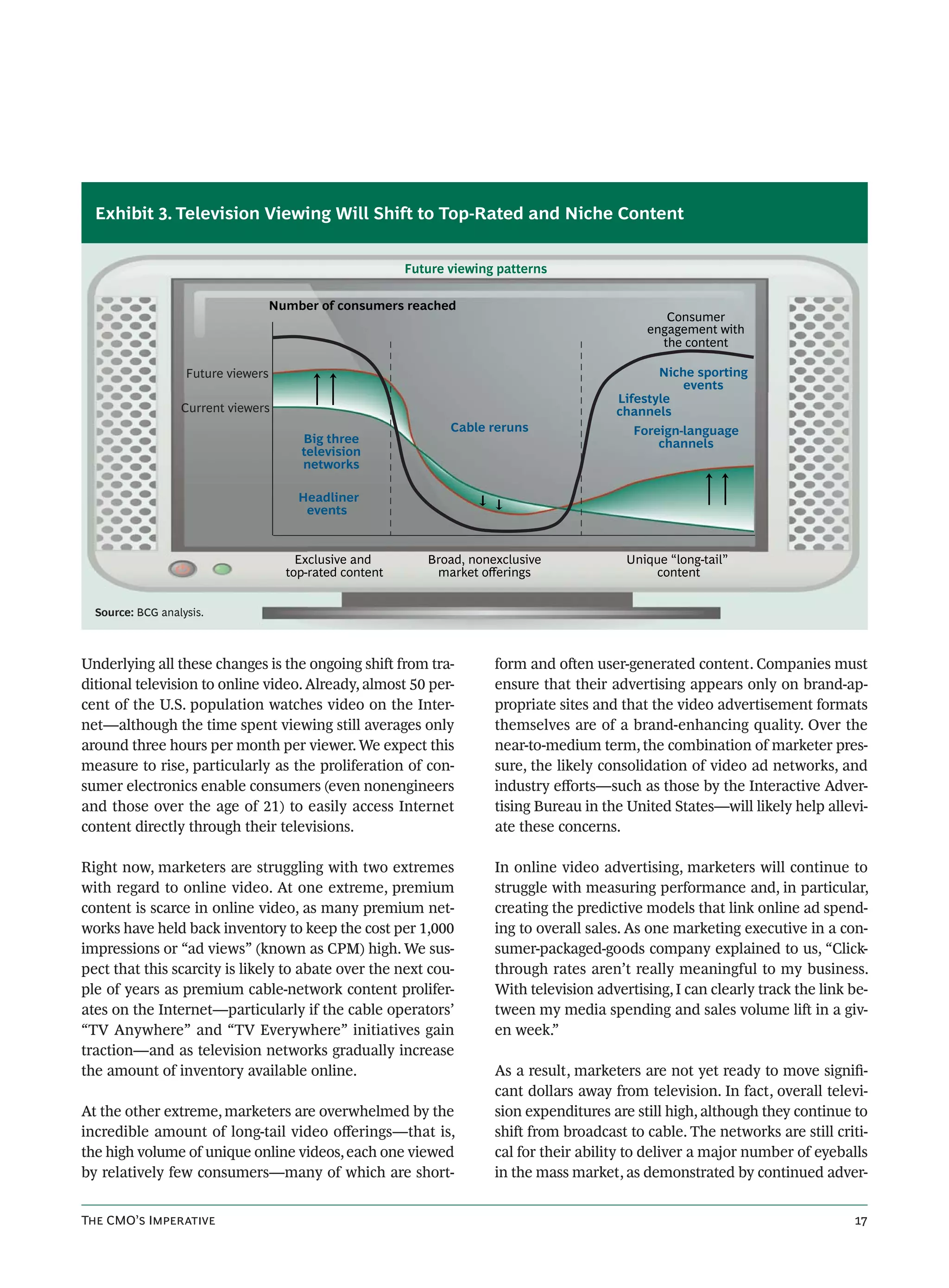
experience with these nuances.                                   world. (See Exhibit 3.) At one extreme, popular content is
                                                                 becoming even more popular, thanks in part to the abil-
Actively monitor developments in the market. The                 ity of consumers to time-shift viewing (although of course,
world of mobile advertising is very dynamic. New en-             this raises questions about whether ads placed in these
trants, new experiments, and new competitive moves               media are actually being watched). At the other extreme,
emerge almost every day, and many of these develop-              the explosion of niche content with high viewer engage-
ments could provide incredible opportunities for your            ment has helped attract those viewers at the long end of
marketing programs.                                              the tail. This will mean decreased viewing for the remain-
                                                                 ing “middle of the road” content; for example, far fewer
Winners and losers in the mobile-advertising market will         viewers will watch dated reruns of The Golden Girls.
begin shaking out over the next couple of years. And
while mobile advertising may not be vital today, the             Advertisers desire flexibility in spending. Television
learning curve is quite steep—and it will take time to get       “upfronts”—the annual ritual in which networks pitch
right. So now really is the time to begin these experi-          their lineup of new programs to advertisers in hopes of
ments if you hope to get a jump on your competitors.             selling ad inventory in advance—are becoming increas-
                                                                 ingly challenging to maintain. With audiences fragment-
                                                                 ing and new alternatives both on and off television aris-
Television and Online Video                                      ing practically on a daily basis, most marketers are not
                                                                 looking to make annual commitments many months out.
Television—the epitome of mass media—is under pres-              In fact, quite the opposite: savvy marketers expect to
sure, but it continues to offer many advantages for tradi-       evaluate their television ad campaigns in real time and
tional marketers. Television still accounts for more than        reallocate expenditures that are not achieving impact.
50 percent of global spending on measured media, mak-
ing it by far the largest media vehicle. It remains one of       Taking all the challenges into account, we expect televi-
the very few mass-marketing vehicles that can reach mil-         sion to undergo massive changes over the next five years.


16                                                                                             The Boston Consulting Group
Exhibit 3. Television Viewing Will Shift to Top-Rated and Niche Content


                                                          Future viewing patterns

                                    Number of consumers reached
                                                                                                   Consumer
                                                                                                engagement with
                                                                                                  the content

                   Future viewers                                                                 Niche sporting
                                                                                                      events
                                                                                           Lifestyle
                  Current viewers                                                          channels
                                                                 Cable reruns                 Foreign-language
                                        Big three                                                 channels
                                        television
                                        networks

                                        Headliner
                                         events


                                        Exclusive and        Broad, nonexclusive             Unique “long-tail”
                                      top-rated content       market offerings                    content


  Source: BCG analysis.


Underlying all these changes is the ongoing shi from tra-              form and oen user-generated content. Companies must
ditional television to online video. Already, almost 50 per-            ensure that their advertising appears only on brand-ap-
cent of the U.S. population watches video on the Inter-                 propriate sites and that the video advertisement formats
net—although the time spent viewing still averages only                 themselves are of a brand-enhancing quality. Over the
around three hours per month per viewer. We expect this                 near-to-medium term, the combination of marketer pres-
measure to rise, particularly as the proliferation of con-              sure, the likely consolidation of video ad networks, and
sumer electronics enable consumers (even nonengineers                   industry efforts—such as those by the Interactive Adver-
and those over the age of 21) to easily access Internet                 tising Bureau in the United States—will likely help allevi-
content directly through their televisions.                             ate these concerns.

Right now, marketers are struggling with two extremes                   In online video advertising, marketers will continue to
with regard to online video. At one extreme, premium                    struggle with measuring performance and, in particular,
content is scarce in online video, as many premium net-                 creating the predictive models that link online ad spend-
works have held back inventory to keep the cost per 1,000               ing to overall sales. As one marketing executive in a con-
impressions or “ad views” (known as CPM) high. We sus-                  sumer-packaged-goods company explained to us, “Click-
pect that this scarcity is likely to abate over the next cou-           through rates aren’t really meaningful to my business.
ple of years as premium cable-network content prolifer-                 With television advertising, I can clearly track the link be-
ates on the Internet—particularly if the cable operators’               tween my media spending and sales volume li in a giv-
“TV Anywhere” and “TV Everywhere” initiatives gain                      en week.”
traction—and as television networks gradually increase
the amount of inventory available online.                               As a result, marketers are not yet ready to move signifi-
                                                                        cant dollars away from television. In fact, overall televi-
At the other extreme, marketers are overwhelmed by the                  sion expenditures are still high, although they continue to
incredible amount of long-tail video offerings—that is,                  shi from broadcast to cable. The networks are still criti-
the high volume of unique online videos, each one viewed                cal for their ability to deliver a major number of eyeballs
by relatively few consumers—many of which are short-                    in the mass market, as demonstrated by continued adver-


T CMO’ I                                                                                                              
tiser support for large-scale audience events such as the        ly crippled by the loss of classified advertising to Internet
World Cup.                                                       applications.

In response to these dramatic changes, we recommend            If the past is any indication of the future, print advertis-
that companies take the following actions:                     ing (in its traditional format) will continue to struggle
                                                               over the next five years. In our survey, about 44 percent
Move to a “zero-based-budgeting” approach for tele-            of respondents said they planned to decrease spending
vision advertising. Companies need                                              on print magazine advertising in the next
to understand what the real return on                                           three years, while 62 percent said they
television expenditures is. Building mar-            Can tablets and            planned to decrease spending on newspa-
keting budgets from scratch—rather than             e-readers rescue            per advertising. Industry veterans also re-
continuing to add annual increases to ex-                                       ported seeing massive changes on the ho-
isting advertising allocations—will help
                                                  print magazines and           rizon. In a recent interview with BCG, one
them discover and reflect the new digital             newspapers?               senior executive from a leading fashion
realities. Television will continue to have                                     magazine predicted, “We believe that
its place in the marketing mix, but too                                         there will be no such thing as a magazine
many of our clients have become overly reliant on tele-        in five years.”
vision over the years.
                                                               Can tablets and e-readers rescue print magazines and
Experiment with over-the-top video advertising. Mar-           newspapers? For newspapers, the answer is maybe. For
keters should try both long-form and targeted short-form       magazines, however, tablets hold clear potential, given
advertisements in online video. However, be careful to         their ability to make rich content completely accessible
ensure that your messages are associated only with video       anywhere.
content that is consistent with your brand.
                                                               Tablets like the iPad, in particular, are strong vehicles for
Work with cable multiservice operators and content             magazine publishing, since they allow more creative fea-
aggregators to create ad formats that work. The basis          tures and color imagery to gain prominence. In addition,
for the next generation of television advertising is being     a tablet has the potential to deliver an inventory of ad-
laid now. New technologies can help avoid ad-skipping          vertising that combines the best of video, high-quality
and create new ad formats that are more effective. Al-         still graphics, and interactivity.
ready, we have begun to see some experimentation, par-
ticularly in some areas of Europe—and some of it is more       These are still the very earliest days of the tablet, howev-
successful than others. To ensure that their voices are        er, and the ecosystem for tablet advertising has yet to
heard, marketers need to participate in the industry con-      form. Through our analysis, BCG predicts that the in-
versations that are now taking place.                          stalled base of tablet devices will reach approximately
                                                               100 million in the United States alone by 2014—and
                                                               could rise substantially higher if corporations transition
Print Media and the Promise                                    business-use laptops to tablets. (For more on this topic,
of the Tablet                                                  please see BCG’s 2010 White Paper Tablets and E-Readers:
                                                               The Last, Best Chance for Digital Content?)
Even a quick glance at the facts makes it clear that print
media are in trouble. According to the tracking firm TNS,      Once the installed base exists, both marketers and the
print media fell from 41 percent of global advertising         publishing industry will need to address several questions
spending in 2003 to 33 percent in 2009, and almost all         over the coming years, chief among them:
the share lost shifted to the Internet.
                                                               ◊ What are the standards for creative formats?
Print magazines were slow to exploit their depth of con-
tent online, fearing cannibalization of subscription and       ◊ How will all these creative formats be rendered on the
newsstand sales. Meanwhile, newspapers were financial-             individual devices?


18                                                                                            The Boston Consulting Group
◊ How should ad effectiveness be measured? For exam-            It is also important to remember that not all traffic is
  ple, should CPMs with and without pass-along viewer-          good and profitable traffic. One client we worked with
  ship be used?                                                 was buying very expensive advertising links to key-
                                                                words in order to attract consumers—but these online
◊ How can the industry take advantage of targeting and          visits never actually converted to sales. The company
   dynamic ad placement while remaining compliant               therefore decided to cut the SEM budget by 80 percent
   with the guidelines issued by the Audit Bureau of Cir-       and reallocate the spending to more productive offline
   culations (ABC)?                                                             channels and vehicles, thereby dramatical-
                                                                                ly increasing online sales. In this dynamic
Advertisers will need to take an active role       It is important to           environment, companies must monitor
in shaping these ecosystems. Many groups        remember that not all           consumer searches, competitor spending,
are already trying to put their own stamp                                       offline marketing expenditures, and
on how the advertising markets for print
                                                 online traffic is good         Google search criteria on an ongoing
publications on tablets and e-readers will       and profitable traffic.        basis.
evolve. Device manufacturers, and their
associated ad networks, are trying to shape                                     When it comes to online display advertis-
the ad landscape. Publishers are working to create a set        ing, many marketers we interviewed voiced concerns
of industry norms. More traditional industry associations       about these vehicles. Premium inventory that offers
such as ABC and IAB are also trying to create a set of          broad reach—as ad placements on MSN and Facebook
norms. Ultimately, however, the large marketers that are        do—remains scarce. Marketers say that it is difficult to
making early investments will have the most influence in        identify effective, brand-enhancing inventory among the
shaping this ecosystem: their marketing dollars will fund       long, long tail of literally millions of content websites of-
the content that appears on this new medium.                    fering advertising space. Meanwhile, consumers are be-
                                                                coming more difficult to reach, as they shift their time to
                                                                social-networking activities and respond less frequently
Measured Internet Media                                         to online advertisements.

At this point in time, measured Internet—traditional on-         Despite these obstacles, several opportunities remain for
line-advertising spending that is tracked by third-party         marketers to further take advantage of measured Inter-
research firms—is actually one of the more stable media          net media.
categories. While, as we describe in the chapter on televi-
sion advertising, online video advertising is still evolving,    Increase the overall allocation to measured Internet
search advertisements and display ads—such as banners,           advertising. CPMs for Internet display advertising re-
videos in static webpages, and pop-up ads—are well es-           main well below the average CPMs for television adver-
tablished. In fact, we refer to these as traditional digital     tising. In our survey, measured Internet advertising was
or “tra-digital” media.                                          considered to be more effective than advertising in other
                                                                 media by 80 percent of respondents. Similarly, 95 percent
Search engine marketing (SEM), and in particular main-           of our survey respondents expect to increase their budget
taining a presence on Google, continues to be a vitally          allocation in this category over the next three years.
important component of the marketing mix for most
companies. However, companies must understand the                Adopt new formats. Some marketers are experimenting
real cost and impact of SEM activity, assess the resulting       with engaging custom formats that go well beyond the
profitability of the customers they acquire through this         traditional banner ad, often taking advantage of rich me-
means, and optimize spending accordingly. It is not              dia animation and video. Apple, for example, has been
enough to simply pay for sponsored listings (known as            very innovative over the past few years with its “Mac vs.
paid search-engine advertising, or SEA). Best-in-class           PC” ads. In one example, the Mac and PC rivals spoke to
companies drive performance both through paid SEA                each other across banner ads on the website. Although
and search engine optimization (SEO); the latter utilizes        these advertising campaigns are often very difficult to
the natural order in which search results appear.                scale up beyond the most premium of sites, they catch


The CMO’s Imperative                                                                                                      19
eyeballs and generate tremendous media buzz in tech-         There is a great deal of excitement about the future of
nology blogs.                                                targeting data—but also some caveats. All players—ad-
                                                             vertising platform owners such as Google, content provid-
Take advantage of improved targeting. Targeting tech-        ers such as magazine publishers, and device manufactur-
nologies have advanced rapidly, in most cases well ahead     ers such as Apple—are trying to harness their own
of marketers’ abilities to utilize them. Most marketers we   consumer-usage data, in many cases across platforms.
have spoken to are still relying primarily on demograph-     Over the coming years, however, the industry will wrestle
ics and location (at the country level) to reach specific    with three main issues raised by targeting:
end users online. However, marketers that use the follow-
ing, newer targeting capabilities can increase click-        ◊ Digital technology will likely continue to outpace mar-
through rates by more than five times:                         keters’ abilities, generating more data than they actu-
                                                               ally can use.
◊ Behavioral Targeting. Leverage the wealth of new user
  information—such as preferred activities, interests,       ◊ We expect increasing legal and public scrutiny around
  television programs, and music—offered by websites           privacy issues, particularly after recent attention
  such as Facebook. Use cookies to gather information          to Google’s collection of data. (The Wall Street Journal
  about other websites that users have visited, and incor-     this summer created an entire webpage, titled “What
  porate those insights into marketing strategies.             They Know,” dedicated to the collection of online mar-
                                                               keting data).
◊ Retargeting (or Remarketing). Target online ads to con-
  sumers who have previously visited your website or         ◊ There is the “creep factor”—consumers are increas-
  clicked on another related ad in order to recapture          ingly demanding a higher degree of transparency.
  their interest.                                              They want to know why the pair of Donna Karan boots
                                                               they viewed at Zappos.com three days ago keeps fol-
◊ Data Sharing. Exchange data with other websites that         lowing them around the Internet.
  may target consumers who have similar or comple-
  mentary profiles.

◊ Use of Data Exchanges. Leverage data exchanges, such
  as BlueKai, that enable advertisers to access a broader
  set of information than ever before, including psycho-
  graphic, behavioral, and occupational data.


20                                                                                       The Boston Consulting Group
The Marketer’s Response


O
              ver the last six months, we’ve held dozens     been tackling a steep learning curve in digital marketing
              of conversations with CMOs and other ex-       largely through trial and error. But we are already start-
              ecutives who realize that 50 years of his-     ing to see the emergence of some patterns that can pro-
              tory in marketing organization and man-        vide better answers to the questions above.
              agement approaches must change
dramatically. Most marketers understand the urgency.         We distilled some specific insights on best-practice ap-
They do not need a call to action. Rather, they need a       proaches by segmenting our survey respondents into two
clear answer on the “new” solution.                          groups: marketers who were more deeply committed to
                                                             digital marketing, our Digitals; and those marketers who
Executives we spoke with raised four types of questions      were still taking a wait-and-see approach, our Tradition-
most frequently:                                             alists. We segmented our sample by defining Digitals as
                                                             respondents from companies that had above-average
◊ Planning and Budgeting. Given limited marketing re-        rankings on three dimensions:
  sources, how do we evaluate the relative effectiveness
  of our marketing options and make tradeoffs accord-        ◊ Budget allocations to social media, Internet, and mo-
  ingly? How do we ensure that our internal process for        bile advertising
  budget allocation supports rather than hinders invest-
  ments that advance our digital-marketing goals?            ◊ Intention to increase spending on social-media and
                                                               mobile advertising
◊ Internal Capabilities. How should we strengthen our
  own organization and processes—for each ad vehicle         ◊ Perceived ability to make tradeoffs across media
  and each stage of the advertising value chain?
                                                             In this way, we observed several characteristics common-
◊ Outsourcing Decisions. Which digital-marketing activi-     ly demonstrated by the companies most actively en-
  ties should we manage internally and which should we       gaged in digital marketing. (See Exhibit 4.) We found
  outsource to our agencies?                                 that Digitals were nearly twice as likely to be in a direct-
                                                             response business with a high e-commerce presence
◊ Agency Navigation. How should we manage the full           (such as retailers, financial service companies, telecom
  spectrum of ad agencies, digital-ad agencies, and PR       companies, and airlines.) Traditionalists were more like-
  agencies?                                                  ly to be in a brand-building business selling products
                                                             largely through third-party retailers (such as food and
Our interviewees agreed that no company out there has        beverage, health and beauty, and consumer durables
all the answers yet. Instead, most companies are taking a    companies).
leap of faith when it comes to digital marketing. They are
investing despite their lack of capabilities, measurement    Through their focus on e-commerce and driving online
tools, and agency supports. Certainly, companies have        traffic over the past decade, direct-response companies


The CMO’s Imperative                                                                                                  21
Exhibit 4. Companies with Higher Digital Engagement Have Stronger Internal Supports


                                                                               Lower digital                                                  Higher digital
                                                                               engagement                                                     engagement


                                                                                                   Traditionalists               Digitals

      Average company revenues                                                                      $22.2 billion             $30.8 billion

      Percentage of respondents in direct-response industries1                                            38                        68


      Percentage of respondents who agree or strongly agree with the statement
      “We have the tools to make tradeoffs effectively across media”                                        29                        52

      “My agencies are helpful in making tradeoffs across media”                                           25                        37
      “My company mandates a minimum investment in digital marketing”                                     19                        39
      “Our KPIs provide incentives to invest in digital marketing”                                        14                        35
      “Digital marketing is important to my personal success”                                             48                        61


     Source: The BCG Future of Marketing and Advertising Study, 2010.
     Note: We categorized 24 respondents as being from Traditionalist companies, and 27 respondents as from Digital companies. We defined Digitals as
     those respondents from companies that had above-average rankings on three dimensions: budget allocations to social-media, Internet, and mobile
     advertising; intention to increase spending on social-media and mobile advertising; and perceived ability to make tradeoffs across media.
     1
      We defined direct-response industries as businesses with a high e-commerce presence, such as retailers, financial service companies, mobile telecom
     companies, and airlines.


have embraced the realities of digital marketing. For                                Planning and Budgeting
brand-building companies, however, the value of invest-
ments in Internet and social media seems hardest to                                  Most marketers have seen their planning and budgeting
prove. “The biggest gap in digital media is the inability to                         approaches evolve greatly over the past decade.
link our advertising spending to a high-confidence ROI
metric,” said one marketing executive.                                               Traditionally, marketing budgets have been set by simply
                                                                                     maintaining a consistent ratio to sales growth, despite ev-
This gap is grounded in business realities. While direct-                            idence suggesting that this is a poor way to make spend-
response companies see digital-marketing clicks driving                              ing decisions. (For more on the topic, please refer to our
consumers to their e-commerce sites and can track each                               recent report, No Shortcuts: The Road Map to Smarter Mar-
subsequent sale, brand-building companies are left with                              keting.) In our survey, however, only 25 percent of respon-
a more tenuous connection between their online market-                               dents told us that their budgets were set this way. In fact,
ing activity and a purchase in a physical store. In addi-                            45 percent of our respondents told us they are building
tion, managers in large consumer-goods companies may                                 marketing budgets from scratch.
tend to focus on sales volume rather than ROI as the pri-
mary metric for success, causing them to focus on activi-                            Most likely, the recent economic downturn, combined
ties such as trade spending and television advertising—                              with the realization that new marketing vehicles need to
which have greater audience reach. By contrast, for                                  be incorporated into the mix, have pushed CMOs to
certain consumer companies, online vehicles on average                               change to this zero-based budgeting approach. We found
tend to deliver higher ROI but lower increases in sales                              this finding encouraging, as it avoids perpetuating subop-
volume (marketing impact) than traditional media do.                                 timal spending patterns simply through status quo bud-
(See Exhibit 5.)                                                                     geting.


22                                                                                                                        The Boston Consulting Group
Exhibit 5. For a Sample of Consumer Companies, Online Media Provides a Relatively
  Higher Return on Investment

                     Marketing impact                                 Marketing efficiency                             Return on investment
                                                                Spending per percentage point
            Percentage of unit sales1 volume                    of unit sales volume attributed               Incremental gross margin per $1
            attributed to marketing                             to marketing2 ($M)                            spent on marketing ($)
            20     19                                           5                                             3.00


                                                                4          3.8
            15
                                                                                                              2.00                         1.85
                                                                3
                                                                     2.4
            10
                                                                2                 1.7
                                                                                                              1.00                  0.84
              5                                                                          0.9                          0.62
                           4                                    1                                                            0.39
                                  1       0
              0                                                 0                                             0.00
                  Trade        Print                                Trade        Print                               Trade        Print
                      Television     Online                             Television     Online                            Television     Online

   Number of                                         Number of                                       Number of
     brands        75     64     43      29            brands        75    64     42      29           brands          75    64     43      29
   in sample:                                        in sample:                                      in sample:
  Source: 2010 ROMI modeling meta-analysis by The Boston Consulting Group and Marketing Analytics.
  Note: The models for the 75 brands were based on at least two years of marketing activity and weekly sales in the U.S. food channel between October
  2005 and July 2009.
  1
   This percentage reflects the amount of sales volume that can be attributed specifically to the impact of marketing expenditures.
  2
   This calculation reflects the marketing expenditures that can be linked specifically to an incremental increase in unit sales volume.


In light of all the changes in the advertising landscape,                         nies are placing a strategic imperative on digital invest-
marketers have mixed views on their own ability to allo-                          ment, and therefore adopting specific mandates to drive
cate marketing resources. About two-thirds of the respon-                         the strategy. Over the past year, leading companies in-
dents we surveyed said that overall they felt comfortable                         cluding Unilever, Procter & Gamble, and Ford publicly an-
optimizing ad spending between new and traditional me-                            nounced setting minimum targets for investment in digi-
dia. But only 46 percent said they possessed the tools                            tal media. In our survey, Digitals were about twice as
needed to make these tradeoffs.                                                   likely as Traditionalists to set minimum thresholds for
                                                                                  spending on digital marketing and to have key perfor-
An even lower percentage of our Traditionalist segment                            mance indicators linked to incentives for investing in dig-
reported confidence in this area. In interviews, marketers                        ital media.
described the importance of obtaining an integrated view
on ROI across marketing vehicles—but seemed to view it                            According to one former executive at Procter & Gamble,
more as an ideal than the reality.                                                investment in digital marketing has historically been
                                                                                  hampered by a prevailing consensus among brand man-
Across most traditional media types—including meas-                               agers that “no one ever got fired for spending more on
ured Internet—a majority of respondents felt that their                           television.” It may be that this is no longer consistently
current planning and budgeting process was effective.                             true. In our survey, 55 percent of our overall respon-
But these same respondents ranked the process used for                            dents—and 61 percent of executives from Digitals—said
social-media and mobile advertising at or near the bot-                           that digital marketing was important to their personal
tom. (See Exhibit 6.) Nevertheless, some leading compa-                           success as executives.


The CMO’s Imperative                                                                                                                                    23
Exhibit 6. Few Respondents Find the Planning Process for Social and Mobile Media Very
  Effective

                                             How effective is your company’s planning and budgeting process for
                                            the each of the following marketing and advertising vehicles you use?

       Point of sale/merchandising                                                                             41
          Cable network television                                                                                      33
                  Direct marketing                                                                                      31
      National broadcast television                                                                                     31
Local and national spot television                                                                                      31
                   Public relations                                                                                      30
                        Magazine                                                                                             27
                      Promotions                                                                                             26
                             Radio                                                                                           26
                           Outdoor                                                                                           26
                      Trade shows                                                                                             24
                       Newspaper                                                                                                   13
                Measured Internet                                                                                                  13
                      Sponsorships                                                                                                  12
     Co-op spending in the channel                                                                                                 12
                      Social media                                                                                                   9
             Sales force marketing                                                                                                       8
                            Mobile                                                                                                           5
                                      0                 20                   40                60                  80                            100

         Very ineffective        Somewhat ineffective          Neither effective nor ineffective   Somewhat effective         Very effective
  Source: The BCG Future of Marketing and Advertising Study, 2010.
  Note: The data reflect 56 responses.


Internal Capabilities                                                        ◊ The nature of digital marketing itself is more global
                                                                               than traditional marketing has been, since activities on
When considering their internal capabilities for digital                       sites such as Facebook and Google can be viewed by
marketing, executives often want to establish where, with-                     Internet users in any country.
in their organizations, digital activities should reside.
                                                                             Recognizing that every company is different, companies
Today we see that most marketing activities—digital as                       can use a good rule of thumb: keep the strategic digital-
well as traditional—tend to be decentralized and per-                        marketing activities as close as possible to the business
formed at the division or brand level rather than central-                   unit and ensure that they reflect the specific marketing
ized across the company. (See Exhibit 7.)                                    direction for the division, brand, or region. Where possi-
                                                                             ble, however, execution—such as coordination of e-mail
However, several issues make digital marketing more                          blasts, the purchase of measured-Internet display adver-
complex than traditional marketing:                                          tising—should be centralized.

◊ Strong talent in the digital space is scarce and often re-                 The center should also mandate specific quality stan-
  quires incentives that differ from those provided by a                     dards for execution at the edges of the organization.
  traditional corporate structure.                                           These standards should be used to set a minimum floor
                                                                             for excellence across the company; the idea is not to
◊ There are very few established “rules of the road” in                      “bring down” high-performing groups, but rather to share
  digital marketing—experience matters.                                      successful approaches with other brands and divisions.


24                                                                                                       The Boston Consulting Group
Exhibit 7. Marketing Activities Are Not Often Centralized


                         Campaign development                                                    87                                               13
    Promotional and event-marketing activities                                                  84                                                16
           Point-of-sale materials and activities                                          74                                                26
     Demographic-specific marketing activities                                              74                                                26
                            Influencer marketing                                           74                                                 26
                  Samples and coupon activities                                           73                                             27
      Traditional mass-market creative content                                            72                                             28
                      Social-media management                                         68                                                32
                                 Direct marketing                                    67                                             33
                        Sales force management                                       65                                             35
  Traditional mass-media planning and buying                                         65                                             35
                                  Co-op activities                              59                                             41
                                  Public relations                              59                                             41
        Measured Internet planning and buying                                   58                                            42
                              CRM management                                   56                                             44
            Measured Internet creative content                             55                                             45
                 Company website management                               50                                             50
                        Company website design                       43                                             57

                                                     0               20                         40         60                      80                  100
                                                                                                             Percentage of respondents citing
                                                                                                      type of marketing-activity management
            Managed in brand or division              Centralized

  Source: The BCG Future of Marketing and Advertising Study, 2010.
  Note: The data reflect 49 responses.


Outsourcing Decisions                                                           (See Exhibit 8.) Similarly, in our interviews, we found that
                                                                                even high-performing companies can easily make sharp-
One of the most frequently asked questions we hear from                         ly contrasting decisions when it comes to outsourcing dig-
marketers is whether they should be insourcing or out-                          ital marketing.
sourcing digital marketing and advertising activities. In
traditional media such as print, radio, and television, the                     An executive we interviewed from an education compa-
value chain and the primary roles in each step are gener-                       ny shared his organization’s decision to eliminate the
ally clear. Typically, internal marketing teams set the                         agency of record and bring all marketing activities in-
strategy, advertising agencies develop the creative execu-                      house. The company now manages a substantial internal
tion and copy, and media-buying organizations acquire                           staff that includes four employees dedicated to SEM, ten
ad pages in magazines or 30-second spots on prime-time                          dedicated to website development and construction, eight
television. The digital world is much more complex, how-                        working with paid vendors, and the remainder handling
ever, requiring new skill sets and interfaces with new sets                     marketing operations and other activities. The company
of players—ad networks, device manufacturers, and blog-                         embraces the benefits of managing search engine optimi-
gers, among them.                                                               zation in-house and developing face-to face-relationships
                                                                                with partners in the advertising value chain, such as
There is no single winning model. Our survey shows that                         Google.
companies defined as Digitals were about as likely as our
Traditionalist segment to outsource online creative exe-                        By contrast, a leader from a midsize consumer-goods
cution, online buying, and social-media management.                             company described a hybrid approach: this company


The CMO’s Imperative                                                                                                                                    25
contracts with both a digital-advetising and traditional-                           sive activity, and it is difficult to attract digital talent into
advertising agency and also manages some activities in-                             a traditional corporation. To determine the right path,
ternally. A four-person brand team, plus one central em-                            CMOs should consider the sensitivity or risk level of an
ployee dedicated to digital initiatives, interacts with a                           activity, the availability of qualified third parties, and the
much larger team of people at the digital-media buying                              difficulty of building internal capabilities.
and creative agencies. In this setup, the skills in agency
navigation become crucial; in order to produce integrated
campaigns, the company must “force” its agencies to                                 Agency Navigation
work together once the creative message is defined.
                                                                                    As most companies are likely to outsource all or some
The outsourcing decision must be made on a highly de-                               digital-marketing activities, the ability to navigate and
averaged basis, depending on the specific activity and                              manage advertising agencies becomes more critical than
step in the value chain. For example, who exactly should                            ever. Unfortunately, working effectively with agencies is
be responsible for responding to Facebook fans? Such en-                            also more complicated than ever. Only 31 percent of our
gagement can be critical to brand reputation and custom-                            survey respondents said that they found their agencies
er loyalty. Too often, however, companies entrust these                             helpful in making the right tradeoffs between digital and
tasks to 20-year-old interns or to third-party PR firms or                          traditional media.
digital agencies that lack sufficient context. At the same
time, in-house approaches face several obstacles: engag-                            On the one hand, traditional “holding-company” agen-
ing digital consumers is a very complex and labor-inten-                            cies, with their wide range of subsidiary businesses and


     Exhibit 8. No Single Model Exists for Outsourcing Decisions on Internet and Social-Media
     Marketing

                         Creative execution                             Planning and buying                               Managing
                       for measured Internet                             measured Internet                               social media
                             advertising                                    advertising

           Percentage of respondents
           in the category
           100

                                                                                                                                        25
                                                                                                                    28
            80                               43                         38
                        45                                                                 45


            60                                                                                                      22
                                                                                                                                        42

            40          30                   38                         43                 33

                                                                                                                    50
            20
                                                                                                                                        33
                        25                                                                 22
                                             19                         19
              0
                  Traditionalists         Digitals               Traditionalists         Digitals             Traditionalists      Digitals

                      Outsourced           Mix          Insourced


     Source: The BCG Future of Marketing and Advertising Study, 2010.
     Note: The data reflect 51 responses—24 Traditionalist companies and 27 Digitals.


26                                                                                                                 The Boston Consulting Group
service offerings, can promise one-stop shopping for mar-       In an emerging approach, some companies are choosing
keting support and integrated campaigns across media.           to outsource social-media activities to PR agencies. Hav-
However, few agencies are fully achieving that ideal to-        ing yet another vendor in the mix on integrated cam-
day. The agencies are hampered in many cases by organ-          paigns certainly adds to the logistical challenges. Howev-
izational silos (although these are improving), by an in-       er, putting PR firms in charge of a brand’s Facebook page
centive system weighted toward experience over                  may be a good match in some cases: these agencies are
experimentation, and by simple inertia. Since they want         skilled at crafting messages for public consumption, re-
to optimize purchasing and to share scale across clients,       sponding to outside inquiries, protecting a brand’s repu-
they lean toward large-scale media purchases that don’t         tation, and avoiding legal risks.
translate well in the digital world. They also may lack
real, bleeding-edge expertise in all aspects of digital mar-    We expect more companies in the future to move toward
keting. As a result, holding-company agencies often fail to     working with a mix that includes a traditional holding-
develop cross-campaigns that make the most of opportu-          company, specialized digital agencies, and PR agencies.
nities in different media.                                      The most successful companies will ensure that these col-
                                                                laborations result in truly integrated campaigns by brief-
On the other hand, focused digital agencies come with           ing all agencies together and providing the right mone-
their own caveats. Most are relatively small; they still lack   tary incentives for them to work with one another.
scale and can’t provide global coverage. Specialized by
nature, they don’t always bring a broader perspective on
traditional media. They can “own” only a small slice of a
company’s marketing activity—the part that is purely
digital and does not require coordination across tradition-
al and digital vehicles.


The CMO’s Imperative                                                                                                   27
Launch Your Mission


E
            ven today’s top marketers haven’t begun to            and may not meet your company’s needs. Agencies
            converge around a single model for the mar-           and industry groups are working to set standards, but
            keting organization of the future. In fact, we        the pace of these efforts is slow, the process is vertical-
            see examples of success in many companies             ly oriented, and the result (which might not come for
            despite their very different approaches.              five years or more) could be output that still isn’t an
                                                                  ideal fit. Better to seize the initiative and define your
However, on the basis of our findings, we can offer a top-        own metrics.
ten list of recommendations for companies looking to im-
prove their game in digital marketing:                          5. Set minimums for digital investment and incentives for ex-
                                                                   perimentation among marketing executives. Change the
1. Start with an internal “health check.” (See the sidebar         internal mandate from “no one ever got fired for
   “Start with a Digital Marketing Health Check.”) An-             spending more on television” to “you can get fired for
   swer the key questions that define a digital-ready mar-         buying too much television time.”
   keting organization. Your responses will reveal your
   strengths and weaknesses, as well as areas for immedi-       6. Reconsider your range of agency options. For each of
   ate improvement.                                                your marketing vehicles, look beyond traditional-ad-
                                                                   vertising agencies and consider digital-advertising
2. Articulate an integrated marketing strategy. The strategy       agencies, digitally savvy PR agencies, and “crowdsourc-
   should be based on an understanding of consumer                 ing” from agencies or even online consumers. (Crowd-
   segments, their potential media-consumption habits,             sourcing entails tapping into your customers and using
   and your specific objectives for marketing each brand           their ideas and contributions in marketing and adver-
   or business. Don’t be distracted by technology gim-             tising campaigns.)
   micks or buzz; base your selection of the right mix of
   traditional and digital options on your strategy.            7. Brief traditional and digital agencies together and create
                                                                   incentives for them to play together nicely. The standard
3. Use an integrated model that assesses ROMI across the full      incentive model for agencies is not structured to sup-
   range of marketing vehicles. Don’t simply rely on your          port seamless collaboration. However, one marketer
   ad agencies for guidance. Jettison outdated marketing-          we spoke with has arranged to withhold up to 20 per-
   mix models that include only traditional-marketing ve-          cent of agency compensation on the basis of a qualita-
   hicles. While we haven’t yet seen a fully integrated ap-        tive assessment of how well the agencies collaborate.
   proach implemented consistently, the leading players
   are working aggressively on continuous improvement           8. Watch out for—and embrace—the emergence of new-style
   in this area.                                                   advertising agencies that support their relationships with
                                                                   integrated campaigns involving all vendors. We predict
4. Design customized measures for digital. Many currently          that the gap currently left by a fragmented array of
   available metrics are inconsistent with one another             digital and traditional agencies may be filled by these


28                                                                                           The Boston Consulting Group
Start with a Digital Marketing Health Check


  Drawing on our work and discussions with clients, we’ve developed a health check for assessing digital marketing.

  Commercial Goals and Strategy                                Internal Organization
  … We understand how the targeted consumer segments           … We successfully attract the best digital-marketing talent
    behave online.                                               in the industry.

  … We leverage online channels and social media effec-        … We have attractive career paths for staff in digital-mar-
    tively.                                                      keting roles.

    • We understand our consumers’ needs.                      … Our organization structure facilitates a core customer
                                                                 focus across traditional, online, and new media activ-
    • We accelerate the innovation process.                      ities.

    • We test and launch new campaigns.                        … We effectively capture and communicate best practices
                                                                 in digital marketing.
  … Our online brand communications are authentic and
    interactive.                                               … Our incentive system reinforces priorities for digital-
                                                                 marketing investment.
  Marketing Budget Allocation
  … We make effective tradeoffs between traditional meas-      Agency Navigation
    ured media and digital-marketing activities.               … Our agencies are helpful in determining tradeoffs
                                                                 between traditional media and digital-marketing activ-
  … We combine traditional- and digital-media vehicles into      ities.
    powerful integrated campaigns.
                                                               … Our digital-ad agencies create effective online and new
  … We can accurately measure the effectiveness of our dig-      media campaigns.
    ital and new media investments.
                                                               … When creating new campaigns, we brief all our agencies
  Consumer Interactions                                          (for example, digital, traditional, PR) at the same time.
  … Our consumers are highly affiliated with our brand on-
    line (for example, we have fans and followers).            … Our agency-compensation system promotes good work-
                                                                 ing relationships across digital, traditional, and PR
  … We monitor what our consumers say about us online.           agencies.

  … We analyze consumer data from online channels and          … We make use of consumer and agency crowdsourcing.
    social media and feed the results back into our process-
    es and systems, such as:

    • Customer segmentation.

    • Brand positioning.

    • New-product development process.


The CMO’s Imperative                                                                                                     29
new players, which will take an open-architecture ap-             el. The structures and approaches companies put in place
       proach and work on an advisory basis.                             today will need to change dynamically over time—and at
                                                                         a faster pace than has been historically the case.
9. In most cases, push strategy to the edge but keep execu-
   tion at the center. How might this look? Brand manag-                 Instead of trying to guess at perfection, companies need
   ers would determine the most relevant marketing                       to think about managing uncertainty and maintaining
   messages while the central CRM function would de-                     the maximum flexibility to adapt. This flexibility is par-
   termine, for example, the most effective time of day                  ticularly crucial for companies executing digital-market-
   for the SMS-message campaign. Some successful                         ing strategies in emerging markets, such as China, Brazil,
   companies have created marketing specialists who                      and India—which have some unique characteristics and
   can apply a digital skill set across divisions. Others                even more uncertainty in their futures. (See the sidebar
   have established a center of excellence that collects                 “Digital Generations in BRICI.”)
   and promotes digital best practices to share across
   the company.                                                          We recommend that companies consider a dynamic ap-
                                                                         proach to marketing strategy—one that emphasizes iter-
10. Ensure a balance between local and global views of your              ative experimentation in order to keep pace with inces-
    digital-marketing efforts. This might mean, for exam-                sant change. With such an approach, organizations gain
    ple, maintaining a global brand image while also re-                 what we call “adaptive advantage.”
    alizing that users in the Philippines are sticking to
    the social-media site Friendster, even though the rest               What does that mean specifically? It’s partly about antic-
    of the world has moved on to Facebook.                               ipating changes, having the foresight to figure out what is
                                                                         going to happen next. It’s partly about resilience, being
We expect that CMOs and other marketing executives                       robust in responding to unanticipated events and trends.
may find the above list of actions inadequate and even                   It’s partly about agility, being nimble enough to respond
frustrating. Unfortunately, it remains impossible in this                to competition as it moves off in another direction. And
fluid media landscape to design a perfect marketing mod-                 it is partly about learning how to apply these capabilities


     Digital Generations in BRICI


     In most emerging markets, digital media are still largely          countries—Brazil, Russia, India, China, and Indonesia—
     in their infancy and social media face several challenges.         will represent more than 1 billion Internet users by 2015.
     Internet penetration is still relatively low, there is not a vi-   But with personal computers being relatively cost prohib-
     able supply of ad inventory, the measurement systems               itive in these nations, many consumers will develop dis-
     are not yet well developed, and local traditional-media            tinctive Internet usage patterns, including a heavier reli-
     agencies don’t yet understand social-media dynamics.               ance on the mobile phone as their primary access point.
                                                                        Specific behaviors vary tremendously by country (due to
     For many of our global clients, investment in social media         income levels, the cost of bandwidth, culture, and other
     at the country level has come primarily from the need to           factors), and digital usage patterns tend to shift quickly.
     satisfy top-down, global mandates for stated minimum in-
     vestments in certain digital vehicles. Moreover, compa-            We see several implications for marketers. First, they
     nies struggle with inconsistent talent in their local organi-      need to monitor usage patterns among local consumers
     zations, whose mandates to date have been simply media             both today and in the future. Second, they need to create
     buying—and potentially mild adaptations—for global                 a long-term organization strategy to ensure that the talent
     campaigns.                                                         and processes are in place locally to support digital ef-
                                                                        forts. Third and finally, large marketers can put pressure
     Advertisers in these markets face tremendous opportuni-            on the social-media-measurement companies and inven-
     ties. However, those opportunities will likely differ from         tory suppliers to create more reliable tools to measure so-
     those in more developed markets. As described in BCG’s             cial-media usage and ROI for specific investments in local
     September 2010 report The Internet’s New Billion, BRICI            markets.


30                                                                                                    The Boston Consulting Group
consistently and more effectively over time. If companies         panies risk ceding share to competitors that are better
can anticipate plausible futures, buffer them, or respond         equipped to leverage emerging media opportunities.
to them faster and better, they can be advantaged in shift-       Over the next five years, we anticipate a significant skills-
ing environments. (For more detail, see BCG’s Perspec-            based battle to define the next generation of marketing
tives series on Adaptive Advantage.)                              leadership: your company can’t stay on the sidelines for
                                                                  this one.
Given the scope of the challenge, it may make sense to
start figuring out what works by piloting a 360-degree            The best CMOs know that they can no longer survive by
digital-marketing plan for a brand or category in a single        relying on their hip agency executives or their young col-
region. The subsequent path can be very iterative, with           lege interns for technical expertise. And they accept the
companies rolling out digital initiatives and then testing        lack of a single, silver-bullet answer for achieving success.
and refining them to gain capabilities over time.                 Now, they must become digitally savvy across every part
                                                                  of the marketing organization, top to bottom. They need
Experimentation, at this point, is preferable to inaction.        foresight, courage, and a bias for action even amid uncer-
That’s because—contrary to received wisdom—inaction               tainty. Only then can they successfully tackle the new dig-
in digital marketing is not the safer option. In fact, it pres-   ital realities.
ents real downside risks.

By failing to integrate digital campaigns effectively, com-
panies risk wasting marketing dollars by the millions. By
fumbling conversations with digital consumers, compa-
nies risk damaging a brand’s reputation and authenticity.
By waiting too long to commit to digital leadership, com-


The CMO’s Imperative                                                                                                        31
For Further Reading
The Boston Consulting Group pub-         The CMO’s Dilemma: Can You
lishes other reports and articles that   Reach the Masses without Mass
                                         Media?
may be of interest to senior execu-      A White Paper by The Boston Consulting
tives. Recent examples include:          Group, July 2009

                                         No Shortcuts: The Road Map
                                         to Smarter Marketing
                                         A report by The Boston Consulting
                                         Group, September 2010

                                         The Internet’s New Billion: Digital
                                         Consumers in Brazil, Russia, India,
                                         China, and Indonesia
                                         A report by The Boston Consulting
                                         Group, September 2010

                                         Smarter Marketing for Tougher
                                         Times
                                         BCG Opportunities for Action in
                                         Consumer Goods, by The Boston
                                         Consulting Group, June 2007


32                                                                                The Boston Consulting Group
Note to the Reader
Acknowledgments                           Neal Rich                              Henri Salha
The authors would like to thank Me-       Project Leader                         Partner and Managing Director
gan Findley, Andrew Jiang, Harish         BCG Chicago                            BCG Paris
Subramanian, Neal Rich, and Neal          +1 312 715 2224                        +33 1 4017 1342
Zuckerman for their role in develop-      rich.neal@bcg.com                      salha.henri@bcg.com
ing our study, and Mary DeVience,
Kim Friedman, and Abigail Garland         John Rose                              Just Schürmann
for their contributions to the writing,   Senior Partner and Managing Director   Partner and Managing Director
editing, design, and production of        Global Leader, Media Sector            BCG Munich
this report.                              BCG New York                           +49 89 2317 4581
                                          +1 212 446 2616                        schuermann.just@bcg.com
For Further Contact                       rose.john@bcg.com
BCG’s Marketing and Sales practice                                               Joachim Stephan
and Technology, Media & Telecom-          Neal Zuckerman                         Partner and Managing Director
munications practice cosponsored          Principal                              BCG Munich
this publication. For inquiries about     BCG Chicago                            +49 89 2317 4360
these practices or BCG’s research,        +1 212 446 2992                        stephan.joachim@bcg.com
please contact any of the following       zuckerman.neal@bcg.com
experts:                                                                         Asia-Pacific
                                          Europe                                 Patrick Forth
Americas                                  Niki Aryana                            Senior Partner and Managing Director
Ed Busby                                  Partner and Managing Director          BCG Sydney
Partner and Managing Director             BCG London                             +61 2 9323 5612
BCG New York                              +44 207 753 5709                       forth.patrick@bcg.com
+1 212 446 6502                           aryana.niki@bcg.com
busby.ed@bcg.com                                                                 Miki Tsusaka
                                          Jens Harsaae                           Senior Partner and Managing Director
Dominic Field                             Partner and Managing Director          Global Leader, Marketing and Sales
Partner and Managing Director             BCG Copenhagen                         Practice
BCG Los Angeles                           +45 7732 3400                          BCG Tokyo
+1 213 633 4594                           harsaae.jens@bcg.com                   +81 3 5211 7939
field.dominic@bcg.com                                                            tsusaka.miki@bcg.com
                                          Antonella Mei-Pochtler
Ron Nicol                                 Senior Partner and Managing Director
Senior Partner and Managing Director      BCG Vienna
Global Leader, Technology, Media &        +43 1 537 56 8118
Telecommunications Practice               mei-pochtler.antonella@bcg.com
BCG Dallas
+1 214 849 1550
 nicol.ron@bcg.com


The CMO’s Imperative                                                                                                33
For a complete list of BCG publications and information about how to obtain copies, please visit our website at
www.bcg.com/publications.

To receive future publications in electronic form about this topic or others, please visit our subscription website at
www.bcg.com/subscribe.

11/10
Abu Dhabi      Chicago      Kuala Lumpur   New Delhi       Stockholm
Amsterdam      Cologne      Lisbon         New Jersey      Stuttgart
Athens         Copenhagen   London         New York        Sydney
Atlanta        Dallas       Los Angeles    Oslo            Taipei
Auckland       Detroit      Madrid         Paris           Tel Aviv
Bangkok        Dubai        Melbourne      Perth           Tokyo
Barcelona      Düsseldorf   Mexico City    Philadelphia    Toronto
Beijing        Frankfurt    Miami          Prague          Vienna
Berlin         Hamburg      Milan          Rome            Warsaw
Boston         Helsinki     Minneapolis    San Francisco   Washington
Brussels       Hong Kong    Monterrey      Santiago        Zurich
Budapest       Houston      Moscow         São Paulo
Buenos Aires   Istanbul     Mumbai         Seoul
Canberra       Jakarta      Munich         Shanghai
Casablanca     Kiev         Nagoya         Singapore       bcg.com

The CMO Imperative

  • 1.
    Report The CMO’s Imperative Tackling New Digital Realities
  • 2.
    The Boston ConsultingGroup (BCG) is a global manage- ment consulting firm and the world’s leading advisor on business strategy. We partner with clients in all sectors and regions to identify their highest-value opportunities, address their most critical challenges, and transform their businesses. Our customized approach combines deep insight into the dynamics of companies and markets with close collaboration at all levels of the client organization. This ensures that our clients achieve sustainable compet- itive advantage, build more capable organizations, and secure lasting results. Founded in 1963, BCG is a private company with 71 offices in 41 countries. For more infor- mation, please visit www.bcg.com.
  • 3.
    The CMO’s Imperative Tackling New Digital Realities Ed Busby Dominic Field Patrick Forth Jens Harsaae John Rose Henri Salha November 2010 bcg.com
  • 4.
    © The BostonConsulting Group, Inc. 2010. All rights reserved. For information or permission to reprint, please contact BCG at: E-mail: bcg-info@bcg.com Fax: +1 617 850 3901, attention BCG/Permissions Mail: BCG/Permissions The Boston Consulting Group, Inc. One Beacon Street Boston, MA 02108 USA
  • 5.
    Contents Executive Summary 4 Back to the Future 7 An Inflection Point: Why Now? 10 Change on Every Front 12 Social Media 12 Mobile Advertising 14 Television and Online Video 16 Print Media and the Promise of the Tablet 18 Measured Internet Media 19 The Marketer’s Response 21 Planning and Budgeting 22 Internal Capabilities 24 Outsourcing Decisions 25 Agency Navigation 26 Launch Your Mission 28 For Further Reading 32 Note to the Reader 33 The CMO’s Imperative 3
  • 6.
    Executive Summary N ew digital media—including online video, ◊ The balance of investment is shifting as companies social media, and mobile advertising—are spend less on media purchases and more on labor-in- transforming the marketing landscape. The tensive tasks such as managing digital content. Boston Consulting Group has spoken to doz- ens of chief marketing officers (CMOs) and As the list of digital-marketing options grows, compa- other leaders who realize that 50 years of marketing-man- nies are reshaping their media expenditures. agement approaches must change dramatically. These mar- keters don’t need a call to action. Rather, they are actively ◊ Newer digital media are finally meeting marketers’ seeking to build a twenty-first-century marketing capability main criteria for investment: scale, audience targeting, that can navigate whatever comes next. standards, a common marketplace (for the buying and selling of ads), and measurement. In this report, BCG offers new insight derived from The BCG Future of Marketing and Advertising Study, 2010, which en- ◊ Dollars are actively shifting to digital media: around compasses a quantitative survey of marketing executives, one- 90 percent of our survey respondents expect to spend on-one industry interviews, and benchmarking research. This more on Internet, social-media, and mobile advertis- report is a follow-up to our 2009 White Paper, The CMO’s Di- ing over the next three years. lemma: Can You Reach the Masses Without Mass Media? It is also the second release in our new Marketing in the Digital ◊ However, traditional media—in particular, television— Economy publication series. Over time, this series will exam- still garner the majority of spending and will for years ine a variety of digital-marketing topics: word-of-mouth ad- to come. vocacy, digital listening, organizational capabilities, multi- channel implications, and more. Making the right tradeoffs across digital- and tradi- tional-marketing vehicles today depends on under- After years of evolutionary change, emerging digital standing how each media category will evolve. media have brought marketing communications to a breakpoint. ◊ Companies have been surprisingly quick to adopt so- cial-media vehicles such as Facebook, Twitter, and You- ◊ The new watchwords for marketers are transparency, Tube as part of their media mix. But there are real risks authenticity, and engagement—a significant change if companies execute poorly in these areas. Companies from centrally created, custom-crafted broadcast mes- are starting to build better internal capabilities to deal sages. with the specific challenges of social-media marketing. ◊ The sheer complexity of marketing vehicles and ◊ Mobile advertising, long a fixture of advanced markets the rapid pace of changes in the field are overwhelm- such as Japan, is finally beginning to realize its poten- ing the traditional approaches to marketing man- tial in Western countries. More than 80 percent of sur- agement. vey respondents plan to increase their spending on 4 The Boston Consulting Group
  • 7.
    mobile advertising, albeitfrom a very small base. Driv- ◊ Although all marketing activities tend to be decentral- ers of growth include the proliferation of smartphones, ized today, marketers shared sincere ambivalence the development of advertising marketplaces, and a about the best organizational “home” for digital activ- host of new start-ups. Now is the time to take these ities. media seriously. No one has yet developed the winning formula—but ◊ Television still remains one of the few mass-marketing some patterns are emerging that suggest how compa- vehicles that can reach millions of consumers at once. nies could build their digital capabilities. But the shift from traditional television viewing to on- line video viewing will happen more quickly than ◊ The executives in our survey who were most commit- many observers expect, as Internet-connected televi- ted to digital marketing share several traits in com- sions roll out over the next few years. Marketers must mon. Their companies establish minimum levels for rethink their approaches to traditional television—and digital investment firmwide and possess the tools re- experiment actively with online video. quired to make tradeoffs across media vehicles. And they believe that digital marketing is important to ◊ Print media stand at a crossroads. While print has lost their personal success. a massive share of ad spending to the Internet, tablets and e-readers offer some hope for the future—at least ◊ To lower barriers to digital investment, brand-building for magazines. As the ecosystem of tablet advertising businesses (such as those in the food and beverage begins to form, marketers and the publishing industry sector) may need to rethink their emphasis on metrics must work together to help shape the future. that track short-term increases in volume sales. They will also need to look at return on investment (ROI), ◊ Measured Internet media, such as search and display customer engagement, and word-of-mouth referrals. advertising, is among the more stable categories now. True, online targeting technologies have improved ◊ A good rule of thumb is to develop digital-marketing somewhat ahead of marketers’ abilities to utilize strategies as closely as possible to the business unit. them—and they raise some privacy concerns. But lead- The center, however, should own standards of excel- ing companies are increasing their allocation to meas- lence, best-practice sharing, and the basics of techni- ured Internet ads and cautiously taking advantage of cal execution (such as the coordination of e-mail the new opportunities to target consumers. blasts). Marketers understand the urgency to adopt digital Instead of trying to guess the perfect marketing mod- media—but need answers on many issues including el in a fluid landscape, companies need to think about optimizing spending, budgeting, organizing, and nav- maintaining maximum flexibility and adaptability. igating agencies. ◊ A more dynamic approach to strategy—one that em- ◊ Only 46 percent of our respondents said they have phasizes iterative experimentation in order to keep the tools required to make tradeoffs across media ve- pace with incessant change—delivers what BCG calls hicles. “adaptive advantage.” ◊ Respondents were comfortable with their companies’ ◊ To determine what works, companies should start by planning approaches for most media vehicles, but they piloting a 360-degree digital-marketing plan for a ranked planning processes for social-media and mo- brand or category in a single region. Experimentation, bile advertising at or near the bottom. at this point, is preferable to inaction. ◊ Only about one-third of our survey respondents said ◊ Over the next five years, we anticipate a significant they felt their advertising agencies were helpful in skills-based battle to define the next generation of making the right tradeoffs between digital and tradi- marketing leadership. Your company can’t stay on the tional media. sidelines. The CMO’s Imperative 5
  • 8.
    About the Authors managing director in the firm’s Copenhagen office and Ed Busby is a partner and managing director in the New global leader of BCG’s marketing topic. You may contact York office of The Boston Consulting Group and leader of him by e-mail at harsaae.jens@bcg.com. John Rose is a The BCG Future of Marketing and Advertising Study, senior partner and managing director in the firm’s New 2010. You may contact him by e-mail at busby.ed@bcg. York office, global leader of the Media sector for BCG’s com. Dominic Field is a partner and managing director Technology, Media & Telecommunications practice, and in the firm’s Los Angeles office and U.S. leader of the Me- global leader of the firm’s special iniative on conver- dia sector for BCG’s Technology, Media & Telecommuni- gence. You may contact him by e-mail at rose.john@bcg. cations practice. You may contact him by e-mail at field. com. Henri Salha is a partner and managing director in dominic@bcg.com. Patrick Forth is a senior partner and the firm’s Paris office and global leader of BCG’s Internet managing director in BCG’s Sydney office and leader of Advantage topic. You may contact him by e-mail at salha. the firm’s Technology, Media & Telecommunications henri@bcg.com. practice in Asia-Pacific. You may contact him by e-mail at forth.patrick@bcg.com. Jens Harsaae is a partner and 6 The Boston Consulting Group
  • 9.
    Back to theFuture I magine the year is 1960. In the United States, the early days of television, is that no one yet has the for- there are only three television networks: NBC, mula for success. In addition, the challenge now is even CBS, and ABC. Most programs are still broadcast tougher than it was then. live and sponsored by advertisers. The now-ubiq- uitous “30-second spot” has yet to be standard- To develop a snapshot of current changes and future ized as an ad unit. Radio is still a powerful force. plans, The Boston Consulting Group launched The BCG Future of Marketing and Advertising Study, 2010. We Marketing in this era seems simple and straightforward tapped into the views of almost 100 industry experts, to us today, but for consumer marketing companies and leaders at advertising agencies, and marketing executives for Madison Avenue’s ad agencies then (currently show- across industry sectors. We conducted a quantitative cased in the popular Mad Men series on cable television), survey, one-on-one interviews, and research on best prac- it was not. Television was an emerging medium, not yet tices.1 found in every home. No one knew how television would evolve, or which advertising formats would break through. While our participants were based primarily in the Unit- Marketers had limited syndicated data—from The Niels- ed States, the study has relevance for all global compa- en Company or elsewhere—to guide decision making. nies, and our work includes many examples from other However, some companies, such as Procter & Gamble, regions. The findings help to scope the current media worked closely with their ad agencies and took bold steps landscape, anticipate what’s coming next, and under- to invest in new and untested brand building via televi- stand how companies are reallocating budgets and build- sion. Even amid massive uncertainty, they shifted market ing capabilities to prepare for the future. share and created powerful brand positions, setting the foundation for 50 years of competitive advantage. After 50 years of evolutionary change, BCG’s analysis shows, we are at a breakpoint in marketing communica- Today, some companies are shifting their spending from tions. television and traditional media to Facebook, blogs, and their own purpose-built websites. They are experiment- The watchwords of the new marketing environment ing with advertising on computer tablets and with loca- are transparency, authenticity, and engagement. This tion-specific mobile targeting. What’s more, consumers shift represents a significant change over centrally creat- are having real-time online conversations with one an- ed, custom-crafted broadcast messages. Digital-marketing other about marketers’ products and messaging. vehicles enable interactive communication: between marketers and consumers (sending messages down the In short, we believe that it is 1960 all over again. Those marketers that figure out not only how to use the new 1. We had 56 survey respondents and interviewed 45 experts from tools but also how to integrate them with traditional me- various types of companies including advertisers, venture capital firms, media firms, and ad networks. Most of the respondents and dia will build brands and shift market share just as in the experts worked in the United States; however, many represented days of the gurus of Madison Avenue. The problem, as in multinational companies with global experience. The CMO’s Imperative 7
  • 10.
    historic one-way path);between consumers and advertis- or externally. Advertisers are struggling to integrate func- ers (engaging in a dialogue); and among consumers (com- tional capabilities within brand teams; agencies and spe- menting on and calibrating the messages being received). cialty third-party service providers are struggling to pro- Such interaction is changing the nature of marketing vide integrated advice and services. communications from crafting one-to-many brand mes- sages to curating conversations about the brand among Companies are shifting the balance between internal consumers. and external spending on marketing. Managing an ef- fective communications program in a real-time, interac- The sheer complexity of marketing vehicles and the tive way requires extensive company- and brand-specific rapid pace of new communication opportunities are information. With traditional advertising, the require- overwhelming chief marketing officers. (See Exhibit ments for internal staff and spending are low since most 1.) This is true whether marketing is managed internally activity is outsourced to agencies and most cost is gener- Exhibit 1. CMOs Face an Increasingly Complex Set of Options Car parking lot Gigantic National Free Urba Loca formong- Ne L pres l n at a ws ilin sed M pap g s d madres ag in ted az er Sy ail ge Ad in g nd m -tar e e g ica Ca on tin o Outdoor Ge bl Ph pec te Radio Cin e d Ne os pr e em tw tlin Pr ork Ho int a ail Ba Te ail nne M r le vis E-m ion e Pop on ite -up Ph ebs Traditional nd w et/ Bra Paid media ern l cation s earch Inter net Int -mai Geoloile ad e Customer mob e relationship SMS lin ive Digital the marketing Digita l Interact on Mobile televisi ove ? ? ? (CRM) Editorial Ab ? ? ? insert Public relations ? Loyalty VIP card CMO ? ? program Product of Awards Public ? Personal the year ? t relations/ ? ? ? lin e One reward emen the -sho rity/ Endors viral low t Sam Maga Celeb ert rshi p Be ple exp nso samp zine Spo nt ling Re t ce me In-th even lat port Pla Off er same-stree ion S of plin t Material g ed ord h al Im ipt how W out Po m Scr ion s cou ediat in ev m g s t o en evi pon e sin De tel f d ts fer di isp g red an Blo In- viso g Pr la ad ch off gin y od Point sto rs ds er er ons uc M c ka ien re td Fr Ne em Promoti Pa o t w en os f sale sto an Br t en re rm an ev la Pe Re da un ch ure uct ck a l tai dv ch un Stor e pa ysic Wind ag iso ffers la pict prod La Brand web s dvi rs Ph e de ack o ow dis Discount ine sor Gis sign Onl s On-p play site Marketing categories Marketing vehicles Marketing tactics Source: BCG analysis. Note: We defined measured media expenditures as “above the line” marketing categories; all other marketing categories were defined as “below the line.” 8 The Boston Consulting Group
  • 11.
    ated by thepurchasing of media. In the new world, com- formance. The mission control center allows Gatorade to panies invest less in media purchasing and more in devel- identify conversations in progress and proactively engage oping content and maintaining customer dialogue—and in discussions with consumers. the cost of managing and updating digital content can be high, whether companies outsource it or manage it them- Companies outside traditional consumer goods are also selves. For example, while some companies assign their building their social-marketing capabilities. Even main- public relations firms or digital agencies responsibility for stream banking firms such as Wells Fargo and Bank of maintaining a brand’s Facebook presence, others view America actively leverage social media with activities this as a critical brand touchpoint to be controlled inter- that include soliciting user-generated product reviews on- nally. line, providing customer service on Twitter, and develop- ing online communities for small business owners. Take the example of the beverage brand Gatorade, which has made significant investments in social media and dig- Chief marketing officers (CMOs) are tackling a critical ital listening (monitoring consumers’ online comments). mission: transition from the marketing organization that Gatorade maintains an actual “mission control” center in worked in 1960 to a twenty-first-century marketing capa- its Chicago headquarters, featuring a panel of screens bility that can navigate the future. To pursue this goal, reminiscent of NASA. Relying on five full-time marketing companies are taking widely different approaches, even employees, the company tracks a wide variety of conver- within the same industries. Some best practices, however, sations through blogs and Twitter conversations, online- are starting to emerge. media performance, sports trends, and social-media per- The CMO’s Imperative 9
  • 12.
    An Inflection Point Why Now? A s digital-marketing options expand, com- Scale. Digital vehicles are finally reaching the point at panies are reshaping their media expen- which they deliver sufficient reach with targeted audi- ditures—and reshaping them so pro- ences. Before CMOs in most major corporations are will- foundly that we can no longer accurately ing to invest heavily in a medium, they need to be able project spending trends based on the past to reach 40 to 60 percent of the target population through five decades of experience. that medium. They can accomplish their goals today through most online display advertising and through We expect that traditional spending on above-the-line some social media, such as Facebook, with its 500 mil- (mass-market) “measured media” will not continue its lion global members. In order to experiment with new past pattern of rising and falling in sync with the econo- media, however, CMOs may require a minimum reach of my. Instead, as developed markets continue their slow re- only 1 million to 5 million adults—as long as there is a covery, we believe overall ad spending will anchor near visible path to broader reach in the near future. Mobile current levels and grow at a lower rate than it historically advertising and other social media are beginning to hit, has. Companies will permanently replace big-dollar ad and in some cases vastly exceed, these thresholds. purchases in television and print media with less-expen- sive, unmeasured investments in digital media. And they Targeting. The clear advantage in audience targeting will reallocate marketing budgets from media spending goes to online and mobile media, since, compared with to spending on the head count and technology needed to traditional media, they offer marketers access to more so- support digital marketing in-house. phisticated, context-driven, and location-driven targeting. Traditional media such as television and print have got- The marketing executives we surveyed cited decisive ten by for a long time with targeting that is based on sim- plans to increase spending in social-media, measured In- ple demographics linked to the type of content, but mar- ternet, and mobile advertising over the next three years.2 keters are starting to see the advantages of trading broad The move to these categories will come at the expense of reach for deeper relevance. print newspaper and magazine advertising, and, to some extent, traditional television advertising. (See Exhibit 2.) Standards. As technologies, formats, and ad-serving Few of the executives we surveyed are ignoring social mechanisms in mobile advertising mature, the barriers to media: at least 80 percent—and as much as 90 percent— marketer commitment will fall. The lack of standards for of our survey respondents told us they are using, experi- ad units and creative formats, such as standard sizes for menting with, or planning to try social-network and viral banner-ad displays, has hindered the development of mo- marketing. bile advertising. However, a few smartphone winners are Why has this shift become more pronounced? What’s re- ally changed? In fact, a number of marketers’ criteria for 2. Measured Internet advertising refers to traditional online-adver- tising spending that is tracked by third-party research firms. It in- investing in emerging marketing vehicles—such as social cludes online search advertisements and display ads—such as ban- media and mobile—have finally been reached: ners, videos in static webpages, and pop-up ads. 10 The Boston Consulting Group
  • 13.
    Exhibit 2. NearlyAll Respondents Plan to Accelerate Spending on Digital Media How do you think your company’s allocation will change over the next three years? Percentage of respondents at companies that will increase spending in the category Measured Internet 95 Social media 94 Mobile 85 Direct marketing 51 Public relations 42 Cable network television 34 Sponsorships 30 Promotions 27 Magazines 25 Outdoor 21 National broadcast television 17 Radio 13 Newspaper 4 0 10 20 30 40 50 60 70 80 90 100 Percentage of respondents Increase significantly Increase somewhat Stay the same Decrease somewhat Decrease significantly or stop Source: The BCG Future of Marketing and Advertising Study, 2010. Note: The data reflect 53 responses. now emerging, reducing market fragmentation and es- vestment (ROMI), and we expect this practice to become tablishing greater certainty around standards. more widespread. However, marketers simply don’t have the same wealth of historical benchmarks to project the Marketplace. Another coming-of-age sign for digital me- revenue impact of digital-advertising efforts that they dia has been the emergence of well-defined places for possess for traditional media such as television or radio. marketers to access aggregated advertising inventory. Only time and experience can fill this gap, and companies Measured Internet advertising offers ad exchanges and must be willing to experiment in order to learn. networks that perform this service; similar models are now emerging in mobile advertising as well. Digital me- The ongoing progress within these five investment crite- dia are also benefiting as marketers embrace and adopt ria suggests that an inflection point is at hand. Yet it is their unique pricing models: performance-based metrics important to keep in mind that, while much is changing, such as cost per click, cost per visitor, and cost per action much also stays the same. Traditional vehicles such as (lead, order, or engagement) support a more general em- television still comprise the majority of total global spend- phasis on return on investment (ROI). ing on measured media. While some companies are mov- ing aggressively into digital marketing, others are taking Measurement. CMOs still struggle to holistically meas- a much more cautious approach. And traditional media ure results from integrated campaigns across traditional are not disappearing; vehicles such as radio, outdoor, and and digital media. We see a few companies starting to ad- television still work for specific marketing objectives. dress this issue by incorporating newer marketing vehi- They will continue to command the largest expenditures cles into their efforts to model return on marketing in- for years to come. The CMO’s Imperative 11
  • 14.
    Change on EveryFront M aking the right tradeoffs across market- years. A few pioneering companies, such The LEGO ing vehicles today depends on under- Group in Europe, can point to social-marketing efforts as standing how each media category will a cornerstone of recent successes. (See the sidebar “Trans- evolve tomorrow. Does measured In- forming Marketing Brick by Brick.”) ternet advertising still have the capac- ity to grow? Is mobile advertising finally poised to take Across the social-media and marketing landscape, a few off? Can tablets rescue print media? Is television dead? social-media sites have emerged as the current front- runners. We hear very little agreement within the marketing com- munity on these issues, even among the most successful Facebook. Almost all the respondents in our survey said business leaders. Few executives have a holistic and de- that their companies have built a presence on Facebook. tailed view of how the media landscape is changing in The site now boasts 500 million users and extensive glob- every key category, how various media are converging, al reach. The social-networking site is translated into 60 and how the entire media ecosystem is likely to evolve in languages and draws 70 percent of its users from outside the future. the United States. Given its draw, advertisers feel unable to sit on the sidelines, and CMOs are working Facebook Some of the following findings may seem old hat to some activities into integrated media campaigns. Facebook is CMOs, but when considered collectively, they suggest the now developing applications, games, and commerce en- contours of the new world. We hope that many leaders gines (such as Deals for Facebook Places) that expand op- will want to engage broadly on the integrated perspec- portunities for marketers. tives that follow—and in such an uncertain space, we hope that many different opinions will abound. Twitter. Another ubiquitous social-network-marketing opportunity is Twitter, which boasts more than 100 mil- lion user accounts. Limited to 140-character messaging Social Media bursts, Twitter is ideally suited for promotional activity such as announcing new-product introductions and spe- Companies have been surprisingly quick to begin experi- cial events, driving word of mouth, and responding to menting with and, in some cases, adopting as part of their consumer complaints. Humphry Slocombe, a 14-seat ice- media mix such social-media vehicles as social network- cream shop in San Francisco, announces its new flavors ing, viral videos on YouTube, blogs, and branded web- in edgy and entertaining Tweets (one printable example: sites. In our survey, 61 percent of the marketing execu- “Oh Carrot Mango, I thought love was only true in fairy tives we interviewed said that they were already tales, meant for someone else but not for me”). These experimenting with social media, and 27 percent had ad- have gained the store more than 300,000 followers on opted the vehicle as a core part of their media mix. More Twitter, compared with fewer than 25,000 followers for than 90 percent of executives in our survey planned to national chains Dairy Queen and Baskin-Robbins com- increase spending on these activities in the next few bined. 12 The Boston Consulting Group
  • 15.
    Transforming Marketing Brickby Brick The LEGO Group is the owner of an iconic brand, a recipi- ◊ The next stage of the journey features the launch of ent of multiple awards for marketing excellence. Yet, as LEGO Universe, a multiplayer online world created to recently as 2004, the company was struggling. Since then, offer fans from all over the globe opportunities to safe- under a dynamic, young leadership team, the company ly build, play, and socialize together online. has accelerated out of the downturn stronger than ever. Transformation of marketing has been a key contributor Although some of these initiatives may sound sophisticat- to its success. ed, the company is acutely aware that digital integration must not become a barrier to experiencing the brand. To Traditional marketing to children will continue to play a succeed, it must balance aggressive expansion of digital crucial role, but The LEGO Group has increasingly made media with continued exploitation of traditional media. social media, viral media, and networks an integral part of the mix. The purpose of the evolving approach is not The LEGO Group considers internal capabilities a critical merely to add another medium but also to enhance the asset on this continuing journey. The company seeks both experience of physical play and build brand loyalty. Creat- to work with external partners and to develop internal re- ing platforms for communities also builds customer advo- sources. Standard technical platforms are also critical. cacy for the brand. Management of digital marketing has been fairly central- ized until now, but it will increasingly become a distribut- ◊ Online mini-movies, featuring properties such as Star ed capability. Wars and Indiana Jones, provide inspiration for play. This experience illustrates how the new digital reality re- ◊ “Design byME” enables online users to design unique quires a companywide perspective that fosters working products and ship them directly to their homes. across functional silos to encompass traditional market- ing strategy, product development, and supply chain ca- ◊ LEGO Club, with more than 3 million members, offers pabilities. even very young aficionados access to the brand. ◊ Legoclick.com is an online community platform with posts, Tweets, and a link to an iPhone application. YouTube. YouTube is one of the most popular websites Groupon. Groupon became the most-visited coupon des- in the world, with more than 2 billion views a day. Of tination online in August 2010, with more than 6 million the top 100 advertisers (as measured by Advertising Age), unique visitors. The site combines elements of traditional 94 have run a campaign on the site. YouTube offers both promotions, digital media, and social networking by en- an advertising platform and—increasingly—a social- couraging users to bring their friends on board. Groupon networking opportunity through the active comments has been embraced by major retail chains such as Gap, section and extensive links with other social sites and along with smaller local businesses. The number of on- blogs. In September 2010, YouTube’s number-one spon- line visits and redemption rates at Groupon are high, in sor (measured by page views) was the skin care brand part because consumers commit by purchasing coupons Old Spice. The reason? The brand posted more than up front. 100 customized video responses to individual user com- ments taken from Facebook, Twitter, and blogs; each re- In the emerging category of social media, we’ve observed sponse was personally delivered by the actor playing the a few best practices. “Old Spice Guy” in television commercials. The cam- paign has gained wide recognition as a best-practice Listen to what consumers are saying. Companies have illustration of social-network marketing: it deploys shown they can gain valuable consumer input from on- humor, rapid response, and personalized customer en- line communities to drive innovation, customer service, gagement and taps the viral nature of Internet commu- and other critical operations. There is an increasing num- nities. ber of tools to help companies monitor consumers’ con- The CMO’s Imperative 13
  • 16.
    versations on blogs,social networks, and other places on tial marketing and ethical issues, companies that engage the Internet. with customers via social media and blogs may face a real and increasing threat of legal action. Last year, the Begin to (cautiously) curate conversations with con- Federal Trade Commission issued guidelines that require sumers. To take advantage of blogs and use them as a companies to disclose “material connections” to bloggers, marketing vehicle, marketers must adopt a new role in a and the agency began initiating investigations against dialogue, becoming the curators of consumers’ conversa- companies that crossed into gray areas, such as offering tions—participating, sparking discussion, and shaping bloggers the opportunity to win prizes for their postings positive word of mouth. Maintaining dialogues with and without providing sufficient instructions about the need among consumers is often a very resource-intensive activ- for disclosure. ity. These dialogues can also entail a degree of risk if they are not monitored properly. Mobile Advertising Integrate social media online with your offline strat- egy. Both social media and blog conversations present Mobile advertising is a fixture in some advanced markets, excellent ways to amplify a brand, but it is quite difficult such as Japan and South Korea. (See the sidebar “Mobile to scale up efforts in these areas. Therefore, the most suc- in Japan.”) However in the United States and Europe, mo- cessful strategies integrate social-media initiatives with bile telecommunications has long been known by most other, more traditional media strategies to extend the marketers as the medium whose future is always around brand. Examples include using targeted television cam- the corner yet never quite arrives. Mobile advertising en- paigns to drive users to Facebook pages or linking spon- compasses several categories of ad vehicles, including sored events to social-media outlets. SMS/text messaging, mobile display and in-application advertising, promotional applications, and sponsored ap- Ensure that conversations are authentic and trans- plications. parent. Consumers demand honesty. In fact, in a survey of 5,000 consumers that BCG conducted across five coun- For most Western companies, mobile advertising has ac- tries earlier this year, respondents selected transparency counted for a very small percentage of the marketing (from a list of 12 options) as the top priority for online budget (typically less than 2 percent for our survey re- advertising. In addition to exposing themselves to poten- spondents) and often has been the first victim of budget Mobile in Japan Throughout much of the world, the mobile medium has their food orders. McDonald’s can even push targeted been—up to now at least—an insignificant piece of the coupons to the users based on their purchasing patterns. advertising puzzle. Not so in Japan, where mobile pay- ments have been used for about five years and have been Another DoCoMo innovation is its i-concier offering, a mo- adopted by more than 20 percent of consumers. These bile personal-assistant service that provides weather, payment technologies have several implications for ad- transportation, sports, and, of course, coupons to more vertisers: they provide a wealth of targeting data; allow for than 5 million users. With i-concier, users can customize point-of-purchase promotions and next-generation loyalty their services and manage their loyalty programs in a way programs; and enable much better measurement of ROI that minimizes unwanted spam. The service incorporates on mobile campaigns. data from a variety of sources including user preferences and GPS location-based data to ensure that the right of- NTT DoCoMo has been one of the leaders in this space. In fers are targeted to the right people. 2007, the company created a joint venture with McDon- ald’s to manage McDonald’s mobile communications to its loyalty club, including e-coupons and mobile cam- paigns. Consumers can download coupons to their phones while waiting in line, and then use them when they place 14 The Boston Consulting Group
  • 17.
    cuts. Globally in2009, the tracking service TNS reported alty program that allows users to check into locations in only $1.7 billion in expenditures on mobile advertising, return for special promotions. Another example, Shop- including both SMS and mobile display ads, compared kick, launched its application earlier this year, enabling with $182 billion spent on television advertising. its users to receive special promotions depending on where they are in its retail partners’ stores. Most of these We believe, however, that mobile media appear at long applications are still in the very early stages of develop- last to be coming of age, even in the United States. In fact, ment, and it still is not clear who the winners and losers more than 70 percent of survey respondents said they will be. Even the success of Foursquare has been called plan to increase their allocation to mobile advertising into question after the launch of Facebook Places, the so- over the next three years. As one participant explained, cial-media giant’s competing platform. “Mobile is a small area of our overall inventory, but it is a big investment area.” Some companies are even designing or sponsoring mo- bile applications of their own to appeal to consumers. Growth in mobile advertising has been boosted by the The most successful applications manage simultaneously proliferation of smartphones. Now that there are more to offer value to the consumer and closely reinforce brand than 50 million smartphones in use in the United States, equity. For example, Procter & Gamble’s Charmin part- marketers are getting excited about mobile display, such ners with Sit or Squat, an application that provides user- as mobile banner ads, and in-application advertisements. generated listings of public restrooms, complete with These advertisements allow companies to deliver an in- hours of operation and user ratings. credibly rich media experience to consumers using very specific targeting at the individual level, including geo- Given this type of news-catching “sizzle” in the mobile- specific, demographic, and even behavioral targeting. advertising market, many marketers are still asking, One major driver behind growth in mobile display adver- “Where’s the steak?” Admittedly, the large-scale effective- tising has been iAd—Apple’s mobile advertising network. ness of mobile advertising is still largely unproven. But (See the sidebar, “The $60 Million Experiment.”) given the recent developments, companies should con- sider a few critical steps: Now, a host of new start-ups are taking advantage of the uniquely mobile nature of the mobile device. The biggest Revisit your segmentation. Mobile phones offer an in- star has been Foursquare, the mobile application and loy- credibly rich set of targeting options, including not only The $60 Million Experiment Earlier this year, Apple completed the acquisition (and natural fit for coupons, promotions, and location-based subsequent closure) of Quattro Wireless, one of the larg- services. However, it remains an open question whether est mobile ad networks in the United States. The compa- the new displays and formats will be effective media for ny soon after announced the creation of iAd, an effort to brand advertising. Progress has been cautious, as Apple, create more-effective mobile advertising to drive revenue advertisers, and creative agencies learn to work together to its application developers. effectively on developing appropriate mobile campaigns. The new ad units would enable users to view ads without If the results of this $60 million experiment are positive, leaving the applications and would feature very rich me- several developments could finally take mobile advertis- dia. Apple attracted more than $60 million from premium ing off the sidelines. First, advertisers experimenting now advertisers, each of which pledged a minimum of $1 mil- have expressed a willingness to increase their commit- lion, for the second half of 2010—essentially doubling the ments. Moreover, other advertisers will likely begin to size of the mobile display market. make greater use of these mobile ad vehicles. And we would expect other ad-based platforms, such as Google’s The early demos have been visually impressive, but ques- AdMob, to follow in iAd’s tracks to develop new types of tions remain about the relative effectiveness of these new innovative ad inventory as well. ad vehicles. The mobile medium is widely perceived as a The CMO’s Imperative 15
  • 18.
    traditional demographics butalso, in some cases, behav- lions of consumers at once, making it ideal for awareness- ioral and geographic targeting. Understanding how the building campaigns. primary target segments line up against your mobile-tar- geting capabilities could have a dramatic impact on the Several key challenges are emerging, however, to the pre- effectiveness of your marketing programs. eminence of television media. Begin a program of planned experimentation. Ad-skipping behavior by consumers is on the rise. Ac- Because these are the early days of mobile cording to Nielsen’s Three Screen Report for media, it is not clear which programs will the first quarter of 2010, 37 percent of U.S. work—and which won’t. CMOs should be- Mobile advertising households now own digital video record- gin investing to understand which pro- may not be vital today, ers (DVRs), representing an increase in grams really “move the needle.” The first adoption of 6 percent per year over the but the learning curve targets should be mobile-advertising vehi- last two years. Media and reporting agen- cles that take advantage of the unique na- is steep—and it will cies have tried to downplay this develop- ture of the mobile phone: individual-level take time to get right. ment. For example, Nielsen’s numbers targeting and GPS- and location-based pro- claim that the time-shifted viewing of com- motions such as coupons. mercials has remained steady, with about 45 percent of commercials watched—even on DVRs. Hire an expert. In the field of mobile advertising, solid execution is both vital and very difficult. For example, an The consumer audience is fragmenting. Of course, advertisement may be rendered differently on different consumers are dividing their time across a wider array of devices. Messaging in mobile advertising is extremely im- media—often viewing several media simultaneously. But portant—limited space means that simple messages work even within the array of television offerings in the United best. Find an agency or hire someone internally who has States, we see a “trifurcation” of the broadcast and cable experience with these nuances. world. (See Exhibit 3.) At one extreme, popular content is becoming even more popular, thanks in part to the abil- Actively monitor developments in the market. The ity of consumers to time-shift viewing (although of course, world of mobile advertising is very dynamic. New en- this raises questions about whether ads placed in these trants, new experiments, and new competitive moves media are actually being watched). At the other extreme, emerge almost every day, and many of these develop- the explosion of niche content with high viewer engage- ments could provide incredible opportunities for your ment has helped attract those viewers at the long end of marketing programs. the tail. This will mean decreased viewing for the remain- ing “middle of the road” content; for example, far fewer Winners and losers in the mobile-advertising market will viewers will watch dated reruns of The Golden Girls. begin shaking out over the next couple of years. And while mobile advertising may not be vital today, the Advertisers desire flexibility in spending. Television learning curve is quite steep—and it will take time to get “upfronts”—the annual ritual in which networks pitch right. So now really is the time to begin these experi- their lineup of new programs to advertisers in hopes of ments if you hope to get a jump on your competitors. selling ad inventory in advance—are becoming increas- ingly challenging to maintain. With audiences fragment- ing and new alternatives both on and off television aris- Television and Online Video ing practically on a daily basis, most marketers are not looking to make annual commitments many months out. Television—the epitome of mass media—is under pres- In fact, quite the opposite: savvy marketers expect to sure, but it continues to offer many advantages for tradi- evaluate their television ad campaigns in real time and tional marketers. Television still accounts for more than reallocate expenditures that are not achieving impact. 50 percent of global spending on measured media, mak- ing it by far the largest media vehicle. It remains one of Taking all the challenges into account, we expect televi- the very few mass-marketing vehicles that can reach mil- sion to undergo massive changes over the next five years. 16 The Boston Consulting Group
  • 19.
    Exhibit 3. TelevisionViewing Will Shift to Top-Rated and Niche Content Future viewing patterns Number of consumers reached Consumer engagement with the content Future viewers Niche sporting events Lifestyle Current viewers channels Cable reruns Foreign-language Big three channels television networks Headliner events Exclusive and Broad, nonexclusive Unique “long-tail” top-rated content market offerings content Source: BCG analysis. Underlying all these changes is the ongoing shi from tra- form and oen user-generated content. Companies must ditional television to online video. Already, almost 50 per- ensure that their advertising appears only on brand-ap- cent of the U.S. population watches video on the Inter- propriate sites and that the video advertisement formats net—although the time spent viewing still averages only themselves are of a brand-enhancing quality. Over the around three hours per month per viewer. We expect this near-to-medium term, the combination of marketer pres- measure to rise, particularly as the proliferation of con- sure, the likely consolidation of video ad networks, and sumer electronics enable consumers (even nonengineers industry efforts—such as those by the Interactive Adver- and those over the age of 21) to easily access Internet tising Bureau in the United States—will likely help allevi- content directly through their televisions. ate these concerns. Right now, marketers are struggling with two extremes In online video advertising, marketers will continue to with regard to online video. At one extreme, premium struggle with measuring performance and, in particular, content is scarce in online video, as many premium net- creating the predictive models that link online ad spend- works have held back inventory to keep the cost per 1,000 ing to overall sales. As one marketing executive in a con- impressions or “ad views” (known as CPM) high. We sus- sumer-packaged-goods company explained to us, “Click- pect that this scarcity is likely to abate over the next cou- through rates aren’t really meaningful to my business. ple of years as premium cable-network content prolifer- With television advertising, I can clearly track the link be- ates on the Internet—particularly if the cable operators’ tween my media spending and sales volume li in a giv- “TV Anywhere” and “TV Everywhere” initiatives gain en week.” traction—and as television networks gradually increase the amount of inventory available online. As a result, marketers are not yet ready to move signifi- cant dollars away from television. In fact, overall televi- At the other extreme, marketers are overwhelmed by the sion expenditures are still high, although they continue to incredible amount of long-tail video offerings—that is, shi from broadcast to cable. The networks are still criti- the high volume of unique online videos, each one viewed cal for their ability to deliver a major number of eyeballs by relatively few consumers—many of which are short- in the mass market, as demonstrated by continued adver- T CMO’ I 
  • 20.
    tiser support forlarge-scale audience events such as the ly crippled by the loss of classified advertising to Internet World Cup. applications. In response to these dramatic changes, we recommend If the past is any indication of the future, print advertis- that companies take the following actions: ing (in its traditional format) will continue to struggle over the next five years. In our survey, about 44 percent Move to a “zero-based-budgeting” approach for tele- of respondents said they planned to decrease spending vision advertising. Companies need on print magazine advertising in the next to understand what the real return on three years, while 62 percent said they television expenditures is. Building mar- Can tablets and planned to decrease spending on newspa- keting budgets from scratch—rather than e-readers rescue per advertising. Industry veterans also re- continuing to add annual increases to ex- ported seeing massive changes on the ho- isting advertising allocations—will help print magazines and rizon. In a recent interview with BCG, one them discover and reflect the new digital newspapers? senior executive from a leading fashion realities. Television will continue to have magazine predicted, “We believe that its place in the marketing mix, but too there will be no such thing as a magazine many of our clients have become overly reliant on tele- in five years.” vision over the years. Can tablets and e-readers rescue print magazines and Experiment with over-the-top video advertising. Mar- newspapers? For newspapers, the answer is maybe. For keters should try both long-form and targeted short-form magazines, however, tablets hold clear potential, given advertisements in online video. However, be careful to their ability to make rich content completely accessible ensure that your messages are associated only with video anywhere. content that is consistent with your brand. Tablets like the iPad, in particular, are strong vehicles for Work with cable multiservice operators and content magazine publishing, since they allow more creative fea- aggregators to create ad formats that work. The basis tures and color imagery to gain prominence. In addition, for the next generation of television advertising is being a tablet has the potential to deliver an inventory of ad- laid now. New technologies can help avoid ad-skipping vertising that combines the best of video, high-quality and create new ad formats that are more effective. Al- still graphics, and interactivity. ready, we have begun to see some experimentation, par- ticularly in some areas of Europe—and some of it is more These are still the very earliest days of the tablet, howev- successful than others. To ensure that their voices are er, and the ecosystem for tablet advertising has yet to heard, marketers need to participate in the industry con- form. Through our analysis, BCG predicts that the in- versations that are now taking place. stalled base of tablet devices will reach approximately 100 million in the United States alone by 2014—and could rise substantially higher if corporations transition Print Media and the Promise business-use laptops to tablets. (For more on this topic, of the Tablet please see BCG’s 2010 White Paper Tablets and E-Readers: The Last, Best Chance for Digital Content?) Even a quick glance at the facts makes it clear that print media are in trouble. According to the tracking firm TNS, Once the installed base exists, both marketers and the print media fell from 41 percent of global advertising publishing industry will need to address several questions spending in 2003 to 33 percent in 2009, and almost all over the coming years, chief among them: the share lost shifted to the Internet. ◊ What are the standards for creative formats? Print magazines were slow to exploit their depth of con- tent online, fearing cannibalization of subscription and ◊ How will all these creative formats be rendered on the newsstand sales. Meanwhile, newspapers were financial- individual devices? 18 The Boston Consulting Group
  • 21.
    ◊ How shouldad effectiveness be measured? For exam- It is also important to remember that not all traffic is ple, should CPMs with and without pass-along viewer- good and profitable traffic. One client we worked with ship be used? was buying very expensive advertising links to key- words in order to attract consumers—but these online ◊ How can the industry take advantage of targeting and visits never actually converted to sales. The company dynamic ad placement while remaining compliant therefore decided to cut the SEM budget by 80 percent with the guidelines issued by the Audit Bureau of Cir- and reallocate the spending to more productive offline culations (ABC)? channels and vehicles, thereby dramatical- ly increasing online sales. In this dynamic Advertisers will need to take an active role It is important to environment, companies must monitor in shaping these ecosystems. Many groups remember that not all consumer searches, competitor spending, are already trying to put their own stamp offline marketing expenditures, and on how the advertising markets for print online traffic is good Google search criteria on an ongoing publications on tablets and e-readers will and profitable traffic. basis. evolve. Device manufacturers, and their associated ad networks, are trying to shape When it comes to online display advertis- the ad landscape. Publishers are working to create a set ing, many marketers we interviewed voiced concerns of industry norms. More traditional industry associations about these vehicles. Premium inventory that offers such as ABC and IAB are also trying to create a set of broad reach—as ad placements on MSN and Facebook norms. Ultimately, however, the large marketers that are do—remains scarce. Marketers say that it is difficult to making early investments will have the most influence in identify effective, brand-enhancing inventory among the shaping this ecosystem: their marketing dollars will fund long, long tail of literally millions of content websites of- the content that appears on this new medium. fering advertising space. Meanwhile, consumers are be- coming more difficult to reach, as they shift their time to social-networking activities and respond less frequently Measured Internet Media to online advertisements. At this point in time, measured Internet—traditional on- Despite these obstacles, several opportunities remain for line-advertising spending that is tracked by third-party marketers to further take advantage of measured Inter- research firms—is actually one of the more stable media net media. categories. While, as we describe in the chapter on televi- sion advertising, online video advertising is still evolving, Increase the overall allocation to measured Internet search advertisements and display ads—such as banners, advertising. CPMs for Internet display advertising re- videos in static webpages, and pop-up ads—are well es- main well below the average CPMs for television adver- tablished. In fact, we refer to these as traditional digital tising. In our survey, measured Internet advertising was or “tra-digital” media. considered to be more effective than advertising in other media by 80 percent of respondents. Similarly, 95 percent Search engine marketing (SEM), and in particular main- of our survey respondents expect to increase their budget taining a presence on Google, continues to be a vitally allocation in this category over the next three years. important component of the marketing mix for most companies. However, companies must understand the Adopt new formats. Some marketers are experimenting real cost and impact of SEM activity, assess the resulting with engaging custom formats that go well beyond the profitability of the customers they acquire through this traditional banner ad, often taking advantage of rich me- means, and optimize spending accordingly. It is not dia animation and video. Apple, for example, has been enough to simply pay for sponsored listings (known as very innovative over the past few years with its “Mac vs. paid search-engine advertising, or SEA). Best-in-class PC” ads. In one example, the Mac and PC rivals spoke to companies drive performance both through paid SEA each other across banner ads on the website. Although and search engine optimization (SEO); the latter utilizes these advertising campaigns are often very difficult to the natural order in which search results appear. scale up beyond the most premium of sites, they catch The CMO’s Imperative 19
  • 22.
    eyeballs and generatetremendous media buzz in tech- There is a great deal of excitement about the future of nology blogs. targeting data—but also some caveats. All players—ad- vertising platform owners such as Google, content provid- Take advantage of improved targeting. Targeting tech- ers such as magazine publishers, and device manufactur- nologies have advanced rapidly, in most cases well ahead ers such as Apple—are trying to harness their own of marketers’ abilities to utilize them. Most marketers we consumer-usage data, in many cases across platforms. have spoken to are still relying primarily on demograph- Over the coming years, however, the industry will wrestle ics and location (at the country level) to reach specific with three main issues raised by targeting: end users online. However, marketers that use the follow- ing, newer targeting capabilities can increase click- ◊ Digital technology will likely continue to outpace mar- through rates by more than five times: keters’ abilities, generating more data than they actu- ally can use. ◊ Behavioral Targeting. Leverage the wealth of new user information—such as preferred activities, interests, ◊ We expect increasing legal and public scrutiny around television programs, and music—offered by websites privacy issues, particularly after recent attention such as Facebook. Use cookies to gather information to Google’s collection of data. (The Wall Street Journal about other websites that users have visited, and incor- this summer created an entire webpage, titled “What porate those insights into marketing strategies. They Know,” dedicated to the collection of online mar- keting data). ◊ Retargeting (or Remarketing). Target online ads to con- sumers who have previously visited your website or ◊ There is the “creep factor”—consumers are increas- clicked on another related ad in order to recapture ingly demanding a higher degree of transparency. their interest. They want to know why the pair of Donna Karan boots they viewed at Zappos.com three days ago keeps fol- ◊ Data Sharing. Exchange data with other websites that lowing them around the Internet. may target consumers who have similar or comple- mentary profiles. ◊ Use of Data Exchanges. Leverage data exchanges, such as BlueKai, that enable advertisers to access a broader set of information than ever before, including psycho- graphic, behavioral, and occupational data. 20 The Boston Consulting Group
  • 23.
    The Marketer’s Response O ver the last six months, we’ve held dozens been tackling a steep learning curve in digital marketing of conversations with CMOs and other ex- largely through trial and error. But we are already start- ecutives who realize that 50 years of his- ing to see the emergence of some patterns that can pro- tory in marketing organization and man- vide better answers to the questions above. agement approaches must change dramatically. Most marketers understand the urgency. We distilled some specific insights on best-practice ap- They do not need a call to action. Rather, they need a proaches by segmenting our survey respondents into two clear answer on the “new” solution. groups: marketers who were more deeply committed to digital marketing, our Digitals; and those marketers who Executives we spoke with raised four types of questions were still taking a wait-and-see approach, our Tradition- most frequently: alists. We segmented our sample by defining Digitals as respondents from companies that had above-average ◊ Planning and Budgeting. Given limited marketing re- rankings on three dimensions: sources, how do we evaluate the relative effectiveness of our marketing options and make tradeoffs accord- ◊ Budget allocations to social media, Internet, and mo- ingly? How do we ensure that our internal process for bile advertising budget allocation supports rather than hinders invest- ments that advance our digital-marketing goals? ◊ Intention to increase spending on social-media and mobile advertising ◊ Internal Capabilities. How should we strengthen our own organization and processes—for each ad vehicle ◊ Perceived ability to make tradeoffs across media and each stage of the advertising value chain? In this way, we observed several characteristics common- ◊ Outsourcing Decisions. Which digital-marketing activi- ly demonstrated by the companies most actively en- ties should we manage internally and which should we gaged in digital marketing. (See Exhibit 4.) We found outsource to our agencies? that Digitals were nearly twice as likely to be in a direct- response business with a high e-commerce presence ◊ Agency Navigation. How should we manage the full (such as retailers, financial service companies, telecom spectrum of ad agencies, digital-ad agencies, and PR companies, and airlines.) Traditionalists were more like- agencies? ly to be in a brand-building business selling products largely through third-party retailers (such as food and Our interviewees agreed that no company out there has beverage, health and beauty, and consumer durables all the answers yet. Instead, most companies are taking a companies). leap of faith when it comes to digital marketing. They are investing despite their lack of capabilities, measurement Through their focus on e-commerce and driving online tools, and agency supports. Certainly, companies have traffic over the past decade, direct-response companies The CMO’s Imperative 21
  • 24.
    Exhibit 4. Companieswith Higher Digital Engagement Have Stronger Internal Supports Lower digital Higher digital engagement engagement Traditionalists Digitals Average company revenues $22.2 billion $30.8 billion Percentage of respondents in direct-response industries1 38 68 Percentage of respondents who agree or strongly agree with the statement “We have the tools to make tradeoffs effectively across media” 29 52 “My agencies are helpful in making tradeoffs across media” 25 37 “My company mandates a minimum investment in digital marketing” 19 39 “Our KPIs provide incentives to invest in digital marketing” 14 35 “Digital marketing is important to my personal success” 48 61 Source: The BCG Future of Marketing and Advertising Study, 2010. Note: We categorized 24 respondents as being from Traditionalist companies, and 27 respondents as from Digital companies. We defined Digitals as those respondents from companies that had above-average rankings on three dimensions: budget allocations to social-media, Internet, and mobile advertising; intention to increase spending on social-media and mobile advertising; and perceived ability to make tradeoffs across media. 1 We defined direct-response industries as businesses with a high e-commerce presence, such as retailers, financial service companies, mobile telecom companies, and airlines. have embraced the realities of digital marketing. For Planning and Budgeting brand-building companies, however, the value of invest- ments in Internet and social media seems hardest to Most marketers have seen their planning and budgeting prove. “The biggest gap in digital media is the inability to approaches evolve greatly over the past decade. link our advertising spending to a high-confidence ROI metric,” said one marketing executive. Traditionally, marketing budgets have been set by simply maintaining a consistent ratio to sales growth, despite ev- This gap is grounded in business realities. While direct- idence suggesting that this is a poor way to make spend- response companies see digital-marketing clicks driving ing decisions. (For more on the topic, please refer to our consumers to their e-commerce sites and can track each recent report, No Shortcuts: The Road Map to Smarter Mar- subsequent sale, brand-building companies are left with keting.) In our survey, however, only 25 percent of respon- a more tenuous connection between their online market- dents told us that their budgets were set this way. In fact, ing activity and a purchase in a physical store. In addi- 45 percent of our respondents told us they are building tion, managers in large consumer-goods companies may marketing budgets from scratch. tend to focus on sales volume rather than ROI as the pri- mary metric for success, causing them to focus on activi- Most likely, the recent economic downturn, combined ties such as trade spending and television advertising— with the realization that new marketing vehicles need to which have greater audience reach. By contrast, for be incorporated into the mix, have pushed CMOs to certain consumer companies, online vehicles on average change to this zero-based budgeting approach. We found tend to deliver higher ROI but lower increases in sales this finding encouraging, as it avoids perpetuating subop- volume (marketing impact) than traditional media do. timal spending patterns simply through status quo bud- (See Exhibit 5.) geting. 22 The Boston Consulting Group
  • 25.
    Exhibit 5. Fora Sample of Consumer Companies, Online Media Provides a Relatively Higher Return on Investment Marketing impact Marketing efficiency Return on investment Spending per percentage point Percentage of unit sales1 volume of unit sales volume attributed Incremental gross margin per $1 attributed to marketing to marketing2 ($M) spent on marketing ($) 20 19 5 3.00 4 3.8 15 2.00 1.85 3 2.4 10 2 1.7 1.00 0.84 5 0.9 0.62 4 1 0.39 1 0 0 0 0.00 Trade Print Trade Print Trade Print Television Online Television Online Television Online Number of Number of Number of brands 75 64 43 29 brands 75 64 42 29 brands 75 64 43 29 in sample: in sample: in sample: Source: 2010 ROMI modeling meta-analysis by The Boston Consulting Group and Marketing Analytics. Note: The models for the 75 brands were based on at least two years of marketing activity and weekly sales in the U.S. food channel between October 2005 and July 2009. 1 This percentage reflects the amount of sales volume that can be attributed specifically to the impact of marketing expenditures. 2 This calculation reflects the marketing expenditures that can be linked specifically to an incremental increase in unit sales volume. In light of all the changes in the advertising landscape, nies are placing a strategic imperative on digital invest- marketers have mixed views on their own ability to allo- ment, and therefore adopting specific mandates to drive cate marketing resources. About two-thirds of the respon- the strategy. Over the past year, leading companies in- dents we surveyed said that overall they felt comfortable cluding Unilever, Procter & Gamble, and Ford publicly an- optimizing ad spending between new and traditional me- nounced setting minimum targets for investment in digi- dia. But only 46 percent said they possessed the tools tal media. In our survey, Digitals were about twice as needed to make these tradeoffs. likely as Traditionalists to set minimum thresholds for spending on digital marketing and to have key perfor- An even lower percentage of our Traditionalist segment mance indicators linked to incentives for investing in dig- reported confidence in this area. In interviews, marketers ital media. described the importance of obtaining an integrated view on ROI across marketing vehicles—but seemed to view it According to one former executive at Procter & Gamble, more as an ideal than the reality. investment in digital marketing has historically been hampered by a prevailing consensus among brand man- Across most traditional media types—including meas- agers that “no one ever got fired for spending more on ured Internet—a majority of respondents felt that their television.” It may be that this is no longer consistently current planning and budgeting process was effective. true. In our survey, 55 percent of our overall respon- But these same respondents ranked the process used for dents—and 61 percent of executives from Digitals—said social-media and mobile advertising at or near the bot- that digital marketing was important to their personal tom. (See Exhibit 6.) Nevertheless, some leading compa- success as executives. The CMO’s Imperative 23
  • 26.
    Exhibit 6. FewRespondents Find the Planning Process for Social and Mobile Media Very Effective How effective is your company’s planning and budgeting process for the each of the following marketing and advertising vehicles you use? Point of sale/merchandising 41 Cable network television 33 Direct marketing 31 National broadcast television 31 Local and national spot television 31 Public relations 30 Magazine 27 Promotions 26 Radio 26 Outdoor 26 Trade shows 24 Newspaper 13 Measured Internet 13 Sponsorships 12 Co-op spending in the channel 12 Social media 9 Sales force marketing 8 Mobile 5 0 20 40 60 80 100 Very ineffective Somewhat ineffective Neither effective nor ineffective Somewhat effective Very effective Source: The BCG Future of Marketing and Advertising Study, 2010. Note: The data reflect 56 responses. Internal Capabilities ◊ The nature of digital marketing itself is more global than traditional marketing has been, since activities on When considering their internal capabilities for digital sites such as Facebook and Google can be viewed by marketing, executives often want to establish where, with- Internet users in any country. in their organizations, digital activities should reside. Recognizing that every company is different, companies Today we see that most marketing activities—digital as can use a good rule of thumb: keep the strategic digital- well as traditional—tend to be decentralized and per- marketing activities as close as possible to the business formed at the division or brand level rather than central- unit and ensure that they reflect the specific marketing ized across the company. (See Exhibit 7.) direction for the division, brand, or region. Where possi- ble, however, execution—such as coordination of e-mail However, several issues make digital marketing more blasts, the purchase of measured-Internet display adver- complex than traditional marketing: tising—should be centralized. ◊ Strong talent in the digital space is scarce and often re- The center should also mandate specific quality stan- quires incentives that differ from those provided by a dards for execution at the edges of the organization. traditional corporate structure. These standards should be used to set a minimum floor for excellence across the company; the idea is not to ◊ There are very few established “rules of the road” in “bring down” high-performing groups, but rather to share digital marketing—experience matters. successful approaches with other brands and divisions. 24 The Boston Consulting Group
  • 27.
    Exhibit 7. MarketingActivities Are Not Often Centralized Campaign development 87 13 Promotional and event-marketing activities 84 16 Point-of-sale materials and activities 74 26 Demographic-specific marketing activities 74 26 Influencer marketing 74 26 Samples and coupon activities 73 27 Traditional mass-market creative content 72 28 Social-media management 68 32 Direct marketing 67 33 Sales force management 65 35 Traditional mass-media planning and buying 65 35 Co-op activities 59 41 Public relations 59 41 Measured Internet planning and buying 58 42 CRM management 56 44 Measured Internet creative content 55 45 Company website management 50 50 Company website design 43 57 0 20 40 60 80 100 Percentage of respondents citing type of marketing-activity management Managed in brand or division Centralized Source: The BCG Future of Marketing and Advertising Study, 2010. Note: The data reflect 49 responses. Outsourcing Decisions (See Exhibit 8.) Similarly, in our interviews, we found that even high-performing companies can easily make sharp- One of the most frequently asked questions we hear from ly contrasting decisions when it comes to outsourcing dig- marketers is whether they should be insourcing or out- ital marketing. sourcing digital marketing and advertising activities. In traditional media such as print, radio, and television, the An executive we interviewed from an education compa- value chain and the primary roles in each step are gener- ny shared his organization’s decision to eliminate the ally clear. Typically, internal marketing teams set the agency of record and bring all marketing activities in- strategy, advertising agencies develop the creative execu- house. The company now manages a substantial internal tion and copy, and media-buying organizations acquire staff that includes four employees dedicated to SEM, ten ad pages in magazines or 30-second spots on prime-time dedicated to website development and construction, eight television. The digital world is much more complex, how- working with paid vendors, and the remainder handling ever, requiring new skill sets and interfaces with new sets marketing operations and other activities. The company of players—ad networks, device manufacturers, and blog- embraces the benefits of managing search engine optimi- gers, among them. zation in-house and developing face-to face-relationships with partners in the advertising value chain, such as There is no single winning model. Our survey shows that Google. companies defined as Digitals were about as likely as our Traditionalist segment to outsource online creative exe- By contrast, a leader from a midsize consumer-goods cution, online buying, and social-media management. company described a hybrid approach: this company The CMO’s Imperative 25
  • 28.
    contracts with botha digital-advetising and traditional- sive activity, and it is difficult to attract digital talent into advertising agency and also manages some activities in- a traditional corporation. To determine the right path, ternally. A four-person brand team, plus one central em- CMOs should consider the sensitivity or risk level of an ployee dedicated to digital initiatives, interacts with a activity, the availability of qualified third parties, and the much larger team of people at the digital-media buying difficulty of building internal capabilities. and creative agencies. In this setup, the skills in agency navigation become crucial; in order to produce integrated campaigns, the company must “force” its agencies to Agency Navigation work together once the creative message is defined. As most companies are likely to outsource all or some The outsourcing decision must be made on a highly de- digital-marketing activities, the ability to navigate and averaged basis, depending on the specific activity and manage advertising agencies becomes more critical than step in the value chain. For example, who exactly should ever. Unfortunately, working effectively with agencies is be responsible for responding to Facebook fans? Such en- also more complicated than ever. Only 31 percent of our gagement can be critical to brand reputation and custom- survey respondents said that they found their agencies er loyalty. Too often, however, companies entrust these helpful in making the right tradeoffs between digital and tasks to 20-year-old interns or to third-party PR firms or traditional media. digital agencies that lack sufficient context. At the same time, in-house approaches face several obstacles: engag- On the one hand, traditional “holding-company” agen- ing digital consumers is a very complex and labor-inten- cies, with their wide range of subsidiary businesses and Exhibit 8. No Single Model Exists for Outsourcing Decisions on Internet and Social-Media Marketing Creative execution Planning and buying Managing for measured Internet measured Internet social media advertising advertising Percentage of respondents in the category 100 25 28 80 43 38 45 45 60 22 42 40 30 38 43 33 50 20 33 25 22 19 19 0 Traditionalists Digitals Traditionalists Digitals Traditionalists Digitals Outsourced Mix Insourced Source: The BCG Future of Marketing and Advertising Study, 2010. Note: The data reflect 51 responses—24 Traditionalist companies and 27 Digitals. 26 The Boston Consulting Group
  • 29.
    service offerings, canpromise one-stop shopping for mar- In an emerging approach, some companies are choosing keting support and integrated campaigns across media. to outsource social-media activities to PR agencies. Hav- However, few agencies are fully achieving that ideal to- ing yet another vendor in the mix on integrated cam- day. The agencies are hampered in many cases by organ- paigns certainly adds to the logistical challenges. Howev- izational silos (although these are improving), by an in- er, putting PR firms in charge of a brand’s Facebook page centive system weighted toward experience over may be a good match in some cases: these agencies are experimentation, and by simple inertia. Since they want skilled at crafting messages for public consumption, re- to optimize purchasing and to share scale across clients, sponding to outside inquiries, protecting a brand’s repu- they lean toward large-scale media purchases that don’t tation, and avoiding legal risks. translate well in the digital world. They also may lack real, bleeding-edge expertise in all aspects of digital mar- We expect more companies in the future to move toward keting. As a result, holding-company agencies often fail to working with a mix that includes a traditional holding- develop cross-campaigns that make the most of opportu- company, specialized digital agencies, and PR agencies. nities in different media. The most successful companies will ensure that these col- laborations result in truly integrated campaigns by brief- On the other hand, focused digital agencies come with ing all agencies together and providing the right mone- their own caveats. Most are relatively small; they still lack tary incentives for them to work with one another. scale and can’t provide global coverage. Specialized by nature, they don’t always bring a broader perspective on traditional media. They can “own” only a small slice of a company’s marketing activity—the part that is purely digital and does not require coordination across tradition- al and digital vehicles. The CMO’s Imperative 27
  • 30.
    Launch Your Mission E ven today’s top marketers haven’t begun to and may not meet your company’s needs. Agencies converge around a single model for the mar- and industry groups are working to set standards, but keting organization of the future. In fact, we the pace of these efforts is slow, the process is vertical- see examples of success in many companies ly oriented, and the result (which might not come for despite their very different approaches. five years or more) could be output that still isn’t an ideal fit. Better to seize the initiative and define your However, on the basis of our findings, we can offer a top- own metrics. ten list of recommendations for companies looking to im- prove their game in digital marketing: 5. Set minimums for digital investment and incentives for ex- perimentation among marketing executives. Change the 1. Start with an internal “health check.” (See the sidebar internal mandate from “no one ever got fired for “Start with a Digital Marketing Health Check.”) An- spending more on television” to “you can get fired for swer the key questions that define a digital-ready mar- buying too much television time.” keting organization. Your responses will reveal your strengths and weaknesses, as well as areas for immedi- 6. Reconsider your range of agency options. For each of ate improvement. your marketing vehicles, look beyond traditional-ad- vertising agencies and consider digital-advertising 2. Articulate an integrated marketing strategy. The strategy agencies, digitally savvy PR agencies, and “crowdsourc- should be based on an understanding of consumer ing” from agencies or even online consumers. (Crowd- segments, their potential media-consumption habits, sourcing entails tapping into your customers and using and your specific objectives for marketing each brand their ideas and contributions in marketing and adver- or business. Don’t be distracted by technology gim- tising campaigns.) micks or buzz; base your selection of the right mix of traditional and digital options on your strategy. 7. Brief traditional and digital agencies together and create incentives for them to play together nicely. The standard 3. Use an integrated model that assesses ROMI across the full incentive model for agencies is not structured to sup- range of marketing vehicles. Don’t simply rely on your port seamless collaboration. However, one marketer ad agencies for guidance. Jettison outdated marketing- we spoke with has arranged to withhold up to 20 per- mix models that include only traditional-marketing ve- cent of agency compensation on the basis of a qualita- hicles. While we haven’t yet seen a fully integrated ap- tive assessment of how well the agencies collaborate. proach implemented consistently, the leading players are working aggressively on continuous improvement 8. Watch out for—and embrace—the emergence of new-style in this area. advertising agencies that support their relationships with integrated campaigns involving all vendors. We predict 4. Design customized measures for digital. Many currently that the gap currently left by a fragmented array of available metrics are inconsistent with one another digital and traditional agencies may be filled by these 28 The Boston Consulting Group
  • 31.
    Start with aDigital Marketing Health Check Drawing on our work and discussions with clients, we’ve developed a health check for assessing digital marketing. Commercial Goals and Strategy Internal Organization … We understand how the targeted consumer segments … We successfully attract the best digital-marketing talent behave online. in the industry. … We leverage online channels and social media effec- … We have attractive career paths for staff in digital-mar- tively. keting roles. • We understand our consumers’ needs. … Our organization structure facilitates a core customer focus across traditional, online, and new media activ- • We accelerate the innovation process. ities. • We test and launch new campaigns. … We effectively capture and communicate best practices in digital marketing. … Our online brand communications are authentic and interactive. … Our incentive system reinforces priorities for digital- marketing investment. Marketing Budget Allocation … We make effective tradeoffs between traditional meas- Agency Navigation ured media and digital-marketing activities. … Our agencies are helpful in determining tradeoffs between traditional media and digital-marketing activ- … We combine traditional- and digital-media vehicles into ities. powerful integrated campaigns. … Our digital-ad agencies create effective online and new … We can accurately measure the effectiveness of our dig- media campaigns. ital and new media investments. … When creating new campaigns, we brief all our agencies Consumer Interactions (for example, digital, traditional, PR) at the same time. … Our consumers are highly affiliated with our brand on- line (for example, we have fans and followers). … Our agency-compensation system promotes good work- ing relationships across digital, traditional, and PR … We monitor what our consumers say about us online. agencies. … We analyze consumer data from online channels and … We make use of consumer and agency crowdsourcing. social media and feed the results back into our process- es and systems, such as: • Customer segmentation. • Brand positioning. • New-product development process. The CMO’s Imperative 29
  • 32.
    new players, whichwill take an open-architecture ap- el. The structures and approaches companies put in place proach and work on an advisory basis. today will need to change dynamically over time—and at a faster pace than has been historically the case. 9. In most cases, push strategy to the edge but keep execu- tion at the center. How might this look? Brand manag- Instead of trying to guess at perfection, companies need ers would determine the most relevant marketing to think about managing uncertainty and maintaining messages while the central CRM function would de- the maximum flexibility to adapt. This flexibility is par- termine, for example, the most effective time of day ticularly crucial for companies executing digital-market- for the SMS-message campaign. Some successful ing strategies in emerging markets, such as China, Brazil, companies have created marketing specialists who and India—which have some unique characteristics and can apply a digital skill set across divisions. Others even more uncertainty in their futures. (See the sidebar have established a center of excellence that collects “Digital Generations in BRICI.”) and promotes digital best practices to share across the company. We recommend that companies consider a dynamic ap- proach to marketing strategy—one that emphasizes iter- 10. Ensure a balance between local and global views of your ative experimentation in order to keep pace with inces- digital-marketing efforts. This might mean, for exam- sant change. With such an approach, organizations gain ple, maintaining a global brand image while also re- what we call “adaptive advantage.” alizing that users in the Philippines are sticking to the social-media site Friendster, even though the rest What does that mean specifically? It’s partly about antic- of the world has moved on to Facebook. ipating changes, having the foresight to figure out what is going to happen next. It’s partly about resilience, being We expect that CMOs and other marketing executives robust in responding to unanticipated events and trends. may find the above list of actions inadequate and even It’s partly about agility, being nimble enough to respond frustrating. Unfortunately, it remains impossible in this to competition as it moves off in another direction. And fluid media landscape to design a perfect marketing mod- it is partly about learning how to apply these capabilities Digital Generations in BRICI In most emerging markets, digital media are still largely countries—Brazil, Russia, India, China, and Indonesia— in their infancy and social media face several challenges. will represent more than 1 billion Internet users by 2015. Internet penetration is still relatively low, there is not a vi- But with personal computers being relatively cost prohib- able supply of ad inventory, the measurement systems itive in these nations, many consumers will develop dis- are not yet well developed, and local traditional-media tinctive Internet usage patterns, including a heavier reli- agencies don’t yet understand social-media dynamics. ance on the mobile phone as their primary access point. Specific behaviors vary tremendously by country (due to For many of our global clients, investment in social media income levels, the cost of bandwidth, culture, and other at the country level has come primarily from the need to factors), and digital usage patterns tend to shift quickly. satisfy top-down, global mandates for stated minimum in- vestments in certain digital vehicles. Moreover, compa- We see several implications for marketers. First, they nies struggle with inconsistent talent in their local organi- need to monitor usage patterns among local consumers zations, whose mandates to date have been simply media both today and in the future. Second, they need to create buying—and potentially mild adaptations—for global a long-term organization strategy to ensure that the talent campaigns. and processes are in place locally to support digital ef- forts. Third and finally, large marketers can put pressure Advertisers in these markets face tremendous opportuni- on the social-media-measurement companies and inven- ties. However, those opportunities will likely differ from tory suppliers to create more reliable tools to measure so- those in more developed markets. As described in BCG’s cial-media usage and ROI for specific investments in local September 2010 report The Internet’s New Billion, BRICI markets. 30 The Boston Consulting Group
  • 33.
    consistently and moreeffectively over time. If companies panies risk ceding share to competitors that are better can anticipate plausible futures, buffer them, or respond equipped to leverage emerging media opportunities. to them faster and better, they can be advantaged in shift- Over the next five years, we anticipate a significant skills- ing environments. (For more detail, see BCG’s Perspec- based battle to define the next generation of marketing tives series on Adaptive Advantage.) leadership: your company can’t stay on the sidelines for this one. Given the scope of the challenge, it may make sense to start figuring out what works by piloting a 360-degree The best CMOs know that they can no longer survive by digital-marketing plan for a brand or category in a single relying on their hip agency executives or their young col- region. The subsequent path can be very iterative, with lege interns for technical expertise. And they accept the companies rolling out digital initiatives and then testing lack of a single, silver-bullet answer for achieving success. and refining them to gain capabilities over time. Now, they must become digitally savvy across every part of the marketing organization, top to bottom. They need Experimentation, at this point, is preferable to inaction. foresight, courage, and a bias for action even amid uncer- That’s because—contrary to received wisdom—inaction tainty. Only then can they successfully tackle the new dig- in digital marketing is not the safer option. In fact, it pres- ital realities. ents real downside risks. By failing to integrate digital campaigns effectively, com- panies risk wasting marketing dollars by the millions. By fumbling conversations with digital consumers, compa- nies risk damaging a brand’s reputation and authenticity. By waiting too long to commit to digital leadership, com- The CMO’s Imperative 31
  • 34.
    For Further Reading TheBoston Consulting Group pub- The CMO’s Dilemma: Can You lishes other reports and articles that Reach the Masses without Mass Media? may be of interest to senior execu- A White Paper by The Boston Consulting tives. Recent examples include: Group, July 2009 No Shortcuts: The Road Map to Smarter Marketing A report by The Boston Consulting Group, September 2010 The Internet’s New Billion: Digital Consumers in Brazil, Russia, India, China, and Indonesia A report by The Boston Consulting Group, September 2010 Smarter Marketing for Tougher Times BCG Opportunities for Action in Consumer Goods, by The Boston Consulting Group, June 2007 32 The Boston Consulting Group
  • 35.
    Note to theReader Acknowledgments Neal Rich Henri Salha The authors would like to thank Me- Project Leader Partner and Managing Director gan Findley, Andrew Jiang, Harish BCG Chicago BCG Paris Subramanian, Neal Rich, and Neal +1 312 715 2224 +33 1 4017 1342 Zuckerman for their role in develop- rich.neal@bcg.com salha.henri@bcg.com ing our study, and Mary DeVience, Kim Friedman, and Abigail Garland John Rose Just Schürmann for their contributions to the writing, Senior Partner and Managing Director Partner and Managing Director editing, design, and production of Global Leader, Media Sector BCG Munich this report. BCG New York +49 89 2317 4581 +1 212 446 2616 schuermann.just@bcg.com For Further Contact rose.john@bcg.com BCG’s Marketing and Sales practice Joachim Stephan and Technology, Media & Telecom- Neal Zuckerman Partner and Managing Director munications practice cosponsored Principal BCG Munich this publication. For inquiries about BCG Chicago +49 89 2317 4360 these practices or BCG’s research, +1 212 446 2992 stephan.joachim@bcg.com please contact any of the following zuckerman.neal@bcg.com experts: Asia-Pacific Europe Patrick Forth Americas Niki Aryana Senior Partner and Managing Director Ed Busby Partner and Managing Director BCG Sydney Partner and Managing Director BCG London +61 2 9323 5612 BCG New York +44 207 753 5709 forth.patrick@bcg.com +1 212 446 6502 aryana.niki@bcg.com busby.ed@bcg.com Miki Tsusaka Jens Harsaae Senior Partner and Managing Director Dominic Field Partner and Managing Director Global Leader, Marketing and Sales Partner and Managing Director BCG Copenhagen Practice BCG Los Angeles +45 7732 3400 BCG Tokyo +1 213 633 4594 harsaae.jens@bcg.com +81 3 5211 7939 field.dominic@bcg.com tsusaka.miki@bcg.com Antonella Mei-Pochtler Ron Nicol Senior Partner and Managing Director Senior Partner and Managing Director BCG Vienna Global Leader, Technology, Media & +43 1 537 56 8118 Telecommunications Practice mei-pochtler.antonella@bcg.com BCG Dallas +1 214 849 1550 nicol.ron@bcg.com The CMO’s Imperative 33
  • 36.
    For a completelist of BCG publications and information about how to obtain copies, please visit our website at www.bcg.com/publications. To receive future publications in electronic form about this topic or others, please visit our subscription website at www.bcg.com/subscribe. 11/10
  • 37.
    Abu Dhabi Chicago Kuala Lumpur New Delhi Stockholm Amsterdam Cologne Lisbon New Jersey Stuttgart Athens Copenhagen London New York Sydney Atlanta Dallas Los Angeles Oslo Taipei Auckland Detroit Madrid Paris Tel Aviv Bangkok Dubai Melbourne Perth Tokyo Barcelona Düsseldorf Mexico City Philadelphia Toronto Beijing Frankfurt Miami Prague Vienna Berlin Hamburg Milan Rome Warsaw Boston Helsinki Minneapolis San Francisco Washington Brussels Hong Kong Monterrey Santiago Zurich Budapest Houston Moscow São Paulo Buenos Aires Istanbul Mumbai Seoul Canberra Jakarta Munich Shanghai Casablanca Kiev Nagoya Singapore bcg.com