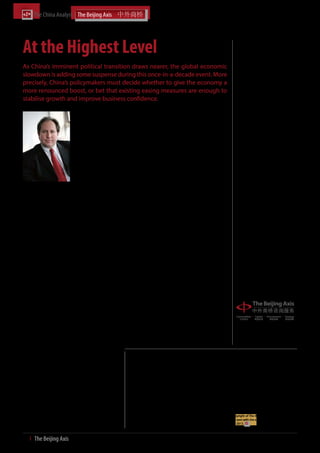
October 2012 І www.thebeijingaxis.com/tca


China’s Reform
at a Crossroads


Features
China’s Economy: Heading for a Firm Landing?
China’s SOEs: Stalled Reforms or Agents of Change?
FOCAC 2012: Sino-African Partnership Gains Momentum


China-focused
International Advisory and Procurement
Having trouble marketing
              your commodities to China?

              Beijing Axis Commodities
               can provide solutions . . .


Beijing Axis Commodities supports commodity producers with their international marketing efforts and the structuring of off-take agreements, and assists
commodity consumers with their procurement efforts in securing supply. We offer comprehensive services across the transaction chain, from origination, negotiation and
structuring to logistics and financing. For more information please contact: cheryl@thebeijingaxis.com


China-focused
International Advisory and Procurement
www.thebeijingaxis.com
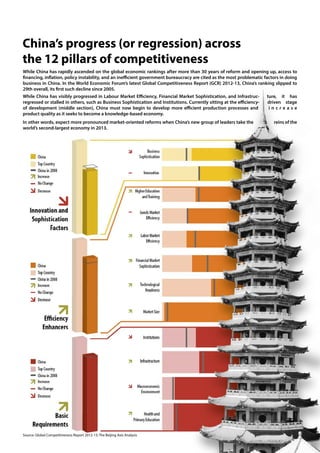
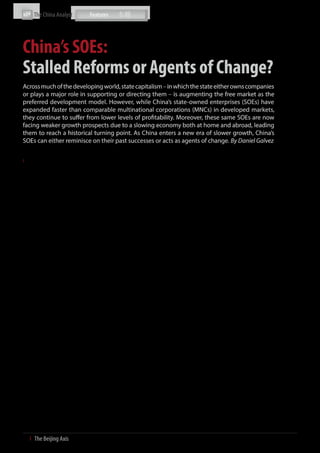
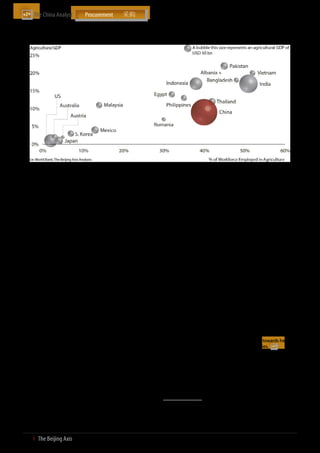
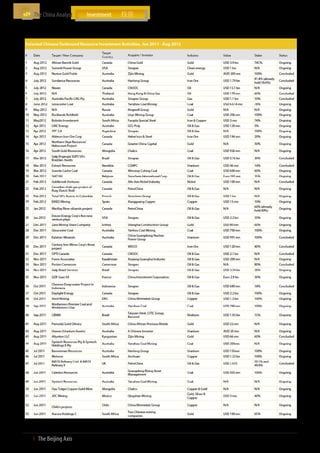
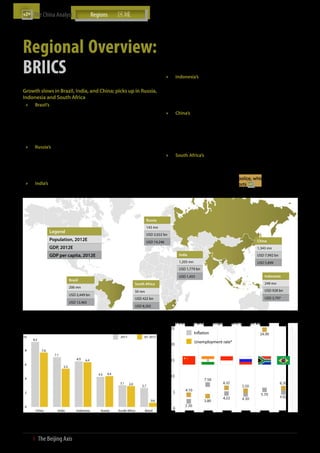
China’s progress (or regression) across
the 12 pillars of competitiveness
While China has rapidly ascended on the global economic rankings after more than 30 years of reform and opening up, access to
financing, inflation, policy instability, and an inefficient government bureaucracy are cited as the most problematic factors in doing
business in China. In the World Economic Forum’s latest Global Competitiveness Report (GCR) 2012-13, China’s ranking slipped to
29th overall, its first such decline since 2005.
While China has visibly progressed in Labour Market Efficiency, Financial Market Sophistication, and Infrastruc-         ture, it has
regressed or stalled in others, such as Business Sophistication and Institutions. Currently sitting at the efficiency-   driven stage
of development (middle section), China must now begin to develop more efficient production processes and                  increase
product quality as it seeks to become a knowledge-based economy.
In other words, expect more pronounced market-oriented reforms when China’s new group of leaders take the                  reins of the
world’s second-largest economy in 2013.


Source: Global Competitiveness Report 2012-13; The Beijing Axis Analysis
The China Analyst	


At the Highest Level                                                                                                                       The
                                                                                                                                           China
As China’s imminent political transition draws nearer, the global economic
slowdown is adding some suspense during this once-in-a-decade event. More
                                                                                                                                           Analyst
precisely, China’s policymakers must decide whether to give the economy a                                                                  October 2012
more renounced boost, or bet that existing easing measures are enough to
stabilise growth and improve business confidence.                                                                                          Published by
                                                                                                                                           The Beijing Axis
                          A ‘wrong move’ risks        away from excessive reliance on investment                                           3806 Central Plaza
                          introducing a new           towards a more domestic consumption driven                                           18 Harbour Road
                                                                                                                                           Wanchai
                          Co m m u n i s t Pa r t y   growth model. Yuan appreciation and rising                                           Hong Kong, PRC
                          leadership to the           wages will increase households’ spending power                                       Tel: +86 (0)10 6440 2106
                          world just as growth        – and disproportionately hurt labour-intensive                                       Fax: +86 (0)10 6440 2672
                          falls below the             manufacturers – further pushing Chinese                                              www.thebeijingaxis.com
                          government’s target         manufacturers to move up the value chain and
                          for the first time in       fulfilling China’s greater aspirations. However,
                          nearly four years.          the vested interests of China’s powerful SOEs will
                          China’s top leadership      remain a major hurdle.                                                               Executive Editor
                          team will be tasked                                                                                              Kobus van der Wath
                          with solving deep           The new generation of leaders will have the                                          kobus@thebeijingaxis.com
                          rooted problems             opportunity to come in and turn things around
                          formed during China’s       in 2013 – a hero’s welcome if you will. If China                                     Editor
30 years of socio-economic development. A             can stay on the course of market-oriented reform                                     Daniel Galvez
growing (and increasingly visible) disconnect         while battling increasingly visible signs of strain, it                              danielgalvez@thebeijingaxis.com
between top wage earners and the lower class,         will mark yet another chapter in China’s unrivalled
downbeat factory owners, and a rapidly-ageing         growth story.
population are just some of the key issues facing                                                                                          Design Specialist
modern China.                                         In this edition of The China Analyst, we gauge                                       Alex Yin
                                                                                                                                           alexyin@thebeijingaxis.com
                                                      China’s progress in implementing these market-
Despite a slowing economy, the central                oriented reforms and outline how the country
government has refrained from releasing a             can balance short-term policy measures against                                       To view the contents of previous
decisive (but reform-counterintuitive) fiscal         long term reform initiatives. We also highlight                                      editions of The China Analyst, see
                                                                                                                                           Previous Editions on page 43. To
stimulus package as seen in 2008-09. Existing         the country’s budding relationship with Africa as
                                                                                                                                           subscribe free of charge to The China
monetary easing measures have yet to reach            a vital source of growth and as an extension of                                      Analyst, please visit www.thebeijingaxis.
those hardest hit by a global slowdown – China’s      China’s decade-long ‘going-out’ policy.                                              com or www.thebeijingaxis.com/tca.
small and medium sized manufacturers – who
                                                                                                                                           For advertising opportunities, please
are now re-living the same business-threatening       I trust our readers will enjoy this edition of The
                                                                                                                                           contact Barbie Co at barbieco@
conditions experienced during the financial crisis.   China Analyst, and as always we welcome your                                         thebeijingaxis.com.
Preliminary indications point to a seventh straight   feedback.
quarter of slower GDP growth in Q3 2012, pushing
back expectations of a growth rebound.
                                                      Kobus van der Wath
Meanwhile, China’s once-booming property              Founder & Group Managing Director
market is still being held in check. Central          The Beijing Axis
government leaders have repeatedly pledged            kobus@thebeijingaxis.com
that the government will not ease macro-
controls designed to cool the property market.
In the meantime, local governments are growing
restless and attempting to take matters into their
own hands, with about a dozen local governments
unveiling multi-year investment plans worth           DISCLAIMER
hundreds of billions of dollars in the past month.    This document is issued by The Beijing Axis Ltd. While all reasonable care has been taken in preparing this document, no re-
                                                      sponsibility or liability is accepted for errors or omissions of fact or for any opinions expressed herein. Opinions, projections and
                                                      estimates are subject to change without notice. This document is for information purposes only, and solely for private circula-
Long term, the stakes are even higher. China is       tion. The information presented here has been compiled from sources believed to be reliable. While every effort has been made
on track to become the world’s biggest economy        ensure that the information is correct and that the views are accurate, The Beijing Axis cannot be held responsible for any loss,
                                                      irrespective of how it may arise. In addition, this document does not constitute any offer, recommendation or solicitation to any
sometime during the new incoming leadership’s         person to enter into any transaction or to adopt any investment strategy, nor does it constitute any prediction of likely future
10-year tenure. If China’s policymakers fail,         movements or events in any form. Some investments discussed here may not be suitable for all investors. Past performance is
                                                      not necessarily indicative of future performance; the value, price or income from investments may fall as well as rise. The Beijing
foreign investors will look to other markets, and     Axis, and/or a connected company may have a position in any of the investments mentioned in this document. All readers are
marginalised sections of the population will grow     advised to make their own independent judgement with respect to any matter contained in this document.
even more restless.                                   Copyright notice: Copyright of all materials, text, articles and information contained herein resides in and may only be repro-
                                                      duced with permission of an authorised signatory of The Beijing Axis. Copyright in materials created by third parties and the
The goal is clear but the road ahead is likely        rights under copyright of such parties is hereby acknowledged. Copyright in all other materials not belonging to third parties
                                                      and copyright in these materials as a compilation vests in and shall remain copyright of The Beijing Axis and should not be
bumpy. Through targeted market-oriented               reproduced or used except for business purposes on behalf of The Beijing Axis or save with the express prior written consent of
reforms, Beijing needs to rebalance its economy       an authorised signatory of The Beijing Axis. All rights reserved. © The Beijing Axis 2012.


4  І  The Beijing Axis    
The China Analyst	


                             Table of Contents
                             October 2012


    6          FEATURES
               China’s Economy: Heading for a Firm
               Landing?
                                                                            26           STRATEGY
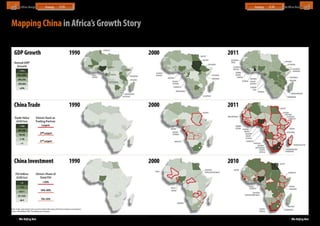
                                                                                         Mapping China in Africa’s Growth
                                                                                         Story
 As China’s entire socio-economic superstructure evolves, it is             In this edition, we illustrate China’s impact on the continent as
 necessary to interpret China’s current cyclical adjustments from           an investor and major trading partner over the past 20 years.
 a long term perspective.


                                                                            28           STRATEGY
                                                                                         Africa Means Business: Opportunities

    9          FEATURES
               China’s SOEs: Stalled Reforms or
               Agents of Change?
                                                                                         in Frontier Markets
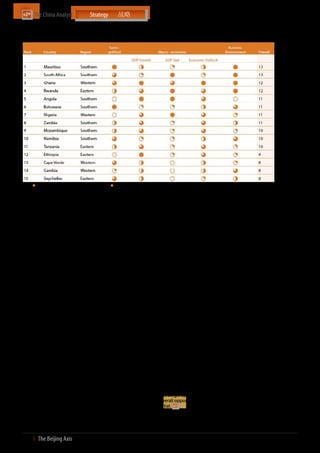
                                                                            Is now the right time for foreign companies to follow China’s
                                                                            lead and enter Africa?


                                                                            30
 Facing weaker growth prospects at home, China’s SOEs con-
 tinue to expand overseas, disrupting the global marketplace                             REGIONS
 and offering new cooperation opportunities.
                                                                                         Regional Overview: BRIICS
                                                                            A macro overview of the leading developing economies: Brazil,
                                                                            Russia, India, Indonesia, China and South Africa.


 12            FEATURES
               FOCAC 2012: Sino-African Partnership
               Gains Momentum                                               32           REGIONS
                                                                                         Regional Focus: CHINA-AFRICA
 The Beijing Declaration reached at the Fifth Ministerial Forum             China-Africa trade and investment analysis, and a focus on
 on China-Africa Co-operation (FOCAC) will help dictate the                 China’s relations with the Economic Community of West African
 future direction of Sino-African relations. We also interview              States (ECOWAS).
 Uganda’s ambassador to China.


                                                                            34           REGIONS
                                                                                         Regional Focus: CHINA-AUSTRALIA
                                                                            China-Australia trade and investment analysis, and 'Australia
                                                                            State Watch', featuring Western Australia.


  18            COMMODITIES
                China’s Ferrochrome Production:
                Altering the Global Balance                                 36           REGIONS
                                                                                         Regional Focus: CHINA-LATIN AMERICA
                                                                            China-Latin America trade and investment analysis, and a spe-
  China’s growing share in global ferrochrome production is forc-           cial focus on China’s relations with Peru.
  ing traditional production leaders such as South Africa to adapt.


  20            PROCUREMENT
                China’s Rising Wages and its Impact                         38           REGIONS
                                                                                         Regional Focus: CHINA-RUSSIA
                                                                            China-Russia trade and investment analysis, including 'China-
                on Cost Competitiveness                                     Russia Resources Watch'.
  China’s rising labour costs necessitate a closer look into the underly-


                                                                            40
  ing drivers behind this important factor of production.
                                                                                         The Beijing Axis News - May - September


  23
                                                                                         2012
                INVESTMENT                                                               The latest news from The Beijing Axis Group.
                China Capital: Inbound/Outbound FDI
                & Overseas Resource Investment
  Analysis of the latest on FDI in China and OFDI by Chinese firms,
  with a focus on overseas resource investment.
                                                                            44           About The Beijing Axis
                                                                                         Company profile and contact information.


5  І  The Beijing Axis    
The China Analyst


           China’s Economy:
           Heading for a Firm Landing?
           Is China about to have a ‘firm landing’? China’s economy is often viewed as having the binary
           choice of experiencing either a soft or a hard landing. A soft landing is always preferred and is
           usually – when viewed as highly probable – enough of an assurance for most China watchers
           that all will be fine. A hard landing – according to its predictors – is almost always analogous with
           severe repercussions, including fallout that could potentially threaten social cohesion. However,
           interpreting China’s economic future as having only two possible paths is an oversimplification.
           China’s economy is complex and, with an uncertain global backdrop, several in-between
           scenarios are possible. By Kobus van der Wath


           C
                   hina, after all, is in the midst of a number of delicate      coal and iron ore at stockyards all over the country’s ports;
                   transitions: it is undergoing an unstoppable structural       large numbers of unsold vehicles sit in dealership parking
                   shift from a low income to a middle income economy;           lots; and empty malls dot certain parts of the country. Recent
           there is a somber move from a rapid growth rate economy, to           trade, manufacturing, bank lending and retail spending data
           a moderate (and hence more sustainable) growth rate; and              support this, and convincingly illustrate the latest downward
           a complex shift is underway from being a low/medium-tech              shift for the second quarter – and July - August indicators are
           (and low/medium-cost) producer to a medium/high-tech (and             weak as well. Also, widespread property price reductions and
           medium/high-cost) producer. This implies waves of change              slower car sales growth hint at a level of aggregate demand
           across all areas of the economy. In fact, the entire socio-           that is probably consistent with GDP growth for the third
           economic superstructure and growth model are evolving.                quarter of close to 7.5%, below the 7.6% and 8.1% registered
           Due to these adjustments – and the weak global backdrop –             in the first and second quarters. Clearly, no rebound yet from
           it is necessary to interpret China’s current cyclical adjustments     the second quarter’s level.
           with care. What is sure is that it is not simply an absolute choice
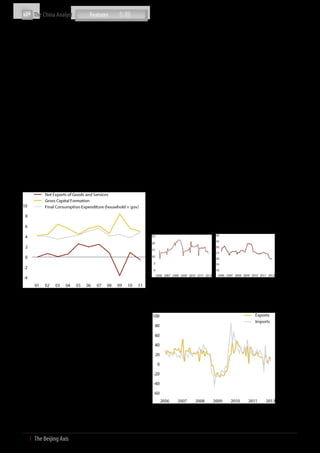
           between a hard versus a soft landing.                                 China’s Quarterly Y-o-Y GDP Growth Rate (%, 2008-2012F)

           Significant slowdown

           It may be time to look for a China ‘landing’ somewhere in the
           middle of the two extreme scenarios. We take the view that
           China will experience a ‘firm landing’ over the next 12 months.
           In short, a landing which would be less than comfortable –
           even painful at times – but still manageable.

           There are increasing visible signs of the much-vaunted
           slowdown in the Chinese economy, a slowdown that has been
           the subject of intense media speculation in recent weeks and
           months. Global fallout from the Euro-area crisis and China’s
           softer first and second quarter GDP growth numbers of
           8.1% and 7.6% respectively, along with the Bo Xilai debacle,
           rising tensions with neighbours in the South China Sea, and           Source: CNBS; The Beijing Axis Analysis
           downward revisions in GDP projections for the second half
           of 2012 all have the makings of a perfect storm. This has led         A new model
           many analysts to predict a so-called hard landing for the
           world’s second-largest economy.                                       Nevertheless, this is not necessarily a hard landing. China is
                                                                                 large and complex, and one must be wary of ignoring a piece
           So how bad is it really? The data shows a weakening economy –         of the jigsaw puzzle. While China is certainly slowing, especially
           and the slowdown is severe – from a peak of 14% GDP growth            in certain sectors and regions, it is also true that a growth rate
           in 2007, 10.4% in 2010 and 9.2% in 2011, to most likely around        of close to 8% for the full year will still outpace that of any large
           7.7% for 2012. This means that current growth has effectively         economy. This year, China’s economy will grow by some USD
           halved against the 2007 peak and has dropped by around a              700 billion, thereby adding another Switzerland or Turkey to
           quarter from the average of 10% over the past 30 years. This          global output. Moreover, Beijing views its economic future in
           marks a big change – there are mounting stockpiles of scrap,          a very different light from just three to eight years ago. The


6  І  The Beijing Axis    
The China Analyst


future entails more moderate but sustainable levels of growth                  provinces have already signalled their intention to support
– quality growth – as opposed to the breakneck growth of                       investment levels, the central government has yet to unveil
the past. This new growth pattern is aimed at shaping a new                    an integrated plan. While we do not expect a massive central
economic structure, and with it a new set of rising strategic                  push for investment as seen during 2008-09, we do anticipate
industries and new areas of competitiveness.                                   the carrying out of ongoing policy initiatives and signals from
                                                                               the central government that it will ensure adequate demand
Inevitably, this new growth model will see some sectors                        in order to support employment and business confidence.
recede, even traditional ones that served as the battering ram                 Given Europe’s malaise, this is understandable. Measures will
to bring China onto the world stage with record-breaking                       be limited and will not prevent a moderation of growth. It will
exports. However, this does not make the transformation less                   just cushion what is likely to be a fairly firm landing.
necessary nor avoidable. The growth model must adapt – and
this implies slower but higher quality growth.                                 For the longer term, the question is when exactly a new
                                                                               consumer-driven growth model will kick in and whether it
This also means that excessive stimulus measures, as the                       can fully offset the effects of a prolonged global slowdown.
economy slows, would be far more dangerous than seeing                         Over the long-term, this looks probable. Unfortunately, China’s
the growth rate fall below 7.5% or even reach 6%. The view                     transformation is still underway and for the economy to pull
that China needs 7-8% growth to maintain social stability is an                up decisively over the short term, it cannot yet count on the
outdated and baseless article of faith; today’s China is already               Chinese consumer.
socially transformed to the point where it can remain stable
and continue its long term trajectory even if the growth rate                  So this is where policymakers will need to show resolve. They
dips to around 6%. Of course a protracted slowdown would be                    must resist the temptation to provide short-term stimulus –
problematic, but the ‘bicycle view’ – that China will fall over if             even as the world and China slows – and instead focus on
it grows too slowly – does not hold in the same manner that                    enacting the difficult reforms that would bring forward the
it did in the past.                                                            consumer-led demand economy that will form the core of a
                                                                               new growth model. Pressures are mounting and consumer
Contribution to GDP Growth¹ (%, 2001-2011)                                     demand can only be expedited by so much, so it will be a close
                                                                               call. However, we believe that the long-term considerations
                                                                               will win out. So expect the slowdown to continue and only a
                                                                               mild stimulus to avoid the worst bumps.

                                                                               Y-o-Y Growth of China’s                 Y-o-Y Growth of China’s
                                                                                Monthly Retail Sales                   Monthly Fixed Assets Invest-
                                                                               (%, 2006-Jun 2012)                      ments (%, 2006-Jun 2012)


                                                                               Source: China Monthly Economic Indi- Source: China Monthly Economic Indi-
                                                                               cators; CNBS; The Beijing Axis Analysis cators; CNBS; The Beijing Axis Analysis
Note: (1) The three components of GDP by expenditure approach are final con-
sumption expenditure (composed of household and government consump-
tion), gross capital formation and net exports of goods and services.
                                                                               Y-o-Y Growth of China’s Monthly Trade
Source: China Statistical Yearbook; The Beijing Axis Analysis                  (%, 2006-Jun 2012)


Cushioned but firm landing

Beijing will not stand back completely as the economy slows.
Banking and real estate, China’s twin liquidity engines, have
been revved down for the last two years, impacting consumer
spending that has enjoyed lofty double-digit growth in the
last decade. Meanwhile, exports have slowed to become a
drag on the economy in the second half of 2011, and more
so in the first half of 2012, as Europe and other developed
markets continue to struggle. Hence, the recent slowdown
in China’s industrial production and the associated downside
risks to growth leave policymakers little choice but to further
ease policies over the next few months.

The only way to quickly lift growth would be via stimulus
measures; however, China will not rush to achieve ‘quick wins’                 Source: China Monthly Economic Indicators; CNBS; The Beijing Axis Analysis
in this manner. The risks are well understood. Nevertheless,
we do anticipate at least a degree of stimulus. While many


7  І  The Beijing Axis    
The China Analyst


           Changing expectations                                                           ӹӹ   Direct management of end-user relationships
                                                                                                is key
           As a result of this new phase in the country’s development,                     ӹӹ   Branding, after-sales service and support will
           China watchers that are used to lofty growth rates over the past                     become hallmarks in resource marketing
           20-30 years will need to sit through the inevitable volatility of               ӹӹ   Resources is now a ‘competitive’ industry –
           the next 6-12 months. The key is to remember that China’s long                       mining marketing managers will increasingly
           term fundamentals remain strong. It will continue to transform,                      compete in the same manner that say Procter
           industrialise, urbanise, modernise and reinvent itself. Over the                     & Gamble (P&G) and Unilever compete
           longer term, China will remain a key market for hydrocarbons,
                                                                                           ӹӹ   Companies that get this right will attract a
           metals and minerals, high-end manufacturing, services and
                                                                                                premium
           technologies. Society is transforming in a profound way, and
           despite facing key challenges and a significant slowdown,
           China’s relentless ascent is not in question.                       For procurement managers

           Upshot and strategic implications                                         ӹӹ   Supplier health checks and supplier selection
                                                                                          become very important
           The landscape is changing and CEOs of Chinese firms and                         ӹӹ Auditing and pre-qualification processes are
           MNCs alike will have to think and anticipate differently. We                          crucial
           offer a few general ideas in this regard:                                       ӹӹ Deeper due diligence will pay off in the end
                                                                                     ӹӹ   Management of Chinese suppliers needs to be
                  ӹӹ   China will become a more ‘normal’ economy after                    elevated – a difficult task if you do not have an
                       decades of rapid growth. Changes are occurring                     on-the-ground presence in the country
                       in cost structures and differentials, technology,
                                                                                     ӹӹ   Appreciate suppliers’ cost structures in order to
                       household and national debt, company leverage,
                                                                                          pre-empt pricing decisions on their part; solid cost/
                       etc. A very different landscape is unfolding
                                                                                          price index tracking is needed
                  ӹӹ   China is partially transformed – it must be viewed
                                                                                     ӹӹ   It is necessary to remain cognisant of cost increases
                       for what it has become – a USD 8 trillion economy
                                                                                          as a part of global category management (i.e.
                       that is more emerged and more developed but still
                                                                                          identify future alternative markets and develop an
                       on a path of change
                                                                                          initial intelligence on them)
                  ӹӹ   Entering China for the same reasons as ten years
                                                                                     ӹӹ   Exchange rate risk will rise, but more hedging
                       ago is a mistake. Ignoring China is also a mistake.
                                                                                          instruments are available than in the past
                       It is necessary to be perceptive and to assess how
                       the macro transformation will impact the business             ӹӹ   Leverage the internationalisation of the renminbi to
                       landscape of your industry                                         manage exposures and complete settlements
                  ӹӹ   China is becoming a very competitive terrain;
                       companies will need to work hard to identify and        Final word
                       claim addressable markets (that are less contested)
                  ӹӹ   Mature (developed) and immature (less developed)        China’s overall transformation remains intact. However, the
                       industries and segments will co-exist in the            nature of that transformation is changing. The next several
                       economy with very different patterns between            months will be turbulent and a firm landing could be
                       regions, industries and companies                       uncomfortable. Do not underestimate the complexity and
                  ӹӹ   Exemplary strategic intelligence is imperative in       challenges that must be faced to manage effectively through
                       scoping the opportunities                               this phase. Brace for some bumps that will hurt but do not
                                                                               spell the end of China’s rise. In fact, China’s economic march
                  ӹӹ   It is now more important to have a solid China team
                                                                               has only just begun. The main story of how its population,
                       than ever before – there are many ‘China hands’, but
                       not many good ones                                      burgeoning middle-class, productive capacity, rising income
                                                                               and wealth, aspirations and global participation and influence
                  ӹӹ   Strategy implementation will require more careful       will impact the world has yet to be written. In many ways, this
                       management to calibrate and fine-tune market            is just the end of the beginning.
                       positions
                  ӹӹ   It will be necessary to operate in China with very      Kobus van der Wath
                       different cost structures                               Founder & Group Managing Director
                                                                               kobus@thebeijingaxis.com
           For the mining and resources sector

                  ӹӹ   Despite lower demand growth, China remains the
                       most important driver of commodities demand
                  ӹӹ   Lower demand growth, lower prices, higher
                       volatility and variability (some commodities will
                       perform better/worse) must be understood and
                       managed
                  ӹӹ   Marketing is now a far more important function in
                       the industry than before
                        ӹӹ There must be an emphasis on strategic
                             marketing


8  І  The Beijing Axis    
The China Analyst


China’s SOEs:
Stalled Reforms or Agents of Change?
Across much of the developing world, state capitalism – in which the state either owns companies
or plays a major role in supporting or directing them – is augmenting the free market as the
preferred development model. However, while China’s state-owned enterprises (SOEs) have
expanded faster than comparable multinational corporations (MNCs) in developed markets,
they continue to suffer from lower levels of profitability. Moreover, these same SOEs are now
facing weaker growth prospects due to a slowing economy both at home and abroad, leading
them to reach a historical turning point. As China enters a new era of slower growth, China’s
SOEs can either reminisce on their past successes or acts as agents of change. By Daniel Galvez


It has long been argued that such state capitalist systems fail   China goes global
to encourage innovation, China’s key to long-term growth
and economic wealth. In the World Bank’s China 2030 report,       There is no denying that Chinese SOEs have a negative stigma
various constructive ideas on China’s on-going transformation     attached to their state-owned designation abroad. However,
were put forth, one of which stated that China needs a better     while private companies are generally more profitable than
innovation policy, which can only begin with a redefinition       their state-owned peers, this does not necessarily mean SOEs
of government’s role in the national innovation system and a      fail to produce profits in their overseas ventures. Through
gradual adoption of a competitive market system.                  2011, out of the 2,000 institutions and branches set up abroad
                                                                  by Chinese SOEs, 73% made a profit or broke even. To further
State sector’s role                                               help Chinese enterprises meet their global ambitions, the
                                                                  central government has taken a series of steps to encourage
At the end of 2010, there were about 110,000 SOEs in China,       investors’ participation in international projects.
of which 121 fall under the direct authority of the State-
owned Assets Supervision and Administration Commission            Others argue that although SOEs overseas ventures are
(SASAC). China’s official position is to reduce the number of     profitable for the most part, profits do not necessarily
central SOEs and create a few large conglomerates, mostly via     equate to competitiveness. To build world-class enterprises,
mergers, to act as key players within strategic sectors, namely   Chinese companies need to make more efforts to improve
aviation, military, power generation, petroleum, mineral          their profitability and sustainability, and improve the
resources, shipping and telecommunications. According to          efficiency of their management systems and their ability
a report from the U.S.-China Economic and Security Review         to allocate resources more efficiently. However, even with
Commission, SOEs (and entities directly controlled by SOEs)       these shortcomings, some private Chinese companies are
accounted for than 40% of China’s non-agricultural GDP. In        successfully taking market share from incumbents in some
2011, the total assets of China’s 121 centrally administered      sectors, especially heavy equipment (Sany Heavy Industry)
SOEs amounted to USD 2.9 trillion, up from USD 360 billion in     and alternative energy (Goldwind). The size of the domestic
2002. Amid controversy over their windfall profits, easy access   market has enabled companies to acquire scale and frequently
to credit, and lavish spending habits, central SOEs have begun    expertise that companies in other nations can only achieve
to pay dividends to the state.                                    through overseas expansion. In some heavy equipment
                                                                  industries for example, the Chinese market accounts for
Despite a record presence in the latest Fortune 500 list (70 in   one-half of global demand.
total, excluding Hong Kong and Taiwan), Chinese companies
still have relatively low profitability and lack a true global    Taking a slice of the global market is the key to the long term
status. As economic structural reform advances and cost           survival of Chinese enterprises. The period when simply
advantages fade away, investment-driven growth must give          relying on China’s breakneck economic development for
way to higher productivity. The average profit margin of          steady returns (which may have previously distracted Chinese
China’s 42 central SOEs on Fortune’s latest annual ranking was    companies from opportunities overseas), is over. Meanwhile,
only 2.2%, compared with an average of 4.8% for non-financial     rising costs in the domestic market mean that SOEs need to
companies outside mainland China. To compare, Sinopec             pay more attention toward both human and capital costs.
Group, the largest company in China and fifth-largest in the      China’s competitive cost position – low labour costs coupled
world in terms of revenue, reported a profit margin of 2.8% in    with scale advantages driven by the size of the domestic
2011. In comparison, Sinopec’s competitor Exxon Mobil, which      market and the standardisation of product offerings – has
came third on the list, had a profit margin of 8.6%. Overall,     long been a strong point in winning overseas business. As
less than 10 of these 70 companies can really be regarded as      discussed in our article “China’s Rising Wages and its Impact
‘world-class enterprises.’ The growth of China’s SOEs is mostly   on Cost Competitiveness” in this edition, labour costs will
a result of their competitive edge in the domestic market, but    continue to rise due to a host of socio-economic factors.
these SOEs face a lot more challenges when they enter the
global market.                                                    To become world-class enterprises, China’s SOEs need to


9  І  The Beijing Axis    
The China Analyst


           enhance their management expertise and widen their capital         fostered market-changing companies. Brazil is perhaps the
           channels. Overall, the central government encourages its SOEs      best current example of how a state-capitalist system can
           to leverage complementary advantages when expanding                build innovative industries. Successive Brazilian governments
           overseas (expand in groups) in order to enhance the                have intervened – through incentives, loans, and subsidies
           competitiveness and lower their risks in global operations. The    – to promote industries that otherwise would have needed
           bottom line – the more SOEs operate like private companies,        long-term private investment to make them competitive
           the more opportunities they are going to have abroad. In the       with rivals from more developed markets. At the same
           end, it is in the best interest of the Chinese government and      time, Brazil preserved strong, independent management of
           its SOEs to play by global rules and further opening up China’s    state-backed firms, ensuring they did not become political
           market.                                                            pieces. Three decades ago, the Brazilian government gave
                                                                              aircraft manufacturer Embraer lucrative contracts and various
           Reforms taking on greater urgency                                  subsidies, recognising that it could potentially find a niche
                                                                              in producing smaller, regional aircraft. Had it relied solely on
           The slowing of the global economy is forcing China as the          private investment, it can be argued the company probably
           world’s largest exporter to confront the issue of rebalancing,     would have failed; instead, it flourished, becoming the world’s
           which entails striking the right balance between state and         biggest maker of regional jets.
           market. Thus far, China’s policymakers have been moving
           in the right direction on major structural reforms as they         Similarly, China’s SOE’s appear to be a key enabler in the
           attempt to rebalance the nation’s economic model towards           government’s plans to encourage indigenous innovation,
           inclusive and more sustainable growth. There are signs             so that the country relies less on foreign technologies. In the
           the contribution of consumption to China’s GDP is rising –         case of high speed rail, the government used SOEs to acquire
           consumption’s contribution to GDP growth reached 60% in Q1         foreign technologies through joint ventures and licensing
           2012. But to a large degree, this reflected the implementation     agreements with foreign firms. Now, the government
           of administrative controls to address past credit excesses,        appears to be using the same approach with current efforts
           government policies to cool activity in the housing market,        to develop a civil aviation industry. In 2008, China established
           as well as softening export demand. The deterioration in key       the Commercial Aircraft Corporation of China (COMAC), with
           economic data in the first half of 2012 has increased pressure     the main goal of designing and eventually building large
           to loosen policy, bringing a second reduction in banks’ reserve    passenger aircrafts with capacity of over 150 passengers in
           requirement ratios this year and the first cut in interest rates   order to ultimately reduce the country’s dependency on the
           since 2008. An important question China needs to carefully         Boeing and Airbus duopoly. Its flagship product is expected to
           consider is whether the rising need to boost short-term            be the COMAC C919 which is a planned family narrow-body
           growth might result in measures that detract from the long-        airliners set to directly compete with Airbus A320 and Boing’s
           term reform agenda.                                                737. Although it is still currently under development, COMAC
                                                                              has already reached joint venture agreements with various
           Up until now, policymakers appear willing to accept a structural   international companies, such as Bombardier, in order to help
           downshift in growth and will likely direct further stimulus        with the C919’s design and components. As of end of 2011,
           measures towards strategic industries and basic infrastructure     it had received at least 220 orders domestically for the C919,
           in underdeveloped areas. Meanwhile, China’s shift towards          which is scheduled to be ready by 2016.
           higher value-added exports and strategic investments to
           underpin growth will continue. While state-owned banks still       Private companies catching up
           dominate the financial sector and are still kept profitable by
           a positive spread between loan and deposit rates dictated by       Even though they are at a disadvantage when it comes to
           government policy, the latest move to liberalise interest rates    securing funds for expansion, private companies accounted
           is a step in the right direction. Also look for the new incoming   for 45% of China’s USD 68.6 billion non-financial ODI in 2011.
           generation of leaders to continue implementing several key         Private companies’ share is expected to continue expanding
           financial system reforms, which are essential to structural        as the government supports investors seeking (profitable)
           changes that permeate the entire economy.                          overseas projects (see chart below).

           Does state capitalism work?                                        SOEs Share of Large Outbound Investments (%, 2005-2011)

           China goes to great lengths to encourage and fortify strategic
           industries, much to the dismay of its fellow WTO members.
           The Chinese government has intervened to promote skilled
           research and development in advanced industries. In so doing,
           the state capitalists have shattered the idea that they cannot
           foster innovation to match developed economies. The biggest
           critics outside China of state capitalism argue a combination
           of government resources and innovation has the potential to
           put US and European multinationals at a serious disadvantage
           competing around the globe.

           However, China’s state capitalism model is far from anything
           which can be perceived as ground-breaking. While state
           intervention in economic affairs runs against the established
           wisdom that the market is best for promoting ideas, the
           governments of many developed nations have actively                Source: UN Comtrade; The Beijing Axis Analysis


10  І  The Beijing Axis    
The China Analyst


Although SOEs still accounted for around 90 percent of China’s      development that is consistent with China’s goal to move up
cumulative ODI as of the end of 2011, MOFCOM predicts               the value-chain. So far, such investments have been largely
private enterprises will definitely play a bigger role in Chinese   limited to the logistics and financial sectors. Were China
ODI activities. Not surprisingly, some of China’s most famous       to open up a wider range of service industries to foreign
companies are private. Lenovo, Huawei and Geely are the             participation, multinationals would be sure to respond. The
three largest private investors overseas, ranking 25th, 27th and    Chinese government in turn, has also urged multinationals to
31st among the top 100 non-financial Chinese companies, in          bring best practice from abroad, to share their expertise and
2011. These major private investors are also among the leaders      contribute to China’s growth.
in the ranking of the top 500 Chinese private companies by
revenue in 2011, released by the All-China Federation of            What’s next?
Industry and Commerce. In terms of revenue in 2011, Huawei
took second place, Lenovo ranked fourth and Geely was sixth.        The country’s next generation of leaders face a considerable
Aforementioned construction equipment maker Sany Heavy              challenge in pushing through the reforms needed to sustain
Industry, which bought a 90 percent stake in German concrete        China’s economic growth. China’s president-in-waiting, Xi
pump manufacturer Putzmeister for USD 407 million earlier           Jinping, has gone on record as saying the Communist Party
in 2012, was the fifth-largest overseas private investor and        must embrace reform with fresh vigour to stave off social and
China’s 10th largest private company. Overall, the 500 largest      economic malaise. In the run-up to his official appointment,
private companies reported combined revenue of more than            Xi Jinping has met one of China’s most prominent reformers,
USD 1.4 trillion in 2011.                                           Hu Depinga, a noticeable indication he is listening to voices
                                                                    calling for faster economic liberalisation. In the end, the pace
Where do MNCs fit?                                                  of reform will depend on political factors in a one-party state.

MNCs in China face a number of challenges that are not              However, China’s SOEs must not wait for government reforms
different from what their domestic competitors face,                to enlarge their presence on the global stage. To become
including rising labour costs and wage inflation, staff turnover,   global leaders, Chinese companies should embrace five
complexity of regulations, strengthening local competition,         strategic initiatives: to take advantage of global megatrends:
and an economy not immune to the current global economic            strengthen M&A capabilities; establish capabilities beyond
slowdown. MNCs therefore see an increasing need to adapt            cost leadership; improve productivity; and develop global
their strategies in China, in order to succeed. The rise of         organisation, management, and governance practices.
innovative state capitalists presents a yet another challenge       According to SASAC, in the next five to 10 years, China will
(or opportunity) to US and European businesses; it could push       need at least 100 CEOs with the ability to run Fortune 500
multinationals out of some markets entirely (or find strategic      companies, 100,000 talented and experienced managers,
partners). In oil and gas, for example, state companies already     and millions of skilled personnel. To improve management
control most of the world’s reserves. China’s SOEs such as China    shortcomings, SASAC recently launched a program to improve
National Offshore Oil Corporation (CNOOC), China’s largest off      internal controls in SOEs, and have sought advice from the
shore oil and gas producer, seek to invest in assets abroad that    world’s leading consultancies to help build these companies
will better position them at home, as well as help them gain        into world-class enterprises.
a foothold in new promising markets over the long term. The
most competitive firms realise size alone will not guarantee        Rightly so, China continues to rank high on multinationals’
long-term global success; technological know-how is needed          wish lists, both as a place to source products and to build a
to enhance their long-term competitiveness. To facilitate their     retail presence. If China continues to maintain a growth rate
development into ‘global champions’, Chinese resource giants        of 7-8% in the next few years, it is expected to account for
are now developing global strategies that match their global        as much as 30% of the world’s growth through to 2017. This
ambitions, rather than relying on government policy alone.          indicates that China will remain a large and growing source of
                                                                    revenue for the world’s MNCs. As the state capitalists’ biggest
CNOOC has shown a particular interest in the technological          companies expand their global operations, their technology,
capabilities of major shale gas players in North America, most      connections, and capital will be almost impossible to ignore.
recently evidenced by its on-going USD 15.1 billion acquisition     China still comes short on one aspect; developed economies
for Canada’s Nexen – China’s largest foreign takeover. In           still possess a huge advantage over their emerging-market
exchange, CNOOC gains exposure to the complicated shale             competitors in terms of financial prowess and sophistication.
gas extraction technology it lacks. Simply put, increased           The US and countries in Europe have mature finance sectors
domestic demand along with untapped shale gas reserves is           with convertible currencies, while places like China still do not
strengthening the competitive rivalry among China’s energy          (although China is working on renminbi internalisation). To
giants, forcing them to buy strategic assets overseas from          ultimately succeed in much-coveted emerging markets, MNCs
their existing partners in order to become more competitive         need a deeper understanding of the new ‘rules of the game’ in
in China and ultimately abroad.                                     order to engage more effectively with their competitors and
                                                                    potential partners.
For MNCs looking to leverage their expertise and enter the
Chinese market, Sino-foreign joint ventures are rising in           Daniel Galvez, Consultant
popularity, especially as they face stronger local competition      danielgalvez@thebeijingaxis.com
and expand into more challenging third- and fourth-tier cities.
It has therefore, made sense for multinationals to team-up
with local partners as a way to expand their market, rather
than through acquisitions or organic growth. An additional
change is the extent to which multinationals invest more
in the services sector, versus the manufacturing sector, a


11  І  The Beijing Axis    
The China Analyst                                                                                                                                                                                                                              Features          专题                 The China Analyst	


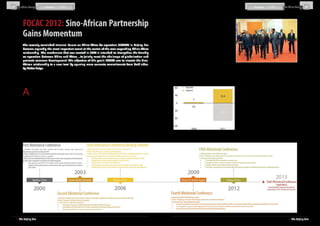
           FOCAC 2012: Sino-African Partnership
                                                                                                                                               ӹӹ    Increase the political trust and strategic consensus
                                                                                                                                                     between China and Africa through more political
                                                                                                                                                     consultation, high-level visits and strategic dialogue


           Gains Momentum
                                                                                                                                               ӹӹ    Increase cooperation between the two sides in
                                                                                                                                                     operationalising the African Union’s (AU) Africa’s Peace
                                                                                                                                                     and Security Architecture (APSA)
                                                                                                                                               ӹӹ    Strengthen China’s cooperation with the AU and
                                                                                                                                                     sub-regional organisations in Africa
           The recently concluded triennial Forum on China-Africa Co-operation (FOCAC) in Beijing has
                                                                                                                                               ӹӹ    Expand mutually beneficial economic cooperation
           become arguably the most important event at the centre of the ever expanding China-Africa
                                                                                                                                                     and balanced trade, adopt innovative ways to boost
           relationship. The mechanism that was created in 2000 is intended to ‘strengthen the friendly                                              cooperation including deepening cooperation in trade,
           co-operation between China and Africa…to jointly meet the challenge of globalisation and                                                  investment, poverty reduction, infrastructure building,
                                                                                                                                                     capacity building, human resources development, food
           promote common development’. The objective of this year’s FOCAC was to elevate the Sino-
                                                                                                                                                     security and hi-tech industries
           African relationship to a new level by spurring more concrete commitments from both sides.                                                                                                                        President Hu Jintao accompanied by African leaders during the opening of this
                                                                                                                                                                                                                             year’s FOCAC. South African President Jacob Zuma (left) and Benin’s President
                                                                                                                                               ӹӹ    Continue to strengthen people-to-people and cultural
           By Walter Ruigu                                                                                                                           exchanges and cooperation between the two sides
                                                                                                                                                                                                                             and current AU Chairperson Boni Yayi (right)
                                                                                                                                                                                                                             Source: Xinhua.net
                                                                                                                                               ӹӹ    Further strengthen the cooperation between the two                      Although the points are to some extent similar to what has
                                                                                                                                                     sides in international affairs                                          been stated before, there were some key and subtle changes
                                                                                                                                                                                                                             that emerged from FOCAC 2012. These included a particular
                                                                                                                                              China’s Trade Value with Africa* (USD bn, 2000 vs. 2011)                       emphasis on non-economic factors including factors that can


          A
                                                                                                                                                                                                                             be grouped under the term, ‘soft power’. Moreover, it entails
                  s this year’s event took place, China-Africa trade had     engaged in has been steadily increasing, particularly in the                                                                                    a greater recognition of the importance of people-to-people
                  already reached a record high of USD 166.1 billion in      manufacturing sector, as more Chinese companies establish                                                                                       exchanges between the regions, greater focus on more
                  2011, with China now entrenched as Africa’s largest        local networks to jump-start their ambitious expansion plans.                                                                                   funding for SMEs and the need for ‘capacity-building’ and skills
           trading partner. This represents a sharp increase from a lowly                                                                                                                                                    transfer. In fact, China promised to launch an ‘African Talents
           USD 10.6 billion in 2000. On the investment front, China’s        This year’s FOCAC, like those prior, has allowed observers of                                                                                   Program’ that will train 30,000 Africans in various sectors in
           OFDI stock in Africa increased from less than USD 400 million     the China-Africa relationship to stop and gauge the progress                                                                                    addition to providing 18,000 government scholarships to
           in 2000 to over USD 14 billion in 2011. Apart from increased      and challenges in this partnership and chart the possible                                                                                       African students to study in China. Additionally, China is set
           trade volumes, co-operation has continually increased in          future path of this relationship leading up to, and beyond,                                                                                     to launch a ‘China-Africa Press Exchange Centre’ in order to
           terms of investments in a range of sectors, cultural exchanges,   the next conference. While the biggest story coming out of                                                                                      encourage exchanges and visits between Chinese and African
           capacity building and of course, political consultation. The      this year’s FOCAC was China’s offer to extend a USD 20 billion                                                                                  media.
           China-Africa relationship has remained dynamic on many            credit-line to the continent over the next three years, this
           fronts. Meanwhile, most large-scale Chinese investments into      year’s Beijing Declaration presented a six-point proposal to                                                                                    Nonetheless, despite this renewed emphasis on China’s ‘soft
           the continent are made by state-owned enterprises, but the        elevate the Sino-African strategic partnership. The key points                                                                                  power’, the Sino-African relationship remains fundamentally
           number of Chinese private entrepreneurs and companies             were as follows:                                                                                                                                an economic one. On this front, there were also notable facets
           heading to Africa in search of opportunities has also been                                                                                                                                                        of a changing relationship that pervaded the conference. For
           rising steadily. The size of deals that these players are                                                                          *Note: Chinese exports to Africa and imports from Africa have both increased
                                                                                                                                                                                                                             instance, a renewed emphasis was placed on cooperation with
                                                                                                                                              15-fold since FOCAC was established, highlighting the growing interdepend-
                                                                                                                                              ency between the two regions                                                   regional organisations and ultimately the AU. This came hot
           Looking back: 12 years of the Forum on China-Africa Co-operation (FOCAC)                                                           Source: UN Comtrade; The Beijing Axis Analysis


12  І  The Beijing Axis                                                                                                                                                                                                                                                                  13  І  The Beijing Axis
The China Analyst


           on the heels of China’s ‘gift’ of a brand new AU headquarters       to scale up economic development. However, changing the
           and its commitment to provide USD 95 million to the regional        entire trade composition will clearly take time. To this end, if
           body over the next three years. Despite this move by China to       both sides are serious, one should expect to see more Chinese
           engage with the continent as a whole, Africa is diverse. China      investment in capital projects, particularly in the mining and
           faces a monumental task of trying to shape a single coherent        manufacturing sectors, in the coming years.
           policy with a landmass of over 50 states. It is in such cases
           that direct engagement with regional organisations such as          Looking ahead: Challenges and opportunities for the
           the AU or even the FOCAC mechanism itself will provide a            6th Ministerial Conference
           more lucid platform for engagement with the continent. In
           addition, the FOCAC mechanism has been a key factor that has        If the past is any indication of the future, all concrete
           increasingly unified the continent on various fronts. African       commitments set out during FOCAC 2012 will be achieved,
           countries are realising that greater unity while engaging China     if not surpassed, by the next FOCAC. With the next FOCAC
           will allow the continent to level the playing field, particularly   scheduled to take place in South Africa in 2015, there will be
           in terms of trade. Instead of having an African state with a        some challenges and opportunities for Sino-Africa relations
           population of less than a million and an economy smaller            in the lead up to the forum. For instance, the 6th Ministerial
           than most Chinese cities engage with China, regional and            Conference will take place under a new Chinese leadership as
           continental organisations can serve as a platform to increase       the current administration completes its term this year. The
           the bargaining power of such countries.                             incoming leadership, most likely to be led by Xi Jinping, will
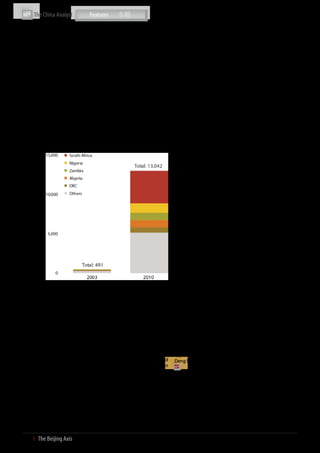
           China’s OFDI Stock in Africa (USD mn, 2003 vs. 2010)                continue to prioritise the continent’s role with China and Xi
                                                                               himself has declared that China and Africa need a new type
                                                                               of ‘strategic partnership’. The exact components of this new
                                                                               partnership will become clearer in the lead up to the FOCAC
                                                                               in South Africa.

                                                                               From an economic perspective, despite China’s GDP growth
                                                                               slowdown, demand for various key commodities will remain
                                                                               high as China aims to boost domestic consumption. This
                                                                               means that imports from Africa will continue to remain
                                                                               crucial to China’s developing economy. This, juxtaposed with
                                                                               increasingly vocal demands from various sections of the
                                                                               continent for greater value-added exports warrants a deep
                                                                               re-examination of the current trade model. Moreover, as more
                                                                               Chinese firms focus on Africa’s expanding middle-class and
                                                                               large number of rapidly developed economies, expect to see
                                                                               greater Chinese investment on the continent.

                                                                               As more Chinese firms move into the continent, the vast
                                                                               differences in the regions’ cultures, languages, economic sizes,
                                                                               etc. will mean that certain social tensions are likely to surface.
                                                                               This will be more visible at the micro economic level as
                                                                               Chinese firms present direct competition to local companies.
                                                                               With Chinese firms possessing various advantages in terms of
           Source: MOFCOM; The Beijing Axis Analysis                           capital and labour, the phenomenon of capitalism’s ‘creative
                                                                               destruction’ will become poignant and a source of friction that
                                                                               needs to be carefully managed by both sides.
           However, the Sino-Africa relationship faces challenges, not least
           of which is an unbalanced terms of trade. This was made clear       Finally, by the time the next FOCAC takes place, the world
           by South African President Jacob Zuma during the conference.        economic climate may be quite different from its current
           President Zuma, the leader of the continent’s largest economy       condition that has been dominated by weak economies in the
           and China’s largest trading partner in Africa, emphasised that      developed world. If the West, especially Europe, can engineer
           the current trading pattern was not sustainable in the long-        a recovery in time, it may spur new supply and demand factors
           term and there was a need to balance trade by focusing on           for Africa. However, despite what happens elsewhere, it is
           increasing the value-added of Africa’s exports. Zuma went           clear that the Sino-Africa economic relationship will continue
           as far as to warn that Africa should avoid a repeat of the          to strengthen, an expansion that needs a more balanced
           uneven trade pattern with the West, where Africa for years          approach. This process is likely to occur only through what
           only exported raw materials. This trading pattern resulted          Deng Xiaoping coined ‘crossing the river by feeling the stones’.
           in very little technological transfer, value added production
           and left Africa vulnerable to constantly deteriorating terms
           of trade. Zuma’s words have been echoed by several leaders          Walter Ruigu, Consultant, Manager: Eastern Africa Desk
           from the continent, especially with regards to the mining           walter@thebeijingaxis.com
           sector, where calls for more beneficiation of minerals and a
           reduction of raw materials exports have become widespread.
           Thus far, China acknowledges this challenges the usual ‘win-
           win’ proposition that generally underpins China’s relationship
           with the continent. Several top leaders including President
           Hu Jintao have reiterated that China’s own experience has
           highlighted the need for greater value-added trade in order


14  І  The Beijing Axis    
The China Analyst


15  І  The Beijing Axis    
The China Analyst


           Expanding Sino-African Economic Relations: H.E. Madibo
           Charles Wagidoso, Ambassador of Uganda to China, on
           China’s Growing Ties with Uganda
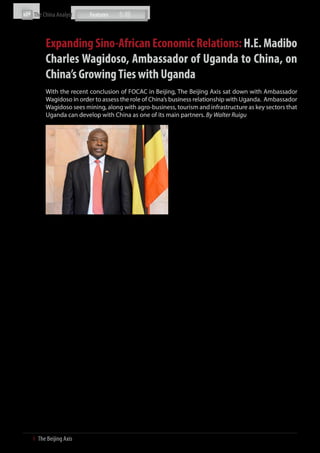
           With the recent conclusion of FOCAC in Beijing, The Beijing Axis sat down with Ambassador
           Wagidoso in order to assess the role of China’s business relationship with Uganda. Ambassador
           Wagidoso sees mining, along with agro-business, tourism and infrastructure as key sectors that
           Uganda can develop with China as one of its main partners. By Walter Ruigu
                                                                              To address this issue, China and Uganda are cooperating to
                                                                              develop this capacity at both the private and public levels.
                                                                              China has already committed some funding which will be
                                                                              used to help develop Ugandan SMEs. At the private level,
                                                                              there are Chinese companies that have already set up shop
                                                                              in Uganda and are already cooperating with local companies.

                                                                              The private sector in Uganda is also getting better organised,
                                                                              especially given the development of different business
                                                                              associations such as the chamber of commerce. The Chinese
                                                                              side has also moved very fast and there is currently a liaison
                                                                              office of the China Development Bank in Kampala, whose
                                                                              mandate is to reach out to local companies and SMEs and
                                                                              see what areas they can offer assistance. However, this will
                                                                              all depend on how the Ugandan private sector can respond
                                                                              to initiatives already being carried out by China. At the end of
           The Ambassador of Uganda to China, H.E. Madibo Charles Wagidoso    the day, you can take a cow to the well but you cannot make
           Please provide an overview of the China-Uganda                     it drink; this metaphor directly applies to our private sector.
           trade and investment relationship.
                                                                              What are Uganda’s key areas of opportunity for
           Over time, particularly in the last ten years, the business        foreign firms?
           relationship between China and Uganda has grown rapidly,
           especially in terms of trade and investments from China            There are four key areas that I view as opportunities for foreign
           into Uganda. Currently, there are two core components that         companies investing in Uganda. The first is tourism, the second
           Uganda is pursuing. First is the sourcing of medium to large       is agriculture, third is infrastructure development and fourth
           scale machinery for industrialisation in both the public and       is mining. Infrastructure broadly includes transportation
           private sectors. Second is better leveraging opportunities to      projects, especially rail and road projects, and energy projects
           export to China, mainly agro-products, to meet China’s rising      such as the construction of hydropower plants and dams. In
           demand. However, we need to better identify where the              terms of rail, the development of hard infrastructure is still the
           opportunities lie for specific products.                           responsibility of the Ugandan and Kenyan governments (Note:
                                                                              The Kenya-Uganda railway runs from Kenya’s coast to the
           Could you please cite some cases studies of successful             interior of Uganda) and this has been an area we are looking to
                                                                              increase development along with Rift Valley Railways, which
           Ugandan businesses in China?
                                                                              was handed the concession to manage the railway.
           Thus far, there are no major Ugandan companies, either public
                                                                              Our mining sector has also been developing rapidly with
           or private, that are operating in China. Most Ugandans that are
                                                                              opportunities in cobalt, gold, copper, iron etc. In fact, the
           pursuing business with China operate on a fly-in fly-out basis.
                                                                              government has just finished the legal framework on
           However, there is one company currently operating in Beijing,
                                                                              appropriation of mining licenses, exploration licenses etc.
           Uganda Crane Coffee, that is taking charge in promoting
                                                                              There are already many Chinese companies that are on the
           Ugandan coffee and increasing exports to China. They are
                                                                              ground, trying to secure various licenses. There are some that
           currently selling green bean and roasted coffee to China and
                                                                              are already conducting exploration and others have already
           working hard to develop this market.
                                                                              begun mining operations. Of course, we are looking for
           I think there are two main barriers for Ugandan companies          companies that can invest and develop local capacity in this
           aiming to enter China. First is the cultural and language          sector. I am convinced that mineral exports will be Uganda’s
           barrier. Some companies are quite reluctant to venture out         leading industry in the future.
           abroad into a place they are unfamiliar with, especially if they
           are unsure about potential business opportunities. Second is       12 years after its creation, what is your evaluation of
           the lack of capital as some Ugandan companies may not have         the FOCAC mechanism?
           enough financial resources to invest in ventures in places as
           far away as China. Overall, this means that there is a lack of     FOCAC has been very successful in terms of strengthening
           capacity for Ugandan companies to adequately access China.         economic and political cooperation between Africa and China.


16  І  The Beijing Axis    
The China Analyst


Before 2000, each African country was dealing with China on          China and I believe China will look very favourably on these
a bilateral level and at that time, many African countries did       projects.
not have full diplomatic relations with China. Following the
establishment of FOCAC, there are now 50 countries with              One key issue is the difficulty of securing Chinese financing
diplomatic relations with China. In terms of economics, the          in Africa’s private sector. For example, in the Kenya-Uganda
forum has allowed greater building of business ties between          railway upgrading project, it is easier for the Chinese side to
China and Africa. This can be seen in the increase of trade          deal with the Kenyan and Ugandan governments as opposed
volume, from barely USD 10 billion in 2000 to over USD 160           to the private sector company managing the project.
billion today. FOCAC has also been a very important forum
where China has been able to increase its support in Africa’s        Uganda currently has a trade deficit with China. Could
infrastructure development.                                          you please discuss this situation and what ideas or
                                                                     plans does Uganda have in place to counter this
Uganda has directly benefitted through financial support
                                                                     trend?
to its agricultural sector, and direct support to various
infrastructure projects in the country through concessional          As I mentioned earlier, the trade volume between China
loans and grant-aid support from the Chinese government.             and Uganda has increased rapidly. Unfortunately, our trade
We are currently building a USD 350 million express highway          imbalance with China is 1 to 10; for every USD 10 worth of
linking the airport to the city of Kampala with the support of       goods we import, we are only selling USD 1 worth to China.
the Chinese government.                                              This is an immense challenge and of course, the sole option
                                                                     is to increase export capacity in Uganda. This is why we are
The USD 20 billion line of credit extended to Africa will be used
                                                                     currently researching which products China has a demand for
for various projects that are to be presented by the African
                                                                     and how we can add value to some of the products that we
side. Previously there was a quota for each African country, but
                                                                     are already exporting.
this has now been changed to a first-come first-serve basis.
The countries that will be able to present viable projects first     One of the targets of the EAC has been to develop a
will be the ones that reap the greatest benefit from the credit
                                                                     single currency with the region. What are your views
line. Uganda is keenly working on submitting project profiles,
feasibility studies and project proposals to the relevant banks      on how this might influence China-Uganda, and
in China.                                                            China-EAC trade?

What is your take on calls for Chinese companies to                  A single currency would facilitate cross-border transactions
                                                                     and if the currency is strong enough, would allow EAC to gain
invest more on continent-wide, regional and cross-
                                                                     more on imports from not only China but the international
border projects as opposed to projects in individual                 community as well. While the East African Shilling would
countries?                                                           lower cross-border transaction costs, more importantly, it
                                                                     would mark a significant achievement towards the goal of
The Chinese government has been very keen on supporting
                                                                     establishing the East African Federation, giving the region a
regional projects including transnational infrastructure
                                                                     greater standing in the international community.
projects. This has meant that African countries need to
cooperate more on which projects are presented to China              Are there particular types of Chinese companies that
for support. For instance, in East Africa, Kenya, Uganda and
                                                                     Uganda has been pursuing or would like to pursue?
Tanzania can jointly seek support on developing waterways
along Lake Victoria. I think success will ultimately depend on       We are looking to reduce the trade imbalance and one of
regional governments such as the East African Community              the potential solutions is to attract more Chinese companies
(EAC) pushing for support of regional projects before each           to invest directly in industries that have promising export
African country can submit their own projects. Taking the EAC        potential. This means we are looking at investments in the agro-
as an example, if Uganda, Kenya and Tanzania were to submit          processing sectors, in products which could be continually
a project for waterways infrastructure development around            exported to China and elsewhere. Food is becoming scarce
Lake Victoria, I believe the Chinese government would be             around the globe and Uganda has an advantage in this regard.
eager to fund such a project as it would allow the benefits to
be spread over several countries.                                    Specific agro-products include tea, coffee, cereals and many
                                                                     other agricultural products. Over 80% of Uganda’s economy
It will be difficult for the Chinese side to decide which regional   is reliant on the agricultural sector. We export significant
projects are viable but ultimately this knowledge must come          amounts of hides and skins, cotton and fishery; however, there
from the African side. The challenge is that all countries must      are opportunities to increase mechanisation and value-added
agree on which project should be prioritised.                        production locally.

Does Uganda currently have projects that they are                    Uganda has been actively seeking foreign investment and not
working on with regional partners such as EAC that it                only from China. We have many incentives in place such as
would like to see more Chinese investment?                           tax rebates for income tax and duties. There are no import
                                                                     taxes on capital equipment, particularly heavy machinery;
Currently there are two key projects with our neighbours that        access to land is not restricted; there are no capital controls
we would like to see more Chinese involvement. The first is          and repatriation of profits is unrestricted; and our foreign
the proposed Kenya-Uganda-South Sudan railway. The other             exchange market is vibrant and free flowing. In addition,
is the pipeline project. As Uganda, Kenya and South Sudan            since Uganda is a developing country, the profit margins and
now all have viable oil deposits, the aim is to build a common       returns are currently very high.
pipeline instead of each country constructing their own. It
is now time for East Africa to present concrete proposals to


17  І  The Beijing Axis    
The China Analyst	


           China’s Ferrochrome Production:
           Altering the Global Balance
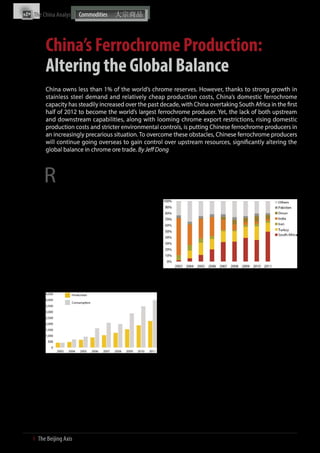
           China owns less than 1% of the world’s chrome reserves. However, thanks to strong growth in
           stainless steel demand and relatively cheap production costs, China’s domestic ferrochrome
           capacity has steadily increased over the past decade, with China overtaking South Africa in the first
           half of 2012 to become the world’s largest ferrochrome producer. Yet, the lack of both upstream
           and downstream capabilities, along with looming chrome export restrictions, rising domestic
           production costs and stricter environmental controls, is putting Chinese ferrochrome producers in
           an increasingly precarious situation. To overcome these obstacles, Chinese ferrochrome producers
           will continue going overseas to gain control over upstream resources, significantly altering the
           global balance in chrome ore trade. By Jeff Dong


          R
                 eviewing the remarkable growth in China’s demand        tionship is only becoming stronger with the wider utilisation of
                 for commodities and its domestic production during      chrome pellets to address the sizing issue of SA chrome ore. Apart
                 the last decade is always eye opening, with the steel   from SA, Turkey, Iran, India, Oman, and Pakistan are all among the
           industry standing out as the prime example. In 2011,          top exporters of chrome ore to China.
           China produced 61% of the world’s total steel output,
           and consumed most of that production domestically.            China’s Sources of Chrome Ore Imports (%, 2003-2011)
           This is even more astounding given China’s domestic
           iron ore supply meets only 40% of domestic demand.
           In order to delve deeper into the stainless steel industry
           one must examine ferrochrome, a main ingredient used
           in steel production. In 2011, China consumed 3.5 million
           tons of high carbon ferrochrome, more than half of which
           was produced domestically. With China having almost no
           domestic chrome reserves, nearly all of the ferrochrome
           produced in China relies on imported chrome. From
           2003 to 2011, though China’s production of high carbon
           ferrochrome increased by nearly 10 times, from around
           420,000 tons to over 2.5 million tons, this still cannot
                                                                         Source: Mysteel, The Beijing Axis Analysis
           meet domestic demand.
           China’s Production and Consumption of High Carbon             China has several key advantages in ferrochrome production
           Ferrochrome (‘000 tons, 2003-2011)                            including low electricity costs, an adequate supply of relatively
                                                                         cheap labour, a well-established transportation network, as well
                                                                         as low capital investment costs for new plants. While many would
                                                                         argue China’s ferrochrome industry will unlikely grow at the same
                                                                         rate for the next five to 10 years, and may even downsize, China
                                                                         is currently taking a significant share of the world’s ferrochrome
                                                                         production.

                                                                         As a matter of fact, thus far in 2012, China’s domestic ferrochrome
                                                                         production is still increasing steadily, even amidst worsening pros-
                                                                         pects for the global economy. At the same time, chrome ore imports
                                                                         continue to rise, while ferrochrome imports are decreasing. Tradi-
           Source: CNFEOL; The Beijing Axis Analysis                     tional ferrochrome producers such as SA are inevitably facing stiff
                                                                         competition.
           With China’s expanding production capacity, the global
           chrome mining sector has boomed. Rising demand for            South African ferrochrome – will export restrictions help?
           stainless steel and subsequent increases in produc-
           tion capacity were the main drivers behind many new           While the world has witnessed China’s share of global ferrochrome
           chrome mining projects. From 2005 to 2011, global             production surge from less than 5% in 2001 to 33% currently, SA
           annual chrome output increased from around 18 million         producers are suffering from sub-par performances. Strong compe-
           tons to 24 million tons.                                      tition from China, according to many insiders, is the main challenge
                                                                         facing SA producers. This is particularly startling given China holds
           Without a doubt, South Africa (SA) has been the most          very little domestic chrome reserves. South Africa, which owns a
           important source for China’s chrome imports; this rela-       majority of the world’s chrome reserves, are feeding the mills and


18  І  The Beijing Axis    
The China Analyst	


furnaces in the Far East. To address this issue, one can put forward       competitiveness, rather than merely attempt to curb
the ‘new colonialisation’ approach in exploiting Africa for its mineral    chrome ore trade.
resources in raw material form, leaving local value-added industries
in a tough situation, or one can examine this issue through a more         Outlook
analytical lens.
                                                                           China’s production of ferrochrome will most likely
First of all, SA chrome ore exports, including UG2 chromite, remain        remain strong and continue to be highly influenced by
a crucial source of stock for China’s ferrochrome producers. The           the on-going consolidation and transformation taking
comparatively low cost of mining UG2 and subsequent big profits            place in China’s steel sector. The following trends are also
are coercing many miners to stick to operations in the UG2 area.           expected to emerge in the mid-to-long term:
In fact, UG2 chrome ore exports to China now make up an integral
part of SA–Chinese bilateral trade activities – the trade employs           ӹӹ   Ferrochrome demand will continue to increase
thousands of SA miners and supports local economies. In 2011, the                With the upgrading of China’s domestic steel
total value of SA chrome ore exports to China amounted to USD 1.2                industry, stainless steel and chrome alloy demand
billion, representing 9.3% of SA’s total exports to China.                       will increase. This means that ferrochrome
South Africa’s Exports to China (USD bn, 2003-2011)                              producers in China will still be blessed with a huge
                                                                                 market. We do not foresee a downturn in China’s
                                                                                 domestic ferrochrome production capacity; on
                                                                                 the contrary, we expect capacity to increase by
                                                                                 another 25% in the next five years.

                                                                            ӹӹ   Consolidation, integration, and innovation
                                                                                 China can no longer be simply viewed as a low-
                                                                                 cost producer – labour costs, power costs, and
                                                                                 environmental costs are all rising at a steady
                                                                                 pace. China’s extensive production model will
                                                                                 be altered and replaced by a more consolidated
                                                                                 and efficient model, which requires cuts in CO2
                                                                                 emissions. Green technology will spur innovation
                                                                                 in the production cycle, which will be largely led
                                                                                 by the country’s huge state-owned enterprises or
Source: UN Comtrade, The Beijing Axis Analysis
                                                                                 large scale producers with the financial, adminis-
South Africans advocating a chrome export tax are basically betting              trative and technical resources.
that chrome export restrictions will most likely lead to price increases
for chrome ore, which will help to put further pressure on China’s          ӹӹ   Greater control over upstream resources
domestic ferrochrome industry and ultimately reduce its capacity.                China is definitely strengthening its control over
Therefore, if stainless steel demand remains robust, demand for                  upstream resources in the ferrochrome and stain-
ferrochrome will also see a strong increase, offering SA producers               less steel industries. As a matter of fact, China’s
an opportunity to regain their advantage in ferrochrome produc-                  endeavour of going overseas for chrome dates
tion. Ideally, SA ferrochrome producers will go one step further, and            back to the early 1990s. Some of the most recent
adopt innovative technologies to improve their performance and                   examples include Sinosteel’s ambitious venture in
strengthen their market position.                                                SA – however, there is definitely more to come.

However, another scenario may emerge; a decrease in SA chrome               ӹӹ   Localisation
ore exports will be offset by increased supply from other sources.               We believe China’s ferrochrome producers will
One cannot underestimate the potential of increasing chrome                      inevitably transfer their capacity to local producers
supplies from other countries such as Iran, Turkey and several                   in chrome-rich countries such as SA. In the short
Asian countries, especially since these sources have higher quality              term, China’s domestic production will still hold
reserves – their ores are lumpy and better suited for ferrochrome                a comparative advantage over SA in terms of
production than the fines produced in SA.                                        power supply, capital equipment costs, logis-
                                                                                 tics, etc. But over the longer term, we believe the
As a reference, we can look at the recent export restriction imposed             electricity and logistics issues in SA will be prop-
by Indonesia. A leading producer of nickel, Indonesia significantly              erly addressed and significantly improved. Under
raised their export tax for nickel ore to 20%, in an effort to protect           the dual trend of rising production costs and an
the local ferronickel industry. However, the higher export tax did not           appreciating currency, China will need to transfer
prop up nickel export prices; on the contrary, not only did the China            primary manufacturing activity overseas, closer
import price of nickel ore drop, the Philippines increased shipments             to the source of chrome reserves. This presents
of nickel ore to China, increasing their market share in China at the            an opportunity for forward-looking SA producers
expense of their neighbour. The policy also caused large layoffs of              to strike deals with the world’s newest leader in
Indonesian nickel mine workers.                                                  ferrochrome production.

Even if chrome ore exports are curbed, SA ferrochrome producers            Jeff Dong, Associate
will still suffer from electricity shortages, underdeveloped trans-        jeffdong@thebeijingaxis.com
portation infrastructure, higher production cost, etc. These prob-
lems will remain even if restrictions are put in place. SA should first
take a long term view and address these problems to increase local


19  І  The Beijing Axis    
The China Analyst	


           China’s Rising Wages and its Impact
           on Cost Competitiveness
           Recent developments in the Chinese economy have drawn renewed media attention to rising
           labour costs in China. More than 50 years ago, economist Arthur Lewis pointed out that with the
           expansion of the modern sector of a low-income country, the unlimited labour supply (from the rural
           sector’s labour surplus) would disappear, and as a result, the country will enter into a phase of faster
           real wage increases. Many countries, including South Korea and Japan, have experienced such a
           change. What about China—is it already at the Lewis turning point? If so, does this signal the end
           of cheap labour in China? By Li-Chia Ou

           Has China reached the point of no return? (aka                    neighbouring South Korea, while in the US, agriculture is only 1%
           the Lewis turning point)                                          of the economy and employees 2% of the US labour force (see chart
                                                                             to the right). This implies that the productivity of China’s agricultural
           Those that argue that China has already reached the               sector is much lower than that of the US or South Korea, which is
           Lewis turning point cite the fact that starting from              understandable given that both countries have highly industrialised
           2006, wages for Chinese migrant workers have skyrock-             agricultural sectors and are more developed than China. As China’s
           eted. Based on data from the China Household Income               economy modernises, so too will its agricultural sector, and in the
           Project, in 2006 and 2007, migrant wages increased by             process, become more productive and mechanised.
           11.5% and 11.2% in nominal terms, and 10% and 6.4%
           in real terms. Wage growth slowed in 2008, but resumed            Assuming that the modernisation of China’s agricultural sector can
           in 2009 when migrant wages increased by 16.6% in                  reduce the agricultural labour force by 50%, an additional 160 million
           nominal terms and 17.3% in real terms. In 2011, China’s           rural workers will be made available to participate in other sectors
           migrant workers got an average pay increase of around             of the economy (China’s total workforce in 2011 was estimated to be
           21% according to data from the National Bureau of                 around 800 million). All this serves to highlight that China has yet to
           Statistics.                                                       reach the Lewis turning point and is unlikely to anytime soon.

           Annual Per Capita Income of Urban and Rural                       Explanations for rising migrant wages
           Households (USD, %, 2005-2011)
                                                                             So if China has yet to reach the Lewis turning point, why have
                                                                             Chinese migrant wages risen so quickly? In theory, the surplus
                                                                             of rural labour in China combined with a fairly underdeveloped
                                                                             agricultural sector should work to suppress migrant wages from
                                                                             going up. To understand why this is happening, one needs to have
                                                                             a broad understanding of China’s socio-political context. Like most
                                                                             central governments around the word, the Chinese Communist Party
                                                                             (CCP) has a mandate to create more jobs for its citizens. However
                                                                             for the CCP, job creation is not just an economic issue, but also a
                                                                             political one; in a one party state like China, high unemployment
                                                                             would undermine the ruling party’s legitimacy to govern and can
                                                                             lead to social unrest. This can partly explain why China remains
                                                                             addicted to infrastructure spending; large infrastructure projects
                                                                             not only stimulate economic growth but also employ thousands
                                                                             of workers over a several year period. This also explains why China
                                                                             has been slow to modernise its agricultural sector. If China were to
                                                                             rapidly adopt a modernised agricultural sector, hundreds of millions
           Note: (1) Annual disposable income of urban households and net
                    income of rural households per capita                    of the rural Chinese population would be left without work. This
                 (2) Growth rates are calculated at current prices           large unemployed workforce would be difficult for the secondary
           Source: National Statistics Database; The Beijing Axis Analysis   and tertiary sectors to absorb all at once, since the vast majority of
                                                                             these rural workers lack the necessary education and training.
           However, to conclude that China has already reached
           the Lewis turning point by looking only at migrant                To keep this large rural population employed in agriculture and
           worker salary data ignores certain demographic realities          not flood the cities in search of higher paying jobs, the Chinese
           and other broader forces at play in China. For example,           government has implemented various direct subsidies to indirectly
           in 2011, the agricultural sector accounted for only 9%            boost their income. The most drastic measure was taken in 2004,
           of China’s total GDP but employed 40% of its labour               when the government both increased cash subsidies to farmers
           force. This is an unusually high workforce percentage             and abolished agricultural taxes nationwide. These two government
           committed to a sector that accounts for less than 10%             actions have created incentives for farmers to increase farm outputs,
           of the economy. In comparison, agriculture accounts               further adding to their income and applying upward pressure on
           for 3% of GDP and employs 7% of the workforce in                  migrant pay.


20  І  The Beijing Axis    
The China Analyst	


Size of Agricultural Sector for Select Countries (USD bn, %, 2011)


Source: World Bank; The Beijing Axis Analysis

Furthermore, while cheap labour has been a key factor in generating       result of the central government’s implementation of the ‘going-
high economic growth over the past three decades, it has also             west’ strategy.
contributed to profound income disparities between rural and
urban households. If left unchecked, such persistent, widening            It should also be noted that while Chinese wages may be going
inequality could lead to social crises that could interrupt growth and    up, Chinese exports are also moving up the value chain. In 1985,
damage competitiveness. To alleviate social tension, the Chinese          China had a GDP per capita of just USD 290 at current prices and
government has begun to intervene by enforcing higher minimum             had almost no high-tech exports1. By 2011, China’s GDP per capita
wages along with investing in a social safety net for the poor. As        had increased to USD 5,414 with high-tech exports now accounting
part of the government’s plans to increase minimum wages by               for roughly 30% of total exports. In contrast, the average GDP per
13% annually through 2015, many provinces and municipalities,             capita of the countries which China then competed with was USD
including Guangdong, Beijing and Shanghai, have raised their              8,318 in 19852. By 2011, the GDP per capita of these countries
minimum wages by double digits in 2011. While many of these               had increased to USD 37,291. This means that while wages in
minimum wage increases are occurring in China’s affluent eastern          China may be going up, the wages of China’s competitors on a
areas, it is clear that the main beneficiaries are the migrant workers    product-by-product basis have been rising even faster along with
who flock to these areas in search of work. Such a re-alignment           the sophistication of their exports. China might have become
of rural–urban income, as a result of wage increases for unskilled        expensive for many low-end manufactured goods such as T-shirts
migrant workers, will reduce overall income inequality over time.         and footwear, but it is still comparatively priced for semiconductors,
                                                                          cars and software development. In fact, recent hikes in minimum
The changing nature of China’s cost competitiveness                       wages all across China are aligned with the government’s initiatives
                                                                          to accelerate the country’s process of industrial restructuring, since
Regardless of when China will reach the Lewis turning point, the          higher labour costs will force enterprises to move up the value chain
indisputable fact is that Chinese migrant wages are rising and this       into more technologically-advanced industries. In other words,
in turn is also driving up general labour costs in China. The rise in     various higher-end products currently being produced by South
Chinese wages means that China will no longer be the cheapest             Korea, Japan, Taiwan, Singapore, and the US will face stiffer Chinese
supplier of low-end manufactured goods. This will benefit countries       competition.
such as Vietnam, Indonesia, Pakistan and other developing nations
who can expect to see more manufacturing outsourced to their              China still has a large untapped pool of migrant workers, but fewer
countries instead of China. However in reality, only a portion of total   will be working in low-end, labour intensive industries; instead,
manufacturing will shift from China. Smaller low-cost countries           more will be employed in high-end value-added industries as China
simply lack the supply chain, infrastructure, and labour skills to        continues to move up the value chain, posing a greater challenge to
absorb all of China’s current production volume.                          middle- and high-income economies, as it moves towards head-to-
                                                                          head competition across various product categories.
Furthermore, China’s vast landmass and regional differences
allows for the country’s central and western provinces to carry on
labour-intensive industries, which coastal regions have outgrown.         Li-Chia Ou, Senior Consultant
China’s spatial and regional diversity means that China can avoid         lichia@thebeijingaxis.com
the common ‘flying geese’ pattern of labour-intensive industries’
moving to less-developed economies by allowing labour-intensive
industries to continue growing in the less-developed inland regions.
In fact, this trend is already clear. In 2011, employment growth
for migrant workers in the western and central regions stood at
8.1% and 9.6%, respectively. In contrast, employment growth in            1
                                                                            Note: High-tech exports are products classified with high RD intensity,
the Yangtze and Pearl River Delta regions was relatively stagnant,        such as aerospace, computers, pharmaceuticals, scientific instruments, and
increasing by only 0.3% and 1%, respectively. Such a development          electrical machinery
is possible because China’s capacity for industrial development in        2
                                                                            Note: Assumes these countries/territories are the US, Japan, South Korea,
the central and western regions has substantially improved as a           Singapore and Taiwan


21  І  The Beijing Axis    
The China Analyst	


How to Procure from China #10 - Quality Management (QA/QC),
Expediting and Third-Party Management
The Beijing Axis Procurement Process Flow encapsulates the full extent of project engagement, from
the point of first enquiry to the range of services in the solution process and benefits provided for the
customer. In this edition we focus more closely on step 10 of the Beijing Axis Procurement Process Flow:
Quality Management (QA/QC), Expediting and Third-Party Management.


The Process Flow and Service Delivery Platform of Beijing Axis Procurement

 ӹӹ   Overall Project Management
 ӹӹ   Holistic Risk Management
 ӹӹ   Strategic Relationship Management
 Strategic
 Sourcing        Analysis                        Procurement
                                                                1                        2                          3                           4
                                                                                                                          
                 Initial Scoping, Supplier       Needs Analysis           Systematic Industry       Supplier Evaluation,
                                                                                                                                Supplier
                                                                                                                                Pre-Qualification,
                 Evaluation, Due Diligence       China Procurement         Search  Supplier         Application of high-
                                                                                                                                Due Diligence 
                                                 Competitive               Identification            level filters
                  Final Selection               Analysis
                                                                                                                                Final Selection


                 Engagement                      Commercial
                                                                8                        7                          6                            5
                                                                                                                          
                 Supplier Engagement,            Process,                                            Site Inspection,           Supplier
                 Site Inspections, Sample        Contracting               Tender Evaluation         Sample Testing and         Engagement, RFQ 
                                                 and Contract                                        Standards                  Tendering (SOI, RFP)
                 Testing, Contracting            Management


 Supply
 Chain           Process                                        9          Quality
                                                                                       10                         11            Coordination 
                                                                                                                                              12
 Mgmt 
                                                                                                                          
                 Transaction Monitoring,         Transaction
                                                                           Management (QA/
                                                                                                     Logistics
                                                                                                                                Assistance On Site
 Support         QA, Expediting, Third-          Monitoring
                                                                           QC), Expediting
                                                                                                     Management
                                                                                                                                (Material Mgmt,
                                                                           and Third-Party                                      Commissioning,
                 Party Mgmt  Logistics                                    Management                                           etc.)


Beijing Axis Procurement Guidelines for Quality                            Expediting: BAP manages the delivery schedule from day one after
Management (QA/QC), Expediting and Third-Party                             the order is placed. By working out a production schedule with the
Management                                                                 supplier, BAP expedites the schedule by implementing a tracking
                                                                           schedule customised with a unique tracking frequency for each
Quality and schedule are the most critical factors in procurement.         supplier. In this way, BAP is able to preemptively identify potential
Beijing Axis Procurement (BAP) provides a range of services to manage      schedule slippage and figure out whether it can be fixed together
the quality of the goods being procured and tracks the schedule            with the supplier. Meanwhile, BAP coordinates with the client to flag
throughout the transaction process, including quality management           potential risks and assists in analysing the client’s acceptance.
(QA/QC), expediting and third-party management.
                                                                           Third-Party Management: BAP has established good relations with
Quality Management (QA/QC): Although it is the supplier’s                  numerous international third-party inspection companies’ China
responsibility to deliver goods of an acceptable quality, it is still      branches and has rich experience working alongside them, on both a
critically important to monitor and manage the entire manufacturing        residence supervision and visit supervision basis, on behalf of overseas
process and verify the quality at every step. BAP provides different       clients. Besides quality inspection companies, BAP helps to manage
quality management strategies and solutions according to the               all other relevant third parties such as law firms, accounting firms,
nature of the goods being procured and leads or assists in the             etc. when required, including selecting, recommending, coordinating
implementation. For commodities, we place a particular emphasis            with and managing the progress of third parties. Therefore, by only
on material checks and final product analysis; for small pieces of         giving instructions to BAP, the client can effectively connect to almost
machinery, we address performance inspections; with small suppliers,       all the relevant parties of the procurement transaction in China.
we coordinate with public labs equipped with better test facilities; for
complex equipment, we mobilise supervising engineers to be based           By Beijing Axis Procurement
on-site at the supplier’s factory for months at a time to work closely
with the supplier’s quality department and third-party inspectors to
monitor the entire process. Whenever a quality problem is identified,
BAP facilitates communication between all parties and provides
efficient and flexible solutions until the problem is resolved.


22  І  The Beijing Axis    
The China Analyst	


China Capital:
                                                                                 Monthly Inbound FDI in China and y-o-y Growth Rate
                                                                                 (USD bn, Jan 2011 - Jun 2012)


Inbound/Outbound
FDI  Overseas
Resource Investment
In the first half of 2012, while FDI into China slightly
decreased compared with the first half of 2011,
China’s outbound FDI grew significantly compared
with last year’s figure. Meanwhile, Chinese                                      Source: MOFCOM; The Beijing Axis Analysis

investment activity in the resources sector remains                               ӹӹ    In H1 2012, we have seen a reduction in the presence of wholly
prominent relative to other sectors as Chinese                                          foreign-owned enterprises in China which represents China’s long
state-owned enterprises continue to close MA                                           term growth shift away from investment and exports towards a
                                                                                        more consumption-driven growth model
deals in the mining sector. By Beijing Axis Capital
                                                                                 Notable FDI Deals in China in H1 2012
                                                                                  ӹӹ    In January, US-based LL Energy acquired a 51% stake in the
                                                                                        Weishe coal mine located in China’s Guizhou province from
                                                                                        Union Energy for USD 16.2 mn
Foreign Direct Investment into China
                                                                                  ӹӹ    In February, Vivo Ventures announced that the company will
Summary                                                                                 invest 45% of its newly raised capital (USD 375 mn) in China
 ӹӹ    In H1 2012, FDI into China amounted to USD 59.1 bn, down by 3%             ӹӹ    In March, the J. M. Smucker Company acquired a
       y-o-y. FDI into China fell for four consecutive months from January              non-controlling minority interest in Guilin Seamild Biologic
       to April with concerns that the Chinese economy is heading for a                 Technology Development, a privately owned manufacturer
       slower growth rate in 2012. However, FDI into China slightly picked              and marketer of oat products for approximately USD 35 mn
       up in May, increasing by 0.1% y-o-y                                        ӹӹ    In April, Minsur SA’s subsidiary, Cumbres Andinas SA, reached
 ӹӹ    In H1 2012, wholly foreign-owned enterprises were the major                      an agreement with CST Mining Group to acquire a 100% stake
       vehicles of investment in China, accounting for around 76% of the                in the group’s subsidiary, CST Resources, for USD 505 mn. CST
       total amount of capital actually utilised                                        Resources owns a 70% stake in Marcobre SAC
 ӹӹ    In H1 2012, 85% of FDI into China originated from other Asian              ӹӹ    In April, German carmaker Volkswagen AG’s joint venture in
       countries/regions. Hong Kong, as the main bridge for inbound                     China announced plans to set up a USD 210 mn assembly
       investment into mainland China, is still the largest source of capital,          plant in Xinjiang Uygur Autonomous Region
       contributing USD 37.3 bn or 63.2% of total FDI

Annual Inbound FDI in China (USD bn, 2005 - H1 2012)                             FDI in China by Source Country / Region (USD bn, H1 2012)


Source: MOFCOM; The Beijing Axis Analysis                                        Source: MOFCOM; The Beijing Axis Analysis


23  І  The Beijing Axis    
The China Analyst	


 ӹӹ    In April, Samsung Electronics, the world’s biggest memory           ӹӹ   In May, Bright Food Group announced that the company is
       chip maker, announced plans to invest USD 7 bn to build its              considering a 60% stake in British cereal maker Weetabix for
       first chip factory in China                                              USD 1.2 bn
 ӹӹ    In May, SJI’s subsidiary, SJI (Hong Kong), acquired 451,604,000     ӹӹ   In May, Dalian Wanda Group announced it would purchase
       shares (40.5% stake) of SinoCom Software Group for                       AMC Entertainment for USD 2.6 bn. The deal received all the
       approximately USD 64 mn                                                  necessary regulatory approvals in July
                                                                           ӹӹ   In July, CNOOC announced a bid for Canadian Nexen for USD
Chinese Outbound Foreign Direct Investment                                      15.1 bn. Once approved it would be the largest acquisition to
                                                                                date
Summary
 ӹӹ    In H1 2012, China’s OFDI amounted to USD 35.4 bn, an               Chinese Overseas Resource Investment
       increase of 48.2% y-o-y
 ӹӹ    In H1 2012, Beijing Axis Capital followed 51 overseas              Summary
       investment activities initiated by Chinese companies                ӹӹ   In H1 2012, China’s OFDI in the energy and mining sectors
       (including on-going transactions and concluded deals of                  moved up to the third place among all sectors largely due
       previously announced transactions), among which 19 are                   to the USD 13.4 bn worth of MA deals finalised by Sinopec,
       resource-related investments (see deal table on next page)               CNOOC and other SOEs, which represented approximately
       and 30 are non-resource investments                                      69.1% of China’s total overseas investment
 ӹӹ    In terms of resources deals, Canada became the most                 ӹӹ   Chinese investors have poured a majority of their investment
       attractive region for Chinese investors with 6 deals followed            into resources such as iron ore, copper, aluminium, platinum
       by Australia and Europe, with 5 and 3 deals each respectively            and other types of minerals. Among these commodities, iron
 ӹӹ    In terms of non-resource deals, Europe and the US were                   ore and copper took almost 60% of total OFDI
       equally favoured by Chinese investors, with 7 deals each.
       Asian countries such as Singapore, Japan, South Korea and          Past challenges and emerging new trends and practices
       the Philippines have also attracted more Chinese investors,         ӹӹ   Chinese mining companies have traditionally preferred not
       with 7 deals all together                                                to deal with projects in early stages of exploration and only
 ӹӹ    In terms of deal size, oil, gas and power deals completed (or            invest in already developed mines that are in the close-to-
       currently being negotiated) by China’s three energy giants,              production stage. This previously limited their ability to
       CNOOC, Sinopec, and SinoChem, are the most noteworthy                    acquire resources in terms of selecting prospective targets
                                                                                and capturing assets when they are still on the low-end of
                                                                                the value curve. China’s geological survey companies, such
Notable Chinese OFDI Deals in H1 2012
                                                                                as the East China Exploration and Development Bureau, are
 ӹӹ    In January, Devon Energy Corporation announced Sinopec will              becoming commercialised and venturing into new markets.
       invest USD 2.2 bn in exchange for one-third of Devon’s interest          This is allowing Chinese mining companies to enter into
       in five new venture plays                                                agreements with these geological survey companies and
 ӹӹ    In January, China Three Gorges International (Europe) SA,                widen the range of possible investment/acquisition targets.
       acquired 21.4% of the share capital of Energias de Portugal              The Central Geological Exploration Fund was established in
       (EDP) for USD 3.5 bn                                                     2005 to support the activities of such companies
 ӹӹ    In March, Sinopec bought a 30% stake in Latin America’s             ӹӹ   Chinese companies’ past engagement with international
       second-biggest oil producer - Galp Energia SGPS SA (GALP)’s              advisory companies for their overseas projects were generally
       exploration division for USD 5.2 bn                                      limited. This resulted in various problems and even deal
 ӹӹ    In April, Chalco launched a USD 926 mn bid for a proportional            failures. Chinese mining companies are gradually realising
       takeover of SouthGobi Resources. In August, Chalco extended              the value-added of such companies and are more actively
       its offer period for another 30 days to obtain approval from the         working with them in various regions, including Africa
       Mongolian government                                                ӹӹ   Given that most large mining companies investing overseas
China’s Annual Outbound Non-financial FDI and y-o-y Growth                      are SOEs, their major means of engagement is through
Rate (USD bn, 2005 - H1 2012)                                                   government contacts. Government-level deals are seen as the
                                                                                main avenue for OFDI. However, there are certain limitations
                                                                                of local companies/governments such as technical capacity
                                                                                (costing, resource estimation, analysis etc.). Acknowledging
                                                                                these shortcomings, Chinese mining companies are now
                                                                                buying partial/full stakes in companies specialising in the
                                                                                exploration stage of mining development after they have
                                                                                identified an attractive resource


Source: MOFCOM; The Beijing Axis Analysis


24  І  The Beijing Axis    
The China Analyst	


Source: Various media; Company reports; The Beijing Axis Analysis


25  І  The Beijing Axis    
The China Analyst	                                                                                                                                                                                    The China Analyst


Mapping China in Africa’s Growth Story
While Africa has certainly benefited from soaring global resource demand, other aspects such as the continent’s ongoing infrastructure construction boom as well as its blooming middle class have been key catalysts in driving
China’s engagement with the region. As depicted in the map below, China’s growing presence, as both an investor and leading trading partner, is expected to continue reshaping the continent – and the global economy – for
decades to come. By Beijing Axis Strategy


Note: Trade value depicts the country’s total trade value with China (imports and exports).
Source: World Bank; IMF; The Beijing Axis Analysis


26  І  The Beijing Axis                                                                                                                                                                                      27  І  The Beijing Axis
The China Analyst	


           Africa Means
                                                                            in demand for steel and aluminium, and virtually all growth
                                                                            for copper and nickel. This rapid growth in China’s natural
                                                                            resource use not only contributed to a surge in commodity
                                                                            prices but also a windfall in trade between China and Africa,


           Business:
                                                                            a major supplier of raw materials. As one of a handful of
                                                                            global frontiers that remain significantly unexplored as a
                                                                            capital investment destination, Africa has also offered high
                                                                            returns across several sectors. According to a report from the

           Opportunities in                                                 McKinsey Global Institute (MGI), natural resources accounted
                                                                            for only one-third of Africa’s GDP growth from 2000 through
                                                                            2008, while the remaining two-thirds came from other sectors


           Frontier Markets
                                                                            such as transportation, telecommunications, and manufac-
                                                                            turing. Some of the key reasons behind this growth surge
                                                                            include improved and more stable macroeconomic conditions
                                                                            and the passage of reforms aimed at creating a more favour-
                                                                            able business climate.
           Over half of all African economies have                          While external demand has been crucial in this trend, a number
           exhibited impressive GDP growth rates in                         of internal growth engines – Africa’s ongoing urbanisation
           recent years, with entire regional blocks within                 process, an expanding labour force, and the rise of the middle-
                                                                            class – have also been key. According to a new report from the
           the continent doubling or even tripling in size                  African Development Bank, Africa’s middle class has tripled
           during the past decade. However, what does                       in size over the last 30 years and now numbers 313 million
           this mean for global businesses? How can                         people, or more than 34% of the continent’s population. In fact,
                                                                            MGI estimates that the number of middle-income consumers
           global MNCs carve out a stake and identify                       in Africa has already exceeded India’s figure. Today, 40% of the
           opportunities in Africa’s growth story? By                       continent’s one billion people live in urban areas, compared to
                                                                            just 28% in the 1980s. A large number of Fortune 500 compa-
           Javier Cuñat                                                     nies have already identified the opportunity. Wal-Mart, who
                                                                            in 2011 completed its USD 4 billion purchase for a majority


          S
                ince 2008, emerging economies have accounted for            stake in the South African retail company Massmart Holdings
                approximately two-thirds of global economic growth.         Ltd. as a part of its global expansion strategy, is just one of
                While the sovereign debt crisis in Europe continues to      the most recent examples. Moreover, where large MNCs have
           deepen and the impact of the global economic slowdown            been slow to venture, local conglomerates such as Nakumatt
           becomes more widespread, emerging economies led by               and Uchumi in Kenya are capitalising on Africa’s middle class
           China continue to show solid macroeconomic prospects. More       and their growing spending power to increase their profits.
           importantly, this is no longer a BRICS phenomenon. It now
           includes a large number of fast growing economies in Asia and    Where to go
           Latin America, with Africa now in the mix.
                                                                            One of the key challenges international companies face
           Indeed most of Africa’s economies have grown at rates            when searching for opportunities in Africa is where to start.
           far above the world average in the last decade and have          While the specifics of the market size and growth, channels to
           continued to do so despite a weak global economy. According      market, industry structure, government and regulations, etc.
           to the IMF, from 2000 to 2010, six of the world’s ten fastest-   will affect a company’s final decision, it is important to first
           growing economies were in sub-Saharan Africa and the fore-       gather relevant intelligence regarding a country’s macro envi-
           cast for the next five years is even more optimistic. Leading    ronment. This allows for the clustering, prioritising and vali-
           performers such as Ghana in the west, Tanzania in the east,      dating of regions, sub regions and countries without boiling
           and Mozambique in the south are emerging as the new prof-        the ocean.
           itable investment destinations of an increasing number of
           Fortune 500 companies.                                           With this goal in mind, The Beijing Axis (TBA) recently
                                                                            performed an analysis of the African continent at the macro
           Looking into what those new foreign investors are doing, it      level. TBA undertook a comparative evaluation of the macro
           seems that Africa’s growth story is not only sustainable but     environment at three levels, namely socio-political/govern-
           also spread across countries and sectors. Telecommunications,    ance, macro-economic and business environment. Ten
           infrastructure, banking and finance, agribusiness and real       factors across three categories were selected to assess the
           estate, against the backdrop of the continent’s booming          overall attractiveness of each country. They were Voice and
           natural resources sector, are expected to remain central to      Accountability, Political Stability, Government Effectiveness,
           an increasing number of companies’ international strategies.     Regulatory Quality, Rule of Law and Control of Corruption,
                                                                            GDP Size, GDP Growth and Economic Growth Outlook and
                                                                            Ease of Doing Business. Some of the findings are as follows
           The drivers                                                      (see chart to the right):
           While there are many factors that have contributed to Africa’s
           growth story, the emergence of China in the world economy         ӹӹ   African economies exhibit impressive GDP growth rates
           and its engagement with the continent has, and will continue           – entire regions have doubled or even tripled the size of
           to play, a fundamental role in Africa’s re-emergence on the            their economies during the past decade
           world stage. China’s has exercised a two-pronged approach –
           trade and investment – throughout its decades-long engage-        ӹӹ   On the basis of the analysis, countries in the Southern
           ment with the continent.                                               region have performed better due to their better
                                                                                  governance structures and business environment
           While China’s GDP expanded at an annual rate of 10% over
           2000-2008, its annual demand for industrial raw materials         ӹӹ   Mauritius, Botswana, Namibia, Cape Verde and South
           has witnessed its own impressive boom. During this period,             Africa emerge as the most attractive markets from a
           China accounted for two-thirds of the world’s entire growth            macro perspective


28  І  The Beijing Axis    
The China Analyst	


Macro Performance of Sub-Saharan African Countries (Top 15, 2011 - 2012)


Note: Denotes a more favourable score. For example,   indicates a GDP growth rate greater then 8% in 2011. A complete methodology breakdown is available
from the author upon request.
Source: World Bank; IMF; The Beijing Axis Analysis

 ӹӹ    African countries ranked from 16 to 30 are small                             political stability, ease of doing business or rule of law
       economies dealing with various socio-political issues                        can be deal breakers. Understanding and managing
                                                                                    these risks are extremely important
 ӹӹ    African countries ranked from 31 onwards are very
       small economies with underdeveloped governance                         ӹӹ    Market intelligence is essential but one cannot entirely
       structures                                                                   rely on data – Decisions cannot be entirely based on
                                                                                    desk research. Field research and on-the-ground work
 ӹӹ    In order for Africa as a whole to continue to prosper,
                                                                                    are key differentiators in successful market entry
       it needs to improve its socio-political stability, rule of
                                                                                    strategies
       law and business environment. For the moment, Africa’s
       under performance in these areas are hindering further                 ӹӹ    Collaborative strategies work - Find support in people
       economic growth and business opportunities                                   who have an intimate understanding of the local
                                                                                    market and have the right connections at both the
Africa is a continent and cannot be understood as one single                        corporate and government levels. Finding a local
market. At the same time, while the overall opportunity                             partner often helps companies to navigate the red tape
may remain attractive (eg. the size of Africa’s consumption                         and significantly reduce transactional costs involved in
markets equals that of India), the market size and growth of                        organic growth
a single market may not be that appealing yet. This is where
an integral understanding of Africa’s regional trade blocs is                 ӹӹ    Find the right channel to market – China’s increasing
needed to further assess available market entry opportunities.                      involvement in Africa presents an opportunity for many
Companies also need to be aware of Africa’s ongoing regional                        companies. Chinese partners can play the role of a
integration efforts, which potentially offer larger markets,                        financier, client or supplier. By partnering with the right
fewer barriers and greater economies of scale. Companies                            Chinese company, one can protect against new entrants
should initially focus on the regional leaders – Ghana in the                       at home or enter into new markets
west, Kenya in the east, South Africa in the south – and analyse
the surrounding regional markets. Whereas it may be impos-                    ӹӹ    Position yourself in the long run – Do not expect
sible to set up shop in each country, having a base in the                          immediate results. A long-term commitment is
regional stronghold is a feasible and increasingly attractive                       fundamental in a successful Africa strategy. The real
strategy that MNCs can adopt.                                                       opportunity is still to come
The challenges ahead
                                                                             Knowing and understanding how to navigate these obstacles
Africa is unique. Understanding and being able to navigate                   are some of the factors that have allowed successful inter-
the continent’s diversity is key. TBA has long been assisting                national companies – many of them Chinese, to profit from
companies to enter a number of African markets and we have                   the continent’s high profit margins across a gamut of sectors.
seen same mistakes being made by new entrants. In our view,                  Doing business in Africa requires both flexibility and a long
some of the critical success factors are:                                    term strategic approach. There will be challenges ahead, but
                                                                             the overall opportunity remains in the continent’s long-term
 ӹӹ    First conduct a thorough market scoping exercise –                    potential.
       Understanding where to start (and why), are key tasks                 Javier Cuñat, Associate Director
       that companies often ignore. Macro factors such as                    javiercunat@thebeijingaxis.com


29  І  The Beijing Axis    
The China Analyst	


Regional Overview:
                                                                                                    performance this decade. India’s manufacturing sector has
                                                                                                    contracted and its agricultural sector has slowed substantially
                                                                                                    while spending by both consumers and the government has


BRIICS
                                                                                                    decelerated slightly from 2011. The Reserve Bank of India
                                                                                                    revised its GDP growth forecast for 2012-13 downwards
                                                                                                    accordingly, from 7.2% to 6.5%
                                                                                               ӹӹ   Indonesia’s Q2 y-o-y GDP growth picked up slightly from Q1,
                                                                                                    resulting in an overall H1 GDP growth rate of 6.4% . Q2 growth
                                                                                                    was mainly supported by investment, government spending
Growth slows in Brazil, India, and China; picks up in Russia,
                                                                                                    and household consumption, while exports slowed due to
Indonesia and South Africa                                                                          declining commodity prices. Overall, Indonesia’s central bank
  ӹӹ    Brazil’s growth H1 2012 fell to 0.6%, leading the government                                sees 2012 growth at 6.2%, down from 6.5%
        to once again lower its annual GDP growth forecast, from 3%
                                                                                               ӹӹ   China’s GDP growth has yet to bottom out, as growth slowed
        to 2%. The government has since carried out several tax cuts
                                                                                                    for the sixth consecutive quarter in Q2 2012 for an H1 2012
        on durable goods and aggressive reductions in interest rates,
                                                                                                    GDP growth rate of 7.8%. Thus far, the Chinese government
        with economic activity expected to rebound in H2. While
                                                                                                    has avoided a massive stimulation package and opted
        unemployment remains low, inflation is re-emerging as a
                                                                                                    for a more subtle approach which includes a combination
        concern amid rising wholesale and food prices
                                                                                                    of implementing policy easing measures and fast tracking
  ӹӹ    Russia’s 4.4% y-o-y GDP growth in H1 caused the Economic                                    infrastructure projects
        Development Ministry to raise its full year GDP growth
                                                                                               ӹӹ   South Africa’s GDP grew by 3.2% in Q2 2012, up from 2.7%
        projection to between 3.7% and 4.0%, up from the previous
                                                                                                    in Q1, largely due to a rebound in mining output after 11
        3.4%. While rapid growth in investment and rising consumer
                                                                                                    months of contracting. However, the outlook for the economy
        demand are driving the strong start, experts are less optimistic
                                                                                                    in H2 continues to deteriorate due to recent clashes between
        growth can remain strong amidst a weak global economy
                                                                                                    striking mine workers and the police, which will most likely
  ӹӹ    India’s y-o-y GDP growth rate decreased to 5.5% in the March-                               weaken mining output and exports
        June period (FY Q1 2012-13), marking the country’s worst Q1


                                                                                  Russia
                                                                                  143 mn
                 Legend
                                                                                  USD 2,022 bn
                 Population, 2012E                                                USD 14,246                                                            China
                 GDP, 2012E                                                                                                                             1,343 mn
                 GDP per capita, 2012E                                                               India                                              USD 7,992 bn
                                                                                                     1,205 mn                                           USD 5,899
                                                                                                     USD 1,779 bn

                                                                                                     USD 1,455                                               Indonesia
                              Brazil
                                                                          South Africa                                                                       249 mn
                              206 mn
                                                                          50 mn                                                                              USD 928 bn
                              USD 2,449 bn
                                                                          USD 422 bn                                                                         USD 3,797
                              USD 12,465
                                                                          USD 8,202

Source: IMF, World Bank, The Beijing Axis Analysis

BRIICS Real GDP Growth (%, 2011, H1 2012)                                                  BRIICS Inflation and Unemployment (%, Jun 2012)

                                                                                                                Inflation

                                                                                                                Unemployment rate*


Source: Trading Economics; Russian Federal State Statistics; Statistics Indonesia; China   Source: NBS China; Trading Economics; Stats SA; IBGE; The Beijing Axis Analysis.
NBS; IMF; BBVA. Note: H1 2012 growth rate for India is for the March-June period.          *Unemployment: China (Q2 12), India (2011), Indonesia (Feb 12), South Africa (Q2 12)


30  І  The Beijing Axis    
The China Analyst	


31  І  The Beijing Axis    
The China Analyst	


Regional Focus:
                                                                       China-Africa Annual Trade (USD bn, 2002 - H1 2012)


CHINA-AFRICA
In H1 2012, China-Africa trade reached USD
91.3 billion, once again reiterating the ever-
strengthening trade relations between the two
regions. In this edition, we report the latest China-
Africa trade data, review major China-Africa trade                     Source: CEIC; The Beijing Axis Analysis
and investment deals from March to August, and
also spotlight China’s investment relationship with                     ӹӹ     Trade data for Q1 2012 reveals that the five biggest African
                                                                               exporters to China were South Africa, Nigeria, Egypt, Algeria
the Economic Community of West African States                                  and Liberia
(ECOWAS)
                                                                       China Exports to Africa
                                                                        ӹӹ     China’s exports to Africa in H1 2012 totalled USD 38.8 bn, up
China-Africa Briefing: More frequent China-Africa high-                        from USD 32.6 bn in H1 2011
level visits; Fifth Forum on China–Africa Cooperation;                  ӹӹ     Trade data for Q1 2012 reveals that the leading five export
African culture project in Beijing                                             destinations for Chinese goods in Africa were South Africa,
                                                                               Angola, Sudan, Libya and Congo-Brazzaville
 ӹӹ   High-level exchanges between African countries and China
      have occurred more frequent. Over the past few years,
                                                                       China-Africa Trade, Ten Largest Partners
      President Hu Jintao has visited the African continent four
                                                                       (USD bn, Q1 2011 vs. Q1 2012)
      times, taking him to 18 African countries. At the same time,
      between 2007 and 2011 over 30 African heads of state and 20
      African speakers of parliament have visited China
 ӹӹ   The Fifth Ministerial Conference of the Forum on Africa-
      China Cooperation (FOCAC) was held in Beijing in July 2012.
      Government officials from China, 50 African countries and the
      chairman of the African Union Commission were present and
      adopted the Beijing Declaration. The Declaration confirmed
      that all goals set at the previous FOCAC in Egypt had
      been accomplished and established an agreement to fully
      explore and utilise one another’s comparative advantages,
      to continue strengthening cultural exchanges, to expand
      mutually beneficial economic cooperation and to further
      strengthen cooperation in international affairs. The Chinese
      government pledged USD 20 bn in concessional loans to
      African countries over the next three years
                                                                       Source: CEIC; The Beijing Axis Analysis
 ӹӹ   The China Africa Industrial Forum (CAIF) aims to bring African
      culture to Beijing with the launch of the first China-Africa
      Cultural Industrial Park Project. The park, is expected to be    China-Africa Investment
      completed within two to three years, with a direct output        Trends
      value amounting to USD 800 mn per year                            ӹӹ     The stock of Chinese investment in Africa has rapidly grown
                                                                               from less than USD 500 mn in 2003 to almost USD 14.7 bn in
China-Africa Trade                                                             2011. At the same time, the number of Chinese companies
                                                                               investing in Africa now exceeds 2,000, mainly targeting
Total Trade
                                                                               the finance, mining, manufacturing, construction, and
 ӹӹ   In H1 2012, China-Africa trade reached USD 91.3 bn, up from              agricultural, industries
      USD 79 bn in Q1 2011. China’s imports from Africa continued
      to grow at much faster pace than its exports, widening its       Major Recent Deals and Developments
      trade deficit with the continent                                  ӹӹ     In March 2012, Chinese firm Guotai Iron and Steel invested
                                                                               USD 4.1 mn to expand its steelmaking facilities in Zambia
China Imports from Africa
                                                                        ӹӹ     In March 2012, the Liberia Broadcasting System signed a USD
 ӹӹ   China’s imports from Africa in H1 2012 totalled USD 52.5 bn,
                                                                               1.4 mn agreement with China for technical services related to
      up from USD 46.3 bn in H1 2011
                                                                               the operation and maintenance of broadcasting and related
                                                                               facilities
                                                                        ӹӹ     In March 2012, the Nigerian communications satellite rebuilt


32  І  The Beijing Axis    
The China Analyst	


      by the China Great Wall Industry Corporation is estimated           ӹӹ    In August 2012, South Sudan announced China would help
      to have provided more than 150,000 Nigerian employment                    build a long delayed new airport in the capital Juba, which
      opportunities                                                             includes a USD 158 mn loan
 ӹӹ   In April 2012, China offered USD 2 mn to help develop               ӹӹ    In August 2012, the Zimbabwe government signed seven
      Mozambique’s agricultural research capabilities. Technology               MoUs with China Fund International Consortium (CFIC) to
      and skills will be shared and transferred when a group of ten             explore ways to cooperate in infrastructure development
      Chinese scientists visit to train local technical staff                   across the transport, communications, energy, water and
 ӹӹ   In April 2012, Ghana signed a USD 1 bn loan agreement                     tourism sectors
      with China Development Bank to develop pipelines and
      surveillance technology of oil and gas processing plants           Africa Regional Focus: China and the Economic Community
 ӹӹ   In April 2012, China International Mining Group Corporation        of West African States (ECOWAS)
      acquired USD 21.2 mn worth of shares in Mwana Africa,
                                                                         Brief Regional Profile
      enabling production at the company’s nickel mine in
      Zimbabwe to restart                                                 ӹӹ    ECOWAS consists of fifteen African countries: Benin, Burkina
                                                                                Faso, Cape Verde, Côte d’Ivoire, Gambia, Ghana, Guinea,
 ӹӹ   In April 2012, China continued to invest in Uganda’s
                                                                                Guinea-Bissau, Liberia, Mali, Niger, Nigeria, Senegal, Sierra
      infrastructure by funding a USD 350 mn toll road construction
                                                                                Leone and Togo. In 2011, ECOWAS countries had a combined
      project. The road will link Entebbe International airport to the
                                                                                GDP of USD 341 bn, with an average real GDP growth rate of
      capital city of Kampala
                                                                                4.9%. This includes Ghana with a 13.5% growth rate and Côte
 ӹӹ   In May 2012, China pledged USD 300 mn to construct a                      d’Ivoire which contracted by 5.8%
      convention centre and additional infrastructure in Zimbabwe
                                                                          ӹӹ    The second China-ECOWAS Economic and Trade Forum
      for the 2013 UN World Tourism Organisation General Assembly,
                                                                                was held in Ghana on 20-21 March 2012 with the theme of
      which will be jointly hosted by Zambia and Zimbabwe. China
                                                                                “institutionalising strategic economic partnership between
      funded the project on the condition that Chinese companies
                                                                                ECOWAS States and China.” As economic ties between China
      be awarded construction tenders
                                                                                and the region have been strengthening, the forum aimed to
 ӹӹ   In June 2012, Huawei donated USD 76,000 for medical                       maximise foreign direct investment inflows from China and
      infrastructure development in the Southern Region of                      attract long-term concessionary funding for development.
      Malawi. A maternity holding shelter will be constructed and               Attending West African leaders encouraged Chinese investors
      an ambulance will be procured for a health centre in Balaka               to take advantage of existing fair trade policies in West African
 ӹӹ   In June 2012, China’s total investment in Zambian sporting                states to expand their investments
      infrastructure reached USD 159 mn with the completion of            ӹӹ    There are currently two China-sponsored Special Economic
      the USD 65 mn Levy Stadium in Ndola and progress in the                   Zones (SEZs) under construction within ECOWAS. The Lekki
      reconstruction of Independence Stadium in Lusaka                          Free Trade Zone and Ogun Guangdong Free Trade Zone,
 ӹӹ   In June 2012, Ethiopian Railways Corporation (ERC)                        are both located in Nigeria and are due to be completed in
      signed a USD 1.5 bn railway construction deal with China                  2014-2015
      Communications Construction Company to develop a railway            ӹӹ    China-ECOWAS share of total China-Africa trade increased
      line between Ethiopia and Tadjourah seaport in neighbouring               from 16.4% in 2010 to 16.7% in 2011
      Djibouti. The railway will enable an increase in exports,
      specifically potash exports
                                                                         China-ECOWAS OFDI (USD mn, 2003-2010)
 ӹӹ   In July 2012, China donated 10,000 biogas appliances to
      the National Bio-gas Program of Ethiopia. The cost of the
      appliances totalled USD 161,290
 ӹӹ   In July 2012, the Central Bank of Kenya authorized the Bank of
      China (BOC) to open a representative office, expanding BOC’s
      existing African presence outside South Africa and Zambia
 ӹӹ   In July 2012, Nkosazana Dlamini-Zuma was elected as the
      head of the African Union Commission. She is expected to
      play a major role in boosting China-Africa ties as she vows to
      enhance cooperation with China
 ӹӹ   In July 2012, Nigeria’s government signed a USD 1.5 bn
      contract with China Civil Engineering Construction Corp
      for a 36-month project to build a railway between Lagos
      and Ibadan, the country’s largest and third-largest cities,
      respectively
 ӹӹ   In August 2012, the Ethiopian Chamber of Commerce and
      Sectoral Associations and the China Council for the Promotion      Note: Data for Burkina Faso and Guinea-Bissau is not available.
                                                                         Source: MOFCOM; The Beijing Axis Analysis
      International Trade signed an MoU to establish a cooperative
      business council between the two countries
 ӹӹ   In August 2012, gold junior Canaco Resources announced
      that it had entered into an MoU with a Chinese gold producer
      to establish a JV to develop Canaco’s Magambazi gold project
      in Tanzania. The Chinese producer’s technical excellence and
      experience in mine development is expected to facilitate the
      advancement of the project


33  І  The Beijing Axis    
The China Analyst	


Regional Focus:
                                                                         China-Australia Trade

                                                                         Total Trade


CHINA-AUSTRALIA
                                                                           ӹӹ    Sino-Australian trade continues to grow as H1 2012 saw total
                                                                                 trade reach USD 59.6 bn (China Customs, CC) and USD 59.9
                                                                                 (Australian Bureau of Statistics, ABS). CC has China’s exports
                                                                                 to Australia at USD 17.2 bn and its imports from Australia at
                                                                                 USD 42.4 bn, while the ABS has Australia’s imports from China
                                                                                 at USD 21 bn and its exports to China at USD 39 bn
                                                                           ӹӹ    China and Australia experienced their largest ever monthly
China’s economic slowdown is starting to make the                                trade gap in June 2012, with the ABS pegging Australia’s
global economy uneasy, judging by the commotion                                  surplus at USD 4 bn. This is a y-o-y increase of 27.7% from
surrounding Minister Ferguson’s comments about                                   June 2011’s USD 3.1 bn surplus
the end of Australia’s mining boom. However,
                                                                         China Annual and Monthly Trade with Australia (USD bn)
based on the figures and activities generated in the
first half of 2012, Sino-Australian trade continues to
grow with total trade reaching nearly USD 60 bn in
H1 2012. In addition, a number of off take contracts
were secured and investment deals approved.


China-Australia Briefing: End of resources boom; China
looks to fill investment void
 ӹӹ   Australia’s Resources Minister Martin Ferguson caused a stir in
      mid-August 2012 when he declared that “the resources boom          Source: China Customs, The Beijing Axis Analysis
      is over”, referring to China’s economic slowdown and waning
      demand for commodities. His comments came a day after
      BHP Billiton decided to shelve its USD 20 bn expansion plan        Trade News
      for the Olympic Dam copper mine in South Australia and a             ӹӹ    Solar energy deals have been prevalent in mid-2012 as
      new USD 20 bn harbour to double its iron ore exports from                  Chinese companies seek contracts with Australian clients.
      Western Australia. Other Australian officials quickly recanted             In August 2012, Chinese solar photovoltaic manufacturer
      or qualified Ferguson’s words, with Trade Minister Craig                   Renesola won an 8 MW deal to supply Australia’s True Value
      Emerson insisting that the mining boom is “not even halfway                Solar. In July 2012, Renesola won a 5.95 MW panel order from
      through”. Ferguson later qualified his statement, stating that             Australian distributor Solargain
      while commodity prices had peaked, investments in multi-             ӹӹ    In July 2012, another Chinese company, China Sunergy,
      billion dollar projects will continue                                      announced that it had signed a 7.8 MW solar modules sales
 ӹӹ   Australia’s agricultural sector could see mounting Chinese                 contract with Australia’s Urban Group Energy. The Chinese
      interest in their sector as key mining projects are cancelled or           company notes that Australia accounted for 18% of its total
      shelved. Statistics from Australia’s Foreign Investment Review             shipments in Q1 2012 and is considered a key market for the
      Board (FIRB) show that while 66% of China’s approved USD                   company
      14.8 bn worth of investments in 2010-2011 were mining-               ӹӹ    In July 2012, Australia’s Roy Hill Iron Ore project managed to
      related, only a measly USD 4 mn or 0.03% were related to the               secure two off-take sales agreements with Chinese compa-
      agriculture, forestry and fishing industries. However, the USD             nies, Shougang Group and Yaxin Steel. Other equity partners
      4 mn is already indicative of a growing or reignited interest              are Posco and STX (South Korea), Marubeni (Japan) and China
      in these sectors. With the possible exception of the USD 11.8              Steel (Taiwan). The mine is scheduled to start production by
      mn worth of investments made in 2006-2007, there has not                   Q4 2014
      been any significant Chinese investment activity in the sector
 ӹӹ   Australian regulators are busy debating how to properly
      deal with increased Chinese investment in the country’s            Australia Annual and Monthly Trade with China (USD bn)
      vital resources sector. In 2011, Chinese enterprises more
      than doubled their amount of investments into Australia’s
      resource sector from 2010. While some Australians argue the
      country should welcome Chinese investment, others argue
      Chinese investments should benefit Australians and be care-
      fully managed, which possibly includes imposing conditions
      on the investment
 ӹӹ   Chevron’s decision to opt out of Woodside Petroleum’s
      Browse LNG project is seen by Australian officials as a chance
      for Chinese investors to buy in, as they have indicated interest
      in taking a stake earlier this year. Chevron will exchange its
      interest in the Browse project for Royal Dutch Shell’s share in
      two gas fields in the Wheatstone LNG project and USD 450           Source: Australian Bureau of Statistics, The Beijing Axis Analysis
      mn in cash

34  І  The Beijing Axis    
The China Analyst	


Australia State Watch: Western Australia                                 Approved Investment Proposals in Australia by Country
  ӹӹ    With a gross state product (GSP) of USD 185 bn in 2010-11,       (2010-2011, USD bn)
        Western Australia is Australia’s fourth-largest economy
  ӹӹ    The state is a net exporter with exports of USD 111 bn and
        imports of USD 25.7 bn in 2010-11
  ӹӹ    Main commodities exported in 2010-2011 were iron ore (USD
        56.6 bn, 51% of total exports), followed by gold bullion (USD
        13.3 bn, 11.9%) and crude oil (USD 10.9 bn, 9.9%)
  ӹӹ    Key industries in terms of contribution to Western Australia’s
        GSP are mining (28%), construction (11.7%), and manufac-
        turing (6.2%)
  ӹӹ    In 2010-11, China was Western Australia’s largest trading
        partner, with total trade reaching USD 50 bn (36.6%), followed
        by Japan (USD 22.8 bn, 16.7%) and South Korea (USD 11.4
                                                                         Source: FIRB, The Beijing Axis Analysis
        bn, 8.4%)
  ӹӹ    Western Australia’s trade with China has accelerated rapidly
                                                                                 both Australia and China, which is then expected to ramp
        at a CAGR of 43.5%, from USD 2.2 bn in 2002 to USD 57.3 bn
                                                                                 up to 25-33 MMT per year by the end of 2016. Following the
        in 2011. In 2011, the state registered its highest ever annual
                                                                                 merger, Yanzhou will hold 78% of Yancoal, while Gloucester
        trade surplus with China at USD 50.2 bn in 2011
                                                                                 and Noble Group will retain a 9% and 13% stake, respectively
                                                                           ӹӹ    In July 2012, Sinopec Group announced that it had completed
Western Australia Trade with China (USD bn, 2002 – H1 2012)                      a USD 1.1 bn deal to purchase 10% of Australia Pacific LNG.
                                                                                 This gives China’s largest refiner access to 78.6 bn cubic meters
                                                                                 of LNG reserves, and increases its stake in the company to
                                                                                 25%. Sinopec also confirmed its intention to buy an addi-
                                                                                 tional 3.3 mn tons of LNG per year from Australia Pacific LNG,
                                                                                 increasing the total amount to 7.6 mn tons per year for 20
                                                                                 years starting in 2016
                                                                           ӹӹ    In August 2012, ASX-listed oil and gas company Molopo
                                                                                 Energy sold five of its coal seam gas assets in Queensland to
                                                                                 Chinese oil and gas giant PetroChina for USD 42.7 mn. While
                                                                                 this sits outside PetroChina’s Arrow Energy venture with Royal
                                                                                 Dutch Shell, it adds to PetroChina’s presence in Queensland’s
                                                                                 coal seam gas sector
                                                                           ӹӹ    In August 2012, Jinyu (H.K.) International Mining, a wholly-
                                                                                 owned subsidiary of China’s Zijin Mining Group, acquired
                                                                                 more than 50% stake in Australia’s Norton Gold Fields. Making
                                                                                 a USD 190 mn cash takeover offer, Zijin already owns 17% of
                                                                                 Norton. The purchase marks the first successful example of
                                                                                 a Chinese enterprise taking over a large-sized gold mine in
                                                                                 production
                                                                           ӹӹ    In August 2012, Hanlong Mining announced that China’s
                                                                                 National Development and Reform Commission approved
Source: Australian Bureau of Statistics, The Beijing Axis Analysis               its takeover bid for Australian iron ore developer Sundance
                                                                                 Resources, on the condition that the final acquisition price be
China-Australia Investment                                                       “reasonable.” Sundance then accepted Hanlong’s revised USD
                                                                                 1.4 bn offer from Hanlong Mining, which is 21% lower than
Major Recent Deals                                                               what it offered a year ago due to significantly lower iron ore
                                                                                 prices. The next step in the process is for Hanlong to secure
  ӹӹ    In February 2012, Beijing Guoli Energy Investment finalised a
                                                                                 China Development Bank’s financial support by August 31 to
        USD 20.5 mn investment in Australian exploration company
                                                                                 buy shares it does not already own. Hanlong currently owns
        Cuesta Coal, which successfully listed on ASX in June 2012
                                                                                 18.6% of Sundance and wants the company for its USD 4.7
  ӹӹ    In April 2012, Taurus Mineral, owned by China Guangdong                  bn Mbalam iron ore project that sits between Central Africa’s
        Nuclear Power Corp (CGNPC) Uranium Resources Company                     Congo and Cameroon
        and the China Africa Development Fund (CADFund),
        completed its USD 2.4 bn bid for ASX-listed Extract Resources,
        which owns the Husab uranium project in Namibia. This came
        after CGNPC and CADFund’s successful bid for London-listed
        Kalahari Minerals late in 2011
  ӹӹ    In June 2012, 98.4% of Australia’s Gloucester Coal share-
        holders approved the merger with Chinese-owned Yancoal
        Australia, a subsidiary of Yanzhou Coal Mining. The merger
        will create a company with an annual production capacity
        of around 12 MMT of thermal, coking and pulverised coal in


35  І  The Beijing Axis    
The China Analyst	


Regional Focus:
                                                                                             China-LatAm Trade

                                                                                             Total Trade


CHINA-LATIN AMERICA
                                                                                               ӹӹ    In H1 2012, China’s total bilateral trade with LatAm reached
                                                                                                     USD 89.4 bn, a decrease of 4% y-o-y (see chart below, left)
                                                                                               ӹӹ    Brazil, Mexico and Chile were China’s largest trading partners
                                                                                                     in LatAm, accounting for 37%, 16% and 15%, respectively, of
                                                                                                     China’s total trade with the region during H1 2012 (see chart
                                                                                                     below, right)
                                                                                               ӹӹ    China’s trade deficit with the region widened to USD 8.8 bn in
                                                                                                     H1 2012, up from a USD 5.5 bn deficit in H1 2011
In H1 2012, bilateral ties continued to strengthen,
emphasised through the 2012 BRICS Summit as well China Imports from LatAm
as high-level state visits that resulted in the creation ӹӹ In H1 2012, China’s total imports from LatAm amounted to
of a BRICS bank and currency swap-agreements. In            USD 40.3 bn, a decrease of 18% y-o-y
this edition, we review these evolving issues and        ӹӹ Approximately 76% of LatAm’s exports to China in H1 2012
                                                            originated from just three countries, namely Brazil (42%),
highlight Peru’s escalating position in the LatAm           Chile (19%) and Venezuela (15%)
region and its trade relationship with China.
                                                                                             China Exports to LatAm
                                                                                               ӹӹ    During 2011, China’s total exports to LatAm in 2011 reached
China-LatAm Briefing: Rio+20 and state visits strengthen                                             USD 99.1 bn, an increase of 36 % y-o-y
bilateral trade ties                                                                           ӹӹ    In 2011, approximately 67% of China’s exports to the region
  ӹӹ    Chinese Premier Wen Jiabao visited four countries in June                                    were concentrated in Brazil (32%), Mexico (24%) and Chile
        during a Latin America tour and attended the UN Conference                                   (11%)
        on Sustainable Development (Rio+20). Premier Wen visited
        Brazil, Uruguay, Argentina and Chile with the goals of building                      China-LatAm Investment
        political mutual trust, promoting pragmatic cooperation,
        deepening cooperation in regional and international affairs,                         Trends
        and expanding cultural and humanistic exchanges. In Chile,                             ӹӹ    Despite expanding trade between South America’s Mercosur
        Premier Wen and Chilean President Sebastian Pinera agreed                                    and China, the trade bloc’s second-biggest trade partner, a free
        to double bilateral trade to USD 60 bn by 2015                                               trade deal was unrealistic as experts and industrialists fear an
  ӹӹ    High-level visits were also made to China by Latin American                                  invasion of cheap Chinese goods, and unequal competition.
        leaders such as Cuba’s Raul Castro, whose visit resulted in                                  Nonetheless, China is expected to carry out feasibility studies
        the signing of eight trade agreements, and Colombia’s Juan                                   on the possibility of a trade deal
        Manuel Santos, who attended the China-Colombia Investment                              ӹӹ    LatAm countries and China continue to sign agreements in
        Forum and signed an agriculture trade agreement. Costa                                       order to safeguard against any global financial crisis as well
        Rican President Laura Chinchilla Miranda also visited Beijing                                as strengthen their trade ties. One clear example is Brazil and
        as her government explores ways to fully take advantage of                                   China’s USD 30 bn currency swap deal. The funds will be used
        its FTA with China and expand its cooperation on a number                                    to shore up reserves in times of crisis or directed towards
        of areas including transportation, power, education, science                                 boosting bilateral trade
        and culture


China-LatAm* Trade (USD bn, 2003 - H1 2012)                                                  China-LatAm Trade by Country (USD bn, H1 2011 vs. H1 2012)


Source: CEIC; UN Comtrade; China Customs; The Beijing Axis Analysis                          Source: CEIC; China Customs; The Beijing Axis Analysis


*Note: Latin America here refers to the Latin American Integration Association (LAIA). LAIA’s members are Argentina, Bolivia, Brazil, Chile, Colombia, Cuba, Ecuador, México, Paraguay,
Peru, Uruguay and Venezuela.


36  І  The Beijing Axis    
The China Analyst	


Major Recent Deals and Developments                                       China-LatAm Country Watch: Peru
 ӹӹ   In April 2012, Industrial and Commercial Bank of China (ICBC),      Brief Country Profile
      the world’s top lender by market value, opened a Brazil
      branch to tap growing trade flows between the two countries.        ӹӹ    Peru is the fifth-largest economy in LatAm, with a nominal
      ICBC do Brasil Banco Multiplo SA will be based in Sao Paulo               GDP of USD 173.5 bn in 2011, and a GDP per capita of USD
                                                                                5,782. Peru’s total population in 2011 was about 30 million, and
      and focus on commercial and investment portfolios
                                                                                similar to many other LatAm countries, its economy is mainly
 ӹӹ   In May 2012, Colombian President Juan Manuel Santos visited               driven by exports of agricultural and mineral commodities
      China to attend the China-Colombia Investment Forum and             ӹӹ    As of 2011, Peru is one of the world’s fastest-growing economies
      to meet with President Hu Jintao. Both countries signed an                owing to the economic boom experienced during the 2000s.
      agreement to cooperate in agriculture while Santos, along                 In 2011, Peru’s GDP grew by 6.9% and is on track to show the
      with ministers of agriculture, mines and energy, sought to                strongest growth in Latin America this year, growing by 6.1%
      develop trade agreements and to boost Chinese investment                  in H1 2012
      in the country                                                      ӹӹ    Peru’s top three sources of imports are the US, China and Brazil
 ӹӹ   In June 2012, Brazilian President Dilma V. Rousseff and                   and its main imports include commodities, fuels, machinery,
      Chinese Premier Wen Jiabao agreed on a common agenda                      equipment, vehicles and electronic machinery. Its top three
      aimed at increasing investment and trade flows in the mining,             export destinations are China, the US and Switzerland, and its
      industrial, aviation and infrastructure sectors. Relations                main exports include gold, copper ore, and petroleum
      between the two countries were also raised to the status of a
      ‘global strategic partnership’                                      China’s Total Trade with Peru (USD mn, 2001 - H1 2012)
 ӹӹ   In June 2012, Chinese Premier Wen Jiabao visited Argentina
      to boost bilateral ties, the first visit by a Chinese premier to
      Argentina in 27 years. China-Argentina agricultural trade
      reached USD 5 bn in 2011, accounting for one-third of total
      bilateral trade volume. Premier Wen also visited Uruguay,
      marking the first trip by a Chinese premier to the country
      since diplomatic ties were established in 1988
 ӹӹ   In June 2012, Chinese renewable energy company Sky
      Solar, state-backed China Development Bank and Chilean
      industrial group Sigdo Koppers announced plans for a USD
      900 mn solar energy park, marking the biggest investment
      made by a Chinese firm in the Andean country
 ӹӹ   China State Grid, the country’s largest power distributor,
      signed a USD 1.3 billion deal with Venezuela’s National
      Electric to build power-transmission facilities in Caracas and
      in other regions of the South American country. The project
      would be China’s largest power-transmission venture in
      Venezuela by value and represents State Grid’s first overseas       Source: UN Comtrade; China Customs; The Beijing Axis Analysis
      grid construction contract
 ӹӹ   In July 2012, the construction of a new relocated city, costing     China-Peru Bilateral Ties
      USD 50 mn, was slated for completion in Peru. Chinese mining        ӹӹ Bilateral relations between Peru and the People’s Republic
      company Chinalco was required by the Peruvian government                of China strengthened further in 2010 and 2011 with the
      to relocate the 5,000 residents in the vicinity of its USD 2.2 bn       establishment of the Peru-China Free Trade Agreement in March
      Toromocho copper mine                                                   2010. Some of the main benefits of this relationship have been
                                                                              increased bilateral trade, with China becoming Peru’s biggest
 ӹӹ   In July 2012, China and Cuba signed eight economic                      trade partner in 2011. The number of Peruvian exporters to
      agreements during Raul Castro’s four-day visit to China. It             China grew by 30% to approximately 500 companies in 2011
      was suggested that the countries coordinate more on issues
                                                                          ӹӹ 2011 direct investments from China to Peru are estimated at
      such as United Nations reform, sustainable development,                 USD 750 mn, with much of it concentrated in the oil, mining
      climate change, as well as increasing trade in the energy and           and fishing industries. This is expected to increase to USD 1.2
      construction industries, among others. China is currently               bn by 2013, and to jump tenfold by 2018, especially in the
      Cuba’s second-largest trading partner, with trade reaching              mining, energy, petrochemicals and infrastructure sectors
      USD 2 bn in 2011
                                                                          ӹӹ Military ties between China and Peru are growing stronger
 ӹӹ   In July 2012, Brazilian car importer CN Auto announced a USD            and Beijing military officials are increasingly making high-level
      122 mn investment plan to build a factory 130 km outside of             visits
      Linhares in Brazil that will start producing automobiles made       ӹӹ Peru’s total trade with China reached USD 13.3 bn in 2011, an
      by Chinese company Harbin Hafei Automobile Industry Group               increase of 25.6% y-o-y
 ӹӹ   In July 2012, China’s largest construction machinery maker          ӹӹ China’s total imports from Peru increased by 22.9% y-o-y to
      by revenue, Sany Heavy Industry, announced expectations to              approximately USD 6.9 bn in 2011. Ores (66%), residues and
      double sales in Brazil as infrastructure construction is taking         waste from the food industries (15%) and copper (11%), make
      place on a large scale ahead of the 2014 World Cup and 2016             up the bulk of China’s imports
      Olympic Games. Sany’s revenue from Brazil reached USD 200           ӹӹ China’s total exports to Peru in 2011 reached USD 6.3 bn, an
      mn in 2011                                                              increase of 28.1% y-o-y. Electrical machinery, equipment and
 ӹӹ   In August 2012, China Development Bank and the Ministry                 parts (20.8%), nuclear reactors, boilers, machinery and
      of Foreign Trade of Costa Rica agreed to develop a strategic            mechanical appliances (19.1%), and vehicles (9.1%) make up
      partnership with an aim of establishing a special economic              the bulk of China’s exports to Peru
      zone in the country


37  І  The Beijing Axis    
The China Analyst	


Regional Focus:
                                                                         China Imports from Russia
                                                                          ӹӹ    China’s imports from Russia in June 2012 amounted to USD
                                                                                3.3 bn, up 5.4% y-o-y


CHINA-RUSSIA
                                                                          ӹӹ    China’s imports from Russia during H1 2012 amounted to USD
                                                                                23.9 bn, an impressive increase of 28% y-o-y

                                                                         China Exports to Russia
                                                                          ӹӹ    China’s exports to Russia in June 2012 amounted to USD 4.0
                                                                                bn, up 13.7% y-o-y
The first half of 2012 saw a large amount of                              ӹӹ    China’s exports to Russia during H1 2012 amounted to USD
announced investment deals between China and                                    19.8 bn, an increase of 14.8% y-o-y
Russia across various sectors, particularly in the
manufacturing industry. Business activity jumped                         China-Russia Monthly Trade (USD bn, 2011 - H1 2012)
in late May-June, driven by Russian President
Vladimir Putin’s high-level visit to China, which was
accompanied by a massive business delegation.


China-Russia Briefing: High-level government visits; Joint
investment projects; Oil and gas highlights
 ӹӹ   During 5-6 June, Russian President Vladimir Putin made
      an official visit to Beijing, accompanied by a large Russian
      business delegation consisting of representatives from
      Russian companies and government bodies. During his visit, a
      wide range of strategic agreements were signed between the
      two countries. The major ones include a cooperation protocol
      between the two governments on building nuclear power
      plants in China; a memorandum of understanding (MoU)
      between Russia’s Ministry of Industry and Trade and China’s
      Ministry of Industry and Information Technology aimed at           Source: China Monthly Economic Indicators; The Beijing Axis Analysis
      strengthening industrial cooperation; a cooperation ‘road
      map’ between Russia’s state-owned Rosatom and China’s              China-Russia Investment
      Atomic Energy Authority; and an MoU on the expansion of
      the power energy cooperation between Russia’s Inter RAO            Major Recent Deals
      UES and the State Grid Corporation of China. In addition,           ӹӹ    In early May, Polyus Gold, the largest gold producer in Russia,
      the Russian Direct Investment Fund and China Investment                   announced the selling of a 7.5% block of treasury shares.
      Corporation (CIC) jointly launched the Russia-China                       5% minus one share of Polyus will go to the major Chinese
      Investment Fund (RCIF), a USD 2-4 billion private equity fund             investment fund CIC International (through its subsidiary
      which will focus on advancing bilateral economic, trade and               Chengdong Investment Corporation); another 2.5% of the
      investment relations between the two countries                            company’s issued share capital will be purchased by Russia’s
 ӹӹ   According to newly released data, Q1 2012 saw a significant               second-largest bank, VTB. Polyus Gold will receive USD 635.5
      increase in cross border transactions on the China Foreign                mn from the two deals. By selling this stake, Polyus Gold aims
      Exchange Trade System, with the transaction volume of the                 to raise the percentage of its free-floating shares to 22%,
      Russian ruble surpassing that of the British pound. Demand                which will increase the company’s chances to be approved for
      for rubles was driven by companies from the resources sector.             a premium listing on the London Stock Exchange (LSE). Under
      Trade with rubles is conducted by Russia’s VTB and China’s                the terms of the transactions, CIC and VTB have limitations on
      Bank of China, ICBC, and Harbin Bank                                      the use of the acquired shares
                                                                          ӹӹ    At the end of May, Yuriy Slyusar, deputy minister of the
 ӹӹ   Q2 2012 was marked by announcements of various
                                                                                Russian Ministry of Industry and Trade, announced plans
      investment/funding deals between China and Russia,
                                                                                between China and Russia to establish a joint venture to
      spanning sectors such as automobile, tyre manufacturing,
                                                                                build a new long-distance passenger aircraft. The new plane
      aluminium, transportation, and aerospace, among others
                                                                                that may come out of the joint China-Russia cooperation will
      (details can be found in ‘China-Russia Investment’ subsection).
                                                                                be developed on the basis of the Russian Il-96 (designed in
      An imminent oil supply contract was announced between
                                                                                late 1980s). In the joint venture, which will be established
      Russia oil company TNK-BP and China, along with plans
                                                                                by Russia’s United Aircraft Corporation and the Commercial
      between China and Gazprom to build underground natural
                                                                                Aircraft Corporation of China (COMAC), Russia will contribute
      gas storage facilities in China
                                                                                intellectual property and China will contribute capital. The
                                                                                planes are set to be manufactured in China. While neither
China-Russia Trade                                                              side has elaborated on the exact production schedule, they
                                                                                initially plan to better assess the needs of the Chinese and
Total Trade                                                                     Russian markets for such aircrafts
 ӹӹ   Bilateral trade between China and Russia has continued to           ӹӹ    In the beginning of June, China’s largest tyre manufacturer,
      increase during the first half of 2012, reaching USD 43.6 bn, an          Triangle Group, announced plans to aggressively enter the
      increase of over 22% y-o-y (see chart to the right)                       Russian market by establishing a plant in central Russia. The


38  І  The Beijing Axis    
The China Analyst	


   China’s Imports from Russia (USD bn, 2010 vs. 2011)                         China’s Exports to Russia (USD bn, 2010 vs. 2011)


Source: UN Comtrade; The Beijing Axis Analysis                               Source: UN Comtrade; The Beijing Axis Analysis

       company, which already sells its products in Russia, sees                    the Kaztransservice (subsidiary of Kazakhstan Railways).
       more prospects to further tap into the Russian market due to                 Contributing 51.1% of the charter capital, the Chinese parties
       increasing demand for its products. The project will be backed               are the major shareholders, while the foreign investors hold
       by the Bank of China. Triangle Group is already engaged in a                 equal shares of 16.3% in the JV. The main activity of the joint
       dialogue with the regional government of Nizhny Novgorod.                    venture will be organising regular rail container shipments
       According to the company’s representatives, it is still too                  between Chongqing in China and Duisburg in Germany. The
       early to talk about the volume of investment and planned                     first container train was scheduled for the end of June 2012.
       production capacity, since the company is still assessing the                Freight volume is forecasted to reach around 5,800 twenty-
       opportunities in the Russian market                                          foot equivalent units (TEU) by the end of 2012
 ӹӹ    Also in June, Chinese automaker Lifan, driven by more than
       a two-fold increase in the sales of its cars in Russia last year,     China-Russia Resources Watch
       announced it has started looking for sites to build its own           New China-Russia oil deal; new prospects for China-Russia
       plant in Russia. The Chinese company is currently deliberating
       between the Kaluga and Yaroslavl regions. If the talks succeed,
                                                                             natural gas cooperation
       Lifan will build a plant with capacity of up to 50,000 cars per        ӹӹ    In May, TNK-BP, a Russian-British oil company, entered into an
       year. The future plant location will depend on several factors,              agreement to supply 100,000 tons of crude oil to China every
       including the support of local authorities and tax benefits.                 month. The oil will be supplied via the Atasu-Alashankou
       Investment for the project is expected to reach up to USD 200                pipeline running through Kazakhstan. TNK-BP has already
       mn. Another Chinese automaker, Haima, can become Lifan’s                     used this pipeline to transport oil to China; however, in 2009,
       partner in the project, but a final agreement has not yet been               China stopped buying oil from TNK-BP and shifted its buying
       reached. According to the data from Association of European                  towards Kazakhstan instead. In 2011, Kazakhstan oil supplies
       Businesses, Lifan, currently the most successful Chinese car                 decreased due to labour strikes, which prompted China
       brand in Russia, increased its car sales by 2.3 times to reach               to search for alternatives. Currently, almost all Russian oil
       17,900 last year                                                             supplied to China goes through the ESPO (East Siberia-Pacific
 ӹӹ    At the end of June, Russia’s Rusal, the world’s largest producer of          Ocean) pipeline, with state-owned Rosneft being the largest
       primary aluminium, announced plans to build an anode plant                   supplier. In the light of this transaction, it is noteworthy to
       in the Irkutsk region. The anodes will be used in aluminium                  highlight that BP is currently considering divesting its assets
       production. To fund this project, the aluminium company                      in Russia. Potential buyers include Rosneft as well as Sinopec
       is going to borrow USD 850 mn from China Eximbank. The                       and CNOOC
       designed capacity of the first stage of the plant is expected to       ӹӹ    In June, China invited Russian Gazprom, the world’s largest
       be over 440 tonnes of anodes per year, which only amounts                    natural gas producer, to take part in expanding gas
       to 20% of Rusal’s needs. In the meantime, the company will                   distribution in China. China’s government offered the Russian
       continue to buy anodes from abroad, mostly from China. The                   gas monopoly an ‘integrated approach’ , framing a potential
       exact location of the plant site has not yet been decided, but               cooperation not only in terms of gas supply, but also in terms
       Rusal has already specified that the preferred location would                of its distribution and marketing. Particularly, the offer
       be within the facilities of Taishet aluminium smelter (TaAZ).                includes Gazprom taking part in building underground
       The final product - aluminium itself - will be sent to China in              natural gas storage facilities in China, taking into account
       order to satisfy the country’s growing demand for the metal                  Gazprom’s extensive experience in this area. In this regard, the
 ӹӹ    At the end of June, RZD Logistics, a subsidiary of Russian                   parties are considering a JV, where China offers Gazprom a
       Railways, announced that it had co-founded a joint venture                   49% stake. These kinds of storage facilities are badly needed
       to organise freight rail transport between China and Europe.                 in China, as the country faces a ten-fold difference in gas
       The joint venture, YuXinOu (Chongqing) Logistics Co. Ltd,                    consumption between the summer and winter periods
       was formed by Chongqing Transportation Holdings (CQCT),
       the China Railway Company for International Multimodal
       Transport (CRIMT), RZD Logistics, Schenker China Ltd. and


39  І  The Beijing Axis    
The China Analyst	


The Beijing Axis News:
May–September 2012
                                                                                                            5th Coaltrans World Anthracite, Coke,
                                                                                                            Coking Coal and PCI Summit – Hong Kong,
                                                                                                            China
                                                                                                            On 4 September 2012, the 5th Coaltrans
                                                                                                            World Anthracite, Coke, Coking Coal and PCI
                                                                                                            Summit was held at Sheraton Hotel, Hong
                                                                                                            Kong. William Dey-Chao, Senior Manager:
                                                                                                            Beijing Axis Strategy, delivered a presenta-
                                                                                                            tion entitled China’s Steel Supply and Demand
                                                                                                            and the Implications for Coal.

                                                                                                            China Commodities Trade  Investment
                                                                                                            Summit 2012 – Shanghai, China
                                                                                                            On 13-14 September 2012, China Commodi-
                                                                                                            ties Trade  Investment Summit 2012 was
                                                                                                            held in Shanghai. Javier Cuñat delivered a
                                                                                                            presentation entitled The End of Commodi-
                                                                                                            ties’ Upward Trends Boosted by ‘China Factors’?

                                                                                                            Mining Philippines – Manila, Philippines
                                                                                                            On 18-20 September 2012, Mining Philip-
                                                                                                            pines was held at Sofitel Philippine Plaza,
                                                                                                            Manila. Barbie Co, Manager: Marketing and
Pictured above: The Beijing Axis Group’s regional office in Beijing, China.                                 Sales Planning, delivered a presentation enti-
                                                                                                            tled The Global Context: The Role of China/Asia
                                                                                                            in Global Mining Developments.
Greater China and Asia                                       ICDA Members’ Meeting – Kyoto, Japan
                                                             On 12-14 June 2012, an ICDA Members’           Other events recently attended by The Bei-
Mines and Money Hong Kong – Hong                             Meeting was held at the Hyatt Regency          jing Axis in Greater China and Asia include:
Kong, China                                                  Kyoto, Japan. Matt Pieterse, Managing
On 19-23 March 2012, Mines and Money                         Director: Beijing Axis Capital, delivered a    Asia Mining Congress
Hong Kong was held at the Hong Kong                          presentation entitled China’s Resource De-     26 March 2012; Singapore
Convention and Exhibition Centre, Hong                       mand and Influence on Global Mining.
Kong. Kobus van der Wath, Founder and                                                                       South Africa Freedom Day
Group Managing Director, chaired a panel                     Mines and Money Beijing – Beijing, China       27 April 2012; Beijing, China
discussion entitled Chinese outbound in-                     On 20-21 June 2012, Mines and Money
vestment: Meeting China’s demand for re-                     Beijing was held at the China World Ho-        Fifth Ministerial Conference of FOCAC
sources.                                                     tel, Beijing. Matt Pieterse chaired a panel    18-20 July 2012; Beijing, China
                                                             discussion entitled Traditional vs. Frontier
Commodity Trade and Finance World                            – Exploring the pros and cons of the world’s   Platts Steel  Material Seminar
Asia 2012 – Singapore                                        mining regions for future Chinese invest-      20 September 2012; Beijing, China
On 28-29 March 2012, Commodity Trade                         ment.
and Finance Asia was held at Marina Bay
Sands, Singapore. Kobus van der Wath de-                     FutureChina Global Forum – Singapore
livered a presentation entitled Revisiting                   On 9-10 July 2012, the FutureChina Global      Africa
China’s role and influence in global com-                    Forum was held in Singapore. Kobus van
                                                             der Wath participated in a panel discus-       UCT GSB Seminar – Cape Town, South
modities.
                                                             sion entitled Towards the end of the “China    Africa
                                                             price”?                                        On 7 March 2012, UCT GSB Seminar was held
Brazil Invest – Hong Kong, China
                                                                                                            in Cape Town. Kobus van der Wath partici-
On 21-23 May 2012, Brazil Invest was held
                                                             Young African Professionals and Stu-           pated in a panel discussion entitled China
at the Renaissance Harbour View Hotel,
                                                             dents (YAPS)                                   and Asia in 2012 - Strategic Imperatives for SA
Hong Kong. Javier Cuñat, Associate Direc-
                                                             On 31 August 2012, The Beijing Axis spon-      Businesses in the Year of the Dragon.
tor, General Manager: Beijing Axis Strat-
egy, delivered a presentation entitled Chi-                  sored the YAPS August Networking Event,
                                                             which was held at the Novotel Sanyuan in       Coaltrans Southern Africa –
na’s rising outward investment in resources
                                                             Beijing. The event was attended by African     Johannesburg, South Africa
– What’s in it for Brazil?
                                                             student leaders and professionals.             On 10-11 May 2012, Coaltrans Southern Af-
                                                                                                            rica was held in Johannesburg. Dirk Kotze,
                                                                                                            Director and GM: Africa, chaired a panel dis-


40  І  The Beijing Axis    
The China Analyst	


cussions entitled Outlook for Regional Coal     Australia
Prices and Investment and Regulations.
                                                Global Iron Ore and Steel Conference
Africa Rail  Ports and Harbour Show            – Perth, Australia
– Johannesburg, South Africa                    On 20-21 March 2012, the Global Iron Ore
 On 25-29 June 2012, the Africa Rail  Ports    and Steel Conference was held at the Pan
and Harbour Show was held at the Sand-          Pacific, Perth. Lilian Luca, Managing Direc-
ton Convention Centre, Johannesburg. Ko-        tor: Beijing Axis Procurement, delivered a
bus van der Wath delivered a presentation       presentation entitled The changing busi-
entitled China in Africa: From Commodity        ness landscape within China.
Demand Driver to Infrastructure Partner.
                                                Mining Procurement and Supply
Africa Mining Congress –                        – Perth, Australia
Johannesburg, South Africa                      On 12-13 June 2012, Mining Procurement
On 16-19 July 2012, the Africa Mining           and Supply was held at the Burswood
Congress was held at the Sandton Con-           Convention Centre, Perth. The Beijing Axis
vention Centre, Johannesburg. Dirk Kotze        sponsored this event wherein Kobus van
delivered a presentation entitled The           der Wath delivered a presentation entitled
changing landscape in China/Asia and how        Mining Procurement and Supply from China
this affects African iron ore.                  and other Low Cost Countries – Extracting
                                                Value and Managing the Risks.
CEIBS-Chengwei Capital ‘China Meets
Africa’ Forum – Accra, Ghana                    CIPSA’s Managing Major Projects 2012
On 30-31 August, the 1st Annual CEIBS-          – Perth, Australia
Chengwei Capital ‘China Meets Africa’ Fo-       On 14 August 2012, CIPSA’s Managing
rum was held at the Accra International         Major Projects 2012 was held at the No-
Conference Centre, Ghana. Dirk Kotze de-        votel Langley, Perth. Kobus van der Wath
livered a presentation entitled The Chinese     delivered a presentation entitled Capital
Business Environment in Africa.                 Project Procurement and the China/Asia LCC
                                                Opportunity – for the Australian Mining, In-
South African Ferro-alloys Conference –         frastructure and Industrial Sectors.
Johannesburg, South Africa
On 5-7 September 2012, South African            Other events recently attended by The
Ferro-alloys Conference was held at Hilton      Beijing Axis in Australia include:
Hotel Sandton, Johannesburg. Dirk Kotze
participated in a panel discussion entitled     Diggers and Dealers 2012
Demand for ferro-alloys in Asia: will China     6-8 August; Kalgoorlie, Australia
still be the main driver?
                                                Africa Downunder
Mining Business and Investment (MBI)            29-31 August; Perth, Australia
East Africa Summit 2012 – Nairobi,
Kenya                                           AMEC Convention 2012
On 27-28 September 2012, Mining Busi-           4-6 September 2012; Perth, Australia
ness and Investment (MBI) East Africa
Summit 2012 was held at Laico Regency
Hotel, Nairobi. Walter Ruigu, Manager:
Eastern Africa Desk, delivered a presenta-      Latin America
tion entitled China’s Role in Africa’s Mining
Sector in the Context of a Slowing Global       Expomin – Santiago, Chile
Economy.                                        On 9-13 April 2012, Expomin was held at
                                                Espacio Riesco, Santiago. Javier Cuñat de-
Other events recently attended by The Bei-      livered a presentation entitled The Global
jing Axis in Africa include:                    Context: How will Asia affect demand and
                                                will investment in Latin America continue?
Africa Iron Ore Conference
5-6 June 2012; Cape Town, South Africa
                                                Europe
Infrastructure Africa
10-11 July 2012; Johannesburg, South Af-        World Mining Investment Congress –
rica                                            London, UK
                                                On 29-31 May 2012, World Mining Invest-
Electra Mining Africa 2012                      ment Congress was held at the Jumeirah
10-14 September 2012; Johannesburg,             Carlton Tower Hotel, London. Matt Piet-
South Africa                                    erse delivered a presentation entitled Chi-
                                                nese foreign direct investments in mining –
                                                major threat or great opportunity?


41  І  The Beijing Axis    
The China Analyst	


42  І  The Beijing Axis    
The China Analyst	


Previous Editions of The China Analyst
                                                               April 2012                                                               September 2011
                             Regulars                                                                           Regulars
                                •	 Macroeconomic Monitor                                                           •	 Macroeconomic Monitor
                                •	 China Sourcing Strategy                                                         •	 China Facts  Figures
                                •	 China Capital                                                                   •	 China Trade Roundup
                                •	 Mapping China                                                                   •	 China Sourcing Strategy
                                •	 Regional Focus: China-Africa, 	                                                 •	 China Capital
                                   China-Australia, China-Latin America and                                        •	 Mapping China
                                   China-Russia                                                                    •	 Regional Focus: China-Africa, 	
                                                                                                                      China-Australia, China-Latin America and
                                                                                                                      China-Russia


  Features                                                                         Features
  State of Change: Assessing China’s Competitiveness                               Resources for Infrastructure: China’s Role in Africa’s New Business Landscape
  Foreign companies are facing the prospect of a competitive landscape sig-        Chinese companies active in Africa are reshaping the continent’s business land-
  nificantly altered by emerging Chinese competitors.                              scape, yet at its core the relationship rests on one simple although vital exchange.

  How to Engage: The Rise of New Chinese Manufacturers                             China and Latin America: Untapped Sources of Added Value
  Chinese machinery suppliers are producing increasingly sophisticated             Trade and investment between China and Latin America have increased
  goods, but are still struggling to increase their efficiency and adequacy of     ten-fold in the last decade, yet the two regions are now set to enter a new
  internal support processes.                                                      higher value added stage of their relationship.


                                                           March 2011                                                                          August 2010
                             Regulars                                                                           Regulars
                                •	 Macroeconomic Monitor                                                           •	 Macroeconomic Monitor
                                •	 China Facts  Figures                                                           •	 China Facts  Figures
                                •	 China Trade Roundup                                                             •	 China Trade Roundup
                                •	 China Sourcing Strategy                                                         •	 China Sourcing Strategy
                                •	 China Capital                                                                   •	 China Capital
                                •	 Mapping China                                                                   •	 Mapping China
                                •	 Regional Focus: China-Africa, 	                                                 •	 Regional Focus: China-Africa, 	
                                   China-Australia, China-Latin America and                                           China-Australia, China-Latin America and
                                   China-Russia                                                                       China-Russia


  Features                                                                         Features
  China in 2030: Outlines of a Chinese Future                                      The China Factor: Supplying China’s Phenomenal Demand for Resources
  China appears to have an awe-inspiring future ahead of it, and its economy       How did the China Factor become a singular driving force of global demand
  its set to attain unparalleled dimensions, if the future turns out like we ex-   for natural resources in the 2000s?
  pect.
                                                                                   Road to 2020: Nuclear’s Rising Contribution to China’s Energy Needs
  China's Construction Industry: Strategic Options for Foreign Players             Nuclear power has entered a new era in China as China targets 2020 for radi-
  Entering the Chinese construction industry is a challenging prospect for for-    cally ramping up nuclear production.
  eign firms, yet opportunities still exist.


Other Recent Publications by The Beijing Axis
                                                          China in Africa:                                     Traditional vs.
                                                          From Commod-                                         Frontier – Exploring
                                                          ity Demand Driver                                    the pros and cons of
                                                          to Infrastructure                                    the world’s mining
                                                          Partner                                              regions for future
                                                                                                               Chinese investment
                                                          Africa Rail                                          Mines and Money
                                                                                             June 2012         Beijing 2012                                June 2012

                                                          Mining Procurement                                   The Global Context:
                                                          and Supply from                                      How will Asia affect
                                                          China and other                                      demand and will
 The China Compass - August 2012: Figures, Forecast       Low Cost Countries –                                 investment in Latin
 and Analysis                                             Extracting Value and                                 America continue?
 The China Compass is a forecast and analysis tool of     Managing the Risks
 the latest macroeconomic data for China presented        Mining Procurement                                   EXPOMIN 2012
 in a reader-friendly format                              and Supply 2012
                                      August 2012                                            June 2011                                                    April 2011


To view or download current or previous editions of The China Analyst or other The Beijing Axis publications, visit our website at www.thebeijingaxis.com.


43  І  The Beijing Axis    
The Beijing Axis is a China-focused international advisory and procurement firm operating in four principal areas: Commodities, Capital,
Procurement and Strategy. We provide international clients with integrated and China-specific advisory services that draw upon the
company’s deep China knowledge. We also act as advisors to our Chinese clients in their international growth strategies. Our services cover
various sectors and industries, yet our core focus is on the mining and resources, industrial and engineering sectors. The Beijing Axis was
established in 2002, and has offices in Beijing, Perth, Johannesburg, London and Singapore.

The Group is organised along four synergistic cross-border business units:

   Beijing Axis Commodities
   Beijing Axis Commodities supports commodity producers with their international marketing efforts and the structuring of off-take
   agreements, and assists commodity consumers with their procurement efforts in securing supply.

   Beijing Axis Capital
   Beijing Axis Capital provides independent corporate finance advisory and transaction origination services. We have a specialist China-
   specific approach with extensive international and Africa-specific knowledge and experience.

   Beijing Axis Procurement
   Beijing Axis Procurement is a China-focused global procurement house and provides a comprehensive range of services across the
   supply chain.

   Beijing Axis Strategy
   Beijing Axis Strategy provides management consulting services to CEOs and senior executives in the areas of strategy formulation and
   strategy implementation.


Contact Information
Beijing, China +86 10 6440 2106, +86 10 6440 2672 (fax)

  Beijing Axis Commodities           Beijing Axis Capital               Beijing Axis Procurement           Beijing Axis Strategy
  Cheryl Tang                        Matt Pieterse                      Lilian Luca                        Javier Cuñat
  MD, Beijing Axis Commodities       MD, Beijing Axis Capital           Non-executive Director             Associate Director
  cheryl@thebeijingaxis.com          matt@thebeijingaxis.com
  +86 10 6440 2106                   +44 7811 936 419

  Johannesburg, South Africa         Perth, Australia  Singapore       London, UK/Europe                  Yangon, Myanmar
  Dirk Kotze                         Kobus van der Wath                 Matt Pieterse                      Dr. Wong YF
  Director; GM, Africa               Founder and Group MD               MD, Beijing Axis Capital           Chief Representative
  dirk@thebeijingaxis.com            kobus@thebeijingaxis.com           matt@thebeijingaxis.com
  +27 11 201 2453                    +86 138 0111 2112                  +44 7811 936 419

  Shanghai, China                    Hong Kong                          Russia Desk                        Latin America Desk
  Julia Wang                         TBA Secretary Corporate Office     Lilian Luca (Beijing)              Javier Cuñat (Beijing)
  Procurement Specialist             3806 Central Plaza,                Non-executive Director             Associate Director
                                     18 Harbour Rd, Wanchai

                                                                        India Desk                         Eastern Africa Desk
                                                                        Ankit Khaitan (Singapore)          Walter Ruigu (Beijing)
                                                                        Beijing Axis Strategy              Beijing Axis Strategy


                                                                                                  China-focused
                                                                         International Advisory and Procurement
                                                                                                         www.thebeijingaxis.com

The China Analyst - October 2012

  • 1.
    October 2012 Іwww.thebeijingaxis.com/tca China’s Reform at a Crossroads Features China’s Economy: Heading for a Firm Landing? China’s SOEs: Stalled Reforms or Agents of Change? FOCAC 2012: Sino-African Partnership Gains Momentum China-focused International Advisory and Procurement
  • 2.
    Having trouble marketing your commodities to China? Beijing Axis Commodities can provide solutions . . . Beijing Axis Commodities supports commodity producers with their international marketing efforts and the structuring of off-take agreements, and assists commodity consumers with their procurement efforts in securing supply. We offer comprehensive services across the transaction chain, from origination, negotiation and structuring to logistics and financing. For more information please contact: cheryl@thebeijingaxis.com China-focused International Advisory and Procurement www.thebeijingaxis.com
  • 3.
    China’s progress (orregression) across the 12 pillars of competitiveness While China has rapidly ascended on the global economic rankings after more than 30 years of reform and opening up, access to financing, inflation, policy instability, and an inefficient government bureaucracy are cited as the most problematic factors in doing business in China. In the World Economic Forum’s latest Global Competitiveness Report (GCR) 2012-13, China’s ranking slipped to 29th overall, its first such decline since 2005. While China has visibly progressed in Labour Market Efficiency, Financial Market Sophistication, and Infrastruc- ture, it has regressed or stalled in others, such as Business Sophistication and Institutions. Currently sitting at the efficiency- driven stage of development (middle section), China must now begin to develop more efficient production processes and increase product quality as it seeks to become a knowledge-based economy. In other words, expect more pronounced market-oriented reforms when China’s new group of leaders take the reins of the world’s second-largest economy in 2013. Source: Global Competitiveness Report 2012-13; The Beijing Axis Analysis
  • 4.
    The China Analyst Atthe Highest Level The China As China’s imminent political transition draws nearer, the global economic slowdown is adding some suspense during this once-in-a-decade event. More Analyst precisely, China’s policymakers must decide whether to give the economy a October 2012 more renounced boost, or bet that existing easing measures are enough to stabilise growth and improve business confidence. Published by The Beijing Axis A ‘wrong move’ risks away from excessive reliance on investment 3806 Central Plaza introducing a new towards a more domestic consumption driven 18 Harbour Road Wanchai Co m m u n i s t Pa r t y growth model. Yuan appreciation and rising Hong Kong, PRC leadership to the wages will increase households’ spending power Tel: +86 (0)10 6440 2106 world just as growth – and disproportionately hurt labour-intensive Fax: +86 (0)10 6440 2672 falls below the manufacturers – further pushing Chinese www.thebeijingaxis.com government’s target manufacturers to move up the value chain and for the first time in fulfilling China’s greater aspirations. However, nearly four years. the vested interests of China’s powerful SOEs will China’s top leadership remain a major hurdle. Executive Editor team will be tasked Kobus van der Wath with solving deep The new generation of leaders will have the kobus@thebeijingaxis.com rooted problems opportunity to come in and turn things around formed during China’s in 2013 – a hero’s welcome if you will. If China Editor 30 years of socio-economic development. A can stay on the course of market-oriented reform Daniel Galvez growing (and increasingly visible) disconnect while battling increasingly visible signs of strain, it danielgalvez@thebeijingaxis.com between top wage earners and the lower class, will mark yet another chapter in China’s unrivalled downbeat factory owners, and a rapidly-ageing growth story. population are just some of the key issues facing Design Specialist modern China. In this edition of The China Analyst, we gauge Alex Yin alexyin@thebeijingaxis.com China’s progress in implementing these market- Despite a slowing economy, the central oriented reforms and outline how the country government has refrained from releasing a can balance short-term policy measures against To view the contents of previous decisive (but reform-counterintuitive) fiscal long term reform initiatives. We also highlight editions of The China Analyst, see Previous Editions on page 43. To stimulus package as seen in 2008-09. Existing the country’s budding relationship with Africa as subscribe free of charge to The China monetary easing measures have yet to reach a vital source of growth and as an extension of Analyst, please visit www.thebeijingaxis. those hardest hit by a global slowdown – China’s China’s decade-long ‘going-out’ policy. com or www.thebeijingaxis.com/tca. small and medium sized manufacturers – who For advertising opportunities, please are now re-living the same business-threatening I trust our readers will enjoy this edition of The contact Barbie Co at barbieco@ conditions experienced during the financial crisis. China Analyst, and as always we welcome your thebeijingaxis.com. Preliminary indications point to a seventh straight feedback. quarter of slower GDP growth in Q3 2012, pushing back expectations of a growth rebound. Kobus van der Wath Meanwhile, China’s once-booming property Founder & Group Managing Director market is still being held in check. Central The Beijing Axis government leaders have repeatedly pledged kobus@thebeijingaxis.com that the government will not ease macro- controls designed to cool the property market. In the meantime, local governments are growing restless and attempting to take matters into their own hands, with about a dozen local governments unveiling multi-year investment plans worth DISCLAIMER hundreds of billions of dollars in the past month. This document is issued by The Beijing Axis Ltd. While all reasonable care has been taken in preparing this document, no re- sponsibility or liability is accepted for errors or omissions of fact or for any opinions expressed herein. Opinions, projections and estimates are subject to change without notice. This document is for information purposes only, and solely for private circula- Long term, the stakes are even higher. China is tion. The information presented here has been compiled from sources believed to be reliable. While every effort has been made on track to become the world’s biggest economy ensure that the information is correct and that the views are accurate, The Beijing Axis cannot be held responsible for any loss, irrespective of how it may arise. In addition, this document does not constitute any offer, recommendation or solicitation to any sometime during the new incoming leadership’s person to enter into any transaction or to adopt any investment strategy, nor does it constitute any prediction of likely future 10-year tenure. If China’s policymakers fail, movements or events in any form. Some investments discussed here may not be suitable for all investors. Past performance is not necessarily indicative of future performance; the value, price or income from investments may fall as well as rise. The Beijing foreign investors will look to other markets, and Axis, and/or a connected company may have a position in any of the investments mentioned in this document. All readers are marginalised sections of the population will grow advised to make their own independent judgement with respect to any matter contained in this document. even more restless. Copyright notice: Copyright of all materials, text, articles and information contained herein resides in and may only be repro- duced with permission of an authorised signatory of The Beijing Axis. Copyright in materials created by third parties and the The goal is clear but the road ahead is likely rights under copyright of such parties is hereby acknowledged. Copyright in all other materials not belonging to third parties and copyright in these materials as a compilation vests in and shall remain copyright of The Beijing Axis and should not be bumpy. Through targeted market-oriented reproduced or used except for business purposes on behalf of The Beijing Axis or save with the express prior written consent of reforms, Beijing needs to rebalance its economy an authorised signatory of The Beijing Axis. All rights reserved. © The Beijing Axis 2012. 4  І  The Beijing Axis    
  • 5.
    The China Analyst Table of Contents October 2012 6 FEATURES China’s Economy: Heading for a Firm Landing? 26 STRATEGY Mapping China in Africa’s Growth Story As China’s entire socio-economic superstructure evolves, it is In this edition, we illustrate China’s impact on the continent as necessary to interpret China’s current cyclical adjustments from an investor and major trading partner over the past 20 years. a long term perspective. 28 STRATEGY Africa Means Business: Opportunities 9 FEATURES China’s SOEs: Stalled Reforms or Agents of Change? in Frontier Markets Is now the right time for foreign companies to follow China’s lead and enter Africa? 30 Facing weaker growth prospects at home, China’s SOEs con- tinue to expand overseas, disrupting the global marketplace REGIONS and offering new cooperation opportunities. Regional Overview: BRIICS A macro overview of the leading developing economies: Brazil, Russia, India, Indonesia, China and South Africa. 12 FEATURES FOCAC 2012: Sino-African Partnership Gains Momentum 32 REGIONS Regional Focus: CHINA-AFRICA The Beijing Declaration reached at the Fifth Ministerial Forum China-Africa trade and investment analysis, and a focus on on China-Africa Co-operation (FOCAC) will help dictate the China’s relations with the Economic Community of West African future direction of Sino-African relations. We also interview States (ECOWAS). Uganda’s ambassador to China. 34 REGIONS Regional Focus: CHINA-AUSTRALIA China-Australia trade and investment analysis, and 'Australia State Watch', featuring Western Australia. 18 COMMODITIES China’s Ferrochrome Production: Altering the Global Balance 36 REGIONS Regional Focus: CHINA-LATIN AMERICA China-Latin America trade and investment analysis, and a spe- China’s growing share in global ferrochrome production is forc- cial focus on China’s relations with Peru. ing traditional production leaders such as South Africa to adapt. 20 PROCUREMENT China’s Rising Wages and its Impact 38 REGIONS Regional Focus: CHINA-RUSSIA China-Russia trade and investment analysis, including 'China- on Cost Competitiveness Russia Resources Watch'. China’s rising labour costs necessitate a closer look into the underly- 40 ing drivers behind this important factor of production. The Beijing Axis News - May - September 23 2012 INVESTMENT The latest news from The Beijing Axis Group. China Capital: Inbound/Outbound FDI & Overseas Resource Investment Analysis of the latest on FDI in China and OFDI by Chinese firms, with a focus on overseas resource investment. 44 About The Beijing Axis Company profile and contact information. 5  І  The Beijing Axis    
  • 6.
    The China Analyst China’s Economy: Heading for a Firm Landing? Is China about to have a ‘firm landing’? China’s economy is often viewed as having the binary choice of experiencing either a soft or a hard landing. A soft landing is always preferred and is usually – when viewed as highly probable – enough of an assurance for most China watchers that all will be fine. A hard landing – according to its predictors – is almost always analogous with severe repercussions, including fallout that could potentially threaten social cohesion. However, interpreting China’s economic future as having only two possible paths is an oversimplification. China’s economy is complex and, with an uncertain global backdrop, several in-between scenarios are possible. By Kobus van der Wath C hina, after all, is in the midst of a number of delicate coal and iron ore at stockyards all over the country’s ports; transitions: it is undergoing an unstoppable structural large numbers of unsold vehicles sit in dealership parking shift from a low income to a middle income economy; lots; and empty malls dot certain parts of the country. Recent there is a somber move from a rapid growth rate economy, to trade, manufacturing, bank lending and retail spending data a moderate (and hence more sustainable) growth rate; and support this, and convincingly illustrate the latest downward a complex shift is underway from being a low/medium-tech shift for the second quarter – and July - August indicators are (and low/medium-cost) producer to a medium/high-tech (and weak as well. Also, widespread property price reductions and medium/high-cost) producer. This implies waves of change slower car sales growth hint at a level of aggregate demand across all areas of the economy. In fact, the entire socio- that is probably consistent with GDP growth for the third economic superstructure and growth model are evolving. quarter of close to 7.5%, below the 7.6% and 8.1% registered Due to these adjustments – and the weak global backdrop – in the first and second quarters. Clearly, no rebound yet from it is necessary to interpret China’s current cyclical adjustments the second quarter’s level. with care. What is sure is that it is not simply an absolute choice between a hard versus a soft landing. China’s Quarterly Y-o-Y GDP Growth Rate (%, 2008-2012F) Significant slowdown It may be time to look for a China ‘landing’ somewhere in the middle of the two extreme scenarios. We take the view that China will experience a ‘firm landing’ over the next 12 months. In short, a landing which would be less than comfortable – even painful at times – but still manageable. There are increasing visible signs of the much-vaunted slowdown in the Chinese economy, a slowdown that has been the subject of intense media speculation in recent weeks and months. Global fallout from the Euro-area crisis and China’s softer first and second quarter GDP growth numbers of 8.1% and 7.6% respectively, along with the Bo Xilai debacle, rising tensions with neighbours in the South China Sea, and Source: CNBS; The Beijing Axis Analysis downward revisions in GDP projections for the second half of 2012 all have the makings of a perfect storm. This has led A new model many analysts to predict a so-called hard landing for the world’s second-largest economy. Nevertheless, this is not necessarily a hard landing. China is large and complex, and one must be wary of ignoring a piece So how bad is it really? The data shows a weakening economy – of the jigsaw puzzle. While China is certainly slowing, especially and the slowdown is severe – from a peak of 14% GDP growth in certain sectors and regions, it is also true that a growth rate in 2007, 10.4% in 2010 and 9.2% in 2011, to most likely around of close to 8% for the full year will still outpace that of any large 7.7% for 2012. This means that current growth has effectively economy. This year, China’s economy will grow by some USD halved against the 2007 peak and has dropped by around a 700 billion, thereby adding another Switzerland or Turkey to quarter from the average of 10% over the past 30 years. This global output. Moreover, Beijing views its economic future in marks a big change – there are mounting stockpiles of scrap, a very different light from just three to eight years ago. The 6  І  The Beijing Axis    
  • 7.
    The China Analyst futureentails more moderate but sustainable levels of growth provinces have already signalled their intention to support – quality growth – as opposed to the breakneck growth of investment levels, the central government has yet to unveil the past. This new growth pattern is aimed at shaping a new an integrated plan. While we do not expect a massive central economic structure, and with it a new set of rising strategic push for investment as seen during 2008-09, we do anticipate industries and new areas of competitiveness. the carrying out of ongoing policy initiatives and signals from the central government that it will ensure adequate demand Inevitably, this new growth model will see some sectors in order to support employment and business confidence. recede, even traditional ones that served as the battering ram Given Europe’s malaise, this is understandable. Measures will to bring China onto the world stage with record-breaking be limited and will not prevent a moderation of growth. It will exports. However, this does not make the transformation less just cushion what is likely to be a fairly firm landing. necessary nor avoidable. The growth model must adapt – and this implies slower but higher quality growth. For the longer term, the question is when exactly a new consumer-driven growth model will kick in and whether it This also means that excessive stimulus measures, as the can fully offset the effects of a prolonged global slowdown. economy slows, would be far more dangerous than seeing Over the long-term, this looks probable. Unfortunately, China’s the growth rate fall below 7.5% or even reach 6%. The view transformation is still underway and for the economy to pull that China needs 7-8% growth to maintain social stability is an up decisively over the short term, it cannot yet count on the outdated and baseless article of faith; today’s China is already Chinese consumer. socially transformed to the point where it can remain stable and continue its long term trajectory even if the growth rate So this is where policymakers will need to show resolve. They dips to around 6%. Of course a protracted slowdown would be must resist the temptation to provide short-term stimulus – problematic, but the ‘bicycle view’ – that China will fall over if even as the world and China slows – and instead focus on it grows too slowly – does not hold in the same manner that enacting the difficult reforms that would bring forward the it did in the past. consumer-led demand economy that will form the core of a new growth model. Pressures are mounting and consumer Contribution to GDP Growth¹ (%, 2001-2011) demand can only be expedited by so much, so it will be a close call. However, we believe that the long-term considerations will win out. So expect the slowdown to continue and only a mild stimulus to avoid the worst bumps. Y-o-Y Growth of China’s Y-o-Y Growth of China’s Monthly Retail Sales Monthly Fixed Assets Invest- (%, 2006-Jun 2012) ments (%, 2006-Jun 2012) Source: China Monthly Economic Indi- Source: China Monthly Economic Indi- cators; CNBS; The Beijing Axis Analysis cators; CNBS; The Beijing Axis Analysis Note: (1) The three components of GDP by expenditure approach are final con- sumption expenditure (composed of household and government consump- tion), gross capital formation and net exports of goods and services. Y-o-Y Growth of China’s Monthly Trade Source: China Statistical Yearbook; The Beijing Axis Analysis (%, 2006-Jun 2012) Cushioned but firm landing Beijing will not stand back completely as the economy slows. Banking and real estate, China’s twin liquidity engines, have been revved down for the last two years, impacting consumer spending that has enjoyed lofty double-digit growth in the last decade. Meanwhile, exports have slowed to become a drag on the economy in the second half of 2011, and more so in the first half of 2012, as Europe and other developed markets continue to struggle. Hence, the recent slowdown in China’s industrial production and the associated downside risks to growth leave policymakers little choice but to further ease policies over the next few months. The only way to quickly lift growth would be via stimulus measures; however, China will not rush to achieve ‘quick wins’ Source: China Monthly Economic Indicators; CNBS; The Beijing Axis Analysis in this manner. The risks are well understood. Nevertheless, we do anticipate at least a degree of stimulus. While many 7  І  The Beijing Axis    
  • 8.
    The China Analyst Changing expectations ӹӹ Direct management of end-user relationships is key As a result of this new phase in the country’s development, ӹӹ Branding, after-sales service and support will China watchers that are used to lofty growth rates over the past become hallmarks in resource marketing 20-30 years will need to sit through the inevitable volatility of ӹӹ Resources is now a ‘competitive’ industry – the next 6-12 months. The key is to remember that China’s long mining marketing managers will increasingly term fundamentals remain strong. It will continue to transform, compete in the same manner that say Procter industrialise, urbanise, modernise and reinvent itself. Over the & Gamble (P&G) and Unilever compete longer term, China will remain a key market for hydrocarbons, ӹӹ Companies that get this right will attract a metals and minerals, high-end manufacturing, services and premium technologies. Society is transforming in a profound way, and despite facing key challenges and a significant slowdown, China’s relentless ascent is not in question. For procurement managers Upshot and strategic implications ӹӹ Supplier health checks and supplier selection become very important The landscape is changing and CEOs of Chinese firms and ӹӹ Auditing and pre-qualification processes are MNCs alike will have to think and anticipate differently. We crucial offer a few general ideas in this regard: ӹӹ Deeper due diligence will pay off in the end ӹӹ Management of Chinese suppliers needs to be ӹӹ China will become a more ‘normal’ economy after elevated – a difficult task if you do not have an decades of rapid growth. Changes are occurring on-the-ground presence in the country in cost structures and differentials, technology, ӹӹ Appreciate suppliers’ cost structures in order to household and national debt, company leverage, pre-empt pricing decisions on their part; solid cost/ etc. A very different landscape is unfolding price index tracking is needed ӹӹ China is partially transformed – it must be viewed ӹӹ It is necessary to remain cognisant of cost increases for what it has become – a USD 8 trillion economy as a part of global category management (i.e. that is more emerged and more developed but still identify future alternative markets and develop an on a path of change initial intelligence on them) ӹӹ Entering China for the same reasons as ten years ӹӹ Exchange rate risk will rise, but more hedging ago is a mistake. Ignoring China is also a mistake. instruments are available than in the past It is necessary to be perceptive and to assess how the macro transformation will impact the business ӹӹ Leverage the internationalisation of the renminbi to landscape of your industry manage exposures and complete settlements ӹӹ China is becoming a very competitive terrain; companies will need to work hard to identify and Final word claim addressable markets (that are less contested) ӹӹ Mature (developed) and immature (less developed) China’s overall transformation remains intact. However, the industries and segments will co-exist in the nature of that transformation is changing. The next several economy with very different patterns between months will be turbulent and a firm landing could be regions, industries and companies uncomfortable. Do not underestimate the complexity and ӹӹ Exemplary strategic intelligence is imperative in challenges that must be faced to manage effectively through scoping the opportunities this phase. Brace for some bumps that will hurt but do not spell the end of China’s rise. In fact, China’s economic march ӹӹ It is now more important to have a solid China team has only just begun. The main story of how its population, than ever before – there are many ‘China hands’, but not many good ones burgeoning middle-class, productive capacity, rising income and wealth, aspirations and global participation and influence ӹӹ Strategy implementation will require more careful will impact the world has yet to be written. In many ways, this management to calibrate and fine-tune market is just the end of the beginning. positions ӹӹ It will be necessary to operate in China with very Kobus van der Wath different cost structures Founder & Group Managing Director kobus@thebeijingaxis.com For the mining and resources sector ӹӹ Despite lower demand growth, China remains the most important driver of commodities demand ӹӹ Lower demand growth, lower prices, higher volatility and variability (some commodities will perform better/worse) must be understood and managed ӹӹ Marketing is now a far more important function in the industry than before ӹӹ There must be an emphasis on strategic marketing 8  І  The Beijing Axis    
  • 9.
    The China Analyst China’sSOEs: Stalled Reforms or Agents of Change? Across much of the developing world, state capitalism – in which the state either owns companies or plays a major role in supporting or directing them – is augmenting the free market as the preferred development model. However, while China’s state-owned enterprises (SOEs) have expanded faster than comparable multinational corporations (MNCs) in developed markets, they continue to suffer from lower levels of profitability. Moreover, these same SOEs are now facing weaker growth prospects due to a slowing economy both at home and abroad, leading them to reach a historical turning point. As China enters a new era of slower growth, China’s SOEs can either reminisce on their past successes or acts as agents of change. By Daniel Galvez It has long been argued that such state capitalist systems fail China goes global to encourage innovation, China’s key to long-term growth and economic wealth. In the World Bank’s China 2030 report, There is no denying that Chinese SOEs have a negative stigma various constructive ideas on China’s on-going transformation attached to their state-owned designation abroad. However, were put forth, one of which stated that China needs a better while private companies are generally more profitable than innovation policy, which can only begin with a redefinition their state-owned peers, this does not necessarily mean SOEs of government’s role in the national innovation system and a fail to produce profits in their overseas ventures. Through gradual adoption of a competitive market system. 2011, out of the 2,000 institutions and branches set up abroad by Chinese SOEs, 73% made a profit or broke even. To further State sector’s role help Chinese enterprises meet their global ambitions, the central government has taken a series of steps to encourage At the end of 2010, there were about 110,000 SOEs in China, investors’ participation in international projects. of which 121 fall under the direct authority of the State- owned Assets Supervision and Administration Commission Others argue that although SOEs overseas ventures are (SASAC). China’s official position is to reduce the number of profitable for the most part, profits do not necessarily central SOEs and create a few large conglomerates, mostly via equate to competitiveness. To build world-class enterprises, mergers, to act as key players within strategic sectors, namely Chinese companies need to make more efforts to improve aviation, military, power generation, petroleum, mineral their profitability and sustainability, and improve the resources, shipping and telecommunications. According to efficiency of their management systems and their ability a report from the U.S.-China Economic and Security Review to allocate resources more efficiently. However, even with Commission, SOEs (and entities directly controlled by SOEs) these shortcomings, some private Chinese companies are accounted for than 40% of China’s non-agricultural GDP. In successfully taking market share from incumbents in some 2011, the total assets of China’s 121 centrally administered sectors, especially heavy equipment (Sany Heavy Industry) SOEs amounted to USD 2.9 trillion, up from USD 360 billion in and alternative energy (Goldwind). The size of the domestic 2002. Amid controversy over their windfall profits, easy access market has enabled companies to acquire scale and frequently to credit, and lavish spending habits, central SOEs have begun expertise that companies in other nations can only achieve to pay dividends to the state. through overseas expansion. In some heavy equipment industries for example, the Chinese market accounts for Despite a record presence in the latest Fortune 500 list (70 in one-half of global demand. total, excluding Hong Kong and Taiwan), Chinese companies still have relatively low profitability and lack a true global Taking a slice of the global market is the key to the long term status. As economic structural reform advances and cost survival of Chinese enterprises. The period when simply advantages fade away, investment-driven growth must give relying on China’s breakneck economic development for way to higher productivity. The average profit margin of steady returns (which may have previously distracted Chinese China’s 42 central SOEs on Fortune’s latest annual ranking was companies from opportunities overseas), is over. Meanwhile, only 2.2%, compared with an average of 4.8% for non-financial rising costs in the domestic market mean that SOEs need to companies outside mainland China. To compare, Sinopec pay more attention toward both human and capital costs. Group, the largest company in China and fifth-largest in the China’s competitive cost position – low labour costs coupled world in terms of revenue, reported a profit margin of 2.8% in with scale advantages driven by the size of the domestic 2011. In comparison, Sinopec’s competitor Exxon Mobil, which market and the standardisation of product offerings – has came third on the list, had a profit margin of 8.6%. Overall, long been a strong point in winning overseas business. As less than 10 of these 70 companies can really be regarded as discussed in our article “China’s Rising Wages and its Impact ‘world-class enterprises.’ The growth of China’s SOEs is mostly on Cost Competitiveness” in this edition, labour costs will a result of their competitive edge in the domestic market, but continue to rise due to a host of socio-economic factors. these SOEs face a lot more challenges when they enter the global market. To become world-class enterprises, China’s SOEs need to 9  І  The Beijing Axis    
  • 10.
    The China Analyst enhance their management expertise and widen their capital fostered market-changing companies. Brazil is perhaps the channels. Overall, the central government encourages its SOEs best current example of how a state-capitalist system can to leverage complementary advantages when expanding build innovative industries. Successive Brazilian governments overseas (expand in groups) in order to enhance the have intervened – through incentives, loans, and subsidies competitiveness and lower their risks in global operations. The – to promote industries that otherwise would have needed bottom line – the more SOEs operate like private companies, long-term private investment to make them competitive the more opportunities they are going to have abroad. In the with rivals from more developed markets. At the same end, it is in the best interest of the Chinese government and time, Brazil preserved strong, independent management of its SOEs to play by global rules and further opening up China’s state-backed firms, ensuring they did not become political market. pieces. Three decades ago, the Brazilian government gave aircraft manufacturer Embraer lucrative contracts and various Reforms taking on greater urgency subsidies, recognising that it could potentially find a niche in producing smaller, regional aircraft. Had it relied solely on The slowing of the global economy is forcing China as the private investment, it can be argued the company probably world’s largest exporter to confront the issue of rebalancing, would have failed; instead, it flourished, becoming the world’s which entails striking the right balance between state and biggest maker of regional jets. market. Thus far, China’s policymakers have been moving in the right direction on major structural reforms as they Similarly, China’s SOE’s appear to be a key enabler in the attempt to rebalance the nation’s economic model towards government’s plans to encourage indigenous innovation, inclusive and more sustainable growth. There are signs so that the country relies less on foreign technologies. In the the contribution of consumption to China’s GDP is rising – case of high speed rail, the government used SOEs to acquire consumption’s contribution to GDP growth reached 60% in Q1 foreign technologies through joint ventures and licensing 2012. But to a large degree, this reflected the implementation agreements with foreign firms. Now, the government of administrative controls to address past credit excesses, appears to be using the same approach with current efforts government policies to cool activity in the housing market, to develop a civil aviation industry. In 2008, China established as well as softening export demand. The deterioration in key the Commercial Aircraft Corporation of China (COMAC), with economic data in the first half of 2012 has increased pressure the main goal of designing and eventually building large to loosen policy, bringing a second reduction in banks’ reserve passenger aircrafts with capacity of over 150 passengers in requirement ratios this year and the first cut in interest rates order to ultimately reduce the country’s dependency on the since 2008. An important question China needs to carefully Boeing and Airbus duopoly. Its flagship product is expected to consider is whether the rising need to boost short-term be the COMAC C919 which is a planned family narrow-body growth might result in measures that detract from the long- airliners set to directly compete with Airbus A320 and Boing’s term reform agenda. 737. Although it is still currently under development, COMAC has already reached joint venture agreements with various Up until now, policymakers appear willing to accept a structural international companies, such as Bombardier, in order to help downshift in growth and will likely direct further stimulus with the C919’s design and components. As of end of 2011, measures towards strategic industries and basic infrastructure it had received at least 220 orders domestically for the C919, in underdeveloped areas. Meanwhile, China’s shift towards which is scheduled to be ready by 2016. higher value-added exports and strategic investments to underpin growth will continue. While state-owned banks still Private companies catching up dominate the financial sector and are still kept profitable by a positive spread between loan and deposit rates dictated by Even though they are at a disadvantage when it comes to government policy, the latest move to liberalise interest rates securing funds for expansion, private companies accounted is a step in the right direction. Also look for the new incoming for 45% of China’s USD 68.6 billion non-financial ODI in 2011. generation of leaders to continue implementing several key Private companies’ share is expected to continue expanding financial system reforms, which are essential to structural as the government supports investors seeking (profitable) changes that permeate the entire economy. overseas projects (see chart below). Does state capitalism work? SOEs Share of Large Outbound Investments (%, 2005-2011) China goes to great lengths to encourage and fortify strategic industries, much to the dismay of its fellow WTO members. The Chinese government has intervened to promote skilled research and development in advanced industries. In so doing, the state capitalists have shattered the idea that they cannot foster innovation to match developed economies. The biggest critics outside China of state capitalism argue a combination of government resources and innovation has the potential to put US and European multinationals at a serious disadvantage competing around the globe. However, China’s state capitalism model is far from anything which can be perceived as ground-breaking. While state intervention in economic affairs runs against the established wisdom that the market is best for promoting ideas, the governments of many developed nations have actively Source: UN Comtrade; The Beijing Axis Analysis 10  І  The Beijing Axis    
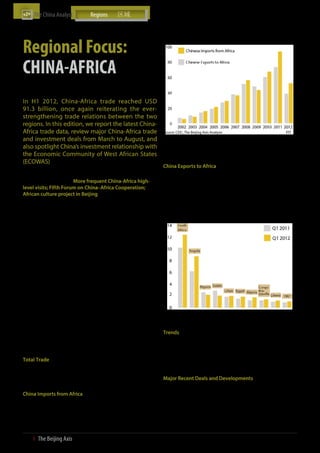
  • 11.
    The China Analyst AlthoughSOEs still accounted for around 90 percent of China’s development that is consistent with China’s goal to move up cumulative ODI as of the end of 2011, MOFCOM predicts the value-chain. So far, such investments have been largely private enterprises will definitely play a bigger role in Chinese limited to the logistics and financial sectors. Were China ODI activities. Not surprisingly, some of China’s most famous to open up a wider range of service industries to foreign companies are private. Lenovo, Huawei and Geely are the participation, multinationals would be sure to respond. The three largest private investors overseas, ranking 25th, 27th and Chinese government in turn, has also urged multinationals to 31st among the top 100 non-financial Chinese companies, in bring best practice from abroad, to share their expertise and 2011. These major private investors are also among the leaders contribute to China’s growth. in the ranking of the top 500 Chinese private companies by revenue in 2011, released by the All-China Federation of What’s next? Industry and Commerce. In terms of revenue in 2011, Huawei took second place, Lenovo ranked fourth and Geely was sixth. The country’s next generation of leaders face a considerable Aforementioned construction equipment maker Sany Heavy challenge in pushing through the reforms needed to sustain Industry, which bought a 90 percent stake in German concrete China’s economic growth. China’s president-in-waiting, Xi pump manufacturer Putzmeister for USD 407 million earlier Jinping, has gone on record as saying the Communist Party in 2012, was the fifth-largest overseas private investor and must embrace reform with fresh vigour to stave off social and China’s 10th largest private company. Overall, the 500 largest economic malaise. In the run-up to his official appointment, private companies reported combined revenue of more than Xi Jinping has met one of China’s most prominent reformers, USD 1.4 trillion in 2011. Hu Depinga, a noticeable indication he is listening to voices calling for faster economic liberalisation. In the end, the pace Where do MNCs fit? of reform will depend on political factors in a one-party state. MNCs in China face a number of challenges that are not However, China’s SOEs must not wait for government reforms different from what their domestic competitors face, to enlarge their presence on the global stage. To become including rising labour costs and wage inflation, staff turnover, global leaders, Chinese companies should embrace five complexity of regulations, strengthening local competition, strategic initiatives: to take advantage of global megatrends: and an economy not immune to the current global economic strengthen M&A capabilities; establish capabilities beyond slowdown. MNCs therefore see an increasing need to adapt cost leadership; improve productivity; and develop global their strategies in China, in order to succeed. The rise of organisation, management, and governance practices. innovative state capitalists presents a yet another challenge According to SASAC, in the next five to 10 years, China will (or opportunity) to US and European businesses; it could push need at least 100 CEOs with the ability to run Fortune 500 multinationals out of some markets entirely (or find strategic companies, 100,000 talented and experienced managers, partners). In oil and gas, for example, state companies already and millions of skilled personnel. To improve management control most of the world’s reserves. China’s SOEs such as China shortcomings, SASAC recently launched a program to improve National Offshore Oil Corporation (CNOOC), China’s largest off internal controls in SOEs, and have sought advice from the shore oil and gas producer, seek to invest in assets abroad that world’s leading consultancies to help build these companies will better position them at home, as well as help them gain into world-class enterprises. a foothold in new promising markets over the long term. The most competitive firms realise size alone will not guarantee Rightly so, China continues to rank high on multinationals’ long-term global success; technological know-how is needed wish lists, both as a place to source products and to build a to enhance their long-term competitiveness. To facilitate their retail presence. If China continues to maintain a growth rate development into ‘global champions’, Chinese resource giants of 7-8% in the next few years, it is expected to account for are now developing global strategies that match their global as much as 30% of the world’s growth through to 2017. This ambitions, rather than relying on government policy alone. indicates that China will remain a large and growing source of revenue for the world’s MNCs. As the state capitalists’ biggest CNOOC has shown a particular interest in the technological companies expand their global operations, their technology, capabilities of major shale gas players in North America, most connections, and capital will be almost impossible to ignore. recently evidenced by its on-going USD 15.1 billion acquisition China still comes short on one aspect; developed economies for Canada’s Nexen – China’s largest foreign takeover. In still possess a huge advantage over their emerging-market exchange, CNOOC gains exposure to the complicated shale competitors in terms of financial prowess and sophistication. gas extraction technology it lacks. Simply put, increased The US and countries in Europe have mature finance sectors domestic demand along with untapped shale gas reserves is with convertible currencies, while places like China still do not strengthening the competitive rivalry among China’s energy (although China is working on renminbi internalisation). To giants, forcing them to buy strategic assets overseas from ultimately succeed in much-coveted emerging markets, MNCs their existing partners in order to become more competitive need a deeper understanding of the new ‘rules of the game’ in in China and ultimately abroad. order to engage more effectively with their competitors and potential partners. For MNCs looking to leverage their expertise and enter the Chinese market, Sino-foreign joint ventures are rising in Daniel Galvez, Consultant popularity, especially as they face stronger local competition danielgalvez@thebeijingaxis.com and expand into more challenging third- and fourth-tier cities. It has therefore, made sense for multinationals to team-up with local partners as a way to expand their market, rather than through acquisitions or organic growth. An additional change is the extent to which multinationals invest more in the services sector, versus the manufacturing sector, a 11  І  The Beijing Axis    
  • 12.
    The China Analyst Features 专题 The China Analyst FOCAC 2012: Sino-African Partnership ӹӹ Increase the political trust and strategic consensus between China and Africa through more political consultation, high-level visits and strategic dialogue Gains Momentum ӹӹ Increase cooperation between the two sides in operationalising the African Union’s (AU) Africa’s Peace and Security Architecture (APSA) ӹӹ Strengthen China’s cooperation with the AU and sub-regional organisations in Africa The recently concluded triennial Forum on China-Africa Co-operation (FOCAC) in Beijing has ӹӹ Expand mutually beneficial economic cooperation become arguably the most important event at the centre of the ever expanding China-Africa and balanced trade, adopt innovative ways to boost relationship. The mechanism that was created in 2000 is intended to ‘strengthen the friendly cooperation including deepening cooperation in trade, co-operation between China and Africa…to jointly meet the challenge of globalisation and investment, poverty reduction, infrastructure building, capacity building, human resources development, food promote common development’. The objective of this year’s FOCAC was to elevate the Sino- security and hi-tech industries African relationship to a new level by spurring more concrete commitments from both sides. President Hu Jintao accompanied by African leaders during the opening of this year’s FOCAC. South African President Jacob Zuma (left) and Benin’s President ӹӹ Continue to strengthen people-to-people and cultural By Walter Ruigu exchanges and cooperation between the two sides and current AU Chairperson Boni Yayi (right) Source: Xinhua.net ӹӹ Further strengthen the cooperation between the two Although the points are to some extent similar to what has sides in international affairs been stated before, there were some key and subtle changes that emerged from FOCAC 2012. These included a particular China’s Trade Value with Africa* (USD bn, 2000 vs. 2011) emphasis on non-economic factors including factors that can A be grouped under the term, ‘soft power’. Moreover, it entails s this year’s event took place, China-Africa trade had engaged in has been steadily increasing, particularly in the a greater recognition of the importance of people-to-people already reached a record high of USD 166.1 billion in manufacturing sector, as more Chinese companies establish exchanges between the regions, greater focus on more 2011, with China now entrenched as Africa’s largest local networks to jump-start their ambitious expansion plans. funding for SMEs and the need for ‘capacity-building’ and skills trading partner. This represents a sharp increase from a lowly transfer. In fact, China promised to launch an ‘African Talents USD 10.6 billion in 2000. On the investment front, China’s This year’s FOCAC, like those prior, has allowed observers of Program’ that will train 30,000 Africans in various sectors in OFDI stock in Africa increased from less than USD 400 million the China-Africa relationship to stop and gauge the progress addition to providing 18,000 government scholarships to in 2000 to over USD 14 billion in 2011. Apart from increased and challenges in this partnership and chart the possible African students to study in China. Additionally, China is set trade volumes, co-operation has continually increased in future path of this relationship leading up to, and beyond, to launch a ‘China-Africa Press Exchange Centre’ in order to terms of investments in a range of sectors, cultural exchanges, the next conference. While the biggest story coming out of encourage exchanges and visits between Chinese and African capacity building and of course, political consultation. The this year’s FOCAC was China’s offer to extend a USD 20 billion media. China-Africa relationship has remained dynamic on many credit-line to the continent over the next three years, this fronts. Meanwhile, most large-scale Chinese investments into year’s Beijing Declaration presented a six-point proposal to Nonetheless, despite this renewed emphasis on China’s ‘soft the continent are made by state-owned enterprises, but the elevate the Sino-African strategic partnership. The key points power’, the Sino-African relationship remains fundamentally number of Chinese private entrepreneurs and companies were as follows: an economic one. On this front, there were also notable facets heading to Africa in search of opportunities has also been of a changing relationship that pervaded the conference. For rising steadily. The size of deals that these players are *Note: Chinese exports to Africa and imports from Africa have both increased instance, a renewed emphasis was placed on cooperation with 15-fold since FOCAC was established, highlighting the growing interdepend- ency between the two regions regional organisations and ultimately the AU. This came hot Looking back: 12 years of the Forum on China-Africa Co-operation (FOCAC) Source: UN Comtrade; The Beijing Axis Analysis 12  І  The Beijing Axis     13  І  The Beijing Axis
  • 13.
    The China Analyst on the heels of China’s ‘gift’ of a brand new AU headquarters to scale up economic development. However, changing the and its commitment to provide USD 95 million to the regional entire trade composition will clearly take time. To this end, if body over the next three years. Despite this move by China to both sides are serious, one should expect to see more Chinese engage with the continent as a whole, Africa is diverse. China investment in capital projects, particularly in the mining and faces a monumental task of trying to shape a single coherent manufacturing sectors, in the coming years. policy with a landmass of over 50 states. It is in such cases that direct engagement with regional organisations such as Looking ahead: Challenges and opportunities for the the AU or even the FOCAC mechanism itself will provide a 6th Ministerial Conference more lucid platform for engagement with the continent. In addition, the FOCAC mechanism has been a key factor that has If the past is any indication of the future, all concrete increasingly unified the continent on various fronts. African commitments set out during FOCAC 2012 will be achieved, countries are realising that greater unity while engaging China if not surpassed, by the next FOCAC. With the next FOCAC will allow the continent to level the playing field, particularly scheduled to take place in South Africa in 2015, there will be in terms of trade. Instead of having an African state with a some challenges and opportunities for Sino-Africa relations population of less than a million and an economy smaller in the lead up to the forum. For instance, the 6th Ministerial than most Chinese cities engage with China, regional and Conference will take place under a new Chinese leadership as continental organisations can serve as a platform to increase the current administration completes its term this year. The the bargaining power of such countries. incoming leadership, most likely to be led by Xi Jinping, will China’s OFDI Stock in Africa (USD mn, 2003 vs. 2010) continue to prioritise the continent’s role with China and Xi himself has declared that China and Africa need a new type of ‘strategic partnership’. The exact components of this new partnership will become clearer in the lead up to the FOCAC in South Africa. From an economic perspective, despite China’s GDP growth slowdown, demand for various key commodities will remain high as China aims to boost domestic consumption. This means that imports from Africa will continue to remain crucial to China’s developing economy. This, juxtaposed with increasingly vocal demands from various sections of the continent for greater value-added exports warrants a deep re-examination of the current trade model. Moreover, as more Chinese firms focus on Africa’s expanding middle-class and large number of rapidly developed economies, expect to see greater Chinese investment on the continent. As more Chinese firms move into the continent, the vast differences in the regions’ cultures, languages, economic sizes, etc. will mean that certain social tensions are likely to surface. This will be more visible at the micro economic level as Chinese firms present direct competition to local companies. With Chinese firms possessing various advantages in terms of Source: MOFCOM; The Beijing Axis Analysis capital and labour, the phenomenon of capitalism’s ‘creative destruction’ will become poignant and a source of friction that needs to be carefully managed by both sides. However, the Sino-Africa relationship faces challenges, not least of which is an unbalanced terms of trade. This was made clear Finally, by the time the next FOCAC takes place, the world by South African President Jacob Zuma during the conference. economic climate may be quite different from its current President Zuma, the leader of the continent’s largest economy condition that has been dominated by weak economies in the and China’s largest trading partner in Africa, emphasised that developed world. If the West, especially Europe, can engineer the current trading pattern was not sustainable in the long- a recovery in time, it may spur new supply and demand factors term and there was a need to balance trade by focusing on for Africa. However, despite what happens elsewhere, it is increasing the value-added of Africa’s exports. Zuma went clear that the Sino-Africa economic relationship will continue as far as to warn that Africa should avoid a repeat of the to strengthen, an expansion that needs a more balanced uneven trade pattern with the West, where Africa for years approach. This process is likely to occur only through what only exported raw materials. This trading pattern resulted Deng Xiaoping coined ‘crossing the river by feeling the stones’. in very little technological transfer, value added production and left Africa vulnerable to constantly deteriorating terms of trade. Zuma’s words have been echoed by several leaders Walter Ruigu, Consultant, Manager: Eastern Africa Desk from the continent, especially with regards to the mining walter@thebeijingaxis.com sector, where calls for more beneficiation of minerals and a reduction of raw materials exports have become widespread. Thus far, China acknowledges this challenges the usual ‘win- win’ proposition that generally underpins China’s relationship with the continent. Several top leaders including President Hu Jintao have reiterated that China’s own experience has highlighted the need for greater value-added trade in order 14  І  The Beijing Axis    
  • 14.
    The China Analyst 15 І  The Beijing Axis    
  • 15.
    The China Analyst Expanding Sino-African Economic Relations: H.E. Madibo Charles Wagidoso, Ambassador of Uganda to China, on China’s Growing Ties with Uganda With the recent conclusion of FOCAC in Beijing, The Beijing Axis sat down with Ambassador Wagidoso in order to assess the role of China’s business relationship with Uganda. Ambassador Wagidoso sees mining, along with agro-business, tourism and infrastructure as key sectors that Uganda can develop with China as one of its main partners. By Walter Ruigu To address this issue, China and Uganda are cooperating to develop this capacity at both the private and public levels. China has already committed some funding which will be used to help develop Ugandan SMEs. At the private level, there are Chinese companies that have already set up shop in Uganda and are already cooperating with local companies. The private sector in Uganda is also getting better organised, especially given the development of different business associations such as the chamber of commerce. The Chinese side has also moved very fast and there is currently a liaison office of the China Development Bank in Kampala, whose mandate is to reach out to local companies and SMEs and see what areas they can offer assistance. However, this will all depend on how the Ugandan private sector can respond to initiatives already being carried out by China. At the end of The Ambassador of Uganda to China, H.E. Madibo Charles Wagidoso the day, you can take a cow to the well but you cannot make Please provide an overview of the China-Uganda it drink; this metaphor directly applies to our private sector. trade and investment relationship. What are Uganda’s key areas of opportunity for Over time, particularly in the last ten years, the business foreign firms? relationship between China and Uganda has grown rapidly, especially in terms of trade and investments from China There are four key areas that I view as opportunities for foreign into Uganda. Currently, there are two core components that companies investing in Uganda. The first is tourism, the second Uganda is pursuing. First is the sourcing of medium to large is agriculture, third is infrastructure development and fourth scale machinery for industrialisation in both the public and is mining. Infrastructure broadly includes transportation private sectors. Second is better leveraging opportunities to projects, especially rail and road projects, and energy projects export to China, mainly agro-products, to meet China’s rising such as the construction of hydropower plants and dams. In demand. However, we need to better identify where the terms of rail, the development of hard infrastructure is still the opportunities lie for specific products. responsibility of the Ugandan and Kenyan governments (Note: The Kenya-Uganda railway runs from Kenya’s coast to the Could you please cite some cases studies of successful interior of Uganda) and this has been an area we are looking to increase development along with Rift Valley Railways, which Ugandan businesses in China? was handed the concession to manage the railway. Thus far, there are no major Ugandan companies, either public Our mining sector has also been developing rapidly with or private, that are operating in China. Most Ugandans that are opportunities in cobalt, gold, copper, iron etc. In fact, the pursuing business with China operate on a fly-in fly-out basis. government has just finished the legal framework on However, there is one company currently operating in Beijing, appropriation of mining licenses, exploration licenses etc. Uganda Crane Coffee, that is taking charge in promoting There are already many Chinese companies that are on the Ugandan coffee and increasing exports to China. They are ground, trying to secure various licenses. There are some that currently selling green bean and roasted coffee to China and are already conducting exploration and others have already working hard to develop this market. begun mining operations. Of course, we are looking for I think there are two main barriers for Ugandan companies companies that can invest and develop local capacity in this aiming to enter China. First is the cultural and language sector. I am convinced that mineral exports will be Uganda’s barrier. Some companies are quite reluctant to venture out leading industry in the future. abroad into a place they are unfamiliar with, especially if they are unsure about potential business opportunities. Second is 12 years after its creation, what is your evaluation of the lack of capital as some Ugandan companies may not have the FOCAC mechanism? enough financial resources to invest in ventures in places as far away as China. Overall, this means that there is a lack of FOCAC has been very successful in terms of strengthening capacity for Ugandan companies to adequately access China. economic and political cooperation between Africa and China. 16  І  The Beijing Axis    
  • 16.
    The China Analyst Before2000, each African country was dealing with China on China and I believe China will look very favourably on these a bilateral level and at that time, many African countries did projects. not have full diplomatic relations with China. Following the establishment of FOCAC, there are now 50 countries with One key issue is the difficulty of securing Chinese financing diplomatic relations with China. In terms of economics, the in Africa’s private sector. For example, in the Kenya-Uganda forum has allowed greater building of business ties between railway upgrading project, it is easier for the Chinese side to China and Africa. This can be seen in the increase of trade deal with the Kenyan and Ugandan governments as opposed volume, from barely USD 10 billion in 2000 to over USD 160 to the private sector company managing the project. billion today. FOCAC has also been a very important forum where China has been able to increase its support in Africa’s Uganda currently has a trade deficit with China. Could infrastructure development. you please discuss this situation and what ideas or plans does Uganda have in place to counter this Uganda has directly benefitted through financial support trend? to its agricultural sector, and direct support to various infrastructure projects in the country through concessional As I mentioned earlier, the trade volume between China loans and grant-aid support from the Chinese government. and Uganda has increased rapidly. Unfortunately, our trade We are currently building a USD 350 million express highway imbalance with China is 1 to 10; for every USD 10 worth of linking the airport to the city of Kampala with the support of goods we import, we are only selling USD 1 worth to China. the Chinese government. This is an immense challenge and of course, the sole option is to increase export capacity in Uganda. This is why we are The USD 20 billion line of credit extended to Africa will be used currently researching which products China has a demand for for various projects that are to be presented by the African and how we can add value to some of the products that we side. Previously there was a quota for each African country, but are already exporting. this has now been changed to a first-come first-serve basis. The countries that will be able to present viable projects first One of the targets of the EAC has been to develop a will be the ones that reap the greatest benefit from the credit single currency with the region. What are your views line. Uganda is keenly working on submitting project profiles, feasibility studies and project proposals to the relevant banks on how this might influence China-Uganda, and in China. China-EAC trade? What is your take on calls for Chinese companies to A single currency would facilitate cross-border transactions and if the currency is strong enough, would allow EAC to gain invest more on continent-wide, regional and cross- more on imports from not only China but the international border projects as opposed to projects in individual community as well. While the East African Shilling would countries? lower cross-border transaction costs, more importantly, it would mark a significant achievement towards the goal of The Chinese government has been very keen on supporting establishing the East African Federation, giving the region a regional projects including transnational infrastructure greater standing in the international community. projects. This has meant that African countries need to cooperate more on which projects are presented to China Are there particular types of Chinese companies that for support. For instance, in East Africa, Kenya, Uganda and Uganda has been pursuing or would like to pursue? Tanzania can jointly seek support on developing waterways along Lake Victoria. I think success will ultimately depend on We are looking to reduce the trade imbalance and one of regional governments such as the East African Community the potential solutions is to attract more Chinese companies (EAC) pushing for support of regional projects before each to invest directly in industries that have promising export African country can submit their own projects. Taking the EAC potential. This means we are looking at investments in the agro- as an example, if Uganda, Kenya and Tanzania were to submit processing sectors, in products which could be continually a project for waterways infrastructure development around exported to China and elsewhere. Food is becoming scarce Lake Victoria, I believe the Chinese government would be around the globe and Uganda has an advantage in this regard. eager to fund such a project as it would allow the benefits to be spread over several countries. Specific agro-products include tea, coffee, cereals and many other agricultural products. Over 80% of Uganda’s economy It will be difficult for the Chinese side to decide which regional is reliant on the agricultural sector. We export significant projects are viable but ultimately this knowledge must come amounts of hides and skins, cotton and fishery; however, there from the African side. The challenge is that all countries must are opportunities to increase mechanisation and value-added agree on which project should be prioritised. production locally. Does Uganda currently have projects that they are Uganda has been actively seeking foreign investment and not working on with regional partners such as EAC that it only from China. We have many incentives in place such as would like to see more Chinese investment? tax rebates for income tax and duties. There are no import taxes on capital equipment, particularly heavy machinery; Currently there are two key projects with our neighbours that access to land is not restricted; there are no capital controls we would like to see more Chinese involvement. The first is and repatriation of profits is unrestricted; and our foreign the proposed Kenya-Uganda-South Sudan railway. The other exchange market is vibrant and free flowing. In addition, is the pipeline project. As Uganda, Kenya and South Sudan since Uganda is a developing country, the profit margins and now all have viable oil deposits, the aim is to build a common returns are currently very high. pipeline instead of each country constructing their own. It is now time for East Africa to present concrete proposals to 17  І  The Beijing Axis    
  • 17.
    The China Analyst China’s Ferrochrome Production: Altering the Global Balance China owns less than 1% of the world’s chrome reserves. However, thanks to strong growth in stainless steel demand and relatively cheap production costs, China’s domestic ferrochrome capacity has steadily increased over the past decade, with China overtaking South Africa in the first half of 2012 to become the world’s largest ferrochrome producer. Yet, the lack of both upstream and downstream capabilities, along with looming chrome export restrictions, rising domestic production costs and stricter environmental controls, is putting Chinese ferrochrome producers in an increasingly precarious situation. To overcome these obstacles, Chinese ferrochrome producers will continue going overseas to gain control over upstream resources, significantly altering the global balance in chrome ore trade. By Jeff Dong R eviewing the remarkable growth in China’s demand tionship is only becoming stronger with the wider utilisation of for commodities and its domestic production during chrome pellets to address the sizing issue of SA chrome ore. Apart the last decade is always eye opening, with the steel from SA, Turkey, Iran, India, Oman, and Pakistan are all among the industry standing out as the prime example. In 2011, top exporters of chrome ore to China. China produced 61% of the world’s total steel output, and consumed most of that production domestically. China’s Sources of Chrome Ore Imports (%, 2003-2011) This is even more astounding given China’s domestic iron ore supply meets only 40% of domestic demand. In order to delve deeper into the stainless steel industry one must examine ferrochrome, a main ingredient used in steel production. In 2011, China consumed 3.5 million tons of high carbon ferrochrome, more than half of which was produced domestically. With China having almost no domestic chrome reserves, nearly all of the ferrochrome produced in China relies on imported chrome. From 2003 to 2011, though China’s production of high carbon ferrochrome increased by nearly 10 times, from around 420,000 tons to over 2.5 million tons, this still cannot Source: Mysteel, The Beijing Axis Analysis meet domestic demand. China’s Production and Consumption of High Carbon China has several key advantages in ferrochrome production Ferrochrome (‘000 tons, 2003-2011) including low electricity costs, an adequate supply of relatively cheap labour, a well-established transportation network, as well as low capital investment costs for new plants. While many would argue China’s ferrochrome industry will unlikely grow at the same rate for the next five to 10 years, and may even downsize, China is currently taking a significant share of the world’s ferrochrome production. As a matter of fact, thus far in 2012, China’s domestic ferrochrome production is still increasing steadily, even amidst worsening pros- pects for the global economy. At the same time, chrome ore imports continue to rise, while ferrochrome imports are decreasing. Tradi- Source: CNFEOL; The Beijing Axis Analysis tional ferrochrome producers such as SA are inevitably facing stiff competition. With China’s expanding production capacity, the global chrome mining sector has boomed. Rising demand for South African ferrochrome – will export restrictions help? stainless steel and subsequent increases in produc- tion capacity were the main drivers behind many new While the world has witnessed China’s share of global ferrochrome chrome mining projects. From 2005 to 2011, global production surge from less than 5% in 2001 to 33% currently, SA annual chrome output increased from around 18 million producers are suffering from sub-par performances. Strong compe- tons to 24 million tons. tition from China, according to many insiders, is the main challenge facing SA producers. This is particularly startling given China holds Without a doubt, South Africa (SA) has been the most very little domestic chrome reserves. South Africa, which owns a important source for China’s chrome imports; this rela- majority of the world’s chrome reserves, are feeding the mills and 18  І  The Beijing Axis    
  • 18.
    The China Analyst furnacesin the Far East. To address this issue, one can put forward competitiveness, rather than merely attempt to curb the ‘new colonialisation’ approach in exploiting Africa for its mineral chrome ore trade. resources in raw material form, leaving local value-added industries in a tough situation, or one can examine this issue through a more Outlook analytical lens. China’s production of ferrochrome will most likely First of all, SA chrome ore exports, including UG2 chromite, remain remain strong and continue to be highly influenced by a crucial source of stock for China’s ferrochrome producers. The the on-going consolidation and transformation taking comparatively low cost of mining UG2 and subsequent big profits place in China’s steel sector. The following trends are also are coercing many miners to stick to operations in the UG2 area. expected to emerge in the mid-to-long term: In fact, UG2 chrome ore exports to China now make up an integral part of SA–Chinese bilateral trade activities – the trade employs ӹӹ Ferrochrome demand will continue to increase thousands of SA miners and supports local economies. In 2011, the With the upgrading of China’s domestic steel total value of SA chrome ore exports to China amounted to USD 1.2 industry, stainless steel and chrome alloy demand billion, representing 9.3% of SA’s total exports to China. will increase. This means that ferrochrome South Africa’s Exports to China (USD bn, 2003-2011) producers in China will still be blessed with a huge market. We do not foresee a downturn in China’s domestic ferrochrome production capacity; on the contrary, we expect capacity to increase by another 25% in the next five years. ӹӹ Consolidation, integration, and innovation China can no longer be simply viewed as a low- cost producer – labour costs, power costs, and environmental costs are all rising at a steady pace. China’s extensive production model will be altered and replaced by a more consolidated and efficient model, which requires cuts in CO2 emissions. Green technology will spur innovation in the production cycle, which will be largely led by the country’s huge state-owned enterprises or Source: UN Comtrade, The Beijing Axis Analysis large scale producers with the financial, adminis- South Africans advocating a chrome export tax are basically betting trative and technical resources. that chrome export restrictions will most likely lead to price increases for chrome ore, which will help to put further pressure on China’s ӹӹ Greater control over upstream resources domestic ferrochrome industry and ultimately reduce its capacity. China is definitely strengthening its control over Therefore, if stainless steel demand remains robust, demand for upstream resources in the ferrochrome and stain- ferrochrome will also see a strong increase, offering SA producers less steel industries. As a matter of fact, China’s an opportunity to regain their advantage in ferrochrome produc- endeavour of going overseas for chrome dates tion. Ideally, SA ferrochrome producers will go one step further, and back to the early 1990s. Some of the most recent adopt innovative technologies to improve their performance and examples include Sinosteel’s ambitious venture in strengthen their market position. SA – however, there is definitely more to come. However, another scenario may emerge; a decrease in SA chrome ӹӹ Localisation ore exports will be offset by increased supply from other sources. We believe China’s ferrochrome producers will One cannot underestimate the potential of increasing chrome inevitably transfer their capacity to local producers supplies from other countries such as Iran, Turkey and several in chrome-rich countries such as SA. In the short Asian countries, especially since these sources have higher quality term, China’s domestic production will still hold reserves – their ores are lumpy and better suited for ferrochrome a comparative advantage over SA in terms of production than the fines produced in SA. power supply, capital equipment costs, logis- tics, etc. But over the longer term, we believe the As a reference, we can look at the recent export restriction imposed electricity and logistics issues in SA will be prop- by Indonesia. A leading producer of nickel, Indonesia significantly erly addressed and significantly improved. Under raised their export tax for nickel ore to 20%, in an effort to protect the dual trend of rising production costs and an the local ferronickel industry. However, the higher export tax did not appreciating currency, China will need to transfer prop up nickel export prices; on the contrary, not only did the China primary manufacturing activity overseas, closer import price of nickel ore drop, the Philippines increased shipments to the source of chrome reserves. This presents of nickel ore to China, increasing their market share in China at the an opportunity for forward-looking SA producers expense of their neighbour. The policy also caused large layoffs of to strike deals with the world’s newest leader in Indonesian nickel mine workers. ferrochrome production. Even if chrome ore exports are curbed, SA ferrochrome producers Jeff Dong, Associate will still suffer from electricity shortages, underdeveloped trans- jeffdong@thebeijingaxis.com portation infrastructure, higher production cost, etc. These prob- lems will remain even if restrictions are put in place. SA should first take a long term view and address these problems to increase local 19  І  The Beijing Axis    
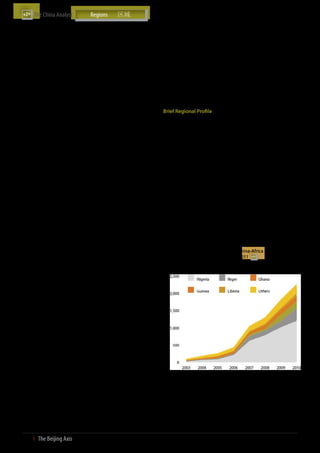
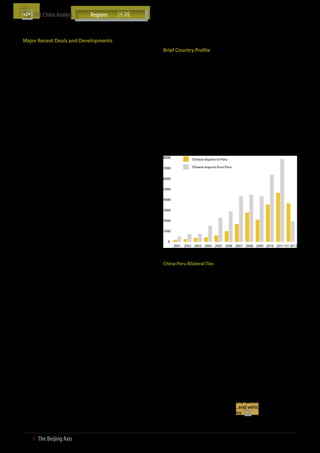
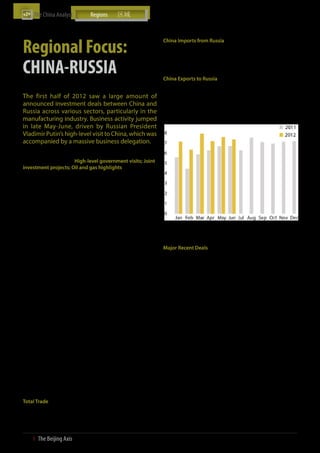
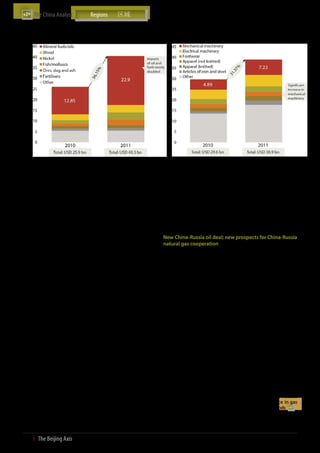

  • 19.
    The China Analyst China’s Rising Wages and its Impact on Cost Competitiveness Recent developments in the Chinese economy have drawn renewed media attention to rising labour costs in China. More than 50 years ago, economist Arthur Lewis pointed out that with the expansion of the modern sector of a low-income country, the unlimited labour supply (from the rural sector’s labour surplus) would disappear, and as a result, the country will enter into a phase of faster real wage increases. Many countries, including South Korea and Japan, have experienced such a change. What about China—is it already at the Lewis turning point? If so, does this signal the end of cheap labour in China? By Li-Chia Ou Has China reached the point of no return? (aka neighbouring South Korea, while in the US, agriculture is only 1% the Lewis turning point) of the economy and employees 2% of the US labour force (see chart to the right). This implies that the productivity of China’s agricultural Those that argue that China has already reached the sector is much lower than that of the US or South Korea, which is Lewis turning point cite the fact that starting from understandable given that both countries have highly industrialised 2006, wages for Chinese migrant workers have skyrock- agricultural sectors and are more developed than China. As China’s eted. Based on data from the China Household Income economy modernises, so too will its agricultural sector, and in the Project, in 2006 and 2007, migrant wages increased by process, become more productive and mechanised. 11.5% and 11.2% in nominal terms, and 10% and 6.4% in real terms. Wage growth slowed in 2008, but resumed Assuming that the modernisation of China’s agricultural sector can in 2009 when migrant wages increased by 16.6% in reduce the agricultural labour force by 50%, an additional 160 million nominal terms and 17.3% in real terms. In 2011, China’s rural workers will be made available to participate in other sectors migrant workers got an average pay increase of around of the economy (China’s total workforce in 2011 was estimated to be 21% according to data from the National Bureau of around 800 million). All this serves to highlight that China has yet to Statistics. reach the Lewis turning point and is unlikely to anytime soon. Annual Per Capita Income of Urban and Rural Explanations for rising migrant wages Households (USD, %, 2005-2011) So if China has yet to reach the Lewis turning point, why have Chinese migrant wages risen so quickly? In theory, the surplus of rural labour in China combined with a fairly underdeveloped agricultural sector should work to suppress migrant wages from going up. To understand why this is happening, one needs to have a broad understanding of China’s socio-political context. Like most central governments around the word, the Chinese Communist Party (CCP) has a mandate to create more jobs for its citizens. However for the CCP, job creation is not just an economic issue, but also a political one; in a one party state like China, high unemployment would undermine the ruling party’s legitimacy to govern and can lead to social unrest. This can partly explain why China remains addicted to infrastructure spending; large infrastructure projects not only stimulate economic growth but also employ thousands of workers over a several year period. This also explains why China has been slow to modernise its agricultural sector. If China were to rapidly adopt a modernised agricultural sector, hundreds of millions Note: (1) Annual disposable income of urban households and net income of rural households per capita of the rural Chinese population would be left without work. This (2) Growth rates are calculated at current prices large unemployed workforce would be difficult for the secondary Source: National Statistics Database; The Beijing Axis Analysis and tertiary sectors to absorb all at once, since the vast majority of these rural workers lack the necessary education and training. However, to conclude that China has already reached the Lewis turning point by looking only at migrant To keep this large rural population employed in agriculture and worker salary data ignores certain demographic realities not flood the cities in search of higher paying jobs, the Chinese and other broader forces at play in China. For example, government has implemented various direct subsidies to indirectly in 2011, the agricultural sector accounted for only 9% boost their income. The most drastic measure was taken in 2004, of China’s total GDP but employed 40% of its labour when the government both increased cash subsidies to farmers force. This is an unusually high workforce percentage and abolished agricultural taxes nationwide. These two government committed to a sector that accounts for less than 10% actions have created incentives for farmers to increase farm outputs, of the economy. In comparison, agriculture accounts further adding to their income and applying upward pressure on for 3% of GDP and employs 7% of the workforce in migrant pay. 20  І  The Beijing Axis    
  • 20.
    The China Analyst Sizeof Agricultural Sector for Select Countries (USD bn, %, 2011) Source: World Bank; The Beijing Axis Analysis Furthermore, while cheap labour has been a key factor in generating result of the central government’s implementation of the ‘going- high economic growth over the past three decades, it has also west’ strategy. contributed to profound income disparities between rural and urban households. If left unchecked, such persistent, widening It should also be noted that while Chinese wages may be going inequality could lead to social crises that could interrupt growth and up, Chinese exports are also moving up the value chain. In 1985, damage competitiveness. To alleviate social tension, the Chinese China had a GDP per capita of just USD 290 at current prices and government has begun to intervene by enforcing higher minimum had almost no high-tech exports1. By 2011, China’s GDP per capita wages along with investing in a social safety net for the poor. As had increased to USD 5,414 with high-tech exports now accounting part of the government’s plans to increase minimum wages by for roughly 30% of total exports. In contrast, the average GDP per 13% annually through 2015, many provinces and municipalities, capita of the countries which China then competed with was USD including Guangdong, Beijing and Shanghai, have raised their 8,318 in 19852. By 2011, the GDP per capita of these countries minimum wages by double digits in 2011. While many of these had increased to USD 37,291. This means that while wages in minimum wage increases are occurring in China’s affluent eastern China may be going up, the wages of China’s competitors on a areas, it is clear that the main beneficiaries are the migrant workers product-by-product basis have been rising even faster along with who flock to these areas in search of work. Such a re-alignment the sophistication of their exports. China might have become of rural–urban income, as a result of wage increases for unskilled expensive for many low-end manufactured goods such as T-shirts migrant workers, will reduce overall income inequality over time. and footwear, but it is still comparatively priced for semiconductors, cars and software development. In fact, recent hikes in minimum The changing nature of China’s cost competitiveness wages all across China are aligned with the government’s initiatives to accelerate the country’s process of industrial restructuring, since Regardless of when China will reach the Lewis turning point, the higher labour costs will force enterprises to move up the value chain indisputable fact is that Chinese migrant wages are rising and this into more technologically-advanced industries. In other words, in turn is also driving up general labour costs in China. The rise in various higher-end products currently being produced by South Chinese wages means that China will no longer be the cheapest Korea, Japan, Taiwan, Singapore, and the US will face stiffer Chinese supplier of low-end manufactured goods. This will benefit countries competition. such as Vietnam, Indonesia, Pakistan and other developing nations who can expect to see more manufacturing outsourced to their China still has a large untapped pool of migrant workers, but fewer countries instead of China. However in reality, only a portion of total will be working in low-end, labour intensive industries; instead, manufacturing will shift from China. Smaller low-cost countries more will be employed in high-end value-added industries as China simply lack the supply chain, infrastructure, and labour skills to continues to move up the value chain, posing a greater challenge to absorb all of China’s current production volume. middle- and high-income economies, as it moves towards head-to- head competition across various product categories. Furthermore, China’s vast landmass and regional differences allows for the country’s central and western provinces to carry on labour-intensive industries, which coastal regions have outgrown. Li-Chia Ou, Senior Consultant China’s spatial and regional diversity means that China can avoid lichia@thebeijingaxis.com the common ‘flying geese’ pattern of labour-intensive industries’ moving to less-developed economies by allowing labour-intensive industries to continue growing in the less-developed inland regions. In fact, this trend is already clear. In 2011, employment growth for migrant workers in the western and central regions stood at 8.1% and 9.6%, respectively. In contrast, employment growth in 1 Note: High-tech exports are products classified with high RD intensity, the Yangtze and Pearl River Delta regions was relatively stagnant, such as aerospace, computers, pharmaceuticals, scientific instruments, and increasing by only 0.3% and 1%, respectively. Such a development electrical machinery is possible because China’s capacity for industrial development in 2 Note: Assumes these countries/territories are the US, Japan, South Korea, the central and western regions has substantially improved as a Singapore and Taiwan 21  І  The Beijing Axis    
  • 21.
    The China Analyst Howto Procure from China #10 - Quality Management (QA/QC), Expediting and Third-Party Management The Beijing Axis Procurement Process Flow encapsulates the full extent of project engagement, from the point of first enquiry to the range of services in the solution process and benefits provided for the customer. In this edition we focus more closely on step 10 of the Beijing Axis Procurement Process Flow: Quality Management (QA/QC), Expediting and Third-Party Management. The Process Flow and Service Delivery Platform of Beijing Axis Procurement ӹӹ Overall Project Management ӹӹ Holistic Risk Management ӹӹ Strategic Relationship Management Strategic Sourcing Analysis Procurement 1 2 3 4    Initial Scoping, Supplier Needs Analysis Systematic Industry Supplier Evaluation, Supplier Pre-Qualification, Evaluation, Due Diligence China Procurement Search Supplier Application of high- Due Diligence Competitive Identification level filters Final Selection Analysis Final Selection Engagement Commercial 8 7 6 5    Supplier Engagement, Process, Site Inspection, Supplier Site Inspections, Sample Contracting Tender Evaluation Sample Testing and Engagement, RFQ and Contract Standards Tendering (SOI, RFP) Testing, Contracting Management Supply Chain Process 9 Quality 10 11 Coordination 12 Mgmt    Transaction Monitoring, Transaction Management (QA/ Logistics Assistance On Site Support QA, Expediting, Third- Monitoring QC), Expediting Management (Material Mgmt, and Third-Party Commissioning, Party Mgmt Logistics Management etc.) Beijing Axis Procurement Guidelines for Quality Expediting: BAP manages the delivery schedule from day one after Management (QA/QC), Expediting and Third-Party the order is placed. By working out a production schedule with the Management supplier, BAP expedites the schedule by implementing a tracking schedule customised with a unique tracking frequency for each Quality and schedule are the most critical factors in procurement. supplier. In this way, BAP is able to preemptively identify potential Beijing Axis Procurement (BAP) provides a range of services to manage schedule slippage and figure out whether it can be fixed together the quality of the goods being procured and tracks the schedule with the supplier. Meanwhile, BAP coordinates with the client to flag throughout the transaction process, including quality management potential risks and assists in analysing the client’s acceptance. (QA/QC), expediting and third-party management. Third-Party Management: BAP has established good relations with Quality Management (QA/QC): Although it is the supplier’s numerous international third-party inspection companies’ China responsibility to deliver goods of an acceptable quality, it is still branches and has rich experience working alongside them, on both a critically important to monitor and manage the entire manufacturing residence supervision and visit supervision basis, on behalf of overseas process and verify the quality at every step. BAP provides different clients. Besides quality inspection companies, BAP helps to manage quality management strategies and solutions according to the all other relevant third parties such as law firms, accounting firms, nature of the goods being procured and leads or assists in the etc. when required, including selecting, recommending, coordinating implementation. For commodities, we place a particular emphasis with and managing the progress of third parties. Therefore, by only on material checks and final product analysis; for small pieces of giving instructions to BAP, the client can effectively connect to almost machinery, we address performance inspections; with small suppliers, all the relevant parties of the procurement transaction in China. we coordinate with public labs equipped with better test facilities; for complex equipment, we mobilise supervising engineers to be based By Beijing Axis Procurement on-site at the supplier’s factory for months at a time to work closely with the supplier’s quality department and third-party inspectors to monitor the entire process. Whenever a quality problem is identified, BAP facilitates communication between all parties and provides efficient and flexible solutions until the problem is resolved. 22  І  The Beijing Axis    
  • 22.
    The China Analyst ChinaCapital: Monthly Inbound FDI in China and y-o-y Growth Rate (USD bn, Jan 2011 - Jun 2012) Inbound/Outbound FDI Overseas Resource Investment In the first half of 2012, while FDI into China slightly decreased compared with the first half of 2011, China’s outbound FDI grew significantly compared with last year’s figure. Meanwhile, Chinese Source: MOFCOM; The Beijing Axis Analysis investment activity in the resources sector remains ӹӹ In H1 2012, we have seen a reduction in the presence of wholly prominent relative to other sectors as Chinese foreign-owned enterprises in China which represents China’s long state-owned enterprises continue to close MA term growth shift away from investment and exports towards a more consumption-driven growth model deals in the mining sector. By Beijing Axis Capital Notable FDI Deals in China in H1 2012 ӹӹ In January, US-based LL Energy acquired a 51% stake in the Weishe coal mine located in China’s Guizhou province from Union Energy for USD 16.2 mn Foreign Direct Investment into China ӹӹ In February, Vivo Ventures announced that the company will Summary invest 45% of its newly raised capital (USD 375 mn) in China ӹӹ In H1 2012, FDI into China amounted to USD 59.1 bn, down by 3% ӹӹ In March, the J. M. Smucker Company acquired a y-o-y. FDI into China fell for four consecutive months from January non-controlling minority interest in Guilin Seamild Biologic to April with concerns that the Chinese economy is heading for a Technology Development, a privately owned manufacturer slower growth rate in 2012. However, FDI into China slightly picked and marketer of oat products for approximately USD 35 mn up in May, increasing by 0.1% y-o-y ӹӹ In April, Minsur SA’s subsidiary, Cumbres Andinas SA, reached ӹӹ In H1 2012, wholly foreign-owned enterprises were the major an agreement with CST Mining Group to acquire a 100% stake vehicles of investment in China, accounting for around 76% of the in the group’s subsidiary, CST Resources, for USD 505 mn. CST total amount of capital actually utilised Resources owns a 70% stake in Marcobre SAC ӹӹ In H1 2012, 85% of FDI into China originated from other Asian ӹӹ In April, German carmaker Volkswagen AG’s joint venture in countries/regions. Hong Kong, as the main bridge for inbound China announced plans to set up a USD 210 mn assembly investment into mainland China, is still the largest source of capital, plant in Xinjiang Uygur Autonomous Region contributing USD 37.3 bn or 63.2% of total FDI Annual Inbound FDI in China (USD bn, 2005 - H1 2012) FDI in China by Source Country / Region (USD bn, H1 2012) Source: MOFCOM; The Beijing Axis Analysis Source: MOFCOM; The Beijing Axis Analysis 23  І  The Beijing Axis    
  • 23.
    The China Analyst ӹӹ In April, Samsung Electronics, the world’s biggest memory ӹӹ In May, Bright Food Group announced that the company is chip maker, announced plans to invest USD 7 bn to build its considering a 60% stake in British cereal maker Weetabix for first chip factory in China USD 1.2 bn ӹӹ In May, SJI’s subsidiary, SJI (Hong Kong), acquired 451,604,000 ӹӹ In May, Dalian Wanda Group announced it would purchase shares (40.5% stake) of SinoCom Software Group for AMC Entertainment for USD 2.6 bn. The deal received all the approximately USD 64 mn necessary regulatory approvals in July ӹӹ In July, CNOOC announced a bid for Canadian Nexen for USD Chinese Outbound Foreign Direct Investment 15.1 bn. Once approved it would be the largest acquisition to date Summary ӹӹ In H1 2012, China’s OFDI amounted to USD 35.4 bn, an Chinese Overseas Resource Investment increase of 48.2% y-o-y ӹӹ In H1 2012, Beijing Axis Capital followed 51 overseas Summary investment activities initiated by Chinese companies ӹӹ In H1 2012, China’s OFDI in the energy and mining sectors (including on-going transactions and concluded deals of moved up to the third place among all sectors largely due previously announced transactions), among which 19 are to the USD 13.4 bn worth of MA deals finalised by Sinopec, resource-related investments (see deal table on next page) CNOOC and other SOEs, which represented approximately and 30 are non-resource investments 69.1% of China’s total overseas investment ӹӹ In terms of resources deals, Canada became the most ӹӹ Chinese investors have poured a majority of their investment attractive region for Chinese investors with 6 deals followed into resources such as iron ore, copper, aluminium, platinum by Australia and Europe, with 5 and 3 deals each respectively and other types of minerals. Among these commodities, iron ӹӹ In terms of non-resource deals, Europe and the US were ore and copper took almost 60% of total OFDI equally favoured by Chinese investors, with 7 deals each. Asian countries such as Singapore, Japan, South Korea and Past challenges and emerging new trends and practices the Philippines have also attracted more Chinese investors, ӹӹ Chinese mining companies have traditionally preferred not with 7 deals all together to deal with projects in early stages of exploration and only ӹӹ In terms of deal size, oil, gas and power deals completed (or invest in already developed mines that are in the close-to- currently being negotiated) by China’s three energy giants, production stage. This previously limited their ability to CNOOC, Sinopec, and SinoChem, are the most noteworthy acquire resources in terms of selecting prospective targets and capturing assets when they are still on the low-end of the value curve. China’s geological survey companies, such Notable Chinese OFDI Deals in H1 2012 as the East China Exploration and Development Bureau, are ӹӹ In January, Devon Energy Corporation announced Sinopec will becoming commercialised and venturing into new markets. invest USD 2.2 bn in exchange for one-third of Devon’s interest This is allowing Chinese mining companies to enter into in five new venture plays agreements with these geological survey companies and ӹӹ In January, China Three Gorges International (Europe) SA, widen the range of possible investment/acquisition targets. acquired 21.4% of the share capital of Energias de Portugal The Central Geological Exploration Fund was established in (EDP) for USD 3.5 bn 2005 to support the activities of such companies ӹӹ In March, Sinopec bought a 30% stake in Latin America’s ӹӹ Chinese companies’ past engagement with international second-biggest oil producer - Galp Energia SGPS SA (GALP)’s advisory companies for their overseas projects were generally exploration division for USD 5.2 bn limited. This resulted in various problems and even deal ӹӹ In April, Chalco launched a USD 926 mn bid for a proportional failures. Chinese mining companies are gradually realising takeover of SouthGobi Resources. In August, Chalco extended the value-added of such companies and are more actively its offer period for another 30 days to obtain approval from the working with them in various regions, including Africa Mongolian government ӹӹ Given that most large mining companies investing overseas China’s Annual Outbound Non-financial FDI and y-o-y Growth are SOEs, their major means of engagement is through Rate (USD bn, 2005 - H1 2012) government contacts. Government-level deals are seen as the main avenue for OFDI. However, there are certain limitations of local companies/governments such as technical capacity (costing, resource estimation, analysis etc.). Acknowledging these shortcomings, Chinese mining companies are now buying partial/full stakes in companies specialising in the exploration stage of mining development after they have identified an attractive resource Source: MOFCOM; The Beijing Axis Analysis 24  І  The Beijing Axis    
  • 24.
    The China Analyst Source:Various media; Company reports; The Beijing Axis Analysis 25  І  The Beijing Axis    
  • 25.
    The China Analyst The China Analyst Mapping China in Africa’s Growth Story While Africa has certainly benefited from soaring global resource demand, other aspects such as the continent’s ongoing infrastructure construction boom as well as its blooming middle class have been key catalysts in driving China’s engagement with the region. As depicted in the map below, China’s growing presence, as both an investor and leading trading partner, is expected to continue reshaping the continent – and the global economy – for decades to come. By Beijing Axis Strategy Note: Trade value depicts the country’s total trade value with China (imports and exports). Source: World Bank; IMF; The Beijing Axis Analysis 26  І  The Beijing Axis     27  І  The Beijing Axis
  • 26.
    The China Analyst Africa Means in demand for steel and aluminium, and virtually all growth for copper and nickel. This rapid growth in China’s natural resource use not only contributed to a surge in commodity prices but also a windfall in trade between China and Africa, Business: a major supplier of raw materials. As one of a handful of global frontiers that remain significantly unexplored as a capital investment destination, Africa has also offered high returns across several sectors. According to a report from the Opportunities in McKinsey Global Institute (MGI), natural resources accounted for only one-third of Africa’s GDP growth from 2000 through 2008, while the remaining two-thirds came from other sectors Frontier Markets such as transportation, telecommunications, and manufac- turing. Some of the key reasons behind this growth surge include improved and more stable macroeconomic conditions and the passage of reforms aimed at creating a more favour- able business climate. Over half of all African economies have While external demand has been crucial in this trend, a number exhibited impressive GDP growth rates in of internal growth engines – Africa’s ongoing urbanisation recent years, with entire regional blocks within process, an expanding labour force, and the rise of the middle- class – have also been key. According to a new report from the the continent doubling or even tripling in size African Development Bank, Africa’s middle class has tripled during the past decade. However, what does in size over the last 30 years and now numbers 313 million this mean for global businesses? How can people, or more than 34% of the continent’s population. In fact, MGI estimates that the number of middle-income consumers global MNCs carve out a stake and identify in Africa has already exceeded India’s figure. Today, 40% of the opportunities in Africa’s growth story? By continent’s one billion people live in urban areas, compared to just 28% in the 1980s. A large number of Fortune 500 compa- Javier Cuñat nies have already identified the opportunity. Wal-Mart, who in 2011 completed its USD 4 billion purchase for a majority S ince 2008, emerging economies have accounted for stake in the South African retail company Massmart Holdings approximately two-thirds of global economic growth. Ltd. as a part of its global expansion strategy, is just one of While the sovereign debt crisis in Europe continues to the most recent examples. Moreover, where large MNCs have deepen and the impact of the global economic slowdown been slow to venture, local conglomerates such as Nakumatt becomes more widespread, emerging economies led by and Uchumi in Kenya are capitalising on Africa’s middle class China continue to show solid macroeconomic prospects. More and their growing spending power to increase their profits. importantly, this is no longer a BRICS phenomenon. It now includes a large number of fast growing economies in Asia and Where to go Latin America, with Africa now in the mix. One of the key challenges international companies face Indeed most of Africa’s economies have grown at rates when searching for opportunities in Africa is where to start. far above the world average in the last decade and have While the specifics of the market size and growth, channels to continued to do so despite a weak global economy. According market, industry structure, government and regulations, etc. to the IMF, from 2000 to 2010, six of the world’s ten fastest- will affect a company’s final decision, it is important to first growing economies were in sub-Saharan Africa and the fore- gather relevant intelligence regarding a country’s macro envi- cast for the next five years is even more optimistic. Leading ronment. This allows for the clustering, prioritising and vali- performers such as Ghana in the west, Tanzania in the east, dating of regions, sub regions and countries without boiling and Mozambique in the south are emerging as the new prof- the ocean. itable investment destinations of an increasing number of Fortune 500 companies. With this goal in mind, The Beijing Axis (TBA) recently performed an analysis of the African continent at the macro Looking into what those new foreign investors are doing, it level. TBA undertook a comparative evaluation of the macro seems that Africa’s growth story is not only sustainable but environment at three levels, namely socio-political/govern- also spread across countries and sectors. Telecommunications, ance, macro-economic and business environment. Ten infrastructure, banking and finance, agribusiness and real factors across three categories were selected to assess the estate, against the backdrop of the continent’s booming overall attractiveness of each country. They were Voice and natural resources sector, are expected to remain central to Accountability, Political Stability, Government Effectiveness, an increasing number of companies’ international strategies. Regulatory Quality, Rule of Law and Control of Corruption, GDP Size, GDP Growth and Economic Growth Outlook and Ease of Doing Business. Some of the findings are as follows The drivers (see chart to the right): While there are many factors that have contributed to Africa’s growth story, the emergence of China in the world economy ӹӹ African economies exhibit impressive GDP growth rates and its engagement with the continent has, and will continue – entire regions have doubled or even tripled the size of to play, a fundamental role in Africa’s re-emergence on the their economies during the past decade world stage. China’s has exercised a two-pronged approach – trade and investment – throughout its decades-long engage- ӹӹ On the basis of the analysis, countries in the Southern ment with the continent. region have performed better due to their better governance structures and business environment While China’s GDP expanded at an annual rate of 10% over 2000-2008, its annual demand for industrial raw materials ӹӹ Mauritius, Botswana, Namibia, Cape Verde and South has witnessed its own impressive boom. During this period, Africa emerge as the most attractive markets from a China accounted for two-thirds of the world’s entire growth macro perspective 28  І  The Beijing Axis    
  • 27.
    The China Analyst MacroPerformance of Sub-Saharan African Countries (Top 15, 2011 - 2012) Note: Denotes a more favourable score. For example, indicates a GDP growth rate greater then 8% in 2011. A complete methodology breakdown is available from the author upon request. Source: World Bank; IMF; The Beijing Axis Analysis ӹӹ African countries ranked from 16 to 30 are small political stability, ease of doing business or rule of law economies dealing with various socio-political issues can be deal breakers. Understanding and managing these risks are extremely important ӹӹ African countries ranked from 31 onwards are very small economies with underdeveloped governance ӹӹ Market intelligence is essential but one cannot entirely structures rely on data – Decisions cannot be entirely based on desk research. Field research and on-the-ground work ӹӹ In order for Africa as a whole to continue to prosper, are key differentiators in successful market entry it needs to improve its socio-political stability, rule of strategies law and business environment. For the moment, Africa’s under performance in these areas are hindering further ӹӹ Collaborative strategies work - Find support in people economic growth and business opportunities who have an intimate understanding of the local market and have the right connections at both the Africa is a continent and cannot be understood as one single corporate and government levels. Finding a local market. At the same time, while the overall opportunity partner often helps companies to navigate the red tape may remain attractive (eg. the size of Africa’s consumption and significantly reduce transactional costs involved in markets equals that of India), the market size and growth of organic growth a single market may not be that appealing yet. This is where an integral understanding of Africa’s regional trade blocs is ӹӹ Find the right channel to market – China’s increasing needed to further assess available market entry opportunities. involvement in Africa presents an opportunity for many Companies also need to be aware of Africa’s ongoing regional companies. Chinese partners can play the role of a integration efforts, which potentially offer larger markets, financier, client or supplier. By partnering with the right fewer barriers and greater economies of scale. Companies Chinese company, one can protect against new entrants should initially focus on the regional leaders – Ghana in the at home or enter into new markets west, Kenya in the east, South Africa in the south – and analyse the surrounding regional markets. Whereas it may be impos- ӹӹ Position yourself in the long run – Do not expect sible to set up shop in each country, having a base in the immediate results. A long-term commitment is regional stronghold is a feasible and increasingly attractive fundamental in a successful Africa strategy. The real strategy that MNCs can adopt. opportunity is still to come The challenges ahead Knowing and understanding how to navigate these obstacles Africa is unique. Understanding and being able to navigate are some of the factors that have allowed successful inter- the continent’s diversity is key. TBA has long been assisting national companies – many of them Chinese, to profit from companies to enter a number of African markets and we have the continent’s high profit margins across a gamut of sectors. seen same mistakes being made by new entrants. In our view, Doing business in Africa requires both flexibility and a long some of the critical success factors are: term strategic approach. There will be challenges ahead, but the overall opportunity remains in the continent’s long-term ӹӹ First conduct a thorough market scoping exercise – potential. Understanding where to start (and why), are key tasks Javier Cuñat, Associate Director that companies often ignore. Macro factors such as javiercunat@thebeijingaxis.com 29  І  The Beijing Axis    
  • 28.
    The China Analyst RegionalOverview: performance this decade. India’s manufacturing sector has contracted and its agricultural sector has slowed substantially while spending by both consumers and the government has BRIICS decelerated slightly from 2011. The Reserve Bank of India revised its GDP growth forecast for 2012-13 downwards accordingly, from 7.2% to 6.5% ӹӹ Indonesia’s Q2 y-o-y GDP growth picked up slightly from Q1, resulting in an overall H1 GDP growth rate of 6.4% . Q2 growth was mainly supported by investment, government spending Growth slows in Brazil, India, and China; picks up in Russia, and household consumption, while exports slowed due to Indonesia and South Africa declining commodity prices. Overall, Indonesia’s central bank ӹӹ Brazil’s growth H1 2012 fell to 0.6%, leading the government sees 2012 growth at 6.2%, down from 6.5% to once again lower its annual GDP growth forecast, from 3% ӹӹ China’s GDP growth has yet to bottom out, as growth slowed to 2%. The government has since carried out several tax cuts for the sixth consecutive quarter in Q2 2012 for an H1 2012 on durable goods and aggressive reductions in interest rates, GDP growth rate of 7.8%. Thus far, the Chinese government with economic activity expected to rebound in H2. While has avoided a massive stimulation package and opted unemployment remains low, inflation is re-emerging as a for a more subtle approach which includes a combination concern amid rising wholesale and food prices of implementing policy easing measures and fast tracking ӹӹ Russia’s 4.4% y-o-y GDP growth in H1 caused the Economic infrastructure projects Development Ministry to raise its full year GDP growth ӹӹ South Africa’s GDP grew by 3.2% in Q2 2012, up from 2.7% projection to between 3.7% and 4.0%, up from the previous in Q1, largely due to a rebound in mining output after 11 3.4%. While rapid growth in investment and rising consumer months of contracting. However, the outlook for the economy demand are driving the strong start, experts are less optimistic in H2 continues to deteriorate due to recent clashes between growth can remain strong amidst a weak global economy striking mine workers and the police, which will most likely ӹӹ India’s y-o-y GDP growth rate decreased to 5.5% in the March- weaken mining output and exports June period (FY Q1 2012-13), marking the country’s worst Q1 Russia 143 mn Legend USD 2,022 bn Population, 2012E USD 14,246 China GDP, 2012E 1,343 mn GDP per capita, 2012E India USD 7,992 bn 1,205 mn USD 5,899 USD 1,779 bn USD 1,455 Indonesia Brazil South Africa 249 mn 206 mn 50 mn USD 928 bn USD 2,449 bn USD 422 bn USD 3,797 USD 12,465 USD 8,202 Source: IMF, World Bank, The Beijing Axis Analysis BRIICS Real GDP Growth (%, 2011, H1 2012) BRIICS Inflation and Unemployment (%, Jun 2012) Inflation Unemployment rate* Source: Trading Economics; Russian Federal State Statistics; Statistics Indonesia; China Source: NBS China; Trading Economics; Stats SA; IBGE; The Beijing Axis Analysis. NBS; IMF; BBVA. Note: H1 2012 growth rate for India is for the March-June period. *Unemployment: China (Q2 12), India (2011), Indonesia (Feb 12), South Africa (Q2 12) 30  І  The Beijing Axis    
  • 29.
    The China Analyst 31 І  The Beijing Axis    
  • 30.
    The China Analyst RegionalFocus: China-Africa Annual Trade (USD bn, 2002 - H1 2012) CHINA-AFRICA In H1 2012, China-Africa trade reached USD 91.3 billion, once again reiterating the ever- strengthening trade relations between the two regions. In this edition, we report the latest China- Africa trade data, review major China-Africa trade Source: CEIC; The Beijing Axis Analysis and investment deals from March to August, and also spotlight China’s investment relationship with ӹӹ Trade data for Q1 2012 reveals that the five biggest African exporters to China were South Africa, Nigeria, Egypt, Algeria the Economic Community of West African States and Liberia (ECOWAS) China Exports to Africa ӹӹ China’s exports to Africa in H1 2012 totalled USD 38.8 bn, up China-Africa Briefing: More frequent China-Africa high- from USD 32.6 bn in H1 2011 level visits; Fifth Forum on China–Africa Cooperation; ӹӹ Trade data for Q1 2012 reveals that the leading five export African culture project in Beijing destinations for Chinese goods in Africa were South Africa, Angola, Sudan, Libya and Congo-Brazzaville ӹӹ High-level exchanges between African countries and China have occurred more frequent. Over the past few years, China-Africa Trade, Ten Largest Partners President Hu Jintao has visited the African continent four (USD bn, Q1 2011 vs. Q1 2012) times, taking him to 18 African countries. At the same time, between 2007 and 2011 over 30 African heads of state and 20 African speakers of parliament have visited China ӹӹ The Fifth Ministerial Conference of the Forum on Africa- China Cooperation (FOCAC) was held in Beijing in July 2012. Government officials from China, 50 African countries and the chairman of the African Union Commission were present and adopted the Beijing Declaration. The Declaration confirmed that all goals set at the previous FOCAC in Egypt had been accomplished and established an agreement to fully explore and utilise one another’s comparative advantages, to continue strengthening cultural exchanges, to expand mutually beneficial economic cooperation and to further strengthen cooperation in international affairs. The Chinese government pledged USD 20 bn in concessional loans to African countries over the next three years Source: CEIC; The Beijing Axis Analysis ӹӹ The China Africa Industrial Forum (CAIF) aims to bring African culture to Beijing with the launch of the first China-Africa Cultural Industrial Park Project. The park, is expected to be China-Africa Investment completed within two to three years, with a direct output Trends value amounting to USD 800 mn per year ӹӹ The stock of Chinese investment in Africa has rapidly grown from less than USD 500 mn in 2003 to almost USD 14.7 bn in China-Africa Trade 2011. At the same time, the number of Chinese companies investing in Africa now exceeds 2,000, mainly targeting Total Trade the finance, mining, manufacturing, construction, and ӹӹ In H1 2012, China-Africa trade reached USD 91.3 bn, up from agricultural, industries USD 79 bn in Q1 2011. China’s imports from Africa continued to grow at much faster pace than its exports, widening its Major Recent Deals and Developments trade deficit with the continent ӹӹ In March 2012, Chinese firm Guotai Iron and Steel invested USD 4.1 mn to expand its steelmaking facilities in Zambia China Imports from Africa ӹӹ In March 2012, the Liberia Broadcasting System signed a USD ӹӹ China’s imports from Africa in H1 2012 totalled USD 52.5 bn, 1.4 mn agreement with China for technical services related to up from USD 46.3 bn in H1 2011 the operation and maintenance of broadcasting and related facilities ӹӹ In March 2012, the Nigerian communications satellite rebuilt 32  І  The Beijing Axis    
  • 31.
    The China Analyst by the China Great Wall Industry Corporation is estimated ӹӹ In August 2012, South Sudan announced China would help to have provided more than 150,000 Nigerian employment build a long delayed new airport in the capital Juba, which opportunities includes a USD 158 mn loan ӹӹ In April 2012, China offered USD 2 mn to help develop ӹӹ In August 2012, the Zimbabwe government signed seven Mozambique’s agricultural research capabilities. Technology MoUs with China Fund International Consortium (CFIC) to and skills will be shared and transferred when a group of ten explore ways to cooperate in infrastructure development Chinese scientists visit to train local technical staff across the transport, communications, energy, water and ӹӹ In April 2012, Ghana signed a USD 1 bn loan agreement tourism sectors with China Development Bank to develop pipelines and surveillance technology of oil and gas processing plants Africa Regional Focus: China and the Economic Community ӹӹ In April 2012, China International Mining Group Corporation of West African States (ECOWAS) acquired USD 21.2 mn worth of shares in Mwana Africa, Brief Regional Profile enabling production at the company’s nickel mine in Zimbabwe to restart ӹӹ ECOWAS consists of fifteen African countries: Benin, Burkina Faso, Cape Verde, Côte d’Ivoire, Gambia, Ghana, Guinea, ӹӹ In April 2012, China continued to invest in Uganda’s Guinea-Bissau, Liberia, Mali, Niger, Nigeria, Senegal, Sierra infrastructure by funding a USD 350 mn toll road construction Leone and Togo. In 2011, ECOWAS countries had a combined project. The road will link Entebbe International airport to the GDP of USD 341 bn, with an average real GDP growth rate of capital city of Kampala 4.9%. This includes Ghana with a 13.5% growth rate and Côte ӹӹ In May 2012, China pledged USD 300 mn to construct a d’Ivoire which contracted by 5.8% convention centre and additional infrastructure in Zimbabwe ӹӹ The second China-ECOWAS Economic and Trade Forum for the 2013 UN World Tourism Organisation General Assembly, was held in Ghana on 20-21 March 2012 with the theme of which will be jointly hosted by Zambia and Zimbabwe. China “institutionalising strategic economic partnership between funded the project on the condition that Chinese companies ECOWAS States and China.” As economic ties between China be awarded construction tenders and the region have been strengthening, the forum aimed to ӹӹ In June 2012, Huawei donated USD 76,000 for medical maximise foreign direct investment inflows from China and infrastructure development in the Southern Region of attract long-term concessionary funding for development. Malawi. A maternity holding shelter will be constructed and Attending West African leaders encouraged Chinese investors an ambulance will be procured for a health centre in Balaka to take advantage of existing fair trade policies in West African ӹӹ In June 2012, China’s total investment in Zambian sporting states to expand their investments infrastructure reached USD 159 mn with the completion of ӹӹ There are currently two China-sponsored Special Economic the USD 65 mn Levy Stadium in Ndola and progress in the Zones (SEZs) under construction within ECOWAS. The Lekki reconstruction of Independence Stadium in Lusaka Free Trade Zone and Ogun Guangdong Free Trade Zone, ӹӹ In June 2012, Ethiopian Railways Corporation (ERC) are both located in Nigeria and are due to be completed in signed a USD 1.5 bn railway construction deal with China 2014-2015 Communications Construction Company to develop a railway ӹӹ China-ECOWAS share of total China-Africa trade increased line between Ethiopia and Tadjourah seaport in neighbouring from 16.4% in 2010 to 16.7% in 2011 Djibouti. The railway will enable an increase in exports, specifically potash exports China-ECOWAS OFDI (USD mn, 2003-2010) ӹӹ In July 2012, China donated 10,000 biogas appliances to the National Bio-gas Program of Ethiopia. The cost of the appliances totalled USD 161,290 ӹӹ In July 2012, the Central Bank of Kenya authorized the Bank of China (BOC) to open a representative office, expanding BOC’s existing African presence outside South Africa and Zambia ӹӹ In July 2012, Nkosazana Dlamini-Zuma was elected as the head of the African Union Commission. She is expected to play a major role in boosting China-Africa ties as she vows to enhance cooperation with China ӹӹ In July 2012, Nigeria’s government signed a USD 1.5 bn contract with China Civil Engineering Construction Corp for a 36-month project to build a railway between Lagos and Ibadan, the country’s largest and third-largest cities, respectively ӹӹ In August 2012, the Ethiopian Chamber of Commerce and Sectoral Associations and the China Council for the Promotion Note: Data for Burkina Faso and Guinea-Bissau is not available. Source: MOFCOM; The Beijing Axis Analysis International Trade signed an MoU to establish a cooperative business council between the two countries ӹӹ In August 2012, gold junior Canaco Resources announced that it had entered into an MoU with a Chinese gold producer to establish a JV to develop Canaco’s Magambazi gold project in Tanzania. The Chinese producer’s technical excellence and experience in mine development is expected to facilitate the advancement of the project 33  І  The Beijing Axis    
  • 32.
    The China Analyst RegionalFocus: China-Australia Trade Total Trade CHINA-AUSTRALIA ӹӹ Sino-Australian trade continues to grow as H1 2012 saw total trade reach USD 59.6 bn (China Customs, CC) and USD 59.9 (Australian Bureau of Statistics, ABS). CC has China’s exports to Australia at USD 17.2 bn and its imports from Australia at USD 42.4 bn, while the ABS has Australia’s imports from China at USD 21 bn and its exports to China at USD 39 bn ӹӹ China and Australia experienced their largest ever monthly China’s economic slowdown is starting to make the trade gap in June 2012, with the ABS pegging Australia’s global economy uneasy, judging by the commotion surplus at USD 4 bn. This is a y-o-y increase of 27.7% from surrounding Minister Ferguson’s comments about June 2011’s USD 3.1 bn surplus the end of Australia’s mining boom. However, China Annual and Monthly Trade with Australia (USD bn) based on the figures and activities generated in the first half of 2012, Sino-Australian trade continues to grow with total trade reaching nearly USD 60 bn in H1 2012. In addition, a number of off take contracts were secured and investment deals approved. China-Australia Briefing: End of resources boom; China looks to fill investment void ӹӹ Australia’s Resources Minister Martin Ferguson caused a stir in mid-August 2012 when he declared that “the resources boom Source: China Customs, The Beijing Axis Analysis is over”, referring to China’s economic slowdown and waning demand for commodities. His comments came a day after BHP Billiton decided to shelve its USD 20 bn expansion plan Trade News for the Olympic Dam copper mine in South Australia and a ӹӹ Solar energy deals have been prevalent in mid-2012 as new USD 20 bn harbour to double its iron ore exports from Chinese companies seek contracts with Australian clients. Western Australia. Other Australian officials quickly recanted In August 2012, Chinese solar photovoltaic manufacturer or qualified Ferguson’s words, with Trade Minister Craig Renesola won an 8 MW deal to supply Australia’s True Value Emerson insisting that the mining boom is “not even halfway Solar. In July 2012, Renesola won a 5.95 MW panel order from through”. Ferguson later qualified his statement, stating that Australian distributor Solargain while commodity prices had peaked, investments in multi- ӹӹ In July 2012, another Chinese company, China Sunergy, billion dollar projects will continue announced that it had signed a 7.8 MW solar modules sales ӹӹ Australia’s agricultural sector could see mounting Chinese contract with Australia’s Urban Group Energy. The Chinese interest in their sector as key mining projects are cancelled or company notes that Australia accounted for 18% of its total shelved. Statistics from Australia’s Foreign Investment Review shipments in Q1 2012 and is considered a key market for the Board (FIRB) show that while 66% of China’s approved USD company 14.8 bn worth of investments in 2010-2011 were mining- ӹӹ In July 2012, Australia’s Roy Hill Iron Ore project managed to related, only a measly USD 4 mn or 0.03% were related to the secure two off-take sales agreements with Chinese compa- agriculture, forestry and fishing industries. However, the USD nies, Shougang Group and Yaxin Steel. Other equity partners 4 mn is already indicative of a growing or reignited interest are Posco and STX (South Korea), Marubeni (Japan) and China in these sectors. With the possible exception of the USD 11.8 Steel (Taiwan). The mine is scheduled to start production by mn worth of investments made in 2006-2007, there has not Q4 2014 been any significant Chinese investment activity in the sector ӹӹ Australian regulators are busy debating how to properly deal with increased Chinese investment in the country’s Australia Annual and Monthly Trade with China (USD bn) vital resources sector. In 2011, Chinese enterprises more than doubled their amount of investments into Australia’s resource sector from 2010. While some Australians argue the country should welcome Chinese investment, others argue Chinese investments should benefit Australians and be care- fully managed, which possibly includes imposing conditions on the investment ӹӹ Chevron’s decision to opt out of Woodside Petroleum’s Browse LNG project is seen by Australian officials as a chance for Chinese investors to buy in, as they have indicated interest in taking a stake earlier this year. Chevron will exchange its interest in the Browse project for Royal Dutch Shell’s share in two gas fields in the Wheatstone LNG project and USD 450 Source: Australian Bureau of Statistics, The Beijing Axis Analysis mn in cash 34  І  The Beijing Axis    
  • 33.
    The China Analyst AustraliaState Watch: Western Australia Approved Investment Proposals in Australia by Country ӹӹ With a gross state product (GSP) of USD 185 bn in 2010-11, (2010-2011, USD bn) Western Australia is Australia’s fourth-largest economy ӹӹ The state is a net exporter with exports of USD 111 bn and imports of USD 25.7 bn in 2010-11 ӹӹ Main commodities exported in 2010-2011 were iron ore (USD 56.6 bn, 51% of total exports), followed by gold bullion (USD 13.3 bn, 11.9%) and crude oil (USD 10.9 bn, 9.9%) ӹӹ Key industries in terms of contribution to Western Australia’s GSP are mining (28%), construction (11.7%), and manufac- turing (6.2%) ӹӹ In 2010-11, China was Western Australia’s largest trading partner, with total trade reaching USD 50 bn (36.6%), followed by Japan (USD 22.8 bn, 16.7%) and South Korea (USD 11.4 Source: FIRB, The Beijing Axis Analysis bn, 8.4%) ӹӹ Western Australia’s trade with China has accelerated rapidly both Australia and China, which is then expected to ramp at a CAGR of 43.5%, from USD 2.2 bn in 2002 to USD 57.3 bn up to 25-33 MMT per year by the end of 2016. Following the in 2011. In 2011, the state registered its highest ever annual merger, Yanzhou will hold 78% of Yancoal, while Gloucester trade surplus with China at USD 50.2 bn in 2011 and Noble Group will retain a 9% and 13% stake, respectively ӹӹ In July 2012, Sinopec Group announced that it had completed Western Australia Trade with China (USD bn, 2002 – H1 2012) a USD 1.1 bn deal to purchase 10% of Australia Pacific LNG. This gives China’s largest refiner access to 78.6 bn cubic meters of LNG reserves, and increases its stake in the company to 25%. Sinopec also confirmed its intention to buy an addi- tional 3.3 mn tons of LNG per year from Australia Pacific LNG, increasing the total amount to 7.6 mn tons per year for 20 years starting in 2016 ӹӹ In August 2012, ASX-listed oil and gas company Molopo Energy sold five of its coal seam gas assets in Queensland to Chinese oil and gas giant PetroChina for USD 42.7 mn. While this sits outside PetroChina’s Arrow Energy venture with Royal Dutch Shell, it adds to PetroChina’s presence in Queensland’s coal seam gas sector ӹӹ In August 2012, Jinyu (H.K.) International Mining, a wholly- owned subsidiary of China’s Zijin Mining Group, acquired more than 50% stake in Australia’s Norton Gold Fields. Making a USD 190 mn cash takeover offer, Zijin already owns 17% of Norton. The purchase marks the first successful example of a Chinese enterprise taking over a large-sized gold mine in production ӹӹ In August 2012, Hanlong Mining announced that China’s National Development and Reform Commission approved Source: Australian Bureau of Statistics, The Beijing Axis Analysis its takeover bid for Australian iron ore developer Sundance Resources, on the condition that the final acquisition price be China-Australia Investment “reasonable.” Sundance then accepted Hanlong’s revised USD 1.4 bn offer from Hanlong Mining, which is 21% lower than Major Recent Deals what it offered a year ago due to significantly lower iron ore prices. The next step in the process is for Hanlong to secure ӹӹ In February 2012, Beijing Guoli Energy Investment finalised a China Development Bank’s financial support by August 31 to USD 20.5 mn investment in Australian exploration company buy shares it does not already own. Hanlong currently owns Cuesta Coal, which successfully listed on ASX in June 2012 18.6% of Sundance and wants the company for its USD 4.7 ӹӹ In April 2012, Taurus Mineral, owned by China Guangdong bn Mbalam iron ore project that sits between Central Africa’s Nuclear Power Corp (CGNPC) Uranium Resources Company Congo and Cameroon and the China Africa Development Fund (CADFund), completed its USD 2.4 bn bid for ASX-listed Extract Resources, which owns the Husab uranium project in Namibia. This came after CGNPC and CADFund’s successful bid for London-listed Kalahari Minerals late in 2011 ӹӹ In June 2012, 98.4% of Australia’s Gloucester Coal share- holders approved the merger with Chinese-owned Yancoal Australia, a subsidiary of Yanzhou Coal Mining. The merger will create a company with an annual production capacity of around 12 MMT of thermal, coking and pulverised coal in 35  І  The Beijing Axis    
  • 34.
    The China Analyst RegionalFocus: China-LatAm Trade Total Trade CHINA-LATIN AMERICA ӹӹ In H1 2012, China’s total bilateral trade with LatAm reached USD 89.4 bn, a decrease of 4% y-o-y (see chart below, left) ӹӹ Brazil, Mexico and Chile were China’s largest trading partners in LatAm, accounting for 37%, 16% and 15%, respectively, of China’s total trade with the region during H1 2012 (see chart below, right) ӹӹ China’s trade deficit with the region widened to USD 8.8 bn in H1 2012, up from a USD 5.5 bn deficit in H1 2011 In H1 2012, bilateral ties continued to strengthen, emphasised through the 2012 BRICS Summit as well China Imports from LatAm as high-level state visits that resulted in the creation ӹӹ In H1 2012, China’s total imports from LatAm amounted to of a BRICS bank and currency swap-agreements. In USD 40.3 bn, a decrease of 18% y-o-y this edition, we review these evolving issues and ӹӹ Approximately 76% of LatAm’s exports to China in H1 2012 originated from just three countries, namely Brazil (42%), highlight Peru’s escalating position in the LatAm Chile (19%) and Venezuela (15%) region and its trade relationship with China. China Exports to LatAm ӹӹ During 2011, China’s total exports to LatAm in 2011 reached China-LatAm Briefing: Rio+20 and state visits strengthen USD 99.1 bn, an increase of 36 % y-o-y bilateral trade ties ӹӹ In 2011, approximately 67% of China’s exports to the region ӹӹ Chinese Premier Wen Jiabao visited four countries in June were concentrated in Brazil (32%), Mexico (24%) and Chile during a Latin America tour and attended the UN Conference (11%) on Sustainable Development (Rio+20). Premier Wen visited Brazil, Uruguay, Argentina and Chile with the goals of building China-LatAm Investment political mutual trust, promoting pragmatic cooperation, deepening cooperation in regional and international affairs, Trends and expanding cultural and humanistic exchanges. In Chile, ӹӹ Despite expanding trade between South America’s Mercosur Premier Wen and Chilean President Sebastian Pinera agreed and China, the trade bloc’s second-biggest trade partner, a free to double bilateral trade to USD 60 bn by 2015 trade deal was unrealistic as experts and industrialists fear an ӹӹ High-level visits were also made to China by Latin American invasion of cheap Chinese goods, and unequal competition. leaders such as Cuba’s Raul Castro, whose visit resulted in Nonetheless, China is expected to carry out feasibility studies the signing of eight trade agreements, and Colombia’s Juan on the possibility of a trade deal Manuel Santos, who attended the China-Colombia Investment ӹӹ LatAm countries and China continue to sign agreements in Forum and signed an agriculture trade agreement. Costa order to safeguard against any global financial crisis as well Rican President Laura Chinchilla Miranda also visited Beijing as strengthen their trade ties. One clear example is Brazil and as her government explores ways to fully take advantage of China’s USD 30 bn currency swap deal. The funds will be used its FTA with China and expand its cooperation on a number to shore up reserves in times of crisis or directed towards of areas including transportation, power, education, science boosting bilateral trade and culture China-LatAm* Trade (USD bn, 2003 - H1 2012) China-LatAm Trade by Country (USD bn, H1 2011 vs. H1 2012) Source: CEIC; UN Comtrade; China Customs; The Beijing Axis Analysis Source: CEIC; China Customs; The Beijing Axis Analysis *Note: Latin America here refers to the Latin American Integration Association (LAIA). LAIA’s members are Argentina, Bolivia, Brazil, Chile, Colombia, Cuba, Ecuador, México, Paraguay, Peru, Uruguay and Venezuela. 36  І  The Beijing Axis    
  • 35.
    The China Analyst MajorRecent Deals and Developments China-LatAm Country Watch: Peru ӹӹ In April 2012, Industrial and Commercial Bank of China (ICBC), Brief Country Profile the world’s top lender by market value, opened a Brazil branch to tap growing trade flows between the two countries. ӹӹ Peru is the fifth-largest economy in LatAm, with a nominal ICBC do Brasil Banco Multiplo SA will be based in Sao Paulo GDP of USD 173.5 bn in 2011, and a GDP per capita of USD 5,782. Peru’s total population in 2011 was about 30 million, and and focus on commercial and investment portfolios similar to many other LatAm countries, its economy is mainly ӹӹ In May 2012, Colombian President Juan Manuel Santos visited driven by exports of agricultural and mineral commodities China to attend the China-Colombia Investment Forum and ӹӹ As of 2011, Peru is one of the world’s fastest-growing economies to meet with President Hu Jintao. Both countries signed an owing to the economic boom experienced during the 2000s. agreement to cooperate in agriculture while Santos, along In 2011, Peru’s GDP grew by 6.9% and is on track to show the with ministers of agriculture, mines and energy, sought to strongest growth in Latin America this year, growing by 6.1% develop trade agreements and to boost Chinese investment in H1 2012 in the country ӹӹ Peru’s top three sources of imports are the US, China and Brazil ӹӹ In June 2012, Brazilian President Dilma V. Rousseff and and its main imports include commodities, fuels, machinery, Chinese Premier Wen Jiabao agreed on a common agenda equipment, vehicles and electronic machinery. Its top three aimed at increasing investment and trade flows in the mining, export destinations are China, the US and Switzerland, and its industrial, aviation and infrastructure sectors. Relations main exports include gold, copper ore, and petroleum between the two countries were also raised to the status of a ‘global strategic partnership’ China’s Total Trade with Peru (USD mn, 2001 - H1 2012) ӹӹ In June 2012, Chinese Premier Wen Jiabao visited Argentina to boost bilateral ties, the first visit by a Chinese premier to Argentina in 27 years. China-Argentina agricultural trade reached USD 5 bn in 2011, accounting for one-third of total bilateral trade volume. Premier Wen also visited Uruguay, marking the first trip by a Chinese premier to the country since diplomatic ties were established in 1988 ӹӹ In June 2012, Chinese renewable energy company Sky Solar, state-backed China Development Bank and Chilean industrial group Sigdo Koppers announced plans for a USD 900 mn solar energy park, marking the biggest investment made by a Chinese firm in the Andean country ӹӹ China State Grid, the country’s largest power distributor, signed a USD 1.3 billion deal with Venezuela’s National Electric to build power-transmission facilities in Caracas and in other regions of the South American country. The project would be China’s largest power-transmission venture in Venezuela by value and represents State Grid’s first overseas Source: UN Comtrade; China Customs; The Beijing Axis Analysis grid construction contract ӹӹ In July 2012, the construction of a new relocated city, costing China-Peru Bilateral Ties USD 50 mn, was slated for completion in Peru. Chinese mining ӹӹ Bilateral relations between Peru and the People’s Republic company Chinalco was required by the Peruvian government of China strengthened further in 2010 and 2011 with the to relocate the 5,000 residents in the vicinity of its USD 2.2 bn establishment of the Peru-China Free Trade Agreement in March Toromocho copper mine 2010. Some of the main benefits of this relationship have been increased bilateral trade, with China becoming Peru’s biggest ӹӹ In July 2012, China and Cuba signed eight economic trade partner in 2011. The number of Peruvian exporters to agreements during Raul Castro’s four-day visit to China. It China grew by 30% to approximately 500 companies in 2011 was suggested that the countries coordinate more on issues ӹӹ 2011 direct investments from China to Peru are estimated at such as United Nations reform, sustainable development, USD 750 mn, with much of it concentrated in the oil, mining climate change, as well as increasing trade in the energy and and fishing industries. This is expected to increase to USD 1.2 construction industries, among others. China is currently bn by 2013, and to jump tenfold by 2018, especially in the Cuba’s second-largest trading partner, with trade reaching mining, energy, petrochemicals and infrastructure sectors USD 2 bn in 2011 ӹӹ Military ties between China and Peru are growing stronger ӹӹ In July 2012, Brazilian car importer CN Auto announced a USD and Beijing military officials are increasingly making high-level 122 mn investment plan to build a factory 130 km outside of visits Linhares in Brazil that will start producing automobiles made ӹӹ Peru’s total trade with China reached USD 13.3 bn in 2011, an by Chinese company Harbin Hafei Automobile Industry Group increase of 25.6% y-o-y ӹӹ In July 2012, China’s largest construction machinery maker ӹӹ China’s total imports from Peru increased by 22.9% y-o-y to by revenue, Sany Heavy Industry, announced expectations to approximately USD 6.9 bn in 2011. Ores (66%), residues and double sales in Brazil as infrastructure construction is taking waste from the food industries (15%) and copper (11%), make place on a large scale ahead of the 2014 World Cup and 2016 up the bulk of China’s imports Olympic Games. Sany’s revenue from Brazil reached USD 200 ӹӹ China’s total exports to Peru in 2011 reached USD 6.3 bn, an mn in 2011 increase of 28.1% y-o-y. Electrical machinery, equipment and ӹӹ In August 2012, China Development Bank and the Ministry parts (20.8%), nuclear reactors, boilers, machinery and of Foreign Trade of Costa Rica agreed to develop a strategic mechanical appliances (19.1%), and vehicles (9.1%) make up partnership with an aim of establishing a special economic the bulk of China’s exports to Peru zone in the country 37  І  The Beijing Axis    
  • 36.
    The China Analyst RegionalFocus: China Imports from Russia ӹӹ China’s imports from Russia in June 2012 amounted to USD 3.3 bn, up 5.4% y-o-y CHINA-RUSSIA ӹӹ China’s imports from Russia during H1 2012 amounted to USD 23.9 bn, an impressive increase of 28% y-o-y China Exports to Russia ӹӹ China’s exports to Russia in June 2012 amounted to USD 4.0 bn, up 13.7% y-o-y The first half of 2012 saw a large amount of ӹӹ China’s exports to Russia during H1 2012 amounted to USD announced investment deals between China and 19.8 bn, an increase of 14.8% y-o-y Russia across various sectors, particularly in the manufacturing industry. Business activity jumped China-Russia Monthly Trade (USD bn, 2011 - H1 2012) in late May-June, driven by Russian President Vladimir Putin’s high-level visit to China, which was accompanied by a massive business delegation. China-Russia Briefing: High-level government visits; Joint investment projects; Oil and gas highlights ӹӹ During 5-6 June, Russian President Vladimir Putin made an official visit to Beijing, accompanied by a large Russian business delegation consisting of representatives from Russian companies and government bodies. During his visit, a wide range of strategic agreements were signed between the two countries. The major ones include a cooperation protocol between the two governments on building nuclear power plants in China; a memorandum of understanding (MoU) between Russia’s Ministry of Industry and Trade and China’s Ministry of Industry and Information Technology aimed at Source: China Monthly Economic Indicators; The Beijing Axis Analysis strengthening industrial cooperation; a cooperation ‘road map’ between Russia’s state-owned Rosatom and China’s China-Russia Investment Atomic Energy Authority; and an MoU on the expansion of the power energy cooperation between Russia’s Inter RAO Major Recent Deals UES and the State Grid Corporation of China. In addition, ӹӹ In early May, Polyus Gold, the largest gold producer in Russia, the Russian Direct Investment Fund and China Investment announced the selling of a 7.5% block of treasury shares. Corporation (CIC) jointly launched the Russia-China 5% minus one share of Polyus will go to the major Chinese Investment Fund (RCIF), a USD 2-4 billion private equity fund investment fund CIC International (through its subsidiary which will focus on advancing bilateral economic, trade and Chengdong Investment Corporation); another 2.5% of the investment relations between the two countries company’s issued share capital will be purchased by Russia’s ӹӹ According to newly released data, Q1 2012 saw a significant second-largest bank, VTB. Polyus Gold will receive USD 635.5 increase in cross border transactions on the China Foreign mn from the two deals. By selling this stake, Polyus Gold aims Exchange Trade System, with the transaction volume of the to raise the percentage of its free-floating shares to 22%, Russian ruble surpassing that of the British pound. Demand which will increase the company’s chances to be approved for for rubles was driven by companies from the resources sector. a premium listing on the London Stock Exchange (LSE). Under Trade with rubles is conducted by Russia’s VTB and China’s the terms of the transactions, CIC and VTB have limitations on Bank of China, ICBC, and Harbin Bank the use of the acquired shares ӹӹ At the end of May, Yuriy Slyusar, deputy minister of the ӹӹ Q2 2012 was marked by announcements of various Russian Ministry of Industry and Trade, announced plans investment/funding deals between China and Russia, between China and Russia to establish a joint venture to spanning sectors such as automobile, tyre manufacturing, build a new long-distance passenger aircraft. The new plane aluminium, transportation, and aerospace, among others that may come out of the joint China-Russia cooperation will (details can be found in ‘China-Russia Investment’ subsection). be developed on the basis of the Russian Il-96 (designed in An imminent oil supply contract was announced between late 1980s). In the joint venture, which will be established Russia oil company TNK-BP and China, along with plans by Russia’s United Aircraft Corporation and the Commercial between China and Gazprom to build underground natural Aircraft Corporation of China (COMAC), Russia will contribute gas storage facilities in China intellectual property and China will contribute capital. The planes are set to be manufactured in China. While neither China-Russia Trade side has elaborated on the exact production schedule, they initially plan to better assess the needs of the Chinese and Total Trade Russian markets for such aircrafts ӹӹ Bilateral trade between China and Russia has continued to ӹӹ In the beginning of June, China’s largest tyre manufacturer, increase during the first half of 2012, reaching USD 43.6 bn, an Triangle Group, announced plans to aggressively enter the increase of over 22% y-o-y (see chart to the right) Russian market by establishing a plant in central Russia. The 38  І  The Beijing Axis    
  • 37.
    The China Analyst China’s Imports from Russia (USD bn, 2010 vs. 2011) China’s Exports to Russia (USD bn, 2010 vs. 2011) Source: UN Comtrade; The Beijing Axis Analysis Source: UN Comtrade; The Beijing Axis Analysis company, which already sells its products in Russia, sees the Kaztransservice (subsidiary of Kazakhstan Railways). more prospects to further tap into the Russian market due to Contributing 51.1% of the charter capital, the Chinese parties increasing demand for its products. The project will be backed are the major shareholders, while the foreign investors hold by the Bank of China. Triangle Group is already engaged in a equal shares of 16.3% in the JV. The main activity of the joint dialogue with the regional government of Nizhny Novgorod. venture will be organising regular rail container shipments According to the company’s representatives, it is still too between Chongqing in China and Duisburg in Germany. The early to talk about the volume of investment and planned first container train was scheduled for the end of June 2012. production capacity, since the company is still assessing the Freight volume is forecasted to reach around 5,800 twenty- opportunities in the Russian market foot equivalent units (TEU) by the end of 2012 ӹӹ Also in June, Chinese automaker Lifan, driven by more than a two-fold increase in the sales of its cars in Russia last year, China-Russia Resources Watch announced it has started looking for sites to build its own New China-Russia oil deal; new prospects for China-Russia plant in Russia. The Chinese company is currently deliberating between the Kaluga and Yaroslavl regions. If the talks succeed, natural gas cooperation Lifan will build a plant with capacity of up to 50,000 cars per ӹӹ In May, TNK-BP, a Russian-British oil company, entered into an year. The future plant location will depend on several factors, agreement to supply 100,000 tons of crude oil to China every including the support of local authorities and tax benefits. month. The oil will be supplied via the Atasu-Alashankou Investment for the project is expected to reach up to USD 200 pipeline running through Kazakhstan. TNK-BP has already mn. Another Chinese automaker, Haima, can become Lifan’s used this pipeline to transport oil to China; however, in 2009, partner in the project, but a final agreement has not yet been China stopped buying oil from TNK-BP and shifted its buying reached. According to the data from Association of European towards Kazakhstan instead. In 2011, Kazakhstan oil supplies Businesses, Lifan, currently the most successful Chinese car decreased due to labour strikes, which prompted China brand in Russia, increased its car sales by 2.3 times to reach to search for alternatives. Currently, almost all Russian oil 17,900 last year supplied to China goes through the ESPO (East Siberia-Pacific ӹӹ At the end of June, Russia’s Rusal, the world’s largest producer of Ocean) pipeline, with state-owned Rosneft being the largest primary aluminium, announced plans to build an anode plant supplier. In the light of this transaction, it is noteworthy to in the Irkutsk region. The anodes will be used in aluminium highlight that BP is currently considering divesting its assets production. To fund this project, the aluminium company in Russia. Potential buyers include Rosneft as well as Sinopec is going to borrow USD 850 mn from China Eximbank. The and CNOOC designed capacity of the first stage of the plant is expected to ӹӹ In June, China invited Russian Gazprom, the world’s largest be over 440 tonnes of anodes per year, which only amounts natural gas producer, to take part in expanding gas to 20% of Rusal’s needs. In the meantime, the company will distribution in China. China’s government offered the Russian continue to buy anodes from abroad, mostly from China. The gas monopoly an ‘integrated approach’ , framing a potential exact location of the plant site has not yet been decided, but cooperation not only in terms of gas supply, but also in terms Rusal has already specified that the preferred location would of its distribution and marketing. Particularly, the offer be within the facilities of Taishet aluminium smelter (TaAZ). includes Gazprom taking part in building underground The final product - aluminium itself - will be sent to China in natural gas storage facilities in China, taking into account order to satisfy the country’s growing demand for the metal Gazprom’s extensive experience in this area. In this regard, the ӹӹ At the end of June, RZD Logistics, a subsidiary of Russian parties are considering a JV, where China offers Gazprom a Railways, announced that it had co-founded a joint venture 49% stake. These kinds of storage facilities are badly needed to organise freight rail transport between China and Europe. in China, as the country faces a ten-fold difference in gas The joint venture, YuXinOu (Chongqing) Logistics Co. Ltd, consumption between the summer and winter periods was formed by Chongqing Transportation Holdings (CQCT), the China Railway Company for International Multimodal Transport (CRIMT), RZD Logistics, Schenker China Ltd. and 39  І  The Beijing Axis    
  • 38.
    The China Analyst TheBeijing Axis News: May–September 2012 5th Coaltrans World Anthracite, Coke, Coking Coal and PCI Summit – Hong Kong, China On 4 September 2012, the 5th Coaltrans World Anthracite, Coke, Coking Coal and PCI Summit was held at Sheraton Hotel, Hong Kong. William Dey-Chao, Senior Manager: Beijing Axis Strategy, delivered a presenta- tion entitled China’s Steel Supply and Demand and the Implications for Coal. China Commodities Trade Investment Summit 2012 – Shanghai, China On 13-14 September 2012, China Commodi- ties Trade Investment Summit 2012 was held in Shanghai. Javier Cuñat delivered a presentation entitled The End of Commodi- ties’ Upward Trends Boosted by ‘China Factors’? Mining Philippines – Manila, Philippines On 18-20 September 2012, Mining Philip- pines was held at Sofitel Philippine Plaza, Manila. Barbie Co, Manager: Marketing and Pictured above: The Beijing Axis Group’s regional office in Beijing, China. Sales Planning, delivered a presentation enti- tled The Global Context: The Role of China/Asia in Global Mining Developments. Greater China and Asia ICDA Members’ Meeting – Kyoto, Japan On 12-14 June 2012, an ICDA Members’ Other events recently attended by The Bei- Mines and Money Hong Kong – Hong Meeting was held at the Hyatt Regency jing Axis in Greater China and Asia include: Kong, China Kyoto, Japan. Matt Pieterse, Managing On 19-23 March 2012, Mines and Money Director: Beijing Axis Capital, delivered a Asia Mining Congress Hong Kong was held at the Hong Kong presentation entitled China’s Resource De- 26 March 2012; Singapore Convention and Exhibition Centre, Hong mand and Influence on Global Mining. Kong. Kobus van der Wath, Founder and South Africa Freedom Day Group Managing Director, chaired a panel Mines and Money Beijing – Beijing, China 27 April 2012; Beijing, China discussion entitled Chinese outbound in- On 20-21 June 2012, Mines and Money vestment: Meeting China’s demand for re- Beijing was held at the China World Ho- Fifth Ministerial Conference of FOCAC sources. tel, Beijing. Matt Pieterse chaired a panel 18-20 July 2012; Beijing, China discussion entitled Traditional vs. Frontier Commodity Trade and Finance World – Exploring the pros and cons of the world’s Platts Steel Material Seminar Asia 2012 – Singapore mining regions for future Chinese invest- 20 September 2012; Beijing, China On 28-29 March 2012, Commodity Trade ment. and Finance Asia was held at Marina Bay Sands, Singapore. Kobus van der Wath de- FutureChina Global Forum – Singapore livered a presentation entitled Revisiting On 9-10 July 2012, the FutureChina Global Africa China’s role and influence in global com- Forum was held in Singapore. Kobus van der Wath participated in a panel discus- UCT GSB Seminar – Cape Town, South modities. sion entitled Towards the end of the “China Africa price”? On 7 March 2012, UCT GSB Seminar was held Brazil Invest – Hong Kong, China in Cape Town. Kobus van der Wath partici- On 21-23 May 2012, Brazil Invest was held Young African Professionals and Stu- pated in a panel discussion entitled China at the Renaissance Harbour View Hotel, dents (YAPS) and Asia in 2012 - Strategic Imperatives for SA Hong Kong. Javier Cuñat, Associate Direc- On 31 August 2012, The Beijing Axis spon- Businesses in the Year of the Dragon. tor, General Manager: Beijing Axis Strat- egy, delivered a presentation entitled Chi- sored the YAPS August Networking Event, which was held at the Novotel Sanyuan in Coaltrans Southern Africa – na’s rising outward investment in resources Beijing. The event was attended by African Johannesburg, South Africa – What’s in it for Brazil? student leaders and professionals. On 10-11 May 2012, Coaltrans Southern Af- rica was held in Johannesburg. Dirk Kotze, Director and GM: Africa, chaired a panel dis- 40  І  The Beijing Axis    
  • 39.
    The China Analyst cussionsentitled Outlook for Regional Coal Australia Prices and Investment and Regulations. Global Iron Ore and Steel Conference Africa Rail Ports and Harbour Show – Perth, Australia – Johannesburg, South Africa On 20-21 March 2012, the Global Iron Ore On 25-29 June 2012, the Africa Rail Ports and Steel Conference was held at the Pan and Harbour Show was held at the Sand- Pacific, Perth. Lilian Luca, Managing Direc- ton Convention Centre, Johannesburg. Ko- tor: Beijing Axis Procurement, delivered a bus van der Wath delivered a presentation presentation entitled The changing busi- entitled China in Africa: From Commodity ness landscape within China. Demand Driver to Infrastructure Partner. Mining Procurement and Supply Africa Mining Congress – – Perth, Australia Johannesburg, South Africa On 12-13 June 2012, Mining Procurement On 16-19 July 2012, the Africa Mining and Supply was held at the Burswood Congress was held at the Sandton Con- Convention Centre, Perth. The Beijing Axis vention Centre, Johannesburg. Dirk Kotze sponsored this event wherein Kobus van delivered a presentation entitled The der Wath delivered a presentation entitled changing landscape in China/Asia and how Mining Procurement and Supply from China this affects African iron ore. and other Low Cost Countries – Extracting Value and Managing the Risks. CEIBS-Chengwei Capital ‘China Meets Africa’ Forum – Accra, Ghana CIPSA’s Managing Major Projects 2012 On 30-31 August, the 1st Annual CEIBS- – Perth, Australia Chengwei Capital ‘China Meets Africa’ Fo- On 14 August 2012, CIPSA’s Managing rum was held at the Accra International Major Projects 2012 was held at the No- Conference Centre, Ghana. Dirk Kotze de- votel Langley, Perth. Kobus van der Wath livered a presentation entitled The Chinese delivered a presentation entitled Capital Business Environment in Africa. Project Procurement and the China/Asia LCC Opportunity – for the Australian Mining, In- South African Ferro-alloys Conference – frastructure and Industrial Sectors. Johannesburg, South Africa On 5-7 September 2012, South African Other events recently attended by The Ferro-alloys Conference was held at Hilton Beijing Axis in Australia include: Hotel Sandton, Johannesburg. Dirk Kotze participated in a panel discussion entitled Diggers and Dealers 2012 Demand for ferro-alloys in Asia: will China 6-8 August; Kalgoorlie, Australia still be the main driver? Africa Downunder Mining Business and Investment (MBI) 29-31 August; Perth, Australia East Africa Summit 2012 – Nairobi, Kenya AMEC Convention 2012 On 27-28 September 2012, Mining Busi- 4-6 September 2012; Perth, Australia ness and Investment (MBI) East Africa Summit 2012 was held at Laico Regency Hotel, Nairobi. Walter Ruigu, Manager: Eastern Africa Desk, delivered a presenta- Latin America tion entitled China’s Role in Africa’s Mining Sector in the Context of a Slowing Global Expomin – Santiago, Chile Economy. On 9-13 April 2012, Expomin was held at Espacio Riesco, Santiago. Javier Cuñat de- Other events recently attended by The Bei- livered a presentation entitled The Global jing Axis in Africa include: Context: How will Asia affect demand and will investment in Latin America continue? Africa Iron Ore Conference 5-6 June 2012; Cape Town, South Africa Europe Infrastructure Africa 10-11 July 2012; Johannesburg, South Af- World Mining Investment Congress – rica London, UK On 29-31 May 2012, World Mining Invest- Electra Mining Africa 2012 ment Congress was held at the Jumeirah 10-14 September 2012; Johannesburg, Carlton Tower Hotel, London. Matt Piet- South Africa erse delivered a presentation entitled Chi- nese foreign direct investments in mining – major threat or great opportunity? 41  І  The Beijing Axis    
  • 40.
    The China Analyst 42 І  The Beijing Axis    
  • 41.
    The China Analyst PreviousEditions of The China Analyst April 2012 September 2011 Regulars Regulars • Macroeconomic Monitor • Macroeconomic Monitor • China Sourcing Strategy • China Facts Figures • China Capital • China Trade Roundup • Mapping China • China Sourcing Strategy • Regional Focus: China-Africa, • China Capital China-Australia, China-Latin America and • Mapping China China-Russia • Regional Focus: China-Africa, China-Australia, China-Latin America and China-Russia Features Features State of Change: Assessing China’s Competitiveness Resources for Infrastructure: China’s Role in Africa’s New Business Landscape Foreign companies are facing the prospect of a competitive landscape sig- Chinese companies active in Africa are reshaping the continent’s business land- nificantly altered by emerging Chinese competitors. scape, yet at its core the relationship rests on one simple although vital exchange. How to Engage: The Rise of New Chinese Manufacturers China and Latin America: Untapped Sources of Added Value Chinese machinery suppliers are producing increasingly sophisticated Trade and investment between China and Latin America have increased goods, but are still struggling to increase their efficiency and adequacy of ten-fold in the last decade, yet the two regions are now set to enter a new internal support processes. higher value added stage of their relationship. March 2011 August 2010 Regulars Regulars • Macroeconomic Monitor • Macroeconomic Monitor • China Facts Figures • China Facts Figures • China Trade Roundup • China Trade Roundup • China Sourcing Strategy • China Sourcing Strategy • China Capital • China Capital • Mapping China • Mapping China • Regional Focus: China-Africa, • Regional Focus: China-Africa, China-Australia, China-Latin America and China-Australia, China-Latin America and China-Russia China-Russia Features Features China in 2030: Outlines of a Chinese Future The China Factor: Supplying China’s Phenomenal Demand for Resources China appears to have an awe-inspiring future ahead of it, and its economy How did the China Factor become a singular driving force of global demand its set to attain unparalleled dimensions, if the future turns out like we ex- for natural resources in the 2000s? pect. Road to 2020: Nuclear’s Rising Contribution to China’s Energy Needs China's Construction Industry: Strategic Options for Foreign Players Nuclear power has entered a new era in China as China targets 2020 for radi- Entering the Chinese construction industry is a challenging prospect for for- cally ramping up nuclear production. eign firms, yet opportunities still exist. Other Recent Publications by The Beijing Axis China in Africa: Traditional vs. From Commod- Frontier – Exploring ity Demand Driver the pros and cons of to Infrastructure the world’s mining Partner regions for future Chinese investment Africa Rail Mines and Money June 2012 Beijing 2012 June 2012 Mining Procurement The Global Context: and Supply from How will Asia affect China and other demand and will The China Compass - August 2012: Figures, Forecast Low Cost Countries – investment in Latin and Analysis Extracting Value and America continue? The China Compass is a forecast and analysis tool of Managing the Risks the latest macroeconomic data for China presented Mining Procurement EXPOMIN 2012 in a reader-friendly format and Supply 2012 August 2012 June 2011 April 2011 To view or download current or previous editions of The China Analyst or other The Beijing Axis publications, visit our website at www.thebeijingaxis.com. 43  І  The Beijing Axis    
  • 42.
    The Beijing Axisis a China-focused international advisory and procurement firm operating in four principal areas: Commodities, Capital, Procurement and Strategy. We provide international clients with integrated and China-specific advisory services that draw upon the company’s deep China knowledge. We also act as advisors to our Chinese clients in their international growth strategies. Our services cover various sectors and industries, yet our core focus is on the mining and resources, industrial and engineering sectors. The Beijing Axis was established in 2002, and has offices in Beijing, Perth, Johannesburg, London and Singapore. The Group is organised along four synergistic cross-border business units: Beijing Axis Commodities Beijing Axis Commodities supports commodity producers with their international marketing efforts and the structuring of off-take agreements, and assists commodity consumers with their procurement efforts in securing supply. Beijing Axis Capital Beijing Axis Capital provides independent corporate finance advisory and transaction origination services. We have a specialist China- specific approach with extensive international and Africa-specific knowledge and experience. Beijing Axis Procurement Beijing Axis Procurement is a China-focused global procurement house and provides a comprehensive range of services across the supply chain. Beijing Axis Strategy Beijing Axis Strategy provides management consulting services to CEOs and senior executives in the areas of strategy formulation and strategy implementation. Contact Information Beijing, China +86 10 6440 2106, +86 10 6440 2672 (fax) Beijing Axis Commodities Beijing Axis Capital Beijing Axis Procurement Beijing Axis Strategy Cheryl Tang Matt Pieterse Lilian Luca Javier Cuñat MD, Beijing Axis Commodities MD, Beijing Axis Capital Non-executive Director Associate Director cheryl@thebeijingaxis.com matt@thebeijingaxis.com +86 10 6440 2106 +44 7811 936 419 Johannesburg, South Africa Perth, Australia Singapore London, UK/Europe Yangon, Myanmar Dirk Kotze Kobus van der Wath Matt Pieterse Dr. Wong YF Director; GM, Africa Founder and Group MD MD, Beijing Axis Capital Chief Representative dirk@thebeijingaxis.com kobus@thebeijingaxis.com matt@thebeijingaxis.com +27 11 201 2453 +86 138 0111 2112 +44 7811 936 419 Shanghai, China Hong Kong Russia Desk Latin America Desk Julia Wang TBA Secretary Corporate Office Lilian Luca (Beijing) Javier Cuñat (Beijing) Procurement Specialist 3806 Central Plaza, Non-executive Director Associate Director 18 Harbour Rd, Wanchai India Desk Eastern Africa Desk Ankit Khaitan (Singapore) Walter Ruigu (Beijing) Beijing Axis Strategy Beijing Axis Strategy China-focused International Advisory and Procurement www.thebeijingaxis.com