The Big Four
• The ‘Big Four’ make up about 70% of the worldwide music industry; the other
  30% is made of other independent labels.
• All four of these music companies own the production, distribution and
  consumption of their music, this is known as ‘vertical integration’.
• Production – recording music.
• Distribution – promoting music and getting it into shops,
                  on the radio and downloaded for
                  payment.
• Consumption – people buying CD’s, downloading
                   music, paying for live concert
                   tickets and purchasing related
                   products.
• Because EMI, Song, Warner Music Group and
  Universal do all these stages themselves they
  are very powerful within the music industry and
  have a lot of influence over the way music is
  made and sold nowadays.
• Each of these companies consists of many smaller
  music labels which serve different markets.
- Background Information
•   Fourth largest of the Big Four.
•   Headquarters - London, UK. However they are able to serve artists, consumers and
    partners all over the world.
•   Founded in 1931 by Emile Berliner (the inventor of the gramophone)
•   Revenue = £1.072 billion (2009)
•   Employees = 5,500 (January 2008)
•   EMI Music’s first websites went live in 1993 and 1994 and in 1998 EMI streamed
    the first complete album over the internet, ‘Mezzanine’ by Massive Attack.
•   The following year EMI was the first company to release a digital album download,
    David Bowie’s ‘…Hours’. EMI also launched the first internet video single in 2001. In
    2007 EMI was the first major music company to make its music available without
    digital rights management (DRM) software.
•   On 12 November 2011, it was announced that EMI has sold its recorded music
    operations to Universal Music Group for £1.2 billion ($1.9billion) and its music
    publishing operations to a Sony-led consortium for $2.2 billion. Among the other
    companies that had competed for the recorded music business was Warner Music
    Group which was reported to have made a $2 billion bid.
- Artists

Below is a list of some of the artists signed with EMI...


•   You Me At Six                                •   Peter Doherty
•   Priscilla Ahn                                •   Nickelback
•   30 Seconds to Mars                           •   Kylie Minogue
•   Pink Floyd                                   •   KT Tunstall
•   The Beatles                                  •   The Kooks
•   Lily Allen                                   •   Gorillaz
•   Katy Perry                                   •   Evanescene
•   David Guetta                                 •   Eliza Doolittle
•   Blur                                         •   Empire of the Sun
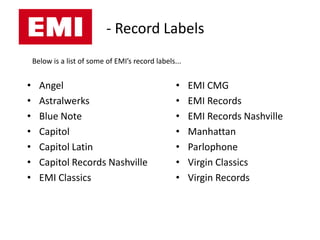
- Record Labels
    Below is a list of some of EMI’s record labels...


•     Angel                                        •    EMI CMG
•     Astralwerks                                  •    EMI Records
•     Blue Note                                    •    EMI Records Nashville
•     Capitol                                      •    Manhattan
•     Capitol Latin                                •    Parlophone
•     Capitol Records Nashville                    •    Virgin Classics
•     EMI Classics                                 •    Virgin Records
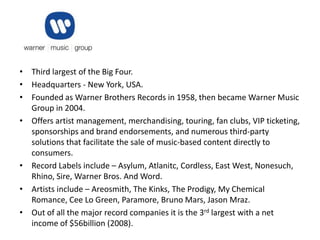
• Third largest of the Big Four.
• Headquarters - New York, USA.
• Founded as Warner Brothers Records in 1958, then became Warner Music
  Group in 2004.
• Offers artist management, merchandising, touring, fan clubs, VIP ticketing,
  sponsorships and brand endorsements, and numerous third-party
  solutions that facilitate the sale of music-based content directly to
  consumers.
• Record Labels include – Asylum, Atlanitc, Cordless, East West, Nonesuch,
  Rhino, Sire, Warner Bros. And Word.
• Artists include – Areosmith, The Kinks, The Prodigy, My Chemical
  Romance, Cee Lo Green, Paramore, Bruno Mars, Jason Mraz.
• Out of all the major record companies it is the 3rd largest with a net
  income of $56billion (2008).
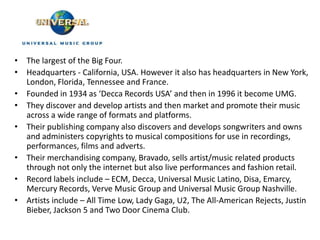
• The largest of the Big Four.
• Headquarters - California, USA. However it also has headquarters in New York,
  London, Florida, Tennessee and France.
• Founded in 1934 as ‘Decca Records USA’ and then in 1996 it become UMG.
• They discover and develop artists and then market and promote their music
  across a wide range of formats and platforms.
• Their publishing company also discovers and develops songwriters and owns
  and administers copyrights to musical compositions for use in recordings,
  performances, films and adverts.
• Their merchandising company, Bravado, sells artist/music related products
  through not only the internet but also live performances and fashion retail.
• Record labels include – ECM, Decca, Universal Music Latino, Disa, Emarcy,
  Mercury Records, Verve Music Group and Universal Music Group Nashville.
• Artists include – All Time Low, Lady Gaga, U2, The All-American Rejects, Justin
  Bieber, Jackson 5 and Two Door Cinema Club.
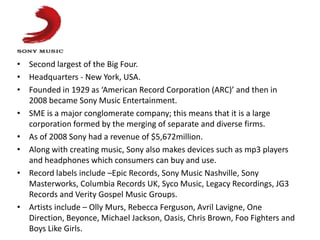
• Second largest of the Big Four.
• Headquarters - New York, USA.
• Founded in 1929 as ‘American Record Corporation (ARC)’ and then in
  2008 became Sony Music Entertainment.
• SME is a major conglomerate company; this means that it is a large
  corporation formed by the merging of separate and diverse firms.
• As of 2008 Sony had a revenue of $5,672million.
• Along with creating music, Sony also makes devices such as mp3 players
  and headphones which consumers can buy and use.
• Record labels include –Epic Records, Sony Music Nashville, Sony
  Masterworks, Columbia Records UK, Syco Music, Legacy Recordings, JG3
  Records and Verity Gospel Music Groups.
• Artists include – Olly Murs, Rebecca Ferguson, Avril Lavigne, One
  Direction, Beyonce, Michael Jackson, Oasis, Chris Brown, Foo Fighters and
  Boys Like Girls.
Napster was developed by John Fanning and Shawn Fanning and was initially released in 1999. It was originally
    founded as a pioneering peer-to-peer file sharing Internet service that emphasized sharing audio files,
    typically music, encoded in MP3 format. Its technology allowed people to easily share their MP3 files with
    other participants. Its easy access and use led to massive copyright violations of music and film media, as
    well as other intellectual property. This meant that Napster had to stop operations and it was eventually
    taken over by Roxio.

The music industry made the following claims against Napster:
1. That its users were directly infringing the plaintiffs' copyrights.
2. That Napster was liable for contributory infringement of the plaintiffs' copyrights.
3. That Napster was liable for vicarious infringement of the plaintiffs' copyrights.

Napster lost the case in the District Court and appealed to the U.S. Court of Appeals for the Ninth Circuit.
    Although the Ninth Circuit found that Napster was capable of commercially significant non-infringing uses,
    it affirmed the District Court's decision. On remand, the District Court ordered Napster to monitor the
    activities of its network and to block access to infringing material when notified of that material's location.
    Napster was unable to do this, and so shut down its service in July 2001. Napster finally declared itself
    bankrupt in 2002 and sold its assets. It had already been offline since the previous year owing to the effect
    of the court rulings. In its second incarnation Napster became an online music store until it merged with
    Rhapsody on 1 December 2011.
Napster was seen as very ‘user-friendly’ and made it relatively easy for music enthusiasts to download copies
    of not only popular songs, but also songs that were otherwise difficult to obtain, like older songs,
    unreleased recordings, and songs from concert bootleg recordings. At its peak there were 25 million users
    and 80 million songs, and the system never once crashed.
Founded in 2006 Spotify is a Swedish DRM-based music streaming service offering streaming of selected music
    from a range of major and independent record labels, including Sony, EMI, Warner Music Group, and
    Universal. Launched in October 2008 by Swedish start-up Spotify AB, the service had approximately 10
    million users as of 15 September 2010; about 2.5 million of who were paying members. The service is, as
    of November 2011, available in Austria, Belgium, Denmark, Faroe Islands, Finland, France, the
    Netherlands, Norway, Spain, Sweden, Switzerland, the United Kingdom and the Unites States. In March
    2011 Spotify announced that it has one million paying subscribers across Europe. In September the
    number of paying subscribers doubled to two million, or at least €10 million per month of revenue.

An active Facebook account is required to use Spotify, unless the user has registered for a Spotify-only account
    before 22 September 2011. A 6 month free trial period is activated upon initial login with a Facebook
    account, where a user can listen to an unlimited amount of music supported by visual and radio style
    advertising. After the trial, Spotify will make tracks unavailable once they are played 5 times and has a
    listening limit of ten hours per month. An "Unlimited" subscription removes advertisements and time
    limits and a "Premium" subscription introduces extra features such as higher bit rate streaming, offline
    access to music and mobile app access.

As of July 2011 the catalogue provides access to approximately 15 million songs via searching for artists,
     albums, titles, labels and genres, and gives users access to tracks from many major and independent
     labels. Some artists have opted not to be added to Spotify. Additionally, some artists are missing in certain
     regions due to licensing restrictions imposed by the record labels. For example, The Beatles are not
     available because of a digital distribution agreement that is exclusive to iTunes.

The big four

  • 1.
  • 2.
    • The ‘BigFour’ make up about 70% of the worldwide music industry; the other 30% is made of other independent labels. • All four of these music companies own the production, distribution and consumption of their music, this is known as ‘vertical integration’. • Production – recording music. • Distribution – promoting music and getting it into shops, on the radio and downloaded for payment. • Consumption – people buying CD’s, downloading music, paying for live concert tickets and purchasing related products. • Because EMI, Song, Warner Music Group and Universal do all these stages themselves they are very powerful within the music industry and have a lot of influence over the way music is made and sold nowadays. • Each of these companies consists of many smaller music labels which serve different markets.
  • 3.
    - Background Information • Fourth largest of the Big Four. • Headquarters - London, UK. However they are able to serve artists, consumers and partners all over the world. • Founded in 1931 by Emile Berliner (the inventor of the gramophone) • Revenue = £1.072 billion (2009) • Employees = 5,500 (January 2008) • EMI Music’s first websites went live in 1993 and 1994 and in 1998 EMI streamed the first complete album over the internet, ‘Mezzanine’ by Massive Attack. • The following year EMI was the first company to release a digital album download, David Bowie’s ‘…Hours’. EMI also launched the first internet video single in 2001. In 2007 EMI was the first major music company to make its music available without digital rights management (DRM) software. • On 12 November 2011, it was announced that EMI has sold its recorded music operations to Universal Music Group for £1.2 billion ($1.9billion) and its music publishing operations to a Sony-led consortium for $2.2 billion. Among the other companies that had competed for the recorded music business was Warner Music Group which was reported to have made a $2 billion bid.
  • 4.
    - Artists Below isa list of some of the artists signed with EMI... • You Me At Six • Peter Doherty • Priscilla Ahn • Nickelback • 30 Seconds to Mars • Kylie Minogue • Pink Floyd • KT Tunstall • The Beatles • The Kooks • Lily Allen • Gorillaz • Katy Perry • Evanescene • David Guetta • Eliza Doolittle • Blur • Empire of the Sun
  • 5.
    - Record Labels Below is a list of some of EMI’s record labels... • Angel • EMI CMG • Astralwerks • EMI Records • Blue Note • EMI Records Nashville • Capitol • Manhattan • Capitol Latin • Parlophone • Capitol Records Nashville • Virgin Classics • EMI Classics • Virgin Records
  • 6.
    • Third largestof the Big Four. • Headquarters - New York, USA. • Founded as Warner Brothers Records in 1958, then became Warner Music Group in 2004. • Offers artist management, merchandising, touring, fan clubs, VIP ticketing, sponsorships and brand endorsements, and numerous third-party solutions that facilitate the sale of music-based content directly to consumers. • Record Labels include – Asylum, Atlanitc, Cordless, East West, Nonesuch, Rhino, Sire, Warner Bros. And Word. • Artists include – Areosmith, The Kinks, The Prodigy, My Chemical Romance, Cee Lo Green, Paramore, Bruno Mars, Jason Mraz. • Out of all the major record companies it is the 3rd largest with a net income of $56billion (2008).
  • 7.
    • The largestof the Big Four. • Headquarters - California, USA. However it also has headquarters in New York, London, Florida, Tennessee and France. • Founded in 1934 as ‘Decca Records USA’ and then in 1996 it become UMG. • They discover and develop artists and then market and promote their music across a wide range of formats and platforms. • Their publishing company also discovers and develops songwriters and owns and administers copyrights to musical compositions for use in recordings, performances, films and adverts. • Their merchandising company, Bravado, sells artist/music related products through not only the internet but also live performances and fashion retail. • Record labels include – ECM, Decca, Universal Music Latino, Disa, Emarcy, Mercury Records, Verve Music Group and Universal Music Group Nashville. • Artists include – All Time Low, Lady Gaga, U2, The All-American Rejects, Justin Bieber, Jackson 5 and Two Door Cinema Club.
  • 8.
    • Second largestof the Big Four. • Headquarters - New York, USA. • Founded in 1929 as ‘American Record Corporation (ARC)’ and then in 2008 became Sony Music Entertainment. • SME is a major conglomerate company; this means that it is a large corporation formed by the merging of separate and diverse firms. • As of 2008 Sony had a revenue of $5,672million. • Along with creating music, Sony also makes devices such as mp3 players and headphones which consumers can buy and use. • Record labels include –Epic Records, Sony Music Nashville, Sony Masterworks, Columbia Records UK, Syco Music, Legacy Recordings, JG3 Records and Verity Gospel Music Groups. • Artists include – Olly Murs, Rebecca Ferguson, Avril Lavigne, One Direction, Beyonce, Michael Jackson, Oasis, Chris Brown, Foo Fighters and Boys Like Girls.
  • 9.
    Napster was developedby John Fanning and Shawn Fanning and was initially released in 1999. It was originally founded as a pioneering peer-to-peer file sharing Internet service that emphasized sharing audio files, typically music, encoded in MP3 format. Its technology allowed people to easily share their MP3 files with other participants. Its easy access and use led to massive copyright violations of music and film media, as well as other intellectual property. This meant that Napster had to stop operations and it was eventually taken over by Roxio. The music industry made the following claims against Napster: 1. That its users were directly infringing the plaintiffs' copyrights. 2. That Napster was liable for contributory infringement of the plaintiffs' copyrights. 3. That Napster was liable for vicarious infringement of the plaintiffs' copyrights. Napster lost the case in the District Court and appealed to the U.S. Court of Appeals for the Ninth Circuit. Although the Ninth Circuit found that Napster was capable of commercially significant non-infringing uses, it affirmed the District Court's decision. On remand, the District Court ordered Napster to monitor the activities of its network and to block access to infringing material when notified of that material's location. Napster was unable to do this, and so shut down its service in July 2001. Napster finally declared itself bankrupt in 2002 and sold its assets. It had already been offline since the previous year owing to the effect of the court rulings. In its second incarnation Napster became an online music store until it merged with Rhapsody on 1 December 2011. Napster was seen as very ‘user-friendly’ and made it relatively easy for music enthusiasts to download copies of not only popular songs, but also songs that were otherwise difficult to obtain, like older songs, unreleased recordings, and songs from concert bootleg recordings. At its peak there were 25 million users and 80 million songs, and the system never once crashed.
  • 10.
    Founded in 2006Spotify is a Swedish DRM-based music streaming service offering streaming of selected music from a range of major and independent record labels, including Sony, EMI, Warner Music Group, and Universal. Launched in October 2008 by Swedish start-up Spotify AB, the service had approximately 10 million users as of 15 September 2010; about 2.5 million of who were paying members. The service is, as of November 2011, available in Austria, Belgium, Denmark, Faroe Islands, Finland, France, the Netherlands, Norway, Spain, Sweden, Switzerland, the United Kingdom and the Unites States. In March 2011 Spotify announced that it has one million paying subscribers across Europe. In September the number of paying subscribers doubled to two million, or at least €10 million per month of revenue. An active Facebook account is required to use Spotify, unless the user has registered for a Spotify-only account before 22 September 2011. A 6 month free trial period is activated upon initial login with a Facebook account, where a user can listen to an unlimited amount of music supported by visual and radio style advertising. After the trial, Spotify will make tracks unavailable once they are played 5 times and has a listening limit of ten hours per month. An "Unlimited" subscription removes advertisements and time limits and a "Premium" subscription introduces extra features such as higher bit rate streaming, offline access to music and mobile app access. As of July 2011 the catalogue provides access to approximately 15 million songs via searching for artists, albums, titles, labels and genres, and gives users access to tracks from many major and independent labels. Some artists have opted not to be added to Spotify. Additionally, some artists are missing in certain regions due to licensing restrictions imposed by the record labels. For example, The Beatles are not available because of a digital distribution agreement that is exclusive to iTunes.