Campaign Analysis

TEXAS CHAINSAW 3D
Trailer Analysis
Throughout a trailer, the four technical aspects help an audience understand the
genre of a film without revealing too much of the main plot. The stalker/slasher
film Texas Chainsaw 3D is the sequel of a popular franchise to this particular
genre, and it portrays the characteristics that a stalker/slasher film possesses. For
example, the sound, editing, cinematography and mise-en-scene within the short
clip. The first two establishing shots used are of a people-carrier, panning across
some empty roads, which then leads to some shots of the people inside the car.
The audience here are introduced to some young adults who are perhaps on a
road trip for a holiday. The female character getting dressed in the car asks
another character whether she knew anything about the place they were going to,
and in response, the female character responds that she only knew the address.
This foreshadows that trouble may await them at their chosen venue of vacation.
There is no voiceover, which leaves audiences with only a small amount of
dialogue and the eerie, sinister music that plays in the background. Replacing the
voiceover, there are dark backgrounds where only slightly glowing white text is
positioned in the middle of the screen. This leaves the audience to draw details
from the narrative in the little dialogue, what they see on screen and the captions.
Poster Analysis
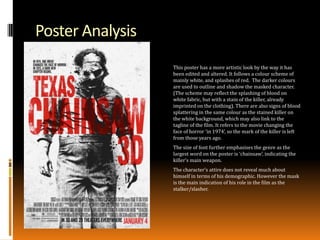
This poster has a more artistic look by the way it has
been edited and altered. It follows a colour scheme of
mainly white, and splashes of red. The darker colours
are used to outline and shadow the masked character.
(The scheme may reflect the splashing of blood on
white fabric, but with a stain of the killer, already
imprinted on the clothing). There are also signs of blood
splattering in the same colour as the stained killer on
the white background, which may also link to the
tagline of the film. It refers to the movie changing the
face of horror ‘in 1974’, so the mark of the killer is left
from those years ago.
The size of font further emphasises the genre as the
largest word on the poster is ‘chainsaw’, indicating the
killer’s main weapon.
The character’s attire does not reveal much about
himself in terms of his demographic. However the mask
is the main indication of his role in the film as the
stalker/slasher.
This grotesque depiction reflects the film’s tagline
“Evil wears many faces” in this image of a range of
masks, lined up on a shelf. This indicates that the
killer hides his identity by wearing sinister and
disturbing masks, that resemble real, human faces,
but with facial mutilations – perhaps the skin of the
killer’s victims. The iconography recurs in horror
movies, with the main example of Michael Myers in
Halloween. Along with these masks, an actual human
head of a female blends in with the rest of the masks,
making her almost unnoticeable. The props used on
the set are also of the stalker/slasher genre, as they
consist of surgical tools, and perhaps even kitchen
utensils, and a jar of what appears to be fingers. In
comparison to the first poster, this one is much more
extreme, and may not be used for very public
advertisement – so perhaps for certain websites and
film magazines.

Texas chainsaw 3 d

  • 1.
  • 2.
    Trailer Analysis Throughout atrailer, the four technical aspects help an audience understand the genre of a film without revealing too much of the main plot. The stalker/slasher film Texas Chainsaw 3D is the sequel of a popular franchise to this particular genre, and it portrays the characteristics that a stalker/slasher film possesses. For example, the sound, editing, cinematography and mise-en-scene within the short clip. The first two establishing shots used are of a people-carrier, panning across some empty roads, which then leads to some shots of the people inside the car. The audience here are introduced to some young adults who are perhaps on a road trip for a holiday. The female character getting dressed in the car asks another character whether she knew anything about the place they were going to, and in response, the female character responds that she only knew the address. This foreshadows that trouble may await them at their chosen venue of vacation. There is no voiceover, which leaves audiences with only a small amount of dialogue and the eerie, sinister music that plays in the background. Replacing the voiceover, there are dark backgrounds where only slightly glowing white text is positioned in the middle of the screen. This leaves the audience to draw details from the narrative in the little dialogue, what they see on screen and the captions.
  • 3.
    Poster Analysis This posterhas a more artistic look by the way it has been edited and altered. It follows a colour scheme of mainly white, and splashes of red. The darker colours are used to outline and shadow the masked character. (The scheme may reflect the splashing of blood on white fabric, but with a stain of the killer, already imprinted on the clothing). There are also signs of blood splattering in the same colour as the stained killer on the white background, which may also link to the tagline of the film. It refers to the movie changing the face of horror ‘in 1974’, so the mark of the killer is left from those years ago. The size of font further emphasises the genre as the largest word on the poster is ‘chainsaw’, indicating the killer’s main weapon. The character’s attire does not reveal much about himself in terms of his demographic. However the mask is the main indication of his role in the film as the stalker/slasher.
  • 4.
    This grotesque depictionreflects the film’s tagline “Evil wears many faces” in this image of a range of masks, lined up on a shelf. This indicates that the killer hides his identity by wearing sinister and disturbing masks, that resemble real, human faces, but with facial mutilations – perhaps the skin of the killer’s victims. The iconography recurs in horror movies, with the main example of Michael Myers in Halloween. Along with these masks, an actual human head of a female blends in with the rest of the masks, making her almost unnoticeable. The props used on the set are also of the stalker/slasher genre, as they consist of surgical tools, and perhaps even kitchen utensils, and a jar of what appears to be fingers. In comparison to the first poster, this one is much more extreme, and may not be used for very public advertisement – so perhaps for certain websites and film magazines.