Test-Driven Development
Why? Why can’t we do the things right the first time?  Why budget for correcting our own mistakes? Why don’t we commit fewer bugs into our code repository?
What is TDD? R elies on the repetition of a very short development cycle  Promotes “Test-First Design” (TFD) Practice that supports change and refactoring S ubstantially reduces the  number  of defects H elps improve design, documents public interfaces, and guards against future mistakes Takes hours  to learn and a lifetime to master
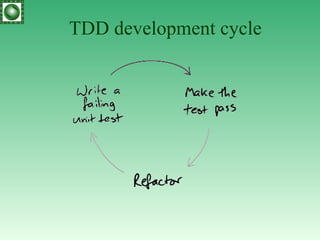
TDD development cycle Think Add a test Run all tests and see if the new one fails Write some code just to make the test pass Run the automated tests and see them succeed Refactor the code Repeat
TDD development cycle
Benefits When writing tests: Makes us clarify the acceptance criteria for the next piece of work Encourages us to write loosely coupled components Adds an executable description of what the code does (design);  Adds to a complete regression suite (implementation); When running tests: Detects errors while the context is fresh in our mind (implementation); Lets us know when we’ve done enough an nothing more – promotes the “KISS” and “YAGNI” principles
Speed matters In TDD, you run the tests as often as one or two times every   five m inute s The tests should take a reasonable time to run M ake sure your tests take under ten seconds to run  A n easy way to keep your test times down is to run a subset of tests during the TDD cycle P eriodically run the whole test suite to  find regressions
Acceptance tests Specifications for the desired behavior and functionality of a system Tell us whether the system behaves correctly from the perspective of a user. Tell us nothing about how the system implements that behavior
Properties of acceptance tests Owned by the customer Written together About the  what  not the  how  (about  business functionality, not about software design  ) Expressed in the language of the problem domain Short, precise and unambiguous
Example User logs in with correct data and sees a welcome message. Type word “admin” in the username field Type word “admin” in the password field Press the login button Verify that the user sees a welcome message with his name on it.
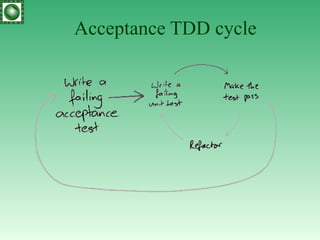
Acceptance TDD cycle Pick a requirement Write acceptance test Automate the acceptance test Implement the functionality using TDD
Acceptance TDD cycle
External and Internal Quality External   quality is how well the system meets the needs of its customers and users Internal   quality is how well it meets the needs of its developers and administrators Acceptance  tests tells us about the external quality Unit  tests gives us feedback about the internal quality Integration  tests fall somewhere in the middle
The walking skeleton Before acceptance test automation build, deploy and test environment is required Deploying and testing right from the start of a project forces the team to understand how their system fits into the world A “walking skeleton” is an implementation of the thinnest possible slice of real functionality that we can automatically build, deploy, and test end-to-end It need not use the final architecture, but it should link together the main architectural components
Benefits of Acceptance TDD Definition of “done” Cooperative work Trust and commitment Specification by example Filling the gap
Summary
When TDD is used properly Y ou find that you spend little time debugging  Although you continue to make mistakes, you find those mistakes very quickly and have little difficulty fixing them.  Y ou have total confidence that the whole codebase is well-tested, which allows you to aggressively refactor at every opportunity The team communication and collaboration will be improved   which leads to more happy people
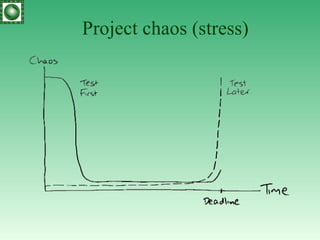
Project chaos (stress)
Disadvantages of TDD Management support is essential. Without the entire organization believing that  TDD  is going to improve the product, management will feel that time spent writing tests is wasted . The tests themselves become part of the maintenance overhead of a project. Badly written tests   are expensive to maintain . Unit tests created in a  TDD  environment are typically created by the developer who will also write the code that is being tested. The tests may therefore share the same blind spots with the code . The high number of passing unit tests may bring a false sense of security, resulting in less additional  QA  activities .
TDD is waste of time if Y ou aren’t disciplined . You  don’t know  exactly  what the system should do (building the thing right vs. building the right thing). You  have no plans for what need to happen . You  haven’t got a clear picture of how to design the system in a loosely coupled manner . T he business model does not care about quality but rather just pushing features and out the market asap . If  the code is not to be maintained. If you maintain a legacy code.
Useful links and resources Agile Boox -   http://jamesshore.com/Agile-Book/test_driven_development.html Growing Object-Oriented Software Guided by Tests -  http://www.growing-object-oriented-software.com/ Test Driven Practical  TDD and Acceptance TDD for Java Developers  http:// www.manning.com/koskela / Unit testing with mock objects -  http://www.ibm.com/developerworks/library/j-mocktest.html Walking skeleton -  http://alistair.cockburn.us/Walking+skeleton
Questions?

Test-Driven Development

  • 1.
  • 2.
    Why? Why can’twe do the things right the first time? Why budget for correcting our own mistakes? Why don’t we commit fewer bugs into our code repository?
  • 3.
    What is TDD?R elies on the repetition of a very short development cycle Promotes “Test-First Design” (TFD) Practice that supports change and refactoring S ubstantially reduces the number of defects H elps improve design, documents public interfaces, and guards against future mistakes Takes hours to learn and a lifetime to master
  • 4.
    TDD development cycleThink Add a test Run all tests and see if the new one fails Write some code just to make the test pass Run the automated tests and see them succeed Refactor the code Repeat
  • 5.
  • 6.
    Benefits When writingtests: Makes us clarify the acceptance criteria for the next piece of work Encourages us to write loosely coupled components Adds an executable description of what the code does (design); Adds to a complete regression suite (implementation); When running tests: Detects errors while the context is fresh in our mind (implementation); Lets us know when we’ve done enough an nothing more – promotes the “KISS” and “YAGNI” principles
  • 7.
    Speed matters InTDD, you run the tests as often as one or two times every five m inute s The tests should take a reasonable time to run M ake sure your tests take under ten seconds to run A n easy way to keep your test times down is to run a subset of tests during the TDD cycle P eriodically run the whole test suite to find regressions
  • 8.
    Acceptance tests Specificationsfor the desired behavior and functionality of a system Tell us whether the system behaves correctly from the perspective of a user. Tell us nothing about how the system implements that behavior
  • 9.
    Properties of acceptancetests Owned by the customer Written together About the what not the how (about business functionality, not about software design ) Expressed in the language of the problem domain Short, precise and unambiguous
  • 10.
    Example User logsin with correct data and sees a welcome message. Type word “admin” in the username field Type word “admin” in the password field Press the login button Verify that the user sees a welcome message with his name on it.
  • 11.
    Acceptance TDD cyclePick a requirement Write acceptance test Automate the acceptance test Implement the functionality using TDD
  • 12.
  • 13.
    External and InternalQuality External quality is how well the system meets the needs of its customers and users Internal quality is how well it meets the needs of its developers and administrators Acceptance tests tells us about the external quality Unit tests gives us feedback about the internal quality Integration tests fall somewhere in the middle
  • 14.
    The walking skeletonBefore acceptance test automation build, deploy and test environment is required Deploying and testing right from the start of a project forces the team to understand how their system fits into the world A “walking skeleton” is an implementation of the thinnest possible slice of real functionality that we can automatically build, deploy, and test end-to-end It need not use the final architecture, but it should link together the main architectural components
  • 15.
    Benefits of AcceptanceTDD Definition of “done” Cooperative work Trust and commitment Specification by example Filling the gap
  • 16.
  • 17.
    When TDD isused properly Y ou find that you spend little time debugging Although you continue to make mistakes, you find those mistakes very quickly and have little difficulty fixing them. Y ou have total confidence that the whole codebase is well-tested, which allows you to aggressively refactor at every opportunity The team communication and collaboration will be improved which leads to more happy people
  • 18.
  • 19.
    Disadvantages of TDDManagement support is essential. Without the entire organization believing that TDD is going to improve the product, management will feel that time spent writing tests is wasted . The tests themselves become part of the maintenance overhead of a project. Badly written tests are expensive to maintain . Unit tests created in a TDD environment are typically created by the developer who will also write the code that is being tested. The tests may therefore share the same blind spots with the code . The high number of passing unit tests may bring a false sense of security, resulting in less additional QA activities .
  • 20.
    TDD is wasteof time if Y ou aren’t disciplined . You don’t know exactly what the system should do (building the thing right vs. building the right thing). You have no plans for what need to happen . You haven’t got a clear picture of how to design the system in a loosely coupled manner . T he business model does not care about quality but rather just pushing features and out the market asap . If the code is not to be maintained. If you maintain a legacy code.
  • 21.
    Useful links andresources Agile Boox - http://jamesshore.com/Agile-Book/test_driven_development.html Growing Object-Oriented Software Guided by Tests - http://www.growing-object-oriented-software.com/ Test Driven Practical TDD and Acceptance TDD for Java Developers http:// www.manning.com/koskela / Unit testing with mock objects - http://www.ibm.com/developerworks/library/j-mocktest.html Walking skeleton - http://alistair.cockburn.us/Walking+skeleton
  • 22.