Context of Health Care
FinancialManagement
Chapter1
LearningObjectives
• Identify keyelementsthat are driving changes in health care
delivery
• Identify keyapproachesto controlling health care costs and
resulting ethicalissues
• Identify keychanges in reimbursementmechanismsto
providers
• CAPITATIONAsystem that pays providers a specific amount in advance to
care for the health care needs of a population over a specific time period.
Providers are usually paid on per memberper month (PMPM) basis. The
provider then assumes the risk that the cost of caring for the population
mayexceed the aggregate PMPM amount received.
• CARE MAPPING A process that specifies in advance the preferred
treatment regimen for patients with particular diagnoses. This is also
referred to as a clinical pathway, clinical protocol, or practice guideline.
• SHARED SAVINGSA payment strategythat encouragesprovidersto reduce
health care spending for a defined patient population by offeringthem a
percentageof the net savings realizedas a resultof their efforts.
•
CAPITATION
‫الصحية‬ ‫الرعاية‬ ‫احتياجات‬ ‫لرعاية‬ ‫ا‬ً‫م‬‫مقد‬ ‫ًا‬‫د‬‫محد‬ ‫ا‬ً‫غ‬‫مبل‬ ‫الخدمة‬ ‫لمقدمي‬ ‫يدفع‬ ‫نظام‬ ‫هو‬
‫للسكان‬
‫محددة‬ ‫زمنية‬ ‫فترة‬ ‫خالل‬
.
‫الشهر‬ ‫في‬ ‫عضو‬ ‫كل‬ ‫أساس‬ ‫على‬ ‫للمقدمين‬ ‫الدفع‬ ‫يتم‬ ‫ما‬ ‫عادة‬
(
PMPM
.)
‫يفترض‬ ‫ثم‬
‫مبلغ‬ ‫إجمالي‬ ‫تتجاوز‬ ‫قد‬ ‫السكان‬ ‫رعاية‬ ‫تكلفة‬ ‫أن‬ ‫خطر‬ ‫الخدمة‬ ‫مقدم‬
PMPM
‫المستلم‬
.
•
‫خريطة‬ ‫رسم‬
‫تشخيص‬ ‫من‬ ‫يعانون‬ ‫الذين‬ ‫للمرضى‬ ‫المفضل‬ ‫العالج‬ ‫نظام‬ ‫ا‬ً‫ق‬‫مسب‬ ‫تحدد‬ ‫عملية‬ ‫الرعاية‬
‫معينة‬ ‫ات‬
.
‫الممارسة‬ ‫إرشادات‬ ‫أو‬ ‫السريري‬ ‫البروتوكول‬ ‫أو‬ ‫السريري‬ ‫المسار‬ ‫باسم‬ ‫ا‬ً‫ض‬‫أي‬ ‫هذا‬ ‫إلى‬ ‫شار‬ُ‫ي‬
.
•
‫المشترك‬ ‫التوفير‬
‫الص‬ ‫الرعاية‬ ‫على‬ ‫اإلنفاق‬ ‫تقليل‬ ‫على‬ ‫الخدمة‬ ‫مقدمي‬ ‫تشجع‬ ‫دفع‬ ‫استراتيجية‬
‫لمجموعة‬ ‫حية‬
‫لجهودهم‬ ‫نتيجة‬ ‫المحققة‬ ‫المدخرات‬ ‫صافي‬ ‫من‬ ‫مئوية‬ ‫نسبة‬ ‫منحهم‬ ‫خالل‬ ‫من‬ ‫المرضى‬ ‫من‬ ‫محددة‬
.
• MALPRACTICEREFORM
The ACA addresses medicalliability in twoways:
(1) extensionof federal malpractice protectionsto
nonmedical personnel working infreeclinics.
(2) authorization of $50 million over the next five yearsfor
HHS to award demonstration project grants. These
grants would be provided to states to develop,
implement, institute,and evaluatealternativesto the
present system used in the United States to resolve
charges against physicians and other health care
providers of wrongdoing topatients. ‫الخاطئ‬ ‫اإلصالح‬
‫تتناول‬
ACA
‫مرحلتين‬ ‫على‬ ‫الطبية‬ ‫المسؤولية‬
:
.1
‫العاملي‬ ‫الطبيين‬ ‫غير‬ ‫للموظفين‬ ‫الممارسة‬ ‫سوء‬ ‫ضد‬ ‫الفيدرالية‬ ‫الحماية‬ ‫تمديد‬
‫العيادات‬ ‫في‬ ‫ن‬
‫المجانية‬
.
.2
‫بمبلغ‬ ‫تفويض‬
50
‫لـ‬ ‫القادمة‬ ‫الخمس‬ ‫السنوات‬ ‫مدى‬ ‫على‬ ‫دوالر‬ ‫مليون‬
HHS
‫منح‬ ‫لمنح‬
‫اإليضاحية‬ ‫المشاريع‬
.
‫وتأس‬ ‫وتنفيذ‬ ‫لتطوير‬ ‫الدول‬ ‫إلى‬ ‫المنح‬ ‫هذه‬ ‫تقديم‬ ‫سيتم‬
‫بدائل‬ ‫وتقييم‬ ‫يس‬
‫األطب‬ ‫إلى‬ ‫الموجهة‬ ‫التهم‬ ‫لتسوية‬ ‫المتحدة‬ ‫الواليات‬ ‫في‬ ‫المستخدم‬ ‫الحالي‬ ‫للنظام‬
‫ومقدمي‬ ‫اء‬
‫المرضى‬ ‫معاملة‬ ‫إساءة‬ ‫بشأن‬ ‫اآلخرين‬ ‫الصحية‬ ‫الرعاية‬
.
LoweringCosts
• Patient Protection and Affordable CareAct(ACA)
• CMS trying to control risingcosts
Center for Medicare and Medicaid Services(CMS)
• Value Based Purchasing(VBP)
GoalsoftheHealthCareSystem
• Access
• Cost
• Quality
Toestablish a contextfor the topics covered in this text,
this chapter highlights key issues affecting health care
organizations.It is organizedintothree sections:
(1)changing methods of health carefinancingand
delivery,
(2) addressing the high cost ofcare,and
(3) establishing value-based paymentmechanisms.
‫القض‬ ‫على‬ ‫الضوء‬ ‫الفصل‬ ‫هذا‬ ‫يسلط‬ ، ‫النص‬ ‫هذا‬ ‫يغطيها‬ ‫التي‬ ‫للموضوعات‬ ‫سياق‬ ‫إلنشاء‬
‫ايا‬
‫الصحية‬ ‫الرعاية‬ ‫مؤسسات‬ ‫على‬ ‫تؤثر‬ ‫التي‬ ‫الرئيسية‬
.
‫أقسام‬ ‫ثالثة‬ ‫إلى‬ ‫منظمة‬ ‫وهي‬
:
.1
، ‫وتقديمها‬ ‫الصحية‬ ‫الرعاية‬ ‫تمويل‬ ‫طرق‬ ‫تغيير‬
.2
‫و‬ ، ‫الرعاية‬ ‫تكلفة‬ ‫ارتفاع‬ ‫معالجة‬
.3
‫القيمة‬ ‫أساس‬ ‫على‬ ‫الدفع‬ ‫آليات‬ ‫إنشاء‬
.
ChangingMethodsOfHealthCare
FinancingandDelivery
• Requirementthat almost all individualshave insurance coverage
• Requirementthat statescreateinsurance exchanges
• Provisionsfor expansionof Medicaid (is a social health care program
for familiesand individualswith low income and resources)
• Provisions for medicalloss ratioand premium rate reviews
• Bundled paymentsandVBP
• Accountable CareOrganizations
This individual mandate lies at the heart ofthelegislation.
whereindividualsand smallbusinesses can obtaincoverage.TheACA containsrequirements
foran essential benefitspackageand providesforchangesto the taxlaw that include
penaltiesfor individualswhochoose not to haveinsurance.
under agesixty-five.
value-basedpurchasingsystem
to share in costsavingsthat they achieveforthe Medicare program.
•
‫ا‬ً‫ب‬‫تقري‬ ‫األفراد‬ ‫لجميع‬ ‫تأمينية‬ ‫تغطية‬ ‫وجود‬ ‫اشتراط‬
.
•
‫التأمين‬ ‫تبادالت‬ ‫إنشاء‬ ‫على‬ ‫ينص‬ ‫الذي‬ ‫الشرط‬
.
•
‫برنامج‬ ‫لتوسيع‬ ‫أحكام‬
Medicaid
(
‫المنخفض‬ ‫الدخل‬ ‫ذوي‬ ‫واألفراد‬ ‫للعائالت‬ ‫اجتماعية‬ ‫صحية‬ ‫رعاية‬ ‫برنامج‬ ‫هو‬
‫والموارد‬
.)
•
‫األقساط‬ ‫أسعار‬ ‫ومراجعات‬ ‫الطبية‬ ‫الخسارة‬ ‫نسبة‬ ‫مخصصات‬
.
•
‫و‬ ‫المجمعة‬ ‫المدفوعات‬
VBP
.
•
‫المسؤولة‬ ‫الرعاية‬ ‫منظمات‬
.
Trends(HealthInsuranceExchanges)
• *Rise of uninsured from 36 million to 50million2001-2010
• ACA authorizes competitive insurance marke place
• Rise of uncompensatedcare for the uninsured2001-2011
• Accountable Care Organizations*(ACO)
• Patient Centered MedicalHome(PCMH)
• New technology
• value-based purchasingsystem(VBP)
at the state leveland providesfortwo types of exchanges,an individualexchange and a small businessexchange
The individual exchange provides a mechanism for implementing the individual mandate for
those who either do not have access to health insurance through an employer plan or who are
uninsured for otherreasons.
The small of health insurance for their employees by pooling their buying power and provide
business exchange provides access for small businesses, enabling them to improve the quality ding
multiplehealth insurance options.
‫الص‬ ‫التأمين‬ ‫إلى‬ ‫الوصول‬ ‫إمكانية‬ ‫لديهم‬ ‫ليس‬ ‫الذين‬ ‫ألولئك‬ ‫الفردي‬ ‫التفويض‬ ‫لتنفيذ‬ ‫آلية‬ ‫الفردي‬ ‫التبادل‬ ‫يوفر‬
‫خطة‬ ‫خالل‬ ‫من‬ ‫حي‬
‫أخرى‬ ‫ألسباب‬ ‫عليهم‬ ‫المؤمن‬ ‫غير‬ ‫أو‬ ‫العمل‬ ‫صاحب‬
.
‫التجاري‬ ‫التبادل‬ ‫وتوفير‬ ‫الشرائية‬ ‫قوتهم‬ ‫تجميع‬ ‫خالل‬ ‫من‬ ‫لموظفيهم‬ ‫الصغير‬ ‫الصحي‬ ‫التأمين‬ ‫يوفر‬
‫للشركات‬ ‫الوصول‬
‫المتعددة‬ ‫الصحي‬ ‫التأمين‬ ‫خيارات‬ ‫جودة‬ ‫تحسين‬ ‫من‬ ‫يمكنهم‬ ‫مما‬ ، ‫الصغيرة‬
.
• This rise (from 36 million to 50 million) is dueto several factors,
including:
(1)health insurance and out-of-pocketcostsbecoming too costlyfor many individuals,
even when theyareworking;
(2)individuals being screened out by insuranceunderwritersbecause of
preexistingconditions;
(3)employerseitherscalingback employees'benefitsoreliminating them altogether by
hiring part-timeworkers;
(4) stategovernmentstighteningMedicaideligibilitycriteria;
(5)individuals voluntarily deciding not to purchase insurance for a variety of financial and
nonfinancial reasons, including the assumption that they will not need care or that they
will be taken care of by the "system"anyway.
The ACA provides for a minimum benefits package; however,participants will be able to shop for
health insurance from among an array of commercialhealth insurance products with varying levels
of deductibles, coinsurance, and additional benefits over and above the minimum. The benefit
packages are referred to as bronze, silver,gold, and platinum, depending on how much participants
choose to pay.
‫االرتفاع‬ ‫هذا‬ ‫ويرجع‬
(
‫من‬
36
‫إلى‬ ‫مليون‬
50
‫مليون‬
)
‫منها‬ ‫عوامل‬ ‫عدة‬ ‫إلى‬
:
.1
‫؛‬ ‫العمل‬ ‫عند‬ ‫حتى‬ ، ‫األفراد‬ ‫من‬ ‫للعديد‬ ‫بالنسبة‬ ‫التكلفة‬ ‫باهظة‬ ‫الشخصية‬ ‫والتكاليف‬ ‫الصحي‬ ‫التأمين‬ ‫أصبح‬
.2
‫؛‬ ‫ا‬ً‫ق‬‫مسب‬ ‫الموجودة‬ ‫الظروف‬ ‫بسبب‬ ‫التأمين‬ ‫وكالء‬ ‫قبل‬ ‫من‬ ‫فحصهم‬ ‫يتم‬ ‫الذين‬ ‫األفراد‬
.3
‫؛‬ ‫جزئي‬ ‫بدوام‬ ‫عمال‬ ‫تعيين‬ ‫طريق‬ ‫عن‬ ‫ا‬ً‫م‬‫تما‬ ‫عليها‬ ‫القضاء‬ ‫أو‬ ‫الموظفين‬ ‫مزايا‬ ‫تقليص‬ ‫إما‬ ‫العمل‬ ‫أرباب‬
.4
‫؛‬ ‫الطبية‬ ‫األهلية‬ ‫لمعايير‬ ‫الحكومات‬ ‫تشديد‬
.5
‫افترا‬ ‫ذلك‬ ‫في‬ ‫بما‬ ، ‫المالية‬ ‫وغير‬ ‫المالية‬ ‫األسباب‬ ‫من‬ ‫متنوعة‬ ‫لمجموعة‬ ‫التأمين‬ ‫شراء‬ ‫عدم‬ ‫ا‬ً‫ع‬‫طو‬ ‫قرروا‬ ‫الذين‬ ‫األفراد‬
‫لن‬ ‫أنهم‬ ‫ض‬
‫أن‬ ‫أو‬ ‫رعاية‬ ‫إلى‬ ‫يحتاجوا‬
"
‫النظام‬
"
‫حال‬ ‫أي‬ ‫على‬ ‫بهم‬ ‫سيهتم‬
.
• *Accountable CareOrganizations
An ACO is a voluntary group of health care providers who come
together to provide coordinated care to a patient population in order
to improve quality andreduce costs by keeping patients healthy and
by reducing unnecessary service duplication
• *Patient-Centered MedicalHome
The patient-centered medical home (PCMH) is a partnership
between primary care providers (PCPs), patients, and their families
to deliver a coordinated and comprehensive rangeof services inthe
mostappropriate settings.
*
‫المسؤولة‬ ‫الرعاية‬ ‫منظمات‬
ACO
‫لمجمو‬ ‫منسقة‬ ‫رعاية‬ ‫لتقديم‬ ‫يجتمعون‬ ‫الذين‬ ‫الصحية‬ ‫الرعاية‬ ‫مقدمي‬ ‫من‬ ‫تطوعية‬ ‫مجموعة‬ ‫هي‬
‫من‬ ‫عة‬
‫وتقل‬ ‫المرضى‬ ‫صحة‬ ‫على‬ ‫الحفاظ‬ ‫طريق‬ ‫عن‬ ‫التكاليف‬ ‫وخفض‬ ‫الجودة‬ ‫تحسين‬ ‫أجل‬ ‫من‬ ‫المرضى‬
‫يل‬
‫الخدمة‬ ‫في‬ ‫الضرورية‬ ‫غير‬ ‫االزدواجية‬
*
‫المريض‬ ‫على‬ ‫يركز‬ ‫طبي‬ ‫منزل‬
‫المريض‬ ‫على‬ ‫يركز‬ ‫الذي‬ ‫الطبي‬ ‫المنزل‬
(
PCMH
)
‫األولية‬ ‫الرعاية‬ ‫مقدمي‬ ‫بين‬ ‫شراكة‬ ‫هو‬
(
PCPs
)
‫اإلعدادات‬ ‫أنسب‬ ‫في‬ ‫الخدمات‬ ‫من‬ ‫وشاملة‬ ‫منسقة‬ ‫مجموعة‬ ‫لتقديم‬ ‫وعائالتهم‬ ‫والمرضى‬
.
Factors Affecting theCostofCare
Another
factors:
New
consumers
will enteror
reenter the
marketplace
AnotherFactorsThatCouldContributetoanDecreasein Costs
• Pharmaceuticals are going off patent, creating opportunities forcost
savings with genericdrugs.
• Certain behaviors have begun to change, spurred in large part by
employerswho can no longer affordto pay for employeehealth care
the way they have in thepast.
Lean thinking breaks processes down into identifiable steps to ensure that each
componentis a value-added activity.Amain tenetof lean thinking and Six Sigma is to
reduce the variationinhow activitiesare conducted, an importantstep towardquality
improvement.
Six Sigma, including the related concept of lean thinking, which offersasystematic
approachto analysisand performance improvement.The five major componentsof
the Six Sigma approach are defined, measure, analyze, improve, and control
(nicknamed DMAIC)
•
‫باستخد‬ ‫التكاليف‬ ‫في‬ ‫وفورات‬ ‫لتحقيق‬ ‫ا‬ً‫ص‬‫فر‬ ‫يخلق‬ ‫مما‬ ، ‫االختراع‬ ‫براءات‬ ‫عن‬ ‫األدوية‬ ‫تخرج‬
‫األدوية‬ ‫ام‬
‫العامة‬
.
•
‫ب‬ ‫يعد‬ ‫لم‬ ‫الذين‬ ‫العمل‬ ‫أرباب‬ ‫قبل‬ ‫من‬ ‫كبير‬ ‫حد‬ ‫إلى‬ ‫مدفوعة‬ ، ‫التغير‬ ‫في‬ ‫السلوكيات‬ ‫بعض‬ ‫بدأت‬
‫تحمل‬ ‫إمكانهم‬
‫الماضي‬ ‫في‬ ‫عليها‬ ‫كانوا‬ ‫التي‬ ‫بالطريقة‬ ‫للموظفين‬ ‫الصحية‬ ‫الرعاية‬ ‫تكاليف‬
.
ImpactstoReimbursement
• Cost Accounting Systems
• Group Purchasing Organizations
• Reengineering/Redesigning
• Mergers andAcquisitions
• Retail HealthCare
• Medical Tourism
• Compliance
• Recovery AuditContractors(RACs)
• VBP
• New DRG System
• ICD 10
•
‫التكاليف‬ ‫محاسبة‬ ‫أنظمة‬
•
‫الجماعي‬ ‫الشراء‬ ‫منظمات‬
•
‫الهندسة‬ ‫إعادة‬
/
‫التصميم‬ ‫إعادة‬
•
‫واالستحواذ‬ ‫الدمج‬ ‫عمليات‬
•
‫بالتجزئة‬ ‫الصحية‬ ‫الرعاية‬
•
‫طبية‬ ‫سياحة‬
•
‫االمتثال‬
•
‫االسترداد‬ ‫تدقيق‬ ‫مقاولو‬
(
RACs
)
•
VBP
•
‫نظام‬
DRG
‫الجديد‬
•
‫لألمراض‬ ‫الدولي‬ ‫التصنيف‬
10
ImpactstoReimbursement
Cost AccountingSystems
The process of estimating and classifying costs incurred by an organization.These costs
can be analyzed at the organizational and departmental levels. separating cost
accounting systems from financial accounting systems and moving away from
traditionalcost-accountingsystemsbased on assignment to activity-basedcostsystems.
This is an expensive endeavor, but lower reimbursements force hospitals to invest in
more sophisticatedcostaccountingsystems.
MergersandAcquisitions
a mergerrequiresthat neither of the parties coming togetherhas control.The two (or
more) entitiesmerge to startan entirely new entity with no step-upin basis of the
assets. the new entity comesinto being on the dateof the merger.
an acquisition,there is a controllingparty,and the assets and liabilitiesare markedto
fairvalue.Acquisitionsare more common than mergersin the health care industry.
New DRGSystem
The new system, based on Medicareseverity-adjusted diagnosis-related groups (MS-
DRGs), has 25 major disease categories, 745 diagnosis-related groups, and 3 subclasses
of complications and comorbidities. It is intended to more closely align reimbursement
to patientseverity of illness, It is intendedto reduce overallcoststhrough improvedcare,
thus combining quality with costcontrol and improved equity.(pay for peiformance,or
P4P)
ImpactstoReimbursement
GROUP PURCHASINGORGANIZATION(GPO)A networkof health careorganizationsand
a third-party vendor who are able to acquire large volumes of supplies from
manufacturersat negotiateddiscountedratesowing toeconomies of scale.
RetailHealth CareWalk-inmedical services for basic preventivehealth care provided in a
retailoutlet, such as a pharmacy,bya licensed care provider.
Compliance The process of abiding by governmental regulations, whether in the
provisionof care, billing,privacy,accountingstandards,security,or anyother regulated
area.
RecoveryAuditContractor(RAC) A programcreated under the MedicareModernization
Act of 2003 to identify and recover improper Medicare payments to health care
providers.
Value-Based Purchasing (VBP) A payment methodology designed to provide incentives
to providersfor delivering qualityhealth careat a lower cost. The financial rewardscome
from funds being withheldby the payor;these funds are then redistributedon providers'
achievement of an improvement on specific performance measures, including patient
satisfaction.
ICD-1 0 The WorldHealth Organization'sInternational StatisticalClassificationofDiseases
and Related Health Problems (lCD) is a coding system for diseases that is used in the
United Statesfor health insurance claim reimbursement.
• Recovery Audit Contractors(RAC)
-There are two types of reviews:automated and complex. The
automated review requires nomedical records.
The complexreviewensues when the automated reviewprovidesevidence of a high
likelihood that the service received improper payment or that there is no Medicare
policy, Medicare article, or Medicare-sanctioned coding guideline for the service
provided.
- The Medicare Audit Improvement Act of2012 was designed to promote transparency
and fairness in RAC reviews, and if passed, itwould establish a penalty for a RAC's failure
to follow the program requirements. It would also, among other things:
1) Establish a consolidatedlimit formedical record requests.
2)Requiremedical necessity audits to focus on widespread payment errors.
3)Allow denied inpatient claims to be billed as outpatient claimswhen appropriate.
4) Requirephysician reviewforMedicare denials.
•
‫المراجعات‬ ‫من‬ ‫نوعان‬ ‫هناك‬
:
‫ومعقد‬ ‫آلي‬
.
‫طبية‬ ‫سجالت‬ ‫أي‬ ‫تتطلب‬ ‫ال‬ ‫اآللية‬ ‫المراجعة‬
.
•
‫ال‬ ‫أنه‬ ‫أو‬ ‫صحيحة‬ ‫غير‬ ‫مدفوعات‬ ‫تلقت‬ ‫الخدمة‬ ‫بأن‬ ‫كبير‬ ‫احتمال‬ ‫وجود‬ ‫على‬ ً
‫دليال‬ ‫اآللية‬ ‫المراجعة‬ ‫تقدم‬ ‫عندما‬ ‫المعقدة‬ ‫المراجعة‬ ‫تتم‬
‫سيا‬ ‫توجد‬
‫سة‬
Medicare
‫مقالة‬ ‫أو‬
Medicare
‫ترميز‬ ‫إرشادات‬ ‫أو‬
Medicare
‫المقدمة‬ ‫للخدمة‬
.
-
‫لعام‬ ‫الطبية‬ ‫الرعاية‬ ‫تدقيق‬ ‫تحسين‬ ‫قانون‬ ‫تصميم‬ ‫تم‬
2012
‫مراجعات‬ ‫في‬ ‫واإلنصاف‬ ‫الشفافية‬ ‫لتعزيز‬
RAC
، ‫إقراره‬ ‫تم‬ ‫وإذا‬ ،
‫فشل‬ ‫على‬ ‫عقوبة‬ ‫فرض‬ ‫فسيتم‬
RAC
‫البرنامج‬ ‫متطلبات‬ ‫اتباع‬ ‫في‬
.
‫أخرى‬ ‫أمور‬ ‫بين‬ ‫من‬ ، ‫ا‬ً‫ض‬‫أي‬ ‫سيكون‬
:
.1
‫الطبية‬ ‫السجالت‬ ‫لطلبات‬ ‫موحد‬ ‫حد‬ ‫وضع‬
.
.2
‫طلب‬
‫تدقيقات‬
‫المنتشرة‬ ‫الدفع‬ ‫أخطاء‬ ‫على‬ ‫للتركيز‬ ‫الطبية‬ ‫الضرورة‬
.
.3
‫االقتضاء‬ ‫عند‬ ‫الخارجيين‬ ‫المرضى‬ ‫مطالبات‬ ‫أنها‬ ‫على‬ ‫المرفوضة‬ ‫الداخليين‬ ‫المرضى‬ ‫مطالبات‬ ‫بدفع‬ ‫السماح‬
.
.4
‫برنامج‬ ‫رفض‬ ‫لحاالت‬ ‫الطبيب‬ ‫مراجعة‬ ‫طلب‬
Medicare
.
• MedicalTourism
Travelto a foreign country to obtain normally expensive medical
services at a steep discount. Even with a family member escorting
the patient (and getting the added benefitof foreigntravel),the total
cost is typicallylessthan it would be athome.
• Electronic Health Record(EHR)
Also called an electronic medical record (EMR), this online version of
patients' medical records can include patient demographics,
insurance information, dictations and notes, medication and
immunization histories, ancillary testresults,and the like.Under strict
security permissions, the information can be accessed either in-
house or in private officesettings.
‫طبية‬ ‫سياحة‬
‫حاد‬ ‫بخصم‬ ‫عادة‬ ‫الثمن‬ ‫باهظة‬ ‫طبية‬ ‫خدمات‬ ‫على‬ ‫للحصول‬ ‫أجنبي‬ ‫بلد‬ ‫إلى‬ ‫السفر‬
.
‫المريض‬ ‫بمرافقة‬ ‫األسرة‬ ‫أفراد‬ ‫أحد‬ ‫قيام‬ ‫مع‬ ‫حتى‬
(
‫والحصول‬
‫الخارج‬ ‫إلى‬ ‫للسفر‬ ‫إضافية‬ ‫ميزة‬ ‫على‬
)
‫المنزل‬ ‫في‬ ‫عليه‬ ‫ستكون‬ ‫مما‬ ‫أقل‬ ‫تكون‬ ‫ما‬ ‫عادة‬ ‫اإلجمالية‬ ‫التكلفة‬ ‫فإن‬ ،
.
‫اإللكتروني‬ ‫الصحي‬ ‫السجل‬
(
EHR
)
‫اإللكتروني‬ ‫الطبي‬ ‫السجل‬ ‫باسم‬ ‫ا‬ً‫ض‬‫أي‬ ‫ُعرف‬‫ي‬
(
EMR
)
‫التركي‬ ‫للمرضى‬ ‫الطبية‬ ‫السجالت‬ ‫من‬ ‫اإلنترنت‬ ‫عبر‬ ‫النسخة‬ ‫هذه‬ ‫تتضمن‬ ‫أن‬ ‫ويمكن‬ ،
‫بة‬
‫و‬ ، ‫اإلضافية‬ ‫االختبارات‬ ‫ونتائج‬ ، ‫والتحصين‬ ‫األدوية‬ ‫وتاريخ‬ ، ‫والمالحظات‬ ‫واإلمالءات‬ ، ‫التأمين‬ ‫ومعلومات‬ ، ‫للمرضى‬ ‫السكانية‬
‫شابه‬ ‫ما‬
.
‫الخاصة‬ ‫المكتب‬ ‫إعدادات‬ ‫في‬ ‫أو‬ ‫المنزل‬ ‫في‬ ‫إما‬ ‫المعلومات‬ ‫إلى‬ ‫الوصول‬ ‫يمكن‬ ، ‫صارمة‬ ‫أمنية‬ ‫تصاريح‬ ‫بموجب‬
.
• Prospective PaymentSystem(PPS)
The payment system used by Medicare to reimburse providers a predetermined
amount. Several payment methods fall under the PPS umbrella, including
methods based on DRGs (for inpatient admissions), APCs (for outpatient visits), a
resource-based relative value scale (RBRVS) (for professional services), and
resource utilizationgroups (RUGs) (forskilled nursing home care). Use of DRGs
was the first method that fell under this type of predetermined payment
arrangement.
Health care systemsareconsolidatingto be largerplayersin the market in
order to:
1)Spread fixed technologyand administrative costs over a largerrevenue base.
2) Strengthen marketpenetration.
3) Gain better accesstocapital.
4) Add new servicelines.
5) Obtain bettercontractsfromcommercialpayors.
‫المحتمل‬ ‫الدفع‬ ‫نظام‬
(
PPS
)
‫قبل‬ ‫من‬ ‫المستخدم‬ ‫الدفع‬ ‫نظام‬
Medicare
‫ا‬ً‫ق‬‫مسب‬ ‫ًا‬‫د‬‫محد‬ ‫ا‬ً‫غ‬‫مبل‬ ‫الخدمة‬ ‫مقدمي‬ ‫لتعويض‬
.
‫الدف‬ ‫طرق‬ ‫من‬ ‫العديد‬ ‫تندرج‬
‫تحت‬ ‫ع‬
‫مظلة‬
PPS
‫إلى‬ ‫المستندة‬ ‫الطرق‬ ‫ذلك‬ ‫في‬ ‫بما‬ ،
DRGs
(
‫الداخليين‬ ‫المرضى‬ ‫لدخول‬
)
‫و‬ ،
APCs
(
‫المرضى‬ ‫لزيارات‬
‫الخارجيين‬
)
‫الموارد‬ ‫على‬ ‫القائم‬ ‫النسبية‬ ‫القيمة‬ ‫ومقياس‬ ،
(
RBRVS
( )
‫المهنية‬ ‫للخدمات‬
)
‫الموارد‬ ‫استخدام‬ ‫ومجموعات‬ ،
(
RUGs
( )
‫المهرة‬ ‫المنزلية‬ ‫للرعاية‬
.)
‫استخدام‬ ‫كان‬
DRGs
‫ترتيبات‬ ‫من‬ ‫النوع‬ ‫هذا‬ ‫تحت‬ ‫تندرج‬ ‫التي‬ ‫األولى‬ ‫الطريقة‬ ‫هو‬
‫ا‬ً‫ق‬‫مسب‬ ‫المحددة‬ ‫الدفع‬
.
‫السوق‬ ‫في‬ ‫أكبر‬ ‫ا‬ً‫ب‬‫الع‬ ‫لتكون‬ ‫الصحية‬ ‫الرعاية‬ ‫أنظمة‬ ‫توحيد‬ ‫يتم‬
‫أجل‬ ‫من‬
:
.1
‫إي‬ ‫قاعدة‬ ‫على‬ ‫اإلدارية‬ ‫والتكاليف‬ ‫الثابتة‬ ‫التكنولوجيا‬ ‫نشر‬
‫أكبر‬ ‫رادات‬
.
.2
‫السوق‬ ‫اختراق‬ ‫تعزيز‬
.
.3
‫المال‬ ‫رأس‬ ‫إلى‬ ‫أفضل‬ ‫بشكل‬ ‫الوصول‬
.
.4
‫جديدة‬ ‫خدمة‬ ‫خطوط‬ ‫إضافة‬
.
.5
‫التجاريين‬ ‫الممولين‬ ‫من‬ ‫أفضل‬ ‫عقود‬ ‫على‬ ‫الحصول‬
.
Summary
• Health care administratorfacesnumerous complexissues when making strategic
and financialdecisions.
• High ethical standardsmust be demonstrated
Health InsurancePortabilityand AccountabilityAct (HIPAA)
A set of federal compliance regulations enacted in 1996 to ensure
standardization of billing, privacy, and reporting practices as
institutionsconvert toelectronicsystems
The HITECHAct (2009) was enacted with thegoalof:
a. Creating and expanding the currenthealth care IT infrastructure
b. Promoting electronic dataexchange
c. SubstantiallyandrapidlyincreasingEHR adoption
Hospitals can keep funds longer and reduce inventory costs by incorporating just-in-time
ordering techniques, and opportunity exists for cost savings by joining group purchasing
organizations (GPOs) that cannegotiatecost discountsthrough largevolumes
‫المعق‬ ‫القضايا‬ ‫من‬ ‫العديد‬ ‫الصحية‬ ‫الرعاية‬ ‫مسؤول‬ ‫يواجه‬
‫دة‬
‫والمالية‬ ‫االستراتيجية‬ ‫القرارات‬ ‫اتخاذ‬ ‫عند‬
.
‫العالية‬ ‫األخالقية‬ ‫المعايير‬ ‫إثبات‬ ‫يجب‬
‫النق‬ ‫وقابلية‬ ‫الصحي‬ ‫التأمين‬ ‫قانون‬
‫ل‬
‫والمساءلة‬
(
HIPAA
)
‫من‬ ‫مجموعة‬
‫ت‬ ‫التي‬ ‫الفيدرالية‬ ‫االمتثال‬ ‫لوائح‬
‫في‬ ‫سنها‬ ‫م‬
‫عام‬
1996
‫ممارسات‬ ‫توحيد‬ ‫لضمان‬
‫التقار‬ ‫وإعداد‬ ‫والخصوصية‬ ‫الفوترة‬
‫ير‬
‫األنظمة‬ ‫إلى‬ ‫تحول‬ ‫كمؤسسات‬
‫اإللكترونية‬
‫هايتك‬ ‫قانون‬ ‫سن‬ ‫تم‬
(
2009
)
‫بهدف‬
:
‫الح‬ ‫التحتية‬ ‫البنية‬ ‫وتوسيع‬ ‫إنشاء‬
‫الية‬
‫الص‬ ‫للرعاية‬ ‫المعلومات‬ ‫لتكنولوجيا‬
‫حية‬
.
‫للبيا‬ ‫اإللكتروني‬ ‫التبادل‬ ‫تعزيز‬
‫نات‬
.
‫اعتماد‬ ‫في‬ ‫وسريعة‬ ‫كبيرة‬ ‫زيادة‬
EHR
.
Health Care
FinancialStatements
Chapter2
LearningObjectives
• Identify basic financial statementsfor health care entities
• Read basic financialstatements
TermstoKnow
• Generally Accepted AccountingPrinciples(GAAP)
• Financial Accounting StandardsBoard (FASB)used on both
commercial and not forprofit
• GovernmentalAccounting StandardsBoard (GASB) government-
standard set offinancial statements
•
‫ا‬ ً‫عموم‬ ‫المقبولة‬ ‫المحاسبة‬ ‫مبادئ‬
•
‫ال‬ ‫ر‬
‫وغي‬ ‫التجارية‬ ‫اض‬‫ر‬‫األغ‬ ‫ي‬
‫ف‬ ‫المالية‬ ‫المحاسبة‬ ‫ر‬
‫معايي‬ ‫مجلس‬ ‫يستخدم‬
‫ربحية‬
•
‫الحكومة‬ ‫الحكومية‬ ‫المحاسبة‬ ‫ر‬
‫معايي‬ ‫مجلس‬
-
‫البيانا‬ ‫من‬ ‫قياسية‬ ‫مجموعة‬
‫ت‬
‫المالية‬
Financial accounting practice is governedbyconcepts and
rules known as generally accepted accounting principles
(GAAP).
‫المح‬ ‫بمبادئ‬ ‫تعرف‬ ‫وقواعد‬ ‫لمفاهيم‬ ‫المحاسبية‬ ‫الممارسة‬ ‫تخضع‬
‫اسبة‬
‫عموما‬ ‫المقبولة‬
.
StatementsusedinNotforProfit
HealthCare Entities
1) Balance sheet
2) Statement of Operations
3) Statement of Changes in Net Assets
4) Statement of Cash Flows
.1
‫العمومية‬ ‫الميزانية‬
.2
‫العمليات‬ ‫قائمة‬
.3
‫األصول‬ ‫صافي‬ ‫في‬ ‫التغيرات‬ ‫قائمة‬
.4
‫النقدية‬ ‫التدفقات‬ ‫قائمة‬
BalanceSheet
• Snapshot of anorganization
• Investor-owned entity: Summary of the entity's assets,
liabilities, and stockholders' equity (shareholders' equity)
• Not-for-profit health care entity: Summary of the entity’s
assets, liabilities,and netassets
• Captures what the entity looks like at a particular point intime
• Created usually the last day of the accountingperiod(e.g.,
quarter or fiscal year).
•
‫مؤسسة‬ ‫من‬ ‫لقطة‬
•
‫المستثمر‬ ‫يملكها‬
:
‫المساهمين‬ ‫وحقوق‬ ،‫وخصومه‬ ،‫الكيان‬ ‫ألصول‬ ‫ملخص‬
(
‫ح‬
‫قوق‬
‫المساهمين‬
)
•
‫الربحية‬ ‫غير‬ ‫الصحية‬ ‫الرعاية‬ ‫كيان‬
:
،‫وخصومه‬ ،‫الكيان‬ ‫ألصول‬ ‫ملخص‬
‫األصول‬ ‫وصافي‬
•
‫معينة‬ ‫نقطة‬ ‫في‬ ‫الكيان‬ ‫عليه‬ ‫يبدو‬ ‫ما‬ ‫يلتقط‬
•
‫المحاسبة‬ ‫فترة‬ ‫من‬ ‫األخير‬ ‫اليوم‬ ‫في‬ ً‫ة‬‫عاد‬ ‫إنشاؤه‬ ‫تم‬
(
‫المث‬ ‫سبيل‬ ‫على‬
‫ربع‬ ،‫ال‬
‫مالية‬ ‫سنة‬ ‫أو‬ ‫سنوي‬
.)
also called shareholders'equity
Differentbtw
Balance SheetComponents
• Heading-Name of the organizationanddate
• Body includes:
• Assets= Liabilities+ NetAssets
• Liabilitieshave 2 categories-current andnoncurrent
• Net Assets=Communities interest in the assets of the notfor
profit
• Footnotes=additional key information
In investor-ownedentities, the equationbecomes
Assets= Liabilities+ Stockholders'Equity
In not-for-profithealth care entity,theequation
Basic AccountingEquation:
Assets = Liabilities+ Net Assets (or stockholders'equity).
‫فئتان‬ ‫لها‬ ‫الخصوم‬
-
‫المتداولة‬
‫المتداولة‬ ‫وغير‬
‫األصول‬ ‫صافي‬
=
‫مصلحة‬
‫غير‬ ‫األصول‬ ‫في‬ ‫المجتمعات‬
‫للربح‬ ‫الهادفة‬
‫الهوامش‬
=
‫أساسية‬ ‫معلومات‬
‫إضافية‬
‫العنوان‬
-
‫والتاريخ‬ ‫المنظمة‬ ‫اسم‬
‫يشمل‬ ‫الجسم‬
:
Assets
• Probable future economic benefits obtained or controlledby a
particularentity as a resultof past transactionsor events.
• Represent resourcesowned
• Are recorded at their cost unless donated
• If donated recordedat fair value at date of donation
Liquidity refers to how quickly an asset can be turned into cash,and current assetsare
generallylisted in liquidityorder.
‫المتداولة‬ ‫الأصول‬ ‫إدراج‬ ‫ويتم‬ ، ‫نقد‬ ‫إلى‬ ‫الأصل‬ ‫تحويل‬ ‫سرعة‬ ‫مدى‬ ‫إلى‬ ‫السيولة‬ ‫تشير‬
‫ا‬ً‫عموم‬
‫السيولة‬ ‫ترتيب‬ ‫في‬
.
•
‫عل‬ ‫الحصول‬ ‫تم‬ ‫التي‬ ‫المحتملة‬ ‫المستقبلية‬ ‫الاقتصادية‬ ‫المنافع‬
‫أو‬ ‫يها‬
‫سابقة‬ ‫أحداث‬ ‫أو‬ ‫لمعاملات‬ ‫نتيجة‬ ‫معين‬ ‫كيان‬ ‫قبل‬ ‫من‬ ‫عليها‬ ‫السيطرة‬
.
•
‫المملوكة‬ ‫الموارد‬ ‫تمثيل‬
•
‫بها‬ ‫التبرع‬ ‫يتم‬ ‫لم‬ ‫ما‬ ‫نفقتها‬ ‫على‬ ‫مسجلة‬
•
‫التبرع‬ ‫تاريخ‬ ‫في‬ ‫العادلة‬ ‫بالقيمة‬ ‫التبرع‬ ‫تم‬ ‫إذا‬
More onAssets
• Current assets are those used or consumed within a year
• Limited or restricted to use in noncurrentportion identified for
how they can be used
• Noncurrent assets are resources to be used or consumedover a
period of time > one year (or veryold)
• Cash and cash equivalents are the most liquid asseton the balance
sheet
• Noncurrent and long term are used interchangeably
•
‫عام‬ ‫غضون‬ ‫في‬ ‫المستهلكة‬ ‫أو‬ ‫المستخدمة‬ ‫تلك‬ ‫هي‬ ‫المتداولة‬ ‫األصول‬
•
‫استخدامها‬ ‫لكيفية‬ ‫المحدد‬ ‫الحالي‬ ‫غير‬ ‫الجزء‬ ‫في‬ ‫لالستخدام‬ ‫مقيد‬ ‫أو‬ ‫محدود‬
•
‫زمني‬ ‫فترة‬ ‫مدى‬ ‫على‬ ‫استهالكها‬ ‫أو‬ ‫استخدامها‬ ‫سيتم‬ ‫التي‬ ‫الموارد‬ ‫هي‬ ‫المتداولة‬ ‫غير‬ ‫األصول‬
‫ة‬
>
‫سنة‬
‫واحدة‬
(
‫ًا‬‫د‬‫ج‬ ‫قديمة‬ ‫أو‬
)
•
‫العمومية‬ ‫الميزانية‬ ‫في‬ ‫سيولة‬ ‫األصول‬ ‫أكثر‬ ‫المعادل‬ ‫والنقد‬ ‫النقد‬ ‫يعتبر‬
•
‫بالتبادل‬ ‫الحالي‬ ‫وغير‬ ‫الطويل‬ ‫المدى‬ ‫استخدام‬ ‫يتم‬
Current & NoncurrentAssets
• Current may include : cash, investments, limitedor restricted
as to use current position, patient accounts receivable,
estimated receivables from 3rd party payers, inventories,
assets held for sale, prepaidexpenses
• Noncurrentmay include: self insurance, benefitplans, capital
equipment, held by the board under bond indenture
agreements, property and equipment, goodwill, net of
accumulatedamortization
Suppliesare sometimes called inventory.
‫المخزون‬ ‫ا‬
ً
‫أحيان‬ ‫المستلزمات‬ ‫تسىم‬
.
‫تشمل‬ ‫قد‬ ‫الحالية‬
:
‫و‬ ، ‫الحالي‬ ‫الوضع‬ ‫الستخدام‬ ‫مقيدة‬ ‫أو‬ ‫محدودة‬ ، ‫واالستثمارات‬ ، ‫النقدية‬
‫حسابات‬
‫واألص‬ ، ‫والمخزونات‬ ، ‫الثالث‬ ‫الطرف‬ ‫دافعي‬ ‫من‬ ‫المقدرة‬ ‫المدينة‬ ‫والذمم‬ ، ‫المدينة‬ ‫المرضى‬
‫ول‬
‫مسبقا‬ ‫المدفوعة‬ ‫والمصروفات‬ ، ‫للبيع‬ ‫بها‬ ‫المحتفظ‬
‫المتداول‬ ‫غير‬ ‫يشمل‬ ‫قد‬
:
‫يحت‬ ‫التي‬ ‫الرأسمالية‬ ‫والمعدات‬ ، ‫المزايا‬ ‫وخطط‬ ، ‫الذاتي‬ ‫التأمين‬
‫بها‬ ‫فظ‬
‫وصافي‬ ، ‫والشهرة‬ ، ‫والمعدات‬ ‫والممتلكات‬ ، ‫السندات‬ ‫عقد‬ ‫اتفاقيات‬ ‫بموجب‬ ‫اإلدارة‬ ‫مجلس‬
‫المتراكم‬ ‫االستهالك‬
Cash and Cash Equivalents: are the most liquid current assets. This account is composed
of actual money on hand as well as savings and checking accounts. Cash equivalents are
short-term investmentswith an original maturityof three months or less.
PatientAccountsReceivable,Netof Allowancefor Doubtful Accounts
Gross patient accounts receivable is the amount owed the health care entity at full
charges. However, many payors , such as Medicaid, insurance companies, large employers,
and managed care entities, are given discounts, are givendiscounts,called contractual
allowances. After subtracting contractual allowances and charity care discountsfrom gross
patient accounts receivable,whatremains is the patient accounts receivablethatthe
providerhas a legalright tocollect.
A reserve or allowance is deducted from patient accounts receivable on thebalance
sheet. It representsan estimateof how much of the entity's patientaccountsreceivable are not likely to
be collectable. This estimateis called the allowancefor doubtful accounts.
Examples of current assets
‫سيولة‬ ‫األكثر‬ ‫المتداولة‬ ‫األصول‬ ‫من‬ ‫يعادله‬ ‫وما‬ ‫النقد‬
.
‫المتوفرة‬ ‫الفعلية‬ ‫األموال‬ ‫من‬ ‫الحساب‬ ‫هذا‬ ‫يتكون‬
‫إلى‬ ‫باإلضافة‬
‫الجارية‬ ‫والحسابات‬ ‫التوفير‬ ‫حسابات‬
.
‫است‬ ‫تاريخ‬ ‫ذات‬ ‫األجل‬ ‫قصيرة‬ ‫استثمارات‬ ‫هي‬ ‫المعادلة‬ ‫النقدية‬
‫يبلغ‬ ‫أصلي‬ ‫حقاق‬
‫أقل‬ ‫أو‬ ‫أشهر‬ ‫ثالثة‬
.
‫تحصيلها‬ ‫في‬ ‫المشكوك‬ ‫الحسابات‬ ‫مخصصات‬ ‫صافي‬ ، ‫المدينة‬ ‫المرضى‬ ‫حسابات‬
‫الكاملة‬ ‫بالرسوم‬ ‫الصحية‬ ‫الرعاية‬ ‫لكيان‬ ‫المستحق‬ ‫المبلغ‬ ‫هو‬ ‫القبض‬ ‫المستحقة‬ ‫المرضى‬ ‫حسابات‬ ‫إجمالي‬
.
‫ف‬ ، ‫ذلك‬ ‫ومع‬
‫من‬ ‫العديد‬ ‫إن‬
‫مثل‬ ، ‫الدائنين‬
Medicaid
‫م‬ ‫ويتم‬ ، ‫خصومات‬ ‫منحهم‬ ‫يتم‬ ، ‫دارة‬ُ‫م‬‫ال‬ ‫الرعاية‬ ‫وكيانات‬ ‫الكبار‬ ‫العمل‬ ‫وأصحاب‬ ‫التأمين‬ ‫وشركات‬
‫نحهم‬
‫التعاقدية‬ ‫العالوات‬ ‫تسمى‬ ، ‫خصومات‬
.
‫ال‬ ‫حساب‬ ‫إجمالي‬ ‫من‬ ‫الخيرية‬ ‫الرعاية‬ ‫وخصومات‬ ‫التعاقدية‬ ‫المخصصات‬ ‫طرح‬ ‫بعد‬
‫مريض‬
‫ًا‬‫ي‬‫قانون‬ ‫تحصيلها‬ ‫للمزود‬ ‫يحق‬ ‫التي‬ ‫المدينة‬ ‫المرضى‬ ‫حسابات‬ ‫هو‬ ‫تبقى‬ ‫ما‬ ‫يبقى‬ ، ‫لالستالم‬ ‫القابل‬
.
‫العمومية‬ ‫الميزانية‬ ‫في‬ ‫المدينة‬ ‫المرضى‬ ‫حسابات‬ ‫من‬ ‫المخصص‬ ‫أو‬ ‫االحتياطي‬ ‫خصم‬ ‫يتم‬
.
‫الذ‬ ‫لمقدار‬ ‫ا‬ً‫تقدير‬ ‫يمثل‬ ‫إنه‬
‫المدينة‬ ‫مم‬
‫تحصيلها‬ ‫المحتمل‬ ‫غير‬ ‫من‬ ‫التي‬ ‫للمرضى‬
.
‫تحصيلها‬ ‫في‬ ‫المشكوك‬ ‫الحسابات‬ ‫مخصص‬ ‫التقدير‬ ‫هذا‬ ‫يسمى‬
.
Suppliesrefersto small-dollaritemsthat will be used up or fully consumedwithin one
year or less, such as pharmaceuticalsand officesupplies.
Equipmentrefersto moreexpensiveitems thatwill be used over a longerperiod, such as
buildings andradiologyequipment.
Prepaidexpensesinclude items the health care entityhas paid forin advance, such as
rent andinsurance.
Investments:
The classification of investments depends on how long management intends to hold them and
whether or not restrictions or other requirements are absent. Short-term investments often
include certificates of deposit, commercial paper, and treasury bills (those with an original
maturity of three months or less are included in cash and cash equivalents)andalso
marketablesecurities designated as tradingsecurities. Short-term investments allow a health care
facility to earn interest on idle cash and, at the same time, providealmostimmediateaccess to cash
for unexpectedsituations.
Examples of currentassets
‫غضو‬ ‫في‬ ‫بالكامل‬ ‫استهالكها‬ ‫أو‬ ‫استخدامها‬ ‫سيتم‬ ‫التي‬ ‫بالدوالر‬ ‫الصغيرة‬ ‫العناصر‬ ‫إلى‬ ‫اإلمدادات‬ ‫تشير‬
‫أو‬ ‫واحد‬ ‫عام‬ ‫ن‬
‫المكتبية‬ ‫واللوازم‬ ‫الصيدالنية‬ ‫المستحضرات‬ ‫مثل‬ ، ‫أقل‬
.
‫ومعدات‬ ‫المباني‬ ‫مثل‬ ، ‫أطول‬ ‫لفترة‬ ‫استخدامها‬ ‫سيتم‬ ‫والتي‬ ‫تكلفة‬ ‫األكثر‬ ‫العناصر‬ ‫إلى‬ ‫المعدات‬ ‫تشير‬
‫األشعة‬
.
‫و‬ ‫اإليجار‬ ‫مثل‬ ، ‫ا‬ً‫ق‬‫مسب‬ ‫الصحية‬ ‫الرعاية‬ ‫هيئة‬ ‫دفعتها‬ ‫التي‬ ‫البنود‬ ‫ا‬ً‫م‬‫مقد‬ ‫المدفوعة‬ ‫المصروفات‬ ‫تشمل‬
‫التأمين‬
.
‫األخر‬ ‫المتطلبات‬ ‫أو‬ ‫القيود‬ ‫كانت‬ ‫إذا‬ ‫وما‬ ‫بها‬ ‫االحتفاظ‬ ‫اإلدارة‬ ‫تنوي‬ ‫التي‬ ‫المدة‬ ‫على‬ ‫االستثمارات‬ ‫تصنيف‬ ‫يعتمد‬
‫موجودة‬ ‫غير‬ ‫ى‬
‫ال‬ ‫أم‬
.
‫الخزانة‬ ‫وأذون‬ ‫التجارية‬ ‫واألوراق‬ ‫اإليداع‬ ‫شهادات‬ ‫على‬ ‫األجل‬ ‫قصيرة‬ ‫االستثمارات‬ ‫تشتمل‬ ‫ما‬ ‫ًا‬‫ب‬‫غال‬
(
‫الت‬ ‫تلك‬
‫تاريخ‬ ‫لها‬ ‫ي‬
‫المعادل‬ ‫والنقد‬ ‫النقد‬ ‫في‬ ‫مدرجة‬ ‫أقل‬ ‫أو‬ ‫أشهر‬ ‫ثالثة‬ ‫لمدة‬ ‫أصلي‬ ‫استحقاق‬
)
‫للتسوي‬ ‫القابلة‬ ‫المالية‬ ‫األوراق‬ ‫ا‬ً‫ض‬‫وأي‬
‫كأوراق‬ ‫المصنفة‬ ‫ق‬
‫للتداول‬ ‫مالية‬
.
‫وفي‬ ، ‫الخامل‬ ‫النقد‬ ‫على‬ ‫فائدة‬ ‫بكسب‬ ‫الصحية‬ ‫الرعاية‬ ‫لمنشأة‬ ‫األجل‬ ‫قصيرة‬ ‫االستثمارات‬ ‫تسمح‬
، ‫الوقت‬ ‫نفس‬
‫المتوقعة‬ ‫غير‬ ‫المواقف‬ ‫في‬ ‫النقود‬ ‫إلى‬ ‫الفوري‬ ‫الوصول‬ ‫من‬ ‫قدر‬ ‫أقصى‬ ‫توفير‬
.
Examples of noncurrent assets
capital equipment: (includes long-lasting goods acquired and owned by a company or
organization that are not consumed in the normal course of business—goods such as
machinery,trucks,largecomputers,and officefurniture),
Properties and Equipment,Net
This categoryof assets represents the major capital investments in the facility. Three
types of assets are included in this category: land, plant,and equipment. Plant refers to
buildings (fixed, immovable objects), land refers to property, and equipment includes a
wide varietyof durableitems from beds to CATscanners
Goodwill:
Goodwillis the term used forwhat an entity is buying in an acquisition when it payscash
and assumes liabilitiesin excess of the fair valueof the assets acquired.
Goodwillrepresentsthe future earningspower of the acquiredentity.
‫الرأسمالية‬ ‫المعدات‬
( :
‫ي‬ ‫وال‬ ‫مؤسسة‬ ‫أو‬ ‫شركة‬ ‫وتملكها‬ ‫عليها‬ ‫الحصول‬ ‫تم‬ ‫التي‬ ‫األمد‬ ‫طويلة‬ ‫السلع‬ ‫تشمل‬
‫استهالكها‬ ‫تم‬
‫العادية‬ ‫األعمال‬ ‫سياق‬ ‫في‬
-
‫المكاتب‬ ‫وأثاث‬ ‫الكبيرة‬ ‫الكمبيوتر‬ ‫وأجهزة‬ ‫والشاحنات‬ ‫اآلالت‬ ‫مثل‬ ‫سلع‬
)
،
‫صافي‬ ، ‫ومعدات‬ ‫خصائص‬
‫المنشأة‬ ‫في‬ ‫الرئيسية‬ ‫الرأسمالية‬ ‫االستثمارات‬ ‫األصول‬ ‫من‬ ‫الفئة‬ ‫هذه‬ ‫تمثل‬
.
‫ف‬ ‫األصول‬ ‫من‬ ‫أنواع‬ ‫ثالثة‬ ‫تضمين‬ ‫يتم‬
‫الفئة‬ ‫هذه‬ ‫ي‬
:
‫األرض‬
‫والمعدات‬ ‫واآلالت‬
.
‫المباني‬ ‫إلى‬ ‫النبات‬ ‫يشير‬
(
‫المنقولة‬ ‫وغير‬ ‫الثابتة‬ ‫األشياء‬
)
‫وت‬ ، ‫الممتلكات‬ ‫إلى‬ ‫األرض‬ ‫وتشير‬ ،
‫المعدات‬ ‫شمل‬
‫الضوئية‬ ‫الماسحات‬ ‫إلى‬ ‫األسرة‬ ‫من‬ ‫المعمرة‬ ‫العناصر‬ ‫من‬ ‫متنوعة‬ ‫مجموعة‬
CAT
‫حسنة‬ ‫نية‬
:
‫تز‬ ‫التزامات‬ ‫وتفترض‬ ‫ًا‬‫د‬‫نق‬ ‫تدفع‬ ‫عندما‬ ‫استحواذ‬ ‫عملية‬ ‫في‬ ‫المنشأة‬ ‫تشتريه‬ ‫لما‬ ‫المستخدم‬ ‫المصطلح‬ ‫هي‬ ‫الشهرة‬
‫العادلة‬ ‫القيمة‬ ‫عن‬ ‫يد‬
‫المكتسبة‬ ‫لألصول‬
.
‫عليه‬ ‫المستحوذ‬ ‫للكيان‬ ‫المستقبلية‬ ‫األرباح‬ ‫قوة‬ ‫الشهرة‬ ‫تمثل‬
.
Liabilities
• Obligations of the entity to pay itscreditors
• Can be debts or otherobligations
• 2 types
1) Current Liabilities- Financial obligations due within one year
2)Noncurrent liabilities- Resources used or consumed over periods
longer than oneyear
Liabilities: The probable future sacrifices of economic benefits arising from present
obligations of a particularentity to transferassets or provideservices to other entities
in the future as a result of past transactionsor events. Liabilities can be debts or other
obligations: for example, deferred revenue, which is an obligation to provide or deliver
goodsor services when paymenthas been receivedin advance.
‫لدائنيها‬ ‫بالدفع‬ ‫المنشأة‬ ‫التزامات‬
‫أخرى‬ ‫التزامات‬ ‫أو‬ ‫ا‬ً‫ن‬‫ديو‬ ‫تكون‬ ‫أن‬ ‫يمكن‬
2
‫أنواع‬
(1
‫المتداولة‬ ‫المطلوبات‬
-
‫واحدة‬ ‫سنة‬ ‫خالل‬ ‫المستحقة‬ ‫المالية‬ ‫االلتزامات‬
2
)
‫المتداولة‬ ‫غير‬ ‫الخصوم‬
-
‫وا‬ ‫سنة‬ ‫من‬ ‫أطول‬ ‫فترات‬ ‫مدى‬ ‫على‬ ‫المستهلكة‬ ‫أو‬ ‫المستخدمة‬ ‫الموارد‬
‫حدة‬
‫المطلوبات‬
:
‫ل‬ ‫الحالية‬ ‫االلتزامات‬ ‫عن‬ ‫الناشئة‬ ‫االقتصادية‬ ‫للمنافع‬ ‫المحتملة‬ ‫المستقبلية‬ ‫التضحيات‬
‫لتحويل‬ ‫معين‬ ‫كيان‬
‫سابقة‬ ‫أحداث‬ ‫أو‬ ‫لمعامالت‬ ‫نتيجة‬ ‫المستقبل‬ ‫في‬ ‫أخرى‬ ‫لمنشآت‬ ‫خدمات‬ ‫تقديم‬ ‫أو‬ ‫األصول‬
.
‫ا‬ ‫تكون‬ ‫أن‬ ‫يمكن‬
‫لخصوم‬
‫أخرى‬ ‫التزامات‬ ‫أو‬ ‫ا‬ً‫ن‬‫ديو‬
:
‫البض‬ ‫تسليم‬ ‫أو‬ ‫بتوفير‬ ‫التزام‬ ‫وهي‬ ، ‫المؤجلة‬ ‫اإليرادات‬ ، ‫المثال‬ ‫سبيل‬ ‫على‬
‫الخدمات‬ ‫أو‬ ‫ائع‬
‫ا‬ً‫م‬‫مقد‬ ‫الدفعة‬ ‫استالم‬ ‫عند‬
.
Current& NoncurrentLiabilities
• Current could include: accounts payable, accrued expenses,
salaries & wages, estimated payables to third parties, short
term borrowings, commercial paper and current portion of
long-term debt.
• Noncurrent could include: long term debt (mortgages and
bonds payable, and estimates for malpractice or self-insured
risks such as a self-funded health benefit or worker's
compensation arrangement),self-insurance reserves,accrued
pension and retireehealthcosts
‫الجاري‬ ‫التداول‬ ‫يشمل‬ ‫أن‬ ‫يمكن‬
:
‫واألجور‬ ‫والرواتب‬ ، ‫المستحقة‬ ‫والمصروفات‬ ، ‫الدائنة‬ ‫الحسابات‬
،
‫الحالي‬ ‫والجزء‬ ‫التجارية‬ ‫واألوراق‬ ، ‫األجل‬ ‫قصيرة‬ ‫والقروض‬ ، ‫أخرى‬ ‫ألطراف‬ ‫المقدرة‬ ‫الدائنة‬ ‫والذمم‬
‫من‬
‫األجل‬ ‫طويلة‬ ‫الديون‬
.
‫المتداول‬ ‫غير‬ ‫يشمل‬ ‫أن‬ ‫يمكن‬
:
‫األجل‬ ‫طويلة‬ ‫الديون‬
(
‫الدفع‬ ‫المستحقة‬ ‫والسندات‬ ‫العقارية‬ ‫الرهون‬
،
‫ترتي‬ ‫أو‬ ‫ا‬ً‫ي‬‫ذات‬ ‫الممولة‬ ‫الصحية‬ ‫المزايا‬ ‫مثل‬ ‫الذاتي‬ ‫التأمين‬ ‫مخاطر‬ ‫أو‬ ‫الممارسة‬ ‫سوء‬ ‫وتقديرات‬
‫تعويض‬ ‫ب‬
‫العمال‬
)
‫للمتقاعد‬ ‫الصحية‬ ‫والتكاليف‬ ، ‫المستحقة‬ ‫والمعاشات‬ ، ‫الذاتي‬ ‫التأمين‬ ‫واحتياطيات‬ ،
‫ين‬
Current Portionof Long-TermDebt
This accountcontains the amount of the entity's long-term debt that is expected to be paid
off within one year. This information is sometimes reported in the account notes payable,
which reports the amount of short-term (less than one year) obligations for which a formal
note has beensigned.
Deferred revenue: consists of fees that have been collected in advance. It represents cash that
is received before the service is rendered by the entity. Accordingly, it is an obligation that will,
upon performance, become revenue. “CurrentLiabilities”
‫األجل‬ ‫طويلة‬ ‫الديون‬ ‫من‬ ‫المتداول‬ ‫الجزء‬
‫واحد‬ ‫عام‬ ‫خالل‬ ‫سداده‬ ‫المتوقع‬ ‫للكيان‬ ‫األجل‬ ‫طويل‬ ‫الدين‬ ‫مبلغ‬ ‫على‬ ‫الحساب‬ ‫هذا‬ ‫يحتوي‬
.
‫عن‬ ‫اإلبالغ‬ ‫يتم‬
‫هذه‬
‫االلتزام‬ ‫مبلغ‬ ‫إلى‬ ‫تشير‬ ‫والتي‬ ، ‫الدفع‬ ‫المستحقة‬ ‫الحساب‬ ‫سندات‬ ‫في‬ ‫األحيان‬ ‫بعض‬ ‫في‬ ‫المعلومات‬
‫األجل‬ ‫قصيرة‬ ‫ات‬
(
‫واحدة‬ ‫سنة‬ ‫من‬ ‫أقل‬
)
‫بشأنها‬ ‫رسمية‬ ‫مذكرة‬ ‫على‬ ‫التوقيع‬ ‫تم‬ ‫التي‬
.
‫المؤجلة‬ ‫اإليرادات‬
:
‫ا‬ً‫م‬‫مقد‬ ‫تحصيلها‬ ‫تم‬ ‫التي‬ ‫الرسوم‬ ‫من‬ ‫تتكون‬
.
‫ال‬ ‫تقديم‬ ‫قبل‬ ‫المستلم‬ ‫النقد‬ ‫يمثل‬
‫الكيان‬ ‫قبل‬ ‫من‬ ‫خدمة‬
.
‫إيرادات‬ ، ‫األداء‬ ‫عند‬ ، ‫سيصبح‬ ‫التزام‬ ‫فهو‬ ، ‫ذلك‬ ‫على‬ ً‫ء‬‫وبنا‬
" .
‫المتداولة‬ ‫المطلوبات‬
"
NetAssets
• Remaining assets after deducting itsliabilities
• 3 classes
1) Permanently restricted (the presence or absence ofdonor-
imposed restrictions)
2) Temporarilyrestricted
3) Unrestricted
• May also include- non controllingownership interestin
subsidiaries
Net Assets (or Equity): The assets of an entity that remain after deducting its liabilities(also
called residual interest). In a business enterprise, equity is the ownership interest. In a not -
for -profit entity,which has noownershipinterest.
Net assets= Assets-Liabilities
Stockholders'Equity
Investor-ownedhealth careentities use a differentformof presentationin the stockholders'
equity section of the balancesheet.
Stockholders' equity in investor-ownedentitiesconsistsof the stockand retainedearnings.
‫التزاماتها‬ ‫خصم‬ ‫بعد‬ ‫المتبقية‬ ‫األصول‬
3
‫فصول‬
1
)
‫دائم‬ ‫بشكل‬ ‫مقيدة‬
(
‫المانح‬ ‫يفرضها‬ ‫قيود‬ ‫وجود‬ ‫عدم‬ ‫أو‬ ‫وجود‬
‫ون‬
)
2
)
‫مؤقتا‬ ‫مقيدة‬
3
)
‫مقيد‬ ‫غير‬
‫ا‬ً‫ض‬‫أي‬ ‫تتضمن‬ ‫قد‬
-
‫الشركات‬ ‫في‬ ‫مسيطرة‬ ‫غير‬ ‫ملكية‬ ‫حصة‬
‫التابعة‬
‫األصول‬ ‫صافي‬
(
‫الملكية‬ ‫حقوق‬ ‫أو‬
:)
‫التزاماتها‬ ‫خصم‬ ‫بعد‬ ‫تبقى‬ ‫التي‬ ‫الكيان‬ ‫أصول‬
(
‫المتبق‬ ‫الفائدة‬ ‫ا‬ً‫ض‬‫أي‬ ‫وتسمى‬
‫ية‬
.)
‫تجارية‬ ‫مؤسسة‬ ‫في‬
‫الملكية‬ ‫حصة‬ ‫هي‬ ‫الملكية‬ ‫حقوق‬ ،
.
‫الملكية‬ ‫في‬ ‫مصلحة‬ ‫له‬ ‫وليس‬ ، ‫للربح‬ ‫هادف‬ ‫غير‬ ‫كيان‬ ‫في‬
.
‫المساهمين‬ ‫حقوق‬
‫الميزان‬ ‫في‬ ‫المساهمين‬ ‫حقوق‬ ‫قسم‬ ‫في‬ ‫العرض‬ ‫من‬ ‫ا‬ً‫ف‬‫مختل‬ ً‫ال‬‫شك‬ ‫للمستثمرين‬ ‫المملوكة‬ ‫الصحية‬ ‫الرعاية‬ ‫كيانات‬ ‫تستخدم‬
‫العمومية‬ ‫ية‬
.
‫المحتجزة‬ ‫واألرباح‬ ‫األسهم‬ ‫من‬ ‫للمستثمرين‬ ‫المملوكة‬ ‫الكيانات‬ ‫في‬ ‫المساهمين‬ ‫حقوق‬ ‫تتكون‬
.
Statement ofOperations
• Summary of the entity’s revenues and
expenses over aperiod of time. (As opposed
to the balancesheet)
• Period is usually the time between statements
• Uses the accrual basis foraccounting
• It does not use the cash basis foraccounting
• Represents how much the entity earned, its
gainsand other sources of revenue and the
resources used during the accounting period
•
‫الكيان‬ ‫إليرادات‬ ‫ملخص‬
‫زمنية‬ ‫فترة‬ ‫خالل‬ ‫ومصاريفه‬
.
(
‫العمومي‬ ‫الميزانية‬ ‫عكس‬ ‫على‬
‫ة‬
)
•
‫الوقت‬ ‫عادة‬ ‫هي‬ ‫الزمنية‬ ‫الفترة‬
‫العبارات‬ ‫بين‬
•
‫االستحقاق‬ ‫أساس‬ ‫يستخدم‬
‫للمحاسبة‬
•
‫النقدي‬ ‫األساس‬ ‫يستخدم‬ ‫ال‬
‫للمحاسبة‬
•
‫المنش‬ ‫كسبته‬ ‫ما‬ ‫مقدار‬ ‫يمثل‬
‫أة‬
‫اإليرادات‬ ‫ومصادر‬ ‫وأرباحها‬
‫المستخدمة‬ ‫والموارد‬ ‫األخرى‬
‫المحاسبية‬ ‫الفترة‬ ‫خالل‬
Statement ofOperation
Components
• Title-name of entity,statement andperiod for information
• Unrestricted revenue, gains and other support
• Net patient services revenue
• Premium revenue
• Other revenue
• Provision for baddebt
• Net assets released from restriction
•
‫العنوان‬
-
‫المعلومات‬ ‫وفترة‬ ‫والبيان‬ ‫الكيان‬ ‫اسم‬
•
‫الدعم‬ ‫أشكال‬ ‫من‬ ‫وغيرها‬ ‫المقيدة‬ ‫غير‬ ‫والمكاسب‬ ‫اإليرادات‬
•
‫المرضى‬ ‫خدمات‬ ‫إيرادات‬ ‫صافي‬
•
‫ممتازة‬ ‫عائدات‬
•
‫اخرى‬ ‫ايرادات‬
•
‫المعدومة‬ ‫الديون‬ ‫مخصص‬
•
‫القيود‬ ‫من‬ ‫عنها‬ ‫المفرج‬ ‫األصول‬ ‫صافي‬
Statement ofOperations
continued
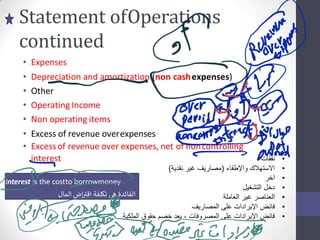
• Expenses
• Depreciation and amortization (non cashexpenses)
• Other
• Operating Income
• Non operating items
• Excess of revenue overexpenses
• Excessof revenue over expenses, net of noncontrolling
interest
Interest is the costto borrowmoney
‫المال‬ ‫اض‬ ‫ر‬
‫اقي‬ ‫تكلفة‬ ‫ي‬
‫ه‬ ‫الفائدة‬
•
‫نفقات‬
•
‫واإلطفاء‬ ‫االستهالك‬
(
‫نقدية‬ ‫غير‬ ‫مصاريف‬
)
•
‫آخر‬
•
‫التشغيل‬ ‫دخل‬
•
‫العاملة‬ ‫غير‬ ‫العناصر‬
•
‫المصاريف‬ ‫على‬ ‫اإليرادات‬ ‫فائض‬
•
‫الملك‬ ‫حقوق‬ ‫خصم‬ ‫بعد‬ ، ‫المصروفات‬ ‫على‬ ‫اإليرادات‬ ‫فائض‬
‫ية‬
UnrestrictedRevenue
The term revenues refers to the amounts either earned by the entity or donated to it.
Gains can come from transactions such as selling assets for more than theircarryingvalue
(such as selling a building or other investment). Other support includes such items as
appropriationsfrom governmentalentitiesand unrestricteddonations.Netpatientservice
revenuegenerallymakes up the largestportion of unrestrictedrevenue,gains.
revenues representamounts earned bythe entity,notthe amount of cash it received
during the period.
Net Patient ServiceRevenue
Gross patient service revenue is the amount the health care entitywould haveearned if all
the payorspaidfull charges.
the provision for bad debts, also called bad debt expense or uncollectiblesexpense
‫المقيدة‬ ‫غير‬ ‫اإليرادات‬
‫له‬ ‫بها‬ ‫التبرع‬ ‫تم‬ ‫أو‬ ‫الكيان‬ ‫عليها‬ ‫حصل‬ ‫التي‬ ‫المبالغ‬ ‫إلى‬ ‫اإليرادات‬ ‫مصطلح‬ ‫يشير‬
.
‫تأتي‬ ‫أن‬ ‫يمكن‬
‫من‬ ‫المكاسب‬
‫الدفترية‬ ‫قيمتها‬ ‫من‬ ‫بأكثر‬ ‫األصول‬ ‫بيع‬ ‫مثل‬ ‫معامالت‬
(
‫آخر‬ ‫استثمار‬ ‫أو‬ ‫مبنى‬ ‫بيع‬ ‫مثل‬
.)
‫الدع‬ ‫يشمل‬
‫ًا‬‫د‬‫بنو‬ ‫اآلخر‬ ‫م‬
‫المقيدة‬ ‫غير‬ ‫والتبرعات‬ ‫الحكومية‬ ‫الكيانات‬ ‫من‬ ‫االعتمادات‬ ‫مثل‬
.
‫ع‬ ‫المرضى‬ ‫خدمة‬ ‫إيرادات‬ ‫صافي‬ ‫يشكل‬
‫ا‬ً‫م‬‫مو‬
‫المقيدة‬ ‫غير‬ ‫األرباح‬ ‫من‬ ‫األكبر‬ ‫الجزء‬
.
‫الفتر‬ ‫خالل‬ ‫تلقته‬ ‫الذي‬ ‫النقدي‬ ‫المبلغ‬ ‫وليس‬ ، ‫الكيان‬ ‫قبل‬ ‫من‬ ‫المكتسبة‬ ‫المبالغ‬ ‫اإليرادات‬ ‫تمثل‬
‫ة‬
.
‫المريض‬ ‫خدمة‬ ‫إيرادات‬ ‫صافي‬
‫الرس‬ ‫دافع‬ ‫كل‬ ‫دفع‬ ‫إذا‬ ‫الصحية‬ ‫الرعاية‬ ‫كيان‬ ‫ستكسبه‬ ‫كانت‬ ‫الذي‬ ‫المبلغ‬ ‫هو‬ ‫المريض‬ ‫خدمة‬ ‫إيرادات‬ ‫إجمالي‬
‫كاملة‬ ‫وم‬
.
‫ل‬ ‫القابلة‬ ‫غير‬ ‫المصاريف‬ ‫أو‬ ‫المعدومة‬ ‫الديون‬ ‫مصروفات‬ ‫ا‬ً‫ض‬‫أي‬ ‫وتسمى‬ ، ‫المعدومة‬ ‫الديون‬ ‫مخصص‬
‫لتحصيل‬
Premium revenue is revenueearned from capitatedcontracts,orit couldbe health plan revenueif the
entity has a healthplan.
Net assets released from restriction are funds reclassified tounrestricted accounts from
temporarilyrestrictednet assets.
Depreciationandamortizationreflectthe amount of a noncurrentasset used up during
the accountingperiod.
Depreciation:A measureof the extent to which a tangible asset(such as plantor equipment) has
been used up (during the accountingperiod) orconsumed.
Amortization:ameasureof how much of an intangibleasset (such as debtissuance cost and goodwill) has
been used up (during the accountingperiod) or consumed.
Other expenses is a catchall categoryformiscellaneous operatingexpenses that are not considered
significantenough to be listedseparately.
Operatingand NonoperatingItems
an excessof revenueover expenses, revenuesand gainsover expenses and losses, earned income, or
performance earnings.
On the statementof operations,expensesare a measure of the amount of resourcesused or consumed in
providinga service, not cashoutflows.
‫صحية‬ ‫خطة‬ ‫لديه‬ ‫الكيان‬ ‫كان‬ ‫إذا‬ ‫صحية‬ ‫خطة‬ ‫إيرادات‬ ‫تكون‬ ‫قد‬ ‫أو‬ ، ‫االستسالم‬ ‫عقود‬ ‫من‬ ‫المكتسبة‬ ‫اإليرادات‬ ‫هي‬ ‫الممتازة‬ ‫اإليرادات‬
.
‫ا‬ً‫ت‬‫مؤق‬ ‫المقيدة‬ ‫األصول‬ ‫صافي‬ ‫من‬ ‫مقيدة‬ ‫غير‬ ‫حسابات‬ ‫إلى‬ ‫تصنيفها‬ ‫المعاد‬ ‫األموال‬ ‫هو‬ ‫القيود‬ ‫من‬ ‫المحررة‬ ‫األصول‬ ‫صافي‬
.
‫المحاسبية‬ ‫الفترة‬ ‫خالل‬ ‫المستخدم‬ ‫المتداول‬ ‫غير‬ ‫األصل‬ ‫مبلغ‬ ‫واإلطفاء‬ ‫االستهالك‬ ‫يعكس‬
.
‫االستهالك‬
:
‫الملموس‬ ‫األصل‬ ‫استخدام‬ ‫لمدى‬ ‫مقياس‬
(
‫المعدات‬ ‫أو‬ ‫المصنع‬ ‫مثل‬
( )
‫المحاسبية‬ ‫الفترة‬ ‫خالل‬
)
‫استهالكه‬ ‫أو‬
.
‫االستهالك‬
:
‫الملموسة‬ ‫غير‬ ‫األصول‬ ‫لمقدار‬ ‫مقياس‬
(
‫والشهرة‬ ‫الدين‬ ‫إصدار‬ ‫تكلفة‬ ‫مثل‬
)
‫استخدامها‬ ‫تم‬ ‫التي‬
(
‫المحاسبية‬ ‫الفترة‬ ‫خالل‬
)
‫استهال‬ ‫أو‬
‫كها‬
.
‫منفصل‬ ‫بشكل‬ ‫إدراجها‬ ‫ليتم‬ ‫يكفي‬ ‫بما‬ ‫كبيرة‬ ‫تعتبر‬ ‫ال‬ ‫التي‬ ‫المتنوعة‬ ‫التشغيل‬ ‫لمصروفات‬ ‫شاملة‬ ‫فئة‬ ‫هي‬ ‫األخرى‬ ‫المصاريف‬
.
‫العاملة‬ ‫وغير‬ ‫العاملة‬ ‫العناصر‬
‫األداء‬ ‫أرباح‬ ‫أو‬ ‫المكتسب‬ ‫الدخل‬ ‫أو‬ ‫والخسائر‬ ‫المصروفات‬ ‫على‬ ‫والمكاسب‬ ‫واإليرادات‬ ‫النفقات‬ ‫على‬ ‫اإليرادات‬ ‫زيادة‬
.
‫ا‬ ‫النقدية‬ ‫التدفقات‬ ‫وليس‬ ، ‫خدمة‬ ‫تقديم‬ ‫في‬ ‫المستهلكة‬ ‫أو‬ ‫المستخدمة‬ ‫الموارد‬ ‫لمقدار‬ ‫ا‬ً‫س‬‫مقيا‬ ‫المصروفات‬ ‫تعد‬ ، ‫العمليات‬ ‫بيان‬ ‫في‬
‫لخارجة‬
.
StatementofChangesinNetAssets
• Repeats some of the information on the statement of
operations to explain changes in unrestrictednet assets but also
adds informationabout changes in restricted netassets
• Areas covered are unrestricted net assets, temporarily restricted
net assets, permanently restricted net assets, increase in net
assets and net assets at the beginning andend of the year.
Its purpose is toexplain whythere was a change from one year to the nextin the entire
net asset section of the balance sheet. two majorreasons:
- increases (decreases) in unrestricted netassets.
- changes in temporarily and permanently restricted netassets.
•
‫يضيف‬ ‫ولكنه‬ ‫المقيدة‬ ‫غير‬ ‫األصول‬ ‫صافي‬ ‫في‬ ‫التغييرات‬ ‫لشرح‬ ‫العمليات‬ ‫بيان‬ ‫في‬ ‫المعلومات‬ ‫بعض‬ ‫يكرر‬
‫معلومات‬ ‫ا‬ً‫ض‬‫أي‬
‫المقيدة‬ ‫األصول‬ ‫صافي‬ ‫في‬ ‫التغييرات‬ ‫حول‬
•
‫بش‬ ‫المقيدة‬ ‫األصول‬ ‫وصافي‬ ‫ا‬ً‫ت‬‫مؤق‬ ‫المقيدة‬ ‫األصول‬ ‫وصافي‬ ‫المقيدة‬ ‫غير‬ ‫األصول‬ ‫صافي‬ ‫هي‬ ‫المشمولة‬ ‫المجاالت‬
‫دائم‬ ‫كل‬
‫العام‬ ‫ونهاية‬ ‫بداية‬ ‫في‬ ‫األصول‬ ‫وصافي‬ ‫األصول‬ ‫صافي‬ ‫في‬ ‫والزيادة‬
.
•
‫العم‬ ‫الميزانية‬ ‫في‬ ‫بالكامل‬ ‫األصول‬ ‫صافي‬ ‫قسم‬ ‫في‬ ‫أخرى‬ ‫إلى‬ ‫سنة‬ ‫من‬ ‫تغيير‬ ‫حدوث‬ ‫سبب‬ ‫شرح‬ ‫هو‬ ‫منه‬ ‫والغرض‬
‫ومية‬
.
‫سببان‬
‫رئيسيان‬
:
-
‫الزيادات‬
(
‫النقصان‬
)
‫المقيدة‬ ‫غير‬ ‫األصول‬ ‫صافي‬ ‫في‬
.
-
‫ودائم‬ ‫مؤقت‬ ‫بشكل‬ ‫المقيدة‬ ‫األصول‬ ‫صافي‬ ‫في‬ ‫التغييرات‬
.
Statement of CashFlows
• Takes the accrual basis financial statements that reportactivity
as it was earned and expended or committed for expenditure
and converts it to the actual flow ofcash
• Covers the same time period as the statement ofoperations
• Discloses key noncash investing andfinancingtransactions
•
‫أ‬ ‫وإنفاقها‬ ‫اكتسابها‬ ‫تم‬ ‫كما‬ ‫التقارير‬ ‫تلك‬ ‫االستحقاق‬ ‫أساس‬ ‫على‬ ‫المالية‬ ‫البيانات‬ ‫تأخذ‬
‫بها‬ ‫االلتزام‬ ‫و‬
‫للنقد‬ ‫الفعلي‬ ‫التدفق‬ ‫إلى‬ ‫وتحويلها‬ ‫للنفقات‬
•
‫العمليات‬ ‫بيان‬ ‫مثل‬ ‫الزمنية‬ ‫الفترة‬ ‫نفس‬ ‫يغطي‬
•
‫النقدية‬ ‫غير‬ ‫الرئيسية‬ ‫والتمويل‬ ‫االستثمار‬ ‫معامالت‬ ‫عن‬ ‫تفصح‬
StatementofCashFlows
Components
• Title-Name of entity,statementand period of time statement covers
• Cash flows from operatingactivities (inentity)
• Cash flows from investing activities (includes investingin self)
• Cash flows from financingactivities
• Net increase (decrease)in cash & cash equivalents
• Cash & cash equivalents at beginning ofyear
• Cash & cash equivalents at end oftheyear
• Supplemental information
•
‫العنوان‬
-
‫الزمني‬ ‫البيان‬ ‫تغطية‬ ‫وفترة‬ ‫والبيان‬ ‫الكيان‬ ‫اسم‬
•
‫التشغيلية‬ ‫األنشطة‬ ‫من‬ ‫النقدية‬ ‫التدفقات‬
(
‫المنشأة‬ ‫في‬
)
•
‫االستثمارية‬ ‫األنشطة‬ ‫من‬ ‫النقدية‬ ‫التدفقات‬
(
‫الذات‬ ‫في‬ ‫االستثمار‬ ‫تشمل‬
)
•
‫التمويلية‬ ‫األنشطة‬ ‫من‬ ‫النقدية‬ ‫التدفقات‬
•
‫الزيادة‬ ‫صافي‬
(
‫النقص‬
)
‫حكمه‬ ‫في‬ ‫وما‬ ‫النقد‬ ‫في‬
•
‫العام‬ ‫بداية‬ ‫في‬ ‫المعادل‬ ‫والنقد‬ ‫النقد‬
•
‫العام‬ ‫نهاية‬ ‫في‬ ‫حكمه‬ ‫في‬ ‫وما‬ ‫النقد‬
•
‫إضافية‬ ‫معلومات‬
Cash Flows from OperatingActivities
The first section identifies the cash inflows and outflows resulting from the normal operations of
an entity. Because most entities do not have this information readily available, they derive it by
starting with the increase (decrease) in net assets from the statementof changes in net assets and
then making adjustmentsto convertthis accrual- based information intocashflows.
Cash FlowsfromInvestingActivities
The second section of the statementof cash flows is cash flows from investingactivities. This
showscash inflowsand outflowsfrom such accountsas:
Purchaseof plant,property,andequipment
Purchase of long-terminvestments
Proceedsfrom sale of plant,property,andequipment
Proceeds from sale of long-terminvestments
Investingby an entity includes investingin itself (such as when an entitybuysnew
equipment).
‫التشغيلية‬ ‫األنشطة‬ ‫من‬ ‫النقدية‬ ‫التدفقات‬
‫للكيان‬ ‫العادية‬ ‫العمليات‬ ‫عن‬ ‫الناتجة‬ ‫والخارجة‬ ‫الداخلة‬ ‫النقدية‬ ‫التدفقات‬ ‫األول‬ ‫القسم‬ ‫يحدد‬
.
‫لديه‬ ‫تتوفر‬ ‫ال‬ ‫الكيانات‬ ‫معظم‬ ‫ألن‬ ‫ا‬ً‫نظر‬
‫بسهولة‬ ‫المعلومات‬ ‫هذه‬ ‫ا‬
‫بالزيادة‬ ‫بالبدء‬ ‫تشتقها‬ ‫فإنها‬ ،
(
‫النقصان‬
)
‫لتحويل‬ ‫تعديالت‬ ‫إجراء‬ ‫ثم‬ ‫األصول‬ ‫صافي‬ ‫في‬ ‫التغيرات‬ ‫بيان‬ ‫من‬ ‫األصول‬ ‫صافي‬ ‫في‬
‫القائمة‬ ‫المعلومات‬ ‫هذه‬
‫نقدية‬ ‫تدفقات‬ ‫إلى‬ ‫االستحقاق‬ ‫على‬
.
‫االستثمارية‬ ‫األنشطة‬ ‫من‬ ‫النقدية‬ ‫التدفقات‬
‫االستثمارية‬ ‫األنشطة‬ ‫من‬ ‫النقدية‬ ‫التدفقات‬ ‫هو‬ ‫النقدية‬ ‫التدفقات‬ ‫بيان‬ ‫من‬ ‫الثاني‬ ‫القسم‬
.
‫والخا‬ ‫الداخلة‬ ‫النقدية‬ ‫التدفقات‬ ‫هذا‬ ‫يوضح‬
‫مثل‬ ‫حسابات‬ ‫من‬ ‫رجة‬
:
‫والمعدات‬ ‫والممتلكات‬ ‫المنشآت‬ ‫شراء‬
‫األجل‬ ‫طويلة‬ ‫استثمارات‬ ‫شراء‬
‫األجل‬ ‫طويلة‬ ‫استثمارات‬ ‫بيع‬ ‫من‬ ‫متحصالت‬ ‫والمعدات‬ ‫والممتلكات‬ ‫اآلالت‬ ‫بيع‬ ‫من‬ ‫متحصالت‬
‫نفسه‬ ‫في‬ ‫االستثمار‬ ‫كيان‬ ‫قبل‬ ‫من‬ ‫االستثمار‬ ‫يشمل‬
(
‫جديدة‬ ‫معدات‬ ‫الكيان‬ ‫يشتري‬ ‫عندما‬ ‫مثل‬
.)
Cashand Cash Equivalentsatthe Endof the Year
This is the "bottomline" of the statementof cash flows and is the same as the cash and
cash equivalentsamountthat appearson the balance sheet.
CashFlows fromFinancingActivities
In this section of the statementof cash flows, we identify the changes in cash flows
resulting from financing activities.These include
Transferstoparent
Proceeds from selectedcontributions
Proceeds from issuance of long-termdebt
Repayment oflong-termdebt
Interestfromrestricted investmentsif interestincomeis also restricted
Repaymentand issuanceoflong-term debt are identifiedin cash flow from financing
activitiesin the statementof cashflows.
‫التمويل‬ ‫أنشطة‬ ‫من‬ ‫النقدية‬ ‫التدفقات‬
‫أنشطة‬ ‫عن‬ ‫الناتجة‬ ‫النقدية‬ ‫التدفقات‬ ‫في‬ ‫التغيرات‬ ‫نحدد‬ ، ‫النقدية‬ ‫التدفقات‬ ‫بيان‬ ‫من‬ ‫القسم‬ ‫هذا‬ ‫في‬
‫التمويل‬
.
‫هذه‬ ‫وتشمل‬
‫الوالدين‬ ‫إلى‬ ‫التحويالت‬
‫مختارة‬ ‫مساهمات‬ ‫من‬ ‫عائدات‬
‫األجل‬ ‫طويل‬ ‫دين‬ ‫سداد‬ ‫األجل‬ ‫طويل‬ ‫دين‬ ‫إصدار‬ ‫حصيلة‬
‫ا‬ً‫ض‬‫أي‬ ‫الفوائد‬ ‫دخل‬ ‫تقييد‬ ‫تم‬ ‫إذا‬ ‫المقيدة‬ ‫االستثمارات‬ ‫من‬ ‫الفوائد‬
‫بيان‬ ‫في‬ ‫التمويلية‬ ‫األنشطة‬ ‫من‬ ‫النقدية‬ ‫التدفقات‬ ‫في‬ ‫األجل‬ ‫طويلة‬ ‫الديون‬ ‫وإصدار‬ ‫سداد‬ ‫تحديد‬ ‫يتم‬
‫النقدية‬ ‫التدفقات‬
.
‫العام‬ ‫نهاية‬ ‫حكمه‬ ‫في‬ ‫وما‬ ‫النقد‬
‫هو‬ ‫هذا‬
"
‫النهائية‬ ‫المحصلة‬
"
‫ال‬ ‫في‬ ‫يظهر‬ ‫الذي‬ ‫المعادل‬ ‫والنقد‬ ‫النقد‬ ‫مبلغ‬ ‫نفس‬ ‫وهو‬ ‫النقدية‬ ‫التدفقات‬ ‫لبيان‬
‫العمومية‬ ‫ميزانية‬
.
StatementofCashFlowsComponents
Performance Indicator: The FASB requires not -for profit health care entities to include a
performance indicator in their statement of operations. The FASB defines it as an
intermediatelevelthat reports he results of operations.Note that operationsincludesboth
operatingand nonoperatingitems. It is analogousto income from continuingoperationsor
net income in an investor-ownedentity.
Charity CareDiscounts:Discountsfrom gross patientaccountsreceivablegiven to patients
who cannotpaytheir bills and who meet the entity'scharity carepolicy.
Amortization:
(1) The allocationofthe acquisition costof debt to the period that it benefits.
(2)The gradual process of payingoff debt through a series of equal periodic payments.
Each payment covers a portion of the principal plus current interest. The periodic
payments are equal over the lifetime of the loan, but the proportion going towardthe
principal graduallyincreases. The amount of a paymentcan be determined by using the
formulato calculatethe presentvalue of an annuity
‫األداء‬ ‫مؤشر‬
:
‫عملي‬ ‫بيان‬ ‫في‬ ‫أداء‬ ‫مؤشر‬ ‫تضمين‬ ‫للربح‬ ‫الهادفة‬ ‫غير‬ ‫الصحية‬ ‫الرعاية‬ ‫كيانات‬ ‫من‬ ‫المالية‬ ‫المحاسبة‬ ‫معايير‬ ‫مجلس‬ ‫يطلب‬
‫اتها‬
.
‫مجلس‬ ‫يعرفه‬
‫العمليات‬ ‫نتائج‬ ‫عن‬ ‫تقارير‬ ‫يقدم‬ ‫​الذي‬​ ‫المتوسط‬ ‫المستوى‬ ‫بأنه‬ ‫المالية‬ ‫المحاسبة‬ ‫معايير‬
.
‫التشغيل‬ ‫عناصر‬ ‫تشمل‬ ‫العمليات‬ ‫أن‬ ‫الحظ‬
‫العاملة‬ ‫وغير‬
.
‫إنه‬
‫للمستثمرين‬ ‫مملوك‬ ‫كيان‬ ‫في‬ ‫الدخل‬ ‫صافي‬ ‫أو‬ ‫المستمرة‬ ‫العمليات‬ ‫من‬ ‫للدخل‬ ‫مشابه‬
.
‫الخيرية‬ ‫الرعاية‬ ‫خصومات‬
:
‫ي‬ ‫والذين‬ ‫فواتيرهم‬ ‫دفع‬ ‫يستطيعون‬ ‫ال‬ ‫الذين‬ ‫للمرضى‬ ‫الممنوحة‬ ‫للمرضى‬ ‫المدينة‬ ‫الذمم‬ ‫إجمالي‬ ‫من‬ ‫خصومات‬
‫سياسة‬ ‫ستوفون‬
‫للجهة‬ ‫الخيرية‬ ‫الرعاية‬
.
‫اإلطفاء‬
:
‫منها‬ ‫تستفيد‬ ‫التي‬ ‫للفترة‬ ‫الديون‬ ‫اقتناء‬ ‫تكلفة‬ ‫تخصيص‬
.
‫المتساوية‬ ‫الدورية‬ ‫المدفوعات‬ ‫من‬ ‫سلسلة‬ ‫خالل‬ ‫من‬ ‫الديون‬ ‫لسداد‬ ‫التدريجية‬ ‫العملية‬
.
‫إلى‬ ‫باإلضافة‬ ‫المال‬ ‫رأس‬ ‫من‬ ‫ا‬ً‫ء‬‫جز‬ ‫دفعة‬ ‫كل‬ ‫تغطي‬
‫الحالية‬ ‫الفائدة‬
.
ً‫ا‬‫تدريجي‬ ‫تزداد‬ ‫المال‬ ‫رأس‬ ‫نحو‬ ‫تذهب‬ ‫التي‬ ‫النسبة‬ ‫لكن‬ ، ‫القرض‬ ‫عمر‬ ‫مدى‬ ‫على‬ ‫متساوية‬ ‫الدورية‬ ‫المدفوعات‬
.
‫الدف‬ ‫مبلغ‬ ‫تحديد‬ ‫يمكن‬
‫الصيغة‬ ‫باستخدام‬ ‫ع‬
‫سنوي‬ ‫لمعاش‬ ‫الحالية‬ ‫القيمة‬ ‫لحساب‬
AccumulatedDepreciation:The totalamountof depreciationtakenon an asset since it was put
intouse.
Third-PartyPayors:Commonlyreferred to as thirdparties, these are entitiesthat pay on behalf of
patients.
NoncontrollingInterest:The amount of a partially owned subsidiary entity that the parent
does notown.
Operating Income: is a classification within excess of revenues over expenses, which
separatesrevenues earned through health care-relatedactivities(operatingincome) and
those earned from other than health care-related activities (nonoperating items). Note
that nonoperatingitems aremost often a mixture of revenues,gains,and losses.
Investmentincome (loss) is reportedasnonoperating.
Net Income: Equivalentto excessof revenue over expenses fora not -for-profitentity.
‫المتراكم‬ ‫االستهالك‬
:
‫التنفيذ‬ ‫حيز‬ ‫في‬ ‫وضعه‬ ‫منذ‬ ‫األصول‬ ‫أحد‬ ‫على‬ ‫تم‬ ‫الذي‬ ‫لإلهالك‬ ‫اإلجمالي‬ ‫المبلغ‬
.
‫الخارجية‬ ‫الدفع‬ ‫جهات‬
:
‫المرضى‬ ‫عن‬ ‫نيابة‬ ‫تدفع‬ ‫كيانات‬ ‫وهي‬ ، ‫ثالثة‬ ‫كأطراف‬ ً‫ة‬‫عاد‬ ‫إليها‬ ‫شار‬ُ‫ي‬
.
‫المسيطرة‬ ‫غير‬ ‫الفائدة‬
:
‫األم‬ ‫الشركة‬ ‫تملكه‬ ‫ال‬ ‫والذي‬ ‫ا‬ً‫ي‬‫جزئ‬ ‫المملوك‬ ‫الفرعي‬ ‫الكيان‬ ‫مبلغ‬
.
‫التشغيلي‬ ‫الدخل‬
:
‫من‬ ‫المكتسبة‬ ‫اإليرادات‬ ‫بين‬ ‫يفصل‬ ‫والذي‬ ، ‫المصروفات‬ ‫عن‬ ‫الزائدة‬ ‫اإليرادات‬ ‫ضمن‬ ‫تصنيف‬
‫األنشطة‬ ‫خالل‬
‫الصحية‬ ‫بالرعاية‬ ‫المتعلقة‬
(
‫التشغيلي‬ ‫الدخل‬
)
‫الص‬ ‫بالرعاية‬ ‫المتعلقة‬ ‫غير‬ ‫األخرى‬ ‫األنشطة‬ ‫من‬ ‫المكتسبة‬ ‫وتلك‬
‫حية‬
(
‫غير‬ ‫البنود‬
‫التشغيلية‬
.)
‫والخسائر‬ ‫والمكاسب‬ ‫اإليرادات‬ ‫من‬ ‫ا‬ً‫ج‬‫مزي‬ ‫تكون‬ ‫ما‬ ‫ًا‬‫ب‬‫غال‬ ‫العاملة‬ ‫غير‬ ‫العناصر‬ ‫أن‬ ‫الحظ‬
.
‫دخل‬ ‫عن‬ ‫اإلبالغ‬ ‫تم‬
(
‫خسارة‬
)
‫عامل‬ ‫غير‬ ‫أنه‬ ‫على‬ ‫االستثمار‬
.
‫الدخل‬ ‫صافي‬
:
‫للربح‬ ‫هادف‬ ‫غير‬ ‫لكيان‬ ‫المصروفات‬ ‫على‬ ‫اإليرادات‬ ‫فائض‬ ‫يعادل‬
.
Summary
• Examined have been the 4 basic financial statements which
comprise a picture of the financial health of a non profit,business
oriented health careentity.
• The four basic financial statementsare:
• Balance Sheet
• Statement of Operations
• Statement of Changes in NetAssets
• Statement of Cash Flows
•
‫لكيان‬ ‫المالي‬ ‫للوضع‬ ‫صورة‬ ‫تشكل‬ ‫التي‬ ‫األربعة‬ ‫األساسية‬ ‫المالية‬ ‫البيانات‬ ‫فحص‬ ‫تم‬
‫صحية‬ ‫رعاية‬
‫لألعمال‬ ‫موجه‬ ‫ربحي‬ ‫غير‬
.
•
‫هي‬ ‫األربعة‬ ‫األساسية‬ ‫المالية‬ ‫البيانات‬
:
•
‫التوازن‬ ‫ورقة‬
•
‫العمليات‬ ‫بيان‬
•
‫األصول‬ ‫صافي‬ ‫في‬ ‫التغيرات‬ ‫بيان‬
•
‫النقدية‬ ‫التدفقات‬ ‫بيان‬
Principles and
Practices ofHealth
CareAccounting
Chapter3
LearningObjectives
•
Recordfinancialtransactions
•
Understand the basics of accrualaccounting
•
Summarizetransactionsinfofinancial statements
One of the major roles of accounting is to record these transactionsand
report the results in a standardizedformat tointerested parties.
‫ي‬
‫ف‬ ‫النتائج‬ ‫عن‬ ‫واإلبالغ‬ ‫المعامالت‬ ‫هذه‬ ‫تسجيل‬ ‫للمحاسبة‬ ‫الرئيسية‬‫األدوار‬ ‫ومن‬
‫موحد‬ ‫شكل‬
‫المهتمة‬ ‫اف‬‫ر‬‫األط‬ ‫إىل‬
.
The“Book”
• As transactions occur (such as the purchase of supplies), they are recorded
chronologically in a “Book” called a journal. This book is more likely to be a
computer than a paper journal requiring manual entries.
• Periodically (simultaneously when using most computer programs), the
transactionsare summarizedby account(i.e., cash, equipment, revenues, etc.) into
another book called aledger
• The journaland ledger make up the chronological listing of
transactions and the current balance in eachaccount
• Totals foreach accountin the ledger are used to preparethe four financial
statements
•
‫المعامالت‬ ‫حدوث‬ ‫عند‬
(
‫اإلمدادات‬ ‫اء‬ ‫ر‬
‫ش‬ ‫مثل‬
)
‫ي‬
‫ف‬ ‫ا‬ً‫زمني‬ ‫تسجيلها‬ ‫يتم‬ ،
"
‫كتاب‬
"
‫د‬ ‫يسىم‬
‫اليومية‬ ‫ر‬
‫في‬
.
‫إدخاالت‬ ‫يتطلب‬ ‫ي‬
‫ر‬
‫ورف‬ ‫يومية‬ ‫ر‬
‫دفي‬ ‫من‬ ‫ر‬
‫أكي‬ ‫ا‬ً
‫كمبيوتر‬‫الكتاب‬ ‫هذا‬ ‫يكون‬ ‫أن‬ ‫المرجح‬ ‫من‬
‫يدوية‬
.
•
‫دوريا‬
(
‫الكمبيوتر‬ ‫امج‬‫ر‬‫ب‬ ‫معظم‬ ‫استخدام‬ ‫عند‬ ‫واحد‬ ‫وقت‬ ‫ي‬
‫ف‬
)
‫ع‬ ‫المعامالت‬ ‫تلخيص‬ ‫يتم‬ ،
‫طريق‬ ‫ن‬
‫حساب‬
(
‫الخ‬ ، ‫ادات‬‫ر‬‫واإلي‬ ‫والمعدات‬ ‫النقدية‬ ‫أي‬
)
‫األستاذ‬ ‫ر‬
‫دفي‬ ‫يسىم‬ ‫آخر‬ ‫ر‬
‫دفي‬ ‫ي‬
‫ف‬
•
‫حس‬ ‫كل‬ ‫ي‬
‫ف‬ ‫ي‬
‫الحاىل‬ ‫والرصيد‬ ‫للمعامالت‬ ‫الزمنية‬ ‫القائمة‬ ‫األستاذ‬ ‫ر‬
‫ودفي‬ ‫المجلة‬ ‫تشكل‬
‫اب‬
•
‫األربع‬ ‫المالية‬ ‫القوائم‬ ‫إلعداد‬ ‫وتستخدم‬ ‫األستاذ‬ ‫ر‬
‫دفي‬ ‫ي‬
‫ف‬ ‫حساب‬ ‫لكل‬ ‫المجاميع‬ ‫حساب‬
‫ة‬
The Book
The Journal
The journal is informal, also known as “book of original entry”. Its consists of recorded in the
accounting entries, the recorded accounting at a record of business transactions, will be in
sequential order,accordingto the datethe transactionsoccur, or in chronological order.
Recordinga transactionin the generaljournal is called journalizing.It is known as a subsidiary
book.
Once you haverecorded a transactionin a general journal, the amountsare posted to the
appropriate accounts, such as equipment,accountsreceivable,and cash transactions.
‫صحيفة‬
"
‫المجلة‬
"
‫باسم‬ ‫أيضا‬ ‫تعرف‬ ،‫رسمية‬ ‫ر‬
‫غي‬
"
‫ي‬
‫األصل‬ ‫اإلدخال‬ ‫كتاب‬
."
‫القيو‬ ‫ي‬
‫ف‬ ‫المسجلة‬ ‫من‬ ‫يتألف‬
، ‫المحاسبية‬ ‫د‬
‫للتاري‬ ‫وفقا‬ ، ‫ي‬
‫تسلسل‬ ‫ترتيب‬ ‫ي‬
‫ف‬ ‫تكون‬ ‫وسوف‬ ، ‫التجارية‬ ‫المعامالت‬ ‫سجل‬ ‫ي‬
‫ف‬ ‫المسجلة‬ ‫والمحاسبة‬
، ‫التكون‬ ‫المعامالت‬ ‫خ‬
‫ي‬
‫الزمن‬ ‫تيب‬ ‫ر‬
‫الي‬ ‫ي‬
‫ف‬ ‫أو‬
.
‫اليومية‬ ‫ر‬
‫بدفي‬ ‫العام‬ ‫اليومية‬ ‫ر‬
‫دفي‬ ‫ي‬
‫ف‬ ‫التسجيل‬ ‫معاملة‬ ‫تسىم‬
.
‫المعروف‬ ‫ومن‬
‫تابع‬ ‫كتاب‬‫باسم‬
.
2types
The Ledger
The ledger is more formalized, also known as “the book of second entry”. It is used to track assets,
liabilities,owner capital,revenues,and expenses.It is a book or file used to record all relevantaccounts.
The act of recordinga transaction in the ledger is called posting. The general ledger is known as a
principlebook.
‫ر‬
‫ودفي‬
‫األستاذ‬
‫ر‬
‫أكي‬
،‫رسمية‬
‫والمعروف‬
‫أيضا‬
‫باسم‬
"
‫ر‬
‫دفي‬
‫الدخول‬
‫ي‬
‫الثان‬
"
.
‫يتم‬
‫استخدامه‬
‫لتتبع‬
‫األصول‬
‫والخصو‬
‫م‬
‫أس‬‫ر‬‫و‬
‫المال‬
‫المالك‬
‫ادات‬‫ر‬‫واإلي‬
‫والمرصوفات‬
.
‫وهو‬
‫كتاب‬
‫أو‬
‫ملف‬
‫يستخدم‬
‫لتسجيل‬
‫جميع‬
‫الحسابات‬
‫ذات‬
‫الصلة‬
.
‫ويسىم‬
‫اء‬‫ر‬‫إج‬
‫تسجيل‬
‫الح‬
‫كة‬
‫ر‬
‫ي‬
‫ف‬
‫ر‬
‫دفي‬
‫األستاذ‬
‫حيل‬ ‫ر‬
‫الي‬
.
‫عرف‬ُ‫ي‬
‫ر‬
‫دفي‬
‫األستاذ‬
‫العام‬
‫ر‬
‫كدفي‬
‫أساس‬
.
‫و‬ ‫المعدات‬ ‫مثل‬ ،‫المناسبة‬ ‫الحسابات‬ ‫إلى‬ ‫المبالغ‬ ‫ترحيل‬ ‫يتم‬ ،‫عام‬ ‫يومية‬ ‫دفتر‬ ‫في‬ ‫حركة‬ ‫تسجيل‬ ‫بمجرد‬
‫التي‬ ‫الحسابات‬
‫النقدية‬ ‫والحركات‬ ‫استردادها‬ ‫يمكن‬
.
The Book here as Computer,itsworkinga journal
Methods ofAccounting
• Cash basis of accounting- tracks cash when received and when cash
is expended regardless of when services were provided or resources
wereused
• Accrual basis of accounting- records revenues when earnedand
resources used regardlessof the flow ofcash in or out of theentity
• Health care organizationsuseaccrualbasis ofaccounting
Accrual Basis ofAccounting
An accounting method that aligns the flow of resources and the revenues those
resources helped to generate.It recordsrevenueswhen earned and resources when
used, regardlessof the flow of cash in or out of the organization.Thisis the standard
method in use today.
•
‫للمحاسبة‬ ‫النقدي‬ ‫األساس‬
-
‫بغض‬ ‫النقدية‬ ‫إنفاق‬ ‫يتم‬ ‫وعندما‬ ‫استالمها‬ ‫عند‬ ‫النقدية‬ ‫يتتبع‬
‫وقت‬ ‫عن‬ ‫النظر‬
‫استعمالها‬ ‫تم‬ ‫التي‬ ‫الموارد‬ ‫أو‬ ‫الخدمات‬ ‫تقديم‬
•
‫للمحاسبة‬ ‫االستحقاق‬ ‫أساس‬
-
‫ت‬ ‫عن‬ ‫النظر‬ ‫بغض‬ ‫المستخدمة‬ ‫والموارد‬ ‫مكتسبات‬ ‫عند‬ ‫السجالت‬
‫دفق‬
‫الكيان‬ ‫خارج‬ ‫أو‬ ‫داخل‬ ‫النقدية‬
•
‫المحاسبة‬ ‫في‬ ‫االستحقاق‬ ‫أساس‬ ‫د‬ ِ
‫ر‬َ‫س‬ُ‫ت‬ ‫الصحية‬ ‫الرعاية‬ ‫منظمات‬
‫توليدها‬ ‫على‬ ‫الموارد‬ ‫تلك‬ ‫ساعدت‬ ‫التي‬ ‫واإليرادات‬ ‫الموارد‬ ‫تدفق‬ ‫بمواءمة‬ ‫يقوم‬ ‫محاسبي‬ ‫أسلوب‬
.
‫ا‬ ‫يسجل‬
‫إليرادات‬
‫المؤسسة‬ ‫خارج‬ ‫أو‬ ‫داخل‬ ‫النقد‬ ‫تدفق‬ ‫عن‬ ‫النظر‬ ‫بغض‬ ،‫استخدامها‬ ‫عند‬ ‫والموارد‬ ‫كسبها‬ ‫عند‬
.
‫ا‬ ‫األسلوب‬ ‫هو‬ ‫هذا‬
‫لقياسي‬
‫اليوم‬ ‫االستخدام‬ ‫في‬
.
cash basis of accounting focuses on the flows of cash in and out of the
organization, whereas the accrual basis of accountingfocuseson the flows of
resources and the revenues those resources help togenerate
‫االستح‬ ‫أساس‬ ‫أن‬ ‫حين‬ ‫في‬ ،‫وخارجها‬ ‫المنظمة‬ ‫داخل‬ ‫النقد‬ ‫تدفقات‬ ‫على‬ ‫للمحاسبة‬ ‫النقدي‬ ‫األساس‬ ‫يركز‬
‫في‬ ‫قاق‬
‫توليدها‬ ‫على‬ ‫الموارد‬ ‫تلك‬ ‫تساعد‬ ‫التي‬ ‫واإليرادات‬ ‫الموارد‬ ‫تدفقات‬ ‫على‬ ‫الحسابات‬ ‫حسابات‬
RecordingTransactions
• 2 rules under accrualaccounting
1- At least two accounts must be used to record a
transaction:
a) Increase (decrease) an asset account
whenever assetsare acquired (used).
b) Increase (decrease) a liability account whenever
obligations are incurred (paidfor).
c) Increase a revenues, gains, or other support
account when it occurs.
d) Increase an expenseaccountwhen an asset is used.
Net assets increase when unrestrictedrevenues, gains,and other support
increase, and net assets decrease whenexpenses occur.
‫أساس‬ ‫على‬ ‫المحاسبة‬ ‫إطار‬ ‫في‬ ‫قاعدتان‬
‫االستحقاق‬
1
-
‫لتسج‬ ‫األقل‬ ‫على‬ ‫حسابين‬ ‫استخدام‬ ‫يجب‬
‫يل‬
‫المعاملة‬
:
‫أ‬
-
‫زيادة‬
(
‫نقصان‬
)
‫تم‬ ‫كلما‬ ‫األصول‬ ‫حساب‬
‫األصول‬ ‫على‬ ‫الحصول‬
(
‫المستخدمة‬
.)
‫ب‬
-
‫زيادة‬
(
‫نقصان‬
)
‫تك‬ ‫تم‬ ‫كلما‬ ‫التزام‬ ‫حساب‬
‫بد‬
‫التزامات‬
(
‫ثمنها‬ ‫مدفوع‬
.)
‫ت‬
-
‫حساب‬ ‫أو‬ ‫المكاسب‬ ‫أو‬ ‫اإليرادات‬ ‫زيادة‬
‫ذلك‬ ‫حدوث‬ ‫عند‬ ‫الدعم‬
.
‫ث‬
-
‫أح‬ ‫استخدام‬ ‫عند‬ ‫المصروفات‬ ‫حساب‬ ‫زيادة‬
‫د‬
‫األصول‬
.
‫صافي‬ ‫وينخفض‬ ،‫الدعم‬ ‫زيادة‬ ‫من‬ ‫وغيرها‬ ‫والمكاسب‬ ‫اإليرادات‬ ‫تزداد‬ ‫عندما‬ ‫األصول‬ ‫صافي‬ ‫وتزداد‬
‫النفقات‬ ‫حدوث‬ ‫عند‬ ‫األصول‬
.
2nd RuleRecording
Transactions
2- After each transaction, the fundamentalaccountingequation
must be in balance:
Assets=Liabilities +NetAssets
Contraasset
An asset that, when increased, decreases the value of a related asset on the books. Two
primary examples are accumulated depreciation, which is the contra-asset to properties
and equipment,and the allowancefor uncollectibles,which is the contra-assetto
accounts receivable.
The terms allowance for doubtful accounts, allowance for uncollectible accounts, and
allowance for bad debt are used interchangeablyin practice. Similarly,the terms provision
for bad debt and bad debt expenseare used interchangeablyin practice.
NetAssets=totalAssets– total Liabilities
2
-
‫األساسية‬ ‫المحاسبية‬ ‫المعادلة‬ ،‫معاملة‬ ‫كل‬ ‫بعد‬
:
•
‫الدفاتر‬ ‫في‬ ‫صلة‬ ‫ذي‬ ‫أصل‬ ‫قيمة‬ ‫من‬ ‫يقلل‬ ،‫زيادته‬ ‫عند‬ ،‫أصل‬
.
‫األص‬ ‫وهو‬ ،‫المتراكم‬ ‫االستهالك‬ ‫هما‬ ‫رئيسيان‬ ‫مثاالن‬ ‫وهناك‬
‫غير‬ ‫ول‬
‫ا‬ ‫المستحقة‬ ‫للحسابات‬ ‫المقابل‬ ‫األصل‬ ‫وهو‬ ،‫المحصلة‬ ‫غير‬ ‫المبالغ‬ ‫وبدل‬ ،‫والمعدات‬ ‫الممتلكات‬ ‫في‬ ‫لالستخدام‬ ‫القابلة‬
‫لقبض‬
.
•
‫للتحص‬ ‫القابلة‬ ‫غير‬ ‫الحسابات‬ ‫وبدل‬ ،‫تحصيلها‬ ‫في‬ ‫المشكوك‬ ‫الحسابات‬ ‫بدل‬ ‫شروط‬ ‫العملية‬ ‫الممارسة‬ ‫في‬ ‫وتستخدم‬
‫الديون‬ ‫وبدل‬ ،‫يل‬
‫المعدومة‬
.
‫الع‬ ‫الممارسة‬ ‫في‬ ‫تستخدم‬ ‫المعدومة‬ ‫الديون‬ ‫ومصاريف‬ ‫المعدومة‬ ‫بالديون‬ ‫المتعلقة‬ ‫الحكم‬ ‫شروط‬ ‫فإن‬ ،‫وبالمثل‬
‫ملية‬
.
Developing the Financial
Statements
• Once the transactionshave been analyzedand recorded,
the organization can develop the four financial
statements:
• Balance Sheet
• Statement of Operations
• Statementof Changes in NetAssets
• Statement of Cash Flows
‫تط‬ ‫للمنظمة‬ ‫يمكن‬ ،‫وتسجيلها‬ ‫المعامالت‬ ‫تحليل‬ ‫بمجرد‬
‫وير‬
‫األربعة‬ ‫المالية‬ ‫البيانات‬
:
The Statement of Operations includes:
1Unrestricted Revenues, Gains, and Other Support
2Operating Expenses
3Operating Income and Excess of Revenues over Expenses.
4Increase in Unrestricted NetAssets
The Balance Sheetincludes:
1Assets
2Liabilities
3NetAssets
The Statement of Changesin NetAssets includes:
1Unrestricted net assets
2Temporarily restricted netassets
3Permanentlyrestrictednetassets
4Increase in netassets
5Net assets at the beginning and end of the year.
The Statement of Cash Flowsincludes:
1Cash flows from operating activities
2Cash flows from investing activities
3Cash flows from financingactivities.
Summary
• One of the major roles of accounting is torecord the transactions in a standardized
format and report the results.
• These transactionsare the basis for the financialstatements
• Accrual accounting is used by health careorganizations
• Financial statements are a foundationfor decision making in health care organizations
Operating Expenses are costs that are incurredin the day-to-dayoperation
of the business.
Operating income is the difference between unrestricted revenues,gains,
and other support andexpenses
•
‫النتائج‬ ‫عن‬ ‫واإلبالغ‬ ‫موحد‬ ‫شكل‬ ‫في‬ ‫المعامالت‬ ‫تسجيل‬ ‫هو‬ ‫للمحاسبة‬ ‫الرئيسية‬ ‫األدوار‬ ‫أحد‬
.
•
‫المالية‬ ‫البيانات‬ ‫أساس‬ ‫هي‬ ‫المعامالت‬ ‫هذه‬
•
‫الصحية‬ ‫الرعاية‬ ‫مؤسسات‬ ‫قبل‬ ‫من‬ ‫االستحقاق‬ ‫أساس‬ ‫على‬ ‫المحاسبة‬ ‫استخدام‬ ‫يتم‬
•
‫الصحية‬ ‫الرعاية‬ ‫مؤسسات‬ ‫في‬ ‫القرار‬ ‫اتخاذ‬ ‫أساس‬ ‫هي‬ ‫المالية‬ ‫البيانات‬
‫التجارية‬ ‫لألعمال‬ ‫اليومية‬ ‫العمليات‬ ‫في‬ ‫تكبدها‬ ‫يتم‬ ‫التي‬ ‫التكاليف‬ ‫هي‬ ‫التشغيل‬ ‫نفقات‬
.
‫األخرى‬ ‫والنفقات‬ ‫والدعم‬ ‫المقيدة‬ ‫غير‬ ‫والمكاسب‬ ‫اإليرادات‬ ‫بين‬ ‫الفرق‬ ‫هو‬ ‫التشغيلي‬ ‫الدخل‬
FinancialStatement
Analysis
Chapter4
LearningObjectives
•
Analyzethe financialstatementsof healthcareorganizations
using the horizontal analysis, vertical analysis and ratio
analysis
•
Calculate and interpretliquidity,profit,activity and capital
structure ratios
HorizontalAnalysis
• Looks at the percentage change in a line item
from one year to the next
• Goal – What is the percentage change in a
line itemfrom one year to the next year ?
• An issue with horizontalanalysisis that small
percentagechanges can hide major dollar
effects
• Another issue is that large percentage
changes from year toyear may be relatively
inconsequentialin terms of dollaramounts
• The latter situation usually occurs when the
base yearshowsa small dollar amount.
•
‫ف‬ ‫للتغيير‬ ‫المئوية‬ ‫النسبة‬ ‫في‬ ‫يبحث‬
‫عنصر‬ ‫ي‬
‫أخرى‬ ‫إلى‬ ‫سنة‬ ‫من‬ ‫خطي‬
•
‫الهدف‬
-
‫للتغيير‬ ‫المئوية‬ ‫النسبة‬ ‫هي‬ ‫ما‬
‫في‬
‫التالي؟‬ ‫العام‬ ‫إلى‬ ‫عام‬ ‫من‬ ‫خطي‬ ‫عنصر‬
•
‫أ‬ ‫وهي‬ ‫األفقي‬ ‫التحليل‬ ‫في‬ ‫مشكلة‬ ‫هناك‬
‫ن‬
‫المئ‬ ‫النسبة‬ ‫في‬ ‫الصغيرة‬ ‫التغييرات‬
‫يمكن‬ ‫وية‬
‫الرئيسية‬ ‫الدوالر‬ ‫تأثيرات‬ ‫تخفي‬ ‫أن‬
•
‫الكب‬ ‫المئوية‬ ‫النسبة‬ ‫أن‬ ‫هي‬ ‫أخرى‬ ‫قضية‬
‫يرة‬
‫تكون‬ ‫قد‬ ‫أخرى‬ ‫إلى‬ ‫سنة‬ ‫من‬ ‫للتغييرات‬
‫غير‬
‫بالدوالر‬ ‫المبالغ‬ ‫حيث‬ ‫من‬ ‫ا‬ً‫ي‬‫نسب‬ ‫مهمة‬
•
‫الكب‬ ‫المئوية‬ ‫النسبة‬ ‫أن‬ ‫هي‬ ‫أخرى‬ ‫قضية‬
‫يرة‬
‫تكون‬ ‫قد‬ ‫أخرى‬ ‫إلى‬ ‫سنة‬ ‫من‬ ‫للتغييرات‬
‫غير‬
‫بال‬ ‫المبالغ‬ ‫حيث‬ ‫من‬ ً‫ا‬‫نسبي‬ ‫أهمية‬ ‫ذات‬
‫دوالر‬
•
‫تظهر‬ ‫عندما‬ ً‫ة‬‫عاد‬ ‫األخير‬ ‫الموقف‬ ‫يحدث‬
‫بالدوالر‬ ‫ا‬ً‫صغير‬ ‫ا‬ً‫غ‬‫مبل‬ ‫األساس‬ ‫سنة‬
.
SubsequentYear PreviousYear
•
‫األسا‬ ‫بسنة‬ ‫مقارنة‬ ‫البنود‬ ‫في‬ ‫التغييرات‬ ‫في‬ ‫يبحث‬ ‫الذي‬ ‫األفقي‬ ‫التحليل‬ ‫من‬ ‫نوع‬
‫س‬
.
•
‫األساس‬ ‫بسنة‬ ‫سنة‬ ‫كل‬ ‫بمقارنة‬ ‫أطول‬ ‫زمنية‬ ‫فترة‬ ‫مدى‬ ‫على‬ ‫التغييرات‬ ‫يقارن‬
.
•
‫االتجاهات‬ ‫تحليل‬ ‫يقارن‬ ، ‫واحدة‬ ‫سنة‬ ‫في‬ ‫تحدث‬ ‫التي‬ ‫التغييرات‬ ‫إلى‬ ‫النظر‬ ‫من‬ ً‫ال‬‫بد‬
‫التغييرات‬
‫األساس‬ ‫بسنة‬ ‫سنة‬ ‫كل‬ ‫مقارنة‬ ‫خالل‬ ‫من‬ ‫أطول‬ ‫زمنية‬ ‫فترة‬ ‫مدى‬ ‫على‬
.
BaseYear
SubsequentYear
Vertical(Common-Size)
Analysis
• Purpose is to answer the general question,What percentage
of one line item is another lineitem?
• Vertical analysis is useful for analyzing the balance sheet
• Called common size because it converts every line item to a
percentage, thus allowing comparisons betweenthe
financial accounts of the organizationsof differentsizes
•
‫آخ‬ ‫سطر‬ ‫عنصر‬ ‫هو‬ ‫واحد‬ ‫سطر‬ ‫لعنصر‬ ‫المئوية‬ ‫النسبة‬ ‫ما‬ ، ‫العام‬ ‫السؤال‬ ‫على‬ ‫اإلجابة‬ ‫هو‬ ‫الغرض‬
‫ر؟‬
•
‫العمومية‬ ‫الميزانية‬ ‫لتحليل‬ ‫مفيد‬ ‫الرأسي‬ ‫التحليل‬
•
‫بي‬ ‫مقارنات‬ ‫بإجراء‬ ‫يسمح‬ ‫مما‬ ، ‫مئوية‬ ‫نسبة‬ ‫إلى‬ ‫عنصر‬ ‫كل‬ ‫يحول‬ ‫ألنه‬ ‫المشترك‬ ‫الحجم‬ ‫يسمى‬
‫ن‬
‫المختلفة‬ ‫األحجام‬ ‫ذات‬ ‫للمؤسسات‬ ‫المالية‬ ‫الحسابات‬
For example,Line item of interest=1000000and Base Line item= 5000000
(1000000/5000000) x 100 = 20%
RatioAnalysis
• Preferredapproachfor gainingan in depth understandingof
financialstatements
• Ratio expresses the relationship between two numbers as a
single number.This provides an indication of the
organization’sability to cover current obligations with current
assets (ability to pay short term debt)
Ratio
An expression of the relationship between two numbers as a single number.
•
‫المالية‬ ‫للبيانات‬ ‫متعمق‬ ‫فهم‬ ‫الكتساب‬ ‫المفضل‬ ‫النهج‬
•
‫واحد‬ ‫كرقم‬ ‫رقمين‬ ‫بين‬ ‫العالقة‬ ‫عن‬ ‫تعبر‬ ‫النسبة‬
.
‫اال‬ ‫تغطية‬ ‫على‬ ‫المنظمة‬ ‫قدرة‬ ‫على‬ ‫مؤشرا‬ ‫هذا‬ ‫يوفر‬
‫لتزامات‬
‫المتداولة‬ ‫باألصول‬ ‫الحالية‬
(
‫األجل‬ ‫قصيرة‬ ‫الديون‬ ‫سداد‬ ‫على‬ ‫القدرة‬
)
‫نسبة‬
‫واحد‬ ‫كرقم‬ ‫رقمين‬ ‫بين‬ ‫العالقة‬ ‫عن‬ ‫تعبير‬
.
Categories ofRatios
• Liquidity-How well is the organization positioned to meet its
short-term obligations?
• Profitability-How profitable is the organization?
• Activity- How efficiently is the organizationusing its assets to
produce revenues?
• Capital structure- How are the organization’sassets financed?
And ability to take on newdebt?
The term benchmark is used to indicate the desired levelof performance an
organization wishes to compare itselfwith.
When comparing organizationstoone another or againstbenchmarks, it is
necessary to make sure the same formulais beingused.
‫السيولة‬
-
‫األجل؟‬ ‫قصيرة‬ ‫بالتزاماتها‬ ‫الوفاء‬ ‫على‬ ‫المنظمة‬ ‫قدرة‬ ‫مدى‬ ‫ما‬
‫الربحية‬
-
‫المنظمة؟‬ ‫ربحية‬ ‫مدى‬ ‫ما‬
‫النشاط‬
-
‫اإليرادات؟‬ ‫إلنتاج‬ ‫أصولها‬ ‫استخدام‬ ‫في‬ ‫المنظمة‬ ‫كفاءة‬ ‫مدى‬ ‫ما‬
‫المال‬ ‫رأس‬ ‫هيكل‬
-
‫جديدة؟‬ ‫ديون‬ ‫تحمل‬ ‫على‬ ‫والقدرة‬ ‫المنظمة؟‬ ‫أصول‬ ‫تمويل‬ ‫يتم‬ ‫كيف‬
‫به‬ ‫مقارنته‬ ‫في‬ ‫المنظمة‬ ‫ترغب‬ ‫الذي‬ ‫األداء‬ ‫من‬ ‫المطلوب‬ ‫المستوى‬ ‫إلى‬ ‫لإلشارة‬ ‫المعيار‬ ‫مصطلح‬ ‫يستخدم‬
.
‫نفس‬ ‫استخدام‬ ‫من‬ ‫التأكد‬ ‫الضروري‬ ‫من‬ ، ‫المعايير‬ ‫مقابل‬ ‫أو‬ ‫البعض‬ ‫ببعضها‬ ‫المؤسسات‬ ‫مقارنة‬ ‫عند‬
‫الصيغة‬
.
Key Points to Consider When Using and InterpretingRatios:
1.No one ratio is necessarily better than any other ratio. It is often useful to
usemore than one ratio to help answer a question.
2. Each ratio's terms offer clues about how to fix a problem.
3.Most ratios are interpretedas follows: there are n dollars in the numerator for
every dollar in the denominator. Thus, a current ratio of 2.00 indicates that
there are $2 in current assets for every $1 in currentliabilities.
4.A ratio can best be interpreted relativeto a benchmark. The benchmark may be
the organization'spast performance, a goal set by the organization, the
performance of a comparison group (such as similar organizations), or some
combinationthereof.
‫وتفسيرها‬ ‫النسب‬ ‫استخدام‬ ‫عند‬ ‫مراعاتها‬ ‫يجب‬ ‫التي‬ ‫األساسية‬ ‫النقاط‬
:
•
‫أخرى‬ ‫نسبة‬ ‫أي‬ ‫من‬ ‫بالضرورة‬ ‫أفضل‬ ‫واحدة‬ ‫نسبة‬ ‫توجد‬ ‫ال‬
.
‫من‬ ‫أكثر‬ ‫استخدام‬ ‫المفيد‬ ‫من‬ ‫يكون‬ ‫ما‬ ‫ا‬ً‫ب‬‫غال‬
‫نسبة‬
‫سؤال‬ ‫عن‬ ‫اإلجابة‬ ‫في‬ ‫للمساعدة‬
.
•
‫مشكلة‬ ‫إصالح‬ ‫كيفية‬ ‫حول‬ ‫أدلة‬ ‫نسبة‬ ‫كل‬ ‫شروط‬ ‫تقدم‬
.
•
‫التالي‬ ‫النحو‬ ‫على‬ ‫النسب‬ ‫معظم‬ ‫تفسير‬ ‫يتم‬
:
‫يوجد‬
n
‫المقام‬ ‫في‬ ‫دوالر‬ ‫كل‬ ‫مقابل‬ ‫البسط‬ ‫في‬ ‫دوالر‬
.
‫فإن‬ ، ‫وبالتالي‬
‫البالغة‬ ‫الحالية‬ ‫النسبة‬
2.00
‫وجود‬ ‫إلى‬ ‫تشير‬
2
‫لكل‬ ‫المتداولة‬ ‫األصول‬ ‫في‬ ‫دوالر‬
1
‫المتداولة‬ ‫الخصوم‬ ‫في‬ ‫دوالر‬
.
•
‫للمعيار‬ ‫بالنسبة‬ ‫أفضل‬ ‫بشكل‬ ‫النسبة‬ ‫تفسير‬ ‫يمكن‬
.
‫للمؤسس‬ ‫السابق‬ ‫األداء‬ ‫هو‬ ‫المعيار‬ ‫يكون‬ ‫قد‬
‫الذي‬ ‫والهدف‬ ، ‫ة‬
‫المقارنة‬ ‫مجموعة‬ ‫أداء‬ ‫أو‬ ، ‫المنظمة‬ ‫حددته‬
(
‫المماثلة‬ ‫المنظمات‬ ‫مثل‬
)
‫منها‬ ‫مزيج‬ ‫أو‬ ،
.
5. There are several problems with using benchmarks for comparison in the health care
industry.Twoof the most prominent are the availability and the reliability of thedata:
➢ Finding appropriate data. Not all segments of the health care industry have data
available that can be used as benchmarks. Even when data are available, it is
important to compare an organization with similar organizations.
➢ Ensuring reliability of the data. The same ratiomay be calculated differentlyby
differentorganizations, differentsources of industry benchmarks, or both.
6. In general, a ratio should be neither too high nor too low relative to thebenchmark.
7. Not only should a ratio be compared with a benchmark but also the trend of the ratio can
help to interpret how well an organization is doing.
8. Because ratios are usually relativelysmall, relatively small differencesmay indicate large
percentage deviations from thebenchmark.
5
.
‫الصحية‬ ‫الرعاية‬ ‫صناعة‬ ‫في‬ ‫للمقارنة‬ ‫المعايير‬ ‫استخدام‬ ‫في‬ ‫المشاكل‬ ‫من‬ ‫العديد‬ ‫هناك‬
.
‫ا‬ ‫توافر‬ ‫أبرزها‬ ‫من‬
‫لبيانات‬
‫وموثوقيتها‬
:
➢
‫المناسبة‬ ‫البيانات‬ ‫إيجاد‬
.
‫استخد‬ ‫يمكن‬ ‫متاحة‬ ‫بيانات‬ ‫لديها‬ ‫الصحية‬ ‫الرعاية‬ ‫صناعة‬ ‫قطاعات‬ ‫كل‬ ‫ليست‬
‫كمعايير‬ ‫امها‬
.
‫المماثلة‬ ‫بالمنظمات‬ ‫منظمة‬ ‫مقارنة‬ ‫المهم‬ ‫من‬ ، ‫البيانات‬ ‫توفر‬ ‫حالة‬ ‫في‬ ‫حتى‬
.
➢
‫البيانات‬ ‫موثوقية‬ ‫ضمان‬
.
‫مص‬ ‫أو‬ ‫مختلفة‬ ‫مؤسسات‬ ‫قبل‬ ‫من‬ ‫مختلف‬ ‫بشكل‬ ‫النسبة‬ ‫نفس‬ ‫حساب‬ ‫يتم‬ ‫قد‬
‫مختلفة‬ ‫ادر‬
‫كليهما‬ ‫أو‬ ‫الصناعة‬ ‫لمعايير‬
.
6
.
‫بالمعيار‬ ‫مقارنة‬ ‫ًا‬‫د‬‫ج‬ ‫منخفضة‬ ‫وال‬ ‫ًا‬‫د‬‫ج‬ ‫مرتفعة‬ ‫النسبة‬ ‫تكون‬ ‫أال‬ ‫يجب‬ ، ‫عام‬ ‫بشكل‬
.
7
.
‫ج‬ ‫مدى‬ ‫تفسير‬ ‫في‬ ‫يساعد‬ ‫أن‬ ‫يمكن‬ ‫النسبة‬ ‫اتجاه‬ ‫ا‬ً‫ض‬‫أي‬ ‫ولكن‬ ، ‫بمعيار‬ ‫النسبة‬ ‫مقارنة‬ ‫فقط‬ ‫ينبغي‬ ‫ال‬
‫المنظمة‬ ‫أداء‬ ‫ودة‬
.
8
.
‫انحرافا‬ ‫إلى‬ ‫ا‬ً‫ي‬‫نسب‬ ‫الصغيرة‬ ‫الفروق‬ ‫تشير‬ ‫فقد‬ ، ‫ا‬ً‫ي‬‫نسب‬ ‫صغيرة‬ ‫تكون‬ ‫ما‬ ‫عادة‬ ‫النسب‬ ‫ألن‬ ‫ا‬ً‫نظر‬
‫النسبة‬ ‫في‬ ‫كبيرة‬ ‫ت‬
‫المقياس‬ ‫عن‬ ‫المئوية‬
.
LiquidityRatios
• There are 6 liquidity ratios
1) Current Ratio-proportion of all current assets to all current liabilities. (Its one of
the most commonly usedratios)
2) Quick Ratio-used in industries in which net accountsreceivable is relatively liquid
(not usually used in health care organizations)
3) Acid TestRatio-most stringenttest of liquidity How much cashis available to pay
off all currentliabilities?
This ratio is particularly useful if current liabilities contain a highpercentage of accountsthat
must be paidoff soon (such as wagespayable)
‫يوجد‬
6
‫سيولة‬ ‫نسب‬
.1
‫الحالية‬ ‫النسبة‬
-
‫المتداولة‬ ‫الخصوم‬ ‫جميع‬ ‫إلى‬ ‫المتداولة‬ ‫األصول‬ ‫جميع‬ ‫نسبة‬
( .
ً‫م‬‫استخدا‬ ‫األكثر‬ ‫النسب‬ ‫إحدى‬ ‫إنها‬
‫ا‬
)
.2
‫ًا‬‫ي‬‫نسب‬ ً
‫سائال‬ ‫المدينة‬ ‫الحسابات‬ ‫صافي‬ ‫فيها‬ ‫يكون‬ ‫التي‬ ‫الصناعات‬ ‫في‬ ‫المستخدمة‬ ‫السريعة‬ ‫النسبة‬
(
‫تس‬ ‫ال‬
‫مؤسسات‬ ‫في‬ ‫عادة‬ ‫تخدم‬
‫الصحية‬ ‫الرعاية‬
)
.3
‫الحمض‬ ‫اختبار‬ ‫نسبة‬
-
‫المتداولة‬ ‫االلتزامات‬ ‫جميع‬ ‫لسداد‬ ‫المتاح‬ ‫النقد‬ ‫مقدار‬ ‫ما‬ ‫للسيولة‬ ‫صرامة‬ ‫األكثر‬ ‫االختبار‬
‫؟‬
‫ق‬ ‫سدادها‬ ‫يجب‬ ‫التي‬ ‫الحسابات‬ ‫من‬ ‫عالية‬ ‫نسبة‬ ‫على‬ ‫تحتوي‬ ‫المتداولة‬ ‫الخصوم‬ ‫كانت‬ ‫إذا‬ ‫خاص‬ ‫بشكل‬ ‫مفيدة‬ ‫النسبة‬ ‫هذه‬
‫ًا‬‫ب‬‫ري‬
(
‫مثل‬
‫الدفع‬ ‫المستحقة‬ ‫األجور‬
)
More LiquidityRatios
4)Days in Accounts Receivable ratio-How quickly a hospitalis
converting its receivablesinto cash
5)Days Cash on Hand ratio- number of days worth of
expenses an organization can cover with its most liquid assets
(cash and marketablesecurities).
6) AveragePayment Period-How long on averageit takesan
organizationto pay its bills.
Its the counterpart to the daysin the accountsreceivableratio.The denominator is a measure of
an average day's payments for bills, dividing current liabilities by an average day's payment
provides a measure of how many daysbills have not beenpaid.
The denominatormeasures an averageday'scash outflow
4
.
‫المدينة‬ ‫الحسابات‬ ‫نسبة‬ ‫في‬ ‫األيام‬ ‫عدد‬
-
‫ن‬ ‫إلى‬ ‫المدينة‬ ‫للذمم‬ ‫المستشفى‬ ‫تحويل‬ ‫سرعة‬ ‫مدى‬
‫قد‬
5
.
‫اليد‬ ‫متناول‬ ‫في‬ ‫النقد‬ ‫أيام‬ ‫نسبة‬
-
‫ال‬ ‫تغطيها‬ ‫أن‬ ‫يمكن‬ ‫التي‬ ‫المصاريف‬ ‫تستحق‬ ‫التي‬ ‫األيام‬ ‫عدد‬
‫بأصولها‬ ‫منظمة‬
‫سيولة‬ ‫األكثر‬
(
‫للتداول‬ ‫القابلة‬ ‫المالية‬ ‫واألوراق‬ ‫النقدية‬
.)
‫لليوم‬ ‫النقدي‬ ‫التدفق‬ ‫متوسط‬ ‫يقيس‬ ‫المقام‬
6
.
‫السداد‬ ‫فترة‬ ‫متوسط‬
-
‫ف‬ ‫المؤسسة‬ ‫تستغرقه‬ ‫الوقت‬ ‫من‬ ‫كم‬
‫ي‬
‫فواتيرها‬ ‫لدفع‬ ‫المتوسط‬
.
‫المدينة‬ ‫الذمم‬ ‫نسبة‬ ‫في‬ ‫لأليام‬ ‫المقابل‬ ‫هو‬
.
‫ال‬ ‫وتقسيم‬ ، ‫اليوم‬ ‫في‬ ‫الفواتير‬ ‫مدفوعات‬ ‫لمتوسط‬ ‫مقياس‬ ‫هو‬ ‫المقام‬
‫المتداولة‬ ‫خصوم‬
‫الفواتير‬ ‫دفع‬ ‫يتم‬ ‫لم‬ ‫التي‬ ‫األيام‬ ‫لعدد‬ ‫ا‬ً‫س‬‫مقيا‬ ‫يوفر‬ ‫اليوم‬ ‫دفع‬ ‫متوسط‬ ‫على‬
.
The term average collectionperiod canbe used interchangeablywith daysin
accountsreceivable.
Notice that the first three ratios focus only on the balance sheet, eachgivinga
little more stringent picture of the organization's ability to pay off its current
liabilities.
The last threeratios use informationfrom boththe statementofoperations
and the balance sheet to look at different aspects of liquidity: the ability of
the organizationtoturn its receivablesinto cash, the actual amount of cash it
has on hand to meet its short-term obligations, and how long it takes the
organizationtopay itsbills.
Liquidity ratios measure a facility's ability to meetshort-termobligations,
collect receivables, and maintain a cashposition.
the current ratio, quick ratio, and acid test ratio all measure the relationship
of various current assets to currentliabilities. The acid testratioprovides the
most stringent test of liquidity ofthethree.
Days in accounts receivable, cash on hand, and average payment period are
all liquidity ratios that give an insight into how quickly cash is flowing in and
out of the organization.
Revenues,Expensesand
ProfitabilityRatios
• Most common are:
1)Operating revenue per adjusted discharge-measures total
operatingrevenues generatedfrom the patient care line of business
based on its adjusted inpatientdischarges.
2)Operating Expense per Adjusted Discharge-measures total
operating expenses incurred for providing its patientcareservices
based on its adjusted inpatientdischarges
3)Return on TotalAssets-measures how much profit is earnedfor
each dollar invested inassets.
‫هي‬ ‫ا‬ً‫ع‬‫شيو‬ ‫األكثر‬
:
.1
‫معدل‬ ‫خروج‬ ‫لكل‬ ‫التشغيل‬ ‫إيرادات‬
-
‫ر‬ ‫خط‬ ‫من‬ ‫المتولدة‬ ‫التشغيلية‬ ‫اإليرادات‬ ‫إجمالي‬ ‫يقيس‬
‫عاية‬
‫المعدلة‬ ‫الداخليين‬ ‫المرضى‬ ‫تصريفات‬ ‫على‬ ً‫ء‬‫بنا‬ ‫لألعمال‬ ‫المرضى‬
.
.2
‫معدل‬ ‫خروج‬ ‫لكل‬ ‫التشغيل‬ ‫مصاريف‬
-
‫لتوفير‬ ‫المتكبدة‬ ‫التشغيل‬ ‫نفقات‬ ‫إجمالي‬ ‫يقيس‬
‫رعاية‬ ‫خدمات‬
‫المعدلة‬ ‫الداخليين‬ ‫المرضى‬ ‫تصريفات‬ ‫على‬ ً‫ء‬‫بنا‬ ‫المرضى‬
.3
‫األصول‬ ‫إجمالي‬ ‫على‬ ‫العائد‬
-
‫األصو‬ ‫في‬ ‫مستثمر‬ ‫دوالر‬ ‫لكل‬ ‫المكتسب‬ ‫الربح‬ ‫مقدار‬ ‫يقيس‬
‫ل‬
.
MoreRatios
4)Salary and Benefit Expense as a Percentage of TotalOperating
Expenses-measuresthe total operatingexpensesthat are attributed
to labor costs
5)Operating Margins-measures profits earnedfromthe
organizationsmain line ofbusiness
6)Nonoperating Revenue Ratio-find out how dependentthe
organizationis on patient-related netincome
7)Return on Net Assets-measuresthe rateof return for each dollar
in net assets.
8) non-patient-service revenue
4
.
‫التشغيل‬ ‫مصاريف‬ ‫إجمالي‬ ‫من‬ ‫مئوية‬ ‫كنسبة‬ ‫المزايا‬ ‫ومصروفات‬ ‫الراتب‬
-
‫مصروف‬ ‫إجمالي‬ ‫يقيس‬
‫التشغيل‬ ‫ات‬
‫العمالة‬ ‫تكاليف‬ ‫إلى‬ ‫المنسوبة‬
5
.
‫التشغيل‬ ‫هوامش‬
-
‫للمؤسسات‬ ‫الرئيسية‬ ‫األعمال‬ ‫من‬ ‫المكتسبة‬ ‫األرباح‬ ‫يقيس‬
6
.
‫التشغيلية‬ ‫غير‬ ‫اإليرادات‬ ‫نسبة‬
-
‫بالم‬ ‫المرتبط‬ ‫الدخل‬ ‫صافي‬ ‫على‬ ‫المنظمة‬ ‫اعتماد‬ ‫مدى‬ ‫اكتشف‬
‫ريض‬
7
.
‫األصول‬ ‫صافي‬ ‫على‬ ‫العائد‬
-
‫األصول‬ ‫صافي‬ ‫في‬ ‫دوالر‬ ‫لكل‬ ‫العائد‬ ‫معدل‬ ‫يقيس‬
.
8
.
‫المرضى‬ ‫خدمات‬ ‫غير‬ ‫إيرادات‬
financial leverage reflects the proportion of debt used in the organization's
capital structure. Thus these cases show that debt increases the financial risk
to the owners of a health care organization.Itmagnifies positive returns when
there is a profit but negative returns when there is a loss. It also carries the
added burden of fixedinterestpayments.
Financialleverage: The degree to which an organizationis financed bydebt.
‫تعكس‬
‫المالية‬ ‫الرافعة‬
‫المنظمة‬ ‫مال‬ ‫رأس‬ ‫هيكل‬ ‫في‬ ‫المستخدمة‬ ‫الدين‬ ‫نسبة‬
.
‫الحاال‬ ‫هذه‬ ‫تظهر‬ ‫وهكذا‬
‫أن‬ ‫ت‬
‫الصحية‬ ‫الرعاية‬ ‫مؤسسات‬ ‫ألصحاب‬ ‫المالية‬ ‫المخاطر‬ ‫من‬ ‫تزيد‬ ‫الديون‬
.
‫اإليجاب‬ ‫العوائد‬ ‫يضخم‬ ‫إنه‬
‫عندما‬ ‫ية‬
‫خسارة‬ ‫هناك‬ ‫تكون‬ ‫عندما‬ ‫سلبية‬ ‫عوائد‬ ‫هناك‬ ‫ولكن‬ ‫ربح‬ ‫هناك‬ ‫يكون‬
.
‫اإلضاف‬ ‫العبء‬ ‫يحمل‬ ‫أنه‬ ‫كما‬
‫ي‬
‫الثابتة‬ ‫الفائدة‬ ‫مدفوعات‬ ‫في‬ ‫المتمثل‬
.
‫المالية‬ ‫الرافعة‬
:
‫بالديون‬ ‫المنظمة‬ ‫تمويل‬ ‫خاللها‬ ‫من‬ ‫يتم‬ ‫التي‬ ‫الدرجة‬
.
ActivityRatios
• May be called EfficiencyRatios
• Ask the question “For each dollar invested in assets,how many
dollars of revenueare being generated”?
• The higher the ratio, the more efficiently the assetsare being
generated
1) TotalAsset Turnover Ratio
2) Fixed Asset Turnover Ratio
3) Age of Plant Ratio
•
‫الكفاءة‬ ‫نسب‬ ‫عليها‬ ‫يطلق‬ ‫قد‬
•
‫السؤال‬ ‫اطرح‬
"
‫األص‬ ‫في‬ ‫استثماره‬ ‫يتم‬ ‫دوالر‬ ‫كل‬ ‫مقابل‬
‫ول‬
‫اإليرادات‬ ‫من‬ ‫تحقيقها‬ ‫يتم‬ ‫التي‬ ‫الدوالرات‬ ‫عدد‬ ‫هو‬ ‫ما‬ ،
"
‫؟‬
•
‫األصول‬ ‫إنشاء‬ ‫كفاءة‬ ‫زادت‬ ، ‫النسبة‬ ‫ارتفعت‬ ‫كلما‬
.1
‫األصول‬ ‫دوران‬ ‫نسبة‬ ‫إجمالي‬
.2
‫الثابتة‬ ‫األصول‬ ‫دوران‬ ‫نسبة‬
.3
‫النبات‬ ‫نسبة‬ ‫عمر‬
Debt service coverage ratio is a critical ratio used by investment bankers because it
reflects the proportion of the cash flow payments being used to pay off debt service
payments.
The fixed asset turnover ratiois a measure of how productivethefixedassets
of the organizationarein generatingoperatingrevenues.
‫نسب‬ ‫تعكس‬ ‫ألنها‬ ‫االستثماريون‬ ‫المصرفيون‬ ‫يستخدمها‬ ‫حرجة‬ ‫نسبة‬ ‫هي‬ ‫الدين‬ ‫خدمة‬ ‫تغطية‬ ‫نسبة‬
‫مدفوعات‬ ‫ة‬
‫الدين‬ ‫خدمة‬ ‫مدفوعات‬ ‫لسداد‬ ‫المستخدمة‬ ‫النقدي‬ ‫التدفق‬
.
‫اإلي‬ ‫توليد‬ ‫في‬ ‫للمؤسسة‬ ‫الثابتة‬ ‫األصول‬ ‫إنتاجية‬ ‫لمدى‬ ‫مقياس‬ ‫هي‬ ‫الثابتة‬ ‫األصول‬ ‫دوران‬ ‫نسبة‬
‫التشغيلية‬ ‫رادات‬
.
Capital StructureRatios
• Define 2 areas
• How are an organizations assets financed?
• How able is this organizationto take on newdebt?
• Examine the statement of cash flows to determine if
significantlong term debt has been acquired or paid offOR if
there has been a sale or purchase offixed assets
•
‫منطقتين‬ ‫حدد‬
•
‫المنظمة؟‬ ‫أصول‬ ‫تمويل‬ ‫يتم‬ ‫كيف‬
•
‫جديدة؟‬ ‫ديون‬ ‫تحمل‬ ‫على‬ ‫المنظمة‬ ‫هذه‬ ‫قدرة‬ ‫مدى‬ ‫ما‬
•
‫األ‬ ‫طويلة‬ ‫كبيرة‬ ‫ديون‬ ‫سداد‬ ‫أو‬ ‫اقتناء‬ ‫تم‬ ‫قد‬ ‫كان‬ ‫إذا‬ ‫ما‬ ‫لتحديد‬ ‫النقدية‬ ‫التدفقات‬ ‫قائمة‬ ‫فحص‬
‫كان‬ ‫إذا‬ ‫أو‬ ‫جل‬
‫ثابتة‬ ‫أصول‬ ‫شراء‬ ‫أو‬ ‫بيع‬ ‫هناك‬
Capital StructureRatios
Continued
• There are 4 to be discussed
1) Long term debt to net assets-measures the proportion ofdebt
to net assets
2) Net assets to total assets-reflects the proportion oftotal assets
financed by equity
3) Times Interest Earned-enables creditors and lenders to evaluate
a hospitals ability to generate the earnings necessary to meet
interest expenserequirements
4) Debt service Coverage-measuresthe ability to repayaloan
‫هناك‬
4
‫للمناقشة‬
.1
‫األصول‬ ‫صافي‬ ‫إلى‬ ‫األجل‬ ‫طويل‬ ‫الدين‬
-
‫األصول‬ ‫صافي‬ ‫إلى‬ ‫الدين‬ ‫نسبة‬ ‫يقيس‬
.2
‫األصول‬ ‫إجمالي‬ ‫إلى‬ ‫األصول‬ ‫صافي‬
-
‫الملكية‬ ‫حقوق‬ ‫من‬ ‫الممولة‬ ‫األصول‬ ‫إجمالي‬ ‫نسبة‬ ‫يعكس‬
.3
‫األوقات‬ ‫من‬ ‫المكتسبة‬ ‫الفائدة‬ ‫على‬ ‫الحصول‬ ‫تم‬
-
‫المس‬ ‫قدرة‬ ‫تقييم‬ ‫من‬ ‫والمقرضين‬ ‫الدائنين‬ ‫تمكن‬
‫على‬ ‫تشفيات‬
‫الفائدة‬ ‫مصروفات‬ ‫متطلبات‬ ‫لتلبية‬ ‫الالزمة‬ ‫األرباح‬ ‫توليد‬
.4
‫الدين‬ ‫خدمة‬ ‫تغطية‬
-
‫القرض‬ ‫سداد‬ ‫على‬ ‫القدرة‬ ‫يقيس‬
Capitalstructureratios measure how an organization'sassets are financed
and howable the organizationis to pay for the new debt.
The long-termdebt to net assets ratiomeasures the proportionof assets
financed by debt relative to the proportion not financed by debt.
Debt service coverage ratio is a critical ratio used by investment bankers
because it reflects the proportion of the cash flow payments being usedtopay
off debt service payments.
‫ال‬ ‫الديون‬ ‫سداد‬ ‫على‬ ‫المنظمة‬ ‫قدرة‬ ‫ومدى‬ ‫المنظمة‬ ‫أصول‬ ‫تمويل‬ ‫كيفية‬ ‫المال‬ ‫رأس‬ ‫هيكل‬ ‫نسب‬ ‫تقيس‬
‫جديدة‬
.
‫الن‬ ‫إلى‬ ‫بالنسبة‬ ‫بالدين‬ ‫الممولة‬ ‫األصول‬ ‫نسبة‬ ‫األصول‬ ‫صافي‬ ‫إلى‬ ‫األجل‬ ‫طويل‬ ‫الدين‬ ‫نسبة‬ ‫تقيس‬
‫الممولة‬ ‫غير‬ ‫سبة‬
‫الديون‬ ‫من‬
.
‫مد‬ ‫نسبة‬ ‫تعكس‬ ‫ألنها‬ ‫االستثماريون‬ ‫المصرفيون‬ ‫يستخدمها‬ ‫حرجة‬ ‫نسبة‬ ‫هي‬ ‫الدين‬ ‫خدمة‬ ‫تغطية‬ ‫نسبة‬
‫التدفق‬ ‫فوعات‬
‫الدين‬ ‫خدمة‬ ‫مدفوعات‬ ‫لسداد‬ ‫المستخدمة‬ ‫النقدي‬
.
Summary
• Three ways have been presented to analyzefinancialstatements
• Horizontalanalysiswhich examinesyear to year changes in line
items of financial statements
• Vertical analysis which comparesone line item with anotherline
item for the same timeperiod
• Ratio analysis which examines the ratio of one line item to another
• Ratio analysis is the preferredapproachfordetailed analysis of
financial statementsof healthcareorganizations
•
‫المالية‬ ‫البيانات‬ ‫لتحليل‬ ‫طرق‬ ‫ثالث‬ ‫تقديم‬ ‫تم‬
•
‫المالية‬ ‫البيانات‬ ‫بنود‬ ‫في‬ ‫السنوية‬ ‫التغييرات‬ ‫يفحص‬ ‫الذي‬ ‫األفقي‬ ‫التحليل‬
•
‫الز‬ ‫الفترة‬ ‫لنفس‬ ‫آخر‬ ‫سطر‬ ‫عنصر‬ ‫مع‬ ‫ًا‬‫د‬‫واح‬ ‫ا‬ً‫عنصر‬ ‫يقارن‬ ‫الذي‬ ‫العمودي‬ ‫التحليل‬
‫منية‬
•
‫آخر‬ ‫إلى‬ ‫سطر‬ ‫عنصر‬ ‫نسبة‬ ‫يفحص‬ ‫الذي‬ ‫النسبة‬ ‫تحليل‬
•
‫لمنظ‬ ‫المالية‬ ‫للبيانات‬ ‫التفصيلي‬ ‫للتحليل‬ ‫المفضل‬ ‫األسلوب‬ ‫هو‬ ‫النسب‬ ‫تحليل‬
‫الصحية‬ ‫الرعاية‬ ‫مات‬
WorkingCapital
Management
Chapter5
LearningObjectives
• Define working capital and the revenuecycle
• Understandworking capital and revenue cyclemanagement
• Construct a cashbudget
• Understand receivables andpayablesmanagement
WorkingCapital
• Workingcapital refers to both current assets and current liabilities
• Net working capitalrefers to the difference between current assets
and current liabilities
• In day to dayoperations there is an ongoing flow of cash incoming
and outgoing
• In healthcare payments where payment for services may be out 2
months or more, there must be sufficient cash on hand to pay bills
Net WorkingCapital=CurrentAssets - CurrentLiabilities
•
‫المتداولة‬ ‫والخصوم‬ ‫المتداولة‬ ‫األصول‬ ‫من‬ ‫كل‬ ‫إلى‬ ‫العامل‬ ‫المال‬ ‫رأس‬ ‫يشير‬
•
‫المتداولة‬ ‫والمطلوبات‬ ‫المتداولة‬ ‫األصول‬ ‫بين‬ ‫الفرق‬ ‫إلى‬ ‫الشبكات‬ ‫مال‬ ‫رأس‬ ‫يشير‬
•
‫والصادرة‬ ‫الواردة‬ ‫للنقدية‬ ‫مستمر‬ ‫تدفق‬ ‫هناك‬ ، ‫اليومية‬ ‫العمليات‬ ‫في‬
•
‫ي‬ ‫أن‬ ‫يجب‬ ، ‫أكثر‬ ‫أو‬ ‫شهرين‬ ‫خارج‬ ‫الخدمات‬ ‫مقابل‬ ‫الدفع‬ ‫يكون‬ ‫قد‬ ‫حيث‬ ‫الصحية‬ ‫الرعاية‬ ‫مدفوعات‬ ‫في‬
‫كون‬
‫الفواتير‬ ‫لدفع‬ ‫اليد‬ ‫متناول‬ ‫في‬ ‫كافية‬ ‫نقود‬ ‫هناك‬
WorkingCapitalCycle
such as
suppliesand
labor
fourphases
‫العامل‬ ‫المال‬ ‫رأس‬ ‫إدارة‬ ‫في‬ ‫التوقيت‬ ‫أهمية‬
+
-
In situation 1, to meet this obligation, it either must take cash out of existing reserves or borrow. In situation 2, there is
always sufficient cash on hand to meet the payments when due, and there is little margin for error.
How much extra working capital an organization determines it must keep as a cushion is called its working capital strategy.
‫الحالة‬ ‫ي‬
‫ف‬
1
‫اض‬ ‫ر‬
‫االقي‬‫أو‬ ‫الحالية‬ ‫االحتياطيات‬ ‫من‬ ‫النقدية‬ ‫األموال‬ ‫سحب‬ ‫إما‬ ‫يجب‬ ، ‫ام‬ ‫ر‬
‫االلي‬ ‫بهذا‬ ‫للوفاء‬ ،
.
‫الحالة‬ ‫ي‬
‫ف‬
2
‫اليد‬ ‫متناول‬ ‫ي‬
‫ف‬ ‫كافية‬‫نقود‬ ‫ا‬ ً‫دائم‬ ‫هناك‬ ،
‫للخطأ‬ ‫ضئيل‬ ‫هامش‬ ‫وهناك‬ ، ‫استحقاقها‬ ‫عند‬ ‫بالمدفوعات‬ ‫للوفاء‬
.
‫العامل‬ ‫المال‬ ‫أس‬‫ر‬ ‫اتيجية‬ ‫ر‬
‫باسي‬ ‫كوسادة‬‫به‬ ‫تحتفظ‬ ‫أن‬ ‫يجب‬ ‫أنها‬ ‫المنظمة‬ ‫تحدده‬ ‫الذي‬ ‫ي‬
‫اإلضاف‬ ‫العامل‬ ‫المال‬ ‫أس‬‫ر‬‫مقدار‬ ‫يسىم‬
.
WorkingCapital ManagementStrategies
• Defined as the amount of working capitalanorganization
must keep as a cushion
• 2 components
1) Asset Mix-amount of working capitalan organizationkeeps
on hand relative to its potential working capitalobligations
2) Financing Mix-hoe an organization choosesto finance
its working capitalneeds
‫كوسادة‬ ‫به‬ ‫االحتفاظ‬ ‫المؤسسة‬ ‫على‬ ‫يجب‬ ‫الذي‬ ‫العامل‬ ‫المال‬ ‫رأس‬ ‫مقدار‬ ‫بأنه‬ ‫ف‬َّ‫عر‬ُ‫ي‬
2
‫مكونات‬
:
.1
‫األصول‬ ‫مزيج‬
-
‫بالنسبة‬ ‫اليد‬ ‫متناول‬ ‫في‬ ‫المنظمة‬ ‫به‬ ‫تحتفظ‬ ‫الذي‬ ‫العامل‬ ‫المال‬ ‫رأس‬ ‫مقدار‬
‫اللتزامات‬
‫المحتملة‬ ‫العامل‬ ‫المال‬ ‫رأس‬
.2
‫المختلط‬ ‫التمويل‬
-
‫العامل‬ ‫المال‬ ‫رأس‬ ‫احتياجات‬ ‫تمويل‬ ‫تختار‬ ‫منظمة‬ ‫أي‬
Asset MixStrategy
• Continuum of aggressive to conservative
1) Aggressive-attempts to maximize returns by investing excess funds in
nonliquid assets expected to have high earnings,such as buildings and
equipment.
2) Conservative-minimizes its risk of havinginsufficient short- term
funds by maintaining higher liquidity.
Liquidity:a measure of how quickly an asset can be convertedintocash.
‫السيولة‬
:
‫نقد‬ ‫إىل‬ ‫األصل‬ ‫تحويل‬ ‫شعة‬ ‫لمدى‬ ‫مقياس‬
.
‫المحافظة‬ ‫إلى‬ ‫العدوانية‬ ‫استمرارية‬
.1
‫عدوانية‬
-
‫ت‬ ‫أن‬ ‫المتوقع‬ ‫السائلة‬ ‫غير‬ ‫األصول‬ ‫في‬ ‫الزائدة‬ ‫األموال‬ ‫استثمار‬ ‫خالل‬ ‫من‬ ‫العوائد‬ ‫لتعظيم‬ ‫محاوالت‬
‫ا‬ً‫ح‬‫أربا‬ ‫حقق‬
‫والمعدات‬ ‫المباني‬ ‫مثل‬ ، ‫عالية‬
.
.2
‫متحفظة‬
-
‫أعلى‬ ‫سيولة‬ ‫على‬ ‫الحفاظ‬ ‫خالل‬ ‫من‬ ‫القصير‬ ‫المدى‬ ‫على‬ ‫كافية‬ ‫أموال‬ ‫وجود‬ ‫عدم‬ ‫مخاطر‬ ‫من‬ ‫يقلل‬
.
Financing MixStrategy
• 3 rules to follow to decide between short
term andlong-term borrowing to finance
working capitalneeds
1) Finance short term working capital
needs withshortterm debt
2) Finance long term working capital
needs withlong-term financing
3) Finance fluctuating needs for working
capital by employing a mixed strategy
3
‫االقتراض‬ ‫بين‬ ‫لالختيار‬ ‫اتباعها‬ ‫يجب‬ ‫قواعد‬
‫ر‬ ‫احتياجات‬ ‫لتمويل‬ ‫األجل‬ ‫وطويل‬ ‫األجل‬ ‫قصير‬
‫أس‬
‫العامل‬ ‫المال‬
.1
‫قصير‬ ‫العامل‬ ‫المال‬ ‫رأس‬ ‫احتياجات‬ ‫تمويل‬
‫األجل‬ ‫قصيرة‬ ‫ديون‬ ‫مع‬ ‫األجل‬
.2
‫طويل‬ ‫العامل‬ ‫المال‬ ‫رأس‬ ‫احتياجات‬ ‫تمويل‬
‫األجل‬ ‫طويل‬ ‫بتمويل‬ ‫األجل‬
.3
‫ا‬ ‫المال‬ ‫لرأس‬ ‫المتقلبة‬ ‫االحتياجات‬ ‫تمويل‬
‫لعامل‬
‫مختلطة‬ ‫استراتيجية‬ ‫استخدام‬ ‫خالل‬ ‫من‬
CashManagement
• Cash refers to currency and cash equivalents,such as interest-
bearing savings and checking accounts.
• 3 major reasons to holdcash
1) Daily operationspurposes
2) Precautionary purposes
3) Speculativepurposes
- Meeting daily operations purposes requires holding cash to pay day-to-day bills.
-Meeting precautionary purposes requires holding cash to meet unexpected demands,
such as unforeseen maintenance.
-Meeting speculative purposes requires holding cash to take advantage of unexpected
opportunities, such as buying a competing group practice that has decided to sell.
-
‫اليومية‬ ‫ر‬
‫الفواتي‬ ‫لدفع‬ ‫بالنقد‬ ‫االحتفاظ‬ ‫اليومية‬ ‫العمليات‬ ‫اض‬‫ر‬‫أغ‬ ‫تلبية‬ ‫يتطلب‬
.
-
‫الص‬ ‫مثل‬ ، ‫المتوقعة‬ ‫ر‬
‫غي‬ ‫الطلبات‬ ‫لتلبية‬ ‫بالنقود‬ ‫االحتفاظ‬ ‫ازية‬ ‫ر‬
‫االحي‬ ‫اض‬‫ر‬‫األغ‬ ‫تلبية‬ ‫يتطلب‬
‫المتوقعة‬ ‫ر‬
‫غي‬ ‫يانة‬
.
-
‫ر‬
‫ش‬ ‫مثل‬ ، ‫المتوقعة‬ ‫ر‬
‫غي‬ ‫الفرص‬ ‫من‬ ‫لالستفادة‬ ‫بالنقود‬ ‫االحتفاظ‬ ‫المضاربة‬ ‫اض‬‫ر‬‫أغ‬ ‫تحقيق‬ ‫يتطلب‬
‫مجموعة‬ ‫ممارسة‬ ‫اء‬
‫البيع‬ ‫قررت‬ ‫منافسة‬
.
‫ا‬ ‫المدخرات‬ ‫مثل‬ ، ‫المعادل‬ ‫والنقد‬ ‫العملة‬ ‫إلى‬ ‫النقد‬ ‫يشير‬
‫لتي‬
‫الجارية‬ ‫والحسابات‬ ‫فائدة‬ ‫تحمل‬
.
3
‫بالنقد‬ ‫لالحتفاظ‬ ‫رئيسية‬ ‫أسباب‬
.1
‫اليومية‬ ‫العمليات‬ ‫أغراض‬
.2
‫احترازية‬ ‫أغراض‬
.3
‫المضاربة‬ ‫أغراض‬
Sources ofTemporaryCash
• Bank Loans-lines of credit, commitment fees,compensating
balances, transactionnotes
• Tradecredit or payables-extensionof credit fromsupplies
twoprimary sourcesof short-termfunds are
• Bank loans
• Extension of credit from suppliers(i.e.,tradepayables)
Bank Loans
There are two major types of unsecured (not backed by an asset) short-term loans offered by
banks: lines of credit and transaction notes. The interestexpense associated with these
alternativesis a function of economic conditionsand the creditbackground of the borrower.
CommitmentFee
A percentageof the unused portion of a credit line that is chargedto thepotential
borrower.
•
‫البنك‬ ‫قروض‬
-
‫المعامالت‬ ‫وسندات‬ ‫التعويض‬ ‫وأرصدة‬ ‫االلتزام‬ ‫ورسوم‬ ‫االئتمان‬ ‫خطوط‬
•
‫الدائنة‬ ‫الذمم‬ ‫أو‬ ‫التجاري‬ ‫االئتمان‬
-
‫الطلبات‬ ‫من‬ ‫االئتمان‬ ‫تمديد‬
‫األجل‬ ‫قصيرة‬ ‫لألموال‬ ‫رئيسيين‬ ‫مصدرين‬ ‫هناك‬
•
‫المصرفية‬ ‫القروض‬
•
‫الموردين‬ ‫من‬ ‫االئتمان‬ ‫تمديد‬
(
‫التجارية‬ ‫الذمم‬ ‫أي‬
)
‫المصرفية‬ ‫القروض‬
‫المضمونة‬ ‫غير‬ ‫األجل‬ ‫قصيرة‬ ‫القروض‬ ‫من‬ ‫رئيسيان‬ ‫نوعان‬ ‫هناك‬
(
‫بأصل‬ ‫المدعومة‬ ‫غير‬
)
‫البنوك‬ ‫تقدمها‬ ‫التي‬
:
‫اال‬ ‫خطوط‬
‫ئتمان‬
‫المعامالت‬ ‫وسندات‬
.
‫ل‬ ‫االئتمانية‬ ‫والخلفية‬ ‫االقتصادية‬ ‫الظروف‬ ‫على‬ ‫دالة‬ ‫هو‬ ‫البدائل‬ ‫بهذه‬ ‫المرتبط‬ ‫الفائدة‬ ‫مصروف‬ ‫إن‬
‫لمقترض‬
.
‫االلتزام‬ ‫رسوم‬
‫المحتم‬ ‫المقترض‬ ‫على‬ ‫تحميله‬ ‫يتم‬ ‫الذي‬ ‫االئتمان‬ ‫حد‬ ‫من‬ ‫المستخدم‬ ‫غير‬ ‫الجزء‬ ‫من‬ ‫مئوية‬ ‫نسبة‬
‫ل‬
.
Lines of Credit
1)Normal Line of credit: An agreement established by a bank and a borrower that establishes
the maximum amount of funds that may be borrowed, and the bank may loan the funds at its
own discretion.
2) RevolvingLine of Credit: An agreementestablishedby a bank and a borrower that legally
requires the bank to loan money to the borrower at any time requested, up toa
prenegotiated limit.
CompensatingBalance
A designateddollar amount on deposit with a bank thata borrower is requiredto maintain.
-The balance requirement is generally a percentage (perhaps 10 to 20 percent) of thetotal
credit line or a percentage of the unused portion of the credit line. The effect of the
compensatingbalance is to increase the true or effectiveinterestratethat the borrowermust
pay.
EffectiveInterest rate:
The true interestrate thatunused a borrowerpays.
TransactionNote
A short -term, unsecured loan made for some specific purpose, such as financinginventory purchases.
Transaction notes have compensating balance requirements. The borrower obtainsthe loan by signing a
promissory note, or IOU. The terms of the transaction note (maturityand cost)are similarto those for
the line of credit.
-commonly used for short-term borrowing by healthcareproviders.
TradeCredit
Short-term credit offeredby the supplier of a good or service tothepurchaser.
TradePayables(accountspayable)
Short -term debt that results from supplies purchased on credit for a given length oftime.
This allows an organization to use the supplies money to pay for the purchase up until the
time it paysthe supplierthe amountowed.
ApproximateInterestRate
The interest rate incurred by not taking advantageof a supplier's discountoffer on bills paid early.
‫معاملة‬ ‫مذكرة‬
‫المخزون‬ ‫شراء‬ ‫تمويل‬ ‫مثل‬ ، ‫معين‬ ‫لغرض‬ ‫تقديمه‬ ‫يتم‬ ‫مضمون‬ ‫غير‬ ‫األجل‬ ‫قصير‬ ‫قرض‬
.
‫التع‬ ‫الرصيد‬ ‫متطلبات‬ ‫لها‬ ‫المعاملة‬ ‫مالحظات‬
‫ويضي‬
.
‫إذني‬ ‫سند‬ ‫أو‬ ‫إذني‬ ‫سند‬ ‫على‬ ‫التوقيع‬ ‫خالل‬ ‫من‬ ‫القرض‬ ‫على‬ ‫المقترض‬ ‫يحصل‬
.
‫المعاملة‬ ‫مذكرة‬ ‫شروط‬
(
‫والتكلفة‬ ‫االستحقاق‬
)
‫لت‬ ‫مماثلة‬
‫بخط‬ ‫الخاصة‬ ‫لك‬
‫االئتمان‬
.
-
‫الصحية‬ ‫الرعاية‬ ‫مقدمي‬ ‫قبل‬ ‫من‬ ‫األجل‬ ‫قصير‬ ‫لالقتراض‬ ‫االستخدام‬ ‫شائع‬
.
‫التجاري‬ ‫االئتمان‬
‫للمشتري‬ ‫الخدمة‬ ‫أو‬ ‫السلعة‬ ‫مورد‬ ‫يقدمه‬ ‫األجل‬ ‫قصير‬ ‫ائتمان‬
.
‫تجاريون‬ ‫دائنون‬
(
‫دائنة‬ ‫حسابات‬
)
‫معينة‬ ‫زمنية‬ ‫لفترة‬ ‫باالئتمان‬ ‫المشتراة‬ ‫التوريدات‬ ‫عن‬ ‫الناتج‬ ‫األجل‬ ‫قصير‬ ‫الدين‬
.
‫المستحق‬ ‫المبلغ‬ ‫للمورد‬ ‫فيه‬ ‫تدفع‬ ‫الذي‬ ‫الوقت‬ ‫حتى‬ ‫الشراء‬ ‫ثمن‬ ‫لدفع‬ ‫المستلزمات‬ ‫أموال‬ ‫باستخدام‬ ‫للمؤسسة‬ ‫هذا‬ ‫يسمح‬
.
‫التقريبي‬ ‫الفائدة‬ ‫معدل‬
‫ا‬ً‫مبكر‬ ‫المدفوعة‬ ‫الفواتير‬ ‫على‬ ‫المورد‬ ‫خصم‬ ‫من‬ ‫االستفادة‬ ‫عدم‬ ‫بسبب‬ ‫المتكبدة‬ ‫الفائدة‬ ‫معدل‬
.
RevenueCycleManagement
• Successfulcash managementis driven by a billing process that
must be timely and accurate.
• Ensuringa timely and accuratebilling process determinesthe
success of cashmanagement
Severalhindrancescan delay the billing processand collectionof cash. For instance:
• Patientswho use more than one name or who have had name changes
• Addresschangesorno addressor phone number on file
•Lack of clarity about who is responsiblefor paying the bill, or outdatedinsurance
information
• Specific requirementsdemandedbyvariousinsurers,such as retrospectivereviews
‫بعملية‬ ‫مدفوعة‬ ‫الناجحة‬ ‫النقدية‬ ‫اإلدارة‬
‫الفوترة‬
‫المناس‬ ‫الوقت‬ ‫وفي‬ ‫دقيقة‬ ‫تكون‬ ‫أن‬ ‫يجب‬ ‫التي‬
‫ب‬
.
‫النقد‬ ‫إدارة‬ ‫نجاح‬ ‫يحدد‬ ‫المناسب‬ ‫الوقت‬ ‫وفي‬ ‫دقيقة‬ ‫فوترة‬ ‫عملية‬ ‫ضمان‬ ‫إن‬
‫النقود‬ ‫وتحصيل‬ ‫الفواتير‬ ‫إعداد‬ ‫عملية‬ ‫تؤخر‬ ‫أن‬ ‫يمكن‬ ‫عوائق‬ ‫عدة‬ ‫هناك‬
.
‫المثال‬ ‫سبيل‬ ‫على‬
:
‫االسم‬ ‫تغيير‬ ‫تم‬ ‫الذين‬ ‫أو‬ ‫واحد‬ ‫اسم‬ ‫من‬ ‫أكثر‬ ‫يستخدمون‬ ‫الذين‬ ‫المرضى‬
‫الملف‬ ‫في‬ ‫هاتف‬ ‫رقم‬ ‫أو‬ ‫عنوان‬ ‫وجود‬ ‫عدم‬ ‫أو‬ ‫العنوان‬ ‫تغيير‬
‫القديمة‬ ‫التأمين‬ ‫معلومات‬ ‫أو‬ ‫الفاتورة‬ ‫دفع‬ ‫عن‬ ‫المسئول‬ ‫وضوح‬ ‫عدم‬
‫رجعي‬ ‫بأثر‬ ‫المراجعات‬ ‫مثل‬ ، ‫المختلفة‬ ‫التأمين‬ ‫شركات‬ ‫تطلبها‬ ‫التي‬ ‫المحددة‬ ‫المتطلبات‬
RevenueCycleManagement
Scheduling orPreregistration
The normal revenuecycle begins with the patient'sphone callto schedule an appointment.
Registration
preregistered patients will encounter either a shortened registration process or,at some
facilities,bypassthe registrationprocessaltogetherand reportdirectly to the clinical area.
ChargeCapture
The integration of a patient's financial and clinical information is critical to the revenue
cycle. Correctly identifying the diagnostic and procedural codes when providing patient
services is a critical steptowardcapturingchargesand identifyingbilling items.
Coding
The primary objectiveof internalclaims processing isto avoidclaims denials.
ElectronicBilling
a process wherebybills are sent electronicallytothirdparties throughelectronic data
interfacing(EDI).
*Claims Scrubbing
The processof ensuring that billing claimscontainall informationrequired by an insurer
before it will submitpayment.
Payment
Timely payment of a claim can speed up the cash flow payments. The major obstacle
health careprovidersface is providesdetailson how the claimswere paid by the third-
party payoror whythey were denied, or both.
Collecting cashpayments
• More and more of the payment responsibility withcopaysand
deductibles resides with the patient at time of service
• By electronically accepting cash payments, providers avoid thecosts
of billing and carrying accounts receivable
• Additional avenues for collecting payments include:decentralized
collection centers, lockboxes,wiretransfers
Decentralizedcollection centers, concentrationbanking, lockboxes,and
wire transfers are methods to reduce collection and transitfloat.
•
‫ا‬ ‫وقت‬ ‫في‬ ‫المريض‬ ‫عاتق‬ ‫على‬ ‫والخصومات‬ ‫المساهمات‬ ‫مع‬ ‫الدفع‬ ‫مسؤولية‬ ‫من‬ ‫والمزيد‬ ‫المزيد‬ ‫يقع‬
‫لخدمة‬
•
‫الفواتير‬ ‫إعداد‬ ‫تكاليف‬ ‫الخدمة‬ ‫مقدمو‬ ‫يتجنب‬ ، ‫ا‬ً‫ي‬‫إلكترون‬ ‫النقدية‬ ‫المدفوعات‬ ‫قبول‬ ‫خالل‬ ‫من‬
‫وحسابات‬
‫القبض‬
•
‫المدفوعات‬ ‫لتحصيل‬ ‫اإلضافية‬ ‫الطرق‬ ‫تشمل‬
:
‫التأمي‬ ‫وصناديق‬ ، ‫الالمركزية‬ ‫التحصيل‬ ‫مراكز‬
، ‫ن‬
‫البرقية‬ ‫والتحويالت‬
‫البرقي‬ ‫والتحويالت‬ ، ‫التأمين‬ ‫وصناديق‬ ، ‫المصرفي‬ ‫والتركيز‬ ، ‫الالمركزية‬ ‫التحصيل‬ ‫مراكز‬
‫طرق‬ ‫هي‬ ‫ة‬
‫والعبور‬ ‫التحصيل‬ ‫تعويم‬ ‫لتقليل‬
.
Decentralizedcollectioncentersand concentrationbanking
allow health care providersto havepayorssend their paymentstoa nearby
location (thus reducing mail float, the time spent in the mail before the
payment reaches itsdestination).
Lock box
A post office boxlocated near a FederalReserve bank or branchthat, for a fee,
will pick up checks from the box and process themquickly.
Wiretransfers
eliminate mail and transit float. They are generally used in two ways: third parties
electronically deposit payments into the health care organization's bank, and local banks
serving parts of a multi-provider systemelectronically transfer cash from provider accounts at
their local branches to the bank holding the system's corporate headquarters' account, from
which all payments aredisbursed.
‫المركزة‬ ‫والمصرفية‬ ‫الالمركزية‬ ‫التحصيل‬ ‫مراكز‬
‫دافعوها‬ ‫يرسل‬ ‫بأن‬ ‫الصحية‬ ‫الرعاية‬ ‫لمقدمي‬ ‫السماح‬
‫مدفوعاتهم‬
‫قريب‬ ‫موقع‬ ‫إلى‬
(
‫ت‬ ‫من‬ ‫يقلل‬ ‫مما‬
‫البريد‬ ‫عويم‬
‫وجهتها‬ ‫إلى‬ ‫الدفعة‬ ‫تصل‬ ‫أن‬ ‫قبل‬ ‫البريد‬ ‫في‬ ‫يقضيه‬ ‫الذي‬ ‫والوقت‬ ،
.)
‫القفل‬ ‫صندوق‬
‫سو‬ ، ‫رسوم‬ ‫مقابل‬ ، ‫والذي‬ ‫الفيدرالي‬ ‫االحتياطي‬ ‫بنك‬ ‫من‬ ‫فرع‬ ‫أو‬ ‫بنك‬ ‫من‬ ‫بالقرب‬ ‫يقع‬ ‫بريد‬ ‫صندوق‬
‫يلتقط‬ ‫ف‬
‫بسرعة‬ ‫ويعالجها‬ ‫الصندوق‬ ‫من‬ ‫الشيكات‬
‫البنكية‬ ‫التحويالت‬
‫والعبور‬ ‫البريد‬ ‫على‬ ‫القضاء‬
.
‫بطريقتين‬ ‫ا‬ً‫م‬‫عمو‬ ‫استخدامها‬ ‫يتم‬
:
‫مؤسس‬ ‫بنك‬ ‫في‬ ‫ًا‬‫ي‬‫إلكترون‬ ‫للمدفوعات‬ ‫الثالثة‬ ‫األطراف‬ ‫إيداع‬
، ‫الصحية‬ ‫الرعاية‬ ‫ة‬
‫فروعه‬ ‫في‬ ‫الموفر‬ ‫حسابات‬ ‫من‬ ‫ًا‬‫ي‬‫إلكترون‬ ‫النقد‬ ‫بتحويل‬ ‫تقوم‬ ‫الخدمات‬ ‫مقدمي‬ ‫متعدد‬ ‫نظام‬ ‫من‬ ‫أجزاء‬ ‫تخدم‬ ‫التي‬ ‫المحلية‬ ‫والبنوك‬
‫إلى‬ ‫المحلية‬ ‫ا‬
‫البنك‬
‫للنظام‬ ‫الرئيسي‬ ‫الشركة‬ ‫بمقر‬ ‫يحتفظ‬ ‫الذي‬
.
‫المدفوعات‬ ‫جميع‬ ‫صرف‬ ‫خالله‬ ‫من‬ ‫يتم‬ ‫الذي‬ ، ‫الحساب‬
.
InvestingCashona ShortTerm
Basis
1) TreasuryBills
2) Negotiable CertificatesofDeposit
3) Commercial Paper
4) Money Market Mutual Funds
.1
‫الخزانة‬ ‫أذون‬
.2
‫للتداول‬ ‫القابلة‬ ‫اإليداع‬ ‫شهادات‬
.3
‫تجارية‬ ‫ورقة‬
.4
‫المال‬ ‫سوق‬ ‫في‬ ‫االستثمار‬ ‫صناديق‬
Treasurybills (T -bills)are financial instruments purchased fora short term.
They havematurities of thirteen, twenty-six,or fifty-two weeks.
Certificates of deposit (COs) are issued by commercial banks asnegotiable,interest-
bearing, short-termcertificates.
The maturitiesof COs usuallyrange from fourteendaysto eighteen months.
Commercial paper consistsof negotiable promissorynotesissued at a discountby large
corporations(usuallypubliclytraded) that need to raiseinternalcapital.
These instruments areissued for maturitiesof 1 to 270 daysthrougha bank or a dealer
that specializes in sellingshort-termsecurities.
Money Market MutualFunds
These funds, which require a minimum investmentof $1,000, representa pooling of
investors'funds for the purchase of a diversified portfolio of short-term financial
instruments, such as CDs, T -bills, and commercialpaper.
‫الخزانة‬ ‫أذون‬
(
T -bills
)
‫القصير‬ ‫المدى‬ ‫على‬ ‫شراؤها‬ ‫تم‬ ‫مالية‬ ‫أدوات‬ ‫هي‬
.
‫وخمس‬ ‫اثنان‬ ‫أو‬ ‫وعشرون‬ ‫ستة‬ ‫أو‬ ‫عشر‬ ‫ثالثة‬ ‫لديهم‬
‫ون‬
‫أسبوعا‬
.
‫إصدار‬ ‫يتم‬
‫اإليداع‬ ‫شهادات‬
(
COs
)
‫األجل‬ ‫وقصيرة‬ ‫فائدة‬ ‫وتحمل‬ ‫للتفاوض‬ ‫قابلة‬ ‫كشهادات‬ ‫التجارية‬ ‫البنوك‬ ‫قبل‬ ‫من‬
.
‫م‬ ‫عادة‬
‫ا‬
‫ا‬ً‫شهر‬ ‫عشر‬ ‫ثمانية‬ ‫إلى‬ ‫ا‬ً‫م‬‫يو‬ ‫عشر‬ ‫أربعة‬ ‫من‬ ‫المنشأ‬ ‫شهادات‬ ‫استحقاق‬ ‫آجال‬ ‫تتراوح‬
.
‫تتكون‬
‫التجارية‬ ‫األوراق‬
‫سندات‬ ‫من‬
‫إذنية‬
‫الكبيرة‬ ‫الشركات‬ ‫قبل‬ ‫من‬ ‫بخصم‬ ‫صادرة‬ ‫للتداول‬ ‫قابلة‬
(
‫تداو‬ ‫يتم‬ ‫ما‬ ‫عادة‬
‫ا‬ً‫ن‬‫عل‬ ‫لها‬
)
‫والتي‬
‫الداخلي‬ ‫المال‬ ‫رأس‬ ‫زيادة‬ ‫إلى‬ ‫تحتاج‬
.
‫إلى‬ ‫يوم‬ ‫من‬ ‫تتراوح‬ ‫استحقاق‬ ‫لتواريخ‬ ‫األدوات‬ ‫هذه‬ ‫إصدار‬ ‫يتم‬
270
‫أو‬ ‫بنك‬ ‫خالل‬ ‫من‬ ‫ا‬ً‫م‬‫يو‬
‫األجل‬ ‫قصيرة‬ ‫المالية‬ ‫األوراق‬ ‫بيع‬ ‫في‬ ‫متخصص‬ ‫تاجر‬
.
‫المال‬ ‫سوق‬ ‫في‬ ‫االستثمار‬ ‫صناديق‬
‫لالستثمار‬ ‫أدنى‬ ‫ًا‬‫د‬‫ح‬ ‫تتطلب‬ ‫التي‬ ، ‫الصناديق‬ ‫هذه‬ ‫تمثل‬
1000
‫من‬ ‫متنوعة‬ ‫محفظة‬ ‫لشراء‬ ‫المستثمرين‬ ‫ألموال‬ ‫ا‬ً‫ع‬‫تجمي‬ ، ‫دوالر‬
‫التجارية‬ ‫واألوراق‬ ‫الخزانة‬ ‫وأذون‬ ‫المدمجة‬ ‫األقراص‬ ‫مثل‬ ، ‫األجل‬ ‫قصيرة‬ ‫المالية‬ ‫األدوات‬
.
ForecastingCashSurplusesand
Deficits
• In planning financiallytiming of cash flows in and out must be known.
• Forecastof the above is useful for short termplanning
• Required Cash Balance -The amount of cash an organization must
have on hand at the end of the current period toensure that it has
enough cash to cover expected outflowsduring the next forecasting
period.
The main vehicle for projecting cash inflows and outflows is a cash budget.
The cash budget is the major budgetary tool for forecastinganorganization's
cash surplus and deficits over a given period oftime.
•
‫والصادرة‬ ‫الواردة‬ ‫النقدية‬ ‫للتدفقات‬ ‫المالي‬ ‫التوقيت‬ ‫معرفة‬ ‫يجب‬ ، ‫المالي‬ ‫التخطيط‬ ‫عند‬
.
•
‫المدى‬ ‫قصير‬ ‫للتخطيط‬ ‫مفيد‬ ‫أعاله‬ ‫ورد‬ ‫بما‬ ‫التنبؤ‬
•
‫المطلوب‬ ‫النقدي‬ ‫الرصيد‬
-
‫الفت‬ ‫نهاية‬ ‫في‬ ‫المؤسسة‬ ‫تمتلكه‬ ‫أن‬ ‫يجب‬ ‫الذي‬ ‫النقدي‬ ‫المبلغ‬
‫للتأكد‬ ‫الحالية‬ ‫رة‬
‫التالي‬ ‫التنبؤ‬ ‫فترة‬ ‫خالل‬ ‫المتوقعة‬ ‫الخارجة‬ ‫التدفقات‬ ‫لتغطية‬ ‫كافية‬ ‫ًا‬‫د‬‫نقو‬ ‫لديها‬ ‫أن‬ ‫من‬
‫ة‬
.
‫النقدية‬ ‫الميزانية‬ ‫هي‬ ‫والخارجة‬ ‫الداخلة‬ ‫النقدية‬ ‫التدفقات‬ ‫لتوقع‬ ‫الرئيسية‬ ‫الوسيلة‬
.
‫الميزا‬
‫أداة‬ ‫هي‬ ‫النقدية‬ ‫نية‬
‫معين‬ ‫زمنية‬ ‫فترة‬ ‫خالل‬ ‫المنظمة‬ ‫في‬ ‫والعجز‬ ‫النقدي‬ ‫بالفائض‬ ‫للتنبؤ‬ ‫الرئيسية‬ ‫الميزانية‬
‫ة‬
.
AccountsReceivableManagement
• Most is paid by a third party payormaking up about 75% of a health care providers
currentassets
• Providers continuously face the problem of trying to control a largelyexternal process
in order to ensure the timely paymentof accounts.
• Timely and accuratebilling is essential and an internalprocess
• Aging schedule
• Receivablesas a percentageof revenueis a means to judge the management’ssuccess
in collectingrevenues
These methods reduce receivablesbecause bringing cash in more quickly reduces the
amount outstanding.
Aging Schedule
A table thatshows the percentage of receivables outstanding by the month they
were incurred.This is oftenalso called an age trial balance, or ATB
•
‫حوالي‬ ‫يشكل‬ ‫ثالث‬ ‫طرف‬ ‫دافع‬ ‫قبل‬ ‫من‬ ‫معظمها‬ ‫دفع‬ ‫يتم‬
75
‫الصحية‬ ‫الرعاية‬ ‫لمقدمي‬ ‫الحالية‬ ‫األصول‬ ‫من‬ ٪
•
‫الحسابات‬ ‫سداد‬ ‫ضمان‬ ‫أجل‬ ‫من‬ ‫كبير‬ ‫حد‬ ‫إلى‬ ‫خارجية‬ ‫عملية‬ ‫في‬ ‫التحكم‬ ‫محاولة‬ ‫مشكلة‬ ‫باستمرار‬ ‫الخدمات‬ ‫مقدمو‬ ‫يواجه‬
‫في‬
‫المناسب‬ ‫الوقت‬
.
•
‫داخلية‬ ‫وعملية‬ ‫ًا‬‫ي‬‫ضرور‬ ‫ا‬ً‫أمر‬ ‫ا‬ً‫ق‬‫ودقي‬ ‫المناسب‬ ‫الوقت‬ ‫في‬ ‫الفواتير‬ ‫إعداد‬ ‫يعد‬
•
‫هرمي‬ ‫جدول‬
•
‫اإليرادات‬ ‫تحصيل‬ ‫في‬ ‫اإلدارة‬ ‫نجاح‬ ‫على‬ ‫للحكم‬ ‫وسيلة‬ ‫اإليرادات‬ ‫من‬ ‫مئوية‬ ‫كنسبة‬ ‫المدينة‬ ‫الذمم‬ ‫تعتبر‬
Methods to Finance AccountsReceivable
an organizationhas twoother options to bring funds in to meet cashneeds:
selling its accounts receivable, called factoring, and using receivables as
collateral.
Factoringand using receivablesas collateralare two waysto receive cash
advances from outstanding accountsreceivable.
Factoring
Selling accounts receivable at a discount, usually to a financial institution or abank,
at a discount.
Pledging Receivables asCollateral
Collateral: A tangible asset that is pledged as a promise to repay a loan. Ifthe loan
is not paid, the lending institution may,asa legal recourse,seize the pledgedasset.
‫القبض‬ ‫حسابات‬ ‫تمويل‬ ‫طرق‬
‫النقدية‬ ‫االحتياجات‬ ‫لتلبية‬ ‫األموال‬ ‫لجلب‬ ‫آخران‬ ‫خياران‬ ‫المنظمة‬ ‫لدى‬
:
‫وتسمى‬ ، ‫المدينة‬ ‫حساباتها‬ ‫بيع‬
‫التخصيم‬
،
‫كضمان‬ ‫المدينة‬ ‫الذمم‬ ‫واستخدام‬
.
‫ال‬ ‫المدينة‬ ‫الذمم‬ ‫من‬ ‫النقدية‬ ‫السلف‬ ‫الستالم‬ ‫طريقتين‬ ‫كضمان‬ ‫المدينة‬ ‫الذمم‬ ‫واستخدام‬ ‫تحليل‬ ‫يعتبر‬
‫قائمة‬
.
‫التخصيم‬
‫مخفض‬ ‫بسعر‬ ، ‫بنك‬ ‫أو‬ ‫مالية‬ ‫لمؤسسة‬ ‫عادة‬ ، ‫بخصم‬ ‫المدينة‬ ‫الذمم‬ ‫بيع‬
.
‫كضمان‬ ‫المدينة‬ ‫الذمم‬ ‫رهن‬
‫الضمانات‬
:
‫قرض‬ ‫بسداد‬ ‫وعد‬ ‫أنه‬ ‫على‬ ‫به‬ ‫التعهد‬ ‫تم‬ ‫ملموس‬ ‫أصل‬
.
‫للمؤسس‬ ‫يجوز‬ ، ‫القرض‬ ‫سداد‬ ‫يتم‬ ‫لم‬ ‫إذا‬
‫ة‬
‫المرهون‬ ‫األصل‬ ‫مصادرة‬ ، ‫قانونية‬ ‫كطريقة‬ ، ‫المقرضة‬
.
MethodstoMonitorRevenueCycle
Performance
Fraud andAbuse
• Comply with laws and regulations related to patient billing,
cost reporting , physiciantransactionsand occupationalhealth
and safety to ensure fraud and abuse areeradicated.
• HHS, CMS and OIG have programs and approaches to help
minimizefraud and abuseas well as structure for compliance
programs
•
‫ا‬ ‫ومعامالت‬ ، ‫التكلفة‬ ‫وتقارير‬ ، ‫المريض‬ ‫بفواتير‬ ‫المتعلقة‬ ‫واللوائح‬ ‫للقوانين‬ ‫االمتثال‬
‫والصحة‬ ، ‫لطبيب‬
‫المعاملة‬ ‫وسوء‬ ‫االحتيال‬ ‫على‬ ‫القضاء‬ ‫لضمان‬ ‫المهنية‬ ‫والسالمة‬
.
•
‫لدى‬
HHS
‫و‬
CMS
‫و‬
OIG
‫باإل‬ ‫االستخدام‬ ‫وإساءة‬ ‫االحتيال‬ ‫تقليل‬ ‫في‬ ‫للمساعدة‬ ‫وأساليب‬ ‫برامج‬
‫ضافة‬
‫االمتثال‬ ‫لبرامج‬ ‫هيكل‬ ‫إلى‬
Summary
• Workingcapital is needed becauseit turns the capacity of a
health care organizationintoservices and revenues.
• All health care organizationsmusthave sufficientworking
capital availableto meet everydayneeds.
• Workingcapitalmanagementstrategiesmustchosen and
utilized to meet the financial needs of the health care
organization.
•
‫خدمات‬ ‫إلى‬ ‫الصحية‬ ‫الرعاية‬ ‫مؤسسة‬ ‫قدرة‬ ‫يحول‬ ‫ألنه‬ ‫العامل‬ ‫المال‬ ‫رأس‬ ‫إلى‬ ‫حاجة‬ ‫هناك‬
‫وإيرادات‬
.
•
‫لتلبية‬ ‫متاح‬ ٍ‫كاف‬ ‫عامل‬ ‫مال‬ ‫رأس‬ ‫الصحية‬ ‫الرعاية‬ ‫مؤسسات‬ ‫جميع‬ ‫لدى‬ ‫يكون‬ ‫أن‬ ‫يجب‬
‫اليومية‬ ‫االحتياجات‬
.
•
‫ال‬ ‫االحتياجات‬ ‫لتلبية‬ ‫واستخدامها‬ ‫العامل‬ ‫المال‬ ‫رأس‬ ‫إدارة‬ ‫استراتيجيات‬ ‫اختيار‬ ‫يجب‬
‫مالية‬
‫الصحية‬ ‫الرعاية‬ ‫لمنظمة‬
.
The True Valueof
Money
Chapter6
LearningObjectives
• Explain why a dollar todayis worth more than a dollar in the
future
• Define the terms future value
• Calculatethe future value of an amount and an annuity
Is it better to receive $10,000 today or at the end of the year? The clear answer is today,
for a variety of reasons:
•Certainty. A dollar in hand today is certain, whereas a dollar to be received sometime
in the future isnot.
•Inflation. During inflationary periods, a dollar will purchase less in the future than it
will today. Thus, because of inflation, the valueof the dollar in the future is less than it
is today.
•Opportunitycost. A dollar today can be used or invested elsewhere. The interest
forgoneby not havingthe dollar to investnow is an opportunitycost.
Opportunity Cost: Proceedslost by forgoingother opportunities.
ComparisonofFutureValueand
PresentValue
FutureValue
• What a dollar investedtodaywill be worth in the future depends on
• Length of the investmentperiod
• Method to calculateinterest
• Interestrate
• 2 types of methods to calculate interest
• Simple method-calculated only on the original principal eachyear.
• Compound interest-calculated on both the original principal and on any
accumulatedinterestearned up to that point. Future value implies the
compoundinterest method.
Simpleinterest:is paid on the original principal each year. The principal is the amount
invested.
Compoundinterest:consistofboth simple interest and interest on interest.
•
‫على‬ ‫المستقبل‬ ‫في‬ ‫اليوم‬ ‫المستثمر‬ ‫الدوالر‬ ‫قيمة‬ ‫تعتمد‬
.1
‫االستثمار‬ ‫فترة‬ ‫طول‬
.
.2
‫الفائدة‬ ‫حساب‬ ‫طريقة‬
.
.3
‫الفائدة‬ ‫سعر‬
.
•
‫الفائدة‬ ‫حساب‬ ‫طرق‬ ‫من‬ ‫نوعان‬
.1
‫كل‬ ‫األصلي‬ ‫المال‬ ‫رأس‬ ‫على‬ ‫فقط‬ ‫محسوبة‬ ‫بسيطة‬ ‫طريقة‬
‫عام‬
.
.2
‫وع‬ ‫األصلي‬ ‫المال‬ ‫رأس‬ ‫على‬ ‫المركبة‬ ‫الفائدة‬ ‫احتساب‬ ‫يتم‬
‫أي‬ ‫لى‬
‫النقطة‬ ‫تلك‬ ‫حتى‬ ‫مكتسبة‬ ‫متراكمة‬ ‫فائدة‬
.
‫القيم‬ ‫تشير‬
‫المستقبلية‬ ‫ة‬
‫المركبة‬ ‫الفائدة‬ ‫طريقة‬ ‫إلى‬
.
‫بسيطة‬ ‫فائدة‬
:
‫عام‬ ‫كل‬ ‫األصلي‬ ‫المال‬ ‫رأس‬ ‫على‬ ‫تدفع‬
.
‫المستثمر‬ ‫المبلغ‬ ‫هو‬ ‫المال‬ ‫رأس‬
‫المركبة‬ ‫الفائدة‬
:
‫الفائدة‬ ‫على‬ ‫والفائدة‬ ‫البسيطة‬ ‫الفائدة‬ ‫من‬ ‫تتكون‬
.
Fromatable
n
The future value factor(FVF) is (1 + i)n, where i is the interest rate and n isthenumber
of periods.
FV = PV x FVF
‫المستقبلية‬ ‫القيمة‬ ‫عامل‬
(
FVF
)
‫هو‬
(
1
n )i +
‫حيث‬ ،
i
‫و‬ ‫الفائدة‬ ‫معدل‬ ‫هو‬
n
‫الفترات‬ ‫عدد‬ ‫هو‬
.
FV = PV x FVF
n
The presentvaluefactoris the reciprocalof the future valuefactorand is calculated
using the formula 1 / (1 + i)n
‫الصيغة‬ ‫باستخدام‬ ‫حسابه‬ ‫ويتم‬ ‫المستقبلي‬ ‫القيمة‬ ‫عامل‬ ‫مقلوب‬ ‫هو‬ ‫الحالي‬ ‫القيمة‬ ‫عامل‬
1
/
(
1
n )i +
The concept of interest determines how much an amount of money invested today will be
worth in the future (its future value). It can also be used to determine how much a dollar
receivedat some pointin the futurewould be worth today(its present value)
Time ValueofMoney
The conceptthat a dollarreceived todayis worth morethan a dollarreceived in the future.
Future ValueTable
Tableoffactors that shows the future valueof a single investment ata given interest rate.
Present ValueTable
Tableoffactors that shows what a single amountto be received in the future is worth
today,at a given interest rate.
Present Value(PV)
The valuetoday of a payment(or series of payments) to be received in the future, taking
intoaccount the costof capital(sometimescalled discountrate).
It is calculated using the formula:PV = FV x PVF Or PV = FV x 1 / (1 + i)n
Discounting
Convertingfuture cash flowsinto their presentvalue, takingintoaccountthe time valueof
money. It is theoppositeofcompounding.
Compounding
Convertinga present valueintoits future value,takinginto accountthe time valueof
money.
FutureandPresentValuesof
Annuities
•
Annuity- A series of equal paymentmade or receivedat
regular time intervals
•
Future value of an annuity-What an equal series ofpayments
will be worth at some future date, usingcompound interest.
•
Future ValueFactor of an Annuity (FVFA)-A factorthat when
multiplied by a stream of equal payments equals the future
value of that stream
‫المعاش‬
-
‫منت‬ ‫زمنية‬ ‫فترات‬ ‫على‬ ‫تلقيها‬ ‫أو‬ ‫سدادها‬ ‫يتم‬ ‫التي‬ ‫المتساوية‬ ‫المدفوعات‬ ‫من‬ ‫سلسلة‬
‫ظمة‬
‫السنوي‬ ‫للمعاش‬ ‫المستقبلية‬ ‫القيمة‬
-
‫م‬ ‫تاريخ‬ ‫في‬ ‫المتساوية‬ ‫المدفوعات‬ ‫سلسلة‬ ‫قيمة‬ ‫هي‬ ‫ما‬
‫المستقبل‬ ‫في‬ ‫ا‬
‫المركبة‬ ‫الفائدة‬ ‫باستخدام‬ ،
.
‫السنوي‬ ‫للراتب‬ ‫المستقبلية‬ ‫القيمة‬ ‫عامل‬
(
FVFA
)
-
‫المدفوعات‬ ‫من‬ ‫تيار‬ ‫في‬ ‫يضرب‬ ‫عندما‬ ‫عامل‬
‫التدفق‬ ‫لهذا‬ ‫المستقبلية‬ ‫القيمة‬ ‫يساوي‬ ‫المتساوية‬
AnnuitiesContinued
• Future Valueof an Annuity Table-Tableoffactorsthat shows
the future value of equal flows at the end of each period,
given a particular interestrate
• Ordinary Annuity- A series of equal annuity paymentsmade
or received at the end of eachperiod
• Present Value of an Annuity-What the series ofpaymentsin
the future is worth today
‫المعاش‬ ‫لجدول‬ ‫المستقبلية‬ ‫القيمة‬
-
‫للتدفق‬ ‫المستقبلية‬ ‫القيمة‬ ‫يوضح‬ ‫الذي‬ ‫العوامل‬ ‫جدول‬
‫في‬ ‫المتساوية‬ ‫ات‬
‫معين‬ ‫فائدة‬ ‫معدل‬ ‫إلى‬ ‫بالنظر‬ ، ‫فترة‬ ‫كل‬ ‫نهاية‬
‫العادي‬ ‫المعاش‬
-
‫نهاي‬ ‫في‬ ‫استالمها‬ ‫أو‬ ‫دفعها‬ ‫يتم‬ ‫التي‬ ‫المتساوية‬ ‫السنوية‬ ‫األقساط‬ ‫من‬ ‫سلسلة‬
‫فترة‬ ‫كل‬ ‫ة‬
‫السنوي‬ ‫للراتب‬ ‫الحالية‬ ‫القيمة‬
-
‫اليوم‬ ‫المستقبل‬ ‫في‬ ‫المدفوعات‬ ‫سلسلة‬ ‫قيمة‬ ‫هي‬ ‫ما‬
More onAnnuities
• Present Value Factor of an Annuity (PVFA)- A factor that
when multipliedby a stream of equal payments equalsthe
present value of thatstream
• Present Value of an Annuity Table- Table of factors that
shows the value today of equal flows at the end ofeach future
period, given a particular interestrate
Annuity Due
A series of equal annuitypayments made or received at the beginning of each
period
‫السنوي‬ ‫للراتب‬ ‫الحالية‬ ‫القيمة‬ ‫عامل‬
(
PVFA
)
-
‫يساوي‬ ‫المتساوية‬ ‫المدفوعات‬ ‫من‬ ‫بتيار‬ ‫ضربه‬ ‫عند‬ ‫عامل‬
‫الدفق‬ ‫لهذا‬ ‫الحالية‬ ‫القيمة‬
‫األقساط‬ ‫لجدول‬ ‫الحالية‬ ‫القيمة‬
-
‫المتساوية‬ ‫للتدفقات‬ ‫الحالية‬ ‫القيمة‬ ‫يوضح‬ ‫الذي‬ ‫العوامل‬ ‫جدول‬
‫كل‬ ‫نهاية‬ ‫في‬
‫معين‬ ‫فائدة‬ ‫معدل‬ ‫إلى‬ ‫بالنظر‬ ، ‫مستقبلية‬ ‫فترة‬
‫المستحق‬ ‫المعاش‬
‫فترة‬ ‫كل‬ ‫بداية‬ ‫في‬ ‫استالمها‬ ‫أو‬ ‫سدادها‬ ‫يتم‬ ‫التي‬ ‫المتساوية‬ ‫السنوية‬ ‫األقساط‬ ‫من‬ ‫سلسلة‬
FutureandPresentValueCalculationsand
ExcelFunctionsforSpecialSituations
• The more frequentthe compounding forany given interest
level and time period, the higher thefuturevalue.
• In the ExcelRATEand NPER functions, the Payment boxor loan
payment box must be a negative value to represent cash
outflows
‫المستقبل‬ ‫القيمة‬ ‫ارتفعت‬ ، ‫معينة‬ ‫زمنية‬ ‫وفترة‬ ‫فائدة‬ ‫مستوى‬ ‫ألي‬ ‫المضاعفة‬ ‫تواتر‬ ‫زاد‬ ‫كلما‬
‫ية‬
.
‫الدالتين‬ ‫في‬
Excel RATE
‫و‬
NPER
‫لت‬ ‫سالبة‬ ‫قيمة‬ ‫القرض‬ ‫سداد‬ ‫مربع‬ ‫أو‬ ‫الدفع‬ ‫مربع‬ ‫يكون‬ ‫أن‬ ‫يجب‬ ،
‫مثيل‬
‫الخارجة‬ ‫النقدية‬ ‫التدفقات‬
The more frequentthe compoundingfor anygiven interestleveland time period, the higher
the futurevalue.
Perpetuity:An annuityfor an infiniteperiod of time. Also called a perpetual annuity.
Amountof Perpetuity = Initial InvestmentxlnterestRate
Nominal InterestRate
The statedannual interest rate of a loan, which does not account for compounding
within the year.
EffectiveInterestRate
The actual interest rate earned or charged, which is affected by the number of
compounding periods during the year.Theeffectiveinterestrateishigher than the
nominal interestratewith compoundingofinterest.
‫المستقبلية‬ ‫القيمة‬ ‫ارتفعت‬ ، ‫معينة‬ ‫زمنية‬ ‫وفترة‬ ‫فائدة‬ ‫مستوى‬ ‫ألي‬ ‫المضاعفة‬ ‫تواتر‬ ‫زاد‬ ‫كلما‬
.
‫الدوام‬
:
‫الزمن‬ ‫من‬ ‫محدودة‬ ‫غير‬ ‫لفترة‬ ‫سنوي‬ ‫ودفع‬
.
‫الدائم‬ ‫السنوي‬ ‫القسط‬ ‫ا‬ً‫ض‬‫أي‬ ‫عليه‬ ‫طلق‬ُ‫ي‬
.
‫االسمي‬ ‫الفائدة‬ ‫معدل‬
‫السنة‬ ‫خالل‬ ‫ا‬ً‫م‬‫تراك‬ ‫يمثل‬ ‫ال‬ ‫والذي‬ ، ‫للقرض‬ ‫المعلن‬ ‫السنوي‬ ‫الفائدة‬ ‫معدل‬
.
‫الفعلي‬ ‫الفائدة‬ ‫معدل‬
‫السنة‬ ‫خالل‬ ‫المركبة‬ ‫الفترات‬ ‫بعدد‬ ‫يتأثر‬ ‫والذي‬ ، ‫ل‬ّ‫م‬‫المح‬ ‫أو‬ ‫المكتسب‬ ‫الفعلي‬ ‫الفائدة‬ ‫معدل‬
.
‫ا‬ ‫معدل‬
‫الفعلي‬ ‫لفائدة‬
‫الفائدة‬ ‫تراكم‬ ‫مع‬ ‫االسمي‬ ‫الفائدة‬ ‫معدل‬ ‫من‬ ‫أعلى‬
.
Summary
• Future values determine the value of dollarpayments in the
future
• Present value indicates the current value of future dollars
• Formulas are used to calculate both future andpresent values
• All calculations can be made using tables orspreadsheets
•
‫المستقبل‬ ‫في‬ ‫بالدوالر‬ ‫المدفوعات‬ ‫قيمة‬ ‫المستقبلية‬ ‫القيم‬ ‫تحدد‬
•
‫المستقبل‬ ‫في‬ ‫للدوالر‬ ‫الحالية‬ ‫القيمة‬ ‫إلى‬ ‫الحالية‬ ‫القيمة‬ ‫تشير‬
•
‫والحالية‬ ‫المستقبلية‬ ‫القيم‬ ‫لحساب‬ ‫الصيغ‬ ‫تستخدم‬
•
‫البيانات‬ ‫جداول‬ ‫أو‬ ‫الجداول‬ ‫باستخدام‬ ‫الحسابات‬ ‫جميع‬ ‫إجراء‬ ‫يمكن‬
The Investment
Decision
Chapter7
LearningObjectives
• Explain the financial objectives of health care providers
• Evaluate various capital investment alternatives
• Calculate and interpretnet present value (NPV)
• Calculate and interpret the internal rate of return (IRR)
CapitalInvestments
• 3 categories
1) Strategic Decisions
2) Expansion Decisions
3) Replacement Decisions
• Decision has 2components:
1) Determine if investment isworthwhile
2) Determine how to finance the investment
Capitalinvestmentdecisionsinvolvelargemonetary investmentsexpected to achieve
long-term benefits for an organization.
Capital InvestmentDecision
A decision involvinga high-dollarinvestmentexpected to achieve long-term benefits
for an organization.
three categories:
• Strategic decisions:
Capital investmentdecisionsdesigned to increase a health care organization'sstrategic
(long-term) position (e.g., purchasing physician practices to increase horizontal
integration)
• Expansiondecisions:
Capital investment decisions designed to increase the operational capabilityof a
health care organization (e.g.,increasingexaminationspace in a group practiceto
accommodate increasedvolume)
• Replacementdecisions:
Capitalinvestmentdecisions designed to replace older assets with newer,cost-saving
ones (e.g., replacing a hospital's existing cost-accounting system with a newer,cost-
savingone)
Capital InvestmentDecisions
• 3 factors
1) Financial Return
2) Future Funding
3) Nonfinancial Benefits Communitybenefits
NonfinancialBenefits
the survival of the organization.
How well an investment enhances the survival of the organization and supports its
mission, patients,employees, and the community is a primary concern in manycapital
investment decisions. A particularly interesting movement in health care is the
increasing number of governmental agencies with taxing authority asking for proof of
community benefit. Community benefits include increased access to different types of
care, higher quality of care, lower charges, the provision of charity care, and the
employment of communitymembers.
Ability to AttractFunds in the Future
Debt and equity financing in the future by external investors.
Without new capital funds, many health care organizationswould be unable to offer
new services, support medical research, or subsidize unprofitable services. Therefore,
anotherobjectiveof capitalinvestmentis to investin profitableprojects or services that
will attract debt (borrowing) and equity financing in the future by external investors.
(Capital financing includes funds from a variety of sources, such as governmental
entities,foundations,and community-based organizations.)
FinancialReturns
direct financial benefits are a primary concern not only to health care organizationsbut
also to many –if not all-investorswho invest in health care organizationsand their
projects.
Direct financialbenefits to investorscan take 2 forms:
The first is periodicpayments in the form of dividendsto stockholdersor interestto
bondholders,or both. Dividendsrepresentthe portion of profit that an organization
distributesto equity investors,whereasinterest is a payment to creditors.
The second type comes in the form of retained earnings, the portion of the profitsthe
organization keeps in-house to use for growth and to support its mission. This describes
the plowing back or investing of funds (including retained earnings) into capital projects
that appreciatein value.
Although almostall organizationscanmake periodic paymentsto their investorsin the
form of interest, by law only investor-ownedhealth care organizationscan distribute
dividendsoutside the organization.
RetainedEarnings
The portion of profits an organization keepsfor itself to use for growth and to support
its mission.
Capital appreciation
Takesplace whenever an investment(A gainthat occurs when an asset) is worth more
when it is sold than when it was purchased. Commonexamples of assets that may
produce capital appreciation are land, property,and stocks. For investor-owned
organizations,this appreciationinvalue increases the value of investors'stock.
Decisions (AnalyticalMethods)
• 3 Financial techniques (use only cashflow)
1) Payback Method (PBP)-calculate the time needed to recoup
each investment.
2) Net Present Value Method (NPY)-difference between the
initial amount paid for an investment and future cash
inflows the investment brings in adjusted for the cost of
capital.
3) Internal rate of return method (IRR).
when only accrual information is available{suchas information from financial
statements), accrual items must be convertedinto cash flows.
The term cash flow is used interchangeably with net cash flow. Net cash flow isthe
result of subtracting cash outflows from cashinflows.
Paybackmethod
• A method to evaluate the feasibility of an investment by
determining how long it would take to recover the initial
investment disregarding the time value ofmoney.
• If the cash flows are equal each year:
𝒊𝒏𝒊𝒕𝒊𝒂𝒍 𝒊𝒏𝒗𝒆𝒔𝒕𝒎𝒆𝒏𝒕
Payback period=
𝒂𝒏𝒏𝒖𝒂𝒍 𝒄𝒂𝒔𝒉 𝒇𝒍𝒐𝒘𝒔
The formula to calculatethe break-evenpoint in years when cash flows are equal each year is:
InitialInvestmentI AnnualCash Flows.
Example2, Case 1: Hospital A investment$1 millionand save $250000/year
Payback period= 1000000/25000= 4 years
Case 2: Hospital B cost $200000 and save$100000/year
Payback period= 200000/100000= 2 years
Case2 greater thancase1, make short paybackperiod because within2 years recoveredthe cost
Example 1, investment$5000 and save $100/month
Payback period= 5000/100= 50 month >>> 50/12= 4.2 years
• Strengthsand weaknessesofPaybackmethod
Strengths:
1) Simple tocalculate
2) Easy to understand
Weaknesses:
1) Answersin years,not dollars
2) Disregardscashflows afterpayback
3) Does not account forthe time value of money
Paybackmethod
Net Present Value(NPV)
• Net present value (NPV) is the difference between the present
value of cash inflows and the present value of cash outflows over a
period of time.
• NPV is used in capital budgeting and investment planning to
analyze the profitability of a projected investment or project.
• A positive net present value indicate that the projected earrings
generated by project or investment – in present dollars – exceeds
the anticipated costs, also present dollars.
• It is assumed that an investment with a positive NPV will be
profitable, and an investment with a negative NPV will result in a
net loss.
Net Present Value(NPV)
• Net presentvalue (NPV)
The difference between the initial amount paid for an investment and its
associated future cash flows that have been adjusted (discounted} by the
cost ofcapital.
• Discounted CashFlows
Cash flows adjusted to account for the cost ofcapital.
• Cost ofCapital
The rate of return required to undertake a project; the cost of capital
accounts for both the time value of money and risk (also called thehurdle
rate or discountrate)
Because of the deficienciesof the paybackmethod, a preferred alternativefor analyzing
capitalinvestmentsis a net present valueanalysis.
The cost of capital includes twocosts:
First, investors (bondholders and stockholders) are being asked to delay the
consumption of their funds by investing in the project (time value of money}.
Second, these investors face a risk that the investment may not generate the
revenues and net cash flows anticipated, leaving them with an inadequate rate
of return, or the project may fail altogether,leaving the investors with perhaps
nothing other than a tax loss.
On the one hand, if the sum of the discounted cash flows resulting from the
investment is greater than the initial investment itself, then the NPV is positive.
Thus, from a purely financial standpoint, the project is acceptable, all else being
equal.
On the other hand, if the sum of the discounted cash flows resulting fromthe
investment is less than the initial investment, then over time the investment
brings in less than what was initially paid out, the NPV is negative, and the
investment should berejected.
Salvage Value
The amount of cash to be received when an asset (e.g., equipment) is sold, usuallyat the
end of its usefullife (also calledterminal value, residualvalue or scrap value)
Goodwill
The value of intangible factors such as brand reputation, customer or supplier
relationships,employeecompetencies, and the like that are expected to affect an
entity's future earning power.An acquiring entitymay paycash and assume liabilitiesin
excess of the fair value of the assets acquired in order to accountfor this value.
In deriving the annual cash flows from pro forma operating statements that include
depreciationexpense, the depreciationexpense, and/or anyother noncashexpense
{e.g., amortizationof goodwill),is added back to the bottomline {operatingincome).
The terms present value and net present value should not be confused. Whereas present
value is the sum of discounted future cash flows, net present value is equal to the
present value net (less) the cost of the initialinvestment.
When using the Excel NPY function,the initial investmentvaluemust be added to the
NPY functionresult and not enteredas a value within the function itself.
UsingSpreadsheetsto CalculateNPV
Any popular spreadsheet is an ideal platform to calculate net present value because
most, if not all, spreadsheets have built-infunctions that simplify the determination of
NPV.
NPV is strong because it accountsfor allcash flows in a project anddiscounts at the cost
of capital.However,the cost of capital canbe difficultto determine.
Net PresentValue(NPV)
• DecisionRulesWhenUsingNPV
• The general decision rule when using NPV is
• If NPV > 0, accept the project.
• If NPV < 0, reject the project.
• If NPV = 0, then accept orreject.
• If two or more mutually exclusive projects are being considered, the one
with the higher or highest positive NPV should bechosen.
•If two or more mutually exclusive projects are being considered and
one must be selected regardless of NPY, then the one with the higheror
highest NPY should be chosen, even if its NPY is negative.
Net PresentValue(NPV)
• StrengthsandweaknessesofanNPVanalysis
Strengths
1)Answersin dollars,notyears.
2)Accounts for all the cash flowsin the project.
3)Discounts at the cost ofcapital.
Weaknesses
1)Cash flowestimatesmay be difficultto develop.
2)Discount rate may be difficultto determine.
• The internal rateof return(IRR)
It can mean the discount rate at which the discounted cash flows
over the life of the project exactly equal the initial investment,the
discount rate that results in a net present value equal to zero, or the
percentage return on the investment. (In contrast,NPV is the dollar
return on the investment).
• The method used to solve for the IRR depends on whether the
cash flows are equal or unequal.
InternalRateof ReturnMethod
Internal Rate of Return
The rate of return on an investment that makes the net present value equal to $0, after
all cash flows havebeen discountedat the same rate.It is also the discountrote at which
the discountedcash flows over the life of the projectexactlyequal the initial investment.
This method is widely used in industry as the preferred wayto make responsible
investmentdecisions.
InternalRateofReturnMethod
• Internal Rate of Return- Rate of return on an investment that
makes the NPV equal to $0 after all cash flows have been
discounted at the samerate
• It is also the discount rate at which the discounted cash flows
over the life of the project exactly equal the initial investment
Equal CashFlows
When the cash flows are equal in each period, the IRR can be determined by first finding
the present value factorfor an annuityand then convertingthe answer to a discount rate
depending on the number of years.
𝑷𝑽 = 𝑨𝒏𝒏𝒖𝒊𝒕𝒚 𝑿 𝑷𝑽𝑭𝑨𝒊,𝒏
Unequal CashFlows
Businesscalculatorsand computer programsmake finding the IRR for unequal cash
flows relatively easy. It used Excel'sfunction is calledIRR
• The internal rate of return is a metric used in financial analysis to
estimate the profitability of potential investments. The internal
rate of return is a discount rate that makes the net present value
(NPV) of all cash flows equal to zero in a discounted cash flow
analysis. IRR calculations rely on the same formula as NPV does.
• Generally speaking, the higher an internal rate of return, the more
desirable an investment is to undertake. IRR is uniform for
investments of varying types and, as such, IRR can be used to rank
multiple prospective investments or projects on a relatively even
basis. In general, when comparing investment options whose other
characteristics are similar,the investment with the highest IRR
would probably be considered the best.
InternalRateofReturnMethod
The discount rate is also called the opportunity cost of capital to the company
undertakingthe capitalinvestmentproject.
DecisionRuleswhenusingtheIRR
• When an organizationchooses a project according to the IRR
method, its financial decision depends on the value of the IRR
relative to the required rate of return on the investment (which
is also called the cost of capital or hurdle rate).
• lf the lRR is greater than the required rate of return, the
project should be accepted.
• lf the IRR is less than the required rate of return, the project
should be rejected.
• lf the lRR is equal to the required rate of return, the facility
should be handled indifferently about accepting or rejecting
the project.
Required Rate ofReturn
The minimal internal rateof return on any investmentthatwill justify that investment
(also calledcost of capitalor hurdlerate) .
Internal Rate of Return(IRR)
• Strengths and weaknesses of the IRR analysis
Strengths
1) Considersall relevantcashflowsof the investmentproject.
2) Take a time value of money-basedapproach.
3) Widely usedby practitionersand easily understood.
Weaknesses
1) Assumes reinvestmentof proceeds at the internal rateof return.
2) Estimatesmay be difficult to develop.
3) Can generatemultipleratesof returnif future cash flowsare estimates.
UsinganNPVAnalysisfor aReplacementDecision
• a common and more complicated analysis is the replacement
decision, which must be made by an organizationwhen it
contemplates replacing an older, existing asset with a newer,
more cost-efficient one.
• There are two ways to undertake this problem, both using a net
present value (NPV) approach and both yielding the same
result. The first approach is to compare the NPV of continuing
as is with the NPV of the replacement alternative, with the
preferredinvestment alternative being the one yielding the
higher NPV. The second approach is to perform a single NPV
analysis using the incremental differences brought about by
replacing an asset. If the single NPV is positive, then the
replacement alternative ispreferred.
Beforethe hospitalmakesa final decisionforpurchaseof new equipment,however,
several issues mustbe considered:
-The purchaseof a new asset typicallyrequires a large up-front expenditure,which may
not alwaysbe feasible.
-Future cash flows are difficultto determine and maynot alwaysbe accurate,
especiallyin the salvagevalue.
- The exact cost of capitalis difficult to determine.
- replacementof an old asset with a new asset may be more expensive (i.e., NPY New<
NPV Old), but replacement may be necessary for other reasons, such as toremain
competitiveby being ableto offer the latesttechnologyto consumers.
Straight-Line Depreciation
A depreciationmethod thatdepreciatesan asset an equal amounteach year until it
reaches its salvagevalue at the end of its useful life.
Sunk Costs
Costs incurred in the past (Not recoverable).(They should not be included in NPV-type
analyses)
Cannibalization
What occurs when a new service or product decreases the revenuesfrom other services
or product line; this result is considered a cash outflow.
Incremental Cash Flows
Cash flows that occur solely as a result of a particularaction, such as undertakinga
project.
An NPV analysisevaluatesthe relationshipbetweenan initial investment and the
incremental cash flows in the future resulting from that investment.
There are three types of incremental cash flows: operating, spillover, and nonregular.
Operating Cash Flows
Cash flows that occur on a regular basis, often following implementationof a project
(also called regular cashflows).
Spillover cash flows, which can be classified into two types, are increases or decreases in
cash flows that occur elsewhere in an organizationoncea project is undertaken.The first
type occurs when a new service produces additional cash flow to other departments. The
second type occurs when a new service diminishes cash flow elsewhere, sometimes
called cannibalization.
Nonregular Cash Flows
Cash flows that occur sporadicallyoron an irregular basis. A common nonregularcash
flow is salvage value, the receipt of funds following a one-time sale of an asset at the
end of its usefullife.
Summary
• Methods to evaluate capital investment were introduced. The
3 methods specifically discussed were payback, net present
value and internal rate of return.
Capital Financingfor
Health Care
Providers
Chapter8
LearningObjectives
• Describe the types of equity and debt financing
• Define various bond terminology
• Compare tax exempt with taxable financing
• Explain lease financing
Assets=Debt+Equity
• Any increase in assets must be balanced by a similar increase in
debt or equity or both
• The structuring of debt relative to equity is called capital
structure decision
• Important for both for profit and not for profit
• Industry changes can limit the access to debt and equity
financing
• Strong cash flow and dominant market share position improve
the credit rating of a health care system
EquityFinancing
Primary sources for not for profits
• Internally generated funds
• Philanthropy
• Governmental grants
• Sale of real estate
Primary source forprofits
• Issuing stock
• Retained earnings
those funds retainedfrom operations(retained
earnings) - are shrinking.
Equity financing for not-for-profits is derived from retained earnings, governmental
grants, sale of assets, and contributions. Equity financing for for-profits comes from
issuing stock as well as from retainedearnings.
The stock markets generally require a higher rate of return on equity financing (issuing
stock) relativeto debt financing (issuing bonds).
ComparisonofStockandDebt
Financing
(equity financing )
Debt Financing
Alternative to equity financing
•Borrowing money from others at a cost
Several types
• Long Term Loans
• Bonds may be issued
Short term
Long term
BOND
A form of long-term financing whereby an issuer receives cash from a lender(an
investor)and in return issues a promissory note(a bond) agreeing to make principal or
interestpaymentsor both on specific dates.
Short-term financingtypicallyrefers to a wide rangeof financing, from debt that must
be paid back almostimmediatelyto debt that may not haveto be paidoff fora year.
Long-term financingtypicallyrefers to debt thatwill be paid off in a period longerthan
one year.
Types of DebtFinancing
Maturity
• Term Loans- paid off within 10 years
• Bonds- maturity in 20-35 years
Type of InterestLoan
• Fixed Interest rate debt
• Variable rate demand bonds
• Auction rate securities
• Interestrate swap
Types of variable-ratebondsinclude:
variable-rate demand bonds and auction-rate securities.
TERM LOAN
A loan, typicallyissued by a bank, thathas a maturity of (1 to 10) years.
Bonds are the primary source of long-term financing for manytax-exempt health care
entities.
Fixed interest ratedebt
ratedebt describes a security whose rate does not change during the lifetime of the bond.
variable interest ratedebt
describes a security whose rate changes based on market conditionsand can fluctuateon a
daily,weekly,or monthlybasis
Variablerate demandbonds
Allow the investor to put, which means to sell, the bonds back to a remarketing agent
within a short time, typicallythirty days,who will then attemptto sell, or remarket,the
bonds
Auction ratesecurities
Allow the bondholdersto resell the bonds throughan auctionprocess rather than the put
feature of the variableratedebt.
INTEREST RATESWAP
An exchange, or swap, of interest rates (from fixed to variable rate or from variable to
fixed rate)between a hospital borrower and another party, typicallya bank or investment
banking firm, with the intentof securing a more favorablerate.
interestraterisk
When hospitalsborrow on a variablebasis, they are exposed to changes in interest rates;
this exposure.
This ability of investorsto sell back these bonds is called the put risk. Typically,these
bonds are supportedby a bank letterof credit, whereby the bond trustee can drawupon
a bank to repurchase the bonds in case all the bonds are not resold by the agent. This
potentialinabilityto resellthe bonds is called the remarketing risk.
Another majorrisk with variableratedemand bonds is that the hospitalmaynot be able
to renew its letter of credit from a bank, a renewal that typically occurs every one to
three years. Hospitals that experience a decline in their credit position due to declining
patient revenues, greatercompetition, and so forth, may not be able to renew their
letterof credit with the bank, andthe potentialforthis is calledthe renewal risk.
HEDGING
The art of offsettinghigh variablerate debt paymentswith returnsfrom variablerate
investments.
ADVANTAGES AND DISADVANTAGES OF FIXED AND
VARIABLERATE DEBT
SelectedTypesofHealthCareDebt
Financing
• Bank Term Loans
• Conventional Mortgages
• Pooled EquipmentFinancing
• FHA Program Loans
• Bonds
• Tax Exempt Bonds
• TaxableBonds
COLLATERAL
-A tangible asset that is pledged as a promise to repay a loan. If the loan is not paid, the
lending institutionmay,asa legal recourse, seize the pledgedasset.
Bank Term Loans
Loans traditionallyissuedby bankswith maturities of 1 to 10 years.
These loansare usually paidoff in equal, or level, amountsover the life of the loan.
Pooled EquipmentFinancing
Tocreate greater access to tax-exempt debt financing for less expensiveloans. Giventhe
high fixed issuance costs of borrowing, pooled financing spreads these costs over a
number of health care borrowers,who each receive a portion of the loan.
ConventionalMortgages
The health care facility pledges its land or building(s) as collateralfor a loan. Typical
lendersincludecommercialbanks, insurancecompanies,and savingsand loan institutions.
The term of the loanis normally 20 years.
FHA Program Loans
To improvemarketabilityandencouragelower interest rates,the government-sponsoredFHA
providesmortgage insurancefor health care facilities'loans.
The insurance guarantees the principal and interest on a loan, which reduces risk to the
bondholders. The disadvantages are the fees charged and the time it takes to have a loan
approved. Many FHA-insured loanscan take a year or more to implement.
FHA: FederalHousingAdministration
Bond
long-term claims against company assets. It is a long-term contract whereby on specific dates
a borrower agrees to make principal or interest payments (or both) to the holderof the bond
TaxableBonds
The couponpaymentsmust be reported astaxableincome by the investor,resultingin a
higher interest rate forthe healthcare issuer.
Taxablebonds typically have a shorter maturity (20 years) , do not have restrictions on the use
of proceeds, and reduced marketability.
The major advantagesthattaxablebonds are lack of restrictions as to use and quicker market
turnaroundtime.
Tax-exemptbonds
The bonds whose interestpaymentsto the investorare exempt from federal income taxes,
and in some cases state and local incometaxes as well.
The lower interestpaymentsof tax-exempt financinghavemade it the primary choice of debt
financing for not-for-profit health care organizations. These bonds can be issued only by an
organization that has been designated a tax-exempt organization by the Internal Revenue
Service (IRS), and the funds must be used for projects that qualify as exemptuses. These
bonds are backed by either the issuer's general obligations or specific revenues (tax-exempt
revenue bonds).
Hospitalscontinueto depend on tax-exemptdebt as their primary source of capital
The advantage is the lower interest rates and long maturity to term, often (30 – 35) years, as
comparedwith (7 - 20) years typical of taxablebonds. One disadvantageis the higher
issuance cost due to documentationfees.
Coupon rate and couponpayment
The coupon rate is the stated interest rate on the bond, as promised by the issuer. The coupon
payment is the amount the holder of the coupon receives periodically, usually semiannually. It
equals the couponrate times the face value of bond payment.
The key terms used as they relate to bonds
Indenture andcovenant
An indentureis a legaldocument that statesthe conditionsand terms of a bond.
A loan covenantis a legalprovisionstatedin the bond that the issuer must follow. Covenants
protect the claims of bondholderson the facility'sassets in case of default.
Debenture
an unsecured bond; that is, it is not backed by specific assets of the organization.
Subordinateddebenture
an unsecured bond thatis junior to debenture bonds. In the case of default,debenture
bondholdersare paid first. A subordinateddebentureis more risky to the investorand thus
paysa higher interestrate.
Par value (security’s facevalue)
the amount that a bondholderis paid at the time of the bond’smaturity,such as $1,000 or
$5,000.
The key terms used as they relate to bonds
Callable bonds
may be redeemed by the issuer before they mature. Toattractinvestors,most callablebonds
guaranteea certaincoupon paymentfor ten years(the call protectionperiod} and containa
callprice feature that equals par value plus a callpremium, usuallyequal to 1 to 2 percent of
the outstandingbalance.
Zero-couponbonds
The bonds issued with no coupon at all, nocouponpaymentsonly pay face value at maturity.
Does not pay interest during the life of the bonds or until maturity. The bond trades at a
deep discount to its face value. Investorsare attractedto these bonds not only because of
their bigger discount rates but also because investorsneed not concern themselves with
managingand reinvestingcouponpayments.
Serial bonds
a portion of a fixed rate bond issue that matures during the early due dates of the issue,
typicallyduring the first ten to fifteen years, and that has its own interestrate.Bonds of this
natureallow the investorto purchasebonds with shorter maturitiesin additionto investing
in bonds with longer maturities. In contrast,term bonds make up the remaining larger
portion and havelonger maturities(between twenty and thirty years).
The key terms used as they relate to bonds
The term couponrefers to the amountof interestthat will be paid by the issuer to the
bondholders.
Sinking Fund
A fund in which monies are set aside each year to ensure that a bond can be liquidatedat
maturity.
Secondary market
deal in buying and selling bonds that havealreadybeen issued.
Debt service reserve funds
typicallyequivalent to one year of principal and interestpayments,are set aside with a
trustee to act as a safeguardagainstdefaultduring the life of the loan period.
Basis point
Security tradersdiscuss the changes in a bond's interestrate in terms of basis points. A basis
point is 1/100th of 1percent.
Bond IssuanceProcess
• Bonds can be sold by either public or private placement
• In a public offering a bond is sold to the investing public
through an underwriter (investment banker)
• Private placements are sold to a particular institution or group
of institutions (banks, pension funds, or insurance companies),
also with the assistance of anunderwriter.
PublicversusPrivatePlacement
The advantageof private over publicplacement:
-That the issuer avoidspublic disclosurein the form of a bond rating, creditenhancement,
and official statement (OS) at the time of issuance as well as after the issuance. Removing
these parts from the issuance process also lowers the costs and shortensthe time required
to issue the bonds.
- Although there is no OS, there is a privateplacement memorandum,which is limited in
scope compared to an OS and is circulatedto all buyers of the privateplacement.
The primarydisadvantageof the privateplacement:
-buyersdemand higher interestrates, because of the bonds' reduced liquidityin this
narrower market.
-If a buyer desires to resell the bonds, there is no publicsecondary market, only other
qualified institutionalbuyers.
Feasibilitystudy
A preliminarystudy undertaken by an organizationandcompiledby a third party to
determine and document a project's financialviability.
Bond IssuanceProcess
• Can take 12-18 months before cash received
• Health care borrower updates its capital plan, measures its debt
capacity
• Borrower identifies and selects the key parties involved in the
bond issuance process
• Borrower is evaluated by a credit rating agency
• Bond is rated by a credit rating agency
• Borrower enters into a loan agreement with a governmental
authority,the issuer ofbonds
• Underwriter sell bonds to bond holders at the public offeringand
the trustee provides health care provider with the net proceed
from the bond issuance
Steps Bond Issuance Process:
1. The health care borrower updatesits capitalplan,measures its debt capacity,and
attempts to “get its house inorder”.
2.The health care borrower identifiesand selects the key partiesinvolvedin the bond
issuance process.
3. The health care borrower is evaluatedbya credit ratingagency
4. The bond is ratedby a credit rating agency.
5.The health care borrower entersintoa loan agreement withinthe governmental
authority,the issuer of thebonds.
6. The underwriterssell the bonds to bondholdersat the publicoffering price, and the
trustee providesthe health care providerwith net proceedsfrom the bond issuance.
Trustee
An agent for bondholders who ensures that the health care facility is making timely
principaland interestpaymentsto the bondholdersandcomplies with legalcovenantsof
the bond.
Debt capacity
The amount of totaldebt thatan organizationcanbe reasonablyexpectedto take on
and payoff in a timely manner.
Bond insurance
Insurancethat protectsagainstdefaultand helps a hospitalborrower to lower its cost of
debt and improvebondmarketability.
The three primary rating agencies are Fitch Ratings, Moody's, and Standard &Poor's
(S&P).
when issuing either tax-exempt or taxable bonds to the public, health care providers
normally seek a credit rating from two out of the three rating agencies to objectively
evaluatetheir creditworthiness:Fitch Ratings, Moody's, and Standard& Poor's(S&P).
The higher the rating, the lower the interest rate the organization has to pay (a higher
ratingimplies less risk of defaultto investorsbut also means a lower couponrate).
The underwriters' primary objective is to achieve the lowest interest rate for the
borrower that will stillattractinvestorstopurchase the bond. Thus the objectiveof the
underwriters is to achieve an equilibrium interest rate that ensures marketabilityyet
avoidsoversubscriptionof the issue.
FinancialEvaluation
• Evaluationof a health care provider’s ability to pay
• Debt Service Coverage ratio- one of the primary financial
ratios used to evaluate a health care provider’s ability to meet
debt service payments
• Market evaluation
• Physician and Management Evaluation
Market evaluation
includinglocal demographics(population growth,income levels,unemploymentratein
the market area), competition from other health care providers, penetration of
managed care, the industrial base of the localeconomy,andlast, the borrower'smarket
share for key service lines.
Investment grade ratings range from AAA to BBB (S&P and Fitch) or Aaa to Baa (Moody's),of
which the highest are called quality ratings. Junk bonds are rated BB and below by S&P and
Ba and below by Moody's. Within the junk bond category are substandard and speculative
bonds, both of which are considered risky investments. Some providers may choose not to
have their bonds rated because their organizationsare relatively small or they expect to
receive a below investmentgrade rating.
Health care provideris unable to achieve the top AAA or Aaa rating unless it purchases a
credit enhancement via bondinsurance.
Health care providers in the BBB or Baa and substandardcategoriesare normally smaller
facilitieslocatedin competitiveor rural marketsand serve a high proportionof Medicareand
Medicaidpatients.
Investment-gradebonds are at or aboveS&P's BBB ratingor Moody's Baa rating. Bonds
below this rating from either agency maybe considered junk bonds.
BankQualifiedorDirectPrivate
PlacementLoans
• Direct tax exempt loan bond purchase by a bank
Advantages
• Direct debt purchase is less time consuming and cheaper to
issue
• Loan does not require a credit rating by a rating agency
• Loan avoids remarketing, put risks since the bank is buying the
bonds directly.
• If a loan qualifies as bank qualified, the bank can deduct 80% of
its interestcosts which results in lower interest
Bank Qualifiedor DirectPrivate
PlacementLoans
Disadvantages:
• the bank has the right after a comparativelyshort period of
time (between five and ten years) to assess the credit risk of
the hospital and call in the bonds.
• bank loans is that they are accompanied by more restrictive
covenants than bonds issued in the public bond market.
• Lessor: an entity that owns an asset that is then leasedout.
• Lessee: An entity that negotiates the use of another’s asset via
a lease.
The lessor owns the asset, and the lessee makes lease payments
to the lessor for the use of the asset.
Reasons for lease:
• Avoid the bureaucraticdelays of capital budget requests
• Avoid technological obsolescence
• Receive better maintenanceservices
• Allow for convenience
Lease Financing
Types ofLease
1) Operating lease- service equipment leased for periods shorter than
the equipment’s economic life (one year orless).
• This type of leasing arrangement can be canceled at any time
without penalty, but there is no option to purchase the asset once
the lease hasexpired.
2) Capital Lease- lease the asset for all of its economic life possible
option to buy.
• This type of lease cannot be cancelled without penalty, and at the
end of the lease period, the lessee may have the option to purchase
the asset.
Capital lease
A lease that lasts for an extendedperiod, up to the life of the leased asset. (also calleda
financiallease).
Sale and leasebackarrangement
A type of capitallease wherebyan institutionsells an owned asset and simultaneously
leases it back from the purchaser.The sellinginstitution retainsthe right to use the
asset and also benefits from the immediateacquisitionof cash from the sale.
Right of useasset
The recordedvalueof a leased asset, which is equal to the present value of the
minimum the leasepayments.
Liability under lease
The liabilityaccountfor a leased asset, which represents the outstandingobligationto
paythe remaining balanceon the leased asset.
Lease versusPurchase
Decision
• One of the most common financial decisions made by a health
care organizationis whether to buy or lease a needed asset.
• Compare present value cost of a buy decision with the present
value cost of a lease over a specified time
• The option with the lower present value cost is preferable
• Many factors to consider
The cost of ownership includes the outflow of cash to maintain the asset offset by the
inflow of cash from its salvage value. Interest and depreciation expenses act as tax-
shields because they are tax-deductibleexpenses, which reduce the taxes paid to the
government.
Tax shield
An investmentfor a for-profit entity thatreduces the amountof income tax to be paid,
often because interestand depreciationexpenses are tax deductible.
Fixed income security
A bond which paysfixed amounts of interestat regular periodicintervals,usually semi-
annually.
Par value
The face value amountof a bond; it is the amount the bond- holder is paid at maturity,
and it does not includeany couponpayments.
Market Value
What a bondwould sell for in today’sopenmarket.
Yield to maturity
The rateat which the market value of a bond is equal to the bond’spresent valueof
future coupon paymentsplus par value.
Required marketrate
The market interest rate on similarrisk bonds.
Discount
When the market rateis higher than the coupon rate,a bond is said to be selling at a
discount from its parvalue.
Premium
When the market rateis lower than the couponrate,a bond is said to be selling at a
premium.
Summary
• Three ways to finance debt
• Using debt (liabilities)
• Using equity
• Combination of debt andequity
Bondvaluation(annualcouponpayments):
𝑚𝑎𝑟𝑘𝑒𝑡 𝑣𝑎𝑙𝑢𝑒 = 𝑐𝑜𝑢𝑝𝑜𝑛 𝑝𝑎𝑦𝑚𝑒𝑛𝑡 𝑋 𝑃𝑉𝐹𝐴 𝑘,𝑛 + 𝑃𝑎𝑟 𝑣𝑎𝑙𝑢𝑒 𝑋 𝑃𝑉𝐹 𝑘,𝑛
Bond valuation (semiannualperiodsfor coupon payments):
𝑚𝑎𝑟𝑘𝑒𝑡 𝑣𝑎𝑙𝑢𝑒 = 𝑐𝑜𝑢𝑝𝑜𝑛 𝑝𝑎𝑦𝑚𝑒𝑛𝑡/2 𝑋 𝑃𝑉𝐹𝐴 𝑘/2,𝑛𝑋2 + 𝑃𝑎𝑟 𝑣𝑎𝑙𝑢𝑒 𝑋 𝑃𝑉𝐹 𝑘/2,𝑛𝑋2
Using Cost
Information toMake
Special Decisions
Chapter9
LearningObjectives
• Define fixed and variable costs
• Compute price, fixed cost, variable cost per unit, or quality
given to others
• Construct and interpret a break even chart
• Apply the concepts of contributionmargin and product margin
SpecialDecisions
• They are made on an as needed basis as opposed to a standard
schedule
• Nonfinancial criteria may outweigh financial criteria
• Tools help make these decisions
• Break even analysis
• Role of fixed and variable costs
• Break even chart
• Contribution Margin
• Product Margin
Break EvenAnalysis
• Also called Cost-Volume-Profit (CVP) analysis.
• Fundamental Financial criterion, when the revenues is
sufficient to cover its ongoing costs
• Studies relationships between price and volume to obtain a
specified amount ofrevenue.
• Approach can determine price, charges, and reimbursement
• Formula to determine total revenues
• Total revenue=Price xQuantity
BREAK-EVENANALYSIS
A techniqueto analyzethe relationshipamong revenues, costs, and volume
inverserelationship
When (number of visits) Increasing, (price/visit) and (fixed cost/visit)Decreasing.
Role of FixedCosts
• The average fixed cost per visit is inversely related to volume
as long as total fixed cost remains constant
• Caution when using fixed cost information for decisions
major errors:
1)Assuming that cost per unit does not change when volume
changes (fixed cost per unit changes with a change in volume)
2)Using fixed cost per unit derived at one level to forecast total
fixed costs at another level.
• Fixed cost per unit decreased at a decreasing rate.
Relevantrange
The rangeof activity over which totalfixed costsor per unit variablecost (or both) do not
vary.
Fixedcosts
Costs that staythe same in total over the relevantrange but change inverselyon a per
unit basis asactivity changes.
Step-fixedcosts
Costs that increase in total over wide, discretesteps.
Variablecosts
Costs that staythe same per unit but change directlyin totalwith a change in activityover
the relevantrange.
The cost per visit drops quickly atfirst, but as the number of visits increases toward
capacity,each additional visit decreases the per unit cost at a gradually decreasing
rate.
fixed
When visits increasing, then total costsincreasing
Role of VariableCosts
• 2 major characteristics
1) Total variable costs change directly with a change in activity
2) Variable cost per unit stays the same with a change inactivity
• Formula Total variable costs=variable cost per unit x number
of units per activity
fixed with Total and variable with PerUnit
variable with Total and fixed with PerUnit
Fixedcosts staythe same (constant)in total as volume increases
Fixedcosts per unit changeinverselywith volume
Variablecosts change directly with volume
Variablecosts per unit staythe same (constant)in totalas volume increases
Break EvenEquation
• Price x Volume=FixedCost + Variable Cost
• Break even formula can be used to :
• Find Price
• Find quantity
• Find Fixed cost
• Find Variable cost per unit
direct costs are those that an organization can measure or trace to a particular patient
or service (e.g. the time a nurse or nursing assistant spends with a client), whileindirect
costs are those which the organization is not able to associate with a particular patient
or service (e.g. the cost of the billingclerk or computer system).
Break EvenChart
• Graphically displays the relationshipsin the break even
equation
• Breakeven point is the point where total revenues equal total
costs
• Shortcut to calculating breakeven is Contribution Margin
• Total Contribution Margin=TotalRevenue-Total VariableCost
TARGETCOSTING
Controllingcosts or decreasingprofit margins (or both) to meet or beat a predetermined
price or reimbursementrate.
ProductMargin
• Subtracting avoidable fixed cost from the total contribution
margin yields product margin
• Multiple Services-organizational fixed costs and service specific
fixed costs
• Avoidable fixed costs-a fixed cost that can be avoided if a service
is not provided
• Nonavoidable fixed costs- A fixed cost that will remain even if a
specific service isdiscontinued
Contribution margin per unit
Per unit revenue minus per unit variablecost.
Incremental costs
Additional costsincurred solely as a result of an actionor activity or a particularset of
actions or activities.
Contribution MarginRule
If the contributionmargin per unit is positive and no other additionalcosts will be incurred,
then it is in the best financialinterestof the organization tocontinueto provideadditional
units of that service, even if the organization is not fully covering all of its other costs. On
the other hand, if the contribution margin is negative, it is not in the best interest of the
organization tocontinueto provideadditional unitsof service, ceteris paribus.
Avoidable FixedCost
A fixed cost that is avoided if a service is not performed.
Example:full-time nursingcosts savedif a service were closed.
Non-avoidable FixedCosts
A fixed cost that will remaineven if a particularservice is discontinued.
Example:full-time nursingcosts in an organizationthatwillcontinue,even though one
of several services is dropped.
ProductMarginUsedinSpecial
DecisionMaking
• Make or Buy Decisions- After comparing product margins, the
alternative with the higher product margin should be chosen
• Adding or Dropping a Service-If proposed service is expected
to have a positive product margin it should be added, if lower
drop
• Expanding or Reducing Service-Compare both product
margins. Higher anticipatedproduct margin should be chosen
Common costs
Costs that benefit a number of services shared by all: for example,rent, utilities, and
billing(also called joint costs).
Product margin
TotalContributionMargin-AvoidableFixed Costs. It represents the amount that a service
contributes toward covering all other costs after it has covered the costs that are there
solely because the service is offered (its totalvariablecost and avoidablefixedcosts) and
thatwould not be there if the service were dropped.
Product margin decisionrule
If a service's product margin is positive,the organizationwillbe better off financiallyif it
continues with the service, ceteris paribus ("all else being the same"). Conversely, if a
service's product margin is negative, the organization will be better off financially if it
discontinues the service, ceterisparibus.
Summary
• In order to make a decision regarding a service, a break even
analysis can be used.
• Fixed and variable costs must be understood and used as a
tool.
• Total contribution and product margins must be understood
• All contribute to the decision makingprocess
Pro forma
A simplified tableof categorized line items with volumes and associatedrevenues and
expenses that are used to estimateoverallfinancialperformance.
Budgeting
Chapter 10
LearningObjectives
• State the purpose ofbudgeting
• Describe the planning and control cycle and the 5 key
dimensions ofbudgeting
• List the major budgets
• Construct each of the major budgets
Budgeting
• Serves as a plan and controldocument
• 4 major components
1) Strategic Planning
2) Planning
3) Implementation
4) Controlling
The budget is one of the most importantdocumentsof a health care organizationandis
the centraldocumentof the planning/controlcycle.
The budget serves not only as a planning document that identifies the revenues and
resources needed for an organizationto achieve its goals and objectives, but also as a
control document thatallows an organizationtomonitorthe actual revenues generated
and its use of resources againstwhat was planned.
1
2
3
4
Budgetingis the central element that affects all these areas (strategicplanning,
planning,implementing, and controlling).
StrategicPlanning
• Strategic planning: Identifying an organization’smission, goal, and
strategy to best position itself for the future
• Assess the organization’sexternal and internal environments
• Mission Statement
Mission statement
A statementthat guides the organization byidentifyingthe unique attributesof the
organization,whyit exists, and what it hopes to achieve.Some organizationsdivide
these attributesbetween a vision statementanda mission statement.
Short-term plans
Plans thatidentify an organization'sshort-term goals and objectivesin detail,primarily in
regard to organizationalmarketing, production,control,and financing.
Planning
• To identify:
• Goals
• Objectives
• Tasks
• Activities
• Resources needed
Planning
The process of identifyinggoals, objectives,tasks, activities,and resources necessary to
carry out the strategic plan of the organization over the next time period, typically one
year.
Implementing
• Once defined and approved budgets are created
• Implementing activities are the process of creating these
individual budgets, which roll up to service line budgets which
feed into the overall organizationalbudget
• For revenue gathering cost centers materials used-historical
trends, market projections, revised fee schedules, gross
revenues expected.
• Non-revenue generating cost centers (such as information
Technologyor Decision Support), will only present projected
costs, and their budgets will be rolled up into the overall
administration budget.
ControllingActivities
• These provide guidance and feedback to keep the organization
within its approved budget
• Tools vary
• Monthly Reports
• Expenditures againstbudgets
ControllingActivities
Activitieswhich provide guidanceand feedback to keep the organizationwithinits
budget once it has been approvedand is being implemented.
Five Approaches toBudgeting
1
2
3
4
5
Authoritarianapproach
Budgeting and decision making done by relatively few people concentratedin the
highest level of the organizationalstructure(opposite ofthe participatory approach).
The authoritarianapproach is often called top-down budgeting.
Participatory approach
A method of budgeting in which the roles and responsibilities of putting together a
budget are diffusedthroughoutthe organization,typicallyoriginatingatthe department
level. There are guidelines to follow,and top-management approvalmust be secured
(opposite of the authoritarian approach).
The participatory approach is often called top-down/bottom-up approach.
Incremental-decrementalapproach
A method of budgeting that starts with an existing budgetto plan future budgets.
Zero-Based Budgeting (ZBB)
An approachto budgeting that continuallyquestionsboth the need for existing
programsand theirlevel of funding, as well as the need for new programs.
- Zero-basedbudgetingwas introducedand broadlyused in the mid-1960s, but it soon
dropped out of favor– primarilybecause it was such a laboriousprocess.
Line-item budget
The least-detailedbudget, showing only revenuesand expenses by category,such as
labor,travel, andsupplies.
Program budget
An extension of the line-item budget that shows revenues and expenses by programor
service lines.
Its four programs: general practice, prenatalcare, well-babycare, and walk-in services.
Performancebudget
An extension of the program budget that also lays outperformance objectives.
lists revenues and expenses by line item for each program or service but adds
performance measures.
Multiyear budget
A budget thatis forecastmultiple yearsout, rather than just for the upcomingyear.
Use multi-year budgets to forecastthree to five years inadvance
Rollingbudget
A multiyearbudget thatis updated more frequently than annually,suchas semiannually
or quarterly.
Its regularlyupdatedand extendedmulti-yearforecasts
Static budget
A budget which uses a single or fixed level ofactivity.
Flexible Budget
A budget which accommodatesa range or multiple levels of activities.
It forecast revenues and expenses for various levelsof activities.
Types ofBudgets
1) Statistics Budget-identifies the amount of services that will be
provided
2) Operating Budget-combinationof 2 budgets developed using
the accrual basis of accounting of revenue budget and expenses
budget.
3) Cash Budget- organization’scash inflows and outflows
4) Capital Budget-summarizes anticipated major purchases for the
year
• Variancesboth positive and negative are monitored
Static budget
A budget that uses a single or fixed level ofactivity.
Statistics budget
The first budget to be prepared;one of the four major types of budgets. It identifiesthe
amount of services thatwill be provided,typicallycategorized by payor type.
Operating budget
One of the four majortypes of budgets, it is comprised of the revenuebudget andthe
expense budget. The bottom line for this budget is net income.
Revenuebudget
A subset of the operatingbudget, which is a forecast of the operating revenues that will
be earned during the current budgetperiod.
It has two components: net patient revenuesand nonpatientrevenues.
Expense budget
A subset of the operatingbudget, which is a forecast of the operating expenses that will
be incurred during the current budgetperiod.
The expense budget lists all operatingand nonoperatingexpenses that are expectedto
be incurred during the budgetperiod.
Cash budget
One of the four majortypes of budgets, it displaysall of the organization’sprojected
cash inflows and outflows. The bottom line for this budget is the amount of cash
availableatthe end of the period.
- The cash budget also detailswhen it is necessary to borrow to cover cash shortages
and when excess funds are availabletoinvest.
-Cash inflowsand outflows of each line item must be estimatedto convertthe
operatingbudget to the cash budget.
Capital budget
One of the four major types of budgets, it summarizes the anticipated purchases forthe
year.
- Capitalbudgets in outpatientfacilitiesmay be fairlysmall,but those for largesystems
with inpatientfacilitiesmaycontainmillions of dollars’ worth of items.
GroupPurchasing
Organizations
• All organizationspurchase and consume supplies as part of
daily operations
• Transfer of supplies thru a middleman to the healthcare
organization’scentraldistribution is called supply chain
• Oversight of this process is called supply chain Management
• A network of health care organizationsall contractingwith the
same third party vendor
Group purchasing organization(GPO)
A network of healthcare organizationsanda third-partyvendor who are able to acquire
large volumes of supplies from manufacturersat negotiateddiscountedrates owing to
economies of scale.
Supply chain
The entities involvedin distributingfinished goods from the manufacturerto the end
consumer,oftentimesincludinga third-party vendor,or middleman.
Supply chainmanagement
The oversightof the supplychain process, up to and includingstorageand consumption
by the end users.
Relative Value Unit(RVU)
A standardized weightingthat is assigned to each encounter,procedure,or surgery and
that reflects resourcesconsumed.
It is also widelyused by hospitalsin evaluatingthe amountsof resources requiredto
perform various services in single departmentor across department.
Gross charges
The full amountan organization billsitspatientsfor rendered services (compare net
charges).
Net charges
The amount an organizationexpectsto receive after accountingfor discountsand
allowances (compare gross charges).
Labor budget
A subset of the expense budget, this budget is composed of the fixed laborbudget
and the variablelabor budget.
Fixed labor budget
A subset of the labor budget that forecasts the cost of salariedpersonnel.
Fixed supplies budget
A subset of the supplies budget that coversitems thatdo not vary with volume.
Variablelabor budget
A subset of the labor budget which forecastsnon-salary labor costs, such as part-time
employees and overtimehours.
Variablesupplies budget
A subset of the suppliesbudget thatincludes those items which do vary based upon
the volume of patientsseen.
Summary
• Budget is a focus for health care organizations
• The planning and control cycle has 4 major components-strategic
planning, planning, implementationand control
• 5 key dimensions vary according to the organization-participation,
budget models, details, forecasts, and modifications
• There are two budget models: incremental-decremental budgeting
and zero-based budgeting.
• 4 interrelated budgets-statistics,operating, cash,capital
Responsibility
Budgeting
Chapter 11
LearningObjectives
• Defining decentralizationand its advantagesand
disadvantages
• Identify the major types of responsibility centers in health
care organizations
• Explain the relationships of responsibility,authority and
accountability
• Compute volume and rate variances for revenue
• Compute volume and cost variances for expenses
Decentralization
• Decentralization: Degree of dispersion of responsibility within
an organization
• Advantages-More efficient use of time, more relevant info,
higher quality decisions, greater speed, better use of talent,
increased motivation andallegiance
• Disadvantages-lossof control, decreased goal congruence,
increased need for coordinationand formal communication,
lack of managerial talent
Decentralizationmayevolveout of working arrangementsor may be more formally
prescribed in an organization'spolices,procedures, and organizationalstructure
More Efficient Use of Time :
From the point of view of central management, a major advantageof decentralization
is an increase in time availabletodevoteto other tasks. Ideally,decentralization should
relievethe central office of day-to-dayoperationaldecision-making,insteadallowing
it to concentratemore on tactical and strategic-levelconcerns.
More RelevantInformation:
When the responsibilityfor decision-making within the organization,theorganization
moves more towarda “need to know” environment,where information is filtered at
each level, and only the information needed for decision-making at higher levels is
passed on.
Higher-Quality Decisions:
Those closer to a problem may be better suited to understand the specifics of the
problemand be more responsiveto the local context,thus leadingto higher quality
decisions.
Greater Speed:
Decentralized decision-makingallowsthose closest to the problem to respond more
quickly by shortening six time-consuming steps in communication. The person who
identifies the problemmust:
- communicate the problem up the organization
- to those who must receive it.
- Then they become aware of it,
- Decide on a course of action.
- Communicate their response down through the organization,
- Where it is ultimatelyreceived by the person authorized to respond.
Better Use of Talent
A health care organizationmustensure that it is developingthe management capability
to allow it to reach its objectives.Although occasionallyitmay wantto look outsidethe
organization for “new blood,” this process can become expensive, intrusive, and time-
consuming.It can also be demoralizingto those within the organization.
Decentralizationhelpsto drawupon and developthe expertise of existing staff.
Increased Motivation and Allegiance
By delegatingresponsibilityto others, a health care organization candevelopincreased
motivationand allegiance.Increased involvementin the planning,implementation,and
control process encourages buy-in by the staff,whomay then experience an increased
sense of ownership,belonging, and pride in their work.
Loss of Control
When responsibility is spread throughout the organization,upper management loses
direct control.For administratorswhohave an authoritarianstyleand for organizations
thatneed top level management’sexpertise, this can be a significantproblem.The
specific ramifications of loss of control also appear in the other disadvantagesof
decentralization,whichareall highly interrelated.
Decreased Goal Congruence
To the extent that responsibilityis decentralized withinthe organization,organizational
units tend to develop their own goals. To avoidthis, considerableeffort must be exerted
to ensure that each division or unit is making consistent decisions that support the
organization’sstrategic plan and are in the best interest of the organization as a whole,
not just thedivision.
Increased Need for Coordination and FormalCommunication
If responsibilityis decentralized withinthe organization,thereis an increased need to
coordinate efforts among the various units and divisions. This results in the need for
more formal communications,meetings, policies,and procedures.
Lack of ManagerialTalent
If an organizationdecentralizesand does not havethe talent availableatlower levelsto
manage the new responsibilities, the organization as a whole could suffer greatly.This
particular problem was all too common during the early stages of HMO development in
the United States. Since no one in the organization had previous experience running
HMOs, organizationsplacedpeople with experience running other healthcare entities in
charge.
Typesof ResponsibilityCenters
1) Service centers
2) Cost centers
3) Profit centers
4) Investment centers
Responsibilitycenter
An organizational unitformallygiven the responsibilitytocarry out one or more tasks or
achieve one or more outcomes (orboth).
1) Service center
An organizational unit primarily responsible for ensuring that health care-related
services are provided to a populationina manner thatmeets the volume and quality
requirementsof the organization.Ithas no direct budgetarycontrol.
2) Cost center
An organizational unitresponsiblefor producingproducts or providingservices and
controlling theircosts.
3) Profit center
An organizational unitresponsiblefor controllingcosts and earning revenues.
4) Investment center
An organizational unitthathas all the responsibilitiesof a traditional profitcenter and is
also responsible for making a certain return oninvestment.
MeasuringPerformance
Basic Attributes
• Responsibility-Duties and obligations of a responsibility center
• Authority-Power to carry out a given responsibility
• Accountability-Extent to which there are consequences,
positive and negative attached to carrying out responsibilities
Budget Variances
• Budget Variance: Difference between what is planned(budgeted)
and what achieved (actually) occurred.
• Revenue variances-positive called favorable
• Develop a Flexible Budget Estimate for Revenues
• Calculate the Revenue VarianceDue to Changes in VolumeRate
• Expense variances-
• Identify the Amount of Variance Due to fixed costs
• Develop a flexible Expense Budget
• Calculate the Expense Variance due to Volume
Flexible Budget
A budget which accomodatesa range or multiplelevels of activities.
Revenue VolumeVariance
The portion of total variancein revenues due to the actual volumebeing either higher
or lower than the budgeted volume.It is the difference between the revenues forecast
in the original budget and those in the flexiblebudget. It can be computedusing the
formula (Actual Volume- BudgetedVolume)x BudgetedRate.
Revenue RateVariance
The amountof the total revenuevariancethat occurs because the actual averagerate
charged variesfrom the one originallybudgeted.It is the difference between the
revenues forecastin the flexible budget and those actuallyearned. It can be calculated
using the formula (Actual Rate- BudgetedRate) x Actual Volume.
Expense VolumeVariance
The portion of total variancein variableexpenses thatis due to the actual volumebeing
either higher or lower than the budgeted volume. It is the difference between the
expenses forecastin the original budget and those in the flexible budget. It can be
computed using the formula: (Actual Volume- Budgeted Volume) x Budgeted Cost per
Unit.
Expense Cost Variance
The amount of the variable expense variance that occurs because the actual cost per
visit varies from that originally budgeted. It is the difference between the variable
expenses forecast in the flexiblebudget and those actuallyincurred. It can be calculated
using the formula: (Actual Cost per Unit - BudgetedCost per Unit) x Actual Volume.
BeyondVariances
• Revenue Attainment
• Cost Containment
• Revenue Enhancement
• Cost Avoidance
Revenueattainment
Earning the amount of revenue budgeted.
Cost containment
Not spendingmore than is budgetedin the expense budget.
Revenueenhancement
Finding supplementalsources of revenue.
Cost avoidance
Finding waysto operatean organizationthateliminatecertain classes of costs.
Other FinancialMeasures
Compensation Systems:
1) Salary Based Compensation System
2) At Risk Compensation System
3) Mixed Compensation System
• Compensation SystemDesign
In designing compensationsystems
a number of factors should be considered, including the goals of the system, which can
generallybe categorizedintogoals pertainingto productivityand quality,financialviability,
and generalcharacteristics.
Salary-based compensationsystem
The fundamentalattributeof a salary-based compensationsystemis that employees
receive a guaranteedsalary.
At-risk compensation System
compensationis based totallyon achievingcertain targets,calledperformance goals.
In a mixed compensationsystem
a portion of compensation is at risk. When well designed, a mixed system can provide a
base of certaintyfor part of individuals‘compensationwhilealso providingperformance
incentives.
Summary
• Decentralizationa growing trend
• Advantages and disadvantages to decentralization
• Responsibilities centers include: service, cost, profit and
investment
• Variances must be tracked and cause determined
• Compensation systems must be reviewed
Provider Cost
Finding Methods
Chapter 12
LearningObjectives
• Identify three methods to estimatecosts
• Calculate costs using a step down method
• Calculate costs using an activity based method
• Understand the major advantages and disadvantagesof
activity based costing
Cost to Charge Ratio(CCR)
• Common method used by dentists andphysicians
• An assumed relationship of cost to charges usually determined
by industry norms
• An advantage is simplicity
• Disadvantages- typical of industry may not apply to whole
organization,CCR may be inaccurate
Cost-to-Charge Ratio (CCR)
A method to estimatecosts that assumes costs are a certain percentageof charges (or
reimbursements).
1)
Step DownMethod
• A cost finding method based on allocating costs that are not
directly paid for (indirect costs) to products or services that
are directly paid for (direct costs)
• 4 steps used to allocate utilities, administrationand laboratory
costs
• Fully allocated cost-Cost of a cost object that includes both its
direct costs and all other costsallocated
2)
Step-Down Method
A cost-finding method based on allocating costs that are not directly paid for to
products or services to which payment is attached.The method derives its name from
the stair-step patternthat results from allocatingcosts.
There are four steps in allocatingindirectcosts to services for which paymentis
attached:
• Determine an allocationbase and compile basic statistics.
• Convert basic statisticsfor the step-down approach.
• Calculateallocation percentages.
• Allocatecosts from each support center to each of the centers below it (thus the
down in step-down).
AllocatingUtilities
• An allocation base (cost drivers) is a statistic used to allocate costs
because it is related to why the costs occurred.
• The better the cause-and-effect relationship between why the cost
occurred and the allocation basis, the more accurate the cost
allocation. Because of their causal relationship to costs.
• a common base for allocating utilities is square footage, on the
assumption that actual utility usage is proportional to the size of
the space a service occupies.
• The allocation base used to allocate administrationis direct costs
of the responsibility centers. Another allocation base sometimes
used to allocate administrativecosts is the number of FTEs (full-
time equivalent employees) in each responsibility center.
Fully AllocatedCost
The cost of a cost object that includesboth its direct costs and all other costs allocated
to it.
3) ActivityBased Costing(ABC)
• Activity Based Costing: A method of estimating the costs of a
service or product by measuring the costs of the activities it takes
to produce that service or product
ActivityBasedCosting(ABC)
3)
• Top–downapproach (Traditional costing)
Because it begins with all the costs and allocates them downward
into various services for which paymentwill bereceived.
3) ActivityBased Costing(ABC)
• Bottom up approach (ABC)
It finds the cost of each service at the lowest level, the point at
which resources are used and aggregates them upward into
products
Cost Terminology
• Direct Costs
-Costs that an organizationcan trace to a cost object
• Indirect costs
-Costs that cannot be traced to a particular cost object.
-A cost is not direct or indirect by its nature but by the ability or
inability of the organizationto trace it to a cost object.
-Common indirect costs are billing, rent, utilities, information
services, and overhead. Typically, these costs are allocated to
cost objects according to an accepted methodology (e.g., the
step-down method).
• Cost Driver
-Things that cause a change in the cost of an activity
Summary
• Must be able to measure costsaccurately
• 3 approaches
1) Cost to Charge Ratio (CCR)
2) Step Down Method
3) Activity Based Costing
Cost Object
Anything for which a cost is being estimated,such as a population,a test, a visit, a
patient,or a patientday.
ProviderPayment
Systems
Chapter 13
LearningObjectives
• Identify the history,theory and characteristicsof the major
types of payment systems
• Identify the tactics payors and providers use to reduce their
financial risk
• Determine the cost per member per month for specific
procedures
• Understand the new wave of innovations in health care
payment systems
Payor
• An entity responsible for paying for the services of a health
care provider
• It can be an insurance company
• It can be a governmental agency
• It can be self-funded insurance through an employer
• Term can be interchangedwith payer
Various stakeholders,including:
Patients
Providers-includingphysicians,institutionalproviders,and ancillaryproviders(e.g.,
physicaltherapists,laboratories,hospices,and home care providers)
Employers
Payors-includingvariouslevelsof governmentalagencies and managed care organizations
Regulators-includinggovernmental (e.g., Medicare and Medicaid) and private agencies
(e.g., the JointCommission on Accreditationof HealthcareOrganizations[JCAHO]and the
NationalCommitteefor QualityAssurance [NCQA])
Evolutionof PaymentSystem
• From 1929-1960
• Charge based
• Fee for service
Tacoma,WA
• 1945 Kaiser Foundation Health plans for steel workers
A method of paymentbased on the charge made bythe provider.
providingcare to lumber companyemployees.
A method of reimbursement based on paymentfor services rendered, with a specific
fee correlated with each specific service. An insurance company,the patient, or a
governmental program such as Medicare or Medicaidmay makethe payments.
• Employer based indemnityinsurance
• 1929 Blue Cross Blue Shield
introduceda planto guarantee teacherstwenty-one daysof hospitalcare a year for $6.
• First prepaid health plan established by Western Clinic in
ManagedCare
Any of a number of arrangementsdesigned to control health care costs through
monitoringand prescribing or proscribing the provisionof health care to a patientor
population.
Evidence-Based Medicine
Health care based on the best evidence currently availablefrom both individual clinical
expertise and research-basedclinicalfindings.
Shared Savings
A paymentstrategythat encouragesprovidersto reduce health care spendingfor a
defined patientpopulationbyoffering them a percentageof the net savings realizedas
a result of their efforts.
Price Setter
The entitythat controlsthe amountpaid for a health care service.
Community Rating
A ratingmethodology used by indemnity andHMO insurers thatguaranteesthat there
will be equivalentamountscollectedfrom members of a specific group without regard
to demographicssuch as age, sex, size of coveredgroup, and industry type.
More History
• 1965 Medicare under Social Security Act
to provideinsuranceprimarily to the populationaged sixty-five and older,who found
coveragealmost impossible to obtain.
• 1970 primarily fee for service and cost based reimbursement
• 1973 HMOs
• Capitation-Limits payment
Privateinsurersalso introducedcapitation,which fixes a limit on payoutsto providers
by reimbursingthem per capitaand not by the actualservices provided.
• 1980 Perspective paymentsystem
• 1990s –mid 2000s focus on access-cost and quality
Health MaintenanceOrganization(HMOs)
A legally incorporated organization that offers health insurance and medical care. HMOs
typically offer a range of health care services at a fixed price. Two types of HMOs are the
staff model and the groupmodel.
Centers for Medicare and Medicaid Services(CMS)
The U.S. government agency that oversees the provisionof and paymentfor health care
supplied under federal entitlement programs (Medicare and Medicaid); CMS replaced
the HealthcareFinancingAdministration(HFCA).
PopulationBased MechanismsEmerge
• Value Based Purchasing
A payment methodology designed to provide incentives to providers for delivering quality
health care at a lower cost. The goal of VBP is to encourage quality of care in multiple care
settings (eg. Physicians’offices, hospitalsetc)
• Hospital Readmissions Reductions
Adverse patientoutcomes due to provider negligence that are not ever
supposed to happen and that therefore are typically not reimbursed.
• Accountable Care Organizations
is a patient-centered,population-basedhealthcare organizationmadeup of various providers
(most notably hospitals, primary care physicians,and specialists) and suppliers of services
covered by Medicare
A readmission is an admission to a hospitalwithinthirty days of discharge from that same
hospitalor another part of the system containingthathospital.
• Never Events
Provider PaymentMechanisms
• In the beginning Medicare based its payment systemon the BCBS
payment policies to hospitals and physicians
• Cost based reimbursementsystem paid on a retrospective basis
• Currently most prospectivepayment systems
• Precision add with ICD 9 CM and the Healthcare Common Procedure
Coding Systems
• DRGs and APCs Paymentmechanisms
Blue Cross and BlueShield (BCBS)
International ClassificationofDisease, 9th Revision,Clinical Modification (ICD-9-CM)
HealthcareCommonProcedure Coding Systems (HCPCS)
diagnosis related groups (DRGs)
ambulatorypaymentclassifications(APCs).
Cost-Based Reimbursement
A payment method that uses the provider's cost of providing services (i.e., supplies, staff
salaries, space costs, etc.) as the basis for reimbursement. By 2012, very little cost-based
reimbursementremained.Criticalaccess hospitalsstill receive reimbursementat 101
percent of reasonablecost.
Prospective Payment System (PPS)
A paymentmethod that establishesrates,prices, or budgets before services are rendered
and costs are incurred.Providersretainor absorb at least a portion of the difference
between establishedrevenuesand actual costs.
(ICD-9-CM) codes are assigned to diagnoses and treatments when they are reported,and
(HCPCS) codes are assigned to services and supplies provided relative to those diagnoses
and treatments.
The ICD-9 has three major functions for reimbursementpurposes:
1) Providesjustificationof proceduresand services provided by the physician
2) Assistsin establishingmedicalnecessity for services and proceduresperformed
3) Serves as an indicatorin measuringthe quality of health care delivered
Medicaid
A federallymandatedprogram,operatedandpartiallyfundedby individual states(in
conjunction with the federal government) to provide medical benefits to certain low-
incomepeople. The state, under broad federal guidelines,determines whatbenefits are
covered,who is eligible,and how much providerswill be paid.
Healthcare Common Procedure Coding System (HCPCS)
A system of codes used for services and suppliesprovided relativeto a diagnosis.
HospitalBilling
• Medicare severity adjusted diagnosis MS-DRGs
To better correlatepaymentswith patientseverity.
(MS-DRGs) are built on major diagnosticcategories (MDCs), which are grouped by body
systems. There are twenty-fiveMDCs.
• Ambulatory Payment ClassificationAPCs
The basis of a flat fee, prospective payment system instituted by CMS to shift the financial
risk of care to the provider in the provision of outpatient services for Medicare recipients.
APCs apply primarilyto hospital outpatientservices.
- Code for standardratefor APCs is called conversionfactor
Medicare Severity-Adjusted Diagnosis Related Groups(MS-DRGS)
The basis for the CMS paymentsystem thatreplaced the DRG paymentsystemand is
designed to better correlatepaymentswith patientseverity.
HospitalBilling
• Per diem Psychiatric Hospitals
The amount a payorwill payfor one day of care, covering all services associated with the
inpatientday(includingnursing care, surgeries, medications,etc.).
- a payornegotiatesan amountthat it will payfor one dayof care.
• Cost critical accesshospitals
• Case Rates
A rate that coverseverything a hospitalprovides during an entireinpatientstay.
Stop-loss (reinsurance)
A method providersuse to limit the exposurethat comes with the possibilitythat
charges will go far beyond negotiated rates – a level of charges over which the
provideris no longer totallyliable.
ReimbursementtoPhysiciansfor
ProfessionalServices
• Medicare reimburses physicians and other health professionals (nurse
practitioners, physicianassistants,andphysicaltherapists) through a fee
schedule known as the resource-basedrelativevaluescale (RBRVS)
• ResourceBased RelativeValueScale(RBRVS)
A systemof paying physicians based on the relative value of the services
rendered
• RelativeValueUnit-A standardizedweighting that is assignedto each
encounter, procedureor surgery and reflects resources consumed
• Relative Value Unit is made up of work RVU, practice expenseRVU,
professional liability RVU
Copayments andDeductibles
• Copayments and deductibles are a mechanism whereby the
patient absorbs some of the cost of services provided.
• Copayment (Coinsurance)
A paymentthe patient is required to make to cover part of the
cost of a health care service. These are a fixed amount or
percentage of the charge
• Deductibles
A base amount the patient is responsible for paying before
insurance coveragebegins.
Parts ofMedicare
• Part A covers inpatient services
• Part B covers physician and outpatient services
• Part C Medicare Advantage Plans
• Part D Prescription drug coverage
Medicare
A nationwide, federally financed health insurance program for people aged sixty-five
and older.It also coverscertain people youngerthan sixty-five who are disabledor have
chronic kidney (end-stage renal) disease. Medicare Part A is the hospital inpatient
insurance program; Part B coversphysician and outpatient services. Part C allows
beneficiaries to receive benefits through private health plans, and Part D covers
prescription drugbenefit plans.
EvaluationAnd ManagementCodes
A set of CPT codes used to classify services by physicians,nurse practitioners (where
permitted), certified nurse midwives, physician assistants,and clinical nurse specialists
offered in physicians' offices, outpatient facilities, inpatient facilities, emergency
departments, and nursing facilitieson one of five levels, depending on the complexityof
the patient'sproblem.
Risk Sharing & Principles ofInsurance
• Goal of insurer is to set the premium at a rate that will be
attractive to those buying the product will adequately cover the
services rendered and as well as administrative costs
• Health plan takes on risk because the premiums received must
cover the cost of care and pay other expenses
Point of Service Product/Plan(POS)
A hybrid arrangement between an HMO and a PPO in which patients are given an
incentive to see providersparticipatingin a definednetwork but may see non-network
providersas well, though usually atsome additional cost.
Preferred Provider Organization(PPO)
A network of independent providers selected by the payor to provide a specific service
or range of services at predetermined (usually discounted) rates to the payor's covered
members.
Participating Provider
A provider who has contracted with a health plan to provide medical services to covered
members at predeterminedrates
Steerage
• Techniqueused to influence a population
• Used in benefit plan design by self insured and other health
plans to influence or steer enrollees toward using in-network
providers by offering savings in the form of lower or no
copayments ordeductible
• Increases volume to participatingproviders
Steerage
The influencingof patientsto use a particular set of providers;an entity (often an
employer or payor)mayreceive a discount for doing this.
Bundled Payments andCapitation
•2 bundled payment models that focus on inpatient services
1- One model that focuses on postdischarge
2- Another is a combination in patient and postdischarge care.
• Since 2012 Medicare is testing the payment initiative
• Capitation is a form of payment that compensates the
provider a certain amount per capita for a defined set of
services
Capitation
A systemthat paysprovidersa specific amount in advanceto care for the healthcare
needs of a population over a specific time period. Providers are usually paid on per
member per month (PMPM) basis. The provider then assumes the risk that the cost of
caring for the populationmayexceed the aggregatePMPM amountreceived.
Primary Care Provider (PCP)
A physician(typicallya FamilyMedicine, Internal Medicine, Pediatricand sometimes
Obstetricsand Gynecology provider)who is the primary caregiverof a patient.
Gatekeepers
Providers (typicallythe PCP) who must preapprovecare received by a patient,such as a
visit to the specialist.Gatekeepersare utilizedin most POS plans and HMO plans.
Members
Peoplewho are covered by a health care plan. Typicallythe member and/or the
employer of the member pays a premium to the plan for the privilege of being
covered.
Per Member Per Month(PMPM)
A metric generally used by health plans and their medical providers when evaluating
revenue,expenses, or utilizationof services. Using this metric takes volumevariance out
of the evaluation.
Premium SettingMethods
Premium
A monthly payment made by a person or an employer,or both, to an insurer that
makes the coveredindividualseligiblefor a defined level of health care for a given
period of time.
• Techniquesto set premiums are actuarially based
• 2 basic methods that payorsuse when developing premiums-
1) community rating and 2) experience rating
ExperienceRating
A method of setting group premium ratesthat are based on the actual health care
costs of individualsin a group or groups.
The difference is that community rating evaluates the health risk of a population as a
whole, whereas experiencerating focuses on assessing the potential medical
expendituresof individualsin a group and then aggregates this informationinorder to
calculate a grouppremium.
Subcapitation
Where the primary care physicianpaysa portion of the total capitateddollarsreceived
to another provider(i.e. specialist).
Incurred But Not Reported(IBNR)
A term that describes medical claims incurred but not yet been reported to the health
plan. Since the time it takes for claims to be reported varies,data must include the date
of service as well as the date of receipt. Only in this way can an actuary factor in how
much expense has been incurred in a given period that is not yet in the general ledger.
The actuary makes an estimate of IBNR using claims lag tables and adjusts the data for
anomaliesand for anyknown or forecastbut unreportedhigh dollar claims outstanding.
The IBNR is then added in to give the health planits expense number for the year.
EvolvingIssues andTechnology
• Linkages to quality with payment
• Pay forperformance
• Pay forreporting
• Desire to employ technology in ways not yet explored
• Informationservices has moved from accounting based to an
integrateddelivery,payment and quality system
AllowableCosts
Costs that are allowableunder the reimbursementrules of governmental(Medicaid and
Medicare) and otherpayors.
Cost Shifting (cross-subsidization)
Chargingone group of patientsmore in order to make up for underpaymentby another
group. Most commonly,charging some privately insured patients more to make up for
underpaymentby Medicaidor Medicare.
Conversion Factor
Actuarialbased formulas developed to adjustratesallowingfor differences in
population demographics.
FinancialRequirements
For healthcare providers,a combination of revenueand expense issues in the areas of
operations,opportunities,contingencies,and return on investment.
Flat Fee
A predefined amount of money paidto a providerfor a unit of service.
Summary
• Population health concerns and rising costs are driving
changes and development of new and differentpayment
methods
• System continues to evolve with an increased focus onquality,
value and access.
ACO Performancewill be measuredon:
Quality standards(patientexperience)
Care coordinationand patient safety
Preventive healthcare
Careof at-risk populations(populationswith diabetes,hypertension,ischemic vascular
disease, heart failure,and/or coronaryartery disease)

Testbank 213 hcm

  • 1.
    Context of HealthCare FinancialManagement Chapter1
  • 2.
    LearningObjectives • Identify keyelementsthatare driving changes in health care delivery • Identify keyapproachesto controlling health care costs and resulting ethicalissues • Identify keychanges in reimbursementmechanismsto providers
  • 3.
    • CAPITATIONAsystem thatpays providers a specific amount in advance to care for the health care needs of a population over a specific time period. Providers are usually paid on per memberper month (PMPM) basis. The provider then assumes the risk that the cost of caring for the population mayexceed the aggregate PMPM amount received. • CARE MAPPING A process that specifies in advance the preferred treatment regimen for patients with particular diagnoses. This is also referred to as a clinical pathway, clinical protocol, or practice guideline. • SHARED SAVINGSA payment strategythat encouragesprovidersto reduce health care spending for a defined patient population by offeringthem a percentageof the net savings realizedas a resultof their efforts. • CAPITATION ‫الصحية‬ ‫الرعاية‬ ‫احتياجات‬ ‫لرعاية‬ ‫ا‬ً‫م‬‫مقد‬ ‫ًا‬‫د‬‫محد‬ ‫ا‬ً‫غ‬‫مبل‬ ‫الخدمة‬ ‫لمقدمي‬ ‫يدفع‬ ‫نظام‬ ‫هو‬ ‫للسكان‬ ‫محددة‬ ‫زمنية‬ ‫فترة‬ ‫خالل‬ . ‫الشهر‬ ‫في‬ ‫عضو‬ ‫كل‬ ‫أساس‬ ‫على‬ ‫للمقدمين‬ ‫الدفع‬ ‫يتم‬ ‫ما‬ ‫عادة‬ ( PMPM .) ‫يفترض‬ ‫ثم‬ ‫مبلغ‬ ‫إجمالي‬ ‫تتجاوز‬ ‫قد‬ ‫السكان‬ ‫رعاية‬ ‫تكلفة‬ ‫أن‬ ‫خطر‬ ‫الخدمة‬ ‫مقدم‬ PMPM ‫المستلم‬ . • ‫خريطة‬ ‫رسم‬ ‫تشخيص‬ ‫من‬ ‫يعانون‬ ‫الذين‬ ‫للمرضى‬ ‫المفضل‬ ‫العالج‬ ‫نظام‬ ‫ا‬ً‫ق‬‫مسب‬ ‫تحدد‬ ‫عملية‬ ‫الرعاية‬ ‫معينة‬ ‫ات‬ . ‫الممارسة‬ ‫إرشادات‬ ‫أو‬ ‫السريري‬ ‫البروتوكول‬ ‫أو‬ ‫السريري‬ ‫المسار‬ ‫باسم‬ ‫ا‬ً‫ض‬‫أي‬ ‫هذا‬ ‫إلى‬ ‫شار‬ُ‫ي‬ . • ‫المشترك‬ ‫التوفير‬ ‫الص‬ ‫الرعاية‬ ‫على‬ ‫اإلنفاق‬ ‫تقليل‬ ‫على‬ ‫الخدمة‬ ‫مقدمي‬ ‫تشجع‬ ‫دفع‬ ‫استراتيجية‬ ‫لمجموعة‬ ‫حية‬ ‫لجهودهم‬ ‫نتيجة‬ ‫المحققة‬ ‫المدخرات‬ ‫صافي‬ ‫من‬ ‫مئوية‬ ‫نسبة‬ ‫منحهم‬ ‫خالل‬ ‫من‬ ‫المرضى‬ ‫من‬ ‫محددة‬ .
  • 4.
    • MALPRACTICEREFORM The ACAaddresses medicalliability in twoways: (1) extensionof federal malpractice protectionsto nonmedical personnel working infreeclinics. (2) authorization of $50 million over the next five yearsfor HHS to award demonstration project grants. These grants would be provided to states to develop, implement, institute,and evaluatealternativesto the present system used in the United States to resolve charges against physicians and other health care providers of wrongdoing topatients. ‫الخاطئ‬ ‫اإلصالح‬ ‫تتناول‬ ACA ‫مرحلتين‬ ‫على‬ ‫الطبية‬ ‫المسؤولية‬ : .1 ‫العاملي‬ ‫الطبيين‬ ‫غير‬ ‫للموظفين‬ ‫الممارسة‬ ‫سوء‬ ‫ضد‬ ‫الفيدرالية‬ ‫الحماية‬ ‫تمديد‬ ‫العيادات‬ ‫في‬ ‫ن‬ ‫المجانية‬ . .2 ‫بمبلغ‬ ‫تفويض‬ 50 ‫لـ‬ ‫القادمة‬ ‫الخمس‬ ‫السنوات‬ ‫مدى‬ ‫على‬ ‫دوالر‬ ‫مليون‬ HHS ‫منح‬ ‫لمنح‬ ‫اإليضاحية‬ ‫المشاريع‬ . ‫وتأس‬ ‫وتنفيذ‬ ‫لتطوير‬ ‫الدول‬ ‫إلى‬ ‫المنح‬ ‫هذه‬ ‫تقديم‬ ‫سيتم‬ ‫بدائل‬ ‫وتقييم‬ ‫يس‬ ‫األطب‬ ‫إلى‬ ‫الموجهة‬ ‫التهم‬ ‫لتسوية‬ ‫المتحدة‬ ‫الواليات‬ ‫في‬ ‫المستخدم‬ ‫الحالي‬ ‫للنظام‬ ‫ومقدمي‬ ‫اء‬ ‫المرضى‬ ‫معاملة‬ ‫إساءة‬ ‫بشأن‬ ‫اآلخرين‬ ‫الصحية‬ ‫الرعاية‬ .
  • 5.
    LoweringCosts • Patient Protectionand Affordable CareAct(ACA) • CMS trying to control risingcosts Center for Medicare and Medicaid Services(CMS) • Value Based Purchasing(VBP)
  • 6.
  • 7.
    Toestablish a contextforthe topics covered in this text, this chapter highlights key issues affecting health care organizations.It is organizedintothree sections: (1)changing methods of health carefinancingand delivery, (2) addressing the high cost ofcare,and (3) establishing value-based paymentmechanisms. ‫القض‬ ‫على‬ ‫الضوء‬ ‫الفصل‬ ‫هذا‬ ‫يسلط‬ ، ‫النص‬ ‫هذا‬ ‫يغطيها‬ ‫التي‬ ‫للموضوعات‬ ‫سياق‬ ‫إلنشاء‬ ‫ايا‬ ‫الصحية‬ ‫الرعاية‬ ‫مؤسسات‬ ‫على‬ ‫تؤثر‬ ‫التي‬ ‫الرئيسية‬ . ‫أقسام‬ ‫ثالثة‬ ‫إلى‬ ‫منظمة‬ ‫وهي‬ : .1 ، ‫وتقديمها‬ ‫الصحية‬ ‫الرعاية‬ ‫تمويل‬ ‫طرق‬ ‫تغيير‬ .2 ‫و‬ ، ‫الرعاية‬ ‫تكلفة‬ ‫ارتفاع‬ ‫معالجة‬ .3 ‫القيمة‬ ‫أساس‬ ‫على‬ ‫الدفع‬ ‫آليات‬ ‫إنشاء‬ .
  • 8.
    ChangingMethodsOfHealthCare FinancingandDelivery • Requirementthat almostall individualshave insurance coverage • Requirementthat statescreateinsurance exchanges • Provisionsfor expansionof Medicaid (is a social health care program for familiesand individualswith low income and resources) • Provisions for medicalloss ratioand premium rate reviews • Bundled paymentsandVBP • Accountable CareOrganizations This individual mandate lies at the heart ofthelegislation. whereindividualsand smallbusinesses can obtaincoverage.TheACA containsrequirements foran essential benefitspackageand providesforchangesto the taxlaw that include penaltiesfor individualswhochoose not to haveinsurance. under agesixty-five. value-basedpurchasingsystem to share in costsavingsthat they achieveforthe Medicare program. • ‫ا‬ً‫ب‬‫تقري‬ ‫األفراد‬ ‫لجميع‬ ‫تأمينية‬ ‫تغطية‬ ‫وجود‬ ‫اشتراط‬ . • ‫التأمين‬ ‫تبادالت‬ ‫إنشاء‬ ‫على‬ ‫ينص‬ ‫الذي‬ ‫الشرط‬ . • ‫برنامج‬ ‫لتوسيع‬ ‫أحكام‬ Medicaid ( ‫المنخفض‬ ‫الدخل‬ ‫ذوي‬ ‫واألفراد‬ ‫للعائالت‬ ‫اجتماعية‬ ‫صحية‬ ‫رعاية‬ ‫برنامج‬ ‫هو‬ ‫والموارد‬ .) • ‫األقساط‬ ‫أسعار‬ ‫ومراجعات‬ ‫الطبية‬ ‫الخسارة‬ ‫نسبة‬ ‫مخصصات‬ . • ‫و‬ ‫المجمعة‬ ‫المدفوعات‬ VBP . • ‫المسؤولة‬ ‫الرعاية‬ ‫منظمات‬ .
  • 10.
    Trends(HealthInsuranceExchanges) • *Rise ofuninsured from 36 million to 50million2001-2010 • ACA authorizes competitive insurance marke place • Rise of uncompensatedcare for the uninsured2001-2011 • Accountable Care Organizations*(ACO) • Patient Centered MedicalHome(PCMH) • New technology • value-based purchasingsystem(VBP) at the state leveland providesfortwo types of exchanges,an individualexchange and a small businessexchange The individual exchange provides a mechanism for implementing the individual mandate for those who either do not have access to health insurance through an employer plan or who are uninsured for otherreasons. The small of health insurance for their employees by pooling their buying power and provide business exchange provides access for small businesses, enabling them to improve the quality ding multiplehealth insurance options. ‫الص‬ ‫التأمين‬ ‫إلى‬ ‫الوصول‬ ‫إمكانية‬ ‫لديهم‬ ‫ليس‬ ‫الذين‬ ‫ألولئك‬ ‫الفردي‬ ‫التفويض‬ ‫لتنفيذ‬ ‫آلية‬ ‫الفردي‬ ‫التبادل‬ ‫يوفر‬ ‫خطة‬ ‫خالل‬ ‫من‬ ‫حي‬ ‫أخرى‬ ‫ألسباب‬ ‫عليهم‬ ‫المؤمن‬ ‫غير‬ ‫أو‬ ‫العمل‬ ‫صاحب‬ . ‫التجاري‬ ‫التبادل‬ ‫وتوفير‬ ‫الشرائية‬ ‫قوتهم‬ ‫تجميع‬ ‫خالل‬ ‫من‬ ‫لموظفيهم‬ ‫الصغير‬ ‫الصحي‬ ‫التأمين‬ ‫يوفر‬ ‫للشركات‬ ‫الوصول‬ ‫المتعددة‬ ‫الصحي‬ ‫التأمين‬ ‫خيارات‬ ‫جودة‬ ‫تحسين‬ ‫من‬ ‫يمكنهم‬ ‫مما‬ ، ‫الصغيرة‬ .
  • 11.
    • This rise(from 36 million to 50 million) is dueto several factors, including: (1)health insurance and out-of-pocketcostsbecoming too costlyfor many individuals, even when theyareworking; (2)individuals being screened out by insuranceunderwritersbecause of preexistingconditions; (3)employerseitherscalingback employees'benefitsoreliminating them altogether by hiring part-timeworkers; (4) stategovernmentstighteningMedicaideligibilitycriteria; (5)individuals voluntarily deciding not to purchase insurance for a variety of financial and nonfinancial reasons, including the assumption that they will not need care or that they will be taken care of by the "system"anyway. The ACA provides for a minimum benefits package; however,participants will be able to shop for health insurance from among an array of commercialhealth insurance products with varying levels of deductibles, coinsurance, and additional benefits over and above the minimum. The benefit packages are referred to as bronze, silver,gold, and platinum, depending on how much participants choose to pay. ‫االرتفاع‬ ‫هذا‬ ‫ويرجع‬ ( ‫من‬ 36 ‫إلى‬ ‫مليون‬ 50 ‫مليون‬ ) ‫منها‬ ‫عوامل‬ ‫عدة‬ ‫إلى‬ : .1 ‫؛‬ ‫العمل‬ ‫عند‬ ‫حتى‬ ، ‫األفراد‬ ‫من‬ ‫للعديد‬ ‫بالنسبة‬ ‫التكلفة‬ ‫باهظة‬ ‫الشخصية‬ ‫والتكاليف‬ ‫الصحي‬ ‫التأمين‬ ‫أصبح‬ .2 ‫؛‬ ‫ا‬ً‫ق‬‫مسب‬ ‫الموجودة‬ ‫الظروف‬ ‫بسبب‬ ‫التأمين‬ ‫وكالء‬ ‫قبل‬ ‫من‬ ‫فحصهم‬ ‫يتم‬ ‫الذين‬ ‫األفراد‬ .3 ‫؛‬ ‫جزئي‬ ‫بدوام‬ ‫عمال‬ ‫تعيين‬ ‫طريق‬ ‫عن‬ ‫ا‬ً‫م‬‫تما‬ ‫عليها‬ ‫القضاء‬ ‫أو‬ ‫الموظفين‬ ‫مزايا‬ ‫تقليص‬ ‫إما‬ ‫العمل‬ ‫أرباب‬ .4 ‫؛‬ ‫الطبية‬ ‫األهلية‬ ‫لمعايير‬ ‫الحكومات‬ ‫تشديد‬ .5 ‫افترا‬ ‫ذلك‬ ‫في‬ ‫بما‬ ، ‫المالية‬ ‫وغير‬ ‫المالية‬ ‫األسباب‬ ‫من‬ ‫متنوعة‬ ‫لمجموعة‬ ‫التأمين‬ ‫شراء‬ ‫عدم‬ ‫ا‬ً‫ع‬‫طو‬ ‫قرروا‬ ‫الذين‬ ‫األفراد‬ ‫لن‬ ‫أنهم‬ ‫ض‬ ‫أن‬ ‫أو‬ ‫رعاية‬ ‫إلى‬ ‫يحتاجوا‬ " ‫النظام‬ " ‫حال‬ ‫أي‬ ‫على‬ ‫بهم‬ ‫سيهتم‬ .
  • 12.
    • *Accountable CareOrganizations AnACO is a voluntary group of health care providers who come together to provide coordinated care to a patient population in order to improve quality andreduce costs by keeping patients healthy and by reducing unnecessary service duplication • *Patient-Centered MedicalHome The patient-centered medical home (PCMH) is a partnership between primary care providers (PCPs), patients, and their families to deliver a coordinated and comprehensive rangeof services inthe mostappropriate settings. * ‫المسؤولة‬ ‫الرعاية‬ ‫منظمات‬ ACO ‫لمجمو‬ ‫منسقة‬ ‫رعاية‬ ‫لتقديم‬ ‫يجتمعون‬ ‫الذين‬ ‫الصحية‬ ‫الرعاية‬ ‫مقدمي‬ ‫من‬ ‫تطوعية‬ ‫مجموعة‬ ‫هي‬ ‫من‬ ‫عة‬ ‫وتقل‬ ‫المرضى‬ ‫صحة‬ ‫على‬ ‫الحفاظ‬ ‫طريق‬ ‫عن‬ ‫التكاليف‬ ‫وخفض‬ ‫الجودة‬ ‫تحسين‬ ‫أجل‬ ‫من‬ ‫المرضى‬ ‫يل‬ ‫الخدمة‬ ‫في‬ ‫الضرورية‬ ‫غير‬ ‫االزدواجية‬ * ‫المريض‬ ‫على‬ ‫يركز‬ ‫طبي‬ ‫منزل‬ ‫المريض‬ ‫على‬ ‫يركز‬ ‫الذي‬ ‫الطبي‬ ‫المنزل‬ ( PCMH ) ‫األولية‬ ‫الرعاية‬ ‫مقدمي‬ ‫بين‬ ‫شراكة‬ ‫هو‬ ( PCPs ) ‫اإلعدادات‬ ‫أنسب‬ ‫في‬ ‫الخدمات‬ ‫من‬ ‫وشاملة‬ ‫منسقة‬ ‫مجموعة‬ ‫لتقديم‬ ‫وعائالتهم‬ ‫والمرضى‬ .
  • 13.
  • 14.
    AnotherFactorsThatCouldContributetoanDecreasein Costs • Pharmaceuticalsare going off patent, creating opportunities forcost savings with genericdrugs. • Certain behaviors have begun to change, spurred in large part by employerswho can no longer affordto pay for employeehealth care the way they have in thepast. Lean thinking breaks processes down into identifiable steps to ensure that each componentis a value-added activity.Amain tenetof lean thinking and Six Sigma is to reduce the variationinhow activitiesare conducted, an importantstep towardquality improvement. Six Sigma, including the related concept of lean thinking, which offersasystematic approachto analysisand performance improvement.The five major componentsof the Six Sigma approach are defined, measure, analyze, improve, and control (nicknamed DMAIC) • ‫باستخد‬ ‫التكاليف‬ ‫في‬ ‫وفورات‬ ‫لتحقيق‬ ‫ا‬ً‫ص‬‫فر‬ ‫يخلق‬ ‫مما‬ ، ‫االختراع‬ ‫براءات‬ ‫عن‬ ‫األدوية‬ ‫تخرج‬ ‫األدوية‬ ‫ام‬ ‫العامة‬ . • ‫ب‬ ‫يعد‬ ‫لم‬ ‫الذين‬ ‫العمل‬ ‫أرباب‬ ‫قبل‬ ‫من‬ ‫كبير‬ ‫حد‬ ‫إلى‬ ‫مدفوعة‬ ، ‫التغير‬ ‫في‬ ‫السلوكيات‬ ‫بعض‬ ‫بدأت‬ ‫تحمل‬ ‫إمكانهم‬ ‫الماضي‬ ‫في‬ ‫عليها‬ ‫كانوا‬ ‫التي‬ ‫بالطريقة‬ ‫للموظفين‬ ‫الصحية‬ ‫الرعاية‬ ‫تكاليف‬ .
  • 15.
    ImpactstoReimbursement • Cost AccountingSystems • Group Purchasing Organizations • Reengineering/Redesigning • Mergers andAcquisitions • Retail HealthCare • Medical Tourism • Compliance • Recovery AuditContractors(RACs) • VBP • New DRG System • ICD 10 • ‫التكاليف‬ ‫محاسبة‬ ‫أنظمة‬ • ‫الجماعي‬ ‫الشراء‬ ‫منظمات‬ • ‫الهندسة‬ ‫إعادة‬ / ‫التصميم‬ ‫إعادة‬ • ‫واالستحواذ‬ ‫الدمج‬ ‫عمليات‬ • ‫بالتجزئة‬ ‫الصحية‬ ‫الرعاية‬ • ‫طبية‬ ‫سياحة‬ • ‫االمتثال‬ • ‫االسترداد‬ ‫تدقيق‬ ‫مقاولو‬ ( RACs ) • VBP • ‫نظام‬ DRG ‫الجديد‬ • ‫لألمراض‬ ‫الدولي‬ ‫التصنيف‬ 10
  • 16.
    ImpactstoReimbursement Cost AccountingSystems The processof estimating and classifying costs incurred by an organization.These costs can be analyzed at the organizational and departmental levels. separating cost accounting systems from financial accounting systems and moving away from traditionalcost-accountingsystemsbased on assignment to activity-basedcostsystems. This is an expensive endeavor, but lower reimbursements force hospitals to invest in more sophisticatedcostaccountingsystems. MergersandAcquisitions a mergerrequiresthat neither of the parties coming togetherhas control.The two (or more) entitiesmerge to startan entirely new entity with no step-upin basis of the assets. the new entity comesinto being on the dateof the merger. an acquisition,there is a controllingparty,and the assets and liabilitiesare markedto fairvalue.Acquisitionsare more common than mergersin the health care industry. New DRGSystem The new system, based on Medicareseverity-adjusted diagnosis-related groups (MS- DRGs), has 25 major disease categories, 745 diagnosis-related groups, and 3 subclasses of complications and comorbidities. It is intended to more closely align reimbursement to patientseverity of illness, It is intendedto reduce overallcoststhrough improvedcare, thus combining quality with costcontrol and improved equity.(pay for peiformance,or P4P)
  • 17.
    ImpactstoReimbursement GROUP PURCHASINGORGANIZATION(GPO)A networkofhealth careorganizationsand a third-party vendor who are able to acquire large volumes of supplies from manufacturersat negotiateddiscountedratesowing toeconomies of scale. RetailHealth CareWalk-inmedical services for basic preventivehealth care provided in a retailoutlet, such as a pharmacy,bya licensed care provider. Compliance The process of abiding by governmental regulations, whether in the provisionof care, billing,privacy,accountingstandards,security,or anyother regulated area. RecoveryAuditContractor(RAC) A programcreated under the MedicareModernization Act of 2003 to identify and recover improper Medicare payments to health care providers. Value-Based Purchasing (VBP) A payment methodology designed to provide incentives to providersfor delivering qualityhealth careat a lower cost. The financial rewardscome from funds being withheldby the payor;these funds are then redistributedon providers' achievement of an improvement on specific performance measures, including patient satisfaction. ICD-1 0 The WorldHealth Organization'sInternational StatisticalClassificationofDiseases and Related Health Problems (lCD) is a coding system for diseases that is used in the United Statesfor health insurance claim reimbursement.
  • 18.
    • Recovery AuditContractors(RAC) -There are two types of reviews:automated and complex. The automated review requires nomedical records. The complexreviewensues when the automated reviewprovidesevidence of a high likelihood that the service received improper payment or that there is no Medicare policy, Medicare article, or Medicare-sanctioned coding guideline for the service provided. - The Medicare Audit Improvement Act of2012 was designed to promote transparency and fairness in RAC reviews, and if passed, itwould establish a penalty for a RAC's failure to follow the program requirements. It would also, among other things: 1) Establish a consolidatedlimit formedical record requests. 2)Requiremedical necessity audits to focus on widespread payment errors. 3)Allow denied inpatient claims to be billed as outpatient claimswhen appropriate. 4) Requirephysician reviewforMedicare denials. • ‫المراجعات‬ ‫من‬ ‫نوعان‬ ‫هناك‬ : ‫ومعقد‬ ‫آلي‬ . ‫طبية‬ ‫سجالت‬ ‫أي‬ ‫تتطلب‬ ‫ال‬ ‫اآللية‬ ‫المراجعة‬ . • ‫ال‬ ‫أنه‬ ‫أو‬ ‫صحيحة‬ ‫غير‬ ‫مدفوعات‬ ‫تلقت‬ ‫الخدمة‬ ‫بأن‬ ‫كبير‬ ‫احتمال‬ ‫وجود‬ ‫على‬ ً ‫دليال‬ ‫اآللية‬ ‫المراجعة‬ ‫تقدم‬ ‫عندما‬ ‫المعقدة‬ ‫المراجعة‬ ‫تتم‬ ‫سيا‬ ‫توجد‬ ‫سة‬ Medicare ‫مقالة‬ ‫أو‬ Medicare ‫ترميز‬ ‫إرشادات‬ ‫أو‬ Medicare ‫المقدمة‬ ‫للخدمة‬ . - ‫لعام‬ ‫الطبية‬ ‫الرعاية‬ ‫تدقيق‬ ‫تحسين‬ ‫قانون‬ ‫تصميم‬ ‫تم‬ 2012 ‫مراجعات‬ ‫في‬ ‫واإلنصاف‬ ‫الشفافية‬ ‫لتعزيز‬ RAC ، ‫إقراره‬ ‫تم‬ ‫وإذا‬ ، ‫فشل‬ ‫على‬ ‫عقوبة‬ ‫فرض‬ ‫فسيتم‬ RAC ‫البرنامج‬ ‫متطلبات‬ ‫اتباع‬ ‫في‬ . ‫أخرى‬ ‫أمور‬ ‫بين‬ ‫من‬ ، ‫ا‬ً‫ض‬‫أي‬ ‫سيكون‬ : .1 ‫الطبية‬ ‫السجالت‬ ‫لطلبات‬ ‫موحد‬ ‫حد‬ ‫وضع‬ . .2 ‫طلب‬ ‫تدقيقات‬ ‫المنتشرة‬ ‫الدفع‬ ‫أخطاء‬ ‫على‬ ‫للتركيز‬ ‫الطبية‬ ‫الضرورة‬ . .3 ‫االقتضاء‬ ‫عند‬ ‫الخارجيين‬ ‫المرضى‬ ‫مطالبات‬ ‫أنها‬ ‫على‬ ‫المرفوضة‬ ‫الداخليين‬ ‫المرضى‬ ‫مطالبات‬ ‫بدفع‬ ‫السماح‬ . .4 ‫برنامج‬ ‫رفض‬ ‫لحاالت‬ ‫الطبيب‬ ‫مراجعة‬ ‫طلب‬ Medicare .
  • 19.
    • MedicalTourism Travelto aforeign country to obtain normally expensive medical services at a steep discount. Even with a family member escorting the patient (and getting the added benefitof foreigntravel),the total cost is typicallylessthan it would be athome. • Electronic Health Record(EHR) Also called an electronic medical record (EMR), this online version of patients' medical records can include patient demographics, insurance information, dictations and notes, medication and immunization histories, ancillary testresults,and the like.Under strict security permissions, the information can be accessed either in- house or in private officesettings. ‫طبية‬ ‫سياحة‬ ‫حاد‬ ‫بخصم‬ ‫عادة‬ ‫الثمن‬ ‫باهظة‬ ‫طبية‬ ‫خدمات‬ ‫على‬ ‫للحصول‬ ‫أجنبي‬ ‫بلد‬ ‫إلى‬ ‫السفر‬ . ‫المريض‬ ‫بمرافقة‬ ‫األسرة‬ ‫أفراد‬ ‫أحد‬ ‫قيام‬ ‫مع‬ ‫حتى‬ ( ‫والحصول‬ ‫الخارج‬ ‫إلى‬ ‫للسفر‬ ‫إضافية‬ ‫ميزة‬ ‫على‬ ) ‫المنزل‬ ‫في‬ ‫عليه‬ ‫ستكون‬ ‫مما‬ ‫أقل‬ ‫تكون‬ ‫ما‬ ‫عادة‬ ‫اإلجمالية‬ ‫التكلفة‬ ‫فإن‬ ، . ‫اإللكتروني‬ ‫الصحي‬ ‫السجل‬ ( EHR ) ‫اإللكتروني‬ ‫الطبي‬ ‫السجل‬ ‫باسم‬ ‫ا‬ً‫ض‬‫أي‬ ‫ُعرف‬‫ي‬ ( EMR ) ‫التركي‬ ‫للمرضى‬ ‫الطبية‬ ‫السجالت‬ ‫من‬ ‫اإلنترنت‬ ‫عبر‬ ‫النسخة‬ ‫هذه‬ ‫تتضمن‬ ‫أن‬ ‫ويمكن‬ ، ‫بة‬ ‫و‬ ، ‫اإلضافية‬ ‫االختبارات‬ ‫ونتائج‬ ، ‫والتحصين‬ ‫األدوية‬ ‫وتاريخ‬ ، ‫والمالحظات‬ ‫واإلمالءات‬ ، ‫التأمين‬ ‫ومعلومات‬ ، ‫للمرضى‬ ‫السكانية‬ ‫شابه‬ ‫ما‬ . ‫الخاصة‬ ‫المكتب‬ ‫إعدادات‬ ‫في‬ ‫أو‬ ‫المنزل‬ ‫في‬ ‫إما‬ ‫المعلومات‬ ‫إلى‬ ‫الوصول‬ ‫يمكن‬ ، ‫صارمة‬ ‫أمنية‬ ‫تصاريح‬ ‫بموجب‬ .
  • 20.
    • Prospective PaymentSystem(PPS) Thepayment system used by Medicare to reimburse providers a predetermined amount. Several payment methods fall under the PPS umbrella, including methods based on DRGs (for inpatient admissions), APCs (for outpatient visits), a resource-based relative value scale (RBRVS) (for professional services), and resource utilizationgroups (RUGs) (forskilled nursing home care). Use of DRGs was the first method that fell under this type of predetermined payment arrangement. Health care systemsareconsolidatingto be largerplayersin the market in order to: 1)Spread fixed technologyand administrative costs over a largerrevenue base. 2) Strengthen marketpenetration. 3) Gain better accesstocapital. 4) Add new servicelines. 5) Obtain bettercontractsfromcommercialpayors. ‫المحتمل‬ ‫الدفع‬ ‫نظام‬ ( PPS ) ‫قبل‬ ‫من‬ ‫المستخدم‬ ‫الدفع‬ ‫نظام‬ Medicare ‫ا‬ً‫ق‬‫مسب‬ ‫ًا‬‫د‬‫محد‬ ‫ا‬ً‫غ‬‫مبل‬ ‫الخدمة‬ ‫مقدمي‬ ‫لتعويض‬ . ‫الدف‬ ‫طرق‬ ‫من‬ ‫العديد‬ ‫تندرج‬ ‫تحت‬ ‫ع‬ ‫مظلة‬ PPS ‫إلى‬ ‫المستندة‬ ‫الطرق‬ ‫ذلك‬ ‫في‬ ‫بما‬ ، DRGs ( ‫الداخليين‬ ‫المرضى‬ ‫لدخول‬ ) ‫و‬ ، APCs ( ‫المرضى‬ ‫لزيارات‬ ‫الخارجيين‬ ) ‫الموارد‬ ‫على‬ ‫القائم‬ ‫النسبية‬ ‫القيمة‬ ‫ومقياس‬ ، ( RBRVS ( ) ‫المهنية‬ ‫للخدمات‬ ) ‫الموارد‬ ‫استخدام‬ ‫ومجموعات‬ ، ( RUGs ( ) ‫المهرة‬ ‫المنزلية‬ ‫للرعاية‬ .) ‫استخدام‬ ‫كان‬ DRGs ‫ترتيبات‬ ‫من‬ ‫النوع‬ ‫هذا‬ ‫تحت‬ ‫تندرج‬ ‫التي‬ ‫األولى‬ ‫الطريقة‬ ‫هو‬ ‫ا‬ً‫ق‬‫مسب‬ ‫المحددة‬ ‫الدفع‬ . ‫السوق‬ ‫في‬ ‫أكبر‬ ‫ا‬ً‫ب‬‫الع‬ ‫لتكون‬ ‫الصحية‬ ‫الرعاية‬ ‫أنظمة‬ ‫توحيد‬ ‫يتم‬ ‫أجل‬ ‫من‬ : .1 ‫إي‬ ‫قاعدة‬ ‫على‬ ‫اإلدارية‬ ‫والتكاليف‬ ‫الثابتة‬ ‫التكنولوجيا‬ ‫نشر‬ ‫أكبر‬ ‫رادات‬ . .2 ‫السوق‬ ‫اختراق‬ ‫تعزيز‬ . .3 ‫المال‬ ‫رأس‬ ‫إلى‬ ‫أفضل‬ ‫بشكل‬ ‫الوصول‬ . .4 ‫جديدة‬ ‫خدمة‬ ‫خطوط‬ ‫إضافة‬ . .5 ‫التجاريين‬ ‫الممولين‬ ‫من‬ ‫أفضل‬ ‫عقود‬ ‫على‬ ‫الحصول‬ .
  • 21.
    Summary • Health careadministratorfacesnumerous complexissues when making strategic and financialdecisions. • High ethical standardsmust be demonstrated Health InsurancePortabilityand AccountabilityAct (HIPAA) A set of federal compliance regulations enacted in 1996 to ensure standardization of billing, privacy, and reporting practices as institutionsconvert toelectronicsystems The HITECHAct (2009) was enacted with thegoalof: a. Creating and expanding the currenthealth care IT infrastructure b. Promoting electronic dataexchange c. SubstantiallyandrapidlyincreasingEHR adoption Hospitals can keep funds longer and reduce inventory costs by incorporating just-in-time ordering techniques, and opportunity exists for cost savings by joining group purchasing organizations (GPOs) that cannegotiatecost discountsthrough largevolumes ‫المعق‬ ‫القضايا‬ ‫من‬ ‫العديد‬ ‫الصحية‬ ‫الرعاية‬ ‫مسؤول‬ ‫يواجه‬ ‫دة‬ ‫والمالية‬ ‫االستراتيجية‬ ‫القرارات‬ ‫اتخاذ‬ ‫عند‬ . ‫العالية‬ ‫األخالقية‬ ‫المعايير‬ ‫إثبات‬ ‫يجب‬ ‫النق‬ ‫وقابلية‬ ‫الصحي‬ ‫التأمين‬ ‫قانون‬ ‫ل‬ ‫والمساءلة‬ ( HIPAA ) ‫من‬ ‫مجموعة‬ ‫ت‬ ‫التي‬ ‫الفيدرالية‬ ‫االمتثال‬ ‫لوائح‬ ‫في‬ ‫سنها‬ ‫م‬ ‫عام‬ 1996 ‫ممارسات‬ ‫توحيد‬ ‫لضمان‬ ‫التقار‬ ‫وإعداد‬ ‫والخصوصية‬ ‫الفوترة‬ ‫ير‬ ‫األنظمة‬ ‫إلى‬ ‫تحول‬ ‫كمؤسسات‬ ‫اإللكترونية‬ ‫هايتك‬ ‫قانون‬ ‫سن‬ ‫تم‬ ( 2009 ) ‫بهدف‬ : ‫الح‬ ‫التحتية‬ ‫البنية‬ ‫وتوسيع‬ ‫إنشاء‬ ‫الية‬ ‫الص‬ ‫للرعاية‬ ‫المعلومات‬ ‫لتكنولوجيا‬ ‫حية‬ . ‫للبيا‬ ‫اإللكتروني‬ ‫التبادل‬ ‫تعزيز‬ ‫نات‬ . ‫اعتماد‬ ‫في‬ ‫وسريعة‬ ‫كبيرة‬ ‫زيادة‬ EHR .
  • 22.
  • 23.
    LearningObjectives • Identify basicfinancial statementsfor health care entities • Read basic financialstatements
  • 24.
    TermstoKnow • Generally AcceptedAccountingPrinciples(GAAP) • Financial Accounting StandardsBoard (FASB)used on both commercial and not forprofit • GovernmentalAccounting StandardsBoard (GASB) government- standard set offinancial statements • ‫ا‬ ً‫عموم‬ ‫المقبولة‬ ‫المحاسبة‬ ‫مبادئ‬ • ‫ال‬ ‫ر‬ ‫وغي‬ ‫التجارية‬ ‫اض‬‫ر‬‫األغ‬ ‫ي‬ ‫ف‬ ‫المالية‬ ‫المحاسبة‬ ‫ر‬ ‫معايي‬ ‫مجلس‬ ‫يستخدم‬ ‫ربحية‬ • ‫الحكومة‬ ‫الحكومية‬ ‫المحاسبة‬ ‫ر‬ ‫معايي‬ ‫مجلس‬ - ‫البيانا‬ ‫من‬ ‫قياسية‬ ‫مجموعة‬ ‫ت‬ ‫المالية‬ Financial accounting practice is governedbyconcepts and rules known as generally accepted accounting principles (GAAP). ‫المح‬ ‫بمبادئ‬ ‫تعرف‬ ‫وقواعد‬ ‫لمفاهيم‬ ‫المحاسبية‬ ‫الممارسة‬ ‫تخضع‬ ‫اسبة‬ ‫عموما‬ ‫المقبولة‬ .
  • 25.
    StatementsusedinNotforProfit HealthCare Entities 1) Balancesheet 2) Statement of Operations 3) Statement of Changes in Net Assets 4) Statement of Cash Flows .1 ‫العمومية‬ ‫الميزانية‬ .2 ‫العمليات‬ ‫قائمة‬ .3 ‫األصول‬ ‫صافي‬ ‫في‬ ‫التغيرات‬ ‫قائمة‬ .4 ‫النقدية‬ ‫التدفقات‬ ‫قائمة‬
  • 26.
    BalanceSheet • Snapshot ofanorganization • Investor-owned entity: Summary of the entity's assets, liabilities, and stockholders' equity (shareholders' equity) • Not-for-profit health care entity: Summary of the entity’s assets, liabilities,and netassets • Captures what the entity looks like at a particular point intime • Created usually the last day of the accountingperiod(e.g., quarter or fiscal year). • ‫مؤسسة‬ ‫من‬ ‫لقطة‬ • ‫المستثمر‬ ‫يملكها‬ : ‫المساهمين‬ ‫وحقوق‬ ،‫وخصومه‬ ،‫الكيان‬ ‫ألصول‬ ‫ملخص‬ ( ‫ح‬ ‫قوق‬ ‫المساهمين‬ ) • ‫الربحية‬ ‫غير‬ ‫الصحية‬ ‫الرعاية‬ ‫كيان‬ : ،‫وخصومه‬ ،‫الكيان‬ ‫ألصول‬ ‫ملخص‬ ‫األصول‬ ‫وصافي‬ • ‫معينة‬ ‫نقطة‬ ‫في‬ ‫الكيان‬ ‫عليه‬ ‫يبدو‬ ‫ما‬ ‫يلتقط‬ • ‫المحاسبة‬ ‫فترة‬ ‫من‬ ‫األخير‬ ‫اليوم‬ ‫في‬ ً‫ة‬‫عاد‬ ‫إنشاؤه‬ ‫تم‬ ( ‫المث‬ ‫سبيل‬ ‫على‬ ‫ربع‬ ،‫ال‬ ‫مالية‬ ‫سنة‬ ‫أو‬ ‫سنوي‬ .)
  • 27.
  • 28.
    Balance SheetComponents • Heading-Nameof the organizationanddate • Body includes: • Assets= Liabilities+ NetAssets • Liabilitieshave 2 categories-current andnoncurrent • Net Assets=Communities interest in the assets of the notfor profit • Footnotes=additional key information In investor-ownedentities, the equationbecomes Assets= Liabilities+ Stockholders'Equity In not-for-profithealth care entity,theequation Basic AccountingEquation: Assets = Liabilities+ Net Assets (or stockholders'equity). ‫فئتان‬ ‫لها‬ ‫الخصوم‬ - ‫المتداولة‬ ‫المتداولة‬ ‫وغير‬ ‫األصول‬ ‫صافي‬ = ‫مصلحة‬ ‫غير‬ ‫األصول‬ ‫في‬ ‫المجتمعات‬ ‫للربح‬ ‫الهادفة‬ ‫الهوامش‬ = ‫أساسية‬ ‫معلومات‬ ‫إضافية‬ ‫العنوان‬ - ‫والتاريخ‬ ‫المنظمة‬ ‫اسم‬ ‫يشمل‬ ‫الجسم‬ :
  • 29.
    Assets • Probable futureeconomic benefits obtained or controlledby a particularentity as a resultof past transactionsor events. • Represent resourcesowned • Are recorded at their cost unless donated • If donated recordedat fair value at date of donation Liquidity refers to how quickly an asset can be turned into cash,and current assetsare generallylisted in liquidityorder. ‫المتداولة‬ ‫الأصول‬ ‫إدراج‬ ‫ويتم‬ ، ‫نقد‬ ‫إلى‬ ‫الأصل‬ ‫تحويل‬ ‫سرعة‬ ‫مدى‬ ‫إلى‬ ‫السيولة‬ ‫تشير‬ ‫ا‬ً‫عموم‬ ‫السيولة‬ ‫ترتيب‬ ‫في‬ . • ‫عل‬ ‫الحصول‬ ‫تم‬ ‫التي‬ ‫المحتملة‬ ‫المستقبلية‬ ‫الاقتصادية‬ ‫المنافع‬ ‫أو‬ ‫يها‬ ‫سابقة‬ ‫أحداث‬ ‫أو‬ ‫لمعاملات‬ ‫نتيجة‬ ‫معين‬ ‫كيان‬ ‫قبل‬ ‫من‬ ‫عليها‬ ‫السيطرة‬ . • ‫المملوكة‬ ‫الموارد‬ ‫تمثيل‬ • ‫بها‬ ‫التبرع‬ ‫يتم‬ ‫لم‬ ‫ما‬ ‫نفقتها‬ ‫على‬ ‫مسجلة‬ • ‫التبرع‬ ‫تاريخ‬ ‫في‬ ‫العادلة‬ ‫بالقيمة‬ ‫التبرع‬ ‫تم‬ ‫إذا‬
  • 30.
    More onAssets • Currentassets are those used or consumed within a year • Limited or restricted to use in noncurrentportion identified for how they can be used • Noncurrent assets are resources to be used or consumedover a period of time > one year (or veryold) • Cash and cash equivalents are the most liquid asseton the balance sheet • Noncurrent and long term are used interchangeably • ‫عام‬ ‫غضون‬ ‫في‬ ‫المستهلكة‬ ‫أو‬ ‫المستخدمة‬ ‫تلك‬ ‫هي‬ ‫المتداولة‬ ‫األصول‬ • ‫استخدامها‬ ‫لكيفية‬ ‫المحدد‬ ‫الحالي‬ ‫غير‬ ‫الجزء‬ ‫في‬ ‫لالستخدام‬ ‫مقيد‬ ‫أو‬ ‫محدود‬ • ‫زمني‬ ‫فترة‬ ‫مدى‬ ‫على‬ ‫استهالكها‬ ‫أو‬ ‫استخدامها‬ ‫سيتم‬ ‫التي‬ ‫الموارد‬ ‫هي‬ ‫المتداولة‬ ‫غير‬ ‫األصول‬ ‫ة‬ > ‫سنة‬ ‫واحدة‬ ( ‫ًا‬‫د‬‫ج‬ ‫قديمة‬ ‫أو‬ ) • ‫العمومية‬ ‫الميزانية‬ ‫في‬ ‫سيولة‬ ‫األصول‬ ‫أكثر‬ ‫المعادل‬ ‫والنقد‬ ‫النقد‬ ‫يعتبر‬ • ‫بالتبادل‬ ‫الحالي‬ ‫وغير‬ ‫الطويل‬ ‫المدى‬ ‫استخدام‬ ‫يتم‬
  • 31.
    Current & NoncurrentAssets •Current may include : cash, investments, limitedor restricted as to use current position, patient accounts receivable, estimated receivables from 3rd party payers, inventories, assets held for sale, prepaidexpenses • Noncurrentmay include: self insurance, benefitplans, capital equipment, held by the board under bond indenture agreements, property and equipment, goodwill, net of accumulatedamortization Suppliesare sometimes called inventory. ‫المخزون‬ ‫ا‬ ً ‫أحيان‬ ‫المستلزمات‬ ‫تسىم‬ . ‫تشمل‬ ‫قد‬ ‫الحالية‬ : ‫و‬ ، ‫الحالي‬ ‫الوضع‬ ‫الستخدام‬ ‫مقيدة‬ ‫أو‬ ‫محدودة‬ ، ‫واالستثمارات‬ ، ‫النقدية‬ ‫حسابات‬ ‫واألص‬ ، ‫والمخزونات‬ ، ‫الثالث‬ ‫الطرف‬ ‫دافعي‬ ‫من‬ ‫المقدرة‬ ‫المدينة‬ ‫والذمم‬ ، ‫المدينة‬ ‫المرضى‬ ‫ول‬ ‫مسبقا‬ ‫المدفوعة‬ ‫والمصروفات‬ ، ‫للبيع‬ ‫بها‬ ‫المحتفظ‬ ‫المتداول‬ ‫غير‬ ‫يشمل‬ ‫قد‬ : ‫يحت‬ ‫التي‬ ‫الرأسمالية‬ ‫والمعدات‬ ، ‫المزايا‬ ‫وخطط‬ ، ‫الذاتي‬ ‫التأمين‬ ‫بها‬ ‫فظ‬ ‫وصافي‬ ، ‫والشهرة‬ ، ‫والمعدات‬ ‫والممتلكات‬ ، ‫السندات‬ ‫عقد‬ ‫اتفاقيات‬ ‫بموجب‬ ‫اإلدارة‬ ‫مجلس‬ ‫المتراكم‬ ‫االستهالك‬
  • 32.
    Cash and CashEquivalents: are the most liquid current assets. This account is composed of actual money on hand as well as savings and checking accounts. Cash equivalents are short-term investmentswith an original maturityof three months or less. PatientAccountsReceivable,Netof Allowancefor Doubtful Accounts Gross patient accounts receivable is the amount owed the health care entity at full charges. However, many payors , such as Medicaid, insurance companies, large employers, and managed care entities, are given discounts, are givendiscounts,called contractual allowances. After subtracting contractual allowances and charity care discountsfrom gross patient accounts receivable,whatremains is the patient accounts receivablethatthe providerhas a legalright tocollect. A reserve or allowance is deducted from patient accounts receivable on thebalance sheet. It representsan estimateof how much of the entity's patientaccountsreceivable are not likely to be collectable. This estimateis called the allowancefor doubtful accounts. Examples of current assets ‫سيولة‬ ‫األكثر‬ ‫المتداولة‬ ‫األصول‬ ‫من‬ ‫يعادله‬ ‫وما‬ ‫النقد‬ . ‫المتوفرة‬ ‫الفعلية‬ ‫األموال‬ ‫من‬ ‫الحساب‬ ‫هذا‬ ‫يتكون‬ ‫إلى‬ ‫باإلضافة‬ ‫الجارية‬ ‫والحسابات‬ ‫التوفير‬ ‫حسابات‬ . ‫است‬ ‫تاريخ‬ ‫ذات‬ ‫األجل‬ ‫قصيرة‬ ‫استثمارات‬ ‫هي‬ ‫المعادلة‬ ‫النقدية‬ ‫يبلغ‬ ‫أصلي‬ ‫حقاق‬ ‫أقل‬ ‫أو‬ ‫أشهر‬ ‫ثالثة‬ . ‫تحصيلها‬ ‫في‬ ‫المشكوك‬ ‫الحسابات‬ ‫مخصصات‬ ‫صافي‬ ، ‫المدينة‬ ‫المرضى‬ ‫حسابات‬ ‫الكاملة‬ ‫بالرسوم‬ ‫الصحية‬ ‫الرعاية‬ ‫لكيان‬ ‫المستحق‬ ‫المبلغ‬ ‫هو‬ ‫القبض‬ ‫المستحقة‬ ‫المرضى‬ ‫حسابات‬ ‫إجمالي‬ . ‫ف‬ ، ‫ذلك‬ ‫ومع‬ ‫من‬ ‫العديد‬ ‫إن‬ ‫مثل‬ ، ‫الدائنين‬ Medicaid ‫م‬ ‫ويتم‬ ، ‫خصومات‬ ‫منحهم‬ ‫يتم‬ ، ‫دارة‬ُ‫م‬‫ال‬ ‫الرعاية‬ ‫وكيانات‬ ‫الكبار‬ ‫العمل‬ ‫وأصحاب‬ ‫التأمين‬ ‫وشركات‬ ‫نحهم‬ ‫التعاقدية‬ ‫العالوات‬ ‫تسمى‬ ، ‫خصومات‬ . ‫ال‬ ‫حساب‬ ‫إجمالي‬ ‫من‬ ‫الخيرية‬ ‫الرعاية‬ ‫وخصومات‬ ‫التعاقدية‬ ‫المخصصات‬ ‫طرح‬ ‫بعد‬ ‫مريض‬ ‫ًا‬‫ي‬‫قانون‬ ‫تحصيلها‬ ‫للمزود‬ ‫يحق‬ ‫التي‬ ‫المدينة‬ ‫المرضى‬ ‫حسابات‬ ‫هو‬ ‫تبقى‬ ‫ما‬ ‫يبقى‬ ، ‫لالستالم‬ ‫القابل‬ . ‫العمومية‬ ‫الميزانية‬ ‫في‬ ‫المدينة‬ ‫المرضى‬ ‫حسابات‬ ‫من‬ ‫المخصص‬ ‫أو‬ ‫االحتياطي‬ ‫خصم‬ ‫يتم‬ . ‫الذ‬ ‫لمقدار‬ ‫ا‬ً‫تقدير‬ ‫يمثل‬ ‫إنه‬ ‫المدينة‬ ‫مم‬ ‫تحصيلها‬ ‫المحتمل‬ ‫غير‬ ‫من‬ ‫التي‬ ‫للمرضى‬ . ‫تحصيلها‬ ‫في‬ ‫المشكوك‬ ‫الحسابات‬ ‫مخصص‬ ‫التقدير‬ ‫هذا‬ ‫يسمى‬ .
  • 33.
    Suppliesrefersto small-dollaritemsthat willbe used up or fully consumedwithin one year or less, such as pharmaceuticalsand officesupplies. Equipmentrefersto moreexpensiveitems thatwill be used over a longerperiod, such as buildings andradiologyequipment. Prepaidexpensesinclude items the health care entityhas paid forin advance, such as rent andinsurance. Investments: The classification of investments depends on how long management intends to hold them and whether or not restrictions or other requirements are absent. Short-term investments often include certificates of deposit, commercial paper, and treasury bills (those with an original maturity of three months or less are included in cash and cash equivalents)andalso marketablesecurities designated as tradingsecurities. Short-term investments allow a health care facility to earn interest on idle cash and, at the same time, providealmostimmediateaccess to cash for unexpectedsituations. Examples of currentassets ‫غضو‬ ‫في‬ ‫بالكامل‬ ‫استهالكها‬ ‫أو‬ ‫استخدامها‬ ‫سيتم‬ ‫التي‬ ‫بالدوالر‬ ‫الصغيرة‬ ‫العناصر‬ ‫إلى‬ ‫اإلمدادات‬ ‫تشير‬ ‫أو‬ ‫واحد‬ ‫عام‬ ‫ن‬ ‫المكتبية‬ ‫واللوازم‬ ‫الصيدالنية‬ ‫المستحضرات‬ ‫مثل‬ ، ‫أقل‬ . ‫ومعدات‬ ‫المباني‬ ‫مثل‬ ، ‫أطول‬ ‫لفترة‬ ‫استخدامها‬ ‫سيتم‬ ‫والتي‬ ‫تكلفة‬ ‫األكثر‬ ‫العناصر‬ ‫إلى‬ ‫المعدات‬ ‫تشير‬ ‫األشعة‬ . ‫و‬ ‫اإليجار‬ ‫مثل‬ ، ‫ا‬ً‫ق‬‫مسب‬ ‫الصحية‬ ‫الرعاية‬ ‫هيئة‬ ‫دفعتها‬ ‫التي‬ ‫البنود‬ ‫ا‬ً‫م‬‫مقد‬ ‫المدفوعة‬ ‫المصروفات‬ ‫تشمل‬ ‫التأمين‬ . ‫األخر‬ ‫المتطلبات‬ ‫أو‬ ‫القيود‬ ‫كانت‬ ‫إذا‬ ‫وما‬ ‫بها‬ ‫االحتفاظ‬ ‫اإلدارة‬ ‫تنوي‬ ‫التي‬ ‫المدة‬ ‫على‬ ‫االستثمارات‬ ‫تصنيف‬ ‫يعتمد‬ ‫موجودة‬ ‫غير‬ ‫ى‬ ‫ال‬ ‫أم‬ . ‫الخزانة‬ ‫وأذون‬ ‫التجارية‬ ‫واألوراق‬ ‫اإليداع‬ ‫شهادات‬ ‫على‬ ‫األجل‬ ‫قصيرة‬ ‫االستثمارات‬ ‫تشتمل‬ ‫ما‬ ‫ًا‬‫ب‬‫غال‬ ( ‫الت‬ ‫تلك‬ ‫تاريخ‬ ‫لها‬ ‫ي‬ ‫المعادل‬ ‫والنقد‬ ‫النقد‬ ‫في‬ ‫مدرجة‬ ‫أقل‬ ‫أو‬ ‫أشهر‬ ‫ثالثة‬ ‫لمدة‬ ‫أصلي‬ ‫استحقاق‬ ) ‫للتسوي‬ ‫القابلة‬ ‫المالية‬ ‫األوراق‬ ‫ا‬ً‫ض‬‫وأي‬ ‫كأوراق‬ ‫المصنفة‬ ‫ق‬ ‫للتداول‬ ‫مالية‬ . ‫وفي‬ ، ‫الخامل‬ ‫النقد‬ ‫على‬ ‫فائدة‬ ‫بكسب‬ ‫الصحية‬ ‫الرعاية‬ ‫لمنشأة‬ ‫األجل‬ ‫قصيرة‬ ‫االستثمارات‬ ‫تسمح‬ ، ‫الوقت‬ ‫نفس‬ ‫المتوقعة‬ ‫غير‬ ‫المواقف‬ ‫في‬ ‫النقود‬ ‫إلى‬ ‫الفوري‬ ‫الوصول‬ ‫من‬ ‫قدر‬ ‫أقصى‬ ‫توفير‬ .
  • 34.
    Examples of noncurrentassets capital equipment: (includes long-lasting goods acquired and owned by a company or organization that are not consumed in the normal course of business—goods such as machinery,trucks,largecomputers,and officefurniture), Properties and Equipment,Net This categoryof assets represents the major capital investments in the facility. Three types of assets are included in this category: land, plant,and equipment. Plant refers to buildings (fixed, immovable objects), land refers to property, and equipment includes a wide varietyof durableitems from beds to CATscanners Goodwill: Goodwillis the term used forwhat an entity is buying in an acquisition when it payscash and assumes liabilitiesin excess of the fair valueof the assets acquired. Goodwillrepresentsthe future earningspower of the acquiredentity. ‫الرأسمالية‬ ‫المعدات‬ ( : ‫ي‬ ‫وال‬ ‫مؤسسة‬ ‫أو‬ ‫شركة‬ ‫وتملكها‬ ‫عليها‬ ‫الحصول‬ ‫تم‬ ‫التي‬ ‫األمد‬ ‫طويلة‬ ‫السلع‬ ‫تشمل‬ ‫استهالكها‬ ‫تم‬ ‫العادية‬ ‫األعمال‬ ‫سياق‬ ‫في‬ - ‫المكاتب‬ ‫وأثاث‬ ‫الكبيرة‬ ‫الكمبيوتر‬ ‫وأجهزة‬ ‫والشاحنات‬ ‫اآلالت‬ ‫مثل‬ ‫سلع‬ ) ، ‫صافي‬ ، ‫ومعدات‬ ‫خصائص‬ ‫المنشأة‬ ‫في‬ ‫الرئيسية‬ ‫الرأسمالية‬ ‫االستثمارات‬ ‫األصول‬ ‫من‬ ‫الفئة‬ ‫هذه‬ ‫تمثل‬ . ‫ف‬ ‫األصول‬ ‫من‬ ‫أنواع‬ ‫ثالثة‬ ‫تضمين‬ ‫يتم‬ ‫الفئة‬ ‫هذه‬ ‫ي‬ : ‫األرض‬ ‫والمعدات‬ ‫واآلالت‬ . ‫المباني‬ ‫إلى‬ ‫النبات‬ ‫يشير‬ ( ‫المنقولة‬ ‫وغير‬ ‫الثابتة‬ ‫األشياء‬ ) ‫وت‬ ، ‫الممتلكات‬ ‫إلى‬ ‫األرض‬ ‫وتشير‬ ، ‫المعدات‬ ‫شمل‬ ‫الضوئية‬ ‫الماسحات‬ ‫إلى‬ ‫األسرة‬ ‫من‬ ‫المعمرة‬ ‫العناصر‬ ‫من‬ ‫متنوعة‬ ‫مجموعة‬ CAT ‫حسنة‬ ‫نية‬ : ‫تز‬ ‫التزامات‬ ‫وتفترض‬ ‫ًا‬‫د‬‫نق‬ ‫تدفع‬ ‫عندما‬ ‫استحواذ‬ ‫عملية‬ ‫في‬ ‫المنشأة‬ ‫تشتريه‬ ‫لما‬ ‫المستخدم‬ ‫المصطلح‬ ‫هي‬ ‫الشهرة‬ ‫العادلة‬ ‫القيمة‬ ‫عن‬ ‫يد‬ ‫المكتسبة‬ ‫لألصول‬ . ‫عليه‬ ‫المستحوذ‬ ‫للكيان‬ ‫المستقبلية‬ ‫األرباح‬ ‫قوة‬ ‫الشهرة‬ ‫تمثل‬ .
  • 35.
    Liabilities • Obligations ofthe entity to pay itscreditors • Can be debts or otherobligations • 2 types 1) Current Liabilities- Financial obligations due within one year 2)Noncurrent liabilities- Resources used or consumed over periods longer than oneyear Liabilities: The probable future sacrifices of economic benefits arising from present obligations of a particularentity to transferassets or provideservices to other entities in the future as a result of past transactionsor events. Liabilities can be debts or other obligations: for example, deferred revenue, which is an obligation to provide or deliver goodsor services when paymenthas been receivedin advance. ‫لدائنيها‬ ‫بالدفع‬ ‫المنشأة‬ ‫التزامات‬ ‫أخرى‬ ‫التزامات‬ ‫أو‬ ‫ا‬ً‫ن‬‫ديو‬ ‫تكون‬ ‫أن‬ ‫يمكن‬ 2 ‫أنواع‬ (1 ‫المتداولة‬ ‫المطلوبات‬ - ‫واحدة‬ ‫سنة‬ ‫خالل‬ ‫المستحقة‬ ‫المالية‬ ‫االلتزامات‬ 2 ) ‫المتداولة‬ ‫غير‬ ‫الخصوم‬ - ‫وا‬ ‫سنة‬ ‫من‬ ‫أطول‬ ‫فترات‬ ‫مدى‬ ‫على‬ ‫المستهلكة‬ ‫أو‬ ‫المستخدمة‬ ‫الموارد‬ ‫حدة‬ ‫المطلوبات‬ : ‫ل‬ ‫الحالية‬ ‫االلتزامات‬ ‫عن‬ ‫الناشئة‬ ‫االقتصادية‬ ‫للمنافع‬ ‫المحتملة‬ ‫المستقبلية‬ ‫التضحيات‬ ‫لتحويل‬ ‫معين‬ ‫كيان‬ ‫سابقة‬ ‫أحداث‬ ‫أو‬ ‫لمعامالت‬ ‫نتيجة‬ ‫المستقبل‬ ‫في‬ ‫أخرى‬ ‫لمنشآت‬ ‫خدمات‬ ‫تقديم‬ ‫أو‬ ‫األصول‬ . ‫ا‬ ‫تكون‬ ‫أن‬ ‫يمكن‬ ‫لخصوم‬ ‫أخرى‬ ‫التزامات‬ ‫أو‬ ‫ا‬ً‫ن‬‫ديو‬ : ‫البض‬ ‫تسليم‬ ‫أو‬ ‫بتوفير‬ ‫التزام‬ ‫وهي‬ ، ‫المؤجلة‬ ‫اإليرادات‬ ، ‫المثال‬ ‫سبيل‬ ‫على‬ ‫الخدمات‬ ‫أو‬ ‫ائع‬ ‫ا‬ً‫م‬‫مقد‬ ‫الدفعة‬ ‫استالم‬ ‫عند‬ .
  • 36.
    Current& NoncurrentLiabilities • Currentcould include: accounts payable, accrued expenses, salaries & wages, estimated payables to third parties, short term borrowings, commercial paper and current portion of long-term debt. • Noncurrent could include: long term debt (mortgages and bonds payable, and estimates for malpractice or self-insured risks such as a self-funded health benefit or worker's compensation arrangement),self-insurance reserves,accrued pension and retireehealthcosts ‫الجاري‬ ‫التداول‬ ‫يشمل‬ ‫أن‬ ‫يمكن‬ : ‫واألجور‬ ‫والرواتب‬ ، ‫المستحقة‬ ‫والمصروفات‬ ، ‫الدائنة‬ ‫الحسابات‬ ، ‫الحالي‬ ‫والجزء‬ ‫التجارية‬ ‫واألوراق‬ ، ‫األجل‬ ‫قصيرة‬ ‫والقروض‬ ، ‫أخرى‬ ‫ألطراف‬ ‫المقدرة‬ ‫الدائنة‬ ‫والذمم‬ ‫من‬ ‫األجل‬ ‫طويلة‬ ‫الديون‬ . ‫المتداول‬ ‫غير‬ ‫يشمل‬ ‫أن‬ ‫يمكن‬ : ‫األجل‬ ‫طويلة‬ ‫الديون‬ ( ‫الدفع‬ ‫المستحقة‬ ‫والسندات‬ ‫العقارية‬ ‫الرهون‬ ، ‫ترتي‬ ‫أو‬ ‫ا‬ً‫ي‬‫ذات‬ ‫الممولة‬ ‫الصحية‬ ‫المزايا‬ ‫مثل‬ ‫الذاتي‬ ‫التأمين‬ ‫مخاطر‬ ‫أو‬ ‫الممارسة‬ ‫سوء‬ ‫وتقديرات‬ ‫تعويض‬ ‫ب‬ ‫العمال‬ ) ‫للمتقاعد‬ ‫الصحية‬ ‫والتكاليف‬ ، ‫المستحقة‬ ‫والمعاشات‬ ، ‫الذاتي‬ ‫التأمين‬ ‫واحتياطيات‬ ، ‫ين‬
  • 37.
    Current Portionof Long-TermDebt Thisaccountcontains the amount of the entity's long-term debt that is expected to be paid off within one year. This information is sometimes reported in the account notes payable, which reports the amount of short-term (less than one year) obligations for which a formal note has beensigned. Deferred revenue: consists of fees that have been collected in advance. It represents cash that is received before the service is rendered by the entity. Accordingly, it is an obligation that will, upon performance, become revenue. “CurrentLiabilities” ‫األجل‬ ‫طويلة‬ ‫الديون‬ ‫من‬ ‫المتداول‬ ‫الجزء‬ ‫واحد‬ ‫عام‬ ‫خالل‬ ‫سداده‬ ‫المتوقع‬ ‫للكيان‬ ‫األجل‬ ‫طويل‬ ‫الدين‬ ‫مبلغ‬ ‫على‬ ‫الحساب‬ ‫هذا‬ ‫يحتوي‬ . ‫عن‬ ‫اإلبالغ‬ ‫يتم‬ ‫هذه‬ ‫االلتزام‬ ‫مبلغ‬ ‫إلى‬ ‫تشير‬ ‫والتي‬ ، ‫الدفع‬ ‫المستحقة‬ ‫الحساب‬ ‫سندات‬ ‫في‬ ‫األحيان‬ ‫بعض‬ ‫في‬ ‫المعلومات‬ ‫األجل‬ ‫قصيرة‬ ‫ات‬ ( ‫واحدة‬ ‫سنة‬ ‫من‬ ‫أقل‬ ) ‫بشأنها‬ ‫رسمية‬ ‫مذكرة‬ ‫على‬ ‫التوقيع‬ ‫تم‬ ‫التي‬ . ‫المؤجلة‬ ‫اإليرادات‬ : ‫ا‬ً‫م‬‫مقد‬ ‫تحصيلها‬ ‫تم‬ ‫التي‬ ‫الرسوم‬ ‫من‬ ‫تتكون‬ . ‫ال‬ ‫تقديم‬ ‫قبل‬ ‫المستلم‬ ‫النقد‬ ‫يمثل‬ ‫الكيان‬ ‫قبل‬ ‫من‬ ‫خدمة‬ . ‫إيرادات‬ ، ‫األداء‬ ‫عند‬ ، ‫سيصبح‬ ‫التزام‬ ‫فهو‬ ، ‫ذلك‬ ‫على‬ ً‫ء‬‫وبنا‬ " . ‫المتداولة‬ ‫المطلوبات‬ "
  • 38.
    NetAssets • Remaining assetsafter deducting itsliabilities • 3 classes 1) Permanently restricted (the presence or absence ofdonor- imposed restrictions) 2) Temporarilyrestricted 3) Unrestricted • May also include- non controllingownership interestin subsidiaries Net Assets (or Equity): The assets of an entity that remain after deducting its liabilities(also called residual interest). In a business enterprise, equity is the ownership interest. In a not - for -profit entity,which has noownershipinterest. Net assets= Assets-Liabilities Stockholders'Equity Investor-ownedhealth careentities use a differentformof presentationin the stockholders' equity section of the balancesheet. Stockholders' equity in investor-ownedentitiesconsistsof the stockand retainedearnings. ‫التزاماتها‬ ‫خصم‬ ‫بعد‬ ‫المتبقية‬ ‫األصول‬ 3 ‫فصول‬ 1 ) ‫دائم‬ ‫بشكل‬ ‫مقيدة‬ ( ‫المانح‬ ‫يفرضها‬ ‫قيود‬ ‫وجود‬ ‫عدم‬ ‫أو‬ ‫وجود‬ ‫ون‬ ) 2 ) ‫مؤقتا‬ ‫مقيدة‬ 3 ) ‫مقيد‬ ‫غير‬ ‫ا‬ً‫ض‬‫أي‬ ‫تتضمن‬ ‫قد‬ - ‫الشركات‬ ‫في‬ ‫مسيطرة‬ ‫غير‬ ‫ملكية‬ ‫حصة‬ ‫التابعة‬ ‫األصول‬ ‫صافي‬ ( ‫الملكية‬ ‫حقوق‬ ‫أو‬ :) ‫التزاماتها‬ ‫خصم‬ ‫بعد‬ ‫تبقى‬ ‫التي‬ ‫الكيان‬ ‫أصول‬ ( ‫المتبق‬ ‫الفائدة‬ ‫ا‬ً‫ض‬‫أي‬ ‫وتسمى‬ ‫ية‬ .) ‫تجارية‬ ‫مؤسسة‬ ‫في‬ ‫الملكية‬ ‫حصة‬ ‫هي‬ ‫الملكية‬ ‫حقوق‬ ، . ‫الملكية‬ ‫في‬ ‫مصلحة‬ ‫له‬ ‫وليس‬ ، ‫للربح‬ ‫هادف‬ ‫غير‬ ‫كيان‬ ‫في‬ . ‫المساهمين‬ ‫حقوق‬ ‫الميزان‬ ‫في‬ ‫المساهمين‬ ‫حقوق‬ ‫قسم‬ ‫في‬ ‫العرض‬ ‫من‬ ‫ا‬ً‫ف‬‫مختل‬ ً‫ال‬‫شك‬ ‫للمستثمرين‬ ‫المملوكة‬ ‫الصحية‬ ‫الرعاية‬ ‫كيانات‬ ‫تستخدم‬ ‫العمومية‬ ‫ية‬ . ‫المحتجزة‬ ‫واألرباح‬ ‫األسهم‬ ‫من‬ ‫للمستثمرين‬ ‫المملوكة‬ ‫الكيانات‬ ‫في‬ ‫المساهمين‬ ‫حقوق‬ ‫تتكون‬ .
  • 39.
    Statement ofOperations • Summaryof the entity’s revenues and expenses over aperiod of time. (As opposed to the balancesheet) • Period is usually the time between statements • Uses the accrual basis foraccounting • It does not use the cash basis foraccounting • Represents how much the entity earned, its gainsand other sources of revenue and the resources used during the accounting period • ‫الكيان‬ ‫إليرادات‬ ‫ملخص‬ ‫زمنية‬ ‫فترة‬ ‫خالل‬ ‫ومصاريفه‬ . ( ‫العمومي‬ ‫الميزانية‬ ‫عكس‬ ‫على‬ ‫ة‬ ) • ‫الوقت‬ ‫عادة‬ ‫هي‬ ‫الزمنية‬ ‫الفترة‬ ‫العبارات‬ ‫بين‬ • ‫االستحقاق‬ ‫أساس‬ ‫يستخدم‬ ‫للمحاسبة‬ • ‫النقدي‬ ‫األساس‬ ‫يستخدم‬ ‫ال‬ ‫للمحاسبة‬ • ‫المنش‬ ‫كسبته‬ ‫ما‬ ‫مقدار‬ ‫يمثل‬ ‫أة‬ ‫اإليرادات‬ ‫ومصادر‬ ‫وأرباحها‬ ‫المستخدمة‬ ‫والموارد‬ ‫األخرى‬ ‫المحاسبية‬ ‫الفترة‬ ‫خالل‬
  • 40.
    Statement ofOperation Components • Title-nameof entity,statement andperiod for information • Unrestricted revenue, gains and other support • Net patient services revenue • Premium revenue • Other revenue • Provision for baddebt • Net assets released from restriction • ‫العنوان‬ - ‫المعلومات‬ ‫وفترة‬ ‫والبيان‬ ‫الكيان‬ ‫اسم‬ • ‫الدعم‬ ‫أشكال‬ ‫من‬ ‫وغيرها‬ ‫المقيدة‬ ‫غير‬ ‫والمكاسب‬ ‫اإليرادات‬ • ‫المرضى‬ ‫خدمات‬ ‫إيرادات‬ ‫صافي‬ • ‫ممتازة‬ ‫عائدات‬ • ‫اخرى‬ ‫ايرادات‬ • ‫المعدومة‬ ‫الديون‬ ‫مخصص‬ • ‫القيود‬ ‫من‬ ‫عنها‬ ‫المفرج‬ ‫األصول‬ ‫صافي‬
  • 41.
    Statement ofOperations continued • Expenses •Depreciation and amortization (non cashexpenses) • Other • Operating Income • Non operating items • Excess of revenue overexpenses • Excessof revenue over expenses, net of noncontrolling interest Interest is the costto borrowmoney ‫المال‬ ‫اض‬ ‫ر‬ ‫اقي‬ ‫تكلفة‬ ‫ي‬ ‫ه‬ ‫الفائدة‬ • ‫نفقات‬ • ‫واإلطفاء‬ ‫االستهالك‬ ( ‫نقدية‬ ‫غير‬ ‫مصاريف‬ ) • ‫آخر‬ • ‫التشغيل‬ ‫دخل‬ • ‫العاملة‬ ‫غير‬ ‫العناصر‬ • ‫المصاريف‬ ‫على‬ ‫اإليرادات‬ ‫فائض‬ • ‫الملك‬ ‫حقوق‬ ‫خصم‬ ‫بعد‬ ، ‫المصروفات‬ ‫على‬ ‫اإليرادات‬ ‫فائض‬ ‫ية‬
  • 42.
    UnrestrictedRevenue The term revenuesrefers to the amounts either earned by the entity or donated to it. Gains can come from transactions such as selling assets for more than theircarryingvalue (such as selling a building or other investment). Other support includes such items as appropriationsfrom governmentalentitiesand unrestricteddonations.Netpatientservice revenuegenerallymakes up the largestportion of unrestrictedrevenue,gains. revenues representamounts earned bythe entity,notthe amount of cash it received during the period. Net Patient ServiceRevenue Gross patient service revenue is the amount the health care entitywould haveearned if all the payorspaidfull charges. the provision for bad debts, also called bad debt expense or uncollectiblesexpense ‫المقيدة‬ ‫غير‬ ‫اإليرادات‬ ‫له‬ ‫بها‬ ‫التبرع‬ ‫تم‬ ‫أو‬ ‫الكيان‬ ‫عليها‬ ‫حصل‬ ‫التي‬ ‫المبالغ‬ ‫إلى‬ ‫اإليرادات‬ ‫مصطلح‬ ‫يشير‬ . ‫تأتي‬ ‫أن‬ ‫يمكن‬ ‫من‬ ‫المكاسب‬ ‫الدفترية‬ ‫قيمتها‬ ‫من‬ ‫بأكثر‬ ‫األصول‬ ‫بيع‬ ‫مثل‬ ‫معامالت‬ ( ‫آخر‬ ‫استثمار‬ ‫أو‬ ‫مبنى‬ ‫بيع‬ ‫مثل‬ .) ‫الدع‬ ‫يشمل‬ ‫ًا‬‫د‬‫بنو‬ ‫اآلخر‬ ‫م‬ ‫المقيدة‬ ‫غير‬ ‫والتبرعات‬ ‫الحكومية‬ ‫الكيانات‬ ‫من‬ ‫االعتمادات‬ ‫مثل‬ . ‫ع‬ ‫المرضى‬ ‫خدمة‬ ‫إيرادات‬ ‫صافي‬ ‫يشكل‬ ‫ا‬ً‫م‬‫مو‬ ‫المقيدة‬ ‫غير‬ ‫األرباح‬ ‫من‬ ‫األكبر‬ ‫الجزء‬ . ‫الفتر‬ ‫خالل‬ ‫تلقته‬ ‫الذي‬ ‫النقدي‬ ‫المبلغ‬ ‫وليس‬ ، ‫الكيان‬ ‫قبل‬ ‫من‬ ‫المكتسبة‬ ‫المبالغ‬ ‫اإليرادات‬ ‫تمثل‬ ‫ة‬ . ‫المريض‬ ‫خدمة‬ ‫إيرادات‬ ‫صافي‬ ‫الرس‬ ‫دافع‬ ‫كل‬ ‫دفع‬ ‫إذا‬ ‫الصحية‬ ‫الرعاية‬ ‫كيان‬ ‫ستكسبه‬ ‫كانت‬ ‫الذي‬ ‫المبلغ‬ ‫هو‬ ‫المريض‬ ‫خدمة‬ ‫إيرادات‬ ‫إجمالي‬ ‫كاملة‬ ‫وم‬ . ‫ل‬ ‫القابلة‬ ‫غير‬ ‫المصاريف‬ ‫أو‬ ‫المعدومة‬ ‫الديون‬ ‫مصروفات‬ ‫ا‬ً‫ض‬‫أي‬ ‫وتسمى‬ ، ‫المعدومة‬ ‫الديون‬ ‫مخصص‬ ‫لتحصيل‬
  • 43.
    Premium revenue isrevenueearned from capitatedcontracts,orit couldbe health plan revenueif the entity has a healthplan. Net assets released from restriction are funds reclassified tounrestricted accounts from temporarilyrestrictednet assets. Depreciationandamortizationreflectthe amount of a noncurrentasset used up during the accountingperiod. Depreciation:A measureof the extent to which a tangible asset(such as plantor equipment) has been used up (during the accountingperiod) orconsumed. Amortization:ameasureof how much of an intangibleasset (such as debtissuance cost and goodwill) has been used up (during the accountingperiod) or consumed. Other expenses is a catchall categoryformiscellaneous operatingexpenses that are not considered significantenough to be listedseparately. Operatingand NonoperatingItems an excessof revenueover expenses, revenuesand gainsover expenses and losses, earned income, or performance earnings. On the statementof operations,expensesare a measure of the amount of resourcesused or consumed in providinga service, not cashoutflows. ‫صحية‬ ‫خطة‬ ‫لديه‬ ‫الكيان‬ ‫كان‬ ‫إذا‬ ‫صحية‬ ‫خطة‬ ‫إيرادات‬ ‫تكون‬ ‫قد‬ ‫أو‬ ، ‫االستسالم‬ ‫عقود‬ ‫من‬ ‫المكتسبة‬ ‫اإليرادات‬ ‫هي‬ ‫الممتازة‬ ‫اإليرادات‬ . ‫ا‬ً‫ت‬‫مؤق‬ ‫المقيدة‬ ‫األصول‬ ‫صافي‬ ‫من‬ ‫مقيدة‬ ‫غير‬ ‫حسابات‬ ‫إلى‬ ‫تصنيفها‬ ‫المعاد‬ ‫األموال‬ ‫هو‬ ‫القيود‬ ‫من‬ ‫المحررة‬ ‫األصول‬ ‫صافي‬ . ‫المحاسبية‬ ‫الفترة‬ ‫خالل‬ ‫المستخدم‬ ‫المتداول‬ ‫غير‬ ‫األصل‬ ‫مبلغ‬ ‫واإلطفاء‬ ‫االستهالك‬ ‫يعكس‬ . ‫االستهالك‬ : ‫الملموس‬ ‫األصل‬ ‫استخدام‬ ‫لمدى‬ ‫مقياس‬ ( ‫المعدات‬ ‫أو‬ ‫المصنع‬ ‫مثل‬ ( ) ‫المحاسبية‬ ‫الفترة‬ ‫خالل‬ ) ‫استهالكه‬ ‫أو‬ . ‫االستهالك‬ : ‫الملموسة‬ ‫غير‬ ‫األصول‬ ‫لمقدار‬ ‫مقياس‬ ( ‫والشهرة‬ ‫الدين‬ ‫إصدار‬ ‫تكلفة‬ ‫مثل‬ ) ‫استخدامها‬ ‫تم‬ ‫التي‬ ( ‫المحاسبية‬ ‫الفترة‬ ‫خالل‬ ) ‫استهال‬ ‫أو‬ ‫كها‬ . ‫منفصل‬ ‫بشكل‬ ‫إدراجها‬ ‫ليتم‬ ‫يكفي‬ ‫بما‬ ‫كبيرة‬ ‫تعتبر‬ ‫ال‬ ‫التي‬ ‫المتنوعة‬ ‫التشغيل‬ ‫لمصروفات‬ ‫شاملة‬ ‫فئة‬ ‫هي‬ ‫األخرى‬ ‫المصاريف‬ . ‫العاملة‬ ‫وغير‬ ‫العاملة‬ ‫العناصر‬ ‫األداء‬ ‫أرباح‬ ‫أو‬ ‫المكتسب‬ ‫الدخل‬ ‫أو‬ ‫والخسائر‬ ‫المصروفات‬ ‫على‬ ‫والمكاسب‬ ‫واإليرادات‬ ‫النفقات‬ ‫على‬ ‫اإليرادات‬ ‫زيادة‬ . ‫ا‬ ‫النقدية‬ ‫التدفقات‬ ‫وليس‬ ، ‫خدمة‬ ‫تقديم‬ ‫في‬ ‫المستهلكة‬ ‫أو‬ ‫المستخدمة‬ ‫الموارد‬ ‫لمقدار‬ ‫ا‬ً‫س‬‫مقيا‬ ‫المصروفات‬ ‫تعد‬ ، ‫العمليات‬ ‫بيان‬ ‫في‬ ‫لخارجة‬ .
  • 44.
    StatementofChangesinNetAssets • Repeats someof the information on the statement of operations to explain changes in unrestrictednet assets but also adds informationabout changes in restricted netassets • Areas covered are unrestricted net assets, temporarily restricted net assets, permanently restricted net assets, increase in net assets and net assets at the beginning andend of the year. Its purpose is toexplain whythere was a change from one year to the nextin the entire net asset section of the balance sheet. two majorreasons: - increases (decreases) in unrestricted netassets. - changes in temporarily and permanently restricted netassets. • ‫يضيف‬ ‫ولكنه‬ ‫المقيدة‬ ‫غير‬ ‫األصول‬ ‫صافي‬ ‫في‬ ‫التغييرات‬ ‫لشرح‬ ‫العمليات‬ ‫بيان‬ ‫في‬ ‫المعلومات‬ ‫بعض‬ ‫يكرر‬ ‫معلومات‬ ‫ا‬ً‫ض‬‫أي‬ ‫المقيدة‬ ‫األصول‬ ‫صافي‬ ‫في‬ ‫التغييرات‬ ‫حول‬ • ‫بش‬ ‫المقيدة‬ ‫األصول‬ ‫وصافي‬ ‫ا‬ً‫ت‬‫مؤق‬ ‫المقيدة‬ ‫األصول‬ ‫وصافي‬ ‫المقيدة‬ ‫غير‬ ‫األصول‬ ‫صافي‬ ‫هي‬ ‫المشمولة‬ ‫المجاالت‬ ‫دائم‬ ‫كل‬ ‫العام‬ ‫ونهاية‬ ‫بداية‬ ‫في‬ ‫األصول‬ ‫وصافي‬ ‫األصول‬ ‫صافي‬ ‫في‬ ‫والزيادة‬ . • ‫العم‬ ‫الميزانية‬ ‫في‬ ‫بالكامل‬ ‫األصول‬ ‫صافي‬ ‫قسم‬ ‫في‬ ‫أخرى‬ ‫إلى‬ ‫سنة‬ ‫من‬ ‫تغيير‬ ‫حدوث‬ ‫سبب‬ ‫شرح‬ ‫هو‬ ‫منه‬ ‫والغرض‬ ‫ومية‬ . ‫سببان‬ ‫رئيسيان‬ : - ‫الزيادات‬ ( ‫النقصان‬ ) ‫المقيدة‬ ‫غير‬ ‫األصول‬ ‫صافي‬ ‫في‬ . - ‫ودائم‬ ‫مؤقت‬ ‫بشكل‬ ‫المقيدة‬ ‫األصول‬ ‫صافي‬ ‫في‬ ‫التغييرات‬ .
  • 45.
    Statement of CashFlows •Takes the accrual basis financial statements that reportactivity as it was earned and expended or committed for expenditure and converts it to the actual flow ofcash • Covers the same time period as the statement ofoperations • Discloses key noncash investing andfinancingtransactions • ‫أ‬ ‫وإنفاقها‬ ‫اكتسابها‬ ‫تم‬ ‫كما‬ ‫التقارير‬ ‫تلك‬ ‫االستحقاق‬ ‫أساس‬ ‫على‬ ‫المالية‬ ‫البيانات‬ ‫تأخذ‬ ‫بها‬ ‫االلتزام‬ ‫و‬ ‫للنقد‬ ‫الفعلي‬ ‫التدفق‬ ‫إلى‬ ‫وتحويلها‬ ‫للنفقات‬ • ‫العمليات‬ ‫بيان‬ ‫مثل‬ ‫الزمنية‬ ‫الفترة‬ ‫نفس‬ ‫يغطي‬ • ‫النقدية‬ ‫غير‬ ‫الرئيسية‬ ‫والتمويل‬ ‫االستثمار‬ ‫معامالت‬ ‫عن‬ ‫تفصح‬
  • 46.
    StatementofCashFlows Components • Title-Name ofentity,statementand period of time statement covers • Cash flows from operatingactivities (inentity) • Cash flows from investing activities (includes investingin self) • Cash flows from financingactivities • Net increase (decrease)in cash & cash equivalents • Cash & cash equivalents at beginning ofyear • Cash & cash equivalents at end oftheyear • Supplemental information • ‫العنوان‬ - ‫الزمني‬ ‫البيان‬ ‫تغطية‬ ‫وفترة‬ ‫والبيان‬ ‫الكيان‬ ‫اسم‬ • ‫التشغيلية‬ ‫األنشطة‬ ‫من‬ ‫النقدية‬ ‫التدفقات‬ ( ‫المنشأة‬ ‫في‬ ) • ‫االستثمارية‬ ‫األنشطة‬ ‫من‬ ‫النقدية‬ ‫التدفقات‬ ( ‫الذات‬ ‫في‬ ‫االستثمار‬ ‫تشمل‬ ) • ‫التمويلية‬ ‫األنشطة‬ ‫من‬ ‫النقدية‬ ‫التدفقات‬ • ‫الزيادة‬ ‫صافي‬ ( ‫النقص‬ ) ‫حكمه‬ ‫في‬ ‫وما‬ ‫النقد‬ ‫في‬ • ‫العام‬ ‫بداية‬ ‫في‬ ‫المعادل‬ ‫والنقد‬ ‫النقد‬ • ‫العام‬ ‫نهاية‬ ‫في‬ ‫حكمه‬ ‫في‬ ‫وما‬ ‫النقد‬ • ‫إضافية‬ ‫معلومات‬
  • 47.
    Cash Flows fromOperatingActivities The first section identifies the cash inflows and outflows resulting from the normal operations of an entity. Because most entities do not have this information readily available, they derive it by starting with the increase (decrease) in net assets from the statementof changes in net assets and then making adjustmentsto convertthis accrual- based information intocashflows. Cash FlowsfromInvestingActivities The second section of the statementof cash flows is cash flows from investingactivities. This showscash inflowsand outflowsfrom such accountsas: Purchaseof plant,property,andequipment Purchase of long-terminvestments Proceedsfrom sale of plant,property,andequipment Proceeds from sale of long-terminvestments Investingby an entity includes investingin itself (such as when an entitybuysnew equipment). ‫التشغيلية‬ ‫األنشطة‬ ‫من‬ ‫النقدية‬ ‫التدفقات‬ ‫للكيان‬ ‫العادية‬ ‫العمليات‬ ‫عن‬ ‫الناتجة‬ ‫والخارجة‬ ‫الداخلة‬ ‫النقدية‬ ‫التدفقات‬ ‫األول‬ ‫القسم‬ ‫يحدد‬ . ‫لديه‬ ‫تتوفر‬ ‫ال‬ ‫الكيانات‬ ‫معظم‬ ‫ألن‬ ‫ا‬ً‫نظر‬ ‫بسهولة‬ ‫المعلومات‬ ‫هذه‬ ‫ا‬ ‫بالزيادة‬ ‫بالبدء‬ ‫تشتقها‬ ‫فإنها‬ ، ( ‫النقصان‬ ) ‫لتحويل‬ ‫تعديالت‬ ‫إجراء‬ ‫ثم‬ ‫األصول‬ ‫صافي‬ ‫في‬ ‫التغيرات‬ ‫بيان‬ ‫من‬ ‫األصول‬ ‫صافي‬ ‫في‬ ‫القائمة‬ ‫المعلومات‬ ‫هذه‬ ‫نقدية‬ ‫تدفقات‬ ‫إلى‬ ‫االستحقاق‬ ‫على‬ . ‫االستثمارية‬ ‫األنشطة‬ ‫من‬ ‫النقدية‬ ‫التدفقات‬ ‫االستثمارية‬ ‫األنشطة‬ ‫من‬ ‫النقدية‬ ‫التدفقات‬ ‫هو‬ ‫النقدية‬ ‫التدفقات‬ ‫بيان‬ ‫من‬ ‫الثاني‬ ‫القسم‬ . ‫والخا‬ ‫الداخلة‬ ‫النقدية‬ ‫التدفقات‬ ‫هذا‬ ‫يوضح‬ ‫مثل‬ ‫حسابات‬ ‫من‬ ‫رجة‬ : ‫والمعدات‬ ‫والممتلكات‬ ‫المنشآت‬ ‫شراء‬ ‫األجل‬ ‫طويلة‬ ‫استثمارات‬ ‫شراء‬ ‫األجل‬ ‫طويلة‬ ‫استثمارات‬ ‫بيع‬ ‫من‬ ‫متحصالت‬ ‫والمعدات‬ ‫والممتلكات‬ ‫اآلالت‬ ‫بيع‬ ‫من‬ ‫متحصالت‬ ‫نفسه‬ ‫في‬ ‫االستثمار‬ ‫كيان‬ ‫قبل‬ ‫من‬ ‫االستثمار‬ ‫يشمل‬ ( ‫جديدة‬ ‫معدات‬ ‫الكيان‬ ‫يشتري‬ ‫عندما‬ ‫مثل‬ .)
  • 48.
    Cashand Cash EquivalentsattheEndof the Year This is the "bottomline" of the statementof cash flows and is the same as the cash and cash equivalentsamountthat appearson the balance sheet. CashFlows fromFinancingActivities In this section of the statementof cash flows, we identify the changes in cash flows resulting from financing activities.These include Transferstoparent Proceeds from selectedcontributions Proceeds from issuance of long-termdebt Repayment oflong-termdebt Interestfromrestricted investmentsif interestincomeis also restricted Repaymentand issuanceoflong-term debt are identifiedin cash flow from financing activitiesin the statementof cashflows. ‫التمويل‬ ‫أنشطة‬ ‫من‬ ‫النقدية‬ ‫التدفقات‬ ‫أنشطة‬ ‫عن‬ ‫الناتجة‬ ‫النقدية‬ ‫التدفقات‬ ‫في‬ ‫التغيرات‬ ‫نحدد‬ ، ‫النقدية‬ ‫التدفقات‬ ‫بيان‬ ‫من‬ ‫القسم‬ ‫هذا‬ ‫في‬ ‫التمويل‬ . ‫هذه‬ ‫وتشمل‬ ‫الوالدين‬ ‫إلى‬ ‫التحويالت‬ ‫مختارة‬ ‫مساهمات‬ ‫من‬ ‫عائدات‬ ‫األجل‬ ‫طويل‬ ‫دين‬ ‫سداد‬ ‫األجل‬ ‫طويل‬ ‫دين‬ ‫إصدار‬ ‫حصيلة‬ ‫ا‬ً‫ض‬‫أي‬ ‫الفوائد‬ ‫دخل‬ ‫تقييد‬ ‫تم‬ ‫إذا‬ ‫المقيدة‬ ‫االستثمارات‬ ‫من‬ ‫الفوائد‬ ‫بيان‬ ‫في‬ ‫التمويلية‬ ‫األنشطة‬ ‫من‬ ‫النقدية‬ ‫التدفقات‬ ‫في‬ ‫األجل‬ ‫طويلة‬ ‫الديون‬ ‫وإصدار‬ ‫سداد‬ ‫تحديد‬ ‫يتم‬ ‫النقدية‬ ‫التدفقات‬ . ‫العام‬ ‫نهاية‬ ‫حكمه‬ ‫في‬ ‫وما‬ ‫النقد‬ ‫هو‬ ‫هذا‬ " ‫النهائية‬ ‫المحصلة‬ " ‫ال‬ ‫في‬ ‫يظهر‬ ‫الذي‬ ‫المعادل‬ ‫والنقد‬ ‫النقد‬ ‫مبلغ‬ ‫نفس‬ ‫وهو‬ ‫النقدية‬ ‫التدفقات‬ ‫لبيان‬ ‫العمومية‬ ‫ميزانية‬ .
  • 49.
  • 50.
    Performance Indicator: TheFASB requires not -for profit health care entities to include a performance indicator in their statement of operations. The FASB defines it as an intermediatelevelthat reports he results of operations.Note that operationsincludesboth operatingand nonoperatingitems. It is analogousto income from continuingoperationsor net income in an investor-ownedentity. Charity CareDiscounts:Discountsfrom gross patientaccountsreceivablegiven to patients who cannotpaytheir bills and who meet the entity'scharity carepolicy. Amortization: (1) The allocationofthe acquisition costof debt to the period that it benefits. (2)The gradual process of payingoff debt through a series of equal periodic payments. Each payment covers a portion of the principal plus current interest. The periodic payments are equal over the lifetime of the loan, but the proportion going towardthe principal graduallyincreases. The amount of a paymentcan be determined by using the formulato calculatethe presentvalue of an annuity ‫األداء‬ ‫مؤشر‬ : ‫عملي‬ ‫بيان‬ ‫في‬ ‫أداء‬ ‫مؤشر‬ ‫تضمين‬ ‫للربح‬ ‫الهادفة‬ ‫غير‬ ‫الصحية‬ ‫الرعاية‬ ‫كيانات‬ ‫من‬ ‫المالية‬ ‫المحاسبة‬ ‫معايير‬ ‫مجلس‬ ‫يطلب‬ ‫اتها‬ . ‫مجلس‬ ‫يعرفه‬ ‫العمليات‬ ‫نتائج‬ ‫عن‬ ‫تقارير‬ ‫يقدم‬ ‫​الذي‬​ ‫المتوسط‬ ‫المستوى‬ ‫بأنه‬ ‫المالية‬ ‫المحاسبة‬ ‫معايير‬ . ‫التشغيل‬ ‫عناصر‬ ‫تشمل‬ ‫العمليات‬ ‫أن‬ ‫الحظ‬ ‫العاملة‬ ‫وغير‬ . ‫إنه‬ ‫للمستثمرين‬ ‫مملوك‬ ‫كيان‬ ‫في‬ ‫الدخل‬ ‫صافي‬ ‫أو‬ ‫المستمرة‬ ‫العمليات‬ ‫من‬ ‫للدخل‬ ‫مشابه‬ . ‫الخيرية‬ ‫الرعاية‬ ‫خصومات‬ : ‫ي‬ ‫والذين‬ ‫فواتيرهم‬ ‫دفع‬ ‫يستطيعون‬ ‫ال‬ ‫الذين‬ ‫للمرضى‬ ‫الممنوحة‬ ‫للمرضى‬ ‫المدينة‬ ‫الذمم‬ ‫إجمالي‬ ‫من‬ ‫خصومات‬ ‫سياسة‬ ‫ستوفون‬ ‫للجهة‬ ‫الخيرية‬ ‫الرعاية‬ . ‫اإلطفاء‬ : ‫منها‬ ‫تستفيد‬ ‫التي‬ ‫للفترة‬ ‫الديون‬ ‫اقتناء‬ ‫تكلفة‬ ‫تخصيص‬ . ‫المتساوية‬ ‫الدورية‬ ‫المدفوعات‬ ‫من‬ ‫سلسلة‬ ‫خالل‬ ‫من‬ ‫الديون‬ ‫لسداد‬ ‫التدريجية‬ ‫العملية‬ . ‫إلى‬ ‫باإلضافة‬ ‫المال‬ ‫رأس‬ ‫من‬ ‫ا‬ً‫ء‬‫جز‬ ‫دفعة‬ ‫كل‬ ‫تغطي‬ ‫الحالية‬ ‫الفائدة‬ . ً‫ا‬‫تدريجي‬ ‫تزداد‬ ‫المال‬ ‫رأس‬ ‫نحو‬ ‫تذهب‬ ‫التي‬ ‫النسبة‬ ‫لكن‬ ، ‫القرض‬ ‫عمر‬ ‫مدى‬ ‫على‬ ‫متساوية‬ ‫الدورية‬ ‫المدفوعات‬ . ‫الدف‬ ‫مبلغ‬ ‫تحديد‬ ‫يمكن‬ ‫الصيغة‬ ‫باستخدام‬ ‫ع‬ ‫سنوي‬ ‫لمعاش‬ ‫الحالية‬ ‫القيمة‬ ‫لحساب‬
  • 51.
    AccumulatedDepreciation:The totalamountof depreciationtakenonan asset since it was put intouse. Third-PartyPayors:Commonlyreferred to as thirdparties, these are entitiesthat pay on behalf of patients. NoncontrollingInterest:The amount of a partially owned subsidiary entity that the parent does notown. Operating Income: is a classification within excess of revenues over expenses, which separatesrevenues earned through health care-relatedactivities(operatingincome) and those earned from other than health care-related activities (nonoperating items). Note that nonoperatingitems aremost often a mixture of revenues,gains,and losses. Investmentincome (loss) is reportedasnonoperating. Net Income: Equivalentto excessof revenue over expenses fora not -for-profitentity. ‫المتراكم‬ ‫االستهالك‬ : ‫التنفيذ‬ ‫حيز‬ ‫في‬ ‫وضعه‬ ‫منذ‬ ‫األصول‬ ‫أحد‬ ‫على‬ ‫تم‬ ‫الذي‬ ‫لإلهالك‬ ‫اإلجمالي‬ ‫المبلغ‬ . ‫الخارجية‬ ‫الدفع‬ ‫جهات‬ : ‫المرضى‬ ‫عن‬ ‫نيابة‬ ‫تدفع‬ ‫كيانات‬ ‫وهي‬ ، ‫ثالثة‬ ‫كأطراف‬ ً‫ة‬‫عاد‬ ‫إليها‬ ‫شار‬ُ‫ي‬ . ‫المسيطرة‬ ‫غير‬ ‫الفائدة‬ : ‫األم‬ ‫الشركة‬ ‫تملكه‬ ‫ال‬ ‫والذي‬ ‫ا‬ً‫ي‬‫جزئ‬ ‫المملوك‬ ‫الفرعي‬ ‫الكيان‬ ‫مبلغ‬ . ‫التشغيلي‬ ‫الدخل‬ : ‫من‬ ‫المكتسبة‬ ‫اإليرادات‬ ‫بين‬ ‫يفصل‬ ‫والذي‬ ، ‫المصروفات‬ ‫عن‬ ‫الزائدة‬ ‫اإليرادات‬ ‫ضمن‬ ‫تصنيف‬ ‫األنشطة‬ ‫خالل‬ ‫الصحية‬ ‫بالرعاية‬ ‫المتعلقة‬ ( ‫التشغيلي‬ ‫الدخل‬ ) ‫الص‬ ‫بالرعاية‬ ‫المتعلقة‬ ‫غير‬ ‫األخرى‬ ‫األنشطة‬ ‫من‬ ‫المكتسبة‬ ‫وتلك‬ ‫حية‬ ( ‫غير‬ ‫البنود‬ ‫التشغيلية‬ .) ‫والخسائر‬ ‫والمكاسب‬ ‫اإليرادات‬ ‫من‬ ‫ا‬ً‫ج‬‫مزي‬ ‫تكون‬ ‫ما‬ ‫ًا‬‫ب‬‫غال‬ ‫العاملة‬ ‫غير‬ ‫العناصر‬ ‫أن‬ ‫الحظ‬ . ‫دخل‬ ‫عن‬ ‫اإلبالغ‬ ‫تم‬ ( ‫خسارة‬ ) ‫عامل‬ ‫غير‬ ‫أنه‬ ‫على‬ ‫االستثمار‬ . ‫الدخل‬ ‫صافي‬ : ‫للربح‬ ‫هادف‬ ‫غير‬ ‫لكيان‬ ‫المصروفات‬ ‫على‬ ‫اإليرادات‬ ‫فائض‬ ‫يعادل‬ .
  • 52.
    Summary • Examined havebeen the 4 basic financial statements which comprise a picture of the financial health of a non profit,business oriented health careentity. • The four basic financial statementsare: • Balance Sheet • Statement of Operations • Statement of Changes in NetAssets • Statement of Cash Flows • ‫لكيان‬ ‫المالي‬ ‫للوضع‬ ‫صورة‬ ‫تشكل‬ ‫التي‬ ‫األربعة‬ ‫األساسية‬ ‫المالية‬ ‫البيانات‬ ‫فحص‬ ‫تم‬ ‫صحية‬ ‫رعاية‬ ‫لألعمال‬ ‫موجه‬ ‫ربحي‬ ‫غير‬ . • ‫هي‬ ‫األربعة‬ ‫األساسية‬ ‫المالية‬ ‫البيانات‬ : • ‫التوازن‬ ‫ورقة‬ • ‫العمليات‬ ‫بيان‬ • ‫األصول‬ ‫صافي‬ ‫في‬ ‫التغيرات‬ ‫بيان‬ • ‫النقدية‬ ‫التدفقات‬ ‫بيان‬
  • 53.
  • 54.
    LearningObjectives • Recordfinancialtransactions • Understand the basicsof accrualaccounting • Summarizetransactionsinfofinancial statements One of the major roles of accounting is to record these transactionsand report the results in a standardizedformat tointerested parties. ‫ي‬ ‫ف‬ ‫النتائج‬ ‫عن‬ ‫واإلبالغ‬ ‫المعامالت‬ ‫هذه‬ ‫تسجيل‬ ‫للمحاسبة‬ ‫الرئيسية‬‫األدوار‬ ‫ومن‬ ‫موحد‬ ‫شكل‬ ‫المهتمة‬ ‫اف‬‫ر‬‫األط‬ ‫إىل‬ .
  • 55.
    The“Book” • As transactionsoccur (such as the purchase of supplies), they are recorded chronologically in a “Book” called a journal. This book is more likely to be a computer than a paper journal requiring manual entries. • Periodically (simultaneously when using most computer programs), the transactionsare summarizedby account(i.e., cash, equipment, revenues, etc.) into another book called aledger • The journaland ledger make up the chronological listing of transactions and the current balance in eachaccount • Totals foreach accountin the ledger are used to preparethe four financial statements • ‫المعامالت‬ ‫حدوث‬ ‫عند‬ ( ‫اإلمدادات‬ ‫اء‬ ‫ر‬ ‫ش‬ ‫مثل‬ ) ‫ي‬ ‫ف‬ ‫ا‬ً‫زمني‬ ‫تسجيلها‬ ‫يتم‬ ، " ‫كتاب‬ " ‫د‬ ‫يسىم‬ ‫اليومية‬ ‫ر‬ ‫في‬ . ‫إدخاالت‬ ‫يتطلب‬ ‫ي‬ ‫ر‬ ‫ورف‬ ‫يومية‬ ‫ر‬ ‫دفي‬ ‫من‬ ‫ر‬ ‫أكي‬ ‫ا‬ً ‫كمبيوتر‬‫الكتاب‬ ‫هذا‬ ‫يكون‬ ‫أن‬ ‫المرجح‬ ‫من‬ ‫يدوية‬ . • ‫دوريا‬ ( ‫الكمبيوتر‬ ‫امج‬‫ر‬‫ب‬ ‫معظم‬ ‫استخدام‬ ‫عند‬ ‫واحد‬ ‫وقت‬ ‫ي‬ ‫ف‬ ) ‫ع‬ ‫المعامالت‬ ‫تلخيص‬ ‫يتم‬ ، ‫طريق‬ ‫ن‬ ‫حساب‬ ( ‫الخ‬ ، ‫ادات‬‫ر‬‫واإلي‬ ‫والمعدات‬ ‫النقدية‬ ‫أي‬ ) ‫األستاذ‬ ‫ر‬ ‫دفي‬ ‫يسىم‬ ‫آخر‬ ‫ر‬ ‫دفي‬ ‫ي‬ ‫ف‬ • ‫حس‬ ‫كل‬ ‫ي‬ ‫ف‬ ‫ي‬ ‫الحاىل‬ ‫والرصيد‬ ‫للمعامالت‬ ‫الزمنية‬ ‫القائمة‬ ‫األستاذ‬ ‫ر‬ ‫ودفي‬ ‫المجلة‬ ‫تشكل‬ ‫اب‬ • ‫األربع‬ ‫المالية‬ ‫القوائم‬ ‫إلعداد‬ ‫وتستخدم‬ ‫األستاذ‬ ‫ر‬ ‫دفي‬ ‫ي‬ ‫ف‬ ‫حساب‬ ‫لكل‬ ‫المجاميع‬ ‫حساب‬ ‫ة‬
  • 56.
    The Book The Journal Thejournal is informal, also known as “book of original entry”. Its consists of recorded in the accounting entries, the recorded accounting at a record of business transactions, will be in sequential order,accordingto the datethe transactionsoccur, or in chronological order. Recordinga transactionin the generaljournal is called journalizing.It is known as a subsidiary book. Once you haverecorded a transactionin a general journal, the amountsare posted to the appropriate accounts, such as equipment,accountsreceivable,and cash transactions. ‫صحيفة‬ " ‫المجلة‬ " ‫باسم‬ ‫أيضا‬ ‫تعرف‬ ،‫رسمية‬ ‫ر‬ ‫غي‬ " ‫ي‬ ‫األصل‬ ‫اإلدخال‬ ‫كتاب‬ ." ‫القيو‬ ‫ي‬ ‫ف‬ ‫المسجلة‬ ‫من‬ ‫يتألف‬ ، ‫المحاسبية‬ ‫د‬ ‫للتاري‬ ‫وفقا‬ ، ‫ي‬ ‫تسلسل‬ ‫ترتيب‬ ‫ي‬ ‫ف‬ ‫تكون‬ ‫وسوف‬ ، ‫التجارية‬ ‫المعامالت‬ ‫سجل‬ ‫ي‬ ‫ف‬ ‫المسجلة‬ ‫والمحاسبة‬ ، ‫التكون‬ ‫المعامالت‬ ‫خ‬ ‫ي‬ ‫الزمن‬ ‫تيب‬ ‫ر‬ ‫الي‬ ‫ي‬ ‫ف‬ ‫أو‬ . ‫اليومية‬ ‫ر‬ ‫بدفي‬ ‫العام‬ ‫اليومية‬ ‫ر‬ ‫دفي‬ ‫ي‬ ‫ف‬ ‫التسجيل‬ ‫معاملة‬ ‫تسىم‬ . ‫المعروف‬ ‫ومن‬ ‫تابع‬ ‫كتاب‬‫باسم‬ . 2types The Ledger The ledger is more formalized, also known as “the book of second entry”. It is used to track assets, liabilities,owner capital,revenues,and expenses.It is a book or file used to record all relevantaccounts. The act of recordinga transaction in the ledger is called posting. The general ledger is known as a principlebook. ‫ر‬ ‫ودفي‬ ‫األستاذ‬ ‫ر‬ ‫أكي‬ ،‫رسمية‬ ‫والمعروف‬ ‫أيضا‬ ‫باسم‬ " ‫ر‬ ‫دفي‬ ‫الدخول‬ ‫ي‬ ‫الثان‬ " . ‫يتم‬ ‫استخدامه‬ ‫لتتبع‬ ‫األصول‬ ‫والخصو‬ ‫م‬ ‫أس‬‫ر‬‫و‬ ‫المال‬ ‫المالك‬ ‫ادات‬‫ر‬‫واإلي‬ ‫والمرصوفات‬ . ‫وهو‬ ‫كتاب‬ ‫أو‬ ‫ملف‬ ‫يستخدم‬ ‫لتسجيل‬ ‫جميع‬ ‫الحسابات‬ ‫ذات‬ ‫الصلة‬ . ‫ويسىم‬ ‫اء‬‫ر‬‫إج‬ ‫تسجيل‬ ‫الح‬ ‫كة‬ ‫ر‬ ‫ي‬ ‫ف‬ ‫ر‬ ‫دفي‬ ‫األستاذ‬ ‫حيل‬ ‫ر‬ ‫الي‬ . ‫عرف‬ُ‫ي‬ ‫ر‬ ‫دفي‬ ‫األستاذ‬ ‫العام‬ ‫ر‬ ‫كدفي‬ ‫أساس‬ . ‫و‬ ‫المعدات‬ ‫مثل‬ ،‫المناسبة‬ ‫الحسابات‬ ‫إلى‬ ‫المبالغ‬ ‫ترحيل‬ ‫يتم‬ ،‫عام‬ ‫يومية‬ ‫دفتر‬ ‫في‬ ‫حركة‬ ‫تسجيل‬ ‫بمجرد‬ ‫التي‬ ‫الحسابات‬ ‫النقدية‬ ‫والحركات‬ ‫استردادها‬ ‫يمكن‬ .
  • 57.
    The Book hereas Computer,itsworkinga journal
  • 59.
    Methods ofAccounting • Cashbasis of accounting- tracks cash when received and when cash is expended regardless of when services were provided or resources wereused • Accrual basis of accounting- records revenues when earnedand resources used regardlessof the flow ofcash in or out of theentity • Health care organizationsuseaccrualbasis ofaccounting Accrual Basis ofAccounting An accounting method that aligns the flow of resources and the revenues those resources helped to generate.It recordsrevenueswhen earned and resources when used, regardlessof the flow of cash in or out of the organization.Thisis the standard method in use today. • ‫للمحاسبة‬ ‫النقدي‬ ‫األساس‬ - ‫بغض‬ ‫النقدية‬ ‫إنفاق‬ ‫يتم‬ ‫وعندما‬ ‫استالمها‬ ‫عند‬ ‫النقدية‬ ‫يتتبع‬ ‫وقت‬ ‫عن‬ ‫النظر‬ ‫استعمالها‬ ‫تم‬ ‫التي‬ ‫الموارد‬ ‫أو‬ ‫الخدمات‬ ‫تقديم‬ • ‫للمحاسبة‬ ‫االستحقاق‬ ‫أساس‬ - ‫ت‬ ‫عن‬ ‫النظر‬ ‫بغض‬ ‫المستخدمة‬ ‫والموارد‬ ‫مكتسبات‬ ‫عند‬ ‫السجالت‬ ‫دفق‬ ‫الكيان‬ ‫خارج‬ ‫أو‬ ‫داخل‬ ‫النقدية‬ • ‫المحاسبة‬ ‫في‬ ‫االستحقاق‬ ‫أساس‬ ‫د‬ ِ ‫ر‬َ‫س‬ُ‫ت‬ ‫الصحية‬ ‫الرعاية‬ ‫منظمات‬ ‫توليدها‬ ‫على‬ ‫الموارد‬ ‫تلك‬ ‫ساعدت‬ ‫التي‬ ‫واإليرادات‬ ‫الموارد‬ ‫تدفق‬ ‫بمواءمة‬ ‫يقوم‬ ‫محاسبي‬ ‫أسلوب‬ . ‫ا‬ ‫يسجل‬ ‫إليرادات‬ ‫المؤسسة‬ ‫خارج‬ ‫أو‬ ‫داخل‬ ‫النقد‬ ‫تدفق‬ ‫عن‬ ‫النظر‬ ‫بغض‬ ،‫استخدامها‬ ‫عند‬ ‫والموارد‬ ‫كسبها‬ ‫عند‬ . ‫ا‬ ‫األسلوب‬ ‫هو‬ ‫هذا‬ ‫لقياسي‬ ‫اليوم‬ ‫االستخدام‬ ‫في‬ .
  • 60.
    cash basis ofaccounting focuses on the flows of cash in and out of the organization, whereas the accrual basis of accountingfocuseson the flows of resources and the revenues those resources help togenerate ‫االستح‬ ‫أساس‬ ‫أن‬ ‫حين‬ ‫في‬ ،‫وخارجها‬ ‫المنظمة‬ ‫داخل‬ ‫النقد‬ ‫تدفقات‬ ‫على‬ ‫للمحاسبة‬ ‫النقدي‬ ‫األساس‬ ‫يركز‬ ‫في‬ ‫قاق‬ ‫توليدها‬ ‫على‬ ‫الموارد‬ ‫تلك‬ ‫تساعد‬ ‫التي‬ ‫واإليرادات‬ ‫الموارد‬ ‫تدفقات‬ ‫على‬ ‫الحسابات‬ ‫حسابات‬
  • 64.
    RecordingTransactions • 2 rulesunder accrualaccounting 1- At least two accounts must be used to record a transaction: a) Increase (decrease) an asset account whenever assetsare acquired (used). b) Increase (decrease) a liability account whenever obligations are incurred (paidfor). c) Increase a revenues, gains, or other support account when it occurs. d) Increase an expenseaccountwhen an asset is used. Net assets increase when unrestrictedrevenues, gains,and other support increase, and net assets decrease whenexpenses occur. ‫أساس‬ ‫على‬ ‫المحاسبة‬ ‫إطار‬ ‫في‬ ‫قاعدتان‬ ‫االستحقاق‬ 1 - ‫لتسج‬ ‫األقل‬ ‫على‬ ‫حسابين‬ ‫استخدام‬ ‫يجب‬ ‫يل‬ ‫المعاملة‬ : ‫أ‬ - ‫زيادة‬ ( ‫نقصان‬ ) ‫تم‬ ‫كلما‬ ‫األصول‬ ‫حساب‬ ‫األصول‬ ‫على‬ ‫الحصول‬ ( ‫المستخدمة‬ .) ‫ب‬ - ‫زيادة‬ ( ‫نقصان‬ ) ‫تك‬ ‫تم‬ ‫كلما‬ ‫التزام‬ ‫حساب‬ ‫بد‬ ‫التزامات‬ ( ‫ثمنها‬ ‫مدفوع‬ .) ‫ت‬ - ‫حساب‬ ‫أو‬ ‫المكاسب‬ ‫أو‬ ‫اإليرادات‬ ‫زيادة‬ ‫ذلك‬ ‫حدوث‬ ‫عند‬ ‫الدعم‬ . ‫ث‬ - ‫أح‬ ‫استخدام‬ ‫عند‬ ‫المصروفات‬ ‫حساب‬ ‫زيادة‬ ‫د‬ ‫األصول‬ . ‫صافي‬ ‫وينخفض‬ ،‫الدعم‬ ‫زيادة‬ ‫من‬ ‫وغيرها‬ ‫والمكاسب‬ ‫اإليرادات‬ ‫تزداد‬ ‫عندما‬ ‫األصول‬ ‫صافي‬ ‫وتزداد‬ ‫النفقات‬ ‫حدوث‬ ‫عند‬ ‫األصول‬ .
  • 65.
    2nd RuleRecording Transactions 2- Aftereach transaction, the fundamentalaccountingequation must be in balance: Assets=Liabilities +NetAssets Contraasset An asset that, when increased, decreases the value of a related asset on the books. Two primary examples are accumulated depreciation, which is the contra-asset to properties and equipment,and the allowancefor uncollectibles,which is the contra-assetto accounts receivable. The terms allowance for doubtful accounts, allowance for uncollectible accounts, and allowance for bad debt are used interchangeablyin practice. Similarly,the terms provision for bad debt and bad debt expenseare used interchangeablyin practice. NetAssets=totalAssets– total Liabilities 2 - ‫األساسية‬ ‫المحاسبية‬ ‫المعادلة‬ ،‫معاملة‬ ‫كل‬ ‫بعد‬ : • ‫الدفاتر‬ ‫في‬ ‫صلة‬ ‫ذي‬ ‫أصل‬ ‫قيمة‬ ‫من‬ ‫يقلل‬ ،‫زيادته‬ ‫عند‬ ،‫أصل‬ . ‫األص‬ ‫وهو‬ ،‫المتراكم‬ ‫االستهالك‬ ‫هما‬ ‫رئيسيان‬ ‫مثاالن‬ ‫وهناك‬ ‫غير‬ ‫ول‬ ‫ا‬ ‫المستحقة‬ ‫للحسابات‬ ‫المقابل‬ ‫األصل‬ ‫وهو‬ ،‫المحصلة‬ ‫غير‬ ‫المبالغ‬ ‫وبدل‬ ،‫والمعدات‬ ‫الممتلكات‬ ‫في‬ ‫لالستخدام‬ ‫القابلة‬ ‫لقبض‬ . • ‫للتحص‬ ‫القابلة‬ ‫غير‬ ‫الحسابات‬ ‫وبدل‬ ،‫تحصيلها‬ ‫في‬ ‫المشكوك‬ ‫الحسابات‬ ‫بدل‬ ‫شروط‬ ‫العملية‬ ‫الممارسة‬ ‫في‬ ‫وتستخدم‬ ‫الديون‬ ‫وبدل‬ ،‫يل‬ ‫المعدومة‬ . ‫الع‬ ‫الممارسة‬ ‫في‬ ‫تستخدم‬ ‫المعدومة‬ ‫الديون‬ ‫ومصاريف‬ ‫المعدومة‬ ‫بالديون‬ ‫المتعلقة‬ ‫الحكم‬ ‫شروط‬ ‫فإن‬ ،‫وبالمثل‬ ‫ملية‬ .
  • 68.
    Developing the Financial Statements •Once the transactionshave been analyzedand recorded, the organization can develop the four financial statements: • Balance Sheet • Statement of Operations • Statementof Changes in NetAssets • Statement of Cash Flows ‫تط‬ ‫للمنظمة‬ ‫يمكن‬ ،‫وتسجيلها‬ ‫المعامالت‬ ‫تحليل‬ ‫بمجرد‬ ‫وير‬ ‫األربعة‬ ‫المالية‬ ‫البيانات‬ :
  • 69.
    The Statement ofOperations includes: 1Unrestricted Revenues, Gains, and Other Support 2Operating Expenses 3Operating Income and Excess of Revenues over Expenses. 4Increase in Unrestricted NetAssets The Balance Sheetincludes: 1Assets 2Liabilities 3NetAssets The Statement of Changesin NetAssets includes: 1Unrestricted net assets 2Temporarily restricted netassets 3Permanentlyrestrictednetassets 4Increase in netassets 5Net assets at the beginning and end of the year. The Statement of Cash Flowsincludes: 1Cash flows from operating activities 2Cash flows from investing activities 3Cash flows from financingactivities.
  • 70.
    Summary • One ofthe major roles of accounting is torecord the transactions in a standardized format and report the results. • These transactionsare the basis for the financialstatements • Accrual accounting is used by health careorganizations • Financial statements are a foundationfor decision making in health care organizations Operating Expenses are costs that are incurredin the day-to-dayoperation of the business. Operating income is the difference between unrestricted revenues,gains, and other support andexpenses • ‫النتائج‬ ‫عن‬ ‫واإلبالغ‬ ‫موحد‬ ‫شكل‬ ‫في‬ ‫المعامالت‬ ‫تسجيل‬ ‫هو‬ ‫للمحاسبة‬ ‫الرئيسية‬ ‫األدوار‬ ‫أحد‬ . • ‫المالية‬ ‫البيانات‬ ‫أساس‬ ‫هي‬ ‫المعامالت‬ ‫هذه‬ • ‫الصحية‬ ‫الرعاية‬ ‫مؤسسات‬ ‫قبل‬ ‫من‬ ‫االستحقاق‬ ‫أساس‬ ‫على‬ ‫المحاسبة‬ ‫استخدام‬ ‫يتم‬ • ‫الصحية‬ ‫الرعاية‬ ‫مؤسسات‬ ‫في‬ ‫القرار‬ ‫اتخاذ‬ ‫أساس‬ ‫هي‬ ‫المالية‬ ‫البيانات‬ ‫التجارية‬ ‫لألعمال‬ ‫اليومية‬ ‫العمليات‬ ‫في‬ ‫تكبدها‬ ‫يتم‬ ‫التي‬ ‫التكاليف‬ ‫هي‬ ‫التشغيل‬ ‫نفقات‬ . ‫األخرى‬ ‫والنفقات‬ ‫والدعم‬ ‫المقيدة‬ ‫غير‬ ‫والمكاسب‬ ‫اإليرادات‬ ‫بين‬ ‫الفرق‬ ‫هو‬ ‫التشغيلي‬ ‫الدخل‬
  • 71.
  • 72.
    LearningObjectives • Analyzethe financialstatementsof healthcareorganizations usingthe horizontal analysis, vertical analysis and ratio analysis • Calculate and interpretliquidity,profit,activity and capital structure ratios
  • 75.
    HorizontalAnalysis • Looks atthe percentage change in a line item from one year to the next • Goal – What is the percentage change in a line itemfrom one year to the next year ? • An issue with horizontalanalysisis that small percentagechanges can hide major dollar effects • Another issue is that large percentage changes from year toyear may be relatively inconsequentialin terms of dollaramounts • The latter situation usually occurs when the base yearshowsa small dollar amount. • ‫ف‬ ‫للتغيير‬ ‫المئوية‬ ‫النسبة‬ ‫في‬ ‫يبحث‬ ‫عنصر‬ ‫ي‬ ‫أخرى‬ ‫إلى‬ ‫سنة‬ ‫من‬ ‫خطي‬ • ‫الهدف‬ - ‫للتغيير‬ ‫المئوية‬ ‫النسبة‬ ‫هي‬ ‫ما‬ ‫في‬ ‫التالي؟‬ ‫العام‬ ‫إلى‬ ‫عام‬ ‫من‬ ‫خطي‬ ‫عنصر‬ • ‫أ‬ ‫وهي‬ ‫األفقي‬ ‫التحليل‬ ‫في‬ ‫مشكلة‬ ‫هناك‬ ‫ن‬ ‫المئ‬ ‫النسبة‬ ‫في‬ ‫الصغيرة‬ ‫التغييرات‬ ‫يمكن‬ ‫وية‬ ‫الرئيسية‬ ‫الدوالر‬ ‫تأثيرات‬ ‫تخفي‬ ‫أن‬ • ‫الكب‬ ‫المئوية‬ ‫النسبة‬ ‫أن‬ ‫هي‬ ‫أخرى‬ ‫قضية‬ ‫يرة‬ ‫تكون‬ ‫قد‬ ‫أخرى‬ ‫إلى‬ ‫سنة‬ ‫من‬ ‫للتغييرات‬ ‫غير‬ ‫بالدوالر‬ ‫المبالغ‬ ‫حيث‬ ‫من‬ ‫ا‬ً‫ي‬‫نسب‬ ‫مهمة‬ • ‫الكب‬ ‫المئوية‬ ‫النسبة‬ ‫أن‬ ‫هي‬ ‫أخرى‬ ‫قضية‬ ‫يرة‬ ‫تكون‬ ‫قد‬ ‫أخرى‬ ‫إلى‬ ‫سنة‬ ‫من‬ ‫للتغييرات‬ ‫غير‬ ‫بال‬ ‫المبالغ‬ ‫حيث‬ ‫من‬ ً‫ا‬‫نسبي‬ ‫أهمية‬ ‫ذات‬ ‫دوالر‬ • ‫تظهر‬ ‫عندما‬ ً‫ة‬‫عاد‬ ‫األخير‬ ‫الموقف‬ ‫يحدث‬ ‫بالدوالر‬ ‫ا‬ً‫صغير‬ ‫ا‬ً‫غ‬‫مبل‬ ‫األساس‬ ‫سنة‬ .
  • 76.
  • 79.
    • ‫األسا‬ ‫بسنة‬ ‫مقارنة‬‫البنود‬ ‫في‬ ‫التغييرات‬ ‫في‬ ‫يبحث‬ ‫الذي‬ ‫األفقي‬ ‫التحليل‬ ‫من‬ ‫نوع‬ ‫س‬ . • ‫األساس‬ ‫بسنة‬ ‫سنة‬ ‫كل‬ ‫بمقارنة‬ ‫أطول‬ ‫زمنية‬ ‫فترة‬ ‫مدى‬ ‫على‬ ‫التغييرات‬ ‫يقارن‬ . • ‫االتجاهات‬ ‫تحليل‬ ‫يقارن‬ ، ‫واحدة‬ ‫سنة‬ ‫في‬ ‫تحدث‬ ‫التي‬ ‫التغييرات‬ ‫إلى‬ ‫النظر‬ ‫من‬ ً‫ال‬‫بد‬ ‫التغييرات‬ ‫األساس‬ ‫بسنة‬ ‫سنة‬ ‫كل‬ ‫مقارنة‬ ‫خالل‬ ‫من‬ ‫أطول‬ ‫زمنية‬ ‫فترة‬ ‫مدى‬ ‫على‬ .
  • 80.
  • 81.
    Vertical(Common-Size) Analysis • Purpose isto answer the general question,What percentage of one line item is another lineitem? • Vertical analysis is useful for analyzing the balance sheet • Called common size because it converts every line item to a percentage, thus allowing comparisons betweenthe financial accounts of the organizationsof differentsizes • ‫آخ‬ ‫سطر‬ ‫عنصر‬ ‫هو‬ ‫واحد‬ ‫سطر‬ ‫لعنصر‬ ‫المئوية‬ ‫النسبة‬ ‫ما‬ ، ‫العام‬ ‫السؤال‬ ‫على‬ ‫اإلجابة‬ ‫هو‬ ‫الغرض‬ ‫ر؟‬ • ‫العمومية‬ ‫الميزانية‬ ‫لتحليل‬ ‫مفيد‬ ‫الرأسي‬ ‫التحليل‬ • ‫بي‬ ‫مقارنات‬ ‫بإجراء‬ ‫يسمح‬ ‫مما‬ ، ‫مئوية‬ ‫نسبة‬ ‫إلى‬ ‫عنصر‬ ‫كل‬ ‫يحول‬ ‫ألنه‬ ‫المشترك‬ ‫الحجم‬ ‫يسمى‬ ‫ن‬ ‫المختلفة‬ ‫األحجام‬ ‫ذات‬ ‫للمؤسسات‬ ‫المالية‬ ‫الحسابات‬
  • 82.
    For example,Line itemof interest=1000000and Base Line item= 5000000 (1000000/5000000) x 100 = 20%
  • 83.
    RatioAnalysis • Preferredapproachfor gaininganin depth understandingof financialstatements • Ratio expresses the relationship between two numbers as a single number.This provides an indication of the organization’sability to cover current obligations with current assets (ability to pay short term debt) Ratio An expression of the relationship between two numbers as a single number. • ‫المالية‬ ‫للبيانات‬ ‫متعمق‬ ‫فهم‬ ‫الكتساب‬ ‫المفضل‬ ‫النهج‬ • ‫واحد‬ ‫كرقم‬ ‫رقمين‬ ‫بين‬ ‫العالقة‬ ‫عن‬ ‫تعبر‬ ‫النسبة‬ . ‫اال‬ ‫تغطية‬ ‫على‬ ‫المنظمة‬ ‫قدرة‬ ‫على‬ ‫مؤشرا‬ ‫هذا‬ ‫يوفر‬ ‫لتزامات‬ ‫المتداولة‬ ‫باألصول‬ ‫الحالية‬ ( ‫األجل‬ ‫قصيرة‬ ‫الديون‬ ‫سداد‬ ‫على‬ ‫القدرة‬ ) ‫نسبة‬ ‫واحد‬ ‫كرقم‬ ‫رقمين‬ ‫بين‬ ‫العالقة‬ ‫عن‬ ‫تعبير‬ .
  • 84.
    Categories ofRatios • Liquidity-Howwell is the organization positioned to meet its short-term obligations? • Profitability-How profitable is the organization? • Activity- How efficiently is the organizationusing its assets to produce revenues? • Capital structure- How are the organization’sassets financed? And ability to take on newdebt? The term benchmark is used to indicate the desired levelof performance an organization wishes to compare itselfwith. When comparing organizationstoone another or againstbenchmarks, it is necessary to make sure the same formulais beingused. ‫السيولة‬ - ‫األجل؟‬ ‫قصيرة‬ ‫بالتزاماتها‬ ‫الوفاء‬ ‫على‬ ‫المنظمة‬ ‫قدرة‬ ‫مدى‬ ‫ما‬ ‫الربحية‬ - ‫المنظمة؟‬ ‫ربحية‬ ‫مدى‬ ‫ما‬ ‫النشاط‬ - ‫اإليرادات؟‬ ‫إلنتاج‬ ‫أصولها‬ ‫استخدام‬ ‫في‬ ‫المنظمة‬ ‫كفاءة‬ ‫مدى‬ ‫ما‬ ‫المال‬ ‫رأس‬ ‫هيكل‬ - ‫جديدة؟‬ ‫ديون‬ ‫تحمل‬ ‫على‬ ‫والقدرة‬ ‫المنظمة؟‬ ‫أصول‬ ‫تمويل‬ ‫يتم‬ ‫كيف‬ ‫به‬ ‫مقارنته‬ ‫في‬ ‫المنظمة‬ ‫ترغب‬ ‫الذي‬ ‫األداء‬ ‫من‬ ‫المطلوب‬ ‫المستوى‬ ‫إلى‬ ‫لإلشارة‬ ‫المعيار‬ ‫مصطلح‬ ‫يستخدم‬ . ‫نفس‬ ‫استخدام‬ ‫من‬ ‫التأكد‬ ‫الضروري‬ ‫من‬ ، ‫المعايير‬ ‫مقابل‬ ‫أو‬ ‫البعض‬ ‫ببعضها‬ ‫المؤسسات‬ ‫مقارنة‬ ‫عند‬ ‫الصيغة‬ .
  • 85.
    Key Points toConsider When Using and InterpretingRatios: 1.No one ratio is necessarily better than any other ratio. It is often useful to usemore than one ratio to help answer a question. 2. Each ratio's terms offer clues about how to fix a problem. 3.Most ratios are interpretedas follows: there are n dollars in the numerator for every dollar in the denominator. Thus, a current ratio of 2.00 indicates that there are $2 in current assets for every $1 in currentliabilities. 4.A ratio can best be interpreted relativeto a benchmark. The benchmark may be the organization'spast performance, a goal set by the organization, the performance of a comparison group (such as similar organizations), or some combinationthereof. ‫وتفسيرها‬ ‫النسب‬ ‫استخدام‬ ‫عند‬ ‫مراعاتها‬ ‫يجب‬ ‫التي‬ ‫األساسية‬ ‫النقاط‬ : • ‫أخرى‬ ‫نسبة‬ ‫أي‬ ‫من‬ ‫بالضرورة‬ ‫أفضل‬ ‫واحدة‬ ‫نسبة‬ ‫توجد‬ ‫ال‬ . ‫من‬ ‫أكثر‬ ‫استخدام‬ ‫المفيد‬ ‫من‬ ‫يكون‬ ‫ما‬ ‫ا‬ً‫ب‬‫غال‬ ‫نسبة‬ ‫سؤال‬ ‫عن‬ ‫اإلجابة‬ ‫في‬ ‫للمساعدة‬ . • ‫مشكلة‬ ‫إصالح‬ ‫كيفية‬ ‫حول‬ ‫أدلة‬ ‫نسبة‬ ‫كل‬ ‫شروط‬ ‫تقدم‬ . • ‫التالي‬ ‫النحو‬ ‫على‬ ‫النسب‬ ‫معظم‬ ‫تفسير‬ ‫يتم‬ : ‫يوجد‬ n ‫المقام‬ ‫في‬ ‫دوالر‬ ‫كل‬ ‫مقابل‬ ‫البسط‬ ‫في‬ ‫دوالر‬ . ‫فإن‬ ، ‫وبالتالي‬ ‫البالغة‬ ‫الحالية‬ ‫النسبة‬ 2.00 ‫وجود‬ ‫إلى‬ ‫تشير‬ 2 ‫لكل‬ ‫المتداولة‬ ‫األصول‬ ‫في‬ ‫دوالر‬ 1 ‫المتداولة‬ ‫الخصوم‬ ‫في‬ ‫دوالر‬ . • ‫للمعيار‬ ‫بالنسبة‬ ‫أفضل‬ ‫بشكل‬ ‫النسبة‬ ‫تفسير‬ ‫يمكن‬ . ‫للمؤسس‬ ‫السابق‬ ‫األداء‬ ‫هو‬ ‫المعيار‬ ‫يكون‬ ‫قد‬ ‫الذي‬ ‫والهدف‬ ، ‫ة‬ ‫المقارنة‬ ‫مجموعة‬ ‫أداء‬ ‫أو‬ ، ‫المنظمة‬ ‫حددته‬ ( ‫المماثلة‬ ‫المنظمات‬ ‫مثل‬ ) ‫منها‬ ‫مزيج‬ ‫أو‬ ، .
  • 86.
    5. There areseveral problems with using benchmarks for comparison in the health care industry.Twoof the most prominent are the availability and the reliability of thedata: ➢ Finding appropriate data. Not all segments of the health care industry have data available that can be used as benchmarks. Even when data are available, it is important to compare an organization with similar organizations. ➢ Ensuring reliability of the data. The same ratiomay be calculated differentlyby differentorganizations, differentsources of industry benchmarks, or both. 6. In general, a ratio should be neither too high nor too low relative to thebenchmark. 7. Not only should a ratio be compared with a benchmark but also the trend of the ratio can help to interpret how well an organization is doing. 8. Because ratios are usually relativelysmall, relatively small differencesmay indicate large percentage deviations from thebenchmark. 5 . ‫الصحية‬ ‫الرعاية‬ ‫صناعة‬ ‫في‬ ‫للمقارنة‬ ‫المعايير‬ ‫استخدام‬ ‫في‬ ‫المشاكل‬ ‫من‬ ‫العديد‬ ‫هناك‬ . ‫ا‬ ‫توافر‬ ‫أبرزها‬ ‫من‬ ‫لبيانات‬ ‫وموثوقيتها‬ : ➢ ‫المناسبة‬ ‫البيانات‬ ‫إيجاد‬ . ‫استخد‬ ‫يمكن‬ ‫متاحة‬ ‫بيانات‬ ‫لديها‬ ‫الصحية‬ ‫الرعاية‬ ‫صناعة‬ ‫قطاعات‬ ‫كل‬ ‫ليست‬ ‫كمعايير‬ ‫امها‬ . ‫المماثلة‬ ‫بالمنظمات‬ ‫منظمة‬ ‫مقارنة‬ ‫المهم‬ ‫من‬ ، ‫البيانات‬ ‫توفر‬ ‫حالة‬ ‫في‬ ‫حتى‬ . ➢ ‫البيانات‬ ‫موثوقية‬ ‫ضمان‬ . ‫مص‬ ‫أو‬ ‫مختلفة‬ ‫مؤسسات‬ ‫قبل‬ ‫من‬ ‫مختلف‬ ‫بشكل‬ ‫النسبة‬ ‫نفس‬ ‫حساب‬ ‫يتم‬ ‫قد‬ ‫مختلفة‬ ‫ادر‬ ‫كليهما‬ ‫أو‬ ‫الصناعة‬ ‫لمعايير‬ . 6 . ‫بالمعيار‬ ‫مقارنة‬ ‫ًا‬‫د‬‫ج‬ ‫منخفضة‬ ‫وال‬ ‫ًا‬‫د‬‫ج‬ ‫مرتفعة‬ ‫النسبة‬ ‫تكون‬ ‫أال‬ ‫يجب‬ ، ‫عام‬ ‫بشكل‬ . 7 . ‫ج‬ ‫مدى‬ ‫تفسير‬ ‫في‬ ‫يساعد‬ ‫أن‬ ‫يمكن‬ ‫النسبة‬ ‫اتجاه‬ ‫ا‬ً‫ض‬‫أي‬ ‫ولكن‬ ، ‫بمعيار‬ ‫النسبة‬ ‫مقارنة‬ ‫فقط‬ ‫ينبغي‬ ‫ال‬ ‫المنظمة‬ ‫أداء‬ ‫ودة‬ . 8 . ‫انحرافا‬ ‫إلى‬ ‫ا‬ً‫ي‬‫نسب‬ ‫الصغيرة‬ ‫الفروق‬ ‫تشير‬ ‫فقد‬ ، ‫ا‬ً‫ي‬‫نسب‬ ‫صغيرة‬ ‫تكون‬ ‫ما‬ ‫عادة‬ ‫النسب‬ ‫ألن‬ ‫ا‬ً‫نظر‬ ‫النسبة‬ ‫في‬ ‫كبيرة‬ ‫ت‬ ‫المقياس‬ ‫عن‬ ‫المئوية‬ .
  • 87.
    LiquidityRatios • There are6 liquidity ratios 1) Current Ratio-proportion of all current assets to all current liabilities. (Its one of the most commonly usedratios) 2) Quick Ratio-used in industries in which net accountsreceivable is relatively liquid (not usually used in health care organizations) 3) Acid TestRatio-most stringenttest of liquidity How much cashis available to pay off all currentliabilities? This ratio is particularly useful if current liabilities contain a highpercentage of accountsthat must be paidoff soon (such as wagespayable) ‫يوجد‬ 6 ‫سيولة‬ ‫نسب‬ .1 ‫الحالية‬ ‫النسبة‬ - ‫المتداولة‬ ‫الخصوم‬ ‫جميع‬ ‫إلى‬ ‫المتداولة‬ ‫األصول‬ ‫جميع‬ ‫نسبة‬ ( . ً‫م‬‫استخدا‬ ‫األكثر‬ ‫النسب‬ ‫إحدى‬ ‫إنها‬ ‫ا‬ ) .2 ‫ًا‬‫ي‬‫نسب‬ ً ‫سائال‬ ‫المدينة‬ ‫الحسابات‬ ‫صافي‬ ‫فيها‬ ‫يكون‬ ‫التي‬ ‫الصناعات‬ ‫في‬ ‫المستخدمة‬ ‫السريعة‬ ‫النسبة‬ ( ‫تس‬ ‫ال‬ ‫مؤسسات‬ ‫في‬ ‫عادة‬ ‫تخدم‬ ‫الصحية‬ ‫الرعاية‬ ) .3 ‫الحمض‬ ‫اختبار‬ ‫نسبة‬ - ‫المتداولة‬ ‫االلتزامات‬ ‫جميع‬ ‫لسداد‬ ‫المتاح‬ ‫النقد‬ ‫مقدار‬ ‫ما‬ ‫للسيولة‬ ‫صرامة‬ ‫األكثر‬ ‫االختبار‬ ‫؟‬ ‫ق‬ ‫سدادها‬ ‫يجب‬ ‫التي‬ ‫الحسابات‬ ‫من‬ ‫عالية‬ ‫نسبة‬ ‫على‬ ‫تحتوي‬ ‫المتداولة‬ ‫الخصوم‬ ‫كانت‬ ‫إذا‬ ‫خاص‬ ‫بشكل‬ ‫مفيدة‬ ‫النسبة‬ ‫هذه‬ ‫ًا‬‫ب‬‫ري‬ ( ‫مثل‬ ‫الدفع‬ ‫المستحقة‬ ‫األجور‬ )
  • 88.
    More LiquidityRatios 4)Days inAccounts Receivable ratio-How quickly a hospitalis converting its receivablesinto cash 5)Days Cash on Hand ratio- number of days worth of expenses an organization can cover with its most liquid assets (cash and marketablesecurities). 6) AveragePayment Period-How long on averageit takesan organizationto pay its bills. Its the counterpart to the daysin the accountsreceivableratio.The denominator is a measure of an average day's payments for bills, dividing current liabilities by an average day's payment provides a measure of how many daysbills have not beenpaid. The denominatormeasures an averageday'scash outflow 4 . ‫المدينة‬ ‫الحسابات‬ ‫نسبة‬ ‫في‬ ‫األيام‬ ‫عدد‬ - ‫ن‬ ‫إلى‬ ‫المدينة‬ ‫للذمم‬ ‫المستشفى‬ ‫تحويل‬ ‫سرعة‬ ‫مدى‬ ‫قد‬ 5 . ‫اليد‬ ‫متناول‬ ‫في‬ ‫النقد‬ ‫أيام‬ ‫نسبة‬ - ‫ال‬ ‫تغطيها‬ ‫أن‬ ‫يمكن‬ ‫التي‬ ‫المصاريف‬ ‫تستحق‬ ‫التي‬ ‫األيام‬ ‫عدد‬ ‫بأصولها‬ ‫منظمة‬ ‫سيولة‬ ‫األكثر‬ ( ‫للتداول‬ ‫القابلة‬ ‫المالية‬ ‫واألوراق‬ ‫النقدية‬ .) ‫لليوم‬ ‫النقدي‬ ‫التدفق‬ ‫متوسط‬ ‫يقيس‬ ‫المقام‬ 6 . ‫السداد‬ ‫فترة‬ ‫متوسط‬ - ‫ف‬ ‫المؤسسة‬ ‫تستغرقه‬ ‫الوقت‬ ‫من‬ ‫كم‬ ‫ي‬ ‫فواتيرها‬ ‫لدفع‬ ‫المتوسط‬ . ‫المدينة‬ ‫الذمم‬ ‫نسبة‬ ‫في‬ ‫لأليام‬ ‫المقابل‬ ‫هو‬ . ‫ال‬ ‫وتقسيم‬ ، ‫اليوم‬ ‫في‬ ‫الفواتير‬ ‫مدفوعات‬ ‫لمتوسط‬ ‫مقياس‬ ‫هو‬ ‫المقام‬ ‫المتداولة‬ ‫خصوم‬ ‫الفواتير‬ ‫دفع‬ ‫يتم‬ ‫لم‬ ‫التي‬ ‫األيام‬ ‫لعدد‬ ‫ا‬ً‫س‬‫مقيا‬ ‫يوفر‬ ‫اليوم‬ ‫دفع‬ ‫متوسط‬ ‫على‬ .
  • 92.
    The term averagecollectionperiod canbe used interchangeablywith daysin accountsreceivable. Notice that the first three ratios focus only on the balance sheet, eachgivinga little more stringent picture of the organization's ability to pay off its current liabilities. The last threeratios use informationfrom boththe statementofoperations and the balance sheet to look at different aspects of liquidity: the ability of the organizationtoturn its receivablesinto cash, the actual amount of cash it has on hand to meet its short-term obligations, and how long it takes the organizationtopay itsbills. Liquidity ratios measure a facility's ability to meetshort-termobligations, collect receivables, and maintain a cashposition. the current ratio, quick ratio, and acid test ratio all measure the relationship of various current assets to currentliabilities. The acid testratioprovides the most stringent test of liquidity ofthethree. Days in accounts receivable, cash on hand, and average payment period are all liquidity ratios that give an insight into how quickly cash is flowing in and out of the organization.
  • 93.
    Revenues,Expensesand ProfitabilityRatios • Most commonare: 1)Operating revenue per adjusted discharge-measures total operatingrevenues generatedfrom the patient care line of business based on its adjusted inpatientdischarges. 2)Operating Expense per Adjusted Discharge-measures total operating expenses incurred for providing its patientcareservices based on its adjusted inpatientdischarges 3)Return on TotalAssets-measures how much profit is earnedfor each dollar invested inassets. ‫هي‬ ‫ا‬ً‫ع‬‫شيو‬ ‫األكثر‬ : .1 ‫معدل‬ ‫خروج‬ ‫لكل‬ ‫التشغيل‬ ‫إيرادات‬ - ‫ر‬ ‫خط‬ ‫من‬ ‫المتولدة‬ ‫التشغيلية‬ ‫اإليرادات‬ ‫إجمالي‬ ‫يقيس‬ ‫عاية‬ ‫المعدلة‬ ‫الداخليين‬ ‫المرضى‬ ‫تصريفات‬ ‫على‬ ً‫ء‬‫بنا‬ ‫لألعمال‬ ‫المرضى‬ . .2 ‫معدل‬ ‫خروج‬ ‫لكل‬ ‫التشغيل‬ ‫مصاريف‬ - ‫لتوفير‬ ‫المتكبدة‬ ‫التشغيل‬ ‫نفقات‬ ‫إجمالي‬ ‫يقيس‬ ‫رعاية‬ ‫خدمات‬ ‫المعدلة‬ ‫الداخليين‬ ‫المرضى‬ ‫تصريفات‬ ‫على‬ ً‫ء‬‫بنا‬ ‫المرضى‬ .3 ‫األصول‬ ‫إجمالي‬ ‫على‬ ‫العائد‬ - ‫األصو‬ ‫في‬ ‫مستثمر‬ ‫دوالر‬ ‫لكل‬ ‫المكتسب‬ ‫الربح‬ ‫مقدار‬ ‫يقيس‬ ‫ل‬ .
  • 94.
    MoreRatios 4)Salary and BenefitExpense as a Percentage of TotalOperating Expenses-measuresthe total operatingexpensesthat are attributed to labor costs 5)Operating Margins-measures profits earnedfromthe organizationsmain line ofbusiness 6)Nonoperating Revenue Ratio-find out how dependentthe organizationis on patient-related netincome 7)Return on Net Assets-measuresthe rateof return for each dollar in net assets. 8) non-patient-service revenue 4 . ‫التشغيل‬ ‫مصاريف‬ ‫إجمالي‬ ‫من‬ ‫مئوية‬ ‫كنسبة‬ ‫المزايا‬ ‫ومصروفات‬ ‫الراتب‬ - ‫مصروف‬ ‫إجمالي‬ ‫يقيس‬ ‫التشغيل‬ ‫ات‬ ‫العمالة‬ ‫تكاليف‬ ‫إلى‬ ‫المنسوبة‬ 5 . ‫التشغيل‬ ‫هوامش‬ - ‫للمؤسسات‬ ‫الرئيسية‬ ‫األعمال‬ ‫من‬ ‫المكتسبة‬ ‫األرباح‬ ‫يقيس‬ 6 . ‫التشغيلية‬ ‫غير‬ ‫اإليرادات‬ ‫نسبة‬ - ‫بالم‬ ‫المرتبط‬ ‫الدخل‬ ‫صافي‬ ‫على‬ ‫المنظمة‬ ‫اعتماد‬ ‫مدى‬ ‫اكتشف‬ ‫ريض‬ 7 . ‫األصول‬ ‫صافي‬ ‫على‬ ‫العائد‬ - ‫األصول‬ ‫صافي‬ ‫في‬ ‫دوالر‬ ‫لكل‬ ‫العائد‬ ‫معدل‬ ‫يقيس‬ . 8 . ‫المرضى‬ ‫خدمات‬ ‫غير‬ ‫إيرادات‬
  • 96.
    financial leverage reflectsthe proportion of debt used in the organization's capital structure. Thus these cases show that debt increases the financial risk to the owners of a health care organization.Itmagnifies positive returns when there is a profit but negative returns when there is a loss. It also carries the added burden of fixedinterestpayments. Financialleverage: The degree to which an organizationis financed bydebt. ‫تعكس‬ ‫المالية‬ ‫الرافعة‬ ‫المنظمة‬ ‫مال‬ ‫رأس‬ ‫هيكل‬ ‫في‬ ‫المستخدمة‬ ‫الدين‬ ‫نسبة‬ . ‫الحاال‬ ‫هذه‬ ‫تظهر‬ ‫وهكذا‬ ‫أن‬ ‫ت‬ ‫الصحية‬ ‫الرعاية‬ ‫مؤسسات‬ ‫ألصحاب‬ ‫المالية‬ ‫المخاطر‬ ‫من‬ ‫تزيد‬ ‫الديون‬ . ‫اإليجاب‬ ‫العوائد‬ ‫يضخم‬ ‫إنه‬ ‫عندما‬ ‫ية‬ ‫خسارة‬ ‫هناك‬ ‫تكون‬ ‫عندما‬ ‫سلبية‬ ‫عوائد‬ ‫هناك‬ ‫ولكن‬ ‫ربح‬ ‫هناك‬ ‫يكون‬ . ‫اإلضاف‬ ‫العبء‬ ‫يحمل‬ ‫أنه‬ ‫كما‬ ‫ي‬ ‫الثابتة‬ ‫الفائدة‬ ‫مدفوعات‬ ‫في‬ ‫المتمثل‬ . ‫المالية‬ ‫الرافعة‬ : ‫بالديون‬ ‫المنظمة‬ ‫تمويل‬ ‫خاللها‬ ‫من‬ ‫يتم‬ ‫التي‬ ‫الدرجة‬ .
  • 97.
    ActivityRatios • May becalled EfficiencyRatios • Ask the question “For each dollar invested in assets,how many dollars of revenueare being generated”? • The higher the ratio, the more efficiently the assetsare being generated 1) TotalAsset Turnover Ratio 2) Fixed Asset Turnover Ratio 3) Age of Plant Ratio • ‫الكفاءة‬ ‫نسب‬ ‫عليها‬ ‫يطلق‬ ‫قد‬ • ‫السؤال‬ ‫اطرح‬ " ‫األص‬ ‫في‬ ‫استثماره‬ ‫يتم‬ ‫دوالر‬ ‫كل‬ ‫مقابل‬ ‫ول‬ ‫اإليرادات‬ ‫من‬ ‫تحقيقها‬ ‫يتم‬ ‫التي‬ ‫الدوالرات‬ ‫عدد‬ ‫هو‬ ‫ما‬ ، " ‫؟‬ • ‫األصول‬ ‫إنشاء‬ ‫كفاءة‬ ‫زادت‬ ، ‫النسبة‬ ‫ارتفعت‬ ‫كلما‬ .1 ‫األصول‬ ‫دوران‬ ‫نسبة‬ ‫إجمالي‬ .2 ‫الثابتة‬ ‫األصول‬ ‫دوران‬ ‫نسبة‬ .3 ‫النبات‬ ‫نسبة‬ ‫عمر‬
  • 99.
    Debt service coverageratio is a critical ratio used by investment bankers because it reflects the proportion of the cash flow payments being used to pay off debt service payments. The fixed asset turnover ratiois a measure of how productivethefixedassets of the organizationarein generatingoperatingrevenues. ‫نسب‬ ‫تعكس‬ ‫ألنها‬ ‫االستثماريون‬ ‫المصرفيون‬ ‫يستخدمها‬ ‫حرجة‬ ‫نسبة‬ ‫هي‬ ‫الدين‬ ‫خدمة‬ ‫تغطية‬ ‫نسبة‬ ‫مدفوعات‬ ‫ة‬ ‫الدين‬ ‫خدمة‬ ‫مدفوعات‬ ‫لسداد‬ ‫المستخدمة‬ ‫النقدي‬ ‫التدفق‬ . ‫اإلي‬ ‫توليد‬ ‫في‬ ‫للمؤسسة‬ ‫الثابتة‬ ‫األصول‬ ‫إنتاجية‬ ‫لمدى‬ ‫مقياس‬ ‫هي‬ ‫الثابتة‬ ‫األصول‬ ‫دوران‬ ‫نسبة‬ ‫التشغيلية‬ ‫رادات‬ .
  • 100.
    Capital StructureRatios • Define2 areas • How are an organizations assets financed? • How able is this organizationto take on newdebt? • Examine the statement of cash flows to determine if significantlong term debt has been acquired or paid offOR if there has been a sale or purchase offixed assets • ‫منطقتين‬ ‫حدد‬ • ‫المنظمة؟‬ ‫أصول‬ ‫تمويل‬ ‫يتم‬ ‫كيف‬ • ‫جديدة؟‬ ‫ديون‬ ‫تحمل‬ ‫على‬ ‫المنظمة‬ ‫هذه‬ ‫قدرة‬ ‫مدى‬ ‫ما‬ • ‫األ‬ ‫طويلة‬ ‫كبيرة‬ ‫ديون‬ ‫سداد‬ ‫أو‬ ‫اقتناء‬ ‫تم‬ ‫قد‬ ‫كان‬ ‫إذا‬ ‫ما‬ ‫لتحديد‬ ‫النقدية‬ ‫التدفقات‬ ‫قائمة‬ ‫فحص‬ ‫كان‬ ‫إذا‬ ‫أو‬ ‫جل‬ ‫ثابتة‬ ‫أصول‬ ‫شراء‬ ‫أو‬ ‫بيع‬ ‫هناك‬
  • 101.
    Capital StructureRatios Continued • Thereare 4 to be discussed 1) Long term debt to net assets-measures the proportion ofdebt to net assets 2) Net assets to total assets-reflects the proportion oftotal assets financed by equity 3) Times Interest Earned-enables creditors and lenders to evaluate a hospitals ability to generate the earnings necessary to meet interest expenserequirements 4) Debt service Coverage-measuresthe ability to repayaloan ‫هناك‬ 4 ‫للمناقشة‬ .1 ‫األصول‬ ‫صافي‬ ‫إلى‬ ‫األجل‬ ‫طويل‬ ‫الدين‬ - ‫األصول‬ ‫صافي‬ ‫إلى‬ ‫الدين‬ ‫نسبة‬ ‫يقيس‬ .2 ‫األصول‬ ‫إجمالي‬ ‫إلى‬ ‫األصول‬ ‫صافي‬ - ‫الملكية‬ ‫حقوق‬ ‫من‬ ‫الممولة‬ ‫األصول‬ ‫إجمالي‬ ‫نسبة‬ ‫يعكس‬ .3 ‫األوقات‬ ‫من‬ ‫المكتسبة‬ ‫الفائدة‬ ‫على‬ ‫الحصول‬ ‫تم‬ - ‫المس‬ ‫قدرة‬ ‫تقييم‬ ‫من‬ ‫والمقرضين‬ ‫الدائنين‬ ‫تمكن‬ ‫على‬ ‫تشفيات‬ ‫الفائدة‬ ‫مصروفات‬ ‫متطلبات‬ ‫لتلبية‬ ‫الالزمة‬ ‫األرباح‬ ‫توليد‬ .4 ‫الدين‬ ‫خدمة‬ ‫تغطية‬ - ‫القرض‬ ‫سداد‬ ‫على‬ ‫القدرة‬ ‫يقيس‬
  • 103.
    Capitalstructureratios measure howan organization'sassets are financed and howable the organizationis to pay for the new debt. The long-termdebt to net assets ratiomeasures the proportionof assets financed by debt relative to the proportion not financed by debt. Debt service coverage ratio is a critical ratio used by investment bankers because it reflects the proportion of the cash flow payments being usedtopay off debt service payments. ‫ال‬ ‫الديون‬ ‫سداد‬ ‫على‬ ‫المنظمة‬ ‫قدرة‬ ‫ومدى‬ ‫المنظمة‬ ‫أصول‬ ‫تمويل‬ ‫كيفية‬ ‫المال‬ ‫رأس‬ ‫هيكل‬ ‫نسب‬ ‫تقيس‬ ‫جديدة‬ . ‫الن‬ ‫إلى‬ ‫بالنسبة‬ ‫بالدين‬ ‫الممولة‬ ‫األصول‬ ‫نسبة‬ ‫األصول‬ ‫صافي‬ ‫إلى‬ ‫األجل‬ ‫طويل‬ ‫الدين‬ ‫نسبة‬ ‫تقيس‬ ‫الممولة‬ ‫غير‬ ‫سبة‬ ‫الديون‬ ‫من‬ . ‫مد‬ ‫نسبة‬ ‫تعكس‬ ‫ألنها‬ ‫االستثماريون‬ ‫المصرفيون‬ ‫يستخدمها‬ ‫حرجة‬ ‫نسبة‬ ‫هي‬ ‫الدين‬ ‫خدمة‬ ‫تغطية‬ ‫نسبة‬ ‫التدفق‬ ‫فوعات‬ ‫الدين‬ ‫خدمة‬ ‫مدفوعات‬ ‫لسداد‬ ‫المستخدمة‬ ‫النقدي‬ .
  • 104.
    Summary • Three wayshave been presented to analyzefinancialstatements • Horizontalanalysiswhich examinesyear to year changes in line items of financial statements • Vertical analysis which comparesone line item with anotherline item for the same timeperiod • Ratio analysis which examines the ratio of one line item to another • Ratio analysis is the preferredapproachfordetailed analysis of financial statementsof healthcareorganizations • ‫المالية‬ ‫البيانات‬ ‫لتحليل‬ ‫طرق‬ ‫ثالث‬ ‫تقديم‬ ‫تم‬ • ‫المالية‬ ‫البيانات‬ ‫بنود‬ ‫في‬ ‫السنوية‬ ‫التغييرات‬ ‫يفحص‬ ‫الذي‬ ‫األفقي‬ ‫التحليل‬ • ‫الز‬ ‫الفترة‬ ‫لنفس‬ ‫آخر‬ ‫سطر‬ ‫عنصر‬ ‫مع‬ ‫ًا‬‫د‬‫واح‬ ‫ا‬ً‫عنصر‬ ‫يقارن‬ ‫الذي‬ ‫العمودي‬ ‫التحليل‬ ‫منية‬ • ‫آخر‬ ‫إلى‬ ‫سطر‬ ‫عنصر‬ ‫نسبة‬ ‫يفحص‬ ‫الذي‬ ‫النسبة‬ ‫تحليل‬ • ‫لمنظ‬ ‫المالية‬ ‫للبيانات‬ ‫التفصيلي‬ ‫للتحليل‬ ‫المفضل‬ ‫األسلوب‬ ‫هو‬ ‫النسب‬ ‫تحليل‬ ‫الصحية‬ ‫الرعاية‬ ‫مات‬
  • 105.
  • 106.
    LearningObjectives • Define workingcapital and the revenuecycle • Understandworking capital and revenue cyclemanagement • Construct a cashbudget • Understand receivables andpayablesmanagement
  • 107.
    WorkingCapital • Workingcapital refersto both current assets and current liabilities • Net working capitalrefers to the difference between current assets and current liabilities • In day to dayoperations there is an ongoing flow of cash incoming and outgoing • In healthcare payments where payment for services may be out 2 months or more, there must be sufficient cash on hand to pay bills Net WorkingCapital=CurrentAssets - CurrentLiabilities • ‫المتداولة‬ ‫والخصوم‬ ‫المتداولة‬ ‫األصول‬ ‫من‬ ‫كل‬ ‫إلى‬ ‫العامل‬ ‫المال‬ ‫رأس‬ ‫يشير‬ • ‫المتداولة‬ ‫والمطلوبات‬ ‫المتداولة‬ ‫األصول‬ ‫بين‬ ‫الفرق‬ ‫إلى‬ ‫الشبكات‬ ‫مال‬ ‫رأس‬ ‫يشير‬ • ‫والصادرة‬ ‫الواردة‬ ‫للنقدية‬ ‫مستمر‬ ‫تدفق‬ ‫هناك‬ ، ‫اليومية‬ ‫العمليات‬ ‫في‬ • ‫ي‬ ‫أن‬ ‫يجب‬ ، ‫أكثر‬ ‫أو‬ ‫شهرين‬ ‫خارج‬ ‫الخدمات‬ ‫مقابل‬ ‫الدفع‬ ‫يكون‬ ‫قد‬ ‫حيث‬ ‫الصحية‬ ‫الرعاية‬ ‫مدفوعات‬ ‫في‬ ‫كون‬ ‫الفواتير‬ ‫لدفع‬ ‫اليد‬ ‫متناول‬ ‫في‬ ‫كافية‬ ‫نقود‬ ‫هناك‬
  • 109.
    WorkingCapitalCycle such as suppliesand labor fourphases ‫العامل‬ ‫المال‬‫رأس‬ ‫إدارة‬ ‫في‬ ‫التوقيت‬ ‫أهمية‬
  • 110.
    + - In situation 1,to meet this obligation, it either must take cash out of existing reserves or borrow. In situation 2, there is always sufficient cash on hand to meet the payments when due, and there is little margin for error. How much extra working capital an organization determines it must keep as a cushion is called its working capital strategy. ‫الحالة‬ ‫ي‬ ‫ف‬ 1 ‫اض‬ ‫ر‬ ‫االقي‬‫أو‬ ‫الحالية‬ ‫االحتياطيات‬ ‫من‬ ‫النقدية‬ ‫األموال‬ ‫سحب‬ ‫إما‬ ‫يجب‬ ، ‫ام‬ ‫ر‬ ‫االلي‬ ‫بهذا‬ ‫للوفاء‬ ، . ‫الحالة‬ ‫ي‬ ‫ف‬ 2 ‫اليد‬ ‫متناول‬ ‫ي‬ ‫ف‬ ‫كافية‬‫نقود‬ ‫ا‬ ً‫دائم‬ ‫هناك‬ ، ‫للخطأ‬ ‫ضئيل‬ ‫هامش‬ ‫وهناك‬ ، ‫استحقاقها‬ ‫عند‬ ‫بالمدفوعات‬ ‫للوفاء‬ . ‫العامل‬ ‫المال‬ ‫أس‬‫ر‬ ‫اتيجية‬ ‫ر‬ ‫باسي‬ ‫كوسادة‬‫به‬ ‫تحتفظ‬ ‫أن‬ ‫يجب‬ ‫أنها‬ ‫المنظمة‬ ‫تحدده‬ ‫الذي‬ ‫ي‬ ‫اإلضاف‬ ‫العامل‬ ‫المال‬ ‫أس‬‫ر‬‫مقدار‬ ‫يسىم‬ .
  • 111.
    WorkingCapital ManagementStrategies • Definedas the amount of working capitalanorganization must keep as a cushion • 2 components 1) Asset Mix-amount of working capitalan organizationkeeps on hand relative to its potential working capitalobligations 2) Financing Mix-hoe an organization choosesto finance its working capitalneeds ‫كوسادة‬ ‫به‬ ‫االحتفاظ‬ ‫المؤسسة‬ ‫على‬ ‫يجب‬ ‫الذي‬ ‫العامل‬ ‫المال‬ ‫رأس‬ ‫مقدار‬ ‫بأنه‬ ‫ف‬َّ‫عر‬ُ‫ي‬ 2 ‫مكونات‬ : .1 ‫األصول‬ ‫مزيج‬ - ‫بالنسبة‬ ‫اليد‬ ‫متناول‬ ‫في‬ ‫المنظمة‬ ‫به‬ ‫تحتفظ‬ ‫الذي‬ ‫العامل‬ ‫المال‬ ‫رأس‬ ‫مقدار‬ ‫اللتزامات‬ ‫المحتملة‬ ‫العامل‬ ‫المال‬ ‫رأس‬ .2 ‫المختلط‬ ‫التمويل‬ - ‫العامل‬ ‫المال‬ ‫رأس‬ ‫احتياجات‬ ‫تمويل‬ ‫تختار‬ ‫منظمة‬ ‫أي‬
  • 112.
    Asset MixStrategy • Continuumof aggressive to conservative 1) Aggressive-attempts to maximize returns by investing excess funds in nonliquid assets expected to have high earnings,such as buildings and equipment. 2) Conservative-minimizes its risk of havinginsufficient short- term funds by maintaining higher liquidity. Liquidity:a measure of how quickly an asset can be convertedintocash. ‫السيولة‬ : ‫نقد‬ ‫إىل‬ ‫األصل‬ ‫تحويل‬ ‫شعة‬ ‫لمدى‬ ‫مقياس‬ . ‫المحافظة‬ ‫إلى‬ ‫العدوانية‬ ‫استمرارية‬ .1 ‫عدوانية‬ - ‫ت‬ ‫أن‬ ‫المتوقع‬ ‫السائلة‬ ‫غير‬ ‫األصول‬ ‫في‬ ‫الزائدة‬ ‫األموال‬ ‫استثمار‬ ‫خالل‬ ‫من‬ ‫العوائد‬ ‫لتعظيم‬ ‫محاوالت‬ ‫ا‬ً‫ح‬‫أربا‬ ‫حقق‬ ‫والمعدات‬ ‫المباني‬ ‫مثل‬ ، ‫عالية‬ . .2 ‫متحفظة‬ - ‫أعلى‬ ‫سيولة‬ ‫على‬ ‫الحفاظ‬ ‫خالل‬ ‫من‬ ‫القصير‬ ‫المدى‬ ‫على‬ ‫كافية‬ ‫أموال‬ ‫وجود‬ ‫عدم‬ ‫مخاطر‬ ‫من‬ ‫يقلل‬ .
  • 113.
    Financing MixStrategy • 3rules to follow to decide between short term andlong-term borrowing to finance working capitalneeds 1) Finance short term working capital needs withshortterm debt 2) Finance long term working capital needs withlong-term financing 3) Finance fluctuating needs for working capital by employing a mixed strategy 3 ‫االقتراض‬ ‫بين‬ ‫لالختيار‬ ‫اتباعها‬ ‫يجب‬ ‫قواعد‬ ‫ر‬ ‫احتياجات‬ ‫لتمويل‬ ‫األجل‬ ‫وطويل‬ ‫األجل‬ ‫قصير‬ ‫أس‬ ‫العامل‬ ‫المال‬ .1 ‫قصير‬ ‫العامل‬ ‫المال‬ ‫رأس‬ ‫احتياجات‬ ‫تمويل‬ ‫األجل‬ ‫قصيرة‬ ‫ديون‬ ‫مع‬ ‫األجل‬ .2 ‫طويل‬ ‫العامل‬ ‫المال‬ ‫رأس‬ ‫احتياجات‬ ‫تمويل‬ ‫األجل‬ ‫طويل‬ ‫بتمويل‬ ‫األجل‬ .3 ‫ا‬ ‫المال‬ ‫لرأس‬ ‫المتقلبة‬ ‫االحتياجات‬ ‫تمويل‬ ‫لعامل‬ ‫مختلطة‬ ‫استراتيجية‬ ‫استخدام‬ ‫خالل‬ ‫من‬
  • 114.
    CashManagement • Cash refersto currency and cash equivalents,such as interest- bearing savings and checking accounts. • 3 major reasons to holdcash 1) Daily operationspurposes 2) Precautionary purposes 3) Speculativepurposes - Meeting daily operations purposes requires holding cash to pay day-to-day bills. -Meeting precautionary purposes requires holding cash to meet unexpected demands, such as unforeseen maintenance. -Meeting speculative purposes requires holding cash to take advantage of unexpected opportunities, such as buying a competing group practice that has decided to sell. - ‫اليومية‬ ‫ر‬ ‫الفواتي‬ ‫لدفع‬ ‫بالنقد‬ ‫االحتفاظ‬ ‫اليومية‬ ‫العمليات‬ ‫اض‬‫ر‬‫أغ‬ ‫تلبية‬ ‫يتطلب‬ . - ‫الص‬ ‫مثل‬ ، ‫المتوقعة‬ ‫ر‬ ‫غي‬ ‫الطلبات‬ ‫لتلبية‬ ‫بالنقود‬ ‫االحتفاظ‬ ‫ازية‬ ‫ر‬ ‫االحي‬ ‫اض‬‫ر‬‫األغ‬ ‫تلبية‬ ‫يتطلب‬ ‫المتوقعة‬ ‫ر‬ ‫غي‬ ‫يانة‬ . - ‫ر‬ ‫ش‬ ‫مثل‬ ، ‫المتوقعة‬ ‫ر‬ ‫غي‬ ‫الفرص‬ ‫من‬ ‫لالستفادة‬ ‫بالنقود‬ ‫االحتفاظ‬ ‫المضاربة‬ ‫اض‬‫ر‬‫أغ‬ ‫تحقيق‬ ‫يتطلب‬ ‫مجموعة‬ ‫ممارسة‬ ‫اء‬ ‫البيع‬ ‫قررت‬ ‫منافسة‬ . ‫ا‬ ‫المدخرات‬ ‫مثل‬ ، ‫المعادل‬ ‫والنقد‬ ‫العملة‬ ‫إلى‬ ‫النقد‬ ‫يشير‬ ‫لتي‬ ‫الجارية‬ ‫والحسابات‬ ‫فائدة‬ ‫تحمل‬ . 3 ‫بالنقد‬ ‫لالحتفاظ‬ ‫رئيسية‬ ‫أسباب‬ .1 ‫اليومية‬ ‫العمليات‬ ‫أغراض‬ .2 ‫احترازية‬ ‫أغراض‬ .3 ‫المضاربة‬ ‫أغراض‬
  • 115.
    Sources ofTemporaryCash • BankLoans-lines of credit, commitment fees,compensating balances, transactionnotes • Tradecredit or payables-extensionof credit fromsupplies twoprimary sourcesof short-termfunds are • Bank loans • Extension of credit from suppliers(i.e.,tradepayables) Bank Loans There are two major types of unsecured (not backed by an asset) short-term loans offered by banks: lines of credit and transaction notes. The interestexpense associated with these alternativesis a function of economic conditionsand the creditbackground of the borrower. CommitmentFee A percentageof the unused portion of a credit line that is chargedto thepotential borrower. • ‫البنك‬ ‫قروض‬ - ‫المعامالت‬ ‫وسندات‬ ‫التعويض‬ ‫وأرصدة‬ ‫االلتزام‬ ‫ورسوم‬ ‫االئتمان‬ ‫خطوط‬ • ‫الدائنة‬ ‫الذمم‬ ‫أو‬ ‫التجاري‬ ‫االئتمان‬ - ‫الطلبات‬ ‫من‬ ‫االئتمان‬ ‫تمديد‬ ‫األجل‬ ‫قصيرة‬ ‫لألموال‬ ‫رئيسيين‬ ‫مصدرين‬ ‫هناك‬ • ‫المصرفية‬ ‫القروض‬ • ‫الموردين‬ ‫من‬ ‫االئتمان‬ ‫تمديد‬ ( ‫التجارية‬ ‫الذمم‬ ‫أي‬ ) ‫المصرفية‬ ‫القروض‬ ‫المضمونة‬ ‫غير‬ ‫األجل‬ ‫قصيرة‬ ‫القروض‬ ‫من‬ ‫رئيسيان‬ ‫نوعان‬ ‫هناك‬ ( ‫بأصل‬ ‫المدعومة‬ ‫غير‬ ) ‫البنوك‬ ‫تقدمها‬ ‫التي‬ : ‫اال‬ ‫خطوط‬ ‫ئتمان‬ ‫المعامالت‬ ‫وسندات‬ . ‫ل‬ ‫االئتمانية‬ ‫والخلفية‬ ‫االقتصادية‬ ‫الظروف‬ ‫على‬ ‫دالة‬ ‫هو‬ ‫البدائل‬ ‫بهذه‬ ‫المرتبط‬ ‫الفائدة‬ ‫مصروف‬ ‫إن‬ ‫لمقترض‬ . ‫االلتزام‬ ‫رسوم‬ ‫المحتم‬ ‫المقترض‬ ‫على‬ ‫تحميله‬ ‫يتم‬ ‫الذي‬ ‫االئتمان‬ ‫حد‬ ‫من‬ ‫المستخدم‬ ‫غير‬ ‫الجزء‬ ‫من‬ ‫مئوية‬ ‫نسبة‬ ‫ل‬ .
  • 116.
    Lines of Credit 1)NormalLine of credit: An agreement established by a bank and a borrower that establishes the maximum amount of funds that may be borrowed, and the bank may loan the funds at its own discretion. 2) RevolvingLine of Credit: An agreementestablishedby a bank and a borrower that legally requires the bank to loan money to the borrower at any time requested, up toa prenegotiated limit. CompensatingBalance A designateddollar amount on deposit with a bank thata borrower is requiredto maintain. -The balance requirement is generally a percentage (perhaps 10 to 20 percent) of thetotal credit line or a percentage of the unused portion of the credit line. The effect of the compensatingbalance is to increase the true or effectiveinterestratethat the borrowermust pay. EffectiveInterest rate: The true interestrate thatunused a borrowerpays.
  • 117.
    TransactionNote A short -term,unsecured loan made for some specific purpose, such as financinginventory purchases. Transaction notes have compensating balance requirements. The borrower obtainsthe loan by signing a promissory note, or IOU. The terms of the transaction note (maturityand cost)are similarto those for the line of credit. -commonly used for short-term borrowing by healthcareproviders. TradeCredit Short-term credit offeredby the supplier of a good or service tothepurchaser. TradePayables(accountspayable) Short -term debt that results from supplies purchased on credit for a given length oftime. This allows an organization to use the supplies money to pay for the purchase up until the time it paysthe supplierthe amountowed. ApproximateInterestRate The interest rate incurred by not taking advantageof a supplier's discountoffer on bills paid early. ‫معاملة‬ ‫مذكرة‬ ‫المخزون‬ ‫شراء‬ ‫تمويل‬ ‫مثل‬ ، ‫معين‬ ‫لغرض‬ ‫تقديمه‬ ‫يتم‬ ‫مضمون‬ ‫غير‬ ‫األجل‬ ‫قصير‬ ‫قرض‬ . ‫التع‬ ‫الرصيد‬ ‫متطلبات‬ ‫لها‬ ‫المعاملة‬ ‫مالحظات‬ ‫ويضي‬ . ‫إذني‬ ‫سند‬ ‫أو‬ ‫إذني‬ ‫سند‬ ‫على‬ ‫التوقيع‬ ‫خالل‬ ‫من‬ ‫القرض‬ ‫على‬ ‫المقترض‬ ‫يحصل‬ . ‫المعاملة‬ ‫مذكرة‬ ‫شروط‬ ( ‫والتكلفة‬ ‫االستحقاق‬ ) ‫لت‬ ‫مماثلة‬ ‫بخط‬ ‫الخاصة‬ ‫لك‬ ‫االئتمان‬ . - ‫الصحية‬ ‫الرعاية‬ ‫مقدمي‬ ‫قبل‬ ‫من‬ ‫األجل‬ ‫قصير‬ ‫لالقتراض‬ ‫االستخدام‬ ‫شائع‬ . ‫التجاري‬ ‫االئتمان‬ ‫للمشتري‬ ‫الخدمة‬ ‫أو‬ ‫السلعة‬ ‫مورد‬ ‫يقدمه‬ ‫األجل‬ ‫قصير‬ ‫ائتمان‬ . ‫تجاريون‬ ‫دائنون‬ ( ‫دائنة‬ ‫حسابات‬ ) ‫معينة‬ ‫زمنية‬ ‫لفترة‬ ‫باالئتمان‬ ‫المشتراة‬ ‫التوريدات‬ ‫عن‬ ‫الناتج‬ ‫األجل‬ ‫قصير‬ ‫الدين‬ . ‫المستحق‬ ‫المبلغ‬ ‫للمورد‬ ‫فيه‬ ‫تدفع‬ ‫الذي‬ ‫الوقت‬ ‫حتى‬ ‫الشراء‬ ‫ثمن‬ ‫لدفع‬ ‫المستلزمات‬ ‫أموال‬ ‫باستخدام‬ ‫للمؤسسة‬ ‫هذا‬ ‫يسمح‬ . ‫التقريبي‬ ‫الفائدة‬ ‫معدل‬ ‫ا‬ً‫مبكر‬ ‫المدفوعة‬ ‫الفواتير‬ ‫على‬ ‫المورد‬ ‫خصم‬ ‫من‬ ‫االستفادة‬ ‫عدم‬ ‫بسبب‬ ‫المتكبدة‬ ‫الفائدة‬ ‫معدل‬ .
  • 118.
    RevenueCycleManagement • Successfulcash managementisdriven by a billing process that must be timely and accurate. • Ensuringa timely and accuratebilling process determinesthe success of cashmanagement Severalhindrancescan delay the billing processand collectionof cash. For instance: • Patientswho use more than one name or who have had name changes • Addresschangesorno addressor phone number on file •Lack of clarity about who is responsiblefor paying the bill, or outdatedinsurance information • Specific requirementsdemandedbyvariousinsurers,such as retrospectivereviews ‫بعملية‬ ‫مدفوعة‬ ‫الناجحة‬ ‫النقدية‬ ‫اإلدارة‬ ‫الفوترة‬ ‫المناس‬ ‫الوقت‬ ‫وفي‬ ‫دقيقة‬ ‫تكون‬ ‫أن‬ ‫يجب‬ ‫التي‬ ‫ب‬ . ‫النقد‬ ‫إدارة‬ ‫نجاح‬ ‫يحدد‬ ‫المناسب‬ ‫الوقت‬ ‫وفي‬ ‫دقيقة‬ ‫فوترة‬ ‫عملية‬ ‫ضمان‬ ‫إن‬ ‫النقود‬ ‫وتحصيل‬ ‫الفواتير‬ ‫إعداد‬ ‫عملية‬ ‫تؤخر‬ ‫أن‬ ‫يمكن‬ ‫عوائق‬ ‫عدة‬ ‫هناك‬ . ‫المثال‬ ‫سبيل‬ ‫على‬ : ‫االسم‬ ‫تغيير‬ ‫تم‬ ‫الذين‬ ‫أو‬ ‫واحد‬ ‫اسم‬ ‫من‬ ‫أكثر‬ ‫يستخدمون‬ ‫الذين‬ ‫المرضى‬ ‫الملف‬ ‫في‬ ‫هاتف‬ ‫رقم‬ ‫أو‬ ‫عنوان‬ ‫وجود‬ ‫عدم‬ ‫أو‬ ‫العنوان‬ ‫تغيير‬ ‫القديمة‬ ‫التأمين‬ ‫معلومات‬ ‫أو‬ ‫الفاتورة‬ ‫دفع‬ ‫عن‬ ‫المسئول‬ ‫وضوح‬ ‫عدم‬ ‫رجعي‬ ‫بأثر‬ ‫المراجعات‬ ‫مثل‬ ، ‫المختلفة‬ ‫التأمين‬ ‫شركات‬ ‫تطلبها‬ ‫التي‬ ‫المحددة‬ ‫المتطلبات‬
  • 119.
  • 120.
    Scheduling orPreregistration The normalrevenuecycle begins with the patient'sphone callto schedule an appointment. Registration preregistered patients will encounter either a shortened registration process or,at some facilities,bypassthe registrationprocessaltogetherand reportdirectly to the clinical area. ChargeCapture The integration of a patient's financial and clinical information is critical to the revenue cycle. Correctly identifying the diagnostic and procedural codes when providing patient services is a critical steptowardcapturingchargesand identifyingbilling items. Coding The primary objectiveof internalclaims processing isto avoidclaims denials. ElectronicBilling a process wherebybills are sent electronicallytothirdparties throughelectronic data interfacing(EDI). *Claims Scrubbing The processof ensuring that billing claimscontainall informationrequired by an insurer before it will submitpayment. Payment Timely payment of a claim can speed up the cash flow payments. The major obstacle health careprovidersface is providesdetailson how the claimswere paid by the third- party payoror whythey were denied, or both.
  • 121.
    Collecting cashpayments • Moreand more of the payment responsibility withcopaysand deductibles resides with the patient at time of service • By electronically accepting cash payments, providers avoid thecosts of billing and carrying accounts receivable • Additional avenues for collecting payments include:decentralized collection centers, lockboxes,wiretransfers Decentralizedcollection centers, concentrationbanking, lockboxes,and wire transfers are methods to reduce collection and transitfloat. • ‫ا‬ ‫وقت‬ ‫في‬ ‫المريض‬ ‫عاتق‬ ‫على‬ ‫والخصومات‬ ‫المساهمات‬ ‫مع‬ ‫الدفع‬ ‫مسؤولية‬ ‫من‬ ‫والمزيد‬ ‫المزيد‬ ‫يقع‬ ‫لخدمة‬ • ‫الفواتير‬ ‫إعداد‬ ‫تكاليف‬ ‫الخدمة‬ ‫مقدمو‬ ‫يتجنب‬ ، ‫ا‬ً‫ي‬‫إلكترون‬ ‫النقدية‬ ‫المدفوعات‬ ‫قبول‬ ‫خالل‬ ‫من‬ ‫وحسابات‬ ‫القبض‬ • ‫المدفوعات‬ ‫لتحصيل‬ ‫اإلضافية‬ ‫الطرق‬ ‫تشمل‬ : ‫التأمي‬ ‫وصناديق‬ ، ‫الالمركزية‬ ‫التحصيل‬ ‫مراكز‬ ، ‫ن‬ ‫البرقية‬ ‫والتحويالت‬ ‫البرقي‬ ‫والتحويالت‬ ، ‫التأمين‬ ‫وصناديق‬ ، ‫المصرفي‬ ‫والتركيز‬ ، ‫الالمركزية‬ ‫التحصيل‬ ‫مراكز‬ ‫طرق‬ ‫هي‬ ‫ة‬ ‫والعبور‬ ‫التحصيل‬ ‫تعويم‬ ‫لتقليل‬ .
  • 122.
    Decentralizedcollectioncentersand concentrationbanking allow healthcare providersto havepayorssend their paymentstoa nearby location (thus reducing mail float, the time spent in the mail before the payment reaches itsdestination). Lock box A post office boxlocated near a FederalReserve bank or branchthat, for a fee, will pick up checks from the box and process themquickly. Wiretransfers eliminate mail and transit float. They are generally used in two ways: third parties electronically deposit payments into the health care organization's bank, and local banks serving parts of a multi-provider systemelectronically transfer cash from provider accounts at their local branches to the bank holding the system's corporate headquarters' account, from which all payments aredisbursed. ‫المركزة‬ ‫والمصرفية‬ ‫الالمركزية‬ ‫التحصيل‬ ‫مراكز‬ ‫دافعوها‬ ‫يرسل‬ ‫بأن‬ ‫الصحية‬ ‫الرعاية‬ ‫لمقدمي‬ ‫السماح‬ ‫مدفوعاتهم‬ ‫قريب‬ ‫موقع‬ ‫إلى‬ ( ‫ت‬ ‫من‬ ‫يقلل‬ ‫مما‬ ‫البريد‬ ‫عويم‬ ‫وجهتها‬ ‫إلى‬ ‫الدفعة‬ ‫تصل‬ ‫أن‬ ‫قبل‬ ‫البريد‬ ‫في‬ ‫يقضيه‬ ‫الذي‬ ‫والوقت‬ ، .) ‫القفل‬ ‫صندوق‬ ‫سو‬ ، ‫رسوم‬ ‫مقابل‬ ، ‫والذي‬ ‫الفيدرالي‬ ‫االحتياطي‬ ‫بنك‬ ‫من‬ ‫فرع‬ ‫أو‬ ‫بنك‬ ‫من‬ ‫بالقرب‬ ‫يقع‬ ‫بريد‬ ‫صندوق‬ ‫يلتقط‬ ‫ف‬ ‫بسرعة‬ ‫ويعالجها‬ ‫الصندوق‬ ‫من‬ ‫الشيكات‬ ‫البنكية‬ ‫التحويالت‬ ‫والعبور‬ ‫البريد‬ ‫على‬ ‫القضاء‬ . ‫بطريقتين‬ ‫ا‬ً‫م‬‫عمو‬ ‫استخدامها‬ ‫يتم‬ : ‫مؤسس‬ ‫بنك‬ ‫في‬ ‫ًا‬‫ي‬‫إلكترون‬ ‫للمدفوعات‬ ‫الثالثة‬ ‫األطراف‬ ‫إيداع‬ ، ‫الصحية‬ ‫الرعاية‬ ‫ة‬ ‫فروعه‬ ‫في‬ ‫الموفر‬ ‫حسابات‬ ‫من‬ ‫ًا‬‫ي‬‫إلكترون‬ ‫النقد‬ ‫بتحويل‬ ‫تقوم‬ ‫الخدمات‬ ‫مقدمي‬ ‫متعدد‬ ‫نظام‬ ‫من‬ ‫أجزاء‬ ‫تخدم‬ ‫التي‬ ‫المحلية‬ ‫والبنوك‬ ‫إلى‬ ‫المحلية‬ ‫ا‬ ‫البنك‬ ‫للنظام‬ ‫الرئيسي‬ ‫الشركة‬ ‫بمقر‬ ‫يحتفظ‬ ‫الذي‬ . ‫المدفوعات‬ ‫جميع‬ ‫صرف‬ ‫خالله‬ ‫من‬ ‫يتم‬ ‫الذي‬ ، ‫الحساب‬ .
  • 123.
    InvestingCashona ShortTerm Basis 1) TreasuryBills 2)Negotiable CertificatesofDeposit 3) Commercial Paper 4) Money Market Mutual Funds .1 ‫الخزانة‬ ‫أذون‬ .2 ‫للتداول‬ ‫القابلة‬ ‫اإليداع‬ ‫شهادات‬ .3 ‫تجارية‬ ‫ورقة‬ .4 ‫المال‬ ‫سوق‬ ‫في‬ ‫االستثمار‬ ‫صناديق‬
  • 124.
    Treasurybills (T -bills)arefinancial instruments purchased fora short term. They havematurities of thirteen, twenty-six,or fifty-two weeks. Certificates of deposit (COs) are issued by commercial banks asnegotiable,interest- bearing, short-termcertificates. The maturitiesof COs usuallyrange from fourteendaysto eighteen months. Commercial paper consistsof negotiable promissorynotesissued at a discountby large corporations(usuallypubliclytraded) that need to raiseinternalcapital. These instruments areissued for maturitiesof 1 to 270 daysthrougha bank or a dealer that specializes in sellingshort-termsecurities. Money Market MutualFunds These funds, which require a minimum investmentof $1,000, representa pooling of investors'funds for the purchase of a diversified portfolio of short-term financial instruments, such as CDs, T -bills, and commercialpaper. ‫الخزانة‬ ‫أذون‬ ( T -bills ) ‫القصير‬ ‫المدى‬ ‫على‬ ‫شراؤها‬ ‫تم‬ ‫مالية‬ ‫أدوات‬ ‫هي‬ . ‫وخمس‬ ‫اثنان‬ ‫أو‬ ‫وعشرون‬ ‫ستة‬ ‫أو‬ ‫عشر‬ ‫ثالثة‬ ‫لديهم‬ ‫ون‬ ‫أسبوعا‬ . ‫إصدار‬ ‫يتم‬ ‫اإليداع‬ ‫شهادات‬ ( COs ) ‫األجل‬ ‫وقصيرة‬ ‫فائدة‬ ‫وتحمل‬ ‫للتفاوض‬ ‫قابلة‬ ‫كشهادات‬ ‫التجارية‬ ‫البنوك‬ ‫قبل‬ ‫من‬ . ‫م‬ ‫عادة‬ ‫ا‬ ‫ا‬ً‫شهر‬ ‫عشر‬ ‫ثمانية‬ ‫إلى‬ ‫ا‬ً‫م‬‫يو‬ ‫عشر‬ ‫أربعة‬ ‫من‬ ‫المنشأ‬ ‫شهادات‬ ‫استحقاق‬ ‫آجال‬ ‫تتراوح‬ . ‫تتكون‬ ‫التجارية‬ ‫األوراق‬ ‫سندات‬ ‫من‬ ‫إذنية‬ ‫الكبيرة‬ ‫الشركات‬ ‫قبل‬ ‫من‬ ‫بخصم‬ ‫صادرة‬ ‫للتداول‬ ‫قابلة‬ ( ‫تداو‬ ‫يتم‬ ‫ما‬ ‫عادة‬ ‫ا‬ً‫ن‬‫عل‬ ‫لها‬ ) ‫والتي‬ ‫الداخلي‬ ‫المال‬ ‫رأس‬ ‫زيادة‬ ‫إلى‬ ‫تحتاج‬ . ‫إلى‬ ‫يوم‬ ‫من‬ ‫تتراوح‬ ‫استحقاق‬ ‫لتواريخ‬ ‫األدوات‬ ‫هذه‬ ‫إصدار‬ ‫يتم‬ 270 ‫أو‬ ‫بنك‬ ‫خالل‬ ‫من‬ ‫ا‬ً‫م‬‫يو‬ ‫األجل‬ ‫قصيرة‬ ‫المالية‬ ‫األوراق‬ ‫بيع‬ ‫في‬ ‫متخصص‬ ‫تاجر‬ . ‫المال‬ ‫سوق‬ ‫في‬ ‫االستثمار‬ ‫صناديق‬ ‫لالستثمار‬ ‫أدنى‬ ‫ًا‬‫د‬‫ح‬ ‫تتطلب‬ ‫التي‬ ، ‫الصناديق‬ ‫هذه‬ ‫تمثل‬ 1000 ‫من‬ ‫متنوعة‬ ‫محفظة‬ ‫لشراء‬ ‫المستثمرين‬ ‫ألموال‬ ‫ا‬ً‫ع‬‫تجمي‬ ، ‫دوالر‬ ‫التجارية‬ ‫واألوراق‬ ‫الخزانة‬ ‫وأذون‬ ‫المدمجة‬ ‫األقراص‬ ‫مثل‬ ، ‫األجل‬ ‫قصيرة‬ ‫المالية‬ ‫األدوات‬ .
  • 125.
    ForecastingCashSurplusesand Deficits • In planningfinanciallytiming of cash flows in and out must be known. • Forecastof the above is useful for short termplanning • Required Cash Balance -The amount of cash an organization must have on hand at the end of the current period toensure that it has enough cash to cover expected outflowsduring the next forecasting period. The main vehicle for projecting cash inflows and outflows is a cash budget. The cash budget is the major budgetary tool for forecastinganorganization's cash surplus and deficits over a given period oftime. • ‫والصادرة‬ ‫الواردة‬ ‫النقدية‬ ‫للتدفقات‬ ‫المالي‬ ‫التوقيت‬ ‫معرفة‬ ‫يجب‬ ، ‫المالي‬ ‫التخطيط‬ ‫عند‬ . • ‫المدى‬ ‫قصير‬ ‫للتخطيط‬ ‫مفيد‬ ‫أعاله‬ ‫ورد‬ ‫بما‬ ‫التنبؤ‬ • ‫المطلوب‬ ‫النقدي‬ ‫الرصيد‬ - ‫الفت‬ ‫نهاية‬ ‫في‬ ‫المؤسسة‬ ‫تمتلكه‬ ‫أن‬ ‫يجب‬ ‫الذي‬ ‫النقدي‬ ‫المبلغ‬ ‫للتأكد‬ ‫الحالية‬ ‫رة‬ ‫التالي‬ ‫التنبؤ‬ ‫فترة‬ ‫خالل‬ ‫المتوقعة‬ ‫الخارجة‬ ‫التدفقات‬ ‫لتغطية‬ ‫كافية‬ ‫ًا‬‫د‬‫نقو‬ ‫لديها‬ ‫أن‬ ‫من‬ ‫ة‬ . ‫النقدية‬ ‫الميزانية‬ ‫هي‬ ‫والخارجة‬ ‫الداخلة‬ ‫النقدية‬ ‫التدفقات‬ ‫لتوقع‬ ‫الرئيسية‬ ‫الوسيلة‬ . ‫الميزا‬ ‫أداة‬ ‫هي‬ ‫النقدية‬ ‫نية‬ ‫معين‬ ‫زمنية‬ ‫فترة‬ ‫خالل‬ ‫المنظمة‬ ‫في‬ ‫والعجز‬ ‫النقدي‬ ‫بالفائض‬ ‫للتنبؤ‬ ‫الرئيسية‬ ‫الميزانية‬ ‫ة‬ .
  • 126.
    AccountsReceivableManagement • Most ispaid by a third party payormaking up about 75% of a health care providers currentassets • Providers continuously face the problem of trying to control a largelyexternal process in order to ensure the timely paymentof accounts. • Timely and accuratebilling is essential and an internalprocess • Aging schedule • Receivablesas a percentageof revenueis a means to judge the management’ssuccess in collectingrevenues These methods reduce receivablesbecause bringing cash in more quickly reduces the amount outstanding. Aging Schedule A table thatshows the percentage of receivables outstanding by the month they were incurred.This is oftenalso called an age trial balance, or ATB • ‫حوالي‬ ‫يشكل‬ ‫ثالث‬ ‫طرف‬ ‫دافع‬ ‫قبل‬ ‫من‬ ‫معظمها‬ ‫دفع‬ ‫يتم‬ 75 ‫الصحية‬ ‫الرعاية‬ ‫لمقدمي‬ ‫الحالية‬ ‫األصول‬ ‫من‬ ٪ • ‫الحسابات‬ ‫سداد‬ ‫ضمان‬ ‫أجل‬ ‫من‬ ‫كبير‬ ‫حد‬ ‫إلى‬ ‫خارجية‬ ‫عملية‬ ‫في‬ ‫التحكم‬ ‫محاولة‬ ‫مشكلة‬ ‫باستمرار‬ ‫الخدمات‬ ‫مقدمو‬ ‫يواجه‬ ‫في‬ ‫المناسب‬ ‫الوقت‬ . • ‫داخلية‬ ‫وعملية‬ ‫ًا‬‫ي‬‫ضرور‬ ‫ا‬ً‫أمر‬ ‫ا‬ً‫ق‬‫ودقي‬ ‫المناسب‬ ‫الوقت‬ ‫في‬ ‫الفواتير‬ ‫إعداد‬ ‫يعد‬ • ‫هرمي‬ ‫جدول‬ • ‫اإليرادات‬ ‫تحصيل‬ ‫في‬ ‫اإلدارة‬ ‫نجاح‬ ‫على‬ ‫للحكم‬ ‫وسيلة‬ ‫اإليرادات‬ ‫من‬ ‫مئوية‬ ‫كنسبة‬ ‫المدينة‬ ‫الذمم‬ ‫تعتبر‬
  • 127.
    Methods to FinanceAccountsReceivable an organizationhas twoother options to bring funds in to meet cashneeds: selling its accounts receivable, called factoring, and using receivables as collateral. Factoringand using receivablesas collateralare two waysto receive cash advances from outstanding accountsreceivable. Factoring Selling accounts receivable at a discount, usually to a financial institution or abank, at a discount. Pledging Receivables asCollateral Collateral: A tangible asset that is pledged as a promise to repay a loan. Ifthe loan is not paid, the lending institution may,asa legal recourse,seize the pledgedasset. ‫القبض‬ ‫حسابات‬ ‫تمويل‬ ‫طرق‬ ‫النقدية‬ ‫االحتياجات‬ ‫لتلبية‬ ‫األموال‬ ‫لجلب‬ ‫آخران‬ ‫خياران‬ ‫المنظمة‬ ‫لدى‬ : ‫وتسمى‬ ، ‫المدينة‬ ‫حساباتها‬ ‫بيع‬ ‫التخصيم‬ ، ‫كضمان‬ ‫المدينة‬ ‫الذمم‬ ‫واستخدام‬ . ‫ال‬ ‫المدينة‬ ‫الذمم‬ ‫من‬ ‫النقدية‬ ‫السلف‬ ‫الستالم‬ ‫طريقتين‬ ‫كضمان‬ ‫المدينة‬ ‫الذمم‬ ‫واستخدام‬ ‫تحليل‬ ‫يعتبر‬ ‫قائمة‬ . ‫التخصيم‬ ‫مخفض‬ ‫بسعر‬ ، ‫بنك‬ ‫أو‬ ‫مالية‬ ‫لمؤسسة‬ ‫عادة‬ ، ‫بخصم‬ ‫المدينة‬ ‫الذمم‬ ‫بيع‬ . ‫كضمان‬ ‫المدينة‬ ‫الذمم‬ ‫رهن‬ ‫الضمانات‬ : ‫قرض‬ ‫بسداد‬ ‫وعد‬ ‫أنه‬ ‫على‬ ‫به‬ ‫التعهد‬ ‫تم‬ ‫ملموس‬ ‫أصل‬ . ‫للمؤسس‬ ‫يجوز‬ ، ‫القرض‬ ‫سداد‬ ‫يتم‬ ‫لم‬ ‫إذا‬ ‫ة‬ ‫المرهون‬ ‫األصل‬ ‫مصادرة‬ ، ‫قانونية‬ ‫كطريقة‬ ، ‫المقرضة‬ .
  • 128.
  • 129.
    Fraud andAbuse • Complywith laws and regulations related to patient billing, cost reporting , physiciantransactionsand occupationalhealth and safety to ensure fraud and abuse areeradicated. • HHS, CMS and OIG have programs and approaches to help minimizefraud and abuseas well as structure for compliance programs • ‫ا‬ ‫ومعامالت‬ ، ‫التكلفة‬ ‫وتقارير‬ ، ‫المريض‬ ‫بفواتير‬ ‫المتعلقة‬ ‫واللوائح‬ ‫للقوانين‬ ‫االمتثال‬ ‫والصحة‬ ، ‫لطبيب‬ ‫المعاملة‬ ‫وسوء‬ ‫االحتيال‬ ‫على‬ ‫القضاء‬ ‫لضمان‬ ‫المهنية‬ ‫والسالمة‬ . • ‫لدى‬ HHS ‫و‬ CMS ‫و‬ OIG ‫باإل‬ ‫االستخدام‬ ‫وإساءة‬ ‫االحتيال‬ ‫تقليل‬ ‫في‬ ‫للمساعدة‬ ‫وأساليب‬ ‫برامج‬ ‫ضافة‬ ‫االمتثال‬ ‫لبرامج‬ ‫هيكل‬ ‫إلى‬
  • 130.
    Summary • Workingcapital isneeded becauseit turns the capacity of a health care organizationintoservices and revenues. • All health care organizationsmusthave sufficientworking capital availableto meet everydayneeds. • Workingcapitalmanagementstrategiesmustchosen and utilized to meet the financial needs of the health care organization. • ‫خدمات‬ ‫إلى‬ ‫الصحية‬ ‫الرعاية‬ ‫مؤسسة‬ ‫قدرة‬ ‫يحول‬ ‫ألنه‬ ‫العامل‬ ‫المال‬ ‫رأس‬ ‫إلى‬ ‫حاجة‬ ‫هناك‬ ‫وإيرادات‬ . • ‫لتلبية‬ ‫متاح‬ ٍ‫كاف‬ ‫عامل‬ ‫مال‬ ‫رأس‬ ‫الصحية‬ ‫الرعاية‬ ‫مؤسسات‬ ‫جميع‬ ‫لدى‬ ‫يكون‬ ‫أن‬ ‫يجب‬ ‫اليومية‬ ‫االحتياجات‬ . • ‫ال‬ ‫االحتياجات‬ ‫لتلبية‬ ‫واستخدامها‬ ‫العامل‬ ‫المال‬ ‫رأس‬ ‫إدارة‬ ‫استراتيجيات‬ ‫اختيار‬ ‫يجب‬ ‫مالية‬ ‫الصحية‬ ‫الرعاية‬ ‫لمنظمة‬ .
  • 131.
  • 132.
    LearningObjectives • Explain whya dollar todayis worth more than a dollar in the future • Define the terms future value • Calculatethe future value of an amount and an annuity Is it better to receive $10,000 today or at the end of the year? The clear answer is today, for a variety of reasons: •Certainty. A dollar in hand today is certain, whereas a dollar to be received sometime in the future isnot. •Inflation. During inflationary periods, a dollar will purchase less in the future than it will today. Thus, because of inflation, the valueof the dollar in the future is less than it is today. •Opportunitycost. A dollar today can be used or invested elsewhere. The interest forgoneby not havingthe dollar to investnow is an opportunitycost. Opportunity Cost: Proceedslost by forgoingother opportunities.
  • 133.
  • 134.
    FutureValue • What adollar investedtodaywill be worth in the future depends on • Length of the investmentperiod • Method to calculateinterest • Interestrate • 2 types of methods to calculate interest • Simple method-calculated only on the original principal eachyear. • Compound interest-calculated on both the original principal and on any accumulatedinterestearned up to that point. Future value implies the compoundinterest method. Simpleinterest:is paid on the original principal each year. The principal is the amount invested. Compoundinterest:consistofboth simple interest and interest on interest. • ‫على‬ ‫المستقبل‬ ‫في‬ ‫اليوم‬ ‫المستثمر‬ ‫الدوالر‬ ‫قيمة‬ ‫تعتمد‬ .1 ‫االستثمار‬ ‫فترة‬ ‫طول‬ . .2 ‫الفائدة‬ ‫حساب‬ ‫طريقة‬ . .3 ‫الفائدة‬ ‫سعر‬ . • ‫الفائدة‬ ‫حساب‬ ‫طرق‬ ‫من‬ ‫نوعان‬ .1 ‫كل‬ ‫األصلي‬ ‫المال‬ ‫رأس‬ ‫على‬ ‫فقط‬ ‫محسوبة‬ ‫بسيطة‬ ‫طريقة‬ ‫عام‬ . .2 ‫وع‬ ‫األصلي‬ ‫المال‬ ‫رأس‬ ‫على‬ ‫المركبة‬ ‫الفائدة‬ ‫احتساب‬ ‫يتم‬ ‫أي‬ ‫لى‬ ‫النقطة‬ ‫تلك‬ ‫حتى‬ ‫مكتسبة‬ ‫متراكمة‬ ‫فائدة‬ . ‫القيم‬ ‫تشير‬ ‫المستقبلية‬ ‫ة‬ ‫المركبة‬ ‫الفائدة‬ ‫طريقة‬ ‫إلى‬ . ‫بسيطة‬ ‫فائدة‬ : ‫عام‬ ‫كل‬ ‫األصلي‬ ‫المال‬ ‫رأس‬ ‫على‬ ‫تدفع‬ . ‫المستثمر‬ ‫المبلغ‬ ‫هو‬ ‫المال‬ ‫رأس‬ ‫المركبة‬ ‫الفائدة‬ : ‫الفائدة‬ ‫على‬ ‫والفائدة‬ ‫البسيطة‬ ‫الفائدة‬ ‫من‬ ‫تتكون‬ .
  • 137.
    Fromatable n The future valuefactor(FVF) is (1 + i)n, where i is the interest rate and n isthenumber of periods. FV = PV x FVF ‫المستقبلية‬ ‫القيمة‬ ‫عامل‬ ( FVF ) ‫هو‬ ( 1 n )i + ‫حيث‬ ، i ‫و‬ ‫الفائدة‬ ‫معدل‬ ‫هو‬ n ‫الفترات‬ ‫عدد‬ ‫هو‬ . FV = PV x FVF
  • 139.
  • 140.
    The presentvaluefactoris thereciprocalof the future valuefactorand is calculated using the formula 1 / (1 + i)n ‫الصيغة‬ ‫باستخدام‬ ‫حسابه‬ ‫ويتم‬ ‫المستقبلي‬ ‫القيمة‬ ‫عامل‬ ‫مقلوب‬ ‫هو‬ ‫الحالي‬ ‫القيمة‬ ‫عامل‬ 1 / ( 1 n )i +
  • 141.
    The concept ofinterest determines how much an amount of money invested today will be worth in the future (its future value). It can also be used to determine how much a dollar receivedat some pointin the futurewould be worth today(its present value) Time ValueofMoney The conceptthat a dollarreceived todayis worth morethan a dollarreceived in the future. Future ValueTable Tableoffactors that shows the future valueof a single investment ata given interest rate. Present ValueTable Tableoffactors that shows what a single amountto be received in the future is worth today,at a given interest rate. Present Value(PV) The valuetoday of a payment(or series of payments) to be received in the future, taking intoaccount the costof capital(sometimescalled discountrate). It is calculated using the formula:PV = FV x PVF Or PV = FV x 1 / (1 + i)n Discounting Convertingfuture cash flowsinto their presentvalue, takingintoaccountthe time valueof money. It is theoppositeofcompounding. Compounding Convertinga present valueintoits future value,takinginto accountthe time valueof money.
  • 142.
    FutureandPresentValuesof Annuities • Annuity- A seriesof equal paymentmade or receivedat regular time intervals • Future value of an annuity-What an equal series ofpayments will be worth at some future date, usingcompound interest. • Future ValueFactor of an Annuity (FVFA)-A factorthat when multiplied by a stream of equal payments equals the future value of that stream ‫المعاش‬ - ‫منت‬ ‫زمنية‬ ‫فترات‬ ‫على‬ ‫تلقيها‬ ‫أو‬ ‫سدادها‬ ‫يتم‬ ‫التي‬ ‫المتساوية‬ ‫المدفوعات‬ ‫من‬ ‫سلسلة‬ ‫ظمة‬ ‫السنوي‬ ‫للمعاش‬ ‫المستقبلية‬ ‫القيمة‬ - ‫م‬ ‫تاريخ‬ ‫في‬ ‫المتساوية‬ ‫المدفوعات‬ ‫سلسلة‬ ‫قيمة‬ ‫هي‬ ‫ما‬ ‫المستقبل‬ ‫في‬ ‫ا‬ ‫المركبة‬ ‫الفائدة‬ ‫باستخدام‬ ، . ‫السنوي‬ ‫للراتب‬ ‫المستقبلية‬ ‫القيمة‬ ‫عامل‬ ( FVFA ) - ‫المدفوعات‬ ‫من‬ ‫تيار‬ ‫في‬ ‫يضرب‬ ‫عندما‬ ‫عامل‬ ‫التدفق‬ ‫لهذا‬ ‫المستقبلية‬ ‫القيمة‬ ‫يساوي‬ ‫المتساوية‬
  • 147.
    AnnuitiesContinued • Future Valueofan Annuity Table-Tableoffactorsthat shows the future value of equal flows at the end of each period, given a particular interestrate • Ordinary Annuity- A series of equal annuity paymentsmade or received at the end of eachperiod • Present Value of an Annuity-What the series ofpaymentsin the future is worth today ‫المعاش‬ ‫لجدول‬ ‫المستقبلية‬ ‫القيمة‬ - ‫للتدفق‬ ‫المستقبلية‬ ‫القيمة‬ ‫يوضح‬ ‫الذي‬ ‫العوامل‬ ‫جدول‬ ‫في‬ ‫المتساوية‬ ‫ات‬ ‫معين‬ ‫فائدة‬ ‫معدل‬ ‫إلى‬ ‫بالنظر‬ ، ‫فترة‬ ‫كل‬ ‫نهاية‬ ‫العادي‬ ‫المعاش‬ - ‫نهاي‬ ‫في‬ ‫استالمها‬ ‫أو‬ ‫دفعها‬ ‫يتم‬ ‫التي‬ ‫المتساوية‬ ‫السنوية‬ ‫األقساط‬ ‫من‬ ‫سلسلة‬ ‫فترة‬ ‫كل‬ ‫ة‬ ‫السنوي‬ ‫للراتب‬ ‫الحالية‬ ‫القيمة‬ - ‫اليوم‬ ‫المستقبل‬ ‫في‬ ‫المدفوعات‬ ‫سلسلة‬ ‫قيمة‬ ‫هي‬ ‫ما‬
  • 148.
    More onAnnuities • PresentValue Factor of an Annuity (PVFA)- A factor that when multipliedby a stream of equal payments equalsthe present value of thatstream • Present Value of an Annuity Table- Table of factors that shows the value today of equal flows at the end ofeach future period, given a particular interestrate Annuity Due A series of equal annuitypayments made or received at the beginning of each period ‫السنوي‬ ‫للراتب‬ ‫الحالية‬ ‫القيمة‬ ‫عامل‬ ( PVFA ) - ‫يساوي‬ ‫المتساوية‬ ‫المدفوعات‬ ‫من‬ ‫بتيار‬ ‫ضربه‬ ‫عند‬ ‫عامل‬ ‫الدفق‬ ‫لهذا‬ ‫الحالية‬ ‫القيمة‬ ‫األقساط‬ ‫لجدول‬ ‫الحالية‬ ‫القيمة‬ - ‫المتساوية‬ ‫للتدفقات‬ ‫الحالية‬ ‫القيمة‬ ‫يوضح‬ ‫الذي‬ ‫العوامل‬ ‫جدول‬ ‫كل‬ ‫نهاية‬ ‫في‬ ‫معين‬ ‫فائدة‬ ‫معدل‬ ‫إلى‬ ‫بالنظر‬ ، ‫مستقبلية‬ ‫فترة‬ ‫المستحق‬ ‫المعاش‬ ‫فترة‬ ‫كل‬ ‫بداية‬ ‫في‬ ‫استالمها‬ ‫أو‬ ‫سدادها‬ ‫يتم‬ ‫التي‬ ‫المتساوية‬ ‫السنوية‬ ‫األقساط‬ ‫من‬ ‫سلسلة‬
  • 149.
    FutureandPresentValueCalculationsand ExcelFunctionsforSpecialSituations • The morefrequentthe compounding forany given interest level and time period, the higher thefuturevalue. • In the ExcelRATEand NPER functions, the Payment boxor loan payment box must be a negative value to represent cash outflows ‫المستقبل‬ ‫القيمة‬ ‫ارتفعت‬ ، ‫معينة‬ ‫زمنية‬ ‫وفترة‬ ‫فائدة‬ ‫مستوى‬ ‫ألي‬ ‫المضاعفة‬ ‫تواتر‬ ‫زاد‬ ‫كلما‬ ‫ية‬ . ‫الدالتين‬ ‫في‬ Excel RATE ‫و‬ NPER ‫لت‬ ‫سالبة‬ ‫قيمة‬ ‫القرض‬ ‫سداد‬ ‫مربع‬ ‫أو‬ ‫الدفع‬ ‫مربع‬ ‫يكون‬ ‫أن‬ ‫يجب‬ ، ‫مثيل‬ ‫الخارجة‬ ‫النقدية‬ ‫التدفقات‬
  • 150.
    The more frequentthecompoundingfor anygiven interestleveland time period, the higher the futurevalue. Perpetuity:An annuityfor an infiniteperiod of time. Also called a perpetual annuity. Amountof Perpetuity = Initial InvestmentxlnterestRate Nominal InterestRate The statedannual interest rate of a loan, which does not account for compounding within the year. EffectiveInterestRate The actual interest rate earned or charged, which is affected by the number of compounding periods during the year.Theeffectiveinterestrateishigher than the nominal interestratewith compoundingofinterest. ‫المستقبلية‬ ‫القيمة‬ ‫ارتفعت‬ ، ‫معينة‬ ‫زمنية‬ ‫وفترة‬ ‫فائدة‬ ‫مستوى‬ ‫ألي‬ ‫المضاعفة‬ ‫تواتر‬ ‫زاد‬ ‫كلما‬ . ‫الدوام‬ : ‫الزمن‬ ‫من‬ ‫محدودة‬ ‫غير‬ ‫لفترة‬ ‫سنوي‬ ‫ودفع‬ . ‫الدائم‬ ‫السنوي‬ ‫القسط‬ ‫ا‬ً‫ض‬‫أي‬ ‫عليه‬ ‫طلق‬ُ‫ي‬ . ‫االسمي‬ ‫الفائدة‬ ‫معدل‬ ‫السنة‬ ‫خالل‬ ‫ا‬ً‫م‬‫تراك‬ ‫يمثل‬ ‫ال‬ ‫والذي‬ ، ‫للقرض‬ ‫المعلن‬ ‫السنوي‬ ‫الفائدة‬ ‫معدل‬ . ‫الفعلي‬ ‫الفائدة‬ ‫معدل‬ ‫السنة‬ ‫خالل‬ ‫المركبة‬ ‫الفترات‬ ‫بعدد‬ ‫يتأثر‬ ‫والذي‬ ، ‫ل‬ّ‫م‬‫المح‬ ‫أو‬ ‫المكتسب‬ ‫الفعلي‬ ‫الفائدة‬ ‫معدل‬ . ‫ا‬ ‫معدل‬ ‫الفعلي‬ ‫لفائدة‬ ‫الفائدة‬ ‫تراكم‬ ‫مع‬ ‫االسمي‬ ‫الفائدة‬ ‫معدل‬ ‫من‬ ‫أعلى‬ .
  • 151.
    Summary • Future valuesdetermine the value of dollarpayments in the future • Present value indicates the current value of future dollars • Formulas are used to calculate both future andpresent values • All calculations can be made using tables orspreadsheets • ‫المستقبل‬ ‫في‬ ‫بالدوالر‬ ‫المدفوعات‬ ‫قيمة‬ ‫المستقبلية‬ ‫القيم‬ ‫تحدد‬ • ‫المستقبل‬ ‫في‬ ‫للدوالر‬ ‫الحالية‬ ‫القيمة‬ ‫إلى‬ ‫الحالية‬ ‫القيمة‬ ‫تشير‬ • ‫والحالية‬ ‫المستقبلية‬ ‫القيم‬ ‫لحساب‬ ‫الصيغ‬ ‫تستخدم‬ • ‫البيانات‬ ‫جداول‬ ‫أو‬ ‫الجداول‬ ‫باستخدام‬ ‫الحسابات‬ ‫جميع‬ ‫إجراء‬ ‫يمكن‬
  • 153.
  • 154.
    LearningObjectives • Explain thefinancial objectives of health care providers • Evaluate various capital investment alternatives • Calculate and interpretnet present value (NPV) • Calculate and interpret the internal rate of return (IRR)
  • 155.
    CapitalInvestments • 3 categories 1)Strategic Decisions 2) Expansion Decisions 3) Replacement Decisions • Decision has 2components: 1) Determine if investment isworthwhile 2) Determine how to finance the investment
  • 156.
    Capitalinvestmentdecisionsinvolvelargemonetary investmentsexpected toachieve long-term benefits for an organization. Capital InvestmentDecision A decision involvinga high-dollarinvestmentexpected to achieve long-term benefits for an organization. three categories: • Strategic decisions: Capital investmentdecisionsdesigned to increase a health care organization'sstrategic (long-term) position (e.g., purchasing physician practices to increase horizontal integration) • Expansiondecisions: Capital investment decisions designed to increase the operational capabilityof a health care organization (e.g.,increasingexaminationspace in a group practiceto accommodate increasedvolume) • Replacementdecisions: Capitalinvestmentdecisions designed to replace older assets with newer,cost-saving ones (e.g., replacing a hospital's existing cost-accounting system with a newer,cost- savingone)
  • 157.
    Capital InvestmentDecisions • 3factors 1) Financial Return 2) Future Funding 3) Nonfinancial Benefits Communitybenefits
  • 158.
    NonfinancialBenefits the survival ofthe organization. How well an investment enhances the survival of the organization and supports its mission, patients,employees, and the community is a primary concern in manycapital investment decisions. A particularly interesting movement in health care is the increasing number of governmental agencies with taxing authority asking for proof of community benefit. Community benefits include increased access to different types of care, higher quality of care, lower charges, the provision of charity care, and the employment of communitymembers. Ability to AttractFunds in the Future Debt and equity financing in the future by external investors. Without new capital funds, many health care organizationswould be unable to offer new services, support medical research, or subsidize unprofitable services. Therefore, anotherobjectiveof capitalinvestmentis to investin profitableprojects or services that will attract debt (borrowing) and equity financing in the future by external investors. (Capital financing includes funds from a variety of sources, such as governmental entities,foundations,and community-based organizations.)
  • 159.
    FinancialReturns direct financial benefitsare a primary concern not only to health care organizationsbut also to many –if not all-investorswho invest in health care organizationsand their projects. Direct financialbenefits to investorscan take 2 forms: The first is periodicpayments in the form of dividendsto stockholdersor interestto bondholders,or both. Dividendsrepresentthe portion of profit that an organization distributesto equity investors,whereasinterest is a payment to creditors. The second type comes in the form of retained earnings, the portion of the profitsthe organization keeps in-house to use for growth and to support its mission. This describes the plowing back or investing of funds (including retained earnings) into capital projects that appreciatein value. Although almostall organizationscanmake periodic paymentsto their investorsin the form of interest, by law only investor-ownedhealth care organizationscan distribute dividendsoutside the organization. RetainedEarnings The portion of profits an organization keepsfor itself to use for growth and to support its mission. Capital appreciation Takesplace whenever an investment(A gainthat occurs when an asset) is worth more when it is sold than when it was purchased. Commonexamples of assets that may produce capital appreciation are land, property,and stocks. For investor-owned organizations,this appreciationinvalue increases the value of investors'stock.
  • 160.
    Decisions (AnalyticalMethods) • 3Financial techniques (use only cashflow) 1) Payback Method (PBP)-calculate the time needed to recoup each investment. 2) Net Present Value Method (NPY)-difference between the initial amount paid for an investment and future cash inflows the investment brings in adjusted for the cost of capital. 3) Internal rate of return method (IRR). when only accrual information is available{suchas information from financial statements), accrual items must be convertedinto cash flows. The term cash flow is used interchangeably with net cash flow. Net cash flow isthe result of subtracting cash outflows from cashinflows.
  • 161.
    Paybackmethod • A methodto evaluate the feasibility of an investment by determining how long it would take to recover the initial investment disregarding the time value ofmoney. • If the cash flows are equal each year: 𝒊𝒏𝒊𝒕𝒊𝒂𝒍 𝒊𝒏𝒗𝒆𝒔𝒕𝒎𝒆𝒏𝒕 Payback period= 𝒂𝒏𝒏𝒖𝒂𝒍 𝒄𝒂𝒔𝒉 𝒇𝒍𝒐𝒘𝒔 The formula to calculatethe break-evenpoint in years when cash flows are equal each year is: InitialInvestmentI AnnualCash Flows. Example2, Case 1: Hospital A investment$1 millionand save $250000/year Payback period= 1000000/25000= 4 years Case 2: Hospital B cost $200000 and save$100000/year Payback period= 200000/100000= 2 years Case2 greater thancase1, make short paybackperiod because within2 years recoveredthe cost Example 1, investment$5000 and save $100/month Payback period= 5000/100= 50 month >>> 50/12= 4.2 years
  • 162.
    • Strengthsand weaknessesofPaybackmethod Strengths: 1)Simple tocalculate 2) Easy to understand Weaknesses: 1) Answersin years,not dollars 2) Disregardscashflows afterpayback 3) Does not account forthe time value of money Paybackmethod
  • 163.
    Net Present Value(NPV) •Net present value (NPV) is the difference between the present value of cash inflows and the present value of cash outflows over a period of time. • NPV is used in capital budgeting and investment planning to analyze the profitability of a projected investment or project. • A positive net present value indicate that the projected earrings generated by project or investment – in present dollars – exceeds the anticipated costs, also present dollars. • It is assumed that an investment with a positive NPV will be profitable, and an investment with a negative NPV will result in a net loss.
  • 164.
    Net Present Value(NPV) •Net presentvalue (NPV) The difference between the initial amount paid for an investment and its associated future cash flows that have been adjusted (discounted} by the cost ofcapital. • Discounted CashFlows Cash flows adjusted to account for the cost ofcapital. • Cost ofCapital The rate of return required to undertake a project; the cost of capital accounts for both the time value of money and risk (also called thehurdle rate or discountrate) Because of the deficienciesof the paybackmethod, a preferred alternativefor analyzing capitalinvestmentsis a net present valueanalysis.
  • 165.
    The cost ofcapital includes twocosts: First, investors (bondholders and stockholders) are being asked to delay the consumption of their funds by investing in the project (time value of money}. Second, these investors face a risk that the investment may not generate the revenues and net cash flows anticipated, leaving them with an inadequate rate of return, or the project may fail altogether,leaving the investors with perhaps nothing other than a tax loss. On the one hand, if the sum of the discounted cash flows resulting from the investment is greater than the initial investment itself, then the NPV is positive. Thus, from a purely financial standpoint, the project is acceptable, all else being equal. On the other hand, if the sum of the discounted cash flows resulting fromthe investment is less than the initial investment, then over time the investment brings in less than what was initially paid out, the NPV is negative, and the investment should berejected.
  • 166.
    Salvage Value The amountof cash to be received when an asset (e.g., equipment) is sold, usuallyat the end of its usefullife (also calledterminal value, residualvalue or scrap value) Goodwill The value of intangible factors such as brand reputation, customer or supplier relationships,employeecompetencies, and the like that are expected to affect an entity's future earning power.An acquiring entitymay paycash and assume liabilitiesin excess of the fair value of the assets acquired in order to accountfor this value. In deriving the annual cash flows from pro forma operating statements that include depreciationexpense, the depreciationexpense, and/or anyother noncashexpense {e.g., amortizationof goodwill),is added back to the bottomline {operatingincome). The terms present value and net present value should not be confused. Whereas present value is the sum of discounted future cash flows, net present value is equal to the present value net (less) the cost of the initialinvestment.
  • 167.
    When using theExcel NPY function,the initial investmentvaluemust be added to the NPY functionresult and not enteredas a value within the function itself. UsingSpreadsheetsto CalculateNPV Any popular spreadsheet is an ideal platform to calculate net present value because most, if not all, spreadsheets have built-infunctions that simplify the determination of NPV. NPV is strong because it accountsfor allcash flows in a project anddiscounts at the cost of capital.However,the cost of capital canbe difficultto determine.
  • 168.
    Net PresentValue(NPV) • DecisionRulesWhenUsingNPV •The general decision rule when using NPV is • If NPV > 0, accept the project. • If NPV < 0, reject the project. • If NPV = 0, then accept orreject. • If two or more mutually exclusive projects are being considered, the one with the higher or highest positive NPV should bechosen. •If two or more mutually exclusive projects are being considered and one must be selected regardless of NPY, then the one with the higheror highest NPY should be chosen, even if its NPY is negative.
  • 169.
    Net PresentValue(NPV) • StrengthsandweaknessesofanNPVanalysis Strengths 1)Answersindollars,notyears. 2)Accounts for all the cash flowsin the project. 3)Discounts at the cost ofcapital. Weaknesses 1)Cash flowestimatesmay be difficultto develop. 2)Discount rate may be difficultto determine.
  • 170.
    • The internalrateof return(IRR) It can mean the discount rate at which the discounted cash flows over the life of the project exactly equal the initial investment,the discount rate that results in a net present value equal to zero, or the percentage return on the investment. (In contrast,NPV is the dollar return on the investment). • The method used to solve for the IRR depends on whether the cash flows are equal or unequal. InternalRateof ReturnMethod Internal Rate of Return The rate of return on an investment that makes the net present value equal to $0, after all cash flows havebeen discountedat the same rate.It is also the discountrote at which the discountedcash flows over the life of the projectexactlyequal the initial investment. This method is widely used in industry as the preferred wayto make responsible investmentdecisions.
  • 171.
    InternalRateofReturnMethod • Internal Rateof Return- Rate of return on an investment that makes the NPV equal to $0 after all cash flows have been discounted at the samerate • It is also the discount rate at which the discounted cash flows over the life of the project exactly equal the initial investment Equal CashFlows When the cash flows are equal in each period, the IRR can be determined by first finding the present value factorfor an annuityand then convertingthe answer to a discount rate depending on the number of years. 𝑷𝑽 = 𝑨𝒏𝒏𝒖𝒊𝒕𝒚 𝑿 𝑷𝑽𝑭𝑨𝒊,𝒏 Unequal CashFlows Businesscalculatorsand computer programsmake finding the IRR for unequal cash flows relatively easy. It used Excel'sfunction is calledIRR
  • 172.
    • The internalrate of return is a metric used in financial analysis to estimate the profitability of potential investments. The internal rate of return is a discount rate that makes the net present value (NPV) of all cash flows equal to zero in a discounted cash flow analysis. IRR calculations rely on the same formula as NPV does. • Generally speaking, the higher an internal rate of return, the more desirable an investment is to undertake. IRR is uniform for investments of varying types and, as such, IRR can be used to rank multiple prospective investments or projects on a relatively even basis. In general, when comparing investment options whose other characteristics are similar,the investment with the highest IRR would probably be considered the best. InternalRateofReturnMethod The discount rate is also called the opportunity cost of capital to the company undertakingthe capitalinvestmentproject.
  • 173.
    DecisionRuleswhenusingtheIRR • When anorganizationchooses a project according to the IRR method, its financial decision depends on the value of the IRR relative to the required rate of return on the investment (which is also called the cost of capital or hurdle rate). • lf the lRR is greater than the required rate of return, the project should be accepted. • lf the IRR is less than the required rate of return, the project should be rejected. • lf the lRR is equal to the required rate of return, the facility should be handled indifferently about accepting or rejecting the project. Required Rate ofReturn The minimal internal rateof return on any investmentthatwill justify that investment (also calledcost of capitalor hurdlerate) .
  • 174.
    Internal Rate ofReturn(IRR) • Strengths and weaknesses of the IRR analysis Strengths 1) Considersall relevantcashflowsof the investmentproject. 2) Take a time value of money-basedapproach. 3) Widely usedby practitionersand easily understood. Weaknesses 1) Assumes reinvestmentof proceeds at the internal rateof return. 2) Estimatesmay be difficult to develop. 3) Can generatemultipleratesof returnif future cash flowsare estimates.
  • 175.
    UsinganNPVAnalysisfor aReplacementDecision • acommon and more complicated analysis is the replacement decision, which must be made by an organizationwhen it contemplates replacing an older, existing asset with a newer, more cost-efficient one. • There are two ways to undertake this problem, both using a net present value (NPV) approach and both yielding the same result. The first approach is to compare the NPV of continuing as is with the NPV of the replacement alternative, with the preferredinvestment alternative being the one yielding the higher NPV. The second approach is to perform a single NPV analysis using the incremental differences brought about by replacing an asset. If the single NPV is positive, then the replacement alternative ispreferred.
  • 176.
    Beforethe hospitalmakesa finaldecisionforpurchaseof new equipment,however, several issues mustbe considered: -The purchaseof a new asset typicallyrequires a large up-front expenditure,which may not alwaysbe feasible. -Future cash flows are difficultto determine and maynot alwaysbe accurate, especiallyin the salvagevalue. - The exact cost of capitalis difficult to determine. - replacementof an old asset with a new asset may be more expensive (i.e., NPY New< NPV Old), but replacement may be necessary for other reasons, such as toremain competitiveby being ableto offer the latesttechnologyto consumers. Straight-Line Depreciation A depreciationmethod thatdepreciatesan asset an equal amounteach year until it reaches its salvagevalue at the end of its useful life. Sunk Costs Costs incurred in the past (Not recoverable).(They should not be included in NPV-type analyses) Cannibalization What occurs when a new service or product decreases the revenuesfrom other services or product line; this result is considered a cash outflow.
  • 177.
    Incremental Cash Flows Cashflows that occur solely as a result of a particularaction, such as undertakinga project. An NPV analysisevaluatesthe relationshipbetweenan initial investment and the incremental cash flows in the future resulting from that investment. There are three types of incremental cash flows: operating, spillover, and nonregular. Operating Cash Flows Cash flows that occur on a regular basis, often following implementationof a project (also called regular cashflows). Spillover cash flows, which can be classified into two types, are increases or decreases in cash flows that occur elsewhere in an organizationoncea project is undertaken.The first type occurs when a new service produces additional cash flow to other departments. The second type occurs when a new service diminishes cash flow elsewhere, sometimes called cannibalization. Nonregular Cash Flows Cash flows that occur sporadicallyoron an irregular basis. A common nonregularcash flow is salvage value, the receipt of funds following a one-time sale of an asset at the end of its usefullife.
  • 178.
    Summary • Methods toevaluate capital investment were introduced. The 3 methods specifically discussed were payback, net present value and internal rate of return.
  • 179.
  • 180.
    LearningObjectives • Describe thetypes of equity and debt financing • Define various bond terminology • Compare tax exempt with taxable financing • Explain lease financing
  • 181.
    Assets=Debt+Equity • Any increasein assets must be balanced by a similar increase in debt or equity or both • The structuring of debt relative to equity is called capital structure decision • Important for both for profit and not for profit • Industry changes can limit the access to debt and equity financing • Strong cash flow and dominant market share position improve the credit rating of a health care system
  • 182.
    EquityFinancing Primary sources fornot for profits • Internally generated funds • Philanthropy • Governmental grants • Sale of real estate Primary source forprofits • Issuing stock • Retained earnings those funds retainedfrom operations(retained earnings) - are shrinking. Equity financing for not-for-profits is derived from retained earnings, governmental grants, sale of assets, and contributions. Equity financing for for-profits comes from issuing stock as well as from retainedearnings. The stock markets generally require a higher rate of return on equity financing (issuing stock) relativeto debt financing (issuing bonds).
  • 183.
  • 184.
    Debt Financing Alternative toequity financing •Borrowing money from others at a cost Several types • Long Term Loans • Bonds may be issued Short term Long term BOND A form of long-term financing whereby an issuer receives cash from a lender(an investor)and in return issues a promissory note(a bond) agreeing to make principal or interestpaymentsor both on specific dates. Short-term financingtypicallyrefers to a wide rangeof financing, from debt that must be paid back almostimmediatelyto debt that may not haveto be paidoff fora year. Long-term financingtypicallyrefers to debt thatwill be paid off in a period longerthan one year.
  • 185.
    Types of DebtFinancing Maturity •Term Loans- paid off within 10 years • Bonds- maturity in 20-35 years Type of InterestLoan • Fixed Interest rate debt • Variable rate demand bonds • Auction rate securities • Interestrate swap Types of variable-ratebondsinclude: variable-rate demand bonds and auction-rate securities.
  • 186.
    TERM LOAN A loan,typicallyissued by a bank, thathas a maturity of (1 to 10) years. Bonds are the primary source of long-term financing for manytax-exempt health care entities. Fixed interest ratedebt ratedebt describes a security whose rate does not change during the lifetime of the bond. variable interest ratedebt describes a security whose rate changes based on market conditionsand can fluctuateon a daily,weekly,or monthlybasis Variablerate demandbonds Allow the investor to put, which means to sell, the bonds back to a remarketing agent within a short time, typicallythirty days,who will then attemptto sell, or remarket,the bonds Auction ratesecurities Allow the bondholdersto resell the bonds throughan auctionprocess rather than the put feature of the variableratedebt. INTEREST RATESWAP An exchange, or swap, of interest rates (from fixed to variable rate or from variable to fixed rate)between a hospital borrower and another party, typicallya bank or investment banking firm, with the intentof securing a more favorablerate.
  • 187.
    interestraterisk When hospitalsborrow ona variablebasis, they are exposed to changes in interest rates; this exposure. This ability of investorsto sell back these bonds is called the put risk. Typically,these bonds are supportedby a bank letterof credit, whereby the bond trustee can drawupon a bank to repurchase the bonds in case all the bonds are not resold by the agent. This potentialinabilityto resellthe bonds is called the remarketing risk. Another majorrisk with variableratedemand bonds is that the hospitalmaynot be able to renew its letter of credit from a bank, a renewal that typically occurs every one to three years. Hospitals that experience a decline in their credit position due to declining patient revenues, greatercompetition, and so forth, may not be able to renew their letterof credit with the bank, andthe potentialforthis is calledthe renewal risk. HEDGING The art of offsettinghigh variablerate debt paymentswith returnsfrom variablerate investments.
  • 188.
    ADVANTAGES AND DISADVANTAGESOF FIXED AND VARIABLERATE DEBT
  • 189.
    SelectedTypesofHealthCareDebt Financing • Bank TermLoans • Conventional Mortgages • Pooled EquipmentFinancing • FHA Program Loans • Bonds • Tax Exempt Bonds • TaxableBonds COLLATERAL -A tangible asset that is pledged as a promise to repay a loan. If the loan is not paid, the lending institutionmay,asa legal recourse, seize the pledgedasset.
  • 190.
    Bank Term Loans Loanstraditionallyissuedby bankswith maturities of 1 to 10 years. These loansare usually paidoff in equal, or level, amountsover the life of the loan. Pooled EquipmentFinancing Tocreate greater access to tax-exempt debt financing for less expensiveloans. Giventhe high fixed issuance costs of borrowing, pooled financing spreads these costs over a number of health care borrowers,who each receive a portion of the loan. ConventionalMortgages The health care facility pledges its land or building(s) as collateralfor a loan. Typical lendersincludecommercialbanks, insurancecompanies,and savingsand loan institutions. The term of the loanis normally 20 years. FHA Program Loans To improvemarketabilityandencouragelower interest rates,the government-sponsoredFHA providesmortgage insurancefor health care facilities'loans. The insurance guarantees the principal and interest on a loan, which reduces risk to the bondholders. The disadvantages are the fees charged and the time it takes to have a loan approved. Many FHA-insured loanscan take a year or more to implement. FHA: FederalHousingAdministration
  • 191.
    Bond long-term claims againstcompany assets. It is a long-term contract whereby on specific dates a borrower agrees to make principal or interest payments (or both) to the holderof the bond TaxableBonds The couponpaymentsmust be reported astaxableincome by the investor,resultingin a higher interest rate forthe healthcare issuer. Taxablebonds typically have a shorter maturity (20 years) , do not have restrictions on the use of proceeds, and reduced marketability. The major advantagesthattaxablebonds are lack of restrictions as to use and quicker market turnaroundtime. Tax-exemptbonds The bonds whose interestpaymentsto the investorare exempt from federal income taxes, and in some cases state and local incometaxes as well. The lower interestpaymentsof tax-exempt financinghavemade it the primary choice of debt financing for not-for-profit health care organizations. These bonds can be issued only by an organization that has been designated a tax-exempt organization by the Internal Revenue Service (IRS), and the funds must be used for projects that qualify as exemptuses. These bonds are backed by either the issuer's general obligations or specific revenues (tax-exempt revenue bonds). Hospitalscontinueto depend on tax-exemptdebt as their primary source of capital The advantage is the lower interest rates and long maturity to term, often (30 – 35) years, as comparedwith (7 - 20) years typical of taxablebonds. One disadvantageis the higher issuance cost due to documentationfees.
  • 192.
    Coupon rate andcouponpayment The coupon rate is the stated interest rate on the bond, as promised by the issuer. The coupon payment is the amount the holder of the coupon receives periodically, usually semiannually. It equals the couponrate times the face value of bond payment. The key terms used as they relate to bonds Indenture andcovenant An indentureis a legaldocument that statesthe conditionsand terms of a bond. A loan covenantis a legalprovisionstatedin the bond that the issuer must follow. Covenants protect the claims of bondholderson the facility'sassets in case of default. Debenture an unsecured bond; that is, it is not backed by specific assets of the organization. Subordinateddebenture an unsecured bond thatis junior to debenture bonds. In the case of default,debenture bondholdersare paid first. A subordinateddebentureis more risky to the investorand thus paysa higher interestrate. Par value (security’s facevalue) the amount that a bondholderis paid at the time of the bond’smaturity,such as $1,000 or $5,000.
  • 193.
    The key termsused as they relate to bonds Callable bonds may be redeemed by the issuer before they mature. Toattractinvestors,most callablebonds guaranteea certaincoupon paymentfor ten years(the call protectionperiod} and containa callprice feature that equals par value plus a callpremium, usuallyequal to 1 to 2 percent of the outstandingbalance. Zero-couponbonds The bonds issued with no coupon at all, nocouponpaymentsonly pay face value at maturity. Does not pay interest during the life of the bonds or until maturity. The bond trades at a deep discount to its face value. Investorsare attractedto these bonds not only because of their bigger discount rates but also because investorsneed not concern themselves with managingand reinvestingcouponpayments. Serial bonds a portion of a fixed rate bond issue that matures during the early due dates of the issue, typicallyduring the first ten to fifteen years, and that has its own interestrate.Bonds of this natureallow the investorto purchasebonds with shorter maturitiesin additionto investing in bonds with longer maturities. In contrast,term bonds make up the remaining larger portion and havelonger maturities(between twenty and thirty years).
  • 194.
    The key termsused as they relate to bonds The term couponrefers to the amountof interestthat will be paid by the issuer to the bondholders. Sinking Fund A fund in which monies are set aside each year to ensure that a bond can be liquidatedat maturity. Secondary market deal in buying and selling bonds that havealreadybeen issued. Debt service reserve funds typicallyequivalent to one year of principal and interestpayments,are set aside with a trustee to act as a safeguardagainstdefaultduring the life of the loan period. Basis point Security tradersdiscuss the changes in a bond's interestrate in terms of basis points. A basis point is 1/100th of 1percent.
  • 195.
    Bond IssuanceProcess • Bondscan be sold by either public or private placement • In a public offering a bond is sold to the investing public through an underwriter (investment banker) • Private placements are sold to a particular institution or group of institutions (banks, pension funds, or insurance companies), also with the assistance of anunderwriter.
  • 197.
    PublicversusPrivatePlacement The advantageof privateover publicplacement: -That the issuer avoidspublic disclosurein the form of a bond rating, creditenhancement, and official statement (OS) at the time of issuance as well as after the issuance. Removing these parts from the issuance process also lowers the costs and shortensthe time required to issue the bonds. - Although there is no OS, there is a privateplacement memorandum,which is limited in scope compared to an OS and is circulatedto all buyers of the privateplacement. The primarydisadvantageof the privateplacement: -buyersdemand higher interestrates, because of the bonds' reduced liquidityin this narrower market. -If a buyer desires to resell the bonds, there is no publicsecondary market, only other qualified institutionalbuyers. Feasibilitystudy A preliminarystudy undertaken by an organizationandcompiledby a third party to determine and document a project's financialviability.
  • 198.
    Bond IssuanceProcess • Cantake 12-18 months before cash received • Health care borrower updates its capital plan, measures its debt capacity • Borrower identifies and selects the key parties involved in the bond issuance process • Borrower is evaluated by a credit rating agency • Bond is rated by a credit rating agency • Borrower enters into a loan agreement with a governmental authority,the issuer ofbonds • Underwriter sell bonds to bond holders at the public offeringand the trustee provides health care provider with the net proceed from the bond issuance
  • 199.
    Steps Bond IssuanceProcess: 1. The health care borrower updatesits capitalplan,measures its debt capacity,and attempts to “get its house inorder”. 2.The health care borrower identifiesand selects the key partiesinvolvedin the bond issuance process. 3. The health care borrower is evaluatedbya credit ratingagency 4. The bond is ratedby a credit rating agency. 5.The health care borrower entersintoa loan agreement withinthe governmental authority,the issuer of thebonds. 6. The underwriterssell the bonds to bondholdersat the publicoffering price, and the trustee providesthe health care providerwith net proceedsfrom the bond issuance. Trustee An agent for bondholders who ensures that the health care facility is making timely principaland interestpaymentsto the bondholdersandcomplies with legalcovenantsof the bond. Debt capacity The amount of totaldebt thatan organizationcanbe reasonablyexpectedto take on and payoff in a timely manner. Bond insurance Insurancethat protectsagainstdefaultand helps a hospitalborrower to lower its cost of debt and improvebondmarketability.
  • 200.
    The three primaryrating agencies are Fitch Ratings, Moody's, and Standard &Poor's (S&P). when issuing either tax-exempt or taxable bonds to the public, health care providers normally seek a credit rating from two out of the three rating agencies to objectively evaluatetheir creditworthiness:Fitch Ratings, Moody's, and Standard& Poor's(S&P). The higher the rating, the lower the interest rate the organization has to pay (a higher ratingimplies less risk of defaultto investorsbut also means a lower couponrate). The underwriters' primary objective is to achieve the lowest interest rate for the borrower that will stillattractinvestorstopurchase the bond. Thus the objectiveof the underwriters is to achieve an equilibrium interest rate that ensures marketabilityyet avoidsoversubscriptionof the issue.
  • 201.
    FinancialEvaluation • Evaluationof ahealth care provider’s ability to pay • Debt Service Coverage ratio- one of the primary financial ratios used to evaluate a health care provider’s ability to meet debt service payments • Market evaluation • Physician and Management Evaluation Market evaluation includinglocal demographics(population growth,income levels,unemploymentratein the market area), competition from other health care providers, penetration of managed care, the industrial base of the localeconomy,andlast, the borrower'smarket share for key service lines.
  • 202.
    Investment grade ratingsrange from AAA to BBB (S&P and Fitch) or Aaa to Baa (Moody's),of which the highest are called quality ratings. Junk bonds are rated BB and below by S&P and Ba and below by Moody's. Within the junk bond category are substandard and speculative bonds, both of which are considered risky investments. Some providers may choose not to have their bonds rated because their organizationsare relatively small or they expect to receive a below investmentgrade rating. Health care provideris unable to achieve the top AAA or Aaa rating unless it purchases a credit enhancement via bondinsurance. Health care providers in the BBB or Baa and substandardcategoriesare normally smaller facilitieslocatedin competitiveor rural marketsand serve a high proportionof Medicareand Medicaidpatients. Investment-gradebonds are at or aboveS&P's BBB ratingor Moody's Baa rating. Bonds below this rating from either agency maybe considered junk bonds.
  • 203.
    BankQualifiedorDirectPrivate PlacementLoans • Direct taxexempt loan bond purchase by a bank Advantages • Direct debt purchase is less time consuming and cheaper to issue • Loan does not require a credit rating by a rating agency • Loan avoids remarketing, put risks since the bank is buying the bonds directly. • If a loan qualifies as bank qualified, the bank can deduct 80% of its interestcosts which results in lower interest
  • 204.
    Bank Qualifiedor DirectPrivate PlacementLoans Disadvantages: •the bank has the right after a comparativelyshort period of time (between five and ten years) to assess the credit risk of the hospital and call in the bonds. • bank loans is that they are accompanied by more restrictive covenants than bonds issued in the public bond market.
  • 205.
    • Lessor: anentity that owns an asset that is then leasedout. • Lessee: An entity that negotiates the use of another’s asset via a lease. The lessor owns the asset, and the lessee makes lease payments to the lessor for the use of the asset. Reasons for lease: • Avoid the bureaucraticdelays of capital budget requests • Avoid technological obsolescence • Receive better maintenanceservices • Allow for convenience Lease Financing
  • 206.
    Types ofLease 1) Operatinglease- service equipment leased for periods shorter than the equipment’s economic life (one year orless). • This type of leasing arrangement can be canceled at any time without penalty, but there is no option to purchase the asset once the lease hasexpired. 2) Capital Lease- lease the asset for all of its economic life possible option to buy. • This type of lease cannot be cancelled without penalty, and at the end of the lease period, the lessee may have the option to purchase the asset.
  • 207.
    Capital lease A leasethat lasts for an extendedperiod, up to the life of the leased asset. (also calleda financiallease). Sale and leasebackarrangement A type of capitallease wherebyan institutionsells an owned asset and simultaneously leases it back from the purchaser.The sellinginstitution retainsthe right to use the asset and also benefits from the immediateacquisitionof cash from the sale. Right of useasset The recordedvalueof a leased asset, which is equal to the present value of the minimum the leasepayments. Liability under lease The liabilityaccountfor a leased asset, which represents the outstandingobligationto paythe remaining balanceon the leased asset.
  • 208.
    Lease versusPurchase Decision • Oneof the most common financial decisions made by a health care organizationis whether to buy or lease a needed asset. • Compare present value cost of a buy decision with the present value cost of a lease over a specified time • The option with the lower present value cost is preferable • Many factors to consider The cost of ownership includes the outflow of cash to maintain the asset offset by the inflow of cash from its salvage value. Interest and depreciation expenses act as tax- shields because they are tax-deductibleexpenses, which reduce the taxes paid to the government. Tax shield An investmentfor a for-profit entity thatreduces the amountof income tax to be paid, often because interestand depreciationexpenses are tax deductible.
  • 209.
    Fixed income security Abond which paysfixed amounts of interestat regular periodicintervals,usually semi- annually. Par value The face value amountof a bond; it is the amount the bond- holder is paid at maturity, and it does not includeany couponpayments. Market Value What a bondwould sell for in today’sopenmarket. Yield to maturity The rateat which the market value of a bond is equal to the bond’spresent valueof future coupon paymentsplus par value. Required marketrate The market interest rate on similarrisk bonds. Discount When the market rateis higher than the coupon rate,a bond is said to be selling at a discount from its parvalue. Premium When the market rateis lower than the couponrate,a bond is said to be selling at a premium.
  • 210.
    Summary • Three waysto finance debt • Using debt (liabilities) • Using equity • Combination of debt andequity Bondvaluation(annualcouponpayments): 𝑚𝑎𝑟𝑘𝑒𝑡 𝑣𝑎𝑙𝑢𝑒 = 𝑐𝑜𝑢𝑝𝑜𝑛 𝑝𝑎𝑦𝑚𝑒𝑛𝑡 𝑋 𝑃𝑉𝐹𝐴 𝑘,𝑛 + 𝑃𝑎𝑟 𝑣𝑎𝑙𝑢𝑒 𝑋 𝑃𝑉𝐹 𝑘,𝑛 Bond valuation (semiannualperiodsfor coupon payments): 𝑚𝑎𝑟𝑘𝑒𝑡 𝑣𝑎𝑙𝑢𝑒 = 𝑐𝑜𝑢𝑝𝑜𝑛 𝑝𝑎𝑦𝑚𝑒𝑛𝑡/2 𝑋 𝑃𝑉𝐹𝐴 𝑘/2,𝑛𝑋2 + 𝑃𝑎𝑟 𝑣𝑎𝑙𝑢𝑒 𝑋 𝑃𝑉𝐹 𝑘/2,𝑛𝑋2
  • 211.
  • 212.
    LearningObjectives • Define fixedand variable costs • Compute price, fixed cost, variable cost per unit, or quality given to others • Construct and interpret a break even chart • Apply the concepts of contributionmargin and product margin
  • 213.
    SpecialDecisions • They aremade on an as needed basis as opposed to a standard schedule • Nonfinancial criteria may outweigh financial criteria • Tools help make these decisions • Break even analysis • Role of fixed and variable costs • Break even chart • Contribution Margin • Product Margin
  • 215.
    Break EvenAnalysis • Alsocalled Cost-Volume-Profit (CVP) analysis. • Fundamental Financial criterion, when the revenues is sufficient to cover its ongoing costs • Studies relationships between price and volume to obtain a specified amount ofrevenue. • Approach can determine price, charges, and reimbursement • Formula to determine total revenues • Total revenue=Price xQuantity BREAK-EVENANALYSIS A techniqueto analyzethe relationshipamong revenues, costs, and volume
  • 216.
    inverserelationship When (number ofvisits) Increasing, (price/visit) and (fixed cost/visit)Decreasing.
  • 218.
    Role of FixedCosts •The average fixed cost per visit is inversely related to volume as long as total fixed cost remains constant • Caution when using fixed cost information for decisions major errors: 1)Assuming that cost per unit does not change when volume changes (fixed cost per unit changes with a change in volume) 2)Using fixed cost per unit derived at one level to forecast total fixed costs at another level. • Fixed cost per unit decreased at a decreasing rate.
  • 219.
    Relevantrange The rangeof activityover which totalfixed costsor per unit variablecost (or both) do not vary. Fixedcosts Costs that staythe same in total over the relevantrange but change inverselyon a per unit basis asactivity changes. Step-fixedcosts Costs that increase in total over wide, discretesteps. Variablecosts Costs that staythe same per unit but change directlyin totalwith a change in activityover the relevantrange.
  • 220.
    The cost pervisit drops quickly atfirst, but as the number of visits increases toward capacity,each additional visit decreases the per unit cost at a gradually decreasing rate.
  • 221.
    fixed When visits increasing,then total costsincreasing
  • 223.
    Role of VariableCosts •2 major characteristics 1) Total variable costs change directly with a change in activity 2) Variable cost per unit stays the same with a change inactivity • Formula Total variable costs=variable cost per unit x number of units per activity
  • 224.
    fixed with Totaland variable with PerUnit variable with Total and fixed with PerUnit Fixedcosts staythe same (constant)in total as volume increases Fixedcosts per unit changeinverselywith volume Variablecosts change directly with volume Variablecosts per unit staythe same (constant)in totalas volume increases
  • 225.
    Break EvenEquation • Pricex Volume=FixedCost + Variable Cost • Break even formula can be used to : • Find Price • Find quantity • Find Fixed cost • Find Variable cost per unit
  • 227.
    direct costs arethose that an organization can measure or trace to a particular patient or service (e.g. the time a nurse or nursing assistant spends with a client), whileindirect costs are those which the organization is not able to associate with a particular patient or service (e.g. the cost of the billingclerk or computer system).
  • 228.
    Break EvenChart • Graphicallydisplays the relationshipsin the break even equation • Breakeven point is the point where total revenues equal total costs • Shortcut to calculating breakeven is Contribution Margin • Total Contribution Margin=TotalRevenue-Total VariableCost TARGETCOSTING Controllingcosts or decreasingprofit margins (or both) to meet or beat a predetermined price or reimbursementrate.
  • 229.
    ProductMargin • Subtracting avoidablefixed cost from the total contribution margin yields product margin • Multiple Services-organizational fixed costs and service specific fixed costs • Avoidable fixed costs-a fixed cost that can be avoided if a service is not provided • Nonavoidable fixed costs- A fixed cost that will remain even if a specific service isdiscontinued
  • 230.
    Contribution margin perunit Per unit revenue minus per unit variablecost. Incremental costs Additional costsincurred solely as a result of an actionor activity or a particularset of actions or activities. Contribution MarginRule If the contributionmargin per unit is positive and no other additionalcosts will be incurred, then it is in the best financialinterestof the organization tocontinueto provideadditional units of that service, even if the organization is not fully covering all of its other costs. On the other hand, if the contribution margin is negative, it is not in the best interest of the organization tocontinueto provideadditional unitsof service, ceteris paribus. Avoidable FixedCost A fixed cost that is avoided if a service is not performed. Example:full-time nursingcosts savedif a service were closed. Non-avoidable FixedCosts A fixed cost that will remaineven if a particularservice is discontinued. Example:full-time nursingcosts in an organizationthatwillcontinue,even though one of several services is dropped.
  • 231.
    ProductMarginUsedinSpecial DecisionMaking • Make orBuy Decisions- After comparing product margins, the alternative with the higher product margin should be chosen • Adding or Dropping a Service-If proposed service is expected to have a positive product margin it should be added, if lower drop • Expanding or Reducing Service-Compare both product margins. Higher anticipatedproduct margin should be chosen
  • 232.
    Common costs Costs thatbenefit a number of services shared by all: for example,rent, utilities, and billing(also called joint costs). Product margin TotalContributionMargin-AvoidableFixed Costs. It represents the amount that a service contributes toward covering all other costs after it has covered the costs that are there solely because the service is offered (its totalvariablecost and avoidablefixedcosts) and thatwould not be there if the service were dropped. Product margin decisionrule If a service's product margin is positive,the organizationwillbe better off financiallyif it continues with the service, ceteris paribus ("all else being the same"). Conversely, if a service's product margin is negative, the organization will be better off financially if it discontinues the service, ceterisparibus.
  • 233.
    Summary • In orderto make a decision regarding a service, a break even analysis can be used. • Fixed and variable costs must be understood and used as a tool. • Total contribution and product margins must be understood • All contribute to the decision makingprocess Pro forma A simplified tableof categorized line items with volumes and associatedrevenues and expenses that are used to estimateoverallfinancialperformance.
  • 234.
  • 235.
    LearningObjectives • State thepurpose ofbudgeting • Describe the planning and control cycle and the 5 key dimensions ofbudgeting • List the major budgets • Construct each of the major budgets
  • 236.
    Budgeting • Serves asa plan and controldocument • 4 major components 1) Strategic Planning 2) Planning 3) Implementation 4) Controlling The budget is one of the most importantdocumentsof a health care organizationandis the centraldocumentof the planning/controlcycle. The budget serves not only as a planning document that identifies the revenues and resources needed for an organizationto achieve its goals and objectives, but also as a control document thatallows an organizationtomonitorthe actual revenues generated and its use of resources againstwhat was planned.
  • 237.
    1 2 3 4 Budgetingis the centralelement that affects all these areas (strategicplanning, planning,implementing, and controlling).
  • 239.
    StrategicPlanning • Strategic planning:Identifying an organization’smission, goal, and strategy to best position itself for the future • Assess the organization’sexternal and internal environments • Mission Statement Mission statement A statementthat guides the organization byidentifyingthe unique attributesof the organization,whyit exists, and what it hopes to achieve.Some organizationsdivide these attributesbetween a vision statementanda mission statement. Short-term plans Plans thatidentify an organization'sshort-term goals and objectivesin detail,primarily in regard to organizationalmarketing, production,control,and financing.
  • 240.
    Planning • To identify: •Goals • Objectives • Tasks • Activities • Resources needed Planning The process of identifyinggoals, objectives,tasks, activities,and resources necessary to carry out the strategic plan of the organization over the next time period, typically one year.
  • 241.
    Implementing • Once definedand approved budgets are created • Implementing activities are the process of creating these individual budgets, which roll up to service line budgets which feed into the overall organizationalbudget • For revenue gathering cost centers materials used-historical trends, market projections, revised fee schedules, gross revenues expected. • Non-revenue generating cost centers (such as information Technologyor Decision Support), will only present projected costs, and their budgets will be rolled up into the overall administration budget.
  • 242.
    ControllingActivities • These provideguidance and feedback to keep the organization within its approved budget • Tools vary • Monthly Reports • Expenditures againstbudgets ControllingActivities Activitieswhich provide guidanceand feedback to keep the organizationwithinits budget once it has been approvedand is being implemented.
  • 243.
  • 244.
    Authoritarianapproach Budgeting and decisionmaking done by relatively few people concentratedin the highest level of the organizationalstructure(opposite ofthe participatory approach). The authoritarianapproach is often called top-down budgeting. Participatory approach A method of budgeting in which the roles and responsibilities of putting together a budget are diffusedthroughoutthe organization,typicallyoriginatingatthe department level. There are guidelines to follow,and top-management approvalmust be secured (opposite of the authoritarian approach). The participatory approach is often called top-down/bottom-up approach. Incremental-decrementalapproach A method of budgeting that starts with an existing budgetto plan future budgets. Zero-Based Budgeting (ZBB) An approachto budgeting that continuallyquestionsboth the need for existing programsand theirlevel of funding, as well as the need for new programs. - Zero-basedbudgetingwas introducedand broadlyused in the mid-1960s, but it soon dropped out of favor– primarilybecause it was such a laboriousprocess.
  • 245.
    Line-item budget The least-detailedbudget,showing only revenuesand expenses by category,such as labor,travel, andsupplies. Program budget An extension of the line-item budget that shows revenues and expenses by programor service lines. Its four programs: general practice, prenatalcare, well-babycare, and walk-in services. Performancebudget An extension of the program budget that also lays outperformance objectives. lists revenues and expenses by line item for each program or service but adds performance measures.
  • 246.
    Multiyear budget A budgetthatis forecastmultiple yearsout, rather than just for the upcomingyear. Use multi-year budgets to forecastthree to five years inadvance Rollingbudget A multiyearbudget thatis updated more frequently than annually,suchas semiannually or quarterly. Its regularlyupdatedand extendedmulti-yearforecasts Static budget A budget which uses a single or fixed level ofactivity. Flexible Budget A budget which accommodatesa range or multiple levels of activities. It forecast revenues and expenses for various levelsof activities.
  • 248.
    Types ofBudgets 1) StatisticsBudget-identifies the amount of services that will be provided 2) Operating Budget-combinationof 2 budgets developed using the accrual basis of accounting of revenue budget and expenses budget. 3) Cash Budget- organization’scash inflows and outflows 4) Capital Budget-summarizes anticipated major purchases for the year • Variancesboth positive and negative are monitored
  • 249.
    Static budget A budgetthat uses a single or fixed level ofactivity. Statistics budget The first budget to be prepared;one of the four major types of budgets. It identifiesthe amount of services thatwill be provided,typicallycategorized by payor type. Operating budget One of the four majortypes of budgets, it is comprised of the revenuebudget andthe expense budget. The bottom line for this budget is net income. Revenuebudget A subset of the operatingbudget, which is a forecast of the operating revenues that will be earned during the current budgetperiod. It has two components: net patient revenuesand nonpatientrevenues. Expense budget A subset of the operatingbudget, which is a forecast of the operating expenses that will be incurred during the current budgetperiod. The expense budget lists all operatingand nonoperatingexpenses that are expectedto be incurred during the budgetperiod.
  • 250.
    Cash budget One ofthe four majortypes of budgets, it displaysall of the organization’sprojected cash inflows and outflows. The bottom line for this budget is the amount of cash availableatthe end of the period. - The cash budget also detailswhen it is necessary to borrow to cover cash shortages and when excess funds are availabletoinvest. -Cash inflowsand outflows of each line item must be estimatedto convertthe operatingbudget to the cash budget. Capital budget One of the four major types of budgets, it summarizes the anticipated purchases forthe year. - Capitalbudgets in outpatientfacilitiesmay be fairlysmall,but those for largesystems with inpatientfacilitiesmaycontainmillions of dollars’ worth of items.
  • 251.
    GroupPurchasing Organizations • All organizationspurchaseand consume supplies as part of daily operations • Transfer of supplies thru a middleman to the healthcare organization’scentraldistribution is called supply chain • Oversight of this process is called supply chain Management • A network of health care organizationsall contractingwith the same third party vendor Group purchasing organization(GPO) A network of healthcare organizationsanda third-partyvendor who are able to acquire large volumes of supplies from manufacturersat negotiateddiscountedrates owing to economies of scale.
  • 252.
    Supply chain The entitiesinvolvedin distributingfinished goods from the manufacturerto the end consumer,oftentimesincludinga third-party vendor,or middleman. Supply chainmanagement The oversightof the supplychain process, up to and includingstorageand consumption by the end users. Relative Value Unit(RVU) A standardized weightingthat is assigned to each encounter,procedure,or surgery and that reflects resourcesconsumed. It is also widelyused by hospitalsin evaluatingthe amountsof resources requiredto perform various services in single departmentor across department. Gross charges The full amountan organization billsitspatientsfor rendered services (compare net charges). Net charges The amount an organizationexpectsto receive after accountingfor discountsand allowances (compare gross charges).
  • 253.
    Labor budget A subsetof the expense budget, this budget is composed of the fixed laborbudget and the variablelabor budget. Fixed labor budget A subset of the labor budget that forecasts the cost of salariedpersonnel. Fixed supplies budget A subset of the supplies budget that coversitems thatdo not vary with volume. Variablelabor budget A subset of the labor budget which forecastsnon-salary labor costs, such as part-time employees and overtimehours. Variablesupplies budget A subset of the suppliesbudget thatincludes those items which do vary based upon the volume of patientsseen.
  • 254.
    Summary • Budget isa focus for health care organizations • The planning and control cycle has 4 major components-strategic planning, planning, implementationand control • 5 key dimensions vary according to the organization-participation, budget models, details, forecasts, and modifications • There are two budget models: incremental-decremental budgeting and zero-based budgeting. • 4 interrelated budgets-statistics,operating, cash,capital
  • 255.
  • 256.
    LearningObjectives • Defining decentralizationandits advantagesand disadvantages • Identify the major types of responsibility centers in health care organizations • Explain the relationships of responsibility,authority and accountability • Compute volume and rate variances for revenue • Compute volume and cost variances for expenses
  • 257.
    Decentralization • Decentralization: Degreeof dispersion of responsibility within an organization • Advantages-More efficient use of time, more relevant info, higher quality decisions, greater speed, better use of talent, increased motivation andallegiance • Disadvantages-lossof control, decreased goal congruence, increased need for coordinationand formal communication, lack of managerial talent Decentralizationmayevolveout of working arrangementsor may be more formally prescribed in an organization'spolices,procedures, and organizationalstructure
  • 259.
    More Efficient Useof Time : From the point of view of central management, a major advantageof decentralization is an increase in time availabletodevoteto other tasks. Ideally,decentralization should relievethe central office of day-to-dayoperationaldecision-making,insteadallowing it to concentratemore on tactical and strategic-levelconcerns. More RelevantInformation: When the responsibilityfor decision-making within the organization,theorganization moves more towarda “need to know” environment,where information is filtered at each level, and only the information needed for decision-making at higher levels is passed on. Higher-Quality Decisions: Those closer to a problem may be better suited to understand the specifics of the problemand be more responsiveto the local context,thus leadingto higher quality decisions.
  • 260.
    Greater Speed: Decentralized decision-makingallowsthoseclosest to the problem to respond more quickly by shortening six time-consuming steps in communication. The person who identifies the problemmust: - communicate the problem up the organization - to those who must receive it. - Then they become aware of it, - Decide on a course of action. - Communicate their response down through the organization, - Where it is ultimatelyreceived by the person authorized to respond. Better Use of Talent A health care organizationmustensure that it is developingthe management capability to allow it to reach its objectives.Although occasionallyitmay wantto look outsidethe organization for “new blood,” this process can become expensive, intrusive, and time- consuming.It can also be demoralizingto those within the organization. Decentralizationhelpsto drawupon and developthe expertise of existing staff. Increased Motivation and Allegiance By delegatingresponsibilityto others, a health care organization candevelopincreased motivationand allegiance.Increased involvementin the planning,implementation,and control process encourages buy-in by the staff,whomay then experience an increased sense of ownership,belonging, and pride in their work.
  • 261.
    Loss of Control Whenresponsibility is spread throughout the organization,upper management loses direct control.For administratorswhohave an authoritarianstyleand for organizations thatneed top level management’sexpertise, this can be a significantproblem.The specific ramifications of loss of control also appear in the other disadvantagesof decentralization,whichareall highly interrelated. Decreased Goal Congruence To the extent that responsibilityis decentralized withinthe organization,organizational units tend to develop their own goals. To avoidthis, considerableeffort must be exerted to ensure that each division or unit is making consistent decisions that support the organization’sstrategic plan and are in the best interest of the organization as a whole, not just thedivision.
  • 262.
    Increased Need forCoordination and FormalCommunication If responsibilityis decentralized withinthe organization,thereis an increased need to coordinate efforts among the various units and divisions. This results in the need for more formal communications,meetings, policies,and procedures. Lack of ManagerialTalent If an organizationdecentralizesand does not havethe talent availableatlower levelsto manage the new responsibilities, the organization as a whole could suffer greatly.This particular problem was all too common during the early stages of HMO development in the United States. Since no one in the organization had previous experience running HMOs, organizationsplacedpeople with experience running other healthcare entities in charge.
  • 263.
    Typesof ResponsibilityCenters 1) Servicecenters 2) Cost centers 3) Profit centers 4) Investment centers Responsibilitycenter An organizational unitformallygiven the responsibilitytocarry out one or more tasks or achieve one or more outcomes (orboth).
  • 264.
    1) Service center Anorganizational unit primarily responsible for ensuring that health care-related services are provided to a populationina manner thatmeets the volume and quality requirementsof the organization.Ithas no direct budgetarycontrol. 2) Cost center An organizational unitresponsiblefor producingproducts or providingservices and controlling theircosts. 3) Profit center An organizational unitresponsiblefor controllingcosts and earning revenues. 4) Investment center An organizational unitthathas all the responsibilitiesof a traditional profitcenter and is also responsible for making a certain return oninvestment.
  • 266.
    MeasuringPerformance Basic Attributes • Responsibility-Dutiesand obligations of a responsibility center • Authority-Power to carry out a given responsibility • Accountability-Extent to which there are consequences, positive and negative attached to carrying out responsibilities
  • 268.
    Budget Variances • BudgetVariance: Difference between what is planned(budgeted) and what achieved (actually) occurred. • Revenue variances-positive called favorable • Develop a Flexible Budget Estimate for Revenues • Calculate the Revenue VarianceDue to Changes in VolumeRate • Expense variances- • Identify the Amount of Variance Due to fixed costs • Develop a flexible Expense Budget • Calculate the Expense Variance due to Volume
  • 269.
    Flexible Budget A budgetwhich accomodatesa range or multiplelevels of activities. Revenue VolumeVariance The portion of total variancein revenues due to the actual volumebeing either higher or lower than the budgeted volume.It is the difference between the revenues forecast in the original budget and those in the flexiblebudget. It can be computedusing the formula (Actual Volume- BudgetedVolume)x BudgetedRate. Revenue RateVariance The amountof the total revenuevariancethat occurs because the actual averagerate charged variesfrom the one originallybudgeted.It is the difference between the revenues forecastin the flexible budget and those actuallyearned. It can be calculated using the formula (Actual Rate- BudgetedRate) x Actual Volume.
  • 270.
    Expense VolumeVariance The portionof total variancein variableexpenses thatis due to the actual volumebeing either higher or lower than the budgeted volume. It is the difference between the expenses forecastin the original budget and those in the flexible budget. It can be computed using the formula: (Actual Volume- Budgeted Volume) x Budgeted Cost per Unit. Expense Cost Variance The amount of the variable expense variance that occurs because the actual cost per visit varies from that originally budgeted. It is the difference between the variable expenses forecast in the flexiblebudget and those actuallyincurred. It can be calculated using the formula: (Actual Cost per Unit - BudgetedCost per Unit) x Actual Volume.
  • 272.
    BeyondVariances • Revenue Attainment •Cost Containment • Revenue Enhancement • Cost Avoidance Revenueattainment Earning the amount of revenue budgeted. Cost containment Not spendingmore than is budgetedin the expense budget. Revenueenhancement Finding supplementalsources of revenue. Cost avoidance Finding waysto operatean organizationthateliminatecertain classes of costs.
  • 273.
    Other FinancialMeasures Compensation Systems: 1)Salary Based Compensation System 2) At Risk Compensation System 3) Mixed Compensation System • Compensation SystemDesign
  • 274.
    In designing compensationsystems anumber of factors should be considered, including the goals of the system, which can generallybe categorizedintogoals pertainingto productivityand quality,financialviability, and generalcharacteristics. Salary-based compensationsystem The fundamentalattributeof a salary-based compensationsystemis that employees receive a guaranteedsalary. At-risk compensation System compensationis based totallyon achievingcertain targets,calledperformance goals. In a mixed compensationsystem a portion of compensation is at risk. When well designed, a mixed system can provide a base of certaintyfor part of individuals‘compensationwhilealso providingperformance incentives.
  • 276.
    Summary • Decentralizationa growingtrend • Advantages and disadvantages to decentralization • Responsibilities centers include: service, cost, profit and investment • Variances must be tracked and cause determined • Compensation systems must be reviewed
  • 277.
  • 278.
    LearningObjectives • Identify threemethods to estimatecosts • Calculate costs using a step down method • Calculate costs using an activity based method • Understand the major advantages and disadvantagesof activity based costing
  • 279.
    Cost to ChargeRatio(CCR) • Common method used by dentists andphysicians • An assumed relationship of cost to charges usually determined by industry norms • An advantage is simplicity • Disadvantages- typical of industry may not apply to whole organization,CCR may be inaccurate Cost-to-Charge Ratio (CCR) A method to estimatecosts that assumes costs are a certain percentageof charges (or reimbursements). 1)
  • 280.
    Step DownMethod • Acost finding method based on allocating costs that are not directly paid for (indirect costs) to products or services that are directly paid for (direct costs) • 4 steps used to allocate utilities, administrationand laboratory costs • Fully allocated cost-Cost of a cost object that includes both its direct costs and all other costsallocated 2)
  • 281.
    Step-Down Method A cost-findingmethod based on allocating costs that are not directly paid for to products or services to which payment is attached.The method derives its name from the stair-step patternthat results from allocatingcosts. There are four steps in allocatingindirectcosts to services for which paymentis attached: • Determine an allocationbase and compile basic statistics. • Convert basic statisticsfor the step-down approach. • Calculateallocation percentages. • Allocatecosts from each support center to each of the centers below it (thus the down in step-down).
  • 283.
    AllocatingUtilities • An allocationbase (cost drivers) is a statistic used to allocate costs because it is related to why the costs occurred. • The better the cause-and-effect relationship between why the cost occurred and the allocation basis, the more accurate the cost allocation. Because of their causal relationship to costs. • a common base for allocating utilities is square footage, on the assumption that actual utility usage is proportional to the size of the space a service occupies. • The allocation base used to allocate administrationis direct costs of the responsibility centers. Another allocation base sometimes used to allocate administrativecosts is the number of FTEs (full- time equivalent employees) in each responsibility center. Fully AllocatedCost The cost of a cost object that includesboth its direct costs and all other costs allocated to it.
  • 285.
    3) ActivityBased Costing(ABC) •Activity Based Costing: A method of estimating the costs of a service or product by measuring the costs of the activities it takes to produce that service or product
  • 286.
    ActivityBasedCosting(ABC) 3) • Top–downapproach (Traditionalcosting) Because it begins with all the costs and allocates them downward into various services for which paymentwill bereceived.
  • 287.
    3) ActivityBased Costing(ABC) •Bottom up approach (ABC) It finds the cost of each service at the lowest level, the point at which resources are used and aggregates them upward into products
  • 288.
    Cost Terminology • DirectCosts -Costs that an organizationcan trace to a cost object • Indirect costs -Costs that cannot be traced to a particular cost object. -A cost is not direct or indirect by its nature but by the ability or inability of the organizationto trace it to a cost object. -Common indirect costs are billing, rent, utilities, information services, and overhead. Typically, these costs are allocated to cost objects according to an accepted methodology (e.g., the step-down method). • Cost Driver -Things that cause a change in the cost of an activity
  • 289.
    Summary • Must beable to measure costsaccurately • 3 approaches 1) Cost to Charge Ratio (CCR) 2) Step Down Method 3) Activity Based Costing Cost Object Anything for which a cost is being estimated,such as a population,a test, a visit, a patient,or a patientday.
  • 290.
  • 291.
    LearningObjectives • Identify thehistory,theory and characteristicsof the major types of payment systems • Identify the tactics payors and providers use to reduce their financial risk • Determine the cost per member per month for specific procedures • Understand the new wave of innovations in health care payment systems
  • 292.
    Payor • An entityresponsible for paying for the services of a health care provider • It can be an insurance company • It can be a governmental agency • It can be self-funded insurance through an employer • Term can be interchangedwith payer
  • 293.
    Various stakeholders,including: Patients Providers-includingphysicians,institutionalproviders,and ancillaryproviders(e.g., physicaltherapists,laboratories,hospices,andhome care providers) Employers Payors-includingvariouslevelsof governmentalagencies and managed care organizations Regulators-includinggovernmental (e.g., Medicare and Medicaid) and private agencies (e.g., the JointCommission on Accreditationof HealthcareOrganizations[JCAHO]and the NationalCommitteefor QualityAssurance [NCQA])
  • 294.
    Evolutionof PaymentSystem • From1929-1960 • Charge based • Fee for service Tacoma,WA • 1945 Kaiser Foundation Health plans for steel workers A method of paymentbased on the charge made bythe provider. providingcare to lumber companyemployees. A method of reimbursement based on paymentfor services rendered, with a specific fee correlated with each specific service. An insurance company,the patient, or a governmental program such as Medicare or Medicaidmay makethe payments. • Employer based indemnityinsurance • 1929 Blue Cross Blue Shield introduceda planto guarantee teacherstwenty-one daysof hospitalcare a year for $6. • First prepaid health plan established by Western Clinic in
  • 295.
    ManagedCare Any of anumber of arrangementsdesigned to control health care costs through monitoringand prescribing or proscribing the provisionof health care to a patientor population. Evidence-Based Medicine Health care based on the best evidence currently availablefrom both individual clinical expertise and research-basedclinicalfindings. Shared Savings A paymentstrategythat encouragesprovidersto reduce health care spendingfor a defined patientpopulationbyoffering them a percentageof the net savings realizedas a result of their efforts. Price Setter The entitythat controlsthe amountpaid for a health care service. Community Rating A ratingmethodology used by indemnity andHMO insurers thatguaranteesthat there will be equivalentamountscollectedfrom members of a specific group without regard to demographicssuch as age, sex, size of coveredgroup, and industry type.
  • 296.
    More History • 1965Medicare under Social Security Act to provideinsuranceprimarily to the populationaged sixty-five and older,who found coveragealmost impossible to obtain. • 1970 primarily fee for service and cost based reimbursement • 1973 HMOs • Capitation-Limits payment Privateinsurersalso introducedcapitation,which fixes a limit on payoutsto providers by reimbursingthem per capitaand not by the actualservices provided. • 1980 Perspective paymentsystem • 1990s –mid 2000s focus on access-cost and quality
  • 297.
    Health MaintenanceOrganization(HMOs) A legallyincorporated organization that offers health insurance and medical care. HMOs typically offer a range of health care services at a fixed price. Two types of HMOs are the staff model and the groupmodel. Centers for Medicare and Medicaid Services(CMS) The U.S. government agency that oversees the provisionof and paymentfor health care supplied under federal entitlement programs (Medicare and Medicaid); CMS replaced the HealthcareFinancingAdministration(HFCA).
  • 298.
    PopulationBased MechanismsEmerge • ValueBased Purchasing A payment methodology designed to provide incentives to providers for delivering quality health care at a lower cost. The goal of VBP is to encourage quality of care in multiple care settings (eg. Physicians’offices, hospitalsetc) • Hospital Readmissions Reductions Adverse patientoutcomes due to provider negligence that are not ever supposed to happen and that therefore are typically not reimbursed. • Accountable Care Organizations is a patient-centered,population-basedhealthcare organizationmadeup of various providers (most notably hospitals, primary care physicians,and specialists) and suppliers of services covered by Medicare A readmission is an admission to a hospitalwithinthirty days of discharge from that same hospitalor another part of the system containingthathospital. • Never Events
  • 299.
    Provider PaymentMechanisms • Inthe beginning Medicare based its payment systemon the BCBS payment policies to hospitals and physicians • Cost based reimbursementsystem paid on a retrospective basis • Currently most prospectivepayment systems • Precision add with ICD 9 CM and the Healthcare Common Procedure Coding Systems • DRGs and APCs Paymentmechanisms Blue Cross and BlueShield (BCBS) International ClassificationofDisease, 9th Revision,Clinical Modification (ICD-9-CM) HealthcareCommonProcedure Coding Systems (HCPCS) diagnosis related groups (DRGs) ambulatorypaymentclassifications(APCs).
  • 300.
    Cost-Based Reimbursement A paymentmethod that uses the provider's cost of providing services (i.e., supplies, staff salaries, space costs, etc.) as the basis for reimbursement. By 2012, very little cost-based reimbursementremained.Criticalaccess hospitalsstill receive reimbursementat 101 percent of reasonablecost. Prospective Payment System (PPS) A paymentmethod that establishesrates,prices, or budgets before services are rendered and costs are incurred.Providersretainor absorb at least a portion of the difference between establishedrevenuesand actual costs. (ICD-9-CM) codes are assigned to diagnoses and treatments when they are reported,and (HCPCS) codes are assigned to services and supplies provided relative to those diagnoses and treatments. The ICD-9 has three major functions for reimbursementpurposes: 1) Providesjustificationof proceduresand services provided by the physician 2) Assistsin establishingmedicalnecessity for services and proceduresperformed 3) Serves as an indicatorin measuringthe quality of health care delivered
  • 301.
    Medicaid A federallymandatedprogram,operatedandpartiallyfundedby individualstates(in conjunction with the federal government) to provide medical benefits to certain low- incomepeople. The state, under broad federal guidelines,determines whatbenefits are covered,who is eligible,and how much providerswill be paid. Healthcare Common Procedure Coding System (HCPCS) A system of codes used for services and suppliesprovided relativeto a diagnosis.
  • 302.
    HospitalBilling • Medicare severityadjusted diagnosis MS-DRGs To better correlatepaymentswith patientseverity. (MS-DRGs) are built on major diagnosticcategories (MDCs), which are grouped by body systems. There are twenty-fiveMDCs. • Ambulatory Payment ClassificationAPCs The basis of a flat fee, prospective payment system instituted by CMS to shift the financial risk of care to the provider in the provision of outpatient services for Medicare recipients. APCs apply primarilyto hospital outpatientservices. - Code for standardratefor APCs is called conversionfactor Medicare Severity-Adjusted Diagnosis Related Groups(MS-DRGS) The basis for the CMS paymentsystem thatreplaced the DRG paymentsystemand is designed to better correlatepaymentswith patientseverity.
  • 303.
    HospitalBilling • Per diemPsychiatric Hospitals The amount a payorwill payfor one day of care, covering all services associated with the inpatientday(includingnursing care, surgeries, medications,etc.). - a payornegotiatesan amountthat it will payfor one dayof care. • Cost critical accesshospitals • Case Rates A rate that coverseverything a hospitalprovides during an entireinpatientstay. Stop-loss (reinsurance) A method providersuse to limit the exposurethat comes with the possibilitythat charges will go far beyond negotiated rates – a level of charges over which the provideris no longer totallyliable.
  • 304.
    ReimbursementtoPhysiciansfor ProfessionalServices • Medicare reimbursesphysicians and other health professionals (nurse practitioners, physicianassistants,andphysicaltherapists) through a fee schedule known as the resource-basedrelativevaluescale (RBRVS) • ResourceBased RelativeValueScale(RBRVS) A systemof paying physicians based on the relative value of the services rendered • RelativeValueUnit-A standardizedweighting that is assignedto each encounter, procedureor surgery and reflects resources consumed • Relative Value Unit is made up of work RVU, practice expenseRVU, professional liability RVU
  • 306.
    Copayments andDeductibles • Copaymentsand deductibles are a mechanism whereby the patient absorbs some of the cost of services provided. • Copayment (Coinsurance) A paymentthe patient is required to make to cover part of the cost of a health care service. These are a fixed amount or percentage of the charge • Deductibles A base amount the patient is responsible for paying before insurance coveragebegins.
  • 307.
    Parts ofMedicare • PartA covers inpatient services • Part B covers physician and outpatient services • Part C Medicare Advantage Plans • Part D Prescription drug coverage Medicare A nationwide, federally financed health insurance program for people aged sixty-five and older.It also coverscertain people youngerthan sixty-five who are disabledor have chronic kidney (end-stage renal) disease. Medicare Part A is the hospital inpatient insurance program; Part B coversphysician and outpatient services. Part C allows beneficiaries to receive benefits through private health plans, and Part D covers prescription drugbenefit plans. EvaluationAnd ManagementCodes A set of CPT codes used to classify services by physicians,nurse practitioners (where permitted), certified nurse midwives, physician assistants,and clinical nurse specialists offered in physicians' offices, outpatient facilities, inpatient facilities, emergency departments, and nursing facilitieson one of five levels, depending on the complexityof the patient'sproblem.
  • 309.
    Risk Sharing &Principles ofInsurance • Goal of insurer is to set the premium at a rate that will be attractive to those buying the product will adequately cover the services rendered and as well as administrative costs • Health plan takes on risk because the premiums received must cover the cost of care and pay other expenses Point of Service Product/Plan(POS) A hybrid arrangement between an HMO and a PPO in which patients are given an incentive to see providersparticipatingin a definednetwork but may see non-network providersas well, though usually atsome additional cost. Preferred Provider Organization(PPO) A network of independent providers selected by the payor to provide a specific service or range of services at predetermined (usually discounted) rates to the payor's covered members. Participating Provider A provider who has contracted with a health plan to provide medical services to covered members at predeterminedrates
  • 310.
    Steerage • Techniqueused toinfluence a population • Used in benefit plan design by self insured and other health plans to influence or steer enrollees toward using in-network providers by offering savings in the form of lower or no copayments ordeductible • Increases volume to participatingproviders Steerage The influencingof patientsto use a particular set of providers;an entity (often an employer or payor)mayreceive a discount for doing this.
  • 311.
    Bundled Payments andCapitation •2bundled payment models that focus on inpatient services 1- One model that focuses on postdischarge 2- Another is a combination in patient and postdischarge care. • Since 2012 Medicare is testing the payment initiative • Capitation is a form of payment that compensates the provider a certain amount per capita for a defined set of services Capitation A systemthat paysprovidersa specific amount in advanceto care for the healthcare needs of a population over a specific time period. Providers are usually paid on per member per month (PMPM) basis. The provider then assumes the risk that the cost of caring for the populationmayexceed the aggregatePMPM amountreceived.
  • 312.
    Primary Care Provider(PCP) A physician(typicallya FamilyMedicine, Internal Medicine, Pediatricand sometimes Obstetricsand Gynecology provider)who is the primary caregiverof a patient. Gatekeepers Providers (typicallythe PCP) who must preapprovecare received by a patient,such as a visit to the specialist.Gatekeepersare utilizedin most POS plans and HMO plans. Members Peoplewho are covered by a health care plan. Typicallythe member and/or the employer of the member pays a premium to the plan for the privilege of being covered. Per Member Per Month(PMPM) A metric generally used by health plans and their medical providers when evaluating revenue,expenses, or utilizationof services. Using this metric takes volumevariance out of the evaluation.
  • 313.
    Premium SettingMethods Premium A monthlypayment made by a person or an employer,or both, to an insurer that makes the coveredindividualseligiblefor a defined level of health care for a given period of time. • Techniquesto set premiums are actuarially based • 2 basic methods that payorsuse when developing premiums- 1) community rating and 2) experience rating ExperienceRating A method of setting group premium ratesthat are based on the actual health care costs of individualsin a group or groups. The difference is that community rating evaluates the health risk of a population as a whole, whereas experiencerating focuses on assessing the potential medical expendituresof individualsin a group and then aggregates this informationinorder to calculate a grouppremium.
  • 314.
    Subcapitation Where the primarycare physicianpaysa portion of the total capitateddollarsreceived to another provider(i.e. specialist). Incurred But Not Reported(IBNR) A term that describes medical claims incurred but not yet been reported to the health plan. Since the time it takes for claims to be reported varies,data must include the date of service as well as the date of receipt. Only in this way can an actuary factor in how much expense has been incurred in a given period that is not yet in the general ledger. The actuary makes an estimate of IBNR using claims lag tables and adjusts the data for anomaliesand for anyknown or forecastbut unreportedhigh dollar claims outstanding. The IBNR is then added in to give the health planits expense number for the year.
  • 315.
    EvolvingIssues andTechnology • Linkagesto quality with payment • Pay forperformance • Pay forreporting • Desire to employ technology in ways not yet explored • Informationservices has moved from accounting based to an integrateddelivery,payment and quality system
  • 316.
    AllowableCosts Costs that areallowableunder the reimbursementrules of governmental(Medicaid and Medicare) and otherpayors. Cost Shifting (cross-subsidization) Chargingone group of patientsmore in order to make up for underpaymentby another group. Most commonly,charging some privately insured patients more to make up for underpaymentby Medicaidor Medicare. Conversion Factor Actuarialbased formulas developed to adjustratesallowingfor differences in population demographics. FinancialRequirements For healthcare providers,a combination of revenueand expense issues in the areas of operations,opportunities,contingencies,and return on investment. Flat Fee A predefined amount of money paidto a providerfor a unit of service.
  • 317.
    Summary • Population healthconcerns and rising costs are driving changes and development of new and differentpayment methods • System continues to evolve with an increased focus onquality, value and access. ACO Performancewill be measuredon: Quality standards(patientexperience) Care coordinationand patient safety Preventive healthcare Careof at-risk populations(populationswith diabetes,hypertension,ischemic vascular disease, heart failure,and/or coronaryartery disease)