Test Bank for Leading and Managing in Nursing 7th Edition by Yoder Wise
Test Bank for Leading and Managing in Nursing 7th Edition by Yoder Wise
Test Bank for Leading and Managing in Nursing 7th Edition by Yoder Wise
Test Bank for Leading and Managing in Nursing 7th Edition by Yoder Wise
Test Bank for Leading and Managing in Nursing 7th Edition by Yoder Wise
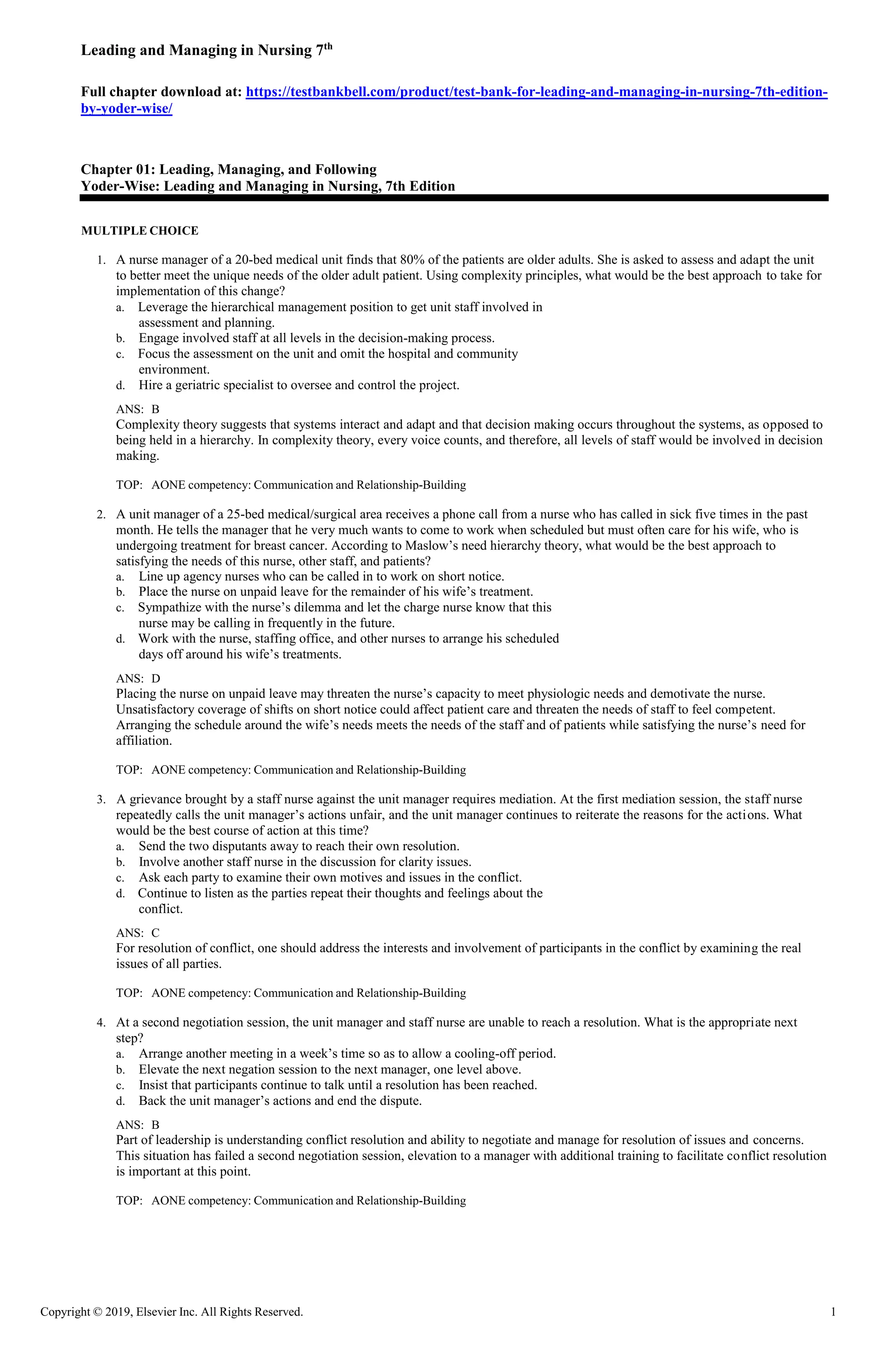
1.
Test Bank forLeading and Managing in Nursing
7th Edition by Yoder Wise download
http://testbankbell.com/product/test-bank-for-leading-and-
managing-in-nursing-7th-edition-by-yoder-wise/
Instant digital products(PDF, ePub, MOBI) ready for you
Download now and discover formats that fit your needs...
Start reading on any device today!
Leading and Managing in Nursing Yoder-Wise 5th Edition
Test Bank
https://testbankbell.com/product/leading-and-managing-in-nursing-
yoder-wise-5th-edition-test-bank/
testbankbell.com
Test Bank for Leading and Managing in Canadian Nursing 1st
Edition by Yoder Wise
https://testbankbell.com/product/test-bank-for-leading-and-managing-
in-canadian-nursing-1st-edition-by-yoder-wise/
testbankbell.com
Management Leading and Collaborating in a Competitive
World Bateman 11th Edition Test Bank
https://testbankbell.com/product/management-leading-and-collaborating-
in-a-competitive-world-bateman-11th-edition-test-bank/
testbankbell.com
Management Leading and Collaborating in the Competitive
World Bateman 10th Edition Solutions Manual
https://testbankbell.com/product/management-leading-and-collaborating-
in-the-competitive-world-bateman-10th-edition-solutions-manual/
testbankbell.com
4.
Management Leading andCollaborating in a Competitive
World Bateman 11th Edition Solutions Manual
https://testbankbell.com/product/management-leading-and-collaborating-
in-a-competitive-world-bateman-11th-edition-solutions-manual/
testbankbell.com
Test Bank for Managing and Coordinating Nursing Care Fifth
Edition
https://testbankbell.com/product/test-bank-for-managing-and-
coordinating-nursing-care-fifth-edition/
testbankbell.com
Test Bank for Management: Leading & Collaborating in a
Competitive World 13th Edition
https://testbankbell.com/product/test-bank-for-management-leading-
collaborating-in-a-competitive-world-13th-edition/
testbankbell.com
Leadership Roles and Management Functions in Nursing
Theory and Application Marquis 7th Edition Test Bank
https://testbankbell.com/product/leadership-roles-and-management-
functions-in-nursing-theory-and-application-marquis-7th-edition-test-
bank/
testbankbell.com
Solution Manual for Human Challenge, The: Managing
Yourself and Others in Organizations, 7/E 7th Edition :
0130859559
https://testbankbell.com/product/solution-manual-for-human-challenge-
the-managing-yourself-and-others-in-organizations-7-e-7th-
edition-0130859559/
testbankbell.com
“Dantesque” to bepleasant. We gladly breathed a purer atmosphere
as we passed out of the gate (inside which is a fabric of sulphur-
works), and bent our steps between white walls on which the green
lizards basked, and between fields of unripe corn and mulberry-
trees, till we reached an open space commanding a fine view of the
Gulf of Pozzuoli and the hills beyond. From thence we turned into
the Capuchin church dedicated to S. Januarius, and said to be built
over the spot where he suffered martyrdom in 305. There is a stone,
on which he is believed to have been beheaded, let into the wall,
and protected with an iron grating. It is seamed with red marks as of
blood. It is very probably a stone on which he knelt and on which
the blood fell. But a block, whether of stone or wood, for the
purposes of beheading, is a modern invention. The Romans used a
sword—as the Turks use a scymitar for that ghastly purpose to this
day—and the patient knelt upright.
It was pleasant to rest in the cool church, which, humble as it is, is
not without its quota of beautiful marbles, and is kept exquisitely
clean, with fresh flowers on the altar, and all care taken of it as if the
community were still there. We found only a lay brother left in
charge. I think he said he had a companion. All the poor fathers
were dispersed by Victor Emanuel's government, and Mass is only
said on feast-days; though it seemed to be the only church in that
immediate neighborhood, and the poor of the district must greatly
miss the presence of the Capuchin fathers, those special friends of
the poor.
As we came down the hill, we were met by peasant lads, who
wanted us to buy lumps of sulphur and the skeletons of the pretty
little fish called the sea-horse, which abound in this part of the
Mediterranean, and which are just like the knights among chessmen.
They may be seen alive in quantities in the aquarium at Brighton.
They twist the tapering end of their tails round a fragment of sea-
weed, or indeed, as the buoyancy of the water keeps them up, they
need but to touch something stationary. And there they stand in
groups, motionless, and looking for all the world like a grave
14.
assembly of horses'heads of the most delicate race, and with noses
slightly turned up. Nothing can be more graceful than the way they
hold themselves. Their heads are not bigger than those of ordinary-
sized chessmen.
As the Vernons had been at Posilippo all through the eruption of
Mount Vesuvius in April, 1872, they were naturally anxious we
should see something of the devastation [pg 822] it had occasioned.
We determined, therefore, to drive to San Sebastiano, a village
which was almost entirely destroyed. As we approached the spot, it
seemed as if we were driving into the kingdom of chaos, where “the
earth was void and empty.” On either side lay wide plains of gray-
black lava, looking as if a dead, unfertile earth had been furrowed
with the burning shares of some gigantic and infernal plough, and
had remained calcined and sterile for ever after. We left the carriage
and climbed up a large mound of lava. I found myself nearly on a
level with the low roof of the small church, round which the lava had
crept, but had spared it. I looked down into the basement of a
house below me. The lava had poured in and filled what once were
rooms, but had left the walls and the roof standing. There was part
of a street left, the lava having, with seeming caprice, turned off to
the left, as it poured down the mountain, just in that spot. Our
friends told us that as they used to sit by the hour and watch the
progress of the burning stream through glasses, they could see the
small white houses, with the fiery flood approaching, when suddenly
each house seemed to leap into the air like a lighted straw, and then
was seen no more. A cat ran past me, in haste to save her paws. We
could not stand still long, for, though more than a year had elapsed,
the land was still too hot to be pleasant; and when we reached
home, we found our feet were blistered. The poor creatures whose
homes have thus perished approach you timidly with bits of lava to
sell. They still have a scared look in their faces. But nothing will
persuade them to shift their quarters and leave their grand but
dangerous neighbor. They are trying to rebuild their village, and are
deaf to all the remonstrances of the great scientific philosopher187
who lives a hermit's life in the observatory half-way up the
15.
mountain. He hasa Capuchin priest as a companion; and the latter
was able to give the last rites of the church to about forty of the
unfortunate people, who, actuated by curiosity, had attempted to
climb the mountain during the eruption. It seems they had never
calculated upon the effect of the burning heat from a distance. They
thought if there were a certain space between them and the lava,
they should be safe. They forgot that actual contact was not
needed; and they were scorched to death long before the stream
reached the spot where they stood. Not one of those thus licked up
by the breath of the volcano ever recovered, or even lived long
enough to quit the place.
Signor Palmier and the Capuchin saw a carriage full of people,
coachman and two horses, advancing up the mountain. Suddenly
the whole was submerged. They could only tell where it had been
arrested by the carrion birds hovering over a certain spot for many
days after!
[pg 823]
16.
A Discussion WithAn Infidel.
VIII. Laws Of Nature And Miracles.
Büchner. We differ very widely in many points, sir; but there is one
point about which we shall have no difficulty in agreeing—the
immutability of natural laws. In fact, you have already conceded that
the laws of nature are unchangeable.
Reader. Yes, I admit the unchangeability of the laws of nature; but I
most strongly protest against your rash inference that therefore
miracles are impossible.
Büchner. Yet my reasoning is very plain. “The law of nature,
observes Moleschott, is a stringent expression of necessity. There
exists in it neither exception nor limitation; and no imaginable power
can disregard this necessity. A stone not supported will in all eternity
fall towards the centre of the earth; and there never was, and never
will be, a command for the sun to stand still” (p. 33).
Reader. Is this what you call “reasoning”?
Büchner. Yes. “The experience of thousands of years has impressed
upon the investigator the firmest conviction of the immutability of
the laws of nature, so that there cannot remain the least doubt in
respect to this great truth” (p. 34).
Reader. This I grant.
Büchner. “Science has gradually taken all the positions of the childish
belief of the peoples; it has snatched thunder and lightning from the
17.
hands of thegods ...” (ibid.)
Reader. It was Christianity, not science, that conquered the gods.
Büchner. “The eclipse of the stars and the stupendous powers of the
Titans of the olden times have been grasped by the fingers of man”
(ibid.)
Reader. How can the fingers of man grasp the eclipses and the
Titans?
Büchner. “That which appeared inexplicably miraculous, and the
work of a supernatural power, has, by the torch of science, proved to
be the effect of hitherto unknown natural forces” (ibid.)
Reader. You dream, doctor. Has “the torch of science” made known
those hitherto unknown forces? No scientific work has yet explained
how, by an act of the will, water can be changed into wine, how the
deaf and dumb can be instantaneously cured, how the blind can be
made to see, the paralytic to walk, and the dead to rise, at the
sound of a voice, four days after burial, and when already in a state
of advanced putrefaction. You may of course deny these facts, as
you deny that the sun ever received a command to stand still; but to
say that “the torch of science” has shown these facts to be the effect
of unknown natural forces is to tell us the most stupid lie that can be
uttered. Lies, you know, should at least be credible.
Büchner. “We have the fullest right, and are scientifically correct, in
asserting that there is no such thing as a miracle. Everything that
happens does so in a natural way—i.e., [pg 824] in a mode
determined only by accidental or necessary coalition of existing
materials and their immanent natural forces. No revolution on earth
or in heaven, however stupendous, could occur in any other
manner” (p. 34).
Reader. These are mere words. I deny that science gives you the
least right to suppress miracles. How can you establish such a right?
18.
Büchner. “Wherever fireand water meet, vapors must arise and
exert their irresistible power. Where the seed falls in the ground,
there it will grow; where the thunderbolt is attracted, there it will
strike. Can there exist any doubt as to these truths?” (p. 35).
Reader. Please, doctor, come to the point.
Büchner. “How is it possible that the unalterable order in which
things move should ever be disturbed without producing an
irremediable gap in the world, without delivering us and everything
up to arbitrary power, without reducing all science, every earthly
endeavor, to a vain and childish effort?” (p. 36).
Reader. All this rhetoric is most absurd, doctor. “The order in which
things move” is not unalterable; and He whom you call an “arbitrary
power” can alter it when he pleases without asking your permission,
or without reducing science to a childish effort.
Büchner. What? You contradict yourself, sir. For, if the order in which
things move is changeable, the laws of nature cannot be
unchangeable.
Reader. Not at all. You sophistically confound two things entirely
different—the law of nature, and the course of nature. The first is
unchangeable, because it is connected with the essence of things;
but the second is changeable, as a constant and universal
experience compels us to admit. However much you may hate
“arbitrary power,” you cannot deny that, besides necessary causes,
there are others which are free in their exertions. Can you deny, for
instance, that a stone may be thrown upwards in spite of gravitation,
or that we can catch hold of the stone from the window, and, in
spite of gravitation, we can prevent it from falling back to the
ground? Now, if we do this, we do not change the law of nature, and
nevertheless we modify the course of nature by freely producing a
phenomenon which nature would not produce.
Büchner. Would you call this a miracle?
19.
Reader. The questionis impertinent. I call it a change in the course
of nature. Now, if the course of nature can be modified without the
law of nature being altered, it is absurd to pretend that there is
contradiction in holding the unchangeableness of the latter and the
changeableness of the former. This being evident, let us go a step
further, and draw an obvious conclusion. We can, when we please,
catch the stone from the window, and prevent it from falling; and
cannot God do the same? We are free to exert our power; but is not
God free, or has he less power than we have? If you are honest, you
will own that what can be done by us can be done by our Creator
and Lord. Now, if he stops the stone in the air, a miracle will be
wrought, and no law of nature violated. You cannot deny the
possibility of miracles without denying God.
Büchner. “A spirit independent of nature cannot exist; for never [pg
825] has an unprejudiced mind cultivated by science perceived its
manifestation” (p. 36).
Reader. Are you not ashamed, doctor, to repeat such a nonsensical
assertion? You have already failed to prove it, and I have shown its
absurdity in a preceding discussion. Must I answer it anew? The only
answer you now deserve is that “The fool has said in his heart,
‘There is no God.’ ” Fools, in fact, deny God in their hearts, but
cannot deny him in their minds, because atheism is not the result of
intellectual knowledge, but of moral depravity. Our present question,
however, is not theism or atheism, but the possibility of miracles
without any breach of natural laws. Surely, if there were no God, no
miracle would be possible; but your argument was that if the laws of
nature are unchangeable, no miracle is possible; and this I have
shown to be false. If there is a God, as we must now assume,
miracles are possible. In the same manner, if a single true miracle
has ever been wrought, there is a God.
Büchner. “Apparent exceptions from the natural order have been
called miracles, of which there have been many at all times” (p. 36).
20.
Reader. You shouldknow better, doctor. The church is not satisfied
with “apparent” exceptions from the natural order; the exception
must be rigorously proved.
Büchner. “We should only waste words in our endeavor to prove the
natural impossibility of a miracle. No educated, much less a
scientific, person who is convinced of the immutable order of things
can nowadays believe in miracles. We find it rather wonderful that so
clear and acute a thinker as Ludwig Feuerbach should have
expended so much logic in refuting the Christian miracles. What
founder of religion did not deem it necessary, in order to introduce
himself to the world, to perform miracles? And has not his success
proved that he was right? What prophet, what saint, is there who
has not performed miracles? The miracle-seeker sees them daily and
hourly. Do not the table-spirits belong to the order of miracles? All
such miracles are equal in the eye of science; they are the result of
a diseased fancy” (pp. 36, 37).
Reader. This is miserable logic, doctor. Why do you speak of the
natural impossibility of miracles? Have we ever taught that miracles
are naturally possible? We know that nature works no miracles, and
that all miracles are supernatural. It is therefore either a mean trick
or a logical blunder on your part to pretend that the natural
possibility of miracles is the point in question. That no educated or
scientific man can nowadays believe in miracles is not only an empty
boast, but also a disgraceful calumny. We Christians believe in
miracles, and yet, I venture to say, we need not resort to you for
lessons in science or education. As a reason for not believing in
miracles, you allege “the immutable order of things”; that is, you
assume what is to be proved. The order of things is so far from
being immutable that we see it modified at every moment. It is the
laws of nature, not the order of things, that are immutable. That
Feuerbach “expended so much of logic in refuting Christian miracles”
I will not deny; I only say that his logic, like your own, is mere
sophism and cavil. Of course you call him “so clear and acute a
thinker”; but we know what this means on the lips of Freemasons. If
21.
he was “so[pg 826] clear and acute a thinker,” why did he not
furnish you with at least one good argument against Christian
miracles?
Besides, you pretend that all founders of religion deemed it
necessary to perform miracles. What then? Were it true, the fact
would scarcely help your cause; for it would only prove that there
have ever been impostors, as there have been quacks and coin-
forgers. Now, who would think of selling counterfeited articles, if
there had existed none genuine? Would there be quacks, had there
been no doctors? And yet your reasoning leads to the conclusion
that, because there are so many quacks, there can be no doctors.
Are you, then, a mere quack yourself?
You say with a malicious sneer that all prophets and saints
performed miracles. Yes; they performed miracles, or rather, to
speak more correctly, God wrought miracles through them. Yet, in
the teeth of sacred and ecclesiastical history which testifies to an
infinite number of unquestionable miracles, you are shameless
enough to conclude that no miracle has ever been performed, on the
plea that miracle-seekers, table-spirits, and diseased fancy must
have conspired to deceive the world. Is it necessary to refute such a
silly assertion? Was Elymas the magician a miracle-seeker when S.
Paul, to punish him for his opposition to Christianity, struck him blind
with a word in the presence of the Roman centurion? Was it a trick
of table-spirits that made the blind see, the lame walk, or the dumb
speak? Was it diseased fancy that impressed on an immense crowd
the belief that they had been miraculously fed by Christ in the
desert, where no provisions were at hand? No, doctor, you are not
silly enough to believe anything of the sort.
Büchner. But what do you answer to the following difficulties? First,
if we admit miracles, “science will be reduced to a vain and childish
effort” (p. 36). Secondly, how can we conceive “a supreme legislator
who allows himself to be moved by prayers and sobs to reverse the
immutable order which he himself has created, to violate his own
22.
laws, and withhis own hand to destroy the action of natural forces?”
(p. 38). Thirdly, “every miracle, if it existed, says Cotta, would lead
to the conviction that the creation is not deserving the respect which
all pay to it, and the mystics would necessarily be obliged to deduce
from the imperfection of the created world the imperfection of the
Creator” (p. 38). Fourthly, “is it a view worthy of God to represent
him as a power which now and then gives a new impulse to the
world in its course, and puts on a screw, etc., like the regulator of a
watch? If the world has been created by God perfect, how can it
require any repairs?” (p. 39). Fifthly, we see that nature works
without superior control; “its action is frequently quite independent
of the rules of a higher reason, now constructing, now destroying,
now full of design, then again perfectly blind and in contradiction
with all moral and rational laws. That in the formation of organic and
inorganic bodies, which are constantly being renewed, there can be
no direct governing reason at work is proved by the most striking
facts. The nisus formativus inherent in nature is so blind and so
dependent on external circumstances that the most senseless forms
are frequently engendered, that it is often incapable of obviating [pg
827] or overcoming the slightest obstructions, and that frequently
the contrary of what according to reason should happen is effected”
(pp. 41, 42). These are serious difficulties, sir.
Reader. I hardly think them to be serious, doctor. The first entirely
disappears when you reflect that the conclusions of physical science
are all hypothetic, inasmuch as they regard phenomena which must
take place under the action of given powers, to the exclusion of any
other power extraneous to those taken into account. Such
conclusions, therefore, imply the condition that no extraneous agent
and no disturbing cause interferes with the production of the
phenomena. If an extraneous power interferes, the conditions are
changed, and with them the phenomena; but science is not upset. A
stone not supported must fall. Not supported; such is the condition.
Now, whether you, or I, or the roof, or God, or an angel support it,
the consequence will be that the stone will not fall. Now, I ask you,
is science “reduced to a vain and childish effort” because you or I or
23.
the roof preventthe stone from falling? I presume, doctor, that if
such were the case, science would long since have disappeared from
this world. Why, then, should science become a vain and childish
effort as soon as God would do himself what we can freely do
without destroying science? Take another example. Nature builds no
stately palaces, no fine steamers, no locomotives, no railroads. All
such things are our free creations. Yet surely you will not maintain
that by building palaces or by boring mountains we destroy science,
although we may interfere very materially with the works of nature.
Now, if our free action upon nature does not destroy science, why
should God's free action destroy it? Answer me in the name of
reason: What theory of natural science would be falsified were God
to send angels to build you a palace, or devils to dig you a grave?
And now I come to your second difficulty. You assume that the
supreme legislator cannot work a miracle without destroying the
action of natural forces and violating his own laws, thus reversing
the immutable order which he himself has created. But you are
mistaken. The order of things is not immutable; this I have already
shown. On the other hand, we have just seen that no law of nature
is ever violated by a miracle. Lastly, God's action does not destroy
the action of natural forces, but produces an effect superior to and
independent of them. Nor is this strange; for we ourselves can do
the like within the range of our limited powers. When we go up-
stairs, do we destroy the action of gravity that urges us downwards?
By no means. The action of gravity continues its work, but our
contrary exertion prevails; and thus our body obeys the resultant of
the two opposite actions, both of which obtain their effect. You see,
therefore, that there is no need of destroying the action of natural
forces in order to produce an effect which natural forces cannot
produce. After these remarks, nothing remains of your second
difficulty but “the prayers and sobs” which you cruelly ridicule as
useless and superstitious. But our Father who is in heaven listens to
such prayers and is moved by those sobs. This is abundantly proved
by innumerable authentic facts; and this suffices for us.
24.
[pg 828]
Your thirddifficulty is based on Cotta's notion that the creation
deserves respect on account of its perfection. Cotta may be one of
your great men, but surely he does not know what he is speaking
about. What “respect” do we owe to creation? Benighted barbarians
thought, indeed, that the sun, the earth, and the stars deserved
respect; but how can a man who pretends to be a philosopher, and
who professes himself an enemy of superstition, adopt such a stale
pagan view, unless he blinds himself and renounces reason by
bestowing upon matter the worship which he refuses to the living
God? To say that the world is “perfect” is a mere equivocation. The
world is perfect after its own manner, inasmuch as it serves all the
purposes for which it has been made; it is perfect in the same sense
in which we say that a thermometer, a telescope, or an engine is
perfect; it is a perfect instrument in God's hand for the attainment of
a determinate end; and therefore its perfection is relative only, and
might be greater and greater without end. Now, Cotta's argument
overlooks this obvious restriction, and presents the world as
absolutely perfect. If the world is imperfect, says he, God is
imperfect; but miracles would show that the world is imperfect; and
therefore miracles would show that God is imperfect. Now, is not
this, doctor, asinine logic? We might as well argue thus: If an engine
is imperfect, its maker is imperfect; but the opening of a turning-
cock for admitting more steam shows that the engine is imperfect;
and therefore that opening shows that the engine-maker is
imperfect. And this leads me to your fourth difficulty, which is
nothing but a repetition of the third.
You ask: “Is it a view worthy of God to represent him as a power
which now and then gives a new impulse to the world in its course?”
I answer, Yes; it is quite worthy of God to exercise his power in the
world in the way he thinks fit. Shall we say, then, that God, “like the
regulator of a watch, puts a screw on the world”? Why not? The
watchmaker is not degraded by regulating his work. But, then, “the
world requires repairs”? I say, Yes. And if you conclude that the
world “has not been created perfect,” I reply that although it came
25.
out relatively perfectfrom the hands of the Creator, it has gradually
and most sadly deteriorated by the malice of man. Moreover, the
world, whether more or less perfect in itself, without a constant
active intervention of its Creator can neither work nor last for a
moment. The world is, therefore, constantly “repaired,” to use your
expression, and has “screws put on it,” as history testifies; and other
“screws” are undoubtedly ready for further “repairs” when they will
be wanted.
Your last difficulty arises from your assumption that nature works
without being controlled by a superior power. But how do you know
that nature is not controlled? What are the “striking facts” which
prove that “there is no direct governing reason at work” in the
formation of organic and inorganic bodies? Your nisus formativus
proves nothing. You say that the nisus is “blind.” You may well call it
blind, inasmuch as it is a work of secondary causes; but you cannot
deny that it is ruled by a superior reason. What does it matter if
“most senseless forms are frequently engendered”? You yourself
admit that the nisus formativus [pg 829] depends very much “on
external circumstances,” which may mar or spoil the work of
organization, and which nothing obliges the superior reason to alter
or improve. On the other hand, such senseless forms are not so
“frequently” engendered as you pretend; and if a few such senseless
or monstrous forms can move you to doubt whether their formation
is controlled by a superior reason, I do not see why the immensely
greater number of other forms perfectly constituted should not
constrain you to banish the doubt, and to recognize that matter not
controlled and not directed by reason cannot co-ordinate its efforts
towards the formation of an organism of which it knows neither the
plan nor the object.
I trust, doctor, that these remarks suffice to solve your difficulties,
and to show that the world is governed by a superior reason.
Büchner. It may be; yet “what this or that man may understand by a
governing reason, an absolute power, a universal soul, a personal
26.
God, etc., ishis own affair. The theologians, with their articles of
faith, must be left to themselves; so the naturalists with their
science. They both proceed by different routes” (p. 43).
Reader. This is no reply, doctor, and your remark is misplaced. The
existence of a personal God, the possibility of miracles, and many
other such truths, are proved by natural reason. Had I refuted your
objections by quoting “theologians” and “articles of faith,” your reply
might have some meaning. But since your allegations have been
answered by reason, what does it avail to say that “theologians, with
their articles of faith, must be left to themselves”? Moreover, you
unwittingly condemn your own tactics. For if theologians are to be
left to themselves, why do you, then, who are no theologian, and
not even a philosopher, invade the province of theology, and fight
against faith?
If you have any desire to know the truth about the reality of
miracles, I will tell you what you have to do. M. Artus, a Frenchman,
on the 23d of July, 1871, publicly challenged all the free-thinkers of
the world to show the falsity of any two out of the many miracles
registered in M. Lasserre's book entitled Notre Dame de Lourdes,
and staked 10,000 francs upon the issue of the contest. This money
was safely deposited by him in the hands of a notary-public in Paris;
and fifty judges were appointed, some of whom were members of
the French Institute, and others fellows of other celebrated
institutions and academies, or members of the bar, including even a
Protestant; so that there could be no suspicion of fanaticism,
ultramontanism, or mysticism about them. Now, incredible as it may
appear to you, none of your great braggarts has dared from that day
till now to accept the challenge. It is for you, who are so peremptory
in denouncing miracles, to come forward, and to blot out by an act
of philosophical valor the stain which the cowardice of your
enlightened friends has left on the glory of free-thinkerism. It is for
you, I repeat; for if a man of your standing and reputation quails
before the challenge, the world will most reasonably conclude that
you have no faith whatever in your own doctrines.
27.
IX. The Heavens.
Reader.The laws of nature are [pg 830] universal. Such is the
subject of the seventh chapter of your Force and Matter. I need
hardly say that, while admitting with you the universality of the
natural laws, I cannot but condemn the materialistic spirit which
disgraces your explanation of that obvious truth. But in the chapter
which follows you speak of the heavens in a most objectionable
style.
Büchner. “Every school-boy knows that the sky is not a glass shade
covering the earth, but that, in contemplating it, we behold an
immense space interrupted by infinitely distant and scattered groups
of worlds” (p. 51).
Reader. This I grant; but I am at a loss to understand how the
contemplation of the heavens can furnish you an argument against
the existence of God. Is it not strange that what has hitherto been
considered to proclaim most loudly the existence, and magnify the
power, of God, has become, in your hands, an evidence in support of
atheism?
Büchner. The heavenly masses “are in constant motion—a motion
singularly combined and complicated, yet in all its modifications
merely the result of a single universal law of nature—the law of
attraction.... All these motions may be determined and predicted
with mathematical exactness. As far as the telescope of man
reaches, the same law, the same mechanical arrangement,
according to the same calculated mechanical formula, is found.
Nowhere is there a trace of an arbitrary finger which has ordered the
heavens or pointed out the path of comets. ‘I have searched the
heavens,’ says Lalande, ‘but have nowhere found the traces of God.’
And when the Emperor Napoleon asked the celebrated astronomer
Laplace why there was no mention of God in his Mécanique Céleste,
he replied, ‘Sire, je n'avais pas besoin de cette hypothèse.’ The more
28.
astronomy progressed inits knowledge of the laws and motions in
the heavens, the more it repudiated the idea of a supernatural
influence, and the easier it became to deduce the origin, grouping,
and motions of the heavenly bodies from the properties inherent in
matter itself. The attraction of atoms rendered the bodies compact,
whilst the law of attraction, in combination with their primary
motion, produced the mode of their reciprocal rotation which we
now observe” (pp. 51, 52).
Reader. Waiving the more than problematic plausibility of your
premises, and setting aside the blasphemies which you have
diligently copied from the books of the French unbelievers, and
which are too stolid to need an answer, I reply, doctor, that you are
always too hasty in drawing your conclusions. Why did you not
reflect that the matter of which the celestial bodies are formed must
have had an origin, that the revolutions of those bodies cannot be
ruled by an abstract law, and that their enormous distances, as well
as the expanse of their orbits through the immensity of space,
compel the admission of an infinite being ranging infinitely above
matter and necessarily prior to it? You should not have overlooked
the fact that the heavens proclaim God's existence by their
immensity far more eloquently than by the revolutions of the
celestial bodies. You speak of movements ruled by a law. I admit the
movements and the law which rules our calculation of the
movements. But without space there is no movement, and without
[pg 831] God there is no space; therefore without God there is no
movement. Extricate yourself, if you can. Do you concede that
without space there is no movement?
Büchner. It is evident.
Reader. Do you admit that without God there is no space?
Büchner. This I deny.
Reader. Then what do you mean by “space”?
29.
Büchner. I fancythat space is nothing but the volume of bodies.
Reader. How is this possible? A body moves through space. Now,
does a body move through its own volume, or does it move through
the volume of other bodies? On the contrary, the body cannot move
without pushing away before it all other bodies and volumes
whatever from the space they occupy. It is therefore evident that
space, as such, is not the volume of bodies.
Büchner. Then I shall say that space is the capability of bodies and
motion.
Reader. This definition of space may be admitted if properly
understood. But what is such a capability? Is it, in your opinion, a
real and positive entity?
Büchner. I should not think so, unless, indeed, it be occupied by
bodies.
Reader. I know that many are of this opinion, that the reality of
space depends on the presence of bodies; but I say that, if such
were the case, then empty space would be mere nothing. Now, if
you admit this, you will be compelled to admit also the absurdity
that a mere nothing can be greater or smaller. For between two
neighboring atoms there may be a greater or smaller interval of
space; and such an interval, by the hypothesis, would be nothing.
Hence it is evident that space, no matter whether occupied or
unoccupied, must be something real.
Büchner. Then I say that space is a mere relation of material objects.
Reader. There are relations of bodies in space; but all such relations
presuppose the existence of absolute space, and therefore space
itself is none of those relations. Moreover, since all real relations
have their reason in something real, which is the foundation of the
relativity, it follows that space, as that through which one body is
really related to another, is in itself a reality, independently of the
30.
relations which mayresult from the existence of bodies in it. And
again, before bodies can be considered as related through space,
they must be each located in space. But, evidently, they cannot be
located in space if there is no space. And therefore there must be
space before any local relation of bodies can be imagined as
possible. Hence you cannot maintain that space is a mere relation.
Büchner. Perhaps I shall be obliged to say with Kant that space is
only a subjective form of the mind.
Reader. Then you will entangle yourself still more. The assumption
would imply the denial of all real distances, of all real volumes, of all
real movements, of all real phenomena, and of all natural laws. For if
space is only a subjective form of our mind, then there is no space
out of the mind; and consequently there are no real distances and
no real movements in the outside world, and science becomes an
array of lies.
Büchner. What is, then, your notion of space?
Reader. Space is the region of [pg 832] all possible ubications and
movements. Do you accept this definition?
Büchner. Why not? It is substantially the same as that which I have
given by saying that space is the capability of bodies and motion.
Reader. Very well. Then, since I have shown that this capability of
bodies and motion is a positive reality, space is a positive reality.
Moreover, space is neither matter nor any of the forces of matter,
nor dependent on matter, but prior to it, and is prerequired as a
necessary condition for the existence of matter. Lastly, space is
independent of time and motion, and therefore is absolutely and
strictly eternal and unchangeable. Do you object to these
conclusions?
Büchner. No, sir.
31.
Reader. Then youconcede that space is an infinite, eternal,
unchangeable, independent reality, prior to matter and above matter,
and therefore, according to your own theory, prior to the world and
above it. Now, to concede so much, and then to deny God, would be
an evident contradiction. For you must admit that absolute space is
either a substance or not. If it is a substance, then it is an infinite,
eternal, independent, unchangeable substance, embracing and
transcending with its immensity all imaginable worlds; and a
substance having such attributes is what we call God. If space is not
a substance, it must still have the reason of its reality in a substance
from which it borrows its infinity, its eternity, its immutability, and of
which it is the extrinsic manifestation. Hence the contemplation of
the heavens and of “the immense space interrupted by infinitely
distant and scattered groups of worlds” affords an irresistible proof
of God's existence, and leaves no room for your pretended
“scientific” objections. If there is no God, there is no space; and if
there is no space, science is a dream and scientists mere
visionaries.188
Büchner. I cannot fight on this ground, sir. Space is a mystery which
our reason has no power to explain; and I decline to argue about
anything that transcends reason. The strongest argument in favor of
the existence of a personal God was ever drawn from the necessity
of a first mover, in order to account for the movement of the
celestial bodies. But such a necessity has never been proved; and
therefore “even in this remote position a personal creative power
cannot hold its ground” (p. 52).
Reader. You cannot cover your retreat by pretending that space is a
mystery; for if space is a mystery, then science also is a mystery—a
conclusion which you do not accept. But while you thus implicitly
acknowledge your defeat, you try to secure a safer position by
alleging that the movement of the heavenly bodies may have
originated in the powers of matter itself without any exterior impulse
from a first mover. I wish you to remark that the words “first mover”
can be understood in two manners; for not he only who directly
32.
imparts the firstmovement, but he also who governs the exertions
and establishes the conditions on which the first movements
depend, [pg 833] can be called “first mover.” The old philosophers,
who did not know the fact of universal gravitation, proved the
existence of God by affirming the necessity of a first mover—that is,
of a first cause—giving the first impetus to the heavens, and
governing their revolutions. But since gravitation became known
philosophers have acknowledged that all matter could receive
motion through the action of other matter, and therefore that the
first movements in the material world could arise from matter itself,
with no need of a special impulse from without. This, however, does
not mean that we can dispense with a “first mover.” However great
your effort to convince yourself that “matter is eternal, and the
motion of matter as eternal as matter itself” (p. 53), you will not
succeed. Matter is created; and He who created it placed it in
definite conditions, that it could exert its powers in a definite manner
and give rise to definite effects. To him, therefore, as to a first
cause, are to be traced all the movements arising from his
production and arrangement of all the proximate causes. Now, the
first cause of all movements is a “first mover.” What can science
object against this evident truth?
Büchner. “Why matter assumed a definite motion at a definite time is
as yet unknown to us; but the investigations of science are as yet
incomplete, nor is it impossible that we may get some clue as to the
period of the first origin of individual worlds. Even at this day
astronomers give cogent reasons that some of the nebular spots are
worlds in embryo, which, by gradual condensation and rotation, will
become worlds and solar systems. We have, therefore, concluding
from analogy, a right to say that those processes through which the
existing solar systems have arisen can have formed no exception to
the general laws inherent in matter, and that the cause of the first
definite motion must have existed in matter itself” (p. 53).
Reader. This is possible; but is it true?
33.
Büchner. “We arethe more justified in asserting this, as the many
irregularities, contingencies, etc., in the economy of the universe and
individual bodies, exclude the thought of an external personal
activity” (ibid.)
Reader. What? Are you serious?
Büchner. “If it were the object of a personal creative power to create
worlds and dwelling-places for men and animals, why, we may ask,
these enormous, waste, useless spaces, in which but here and there
suns and planets swim, floating about as imperceptible points? Why
are not all planets of our system so formed as to be inhabited by
man? Why is the moon without water and atmosphere, and
consequently adverse to every organic development? Wherefore the
irregularities and enormous differences in the size and distances of
the planets of our solar system? Why the deficiency in order,
symmetry, and beauty? Why have all comparisons, analogies,
speculations, in regard to the number and forms of the planets,
proved idle fancies? Why, asks Hudson Tuttle, did the Creator give
rings to Saturn, which, surrounded by its eight moons, can have little
need of them, while Mars is left in total darkness? And again, the
moon's rotation round its axis is, in relation to that of the earth, such
that it always presents to it the same [pg 834] surface. What is the
reason of this? If there be design in this arrangement, it must be
admitted that it is very imperfect. Why did the Creator not impart to
the celestial bodies that order from which the intention and the
design could irresistibly be inferred?” (pp. 53, 54).
Reader. Unfortunate man that you are! You have already received
the just punishment of your rebellion against truth; you have been
struck with blindness. The thing is evident, say what you will. You
make a fool of yourself, as your preposterous queries prove nothing
but your arrogance, ignorance, and malice. You will never be cured
of your blindness till you lower your tone and humble your pride
before the God whose works you disregard, and whose wisdom you
call in question. You are a smoky little candle challenging the sun





![assembly of horses' heads of the most delicate race, and with noses
slightly turned up. Nothing can be more graceful than the way they
hold themselves. Their heads are not bigger than those of ordinary-
sized chessmen.
As the Vernons had been at Posilippo all through the eruption of
Mount Vesuvius in April, 1872, they were naturally anxious we
should see something of the devastation [pg 822] it had occasioned.
We determined, therefore, to drive to San Sebastiano, a village
which was almost entirely destroyed. As we approached the spot, it
seemed as if we were driving into the kingdom of chaos, where “the
earth was void and empty.” On either side lay wide plains of gray-
black lava, looking as if a dead, unfertile earth had been furrowed
with the burning shares of some gigantic and infernal plough, and
had remained calcined and sterile for ever after. We left the carriage
and climbed up a large mound of lava. I found myself nearly on a
level with the low roof of the small church, round which the lava had
crept, but had spared it. I looked down into the basement of a
house below me. The lava had poured in and filled what once were
rooms, but had left the walls and the roof standing. There was part
of a street left, the lava having, with seeming caprice, turned off to
the left, as it poured down the mountain, just in that spot. Our
friends told us that as they used to sit by the hour and watch the
progress of the burning stream through glasses, they could see the
small white houses, with the fiery flood approaching, when suddenly
each house seemed to leap into the air like a lighted straw, and then
was seen no more. A cat ran past me, in haste to save her paws. We
could not stand still long, for, though more than a year had elapsed,
the land was still too hot to be pleasant; and when we reached
home, we found our feet were blistered. The poor creatures whose
homes have thus perished approach you timidly with bits of lava to
sell. They still have a scared look in their faces. But nothing will
persuade them to shift their quarters and leave their grand but
dangerous neighbor. They are trying to rebuild their village, and are
deaf to all the remonstrances of the great scientific philosopher187
who lives a hermit's life in the observatory half-way up the](https://image.slidesharecdn.com/15456-250331044852-99078fcb/75/Test-Bank-for-Leading-and-Managing-in-Nursing-7th-Edition-by-Yoder-Wise-14-2048.jpg)
![mountain. He has a Capuchin priest as a companion; and the latter
was able to give the last rites of the church to about forty of the
unfortunate people, who, actuated by curiosity, had attempted to
climb the mountain during the eruption. It seems they had never
calculated upon the effect of the burning heat from a distance. They
thought if there were a certain space between them and the lava,
they should be safe. They forgot that actual contact was not
needed; and they were scorched to death long before the stream
reached the spot where they stood. Not one of those thus licked up
by the breath of the volcano ever recovered, or even lived long
enough to quit the place.
Signor Palmier and the Capuchin saw a carriage full of people,
coachman and two horses, advancing up the mountain. Suddenly
the whole was submerged. They could only tell where it had been
arrested by the carrion birds hovering over a certain spot for many
days after!
[pg 823]](https://image.slidesharecdn.com/15456-250331044852-99078fcb/75/Test-Bank-for-Leading-and-Managing-in-Nursing-7th-Edition-by-Yoder-Wise-15-2048.jpg)
![hands of the gods ...” (ibid.)
Reader. It was Christianity, not science, that conquered the gods.
Büchner. “The eclipse of the stars and the stupendous powers of the
Titans of the olden times have been grasped by the fingers of man”
(ibid.)
Reader. How can the fingers of man grasp the eclipses and the
Titans?
Büchner. “That which appeared inexplicably miraculous, and the
work of a supernatural power, has, by the torch of science, proved to
be the effect of hitherto unknown natural forces” (ibid.)
Reader. You dream, doctor. Has “the torch of science” made known
those hitherto unknown forces? No scientific work has yet explained
how, by an act of the will, water can be changed into wine, how the
deaf and dumb can be instantaneously cured, how the blind can be
made to see, the paralytic to walk, and the dead to rise, at the
sound of a voice, four days after burial, and when already in a state
of advanced putrefaction. You may of course deny these facts, as
you deny that the sun ever received a command to stand still; but to
say that “the torch of science” has shown these facts to be the effect
of unknown natural forces is to tell us the most stupid lie that can be
uttered. Lies, you know, should at least be credible.
Büchner. “We have the fullest right, and are scientifically correct, in
asserting that there is no such thing as a miracle. Everything that
happens does so in a natural way—i.e., [pg 824] in a mode
determined only by accidental or necessary coalition of existing
materials and their immanent natural forces. No revolution on earth
or in heaven, however stupendous, could occur in any other
manner” (p. 34).
Reader. These are mere words. I deny that science gives you the
least right to suppress miracles. How can you establish such a right?](https://image.slidesharecdn.com/15456-250331044852-99078fcb/75/Test-Bank-for-Leading-and-Managing-in-Nursing-7th-Edition-by-Yoder-Wise-17-2048.jpg)
![Reader. The question is impertinent. I call it a change in the course
of nature. Now, if the course of nature can be modified without the
law of nature being altered, it is absurd to pretend that there is
contradiction in holding the unchangeableness of the latter and the
changeableness of the former. This being evident, let us go a step
further, and draw an obvious conclusion. We can, when we please,
catch the stone from the window, and prevent it from falling; and
cannot God do the same? We are free to exert our power; but is not
God free, or has he less power than we have? If you are honest, you
will own that what can be done by us can be done by our Creator
and Lord. Now, if he stops the stone in the air, a miracle will be
wrought, and no law of nature violated. You cannot deny the
possibility of miracles without denying God.
Büchner. “A spirit independent of nature cannot exist; for never [pg
825] has an unprejudiced mind cultivated by science perceived its
manifestation” (p. 36).
Reader. Are you not ashamed, doctor, to repeat such a nonsensical
assertion? You have already failed to prove it, and I have shown its
absurdity in a preceding discussion. Must I answer it anew? The only
answer you now deserve is that “The fool has said in his heart,
‘There is no God.’ ” Fools, in fact, deny God in their hearts, but
cannot deny him in their minds, because atheism is not the result of
intellectual knowledge, but of moral depravity. Our present question,
however, is not theism or atheism, but the possibility of miracles
without any breach of natural laws. Surely, if there were no God, no
miracle would be possible; but your argument was that if the laws of
nature are unchangeable, no miracle is possible; and this I have
shown to be false. If there is a God, as we must now assume,
miracles are possible. In the same manner, if a single true miracle
has ever been wrought, there is a God.
Büchner. “Apparent exceptions from the natural order have been
called miracles, of which there have been many at all times” (p. 36).](https://image.slidesharecdn.com/15456-250331044852-99078fcb/75/Test-Bank-for-Leading-and-Managing-in-Nursing-7th-Edition-by-Yoder-Wise-19-2048.jpg)
![he was “so [pg 826] clear and acute a thinker,” why did he not
furnish you with at least one good argument against Christian
miracles?
Besides, you pretend that all founders of religion deemed it
necessary to perform miracles. What then? Were it true, the fact
would scarcely help your cause; for it would only prove that there
have ever been impostors, as there have been quacks and coin-
forgers. Now, who would think of selling counterfeited articles, if
there had existed none genuine? Would there be quacks, had there
been no doctors? And yet your reasoning leads to the conclusion
that, because there are so many quacks, there can be no doctors.
Are you, then, a mere quack yourself?
You say with a malicious sneer that all prophets and saints
performed miracles. Yes; they performed miracles, or rather, to
speak more correctly, God wrought miracles through them. Yet, in
the teeth of sacred and ecclesiastical history which testifies to an
infinite number of unquestionable miracles, you are shameless
enough to conclude that no miracle has ever been performed, on the
plea that miracle-seekers, table-spirits, and diseased fancy must
have conspired to deceive the world. Is it necessary to refute such a
silly assertion? Was Elymas the magician a miracle-seeker when S.
Paul, to punish him for his opposition to Christianity, struck him blind
with a word in the presence of the Roman centurion? Was it a trick
of table-spirits that made the blind see, the lame walk, or the dumb
speak? Was it diseased fancy that impressed on an immense crowd
the belief that they had been miraculously fed by Christ in the
desert, where no provisions were at hand? No, doctor, you are not
silly enough to believe anything of the sort.
Büchner. But what do you answer to the following difficulties? First,
if we admit miracles, “science will be reduced to a vain and childish
effort” (p. 36). Secondly, how can we conceive “a supreme legislator
who allows himself to be moved by prayers and sobs to reverse the
immutable order which he himself has created, to violate his own](https://image.slidesharecdn.com/15456-250331044852-99078fcb/75/Test-Bank-for-Leading-and-Managing-in-Nursing-7th-Edition-by-Yoder-Wise-21-2048.jpg)
![laws, and with his own hand to destroy the action of natural forces?”
(p. 38). Thirdly, “every miracle, if it existed, says Cotta, would lead
to the conviction that the creation is not deserving the respect which
all pay to it, and the mystics would necessarily be obliged to deduce
from the imperfection of the created world the imperfection of the
Creator” (p. 38). Fourthly, “is it a view worthy of God to represent
him as a power which now and then gives a new impulse to the
world in its course, and puts on a screw, etc., like the regulator of a
watch? If the world has been created by God perfect, how can it
require any repairs?” (p. 39). Fifthly, we see that nature works
without superior control; “its action is frequently quite independent
of the rules of a higher reason, now constructing, now destroying,
now full of design, then again perfectly blind and in contradiction
with all moral and rational laws. That in the formation of organic and
inorganic bodies, which are constantly being renewed, there can be
no direct governing reason at work is proved by the most striking
facts. The nisus formativus inherent in nature is so blind and so
dependent on external circumstances that the most senseless forms
are frequently engendered, that it is often incapable of obviating [pg
827] or overcoming the slightest obstructions, and that frequently
the contrary of what according to reason should happen is effected”
(pp. 41, 42). These are serious difficulties, sir.
Reader. I hardly think them to be serious, doctor. The first entirely
disappears when you reflect that the conclusions of physical science
are all hypothetic, inasmuch as they regard phenomena which must
take place under the action of given powers, to the exclusion of any
other power extraneous to those taken into account. Such
conclusions, therefore, imply the condition that no extraneous agent
and no disturbing cause interferes with the production of the
phenomena. If an extraneous power interferes, the conditions are
changed, and with them the phenomena; but science is not upset. A
stone not supported must fall. Not supported; such is the condition.
Now, whether you, or I, or the roof, or God, or an angel support it,
the consequence will be that the stone will not fall. Now, I ask you,
is science “reduced to a vain and childish effort” because you or I or](https://image.slidesharecdn.com/15456-250331044852-99078fcb/75/Test-Bank-for-Leading-and-Managing-in-Nursing-7th-Edition-by-Yoder-Wise-22-2048.jpg)
![[pg 828]
Your third difficulty is based on Cotta's notion that the creation
deserves respect on account of its perfection. Cotta may be one of
your great men, but surely he does not know what he is speaking
about. What “respect” do we owe to creation? Benighted barbarians
thought, indeed, that the sun, the earth, and the stars deserved
respect; but how can a man who pretends to be a philosopher, and
who professes himself an enemy of superstition, adopt such a stale
pagan view, unless he blinds himself and renounces reason by
bestowing upon matter the worship which he refuses to the living
God? To say that the world is “perfect” is a mere equivocation. The
world is perfect after its own manner, inasmuch as it serves all the
purposes for which it has been made; it is perfect in the same sense
in which we say that a thermometer, a telescope, or an engine is
perfect; it is a perfect instrument in God's hand for the attainment of
a determinate end; and therefore its perfection is relative only, and
might be greater and greater without end. Now, Cotta's argument
overlooks this obvious restriction, and presents the world as
absolutely perfect. If the world is imperfect, says he, God is
imperfect; but miracles would show that the world is imperfect; and
therefore miracles would show that God is imperfect. Now, is not
this, doctor, asinine logic? We might as well argue thus: If an engine
is imperfect, its maker is imperfect; but the opening of a turning-
cock for admitting more steam shows that the engine is imperfect;
and therefore that opening shows that the engine-maker is
imperfect. And this leads me to your fourth difficulty, which is
nothing but a repetition of the third.
You ask: “Is it a view worthy of God to represent him as a power
which now and then gives a new impulse to the world in its course?”
I answer, Yes; it is quite worthy of God to exercise his power in the
world in the way he thinks fit. Shall we say, then, that God, “like the
regulator of a watch, puts a screw on the world”? Why not? The
watchmaker is not degraded by regulating his work. But, then, “the
world requires repairs”? I say, Yes. And if you conclude that the
world “has not been created perfect,” I reply that although it came](https://image.slidesharecdn.com/15456-250331044852-99078fcb/75/Test-Bank-for-Leading-and-Managing-in-Nursing-7th-Edition-by-Yoder-Wise-24-2048.jpg)
![out relatively perfect from the hands of the Creator, it has gradually
and most sadly deteriorated by the malice of man. Moreover, the
world, whether more or less perfect in itself, without a constant
active intervention of its Creator can neither work nor last for a
moment. The world is, therefore, constantly “repaired,” to use your
expression, and has “screws put on it,” as history testifies; and other
“screws” are undoubtedly ready for further “repairs” when they will
be wanted.
Your last difficulty arises from your assumption that nature works
without being controlled by a superior power. But how do you know
that nature is not controlled? What are the “striking facts” which
prove that “there is no direct governing reason at work” in the
formation of organic and inorganic bodies? Your nisus formativus
proves nothing. You say that the nisus is “blind.” You may well call it
blind, inasmuch as it is a work of secondary causes; but you cannot
deny that it is ruled by a superior reason. What does it matter if
“most senseless forms are frequently engendered”? You yourself
admit that the nisus formativus [pg 829] depends very much “on
external circumstances,” which may mar or spoil the work of
organization, and which nothing obliges the superior reason to alter
or improve. On the other hand, such senseless forms are not so
“frequently” engendered as you pretend; and if a few such senseless
or monstrous forms can move you to doubt whether their formation
is controlled by a superior reason, I do not see why the immensely
greater number of other forms perfectly constituted should not
constrain you to banish the doubt, and to recognize that matter not
controlled and not directed by reason cannot co-ordinate its efforts
towards the formation of an organism of which it knows neither the
plan nor the object.
I trust, doctor, that these remarks suffice to solve your difficulties,
and to show that the world is governed by a superior reason.
Büchner. It may be; yet “what this or that man may understand by a
governing reason, an absolute power, a universal soul, a personal](https://image.slidesharecdn.com/15456-250331044852-99078fcb/75/Test-Bank-for-Leading-and-Managing-in-Nursing-7th-Edition-by-Yoder-Wise-25-2048.jpg)
![IX. The Heavens.
Reader. The laws of nature are [pg 830] universal. Such is the
subject of the seventh chapter of your Force and Matter. I need
hardly say that, while admitting with you the universality of the
natural laws, I cannot but condemn the materialistic spirit which
disgraces your explanation of that obvious truth. But in the chapter
which follows you speak of the heavens in a most objectionable
style.
Büchner. “Every school-boy knows that the sky is not a glass shade
covering the earth, but that, in contemplating it, we behold an
immense space interrupted by infinitely distant and scattered groups
of worlds” (p. 51).
Reader. This I grant; but I am at a loss to understand how the
contemplation of the heavens can furnish you an argument against
the existence of God. Is it not strange that what has hitherto been
considered to proclaim most loudly the existence, and magnify the
power, of God, has become, in your hands, an evidence in support of
atheism?
Büchner. The heavenly masses “are in constant motion—a motion
singularly combined and complicated, yet in all its modifications
merely the result of a single universal law of nature—the law of
attraction.... All these motions may be determined and predicted
with mathematical exactness. As far as the telescope of man
reaches, the same law, the same mechanical arrangement,
according to the same calculated mechanical formula, is found.
Nowhere is there a trace of an arbitrary finger which has ordered the
heavens or pointed out the path of comets. ‘I have searched the
heavens,’ says Lalande, ‘but have nowhere found the traces of God.’
And when the Emperor Napoleon asked the celebrated astronomer
Laplace why there was no mention of God in his Mécanique Céleste,
he replied, ‘Sire, je n'avais pas besoin de cette hypothèse.’ The more](https://image.slidesharecdn.com/15456-250331044852-99078fcb/75/Test-Bank-for-Leading-and-Managing-in-Nursing-7th-Edition-by-Yoder-Wise-27-2048.jpg)
![astronomy progressed in its knowledge of the laws and motions in
the heavens, the more it repudiated the idea of a supernatural
influence, and the easier it became to deduce the origin, grouping,
and motions of the heavenly bodies from the properties inherent in
matter itself. The attraction of atoms rendered the bodies compact,
whilst the law of attraction, in combination with their primary
motion, produced the mode of their reciprocal rotation which we
now observe” (pp. 51, 52).
Reader. Waiving the more than problematic plausibility of your
premises, and setting aside the blasphemies which you have
diligently copied from the books of the French unbelievers, and
which are too stolid to need an answer, I reply, doctor, that you are
always too hasty in drawing your conclusions. Why did you not
reflect that the matter of which the celestial bodies are formed must
have had an origin, that the revolutions of those bodies cannot be
ruled by an abstract law, and that their enormous distances, as well
as the expanse of their orbits through the immensity of space,
compel the admission of an infinite being ranging infinitely above
matter and necessarily prior to it? You should not have overlooked
the fact that the heavens proclaim God's existence by their
immensity far more eloquently than by the revolutions of the
celestial bodies. You speak of movements ruled by a law. I admit the
movements and the law which rules our calculation of the
movements. But without space there is no movement, and without
[pg 831] God there is no space; therefore without God there is no
movement. Extricate yourself, if you can. Do you concede that
without space there is no movement?
Büchner. It is evident.
Reader. Do you admit that without God there is no space?
Büchner. This I deny.
Reader. Then what do you mean by “space”?](https://image.slidesharecdn.com/15456-250331044852-99078fcb/75/Test-Bank-for-Leading-and-Managing-in-Nursing-7th-Edition-by-Yoder-Wise-28-2048.jpg)
![relations which may result from the existence of bodies in it. And
again, before bodies can be considered as related through space,
they must be each located in space. But, evidently, they cannot be
located in space if there is no space. And therefore there must be
space before any local relation of bodies can be imagined as
possible. Hence you cannot maintain that space is a mere relation.
Büchner. Perhaps I shall be obliged to say with Kant that space is
only a subjective form of the mind.
Reader. Then you will entangle yourself still more. The assumption
would imply the denial of all real distances, of all real volumes, of all
real movements, of all real phenomena, and of all natural laws. For if
space is only a subjective form of our mind, then there is no space
out of the mind; and consequently there are no real distances and
no real movements in the outside world, and science becomes an
array of lies.
Büchner. What is, then, your notion of space?
Reader. Space is the region of [pg 832] all possible ubications and
movements. Do you accept this definition?
Büchner. Why not? It is substantially the same as that which I have
given by saying that space is the capability of bodies and motion.
Reader. Very well. Then, since I have shown that this capability of
bodies and motion is a positive reality, space is a positive reality.
Moreover, space is neither matter nor any of the forces of matter,
nor dependent on matter, but prior to it, and is prerequired as a
necessary condition for the existence of matter. Lastly, space is
independent of time and motion, and therefore is absolutely and
strictly eternal and unchangeable. Do you object to these
conclusions?
Büchner. No, sir.](https://image.slidesharecdn.com/15456-250331044852-99078fcb/75/Test-Bank-for-Leading-and-Managing-in-Nursing-7th-Edition-by-Yoder-Wise-30-2048.jpg)
![imparts the first movement, but he also who governs the exertions
and establishes the conditions on which the first movements
depend, [pg 833] can be called “first mover.” The old philosophers,
who did not know the fact of universal gravitation, proved the
existence of God by affirming the necessity of a first mover—that is,
of a first cause—giving the first impetus to the heavens, and
governing their revolutions. But since gravitation became known
philosophers have acknowledged that all matter could receive
motion through the action of other matter, and therefore that the
first movements in the material world could arise from matter itself,
with no need of a special impulse from without. This, however, does
not mean that we can dispense with a “first mover.” However great
your effort to convince yourself that “matter is eternal, and the
motion of matter as eternal as matter itself” (p. 53), you will not
succeed. Matter is created; and He who created it placed it in
definite conditions, that it could exert its powers in a definite manner
and give rise to definite effects. To him, therefore, as to a first
cause, are to be traced all the movements arising from his
production and arrangement of all the proximate causes. Now, the
first cause of all movements is a “first mover.” What can science
object against this evident truth?
Büchner. “Why matter assumed a definite motion at a definite time is
as yet unknown to us; but the investigations of science are as yet
incomplete, nor is it impossible that we may get some clue as to the
period of the first origin of individual worlds. Even at this day
astronomers give cogent reasons that some of the nebular spots are
worlds in embryo, which, by gradual condensation and rotation, will
become worlds and solar systems. We have, therefore, concluding
from analogy, a right to say that those processes through which the
existing solar systems have arisen can have formed no exception to
the general laws inherent in matter, and that the cause of the first
definite motion must have existed in matter itself” (p. 53).
Reader. This is possible; but is it true?](https://image.slidesharecdn.com/15456-250331044852-99078fcb/75/Test-Bank-for-Leading-and-Managing-in-Nursing-7th-Edition-by-Yoder-Wise-32-2048.jpg)
![Büchner. “We are the more justified in asserting this, as the many
irregularities, contingencies, etc., in the economy of the universe and
individual bodies, exclude the thought of an external personal
activity” (ibid.)
Reader. What? Are you serious?
Büchner. “If it were the object of a personal creative power to create
worlds and dwelling-places for men and animals, why, we may ask,
these enormous, waste, useless spaces, in which but here and there
suns and planets swim, floating about as imperceptible points? Why
are not all planets of our system so formed as to be inhabited by
man? Why is the moon without water and atmosphere, and
consequently adverse to every organic development? Wherefore the
irregularities and enormous differences in the size and distances of
the planets of our solar system? Why the deficiency in order,
symmetry, and beauty? Why have all comparisons, analogies,
speculations, in regard to the number and forms of the planets,
proved idle fancies? Why, asks Hudson Tuttle, did the Creator give
rings to Saturn, which, surrounded by its eight moons, can have little
need of them, while Mars is left in total darkness? And again, the
moon's rotation round its axis is, in relation to that of the earth, such
that it always presents to it the same [pg 834] surface. What is the
reason of this? If there be design in this arrangement, it must be
admitted that it is very imperfect. Why did the Creator not impart to
the celestial bodies that order from which the intention and the
design could irresistibly be inferred?” (pp. 53, 54).
Reader. Unfortunate man that you are! You have already received
the just punishment of your rebellion against truth; you have been
struck with blindness. The thing is evident, say what you will. You
make a fool of yourself, as your preposterous queries prove nothing
but your arrogance, ignorance, and malice. You will never be cured
of your blindness till you lower your tone and humble your pride
before the God whose works you disregard, and whose wisdom you
call in question. You are a smoky little candle challenging the sun](https://image.slidesharecdn.com/15456-250331044852-99078fcb/75/Test-Bank-for-Leading-and-Managing-in-Nursing-7th-Edition-by-Yoder-Wise-33-2048.jpg)


