Test Bank for Leading and Managing in Nursing
7th Edition by Yoder Wise download
https://testbankmall.com/product/test-bank-for-leading-and-
managing-in-nursing-7th-edition-by-yoder-wise/
Find test banks or solution manuals at testbankmall.com today!
We have selected some products that you may be interested in
Click the link to download now or visit testbankmall.com
for more options!.
Leading and Managing in Nursing Yoder-Wise 5th Edition
Test Bank
https://testbankmall.com/product/leading-and-managing-in-nursing-
yoder-wise-5th-edition-test-bank/
Test Bank for Leading and Managing in Canadian Nursing 1st
Edition by Yoder Wise
https://testbankmall.com/product/test-bank-for-leading-and-managing-
in-canadian-nursing-1st-edition-by-yoder-wise/
Management Leading and Collaborating in a Competitive
World Bateman 11th Edition Test Bank
https://testbankmall.com/product/management-leading-and-collaborating-
in-a-competitive-world-bateman-11th-edition-test-bank/
Microbiology Principles and Explorations Black 8th Edition
Test Bank
https://testbankmall.com/product/microbiology-principles-and-
explorations-black-8th-edition-test-bank/
Test Bank for The Human Body in Health and Disease 7th
Edition by Patton
https://testbankmall.com/product/test-bank-for-the-human-body-in-
health-and-disease-7th-edition-by-patton/
Test Bank for Cultural Anthropology: A Problem-Based
Approach, 7th Edition, Richard H. Robbins, Rachel Dowty
https://testbankmall.com/product/test-bank-for-cultural-anthropology-
a-problem-based-approach-7th-edition-richard-h-robbins-rachel-dowty/
Solution Manual for Business Driven Information Systems,
6th Edition, Paige Baltzan, Amy Phillips
https://testbankmall.com/product/solution-manual-for-business-driven-
information-systems-6th-edition-paige-baltzan-amy-phillips/
Test Bank for Worlds Together, Worlds Apart 5th by Adelman
https://testbankmall.com/product/test-bank-for-worlds-together-worlds-
apart-5th-by-adelman/
Test Bank for College Physics: A Strategic Approach, 2nd
Edition, Randall D. Knight, Brian Jones, Stuart Field,
https://testbankmall.com/product/test-bank-for-college-physics-a-
strategic-approach-2nd-edition-randall-d-knight-brian-jones-stuart-
field/
Test Bank for Anatomy and Physiology 2nd Edition by
Martini
https://testbankmall.com/product/test-bank-for-anatomy-and-
physiology-2nd-edition-by-martini/
Copyright © 2019, Elsevier Inc. All Rights Reserved. 2
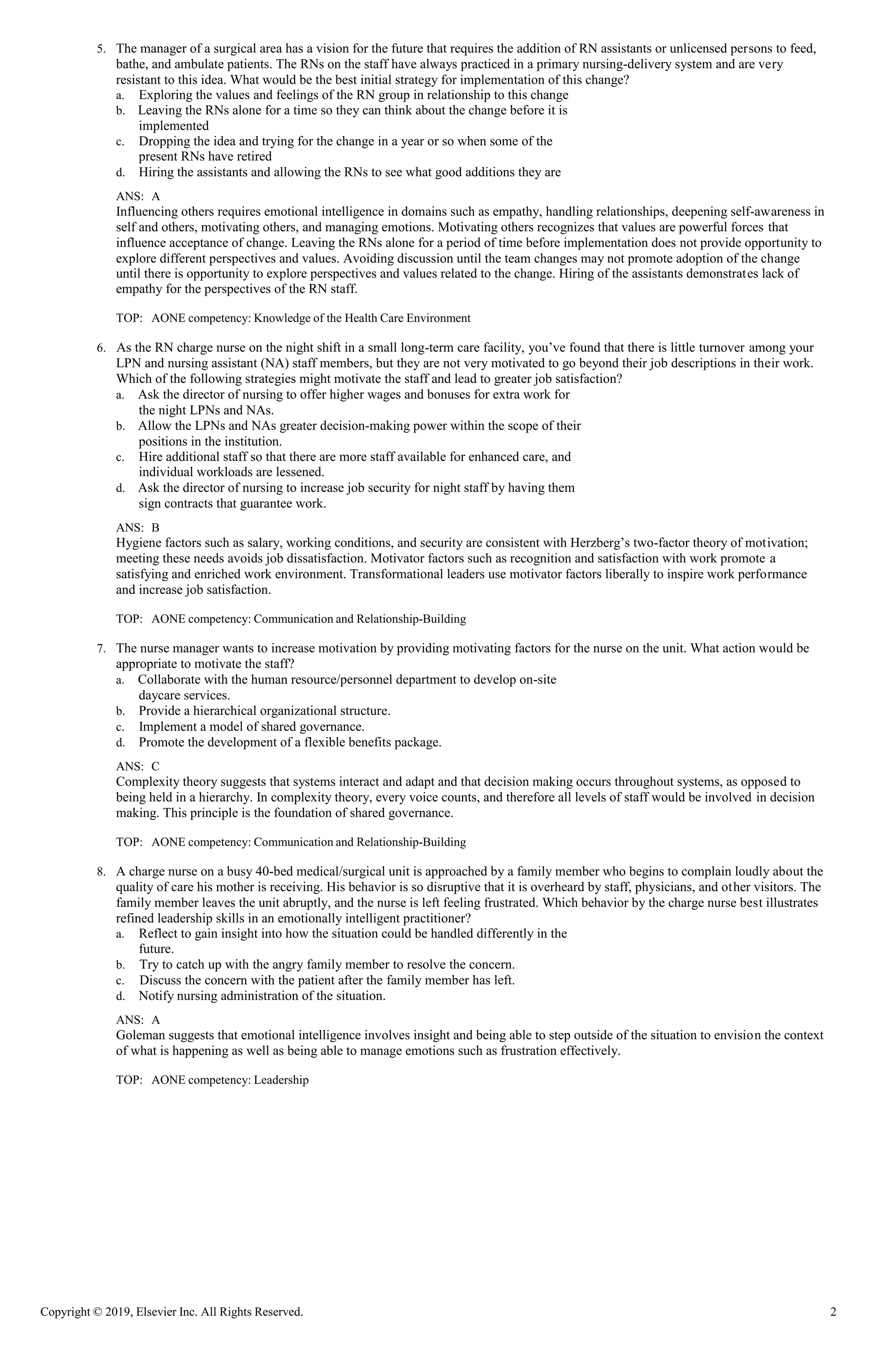
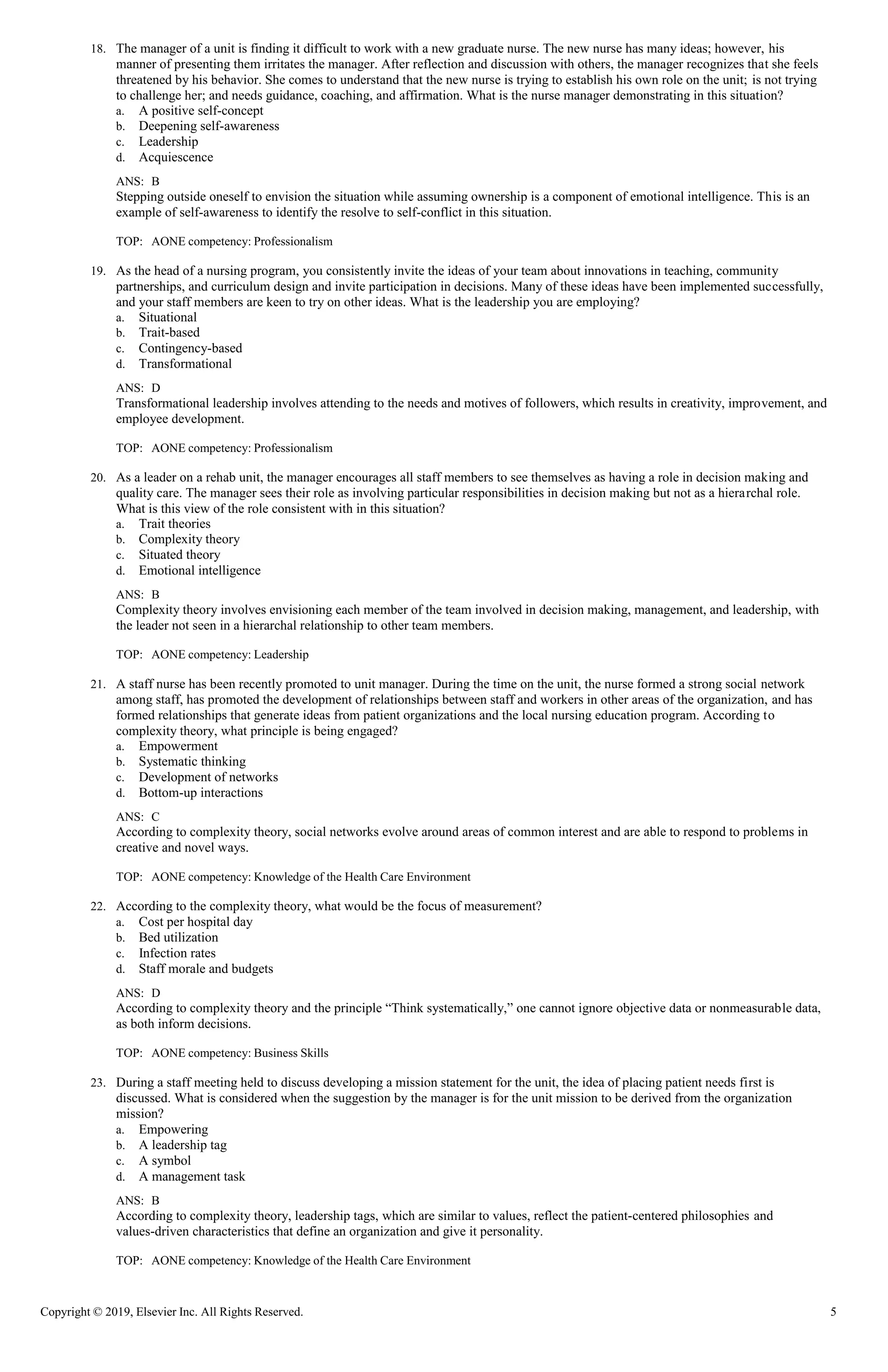
5. The manager of a surgical area has a vision for the future that requires the addition of RN assistants or unlicensed persons to feed,
bathe, and ambulate patients. The RNs on the staff have always practiced in a primary nursing-delivery system and are very
resistant to this idea. What would be the best initial strategy for implementation of this change?
a. Exploring the values and feelings of the RN group in relationship to this change
b. Leaving the RNs alone for a time so they can think about the change before it is
implemented
c. Dropping the idea and trying for the change in a year or so when some of the
present RNs have retired
d. Hiring the assistants and allowing the RNs to see what good additions they are
ANS: A
Influencing others requires emotional intelligence in domains such as empathy, handling relationships, deepening self-awareness in
self and others, motivating others, and managing emotions. Motivating others recognizes that values are powerful forces that
influence acceptance of change. Leaving the RNs alone for a period of time before implementation does not provide opportunity to
explore different perspectives and values. Avoiding discussion until the team changes may not promote adoption of the change
until there is opportunity to explore perspectives and values related to the change. Hiring of the assistants demonstrates lack of
empathy for the perspectives of the RN staff.
TOP: AONE competency: Knowledge of the Health Care Environment
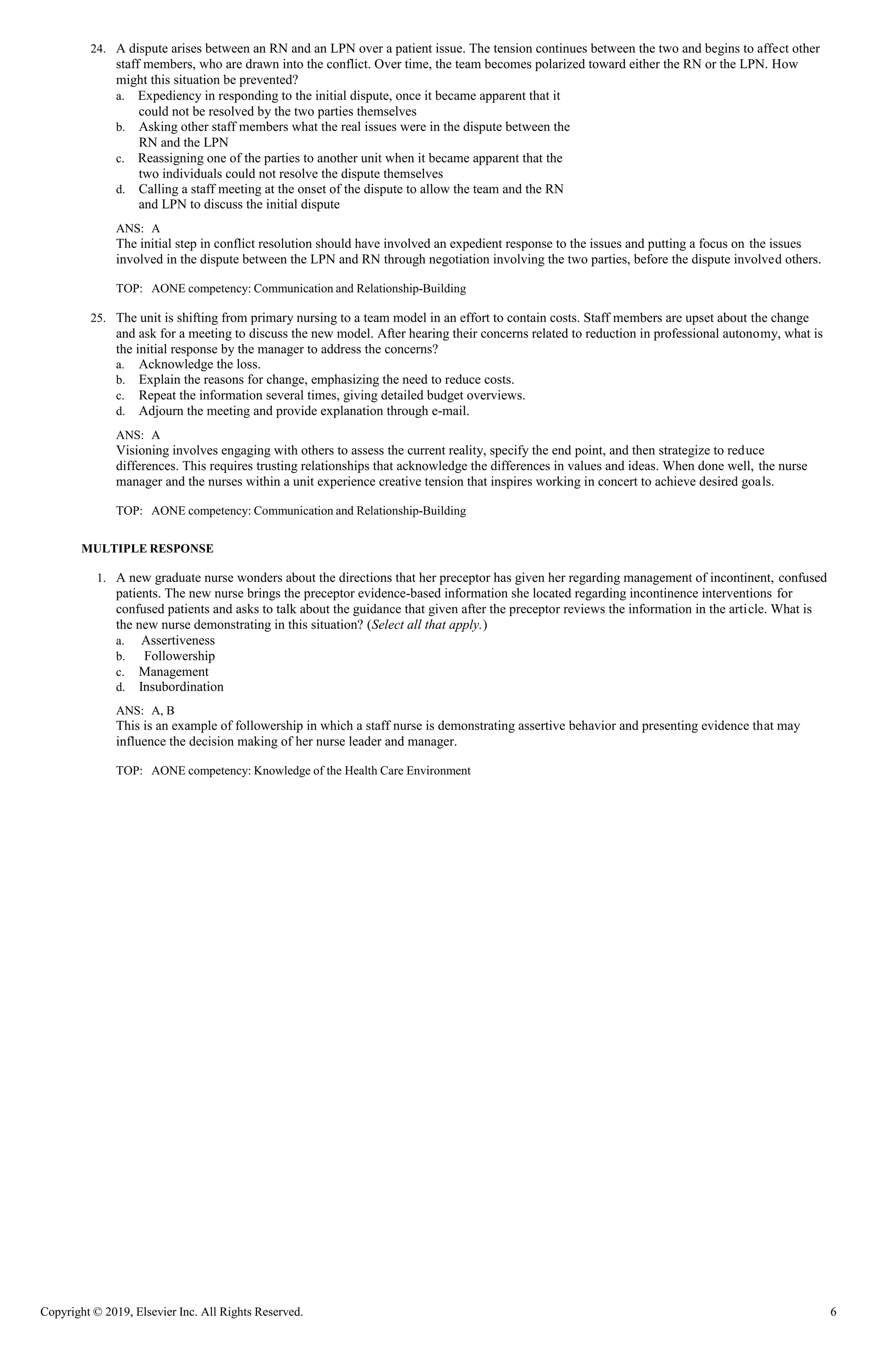
6. As the RN charge nurse on the night shift in a small long-term care facility, you’ve found that there is little turnover among your
LPN and nursing assistant (NA) staff members, but they are not very motivated to go beyond their job descriptions in their work.
Which of the following strategies might motivate the staff and lead to greater job satisfaction?
a. Ask the director of nursing to offer higher wages and bonuses for extra work for
the night LPNs and NAs.
b. Allow the LPNs and NAs greater decision-making power within the scope of their
positions in the institution.
c. Hire additional staff so that there are more staff available for enhanced care, and
individual workloads are lessened.
d. Ask the director of nursing to increase job security for night staff by having them
sign contracts that guarantee work.
ANS: B
Hygiene factors such as salary, working conditions, and security are consistent with Herzberg’s two-factor theory of motivation;
meeting these needs avoids job dissatisfaction. Motivator factors such as recognition and satisfaction with work promote a
satisfying and enriched work environment. Transformational leaders use motivator factors liberally to inspire work performance
and increase job satisfaction.
TOP: AONE competency: Communication and Relationship-Building
7. The nurse manager wants to increase motivation by providing motivating factors for the nurse on the unit. What action would be
appropriate to motivate the staff?
a. Collaborate with the human resource/personnel department to develop on-site
daycare services.
b. Provide a hierarchical organizational structure.
c. Implement a model of shared governance.
d. Promote the development of a flexible benefits package.
ANS: C
Complexity theory suggests that systems interact and adapt and that decision making occurs throughout systems, as opposed to
being held in a hierarchy. In complexity theory, every voice counts, and therefore all levels of staff would be involved in decision
making. This principle is the foundation of shared governance.
TOP: AONE competency: Communication and Relationship-Building
8. A charge nurse on a busy 40-bed medical/surgical unit is approached by a family member who begins to complain loudly about the
quality of care his mother is receiving. His behavior is so disruptive that it is overheard by staff, physicians, and other visitors. The
family member leaves the unit abruptly, and the nurse is left feeling frustrated. Which behavior by the charge nurse best illustrates
refined leadership skills in an emotionally intelligent practitioner?
a. Reflect to gain insight into how the situation could be handled differently in the
future.
b. Try to catch up with the angry family member to resolve the concern.
c. Discuss the concern with the patient after the family member has left.
d. Notify nursing administration of the situation.
ANS: A
Goleman suggests that emotional intelligence involves insight and being able to step outside of the situation to envision the context
of what is happening as well as being able to manage emotions such as frustration effectively.
TOP: AONE competency: Leadership
Copyright © 2019, Elsevier Inc. All Rights Reserved. 3
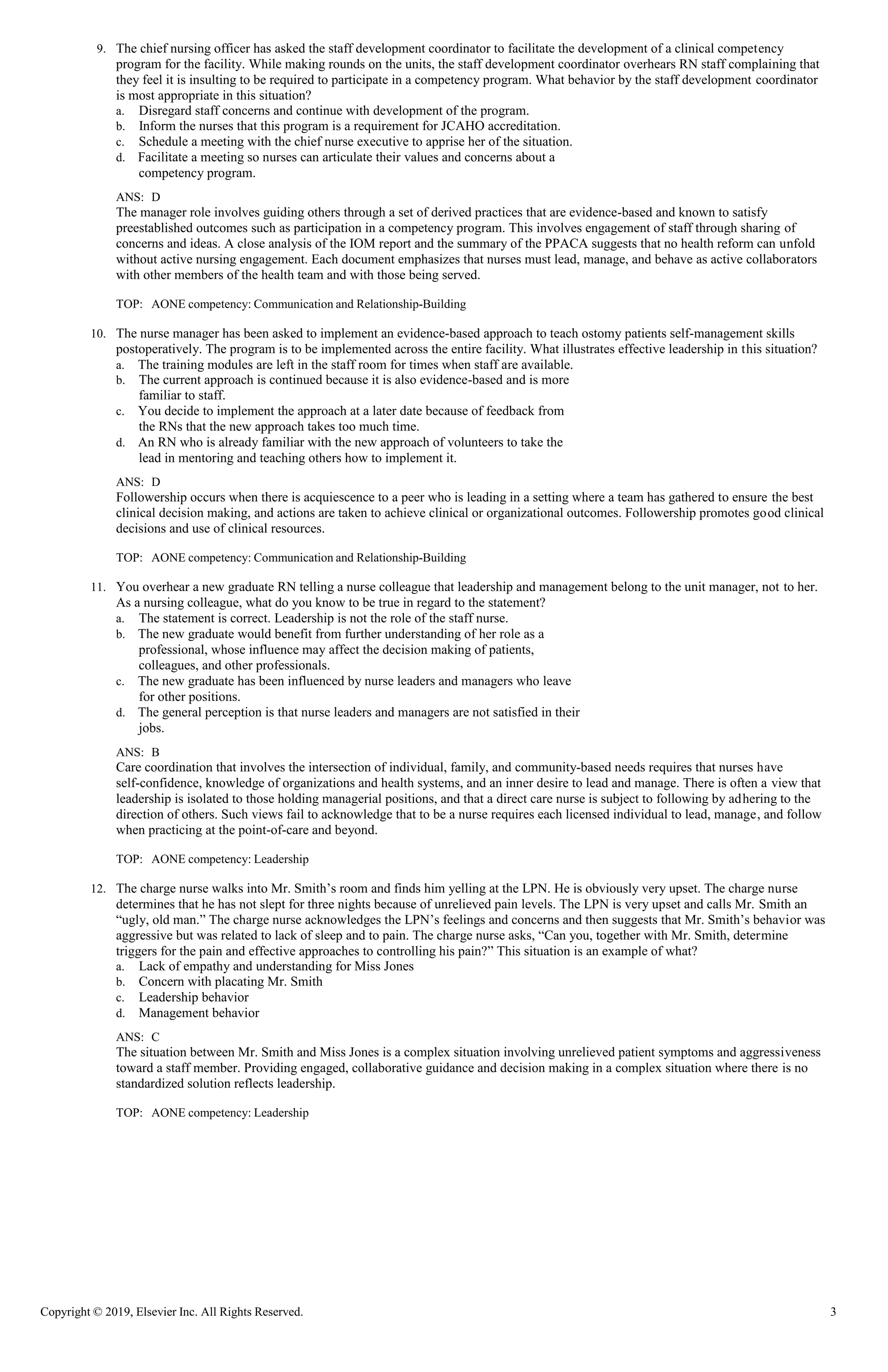
9. The chief nursing officer has asked the staff development coordinator to facilitate the development of a clinical competency
program for the facility. While making rounds on the units, the staff development coordinator overhears RN staff complaining that
they feel it is insulting to be required to participate in a competency program. What behavior by the staff development coordinator
is most appropriate in this situation?
a. Disregard staff concerns and continue with development of the program.
b. Inform the nurses that this program is a requirement for JCAHO accreditation.
c. Schedule a meeting with the chief nurse executive to apprise her of the situation.
d. Facilitate a meeting so nurses can articulate their values and concerns about a
competency program.
ANS: D
The manager role involves guiding others through a set of derived practices that are evidence-based and known to satisfy
preestablished outcomes such as participation in a competency program. This involves engagement of staff through sharing of
concerns and ideas. A close analysis of the IOM report and the summary of the PPACA suggests that no health reform can unfold
without active nursing engagement. Each document emphasizes that nurses must lead, manage, and behave as active collaborators
with other members of the health team and with those being served.
TOP: AONE competency: Communication and Relationship-Building
10. The nurse manager has been asked to implement an evidence-based approach to teach ostomy patients self-management skills
postoperatively. The program is to be implemented across the entire facility. What illustrates effective leadership in this situation?
a. The training modules are left in the staff room for times when staff are available.
b. The current approach is continued because it is also evidence-based and is more
familiar to staff.
c. You decide to implement the approach at a later date because of feedback from
the RNs that the new approach takes too much time.
d. An RN who is already familiar with the new approach of volunteers to take the
lead in mentoring and teaching others how to implement it.
ANS: D
Followership occurs when there is acquiescence to a peer who is leading in a setting where a team has gathered to ensure the best
clinical decision making, and actions are taken to achieve clinical or organizational outcomes. Followership promotes good clinical
decisions and use of clinical resources.
TOP: AONE competency: Communication and Relationship-Building
11. You overhear a new graduate RN telling a nurse colleague that leadership and management belong to the unit manager, not to her.
As a nursing colleague, what do you know to be true in regard to the statement?
a. The statement is correct. Leadership is not the role of the staff nurse.
b. The new graduate would benefit from further understanding of her role as a
professional, whose influence may affect the decision making of patients,
colleagues, and other professionals.
c. The new graduate has been influenced by nurse leaders and managers who leave
for other positions.
d. The general perception is that nurse leaders and managers are not satisfied in their
jobs.
ANS: B
Care coordination that involves the intersection of individual, family, and community-based needs requires that nurses have
self-confidence, knowledge of organizations and health systems, and an inner desire to lead and manage. There is often a view that
leadership is isolated to those holding managerial positions, and that a direct care nurse is subject to following by adhering to the
direction of others. Such views fail to acknowledge that to be a nurse requires each licensed individual to lead, manage, and follow
when practicing at the point-of-care and beyond.
TOP: AONE competency: Leadership
12. The charge nurse walks into Mr. Smith’s room and finds him yelling at the LPN. He is obviously very upset. The charge nurse
determines that he has not slept for three nights because of unrelieved pain levels. The LPN is very upset and calls Mr. Smith an
“ugly, old man.” The charge nurse acknowledges the LPN’s feelings and concerns and then suggests that Mr. Smith’s behavior was
aggressive but was related to lack of sleep and to pain. The charge nurse asks, “Can you, together with Mr. Smith, determine
triggers for the pain and effective approaches to controlling his pain?” This situation is an example of what?
a. Lack of empathy and understanding for Miss Jones
b. Concern with placating Mr. Smith
c. Leadership behavior
d. Management behavior
ANS: C
The situation between Mr. Smith and Miss Jones is a complex situation involving unrelieved patient symptoms and aggressiveness
toward a staff member. Providing engaged, collaborative guidance and decision making in a complex situation where there is no
standardized solution reflects leadership.
TOP: AONE competency: Leadership
Copyright © 2019, Elsevier Inc. All Rights Reserved. 4
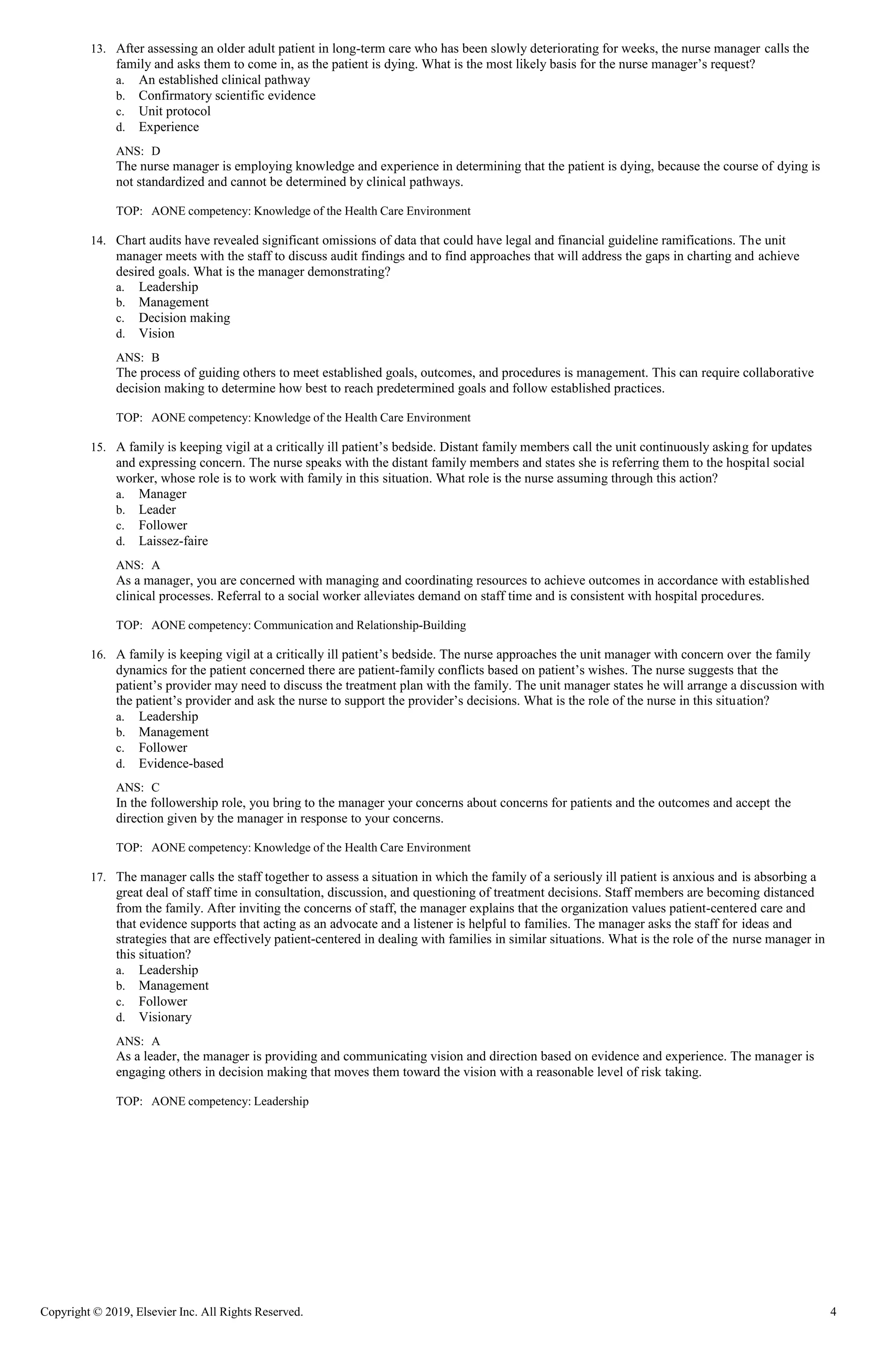
13. After assessing an older adult patient in long-term care who has been slowly deteriorating for weeks, the nurse manager calls the
family and asks them to come in, as the patient is dying. What is the most likely basis for the nurse manager’s request?
a. An established clinical pathway
b. Confirmatory scientific evidence
c. Unit protocol
d. Experience
ANS: D
The nurse manager is employing knowledge and experience in determining that the patient is dying, because the course of dying is
not standardized and cannot be determined by clinical pathways.
TOP: AONE competency: Knowledge of the Health Care Environment
14. Chart audits have revealed significant omissions of data that could have legal and financial guideline ramifications. The unit
manager meets with the staff to discuss audit findings and to find approaches that will address the gaps in charting and achieve
desired goals. What is the manager demonstrating?
a. Leadership
b. Management
c. Decision making
d. Vision
ANS: B
The process of guiding others to meet established goals, outcomes, and procedures is management. This can require collaborative
decision making to determine how best to reach predetermined goals and follow established practices.
TOP: AONE competency: Knowledge of the Health Care Environment
15. A family is keeping vigil at a critically ill patient’s bedside. Distant family members call the unit continuously asking for updates
and expressing concern. The nurse speaks with the distant family members and states she is referring them to the hospital social
worker, whose role is to work with family in this situation. What role is the nurse assuming through this action?
a. Manager
b. Leader
c. Follower
d. Laissez-faire
ANS: A
As a manager, you are concerned with managing and coordinating resources to achieve outcomes in accordance with established
clinical processes. Referral to a social worker alleviates demand on staff time and is consistent with hospital procedures.
TOP: AONE competency: Communication and Relationship-Building
16. A family is keeping vigil at a critically ill patient’s bedside. The nurse approaches the unit manager with concern over the family
dynamics for the patient concerned there are patient-family conflicts based on patient’s wishes. The nurse suggests that the
patient’s provider may need to discuss the treatment plan with the family. The unit manager states he will arrange a discussion with
the patient’s provider and ask the nurse to support the provider’s decisions. What is the role of the nurse in this situation?
a. Leadership
b. Management
c. Follower
d. Evidence-based
ANS: C
In the followership role, you bring to the manager your concerns about concerns for patients and the outcomes and accept the
direction given by the manager in response to your concerns.
TOP: AONE competency: Knowledge of the Health Care Environment
17. The manager calls the staff together to assess a situation in which the family of a seriously ill patient is anxious and is absorbing a
great deal of staff time in consultation, discussion, and questioning of treatment decisions. Staff members are becoming distanced
from the family. After inviting the concerns of staff, the manager explains that the organization values patient-centered care and
that evidence supports that acting as an advocate and a listener is helpful to families. The manager asks the staff for ideas and
strategies that are effectively patient-centered in dealing with families in similar situations. What is the role of the nurse manager in
this situation?
a. Leadership
b. Management
c. Follower
d. Visionary
ANS: A
As a leader, the manager is providing and communicating vision and direction based on evidence and experience. The manager is
engaging others in decision making that moves them toward the vision with a reasonable level of risk taking.
TOP: AONE competency: Leadership
Copyright © 2019, Elsevier Inc. All Rights Reserved. 5
18. The manager of a unit is finding it difficult to work with a new graduate nurse. The new nurse has many ideas; however, his
manner of presenting them irritates the manager. After reflection and discussion with others, the manager recognizes that she feels
threatened by his behavior. She comes to understand that the new nurse is trying to establish his own role on the unit; is not trying
to challenge her; and needs guidance, coaching, and affirmation. What is the nurse manager demonstrating in this situation?
a. A positive self-concept
b. Deepening self-awareness
c. Leadership
d. Acquiescence
ANS: B
Stepping outside oneself to envision the situation while assuming ownership is a component of emotional intelligence. This is an
example of self-awareness to identify the resolve to self-conflict in this situation.
TOP: AONE competency: Professionalism
19. As the head of a nursing program, you consistently invite the ideas of your team about innovations in teaching, community
partnerships, and curriculum design and invite participation in decisions. Many of these ideas have been implemented successfully,
and your staff members are keen to try on other ideas. What is the leadership you are employing?
a. Situational
b. Trait-based
c. Contingency-based
d. Transformational
ANS: D
Transformational leadership involves attending to the needs and motives of followers, which results in creativity, improvement, and
employee development.
TOP: AONE competency: Professionalism
20. As a leader on a rehab unit, the manager encourages all staff members to see themselves as having a role in decision making and
quality care. The manager sees their role as involving particular responsibilities in decision making but not as a hierarchal role.
What is this view of the role consistent with in this situation?
a. Trait theories
b. Complexity theory
c. Situated theory
d. Emotional intelligence
ANS: B
Complexity theory involves envisioning each member of the team involved in decision making, management, and leadership, with
the leader not seen in a hierarchal relationship to other team members.
TOP: AONE competency: Leadership
21. A staff nurse has been recently promoted to unit manager. During the time on the unit, the nurse formed a strong social network
among staff, has promoted the development of relationships between staff and workers in other areas of the organization, and has
formed relationships that generate ideas from patient organizations and the local nursing education program. According to
complexity theory, what principle is being engaged?
a. Empowerment
b. Systematic thinking
c. Development of networks
d. Bottom-up interactions
ANS: C
According to complexity theory, social networks evolve around areas of common interest and are able to respond to problems in
creative and novel ways.
TOP: AONE competency: Knowledge of the Health Care Environment
22. According to the complexity theory, what would be the focus of measurement?
a. Cost per hospital day
b. Bed utilization
c. Infection rates
d. Staff morale and budgets
ANS: D
According to complexity theory and the principle “Think systematically,” one cannot ignore objective data or nonmeasurable data,
as both inform decisions.
TOP: AONE competency: Business Skills
23. During a staff meeting held to discuss developing a mission statement for the unit, the idea of placing patient needs first is
discussed. What is considered when the suggestion by the manager is for the unit mission to be derived from the organization
mission?
a. Empowering
b. A leadership tag
c. A symbol
d. A management task
ANS: B
According to complexity theory, leadership tags, which are similar to values, reflect the patient-centered philosophies and
values-driven characteristics that define an organization and give it personality.
TOP: AONE competency: Knowledge of the Health Care Environment
Copyright © 2019, Elsevier Inc. All Rights Reserved. 6
24. A dispute arises between an RN and an LPN over a patient issue. The tension continues between the two and begins to affect other
staff members, who are drawn into the conflict. Over time, the team becomes polarized toward either the RN or the LPN. How
might this situation be prevented?
a. Expediency in responding to the initial dispute, once it became apparent that it
could not be resolved by the two parties themselves
b. Asking other staff members what the real issues were in the dispute between the
RN and the LPN
c. Reassigning one of the parties to another unit when it became apparent that the
two individuals could not resolve the dispute themselves
d. Calling a staff meeting at the onset of the dispute to allow the team and the RN
and LPN to discuss the initial dispute
ANS: A
The initial step in conflict resolution should have involved an expedient response to the issues and putting a focus on the issues
involved in the dispute between the LPN and RN through negotiation involving the two parties, before the dispute involved others.
TOP: AONE competency: Communication and Relationship-Building
25. The unit is shifting from primary nursing to a team model in an effort to contain costs. Staff members are upset about the change
and ask for a meeting to discuss the new model. After hearing their concerns related to reduction in professional autonomy, what is
the initial response by the manager to address the concerns?
a. Acknowledge the loss.
b. Explain the reasons for change, emphasizing the need to reduce costs.
c. Repeat the information several times, giving detailed budget overviews.
d. Adjourn the meeting and provide explanation through e-mail.
ANS: A
Visioning involves engaging with others to assess the current reality, specify the end point, and then strategize to reduce
differences. This requires trusting relationships that acknowledge the differences in values and ideas. When done well, the nurse
manager and the nurses within a unit experience creative tension that inspires working in concert to achieve desired goals.
TOP: AONE competency: Communication and Relationship-Building
MULTIPLE RESPONSE
1. A new graduate nurse wonders about the directions that her preceptor has given her regarding management of incontinent, confused
patients. The new nurse brings the preceptor evidence-based information she located regarding incontinence interventions for
confused patients and asks to talk about the guidance that given after the preceptor reviews the information in the article. What is
the new nurse demonstrating in this situation? (Select all that apply.)
a. Assertiveness
b. Followership
c. Management
d. Insubordination
ANS: A, B
This is an example of followership in which a staff nurse is demonstrating assertive behavior and presenting evidence that may
influence the decision making of her nurse leader and manager.
TOP: AONE competency: Knowledge of the Health Care Environment
Random documents with unrelated
content Scribd suggests to you:
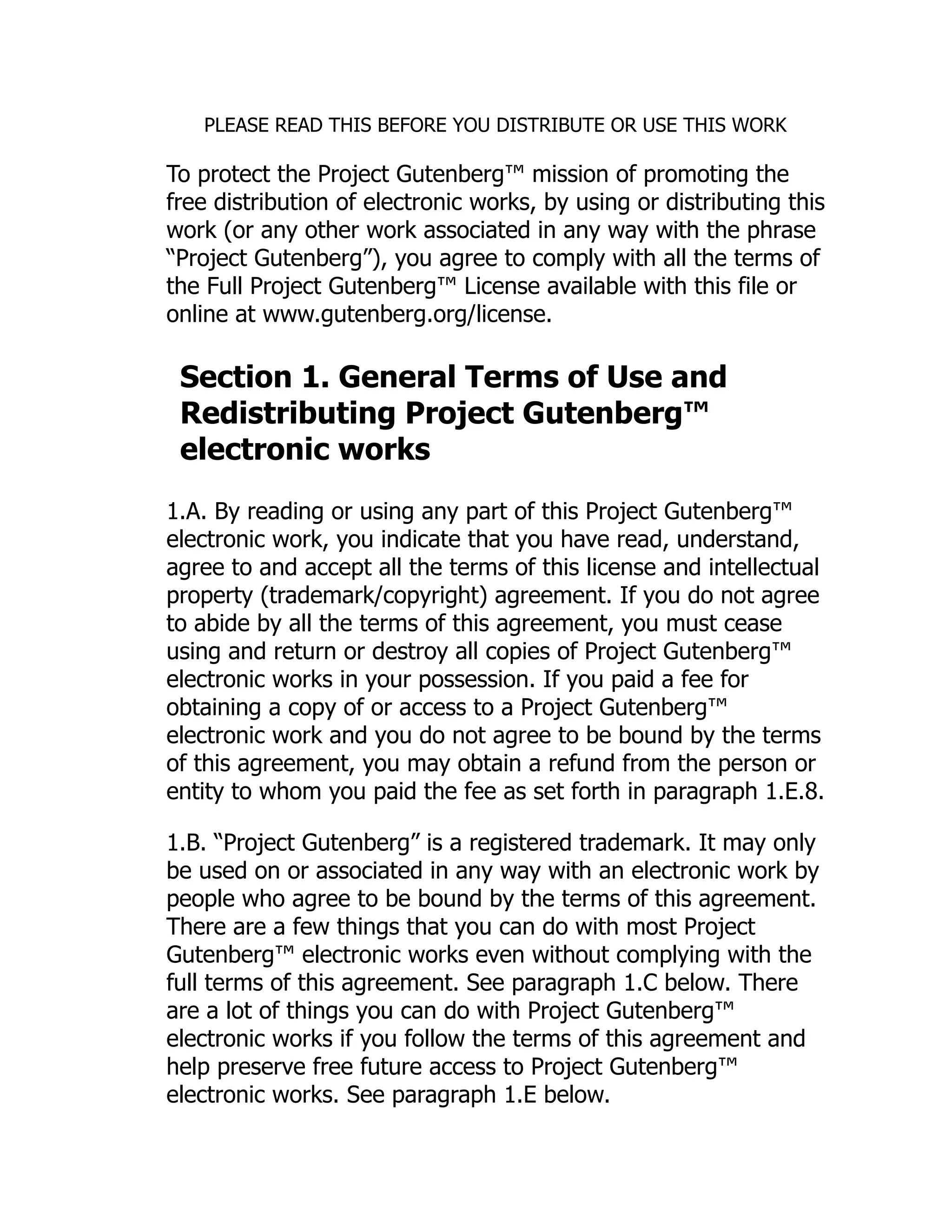
PLEASE READ THIS BEFORE YOU DISTRIBUTE OR USE THIS WORK
To protect the Project Gutenberg™ mission of promoting the
free distribution of electronic works, by using or distributing this
work (or any other work associated in any way with the phrase
“Project Gutenberg”), you agree to comply with all the terms of
the Full Project Gutenberg™ License available with this file or
online at www.gutenberg.org/license.
Section 1. General Terms of Use and
Redistributing Project Gutenberg™
electronic works
1.A. By reading or using any part of this Project Gutenberg™
electronic work, you indicate that you have read, understand,
agree to and accept all the terms of this license and intellectual
property (trademark/copyright) agreement. If you do not agree
to abide by all the terms of this agreement, you must cease
using and return or destroy all copies of Project Gutenberg™
electronic works in your possession. If you paid a fee for
obtaining a copy of or access to a Project Gutenberg™
electronic work and you do not agree to be bound by the terms
of this agreement, you may obtain a refund from the person or
entity to whom you paid the fee as set forth in paragraph 1.E.8.
1.B. “Project Gutenberg” is a registered trademark. It may only
be used on or associated in any way with an electronic work by
people who agree to be bound by the terms of this agreement.
There are a few things that you can do with most Project
Gutenberg™ electronic works even without complying with the
full terms of this agreement. See paragraph 1.C below. There
are a lot of things you can do with Project Gutenberg™
electronic works if you follow the terms of this agreement and
help preserve free future access to Project Gutenberg™
electronic works. See paragraph 1.E below.
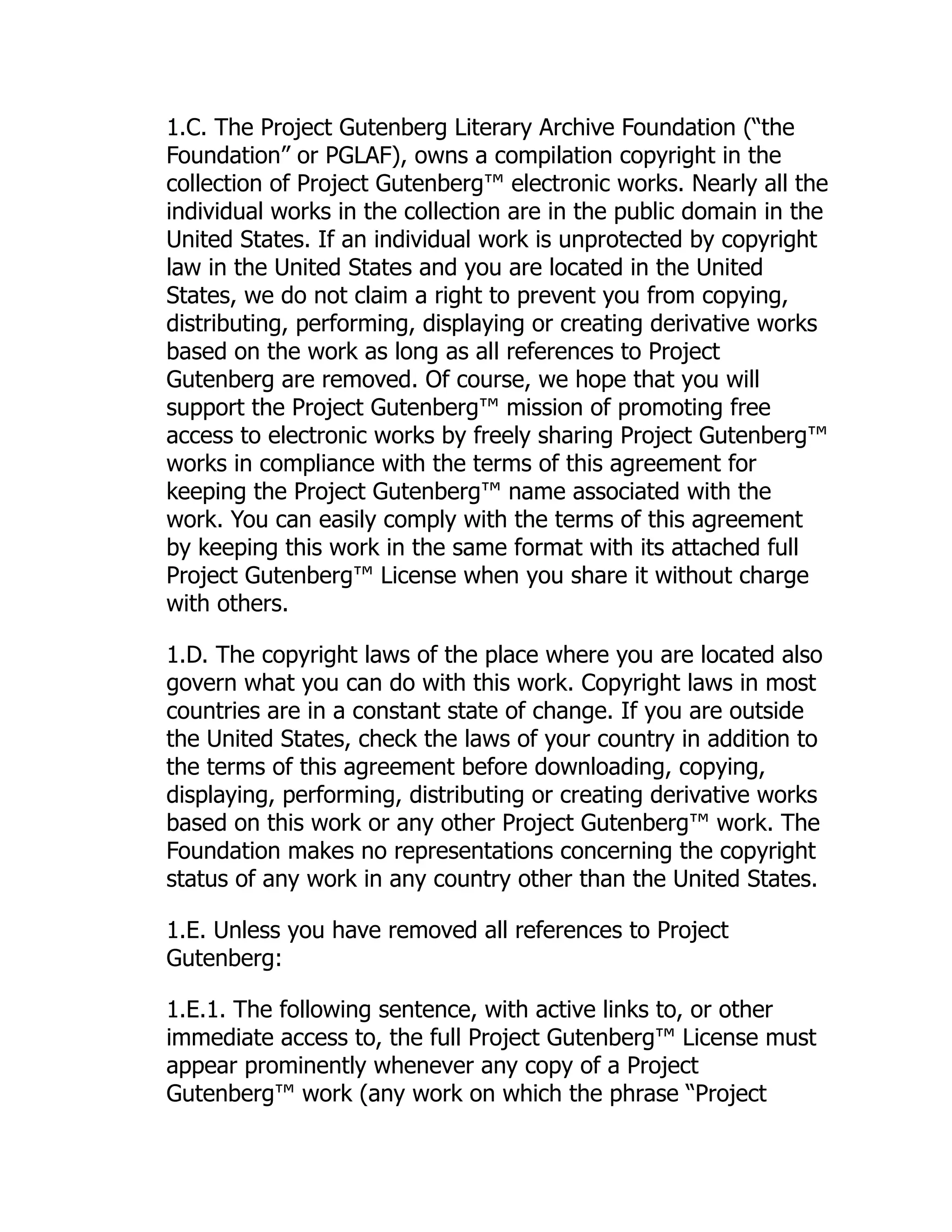
1.C. The Project Gutenberg Literary Archive Foundation (“the
Foundation” or PGLAF), owns a compilation copyright in the
collection of Project Gutenberg™ electronic works. Nearly all the
individual works in the collection are in the public domain in the
United States. If an individual work is unprotected by copyright
law in the United States and you are located in the United
States, we do not claim a right to prevent you from copying,
distributing, performing, displaying or creating derivative works
based on the work as long as all references to Project
Gutenberg are removed. Of course, we hope that you will
support the Project Gutenberg™ mission of promoting free
access to electronic works by freely sharing Project Gutenberg™
works in compliance with the terms of this agreement for
keeping the Project Gutenberg™ name associated with the
work. You can easily comply with the terms of this agreement
by keeping this work in the same format with its attached full
Project Gutenberg™ License when you share it without charge
with others.
1.D. The copyright laws of the place where you are located also
govern what you can do with this work. Copyright laws in most
countries are in a constant state of change. If you are outside
the United States, check the laws of your country in addition to
the terms of this agreement before downloading, copying,
displaying, performing, distributing or creating derivative works
based on this work or any other Project Gutenberg™ work. The
Foundation makes no representations concerning the copyright
status of any work in any country other than the United States.
1.E. Unless you have removed all references to Project
Gutenberg:
1.E.1. The following sentence, with active links to, or other
immediate access to, the full Project Gutenberg™ License must
appear prominently whenever any copy of a Project
Gutenberg™ work (any work on which the phrase “Project
Gutenberg” appears, or with which the phrase “Project
Gutenberg” is associated) is accessed, displayed, performed,
viewed, copied or distributed:
This eBook is for the use of anyone anywhere in the United
States and most other parts of the world at no cost and
with almost no restrictions whatsoever. You may copy it,
give it away or re-use it under the terms of the Project
Gutenberg License included with this eBook or online at
www.gutenberg.org. If you are not located in the United
States, you will have to check the laws of the country
where you are located before using this eBook.
1.E.2. If an individual Project Gutenberg™ electronic work is
derived from texts not protected by U.S. copyright law (does not
contain a notice indicating that it is posted with permission of
the copyright holder), the work can be copied and distributed to
anyone in the United States without paying any fees or charges.
If you are redistributing or providing access to a work with the
phrase “Project Gutenberg” associated with or appearing on the
work, you must comply either with the requirements of
paragraphs 1.E.1 through 1.E.7 or obtain permission for the use
of the work and the Project Gutenberg™ trademark as set forth
in paragraphs 1.E.8 or 1.E.9.
1.E.3. If an individual Project Gutenberg™ electronic work is
posted with the permission of the copyright holder, your use and
distribution must comply with both paragraphs 1.E.1 through
1.E.7 and any additional terms imposed by the copyright holder.
Additional terms will be linked to the Project Gutenberg™
License for all works posted with the permission of the copyright
holder found at the beginning of this work.
1.E.4. Do not unlink or detach or remove the full Project
Gutenberg™ License terms from this work, or any files
containing a part of this work or any other work associated with
Project Gutenberg™.
1.E.5. Do not copy, display, perform, distribute or redistribute
this electronic work, or any part of this electronic work, without
prominently displaying the sentence set forth in paragraph 1.E.1
with active links or immediate access to the full terms of the
Project Gutenberg™ License.
1.E.6. You may convert to and distribute this work in any binary,
compressed, marked up, nonproprietary or proprietary form,
including any word processing or hypertext form. However, if
you provide access to or distribute copies of a Project
Gutenberg™ work in a format other than “Plain Vanilla ASCII” or
other format used in the official version posted on the official
Project Gutenberg™ website (www.gutenberg.org), you must,
at no additional cost, fee or expense to the user, provide a copy,
a means of exporting a copy, or a means of obtaining a copy
upon request, of the work in its original “Plain Vanilla ASCII” or
other form. Any alternate format must include the full Project
Gutenberg™ License as specified in paragraph 1.E.1.
1.E.7. Do not charge a fee for access to, viewing, displaying,
performing, copying or distributing any Project Gutenberg™
works unless you comply with paragraph 1.E.8 or 1.E.9.
1.E.8. You may charge a reasonable fee for copies of or
providing access to or distributing Project Gutenberg™
electronic works provided that:
• You pay a royalty fee of 20% of the gross profits you derive
from the use of Project Gutenberg™ works calculated using the
method you already use to calculate your applicable taxes. The
fee is owed to the owner of the Project Gutenberg™ trademark,
but he has agreed to donate royalties under this paragraph to
the Project Gutenberg Literary Archive Foundation. Royalty
payments must be paid within 60 days following each date on
which you prepare (or are legally required to prepare) your
periodic tax returns. Royalty payments should be clearly marked
as such and sent to the Project Gutenberg Literary Archive
Foundation at the address specified in Section 4, “Information
about donations to the Project Gutenberg Literary Archive
Foundation.”
• You provide a full refund of any money paid by a user who
notifies you in writing (or by e-mail) within 30 days of receipt
that s/he does not agree to the terms of the full Project
Gutenberg™ License. You must require such a user to return or
destroy all copies of the works possessed in a physical medium
and discontinue all use of and all access to other copies of
Project Gutenberg™ works.
• You provide, in accordance with paragraph 1.F.3, a full refund of
any money paid for a work or a replacement copy, if a defect in
the electronic work is discovered and reported to you within 90
days of receipt of the work.
• You comply with all other terms of this agreement for free
distribution of Project Gutenberg™ works.
1.E.9. If you wish to charge a fee or distribute a Project
Gutenberg™ electronic work or group of works on different
terms than are set forth in this agreement, you must obtain
permission in writing from the Project Gutenberg Literary
Archive Foundation, the manager of the Project Gutenberg™
trademark. Contact the Foundation as set forth in Section 3
below.
1.F.
1.F.1. Project Gutenberg volunteers and employees expend
considerable effort to identify, do copyright research on,
transcribe and proofread works not protected by U.S. copyright
law in creating the Project Gutenberg™ collection. Despite these
efforts, Project Gutenberg™ electronic works, and the medium
on which they may be stored, may contain “Defects,” such as,
but not limited to, incomplete, inaccurate or corrupt data,
transcription errors, a copyright or other intellectual property
infringement, a defective or damaged disk or other medium, a
computer virus, or computer codes that damage or cannot be
read by your equipment.
1.F.2. LIMITED WARRANTY, DISCLAIMER OF DAMAGES - Except
for the “Right of Replacement or Refund” described in
paragraph 1.F.3, the Project Gutenberg Literary Archive
Foundation, the owner of the Project Gutenberg™ trademark,
and any other party distributing a Project Gutenberg™ electronic
work under this agreement, disclaim all liability to you for
damages, costs and expenses, including legal fees. YOU AGREE
THAT YOU HAVE NO REMEDIES FOR NEGLIGENCE, STRICT
LIABILITY, BREACH OF WARRANTY OR BREACH OF CONTRACT
EXCEPT THOSE PROVIDED IN PARAGRAPH 1.F.3. YOU AGREE
THAT THE FOUNDATION, THE TRADEMARK OWNER, AND ANY
DISTRIBUTOR UNDER THIS AGREEMENT WILL NOT BE LIABLE
TO YOU FOR ACTUAL, DIRECT, INDIRECT, CONSEQUENTIAL,
PUNITIVE OR INCIDENTAL DAMAGES EVEN IF YOU GIVE
NOTICE OF THE POSSIBILITY OF SUCH DAMAGE.
1.F.3. LIMITED RIGHT OF REPLACEMENT OR REFUND - If you
discover a defect in this electronic work within 90 days of
receiving it, you can receive a refund of the money (if any) you
paid for it by sending a written explanation to the person you
received the work from. If you received the work on a physical
medium, you must return the medium with your written
explanation. The person or entity that provided you with the
defective work may elect to provide a replacement copy in lieu
of a refund. If you received the work electronically, the person
or entity providing it to you may choose to give you a second
opportunity to receive the work electronically in lieu of a refund.
If the second copy is also defective, you may demand a refund
in writing without further opportunities to fix the problem.
1.F.4. Except for the limited right of replacement or refund set
forth in paragraph 1.F.3, this work is provided to you ‘AS-IS’,
WITH NO OTHER WARRANTIES OF ANY KIND, EXPRESS OR
IMPLIED, INCLUDING BUT NOT LIMITED TO WARRANTIES OF
MERCHANTABILITY OR FITNESS FOR ANY PURPOSE.
1.F.5. Some states do not allow disclaimers of certain implied
warranties or the exclusion or limitation of certain types of
damages. If any disclaimer or limitation set forth in this
agreement violates the law of the state applicable to this
agreement, the agreement shall be interpreted to make the
maximum disclaimer or limitation permitted by the applicable
state law. The invalidity or unenforceability of any provision of
this agreement shall not void the remaining provisions.
1.F.6. INDEMNITY - You agree to indemnify and hold the
Foundation, the trademark owner, any agent or employee of the
Foundation, anyone providing copies of Project Gutenberg™
electronic works in accordance with this agreement, and any
volunteers associated with the production, promotion and
distribution of Project Gutenberg™ electronic works, harmless
from all liability, costs and expenses, including legal fees, that
arise directly or indirectly from any of the following which you
do or cause to occur: (a) distribution of this or any Project
Gutenberg™ work, (b) alteration, modification, or additions or
deletions to any Project Gutenberg™ work, and (c) any Defect
you cause.
Section 2. Information about the Mission
of Project Gutenberg™
Project Gutenberg™ is synonymous with the free distribution of
electronic works in formats readable by the widest variety of
computers including obsolete, old, middle-aged and new
computers. It exists because of the efforts of hundreds of
volunteers and donations from people in all walks of life.
Volunteers and financial support to provide volunteers with the
assistance they need are critical to reaching Project
Gutenberg™’s goals and ensuring that the Project Gutenberg™
collection will remain freely available for generations to come. In
2001, the Project Gutenberg Literary Archive Foundation was
created to provide a secure and permanent future for Project
Gutenberg™ and future generations. To learn more about the
Project Gutenberg Literary Archive Foundation and how your
efforts and donations can help, see Sections 3 and 4 and the
Foundation information page at www.gutenberg.org.
Section 3. Information about the Project
Gutenberg Literary Archive Foundation
The Project Gutenberg Literary Archive Foundation is a non-
profit 501(c)(3) educational corporation organized under the
laws of the state of Mississippi and granted tax exempt status
by the Internal Revenue Service. The Foundation’s EIN or
federal tax identification number is 64-6221541. Contributions
to the Project Gutenberg Literary Archive Foundation are tax
deductible to the full extent permitted by U.S. federal laws and
your state’s laws.
The Foundation’s business office is located at 809 North 1500
West, Salt Lake City, UT 84116, (801) 596-1887. Email contact
links and up to date contact information can be found at the
Foundation’s website and official page at
www.gutenberg.org/contact
Section 4. Information about Donations to
the Project Gutenberg Literary Archive
Foundation
Project Gutenberg™ depends upon and cannot survive without
widespread public support and donations to carry out its mission
of increasing the number of public domain and licensed works
that can be freely distributed in machine-readable form
accessible by the widest array of equipment including outdated
equipment. Many small donations ($1 to $5,000) are particularly
important to maintaining tax exempt status with the IRS.
The Foundation is committed to complying with the laws
regulating charities and charitable donations in all 50 states of
the United States. Compliance requirements are not uniform
and it takes a considerable effort, much paperwork and many
fees to meet and keep up with these requirements. We do not
solicit donations in locations where we have not received written
confirmation of compliance. To SEND DONATIONS or determine
the status of compliance for any particular state visit
www.gutenberg.org/donate.
While we cannot and do not solicit contributions from states
where we have not met the solicitation requirements, we know
of no prohibition against accepting unsolicited donations from
donors in such states who approach us with offers to donate.
International donations are gratefully accepted, but we cannot
make any statements concerning tax treatment of donations
received from outside the United States. U.S. laws alone swamp
our small staff.
Please check the Project Gutenberg web pages for current
donation methods and addresses. Donations are accepted in a
number of other ways including checks, online payments and
credit card donations. To donate, please visit:
www.gutenberg.org/donate.
Section 5. General Information About
Project Gutenberg™ electronic works
Professor Michael S. Hart was the originator of the Project
Gutenberg™ concept of a library of electronic works that could
be freely shared with anyone. For forty years, he produced and
distributed Project Gutenberg™ eBooks with only a loose
network of volunteer support.
Project Gutenberg™ eBooks are often created from several
printed editions, all of which are confirmed as not protected by
copyright in the U.S. unless a copyright notice is included. Thus,
we do not necessarily keep eBooks in compliance with any
particular paper edition.
Most people start at our website which has the main PG search
facility: www.gutenberg.org.
This website includes information about Project Gutenberg™,
including how to make donations to the Project Gutenberg
Literary Archive Foundation, how to help produce our new
eBooks, and how to subscribe to our email newsletter to hear
about new eBooks.
Welcome to our website – the perfect destination for book lovers and
knowledge seekers. We believe that every book holds a new world,
offering opportunities for learning, discovery, and personal growth.
That’s why we are dedicated to bringing you a diverse collection of
books, ranging from classic literature and specialized publications to
self-development guides and children's books.
More than just a book-buying platform, we strive to be a bridge
connecting you with timeless cultural and intellectual values. With an
elegant, user-friendly interface and a smart search system, you can
quickly find the books that best suit your interests. Additionally,
our special promotions and home delivery services help you save time
and fully enjoy the joy of reading.
Join us on a journey of knowledge exploration, passion nurturing, and
personal growth every day!
testbankmall.com

Test Bank for Leading and Managing in Nursing 7th Edition by Yoder Wise

  • 1.
    Test Bank forLeading and Managing in Nursing 7th Edition by Yoder Wise download https://testbankmall.com/product/test-bank-for-leading-and- managing-in-nursing-7th-edition-by-yoder-wise/ Find test banks or solution manuals at testbankmall.com today!
  • 2.
    We have selectedsome products that you may be interested in Click the link to download now or visit testbankmall.com for more options!. Leading and Managing in Nursing Yoder-Wise 5th Edition Test Bank https://testbankmall.com/product/leading-and-managing-in-nursing- yoder-wise-5th-edition-test-bank/ Test Bank for Leading and Managing in Canadian Nursing 1st Edition by Yoder Wise https://testbankmall.com/product/test-bank-for-leading-and-managing- in-canadian-nursing-1st-edition-by-yoder-wise/ Management Leading and Collaborating in a Competitive World Bateman 11th Edition Test Bank https://testbankmall.com/product/management-leading-and-collaborating- in-a-competitive-world-bateman-11th-edition-test-bank/ Microbiology Principles and Explorations Black 8th Edition Test Bank https://testbankmall.com/product/microbiology-principles-and- explorations-black-8th-edition-test-bank/
  • 3.
    Test Bank forThe Human Body in Health and Disease 7th Edition by Patton https://testbankmall.com/product/test-bank-for-the-human-body-in- health-and-disease-7th-edition-by-patton/ Test Bank for Cultural Anthropology: A Problem-Based Approach, 7th Edition, Richard H. Robbins, Rachel Dowty https://testbankmall.com/product/test-bank-for-cultural-anthropology- a-problem-based-approach-7th-edition-richard-h-robbins-rachel-dowty/ Solution Manual for Business Driven Information Systems, 6th Edition, Paige Baltzan, Amy Phillips https://testbankmall.com/product/solution-manual-for-business-driven- information-systems-6th-edition-paige-baltzan-amy-phillips/ Test Bank for Worlds Together, Worlds Apart 5th by Adelman https://testbankmall.com/product/test-bank-for-worlds-together-worlds- apart-5th-by-adelman/ Test Bank for College Physics: A Strategic Approach, 2nd Edition, Randall D. Knight, Brian Jones, Stuart Field, https://testbankmall.com/product/test-bank-for-college-physics-a- strategic-approach-2nd-edition-randall-d-knight-brian-jones-stuart- field/
  • 4.
    Test Bank forAnatomy and Physiology 2nd Edition by Martini https://testbankmall.com/product/test-bank-for-anatomy-and- physiology-2nd-edition-by-martini/
  • 5.
    Copyright © 2019,Elsevier Inc. All Rights Reserved. 2 5. The manager of a surgical area has a vision for the future that requires the addition of RN assistants or unlicensed persons to feed, bathe, and ambulate patients. The RNs on the staff have always practiced in a primary nursing-delivery system and are very resistant to this idea. What would be the best initial strategy for implementation of this change? a. Exploring the values and feelings of the RN group in relationship to this change b. Leaving the RNs alone for a time so they can think about the change before it is implemented c. Dropping the idea and trying for the change in a year or so when some of the present RNs have retired d. Hiring the assistants and allowing the RNs to see what good additions they are ANS: A Influencing others requires emotional intelligence in domains such as empathy, handling relationships, deepening self-awareness in self and others, motivating others, and managing emotions. Motivating others recognizes that values are powerful forces that influence acceptance of change. Leaving the RNs alone for a period of time before implementation does not provide opportunity to explore different perspectives and values. Avoiding discussion until the team changes may not promote adoption of the change until there is opportunity to explore perspectives and values related to the change. Hiring of the assistants demonstrates lack of empathy for the perspectives of the RN staff. TOP: AONE competency: Knowledge of the Health Care Environment 6. As the RN charge nurse on the night shift in a small long-term care facility, you’ve found that there is little turnover among your LPN and nursing assistant (NA) staff members, but they are not very motivated to go beyond their job descriptions in their work. Which of the following strategies might motivate the staff and lead to greater job satisfaction? a. Ask the director of nursing to offer higher wages and bonuses for extra work for the night LPNs and NAs. b. Allow the LPNs and NAs greater decision-making power within the scope of their positions in the institution. c. Hire additional staff so that there are more staff available for enhanced care, and individual workloads are lessened. d. Ask the director of nursing to increase job security for night staff by having them sign contracts that guarantee work. ANS: B Hygiene factors such as salary, working conditions, and security are consistent with Herzberg’s two-factor theory of motivation; meeting these needs avoids job dissatisfaction. Motivator factors such as recognition and satisfaction with work promote a satisfying and enriched work environment. Transformational leaders use motivator factors liberally to inspire work performance and increase job satisfaction. TOP: AONE competency: Communication and Relationship-Building 7. The nurse manager wants to increase motivation by providing motivating factors for the nurse on the unit. What action would be appropriate to motivate the staff? a. Collaborate with the human resource/personnel department to develop on-site daycare services. b. Provide a hierarchical organizational structure. c. Implement a model of shared governance. d. Promote the development of a flexible benefits package. ANS: C Complexity theory suggests that systems interact and adapt and that decision making occurs throughout systems, as opposed to being held in a hierarchy. In complexity theory, every voice counts, and therefore all levels of staff would be involved in decision making. This principle is the foundation of shared governance. TOP: AONE competency: Communication and Relationship-Building 8. A charge nurse on a busy 40-bed medical/surgical unit is approached by a family member who begins to complain loudly about the quality of care his mother is receiving. His behavior is so disruptive that it is overheard by staff, physicians, and other visitors. The family member leaves the unit abruptly, and the nurse is left feeling frustrated. Which behavior by the charge nurse best illustrates refined leadership skills in an emotionally intelligent practitioner? a. Reflect to gain insight into how the situation could be handled differently in the future. b. Try to catch up with the angry family member to resolve the concern. c. Discuss the concern with the patient after the family member has left. d. Notify nursing administration of the situation. ANS: A Goleman suggests that emotional intelligence involves insight and being able to step outside of the situation to envision the context of what is happening as well as being able to manage emotions such as frustration effectively. TOP: AONE competency: Leadership
  • 6.
    Copyright © 2019,Elsevier Inc. All Rights Reserved. 3 9. The chief nursing officer has asked the staff development coordinator to facilitate the development of a clinical competency program for the facility. While making rounds on the units, the staff development coordinator overhears RN staff complaining that they feel it is insulting to be required to participate in a competency program. What behavior by the staff development coordinator is most appropriate in this situation? a. Disregard staff concerns and continue with development of the program. b. Inform the nurses that this program is a requirement for JCAHO accreditation. c. Schedule a meeting with the chief nurse executive to apprise her of the situation. d. Facilitate a meeting so nurses can articulate their values and concerns about a competency program. ANS: D The manager role involves guiding others through a set of derived practices that are evidence-based and known to satisfy preestablished outcomes such as participation in a competency program. This involves engagement of staff through sharing of concerns and ideas. A close analysis of the IOM report and the summary of the PPACA suggests that no health reform can unfold without active nursing engagement. Each document emphasizes that nurses must lead, manage, and behave as active collaborators with other members of the health team and with those being served. TOP: AONE competency: Communication and Relationship-Building 10. The nurse manager has been asked to implement an evidence-based approach to teach ostomy patients self-management skills postoperatively. The program is to be implemented across the entire facility. What illustrates effective leadership in this situation? a. The training modules are left in the staff room for times when staff are available. b. The current approach is continued because it is also evidence-based and is more familiar to staff. c. You decide to implement the approach at a later date because of feedback from the RNs that the new approach takes too much time. d. An RN who is already familiar with the new approach of volunteers to take the lead in mentoring and teaching others how to implement it. ANS: D Followership occurs when there is acquiescence to a peer who is leading in a setting where a team has gathered to ensure the best clinical decision making, and actions are taken to achieve clinical or organizational outcomes. Followership promotes good clinical decisions and use of clinical resources. TOP: AONE competency: Communication and Relationship-Building 11. You overhear a new graduate RN telling a nurse colleague that leadership and management belong to the unit manager, not to her. As a nursing colleague, what do you know to be true in regard to the statement? a. The statement is correct. Leadership is not the role of the staff nurse. b. The new graduate would benefit from further understanding of her role as a professional, whose influence may affect the decision making of patients, colleagues, and other professionals. c. The new graduate has been influenced by nurse leaders and managers who leave for other positions. d. The general perception is that nurse leaders and managers are not satisfied in their jobs. ANS: B Care coordination that involves the intersection of individual, family, and community-based needs requires that nurses have self-confidence, knowledge of organizations and health systems, and an inner desire to lead and manage. There is often a view that leadership is isolated to those holding managerial positions, and that a direct care nurse is subject to following by adhering to the direction of others. Such views fail to acknowledge that to be a nurse requires each licensed individual to lead, manage, and follow when practicing at the point-of-care and beyond. TOP: AONE competency: Leadership 12. The charge nurse walks into Mr. Smith’s room and finds him yelling at the LPN. He is obviously very upset. The charge nurse determines that he has not slept for three nights because of unrelieved pain levels. The LPN is very upset and calls Mr. Smith an “ugly, old man.” The charge nurse acknowledges the LPN’s feelings and concerns and then suggests that Mr. Smith’s behavior was aggressive but was related to lack of sleep and to pain. The charge nurse asks, “Can you, together with Mr. Smith, determine triggers for the pain and effective approaches to controlling his pain?” This situation is an example of what? a. Lack of empathy and understanding for Miss Jones b. Concern with placating Mr. Smith c. Leadership behavior d. Management behavior ANS: C The situation between Mr. Smith and Miss Jones is a complex situation involving unrelieved patient symptoms and aggressiveness toward a staff member. Providing engaged, collaborative guidance and decision making in a complex situation where there is no standardized solution reflects leadership. TOP: AONE competency: Leadership
  • 7.
    Copyright © 2019,Elsevier Inc. All Rights Reserved. 4 13. After assessing an older adult patient in long-term care who has been slowly deteriorating for weeks, the nurse manager calls the family and asks them to come in, as the patient is dying. What is the most likely basis for the nurse manager’s request? a. An established clinical pathway b. Confirmatory scientific evidence c. Unit protocol d. Experience ANS: D The nurse manager is employing knowledge and experience in determining that the patient is dying, because the course of dying is not standardized and cannot be determined by clinical pathways. TOP: AONE competency: Knowledge of the Health Care Environment 14. Chart audits have revealed significant omissions of data that could have legal and financial guideline ramifications. The unit manager meets with the staff to discuss audit findings and to find approaches that will address the gaps in charting and achieve desired goals. What is the manager demonstrating? a. Leadership b. Management c. Decision making d. Vision ANS: B The process of guiding others to meet established goals, outcomes, and procedures is management. This can require collaborative decision making to determine how best to reach predetermined goals and follow established practices. TOP: AONE competency: Knowledge of the Health Care Environment 15. A family is keeping vigil at a critically ill patient’s bedside. Distant family members call the unit continuously asking for updates and expressing concern. The nurse speaks with the distant family members and states she is referring them to the hospital social worker, whose role is to work with family in this situation. What role is the nurse assuming through this action? a. Manager b. Leader c. Follower d. Laissez-faire ANS: A As a manager, you are concerned with managing and coordinating resources to achieve outcomes in accordance with established clinical processes. Referral to a social worker alleviates demand on staff time and is consistent with hospital procedures. TOP: AONE competency: Communication and Relationship-Building 16. A family is keeping vigil at a critically ill patient’s bedside. The nurse approaches the unit manager with concern over the family dynamics for the patient concerned there are patient-family conflicts based on patient’s wishes. The nurse suggests that the patient’s provider may need to discuss the treatment plan with the family. The unit manager states he will arrange a discussion with the patient’s provider and ask the nurse to support the provider’s decisions. What is the role of the nurse in this situation? a. Leadership b. Management c. Follower d. Evidence-based ANS: C In the followership role, you bring to the manager your concerns about concerns for patients and the outcomes and accept the direction given by the manager in response to your concerns. TOP: AONE competency: Knowledge of the Health Care Environment 17. The manager calls the staff together to assess a situation in which the family of a seriously ill patient is anxious and is absorbing a great deal of staff time in consultation, discussion, and questioning of treatment decisions. Staff members are becoming distanced from the family. After inviting the concerns of staff, the manager explains that the organization values patient-centered care and that evidence supports that acting as an advocate and a listener is helpful to families. The manager asks the staff for ideas and strategies that are effectively patient-centered in dealing with families in similar situations. What is the role of the nurse manager in this situation? a. Leadership b. Management c. Follower d. Visionary ANS: A As a leader, the manager is providing and communicating vision and direction based on evidence and experience. The manager is engaging others in decision making that moves them toward the vision with a reasonable level of risk taking. TOP: AONE competency: Leadership
  • 8.
    Copyright © 2019,Elsevier Inc. All Rights Reserved. 5 18. The manager of a unit is finding it difficult to work with a new graduate nurse. The new nurse has many ideas; however, his manner of presenting them irritates the manager. After reflection and discussion with others, the manager recognizes that she feels threatened by his behavior. She comes to understand that the new nurse is trying to establish his own role on the unit; is not trying to challenge her; and needs guidance, coaching, and affirmation. What is the nurse manager demonstrating in this situation? a. A positive self-concept b. Deepening self-awareness c. Leadership d. Acquiescence ANS: B Stepping outside oneself to envision the situation while assuming ownership is a component of emotional intelligence. This is an example of self-awareness to identify the resolve to self-conflict in this situation. TOP: AONE competency: Professionalism 19. As the head of a nursing program, you consistently invite the ideas of your team about innovations in teaching, community partnerships, and curriculum design and invite participation in decisions. Many of these ideas have been implemented successfully, and your staff members are keen to try on other ideas. What is the leadership you are employing? a. Situational b. Trait-based c. Contingency-based d. Transformational ANS: D Transformational leadership involves attending to the needs and motives of followers, which results in creativity, improvement, and employee development. TOP: AONE competency: Professionalism 20. As a leader on a rehab unit, the manager encourages all staff members to see themselves as having a role in decision making and quality care. The manager sees their role as involving particular responsibilities in decision making but not as a hierarchal role. What is this view of the role consistent with in this situation? a. Trait theories b. Complexity theory c. Situated theory d. Emotional intelligence ANS: B Complexity theory involves envisioning each member of the team involved in decision making, management, and leadership, with the leader not seen in a hierarchal relationship to other team members. TOP: AONE competency: Leadership 21. A staff nurse has been recently promoted to unit manager. During the time on the unit, the nurse formed a strong social network among staff, has promoted the development of relationships between staff and workers in other areas of the organization, and has formed relationships that generate ideas from patient organizations and the local nursing education program. According to complexity theory, what principle is being engaged? a. Empowerment b. Systematic thinking c. Development of networks d. Bottom-up interactions ANS: C According to complexity theory, social networks evolve around areas of common interest and are able to respond to problems in creative and novel ways. TOP: AONE competency: Knowledge of the Health Care Environment 22. According to the complexity theory, what would be the focus of measurement? a. Cost per hospital day b. Bed utilization c. Infection rates d. Staff morale and budgets ANS: D According to complexity theory and the principle “Think systematically,” one cannot ignore objective data or nonmeasurable data, as both inform decisions. TOP: AONE competency: Business Skills 23. During a staff meeting held to discuss developing a mission statement for the unit, the idea of placing patient needs first is discussed. What is considered when the suggestion by the manager is for the unit mission to be derived from the organization mission? a. Empowering b. A leadership tag c. A symbol d. A management task ANS: B According to complexity theory, leadership tags, which are similar to values, reflect the patient-centered philosophies and values-driven characteristics that define an organization and give it personality. TOP: AONE competency: Knowledge of the Health Care Environment
  • 9.
    Copyright © 2019,Elsevier Inc. All Rights Reserved. 6 24. A dispute arises between an RN and an LPN over a patient issue. The tension continues between the two and begins to affect other staff members, who are drawn into the conflict. Over time, the team becomes polarized toward either the RN or the LPN. How might this situation be prevented? a. Expediency in responding to the initial dispute, once it became apparent that it could not be resolved by the two parties themselves b. Asking other staff members what the real issues were in the dispute between the RN and the LPN c. Reassigning one of the parties to another unit when it became apparent that the two individuals could not resolve the dispute themselves d. Calling a staff meeting at the onset of the dispute to allow the team and the RN and LPN to discuss the initial dispute ANS: A The initial step in conflict resolution should have involved an expedient response to the issues and putting a focus on the issues involved in the dispute between the LPN and RN through negotiation involving the two parties, before the dispute involved others. TOP: AONE competency: Communication and Relationship-Building 25. The unit is shifting from primary nursing to a team model in an effort to contain costs. Staff members are upset about the change and ask for a meeting to discuss the new model. After hearing their concerns related to reduction in professional autonomy, what is the initial response by the manager to address the concerns? a. Acknowledge the loss. b. Explain the reasons for change, emphasizing the need to reduce costs. c. Repeat the information several times, giving detailed budget overviews. d. Adjourn the meeting and provide explanation through e-mail. ANS: A Visioning involves engaging with others to assess the current reality, specify the end point, and then strategize to reduce differences. This requires trusting relationships that acknowledge the differences in values and ideas. When done well, the nurse manager and the nurses within a unit experience creative tension that inspires working in concert to achieve desired goals. TOP: AONE competency: Communication and Relationship-Building MULTIPLE RESPONSE 1. A new graduate nurse wonders about the directions that her preceptor has given her regarding management of incontinent, confused patients. The new nurse brings the preceptor evidence-based information she located regarding incontinence interventions for confused patients and asks to talk about the guidance that given after the preceptor reviews the information in the article. What is the new nurse demonstrating in this situation? (Select all that apply.) a. Assertiveness b. Followership c. Management d. Insubordination ANS: A, B This is an example of followership in which a staff nurse is demonstrating assertive behavior and presenting evidence that may influence the decision making of her nurse leader and manager. TOP: AONE competency: Knowledge of the Health Care Environment
  • 10.
    Random documents withunrelated content Scribd suggests to you:
  • 11.
    PLEASE READ THISBEFORE YOU DISTRIBUTE OR USE THIS WORK To protect the Project Gutenberg™ mission of promoting the free distribution of electronic works, by using or distributing this work (or any other work associated in any way with the phrase “Project Gutenberg”), you agree to comply with all the terms of the Full Project Gutenberg™ License available with this file or online at www.gutenberg.org/license. Section 1. General Terms of Use and Redistributing Project Gutenberg™ electronic works 1.A. By reading or using any part of this Project Gutenberg™ electronic work, you indicate that you have read, understand, agree to and accept all the terms of this license and intellectual property (trademark/copyright) agreement. If you do not agree to abide by all the terms of this agreement, you must cease using and return or destroy all copies of Project Gutenberg™ electronic works in your possession. If you paid a fee for obtaining a copy of or access to a Project Gutenberg™ electronic work and you do not agree to be bound by the terms of this agreement, you may obtain a refund from the person or entity to whom you paid the fee as set forth in paragraph 1.E.8. 1.B. “Project Gutenberg” is a registered trademark. It may only be used on or associated in any way with an electronic work by people who agree to be bound by the terms of this agreement. There are a few things that you can do with most Project Gutenberg™ electronic works even without complying with the full terms of this agreement. See paragraph 1.C below. There are a lot of things you can do with Project Gutenberg™ electronic works if you follow the terms of this agreement and help preserve free future access to Project Gutenberg™ electronic works. See paragraph 1.E below.
  • 12.
    1.C. The ProjectGutenberg Literary Archive Foundation (“the Foundation” or PGLAF), owns a compilation copyright in the collection of Project Gutenberg™ electronic works. Nearly all the individual works in the collection are in the public domain in the United States. If an individual work is unprotected by copyright law in the United States and you are located in the United States, we do not claim a right to prevent you from copying, distributing, performing, displaying or creating derivative works based on the work as long as all references to Project Gutenberg are removed. Of course, we hope that you will support the Project Gutenberg™ mission of promoting free access to electronic works by freely sharing Project Gutenberg™ works in compliance with the terms of this agreement for keeping the Project Gutenberg™ name associated with the work. You can easily comply with the terms of this agreement by keeping this work in the same format with its attached full Project Gutenberg™ License when you share it without charge with others. 1.D. The copyright laws of the place where you are located also govern what you can do with this work. Copyright laws in most countries are in a constant state of change. If you are outside the United States, check the laws of your country in addition to the terms of this agreement before downloading, copying, displaying, performing, distributing or creating derivative works based on this work or any other Project Gutenberg™ work. The Foundation makes no representations concerning the copyright status of any work in any country other than the United States. 1.E. Unless you have removed all references to Project Gutenberg: 1.E.1. The following sentence, with active links to, or other immediate access to, the full Project Gutenberg™ License must appear prominently whenever any copy of a Project Gutenberg™ work (any work on which the phrase “Project
  • 13.
    Gutenberg” appears, orwith which the phrase “Project Gutenberg” is associated) is accessed, displayed, performed, viewed, copied or distributed: This eBook is for the use of anyone anywhere in the United States and most other parts of the world at no cost and with almost no restrictions whatsoever. You may copy it, give it away or re-use it under the terms of the Project Gutenberg License included with this eBook or online at www.gutenberg.org. If you are not located in the United States, you will have to check the laws of the country where you are located before using this eBook. 1.E.2. If an individual Project Gutenberg™ electronic work is derived from texts not protected by U.S. copyright law (does not contain a notice indicating that it is posted with permission of the copyright holder), the work can be copied and distributed to anyone in the United States without paying any fees or charges. If you are redistributing or providing access to a work with the phrase “Project Gutenberg” associated with or appearing on the work, you must comply either with the requirements of paragraphs 1.E.1 through 1.E.7 or obtain permission for the use of the work and the Project Gutenberg™ trademark as set forth in paragraphs 1.E.8 or 1.E.9. 1.E.3. If an individual Project Gutenberg™ electronic work is posted with the permission of the copyright holder, your use and distribution must comply with both paragraphs 1.E.1 through 1.E.7 and any additional terms imposed by the copyright holder. Additional terms will be linked to the Project Gutenberg™ License for all works posted with the permission of the copyright holder found at the beginning of this work. 1.E.4. Do not unlink or detach or remove the full Project Gutenberg™ License terms from this work, or any files
  • 14.
    containing a partof this work or any other work associated with Project Gutenberg™. 1.E.5. Do not copy, display, perform, distribute or redistribute this electronic work, or any part of this electronic work, without prominently displaying the sentence set forth in paragraph 1.E.1 with active links or immediate access to the full terms of the Project Gutenberg™ License. 1.E.6. You may convert to and distribute this work in any binary, compressed, marked up, nonproprietary or proprietary form, including any word processing or hypertext form. However, if you provide access to or distribute copies of a Project Gutenberg™ work in a format other than “Plain Vanilla ASCII” or other format used in the official version posted on the official Project Gutenberg™ website (www.gutenberg.org), you must, at no additional cost, fee or expense to the user, provide a copy, a means of exporting a copy, or a means of obtaining a copy upon request, of the work in its original “Plain Vanilla ASCII” or other form. Any alternate format must include the full Project Gutenberg™ License as specified in paragraph 1.E.1. 1.E.7. Do not charge a fee for access to, viewing, displaying, performing, copying or distributing any Project Gutenberg™ works unless you comply with paragraph 1.E.8 or 1.E.9. 1.E.8. You may charge a reasonable fee for copies of or providing access to or distributing Project Gutenberg™ electronic works provided that: • You pay a royalty fee of 20% of the gross profits you derive from the use of Project Gutenberg™ works calculated using the method you already use to calculate your applicable taxes. The fee is owed to the owner of the Project Gutenberg™ trademark, but he has agreed to donate royalties under this paragraph to the Project Gutenberg Literary Archive Foundation. Royalty
  • 15.
    payments must bepaid within 60 days following each date on which you prepare (or are legally required to prepare) your periodic tax returns. Royalty payments should be clearly marked as such and sent to the Project Gutenberg Literary Archive Foundation at the address specified in Section 4, “Information about donations to the Project Gutenberg Literary Archive Foundation.” • You provide a full refund of any money paid by a user who notifies you in writing (or by e-mail) within 30 days of receipt that s/he does not agree to the terms of the full Project Gutenberg™ License. You must require such a user to return or destroy all copies of the works possessed in a physical medium and discontinue all use of and all access to other copies of Project Gutenberg™ works. • You provide, in accordance with paragraph 1.F.3, a full refund of any money paid for a work or a replacement copy, if a defect in the electronic work is discovered and reported to you within 90 days of receipt of the work. • You comply with all other terms of this agreement for free distribution of Project Gutenberg™ works. 1.E.9. If you wish to charge a fee or distribute a Project Gutenberg™ electronic work or group of works on different terms than are set forth in this agreement, you must obtain permission in writing from the Project Gutenberg Literary Archive Foundation, the manager of the Project Gutenberg™ trademark. Contact the Foundation as set forth in Section 3 below. 1.F. 1.F.1. Project Gutenberg volunteers and employees expend considerable effort to identify, do copyright research on, transcribe and proofread works not protected by U.S. copyright
  • 16.
    law in creatingthe Project Gutenberg™ collection. Despite these efforts, Project Gutenberg™ electronic works, and the medium on which they may be stored, may contain “Defects,” such as, but not limited to, incomplete, inaccurate or corrupt data, transcription errors, a copyright or other intellectual property infringement, a defective or damaged disk or other medium, a computer virus, or computer codes that damage or cannot be read by your equipment. 1.F.2. LIMITED WARRANTY, DISCLAIMER OF DAMAGES - Except for the “Right of Replacement or Refund” described in paragraph 1.F.3, the Project Gutenberg Literary Archive Foundation, the owner of the Project Gutenberg™ trademark, and any other party distributing a Project Gutenberg™ electronic work under this agreement, disclaim all liability to you for damages, costs and expenses, including legal fees. YOU AGREE THAT YOU HAVE NO REMEDIES FOR NEGLIGENCE, STRICT LIABILITY, BREACH OF WARRANTY OR BREACH OF CONTRACT EXCEPT THOSE PROVIDED IN PARAGRAPH 1.F.3. YOU AGREE THAT THE FOUNDATION, THE TRADEMARK OWNER, AND ANY DISTRIBUTOR UNDER THIS AGREEMENT WILL NOT BE LIABLE TO YOU FOR ACTUAL, DIRECT, INDIRECT, CONSEQUENTIAL, PUNITIVE OR INCIDENTAL DAMAGES EVEN IF YOU GIVE NOTICE OF THE POSSIBILITY OF SUCH DAMAGE. 1.F.3. LIMITED RIGHT OF REPLACEMENT OR REFUND - If you discover a defect in this electronic work within 90 days of receiving it, you can receive a refund of the money (if any) you paid for it by sending a written explanation to the person you received the work from. If you received the work on a physical medium, you must return the medium with your written explanation. The person or entity that provided you with the defective work may elect to provide a replacement copy in lieu of a refund. If you received the work electronically, the person or entity providing it to you may choose to give you a second opportunity to receive the work electronically in lieu of a refund.
  • 17.
    If the secondcopy is also defective, you may demand a refund in writing without further opportunities to fix the problem. 1.F.4. Except for the limited right of replacement or refund set forth in paragraph 1.F.3, this work is provided to you ‘AS-IS’, WITH NO OTHER WARRANTIES OF ANY KIND, EXPRESS OR IMPLIED, INCLUDING BUT NOT LIMITED TO WARRANTIES OF MERCHANTABILITY OR FITNESS FOR ANY PURPOSE. 1.F.5. Some states do not allow disclaimers of certain implied warranties or the exclusion or limitation of certain types of damages. If any disclaimer or limitation set forth in this agreement violates the law of the state applicable to this agreement, the agreement shall be interpreted to make the maximum disclaimer or limitation permitted by the applicable state law. The invalidity or unenforceability of any provision of this agreement shall not void the remaining provisions. 1.F.6. INDEMNITY - You agree to indemnify and hold the Foundation, the trademark owner, any agent or employee of the Foundation, anyone providing copies of Project Gutenberg™ electronic works in accordance with this agreement, and any volunteers associated with the production, promotion and distribution of Project Gutenberg™ electronic works, harmless from all liability, costs and expenses, including legal fees, that arise directly or indirectly from any of the following which you do or cause to occur: (a) distribution of this or any Project Gutenberg™ work, (b) alteration, modification, or additions or deletions to any Project Gutenberg™ work, and (c) any Defect you cause. Section 2. Information about the Mission of Project Gutenberg™
  • 18.
    Project Gutenberg™ issynonymous with the free distribution of electronic works in formats readable by the widest variety of computers including obsolete, old, middle-aged and new computers. It exists because of the efforts of hundreds of volunteers and donations from people in all walks of life. Volunteers and financial support to provide volunteers with the assistance they need are critical to reaching Project Gutenberg™’s goals and ensuring that the Project Gutenberg™ collection will remain freely available for generations to come. In 2001, the Project Gutenberg Literary Archive Foundation was created to provide a secure and permanent future for Project Gutenberg™ and future generations. To learn more about the Project Gutenberg Literary Archive Foundation and how your efforts and donations can help, see Sections 3 and 4 and the Foundation information page at www.gutenberg.org. Section 3. Information about the Project Gutenberg Literary Archive Foundation The Project Gutenberg Literary Archive Foundation is a non- profit 501(c)(3) educational corporation organized under the laws of the state of Mississippi and granted tax exempt status by the Internal Revenue Service. The Foundation’s EIN or federal tax identification number is 64-6221541. Contributions to the Project Gutenberg Literary Archive Foundation are tax deductible to the full extent permitted by U.S. federal laws and your state’s laws. The Foundation’s business office is located at 809 North 1500 West, Salt Lake City, UT 84116, (801) 596-1887. Email contact links and up to date contact information can be found at the Foundation’s website and official page at www.gutenberg.org/contact
  • 19.
    Section 4. Informationabout Donations to the Project Gutenberg Literary Archive Foundation Project Gutenberg™ depends upon and cannot survive without widespread public support and donations to carry out its mission of increasing the number of public domain and licensed works that can be freely distributed in machine-readable form accessible by the widest array of equipment including outdated equipment. Many small donations ($1 to $5,000) are particularly important to maintaining tax exempt status with the IRS. The Foundation is committed to complying with the laws regulating charities and charitable donations in all 50 states of the United States. Compliance requirements are not uniform and it takes a considerable effort, much paperwork and many fees to meet and keep up with these requirements. We do not solicit donations in locations where we have not received written confirmation of compliance. To SEND DONATIONS or determine the status of compliance for any particular state visit www.gutenberg.org/donate. While we cannot and do not solicit contributions from states where we have not met the solicitation requirements, we know of no prohibition against accepting unsolicited donations from donors in such states who approach us with offers to donate. International donations are gratefully accepted, but we cannot make any statements concerning tax treatment of donations received from outside the United States. U.S. laws alone swamp our small staff. Please check the Project Gutenberg web pages for current donation methods and addresses. Donations are accepted in a number of other ways including checks, online payments and
  • 20.
    credit card donations.To donate, please visit: www.gutenberg.org/donate. Section 5. General Information About Project Gutenberg™ electronic works Professor Michael S. Hart was the originator of the Project Gutenberg™ concept of a library of electronic works that could be freely shared with anyone. For forty years, he produced and distributed Project Gutenberg™ eBooks with only a loose network of volunteer support. Project Gutenberg™ eBooks are often created from several printed editions, all of which are confirmed as not protected by copyright in the U.S. unless a copyright notice is included. Thus, we do not necessarily keep eBooks in compliance with any particular paper edition. Most people start at our website which has the main PG search facility: www.gutenberg.org. This website includes information about Project Gutenberg™, including how to make donations to the Project Gutenberg Literary Archive Foundation, how to help produce our new eBooks, and how to subscribe to our email newsletter to hear about new eBooks.
  • 21.
    Welcome to ourwebsite – the perfect destination for book lovers and knowledge seekers. We believe that every book holds a new world, offering opportunities for learning, discovery, and personal growth. That’s why we are dedicated to bringing you a diverse collection of books, ranging from classic literature and specialized publications to self-development guides and children's books. More than just a book-buying platform, we strive to be a bridge connecting you with timeless cultural and intellectual values. With an elegant, user-friendly interface and a smart search system, you can quickly find the books that best suit your interests. Additionally, our special promotions and home delivery services help you save time and fully enjoy the joy of reading. Join us on a journey of knowledge exploration, passion nurturing, and personal growth every day! testbankmall.com