Test Bank for Labor Relations 12th Edition by Fossum
download pdf
http://testbankbell.com/product/test-bank-for-labor-relations-12th-
edition-by-fossum/
Visit testbankbell.com today to download the complete set of
test banks or solution manuals!
We have selected some products that you may be interested in
Click the link to download now or visit testbankbell.com
for more options!.
Test Bank for Labor Relations, 11th Edition: John Fossum
http://testbankbell.com/product/test-bank-for-labor-relations-11th-
edition-john-fossum/
Test Bank for The Labor Relations Process, 10th Edition :
Holley
http://testbankbell.com/product/test-bank-for-the-labor-relations-
process-10th-edition-holley/
Labor Relations Striking a Balance 5th Edition Budd Test
Bank
http://testbankbell.com/product/labor-relations-striking-a-
balance-5th-edition-budd-test-bank/
Test Bank for Crafting & Executing Strategy, 17th
Edition: Arthur Thompson
http://testbankbell.com/product/test-bank-for-crafting-executing-
strategy-17th-edition-arthur-thompson/
Solution Manual for Project Management: A Systems Approach
to Planning, Scheduling, and Controlling 11th Edition
Harold R. Kerzner
http://testbankbell.com/product/solution-manual-for-project-
management-a-systems-approach-to-planning-scheduling-and-
controlling-11th-edition-harold-r-kerzner/
Test Bank for Access to Health, 13/E 13th Edition Rebecca
J. Donatelle
http://testbankbell.com/product/test-bank-for-access-to-
health-13-e-13th-edition-rebecca-j-donatelle/
Test Bank for International Business, 15/E 15th Edition :
0133457230
http://testbankbell.com/product/test-bank-for-international-
business-15-e-15th-edition-0133457230/
Test Bank for Biology: The Core, 3rd Edition, Eric J.
Simon
http://testbankbell.com/product/test-bank-for-biology-the-core-3rd-
edition-eric-j-simon/
THINK Sociology Canadian 2nd Edition Carl Solutions Manual
http://testbankbell.com/product/think-sociology-canadian-2nd-edition-
carl-solutions-manual/
Solution Manual for Engineering with Excel, 4/E 4th
Edition Ronald W. Larsen
http://testbankbell.com/product/solution-manual-for-engineering-with-
excel-4-e-4th-edition-ronald-w-larsen/
1-1
Copyright © 2015 McGraw-Hill Education. All rights reserved. No reproduction or distribution without the prior written consent of
McGraw-Hill Education.
Test Bank for Labor Relations 12th Edition by
Fossum
Download full chapter at: https://testbankbell.com/product/test-bank-for-
labor-relations-12th-edition-by-fossum/
Chapter 01
Introduction
True / False Questions
1. The basis for the practice of labor relations within a unionized employer is a contract negotiated
by the parties.
True False
2. Stock markets create the opportunity to make ownership highly liquid by providing an
institutionalized mechanism for the purchase and sale of shares.
True False
3. Operational decisions are made by the managers hired by the shareholders' elected board of
directors.
True False
4. Unions are developed to take over companies.
True False
5. In democracies, laws and regulations ultimately reflect the will of the electorate.
True False
6. Unions can exist without employers, but employers cannot exist without unions.
True False
7. A lockout occurs when a unionized employment practice is adopted by nonunion employers in
order to avoid unionization by copying what unions have won for their members.
True False
1-2
Copyright © 2015 McGraw-Hill Education. All rights reserved. No reproduction or distribution without the prior written consent of
McGraw-Hill Education.
8. Unionization provides employees a voice in how the employment relationship is implemented in
their workplace.
True False
9. Spillover is a pervasive phenomenon that occurs when a group perceives danger.
True False
10. Workers in companies with innovative human resource management practices are less likely to
desire unions.
True False
11. Employees are more likely to vote for unions due to job task characteristics rather than
dissatisfaction with employment conditions.
True False
12. Dissatisfaction is consistently associated with turnover.
True False
13. Local community attitudes have no effect on union power.
True False
14. Union action cannot influence public policy decisions on potentially favorable tax abatements for
employers.
True False
15. The policies of large national unions are influenced strongly by the actions of majorities of local
union members.
True False
16. Satisfaction of nonunion employees has drastically decreased when compared to that of
unionized workers, thereby eliminating the motivation to organize.
True False
17. Prices, and ultimately wages, are controlled by collective bargaining rather than by the market.
True False
18. If the middle class perceives income distribution as fair, then support for collective bargaining will
not be strong.
True False
19. Groups of employees coalesce around common interests or group membership to pressurize
their employers to address employment issues of particular interest to their groups.
True False
1-3
Copyright © 2015 McGraw-Hill Education. All rights reserved. No reproduction or distribution without the prior written consent of
McGraw-Hill Education.
20. Increasing unionization in the industry where one is employed negatively influences wages.
True False
21. Bargaining power is very low for unions that represent workers who deliver services directly to the
consumer.
True False
22. One of the greatest challenges facing private sector unions is the continued increase in the
globalization of production.
True False
23. While major employers have increasingly exercised global options, unions around the world have
maintained jurisdictions largely within their own countries.
True False
24. Traditionally, union membership depended on employment in a workplace governed by a
collective bargaining agreement.
True False
25. Unions have generally benefited much from a Democratic president and/or the Congress.
True False
Multiple Choice Questions
26. _____ is the ongoing interchange between the union and the employer that identifies their
common and specific interests and creates mechanisms to clarify, manage, reduce, and resolve
conflicts over their specific interests.
A. Monopoly power
B. Labor relations
C. Spillover
D. Voice power
27. Why are contracts renegotiated periodically?
A. To lead employees into believing that they are individually unable to influence a change in the
conditions causing their dissatisfaction
B. To lead employees into believing that changing jobs would improve conditions more than
collective bargaining
C. To take into account changes in the economy and society
D. To take into account changing goals and objectives of the government
1-4
Copyright © 2015 McGraw-Hill Education. All rights reserved. No reproduction or distribution without the prior written consent of
McGraw-Hill Education.
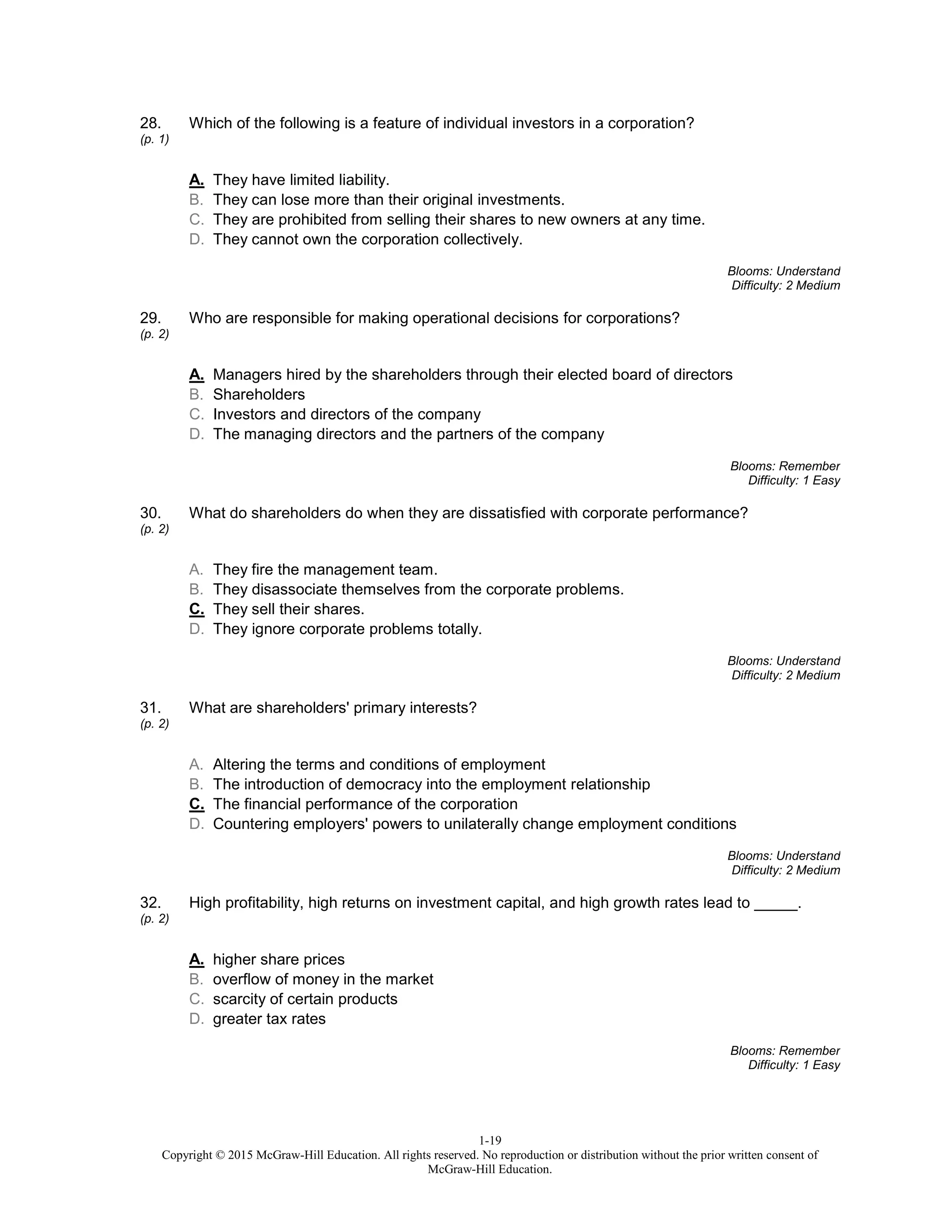
28. Which of the following is a feature of individual investors in a corporation?
A. They have limited liability.
B. They can lose more than their original investments.
C. They are prohibited from selling their shares to new owners at any time.
D. They cannot own the corporation collectively.
29. Who are responsible for making operational decisions for corporations?
A. Managers hired by the shareholders through their elected board of directors
B. Shareholders
C. Investors and directors of the company
D. The managing directors and the partners of the company
30. What do shareholders do when they are dissatisfied with corporate performance?
A. They fire the management team.
B. They disassociate themselves from the corporate problems.
C. They sell their shares.
D. They ignore corporate problems totally.
31. What are shareholders' primary interests?
A. Altering the terms and conditions of employment
B. The introduction of democracy into the employment relationship
C. The financial performance of the corporation
D. Countering employers' powers to unilaterally change employment conditions
32. High profitability, high returns on investment capital, and high growth rates lead to _____.
A. higher share prices
B. overflow of money in the market
C. scarcity of certain products
D. greater tax rates
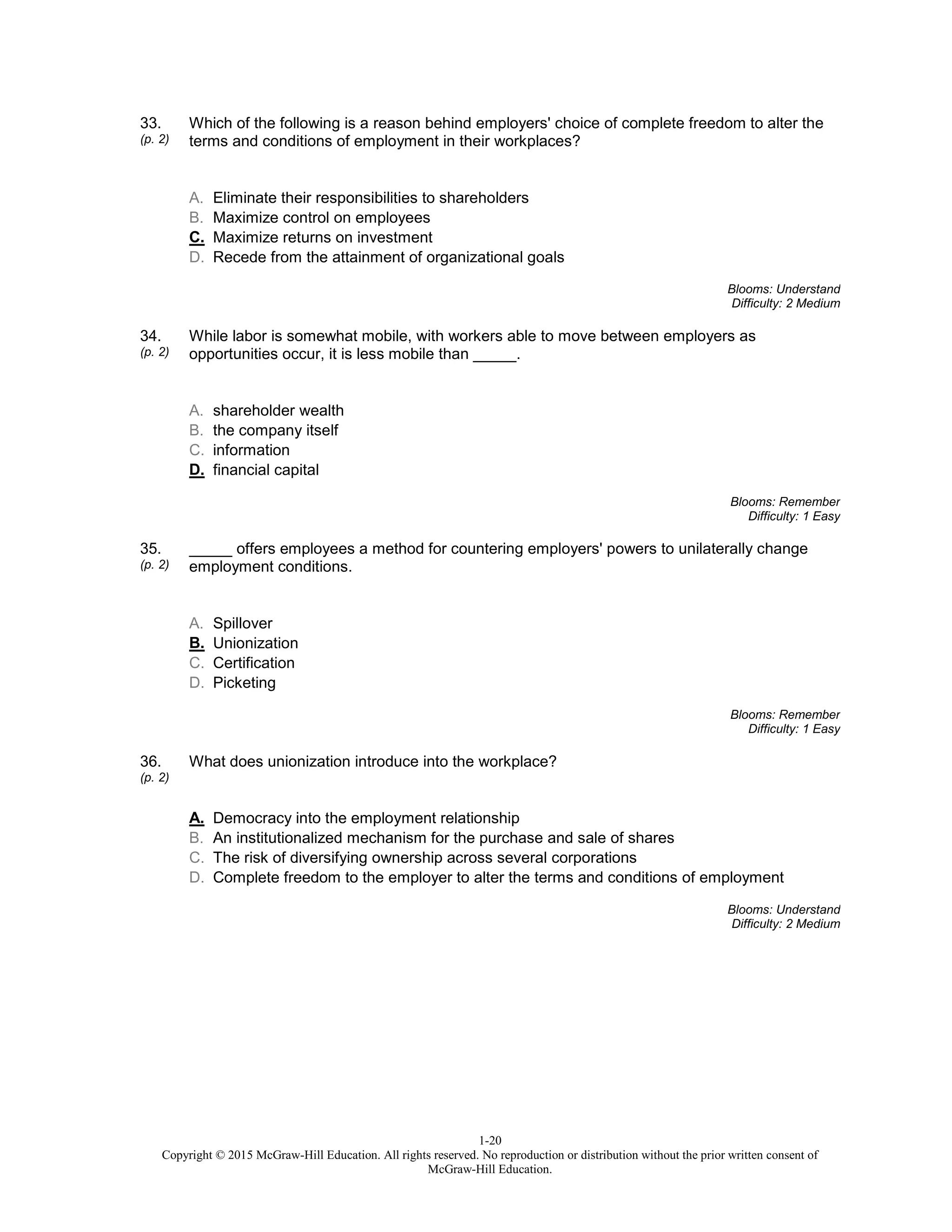
33. Which of the following is a reason behind employers' choice of complete freedom to alter the
terms and conditions of employment in their workplaces?
A. Eliminate their responsibilities to shareholders
B. Maximize control on employees
C. Maximize returns on investment
D. Recede from the attainment of organizational goals
1-5
Copyright © 2015 McGraw-Hill Education. All rights reserved. No reproduction or distribution without the prior written consent of
McGraw-Hill Education.
34. While labor is somewhat mobile, with workers able to move between employers as opportunities
occur, it is less mobile than _____.
A. shareholder wealth
B. the company itself
C. information
D. financial capital
35. _____ offers employees a method for countering employers' powers to unilaterally change
employment conditions.
A. Spillover
B. Unionization
C. Certification
D. Picketing
36. What does unionization introduce into the workplace?
A. Democracy into the employment relationship
B. An institutionalized mechanism for the purchase and sale of shares
C. The risk of diversifying ownership across several corporations
D. Complete freedom to the employer to alter the terms and conditions of employment
37. Which of the following is a reason for the development of unions?
A. To take over companies
B. To eliminate management
C. To counter employer power
D. To assert power of top management
38. Which of the following is true about shareholders?
A. Large corporations consist of a single shareholder, who participates in the corporation's day-
to-day business.
B. Operational decisions are made by workers hired by the shareholders.
C. Shareholders who are dissatisfied with corporate performance cannot sell their shares or
combine with others to oust the current board and its managers.
D. Shareholders may decide, collectively, to sell their interests to another company that seeks to
acquire its assets.
39. In democracies, labor laws and regulations ultimately reflect the will of the _____.
A. corporations
B. managers
C. electorate
D. shareholders
1-6
Copyright © 2015 McGraw-Hill Education. All rights reserved. No reproduction or distribution without the prior written consent of
McGraw-Hill Education.
40. A corporation's _____ ultimately control decisions about its direction, investments, and existence
depending on which best meets their interests.
A. managers
B. shareholders
C. board of directors
D. employees
41. As economic actors, what do unions seek to control?
A. The supply of labor to the employers
B. The changing goals and objectives of the government
C. The changes in the economy and society
D. The purchase and sale of investors' shares
42. Which of the following factors is responsible for the decline in unionized employment, in both the
proportion and number of workers?
A. A shift from services toward manufacturing
B. The decreasing intellectual content of jobs
C. The globalization of manufacturing
D. An overall increase in union organizing activity
43. Global competition, free trade, and an emphasis on corporate financial performance have
strongly influenced employment patterns and reduced _____.
A. intellectual content of jobs
B. union bargaining power
C. the overall decline in union organizing activity
D. economic relations
44. What must unions generate in order to survive?
A. Limited liability for individual investors
B. Global economic development
C. Economic benefits for their members
D. Global competition
45. Which of the following needs to be done by unions to achieve gains?
A. Decrease the intellectual content of jobs
B. Encourage the purchase and sale of investors' shares
C. Provide limited liability to individual investors
D. Exert bargaining power through some degree of labor supply control
1-7
Copyright © 2015 McGraw-Hill Education. All rights reserved. No reproduction or distribution without the prior written consent of
McGraw-Hill Education.
46. What is the reason behind the statement, "Today's global economy, combined with the
elimination of anticompetitive regulations in several major industries, has reduced union
bargaining power"?
A. The costs of increased benefits cannot readily be passed on to consumers.
B. Jobs in the global economy are associated with decreasing intellectual content.
C. Unions exert the highest influence on employment practices through spillovers than they did in
the past.
D. The unions control labor supply on an international basis.
47. Union representation has declined from 35 percent in 1955 to a little more than 11 percent now,
indicating that unions exert less influence on employment practices through _____.
A. voice power
B. spillovers
C. collective bargaining
D. monopoly power
48. When an employment practice in unionized companies is adopted by nonunion employers to
avoid unionization, a _____ occurs.
A. boycott
B. spillover
C. strike
D. lockout
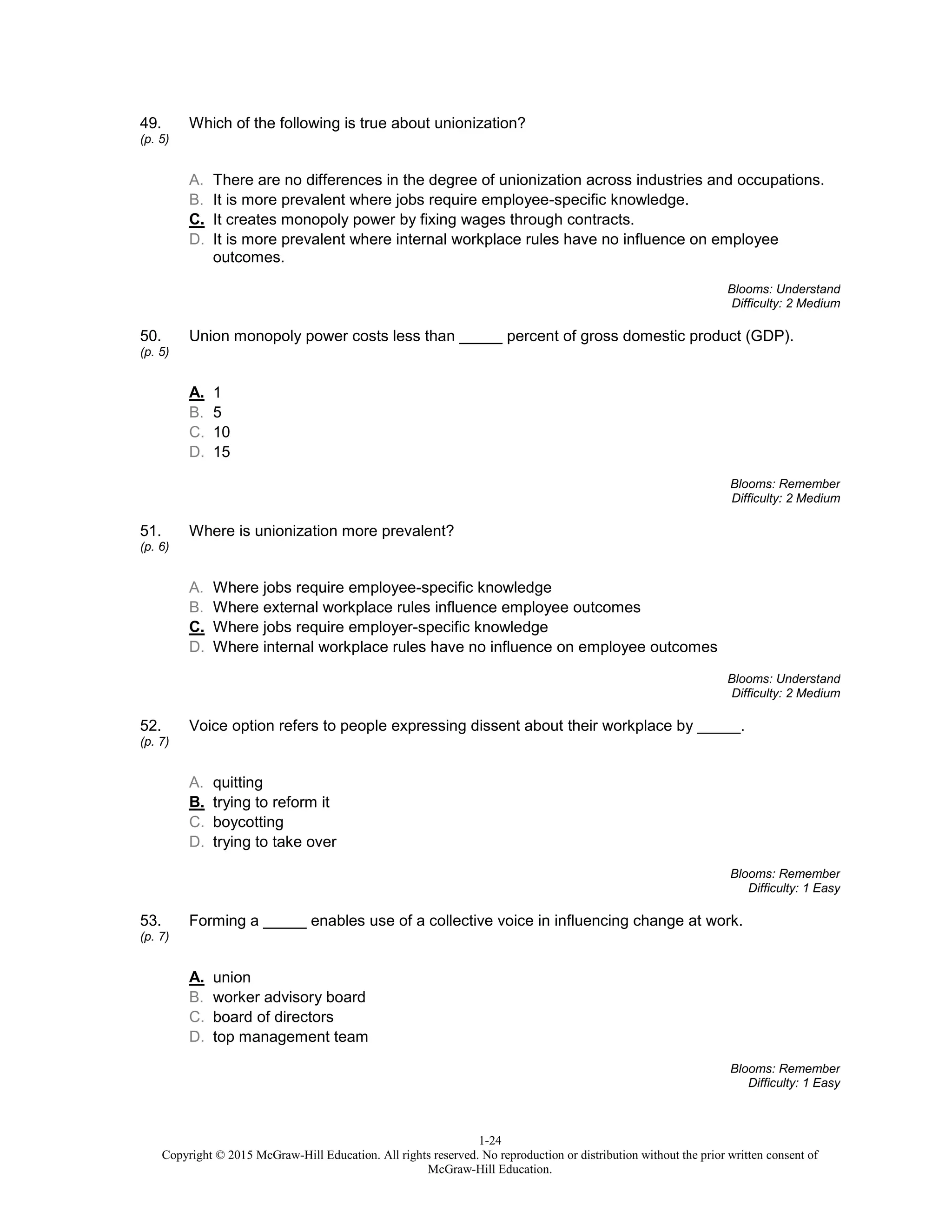
49. Which of the following is true about unionization?
A. There are no differences in the degree of unionization across industries and occupations.
B. It is more prevalent where jobs require employee-specific knowledge.
C. It creates monopoly power by fixing wages through contracts.
D. It is more prevalent where internal workplace rules have no influence on employee outcomes.
50. Union monopoly power costs less than _____ percent of gross domestic product (GDP).
A. 1
B. 5
C. 10
D. 15
51. Where is unionization more prevalent?
A. Where jobs require employee-specific knowledge
B. Where external workplace rules influence employee outcomes
C. Where jobs require employer-specific knowledge
D. Where internal workplace rules have no influence on employee outcomes
1-8
Copyright © 2015 McGraw-Hill Education. All rights reserved. No reproduction or distribution without the prior written consent of
McGraw-Hill Education.
52. Voice option refers to people expressing dissent about their workplace by _____.
A. quitting
B. trying to reform it
C. boycotting
D. trying to take over
53. Forming a _____ enables use of a collective voice in influencing change at work.
A. union
B. worker advisory board
C. board of directors
D. top management team
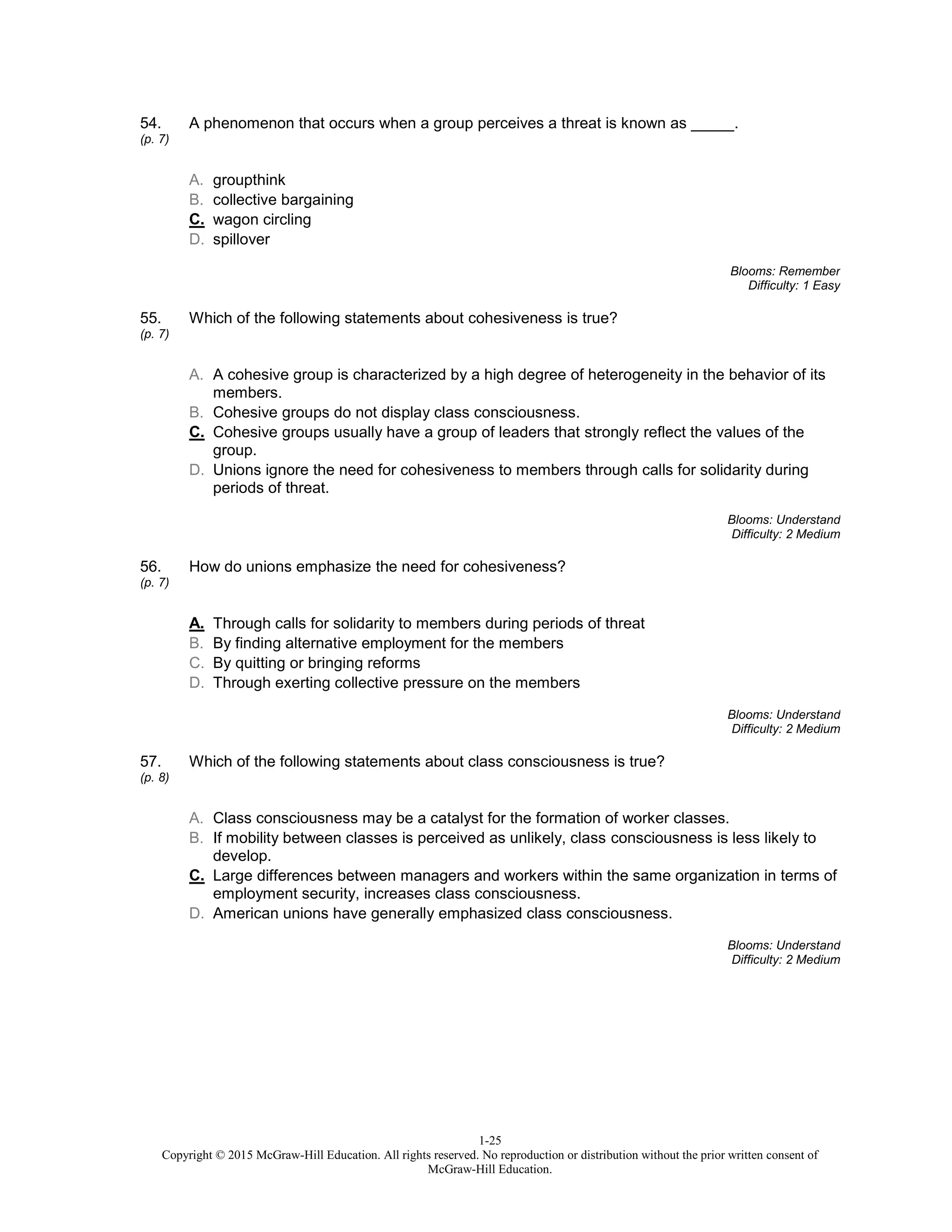
54. A phenomenon that occurs when a group perceives a threat is known as _____.
A. groupthink
B. collective bargaining
C. wagon circling
D. spillover
55. Which of the following statements about cohesiveness is true?
A. A cohesive group is characterized by a high degree of heterogeneity in the behavior of its
members.
B. Cohesive groups do not display class consciousness.
C. Cohesive groups usually have a group of leaders that strongly reflect the values of the group.
D. Unions ignore the need for cohesiveness to members through calls for solidarity during periods
of threat.
56. How do unions emphasize the need for cohesiveness?
A. Through calls for solidarity to members during periods of threat
B. By finding alternative employment for the members
C. By quitting or bringing reforms
D. Through exerting collective pressure on the members
57. Which of the following statements about class consciousness is true?
A. Class consciousness may be a catalyst for the formation of worker classes.
B. If mobility between classes is perceived as unlikely, class consciousness is less likely to
develop.
C. Large differences between managers and workers within the same organization in terms of
employment security, increases class consciousness.
D. American unions have generally emphasized class consciousness.
1-9
Copyright © 2015 McGraw-Hill Education. All rights reserved. No reproduction or distribution without the prior written consent of
McGraw-Hill Education.
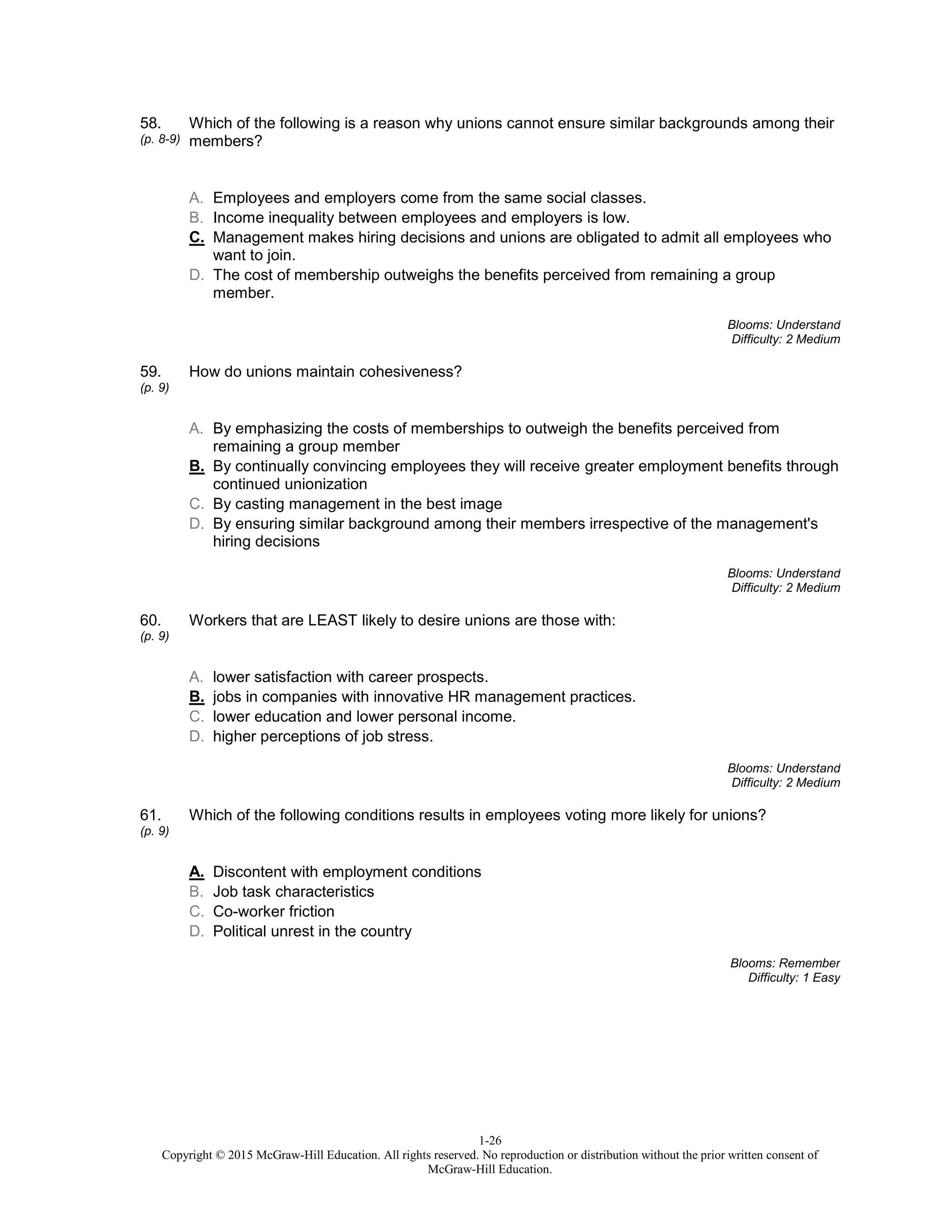
58. Which of the following is a reason why unions cannot ensure similar backgrounds among their
members?
A. Employees and employers come from the same social classes.
B. Income inequality between employees and employers is low.
C. Management makes hiring decisions and unions are obligated to admit all employees who
want to join.
D. The cost of membership outweighs the benefits perceived from remaining a group member.
59. How do unions maintain cohesiveness?
A. By emphasizing the costs of memberships to outweigh the benefits perceived from remaining a
group member
B. By continually convincing employees they will receive greater employment benefits through
continued unionization
C. By casting management in the best image
D. By ensuring similar background among their members irrespective of the management's hiring
decisions
60. Workers that are LEAST likely to desire unions are those with:
A. lower satisfaction with career prospects.
B. jobs in companies with innovative HR management practices.
C. lower education and lower personal income.
D. higher perceptions of job stress.
61. Which of the following conditions results in employees voting more likely for unions?
A. Discontent with employment conditions
B. Job task characteristics
C. Co-worker friction
D. Political unrest in the country
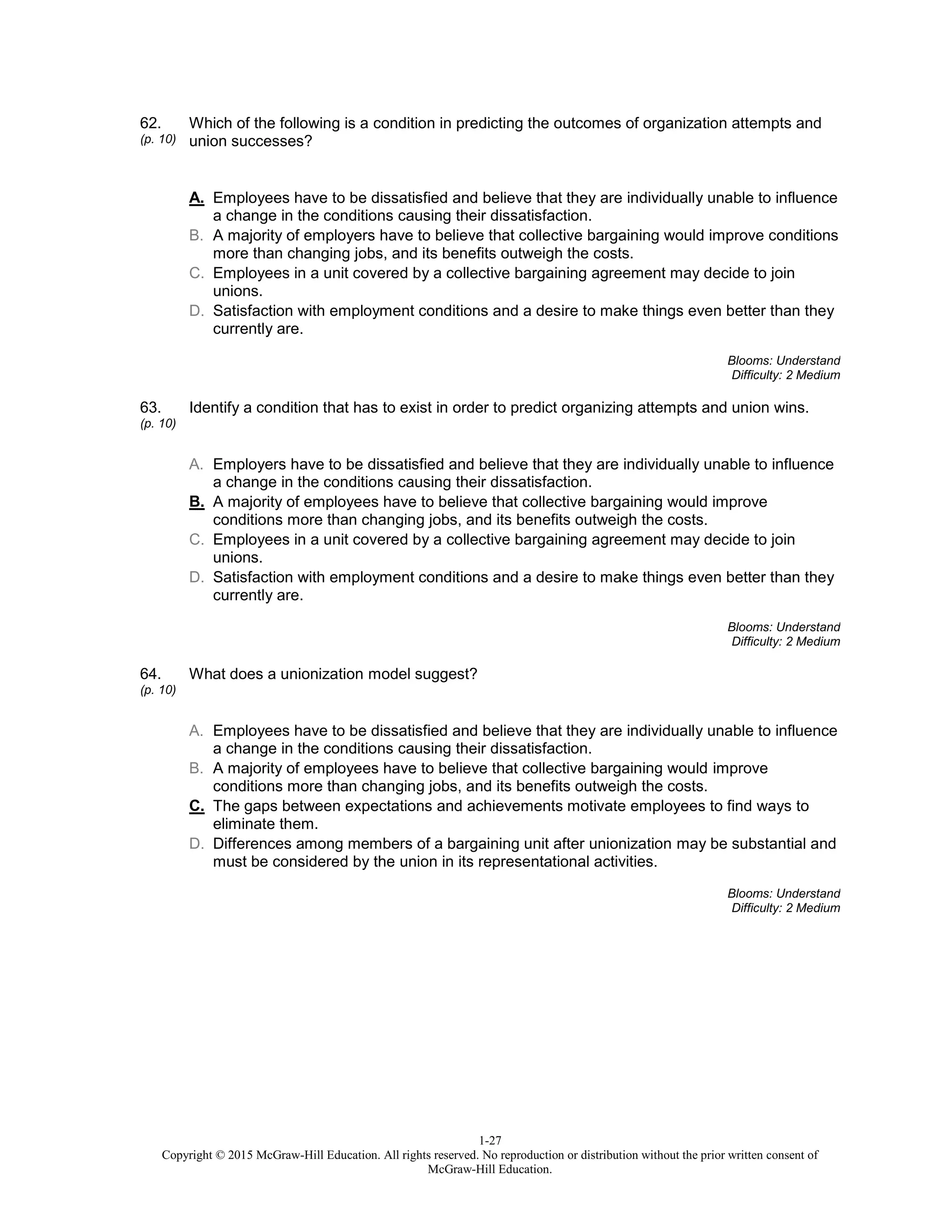
62. Which of the following is a condition in predicting the outcomes of organization attempts and
union successes?
A. Employees have to be dissatisfied and believe that they are individually unable to influence a
change in the conditions causing their dissatisfaction.
B. A majority of employers have to believe that collective bargaining would improve conditions
more than changing jobs, and its benefits outweigh the costs.
C. Employees in a unit covered by a collective bargaining agreement may decide to join unions.
D. Satisfaction with employment conditions and a desire to make things even better than they
currently are.
1-10
Copyright © 2015 McGraw-Hill Education. All rights reserved. No reproduction or distribution without the prior written consent of
McGraw-Hill Education.
63. Identify a condition that has to exist in order to predict organizing attempts and union wins.
A. Employers have to be dissatisfied and believe that they are individually unable to influence a
change in the conditions causing their dissatisfaction.
B. A majority of employees have to believe that collective bargaining would improve conditions
more than changing jobs, and its benefits outweigh the costs.
C. Employees in a unit covered by a collective bargaining agreement may decide to join unions.
D. Satisfaction with employment conditions and a desire to make things even better than they
currently are.
64. What does a unionization model suggest?
A. Employees have to be dissatisfied and believe that they are individually unable to influence a
change in the conditions causing their dissatisfaction.
B. A majority of employees have to believe that collective bargaining would improve conditions
more than changing jobs, and its benefits outweigh the costs.
C. The gaps between expectations and achievements motivate employees to find ways to
eliminate them.
D. Differences among members of a bargaining unit after unionization may be substantial and
must be considered by the union in its representational activities.
65. Bargaining units are not organized until all of the following occur EXCEPT:
A. a majority of employees desire representation.
B. officers are elected by majorities of local union members.
C. contracts are vetoed by a majority of union members in the bargaining unit.
D. officers are defeated by majorities of local union members.
66. Which of the following is a condition that prevented union empowerment in the United States?
A. Employers fiercely protected, and unions ceded to them, the capitalistic, market-driven system
that was embraced by the United States.
B. With the exception of the skilled construction trades, employees have always controlled the
content of jobs.
C. Employers have absolutely no connection with the U.S. educational system.
D. The small middle class in the United States has had no interest in efficiency and productivity.
67. Prices, and ultimately wages, are controlled by _____.
A. collective bargaining
B. administrative orders
C. the government
D. the market
1-11
Copyright © 2015 McGraw-Hill Education. All rights reserved. No reproduction or distribution without the prior written consent of
McGraw-Hill Education.
68. Which of the following occurs when an employer decides to outsource or move production
abroad?
A. Elimination of any kind of internal competition among employees to retain jobs.
B. Unionized workers from two different local unions of the same national will be forced to end
operations.
C. Increase in job security and union bargaining power on a companywide basis.
D. Companies may seek tax concessions from governments representing a particular country in
deciding where to locate.
69. Which of the following is true about union memberships?
A. Usually, membership is independent of employment in a workplace governed by a collective
bargaining agreement.
B. Only in the building trades and some entertainment unions does membership terminate after
employment with a particular employer ends.
C. Traditionally, if employment was lost, membership often terminated.
D. Unions can ensure a similar background among the members, irrespective of the
management's hiring decisions.
70. What was the reason for membership to survive in the building trades, the maritime unions, and
some entertainment unions after employment with a particular employer ended?
A. The industrial unions acted as collective bargaining agents.
B. The industrial unions found it increasingly difficult to attract members in a transient
employment environment.
C. The employees preferred to have temporary ties to an employer.
D. Union hiring halls were the primary source of employees in these industries.
Short Answer Questions
71. What is meant by labor relations?
1-12
Copyright © 2015 McGraw-Hill Education. All rights reserved. No reproduction or distribution without the prior written consent of
McGraw-Hill Education.
72. Does unionization introduce democracy into the employment relationship? Explain.
73. Explain how unions are simultaneously economic and political organizations.
74. What is a spillover?
75. Explain group cohesiveness.
1-13
Copyright © 2015 McGraw-Hill Education. All rights reserved. No reproduction or distribution without the prior written consent of
McGraw-Hill Education.
76. What are the three ways by which employees can become union members?
77. What are the conditions required to predict the outcomes of organizing attempts and a union
success?
78. How do local community attitudes affect union power?
79. Briefly explain the median voter concept.
1-14
Copyright © 2015 McGraw-Hill Education. All rights reserved. No reproduction or distribution without the prior written consent of
McGraw-Hill Education.
80. Describe several historical conditions which have prevented the accumulation of union power in
the United States over the past two centuries.
1-15
Copyright © 2015 McGraw-Hill Education. All rights reserved. No reproduction or distribution without the prior written consent of
McGraw-Hill Education.
Chapter 01 Introduction Answer Key
True / False Questions
1.
(p. 1)
The basis for the practice of labor relations within a unionized employer is a contract
negotiated by the parties.
TRUE
Blooms: Remember
Difficulty: 1 Easy
2.
(p. 1)
Stock markets create the opportunity to make ownership highly liquid by providing an
institutionalized mechanism for the purchase and sale of shares.
TRUE
Blooms: Remember
Difficulty: 1 Easy
3.
(p. 2)
Operational decisions are made by the managers hired by the shareholders' elected board of
directors.
TRUE
Blooms: Remember
Difficulty: 1 Easy
4.
(p. 2)
Unions are developed to take over companies.
FALSE
Blooms: Remember
Difficulty: 1 Easy
5.
(p. 3)
In democracies, laws and regulations ultimately reflect the will of the electorate.
TRUE
Blooms: Remember
Difficulty: 1 Easy
6.
(p. 3)
Unions can exist without employers, but employers cannot exist without unions.
FALSE
Blooms: Remember
Difficulty: 1 Easy
7.
(p. 5)
A lockout occurs when a unionized employment practice is adopted by nonunion employers in
order to avoid unionization by copying what unions have won for their members.
FALSE
Blooms: Remember
Difficulty: 1 Easy
1-16
Copyright © 2015 McGraw-Hill Education. All rights reserved. No reproduction or distribution without the prior written consent of
McGraw-Hill Education.
8.
(p. 5)
Unionization provides employees a voice in how the employment relationship is implemented
in their workplace.
TRUE
Blooms: Remember
Difficulty: 1 Easy
9.
(p. 7)
Spillover is a pervasive phenomenon that occurs when a group perceives danger.
FALSE
Blooms: Remember
Difficulty: 1 Easy
10.
(p. 9)
Workers in companies with innovative human resource management practices are less likely
to desire unions.
TRUE
Blooms: Remember
Difficulty: 1 Easy
11.
(p. 9)
Employees are more likely to vote for unions due to job task characteristics rather than
dissatisfaction with employment conditions.
FALSE
Blooms: Remember
Difficulty: 1 Easy
12.
(p. 10)
Dissatisfaction is consistently associated with turnover.
TRUE
Blooms: Remember
Difficulty: 1 Easy
13.
(p. 16)
Local community attitudes have no effect on union power.
FALSE
Blooms: Remember
Difficulty: 1 Easy
14.
(p. 16)
Union action cannot influence public policy decisions on potentially favorable tax abatements
for employers.
FALSE
Blooms: Remember
Difficulty: 1 Easy
15.
(p. 17)
The policies of large national unions are influenced strongly by the actions of majorities of
local union members.
TRUE
Blooms: Remember
Difficulty: 1 Easy
1-17
Copyright © 2015 McGraw-Hill Education. All rights reserved. No reproduction or distribution without the prior written consent of
McGraw-Hill Education.
16.
(p. 18)
Satisfaction of nonunion employees has drastically decreased when compared to that of
unionized workers, thereby eliminating the motivation to organize.
FALSE
Blooms: Remember
Difficulty: 1 Easy
17.
(p. 19)
Prices, and ultimately wages, are controlled by collective bargaining rather than by the
market.
FALSE
Blooms: Remember
Difficulty: 1 Easy
18.
(p. 19)
If the middle class perceives income distribution as fair, then support for collective bargaining
will not be strong.
TRUE
Blooms: Remember
Difficulty: 1 Easy
19.
(p. 19)
Groups of employees coalesce around common interests or group membership to pressurize
their employers to address employment issues of particular interest to their groups.
TRUE
Blooms: Remember
Difficulty: 1 Easy
20.
(p. 20)
Increasing unionization in the industry where one is employed negatively influences wages.
FALSE
Blooms: Remember
Difficulty: 1 Easy
21.
(p. 21)
Bargaining power is very low for unions that represent workers who deliver services directly to
the consumer.
FALSE
Blooms: Remember
Difficulty: 1 Easy
22.
(p. 21)
One of the greatest challenges facing private sector unions is the continued increase in the
globalization of production.
TRUE
Blooms: Remember
Difficulty: 1 Easy
1-18
Copyright © 2015 McGraw-Hill Education. All rights reserved. No reproduction or distribution without the prior written consent of
McGraw-Hill Education.
23.
(p. 21)
While major employers have increasingly exercised global options, unions around the world
have maintained jurisdictions largely within their own countries.
TRUE
Blooms: Remember
Difficulty: 1 Easy
24.
(p. 22)
Traditionally, union membership depended on employment in a workplace governed by a
collective bargaining agreement.
TRUE
Blooms: Remember
Difficulty: 1 Easy
25.
(p. 23)
Unions have generally benefited much from a Democratic president and/or the Congress.
FALSE
Blooms: Remember
Difficulty: 1 Easy
Multiple Choice Questions
26.
(p. 1)
_____ is the ongoing interchange between the union and the employer that identifies their
common and specific interests and creates mechanisms to clarify, manage, reduce, and
resolve conflicts over their specific interests.
A. Monopoly power
B. Labor relations
C. Spillover
D. Voice power
Blooms: Remember
Difficulty: 1 Easy
27.
(p. 1)
Why are contracts renegotiated periodically?
A. To lead employees into believing that they are individually unable to influence a change in
the conditions causing their dissatisfaction
B. To lead employees into believing that changing jobs would improve conditions more than
collective bargaining
C. To take into account changes in the economy and society
D. To take into account changing goals and objectives of the government
Blooms: Understand
Difficulty: 2 Medium
1-19
Copyright © 2015 McGraw-Hill Education. All rights reserved. No reproduction or distribution without the prior written consent of
McGraw-Hill Education.
28.
(p. 1)
Which of the following is a feature of individual investors in a corporation?
A. They have limited liability.
B. They can lose more than their original investments.
C. They are prohibited from selling their shares to new owners at any time.
D. They cannot own the corporation collectively.
Blooms: Understand
Difficulty: 2 Medium
29.
(p. 2)
Who are responsible for making operational decisions for corporations?
A. Managers hired by the shareholders through their elected board of directors
B. Shareholders
C. Investors and directors of the company
D. The managing directors and the partners of the company
Blooms: Remember
Difficulty: 1 Easy
30.
(p. 2)
What do shareholders do when they are dissatisfied with corporate performance?
A. They fire the management team.
B. They disassociate themselves from the corporate problems.
C. They sell their shares.
D. They ignore corporate problems totally.
Blooms: Understand
Difficulty: 2 Medium
31.
(p. 2)
What are shareholders' primary interests?
A. Altering the terms and conditions of employment
B. The introduction of democracy into the employment relationship
C. The financial performance of the corporation
D. Countering employers' powers to unilaterally change employment conditions
Blooms: Understand
Difficulty: 2 Medium
32.
(p. 2)
High profitability, high returns on investment capital, and high growth rates lead to _____.
A. higher share prices
B. overflow of money in the market
C. scarcity of certain products
D. greater tax rates
Blooms: Remember
Difficulty: 1 Easy
1-20
Copyright © 2015 McGraw-Hill Education. All rights reserved. No reproduction or distribution without the prior written consent of
McGraw-Hill Education.
33.
(p. 2)
Which of the following is a reason behind employers' choice of complete freedom to alter the
terms and conditions of employment in their workplaces?
A. Eliminate their responsibilities to shareholders
B. Maximize control on employees
C. Maximize returns on investment
D. Recede from the attainment of organizational goals
Blooms: Understand
Difficulty: 2 Medium
34.
(p. 2)
While labor is somewhat mobile, with workers able to move between employers as
opportunities occur, it is less mobile than _____.
A. shareholder wealth
B. the company itself
C. information
D. financial capital
Blooms: Remember
Difficulty: 1 Easy
35.
(p. 2)
_____ offers employees a method for countering employers' powers to unilaterally change
employment conditions.
A. Spillover
B. Unionization
C. Certification
D. Picketing
Blooms: Remember
Difficulty: 1 Easy
36.
(p. 2)
What does unionization introduce into the workplace?
A. Democracy into the employment relationship
B. An institutionalized mechanism for the purchase and sale of shares
C. The risk of diversifying ownership across several corporations
D. Complete freedom to the employer to alter the terms and conditions of employment
Blooms: Understand
Difficulty: 2 Medium
1-21
Copyright © 2015 McGraw-Hill Education. All rights reserved. No reproduction or distribution without the prior written consent of
McGraw-Hill Education.
37.
(p. 2)
Which of the following is a reason for the development of unions?
A. To take over companies
B. To eliminate management
C. To counter employer power
D. To assert power of top management
Blooms: Remember
Difficulty: 1 Easy
38.
(p. 2)
Which of the following is true about shareholders?
A. Large corporations consist of a single shareholder, who participates in the corporation's
day-to-day business.
B. Operational decisions are made by workers hired by the shareholders.
C. Shareholders who are dissatisfied with corporate performance cannot sell their shares or
combine with others to oust the current board and its managers.
D. Shareholders may decide, collectively, to sell their interests to another company that seeks
to acquire its assets.
Blooms: Understand
Difficulty: 2 Medium
39.
(p. 3)
In democracies, labor laws and regulations ultimately reflect the will of the _____.
A. corporations
B. managers
C. electorate
D. shareholders
Blooms: Remember
Difficulty: 1 Easy
40.
(p. 3)
A corporation's _____ ultimately control decisions about its direction, investments, and
existence depending on which best meets their interests.
A. managers
B. shareholders
C. board of directors
D. employees
Blooms: Remember
Difficulty: 1 Easy
1-22
Copyright © 2015 McGraw-Hill Education. All rights reserved. No reproduction or distribution without the prior written consent of
McGraw-Hill Education.
41.
(p. 4)
As economic actors, what do unions seek to control?
A. The supply of labor to the employers
B. The changing goals and objectives of the government
C. The changes in the economy and society
D. The purchase and sale of investors' shares
Blooms: Understand
Difficulty: 2 Medium
42.
(p. 4)
Which of the following factors is responsible for the decline in unionized employment, in both
the proportion and number of workers?
A. A shift from services toward manufacturing
B. The decreasing intellectual content of jobs
C. The globalization of manufacturing
D. An overall increase in union organizing activity
Blooms: Understand
Difficulty: 2 Medium
43.
(p. 4)
Global competition, free trade, and an emphasis on corporate financial performance have
strongly influenced employment patterns and reduced _____.
A. intellectual content of jobs
B. union bargaining power
C. the overall decline in union organizing activity
D. economic relations
Blooms: Remember
Difficulty: 1 Easy
44.
(p. 4)
What must unions generate in order to survive?
A. Limited liability for individual investors
B. Global economic development
C. Economic benefits for their members
D. Global competition
Blooms: Understand
Difficulty: 2 Medium
1-23
Copyright © 2015 McGraw-Hill Education. All rights reserved. No reproduction or distribution without the prior written consent of
McGraw-Hill Education.
45.
(p. 4)
Which of the following needs to be done by unions to achieve gains?
A. Decrease the intellectual content of jobs
B. Encourage the purchase and sale of investors' shares
C. Provide limited liability to individual investors
D. Exert bargaining power through some degree of labor supply control
Blooms: Understand
Difficulty: 2 Medium
46.
(p. 4)
What is the reason behind the statement, "Today's global economy, combined with the
elimination of anticompetitive regulations in several major industries, has reduced union
bargaining power"?
A. The costs of increased benefits cannot readily be passed on to consumers.
B. Jobs in the global economy are associated with decreasing intellectual content.
C. Unions exert the highest influence on employment practices through spillovers than they
did in the past.
D. The unions control labor supply on an international basis.
Blooms: Understand
Difficulty: 2 Medium
47.
(p. 5)
Union representation has declined from 35 percent in 1955 to a little more than 11 percent
now, indicating that unions exert less influence on employment practices through _____.
A. voice power
B. spillovers
C. collective bargaining
D. monopoly power
Blooms: Remember
Difficulty: 1 Easy
48.
(p. 5)
When an employment practice in unionized companies is adopted by nonunion employers to
avoid unionization, a _____ occurs.
A. boycott
B. spillover
C. strike
D. lockout
Blooms: Remember
Difficulty: 1 Easy
1-24
Copyright © 2015 McGraw-Hill Education. All rights reserved. No reproduction or distribution without the prior written consent of
McGraw-Hill Education.
49.
(p. 5)
Which of the following is true about unionization?
A. There are no differences in the degree of unionization across industries and occupations.
B. It is more prevalent where jobs require employee-specific knowledge.
C. It creates monopoly power by fixing wages through contracts.
D. It is more prevalent where internal workplace rules have no influence on employee
outcomes.
Blooms: Understand
Difficulty: 2 Medium
50.
(p. 5)
Union monopoly power costs less than _____ percent of gross domestic product (GDP).
A. 1
B. 5
C. 10
D. 15
Blooms: Remember
Difficulty: 2 Medium
51.
(p. 6)
Where is unionization more prevalent?
A. Where jobs require employee-specific knowledge
B. Where external workplace rules influence employee outcomes
C. Where jobs require employer-specific knowledge
D. Where internal workplace rules have no influence on employee outcomes
Blooms: Understand
Difficulty: 2 Medium
52.
(p. 7)
Voice option refers to people expressing dissent about their workplace by _____.
A. quitting
B. trying to reform it
C. boycotting
D. trying to take over
Blooms: Remember
Difficulty: 1 Easy
53.
(p. 7)
Forming a _____ enables use of a collective voice in influencing change at work.
A. union
B. worker advisory board
C. board of directors
D. top management team
Blooms: Remember
Difficulty: 1 Easy
1-25
Copyright © 2015 McGraw-Hill Education. All rights reserved. No reproduction or distribution without the prior written consent of
McGraw-Hill Education.
54.
(p. 7)
A phenomenon that occurs when a group perceives a threat is known as _____.
A. groupthink
B. collective bargaining
C. wagon circling
D. spillover
Blooms: Remember
Difficulty: 1 Easy
55.
(p. 7)
Which of the following statements about cohesiveness is true?
A. A cohesive group is characterized by a high degree of heterogeneity in the behavior of its
members.
B. Cohesive groups do not display class consciousness.
C. Cohesive groups usually have a group of leaders that strongly reflect the values of the
group.
D. Unions ignore the need for cohesiveness to members through calls for solidarity during
periods of threat.
Blooms: Understand
Difficulty: 2 Medium
56.
(p. 7)
How do unions emphasize the need for cohesiveness?
A. Through calls for solidarity to members during periods of threat
B. By finding alternative employment for the members
C. By quitting or bringing reforms
D. Through exerting collective pressure on the members
Blooms: Understand
Difficulty: 2 Medium
57.
(p. 8)
Which of the following statements about class consciousness is true?
A. Class consciousness may be a catalyst for the formation of worker classes.
B. If mobility between classes is perceived as unlikely, class consciousness is less likely to
develop.
C. Large differences between managers and workers within the same organization in terms of
employment security, increases class consciousness.
D. American unions have generally emphasized class consciousness.
Blooms: Understand
Difficulty: 2 Medium
1-26
Copyright © 2015 McGraw-Hill Education. All rights reserved. No reproduction or distribution without the prior written consent of
McGraw-Hill Education.
58.
(p. 8-9)
Which of the following is a reason why unions cannot ensure similar backgrounds among their
members?
A. Employees and employers come from the same social classes.
B. Income inequality between employees and employers is low.
C. Management makes hiring decisions and unions are obligated to admit all employees who
want to join.
D. The cost of membership outweighs the benefits perceived from remaining a group
member.
Blooms: Understand
Difficulty: 2 Medium
59.
(p. 9)
How do unions maintain cohesiveness?
A. By emphasizing the costs of memberships to outweigh the benefits perceived from
remaining a group member
B. By continually convincing employees they will receive greater employment benefits through
continued unionization
C. By casting management in the best image
D. By ensuring similar background among their members irrespective of the management's
hiring decisions
Blooms: Understand
Difficulty: 2 Medium
60.
(p. 9)
Workers that are LEAST likely to desire unions are those with:
A. lower satisfaction with career prospects.
B. jobs in companies with innovative HR management practices.
C. lower education and lower personal income.
D. higher perceptions of job stress.
Blooms: Understand
Difficulty: 2 Medium
61.
(p. 9)
Which of the following conditions results in employees voting more likely for unions?
A. Discontent with employment conditions
B. Job task characteristics
C. Co-worker friction
D. Political unrest in the country
Blooms: Remember
Difficulty: 1 Easy
1-27
Copyright © 2015 McGraw-Hill Education. All rights reserved. No reproduction or distribution without the prior written consent of
McGraw-Hill Education.
62.
(p. 10)
Which of the following is a condition in predicting the outcomes of organization attempts and
union successes?
A. Employees have to be dissatisfied and believe that they are individually unable to influence
a change in the conditions causing their dissatisfaction.
B. A majority of employers have to believe that collective bargaining would improve conditions
more than changing jobs, and its benefits outweigh the costs.
C. Employees in a unit covered by a collective bargaining agreement may decide to join
unions.
D. Satisfaction with employment conditions and a desire to make things even better than they
currently are.
Blooms: Understand
Difficulty: 2 Medium
63.
(p. 10)
Identify a condition that has to exist in order to predict organizing attempts and union wins.
A. Employers have to be dissatisfied and believe that they are individually unable to influence
a change in the conditions causing their dissatisfaction.
B. A majority of employees have to believe that collective bargaining would improve
conditions more than changing jobs, and its benefits outweigh the costs.
C. Employees in a unit covered by a collective bargaining agreement may decide to join
unions.
D. Satisfaction with employment conditions and a desire to make things even better than they
currently are.
Blooms: Understand
Difficulty: 2 Medium
64.
(p. 10)
What does a unionization model suggest?
A. Employees have to be dissatisfied and believe that they are individually unable to influence
a change in the conditions causing their dissatisfaction.
B. A majority of employees have to believe that collective bargaining would improve
conditions more than changing jobs, and its benefits outweigh the costs.
C. The gaps between expectations and achievements motivate employees to find ways to
eliminate them.
D. Differences among members of a bargaining unit after unionization may be substantial and
must be considered by the union in its representational activities.
Blooms: Understand
Difficulty: 2 Medium
1-28
Copyright © 2015 McGraw-Hill Education. All rights reserved. No reproduction or distribution without the prior written consent of
McGraw-Hill Education.
65.
(p. 16-
17)
Bargaining units are not organized until all of the following occur EXCEPT:
A. a majority of employees desire representation.
B. officers are elected by majorities of local union members.
C. contracts are vetoed by a majority of union members in the bargaining unit.
D. officers are defeated by majorities of local union members.
Blooms: Understand
Difficulty: 2 Medium
66.
(p. 19)
Which of the following is a condition that prevented union empowerment in the United States?
A. Employers fiercely protected, and unions ceded to them, the capitalistic, market-driven
system that was embraced by the United States.
B. With the exception of the skilled construction trades, employees have always controlled the
content of jobs.
C. Employers have absolutely no connection with the U.S. educational system.
D. The small middle class in the United States has had no interest in efficiency and
productivity.
Blooms: Understand
Difficulty: 2 Medium
67.
(p. 19)
Prices, and ultimately wages, are controlled by _____.
A. collective bargaining
B. administrative orders
C. the government
D. the market
Blooms: Remember
Difficulty: 1 Easy
68.
(p. 21)
Which of the following occurs when an employer decides to outsource or move production
abroad?
A. Elimination of any kind of internal competition among employees to retain jobs.
B. Unionized workers from two different local unions of the same national will be forced to end
operations.
C. Increase in job security and union bargaining power on a companywide basis.
D. Companies may seek tax concessions from governments representing a particular country
in deciding where to locate.
Blooms: Understand
Difficulty: 2 Medium
1-29
Copyright © 2015 McGraw-Hill Education. All rights reserved. No reproduction or distribution without the prior written consent of
McGraw-Hill Education.
69.
(p. 22)
Which of the following is true about union memberships?
A. Usually, membership is independent of employment in a workplace governed by a
collective bargaining agreement.
B. Only in the building trades and some entertainment unions does membership terminate
after employment with a particular employer ends.
C. Traditionally, if employment was lost, membership often terminated.
D. Unions can ensure a similar background among the members, irrespective of the
management's hiring decisions.
Blooms: Understand
Difficulty: 2 Medium
70.
(p. 22)
What was the reason for membership to survive in the building trades, the maritime unions,
and some entertainment unions after employment with a particular employer ended?
A. The industrial unions acted as collective bargaining agents.
B. The industrial unions found it increasingly difficult to attract members in a transient
employment environment.
C. The employees preferred to have temporary ties to an employer.
D. Union hiring halls were the primary source of employees in these industries.
Blooms: Understand
Difficulty: 2 Medium
Short Answer Questions
71.
(p. 1)
What is meant by labor relations?
In unionized employers, labor relations is the ongoing interchange between the union and the
employer that identifies their common and specific interests and creates mechanisms to
clarify, manage, reduce, and resolve conflicts with respect to their specific interests.
Blooms: Remember
Difficulty: 1 Easy
1-30
Copyright © 2015 McGraw-Hill Education. All rights reserved. No reproduction or distribution without the prior written consent of
McGraw-Hill Education.
72.
(p. 2)
Does unionization introduce democracy into the employment relationship? Explain.
Unionization introduces democracy into the employment relationship. Employees determine,
first, whether a majority desires to be represented; second, who to elect as leaders or hire as
agents; third, what workplace issues are most important to them; and fourth, whether to accept
a proposed contract or to collectively withhold their labor.
Blooms: Remember
Difficulty: 2 Medium
73.
(p. 4)
Explain how unions are simultaneously economic and political organizations.
As economic actors, unions seek to control the supply of labor to employers in order to
improve economic returns for their members. To accomplish this, they also seek to create and
maintain power to influence the direction of laws and regulations, to provide a vehicle for
advancing their leaders' and members' purposes, and to survive and grow. Conflicts may exist
between union levels as national union goals may not completely agree with goals at the local
level.
Blooms: Remember
Difficulty: 2 Medium
74.
(p. 5)
What is a spillover?
A spillover occurs when a unionized employment practice is adopted by nonunion employers
in order to avoid unionization by copying what unions have won for their members.
Blooms: Remember
Difficulty: 1 Easy
75.
(p. 7)
Explain group cohesiveness.
One of the characteristics that defines a cohesive group is a high degree of similarity in the
values and behavior of its members. One of these values may be class consciousness. Age,
seniority, and other background characteristics are also probably quite similar. Cohesive
groups usually have a leader or group of leaders that strongly reflect the values of the group
and are deferred to by other members of the group. Cohesiveness may also be a function of a
perceived external threat. Unions emphasize the need for cohesiveness to members through
calls for "solidarity" during periods of threat.
Blooms: Understand
Difficulty: 2 Medium
Random documents with unrelated
content Scribd suggests to you:
Gutenberg” appears, or with which the phrase “Project
Gutenberg” is associated) is accessed, displayed, performed,
viewed, copied or distributed:
This eBook is for the use of anyone anywhere in the United
States and most other parts of the world at no cost and
with almost no restrictions whatsoever. You may copy it,
give it away or re-use it under the terms of the Project
Gutenberg License included with this eBook or online at
www.gutenberg.org. If you are not located in the United
States, you will have to check the laws of the country
where you are located before using this eBook.
1.E.2. If an individual Project Gutenberg™ electronic work is
derived from texts not protected by U.S. copyright law (does not
contain a notice indicating that it is posted with permission of
the copyright holder), the work can be copied and distributed to
anyone in the United States without paying any fees or charges.
If you are redistributing or providing access to a work with the
phrase “Project Gutenberg” associated with or appearing on the
work, you must comply either with the requirements of
paragraphs 1.E.1 through 1.E.7 or obtain permission for the use
of the work and the Project Gutenberg™ trademark as set forth
in paragraphs 1.E.8 or 1.E.9.
1.E.3. If an individual Project Gutenberg™ electronic work is
posted with the permission of the copyright holder, your use and
distribution must comply with both paragraphs 1.E.1 through
1.E.7 and any additional terms imposed by the copyright holder.
Additional terms will be linked to the Project Gutenberg™
License for all works posted with the permission of the copyright
holder found at the beginning of this work.
1.E.4. Do not unlink or detach or remove the full Project
Gutenberg™ License terms from this work, or any files
containing a part of this work or any other work associated with
Project Gutenberg™.
1.E.5. Do not copy, display, perform, distribute or redistribute
this electronic work, or any part of this electronic work, without
prominently displaying the sentence set forth in paragraph 1.E.1
with active links or immediate access to the full terms of the
Project Gutenberg™ License.
1.E.6. You may convert to and distribute this work in any binary,
compressed, marked up, nonproprietary or proprietary form,
including any word processing or hypertext form. However, if
you provide access to or distribute copies of a Project
Gutenberg™ work in a format other than “Plain Vanilla ASCII” or
other format used in the official version posted on the official
Project Gutenberg™ website (www.gutenberg.org), you must,
at no additional cost, fee or expense to the user, provide a copy,
a means of exporting a copy, or a means of obtaining a copy
upon request, of the work in its original “Plain Vanilla ASCII” or
other form. Any alternate format must include the full Project
Gutenberg™ License as specified in paragraph 1.E.1.
1.E.7. Do not charge a fee for access to, viewing, displaying,
performing, copying or distributing any Project Gutenberg™
works unless you comply with paragraph 1.E.8 or 1.E.9.
1.E.8. You may charge a reasonable fee for copies of or
providing access to or distributing Project Gutenberg™
electronic works provided that:
• You pay a royalty fee of 20% of the gross profits you derive
from the use of Project Gutenberg™ works calculated using the
method you already use to calculate your applicable taxes. The
fee is owed to the owner of the Project Gutenberg™ trademark,
but he has agreed to donate royalties under this paragraph to
the Project Gutenberg Literary Archive Foundation. Royalty
payments must be paid within 60 days following each date on
which you prepare (or are legally required to prepare) your
periodic tax returns. Royalty payments should be clearly marked
as such and sent to the Project Gutenberg Literary Archive
Foundation at the address specified in Section 4, “Information
about donations to the Project Gutenberg Literary Archive
Foundation.”
• You provide a full refund of any money paid by a user who
notifies you in writing (or by e-mail) within 30 days of receipt
that s/he does not agree to the terms of the full Project
Gutenberg™ License. You must require such a user to return or
destroy all copies of the works possessed in a physical medium
and discontinue all use of and all access to other copies of
Project Gutenberg™ works.
• You provide, in accordance with paragraph 1.F.3, a full refund of
any money paid for a work or a replacement copy, if a defect in
the electronic work is discovered and reported to you within 90
days of receipt of the work.
• You comply with all other terms of this agreement for free
distribution of Project Gutenberg™ works.
1.E.9. If you wish to charge a fee or distribute a Project
Gutenberg™ electronic work or group of works on different
terms than are set forth in this agreement, you must obtain
permission in writing from the Project Gutenberg Literary
Archive Foundation, the manager of the Project Gutenberg™
trademark. Contact the Foundation as set forth in Section 3
below.
1.F.
1.F.1. Project Gutenberg volunteers and employees expend
considerable effort to identify, do copyright research on,
transcribe and proofread works not protected by U.S. copyright
law in creating the Project Gutenberg™ collection. Despite these
efforts, Project Gutenberg™ electronic works, and the medium
on which they may be stored, may contain “Defects,” such as,
but not limited to, incomplete, inaccurate or corrupt data,
transcription errors, a copyright or other intellectual property
infringement, a defective or damaged disk or other medium, a
computer virus, or computer codes that damage or cannot be
read by your equipment.
1.F.2. LIMITED WARRANTY, DISCLAIMER OF DAMAGES - Except
for the “Right of Replacement or Refund” described in
paragraph 1.F.3, the Project Gutenberg Literary Archive
Foundation, the owner of the Project Gutenberg™ trademark,
and any other party distributing a Project Gutenberg™ electronic
work under this agreement, disclaim all liability to you for
damages, costs and expenses, including legal fees. YOU AGREE
THAT YOU HAVE NO REMEDIES FOR NEGLIGENCE, STRICT
LIABILITY, BREACH OF WARRANTY OR BREACH OF CONTRACT
EXCEPT THOSE PROVIDED IN PARAGRAPH 1.F.3. YOU AGREE
THAT THE FOUNDATION, THE TRADEMARK OWNER, AND ANY
DISTRIBUTOR UNDER THIS AGREEMENT WILL NOT BE LIABLE
TO YOU FOR ACTUAL, DIRECT, INDIRECT, CONSEQUENTIAL,
PUNITIVE OR INCIDENTAL DAMAGES EVEN IF YOU GIVE
NOTICE OF THE POSSIBILITY OF SUCH DAMAGE.
1.F.3. LIMITED RIGHT OF REPLACEMENT OR REFUND - If you
discover a defect in this electronic work within 90 days of
receiving it, you can receive a refund of the money (if any) you
paid for it by sending a written explanation to the person you
received the work from. If you received the work on a physical
medium, you must return the medium with your written
explanation. The person or entity that provided you with the
defective work may elect to provide a replacement copy in lieu
of a refund. If you received the work electronically, the person
or entity providing it to you may choose to give you a second
opportunity to receive the work electronically in lieu of a refund.
If the second copy is also defective, you may demand a refund
in writing without further opportunities to fix the problem.
1.F.4. Except for the limited right of replacement or refund set
forth in paragraph 1.F.3, this work is provided to you ‘AS-IS’,
WITH NO OTHER WARRANTIES OF ANY KIND, EXPRESS OR
IMPLIED, INCLUDING BUT NOT LIMITED TO WARRANTIES OF
MERCHANTABILITY OR FITNESS FOR ANY PURPOSE.
1.F.5. Some states do not allow disclaimers of certain implied
warranties or the exclusion or limitation of certain types of
damages. If any disclaimer or limitation set forth in this
agreement violates the law of the state applicable to this
agreement, the agreement shall be interpreted to make the
maximum disclaimer or limitation permitted by the applicable
state law. The invalidity or unenforceability of any provision of
this agreement shall not void the remaining provisions.
1.F.6. INDEMNITY - You agree to indemnify and hold the
Foundation, the trademark owner, any agent or employee of the
Foundation, anyone providing copies of Project Gutenberg™
electronic works in accordance with this agreement, and any
volunteers associated with the production, promotion and
distribution of Project Gutenberg™ electronic works, harmless
from all liability, costs and expenses, including legal fees, that
arise directly or indirectly from any of the following which you
do or cause to occur: (a) distribution of this or any Project
Gutenberg™ work, (b) alteration, modification, or additions or
deletions to any Project Gutenberg™ work, and (c) any Defect
you cause.
Section 2. Information about the Mission
of Project Gutenberg™
Project Gutenberg™ is synonymous with the free distribution of
electronic works in formats readable by the widest variety of
computers including obsolete, old, middle-aged and new
computers. It exists because of the efforts of hundreds of
volunteers and donations from people in all walks of life.
Volunteers and financial support to provide volunteers with the
assistance they need are critical to reaching Project
Gutenberg™’s goals and ensuring that the Project Gutenberg™
collection will remain freely available for generations to come. In
2001, the Project Gutenberg Literary Archive Foundation was
created to provide a secure and permanent future for Project
Gutenberg™ and future generations. To learn more about the
Project Gutenberg Literary Archive Foundation and how your
efforts and donations can help, see Sections 3 and 4 and the
Foundation information page at www.gutenberg.org.
Section 3. Information about the Project
Gutenberg Literary Archive Foundation
The Project Gutenberg Literary Archive Foundation is a non-
profit 501(c)(3) educational corporation organized under the
laws of the state of Mississippi and granted tax exempt status
by the Internal Revenue Service. The Foundation’s EIN or
federal tax identification number is 64-6221541. Contributions
to the Project Gutenberg Literary Archive Foundation are tax
deductible to the full extent permitted by U.S. federal laws and
your state’s laws.
The Foundation’s business office is located at 809 North 1500
West, Salt Lake City, UT 84116, (801) 596-1887. Email contact
links and up to date contact information can be found at the
Foundation’s website and official page at
www.gutenberg.org/contact
Section 4. Information about Donations to
the Project Gutenberg Literary Archive
Foundation
Project Gutenberg™ depends upon and cannot survive without
widespread public support and donations to carry out its mission
of increasing the number of public domain and licensed works
that can be freely distributed in machine-readable form
accessible by the widest array of equipment including outdated
equipment. Many small donations ($1 to $5,000) are particularly
important to maintaining tax exempt status with the IRS.
The Foundation is committed to complying with the laws
regulating charities and charitable donations in all 50 states of
the United States. Compliance requirements are not uniform
and it takes a considerable effort, much paperwork and many
fees to meet and keep up with these requirements. We do not
solicit donations in locations where we have not received written
confirmation of compliance. To SEND DONATIONS or determine
the status of compliance for any particular state visit
www.gutenberg.org/donate.
While we cannot and do not solicit contributions from states
where we have not met the solicitation requirements, we know
of no prohibition against accepting unsolicited donations from
donors in such states who approach us with offers to donate.
International donations are gratefully accepted, but we cannot
make any statements concerning tax treatment of donations
received from outside the United States. U.S. laws alone swamp
our small staff.
Please check the Project Gutenberg web pages for current
donation methods and addresses. Donations are accepted in a
number of other ways including checks, online payments and
credit card donations. To donate, please visit:
www.gutenberg.org/donate.
Section 5. General Information About
Project Gutenberg™ electronic works
Professor Michael S. Hart was the originator of the Project
Gutenberg™ concept of a library of electronic works that could
be freely shared with anyone. For forty years, he produced and
distributed Project Gutenberg™ eBooks with only a loose
network of volunteer support.
Project Gutenberg™ eBooks are often created from several
printed editions, all of which are confirmed as not protected by
copyright in the U.S. unless a copyright notice is included. Thus,
we do not necessarily keep eBooks in compliance with any
particular paper edition.
Most people start at our website which has the main PG search
facility: www.gutenberg.org.
This website includes information about Project Gutenberg™,
including how to make donations to the Project Gutenberg
Literary Archive Foundation, how to help produce our new
eBooks, and how to subscribe to our email newsletter to hear
about new eBooks.
Welcome to our website – the perfect destination for book lovers and
knowledge seekers. We believe that every book holds a new world,
offering opportunities for learning, discovery, and personal growth.
That’s why we are dedicated to bringing you a diverse collection of
books, ranging from classic literature and specialized publications to
self-development guides and children's books.
More than just a book-buying platform, we strive to be a bridge
connecting you with timeless cultural and intellectual values. With an
elegant, user-friendly interface and a smart search system, you can
quickly find the books that best suit your interests. Additionally,
our special promotions and home delivery services help you save time
and fully enjoy the joy of reading.
Join us on a journey of knowledge exploration, passion nurturing, and
personal growth every day!
testbankbell.com
Test Bank for Labor Relations 12th Edition by Fossum

  • 1.
    Test Bank forLabor Relations 12th Edition by Fossum download pdf http://testbankbell.com/product/test-bank-for-labor-relations-12th- edition-by-fossum/ Visit testbankbell.com today to download the complete set of test banks or solution manuals!
  • 2.
    We have selectedsome products that you may be interested in Click the link to download now or visit testbankbell.com for more options!. Test Bank for Labor Relations, 11th Edition: John Fossum http://testbankbell.com/product/test-bank-for-labor-relations-11th- edition-john-fossum/ Test Bank for The Labor Relations Process, 10th Edition : Holley http://testbankbell.com/product/test-bank-for-the-labor-relations- process-10th-edition-holley/ Labor Relations Striking a Balance 5th Edition Budd Test Bank http://testbankbell.com/product/labor-relations-striking-a- balance-5th-edition-budd-test-bank/ Test Bank for Crafting & Executing Strategy, 17th Edition: Arthur Thompson http://testbankbell.com/product/test-bank-for-crafting-executing- strategy-17th-edition-arthur-thompson/
  • 3.
    Solution Manual forProject Management: A Systems Approach to Planning, Scheduling, and Controlling 11th Edition Harold R. Kerzner http://testbankbell.com/product/solution-manual-for-project- management-a-systems-approach-to-planning-scheduling-and- controlling-11th-edition-harold-r-kerzner/ Test Bank for Access to Health, 13/E 13th Edition Rebecca J. Donatelle http://testbankbell.com/product/test-bank-for-access-to- health-13-e-13th-edition-rebecca-j-donatelle/ Test Bank for International Business, 15/E 15th Edition : 0133457230 http://testbankbell.com/product/test-bank-for-international- business-15-e-15th-edition-0133457230/ Test Bank for Biology: The Core, 3rd Edition, Eric J. Simon http://testbankbell.com/product/test-bank-for-biology-the-core-3rd- edition-eric-j-simon/ THINK Sociology Canadian 2nd Edition Carl Solutions Manual http://testbankbell.com/product/think-sociology-canadian-2nd-edition- carl-solutions-manual/
  • 4.
    Solution Manual forEngineering with Excel, 4/E 4th Edition Ronald W. Larsen http://testbankbell.com/product/solution-manual-for-engineering-with- excel-4-e-4th-edition-ronald-w-larsen/
  • 5.
    1-1 Copyright © 2015McGraw-Hill Education. All rights reserved. No reproduction or distribution without the prior written consent of McGraw-Hill Education. Test Bank for Labor Relations 12th Edition by Fossum Download full chapter at: https://testbankbell.com/product/test-bank-for- labor-relations-12th-edition-by-fossum/ Chapter 01 Introduction True / False Questions 1. The basis for the practice of labor relations within a unionized employer is a contract negotiated by the parties. True False 2. Stock markets create the opportunity to make ownership highly liquid by providing an institutionalized mechanism for the purchase and sale of shares. True False 3. Operational decisions are made by the managers hired by the shareholders' elected board of directors. True False 4. Unions are developed to take over companies. True False 5. In democracies, laws and regulations ultimately reflect the will of the electorate. True False 6. Unions can exist without employers, but employers cannot exist without unions. True False 7. A lockout occurs when a unionized employment practice is adopted by nonunion employers in order to avoid unionization by copying what unions have won for their members. True False
  • 6.
    1-2 Copyright © 2015McGraw-Hill Education. All rights reserved. No reproduction or distribution without the prior written consent of McGraw-Hill Education. 8. Unionization provides employees a voice in how the employment relationship is implemented in their workplace. True False 9. Spillover is a pervasive phenomenon that occurs when a group perceives danger. True False 10. Workers in companies with innovative human resource management practices are less likely to desire unions. True False 11. Employees are more likely to vote for unions due to job task characteristics rather than dissatisfaction with employment conditions. True False 12. Dissatisfaction is consistently associated with turnover. True False 13. Local community attitudes have no effect on union power. True False 14. Union action cannot influence public policy decisions on potentially favorable tax abatements for employers. True False 15. The policies of large national unions are influenced strongly by the actions of majorities of local union members. True False 16. Satisfaction of nonunion employees has drastically decreased when compared to that of unionized workers, thereby eliminating the motivation to organize. True False 17. Prices, and ultimately wages, are controlled by collective bargaining rather than by the market. True False 18. If the middle class perceives income distribution as fair, then support for collective bargaining will not be strong. True False 19. Groups of employees coalesce around common interests or group membership to pressurize their employers to address employment issues of particular interest to their groups. True False
  • 7.
    1-3 Copyright © 2015McGraw-Hill Education. All rights reserved. No reproduction or distribution without the prior written consent of McGraw-Hill Education. 20. Increasing unionization in the industry where one is employed negatively influences wages. True False 21. Bargaining power is very low for unions that represent workers who deliver services directly to the consumer. True False 22. One of the greatest challenges facing private sector unions is the continued increase in the globalization of production. True False 23. While major employers have increasingly exercised global options, unions around the world have maintained jurisdictions largely within their own countries. True False 24. Traditionally, union membership depended on employment in a workplace governed by a collective bargaining agreement. True False 25. Unions have generally benefited much from a Democratic president and/or the Congress. True False Multiple Choice Questions 26. _____ is the ongoing interchange between the union and the employer that identifies their common and specific interests and creates mechanisms to clarify, manage, reduce, and resolve conflicts over their specific interests. A. Monopoly power B. Labor relations C. Spillover D. Voice power 27. Why are contracts renegotiated periodically? A. To lead employees into believing that they are individually unable to influence a change in the conditions causing their dissatisfaction B. To lead employees into believing that changing jobs would improve conditions more than collective bargaining C. To take into account changes in the economy and society D. To take into account changing goals and objectives of the government

  • 8.
    1-4 Copyright © 2015McGraw-Hill Education. All rights reserved. No reproduction or distribution without the prior written consent of McGraw-Hill Education. 28. Which of the following is a feature of individual investors in a corporation? A. They have limited liability. B. They can lose more than their original investments. C. They are prohibited from selling their shares to new owners at any time. D. They cannot own the corporation collectively. 29. Who are responsible for making operational decisions for corporations? A. Managers hired by the shareholders through their elected board of directors B. Shareholders C. Investors and directors of the company D. The managing directors and the partners of the company 30. What do shareholders do when they are dissatisfied with corporate performance? A. They fire the management team. B. They disassociate themselves from the corporate problems. C. They sell their shares. D. They ignore corporate problems totally. 31. What are shareholders' primary interests? A. Altering the terms and conditions of employment B. The introduction of democracy into the employment relationship C. The financial performance of the corporation D. Countering employers' powers to unilaterally change employment conditions 32. High profitability, high returns on investment capital, and high growth rates lead to _____. A. higher share prices B. overflow of money in the market C. scarcity of certain products D. greater tax rates 33. Which of the following is a reason behind employers' choice of complete freedom to alter the terms and conditions of employment in their workplaces? A. Eliminate their responsibilities to shareholders B. Maximize control on employees C. Maximize returns on investment D. Recede from the attainment of organizational goals
  • 9.
    1-5 Copyright © 2015McGraw-Hill Education. All rights reserved. No reproduction or distribution without the prior written consent of McGraw-Hill Education. 34. While labor is somewhat mobile, with workers able to move between employers as opportunities occur, it is less mobile than _____. A. shareholder wealth B. the company itself C. information D. financial capital 35. _____ offers employees a method for countering employers' powers to unilaterally change employment conditions. A. Spillover B. Unionization C. Certification D. Picketing 36. What does unionization introduce into the workplace? A. Democracy into the employment relationship B. An institutionalized mechanism for the purchase and sale of shares C. The risk of diversifying ownership across several corporations D. Complete freedom to the employer to alter the terms and conditions of employment 37. Which of the following is a reason for the development of unions? A. To take over companies B. To eliminate management C. To counter employer power D. To assert power of top management 38. Which of the following is true about shareholders? A. Large corporations consist of a single shareholder, who participates in the corporation's day- to-day business. B. Operational decisions are made by workers hired by the shareholders. C. Shareholders who are dissatisfied with corporate performance cannot sell their shares or combine with others to oust the current board and its managers. D. Shareholders may decide, collectively, to sell their interests to another company that seeks to acquire its assets. 39. In democracies, labor laws and regulations ultimately reflect the will of the _____. A. corporations B. managers C. electorate D. shareholders
  • 10.
    1-6 Copyright © 2015McGraw-Hill Education. All rights reserved. No reproduction or distribution without the prior written consent of McGraw-Hill Education. 40. A corporation's _____ ultimately control decisions about its direction, investments, and existence depending on which best meets their interests. A. managers B. shareholders C. board of directors D. employees 41. As economic actors, what do unions seek to control? A. The supply of labor to the employers B. The changing goals and objectives of the government C. The changes in the economy and society D. The purchase and sale of investors' shares 42. Which of the following factors is responsible for the decline in unionized employment, in both the proportion and number of workers? A. A shift from services toward manufacturing B. The decreasing intellectual content of jobs C. The globalization of manufacturing D. An overall increase in union organizing activity 43. Global competition, free trade, and an emphasis on corporate financial performance have strongly influenced employment patterns and reduced _____. A. intellectual content of jobs B. union bargaining power C. the overall decline in union organizing activity D. economic relations 44. What must unions generate in order to survive? A. Limited liability for individual investors B. Global economic development C. Economic benefits for their members D. Global competition 45. Which of the following needs to be done by unions to achieve gains? A. Decrease the intellectual content of jobs B. Encourage the purchase and sale of investors' shares C. Provide limited liability to individual investors D. Exert bargaining power through some degree of labor supply control
  • 11.
    1-7 Copyright © 2015McGraw-Hill Education. All rights reserved. No reproduction or distribution without the prior written consent of McGraw-Hill Education. 46. What is the reason behind the statement, "Today's global economy, combined with the elimination of anticompetitive regulations in several major industries, has reduced union bargaining power"? A. The costs of increased benefits cannot readily be passed on to consumers. B. Jobs in the global economy are associated with decreasing intellectual content. C. Unions exert the highest influence on employment practices through spillovers than they did in the past. D. The unions control labor supply on an international basis. 47. Union representation has declined from 35 percent in 1955 to a little more than 11 percent now, indicating that unions exert less influence on employment practices through _____. A. voice power B. spillovers C. collective bargaining D. monopoly power 48. When an employment practice in unionized companies is adopted by nonunion employers to avoid unionization, a _____ occurs. A. boycott B. spillover C. strike D. lockout 49. Which of the following is true about unionization? A. There are no differences in the degree of unionization across industries and occupations. B. It is more prevalent where jobs require employee-specific knowledge. C. It creates monopoly power by fixing wages through contracts. D. It is more prevalent where internal workplace rules have no influence on employee outcomes. 50. Union monopoly power costs less than _____ percent of gross domestic product (GDP). A. 1 B. 5 C. 10 D. 15 51. Where is unionization more prevalent? A. Where jobs require employee-specific knowledge B. Where external workplace rules influence employee outcomes C. Where jobs require employer-specific knowledge D. Where internal workplace rules have no influence on employee outcomes
  • 12.
    1-8 Copyright © 2015McGraw-Hill Education. All rights reserved. No reproduction or distribution without the prior written consent of McGraw-Hill Education. 52. Voice option refers to people expressing dissent about their workplace by _____. A. quitting B. trying to reform it C. boycotting D. trying to take over 53. Forming a _____ enables use of a collective voice in influencing change at work. A. union B. worker advisory board C. board of directors D. top management team 54. A phenomenon that occurs when a group perceives a threat is known as _____. A. groupthink B. collective bargaining C. wagon circling D. spillover 55. Which of the following statements about cohesiveness is true? A. A cohesive group is characterized by a high degree of heterogeneity in the behavior of its members. B. Cohesive groups do not display class consciousness. C. Cohesive groups usually have a group of leaders that strongly reflect the values of the group. D. Unions ignore the need for cohesiveness to members through calls for solidarity during periods of threat. 56. How do unions emphasize the need for cohesiveness? A. Through calls for solidarity to members during periods of threat B. By finding alternative employment for the members C. By quitting or bringing reforms D. Through exerting collective pressure on the members 57. Which of the following statements about class consciousness is true? A. Class consciousness may be a catalyst for the formation of worker classes. B. If mobility between classes is perceived as unlikely, class consciousness is less likely to develop. C. Large differences between managers and workers within the same organization in terms of employment security, increases class consciousness. D. American unions have generally emphasized class consciousness.
  • 13.
    1-9 Copyright © 2015McGraw-Hill Education. All rights reserved. No reproduction or distribution without the prior written consent of McGraw-Hill Education. 58. Which of the following is a reason why unions cannot ensure similar backgrounds among their members? A. Employees and employers come from the same social classes. B. Income inequality between employees and employers is low. C. Management makes hiring decisions and unions are obligated to admit all employees who want to join. D. The cost of membership outweighs the benefits perceived from remaining a group member. 59. How do unions maintain cohesiveness? A. By emphasizing the costs of memberships to outweigh the benefits perceived from remaining a group member B. By continually convincing employees they will receive greater employment benefits through continued unionization C. By casting management in the best image D. By ensuring similar background among their members irrespective of the management's hiring decisions 60. Workers that are LEAST likely to desire unions are those with: A. lower satisfaction with career prospects. B. jobs in companies with innovative HR management practices. C. lower education and lower personal income. D. higher perceptions of job stress. 61. Which of the following conditions results in employees voting more likely for unions? A. Discontent with employment conditions B. Job task characteristics C. Co-worker friction D. Political unrest in the country 62. Which of the following is a condition in predicting the outcomes of organization attempts and union successes? A. Employees have to be dissatisfied and believe that they are individually unable to influence a change in the conditions causing their dissatisfaction. B. A majority of employers have to believe that collective bargaining would improve conditions more than changing jobs, and its benefits outweigh the costs. C. Employees in a unit covered by a collective bargaining agreement may decide to join unions. D. Satisfaction with employment conditions and a desire to make things even better than they currently are.
  • 14.
    1-10 Copyright © 2015McGraw-Hill Education. All rights reserved. No reproduction or distribution without the prior written consent of McGraw-Hill Education. 63. Identify a condition that has to exist in order to predict organizing attempts and union wins. A. Employers have to be dissatisfied and believe that they are individually unable to influence a change in the conditions causing their dissatisfaction. B. A majority of employees have to believe that collective bargaining would improve conditions more than changing jobs, and its benefits outweigh the costs. C. Employees in a unit covered by a collective bargaining agreement may decide to join unions. D. Satisfaction with employment conditions and a desire to make things even better than they currently are. 64. What does a unionization model suggest? A. Employees have to be dissatisfied and believe that they are individually unable to influence a change in the conditions causing their dissatisfaction. B. A majority of employees have to believe that collective bargaining would improve conditions more than changing jobs, and its benefits outweigh the costs. C. The gaps between expectations and achievements motivate employees to find ways to eliminate them. D. Differences among members of a bargaining unit after unionization may be substantial and must be considered by the union in its representational activities. 65. Bargaining units are not organized until all of the following occur EXCEPT: A. a majority of employees desire representation. B. officers are elected by majorities of local union members. C. contracts are vetoed by a majority of union members in the bargaining unit. D. officers are defeated by majorities of local union members. 66. Which of the following is a condition that prevented union empowerment in the United States? A. Employers fiercely protected, and unions ceded to them, the capitalistic, market-driven system that was embraced by the United States. B. With the exception of the skilled construction trades, employees have always controlled the content of jobs. C. Employers have absolutely no connection with the U.S. educational system. D. The small middle class in the United States has had no interest in efficiency and productivity. 67. Prices, and ultimately wages, are controlled by _____. A. collective bargaining B. administrative orders C. the government D. the market
  • 15.
    1-11 Copyright © 2015McGraw-Hill Education. All rights reserved. No reproduction or distribution without the prior written consent of McGraw-Hill Education. 68. Which of the following occurs when an employer decides to outsource or move production abroad? A. Elimination of any kind of internal competition among employees to retain jobs. B. Unionized workers from two different local unions of the same national will be forced to end operations. C. Increase in job security and union bargaining power on a companywide basis. D. Companies may seek tax concessions from governments representing a particular country in deciding where to locate. 69. Which of the following is true about union memberships? A. Usually, membership is independent of employment in a workplace governed by a collective bargaining agreement. B. Only in the building trades and some entertainment unions does membership terminate after employment with a particular employer ends. C. Traditionally, if employment was lost, membership often terminated. D. Unions can ensure a similar background among the members, irrespective of the management's hiring decisions. 70. What was the reason for membership to survive in the building trades, the maritime unions, and some entertainment unions after employment with a particular employer ended? A. The industrial unions acted as collective bargaining agents. B. The industrial unions found it increasingly difficult to attract members in a transient employment environment. C. The employees preferred to have temporary ties to an employer. D. Union hiring halls were the primary source of employees in these industries. Short Answer Questions 71. What is meant by labor relations?
  • 16.
    1-12 Copyright © 2015McGraw-Hill Education. All rights reserved. No reproduction or distribution without the prior written consent of McGraw-Hill Education. 72. Does unionization introduce democracy into the employment relationship? Explain. 73. Explain how unions are simultaneously economic and political organizations. 74. What is a spillover? 75. Explain group cohesiveness.
  • 17.
    1-13 Copyright © 2015McGraw-Hill Education. All rights reserved. No reproduction or distribution without the prior written consent of McGraw-Hill Education. 76. What are the three ways by which employees can become union members? 77. What are the conditions required to predict the outcomes of organizing attempts and a union success? 78. How do local community attitudes affect union power? 79. Briefly explain the median voter concept.
  • 18.
    1-14 Copyright © 2015McGraw-Hill Education. All rights reserved. No reproduction or distribution without the prior written consent of McGraw-Hill Education. 80. Describe several historical conditions which have prevented the accumulation of union power in the United States over the past two centuries.
  • 19.
    1-15 Copyright © 2015McGraw-Hill Education. All rights reserved. No reproduction or distribution without the prior written consent of McGraw-Hill Education. Chapter 01 Introduction Answer Key True / False Questions 1. (p. 1) The basis for the practice of labor relations within a unionized employer is a contract negotiated by the parties. TRUE Blooms: Remember Difficulty: 1 Easy 2. (p. 1) Stock markets create the opportunity to make ownership highly liquid by providing an institutionalized mechanism for the purchase and sale of shares. TRUE Blooms: Remember Difficulty: 1 Easy 3. (p. 2) Operational decisions are made by the managers hired by the shareholders' elected board of directors. TRUE Blooms: Remember Difficulty: 1 Easy 4. (p. 2) Unions are developed to take over companies. FALSE Blooms: Remember Difficulty: 1 Easy 5. (p. 3) In democracies, laws and regulations ultimately reflect the will of the electorate. TRUE Blooms: Remember Difficulty: 1 Easy 6. (p. 3) Unions can exist without employers, but employers cannot exist without unions. FALSE Blooms: Remember Difficulty: 1 Easy 7. (p. 5) A lockout occurs when a unionized employment practice is adopted by nonunion employers in order to avoid unionization by copying what unions have won for their members. FALSE Blooms: Remember Difficulty: 1 Easy
  • 20.
    1-16 Copyright © 2015McGraw-Hill Education. All rights reserved. No reproduction or distribution without the prior written consent of McGraw-Hill Education. 8. (p. 5) Unionization provides employees a voice in how the employment relationship is implemented in their workplace. TRUE Blooms: Remember Difficulty: 1 Easy 9. (p. 7) Spillover is a pervasive phenomenon that occurs when a group perceives danger. FALSE Blooms: Remember Difficulty: 1 Easy 10. (p. 9) Workers in companies with innovative human resource management practices are less likely to desire unions. TRUE Blooms: Remember Difficulty: 1 Easy 11. (p. 9) Employees are more likely to vote for unions due to job task characteristics rather than dissatisfaction with employment conditions. FALSE Blooms: Remember Difficulty: 1 Easy 12. (p. 10) Dissatisfaction is consistently associated with turnover. TRUE Blooms: Remember Difficulty: 1 Easy 13. (p. 16) Local community attitudes have no effect on union power. FALSE Blooms: Remember Difficulty: 1 Easy 14. (p. 16) Union action cannot influence public policy decisions on potentially favorable tax abatements for employers. FALSE Blooms: Remember Difficulty: 1 Easy 15. (p. 17) The policies of large national unions are influenced strongly by the actions of majorities of local union members. TRUE Blooms: Remember Difficulty: 1 Easy
  • 21.
    1-17 Copyright © 2015McGraw-Hill Education. All rights reserved. No reproduction or distribution without the prior written consent of McGraw-Hill Education. 16. (p. 18) Satisfaction of nonunion employees has drastically decreased when compared to that of unionized workers, thereby eliminating the motivation to organize. FALSE Blooms: Remember Difficulty: 1 Easy 17. (p. 19) Prices, and ultimately wages, are controlled by collective bargaining rather than by the market. FALSE Blooms: Remember Difficulty: 1 Easy 18. (p. 19) If the middle class perceives income distribution as fair, then support for collective bargaining will not be strong. TRUE Blooms: Remember Difficulty: 1 Easy 19. (p. 19) Groups of employees coalesce around common interests or group membership to pressurize their employers to address employment issues of particular interest to their groups. TRUE Blooms: Remember Difficulty: 1 Easy 20. (p. 20) Increasing unionization in the industry where one is employed negatively influences wages. FALSE Blooms: Remember Difficulty: 1 Easy 21. (p. 21) Bargaining power is very low for unions that represent workers who deliver services directly to the consumer. FALSE Blooms: Remember Difficulty: 1 Easy 22. (p. 21) One of the greatest challenges facing private sector unions is the continued increase in the globalization of production. TRUE Blooms: Remember Difficulty: 1 Easy
  • 22.
    1-18 Copyright © 2015McGraw-Hill Education. All rights reserved. No reproduction or distribution without the prior written consent of McGraw-Hill Education. 23. (p. 21) While major employers have increasingly exercised global options, unions around the world have maintained jurisdictions largely within their own countries. TRUE Blooms: Remember Difficulty: 1 Easy 24. (p. 22) Traditionally, union membership depended on employment in a workplace governed by a collective bargaining agreement. TRUE Blooms: Remember Difficulty: 1 Easy 25. (p. 23) Unions have generally benefited much from a Democratic president and/or the Congress. FALSE Blooms: Remember Difficulty: 1 Easy Multiple Choice Questions 26. (p. 1) _____ is the ongoing interchange between the union and the employer that identifies their common and specific interests and creates mechanisms to clarify, manage, reduce, and resolve conflicts over their specific interests. A. Monopoly power B. Labor relations C. Spillover D. Voice power Blooms: Remember Difficulty: 1 Easy 27. (p. 1) Why are contracts renegotiated periodically? A. To lead employees into believing that they are individually unable to influence a change in the conditions causing their dissatisfaction B. To lead employees into believing that changing jobs would improve conditions more than collective bargaining C. To take into account changes in the economy and society D. To take into account changing goals and objectives of the government Blooms: Understand Difficulty: 2 Medium
  • 23.
    1-19 Copyright © 2015McGraw-Hill Education. All rights reserved. No reproduction or distribution without the prior written consent of McGraw-Hill Education. 28. (p. 1) Which of the following is a feature of individual investors in a corporation? A. They have limited liability. B. They can lose more than their original investments. C. They are prohibited from selling their shares to new owners at any time. D. They cannot own the corporation collectively. Blooms: Understand Difficulty: 2 Medium 29. (p. 2) Who are responsible for making operational decisions for corporations? A. Managers hired by the shareholders through their elected board of directors B. Shareholders C. Investors and directors of the company D. The managing directors and the partners of the company Blooms: Remember Difficulty: 1 Easy 30. (p. 2) What do shareholders do when they are dissatisfied with corporate performance? A. They fire the management team. B. They disassociate themselves from the corporate problems. C. They sell their shares. D. They ignore corporate problems totally. Blooms: Understand Difficulty: 2 Medium 31. (p. 2) What are shareholders' primary interests? A. Altering the terms and conditions of employment B. The introduction of democracy into the employment relationship C. The financial performance of the corporation D. Countering employers' powers to unilaterally change employment conditions Blooms: Understand Difficulty: 2 Medium 32. (p. 2) High profitability, high returns on investment capital, and high growth rates lead to _____. A. higher share prices B. overflow of money in the market C. scarcity of certain products D. greater tax rates Blooms: Remember Difficulty: 1 Easy
  • 24.
    1-20 Copyright © 2015McGraw-Hill Education. All rights reserved. No reproduction or distribution without the prior written consent of McGraw-Hill Education. 33. (p. 2) Which of the following is a reason behind employers' choice of complete freedom to alter the terms and conditions of employment in their workplaces? A. Eliminate their responsibilities to shareholders B. Maximize control on employees C. Maximize returns on investment D. Recede from the attainment of organizational goals Blooms: Understand Difficulty: 2 Medium 34. (p. 2) While labor is somewhat mobile, with workers able to move between employers as opportunities occur, it is less mobile than _____. A. shareholder wealth B. the company itself C. information D. financial capital Blooms: Remember Difficulty: 1 Easy 35. (p. 2) _____ offers employees a method for countering employers' powers to unilaterally change employment conditions. A. Spillover B. Unionization C. Certification D. Picketing Blooms: Remember Difficulty: 1 Easy 36. (p. 2) What does unionization introduce into the workplace? A. Democracy into the employment relationship B. An institutionalized mechanism for the purchase and sale of shares C. The risk of diversifying ownership across several corporations D. Complete freedom to the employer to alter the terms and conditions of employment Blooms: Understand Difficulty: 2 Medium
  • 25.
    1-21 Copyright © 2015McGraw-Hill Education. All rights reserved. No reproduction or distribution without the prior written consent of McGraw-Hill Education. 37. (p. 2) Which of the following is a reason for the development of unions? A. To take over companies B. To eliminate management C. To counter employer power D. To assert power of top management Blooms: Remember Difficulty: 1 Easy 38. (p. 2) Which of the following is true about shareholders? A. Large corporations consist of a single shareholder, who participates in the corporation's day-to-day business. B. Operational decisions are made by workers hired by the shareholders. C. Shareholders who are dissatisfied with corporate performance cannot sell their shares or combine with others to oust the current board and its managers. D. Shareholders may decide, collectively, to sell their interests to another company that seeks to acquire its assets. Blooms: Understand Difficulty: 2 Medium 39. (p. 3) In democracies, labor laws and regulations ultimately reflect the will of the _____. A. corporations B. managers C. electorate D. shareholders Blooms: Remember Difficulty: 1 Easy 40. (p. 3) A corporation's _____ ultimately control decisions about its direction, investments, and existence depending on which best meets their interests. A. managers B. shareholders C. board of directors D. employees Blooms: Remember Difficulty: 1 Easy
  • 26.
    1-22 Copyright © 2015McGraw-Hill Education. All rights reserved. No reproduction or distribution without the prior written consent of McGraw-Hill Education. 41. (p. 4) As economic actors, what do unions seek to control? A. The supply of labor to the employers B. The changing goals and objectives of the government C. The changes in the economy and society D. The purchase and sale of investors' shares Blooms: Understand Difficulty: 2 Medium 42. (p. 4) Which of the following factors is responsible for the decline in unionized employment, in both the proportion and number of workers? A. A shift from services toward manufacturing B. The decreasing intellectual content of jobs C. The globalization of manufacturing D. An overall increase in union organizing activity Blooms: Understand Difficulty: 2 Medium 43. (p. 4) Global competition, free trade, and an emphasis on corporate financial performance have strongly influenced employment patterns and reduced _____. A. intellectual content of jobs B. union bargaining power C. the overall decline in union organizing activity D. economic relations Blooms: Remember Difficulty: 1 Easy 44. (p. 4) What must unions generate in order to survive? A. Limited liability for individual investors B. Global economic development C. Economic benefits for their members D. Global competition Blooms: Understand Difficulty: 2 Medium
  • 27.
    1-23 Copyright © 2015McGraw-Hill Education. All rights reserved. No reproduction or distribution without the prior written consent of McGraw-Hill Education. 45. (p. 4) Which of the following needs to be done by unions to achieve gains? A. Decrease the intellectual content of jobs B. Encourage the purchase and sale of investors' shares C. Provide limited liability to individual investors D. Exert bargaining power through some degree of labor supply control Blooms: Understand Difficulty: 2 Medium 46. (p. 4) What is the reason behind the statement, "Today's global economy, combined with the elimination of anticompetitive regulations in several major industries, has reduced union bargaining power"? A. The costs of increased benefits cannot readily be passed on to consumers. B. Jobs in the global economy are associated with decreasing intellectual content. C. Unions exert the highest influence on employment practices through spillovers than they did in the past. D. The unions control labor supply on an international basis. Blooms: Understand Difficulty: 2 Medium 47. (p. 5) Union representation has declined from 35 percent in 1955 to a little more than 11 percent now, indicating that unions exert less influence on employment practices through _____. A. voice power B. spillovers C. collective bargaining D. monopoly power Blooms: Remember Difficulty: 1 Easy 48. (p. 5) When an employment practice in unionized companies is adopted by nonunion employers to avoid unionization, a _____ occurs. A. boycott B. spillover C. strike D. lockout Blooms: Remember Difficulty: 1 Easy
  • 28.
    1-24 Copyright © 2015McGraw-Hill Education. All rights reserved. No reproduction or distribution without the prior written consent of McGraw-Hill Education. 49. (p. 5) Which of the following is true about unionization? A. There are no differences in the degree of unionization across industries and occupations. B. It is more prevalent where jobs require employee-specific knowledge. C. It creates monopoly power by fixing wages through contracts. D. It is more prevalent where internal workplace rules have no influence on employee outcomes. Blooms: Understand Difficulty: 2 Medium 50. (p. 5) Union monopoly power costs less than _____ percent of gross domestic product (GDP). A. 1 B. 5 C. 10 D. 15 Blooms: Remember Difficulty: 2 Medium 51. (p. 6) Where is unionization more prevalent? A. Where jobs require employee-specific knowledge B. Where external workplace rules influence employee outcomes C. Where jobs require employer-specific knowledge D. Where internal workplace rules have no influence on employee outcomes Blooms: Understand Difficulty: 2 Medium 52. (p. 7) Voice option refers to people expressing dissent about their workplace by _____. A. quitting B. trying to reform it C. boycotting D. trying to take over Blooms: Remember Difficulty: 1 Easy 53. (p. 7) Forming a _____ enables use of a collective voice in influencing change at work. A. union B. worker advisory board C. board of directors D. top management team Blooms: Remember Difficulty: 1 Easy
  • 29.
    1-25 Copyright © 2015McGraw-Hill Education. All rights reserved. No reproduction or distribution without the prior written consent of McGraw-Hill Education. 54. (p. 7) A phenomenon that occurs when a group perceives a threat is known as _____. A. groupthink B. collective bargaining C. wagon circling D. spillover Blooms: Remember Difficulty: 1 Easy 55. (p. 7) Which of the following statements about cohesiveness is true? A. A cohesive group is characterized by a high degree of heterogeneity in the behavior of its members. B. Cohesive groups do not display class consciousness. C. Cohesive groups usually have a group of leaders that strongly reflect the values of the group. D. Unions ignore the need for cohesiveness to members through calls for solidarity during periods of threat. Blooms: Understand Difficulty: 2 Medium 56. (p. 7) How do unions emphasize the need for cohesiveness? A. Through calls for solidarity to members during periods of threat B. By finding alternative employment for the members C. By quitting or bringing reforms D. Through exerting collective pressure on the members Blooms: Understand Difficulty: 2 Medium 57. (p. 8) Which of the following statements about class consciousness is true? A. Class consciousness may be a catalyst for the formation of worker classes. B. If mobility between classes is perceived as unlikely, class consciousness is less likely to develop. C. Large differences between managers and workers within the same organization in terms of employment security, increases class consciousness. D. American unions have generally emphasized class consciousness. Blooms: Understand Difficulty: 2 Medium
  • 30.
    1-26 Copyright © 2015McGraw-Hill Education. All rights reserved. No reproduction or distribution without the prior written consent of McGraw-Hill Education. 58. (p. 8-9) Which of the following is a reason why unions cannot ensure similar backgrounds among their members? A. Employees and employers come from the same social classes. B. Income inequality between employees and employers is low. C. Management makes hiring decisions and unions are obligated to admit all employees who want to join. D. The cost of membership outweighs the benefits perceived from remaining a group member. Blooms: Understand Difficulty: 2 Medium 59. (p. 9) How do unions maintain cohesiveness? A. By emphasizing the costs of memberships to outweigh the benefits perceived from remaining a group member B. By continually convincing employees they will receive greater employment benefits through continued unionization C. By casting management in the best image D. By ensuring similar background among their members irrespective of the management's hiring decisions Blooms: Understand Difficulty: 2 Medium 60. (p. 9) Workers that are LEAST likely to desire unions are those with: A. lower satisfaction with career prospects. B. jobs in companies with innovative HR management practices. C. lower education and lower personal income. D. higher perceptions of job stress. Blooms: Understand Difficulty: 2 Medium 61. (p. 9) Which of the following conditions results in employees voting more likely for unions? A. Discontent with employment conditions B. Job task characteristics C. Co-worker friction D. Political unrest in the country Blooms: Remember Difficulty: 1 Easy
  • 31.
    1-27 Copyright © 2015McGraw-Hill Education. All rights reserved. No reproduction or distribution without the prior written consent of McGraw-Hill Education. 62. (p. 10) Which of the following is a condition in predicting the outcomes of organization attempts and union successes? A. Employees have to be dissatisfied and believe that they are individually unable to influence a change in the conditions causing their dissatisfaction. B. A majority of employers have to believe that collective bargaining would improve conditions more than changing jobs, and its benefits outweigh the costs. C. Employees in a unit covered by a collective bargaining agreement may decide to join unions. D. Satisfaction with employment conditions and a desire to make things even better than they currently are. Blooms: Understand Difficulty: 2 Medium 63. (p. 10) Identify a condition that has to exist in order to predict organizing attempts and union wins. A. Employers have to be dissatisfied and believe that they are individually unable to influence a change in the conditions causing their dissatisfaction. B. A majority of employees have to believe that collective bargaining would improve conditions more than changing jobs, and its benefits outweigh the costs. C. Employees in a unit covered by a collective bargaining agreement may decide to join unions. D. Satisfaction with employment conditions and a desire to make things even better than they currently are. Blooms: Understand Difficulty: 2 Medium 64. (p. 10) What does a unionization model suggest? A. Employees have to be dissatisfied and believe that they are individually unable to influence a change in the conditions causing their dissatisfaction. B. A majority of employees have to believe that collective bargaining would improve conditions more than changing jobs, and its benefits outweigh the costs. C. The gaps between expectations and achievements motivate employees to find ways to eliminate them. D. Differences among members of a bargaining unit after unionization may be substantial and must be considered by the union in its representational activities. Blooms: Understand Difficulty: 2 Medium
  • 32.
    1-28 Copyright © 2015McGraw-Hill Education. All rights reserved. No reproduction or distribution without the prior written consent of McGraw-Hill Education. 65. (p. 16- 17) Bargaining units are not organized until all of the following occur EXCEPT: A. a majority of employees desire representation. B. officers are elected by majorities of local union members. C. contracts are vetoed by a majority of union members in the bargaining unit. D. officers are defeated by majorities of local union members. Blooms: Understand Difficulty: 2 Medium 66. (p. 19) Which of the following is a condition that prevented union empowerment in the United States? A. Employers fiercely protected, and unions ceded to them, the capitalistic, market-driven system that was embraced by the United States. B. With the exception of the skilled construction trades, employees have always controlled the content of jobs. C. Employers have absolutely no connection with the U.S. educational system. D. The small middle class in the United States has had no interest in efficiency and productivity. Blooms: Understand Difficulty: 2 Medium 67. (p. 19) Prices, and ultimately wages, are controlled by _____. A. collective bargaining B. administrative orders C. the government D. the market Blooms: Remember Difficulty: 1 Easy 68. (p. 21) Which of the following occurs when an employer decides to outsource or move production abroad? A. Elimination of any kind of internal competition among employees to retain jobs. B. Unionized workers from two different local unions of the same national will be forced to end operations. C. Increase in job security and union bargaining power on a companywide basis. D. Companies may seek tax concessions from governments representing a particular country in deciding where to locate. Blooms: Understand Difficulty: 2 Medium
  • 33.
    1-29 Copyright © 2015McGraw-Hill Education. All rights reserved. No reproduction or distribution without the prior written consent of McGraw-Hill Education. 69. (p. 22) Which of the following is true about union memberships? A. Usually, membership is independent of employment in a workplace governed by a collective bargaining agreement. B. Only in the building trades and some entertainment unions does membership terminate after employment with a particular employer ends. C. Traditionally, if employment was lost, membership often terminated. D. Unions can ensure a similar background among the members, irrespective of the management's hiring decisions. Blooms: Understand Difficulty: 2 Medium 70. (p. 22) What was the reason for membership to survive in the building trades, the maritime unions, and some entertainment unions after employment with a particular employer ended? A. The industrial unions acted as collective bargaining agents. B. The industrial unions found it increasingly difficult to attract members in a transient employment environment. C. The employees preferred to have temporary ties to an employer. D. Union hiring halls were the primary source of employees in these industries. Blooms: Understand Difficulty: 2 Medium Short Answer Questions 71. (p. 1) What is meant by labor relations? In unionized employers, labor relations is the ongoing interchange between the union and the employer that identifies their common and specific interests and creates mechanisms to clarify, manage, reduce, and resolve conflicts with respect to their specific interests. Blooms: Remember Difficulty: 1 Easy
  • 34.
    1-30 Copyright © 2015McGraw-Hill Education. All rights reserved. No reproduction or distribution without the prior written consent of McGraw-Hill Education. 72. (p. 2) Does unionization introduce democracy into the employment relationship? Explain. Unionization introduces democracy into the employment relationship. Employees determine, first, whether a majority desires to be represented; second, who to elect as leaders or hire as agents; third, what workplace issues are most important to them; and fourth, whether to accept a proposed contract or to collectively withhold their labor. Blooms: Remember Difficulty: 2 Medium 73. (p. 4) Explain how unions are simultaneously economic and political organizations. As economic actors, unions seek to control the supply of labor to employers in order to improve economic returns for their members. To accomplish this, they also seek to create and maintain power to influence the direction of laws and regulations, to provide a vehicle for advancing their leaders' and members' purposes, and to survive and grow. Conflicts may exist between union levels as national union goals may not completely agree with goals at the local level. Blooms: Remember Difficulty: 2 Medium 74. (p. 5) What is a spillover? A spillover occurs when a unionized employment practice is adopted by nonunion employers in order to avoid unionization by copying what unions have won for their members. Blooms: Remember Difficulty: 1 Easy 75. (p. 7) Explain group cohesiveness. One of the characteristics that defines a cohesive group is a high degree of similarity in the values and behavior of its members. One of these values may be class consciousness. Age, seniority, and other background characteristics are also probably quite similar. Cohesive groups usually have a leader or group of leaders that strongly reflect the values of the group and are deferred to by other members of the group. Cohesiveness may also be a function of a perceived external threat. Unions emphasize the need for cohesiveness to members through calls for "solidarity" during periods of threat. Blooms: Understand Difficulty: 2 Medium
  • 35.
    Random documents withunrelated content Scribd suggests to you:
  • 36.
    Gutenberg” appears, orwith which the phrase “Project Gutenberg” is associated) is accessed, displayed, performed, viewed, copied or distributed: This eBook is for the use of anyone anywhere in the United States and most other parts of the world at no cost and with almost no restrictions whatsoever. You may copy it, give it away or re-use it under the terms of the Project Gutenberg License included with this eBook or online at www.gutenberg.org. If you are not located in the United States, you will have to check the laws of the country where you are located before using this eBook. 1.E.2. If an individual Project Gutenberg™ electronic work is derived from texts not protected by U.S. copyright law (does not contain a notice indicating that it is posted with permission of the copyright holder), the work can be copied and distributed to anyone in the United States without paying any fees or charges. If you are redistributing or providing access to a work with the phrase “Project Gutenberg” associated with or appearing on the work, you must comply either with the requirements of paragraphs 1.E.1 through 1.E.7 or obtain permission for the use of the work and the Project Gutenberg™ trademark as set forth in paragraphs 1.E.8 or 1.E.9. 1.E.3. If an individual Project Gutenberg™ electronic work is posted with the permission of the copyright holder, your use and distribution must comply with both paragraphs 1.E.1 through 1.E.7 and any additional terms imposed by the copyright holder. Additional terms will be linked to the Project Gutenberg™ License for all works posted with the permission of the copyright holder found at the beginning of this work. 1.E.4. Do not unlink or detach or remove the full Project Gutenberg™ License terms from this work, or any files
  • 37.
    containing a partof this work or any other work associated with Project Gutenberg™. 1.E.5. Do not copy, display, perform, distribute or redistribute this electronic work, or any part of this electronic work, without prominently displaying the sentence set forth in paragraph 1.E.1 with active links or immediate access to the full terms of the Project Gutenberg™ License. 1.E.6. You may convert to and distribute this work in any binary, compressed, marked up, nonproprietary or proprietary form, including any word processing or hypertext form. However, if you provide access to or distribute copies of a Project Gutenberg™ work in a format other than “Plain Vanilla ASCII” or other format used in the official version posted on the official Project Gutenberg™ website (www.gutenberg.org), you must, at no additional cost, fee or expense to the user, provide a copy, a means of exporting a copy, or a means of obtaining a copy upon request, of the work in its original “Plain Vanilla ASCII” or other form. Any alternate format must include the full Project Gutenberg™ License as specified in paragraph 1.E.1. 1.E.7. Do not charge a fee for access to, viewing, displaying, performing, copying or distributing any Project Gutenberg™ works unless you comply with paragraph 1.E.8 or 1.E.9. 1.E.8. You may charge a reasonable fee for copies of or providing access to or distributing Project Gutenberg™ electronic works provided that: • You pay a royalty fee of 20% of the gross profits you derive from the use of Project Gutenberg™ works calculated using the method you already use to calculate your applicable taxes. The fee is owed to the owner of the Project Gutenberg™ trademark, but he has agreed to donate royalties under this paragraph to the Project Gutenberg Literary Archive Foundation. Royalty
  • 38.
    payments must bepaid within 60 days following each date on which you prepare (or are legally required to prepare) your periodic tax returns. Royalty payments should be clearly marked as such and sent to the Project Gutenberg Literary Archive Foundation at the address specified in Section 4, “Information about donations to the Project Gutenberg Literary Archive Foundation.” • You provide a full refund of any money paid by a user who notifies you in writing (or by e-mail) within 30 days of receipt that s/he does not agree to the terms of the full Project Gutenberg™ License. You must require such a user to return or destroy all copies of the works possessed in a physical medium and discontinue all use of and all access to other copies of Project Gutenberg™ works. • You provide, in accordance with paragraph 1.F.3, a full refund of any money paid for a work or a replacement copy, if a defect in the electronic work is discovered and reported to you within 90 days of receipt of the work. • You comply with all other terms of this agreement for free distribution of Project Gutenberg™ works. 1.E.9. If you wish to charge a fee or distribute a Project Gutenberg™ electronic work or group of works on different terms than are set forth in this agreement, you must obtain permission in writing from the Project Gutenberg Literary Archive Foundation, the manager of the Project Gutenberg™ trademark. Contact the Foundation as set forth in Section 3 below. 1.F. 1.F.1. Project Gutenberg volunteers and employees expend considerable effort to identify, do copyright research on, transcribe and proofread works not protected by U.S. copyright
  • 39.
    law in creatingthe Project Gutenberg™ collection. Despite these efforts, Project Gutenberg™ electronic works, and the medium on which they may be stored, may contain “Defects,” such as, but not limited to, incomplete, inaccurate or corrupt data, transcription errors, a copyright or other intellectual property infringement, a defective or damaged disk or other medium, a computer virus, or computer codes that damage or cannot be read by your equipment. 1.F.2. LIMITED WARRANTY, DISCLAIMER OF DAMAGES - Except for the “Right of Replacement or Refund” described in paragraph 1.F.3, the Project Gutenberg Literary Archive Foundation, the owner of the Project Gutenberg™ trademark, and any other party distributing a Project Gutenberg™ electronic work under this agreement, disclaim all liability to you for damages, costs and expenses, including legal fees. YOU AGREE THAT YOU HAVE NO REMEDIES FOR NEGLIGENCE, STRICT LIABILITY, BREACH OF WARRANTY OR BREACH OF CONTRACT EXCEPT THOSE PROVIDED IN PARAGRAPH 1.F.3. YOU AGREE THAT THE FOUNDATION, THE TRADEMARK OWNER, AND ANY DISTRIBUTOR UNDER THIS AGREEMENT WILL NOT BE LIABLE TO YOU FOR ACTUAL, DIRECT, INDIRECT, CONSEQUENTIAL, PUNITIVE OR INCIDENTAL DAMAGES EVEN IF YOU GIVE NOTICE OF THE POSSIBILITY OF SUCH DAMAGE. 1.F.3. LIMITED RIGHT OF REPLACEMENT OR REFUND - If you discover a defect in this electronic work within 90 days of receiving it, you can receive a refund of the money (if any) you paid for it by sending a written explanation to the person you received the work from. If you received the work on a physical medium, you must return the medium with your written explanation. The person or entity that provided you with the defective work may elect to provide a replacement copy in lieu of a refund. If you received the work electronically, the person or entity providing it to you may choose to give you a second opportunity to receive the work electronically in lieu of a refund.
  • 40.
    If the secondcopy is also defective, you may demand a refund in writing without further opportunities to fix the problem. 1.F.4. Except for the limited right of replacement or refund set forth in paragraph 1.F.3, this work is provided to you ‘AS-IS’, WITH NO OTHER WARRANTIES OF ANY KIND, EXPRESS OR IMPLIED, INCLUDING BUT NOT LIMITED TO WARRANTIES OF MERCHANTABILITY OR FITNESS FOR ANY PURPOSE. 1.F.5. Some states do not allow disclaimers of certain implied warranties or the exclusion or limitation of certain types of damages. If any disclaimer or limitation set forth in this agreement violates the law of the state applicable to this agreement, the agreement shall be interpreted to make the maximum disclaimer or limitation permitted by the applicable state law. The invalidity or unenforceability of any provision of this agreement shall not void the remaining provisions. 1.F.6. INDEMNITY - You agree to indemnify and hold the Foundation, the trademark owner, any agent or employee of the Foundation, anyone providing copies of Project Gutenberg™ electronic works in accordance with this agreement, and any volunteers associated with the production, promotion and distribution of Project Gutenberg™ electronic works, harmless from all liability, costs and expenses, including legal fees, that arise directly or indirectly from any of the following which you do or cause to occur: (a) distribution of this or any Project Gutenberg™ work, (b) alteration, modification, or additions or deletions to any Project Gutenberg™ work, and (c) any Defect you cause. Section 2. Information about the Mission of Project Gutenberg™
  • 41.
    Project Gutenberg™ issynonymous with the free distribution of electronic works in formats readable by the widest variety of computers including obsolete, old, middle-aged and new computers. It exists because of the efforts of hundreds of volunteers and donations from people in all walks of life. Volunteers and financial support to provide volunteers with the assistance they need are critical to reaching Project Gutenberg™’s goals and ensuring that the Project Gutenberg™ collection will remain freely available for generations to come. In 2001, the Project Gutenberg Literary Archive Foundation was created to provide a secure and permanent future for Project Gutenberg™ and future generations. To learn more about the Project Gutenberg Literary Archive Foundation and how your efforts and donations can help, see Sections 3 and 4 and the Foundation information page at www.gutenberg.org. Section 3. Information about the Project Gutenberg Literary Archive Foundation The Project Gutenberg Literary Archive Foundation is a non- profit 501(c)(3) educational corporation organized under the laws of the state of Mississippi and granted tax exempt status by the Internal Revenue Service. The Foundation’s EIN or federal tax identification number is 64-6221541. Contributions to the Project Gutenberg Literary Archive Foundation are tax deductible to the full extent permitted by U.S. federal laws and your state’s laws. The Foundation’s business office is located at 809 North 1500 West, Salt Lake City, UT 84116, (801) 596-1887. Email contact links and up to date contact information can be found at the Foundation’s website and official page at www.gutenberg.org/contact
  • 42.
    Section 4. Informationabout Donations to the Project Gutenberg Literary Archive Foundation Project Gutenberg™ depends upon and cannot survive without widespread public support and donations to carry out its mission of increasing the number of public domain and licensed works that can be freely distributed in machine-readable form accessible by the widest array of equipment including outdated equipment. Many small donations ($1 to $5,000) are particularly important to maintaining tax exempt status with the IRS. The Foundation is committed to complying with the laws regulating charities and charitable donations in all 50 states of the United States. Compliance requirements are not uniform and it takes a considerable effort, much paperwork and many fees to meet and keep up with these requirements. We do not solicit donations in locations where we have not received written confirmation of compliance. To SEND DONATIONS or determine the status of compliance for any particular state visit www.gutenberg.org/donate. While we cannot and do not solicit contributions from states where we have not met the solicitation requirements, we know of no prohibition against accepting unsolicited donations from donors in such states who approach us with offers to donate. International donations are gratefully accepted, but we cannot make any statements concerning tax treatment of donations received from outside the United States. U.S. laws alone swamp our small staff. Please check the Project Gutenberg web pages for current donation methods and addresses. Donations are accepted in a number of other ways including checks, online payments and
  • 43.
    credit card donations.To donate, please visit: www.gutenberg.org/donate. Section 5. General Information About Project Gutenberg™ electronic works Professor Michael S. Hart was the originator of the Project Gutenberg™ concept of a library of electronic works that could be freely shared with anyone. For forty years, he produced and distributed Project Gutenberg™ eBooks with only a loose network of volunteer support. Project Gutenberg™ eBooks are often created from several printed editions, all of which are confirmed as not protected by copyright in the U.S. unless a copyright notice is included. Thus, we do not necessarily keep eBooks in compliance with any particular paper edition. Most people start at our website which has the main PG search facility: www.gutenberg.org. This website includes information about Project Gutenberg™, including how to make donations to the Project Gutenberg Literary Archive Foundation, how to help produce our new eBooks, and how to subscribe to our email newsletter to hear about new eBooks.
  • 44.
    Welcome to ourwebsite – the perfect destination for book lovers and knowledge seekers. We believe that every book holds a new world, offering opportunities for learning, discovery, and personal growth. That’s why we are dedicated to bringing you a diverse collection of books, ranging from classic literature and specialized publications to self-development guides and children's books. More than just a book-buying platform, we strive to be a bridge connecting you with timeless cultural and intellectual values. With an elegant, user-friendly interface and a smart search system, you can quickly find the books that best suit your interests. Additionally, our special promotions and home delivery services help you save time and fully enjoy the joy of reading. Join us on a journey of knowledge exploration, passion nurturing, and personal growth every day! testbankbell.com