Visit https://testbankdeal.com to download the full version and
browse more test banks or solution manuals
Labor Relations Development Structure Process 12th
Edition Fossum Test Bank
_____ Press the link below to begin your download _____
https://testbankdeal.com/product/labor-relations-
development-structure-process-12th-edition-fossum-test-bank/
Access testbankdeal.com now to download high-quality
test banks or solution manuals
Here are some recommended products for you. Click the link to
download, or explore more at testbankdeal.com
Labor Relations Development Structure Process 12th Edition
Fossum Solutions Manual
https://testbankdeal.com/product/labor-relations-development-
structure-process-12th-edition-fossum-solutions-manual/
Labor Relations Development Structure Process 10th Edition
John Fossum Test Bank
https://testbankdeal.com/product/labor-relations-development-
structure-process-10th-edition-john-fossum-test-bank/
Labor Relations Development Structure Process 10th Edition
John Fossum Solutions Manual
https://testbankdeal.com/product/labor-relations-development-
structure-process-10th-edition-john-fossum-solutions-manual/
Contemporary Strategy Analysis 10th Edition Grant Test
Bank
https://testbankdeal.com/product/contemporary-strategy-analysis-10th-
edition-grant-test-bank/
Life-Span Development 14th Edition Santrock Test Bank
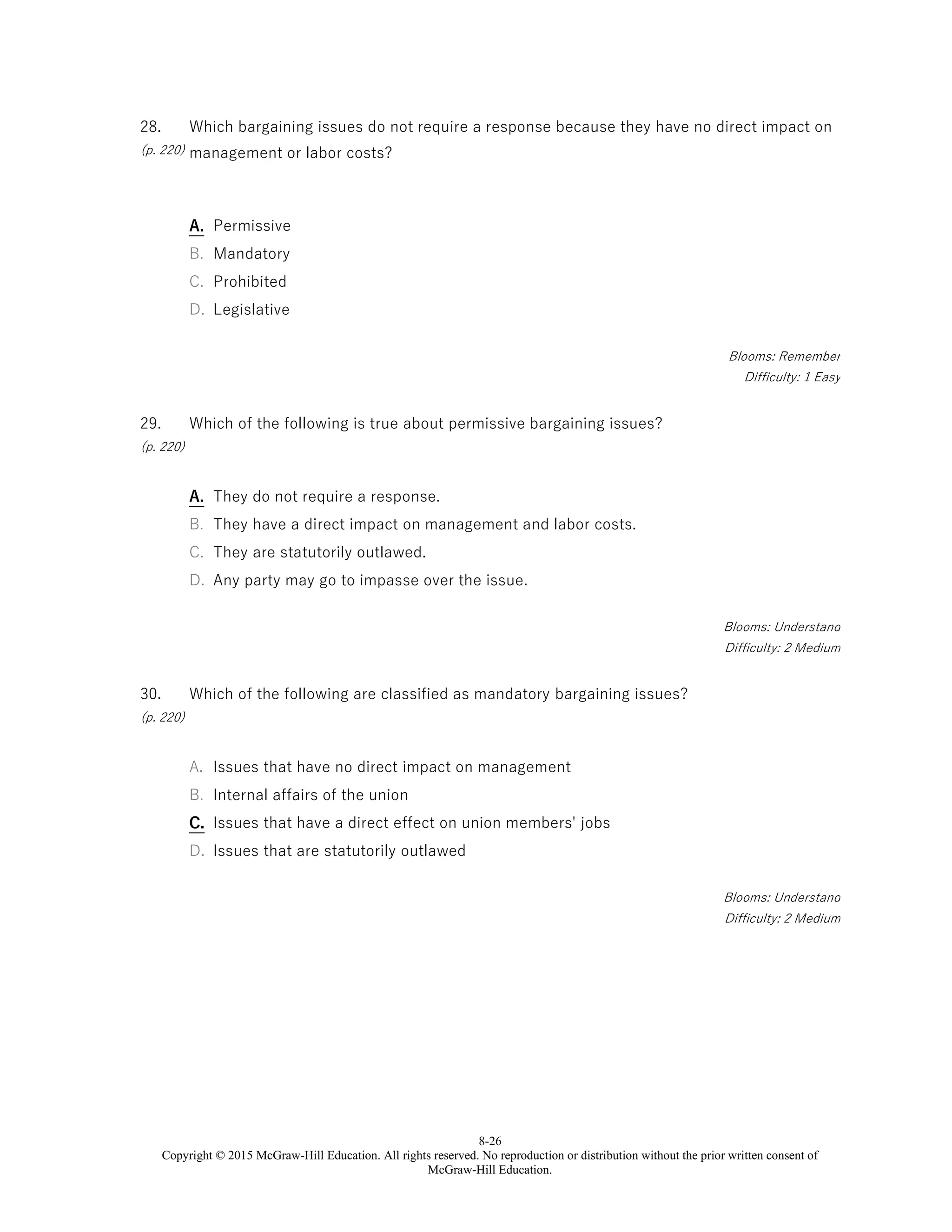
https://testbankdeal.com/product/life-span-development-14th-edition-
santrock-test-bank/
Environment and You 2nd Edition Christensen Test Bank
https://testbankdeal.com/product/environment-and-you-2nd-edition-
christensen-test-bank/
Fundamentals of Statistics 4th Edition Michael Sullivan
Test Bank
https://testbankdeal.com/product/fundamentals-of-statistics-4th-
edition-michael-sullivan-test-bank/
Management Australia 7th Edition Stagg Test Bank
https://testbankdeal.com/product/management-australia-7th-edition-
stagg-test-bank/
Retailing 8th Edition Dunne Solutions Manual
https://testbankdeal.com/product/retailing-8th-edition-dunne-
solutions-manual/
Global Marketing Management 6th Edition Kotabe Solutions
Manual
https://testbankdeal.com/product/global-marketing-management-6th-
edition-kotabe-solutions-manual/
8-1
Copyright © 2015 McGraw-Hill Education. All rights reserved. No reproduction or distribution without the prior written consent of
McGraw-Hill Education.
Chapter 08
The Environment for Bargaining
True / False Questions
1. The Railway Labor Act injected the federal government into transportation negotiations in the
form of the National Mediation Board.
True False
2. Permissive bargaining has no direct impact on management or labor costs.
True False
3. The demand for goods and services in a competitive market is highly elastic.
True False
4. A competitive market is one with relatively few producers.
True False
5. Deregulation created competition in wages between union and nonunion sectors of the
industries.
True False
6. The derived demand for labor is more inelastic if a given type of labor is essential in the
production of the final products.
True False
8-2
Copyright © 2015 McGraw-Hill Education. All rights reserved. No reproduction or distribution without the prior written consent of
McGraw-Hill Education.
7. Employers are likely to be able to pass on the cost of a wage increase if they are in a
noncompetitive product market.
True False
8. Economic theory suggests workers will be added until the added value of the additional
output no longer exceeds the wage.
True False
9. Marginal revenue product is the value of the output produced by the existing workforce.
True False
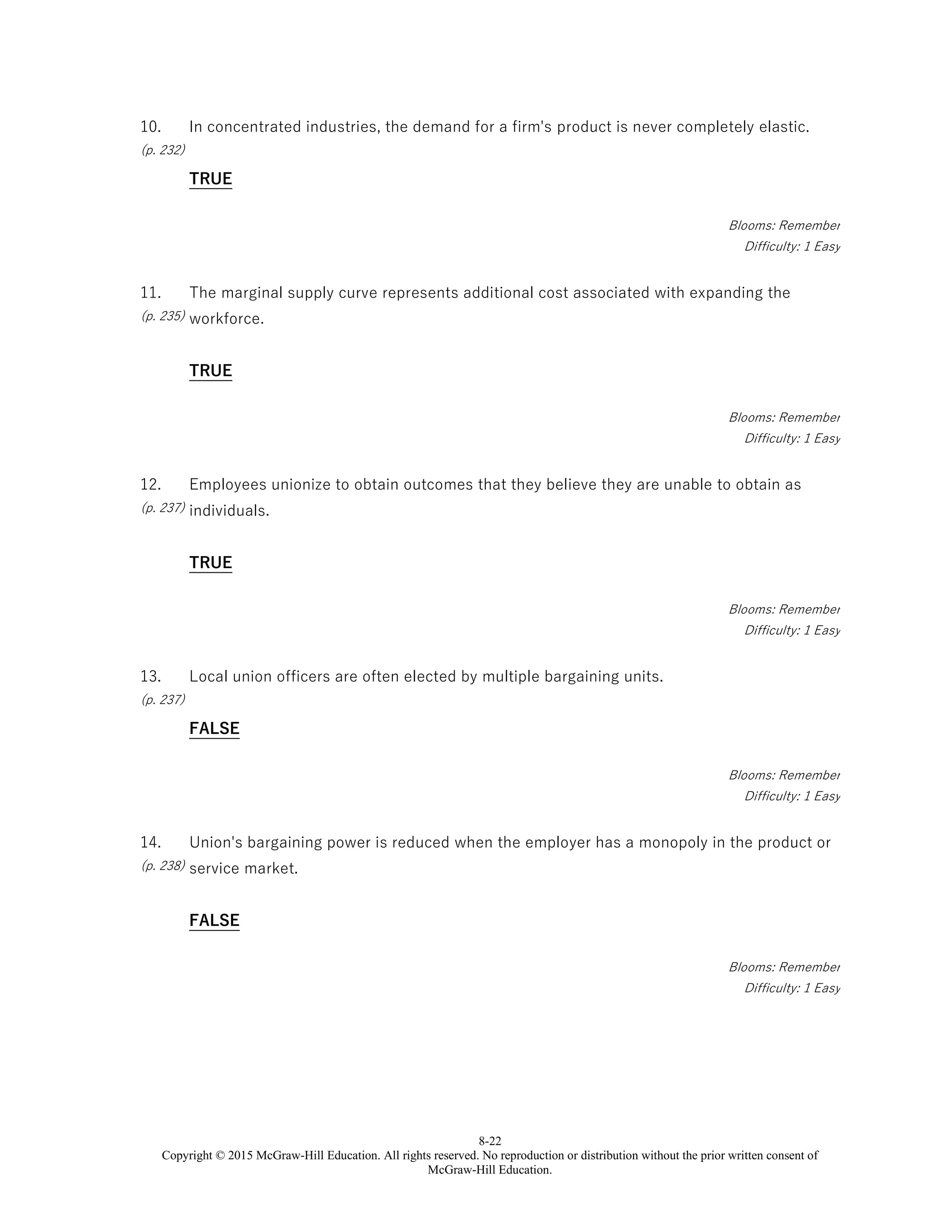
10. In concentrated industries, the demand for a firm's product is never completely elastic.
True False
11. The marginal supply curve represents additional cost associated with expanding the
workforce.
True False
12. Employees unionize to obtain outcomes that they believe they are unable to obtain as
individuals.
True False
13. Local union officers are often elected by multiple bargaining units.
True False
14. Union's bargaining power is reduced when the employer has a monopoly in the product or
service market.
True False
8-3
Copyright © 2015 McGraw-Hill Education. All rights reserved. No reproduction or distribution without the prior written consent of
McGraw-Hill Education.
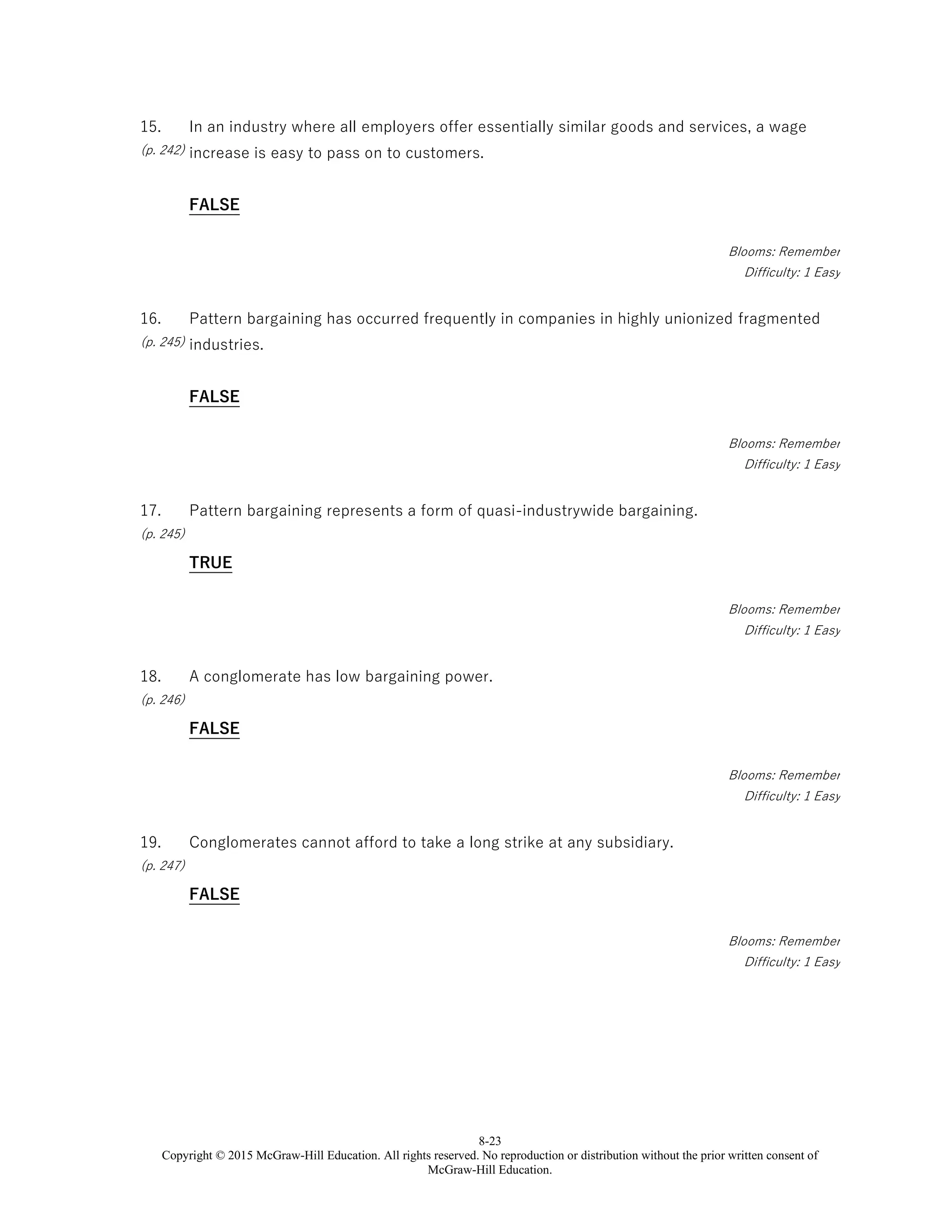
15. In an industry where all employers offer essentially similar goods and services, a wage
increase is easy to pass on to customers.
True False
16. Pattern bargaining has occurred frequently in companies in highly unionized fragmented
industries.
True False
17. Pattern bargaining represents a form of quasi-industrywide bargaining.
True False
18. A conglomerate has low bargaining power.
True False
19. Conglomerates cannot afford to take a long strike at any subsidiary.
True False
20. The goal of conglomerates created by private equity is to refloat the businesses through
initial public offerings as independent companies.
True False
21. Coordinated bargaining occurs where a single union represents employees of several small
employers.
True False
22. With the focus moving from a corporate to a business-unit perspective, unions have gained
leverage on economic issues.
True False
8-4
Copyright © 2015 McGraw-Hill Education. All rights reserved. No reproduction or distribution without the prior written consent of
McGraw-Hill Education.
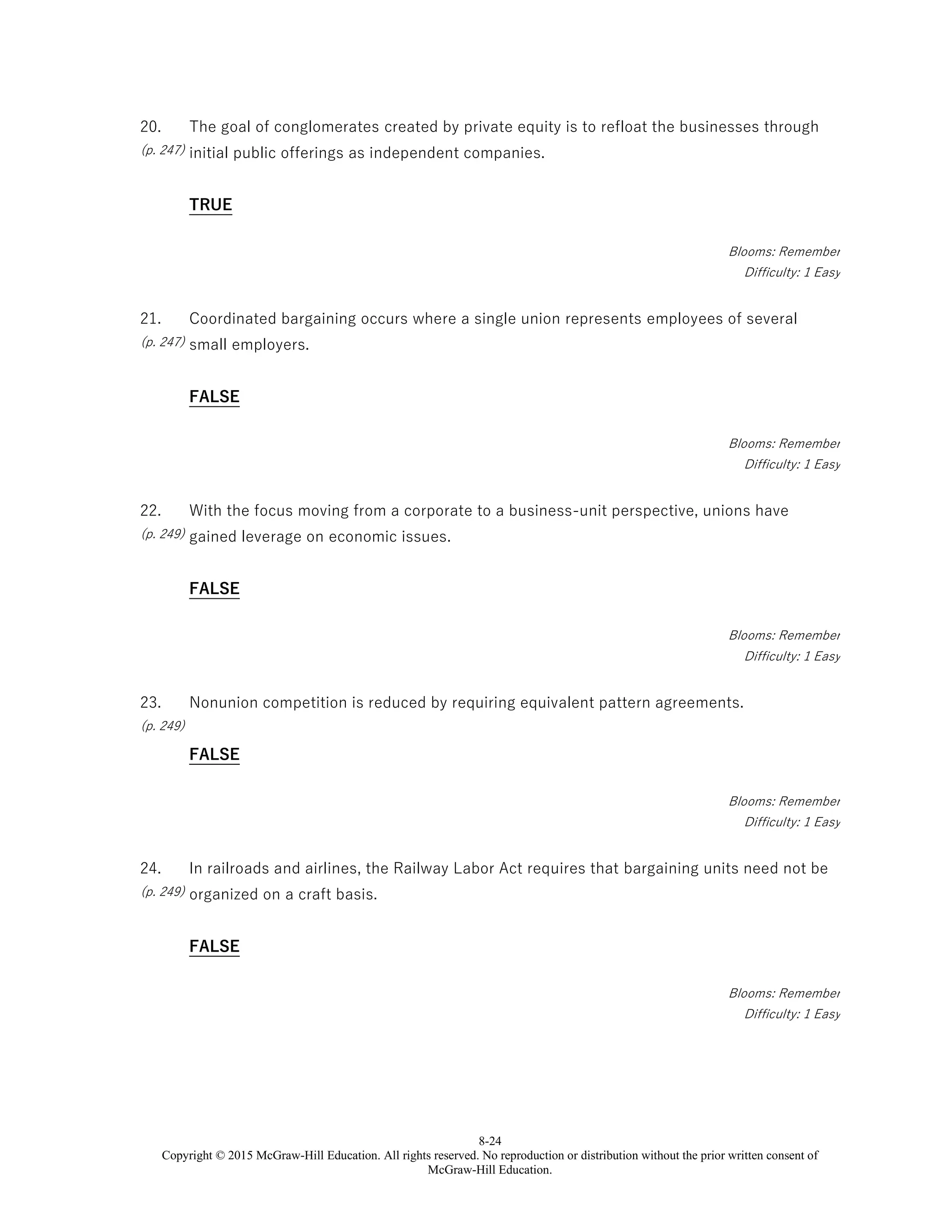
23. Nonunion competition is reduced by requiring equivalent pattern agreements.
True False
24. In railroads and airlines, the Railway Labor Act requires that bargaining units need not be
organized on a craft basis.
True False
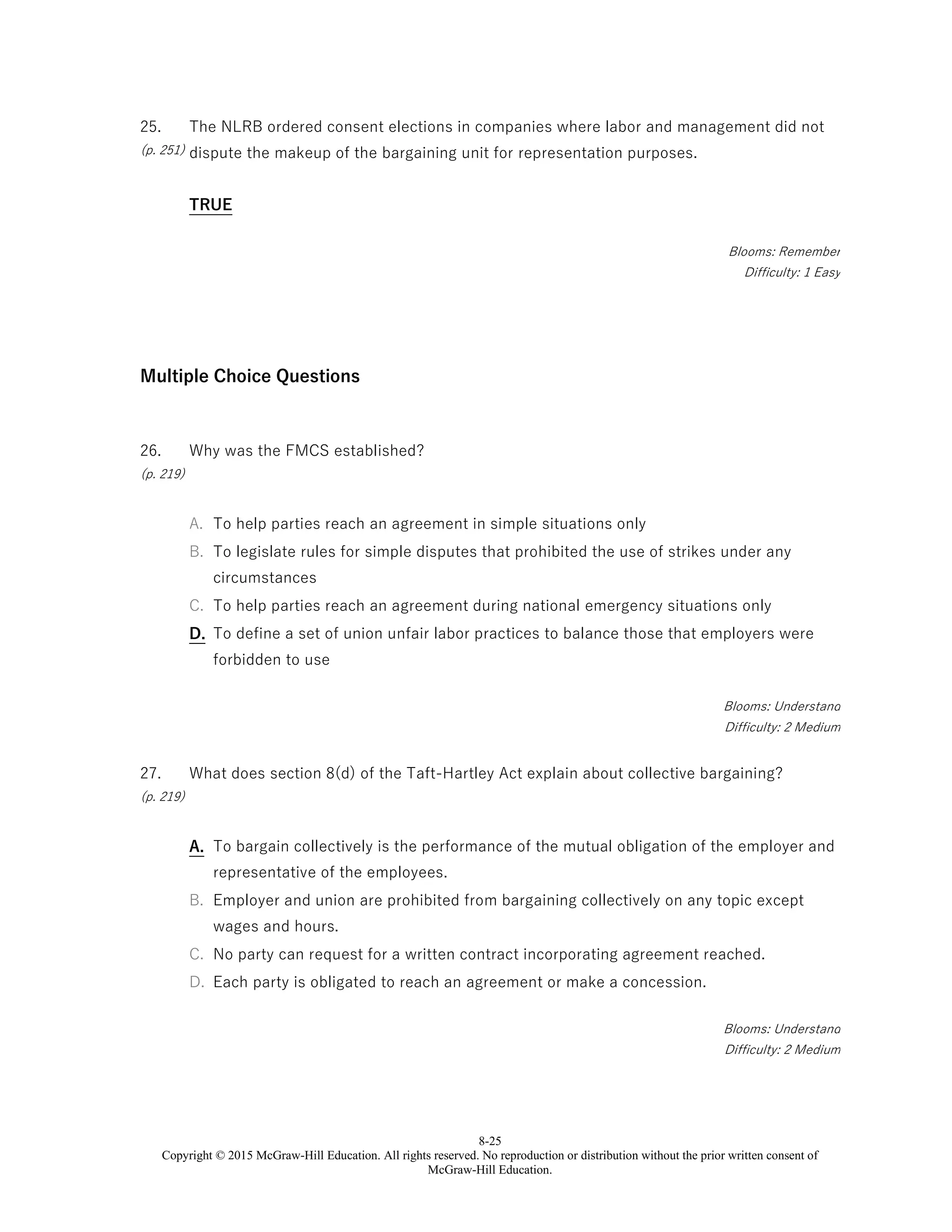
25. The NLRB ordered consent elections in companies where labor and management did not
dispute the makeup of the bargaining unit for representation purposes.
True False
Multiple Choice Questions
26. Why was the FMCS established?
A. To help parties reach an agreement in simple situations only
B. To legislate rules for simple disputes that prohibited the use of strikes under any
circumstances
C. To help parties reach an agreement during national emergency situations only
D. To define a set of union unfair labor practices to balance those that employers were
forbidden to use
27. What does section 8(d) of the Taft-Hartley Act explain about collective bargaining?
A. To bargain collectively is the performance of the mutual obligation of the employer and
representative of the employees.
B. Employer and union are prohibited from bargaining collectively on any topic except wages
and hours.
C. No party can request for a written contract incorporating agreement reached.
D. Each party is obligated to reach an agreement or make a concession.
8-5
Copyright © 2015 McGraw-Hill Education. All rights reserved. No reproduction or distribution without the prior written consent of
McGraw-Hill Education.
28. Which bargaining issues do not require a response because they have no direct impact on
management or labor costs?
A. Permissive
B. Mandatory
C. Prohibited
D. Legislative
29. Which of the following is true about permissive bargaining issues?
A. They do not require a response.
B. They have a direct impact on management and labor costs.
C. They are statutorily outlawed.
D. Any party may go to impasse over the issue.
30. Which of the following are classified as mandatory bargaining issues?
A. Issues that have no direct impact on management
B. Internal affairs of the union
C. Issues that have a direct effect on union members' jobs
D. Issues that are statutorily outlawed
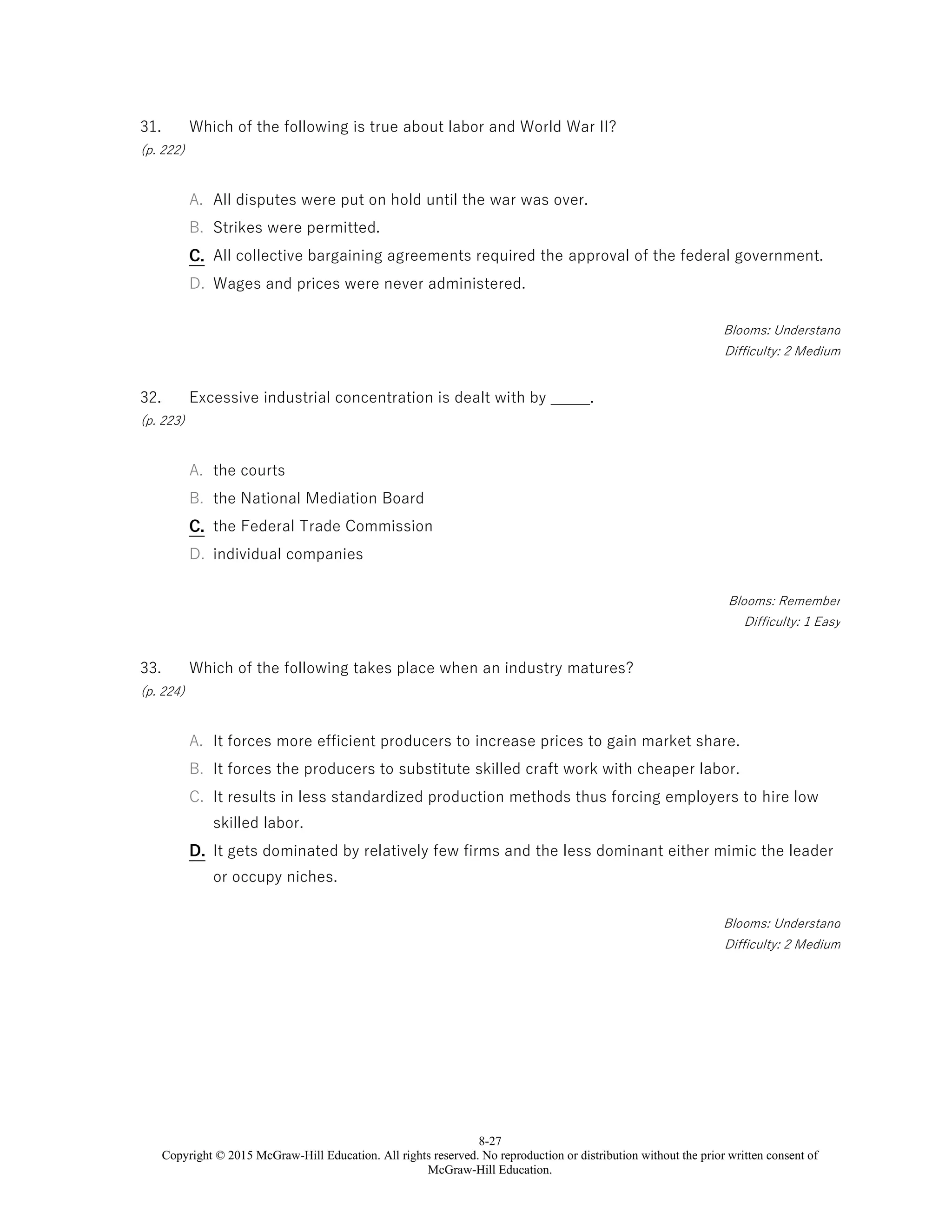
31. Which of the following is true about labor and World War II?
A. All disputes were put on hold until the war was over.
B. Strikes were permitted.
C. All collective bargaining agreements required the approval of the federal government.
D. Wages and prices were never administered.
8-6
Copyright © 2015 McGraw-Hill Education. All rights reserved. No reproduction or distribution without the prior written consent of
McGraw-Hill Education.
32. Excessive industrial concentration is dealt with by _____.
A. the courts
B. the National Mediation Board
C. the Federal Trade Commission
D. individual companies
33. Which of the following takes place when an industry matures?
A. It forces more efficient producers to increase prices to gain market share.
B. It forces the producers to substitute skilled craft work with cheaper labor.
C. It results in less standardized production methods thus forcing employers to hire low
skilled labor.
D. It gets dominated by relatively few firms and the less dominant either mimic the leader or
occupy niches.
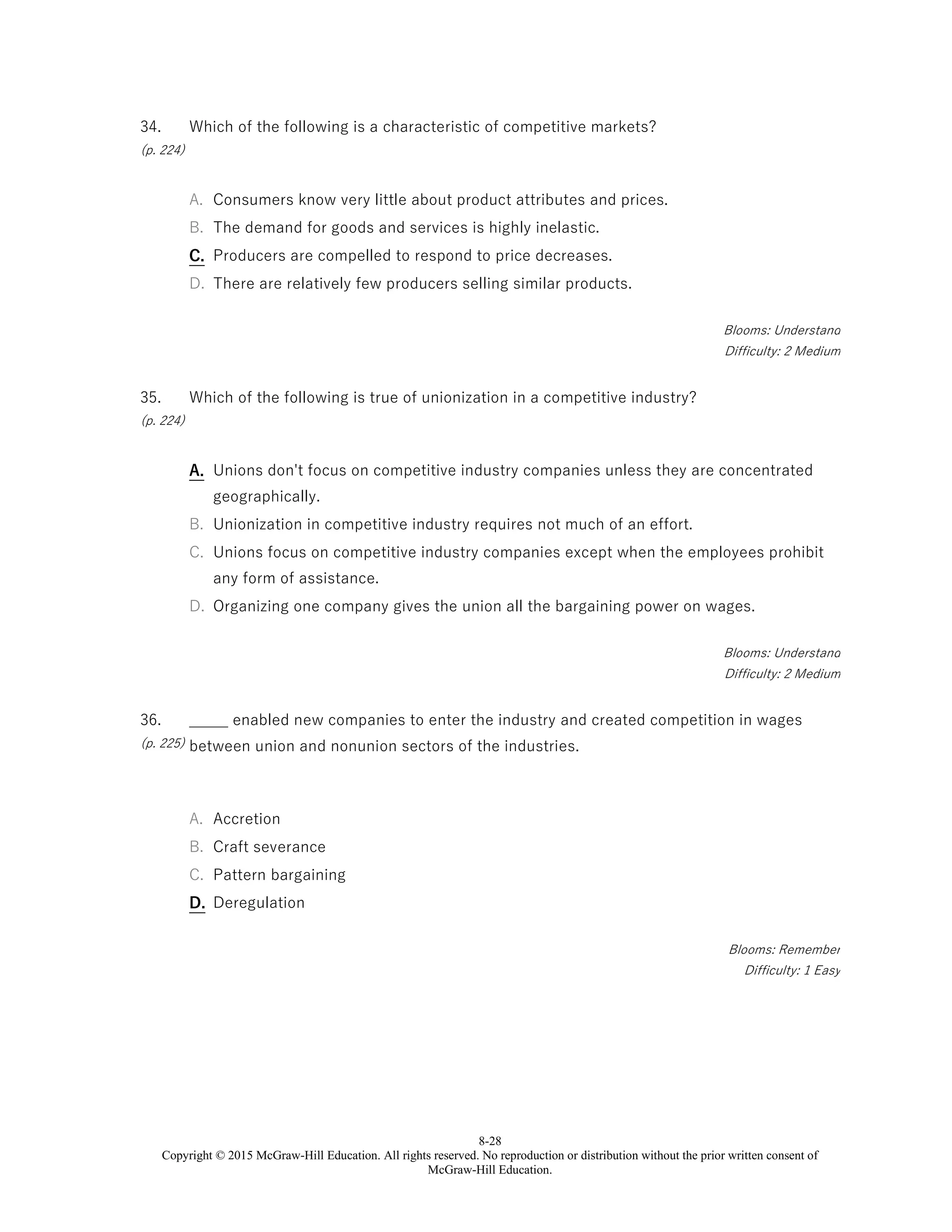
34. Which of the following is a characteristic of competitive markets?
A. Consumers know very little about product attributes and prices.
B. The demand for goods and services is highly inelastic.
C. Producers are compelled to respond to price decreases.
D. There are relatively few producers selling similar products.
35. Which of the following is true of unionization in a competitive industry?
A. Unions don't focus on competitive industry companies unless they are concentrated
geographically.
B. Unionization in competitive industry requires not much of an effort.
C. Unions focus on competitive industry companies except when the employees prohibit any
form of assistance.
D. Organizing one company gives the union all the bargaining power on wages.
8-7
Copyright © 2015 McGraw-Hill Education. All rights reserved. No reproduction or distribution without the prior written consent of
McGraw-Hill Education.
36. _____ enabled new companies to enter the industry and created competition in wages
between union and nonunion sectors of the industries.
A. Accretion
B. Craft severance
C. Pattern bargaining
D. Deregulation
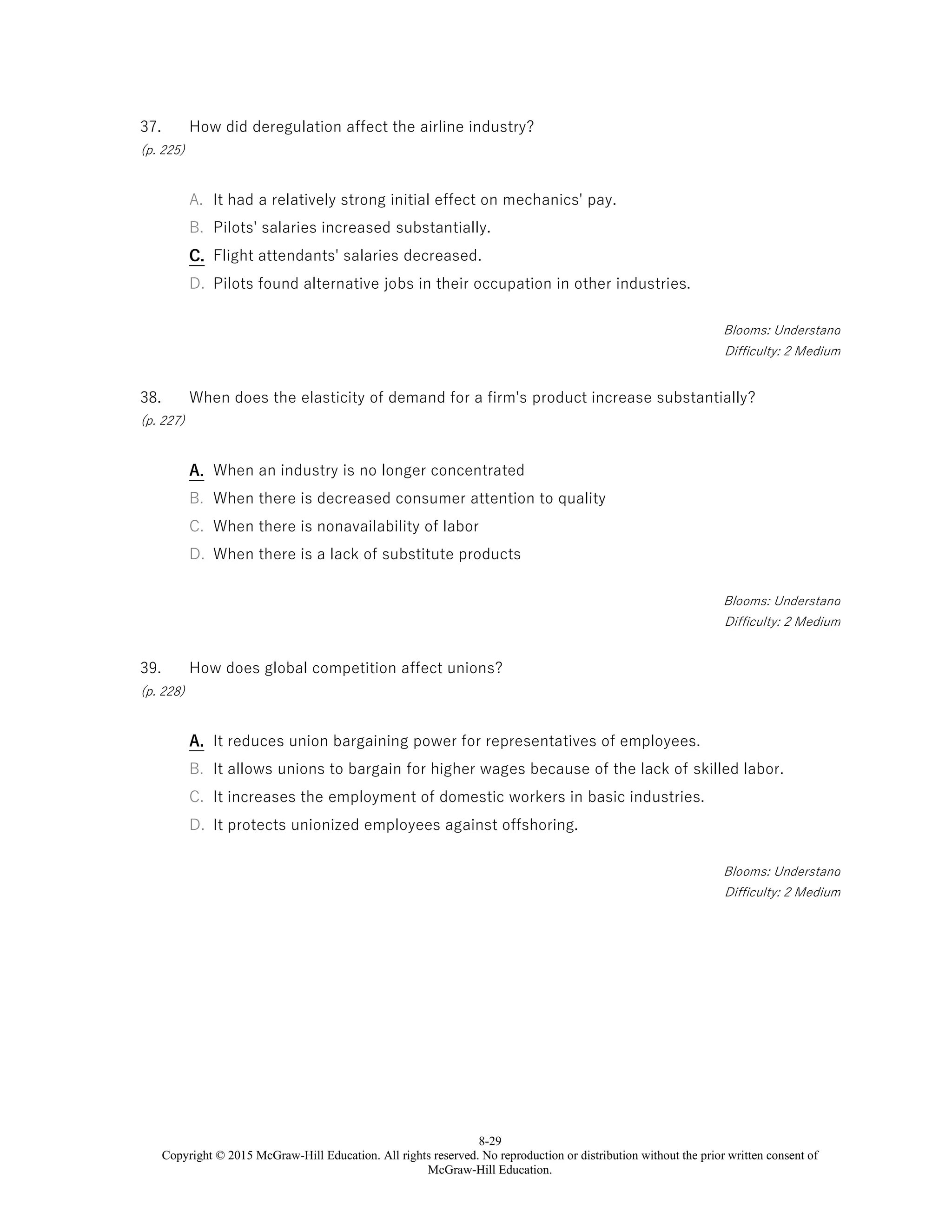
37. How did deregulation affect the airline industry?
A. It had a relatively strong initial effect on mechanics' pay.
B. Pilots' salaries increased substantially.
C. Flight attendants' salaries decreased.
D. Pilots found alternative jobs in their occupation in other industries.
38. When does the elasticity of demand for a firm's product increase substantially?
A. When an industry is no longer concentrated
B. When there is decreased consumer attention to quality
C. When there is nonavailability of labor
D. When there is a lack of substitute products
39. How does global competition affect unions?
A. It reduces union bargaining power for representatives of employees.
B. It allows unions to bargain for higher wages because of the lack of skilled labor.
C. It increases the employment of domestic workers in basic industries.
D. It protects unionized employees against offshoring.
8-8
Copyright © 2015 McGraw-Hill Education. All rights reserved. No reproduction or distribution without the prior written consent of
McGraw-Hill Education.
40. _____ in basic industries has decreased the wages and employment of domestic workers.
A. Prohibited bargaining
B. Global competition
C. Permissive bargaining
D. Unionization
41. Which of the following is true about health and pension costs?
A. They are largely determined by the control of the bargainers.
B. They are not related to the age of the workers.
C. They are not determined by the prices of financial services.
D. They are related to the prices of medical services.
42. What does management do to meet investor objectives?
A. They sell-off a higher-earning division.
B. They stay away from a possible spin off.
C. They shift investment from areas with increasing returns to those where improvement is
never anticipated.
D. They try to maximize profits in their present operations.
43. The derived demand for labor is more elastic if the:
A. market demand for the final products is inelastic.
B. cost of labor is a significant part of the total product cost.
C. supply of materials is elastic.
D. supply of capital is elastic.
8-9
Copyright © 2015 McGraw-Hill Education. All rights reserved. No reproduction or distribution without the prior written consent of
McGraw-Hill Education.
44. When is the derived demand for labor more inelastic?
A. If a given type of labor is essential in the production of the final products
B. If the market demand for the final products is elastic
C. If the cost of labor is a significant part of the total product cost
D. If the supply of materials is elastic
45. When is the supply of labor elastic?
A. When an employer is a relatively small factor in a labor market
B. When there are a lot of employment opportunities in the market
C. When several employers hire the same type of labor simultaneously
D. When the rate of unemployment is low in the market
46. Employers are likely to be able to pass on the cost of a wage increase if they _____.
A. are in a competitive product market
B. are in a concentrated industry
C. are in a noncompetitive product market
D. sell products that have an elastic demand
47. Which of the following best describes marginal revenue product?
A. It is the value of output produced by hiring an additional worker.
B. It represents the additional cost associated with expanding the workforce.
C. It is the price at which the product is allowed to be sold in the retail market.
D. It is the total revenue generated times the labor cost.
8-10
Copyright © 2015 McGraw-Hill Education. All rights reserved. No reproduction or distribution without the prior written consent of
McGraw-Hill Education.
48. Which of the following statements about competitive and/or concentrated markets is true?
A. In competitive industries, demand for a firm's product is highly inelastic.
B. The demand for each employer's products in concentrated industries is highly price-
sensitive.
C. The labor demand in concentrated industries is less elastic than it is in the competitive
situation.
D. Wage increase can be easily passed on to customers in competitive industries.
49. What would an employer in a competitive market do when the cost of labor increases?
A. Reduce cost on capital
B. Change capital-labor mix
C. Hire only unskilled workers
D. Decrease its dependence on technology
50. Which of the following is true of labor markets?
A. The union can never acquire monopoly power over the labor supply.
B. The union supplies the labor, but the contract has no authority on fixing its price.
C. Unions stay away from employers that have power to influence prices in the product
market and/or wages in the labor market.
D. A contracted wage elasticizes the labor supply at the negotiated rate.
51. Which of the following best describes a monopsonist employer?
A. A single producer of a specific product in a given market
B. The only unionized employer in a given market
C. A single purchaser of labor in a given market
D. The most dominating producer in a given market
8-11
Copyright © 2015 McGraw-Hill Education. All rights reserved. No reproduction or distribution without the prior written consent of
McGraw-Hill Education.
52. Which of the following is true of the marginal supply curve?
A. It represents the value of output produced by hiring an additional worker.
B. It represents the graph of product supply and demand.
C. It represents the graph of labor supply and demand.
D. It represents the additional cost associated with expanding the workforce.
53. Which of the following is most likely to happen when a union bargains with a monopsonist
employer for increased wages beyond a point where MS and MRP intersect?
A. Employer will incur unviable labor costs.
B. Employer will be forced to layoff employees.
C. Employer will be able to expand employment.
D. Employer will be able to increase profits substantially.
54. Employers in the private sector are interested in _____.
A. maximizing long-term return to the investment in skills
B. maximizing long-term profits
C. encouraging all employees to join unions
D. increasing employment wages
55. What are the two major goals of unions?
A. Higher wages and more members
B. Maximizing profit and share value
C. Reduce risk of investments and diversification
D. Mergers and acquisitions of firms
8-12
Copyright © 2015 McGraw-Hill Education. All rights reserved. No reproduction or distribution without the prior written consent of
McGraw-Hill Education.
56. In which of the following conditions will the employer have higher ability to continue
operations?
A. When the strike is in peak season
B. When the firm is capital-intensive
C. When high skilled labor is not easily replaceable
D. When an employer has only one plant that produces the product
57. In which of the following scenarios will the employer be less able to take a strike?
A. If employers implement just-in-time inventory systems
B. If the firm is capital intensive
C. If the employer has several plants producing the same product
D. If the jobs' skill level is low
58. Under which condition is union's wage gains in bargaining higher?
A. When new employers can easily enter the market
B. When industrial concentration is low
C. When foreign competition is low
D. When union coverage by dominant union is low
59. Which of the following is true of a multiemployer bargaining unit?
A. A single set of negotiators and negotiated wages applies to all members.
B. The contract expires at different times for all.
C. Each employer faces a product and service demand curve totally different from the market
demand curve.
D. If the market demand for the employers' goods and services is quite inelastic, none of the
wage increases can be passed.
8-13
Copyright © 2015 McGraw-Hill Education. All rights reserved. No reproduction or distribution without the prior written consent of
McGraw-Hill Education.
60. When does the most successful multiemployer bargaining occur?
A. When the employers have varied nonlabor costs
B. When all employers are unionized
C. When the entry costs are low for new firms
D. When the negotiated wages do not apply to all
61. When does industrywide bargaining take place?
A. When employees stick to a single employer within a small geographic area
B. When products or services are essentially commodities
C. When the bargaining occurs within a relatively small geographic area
D. When the bargaining is done in a business operating in several distinct industries
62. What is pattern bargaining?
A. Union targets one dominant employer in a highly concentrated industry
B. Union bargains with many small employers from a particular geographic area
C. Union bargains with a large employer that has many competitors
D. Union bargains with a small employer who has many competitors
63. Which of the following is true of a conglomerate?
A. It has low bargaining power.
B. It is a business operating in several distinct industries.
C. Its parts depend on each other for components and processes.
D. It can never afford to take a long strike at any of its subsidiary.
8-14
Copyright © 2015 McGraw-Hill Education. All rights reserved. No reproduction or distribution without the prior written consent of
McGraw-Hill Education.
64. Why does a conglomerate have higher ability to take on a long strike at any subsidiary?
A. A few parts of its business are large relative to others.
B. Its parts do not depend on each other for components or processes.
C. It has low bargaining power.
D. It deals with a single union and has contracts with the same expiration.
65. Which of the following best describes coordinated bargaining?
A. Dominant union chooses a major employer as a bargaining target
B. Bargaining in businesses operating in several distinct industries
C. Two or more national unions represent employees of a single major employer
D. A single set of negotiators speaks for all employers
66. A _____ arrangement increases union bargaining power but is also accompanied by an
increased willingness to try innovative solutions to employment problems during a period of
rapid technological change in the telecommunications industry.
A. coalition
B. local
C. permissive
D. industrywide
67. Under which act do bargaining units need to be organized on a craft basis?
A. Taft-Hartley Act
B. Norris-La Guardia Act
C. Railway Labor Act
D. Wagner Act
8-15
Copyright © 2015 McGraw-Hill Education. All rights reserved. No reproduction or distribution without the prior written consent of
McGraw-Hill Education.
68. Unions must be able to reduce competition with both nonunion and union workers to improve
conditions. Nonunion competition is reduced through _____.
A. requiring equivalent pattern agreements
B. covering only nonunion labor
C. extending organizing
D. unionizing only the dominant producer
69. Which of the following is true about the changes in industrial bargaining structures and their
outcomes?
A. Professional sports are the least organized, with baseball and basketball players exercising
low bargaining strength.
B. Declining unionization in health care and the consolidation of health care providers has led
to the reduced use of organization-wide bargaining structures.
C. Unionization in the construction industry has increased as employers have increasingly
established nonunion subsidiaries.
D. The Communications Workers have some of the major local operators who are neutral in
organizing campaigns and/or allow card checks for recognition in their wireless business
units.
70. Which of the following is true about bargaining units?
A. Where local unions service several bargaining units, local officers are very concerned
about the content of individual contracts.
B. At its most elemental level, a bargaining unit is what labor and management say it is.
C. After the representation stage, the parties are free to make the bargaining unit less (but
not more) inclusive in negotiations.
D. The expansion of a bargaining unit results only if management forces the union to do so.
Short Answer Questions
8-16
Copyright © 2015 McGraw-Hill Education. All rights reserved. No reproduction or distribution without the prior written consent of
McGraw-Hill Education.
71. What are the changes that occur from the time of infancy to maturity of an industry?
72. Describe the characteristics of a competitive industry.
73. How does the composition of the workforce affect productivity and labor costs of employers?
8-17
Copyright © 2015 McGraw-Hill Education. All rights reserved. No reproduction or distribution without the prior written consent of
McGraw-Hill Education.
74. List some of the steps that a firm can take to increase profitability.
75. When is the derived demand for labor more inelastic?
76. Explain the labor-capital substitution.
8-18
Copyright © 2015 McGraw-Hill Education. All rights reserved. No reproduction or distribution without the prior written consent of
McGraw-Hill Education.
77. What is a marginal supply curve? Explain with an example.
78. How do unions demonstrate their effectiveness?
79. How do integrated facilities affect an employer's ability to take on strikes?
8-19
Copyright © 2015 McGraw-Hill Education. All rights reserved. No reproduction or distribution without the prior written consent of
McGraw-Hill Education.
80. Write a short note on industrywide bargaining.
8-20
Copyright © 2015 McGraw-Hill Education. All rights reserved. No reproduction or distribution without the prior written consent of
McGraw-Hill Education.
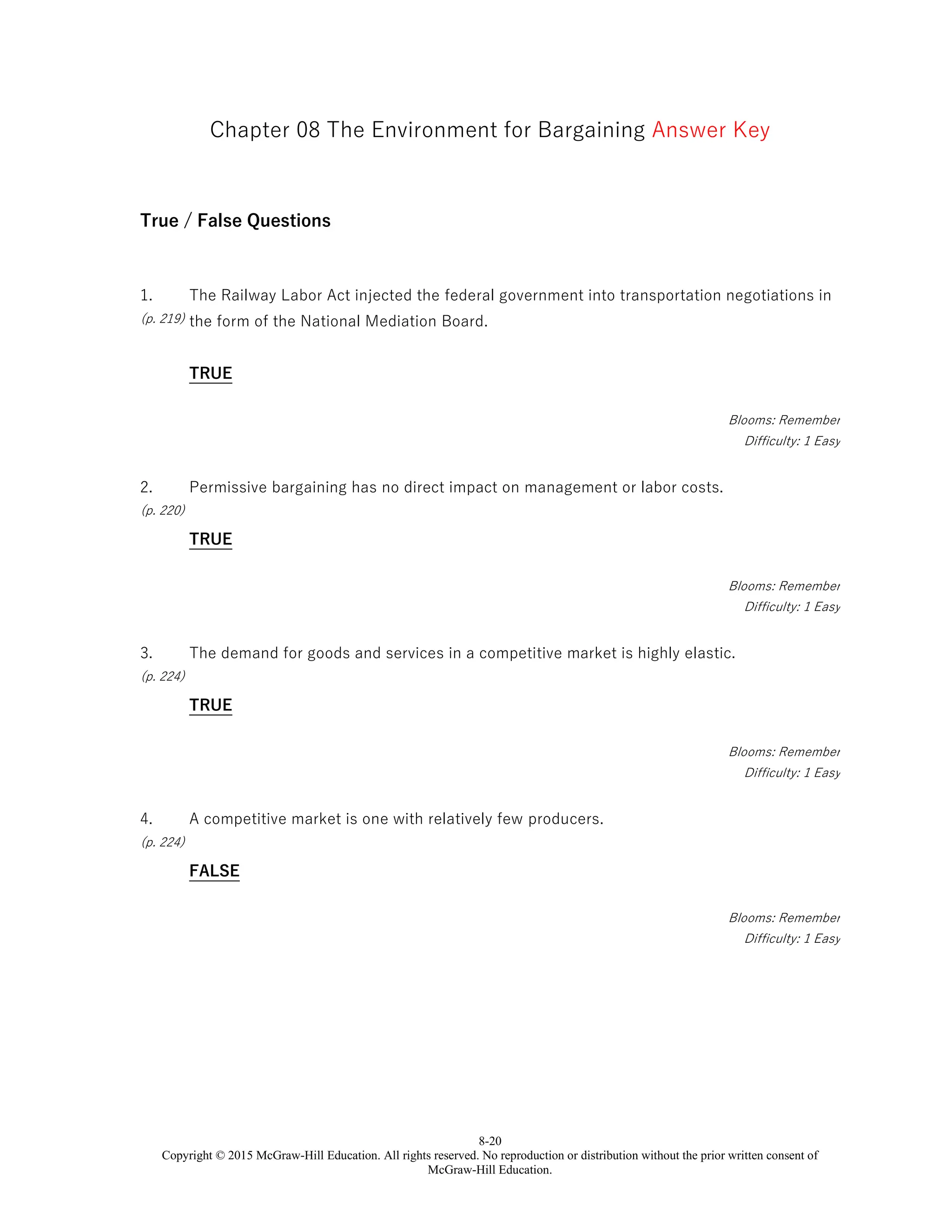
Chapter 08 The Environment for Bargaining Answer Key
True / False Questions
1.
(p. 219)
The Railway Labor Act injected the federal government into transportation negotiations in
the form of the National Mediation Board.
TRUE
Blooms: Remember
Difficulty: 1 Easy
2.
(p. 220)
Permissive bargaining has no direct impact on management or labor costs.
TRUE
Blooms: Remember
Difficulty: 1 Easy
3.
(p. 224)
The demand for goods and services in a competitive market is highly elastic.
TRUE
Blooms: Remember
Difficulty: 1 Easy
4.
(p. 224)
A competitive market is one with relatively few producers.
FALSE
Blooms: Remember
Difficulty: 1 Easy
8-21
Copyright © 2015 McGraw-Hill Education. All rights reserved. No reproduction or distribution without the prior written consent of
McGraw-Hill Education.
5.
(p. 225)
Deregulation created competition in wages between union and nonunion sectors of the
industries.
TRUE
Blooms: Remember
Difficulty: 1 Easy
6.
(p. 230)
The derived demand for labor is more inelastic if a given type of labor is essential in the
production of the final products.
TRUE
Blooms: Remember
Difficulty: 1 Easy
7.
(p. 231)
Employers are likely to be able to pass on the cost of a wage increase if they are in a
noncompetitive product market.
TRUE
Blooms: Remember
Difficulty: 1 Easy
8.
(p. 231)
Economic theory suggests workers will be added until the added value of the additional
output no longer exceeds the wage.
TRUE
Blooms: Remember
Difficulty: 1 Easy
9.
(p. 231)
Marginal revenue product is the value of the output produced by the existing workforce.
FALSE
Blooms: Remember
Difficulty: 1 Easy
8-22
Copyright © 2015 McGraw-Hill Education. All rights reserved. No reproduction or distribution without the prior written consent of
McGraw-Hill Education.
10.
(p. 232)
In concentrated industries, the demand for a firm's product is never completely elastic.
TRUE
Blooms: Remember
Difficulty: 1 Easy
11.
(p. 235)
The marginal supply curve represents additional cost associated with expanding the
workforce.
TRUE
Blooms: Remember
Difficulty: 1 Easy
12.
(p. 237)
Employees unionize to obtain outcomes that they believe they are unable to obtain as
individuals.
TRUE
Blooms: Remember
Difficulty: 1 Easy
13.
(p. 237)
Local union officers are often elected by multiple bargaining units.
FALSE
Blooms: Remember
Difficulty: 1 Easy
14.
(p. 238)
Union's bargaining power is reduced when the employer has a monopoly in the product or
service market.
FALSE
Blooms: Remember
Difficulty: 1 Easy
8-23
Copyright © 2015 McGraw-Hill Education. All rights reserved. No reproduction or distribution without the prior written consent of
McGraw-Hill Education.
15.
(p. 242)
In an industry where all employers offer essentially similar goods and services, a wage
increase is easy to pass on to customers.
FALSE
Blooms: Remember
Difficulty: 1 Easy
16.
(p. 245)
Pattern bargaining has occurred frequently in companies in highly unionized fragmented
industries.
FALSE
Blooms: Remember
Difficulty: 1 Easy
17.
(p. 245)
Pattern bargaining represents a form of quasi-industrywide bargaining.
TRUE
Blooms: Remember
Difficulty: 1 Easy
18.
(p. 246)
A conglomerate has low bargaining power.
FALSE
Blooms: Remember
Difficulty: 1 Easy
19.
(p. 247)
Conglomerates cannot afford to take a long strike at any subsidiary.
FALSE
Blooms: Remember
Difficulty: 1 Easy
8-24
Copyright © 2015 McGraw-Hill Education. All rights reserved. No reproduction or distribution without the prior written consent of
McGraw-Hill Education.
20.
(p. 247)
The goal of conglomerates created by private equity is to refloat the businesses through
initial public offerings as independent companies.
TRUE
Blooms: Remember
Difficulty: 1 Easy
21.
(p. 247)
Coordinated bargaining occurs where a single union represents employees of several
small employers.
FALSE
Blooms: Remember
Difficulty: 1 Easy
22.
(p. 249)
With the focus moving from a corporate to a business-unit perspective, unions have
gained leverage on economic issues.
FALSE
Blooms: Remember
Difficulty: 1 Easy
23.
(p. 249)
Nonunion competition is reduced by requiring equivalent pattern agreements.
FALSE
Blooms: Remember
Difficulty: 1 Easy
24.
(p. 249)
In railroads and airlines, the Railway Labor Act requires that bargaining units need not be
organized on a craft basis.
FALSE
Blooms: Remember
Difficulty: 1 Easy
8-25
Copyright © 2015 McGraw-Hill Education. All rights reserved. No reproduction or distribution without the prior written consent of
McGraw-Hill Education.
25.
(p. 251)
The NLRB ordered consent elections in companies where labor and management did not
dispute the makeup of the bargaining unit for representation purposes.
TRUE
Blooms: Remember
Difficulty: 1 Easy
Multiple Choice Questions
26.
(p. 219)
Why was the FMCS established?
A. To help parties reach an agreement in simple situations only
B. To legislate rules for simple disputes that prohibited the use of strikes under any
circumstances
C. To help parties reach an agreement during national emergency situations only
D. To define a set of union unfair labor practices to balance those that employers were
forbidden to use
Blooms: Understand
Difficulty: 2 Medium
27.
(p. 219)
What does section 8(d) of the Taft-Hartley Act explain about collective bargaining?
A. To bargain collectively is the performance of the mutual obligation of the employer and
representative of the employees.
B. Employer and union are prohibited from bargaining collectively on any topic except
wages and hours.
C. No party can request for a written contract incorporating agreement reached.
D. Each party is obligated to reach an agreement or make a concession.
Blooms: Understand
Difficulty: 2 Medium
8-26
Copyright © 2015 McGraw-Hill Education. All rights reserved. No reproduction or distribution without the prior written consent of
McGraw-Hill Education.
28.
(p. 220)
Which bargaining issues do not require a response because they have no direct impact on
management or labor costs?
A. Permissive
B. Mandatory
C. Prohibited
D. Legislative
Blooms: Remember
Difficulty: 1 Easy
29.
(p. 220)
Which of the following is true about permissive bargaining issues?
A. They do not require a response.
B. They have a direct impact on management and labor costs.
C. They are statutorily outlawed.
D. Any party may go to impasse over the issue.
Blooms: Understand
Difficulty: 2 Medium
30.
(p. 220)
Which of the following are classified as mandatory bargaining issues?
A. Issues that have no direct impact on management
B. Internal affairs of the union
C. Issues that have a direct effect on union members' jobs
D. Issues that are statutorily outlawed
Blooms: Understand
Difficulty: 2 Medium
8-27
Copyright © 2015 McGraw-Hill Education. All rights reserved. No reproduction or distribution without the prior written consent of
McGraw-Hill Education.
31.
(p. 222)
Which of the following is true about labor and World War II?
A. All disputes were put on hold until the war was over.
B. Strikes were permitted.
C. All collective bargaining agreements required the approval of the federal government.
D. Wages and prices were never administered.
Blooms: Understand
Difficulty: 2 Medium
32.
(p. 223)
Excessive industrial concentration is dealt with by _____.
A. the courts
B. the National Mediation Board
C. the Federal Trade Commission
D. individual companies
Blooms: Remember
Difficulty: 1 Easy
33.
(p. 224)
Which of the following takes place when an industry matures?
A. It forces more efficient producers to increase prices to gain market share.
B. It forces the producers to substitute skilled craft work with cheaper labor.
C. It results in less standardized production methods thus forcing employers to hire low
skilled labor.
D. It gets dominated by relatively few firms and the less dominant either mimic the leader
or occupy niches.
Blooms: Understand
Difficulty: 2 Medium
8-28
Copyright © 2015 McGraw-Hill Education. All rights reserved. No reproduction or distribution without the prior written consent of
McGraw-Hill Education.
34.
(p. 224)
Which of the following is a characteristic of competitive markets?
A. Consumers know very little about product attributes and prices.
B. The demand for goods and services is highly inelastic.
C. Producers are compelled to respond to price decreases.
D. There are relatively few producers selling similar products.
Blooms: Understand
Difficulty: 2 Medium
35.
(p. 224)
Which of the following is true of unionization in a competitive industry?
A. Unions don't focus on competitive industry companies unless they are concentrated
geographically.
B. Unionization in competitive industry requires not much of an effort.
C. Unions focus on competitive industry companies except when the employees prohibit
any form of assistance.
D. Organizing one company gives the union all the bargaining power on wages.
Blooms: Understand
Difficulty: 2 Medium
36.
(p. 225)
_____ enabled new companies to enter the industry and created competition in wages
between union and nonunion sectors of the industries.
A. Accretion
B. Craft severance
C. Pattern bargaining
D. Deregulation
Blooms: Remember
Difficulty: 1 Easy
8-29
Copyright © 2015 McGraw-Hill Education. All rights reserved. No reproduction or distribution without the prior written consent of
McGraw-Hill Education.
37.
(p. 225)
How did deregulation affect the airline industry?
A. It had a relatively strong initial effect on mechanics' pay.
B. Pilots' salaries increased substantially.
C. Flight attendants' salaries decreased.
D. Pilots found alternative jobs in their occupation in other industries.
Blooms: Understand
Difficulty: 2 Medium
38.
(p. 227)
When does the elasticity of demand for a firm's product increase substantially?
A. When an industry is no longer concentrated
B. When there is decreased consumer attention to quality
C. When there is nonavailability of labor
D. When there is a lack of substitute products
Blooms: Understand
Difficulty: 2 Medium
39.
(p. 228)
How does global competition affect unions?
A. It reduces union bargaining power for representatives of employees.
B. It allows unions to bargain for higher wages because of the lack of skilled labor.
C. It increases the employment of domestic workers in basic industries.
D. It protects unionized employees against offshoring.
Blooms: Understand
Difficulty: 2 Medium
8-30
Copyright © 2015 McGraw-Hill Education. All rights reserved. No reproduction or distribution without the prior written consent of
McGraw-Hill Education.
40.
(p. 228)
_____ in basic industries has decreased the wages and employment of domestic workers.
A. Prohibited bargaining
B. Global competition
C. Permissive bargaining
D. Unionization
Blooms: Remember
Difficulty: 1 Easy
41.
(p. 229)
Which of the following is true about health and pension costs?
A. They are largely determined by the control of the bargainers.
B. They are not related to the age of the workers.
C. They are not determined by the prices of financial services.
D. They are related to the prices of medical services.
Blooms: Remember
Difficulty: 1 Easy
42.
(p. 230)
What does management do to meet investor objectives?
A. They sell-off a higher-earning division.
B. They stay away from a possible spin off.
C. They shift investment from areas with increasing returns to those where improvement
is never anticipated.
D. They try to maximize profits in their present operations.
Blooms: Understand
Difficulty: 2 Medium
Other documents randomly have
different content
still actively growing, especially in spring and early summer when
rocks are pried loose by the alternate freezing and thawing of
moisture within fractures. The artillery-like crack made when a falling
rock crashes to the base of a high cliff is a familiar sound to anyone
who has spent much time in the mountains.
24
The Future
We know that the processes of erosion and weathering will continue,
that alluvial fans and talus cones will grow larger, and gorges will be
eroded deeper, and as a result the mountains will be cut down to
lower elevations. But, as we have seen, this event will require much
time. If the present climate continues for a few more years our
remaining glaciers will disappear, but there is nothing in
geologic history which says they won’t return again, possibly
even to the size of their heyday in the Pleistocene. And if history
repeats itself, and all past geologic history has been a repetition, then
the mountains will eventually be worn down to an uneventful plain
and the sea will invade the land again.
But certain breeds of man are the only despoilers of mountains that
we need fear, so if the good citizens of our land keep the human
invader and his dams and earth-moving equipment out of our
national parks these grand mountains will endure for many
thousands, yes, even millions of years.
Footnotes
[1]
Dr. Dyson worked as a ranger-naturalist in Glacier National Park for
eight summers starting in 1935.
[2]
Argillite is the term used by geologists for a rock, originally a shale,
which has been recrystallized or made harder by greater pressure.
In external appearance it looks like shale.
[3]
A dike is like a sill in all respects except that it cuts across adjacent
layers instead of paralleling them.
[4]
For a complete discussion of glaciers and their effects see Special
Bulletin No. 2 (Glaciers and Glaciation in Glacier National Park) of
the Glacier Natural History Association.
PRINTED IN U. S. A.
BY
GLACIER NATURAL HISTORY ASSOCIATION
IN COOPERATION WITH
NATIONAL PARK SERVICE DEPARTMENT OF INTERIOR
1953
O’NEIL PRINTERS—KALISPELL, MONTANA
Principal Aims of the GLACIER NATURAL HISTORY
ASSOCIATION, Inc.
Glacier National Park
West Glacier, Montana
Organized for the purpose of cooperating with the
National Park Service by assisting the Naturalist
Department of Glacier National Park in the development of
a broad public understanding of the geology, plant and
animal life, history, Indians and related subjects bearing
on the park region. It aids in the development of the
Glacier National Park museum library, museums and
wayside exhibits; offers books on natural history
pertaining to this area for sale to the public; assists in the
acquisition of non-federally owned lands within the park in
behalf of the United States government; and cooperates
with government projects in the completion and
development of Glacier National Park as needed.
Revenue derived from the activities of the Glacier Natural
History Association is devoted entirely to the purposes
outlined. Any person interested in the furtherance of these
purposes may become a member upon payment of the
annual fee of one dollar. Gifts and donations are accepted
for land acquisition or general use.
Bulletin No. 1—Motorists Guide to the Going-to-the-Sun
Highway, 1947—Price 25 Cents.
Bulletin No. 2—Glaciers and Glaciation in Glacier National
Park, 1948—Price 25 Cents.
Bulletin No. 3—Geologic Story of Glacier National Park,
1949—Price 25 Cents.
Bulletin No. 4—Trees and Forests of Glacier National Park,
1950—Price 50 Cents.
Bulletin No. 5—101 Wildflowers of Glacier National Park,
1952—Price 50 Cents.
Transcriber’s Notes
Copyright notice provided as in the original—this e-text is public
domain in the country of publication.
Silently corrected palpable typos, leaving non-standard spellings
and dialect unchanged.
Only in the text versions, delimited italicized text (or non-
italicized text within poetry) in _underscores_ (the HTML version
reproduces the font form of the printed book.)
*** END OF THE PROJECT GUTENBERG EBOOK THE GEOLOGIC
STORY OF GLACIER NATIONAL PARK ***
Updated editions will replace the previous one—the old editions will
be renamed.
Creating the works from print editions not protected by U.S.
copyright law means that no one owns a United States copyright in
these works, so the Foundation (and you!) can copy and distribute it
in the United States without permission and without paying
copyright royalties. Special rules, set forth in the General Terms of
Use part of this license, apply to copying and distributing Project
Gutenberg™ electronic works to protect the PROJECT GUTENBERG™
concept and trademark. Project Gutenberg is a registered trademark,
and may not be used if you charge for an eBook, except by following
the terms of the trademark license, including paying royalties for use
of the Project Gutenberg trademark. If you do not charge anything
for copies of this eBook, complying with the trademark license is
very easy. You may use this eBook for nearly any purpose such as
creation of derivative works, reports, performances and research.
Project Gutenberg eBooks may be modified and printed and given
away—you may do practically ANYTHING in the United States with
eBooks not protected by U.S. copyright law. Redistribution is subject
to the trademark license, especially commercial redistribution.
START: FULL LICENSE
THE FULL PROJECT GUTENBERG LICENSE
PLEASE READ THIS BEFORE YOU DISTRIBUTE OR USE THIS WORK
To protect the Project Gutenberg™ mission of promoting the free
distribution of electronic works, by using or distributing this work (or
any other work associated in any way with the phrase “Project
Gutenberg”), you agree to comply with all the terms of the Full
Project Gutenberg™ License available with this file or online at
www.gutenberg.org/license.
Section 1. General Terms of Use and
Redistributing Project Gutenberg™
electronic works
1.A. By reading or using any part of this Project Gutenberg™
electronic work, you indicate that you have read, understand, agree
to and accept all the terms of this license and intellectual property
(trademark/copyright) agreement. If you do not agree to abide by all
the terms of this agreement, you must cease using and return or
destroy all copies of Project Gutenberg™ electronic works in your
possession. If you paid a fee for obtaining a copy of or access to a
Project Gutenberg™ electronic work and you do not agree to be
bound by the terms of this agreement, you may obtain a refund
from the person or entity to whom you paid the fee as set forth in
paragraph 1.E.8.
1.B. “Project Gutenberg” is a registered trademark. It may only be
used on or associated in any way with an electronic work by people
who agree to be bound by the terms of this agreement. There are a
few things that you can do with most Project Gutenberg™ electronic
works even without complying with the full terms of this agreement.
See paragraph 1.C below. There are a lot of things you can do with
Project Gutenberg™ electronic works if you follow the terms of this
agreement and help preserve free future access to Project
Gutenberg™ electronic works. See paragraph 1.E below.
1.C. The Project Gutenberg Literary Archive Foundation (“the
Foundation” or PGLAF), owns a compilation copyright in the
collection of Project Gutenberg™ electronic works. Nearly all the
individual works in the collection are in the public domain in the
United States. If an individual work is unprotected by copyright law
in the United States and you are located in the United States, we do
not claim a right to prevent you from copying, distributing,
performing, displaying or creating derivative works based on the
work as long as all references to Project Gutenberg are removed. Of
course, we hope that you will support the Project Gutenberg™
mission of promoting free access to electronic works by freely
sharing Project Gutenberg™ works in compliance with the terms of
this agreement for keeping the Project Gutenberg™ name associated
with the work. You can easily comply with the terms of this
agreement by keeping this work in the same format with its attached
full Project Gutenberg™ License when you share it without charge
with others.
1.D. The copyright laws of the place where you are located also
govern what you can do with this work. Copyright laws in most
countries are in a constant state of change. If you are outside the
United States, check the laws of your country in addition to the
terms of this agreement before downloading, copying, displaying,
performing, distributing or creating derivative works based on this
work or any other Project Gutenberg™ work. The Foundation makes
no representations concerning the copyright status of any work in
any country other than the United States.
1.E. Unless you have removed all references to Project Gutenberg:
1.E.1. The following sentence, with active links to, or other
immediate access to, the full Project Gutenberg™ License must
appear prominently whenever any copy of a Project Gutenberg™
work (any work on which the phrase “Project Gutenberg” appears,
or with which the phrase “Project Gutenberg” is associated) is
accessed, displayed, performed, viewed, copied or distributed:
This eBook is for the use of anyone anywhere in the United States
and most other parts of the world at no cost and with almost no
restrictions whatsoever. You may copy it, give it away or re-use it
under the terms of the Project Gutenberg License included with
this eBook or online at www.gutenberg.org. If you are not located
in the United States, you will have to check the laws of the
country where you are located before using this eBook.
1.E.2. If an individual Project Gutenberg™ electronic work is derived
from texts not protected by U.S. copyright law (does not contain a
notice indicating that it is posted with permission of the copyright
holder), the work can be copied and distributed to anyone in the
United States without paying any fees or charges. If you are
redistributing or providing access to a work with the phrase “Project
Gutenberg” associated with or appearing on the work, you must
comply either with the requirements of paragraphs 1.E.1 through
1.E.7 or obtain permission for the use of the work and the Project
Gutenberg™ trademark as set forth in paragraphs 1.E.8 or 1.E.9.
1.E.3. If an individual Project Gutenberg™ electronic work is posted
with the permission of the copyright holder, your use and distribution
must comply with both paragraphs 1.E.1 through 1.E.7 and any
additional terms imposed by the copyright holder. Additional terms
will be linked to the Project Gutenberg™ License for all works posted
with the permission of the copyright holder found at the beginning
of this work.
1.E.4. Do not unlink or detach or remove the full Project
Gutenberg™ License terms from this work, or any files containing a
part of this work or any other work associated with Project
Gutenberg™.
1.E.5. Do not copy, display, perform, distribute or redistribute this
electronic work, or any part of this electronic work, without
prominently displaying the sentence set forth in paragraph 1.E.1
with active links or immediate access to the full terms of the Project
Gutenberg™ License.
1.E.6. You may convert to and distribute this work in any binary,
compressed, marked up, nonproprietary or proprietary form,
including any word processing or hypertext form. However, if you
provide access to or distribute copies of a Project Gutenberg™ work
in a format other than “Plain Vanilla ASCII” or other format used in
the official version posted on the official Project Gutenberg™ website
(www.gutenberg.org), you must, at no additional cost, fee or
expense to the user, provide a copy, a means of exporting a copy, or
a means of obtaining a copy upon request, of the work in its original
“Plain Vanilla ASCII” or other form. Any alternate format must
include the full Project Gutenberg™ License as specified in
paragraph 1.E.1.
1.E.7. Do not charge a fee for access to, viewing, displaying,
performing, copying or distributing any Project Gutenberg™ works
unless you comply with paragraph 1.E.8 or 1.E.9.
1.E.8. You may charge a reasonable fee for copies of or providing
access to or distributing Project Gutenberg™ electronic works
provided that:
• You pay a royalty fee of 20% of the gross profits you derive
from the use of Project Gutenberg™ works calculated using the
method you already use to calculate your applicable taxes. The
fee is owed to the owner of the Project Gutenberg™ trademark,
but he has agreed to donate royalties under this paragraph to
the Project Gutenberg Literary Archive Foundation. Royalty
payments must be paid within 60 days following each date on
which you prepare (or are legally required to prepare) your
periodic tax returns. Royalty payments should be clearly marked
as such and sent to the Project Gutenberg Literary Archive
Foundation at the address specified in Section 4, “Information
about donations to the Project Gutenberg Literary Archive
Foundation.”
• You provide a full refund of any money paid by a user who
notifies you in writing (or by e-mail) within 30 days of receipt
that s/he does not agree to the terms of the full Project
Gutenberg™ License. You must require such a user to return or
destroy all copies of the works possessed in a physical medium
and discontinue all use of and all access to other copies of
Project Gutenberg™ works.
• You provide, in accordance with paragraph 1.F.3, a full refund of
any money paid for a work or a replacement copy, if a defect in
the electronic work is discovered and reported to you within 90
days of receipt of the work.
• You comply with all other terms of this agreement for free
distribution of Project Gutenberg™ works.
1.E.9. If you wish to charge a fee or distribute a Project Gutenberg™
electronic work or group of works on different terms than are set
forth in this agreement, you must obtain permission in writing from
the Project Gutenberg Literary Archive Foundation, the manager of
the Project Gutenberg™ trademark. Contact the Foundation as set
forth in Section 3 below.
1.F.
1.F.1. Project Gutenberg volunteers and employees expend
considerable effort to identify, do copyright research on, transcribe
and proofread works not protected by U.S. copyright law in creating
the Project Gutenberg™ collection. Despite these efforts, Project
Gutenberg™ electronic works, and the medium on which they may
be stored, may contain “Defects,” such as, but not limited to,
incomplete, inaccurate or corrupt data, transcription errors, a
copyright or other intellectual property infringement, a defective or
damaged disk or other medium, a computer virus, or computer
codes that damage or cannot be read by your equipment.
1.F.2. LIMITED WARRANTY, DISCLAIMER OF DAMAGES - Except for
the “Right of Replacement or Refund” described in paragraph 1.F.3,
the Project Gutenberg Literary Archive Foundation, the owner of the
Project Gutenberg™ trademark, and any other party distributing a
Project Gutenberg™ electronic work under this agreement, disclaim
all liability to you for damages, costs and expenses, including legal
fees. YOU AGREE THAT YOU HAVE NO REMEDIES FOR
NEGLIGENCE, STRICT LIABILITY, BREACH OF WARRANTY OR
BREACH OF CONTRACT EXCEPT THOSE PROVIDED IN PARAGRAPH
1.F.3. YOU AGREE THAT THE FOUNDATION, THE TRADEMARK
OWNER, AND ANY DISTRIBUTOR UNDER THIS AGREEMENT WILL
NOT BE LIABLE TO YOU FOR ACTUAL, DIRECT, INDIRECT,
CONSEQUENTIAL, PUNITIVE OR INCIDENTAL DAMAGES EVEN IF
YOU GIVE NOTICE OF THE POSSIBILITY OF SUCH DAMAGE.
1.F.3. LIMITED RIGHT OF REPLACEMENT OR REFUND - If you
discover a defect in this electronic work within 90 days of receiving
it, you can receive a refund of the money (if any) you paid for it by
sending a written explanation to the person you received the work
from. If you received the work on a physical medium, you must
return the medium with your written explanation. The person or
entity that provided you with the defective work may elect to provide
a replacement copy in lieu of a refund. If you received the work
electronically, the person or entity providing it to you may choose to
give you a second opportunity to receive the work electronically in
lieu of a refund. If the second copy is also defective, you may
demand a refund in writing without further opportunities to fix the
problem.
1.F.4. Except for the limited right of replacement or refund set forth
in paragraph 1.F.3, this work is provided to you ‘AS-IS’, WITH NO
OTHER WARRANTIES OF ANY KIND, EXPRESS OR IMPLIED,
INCLUDING BUT NOT LIMITED TO WARRANTIES OF
MERCHANTABILITY OR FITNESS FOR ANY PURPOSE.
1.F.5. Some states do not allow disclaimers of certain implied
warranties or the exclusion or limitation of certain types of damages.
If any disclaimer or limitation set forth in this agreement violates the
law of the state applicable to this agreement, the agreement shall be
interpreted to make the maximum disclaimer or limitation permitted
by the applicable state law. The invalidity or unenforceability of any
provision of this agreement shall not void the remaining provisions.
1.F.6. INDEMNITY - You agree to indemnify and hold the Foundation,
the trademark owner, any agent or employee of the Foundation,
anyone providing copies of Project Gutenberg™ electronic works in
accordance with this agreement, and any volunteers associated with
the production, promotion and distribution of Project Gutenberg™
electronic works, harmless from all liability, costs and expenses,
including legal fees, that arise directly or indirectly from any of the
following which you do or cause to occur: (a) distribution of this or
any Project Gutenberg™ work, (b) alteration, modification, or
additions or deletions to any Project Gutenberg™ work, and (c) any
Defect you cause.
Section 2. Information about the Mission
of Project Gutenberg™
Project Gutenberg™ is synonymous with the free distribution of
electronic works in formats readable by the widest variety of
computers including obsolete, old, middle-aged and new computers.
It exists because of the efforts of hundreds of volunteers and
donations from people in all walks of life.
Volunteers and financial support to provide volunteers with the
assistance they need are critical to reaching Project Gutenberg™’s
goals and ensuring that the Project Gutenberg™ collection will
remain freely available for generations to come. In 2001, the Project
Gutenberg Literary Archive Foundation was created to provide a
secure and permanent future for Project Gutenberg™ and future
generations. To learn more about the Project Gutenberg Literary
Archive Foundation and how your efforts and donations can help,
see Sections 3 and 4 and the Foundation information page at
www.gutenberg.org.
Section 3. Information about the Project
Gutenberg Literary Archive Foundation
The Project Gutenberg Literary Archive Foundation is a non-profit
501(c)(3) educational corporation organized under the laws of the
state of Mississippi and granted tax exempt status by the Internal
Revenue Service. The Foundation’s EIN or federal tax identification
number is 64-6221541. Contributions to the Project Gutenberg
Literary Archive Foundation are tax deductible to the full extent
permitted by U.S. federal laws and your state’s laws.
The Foundation’s business office is located at 809 North 1500 West,
Salt Lake City, UT 84116, (801) 596-1887. Email contact links and up
to date contact information can be found at the Foundation’s website
and official page at www.gutenberg.org/contact
Section 4. Information about Donations to
the Project Gutenberg Literary Archive
Foundation
Project Gutenberg™ depends upon and cannot survive without
widespread public support and donations to carry out its mission of
increasing the number of public domain and licensed works that can
be freely distributed in machine-readable form accessible by the
widest array of equipment including outdated equipment. Many
small donations ($1 to $5,000) are particularly important to
maintaining tax exempt status with the IRS.
The Foundation is committed to complying with the laws regulating
charities and charitable donations in all 50 states of the United
States. Compliance requirements are not uniform and it takes a
considerable effort, much paperwork and many fees to meet and
keep up with these requirements. We do not solicit donations in
locations where we have not received written confirmation of
compliance. To SEND DONATIONS or determine the status of
compliance for any particular state visit www.gutenberg.org/donate.
While we cannot and do not solicit contributions from states where
we have not met the solicitation requirements, we know of no
prohibition against accepting unsolicited donations from donors in
such states who approach us with offers to donate.
International donations are gratefully accepted, but we cannot make
any statements concerning tax treatment of donations received from
outside the United States. U.S. laws alone swamp our small staff.
Please check the Project Gutenberg web pages for current donation
methods and addresses. Donations are accepted in a number of
other ways including checks, online payments and credit card
donations. To donate, please visit: www.gutenberg.org/donate.
Section 5. General Information About
Project Gutenberg™ electronic works
Professor Michael S. Hart was the originator of the Project
Gutenberg™ concept of a library of electronic works that could be
freely shared with anyone. For forty years, he produced and
distributed Project Gutenberg™ eBooks with only a loose network of
volunteer support.
Project Gutenberg™ eBooks are often created from several printed
editions, all of which are confirmed as not protected by copyright in
the U.S. unless a copyright notice is included. Thus, we do not
necessarily keep eBooks in compliance with any particular paper
edition.
Most people start at our website which has the main PG search
facility: www.gutenberg.org.
This website includes information about Project Gutenberg™,
including how to make donations to the Project Gutenberg Literary
Archive Foundation, how to help produce our new eBooks, and how
to subscribe to our email newsletter to hear about new eBooks.
Welcome to our website – the perfect destination for book lovers and
knowledge seekers. We believe that every book holds a new world,
offering opportunities for learning, discovery, and personal growth.
That’s why we are dedicated to bringing you a diverse collection of
books, ranging from classic literature and specialized publications to
self-development guides and children's books.
More than just a book-buying platform, we strive to be a bridge
connecting you with timeless cultural and intellectual values. With an
elegant, user-friendly interface and a smart search system, you can
quickly find the books that best suit your interests. Additionally,
our special promotions and home delivery services help you save time
and fully enjoy the joy of reading.
Join us on a journey of knowledge exploration, passion nurturing, and
personal growth every day!
testbankdeal.com

Labor Relations Development Structure Process 12th Edition Fossum Test Bank

  • 1.
    Visit https://testbankdeal.com todownload the full version and browse more test banks or solution manuals Labor Relations Development Structure Process 12th Edition Fossum Test Bank _____ Press the link below to begin your download _____ https://testbankdeal.com/product/labor-relations- development-structure-process-12th-edition-fossum-test-bank/ Access testbankdeal.com now to download high-quality test banks or solution manuals

  • 2.
    Here are somerecommended products for you. Click the link to download, or explore more at testbankdeal.com Labor Relations Development Structure Process 12th Edition Fossum Solutions Manual https://testbankdeal.com/product/labor-relations-development- structure-process-12th-edition-fossum-solutions-manual/ Labor Relations Development Structure Process 10th Edition John Fossum Test Bank https://testbankdeal.com/product/labor-relations-development- structure-process-10th-edition-john-fossum-test-bank/ Labor Relations Development Structure Process 10th Edition John Fossum Solutions Manual https://testbankdeal.com/product/labor-relations-development- structure-process-10th-edition-john-fossum-solutions-manual/ Contemporary Strategy Analysis 10th Edition Grant Test Bank https://testbankdeal.com/product/contemporary-strategy-analysis-10th- edition-grant-test-bank/
  • 3.
    Life-Span Development 14thEdition Santrock Test Bank https://testbankdeal.com/product/life-span-development-14th-edition- santrock-test-bank/ Environment and You 2nd Edition Christensen Test Bank https://testbankdeal.com/product/environment-and-you-2nd-edition- christensen-test-bank/ Fundamentals of Statistics 4th Edition Michael Sullivan Test Bank https://testbankdeal.com/product/fundamentals-of-statistics-4th- edition-michael-sullivan-test-bank/ Management Australia 7th Edition Stagg Test Bank https://testbankdeal.com/product/management-australia-7th-edition- stagg-test-bank/ Retailing 8th Edition Dunne Solutions Manual https://testbankdeal.com/product/retailing-8th-edition-dunne- solutions-manual/
  • 4.
    Global Marketing Management6th Edition Kotabe Solutions Manual https://testbankdeal.com/product/global-marketing-management-6th- edition-kotabe-solutions-manual/
  • 5.
    8-1 Copyright © 2015McGraw-Hill Education. All rights reserved. No reproduction or distribution without the prior written consent of McGraw-Hill Education. Chapter 08 The Environment for Bargaining True / False Questions 1. The Railway Labor Act injected the federal government into transportation negotiations in the form of the National Mediation Board. True False 2. Permissive bargaining has no direct impact on management or labor costs. True False 3. The demand for goods and services in a competitive market is highly elastic. True False 4. A competitive market is one with relatively few producers. True False 5. Deregulation created competition in wages between union and nonunion sectors of the industries. True False 6. The derived demand for labor is more inelastic if a given type of labor is essential in the production of the final products. True False
  • 6.
    8-2 Copyright © 2015McGraw-Hill Education. All rights reserved. No reproduction or distribution without the prior written consent of McGraw-Hill Education. 7. Employers are likely to be able to pass on the cost of a wage increase if they are in a noncompetitive product market. True False 8. Economic theory suggests workers will be added until the added value of the additional output no longer exceeds the wage. True False 9. Marginal revenue product is the value of the output produced by the existing workforce. True False 10. In concentrated industries, the demand for a firm's product is never completely elastic. True False 11. The marginal supply curve represents additional cost associated with expanding the workforce. True False 12. Employees unionize to obtain outcomes that they believe they are unable to obtain as individuals. True False 13. Local union officers are often elected by multiple bargaining units. True False 14. Union's bargaining power is reduced when the employer has a monopoly in the product or service market. True False
  • 7.
    8-3 Copyright © 2015McGraw-Hill Education. All rights reserved. No reproduction or distribution without the prior written consent of McGraw-Hill Education. 15. In an industry where all employers offer essentially similar goods and services, a wage increase is easy to pass on to customers. True False 16. Pattern bargaining has occurred frequently in companies in highly unionized fragmented industries. True False 17. Pattern bargaining represents a form of quasi-industrywide bargaining. True False 18. A conglomerate has low bargaining power. True False 19. Conglomerates cannot afford to take a long strike at any subsidiary. True False 20. The goal of conglomerates created by private equity is to refloat the businesses through initial public offerings as independent companies. True False 21. Coordinated bargaining occurs where a single union represents employees of several small employers. True False 22. With the focus moving from a corporate to a business-unit perspective, unions have gained leverage on economic issues. True False
  • 8.
    8-4 Copyright © 2015McGraw-Hill Education. All rights reserved. No reproduction or distribution without the prior written consent of McGraw-Hill Education. 23. Nonunion competition is reduced by requiring equivalent pattern agreements. True False 24. In railroads and airlines, the Railway Labor Act requires that bargaining units need not be organized on a craft basis. True False 25. The NLRB ordered consent elections in companies where labor and management did not dispute the makeup of the bargaining unit for representation purposes. True False Multiple Choice Questions 26. Why was the FMCS established? A. To help parties reach an agreement in simple situations only B. To legislate rules for simple disputes that prohibited the use of strikes under any circumstances C. To help parties reach an agreement during national emergency situations only D. To define a set of union unfair labor practices to balance those that employers were forbidden to use 27. What does section 8(d) of the Taft-Hartley Act explain about collective bargaining? A. To bargain collectively is the performance of the mutual obligation of the employer and representative of the employees. B. Employer and union are prohibited from bargaining collectively on any topic except wages and hours. C. No party can request for a written contract incorporating agreement reached. D. Each party is obligated to reach an agreement or make a concession.
  • 9.
    8-5 Copyright © 2015McGraw-Hill Education. All rights reserved. No reproduction or distribution without the prior written consent of McGraw-Hill Education. 28. Which bargaining issues do not require a response because they have no direct impact on management or labor costs? A. Permissive B. Mandatory C. Prohibited D. Legislative 29. Which of the following is true about permissive bargaining issues? A. They do not require a response. B. They have a direct impact on management and labor costs. C. They are statutorily outlawed. D. Any party may go to impasse over the issue. 30. Which of the following are classified as mandatory bargaining issues? A. Issues that have no direct impact on management B. Internal affairs of the union C. Issues that have a direct effect on union members' jobs D. Issues that are statutorily outlawed 31. Which of the following is true about labor and World War II? A. All disputes were put on hold until the war was over. B. Strikes were permitted. C. All collective bargaining agreements required the approval of the federal government. D. Wages and prices were never administered.
  • 10.
    8-6 Copyright © 2015McGraw-Hill Education. All rights reserved. No reproduction or distribution without the prior written consent of McGraw-Hill Education. 32. Excessive industrial concentration is dealt with by _____. A. the courts B. the National Mediation Board C. the Federal Trade Commission D. individual companies 33. Which of the following takes place when an industry matures? A. It forces more efficient producers to increase prices to gain market share. B. It forces the producers to substitute skilled craft work with cheaper labor. C. It results in less standardized production methods thus forcing employers to hire low skilled labor. D. It gets dominated by relatively few firms and the less dominant either mimic the leader or occupy niches. 34. Which of the following is a characteristic of competitive markets? A. Consumers know very little about product attributes and prices. B. The demand for goods and services is highly inelastic. C. Producers are compelled to respond to price decreases. D. There are relatively few producers selling similar products. 35. Which of the following is true of unionization in a competitive industry? A. Unions don't focus on competitive industry companies unless they are concentrated geographically. B. Unionization in competitive industry requires not much of an effort. C. Unions focus on competitive industry companies except when the employees prohibit any form of assistance. D. Organizing one company gives the union all the bargaining power on wages.
  • 11.
    8-7 Copyright © 2015McGraw-Hill Education. All rights reserved. No reproduction or distribution without the prior written consent of McGraw-Hill Education. 36. _____ enabled new companies to enter the industry and created competition in wages between union and nonunion sectors of the industries. A. Accretion B. Craft severance C. Pattern bargaining D. Deregulation 37. How did deregulation affect the airline industry? A. It had a relatively strong initial effect on mechanics' pay. B. Pilots' salaries increased substantially. C. Flight attendants' salaries decreased. D. Pilots found alternative jobs in their occupation in other industries. 38. When does the elasticity of demand for a firm's product increase substantially? A. When an industry is no longer concentrated B. When there is decreased consumer attention to quality C. When there is nonavailability of labor D. When there is a lack of substitute products 39. How does global competition affect unions? A. It reduces union bargaining power for representatives of employees. B. It allows unions to bargain for higher wages because of the lack of skilled labor. C. It increases the employment of domestic workers in basic industries. D. It protects unionized employees against offshoring.
  • 12.
    8-8 Copyright © 2015McGraw-Hill Education. All rights reserved. No reproduction or distribution without the prior written consent of McGraw-Hill Education. 40. _____ in basic industries has decreased the wages and employment of domestic workers. A. Prohibited bargaining B. Global competition C. Permissive bargaining D. Unionization 41. Which of the following is true about health and pension costs? A. They are largely determined by the control of the bargainers. B. They are not related to the age of the workers. C. They are not determined by the prices of financial services. D. They are related to the prices of medical services. 42. What does management do to meet investor objectives? A. They sell-off a higher-earning division. B. They stay away from a possible spin off. C. They shift investment from areas with increasing returns to those where improvement is never anticipated. D. They try to maximize profits in their present operations. 43. The derived demand for labor is more elastic if the: A. market demand for the final products is inelastic. B. cost of labor is a significant part of the total product cost. C. supply of materials is elastic. D. supply of capital is elastic.
  • 13.
    8-9 Copyright © 2015McGraw-Hill Education. All rights reserved. No reproduction or distribution without the prior written consent of McGraw-Hill Education. 44. When is the derived demand for labor more inelastic? A. If a given type of labor is essential in the production of the final products B. If the market demand for the final products is elastic C. If the cost of labor is a significant part of the total product cost D. If the supply of materials is elastic 45. When is the supply of labor elastic? A. When an employer is a relatively small factor in a labor market B. When there are a lot of employment opportunities in the market C. When several employers hire the same type of labor simultaneously D. When the rate of unemployment is low in the market 46. Employers are likely to be able to pass on the cost of a wage increase if they _____. A. are in a competitive product market B. are in a concentrated industry C. are in a noncompetitive product market D. sell products that have an elastic demand 47. Which of the following best describes marginal revenue product? A. It is the value of output produced by hiring an additional worker. B. It represents the additional cost associated with expanding the workforce. C. It is the price at which the product is allowed to be sold in the retail market. D. It is the total revenue generated times the labor cost.
  • 14.
    8-10 Copyright © 2015McGraw-Hill Education. All rights reserved. No reproduction or distribution without the prior written consent of McGraw-Hill Education. 48. Which of the following statements about competitive and/or concentrated markets is true? A. In competitive industries, demand for a firm's product is highly inelastic. B. The demand for each employer's products in concentrated industries is highly price- sensitive. C. The labor demand in concentrated industries is less elastic than it is in the competitive situation. D. Wage increase can be easily passed on to customers in competitive industries. 49. What would an employer in a competitive market do when the cost of labor increases? A. Reduce cost on capital B. Change capital-labor mix C. Hire only unskilled workers D. Decrease its dependence on technology 50. Which of the following is true of labor markets? A. The union can never acquire monopoly power over the labor supply. B. The union supplies the labor, but the contract has no authority on fixing its price. C. Unions stay away from employers that have power to influence prices in the product market and/or wages in the labor market. D. A contracted wage elasticizes the labor supply at the negotiated rate. 51. Which of the following best describes a monopsonist employer? A. A single producer of a specific product in a given market B. The only unionized employer in a given market C. A single purchaser of labor in a given market D. The most dominating producer in a given market
  • 15.
    8-11 Copyright © 2015McGraw-Hill Education. All rights reserved. No reproduction or distribution without the prior written consent of McGraw-Hill Education. 52. Which of the following is true of the marginal supply curve? A. It represents the value of output produced by hiring an additional worker. B. It represents the graph of product supply and demand. C. It represents the graph of labor supply and demand. D. It represents the additional cost associated with expanding the workforce. 53. Which of the following is most likely to happen when a union bargains with a monopsonist employer for increased wages beyond a point where MS and MRP intersect? A. Employer will incur unviable labor costs. B. Employer will be forced to layoff employees. C. Employer will be able to expand employment. D. Employer will be able to increase profits substantially. 54. Employers in the private sector are interested in _____. A. maximizing long-term return to the investment in skills B. maximizing long-term profits C. encouraging all employees to join unions D. increasing employment wages 55. What are the two major goals of unions? A. Higher wages and more members B. Maximizing profit and share value C. Reduce risk of investments and diversification D. Mergers and acquisitions of firms
  • 16.
    8-12 Copyright © 2015McGraw-Hill Education. All rights reserved. No reproduction or distribution without the prior written consent of McGraw-Hill Education. 56. In which of the following conditions will the employer have higher ability to continue operations? A. When the strike is in peak season B. When the firm is capital-intensive C. When high skilled labor is not easily replaceable D. When an employer has only one plant that produces the product 57. In which of the following scenarios will the employer be less able to take a strike? A. If employers implement just-in-time inventory systems B. If the firm is capital intensive C. If the employer has several plants producing the same product D. If the jobs' skill level is low 58. Under which condition is union's wage gains in bargaining higher? A. When new employers can easily enter the market B. When industrial concentration is low C. When foreign competition is low D. When union coverage by dominant union is low 59. Which of the following is true of a multiemployer bargaining unit? A. A single set of negotiators and negotiated wages applies to all members. B. The contract expires at different times for all. C. Each employer faces a product and service demand curve totally different from the market demand curve. D. If the market demand for the employers' goods and services is quite inelastic, none of the wage increases can be passed.
  • 17.
    8-13 Copyright © 2015McGraw-Hill Education. All rights reserved. No reproduction or distribution without the prior written consent of McGraw-Hill Education. 60. When does the most successful multiemployer bargaining occur? A. When the employers have varied nonlabor costs B. When all employers are unionized C. When the entry costs are low for new firms D. When the negotiated wages do not apply to all 61. When does industrywide bargaining take place? A. When employees stick to a single employer within a small geographic area B. When products or services are essentially commodities C. When the bargaining occurs within a relatively small geographic area D. When the bargaining is done in a business operating in several distinct industries 62. What is pattern bargaining? A. Union targets one dominant employer in a highly concentrated industry B. Union bargains with many small employers from a particular geographic area C. Union bargains with a large employer that has many competitors D. Union bargains with a small employer who has many competitors 63. Which of the following is true of a conglomerate? A. It has low bargaining power. B. It is a business operating in several distinct industries. C. Its parts depend on each other for components and processes. D. It can never afford to take a long strike at any of its subsidiary.
  • 18.
    8-14 Copyright © 2015McGraw-Hill Education. All rights reserved. No reproduction or distribution without the prior written consent of McGraw-Hill Education. 64. Why does a conglomerate have higher ability to take on a long strike at any subsidiary? A. A few parts of its business are large relative to others. B. Its parts do not depend on each other for components or processes. C. It has low bargaining power. D. It deals with a single union and has contracts with the same expiration. 65. Which of the following best describes coordinated bargaining? A. Dominant union chooses a major employer as a bargaining target B. Bargaining in businesses operating in several distinct industries C. Two or more national unions represent employees of a single major employer D. A single set of negotiators speaks for all employers 66. A _____ arrangement increases union bargaining power but is also accompanied by an increased willingness to try innovative solutions to employment problems during a period of rapid technological change in the telecommunications industry. A. coalition B. local C. permissive D. industrywide 67. Under which act do bargaining units need to be organized on a craft basis? A. Taft-Hartley Act B. Norris-La Guardia Act C. Railway Labor Act D. Wagner Act
  • 19.
    8-15 Copyright © 2015McGraw-Hill Education. All rights reserved. No reproduction or distribution without the prior written consent of McGraw-Hill Education. 68. Unions must be able to reduce competition with both nonunion and union workers to improve conditions. Nonunion competition is reduced through _____. A. requiring equivalent pattern agreements B. covering only nonunion labor C. extending organizing D. unionizing only the dominant producer 69. Which of the following is true about the changes in industrial bargaining structures and their outcomes? A. Professional sports are the least organized, with baseball and basketball players exercising low bargaining strength. B. Declining unionization in health care and the consolidation of health care providers has led to the reduced use of organization-wide bargaining structures. C. Unionization in the construction industry has increased as employers have increasingly established nonunion subsidiaries. D. The Communications Workers have some of the major local operators who are neutral in organizing campaigns and/or allow card checks for recognition in their wireless business units. 70. Which of the following is true about bargaining units? A. Where local unions service several bargaining units, local officers are very concerned about the content of individual contracts. B. At its most elemental level, a bargaining unit is what labor and management say it is. C. After the representation stage, the parties are free to make the bargaining unit less (but not more) inclusive in negotiations. D. The expansion of a bargaining unit results only if management forces the union to do so. Short Answer Questions
  • 20.
    8-16 Copyright © 2015McGraw-Hill Education. All rights reserved. No reproduction or distribution without the prior written consent of McGraw-Hill Education. 71. What are the changes that occur from the time of infancy to maturity of an industry? 72. Describe the characteristics of a competitive industry. 73. How does the composition of the workforce affect productivity and labor costs of employers?
  • 21.
    8-17 Copyright © 2015McGraw-Hill Education. All rights reserved. No reproduction or distribution without the prior written consent of McGraw-Hill Education. 74. List some of the steps that a firm can take to increase profitability. 75. When is the derived demand for labor more inelastic? 76. Explain the labor-capital substitution.
  • 22.
    8-18 Copyright © 2015McGraw-Hill Education. All rights reserved. No reproduction or distribution without the prior written consent of McGraw-Hill Education. 77. What is a marginal supply curve? Explain with an example. 78. How do unions demonstrate their effectiveness? 79. How do integrated facilities affect an employer's ability to take on strikes?
  • 23.
    8-19 Copyright © 2015McGraw-Hill Education. All rights reserved. No reproduction or distribution without the prior written consent of McGraw-Hill Education. 80. Write a short note on industrywide bargaining.
  • 24.
    8-20 Copyright © 2015McGraw-Hill Education. All rights reserved. No reproduction or distribution without the prior written consent of McGraw-Hill Education. Chapter 08 The Environment for Bargaining Answer Key True / False Questions 1. (p. 219) The Railway Labor Act injected the federal government into transportation negotiations in the form of the National Mediation Board. TRUE Blooms: Remember Difficulty: 1 Easy 2. (p. 220) Permissive bargaining has no direct impact on management or labor costs. TRUE Blooms: Remember Difficulty: 1 Easy 3. (p. 224) The demand for goods and services in a competitive market is highly elastic. TRUE Blooms: Remember Difficulty: 1 Easy 4. (p. 224) A competitive market is one with relatively few producers. FALSE Blooms: Remember Difficulty: 1 Easy
  • 25.
    8-21 Copyright © 2015McGraw-Hill Education. All rights reserved. No reproduction or distribution without the prior written consent of McGraw-Hill Education. 5. (p. 225) Deregulation created competition in wages between union and nonunion sectors of the industries. TRUE Blooms: Remember Difficulty: 1 Easy 6. (p. 230) The derived demand for labor is more inelastic if a given type of labor is essential in the production of the final products. TRUE Blooms: Remember Difficulty: 1 Easy 7. (p. 231) Employers are likely to be able to pass on the cost of a wage increase if they are in a noncompetitive product market. TRUE Blooms: Remember Difficulty: 1 Easy 8. (p. 231) Economic theory suggests workers will be added until the added value of the additional output no longer exceeds the wage. TRUE Blooms: Remember Difficulty: 1 Easy 9. (p. 231) Marginal revenue product is the value of the output produced by the existing workforce. FALSE Blooms: Remember Difficulty: 1 Easy
  • 26.
    8-22 Copyright © 2015McGraw-Hill Education. All rights reserved. No reproduction or distribution without the prior written consent of McGraw-Hill Education. 10. (p. 232) In concentrated industries, the demand for a firm's product is never completely elastic. TRUE Blooms: Remember Difficulty: 1 Easy 11. (p. 235) The marginal supply curve represents additional cost associated with expanding the workforce. TRUE Blooms: Remember Difficulty: 1 Easy 12. (p. 237) Employees unionize to obtain outcomes that they believe they are unable to obtain as individuals. TRUE Blooms: Remember Difficulty: 1 Easy 13. (p. 237) Local union officers are often elected by multiple bargaining units. FALSE Blooms: Remember Difficulty: 1 Easy 14. (p. 238) Union's bargaining power is reduced when the employer has a monopoly in the product or service market. FALSE Blooms: Remember Difficulty: 1 Easy
  • 27.
    8-23 Copyright © 2015McGraw-Hill Education. All rights reserved. No reproduction or distribution without the prior written consent of McGraw-Hill Education. 15. (p. 242) In an industry where all employers offer essentially similar goods and services, a wage increase is easy to pass on to customers. FALSE Blooms: Remember Difficulty: 1 Easy 16. (p. 245) Pattern bargaining has occurred frequently in companies in highly unionized fragmented industries. FALSE Blooms: Remember Difficulty: 1 Easy 17. (p. 245) Pattern bargaining represents a form of quasi-industrywide bargaining. TRUE Blooms: Remember Difficulty: 1 Easy 18. (p. 246) A conglomerate has low bargaining power. FALSE Blooms: Remember Difficulty: 1 Easy 19. (p. 247) Conglomerates cannot afford to take a long strike at any subsidiary. FALSE Blooms: Remember Difficulty: 1 Easy
  • 28.
    8-24 Copyright © 2015McGraw-Hill Education. All rights reserved. No reproduction or distribution without the prior written consent of McGraw-Hill Education. 20. (p. 247) The goal of conglomerates created by private equity is to refloat the businesses through initial public offerings as independent companies. TRUE Blooms: Remember Difficulty: 1 Easy 21. (p. 247) Coordinated bargaining occurs where a single union represents employees of several small employers. FALSE Blooms: Remember Difficulty: 1 Easy 22. (p. 249) With the focus moving from a corporate to a business-unit perspective, unions have gained leverage on economic issues. FALSE Blooms: Remember Difficulty: 1 Easy 23. (p. 249) Nonunion competition is reduced by requiring equivalent pattern agreements. FALSE Blooms: Remember Difficulty: 1 Easy 24. (p. 249) In railroads and airlines, the Railway Labor Act requires that bargaining units need not be organized on a craft basis. FALSE Blooms: Remember Difficulty: 1 Easy
  • 29.
    8-25 Copyright © 2015McGraw-Hill Education. All rights reserved. No reproduction or distribution without the prior written consent of McGraw-Hill Education. 25. (p. 251) The NLRB ordered consent elections in companies where labor and management did not dispute the makeup of the bargaining unit for representation purposes. TRUE Blooms: Remember Difficulty: 1 Easy Multiple Choice Questions 26. (p. 219) Why was the FMCS established? A. To help parties reach an agreement in simple situations only B. To legislate rules for simple disputes that prohibited the use of strikes under any circumstances C. To help parties reach an agreement during national emergency situations only D. To define a set of union unfair labor practices to balance those that employers were forbidden to use Blooms: Understand Difficulty: 2 Medium 27. (p. 219) What does section 8(d) of the Taft-Hartley Act explain about collective bargaining? A. To bargain collectively is the performance of the mutual obligation of the employer and representative of the employees. B. Employer and union are prohibited from bargaining collectively on any topic except wages and hours. C. No party can request for a written contract incorporating agreement reached. D. Each party is obligated to reach an agreement or make a concession. Blooms: Understand Difficulty: 2 Medium
  • 30.
    8-26 Copyright © 2015McGraw-Hill Education. All rights reserved. No reproduction or distribution without the prior written consent of McGraw-Hill Education. 28. (p. 220) Which bargaining issues do not require a response because they have no direct impact on management or labor costs? A. Permissive B. Mandatory C. Prohibited D. Legislative Blooms: Remember Difficulty: 1 Easy 29. (p. 220) Which of the following is true about permissive bargaining issues? A. They do not require a response. B. They have a direct impact on management and labor costs. C. They are statutorily outlawed. D. Any party may go to impasse over the issue. Blooms: Understand Difficulty: 2 Medium 30. (p. 220) Which of the following are classified as mandatory bargaining issues? A. Issues that have no direct impact on management B. Internal affairs of the union C. Issues that have a direct effect on union members' jobs D. Issues that are statutorily outlawed Blooms: Understand Difficulty: 2 Medium
  • 31.
    8-27 Copyright © 2015McGraw-Hill Education. All rights reserved. No reproduction or distribution without the prior written consent of McGraw-Hill Education. 31. (p. 222) Which of the following is true about labor and World War II? A. All disputes were put on hold until the war was over. B. Strikes were permitted. C. All collective bargaining agreements required the approval of the federal government. D. Wages and prices were never administered. Blooms: Understand Difficulty: 2 Medium 32. (p. 223) Excessive industrial concentration is dealt with by _____. A. the courts B. the National Mediation Board C. the Federal Trade Commission D. individual companies Blooms: Remember Difficulty: 1 Easy 33. (p. 224) Which of the following takes place when an industry matures? A. It forces more efficient producers to increase prices to gain market share. B. It forces the producers to substitute skilled craft work with cheaper labor. C. It results in less standardized production methods thus forcing employers to hire low skilled labor. D. It gets dominated by relatively few firms and the less dominant either mimic the leader or occupy niches. Blooms: Understand Difficulty: 2 Medium
  • 32.
    8-28 Copyright © 2015McGraw-Hill Education. All rights reserved. No reproduction or distribution without the prior written consent of McGraw-Hill Education. 34. (p. 224) Which of the following is a characteristic of competitive markets? A. Consumers know very little about product attributes and prices. B. The demand for goods and services is highly inelastic. C. Producers are compelled to respond to price decreases. D. There are relatively few producers selling similar products. Blooms: Understand Difficulty: 2 Medium 35. (p. 224) Which of the following is true of unionization in a competitive industry? A. Unions don't focus on competitive industry companies unless they are concentrated geographically. B. Unionization in competitive industry requires not much of an effort. C. Unions focus on competitive industry companies except when the employees prohibit any form of assistance. D. Organizing one company gives the union all the bargaining power on wages. Blooms: Understand Difficulty: 2 Medium 36. (p. 225) _____ enabled new companies to enter the industry and created competition in wages between union and nonunion sectors of the industries. A. Accretion B. Craft severance C. Pattern bargaining D. Deregulation Blooms: Remember Difficulty: 1 Easy
  • 33.
    8-29 Copyright © 2015McGraw-Hill Education. All rights reserved. No reproduction or distribution without the prior written consent of McGraw-Hill Education. 37. (p. 225) How did deregulation affect the airline industry? A. It had a relatively strong initial effect on mechanics' pay. B. Pilots' salaries increased substantially. C. Flight attendants' salaries decreased. D. Pilots found alternative jobs in their occupation in other industries. Blooms: Understand Difficulty: 2 Medium 38. (p. 227) When does the elasticity of demand for a firm's product increase substantially? A. When an industry is no longer concentrated B. When there is decreased consumer attention to quality C. When there is nonavailability of labor D. When there is a lack of substitute products Blooms: Understand Difficulty: 2 Medium 39. (p. 228) How does global competition affect unions? A. It reduces union bargaining power for representatives of employees. B. It allows unions to bargain for higher wages because of the lack of skilled labor. C. It increases the employment of domestic workers in basic industries. D. It protects unionized employees against offshoring. Blooms: Understand Difficulty: 2 Medium
  • 34.
    8-30 Copyright © 2015McGraw-Hill Education. All rights reserved. No reproduction or distribution without the prior written consent of McGraw-Hill Education. 40. (p. 228) _____ in basic industries has decreased the wages and employment of domestic workers. A. Prohibited bargaining B. Global competition C. Permissive bargaining D. Unionization Blooms: Remember Difficulty: 1 Easy 41. (p. 229) Which of the following is true about health and pension costs? A. They are largely determined by the control of the bargainers. B. They are not related to the age of the workers. C. They are not determined by the prices of financial services. D. They are related to the prices of medical services. Blooms: Remember Difficulty: 1 Easy 42. (p. 230) What does management do to meet investor objectives? A. They sell-off a higher-earning division. B. They stay away from a possible spin off. C. They shift investment from areas with increasing returns to those where improvement is never anticipated. D. They try to maximize profits in their present operations. Blooms: Understand Difficulty: 2 Medium
  • 35.
    Other documents randomlyhave different content
  • 36.
    still actively growing,especially in spring and early summer when rocks are pried loose by the alternate freezing and thawing of moisture within fractures. The artillery-like crack made when a falling rock crashes to the base of a high cliff is a familiar sound to anyone who has spent much time in the mountains.
  • 37.
    24 The Future We knowthat the processes of erosion and weathering will continue, that alluvial fans and talus cones will grow larger, and gorges will be eroded deeper, and as a result the mountains will be cut down to lower elevations. But, as we have seen, this event will require much time. If the present climate continues for a few more years our remaining glaciers will disappear, but there is nothing in geologic history which says they won’t return again, possibly even to the size of their heyday in the Pleistocene. And if history repeats itself, and all past geologic history has been a repetition, then the mountains will eventually be worn down to an uneventful plain and the sea will invade the land again. But certain breeds of man are the only despoilers of mountains that we need fear, so if the good citizens of our land keep the human invader and his dams and earth-moving equipment out of our national parks these grand mountains will endure for many thousands, yes, even millions of years.
  • 38.
    Footnotes [1] Dr. Dyson workedas a ranger-naturalist in Glacier National Park for eight summers starting in 1935. [2] Argillite is the term used by geologists for a rock, originally a shale, which has been recrystallized or made harder by greater pressure. In external appearance it looks like shale. [3] A dike is like a sill in all respects except that it cuts across adjacent layers instead of paralleling them. [4] For a complete discussion of glaciers and their effects see Special Bulletin No. 2 (Glaciers and Glaciation in Glacier National Park) of the Glacier Natural History Association. PRINTED IN U. S. A. BY GLACIER NATURAL HISTORY ASSOCIATION IN COOPERATION WITH NATIONAL PARK SERVICE DEPARTMENT OF INTERIOR 1953 O’NEIL PRINTERS—KALISPELL, MONTANA Principal Aims of the GLACIER NATURAL HISTORY ASSOCIATION, Inc.
  • 39.
    Glacier National Park WestGlacier, Montana Organized for the purpose of cooperating with the National Park Service by assisting the Naturalist Department of Glacier National Park in the development of a broad public understanding of the geology, plant and animal life, history, Indians and related subjects bearing on the park region. It aids in the development of the Glacier National Park museum library, museums and wayside exhibits; offers books on natural history pertaining to this area for sale to the public; assists in the acquisition of non-federally owned lands within the park in behalf of the United States government; and cooperates with government projects in the completion and development of Glacier National Park as needed. Revenue derived from the activities of the Glacier Natural History Association is devoted entirely to the purposes outlined. Any person interested in the furtherance of these purposes may become a member upon payment of the annual fee of one dollar. Gifts and donations are accepted for land acquisition or general use. Bulletin No. 1—Motorists Guide to the Going-to-the-Sun Highway, 1947—Price 25 Cents. Bulletin No. 2—Glaciers and Glaciation in Glacier National Park, 1948—Price 25 Cents. Bulletin No. 3—Geologic Story of Glacier National Park, 1949—Price 25 Cents. Bulletin No. 4—Trees and Forests of Glacier National Park, 1950—Price 50 Cents. Bulletin No. 5—101 Wildflowers of Glacier National Park, 1952—Price 50 Cents.
  • 40.
    Transcriber’s Notes Copyright noticeprovided as in the original—this e-text is public domain in the country of publication. Silently corrected palpable typos, leaving non-standard spellings and dialect unchanged. Only in the text versions, delimited italicized text (or non- italicized text within poetry) in _underscores_ (the HTML version reproduces the font form of the printed book.)
  • 41.
    *** END OFTHE PROJECT GUTENBERG EBOOK THE GEOLOGIC STORY OF GLACIER NATIONAL PARK *** Updated editions will replace the previous one—the old editions will be renamed. Creating the works from print editions not protected by U.S. copyright law means that no one owns a United States copyright in these works, so the Foundation (and you!) can copy and distribute it in the United States without permission and without paying copyright royalties. Special rules, set forth in the General Terms of Use part of this license, apply to copying and distributing Project Gutenberg™ electronic works to protect the PROJECT GUTENBERG™ concept and trademark. Project Gutenberg is a registered trademark, and may not be used if you charge for an eBook, except by following the terms of the trademark license, including paying royalties for use of the Project Gutenberg trademark. If you do not charge anything for copies of this eBook, complying with the trademark license is very easy. You may use this eBook for nearly any purpose such as creation of derivative works, reports, performances and research. Project Gutenberg eBooks may be modified and printed and given away—you may do practically ANYTHING in the United States with eBooks not protected by U.S. copyright law. Redistribution is subject to the trademark license, especially commercial redistribution. START: FULL LICENSE
  • 42.
    THE FULL PROJECTGUTENBERG LICENSE
  • 43.
    PLEASE READ THISBEFORE YOU DISTRIBUTE OR USE THIS WORK To protect the Project Gutenberg™ mission of promoting the free distribution of electronic works, by using or distributing this work (or any other work associated in any way with the phrase “Project Gutenberg”), you agree to comply with all the terms of the Full Project Gutenberg™ License available with this file or online at www.gutenberg.org/license. Section 1. General Terms of Use and Redistributing Project Gutenberg™ electronic works 1.A. By reading or using any part of this Project Gutenberg™ electronic work, you indicate that you have read, understand, agree to and accept all the terms of this license and intellectual property (trademark/copyright) agreement. If you do not agree to abide by all the terms of this agreement, you must cease using and return or destroy all copies of Project Gutenberg™ electronic works in your possession. If you paid a fee for obtaining a copy of or access to a Project Gutenberg™ electronic work and you do not agree to be bound by the terms of this agreement, you may obtain a refund from the person or entity to whom you paid the fee as set forth in paragraph 1.E.8. 1.B. “Project Gutenberg” is a registered trademark. It may only be used on or associated in any way with an electronic work by people who agree to be bound by the terms of this agreement. There are a few things that you can do with most Project Gutenberg™ electronic works even without complying with the full terms of this agreement. See paragraph 1.C below. There are a lot of things you can do with Project Gutenberg™ electronic works if you follow the terms of this agreement and help preserve free future access to Project Gutenberg™ electronic works. See paragraph 1.E below.
  • 44.
    1.C. The ProjectGutenberg Literary Archive Foundation (“the Foundation” or PGLAF), owns a compilation copyright in the collection of Project Gutenberg™ electronic works. Nearly all the individual works in the collection are in the public domain in the United States. If an individual work is unprotected by copyright law in the United States and you are located in the United States, we do not claim a right to prevent you from copying, distributing, performing, displaying or creating derivative works based on the work as long as all references to Project Gutenberg are removed. Of course, we hope that you will support the Project Gutenberg™ mission of promoting free access to electronic works by freely sharing Project Gutenberg™ works in compliance with the terms of this agreement for keeping the Project Gutenberg™ name associated with the work. You can easily comply with the terms of this agreement by keeping this work in the same format with its attached full Project Gutenberg™ License when you share it without charge with others. 1.D. The copyright laws of the place where you are located also govern what you can do with this work. Copyright laws in most countries are in a constant state of change. If you are outside the United States, check the laws of your country in addition to the terms of this agreement before downloading, copying, displaying, performing, distributing or creating derivative works based on this work or any other Project Gutenberg™ work. The Foundation makes no representations concerning the copyright status of any work in any country other than the United States. 1.E. Unless you have removed all references to Project Gutenberg: 1.E.1. The following sentence, with active links to, or other immediate access to, the full Project Gutenberg™ License must appear prominently whenever any copy of a Project Gutenberg™ work (any work on which the phrase “Project Gutenberg” appears, or with which the phrase “Project Gutenberg” is associated) is accessed, displayed, performed, viewed, copied or distributed:
  • 45.
    This eBook isfor the use of anyone anywhere in the United States and most other parts of the world at no cost and with almost no restrictions whatsoever. You may copy it, give it away or re-use it under the terms of the Project Gutenberg License included with this eBook or online at www.gutenberg.org. If you are not located in the United States, you will have to check the laws of the country where you are located before using this eBook. 1.E.2. If an individual Project Gutenberg™ electronic work is derived from texts not protected by U.S. copyright law (does not contain a notice indicating that it is posted with permission of the copyright holder), the work can be copied and distributed to anyone in the United States without paying any fees or charges. If you are redistributing or providing access to a work with the phrase “Project Gutenberg” associated with or appearing on the work, you must comply either with the requirements of paragraphs 1.E.1 through 1.E.7 or obtain permission for the use of the work and the Project Gutenberg™ trademark as set forth in paragraphs 1.E.8 or 1.E.9. 1.E.3. If an individual Project Gutenberg™ electronic work is posted with the permission of the copyright holder, your use and distribution must comply with both paragraphs 1.E.1 through 1.E.7 and any additional terms imposed by the copyright holder. Additional terms will be linked to the Project Gutenberg™ License for all works posted with the permission of the copyright holder found at the beginning of this work. 1.E.4. Do not unlink or detach or remove the full Project Gutenberg™ License terms from this work, or any files containing a part of this work or any other work associated with Project Gutenberg™. 1.E.5. Do not copy, display, perform, distribute or redistribute this electronic work, or any part of this electronic work, without prominently displaying the sentence set forth in paragraph 1.E.1
  • 46.
    with active linksor immediate access to the full terms of the Project Gutenberg™ License. 1.E.6. You may convert to and distribute this work in any binary, compressed, marked up, nonproprietary or proprietary form, including any word processing or hypertext form. However, if you provide access to or distribute copies of a Project Gutenberg™ work in a format other than “Plain Vanilla ASCII” or other format used in the official version posted on the official Project Gutenberg™ website (www.gutenberg.org), you must, at no additional cost, fee or expense to the user, provide a copy, a means of exporting a copy, or a means of obtaining a copy upon request, of the work in its original “Plain Vanilla ASCII” or other form. Any alternate format must include the full Project Gutenberg™ License as specified in paragraph 1.E.1. 1.E.7. Do not charge a fee for access to, viewing, displaying, performing, copying or distributing any Project Gutenberg™ works unless you comply with paragraph 1.E.8 or 1.E.9. 1.E.8. You may charge a reasonable fee for copies of or providing access to or distributing Project Gutenberg™ electronic works provided that: • You pay a royalty fee of 20% of the gross profits you derive from the use of Project Gutenberg™ works calculated using the method you already use to calculate your applicable taxes. The fee is owed to the owner of the Project Gutenberg™ trademark, but he has agreed to donate royalties under this paragraph to the Project Gutenberg Literary Archive Foundation. Royalty payments must be paid within 60 days following each date on which you prepare (or are legally required to prepare) your periodic tax returns. Royalty payments should be clearly marked as such and sent to the Project Gutenberg Literary Archive Foundation at the address specified in Section 4, “Information
  • 47.
    about donations tothe Project Gutenberg Literary Archive Foundation.” • You provide a full refund of any money paid by a user who notifies you in writing (or by e-mail) within 30 days of receipt that s/he does not agree to the terms of the full Project Gutenberg™ License. You must require such a user to return or destroy all copies of the works possessed in a physical medium and discontinue all use of and all access to other copies of Project Gutenberg™ works. • You provide, in accordance with paragraph 1.F.3, a full refund of any money paid for a work or a replacement copy, if a defect in the electronic work is discovered and reported to you within 90 days of receipt of the work. • You comply with all other terms of this agreement for free distribution of Project Gutenberg™ works. 1.E.9. If you wish to charge a fee or distribute a Project Gutenberg™ electronic work or group of works on different terms than are set forth in this agreement, you must obtain permission in writing from the Project Gutenberg Literary Archive Foundation, the manager of the Project Gutenberg™ trademark. Contact the Foundation as set forth in Section 3 below. 1.F. 1.F.1. Project Gutenberg volunteers and employees expend considerable effort to identify, do copyright research on, transcribe and proofread works not protected by U.S. copyright law in creating the Project Gutenberg™ collection. Despite these efforts, Project Gutenberg™ electronic works, and the medium on which they may be stored, may contain “Defects,” such as, but not limited to, incomplete, inaccurate or corrupt data, transcription errors, a copyright or other intellectual property infringement, a defective or
  • 48.
    damaged disk orother medium, a computer virus, or computer codes that damage or cannot be read by your equipment. 1.F.2. LIMITED WARRANTY, DISCLAIMER OF DAMAGES - Except for the “Right of Replacement or Refund” described in paragraph 1.F.3, the Project Gutenberg Literary Archive Foundation, the owner of the Project Gutenberg™ trademark, and any other party distributing a Project Gutenberg™ electronic work under this agreement, disclaim all liability to you for damages, costs and expenses, including legal fees. YOU AGREE THAT YOU HAVE NO REMEDIES FOR NEGLIGENCE, STRICT LIABILITY, BREACH OF WARRANTY OR BREACH OF CONTRACT EXCEPT THOSE PROVIDED IN PARAGRAPH 1.F.3. YOU AGREE THAT THE FOUNDATION, THE TRADEMARK OWNER, AND ANY DISTRIBUTOR UNDER THIS AGREEMENT WILL NOT BE LIABLE TO YOU FOR ACTUAL, DIRECT, INDIRECT, CONSEQUENTIAL, PUNITIVE OR INCIDENTAL DAMAGES EVEN IF YOU GIVE NOTICE OF THE POSSIBILITY OF SUCH DAMAGE. 1.F.3. LIMITED RIGHT OF REPLACEMENT OR REFUND - If you discover a defect in this electronic work within 90 days of receiving it, you can receive a refund of the money (if any) you paid for it by sending a written explanation to the person you received the work from. If you received the work on a physical medium, you must return the medium with your written explanation. The person or entity that provided you with the defective work may elect to provide a replacement copy in lieu of a refund. If you received the work electronically, the person or entity providing it to you may choose to give you a second opportunity to receive the work electronically in lieu of a refund. If the second copy is also defective, you may demand a refund in writing without further opportunities to fix the problem. 1.F.4. Except for the limited right of replacement or refund set forth in paragraph 1.F.3, this work is provided to you ‘AS-IS’, WITH NO OTHER WARRANTIES OF ANY KIND, EXPRESS OR IMPLIED,
  • 49.
    INCLUDING BUT NOTLIMITED TO WARRANTIES OF MERCHANTABILITY OR FITNESS FOR ANY PURPOSE. 1.F.5. Some states do not allow disclaimers of certain implied warranties or the exclusion or limitation of certain types of damages. If any disclaimer or limitation set forth in this agreement violates the law of the state applicable to this agreement, the agreement shall be interpreted to make the maximum disclaimer or limitation permitted by the applicable state law. The invalidity or unenforceability of any provision of this agreement shall not void the remaining provisions. 1.F.6. INDEMNITY - You agree to indemnify and hold the Foundation, the trademark owner, any agent or employee of the Foundation, anyone providing copies of Project Gutenberg™ electronic works in accordance with this agreement, and any volunteers associated with the production, promotion and distribution of Project Gutenberg™ electronic works, harmless from all liability, costs and expenses, including legal fees, that arise directly or indirectly from any of the following which you do or cause to occur: (a) distribution of this or any Project Gutenberg™ work, (b) alteration, modification, or additions or deletions to any Project Gutenberg™ work, and (c) any Defect you cause. Section 2. Information about the Mission of Project Gutenberg™ Project Gutenberg™ is synonymous with the free distribution of electronic works in formats readable by the widest variety of computers including obsolete, old, middle-aged and new computers. It exists because of the efforts of hundreds of volunteers and donations from people in all walks of life. Volunteers and financial support to provide volunteers with the assistance they need are critical to reaching Project Gutenberg™’s goals and ensuring that the Project Gutenberg™ collection will
  • 50.
    remain freely availablefor generations to come. In 2001, the Project Gutenberg Literary Archive Foundation was created to provide a secure and permanent future for Project Gutenberg™ and future generations. To learn more about the Project Gutenberg Literary Archive Foundation and how your efforts and donations can help, see Sections 3 and 4 and the Foundation information page at www.gutenberg.org. Section 3. Information about the Project Gutenberg Literary Archive Foundation The Project Gutenberg Literary Archive Foundation is a non-profit 501(c)(3) educational corporation organized under the laws of the state of Mississippi and granted tax exempt status by the Internal Revenue Service. The Foundation’s EIN or federal tax identification number is 64-6221541. Contributions to the Project Gutenberg Literary Archive Foundation are tax deductible to the full extent permitted by U.S. federal laws and your state’s laws. The Foundation’s business office is located at 809 North 1500 West, Salt Lake City, UT 84116, (801) 596-1887. Email contact links and up to date contact information can be found at the Foundation’s website and official page at www.gutenberg.org/contact Section 4. Information about Donations to the Project Gutenberg Literary Archive Foundation Project Gutenberg™ depends upon and cannot survive without widespread public support and donations to carry out its mission of increasing the number of public domain and licensed works that can be freely distributed in machine-readable form accessible by the widest array of equipment including outdated equipment. Many
  • 51.
    small donations ($1to $5,000) are particularly important to maintaining tax exempt status with the IRS. The Foundation is committed to complying with the laws regulating charities and charitable donations in all 50 states of the United States. Compliance requirements are not uniform and it takes a considerable effort, much paperwork and many fees to meet and keep up with these requirements. We do not solicit donations in locations where we have not received written confirmation of compliance. To SEND DONATIONS or determine the status of compliance for any particular state visit www.gutenberg.org/donate. While we cannot and do not solicit contributions from states where we have not met the solicitation requirements, we know of no prohibition against accepting unsolicited donations from donors in such states who approach us with offers to donate. International donations are gratefully accepted, but we cannot make any statements concerning tax treatment of donations received from outside the United States. U.S. laws alone swamp our small staff. Please check the Project Gutenberg web pages for current donation methods and addresses. Donations are accepted in a number of other ways including checks, online payments and credit card donations. To donate, please visit: www.gutenberg.org/donate. Section 5. General Information About Project Gutenberg™ electronic works Professor Michael S. Hart was the originator of the Project Gutenberg™ concept of a library of electronic works that could be freely shared with anyone. For forty years, he produced and distributed Project Gutenberg™ eBooks with only a loose network of volunteer support.
  • 52.
    Project Gutenberg™ eBooksare often created from several printed editions, all of which are confirmed as not protected by copyright in the U.S. unless a copyright notice is included. Thus, we do not necessarily keep eBooks in compliance with any particular paper edition. Most people start at our website which has the main PG search facility: www.gutenberg.org. This website includes information about Project Gutenberg™, including how to make donations to the Project Gutenberg Literary Archive Foundation, how to help produce our new eBooks, and how to subscribe to our email newsletter to hear about new eBooks.
  • 53.
    Welcome to ourwebsite – the perfect destination for book lovers and knowledge seekers. We believe that every book holds a new world, offering opportunities for learning, discovery, and personal growth. That’s why we are dedicated to bringing you a diverse collection of books, ranging from classic literature and specialized publications to self-development guides and children's books. More than just a book-buying platform, we strive to be a bridge connecting you with timeless cultural and intellectual values. With an elegant, user-friendly interface and a smart search system, you can quickly find the books that best suit your interests. Additionally, our special promotions and home delivery services help you save time and fully enjoy the joy of reading. Join us on a journey of knowledge exploration, passion nurturing, and personal growth every day! testbankdeal.com